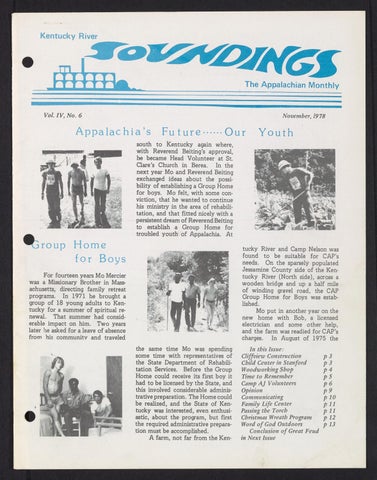
Kentucky River
Vol. IV, No. 6
November, 1978
A p p a l a c h i a ’s
F u t u r e ...... O u r
Youth
south to Kentucky again where, with Reverend Beiting's approval, he became Head Volunteer at St. Clare's Church in Berea. In the next year Mo and Reverend Beiting exchanged ideas about the possi bility of establishing a Group Home for boys. Mo felt, with some con viction, that he wanted to continue his ministry in the area of rehabili tation, and that fitted nicely with a persistent dream of Reverend Beiting to establish a Group Home for troubled youth of Appalachia. At
r oup H o m e f o r Boys
tucky River and Camp Nelson was found to be suitable for CAP's needs. On the sparsely populated Jessamine County side of the Ken tucky River (North side), across a wooden bridge and up a half mile of winding gravel road, the CAP Group Home for Boys was estab lished. Mo put in another year on the new home with Bob, a licensed electrician and some other help, and the farm was readied for CAP's charges. In August of 1975 the
For fourteen years Mo Mercier was a Missionary Brother in Mass achusetts, directing family retreat programs. In 1971 he brought a group of 18 young adults to Ken tucky for a summer of spiritual re newal. That summer had consid erable impact on him. Two years later he asked for a leave of absence from his community and traveled the same time Mo was spending some time with representatives of the State Department of Rehabili tation Services. Before the Group Home could receive its first boy it had to be licensed by the State, and this involved considerable adminis trative preparation. The Home could be realized, and the State of Ken tucky was interested, even enthusi astic, about the program, but first the required administrative prepara tion must be accomplished. A farm, not far from the Ken-
In this Issue: Cliffview Construction p3 Child Center in Stanford p3 Woodworking Shop p4 Time to Remember p5 Camp AJ Volunteers p6 Opinion p9 Communicating p 10 Family Life Center p 11 Passing the Torch p 11 Christmas Wreath Program p 12 Word o f God Outdoors p 13 Conclusion o f Great Feud in Next Issue
first boy arrived at the CAP Group Home. The capacity of eight for the Home's objective population was soon reached. “We developed our program slowly," Mo Mercier says. “In out first year we got eight boys from the state camps, and that was a very difficult year for us. Those eight boys were almost all the same type of characters, same type of back grounds. Ideally, in a Group Home the concept is to get a well-bal anced peer group. You should have some with intellectual capacity,some aggressive ones, those who have leadership otential, and other types. It is really important to -have a mixture, a composite group, so that each one gives and each one takes from the group experience." “You've got to really provide a lot of stimulus for the boys, and peer-pressure does that,” he con tinued. Peer-pressure is often what gets youth into trouble, and is most effective, when positively managed, in getting them out. Mo explained that for most o f these/boys the stimulus in their liv^s had been passive or negative in/nature; drugs, alcohol, theft, etc.,/personally as well as by example from elders. “Now the stimulus has to be a very positive type thing, and that's a whole different ball game. So our first year definitely turned out to be a difficult time, though it was a tremendous experience. But we were low on staff, working ninety hours a week minimum. It was a definite drain on us." Mo is married now. He and Stephanie, his wife of three years, have lived at the home since it
2
opened. They have a 2-year old son, Todd. Mo says the average working stay of a family at a Group Home is six months. He feels that the Home life puts a lot of pressure on a marriage, but a mother-father-child nuclear family image is important for the boys. Stephanie is a Regis tered Nurse presently working part time at Project Concern, but spends most of her time at the Home with her own family and with the boys. Both Mo and Stephanie feel this is important. To be a “home" in the complete sense of the term, the positive sense necessary for what must be accomplished there, it needs a mother as well as a father. “The basic program we offer the boys is a one-year stay," Mo explains. “A boy comes to us and his papers are sent to us for a refer ence. We look over his back ground sheet and have an interview with him, then decide whether to take him on a one-week trial basis. During that trial period, the staff and the boy decide if he is going to fit in. It gives the boy time to take a look at our program, feel it out, and talk to the other boys. I believe very strongly tnat they must hear it not only from a staff person, but also from the other boys. The boys sell the program. They are the program, they make the program, and they are much more credible to a newcomer than any staff member.” During that initial week there is a heavy concentration on goals. Why does he want to stay at the CAP Home? What other things in his life does he want to change? How does he want to accomplish those changes? At the end of the week Mo holds a group session, and the attitudes of both the boy and staff are explained. A decision is made on whether he stays or leaves at that time. If the boy is not accepted he is returned to a state camp. It really behooves the boy to make an attempt to stay at the CAP Home, but a personal decision by himself, an initial commitment, is necessary. After he is accepted, he stays in the Home for six months. They process him through a number of
interviews. First, they start a re habilitation program. He receives a physical examination in Nicholasville, and arrangements are made with the State to provide funds for job training and education. He gets an appointment for aptitude testing, and his scores are sent to Central Vocational in Lexington for analysis. Finally, a staff person and the boy have an interview with Central to see about traininq for a future skill. “The first month is very ther apeutic in a lot of ways," Mo goes on. “Every week something )ino^^ on that is leading him to very c o n ^ ^ Crete, new life situations. After his Continued on p 8
THE MONTHLY MAGAZINE OF THE CHRISTIAN APPALACHIAN PR O JEC T Editor - Jack Little Production - Alton Bradley Typesetting - Jean Brown
K entucky River S o undings is published monthly by the Christian Appalachian Project Kentucky River Soundings Lancaster, Kentucky 40446 Manuscripts, photographs and art work limited to Appalachian i them es are invited. * Copyright 1978, The Christian Appalachian Project, All Rights Reserved.
CONSTRUCTION GOES ON AT CLIFFVIEW
K ¥
v f l n
I
Cliffview Lodge occupies a spe cial position in the history of the Christian Appalachian Project. It is the first of all our undertakings, started more than 20 years ago. At that time the facilities were design ed to care for children during the summer camping period. When construction was begun, no pro visions were made for the building to be used during the winter season. Over the course of the past several years, demands for more and more facilities to carry on programs that are not merely seasonal in nature have increased greatly. As a conse quence, we have felt compelled to enlarge our facilities at Cliffview and to winterize buildings so that year-round programs could be con ducted. A special crew has been work ing very hard on enlarging our
meeting hall, adding additional sleep ing quarters and improving kitchen facilities. We are in hopes that all of these programs will be completed before the severe weather begins in the latter part of November. Al ready every weekend is scheduled by groups all the way through the first of the year. A special feeling of satisfaction is ours when we see that our oldest facility has been able to change with the needs over the years, and is even more in de mand now than it was at its be ginning. WORK PROCEEDS IN STANFORD At the present time three proj ects are underway in Stanford, the county seat of Lincoln County, which is located 10 miles south of Lancaster on U.S. Highway 27. The first project is the erection of a new "Attic" or clothing store where practical attire donated by CAP supporters is sold for a nominal sum to the more needy people of an area. (We have found that to just give such clothing away defeats our “self help" philosophy, in that peo ple then treat the item as a charity expendable. When charged for it, however small a charge, they attach much more value to it and our pro gram is that much more effective.) CAP has not had an outlet of this
nature in Lincoln County until now. Lincoln County is very large geo graphically, and the needs are pro found. We hope that a new “Attic" will offer an answer to the more needy peoples’ clothing problems there. A second on-going construction project is a small school building. It will have three classrooms, each especially designed for teaching of the handicapped. The new facility will make it possible for us to accomodate as many as 25 children. Also, it will become the headquar ters of our special program for hand icapped children that will be man aged by Marilyn Stefanski, presently finishing her Master’s Degree in this speciality. This will be an Outreach Program to work with parents who have handicapped children. Such work will be done primarily in the homes of the individual children, and will provide an opportunity for them and their parents that would otherwise be entirely out of the question economically. A third project is the expansion of one of the older buildings in Stanford to accommodate a greater number of children in the Child Development field. When this con-struction is completed, we will be able to accommodate as many as 30 children. At the present time our facilities will only care for 12. Due to many unforeseen delays that have troubled the contractor, not un common in construction, we are not sure when it will be finished but are hoping it will be ready by the first of the year.
3
MOUNT VERNON WOODWORKING SHOP: HELPING PEOPLE HELP THEMSELVES
Given: One old chicken barn, a collection of used and restorable woodworking machinery, three craftsmen looking for independence, and the Christian Appalachian Proj ect. Result: A new business and rewarding livlihood. Mount Vernon's new Mehler and Blunt Co. is based first on skilled woodworking and design compe tence - both intrinsically rewarding and tangibly valuable. With CAP's generous assistance, this seed is rapidly growing toward a viable enterprise. Any business venture is full of surprises, but few come close to The company is now working, those that have been met by the with orders for two months ahead Mehler and Blunt Co. We are wood and original designs on the drawing working craftsmen, but we've also board. We will offer a cane-bottom had to become electricians,designers, ed side chair in solid cherry, a plumbers, carpenters, machinery me slender Shaker-inspired trestle table, chanics, marketing analysts,account and a writing table. There will also ants and janitors as well. We be a walnut and maple carving scouted three states to find good board for table-top use first among deals on heavy woodworking ma accessories offered. We will be chinery, and we reconditioned an adding bookcases, chests of drawers tique machines that were already and other furniture to the selection, available to us. With experience in and will continue custom orders for restoring furniture, it was an edu solid hardwoodfurniture. Our Grand cation to see how we could do the Opening will be scheduled for next same for old machinery. Spring. We've also been surprised by Three partners are in the shop: the solid rock shelf on which our Kelly Mehler and Peter Blunt, ex building sits, and through which perienced furniture - makers, and we've installed water lines and drain Michael McFarland, a former CAP fields. We have a hamsized rock on volunteer who is now a marketing our roof now, thrown there by the specialist. Michael has been working blasting. fpr M.A.T.C.H., Inc. (.Marketing Appalachia Through the Church), and as a consultant for the Volunteer Development Corps he went to Fiji to help a local woodcarving co op with marketing problems. He studied woodworking at John C. Campbell Folk School and has a Berea College degree in crafts design and production. The shop will accomodate up to six workers, and the company has plans to hire a chairmaker first. Training will be provided. The company also will train four or five in the community as cane seat weavers, and offer part-time work 4
at home for them as independerá craftsmen. We will offer them work seating our own chairs and also referrals of customers for recaning old chairs. The company may also have occasional upholstery work available. The shop will operate on a metric system of measures. There is no better time to begin metrics than at start-up, and we have already found it to be more precise, errorfree and even quicker to use than our familiar inches and fractions. We will, of course, give our customers the common equivalents. Our tables, for example, will be 78 centimeters tall, or roughly 30 and % inches. 29 to 31 inches is the standard table height in the old system, and its 75 to 80 cm. in the new. Inquiries are invited and a brochure will be available soon. Direct inquiries to Kelly Mehler, Pres., MEHLER AND BLUNT CO.,A Route 4, Box 299, Mount Vemonf^^; Kentucky 40456. All letters will receive prompt attention.
talent, however, and the one he will now be utilized in, is education. He has a Master’s Degree from Georgia State University in Early Childhood Training, and is very well qualified to serve CAP in this capac ity. We are particularly pleased to have him join our staff in the pre school Programs. The school at Stanford is but one year old and we look for considerable development there in the immediate future. Mike lives in Lancaster and we look for ward to many years of fruitful ser vice with him in this special field.
CHRISTMAS BASKETS Christmas basket preparation is in full swing for Garrard, Rockcastle, and Lincoln Counties. Our thanks go out to subscribers that have voiced an interest in sponsoring a family for toys for Christmas. If anyone else would be interested in providing food for an Appalachian family that is in need for Christmas, more information may be obtained by writing: Peggy Gabriel 224 Lexington St. Lancaster, Ky. 40444 We hope you can appreciate this need for food, especially at Christmas time in Appalachia. If you know o f any school or organ ization that would be interested in sponsoring a canned food drive for our Christmas baskets, please let us know by writing to the same address. (Please wirte first, because we can save you a lot in shipping costs by using certain transportation outfits.) The cost for sponsoring an individual family is $15.00, if anyone would care to make a donation for an individual family on that basis. We most especially ask for your prayers and good wishes for the success o f the Christmas Basket Project, and thank you for same. CONGRATULATIONS TO THE NEW POPE During the course of its exis tence CAP has been aided and assisted by men o f good will from every religion. A special area of contribution has come from that group known as the Catholic Church. We would like to take this oppor tunity to extend to all o f them our most sincere congratulations over the election of the new Pope, John Paul II From the various reports that have come out, almost all the Chris tian World has taken a special in terest in this election. Everyone seems to be genuinely enthused over the selection made. We, in Appa lachia, share a special reason for re joicing. Appalachians are often a
minority people, overlooked and bypassed by the mainstream of American life. Frequently, our people have a very difficult time surviving economically in the af fluent society that the America around us has become. From all that we have seen and read, the Pope has come from one of the countries of the world that has also been bypass ed and overlooked. Poland, for the last several hundred years, has been the victim of Russia, Germany, Prussia, Austria, or other of its more powerful neighbors. Yet, they have preserved a spirit of faith that enables them to continue as apeople, and to achieve a degree of happiness not found by their more aggressive neighbors. We can join with men of goodwill in all religions to pray that this new religious leader for the Ca tholic world may stand as a voice for freedom for all persecuted and neglected peoples, and that he may stand as a witness to the vitality of religion in a materialistic world. We hope that his example will make it possible for all religions to develop and to become more firmly com mitted to the things o f God, rather than to worldly things alone. MIKE MORRISSEY JOINS CAP FULLTIME The new director for the Child Development Center in Stanford is Michael Morrissey. Mike has worked for CAP in various capacities over the course of the last year and a half in the Christmas Wreath Pro gram, in our mailing and inserting shops, and also assisted in various construction efforts. His major
A TIME TO REMEMBER A CHILD IN A CAGE By Rev. Ralph Beiting As I was going through more of my file of pictures, I recognized a group of volunteers who had come to us from up in the Eastern part of the United States. From New York, New Jersey, Pennsylvania, Massachusetts, Connecticut, etc. They had come to help us in an Easter program. We were clearing land and were trying to establish pastures and better income for the people of the area. In addition to this, we were visiting many of the poor. One of the places we visited was a little shack along a creek. I took the volunteers there because the people were poor and I had hoped that by meeting some outsid ers, they would begin to realize that people could care for one another and that this could make a dif ference in their lives. I had met the people in the shack in December of the year 5
before. One of the permanent vol unteers of our staff, and myself, were checking on people that we wished to help at Christmas time with food, clothing, and toys. We had parked our car and walked down this road, because the weather was bad, and the road was pooh We crossed a little creek and came up to this house and knocked on the door, and told the husband who we were. He asked us to come in.. We sat in the gloom of the cabin as there was no light in it except a small glow coming from an open fireplace. We met his wife and talked for a little while. She mentioned some thing about her baby. I asked if I might see it. So they took-us over to a little place in the comer o f the room, and there in a cage was the little child, no more than two months old. Finally, my curiosity and con cern got the better of me and I asked them why did they have the child in this little cage. It was made out o f chicken wire/¿tightly woven chicken wire. The answer that came back was orie/ that star tled me and I don't think I'll ever be likely to forget. He skid, “We have to have him in this ¡little cage, so that the rats won’t eat on him. ” I guess most people wouldn’t believe this story, and they don’t think that such a thing could be true in the America that we know. But in a little shed along a creek in Appa lachian country, that was true. I haven’t seen the family for the last several years. The little baby was about eight years old, the last I saw him. But I can’t help but think that things like this have cer tainly stirred me from whatever apathy that I might be tempted to fall into. It urges you to do those things that are important and necessary for others. It certainly has a way of reminding you that you don’t have as many problems as you thought you had. Yes, some time it does pay you to take the time to remember!
6
THE PEOPLE WHO MAKE CAMP ANDREW JACKSON WORK, YEAR AFTER YEAR Reverend Beiting I visited our camp at Andrew Jackson the other day. I could hardly believe the difference just a couple of weeks could make. The time before there were children and counselors everywhere. The excite ment of new friends, the satisfaction of learning something new permeat ed everything. Now there was just the quiet stillness that comes to the mountains at the close of day. As I sat quietly and looked over the lake, I could not help but remember what had happened there. It was our biggest and, as far as we can evaluate, the best camp we ever conducted. One week alone sixty-nine children were there. The one vision that comes to me most clearly, however, was that of the staff. Many of them were back for their second and third years at the camp. Long hours, patient endur ance and great love characterized them all. Because of them children of many areas and vastly different backgrounds came to be genuine friends. The color of their skin, religious group to which they be longed, or county they lived in were treated so that this difference only served to make each one appreciate the other that much more. I thought to myself, even if I had all the money in the world I could not hire a staff of specialists to accomplish that. But when you have people who love God and each other, then all things can be trans lated into good. I couldn’t help but recall the volunteers of seasons past who gave of themselves to bring all this about. They cut trees and cleared land. They hauled lumber and built cabins, painted walls, spread gravel and cut weeds. Many of them never saw the fruits of their labors or heard the joy of a child at camp. But because of them, it all came to be.
I couldn’t help but think, also, of that splendid array of people who by their generosity keep Camp Andrew Jackson going strong. I wonder where we would be without their faith and confidence. As I took my leave, I knew that Camp Andrew Jackson was infinitely more than a place. It was people, their spirit, their faith and their determination that the next genera tion of Americans will be the best we ever had.
Sister Carol K opff is a Dominican Sister of Sparkill, N.Y. She is originally from St. Louis, and teaches math and science to Jr High stu dents in Monroe City, Missouri. Sister Carol taught Bible School at camp and seconded as a nurse whenever needed. She has been at Camp AJ for 5 years in a row, and is a great hiker and canoe enthusiast.
Sister Ancilla Maloney, IHM, is from N.Y. and teaches religion and social studies in Williamsport, Pennsyl vania. She taught Bible School and* assisted in Arts and Crafts.
Sister Ancilla has been at camp 3 years, but couldn't come this past summer because of Chapter require ments.
Amalia Julian graduated from Regis College in Massachusetts this past June in Elementary Education and was counselor for older girls this summer. She has been with us at Camp AJ for 2 years, and is now working for her dad and looking for a job in elementary education in Beverly, MA.
Catholic Theological Union in Chi cago and has been a lifeguard at AJ for 4 years. He will become a decon in Juneof 1979 and will be ordained in June of 1980. Rick hails from Dayton, OH.
Trish Dandrow also graduated from Regis this past June in Social Work, and has been both a lifeguard and counselor. She has been with us for 2 years at Camp AJ, and as a volunteer in Texas is currently as sistant director of a Hostel for alcoholic women. Trish is originally from Milton, MA.
Tony Scalafani lives inBayville, N. Y. and teaches biology at St. Dominies High School in Oyster Bay. He has been at camp 3 years, and serves primarily as counselor for middle boys.
■KY
Mark Heuser is a junior in college and has been a lifeguard at the camp for 2 years. He hails from Orlando, Florida and is a youth minister for his church there.
Tom Grainger is a sophomore at St. Pius X Seminary. He was our counsellor for younger boys and, during girls camp, was in charge of hiking and canoeing. Tom lives in Bellevue, KY.
8
Rich and Peggy Yaeger, Mr. and Mrs., have been our married team at Camp for the past two years. Rich teaches and coaches at St. Camillus Academy in Corbin. He has been our older boys counselor and is orginally from St. Louis. Peggy teaches part time at St. Camillus, has been at camp for 3 years and is a fabulous Arts and Crafts person. Peg is originally from Maine.
m
;
M ij| IP \
Rick Nieberding
is a senior at
Donna Betzig graduated with a degree in Elementary Education in June of 1978 and was our girls' counselor, middle group, this past 7
summer. She is originally from Larchmont, N.Y. and is now a volunteer working at St. Charles Mission in Montana, teaching native Americans.
Ellen Burke, the head of CAP’s Child Development Center in Berea has been director of Camp Andrew Jackson for the past several years. It is up to her to draw these diverse people together into the “team" necessary for AJ’s success. She has done a truly admirable job o f it. Ellen will refuse any credit for this, saying it is all up to wonderful people like those described above. But someone must put it all together each summer, Ellen, and we think we know who does.
GROUP HOME (Cont'd) interview we get him clothes, or money to buy them if he has none. He works with the other/boys daily, builds relationships, andlwe are able to identify his problems. He begins to develop a life as a member of the group*” As he develops this “group life,” the positive reorientation be gins taking place. He is earning membership, status, and a role in a group that knows where it's going and is taking its members along with it. And this group is taking its mem bers in a much better, more positive direction than the one he was pre viously headed on. “By the time the boy is here six to seven weeks,” Mo says, “we have a finalized contract o f his goals for the year. We even go so far as to have him sign this contract. It's a contract between the boy and all the staff people, and is cosigned by all of them. It includes goals from furthering his academic work to
8
things like getting a driver's license. It is viewed by all parties concerned as a real, solid, binding contract for future behavior and goals.” Once he makes this commit ment, the boy is at the home for a year with, as Mo puts it, “no ifs, ands or buts about it.” One-on-one counselling sessions are held regular ly, and for any special situations that might arise. Also, a group session is held at least once a week which normally lasts three to four hours. “Our central concept for these ses sions, and perhaps our whole phi losophy, is that within each person there is an adult, a child, and a parent. The objective is to bring these three into proper personal perspective if one is to live a healthy, happy life. We also hire a psychol ogist to attend these sessions so that we have an outsider, who is also highly qualified, to keep us from getting off base,” Mo says with' emphasis. “This applies to the staff as well as the boys. It is necessary because we can get so tightly in volved with the boys that we might get off track in counselling and in the group sessions. Having this outsider there prevents that. The boys pay five dollars each for these consultant visits, which is a way of letting them pay for their own help, then the Home pays for the rest. We also have an on-going educational program for the staff, with a pro fessor from the University of Ken tucky who comes twice a month for three-hour sessions with us.” For their work on the farm, from laying tobacco beds to cutting, hanging, and stripping it, the boys are paid a wage comparable to that paid other farm labor in the area. From this they contribute to a common fund which is used for gifts for the boys, usually birthday presents, and for helping other peo ple in the area. For example, last winter some of the common fund was used to buy firewood for an elderly couple who needed it to heat their home. They also pay for their own vacations and other per sonal needs. This way they develop a sense of social, as well as person al, responsibility. “We emphasize individual res
ponsibility in all of this, with thé group pressure being the subtle stimulus,” Mo goes on. “They pay their own rent, buy their own clothes, and we don't get them u]Ap in the morning. It is up to them to arise on their own, make their beds, fix their breakfast and get off to school or work on time. When they return home in the afternoon they have chores to do, then they have supper, and every evening they have three hours of classes. Two hours are for their academics, and one hour is for personal projects. These projects may be writing letters, working on something like a radio or stereo, or listening to guest speakers we have in from time to time. So they carry a pretty heavy There have been about 55 boys who have been through the program in the last three years. Of these 55, only three have ended up back in state custody, f'By that, ” Mo says, “I mean those who stayed with it and went all the way with us. Some who come and last only a month or so, just trying it out and then leaving, I do not count. ” ^ A great deal of this su ccesi® could be attributed to the “post program,” where the boys move out into the community with a job and more freedom of responsibility. The Home continues to stay in touch with them, they can return and eat the supper meal at the home if they want, and maintain other kinds of contacts. But the emphasis now is on a new contract of more individual achievement with less direct support from the Group Home. Mo admits that he gets quite emotional when he receives a phone call or visit from a graduate, but also feels great satisfaction on seeing one of the boys “make it ” in life on his own. “I really feel,” he says, “that they realize we took their lives very seriously, and that the experience they had here is truly lasting. They’ll never forget it, no matter what.” And, we might add, Mo and Step hanie Mecier will never forget any one of those boys, ever, either, no matter what.
Appalachia Today
Opinion S Father Ralph Beiting
JACK MORRIS Another full-time employee of CAP came on board the 1st of Sep tember but we failed to mention him in that issue. Jack Morris, who will head our entire Human Development Program, comes originally from Jop lin, Missouri. He graduated from Central Missouri State College in 1960 with a B.S. in Social Science and Secondary School Teaching Cer tificate. He also attended William Jewel College taking courses in Biblical Studies and Language in ( 0 preparation for Seminary, and grad uated in 1966 from Lexington The ological Seminary with a B.D. De gree. Jack has been attending Summer Sessions at the University of Kentucky working toward a Master's in Education. He is an Ordained Minister of the Christian Church (Disciples of Christ), and is married with two children. Jack will be supervising and coordinating all “Attic" operations, Foster Homes, Day Care Centers, Emergency Shelters, and the Family Life Program. His experience as well as academic preparation make him well suited for these respon sibilities. He has worked in early childhood education, juvenile de linquency, counseling, camping trips for youth, community development, employment guidance, housing and clothing aid, and a list of other, related, endeavors. He has already made himself felt around CAP as a “mover." We're sure you'll hear more about, and perhaps from, Jack Morris.
Not too long ago I attended a convention in which some members sought to recognize and honor one who had been a part of that assem bly for 20 years. There was a great reluctance to accept the state ment of recognition and to apply praise to the individual. Out of it alT came a certain sense of bitterness as one pointed out this flaw in his character, another this lack of ac complishment, and still another ques tioning whether he really had the proper qualifications to serve in that capacity. I must confess I came away from this meeting much sad dened, and yet, I think this ex perience is not unique or special. It is something that we see going on about us almost every day. We, as a people, are so reluc tant to extend congratulations and sentiments of praise to our fellow human beings. At times when an evaluation needs to be made for a fellow worker of ours, we are very quick to point out every short coming, every lack of accomplish ment, every flaw that he has. This, of course^ is true not merely of our fellow workers, but of our neighbors. If someone came down the street asking each person what they thought of the people who lived on that street or in that area, I'm afraid the negative reports would far outweigh the positive ones. Even within the realm of our families we see this spirit of rivalry. We can tell you that this brother or sister is not as good as he or she should be, that this uncle is a real problem or that this aunt is a gossip. Some times we even hear them discussing their marriage partner, bringing forth irioi shortcomings. I ask myself
in moments of silent reflection: “Why is it that all of us are so prone to find the weak spots, to point out the defects, to rejoice in the shortcomings of those with whom we work and live?" I suppose we may give the excuse that justice demands it and that, if we're going to be fair, we’re going to have to point out all these things. “Integrity" is a word that is frequently used to rationalize such statements. No one in his right mind could expect a blatant evil to go unchallenged or a criminal deed to be left uncovered. This is not the point. The point is that we make judgements concerning the value of this individual, of his life, of his work and even of his motives. It seems that too often this spirit of criticism comes not from the justice, integrity and fairness that we so frequently bring to the fore, but it comes from our own inadequacy. Each of us has a hunger to be known, to be respected and to be applauded, and when attention is not placed on oneself, but on someone else in some mysterious fashion, we think that we shall become greater if we can only make others smaller. I think, too, that we as a people are too prone to act on partial infor mation or misinformation. We take a scrap of input and project it to make a whole, even though the information we have is not valid and, therefore, the conclustions that we reach will be often times very wrong. I think, also, there is at times on the part of all of us an unreasonable desire for perfection in others so that we expect someone else to be absolutely the best, to have no estige of human fraility 9
about them whatsoever. We want them to be unlimited in their wis dom, to be tireless in their zeal, and absolutely perfect in all their achievements. Such will never come about this side o f heaven!! The purpose of this editorial is to encourage on the part of all readers a spirit of charity and fair ness. I think that there is much in our heritage to encourage us to act in this way. As citizens of a great country we have as one of our fundamental truths that each man is innocent until he is proven guilty. It is the American way, and yet how often do we act in an unAmerican spirit? We often assume the worst of everyone, and he has to prove with great difficulty that he is not guilty of it. Our common Christian heritage, as well as our Jewish heri tage, tells us: “Judge not, that you may not be judged. Judgement be longs to the Lord. He alone will bring about retribution. ” “Love one another,” we are told, “even as God has loved you.” These guide lines somehow get lost or are over looked. Perhaps the best way of restoring what should be an era of kindness, friendship and genuine re spect is to take the positive sug gestion given us/ by Jesus Christ himself. He said/to us when He was giving that magnificent discourse on the mountain ovèrlooking the sea of Galilee: “Blessed are the peace makers, for they shall see God.” I think it is incumbent upon each o f us to act in the role o f peacemaker. Perhaps the easiest way to be gin this role of peacemaker is simply to praise our fellow citizens everytime we see him achieve some goal. We need to let him know that his triumph in this particular matter, his success, has blessed us all and that because we are united with him in common kinship we all have basked a little in his success. A word of praise, a word of commen dation, a word given for successes achieved by another will go a long way toward establishing a spirit of genuine love in this land. I think it is impérative that we speak slowly, that we do not give quick utterances to our words. Judgements are quick to come out at times, and
10
awfully hard to take back. We need to speak slowly for our information may be poor, may be only half-true and may only be half-adequate. Only in the fullness o f knowledge should we speak. Finally, I believe that there is a role that each of us needs to play more than ever, and that is to be a “reconciler.” To not always feel compelled to take one side as op posed to another, but to recognize that there is good in each opposing opinion. To see that there is good will and integrity in the hearts of all people, and that we, by means of our intercession,may indeed allow each opposing camp to see the good that is in the other and to come to a common goal that will result in the betterment of all. This requires a person who has complete con fidence in self, who doesn’t need to be recognized for his own thing, but who takes greatest satisfaction in seeing the rest of mankind living in peace and dignity with one another. I would sincerely hope that each of us might take the words uttered by Jesus that sunny day in Galilee nearly 2000 years ago very much to heart: “Blessed are the peacemakers, for they shall see God.”
poor regions of Eastern Kentucky go through life able to communicate only with a few people who under stand their own made-up signs. Of all the deaf people that I have met, though, at least one of their forms of communication is universally per-
1
fect-the clear expression of a smile. To describe this form of com munication simply as a smile is unfair. A better description might be a glow-an expression that comes from the heart and communicates a warmth that is difficult to capture in any other way. Without em
“COMMUNICATING” One of the most interesting aspects of working for CAP is the op portunity one has of meeting many different types of people from vary ing backgrounds and experience. When you ’re meeting people, and sharing experiences and dreams, verbal communication is something that is as natural as air and water something to expected, not appre ciated. But what happens when verbal communication is not possible as is true when one meets a deaf person? Those of us working in the CAP- program with the deaf have learned that a lot of good and exciting things happen. Deaf people communicate in dif ferent ways. Some use standard sign language or fingerspelling, some write, and some deaf people in the
ploying one word a deaf child's smüe can say many things from, “Hello, it's good to see you !” to “I really like you ” to “I'll see you soon.” At least one thing about this form of communication is unquestionably clear. In communicating with deaf people, one realizes how unimpor tant the spoken word is in relating the message of friendship, caring and love. Ric O’Connel
DANIEL BOONE We wish to express our appre ciation to the readers o f Soundings" Jvho have ordered Father Beiting’s two books on Daniel Boone: Soldier o f the Revolution, and Adventures o f Daniel Boone. The special offer of $4.50 for both books is made once again. If both books are order ed at the same time, "Soundings” will assume the cost of postage and shipping. Simply write to Soundings. These books would make excellent Christmas gifts for almost any mem ber of the family. All proceeds after cost of production and publication will be donated to charity. FAMILY LIFE CENTER Dear Mr. and Mrs. Reader, My name is Len. I am the Director of the Christian Appala chian Project's new Family Life Center located on a 100 acre tract of land in beautiful Renfro Valley (of national "Country Jamboree" ^ame) on U.S. Highway 25 just north | l f Mt. Vernon, Kentucky. Two functional buildings are being de signed for erection to be completed early in 1979. But you don't have to wait for the building to be finish ed before you visit us. Here's why. CAP has just taken over a mod em 16 unit motel near the Center site to be used specifically for Marriage Enrichment type programs. In fact, we are remodelling this motel now so that it will better serve this purpose. The facility is the former Scenic View Motel just north of Renfro Valley. It is very accessible from Lexington and the surrounding area and is located just 1 mile north of the Mt. Vernon/ Renfro Valley Exit off Interstate 1-75. I invite you to feel welcome to use our facility. The purpose of our Family Life Center is to enhance family life in all of its dimensions. The Center will eventually be both | training place to form leaders in the family life movement and a counseling and treatment facility. Our new motel is a gift from
I
God, since l am convinced that the Family Life Center can make no better beginning than with the Mar riage Enrichment programs. I would hope that you might be part of this exciting new venture. I invite you to contact me at CAP headquarters for further in formation. I will keep you posted on the latest developments. Sincerely yours, Len Spanjers Director Family Life Center THE PASSING OF THE TORCH Each year as August turns into September we experience the sadness of departure as well as the exhiliration of new beginnings. Volun teers with a year or more service make their departure as September begins, and our new volunteers come upon the scene at that time. The sadness of departure is tempered by our joy over the new people who come. This year has been no exception. For more than two years , Mary Ann Crea of Philadelphia has assisted us in the work of caring for the poor. Her primary concern was that of our "Attic" stores, and the distribution of clothing to those who were in need. In this capacity she gave herself unceasingly to the demands of this important work. Due mainly to her initiative, a new program of acquiring the necessary food, clothing and toys for the Christmas Baskets came about. She wrote to each one of the people
who had contributed rummage, not merely thanking them for their kindness, but acquainted them with our Christmas Basket Program, asking if they would become involved. Be cause of this concern, more than 250 families have been enlisted in gather ing the food, clothing and toys for our program. Mary Ann presently is going to school in North Carolina. She is pursuing a course of studies that will equip her to be a para legal professional. In the mean timé, she is working to support herself and to pay tuition necessary in pursuit of the degree. Elizabeth Burroughs spent near ly two years assisting in our program of Child Development. Berea was her area of involvement. She lived at our center in Mount Vernon and traveled each day to Berea where she not only helped with teaching the children, but also with their transportation. At the present time she is back at her home in Indiana polis, Indiana where she is working. She plans in the new semester of the coming year to go to graduate school and pursue her training in Child Development. In addition to these two volun teers, we lost the involvement of our married couple. T.J and Kathy Marcisz returned after a year’s work to their home in Lafayette, Indiana. Kathy, a registered nurse, is return ing to nursing and T.J. is resuming his duties as a pharmacist. They were the first teachers in our new Child Development Center in Stan ford, and their contribution in this area has been significant. They went beyond mere professionalism and added a warmth and a care that will be difficult, if not impossible, to recapture. They will be missed not merely for their contributions to the work, but for the presence and value of them as individuals. We wish them well and ask God’s blessing upon them in all things. Two other volunteers have stepped out of the service o f volun teer work, but are still with us in our programs to assist the people of the area. Marilyn Stefanski was the leader of our Child Development Center in Lancaster. She has re turned to the University of Kentucky 11
where she is pursuing graduate stud ies in the field of Early Childhood Education for the Handicapped. She plans to complete her studies and receive her Master's Degree in De cember. Once this has been pompleted, she will be heading up a special program for CAP that will work with parents of the handicapped in their home. We feel very strongly that the home is the primary source o f education for the child, and espe cially a child who frequently would not be able to participate in normal school life. Kathleen Ford has followed Marilyn as leader for our Child Development Center in Lancaster. Kathleen has spent nearly two years as a volunteer, and has now de cided to remain in Lancaster for an extended period of time. She has taken her own apartment and is presently an employee o f CAP in Child Development. We are espe cially delighted to volunteers Stay in the area after their period of volunteer service is completed, and to continue their work with pro grams that are/so vital to the well being of the area. Not all/is sadness and sorrow over losing old friends. There is also the joy o f acquiring new ones. This September we were particularly for tunate in acquiring three very special young women. Sue Daniels has come to us from Shawano, Wisconsin. She is a graduate of St. Joseph's School of Nursing at Marshfield, Wiscon sin. Her major task at present is to be a jack of all trades. She substitutes for many of the.volun teers in the fields of Child Develop ment, work in the “Attic," etc. But her major concerns are the on going programs that require home visiting. Each day she's on the road in some different direction learning the needs of people, assisting in whatever fashion seems wise. Part of the real purpose of home visiting is not only to respond to existing needs, but to discover if there are probable future needs as well, which Sue is very much aware of. Nancy Whittmann comes to us from St. Louis, Missouri. She is a graduate of Benedictine College,
12
Atchison, Arkansas. Nancy spends the majority of her time working in the “Attic" at Lancaster. This work is one of our more special pro grams, for it involves far more than simply making clothing available and distributing it. It is a place wnere we make friends, where we meet so many people who have all sorts of needs. We respond to them first of all by making friends, and secondly by participating with them in their work to take a step forward. Nancy is well suited by personality for this kind of activity. Wanda Brannon comes to us from Birmingham, Alabama. Wanda is involved with our Child Develop ment Center in Stanford. She is entrusted with the care of the children there and also with expan sion of the center. This is one of
our more important projects cur rently, and Wanda was selected carefully for this assignment. We expect some really big things from this effort, and Wanda can be expec^j ed to really help in producing t h e r f f The duties of these new volun teers are not, of course, limited to the programs described above. They participate in so many things that are necessary and vital to keeping CAP the exciting enterprise that it is. We look forward to much good from these new volunteers. There is a constantly pressing need for additional volunteers, and if anyone has the inclination to be o f value to their fellow human beings through a volunteer program in Appalachia, we would strongly encourage them to write to CAP in care o f the “Soundings. ”
CHRISTMAS WREATH PROGRAM CONTINUES TO “GROW" We want to thank the many people who have given time and effort to expand our sales of the Christmas Wreaths made in Jackson County. This is, as many of you know, one of the poorer counties in our area because it lacks any real economic base such as industry or mining. This CAP program provides work and income for up wards o f 100 people during No vember and December, making beau tiful, 24-inch, natural and native pine wreaths. We depend on you, our readers, for most o f the dis tribution effort, and greatly appre ciate your past help and look for ward to more support this year. With the anticipated continuing expansion of the sales program, we found that we had a shortage of select pme boughs developing. Se lected boughs are absolutely nec essary to produce the quality wreaths these mountain people insist on. We have a plan in operation to alleviate this shortage in the future. CAP acquired a 300 acre mountain farm near our production site that has about 27,000 pine trees with from 1 to 5 years of growth. We intend to plant an additional 10,000 trees a year for the next 5 years, which will provide additional employment in this depressed area and insure a
supply of boughs well into the future. Besides the added jobs for people of the area, and a sufficient supply of pine boughs* this program will be renewing the mountain forest^ with all their beauty. We are q u i A proud of it, and you should all share in that pride for, without your tremendous support, such ventures would not be possible for CAP to carry out. We earnestly invite the support of anyone interested in joining this effort to distribute wreaths. They are truly beautiful creations, and say a great deal about the beauty of Christ’s birth which we celebrate at Christmas time. The employment they provide for people in Jackson County, coming just before Christ mas, also enables many families there to have a more enjoyable holiday than they might otherwise be able to afford. We find that group efforts by high schools, elementary schools, Optimist Clubs, and other organ izations are highly effective, but we certainly welcome individual support, too. It is truly a way o f adding something special to the celebration o f Christ’s birth. The w reath^ themselves add a dignified b e a u f^ J to the occasion, and the jobs they provide our fellow people in Ap palachia is another, most beautiful
way of “giving” at Christmas time. Anyone interested in helping with distribution o f these wreaths is asked to write to “Soundings. ” You or your group could mean a great deal to the people o f our area, and to the kind o f Christmas they have this year.
of our car. It in turn powers micro phones and the sound goes out over the loud speakers. Normally, I am accompanied by anywhere from three to a half-dozen young men. We pull the car off on the roadside or in some parking area where at least a dozen homes can be reached. Here we set up our equipment. The horns are directed to all points. The amplifier is activated and a record is played; perhaps Tennessee Ernie
and a prayer the program. In the meantime, we have visited and left some religious literature or momento with them. After the preaching is over, I go and talk to those who have listen ed. It is not a terribly complicated process and yet is one in which I find so much satisfaction. During the course of July I was involved in this activity in Pike, Letcher, and
THE WORD OF GOD GOES OUTDOORS
Man has always had aparticular genius in designing the ways in which he worships his God. Sometimes it is done, in fear of enemies, in the simplicity of the forest or in underground caves. At other times it is in small chapels or simple country churches where he goes to offer worship to God. He has also erected great cathedrals and synagogues that grace the landscape of almost every country under heaven. Huge rallies are organized by evangelists everywhere, and small er numbers form prayer groups in their homes. In our Appalachian hills we too have tried in our limited way to honor God in a special form. We call that form Outdoor Preach ing, or “street preaching.” It's certainly nothing new that has been designed only by us, but no one has persevered in this type o f ministry longer than we have. For 28 years it has been my special privilege to stand out in open places and speak to those who would stop and listen to God's word. The mechanics of this are quite simple. We have an amplifier that is run off the battery
We also say that we hope they can take time to listen because we feel it will be not merely a time of enjoyment, but also a time of in spiration. I then introduce our singers, usually young men with guitars and perhaps banjos. They sing another religious song. This is followed by a period of ten to fif teen minutes of talking about God, then some more singing by the young men that accompany me. This once more is followed by another ten to fifteen minutes of
i Ford, or George B. Shay, or some other artist sings a religious song calling everyone’s attention to God. Within a matter of moments people come from everywhere to see what this is all about. By the time the song has been completed, I'm able to announce to them that we have a special program that will last from a half hour to forty-five minutes. tip of Kentucky. It was terribly hot. Some days the thermometer registered 100 degrees. To stand out in these open places with the sun beating directly upon you is not a pleasant task. To fix your own meals, to travel sometimes more than 100 miles a day, to begin at 7:00 in the morning and not get back to your trailer, which is now your “home,” until 11:00 at night 13
is a demanding schedule. It takes a great deal out of you as you pursue this day-after-day for the two week period of street preaching. And y e t there is about it something so pleasant, so special, that each year as summer draws near I find myself looking forward to the time when once again I can go out into the highways and byways. There by creek side, in front of post offices, filling stations, and general stores I will talk to the People of the Mountains about God.
always attracted me is just the simple act of praying. I think I am most impressed by the praying that we do at evening time. There is a quiet that comes over the earth at that time of day as we say the Lord’s Prayer or some other form, usually spontaneous in nature. The loud speakers blast out the words that bounce off the side of a mountain and roll down the valley. In the quiet of twilight as this sound goes forth from our lips, it is only a matter of seconds before the moun tains throw it back. It is almost as if God Himself had joined in. The atmosphere of praying in this setting is something that is hard to describe, and yet is something that you do not easily forget. To pray is a good
14
religion for some time.
thing. To pray and have God’s creation echo it back to you, I think, is a rather special thing. There is something about stand ing out there in the open places that exposes you to some ridicule. Some times young men come by and rev up their cars and make all sorts of noise to distract people. I’ve even had some of them come by after a rain when mud-puddles are every where and run through the water and spray you with muddy water.
At times they yell or call out and ridicule what you’re doing. Yet, the very fact that we continue to stand there in public places says that God is important in our world and that, without Him, nothing will work eut well. I am convinced that this is something that we all need. Saint Paul said it many centuries ago : “For Christ we are witnesses. ” This form of preaching out in the open is a special area of witness that has meant a great deal not only to myself, but I think to the people who have listened. I am always surprised to see the response of people. Almost without fail it is one of deep appreciation and grat itude that you ’ve come. For the old, it is frequently their first con tact with a physical minister of
They are
because of illness or infirmity, but now they can sit on porches or under shade in the side yard and listen to the word of God. They are so very grateful that you came. The young, for some strange rea-
som nated by the talks. You’ll see them sitting on bicycles, under a shade tree, or playing with their com panions in some dusty side yard, yet all the time you can see they are listening. You are well aware that they know you ’re there and that they are attentive. Afterwards, some of them come up and thank you for having come. Sometimes you ’ll find unusual circumstances. I remember this past summer we had just finished our first talk on the first day out.
listen. ” Others are enthusiastic that you need their land, that you use their side yard or driveway. All these things, offered out of kind S~ W ness, S S Sare U in order to have the word • of God preached nearby. We were along a creek in Pike County one afternoon. It was threatening rain, but we set up and began our talk. I had noticed that two rather elderly ladies had walked up the little path that ran beside the creek. They stood leaning on the fence, listening to what I had to say. Before long the rains came down and I endeavored for 5 minutes
It was near lunch time and, as we finished, a man came up and offered us lunch. He lived in the house
#
"F
■
■ ■ |
to the ladies and thanked them for coming. I learned that one lady had a telephone and she was the one who first heard the preaching. She called her friend and told her to come up because there was a preach er here and they ought to go and listen. I again expressed my appre ciation for their presence. I told them I was especially pleased because they had stood there during the rain. The older of the two ladies -
in front of which we were preaching. jHe asked if we would come in and eat lunch with him because it was noon hour and we must be hungry. We thanked him, but, because we had to make up time we had lost earlier we needed to go on. I told him we would have to wait until later in the afternoon. At still another stop, a gentleman came up and said: “All this must cost you a lot of money. You need cars, the sound system, and it takes the time and work of many people.” He said, ‘7 don’t have a lot o f money but I sure appreciated you coming. Here is five dollars and I hope it will enable you to go to still another place so some other people can
■y ■ . vr‘7A
§Hl ¿W&v ¡81
B H |
If you know someone who would like to receive the Soundings each month, have them complete this form, enclose $4.00 for a year’s sub scription and send it to us. Or, if you’d like to give someone a year’s subscription as a gift, complete the form and send it in with $4.00 yourself.
,
N a m e ----------------------------------------------------- ----------Address
____________________________________
___S|
ifi»
m
or so to continue the talk, hoping that the rain would stop. It did not. Before long it grew worse and I had to stop because the equipment would be ruined in the rain. I went over after the rain had stopped and spoke
City
__________________:______Z ip __
Send to:
Christian Appalachian Project Kentucky River Soundings Lancaster, Kentucky 40446 15
said: “If getting a little w et is all I have to pay to listen to the word o f God, I ’m willing to pay it every day. ” Her words filled me with wonder. There are so many other stories and reminiscences about this type work that I cannot go into them all here. But, in conclusion, I think what I have treasured most in the past 15 years is the eagerness of people to hear about God, whatever religion they are - Catholic, Baptist, Methodist, Church of Christ, as well as those who have no formal religion at all. One of the great blessings of
and mount the horns on top of the car and gather a few spirits of like mind and head out into the hill country of Eastern Kentucky. / want to stand on side o f the creek and in a dozen other places and say to all that God loves you and cares and that He will never leave anyone an orphan. I want to remind them that our main purpose in life is to love Him in return, and that we are to try beyond all things else to love one another as one of the finest expressions o f that love we have for Him.
my life is to have been able for more than 28 years to do this type of work. I pray that as each new year dawns and spring gives promise that summer is not far away, once again I can get out the amplifiers Kentucky River
The Appalachian Monthly
N O N - P R O F IT O R G A N IZ A T IO N U. S . P O S T A G E
PA I 0
Christian Appalachian Project Kentucky River Soundings Lancaster, Kentucky 40446
Name Address City
16
Zip.
Ch ristian A p p alach ian Project