Kentucky River
The Appalachian Monthly
Vol. IV No. 5
Septem ber, 1978
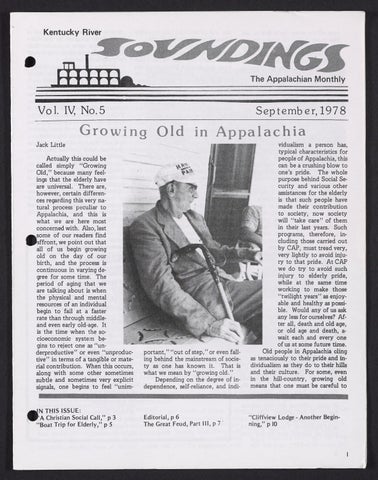
G r o w i n g O l d in A p p a l a c h i a Actually this could be called simply “Growing Old,” because many feel ings that the elderly have are universal. There are, however, certain differen ces regarding this very na tural process peculiar to Appalachia, and this is what we are here most concerned with. Also, lest some of our readers find affront, we point out that all of us begin growing old on the day of our birth, and the process is continuous in varying de gree for some time. The period of aging that we are talking about is when the physical and mental resources of an individual begin to fail at a faster rate than through middleand even early old-age. It is the time when the so cioeconomic system be gins to reject one as “un derproductive” or even “unproduc tive” in terms of a tangible or mate rial contribution. When this occurs, along with some other sometimes subtle and sometimes very explicit signals, one begins to feel “unim
portant,” “out of step,” or even fall ing behind the mainstream of socie ty as one has known it. That is what we mean by “growing old.” Depending on the degree of in dependence, self-reliance, and indi-
vidualism a person has, typical characteristics for people of Appalachia, this can be a crushing blow to one’s pride. The whole purpose behind Social Se curity and various other assistances for the elderly is that such people have made their contribution to society, now society will “take care” of them in their last years. Such programs, therefore, in cluding those carried out by CAP, must tread very, very lightly to avoid inju ry to that pride. At CAP we do try to avoid such injury to elderly pride, while at the same time working to make those “twilight years” as enjoy able and healthy as possi ble. Would any of us ask any less for ourselves? Af ter all, death and old age, or old age and death, await each and every one of us at some future time. Old people in Appalachia cling as tenaciously to their pride and in dividualism as they do to their hills and their culture. For some, even in the hill-country, growing old means that one must be careful to
JN TH IS IS SU E: P'A Christian Social Call,” p 3 ^‘Boat Trip for Elderly,” p 5
Editorial, p 6 The Great Feud, Part III, p 7
“Cliffview Lodge - Another Begin ning,” p 10
Jack Little
•
turn off the water tap in sink or tub. For many others, it means forcing the once strong but now arthritic and shriveled arm to work a pump handle up and down to draw water from a well. A once enjoyable Stroll down a footpath, then dry creek bed, across a precariously swaying string bridge to the mail box or tiny post office, can now be come a hazardous, daily threat. But mail is important to the old and lonely, “Firewood warms you four times,” the old folks will tell you: “Cuttin' it, haulin’ it, splittin’ it, and burnin' it.” But when any one of the first three tasks becomes an exhausting chore to an aged body, and the last becomes more and more dangerous in a deteriorating cabin or house, they don't say it with such vigor and conviction any more. What we in CAP try to do is ease the burden for the elderly, but leave that pride intact at the same time. A simple plumbing job of good washers in those Water taps makes them turn oft easier and more surely. Let that old man or woman pump the water, compli menting them on their amazing strength and stamina, then pick up the bucket and carry it for them. A five gallon pail of water is right around forty pounds, and is much more of a drag on aged limbs than the pump handle. But, they can say to themselves, “ I still pump my own water, by golly.” It might some day be necessary to take the mail to them, but, while they still can and want to fetch it them selves, it's far better to schedule vi sits so they have the company of a “young un” for the trip. They'll still feel that independence of go ing down to pick up their own mail, but the trip will be much less threatening with a strong body to lean on if needed. The firewood, if cut and hauled early, will split easily and burn well, and a little nonflammable sealer here and there or some asbestos sheeting reduces hazard of fire greatly. Our CAP Home Remodeling crew can also do some insulating. They still have the pride of splittin' and burnin' you 2
see, and of receiving heat in a time honored way in the hill-country. Some of these people never left the hills, and never left the homeplace where our CAP workers find them spending the last years of this life. Others did leave, and spent perhaps most of a lifetime “work ing out” in towns or cities some where, but they came home for this twilight period. Why, we might ask ourselves, do they come back here rather than retiring into a comfort able suburbia somewhere? Well, they have come home, you see, much as it says in scripture some where, “ I return to the altar of God, to God, joy of my youth.” And those who never left that altar sure ly do not want to do so now. Reaching these people, and do ing for them what must be done, is not one of CAP's more expensive programs. It is not expensive, that is, so long as they are physically and mentally able to retain that degree of independence, self-reliance, and individualism we speak of. A time always comes, however, when even that must be surrendered, or a lone ly, perhaps terrible, death may in
tervene. This requires some kind of foster-home program for the elder ly, lest winter snow or summer flash flood prevent our visits long enough to cause such a tragedy. Perhaps our population of elo^H ly is greater than elsewhere, or per haps it is just that we focus on it more because of general living con ditions in Appalachia. In another article in this issue, based on an in terview with Barbara Witte who is a CAP volunteer working with the elderly in Rockcastle County, we hope you can come to see that need as we do. We also hope that you can see, through Miss Witte's eyes and heart, what CAP has been doing and is doing now for the elderly in our area. CAP is trying, rest as sured, as best it can with resources available, to make “growing old in Appalachia” a little easier for as ma ny as we can reach. And for those of you who are a part of CAP through your donations, please feel confident you have shared directly in this effort.
Kentucky River
THE MONTHLY MAGAZINE OF THE CHRISTIAN APPALACHIAN PROJECT Chief Editor - Reverend Ralph Beiting Editor - Jack Little Production - Alton Bradley Typesetting - Jean Brown
Kentucky River Soundings is published monthly by the Christian Appalachian Project, 322 Crab Orchard Road, Lancaster, Kentucky 40444. Manuscripts, photographs and art work limited to Appalachian themes are invited. Copyright 1978, The Christian Appalachian Project, All Rights Reserved.
1
A
C h r i s t i a n S o c ia l Call
Jack Little with Barbara Witte Barbara Witte has been working with the elderly of Appalachia as a CAP volunteer for two and a half years. Her early efforts and con cern were a big stimulus to CAP in becoming more aware of this prob lem, and the knowledge and infor mation she gathered was instrumen tal in our increased determination to deal with it. Now, she includes over thirty “shut-ins" and forty some residents of the Brodhead nurs ing home as her responsibility in Rockcastle County. She also aver ages two or three hospital visits a day for those of her people who are admitted for some reason. “I concentrate on what I refer to as a Christian Social Call," Bar bara says, “which involves reading the bible and talking with them. They love you to read the bible." Talking with them, as Barbara puts it, is much more than a one-way conversation. It means being a good listener, too. In fact, it means be ing a very good listener by showing a sincere interest and concern in all they have to say, and projecting sin cerity in body language, facial ex pression, and every little gesture. There should be no doubt at all about Miss Witte's sincerity, and evi dence of its complete projection to the elderly is reflected in their ani mated smiles, joyful response to her questions, and forward-leaning, in tense concentration on her words. “I encourage talking about God, scripture, or death if they bring up topics like that," Barbara goes on. “I also let them express negative feelings on this if they want to, and listen to it. If they feel God has done them wrong, I let them talk about it." The need these old folks have, as Barbara sees it, is to be able to talk about such things. More es pecially, perhaps, they have a need to talk about it with a younger per son, to try to regain or retain some contact with the society which is in creasingly rejecting them. A society
Rockcastle County Visit
“ Let’s Talk About It"
that, in the nature of things, is re presented by younger people in the eyes of the elderly. Far from rejec ting these people, Miss Witte, feels that a great deal can be gained from them and that her experience with
them is at least as rewarding to her as it is a comfort to them. “Each one of these old people has a gift to give that's totally unique from the next one," Barbara will tell you. “They've taught me
Another Home Visit
Visit to the Doctor
things ¿bout life that I know no other age group could have given me. They are very grateful for your attention. As soon as you walk in the room they’re thankful that you are just there. Most of them, de spite all the inadequacies they have to tolerate and all the things they can no longer do, keep a strong be lief in God* I admire that, more es pecially because of all that these people have gone through, and what many of them are still going through. They are truly beautiful people.” In more tangible terms, Miss Witte looks at the specific needs of each of her elderly “shut-ins,” and attends to them dutifully but with attention to that pride and indepen dence of the Appalachian. Some need clothes taken to the dry clean er, being of the pre-washandwear generation. There is, of course, house cleaning to be done in some cases, and for others the laundry needs tc be caught up with. “Eve ry one has a different social need 4
and a different home situation,’1 Barbara explains. “You have to get to know each of them a little to know just what they need.” And this completely dedicated CAP vol unteer, even with all her psychologi cal and emotional involvement, re mains acutely aware of a wider so cial need these older people have. “ I try to work with their fami lies, if they have any, and with their neighbors to try and get the com munity interested in helping them ,” Barbara says with emphasis. “As one person I can only do so much, but if I can get family or friends in terested in helping them, taking them places, etc., then it becomes a much more beautiful thing.” In some cases Miss Witte feels rewarded in this respect, but there is frustra tion, too. Appalachia is not a weal thy area, in monetary terms, and, though family loyalty runs deep in the hill-country, the younger gen eration is often all wrapped up in its own subsistence. “In some cases,”
Barbara says, “the families are dis interested, and in many others they just do not have the money neces sary to provide needed care.” Bar bara Witte, in such cases, becomes something of a foster family for her many, many mothers and fathers. “We take people on outings, and have them over to dinner where we live, and take them to the doctor if they need medical care,’’Barbara re lates. “ If I had five people working with me there’d be enough work to last us till doomsday, believe me.” But Barbara commits herself entire ly to this work, and finds considera ble satisfaction and joy in return. “The three big things noticeable about the elderly,” she says reflec tively, “are their gratefulness, toler ance, and faithfulness. They are so grateful for such little things as we can do for them, and so, so toleranjte. of the inadequacies and inconven^P ences they put up with. And they are faithful to an unbelievable de gree to their God and to those who
try to help them .” Miss Witte’s on ly big frustration is the inadequacy she sees in facilities for the elderly. “There are a lot of older people in this area of Rockcastle County, which there probably are in other areas if you check it o u t,” Barbara
Boat
laments, but not in any defeatist way. “The people I visit are just a handful of the total that could be, and should be, reached. We only have two foster homes for the elder ly in this county, and I know, right now, at least ten people that should
Trip For
be in a foster home rather than toughing it out where they are at their age. We need more foster homes, but the county just does not have, and cannot get, the money needed for such care for the elder ly.” But in the same breath Miss Witte will make it very, very clear that she is not about to give up hope or stop trying, nor will CAP, with field leadership like Barbara provides, stop either. “Working with CAP in this en deavor has changed my whole life,” Barbara says with considerable con viction. “Each person that might come here would get something dif ferent from it. But for me, my life is fuller. I’m closer to God, and I feel like I ’m helping people get clo ser to God. Some day I’d like to go on in college and get into counsel ing the dying. But for now, I find working with these elderly folks so rewarding, so fulfilling, that I can’t leave.” Knowing Barbara Witte, and the complete commitment she has to this work, we are positive that there are a lot of elderly people in Rockcastle County who don't want her to leave, either.
Elderly Reverend Beiting In the last two weeks of August the houseboat “Daniel Boone” host ed a special group of people. All summer long it had echoed with the laughter of children and their busy activities. But for these trips the pace was much slower. Groups of senior citizens from Rockcastle and Garrard Counties were now tlie guests of honor. You did not have to worry about anyone running on this trip. Instead there was the slow pace of walker and cane as the older folks boarded the boat. Yet laughter, joy and real contentment were there in great abundance. For many of the people this was their first time on a houseboat. They marveled at the expanse of Cumberland Lake (9th longest man made lake in the world). One old 5
gentleman allowed that the ocean must be almost this big. What impressed me was their deep appreciation of the beauty of God's creation that was to be wit nessed on every side. They savored every new vista, whether it was the clarity of the water, beauty of the trees that lined thé banks, or bril lance of- a waterfall tumbling off a hillside into the lake. When skiers came past skimming the water they wondered at such a feat. Even quiet fishermen patiently casting along the banks drew their admira tion. They missed nothing in their appreciation of the trip. With the wisdom that apparently has to be earned by a long life, they saw God in almost everything. One lady commented that she felt closer to God out here than she did even at her prayer meeting. It was a refreshing experience to see how naturally and sincerely praise for God came from this group of old people. As the boat returned to the dock at Lee's Ford, they all wanted to convey their thanks. “It was the best day of the year.” “ I don't know when I had such a good day.''
Elation After the Trip
These were a few of the numerous comments made. Each one had to thank me personally for the day. Yet when they all left and I had a few moments alone to think about the day, I realized that they were the ones who deserved our gratitude. How much all of us who are younger
Appalachia Today
Opinion Rev. Ralph Beiting Reverend Beiting In this issue of the “ Soundings," dedicated to our senior citizens, I can think of no better editorial than the story of an old lady I have known for many years. Her quiet dignity, hard work, and determina tion to help herself to the best of her ability points so clearly to the
6
value we all owe the old. I only wish I could convey to you the high admiration I feel for this lady. For six months less than fifty-four years, she has lived in this house. It was new, full of the pride of youth, when she, her husband, and her six month old daughter moved into it, though it could boast of only four rooms. Water had to
have profited by the life of these senior citizens. For more than 80 years they have contributed to the quality of our American way of life. I can only pray th at we who come after them will be able 1^^ continue the legacy they have le ^ p us.
be transported from a nearby spring. A Kerosene lamp furnished light for reading and the necessary household chores. Even to this day electricity has not found its way into the house. Out back at the end of a long path, near the creek, was the outhouse. A small garden on the west side of the house promised food if a little work was spent on it. Perched upon stones and fasten ed to the front of the house was a small porch. Hospitality, peace, and gentle gossip from the neighboring hills found a welcome resting place there. Through the years the house turned into a home. Love brought thirteen children here, and with the grace of God and a m other’s a f f ^ ^ tion, they grew to maturity. O n ® by one they found loves of their own, and went off to other houses. Almost eight years ago her man
passed away, and suddenly there was an awful silence. The noises of children and quiet talk of hus band and wife were stilled. She was |tt|o n e . She talks to herself now and •R jm etim es she sings a song of long ago. More often though she talks with the two dogs who now share the house with her. Her step is not so sure any more and her body has shrunk as the years have grown, but you must not suppose she is less of a woman now than when youth was hers. She is of pioneer stock and she knows how to fare. When you know her, but for a little while, you know you cannot pity her or con descend. She stands firm with a strong hand on her future. Her house has not wintered as well as she, however,. and the roof leaks in a hundred different spots. Roof joists have cracked. The floor boards have rotted from effects of water. Window lights have long ago been broken out of the doors, and scraps from packing cases nailed over the opening. Years ago lino leum covered the floor, but today you can barely detect there was l^ p ic e a pattern there, and ugly holes
pierce it all around. With patient determination she fights back. Somewhere a piece of plywood is found and nailed over a hole. Cans by the dozen are placed in areas where the heaviest leaks are located. She gathers what wood she can to fuel the wood burning cook stove. Plastic milk bottles donated by relatives and friends allow her to tote in the water and even keep some on hand. She gets a neighbor to plow her garden, but the hoe is her work. Corn, potatoes, beans, cabbage, carrots and pears are re sponding to her constant care. De spite such heroic efforts, however, the battle goes against her more and more, as the years go on. I sat on a rickety, battered chair out on that front porch and asked her if she would let me into her life, so that I could assist her with the struggles. “ I sure would be pleasured if the leaks would stop," she said. “It is so much trouble to put the cans around and I cannot catch all the water anymore." With pencil and paper I planned what needed to be done. Rafters had to be replaced. New sheeting boards
on the roof and floor would be needed. Insulation would be neces sary for ceiling and walls. New linoleum should go on the floors. Two new doors, a safe flue pipe, new roofing and a back porch filled out the list. I asked her if this would be enough. It was more than enough. She could make it if only she could keep dry. She then turn ed to me and said, “What will all this cost me? I am a poor woman and have to live within my means." I told her I would pay for the labor and if she could pay for a little part of the materials this would be fine. She studied for a few moments as she went over in her mind her two hundred dollars a month income and the expenses she had. “I can give you $50 a m onth,” she said, “for the rest of the year. Would this be enough?" I could hardly keep back the tears of admiration I felt for this wonderful lady. Yes, it was more than enough. “ It is too much,” I told her. “No," she said, “You will have to spend a lot more than that. I don’t want you to do it all. I just want a little help."
The Great Feud By Reverend Ralph Beiting Part III of a Four Part Story
Frank Phillips was now an offi cial deputy Sheriff of Pike County, Kentucky. Since an election was soon to take place at Blackberry Creek in Pike County, he sent word to all of the Hatfields that he was going to be present and if any of them had the nerve to show up he would certainly put them in jail. He sauntered around half drunk most of election day and no Hat field appeared. Finally, near dusk vhen he was resting against a tree a lolley of shots rang out and the bullets picked the bark from the tree right above his head. He quick ly unloaded both of his revolvers in
i
the direction from which the shots came and fell behind the tree. More than a half hour was spent in silence. No one knew if anyone had been hurt on either side. Finally, Frank Phillips appeared from be hind the tree and went in search of the Hatfields. They, however, had slipped off into the forest and had gone back across the Tug into West Virginia. The feud was now becom ing very expensive for the Hatfields. They were unable to cultivate their fields. Weeds took the place of gar den crops. They were unable to cut the timber from their rich land. The buying of ammunition from the
surrounding communities had grown more and more expensive. Finally, Devil Anse had to sell off a large portion of his land to finance this miniature war. There was a grow ing feeling within and from outside the family that it would be good if the feud could come to an end. But such was not to be. In August of 1887 General Simon Boliver Buckner was elected Gover nor of the state of Kentucky. He was the same General Simon Boliver Buckner who had during the Civil War surrendered Fort Donaldson in Kentucky to a Colonel in the Union Army by the name of Ulysses S. 7
Grant. He owed his election in great part to the political power of the McCoys in Pike County. They now enlisted his help in their battle with the Hatfields. Buckner sent Frank Phillips to Governor Wilson as his special emis sary asking for the extradition pa pers to bring the Hatfields back to trial in Kentucky. The Governor of West Virginia refused. Frank Phillips went home more determined than ever to take the law into his own hands. Phillips was a brave man without a doubt. He was drunk much of the time, serving the law in his own special way and presuming that he could not be killed. He went alone into West' Virginia and surprisingly he began to capture Hatfields first one and then another. Before long he had the McCoys in such a state of exhilaration that any time he rode out there were fifty McCoys eager to accompany him. Across the river in West Virginia the Hat fields were beside themselves. Anger was building, revenge was demanded and yet Devil Anse was keeping thermal best he could in check. Once again Devil Anse sent ap peals to Governor Wilson in West Virginia to have Phillips stopped. Nothing came of that and before many weeks had gone past Devil Anse’s brother, Wall, was captured by Frank Phillips. He was brought into Pikeville for trial for his part in the feud. The trial took but little time and at its conclusion he was condemned to life imprisonment. Wall was a strong tempered moun tain man and he did not take easily to confinement. Once he was put in prison he refused to eat and with in two weeks he had died of starva tion. The animosity, hatred and suspi cion of the Hatfields was once more at white heat. It was New Year’s Eve in 1887 when the hatred that had been building up in the Hatfields found expression. Old Jim Vance, Uncle to Devil Anse; Johnse, Devil Anse’s son; Cap, his other son; Cotton Top Mounts; and several other members of the Hatfield clan gathered together. Only three of them knew where they were going
and for what purpose. The rest were obliged to follow the orders given by the leaders no matter what circumstances presented themselves. Big Jim Vance and Cap were the leaders of this band. Johnse had reluctantly agreed to go along. In their opinion there was only one answer to this feud and this was the removal of Randall McCoy. The sooner he was killed, the quicker this whole matter would come to an end. Their mission this night was to seek out and kill Randall McCoy. They crossed the Tug Fork River and headed into Pike County, ar riving at last at the cabin of Randall McCoy. The cabin had several sections. The men slept in one section off to the side. There was an annex reached through a breeze way where the women slept. The Hatfields knew that Randall and his son, Calvin, would be in the quarters for the men. They had all agreed to hold back their fire until the signal was given by Jim Vance. Jim cried out for Randall to surrender since the building was completely sur rounded and there was no hope for him to escape. Before an answer could be made Johnse Hatfield fired. This premature shot completely al tered the plans that they had for this night. Calvin and his father, Randall, now awake, returned the fire, There were nine Hatfields against the two McCoys inside the building. Jim Vance was greatly angered by the action of Johnse Hatfield. He had no choice now but to continue the firing. When it became apparent that they were making no headway they decided to set fire to the building. Be fore long they had the roof on fire and the cabin was enveloped in flame. Jim Vance knew they had to get the sleeping quarters completely surrounded if they were going to get the men out in the open. He ordered two of the band to get the women out of their quarters so that they could fire at the men from the rear. Cotton Top Mounts knocked on the door and little Allifar McCoy, fifteen years old, came to the door screaming that there were no men Jiere and that they should go away.
The other Hatfields in ambush screamed at Cotton Top to shoot the girl and get on with the busi ness. He raised his rifle at p o u p t blank range and shot her in tVB chest and killed her instantly. Sarah McCoy came screaming out of the women’s quarters in order to help her daughter. She was first hit by the b u tt of a rifle. When she gdt up and started once again to her daughter, Johnse hit her on the top of the head with his pistol. She was knocked unconscious. She laid face down in the snow, apparently dead. The cabin was now burning out of control. Calvin decided that the only possible hope they had was for him to reach the corn crib and then draw the fire of the Hatfields so his father could escape. He made a run for the corn crib and reached the door of it in safety when a shot rang out and a bullet w ent through his head and he fell in the doorway dead. Randall was now almost com pletely out of his mind. He was convinced that his daughter and had been killed. He saw Calvin ly S P dead in the doorway. He loaded his pockets with shells, filled his two revolvers and ran from the building shooting in every direction. As he left the building the roof collapsed and fire sparks flew everywhere. In the confusion, somehow or other, he was able to make the forest and escape into the dead of night. The Hatfields were greatly dis appointed in the raid. Everything had gone wrong. It had been a mess. Jim Vance blamed Johnse for bringing about this unhappy state of events. They went back across the Tug Fork River to the safety of West Virginia. Randall came back in the morning, found his wife, still unconscious, but alive. For a day and a half she hovered between life and death and when at last she re gained consciousness she took his hand in hers and said that she would no longer hold him to his p ro n ^ ^ not to go after the Hatfields, could do as he saw fit. Nearly every newspaper in the country carried the news of the tragic deaths at Randall McCoy’s
By this time the racoon was set home and the burning of his cabin. ting up a devilish attack in the stom A wave of indignation swept over ach of Jim Vance. He complained every one. Over $2,700 in rewards e offered by the Governor of that the racoon was not nearly dead enough. He had one awful belly ducky for the arrest and convic tion of the Hatfield men involved in ache. After several hours of pursuit they were surrounded. Both Jim the killing. Vance and Cap gave a good account Frank Phillips fathered up a of themselves. Many of the McCoys whole army including fifty or sixty were brought down. At last Jim of the McCoy clan. He was joined Vance had a bullet enter his stom by Randall McCoy, the head of the McCoy clan. An invasion of West ach. This together with the racoon Virginia was then made. Devil Anse on the inside gave him a fearful time was waiting at the fort on Peters indeed. At last he ordered his neph Creek where he and the rest of the ew, Cap, to escape. He would hold Hatfields had gathered. Missing off the gang as long as he could. Cap from the family were two of its at first refused to go but at last omost famous members, Uncle Jim beyed the will of his Uncle. He Vance and Cap Hatfield. They had slipped out and made his escape. gone hunting. Old Jim Vance had The attack began in earnest on shot a racoon and he brought it to Jim Vance and several other bullets his own cabin where he intended to entered his body. At last there was have it for supper. His wife inform silence. No longer could they hear ed him that the whole countryside his curses. Frank Phillips walked was infested by Frank Phillips and over to the Locust log behind which the McCoys. She urged them to get Jim Vance was hiding. He saw that out as quickly as possible. Jim he was too weak to raise his revolver Vance insisted on spending the night and fire. Frank told Jim Vance that at his cabin. He wanted her to fix he hated him, but he admired him jfto t racoon. She did so and they for the great courage he had shown. ^ ^ ra te the racoon with much pleas With this simple statement made, ure. In the morning Jim Vance made Frank Phillips took his rifle and sure that his wife got off safely. But placed it at Jim Vance's head. He before he and Cap could make their then pulled the trigger and shot him way to the fort at Peters Creek they dead. Cap returned home, gave were attacked by Frank Phillips and Devil Anse the sad news that his more than sixty of the McCoy clan. Uncle Jim had been killed. After Both Cap and Jim Vance dashed Frank Phillips had killed Jim Vance from the house and into the safety he knew that Devil Anse and the of the forest. They were, however, rest of the Hatfields would be hot quickly pursued by Frank Phillips in pursuit. Knowing discretion was and his gang. the better part of valor, he and the
*
A
Time to Remember
NO D ISH W A SH ER?!!
Reverend Beiting From time to time good people come to our assistance, not merely to give money, or items of food or clothing. They bring themselves and assist us in the work we are doing, â n e such family came out of LexP |to n to assist us in our work of bringing food, clothing, and toys at Christmas time to the poor of the area.
One Sunday afternoon we were out visiting the people in order to prepare Christmas baskets. As we entered this house, we could see that the family was extremely poor. The house consisted of just two rooms. The front room was small by any standard. Yet, it contained a little kitchen stove and some chairs and a table. The other room was a bedroom. Six children and their parents lived in this house. There had been electricity, but as the fam
McCoys headed back across to the safety of Kentucky. In the meantime an interesting development was taking place. Johnse Hatfield had been married to Nancy McCoy almost five years. Two children were the result of this marriage but love and peace were lacking in this family. Nancy was a died-in-the-wool McCoy. She con-' stantly, with a sharp tongue, knifed away at Johnse and his Hatfield clan. At long last Johnse could no longer stand this nagging from his wife. He told her that he was going to sell his property,leave West Virginia and head for the far west. This decision pleased Nancy just as well. Johnse told his father that he was backing out of the feud, leaving the country and heading west. He took enough money with him to get his own pas sage west and to pay for some land. He left the rest with his wife who was to follow him with the two chil dren as soon as he found a place. But Nancy McCoy had had enough of the Hatfields. She went to her kinfolks in Pike County and there at a dance she met Frank Phillips. There was an attrac tion between the two from the start. Nancy and Frank Phillips were soon living together. They spent Johnse Hatfield's money and mocked him in the process. Devil Anse was in censed, but figured that any price was cheap if they could get rid of such a woman. He made no further comment.
ily was extremely poor they could not afford to pay the electric bills, so the current had been cut off. Even in the middle of the afternoon, it was dark inside the cabin, and it took a while for your eyes to be come accustomed to the gloom. The family that had accompanied me brought four of their older chil dren with them. They were in the last years of grade school. They talked with the children in the fam ily, and we made conversation with the adults. After we had gathered the information that we needed, we 9
took our leave of the family. As we got back in the car and headed on to our next stop, the mother and father had been quite moved by what they had seen and they turned to the children and asked, “Did you see how poor they were?" The children too, must have been moved, because one of the girls said, “They didn’t even have electricity, how can they do the dishes?” They, of course, have an electric dishwasher at home and they grew up suspecting that every one in the world had an electric dishwasher to take care of their dishes. The mother and father talk ed to me about it afterwards, and said, “We have sheltered our chil
C liffview
dren too much. They have grown accustomed to the better things of life and they have lost sight of the fact that there are families not as well off as we are. They assume that all people have all the things they need.” That family made a rule from that time on, that they would in volve their children in activities and work that would take them to where the poor are. Somehow, I suspect that many of us are like the children of this family. We assume that everyone is as well off as we. We assume that people have all that they need. When the simple fact is still true that there are so many in this society in which
we live that are desperately in need of even the barest essentials. I know that this is true a b o ^ | myself, when I am tempted to coWP plain or to grow discouraged be cause I don’t have all the means of doing the things that I would like I remember this family from Lex ington and the children who would ask, “But how can they do the dishes? They don’t have any elec tricity.” It's a big help to me to remember that there are a lot of people a lot worse off than I am and that I need to be concerned about them, rather than about my own needs.
Lodge - Another
Ric O’Connell For seventeen years Cliffview Lodge at Herrington Lake has play ed a major role in the Christian Appalachian Project’s human devel opment program. Facilities on the original 550 feet of lakefront by 16yfeet deep lot now include sleep ing accomodations for 40 people with cooking facilities for same, a pavilion that can serve as meeting room for up to 100 people, and a swimming/boating dock 32 by 70 feet long. There are six buildings plus a boat-house, with a field large enough for softball, volley ball and soccer to be played at the same time. This layout gave first life to CAP's summer program of camping for the underpriviledged of Appala chia, a program which has since moved to Camp Andrew Jackson. Cliffview then went on to provide the first vision of what was to be come one of CAP's finest achieve ments in a Group Home for teenage boys,finally located at Camp Nelson. During the years before and after its use as summer camp and foster home, Cliffview hosted many other programs. It was used for retreats, seminars, workshops of various per suasion, and also provided a central location for family reunions, pic nics, and many other activities. By
1976, however, Cliffview Lodge had seemingly come to an end of its need. It was scheduled to be sold. As is often the case, the vision of men fell far short of the expecta tions of God. It wasn't long after the first thought of selling had en tered the mind than a new need be gan to make itself known to the heart. While considering options of how best to utilize Cliffview Lodge during the time left before a selling date could be negotiated, we decid ed to make a few phone calls in hopes of stimulating more activity. After many fruitless attempts, we received a call from an International Deaf Association in Louisville, Ken tucky, inquiring about the facility. They wondered what, if any, advan tages Cliffview might have for host ing a retreat for the deaf and hear ing-impaired. Shortly after that we were visited by two representatives of the Deaf Association. They im mediately reserved the Lodge for the first deaf program we were to have at Cliffview. Although we were unaware of it then, Cliffview was being given a new lease on life, and opportunity for a profound impact on the lives of people. Witnessing this first encounter with the deaf was a catalyst which
Beginning
began to deepen our awareness of more sharing and interaction. As this sharing and caring of the first weekend opened our eyes to t t e heavy burden the deaf must b^H ) in life, more and more areas of need began surfacing. Not long after this first encounter, we began making plans for a summer camp activity for the deaf and hearing-impaired of our area. In keeping with the nature of good beginnings, we de cided to start small. We would have two weeks of summer camp with twenty children in each group. We would also restrict this program to children ranging in age from ten years through high-school seniors. Our programming for the deaf camp was to accomplish a degree of education as well as to provide a good, common ground for coming together. Therefore, we structured the week with activities th at would include daily bible school, arts and crafts, nature and canoe trips, an overnight boat trip at Lake Cumber land, and a trip through Daniel Boone Cave. There would also be a tour of Camp Nelson, swimming recreation, a visit to a n eig h b o r?^ dairy farm, as well as shared prayer and fellowship in a community of other deaf youth and caring staff,
and camp fires. A lot of activity for one short week. Though the days were long, with the staff rising at 6:30 and retiring at midnight, we ere well sustained by the grace of od and our two good cooks. We didn't realize the total num bers we expected, and ended up with only one week of camping in stead of the two originally planned. But the love and joy which that week brought to our thirteen children and eleven staff members makes us con fident of being able to achieve our original goals and much, much more in the year ahead. Already we are planning for next year. We are hop ing for a six-week camping session that will begin the last week of June 1979. As we see it now, our great est need is going to be in the area of camp counsellors. This is where we ask your support. By spreading the word of this need to those you know, you may turn up people you never suspected were trained to help the deaf. This means, of course, staff members who have some abili ty in sign language. Besides these summer camp actities planned for next year, we are f tConsidering several workshops and seminars which will be geared to aid the deaf spiritually, socially, and economically. Our workshops would include, but not be limited to, drama for the deaf, deaf awareness and self-awareness, parent and child sem inars to improve communications and better psychological understand ing in the family. We would also cover coping with handicaps, em ployment opportunities for the deaf, and skill development. Again, if you know of people in education, business or industry who are active in employment opportunities for the handicapped, we would much appreciate their collaboration in this effort. It is also planned to develop more interest among hearing people, and to provide sign language instruc tion to those who are interested. The joy we felt as volunteers in watching these youngsters warm up, Wc en open up, and then actually prof t ect to one another and all of us that there was joy in the world for them, is difficult to put into words.
Deaf Youth Share an Orange
You don’t have to hear to enjoy fishing
An especially emotional moment is when we pray together, because they must pray entirely in sign language. When you see that, and you see them doing it with emphasis, con centration, and animated sincerity, but all in silence, you have a strange surge of feeling at how lucky you really are. You may also feel, as we did, a strong, strong urge to try and reach them, help them, communi
cate with something as beautiful as what they have in praying to our God entirely in signs and gestures, without sound, despite the burden it also means. The summer is an especially trying time for them be cause, without school, they have probably no human group involve ment, unless they live in an urban area near other deaf people. This is not, of course, the case for those in
A Boat Trip for Deaf Youngsters
our area of small towns and rural society. They often spend a sum mer, therefore, as an isolated indi vidual in an otherwise hearing world; no radio, no stereo, TV but no sound, and no “conversation” as we know it. The acronym on all our wooden name tags for the camp was IALAC, for “I am lovable and ca pable.” They are indeed that, but
it takes a proper environment like Cliffview Lodge and sincere effort by staff members to bring it out. The needs of this segment of our society are ever increasing. As job competition becomes extremely in tense for everyone, w hat of deaf people who can only communicate in sign language? People who can not even hear, let alone respond, in
Kentucky River
The Appalachian Monthly
N O N - P R O F IT O R G A N IZ A T IO N U. S. P O S T A G E
PAID If you would like to receive the Soundings each month send $4.00 for each year to:
Christian Appalachian Project Kentucky River Soundings Lancaster, Kentucky 40444 N am e ______________________________________
Address____________________________________ C i t y ___________________________________ Zip.
12
C hristian Appalachian Project