Kentucky River
h
Vol IV No
f
H
-
f
K
f
t ........
The Appalachian IVIonthly
July 1978
Contents Kentucky River
Features • The Great Feud THE MONTHLY MAGAZINE OF THE CHRISTIAN APPALACHIAN PROJECT
Reverend Beiting, a m ountain folklorist, with over 25 years in the Ken tucky hills, examines the HatfieldMcCoy Fued. During one of his street preaching sojourns in the hills Reverend Beiting happened to meet one of the Hatfield clan. This is the first of a four part story on the The Great Feud. Page 4
Reverend Ralph Beiting Editor in Chief Steve Frazier Editor
• The Perpetual Crisis
Alton Bradley Phyllis Underwood Junior Shackleford Production
The efforts of a small non-profit home building organizations are given a brief look in this feature on housing in Cen tral Appalachia. The need for safe, sanitary dwellings in the mountains of Eastern Kentucky is not being met the experts say and presently there is little hope for the future. Page 6
KENTUCKY RIVER S O U N D IN G S is printed by Appalachian craftsmen at the Kentucky Valley Press, Lancaster, Kentucky and published monthly by the Chris tian Appalachian Project, 322 Crabj Orchard Road, Lancaster, Ken tucky 40444. Copyright © 1 9 7 8 by the C h ris
• The Art of Warren Brunner Warren Brunner, noted Appalachian photographer, briefly discusses his technique and philosophy in this Soun dings photo feature. Brunner, a native of Wisconsin, came to the mountains in 1953 and now owns a photo shop in Berea, Kentucky. His photography has gained national recognition. Page 8-9
tia n A p p a la c h ia n P r o je c t, CAP. All rights reserved. Manuscripts, photographs illu s tr a tio n s lim ite d to palachian them es are invited.
and A p
This Month’s Cover
• A Time to Remember During his auarter century in the m ountains Reverend Beiting has crossed paths with many lives. In this month’s A Time to Remember, Reverend Beiting recalls a visit to some homes that “most people would not dream human beings still live in today.” This month’s remembrance; A Place of Shelter. Page 10
Departments
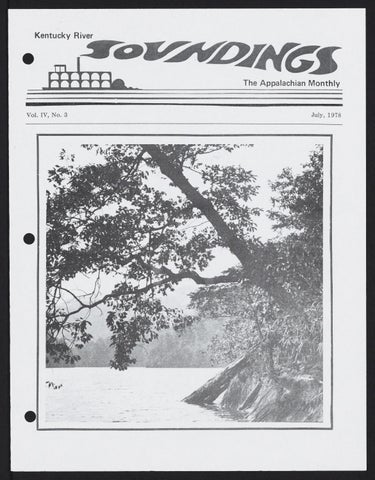
Kentucky River, Warren Brunner
Opinion
CAP Notes
Around Camp Nelson
The General Store
This Month’s Disclaimer: “It’s a damn poor mind, indee1 Old Hickory wrote, “which can think of at least two ways to spell a word,”
f
In danger of losing the fight i have fo r too long listen ed to p e o p le resp o n d , “W hat’s the governm ent ng abou t it?” when I give a talk on poverty or p o o r housing or so m e oth er a sp e ct of poverty...I g e t so weary that I s o m e tim e s call out, “W hat do I care what the governm ent is going to do about it! God is not going to ju d g e the governm ent. H e’s going to ju dge m e. What am [ doing about it.”
*
The other night I attended a how far does $5,000 go to enable him banquet, a m eal in which speakers to get a house? expounded upon their chosen Losing the fight field. It was billed as the “Gover Today in America we are in danger of nor’s Conference on Housing for losing the fight of the whole bottom sec th e Poor.” The banquet was held at the tion of our economy and of the people Hyatt Regency Hotel Complex in who are trapped there. There is a great Lexington, Kentucky surely not a poor need for steps to be taken that will place to live. Some of the speakers we heard were exceptionally good men who lived in the mountain area, men who worked every day with the poor, who were concerned over their housing needs. We heard other officials, too. Men who reside in Frankfort and Washington, men who gave us figures of how much new housing was added to Kentucky’s low cost housing that year, and how much they hoped to get in the year that lay ahead. Others were telling of grants from the Labor Departnt or from some foundation. Yet 2n it was all over and done, the kind lousing that many of these officals from outside the area conceived of as low cost were in the $20,000-$25,000 bracket. In much of America this doesn’t buy much in the way of housing today, enable these people who can only make but what about that poor man in the Ap $5,000 to $6,000 a year to have a home palachian Mountains? Even if he is for too. Government programs are not very tunate enough to have a job, he can well geared to this. Banks are not ac make perhaps only the minimum wage customed to lending money for a home which would be just slightly over $5,000 to a man who can only make $5,000 to per year. If he has three or four children, $6,000 a year. Yet there is probably no
other group of people who would profit as much by adequate housing, simple though it may be, as would these, the very poorest of the poor. What I would like to advocate is that each individual who buys a house or is in the process of paying for a house to come to his brother’s needs. He can work independently through an organization in which he has trust or through his church or through some other fraternal organization to which he belongs. If he could give even one per cent of the money that he pays for his own housing to a private organization of his own choosing to enable them to help
Appalachia Today
Opinion
«
It is too often the tendency on the part of many to rationalize their existence and to talk in term s that are material and that embrace only the physical aspect of life. So it is with housing, m edical care, educational needs or job opportunities. It is my deep conviction that a man ought not neglect the material and the physical, but it is even more a conviction of m ine that he ought not neglect God. Over 1500 years ago a great saint wrote, “Pray as if all things depend upon God and then act if all things depend upon you.” We must utilize our talents, ability and every other means at our disposal in the material world to help our neigh bor, but we must not neglect prayer, for in the hands of God there is a power that men don’t even suspect. By turning to - ^ o d in prayer for the benefit of those who are in desperate ed of a better share of this world’s goods, we take a real siep in bringing this needed help about. The readers of this magazine are comprised of Catholics, Protestants, and Jews. For those of us who share the Christian tradition there is no
K
Rev. Ralph Beiting furnish housing for the poor, I believe that we would have made a tremendous start here in America to enable the very poorest to have a home. I have for too long listened to people respond, “What’s the government doing cont. page 11
prayer that is more beloved by us than the Lord’s Prayer, the Our Father. It is my hope that each one of the readers of this magazine would say the Our Father each day during the month of June and July in order that God may bring about better housing for those who desperately need it. For our Jewish friends we ask that they use one of their favorite prayers each day to plead for the same cause. One tim e the apostles asked Our Lord why they could not cast out an unclean spirit from a boy for they had been granted the power of working m ira clei. The answer that the Lord gave to them was, “This was a difficult kind and could only be cast out by prayer.” While we need money, financing and programming, even more we need prayer. It would be a tragedy if we neglect the spiritual m eans at our disposal to bring an answer to the perplexing problem s that face us. Let us be true to our Christian roots and utilize prayer with the sam e fervor that we utilize our generosity in making contributions of other kinds. (Rev. R.B.) Soundings 3
Soundings Feature THACK!
MATE CREEK.
J(|v8ticn
by Reverend RalphfiSeitirig
eRAPEVih
’McCoy c A friV it y
Tue b-RANCH OF THE
5*eswpy river — E U A S HATRELD .HotfE BUSKiRK
WESTVIRG IN IA
h a t f ie u
IfCARR DELORME
e>mzK.8£RW CPEEK
KENTUCKY
st r in g t c w n
ROSEÂNMA BABY GRAVE W * Q M *S .•ÔURNWEilf
I E F T TURKEY TOE
UTIELP HOpl!
SCOTT HOME HATFIEW? BRAffC!
McCoy FAMILYCEMl To l e r
DIM McCoy HOME
>LL McCoy HOME
PAN50 H O
HARPy SAM McCOY HOME
.»
“I had been stre e t preaqbi^g in a little com m u n ity called W ayland in Floyd County, K entucky. A£&r th e preaching-was over th at night I m ingled with the crow d meeting^ various p e o p le who had listen ed and w anted to talk with m e. One o f th e p e o p le who cam e up and introduced h im self was R obert H atfield.” This is the beginning of a four part story of the m ost fam ous feud that occurred in the history of the United States, that betw een the Hatfields of W est Virginia and the McCoys of Kentucky. This last week the Louisville Courier Journal newspaper carried an account of the death of W illis H a tfie ld o f C h a rle sto n , W est Virginia. At 90 he was the last sur viving son of Devil Anse Hatfield, the leader of the Hatfield clan in the fam ous Hatfield and McCoy feud. This particular notice brought back to me memories that stretch back more than fifteen years. I had been street preaching in a little community called Wayland in Floyd County, Kentucky. After the preaching was over that night I mingled with the crowd meeting various Soundings 4
people who had listened and who wan ted to talk with me. One of the people who came up and introduced himself was Robert Hatfield. At that time he was a man in his seventies. He told me that he had been a small boy at the turn of the century when the last of the dif ficulties between the Hatfields and the McCoys had occurred. He recalled a confrontation between various clan members on a particular day that had stuck in his mind ever since. Andersons and Randolphs All of this has prompted m e to write a short history of the feud that took place between the fam ilies of Anderson, better known as Devil Anse Hatfield, and Ran dolph, better known as Randall McCoy. The H atfields and the McCoys
had com e to the Virginia land early in the English colonization of America. They were yeom en. Their fam ilies were not of the nobility or the aristocracy. They were of the working class. They were solid fam ilies with many outstanding virtues. Both fam ilies, the Hat fields and the McCoys, after their initial stay in th e Virginia tidelands, migrated w est. The H atfields settled in the western m ost section of Virginia in what was called L ogan C ou n ty. The M cC oys crossed over the Tug Fork River and entered Kentucky in what is now Pike County. At the tim e of the great feud le ss than ten m iles^ ^ separated the hom e of Devil A n s ^ P Hatfield and Randall McCoy. Devil Anse Hatfield lived at the mouth of Peter’s Creek where it entered
Our Appalachian Heritage H; “Both fa m ilies were proficien t in ^ t h e d istillin g o f spirits. When it * cam e to the m aking of m oonshine th ey su rpassed everyone in the neighborhood the Tug Fork River. As mentioned above only ten miles separated him from the home of Randolph McCoy who lived across the hills and valleys in Pike County. Certain characteristics were pesent in both of the mountain families. The menfolks were vey much devoted to hunt ing, spending much of their time in the woods. Later on when timber became a valuable commodity they did a great deal of logging. Both families were very proficient in the distilling if spirits. When it came to the making of moonshine they surpassed everyone in the neigh borhood. The moonshine played an im portant part frequently in the feud that developed later on.
people used to describe Anderson. An derson Hatfield was a Captain in the Confederate Army and he single handedly held off a whole company of Union soldiers on top of one of tbe mountains in the Logan County area A West Virginia. The name of the moun tain was the Devil’s Backbone. Because of this feat people from then on knew him as Devil Anse Hatfield. Som e tim e in the year 1863 Devil Anse left the regular Con federate Army and was given
charge o f the local m ilitia. They were called the “H om e Guard”. Their purpose was to protect the county in which they lived from at tacks from opposing armies. Ran dall McCoy on the Kentucky side of the Tug Fork River had assum ed the sam e responsibility. He was in charge of the local Home Guard in Pike County. A number of skir m is h e s to o k p la c e and hard feelin gs developed between these cont. page 14
Originally the tw o fa m ilies lived in p e a c e and harmony. They frequently interm arried. Q uite a large branch o f th e H atfield Clan even cro ssed the Tug Fork River and m ade their perm anent h om es in Pike County K en tu ck y.” ‘
Clans and Harmony Both fam ilies were large. Devil Anse had thirteen children and so did Randolph McCoy. This was ammon am ong their brothers, isters and kinfolks all the way down the line. In those days this part of the Appalachian area was so removed from the main stream of American life that the fam ilies were very clannish. This clo se association was necessary for both protection as well as for social en tertainm ent and developm ent. As a con seq u en ce they becam e powers within the states where they lived having alm ost com plete control over not only the ordinary events of life but even the political life of the county as well. Originally the two families had lived in peace and harmony. They frequently intermarried. Quite a large branch of the Hatfield clan even crossed the Tug Fork River and made their permanent homes in Pike County, Kentucky. It is difficult to assess what was at the heart and core of the great feud. A num ber of items have been traditionally brought forth as contributing factors. One was the Civil War. Anderson Hat field (Devil Anse) was a Confederate idier and Randall McCoy was a Union an. It was during the Civil War that A nderson Hatfield received his nickname of Devil. Anse was but a shortened form that the mountain
G
t
Soundings 5
H o u s in g in A ppalachia The Perpetual Crisis
SKBB.
Pf ^
chronic problem s of Appalachia and
"'A a lot o^g^pneir. W holesale iznprowic^nN, é$L billion I t fakes wlio áre ||j J tv e rc rp w j
Soundings 6
ofrfftoiiSands of Áhoalad M i^ ^ M É ^ iÉ « s th^ljdo not have adeomKgbrfflSm^gMre
Soundings Feature ^ A recent report issued by a church-related Berea, Kentucky consulting 0rm HEAD (Housing Econom ic Appalachian Developm ent) stated that 80,000 fam ilies reside in sub-standard housing in Central Appalachia, a region com prising 85 counties of Eastern Kentucky, Northeastern Ten n essee, W est Virginia and Virginia. Two unrelated studies by HEAD and the University of Louisville Urban Studies Center came to similar con clusions about housing needs in the region by the end of the decade. The Louisville study showed a need for 172,000 new dwellings in Eastern Kentucky while the HEAD report, slightly larger in scope, prophesied the need for 287,000 homes for all of Cen tral Appalachia. The salient fact is nothing substantial is planned face the housing needs. Little Advocacy Tackling the fortress Appalachia housing problem has been a David ver sus Goliath task. Few have dared step forth to even pick up a stone. Indeed little housing advocacy has been alive in the Eastern Kentucky hills. The rediscovery of Appalachia and subkpquent embarrassment over the find ings occurred only a little over a decade ago when Lyndon Johnson declared his war on poverty. Only five years ago did the first private group attempt reform with any determination. The first serious private venture came in 1973 when the non-profit Man chester, Kentucky based Kentucky Mountain Housing Development Cor poration (KMH) was chartered. Since then ten non-profits have arisen to champion the housing cause. All following the trail blazed by KMH’s building and remodeling venture. Trail Blazing Enraged by a federal lending program ill-suited to the needs of the poor and appalled by the sinister effects of the lack of santiary housing, the Church of the Brethren and citizens of Clay Coun ty, Kentucky, formed a non-profit cor poration. They felt if they could encourage donations and pool the revenue, they might be able to persuade a skeptical Farm er’s Home Adm inistration iFmHA), the largest mortgage guaran tor in the mountains, to aid low income families obtain mortgages. Many felt the venture would be short lived.
The legacy of grass-roots organiza tions in the Kentucky mountains is a trial of burnt out hopes and resignation. The incendiary Appalachian spirit too often dampened by a mystifying mistrust of the outside world, govern ment, and even ...“tomorrow.” By sheer determination, prayer they hasten to add, KMH persisted, challeng ing every government agency, church and private concern. Before this advocacy action, families in Clay County even into the middle in come brackets (KMH works with only low income families, $2-5,000 a year) were virtually excluded from buying a home. Red-lining Why? Conventional construction is very costly in the mountains and there is a shortage of skilled contractors. There isn’t much industry where coal isn’t around and little money available for lending in rural banks. Lending in stitutions are forced to ask as much as twenty percent down at 8.5 percent in terest for 15-20 years on a home. The poor are locked out. The phenomenon is called rural red lining. Red-lining is well-known in the cities where bankers won’t lend money for businesses or homes in high risk areas, like the ghetto. In Appalachia the same protective practices are encountered. Either the bank has no capital to lend to the poor (a risk) or in the case of coal country WON’T lend even when capital is plentiful. KMH won its battle by throwing all of its assets into construction and labor, a bargain the FmHA did not refuse. Mort gages were dispensed under the federal government’s most reasonable plan, FmHA 502. KMH promised to pay ninety percent of the labor costs. Since 1973 KMH has built 50 new homes in Clay and neighboring Jackson Counties. They have repaired or remodeled 425. Twenty-seven more are going up this year. The homes are attractive, two and .three bedroom frame dwellings, com plete with kitchen appliances. They are
landscaped. The mortgage is usually about $14,000. The home costs KMH $20 to $23,000 to build. The home is a bargain. It’s a small effort compared to the vast needs cited in the HEAD report but as important as the trailblazing done by Boone to open the wilderness. Lest we have too much hope about non-profit building achievements the sobering prophecy in a winter HEAD report recalls the grim reality. The report said the FmHA in Central Appalachia made 1,587 loans against that balance of 80,000 possible needs last year. At the present rate, HEAD estimated, given NO POPULATION GROWTH, it will take forty-five years to catch up with single family housing needs. However, the persistence of KMH is unique to a grass-roots Appalachian organization. Its success perhaps the signal effort in a repudiation of that resigned Appalachian stereotype. Coal Country Where coal is king things are a little different. In many ways coal country is still a fuedal society. The Lords and serfs now owners and miners with a few bankers and politicians on the owner’s patron age. In the early days of coal production in Kentucky the companies provided all the necessities of life for the miner, in cluding his home. There was (still is) relatively little in dustry in the mountains but coal. Large communities grew under the purview of coal ownership. The upkeep of the com munity was costly to the company. The appearance of the sub-standard home was an incipient fact. Over the years m echanization changed the demography of the moun tains and many fled north for em ployment. Always there were those who remained in the hills in which they were born. Asserting a costly but real American right, entitled to be a recipient of the general welfare but not until the mid-sixties discovered as a lost benefac tor. The success of a hillside mining town called David, in Floyd County, Ken tucky left for dead by a coal company ten years ago, is an equaly bright chap ter in the housing legacy. The orphaned citizens of David Co nt. Page 14
Soundings 7
Soundings Feature
MEET WARREN BRUNNER Q. Would you tell us about your
specialty, Mr. Brunner? A. My specialty is photographing Appalachian America to record the quali ty of life of the people as they are, or as they were from 50 to 100 years ago. I preserve on film a way of life that is passing—much of it already gone. Some scenes or situations disappear within moments after the picture is taken. Q. How did you happen to enter this field? A. My father started me in photography when he gave me my first camera; my high school chemistry teacher taught me how to develop and print; my mother loaned mer her kitchen for a dark room and her cake tins for developing pans. My first job was working for a new spaper man who e n couraged the taking of copious pictures for experiement as well as for news value. My love affair with the Appalachian south began in 1953 when I came to Berea to take a job in a studio which I bought eight years later. Hiking and jeeping in the mountains, I saw how grossly the outside media had m isrepresented . Soundings 8
the region and its people. I have been working to cor rect the record ever since. Q. What type of equipment do you use? A. Burke & James View Camera with 5” x 7” split 5” x 7” sheet film, 4” x 5” roll film back, 1 2 ” and 8 V4” lenses, 4” x 5” Graphic, Mamiva Press, Mamiva Reflex, 35mm Minolta, Omega D-2 enlarger. My favorite is a twin lens reflex with wide angle lens, with CPS 120 film. For black and white I use the 2 V4” or 35mm SLR. Q. What are som e of the publications in which your work has appeared? A. My work has appeared in local and state papers as well as the national p r e s s —T i m e , for instance—but mostly in brochures and news or publicity of Appalachian Regional Commission, Coun cil of the Southern Moun tains, Vista, SAve the Children Federation (many shots in their new book, Save The Children) Moun tain Ma t er na l He al t h League, Berea College, and a Profile of Poverty at the Smithsonian Institution. QDo you have any advice to the s e r i o u s
a m a t e u r
photographer? A.Besides some of the things discussed earlier I’d say learn all you can about processes related to photography; it br ings in many important factors while making the picture.
The
Photographyof Warren Brunner
Soundings 9
A
Timeto Remember Recollections from Father Belting’s 27 years as President of CAP and Appalachian preacher
• A Place of Shelter The other day I had the op portunity of visiting one of our Child Developm ent and Day Care Centers. The children were busy at work. They had hammers and they were pounding nails into boards. One of them in particular was directing the activities of the other children. I asked them what they were doing and the young boy who was apparently in charge of this activity said, “W ere building a house.” Even at four and five years old there seems to be a desire on the part of a human being to have a home, a place of shelter, a place of com fort and a place of love. Most people in the United States today have found the means of securing some adequate housing for themselves. It is true that frequently the cost of this housing is high and the obligations they assume are many, but the fact still remains that they have the resources to acquire a home of their own. In the 28 years that I have spent in Appalachia, I have seen some fine homes. I have been in them and enjoyed the hospitality of those who owned them. I have, also, had the experience of visiting homes that I am sure that most people would not dream that human beings still live in today. Surviving
It was in this fashion that they removed the child. When I asked them why they had the child in the cage, the answer was simple, “So the rats wouldn’t eat on him.” Their home was not a very pleasant place to remember. Despair For almost two years we helped the woman who had been abandoned by her husband. She had three children. She lived in the midst of a junk yard. It was a tiny two room shanty. I have never seen a place quite as dilapidated in my whole life. Every child had sores. There was, of course, no running water and no electricity. They were barely able to survive. It was hardly better than a
I remember visiting an old couple in cave in which to live, but what could she their seventies. We had grown to be do? She had no place to go and no one good friends. I visited them whenever I to help her. Someone had offered her was in that part of the county and on the use of this little shed in the junk yard one occasion they invited me to eat a and she took it. meal with them. As I sat down at the There was a man who used to hitch table I noticed that tin cans were placed hike on the road. I traveled that road on the floor and the legs of the table quite often and so it was that I picked rested inside these tin cans. The ex him up frequently and took him to his planation was quite simple. The floor home. There was a retarded girl in tier had holes in it. They needed a bigger late twenties or early thirties, a mother base than the legs the table offered in or who was sick much of the time and the der to keep it from falling through the old man. They had three rooms in this floor. A home! It wasn’t much of a house which they shared with the home. It simply was all they had. chickens, some ducks, a dog and a cat. I remember visiting still another They were ashamed to meet other family. They had two rooms. The place peo'ple, unless it was someone they was infected by all sorts of rodents, bugs could trust. The girl could not speak. and other creeping things. I spied a little She was in bed almost constantly and cage over in the corner. I looked closer only grunted and groaned. Because of and could see that there was a small in this, and their lack of income and of the fant in this box or cage with chicken wire inability to find work, they had to settle tacked around the frame. The top of it for chickens, ducks, cats and dogs for was on hinges and you could open it up. visitors instead of people. Sometimes I Soundings 10
wondered if the animals were living with the people or if the people were living with the animals. Yet they were good people. They feared God and all they could do was pray that some day heaven might be a little better than this. Death There was another man that I remem ber well. Through the work of our volunteers I had come to know him. He was in his late seventies, perhaps even early eighties. His family had moved away, his wife died and he was living alone in a little old shed. It was winter and he apparently had become so cold in this place that he went out to find shelter somewhere else. We know that
he made it to the store and he ap parently had started from the store back to his shed. Perhaps he was confused or perhaps he was too cold to go on any further. Whatever the reason, he sought shelter in an old abandoned car on the side of the road. The next morning someone happened to be walking along the road and saw a man sitting in the car. It was such a strange sight for such a cold morning that they stopped to ask if they could help. It was then that they discovered that my old friend had frozen to death. For one fleeting fatal moment he had been convinced that any place would be warmer than his house. As I begin to remember all of these friends from times past, I also remember their houses. Buses, garages, dilapidated^» trailers and abandoned truck beds—I’ve^^" seen families living in them all, keeping warm the best they could, suffering pitifully in the process.
CAP Notes ^ N e w Attic Reverend Ralph Beiting a n nounced In May that CAP would be building a new Attic Clothing Store in Stanford, Kentucky, which will br ing the total number of CAP clothing outlets to four in Eastern Kentucky. The Attic Store will cover about 5,000 square feet and construction is expected to begin in July. On the same property CAP presently runs a Day Care Center for Lincoln County residents and allows a state Com prehensive Care Rehabilitation Ser vice to occupy part of the Day Care Center Building. Hopefully an annex to the new At tic will house an expanded program for retarded children of Lincoln County.
May 25 Governor’s Conference on Aging Eastern Kentucky University, Richmond, Kentucky Speaker May 28 Camp Nelson National .Cemetary, Camp Nelson, Ky. Memorial Day Service Speaker Garrard County High School Graduation Ceremonies Invocation, Benediction
• Mary Pank Leaves
• Temporary Volunteers CAP happily reports the arrival of five temporary volunteers during the months of May and June. Their ^ p m e s , occupations and hometowns S h e ila K o eler, adm inistrative assistant, Lawrence, Mass. Billy O’Connor, student, Jersey Ci ty, N.J. C h arles C ow ger, retired, Belvedere, Illinois Mike Abbato, student, Union, New Jersey Steve Torma, student, Astabula, Ohio Sheila has been working at the Lancaster Attic Store. Billy, Charles, Mike and Steve all work at Cliffview Lodge and the Lancaster Wood-Working shop.
•Reverend Belting’s Calendar April 26 First Christian Church, Ky. Speaker May 23 Women’s Club, Berea, Ky. Speaker ^ a y 24 Lion’s Club, Berea, Ky. Speaker
Danville,
In early May one of our volunteers, Mary Pank, 21, was forced to return home to help a relative who was hospitalized. Everybody in CAP will miss Mary who worked in the Day Care Centers at Standford and Lancaster, and with the Elderly in Mt. Vernon. Mary is from Long Island, New York. Need Vol CAP’s Child Development Centers in Berea, Stanford, and Lancaster need volunteers. Must be 21 years of age, make a one year commitment, degree not required, rapport with children 3, 4, 5 years old. Five day work week.
Opinion C o n tin u ed about it?” when I give a talk on poverty or poor housing or some other aspect of poverty in an Appalachian area. I get so weary that I sometimes call out, “What do I care what the government is doing about it! God is not going to judge the government. He’s going to judge me. What am I doing about it?” This is where I think we should begin. One of the guiding spirits of American life has been the concern for our fellow man. The only way that you overcome the materialism of society is to become spiritual yourself. That means that you give away some of your material pos sessions. Most of us left to our own devices can rationalize why we need not only every cent that we possess but a considerable amount more besides. As one old man told me, “We get our wan ts mixed up with our needs. We want more by far than we need.” I would like to invite every reader of this article to take it as his own personal challenge to do something about housing for the ex tremely poor. Participate I would like to advocate that one per cent of what we pay for our own housing would be set aside to help with those less fortunate than ourselves. If you know an organization that will work with you in acquiring this kind of sup port for housing for the poor, please contact them immediately. If you do not have an organization that you feel com fortable with in this respect I would in vite you to participate with those of us at the Christian Appalachian Project in our endeavors to bring about this needed housing for the very poorest of God’s people. You may contact me, Father Ralph W. Beiting, c/o Soundings, Lan caster, Kentucky 40444. I will be happy to send you an outline of what we are doing and what your contribution will enable us to do in the future. Let’s go back to our roots. What made us great in the first place was that we were our brother’s keepers. Let’s not give up on it. It still can work.
NOTICE TO READERS some valuable time was lost in hiring an • During the next few months Soun editor for Soundings. dings will be experimenting with design and format hopefully to find a more at • In order to achieve parity over lost tractive way to present ourselves. issues Soundings will lengthen sub sequent issues • During a staff change in mid-winter Soundings 11
Camp Nelson Notes From
th e
C am p
Ne
by Marilyn Stefanski A lum inum Surprise V2 pound ground beef V2 teaspoon salt V2 teaspoon pepper 1 tablespoon par sley, chopped 1 teaspoon onion, chopped 1 small carrot, cut in strips 2 small onions, peeled 1 small potato, quartered 6 ripe olives 6 stuffed olives 1 ear of corn Cut 2 sheets of 12 by 18 inches alumi num foil and place together crosswise. Combine the beef, salt, pepper, parsley, and chopped onion in a bowl and shape into a large patty. Arrange on aluminum foil. Add the carrot, whole onions, potato, olives, com, salt and pepper. Bring the foil up around the beef mix ture. Fold and seal. Cook over hot coals for about 1 hour or until the vegetables are tender. Remove from the grill and serve immediately.
Beef Liver in W ine Sauce 1 pound beef liver 3 tablespoons flour V2 teaspoon sweet Hungarian paprika V4 teaspoon pepper V4 teaspoon thyme V4 cup onion, minced «>■
Great Stone Manor House 4 tablespoons butter 2 tablespoons oil 1 cup dry vermouth 2 tablespoons parsley, chopped Skin liver and cut it into V2 -inch thick strips and dust them with flour mixed with paprika, pepper and thyme. In a large skillet saute onions in butter and oil until they are soft. Add the liver and saute it until it is lightly browned on all sides. Add vermouth and parsley and simmer the mixture, uncovered for 5 minutes or until the liver is tender and the wine is slightly reduced. Swirl in 2 tablespoons of butter softened and cut into pieces. Finally add salt to taste.
C h ip p ed B e e f D e lu x e V4 pound chipped beef 2 tablespoons onion, minced V2 cup butter 3 tablespoons four 1 cup milk V4 pound mushrooms, sliced 1 cup sour cream 1 cup Cheddar Cheese, finely grated 2 tablespoons parsley, chopped In a heavy skillet saute the chipped beef and minced onions in butter until the onions are translucent. Blend in the four and milk. Cook the sauce, stirring con stantly until it is thick and smooth. Add the mushrooms which have been sauteed in butter, sour cream and Ched dar Cheese. Stir the mixture until the ingredients are well blended, but do not let it boil. Garnish with parsley. L O U IS V IL L E 95 mi.
C IN C IN N A T I 70 mi.
FRANKFORT 45 mi. L E X IN G T O N 20 ml. Camp Nelson. SO M E 60 mi.
Camp Nelson Log Cabin Soundings 12
KNOXVILLE
165 m i.
tecollections from Father Betting’s 21 years as President of CAP and Appalachian preacher
• THE CHARLES FELTS FAMILY I saw a picture the other day of a family that I had known for many years. They lived in the Sand Gap area of Jackson County. I suppose it was 1964 that I first met Charles and his family. 1 was involved in a program that we call Home Visiting. I was going from house to house, meeting the people in the community learning their needs and seeing how we might be of help to them. I w as. quite surprised to find that anyone was living in the garage where I stopped. As I knocked on the door, I ex pected to find a car or a truck being worked on. Instead, there was a family living there with ten children. Charles was a truck driver when he could get work. The winter time was especially difficult because he was laid off so much. As a result, he was fre quently without the means of sup porting his family in the way he felt proper. ^ ^ T h e garage was one large room. ^ K ie re were no partitions in it at all. Despite the fact that they lived as poor as almost any family that I have ever seen, there was quiet dignity here. The children respected the parents and the parents had a deep concern for the children. Their garage home was a place I en joyed visiting. So, on this one particular Christmas season, I went there to see how they were faring and what could I do for them at Christmas time. They had just had a new baby and as I entered the garage that was their home, I noticed the concern on everyone’s face. They told me that the baby was very sick, and as I looked at it, I recognized of course, the seriousness of the plight, for the baby had turned blue. I told him, “Charles, the baby is very, very sick, we need to get him to a hospital as quickly as possible.” With pleading, yet grief stricken eyes, he said, “I have no car, and we have no money, how can we go?” Very quickly, we bun dled the baby together and the father, (other and I sped down the hill from and Gap to Berea, where there was a hospital. We got the baby to the hospital in time, and his life was saved. In quiet ap
•
preciation for my involvement in this, they called the little baby boy “Ralph ” which is my first name. Over the years, following that, we had many pleasant visits, and always there was that gnawing poverty, that desperate attempt to try to keep well and healthy. Then the family "moved away and I lost track of them. This last summer I received a phone call from one of the boys of that family. He asked, “Are you the preacher that used to come and help us when I was lit tle?” I said, “Yes.” He said, “Have you heard what happened to my father and mother and the family?” I replied, “No, I just know that you had moveo out of the country.” He said that they had gone to Ohio and they lived in a house that was located on a very sharp bend of the road. One night, earlier in the spring, a large truck had failed to negotiate the bend, and had plowed through their house and killed the mother and father and two of the smallest children, in cluding the one whose name was Ralph. The reason for the call, was that he and his father had had an argument before death took his father away and he had never had a chance or hadn’t
taken the opportunity while his father was alive, to make peace. Now it bothered him mightily. He called, looking for a friend, looking for someone who had known both him and his father, to see if there was some way in which there could be peace. I told him that God is a God of the living and the dead and if we prayed and asked God for the forgiveness we needed and try to receive his guidance, that somehow peace and tranquility could come both to the young man and his father. He thanked me a great deal and asked that when he had a chance to come past our part of the country, could he stop and visit. I hope he does, But in the winter time, I remember a garage, a family with dignity, a man who strove to do what he could, a little baby named Ralph, and now the realization that the father and mother and children are dead. Perhaps in a life where things are a lot better for them than they were here, they may be grateful for all the things that were done for them and I am sure the Father knows of the love that is now in his son’s heart.
The Great Feud
of Randall McCoy. As a consequence of this close marriage relationship the two regularly visited with one another. Both of them raised hogs. The mountain people would allow the hogs to run loose in the woods and fields and then at spring and fall they would gather them together and put them into pens. Each mountaineer branded his hogs with his own special brand, usually put ting a clip of some nature in the ear of the hog. When Randall McCoy visited with his brother-in-law, Floyd Hatfield, he noticed a particular razorback hog in the pen and said that the hog belonged to him. Floyd denied this, of course, and said that it was his hog. A fight im mediately ensued. Randall, always a man with a great temper and the words to back it up, indicated that he would have the last say and went off to get the law. co n t. next issue
C o n tin u e d two powerful fam ilies. It is said that during the course of one of th ese skirm ishes Harmon McCoy, brother to Randall, was wounded by Devil Anse. Later on Herman was found shot to death in a cave. Many people said that Devil Anse had performed the deed. Devil An se, however, always in sisted that he had not, that he had been sick at hom e with a fever. There are som e who believe that it may have been done by Jim Vance, uncle to Devil Anse Hatfield. This, however, was undoubtedly one of the con tributing causes to the bad feeling and to the bad blood between the fam ilies. A nim osities Forgotten In the years following the Civil War something like peace was restored bet ween the Hatfields and McCoys. It looked for a while as if the old animosities would be forgotten. Floyd Hatfield was a cousin to Devil Anse Hat field. He had married a sister to the wife
E v e ry b o d y is ig n o r a n t—o n ly a b o u t d iffe r e n t th in g s . W ill R ogers. Soundings 13
Soundings Feature Crisis C o n tin u ed formed the David Community Develop ment Corporation (DCDC) and pur chased their town lock, stock, and kitch en sink from a local real estate agency. Aided by a Catholic mission; St. Vin cent’s Brothers of Charity (who loaned them $20,000 at no interest) and a legal assistance group, Appalachian Research and Defense Fund, David challenged government, as had KMH for every bit of assistance. Since nearly all of the residents of David (whose homes, built by coal, had fallen into delapidation) could not qualify for conventional building loans, David, following the model of KMH went into the construction business. David has made a unique transition. Its building program is the model for redevelopment of old coal towns. 28 sites are planned for construction this year. The Corporation is ready to lay a sewer system. Others who live in counties where coal is still present are not so lucky. There the fuedal purse strings are pulled tight. Most often in these Kentucky coun ties there is a lot of money. The energy crisis, real or fake, has driven up the demand and cost for coal. The rich g-A richer.
In Perry County, Kentucky, where the banks admit there is plenty of money, many miners, who make as much as $15,000 a year, cannot get home loans. The banks say that the people just want something for nothing. They say they won’t underwrite the poor. They consistently ask twenty-percent down and 15-20 year mortgages. What is sustained is the old feudal enmity be tween lord and serf. Over half the housing in Perry Coun ty is sub-standard. The same is true of housing in the coal counties of Bell, Harlan, Knox and Whitley. Rural red-lining, the old class distinc tions between wealth and poverty is frustrating human life in the mountains. The hatred fostered is a well-known fact. Solutions Problem-solving at the political and business level of the houisng dilemma are the consultants or technical assis tants as they prefer to be called. Most of ten church or University related they are free to lobby, not tied to any political purse, for housing reform in Frankfort, Kentucky and Washington, D.C. The work they do is perhaps the most im portant in terms of long range hopes for Appalachia. The most respected of these firms,
HEAD, is located in the college town Berea, Kentucky. Under the direction d ^ V a Southern Baptist minister, a staff of three prepares the technical am munition journalists, politicians, and its fifteen member non-profit coalition need to carry on the lobbying battle. HEAD staffers are the store-ho use of knowledge for nascent housing programs. They know the bureaucratic in roads, the availability of funds, and most important the people. They have gained high marks from the state and federal agencies with which they work. In one way or another not a cog in the Appalachian housing wheel turns without the advice of a HEAD staffer somewhere in the process. Ten Kentucky non-profits have sur vived the experimental stage and today count each new home raising a victory. The awesome fact that so much remains to be done does not deter them. They are mindful of the fact that one thing done for their fellow man relieves a great burden. Some wary, some embittered, some yet to learn about the uncertainty o ^ ^ government funds, the non-profits a r ^ B establishing a precedent of self-reliance^^ guided by faith in God, and though often precariously unstable financially, creating hope in the mountains. "“A m e r i c a n s
Most Adventuresome Outdoor Drama” Old Fort Harrod State Park 1978 Season Playing - 8:30 nightly, except Sundays June 17 thru August 26 TidteSAdults 3&oo Children (6-12) 9SM Group Rates Available Phone - ¡6061 734-3346 P O. Box 365 Harrodsburg. Ky. 40330
“It takes an interest in the welfare of thousands of Appalachian fam ilies who are presently living in h om es that do not have adequate plumbing, are ivercrowded, failing structurally or dilapidated/’ Soundings 14
The General Store •
PIONEER PLAYHOUSE of Kentucky Come to Kentucky’s Oldest Outdoor Theatre 1978 Summer Season
E ben C. H en so n D irector
“A THOUSAND CLOWNS” (Comedy) July 3 thru July 22 (Matinee July 18) Broadway’s Hit Has a Thousand Laughs
“HOUND OF THE A long time friend of CAP, Eben BASKERVILLES” H enson is Pioneer P layhouse’s der and producer. He is a July 24 thru Aug. 12 (Mystery) uate of Indiana University, has (Matinee Aug. 8) studied dramatics at four colleges, Sherlock Holmes Solves Ancient three professional schools and has Curse appeared on Broadway and in “VERONICA’S ROOM” movies with Warner Bros., MGM, and 20th Century Fox. Since foun (Psycho Thriller) ding Pioneer Playhouse he has had Aug. 14 thru Sept. 2 seven plays of his own produced (Matinee Aug. 29) throughout the country. He has in A shocker of the Hitchcock “Psycho” addition: produced the first U.S. ver type son of “Light & Sound” in this
•
hemisphere; founded and is presi TICKET PRICES dent of the Kentucky Council of Per (Indoors in Case of Rain) forming Arts; become location con THEATRE THEATRE sultant for seven major film com & DINNER ONLY panies; is Chairman of the Ky. Reserved Seats............... $7.95 $3.95 Bluegrass Region Tourist-Travel General Adm ission. . . . 6.95 2.95 Council; on the Executive Board of Children (Under 12) . . . 4.50 1.50 the Kentucky Arts Commission; DINNER-THEATRE 10 persons 20 or more Chairman of the Council of Southern Reserved S eats................... 7.30 6.95 Mountains Arts & Humanities Board; General Admission. . . . 6.40 6.25 was selected in 1956 the Outstan THEATRE ONLY 10 persons 20 or more ding Young Man in Ky. He is the Reserved S eats.............. 3.75 3.50 youngest Eagle Scout on record at General Admission . . . . 2.60 2.50 age 12. He has also been the mayor PERFORMANCES NIGHTLY (Except Sunday) of Danville, Kentucky. The General S to re is s e t aside fo r Dinner Served 7:30 P.M. ou r re g io n a l f r i e n d s , s o m e Show Time 8:30 P.M. (EDT) f whom we have aided in our 25 ears in th e m o u n ta in s . We DISCOUNTS hope the next tim e you are in K e n FOR tucky you drop in and visit CLUBS! them .
f
Heading South on 1-75?
Glenn R o b in so n 's C hair Factory 1 Mile South of Livingston, Kentucky Handcrafted chairs, furniture on Route 25 TAKE MT. VERNON EXIT 49
Cookbook In previous issues of the Soundings we have mentioned the fact that a cookbook known as the “Historic Camp Nelson Cookbook” was under preparation. We are very pleased to announce at this time that the book has been printed and is now available for sale. The book is known as the “Historical Camp Nelson Cookbook” and the recipes have been obtained and arranged by two of the volunteer workers that we have in our area. Miss Katy Kelly and Miss Marilyn Stefanski have worked together for quite some time in acquiring the recipes and arranging them in the pleasing format that the new book now has. The price of the book is $2.95; it contains over 120 pages. Besides the very excellent recipes, the book contains some original art work depicting Civil War scenes at Camp Nelson. The recipes have a decided Kentucky flavor and are the product of much research and work. Originally Camp Nelson served as one of the major fording points of the Kentucky River. Inns and eating places were always characteristic of these river crossings. Camp Nelson became quite famous throughout the centuries as a place where fine food was prepared and served. We feel it only proper that this name should adorn the cookbook. Dandelion Soup 1 cup dandelion pulp 1 tablespoon butter 1 tablespoon flour 1 cup milk 1 teaspoon salt 1 teaspoon pepper 1 yolk of a hard cooked egg Make a white sauce of the above ingredients, except for the dandelion pulp and egg yolk. Add dandelion pulp to white sauce. Just before serving add yolk of egg which has been pressed Soundings 15
Independence Day “The good and positive elem ents” Two years ago w h en our n a tio n celeb ra ted its 2 0 0 th birthday, p a trio tism and th e o b servan ce of th e Fourth of July w ere everyw here. The ta ll sh ip s paraded in th e har bor o f N ew York and every sm a ll co m m u n ity th ro u g h o u t th e U nited S ta te s had s o m e Fourth of July c e le b r a tio n . T elev isio n w as alive w ith th e rem em b ran ce of our n a tio n , its history and its b eg in n in g . This year th ere w ill be little fanfare. On th is q u iet c o m m e m o r a tio n of th e Fourth of July w e o f th e “S o u n d in g s” w ou ld
lik e to urge th a t e a ch fam ily in our n a tio n ta k e s o m e tim e o u t from th a t day or th e ev e o f th a t day to ta lk a m o n g th e m se lv e s and to bring forth in w ords w h at th ey valu e m o s t a b o u t A m erica. If e a c h of u s v erb a lizes th e fe e lin g s we have about th o se e le m e n ts in our s o c ie ty th at are g o o d and p o sitiv e , it c o u ld w e ll b e th a t th is is th e fin e s t w ay to c o m m e m o r a te th e birthday o f our n a tio n . As L incoln sa id lo n g a g o a t th e G ettysbu rg C em etery , “It is rather for us th e livin g to d e d ic a te o u r se lv e s to th e
c a u s e th a t s till r e m a in s.” It is our r e sp o n sib ility to d a y to c r e a te a n a tio n un der G od w h ere th ere w ill b e ju stic e , freed o m and o p p o rtu n ity for o n e and all. I ca n th in k o f no finer w ay o f bringing th is a b o u t th an th e q u ie t fam ily g a th erin g s w h ere w e te ll e a c h o th e r a b o u t t h o s e th in g s w e lo v e in A m erica and a b o u t th o s e th in g s th a t m a k e A m erica great. It is m y c o n v ic tio n th a t if w e ta lk a b o u t s u c h th in g s it is o n ly a n o th er sh o rt s te p b efo re w e start p r a c tic in g w h a t w e ta lk . (Rev. R.B.)
Kentucky River N O N - P R O F IT O R G A N IZ A T IO N U . S. P O S T A G E
PAI D C h ristia n A p p a la c h ia n Project
If you would tike to receive the Soundings each month send $4.00 for each year to:
Christian Appalachian Project Kentucky River Soundings Lancaster, Kentucky 40444 Name
Address________________________ C it y ________________________ Zip.