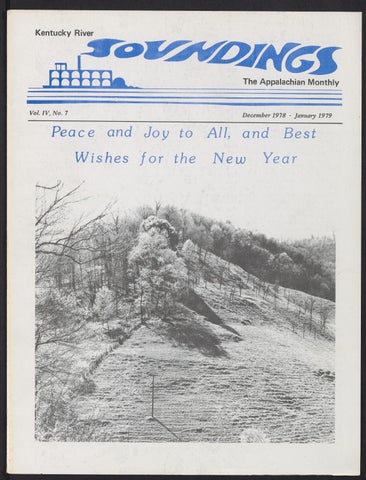
Kentucky River
The Appalachian Monthly
Vol. IV, No. 7
December 1978 - January 1979
Peace and Joy to All, and Best Wishes f o r the
New
Year
IN THIS ISSUE: “Southpaw ”
p .3
“A Time to Work ”
p .3
“Three Moves to a Burn o u t”
p. 4
“A Time to Remember”
p. 4
“Reflections on a Boat Trip”
p. 6
Conclusion: “The Great Feud”
p. 7
“And the Rains Came”
p. 12
READERS' OPINION NEEDED Over the past several years, Soundings has featured articles of varying interest in an effort to reach a wide range of people. There has been considerable turnover in the editorial staff which has affected different issues in terms of design and theme. That has now stabilized and, as editor, I want to establish a dialogue with our readers. Reverend V,Ralph Beiting will, of course, con tin u e as Chief Editor and remain a major contributor of articles, stories, and experiences. But we need to know what your reading interests are regarding CAP’s activities and what kind of information you'd like us to include in Soundings about the appalachia we serve. I know full well that our schedule of delivery has been erratic in the past, and that will definitely be corrected. As a “Monthly," rest assured that you will receive future issues on a monthly basis. As you receive and read them, please let me know what you think about them in terms of content. Look over back issues also, and include comments on what you like and what you dis like. After all, the purpose of Soundings is to satisfy the reading desires of our readers, not ourselves. Just send your comments, sugges tions, or criticisms to: Jack Little, Soundings Editor Christian Appalachian Project Lancaster, Kentucky 40446 2
Dear Friends, At this joyous time of year, when thanksgiving for all our bless ings are uppermost in our minds, I would like to thank you good people on behalf of our Christmas Wreath Project. The wreath program is one of our oldest endeavors and this year we will far exceed any of past seasons. Before the season is over, we anticipate shipping in excess o f 20,000 beautiful wreaths by U.P.S. alone. These lovely symbols of the season have been shipped to all sections of our country as well as Alaska, Hawaii, Puerto Rico, and even Ireland. I have been a part of this under taking since the 1975 season and it is most certainly a heart warming experience to see the program al most double in that time. Without the support and gen erous donations of you good people, all the wonderful projects this pro gram finances would be impossible. Not only does the revenue from Christmas wreaths provide work for nearly 100 people for the better part of two months (sometimes their only gainful employment), but it is a major source of funds in our Human Development Programs. It is therefore, with heart felt thanks that the people o f Appalachia^ the workers and management o f the wreath program, and m yself want to extend to you and yours a most joyous yuletide season. May God Bless you, Lew Phillips Special Projects Dear Friends, I am Jack Morris, the Director of Human Development for the Christian Appalachian Project. One of the most satisfying parts of my responsibility is the recruitment and supervision of volunteers for CAP. The responsibility becomes par ticularly rewarding at Christmas. During Christmas our work is greatly enriched by volunteers who come to us from many parts o f the nation. The holiday season this year will
bring volunteers to us from La Fayette, Indiana, Cincinnati, Ohio, New Orleans, Louisiana, Ames, Iowa, Lousiville, Kentucky and from other places that we are not yet aware of at time of this writing. These volunteers, for the most part, come to us in groups. They come from high schools, colleges and churches. Despite their different origins, however, they have several things in common. They come to work - and work hard! They come with a great deal o f enthusiasm. But, above all, they come to serve. Early in the season some of the groups help us in our regular proj ects. This year, for example, a group from the University of Cincinatti spent a week helping us renovate a motel that we recently acquired to serve as a site for marriage enrichment retreats. But as Christmas draws closer, all proj ects take on more of a yuletide flavor. Some groups come, bringing food and toys, and stay to help us pack and distribute our Christmas baskets. This year CAP will dis tribute more than 300 baskets o f fo o d and toys in 3 counties, to
THE MONTHLY MAGAZINE OF THE CHRISTIAN APPALACHIAN PROJECT “Chief Editor - Reverend Beiting ” Editor - Jack Little Production - Alton Bradley Typesetting - Jean Brown Kentucky River Soundings is published monthly by the Christian Appalachian Project Kentucky River Soundings Lancaster, Kentucky 40446 Manuscripts, photographs and art work limited to Appalachian themes are invited. Copyright 1978, The Christian Appalachian Project, All Rights Reserved.
families with a special need. More often than we would like tragedy and hardship are mingled with joy during the Christmas season. One group from Lafayette, Indiana as sisted us this year in relocating a family whose home had burned. Other groups will come immediately after Christmas and help us clean up and prepare for the new year. There are almost as many ways to express the Christmas spirit as there are people in the world. But it does seem a most admirable way o f expressing the Christmas spirit through the giving o f time in vol unteer service, as these people are doing. Christmas at CAP certainly would not have its present joy and excitement without our volunteers. It is our prayer that you may also have an opportunity to serve during the holiday season and, as subscribers to Soundings and sup porters of CAP’s endeavor, we are sure that you will.
branches, and a squirrel came tumbling down. The old ball player was abso lutely amazed. He had pitched many games in the major leagues, against men like Ruth and Gherig, and deserved their respect when they were in the box and he was on the mound. But what this local boy in the hills of Kentucky had just done truly amazed him. He watched the youngster walk over, pick up the squirrel and add it to the others in his right hand, then take another stone from his pocket. Then the oldster stepped out to speak to the boy. “Son, do you do that every time?” he asked. The boy was a bit startled, having not seen the man while concentrating on the squirrel, but
he replied politely: “Most every time, sir." Every ex-ballplayer is usually an inveterate scout for new talent, and the old pitcher was no ex ception. He saw here some great potential for the major leagues, and he asked: “And you’re left-handed, too, huh?" “Oh no, sir. I'm naturally right handed,” he replied. “But you just flung that stone and hit that squirrel left handed,” the old pitcher said. When telling the story the old man would start chuckling at this point. The boy from the Kentucky hills looked up at him, and in all innocence said: “Oh, shucks, mister, I only do that lcuz maw says I mangle 'em too bad when I throw right handed. "
Appalachia Today
Peace and Joy Jack Morris Human Development Director Christian Appalachian Project
Opinion
SOUTHPAW A grand old man of baseball, after he had retired from pitching and become an announcer for radio broadcasts of games, told of an experience he had while squirrel hunting in the Kentucky hills. He had taken a stand near some large trees, “still-hunting" the little bushytails rather than trying to stalk them. As he leaned quietly against a large elm, he noted a young boy slipping through the woods bare foot and carrying several squirrels by the tails in his right hand. The old baseball pitcher watched, inter ested because the boy apparently had no gun. The youngster, obviously va local native, slipped toward the elm then started sidestepping away, squinting all the while up into another tree. He spread his feet, cocked back his left arm and whipped a stone up into the
EDITORIAL A TIME TO WORK Reverend Beiting Over 20 years ago when the idea of the Christian Appalachian Project first began to take shape and form in my mind, I was determined that it would be an organization that would get its hands dirty, that it would be a working organization. It was not that I had any instinctive fear or dread of a study organization or a group that would address itself to doing research. These things are necessary and needed. But Appala chia has been a land that has been
researched and surveyed nearly unto death. The name Christian Appala chian Project was a purposeful choice. Christian because we wished it to be religious in the fullest sense of the word, Appalachian be cause that was our area o f dedi cation, and Project because that was our main emphasis. We were to be a doer. In the course of the nearly 29 years that I have been present in Appalachia's Eastern Kentucky area, I have attended meetings of various kinds from one end of the spectrum to another. Too seldom in all of these meetings do I find people who are out doing anything. There are study groups, protesting 3
groups, and research groups of one nature or another. We have wished to be identified with the group of organizations that are on the scene, creating new opportunities, forming new organizations and jobs and projects day after day. This issue of “Soundings” is our attempt to inform you of the great number of activities in which we are involved, and the inputs we are making for the well being of the people of our area. Hopefully, it will clarify what we are and might serve as encouragement to others to continue to work for programs and projects that are practical in nature, concrete and down to earth in their involvement, creation, and contribution.
three-line, seventeen-syllable verse. But it does tell one, if one is sensitive and attentive to detailed content in a people’s expressive manner, a whole lot about the people of Appalachia. This expression, unfortunately, is not a happy one. “Three moves" refers to a change of residence, of domicile, of home for a family. This means that a mother and father, and however many children they have, have to pick up all earthly possessions they have left and re locate three times. What the ex pression means is that they must move first, usually, in with his folks. Then, usually, they must move again, as the welcome wears out or tempers grow short or, very prob ably, simple necessities like food and drink in the host home are over taxed, this time in with her folks. Mountain people are terribly proud of one thing: his folks and her folks will take them in. That is a given in the hill country. Regardless of how absolutely little one has, one is bound by some code beyond comprehension for others to do this for kinsmen.
burn-out." But acceptance does not mean absence of anguish, felt trag edy, much readjustment, and a great deal of personal and family loss. Stoicism stems as much from hopelessness as from inner-strength in cases like this, and we try to provide hope where we can to build that inner-strength. When we hear of a “burn-out," CAP’s resources are immediately turned toward re ducing, in so far as we are able, the number of “three moves." More than that, we even try, within our limited resources, to prevent the burn-out. Our home remodeling crews will redo, restructure, and even rebuild stovepipe vents, chim neys, or other fire-hazardous aspects of dwellings. But, nevertheless, “three moves to a burn-out” remains a very graphic expression of hillcountry reality. We hope you can grasp, from this brief description, a little more of the philosophy of our people. They are, though bypassed in many ways, a beautiful people, and de serving, we feel, o f a better deal than has been their lot too often in our history. We hope you share this feeling with us.
A TIME TO REMEMBER LORD, THAT I MAY SEE “THREE MOVES TO Reverend Beiting
A BURN-OUT"
The people of the hills have a number of expressions that many would consider a language unto itself. They communicate with one another using these expressions in an almost fragmentary way that can leave an “outlander" at a complete loss as to what is being discussed. “Three moves to a burnout" is one such expression. All wrapped up in this abrupt, quickly and easily delivered phrase is an almost complete expression o f the Mountain People’s philosophy o f life. Oh, it is not anything like a Japanese Haiku poem is supposed to be, which claims to express the whole of human existence in a 13
A “burn-out" means, very sim ply yet very tragically, that the home has burned down. “Burn-out” is a widely, commonly, immediately understood expression to the hill people,'• With deteriorated fireplaces, poorly restored wood-stoves, and often shaky venting of stovepipes or chimneys, it is an almost in evitable catastrophe for the poorer people. They show acceptance of this hazard, in a quite stoic manner, with the expression, often delivered with a smile, “three moves to a
It was Sunday morning. The services at church were completed. I had finished visiting with all the people who had attended and was on my way back through the church to return to the rectory to have breakfast. There, standing in the sanctuary, was a young woman. Her hair was tangled and her clothes were rumpled. She said, “Can you tell me where the preacher is?" I told her that I was he and could I be of help to her. “My man and I are here and they toldi us that if we came here you would help us." I inquired of her what her needs were. They hadn’t eaten for over a day. The night before they had slept under an overpass on the interstate highway outside o f Lexington and
I
people had more problems than simply financial ones. Their speech was very impaired and you had to listen closely in order to understand what they were talking about. The young husband told me that from the time he had been fifteen he had been awarded total disability be cause of his mental problem^ The wife, too, had been judged in capable of caring for her own affairs. For a while they had each received some assistance from Social Security, but of late it had become in last night they had slept in a car. creasingly difficult to get anyone They were tired, hungry and dirty. to serve as their guardian. Without They had no one that they could a guardian, Social Security would call their friend. I invited them to not give them the money they come and share breakfast with me. needed. As I explored their plight After we had eaten I sat down with even further I found that besides them and listened to their story and mental retardation the wife, also, became acquainted with their prob suffered from epilepsy. lems. Both of them had been taken They had come into our town advantage of by those about them. hitchhiking. They were not sure The wife on several occasions had where they wanted to go but thought been induced by people to buy that Florida would be a good place. drugs. She was extremely free with It was warm there and some years her money. Sometimes she even before they had visited Florida. threw it into the fire and other Rides were hard to come by. They times she put it into the garbage. had gotten as far as our town and She always felt compelled to give they felt now that maybe they it to anyone who asked for it. Her ought to stay here. They had acquaintances asked her to give nothing other than the clothes they them money and they would give wore on their backs, not even a her drugs. Then they told her to razor for the man to shave with sell the drugs to others. She did or a comb for the woman to straight this and for that she landed in jail. en her hair. The pants, shoes and The people of the area fre thin jackets they wore were all they quently gave the husband something owned in this world. They had to drink. They enjoyed seeing not even a quarter as far as money him act peculiar. He had wrecked was concerned. They knew no one a car. He left the scene of the in our whole state, much less our accident. He resisted arrest. He, town. I asked them about their too, had found his way to jail. family. Did they know where they Neither one was retained there very were and what had happened to long because of their mental con them? Their family did not care. dition. Before long they were free Each of them had suffered the loss to become victims once again. of their fathers through death. The Their families felt embarrassed wife's mother had remarried. The by these young people. They did husband’s mother was simply living not want them around. They with another man. Neither wanted caused too many problems. Now these young people who were twen they stood here in my house com ty-seven and twenty-eight years old pletely without resources o f any around them. They had no other kind; no money, no clothes, no brothers and sisters except in the job, no home, no friends, no pros case of the wife who had a brother pects for the future. Nothing! I who did not want to see her. asked them how they had lived in As I talked with them there days past. For over â month they was a growing awareness that these had lived in a cave and at other
times they lived in abandoned houses that people no longer deemed wor thy for any habitation. Sometimes people would give them an old place to live in if they would fix it up. They huddled under bridges. They slept in old cars. They were truly children abandoned by the world. As I went over in my mind the plight of these young people I knew that I had rarely seen some one so totally abandoned. With childlike simplicity they kept re peating, "The man down the street said that if we came here that you would help us.” Later that evening I was reading the Bible and I read the account given by St. Matthew of Jesus’ trip into the ancient city of Jericho, located on an oasis in the great desert leading to the Dead Sea. On this particular day as Jesus entered the town two men sat by the side of the road and cried out, “Jesus o f Nazareth have p ity onus!” When he stopped to talk to them and asked them what they would have him do for them, they said simply, “Lord that we may see. ” As I read these words I could now see the meaning contained herein. I had been suffering from a cold and the flu and I was having a difficult time getting rid of it. Just when I thought it was over with it came back with diarrhea, sore throat, headache and the chills. I kept saying, “Oh, goodness, I wish this was over with.” Sometimes my arthritis acted up and I had a dif ficult time walking as firmly and surely as I would like. I complained because the days were long and the time was short and there was so
much to do and so little time in which to accomplish it. I told myself how little I was appreciated and how few people cared, and what a thankless job it was I had after all. I felt sorry for myself and truly commiserated over the prob lems and difficulties that I faced. As I read this passage from the sacred scripture I could not help but realize how blind I was. Could I not see the blessings that I pos sessed? Could I not see all the wonderful things I had? I had more than one shirt and more than one pair o f pants or shoes. I had a place to lay m y head. I had friends that I could go and talk to. I had people who would give me money i f I asked them fo r it. I had health that was better than most people. I had the experience o f some o f the best people in the world to guide me. What right had I to feel sorry for myself! What right had I to complain! Oh, God! Grant that I may see. This young couple came to me begging for help but I feel they wound up giving me a blessing instead. I wish that I could say that there was a happy end to all of this. This story is still being unraveled. Explorations into what can be done are still under way. Oh, yes! I have put them into a place where they have a warm bed. We have given them food. We have acquired some additional clothing for them and they even have a little work to do. We are exploring with the Social Security office and the Department of Human Resources in our state as to what can be done on a more permanent basis for them. I suspect the story will not have a speedy ending. I imagine it will stretch out for the entire life time of these young people for they will always be searching for friends, looking for help, unable to manage their own affairs. In a world that is so self centered few people even see them and their needs at all. But perhaps their visit to me may result in more good than the^ dreamed of. I can only hope and pray that I shall not soon forget them and that I will not forget the reading of the Scriptures that came 6
to me the day they visited. I pray that I may not be blind any longer, that I may use the great blessings and gifts that have been conferred upon me in such a manlier that I will be a help and a source of encouragement to many more. I f lean use m y time not to concentrate upon m yself and m y own needs, but to look to that greater horizon where God calls us all, to love one another even as much as we love ourselves, then perhaps the blindness will be dispelled and good will come to many. Who knows but that this simple, handicapped, neg lected couple may be the reason why so many others receive a helping hand.
—
MWlW Km -gjL
f
REFLECTIONS ON A BOAT TRIP The time was the last Saturday in October, 1978. The weather was warm. The forecast called for it to be sunny and clear. Eight young men, seventeen and eighteen years old, had asked me to take them on a trip, a boat ride, an overnighter, on Cumberland Lake in Eastern Kentucky. Being fond of both young men and boats, I readily agreed. From noon on Saturday until past 6 p.m. on Sunday we shared the time. One does not get to be fifty five years o f age without knowing a 'great deal about youth. Out of this knowledge you realize that they are persons with unrestricted energy. How they can go so long, so fast, switching gears at a mo ment's notice, pursuing still another course is beyond me! I am afraid that the burden of middle age has caused my memory to lap&e when it comes to recalling how things
were with me at that age. They are fishing one moment, listening to a stereo blaring rock and roll in another, and playing tricks and jokes on each other all the while. When a boat goes past they wave and then whistle when they see that there is a girl aboard. They inquire “Where is the food and when do we eat?" They want to play games, they want to sit silent, and then they like to talk. All these things are a part of their life and for a day and a half I shared that life with them. At times they allowed me the luxury of a quiet moment in which I prayed. At other times they questioned me about the lake and its history, how it came to be, and was the water always this low or did it get higher. At other times they wanted you to play monolopy with them and they took much satisfaction when they beat you rather thoroughly. All these things took place, but I think what lingers in m y mind now days after the event is not the fish they caught, the jokes they told, the pranks they played, or the music they murdered. It was they, themselves, not what they did, but what they were, that affected me most. They were people. Being young was but an accident that would soon be remedied. They were people with dreams and hopes, people with sorrows and fears. As I sat at the table and listened to them discuss first this jail and then that one in all the counties that surrounded us, I realized that the boys had lived in them for a while. (Continued, p. 11)
Our Appalachian Heritage
The Great Feud By Reverend Ralph Beiting Frank Phillips kept up his raids into West Virginia. Cotton Top Mounts, the man who had shot and killed Allifar McCoy, was captured. They was taken away to Pikeville where he was to undergo trial and execution. Each time Frank Phillips depart ed for West Virginia, he was follow ed by McCoys. A strange and mar velous thing happened to them on one trip. As they were following a trail they heard the approach of a number of men. They quickly hid in the forest and waited. They were amazed and then overjoyed to find
that it was no other than Devil Anse, his son, Cap, and five of the Hat fields who were following the trail. Frank Phillips gave word that his men should wait hidden in the forest until the small group of men had come out into a clearing. At the proper moment he would give the signal to fire. It looked like he was going to put an end to this feud once and for all. But as Cap Hat field entered the clearing he noticed a twig moving. With a shout of warn ing he fired his pistol and one of the McCoys pitched forward mortally wounded. The Hatfields blasted
loose in every directionhittinghorses as well as men. The horses began to cry out in pain and dash madly about in every direction. They com pletely confused the McCoys and before long what seemed to be an easy ambush was turning into a rout in favor of the Hatfields. The battle went on for two hours. One Hatfield was dead and three were wounded, but of the forty odd McCoys that had come to do battle only eighteen were left now that could fight. Both sides withdrew, thankful for a chance to go home. For years 7
each of the two feuding clans had taken their cause to the governors of their respective states. The gover nor of West Virginia was now totally incensed by the invasion of hundreds of Kentuckians led by an agent of the governor of a foreign state into his territory. He wired the Governor of Kentucky that he was ordering out the militia who would deal with any further invasion. The Governor of Kentucky answered back that he, too, had soldiers and that if he wanted à fight, a fight was what was going to take place. For some time it seemed like the two states would be involved in this feud. A civil war now threatened to break out and spill’even more blood. But the governor's of both states realized the danger in time and canceled their call for the militia. Each governor talked to the two clan leaders and urged peace. Devil Anse was persuaded to move twenty miles further inland from his beloved Tug Fork River Valley and settle on Main Island Creek. The McCoys were also getting a little weary of the feuding and, finding the financial pinch more and more vexing, moved inland to the vicinity of Pikeville. On Tuesday, November 19, 1889 the capital city of West Virginia, Charleston, was amazed to see walk ing down the main thoroughfare no o:ie other than Devil Anse Hatfield. He had been taken into custody of his own free will by the deputy sheriff. He had been assured by the court that he would in no way be troubled. The McCoys had fallen back on strategy in their attem pt to take Devil Anse. There was a federal warrant out for Devil Anse for the making and selling of moonshine. The McCoys urged the authorities to arrest him With the intention of then capturing him and getting him back across Tug Fork River into Kentucky. Devil Anse consented to go to Charleston. Perhaps there was in him something of a showman. He presented an impòsing sight. He was armed to the teeth, two revolvers at his side, a knife in his belt and a Winchester on his arm. Besides that, he had his own personal bodyguard. There waà also the deputy sheriff 8
and the promise of the court that nothing would happen to him. Devil Anse gave his testimony in the courtroom. His Winchester rifle lay between his legs cocked. He assured judge, jury and all, that he had never made a drop of moon shine in his life and that this charge was trumped up by his enemies. He was, of course, immediately freed and found innocent. The court had gotten wind of the attem pt of the McCoys to capture him. It was one of those comic relief episodes in the tragic story of this feud that now interested newspaper men, magazine writers, and photographers from all parts of the East. On February 18, 1890 the law demanded at long last that Cotton Top Mounts was to be hanged until dead. He had been involved in much of the feuding and had shot the McCoy girl the evening when Ran dall's home burned to the ground. Pikeville had never seen such a sight before. Probably 8,000 people crowded into the town that day to witness the execution of one of the most dreaded of the Hatfield clan. Frank Phillips was on hand bloom ing drunk, staggering down the streets yelling and cursing one and all. This was his day and he was de termined to enjoy it to the fullest. He had six revolvers tucked into his belt and a Winchester in his hand. The sheriff was very concerned and ordered that Frank Phillips be dis armed. A fight followed out of which a riot nearly grew. In the end, the people were more anxious
to see Ellison Cotton Top Mounts hung than Frank Phillips in a fight. At long last the day and hour had come. The prayer had ^been said and the minister departed. Cotton Top Mounts stood on the wagon which drove off and left him dangling in air, dead and hopefully at peace at last. The continuing feud was no long er a fashionable affair. It was inter rupting progress. It was slowing down the coal industry, the timber industry. These new powers had moved into the mountains and not even the most feared mountain men could oppose them. A period of peace then settled over the river valley and everyone thought that perhaps this might be indeed an end of the hostilities. The peace lasted until the year 1896. On this particular occasion Cap Hatfield and his little stepson, Joe Glen, went to Thacker, West Virginia to celebrate the presidential election of that year. Cap, as all Hatfields, was armed to the teeth, a revolver stuck in his belt, a knife hanging in sheath and the Winchester in his hand. On the streets of Thacker he was confronted by one of the Rutherford clan. They were in-laws to the McCoys. John Rutherford and his brother, Elliott, had been drinking heavily in their celebration of the election. They started a fight with Cap. Cap continued to apolo gize and try to break away, but the argument persisted until one of the Rutherford's took his Winchester and fired at Cap. Instantaneously, Cap's revolver came out and the bullet smashed the Winchester. An other shot and John Rutherford was dead. Joe Glenn, a small teenage boy, seeing that the other Ruther ford was taking aim at his step father, pulled his pistol and killed him. A local townsman came run-
ning out of one of the stores shout ing to stop this ruckus. Young Glenn thinking he was also one of the Rutherfords opened fire and killed him. Three men lay dead. Cap Hatfield and young Joe Glenn were taken to the jail at Huntington, West Virginia. When his father, Devil Anse, heard that Cap had been arrested and put in jail he armed the Hatfield clan once again and started for Huntington. This time the sheriff of Mingo County, West Virginia stood in his path. He told Devil Anse that these were difficult times. He could probably shoot and kill a number of the deputies, but he couldn't kill them all. The law was here to stay and Devil Anse had best listen. Devil Anse's response to this warning was loud and profane. When he finished the sheriff put him under arrest. When Devil Anse threatened to shoot him dead, the sheriff told him to go ahead, but that he would surely die as well. There were too many men for even the Hatfields to fight. Devil Anse was taken to jail and released with the promise that he would come back to Williamson, West Virginia. Cap Hatfield was sentenced to one year in prison and his stepson, Joe Glenn, was given a similar sentence. After several months had passed Cap's fascination w ith'jail life came to an end. After several members of his clan had visited him, Cap was found missing from the jailhouse. Little Joe Glenn was released from prison and grew up to be one
of West Virginia's outstanding law yers. With Cap's escape from prison in Williamson the entire countryside was once more up in arms. In fact four states were now brought info the conflict. West Virginia, long the defender of the Hatfields, now had a posse out hunting for Cap. Kentucky had armed its borders in order to prevent him from crossing the Tug Fork River and skipping into the mountains of Eastern Ken tucky. Virginia and Ohio also placed special guards on their fron tiers with West Virginia. There were now well over a thousand men in the manhunt, pursuing Cap Hatfield. Perhaps never before or since had so many men been after just one individual. Cap was eventually discovered at a place made famous by his father, Devil Anse. He had been spotted by the sheriff and his posse on a mountainside in West Virginia known as the Devil's backbone. At this place his father, Devil Anse, had held off an entire company of Union soldiers during the Civil War. The sheriff and his posse were soon joined by an eighty year old man now nearly demented. His name was Randall McCoy. “He had come," he said, “to get himself six foot of Devil and 180 lbs. of hell." This was his description of Cap Hatfield. The sheriff and his posse had Cap surrounded on top of Devil's Backbone. Yet the more they tried to get him the more losses they suffered. After two days they had nine wounded, two dead and two soon to die. They were joined
by hundreds of other men. At one time they endeavored to blow up the Devil's Backbone. Two separate charges of dynamite were set off. They exploded and sent most of the craig falling into the valley below. But when the final dust had cleared, Cap's guns were still blazing, and none of the men dared to go for ward. Mysteriously Cap slipped away. In spite of the fact that hun dreds and hundreds of men roamed over the mountainside, no one could find a sign or trail of Cap Hatfield. The possee went to Devil Anse's home only to find that Devil Anse was gone and would not be back for several days. The old chieftain returned full of dust and dirt, weary and hungry but unwilling to talk. Undoubtedly, he had hid Cap out in the vast recesses of the forest that he and his family had known so well. After a while, strange as it may seem to us today, the animosity over Cap's departure from the Will iamson jail subsided. With the pass ing of a couple of years Cap came back and resumed his part in the family fold. No one intervened. The indictments against him gather ed dust and the incident was for gotten. The year was now 1898, and Frank Phillips, who had done so much to bring so many of the Hat fields to trial and finally to exeuction, was on one of his drunken expeditions. He was with a crony, a man by the name of Ransom Bray. They had been out on a searching expedition for some of the Hatfields. Frank was drunk as was his custom now, and he began to pick a fight with Bray. Bray, not wishing to get into an argument with Frank Phillips, went off with a local young woman to a neighbor’s
;m|
k$» “
S*
1 fljj 9
amazed by the lack of uniformity concerning the number of people killed in the feud. Some estimates are as low as thirty. Some go over the hundred mark. Without a doubt it was the longest and most costly family feud in American history. The Hatfield clan, in particular, went on to produce many outstand ing men and women, college grad uates by the score, lawyers, doctors and professional people of all kinds. Not one of Devil Anse’s thirteen children had been killed in the feud.
home. Later that night Frank Phillips came and demanded satis faction of Bray. A fight ensued and Frank Phillips was shot in the leg. He lay -wounded in this place for two days. Gangrene set in and his life was quickly running out. In true characteristic mountain fashion as he was about to die Frank asked one and all not to hold it against Ranson Bray. It had been a fight of his own making and since he couldn’t settle it no one else should. Now one of the great antagonists in the feud was dead. Frank Phillips would no longer invade West Virginia and haul Hatfields to the court at Pikeville. With the coming of the new cen tury, the feud had now come at last to an end. Randolf McCoy died on March 28, 1914. Devil Anse Hat field passed away on January 6, 1921. The people in West Virginia still talk of the funeral that was had on that day to honor this important man. The railroad had to put two extra coaches on the train to help handle the attendance. Some folks say there were more than 5,000 people present for the funeral. When one reads the accounts given by many of the historians of this particular family feud, one is 10
ap ■ 1»
mm
^ JH PK k 1
The McCoys, too, made an im pressive showing in later generations, producing many important indi viduals. I recall the Hatfield man that I met back in Wayland, Kentucky more than fifteen years ago. I remember the fright he expressed over one of the early meetings be tween the two families. He had witnessed, however, that these days were gone forever. More peaceful
times have come to our mountains. When I finished writing this I talked to one of the men that I employ in our work in the moun tains. I asked where he had been over the weekend. He told me that he had gotten into a little family argument. He and his brother had gotten into an argument with a neighbor over the sale of a pickup truck. A fist fight had resulted and both of them had landed in jail. I said to him, "You better be careful. These things could turn into serious trouble.” He said, "I know. Last week my brother-in-law was shot and killed in Crab Orchard over an argument concerning a pickup truck.” I suppose the old violence is still here. But I can only pray the family clans have learned the law is also here.
Excerpt from PAUL H A R V E Y NEWS * (July 19. 1977) LIFE UNDERWRITERS and THE FLORIDA TIMES—UNION have audited charities. Hear this: - For every dollar reaching the hands o f the needy through churches, the - cost o f distribution is 8 cents. - For every dollar reaching the needy through pri vate charities the average cost is 28 cents. - For every dollar given the needy by the fed eral government the cost ofdistribution is THREE DOLLARSl The prosecution rests. *American Broadcasting Company Chicago, Illinois 60601
(REFLECTIONS' Cont’d) Their liberty had been taken and they knew what it meant to look from the inside out. I heard them speak about their problems. Why did their mother have to hang out with that kind of man? Why did she always go after an individual that had no real morals? Why wouldn't their father come to see them? Why had it been six, seven or eight years since they have seen him last? All the while you could hear them crying out. You could hear the cry coming forth, "Won’t somebody care fo r me? Won’t somebody give me their attention? Won’t some body love me?”
I was rather surprised to see the enthusiasm with which they reacted to prayer and to religious services. I was privileged to have a service for them on Sunday morning. When it was over and a quiet time had intervened, they came one after another, not in some routine pro cession that was expected, but in dividually, quietly, sincerely. They said, “We really enjoyed the services. You made God sound real nice. I would like to come again. It meant a lot to me." It always makes me feel good when somebody loves God. It was gratifying indeed to see these young men who have had so little opportunity to know God in a religious context, who had suffered so much almost from the time that they had come to know life, to find in God a friend. They talked about their future. What were they to look for? How were they to know what makes them happy? How would they see it? What should they look for in
order to catch the signs? All the while, you had the feeling it was not so much what to look for that they were inquiring about. What really was on their minds was, “Would yo u help me? Would you care? Does it matter to you what happens to me?” A t near the end of the day one young man came up to me and said, “Do you mind if I tell you what I think of you?" If •there ever was a loaded question, that had to be it. I felt a captive to the question. I had no other alter native but to say, “Well, no, not at all. Say what you feel." Haltingly and painfully, he got it out that he thought that I was a fine man be cause I knew how to give. He knew that I had given my time when there were many other things that I could and possibly should have been doing. He saw that they could drive the boat and they could use all the various equipment on it. They always asked, but they knew they could use whatever was in m y fishing tackle box and that impressed them. Somebody who was willing to give their time, possessions and them selves. It was nearly dark when they
took their leave and got into their van and headed for their homes. The wave of the hand, the shout of thanks and the question “When will we see you again?" filled the air, but soon they were gone and all was silent and I was left to think about what it all meant. The more I have thought and the more I have re flected, the more astonished I am at the wisdom o f God. He made us a family. He made some o f us old, some o f us young, and some o f us middle aged. From each we draw strength, wisdom, inspiration and
security. I learned from them and hopefully they profited from me. We tolerated each other on certain areas. They didn’t like m y Mario Lanza and I couldn’t stand their rock and roll, but they allowed one of my songs to come through every once in a while and I felt a sense of tolerance for theirs to come forth as well. The generation gap has always been with us, but family unity is stronger than that. In his infinite wisdom, God gave us to one another to be helpmates, to be guides, sources of strength and inspiration. I am very pleased to be old so that I may give and share with others what the goodness of God and the concern of others has given to me. I am glad that they are young so that I may always be enthusiastic and learn from that that life does not have to be a stagnant pool. It will not be long before the beautiful leaves of autumn and the warm sun shine of October is a memory. The dreary cold rain o f November will give way to the snow o f December, but what happened on that warm October day between eight boys and m yself on a boat on Cumberland Lake will not easily be forgotten. 11
And
Then the
It is midnight, Thursday, De cember 7. Iam ready for bed. It is difficult to get to sleep. A severe thunderstorm is raging outside. The night is set afire by the lightening. The rain has been pelting the earth most of the day. 6:00 A.M. - Friday - The alarm goes off. The rain is still coming down. 7:30 A.M. - 1 celebrate Mass for the feast of the Immaculate Conception. 8:30 A.M. - I met with some of our workers to get a car fixed. (The wheel bearings went out and it is stranded five miles down the road.) We also make arrangements to move some of the food for our Christmas baskets to another location where we can sort it. 9:00 A.M. - I leave Lancaster and head for Mt. Vernon, 26 miles away. For the moment the rain has stopped. DIX RIVER BRIDGE OUT 9:15 A.M. - I arrive at the 12
Rains
Dix River twelve miles away and to my surprise the road is covered with flood waters. Never in 28 years had I seen this bridge covered. I couldn’t return to Lancaster as the bridge was washed out between Stanford and Crab Orchard. A local resident told me I could get to Berea if I used the back gravel roads and then go from there to Mt. Vernon. 9:30 A.M. - I started out on the back roads. One mile down the road a creek covered the road for nearly 300 ft. I asked the farmer who stood by the road how deep he thought it was. "About two feet, I reckon,” he said. I decided to try it. With a fervent prayer to whatever saint looks out for mad-men in flood waters, I started out. The farmer was correct. I made it. I had no brakes, but they would dry out. Two more sections of the road were covered, but not as bad as the first. HOME FOR RETIRED PRIESTS
Came
10:15 A.M. - I arrived at last in Mt. Vernon and went to see a reltor who was helping me locate a small farm for a retirement home for priests and ministers. He was very surprised to see me because of the rain. 10:30 A.M. - We got into his jeep and looked over two places. By this time it was raining harder than ever. You couldn't see to drive. 12:00 Noon - I came back to our church at Mt. Vernon. I called back to Lancaster to tell them I was cut off by the flood at the Dix River. I was also concerned about our camp for children on Herrington Lake which was formed by the Dix River. I sent a volunteer there to check on that. I told them to get some of our workers and check on the Ken tucky River at Camp Nelson where we had a big project to restore its historical heritage and to create jobs through family recreation.
27 BRIDGES OUT 1:00 P.M. - I called the High way Department to learn about the condition of roads in the area. To m y amazement I learned that Lamero, Livingston and the Roundstone section o f the county were all under water. Twenty -seven bridges were out in Lincoln County. The Dix River now covered U.S. Highway 27 between Lancaster and Stanford. He didn't have definite knowledge on the Kentucky River, but it had to be bad. The rain was still coming down hard. The phone no longer operated. 2:30 P.M. - Two of our workers came in from Berea. The rains had been so hard that a small stream crossed the road and poured into the building where we had our used clothing store at Appalachian Village. Much of the clothing got soaked. The store was closed and we needed workers there to clean up the mess. CLIFFVIEW LODGE N E A R L Y IN WATER 3:00 P.M. - Phone rings. It is Cliffview Lodge. The lake is a raging torrent. Boats, docks and huge trees are racing past. Our boats and dock are still secure. “How high can the lake go,” they asked. “It is only two feet from coming into the buildings.” I assured them we built the building
14 inches above the spillway of the dam. There was no need to worry. Saturday the lake crested with water lapping at the edge of the floor. The volume o f water coming into the lake was so great it couldn’t get over the spillway o f the dam fast enough and backed the lake up higher than anytime since it was built in 1930. 3:30 P.M. - Another one of our workers arrives. He has been out helping a widow and her family find a house. Two days before, their home had burnt down.
m
Their furniture and all of their clothes were gone as well as the money from her monthly paycheck which she had cashed the night before. Because of the floods he was having a hard time finding a place for her. I told him that the roads were under water between Mt. Vernon and Lancaster and he couldn’t get the furniture for her we had gathered together there. 4:00 P.M. - The phone is working again. I called Pikeville, Hazard, Harlan, Pineville and Williamsburg to see how the flood was there. It was at Easter in 1977 that we had taken food, clothing and supplies to those places and I wondered if we would be needed there again. To my relief they were in no danger. The rain there was light. KENTUCKY RIVER GOES WILD A T CAMP NELSON 4:30 P.M. - Phone rings... It is Lancaster and they have a report on the Kentucky River and Camp Nelson. The river was covering the campgrounds. Three o f our buildings have water in them. The excursion boat has broken loose from the dock and has gone down river. It is still raining and the river is rising fast. No one knows how high it will go. 5:15 P.M. - A priest from Indiana brings in a group of high school t t a Ii i m f
fa
horn
4
in a woodworking venture. I had promised to get them more equip ment when I went to Northern Kentucky to see my mother who had been operated on Friday for cataracts on her eyes.
surprised to see the flood and we are grateful for them. On Saturday, they helped clean up the damage done at the used clothing store at Berea and cleaned up an old house found for the widow who had suffered from the burn out. TRIP TO WILLIAMSBURG, KEN TUCKY 6:00 P.M. - 1 leave Mt. Vernon and head for Williamsburg, 65 miles away. I had made an appointment to meet some realtors there. A group of four nuns had worked out of Williamsburg for 8 years. In that time they had to move five times and the present house had been sold again. They asked me to help them get a house of their own. Since I had promised to come, I went. It was still raining and the rain continued all night. 9:00 A.M.Saturday - I met the Sisters and we visited three separate homes with the realtors. One home is settled on as the best of the choices. After much negotiation, we agreed on a price of $36,000. Closing will be by the first of the year. I will have to raise the money by then. We are going to pay for it and let the sisters use it rent free. TRAVELERS WARNING - SNOW BEGINS 12:00 Noon - The rain has stopped, but it is getting colder. Radio forcast calls for sleet, snow and sub-freezing weather. A travelers warning is now out. I head back for Mt. Vernon and Lancaster. I had promised to see the volunteers who were working at Mt. Vernon. I also had a meeting with three young men whom I had helped get started 14
RETURN TO MT. VERNON AND BAD NEWS 1:30 P.M. - I arrive at the church at Mt. Vernon. It was now sleeting and it was getting very cold. "They have been trying to get you all morning from Lancaster,” I was told. I called Lancaster. We were going to have a social there that evening to aid a missionary in Rhodesia who had visited us during the summer. I had promised him $1,000 before the end of the year. Because of the travelers warning they had to call the social off. The big news, however, was the
Kentucky River and Camp Nelson. Every building there was covered. Only roofs stuck out every now and then. I told them this was impossible. The Corp o f Engineers had been keeping records o f the river fo r over 100 years and at no time had the river been that high. N ot even the great floods that destroyed the Ohio and Mississippi River valley in 1937 got that high. Record or no record the river was higher than that and still rising! I had better get home as soon as possible. CALL FOR HELP FROM FOSTER HOME FOR BOYS 2:30 P.M. - Roads are still covered between Lancaster and Mt. Vernon. I go by way of Berea and get through. It is snowing hard now and the wind is bitter cold. As I
come into the door at Lancaster, I am met by one of our volunteers. They had a call from our Foster Group Home for Boys at Camp Nelson and they are worried about the rising water. Do we have room for them at church i f they have to move that night? I try to get them back by phone, but the phone is out now. 3:00 P.M. - I get two volunteers and we head out for Camp Nelson to see what we can do about the damage and get word to the Foster Home. 3:15 P.M. We drive down the last section of road to Camp Nelson. I cannot believe my eyes. Water is every where. The current is frightening. Every building and home we have at Camp Nelson is under water. A house trailer, that two of the workers at the Foster Home lived in, was now down the river swept away by the raging current. Two craft shops were also gone and two small buildings that housed pumps and equipment were washed away. Both of our boat docks over 800 ft. in length were gone, together with the five pontoon boats and the motors on them. One dock was lost when a house floating down the river hit it and tore it loose. 3:45 P.M. - 1 got back in the car and back tracked to get on the high bridge that was 150 ft. above the water. We got down to the river again, this time on the north side. As we came down the road leading to the river, I saw to my great relief that the Foster Home was still a good ten feet out of the water. They were cut o f f but safe!
HOUSES FLOAT AW AY, TRAIL ERS DESTROYED When I arrived at the water’s edge once again, the destruction was awful. An old lady was trying to get the rescue squad to go out by boat and tie her house to some high trees that were still out of water. Her house had already floated one-fourth mile away from its foundation. It was no use. Before nightfall came the house had broken into a thousand sticks. I met other old friends. They told me that o f the five houses and one trailer over on this side o f the river, three homes and the trailer were gone. The rest just had the roofs out o f water. H alf a dozen cars were under water plus tractors and trucks. Another man came up to me and said, “Oh this is awful! No, it is worse than awful! Camp Nelson has to be dead this time. There is no way it can come back from this!” I called out the Rescue Squad from Nicholasville and they brought their boat to the shore. I told them about the Foster Home and the 18 boys and the family there. They headed out into the river and up the creek to the home. I told them I would wait for them at the base unit and they could
pMMgBlIl
m m SHI MSBM M contact me by radio. Fifteen min utes later the radio crackled with their report. I talked to the director o f the home and told him the water was now cresting and they had nothing to worry about. They had food, water and firewood. They would be o.k. DARKNESS COMES WITH BIT TER COLD 6:00 P.M. - It was now dark and getting colder by the minute. Two inches of snow was on the
ground, but it had stopped snowing. I went home. 9:00 P.M. - I had finished supper, some of the spa ghetti and meat balls that were planned for the social. I hac| called home about my mother. She was home from the hospital. She had no pain, but was still very weak. I would drive north to see her after Sunday’s Masses. A call came in for help on Sunday. Could one of us priests go to Corbin and have Sunday services for them. The priest who was to come was stranded
If you know someone who would like to receive the Soundings each month, have them complete this form, enclose $4.00 for a year’s sub scription and send it to us. Or, if you’d like to give someone a year’s subscription as a gift, complete the form and send it in with $4.00 yourself. N am e
:-------- !------------------ :— -_________
Address
___ ;----- .-------------------------------------------
City
------------------------- ------------ Zip
._________
Send to:
Christian Appalachian Project Kentucky River Soundings Lancaster, Kentucky 40446 15
by high water at Beattyville on the Kentucky River. My associate went to Clorbin and I covered Lancaster and Mt. Vernon. MIDNIGHT - A D A Y OF TRAGIC DESPAIR 11:30 P.M. - The worst was over. How severe the damage was would be weeks in the telling, but already estimates were going beyond 150 million dollars. The flood at Camp Nelson had gone 8 ft. higher than any flood in history. From 8 a.m. on Thursday to 8 a.m. on Saturday nearly 8 inches o f rain had fallen. By Sunday morning the temperature had fallen to 12 degrees above zero. A mother and her child were frozen in their car. As I reflected on the last two days I realized that we had lost more in these last two days than at any time in our history. We were on missions of mercy from Rhodesia to Williamsburg when we got hurt ourselves. I don’t know the answer to all of this. B ut I do know we shall come back! God is still here and with him and good folks like you, we will come back and do even more good. Kentucky River
The Appalachian Monthly
N O N -P R O F IT O R G A N IZ A T IO N U . S. P O S TA G E
PAID Christian Appalachian Project
Christian Appalachian Project Kentucky River Soundings Lancaster, Kentucky 40446 N a m e ------------ ----- -------------------------Address