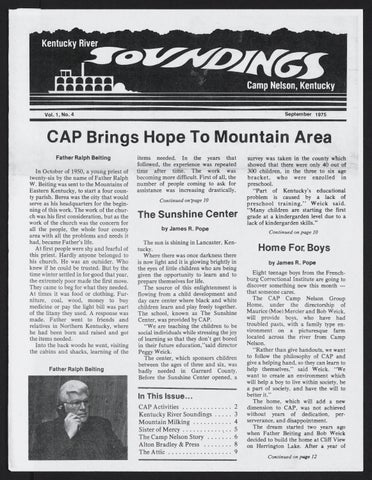
CAP Brings Hope To Mountain Area Father Ralph Beiting In October of 1950, a young priest of twenty-six by the name of Father Ralph W. Beiting was sent to the Mountains of Eastern Kentucky, to start a four coun ty parish. Berea was the city that would serve as his headquarters for the begin ning of this work. The work of the chur ch was his first consideration, but as the work of the church was the concern for all the people, the whole four county area with all the problems and needs it had, became Father’s life. At first people were shy and fearful of this priest. Hardly anyone belonged to his church. He was an outsider. Who knew if he could be trusted. But by the time winter settled in for good that year, the extremely poor made the first move. They came to beg for what they needed. At times it was food or clothing. Fur niture, coal, wood, money to buy medicine or pay the light bill was part of the litany they used. A response was made. Father went to friends and relatives in Northern Kentucky, where he had been born and raised and got the items needed. Into the back woods he went, visiting the cabins and shacks, learning of the Father Ralph Beiting
items needed. In the years that followed, the experience was repeated time after time. The work was becoming more difficult. First of all, the number of people coming to ask for assistance was increasing drastically, Continued on'page 10
The Sunshine Center by James R. Pope The sun is shining in Lancaster, Ken tucky. Where there was once darkness there is now light and it is glowing brightly in the eyes of little children who are being given the opportunity to learn and to prepare themselves for life. The source of this enlightenment is flowing from a child development and day care center where black and white children learn and play freely together. The school, known as The Sunshine Center, was provided by CAP. “We are teaching the children to be social individuals while stressing the joy of learning so that they don’t get bored in their future education,’’said director Peggy Weick. The center, which sponsors children between the ages of three and six, was badly needed in Garrard County. Before the Sunshine Center opened, a
In This Issue... CAP A c t iv it ie s .................................. 2 K entucky River S o u n d in g s ...........3 M ountain M i l k i n g ............................. 4 Sister of M e r c y .......................... . 5 T he Cam p N elson S t o r y ................... 6 A lton Bradley & Press .................. 8 T he A t t i c ................................................9
survey was taken in the county which showed that there were only 40 out of 300 children, in the three to six age bracket, who were enrolled in preschool. “Part of Kentucky’s educational problem is caused by a lack of p reschool tra in in g ,” W eick said. “Many children are starting the first grade at a kindergarden level due to a lack of kindergarden skills.” Continued on page 10
Home For. Boys by James R. Pope Eight teenage boys from the Frenchburg Correctional Institute are going to discover something new this month — that someone cares. The CAP Camp Nelson Group Home, under the directorship of Maurice (Moe) Mercier and Bob Weick, will provide boys, who have had troubled pasts, with a family type en vironment on a picturesque farm located across the river from Camp Nelson. “Rather than give handouts, we want to follow the philosophy of CAP and give a helping hand, so they can learn to help themselves,” said Weick. “We want to create an environment which will help a boy to live within society, be a part of society, and have the will to better it.” The home, which will add a new dimension to CAP, was not achieved without years of dedication, perserverance, and disappointment. The dream started two years ago when Father Beiting and Bob Weick decided to build the home at Cliff View on Herrington Lake. After a year of Continued on page 12
CAP A c tiv itie s in S ix Counties Many people have gotten so caught up in the activities and spirit of Camp Nelson that other areas of CAP may have been overlooked or forgotten. Maps shows the scope of the Christian Appalachian Project.(CAP) MADISON COUNTY Berea •Camp for Children, Blue Licks •Child Development Center—ages 3,4,5. •Upholstry shop •Appalachian Village Shopping Center •Mountain Craft Center •Berea theatre (Movie) »Used clothing store •Town Cinema
JESSAMINE COUNTY •Old Music Hall •Memorial park •Fort Bramlett •Tack shop Boone’s Lodge •Home for Boys •Boone’s Cave •Farming Operation JACKSON COUNTY Tyner •O ld Folks Home •Factory leased to Kyaks (makes boats) •Christmas Wreath Manufacturing Co. •W ood working factory •Dairy •Used clothing store •Camp for children
G A R R A R D CO UNTY CAP O f fice—Yellow House Lancaster •Youth Center •The Attic-used clothing store •Emergency shelter houses for children •Camp for children-Cliffview lodge, Herrington Lake •H o u se b o a t—D a n iel ' Boone Camp Nelson •Child Development Center—age 3,4,5 •Kentucky Valley Press •M ailing service •Antique Shop •Trailer and camping area •Two Marinas •Country Store x »Post Office •Golf Course (miniature) •Mexican and Indian Shop •Camp Grounds •New Music Hall ROCKCASTLE COUNTY Non-denomonational Bible School Mt. Vernon •U sed Clothing store Farming Operations •Lincoln Co. •Jessamine Co. •Garrard Co. •Jackson Co. CAP has helped set up many people in business. •electronic •wood chair mfg. •wood carving 3 Nurses working in various spots in CAP and Medical Transportation Ser vice for remote areas. Non denominational Bible School
Kentucky River Soundings P u blish er....................................CAP Editor-in-Chief.................................... Father Ralph Beiting Editor, Writer, Photographer.......... Henry Gilbert Writer, Photographer........................ James R. Pope Design A rtist............ . Mackie Gray Published monthly by Christian Ap palachian Project (CAP). Entered as second class matter at Camp Nelson Post Office, Camp Nelson, Kentucky 40444. Subscription rate in U.S. is $3.00 per year. Address all correspondence to Kentucky River Soundings, Camp Nelson, Kentucky 40444.
The Kentucky River Soundings— All of us at CAP have been pleasantly surprised by the public acceptance of the Sounding. Our first editions were gotten out so quickly we didn’t have time to tell in greater detail all the ex citing things CAP is doing in the six counties it is principally engaged with at the present time. You will read stories of camps for children, emergen cy shelters, used clothing stores, job op portunities, Camp Nelson and just plain folks. CAP is one of the most exciting groups in Appalachia. It’s continuing involvement with the mountains and the mountain people we think will make great reading. We also want to call attention to the mountains and hills of Appalachia. There will be stories of history and pioneers both early and late who made the mountains ring. You will find recipies and household hints. Songs of a bygone day wull live again. You will learn about mountain crafts and how to get them and where to go to see the mountain plays and enjoy mountain hospitality. From time to time we will speak about the big issues that concern Ap palachia and what we think are the ways in which to face and anaswer them and how you might help. We want the Soundings to be your paper as well. And so we shall be letters from the readers, guest editorials and maybe at times some just plain gossip. We hope the Soundings will be a cheer ful, folksy, informative and challenging part of your life.
Kentucky River Soundings has staff of four Since its beginning last April the staff of the Kentucky River Sound ings has increased to where there are four people doing 'different or extra jobs. The first two issues concerned the rebirth of Camp Nelson, mainly. Now the publication is branching out to include more of the activities of the Christian Appalachian Project (CAP). Future issues will not only cover activities of CAP but will tell about some of the life and different activities of Appalachia—in par ticular the area around the six coun ty area of CAP. Father Ralph Beiting is the editorin-chief. Of course, with his years around the area of Lancaster, Berea, Mt. Vernon and McKee there is no need to go into his life story— everyone knows that he has spent the last 25 years here and CAP is his dream and vision. Henry G ilbert, a L exington photographer and teacher, was chosen as the editor, writer and photographer of the Soundings. He started his professional p h o to graphic career with the Louisville Times in 1956, later teaching photography in the Journalism School at the University of Ken tucky. Gilbert has won many state and national prizes for his work in photography. He is now serving as President of the K entucky P r o fe ssio n a l P h o to g r a p h e r s Association (KPPA) until April 1976. The Pepiot Studio in Lexington has been his base of operation for about 12 years. James Pope, Lexington, a recent graduate of the University of Ken tucky does a great deal of the writing and photography for the Soundings. Continued on page 12 It takes a lot of talent to produce the “ Soun dings” , but with the help of Jason Gray (Mackie’s two-year-old s o n ) . . . we made it!
Mr. Michael McLaughlin
Michael C. McLaughlin promoted to General Manager of CAP As of May 8, 1975 Michael C. McLaughlin, Personnel and Business Development Manager of CAP, has been promoted to General Manager of the Christian Appalachian Project (CAP). This means he is second only to Father Beiting who is President of CAP. For this position, it would have been hard to find a person with the q ualification s, experience and education of Mike McLaughlin. He graduated Valadictorian from Mid dletown, Ohio High School in 1957 out of a class of 350 students, receiving scholarships from Armco and Harvard University. McLaughlin received his A.B. degree from Harvard University in 1961, Cum laude, attended the Univer sity of Tennessee in 1969-71 where he did graduate work in industrial physchology with grade point average of 3.75. At the University of Dayton, he did undergraduate study in General Psychology with an average of 3.37. In 1962 he graduated with honors as an ensign from the office candidate school at New Port, R.I. and was assigned to the office of Naval In telligence, Washington D.C. where he received several commendations for outstanding performance. In 1963 Mike was assigned to the USS Kitty Hawk, promoted to Lieutenant in charge of 60 men. Here he received many honors, in cluding the Cold War Service Medal. From the Navy, he went to the Univer sity of Dayton as Personnel Director at the Research Institute where he was in charge of all personnel functions of an Continued on page 12
4
Mountain Milking by James R. Pope
“If you’re like me, you like to know what’s going on in the back roads of the country,” said “J.B.” Muncy, who has worked for 10 years on the C.A.P. dairy farm in Jackson County, Kentucky. Far removed from the more beaten paths of society, where the moo of cows and the sputter of automatic milkers are more frequently heard than sirens and telephones, the C.A.P. dairy farm, near Grey Hawk, dozes beneath the summer sun. This is not your average dairy farm. For one thing it is located in one of the most picturesque settings in K en-, tucky. As you approach the farm on a small graveled road and crest the top of a hill, the farm, framed by wooded hills of oak, hickory, and maple, springs before you. “Life is not all that easy here,” said J.B., who is a native of Jackson County, “It’s a big job but I sure do like it.” The farm started with only a few hand-milked cows (donated by the Trappist Monastery at Gethsemane), a grade B dairy, a two bent tobacco barn, and 35 acres of land with only 12 cleared. Since that time it has been trans formed into the largest dairy in Jackson County with 170 Holstein cows, a grade A dairy totalling 305 acres with 220 acres in pasture, and a modern farm stead complex certain to be the pride of any dairyman’s eye. A large colorful silo towers over a milking parlor, numerous sheds, hay barns, and a machine shed. Like most dairy farms, the rooster crows'early. At six o’clock every morn ing the men roll out of bed and head for the milking parlor and another day of work. “There are no labor problems here,” Purcell said, “All workers take a big in terest in the dairy and a big part in the running of the farm.” The dairy farm employs four fulltime workers. Besides Purcell and J.B., the other full time employees include Carl Joe Truett, who has been with the farm five years, and Andy Spring, who has worked for four years. The farm also employs a number of part-time help, who harvest over 10,000 bales of hay each year.
J. B. Muncy readies one of the cows for milking.
Profitable Business .At a time when most dairy farmers are “hanging by their shoestrings,” due to a devastating mile-price slump, the C.A.P. farm is maintaining a profit. “They say you have to maintain the Kentucky cow-on-test average of about 12,000 pounds of milk per cow to stay in business,” Spring said. “Ours are averaging 12,500 pounds.” Spring, who plans to go back to school and study dairy science at the University of Kentucky, attended an artifical insemination school which has proved to be highly beneficial since they breed all their cows artificially. “I’ve always liked coon hunting,”
said J.B. “Breeding cows to the finest bulls is like breeding to the finest coon dogs, doesn’t always lead to the finest producers, but it still pays to shoot for the best.” With the help of Dairy Herd Im provement Association (DHIA), they m aintain accurate com puterized records on the individual production of all their cows. “We evaluate the amount of feed each cow is eating and how much milk each cow is producing, then by sub tracting feed costs from milk value, we can determine how much money each cow is making,” Spring said. Besides the dairying operation, the farm leases out six acres of tobacco, grows, 55 acres of com silage, 70 acres of hay, while doing a “fair amount” of custom work for other farmers. “We don’t make much money by doing custom work, but we like to help our neighbors whenever we can,” J.B. said. CAP purchased the farm 12 years ago when many dairys in the community were going out of business. With the generosity of CAP they were able to preserve the Gray Hawk farm while of fering jobs to the jobless and sending talented workers like Andy Spring to help upgrade other dairy farms in the community. George Purcell and CAP are present ly sponsoring other community im provement projects such as a needed water line for the people of that district. Farm Problems T hough the farm gets along remarkably well in an age when most farmers suffer drastically, it has its problems. Dry weather, mastitis (an in-
a
flamation of the cows udder), and depressed milk and calf prices have all taken their toll. “We haven’t had a good rain in three months,” J.B. said recently. “I wish it would rain today, but I know it won’t.” The present production-price-cost squeeze and mastitis, the two worst villians of the dairy industry, have rob bed them of better profits and placed them in a bind. The farm which markets around 90 calves annually, used to get $100 per calf two years ago. “Now we get only $20,” Spring said, “While mastitis costs us about $100 annually per cow.” The Days End: At the end of the day, one of the men must walk about a mile across mean dering meadows, laced by towering trees, to check on some loafing cattle in distant fields. What seemingly would be a chore for most is not a chore at all for J.B., for he likes to scout the country and hike along a secluded creek, known as Laurel’s Fork, at the back of the farm. “There’s a 25 foot waterfall back there that is as nice as any place you have ever been,” J.B. said. But when the retreating sun is drawn to rest and when the cows have given their last drop of milk for the day, the C.A.P. dairy farm at Grey Hawk sleeps; except for maybe a coon hound’s bawl and a Whip-poor-will’s call.
From the litle red barn where it all started to a modern dairy farm with a towering silo.
Appalachia’s Sister of Mercy 5 by James R. Pope “Every person deserves the best he can get as a child of God,” said Sister Sara, who has devoted her life to the at tainment of this goal as. a volunteer nur se in Rockcastle County, Kentucky. Home nursing and free medical care are two terms that are virtually unheard of in this country, but to Sister Sara, better known to the people of Mt. Ver non as “ Sister Sarrie,” they are every day things. Sister Sara came to Kentucky’s Ap palachia seven years ago when she lear ned that the R ockcastle County Hospital had lost its accreditation. “I heard there were great medical needs in Appalachia,” said Sister Sara. “I am from the mountains so I wanted to go back to the mountains.” She then contacted a man by the name of Father Beiting and asked if she could be of help. His reply was “could you come yesterday.”
service to local people regardless of their income. “I love people, yet it would be easy for any nurse to become a hard person due to all the suffering they have followed, ” said Sister Sara; “Yet you can be empathetic without being sym pathetic.” Besides her job at the health depart ment, she does volunteer home nursing in rural areas, such as giving vac cinations to people who do not have transportation to the clinic or relieving strife-ridden families by caring for bed ridden patients. “Sometimes I go for a day and a half without sleep, but I love the work; if I didn’t I wouldn’t stay.” “ I find mountain people to be very sincere, simple, and uncomplicated; that is why I love them.” Medical Problems “Wherever you have human beings
“...there were great medical needs in Appalachia. I am from the mountains so I wanted to go back to the mountains.” She arrived the same year the beautiful Our Lady of Mt. Vernon Cen ter was established. She began working nights at the hospital and during the days she did volunteer medical work for CAP, getting very little sleep. With her special training as a Bon Secours nurse; her background as a supervisor of maternity, supervisor of pediatrics, and later director of nurses at Bon Secours hospital in Baltimore, Md., she suceeded with persistant and ded icated work in renewing the hospital’s acreditation. One Who Cares Sister Sara has worked for the last four years as the only registered nurse at the Rockcastle County Health Department. She operates a variety of medical clinics which offer free medical
you have problems, but the achieve ments of CAP, which I have witnessed, are overwhelming.” When Sister Sara first came to Mt. Vernon, many people were “stand offish” because she was one of the few nuns they had ever seen or been in con tact with. But her unique personality and professional ability caused the people to readily accept her. “In the hospital I was constantly coming in contact with people and they soon learned to accept me as an in dividual.” Despite the improved health con ditions that followed the arrival of Sister Sara, there are still problems that plague the medical situation in Rock castle County. Continued on page 11
The Camp Nelson Story by James R. Pope The Camp Nelson story is a story of America at its best, which thanks to a man named Father Beiting, lives on today. Camp Nelson was as integral to the settlement of Kentucky as Plymouth Rock was to the settlement of America. The record of Camp Nelson’s illustrious past bears the names of such great men as Daniel Boone, William Butler, and John Fee; while being an important historical site for the Civil War—from which its name was born. It is a story of geological and social history resurrected from the depths of time by ethical concern on the part of today’s people. Today the main stream of civilization passes noisily overhead on an ultra modern skyscraper bridge, while below, Camp Nelson exists as a tranquil village overlooking the quiet waters of the scenic Kentucky River. The beginning of the white man’s existence in Kentucky started in a cave at Camp Nelson where Daniel Boone lived in the winter of 1770. From this base he hunted and explored Kentucky collecting information which led to the formation of Boonesborough five years later. Because of a natural break in the Camp Nelson limestone palisades, believed to be the oldest rock out croppings in Kentucky, early pioneers quickly established a fording place; a ferry, and in 1838, the most famous wooden bridge in the world. The Wernwag covered bridge, believed to be the longest wooden span in the world, was built without using a single nail in its entire construction.
The first commercial vineyard in America was established at Camp Nelson in 1798, while here in 1805, vicepresidential candidate William Orlan do was born. The first steam boat to ever journey down the Kentucky River was built and sailed from Camp Nelson in 1817, carrying hemp, pigs, tobacco, wheat, m olasses, and other agricultural products to New Orleans and other parts. At the beginning of the Civil War, Camp Nelson became the site of the first Union training camp in Kentucky and was named after the first com mander of the camp, General William Nelson. During the Civil War, John Fee, the
“It is a story of geological and social history...” founder of Berea College, established a college and prepartory school here for newly freed blacks. Artists came to this spectacular spot; among them were singer Jenny Lind who described it as the “Switzerland of America” and well known Kentucky ar tist Paul Sawyer who lived on a houseboat here and at High Bridge for five years.
This historical photograph shows the famous Wernwag wooden bridge, buiit in 1838, without the use of a single nail.
The old gray stone distillery soon to be a hotel.
Because of an unusual subterranean stream of water that surfaced at Camp Nelson, if became well known for its distilling of spirits and attracted such noted companies as Canada Dry and Old Fitzerald. In 1972, the construction of the giant Camp Nelson bridge caused people to bypass the community; environmental problems caused the distilleries to move away, and a devastating flood (the worst in history) put nearly every building un der water and almost turned the once thriving community into a ghost town. “Its proud past was forgotten,” wrote Father Beiting. “Its future could not be counted on to go beyond tomorrow.” At that point he prayed for God’s guidance. “I made up my mind that not only would Camp Nelson not die, but it would have a future that would rival any period of its once glorious past.” At that time the buildings at Camp Nelson were old and run-down and it seemed almost impossible to acquire the financial needs, the cooperation, and dedication on the part of the many people involved.
The restored entrance.
/ What seemed to be the end was just the beginning of the special story that was about to unfold at Camp Nelson, Kentucky. Father Beiting’s dream was first to become a reality on the Garrard County side of the river with the upshoot of a camp ground, Marina, miniature golf course, swimming pool, general store, post office, restaurant, recreational cen ter, filling station, numerous shops, and plans of an even greater future. “Somehow, it seemed that there were hundreds and even thousands of ghosts calling out for their stories to be retold,” wrote Father Beiting. If historical sites were to be preser ved, land needed to be purchased on the Jessamine County side of the river, in
The history of the past must never be forgotten, the present and the future need the lessons learned there. This small community located on a minor river of our nation, shall become a sym bol for all Americans. We may not be great or have important positions, but if we use our past and are not afraid to dream great dreams, and have the courage to work hard and enlist the help of our friends and neighbors, we shall build some thing special, a place of peace and beauty with enough for all to share.”
The Kentucky River and its palasades near Camp Nelson.
“...Life must always conquer over death. The history of the past must never be forgotten.” the vicinity where the old Union Army Camp known as Fort Bramlette stood. There were more problems in buying the land but, after two years of proposals, a total of 550 acres of land was acquired which included the distillery buildings and a small farm to be used as a foster home for teenage boys. “Camp Nelson almost overnight has become a place of beauty, of quiet con templation, of historical promise. To me one of the most rewarding things coming out of Camp Nelson’s rebirth, is the attitude of the local people. They are pleased and proud of what has taken place at their home. “I am often asked when will Camp Nelson be finished, when will the restoration be complete? I don’t know the answer to that. Each month without fail, a new section is added, some new feature comes to be. In that greater meaning of what Camp Nelson is all about, I hope the work is never finished. The resurrection story needs to go on. Life must always conquer over death.
The Admiral’s Table, a rustic restaurant by the scenic Kentucky River.
Ole Joe Clark entertains at Camp Nelson.
“I made up my mind that not only would Camp Nelson not die, but it would have a future...”
Lou Phillips is named Director of Human Development Centers
The Kentucky Valley Press wasn’t what you might say a press just a few short years ago. It started out with just one mimeograph machine on a table top in the back of the rectory of St. Williams Church in Lancaster, Ken tucky. With an organization such as CAP and with the vast amount of letters, brochures, etc., the Press grew to a sm all offset printing press, the Multilith, still on a table top. A m achine or two betw een the mimeograph and the offset machine were purchased but still they couldn’t handle the large amount of materials to be printed with the Multilith press. The shop was moved to a shed near the church. The press soon out-grew these quarters as volunteers of CAP and em ployees grew in number. Almost parallel in time and in nearby Brodhead was a young man by the name of Alton Bradley, interested in the printing business. So off to the Vocational School at Somerset, Ken tucky for the next two years where he learned the printing trade. Alton Bradley learned his lessons well and his services were immediately needed. After finishing school in 1962 he took a job with the press in Winchester and stayed there for four years. Winchester being some distance from his home and family at Brodhead and not satisfied to be working for someone else decided to go back to Brodhead and sit up his own printing'shop. Before long Alton’s ser
vices were in demand and he started working 30 miles away for the “Rich mond Daily Register” during the day and running his own press after hours in Brodhead. This travel and schedule began to tire Alton. Alton had done work for Father Beiting and for CAP as the vast amount of materials to be printed was more than the CAP printing shop could han dle. Bradley being tired of the traveling and the CAP printing shop being over worked, Father Beiting and Alton got together. With some encouragement from Father Beiting, Alton sold the shop to CAP in 1969 and the Kentucky Valley Press was bbrn. With the two businesses combined, the quarters behitid St. Williams Church was much too small. So an abandoned building at Danville Road and Maple Street in Lancaster was purchased and remodeled. The two businesses being combined, with Alton Bradley in charge, now does a big job for CAP and as a press takes outside job printing. The Kentucky River Soundings is printed by the Ken tucky Valley Press as are all letters, cir culars, handbills, brochures, etc. Yes, the Kentucky Valley Press fills a very important need for the Christian Ap palachian Project and now employs several full time workers. Alton Bradley, happy with his work as head of the Kentucky Valley Press, now lives with his family near Lancaster on the Crab Orchard Road.
Alton Bradley and two of his assistants, Barbara Hatfield (I) and Brenda Bradley.
Lou Phillips, who has been General M anager of Camp N elson since February, 1975, has now been named director of the Human Development Center of CAP. The Sunshine Center in Lancaster and the Group Home for Boys near Camp Nelson are each two of the many projects that will come under his supervision. Mr. Phillip’s • long association with Centre College as coach and teacher and manager and buyer for a large department store make him a natural choice for the position. Phillips is a native of Covington, Kentucky. He played all sports while in high school and while at Eastern K entucky U niversity. He received his B.A. degree from the University of Cincinnati and M.A. at the University of Kentucky. Lou, with his family, lives in Danville, Kentucky.
Bill Begley and Lou Phillips.
Begley is Director of Appeals Four years ago, Bill Begley made folders for a digital computer manufac turer in Florida; now as the Appeal Director for CAP, he serves as a corner stone for the entire operation. When he met Father Beiting in Florida, Bill and his Wife Judith, who is originally from Lexington, decided to move to Kentucky where Bill became an integral part of CAP. Bill skillfully manages a very im portant position as head of the fund raising operation, since CAP is very dependent on donations. “We could not have achieved what we have achieved without the donations of charitable people,” Begley said. “We have been very fortunate that C on tin u ed on p age 12
c
1
THE T T
by Father Ralph Beiting One of the most significant of CAP contributions to the people of Eastern Kentucky has been the Rummage Sale. The idea of making clothes, household items and toys available to those in need is not new with CAP. Many people and organizations have been doing this for a long time. When Father Beiting began the prac tice of making clothes available it was on a free basis to one and all. It was not long however, before the flaws in this program were visible. One group of people would come very early every time the clothes were available. With the ef ficiency of a well trained team they would go through the tables, get the best items and then head off. Before long they had a little store of their own, where they were selling the articles, of ten at substantial price. A second group of people were genuinely poor. They took the things they needed home and kept them for their own use. Because water was dif ficult to get and washing machines were not very often present, they began to throw the clothes away when they were dirty. They could always go down and get more clothes for nothing when they wanted them. A third goup of people did not come at all. In their pride they did not want a hand out nor did they want to be associated with either of the above groups. Yet they had a real need for the clothing. It became apparent some new way had to be devised for the distribution of the material. CAP present practice is the answer to the problems stated above. In each of the counties a used clothing store was established at the County seat. We call the stores The Attic. Here the items are put out for display. It is in this aspect that CAP differs from almost every other rummage store. The articles of clothing are mended if this is needed. Other items are ironed. All are at
tractively displayed, not just dumped on tables. Music is played thoughout the store. Pictures grace the walls and at tractive floor covering is put down. We believe all of this is very important. The poor are made to feel that they are as good as any other kind of folks. The way the store is decorated and kept tells them they are important. A small charge is made for every item. It is enough to prevent future selling of the merchandize. The price is low and therefore everyone gets a bargain and now everyone comes. No longer is clothing thrown away when it is soiled for they now have and in vestment in it. For those who can not pay im mediately, they can pick out what they need. It is then bagged and put aside for them. When they get their money they come up and pay for their order and take it home. Some people have their homes and possessions destroyed by fire or lost in a tornado or flood. We give items to these people. The same is true of those who are so poor or sick or old that they can not work. They too are helped without charge. At Christmas time CAP makes a big effort to help the poor and ap proximately 500 families are given food, toys, clothing, household items, etc. One of the unnoticed benefits of the Attics is the good money does that is collected when the clothing is sold. In each of the four counties at least three people are employed in each center. These are new jobs and permanent in come for their families. Besides this the balance of the income goes to create new jobs. A farming operation and a chair making enterprise were financed in Rockcastle County from the Attic in come at Mt. Vernon. In Madison Coun ty a child development center is sustained from the Attic in Berea. A camp for children is supported in Jackson County form the Attic at McKee. Lancaster’s Attic has started new jobs at Camp Nelson and sup ported the Emergency Shelter and Cliffview Lodge another camp for children in Garrad County. At the present time CAP has four At tics, in Berea, Lancaster, Mt. Vernon and McKee. Two of the buildings CAP has built, the other two are being ren ted. All of the items in the Attics are the donations sent in from all over the country. Since the stores are opened six days a week a great deal of clothing is needed. C ontributions are always sought and deeply appreciated. Clothing can be sent to : Appalachian Village, Berea, Ky. or CAP, Inc., 224 Lexington Street, Lancaster, Ky. 40444.
m 1
9
Volunteers by Father Ralph Beiting
This year will mark the completion of twenty-five years of service for me in the Mountains of Appalachia. In the process I have passed the mid-century mark of life and my brown hair has now become show-white. Youth has moved aside for middle age, and you know what? I am very happy about it all. It seems almost totally impossible to me that so many memories could be crowded in twenty-five years. Challenges, successes, some defeats, laughter and tears, a sense of pride and regret that more didn’t happen; they all have a place. But one of the brightest spots in all these years have been the special out-pouring of love we call the volunteers. Youngsters in high school, college students, married people, single adults, retired folks, white and black, Catholic and Protestant and Jew, they have come from over forty states and eight foreign countries to give that special gift they call “themselves”. Long before President Kennedy discovered Appalachia and poverty and called for the Peace Corps; before there was a great war on poverty and such groups as VISTA and Appalachian volunteers formed to do battle, we were quietly, but effectively gathering our volunteers around us to be a living wit ness to that novel part of our nation that says that no problem is too great to overcome but if good people bring their love and with perseverence, serve their most needy neighbors. They have taught schools, nursed the sick, taken kids camping, read to the blind, operated used clothing stores. They have made the old feel needed, driven over a million mountain miles, brought folks to the doctors, to church, to bible schools, to work. They have built churches, camps, factories, stores, barns. Dishes have been washed, floors swept, letters written. They have walked up countless hollers, sat on rickety por ches, listened to a thousand sad stories, shed a tear with those burdened with sorrow, made three generations of kids laugh. At times they have been misun derstood, even feared and told to go home, but limitless willingness to help, has long since enabled them to over come and be accepted with love by the people they have come to befriend. C ontinued on page 11
10 CAP Brings... Continued from page 1 secondly, Father was becoming con vinced that a give-away program no matter how noble its nature and how much was appreciated was not the an swer. The awful poverty was not being eliminated, only a few pitiful bandaids were being applied. The despair of the people was monumental. A once proud and resourceful people now had no alternative, but to move away from home to the big cities, or to stay at home and beg for what they couldn’t earn for themselves. By the fall of 1957, Father was con vinced that something positive had to be done. A camp for children was star ted on Herrington Lake, near LanC a ster, Kentucky, which had now become the headquarters for the work. The children came. At first there was only a handful, but soon the numbers, out-stripped the facilities. A strange thing than happened. The parents said to Father, “The kids really loved the camp, they want to come back, and we are happy for them, but isn’t there something you can do for us?”. Almost always the response was the same to the question of what they needed. A job, a way to feed, house and care for their families was what they wanted most of all. Father Beiting went to his bishop in Covington, Kentucky and asked for permission to start a non-profit, nondenom inational corporation whose main object was to help the poor help themselves. The corporation would be based on the spirit of Christ and the Judaeo Christian theology. Its main concern would be people not material profits. It would seek to serve the needs of all men, no matter what their religion or lack of it. Neither color, national origin, or any other distinction would make any difference. The Catholic Church would never have any control over the corporation. The corporation would have its own board of directors and its own constitution and by-laws. A determined effort would be made to in terest all the American people in the project and obtain their support for the people of Appalachia. It was to be an ecumenical movement that would con centrate on service. Permission was given by Bishop Ackerman of Covington to form the corporation. The name selected was the Christian Appalachian Project. CAP, as it is affectionately called, came into being in 1963. Since that time it has en tered into almost every type of endeavor
in an effort to help the people help them selves. In this issue of the Soundings you will read of some of the activities. More stories of the excitement caused by CAP in the mountains of Eastern Kentucky will follow in succeeding issues.
Sunshine Center... Continued from page 1
Enrollment fees for preschools con tribute to this problem because many parents cannot afford this extra ex pense. However, at the Sunshine Cen ter, enrollment fees are determined by a sliding scale based on a familys’ in come. Because of this philosophy, the school is giving many children a kindergarden opportunity who otherwise would not have had this chance. “Many of the children have been deprived socially because frequently both parents work leaving their kids with older brothers and sisters,” said. Weick. “Many parents don’t take enough time out for their children and they don’t know what to do with their kids when they do have the time.” The school furnishes transportation for the children to and from school when needed. The instructors also try to meet all the parents individually and explain the purpose of their program. When the school first opened in December of 1974, the school canvassed Garrard County for students. But in a short time the response was so over whelming that the school almost had to lock its doors. “Now that people have seen what the school is doing, they are knocking down our doors and we are swamped by parents who want their kids to go to our school,” said Kate Kelley, who is one of the teachers. Peggy Weick, the director from St. Louis, Missouri, has a B.A. degree in elementary education and three years experience in teaching. Kate Kelley, from Gardner, Massachusetts, has a B.A. degree in primary education and a masters degree in psychology and coun selling. M arilyn Stefanski, who previously managed the Attic in Lan caster, has a A.B. degree in French and English. Since the teachers receive only a minimal salary, it is evident that they teach for the joy of teaching and not for the love of money. Curriculum “We want the children to develop a positive attitude towards education, so we provide an open educational at mosphere,” said Kelley.
The school’s program is divided into four different workshop sections rather that grade or age divisions. Each child is allowed to make his own decision as to the allocation of his time, but they must attend all four class areas during the day. The four classes are called the large muscle area, small muscle area, sensory area, and creative area. In the large muscle area the students enjoy running and various other forms of physical education. In the small muscle area they develop pre-reading and pre-writing skills as well as learning to make puzzles or how to count. The sensory area involves the child in feeling through music and touching. The creative area is an art area featuring different media of crayons, paints, and pencils. Besides the curriculum, the school sponsors an extensive health program in conjunction with the Garrard County Health Department. This program provides ear and eye examinations, a T.B. test, and each child is given a tooth brush and lessons in dental hygene. School Objectives “Our first desire is to meet the needs of the individual child,” Kelley said. “Our overall goal is to prepare them for life with a good attitude through self-identity,” Weick said. To achieve these goals they: • stress the joy of learning • teach self-control and respon sibility • develop social individuals through social education • help create communicative skills “It is important to let children have the opportunity to interact with other children and it is important for them to feel secure and confident about them selves,” Stefanski said. To accomplish these worthwhile goals the school must have money and materials. State funds for the Sunshine Center have not yet come through, so it is totally depandent on CAP for help. Alexander Pope once wrote “Tis education that forms the common mind; Just as the twig is bent the tree’s inclined.” The Sunshine Center is illustrating the wisdom of these words by providing many children with a bet ter opportunity for growth towards the good life. The Sunshine Center is the most recent of CAP’s preschool programs. Another center under the direction of Ellen Burke, Peggy Mersch, and Catherine Retting is located at Ap palachian Village in Berea. Earlier schools were started in McKee and Mt. Vernon.
I
Pearl Bryan left home in Green Castle, Indiana on January 23, 1896 to visit “friends” in Indianapolis, Indiana . . . so she told her parents. Instead she went to Cincinnati where she apparently appealed to Scott Johnson and Alonzo Walling, two dental students, to procure her an abortion. Pearl was last seen in the company of two dental students and it was believed she was pregnant by Scott Johnson who was also from her home town of Green Castle, Indiana. It is also believed that the two dental students attempted the abortion and thinking they had killed her, decapitated the body to prevent identification. Pearl Bryan’s headles body was found across the river from Cincinnati in a field in Ft. Thomas, Kentucky. The two students wrote notes on the day they were to hang and stated that a Kentucky doctor, a mental patient, had killed the girl. Nevertheless Scott Johnson and Alonzo Walling swung from the scaffold simultaneously on March 20,1897. Pearl Bryan’s head was never found. Several versions of the song have been recorded. The one above is from Carson J. Robinson’s Song Folio of about 1931. Burnett and Rutherford recorded one version on Columbia about 1926-30; Vernon Dalhart, under several different names, recorded the song on about four labels (incidently, Dalhart, a former opera singer from Texas, turned country and recorded more songs than any other singer). Our own Bradley Kincaid recorded the song for Blue Bonnet and on Gennett in the late 20’s. Doc Hopkins, for mer WLS balladeer from Rockcastle County, recorded a slightly different version from the above on Birch records in 1973. The information above is also from Doc whom we are certainly indebted to for his recordings and collections for posterity.
Volunteers... Continued from page 9 Their time of service may be as brief as a weekend or a couple of weeks in the summer. But the backbone of the volunteer movement is the permanent volunteer who gives at least a year of service and often times two or more. Others stay on and work for CAP or some other worthwhile organization and make it a life commitment. For room and board and $35.00 a month, the volunteer gives himself to the work at hand. Each year over a 1000
temporary volunteers come and pay for the privilege and 25 permanent volun teers make Appalachia their home. The excitement of CAP has had a profound effect and good on Ap palachia, largely because one of the most exciting things about CAP has -been the volunteers.
Sister Sara... Continued from page 5 “The needs are not all being met in rural Appalachia because there is a shortage of adequate medical per
sonnel.” “There is a lack of doctors, clinical team work, and there are not enough specialists,” (Rockcastle County has only two full-time, doctors.) Anemia and poor nutrition are two of the most common problems she has ob served. “Many people buy the wrong types of food. They buy soft drinks, pop-cycles, and candy which do not provide a well balanced diet.” Sister Sara nevertheless, continues her pursurt towards the betterment of life; giving relief where there was pain and encouragement where there was dispair.
Bill Begley...
Home for Boys...
Continued from page 8
Continued from page 1
our friends throughout the country have not slowed down their donations even though there has been a slow-down in the economy.” Bill’s first two years with CAP were spent as general manager of the Ap palachian Village in Berea. He then became general manager of Camp Nelson for two years before accepting his present position as Appeal Director.
work at building and planning the home, the local people petitioned and got an injunction against opening the boy’s home in their community. Discouraged but not defeated, CAP decided not to fight it since “we didn’t want to be in a community that didn’t want us.” The foster home was then con structed in Jessamine County with the help of contractor Nick Smith and his family, architect Paul Kissel, and workers from the CAP summer work program. CAP sponsored the boy’s home because they were aware of the shortage of such homes and they recognized the positive effect a vote of confidence has on the lives of deserving boys and on society. “The need istremendous, par ticularly in Kentucky, because there are only a few homes like this,” said Mer rier. “Many kids are placed in jails which are used as waiting centers for the courts.” “State reception centers are not working, jails are not working, so if we are to solve the problem of juvenile deliquency, group homes are the an swer,” said Mercier. “We hope this home will help alleviate the problem as well as to help find new means to attack the problem.” “To put it in a nutshell, we feel we are involved.” Moe, from Central Falls, Rhode Island, has been director in counselling and retreat type work for the last eight years. His wife, Stephany, is a registered nurse at the Garrard County Hospital. They both feel that missionery work is their life.
Mike McLaughlin... Continued from page 3 aerospace research organization. In 1970, Mike worked with community ac tion programs and Minority Business Enterprize Programs, among others. From 1970-73 he became Human Resources Coordinator for the East Tennessee Development District where he administered a Federal Manpower program over a 16 county area for disadvantaged persons, etc. Mr. McLaughlin became personnel manager for Phillips Industries, Inc., of Nicholasville in 1973, where over 400 people were hired in a 13 million dollar facility. There is not room in publication of this kind to list all his duties. However, while employed at Phillips, through a friend of his wife, he becam e fam iliar with the CAP organization. He liked the things Father Beiting was doing and in Oc tober 1974 became Personnel and Business Development Manager for CAP. On May 8, 1975 Mike was promoted to General Manager of CAP. He sits in on all meetings of the Board of Directors of CAP. At 35, Michael C. McLaughlin has had more experience than most people twice his age. He is marred with one blind and expects a second one in the next few monthf; Mike and his wife live at Route No. 4, Lancaster, Kentucky. Perhaps you would like to receive the Soundings each month? If so, send $3.00 for each year to: Kentucky River Soundings Camp Nelson, Kentucky 40444
Bob, from St. Louis; M issouri, was previously the human development director for CAP. His wife, Peggy, is the director of the Sunshine Center in Lan
Kentucky River Soundings Camp Nelson, Kentucky 40444
caster. “Our basic goal is to prepare the boys for society by giving them another lease on life,” said Mercier. “How can you change someone’s life without getting something started in their life?” To accomplish this they are going to help the boys learn a trade through job opportunities and provide them with a high school equivalent education. The program w ill also stress money management and the boys will be en couraged to open a savings account. The boys will stay at the home for about a year, but after four or five mon ths, two of them will move into a trailer next to the home, where they will have their own place. Here they will be ex pected to pay their own bills, budget their own money, and learn the process of becoming self-sufficient—the process of living. “Institutions are overcrowded and they can’t provide sincere help,” said Mercier. “We hope to give them our confidence by working with them, suf fering with them, and rejoicing with them, so that they know we believe in them.”
Staff... Continued from page 3 His writings have appeared regularly in The Lexington Herald-Leader. James majored in agriculture and forestry at U.K. and is now doing graduate work there, where he is studying photography, journalism and poetry. He will soon publish a book of his poetry and photographs. Macke Gray, the girl you never see or hear about does the layout work for the Soundings. She has several years experience with one of the hor se magazines in Lexington. Macke does the layout work also for Jim Host and Associates, a public relations firm in Lexington. The Soundings is happy indeed to be able to procure the skills of Macke Gray. ^ —""
Name___________________________ Address_________________________ City
________________ Z ip______ /
-
Non-Profit Qrg. U.S. Pottage PAID