CAMP NELSON STORY PART II by Ralph Betting
As the dream began to unfold in my mind, the possibilities of something special happening at Camp Nelson became more real to me. But. I realized l could not do this alone. Paul Kissel, an architect friend of many years stand ing. seemed to be a logical choice. I called Paul at his office in Lexington and he became most enthusiastic. Étefore, long, we had an architect’s mrawing of what was to be our master plan for Camp Nelson. Work began on new developments. Our dream was now made up of such things as a Camp Grounds. Marina, miniature golf course, Swiming Pool. Laundry Mat, General Store, Post Of fice, Restaurant. Recreation Center, Motel, Shops, Filling Station, etc. So far. all of our activities had been on the G arrard County side, or south side, of the River. Each day as I looked across the river, I could see Boone’s K noll, the giant stone castle-like building that belonged to the old Fitz gerald Distilling Corporation. A little up-stream, and occupying the highest hill in the vicinity was Fort Bramlette. From Fort Bramlette, the Union Army at Camp Nelson guarded the River and protected the coverd bridge at the mouth of Hickman Creek. The stone piers still stood quietly at the river bank, a majestic tribute to what had been one of the truly great bridges of pioneer America. Daniel Boone’s Cave .w as only a short distance up Hickman ■Creek. Here the great pioneer lived in ^the winter of 1770. For years. I had heard stories of the Civil W ar and the camp that had been there. I knew it had sprawled over 4000 acres of this land, but beyond this, I knew nothing. It was a land of mystery.
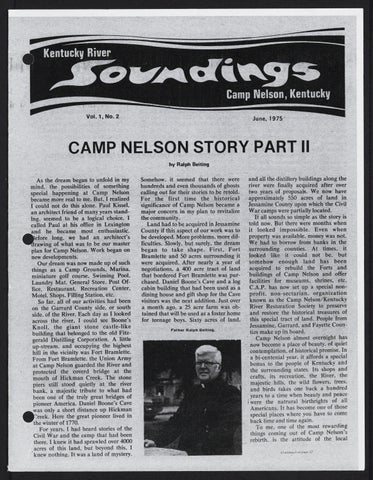
Somehow, it seemed that there were hundreds and even thousands of ghosts calling out for their stories to be retold. For the first tim e the historical significance of Camp Nelson became a major concern in my plan to revitalize the community. Land had to be acquired in Jessamine County if this aspect of our work was to be developed. More problems, more dif ficulties. Slowly, but surely, the dream began to take shape. F irst. Fort Bramlette and 50 acres surrounding it were acquired. After nearly a year of negotiations, a 400 acre tract of land that bordered Fort Bramlette was pur chased. Daniel Boone’s Cave and a log cabin building that had been used as a dining house and gift shop for the Cave visitors was the next addition. Just over a month ago, a 25 acre farm was ob tained that will be used as a foster home for teenage boys. Sixty acres of land, Father Ralph Belting.
and all the distillery buildings along the river were finally acquired, after over two years of proposals. We now have approximately 550 acres of land in Jessamine County upon which the Civil W ar camps were partially located. It all sounds so simple as the story is told now. But there were months when it looked impossible. Even when property was available, money was not. We had to borrow from banks in the surrounding counties. At times, tf looked llikefi it could notjjbe, but Somehow enough land has been acquired to rebuild the Forts and buildings of Camp Nelson and offer facilities for museums, shrines, etc. C.A.P. has now set up a special non profit, non-sectarian, organization known as the Camp Nelson/Kentucky River Restoration Society to preserve and restore the historical treasures of this special tract of land. People from Jessamine. Garrard, and Fayette Coun ties make up its board. Camp Nelson almost overnight has now become a place of beauty, of quiet contemplation, of historical promise. In a Jbi-centenial year, it affords a special bonus to the people of Kentucky and the surrounding states. Its shops and crafts, its recreation, the River, the majestic hills, the wild flowers, trees, and birds takes one back a hundred years to a time when beauty and peace i were the natrural birthrights of all Americans. It has become one of those special places where you have to come back time and time again. To me. one of the most rewarding things coming out of Camp Nelson s rebirth, is the attitude of the local "ti'puiic 12
Michael C. McLaughlin promoted to Gen. Manager of CAP. As of May 8» 1975 Michael C. McLaughlin, Personnel and Business
Development Manager of CAP, has been promoted tb General Manager of the Christian Appalachian Project (CAP). This means he is second only to Father Beiting who is President of CAP. For this position, it would have been hard to find a person with the qualifications,, experience and education of Mike McLaughlin. He graduated Valadictorian from Mid dletown, Ohio High School in 1957 out of a elass of 350 students, receiving scholarships from Armco and Harvard University. McLaughlin received his A.B. degree from Harvard University in 1961, Cum laude, attended the Univer sity of Tennessee in 1969-.71 where he did g rad u ate V o rk in in d u stria l physchology with grade point average of 3.75. At the University of Dayton, he did undergraduate study in General Psychology with an average of 3.37. Mr. Michael McLaughlin
In 1962 he graduated with honors as an ensign from the officer candidate school at New Port, R.I. and was assigned to the office of Naval In telligence, Washington D.C. where he received several commendations for outstanding performance. In 1963 Mike was assigned to the USS Kitty Hawk, promoted to Lieutenant in charge of 60 men. Here he received many honors in cluding the Cold War Service Medal. From the Navy, he went to the Univer sity of Dayton as Personnel Director at the Research Institute where he was in
charge of all personnel functions of an aerospace research organization. In 1970, Mike worked with community ac
tion programs and Minority Business Enterprize Programs, among others. From 1970-73 he became Human Resources Coordinator for the East Tennessee Development District where he administered a Federal Manpower program over a 16 county area for disadvantaged persons, etc. Mr. McLaughlin became personnel manager for Phillips Industries, Inc., of Nicholasville in 1973, where over 400 people were hired in a 13 million dollar facility. T here is not room in publication of this kind to list all his
duties. However, while employed at Phillips, through a friend of Ins wife, he becam e fam iliar w ith the CAP organization. He liked the things Father Beiting was doing and in Oct. 1974 became Personnel and Business Development Manager for CAP. On May 8, 1975 Mike was promoted to General Manager of CAP. He sits in on all meetings of the jBoard of Directors of CAP. At 35, Michael C. McLaughlin has had more experience than most people twice his age. He is married with one child and expects a second one in the next few months. Mike and his wife live at Route No. 4, Lancaster, Kentucky.
Congressman Tim Lee Carter here for dedication Congressman Tim Lee Carter whose name is Tompkinsville and represents the fifth congressional district of K e n tucky was here on April 20 for the dedication of the Louis Wernwag H istorical Shrine- an d M arkers. Congressman Carter told about the construction of the bridge and also told something about Louis Wernwag Life and Times. Paul Sawyer, General William Nelson, General William O. Butler, native of Jessamine County and Abraham Lincoln were subjects of Mf. Carter’s speech. The new shrine is located across from the old distillery building and is the en trance to the original covered bridge. Along with the reconstructed entrance which is a duplicate of the entrance to the old Wernwag covered bridge and designed by Paul Kissel of Lexington are markers telling of Wernwag, Paul Sawyer£Gen. Butler and Gen. Nelson. . Father Beiting introduced people who are helping with the restoration
project at Camp Nelson and told ©f the progress being, made by the Christian Appalachian Project (CAPÍ;' Several candidates were given chances tb make short talks about their candidacy fen various stateoffices. - Loyal Jones Historian of Berea was featured speaker for the A pril -20 dedication of the M emorial Park arid m arkers. He talked, of the ac complishm ents of Wernwag; Gen. Butter; Gen. Nelson, for whom Gam p Nelson was named; and talked briefly about Artist Paul Sawyer who spent much time at Camp Nelson. It was here that Sawyer painted many of his best. Other than Dr. Carter’s speech the parade was probably the highlight of the clear, cool, windy afternoon’s dedication. Several units of floats preceded the dignitaries and several hundred people to the little park overlooking the Ky. River where Paul Sawyer painted some of his Ky. River Scenes. *
D E D I C A T I O N DAY iM gpe Loyal Jones, historian of Berea.
HH
Part of the crowd that attended the April 20 dedication of The W «nm j$ Memorial Park and markers. The Park adjoins the pier where the covered bridge formerly stood.
IfgJgpP
K H ayi
h» b b
Congressman Tim Lee-Carter of TompkinsviHe
4
Father Tom—Forever 28.
Fattier Tom
\
Father Ralph W. Beiting
Father Thomas Raymond Lubbers was born in Covington, Kentucky on July 3, 1947. He was one of eleven children born to Joseph and Ethel Lub bers. Father Tom attended St. John Grade Sehool in Covington and his high school training was at Covington Latin School. He entered St. Pius X Seminary in Erlanger, Ky. in September of 1962. His theology courses were taken at St. Mary of the West Seminary in Cincinnati, Ohio. He was ordained at the Cathedral of the Assumption in Covington, Ky. on May 16, 1970 by the Most Rev. Richard H. Ackerman, bishop of Covington, Ky. Fr. Lubbers spent the first two years of his priesthood at Mary Queen of the Holy Rosary Parish in Lexington, Ky. He assisted M onsignor Leonard Neinaber in that assignment. He also taught at Lexington Catholic High School. He was involved in may projects in the Lexington area that served God’s people both within and without the Catholic Church. Fr. Lubbers was assigned to the four county parrish that Father Beiting serves in Madison, Jackson, Rockcastle and Garrard Counties. This assignment begain in June of 1973. In this assign ment Fr. Lubbers was literally in all places. For the last year he has especially dedicated his work to Madison and Jackson Counties. With Catholic people, the Ministerial societies, civic organizations, the college community and with people anywhere
he felt equally at home and worked for their betterment in everyway. His love for the poor occupied a major part of his life. He devoted much time and effort to assist the Christian Appalachian Project iru. its goal of helping the poor help themselves. On his last day of life, Fr. Tom had completed his Mass, the great act of praise to God, at St. Paul Church in McKee and was on his way to appear before the City Council in Berea to present a program to help the children who attend the Berea Child Develop ment center at St. Clare’s Parish Hall. He died at 9:15 A.M. on Tuesday, April 29, 1975. His death occured on U.S. Highway 421 in Madison County, at the Big Hill Community. A truck tur ning into a side road hit Fr. Tom head on. Father died instantly. It is hard to sum up his life even if it only lasted 28 years. He loved children and young people. He played the guitar and sang country songs because he wanted to bring people to God through music. He loved the hills and the land. (He was raising 3 calves.) He chewed tobacco and called everybody “Dear Heart” . He made people feel they were important and a new ray of hope followed in his path. He will be missed by all. We can only hope his enthusiasm and love for the poor will continue in those of us who remain behind.
CARL STORY TO M ANAGE BLUEGRASS FESTIVAL Plans are moving ahead for the first Bluegrass Music Festival to be held at Camp Nelson. As yet, the final date has not been set but the ground is being prepared on the river behind the old distillery building. Carl Story and his Rambling Mountaineers have been con tracted to manage the festival. Most prominent amoung the names of Bluegrass Gospel greats is that of CARL STORY who organized his first band in 1934. Raised by a father who played old-time fiddle and a mother who played guitar and organ, Carl’s styles are reminiscent of the traditional music heard in the North Carolina Blue Ridge Mountains where he grew up. Known widely as the “Father of Bluegrass Gospel Music,” he has been officially granted that title by the State of Oklahoma. His music is known worldwide through more than 700 songs which he has recorded over the years for Columbia, Mercury and Starday with
40 albums to his credit and still record ing. CARL STORY performed with the Tennessee Barn Dance, for ten years and is a former member of the Grand Ole Opry. His numerous television ap pearances, including his own program, and four years with the nationwide CBS Radio Country Style show have brought him music appreciative fans who turn out consistently for his many personal appearance tours. Most requested among his songs are “Light at the River,” “ Family Reunion,” “My Lord Keeps a Record” and “Lonesome Road.”
The Kentucky River Soundings— Father Ralph W. Beiting All of us at CAP have been pleasantly surprised by the public acceptance o f our first issue of the Sounding. That fir st edition was gotten out so quickly we didn’t have time to tell in greater detail all the exciting things CAP is doing in the six counties it is principally engaged with at the present time. You will read stories of camps for children, emergen cy shelters, used clothing stores, job op portunities, Camp Nelson and just plain folks. CAP is one of the most exciting groups in Appalachia. It’s continuing involvement with the mountains and the mountain people we think will make great reading. We also want to call attention to the mountains and hills of Appalachia. There will be stories of history and pioneers both early and late who made the mountains ring. You will find receipes and house hold hints. Songs of a by gone day will live again. You will learn about mountain crafts and how to get them and where to go to see the mountain plays and enjoy mountain hospitality. From time to time we will speak about the big issues that concern Ap palachia and what we think are the ways in which to face and answer them and how you might help. We want the Soundings to paper as well. And so we shall have let ters from the readers, guest editorials and maybe at times some just plain gossip. We hope the Soundings will be a cheerful, folkie, inform ative and challenging part of your life.
Judr Shelton writes the checks for GAP.
Wwmk
lune W ardrip is head bookkeeper for CAP
Paulette Wilson, receptionist
m
Elaine and Coop Stinett who operate the General Store and Post office for Camp Nelson.
Mrs. Una Preston, when not operating the Doll’s House, is secretary to Father Belting.
Father Tom and Father Beiting get together with Congressman Tim Lee Carter and share some unusual experiences on April 20
Controller for CAP is Dorothy Blankenship.
6
Lewis V. Wernwag: Master Bridge Builder By J. Winston Coleman, Jr., ME., LL.D.
(EDITOR’S NOTE: The follow ing article on Lewis V . W ernwag was written especially for Tim bered Tunnel Talk, by D r, J. W inston Coleman» one o f KCBA’s Charter M em bers, whose regular help we seek and vaine. He is a friend, a worker, a scholar, an anthor, and Kentucky’s leading historian.)
With the passing of many o f Ken tucky’s covered bridges, people are beginning to ask—-who built these fine wooden structures and when were they erected? Unique in construction and replete with romance, these old bridges were built at a time when iron and steel beams were not to be had, and they have served a useful purpose, many of them with 75 to 100 years of continuous use to thier credit. Probably the most famous of the Kentucky bridge builders was Lewis V. Wernwag, who was bom December 4, 1769, in Riedlingen, Germany. As a youth he attended a local trade or vocational school in his home town. It is believed that he came to America at an early age to evade military service, taking up his residence in Philadelphia. Here he served several apprenticeships to millwrights and professional builders. Wernwag was connected with various enterprises, including the building of a machine to make whetstones, the con struction of powder mills; he ex perimented with the use of anthracite coal for fuel, and with the improvement of a nail-making machine at the Phoenix Nail Works, Phoenixville, Pen nsylvania, in which he purchased an in terest in 1813; It is, however, the design and builder of wooden bridges that his name will be chiefly remembered. After building and designing a num ber of well-known bridges in the Eastern States, such as the one (1810) across Neshaminy Creek, on the road between Philadelphia and New York, and the cantilever design at Bridgeport the following year, together with the Upper Ferry Bridge across the Schuykill River, ’near Philadelphia, Wernwag in 1824 moved to Harpers Ferry, Virginia (W. Va.), and purchased the Isle of Virginius and there cut and prepared his bridge timbers. It was his practice to saw all the timbers through the heart to detect unsound wood and to permit good seasoning. He used no timbers of greater thickness than six in ches and separated the braces or arches with cast-iron washers, to allow free cir
culation of the air and thus prevent decay. If greater strength was needed, he increased the number but not the dimensions of the races. Typical of the privately-owned and operated toll roads in Kentucky was the M aysville, W ashington, Paris and Lexington Turnpike Road Company, organized about 1830, with a capital stock of $320,000. When completed in 1835, it included 13 toll houses and several covered bridges. John Armstrong and the directors of the road sought a professional architect and engineer to build their covered bridges and possibly to assist in the design and consruction of the toll-gate houses. For this undertaking the men turned to a man who had erected a number of well-executed crossings of Atlantic Seaboard rivers. It is thought that the master bridge-builder arrived in Kentucky sometime during the sum mer ofj.832 or early in 1833. His first major assignment was the construction of a two-lane covered bridge over Stoner Creek on the outskirts o f Paris. The 160-foot structure, completed in 1833, stood for an even century. From the marriage records of the Mason County Court, it appears that Lewis V. Wernwag was married January 25, 1836, to Miss Margaret W. Basset, of that county# with David Bassett ask her bondsman. About a month before his wedding the bridgebuilder purchased a lot in May’s Lick, on December 30,1835, from William V. Morris nad wife, Louisa, described as “all that plot of ground containing Lot No. 9.” At the time the deed was passed, it listed Wernwag as a resident “o f Nicholas County” , where he was probably living with his b roth er Thomas,at the Blue Lick Springs while supervising the construciton o f a covered bridge on the LexingtonMaysville Pike over the Licking River. After purchasing his lot in May’s Lick, Wernwag soon thereafter erected a fine, two-story red brick house, as well as the present Christian Church with just the alley between the two buildings. For the next few years he and his wife resided here and during this period he designed several other bridges in Ken tucky, West Virginia, Ohio and In diana, where his name often appears only as “architect” . At B oone’s Knob (later Camp
Nelson) on the Kentucky River, between Jessamine and Garrard counties, the G erm an-bora engineer erected his greatest masterpiece in Kentucky. This covered bridge was located about 20 miles south o f Nicholasville and carried the main traffic on the Danville, Lan caster & Nicholasville turnpike, on a single span o f 240 feet between the abutments, without a support in the river. The Camp Nelson bridge was said to have been fabricated some distance up stream from the site, floated down on rafts and put together in sections. Some 18 to 20 men worked on the bridge for about a year, including the cutting of tim bers and trusses, flooring and roofing, and the quarrying and building the huge stone abutments on each side of the river. Cost o f the structure was put at $30,000 which was divided bet ween the counties of Jessamine and Garrard. The bridge was completed in the fall o f 1838. This was verified by a three by five-foot sign which was e r e o f l | ted Over the south entrance; it rea o ^ ^ “Erected A.D. 1838. L.V. Weniwag, Architect”. This noted bridge had three trusses supporting two roadways, each about 12 feet wide; from the floor to the roof was 14’-3” . The long truss (radius 370 feet) was essentially an arch, braced laterally and vertically by a stiffener truss. The center truss was straight, but the two outer trusses were slightly cur ved, forming flat arches and opposite to each other, so that the bridge was somewhat wider at the ends than in the center. The floor was made of planks, placed on stringers, which in turn rested on floorboards; the whole struc ture was enclosed with weather-boards and covered over with wood shingles. An engineering marvel of its day, it was built o f hewn poplar and pine timbers and put together with iron braces and one-inch square wrought-iron rods fashioned at the Red River Iron Works in Estill County. Evidently Wernwag was not paid in full when the bridge was completed six yearn later the Kentucky LegislatuM p passed an act (approved Feb. 23, 1844 r for his relief, which read:
Be it enacted by the General Assem bly o f the Commonwealth o f Ken tucky, that the President and Direc tors o f the Danville, Lancaster &
É
Nicholasville Turnpike Road Com pany, and theyiare hereby authorized to adjust and settle in the account o f Lewis V. Wemwag, for constructing a bridge across the Kentucky River, on said road, in accordance with the understanding between the parties at the time said bridge was being con structed, and if any balance should be found to be due to said Wemwag, the said President and Directors are authorized to pay the sum out o f the tolls which may be collected on said road.” Wernwag, however, failed to derive any benefit from the act, as he had died six or seven months before it was passed. After nearly ninety years of sevice, a heavily-loaded truck from Lexington fell through one of the floorboards, which had become rotted due to a leak in the roof. The bridge was then declared unsafe and closed to traffic early in December, 1926. Efforts to preserve the historic structure failed. Government engineers condemned it on the grounds that it was likely to collapse and fall into the river, thereby en dangering river traffic. After several years agitation it was voted to tear down the old bridge, despite the report of two ¿vil engineers from Dayton, Ohio, that m was still structurally sound and with some slight local reinforcements, would be good for many years to come. At length, Mr. J.R. Leavell, a farmer in the vicinity secured the contract for dismantling the structure. On October 19, 1933, as the bridge was being taken down, it broke into five sections and fell into the river, causing boat traffic to be blocked for several hours. Several work men were on the bridge when it fell into the river, and one man narrowly escaped with his life. At the time the Camp Nelson bridge was razed it was thought to have been the longest wooden cantilever bridge in the United Some speculation has arisen as to whether there were two covered bridges at Camp Nelson. In the opinion of the writer there was only one—the 1838 Wernwag bridge. This confusion may possibly result from the numerous views of the bridge during its long life, some showing a row of small windows on the sides, others without them; this could have been due to changes in the ^m odelin g. ■ Some two years after the Camp k elso n bridge was completed, Lewis Wernwag sold his home in May’s Lick (still standing) to John S. Mitchell, on May 4, 1840, and returned to Harpers Ferry where he spend his last years, dying there on August 12, 1843.
Boone’s Stable Popular with people of all ages from 18-80 is Boone’s Stable of Camp Nelson, located on Old Highway 27 just behind Boone’s L odg^ The beautiful ,log structure, now a tack shop, is high above the main recreational area overlooking the Kentucky River and Hickman Creek. Boone’s Stable offers horses for rent by the hour or by the day if you would like to take one of the over night trail rides and overnight catnping trip. If you need extra riding gear or wear you need not worry for most any riding accessory is available right there at the old log cabin “Boone’s Lodge” which is now a western shop. You may even buy your own pony or horse from the stable.
All trail rides, whether short or over night are carefully supervised, however, you ride at your own risk. Check schedule for dates and fees, etc. If you are under 18 you must be accompanied by parents or have written consent. You will need to bring bed roll and grub sack. If you want, the stable will furnish transportation of your supplies to the campsite. One featured trailride Is the one along the creeks and river, up hill, and across valley to F ort B ram lette, overlooking the Kentucky River. Of course, no alcoholic drink will be allowed and you should use good com mon sense at all times. A guitar or uke or other instrument is always welcome on trail rides and cam ping trips for group singing.
No way to miss Camp Nelson when arriving Cram the north. This huge billboard is at the north entrance to Cam p Nelson.
ITIEt ATTtKTIBtt H IM U THE HUB V
8
Foiled Again
CA M P NELSON M ARINA
These receipes are from the kitchen of Miss Marilyn Stefunski. Marilyn is the manager of The Attic, Used Clothing outlet of the Christian Appalachian project in Lancaster.
For a single day’s recreation as as for an extended vacation, you H assured of a friendly and pleasant eW perience at the Camp Nelson Marina. This is part of the new Tourist and Recreational Center that also comprises “The Boone’s Landing” Campground and the historic Camp Nelson Town ship. The Marina is situated behind “The Admiral’s Table” which serves snacks and full meals both indoors and out doors according to the season of the year. If you bring your own boat, you will find two launching ramps in service the year round. You will also find a large selection of boats—runabouts, fishing boats, motor boats and canoes—for short-term or long-term hire.
Chicken Bundle 1 chicken quarter 2 slices onion 3 slices summer squash Pinch of Rosemary Vi teaspoon salt X A teaspoon pepper 1 tablespoon butter 1 tablespoon water Place the chicken quarter on a large square of heavy-duty aluminum foil. Add the vegetables, seasonings, butter and water. Fold the foil closely around chicken and seal. Cook on grill over hot coals, turning every 10 to 15 minutes, for 1 hour. Serve in foil package. 1 serv ing. Herbed Com in Foil X A cup soft butter 2 tabsp. chopped parsley 2 tabsp. chopped chives Vi tsp. salt Dash of pepper 8 ears of corn Blend the butter with parsley, chives, salt and peper. Spread 1 tablespoon herbed butter on each ear of corn and wrap each ear in heavy-duty aluminum foil. Grill for 15 to 25 minutes or until tender, turning occasionally. Fold foil back to serve.
M arfya Stefunski, other than being the manager for The Attic, furnishei the soundings with the receipes. See “Foiled Again.”
Poundcake-Marshmallow Sandwiches With sharp knife, cut one poundcake crosswise into 12 slices. Spread 6 cake slices with Vi cup marshmallow cream and sprinkle with X A cup semisweetchocolate pieces. Top with remaining cake slices to make sandwiches. Place poundcake sandwiches on grill over low coals; grill 10 minutes or until chocolate pices are melted, turning oc casionally. Makes 6 servings. *Contrary to our heading, these prepare-aheadat-home picnic and backyard barbeque specials will not findytiu “foiled again” having forgotten an ingredient or serving utensil.
V?L <-=J >1 \
‘
r; / .; ¡
Additional Facilites Include: 600 feet of docking space Private docking space Large service float (Ice, groceries, light refreshment available) Marine sales and service (in-boards and out-boards, motors, and supplies) Gas and oil service at the water front Water and electficty at each docking space All accessories for boating, fishing, water sports Ample Parking Picnic area overlooking Marina Year-round service Round-the-clock security Be sure to inquire about our Canoe Club
9
Paul Kissell, Architect-in-Residence To acquaint you, with the many things that are happening at Camp Nelson it is necessary to introduce you to the personnel that is “ making it hap pen.’’ The man that will leave his im print on much of th physical structure at Camp Nelson and other CAP projects is Paul J. Kissel, architect-in-residence, at Camp Nelson, and from Lexington. Paul is a native of Louisville, attended DuPont Manual High School where he starred in football. He received his B.S. degree in Civil Engineering from the University of Kentucky. Paul became a registered architect in 1962 and set up private practice at 1216 Harrodsbufg Road, Lexington, Ken tucky in 1965. His accomplishments are so many in the Lexington area that space does not permit a listing at this time. Some of his accomplishments at Camp Nelson are: the restoration and decorating of the Admiral’s Table Restaurant: the designing of the new and beautiful Music Hall, to be opened offi^ally on May 23; remodeling of the Office an d G eneral Store; remodeling of the log house called Boone’s Lodge, now a Western Tack Shop; & designing the memorial park and the reproducing of the Wernwag Covered Bridge. These are but a few of the things that has been done or are in the planning stage. Paul is also on the Board of Directors of the C.A.P. Project. Paul is so enthusastic about the future of Camp Nelson that he says “We hope we never get through building here.’’ In other words the re building of Camp Nelson is just getting started. The plans call for 40 shops on the Garrard side of the river — a recreation of Camp Nelson of 1850-1880. All will be the little curio type shops along the side of the highway facing the Ad miral’s Table Restaurant. In fact, there is to be a narrow walking street between the two rows of buildings along the main street that is now the highway. The stores will be of the type that was here at Camp Nelson between 18501J^ ■ H n e of the shops will be an old Printing Shop with old type hand press. Many of the craft shops will be of the mountain variety, such as weaving, quilting, pottery, etc. with demon strations actually taking place on the premises. An old ice cream parlor with authentic furnishing is to be in
operation. The buildings will probably be of the two story clapboard type with living quarters above. It is hoped that this will be a real activity area like that at Gatlinburg. Tennessee, only in the 1850-1880 tradition. On the Jessamine County side of the river -the old distillery building will be
redone into a resort Hotel as it was sup posed to be originally. It is estimated that this project will cost one-half million dollars. There were originally about 4,000 acres of land at the Union Camp above the river where several thousand soldiers camped or were stationed during the Civil War. On this land was approximately 300 buildings. Of this number, about 30 will be reconstructed
Some remodeling will be done so the barn will be usuable in case of rain. About one thousand people could be sheltered here in case of bad weather. Near-by will be the grounds for the first Blue Grass Festival. On the cliff overlooking Camp Nelson will be camping area for tents. There will be all day Historic trail hikes for Boy Scouts. Boat trips are now a reality with CAP owning two house boats and other river going craft. A new and second marina is in the process of being installed at this time. It will be much larger than the first one. In the future people will get a chance to get instruction in mountain climbing, & canoeing for trips on the river is in the plans for the future. A new water system is in the planning stage and the log house (above the golf course) that burned several years ago is to be rebuilt bn the same foundation and used for a guest house. With all of the fine accomplishments of Paul, he also has time for his family. He is married to the former Marilyn Brown of Lexington and they are the parents of five children; Julie, 17; Tom 15; Mark 13; Amy, 11; and Megan who is 4. With a man like Paul Kissel at the helm, how could Camp Nelson do anything but grow and grow 'and suc ceed! M Zim m I COJ
Professional Photographers to be at Camp Nelson. Paul Kissel tell of future plans of .Camp Nelson.
on about 45 acres to simulate camp life during the Civil War, even the old Horse shoeing rack will be rebuilt just as during the War. Camp Nelson is rich in Black History also since a Negro school was established here b^ John G. Fee who later founded Berea College. Research is being made now on the Negro school here. Fort Brammlet; used during the Civil War for the protection of Camp Nelson by Union soldiers, will be restored. Back to the Garrard side of the river and behind to old distillery building is a barn about 300 feet long that will be rented to large parties for picnicing.
On Sunday, June 8, Professional Photographs of America, the Kentucky Professional Photographers Association in a joint meeting with the Greater Louisville Professional Photographers Associations will meet at Camp Nelson. The meeting will take place in the old distillery building and will be an all day seminar. A group of nearly one hundred Professional Photographers from around the state and out of state will at tend the meeting. Henry Gilbert, Of ficial Photographer for Camp Nelson and owner of Pepiot Studio in Lexington, is President of the Kentucky Group. Robert Walden of Lexington and owner of Walden’s House of Photographers is President of the Greater Louisville group.
10
tT H E A T T I C Father Ralph W. Betting One of the most significant of CAP contributions to the people of Eastern Kentucky has been the Rummage Sale., The idea of making clothes, household items and toys available to those in need is pot new with CAP. Many people and organizations have been doing this for a long time. When Father Beiting began the prac tice of making clothes available it was on a free basis to one and all. It was not long however, before the flaws in this program were visible. One group of people would come very early every time the clothes were available. With the ef ficiency of a well trained team they would go through the tables, get the best items and then head off. Before long they had a little store of their own, where they were selling the articles, of ten at substantial price. A second group of people were genuinely poor. They took the things they needed home and kept them for their own use. Because water was dif ficult to. get and washing machines were not very often present, they began to throw the clothes away when they were dirty. They could always go down and get more clothes for nothing when they wanted them. A third group of people did not come at all. In their pride they did not want a hand out nor did they want to be associated with either of the above groups. Yet they had a real need for the clothing. It became apparent some new
way had to be devised for the distribution of the material. CAP present practice is the answer to the problems stated above. In each of the counties a used clothing store was established at the County seat. We call the stores The Attic. Here the items are put out for display. It is in this aspect that CAP differs from almost every other rummage store. The articles of clothing are mended if this is needed. Other items are ironed. All are at tractively displayed, not just dumped on tables. Music is played throughout the store. Pictures grace the walls and at tractive floor covering is put down. We believe all of this is very important. The poor are made to feel that they are as good as any other kind of folks. The way the store is decorated and kept tells them they are important. A small charge is made for every item. It is enough to prevent future selling of the merchandize. The price is low and therefore everyone gets a bargain and now everyone comes. No, longer-is clothing thrown away when it is soiled for they now have an in vestment in it. For those who can not pay im mediately, they can pick out what they need. It is then bagged and put aside for them. When they get their money they come up and pay for their order and take it home. Some people have their homes and possessions destroyed by fire or lost in a
Popular place especially for the women is THE ATTIC located in Lancaster, outlet-for used clothing. In adjoining room is the G arrard Youth Center, gathering place for teenagers in Lancaster, also a CAP project.
tornado or flood. We give items to these people. The same is true of those who are so poor or sick or old that they can not work. They too are helped without charge. A t Christmas time CAP makes a big effort to help the poor and ap proximately 500 families are given food, toys, clothing, household items, etc. One of the unnoticed benefits of the Attics is the good money does that is collected when the clothing is sold. In each of the four counties at least three people are employed in each center. These are new jobs and permanent' in come for their families. Besides this the balance of the income goes to create new jobs. A farming operation and a chair making enterprise were financed m Rockcastle County from the Attic in come at Mt. Vernon. In Madison Coun ty a child development center is sustained from the Attic in Berea. A camp for children is supported in Jackson County from the Attic at McKee. Lancaster’s Attic has started new jobs at Camp Nelson and sup ported the Emergency Shelter and Cliffview Lodge another camp for children in G arrad County. At the present time CAP has four At tics, in Berea, Lancaster, Mt. Vernon and McKee. Two of the buildings CAll has built, the other two are being rent ed. All of the items in the Attics are the donations sent in from all over the country. Since the stores are opened six days a week a great deal of clothing is needed. C ontributions are always so u g h t and deeply app reciated . Clothing can be sent to: Appalachian Village, Berea, Ky. or CAP, Inc., 224 Lexington Street, Lancaster, Ky. 40444. Sonja Milliard handles the cash register for The Attic but she also smite, as she tabes your money.
11 W hen T he Roses Bloom Again
W hen T he R oses Bloom Again
Aadyanr hemrtneed not he sigh-mg If 1: be a m o n g the dy-iag, I’ll be with you when the And it's there 1 pr&y you take me,lVe been faith-fddon’tfor-sakeme,l’ll be with yonwhen the
jJjg
lin-ger, For yon know not what to riv - ee l^hetethe rds- es are in
And the mb - in red breast sings his sweet re - Train,
: ......
In {he days of Old Lang
say, For dn t ty calls your sweet-hearts name a-gam», ■■■■.■■■hi., bloom, A- .maid-en who is ??ait- ihgthere for nie, — •— Syne, f i t be with yousweet-heait mine,ill hewjriryouwben t^n postesblòoiii a i gai
C^lntry Nostalgia This song “When the Roses Bloom Again” is probably of Scottish origin. Many old time bands of the 20’s recorded it.'Burnett and Rutherford with fiddle and banjo onl^ecorded it about 1926 or 27 for Columbia under the name of ‘fTll be with you when the Roses Bloom Again” with slightly different melody. Burnett and Rutherford-were from Harlan County, Kentucky. Lester McFarland and Robert A. Gardner, both blincjirecorded this melody and words in 1926 on Brunswick. While per forming a t WNOX in Knoxville, Tennessee* believe it or not their recording of this, song sold more than 2 million copies, a feat that not many present day performers have achieved. In 1931, McFarland and Gardner joined the WL$ National Bam Dance and changed their billing to simply, Mac and Bob. About 1933 Mac and Bob recorded “When the Roses Bloom Again” for Per fect Records* Also for Con queer, the Sears Roebuck label. Mac is from Gray, near Corbin, Ky. and Bob is from Olive Springs, Tennessee. Both, blind from birth now live at Olive Springs. More on Mac and Bob later. . ^ "•*r- r ' j ' „
Joe Clark to Honor Bradley Kincaid In the planning stage at this time is a Museum honoring a native Garrard Countain, Bradley Kincaid. Joe Clark has space in the shoppe area set aside to honor Bradley who was bom near Camp Nelson. The Museum will have
From right here in Camp Nelson was the late little raspy-voiced fiddle and harmonica player on the Renfro Valley Barn Dance by the name of Granny Harper. Nearly everyone is familiar axe-w ielding, bar-ch o p p in g , b o ttle breaking shenanigans of Carrie Nation who tried to destroy all the booze
Kentucky and Missouri in the late many articles pertaining to the long 1800’s. Granny and Carrie will b< musical career of Kincaid who sang and featured in a later issue of The picked his “hound dog” guitar all the dings. way from one end of the country to the other. dley started his career in radio, Art Classes Start May 28 and recordings while at WLS in t;nicago about 1925. The Museum will John Stamper, Artist in Residence be dedicated later on this year and Camp Nelson wishes to announce that hopefully there will be a visit to Camp Art Classes will start on May 28. The Nelson by Bradley. fee for the 6 week course is $25.00 and will meet every Thursday from 6:00 Bradley Kincaid is not the only p.m. to 8:00 p.m. celebrity to come from Garrard County.
Manuel 0 . Clark, handles the booking of acts for the Barn Dance and many other duties as head of Entertainment for Camp Nelson.
■
*
Continued from page /
people. They are pleased and proud of what has taken place at their home. I was reminded of this one Sunday, not too long ago. when I was in the General Store and Post Office. A man. near thir ty years of age was there and I could sense he wanted to say something. Finally, as I was about to leave, he turned to me and said, “Hell, Father Beiting, I don’t care if you are Catholic, you sure have made our place pretty* and we are proud of it.” That man made the years of sweat, worry, and prayer worthwhile. I am often asked when will Camp Nelson be finished, when will the restoration be complete? I don’t know the answer to that. Each month without fail, a new section is added, some new feature comes to be. In that greater meaning of what Camp Nelson is all about, 1 hope the work is never finished. The resurrection story needs to go on. Life must always conquer over death. The history of the past must never be forgotten, the present and the future need the lessons learned there. This small community located on a minor river of our nation, shall become a sym bol for all Americans. We may not be great or have important positions, b u t if we use our past and are not afraid to dream great dreams* and have the courage to work hard and enlist the help of our friends and neighbors, we shall build some thing special, a place of peace and beauty with enough for all to share. . ' I sincerely hope you pay a visit to Camp Nelson soon. It will make you proud of what we once were, but more important it will make you more deter mined than ever to make our land that uniquely special place in the world,' where a people under God can build a house of freedom with liberty and justice for all. Kentucky River Soundings Camp Nelson, Kentucky 40444
The Unpardonable Sin You can break the ten command ments and Society will forgive, But there’s one sin that no man can ever manage to outlive; You can buy a snow white mantle and all misdeeds cloak— But the sin that’s without pardon is the crime of being broke. You can break the ten command ments and the world will roll along And no man will shun or scorn you while you’re of the moneyed folks But the sin beyond forgiveness is the crime of being broke. You can’t break the ten command ments and avoid all worldly grills For there’s something that absolves you in a ready roll of bills; And we’ll call you a good fellow and we’ll pass it as a joke— But the sin that’s without pardon is the crime of being broke.
Kentucky River Soundings
P u b lish e r....................... .......... CAP Editor in C h ie f.............. ....... . . . Father Ralph B eitinfB r Editor. Writer. Photographer......... Henry Gilbert Published monthly by Christian Appalacian Project (CAP). Entered as second class matter at Camp Nelson P est Office, Camp Nelson, Kentucky 40444. Subscription rate in U.S. is $3.00 p e r year. A ddress . all correspondence to Kentucky River Soundings, Camp Nelson, Kentucky 40444.
Reprint from Renfro Valley Bugle
Young Phillips W ins Pole Vault Championship Jamie Phillips has won the Pole Vault Championship of the Central Kentucky Conference meet held at U of K May 13. Jamie is a student a t Boyle County High School and is the son of Mr. and Mrs. Lou Phillips of Danville. Lou is the Gen. Manager of Camp Nelson. If anyone was left out of the first issue of The Kentucky River Soundings . . . our apologies Time was a big faetor as we only had a few days to get the first issue together. Also material on key personnel was not available in time. We will try to include many more personalitites in future issues. (Any errors we hope are overlooked.)
Junel I : ■
S
\
«
Gospel Singings—Music Hall June7 ' Mini Golf Tournament. Trail rides from Boone’s Stable. Wagon rides. Boat rides Bara Dance. June 8 1 Professional Photographers of Ken tucky and Greater Louisville for all day sem inar sponsored by Professional Photographers of America. Gospel Singing. June 14 if* J ? T rail rides from Boone’s Stable. Barn Dance. Perhaps you would like to receive the Soundings each month? If so, send $3.00 for each year to: Kentucky River Soundings Camp Nelson, Kentucky 40444
City
JGp_