Æ g-
CAM P N ELSO N H A S “R ISE N ”.. A G A IN ! by Ralph Beiting The Christian Com m unity has just celebrated the age-old m ystery o f Easter. Rejection, death, and frustration born of despair are the seeming victors in the sto ry. But resurrection and new life re wrote the ending and mankind was given a hope and faith that no one would ever be able to take from it. I, like most of you, often wondered how I might apply the lesson learned and continue in our tim es the message and hope o f Easter. A little over two years ago, I found the opportunity I was look ing fo r. Like most opportunities, it was close to home. It bore the name of Camp Nelson, a small com m unity thirteen miles north of Lancaster, where U .S . Highway 27 crosses the Kentucky R iver. From the earliest of pioneer days,
Camp Nelson had been an im portant center. In the w inter o f 1770, Daniel 8oone lived in a cave at Camp Nelson. From this base, he hunted and explored K entu cky. The inform ation he gained would result in the form ation o f Boonesborough five years later. There was a natural break in the palisades along the river at Camp Nelson and a fording place fo r travelers was q u ickly established. N e x t, the V irginia Legislature established a fe rry across the river at th is p o int, years before Kentucky was declared a state. When the first bridge across the Kentucky River was b uilt in 1838, it was located at Camp Nelson. In tim e, it would become the most fam ous wooden bridge in the w orld. The first com m ercial vineyard in Am erica was established at Camp Nelson in 1798.
In 1805, W illiam Orlando Butler was born at Camp Nelson. In tim e, he would run for the vice-presidency o f the United States. When the C ivil War threatened to break our Republic apart, the first Union recruiting camp in Kentucky was es tablished at Camp Nelson. It became the great storage depot in Kentucky fo r the Union arm ies, also fo r the states of Tennessee, and parts of Alabam a, and M ississippi. The present name of Camp Nelson was taken from General W illiam Nelson, the first commander of the camp. John Fee, the founder of Berea College, came to Camp Nelson during the C ivil War and established a college and pre paratory school here fo r the new ly freed blacks. A gricultural products o f all kinds, tobacco,' hemp, w heat, pigs, molasses, etc., were stored here and when a "tid e " came on the R iver, the produce was sent to New Orleans and other distant parts. In 1817, the first steam boat ever to journey down the Kentucky River was b u ilt and sailed from Camp Nelson. A rtists came to this tru ly spectacular spot. Jenny Lin d , the "Sweetest Nighting a le ", called it the "Sw itzerland of Am er ica ". Paul Saw yer, one o f Kentucky's most famous painters lived on a houseboat here and at High Bridge fo r five years. During this period, his finest work was done. Because o f an unusual subterranean stream of water that surfaced at Camp Nelson, another activity was established. Th is was the distilling of spirits. No where else was there so pure a supply of water as here and the d istillery business flourished here until 1973. The Kentucky River d istillery would give way in tim e to Canada D ry and then to Old Fitzgerald. Despite so many claim s to fame and a
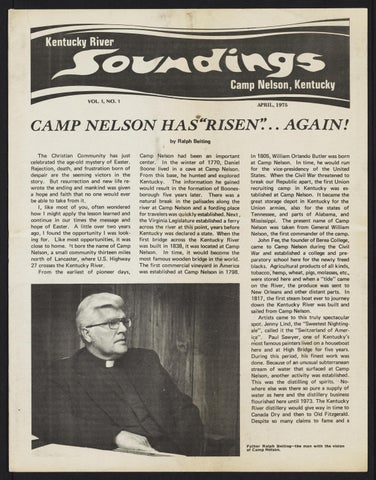
Father Ralph Beiting—the man with the vision of Camp Nelson.
2
Old Joe Clark to Headline Barn Dance When Father Beiting decided to have a barn dance at Camp Nelson, who would he call on except Old Joe Clark whom he knew had been associated with Renfro Valley Barn Dance for many years. Joe and his pretty petite wife, Jean, have been living over the Admiral Table Restaurant for several months. Jean manages the restaurant (and Joe entertains the customers with his Will Rogers humor). Joe is the comedian off as well as on stage. Besides his duties as correspondent and booking acts for Camp Nelson, he is the “ Star" of the Camp Nelson Barn Dance. If Old Joe doesn't make you laugh, you are ready for the last ride to the cemetery. Joe is so artistic at make-up that many country music writers think he is the peer of people like Uncle Dave Macon or Fiddlin' John Carson, but if you think he is half their age, you are still over-guessing.
After several curtain calls, Joe and the rest of the young boys, alt under the age of fifteen, had a spot on the program with the Carlilse Brothers. A few years later, John Lair of Renfro Valley Barn Dance hired Joe for the Barn Dance. However, his musical career at Renfro was short lived. In 1942, Clark was called to the service of Uncle Sam. After his service with the Army, Speedy returned to Johnson City where he owned a radio station and organized his band. After a short stay in JohnsortUCity, he joined the famous originators of Bluegrass music, Bill Monroe and the Bluegrass Boys on the WSM Grand Ole Opry. After a stay with the Bluegrass Boys, Renfro Valley beckoned again, this time as “ O ld" Joe Clark, the name that John Lair gave him. The name has stuck through about 27 years as star of Renfro Valley Barn Dance, five mo tion pictures, and probably millions of miles of appearances on Grand Ole Opry and Renfro Valley Barn Road shows. Joe is planning big things for the Camp Nelson Barn Dance. Besides himself, appearances are planned by Lily Mae Ledford of the Coon Creek Girls, Ralph Marcum, former fiddler on the Renfro Barn Dance. He has also made arrangements for Carl Story, long time country and gospel musician to head a Bluegrass Festival this summer. The exact time will be announced in a later issue. Joe and Jean Clark have three boys and one daughter. Joe's youngest son, Terry, also appears with Joe on stage and plays the banjo proficiently. Both appear with various Grand Ole O pry acts from time to time. Together they make quite an act!
Lou Phillips to Head Physical Plant Old Joe Clark getting ready to go on stage on a recent Saturday night.
|
Joe Clark started his career in music and entertaining in East Tennessee, near Johnson City, in the late 30's at the age of thirteen. There he was knovyn as Speedy Clark. About 1938 or 1939, Cliff Carlilse, nationally known singer and song writer, along with brother Bill Carlilse, were doing a program on WKNOX, Knoxville, called the Mid day Merry-Go-Round. After some resistance by Speedy Clark, his band was allowed to play on the program.
Father Beiting and the Board of Directors have chosen Lou Phillips of Danville to be Supervisor and Manager of the physical layout of Camp Nelson. Lou came to Camp Nelson about the last week of February and was chosen for his ability to manage and get along with people. He coached basketball for five years at Centre College before becoming Manager and Buyer at The Hub, a large department store in Danville, Kentucky.
Phillips is a native of Covington and attended Dixie Heights High School there. He played all sports and receiv ed his B.A. from University of Cincin nati. He attended Eastern State Un iversity briefly and then worked on his Masters at the University of Ken tucky. Lou is married and has three boys. Lou Phillips coordinates most acttvities here as General Manager of Camp Nelson.
K E N T U C K Y V A L L E Y SO U N D IN G S CA P — Publisher Rev. Ralph Beiting editor Published m onthly by the Christian Appalachian Project. Entered as secondclass matter at the Camp Nelson Post O ffice at Camp Nelson, Kentucky 40444. Advertising rates, $ .00 per column inch. Subscription rates Subscription cates in the United States is $3.00 per year. Kentucky V alley Soundings w ill gladly accept any unsolicited photos and manu scripts but can not be held responsible for the loss or failure to return. M anuscripts submitted should be accompanied w ith a self-addressed, stamped envelope. O ffice Kentucky V alley Soundings 224 Lexington Street Lancaster, Kentucky 40444
3
JOHN STAMPER TO HEAD MUSEUM Future plans call for renovation of the old distillery building ipto what the originalplans called fo r. . . a hotel overlooking the Kentucky River. The completion date is set for a few years from now, perhaps four or five. The main part of the building facing old Highway 27 and what was to be the lobby originally will become a perma nent Art Gallery and Museum. John Stamper, Lexington, one of the Kentucky Heritage Artists will be Curator of the Museum and Artist-inResidence. John is traveling far and wide collecting art for the Museum, and thousands of dollars of art has already been collected.
signed for them. John Stamper is a native of Lee County, Kentucky and is selfeducated in the field of art. He has been a professional artist for about five years and already has paintings in some of the most reputable homes and offices across the U.S. He recently did a painting for the American Tobacco Association of a tobacco field and barn and the prints hang in every state and in some foreign countries. Stamper has ex hibited with the Kentucky Heritage group and singly in Washington, Louisville and many of the State Parks.
Lexington Artist Designs Heading We have James F. Omohundro to thank for the very nice heading he designed for The Kentucky River Soundings. Jim is known for his bullfight scenes and for his Civil War heroes. He is a commercial artist for Jim Host and Associates at present.
The K en tu ck y R iv e r Sou n ding s to be Published Monthly The Kentucky River Soundings is the official publication of Camp Nelson. It will contain stories and articles concerning personalities and events that have made Camp Nelson famous. It will also contain schedules of coming events and information pertaining to activities to The Chris tian Appalachian Project (CAP). The personnel at Camp Nelson hope you will like the publication and find it interesting enough to file in your standard notebook binder or scrapbook for future reminiscing and information. Lexington Photogra pher, Henry Gilbert of Pepiot Studio has been chosen Photographer, Writer, and Editor of The Kentucky River Soundings.
HISTORIC CAM P NELSON TO DEDICATE SHRINE On April 20,1975, at 2:00 P.M., the Christian Appalachian Project (CAP) will dedicate the new Louis Wernwag Historical Shrine at Camp Nelson. The historical shrine is located across the Highway from the old store distillery building on the old road leading to the stone piers on the Jessamine County side of the river. Louis Wernwag of Pennsylvania built the first bridge to cross the Kentucky River in 1838 which was in constant use until it was closed in 1924. The bridge was torn down from its piers in 1932, having served Camp Nelson and Kentucky for almost a century. It was a two lane bridge of wooden structure and was located near the mouth of Hickman Creek at Camp Nelson. The bridge spanned over 240 feet and was the largest single span wooden bridge in the world. The new shrine has been recreated by Architect Paul Kissell of Lexington. It has been built to full scale of the original Wernwag bridge only it is six feet long. It is also the entrance to a park which will have benches, flowers, shelter house and a magnifi cent view of the Kentucky River and Camp Nelson. A tollgate will com plete the restoration. This is the second restoration done by CAP at Camp Nelson, the first being the restoration of the Camp Nelson Post Office. The Kentucky Historical Society has furnished four markers com memorating the bridge at Camp Nelson, General William Nelson, art ist Paul Sawyier who once lived at Camp Nelson, and William Orlando Butler. Other markers tell some of the history of the Kentucky River.
Kentucky Heritage Artist John Stamper.
Besides collecting art for the M useum , Stamper w ill teach beginning art classes. The classes are now being organized and will meet every Wednesday from six to eight p.m. The first class will start May 28 and will continue for six weeks. A limited number of students may take the classes and the price will be $25.00. The classes seem to be very popular since many students have already
Covered Bridge—^from about 1900 photograph featured in Robert Ripley’s newspaper column “ Believe it or Not stated that the Bridge was the longest wooden span in the world and not one nail was used in its construction.
4
Bradley Kincaid ...
Story and picture on Bradley Kincaid courtesy of Ed Ford, Berea College Alumni Association.
The m an who’s called country m usic’s pioneer now, but time has H isagedhairhimis silver gracefully. His voice is still clear and melodic as his fingers skillfully pick out the old mountain ballads that made him famous. John Lair, the veteran country music promoter, calls him "the pioneer Sfrthe man who started it all.” '‘Bradley Kincaid has played to more people as a single act than any one I’ve ever known,” Lair said. "And
whether you blame or praise country music, he’s the fella who got it started.” ’ Kincaid, who was in Berea recently to take part in the Traditional Music Celebration, is now in his late 70s and has been "trying to retire” since 1955, but says "they won’t let me.” He does limit his personal appearances, how ever, to such festivities as the tradi tional music event. As a member of the College’s Traditional Music Com
mittee, he took an active part in the program and— to the delight of the audiences— sang,7 talked and reminesced about folk and country music and his early days in radio. Kincaid, who received his high school diploma from the Berea Acad emy in 1922, confesses he never in tended to make music his career as his goal was to become a YMCA secre tary. After working for the "Y” for several years, he decided to pursue his goal and enrolled at the YMCA Col lege (now George Williams College) in Chicago. He was graduated from the college in 1928, but his ability to sing permanently sidetracked his YM CA career. Asked for ballads
When Bradley Kincaid turned professional en tertainer, this was his first photograph taken for publicity purposes. Bradley was a regular member of the WLS staff at the time. The year was 1929.
Bradley was a member of the YMCA College Quartet that sang one night over radio station WLS in Chi cago. The station manager learned that Bradley also sang mountain ballads and invited him to sing them on the air. He agreed and his debut made him an instant success. "I became a member of the N a tional Barn Dance program and every Saturday night for the next four years I sang 'Barbara Allen’,” Kincaid re calls. "I was paid $15 every Satur day night, and that was a lot of money in those days for a college student.” In 1929, he became a regular on the WLS staff and sang all the old English and Scotch ballads that he learned as a boy in his native Garrard County, Ky. "People wrote by the thousands for the songs, so— at the suggestion of
5
The pioneer of country music the station manager— I found a printer and put together a book containing 23 songs,” Kincaid said. "I thought we might print several thousand copies, but the printer1 insisted we needed 20,000. Well, it ended up that we published 300,000 copies.” Eventually, Kincaid printed 13 dif ferent songbooks that featured such tunes as "Barbara Allen,” "Sourwood Mountain,” "Wonder W hen I Shall Marry?,” and "Methodist Pie,” a song that originated at a church meeting in Camp Nelson, Ky. T oured w ith Edwards Bradley got many songs for the books during a 1929 tour of eight southern mountain states in which he and Dean Thomas Edwards, his friend and teacher from the Academy, went in search of the old mountain ballads. After Bradley had been with WLS a short while, he was urged by the station to make personal appearances. "I kept turning them down until finally I agreed to appear at a theater, in Woodstock, 111.,” he recalled. "When I walked up to the theater, there was a line several blocks long and people were being turned away. I walked across the street and asked a fellow what was going on. He said, W hy that radio singer from WLS is going to be here.’ "I approached that first appearance with fear and trembling, because I really didn’t know what I was going to do. But the show went well and I got either $300 or $400 for appear ing. That got me to thinking that maybe there really was some money in the music business.” M oved to W LW Bradley left WLS in 1930 and joined W LW in Cincinnati. His agree ment with the station was that he would work free if they would help him get theater bookings. After one week, he received some 50,000 lettersand got all the bookings he could handle. After several years in Cincinnati, Kincaid worked at radio stations in Pittsburgh, Schenectady, Boston, Ro
chester and with WNBC in New York City. He usually spent a year to a year and one-half at each place. Things went extremely well in New England, however, and he spent 10 years— one of his longest stints— with stations in that area. Although his act primarily was a single, he did have other performers with him. One was a banjo player with a "whangy” voice. "Marshall Jones sounded like an old Grandpa,” Bradley said, "so I’d call him up front and say, 'Come on, Grandpa, do another number for us.’ Well, the name stuck and he became known as 'Grandpa Jones.’ ‘T watch him on 'Hee Haw’ and notice that he still wears the pair of boots I gave him as a gift 40 years ago.” Bradley was one of the headliners on "The Grand Ole Gpry” for five years, starting in 1942. Roy Acuff, Ernest Tubb, Red Foley and Eddy Arnold were other well-known regu lars on the "Opry” at that time. Several years later, Kincaid invested in a radio station in Springfield, Ohio. He took over the "business end” of the station, operated it few years, then sold it to a group in Dayton. By that time, he was thinking of retiring and, finally, in 1955 he announced his in tention to let show business go its ow n way without him. "I played golf for a year, but then decided I’d go back into broadcasting. I had an agreement to rejoin WLW and was getting ready to go to Cin cinnati when I noticed my old guitar case was looking pretty bad. I went down to a Springfield music store to get a new case and met one of the best salesmen I’ve ever seen. He sold me a new case and then talked me into buying the store. "I never did get to W LW .” Bradley operated the store for some time, then turned it over to his oldest son, James. The current popularity of country music doesn’t surprise Kincaid. "I’ve seen folk and country music come and go in popularity about three
or four times now,” he said. "My fav orite songs still are the old mountain ballads, but, really, -1 like any music that has a good sentiment and melody and tells a story. I don’t know that I have just one favorite song, but one I like is ‘In the Hills of Old Kentucky.’ Although he still lives in Springfield, Bradley, has a soft spot in his heart for his native Kentucky and Be rea College. "I think Berea is the greatest col lege in the world and, if it hadn’t been for Berea, I never would have had an education,” he said. "I finished McGuffey’s old fifth grade reader — which was as far as I could go in my school at home— and had no particular ambition. "But a friend named Jim Ralston inspired me to continue school. So, at age 19, I came to Berea. That was in 1914 and I’ll tell you the cows licked through the fence at me I was so green.” Bradley finished three grades in two years, then entered the Army for two more years before returning to Berea and getting his high school di ploma. "One of the persons I’ll never forget is Dean Edwards,” Bradley said. For 20 years, Edwards was head of the model schools and the subsequent Foundation School. "It was in his Eng lish class that I got my eyes open and really started to develop some ambi tion. Dean Edwards was more than a teacher, he was a real friend and I would have done anything in the world for him. "It would take me a year to write down what Berea really means to me.” One of Kincaid’s greatest show busi ness satisfactions is the thousands of letters he still receives every year from people who remember him and appre ciate his talent. ‘'But, you know, one of the things that I appreciate most is the reception I received at a performance in 1929,” Bradley said. "It was the greatest ova tion I’ve ever received and it meant so much because it came from the stu p | dents in Phelps Stokes Chapel.”
6
Harold Montgomery’s artistry is featured each Saturday night here at Camp Nelson.
Michael C. McLaughlin in charge of personnel, hiring and firing.
From fine bourbon to fine arts, the old distillery building will house The Art Museum and eventually hotel rooms.
Snookie, Mrs. Harold Montgomery, does double duty playing the drums for her husband on the Saturday Night Barn Dance.
You’ll be greeted with a smile by Jean Clark when you enter the Admiral’s Table. Jean is managing the restaurant after many years managing a restaurant at Renfro Valley.
Paul J. Kissel, architect df Lexington, designs the reconstruction work for CA P. Also member of Board of Directors. *
7
Methodist Pie ( A s Sung by Bradley K incaid)
** 1 V J
& • » ----------------
_ ~I” 1.
^
j i MWIHIIr if II1!« « É9 1 9 ------------H H
■|
1 1 — 1—
Tt B1 1 H LLL
1- 1 i
nr
U U U lIt t h
C horus
I was down to camp meetin’ The other afternoon To hear them shout and sing. For to tell each other How they loved one another And to make hallelujah ring.
Then they cotch a hold of hands And march around the ring, Kept a singing all the while You’d think it was a cyclone Coming thru the air, You cou’d hear them shout a half a mile.
There’s old uncle Daniel And brother Ebenezer, Uncle Rufus with his lame gal, Sue, Aunt Polly and Melinda And old Mother Bender, Well, I never seen a happier crew.
Then the bell rings loud and the great big crowd Breaks ranks and up they fly, While I took board On the sugar in the gourd And I cleaned up the Methodist Pie.
Well, they all go there For to have a good time And to eat that grub so sly, Have applesauce butter With sugar in the gourd And a great big Methodist Pie. Well, you ought to hear the ringing When they all get to singing That good old bye and bye. See Jimmy McGee in the top of a tree Saying, how is this for high?
Chorus: Oh, little children, I believe, Oh, little children, I believe, Oh, little children, I believe, I’m Methodist till I die. I’m Methodist, Methodist, ’Tis my belief, I’m Methodist till I die. When old grim death comes knocking at the door I’m Methodist till I die.
This song, collected by Bradley Kincaid is believed to have been written here at Camp Nelson. It was first sung by Bradley Kincaid at the National Barn Dance at W LS in Chicago about 1926. Bradley no doubt recorded this as he did many others during his long musical career. The song was also sung at one of the churches here at Camp Nelson. This copy is from the W LS Family Album of 1931.
Printed By Ky. Valley Press, Lancaster, Ky.
permanent place in history by the w inter of 1972, Camp Nelson had practically ceased to e xist. In the name of progress, a new gigantic bridge would span the river towering three hundred feet over the w ater. Camp Nelson was to be bypassed. Environm ental problems were troubling the distilling industry. They would find it more economical to move to Louisville and adandon their operation at Camp Nelson. A final blow was the w orst flood in history to hit this river com m unity. Nearly every building was under w ater. By Christm as of 1972, Camp Nelson was a dead issue. Its proud past was forgotten. Its future could not be counted to go beyond tom orrow. My main purpose was to pray. It was a tim e of retreat. But visitors from the com m unity visited me and I ate some meals in the local restaurant. Before long, the problem o f Camp Nelson was my problem. During twenty-three years of w ork in Appalachia, I had seen too much o f death, too much despair. I made up my mind that not only would Camp Nelson not die, but it would have a future that would rival any period of its once glorious past. That last night aboard the boat named Dan'l Boone, I prayed for God's guidance. "Was this the place to retell the story of Easter? Could I really bring a dead thing back to life? Lo rd, what am I to do?" I had no money of my own. The Christian Appalachian Project w hich I had started to help the poor was a natural tool to use for this project. Bu t, we were heavily committed to other areas and we were already in debt. Besides, who would sell their property to a Catholic priest? I could find no sensible reason to expect this project to succeed. Y e t, I could only hear the words of our Risen C hrist, "Com e follow m e...w ith me, you can do all things". So I set about the task of bringing Camp Nelson back to life . The first response to my idea was not very enthusiastic. Our own people at C .A .P . thought it a little too am bitious w ith what was at hand. The dream of what was to be seemed so far removed from what was there. The buildings at Camp Nelson were old, the septic systems were com pletely gone. The damage from the flood was in every5one's thoughts. Junk was scattered every where, and besides, who would come down the old winding road now that an expressway was open. Our fo lks listened but I could feel that they thought I had been working too hard. The land owners o f the property were cool to the idea o f selling to a Catholic
priest. Either the price was so unrealistic or an outright refusal greeted my efforts to begin. But at last perserverence began to pay o ff. F irst, one man and then another decided to go along w ith me. Th eir property was purchased. N ext, I talked to a group of our volun teers about the w ork at Camp Nelson. They gave an immediate response. They would be happy to clean up the mess. Tw o trucks were kept busy fo r weeks just hauling away the debris. G radually Camp Nelson was taking on an orderly look. A friend from D ayton, Ohio obtained a donation of paint and every building at Camp Nelson was treated to a new fresh coat of paint. A t last the place started to look clean. A beginning had been made. People now were convinced that I was serious about a resurrection fo r Camp Nelson.
LEXINGTON PH O TO G RAPHER TO W ORK ON PUBLICATION
Who could keep from buying from pretty Karen Preston? Karen operates the Mexican Shop.
New Barn to Open Soon H e n ry G ilb e r t , Le xin g to n Photographer and owner of Pepiot Studio, Lexington, is to play a large part ip the publication of The Ken tucky River Soundings. A native of Laurel County, Mr. Gilbert has lived in Lexington and operated the Pepiot Studio for the past twelve years. He graduated from Eastern Ken tucky University with a Bachelor of Arts degree in 1949 and Masters of Art Degree in 1951. He received his for mal photography training at the Winona School of Photography, Wiriona, Indiana. Mr. Gilbert has studied under many nationally known portrait photographers and has worked professionally with the Louisville Times and Courier Journal during 1957. Since April 7, he has been President of the Kentucky Professional Photographers Association. Many nationally known personalities have come before the lens of the Gilbert Cameras with the most famous probably being Col. Harlan Sanders, who, by the way, at one time in the late 20’s, lived at Camp Nelson. Gov. Mott Welsh of Indiana, Phyliss George, Miss America of 1972, Con gressman John Breckinridge, and many others are included in the list. Mr. Gilbert has won many national and state awards and his most famous picture is probably the portrait of John Jacob Niles and his dog, Stanley.
Plans now are for the new barn to open May 15. Temporary quarters of the .Camp Nelson Barn Dance has been the Music Hall, the building across from the old distillery. Of course Old Joe Clark will be the headliner with Harold Montgomery and Band to be the Staff Band. Harold has had many years of experience in the country music field in restaurants, night clubs and Renfro Valley Barn Dance. Henry C.
Gilbert