2026
MAGAZINE
the
FALL issue
PUBLISHER & PHOTOGRAPHER
Michie Turpin EDITOR
Kemble Hildreth COPY EDITOR
Michael Boylan GRAPHIC DESIGNER
Scott Tredeau
ADVERTISING ART DIRECTOR
FEATURES
Doug Oakes
8 The Heartbeat of the Band
CONTRIBUTING WRITERS
Paul Andino Mia Broder Pastor Ron Castillo Michelle Floyd Jasmine Forte, MD Andrea Gibson, DNP Keli Hazel Sydney-Kate Lewis Craig Threlkeld
COMMUNITY 22 Life of Literacy 24 Rolling Together 26 STRong Together 30 Veteran Victories
PROFILES
34 And the Show Goes On 38 More than a Game
We Are Henry Magazine is published quarterly. All contents are copyrighted by We Are Henry, LLC. Reproduction, in whole or part, without permission is prohibited. We Are Henry, LLC. reserves liability in error to a printed correction. We want to hear from you—call or click today. 678-770-0731, michieturpin@gmail.com facebook.com/wearehenry instagram.com/wearehenry
DEPARTMENTS 42 History 48 Spiritual 50 Finance 56 Safety Tips 70 Home & Garden
6 We Are Henry
ON THE COVER
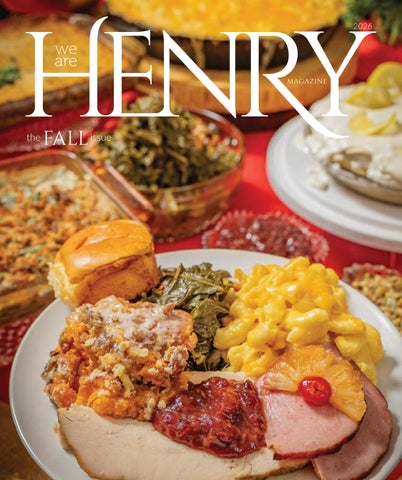
Tanya Boatwright’s holiday spread looks just like it does at her family’s table every year: turkey ham, dressing, collard greens and maple pecan sweet potatoes, seasoned with blends she mixes by hand at BoJaynes Specialty Foods in McDonough. Her secret ingredient has never been much of a secret at all. It’s love, with a little patience stirred in. Gather your people and set the table. The holidays are here in Henry.
F E AT U R E S
THE HEARTBEAT OF THE BAND Kansas drummer Phil Ehart turns the page on a remarkable life. by CRAIG THRELKELD
For more than five decades, Phil Ehart kept time behind the drum kit for Kansas, the Topeka-born rock band whose songs — “Carry On Wayward Son,” “Dust in the Wind,” and “Point of Know Return” — became the soundtrack of a generation. What most fans never knew is that Ehart’s story off the stage rivals anything the band ever put on vinyl: chance encounters with several of rock music’s most iconic figures, and a lifetime shaped by a military childhood that carried him from Air Force bases in the Philippines to a club in New Orleans. Now, after decades of people telling him he ought to write a book and navigating the long road of recovery from a major heart attack, Ehart has finally put it all down on paper. His new memoir – “I Am Phil” – co-written with Chicago-based writer Paul Braoudakis, arrived earlier this year after a writing process that began in earnest in 2024 — just months after Ehart’s serious cardiac event forced him, for the first time in his life, to slow down. “You keep hearing it, and you keep hearing it, and finally you go, ‘okay, I’ll write one and see how it goes.’” That was Ehart’s answer when asked what finally convinced him to share his memoirs. The tipping point, he said, was a conversation with Braoudakis, who had been pursuing the project since 2011 when the idea was first pitched. The timing had never worked — until it did. “He got me,” Ehart said of his co-author’s approach. “He said, why don’t you write these stories down for your kids? Because your kids are going to want to know these stories.” When the idea was mentioned to his daughter, Avery, her reaction sealed it. “She replied to Ehart’s wife Laurie, ‘Oh, Mom — I would love that. Get it done.’”
8 We Are Henry
2026 Fall Issue 9
F E AT U R E S PHIL’S MOM, DAD AND BROTHER STEVE
10 We Are Henry
PHIL LIVED A LIFE THAT MANY ONLY DREAM OF, DOING LIFE WITH THIS TALENTED COLLECTION OF MEN FROM THE PLAINS OF KANSAS.
A RELUCTANT SUBJECT For a man with gold and platinum records lining his walls, Ehart is remarkably uninterested in talking about himself — a trait Laurie describes as central to who he is. Sitting down to reconstruct a lifetime of stories, he said, forced an unfamiliar kind of self-reflection. “I don’t take myself that seriously,” says Ehart. “I don’t really sit around and think about myself that much. I have way too much else going on.” That reluctance, paired with the physical and emotional toll of recovering from a heart attack, made the writing process difficult at times — and, according to Laurie, deeply valuable. “I feel like it was one of the best things you did for your recovery,” she told him during the interview, “trying to stop and just take a look back. You don’t usually do that.” The finished product surprised even its author. “As it started to form into a book, I told Laurie — this is actually pretty interesting,” Ehart recalled. “Once you start seeing it and reading it, it’s actually pretty good.”
FAITH, CLEARLY STATED Ehart was insistent from the outset that his Christian faith be represented honestly in the book, even though it plays no role in Kansas’s music today. “My relationship with Jesus is extremely important to me,” he told Braoudakis early in the process, “and if it’s not important to you, then I’ve got the wrong guy.” Paul, he said, embraced the idea immediately. Readers will learn quickly the importance to Ehart that he was raised in a family of faith. At a young age he came to understand and accept the good news of who Jesus was and the sacrifice He made for everyone. To this day Ehart considers himself blessed and chooses to live his life as a Christ follower, emulating Jesus in his own understated and humble way. In “I Am Phil,” Ehart says, “Some may be surprised by that because I haven’t shouted it from the rooftops or worn it on my sleeve. But it’s as real as anything else in my life.” The subject carries some complicated history for the band. In the 1970s, one member’s embrace of Christianity — reflected heavily in the lyrics he was writing — created friction within the group, though nothing that threatened its survival. Ehart is careful to frame the chapter as personal testimony rather than proselytizing. “It’s not, I’m judging anybody or tearing anybody down,” he said. “It was about my personal faith.” 2026 Fall Issue 11
F E AT U R E S
BRUSHES WITH ROCK HISTORY Some of the memoir’s most vivid material predates Kansas altogether. Very early in his career, Ehart was playing in a band called the Pets when a New Orleans club owner pulled him aside: Jim Morrison was at the bar, and the Doors frontman wanted to sit in. “He wants to talk to you on a break, because he wants to try out some new lyrics with you guys playing,” Ehart recalls the club owner telling him. Morrison came up during a break, performed a few verses of new material over “Light My Fire,” gave Ehart a thumbs-up, and walked out into the French Quarter. Not long after, Morrison’s manager booked Kansas as an opening act for what turned out to be the singer’s final performance before his death in 1971. That same era produced an equally unforgettable moment with Janis Joplin, who called Ehart over after a Kansas set at the New Orleans Pop Festival. “She said, ‘I’m gonna tell you something. You’re great. Don’t you ever quit,’” Ehart remembered. Decades and multiple platinum records later, he still credits that brief exchange as one of the reasons he never gave up during the band’s leanest years — a period, he noted, when he survived on roughly a dollar a day and cases of canned soup that his mother mailed him to keep him fed. A PAINFUL STORY ABOUT A FRIEND Not every story in the book is triumphant. One story he was quick to recount — one that had never been made public before — involves Rush drummer Neil Peart, a close friend and peer whose career rose alongside Kansas’s in the mid-1970s. Peart, now widely regarded as belonging on the “Mount Rushmore” of rock drummers, once asked Ehart, who had an endorsement relationship with drum manufacturer Slingerland, to help him secure his own endorsement deal. Ehart made the call on Peart’s behalf, only to be told the company wanted nothing to do with it — not because of Peart, but because of friction with another member of Rush. Ehart had to deliver the news himself. “He had to sit down. I mean, it was heartbreaking for him.” “I would have given him my own drum set if I could have,” Ehart said. The two remained close for the rest of Peart’s life; Peart died in 2020. Ehart said he still isn’t entirely sure why the story had never come out before it was marked for inclusion in the book. “All the Rush fans heard about it for the first time ever,” he said. “They didn’t know that happened.”
12 We Are Henry
HONORING THE FALLEN Perhaps the memoir’s most personal chapter grew out of Kansas’s long relationship with the USO, an outgrowth of Ehart’s own upbringing as the son of a career Air Force officer. Ehart spent years organizing tours that brought musicians to aircraft carriers and overseas bases — an effort born out of the utmost of love and respect for the military and that became known as “The 1st Airborne Rock and Roll Division.” That work eventually led the band to Section 60 at Arlington National Cemetery, the burial ground for U.S. service members killed in Iraq and Afghanistan, on a visit arranged by a longtime
fan and military veteran. The experience inspired a song of the same name, which the band began performing live as a nightly tribute — inviting a local service member to hold a folded flag onstage while the lights dimmed. “We’re taking this time out of our set each night to honor those that have given their lives. What happens when we’re done? We get booed.” The reaction, Ehart clarified, came from a single California audience — an outlier in what has otherwise been an overwhelmingly supportive response, he said, from a fan base the band has come to rely on through five decades of career turns.
PHIL AT HIS HOME IN STOCKBRIDGE 2026
“That’s how you get your big break. Just by chance.” Phil Ehart 2026 Fall Issue 13
F E AT U R E S
BUILT BY CHANCE Woven through the book is a recurring theme: how much of Ehart’s life turned on chance encounters rather than planning. Kansas itself, he said, was never engineered — it was a handful of self-taught neighborhood friends from Topeka, the majority of whom could not read sheet music, who happened to click. Even the band’s breakout Pennsylvania fan base, still its strongest region decades later, traces back to a last-minute booking after Queen had to cancel a Pittsburgh date and promoter Rich Engler slotted Kansas into the headline spot instead. “That’s how you get your big break,” Ehart said. “Just by chance.” WHAT READERS WILL TAKE AWAY Asked what he hopes readers carry away from the book, Ehart returns to the same theme that runs through nearly every story
14 We Are Henry
he tells: gratitude, for a career built on luck, faith, family, and a fan base he doesn’t take for granted. The book is currently available through Ehart’s personal website, www.philehart.net, and locally through Smith & Davis Clothing, a longtime Fayetteville, Ga., store whose owners became fans after discovering the book on a visit. Early sales, Ehart said, have exceeded his expectations — as has the response from younger readers who arrive expecting the familiar excesses of a rock memoir and instead find something different. “They couldn’t believe you could go through those decades without drinking and doing drugs,” Laurie said. “It’s just a story of Phil’s life – very different.” For a musician who has spent 50 years avoiding the spotlight off the stage, that reaction may be the truest measure of what the book set out to do.
ADVERTORIAL
Greenland H u m b l e s Yo u Taking the road less traveled to Nuuk, Ilulissat and the icebergs of the Arctic. by PETO FALLAS, OWNER, FALLAS FAMILY VISION In the summer of 2026, we decided to visit Greenland. Why? To take the road less traveled. As usual, I find more enrichment in destinations not overloaded by the human imprint. Our journey began in Nuuk, Greenland’s small and colorful capital, a beautiful little city that felt more like a town. The local people are short on words and a bit timid, but we found beauty in that. Nuuk will take your breath away, but the heart of the trip became Ilulissat, an even smaller town. Nothing quite prepares you for seeing the icebergs for the first time. They aren’t simply pieces of ice floating in the ocean. They come in different sizes and tonalities of white. Some have a crisp blue color in the gaps where the sun shines through. Places like Ilulissat show that not everything must be conquered, developed, or owned; some landscapes hold greater value simply by existing as they are. As the Arctic faces increasing pressures from climate change and human ambition, this remarkable place serves as a reminder that our responsibility is not to take from every corner of the world we can reach, but to safeguard its rare wonders so future generations can experience the same sense of awe. The entire country of Greenland is about 22 percent the size of the United States (three times the size of Texas), but it has barely 90 miles of paved roads. Want to reach a destination? You must go by boat or small airplane. Greenland also reminded us that nature makes the rules. Fog disrupted flights and changed our plans, and the infamous Ilulissat mosquitoes made sure the Arctic wasn’t too romantic. But even those inconveniences became part of the story. As a photographer, I found Greenland almost overwhelming. Everywhere I looked, there was another image: brightly painted houses beneath gray skies, enormous icebergs glowing in the Arctic light, fishing boats appearing tiny against the landscape. Some destinations impress you. Others entertain you. Greenland humbles you. It reminded me that there are still places on Earth where silence is bigger than we are, where nature remains in control, and where simply standing still and looking around can be enough.
PHOTOGRAPHY BY: PETO FALLAS
18 We Are Henry
“One of Greenland’s greatest treasures is what it lacks: crowds, towering hotels, and mass tourism.” Peto Fallas
2026 Fall Issue 19
COMMUNITY
22 We Are Henry
LIFE OF LITERACY Literacy conference held in Henry County. by MICHELLE FLOYD
About 100 educators, educational supporters and advocates convened in Henry County for a statewide literacy conference. The Georgia Association of Literacy Advocates (GALA) gathered at Creekside Christian Academy in Hampton in July 2026 for a one-day literacy summit, Literacy in Full: Science, Meaning and Voice. The event was the first of its kind in more than a decade for GALA, an organization of Georgia educators and supporters of literacy and equity. “We wanted to take the science of research and show how it looks to practice it,” explains Dr. Andrea Carter-Robin, Conference Planning Committee Chair and board member for GALA. “They want to know what to do with all this research. So many times there’s an implementation problem, so we actually brought those lanes together, where research met classroom practice.” The event included discussions from local government officials, GALA board members and Georgia Department of Education Deputy Superintendent Dr. April Aldridge. “These people came into Henry County and were amazing,” says Stockbridge resident Carter-Robin. “We can learn from
each other. Reading is bigger than a reading score; it’s about participation and community and life.” Guests attended breakout sessions about engaging students, reading comprehension, picture books and graphic novels, vocabulary and writing, and multilingual learners, given by statewide educators and administrators, professors and authors. “It was amazing because so many people were like-minded there,” explains Carter-Robin. “It was great to have them poured into because they’re always giving it out.” Dana Smith, a literacy coach at the Utopian Academy for the Arts Charter School in Ellenwood, attended the summit to meet educators from various types of schools in Henry, Newton and other counties across the state, and even Tennessee, to share ideas to bring back to her school. “I got ideas from doing a reading block and maximizing time and adjusting to new standards and using small group times,” recalls Smith, who said new standards were introduced in Georgia last year that school staff are still trying to grasp. Guests also were able to network and attend a panel discussion on literacy leadership, as well as visit literacy vendors and exhibitors offering resources to enhance classrooms and schools. Keldric Holmes, a third-grade teacher from Decatur and social media influencer who is popularly known as Mr. Holmes, was one of the panelists who discussed literacy leadership. “Most people don’t realize it, but we’re having a literacy crisis,” explains Holmes, who moved to Georgia in 2025 from Mississippi. “I want to not only be known for creating funny videos on social media but to be an advocate for students and teachers as well. I want to be a voice for everyone and for things to be better.” GALA plans to make this an annual event. More information is available on its website, www.galiteracy.org.
PICTURED ABOVE (L-R) DR. ROBERT GRIFFIN (BOARD CHAIR, GALA), DR. ALDRIDGE (STATE DEPUTY SUPERINTENDENT), DR. ANDREA CARTER-ROBIN (CONFERENCE CHAIR & GALA BOARD MEMBER), MAYOR KAM VARNER (CITY OF MCDONOUGH), ANGELA O'BRIEN (MASTER OF CEREMONIES) AND COMMISSIONER KEVIN HARRIS (HENRY COUNTY)
2026 Fall Issue 23
F EOAMT M C UR U ENSI T Y
Rgoelltihnerg To
How Rolling Bites Alliance is bringing Henry County’s food trucks together. by SYDNEY-KATE LEWIS
What started as a conversation between two food-truck owners has grown into a community of more than 30 mobile food businesses working together to find opportunities, share resources, and serve Henry County. Rolling Bites Alliance was founded by Tony Eiermann of DaVinci’s NY Style Pizza and Kevin of 2 Carnales. The idea came while the two were sitting in the back booth of a restaurant, discussing their experiences taking their food trucks to events. Other truck owners would often ask how they found events, how they got involved with different organizations, and where they found opportunities. They began wondering: Why not create a group where food-truck owners could help one another instead of having to navigate the industry alone? “It started on a whim,” Eiermann says. “It’s helped me personally. It’s helped pretty much everybody, and the group has helped each other.”
Today, Rolling Bites Alliance operates through a membership program with more than 30 trucks. To maintain variety at events, the alliance limits membership to two trucks per food category, such as barbecue or tacos. Prospective members are also vetted before joining. They must provide required documentation, health scores, and other legal information, and an existing member anonymously visits their truck to ensure the food meets the alliance’s standards. While members stay connected through a group chat, occasional in-person meetings provide an opportunity to share ideas, offer advice, and build relationships. Each member brings different expertise to the table, whether it’s knowledge of laws and regulations, financial management, or operational efficiency. “If someone wants to go [to an event] but can’t figure out how to do it, there’s people within the group that can help them,” Eiermann says. The alliance also serves as a resource for event coordinators. Its website features a directory of member trucks, allowing
“It gets discouraging. And that’s where we wanted Rolling Bites to come in. To say, we got you.” Tony Eiermann, DaVinci’s NY Style Pizza, Rolling Bites Alliance co-founder
24 We Are Henry
TONY EIRMANN MAKING IT HAPPEN.
planners to search by food category and contact individual businesses or the alliance directly. If a scheduled food truck has an emergency and can no longer attend an event, organizers can also turn to the alliance to find a replacement. That collaboration is particularly important because more food trucks does not always mean more business for each individual truck. Rolling Bites helps create opportunities that are beneficial for both event organizers and the businesses serving them. After a month of conversations, Rolling Bites Alliance officially partnered with Henry County Parks and Recreation in March 2026. The partnership has led to monthly “Food Truck Frenzy” events, where alliance members gather at county parks to serve the community. Members also participate in Parks and Recreation events, including Movies in the Park. For Eiermann, the alliance is ultimately about making sure food-truck owners know they don’t have to navigate the industry alone. “It gets discouraging [not making money because you can’t find events],” he says. “And that’s where we wanted Rolling Bites to come in. To say, we got you.” Whether you’re an event coordinator looking for a food truck or a food-truck owner interested in joining the alliance, learn more at RollingBitesAlliance.com. 2026 Fall Issue 25
COMMUNITY
“This is probably the only sport where we are also out suffering with the kids.” Christy Stayer, team director, Southside Trail Riders
26 We Are Henry
STRong Together A homegrown youth mountain bike team is turning mountains into hills, and teammates into family. by KEMBLE HILDRETH
Ask Christy Stayer how she ended up directing a mountain bike team, and she will tell you she was not a mountain biker. Her kids were. Never drawn to baseball or football, they had been on bikes since age four, and a coach at a Newnan summer camp pointed the family toward a team closer to home: Southside Trail Riders, better known as STRong. Stayer’s son joined as a sixth grader in 2023, and she signed on as an admin coach, keeping watch from the parking lot and handling fundraising behind the scenes. Then her kids asked her to ride. Today the Locust Grove mom rides, coaches and directs the program. Head coach Jaison Lewis tells a similar story. He and his son were riding trails for fun when a friend from scouting mentioned the team. “I really like the kids,” his son told him after the informational meeting. “The kids were awesome.” That is how STRong grows: by word of mouth. Founded around 2017 under the Georgia Cycling Association, the composite team draws riders in grades six through 12 from Henry, Spalding, Butts and Jasper counties. Its 22 student riders and 11 coaches practice mainly at Dauset Trails in Jackson, with regular sessions at South Rockdale Community Park in Stockbridge and occasional trips to Quarry’s Edge in Griffin. Riders can ride for fun or compete in a four-race season and, for those who qualify, a state championship. Last year the team took second in its division at state, and several riders finished among the top in theirs. A sister program, Butts County Trail Rangers, welcomes second through fifth graders, Henry County kids included. 2026 Fall Issue 27
COMMUNITY
Nearly every coach is a parent who learned the sport alongside their own kid. “This is probably the only sport where we are also out suffering with the kids,” Stayer said. “You’re not sitting on the sidelines. You’re out there doing it with them.” For Lewis, the reward is the progression. Riders who struggled through two miles at the start of their first season were riding 12 by the end of it. “What seems to look like a mountain is now a hill,” he said. The payoff goes well beyond fitness. With races up to two hours away, families camp together the night before, and the kids ride together year-round. So do the adults. “They’re friends, not just teammates,” Lewis said. “We always refer to it as the STRong family.” The season runs July through October, with races in September and October. Informational meetings are announced each spring on the team’s website and Facebook page, and new riders can sign a waiver and try a practice before committing. Learn more at www.strong.bike. PICTURED TOP LEFT BACK ROW (L-R) JENNIFER HOLBROOK, TYSON HARTY, RYKER HARTY, LEILA AUSTIN, LEVI SMITH, LANDON AUSTIN, NOLAN SULLIVAN AND LUKE AUSTIN. MIDDLE ROW (L-R) SHEILA SLAYTON, AVA CHRISTMAS, BELLA CHRISTMAS, BODHI HOLBROOK, OWEN STAYER, TRISTAN LEWIS, JULY HOLBROOK, GRAHAM SULLIVAN, JUNIPER FISHER, KAYLA SMITH, ALEX FIELDS, ISRAEL FIELDS, KELLI SULLIVAN, BRANDON CHRISTMAS, JOSHUA SMITH AND BRANDON AUSTIN. FRONT ROW (L-R) CHRISTY STAYER (TEAM DIRECTOR), OLIVIA STAYER, JACOB PATTERSON, CHASE SULLIVAN, JULIA HOLBROOK AND JAISON LEWIS (HEAD COACH).
28 We Are Henry
COMMUNITY
Ve ter an Victorie s 5K benefits veteran organization. by MICHELLE FLOYD
After a successful inaugural event in 2025, local organizers are making a 5K dedicated to eliminating veteran homelessness an annual event. The Mighty Hero Homes 5K is one of the events that benefit the McDonough-based 501(c)(3) nonprofit organization that seeks to provide affordable, permanent homes for all U.S. veterans. The organization is planning the first Mighty Hero Homes community construction in Henry County. “Events like this are important for the local community to recognize that this is not just a VA problem or organizational problem,” explains Drew Walston, founder and CEO of Mighty Hero Homes. “We all benefit from our veterans, whether they serve our nation on our behalf or need our help.” Lake Dow resident Crystal Preston-Lloyd started creating and planning the race around 2024. She became an avid runner in the early 1990s after giving up smoking. “I basically traded one habit for another. For me, it’s a big stress reliever,” says Preston-Lloyd, who lives with her husband, Tommy Lloyd, and the dogs she runs with in town. “When I first started running, the only goal I had was to do the Peachtree Road Race.” She eventually ran it in the mid-1990s and more than 20 times since then, in addition to nearly as many marathons in Georgia and across the country. She has participated in several marathons that benefited veterans, including the Marine Corps Marathon in Washington, D.C., and the Soldier Marathon in Columbus, Ga., in addition to dedicating races to veterans.
“Veterans are the people who allow us to be free.” Crystal Preston-Lloyd, Mighty Hero Homes 5K creator and organizer
30 We Are Henry
“I just have always been a supporter of veterans because they are the people who allow us to be free,” she explains, adding that her father, brother and two cousins are Navy veterans. But she took her racing to the next level by planning the local 5K. “As a runner, I thought it would be fun to develop a race, but I didn’t want it to be for nothing,” says Preston-Lloyd, whose husband plays golf with Walston, which is how they decided to benefit his organization. “I know what a race is and what makes a run good, but I had never put one together myself.” Preston-Lloyd explains that the race took more than a year to plan: creating a route and getting it USATF-certified for 10 years and designated as a Peachtree Road Race qualifier, securing volunteers, designing a T-shirt and awards, planning to close roads, having officers and permits in place and even putting together plans like renting portable toilets.
“It’s putting everything all together,” says Preston-Lloyd, whose husband is a battalion chief for the Henry County Fire Department. “It takes a lot of planning, and it wasn’t just me.” The event, which includes a 5K, a kids’ fun run and “ghost runner” spots for those who want to support the race financially without running, is held the Saturday before Veterans Day each year, this year on November 7, running through the Lake Dow and Lake Dow Estates communities. Participants are encouraged to walk it if they can’t run it. “Part of this race also is to promote health in the community and support veterans at the same time,” notes Preston-Lloyd, who works at Aylo Health. The race, which was run by several fire and law enforcement officials in its first year, is always looking for sponsors and student and adult volunteers. Organizers also plan to honor a veteran each year, as they did the first year by honoring Lt. Col. Allan Imes of Griffin. 2026 Fall Issue 31
PROFILES
34 We Are Henry
AND THE SHOW GOES ON For 35 years The Henry Players have proven that on the stage, anything can happen, and something must. by CRAIG THRELKELD
In McDonough, Georgia, inside an old building many people pass without a second glance, a theater has been quietly teaching a town how to gather. For 35 years, The Henry Players have survived on long nights, volunteer hands, borrowed patience, and the stubborn belief that art matters even when money is tight and the world is distracted. That belief lives in people like Amanda Massie and Melissa Rice, two women who came to the theater by different roads and stayed for the same reason. One grew up in theater and learned to love both the spotlight and the work behind it. The other arrived as a mother, waiting on her daughters during youth rehearsals, then picked up a broom, cleaned what needed cleaning, and never really left. Over time, they became part of the board, Rice joining as the marketing chair in 2017 and becoming the current president in 2020. Massie joined the board in 2018 as stage management chair and has served as vice president of operations since 2020, and as a crucial cog in the group’s engine for much longer. They talk about the theater the way people talk about family: with pride, fatigue, laughter, and a little disbelief that everyone has made it this far. “I think about how many people drive by this building daily and never, in their wildest dreams, think of what’s inside of here
unless they already know,” says Massie. “You have a theater, you can seat nearly 200 people, but it’s also an intimate space. Our theater provides so much, and my wish is that people discover what’s here, especially if they don’t know.” There were hard years. COVID nearly broke the rhythm of live performance. Rehearsals moved online. Audiences disappeared. Money thinned out. A production of Mamma Mia!, delayed for months, finally reached the stage under masks and strict distancing, only for the lighting computer to fail during opening night. For a moment, everything hung in the balance. Then a quick-thinking young crew member grabbed the spotlight and held the show together by hand. That, in a way, was the whole story of The Henry Players: when something fails, someone steps forward. And then there is HYPE, the youth program, where middle and high school students learn not only acting, singing, and stage combat, but how to belong. Mentored by local educator Joaquin Santiago, they build props from cardboard, run booths, elect student leaders, and welcome nervous newcomers. Some of them return later as trusted crew members, performers, even future leaders. In a world that can be sharp and lonely for young people, the theater offers them a place to arrive exactly as they are.
PICTURED ON TOP PAGE 36 BACK ROW (L-R) IVONNE RODRIGUEZ, JOAQUIN SANTIAGO, DAVID BEDFORD, ELISE GOMEZ, AMANDA TUDOR, SARA JEANIS, JESS RICE AND MELISSA RICE. FRONT ROW (L-R) CHAUNCY SCRUGGS, JACK MACKIM, BEVERLY JACKSON, KIMMIE AHRENS, HALEIGH MASSIE AND AMANDA MASSIE. BOARD MEMBERS NOT PICTURED MAKENA MASSIE, KYLAH JONES, EMILY BOSKEY AND MATTHEW BOSKEY.
2026 Fall Issue 35
PROFILES
What has kept the company alive is not one show, one donor, or one season. It is the mix of old loyalty and new energy, of seasoned supporters and younger artists reaching beyond the county line. It is the audience member who comes back repeatedly, the parents who wait in the lobby, the teachers, the directors, the kids who sing too loudly in summer camp, and the volunteers who stay late painting scenery under dim lights. “One of my favorite parts is seeing people learn how much they enjoy this,” says Rice. Occasionally the troupe features shows like The Evil Dead, which of course draws on its own
“Just come and give us a try. We are so good.” Melissa Rice, president, The Henry Players
36 We Are Henry
cult following. But Rice’s goal is to continue encouraging not only those who follow specific cultural favorites, but those who literally “Google” what to do in Henry County, Ga. “I think that one thing our productions always do a good job of is the fact that in our shows there is something interesting for everybody, there’s a little something for everyone here,” Rice says, “even if you’re not a theater person. And we have a lot of local talent that’s wonderful who just didn’t go the performing route for their careers; they’re here and they can shine.” As audiences diversify, like the areas from which they hail, Rice enjoys learning about those who are in attendance. “We’ve gotten good this past season about asking people, ‘Hey, how did you hear about us? Is this your first time here?’ Often we get, ‘I’m in McDonough, and we were just bored tonight. And we just came out, just decided to give you a try.’ That’s my pitch,” Rice says. “I would love for that to happen across all of Henry County. “Just come and give us a try. We are so good.” So remember, next time you pass the building at 136 Hood Street, don’t pass it up. From the street, it may look like just another building. Inside, it is a small, stubborn miracle that opens its doors to you for the 36th season, featuring a halfdozen shows you will not want to miss!
PROFILES
MORE THAN
A GAME
Baseball continues to provide David Mendez a life he loves. by CRAIG THRELKELD
On many afternoons in Georgia, when David Mendez and his pupils get to work, it isn’t one but two countries that are represented on the ballfield: the United States and his beloved home of Panama. Like the excitement of late-inning heroics, the melding of those two creates the platform on which a dream continues to be realized. Mendez Baseball Academy is not just a baseball
38 We Are Henry
academy. It is a bridge between countries, generations, and hard-earned dreams. And Mendez, the man at the center of it, treasures that journey. Gifted as a left-handed pitcher, he began drawing attention as a teenager. From ages 13 to 16, Mendez played for the Panama national teams. As part of those teams, he represented his home country in various international tournaments in the Virgin Islands, Puerto Rico, and Cuba. At 15, the Panama national team represented all of Latin America in the Senior League World Series in Kissimmee, Fla. “First, it was a dream come true,” he says, thinking back to boyhood in Panama, where the thread of baseball ran through the tapestry of his family. His father played. His brothers played. “I am the youngest one out of three brothers,” he says. “I saw them first, and then I wanted to follow that line.” Soon after his final tournament in Cuba, the childhood dream took shape and Mendez signed with the Atlanta Braves organization. For a boy who had admired the club from afar, it felt enormous. But wonder quickly met reality. “It was a time to grow up,” he says. He was 16, far from home, without the English he speaks now, and separated from his parents and everything familiar. “It was hard, but it was a great experience.” He remembers the scale of it all: the long months in the minors, the grind of spring training, the feeling of being inside a world that had just celebrated a World Series title. Around him were names that seemed larger than life: Greg Maddux, Tom Glavine, John Smoltz. As a young lefty, he watched Glavine closely. “His control impressed me,” he says. “He could just put the ball wherever he wanted.” But it was also during his time with the Braves, as a member of the final Macon Braves squad in 2002, that his life was
changed again, as he met his wife, Andrea. Now, more than two decades later, they have two sons, both of whom he has had the opportunity to coach. Years later, the lessons he carried were not only about pitching. They were about discipline, respect, and what a game can build inside a person. Those lessons became the foundation of his academy. He began by bringing young players from Panama to the U.S., giving them opportunities he knew were rare. Better fields. Better equipment. Better visibility. Then he mixed those players with local kids, creating something larger than a travel team. Today, many of his players go on to college. He says one recent class sent about 95 percent of its players there. Success has followed him to Henry County, where his teams have won numerous Perfect Game and USSSA tournaments at various age levels (9–18). He also was the pitching coach for the Ola High School Mustangs in 2025 when they went undefeated in the region, winning the region championship. Still, his proudest measure of success is not a scholarship or a signing day. “Baseball is just a channel,” he says. “If you’ve got good people that take you through that channel, you can become a great person in life.”
“It was a time to grow up … It was hard, but it was a great experience.” David Mendez, Mendez Baseball Academy
2026 Fall Issue 39
HISTORY
42 We Are Henry
Feels Like Home
Celebrating The Brown House: 1826–2026. by MIA BRODER
This proud white, two-story, columned house has been called “home” by many in the last 200 years. At 71 Macon Street in McDonough, Georgia, the halls of the Brown House echo with resilience, unexpected warmth, laughter, tears, and a dash of curiosity. The house is one of the oldest surviving buildings in Henry County, and its story is being celebrated by its current resident: the Genealogical Society of Henry and Clayton Counties. “Time Travelers Welcome: Experience 200 Years of History” is a free, ticketed open house on Saturday, October 24, 2026, from noon to 5 p.m. Amanda Beck, the Genealogical Society’s president, says, “Visitors can expect a historic experience with exclusive guided tours of the Brown House.” The society is known for its Promenade programs, with lively storytelling of past Henry Countians. This open house will also bring actor portrayals of past residents of the Brown House, including Andrew McBride, Aunt Sallie Brown, and Hattie Lewis Goodhue. Visitors will also get a look inside the Genealogical Society’s Family Research Library, where the research materials allow the public to discover their ancestral roots. Reference books, microfilm, old newspapers, Wi-Fi, and access to online databases such as Ancestry.com and Fold3.com are all available.
It is hard to count just how many lives the Brown House has impacted from 1826 to 2026. To understand why the Brown House is worth honoring, one must understand its journey. Before the iconic courthouse and the vicious Civil War, Andrew McBride, a Revolutionary War patriot, bought lots in the brand-new town named McDonough in 1823. By 1826, he was lining his home’s ceiling, floors, and walls with heart pine.
“The old reliable Brown House is voted by the traveling public to be the most hospitable and home like hotel between Macon and Atlanta.” Henry County Weekly, 1883 2026 Fall Issue 43
HISTORY
Thirty years later, Asa Brown (its namesake) bought the home for his growing family. After Asa’s death in 1874, his wife, Sallie Knott Brown (Aunt Sallie Brown), added a hotel to the residence. She expanded the house by constructing a second floor, using the original heart pine from the first floor. The new railroad helped the hotel gain popularity. In an 1883 Henry County Weekly article, it was noted that “The old reliable Brown House is voted by the traveling public to be the most hospitable and home like hotel between Macon and Atlanta.” While owners came and went throughout the years, the Brown House remained a hotel until 1954, when it was sold to the Goodhues. Hattie Lewis Goodhue, the first female lawyer in Henry County, transformed the once-bustling hotel and cafeteria into her law office. The Goodhues made changes to the home while working and living there, including removing the long two-tiered Victorian porch. By 1986, the Brown House was owned by the Smiths, who deeded it to Henry County Landmarks, Inc. It was listed on the National Register of Historic Places in 1991. Today, the heart of the Brown House remains with its current stewards, the Genealogical Society of Henry and Clayton Counties. For more information about “Time Travelers Welcome: Experience 200 Years of History,” please visit www.henryclaytongenealogy.com.
44 We Are Henry
(L-R) LINDA WEST, CHARLES PENDLEY, MARY HANCOCK, MARTY MEEKS AND NORAH TRIMBLE
Digital edition subscribe today
Sign up to receive the free digital edition of We Are Henry Magazine via email. The digital edition includes an assortment of stories–new and old–plus fun tips and tidbits.
SPIRITUAL
GRACE & TRUTH
Beyond the Walls
After more than ten years in jail ministry, a McDonough team carries its message to the streets. by PASTOR RON CASTILLO, GEORGIA HISPANIC JAIL & PRISON MINISTRIES
MERCY BEHIND BARS I have served in jail ministry since May 2015. In more than ten years of that work, I have watched many men turn to Christ as the Holy Spirit brought conviction, hope, and new life through the preaching of the Gospel. Every conversion has reminded me that salvation is the work of God, not the achievement of the messenger. I remain humbled by His mercy toward the guilty, His grace toward the broken, and His willingness to reach people whom society may have forgotten. This year, that same burden has carried our McDonoughbased team, Georgia Hispanic Jail & Prison Ministries, beyond the jail walls and into the streets. A MISSION FOR THIS MOMENT The United States has changed dramatically in recent years. We live in a culture saturated with information, yet increasingly confused about truth; connected through technology, yet deeply marked by loneliness, addiction, fear, and spiritual emptiness. In such a time, the Church cannot afford to become silent or inward-looking. Believers must remain firmly rooted in the Word of God and carry the unchanging Gospel of Jesus Christ into a changing world. Jesus did not give the Great Commission only to pastors, missionaries, or evangelists. He entrusted it to His Church: “Go therefore and make disciples of all the nations … teaching them to observe all things that I have commanded you” (Matthew 28:19–20, NKJV). He also declared, “Go into all the world and preach the gospel to every creature” (Mark 16:15, NKJV). The mission requires movement. We are called to go beyond the four walls of the church: into jails, prisons, streets, neighborhoods, workplaces, and every place where God opens a door.
48 We Are Henry
INTO THE STREETS Our street outreach takes place at McDonough Square in downtown McDonough. The setting is different from the jail, but the need is the same. We go prayerfully, speak truth with love, listen with compassion, distribute Gospel tracts, offer prayer, and invite people toward lasting discipleship in the local church. We do not measure success merely by numbers or immediate responses. Our responsibility is to proclaim Christ faithfully; God alone gives the increase. EVERY BELIEVER CAN PARTICIPATE This ministry may not be the specific calling of every Christian, but every believer can take part in the Great Commission. Some can enter the jails with us; our team serves in Clayton County Jail, Butts County Jail, four state prisons and the Stewart Detention Center in Lumpkin. Some can preach or serve on the streets. Others can pray, give, or help provide Bibles and Gospel tracts for inmates and for the people we meet in public places. Every contribution helps place the truth of God into someone’s hands and the hope of Christ before a searching heart. God is still seeking servants who will labor diligently, humbly, and faithfully. The fields remain ready. May we be a Church that not only gathers to worship, but also goes out to proclaim: Jesus Christ saves, restores, and makes all things new. To join a jail visit or a street outreach, or to help supply Bibles and tracts, call 770-894-3197 or email prisonministry@masterpiecechurch.us.
“The mission requires movement. We are called to go beyond the four walls of the church.” Pastor Ron Castillo
2026 Fall Issue 49
FINANCE
Be yond the Piggy Bank The Three-Bucket Strategy, Part One: The Tax-Deferred Bucket.
by KELI HAZEL, CPA, BFA, FINANCIAL PLANNER, CAPITOL FINANCIAL SOLUTIONS Welcome to the first of a series of financial insights and tips that take you well beyond your piggy bank days. We will start with a three-bucket strategy that will help you categorize your wealth for a lifetime of savings. THE TAX-DEFERRED BUCKET When building a financial plan, it’s easy to focus on how much you’re saving and investing. But an important question is: How will those dollars be taxed when you need them? WHAT IS TAX-DEFERRED MONEY? Tax-deferred accounts include 401(k)s, 403(b)s, traditional IRAs, SIMPLE IRAs and SEP IRAs. Contributions may provide tax benefits today, depending on the account and the investor’s circumstances, while taxes on investment growth are generally postponed until money is withdrawn.
“Tax-deferred doesn’t mean tax-free.” Keli Hazel, CPA, BFA, Financial Planner
50 We Are Henry
That tax deferral can be a powerful wealth-building tool. An advantage of a tax-deferred account is that instead of paying taxes on investment earnings each year, the money can remain invested and potentially compound over time. But there is an important trade-off: tax-deferred doesn’t mean tax-free. Eventually, withdrawals are taxed at ordinary income tax rates. For many retirees, that means the money accumulated in these accounts represents both an asset and a future tax liability. PLANNING FOR THE FUTURE TAX BILL This is where tax planning becomes especially important. The goal isn’t necessarily to eliminate taxes; it’s to manage when and how much you pay. For example, during retirement, there may be opportunities to strategically withdraw from tax-deferred accounts when taxable income is relatively low. However, it’s important to note that you are not completely in control. Owners of tax-deferred
retirement accounts born between 1951 and 1959 are required to take annual Required Minimum Distributions (RMDs) starting at age 73. For those born in 1960 or after, the RMD age is 75. This rule applies to 401(k)s, 403(b)s, traditional IRAs, SIMPLE IRAs and SEP IRAs. Why do we have RMDs? Congress implemented the RMD rules through the Tax Reform Act of 1986 to prevent perpetual tax-deferred sheltering of retirement funds. The Internal Revenue Service (IRS) enforces and administers these guidelines. THE BIGGER PICTURE The tax-deferred bucket can be an excellent first step for retirement savings, but it shouldn’t necessarily stand alone. How it interacts with tax-free and taxable assets may ultimately be just as important as the amount accumulated inside it. Our next article will focus on the tax-free bucket and how Roth assets can provide valuable tax flexibility in retirement.
ADVERTORIAL
DON’T WAIT FOR THE WAKE-UP CALL Recognizing heart failure before it becomes an emergency.
by DR. ANDREA GIBSON, DNP, ACAG-NP, CARDIAC NURSE PRACTITIONER, ATLANTA HEART ASSOCIATES As a cardiac nurse practitioner, one of the hardest conversations I have with patients often begins the same way: “I didn’t realize it was getting that bad.” The truth is that congestive heart failure (CHF) rarely becomes an emergency overnight. More often, it whispers before it screams. The body usually gives us warning signs days, or even weeks, before a hospitalization becomes necessary. The challenge is recognizing those signs early and knowing when to act. That’s why I teach my patients the acronym F.L.U.I.D. It’s an easy way to remember five common warning signs that your body may be retaining excess fluid and your heart may be struggling to keep up.
F – FEELING FULL FASTER If you’re becoming full after only a few bites, losing your appetite, or feeling bloated after eating, don’t dismiss it. Fluid can back up around your digestive system, making it difficult to eat normally. L – LEG EDEMA Swelling in your feet, ankles, or lower legs isn’t simply “part of getting older.” It may be your body’s way of telling you that fluid is accumulating because your heart isn’t pumping as efficiently as it should. U – UNABLE TO PERFORM YOUR USUAL TASKS Have you noticed everyday activities suddenly leave you exhausted? Maybe walking to the mailbox, climbing stairs, or folding laundry requires more effort than it did just a week ago. Increased fatigue is often one of the earliest signs your heart is working harder than it should.
DR. ANDREA GIBSON, DNP
I – INCREASED WEIGHT One of the most important numbers for someone living with heart failure isn’t just blood pressure; it’s the number on the scale. A sudden weight gain of 2 to 3 pounds overnight or 5 pounds in a week is often fluid retention, not body fat. Your scale can detect worsening heart failure before you even begin to feel significantly different.
“I didn’t realize it was getting that bad.” A patient, as told to Dr. Andrea Gibson, DNP, Atlanta Heart Associates
54 We Are Henry
D – DIFFICULTY LYING FLAT If you’ve suddenly started sleeping with extra pillows or find yourself waking up short of breath during the night, don’t ignore it. Difficulty breathing while lying flat may indicate that fluid is beginning to collect in your lungs. The good news? Many heart failure hospitalizations are preventable. Daily weight checks, limiting sodium, taking medications as prescribed, staying active within your limits, and communicating new symptoms early can often keep a manageable problem from becoming a medical emergency.
One of the biggest mistakes I see is patients waiting too long to call. They hope the swelling will improve on its own, assume the weight gain is “just a few pounds,” or decide they’ll mention it at their next appointment. Unfortunately, by the time symptoms become severe, hospitalization is often the safest option. When you recognize the F.L.U.I.D. warning signs early and notify your cardiology provider promptly, it gives us the opportunity to intervene before your condition worsens. Often, we can adjust your medications, increase your diuretic dose, or even administer intravenous (IV) diuretics in our office to remove excess fluid, potentially preventing an emergency room visit or hospital admission altogether. The earlier you call, the more options we have. Beyond caring for patients in the office, I also have the privilege of mentoring nursing students, serving as a clinical preceptor for future nurse practitioners, and educating a growing community of more than 80,000 healthcare professionals and patients through my social media platform, Make It Make Sense Cardiology. Whether I’m in the exam room or behind a camera, my mission is the same: to help people understand why their heart is doing what it’s doing, not just memorize diagnoses or medications. At Atlanta Heart Associates, we believe education is one of the most powerful treatments we can offer. We don’t just tell you that you have heart failure; we help you understand it. We teach you what to watch for, how to recognize subtle changes, and, most importantly, when to let us know so we can intervene before those subtle changes become a crisis. Atlanta Heart Associates is currently accepting new patients. If you’re living with heart failure, or you’re looking for a cardiology team that believes education is just as important as medication, we’d love the opportunity to care for you. We don’t simply diagnose heart failure; we partner with you to understand your condition, recognize problems early, and keep you healthy, active, and out of the hospital whenever possible. Atlanta Heart Associates 3333 Jodeco Road McDonough, GA 30253 770-692-4000 atlantaheartassociates.com 2026 Fall Issue 55
SAFETY TIPS
TIPS FOR
Headache or Migraine? Understanding the difference.
by JASMINE FORTE, MD, CHILDREN’S HEALTHCARE OF ATLANTA NEUROLOGY When a child says their head hurts, it’s easy to wonder: Is this just a headache, or is it a migraine? The key difference is simple: Headache is a symptom. Migraine is a neurologic disease. Headache simply means pain in the head. Children can develop headaches for many reasons, including illness, dehydration, lack of sleep, stress or anxiety, or a head injury. Headache can also be a symptom of a primary headache disorder, including migraine. That’s why it’s important to look beyond how much the head hurts and consider what else is happening. Migraine is more than a bad headache. It is a neurologic disease with a strong genetic basis that is also influenced by environmental factors. Children with migraine have a nervous system that is predisposed to migraine attacks. Headache is often part of an attack, but it is only one of many possible migraine symptoms. During a migraine attack, a child may experience nausea or vomiting, sensitivity to light or sound, dizziness, fatigue, difficulty concentrating or changes in vision. Some children become pale or simply want to stop what they are doing and lie down. Migraine attacks can last for hours to days. The headache associated with migraine can be moderate to severe and may worsen with physical activity. For children with migraine, certain factors can make attacks more likely. Here are some daily habit changes that can help reduce migraine frequency or severity: • Regular sleep • Good hydration • Consistent meals • Physical activity • Stress management
56 We Are Henry
These habits don’t cure migraine; rather, they can help reduce factors that may make attacks more likely. When a headache or migraine attack occurs, encourage fluids, regular food intake and rest in a comfortable environment. Over-the-counter pain medication may help when used appropriately for a child’s age and weight. Children with migraine may also benefit from migraine-specific treatments recommended or prescribed by their healthcare provider.
JASMINE FORTE, MD, PEDIATRIC NEUROLOGIST, CHILDREN’S HEALTHCARE OF ATLANTA. PHOTO COURTESY OF CHILDREN’S HEALTHCARE OF ATLANTA.
A CHILDREN’S HEALTHCARE OF ATLANTA PHYSICIAN EXAMINES A YOUNG PATIENT. PHOTO COURTESY OF CHILDREN’S HEALTHCARE OF ATLANTA.
Talk with your child’s pediatrician if headaches are becoming more frequent or severe, repeatedly interfering with school, sports, or other activities, or are accompanied by new or unusual symptoms. Seek urgent medical attention for a sudden, extremely severe headache; headache with new weakness, difficulty speaking, confusion, loss of consciousness, or seizure; or a concerning headache following a significant head injury. Persistent headache with fever and neck stiffness or repeated vomiting also warrants prompt medical evaluation. The bottom line: Migraine isn’t just a bad headache. Headache is a symptom with many possible causes. Migraine is a neurologic disease that can cause headache along with a wide range of other symptoms. Understanding the difference is the first step toward getting children the right diagnosis and treatment. Medical insight above is provided by Jasmine Forte, MD, a pediatric neurologist at Children’s Healthcare of Atlanta.
“Headache is a symptom. Migraine is a neurologic disease.” Jasmine Forte, MD, pediatric neurologist, Children’s Healthcare of Atlanta
Disclaimer: This content is general information and is not specific medical advice. Always consult with a doctor or healthcare provider if you have any questions or concerns about the health of a child. In case of an urgent concern or emergency, call 911. 2026 Fall Issue 57
Seasoned with
LOVE
At BoJaynes, Tanya Jaynes Boatwright’s hand-blended spices are bringing families back to the table. by KEMBLE HILDRETH
The holiday spread on this issue’s cover is what the table looks like every year at Tanya Jaynes Boatwright’s house: turkey ham, dressing, macaroni and cheese, green bean casserole, black-eyed peas, maple pecan sweet potatoes and collard greens, most of them made from recipes handed down through her family. “I just decorate it a little differently every year,” she says. “But that’s basically it.” Boatwright and her husband, Kevin Boatwright, have run BoJaynes Specialty Foods with their family for more than 15 years, and their shop on Keys Ferry Street in McDonough carries the same feeling. It is part natural deli, part gourmet market and, at its heart, a spicery. The deli case rotates daily with sandwiches, grinders, wraps, salads and soups built on chicken salads, turkey, roast beef and turkey ham, with vegan, vegetarian and pescatarian options. The secret to the family recipes? “A lot of love,” she says. “And patience. Once you connect with your food, the love you put in is what you see back.”
“Once you connect with your food, the love you put in is what you see back.” Tanya Jaynes Boatwright, BoJaynes Specialty Foods
64 We Are Henry
But the spices are what she wanted to talk about. “That’s my heart,” she says. When the family opened their first shop, she pictured a spicery inside a deli. The community wasn’t ready. “I don’t think many people were cooking at home,” she says. “So I took it all out and just used the spices behind the scenes.” As families rediscovered their kitchens, she brought the blends back out, and today they are one of the shop’s biggest draws. Boatwright blends every one herself, in small batches, with the instinct she had as a little girl at her mother’s spice cabinet. “I didn’t know what I was doing, but I was mixing,” she laughs. When she told her mother she wanted a deli with spices in it, the response was simple: “I’m not surprised. That’s what you do.” The line runs from a collard green seasoning to Greek, Mardi Gras and lemon pepper blends, a Middle Eastern za’atar heavy with thyme and sesame, and her own version of garam masala. Her favorites are the collard green, the za’atar and the masala. Every culture cooks with the same spices, she points out; they simply use them differently. Her goal is to take the intimidation out of the jar. “I try to put it all in one can so that you don’t have to stress about the flavor of your food,” she says. That, she believes, is what gets busy families cooking at home, where the good stuff happens. “When you set the meal, that’s time you are spending with your family,” she says. “That’s where you get the conversations, to know what’s going on with your kids, and touch base on how everyone’s feeling. I love home. I love family.” Her palate works on instinct. Every dish balances sweet, savory and a little spice, a pattern she followed for years before she went to school to learn more about time-honored culinary methods.
Nearly everything on the cover was seasoned from her own shelves: the holiday blend she makes each year, the collard green seasoning, the all-purpose blend, a four-spice mix in the maple pecan sweet potatoes. With the shop down to just the family, BoJaynes has stepped back from full catering, but Tanya still offers a small holiday menu for pickup each year, so the spread can travel to your table too. Selling the blends online is next on her list. For now, come see the family in person. She wouldn’t have it any other way. BoJaynes Specialty Foods is located at 371 Keys Ferry Street in McDonough. Visit bojaynesspecialtyfoods.com for the deli menu, the full line of hand-blended spices and current hours, or call 770-914-1154. Follow BoJaynes Specialty Foods on Facebook and on Instagram @bojaynes_specialty_foods.
(L-R) KEVIN BOATWRIGHT, TANYA JAYNES AND KASHON JAYNES
2026 Fall Issue 65
HOME & GARDEN
Leave a Little Behind A different kind of autumn cleanup. by PAUL ANDINO, 4 NATIVE SAKE GARDENS & NURSERY
There is something special about Georgia autumns. The heat finally begins to loosen its grip, mornings become cooler, and the garden slowly changes. Flowers fade, grasses turn golden, and leaves begin to fall. For many of us, that means one thing: time to clean everything up. But what if we looked at autumn a little differently this year? What if some of what we consider yard waste is actually beneficial? A layer of fallen leaves can provide shelter and insulation for many of the small creatures that help make our gardens healthy. Approximately 70 percent of native bee species nest in the ground, creating tunnels beneath the soil where they spend part of their life cycle. Other bees and beneficial insects use hollow stems from spent flowers, dead wood, and natural plant debris for shelter. That carpet of leaves we are so quick to remove can help protect this hidden world through the winter. Instead of removing every leaf, consider relocating them. Rake leaves from the lawn and place them beneath trees, around shrubs, or into garden beds. Leave some areas undisturbed where nature can take its course. And don’t be too quick to cut everything back. Those dried stems that no longer look beautiful to us may still provide nesting sites or winter shelter for insects, and the seeds that have not yet fallen offer food for migrating birds. What looks dormant to us can actually be very much alive. Sometimes the best thing we can do for our gardens is simply do a little less. But autumn is also a good time to look closely at what doesn’t belong. Invasive plants can quietly take over garden edges, wooded areas, and neglected spaces, crowding out the native plants that
70 We Are Henry
local wildlife depend upon. Autumn gives us an opportunity to identify these plants and begin removing them before they gain even more ground. Know what to leave, and know what to remove. Here in Georgia, plants such as Chinese privet, English ivy, Japanese honeysuckle, nandina, and kudzu, along with other invasive species, can take advantage of disturbed landscapes and gradually replace native vegetation. We have to be intentional about creating opportunities for native insects, birds, and other wildlife to find food and shelter. Think of fall as preparation rather than cleanup. The leaves falling today will eventually return nutrients to the soil. A dried stem may shelter an insect until spring. A small patch of undisturbed ground may be home to a native bee. And an invasive plant removed today may give a native plant room to thrive tomorrow. A native garden isn’t simply a collection of plants. It is a small ecosystem. And every garden in Henry County has the potential to become part of something much larger. So before you reach for the rake, blower, or pruning shears this fall, take a moment to look a little closer. Leave some leaves. Leave some stems. Leave some undisturbed ground. Remove the plants that don’t belong. And make room for the ones that do. Because sometimes creating a healthier garden doesn’t require us to do more. Sometimes it simply requires us to understand what nature is already doing. 4 Native Sake Gardens & Nursery Growing habitats, one garden at a time.
“Sometimes the best thing we can do for our gardens is simply do a little less.” Paul Andino, 4 Native Sake Gardens & Nursery
2026 Fall Issue 71