Think Global is Global Justice Now’s activist newsletter, published three times a year, with monthly email supplements (Think Global Extra)
Editing: Daisy Pearson, Guy Taylor and James O’Nions
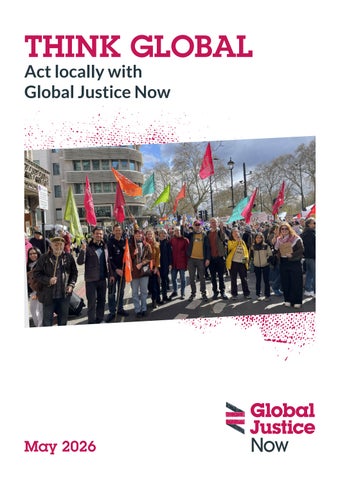
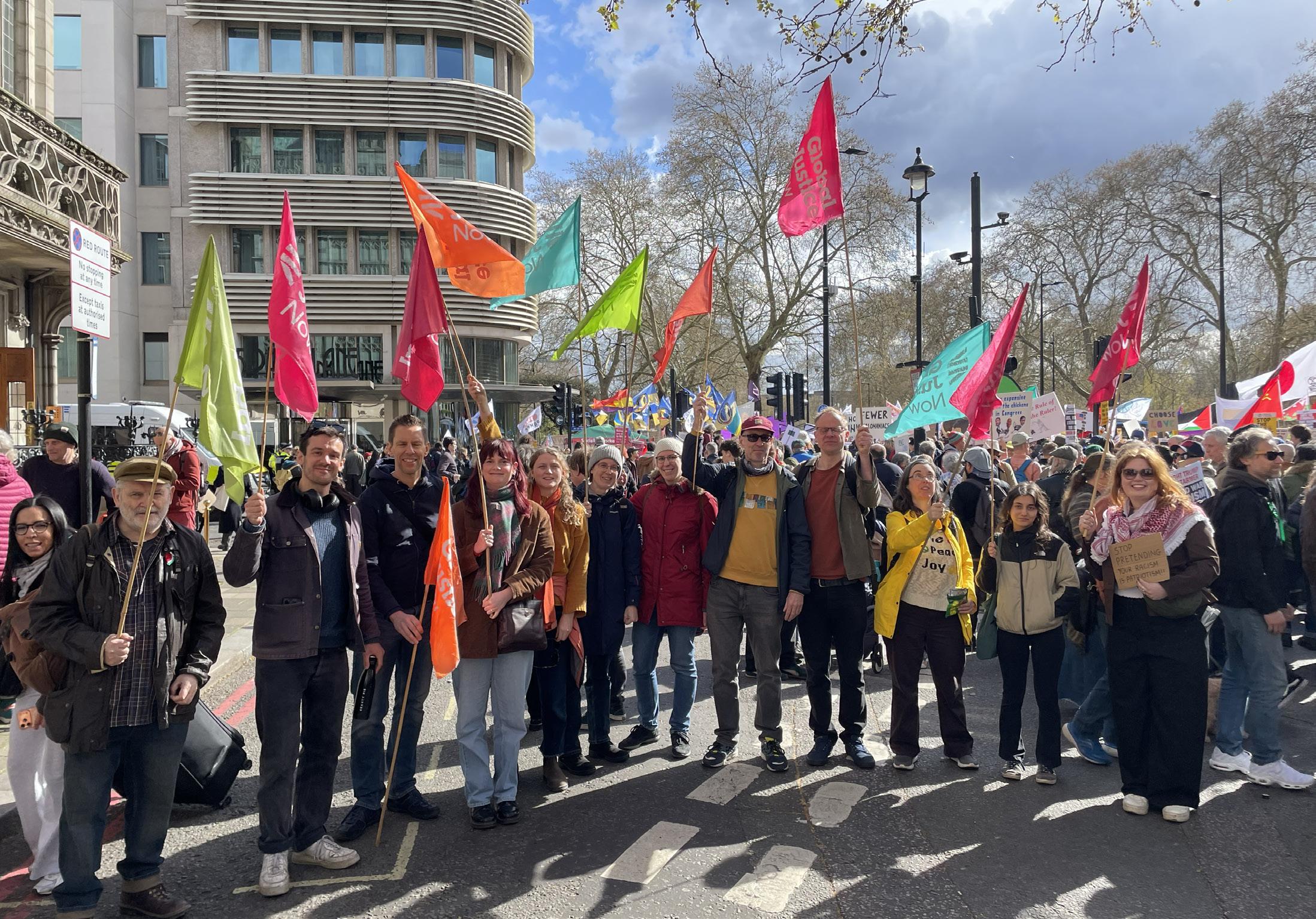
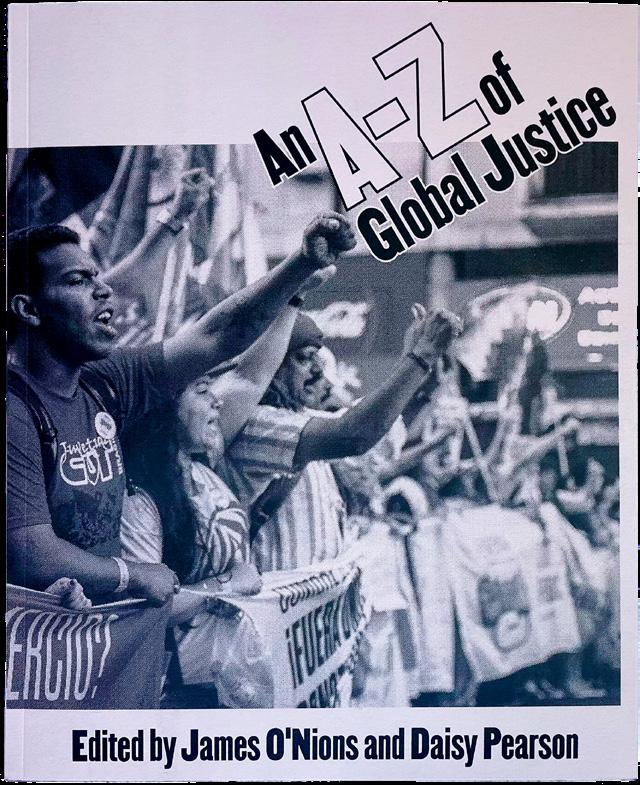
Cover photo: Global Justice Now staff, supporters and allies at Together Against the Far Right
Campaigning in a polarised country
Guy Taylor Activism Manager
We certainly live in interesting times. Last week’s election results reveal a dividing society, splitting along political and class lines.
At this stage it is mostly a shift in council seats, but the worry for people living in areas where the hard right has taken charge of the local authority is real. But results in London, Manchester and other cities tell us all is not lost, although the stakes are high and there is much to play for. We need to be proposing radical, achievable progressive alternatives, in order to win people over from the scapegoating politics of the right. This way we can tackle climate change and the cost of living crisis, and protect the NHS from becoming an insurance-based scheme, like the US system.
In times like these individuals can veer one way and then another and may frequently hold ideas in their heads from both ends of the political spectrum. For example, they might believe we need to invest in environmental protection and at the same time blame irregular migrants for the cost-of-living crisis.
We have to listen to people, understand where they are, their hopes and their fears, while helping them to make more inclusive and positive conclusions. We need to show people how corporations in the media, tech and other sectors manipulate ideas and why it is important to reject such thinking.
A major attack on the right to protest is underway; pensioners holding placards opposing genocide are treated as the UK’s biggest terrorist threat; and the scapegoating of migrants and refugees is as relentless as ever.
We can spend hours arguing and trying to convince people, but that is the long slow route to a brave new world. On the other hand, involvement in a determined campaign can change someone’s ideas rapidly and radically. Whether you’re campaigning for climate action, or against a local data centre, you may find yourself working with unexpected bedfellows. Use these opportunities to start discussions, and to introduce ideas of structural change and justice. If you find you have even a little common ground with someone, start from that place and work outwards. When someone starts to question the status quo, there’s no telling where they will end up!
Seemingly small acts acts add up. It is by forging these alliances, that we can turn the tables against the right, and win a more hopeful, united, and just future for all.
News from Global Justice Now
In the media
It’s been a busy few months! The First Conference on the Transition Away from Fossil Fuels has just drawn to a close in Colombia. As the conference started, we launched a joint report which revealed that the UK ranks number one in Europe for upholding ISDS – an unenviable title. The findings were picked up by Sustainable Views (part of the Financial Times) and POLITICO. Following the conference, where we worked on the ground with movements mobilising against corporate courts, the Guardian referenced the need to end ISDS as one of the ‘big lessons’ on ending the fossil fuel era.
Meanwhile, we’ve continued our work campaigning against the unjust US-UK pharma deal. The Guardian quoted our critiques in a write-up as the deal was officially finalised. The Bureau of Investigative Journalism also put out an investigation on the deal which referenced our campaigning work to date.
On climate, a joint letter we put out urging the Scottish government to oppose any approval of the Rosebank oil field was picked up by the National. It’s also been brilliant to see the incredible work of our activists across the UK hit the headlines. As the Fossil Fuel Treaty motion passed in Cardiff, Nation Cymru did a great write up celebrating the news. Meanwhile in Scotland, the Herald covered a joint protest organised between Stop the War Scotland and Global Justice Ayrshire over the US military use of Prestwick Airport.
Action checklist
Watch our 3 minute film, How Britain got sued for stopping a coal mine, on YouTube now, and share.
Council update
Maggie Mason, chair, reports: Our staff-council awayday in April focussed on movementbuilding strategy in the current political climate, with a particular focus on the big tech campaign. With our significant contribution to the recent Santa Marta conference, our timely campaigns on big tech and Palestine, and our deep expertise on trade, Global Justice Now feels more relevant now than at any time in its 50+ year history. If you are involved in activism, thank you!
Annual General Meeting
Tuesday 16 June, 6:30pm
Our AGM is an opportunity for members to hear more about our work during the last year, ask questions and contribute to the discussion about the direction of our work. Please register in advance for this event by Thursday 11 June. You can register, find out more details, appoint a proxy and submit resolutions for consideration online at globaljustice.org.uk/agm-2026.
Corporate courts
Organise a meeting on ISDS – for your group or another organisation
Big tech
Connect with your local campaign against data centres
Palestine
End Palantir contracts in the NHS – write to your MP and use our petition.
Continue to press your MP on settlement goods and sanctions on Israel
Trade justice
Fresh back from Colombia
We’re just back from the First Conference on the Transition Away from Fossil Fuels in Santa Marta, Colombia – where, for the first time, a global climate conference formally discussed corporate courts.
ISDS was a hot topic all week. We worked hard to forge unity between NGOs, academics and unions, getting them to call for a total exit from the system. Academics formally proposed that countries start cancelling ISDS agreements, echoing a global statement we helped coordinate signed by more than 340 organisations worldwide. You can read this statement at europeantradejustice.org/2026isds-statement
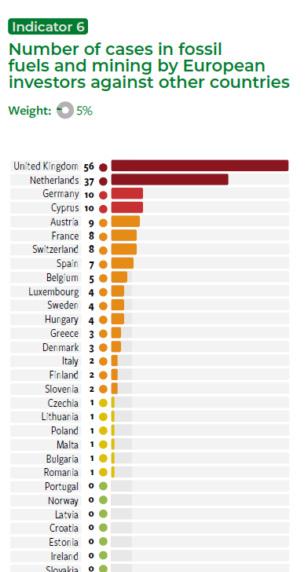
However, vested interests still blocked stronger action. The Dutch government opposed tougher language on ISDS, weakening the conference conclusions. This is hardly surprising, given our recent report revealed the Netherlands is one of Europe’s biggest defenders of the corporate court system – second only to the UK.
Still, while the US continues to wage war on the multilateral order, Santa Marta has set a direction for a new, bolder kind of international cooperation. Behind the scenes, we met with several governments looking to chart their own course away from ISDS.
UK ranked worst in Europe
Alongside European partners, we published new research ranking European countries’ role in propping up ISDS. The UK came out worst overall, with UK investors particularly active in mining and fossil fuel cases. This strengthens the case for pushing the UK government to change course, and could be a powerful advocacy tool to use when speaking to MPs and local representatives.
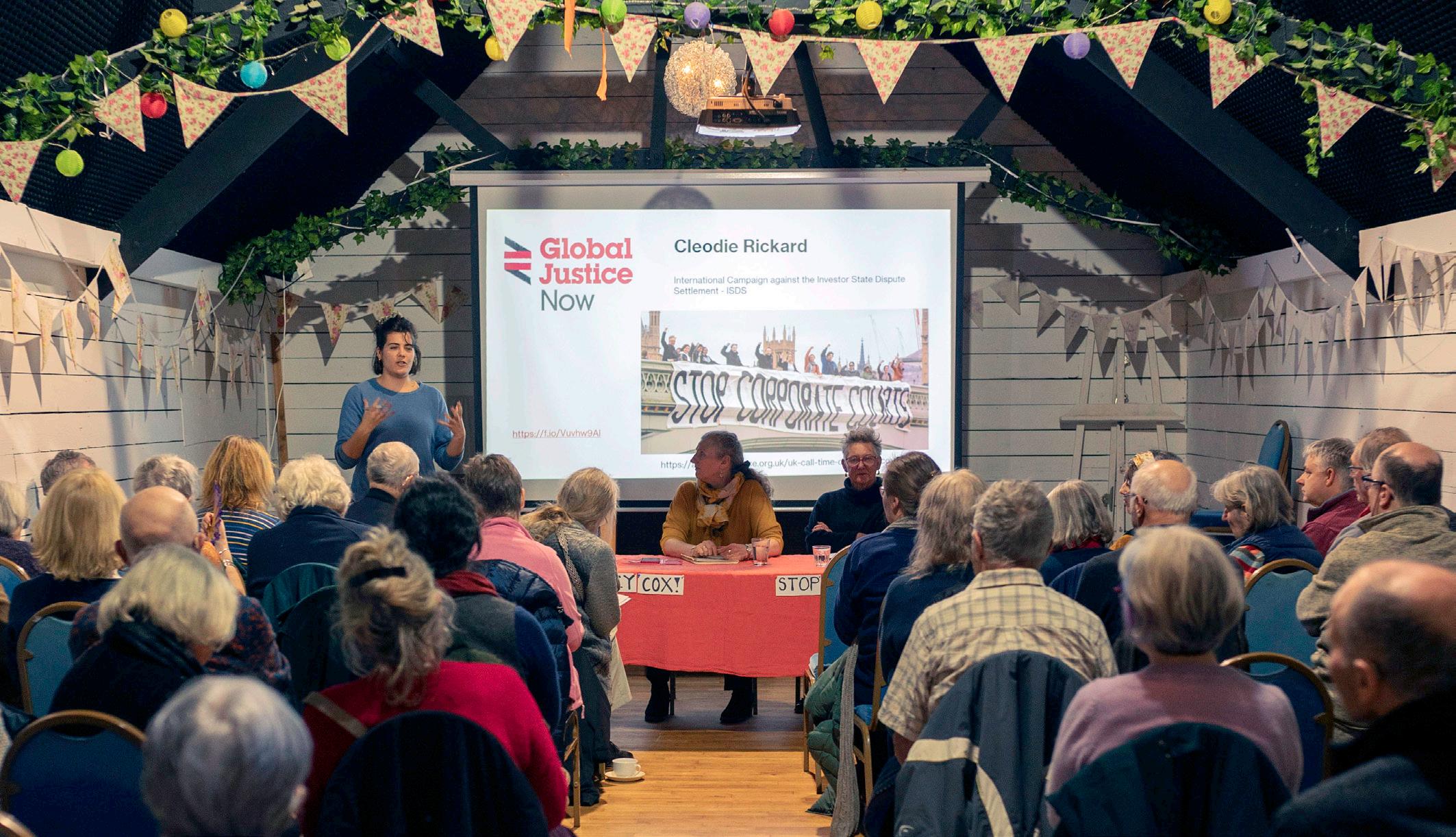
Trade campaigner Cleodie speaks to a packed meeting of campaigners and constituents of Geoffrey Cox in Devon.
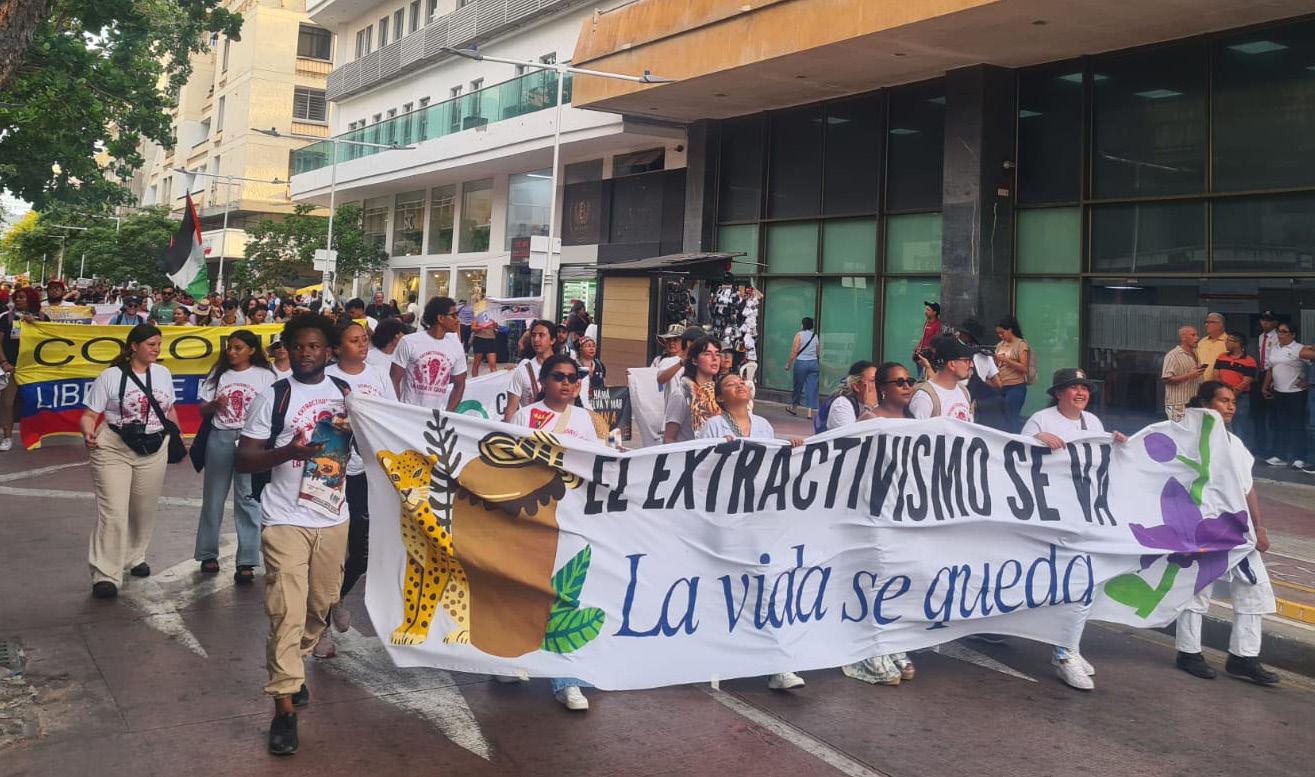
We joined grassroots mobilisations in Santa Marta.
UK-Colombia deal
At Santa Marta, the Colombia recommitted to pursuing its own exit from corporate courts. We’re now pushing the UK government to negotiate over the UK-Colombia investment deal and neutralise its dangerous sunset clause.
There are signs parts of government are listening: the energy department is currently seeking views on how the UK’s investment treaties and the Energy Charter Treaty’s sunset clause are affecting climate goals. We need to turn that opening into wider political pressure.
What you can do
With international momentum growing, this is a crucial moment to build pressure here in the UK. Public campaigning and political lobbying can help turn growing global opposition to ISDS into concrete government action.
New Internationalist discount
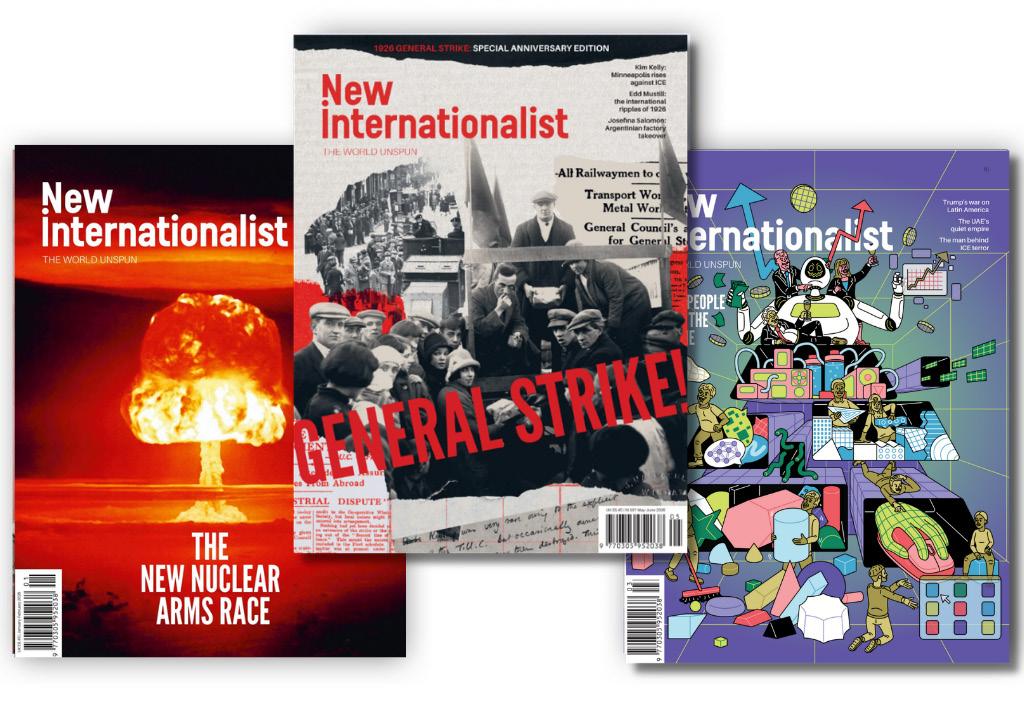
New Internationalist is an award-winning global justice magazine, and one of the UK’s pioneering independent media co-operatives. It publishes high-quality, in-depth reportage from around the world, offering perspectives you won’t find elsewhere.
They’re offering Global Justice Now supporters a special discount of 30% off annual print & digital bundle subscriptions using the code NI2026. Learn more and subscribe at subscribe.newint.org.
ISDS global days of action
When: Thursday-Saturday 15-17 October Where: Everywhere!
We’re coordinating with international partners on three days of action to get the pernicious corporate courts system scrapped. Get involved wherever you are and help bring about the beginning of the end for the despised ISDS. Check the website for updates.
Colombia Eight-page booklet (Jan 2025)
Stand with Colombia against corporate power A5 leaflet (Jan 2025)
Scrap the UK-Colombia investment treaty MP briefing (Oct 2024)
Contact us to order these or view them at globaljustice.org.uk/resources
Big tech
Resisting Big Tech Empires
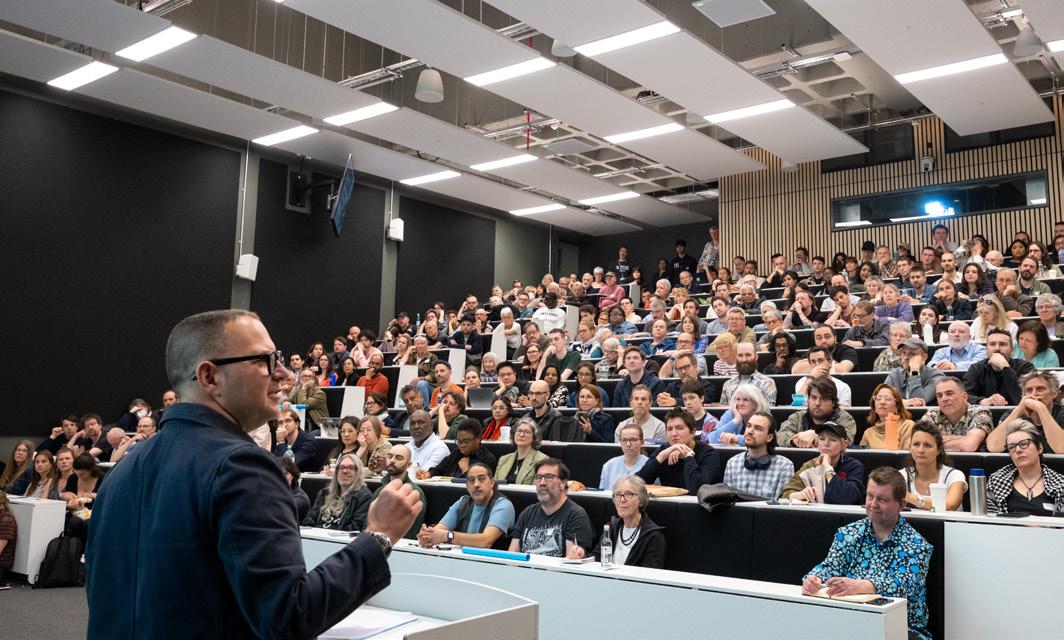
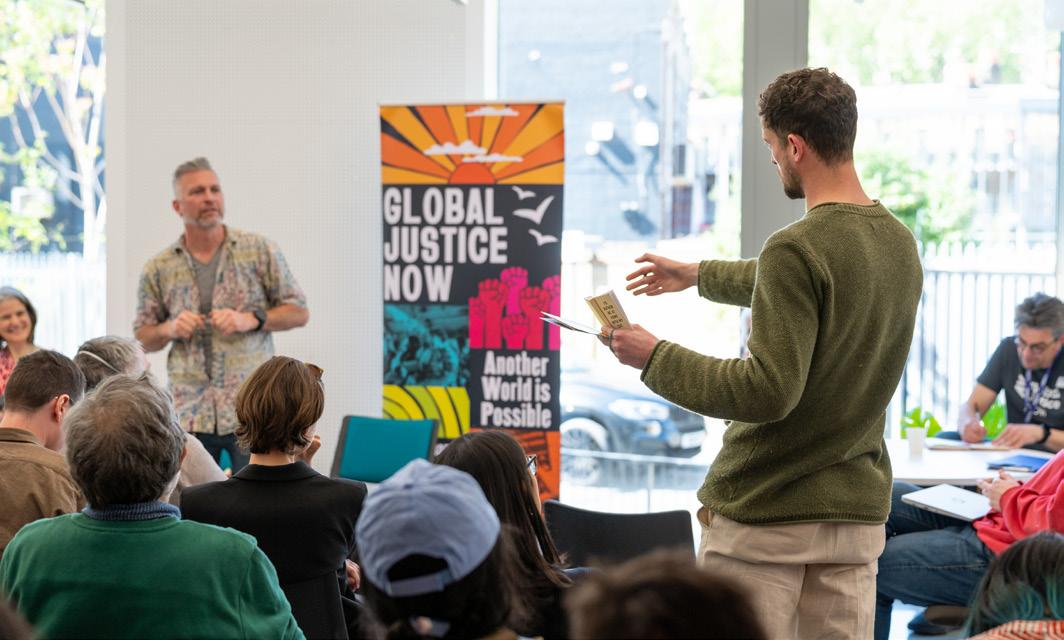
Concern about the power of big tech corporations is widespread and growing. That’s one conclusion we can draw from Resisting Big Tech Empires, our national gathering this year which saw hundreds of people attend a jampacked day at London Southbank University in April. It was our biggest public event for years, and despite the worrying issues on the table, people left clued up and motivated.
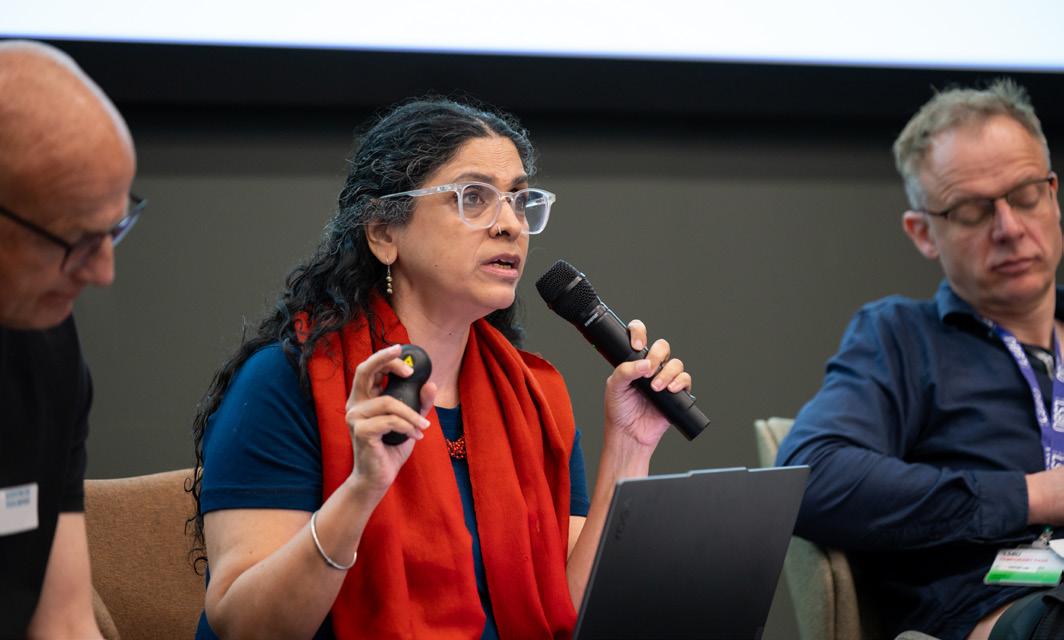
Speakers and participants discussed big questions like the implications of AI, and took part in practical workshops such as ‘how to resist a data centre’. We looked at how big tech power is increasingly intertwined with trade deals, its role in warfare and its relationship with the far right. And crucially, our international guests, Anita Gurumurthy from India and Sofia Scasserra from Argentina, gave a clear picture of the neocolonial aspects of big tech power. This includes not just the way that the dominance of particularly US corporations is acting as a wealth siphon from the rest of the world, but
also how big tech is deepening a very unequal division of labour across the planet.
Some of the content from the day, including an erudite talk from novelist and digital rights campaigner Cory Doctorow, is available online. Links at globaljustice.org.uk/tech-empires
New materials
Enclosed with this issue of Think Global, you’ll find some new materials. You can order more from activism@globaljustice.org.uk.
• Stop the big tech power grab. This is a fourpage leaflet laying out in a topline way the problems of big tech and three campaign areas we’re working on. It can be given out fairly liberally on stalls, and includes QR codes to two petitions.
• The new digital colonialism. This eight-page briefing is a more in-depth look at the main issues with big tech power and some of our demands for tackling it. Distribute to your group, and on stalls, to the very interested.
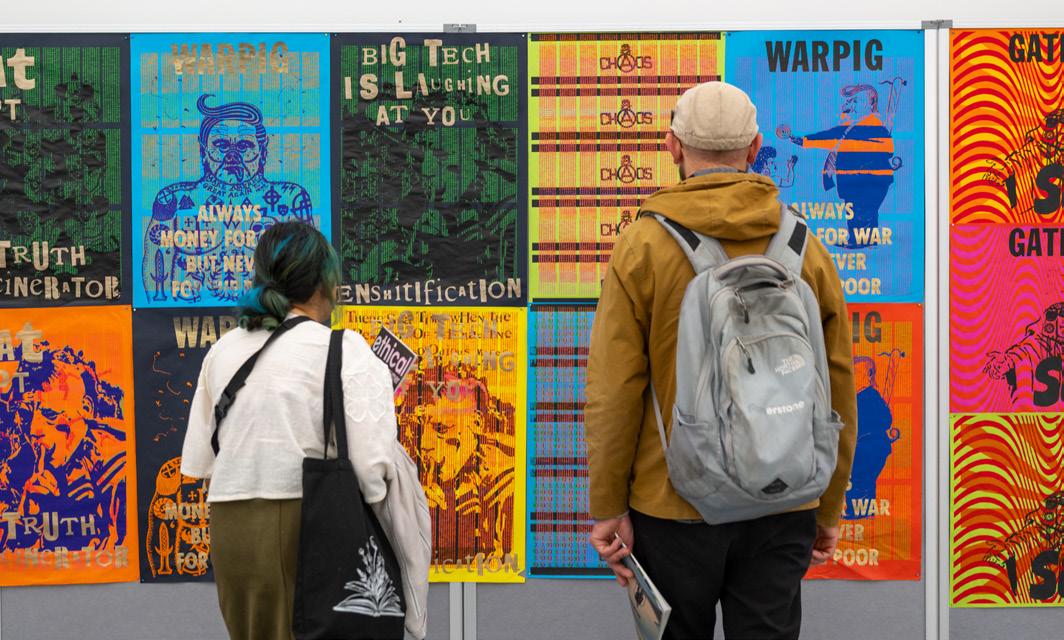
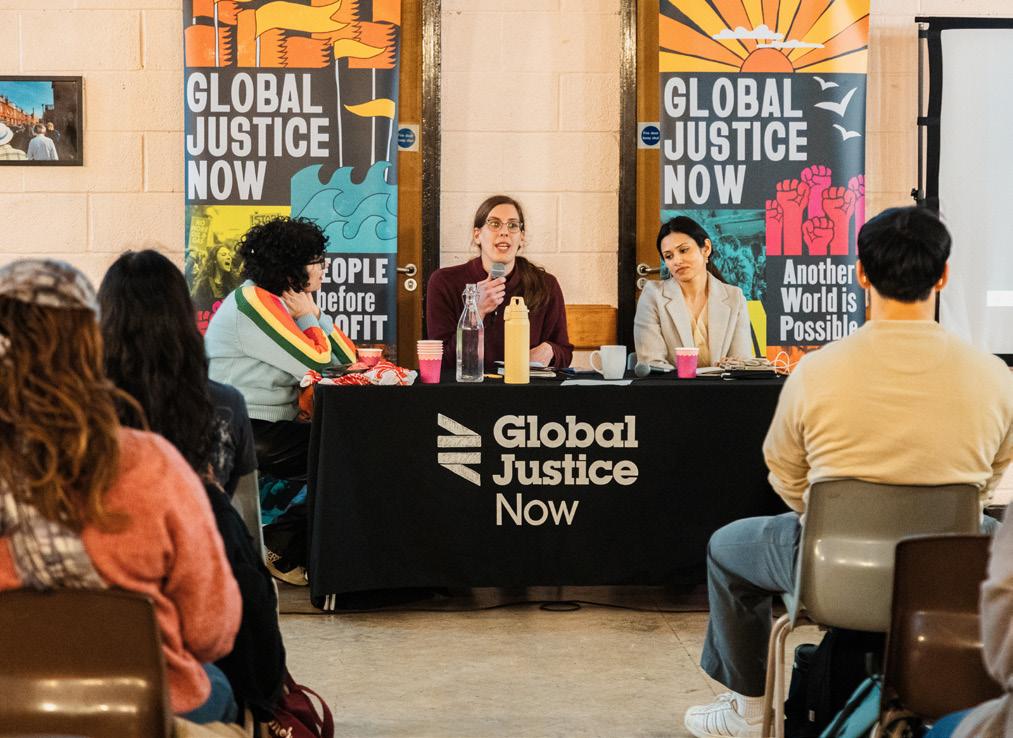
Resisting Big Tech Empires, clockwise from top: Cory Doctorow addresses a packed room; attendees peruse posters from Paris68Redux; a workshop on resisting data centres; Anita Gurumurthy from Indian NGO, IT for Change.
Continuing the theme from our sold-out national gathering, this year’s Scottish gathering will focus on challenging the power of big tech corporations. We’ll hear from Global Justice Now director Nick Dearden; Craig Dalzell of Common Weal, who’ll talk about what digital sovereignty means in Scotland; and journalist Rachel Revesz, who’s campaigning against the flurry of planning applications for hyperscale data centres across Scotland. More speakers still to be announced.
Come to learn, discuss and get involved in planning local action. There will be plenty of opportunities to meet and chat with other local campaigners from across Scotland. Lunch will be provided for a donation.
Palestine
Israel’s assault continues
The six-month old ‘ceasefire’ has brought little peace to the people of Palestine. In Gaza, Israel’s deadly attacks continue, along with displacement, disease and malnutrition. In the West Bank, attacks have increased, with an Israeli general describing “killing like we haven’t killed since 1967”, while settler pogroms continue with effective military backing.
Elsewhere, Netanyahu’s government has killed thousands in Lebanon and displaced one million people, while coordinated attacks with Trump have expanded the war to Iran. With the strait of Hormuz blocked at the time of writing, the crisis now threatens living standards globally. We cannot stay silent as international law is dismantled before our eyes.
Britain still backing Israel
The UK remains a key protector of Israel. The government’s latest response has been to threaten protests opposing the genocide, dangerously and falsely conflating them with a rise in antisemitism and racist attacks in London.
We must keep demanding that our government abides by international law, ends its support for
Israel, and uses every available lever to pressure Israel to end its war crimes and decades-long occupation. And we are not powerless.
The international movement is growing
In March, director Nick Dearden travelled to the Netherlands for the Hague Group summit, meeting campaigners organising boycotts, divestment actions and strikes to pressure Israel. In the EU, well over one million people
Key Palestine resources
Time for sanctions on Israel Two-page leaflet (April 2025)
The case for sanctions on Israel’s economy Four-page briefing (April 2025)
Sanctions petition sheet (April 2024)
End UK complicity in Israel’s war crimes Four-page briefing (Sep 2024)
Stop arming Israel Two-page leaflet (2024)
Stop arming Israel petition sheet (2024)
Contact us to order these or view them at globaljustice.org.uk/resources
Andrea Domeniconi
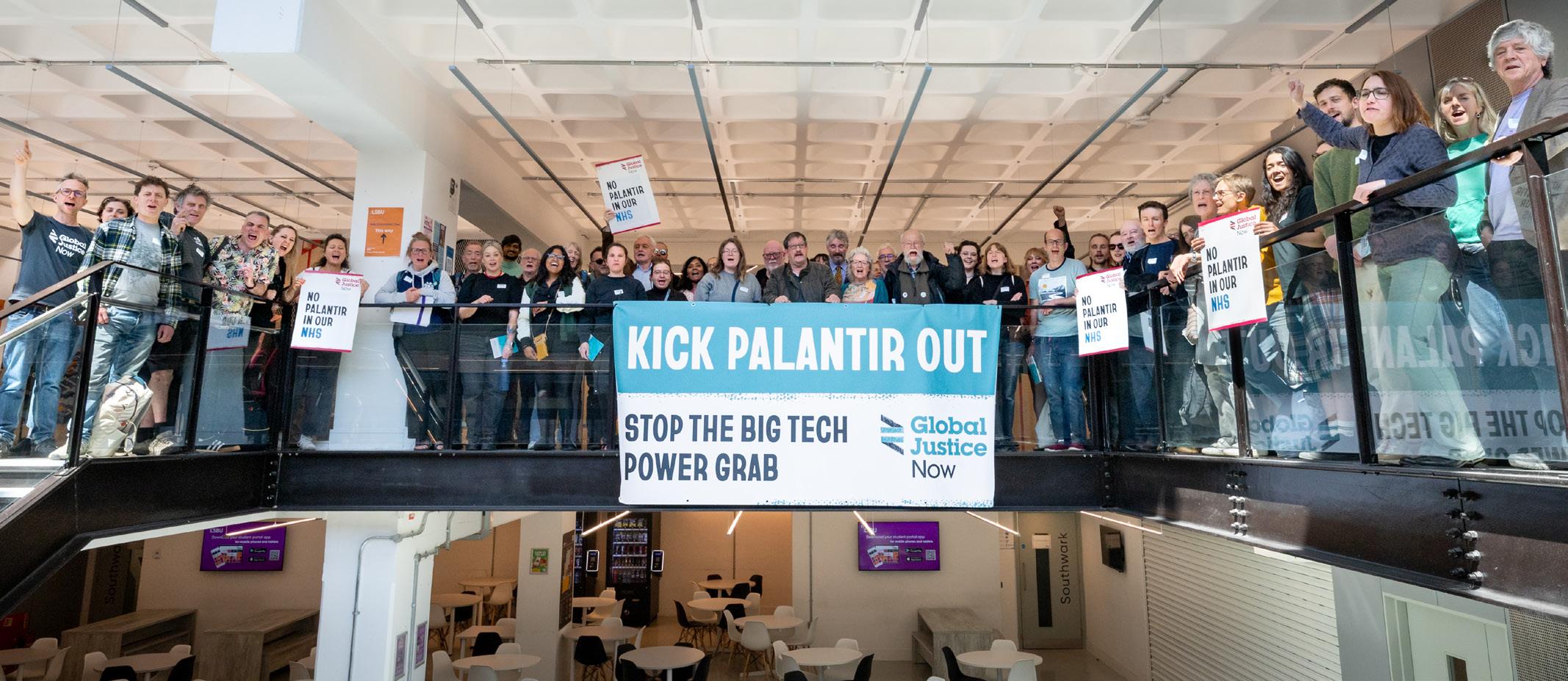
Attendees at our recent event Resisting Big Tech Empires joined our call to say: Kick Palantir Out!
signed a petition to suspend the EU-Israel Trade Agreement.
Watching the suffering in Palestine can make us despair, but we cannot give in to hopelessness. We are part of a growing international movement defending human rights and international law.
Only a powerful citizens’ movement can change the British government’s relationship with Israel. The Boycott, Divestment and Sanctions (BDS) movement is central because it gives us practical tools to apply political and economic pressure. As a recent Guardian article noted, “boycotting Israel has gone mainstream”. And given Europe is Israel’s biggest trading partner, action here can have real impact.
What you can do
We’re encouraging activists to:
1. Continue demanding a full arms embargo and a suspension of the UK-Israel trade deal. There is no excuse for supplying arms or continuing normal economic relations while Israel openly defies international law. Write to the government, make others aware in your community, and why not write to your local newspaper?
2. Stop settlement trade. We’ve joined a campaign to ban products made in illegal settlements from entering the UK. Similar campaigns are underway in Ireland and Spain. These goods should already be banned under international law. We can win this. Make sure your MP knows about it, and consider campaigning in your local supermarket.
3. Demand an end to Palantir’s contracts. Israel’s economy relies heavily on military and surveillance technology. Numerous reports show Palantir’s deep complicity in Israel’s crimes, making it an obvious target for pressure. We support the campaign to rescind all the UK government’s contracts with Palantir. Check whether your local police force or NHS Trust has a contract with Palantir, and write to them.
Pharma
For the last 12 months big pharma has been blackmailing the British government. Drug corporations withdrew investment from the UK, demanding that the NHS pay more for their already overpriced new medicines.
In December, with Trump’s help, the companies got what they wanted. The government signed a ‘pharma deal’ with the US which promises the NHS will spend more of its stretched budgets on new drugs, and reduce the excess profits they will claw back from the pharma companies.
Even by the standards of modern trade deals, promising to hand over a segment of your health budget to multinational corporations is extraordinary. Little wonder they gave MPs no time to debate the deal. We worked with MPs and Lords to raise objections and received cross-party support. But we were unable to stop the deal before parliament broke up.
However, we have one last route to try. In order to implement the deal, the government has changed the way they calculate whether a drug represents ‘value for money’. We believe they have failed to follow due process in how they’ve introduced this change. We’re working with our friends at Just Treatment on a legal challenge. Watch this space to find out how you can help, and find out more by reading Nick Dearden’s article in Tribune: tribunemag.co.uk/2026/04/ big-pharma-is-blackmailing-the-nhs
Campaigners outside parliament before our joint event to challenge this toxic deal.
Local groups news
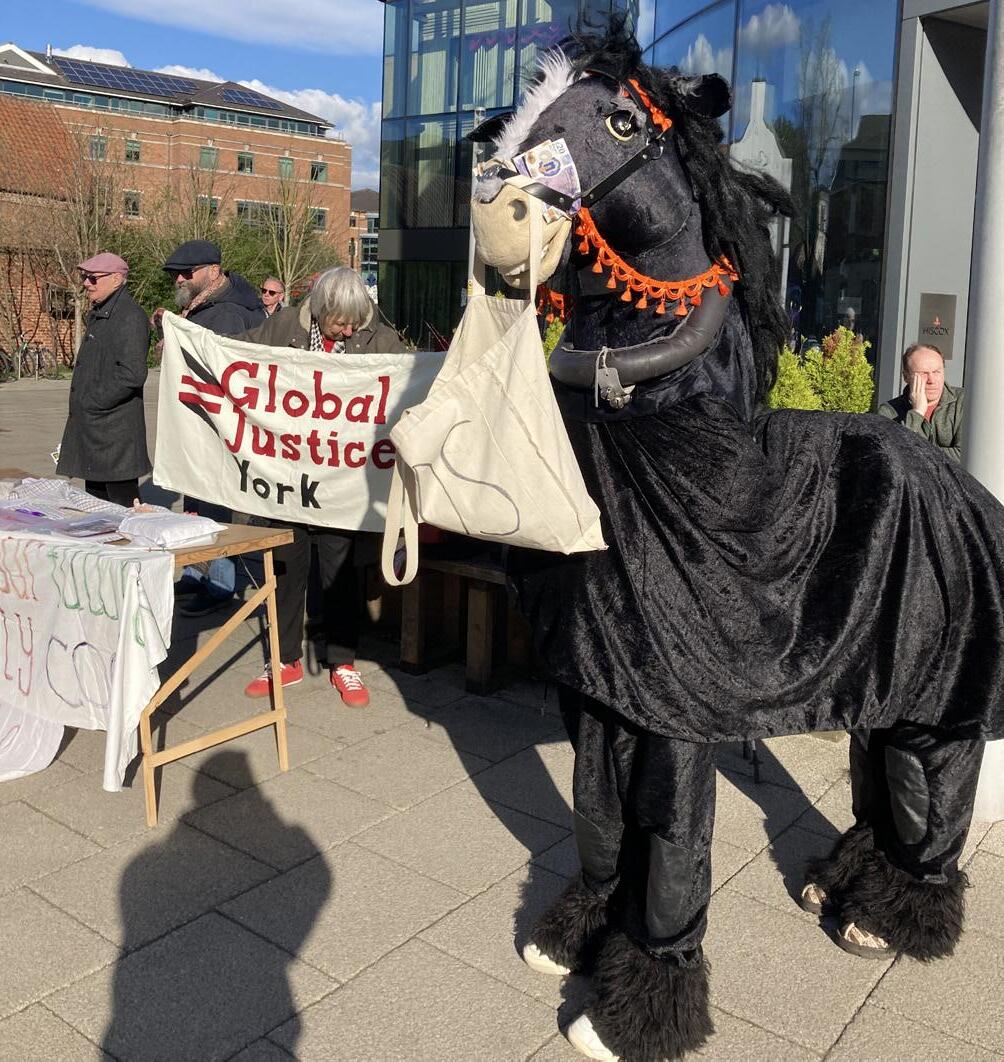
Global Justice York had an action weekend in April. On the Friday they brought a ‘Trojan Horse’ to the office building of Hiscox insurers – a metaphor for the way ISDS is hidden in trade deals. They hired a pantomime horse, an activist dressed up as Geoffrey Cox MP, complete with mask, and they ran a street stall to raise public awareness. They then repeated all this in the town centre the next day. They also hosted a hugely successful public meeting with campaigner Tim Bierley on the Friday evening.
Global Justice Nottingham held an excellent meeting on the UK’s economic support for Israel. Tim Bierley and a speaker from the PSC led the discussion. They joined the Trades Council’s annual May Day march in the city, carrying their banner and handing out flyers.
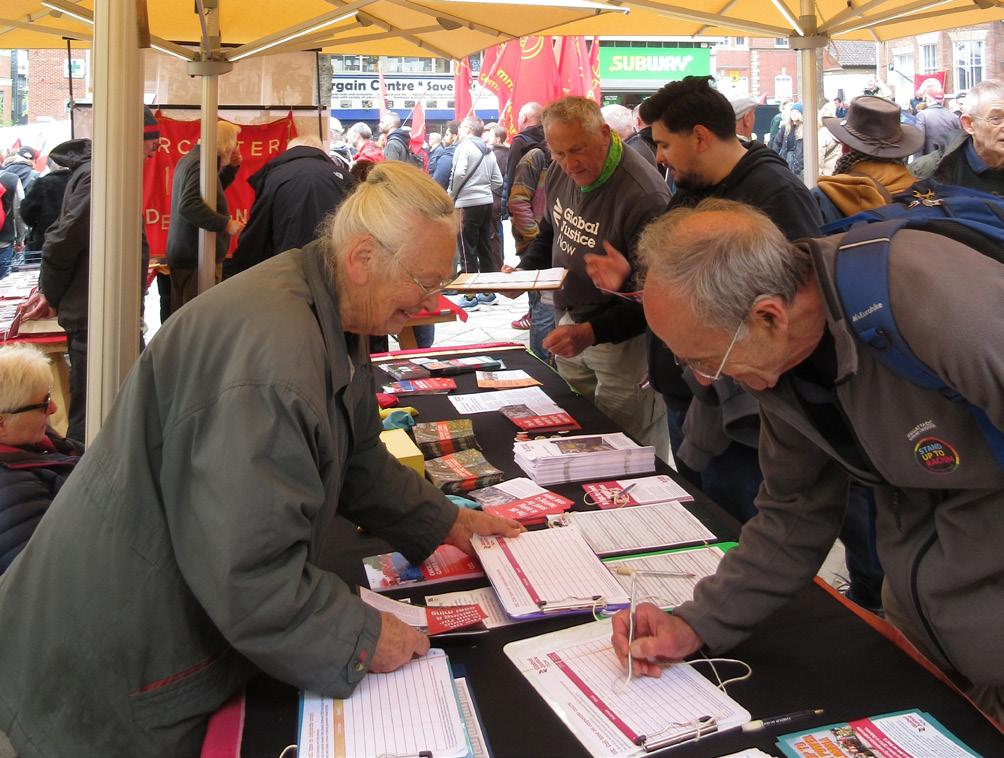
Global Justice Sheffield joined Chesterfield TUC’s May Day celebration, marching round the town and running a stall on ISDS. People were receptive, and they collected over 60 signatures.
Global Justice Leicester held a stall at an event organised by Friends of the Earth to mark the 100th birthday of David Attenborough, to celebrate nature and campaign against climate change.
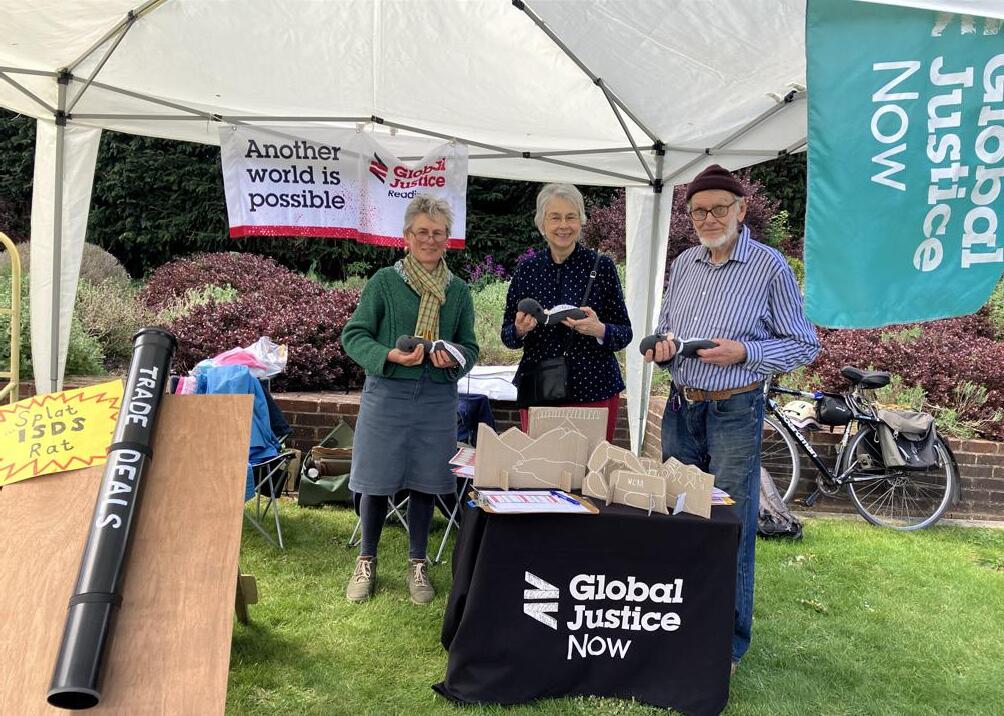
Global Justice Reading invited people to play “Splat the ISDS Rat” at the Beanpole Festival this year. Three rats named after your least favourite litigants, and a (small) chance to bash them, aided activists in explaining ISDS to the public. They filled three sheets with signatures and talked about the Cumbrian coal mine case.
Global Justice Bradford screened The Boy Who Harnessed the Wind, and were joined by a Malawian speaker. They had 47 attendees! The event was great, but they warn other groups that the film is too long to have a Q&A on top of the speech.
Global Justice Herts and Beds ran a stall at the Hitchin Eco Day, focussing on big tech and ISDS.
Photos: it’s ISDS campaigning season! From top: York’s trojan horse; Sheffield’s stall; Sheffield’s Splat the Rat.
Youth
In February, Global Justice Youth’s national gathering We Rise was in Leeds. Youth activists travelled from across the country for a packed day of political education on racial and economic justice as well as the threats posed by big tech. Attendees explored how we organise effectively, build campaigns, and root our work in a broader analysis of international justice.
Brighton Global Justice Youth is campaigning for the university to endorse the Fossil Fuel Treaty. They’ve put together petitions and open letters, with support from hundreds of students and staff, but the university management has come out against endorsing. People campaigning on other issues have also felt ignored and sidelined by the university, so the group is planning a campaign to call this out.
Canterbury Global Justice Youth hosted a workshop with our campaigner Cleodie, looking at how piecemeal agreements are increasingly replacing large formal trade deals, especially in the sectors of big tech and digital regulation.
Manchester Global Justice Youth has been screening a series of films. In March, they showed Woman at War, raising funds for the Fossil Fuel Treaty, followed by First Reformed in April, with proceeds going to Faiths4Change. Members have also been involved in a creative postering campaign, spreading economic justice messages across the city.
Stirling Global Justice Youth screened Gaza Soundman with the Islamic Society, raising money for Medical Aid for Palestinians. They’ve also been examining the university’s finances for possible breaches of its ethical investment policy; they links to major oil, gas, and mining companies, and are now campaigning to end these. Meanwhile, their free breakfast project continues, and they’ve raised funds for the Kurdish Red Crescent.
Summer School 2026
Join youth activists and campaigners from across the country for three days of organising training, campaign strategy, and political education about how global capitalism works, how people are resisting corporate power and the alternatives they’re building. The School runs 16 –18 May in our office in London SW9 and is completely free. Apply at globaljustice.org.uk/summer-school.
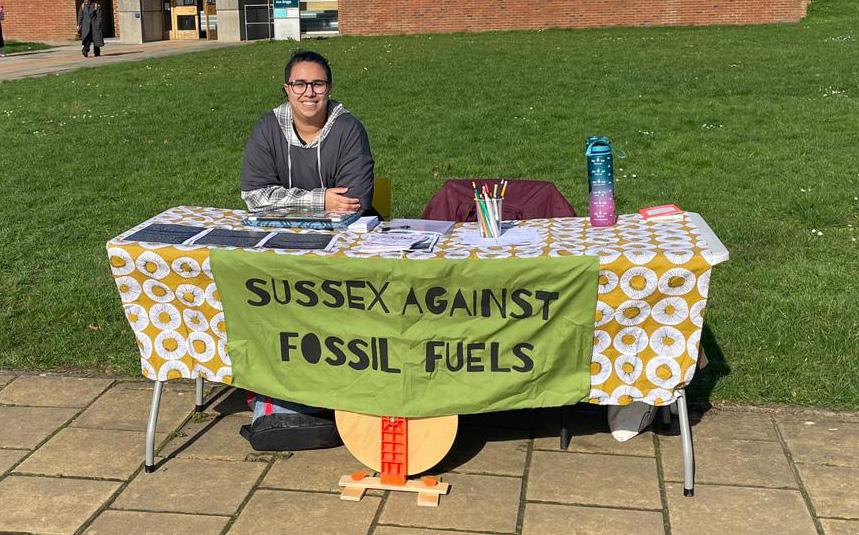
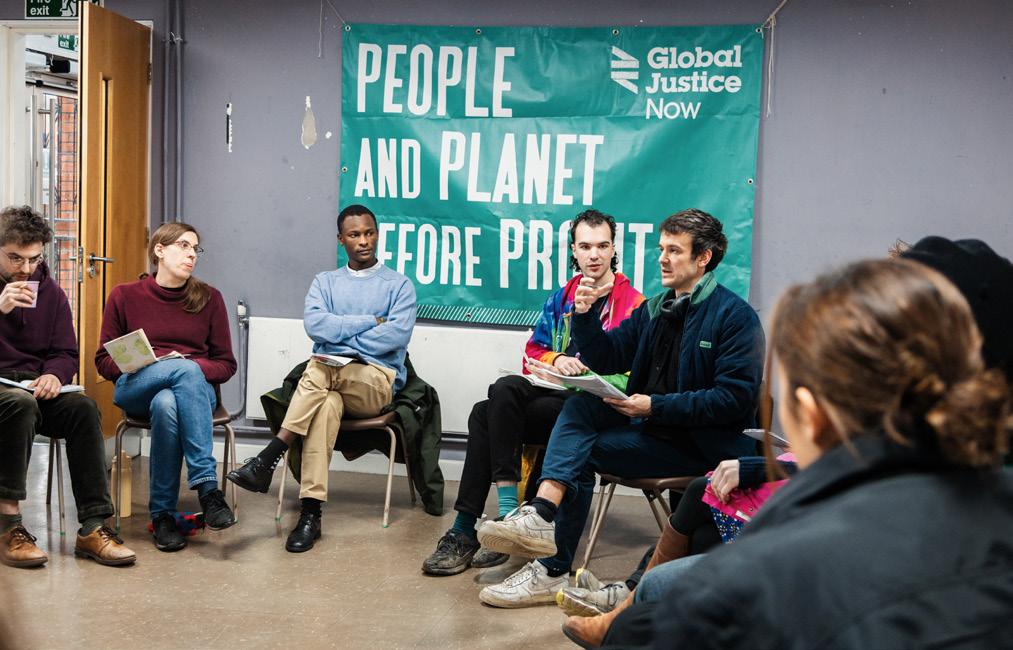
From top: The Brighton group’s FFT stall; two sessions
NEW T-SHIRTS!
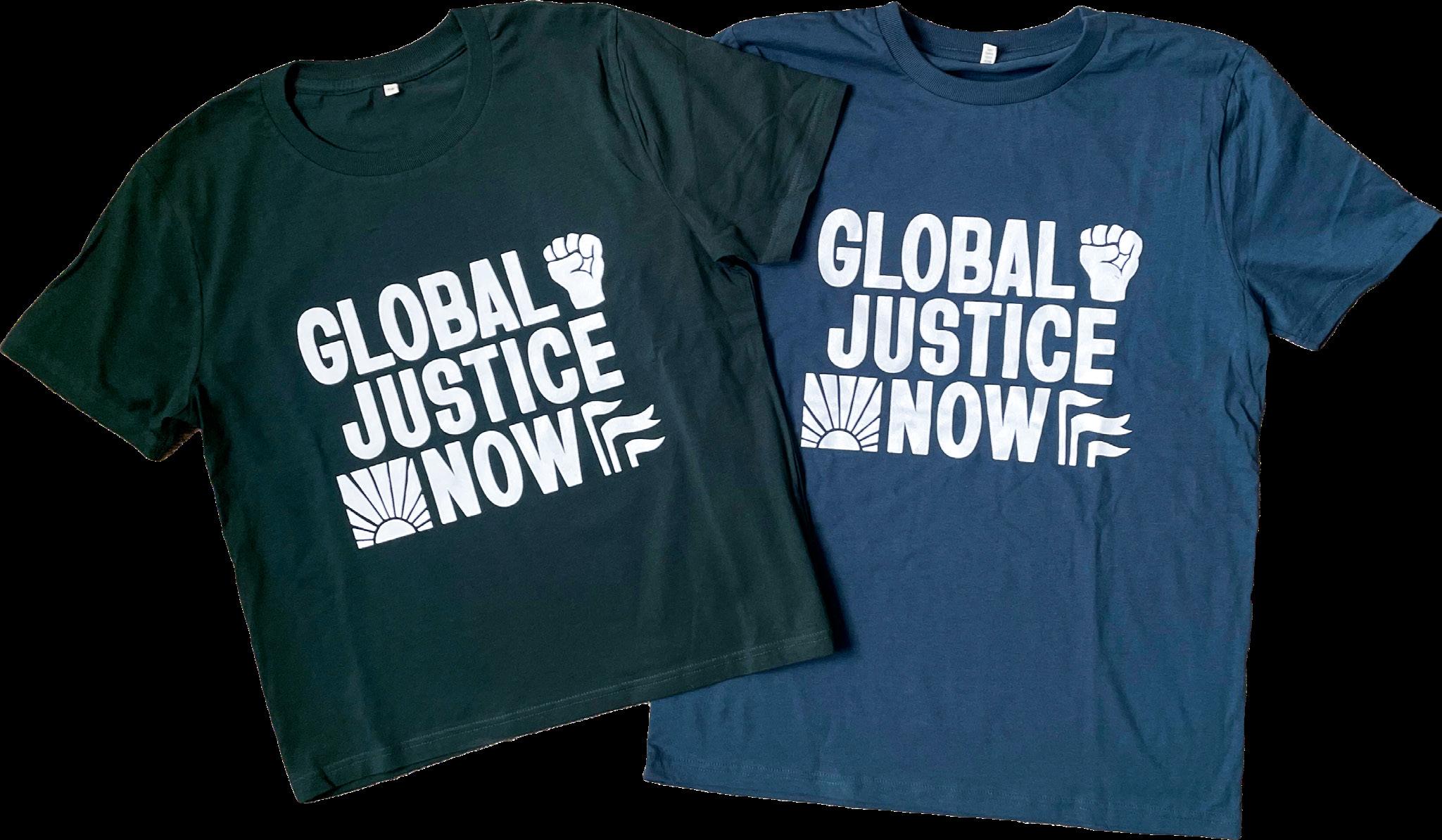
We’re excited to share that we have a limited run of these high-quality screenprinted t-shirts available to order, while stocks last. These feature a brand new design by Daisy, our movement-building manager.
People who’ve been to some of our activist and youth gatherings over the last couple of years might have seen we’ve got ourselves a block printing set, in our favourite font, Bayard, so that people can make their own patches and messages. Daisy originally printed this as a patch at last year’s We Rise, and it just felt too perfect to not turn into a t-shirt, and
following many requests for a Global Justice Now t-shirt from supporters, we did!
There are unisex t-shirts in blue, and women’s t-shirts in green, and many sizes in both. All are available to order on our website at globaljustice.org.uk/t-shirts