Ninety-Nine is published three times a year by Global Justice Now
Global Justice Now campaigns for a world where resources are controlled by the many, not the few. We champion social movements and propose democratic alternatives to the rule of the 1%. Our activists and groups in towns and cities around the UK work in solidarity with those at the sharp end of poverty and injustice.
Ninety-Nine magazine, Global Justice Now 66 Offley Road, London SW9 0LS 020 7820 4900 • offleyroad@globaljustice.org.uk • globaljustice.org.uk
Editors: Jonathan Stevenson, Anita Bhadani
Graphic Design: Matt Bonner www.revoltdesign.org
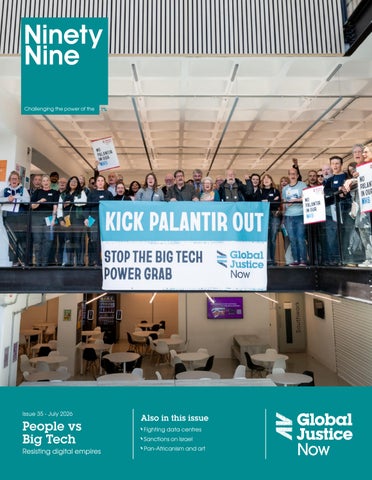
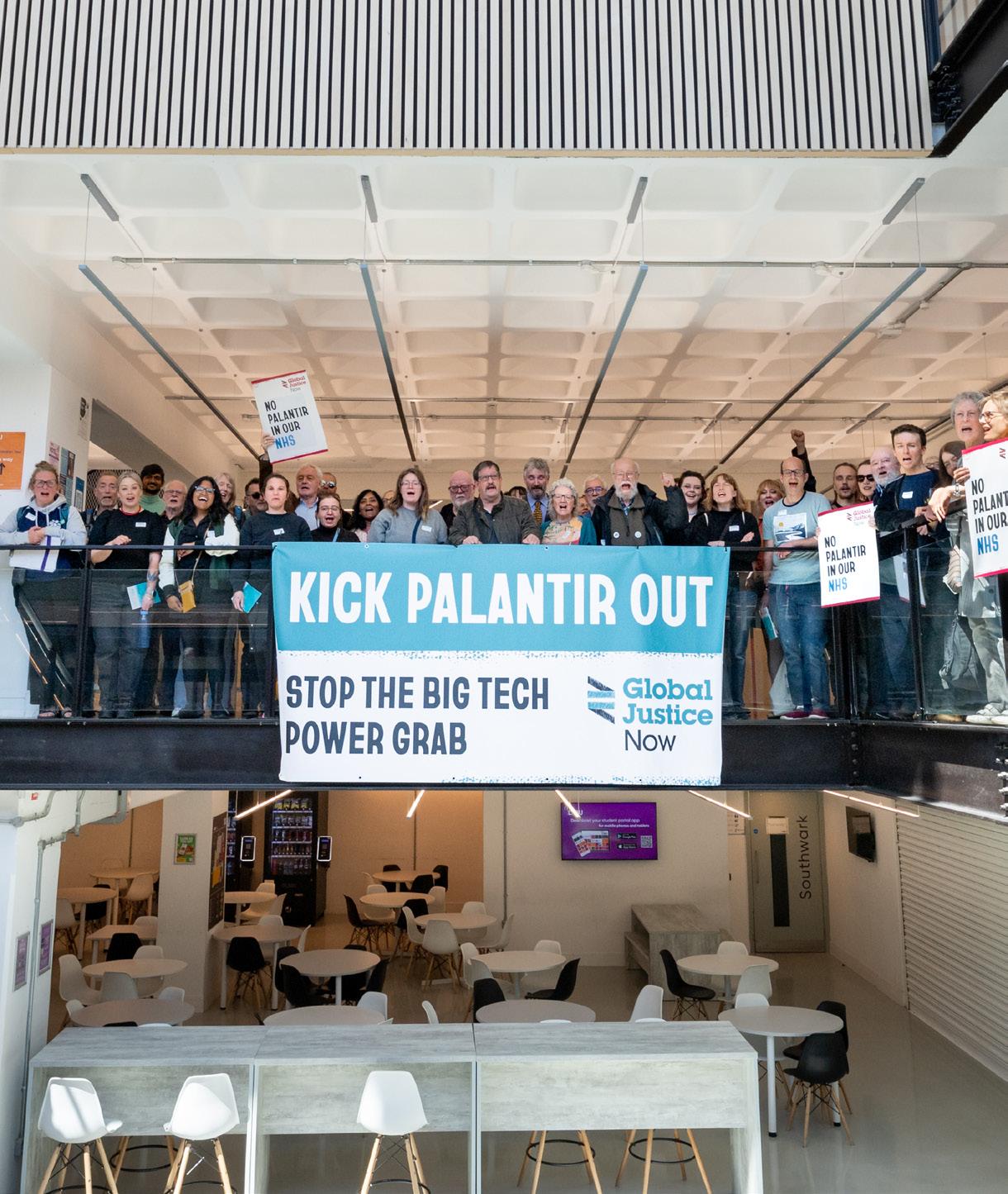
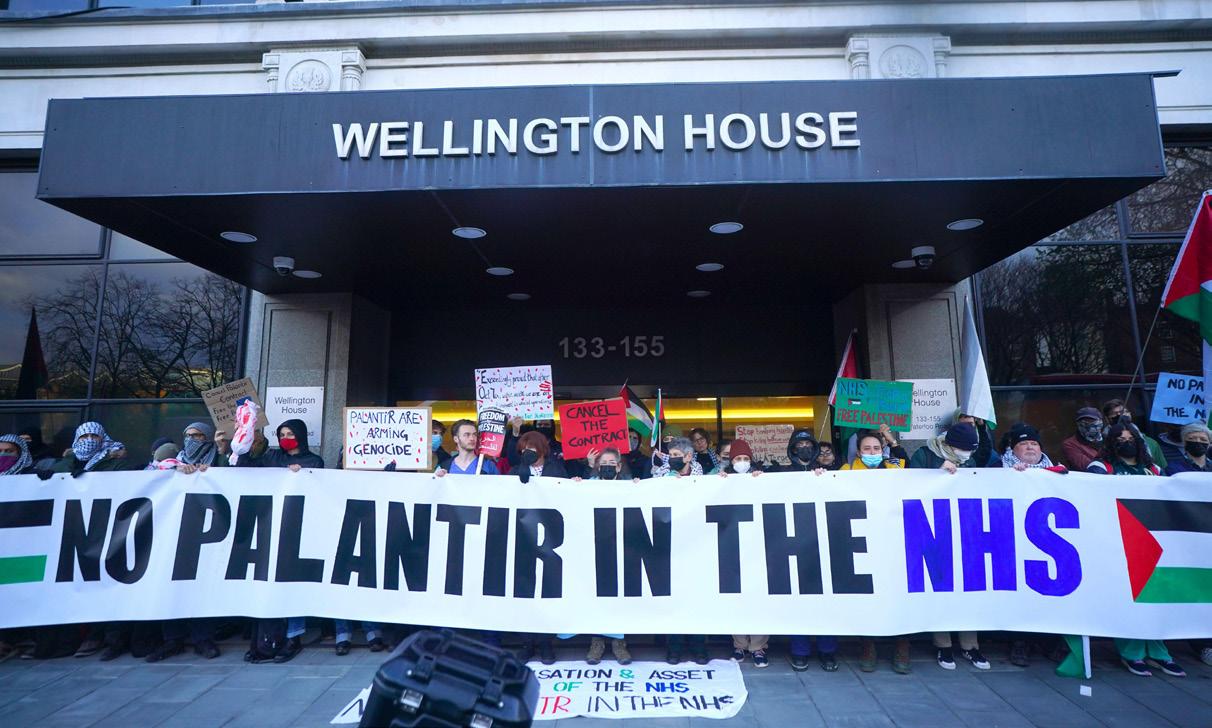
Cover: Sending a message to Palantir at our big tech conference in April.
Get Ninety-Nine delivered to your door three times a year when you become a member of Global Justice Now. Go to globaljustice.org.uk/join
We can challenge the big tech barons – and we must
Nick Dearden Director
Big tech has become synonymous with the greatest disparity in wealth that the world has ever seen. 8 of the 10 richest men on the planet have made their fortune from this industry.
These companies are making obscene amounts of money, and driving inequality, because they’ve monopolised new forms of technology. That has given them a stranglehold over how our economy will grow, and how our society will develop, turning them into modern-day empires.
But we can challenge this. And indeed we have to. Under Donald Trump these companies are only getting richer and more powerful, with disastrous consequences across the globe – fuelling war and climate change, threatening worse and fewer jobs and hollowing out our democracies.
Yet as we showed at our conference in April, from resisting data centres to kicking Palantir out of our public services, opposition to big tech empires is growing, here and around the world. In this issue of Ninety-Nine we explore that further.
Opposition to big tech empires is growing around the world
So far the UK’s approach to big tech has been as dangerous as it is embarrassing. When it comes to AI, we’ve decided to be little more than an aircraft carrier for the US.
When Donald Trump came on his state visit last September, a group of tech barons accompanied him and sat at the state dinner with the King. And they got what they wanted – a series of massive data centres to expand their empires, and a ‘tech pact’ that will let them further bully the UK in the coming years. Rather than building a more resilient, sustainable economy, we are entrenching our dependence on Trump and his big tech friends.
It is vital that we declare our independence from Trump’s USA. But we won’t be able to do that unless we develop a very different policy on big tech. As Ninety-Nine goes to press, there is the prospect of a change of prime minister, which will open up new opportunities for this.
April’s conference was our best-attended in years, and it filled me with energy for our movement in the months and year ahead. Thank you for being part of it.
Packed-out conference on fighting big tech
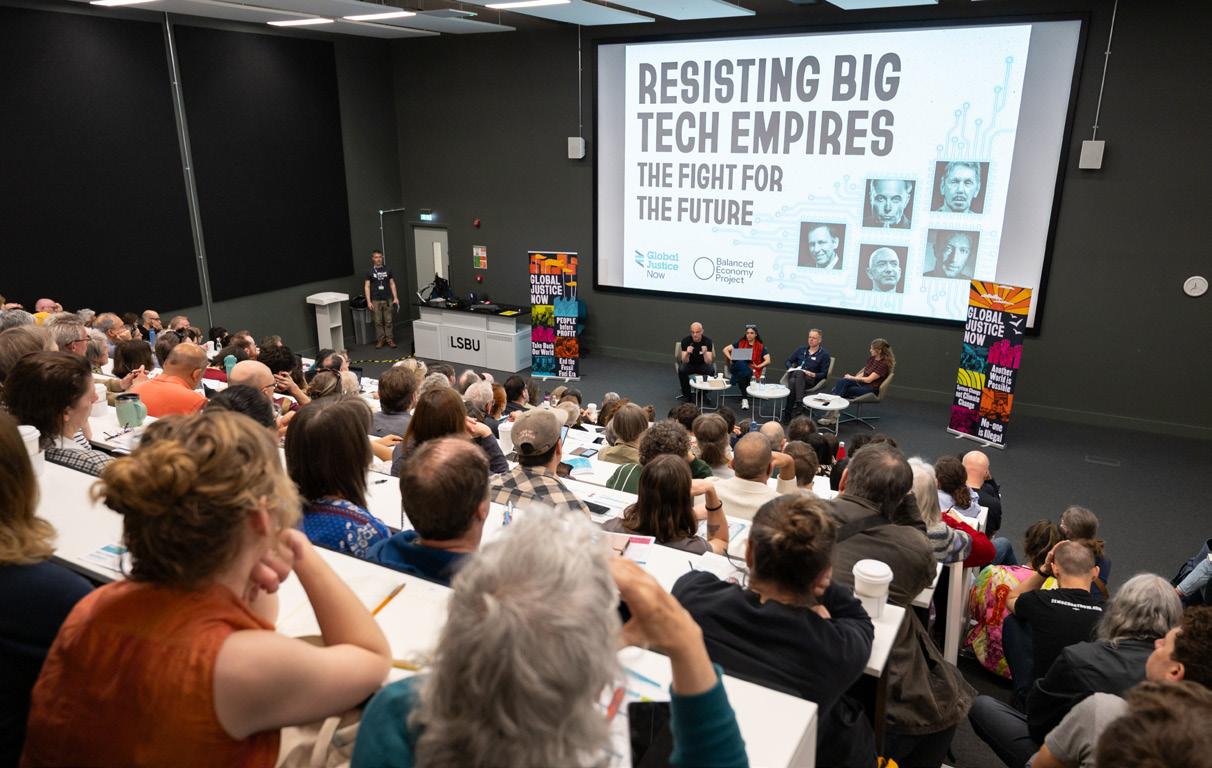
Concern about the power of big tech corporations is widespread and growing. That’s one conclusion we can draw from Resisting Big Tech Empires, our national gathering in April which saw over 300 people attend a jam-packed day at London Southbank University. It was our biggest public event in years, with activists, campaigners, trade unionists and tech workers coming together from across the UK and internationally. Despite the worrying issues under discussion, people left better informed and motivated to take action.
Speakers and participants considered big questions like the implications of AI. We also had practical workshops, such as a session on resisting data centres which explored how the rapid expansion of this energy and water-guzzling infrastructure is locking in big tech’s chokehold over our economy, and how the growing number of local campaigns challenging new developments show us ways to fight back. Other sessions covered how big tech power
is increasingly intertwined with trade deals, its role in warfare and its relationship with the far right.
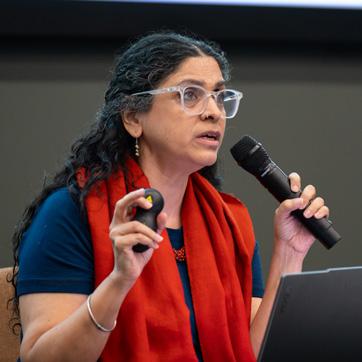
Speakers from around the world, such as Anita Gurumurthy (India) and Sofia Scasserra (Argentina), gave a clear picture of the neocolonial aspect of big tech. They explored how the dominance of US tech corporations is siphoning off wealth from the rest of the world and deepening a very unequal division of labour across the planet. While ownership, profits and decision-making remain concentrated in the global north, the environmental damage, extractive mining for minerals, low-paid labour and data processing that sustain the digital economy increasingly take place in the global south. International solidarity has to be central to any challenge to big tech power.
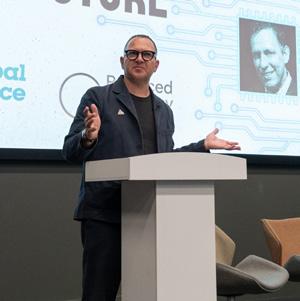
Some of the day’s sessions, including the talk from Canadian novelist and digital rights campaigner Cory Doctorow (above), are available online via: globaljustice.org.uk/tech-empires
Action on corporate courts blocked at historic conference
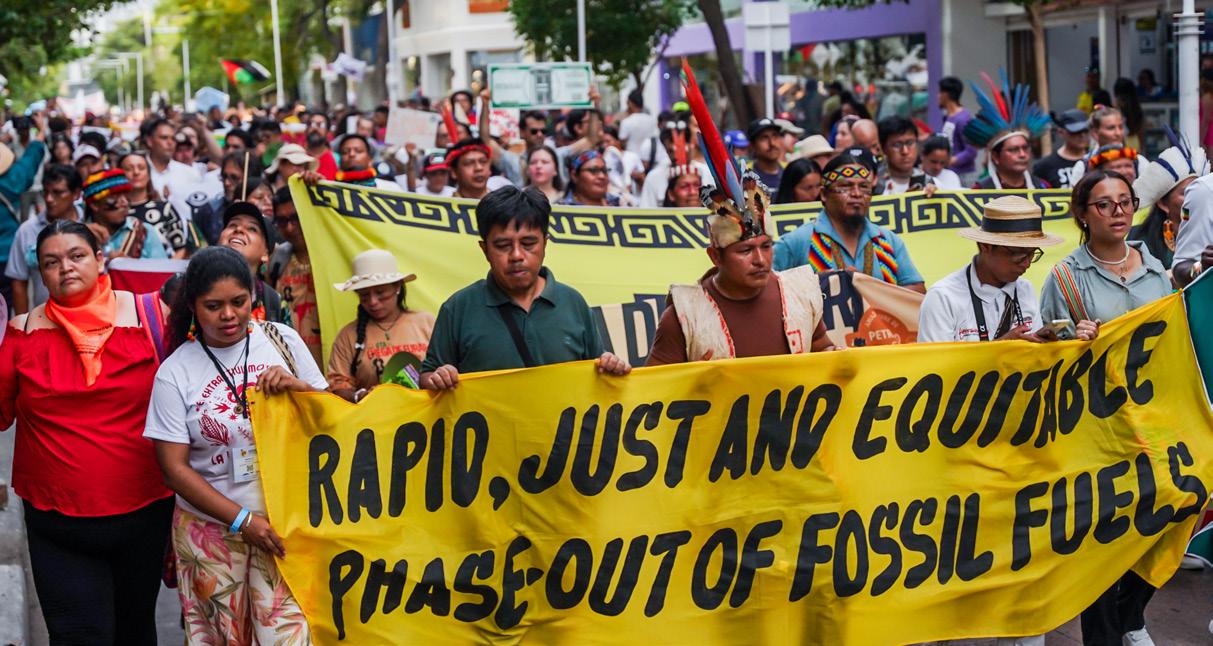
For the first time, corporate courts were on the agenda of a major climate summit when 55 governments including the UK met for the First Conference on Transitioning Away from Fossil Fuels in April.
Before it even began, the conference in Santa Marta, Colombia, was historic. It was born directly from conversations between governments supporting the Fossil Fuel Non-Proliferation Treaty, which pushed for a dedicated space to negotiate the shift. Away from the influence of corporations and petrostates that plagues COP, governments were able to establish that ongoing, focused cooperation between willing countries is needed to achieve a fair global energy transition. It was a big win for our campaigning on the Fossil Fuel Treaty, which helped to create this space and persuade the UK government to attend.
We were on the ground in Santa Marta with over 1,500 activists and campaigners from the global movement. In particular, through careful collaboration with allies we ensured that strong demands on corporate courts were made. Civil society, academics and trade unions present from around the world all demanded states pursue an urgent, coordinated exit from investor-state dispute settlement (ISDS) in their official contributions to the meeting.
However, vested interests stood in the way of seizing the opportunity on ISDS. The Dutch government, cohosts of the conference with Colombia, said it “did not agree” on the role of ISDS – leading to a weakening of language in the summary produced by the co-hosts at the conference’s close. This was disappointing, but not surprising, based on new research we launched on the eve of the summit (see opposite).
Despite this disappointment, our movement demonstrated its strength and unity repeatedly. More than 300 organisations released a global statement calling for governments to free themselves from ISDS. And throughout, movements came together in a way that was truly inspiring, including a defiant march through the streets of Santa Marta to demand a fossil-free future.
Now we need to push for change that can make this ongoing process as meaningful as possible, ahead of a planned second transition conference to be hosted by Tuvalu and Ireland in 2027. Meanwhile, the global movement will continue to push for co-ordinated action on ISDS, starting with three days of action planned for October (see page 13).
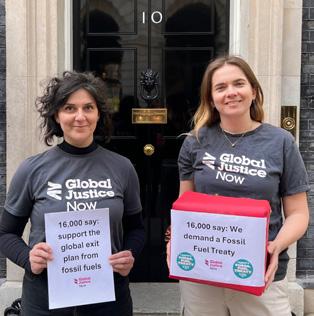
Above: Delivering our Fossil Fuel Treaty petition to the prime minister ahead of the
Top: The global movement was out in force in Santa Marta.
summit.
Legal challenge against pharma deal with Trump
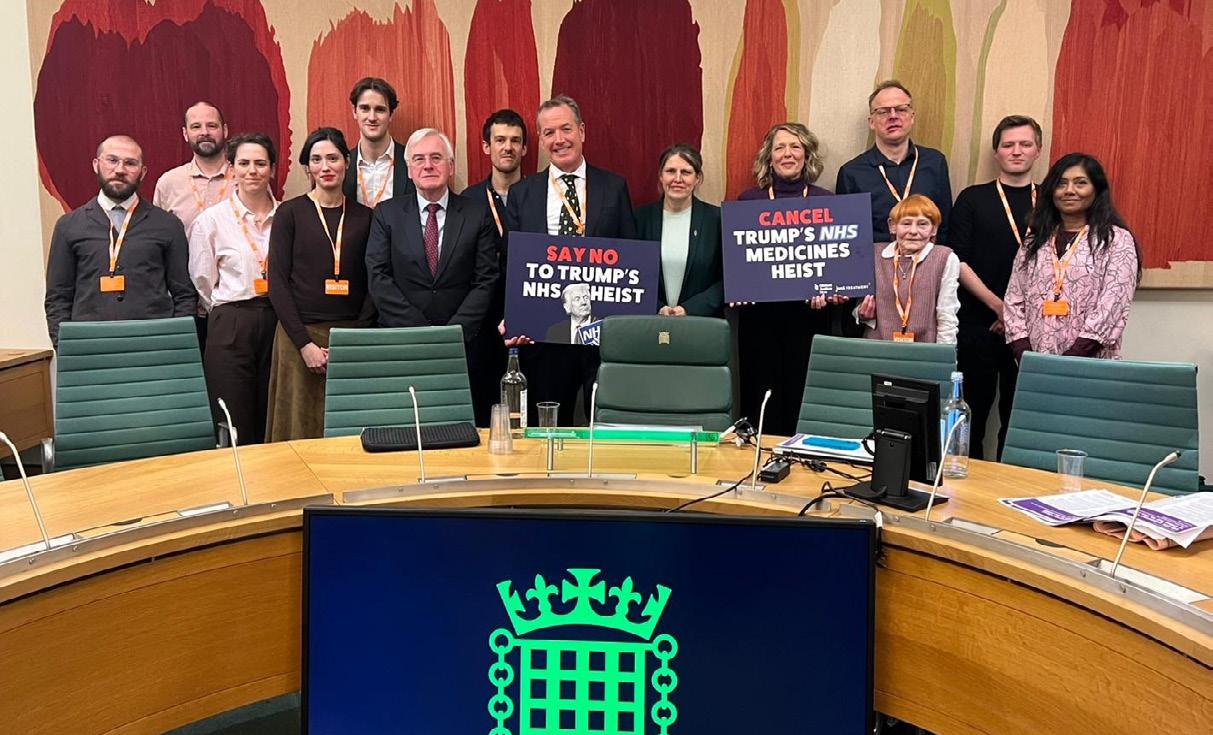
In April, the UK government confirmed the signing of a pharmaceuticals agreement with the US that commits the NHS to paying higher medicines prices. This includes doubling spending on new medicines as a share of GDP, at a cost of £9 billion a year by 2036. But with serious questions about the legality of changes introduced as part of the
deal, we are working with MPs and partners to challenge it.
The ‘deal’ was negotiated behind closed doors with Donald Trump’s administration amid intense lobbying by the pharmaceutical industry. With no debate in parliament, the UK has agreed to water down price controls including removing the independence of drugs watchdog NICE. We believe
the legislation the government has used is unlawful and undemocratic. So together with Just Treatment, we are taking the government to court – and in May we launched a crowdfunder to help pay for it.
Donate to the legal challenge here: globaljustice.org.uk/pharma-legal
Below: Our event in parliament in January to brief MPs on the deal.
UK ranked worst in Europe on ISDS amid £300m claim
Global Justice Now and partners released an ‘ISDS Scorecard’ report in April, ranking 30 European countries for their involvement in propping up the global system of corporate courts.
Looking at ten indicators of support, we found the UK and the Netherlands to be the worst actors, with Dutch investors, often using shell companies, initiating the most
cases in total. But the UK ‘topped’ the ranking overall, including as a particular home for investors making fossil fuel and mining-related claims. This makes our campaigning in the UK particularly important for unravelling the ISDS regime.
While corporate courts in UK trade deals ravage democracy around the world, Britain is itself now looking
down the barrel of the system. It was recently revealed that the investors suing the UK over the Cumbrian coal mine quashed by the high court are seeking up to £300 million of public money in damages: turning an illegal, unviable project into a cash cow for an overseas hedge fund.
Read the ISDS scorecard at: globaljustice.org.uk/isds-scorecard
Bolivia brought to a standstill by anti-government protests
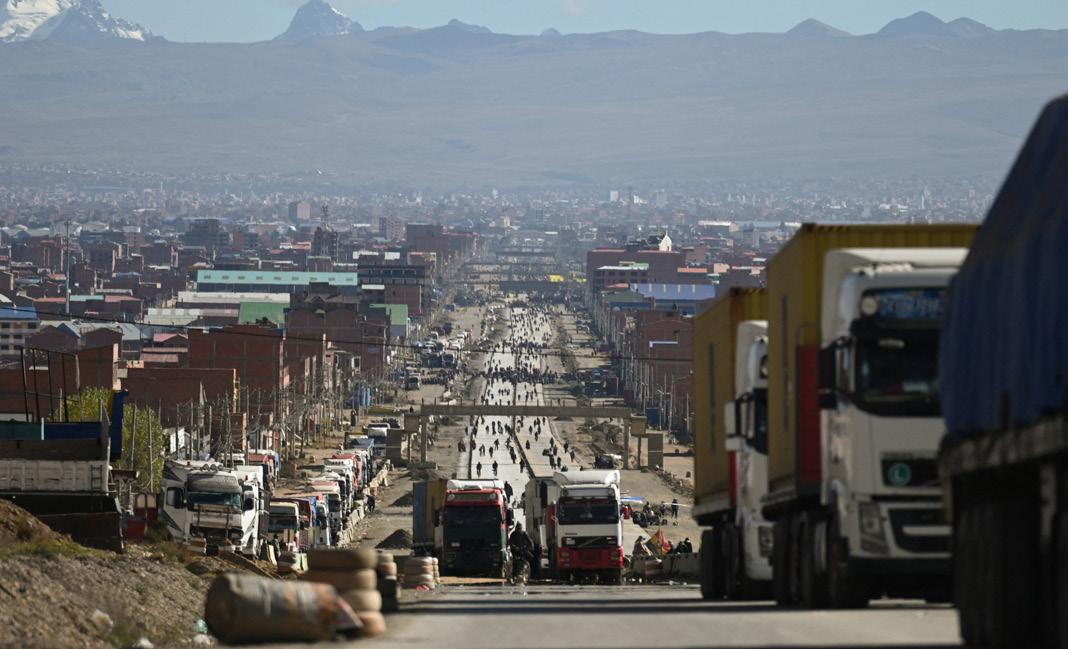
More than 90 roads across Bolivia have been blockaded as part of protests against the country’s new pro-business president, Rodrigo Paz, since April. Paz came into office in January and introduced emergency measures including spending cuts and privatisation, as well as restoring relations with the US.
At least 10 people have been killed and hundreds arrested following wide-ranging protests initially sparked by proposed land reforms targeting small-scale farmers. Trade unions and Indigenous groups have led the demonstrations, which have lasted several weeks. Road blockades on major routes nationwide have isolated
major cities including the capital La Paz, where transport workers have remained on indefinite strike.
In early June, the government authorised military force to be used against the protestors, who are demanding Paz’s resignation alongside an end to austerity measures including the reinstatement of fuel subsidies.
‘Global Justice Report’ sets out vision for climate equality
A report presented at the World Inequality Conference in June has set out to show it remains possible to tackle global poverty and inequality at the same time as addressing the climate crisis. The “plan for equality and prosperity within planetary boundaries” was produced by a group of 45 authors including French academic Thomas Piketty.
Solutions proposed include substantial wealth taxes on billionaires, more than halving average working time, encouraging people to eat less red meat, and refocusing the economy towards health and education rather than high-consumption sectors.
Part of the proposals would involve the creation of a global justice fund
to finance the shift to renewable energy and promote sustainable investment. “A habitable, equal 21st century is materially possible,” it concludes. “What stands in the way is not technical impossibility but political choice and the hard but crucial work of building a coalition behind it.”
Protesters block a major highway into the city of El Alto, Bolivia, in May.
UK reparations to be key demand at Commonwealth summit
Caribbean and African leaders will demand that reparations for the trafficking of enslaved Africans are a major issue at the Commonwealth heads of government summit in Antigua and Barbuda in November. It follows a reparations conference in Ghana in June which discussed next steps following the UN resolution on the issue.
Colombian town fights drinks giant for water access
Residents of the Colombian town of La Calera, near Bogotá, have won a victory in a struggle for access to water with a subsidiary of the world’s largest CocaCola bottler. Despite a severe drought, the company was continuing to extract water while residents faced restrictions. The company’s concession was cut in April after a twoyear campaign.
100+ Labour MPs call for ban on trade with Israeli settlements
Almost 140 Labour MPs wrote to the UK foreign secretary in June to call for a ban on trade with Israeli settlements, following escalating violations against Palestinians in the occupied West Bank and East Jerusalem. At least 11 countries have called for the EU to end such trade, with several doing so unilaterally.
Global peasant movement launches solidarity effort with Cuba
La Vía Campesina, the global movement bringing together peasants, fishers, land workers and food producers from over 80 countries, has launched an international solidarity effort with Cuba, following the escalation of the US government’s blockade.
The blockade has been in place for over 60 years, but its impacts have intensified since the US invasion of Venezuela in January, which ended shipments of Venezuelan oil to Cuba. Due to the threat of US sanctions against exporting oil to
Cuba, this has led to rolling blackouts and a degradation in standards for ordinary Cubans. It has affected every area of life, from electricity generation to transport, healthcare to food distribution.
Calling for the blockade to be broken through material aid, political pressure and international solidarity, LVC is organising a global fundraising effort to cover basic needs that stimulate agri-food production, as well as mobilising people to continue denouncing the impact of the blockade.
Resistance to data centres growing worldwide
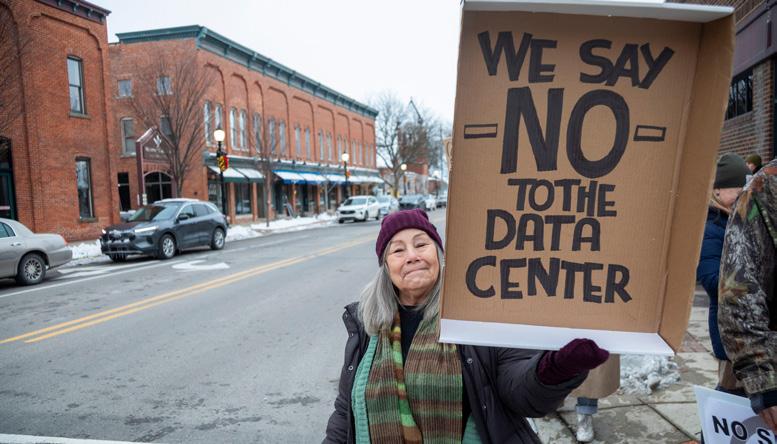
There are now over 12,000 operational data centres globally, with the US accounting for almost half. Capacity has tripled in a decade and is projected to triple again by 2030. But this expansion faces growing community resistance over everything from land and water use to climate impacts and opposition to AI. Grassroots protests have taken place across the US, where the issue has crossed political divides. In rural Utah, residents speak of the huge community impacts of proposals for the world’s largest AI data
centre. “We don’t want an out-of-state billionaire making decisions for us”, said Brenna Williams, one of the organisers pushing back.
Resistance too is growing in the global south, where data centres are seeing some of the fastest expansion. In the Brazilian state of Ceará, the Anacé Indigenous community is going to court to fight a TikTok data centre being built on their land. “Resisting is not a choice: it is survival”, says Anacé chief Roberto Ytaysaba Anacé.
Michigan residents rally against the $7bn Stargate data centre planned on farmland.
Palantir should be nowhere near our public services
The US tech firm that enables ICE and Israel is getting access to your medical records – and more besides. But it’s not too late to stop it, writes JONATHAN STEVENSON.
Publishing a 22-point manifesto for world domination on social media is not everyone’s idea of positive PR. But it was good enough for Palantir, the controversial US company which supplies surveillance technology to militaries and intelligence services around the world. Described as sounding like “the ramblings of a supervillain” by one MP, the thread posted in April praised American “hard power”, outlined a vision for AI-fuelled conflict, and dismissed other cultures as “dysfunctional and regressive”.
It made clear not only that Palantir’s leadership sees the company as a political force in the world, rather than just a supplier of data services, but also that they’re not afraid to say it. That’s why Palantir, perhaps more than any other company, is becoming a lightning rod for criticism of the powerful and unaccountable position that big tech has taken up in our societies, with little to no democratic control.
RECORD OF OPPRESSION
ICE, Donald Trump’s abusive immigration enforcement squads, to trawl through information to aggressively target migrants for detention and deportation. In Los Angeles and New Orleans, its software has helped drive ‘predictive’ policing, which disproportionately targets minority groups, effectively automating past injustices.
Thiel once wrote that votes for women are detrimental to his vision of American capitalism, and that he no longer believed “freedom and democracy are compatible”. He has also said that “the NHS makes people sick”. Palantir’s UK chief Louis Mosley, meanwhile, is the grandson of British fascist Oswald Mosley, and has said he is “proud ” of the work Palantir does in Israel.
A break clause in Palantir's contract with the NHS can be activated in 2027.
Palantir was co-founded by US billionaire and Trump donor Peter Thiel in the early 2000s, and it has an unashamed record of helping military and police oppression around the world. It markets its surveillance tools as helping to “optimize the kill chain”, has entered into a ‘strategic partnership’ with Israel’s ministry of defence, and has supplied military technology to Israel during its genocidal war on Gaza.
In the US, Palantir’s data tools have helped
CORPORATE CAPTURE
You might think that such a company has no place in our public services in the UK. But Palantir has spent years building up a range of contracts here and indeed around Europe. Since 2023 it has won contracts worth over £500 million with the UK government, during a period when it was represented by Global Counsel, the lobby firm founded by the disgraced former UK ambassador to the US Peter Mandelson. These include a £330 million contract to provide a ‘federated data platform’ to store patient medical data for the NHS – something the British Medical Association has warned doctors may refuse to use. In total, it has more than 30 contracts across public services in the UK.
Particularly contentious was a visit then prime minister Keir Starmer made with Mandelson to Palantir’s Washington DC offices in February last year. Despite freedom of information requests by campaign group Foxglove, the government has refused to make details of this meeting public, and it did not initially appear on the prime minister’s register of visits. Yet in January 2026, Palantir announced a £241 million deal with the Ministry of Defence.
TURNING THE TIDE
As awareness of Palantir’s role and values has spread, however, people are increasingly fighting back, trying to remove Palantir’s influence from our public services before it becomes too embedded to undo. Campaigners have been demanding Palantir is removed from the NHS since the contract was signed, but this will soon become possible via a break clause which can be activated in 2027.
Opposition has been building in parliament and beyond. In May, the science and technology committee said Palantir’s growing presence across the UK public sector is an
“unacceptable point of weakness” and added its name to calls for the government to end the NHS contract . In May, London mayor Sadiq Khan overturned the Metropolitan Police’s awarding of a contract to Palantir unopposed.
It’s not just here that the tide is starting to turn. Across Europe, movements and governments are also increasingly conscious of the threat. Switzerland has rejected Palantir bids at least 9 times. Countries including France, the Netherlands and Denmark are aiming to avoid or curtail their need for the firm. And Germany’s justice minister has pledged not to use the company, following mass mobilisations there.
For campaigners across Europe, wresting back control over our data from this company has become a test case in the battle over the digital sphere, which now plays such a huge role in our societies as a whole. It is a fight we all have an interest in winning.
Jonathan Stevenson is head of campaigns at Global Justice Now.
Big tech is a superpower, but so is our collective imagination
ANITA GURUMURTHY and SOFIA SCASSERRA discuss the nature of big tech reshaping our societies and the global economy, and what alternative futures could look like, with Global Justice Now director Nick Dearden.
Nick Dearden: Why is resisting Big Tech so important now?
Anita Gurumurthy: Tech and big tech seems like an unstoppable force today, controlling everything from core infrastructure and the economy to political narratives and even colonising our most intimate spaces. And I do believe that if we don’t come together as progressive actors, North and South, it might be too late. This is really about recovering people’s autonomy. We talk about sovereignty, but it’s really about people’s self-determination to collectively reshape technologies, re-imagine technologies, and also define technological materialities. This is not a task we can leave to big tech and certainly not a task that we can leave to our governments.
the greatest power on Earth. It’s how society has always constructed knowledge throughout time.
ND: In your view, is the rise of big tech a problem of monopoly capitalism, or does the threat that these corporations pose to us because of their control of data represent something genuinely different in economic terms?
Sofia Scasserra: We are going against a superpower that is going around the globe. This is not something only happening in Latin America, the UK, India, the US or China. It’s happening everywhere. And if we don’t unite and strategise together, if we don’t try to imagine that another future is possible, then it really comes down to what an individual can do against the superpower. We cannot afford that kind of thinking. We need solidarity. Big tech is a superpower, but we also have a superpower that is collective imagination. And I think that’s
SS: History has a funny way of rhyming with itself. I am totally into the academic debate on whether this is technofeudalism or techno- whatever name you want to call it. But I think that mostly that debate is irrelevant. What is relevant here is that through data, big tech finds a way to monetise things that weren’t capable of being monetised. Human life as we know it, nature, your personal relationships, your taste, the conversations with your mother last week – they find a way to get money out of that. We got the feeling that there were things that were your own.
That’s something that shifts the equation on how much information corporations have about you and therefore how much power. Information builds technology and technology builds power. That’s why they never want you to understand the technology: this is a political decision. It’s getting harder and harder to understand technology because of intellectual property rules and many things. And while
we are accustomed to seeing corporations lobby our governments, this is the first time that corporations are even more powerful than governments, and governments rely on them to build even more power. If we don’t democratise technology, it’s going to be really problematic: I think this is where we should be focusing, and not so much on which word defines the historical moment.
AG: I think that this is a continuation in this epoch of capitalism. But this is cognitive capitalism on steroids. I do see parallels in history. In English history, the enclosure of the commons [when communally shared agricultural land became private over hundreds of years] was really the turning point for capitalism. And now, as Sofia points out, what we see is an enclosure of social knowledge commons. It’s really those little things that only your intimate self will know, or you believe only you know, that suddenly pop up as a nudge on your screen. How shocking can that be? I think that this form of primitive accumulation is a kind of a new phenomenon, because the technology allows for that kind of interface. And it is based on similar principles of dispossession which involve ecological devastation, the kind of hollowing out of labour and all of those
things which are characteristic of capital accumulation and empire.
ND: There's a disagreement in progressive and left-wing movements about how to respond to some of the technology that’s now on the table. Some people say, “Well, the technology itself is neutral. It’s who controls it and how we use it.” Others say, “Actually, if you look at how this technology works, it embeds very problematic dynamics in society.” What’s your take?
This is really about recovering people’s autonomy – it’s not a task that we can leave to our governments.
SS: Technology is not neutral, and this is a philosophical debate that was solved long ago. The intentions of the person who created it, the company which created it, are embedded in the design. We live in a capitalist system, and therefore the objective is profit. So I understand people who are anti-tech. But I think that not using technology is a luxury that rich countries can have. You cannot ask the consumer to take the responsibility for what they consume, because that is neoliberal.
Governments should take that responsibility to regulate to make those objectives of technology worthwhile for your society. Because otherwise, we forget how responsible governments are for this disaster, and we place the responsibility over people. But the responsibility is of governments who let these corporations do whatever they wanted for 25 years or more, and now all of a sudden they want to regulate, and find themselves in problems because these corporations are powerful. So in that sense we as citizens do have the responsibility to ask our governments to take action.
AG: I agree with Sofia on the fact that there hasn’t been a civilisational moment where technology didn’t interface with social relations. However, I think we need nuance about leaving the responsibilities to governments because the nature of information technologies is such that anyone using it will exercise power over society. Therefore, while technology is not neutral, I do also think that particular technologies complicate social power relations
in very particular ways. People live on the edge because of precarity, but Elon Musk lives on the edge because he wants to live it up. There is a difference between both the edges.
Privately endowed, bestowed technology has left us with no option to contemplate a computational revolution, a legal policy framework, a social commons imagination that can coexist for us to have healthy technological consumption in the digital age. The enthusiasm we have about the statistical prowess of machine learning should be questioned. It’s wondrous but I can also see extraordinary harm. And I feel the opiate that it has become for the masses is a reality. That is not to reject technology in its entirety, but to ask the question, if we can’t put the genie back in the bottle, then what can we do?
There may be certain parts of the technological revolution that have to be provisioned as public goods. In terms of applications and uses, the tools should be made available to the commons. The problem is that we have too much centralisation that prevents frugal use of technologies. The very same digital technologies are also possible to build through a very different kind of imagination where the power is at the edges. And that’s very often forgotten – huge amounts of money are spent for us to have social amnesia about that.
Anita Gurumurthy is a founding member and executive director of IT for Change in Bengaluru, India, itforchange.net.
Sofia Scasserra is an associate researcher with the Transnational Institute, tni.org.
This is an edited and condensed excerpt from an episode of the COUNTER•POWER podcast for global solidarity, brought to you by Stop Trump Coalition, Another Europe Is Possible and Global Justice Now, counterpower.uk
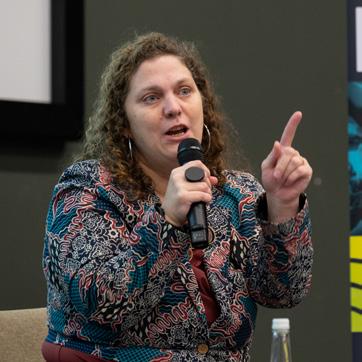
Left: Sofia Scasserra speaks at our big tech conference in April.
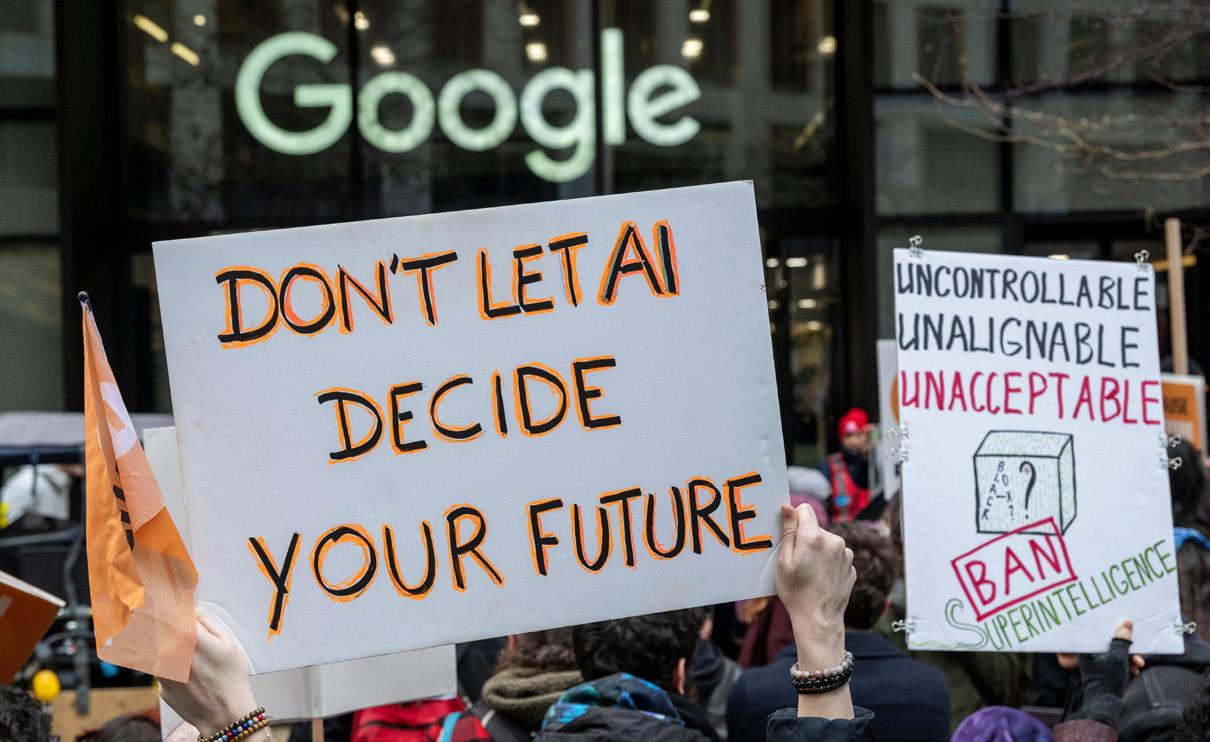
Below: A 'March Against the Machines' outside the offices of Google and others in King's Cross in February.
Credit: Stephen Chung/Alamy Live News
New t-shirts!
Global Justice Now Supporters The
By popular demand, we’ve done a limited run of high-quality screen-printed Global Justice Now t-shirts, featuring a brand new design inspired by activist block printing. Blue unisex t-shirts and green women’s t-shirts, in a range of sizes, are available to order on our website now.
Order in conjunction with our book An A-Z of Global Justice for a special discount. T-shirts: £18 inc P&P. A-Z and T-shirt combined, £28 inc P&P. Order at: globaljustice.org.uk/tshirts
Together against the far right
In March we attended the Together march, which mobilised half a million people on the streets of London in solidarity and unity against the growing scourge of the far right. We marched as part of the internationalist bloc, building solidarity with antifascist movements around the world. It was a brilliant day that reminded us that we have power, even in the face of hatred and division, when we show up and speak out together.
We Rise 2026
Global Justice Youth’s national gathering, We Rise, took place in Leeds earlier this year. The programme brought together campaigners and organisers working on racial and economic justice, alongside those focused on resisting the growing power of big tech. Youth activists travelled from across the country for a packed day of political education, featuring international speakers, and as always, it was wonderful to bring the whole network together.
fight against corporate courts is global
Days of action to stop ISDS 5-17 October
This October we’re working with allies from Peru to the Philippines to co-ordinate three days of action against the secretive system of investor tribunals. Corporate courts have had devastating consequences for the climate, human rights and democracy. We’ve had some important victories against the system, including when we forced the UK and many European countries to pull out of the Energy Charter Treaty. But the fight is far from over.
As part of a renewed global effort, these days of action will see protests, events, lobbying and public education around the world, and we want you to be part of it too. There are now two ISDS cases against the UK, which gives us a particular opportunity to make the argument for the UK to pull out of the system altogether. The case brought by investors in the cancelled West Cumbria coal mine in particular is the subject of growing outrage.
Find out more and get involved: globaljustice.org.uk/isds-global
Britain is still failing on Israel. It’s time for sanctions
The UK’s trade relationship with Israel directly supports the oppression of Palestinians. It is up to us to change this,
writes TIM BIERLEY.
As the US and Israel have waged war on Iran in recent months, and Israel has expanded its attacks to Lebanon as well, global media attention has all too often moved on from Gaza. Yet away from the headlines, Israel has continued to carry out deadly attacks on Palestinians in the territory, despite the supposed ‘ceasefire’ in October last year.
Since then, Israel has killed almost 1,000 Palestinians and injured thousands more. Far from withdrawing its army, it has announced plans to seize up to 70% of Gaza. And alongside this, Israel has accelerated plans for a new settlement that would advance the annexation of Palestinian land in the occupied West Bank, amid growing state-backed settler violence there.
Demands for sanctions have already forced some changes. Our pressure has forced the UK to suspend talks over a new trade deal with Israel and stop some arms licences. Meanwhile, several companies have moved to end operations that support the occupation.
But while this shows what this movement can achieve, much more is needed. We need to ramp up the pressure on the UK government in parliament and beyond, target the corporations and institutions most complicit in the occupation, and mobilise activists to strategise and run campaigns around the country.
Economic pressure on Israel is where people in the UK can have the most leverage.
These ever-escalating attacks on Palestinian life must be stopped. And as Israel continues to act with near-total impunity, we need to do more to keep Palestine in the spotlight.
SANCTIONS NOW
Over the last two years Global Justice Now has been campaigning for economic pressure and sanctions on Israel to end its illegal wars and occupation. We believe this is where people in the UK have the most leverage.
As well as supplying arms to Israel, the UK is one of Israel’s largest trading partners. This includes British companies importing goods and services that directly support the occupation –from settlement produce in UK supermarkets to military technology battle-tested on Palestinians in the West Bank.
Our demand for sanctions is clear: cut off economic and military support to Israel’s war economy, target the industries that profit from oppression and build solidarity with the Palestinian people.
‘BURYING PALESTINE’
But things are moving faster than ever. As well as deepening its stranglehold over Gaza, Israel is right now moving ahead with plans to build a new settlement on the West Bank which one minister boasts is designed to “bury the idea of a Palestinian state”.
But we are also finally seeing leading politicians make stronger demands to stop UK economic complicity in the occupation. In June, almost 140 Labour MPs called for a ban on UK trade with Israel’s illegal settlements – a measure that Palestinians have long demanded.
In mid-June, foreign secretary Yvette Cooper announced sanctions against a handful of
individuals who have supported settler violence on the West Bank. But outrageously, she stopped short of announcing a ban on settlement trade, instead choosing only to update ‘advice’ to British businesses – with no sanctions if they chose to ignore it.
This piecemeal approach is grossly insufficient in the face of deepening apartheid and ethnic cleansing. We are not looking at the work of a few extremist groups and individuals here: expanding settlements and violence against Palestinians there is Israel’s state policy, as Amnesty International and others have documented.
STRONGER THAN EVER
The UK’s lack of decisive action shows a cowardly disregard for the Palestinian victims of Israeli state violence – and an unforgivable lack of urgency in the face of ethnic cleansing. There are several measures that the government must take now that would put real pressure on Israel.
It must suspend its existing trade deal with Israel, the text of which states that respect for human rights is “essential” to the agreement.
It must sanction and ban public contracts with companies that support Israel’s occupation, such as surveillance tech companies, banks, and food companies. And it must ban all trade with Israel’s illegal settlements on occupied Palestinian land.
The fight for justice in Palestine requires both perseverance and urgency. We need to work to pinpoint the UK’s businesses and trade patterns that help prop up the occupation, put pressure on corporate bosses and lobby MPs for change. We need to make the case for change in every community – and to our new prime minister, if there is a change of leader in the months ahead.
Speaking to Global Justice Now activists earlier this year, I was reminded that the movement to mobilise economic pressure against South Africa’s apartheid regime took decades to achieve its aim. But in the end, it did succeed.
Despite the horrors of the past two years, the movement for Palestine is larger and stronger than ever. Now is the time to dig in and stand together to demand the UK imposes sanctions.
Tim Bierley is campaigns and policy manager on Palestine at Global Justice Now.
Project a Black Planet
A new exhibition at the Barbican charts the influence of PanAfricanism over art and culture around the world.
Coined around 1900, Pan-Africanism can be understood as an umbrella term for political and philosophical movements advocating for self-determination, anti-colonial resistance, and transnational solidarity among peoples of African descent. In Project a Black Planet, Panafrica, the symbolic site invoked in the title, appears not as a fixed territory but as a conceptual terrain where rupture, dissent, and collective imagination converge toward emancipatory futures. Instead of mapping a defined geography, the exhibition casts Panafrica as a shifting constellation that reimagines standard representations of the planet.
Project a Black Planet showcases how artists and cultural producers responded to worldaffecting histories of conflict and rupture, acting on desires for unity and solidarity throughout the twentieth and twenty-first centuries. Bringing a vast range of cultural outputs into conversation, the exhibition presents works by academically trained and self-taught artists, popular music and avantgarde experiments, political and poetic speech and printed materials and ephemera, from posters and magazines to pamphlets and newspapers, all of which formed a key role in the distribution and formation of PanAfricanist ideas.
Panafrica is at the Barbican Art Gallery in London
2026, alongside more than fifty associated events across art, cinema, music, performance and talks at the Barbican Centre over the summer: barbican.org.uk.
Chris Ofili. Courtesy the artist, David Zwirner and Victoria Miro.
6. An Understanding Of Uncles, 2026 Lynette YiadomBoakye Charcoal on paper. Courtesy the Artist, Corvi-Mora, London, and Jack Shainman Gallery, New York.
de Arte Negra [Black Art Museum] IPEAFRO Collection.
How we stood up to a Google data centre
When Google tried to sneak through plans for a data centre in Uruguay during a severe drought, campaigners fought back, write DANIEL
PENA and ENOL NIETO JIMÉNEZ .
In 2022, Eleanor Application SRL, a Google subsidiary, submitted a project proposal to install a data centre in the city of Canelones, in southern Uruguay. The proposal, submitted to the Ministry of the Environment, declared the sections related to water, energy, and wastewater consumption as “confidential for commercial reasons”.
Awareness surrounding water conservation in the country led us, together with lawyer Carolina Neme, to challenge in court the secrecy around the potential impacts of this project which could affect the human rights to water and a healthy environment. A favourable ruling in 2023 made public that Google planned to use 7.6 million litres of water per day from the public network to keep this data centre cool. The emergence of this information came amidst the worst drought the country had experienced in 70 years. This was the start of a pushback against the planned data centre as part of growing mobilisations for access to water.
LESSONS LEARNED
AP
After months of drought, and sustained action by social and labour movements demanding a transformation in production models and water usage, the company reformulated part of the planned project. It reduced its size to a third of what was initially planned, and proposed to use an air cooling system in place of a water one. It was at this point that awareness grew of the multiple impacts associated with the expansion of hyperscale data centres, thanks to the lessons learned from cases in Chile, Ireland and the United States.
A video complaint was launched featuring artists, and over 400 comments were sent to the Ministry of Environment on several issues: low employability (the project would only provide 50 jobs); tax exemptions; increased use of electricity and associated CO2 emissions; dependence on minerals and metals used in the production of processors, extracted under conditions of slavery, forced displacement, and child labour; and a lack of assessment of emissions that could increase air pollution.
However, the scientific and citizen arguments were dismissed by the government. The project, which is currently under construction, was approved. But the reformulation of the project represented a ‘partial victory’, and above all, it succeeded in transforming public opinion. For the first time, people began to debate the materiality that lies behind the abstraction of the ‘digital cloud’. This is something we must all continue to do.
Daniel Pena is a researcher at the University of the Republic in Montevideo, Uruguay. Enol Nieto Jiménez is a researcher with the BETA Technological Center in Barcelona.
Photo/Matilde Campodonico
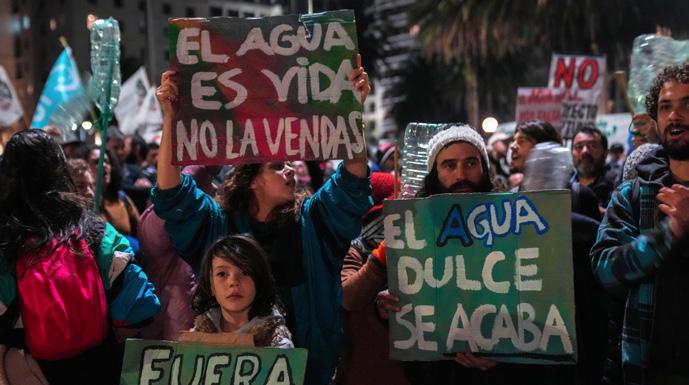
Protest signs say "Water is life. Do not sell it" and "Drinking water is running out" during the crisis.
Reviews
EVERYBODY TO KENMURE STREET
Felipe Bustos Sierra, 2026
1hr 35min
Back in 2021, the world’s eyes were drawn to an unassuming street in Glasgow: Kenmure Street. On a May morning, many communities were waking up to celebrate Eid. The Home Office had other plans. Arriving in the early hours, immigration officers detained two Sikh men, pulling them out of their homes. But it soon became evident the Home Office had messed with the wrong neighbourhood.
Sierra’s inspiring documentary covers the day’s events through footage and first-hand accounts with some of the hundreds of protestors who turned up throughout the day, eventually forcing the immigration officers to back down. The documentary captures the spirit and energy of the day brilliantly, and emphasises the ordinariness of the resistance. The protest started with a concerned neighbour coming down. Others followed. Soon, the streets swelled and together, the people won. As the far right continues to attempt to divide us, this documentary serves as a reminder that we can fight backand win - if we act together.
Anita Bhadani
ENSHITTIFICATION
Cory Doctorow
Verso, 2025
Many readers will recognise Cory Doctorow from his keynote address at our recent national gathering on big tech, where discussions around digital colonialism, corporate power and tech monopolies took centre stage. In this book, he offers a sharp, readable account of how digital platforms become increasingly extractive: first serving users, then advertisers, and finally shareholders alone.
What makes the book especially valuable is its accessibility. Doctorow avoids jargon, using humour, stories and vivid examples to unpack monopoly power, surveillance and corporate capture online. I’d highly recommend it even to members already familiar with the idea of ‘enshittification’, as
ENCYCLICAL ON AI
Pope Leo XIV
The Holy See, 2026
the book is packed with fascinating case studies and written in characteristically funny and entertaining style.
Crucially, the book is not simply pessimistic. Doctorow argues that there are real opportunities for collective action, regulation and democratic control that can challenge big tech’s power, leaving readers not just informed, but hopeful.
Daisy Pearson
If you’re looking for an antidote to Palantir’s 22-point ‘supervillain’ manifesto for AI-driven warfare, you could do worse than read Pope Leo’s encyclical on AI. In it, the Pope aims not to dismiss the value of technology, but to explain that AI is currently being developed within a political and economic context which means that unless we “disarm” it, disaster looms. He lays out the dangers – impacts on climate, employment, inequality, conflict and misinformation. But these dangers risk something deeper: an outright attack on humanity itself. Because these technologies will hardwire the assumptions of their owners into our politics and, indeed, our minds, exacerbating the anti-hu man ideology that weakness must be eliminated.
There is an alternative. While regulation is vital, the Pope thinks we need to “disarm” AI, by which he means a restructuring of our deeply unjust global order. It’s an extraordinary work and leaves you wondering why our democratically-elected leaders are unable to come up with anything which is either so profound or so practical. Nick Dearden
We all want a more just and equal world for those we love. One in which corporate greed is reined in, and resources aren’t controlled by a powerful few. This can’t be done overnight. It takes years - sometimes decadesof pushing for change.
Would you consider leaving a gift in your Will to Global Justice Now? Whether large or small, you can make sure we’ll keep fighting for a future where people come before big business.