Ninety-Nine is published three times a year by Global Justice Now
Global Justice Now campaigns for a world where resources are controlled by the many, not the few. We champion social movements and propose democratic alternatives to the rule of the 1%. Our activists and groups in towns and cities around the UK work in solidarity with those at the sharp end of poverty and injustice.
Ninety-Nine magazine, Global Justice Now 66 Offley Road, London SW9 0LS 020 7820 4900 • offleyroad@globaljustice.org.uk • globaljustice.org.uk
Editors: Jonathan Stevenson, Anita Bhadani Graphic Design: Matt Bonner www.revoltdesign.org
Get Ninety-Nine delivered to your door three times a year when you become a member of Global Justice Now. Go to globaljustice.org.uk/join
We must stand up to Donald Trump, on every front
Jonathan Stevenson Head of campaigns
So far in 2026 Donald Trump has illegally kidnapped the leader of Venezuela, threatened to illegally take Greenland by force, and – as Ninety-Nine goes to press – launched an unprovoked and (needless to say) illegal bombardment of Iran. That’s not to mention his continuing economic war against pretty much every country. Who knows what he’ll have done by the time this reaches you.
The first year of Trump’s presidency has shown that the only language he understands is resistance. From people across the US mobilising against ICE killings, to governments from Canada to China facing down his trade threats, it has been by showing strength that Trump has been forced to take notice. Our own prime minister, admittedly dealt a weak hand by his economic inheritance, has tried to appease the president by offering concession after concession. But it’s not popular from a government that promised change, and it’s not working.
The only language Trump understands is resistance
Nothing sums this up better than the appointment of Peter Mandelson as ambassador in Washington, a gamble that has backfired horrifically. The news that Mandelson leaked information about government policies at the height of the financial crisis has added an extra dimension to the scandal. If he could do this once, he could well have done it again while ambassador – a period when the UK was negotiating both an NHS pharma deal with Trump (see page 5) and the outline of a tech prosperity deal. There is more to come out on both of these – and we are pushing for it to do so.
In this issue we hear about resistance to Trump on several fronts, from Greenland to ICE protests. Melinda St. Louis of Public Citizen explains how Trump’s global trade agenda has Big Tech’s fingerprints all over it. As our conference in April will explore, this industry will dominate all our futures, and understanding it is the first step to taking it on. By bringing together some of the leading voices and campaigners on Big Tech from around the world, it should be a fascinating day.
Elsewhere we look in detail at the fossil fuel transition conference in Santa Marta, Colombia in April. Trump’s climate retreat has created space for others to press ahead with the green transition, and this conference is a real breakthrough for our collective efforts to advance this conversation among willing governments. We will press for the UK to put its head above the parapet and play a full part.
UK hit by second corporate courts case
Having already been sued over the cancelled Cumbria coal mine in August, at the end of last year the UK was hit with another corporate court case: this time by a Russian oligarch who came under UK sanctions over the war on Ukraine. The billionaire Mikhail Fridman, allegedly a Putin insider, has also just sued Luxembourg over the freezing of his assets, for a staggering $16 billion – half of its entire central government revenue. This new case against the UK shows the breadth of the threat of corporate courts (known as investorstate dispute settlement or ISDS). Besides punishing our climate action, ISDS is now interfering in questions of war and peace. But it also opens up new fronts for us to fight on – a fresh angle to engage politicians of different stripes.
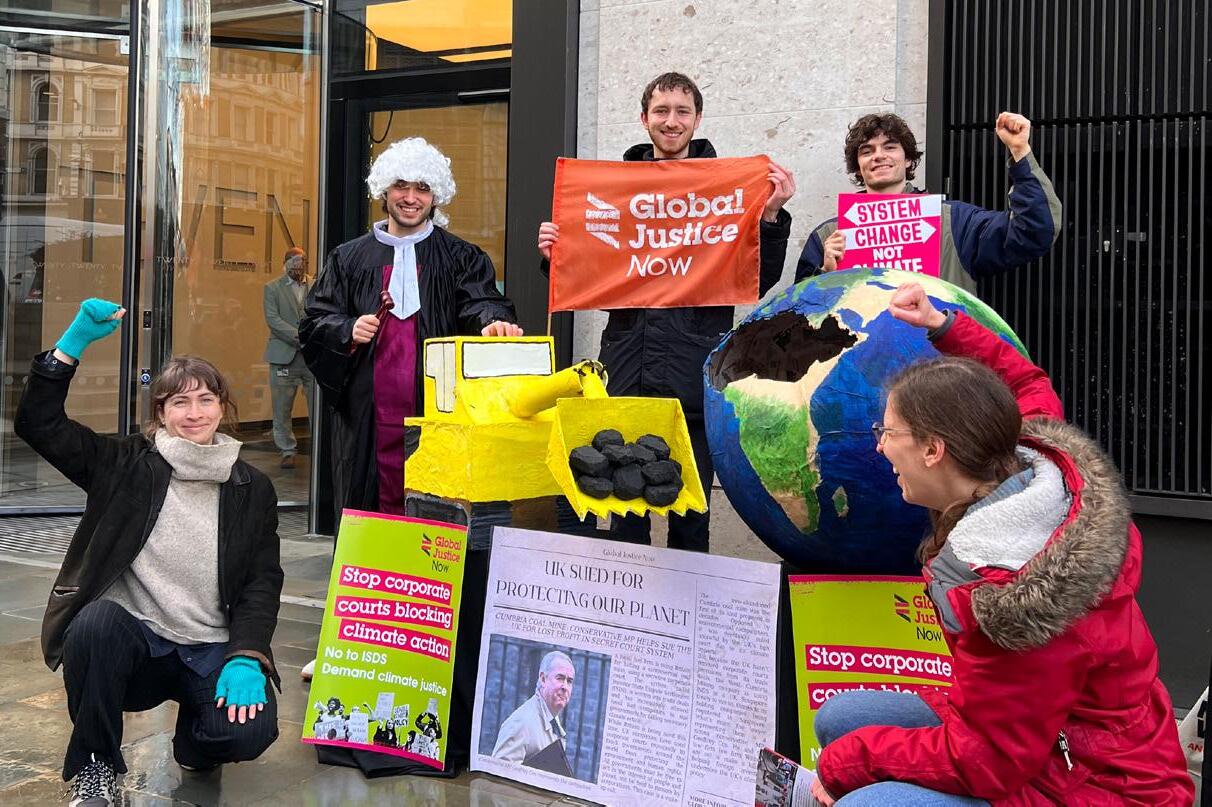
We’re keeping pressure on around the Cumbria case too (see pages 8-9). Exposing the scandal that a sitting MP, Sir Geoffrey Cox, is legal counsel for the overseas hedge fund suing the UK, Global Justice Now activists coordinated twopronged protests. At his law firm’s office in London, Global Justice Youth organised a creative stunt and spoke to passersby, and in his constituency in Devon, local campaigners staged a mock trial and demonstration to call out their MP sacrificing their interests to those of fossil capital.
We ended 2025 with a big push to bring the issue of corporate courts into the UN climate change summit, COP30. We organised an official side event on ISDS – the first time the issue has been brought into the COP process in this way – and shared
the stage with the Colombian environment minister, who was clear in her words: “No government should have to choose between protecting nature and its people, and protecting itself from arbitrators.”
She also announced Colombia will be hosting the world’s first fossil fuel phase-out conference in April this year (see pages 14-15). We’re now influencing this event to ensure ISDS is central to discussions there.
Our event at COP30 was a key moment kicking off collaboration with our international allies to push a coalition of willing governments to scrap corporate courts in their treaties. Add your name to the petition to the UK at: globaljustice.org.uk/stop-isds
Above: Global Justice Youth activists at the office of Sir Geoffrey Cox MP.
Climate wins in UK but COP30 disappoints
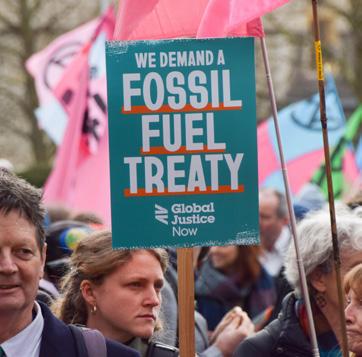
At COP30 in November, climate and energy secretary Ed Miliband called for a global roadmap to ending fossil fuels – a previously unthinkable position for a UK government. This progressive trajectory was doubtless partly thanks to movements UK-wide creating pressure for a fossil fuel phase-out by campaigning on everything from the Fossil Fuel Non-Proliferation Treaty to the Rosebank oilfield.
Once again, however, fossil fuels were not mentioned in the final text from COP. And the UK undermined its own stated goals by refusing to back the necessary climate finance to help countries end fossil fuels. But the most positive development was the announcement of the first international conference on transitioning away from fossil fuels – announced at COP30 by the Colombian and Dutch governments (see pages 14-15).
The UK government has also been pushing back against the toxic oil and gas industry domestically. In November, it confirmed it would fulfil its manifesto promise to end new oil and gas exploration in the North Sea, something we
and our supporters had called for repeatedly.
Another big win came in December, when ministers announced they were cancelling funding that Liz Truss had promised to Mozambique LNG, a carbon bomb waiting to happen that was also embroiled in human rights scandals (see pages 6-7). In 2025, Global Justice Now supporters wrote to the Department for Business and Trade demanding that the UK cancel its funding for this project, which was backed by French oil and gas giant Total and partners. The UK’s decision is a major blow to the project and Total’s global business plan.
These are major wins that can help to galvanise us as we look to the next battles in the fight against fossil fuels. Most urgently, Rosebank – which would help to destroy the climate and put billions in the pockets of big oil – is still very much on the table. Stop Rosebank campaigners UK-wide are still fighting to stop this oilfield from ever breaking ground, with the government’s decision due any time from now.
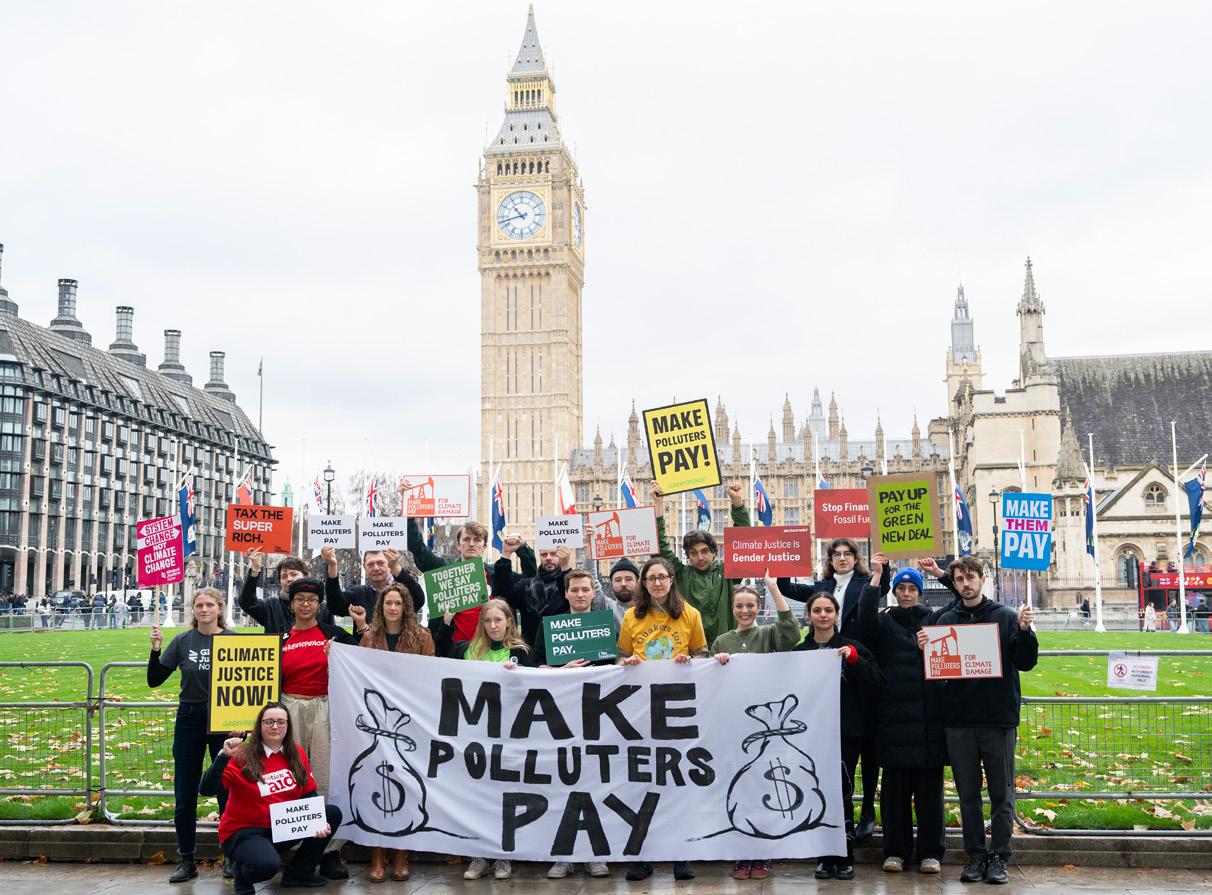
We joined members of the Make Polluters Pay coalition in Westminster in November.
Pharma deal with Trump could cost NHS billions
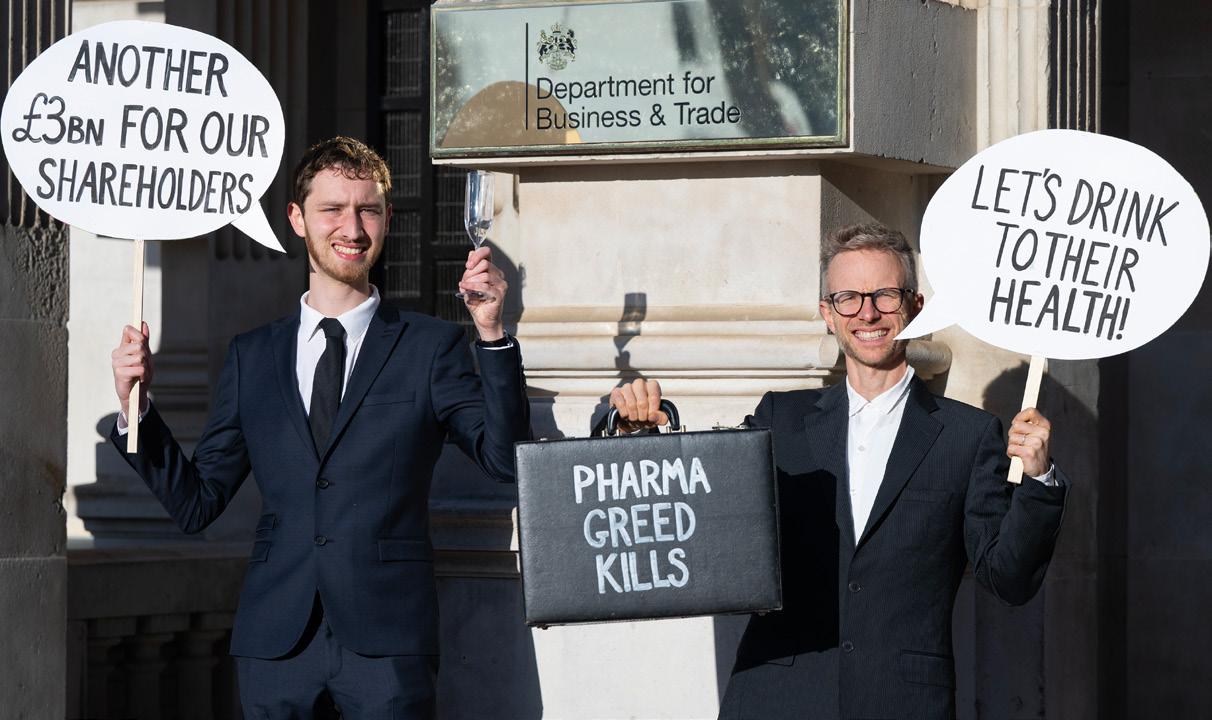
In December, the UK signed an agreement with the US to dramatically increase medicines prices, following threats of tariffs from President Trump. The deal followed months of pressure from pharmaceutical companies who have been demanding that the UK dismantle price controls that help the NHS get better value for money. The government has admitted that the
costs of the deal will grow year-onyear but refused to say how much these changes will cost in the long run, even after we put in a freedom of information request.
We estimate that the government’s commitments could cost £9 billion a year by 2035, and we have been working to raise the alarm over this deal’s threat to the NHS, meeting MPs and placing stories in the media. This
is just one part of wide-ranging trade negotiations between the UK and US. Perhaps most worryingly, Trump’s team is now also pushing to limit the government’s ability to tax and regulate Big Tech firms.
Tell the UK to come clean on the cost of Trump’s NHS deal: globaljustice.org.uk/pharma-deal
Below: Opposing the deal outside the department in December.
While a Gaza ceasefire agreement was agreed in September, Israel has since violated it consistently, killing hundreds of people. It also continues to obstruct aid and its military has remained in control of 58% of the territory. As Amnesty International stated in November, the genocide of Palestinians in Gaza continues.
Meanwhile with the media focus elsewhere, Israel is also rapidly deepening its occupation of the West Bank, including East Jerusalem, with settler attacks spiking in 2025 and vast new settlement projects that would further fracture and enclose the Palestinian territory approved.
Despite this, the UK trade secretary
Peter Kyle said in January that the UK would consider resuming trade talks with Israel as well as lifting the UK’s partial ban on arms sales if phase two of the ceasefire is completed. We have worked with allies to respond, demanding the government ramps up pressure on Israel rather than reward its continued abuses.
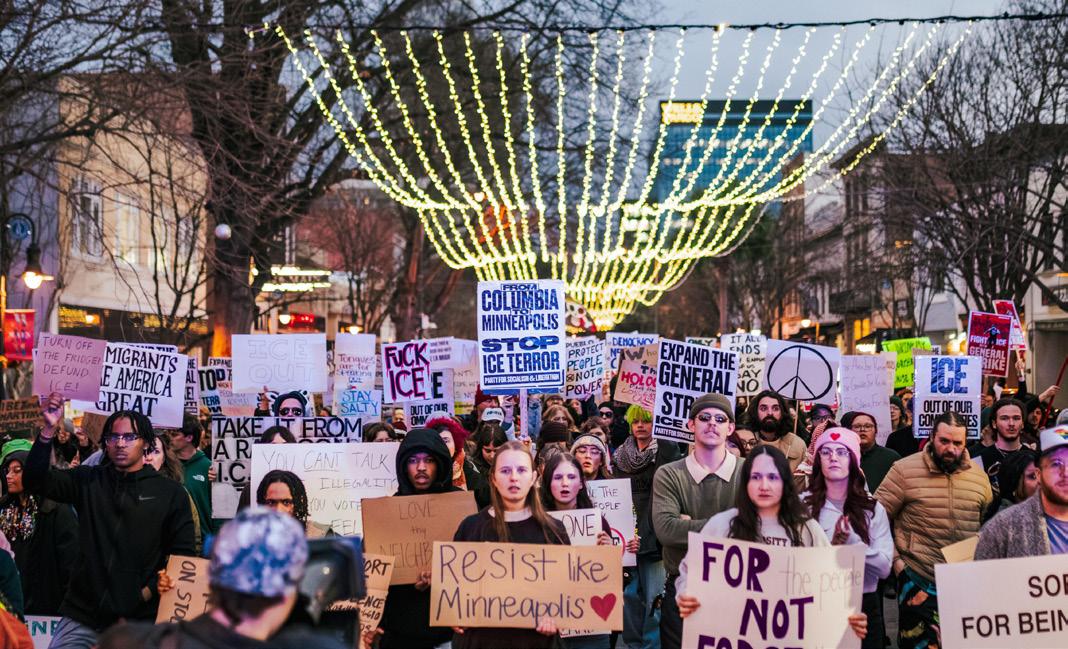
Thousands protest against ICE across America
Hundreds of protests and a national strike took place across every state in the US in February, following multiple killings of people at the hands of ICE (US Immigration and Customs Enforcement) agents. People took to the streets to call for justice for people detained by ICE, and those killed by ICE or in ICE custody. “We
keep each other safe”, organisers 50501 said in a statement. “ICE is terrorising our communities as an occupying paramilitary, but we will NOT COMPLY”.
Meanwhile, the boycott movement ‘Resist and Unsubscribe’ is gaining momentum, as masses of Americans are boycotting major Big Tech
companies with outsized influence over the US economy, and those enabling ICE operations. Its aim is to influence Trump through a monthlong economic strike targeted at the companies enabling his actions.
UK pulls £870m funding from Mozambique gas project
In December the UK government withdrew $1.15 billion (£870 million) of funding pledged by former prime minister Liz Truss for a controversial gas project in Mozambique. The Mozambique LNG project, run by French fossil fuel giant TotalEnergies, had long been criticised as a carbon bomb which would have emitted an
estimated 3.3-4.5 billion tonnes of CO2 equivalent during its lifecycle.
Campaigners from Justiça Ambiental! (Friends of the Earth Mozambique) have opposed the project for many years, with international support including from Global Justice Now. Truss originally offered the export credit finance in 2020, despite the UK being on
the point of pledging to end all fossil fuel funding overseas. Total suspended the project in 2021 after it was accused of involvement in severe human rights violations in the country, but it was recently revived. Campaigners are now calling on other European governments to follow the UK in cancelling funding before work resumes.
Demonstrators march through Columbia, South Carolina as part of the nationwide 'Ice Out' strike.
The High Court ruled in February that the UK government’s proscription of the protest group Palestine Action under anti-terrorism laws was disproportionate. Cofounder Huda Ammori said, “This is a monumental victory both for our fundamental freedoms here in Britain and in the struggle for freedom for the Palestinian people”.
Bangladesh drops garment worker charges
The interim government in Bangladesh has dropped outstanding criminal charges against more than 48,000 garments workers who were arrested in 2023 following protests over the minimum wage, which was subsequently increased. Factory owners had lodged complaints against their own workers without having to provide evidence.
Edinburgh data centre stopped
Campaigners are celebrating after Edinburgh Council vetoed plans for a controversial data centre. The plans were scrapped after councillors deemed that the application did not address the site's total greenhouse gas emissions or the climate crisis. Campaigners had stated that the planning documents for the nowscrapped data centre “deserved gold medals for greenwashing”.
Price of cystic fibrosis drugs to fall by up to 99%
The cost of the latest drugs to treat cystic fibrosis is set to fall dramatically after the announcement that a manufacturer in Bangladesh will produce a generic version.
US pharma company Vertex, which holds the patents on Trikafta, has been charging $370,000 a year for the treatment, with just a quarter of the estimated 180,000 people with cystic fibrosis globally having received it. But following campaigning by Just Treatment, Third World Network and
others, Bangladeshi company Beximco is set to produce a generic version from the spring. It will be priced at $12,750 for adults and $6,375 for children, 58 times less than the price charged by Vertex. The annual cost could fall to $2,000 using a reduced dosing protocol adopted by South African doctors, a 99.5% reduction.
“We’ve watched children suffer and die while a treatment sat on the shelf, priced out of reach,” said Gayle Pledger of Just Treatment, whose daughter has cystic fibrosis.
Breakthrough on just transition at COP30
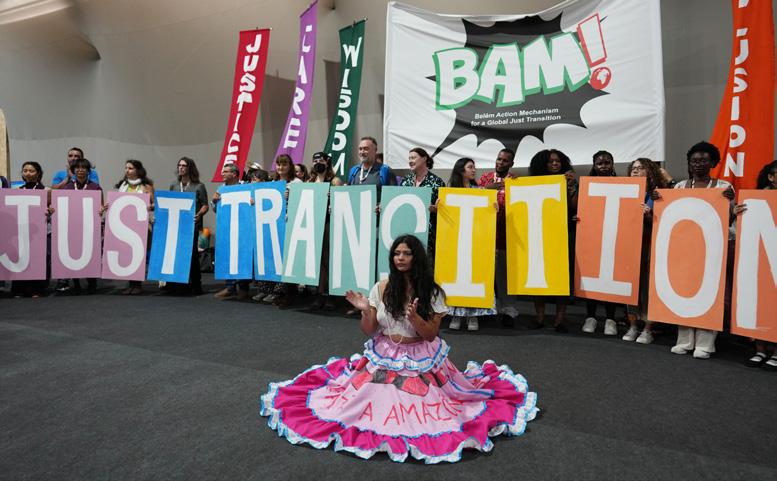
Globally co-ordinated action for a just transition is critical if we want a fossil fuel phase-out that protects workers and communities, rather than lining the pockets of the super-rich. Since COP27 in Egypt, there has been a temporary space at the climate talks to discuss this, but it was due to close after November’s COP30 in Belém, Brazil.
Yet following concerted pressure from around the world, movements won the fight to keep the discussion alive, with the Belém Action Mechanism
(BAM) establishing just transition as a permanent part of the negotiations. Networks like the Global Campaign to Demand Climate Justice maximised public and private pressure, winning backing from the G77 group of global south governments. The UK opposed the BAM, but Global Justice Now and others protested during the summit, including directly confronting the energy secretary, to make sure the UK didn’t block this critical step towards a just transition.
A protest in support of the Belém Action Mechanism during COP30 in November.
Campaigners fought the Cumbria coal mine, and won. Now investors are using corporate courts to sue us all. It’s time to fight back, writes CLEODIE RICKARD.
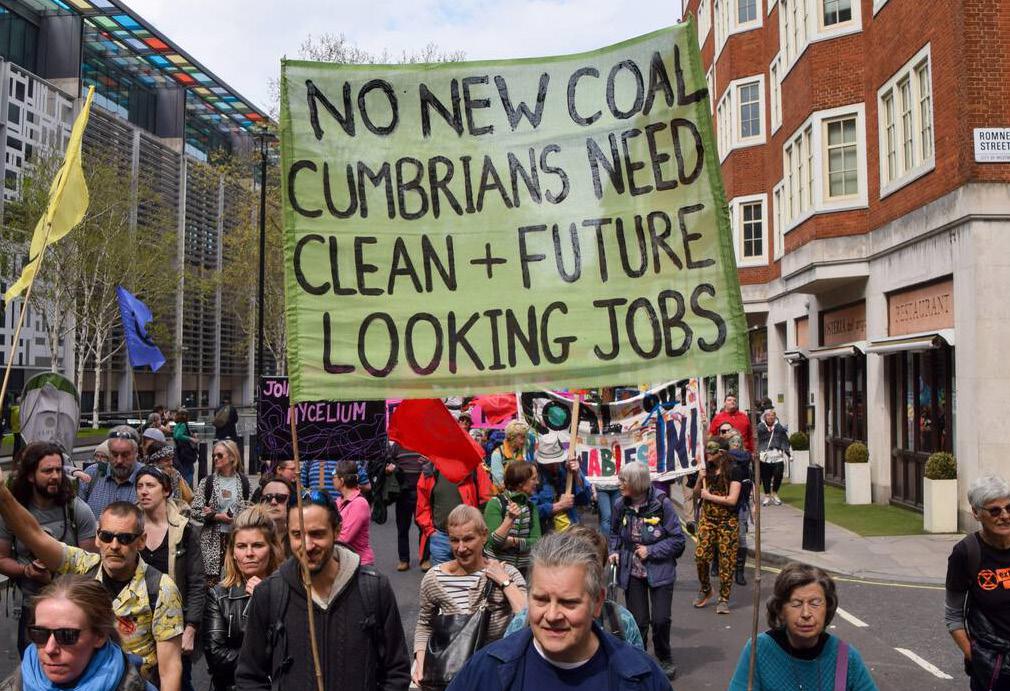
In 2024, the people of Cumbria saw a huge victory in their fight against fossil fuels. Campaigners at Friends of the Earth and South Lakes Action on Climate Change took legal action against West Cumbria Mining – and won. The High Court ruled that the decision to grant planning permission to West Cumbria Mining’s proposed coal mine in Whitehaven was unlawful on the basis of its climate impacts. And so it was quashed. This victory was the result of years of campaigning from people who saw through the false promises of fossil fuel corporations.
First submitting its application in May 2017, West Cumbria Mining argued its mine would be “climate neutral”. They expected residents to ignore that over the lifetime of the mine, 220 million tonnes of greenhouse gases would be released through using the coal alone, while constructing and operating the mine would release 9 million tonnes of emissions. But local residents saw past the greenwash, and the High Court agreed.
FALSE PROMISES
security was also hollow: due to the coal’s sulphur content, all of it would have had to be exported.
In 2025, West Cumbria Mining officially withdrew its planning application. It didn’t appeal the High Court’s decision. But as it turned out, this was only one battle won. West Cumbria Mining had a secret weapon. Its hedge fund investors in Singapore are suing the UK for compensation in a secret corporate court. They can do so using Investor-State Dispute Settlement (ISDS) provisions in a 1975 treaty between the UK and Singapore.
Corporate courts have long let British corporations wreak havoc around the world. Now the UK is tasting its own medicine.
CORPORATIONS VS THE PEOPLE
Raised in August 2025, this is the first ISDS case the UK is facing over a climate policy – at a time when fossil fuel investors are ramping up claims against the government’s climate action. Similar cases have run into the billions, as investors can sue not just for their initial investments but all future profits they expected to make. Fossil fuel investors have cashed in over £59 billion globally in recent decades.
West Cumbria Mining promised local jobs, but gave no assurance that these would benefit existing residents. What’s more, Cumbrian workers deserve more than work in a dying industry, unlikely to sustain more than a few decades. Campaigners argued there was no opposition between good climate policy and good jobs: people need the well paid, unionised, green jobs of the future. The promised boon to UK energy
Even if the UK manages to win, legal fees average £3.7 million. If it loses, foreign investors in a failed mine that never had boots on the ground will get a payout from the UK public. Either way, taxpayers foot the bill – funds which could rather be invested in Cumbria to create new green jobs.
The case is also a perfect example of the elite interests at play in ISDS: scandalously, a sitting MP, Sir Geoffrey Cox, is acting as legal counsel for the investors suing, in his lucrative second
job. That’s right – an elected representative of UK citizens is helping investors squeeze as much as they can out of our public purse. It’s a direct abdication of his responsibilities to act in the public interest, and his constituents are up in arms, taking to the streets in protest.
THE FIGHT TO END CORPORATE COURTS
Corporate courts have been used globally to challenge everything from increases to the minimum wage to health legislation for plain packaging cigarettes to windfall taxes. Over £74 billion in public money has been awarded to corporations through ISDS to date worldwide. In the UK, we’ve also been hit by a second case, this time raised by one of the richest individuals in the world. Russian oligarch Mikhail Fridman is using corporate courts to sue the UK, after the billionaire was sanctioned in 2022 due to his ties to the Russian regime amid its invasion of Ukraine. Now is the time for the UK to take seriously the grave threat corporate courts pose.
Following sustained campaigning, the previous Conservative government withdrew from the most litigated ISDS agreement, the Energy Charter Treaty, citing its risks to net zero. Yet the UK’s approach has been inconsistent. Our current government is pushing to include new ISDS provisions in negotiations for deals with India and the Gulf states, opening more doors for these costly claims to punish our climate action.
Corporate courts have long let British corporations wreak havoc around the world, and now the UK is tasting its own medicine. For communities here and overseas, we need to push the government to scrap corporate courts across the board. We’ve won before, and we will do it again. We can’t give corporate greed carte blanche to attack the steps we’re taking towards a fairer, greener future.
Cleodie Rickard is Global Justice Now’s trade campaign manager.
President Trump’s trade agenda: Big Tech First!
Like the pharma industry before them, Big Tech wants trade deals to lock in deregulation around the world. Donald Trump is supercharging the process, writes MELINDA ST. LOUIS.
An examination of the dizzying chaos surrounding President Trump’s tariff threats and secretive ‘trade deals’ shows a disturbing throughline: this is nothing but a shakedown on behalf of Big Tech.
President Trump’s trade policy has been a barrage of bullying foreign countries. While he claims this will benefit the American economy, nothing could be further from the truth. President Trump’s deregulatory agenda – both at home and abroad –benefits his Big Tech buddies, while the losers are consumers, workers, and small businesses, in the US and globally.
AMERICA FIRST?
From the very outset, this administration’s ‘America First’ agenda has really been a ‘Big Tech First’ agenda, as was made clear by the release of the Presidential Directive to Prevent Unfair Exploitation of American Innovation in February 2025. This policy put the world on notice that the Trump administration planned to bat for Big Tech companies, who the memorandum claimed needed protection from “overseas extortion”. This was followed quickly by the announcement of so-called “reciprocal tariffs” in April 2025. As has been made clear in the year since their institution, these tariffs have granted Trump considerable leverage to coerce countries into deals that enrich the US’s biggest corporations. It is no secret that neoliberal trade deals have for decades been rigged in favour of large corporations by prioritising investor profit over public interest. Despite campaigning on a platform that criticised “globalist” deals, and rather than pairing strategic tariffs with policies to encourage countries to adopt trade policies that help workers and consumers, President
Trump is merely using trade as a tool to enrich those closest to him.
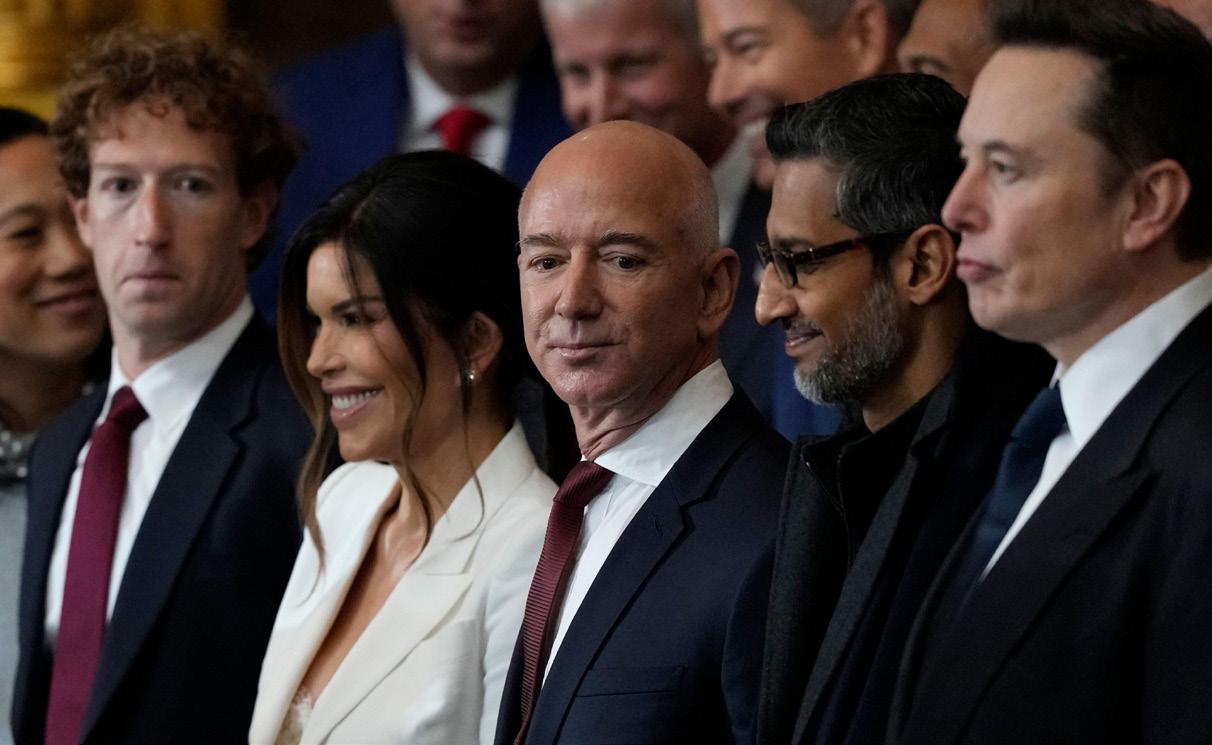
And no one is closer to Trump than Big Tech. The mutual admiration between various tech CEOs and Trump is a matter of public record, buttressed by the numerous instances of the president wining and dining them. Big Tech has also been a reliable piggy bank for Trump, having poured more than a billion dollars into his inauguration fund, his gilded White House ballroom, and so on. And let's not forget Apple presenting Trump with a shiny gold statue!
DOMESTIC DEREGULATION
In exchange, President Trump is unabashedly pushing Big Tech interests – including by deregulating the tech sector and awarding his tech buddies billions in controversial government contracts.
The examples of Trump’s pro-Big Tech agenda in the US are numerous. They include a recent executive order which bars US states from regulating harms caused by the fast-growing AI industry, attempts at hollowing out enforcement capacity including by defanging a number of critical consumer protection institutions such as the Federal Trade Commission, and dropping dozens of enforcement actions against a host of tech companies. Companies such as Palantir, xAI and others have been controversially awarded government contracts for further integrating technology into the federal government.
This pattern is being perpetuated outside the US through the means of trade tools.
GLOBAL DEREGULATION THROUGH TRADE
Following in the footsteps of Big Pharma’s campaign to globalise extreme intellectual property rules, Big Tech has consistently sought
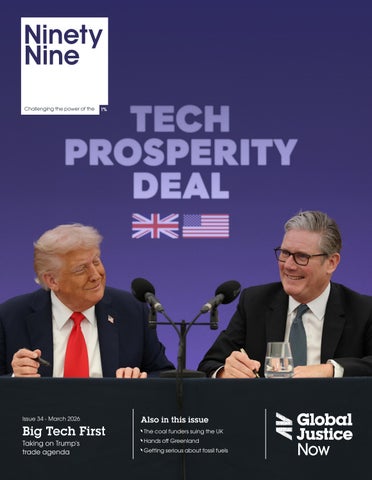
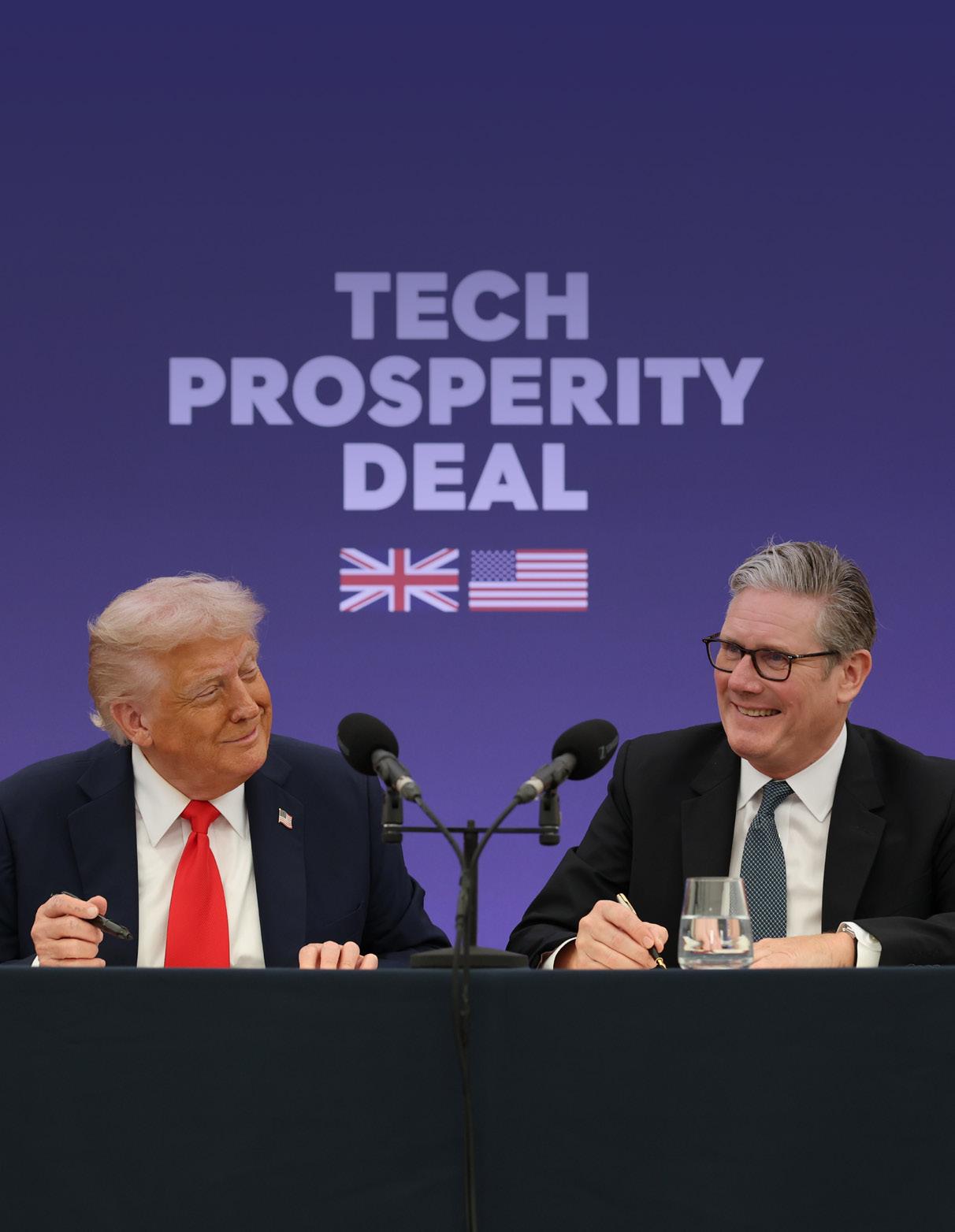
Overleaf: Keir Starmer and Donald Trump announce a US-UK tech prosperity deal during the state visit last year.
to use the trade arena as a means to block regulation of the tech sector around the world. These efforts have been particularly successful under President Trump, with the president explicitly tying the use of punitive measures such as tariffs to countries’ attempts at regulating the digital ecosystem. And, as is to be expected, Big Tech companies are eager to cash in on a president who is seemingly only too happy to go out to bat for them.
Research by Public Citizen exposes the ‘shopping list’ presented by Big Tech to the US administration. The targets include hundreds of digital economy policies in over 60 jurisdictions around the world such as:
• AI regulations that seek to ensure the safety, ethical functioning and reliability of AI systems;
• Data protection and privacy laws that regulate how companies
can process, store, and export personal data;
• Competition regulations that promote fair play in digital markets that are frequently dominated by a handful of big players;
• Taxes that ensure technology companies pay their fair share in jurisdictions where they have a user-base.
Many of these regulations and laws have been explicitly targeted in the spate of trade deals signed by President Trump over the last few months. The recent ‘reciprocal’ trade arrangements with Argentina, Bangladesh, Cambodia, El Salvador, Guatemala, and Malaysia, require these countries to rewrite their privacy and data protection laws to enable unrestricted exports of personal data, thereby enabling Big Tech companies to move data to locations
with low privacy protections (such as the US). Countries are also barred from implementing digital services taxes or customs duties on electronic transmissions, thereby denying them a source of revenue that could be put towards their developmental needs. The agreements also restrain them from implementing digital competition, platform accountability or online safety regulations that could be (mis)construed to discriminate against US tech giants. Finally, provisions in the agreements restrict regulators and other authorities from reviewing algorithms or source code before they are released to the public, limiting efforts to enhance transparency and accountability of software and AI systems.
All these deals restrict the ability of the counterparties to regulate or adapt digital policy as technologies evolve. In effect, they create
dependencies on US tech companies, reduce revenue available to countries for developmental needs and provision of public services, and restrain governments from responding to social and other harms in the digital ecosystem.
Under the threat of tariffs, even countries with whom the US has not yet secured trade deals are rolling back or slow-walking implementation of digital economy regulations. For example, Canada was forced to roll back its digital services tax in order to restart trade negotiations that had been called off by President Trump. Similarly, India has reportedly withdrawn its ‘equalisation levy’, a tax on advertising revenues of Big Tech companies, while Australia appears to be delaying enforcement of its news media bargaining code.
for breach of online safety, privacy and competition regulations. This campaign against EU’s digital regulations even included the US suspending the visas of members of the European Commission responsible for administering the DMA!
LOOKING AHEAD
systems in the public interest. This requires standing up to bullying by the Trump administration. As we have seen in a number of instances, notably concerning the threats to take over Greenland, countries can successfully rebuff Trump’s demands.
In effect, these trade deals create dependencies on US tech companies.
Secretive trade negotiations should not be the venue to shape decisions on how our societies regulate emerging technologies. Not only could signing up to such agreements hurt citizens around the world, there is also no guarantee that any concessions made will actually end the bullying by the unpredictable US administration. In fact, all the recent deals signed by the Trump administration impose one-sided terms including in the form of enforcement measures available to the parties.
But none of these concessions has satisfied Trump. Even countries that have signed supposed “deals” with this administration continue to face pressure to further deregulate or face additional tariffs. We’ve seen this most recently in the case of South Korea, which despite agreeing to a trade deal with the US, has faced hostility for two reasons: regulatory investigations into the US-based online marketplace Coupang, which is accused of a massive data breach last year; and efforts to implement platform regulation similar to the European Union’s Digital Markets Act (DMA) and Digital Services Act (DSA).
The European Union too has been on the receiving end, with multiple threats being directed at Europe’s temerity to punish Big Tech platforms
As an alternative, countries would be wise to focus on two policy goals: first, ensuring a global policy ecosystem that enables them to develop their own technology ecosystems, and second, retaining the ability to regulate digital
For the tech sector, given that the Trump administration is essentially reshaping trade policy to treat regulation itself as illegitimate, in the medium to long-term, this may prove an own-goal. Public trust in the sector will continue to wane. At the same time, the Trump administration’s corrupt policies and practices, such as extending favourable tariff treatment to his favoured companies, could further entrench market power (leading to further inequality in the relationship between Big Tech and smaller companies as well as users). In addition, rather than opening up foreign markets to US tech companies, the inconsistent and short-sighted actions of the Trump administration may set the stage for further global calls for ‘digital sovereignty’, leading to more countries reducing their dependence on American digital services.
Melinda St. Louis is Global Trade Watch Director at Public Citizen, citizen.org
Global Justice Now Supporters
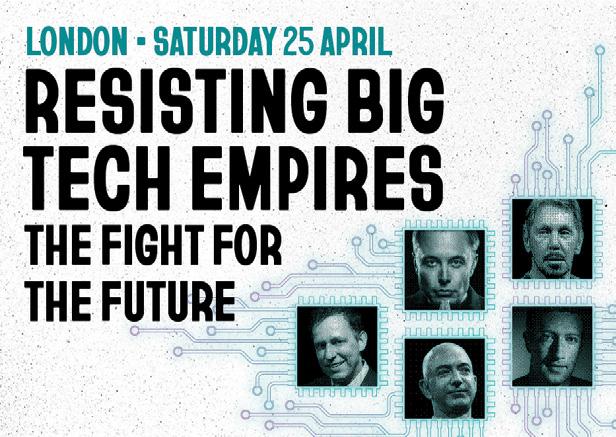
Join our Big Tech conference
Global Justice Now’s national gathering on 25 April focuses on a critical issue of our times: resisting the growing power of Big Tech companies. In their search for profit and power these companies are fuelling division and advancing far-right authoritarianism, facilitating a vast transfer of wealth upwards, intensifying automated warfare, and accelerating environmental destruction. Yet they still pose as the visionaries of the future.
There is much that is unprecedented about the technological revolution currently taking place. At the same time, it echoes older histories of enclosure and dispossession. But the future does not have to belong to unaccountable tech monopolies. By challenging corporate power, democratising digital infrastructure, and putting human and planetary needs before profit, we can reclaim technology as a public good and build a better future for everyone.
We’ve got an incredible line-up of speakers, including:
Cory Doctorow, novelist and campaigner
Anita Gurumurthy, IT for Change, India
Sofia Scasserra, Our World is Not for Sale, Argentina
James Meadway, Macrodose podcast
Khem Rogaly, Common Wealth
Cecilia Rikap, digital sovereignty researcher
Dan McQuillan, author of Resisting AI
This is not one to be missed. Book your free place online at: globaljustice.org.uk/tech-empires
Our new podcast
Audio and visual content has become increasingly important for educating and organising movements, and new technology has made it more affordable. So we’re working with Another Europe is Possible and Stop Trump on a new fortnightly podcast: COUNTER•POWER. It is also filmed, ensuring we have plenty of clips for social media. Expect analysis of global politics and news about the movement for a better world. Watch and listen via: counterpower.uk
Your impact in 2025
We have just published our newest Impact Report, which highlights what we achieved together in 2025 – including our landmark victory over the climatewrecking Energy Charter Treaty, pushing the Colombian government to publicly commit to ending its corporate courts treaties, and bringing tens of thousands of people onto the streets. Read the full report at: globaljustice.org.uk/impact2025
Our AGM
This year’s Global Justice Now AGM will take place online on Tuesday 16 June at 6.30pm. This is your chance to hear about our progress in the last year and ask questions of our director, Nick Dearden. It is also an important part of our internal democracy. Register to attend at: globaljustice.org.uk/agm-2026
The beginning of the end for fossil fuels?
In Colombia in April, governments will finally start discussing how to phase out fossil fuels fairly. It could be a major turning point, writes
IZZIE McINTOSH.
November marked 30 years since the UN held its first Conference of the Parties (COP) on climate change. 30 years of negotiations, debates and bitter battles. 30 years in which an avalanche of evidence about the impact of fossil fuels on the climate has been produced. All the while, the global south has been feeling the escalating impacts of climate change more acutely, and big oil has been making more and more money on the backs of ordinary people around the world. Despite all of this, COP has made almost no progress towards a fossil fuel phaseout.
COALITION OF THE WILLING
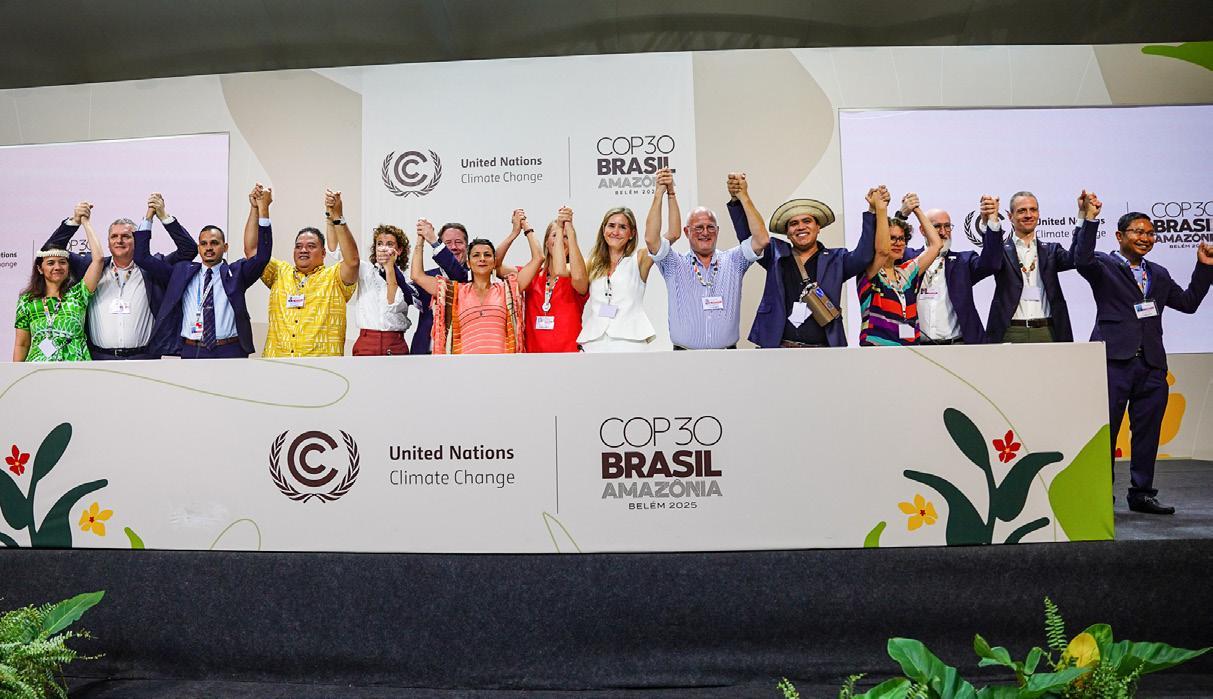
At COP30, in the Amazonian city of Belém, the Colombian and Dutch governments took matters into their own hands.
Soon before the gavel came down on the final deal, they announced that they would host the First Conference on Transitioning Away from Fossil Fuels in Santa Marta, Colombia in April. Flanked by representatives of governments from across the world – including highly climate-vulnerable Pacific Island states – ministers from both Colombia and the Netherlands drew a line in the sand. Refusing to accept COP’s empty promises or missed opportunities as the end of the conversation, they encouraged activists, NGOs and governments to join them in Santa Marta.
transition from fossil fuels. It has the potential to be a major turning point in the fight against climate change, and even identifies addressing corporate courts (also known as investor-state dispute settlement, or ISDS) as a key point of discussion. This is in no small part thanks to the work of activists all around the world. As well as campaigning on corporate courts for years –demonstrating how these shadowy tribunals are a fatal hindrance to climate action – Global Justice Now’s networks have championed the Fossil Fuel Non-Proliferation Treaty and helped make the demand for independent negotiations on the fossil fuel phase-out impossible to ignore.
In 2024, for example, our activists brought hundreds of people from their communities to events about the Fossil Fuel Treaty, featuring globally renowned activist Mitzi Jonelle Tan. Colombia’s environment minister, Irene Vélez Torres, also spoke at one of these events. She had the opportunity to see the support for a rapid and just transition around the world as well as hearing about the incredible pressure that had been building in the UK, thanks to our supporters securing public support from their local councils and MPs.
Colombian environment minister Irene Vélez Torres and Dutch deputy prime minister Sophie Hermans celebrate the announcement of the conference at COP30.
The conference will be the first of its kind and aims to cement a coalition of the willing to push forward tangible action for a truly just
A GRASSROOTS WIN
April’s conference is a critical victory for our activists. COPs are a key opportunity for movements to hold governments’ feet to the fire, but for a long time we've known we need much faster, fairer action than they can
Right:
produce. This is partly because COP is overrun by corporate lobbyists, who push the interests of the 1% and hold back action on climate change. At COP30 in November, more than 1,600 attendees were fossil fuel lobbyists, the highest ever. Read that again. Coal, oil and gas are indisputably the root cause of climate change that is increasingly devastating communities around the world, particularly in the global south. Yet at the conference that is supposed to deliver the answers to climate change, thousands were there to represent the very people causing it.
Governments give fossil fuel lobbyists a level of access that most campaigners can only dream of. Perhaps it is this proximity to the fossil fuel industry that leads global north governments to fail so comprehensively at achieving change, even undermining their own stated goals. The UK government, for example, demanded a fossil fuel
phase-out at COP30. But without promises of the necessary finance to enable a transition in the global south, which could be funded by polluter taxes, its agenda crumbled and once again fossil fuels were not mentioned in the final text. This failure was also driven by COP’s consensus voting system, in which every single party must agree to the final deal. Securing such consensus is a gargantuan task in which polluting countries and petrostates can easily derail progress on fossil fuels, as happened again at COP30. World leaders’ repeated failures at COP demonstrate that solutions to the climate crisis need to be built
The conference will be the first of its kind, aiming to cement a coalition of countries willing to go further and faster.
from the grassroots. By campaigning on the Fossil Fuel Treaty in the UK, we have helped shape the actions of governments globally. It’s no accident that April's conference will focus on tackling systems like ISDS as part of the transition. It reflects the agenda of activists all around the world, including in the UK. We have been demanding a Fossil Fuel Treaty to forge an independent space, built on grassroots demands, that can bring an end to the fossil fuel era. In the fight for a just transition, there are still a lot more battles ahead, but April’s conference takes us one step closer to just that.
Izzie
McIntosh is climate justice campaign manager at Global Justice Now.
Nigerian Modernism
A new exhibition at Tate Modern shows how artists responded to five decades of Nigeria’s history, through independence and beyond.
Spanning a period from indirect colonial rule to national independence and after, Nigerian Modernism celebrates an international network of artists who combine African and European traditions, creating a vibrant artistic legacy. It presents the work of over 50 artists across 50 years, from Ben Enwonwu to El Anatsui. They each responded to Nigeria’s evolving political and social landscape by challenging assumptions and imagining new futures, reclaiming Indigenous traditions to create a new African vision of Modernism.
Nigerian Modernism is at Tate Modern in London until 10 May 2026.
1. The Durbar of Eid-ul-Fitr, Kano, Nigeria, 1955.
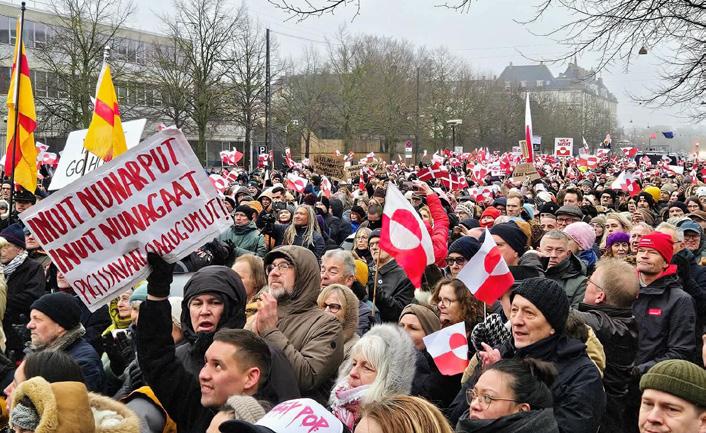
Donald Trump’s attempts to buy Greenland – and threats to take it by force – have provoked a popular response, writes SIKA NUUNU KRISTENSEN.
During Donald Trump’s first term as US president in 2019, he expressed interest in buying Greenland, describing it as a “large real estate deal”.
Even a basic understanding of Greenland’s history makes this statement deeply troubling. Greenland has long been working toward independence, gradually taking over responsibilities from the Danish government, and now governs itself under self-rule. When Greenland chooses to claim full independence, it is free to do so.
Hearing a sitting US president speak of buying a country is not only degrading – it reveals an outdated imperialist mindset in which peoples and nations are treated as commodities. This is a way of thinking many believed had been abandoned after World War II.
people of Greenland.”
On 19 January 2025 my father, Poul Johansen, a Greenlander living in Denmark, organised the first rally in response to these statements. “Even if it is only us, we need to do this. If we stay at home, we accept the situation,” he said. That day, 50 people gathered in front of the American Embassy in Copenhagen.
This effort became the foundation of the citizen initiative Hands Off Kalaallit Nunaat (the indigenous name for Greenland).
SHAMEFUL
Following J.D. Vance’s unapproved visit to Greenland in March 2025 and his aggressive rhetoric toward Denmark, Anders Franssen, a Dane, felt compelled to organise another rally. “Greenland is in an extraordinarily vulnerable situation, pressured by one of the world’s largest powers. It is shameful,” he said. “That is why it is important for me to show solidarity with the
As Trump’s statements intensified – eventually including threats of taking Greenland by force –and combined with US intervention in Venezuela, it became clear that this was no longer theoretical. We had to act. What would happen to our families, our freedom, our land, and our nature if Greenland were taken over? This is not just Greenland’s struggle; it is a test of whether powerful nations can overrun smaller ones.
Together with local Greenlandic communities and associations, we organised simultaneous rallies across five major cities in Denmark and Greenland on 17 January 2026.
That day, the power of collective action was undeniable, with thousands of people showing up in solidarity. One person may be invisible, but together we cannot be ignored! The message was clear: Greenland is not for sale. Danes and Greenlanders stand united for sovereignty, selfdetermination, and justice.
Sika Nuunu Kristensen is an organiser with Hands Off Kalaallit Nunaat – Hands Off Greenland.
Demonstration at City Hall Square in Copenhagen, Denmark, January 2026.
Reviews
PALESTINE 36
Annemarie Jacir, 2025
1hr 59min, Channel 4
Palestine 36 tells the story of the 1936-39 Arab revolt against the British imperial administration and its support for Zionist colonisation. It follows an ensemble of engaging characters navigating their personal relationships and developing Palestinian national consciousness.
The film captures the origins of the long Palestinian struggle for self-determination and the depths of British complicity. Scenes of tense debates among the colonial administrators relate how they used Jewish settlement to reshape the region in their interests while the brutal dramatisations of British collective punishment leave the viewer in no doubt as to how current Israeli military doctrine was developed.
The film is visually stunning with beautiful lingering landscape shots reminding us that the Palestinian cause is ultimately a struggle rooted in the connection between an indigenous people and their land. Indeed, Palestine 36 is so powerful and relevant that Israeli police recently raided screenings in occupied East Jerusalem.
Hugo Raine
MOTHER MARY COMES TO ME Arundhati Roy
Hamish Hamilton, 2025
A fierce critic of capitalism, injustice and imperialism, writer and activist Arundhati Roy has written her first work of memoir, Mother Mary Comes To Me. This time turning the gaze inwards, Roy provides insight into her complex relationship with her late mother, and her own life to date. It’s a story of her becoming – as a writer, as an activist and as a person – that shows the political and the personal are inseparable.
From an early age, Roy’s life has never been one marked by convention, and one could argue that this formed in her an attitude of never accepting things the way they are. What does it mean to fight for what you believe in, when so many try to silence your voice? How is love maintained even in bonds which cause us pain? In her trademark poetic and unapologetic prose, Roy’s memoir is a beautiful tribute to a multifaceted relationship and life.
Anita Bhadani
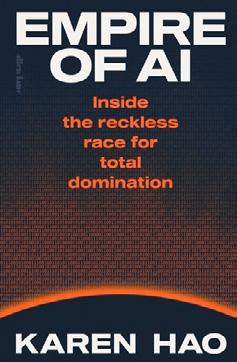
EMPIRE OF AI: INSIDE THE RECKLESS RACE FOR TOTAL DOMINATION
Karen Hao
Allen Lane, 2025
OpenAI are the makers of ChatGPT, the chatbot responsible for AI’s breakout into the mainstream in 2022. Karen Hao has followed the company’s rise closer than anyone, and in Empire of AI she tells the compelling story of how a not-forprofit organisation that promised to develop AI safely, transparently and for the public good gradually “became everything it said it would not be” – a secretive, profit-seeking corporation sacrificing safety for the arms race of competition.
Hao unpacks the true human and environmental horrors of this industry around the world, though she never throws the technology out with the
bathwater. AI can take many forms, she argues, but it is currently
heading in an alarming direction, one in which the benefits “mostly accrue upwards”. It is up to us to wrest back control over AI’s future. Ending with a vision for redistributing power which could help dissolve these digital empires, it’s an essential and eye-opening read.
Jonathan Stevenson
RESISTING BIG TECH EMPIRES THE FIGHT FOR THE FUTURE
Speakers:
SATURDAY 25 APRIL
LONDON, 11AM-6PM
Cory Doctorow Novelist and campaigner
Anita Gurumurthy IT for Change, India
Sofia Scasserra Our World is not for Sale, Argentina