toadlane October 2010
Editor’s note
pg. 3
By Helen Qu
Hellos from our DMs
pg. 4
Some Job Search Wisdom
pg. 8
By Melvin
The Rights and Wrongs in our Moral Obligations
pg. 9
By Helen
The Extraordinary Uses of Toothpaste!
pg. 12
By Amy Ruan
Why I Became a Christian
pg. 14
By Sharon
Sketchers shape up shoes. Does it work?
pg. 16
By Elizabeth Gong
The Amazing Courtyard of WCRI
pg. 17
By Amy Ruan
Workload, How Much Is Too Much?
pg. 18
By the.username.is.taken
toadlane October 2010
2
Notes from the Editor
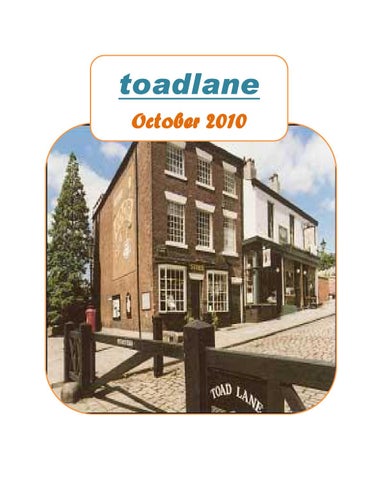
Hello fellow WCRI members! I’d like to begin by welcoming you all to the first issue of toadlane this fall! toadlane is a WCRI internal newsletter and it is written by the members for the members! This issue will a bit more ‘meaty’ than usual because it includes welcome words from our Division Managers. As you read on, you’ll also find many other interesting articles written by our very talented toadlane contributors! When you first picked up this issue, you might be puzzled by this strange looking building on the cover page, because it certainly does not look anything like WCRI buildings! This building, now known as the Toad Lane museum, is where the Co-operative Movement began in 1844 in Rochdale, England. The name of this particular publication toadlane, came from the name of the street on which the Weavers’ Arms Pub was located in Rochdale. If you ever get a chance to visit England, make sure to drop by the museum and learn a bit more about the history of the Cooperatives! As the editor of toadlane, I encourage you all to share this copy with your fellow WCRI members, as we do not print a hard copy for everyone. You can also view an electronic copy of this publication by logging into the member’s site through the WCRI home page. Finally, I’d like to remind you that your division managers have planned many social events for you this term! So keep an eye on the bulletin boards in your division for upcoming events and ask your DM how you can get involved!
I hope you all have a good term!
Helen Qu toadlane Editor toadlane@wcri.coop
toadlane October 2010
3
Hi Kershaw! My name is Robert Xia, and I will be the Division Manager for Kershaw this Fall. I am a 4B student currently studying Math/Accounting. During my spare time I enjoy a wide variety of sports such as badminton, basketball and tennis. I also enjoy exercising and many other athletic activities. This is my first time taking on the role as division manager. However, during my past stays at WCRI, I have actively participated in many of their social events. Those events have made my time at school more delightful. I am hoping to plan many events for all of you and make WCRI the most liveable community! Let’s all work and live together to have an awesome term at WCRI! I look forward to meeting you all. Please feel free to stop by at Kershaw 35 to have a chat!
Hi South! My name is Melvin Pong and I’m the South Division Manager. I just finished my 4A term studying chemical engineering and I’m currently working in Kitchener for my work term. This is my second term living in WCRI, but I’ll try my best to help you with whatever it is that you need!
toadlane October 2010
4
Hey Clayfielders! I’ll be your DM for the Fall term and I hope to make it a memorable one! Watch out for some awesome events, which you can keep on top of by finding me online: Clayfield DM on Facebook, clayfielddm on Twitter and dm.clayfield@gmail.com on Google. I’m currently a student at UW, working away at a degree in Computer Science with the Bioinformatics option. Outside of school, I love to do a variety of things such as yoga, reading, baking and rocking out at concerts. I’m up at Cl-46 so come around if you’d like to chat or just say “Hi”. If you have any questions or problems, feel free to email me at clayfielddm@wcri.coop. See you around! Anna Komarova
Hello Hammar ! My name is Dhara ! I am the Division Manager for Hammar this term. I finished my biotechnology specialization program in spring term and now I am here to work and also to take extra courses for medical school requirement. I live in S-12, so feel free to drop by my room. You can also email me at hammardm@wcri.coop This term is going to be a blast! So please come out to our social events!
Dhara
toadlane October 2010
5
Hello B-Division!!! My name is Jack Ma! This is my first time being a Division Manager for B-Division for the fall! I live in B3-04, you can find all my contact information from my DM posters! For those of you who don’t already know me, I’m a guy of simple taste, my hobbies involve posting event posters, mass emailing everybody, resolve member conflicts, and schedule management team meetings! With this been said, if you share similar hobbies as me, don't hesitate to contact me, you could have a talk! Sadly, I don’t always have the time for my hobbies. On weekends, if I had enough PI bucks, I would go buy myself a Bose sound-dock system, go to the B-div parking lot, lay on the bench near that volleyball court, put on some music, then stare at some moving white clouds and clear blue sky. I just enjoy nice summer breeze! Something to look forward to this term is lots of different social events try to meet your interests! Last but not least, let us do our best to keep B-Division safe, clean, quiet, and make B-Division the best division in WCRI to live in. Jack Ma
Hey North! Welcome to WCRI! I’m Jessie, the division manager for North. This is my fourth term living in North. So, come and find me if you have any questions! This is my favourite picture. It is a perfect illustration of how I would be most of the time. I have 8:30 classes this term and I am NOT a morning person. This shall be a fun term. I'm a 3A student in Math/Business program. Still deciding on majors; so far, I haven’t ruled anything out. Not good…not good… In my spear time, I like to read, cook, and spend time with friends. Just because I like to cook doesn’t mean I’m good at it. I like to experiment with weird combinations. For example, peanut butter and tomato is NOT a good combo. I would not recommend anyone to try it.
toadlane October 2010
6
Hello Carver! I'm the Carver DM for Fall 2010 term. This is going to be the first term staying in Carver for me!! Yes you are right first term as a Carver DM as well. I am a PhD student in the Department of Mechanical and Mechatronics Engineering at University of Waterloo. My duties as a DM will be to ensure overall safety and maintain proper quality of lifestyle in Carver. I will be planning some social events to help you people to socialize (whether you want it or not :P) with other people staying in our Division. I'm staying in CA-45. My contact information is available in the DM posters on the noticeboards of your blocks. In case of any question, problem please don't hesitate to get in touch with me.I will expect full enthusiasm and co-operation from all you Carvers so that we can say “Three Cheers for Carver... Hip hip hurray.. :)�. Have a nice FALL.. Cheers, Kaushik Saha CARVER DM
toadlane October 2010
7
Some Job Search Wisdom By Melvin Jobmining is a word familiar to many. Even those who aren't in co-op know about it through friends. Whether you love it or hate it, being able to write a good resume and having solid interview skills are things that you need to familiarize yourself with sometime in the future. Coop student or not, listen up, as I am about to pass on my wisdom to you all. But why should you listen to me? Well, I'm on my sixth and final work term right now, so I've got a lot of experience in changing up my resume to see what works best, and I've done tons of interviews. I've worked in Fortune Global 500 companies, in government, and I've worked in Europe. I'd say my resume is quite a handsome one. Resume Tips: 1. Use active words. Yes, you hear this all the time, but it's very important. Pick active words that emphasize certain qualities about you. a) Participated in a team to organize fundraising activities, collecting over $5000 in donations b) Organized fundraising activities and collected over $5000 in donations c) Led a team of student volunteers to organize fundraising activities, resulting in over $5000 in donations The first one is very passive, although it clearly states what you did. The second one is better as it uses an active word. However, the last one screams "leader" to the person reading your resume. Leadership is a universal skill that everyone looks for. 2. Structure your bullets in the following way: what you did, how you did it, and what you were able to accomplish. That way, you are clear about what contributions you've made in your work experiences, and what the employer can expect you to accomplish if they decide to hire you. 1c is an example of that. 3. KISS. I'm sure you've seen your friends with resumes that are 2 pages long. I've seen one that was 3 pages long! If your experiences are truly that outstanding and deserve that much space, by all means go ahead. However, most of us have limited experiences, so I don't know how some people can have such detailed resumes. Don't list every single thing you've ever done in your life. Instead, focus on what's relevant. I don't have any high school stuff on my resume, and I dropped all work experiences prior to 2007 and extracurricular prior to 2008 just because these are outdated. Personally, I'd keep my resume to 1 page and list only education, work experience, and extracurricular activities. If you'd like, you can have a summary of qualifications too. This is just my personal opinion, so if you like the ideas, make use of it. If you don't agree with me, then you can just ignore what I said above. Happy Jobmining guys! toadlane October 2010
8
The Rights and Wrongs in Our Moral Obligations By Helen I once read a true story about a philosophy student who wrote a research paper arguing that all moral obligations are relative, and there are no absolute standards of justice or rightness, because it is all a matter of opinion. Judging by any standards, it was easily an “A” paper. The professor however, read the paper and gave the student a fail, because he did not like the blue paper covers. When the student received his grades and his comments, he went back to the office and yelled “This is not justice! This is not fair! I should not be judged on the cover of my paper! The professor then asked him whether he was talking about the paper that said how the world have no fairness, righteous and justice, and then student replied ‘Yes’. The professor then responded “well, I do not like the blue report cover, therefore it will remain a fail”. The student then suddenly understood that he himself did not truly believe in subjective moral obligations such as justice and fairness, but was expecting it to be applied to his paper.
Is morality objective or subjective? Most of us, like the philosophy student, will probably believe that moral obligations are subjective, because whether something is right or wrong (such as abortion, capital punishment etc) will largely depends on people’s personal opinion on certain things. Subjective moral obligation means that our moral judgements are purely based on things like personal taste and preferences, and nothing more, and two conflicting statements can both be correct. For example, one person can claim that coke is better than pepsi, while the other person claim otherwise. The same goes for bigger issues such as cheating on exams, where two contradictory opinions on cheating can both be correct. If our moral obligations are strictly subjective (or relative), then there will be no right or wrong actions. This belief works well on opinions about pepsi or coke, or even maybe cheating on exams. The problem arises however, when it is applied
to bigger issues such as murder, rape or child abuse. Objective morality on the other hand, is where we say the truth of moral judgements does not depend upon personal tastes, opinions, or beliefs of an individual or group. For example, we say 1 + 1 = 2 is objective truth, and it is independent of anyone’s opinion. When it comes to objective moral judgement, if we say killing innocent babies is wrong, then we imply that it is objectively wrong. Although people can easily claim that moral principles are relative from person to person, it is very difficult to apply it to real life.
Now the question comes down to whether there exists (if at all) any objective moral principles that are obligatory in nature and binding on all people. As I mentioned earlier, toadlane October 2010
9
most people will probably think that ethics are subjective and it is influenced by culture, especially on things such as pre-marital sex and abortion. I found however, that although people can easily claim that moral principles are relative from person to person, it is very difficult to apply it to real life. For instance, we think robbery is wrong because when someone robs us, we feel hurt. But if this moral principle is truly subjective, then it is entirely possible for the thief to say that stealing is an acceptable behaviour, therefore it is perfectly OK for him to do. You can therefore see that subjective moral obligations are hard to apply to real life situations. Another example where subjective morality doesn’t work out is to imagine an island of 100 people, where 50 people believe that killing is wrong and 50 believe that killing is acceptable, and they cannot reach a consensus on what to write on the law book. Say over night, the 50 people who believe killing is acceptable kills one member from the other group, and the next day, the new result from the vote is 50 pro killing and 49 against killing, and the law of killing is passed. Most of us will obviously agree with me that this is not the way it should work. What if we let this hypothetical scenario run further and let the 49 anti-killing people to kill two members of the pro-killing group the next day so that the new result would have anti-killing as a majority? You will probably agree with me that this will also not work because how can the anti-killing group murder in the first place.
I’m not trying to claim that all moral obligations are objective, but rather trying to explain that even though at the surface all moral principles seem subjective, there are situations where only objective moral obligations would be able to explain. Now, having acknowledged that objective moral principles do exist (hopefully you now agree), then the natural question we now asks ourselves is where do these principles come from? What makes them objective and binding especially on those who disagree? At this point, some people would have the intuition that if God exists, then it follows that it is God who created these universal standards such that we have a binding intuition on what is right or wrong. The rationale is that if the universe is created without purpose and is indifferent, then how did this standard set of moral obligations come from a purely materialistic universe?
Where do moral principles come from? Self-interest I have to agree that it is very intuitive at first to say that self-interest and survival could be the foundation of objective morality. I do good things to others so that others can do the same to me. After all, we learned from ‘love your neighbour as yourself’ that this is probably a good way for us to survive without each other over time. However, if this is truly the foundation, then how can toadlane October 2010
10
we explain noble things such as selfsacrifice, came as a result of self-interest? For example, consider the case when a mother dies to save her son. From an atheistic point of view, there is no good net benefit from saving one life and sacrifice yourself, and how can a self-interest point of view explain why would anyone die to save another person’s life? Social contracts and societal benefits Another suggestion is that the foundation of our objective moral principles comes from the social welfare and benefits of our society as a whole. Objective moral obligations are simply societal contracts that are agreed to help our society grow as a whole. The contracts originally came from our ancestors, and they have been modified to maximize total societal benefits. However problems arise when the sick and old people drag our social production down. If our social contract is truly to maximize the welfare of our society as a whole, then why not simply condemn anyone who is unable to contribute to societal benefits? And yet, deep down in our hearts, we know that there exist some absolute moral obligations which are preventing us from taking such actions. Another problem with this theory is that when the contract is broken, there’s usually a deep moral revulsion in us that tells us that there might be something else above
and beyond those contracts. For instance, when a person kidnaps and tortures your child, you do not treat this the same way as if some job offer contract have been violated. There’s always something deep down inside telling us that something scandalous and outrageously immoral has taken place. The human knowledge of what is good or evil is a combination of what God has put in our psyche, and it is enhanced consistently with the basic laws of logic and inference. Most of the people probably cannot deny the wrongness in the actions I mentioned above, but struggles to see the idea that God is the necessary foundation of those objective moralities. If God exists, then he adequately supplies the foundation for objective moral obligations. God’s holy nature is what we ultimately define as good. The human knowledge of what is good or evil is a combination of what God has put in our psyche, and it is enhanced consistently with the basic laws of logic and inference. To hurt someone is inconsistent with God’s nature, therefore it is not good. God created us with goodness, love, purpose, and the ability to relate back to Him. Therefore it is wrong to harm, and good to do whatever’s consistent with our moral values (which came from God’s nature), to promote the growth and survival of human beings.
Source: Is there any real right of wrong? Campus for Christ May 2004
toadlane October 2010
11
The Extraordinary Uses of Toothpaste! By Amy Ruan
We have done it so often that it has become an integral part of our life. Rarely do people pay a second thought to brushing their teeth with toothbrush and toothpaste. As university students, we constantly try to squeeze out time and money. The answer to some of our troubles may lie in a tube of toothpaste. Thus, I would like to investigate the extraordinary uses of toothpaste its various cleaning functions, anti-fogging properties, and some amazing skin care tips.
To begin with, we all know that toothpaste has whitening properties. But have you thought about using toothpaste to remove stains from clothing? As bizarre as it may sound, non-gel toothpaste can be used to removing ink, lipstick, and sweat stains from shirts. Results vary upon the fabric, but give it a try before disposing your shirt to the garbage bin. I personally prefer using toothpaste to remove stains near the collar of a white blouse. To do so, squeeze some non-gel toothpaste on the stain and rub the fabric vigorously together and rinse off with water. Repeat the process until the stain is removed. The same applies for removing ink and lipstick. Now you’ll never fear wearing a white dress shirt again so you can “Go ahead, get dirty.” Non-gel toothpaste is also an excellent way to remove scuffs from shoes! It works best on leather, but you can give it a shot on canvas, vinyl or cotton. Simply rub a bit of toothpaste onto the scuffed area with a soft cloth, I recommend trying on a small area first, and wipe clean with a damp cloth. Shining your bathroom chrome and sink with toothpaste is possible when you don’t have any cleaning products handy. Just smear some on the faucet and in the sink, then scrub and rinse. As a bonus, the toothpaste will kill any odour originating from the sink.
After cleaning the bathroom sink, the mirror might need some attention. Toothpaste is not only great for cleaning, it can also act as a shield against the fogging up of surfaces particularly mirrors. I’m sure all of us have encountered seeing a layer of fog creeping along our mirror after a nice shower. It always bothers me to have to wipe off the fog when I need the mirror. In the future, when you think this fog will become bothersome, just coat your mirror with nongel toothpaste, wipe off with a cloth before stepping into the shower. Upon completion, the mirror will not fog up. The same thing applies for goggles. There is nothing more frustrating or dangerous than having your sight clouded by fog during scuba diving, skiing, or performing lab experiments. toadlane October 2010
12
In addition to having whitening and anti-fog properties, toothpaste may act as a lifesaver in certain circumstances. That’s right; toothpaste may be used for skin care. One of my worst nightmares is waking up one morning to a monstrous red bump in the middle of my forehead. It draws massive attention regardless of how much I try to disguise it. If this also sounds familiar to you, fear not! There is a quick and affordable solution to treating that pimple! Before going to bed, apply a little non-gel, non-whitening toothpaste on the hideous spot. The toothpaste works by dehydrating and absorbing the oil in the pimple. When you wake up the next morning, be ready to say goodbye to your friend! Of course, you must keep in mind that the results may vary, as is always the case with other commercialized skin care products. Toothpaste also acts as a cooling agent for minor closed-wound burns, such as touching a very hot surface. Simply apply to injured area and the mint in toothpaste will sooth the pain until further medication can be applied. Caution: this home cure is not intended to use on openwounds or severe burns, as it will cause infection.
So the next time you walk down the dental care aisle, pick up a tube of non-gel toothpaste; you never know when it’ll come in handy!
toadlane October 2010
13
Why I Became a Christian By Sharon from UW Mandarin CCF
Before I became a Christian, I was a culturally-formed semi Buddhist who always went to those Buddhist temples and superstitiously worshiped these gods in Taiwan. I also believed in karma and was very scared of death, spirit, and perhaps ghosts. I did not feel any peace; my mind was filled with evil ideas and was very cynical. After I came to Canada as a teen (not with my parents), I became even more cynical as I faced many cultural barriers and language challenges. Life became tough moving to a new environment with crappy English… with a different cultural background than my fellow students… I began to lose my self-confidents and started to feel really lonely. I felt I was on my own; no one was there to help me. As time passed by (long story), my parents became Christian in Taiwan; my mom came to Canada and wanted me to go to church with her. My mom told me that I could make some friends there (perhaps some Mandarin speaking friends), so I thought I might give it a try. People there at youth group were very open and nice, and I slowly learned about what the Bible says. “If You are real God… then heal my dog. If You heal him… then I will believe you”.
Shortly after I started to go to church, my dog (a yellow lab) had some knee injury; he couldn’t walk and was crawling painfully on the ground. At that desperate time, I started my first prayer to God. I prayed to God saying “If You are real God… then heal my dog. If You heal him… then I will believe you”. Guess what? Then my dog did recover after all. But at that time I thought “it must have been the medicine. I gave him the medication, so of course he will heal!” So I thought it was just a coincidence that “God answered my prayer”. Then… another time when I had a very severe stomach ulcer. After taking my medication, I was still in so painful that I had to curl up like a centipede on the bed. I prayed to God again asking him to remove my stomach-ache. I still clearly remember now: right before the moment I fell asleep, I felt no pain at all. Guess what I thought at that time? I thought… “hmm, I didn’t feel any pain was because I fell asleep! Not because God removed my pain”. But the Lord did not give up doing work in me. He slowly invited me and accepted who I was. He changed me. I became more outgoing, more positive, and had joy in me. I began to feel peaceful in my heart. I could take a shower without sporadically open my eyes and worry about toadlane October 2010
14
whether there might be ghost in the shower. Things around me became smooth and I did well at school. I started to believe that Jesus died for us and we are saved by His grace. I knew that God loves me but I also knew that I didn’t love really love God as much. I just held that thought in my mind, until a year later when I had a chance to go to a Christian conference at Toronto called the “Teen Conference”. That was the first time I saw so many young people who were so passionate about God and I saw their overflowing joy God has given them. Then during worship we sang a song by Hillsong (a contemporary Christian band) called “Came to my rescue”. It says: I called you answered And you came to my rescue and I I wanna be where you are At that time, I really wanted to be like them. To be loved by someone who will give me
unconditional love. To be filled with joy from within. I wanted to be a child of God. So there I was, accepting Jesus as my Lord and Saviour. After all these years, I had a lot of “coincident” and “lucky things”. But now when I recall, it was God who protected me from harm. Nevertheless, I think the biggest difference of me becoming a Christian is that: When I didn’t believe in God, I was walking on my own; the road called “life” seemed dark and I had to no choice but rely on my own strength. But after believing in God, there is a lamp to my feet and a light for my path, leading me as I go. It’s my testimony of how I became a Christian.
toadlane October 2010
15
Sketchers shape up shoes. Does it work? By Elizabeth Gong For those of you who don’t know what this shoe does, this shoe is supposed to tone your legs, butt, and increase your metabolism (meaning to make you lose weight). The commercial for this shoe was everywhere on TV. this summer and also on a lot of magazines. When I saw it, I was very interested how this shoe works and if it actually does. To be honest, I thought this shoe was very expensive, so at first I was not going to buy them. But when I tried it on, I loved them! They are definitely the most comfortable shoes I have ever tried on. It literately felt like walking on clouds, the soles of the shoe feels like an air bag, and if you stand beside a mirror and you move your feet up and down against the floor, you will notice that the bottom of the shoe contracts inward and outward as you move. Very comfortable! So I bought a pair, it cost around $135 including tax at Sportchek (some pairs are more expensive than others). For the shape ups, they have different kinds and different colour, some of them are for metabolism, some are suppose to increase effectiveness for workouts and many more. In terms of its effectiveness compared to what the manufacturer promises, I have not noticed my butt or legs get skinner, but I did notice that when I wear these shoes I walk to class a lot faster, because the bottom of the shoe is curved, so when you are standing still, there is no points for you to land you feet flat on the ground. When you are walking, it pushes you off very well. I also noticed that if I wear these shoes and walk to a certain destination that I usually walk to with normal shoes, I sweat more. But I have not noticed any decrease in weight. These shoes do take some getting used to though. At first wearing them felt a little weird, but not as weird when walking. The weird part is when you are standing still, there is no flat surface for you to settle your feet on as these shoes are curved on the bottom. The shoes came with an instruction manual on how to wear and get used to them the first time, and also a DVD. The manual states that this shoe mimics walking bare feet on sand, which allows you to use muscles that are not normally used in regular-shoe walking. These shoes are also available for men, but mostly it is women who are wearing them. For the ladies, these shoes cushion quite nicely, so when I walk, they absorb shock to make it easier on my hips. So in conclusion, although these shoes were very expensive, but I still thought it was well worth the money. By the way, did I mention that these shoes make you instantly two inches taller? toadlane October 2010
16
By: Amy Ruan This is my second year of living at WCRI South Division and I have to admit that I’ve been quite ignorant of the courtyard between the North and South division. Maybe you have been as well. But this term, thanks to the amazing folks living on my floor, I came to appreciate the following about WCRI’s courtyard: Apples Trees! I just discovered that there are TWO apple trees in the courtyard - golden delicious and McIntosh apple trees (but I could be wrong since I’m not an apple expert). By the time you read this, the apples may have all fallen from the trees…maybe next fall you can be the first to taste those apples! Green Onions! Yup, there are green onions in the courtyard near where the great statue is (not sure what the statue is supposed to represent…). So if you are in dire need of some green onions for your stir fry or omelette, just pick up a pair of scissors and help yourself to some fresh greens! Barbecue Grills! These are supplied by WCRI and free to all WCRI members. So go ahead and flip some burgers! Trees! This may sound kind of strange, but the courtyard has a variety of trees which offers great shade in the summer and a cool place to study. Benches! If you ever want to go moon/star-gazing, these benches provide great support for your back! Ashtrays…These are designated smoking areas. So remember to smoke 10 meters away from all WCRI buildings or you will be FINED!!! So the next time you take a walk around WCRI, keep your eyes open and you’ll be amazed by what you’ll find! (Rumour has it that there are tomatoes planted on WCRI premise!)
toadlane October 2010
17
Workload, How Much Is Too Much? Macroeconomics in a microscopic view By the.username.is.taken
As university students, one thing we inevitably face every semester is choosing our workload. Although we want to have fun and enjoy our lives in university, we often fall into the trap of having an overwhelming schedule. A major study conducted by the American College Health Association (ACHA) in 2004 revealed that 94% of university students report that considering everything they have to do, they feel overwhelmed, overworked, and overstressed. If you experience stress from time to time, clearly, you are not alone. Being at one of the most prestigious universities in Canada, we are surrounded by talented individuals. Anyone you pick from a random crowd could be a triple major who not only takes 7 courses per term (with one or two being “advanced”), but also sits on the board of 10 student clubs. It seems almost as if we will be looked down upon if we don’t push ourselves beyond what is physically (as well as mentally) possible. Consequently we decide to have the fullest schedule possible, take the hardest courses possible, and getting involved as much as possible. However, the path is paved with hidden dangers. We often overlook the importance of our dearest friend, stress. Let me digress a little and talk about something else: macroeconomics. If you have taken a first year macroeconomics class before, you should know that in the
classical range of an aggregate supply curve, the slope of the curve increases exponentially. In layman’s terms, it means that after a society reaches full employment, the more you want to produce, the higher the price of the produced item will have to be. The idea is actually very intuitive. When everyone is working hard (full employment), and you still want more to be produced, what do you do? You whip them? Of course you don’t. We are in a capitalist country. You offer them a monetary incentive to work overtime, which causes the price of the product to increase. When the price goes up by too much, we observe an interesting phenomenon called inflation (for those who don’t know, inflation simply means a decrease in purchasing power led by an increase in the general level of prices). I guess you can see where I am going with this. When the above theory is applied at a micro level (i.e. an individual), a society’s output is equivalent to our workload, full employment is equivalent to a full schedule, and inflation is equivalent to stress. When we push ourselves beyond our capabilities, we build up our stress, which may ultimately result in burnout. I assure you it’s not something you would want to experience if you haven’t. To save ourselves, let’s take a scrutiny at the forementioned full employment. In economics, full employment does not necessarily mean every single person in the toadlane October 2010
18
society is working. There is a general allowance of 2-6% of unemployment depending on the country or circumstance. For example, Canada is said to be at full employment when the unemployment rate is less than 6%. One reason is that there will always be people who need to take a few months off to look for a better job (aka frictional unemployment). Similarly, even if we want to be productive, we probably don’t want to have a schedule that’s filled with activities during every waking moment. Therefore, the first step to stay away from a burnout is to set aside some buffer time from our hectic schedule. Nonetheless, this is not the end of the story. Let’s talk about leisure. I will not go into all the technical details of labour economics. Instead, I will use a real-world example to illustrate how reducing one’s workload may be extremely beneficial. The famous American industrialist Henry Ford announced a revolutionary program in 1926, reducing 6-day workweeks to 5 days, without changing the wage (i.e. the workers would only need to work 5 days per week,
but would get 6 days’ pay. In case you didn’t know, workers were required to work 6 days a week). His philosophy was that by cutting workdays, workers would be more energetic and motivated, thus be more efficient during their workdays. Since the equipment was expensive, this yields a higher overall return, which benefits both parties. Comparatively, when we set aside a fixed amount of time for leisure, we will be forced to cut off the less important activities. As a result, not only we will be more efficient and focused when doing the important ones, but we will also have time to relax ourselves, enjoy university life, and get recharged for the following week. This way, we can be productive without being stressed-out. To achieve anything worthwhile in the long run, we need to first maintain a sustainable workload. That is, to strike a balance between leisure and work. If you are constantly under stress, maybe it is time to remove a few items from your overwhelming schedule so you can enjoy your hard-earned happiness and freedom.
toadlane October 2010
19
Inspired by this issue of toadlane and have something to say? Want to see your article published in the next issue? Send your email entries to toadlane@wcri.coop
toadlane October 2010
20