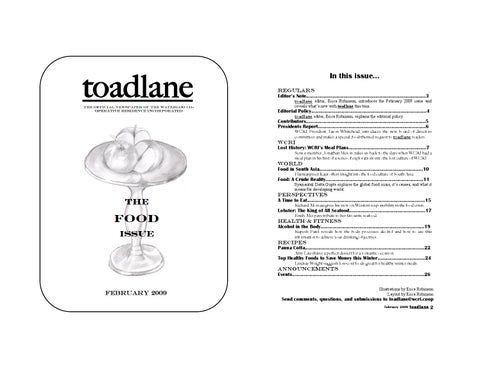
In this issue… REGULARS Editor’s Note………………………………………………………………….…….3 toadlane editor, Erica Robinson, introduces the February 2009 issue and reveals what’s new with toadlane this term.
Editorial Policy……………………………………………………………….…….4 toadlane editor, Erica Robinson, explains the editorial policy.
Contributors………………………………………………………………….…….5 Presidents Report....………..……………………………………………..…….6 WCRI President, Jason Whitehead, introduces the new board of directors committees and makes a special, food-themed request to toadlane readers.
WCRI Lost History: WCRI’s Meal Plans.……………………………………….…….7
Senior member, Jonathan Jileson, takes us back to the days when WCRI had a meal plan in his first of a series of explorations into the lost culture of WCRI .
WORLD Food in South Asia……….…………………………………………….…….…10 Harmanpreet Kaur offers insight into the food culture of South Asia.
Food: A Crude Reality..…………………………………………………….…..11 Syamantak Datta Gupta explores the global food crisis, it’s causes, and what it means for developing world.
PERspectives A Time to Eat…………………………..…………………..……………………...15 Richard Moreau gives his view on Western responsibility in the food crisis.
Lobster: The King of All Seafood...…………………..……………………...17 Emily Mei pays tribute to her favourite seafood.
Health & FITNESS Alcohol in the Body……………………………………………………….….….19 Rupesh Patel reveals how the body processes alcohol and how to use this information to achieve your drinking objectives.
Recipes Panna Cotta……………………………………………….……….…….…….....22 Amy Lau shares a perfect dessert for a romantic occasion.
Top Healthy Foods to Save Money this Winter…..……….…….…….....24 Lindsay Wright suggests low-cost foods great for healthy winter meals.
Announcements Events……………….……………………………………….……….………….....26 Illustrations by Erica Robinson Layout by Erica Robinson
Send comments, questions, and submissions to toadlane@wcri.coop February 2009
toadlane 2
Editorial Policy Note from the Editor Welcome to the February 2009 issue of toadlane! This month we’re talking about food. From the physical work of digestion (p 19) to the symbolic significance of food in courtship (pp 17, 22) to the political obligations created by discrepancies in food accessibility (pp 11, 15), each article touches upon why and how food affects us. Many of the articles evoke the powerful sense that food is fundamental to our lives, not just as physical sustenance, but also as an important part of our social interactions and cultural identities. Sharing food is an act imbued with social significance. To share food binds communities together, as Jonathan dramatizes in his description of the community spirit created by common meal times with the former WCRI meal plans (p 7). In this sense, food is a perfect theme for toadlane. toadlane is our newspaper. It is a place for members to come together to exchange and share ideas – as people so often do over food. I hope you enjoy reading the articles in this issue and please feel free to submit responses to the authors who have listed their contact information with their articles or to toadlane@wcri.coop as letters to the editor. In the sprit of cooperation, Erica Robinson
February 2009
toadlane 3
toadlane is a free publication produced by the members of WCRI for the members. It is place for us to express our ideas, interests, and creativity. All members are welcome to submit to toadlane. You can write about any subject of interest to you. We particularly encourage you to send in photos or illustrations with your article. Illustrations may also be added in the editorial process. You may publish under your real name, anonymously or else under an alias. Whichever way your name is to appear in the issue, please include your real name with your submission. Articles will be edited for spelling, grammar, clarity, and sometimes length. Submissions must be original work and must not be offensive in nature. This is not to say, however, that you cannot raise issues that might provoke debate. As editor, I encourage submissions that will engage members in dialogue. My role as editor is to ensure that the tone of toadlane is, without exception, characterized by understanding and respect. The opinions expressed in toadlane are those of the individual authors and do not necessarily reflect the views of WCRI or the toadlane staff. To submit to toadlane, email articles, recipes, games, essays, p oems, a nnouncem ents, riddles, stories, comics, etc. to toadlane@w cri.coop
February 2009
toadlane 4
Contributors EMILY MEI Emily Mei is a 4B Environment and Business student at the University of Waterloo. She has lived at WCRI for five terms. Aside from writing, her hobbies include playing Wii, Youtube, watching Gossip Girl, and taking long afternoon naps. RICHARD MOREAU Richard Moreau is a first year Honours Arts student at the University of Waterloo. He lives in WCRI building A2 and enjoys sports, politics, technology, good reads, and video games. He grew up in St. Catharines, Ontario and spent the majority of high school rowing. You can often hear him strumming out some mean tunes on his guitar as you walk by his window at night. RUPESH PATEL Rupesh (“Pesh”) has been writing for toadlane since Fall 2007. His articles have typically focused on Health and Fitness, which allows him to share his expertise and experience gathered as a Waterloo Kinesiology graduate (BSc), and presently as an MSc Kinesiology student and the StrengthConditioning Coach for the Men’s Basketball Team. Rupesh is proud to live at WCRI and has been a member since 2006. His hobbies include sports, fitness training, watching movies and reading up on daily politics. Feel free to contact him for suggestions on articles or questions that need to be answered regarding health and fitness at r24patel@uwaterloo.ca. ERICA ROBINSON This is Erica’s second term at WCRI and her second term as t oadlane‘s editor. Having just graduated from her master’s at the University of Guelph, she is currently working as a writer and public performance consultant. She enjoys reading, yoga, and collaborating with other people on exciting projects. You can contact her at toadlane@wcri.com
February 2009
toadlane 5
President’s Report This term, the board is in the pro cess of creating three committees: the alumni committee, the IDC committee, and the redevelopment committee. Each group is charged with a specific task to improve one aspect of the co-operative. The alumni committee wants to help foster the co-operative spirit by reaching out to past and present members in the form of a large summer celebration. The IDC committee is looking at ways to improve member participation within the co-op. And the redevelopment committee is investigating how to rebuild the 280 Phillip St. property. With this being the “Food” issue of toadlane, I want the members of WCRI to form an unofficial fourth committee: the food committee. I want to know if the cooperative should provide food services. If yes, how would this service operate? And what foods or beverages should be offered? Please email me any ideas that you have at president@wcri.coop and I will share your ideas with the board. Your ideas will help shape the co-operative’s opinion on food services for the next fiscal year. Co-operatively yours, Jason Whitehead February 2009
toadlane 6
……..……………….…………………………..……….……WCRI would like to discuss the affect of these changes.
Meal plans
Lost History Part I: WCRI’s Meal Plans by Jonat han Jiles on
Have you ever been walk ing around the co-op and noticed something strange (for example stairs that go nowhere)? Or seen a photo or piece of artwork and wondered where it came from? In some ways the coop is like an archaeological site. Even though the history of the co-op is only 46 years long in some ways it is like it is 720 years old and, as a result, much history has been lost. Why 720 years old? If you consider that the average co-op life span of a member is less than 5 years then there have been more
than 9 ‘generations’ of members. Most people, once they have left the co-op, do not return and, although there are some written records, much of the cultural history of the co-op is not passed on. As the member with the most seniority of any member currently living at WCRI, I feel the need to pass on some of my experiences. The coop has changed a lot since I first became a member both in the services that are provided and culturally. The major changes were the loss of frosh week, the loss of Weaver’s and the end of the meal plans. Throughout this term I February 2009
toadlane 7
Since this issue of Toadlane has a food theme, I will start by talking about the meal plan. When I first came to WCRI there were three meal plan divisions: North, South and Hammer. There was also a significant amount of staff support, with cooks for each division, and a food services coordinator. The meals were served three times a day in cafeterias. The remnants of these can still be seen in North and South. The major benefit of the meal plans in my opinion was the social aspect. Having fixed times and locations for eating resulted in a large number of members gathering at the same time. This created a great social environment where I met many of my best friends. The other great thing about having a meal plan was the end of term parties. When there was a cafeteria in the residence divisions the cooks prepared an extra special meal on the evening of the end of term. This usually involved steak and lots of fancy desserts. A range of foods was offered in the cafeterias. My favourite
The remnants of the abandoned cafeterias can still be seen in North and South. meals were taco salad, mini pizzas, meat pies and build your own sandwich. There was also a great salad bar and I ate more vegetables at that time then I had before I lived at the co-op. On the other hand, some meals were very unhealthy and super greasy (burgers and fries, Canadian Chinese food). In order to meet the nutritional meal requirements with these greasy meals, the cooks would do things like fry vegetables, or include vegetables in the rice. The quality of the food seemed to degrade over the years. This may have been due to the way that the repertoire of the cooks were stretched too much as attempts were made to diversify the food selection in response to the changing demographic of the coop. Near the end of the life of the meal plans, much food was wasted and many members felt that their needs were not being met. This resulted in the meal plan actually detracting from living in residence. With the occupancy in the residences dropping the board resDecember 2008
toadlane 8
ponded by closing first one cafeteria and then finally all of the cafeterias.
Life After the Meal Plans Closing the cafeterias saved the co-op money and occupancy in the residence divisions increased. However, something of the spirit of the coop was lost. Members no longer had a reason to gather at an assigned time and place. This meant that interaction within the co-op decreased and the community atmosphere suffered. Many active members within the co-op felt this loss. When I joined the board a year ago one of my goals was to try and reintroduce some kind of food service to the co-op. I wanted to bring back the social aspect. After joining the board and entering into discussion, I came to realize that there are many obstacles to be overcome before we can offer such a service. First there is the issue of how to economically meet the food needs of the diverse ethnicities of the coop. After some research, this obstacle led me to abandon the idea of bringing back the meal plan. My next idea was to rent out part of WCRI to restaurants (kind
…………………….…………………………..………WORLD
The board still recognizes the need for some kind of food service. of like on campus) and have them offer discounts to co-op members. This plan does not work, however, because it would require rezoning of the property in a way that would never pass because of the objections of nearby restaurants. Currently, the board still recognizes the need for some kind of food service and we are pursuing ideas such as having a member run C&D in Weavers, or opening a members-only coffee shop. While the member-run C&D is the easiest to implement, it requires responsible members to volunteer their time. Please feel free to contact myself or one of the other board members if you have ideas which would help us to overcome the difficulties mentioned and provide some kind of food services to the membership. ! Please contact Jonathan Jilesen at jjilesen@uwaterloo.ca.
December 2008
toadlane 9
Food in South Asia By Harmanpreet Ka ur
Food is a definitiv e as pect of every culture’s values and beliefs. This is showcased in the traditions that have been around for centuries. Traditional recipes are handed down from generation to generation unchanged. Specifically, food to South Asians is more than something that we require to live and function properly. It is a celebration of our land and culture. Our dishes are treats and are intertwined with our traditions and culture. Our festivals celebrate the first harvest and the first plantations. For example, the festival of Baisaki is celebrated at the time of the first harvest. Rice and wheat are the primary staple crops but each region in South Asia has its own special recipes and is known for its own delicacies. Even within the same country, different regions have dishes that they are known by and people from other regions visit these regions to enjoy and savor the meals. For example, a place called Hyderabad in India is known to produce the best biryani (rice with pieces of
Each region in South Asia is known for its own delicacies. chicken) in the world. It is so famous that it goes by the name of Hyderabadi biryani. Tourists and locals from India alike visit Hyderabad to have a taste of this delicacy. Another example is soan halwa (a dessert), which New Delhi is known for. South Asians have what we call a sweet tooth and are very fond of sweet dishes. Dessert is very common after every meal of a day and a multitude of recipes exist. Amongst these is the halwa, which is the most common sweet dish and one every South Asian is familiar with. Similarly other regions of India, Pakistan, Bangladesh and Sri Lanka are known for their dishes that have been around for centuries and have been passed down one generation after another. !
December 2008
toadlane 10
……………………………………………………………. WORLD
strations have been witnessed in dozens of countries, especially in Asia, Africa and South America. Clouds of a global food crisis first started to emerge in 2006, in the form of unreasonable price hikes, and have been accumulating ever since at a steady rate. These hikes have been particularly pronounced in the case of
In a society heavily reliant on technology, machines have priority over human beings Food: A Crude Reality by Syamantak Datta Gupta
Som e tim e in the middle of last year, when most people in North America were keenly following the run-up to the US Presidential Election, a disturbing news came up on international media [1]. In the Caribbean Republic of Haiti, people were eating mud-cakes in lieu of food. In dusty courtyards, the report said, women were moulding clay and water into hundreds of little platters and drying them under the hot tropical sun; until they were ready, not to be
used for holding food but to be eaten as food. With food prices soaring up, dirt, thus had become the staple diet for a population. Reports like this one, though not all so appalling, have kept on appearing from different parts of the developing world throughout last year. Food riots and angry demon-
In Haiti, people were eating mud-cakes December 2008
toadlane 11
major staple foods. Between the start of 2006 and 2008, for instance, the average world price for rice rose by 217%, wheat by 136%, maize by 125% and soybeans by 107% [2]. What’s more, these prices are predicted to go even higher in days to come. A rise in food prices has an immediate impact on the poor, which means, given the fact that about 3 billion people live off less than $2 a day, there are many who are affected by such a hike. There are many factors that have contributed to the present situation. The population of the world has been increasing at a rate higher than ever before. Thanks to advances in medical sciences, life expectancies have increased significantly over the years.
However, the exponential rise in population has not been met by a similar rise in yield of crop. Farmlands are being steadily lost due to rapid urbanisation and soil erosion. Weather hazards related to global climate changes, such as extended droughts in Australia (that affected the production of rice and wheat in Australia), Cyclone Nargis in Burma (that inundated huge areas of rice paddies), Heat waves in California (that killed many farm animals in 2006) and unseasonable rains in Southern India (that destroyed piles of grain in 2008) have also lead to a reduction in the availablity of food-crops. And if these were not enough, several man-made factors have further escalated the crisis. With natural sources of fuel such as coal and oil depleting steadily, non-perishable alternatives ranging from solar panels to ocean current were being sought after for quite some time. In recent years, a very strange option has been identified for this purpose: food. It has been argued that certain crops such as maize, sugar cane or vegetable oil can be used either to feed people or to feed machines. In a society heavily reliant on technology, machines of course have priority over human beings. Hence the production and use of “biofuels” have gained good popularity. Food crops have been used extensively to create first generation biofuels. December 2008
toadlane 12
Government subsidies in the United States have encouraged many farmers to switch to production for biofuel from food crops. Since 2006, a lot of land previously used to cultivate other crops in the United States have been reallocated to grow maize for biofuels, and a huge proportion of the overall yield of maize is being used for ethanol production, reaching 25% in 2007, and 38% in 2008 [3]. This data is alarming once we consider the fact that the amount of biofuel that fills up the tank of an average car requires approximately the same amount of maize that is consumed by a man in Africa (maize is the major staple food in Africa) in one year [4]. Growing use of biofuels have lead to spikes in maize prices; which in turn have sparked surges in the price of wheat, rice, soya and vegetable oils in a chain reaction. According to a World Bank Report [5], biofuels contributed to about ! of the recent food price rises; while the rest is chiefly attributed to higher oil prices. International policies, too, have unfavourably affected the situation. International banking organizations have been consistently pushing developing countries to reduce subsidies on local commodities and fertilizers as a precondition for providing aid. As a result, surplus food from developed countries have been exported and made available at cheap
rates in African countries, but this has affected local business and productivity. Nations that had once been selfsufficient in their food production have to now rely chiefly on imports. Strange rules that govern global trade have not helped improve the situation either. Japan, for instance, is forced to import more than 767,000 tons of rice annually from other countries due to WTO rules; even though it is itself capable of producing more than its domestic rice requirements [6]. Food shortage and famines are nothing new, they have happened repeatedly in different parts of the world, and many of them have been caused by man. What’s unique about the ongoing crisis, however, is its global nature. In an open economy, regional markets are strongly
An average tankful of biofuel requires the same amount of maize consumed by a man in Africa in one year. correlated to each other and thus are greatly affected by changes elsewhere. It’s the same old story of unequal shares between the haves and havenots. But this time it’s on a much December 2008
toadlane 13
bigger spatial scale, and can have farreaching consequences if not taken care of at a preliminary stage. One immediate step would be to put an embargo on the production of biofuels. Someone’s yearly supply of staple diet is perhaps, of slightly more consequence than the fuel that fills up the tank of a standard car, even though they come from the same amount of maize. Changes are going to be implemented and, hopefully, the food crisis will gradually end. Its existence for the time being, however, has forced us to face a disturbing truth. The truth that the gaps between societies are widening at an alarming rate and that poverty is still at large. The present era is witnessing development and growth of technology and industry at astounding rates in virtually all fields of human experience, and yet, we haven’t been able to find a way to ensure food for all. Food, after all, is one of the basic needs of man, and when we see that basic need unfulfilled in the lives of millions; when we see people skipping meals not because they are on a diet, but because they have no choice; and when we see people biting dust cakes to quench their hunger, it makes us wonder whether our civilization is on the right track. !
More information at: 2007–2008 world food price crisis http://en.wikipedia.org/wiki/2007%E2%80% 932008_world_food_price_crisis References 1. Haiti : M ud cakes be come sta ple d iet as c ost of food s oar s be yond a famil y's reac h – R or y Car rol , Th e Gua rdian (http://www.guardian.co.uk/world/2008/jul/29/food .internationalaidanddevelopment) 2. Finan cial s p eculat or s r ea p pr ofits fr om global h ung er - St efan Stein berg (http://globalresearch.ca/index.php?context=va&ai d=8794) 3. Aft er the Oil C risi s, a Food C risis ? Kathle en Ki ngs bu r y (http://www.time.com/time/business/article/0,8599, 1684910,00.html?iid=sphere-inline-sidebar) 4. Global food c risis : magnitu de , caus es a nd poli cy m eas ure s- Su manje et Singh (http://www.emeraldinsight.com/Insight/ViewConte ntServlet;jsessionid=B58779F8D88CE5362D724010 C408F228?contentType=Article&Filename=Publis hed/EmeraldFullTextArticle/Articles/0060360102.ht ml) 5. A N ote on Risin g Food P ric es Donald Mitc hell (http://wwwwds.worldbank.org/external/default/WDSContentS erver/IW3P/IB/2008/07/28/000020439_20080728103 002/Rendered/PDF/WP4682.pdf) 6. Japan Ric e Ne ws (http://www.japanrice.com/News-English.htm)
December 2008
toadlane 14
………………………. ………. ………..…Perspectives
A Time to Eat by Richard Morea u
With all t he events t hat hav e occurred in the past few months, including the economic crisis of questionable origins, it should come as no surprise that food prices have skyrocketed. In the past year alone, over 40 million people have been declared as “hungry” by international definition. This 40 million is added on to the already outrageous number of 883 million people that were already hungry. That brings us to our grand total today of 923 million hungry people. While numbers and statistics are boring, the impact that these bring are unbelievable. What's believable is that 907 million of these people occupy developing countries, and of that number 65% live in India, China, Pakistan, Bangledesh, Ethiopia, and the Congo. But here in North America, we're living the sweet life: food, shelter, designer clothing, expendable income (for the majority of people). A lot of people in our society find it hard to relate to these starving people, though we see it everyday in our own homeless people. Any homeless person will tell you, as humiliating as it is to beg for money, the worst part is the lack of human com-
passion they feel. Think about it: the last time you gave spare change to someone sitting out front of a business, did you look him in the eyes? Did you even see the person and relate to him as a human being? Now, don't despair, you're not alone. as high as I speak, I'm part of the group in this one. I believe it's not that we are trying to avoid contact with these people. It's that we are afraid that we too could end up the same way. So we strive to find some way, any way, not to relate to them. This reflects our attitude towards foreign aid. No one wants to think about it. Children starving, mothers dying, endless crime: it's all happening and all our society can think about is whether Simon Cowell's next line is going to be “Dreadful” or “Brilliant.” We're bred this way. Television says, “Live this way! Feel great!” meanwhile the population struggles with this deep, moral inner struggle. So, in order to hush this flash of conscience, television says to ignore it and pounds the same useless junk into our consciousness and even our subconscious. If there's one good thing that can be said about Former President George W. Bush, it's that he got more acNovember 2008
toadlane 15
complished in foreign aid to Africa and fighting poverty there than any past President had. It was a step in the right direction. Hell, even Canada took a break from domestic spending to lend a hand to Africa. Now, in the economic position the world is in, who's going to help? Everyone's looking out for number one. There's no more spare cash to dish out. The numbers of people under the poverty line is going to creep higher and higher and I've even heard some say this could be a good thing. Apparently, it gets some “useless filler” out of the way for economic progress.
This is all opinion based and I understand it's a little scatterbrained, but the facts and statistics are real (Food and Agriculture Organization). Whether or not we decide on our way back up we take the ones suffering around the world is up to us. We can't keep committing to selfish government projects. If there's a problem here at home, solve it, if not then it is our duty to help (but not interfere) with our fellow humans around the world. !
If you have any questions or would like to discuss this article further, feel free to email Richard at merritton_richard@hotmail.com.
November 2008
toadlane 16
………………………. …………..………..…Perspectives
Lobster – The King of All Seafood by Emily Mei
Some may call it a giant bug – but to me, the lobster is the king of all seafood! Whether it’s steamed, deep fried, or minced with butter and garlic, it is always tender and juicy. It is definitely the one food you should buy for your girlfriend on a romantic night out if you want to show her how much you love and care for her! The history of lobster dates back to the 1800s. In North America, lobsters were abundant and easy to catch. Those who were of middle or high class did not eat lobster at all. Lobsters were mostly eaten by those in the lower class, and it was also fed to slaves during the slavery period in the United States. It was not until the last 1800s to early
1900s when its popularity began to catch on. Wealthy Europeans had already developed a taste for lobsters, and when they began to immigrate to Canada and the United States, they were astonished by the cheap price of the crustacean. Once middle class people saw these rich immigrants eating this “low class” food, they decided to try it too and enjoyed it. Fisherman saw this rise in demand for lobsters, and this is how the lobster market developed, along with a steep rise in its price. Due to overfishing, the lobster stock depleted, and conservations measures had to be put in place by governments to rebuild the lobster stock. November 2008
toadlane 17
Lobster is also good for you. They are loaded with zinc, potassium, and omega 3 fatty acids. Lobster meat also contains less saturated fat in comparison to meat. There is also an abundance of lots of vitamins, such as A B, B12, and D. It will keep your bones healthy and help you steer clear from heart problems. So, for the next time you go to the supermarket and pick out a fresh lobster, here are some tips! The first tip is to pick a lobster that is between 1-2 pounds. Lobsters that weigh between 1-2 pounds have the most tender meat. You also want to pick a lobster that is lively and well – don’t pick ones that look like they are asleep at the bottom of the tank! Too bad we are stuck in university right now, so we can only dream about eating some soft, buttery, lobster meat in our sleep. However, don’t be afraid to indulge in lobster after your first co-op paycheque - it will be well worth it, I guarantee it! And if you want to be super-indulgent, go for the surf and turf – steak and lobster together! Now steak and lobster – that is a perfect meal to be dreaming about. Wow I am hungry now after all this lobster talk… time to make myself some cup noodles…
November 2008
toadlane 18
………………………. …………..…Health & fitness
therefore carry more of the unbroken alcohol to the small intestine, which leads to higher concentrations of alcohol in the bloodstream.
Alcohol in the Liver
What Happens to Alcohol in the Body By Rupes h Patel
Alcohol is used today as a social anaesthetic to help people relax and relieve anxiety.
Drinkin g al cohol ap pears to be common practice among university students. Therefore it may be useful to know what actually happens to alcohol when it enters the body. From the moment an alcoholic beverage enters the body it is given special clearance. Unlike foods that require time for digestion, alcohol needs no digestion and is quickly absorbed. Much of our food is digested and absorbed when it reaches the intestine, but 20% of the alcohol ingested is absorbed through the walls of the stomach; this absorption increases when the stomach is empty. When the stomach is full of food, alcohol has less chance of reaching the stomach walls and therefore diffuses through into the small intestine with the food. This results in a slightly delayed affect on the brain – a fact that should en-
courage one to eat snacks when drinking (depending, of course, on one’s priorities). Eating carbohydrate snacks would be most appropriate because they slow alcohol absorption, whereas high-fat snacks slow the movement of food from the stomach to the intestines allowing for alcohol to sit in the stomach. Before entering the small intestine alcohol is broken down in the stomach through an enzymatic process. Interestingly, women appear to have less of this enzyme and November 2008
toadlane 19
Liver cells are the only cells in the body that can metabolize alcohol They typically perform this process at a rate of " ounce per hour (the amount in a typical drink), but this can vary depending on the person’s general health, body size, drinking experience and food intake. This rate of which we breakdown alcohol is dependent upon an enzyme (alcohol dehydrogenase). Therefore if more alcohol arrives at the liver than the enzymes can handle, the extra keeps circulating again and again through the body until liver enzymes are available to metabolize it. If the liver cannot keep up with the accumulating alcohol then blood concentrations increase and can anesthetise the brain.
Alcohol in the Brain People have used alcohol for centuries as an anesthetic because it can deaden pain. Unfortunately it did not always do a great job because one could never be sure how much a person would need and how much would be a fatal dose. Nevertheless, it is still used today as a social anaesthetic to help people relax and relieve anxiety. Here is what happens to someone when the liver cannot keep up and alcohol blood concentrations increase (i.e. the process of getting “drunk”): 1. Judgment and reasoning is first to get disrupted as alcohol sedates the frontal lobe of the brain. 2. Speech and vision centres are next affected. 3. Eye-hand coordination (voluntary movement) is impaired. 4. Finally, the conscious brain is made completely passive and the person passes out. Fortunately, at this point, the person can drink no more or the alcohol would impair deep brain centres that control breathing and heartbeat.
November 2008
toadlane 20
Pers onal Strategies Depending on your goals for the night of drinking, your strategies may differ. First, if you want to drink alcohol but avoid high alcoholic blood concentrations, then sip your drinks with food to provide the liver an opportunity to metabolize it. If, on the other hand, you or your friend is impaired as described above and need to sober up here are some tips. • Avoid walking and exercise. Remember, only liver cells can metabolize alcohol not muscle cells. Remember that each person has a limited amount of that special liver enzyme, time will do the job! • Caffeine will not help; it does not speed up alcohol metabolism. Apparently, the police commonly say, “if you give a drunk a cup of coffee, you’ll just have a wide-awake drunk on your hands.”
• It could take as much as 24 hours to sober up completely, just sleep and turn to your side to avoid choking on vomit. • Drinking water before going to bed can dilute high alcoholic blood concentrations.
Final Not e
………………………. ………………………………………Recipes
Panna Cotta Submitted, inspired, and modified by Amy Lau
This article is not in any way intended to discourage or encourage alcohol consumption, but merely to inform about what happens in the body. Negative effects (both short and long-term) are documented elsewhere, but they are beyond the scope of this article. I do however encourage everyone to please drink responsibly and take responsibility for your actions. ! Rupesh Patel is a Graduate student in the Department of Kinesiology at UW. He is also the Strength-Conditioning Coach of the Men’s Basketball Team. Please feel free to contact him with questions or suggestions for future articles at r24patel@uwaterloo.ca
Since this is the season of Valentine’s day (which is often the most head scratching, problematic, stickysituation day for many couples), the following is a simple, yet delicious (and relatively healthy) dessert that can be shared by two love birds. This recipe is called panna cotta. No one has ever told me they disliked this dish and it is very easy to make. So guys, this is your chance to shine and impress your girlfriends with your super culinary skills!
Ingredients For 2 Servings 2 tablespoons and 2 teaspoons of skim milk Half a package of unflavoured gelatin 1 cup of 18% cream 40mL of white sugar And 1 teaspoon of vanilla extract You will als o need: Heart shaped muffin pan or something that is stainless steel/silicone or use a ramekin if you like
November 2008
toadlane 21
November 2008
toadlane 22
Instructions
………………………. ………………………………………Recipes
1. The first step is to stir in the gelatin powder with skim milk and set that aside. 2. In a small saucepan, over medium to medium-high heat, stir in the heavy cream and sugar, and then allow for it to boil. 3. Once it does, pour the skim milk/gelatin powder mixture into the pan, and stir until it is completely dissolved. 4. Remove the pan from the heat, turn the heat off, and stir in the vanilla extract. 5. Pour into two (or three if there is more) ramekin dishes, (or any container) and allow it to cool to room temperature. 6. Once cooled, cover with plastic wrap and refrigerate for at least four hours (or overnight) before serving. 7. If you are using a stainless steel pan, very briefly (for 5 seconds or less) immerse the bottom of the pan in very warm to hot water to dislodge the panna cotta, so you can put this onto a plate without any messy work. Suggestions to serve it with: chocolate syrup and blueberries or strawberries Alternatives: For the healthy dieters, and people who lack a sweet tooth, I suggest the following modifications. Ingredients: 2 tablespoons and 2 teaspoons of fat free milk Half a package of unflavoured gelatin 1 to 1.25 cups of half and half cream (so instead of 35% its 10%) 30mL of Splenda And 1 teaspoon of vanilla extract And you can also choose to use lemon juice extract if you don’t like vanilla extract. The original recipe is found at: http://allrecipes.com/Recipe/PannaCotta/Detail.aspx
November 2008
Top Healthy Foods to Save Money this Winter by Lindsay Wright 1.Texturized vegetable protein (TVP) can be purchased by the bag for less than a dollar and added to meals to improve the texture and add protein. TVP resembles chipped toffee. To use it, simply poor boiling water over it an wait several minutes then add it to your dish. It is particularly good mixed in tomato based pasta sauces. 2.Beans are often overlooked but are inexpensive can used in many healthy dishes. Chana masala is delicious and easy to make, black beans are good in tacos and burritos, and beans can simply be added to a salad or enjoyed on toast with ketchup. A simple bean soup recipe can be prepared by grinding black beans in a store bought vegetable broth base, and adding onion, garlic and any other vegetables you like. It can take time to establish the healthy bacteria in your digestive to digest beans, so it is best to start by eating small quantities frequently and ideally also eating foods with good bacteria such as yogurt, kiefer, and fermented vegetables. You can also purchase digestive enzymes from bacteria to help with digestion of an individual meal. If you have trouble with canned beans, you may want to cook your own beans and pre-soak them extensively. Cooking beans at home is also dramatically less expensive. 3.Though store bought granola is expensive, granola can be easily made at home for little more than the price of oatmeal. Purchasing oats in bulk can significantly reduce costs.
toadlane 23
November 2008
toadlane 24
A Simple Oatmeal Recipe: i) Add what you like to oats (e.g. sunflower seeds, raisins, or wheat germ). Start with roughly 2 cups of oats. You may want to double or triple this once you have a version you like. ii) Coat the oat mixture in a sweat liquid. I typically use ! cup honey, ! cup water, and ! cup oil. Grape-seed oil is healthy and tastes good but margarine or any good vegetable oil should work. One approach is to heat the liquid in a large frying pan and stir in the oat mixture. iii) Spread the mixture on cooking trays and sprinkle on sugar if desired. iv) Cook at 180 C for 40-45 minutes or until golden brown, turning every 10-15 minutes. 4.Cabbage and big winter carrots are inexpensive and available all winter. They taste good and keep well. Simply cut up and enjoy. 5. Homegrown wheat-grass is very healthy and low in cost if you buy the seeds in bulk. It is a great way to get green vegetables in the winter. Hard red winter wheat is often used for wheat-grass. The seed can be purchased online or at the Ontario Seed Company on King Street in Uptown Waterloo. Organic seeds are best if they are available. For more information about how the seeds can be sprouted and juiced see: Sprout People. Sprouting Seed: Wheat Grass. http://www. sproutpeople.com/seed/wheatgrass.html. Wigmore, Ann. 1985. The Wheatgrass Book: How to Grow and Use Wheatgrass to Maximize Your Health and Vitality. NY: Avery Publishing Group. Are you interested in saving money and supporting sustainable local agriculture? Join Ebytown Food Co-op ! Previously, it was located at WCRI, and it is still a great source for low cost bulk food and for local products. If you are interested, send your email address to Lindsay Wright (lindwright@gmail.com) and she will put you in touch with Ebytown organizers. The next delivery will go out near the beginning of March.
November 2008
toadlane 25
………………………. ……………..…Announcements
Upcoming Events Sunday, February 22
Movie Night
Regular Events
8pm
Every Tuesday:
February 24 Keep an eye out for more information!
Meet at 7pm at Weavers for writing exercises, discussions of the craft, and help with preparation for publication.
Wednesday, February 25
Every Thursday Night:
Laser Tag
Poker Night 7pm to 10pm at Weaver's. Come and play/learn how to play poker. Free snacks and drinks are provided. February 26
Weaver's Event Come out to Weaver’s for fun and games. Sunday, February 28
Snow Day Morning to afternoon. Come out to Columbia lake fields for tobogganing, making snow houses, snowfighting, and more! STAY TUNED ALSO FOR INFORMATION ABOUT UPCOMING PARTIES TO CELEBRATE toadlane AND toadlane’s READERS AND CONTRIBUTORS!
WCRI Writing Club
Thursday Nights at Weaver's The parties will ranges from casual games nights to full-out affairs every Thursday night this term. Every Saturday at 3pm in the Music R oom:
WCRI Musical Jam Sessions Come, improvise and show your musical skills to your friends. Feel free to come to listen! Coming S oon:
Swing Dance Classes at Weaver’s Stay tuned for more information!
November 2008
toadlane 26
November 2008
toadlane 27