Rev. Dr. Amos C. Brown Awarded the NAACP’s 111th Spingarn Medal at
Special to BlackPressUSA
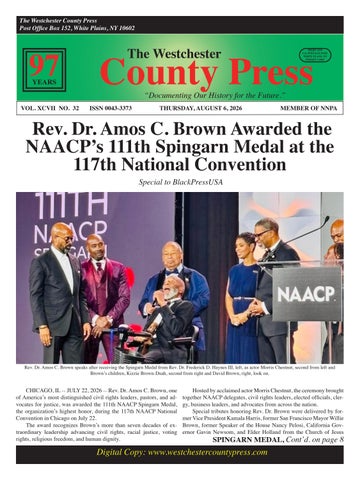
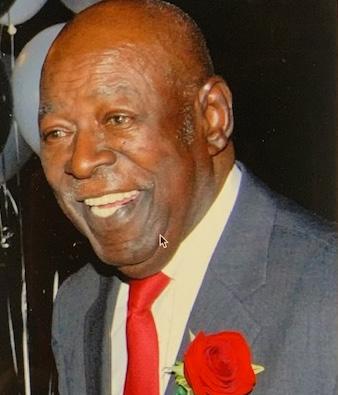
CHICAGO, IL -- JULY 22, 2026 -- Rev. Dr. Amos C. Brown, one of America’s most distinguished civil rights leaders, pastors, and advocates for justice, was awarded the 111th NAACP Spingarn Medal, the organization’s highest honor, during the 117th NAACP National Convention in Chicago on July 22.
The award recognizes Brown’s more than seven decades of extraordinary leadership advancing civil rights, racial justice, voting rights, religious freedom, and human dignity.
Hosted by acclaimed actor Morris Chestnut, the ceremony brought together NAACP delegates, civil rights leaders, elected officials, clergy, business leaders, and advocates from across the nation.
Special tributes honoring Rev. Dr. Brown were delivered by former Vice President Kamala Harris, former San Francisco Mayor Willie Brown, former Speaker of the House Nancy Pelosi, California Governor Gavin Newsom, and Elder Holland from the Church of Jesus
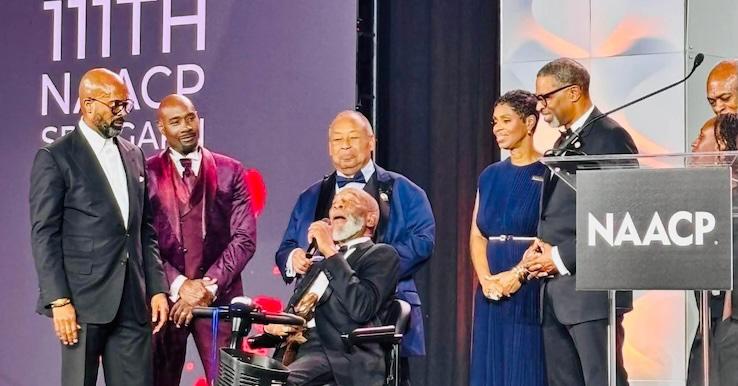
Rev. Dr. Amos C. Brown speaks after receiving the Spingarn Medal from Rev. Dr. Frederick D. Haynes III, left, as actor Morris Chestnut, second from left and Brown’s children, Kizzie Brown-Duah, second from right and David Brown, right, look on.
SUNY WCC and Second Chance Foods Expand Partnership to Help Address Student Food Insecurity
Donated commercial freezer will increase access to nutritious meals for students
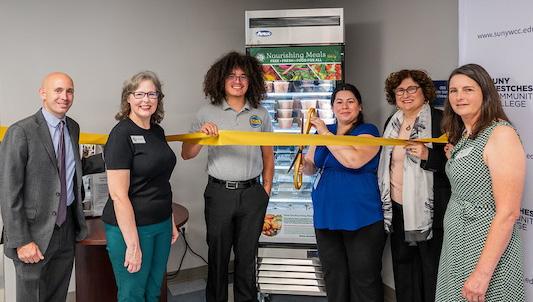
(From L to R):Ben Naylor, Chief of Staff and VP of Strategic Operations, SUNY WCC; Kathryn LaCombe, Culinary Director, Second Chance Foods; Delta Auqui - SUNY WCC student and former Student Government Association (SGA) Treasurer; Sophia Pineiro, Associate Director of Student Support Services, SUNY WCC; Assemblymember MaryJane Shimsky; and Martha Elder, Executive Director and Co-Founder, Second Chance Foods. (Photo credit: SUNY Westchester Community College).
and their families
Valhalla, N.Y. (July 30, 2026) –SUNY Westchester Community College and Second Chance Foods today celebrated the expansion of their partnership to combat student food insecurity with a ribbon-cutting ceremony for a commercial freezer donated by the nonprofit organization. The new freezer will significantly increase the College’s capacity to store and distribute nutritious frozen meals prepared and donated by Second Chance Foods, helping ensure that more students and their families have reliable access to healthy food.
The donation strengthens the College’s ongoing commitment to supporting students both inside and outside the classroom. Nationally, nearly 25% of all undergraduate students experience food insecurity, a challenge that can affect academic performance, persistence, and degree completion.
SUNY WCC, Cont’d. on page 11
Open Door’s Annual Community Resource Fair Will Be Held August 8th in Ossining
OSSINING, NY -- The Open Door Care Network will mark National Health Center Week (NHCW) by hosting its annual Community Resource Fair at its newest location at 2 Church Street in Ossining on Saturday, August 8 from 10 a.m. to 1 p.m.
The event is open to the public with the intent of connecting community members with important health-related resources, while offering fun, family-friendly activities for children and adults.
“This resource fair serves as an opportunity to answer the health-related questions of attendees and help identify potential health issues as early as possible,” said Marilyn Pacheco, Director of Marketing & Community Relations at Open Door.
“Education and prevention, after all, are critical in keeping members of our community healthy. In celebration of NHCW (August 2 – 8), we support this year’s theme of “Building Innovative Care Where It Matters Most,” which speaks to how the creativity and commitment of Community Health Centers helps advance the in-
novative solutions that meet patients where they are and improve primary care delivery, access, and outcomes. This includes partnering with key stakeholders and elected officials to strengthen relationships that support high-quality, patientcentered care in the communities they serve.”
Every August, the National Association of Community Health Centers (NACHC) sponsors NHCW to celebrate and increase awareness of America’s more than 1,500 Community Health Centers (CHCs). The week-long celebration is an opportunity to highlight the commitment and passion of Community Health Center patients, staff, board members, and supporters who make it possible to provide quality, comprehensive healthcare services to 52 million patients across more than 17,000 communities.
The event is held in partnership with the following organizations: Kindle Community Inc, JumpStart for Dads: A Program Supported by Grandpas United, Alzheimer’s Association, West-
chester County Department of Health, Neighbors Link, IFCA Housing Network, Village of Ossining Recreation, MVP Health Care, Ossining Youth Bureau, Ossining Food Pantry, Hispanic Federation, Family Services of Westchester, Cancer Support Team, ArtsWestchester/ArtsMobile, Ossining Children’s Center, The LOFT LGBTQ+ Community Center, Ossining Padres Hispanos Inc., Sustainable Westchester, and VDO Cardiology.
The Open Door Care Network provides excellent, accessible, personalized care regardless of ability to pay; care that builds healthier families and communities.
Open Door provides whole person care: medical and dental; behavioral and mental health; prevention and wellness; family, youth, and senior support; early childhood programs; and community and advocacy services. Open Door provides these services in Westchester, Dutchess, Putnam, and Ulster counties.
Westchester County Youth Bureau Releases Three RFPs for Youth Development, Youth Team Sports, and Youth Sports & Education Programs
WHITE PLAINS, NY -- The Westchester County Youth Bureau is pleased to announce the release of the 2026-2027 Request for Proposals (RFP) for (1) Youth Development Programs (YDP), (2) Youth Team Sports Programs (YTS) and (3) Youth Sports & Education Programs (YSE), made possible through funding from the New York State Office of Children and Family Services (OCFS).
This RFP invites eligible community-based organizations to apply for funding of these programs, which support evidence-based, youthcentered services that promote educational enrichment, leadership development, mentoring, health, wellness and community engagement for children and youth across Westchester County.
Youth Development Programs – This funding supports innovative Positive Youth Development services, opportunities and resources for youth ages 21 and under. The Youth Bureau invites eligible, local non-profits only to apply for funding up to $30,000 to implement programs in the following suggested but not exclu-
sive areas:
• Citizenship and Civic Engagement (youth leadership, cultural competency, racial equity)
• Community (youth activism, mentoring, community service)
• Economic Security (career development, life skills)
• Physical Health and Emotional Well-Being (seasonal activities like summer camp, opportunities for creative expression)
• Education (“out-of-school time” programming to support educational engagement, dropout prevention services)
• Safe Harbor/Anti-Trafficking activities, prevention, and supports.
• Family Supports (conflict resolution, restorative practices)
Youth Team Sports - This funding supports the operations of team sports programs for youth under the age of 18 years old. The Bureau invites eligible non-profits and community-based organizations to apply for funding up to $50,000 to provide opportunities for team sports programs.
YOUTH BUREAU, Cont’d. on page 11
Senator Shelley Mayer Introduces Legislation Prohibiting Humanoid AI Robots in Schools
WHITE PLAINS, NY – State Senator Shelley Mayer, Chair of the Senate Committee on Education, introduced legislation today, S.10671, to prohibit the use of artificial intelligence-enabled humanoid robots in instructional roles in New York’s schools.
The legislation is in response to the Salamanca City Central School District’s plan to introduce an AI-enabled humanoid robot into a classroom. The robot, known as “Sally,” was designed to appear between 16 and 24 years old, exhibit a positive personality, and possess knowledge of the city’s local history. The district proposed using the AI robot as a tutoring aide, capable of interacting with students, helping with assignments, explaining lessons, and offering personalized educational support.
On July 24, the State Education Commission Betty Rosa wrote to Salamanca Superintendent Mark Beehler expressing concern over the effect
the humanoid robot may have. The letter stated: “The Department remains concerned about the effect that a humanoid robot may have within a high school classroom. Although you confirmed that the robot would not have any role in delivering classroom instruction, a recent presentation to the board characterized the robot as a ‘tutoring platform.’ Many parents, teachers, and stakeholders, are understandably concerned about the presence of Artificial Intelligence (Al) technology in classrooms, particularly when it involves robots that resemble humans.”
Salamanca City Central School District announced later that day that the “Sally” pilot program with Realbotix was put on hold while they “work through enhanced student data privacy agreements with the New York State Education Department and continue engaging with [our] community and stakeholders.”
Senator Mayer’s legislation would require every school district, charter school, and Board of Cooperative Educational Services (BOCES) to adopt a written policy governing the use of humanoid robots in schools. This policy must prohibit the use of AI-enabled humanoid robots to perform the responsibilities of a teacher, including delivering or leading classroom instruction, providing one-on-one or small-group instruction, tutoring students, offering educational support services, assessing or evaluating student performance, grading student work, or carrying out any other duties ordinarily performed by a certified teacher.
SENATOR SHELLEY MAYER
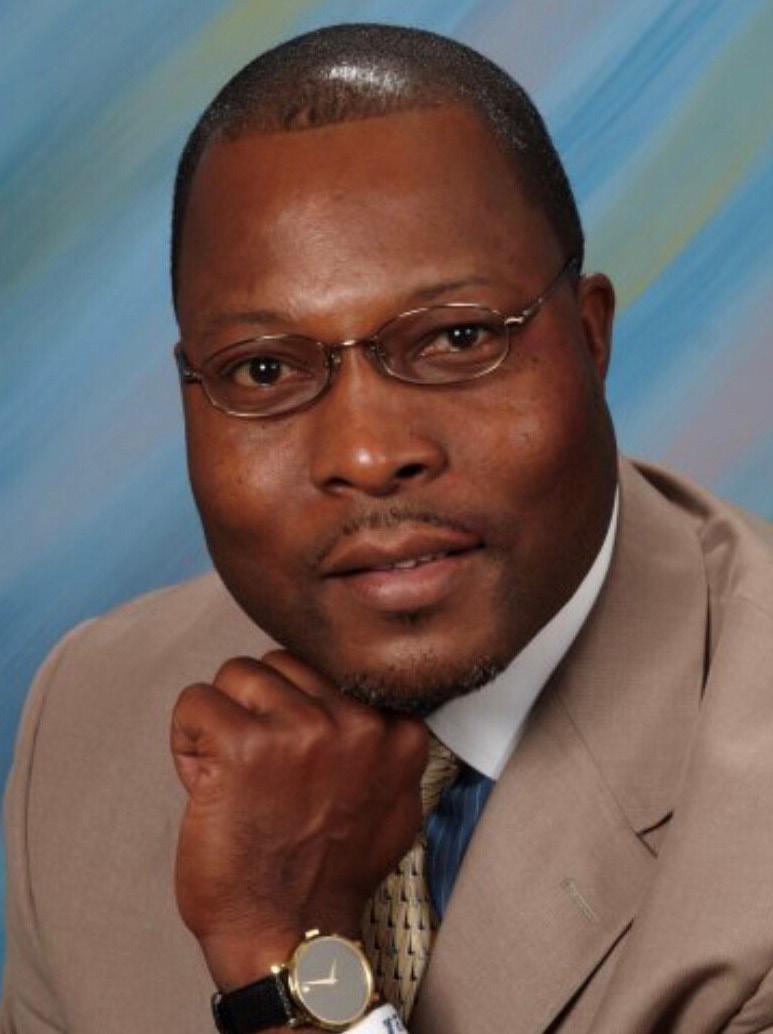
ERNEST McFADDEN
OP-ED: No More Broken Promises to Black America
By Reverend Dr. Boise Kimber, President National Black Convention, USA
The AI Boom and the promise of public ownership: Artificial Intelligence (AI) is quickly becoming one of the most powerful forces in the global economy, with the potential to generate historic levels of wealth. As technology companies and governments position themselves to benefit from this growth, our communities must share in those gains in ways that are real, substantial, and protected from po-
The
Westchester County Press
(ISSN 0043-3373) is published weekly on Thursday in White Plains, New York. Copies: 40¢. Yearly Subscription: $25.00, two years: $45.00. National Advertising representative: National Newspaper Publishers Association. Local and national advertising rates on request. Paper founded August 1, 1928 to serve the County of Westchester, New York.
Sandra T. Blackwell President, Publisher & Editor
Carolyn B. Coleman Vice President
Alyce T. Coleman Executive Editor
Bruce L. Bozeman, Esq. Legal Counsel
Celeste Coleman-Housey, Ed.D. Art Director/Managing Editor
Editorial & Advertising Offices P.O. Box 152 White Plains, NY 10602 Telephone:(914) 953-2620
Member: National Newspaper Publishers Association
litical reversal
At the same time, many communities are pushing back to ensure that new AI infrastructure does not strain local resources, increase costs, or pollute their neighborhoods. Sovereign Wealth Funds and Equity Stakes: the latest promise being offered to the public is the creation of sovereign wealth funds or similar ownership models that would give people a stake in AI-generated wealth.
Several proposals point in this direction: • President Donald Trump has explored strategies for the U.S. government to take equity stakes in leading AI firms. • Senator Bernie Sanders has introduced legislation aimed at giving the public a share in this new economic value. • OpenAI has proposed a voluntary “Public Wealth Fund” that would give American citizens a direct stake in the gains created by artificial intelligence. The question is whether these proposals represent real economic inclusion— or another version of a familiar promise that never fully reaches Black America because of broken promises such as the 40 Acres and a Mule broken promises from government and business are not new to Black Americans.
The history of slavery, emancipation, and Reconstruction shows a repeated pattern: Black labor created wealth, but Black people were denied equal compensation, legal protection, and the resources needed to build generational wealth. Near the end of the Civil War, Union General William Tecumseh Sherman and Secretary of
By Wade Henderson
Source: BlackPressUSA
Pete Hegseth insists that he is restoring “merit” to the United States military. But after months of dismissals, blocked promotions, and ideological purges, the evidence tells a different story. His campaign against so-called “diversity, equity, and inclusion” has become something far more dangerous: an assault on equal opportunity that falls with particular force on African Americans, while also targeting women, Latinos, gay Americans, and transgender service members.
The latest example is both troubling and infuriating.
Once again, Defense Secretary Pete Hegseth has reportedly blocked the promotion of an exceptionally qualified woman—Rear Admiral Amy Bauernschmidt. Bauernschmidt is no ordinary officer. She became the Navy’s first woman to command a nuclear-powered aircraft carrier, one of the most demanding leadership assignments in the world. Her career reflects decades of exemplary performance, operational excellence, and leadership under extraordinary pressure.
Yet once again, a distinguished military career appears to have been subordinated to an ideological agenda masquerading as “merit.”
I call BS!
The American people are expected to believe that one extraordinary officer after another suddenly fails to meet some undefined standard of excellence. We are expected to ignore impeccable service records while accepting that political appointees alone possess the wisdom to determine who is worthy of advancement.
The pattern has become impossible to ignore.
General Charles Q. Brown Jr., only the second African American to serve as Chairman of the Joint Chiefs of Staff, was dismissed despite a career that placed him among the most accomplished military leaders of his generation.
Admiral Lisa Franchetti, the first woman ever to serve as Chief of Naval Operations, was removed despite decades of distinguished command experience.
Reports have documented interventions that blocked or delayed the pro-
Photo: iStockphoto / NNPA
OP-ED: Built in a Moment Like This: The Divine Nine and the Fight After Callais
By Danielle Bess, Esq.
Las Vegas was awash in pink and green during the week of July 18, 2026, as Alpha Kappa Alpha Sorority, Incorporated, and nearly 27,000 of its members and their families arrived for the sorority’s biennial Boule.
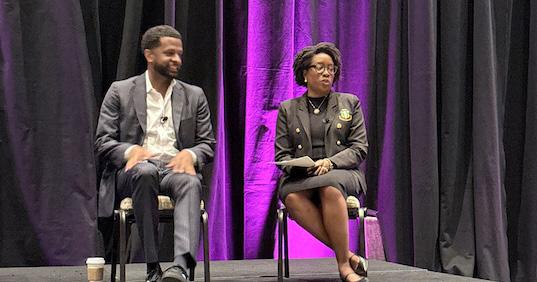
The women of Alpha Kappa Alpha were not the only notable arrivals. Black political power showed up, too. Congresswoman Lauren Underwood moderated a conversation with attorney and political commentator Bakari Sellers at a workshop titled “Soaring to the Polls: Mastering the Midterm Journey.” Aaron Ford, Nevada’s Attorney General and the Democratic nominee for Governor, addressed the workshop participants, while Congresswoman Emilia Sykes sat in the audience. And at the organization’s public meeting, Maryland Governor Wes Moore received a community award and delivered a rousing speech that sounded less like an acceptance and more like a precursor to a run for President.
Politicians go where power is. But these politicians were not mere visitors. All of the politicians are members of Divine Nine organizations. And three months after the Supreme Court neutered Section 2 of the Voting Rights Act, the power in that convention hall mattered more than it had in sixty years.
AKA, and all of the Divine Nine organizations—the historically Black Greek-letter fraternities and sororities—are a natural stop for any politician who wants to raise their profile or launch a bid for elected office. The organizations collectively have more than 4 million members who are educated and civically engaged in their communities.
While the organizations are all nonpartisan, they are able to engage in voter education, policy advocacy, and get-out-the-vote efforts. Congresswoman Underwood, an AKA herself, described the mission from the stage: “We are not telling them who to vote for, but as we soar to the polls, we have a lot of ground to cover to lay the foundation for what issues are on the ballot, who’s running, how to participate in this election.”
And for their collective 120-year history, they have done that. The NAACP was cofounded by W.E.B. Du Bois, a member of Alpha Phi Alpha fraternity. Many civil rights icons were members of the Divine Nine, including Martin Luther King, Jr., who was also an Alpha. Today, more than half the current members of the Congressional Black Caucus are members of one of the Divine Nine organizations.
With the gutting of Section 2 of the Voting Rights Act, Black political representation in Congress is at risk. Governor Moore, a member of Alpha Phi Alpha, accepting the sorority’s community award, rejected the notion that the question is whether AKA is ready. “When there’s ever a question about whether the AKAs are built for a moment like this, let’s be clear: the AKAs were built in a moment like this,” he said. “Let’s not pretend like 1908 was easy. Let’s not pretend like 1908 was simple. Let’s not forget in 1908, you had the Springfield race riot. In 1908, you had the oppressive peak of Jim Crow.”
Moore’s history was precise. Alpha Kappa Alpha was founded at Howard University in January 1908. That August, a white mob rampaged through Springfield, Illinois — the riot that spurred the founding of the NAACP the following year. The Divine Nine were not built in calm waters. They were built in the storm.
Sellers told the workshop what this storm looks like.
In April, the Supreme Court ruled in Louisiana v. Callais that voting rights plaintiffs must now show a strong inference that a state intentionally discriminated — a standard Justice Elena Kagan described as rendering the VRA “all but a dead letter”. Within weeks, Southern states began dismantling majority-Black congressional districts.
“In Alabama, in Mississippi, in Georgia, in Ar-
kansas, in Texas, and in Florida, we had Black elected officials because we could go out and vote for people who we believed shared our same lived experiences and that represented our interests,” Sellers said. “When you wake up in November, that no longer will be the case. No matter if we win, lose, or draw, no matter if Hakeem Jeffries is the Speaker of the House we will have less Black Caucus members than we’ve had before. And in two years, we’ll have even less.”
Sellers knows the cost of this fight in his bones. His father, Cleveland Sellers, was an early member of the Student Nonviolent Coordinating Committee. “When my dad and Stokely and everybody were going around yelling Black Power, they weren’t trying to shoot you,” he told the room. “They were talking about Black economic power and Black political power. So when they were in the depths of Mississippi, that’s what Black Power actually meant.”
Governor Moore offered Maryland as proof that the storm can be answered. With the support of the AKAs, he said, the state passed its own voting rights act, and he has called the legislature into special session rather than, in his words, “sit on our hands while we’re being punched in the face.” He cited more than $1.3 billion in state investments in HBCUs, “unapologetically,” and legislation confronting book bans: “You will not ban books inside the state of Maryland.”
Congresswoman Underwood was practical about what comes next. She urged the members to take the mobilization where the voters are — online — “creating content that is engaging and informative on the issues that matter: issues like the high cost of living and how we can take action in this election to lower housing costs, health care costs.” Sellers pressed the same
Congresswoman Lauren Underwood moderated a conversation with attorney and political commentator Bakari Sellers at a workshop titled “Soaring to the Polls: Mastering the Midterm Journey..
Rev. Dr. Amos C. Brown Awarded the NAACP’s 111th Spingarn Medal at the 117th National Convention
SPINGARN MEDAL, Cont’d. from
Christ of Latter-Day Saints each recognizing his unwavering commitment to justice and his profound influence on generations of leaders.
Established in 1914 by Joel E. Spingarn, the Spingarn Medal is the NAACP’s highest honor, presented annually to an African American whose achievements reflect the highest ideals of excellence, service, and leadership.
Previous recipients include Dr. Martin Luther King Jr., Rosa Parks, Thurgood Marshall, Maya Angelou, Toni Morrison, Congressman James E. Clyburn, Dr. Hazel N. Dukes, and Vice President Kamala Harris.
Held under the convention theme “We, the People,” the 117th NAACP National Convention convened thousands of activists, elected officials, business leaders, clergy, and community advocates committed to advancing civil rights, equity, and opportunity as the United States approaches its 250th anniversary.
The medal was presented to Brown by Rev. Dr. Frederick D. Haynes III, a longtime friend, spiritual son, and fellow champion for justice and peace. In his heartfelt introduction, Haynes affectionately described Brown as “You the Birthday,” a phrase from today’s young culture meaning, “You are amazing. You are awesome.”
Haynes celebrated Brown’s extraordinary
page 1
life of service, recounting his many accomplishments, enduring influence, and unwavering commitment to preserving history of African Americans. Haynes praised Brown for using both his remarkable memory and his prophetic voice to uplift “the last, the least, and the left behind,” noting that he has always understood the sacred responsibility of standing for those who cannot stand for themselves – to speak the truth.
Concluding his tribute, Rev. Dr. Haynes offered a powerful charge:
“Maybe it is both providential and prophetic that we are honoring Rev. Dr. Amos C. Brown today, because we need a Third Reconstruction in the face of a nation that is trying to dismantle the hard-fought gains of the Civil Rights Movement. Thank you, Amos C. Brown, and thank you, NAACP, for showing us the way toward that Third Reconstruction. “You the Birthday.”
During his acceptance remarks, Rev. Dr. Brown honored the women who helped shape his life and ministry—including his mother and father, sisters, his beloved wife, Jane Smith Brown, and Eliza Davis, founder of Third Baptist Church of San Francisco.
“I am deeply honored and humbled to receive the Spingarn Medal. This recognition is not simply about one individual—it represents the countless people who have dedicated their
lives to the ongoing pursuit of justice, equality, and human dignity. Our work continues.” said Brown.
He also recognized on stage his longtime friend and fellow prophetic voice, Rev. Dr. Jeremiah A. Wright Jr., urging that history faithfully preserve Wright’s influence on a generation of leaders. Wright, the renowned Chicago pastor emeritus mentored then-Senator Barack Obama.
This year’s Spingarn Medal recipient is a powerful reminder that we must continue to celebrate our own—to honor the women and men whose courage, sacrifice, and unwavering leadership have advanced the ongoing struggle for justice, equality, and democracy in America.
“This recognition celebrates not only our father’s extraordinary life of service but also the generations of people he has inspired to believe that justice requires both faith and action,” said Kizzie Brown-Duah, Brown’s daughter.
“Our family is deeply grateful to the NAACP for honoring a lifetime devoted to advancing freedom, dignity, and opportunity for all people.” Said Brown’s son, David Brown.
This story came from the media relation department of the office of Rev. Dr. Amos C. Brown
WBWPC Celebrates 50 Years of Leadership, Advocacy, and Political Empowerment
The Westchester Black Women’s Political Caucus (WBWPC), one of Westchester County’s most respected and influential political organizations, proudly announces its 50th Anniversary Golden Celebration Cocktail Reception and Dinner, to be held on Friday, October 16, 2026, from 6:00 p.m. to 11:00 p.m. at The Surf Club on the Sound, 280 Davenport Avenue, New Rochelle, New York.
Our theme: Rooted in Legacy, Rising in Power.
Rooted in Legacy: We celebrate the extraordinary women whose vision, courage, and determination established the Westchester Black Women’s Political Caucus and laid the foundation for five decades of advocacy, leadership, civic engagement, and community impact.
Rising in Power: As we honor this rich history, we look boldly toward the future. Our roots remind us of the sacrifices and resilience of those who came before us, while our rising power re-
flects the strength, unity, and purpose of today’s leaders. Together, they continue to break barriers, amplify the voices of Black women, and inspire the next generation of changemakers.
We are excited to honor one of our Founding Members, The Honorable Ruth Hassell Thompson, President and CEO of Third Act Ill Development Consultancy Firm, whose distinguished career in public service has left an indelible mark on communities throughout New York State.
For ticket information, sponsorship opportunities, journal advertisements, or additional information, please see links below.
EVENTBRITE LINK: https:// www.eventbrite.com/e/1992072181520 ?aff=oddtdtcreator Angela Davis-Farrish, President
OP-ED: No More Broken Promises to Black America
EDITORIAL, Cont’d. from page 4
War Edwin Stanton met with 20 Black leaders in Savannah, Georgia. Those leaders made clear that true freedom and self-determination required land ownership. Sherman’s Special Field Order No. 15 set aside 400,000 acres of confiscated Confederate land and granted enslaved families plots of up to 40 acres.
After Lincoln’s assassination, however, President Andrew Johnson reversed course, pardoned former Confederates, and returned the land to its previous owners. Unpaid labor and unequal compensation from 1619 to 1865 were allocated to former enslaved Africans and their descendants who had labored from sunup to sundown without wages, building wealth for enslavers and for the governments and institutions that supported the enslavement economy.
During much of the Civil War, the Militia Act of 1862 allowed Black soldiers to be paid less than white soldiers. Black soldiers received $10 per month, with $3 deducted for clothing, leaving only $7 in take-home pay. White soldiers received $13 per month with no clothing deduction.
Congress did not correct this inequity for two years. The reality was that “Emancipation” without economic justice and equality was the order of that period of American history, and in April 1862, eight months before President Abraham Lincoln issued the Emancipation Proclamation, Congress passed the District of Columbia Emancipation Act. The law freed roughly 3,000 Black people, but its benefits were unequal: enslavers received compensation of up to $300 per enslaved person, while the people who had labored without pay received nothing unless they agreed to relocate outside the United States, where they would get $100.
The 13th Amendment, ratified in 1865, abolished slavery in the United States but preserved a loophole by allowing involuntary servitude as punishment for a crime. Former slaveholding states exploited that exception through Black Codes, convict leasing, and Jim Crow laws, using the criminal legal system to restrict Black freedom and to preserve economic control and wealth by former enslavement masters.
These broken promises symbolize the federal government’s failure to provide foundational reparations and economic justice to Black Americans. They represent the systemic hurdles that descendants of enslaved people have navigated as they struggle to build generational wealth in the United States. Today we are facing another threat to Black American economic progress.
President Trump, the Republicans, and the Supreme Court are rolling back all the gains made by our people over the last 162 years. Quality education is being dismantled. Racist gerrymandering disguised as equal opportunity is eliminating Black congressional districts. Civil Rights are being stripped of their ability to protect Blacks. A massive tax burden is being shifted from the rich to the poor.
Given this record, it is reasonable to question whether the federal government and its technology partners will truly protect Black interests in the next wave of AI-driven wealth. Senator Bernie Sanders is right to argue that artificial intelligence is built on “the collective knowledge of humanity and the creative work of tens of millions of people.” He also correctly warns that the public should have a say in how AI develops so that its benefits serve humanity, not only the wealthiest people on the planet.
However, his current legislative proposal falls short of providing true equality or meaningful economic opportunity for everyday Americans. Sanders estimates that the average payment would be $1,000 per person before taxes. Measured against the 1862 purchasing power offered to relocating slaves, the only time in American history when the DC Blacks were offered reparations, that amount would equal only about $33. Meanwhile, the data, knowledge, and creative work of ordinary people are helping create new billionaires and trillionaires.
This small payment does not address the deeper question: who should own and benefit from the wealth AI generates? No more empty promises to Black American communities should be expected. We will not accept another symbolic promise of “40 acres and a mule” from the federal government or the technology industry.
If AI is going to generate historic levels of wealth, then the benefits must be real, substantial, and protected from political reversal. That means any new public-wealth proposal must include: • Substantial investment in Black communities. • Clear guarantees that promised benefits cannot be easily reversed by a future administration. • Accountability from both government leaders and technology companies.
As President of the 7-million-member National Black Convention, USA, I intend to help ensure that new achievable and financially sustainable promises are not only made but kept.
The Divine Nine and the Fight After Callais
point about the message. When Southern states refuse to expand Medicaid, he said, rural hospitals close—”and when your rural hospital closes, it’s not just the fact that you don’t have access to care. It’s your largest employer in the county.” Then came the workshop’s bluntest warning, aimed at his own party: “We cannot over the next 107 days simply believe that saying ‘I’m not Donald Trump’ is enough to win an election.”
The Divine Nine organizations were all founded before the passage of the Voting Rights Act, and they have now outlived its full protection. They were built between 1906 and 1922—the decades
after Black representation had been driven out of Congress and the ballot stripped away across the South—as infrastructure for a people the law had abandoned. Their mission of racial uplift has not changed.
Sellers told the women what he believed their assignment was. “I’m talking to you all as apostles,” he said. “I’m not trying to teach you something. I’m trying to give you something to go out and share.”
Governor Moore reached for the same idea through the ancestors. “It’s not a recognition of
what we’ve done already. It’s a standard for what we’re still yet to get done,” he said, closing with the words every member in the hall knew by heart, from the hymn James Weldon Johnson — himself a member of Phi Beta Sigma — gave to Black America: “Facing the rising sun of our new day begun, let us march on till victory is won.”
Nearly 27,000 women left Las Vegas at the week’s end and carried that assignment home across the country — members of an organization that predates the Voting Rights Act, now asked to repair its gutting.
Jim Crow 2.0 at the Pentagon
By Wade Henderson • Source: BlackPressUSA
Continued from page 4
motions of Black officers and women selected through the military’s rigorous promotion system.
Now Rear Admiral Amy Bauernschmidt joins the growing list of highly accomplished officers whose careers have been derailed for reasons that have never been persuasively explained.
Where is Congress?
Its silence has become deafening.
Congress has an independent constitutional responsibility to oversee the armed forces. Instead, too many lawmakers have watched silently while one of the nation’s most respected institutions is subjected to ideological litmus tests and political interference.
This is not military reform. It is testosterone-fueled performative masculinity disguised as a philoso-
phy of military excellence.
The irony is impossible to miss. Hegseth repeatedly invokes “merit,” yet his rhetoric begins with the assumption that Black officers, women, and other historically excluded Americans must somehow justify their achievements in ways that white male officers are rarely required to do.
That is not meritocracy. It is prejudice wrapped in patriotic language.
No one is asking that anyone be promoted because of race or gender. Americans simply expect that promotions be based on demonstrated competence, leadership, integrity, and service. The officers being targeted have already proven themselves repeatedly under one of the world’s most demanding evaluation systems.
Their records speak for themselves.
The attack on African American military leadership has been especially pernicious.
For generations, Black Americans fought in segregated units, earned decorations while denied equal treatment, and repeatedly demonstrated loyalty to a nation that often failed to extend them full citizenship. They broke barriers not because standards were lowered but because excellence finally overcame institutional discrimination.
Today’s campaign against “diversity” threatens to revive old assumptions under new slogans.
The implication that Black generals and admirals somehow owe their success to affirmative action rather than extraordinary performance echoes some of the ugliest stereotypes of the Jim Crow
era. Yesterday’s segregationists claimed Black Americans were inherently less qualified. Today’s culture warriors simply employ more politically acceptable language while inviting the same suspicion about Black achievement.
That is why Hegseth’s campaign increasingly resembles Jim Crow 2.0.
The targets may now wear stars on their shoulders instead of military patches on segregated uniforms, but the underlying message is hauntingly familiar: Black excellence is presumed suspect, while white excellence is presumed earned.
America’s military became the finest fighting force in history because it opened its doors to talent wherever it could be found. It grew stronger after President Truman desegregated the armed forces. It became stronger when women assumed greater command responsibilities. It became stronger when every qualified American was given the opportunity to serve to the fullest extent of their abilities.
Diversity is not a concession. It is a strategic advantage.
The nation’s adversaries do not fear an American military because it is racially homogeneous. They fear it because it draws upon the talents of more than 340 million Americans whose diverse experiences, perspectives, and abilities make our armed forces unmatched anywhere in the world.
Every politically motivated dismissal of a distinguished officer sends a chilling message throughout the ranks: excellence alone may no
longer be enough if you belong to the wrong demographic group.
That weakens morale. It weakens recruitment. It weakens retention.
And ultimately, it weakens national security.
Pete Hegseth has every right to pursue military readiness. He has no right to redefine merit in ways that repeatedly cast suspicion upon the accomplishments of Black officers, women, and others who have devoted their lives to defending this nation.
America deserves better. The men and women who wear the uniform deserve better. The Constitution deserves better.
And unless Congress finds the courage to exercise meaningful oversight, history may well remember this period not as a restoration of military excellence, but as the moment political ideology attempted to resurrect, in modern form, the old poison of exclusion.
Jim Crow did not strengthen America. Jim Crow 2.0 will not strengthen America’s military. It will only diminish it
Wade Henderson
Strategic Advisor
Civil and Human Rights
wade@wadejhenderson.com
Originally published by BlackPressUSA
If You Don’t Count It, You Don’t Have to Fix It!
Commentary by Dr. Julianne Malveaux • Source: BlackPressUSA
(Trice Edney Wire) – The Trump administration is not eliminating workplace discrimination. It is eliminating the receipts.
On July 23, the Equal Employment Opportunity Commission (EEOC) proposed abolishing the EEO-1 report and five related workforce reports. For nearly sixty years, EEO-1 has required large private employers to report the race, ethnicity, and sex of their employees across major occupational categories. The information helps us see who gets hired, who advances, who remains clustered at the bottom, and who never gets through the door. Now the federal government proposes to stop collecting it.
This is far more than bureaucratic housekeeping. It is the deliberate destruction of evidence. Without data, disparities cannot be adequately documented; without documentation, discrimination becomes more difficult to prove. An administration already committed to declaring our nation colorblind will then be free to point to the absence of evidence—an absence it created—as evidence that inequality no longer exists.
First they deny inequality. Then they destroy the evidence. Finally, they declare the problem solved.
The EEO-1 report has been collected since 1966, just two years after the passage of the Civil Rights Act. Private employers with at least 100 workers, along with certain federal contractors with at least 50, have been required to provide workforce demographic information. Approximately 110,000 employers are covered. While that is less than 2 percent of the nation’s nearly 6 million employer firms, these are among our largest employers and collectively employ a substantial share of the American workforce.
The proposed rule goes beyond private employers. It would also eliminate reports covering unions, state and local governments, public school systems, apprenticeship programs and institutions of higher education, as well as some of the recordkeeping requirements associated with those reports. The administration is not sim-
ply turning off the camera; it is also proposing to throw away the film.
The EEOC contends that these reports are burdensome, of limited usefulness and potentially unconstitutional because they classify workers by race and sex. That reasoning turns civil-rights enforcement on its head. In the twisted logic of this political moment, counting racial inequality is treated as a form of racial discrimination, while actual discrimination is rendered invisible.
Collecting information about race is not the same as discriminating by race. A thermometer does not cause a fever, nor does a scale cause weight gain. Data do not create inequality; they reveal it. Indeed, without data, claims of equal opportunity are little more than corporate advertising.
The EEOC estimates that eliminating the reporting requirements would save employers and the federal government about $278 million annually, including approximately $273 million for private employers. That sounds like a large amount until it is compared with the economic cost of workplace discrimination. Wage disparities, occupational segregation, biased hiring and blocked promotions cost workers—and the larger economy—far more than employers spend completing a report.
Furthermore, businesses already collect much of this information through their payroll and human-resources systems. The real burden may not be gathering the numbers but being held accountable for what those numbers reveal.
EEO-1 data are hardly perfect. The report does not tell us everything about pay, promotions, discrimination or workplace culture; it offers a snapshot rather than a full biography. Still, snapshots matter. They can reveal whether Black women are concentrated in administrative and support positions while white men dominate senior management. They can expose the distance between a company’s carefully worded commitment to diversity and its actual employment practices.
Such patterns do not prove every individual allegation of discrimination, but they tell investigators where to look. They allow employers to identify problems before those problems become lawsuits, while giving researchers and policymakers a way to measure progress—or the lack of it. Eliminating
the data will not make workplaces more equal; it will simply make inequality easier to conceal.
This attack on EEO-1 reporting is part of a broader war on facts. The Trump administration has attacked diversity, equity and inclusion programs, weakened federal contracting protections and attempted to purge race-conscious analysis from government. It apparently wants a nation in which racial inequality may be experienced but not measured, described but not documented, protested but not proved.
Black workers know better, and so do women who continue to encounter occupational segregation and unequal opportunity. We know that fairness cannot be measured by a corporate slogan or a glossy photograph featuring a carefully assembled rainbow of employees. It must be measured by who is hired, what they earn, where they work, whether they advance and who holds power.
Data are instruments of democratic accountability because they allow ordinary people to compare promises with performance. That is precisely why those who resist accountability want the numbers buried. The proposed elimination of EEO-1 reporting is not colorblindness but willful blindness—a declaration that the federal government would prefer not to know what is happening inside American workplaces.
Inequality does not disappear when government closes its eyes. When the people charged with enforcing equal opportunity stop collecting the evidence, they are not being neutral. They are choosing concealment over accountability and darkness over the illumination that data provide.
Dr. Julianne Malveaux is a DCbased economist and author.
Based on reporting by Seattle Medium.
Originally published by Black Press USA Wire — https://seattlemedium.com/eeoc-proposed-abolisheeo-one/
DR. JULIANNE MALVEAUX
Cont’d. from page 2
“Student success depends on more than academic opportunity alone,” said Dr. Belinda S. Miles, President of SUNY Westchester Community College. “Students are best positioned to succeed when their basic needs are met. We are deeply grateful to Second Chance Foods for this generous donation and for their continued partnership in helping us remove barriers to success. Together, we are ensuring that more students can focus on learning, achieving their goals, and building brighter futures.”
The donated freezer will expand the College’s ability to provide frozen, nutritious meals through its student support initiatives, complementing the wide range of services SUNY Westchester offers to help students persist to graduation. The partnership reflects the College’s holistic approach to student success by addressing the non-academic challenges that can prevent students from reaching their educational goals.
“We are honored to play a small part in removing one barrier for students who are working hard to build brighter futures,” said Martha Elder, Executive Director of Second Chance Foods. “A nourishing meal may seem like a simple thing, but it can mean the difference between struggling through the day and being able to focus, learn, and thrive.”
Assemblymember MaryJane Shimsky, who participated in the ribboncutting ceremony, praised the partnership and its broader impact.
“Community colleges play a key role in preparing the workers most needed in our communities. Their students deserve the opportunity to learn without wondering where their next meal will come from,” Assemblymember Shimsky said. “Yet, nearly one in four college students experiences food insecurity, often while juggling employment and family responsibilities. SUNY Westchester is addressing this most basic need through its partnership with Second Chance Foods – ensuring access to fresh, nutritious food while also supporting the diversion of food waste from our landfills. It’s a winning proposition for SUNY students, the environment, and our society.”
The event also recognized the work of the College’s Student Support Services team and the many community partners whose generosity helps remove barriers to student success through food assistance, scholarships, internships, mentoring, and other essential resources.
By expanding access to nutritious food, SUNY Westchester Community College and Second Chance Foods are helping students stay focused on their education while strengthening the health and well-being of the broader Westchester community. For more information on SUNY WCC’s Student Support Services, visit www.sunywcc.edu/sss.
YOUTH BUREAU, Cont’d. from page 3
In addition to providing a recreational outlet for Westchester’s youth, team sports increase physical and mental wellness, develop social and leadership skills, promote teamwork and break down societal barriers.
Youth Sports & Education - This funding supports youth development through general sports programs (non- competitive) for underserved youth ages 6 to 17 years old. Sports programs may encompass any organized activities with movement, including physical fitness activities such as yoga, hiking, dance, and active outdoor pursuits. The Youth Bureau invites eligible local non-profits, municipalities, and/or local youth bureaus to apply for funding up to $25,000 for these essential programs. Detention facilities, residential runaway and homeless youth programs, and other congregate residential settings supporting disconnected youth are strongly encouraged to apply to offer opportunities to vulnerable youth in these settings.
Westchester County Youth Bureau Executive Director Ernest McFadden said: “The Westchester County Youth Bureau is committed to supporting programs that inspire, empower, uplift and engage young people across our County. Through this funding opportunity from NYS, we invite organizations that share our commitment to equity, opportunity and excellence in youth development and education to partner with us. By investing in our young people, we strengthen families, build safer neighborhoods, foster healthier communities, and create a more equitable future. These funds represent more than financial support—they are an investment in our youth for lasting and positive change.”
The RFPs outline all criterion, noting that the application must demonstrate the coordination and implementation of youth development, team sports and/or sports and education activities/services as may be relevant. The three RFPs are available on the Westchester County Youth Bureau’s website: https://youth.westchestercountyny.gov/
Proposal submission must be received by email at WCYBRFP@westchestercountyny.gov on or before September 24, 2025 at 3 p.m. In-person submission will be accepted ONLY if proposer is unable to submit via email and adhere to the same deadline. Drop off address: Westchester County Youth Bureau, 112 East Post Road, 3rd Floor, White Plains, NY 10601.
AI ROBOTS IN SCHOOLS, Cont’d from
p. 3
State Senator Shelley Mayer said, “Humanoid AI robots designed to look and interact like people present unique concerns in schools, not the least of which is the impact on children. These systems have the potential to foster inappropriate emotional attachments or relationships with students, and like any technology, cannot be used to replace the human interaction that is so critical to intellectual, social and age-appropriate development. Artificial intelligence has an important place in education and can be a valuable tool. But as we begin to determine the optimal way to use AI in our schools, it can never replace the knowledge, compassion, and human connection that our educators and other staff bring to the classroom – and to the school building – every day.”
Senator Kristen Gonzalez, Chair of the Senate Internet and Technology Committee, said, “Before any new technology is introduced in educational settings, it should have evidence-backed and clear guidelines on how to achieve learning objectives. AI-powered humanoid robots lack any research and raise serious concerns about how these devices could impact the social and emotional development of children. What should be clear is that no such device could ever replace the role of teachers in the classroom. Teachers are an essential part of students’ education and their instruction and guidance cannot be automated. I have passed legislation protecting these jobs, and this bill strengthens these protections and prevents potentially harmful impacts of AI on our school communities. I am excited to have worked with Senator Mayer on this bill and look forward to continuing our work to make sure our schools use technology responsibly.”
Senator Rachel May said, “Teachers do far more than deliver information. They mentor, encourage, and help students build the social and emotional skills they need to succeed, something a humanoid robot can’t replace. We must be thoughtful about how artificial intelligence is used in our schools, ensuring it supports education rather than replaces the human relationships that are essential to learning. Thank you to Senator Mayer for sponsoring this important legislation to establish clear guardrails for the use of humanoid robots in the classroom while protecting students’ access to a well-rounded education.”
Melinda Person, NYSUT President, said, “Sen. Mayer moved quickly, and we thank her for her leadership to create statewide guardrails so districts don’t become testing grounds for humanoid robots. This legislation begins the crucial process of defining which technology belongs in our classrooms and what should be limited. NYSUT looks forward to working with our education partners across this state to give our kids what every child deserves — meaningful human connections in the classroom — even as we teach them to navigate the technology that will shape their lives.”
NYS PTA President Patty Frazier said, “We thank Senator Mayer for starting this critical conversation about the appropriate role of technology in the classroom. While we recognize certain education-based technology may have use in instructional settings, we agree that AI technologies such as this should not have any instructional role with our students. We hope that school districts looking to expand and implement technology have meaningful conversations with parents, families, and educators about its use with our children.”
CALENDAR, Cont’d. from page 15
Saturday, Nov. 7
Join us for our biggest celebration of the year, the 2026 Benefit for ArtsWestchester, on Saturday, November 7, 2026 featuring a concert by Grammy®-nominated, classical-meets-hip-hop duo Black Violin. It’ll be a full evening with fabulous dinner stations, an open bar, live and silent auctions, a world-class music performance and a dessert after-party -- all in the company of people who love the arts as much as you do. Don’t miss this special evening to ensure the vibrancy and accessibility of the arts in the greater Westchester region. A Benefit for ArtsWestchester Featuring a Concert by Black Violin Saturday, Nov. 7, 2026 VIP Dinner & Reception 5:00PM | Concert 7:30PM.
THE BOZEMAN LAW FIRM, PLLC
200 Mamaroneck Avenue, Suite 500
White Plains, New York 10601
(914) 668-4600 • (914) 669-6371
Serving Metro-New York and Westchester County
PRACTICE AREAS
REAL ESTATE (Residential and Commercial)
FAMILY (Adoption)
WILLS/TRUSTS/ESTATES (Guardianship and Elderlaw)
RELIGIOUS /NON-PROFIT (Administration & Tax Status)
BUSINESS LAW (Corporations & Partnerships & Limited Liability Corporation)
*Bruce L. Bozeman, Esq., * Carla Lewis-Burnett, Esq. John S. Savage, Esq. ~ of counsel, Leticia Arzu, Esq.
*Principals of the firm serve as seminar speakers, upon request. Appointments Preferred.
Community Calendar
CALENDAR SUBMISSION: Please use a brief paragraph to describe your event. The paragraph should include event name, date(s), time, location and contact information. Send calendar information via email to westchestercountypress@yahoo.com. Please type “CALENDAR EVENT” in the subject bar.
Friday, August 7
American Red Cross Blood Drive
Friday, August 7, from 1:30 am3:30 pm Prospective donors are currently being sought by the American Red Cross for this upcoming blood drive. Please visit bit.ly/NRPLBloodDrive if you are interested in being a blood donor for this blood drive. Refreshments are provided! Donors need to be at least 17 years of age. Donors may inquire about registering by calling 1-800-RED-CROSS, or by visiting www.redcrossblood.org. Donors should bring a photo I.D. and allow an hour to complete the donation. For more information, contact the American Red Cross at: 1-800-RED-CROSS. Location: at the New Rochelle Public Library, 1 Library Plaza, New Rochelle, Ossie Davis Theater/Meeting Room
Thursday, August 13
Let the rhythms take control in this R&B line dancing workshop designed for all skill levels. Stepby-step instructions will guide participants through basic movements before teachers gradually introduce more complex steps as guests groove to a mix of classic and contemporary music. This session promises a fun night for both seasoned dancers and beginners. Artist: DJ Danny Washington TICKET PRICE: $20 (nonmembers), $10 (ArtsW members) DOORS OPEN AT: 6:40 PM. R&B Line Dancing August 13, 2026 | 7-9 PM ArtsWestchester Gallery, 31 Mamaroneck Ave., White Plains, NY.
Thursday, August 13
Public Hearing on Bee-Line Student Fares To seek public comment on the Bee-Line System’s proposed student fare adjustments Thursday, August 13 from 5:307:00 p.m. at the Department of
Public Works & Transportation, 148 Martine Ave., White Plains, NY – 5th Floor Room 527. Join remotely by registering in advance here.
Sunday, August 16
Dia De La Cultura Ecuatoriana
Sunday, August 16, 2026 | 3-8PM Barnhart Park, 25 Andrews Lane, Sleepy Hollow, NY. Join us for an afternoon of Ecuadorian music, dance, food and craft, along with family-friendly presentations that feature traditional Ecuadorian costumes and the indigenous Kichwa language. Guests are welcome to bring their own lawn chairs or picnic blankets to enjoy the performances. Co-organized by ArtsWestchester and the Village of Sleepy Hollow.
Sunday, August 23
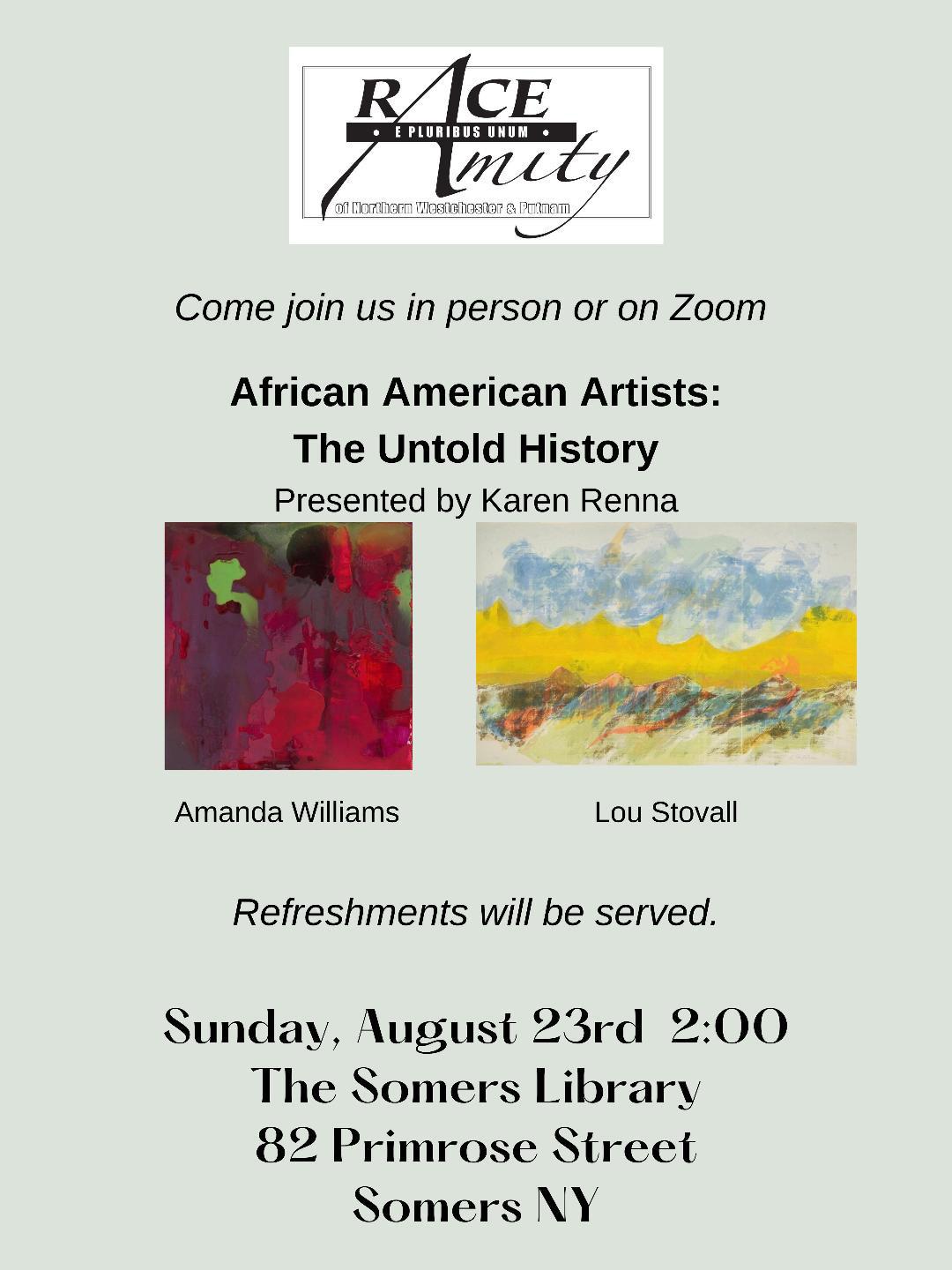
Please join RANWP on Sunday, August 23rd, in person at the Somers Library (182 Primrose Street) or on Zoom. We are delighted to have a special presentation this month on African American Artists: The Untold Story. Karen M.A. Renna is an artist who retired from teaching in 2021 and recognized, as a teacher, that there were no African American artists mentioned in any of her Art History books when she first began teaching. For the 27 years that she taught, she continued to compile lists of more and more African American artists and put together her own files of their artwork. It is her joy and pleasure to share with you just a few of the artists she has collected. Join us at 2:00 for a social half hour and refreshments. At 2:30, we will begin our presentation, which will be followed by a discussion. For those of you unable to be with us in person, this meeting will be hybrid (in person/Zoom). Please join us online at 2:30. A link will
be sent the day before. We look forward to seeing you on August 23rd! In amity, The Steering Committee, Race Amity of Northern Westchester & Putnam
Wednesday, August 26
The Great New York State Fair starts Wednesday, August 26, and runs through Labor Day, Monday, September 7. All concerts are included in the price of admission. Tickets are on sale now at The Fair’s website, https://nysfair. ny.gov. Packed with value, a single admission ticket costs $8 and includes access to all grounds entertainment and The Fair’s awardwinning concert lineup. In addition, a Frequent Fairgoer ticket option is available for $25. The Fair continues to be one of the most affordable fairs in the nation, with admission remaining free for those aged 65 and older along with children 12 years old and under. Founded in 1841, The Great New York State Fair showcases the best of New York agriculture, provides top-quality entertainment, and is a key piece of the state’s CNY Rising strategy of growing the Central New York economy through tourism. It is the oldest fair in the United States and is consistently recognized as being among the top five state fairs in the nation. The New York State Fairgrounds is a 375-acre exhibit and entertainment complex that operates all year. Audiences are encouraged to learn more about The Great New York State Fair online, browse photos on Flickr, and follow the fun on Facebook, TikTok, and Instagram.
Sunday, September 13
From 3–5 p.m, at the Paramount Hudson Valley Theater, Peekskill, N, The Robeson in Peekskill Project presents its third annual commemoration of the Peekskill
Riots and celebration of Paul Robeson’s legacy. Hosted and narrated by Shana L. Redmond, award-winning author of Everything Man: The Form and Function of Paul Robeson, with visuals by documentary filmmaker and historian Jon Scott Bennett, the program brings together music, storytelling, history, youth voices, and community performers in an afternoon rooted in history and alive with the energy of the present. Featured performers include Resistance Revival Chorus, Cole Quest and the City Pickers, AMAUTA, Bria The Artist, and the Peekskill City Singers. Together, they will create an afternoon that is rooted in history, alive with the energy of the present, and designed to invite audiences of all ages to reflect, connect, and sing. Tickets are available at tinyurl. com/SWSTIX. Admission is $35 regular; $25 seniors 65+; $15 students; $5 kids 12 and under accompanied by an adult.
September 16-20
The wait is over—registration is now open for the Congressional Black Caucus Foundation (CBCF)’s 55th Annual Legislative Conference (ALC)! September 16–20, 2026, Walter E. Washington Convention Center, Washington, D.C. Join us for five days of impactful conversations, thoughtprovoking policy discussions, networking opportunities, and celebrations that bring together leaders, advocates, professionals, students, and changemakers from across the nation. This year’s ALC is especially significant as we commemorate the 50th Anniversary of CBCF—a milestone that honors five decades of cultivating leaders, advancing equity, and creating pathways for future generations. Together, we’ll reflect on our legacy, celebrate our
CALENDAR,
Cont’d from page 14
progress, and look ahead to the future of Black leadership and civic engagement. For more information about the Annual Legislative Conference, please email our team. Registration: eventsupport@cbcfinc.org ALC Sponsorship Opportunities: rd@cbcfinc. org
Thursday, Sept. 17
Westchester County Board of Health Meeting will be held on Thursday, September 17 at 8:30 a.m. in the Westchester County Health Department Office, 11 Martine Avenue, 12th Floor, White Plains, NY 10606. Members of the public may view this meeting online at: meetings.westchestercountyny.gov
Friday, Sept. 18
Artrider Productions is excited to welcome visitors back for Fall Crafts at Lyndhurst, one of the Hudson Valley’s premier fall shopping events, returning September 18–20, 2026. Set against the spectacular autumn landscape of the historic Lyndhurst estate overlooking the Hudson River, this annual event offers an unforgettable weekend of shopping, fine craftsmanship, delicious food, family activities, and the beauty of the season. Visitors can shop from 200 accomplished artists and makers from across the country, featuring an extraordinary selection of original handmade jewelry, ceramics, clothing and accessories, home décor, fine art, specialty foods, and much more. Show hours are Friday, from 10am-5pm, Saturday, from 10am-6pm, and Sunday, from 10am-5pm. Advanced online ticket purchase available and strongly encouraged. Tickets available at www.artrider.com. Group rates are available and tour buses are welcome. Mansion tours are an additional fee and best reserved in advance via Lyndhurst’s website. Crafts at Lyndhurst is held at Lyndhurst, located at 635 S. Broadway, Tarrytown, NY. Parking is free and the show is outdoors, rain or shine. While we love our furry friends, no pets,
with the exception of service animals, are allowed within the show site. More details are available at www.artrider.com.
Saturday, Sept. 19
September 19th, 2026, Times Square at Noon LOVE OUR MOTHER Concert Calming/Celebration/Party. Join us, as we honor and strengthen the message for the upcoming September 21st, the UN International Day of Peace at Noon WORLDWIDE, 193 Counties in the UN Agreed to participate and 1.6 billion people are aware (McKinsey Co.) of Peace Day...we want 8 billion to join in at noon (Put down the guns, anger and make love not violence) around the world for a MOMENT/MINUTE OF SILENCE FOR PEACE, Ringo Starr will lead the Minute/Moment:) Peace & Love and may it continue FOREVER Here is a message from the Executive Producer about why we should all get involved and why for 24 years, our nonprofit, Good News Corporation, has: :https://pausetheworldforpeace. org/reverend-paul-sladkus-all-faithsand-spiritual-producer-of-earth-andpeace-day-concerts-for-24-yearsshares-why/ Thank you all for caring for our world and those living in it… Our Good News Community hasn’t deviated since our first Good News Broadcast on July 4, 1998, through to the establishment of our International Day of Peace Concerts in 2002. WE CONGRATULATE YOU ALL FOR YOUR DESIRE TO SEE MEDIA AND EVENTS PROMOTE THE GOOD
Wednesday, Sept. 23 thru Sunday, Sept. 27
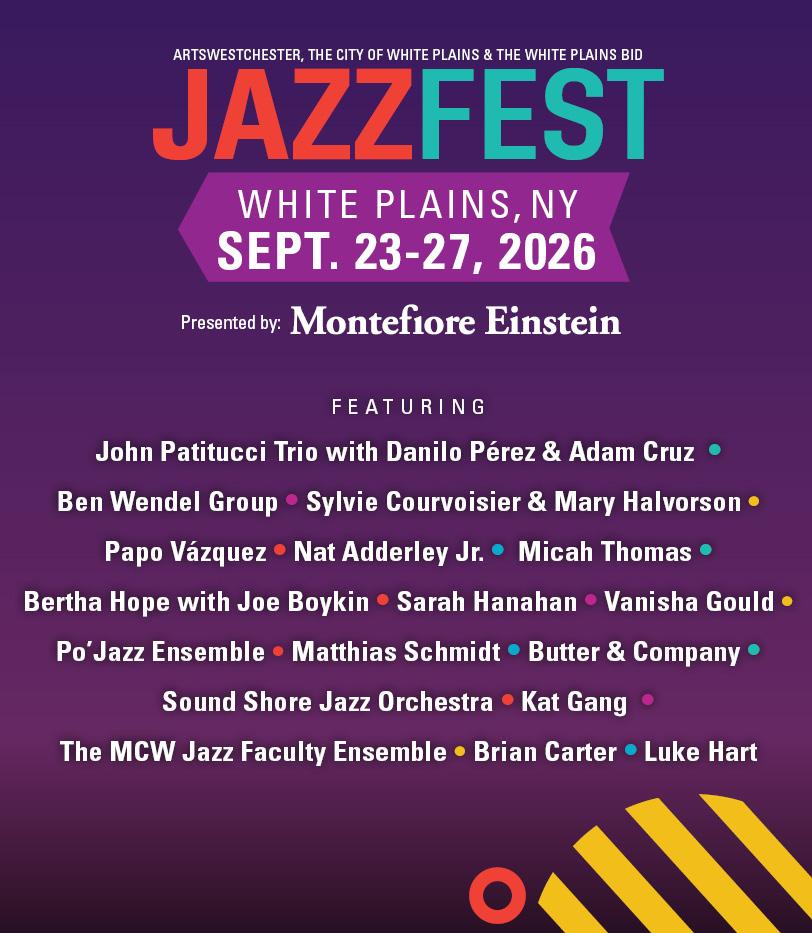
JazzFest White Plains Sept. 23-27, 2026 | White Plains, NY JazzFest White Plains returns this fall with a bold, artist-driven lineup that reflects the vitality of jazz today. Across five days, 19 performances will bring legendary artists, contemporary innovators and emerging voices to downtown White Plains. Featuring five GRAMMY Award winners and nominees, the festival offers audiences a rare opportunity to experience the living evolution of jazz—from its foundational masters to the artists defining its future.
CALENDAR, page 11
Blood crisis NOW: Immediate Need for Blood Donations
Red Cross issues rare crisis call for donors as summer blood shortage intensifies Patient care threatened as critical blood type levels continue to fall
For only the second time in history, the American Red Cross has declared a national blood crisis — and patients may already be feeling the impact. Donors are asked to act immediately to help save lives.
Blood donations have fallen to a four-year summer low, worsening this season’s emergency blood shortage. All blood types are needed, but the situation is especially dire for type O blood as the Red Cross is now limiting distributions of these blood products to hospitals. The supply of type O positive blood has now dropped below a one-day supply.
Help end this crisis and stabilize the blood supply. Book an appointment to give blood now by using the Blood Donor App, visiting RedCrossBlood. org or calling 1-800-RED CROSS (1-800-733-2767). As a thank-you, all who come to give by July 31 will receive a Fandango Movie Ticket by email (up to $15 ticket price and fees). See RedCrossBlood.org/July.
Tthose who come to give Aug. 1-31, 2026, will receive a $20 Amazon Gift Card by email. For details, visit RedCrossBlood.org/August.
REQUEST FOR PROPOSAL (RFP) # 2022- 05
REQUEST FOR PROPOSALS FOR LANDLORD/TENANT – LEGAL SERVICES FOR PROPERTIES MANAGED BY THE MUNICIPAL HOUSING AUTHORITY FOR THE CITY OF YONKERS
The Municipal Housing Authority for the City of Yonkers (the “Authority” or “MHACY”), is soliciting proposals qualified attorneys or law firms to provide Landlord/Tenant legal services to the MHACY as specified in Proposals (“RFP”).
its proposed Fiscal Years (FY) 2027 Annual Plan. A draft copy of the proposed changes and information will be available at the Office of The Municipal Housing Authority for the City of Yonkers, Augustine J. Shea Administration Building, 1511 Central Park Avenue beginning, Friday, August 7, 2026, from 8:30 A.M4:30 P.M. weekdays until Monday, September 21, 2026, and on our website www.mhacy.org listed as draft FY 2027 Annual Plan.
4 Curran Court
This RFP package contains submission requirements and terms and conditions and other pertinent information submitting a proper and responsive proposal. This RFP is the only information provided to prospective bidders (hereinafter “Responders”) and is available online starting November 8, 2022 at www.mhacy.org/about/procurement/
The RFP questions deadline is November 16, 2022, at 3:00PM Eastern Standard Time (EST) Any and must be emailed to our Procurement Department at procurement@mhacy.org by the deadline. No and/or written communication sent via mail will be accepted
The Public Hearings will be on Monday, September 21, 2026, at:
Proposals must reach MHACY no later than 3:00 PM (EST) on November 23, 2022. Late submissions handled in accordance with the provisions in Form HUD-5369B.
Community Room Building #4 Yonkers, New York 1:00 P.M.
Proposals will be evaluated on the criteria stated in the RFP. Negotiations may be conducted with contractors have a reasonable chance of being selected for the award. After evaluation of the proposal revision, contract will be awarded to the responsible firm(s) whose qualifications, price and other factors are the most advantageous to MHACY.
Ross F. Calcagno Home 10 Brook Street (Gymnasium) Yonkers, New York 6:00 P.M.
MHACY reserves the right to reject any and all proposals and waive any irregularities or informalities
MHACY’s best interest to do so. MHACY reserves the right to cancel this RFP or to reject, in whole and all proposals received in response to this RFP, upon its determination that such cancellation or best interest of MHACY.
These public hearings are open to all interested parties. Residents are encouraged to select a spokesperson to present their comments at the public hearings. Participants in the public hearings should present their comments orally and in writing. Persons wishing to speak at any of the public hearings will be limited to five (5) minutes each. A sign-up sheet for speakers will be available at the start of each public hearing.
MHACY is an Equal Opportunity Employer and does not discriminate on the basis of race, sexual national origin, sex, religion, age, disability, or family status. MHACY solicits and encourages the participation minorities and small businesses in procurement.
Contact, related to this procurement, with members of MHACY’s Board of Commissioners, or MHACY’s and/or employees other than the contact person show above, during the procurement process could disqualification of a proposal.
The Municipal Housing Authority for the City of Yonkers (MHACY) does not discriminate because of disability, color, sex, religion, national origin, family status or race. Provisions will be made for persons with disabilities to ensure their full participation in these public hearings if they so choose. Requests for any reasonable accommodation must be made to the MHACY by 4:00 P.M. on Friday, September 18, 2026 The request must be directed to:
Wilson Kimball President & CEO
Municipal Housing Authority for the City of Yonkers 1511 Central Park Avenue
Legal Department
Municipal Housing Authority for the City of Yonkers 1511 Central Park Avenue Yonkers, New York 10710 jdaoud@mhacy.org Fax: 914-793-8585
Yonkers, New York 10710 RFP # 2022-05
Dated: August 5, 2026
Municipal Housing Authority for the City of Yonkers NOTICE OF A PUBLIC HEARING FOR THE FY 2027 ANNUAL