Independent Autopsy Finds Cause of Death for Nolan Xavier Wells Remains Undetermined
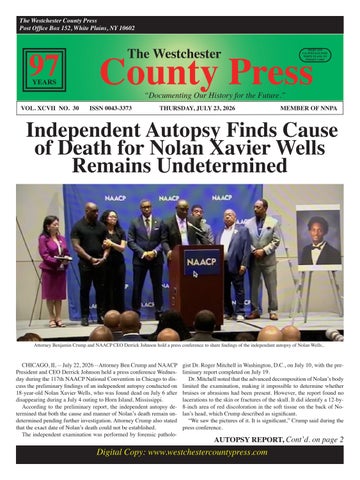
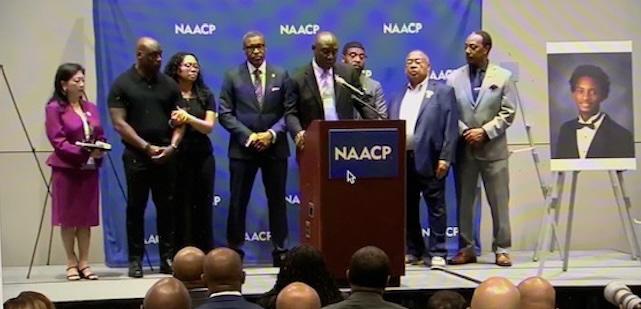
Attorney Benjamin Crump and NAACP CEO Derrick Johnson hold a press conference to share findings of the independant autopsy of Nolan Wells..
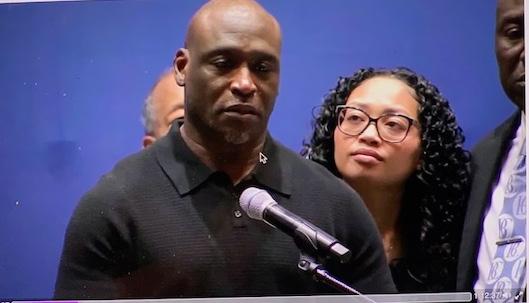
CHICAGO, IL -- July 22, 2026 --Attorney Ben Crump and NAACP President and CEO Derrick Johnson held a press conference Wednesday during the 117th NAACP National Convention in Chicago to discuss the preliminary findings of an independent autopsy conducted on 18-year-old Nolan Xavier Wells, who was found dead on July 6 after disappearing during a July 4 outing to Horn Island, Mississippi.
According to the preliminary report, the independent autopsy determined that both the cause and manner of Nolan’s death remain undetermined pending further investigation. Attorney Crump also stated that the exact date of Nolan’s death could not be established.
The independent examination was performed by forensic patholo-
gist Dr. Roger Mitchell in Washington, D.C., on July 10, with the preliminary report completed on July 19.
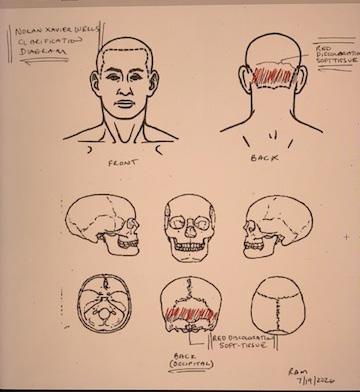
Dr. Mitchell noted that the advanced decomposition of Nolan’s body limited the examination, making it impossible to determine whether bruises or abrasions had been present. However, the report found no lacerations to the skin or fractures of the skull. It did identify a 12-by8-inch area of red discoloration in the soft tissue on the back of Nolan’s head, which Crump described as significant.
“We saw the pictures of it. It is significant,” Crump said during the press conference.
Independent Autopsy Finds Cause of Death for Nolan Xavier Wells Remains Undetermined
Crump was joined by Nolan’s parents, Christine and Elmore Wonsley, as they called for a thorough investigation into the circumstances surrounding their son’s death.
Nolan traveled with friends by boat to Horn Island on July 4 to celebrate the holiday. When the group returned to the mainland, Nolan was no longer with them. His body was discovered on the morning of July 6 by a U.S. National Park Service ranger at the island’s northwestern tip.
On July 18, the NAACP National Board of Directors adopted a resolution expressing condolences to the Wells family and urging local, state, and federal authorities—including the U.S. Department of Justice—to conduct a comprehensive and transparent
investigation into the events leading up to Nolan’s death, including how he came to be left on the island.
During the press conference, Crump also revealed that several organs were not available when Dr. Mitchell conducted the independent autopsy. While noting that it is standard practice for organs to be removed during an autopsy for additional testing, Crump said the absence of Nolan’s throat prevented Dr. Mitchell from fully evaluating whether a neck injury contributed to or caused his death.
Without the throat, the forensic pathologist was also unable to examine the airway for evidence of water or evaluate stomach contents, factors that could help determine the circumstances surrounding Nolan’s death.
“He also talked about the fact that it is common practice that he was missing the throat when he received the body. He wants to know why they held it back,” Crump said. “He’s not drawing any conclusions, but he said he would want to examine it if there were any neck fractures. That’s significant to the autopsy.”
Crump emphasized that because Nolan’s death occurred in or near the water, investigators must determine the circumstances under which he entered the water. According to the independent autopsy, it could not be determined whether Nolan was conscious or unconscious when he entered the water, nor whether he entered voluntarily or was forced.
“The condition of Nolan Wells before he entered the water would be the crux of the matter,” Crump said. “It would be of utmost importance to be able to determine a cause and manner of death.”
The independent autopsy remains preliminary, and investigators say
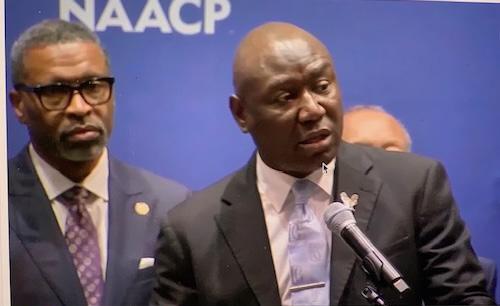
NAACP President & CEO Derrick Johnson and Attorney Benjamin Crump.
Independent Autopsy Finds Cause of Death for Nolan Xavier Wells Remains Undetermined
additional findings may emerge as the investigation continues.
Preliminary Discussion | Opinion:
This forensic pathologist identified several limitations during the second autopsy that create barriers to establishing a definitive cause and manner of death for Nolan Xavier Wells. The second autopsy performed on Nolan Wells revealed marked decompositional changes. Marked decomposition can obscure the presence or absence of bruising on the skin surface, especially during a second autopsy examination. For these reasons, additional dissection procedures, not performed during the first autopsy examination, were performed to rule out potential blunt force injuries responsible for the death. These procedures included facial dissection, posterior head and neck dissection, dissection of the ribs, pelvic dissection, and subcutaneous and deep soft tissue dissection of the back, buttocks, arms, and legs. There were no fractures or deep tissue injuries identified. However, dissection of the back of head during the layered posterior neck dissection revealed a 12 X 8-inch focal area of red discoloration in the deep soft tissues overlying the occipital bone. The etiology of this finding is unclear. There are no lacerations of the overlying skin nor fractures of the underlying skull. These findings are inconclusive for perimortem injury due to both the extensive decomposition and the absence of associated injuries. This finding, however, is significant enough to be high-
lighted in this preliminary report for further investigation. It is important to reiterate that this finding could not have been observed in the first autopsy because the posterior head and neck dissections were not performed. Another limitation faced by this forensic pathologist was the absence of the anterior internal neck structures. The tracheal and laryngeal cartilages, thyroid horn, and hyoid bone were not received with the body. It is assumed that the initial pathologist retained these structures for additional evaluation. The retention of the anterior neck structures during an initial autopsy is a common forensic pathology practice. Nevertheless, a posterior neck dissection performed without review of the anterior neck structures, is incomplete. Therefore, this pathologist cannot rule out injury to the neck as a contributor or cause of death. Because the initial autopsy rightfully removed and dissected each organ, there are additional limitations inherent in the second autopsy of Nolan Wells. The most significant of the limitations was the inability to directly observe the airway and lungs for water and directly observe the stomach for gastric contents. In addition, the original toxicology results had not been received at the time of this report. Lastly, in cases where a death has occurred in or around a body of water with suspicion of drowning it is important to confirm how that person entered the water. This information is especially important for those deaths of persons who can swim, as is the case with Nolan Wells. At the time of this report, this forensic pathologist does not know the condition of Nolan Wells (i.e. conscious
or unconscious, forced or unforced) before entering the water. Definitive circumstances of death are required to determine manner of death. For these reasons, this pathologist cannot rule out if any intervening non-accidental factors contributed to or caused the death of Nolan Wells.
1. With the following questions still outstanding:
2. What were the circumstances that led to Nolan Xavier Wells entering the water?
3. What was the body position when found? .
4. Was there water in the airway? .
5. Is there any evidence of injuries to the anterior neck structures? .
6. Is there any evidence of intracranial hemorrhage (subdural or subarachnoid)? .
7. What was the composition of the stomach contents? 7
What are the toxicology report findings? The best classification for the cause and manner of death for Nolan Xavier Wells is Undetermined - Pending Investigation.
This forensic pathologist reserves the right to review and incorporate additional forensic pathology information into his opinion as it becomes available.
DATE: July 19, 2026
Roger A. Mitchell, Jr. MD
The above opinions are expressed to a reasonable degree of medical certainty
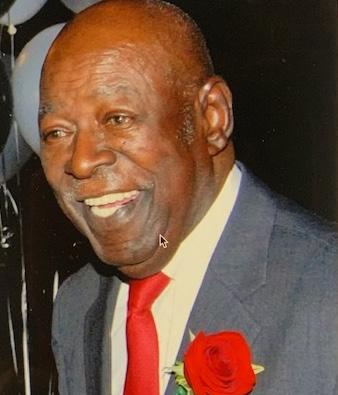
Nolan’s parents: Elmore and Christine Wonsley.
EDITORIAL:
Justice Requires the Truth
By WI Editorial Staff
Source: Black Press USA Wire
Independent Investigations Are the Only Way to Preserve Public Trust in an Era of Deep Division
The deaths of Lorenzo Salgado Araujo, who was fatally shot by an Immigration and Customs Enforcement (ICE) agent in Texas, and Nolan Xavier Wells, the 18-year-old Black college football player whose body was recovered after he disappeared during a boating outing in Mississippi, have once again raised questions that demand answers.
While the circumstances surrounding these two cases are very different, the principle is the same: there must be independent, transparent, and thorough investigations that follow the facts wherever they lead.
This is not simply about two tragic deaths. It is about the state of public trust in America.
We are living in a political climate in which nearly every institu-
The Westchester County Press
(ISSN 0043-3373) is published weekly on Thursday in White Plains, New York. Copies: 40¢. Yearly Subscription: $25.00, two years: $45.00. National Advertising representative: National Newspaper Publishers Association. Local and national advertising rates on request. Paper founded August 1, 1928 to serve the County of Westchester, New York.
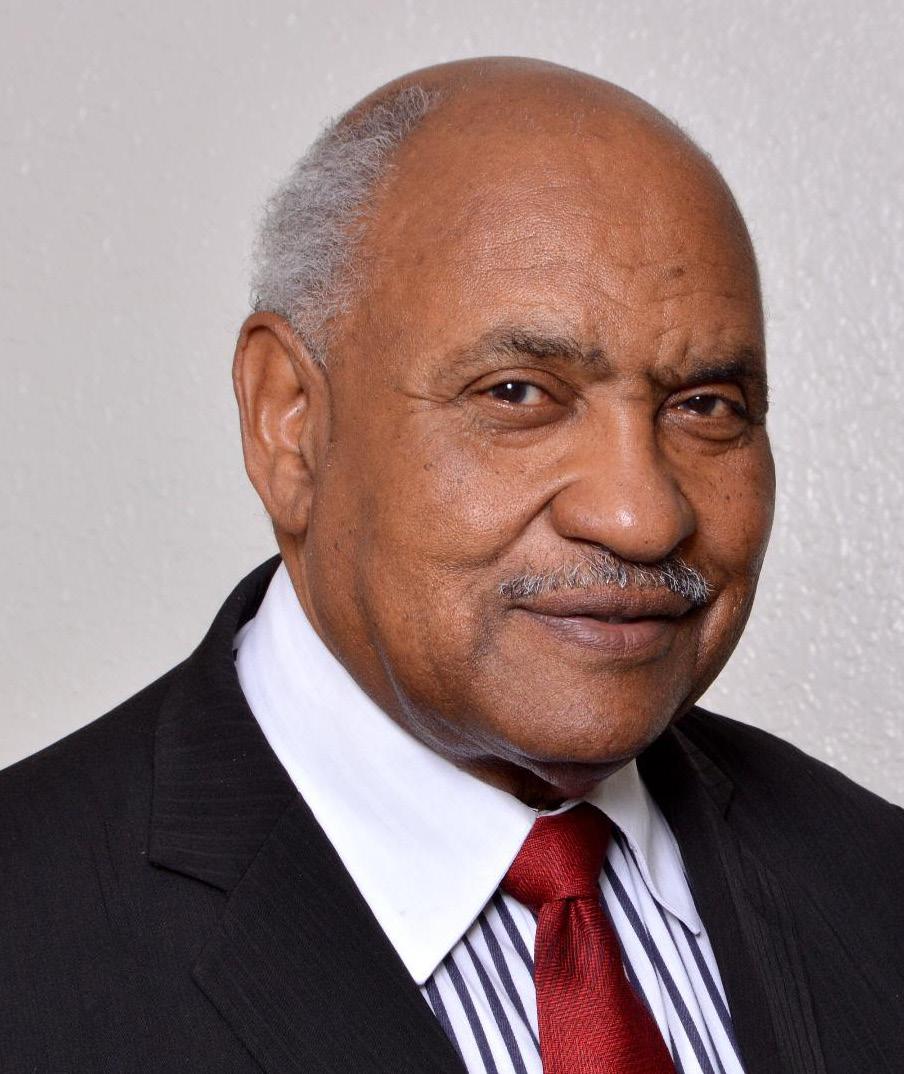
Sandra T. Blackwell President, Publisher & Editor
Carolyn B. Coleman Vice President
Alyce T. Coleman Executive Editor
Bruce L. Bozeman, Esq. Legal Counsel
Celeste Coleman-Housey, Ed.D. Art Director/Managing Editor
Editorial & Advertising Offices P.O. Box 152
White Plains, NY 10602 Telephone:(914) 953-2620
Member: National Newspaper Publishers Association
tion is viewed with skepticism. Government agencies, law enforcement, the media, and even the courts are routinely questioned by large segments of the public. Whether justified or not, confidence has eroded to the point that every controversial death is immediately viewed through the lenses of politics, race, ideology, or immigration.
That is precisely why independence matters.
Reports indicate that ICE agents were attempting to apprehend another individual when Salgado Araujo was shot and killed. His family deserves a full accounting of what happened, free from any appearance of institutional bias. Likewise, Wells’ family has raised legitimate questions about the events that led to his death after spending time on the water with several friends. Their request for additional scrutiny should not be dismissed as mere suspicion or speculation. It should be respected as a reasonable demand for transparency.
An independent investigation is not an accusation. It is a safeguard.
If government officials acted appropriately, an impartial review would strengthen public confidence in that conclusion. If mistakes were made — or misconduct occurred — those responsible should be held accountable. Justice works only when the public believes the process is fair, impartial, and free from political influence.
America has learned, often the hard way, that institutions investigating themselves rarely inspire confidence. Families deserve more than assurances. Communities deserve more than press releases. They deserve evidence, transparency, and accountability.
No one should prejudge either case. Facts — not rumors, politics, or social media — must determine the outcome. But allowing independent investigators to examine every witness statement, every piece of physical evidence, and every official action is the surest way to establish those facts.
Equal justice cannot depend on a person’s race, immigration status, political affiliation, or the agency in-
is the Time To Register To Vote
By Dr. John E. Warren, Publisher
San Diego Voice & Viewpoint Newspaper Chairman of the Board of Directors, NNPA
As we find ourselves four months away from the Midterm Elections, we see that the Republican Party has seen the handwriting on the wall in terms of the number of Republicans running for office nationwide who are going down in defeat. The one remaining question is: How many of the rest of us also see the opportunity of the rescue of our democratic form of government, if only we would bother to vote?
Now is the time to engage in Voter Registration, which will ensure our right to vote in the November Midterm elections. While it is important to put people in office
who will uphold the Constitution and the Oath of Office that goes with it, one has to be registered to vote before one can actually vote.
The San Diego Voice & Viewpoint newspaper has done what we hope all of our papers will do: simply make Voter Registration Cards available at our office. Not only can you pick up blank registration forms here, we can assist you in filling them out, if you need help. There is no need to wait until October to join a rush to registration. We can hold a number of conversations about who one might consider voting for, the main issue is that as many of us as possible are registered to vote.
It does not matter if you are homeless, have a past criminal record, or speak a different language. This is one of the states that offers multiple language voter registration opportunities.
We must remember that people died for our right to vote. We must also remember that there is a part of America afraid of executing that right, which we have guaranteed under the Constitution. Voting is more than a right; it’s an obligation that we have to those who came before us and were denied that right for a variety of reasons. THINK ABOUT IT.
volved. It must rest on truth.
In a nation already strained by polarization and distrust, independent investigations are not merely procedural exercises — they are essential to preserving the public’s faith in justice itself. The families of Salgado Araujo and Wells deserve clear answers. So does the American people. Truth, pursued without fear or favor, remains the strongest foundation upon which justice — and public trust — can stand.
Based on reporting by Washington Informer.
DR. JOHN E. WARREN
EDITORIAL: As They Seek Justice in the Death of Nolan Wells, African Americans Wrestle with the Notion the South Is Still the South
By WI Editorial Staff. Source: Black Press USA Wire
It’s been more than a week since the parents of Nolan Xavier Wells, a Black teenager eager to make his mark as a wide receiver on the football team at Southwest Mississippi Community College, received the call that no family ever wants to get.
After leaving home to celebrate the Fourth of July with friends on Horn Island — an uninhabited stretch of wilderness nestled among barrier islands located off the Mississippi coast — the teen’s parents became alarmed after their son failed to respond to calls, and his whereabouts were unknown.
Two days later, the foreboding sense of fear that had undoubtedly haunted Wells’ parents since his disappearance was confirmed: his body had been found by a U.S. Park Service Ranger, face down in the water just off the island’s northwest tip.
The 18-year-old’s friends made it safely back to the mainland. He did not.
Now, Wells’ parents, Elmore and Christine Wonsley, must wait anxiously, hoping to learn what really happened to their son, and prayerfully find some semblance of peace.
Meanwhile, questions continue to mount. Why didn’t the youth return with his friends? Why didn’t he have his cellphone with him? Was he involved in an altercation? Did he remain behind to meet with a girl or someone else?
Further, why did the Jackson County Sheriff’s Office state that no foul play was suspected, even before official autopsy and toxicology reports had been completed?
Mississippi is known for its beauty: magnificent magnolias, lush bayous, cypress swamps, and moss-draped Southern live oak. But the Magnolia
State also bears the ignoble distinction of the highest number of lynchings recorded in America, with an estimated 581 documented victims between the late 19th and mid-20th centuries, according to the Equal Justice Initiative.
As part of the rite of passage for their children as they reach adulthood, Black parents often recount the tragic narrative of 14-year-old Emmett Till, a Black teenager from Chicago, who, after allegedly whistling at a White woman, was abducted, tortured, and killed on Aug. 28, 1955, in the Mississippi Delta while visiting his relatives.
Mississippi is where three civil rights activists, James Chaney, Andrew Goodman, and Michael Schwerner, were arrested by local police in Neshoba County on June 21, 1964, and later released into the hands of a Ku Klux Klan mob who severely beat Chaney, a 21-year-old Black man, before shooting and killing him and his two White colleagues.
During a news conference on July 10, the Rev. Al Sharpton said while he was reluctant to rush to judgment or speculate that racism may have led to Wells’ death, he admitted, “This does not smell right.”
The truth will eventually come to light, but since the days well before the Civil War, Mississippi has been a dangerous and deadly place for African Americans.
It seems the South is still the South.
Based on reporting by Washington Informer.
Originally published by Black Press USA Wire — https://www.washingtoninformer.com/nolan-wells-death-mississippi-concerns/
Automatic Draft Registration Raises Questions Among Young Americans
By Morgan Knight, Armani Durham and Zoe Cummings | Howard University News Service
As the federal government moves toward automatically registering men ages 18 to 25 for the Selective Service System, a longstanding requirement tied to a potential military draft, confusion and concern are growing among young Americans.
The policy shift is intended to streamline the registration process and increase compliance by using existing government databases, such as Social Security and DMV records, rather than relying on individuals to sign themselves up. While officials frame the change as administrative, many young people say it feels more significant.
John Aden Wilson, a 20-year-old college student who plans to join the D.C. National Guard, said his initial reaction was uncertainty and concern.
“I was a little bit worried,” Wilson said. “It feels like it sets up the future generation to become pawns of whatever administration is in power.”
Although Wilson is already involved in the military in a non-combat intelligence and logistics role, he said his perspective might be different if he had no connection to service.
“If I wasn’t already going into the National Guard, I think I would have been more worried,” he said. “Now it feels less like a choice and more like something that’s forced.”
The United States has not used a military draft since 1973, during the Vietnam War.
Still, registration with the Selective Service has remained mandatory for men, though enforcement has historically been inconsistent. The move toward automatic registration changes how that requirement is experienced, particularly for younger generations who may not have been fully aware of it.
Wilson said many people his age misunderstand what the change actually means.
HUNews Service
“A lot of people think this means you’re going to be sent off to war immediately, and that’s not true,” he said. “It just means you’re in the system. A draft would have to be officially activated for anything beyond that.”
He added that there is also confusion about the difference between registering and being drafted.
Registering for the Selective Service simply means a person’s information is entered into a system that could be used in the event of a national emergency. Being drafted, however, would only occur if the government officially reinstates the draft and begins calling individuals to serve in the military.
“I don’t think the government has clearly explained that difference,” Wilson said.
“And that lack of clarity is what scares people.”
Misinformation circulating on social media has only added to the anxiety. Some posts falsely claim that automatic registration leads directly to military training or deployment.
“I’ve had people ask me if being registered means they have to go to basic training right away,” Wilson said. “That’s not the case at all.”
Still, he believes social media plays a mixed role.
“It depends on who you follow,” he said. “There’s misinformation out there, but there are also people trying to explain what’s re lly happening. You just have to be careful about where you get your information.”
Beyond confusion, the policy raises broader concerns about government authority and privacy. The use of cen-
tralized databases to automatically enroll individuals has prompted questions about how personal information is being used.
“That’s what worries me the most,” Wilson said. “Where is that information going, and how else is it being used? The government doesn’t always have the best track record when it comes to protecting people’s data.”
The change also shifts the symbolic meaning of registration. For some, signing up for the Selective Service was previously seen as a civic duty tied to patriotism. Automatic enrollment removes that element of personal choice.
“Signing up yourself felt like you were doing your part,” Wilson said. “Now it feels like, ‘We already have your name, you don’t have a say.’”
At the same time, not all young Americans view the policy through the same lens.
Brock Morgan, who is pursuing his master’s degree at Northwestern University, said military service was never part of his plans and views the potential return of a draft as deeply troubling.
To him, the decision represents a dangerous step backward.
“It’s a waste of time, resources, taxpayer money and most importantly American lives over something that didn’t need to happen,” Morgan said.
Wilson emphasized that, regardless of perspective, young people should remain engaged, particularly through voting.
“People think once something like this happens,
Cont’d. on page 11
Predatory auto lending exploits Black consumers: Higher car costs, double-digit interest rates, misleading sales tactics drive historic delinquency
Nearly 92 percent of American households rely on a personal vehicle to manage their daily lives. Consumers shopping for a vehicle in May learned that the average cost of a new car was $49,307, and that used cars averaged $25,918, according to Cox Automotive.
But the high price of vehicles is not the only financial challenge confronting Black and other consumers of color. Discriminatory and predatory practices in the sale and financing of cars have pushed millions of buyers into longer and higher priced loans.
A study by the National Fair Housing Alliance found that non-white test shoppers were given more expensive financing 62.5 percent of the time compared to white testers with equivalent or worse credit. Similarly, another recent independent study by the Century Foundation concluded that Black, Hispanic, and American Indian borrowers are given higher interest rates on auto loans across all credit tiers. Research published by the Federal Reserve found Black borrowers disproportionately pay the highest interest rate mark-up, resulting in more than $3,000 in additional interest over the life of the loan.
Now a new report released by the Center for Responsible Lending (CRL) found that the terms of predatory loans as well as dealers and lenders conniving to drive up costs - not the consumers’ willingness to pay – made delinquency and default more likely. These tactics limit alternatives borrowers can pursue to lower their payments. This conclusion came through a series of consumer focus groups with subprime credit scores, most of whom are Black, reeling from the effects of predatory car loans.
High-pressure tactics, misleading claims about vehicle features or conditions, and aggressive upselling of overpriced add-ons and services together obscured the true cost of the vehicle and prevented consumers from making informed decisions. Beyond auto sale, dealer financing exposes consumers to interest rate markups,
By Charlene Crowell
hidden fees, and unaffordable loan terms.
Nicole, a Black woman in her early 50s who lives in Minneapolis, Minnesota shared her personal story of urgently needing a vehicle as she went through a separation in which her former spouse kept their car.
A full-time employee at a nonprofit organization focused on ending homelessness, she earns less than $50,000 a year. She took out a loan for $19,000 with an interest rate of 24 percent and a 48-month term. In addition to the inflated sales price of the vehicle, the dealer included a $2,000 warranty and the lender rolled over a previous loan for a repossessed vehicle that significantly increased the total financing for Nicole.
Shortly after the sale, Nicole discovered the car lacked heat and had a failed engine, fuel pump, and water pump — all undisclosed problems requiring costly repairs
that were not fully covered by the warranty. She now owes more on her car than it’s worth but still needs a way to get to work. Making payments has been a struggle and on a few occasions, the car has been taken away due to late payments.
“You pay that and nothing, nothing ever changes,” Nicole shared. “And even when it reports on the credit bureau, it says that I’m still past due, like, 31 payments, and they’ve come, they’ve taken the truck. I pay when I’m past due, and they give it back to me. So, it’s a vicious cycle.”
A portion of CRL’s report explains the costly and limited options lenders provide borrowers who fall behind on payments:
A deferment lets a borrower skip a payment, but the skipped amount is added to the end of the loan along with additional interest. Lenders often describe deferments as just moving a payment to the end
and does not disclose the true costs of doing so. However, the accumulating interest means borrowers end up paying more than the deferred payment and may become even more underwater as the car depreciates while the loan balance grows.”
“Isabelle,” a journalist in Florida using a pseudonym, related her experience with deferment:
“The problem with that is like they charge a daily interest, and you never catch up. Because I did that a couple of times, I was paying my car and then the payoff amount would not change at all, because the interest is so high, plus all those daily fees and everything. So, I didn’t have a choice. I had to do it. I do not recommend [it] if you can stretch and maybe borrow some money from family, friends, or whatever, because it’s better than to do that.”
Many auto lenders have also turned to technology that remotely disables vehicles if a borrower falls
Photo Credit: Center for Responsible Lending (CRL)
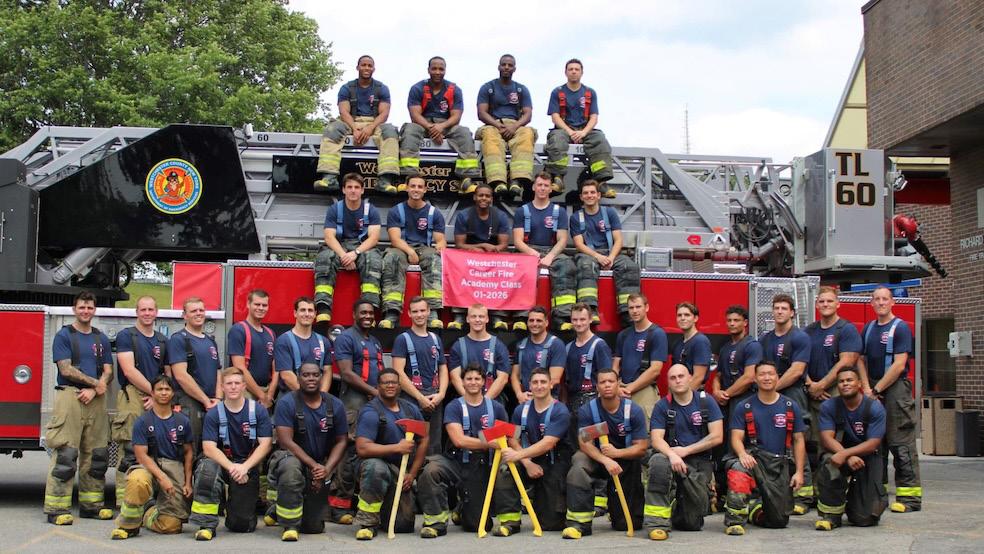
35 New Firefighters Graduate from the County Career Fire Chiefs Firefighters Academy
Will go to work for nine fire departments in Westchester and three others in the region
CHAPPAQUA, NY – Thirty-five recruits from 12 fire departments in Westchester and beyond graduated today from the Westchester County Career Fire Chiefs Firefighters Academy.
The new firefighters are going to work for nine departments in Westchester, two in Dutchess, and one in Orange. They were awarded their certificates before a packed house at the Chappaqua Performing Arts Center in New Castle.
Deputy County Executive Joan McDonald congratulated the graduates for successfully completing the rigorous academic and physical demands of their Academy training. She noted that firefighters need a broad range of skills to handle incidents ranging from building fires to hazardous materials to rescue and recovery efforts following severe storms.
McDonald said, “To Class 01-2026, best of luck to you as you make you way in this demanding, rewarding and noble profession you have chosen. On behalf of County Executive Jenkins, I wish all of you long, safe and successful careers.”
She also thanked the career chiefs, Academy commanding officers, Academy instructors, and staff from the Department of Emergency Services for preparing the new firefighters for the challenges ahead.
Other speakers who lauded the graduates were DES Commissioner Susan Spear; Fairview Fire Chief Howard Reiss and Eastchester Fire Department Lt. Dominick DiRienzo, who served as one of the Academy’s commanding officers.
The graduates and their departments are:
Arlington: Steven Halderman, Zachary Jones, William Lacovara.
Eastchester: Kevin Lee.
Greenville: Dylan O’Brien, Patrick Prendergast, Samuel Shedden.
Lake Mohegan: Paul Cirillo, Nicholas Colello, Samuel Guida, Nicholas Rubeo, Jacob Tussel.
Mount Vernon: Justin Cales-Bookman, Ronald Miller, Justin Wallace, Curtis Wright.
Newburgh: Robert Sampson, Thien Truong, Stephan Tyler.
New Rochelle: Michael Acocella, Rameek Boyd, Lonnie Jones, Anthony Petrone.
Pelham: Anthony Romano.
Poughkeepsie: Riley Carroll.
Rye: Jeffrey Fernandes.
Scarsdale: John Madera.
White Plains: Joseph Carrier, Paul Clarke, Nicholas Constantino, Nolan Constantino, Michael DeRenzis, Nazir Hibbert, Christos Siapanides, Alexander Siapanides.
Under One Advisory, Two Different Wednesdays: Asthma and Air Quality in Westchester County
Westchester asthma air quality
Editor’s note: Denise, Malik, and Aaliyah Carter are a composite household, not real, identified people. Their story is constructed from patterns that county officials, health data, and local advocates describe as typical for thousands of families across Westchester — it is illustrative, not a reported fact about a specific family.
Denise Carter didn’t need her phone to tell her last Wednesday would be a bad-air day. Her 8-year-old son, Malik, had struggled to breathe overnight — something his pediatrician says isn’t unusual for a family living a few blocks from a bus depot and a cluster of highway onramps in Mount Vernon. Long before the state made it official, Carter had already kept Malik and her 14-yearold daughter, Aaliyah, indoors, checked that Malik’s rescue inhaler was in his backpack, and switched from checking the Air Quality Index once a day to checking it every hour.
County officials and local advocates say the Carters’ Wednesday is a near-exact match for what plays out in thousands of homes across Westchester. For a family in a wealthier part of the county, like Bedford or Pound Ridge, the same advisory might mean rescheduling an outdoor tennis lesson. For the Carters, it means something closer to triage: two air purifiers running around the clock — adding roughly $40 to the monthly electric bill — nebulizer supplies not always fully covered by insurance, and, on at least one occasion, Denise Carter leaving work early after a school nurse called about Aaliyah’s breathing on a smoky afternoon.
This past Wednesday, the county was under an active Air Quality Health Advisory as wildfire smoke drifting down from Canada combined with a regional heat wave. The advisory, issued by the New York State Department of Environmental Conservation, grouped Westchester with New York City and Rockland County in a “metro zone” forecast to have unhealthy air for sensitive groups into the evening — stacked on top of a heat advisory already running through 9 p.m. Westchester County Health Commissioner Dr. Sherlita Amler urged people to take the heat seriously, singling out infants, pregnant women, older adults, and anyone with asthma, heart disease, or another respiratory condition as groups that should limit their time outside until temperatures and air quality improved.
A Pattern, Not a One-Off
Local officials and clean-air advocates are quick to frame days like this as part of a pattern rather than a rare event — and the numbers back that up in two different ways.
County-wide, the Westchester Index — a community data project that draws on EPA monitoring figures — found that Westchester recorded “good air” quality
By Marvin Church
on 88% of monitored days in 2023, matching the 2022 rate and marking a 14-percentage-point improvement over 2010, well above 2007’s low point of 66%. But that county-wide number can be misleading: the risk-analysis firm First Street Foundation has found Westchester already logs more poor-air-quality days than about 90% of counties statewide, with those numbers projected to climb over the next three decades rather than fall, and First Street singles out Mount Vernon — the Carters’ neighborhood — as the hardest-hit municipality in the county. Health officials have also pointed to a related trend: childhood asthma rates rising nationally, with environmental pollutants suspected as a contributing factor.
The other pattern is this week’s smoke, which is a repeat of what Westchester and the rest of the region have been through before. On June 7, 2023, smoke from wildfires burning in Quebec pushed New York City’s Air Quality Index to 484 by 5 p.m. — a record high on AirNow.gov’s 500-point scale, and briefly the worst air quality of any major city in the world. This week’s smoke, drifting down from more than 100 fires burning across Ontario and Minnesota, was forecast to push the city’s index to around 200 — well above the alert threshold, but short of the 2023 peak, making it the worst smoke event New York has seen since then.
The health data from 2023 makes clear who absorbed the brunt of that earlier event, and it’s the same population Westchester’s own numbers point to. A state Department of Health study published in the CDC’s Morbidity and Mortality Weekly Report found that emergency department visits for asthma attacks rose sharply during the three-day 2023 smoke episode, and that children and non-Hispanic Black residents disproportionately experience the kind of asthma flare-ups that require emergency care — a pattern the study’s authors warned would likely deepen as extreme weather events become more frequent. Separate reporting on that same smoke wave found the burden fell hardest on poorer and predominantly Black communities that already tend to live closer to polluting industry and carry higher baseline asthma rates, with cities like Detroit registering some of the worst readings in the country.
That said, not every study from 2023 points to a single conclusion about the severity of the acute health impact. A separate analysis by researchers at NYU Langone found that citywide, the bump in emergency-room visits for asthma attacks and breathing problems during the smoke event was only slightly higher than what New York typically sees on a bad pollen day — a reminder that the disparity in who bears the burden of poor air quality is well established, even as researchers continue to sort out exactly how severe any single smoke event’s citywide health toll turns out to be.
For Mount Vernon, the 2023 disparity data isn’t abstract — it’s a preview. A family like the Carters didn’t experience 2023 and this week’s advisory as two
separate news events; they experienced them as the same recurring emergency, another stretch of days when the folder of inhaler prescriptions and air quality screenshots gets thicker, whether the AQI tops out at 200 or 480. None of it is unique to one household — it’s the same routine playing out across hundreds of families concentrated in a handful of neighborhoods, absorbing the same advisories and the same costs that never show up in a headline statistic like “88% good air days.”
Why the Burden Falls Unevenly
Nationally, Black Americans are hospitalized and die from asthma at significantly higher rates than white Americans — a disparity researchers attribute to unequal exposure and structural inequity rather than any biological difference. Westchester, despite its overall wealth, mirrors that same pattern. Several factors combine to produce it:
Location of pollution sources. Traffic corridors, older industrial sites, and denser housing tend to sit in the same neighborhoods historically shaped by discriminatory housing policy, so residents there breathe more particulate matter and ozone
MARVIN CHURCH
DRAFT,
Cont’d. from page 6
there’s nothing they can do,” he said.
“But that’s not true. Elections still matter. Congress still matters. That’s how you push back.”
For veterans like Keith Austin, who served nearly 20 years in the U.S. Air Force, the conversation reflects a deeper disconnect between civilians and the military.
“I think for you to understand the military, you need to have at least been part of it,” Austin said. “The reason we serve is to protect the freedoms people use every day.”
But for many young Americans, the issue is less about understanding the military and more about trust in the institutions making these decisions.
“I would fight to protect my country,” Wilson said. “But I think people want to understand what they’re being asked to fight for and why.”
As the policy moves forward, that question of purpose, transparency and trust remains at the center of the national conversation.
Morgan Knight, Armani Durham, and Zoe Cummings are reporters for HUNewsService.com
Originally published by BlackPressUSA Newswire
CROWELL,
Cont’d. from page 7
behind on payments. These “kill switches” can put drivers in physical as well as financial risk.
Monica, another borrower, told of the lender disabling her car while she was driving:
“I forgot that they have the GPS thing installed. My car is jerking and I’m on the side of the road. And so when I called roadside, they were like, we can’t help you. It’s this [start interrupter device] I’m like, you couldn’t send me an email? Like, you see my payment history. What if I was on the freeway, and not only just a regular street?”
CRL urges the Federal Trade Commission, Consumer Financial Protection Bureau, and states to establish several consumer protections, including limits on how much lenders can charge.
“This report shows how the advantages auto dealers and lenders have over consumers result in exploitation,” noted Lucia Constantine, report coauthor and a CRL senior researcher. “Our government must establish guardrails to protect consumers — like it did in the mortgage market.”
Charlene Crowell is a senior fellow with the Center for Responsible Lending. She can be reached at Charlene.crowell@responsiblelending.org.
AIR QUALITY, Cont’d from page 9
day to day, regardless of the county-wide average.
Housing quality. Older housing stock — more common in historically underinvested neighborhoods — is more prone to mold, pests, and poor ventilation, all recognized asthma triggers, and families with fewer resources have a harder time keeping up with repairs.
Access to care. Getting to a specialist, refilling a prescription, or making a follow-up appointment is harder for families dealing with transportation gaps, inflexible work schedules, and insurance hurdles — meaning an air quality alert doesn’t do much good if a family can’t get a nebulizer refilled that week.
Chronic stress. Researchers studying New York City health survey data found that people with a history of incarceration were substantially more likely to have asthma than those without, after statistically matching them on other risk factors — evidence, the study’s authors suggested, that exposure to the criminal justice system may itself be a contributing factor in the racial disparity in asthma rates, on top of pollution exposure alone. It’s a single, associational finding rather than a proven mechanism. Still, it points to the same conclusion as the housing and stress research more broadly: asthma doesn’t develop in isolation from the rest of a person’s life.
From Data to Policy
That gap between the county-wide average and neighborhood-level reality is what pushed a county advisory group to act. Over the past year, the
Asthma Committee of the Westchester County African American Advisory Board has been building a case — with data, not just individual stories — that asthma in Westchester falls disproportionately on Black communities.
At a forum last November at Westchester Community College’s Mount Vernon Extension Center, committee chair Marvin V. Church told residents, health professionals, and elected officials:
“The idling of buses and the emissions from surrounding factories are not just environmental concerns — they are public health threats. Our children breathe this air every day. We have a responsibility to act.”
Barbara Edwards, Esq., who chairs the full Advisory Board, told the same forum that the county Board of Legislators has since approved a new Asthma Subcommittee tasked with studying and addressing the county’s asthma burden — a direct result of the committee’s push.
To ground its case in evidence, the committee has been collecting residents’ ZIP codes at its forums and using them to build interactive maps of asthma hot spots and pollution clusters. The goal, organizers say, is to steer policymakers toward the specific neighborhoods carrying the heaviest burden, rather than letting a reassuring county-wide figure obscure what’s happening block by block — a map on which a household like the Carters’ would land squarely inside a hot spot.
The committee’s reach has grown well past Mount Vernon: Dr. Suzanne Phillips has led outreach in Greenburgh, Larry Sykes, Esq. has organized forums in Yonkers, and Gwen Clayton Fernandes hosted a session in New Rochelle, with more forums planned in Elmsford, White Plains, and Peekskill. State Assemblywoman Mary Jane Shimsky and State Senator Jamaal Bailey’s offices have both engaged with the effort, and the American Lung Association has partnered with the committee to widen its outreach.
Church and other committee members have also highlighted what they call the “hidden cost” of asthma for lower-income households: air purifiers, nebulizers, and filtration systems that must run constantly, straining already tight budgets, on top of missed school days and ER visits.
What Officials Are Telling Residents, and What Comes Next
With Wednesday’s advisory still active into the evening, county officials urged residents in sensitive groups to check the Air Quality Index before heading outdoors using AirNow.gov or local forecasts, since conditions can shift over the course of a day; stay inside with windows closed and air conditioning or filtration running where available; watch for early symptoms like coughing, throat irritation, or shortness of breath and follow any existing asthma action plan; and avoid strenuous outdoor activity or work until the advisory is lifted. Officials said further updates would come through the state Department of Environmental Conservation and Department of Health as conditions change.
Westchester’s wealth was never the problem, advocates say — the problem is that its benefits, from cleaner streets to newer housing to easier access to care, haven’t reached every neighborhood equally. Closing that gap, they argue, means targeted air monitoring in Mount Vernon, Yonkers, and New Rochelle that reflects neighborhood-level conditions instead of county-wide averages; housing remediation support aimed at the older housing stock most linked to indoor asthma triggers; easier access to medications and specialist care, including transportation help and flexible scheduling for working families; and sustained, community-led education so households have an asthma action plan in place before a bad-air day turns into an emergency room visit.
For families like the Carters, that gap between a manageable Tuesday and a trip to the ER is exactly what the county’s asthma advocates are trying to close.
THE BOZEMAN LAW FIRM, PLLC
200 Mamaroneck Avenue, Suite 500
White Plains, New York 10601
(914) 668-4600 • (914) 669-6371
Serving Metro-New York and Westchester County
PRACTICE AREAS
REAL ESTATE (Residential and Commercial)
FAMILY (Adoption)
WILLS/TRUSTS/ESTATES (Guardianship and Elderlaw)
RELIGIOUS /NON-PROFIT (Administration & Tax Status)
BUSINESS LAW (Corporations & Partnerships & Limited Liability Corporation)
*Bruce L. Bozeman, Esq., * Carla Lewis-Burnett, Esq. John S. Savage, Esq. ~ of counsel, Leticia Arzu, Esq.
*Principals of the firm serve as seminar speakers, upon request. Appointments Preferred.
Community Calendar
CALENDAR SUBMISSION: Please use a brief paragraph to describe your event. The paragraph should include event name, date(s), time, location and contact information. Send calendar information via email to westchestercountypress@yahoo.com. Please type “CALENDAR EVENT” in the subject bar
Now thru August 2nd
Exhibits on View at ArtsWestchester: May 16- Aug 2, 2026: Forever, Amen is an ongoing photographic study of the oldest Black churches in White Plains. Despite widespread displacement and cultural erasure caused by urban renewal, some of these churches have existed for nearly two centuries. The series examines how these places of worship have anchored Black residents of the city and its surrounding communities.
Thursday, July 23
We’re excited to announce that the Mount Vernon Youth Bureau will be hosting its 2nd Bi-Annual Planting the Seeds Gala on Thursday, July 23, 2026, at the Greentree Country Club in New Rochelle. This special evening supports an important mission: raising critical funds for young adults (ages 18–24) who are pursuing vocational and trade educations. Your support helps create meaningful pathways to careers, independence, and long-term success. We invite you to be part of this impactful event—whether by attending, donating, or spreading the word. Every contribution makes a difference in empowering the next generation. To learn more and support the cause, please visit: Friends of Mount Vernon Arts Recreation and Youth Programs — Donate via AB Charities. Thank you for your continued support. We look forward to celebrating with you!
Thursday, July 23
NYS Division of Minority and Women’s Business Development invites you to the 2026 MWBE Regional Opportunities Expo which will be held at the Javits
Center located in New York City. The New York Statey Minority and Women-owned Business Enterprise (MWBE) Regional Opportunities Expo brings together various New York State Agencies and Authorities and prime contractors that have a significant presence in all 10 NYS regions to provide MWBEs with information on contracting opportunities. Date: July 23, 2026. Time: 8:00 AM–5:00 PM. Location: 429 11th Avenue New York, NY 10001. The MWBE Regional Opportunities Expo will be held in-person and is our largest expo yet. Registration is required for all attendees.
Now thru July 26
M&M Performing Arts Company brings Shakespeare’s romantic comedy A Midsummer Night’s Dream to Lyndhurst this July in a 1960s-inspired production staged in the open-air theater of the estate’s Palm Court. Guests can witness the play’s love stories, feuds and celebrations against the backdrop of the Lord & Burnham gothic greenhouse. Performances begin at 7pm, with the option for picnicking starting at 5:30pm.
Wednesday, July 29
Open Sewing fro 10:30 am - 1:00 pm. The New Rochelle Public Library offers experienced seamstresses use of our state-of-the-art Necchi sewing machines. Patrons are responsible for bringing their own supplies, including fabrics, threads, patterns, and any other materials necessary for their projects. First come first served. Location: Community Gallery
Sunday, September 13
From 3–5 p.m, at the Paramount Hudson Valley Theater, Peek-
skill, N, The Robeson in Peekskill Project presents its third annual commemoration of the Peekskill Riots and celebration of Paul Robeson’s legacy. Hosted and narrated by Shana L. Redmond, award-winning author of Everything Man: The Form and Function of Paul Robeson, with visuals by documentary filmmaker and historian Jon Scott Bennett, the program brings together music, storytelling, history, youth voices, and community performers in an afternoon rooted in history and alive with the energy of the present. Featured performers include Resistance Revival Chorus, Cole Quest and the City Pickers, AMAUTA, Bria The Artist, and the Peekskill City Singers. Together, they will create an afternoon that is rooted in history, alive with the energy of the present, and designed to invite audiences of all ages to reflect, connect, and sing. Tickets are available at tinyurl. com/SWSTIX. Admission is $35 regular; $25 seniors 65+; $15 students; $5 kids 12 and under accompanied by an adult.
September 16-20
The wait is over—registration is now open for the Congressional Black Caucus Foundation (CBCF)’s 55th Annual Legislative Conference (ALC)! September 16–20, 2026, Walter E. Washington Convention Center, Washington, D.C. Join us for five days of impactful conversations, thoughtprovoking policy discussions, networking opportunities, and celebrations that bring together leaders, advocates, professionals, students, and changemakers from across the nation. This year’s ALC is especially significant as we commemorate the 50th Anniversary of CBCF—a milestone that honors five decades of culti-
vating leaders, advancing equity, and creating pathways for future generations. Together, we’ll reflect on our legacy, celebrate our progress, and look ahead to the future of Black leadership and civic engagement. For more information about the Annual Legislative Conference, please email our team. Registration: eventsupport@cbcfinc.org ALC Sponsorship Opportunities: rd@cbcfinc. org
Saturday, Sept. 19
September 19th, 2026, Times Square at Noon LOVE OUR MOTHER Concert Calming/Celebration/Party. Join us, as we honor and strengthen the message for the upcoming September 21st, the UN International Day of Peace at Noon WORLDWIDE, 193 Counties in the UN Agreed to participate and 1.6 billion people are aware (McKinsey Co.) of Peace Day...we want 8 billion to join in at noon (Put down the guns, anger and make love not violence) around the world for a MOMENT/MINUTE OF SILENCE FOR PEACE, Ringo Starr will lead the Minute/ Moment:) Peace & Love and may it continue FOREVER Here is a message from the Executive Producer about why we should all get involved and why for 24 years, our nonprofit, Good News Corporation, has: :https://pausetheworldforpeace. org/reverend-paul-sladkus-allfaiths-and-spiritual-producer-ofearth-and-peace-day-concerts-for24-years-shares-why/ Thank you all for caring for our world and those living in it…Our Good News Community hasn’t deviated since our first Good News Broadcast on July 4, 1998, through to the establishment of our International Day of Peace Concerts in 2002. WE CONGRATULATE YOU ALL FOR YOUR DESIRE TO SEE MEDIA AND EVENTS PROMOTE THE GOOD.
117th NAACP Convention
IL -- July 22, 2026 --
CHICAGO,
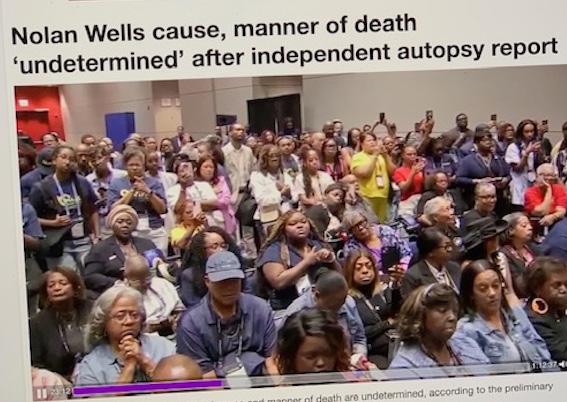
Kecia Palmer Cousins, Peekskill Councilwoman Hon. Beverley Chang, and NAACP Peekskill Branch President Priscilla Augustin wait in line to attend the press conference to hear the findings of the independent autopsy report of Nolan Xavier Wells.