As this goes to print just after the July 4th holiday, the fireworks have faded, the flags have been folded, and the parades have passed. But this year, the reflection cannot end with the holiday.
America has entered its 250th anniversary season, and many commemorations will continue throughout the year. That is fitting, because
on page 2
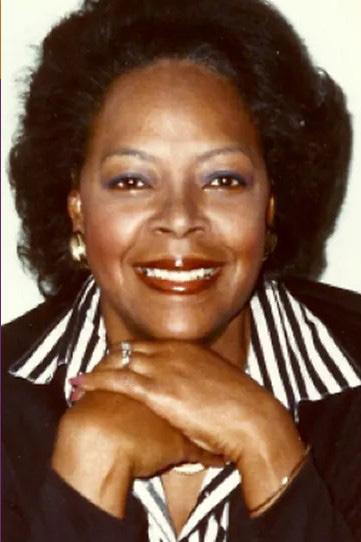
County Legislator Jewel Williams Johnson.
After the Fourth: Independence, Memory, and the Founding Still Before Us
By Jewel Williams Johnson
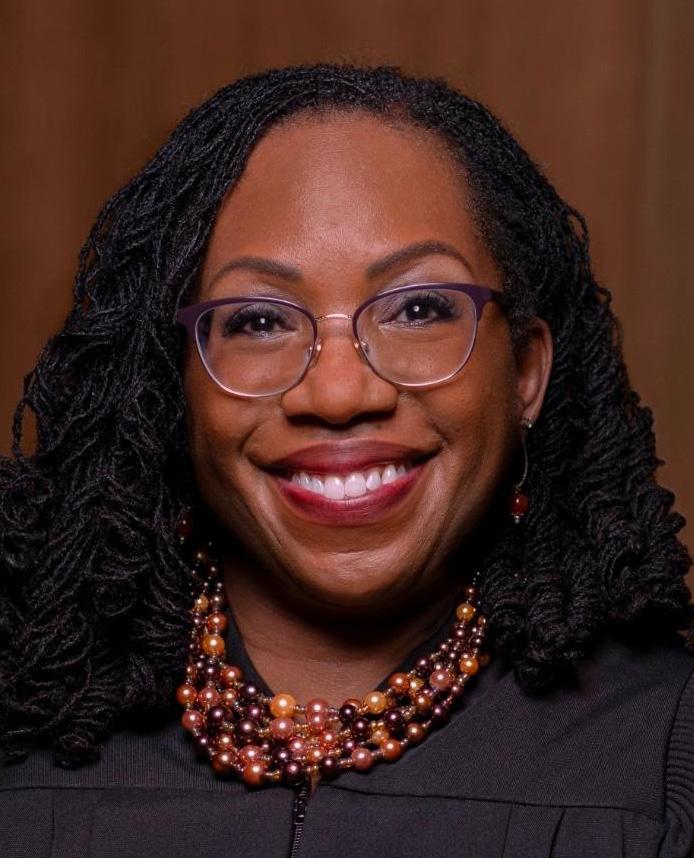
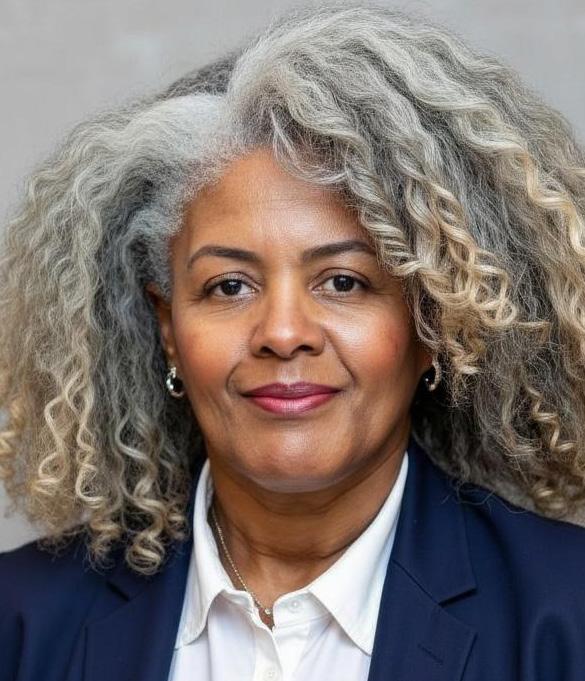
SUPREME COURT JUDGE
KATANJA JACKSON BROWN
the meaning of independence cannot be contained in one day. It cannot be reduced to one parade, one speech, one barbecue, or one burst of red, white, and blue across the sky.
The Fourth of July is not only the nation’s birthday. In Black his-
tory, it is also a date of unfinished promises, emancipation, education, resistance, and the ongoing demand that America live up to its own words.
On July 4, 1827, slavery officially ended in New York State. On July 4, 1881, Tuskegee University was founded, becoming one of the great institutions of Black education and self-determination. And just one day after Independence Day in 1852, Frederick Douglass asked the question that still pierces the American conscience: What, to the enslaved, is the Fourth of July?
That is why Independence Day must be joyful, but it must also be honest.
The Declaration of Independence gave voice to one of the most powerful promises ever written: that we are created equal and endowed with unalienable rights, including life, liberty, and the pursuit
of happiness.
But before 1776, this land was already home to Indigenous peoples and Native nations with their own governments, cultures, laws, spiritual traditions, and deep relationships to the land. Any honest discussion of America’s founding must begin there.
The United States did not emerge on empty ground. It emerged on land already loved, governed, defended, and understood by others.
That truth does not diminish the Declaration. In fact, it deepens the responsibility attached to it.
A promise written on paper is like a seed placed in soil. It may contain possibility, but it does not become a tree unless it is tended. It needs light, water, protection, pruning, and care. The Declaration planted a vision, but it did not automatically produce equality. Too many people were excluded from
its shelter. Too many were asked to believe in liberty while being denied it.
And the timeline matters.
From the signing of the Declaration of Independence in 1776 to the end of legal slavery in New York State on July 4, 1827, there were 51 years — more than half a century — of Independence Day celebrations in this state while enslaved people were still enslaved. That is not a footnote. That is a contradiction at the heart of the American story.
For 51 years in New York, bells rang for liberty while bondage remained legal. Speeches praised freedom while Black families were still denied it. The nation celebrated independence while some people were treated as property, not people. America was fluent in fireworks long before it was fluent in freedom. Even after New York’s eman-
AFTER THE FOURTH, Cont’d. on page 6
County Executive Ken Jenkins, Neuberger Museum of Art and SUNY Purchase Partner on Historic Exhibition Featuring Westchester’s Holt Broadside
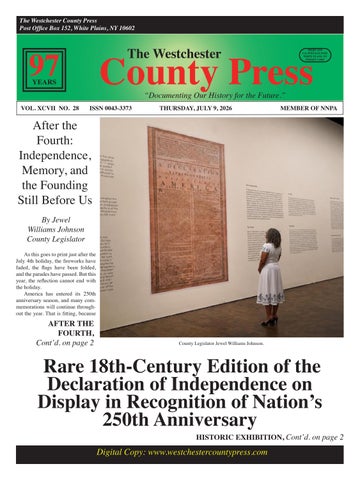
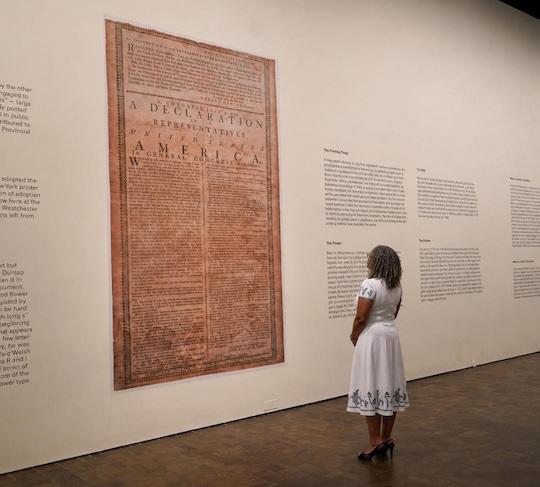
WHITE PLAINS, NY – Westchester County Executive Ken Jenkins, the Neuberger Museum of Art and SUNY Purchase will unveil Westchester County’s Holt Broadside, which is featured in the exhibition, The Declaration Distributed: Westchester County’s Holt Broadside of 1776. The special exhibition, centered on New York State’s historic adoption and distribution of the Declaration of Independence, will feature Westchester County Government’s Holt Broadside edition of the Declaration of Independence. This edition is believed to be the document that was read in White Plains shortly after the Declaration was adopted. Jenkins said: “We often talk about the founding of this nation as something that happened somewhere else, in Philadelphia, Boston or Washington, but this exhibition is a powerful reminder that Westchester County was part of that story from the very beginning.
The Holt Broadside is not simply an old document preserved in an archive. It is evidence that the words of the Declaration of Independence were carried here, read here and shared here as the American Revolution unfolded in real time. Westchester County has proudly safeguarded this extraordinary artifact for generations, and as we approach the nation’s 250th anniversary, we are honored to partner with the Neuberger Museum of Art, SUNY Purchase, to share it with the public. This exhibition highlights not only the importance of preserving history, but also the important role Westchester County played in the founding of our nation and the ongoing story of American democracy.”
The Declaration Distributed will mark the 250th anniversary of the founding of the United States and highlight Westchester County’s critical role in that founding. It will offer visitors a rare opportunity to
WESTCHESTER COUNTY EXECUTIVE
Kenneth W. Jenkins
Why African Americans Celebrate July 5th — and How That Resonates Today
By Barbara L. Edwards, Esq.
BARBARA L. EDWARDS, Esq.
For many Americans, July 4th represents freedom, independence, and the founding ideals of the United States. Yet for many African Ameri-
cans in the nineteenth century, the holiday highlighted a painful contradiction. While the nation celebrated liberty from British rule, millions of Black people remained enslaved. In response, African Americans in New York and other communities developed a tradition of commemorating freedom on July 5th, creating a space to celebrate emancipation while also challenging the nation to live up to its promises of equality.
The Origins of the Fifth of July
In 1827, New York completed the abolition of slavery within the state. Although emancipation officially took effect on July 4th, Black community leaders chose to celebrate on July 5th. Their decision reflected practical concerns about racial hostility and a desire to distinguish their celebration from the Independence Day observances held by white Americans.
The Fifth of July quickly became a meaningful annual tradition. African Americans gathered for church services, speeches, parades, and community events that honored freedom while drawing attention to the fact that slavery still existed elsewhere in the country.
A Symbol of Faith, Courage,
and Determination
The significance of July 5th extended beyond a single day’s celebration. It reflected the determination of African Americans to define freedom for themselves, even when society denied them full citizenship and equal rights. These commemorations demonstrated resilience in the face of discrimination and conveyed a clear message: freedom was not merely a legal status but a continuing struggle for dignity, opportunity, and justice.
This spirit was powerfully expressed by Frederick Douglass, who delivered his famous speech, “What to the Slave Is the Fourth of July?” on July 5, 1852. Douglass challenged the nation to reconcile its ideals with the reality of slavery and unequal treatment.
The Emancipation Proclamation and a New Era
President Abraham Lincoln’s Emancipation Proclamation, which took effect on January 1, 1863, became a historic milestone in the struggle against slavery and
CELEBRATE JULY 5th, Cont’d. on page 11
County Executive Ken Jenkins Reappoints Leonard Townes as Commissioner of Dept. of Social Service
WHITE PLAINS, NY -- Westchester County Executive Ken Jenkins announced the reappointment of Leonard G. Townes as Commissioner of the Department of Social Services. Townes was first appointed Commissioner in February 2021, capping a 36-year career at the Department that began as an Eligibility Examiner. He had previously served as Deputy Commissioner. Townes also currently serves as president of the Board of Directors of the New York Public Welfare Association. He is also an Elder on New York State’s recently convened Fatherhood Steering Committee, established to help guide statewide fatherhood engagement across family-serving system, and in Blue Nile Rights of Passage of
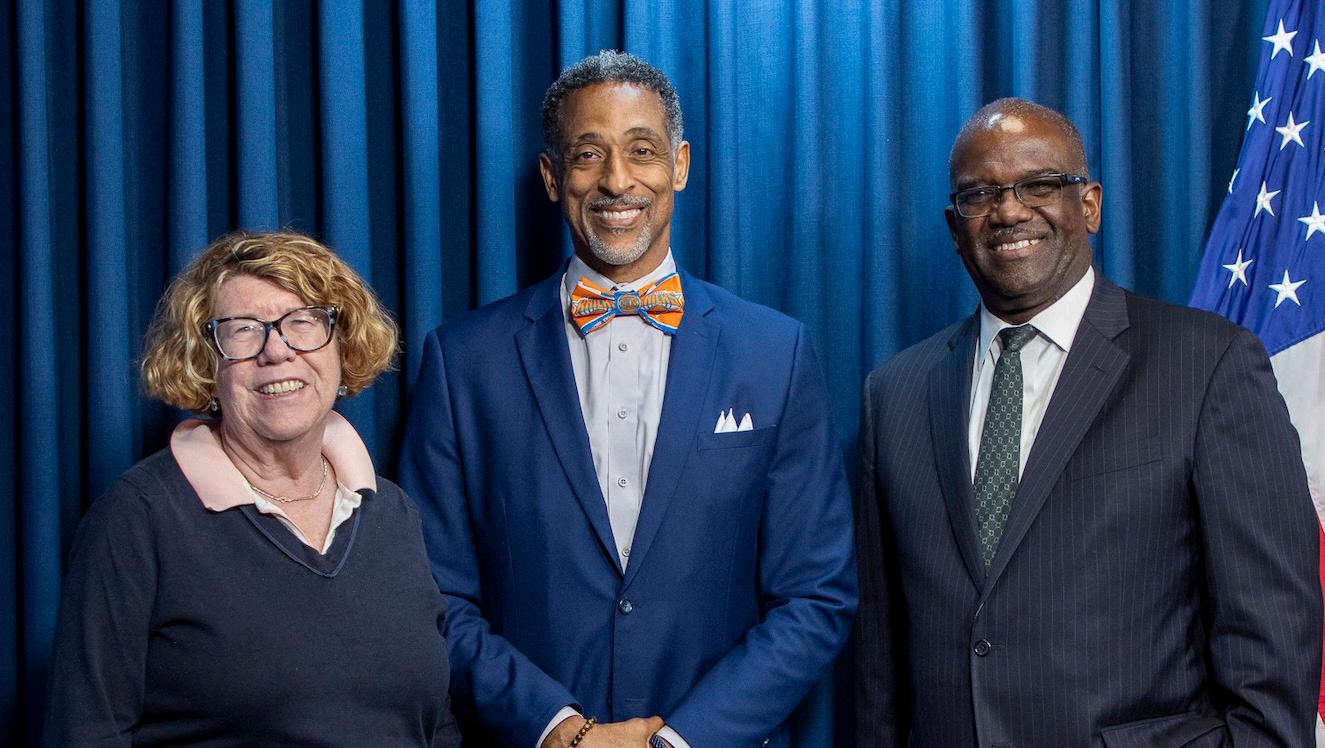
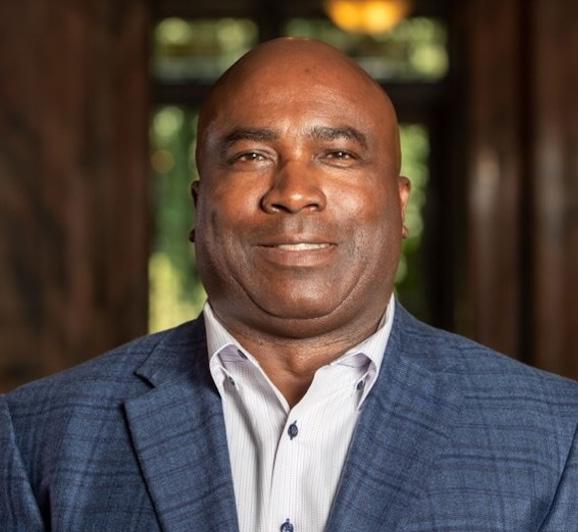
Deputy County Executive, Commissioner Leonard Townes and Westchester County Executive Ken Jenkins.
Jenkins Reappoints Leonard
Townes as Commissioner of Dept. of Social Services
Harlem and Westchester, a spiritual, cultural and moral character development mentor program with a focus on youth of African descent.
With a $750 million budget and 1,000 employees, the Department of Social Services is the County’s largest department, providing food, medical, housing, child care and child support services, and child and adult welfare protection to hundreds of thousands of Westchester’s most vulnerable residents annually.
Jenkins said: “The Department of Social Services provides crucial services for the county’s most overlooked residents: improving community stability through housing support, making sure people don’t go hungry, providing people in crises with lifeline services to get them back on their feet, and protecting children and vulnerable adults when they can’t protect themselves.
“Leonard took the reins during one of the most difficult times the Department has faced, the COVID crisis, and has worked to revitalize
The Westchester County Press
(ISSN 0043-3373) is published weekly on Thursday in White Plains, New York. Copies: 40¢. Yearly Subscription: $25.00, two years: $45.00. National Advertising representative: National Newspaper Publishers Association. Local and national advertising rates on request. Paper founded August 1, 1928 to serve the County of Westchester, New York.
Sandra T. Blackwell President, Publisher & Editor
Carolyn B. Coleman Vice President
Alyce T. Coleman Executive Editor
Bruce L. Bozeman, Esq. Legal Counsel
Celeste Coleman-Housey, Ed.D. Art Director/Managing Editor
Editorial & Advertising Offices P.O. Box 152 White Plains, NY 10602 Telephone:(914) 953-2620
Member: National Newspaper Publishers Association
the Department with a data-driven approach focusing on service, staff development and innovative and efficient use of technology. Today we face new challenges stemming from both the economic environment and uncertainty about federal support for the vulnerable. Commissioner Townes is the right person to continue to lead DSS through the coming challenges and opportunities.”
Townes said: “I want to thank County Executive Jenkins for the opportunity to continue to serve the people in Westchester who need our help the most. Our work is about protecting the vulnerable, strengthening families and supporting people in need so they can get back on their feet, and I am grateful to the Department’s tireless, dedicated employees for the commitment to that mission that they display every day.
“As Commissioner, my work also is to build a resilient, efficient, 21stcentury organization focused on innovation and best-practices, fostering new ideas, efficiently using the newest technology, and building robust leadership across the whole department, and I’m grateful for the chance to continue the process of revitalizing the department.”
A graduate of North Carolina A&T State University with an M.P.A. from Pace University, Townes is a lifelong resident of Westchester, graduating from Woodlands High School in Hartsdale, and currently resides in Dobbs Ferry.
By Dr. John E. Warren, Publisher San Diego Voice & Viewpoint Newspaper Chairman
It was like a “Tale of Two Cities”: The best of times and the Worst of Times. It was the best of times for the hundreds of immigrants that were sworn in as U.S. naturalized citizens across this great land. Their swearing in was a manifestation of the provisions of the 14th Amendment creating citizenship status for persons not born in this country; a provision of the 14th Amendment to the Constitution just as important as citizenship by birth. This is the provision that President Trump tried to get the U.S. Supreme Court to nullify, the Birthright Citizenship case which the Court rejected.
While many recited the Preamble to the Declaration of Independence words stating that “We hold these truths to be self-evident, that all men are created equal, that they are endowed by their Creator with certain unalienable Rights; that among these are Life, Liberty and the Pursuit of Happiness, That to secure these rights, Governments are instituted among men, deriving their just powers from the consent of the governed….” Many among
us are being denied those very rights today as evidenced by armed troops on the streets of our cities and Federal agents killing and imprisoning immigrants, citizens and anyone who appears to be out of step with this administration.
The celebrations, parades and millions of dollars spent on fireworks left many of us to remember to question those events with the immortal words of Frederick Douglass when he raised his rhetorical question during the 1852 76th anniversary celebration of America’s independence; “WHAT TO THE NEGRO (BLACK PEOPLE) IS YOUR FOURTH OF JULY….? TODAY ONE HUNDRED AND SEVENTY FOUR YEARS LATER, the question is still all too real.
For those of us concerned about the police state and kingship that Donald Trump would establish, let us take heart in the fact that today we have tools that Douglass did not have. In addition to the Constitution with its 13th, 14th, and 15th Amendments, the only thing we lack to make change is the will to get involved and do so.
Let’s start right where we live. Let’s start with the issue of making sure that each of us can vote, register and prepare to do so. Let’s take another look at how we are spending the few dollars we have. Let’s take another look at who we can help as a part of our collective and prepare to use our numbers like never before in all that we do. Let’s create our own fireworks that will last all year long with our involvement and collective agreement to help ourselves before we expect others to do so, and in all this, let’s make a lasting reality out of the change that Frederick Douglass envisioned.
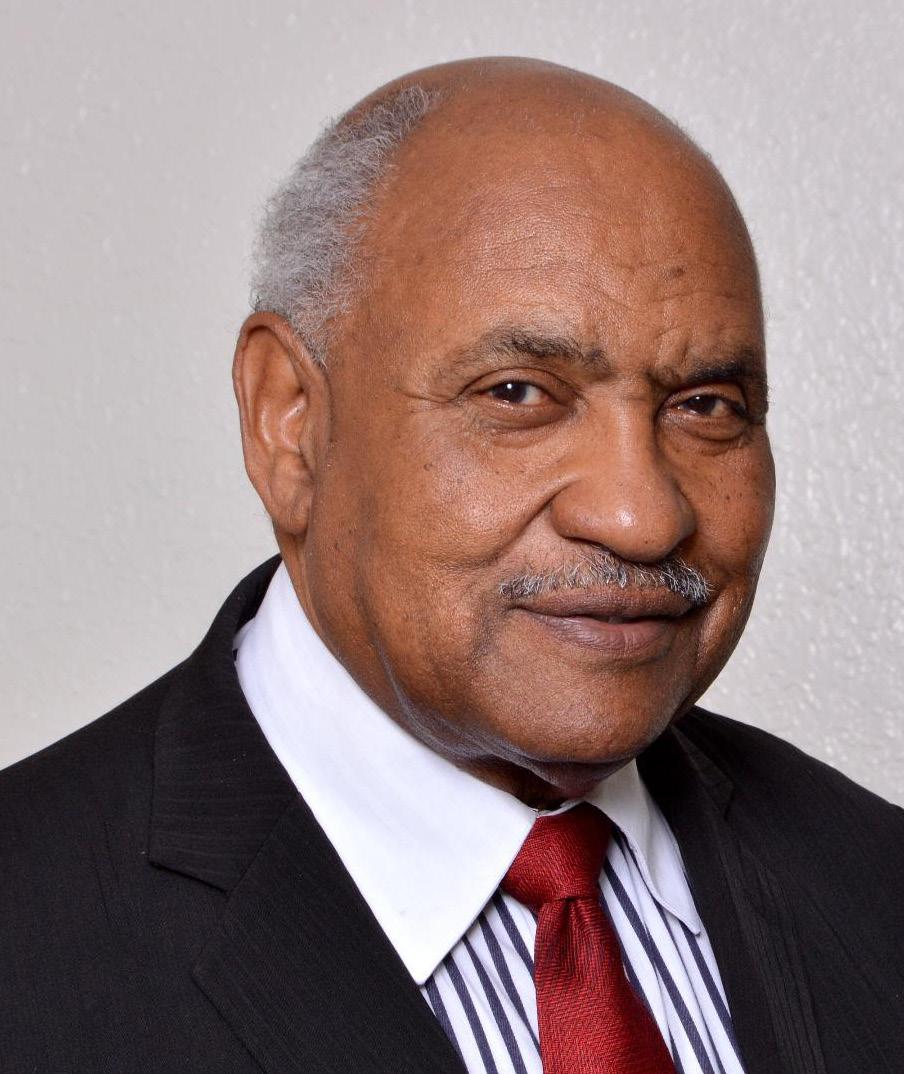
DR. JOHN E. WARREN
A Nation That Forgets Its History Is Bound
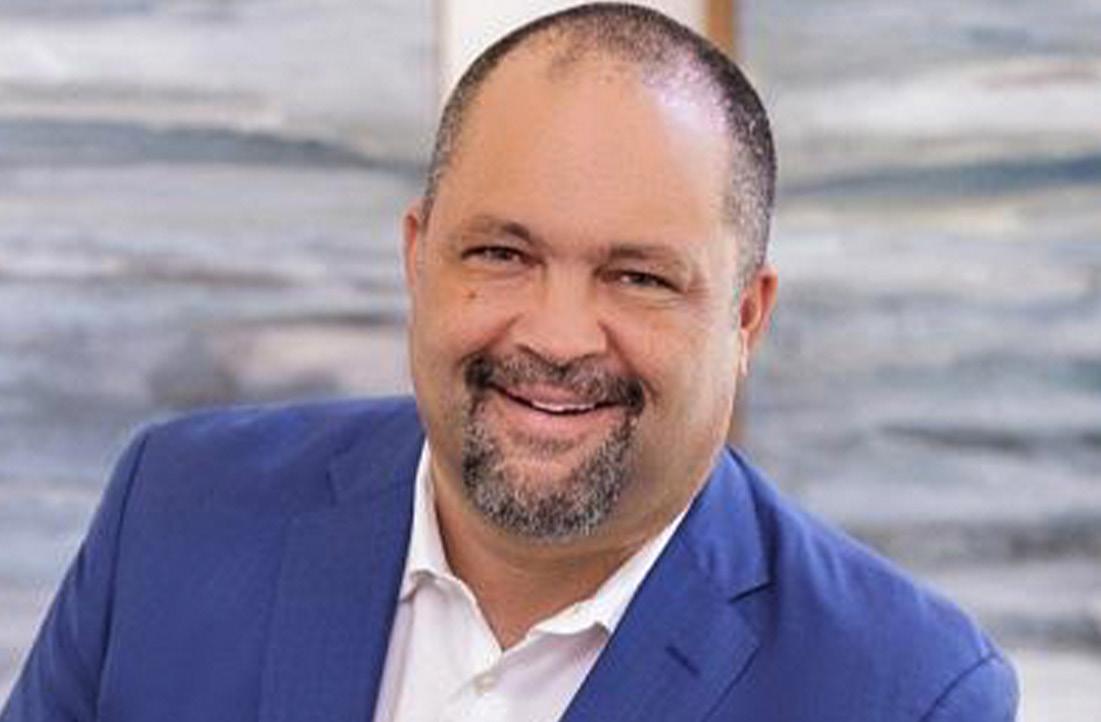
By Ben Jealous, Originally published by Black Press USA Wire —
When we forget the first fights over voting rights, we forget who profits when the many are divided.
Voting rights is back in the news because some people are still trying to decide whose votes deserve trust. In Georgia, the Justice Department and FBI under President Donald Trump have reopened questions around Fulton County’s 2020 election records after agents seized hundreds of boxes of ballots. The Associated Press reports the FBI has assigned 260 analysts and operations staff to review them.
Fulton County includes most of Atlanta and sits at the heart of Georgia’s transformation. It has a large Black electorate, growing Latino and Asian American communities, and many newer residents drawn by the Atlanta region’s jobs and universities. It voted against President Trump. Yet Georgia’s 2020 result was not some partisan rumor. Local officials counted the ballots. The state counted them three times, including once by hand. Republican officials certified the result. Each count confirmed the same outcome. That matters because vote suppression has often followed the same pattern: discredit the voters, divide the people, deprive enough citizens of the ballot, and move power upward.
The country has largely forgotten one of its earliest broad voting rights victories: the campaign to end property qualifications for white men. In many states, a man could be white, free, taxed, armed and called to defend the Revolution — and still be denied the vote because he did not own enough property.
Those men did not suffer as long as Black men, women, Native people or others shut out of democracy. Their exclusion still reveals the old fault line. Power rightfully belongs to the people. Yet wealthy interests have often tried to keep too much of it for themselves.
Some people profit from our forgetting. If we forget that landless white men once had to fight for the
vote, we can miss the pattern when it returns in new clothes.
Benjamin Franklin saw the absurdity. He told the story of a man whose vote depended on owning a jackass worth enough money to qualify him. When the animal died, the man lost the vote. Franklin asked the obvious question: “In whom is the right of suffrage? In the man or in the jackass?”
Thomas Paine gave the moral answer. “Man did not enter into society to become worse than he was before, nor to have fewer rights than he had before, but to have those rights better secured.”
There is irony in President Trump’s love of President Andrew Jackson. Jackson and his allies built the Democratic Party with a founding promise: government should answer to the landless many, not merely the propertied few.
Jackson’s democracy was badly bounded. It excluded Black people, women and Native people. His politics also embraced slaveholding
white supremacy. Still, he saw one danger clearly. In his veto of the national bank, he warned that “the rich and powerful too often bend the acts of government to their selfish purposes.”
That warning fits this moment. Vote suppression has often worked by discrediting voters, dividing working people against one another, and depriving the many of their full voice so some rich and powerful people can bend government toward themselves.
That was much of the logic of monarchy: divide and conquer. It was much of the logic of Jim Crow: tell poor white people their enemy is Black freedom. It was true in the 1820s. It was true in the 1920s, when immigrants from predominantly Catholic countries like Ireland and Italy were cast as threats to real America. It is true today, when immigrants from predominantly Catholic countries like Haiti and Mexico are made into scapegoats again. Tell rural voters their enemy is city vot-
ers. Tell Election Day voters their enemy is mail voters.
The tools change. The purpose often does not. Property requirements became poll taxes. Poll taxes became literacy tests. Literacy tests gave way to purges, ID rules, closed polling places and attacks on early voting, same-day registration and mail ballots.
The burden comes as paperwork, deadlines, long lines, missing names and ballots questioned after the people have spoken. A poll tax charged money. A long line charges time. Cutting early voting can tax people who do not control their schedules. Restricting mail ballots can tax seniors, disabled voters, rural voters and caregivers.
The Rev. Jesse Jackson spent his life widening the meaning of the many. He urged young people to hold “a diploma in one hand” and “a voter registration card in that other hand.” Education and the ballot. Knowledge and power.
I come to this history as a son
Ben Jealouss
After the Fourth: Independence, Memory, and the Founding Still Before Us
By Jewel Williams Johnson
cipation, nearly another 40 years passed before enslaved people in Texas learned, on June 19, 1865, that they were free under the Emancipation Proclamation. Another three years passed before the 14th Amendment was ratified on July 9, 1868, establishing birthright citizenship, due process, and equal protection as constitutional guarantees.
Then, astonishingly, it would take nearly another century — until July 2, 1964 — for Congress to pass the Civil Rights Act, outlawing segregation in public accommodations and banning employment discrimination on the basis of race, color, religion, sex, or national origin, while strengthening voting protections.
Apparently, America needed 188 years after declaring that all men are created equal to decide that “public accommodations” should actually be public.
And even that did not finish the work.
That is why African Americans and Indigenous peoples have every reason to approach July 4 with a different lens. Not without love of country. Not without hope. But with memory. With truth. With the moral clarity of people who know that celebration without honesty
can become performance, and patriotism without justice can become decoration.
This year’s anniversary season arrives alongside two deeply revealing national moments.
First, the United States Supreme Court’s decision in the birthright citizenship case reaffirmed a core constitutional truth: that children born in this country are citizens of this country. In that case, Justice Ketanji Brown Jackson reminded us that citizenship is the “right to have rights,” and warned against any interpretation of the Constitution that would create a “superior, dominant, ruling class of citizens.”
Those words should stop us in our tracks.
Even in victory, the birthright citizenship case reminds us that constitutional rights do not defend themselves; the Court upheld the promise, but the fractured reasoning showed how close foundational guarantees can come to being recast, narrowed, or placed back into political contest.
Citizenship is not merely paperwork. It is belonging. It is protection. It is the key that opens the door to every other promise the nation makes. To weaken citizenship is to weaken the idea that rights belong to people because of their humanity, not because of political convenience.
Justice Jackson also reminded us that “nations should have memories.” That may be one of the most important civic instructions of our time.
A nation without memory is like a family that refuses to speak honestly about its wounds. The pain does not disappear. It simply travels, unnamed, into the next generation. If we forget Indigenous displacement, slavery, Reconstruction, segregation, exclusion, voter suppression, and the long movements that forced America to widen its circle of “We the People,” then we become vulnerable to repeating the very injustices we claim to have overcome.
Second, this anniversary season also arrives one year after the passage of the so-called “Big Beautiful Bill,” a law whose consequences include health care losses for far too many people.
That, too, belongs in our reflection.
Because liberty is not only the right to speak. It is also the ability to live.
What does freedom mean to a mother who delays care because coverage is gone? What does the pursuit of happiness mean to a senior choosing between prescriptions and groceries? What does equal dignity mean to a worker who did everything asked of them and still finds the safety net pulled away?
Rights on parchment must become realities in peo-
ple’s lives.
There is another striking image unfolding around us as well: the World Cup here on North American soil, bringing nations, languages, flags, cultures, and people from across the globe into shared stadiums and shared streets. At its best, sport reminds us how beautiful human diversity can be when it is not treated as a threat.
That image stands in sharp contrast to the conflicts of this anniversary season — when citizenship, belonging, health care, history, and democracy itself are being contested. How powerful it would be if the spirit we cheer in the stands — many nations, many people, one shared field — helped remind us of what America must still become.
Sherrilyn Ifill, Howard University law professor, founding director of the 14th Amendment Center for Law & Democracy, and former President and DirectorCounsel of the NAACP Legal Defense and Educational Fund, has said: “We were founded a second time and we’ve hit 250 years and will need to be founded a third time; and that is the exciting part.”
I receive that powerful statement with deep appreciation. And if we are honest enough to remember that Native nations were here first, perhaps we can understand this moment as calling us toward an even broader fourth founding.
Not a founding that erases what came before. Not a founding that denies the promise of 1776 or the liberation vision of Reconstruction. But a founding that finally insists on the fullness of truth, the dignity of every person, the protection of democracy, and the conversion of constitutional ideals into lived reality.
The first peoples remind us that this land had history before America. The Declaration reminds us that a nation can be brave enough to proclaim ideals. Reconstruction reminds us that freedom must be expanded by law. The civil rights movement reminds us that laws must bend toward lived equality. And this moment reminds us that democracy must be defended in daily life.
So after the Fourth, as the 250th anniversary commemorations continue, may we do more than celebrate independence.
May we recommit to it.
May we build a nation where freedom is not reserved, citizenship is not narrowed, health care is not treated as expendable, history is not distorted, diversity is not feared, and democracy is not taken for granted.
Freedom is not self-sustaining. Democracy is not guaranteed. Rights are not protected by celebration alone.
They are protected by memory, courage, truth, compassion, participation, and us.
JEWEL WILLIAMS JOHNSON
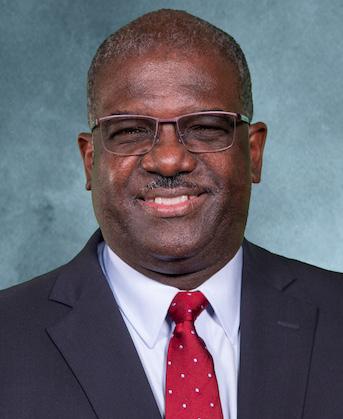
Manhattanville University Appoints Chris Lewis ’97 as Chair of the Board of Trustees
Lewis brings decades of experience and a passion for Manhattanville to the role
PURCHASE, NY, July 2026 –Manhattanville University is pleased to announce the appointment of Chris Lewis ’97 as Chair of the Board of Trustees, effective July 1st. A distinguished legal executive and dedicated member of the Manhattanville community, Lewis is a Manhattanville alumnus who has served on Manhattanville’s Board of Trustees since 2014.
“Chris brings strong experience, intellect, and a deep commitment to Manhattanville’s mission to the role of Chair of the Board of Trustees,” said Manhattanville University President Frank Sánchez, PhD. “His leadership will help guide the University as we prepare for strategic planning and continue building on our current momentum into the future.”
Reflecting on his new role, Lewis shared, “It is a tremendous honor to serve as Chair of the Board of Trustees at Manhattanville University. I look forward to working closely with my fellow Trustees and University leadership to advance Manhattanville’s mission and create continued opportunities for our students and community.”
Lewis has decades of leadership experience in legal, compliance, and governance roles. He recently retired as General Counsel at Edward Jones, where he was responsible for overseeing legal services, compliance, and government relations for the firm. In that role, he also served on the firm’s Executive and Management Commit-
tees, helping drive strategic initiatives and guiding the organization toward its long-term vision of serving serious individual investors.
Prior to his retirement, Lewis’s tenure at Edward Jones included serving as principal and deputy general counsel, where he provided corporate support on training, contract issues, employment matters, and regulatory guidance. Before joining Edward Jones in 2007, he practiced law with Kirkpatrick & Lockhart, LLP. A graduate of Columbia University School of Law and a Harlan Fiske Stone Scholar,
Lewis is widely recognized in the legal and financial services industries, including his involvement with the Securities Industry and Financial Markets Association (SIFMA) General Counsel Committee.
A committed advocate for community engagement and service, Lewis also serves as Board Chair of Big Brothers Big Sisters of Eastern Missouri and sits on the Boards of the St. Louis Children’s Hospital Foundation and the Missouri Botanical Garden. At Manhattanville University, he has been an active Trustee, chairing the Governance
and Nominating Committee and serving on both the Executive and Audit Committees. He also played a key role on the University’s recent Presidential Search Committee and has been a frequent and enthusiastic participant in Commencement ceremonies. Lewis began his professional journey working with children with developmental disabilities. He has been recognized for his contributions to diversity and leadership, including receiving the St. Louis Business Journal’s Diverse Business Leader Award.
As he steps into the role of Board Chair, Lewis succeeds Michael C. Dunn ’77, whose four-year tenure has been marked by transformative leadership and steadfast dedication to the University. Since joining the Board in 2015 and becoming Chair in 2022, Dunn focused on strengthening financial stewardship, ensuring institutional stability, and advancing the University’s long-term success. Under Dunn’s leadership, the Board adopted best practices to enhance governance, including implementing comprehensive assessment tools for Board leadership and the University President. He also oversaw the selection of Manhattanville’s 15th president, Dr. Frank Sánchez, PhD., as well as significant growth and diversification of the Board, expanding its membership from 17 to 24 Trustees while fostering a culture of professionalism, accountability, and shared governance.
CHRIS LEWIS
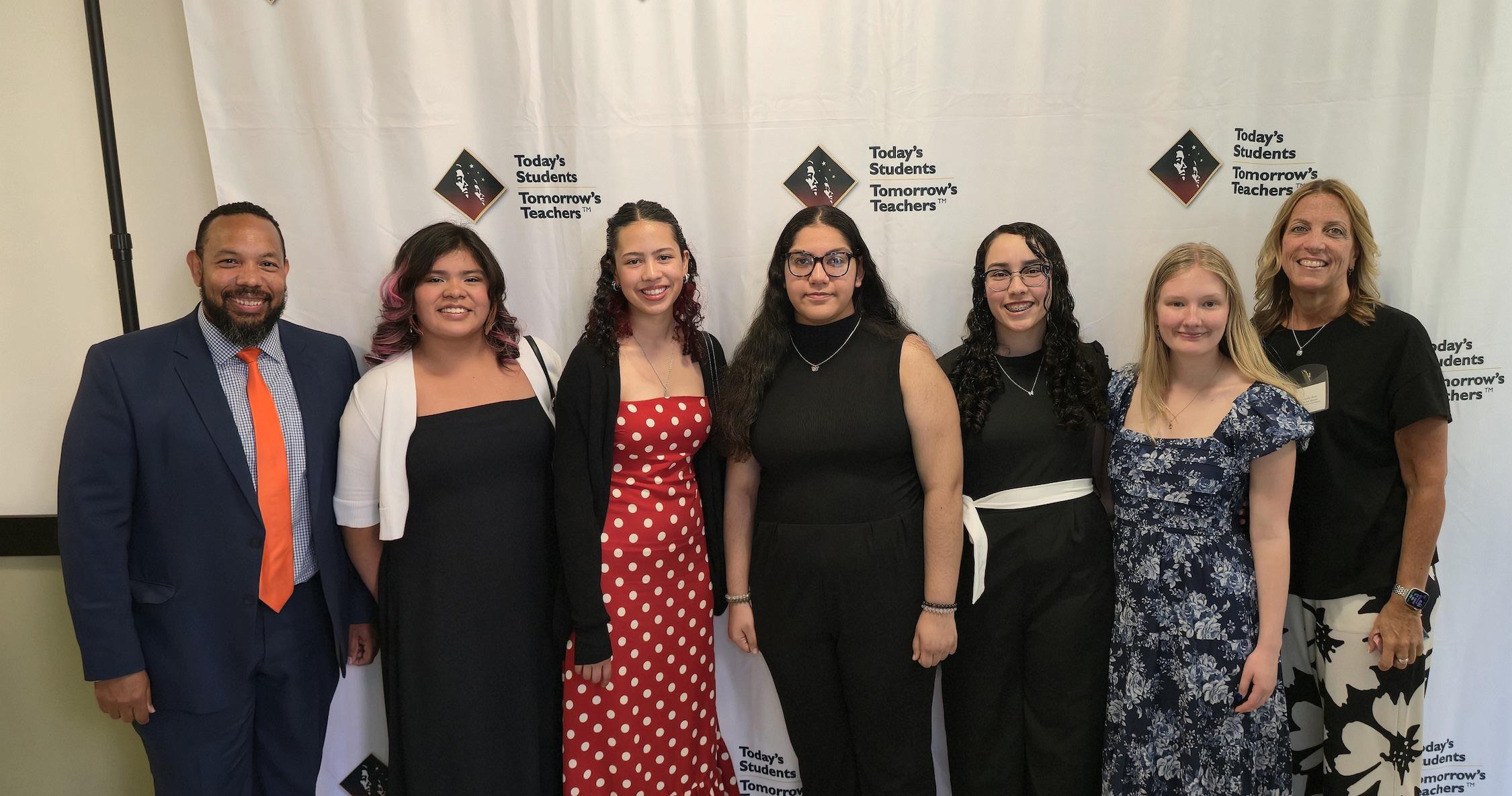
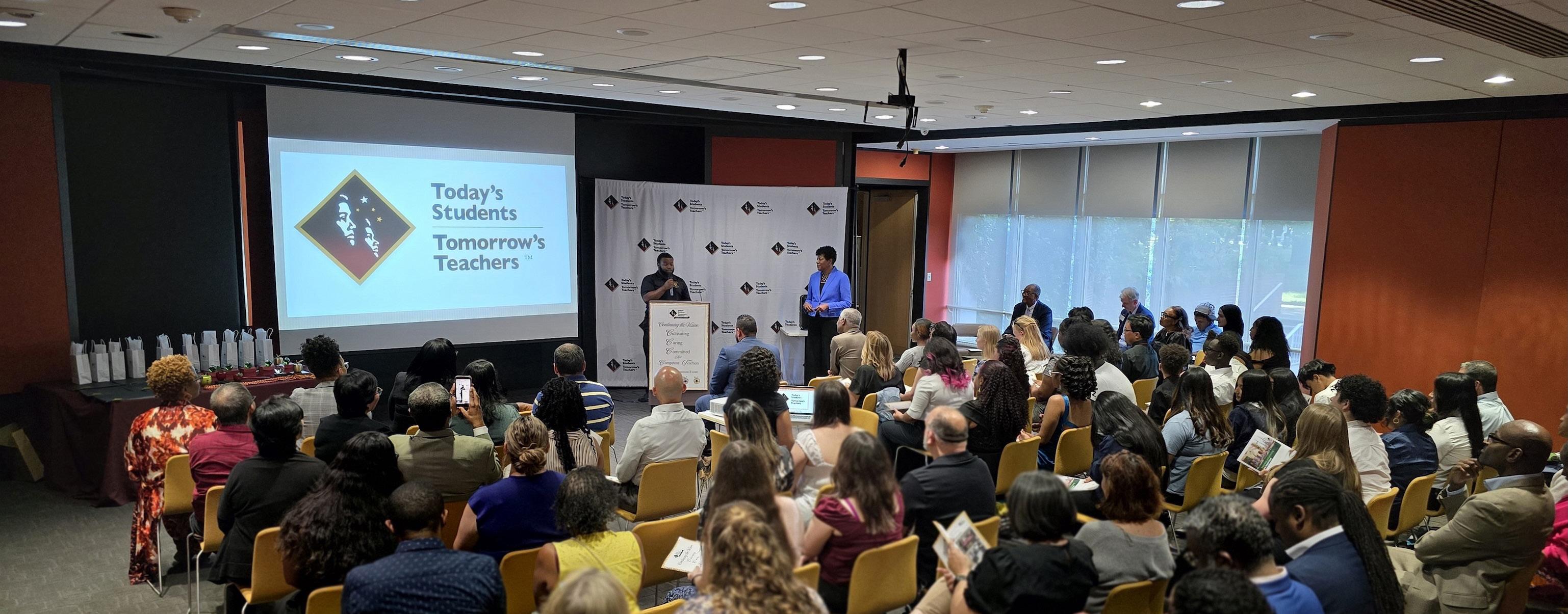
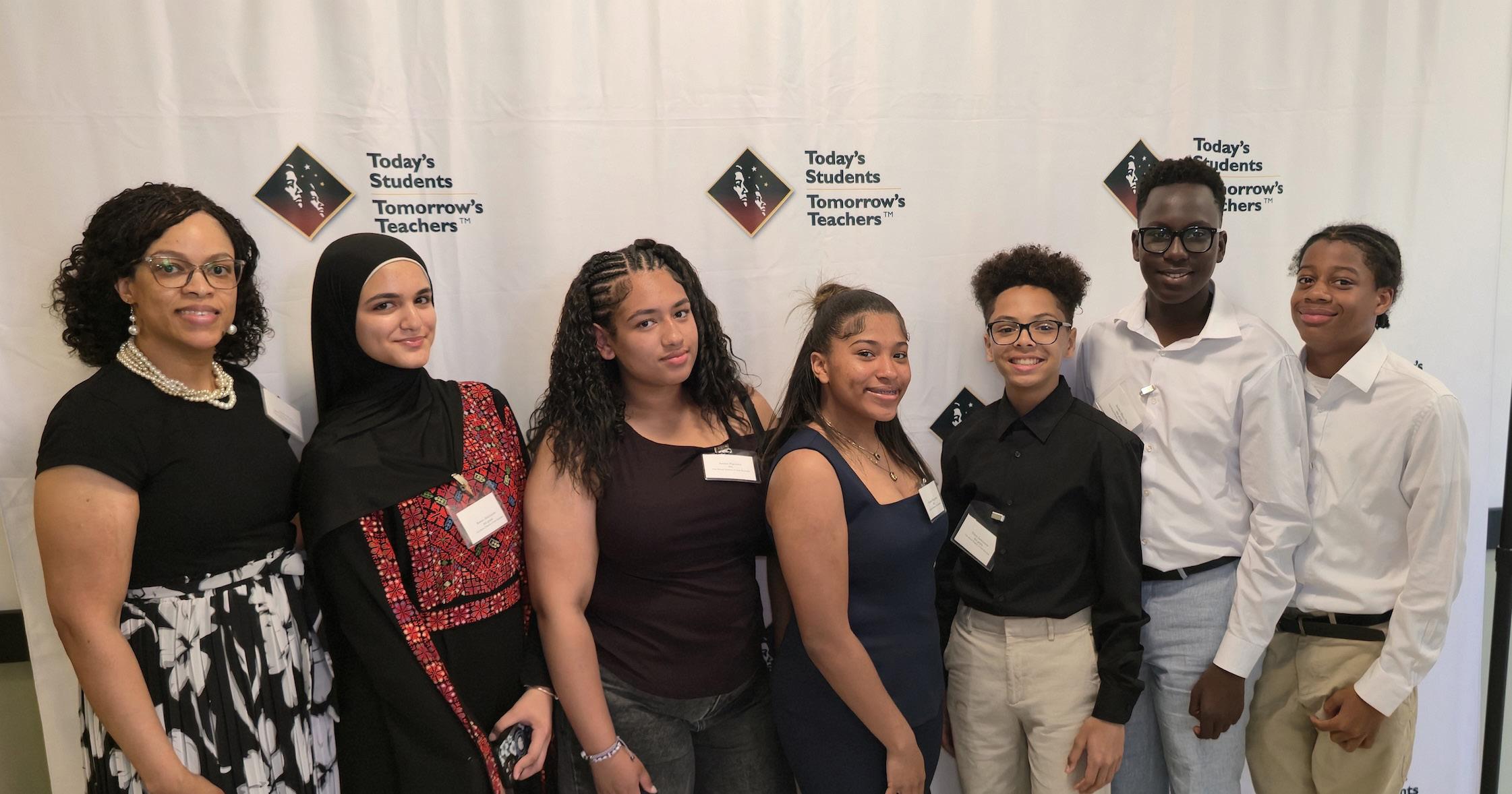
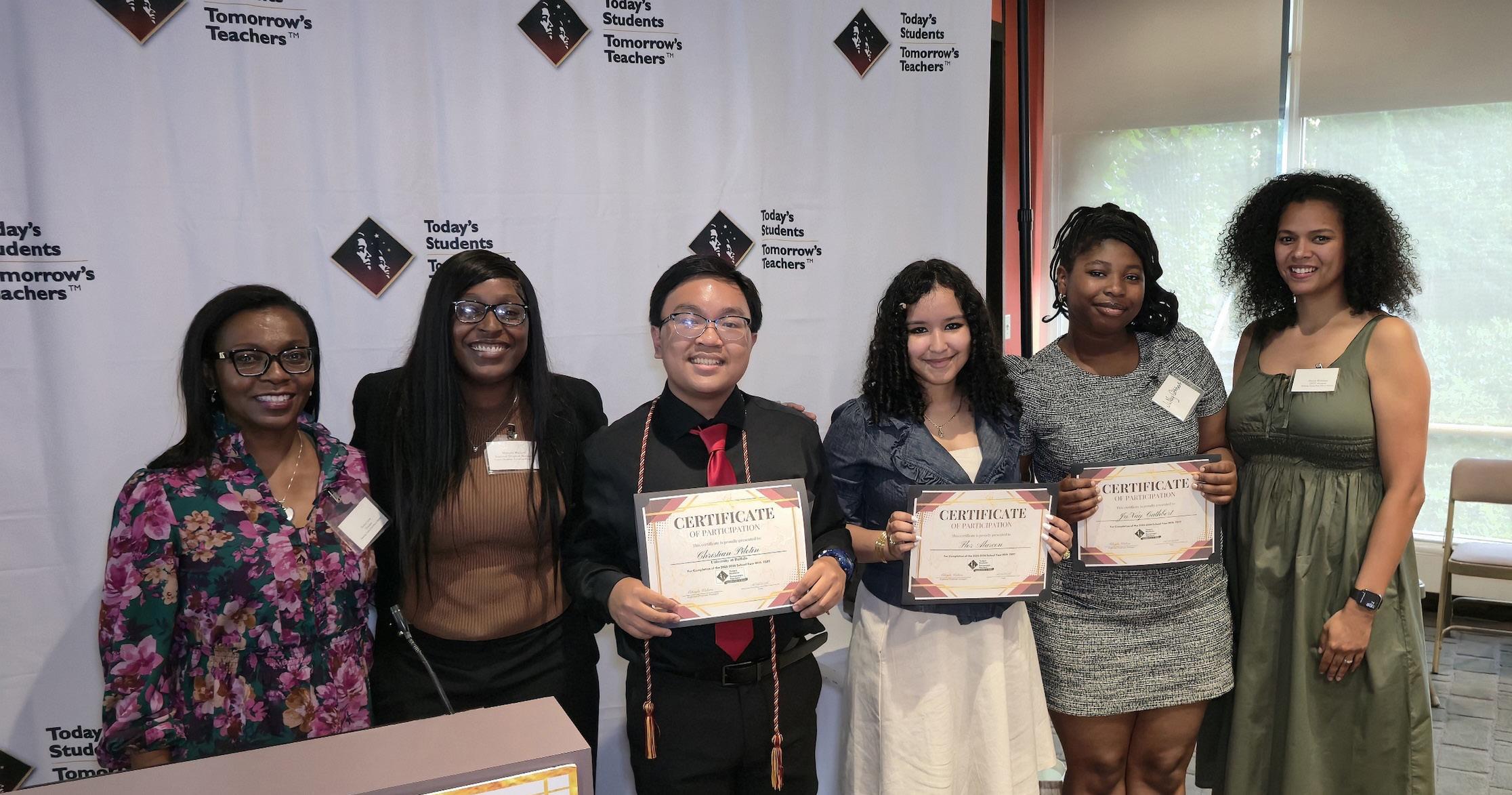
Today’s Students Tomorrow’s Teachers Scores at 2026 Regional Recognition Celebration
By Rosia Blackwell Lawrence
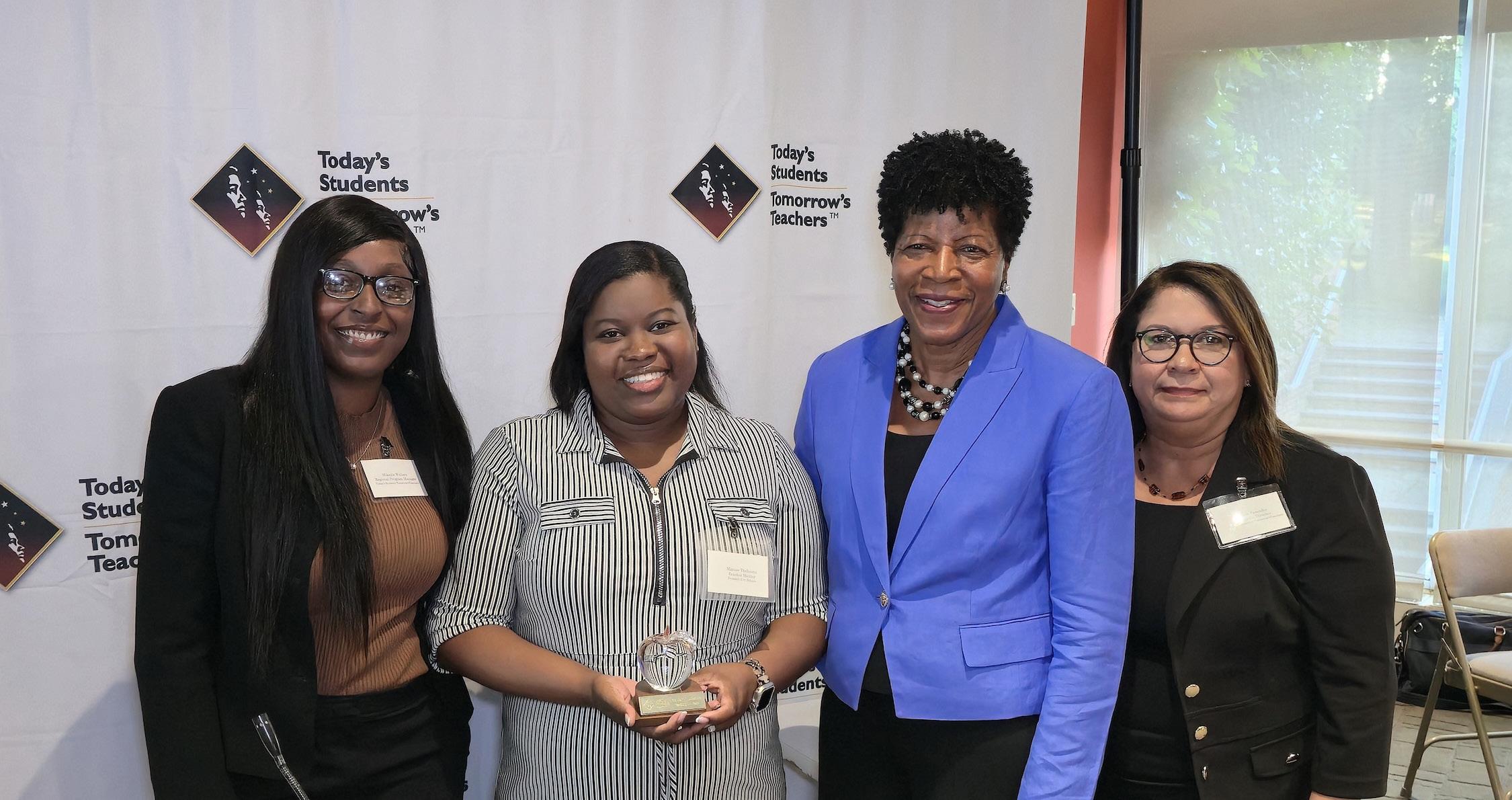
WHITE PLAINS, NY -- More than 150 students, families, school administrators, educators, alumni, community leaders, and partners gathered on June 16, 2026, at the Conference Center at 333 Westchester Avenue in White Plains for Today’s Students Tomorrow’s Teachers’ (TSTT) Westchester Regional Recognition Celebration. The evening, themed “Continuing the Vision: Cultivating, Caring, Committed, and Competent Teachers,” opened with welcome remarks from Mikayla Walters, Westchester Regional Program Manager, greetings from Lawrence Ault, TSTT Board Treasurer, and an inspiring address from Dr. Bettye H. Perkins, Founder, President, and CEO, introduced by TSTT alumna and Regional Program Consultant Jessica Reader.
In her remarks, Dr. Perkins reflected on TSTT’s remarkable growth, “More than 30 years ago, Today’s Students Tomorrow’s Teachers began in Westchester with just seven students and a vision that every child deserves to see themselves reflected in the classroom. Today, that vision has expanded across seven regions in New York and Connecticut, with more than 2,100 students having participated in our program and 442 students currently pursuing their dreams of becoming educators.”
She urged everyone to stay committed, “Our future depends on preparing caring, culturally responsive, committed, and competent teachers who will educate, mentor, inspire, and transform the next generation.
Today’s Students Tomorrow’s Teachers Scores at 2026 Regional Recognition Celebration
Through the unwavering support of our school districts, families, mentors, and college partners—including our landmark partnership with our first HBCU, South Carolina State University—we continue to build a stronger, more diverse educator workforce that will str ngthen classrooms and communities for years to come.”
The program celebrated the success of TSTT alumni and current students alike. Kristina Brown, a TSTT alumna and graduate of Ossining High School and Seton Hall University,introduced keynote speaker Emerly Martinez, TSTT alumna and Principal of White Plains High School, whose educational journey exemplifies the lasting impact of the TSTT program.
A special highlight of the evening was the presentation of the 2026 Lois T. Bronz Scholarship to Azon Laurel of Fallsburg Junior-Senior High School by former scholarship recipient Justice Mickens. The evening also recognized middle school students, high school seniors, college students, and dedicated teacher mentors, with graduating high school seniors proudly receiving TSTT’s signature Green Apple Awards and Graduation
Cords. Natacha Robert, a TSTT alumna and doctoral student, shared heartfelt reflections on the enduring influence of TSTT and the importance of giving back to the next generation of future educators.
The celebration concluded with closing remarks from Rosario (Rosie) Samudio, TSTT Program Director, who thanked the many families, school districts, alumni, volunteers, and community partners whose support continues to strengthen TSTT’s educator pipeline.
By Rosia Blackwell Lawrence
Special appreciation was extended to longtime title sponsors United Federation of Teachers (UFT), Morgan Stanley, and M&T Bank for their steadfast commitment to TSTT’s mission. Guests enjoyed a festive reception featuring a variety of delicious hors d’oeuvres and desserts while celebrating the accomplishments of this year’s students. The Westchester Regional Recognition Celebration served as a powerful reminder that throughpartnership, mentorship, and educational opportunity, TSTT continues to cultivate the next generation of caring, committed, and competent teachers who will strengthen classrooms and communities for years to come.
Westchester
County Executive Ken Jenkins Statement on the Need for Sustainable, Collaborative Childcare Solutions
WHITE PLAINS, NY -- “Westchester County welcomes innovative ideas and appreciates every organization that is committed to strengthening childcare for working families. However, we were surprised to see individuals weighing in on a system as complex as childcare finance and workforce development without first developing a full understanding of the work already underway and the challenges providers face every day.
“While well-intentioned, no single pilot or isolated investment will solve a problem that has been decades in the making. Sustainable progress
requires collaboration with those who have been doing this work every day and understand the complexity of the childcare system. Short-term, limited initiatives that are not fully integrated into the existing childcare ecosystem also risk disrupting an already fragile workforce, creating unintended consequences for providers without addressing the long-term need to expand the overall availability and affordability of childcare.
Lasting solutions require coordinated, sustainable investments that strengthen, not inadvertently destabilize, the childcare infrastructure families rely on”
Cont’d. from page 2
view the document that helped bring the Declaration’s words to New York in 1776. The exhibition will open to the public on July 4, 2026.
Purchase College President Michael E. Steiper, PhD said: “We are deeply grateful to Westchester County for choosing the Neuberger Museum at SUNY Purchase to exhibit this powerful and historic document. As a public campus, we are excited to welcome our students and the wider community of Westchester to visit and learn more about this document and the Revolutionary era history that surrounds us.”
Neuberger Museum of Art Director Tracy Fitzpatrick, PhD said: “We are honored to be able to display the Holt Broadside at the Neuberger Museum of Art, and to share with our community a powerful artifact of American history, while recognizing the deep local roots that tie Purchase and Westchester County to the story of independence.”
The Holt Broadside is one of the earliest state printed editions of the Declaration of Independence. Printed by John Holt in New York City and dated July 9, 1776, the document reflects the rapid spread of the Declaration throughout the colonies during the earliest days of the American Revolution. The Westchester County edition is believed to have been the one that was publicly read in White Plains on July 11, 1776 on the steps of the Court House. The Holt Broadside was preserved for generations by the White Plains Chapter of the Daughters of the American Revolution before being donated to Westchester County in the mid-20th century. Following conservation and restoration efforts, the historic document was permanently transferred to the Westchester County Archives in 1991 by County Executive Andrew P. O’Rourke. Today, the Holt Broadside stands as one of Westchester County’s most significant Revolutionary-era artifacts connecting the County directly to the founding of the United States and the enduring ideals of liberty, democracy and self-governance.
The story told in The Declaration Distributed: Westchester County’s Holt Broadside of 1776 is the story of a revolution in progress and a revolution unfinished. It is the story of the ways in which those revolutionary ideas spread through New York State by way of the Holt Broadside. The exhibition focuses on the document, its printer and the role of printing during the Revolution, the first reader of the document in New York State who lived on the land where Purchase College now stands, its whereabouts over the last 250 years, and current preservation efforts so that it will be with us for another 250 years. The Declaration Distributed: Westchester County’s Holt Broadside of 1776 at the Neuberger Museum of Art, SUNY Purchase, is made possible by Westchester County Government. Support for the project has been provided by the Friends of the Neuberger Museum of Art.
The Neuberger Museum of Art opened at the heart of the SUNY Purchase, State University of New York (SUNY) campus in 1974 with a core collection donated by Roy R. Neuberger, one of the greatest private collectors, philanthropists, and arts advocates of the twentieth century. Its collection has grown to nearly 7,000 objects. Today, its critically acclaimed exhibitions, tours, lectures, and interactive programs make it a vital center of teaching and learning for audiences of all ages.
A top 10 public school, according to U.S. News & World Report, SUNY Purchase, part of the State University of New York (SUNY) system, is a dynamic campus that combines conservatory training in the visual and performing arts with programs in the liberal arts and sciences, in order to inspire an appreciation for both intellectual and artistic talents in all students. SUNY Purchase is a community of students, faculty, and friends where open-minded engagement with the creative process leads to a lifetime of intellectual growth and professional opportunity. For more information about the college, visit www.purchase.edu.
JULY 5th, Cont’d from page 3
inspired new freedom celebrations across the nation. Over time, commemorations such as Emancipation Day and Juneteenth became prominent symbols of liberation and progress
Although the Fifth of July tradition gradually faded, the values it represented did not.
The Legacy of July 5th in Modern America
The resolve shown by those early African American communities contin-
ues to resonate today. The decision to celebrate on July 5th was an act of self-determination—a declaration that freedom deserved to be recognized even when the nation fell short of its own ideals.
That same spirit can be seen in contemporary efforts to expand educational opportunity, promote civic participation, preserve Black history, strengthen communities, and pursue equal treatment under the law. While the challenges of each generation differ, the commitment to perseverance, community leadership, and faith in a better future remains a defining feature of the African American experience.
Modern observances such as Juneteenth, community heritage celebrations, and initiatives that preserve the stories of freedom fighters all reflect a continuing belief that history should be remembered, progress should be celebrated, and unfinished work should be pursued with determination. The resolve demonstrated by those who gathered on July 5th in 1827 reminds Americans that freedom is not only something won in the past—it is also a responsibility carried forward by each generation.
The history of African Americans celebrating July 5th is more than a story about a forgotten holiday. It is a story of resilience, hope, and an unwavering commitment to freedom. Long before the Emancipation Proclamation, African Americans created their own traditions to honor liberty and assert their place in the American story. Their resolve continues to inspire people today, reminding us that the pursuit of equality and justice requires courage, persistence, and faith that the nation’s highest ideals can become realities for all.
The Women’s Leadership Institute Offers Warm Wishes for July 4th and July 5th Celebrations
To African American families and communities observing the significance of July 5th as a time of reflection, resilience, and continued progress, may this day be filled with pride, unity, joy, and hope for future generations.
To all Americans celebrating Independence Day on July 4th, may the holiday bring gratitude and cherished moments with family and friends. Let us honor the ideals of liberty, equality, and opportunity while recognizing the many contributions that have shaped our nation.
May these celebrations inspire us to come together in mutual respect, appreciation, and a shared commitment to building a brighter future for all.
Happy July 4th and best wishes for a meaningful July 5th celebration!
The Women’s Leadership Institute is an organization established to advance and improve the personal, economic, and professional status of women and girls. Activities and programs are designed to promote talented women and girls, seeking Leadership advancement and opportunities for skills enrichment. We connect women and girls across industries and demographics. Visit our web page at www.tcfiswli.com or contact us at 914-6640430.
THE BOZEMAN LAW FIRM, PLLC Attorneys & Counselors
200 Mamaroneck Avenue, Suite 500
White Plains, New York 10601
(914) 668-4600 • (914) 669-6371
Serving Metro-New York and Westchester County
PRACTICE AREAS
REAL ESTATE (Residential and Commercial)
FAMILY (Adoption)
WILLS/TRUSTS/ESTATES (Guardianship and Elderlaw)
RELIGIOUS /NON-PROFIT (Administration & Tax Status)
BUSINESS LAW (Corporations & Partnerships & Limited Liability Corporation)
*Bruce L. Bozeman, Esq., * Carla Lewis-Burnett, Esq. John S. Savage, Esq. ~ of counsel, Leticia Arzu, Esq.
*Principals of the firm serve as seminar speakers, upon request. Appointments Preferred.
Community Calendar
CALENDAR SUBMISSION: Please use a brief paragraph to describe your event. The paragraph should include event name, date(s), time, location and contact information. Send calendar information via email to westchestercountypress@yahoo.com. Please type “CALENDAR EVENT” in the subject bar
Now thru August 2nd
Exhibits on View at ArtsWestchester: May 16- Aug 2, 2026: Forever, Amen is an ongoing photographic study of the oldest Black churches in White Plains. Despite widespread displacement and cultural erasure caused by urban renewal, some of these churches have existed for nearly two centuries. The series examines how these places of worship have anchored Black residents of the city and its surrounding communities.
. Saturday, July 11
Join the city-wide FIFA World Cup 2026™ free celebration! White Plains Soccer Fest transforms downtown White Plains into a celebration of the global game, featuring a spectacular watch party on Saturday, July 11. Visit the Soccer Fest site for a complete listing of soccer-related events happening in July!
Saturday, July 11
Westchester during the Revolution with naval veteran and social studies teacher Walt Johanson, hosted by St. Paul’s Church National Historic Site. Explore the military and political history of Westchester County during the Revolutionary War years. Saturday, July 11, 10:30 a.m. 897 S Columbus Avenue, Mt Vernon, NY
Saturday, July 11
Voices of We The People: America 250 New Rochelle, a gathering at City Hall featuring a multilingual reading of the preamble to the Declaration of Independence, a soundtrack of 250 songs for 250 years, food trucks, and more. Saturday, July 11, 11:00 a.m.—1:00 p.m., 515 North Ave, New Rochelle, NY
Saturday, July 11
America’s Birthday Parade, a fullday semiquincentennial celebration in Eastchester / Bronxville / Tuckahoe, including live music and a BBQ, hosted by the EBT 250th Committee and Eastchester Veterans. Parade kicks off at Immaculate Conception School. Saturday, July 11, 11:00 a.m., 53 Winter Hill Road, Tuckahoe, NY
Sunday, July 12
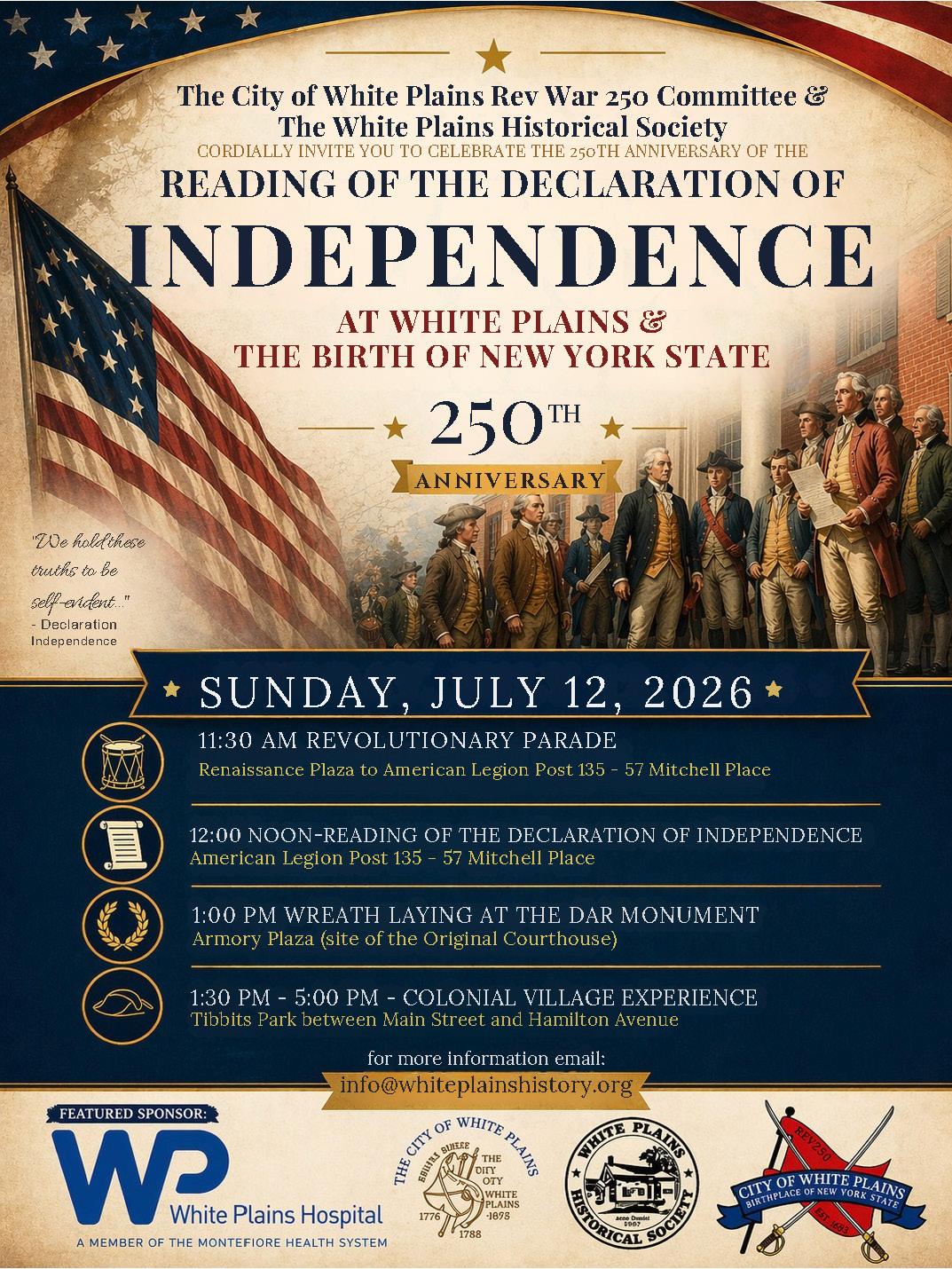
Reading of the Declaration of Independence at White Plains & The Birth of NY State, hosted by the City of While Plains. Commemorate the first time the Declaration of Independence was read on the steps of the White Plains Courthouse. Activities include a parade, a reading of the Declaration of Independence, a wreath laying at the DAR monument and a Colonial village experience in Tibbets Park. Sunday, July 12, 11:30 a.m.–5:00 p.m. Various locations.
Tuesday, July 14
The Westchester County Office for Women (OFW) will hold its July webinar of the Empower Hour series on Tuesday, July 14 from noon to 1 p.m. featuring OFW Acting Director Catherine Borgia and guest, Westchester County Department of Health Commissioner Dr. Sherlita Amler. They will talk about the most critical health considerations for women, essential screenings and the key preventative lifestyle habits to ensure ongoing good health and vitality. Borgia said: “Women are often so consumed managing the health of those around them – children, partners, aging parents – that they put their own health needs on the back burner. I am excited to have Dr. Amler share her years of expertise and
experience on the importance of women getting on and staying on track for their own healthcare.”
The webinar and Q & A session will be presented on WebEx and can be easily accessed from your browser. For more information and to register, go to Empower Hour. Empower Hour is presented by the Westchester County Office for Women as part of our commitment to supporting, educating and uplifting women across Westchester County.
July 15 thru 19
The National ACT-SO Competition this year takes place July 15-19, where talented high school students from across the country showcase their achievements in science, technology, the arts, entrepreneurship, and more.
Wednesdays, July 15, 22, 29
Open Sewing fro 10:30 am - 1:00 pm. The New Rochelle Public Library offers experienced seamstresses use of our state-of-the-art Necchi sewing machines. Patrons are responsible for bringing their own supplies, including fabrics, threads, patterns, and any other materials necessary for their projects. First come first served. Location: Community Gallery
July 18 thru July 22
In just a few weeks, thousands of advocates, organizers, leaders, students, creators, and community members will gather for the 117th NAACP National Convention in Chicago, Illinois. Across Convention week, attendees will experience:• Powerful plenary sessions and national conversations • Advocacy forums focused on the issues shaping our communities • THE HUB activations, engagement spaces, and live experiences • Networking events
bringing together changemakers from across the country • The energy and heartbeat of Chicago. Updates on speakers, programming announcements, and more are still to come.
Sunday, July 19
The New York State United –2026 World Cup Watch Experience will present a free 2026 FIFA World Cup Final Watch Party on the big screen at Kensico Dam Plaza in Valhalla. This freeadmission event will begin at 12 PM with pre-match activities and local food options, followed by kickoff at 3 PM. Learn more and reserve tickets here.
September 16-20
The wait is over—registration is now open for the Congressional Black Caucus Foundation (CBCF)’s 55th Annual Legislative Conference (ALC)! September 16–20, 2026, Walter E. Washington Convention Center, Washington, D.C. Join us for five days of impactful conversations, thoughtprovoking policy discussions, networking opportunities, and celebrations that bring together leaders, advocates, professionals, students, and changemakers from across the nation. This year’s ALC is especially significant as we commemorate the 50th Anniversary of CBCF—a milestone that honors five decades of cultivating leaders, advancing equity, and creating pathways for future generations. Together, we’ll reflect on our legacy, celebrate our progress, and look ahead to the future of Black leadership and civic engagement. For more information about the Annual Legislative Conference, please email our team. Registration: eventsupport@cbcfinc.org ALC Sponsorship Opportunities: rd@cbcfinc. org
A Nation That Forgets Its History Is Bound
of the Revolution, the abolitionist movement, and the Southern populist tradition that rose in the decades after the Civil War and united working men across color lines. My greatgreat-grandfather, Edward David Bland, was born enslaved and died a Virginia legislator.
He helped build the Readjuster Party, a post-Civil War, multiracial voting rights movement that brought together Black men who had been enslaved and white men who had fought for the Confederacy. Their cause was schools, fairer taxes, debt relief, voting rights and democracy. When they gained power, they abolished Virginia’s poll tax.
After they were broken, Virginia’s ruling Democrats wrote a new constitution in 1902 that brought the poll tax back with literacy tests and other barriers. Black voters were almost wiped out as a political force. White voting was cut roughly in half. The old ruling class knew whose coalition it was trying to prevent from rising again.
Imagine if every schoolchild
learned that the poll tax was not only an attack on Black voting power but also on poor white voting power. We might see the trick more clearly when it returns in new clothes.
The Democratic donkey did not come from Franklin’s parable. It came from Jackson’s enemies calling him a jackass, an insult he embraced and cartoonists later made stick. Still, the echo is hard to miss.
If Democrats keep the jackass, they should remember Franklin’s question. The right was never in the jackass. It was never in the deed, the poll tax, the ID card, the Tuesday work schedule, the mailbox or the database.
The right is in the people. Every generation that won more democracy ultimately did so by resisting efforts by the few to divide the many. That is our work now: remember the history, reject the division, and defend the vote for every one of us.
Ben Jealous is a professor of practice at the University of Pennsylvania and former national president and CEO of the NAACP.