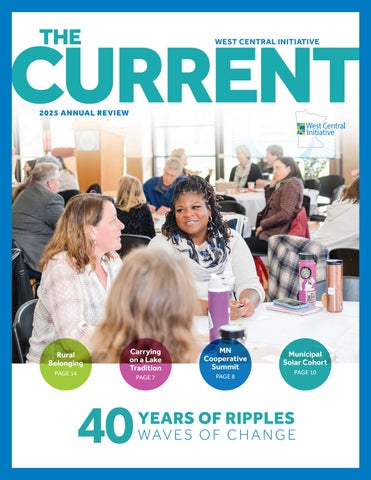
Rural Belonging PAGE 14
Carrying on a Lake Tradition
40
PAGE 7
MN Cooperative Summit PAGE 8
Municipal Solar Cohort PAGE 10
YEARS OF RIPPLES
WAV E S O F C H A N G E
FOR 40 YEARS
our organization has played a vital role in enhancing the quality of life across our region. We’re committed to ensuring that every individual in the region can reach their fullest potential. By fostering a sense of connection and mutual support among the 82 towns, nine counties, and White Earth Nation, we strengthen the bonds that unite us. As dedicated stewards of this region, and guided by the Sustainable Development Goals, we take pride in nurturing its people and communities.
Dear Friends and Partners, As I look back on 2025, I’m reminded why west central Minnesota and White Earth Nation are such special places to call home. Throughout the year, neighbors showed up for one another, local leaders leaned in, and communities worked together to move important work forward. Once again, we saw that when we care for this place we share, our region grows stronger together. Through our Rural Democracy program, we saw extraordinary momentum. The Rural Democracy Summit brought more than 150 community members, leaders, and advocates together for two days of learning, reflection, and big‑idea thinking about the health of our civic life. The energy in the room was unmistakable. From roundtable conversations to keynote discussions, the gathering highlighted the strength of our civic infrastructure and the growing network of people ready to lead their communities forward. Our region also made significant strides in advancing local sustainability. The Municipal Solar Cohort—a first-of-its-kind collaboration among 10 communities—is now helping public buildings reduce energy costs, reinvest savings locally, and build long-term resilience. These projects demonstrate what can happen when education, technical support, and community leadership meet at just the right moment. We also celebrated a powerful statewide moment of connection at the first Minnesota Cooperative Summit, where nearly 200 cooperative leaders and practitioners gathered to explore how cooperation can shape stronger, more equitable local economies. The day’s conversations reaffirmed that the cooperative model—rooted in shared ownership and shared benefit—remains a vital tool for rural prosperity. As we look ahead, 2026 marks West Central Initiative’s 40th anniversary, an opportunity to celebrate four decades of partnership, community leadership, and investment in the future of our region. Thank you for being part of this work. With hope and determination, we look ahead to another year of building a stronger, more resilient region. With gratitude,
Anna Wasescha | President, West Central Initiative
West Central Initiative Annual Review | 3
$2.32M
$6.73M
granted through Component Funds designated for specific charitable purposes
value we delivered to the region through funding and technical assistance
2025 AT A GLANCE
Represents 2025 fiscal year
335
hours of direct technical assistance to communities
160
active loans supporting small business growth
What Changed in Our Communities in 2025? In 2025, West Central Initiative helped move resources into communities across our region—supporting nonprofits, small businesses, and local leaders.
$5.86M
distributed by West Central Initiative and our Component Funds through
636 grants for community
and regional initiatives
650+
volunteers served as advisors, helping guide local giving
1,500+ people gathered at our events
14
members of the Lasting Landscapes Legacy Society have committed future gifts to the region
$5.61M
contributed to West Central Initiative and our Component Funds
$200K
secured for community projects through our technical assistance work
In our 40-year history We’ve distributed:
$93M+ IN GRANTS
Where the Resources Came From This work was made possible by generosity from individuals, families, organizations, and partners.
$62M+ IN LOANS
Helped to create or retain:
9,230+ JOBS
And leveraged:
$303M+ LOAN DOLLARS
How Resources Were Managed
$94.2M
At the end of 2025, West Central Initiative managed
in net assets on behalf of the region.
PLANNING & LENDING
Photo by Jesse Thorstad/Lakes Area 360
Economic Development Expertise
Through our planning work, we partner with regional and local leaders to create vibrant, sustainable, and welcoming communities for all. As the federally designated planning organization for the region through the U.S. Economic Development Administration (EDA), we create a Comprehensive Economic Development Strategy for the Region IV Economic Development District of Minnesota every five years. The current plan (2022–2026) primarily focuses on growing regional population and workforce, increasing wages, improving child-care capacity and availability, increasing housing affordability and availability, increasing access to broadband, and examining the sustainability of infrastructure. Development of a new five-year plan is underway, with the updated plan set to take effect in January 2027.
With our help, local communities have received more than
$8.23M
Our Loan Program Our loan program helps start-ups and growing businesses secure financing when traditional lenders can’t cover the full amount needed. As a “gap lender,” we fill the remaining funding gap so the full financing package can succeed. Our Planning Services • Comprehensive community planning and climate resiliency planning • Resource and grant navigation and writing for community and economic development projects • Small business development support • Sustainable food and agricultural development and planning • Community engagement and facilitation
IN FEDERAL GRANTS
for roads, utilities, and wastewater treatment to support residential and industrial growth since 1996.
6 | West Central Initiative Annual Review
Contact Greg Wagner AICP, Director of Business & Economic Development, at greg@wcif.org to learn more.
Carrying on a Lake Tradition at East Silent Lake Resort East Silent Lake Resort in Otter Tail County has welcomed families to the water for more than a century. Founded in 1915, the resort is a fixture of Minnesota’s lakes culture and, for Andy Leonard and his family, a continuation of traditions that shaped their own childhood. “We grew up in northeast Iowa, where you don’t have the same access to lakes that you do in Minnesota,” said Andy. “Coming to resorts like this is what made us fall in love with lake life.” About 20 years ago, Andy, his brother Nick, and their parents began searching for a resort they could grow into while honoring the history that makes places like East Silent Lake special. When this property became available, they knew it was the right fit. Today, the family operates 18 units, blending traditional cabins with newer vacation homes. Andy’s parents still return each summer to help. “Every year, more family resorts disappear,” said Andy. “That made it even more important for us to keep this one going.” The Leonards faced a challenge common to many historic properties: how to modernize aging infrastructure without losing character. Several cabins dated back to the 1950s with outdated electrical systems and utilities. With support from West Central Initiative’s loan program, the family was able to relocate and renovate five traditional cabins, upgrade critical infrastructure, and preserve the classic knotty pine interiors guests cherish. “That funding made all the difference,” said Andy. “It allowed us to do the project the right way and keep the historic feel people come here for.” Looking ahead, the Leonards hope to continue upgrading remaining cabins, thoughtfully expand the resort, and keep creating space for new and returning families to build traditions of their own.
In 2025,
30 9 $2.98M REGIONAL BUSINESS OWNERS
and
COMMUNITIES
have collectively secured more than
FROM OUR LOAN PROGRAM to support the launch and expansion of their businesses or municipal solar projects.
“Our kids are growing up in this now,” said Andy. “That’s really special. We just want to keep providing that opportunity—for our family and for all the families who come here to experience Otter Tail County.” West Central Initiative Annual Review | 7
COOPERATION IN ACTION:
Highlights from the First Minnesota Cooperative Summit On July 30, nearly 200 people gathered at the University of Minnesota Morris for a full day of connection, learning, and shared vision at the first Minnesota Cooperative Summit. Cohosted by CoMinnesota, Minnesota Farmers Union, the University of Minnesota Morris, and West Central Initiative, the summit marked the first annual gathering of its kind in Minnesota. Cooperative leaders, practitioners, and community builders gathered from across the country. Created in celebration of the International Year of Cooperatives, the event set out to spotlight the cooperative model as a powerful and timely tool for strengthening communities and local economies. The summit opened with keynote presentations from German-American political economist Jerome Warren, 8 | West Central Initiative Annual Review
former Minnesota Secretary of State Mark Ritchie, and Minnesota State Senator Aric Putnam, whose stories and insights underscored the enduring impact of cooperation. From rural communities to global systems, speakers emphasized how cooperatives create opportunity, build resilience, and return value to the people who rely on them most. In the afternoon, the summit shifted into breakout sessions that invited deeper exploration. Participants moved between conversations on agriculture, energy, housing, child care, workforce development, and other sectors where cooperative ownership is already making a difference—or holds the potential to do so. Ideas flowed freely as attendees shared challenges, exchanged strategies, and learned from real-world examples of cooperatives responding to community needs.
Minnesota is home to more than
800 COOPERATIVES including more than
170
AGRICULTURAL and
40
FOOD COOPERATIVES
As the day came to a close, the impact of the summit was felt not just in the sessions attended, but in the conversations spilling into hallways, over food, and on the walk back to parking lots. Attendees left with new relationships, renewed confidence, and a clearer sense of what is possible when people work together. For many, the day planted a seed—an idea for a new cooperative, a partnership waiting to be formed, or a fresh approach to meeting local needs. Those seeds now travel back to communities across Minnesota and beyond, carrying forward the cooperative spirit that made the first Minnesota Cooperative Summit such a meaningful success.
West Central Initiative Annual Review | 9
C L I M AT E & E N E R GY
Municipal Solar Cohort Powers Rural Communities
Helping public buildings save energy, reduce costs, and invest locally
Scan to view the region’s Climate Action Plan.
We’re working with communities across our region to build a more sustainable and resilient future through our Municipal Solar Cohort. Through this initiative, we’re partnering with 10 communities to develop small-scale municipal solar projects that lower energy costs, generate local revenue, and strengthen local economies. In the Q&A to the right, meet our team members helping lead and advance this work. THE FIRST COHORT INCLUDES: • Ashby • Battle Lake • Hoffman • New York Mills • Parkers Prairie • Pelican Rapids • Vergas
• Frazee • Ogema • Perham
ENERGY STORAGE WILL BE ADDED in Ogema, Vergas, New York Mills, and Ashby to help keep power available during outages.
10
COMMUNITY BUILDINGS will install solar panels sized to meet local needs.
COMMUNITIES ARE EXPECTED TO SAVE ABOUT
$2K to $6K each year on energy costs.
MOST OF THE PROJECT COSTS WILL BE COVERED through financial incentives, with additional support from West Central Initiative.
Scan for upcoming Sustainable Communities Network events. 10 | West Central Initiative Annual Review
Cedar Walters Director of Climate & Sustainability Programs
Ben Schierer Director of Civic Partnerships
What was the spark that first inspired the idea for the Municipal Solar Cohort, and why was West Central Initiative the right organization to take the lead in creating and facilitating it? We started by sharing information about financial incentives to help communities fund clean energy projects, but I soon realized that information alone wouldn’t move projects forward in small rural communities. Community leaders needed to better understand the benefits of small-scale solar, and by creating a program focused on education and hands-on project support, we could more effectively drive solar adoption. Bringing multiple communities together also allowed us to streamline assistance and increase our overall impact. West Central Initiative values collaboration, learning, and innovation—and this program truly reflects that. It’s about building relationships, sharing knowledge, and working together to strengthen community resilience through solar energy.
Why is it important for small rural communities—and their elected officials—to work together through initiatives like the Municipal Solar Cohort to strengthen communities and the region? We all know there are human-made issues and forces—political, geographic, and beyond— that can divide us and keep us from working together for the greater good. Too often, when opportunities for funding or projects come along, rural communities feel left behind compared to their urban counterparts. This initiative demonstrates that every community in Minnesota can benefit from clean energy. From a town of 300 people in west central Minnesota to our largest urban centers, we believe this demonstrates that we are all in this together. Every community matters, and when we choose to invest in clean energy, we create a brighter future for everyone in Minnesota—if we make it together and commit to the work ahead.
For communities thinking about adding solar to their municipal buildings, what do you most want them to know—especially about the technical side that often surprises or reassures them? I want communities in our region to know that solar isn’t scary. It’s one of the easiest ways to save taxpayer money by cutting operating costs and creating long-term savings. Griffin Peck Energy and Adaptation Planner
Greg Wagner Director of Business & Economic Development
In our first cohort, each community is using 1 to 3 years of energy savings and utility payments to cover the portion of the project not funded by incentives, rebates, or grants. After that, they save $2,000 to $6,000 every year for 25 years or more. That adds up to over $100,000 that can be reinvested in other local projects. In Pelican Rapids, the solar array on the liquor store is already offsetting higher electricity costs from the new aquatic center. That’s the kind of impact solar can have for communities now and in the future.
How has our interest-free municipal solar lending, in partnership with the Municipal Solar Cohort, helped communities move their solar projects from proposal to reality? I believe offering no-interest loans was a key motivator for cities in this first cohort to take the leap into solar. Elected officials are accountable to their constituents and must maintain fiscal responsibility for their cities. While lower utility bills and revenue from selling electricity back to the grid will generate savings over time, any improvement to municipal buildings comes with upfront costs that can strain budgets in communities of any size. Solar technology isn’t new, but there’s still a perceived risk around its reliability and effectiveness. We helped address both concerns by reducing some of the initial costs. This approach helped alleviate the financial burden and allowed participating communities to achieve cost savings more quickly.
West Central Initiative Annual Review | 11
R U R A L D E M O C R AC Y
Rural Democracy
Increasing civic participation & supporting leadership development In Minnesota, on average 1 in 21 individuals need to serve in positional leadership (local government or nonprofit) in their lifetime. In west central Minnesota, demand is higher, reaching 1 in 9 individuals in Wilkin and Stevens Counties, 1 in 8 in Traverse County, and 1 in 7 in Grant County—classifying almost half of our region as “leadership distressed.”
“Our program is built on the belief that strong communities depend on strong leaders,” said Ben Schierer, Director of Civic Partnerships. “We focus on identifying and developing new leaders while equipping and supporting those already serving. At our core is the belief that everyone has the potential to impact their community positively through civic engagement.”
We aim to strengthen rural democracy by helping residents meet these demands through our Rural Democracy program.
The Rural Advocacy and Public Leadership Program is our free six-month leadership and advocacy program for individuals interested in strengthening democracy and promoting good governance in their rural community. Participants engage in discussions, learning from each other, and develop a local “hands-on” project to address an issue in their community. 12 | West Central Initiative Annual Review
Elected officials are the heart of local democracy. Through the Lead Local Mayors Network, we’re convening and building relationships among the 82 mayors in west central Minnesota, so they can share ideas and encourage their constituents to get involved in public service. We invite all local elected officials in west central Minnesota to participate in our quarterly meetings.
Run4Rural is our free 1½ day public leadership training program designed for people interested in growing and strengthening their local communities through elected office and other forms of public leadership. This nonpartisan training is useful for existing and emerging rural leaders and people active in their community whether or not they have decided to run for office.
Since the launch of our Rural Democracy program in 2022:
600+
attended events to bolster civic engagement and strengthen democracy.
400+
participated in community conversations on public leadership, local journalism, bridging divides, and the health of rural democracy.
175+
attended Going Local workshops around the region.
150+
attended trainings, including Run4Rural’s nonpartisan local office training, the Rural Advocacy and Public Leadership program, and Intro to Civic Life.
100+
elected officials worked together to strengthen civic infrastructure and advance community projects.
Going Local is our free rural democracy workshop. At the Going Local workshops, we share food and stories, learn about some of the unique challenges rural communities face, and explore what we can do together to make our communities stronger and healthier.
Rural Democracy Summit Brings neighbors together to shape the region’s future
Our 2025 Rural Democracy Summit offered two days of connection, insight, and broad thinking at the University of Minnesota Morris. The event served as a reminder of the civic strength found throughout west central Minnesota’s nine counties and White Earth Nation.
Day One started with a close-knit gathering of regional thought leaders and changemakers. Representatives, organizers, and advocates from public and private sector organizations came together for a roundtable discussion on the state of civic life in rural areas. The conversations were honest and open. Participants shared successes, discussed ongoing challenges, and reflected on what it takes to develop and maintain strong civic infrastructure. The atmosphere felt collaborative and hopeful, grounded in a shared commitment to the region’s future. Day Two expanded the discussion with keynote and panel presentations from Heidi Heitkamp, former United States Senator; Tom Horner, former candidate for Governor and former Chief of Staff for United States Senator David Durenberger; Mark Ritchie, former Minnesota Secretary of State; and Kathy Cramer, author and professor. The sessions were moderated by Lori Sturdevant, retired Minnesota Star Tribune political columnist. Each speaker offered a unique perspective on rural democracy, addressing civic participation, community resilience, public trust, and the stories that shape rural identity. Their insights sparked lively table conversations in which attendees explored “Big Ideas” for strengthening civic life and long-term prosperity across the region. “Bringing over 150 folks from our region and beyond was a reminder of just how strong the civic heartbeat of our region really is,” said Justin Moen, our Rural Democracy Network Coordinator. “Together, we broke bread, celebrated what’s working in our communities, examined the barriers we still face, and shared a genuine sense of possibility for the future of civic health and rural vitality in west central Minnesota.” The summit concluded with a renewed sense of energy and unity. More than a discussion of rural democracy, it showcased what can happen when neighbors come together to build a shared vision for our region’s future.
ENGAGE IN DEMOCRACY
Scan for a video spotlighting our Rural Democracy program. West Central Initiative Annual Review | 13
RURAL BELONGING
RURAL BELONGING
Uniting neighbors and building welcoming and inclusive places
14 | West Central Initiative Annual Review
Welcoming Week is a national movement that brings communities together to foster connection and belonging, especially for new residents. Each September, communities across our region host events on farms, at street fairs, in libraries, schools, and other gathering spaces. Activities include food tastings, cultural exhibits, art, shared meals, and demonstrations. Organized by local governments, schools, nonprofits, and businesses, the week creates meaningful opportunities to connect and welcome new neighbors. We’re celebrating 4 years of Welcoming Events. 2025 included
20+ 13
EVENTS
across
COMMUNITIES
Since 2022, we’ve leveraged more than
$92K
IN SPONSORSHIP DOLLARS to support more than
120
COMMUNITY EVENTS
around the region as part of the national Welcoming Week movement.
What was it like to participate in Welcoming Week? We posed that question to Similoluwa (Simi) KasakweWelsch, a Welcoming Week rock star who experienced three separate events this year. She attended gatherings in Alexandria, Glenwood, and Starbuck. In Glenwood, she was even part of The Welcome Table program, sharing stories about her native country of Nigeria while attendees sampled Nigerian food. “Even though I haven’t been back since I was five years old, I hold my home country dearly to my heart,” she noted.
“Culturally, we never really lost any sense of being Nigerian,” she continues. “My children are born and raised in the United States but are very familiar with Nigerian food, culture, music, and all of that.” Other presenters at The Welcome Table, hosted by Glenwood Lakes Area Welcome Center, shared foods from Chile, India, Germany, and Norway.
cool,” she said. “My kids absolutely enjoyed doing that and getting to go home with their beads and their bracelets.” At Alexandria Technical and Community College’s Global Beats & Bites, Simi enjoyed engaging neighbors over tasty snacks and diverse entertainment. While she wasn’t involved in planning this year, she had been in the past and loved the concept. “I thought it was a great idea, and I was, like, ‘I’m going to be part of that.’” Simi believes we need to have welcoming communities year-round, “Keep it going in the forefront of people’s minds so that it’s not just a one-week thing, it’s a yearround form of welcoming.”
Turning Welcoming Week into a Welcoming Year? That is certainly an admirable goal.
When Starbuck Chamber of Commerce hosted its very first Welcoming Week event this year, Simi was there with her family. They “visited” different countries, learned a little bit about them, and then received beads that represented the flag of the various countries. “At the end of the tour around the Depot Museum and train, you were able to make a bracelet that had all the different nations represented on the beads. Very, very
West Central Initiative Annual Review | 15
CHILDREN
Strong Systems. Strong Starts. Stronger Futures. We’re committed to advancing the systems, services, and supports that give children the best possible start in life—shaping their health, learning, and success. We partner with communities to strengthen the systems that support children and families, focusing on the connections between health, well-being, and learning. By aligning efforts across sectors, we help communities identify gaps, build on what’s working, and implement strategies that lead to measurable, lasting progress. Improving access to high-quality child care and education is central to this work, as early learning environments play a critical role in children’s development and long-term success. When families have access to strong, supportive care, children are better positioned to thrive academically and socially.
Through regional networks focused on early childhood oral health and mental well-being, we help to integrate care into the everyday settings families rely on— expanding access, promoting early intervention, and supporting coordinated approaches that help children thrive.
Beyond the education provided by the program,
1,470+ CHILDREN RECEIVED DENTAL CARE through the Early Childhood Dental Network.
16 | West Central Initiative Annual Review
T R A N S P O R TAT I O N P L A N N I N G
Mapping the Future:
Transportation Planning for a Connected Region Helping all to drive, bike, walk, and roll around our region safely and efficiently Through a contract with the Minnesota Department of Transportation, West Central Initiative administers a transportation planning program for west central Minnesota. This partnership allows for coordinated, long-range, regional transportation planning.
As part of the regional transportation planning process, we oversee studies related to transportation, provide technical assistance to communities on transportation and active transportation issues, and work with the Minnesota Department of Transportation District 4 and the West Central Minnesota Area Transportation Partnership.
With our planning assistance, Battle Lake has secured more than
$1M
FOR ACTIVE TRANSPORTATION INFRASTRUCTURE supporting projects such as sidewalks and trails that improve safety and connectivity.
Community input sparks solutions for Safe Routes to School Plans Safe Routes to School is a national initiative that encourages walking and biking to school to support lifelong healthy habits. With support from the State of Minnesota, communities can advance planning, infrastructure, and education to turn these goals into action. In 1969, about half of all children walked or biked to school. Today, fewer than 15% do. With 75% of kids not getting the recommended 60 minutes of daily physical activity, Safe Routes to School programs play a critical role in addressing childhood obesity, which affects 25 million children nationwide and contributes to $14 billion in health care costs. In our region alone, we’ve secured more than $15 million for projects that make it safer and easier for children to walk and bike.
In 2025,
550+ STUDENTS
benefited from new Safe Routes to School Plans in Battle Lake, Browns Valley, and Chokio-Alberta.
West Central Initiative Annual Review | 17
L O C A L F O O D S A N D S U S TA I N A B L E A G R I C U LT U R E
A thriving local food system
empowers farmers, ensures fresh, nutritious food is accessible to all and builds resilient communities. To help create a thriving and interconnected food ecosystem, we support regenerative agriculture practices, facilitate educational opportunities, and advocate for policies that support local food production.
Fresh produce in the United States travels more than
1,500 MILES
on average before being consumed. 18 | West Central Initiative Annual Review
Growing Connection Through Local Food
On two summer days in June 2025, community members from across our region gathered at Farm in the Dell of the Red River Valley and New Roots Farm Incubator to work alongside farmers, share meals made from locally grown food, and engage in honest conversation about the region’s food system. These gatherings were part of a project led by Renewing the Countryside and supported by a West Central Initiative grant.
Through West Central Initiative’s grant support, Renewing the Countryside strengthened regional partnerships, supported farmer connection, and advanced a more resilient local food system. The project demonstrates how relationship-centered approaches— rooted in local farms—can generate lasting impact.
Renewing the Countryside’s Local Foods Project Coordinator Matt Barthelemy led the effort. Drawing on his background in community organizing and farm-based volunteering, Matt spent a year building relationships with farmers, local food organizations, and partners across west central Minnesota and White Earth Nation. This groundwork helped ensure the gatherings reflected regional values and priorities. Working with local partners, the project team designed the gatherings. The West Central Minnesota Food Policy Council played a key role as a regional connector, helping select host farms and recruit participants. Farm in the Dell of the Red River Valley and New Roots Farm Incubator, both nonprofit farms, hosted the events. Each gathering followed the same structure: participants volunteered alongside farmers, shared a locally sourced meal prepared by local chefs, and took part in facilitated discussions about community resilience and the challenges facing farmers and food systems. Chef Candace Stock prepared the meal at Farm in the Dell of the Red River Valley, followed by Chef Paul Strand, District Chef for Moorhead Area Public Schools, at New Roots Farm Incubator. Conversations brought together nonprofit leaders, educators, city officials, cultural organizers, and farmers, creating space for relationshipbuilding across sectors. Those relationships quickly translated into action. Connections made through the gatherings led Moorhead Area Public Schools to begin purchasing from Farm in the Dell of the Red River Valley, creating new markets for farmers and increasing access to local food for students. Other connections sparked cross-cultural collaboration and leadership development, helping build local capacity to carry this work forward.
West Central Initiative Annual Review | 19
COMPONENT FUNDS
THRIVING COMMUNITIES: POWERED BY COLLECTIVE GIVING Through our Component Funds, we harness the power of collective giving to support local community improvement projects, provide funding for nonprofits, give scholarships, and build a better quality of life for years to come. As a community foundation, one of our roles is to establish and manage dedicated funds that address specific charitable purposes as defined by the IRS as 501(c)(3) nonprofit organizations. We call these funds “Component Funds” because they’re part of our mission and asset valuation. Component Funds function in two ways: making grants for charitable activities within the fund’s specific purpose and providing rural economic development loans through a revolving loan fund. These funds generate interest, which can be distributed as grants or reinvested in the fund. Component Fund activities are directed by groups of community volunteers called advisory committees. Partnerships among the advisory committees, donors, and West Central Initiative play a critical role in the success of these funds and the achievement of their goals. Through our Component Fund program, we provide training and help donors invest in public parks, libraries, scholarships, main street improvements, and more— building stronger, more vibrant communities for generations to come. 20 | West Central Initiative Annual Review
271 $2.32M COMPONENT FUNDS
GRANTED FROM COMPONENT FUNDS
487 $3.41M
GRANTS FROM COMPONENT FUNDS
DONATED TO COMPONENT FUNDS
650+
VOLUNTEERS SERVE AS FUND ADVISORS
Represents 2025 fiscal year
Types of Component Funds
Our fund options are designed to give donors flexibility in how they support the causes they care about most. From scholarships and community initiatives to long-term endowments and flexible Donor Advised Funds, each type offers a unique way to make a lasting impact. Donor Advised Fund: A flexible giving option that lets donors contribute assets, receive tax benefits, and recommend grants to charities over time.
Designated Fund: A fund where donors direct ongoing support to specific nonprofit organizations of their choice.
Geographic Area Fund (Community Fund): A fund created to support charitable initiatives within a specific city, county, or region.
Field of Interest Fund: A fund focused on a particular cause, like education, health, or the arts, allowing donors to target their impact.
Unrestricted Fund: A flexible fund that lets the foundation allocate resources wherever they’re needed most in the community.
Scholarship Fund: A fund established to provide financial assistance to students pursuing higher education.
Agency Fund: A fund established by a nonprofit to support its mission through investment of assets in an endowment or nonendowed fund structure.
Revolving Loan Fund: A renewable pool of funds that provides loans to businesses or nonprofits, reinvesting repayments to fuel ongoing growth.
Project Fund: A short-term fund created to support specific, time-sensitive community projects or initiatives.
Q&A with the Audubon Area Community Development Foundation The Audubon Area Community Development Foundation raises, manages, and distributes funds to support community nonprofit and city projects in the Audubon area, including the Food Forest Project. We talked with Meghan Eastman, Clerk and Treasurer of the City of Audubon, to learn more. What is the Food Forest Project? Audubon City Park lies in the heart of the city. In the summer, families picnic in our shelter, kids of all ages enjoy our playground equipment, and teams are cheered on by their families and neighbors at our baseball diamond. The park is also home to our new Food Forest, where fruit trees grow to provide fresh food, shade, and beauty for the community. With the guidance of Country Fields Greenhouse in Detroit Lakes, two rows of apple trees run along the western corridor and pear and plum trees create a circle in the south-central portion of the park. That area will one day be home to a memorial garden, complete with a statue honoring our city bird, the purple martin. How are the Food Forest Project and Audubon Area Community Development Foundation connected? When we began working with West Central Initiative on the Food Forest grant, we learned that Audubon has an existing fund at West Central Initiative called the Audubon Area Community Development Foundation, with resources available to support projects like this. The city requested a grant from the Audubon Area Community Development Foundation to purchase the fruit trees that form the circle for our future memorial garden.
West Central Initiative Annual Review | 21
GENEROSITY IMPACT &
How a Move Away Deepened a Commitment to Home for Jenna and Pete Ray
22 | West Central Initiative Annual Review
Jenna and Pete Ray met as students at the University of Minnesota Morris. It was a happy accident that Jenna landed in Morris. Originally from Bismarck, North Dakota, Jenna followed a good friend to Morris and learned about the wonderful intersection of the community and college campus that still prevails. While the couple intended to stay in the area for two years after graduation, two quickly became 12 years, only moving for an opportunity to make a greater impact on their rural community from the Twin Cities. Jenna, Pete, and their young son, Max, look forward to coming back to the region whenever they can. “To be seen and heard by your community is a true gift,” Jenna shared. “Unique to Greater Minnesota—specifically, west central Minnesota—is how deeply connected and involved we are as a community. There is a strong sense of commitment that makes this region a great place to call home.”
Jenna appreciates how West Central Initiative shows up for the community, offering two unique perspectives across the region. As a community foundation, West Central Initiative raises, invests, and administers funds to support communities. As a planning organization, West Central Initiative also offers programs that create growth opportunities across 82 cities, nine counties, and White Earth Nation. “West Central Initiative is intentional and thoughtful in inviting the community to participate by sharing their time, talent, and treasure in response to needs,” Jenna said. “We’re grateful to be connected to a region that shows up as partners in this important work.” The Rays’ commitment reflects the quiet power of investing in a region that has given so much in return.
Scan to view opportunities to give to and through West Central Initiative.
EARLY GENEROSITY A granddaughter from the Little Shell Tribe of Chippewa Indians of Montana, Jenna recalls family as being caretakers of the community, and always generous. Pete’s deep sense of community service stems from being raised on a farm near Barrett, Minnesota, where neighbors help neighbors. Growing up, their families didn’t talk much about money, but faith-based giving was something both witnessed as their earliest philanthropic experience. GENEROSITY AS PHILANTHROPY We can make all kinds of assumptions related to wealth and philanthropy, but we know that real solutions to big problems happen collectively with support from businesses, families, and individuals, whether $5 or $500, no gift is too small to have significant impact on a region.
Sharing a vision for what’s possible and having the courage to invest in something bigger than yourself is an opportunity to be celebrated. – Jenna and Pete Ray
As donors, the Rays appreciate that West Central Initiative invites everyone to the table to consider how their gift can provide the greatest lift for the community and future generations. They explain, “Sharing a vision for what’s possible and having the courage to invest in something bigger than yourself is an opportunity to be celebrated.”
West Central Initiative Annual Review | 23
HOW WILL YOU HELP YOUR COMMUNITY? By partnering with West Central Initiative, your generosity is amplified. Whether you’re supporting our work or directing your gift to a Component Fund that reflects your values, you gain flexibility, potential tax benefits, and trusted local stewardship. We handle the details behind the scenes—so you can focus on making the impact you envision. INVESTING IN PEOPLE, PLACE, AND POSSIBILITY LASTING LANDSCAPES LEGACY SOCIETY: Giving That Endures By planning a gift to support one of West Central Initiative’s regional endowments or an endowment for a local nonprofit or community, you join a growing movement of visionary donors helping our people and communities thrive—today and tomorrow. The Lasting Landscapes Legacy Society recognizes individuals and families who demonstrate this commitment through a future gift in their estate plans or a major lifetime endowed gift. Membership is open to anyone who has included West Central Initiative in their estate plans or made a lifetime gift of $10,000 or more to a permanent endowed fund supporting our organization or a local nonprofit. BUSINESS GIVING THAT BUILDS COMMUNITY: Investing for Regional Impact We invite businesses and corporate partners to invest in the people, places, and possibilities shaping a stronger future for our region. Your gift helps plant seeds that grow for generations by supporting efforts in early childhood, workforce development, rural leadership, and other vital areas. Strong communities don’t happen by accident— they’re built over time by organizations willing to invest in what matters most. By joining our business giving program, you become part of a network of local leaders committed to a lasting legacy. COMPONENT FUNDS: Flexible Ways to Give with Purpose Our Component Fund options are designed to give donors meaningful flexibility in supporting the causes they care about most, while strengthening our region for the long term. Whether you’re passionate about scholarships, community initiatives, permanent endowments, or the versatility of a Donor Advised Fund, each option offers a powerful way to invest in people, places, and possibilities. Together, these funds help ensure lasting impact—today and for generations to come.
Scan to view opportunities to give to and through West Central Initiative.
24 | West Central Initiative Annual Review
WAYS TO GIVE
We can accept many kinds of assets, helping you maximize your giving and find tax advantages.
Cash
Appreciated Stock
IRA Required Distributions
Retirement Funds
Real Estate
Life Insurance
Annuities
Give beyond your lifetime
Planning an estate gift allows you to strategically accomplish both financial and charitable objectives. For many people, these include preserving the family name, honoring loved ones, providing for heirs, minimizing tax burdens, and supporting the community they call home. Bequests to West Central Initiative are exempt from estate taxes.
Establishing a fund at West Central Initiative as part of your estate allows you to: Support your favorite nonprofits or choose community grantmaking funds that align with your interests. Manage gifts to multiple entities, which you can change at any time cost-free.
Give almost any kind of asset, from real estate, to stock, to retirement plans and life insurance proceeds. Avoid the setup costs and ongoing management of creating your own private foundation.
Rebecca Lynn Petersen Director of Development & Philanthropic Services rebecca@wcif.org
Camille Pearson Walz Development & Philanthropic Services Officer camille@wcif.org
Rick Schara Community Engagement Officer rick@wcif.org West Central Initiative Annual Review | 25
THANK YOU, CONTRIBUTORS
We’re deeply grateful to all the individuals and organizations who have supported our mission over the past year. Along with the contributors listed below, we also thank the many others who have given through West Central Initiative by supporting one of our Component Funds. We’ve done our best to include all contributors, but we may have unintentionally missed someone. Please know that your support is sincerely appreciated. Kristi Ackley Bruce and Carol Albright Pete and Jill Amundson Nance Anders Mark and Pauline Andersen Kay Lindor-Blauert and Mark Blauert Karen Marie Block Dr. Gerald and Celine Brudvik Adrienne Buboltz Jackie and Mitch Buboltz Edward Buerkle Dana Gust Carr and Harry Carr Sarah and Andrew Casey John and Judi Dahlseng Jim and Sue Dieter Richard and Cynthia Drevlow Roger and Gladys Durensky Jim and Anne Eidsvold Donna and Jeff Ellsworth Christopher Thanel and Debra Ferguson Shirley Fihn Cynthia Flaig Evelyn and Gary Fox Janel and Chad Fredericksen Jane Vangsness Frisch and Tom Frisch Amy Freund and Katherine Mudge Steven and Karla Fridgen Sarah and Mick Bauer Fund Ralph Fynboh Katie and Nick Ganoe Craig Gillespie and Gwen Perman Gillespie Yoke-Sim Gunaratne Nan Haggerty Dr. Yvonne Hanley Vernae and Michael Hasbargen Gail Supernois-Hedstrom and Kent Hedstrom Deborah and David Hegseth Dennis Hoppe Jacob and Kelsey Hruby Nancy and Darin Huot Wayne Hurley Lauryl Ivers Dr. Erika Johnson Nancy and Steve Kent
Matt Knipschield Isabell and John Koland Kari and John Kreft Steve Lindaas Jesse Lipson Victor and Ann Lundeen Chuck and Linda MacFarlane John MacFarlane Elena Machkasova Catherine McGinnis Dennis and Beverly Meyer Samantha VanWechel-Meyer and Derek Meyer Carole Mitchell Justin Moen John Molinaro Harold and Elaine Nelson Richard and Diane Nelson Gail Nordstrom Mark A. Olson Trygve Olson Daniel and Barbara Ostrander Rebecca Petersen and Mark A. Solie Tony Pipa Ashley Quam Dennis and Nancy Quam Chere and Ed Rikimoto Betsy Roder Gloria Ronning Ryan Rooney Stephen and Sandra Rufer Richard and Kathleen “Kitt” Schara Laura Busian Schmidt and Joe Schmidt Ruth Simpson Oscar and Laurel Sorlie Shelly Staebler Derek and Trina Starker Bria Sundton Lisa Tillotson Dianne Tuff Lisa Turner Janice Tweet Denae Wagner Cedar and Chris Walters Camille Pearson Walz Richard Kagan and Dr. Anna M. Wasescha
26 | West Central Initiative Annual Review
Heather Weber Tyler Wirth Grace Wright American Crystal Sugar Company Bending the Arc Strategies Blackbaud Children’s Defense Fund EAC & Associates Fund First Lutheran Church of Fergus Falls Frank W. Veden Charitable Trust Granite Partners Foundation of Minnesota, Inc. Initiative Foundation Lakes Country Service Cooperative Lake Region Healthcare Leighton Broadcasting Manna Food Co-op Mary Baukol Sales McKnight Foundation Minnesota Coaches Inc. Minnesota Department of Employment and Economic Development Minnesota Farmers Union Otter Tail Corporation Foundation Otter Tail Power Company Otto Bremer Trust Prince Family Fund of The Minneapolis Foundation Rick and Helga Bauerly Foundation Runestone Electric Association Saint Paul & Minnesota Foundation Sauer Family Foundation The Funders Network for Smart Growth and Livable Communities, Inc. University of Minnesota Extension US Charitable Gift Trust Vector Windows City of Alexandria City of Ashby
City of Barnesville City of Battle Lake City of Breckenridge City of Browns Valley City of Carlos City of Chokio City of Cyrus City of Dent City of Detroit Lakes City of Dilworth City of Elbow Lake City of Fergus Falls City of Hawley City of Herman City of Hitterdal City of Hoffman City of Kensington City of Long Beach City of Lowry City of Millerville City of Miltona City of Moorhead City of Morris City of Nashua City of New York Mills City of Ottertail City of Parkers Prairie City of Pelican Rapids City of Perham City of Richville City of Rothsay City of Starbuck City of Villard City of Vining City of Westport City of Wheaton Becker County Clay County Douglas County Grant County Otter Tail County Pope County Stevens County Traverse County Wilkin County
A SPECIAL
THANK YOU
to members of our Lasting Landscapes Legacy Society. The Lasting Landscapes Legacy Society recognizes individuals and families who have made a lasting commitment to our region through either a future gift in their estate plan or a major lifetime endowed gift to West Central Initiative.
LASTING LANDSCAPES LEGACY SOCIETY MEMBERS Pamela Bernstein
Carole Mitchell
Beth Grosen
John Molinaro
Inga M. Johnson
Charlotte Moline
Deloris B. Kenner
Steve Guttormson and Nancy Swenson
Lynn Middleton Koller
Rebecca Petersen and Mark A. Solie
Floyd and Harriet Miller
West Central Initiative Annual Review | 27
GRANT RECIPIENTS
We’re uniting ideas and resources to create a stronger, more vibrant region. Guided by our strategic priorities and aligned with the Sustainable Development Goals, we offer a range of resources—including grants—to support families, communities, organizations, and businesses. The grant recipients highlighted below represent just a portion of the many noteworthy initiatives we supported this year.
Early Childhood Grants Becker County Early Childhood Oral Health Education
Douglas County Early Childhood Initiative
Pope County Early Childhood Initiative
Becker County Early Childhood Initiative
Grant County Early Childhood Oral Health Education
Clay County Early Childhood Oral Health Education
Grant County Early Childhood Initiative
Stevens County Early Childhood Oral Health Education
Clay County Early Childhood Initiative
Otter Tail County Early Childhood Oral Health Education
Douglas County Early Childhood Oral Health Education
Stevens County Early Childhood Initiative Southern Valley (Wilkin County) Early Childhood Initiative
Traverse County Early Childhood Oral Health Education Traverse County Early Childhood Initiative White Earth Nation Early Childhood Oral Health Education White Earth Nation Early Childhood Initiative
Otter Tail County Early Childhood Initiative
Southern Valley (Wilkin County) Early Childhood Oral Health Education
Hoffman-Kensington Area Food Shelf
Barnesville Area Food Pantry
Churches United for the Homeless Dorothy Day Food Pantry
New York Mills Area Food Shelf
Rural Enrichment and Counseling Headquarters, Inc. (REACH)
Battle Lake Food Shelf, Inc.
Emergency Food Pantry, Inc.
Outreach Food Shelf
Stevens County Food Shelf
Becker County Food Pantry, Inc.
Fergus Falls Community Food Shelf
Pelican Rapids Community Food Shelf, Inc.
The Bridge Pantry
Fergus Falls Salvation Army
Pope County Hearts and Hands, Inc.
Food Shelf Support A Place For Hope: Recovery and Wellness Center
Bread of Life Food Pantry Bridgepointe Community Food Shelf Browns Valley Food Shelf
Glyndon Community Food Pantry Henning Community Food Shelf
Prairie Food Shelf Richland Wilkin Emergency Food Pantry
White Earth Land Recovery Project Food Distribution Program White Earth Tribal College & Community Food Shelf
Municipal Solar Cohort City of Ashby
City of New York Mills
28 | West Central Initiative Annual Review
City of Ogema
City of Vergas
Otto Bremer Trust Community Responsive Fund CCRI, Inc. for sustaining the Positive Support Services program to assist individuals with disabilities in responding to challenges in safe and healthy ways and to teach parents and caregivers how to support individuals in building fulfilling, independent lives. Community Health Service, Inc. (CHSI) for improved electronic medical record software at the CHSI Moorhead site, which will allow dentists and primary care providers to easily access patients’ diagnoses, medication lists, and important medical information. Lake Region Healthcare Corporation for the Women’s and Children’s Department to provide essential, high-quality, compassionate maternity and pediatric care in rural Minnesota.
Lakes and Prairies Community Action Partnership, Inc. (CAPLP) for the Flourishing Families Program to support families with young children in poverty through highquality early education and intensive coaching for parents. The program aims to improve long-term family stability, physical health, and mental health. MAHUBE-OTWA Community Action Partnership, Inc. for Family Resource Centers to support families in rural areas through homework help, mental health resources, and other resources for upward mobility. Funding will support staffing, mental health events, and coordination with local organizations.
West Central Initiative Grants A Place For Hope: Recovery and Wellness Center for a refurbished walk-in freezer for the food shelf. Artistree Community Inc. for the Facilitating Racial Equity Collaborative (FREC) Greater Minnesota Racial Equity Conference.
Clifford J. Benson Center for Community Partnerships, University of Minnesota Morris, for the Center for Small Towns’ Rural Intercultural Education Initiative and Rural Food Systems Initiative.
Bagosendaan for promoting learning and emotional growth to low-income youth ages 11 to 18 who are at-risk or are previous offenders within a court or school system.
Community Connect Center (formerly the South Sudanese Foundation) for expanding community-based equity conversations, enhancing the Healthy Connections program, mobilizing civic engagement and leadership, and strengthening organizational capacity.
Bam’idizowigamig Creator’s Place for providing employment, skills training, and education to those who have been historically marginalized, including individuals who have experienced long-term unemployment, past incarceration, or lack formal education.
Concordia College for Amplifying Indigenous Voices: Education for Mutual Respect in West Central Minnesota, which will convene local Indigenous leaders and healthcare providers to enhance providers’ cultural competency, strengthen trust, improve health outcomes, and amplify Indigenous voices.
Baraza La Afrika for the Congolese Community Garden.
Conexiones for ongoing activities and resources for the growing immigrant population, and to support strategic planning to meet emerging needs.
Boys & Girls Club of Detroit Lakes, Inc. for the Hydroponic Farm Education Program, which provides agricultural education and healthy food access. City of Henning for the cellular shade project at the Trinity Center, which will reduce heat loss and improve the center’s energy efficiency. City of Pelican Rapids for EcoRide Equity: Pedaling Towards Inclusivity, which will establish an equitable e-bike program at the Pelican Rapids Public Library. Civic Bridgers for Youth Civic Engagement. Clay County Social Services for the Clay County Family Resource Center to provide welcoming spaces for connection, access, support, and community building for all Clay County families.
Cornerstone Community and Youth Center for Cultural Fusion to offer culturally relevant programs in collaboration with White Earth Nation and cultural groups. Cultural Diversity Resources for the Family Engagement for Healthy, Social and Financial Well-Being Project to provide nutritional and financial education to low-income individuals, marginalized and underserved New Americans, and those who identify as Black, Indigenous, or a Person of Color. Dilworth Glyndon Felton Public School #2164 for Native Voices and culturally responsive professional development to create a school where all students feel like they belong, are valued, seen, and heard.
Stevens Community Medical Center for two new infant warmers to allow easy access to infants while providing uninterrupted thermal support. West Central Minnesota Communities Action, Inc., for expanding hours for a mental health consultant and traumainformed assistant teachers for Head Start, which offers health screenings, mental health support, nutrition, parenting education, and community connections to young children and their caregivers.
Doubting Thomas Farms for Seeds of Heritage: Indigenous Youth Growing Traditions to reconnect Indigenous youth with traditional agriculture to learn how Indigenous food systems support community health, environmental resilience, and cultural preservation. Douglas County Car Care Program for the expansion of the Car Care Program to Fergus Falls. The program provides vital transportation support through vehicle donations, affordable repairs, and mechanical training for historically marginalized populations, including lowincome households, individuals with disabilities, and single-parent families. Empowering Kids Perham for the establishment and facilitation of a parent and caregiver support group for families of neurodivergent children. Ethnic Self-Help Alliance for Refugee Assistance (ESHARA) for reducing barriers and expanding access to critical resources, including employment, housing, healthcare, and education for refugees, immigrants, and New Americans. Fergus Falls Community Food Shelf for a new cooler for the fruit and vegetable recovery program to utilize discarded fresh produce. Fergus Falls Public Schools #544 for the Rooted in History, Growing Our Future prairie restoration initiative. First Congregational United Church of Christ for Youth Stewards Internship program to provide youth with hands-on experience in sustainable farming practices and natural resource protection.
West Central Initiative Annual Review | 29
West Central Initiative Grants Continued
Friends of the Alexandria Nature Trail for the protection and enhancement of the Alexandria Nature Trail.
Lake Region Healthcare Foundation for the Lake Region Takes Root Community Garden expansion.
Prairie Rose Agricultural Institute for Research, Innovation & Education for the New Roots Farm Incubator.
Ganawenindidaaa (We Take Care of Each Other) for water-quality monitoring of the Otter Tail River, Buffalo River, Wild Rice River, and the Red Lake River.
Lakes Country Service Cooperative for the Youth in Leadership Launchpad project, which is designed to strengthen civic engagement and leadership development among high school students.
Project 412 for the HOTdish: Turning Ideas into Action & Community into Changemakers annual grassroots event designed to inspire and fund community-driven projects in Detroit Lakes.
League of Women Voters, Detroit Lakes Area for Democracy in Action to educate, energize, and engage community members about local government, democracy, and voting.
Regional Native Public Defense for addressing systemic inequities by ensuring culturally competent legal representation, advocating for fair outcomes, and reducing barriers to justice for individuals in White Earth Nation and the surrounding area.
Grant County Collaborative for hosting seven Grant County Changemakers in the Community 2.0 activities focused on sustainability, equity, and civic engagement. Harvest Hope Farm for hands-on farm experiences and education for youth regarding sustainable food resources and environmental stewardship. Henning Public School District #545 for improving library programming access for students and community members. History Arts & Cultural Organization for the creation of the Where Did They Go? The Story of the Indigenous People of East Otter Tail County exhibit at the History Museum of East Otter Tail County. Hope Blooms for Flower Empower to enhance well-being and social connectedness for older adults and those with disabilities, in recovery, in mental health facilities, and many others. Immigrant Law Center of Minnesota for educational presentations about immigration law and rights for immigrants in west central Minnesota. Inclusive Moorhead for facilitating events, programs, and services that empower marginalized groups, including New Americans, Indigenous people, those with disabilities, and LGBTQIA+ communities. Izaak Walton League Prairie Woods Chapter for creating an outdoor pollinator and environmental science classroom at the Detroit Lakes Boys & Girls Club in collaboration with a Boy Scout Troop 674 Eagle Scout. Kondial Kel International for the MoneySmart Program to address the critical gap in financial literacy among youth and women from low-income families.
Minnesota Council of Churches for building local leadership, encouraging civic participation, enhancing community education, and expanding the Respectful Conversations series. Minnesota Flyers Gymnastics for FlyTime, which offers fitness equality for individuals who have physical or emotional limitations that require extra assistance and specialized equipment. Monarch Joint Venture for The Habitat Reciprocity Project to provide public education about the loss of native grassland habitats and the decline of bird and pollinator species. New Roots Midwest for the African Immigrant Mentorship Program to teach practical skills, such as financial literacy, housing options, healthcare access, and transportation systems, to ensure newcomers can settle comfortably into their new homes. Otter Tail County for the Empowering Workers Program, which provides training and services to individuals and families to overcome barriers to employment and obtain high-demand jobs that pay a household-sustaining wage. P’s & Q’s Etiquette for expanding hands-on, skills-based, youth-informed programming to help disadvantaged youth become effective leaders. Planned Parenthood Minnesota, North Dakota, South Dakota for Sexual and Reproductive Health Peer Education to provide culturally specific, age-appropriate, and medically accurate education to increase equitable access to health resources.
Renewing the Countryside for culinary events serving local foods from local farms. Resource Connect for Pathways to Opportunity: Equitable Transportation for Marginalized Workers to address critical transportation barriers facing historically marginalized populations in the FargoMoorhead region. Richland-Wilkin Kinship to provide opportunities and support for youth with adverse childhood experiences through the power of mentoring. RUSC Kinship Mentoring for fostering equity in the community by ensuring that all youth, regardless of background or circumstance, have access to positive mentorship, literacy resources, and developmental support and to increase public awareness of NEAR (Neuroscience, Epigenetics, Adverse Childhood Experiences, and Resilience). Seed Coalition for the Civic Action Academy and Engaged Faculty Institute to support the long-term development of civic engagement in Stevens and Clay Counties and the surrounding region. Women Initiative Network of Liberia in Cass and Clay Counties for furthering its mission of creating a place with activities and support services for single moms, youth, children, and vulnerable adults. YMCA of the Northern Sky for YMCA Youth in Government, which provides students in grades 8 through 12 with a hands-on opportunity to engage in civic education.
Thank you to Minnesota Department of Employment & Economic Development Main Street Economic Revitalization Program, the Otto Bremer Trust, the McKnight Foundation Rapid Response Good Neighbor Fund, generous anonymous donors, and others for providing our region with grant funding. 30 | West Central Initiative Annual Review
Scan to view our regional almanac. Our event, The View from Here, brought together newspaper leaders for a conversation about the role of local journalism and the release of our regional almanac, The View from Here: An Almanac of Life and Land in Our Region. The gathering highlighted the essential role newspapers play in documenting community realities and providing the trusted information that helps sustain a healthy democracy.
Welcome new board members
WEST CENTRAL INITIATIVE BOARD Jackie Buboltz Becker County Corey Kratcha Wilkin County
Ryan Rooney Douglas County
Laura J. Busian Schmidt Stevens County
David Schornack Otter Tail County Shelly Staebler Traverse County
Trina Starker Pope County
Janice Tweet Clay County
Lisa Tillotson Clay County
Tyler Wirth Douglas County
ECONOMIC DEVELOPMENT DISTRICT BOARD Scott Allen City of Alexandria
Rick Busko Wilkin County
Bill LaValley Grant County
Chad Metz Traverse County
Kurt Mortenson Otter Tail County
Jackie Buboltz City of Detroit Lakes
Paul Krabbenhoft Clay County
Patricia Lesmeister Nelson Stevens County
Emily Moore City of Moorhead
Kevin Wohlers City of Morris
Michael Backer City of Browns Valley
Tim Kalina Douglas County
STAFF Jill Amundson Impact Evaluator
Sarah Casey Director of Strategic Communications
Marsha Erickson Early Childhood Specialist Trevor Gervais Chief Financial Officer Deb Hegseth Loan Specialist
Greta Hentges Marketing & Communications Specialist Phil Hintz Loan Officer
Wayne T. Hurley Director of Transportation Planning Kathy Nordick Senior Accounting Manager
Camille Pearson Walz Development & Philanthropic Services Officer Griffin Peck Energy & Adaptation Planner
Rebecca Lynn Petersen Director of Development & Philanthropic Services
Mark Leighton City of Fergus Falls
Ben Schierer Director of Civic Partnerships
Deb Raasch Accountant
Anna Wasescha President
Rick Schara Community Engagement Officer
Welcome New Staff Members
Samantha VanWechel-Meyer Community Philanthropy Officer Greg Wagner Director of Business & Economic Development
Typhanie Schafer Office Administrator
Paul Wildman Pope County
Lisa Turner Executive Assistant to the President & Board Liaison
Amanda Quam Grants Officer
Ashley Quam Marketing & Communications Officer
David Meyer Becker County
Cedar Walters Director of Climate & Sustainability Programs
Justin R. Moen Rural Democracy Network Coordinator
Bianca Newell Transportation and Sustainability Planner
Heather Weber Salesforce Administrator & IT Coordinator
West Central Initiative Annual Review | 31
TOGETHER, WE CAN DO SO MUCH. Let’s partner to create ripples that change our communities, our region, and our world for the better—forever.
1000 Western Avenue | P.O. Box 318 | Fergus Falls, MN 56538-0318 | wcif.org
Call (800) 735-2239 to schedule a meeting to learn more.