Safe Routes to School A plan to make walking and biking to school a safe, fun activity. West Central Area Public Schools | June 2021 WCA North Elementary School – Elbow Lake WCA South Elementary – Kensington
Acknowledgements The following key people/entities participated in the Safe Routes to School (SRTS) plan efforts for this Safe Routes to School Plan. Their creativity, energy, and commitment were critical to the success of this effort.
Deb Hengel, Mayor
Sue Kulbeik, Executive Director
City of Elbow Lake SRTS Team Co-chair
Elbow Lake Chamber of Commerce
Dale Hogie, Superintendent
Kensington
West Central Area School District SRTS Team Co-chair
Naomi Moerke, Community Education
Christine Mahoney, Community Representative
West Central Area School District
Jane Butzer, Program Coordinator
Aaron Olson, Disability Advocate
MnDOT District 4
Elbow Lake
Dan Denardo, Biking and walking advocate
Natalie Prasch, Elementary School Principal
Elbow Lake
West Central Area School District
Steve Escobar
Mary Safgren, Planning Director
Palmer Bus Company
MnDOT District 4
Tim Erickson, Public Works Director
Jim Schecker, Mayor
Douglas County
City of Kensington
Jacob Foslien, Dean / Athletic Director
Bob Schlieman, City Engineer
West Central Area School District
City of Elbow Lake / Apex Engineering
Jennifer Kangas, City Clerk
John Van Kempen, City Council Member
City of Kensington
City of Elbow Lake
Tom Grout, City Council Member
Tracey Von Bargen, County Engineer
City of Elbow Lake
Grant County
Mark Haberer, Sheriff
Troy Wolberson, Sheriff
Grant County
Douglas County
Gail Hedstrom, Biking and walking advocate
Elbow Lake Jeff Holsen, City Clerk/Administrator/Treasurer
West Central Initiative Staff Team:
City of Elbow Lake
Wayne Hurley, Director of Transportation Planning
Greg Jacobson, City Superintendent
City of Elbow Lake
Mallory Jarvi, Minnesota GreenCorps Member
Crystal Hoepner, Health Educator
Jill Amundson, Innovation Strategist
Horizon Public Health / Horizon SHIP
2
Contents Acknowledgements ............................................................................................................................................... 2 Introduction + Context........................................................................................................................................... 5 Introduction to Safe Routes to School ............................................................................................................... 7 The Six E’s ....................................................................................................................................................... 7 Navigating this Plan ........................................................................................................................................ 8 The Vision ........................................................................................................................................................... 9 SMART Goals ...................................................................................................................................................... 9 Community and School Profiles ....................................................................................................................... 10 City of Elbow Lake......................................................................................................................................... 10 City of Kensington ......................................................................................................................................... 10 West Central Area Public Schools ................................................................................................................. 10 WCA North Elementary School ..................................................................................................................... 10 WCA South Elementary School ..................................................................................................................... 10 Demographics and EquitY ............................................................................................................................. 10 Programs .............................................................................................................................................................. 11 Introduction to Programs ................................................................................................................................. 11 Existing Programs ............................................................................................................................................. 12 Program Recommendations............................................................................................................................. 12 Table 1. Recommended Programs List ......................................................................................................... 13 Program Descriptions ................................................................................................................................... 14 Infrastructure ....................................................................................................................................................... 16 Introduction to Infrastructure .......................................................................................................................... 16 Existing Infrastructure .................................................................................................................................. 17 Infrastructure Recommendations – Kensington .......................................................................................... 22 Infrastructure Recommendations – Elbow Lake........................................................................................... 23 Table 2. Kensington Infrastructure Recommendation List ........................................................................... 24 Table 3. Elbow Lake Infrastructure Recommendation List ........................................................................... 25 Examples of Potential Infrastructure Improvements ................................................................................... 26 How to Get Involved ............................................................................................................................................ 31 Using this Plan .................................................................................................................................................. 31 Who are You? ............................................................................................................................................... 32 Appendices .......................................................................................................................................................... 34 Appendix A: Parent Survey Results ............................................................................................................... 34 Appendix B: Student Travel Tally Results ..................................................................................................... 49 Appendix C: Data Collection Instruments ..................................................................................................... 55
3
Appendix D: West Central Area SMART Goals .............................................................................................. 60 Appendix E: WEST CENTRAL AREA SAFE ROUTES TO SCHOOL TEAM MEETING NOTES ............................... 62 Appendix F: Public Health Law Center, SRTS Policy Amendments ............................................................... 65 Appendix G: Minnesota SRTS Model Policies Tip Sheet ............................................................................... 72 Appendix H: Elbow Lake and Kensington City Ordinances ........................................................................... 77 Appendix H: West Central Area School District #2342 Transportation Policy .............................................. 80 Appendix J: Crash Data ................................................................................................................................. 87 Appendix k: Maps ......................................................................................................................................... 88
4
Introduction + Context 5
6
Introduction to Safe Routes to School THE SIX E’S Safe Routes to School programs use a variety of strategies to make it easy, fun, and safe for children to walk and bike to school. These strategies are often called the “Six E’s”.
Equity Equity is an overarching concept that applies to all of the Es. Equity in SRTS means that the SRTS program is inclusive, celebrates the diversity of students, allocates resources to overcome inequities, and supports a community where walking and biking is safe, comfortable, and convenient for every student.
Education
Enforcement
Programs designed to teach children about traffic safety, bicycle and pedestrian skills, and traffic decision-making.
Law enforcement strategies aimed at improving driver behavior near schools and ensuring safe roads for all users.
Encouragement
Evaluation
Programs that make it fun for kids to walk and bike, including incentive programs, regular events, or classroom activities.
Strategies to help understand program effectiveness, identify improvements, and ensure program sustainability.
Engineering
Engagement – a 7th “E”
Physical projects that are built to improve walking and bicycling conditions.
All Safe Routes to School initiatives should begin by listening to students, families, teachers, and school leaders and working with existing community organizations, and build intentional, ongoing engagement opportunities into the program structure.
7
NAVIGATING THIS PLAN Below is a roadmap for navigating the way through this plan. Use it to find all the information you need for helping students be safer and more active!
Programs
How to get involved
Getting kids to walk and bike to school requires fun and engaging programs for schools and families. Turn to this section for recommended events, activities, and strategies that will get students moving.
The more people involved with a local Safe Routes to School process, the more successful it will be! Use this section to find out how you can be a part of this important initiative.
Appendices Infrastructure Ensuring the safety of students on their trips to and from school means upgrading the streets. See this section for suggestions to improve the safety, comfort and convenience of walking and biking, including paint, signage, and signals.
There is more information available than could fit in this plan. For additional resources, turn to this section
8
The Vision
SMART Goals
The Cities of Elbow Lake and Kensington, along with the West Central Area School District, seek to become communities where it is safe and convenient for all children to walk and bicycle to and from school, where our children can travel, explore, and play in their community safely under their own power, and where they learn life-long habits of incorporating physical activity into their daily lives. We will seek to achieve this vision through safety awareness, education, encouragement, and self-evaluation, all while building the infrastructure needed to make walking and bicycling safer and more convenient for all.
This plan will offer recommendations for programs and infrastructure that are consistent with the concept of SMART Goals, which provide a framework for an effective and sustainable SRTS plan. SMART Goals for this plan will be: Specific: the recommendations will communicate what needs to be accomplished and by whom. Measurable: the outcomes from the recommendations will be quantifiable. Attainable: the recommendations will be ambitious but reasonable. Relevant: the recommendations will be responsive to the needs of the school and community.
The vision and goals for the community were developed with guidance from community stakeholders that met four times throughout the planning process. The meeting notes can be found in Appendix E.
Timely: the recommendations will have a specific timeline.
9
Community and School Profiles CITY OF ELBOW LAKE
25% of students live within one mile of the school, while 3.6% live in a hazard bus area.
The City of Elbow Lake is located in central Grant County, at the intersection of State Highway 55 and State Highway 79.
WCA SOUTH ELEMENTARY SCHOOL West Central Area South Elementary is located at 31 N Central Ave in Kensington, MN. In total, 171 students attend WCA South Elementary.
The median household income of Elbow Lake is $52,955, with 48% of household incomes below $50,000, 40% between $50,000 and $100,000, 10% between $100,000 and $200,000, and 2% over $200,000.
WCA South includes students in grades K-4. 45% of students are eligible for free and reduced lunches. 18.7% of students live within one mile of the school, while 0.6% live in a hazard bus area.
In 2019 the population of Elbow Lake was 1,267. There were 612 households with an average of 2.1 people per household. The racial make-up of the city was 91.9% White, 7.6% two or more races, 0.3% Black or African American, and 0.2% other.
DEMOGRAPHICS AND EQUITY Equity means that resources are allocated appropriately to between individuals and groups based on their needs. This involves specific strategies for each school and communities. This is important because children from lower-income families are twice as likely to walk to school compared to higher-income students.
CITY OF KENSINGTON The City of Kensington is located in the southwest corner of Douglas County, at the intersection of State Highway 55 and Douglas County Road 1. The median household income of Kensingotn is $41,250, with 59% of household incomes under $50,000, 28% between $50,000 and $100,000, 10% between $100,000 and $200,000, and 3% over $200,000.
African American neighborhoods are 38 times more likely to have low quality sidewalks. Children from low-income families are 159% more likely to be deprived of recess. By investing in Safe Routes to School communities can become more equitable for everyone.
As of 2019 the population of Kensington was 246. There were 108 households with an average of 1.9 people per household. The racial makeup of the city was 97% White, 1.5% Asian, 1.5% two or more races.
WEST CENTRAL AREA PUBLIC SCHOOLS West Central Area School District ISD #2342 – home of the Knights – has schools in three communities. The Safe Routes to School plan focuses on WCA North Elementary School in Elbow Lake and WCA South Elementary School in Kensington. WCA Secondary School is located in Barrett and is not addressed in this plan.
WCA NORTH ELEMENTARY SCHOOL West Central Area North Elementary is located at 411 1st Street SE in Elbow Lake, MN. In total 221 students attend WCA North Elementary. WCA North includes students in grades K-4. 38% of students are eligible for free and reduced lunches.
10
Programs Introduction to Programs The Safe Routes to School movement acknowledges that infrastructure changes are a necessary but insufficient condition for shifting school travel behavior. Programs are a necessary component of any successful SRTS plan. While engineering improvements such as sidewalks, crosswalks, and bikeways are important, equally important are education programs to give children and families basic safety skills, encouragement programs to highlight walking and bicycling to school as fun and normal, enforcement against unsafe and illegal motorist behavior, and evaluation of the impact of investments and non-infrastructure efforts. Often,
programs that help to get more kids walking and biking lead to increased public support for infrastructure projects - they can be an important first step towards building out the physical elements that make walking and biking safer and more comfortable. And relative to certain infrastructure projects, most programs are very low cost
11
Existing Programs
Program Recommendations
Since the West Central Area School District is relatively new to Safe Routes to School, there have been limited programs to date.
Based on observations at the school sites in Elbow Lake and Kensington, along with information gathered from student travel tallies, parent surveys, and on a Wikimap that was used to gather input, several program recommendations were developed. A list of these recommendations can be found below. In the table on the next page, each recommended program shows the “E” it falls under, plus suggested lead, support, and priority. Recommended Programs List: • • • • • • •
12
Bus Drop and Walk/Park and Walk Bicycle rodeo Walking School Bus Walk and Bike to School Days Family Biking Class Walk! Bike! Fun! Classroom Curriculum Crossing Guards
TABLE 1. RECOMMENDED PROGRAMS LIST PROGRAM
WHICH “E”?
PROGRAM LEADER
PROGRAM SUPPORT
PRIORITY
Bus Drop and Walk/Park and Walk
Encouragement
School staff
District, parents
Short term (1-2 years)
Bicycle Rodeo
Education
District, local advocates
Short term (1-2 years)
Walking School Bus
Encouragement
Parents, Local law enforcement, Local bicycle group Parents, PTO
Teachers, local government, administrators, local advocates
Short term (1-2 years)
Walk and Bike to School Days
Encouragement
Parents, students, local advocacy group
Teachers, local government, local advocates, PTO, volunteers
Short term (1-2 years)
Bike Fleet
Equity
Teachers, Bicycling advocates, Administrators
PTO, parents, local advocates, local government, district staff
Short term (1-2 years)
Family Biking Class
Education
Parents, Bicycling advocates
Teachers, PTO, School district, local advocates
Medium term (2-4 years)
Walk! Bike! Fun! Classroom Curriculum
Education
Teachers, Administrators
School district, PTO, parents, local advocates
Medium term (2-4 years)
Crossing Guards
Enforcement
School district, local law enforcement
Teachers, PTO, parents, local government, local advocates
Medium term (2-4 years)
Ongoing evaluation Evaluation is an important tool that helps determine if the goals defined by the community are being met and identifies if there is a need for adjustments to the program. Evaluation does this by receiving information from parents and teachers in the community regarding how often kids travel to school. By having access to this data, evaluation provides many benefits to the community. Some of the key benefits are that the underlying problem is identified, and then the proper strategies can be used. Setting reasonable expectations is also important because it gives the program a starting point. From that starting point changes can be made throughout the course of development to continue improving the program. Then at the end of the implementation evaluation can help determine funding sources, inform the media, and reach out to the public to support SRTS. Another important benefit is that it can affect future funding at the local, state, and national level for SRTS programs across the country. There are two great tools to evaluate all the SRTS work in your community: • Parent Surveys: Recommended to be done once every 2-3 years. A hard copy survey or link to the survey can be sent to parents which asks their perceptions of walking and biking to school. • Student Travel Tally: Recommended to be done fall and spring of every year. These in-class tallies ask students how they travel to and from school. • More information on both the parent survey and the student travel tally can be found at http://guide.saferoutesinfo.org/evaluation/
13
PROGRAM DESCRIPTIONS Bus Drop and Walk / Park and Walk This program is designed to give those who ride the bus or commute with a caregiver a chance to get physical exercise before school. School administration should choose a location a quarter to half mile away from school where drop-off from buses and caregiver vehicles can occur on a single day. Not all students are able to walk or bike the whole distance to school; they may live too far away, or their route may include hazardous traffic situations. This program allows students who are unable to walk or bike to school a chance to participate in Safe Routes to School programs. Additional Resources: http://www.dot.state.mn.us/mnsaferoutes/training/bus-stop-and-walk/index.html
Bicycle Rodeo This program is designed to educate children with all levels of bicycle riding experience on traffic safety, walking, and bicycling. A rodeo should be in organized between spring and fall when the weather is warm, but if the weather is poor they can be held in a gymnasium. Rodeos should focus on proper biking safety, technique, and proper rode safety. Not all students have been taught proper biking and traffic safety, and this allows students an oppportunity to receive proper training with the support of their community behind them. Additional Resources: http://www.bikemn.org/storage/documents/rodeo-101-v1.2.0.pdf
Walking School Bus This program is designed to give students who live in the close vicinity of the safe travel by walking with a group of students led by an adult volunteer to school. A walking school has a set route in the morning that gives parents a way to know that their child is getting safely to school without driving or having their child take the bus in the morning. A walking school bus should be coordinated with a group of parent volunteers or through a local advocacy group. Additional Resources: https://www.saferoutespartnership.org/sites/default/files/resource_files/step-by-stepwalking-school-bus-2017.pdf
Walk and Bike to School Days Walk and Bike to School Day is an international event that attracts millions of participants in over 30 countries in October. Winter Walk to School Day is held every year in February, and give kids an opportunity to experience walking to school in winter weather. In May, Bike to School Day is celebrated nationwide. These events encourages students and their families to try walking or bicycling to school. Parents and other adults accompany students and staging areas can be designated along the route to school where groups can gather and walk or bike together. These events are often heavily promoted through media.
14
Additional Resources: http://www.walkbiketoschool.org/learn-more/about-the-events/about-walk-to-school-day/ http://www.dot.state.mn.us/mnsaferoutes/news-events/bike-to-school-day.html http://www.dot.state.mn.us/mnsaferoutes/news-events/winter-walk-to-school-day.html
Bike Fleet Bike fleets are a set of bicycles purchased for a school or school district for the use of bike-related student events. This gives all students no matter their socio-economic background the opportunity to participate in bike events with their classmates. These events include class field-trips, in-class biking instruction, bicycle rodeos, class bike rides, bike clubs, and integrated SRTS educational events with classroom teachers. Additional resources: https://www.dot.state.mn.us/mnsaferoutes/resources/bike_fleets.html
Family Biking Class Family biking classes are great tools for educating and encouraging families to ride bicycles. Education trainings can cover safety checks, skills instruction, basic bike maintenance, how to carry kids by bicycle, cargo bike demonstrations, bike rodeos, and/or guided bike rides. Additional resources: https://www.bikemn.org/education/courses/short-courses-a-rides
Walk! Bike! Fun! Classroom Curriculum The Minnesota Walk! Bike! Fun! Pedestrian and Bicycle Safety Curriculum is a modular curriculum designed specifically for Minnesota’s schools and youth education programs, and meets MN Physical Education Standards and Benchmarks. Walk! Bike! Fun! lessons teach school-aged kids about pedestrian and bicycle safety to walk and ride confidently in their community. Additional resources: https://www.walkbikefun.org/
Crossing Guards Crossing guards are trained adults, paid or volunteer, who are legally empowered to stop traffic to assist students with crossing the street. Additional Resources: https://www.dot.state.mn.us/mnsaferoutes/training/mncrossing%20guard%20training/index.html
15
Infrastructure Introduction to Infrastructure In addition to program recommendations, changes to the streetscape are essential to making walking and biking to school safer and more comfortable. West Central Initiative’s Safe Routes to School team visited Elbow Lake and Kensington in the Fall of 2020 and Spring of 2021 to conduct walk and bike audits. During the Spring 2021 visits, the SRTS team also conducted arrival and dismissal observations at both WCA North Elementary School and WCA South Elementary School. In addition, feedback from parents was gathered through a survey that was sent to all parents. Public input was also gathered via a WikiMap,
which allowed people to make comments and recommendations on a map of the community. Based on the data gathered, several recommendations have been developed. Infrastructure recommendations were also provided based on data from past accidents that involved a car and a pedestrian or bicyclist within the city of Kensington and Elbow Lake. This information can be found in Appendix J.
16
EXISTING INFRASTRUCTURE
The intersection of 1st Street SE and 5th Avenue SE in Elbow Lake near North Elementary School is very busy during arrival and dismissal periods. There is a crosswalk on only one side of the intersection. Although traffic is controlled by stop signs and a flashing light, it is a very challenging intersection for students to cross.
Intersection of 1st Street SE and 5th Avenue SE in Elbow Lake near North Elementary School; the north side of the crosswalk lacks a curb ramp, and there is not a sidewalk going north from the intersection. The intersection is heavily travelled by students walking to and from school.
17
Central Avenue in front of South Elementary School in Kensington is excessively wide for a city street (approximately 55 feet). This creates challenges with vehicle congestion and queuing, making it difficult for students to cross the street. However, the width also provides opportunities for unique solutions to the issue.
Highway 55 and the CP / Soo Line Railroad tracks in Kensington are challenging for students to cross. The lack of sidewalks on Central Avenue requires students to walk on the shoulder.
18
The sidewalk along 1st Street SE in front of North Elementary School in Elbow Lake ends before it reaches 6 th Avenue SE. Students and parents walking along 1st Street SE in this area must walk in the street to continue to the east.
The sidewalk along 4th Avenue SE is too narrow to allow students waiting for the bus to queue behind the red line and also allow for a 4-foot pedestrian access route.
19
Corner of 2nd Street SE and 6th Avenue SE in Elbow Lake; the lack of sidewalks on the south and east sides of North Elementary School mean that students must walk in the street in this area.
Vehicles parking / stopping close to crosswalks make it challenging for drivers of vehicles to see students who are trying to cross the street, and also make it difficult for students to see approaching vehicles. This example is at the corner of 1st Street SE and 4th Avenue SE in Elbow Lake, adjacent to North Elementary School.
20
Obstacles in the path of the sidewalk make it challenging to pass, particularly for people with physical disabilities or limited mobility. A clear, 4-foot pedestrian access route should be provided on all sidewalks. This example is located along 4th Avenue SE in Elbow Lake, next to North Elementary School.
Parked vehicles that block or protrude onto the sidewalk can be challenging to navigate around – especially for young children and those with physical disabilities or limited mobility.
21
INFRASTRUCTURE RECOMMENDATIONS – KENSINGTON Blue lines indicate existing sidewalks; purple lines indicate recommended sidewalks; purple icons indicate areas for possible crosswalk improvements; purple shaded areas indicated areas to explore for possible connection opportunities. Detailed information on infrastructure recommendations is available in the table that follows. Additional maps can be found in Appendix K.
22
INFRASTRUCTURE RECOMMENDATIONS – ELBOW LAKE Blue lines indicate existing sidewalks; purple lines indicate recommended sidewalks; purple icons indicate areas for possible crosswalk improvements. Detailed information on infrastructure recommendations is available in the table that follows. Additional maps can be found in Appendix J.
23
TABLE 2. KENSINGTON INFRASTRUCTURE RECOMMENDATION LIST #
LOCATION
PROBLEM/ISSUE
POTENTIAL SOLUTION/RECOMMENDATON
ANTICIPATED OUTCOME
LEAD
PRIORITY
A
Central Avenue between Pacific Street and Highway 55 Kensington
No sidewalk; kids walking on the shoulder; no safe crossing at RR tracks or Highway 55.
Add sidewalk or shared use path along Central Avenue between Pacific Street and Highway 55; add crosswalk at Central Avenue & Highway 55 (explore options including crosswalk lights).
Improved visibility and safety for kids crossing the railroad and Highway 55
City of Kensington
High
Central Avenue N between Rostedt Street and State Street Kensington
Extremely wide street; vehicle congestion; difficult to cross.
Apply to MnDOT for Demonstration Project funding to explore possible approaches to improving safety in front of the school.
Determination of a permanent solution to improve safety for students crossing the street.
City of Kensington
Elbow Lake – citywide
Lack of sidewalks and high-visibility crosswalks on key routes to school.
Add sidewalks on routes to school in accordance with SRTS recommendations map. Convert existing marked crosswalks to high-visibility (i.e., continental or ladder style) crosswalks, where needed.
Improved safety for kids walking to school
City ordinances and codes, along with school policies should be reviewed to ensure that they work well for students walking and biking.
Review city ordinances and codes related to sidewalks and update, as necessary. Review school policies related to walking and biking and update, as necessary.
Improved conditions for students and others who walk and bike in the community.
Some sidewalks lack curb cuts at the intersection.
Add curb cuts to sidewalks that lack them, in accordance with the Public Right-of-Way Accessibility Guidelines (PROWAG).
Improved access for young children and those with physical disabilities or other mobility issues.
B
C
Kensington – citywide
D
Elbow Lake – citywide Kensington – citywide
E
Elbow Lake – citywide Kensington – citywide
24
MnDOT
High
WCA School District Low City of Kensington Douglas County City of Kensington
Low
Low City of Kensington Douglas County
TABLE 3. ELBOW LAKE INFRASTRUCTURE RECOMMENDATION LIST #
LOCATION
PROBLEM/ISSUE
POTENTIAL SOLUTION/RECOMMENDATON
ANTICIPATED OUTCOME
LEAD
PRIORITY
A
1st Street SE & 5th Avenue SE Elbow Lake
Busy crosswalk; vehicles failing to stop/yield; parked vehicles make visibility challenging.
Add curb extensions/bump-outs; install high visibility crosswalks (i.e., continental or ladder style) on both sides of the intersection.
Improved visibility and safety for kids crossing the street
City of Elbow Lake
High
This could be done via a MnDOT SRTS Demonstration Project before committing to a permanent installation. B
City block surrounding North Elementary School (1st Street SE, 6th Avenue SE, 2nd Street SE) Elbow Lake
No sidewalk on east half of the block; narrow sidewalk on west side of the block; kids walking on the shoulder; high speed traffic perceived.
Add sidewalk to 1st Street SE, 6th Avenue SE, and 2nd Street SE, completing the sidewalk around the entire school building. Widen the sidewalk along 4th Avenue SE.
Improved safety for kids walking along the street.
City of Elbow Lake
High
C
1st Street SE & 4th Avenue SE Elbow Lake
Busy crosswalk; vehicles failing to stop/yield; vehicles parking in or very close to crosswalk; parked vehicles make visibility challenging.
Add curb extensions/bump-outs; use high visibility crosswalk (i.e., continental or ladder style).
Improved visibility and safety for kids crossing the street
City of Elbow Lake
Medium
D
1st Street SE & 6th Avenue SE Elbow Lake
Busy crosswalk; vehicles failing to stop/yield; high speed traffic perceived.
Add curb extensions/bump-outs; use high visibility crosswalk (i.e., continental or ladder style); explore converting intersection to 4-way stop.
Improved visibility and safety for kids crossing the street
City of Elbow Lake
Medium
E
Various intersections along Highway 79 and Highway 55/59 Elbow Lake
Lack of safe crossing locations along Highway 79, Highway 55/59.
Explore installing crosswalks / improve existing crosswalk at Highway 79 & 8th Avenue NE and at Highway 79 & 10th Avenue NE. Explore installing a high-visibility crosswalk at Highway 55/59 & Central Avenue N (west of the courthouse). Consider curb extensions / bump-outs to reduce crossing distances; explore options for pedestrian activated lights.
Improved visibility and safety for kids crossing Highway 79
City of Elbow Lake
Medium
F
Elbow Lake – citywide
Lack of sidewalks and high-visibility crosswalks on key routes to school.
Add sidewalks on routes to school in accordance with SRTS recommendations map. Convert existing marked crosswalks to high-visibility (i.e., continental or ladder style) crosswalks, where needed.
Improved safety for kids walking to school
City of Elbow Lake Grant County
Low
G
Elbow Lake – citywide
City ordinances and codes, along with school policies should be reviewed to ensure that they work well for students walking and biking.
Review city ordinances and codes related to sidewalks and update, as necessary. Review school policies related to walking and biking and update, as necessary.
Improved conditions for students and others who walk and bike in the community.
City of Elbow Lake
Low
H
Elbow Lake – citywide
Some sidewalks lack curb cuts at the intersection.
Add curb cuts to sidewalks that lack them, in accordance with the Public Right-of-Way Accessibility Guidelines (PROWAG).
Improved access for young children and those with physical disabilities or other mobility issues.
City of Elbow Lake Grant County
Low
25
MnDOT
EXAMPLES OF POTENTIAL INFRASTRUCTURE IMPROVEMENTS
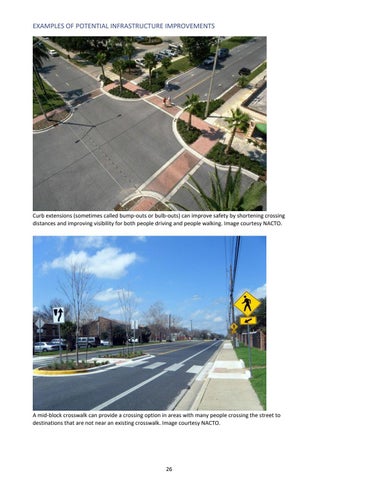
Curb extensions (sometimes called bump-outs or bulb-outs) can improve safety by shortening crossing distances and improving visibility for both people driving and people walking. Image courtesy NACTO.
A mid-block crosswalk can provide a crossing option in areas with many people crossing the street to destinations that are not near an existing crosswalk. Image courtesy NACTO.
26
High visibility crosswalks such as this “ladder” style crosswalk “are preferable to standard parallel or dashed pavement markings. These are more visible to approaching vehicles and have been shown to improve yielding behavior” according to the National Association of City Transportation Officials (NACTO). Image courtesy FHWA.
An alternate high-visibility crosswalk such as this color treated crosswalk could be installed near the school, utilizing school colors. This type of crosswalk can improve visibility and enhance student pride. This rendering is of a crosswalk being installed in Brainerd. Image courtesy City of Brainerd.
27
A “Rectangular Rapid Flashing Beacon” (RRFB) is an option to improve safety and visibility for students crossing the street. Image courtesy www.pedbikeimages.org / Lara Justine.
An LED sign like this is an option to improve safety and visibility for students crossing the street at crosswalks. Image courtesy TAPCO.
28
Sidewalks should be a minimum of 5’ wide, and potentially wider closer to the schools in Elbow Lake and Kensington. Whenever possible, sidewalks should be set back from the street with boulevards. This is a good example from 6th Avenue SE in Elbow Lake, across the street from North Elementary School.
Curb ramps should be compliant with the Public Right-of-Way Accessibility Guidelines (PROWAG). PROWAG compliant curb ramps such as those pictured here improve safety for young children, people with disabilities, or mobility issues to navigate the sidewalk network.
29
A spiral or “helix” bike rack is a good option for bike parking for elementary school students. It provides security and organization, and the fun design encourages students to ride to school. Image courtesy Dero.
Another option for a school bike rack would be a hoop style rack. These racks can incorporate school logos like the one seen above for the Hawley Owls. Hoop racks provide good security and bike storage options. Image courtesy Dero / West Central Initiative.
30
How to Get Involved Using this Plan At the heart of every successful Safe Routes to School comprehensive program is a coordinated effort by parent volunteers, school staff, local agency staff, law enforcement and community advocates, such as public health. This plan provides an overview of Safe Routes to School with specific recommendations for a 6 E’s approach to improve the safety and the health and wellness of students. The specific recommendations in this plan are intended to support improvements and programs over the next 5 years. These recommendations include both long- and short-term infrastructure improvements as well as programmatic recommendations.
It should be noted that not all of these projects and programs need to be implemented right away to improve the environment for walking and bicycling to school. The recommended projects and programs listed in this plan should be reviewed as part of the overall and ongoing Safe Routes to School strategy. Some projects will require more time, support, and funding than others. It is important to achieve shorter-term successes while laying the groundwork for progress toward some of the larger and more complex projects.
31
WHO ARE YOU?
members, including seniors or retirees who may have more flexible schedules than parents with school-aged children, may volunteer in established programs or work with school staff or community partners to start new programs recommended in this plan.
Successful programs are achieved through the coordinated efforts of parent volunteers, school staff, local agency staff, law enforcement and community advocates, such as public health. Each partner has a key role to play in contributing to a plan’s success. The following paragraphs highlight the unique contributions of key partners in Safe Routes to School.
I WORK FOR THE SCHOOL DISTRICT School district staff can use this report to prioritize improvements identified on District property and develop programs that educate and encourage students and parents to seek alternatives to single family commutes to school.
I AM A PARENT Parents can use this report to understand the conditions at their children’s school and to become familiar with the ways an SRTS program can work to make walking and bicycling safer. Concerned parents or city residents have a very important role in the Safe Routes to School process. Parent groups, both formal and informal, have the ability and the responsibility to help implement many of the educational and encouragement programs suggested in this plan. Parent groups can also be key to ongoing success by helping to fundraise for smaller projects and programs.
District officials are perhaps the most stable of the stakeholders for a Safe Routes to School program and are in the best position to keep the program active over time. District staff can work with multiple schools, sharing information and bringing efficiencies to programs at each school working on Safe Routes.
I AM A SCHOOL ADMINISTRATOR School administrators have an important role in implementing the recommendations contained within this SRTS plan. For a plan to succeed, the impetus for change and improvement must be supported by the leadership of the school
I AM A COMMUNITY MEMBER Community residents, even if they don’t currently have children enrolled in school, can play an important role in supporting implementation of the plan. They can use this report to better understand where there may be opportunities to participate in programming initiatives and infrastructure improvements. Community
School administrators can help with making policy and procedural changes to projects that are within school grounds and by distributing informational materials to parents within school publications. Please read the SRTS Facts for School Communication in Appendix B.
32
before final design and construction. For recommendations within the public right-of-way, the responsible agency will determine how (and if) to incorporate suggestions into local improvement plans and prioritize funding to best meet the needs of each school community.
I AM A TEACHER OR OTHER STAFF MEMBER Other than parents, teachers might interact with students the most. Teachers can include bicycle and pedestrian safety in lesson plans (see Walk! Bike! Fun!). Sharing books in your classroom that promote walking and biking is a good way to get kids interested at an early age. Teachers can also arrange for field trips within walking distance of school and incorporate informal lessons about safety along the way. In general, being positive and encouraging about walking and biking is a great way to start!
I WORK FOR THE POLICE DEPARTMENT Police department staff can use this report to understand issues related to walking and bicycling to school and to plan for and prioritize enforcement activities that may make it easier and safer for students to walk and bike to school. The Police Department will be instrumental to the success of the enforcement programs and policies recommended in this plan. The Police Department will also have a key role in working with school administrations in providing officers and assistance to some of the proposed education and encouragement programs.
I WORK FOR THE CITY OR COUNTY City and County staff can use this report to identify citywide issues and opportunities related to walking and bicycling and to prioritize infrastructure improvements. City staff can also use this report to support Safe Routes to School funding and support opportunities such as:
I WORK IN PUBLIC HEALTH
• MnDOT Safe Routes to School (SRTS) grants • Federal Safe Routes to School (SRTS) grants • Statewide Health Improvement Program (SHIP)
Public health staff can use this report to identify specific opportunities to collaborate with schools and local governments to support safety improvements and encourage healthy behaviors in school children and their families.
For all infrastructure recommendations, a traffic study and more detailed engineering may be necessary to evaluate project feasibility, and additional public outreach should be conducted
33
Appendices APPENDIX A: PARENT SURVEY RESULTS
34
35
36
37
38
39
40
41
42
43
44
45
46
47
48
APPENDIX B: STUDENT TRAVEL TALLY RESULTS Student Travel Tally Report: One School in One Data Collection Period School Name: West Central Area North Elementary
Set ID: 31436
School Group: West Central Minnesota / MnDOT D4
Month and Year Collected: April 2021
School Enrollment: 221
Date Report Generated: 06/15/2021
Number of Classrooms Included in Report: 12 This report contains information from your school's classrooms about students' trip to and from school. The data used in this report were collected using the in-class Student Travel Tally questionnaire from the National Center for Safe Routes to School.
Morning and Afternoon Travel Mode Comparison
Morning and Afternoon Travel Mode Comparison
Percentages may not total 100% due to rounding.
49
Morning and Afternoon Travel Mode Comparison by Day
Morning and Afternoon Travel Mode Comparison by Day
50
TRAVEL MODE BY WEATHER CONDITION
TRAVEL MODE BY WEATHER CONDITION
Student Travel Tally Report: One School in One Data Collection Period School Name: West Central Area South Elementary
Set ID: 31437
51
School Group: West Central Minnesota / MnDOT D4
Month and Year Collected: April 2021
School Enrollment: 117
Date Report Generated: 06/15/2021
Number of Classrooms Included in Report: 11 This report contains information from your school's classrooms about students' trip to and from school. The data used in this report were collected using the in-class Student Travel Tally questionnaire from the National Center for Safe Routes to School.
Morning and Afternoon Travel Mode Comparison
Morning and Afternoon Travel Mode Comparison
52
Morning and Afternoon Travel Mode Comparison by Day
Morning and Afternoon Travel Mode Comparison by Day
53
Travel Mode by Weather Conditions
Travel Mode by Weather Condition
54
APPENDIX C: DATA COLLECTION INSTRUMENTS CAREGIVER SURVEY ABOUT WALKING AND BIKING TO SCHOOL SECTION 1 - INTRODUCTION Dear Parent or Caregiver, Your child’s school would like to learn your thoughts about students walking and biking to school during a typical year. If your child’s school is currently in distance-learning because of COVID-19, think about what you would do if they were attending classes in person. This survey will take about 5 - 10 minutes to complete. We ask that each family complete only one survey per school your children attend. If more than one child attends the same school, please fill out the survey for the child with the next birthday from today's date. Your responses will be kept confidential and neither your name nor your child’s name will be associated with any results. School Name: [DROP DOWN MENU] SECTION 2 - ABOUT YOU The following questions ask about the demographics of your child and family. They will help us understand if we are reaching a representative sample of the community. The questions are optional, and your answers will remain anonymous. What is the grade of your child? [DROP DOWN] What is the gender of your child? • Male • Female • Other • Prefer not to answer What is the race/ethnicity of your child? (check all that apply) White Hispanic or Latino Black or African American Native American or American Indian Asian Native Hawaiian/Pacific Islander Other Prefer not to say What is your annual household income? • Less than $25,000 • $25,000 to $50,000 • $50,000 to $75,000 • $75,000 to $125,000 • $125,000 to $200,000 • More than $200,000 • Prefer not to say Do you speak a language other than English at home? • Yes • No
55
What language(s) do you speak at home? (check all that apply) Spanish Hmong Cushite (includes Romo, Somali, Sidamo, and other East African languages) German Vietnamese Chinese (includes Cantonese, Mandarin, and other Chinese languages) French (includes Patois and Cajun) Russian Laotian Arabic Amharic Hindi Kru, Ibo, Yoruba Korean Mon-Khmer, Cambodian Tagalog Telegu Norwegian Ojibwa Karen Swahili Other: _____________________________ What is the street intersection nearest your home? [STREET 1 SHORT ANSWER] and [STREET 2 SHORT ANSWER] How far does your child live from school? • Less than ¼ mile • ¼ mile to ½ mile • ½ mile to 1 mile • 1 to 2 miles • More than 2 miles • Don’t know SECTION 3 - SAFE ROUTES TO SCHOOL This section asks about school travel habits and attitudes towards walking and biking. If your child’s school is currently in distance-learning because of COVID-19, think about what you would do if they were attending classes in person. On most days, how does your child travel to and from school? Travel arriving to school • Walk • Bike • School bus • Family vehicle (only children in your family) • Carpool (children from other families) • Transit (city bus, subway, etc.) • Other (skateboard, scooter, inline skates, etc.) Travel leaving school • Walk • Bike • School bus • Family vehicle (only children in your family) • Carpool (children from other families) • Transit (city bus, subway, etc.)
56
•
Other (skateboard, scooter, inline skates, etc.)
Has your child asked you permission to walk or bike to/from school in the last year? • Yes • No At what grade would you allow your child to walk or bike to/from school without an adult? [DROP DOWN] Which of the following issues prevent your child from walking or biking to/from school? (check all that apply) Distance between home and school Convenience of driving Time it takes to walk/bike Before or after-school activities Traffic speeds along route Amount of traffic along route Adults to walk or bike with Fear of hate or street harassment based on race, ethnicity, and/or gender identity Other students to walk or bike with Sidewalks or pathways Safety of intersections and crossings Lack of crossing guards/student patrols Bullying Fear of violence or crime Weather or climate School policy discourages/prohibits walking/biking Access to a bike or bike lock Concerns about COVID-19 transmission What would help your child walk or bike to/from/at school more often? (check all that apply) A group of students to walk or bike with A shorter distance to walk or bike Learning traffic rules and regulations and how to walk/bike safely Safer intersections/crossings An adult to walk or bike with Better/more sidewalks or pathways Walking/biking field trips Incentives, games, or rewards for walking/biking Better snow/ice removal in winter School policy that encourages walking/biking More information about walking and biking routes Less traffic along route Slower car speeds along route Bullying, hate, and harassment prevention and bystander intervention training A school club or after-school program Crossing guards/student patrols/corner captains Access to a bike, bike lock, or secure bike parking Better/more lighting along route Other: _____________________________ How much does your child’s school encourage walking and biking to/from school? • Strongly encourages • Encourages • Neutral • Discourages • Strongly discourages
57
How much fun is walking or biking to/from school for your child? • Very fun • Fun • Neutral • Boring • Very boring How healthy is walking or biking to/from school for your child? • Very healthy • Healthy • Neutral • Unhealthy • Very unhealthy SECTION 3 - COVID The following questions ask about how the COVID-19 pandemic has affected your family’s travel habits and physical activity. How has the COVID-19 pandemic affected your child’s travel/physical activity habits? My child walks... • More often than before • About the same • Less often than before My child bikes... • More often than before • About the same • Less often than before My child travels by car… • More often than before • About the same • Less often than before My child travels by school bus/transit… • More often than before • About the same • Less often than before Which of the following distance learning/social distancing activities have you participated in? (check all that apply) Walking or biking to get to a destination Walking or biking for recreation (no destination) Temporary street closures for walking/biking Walking/biking distance learning curriculum Other: _____________________________ SECTION 4 - MAP/COMMENTS To identify specific walking/biking routes, barriers, opportunities, and destinations at your child’s school, visit the interactive project map: [LINK] Please provide any additional comments below: [LARGE COMMENT BOX] The online version of the quiz can be found here in English and Spanish respectively: https://www.surveymonkey.com/r/mnsrtscaregiversurvey-en https://es.surveymonkey.com/r/mnsrtscaregiversurvey-es
58
STUDENT TRAVEL TALLY SURVEY ABOUT WALKING AND BIKING TO SCHOOL
A high-quality and text readable original version of this document can be found at: http://saferoutesdata.org/downloads/SRTS_Two_Day_Tally.pdf
59
APPENDIX D: WEST CENTRAL AREA SMART GOALS Education ▪ The Cities of Elbow Lake and Kensington and the WCA School District will host a Bike Rodeo to improve bicycle skills for elementary students in the 2021-2022 school year. ▪ Walk Bike Fun! curriculum will be adopted by the WCA School District between March and May of 2022. ▪ WCA School District staff will attend the WBF training in the 2021-2022 school year. Engagement ▪ WCA School District will share Safe Routes to School information at Parent / Teacher conferences, with all families, starting in the 2021-22 school year. ▪ WCA School District will share Safe Routes to School information will share SRTS information at city council and school board meetings by August 16th. ▪ WCA School District will share Safe Routes to School information with the general public by publishing information on social media, the local newspaper, and school district and city website by December of 2021. ▪ Deploy the WCI Rainbow Friends toolkit at the WCA School district by the 2021-2022 school year. Encouragement ▪ By 2024, the WCA School District, City of Elbow Lake, and City of Kensington will partner to organize a Walking School Bus to increase the number of kids who walk to school. ▪ WCA School District with participate in the ongoing walk and bike to school day events during the 2021-2022 school year. Enforcement ▪ By 2025, the City of Elbow Lake, City of Kensington, Grant County, and Douglas County will partner to install speed feedback signs near WCA North and WCA South Elementary Schools, to reduce vehicle speeds and improve safety for students walking and biking. ▪ WCA School District will partner with the Highway State Patrol to place temporary feedback signs around the North and South Elementary schools for two weeks by ▪ WCA School District will partner with local campground in Elbow lake to place trailer feedback sign around North Elementary Engineering ▪ The City of Elbow Lake will partner with WCA School District to implement crosswalk improvements at 1st St & 5th Ave SE in Elbow Lake by 2026 to improve safety for students walking and biking. ▪ MnDOT and the City of Kensington will partner to implement crosswalk improvements at Central Ave & Highway 55 in Kensington by 2026 to improve safety for students walking and biking. ▪ WCA School District will apply for MNDOT Demonstration project funding during the 20212022 school year. Evaluation ▪ Starting in the fall of 2021, WCA School District will conduct student travel tallies twice annually (fall and spring) at both WCA North and WCA South Elementary Schools, to record changes to the number of students walking and biking to school. ▪ Starting in the fall of 2022, WCA School District will conduct parent surveys every 2 years to evaluate and measure progress on SRTS activities.
60
▪ Deploy bike/ped traffic counter in Elbow Lake and Kensington communities by December 2023. Equity ▪ By 2022, the WCA School District will apply for funding to purchase a bike fleet for the district, ensuring that all students have access to bicycles for on-bike education. ▪ Increase number of bike racks as necessary* ▪ Explore Free Bikes 4 Kidz program. Partner with local individuals or organizations in WCA School District. (Look at Pelican Rapids as case study)
61
APPENDIX E: WEST CENTRAL AREA SAFE ROUTES TO SCHOOL TEAM MEETING NOTES WCA Meeting 1: 2/9/21 (Wayne goes through MNDOT planning guide/timeline) -Already did a version of school zone hazard observational assessment this fall. Will do another one for morning and afternoon observation. Elbow lake and Kensington on separate days. Hour before bell rings. -Looking at: crosswalks, stop signs, parents stopping at stop signs, yielding, other drivers behaving poorly, high school driving poorly. -Gives Glenwood observation. -SRTS is about walking and biking to school, not about how to make it easier to drop kids off at school. Kids not cars. -School Env policy assessment is underway. -Walk and bike audit. Already did one, but will be done again. -Jill and Naomi artist toolkit for SRTS purposes. This can be deployed in Elbow Lake and Kensington. -Community engagement event will probably be the bike sculpture with survey. (Jill shares safe to school toolkit) (Vision statement analysis) Change between schools, kids not biking from Elbow Lake to Kensington. Make a change to and from school facilities like baseball fields. Biggest Barriers: -Crossing the major highway is a barrier as parents feel it is not safe. -Kensington: Highway 55 to school side is cumbersome -Railroads through both cities -Buses get stuck behind trains Improvements: -Main street crosswalks in Elbow Lake -In front of the school is a 45ft street. Kids are walking on both sides of the street. Bus was making a turn and had plenty of room to make sure the kids are safe. Opportunities: -SHIP is great partner for SRTS planning. Has provided funding in the past. Encouragement and education -Crystal will be on Grant county schools -Dollar general across highway 79, young kids are running across the highway for school supplies -Car wash is going to be constructed by dollar general which may increase traffic, also new apartment buildings being built. -Channel sidewalks to safe locations. To apartment buildings and to parks. Find some natural corridors. Safe and convenient areas: -Main street Elbow Lake -West side of South Elementary has updated sidewalks, lights, and ADA accessible grants
62
The street scape is more important than the speed limit signs. Making a narrower street makes drivers go slower. With a larger street have opportunities to add walking lanes. Action Items for Team: Parent survey by the end of Feb STT end of April SZHA April SEPA currently underway Community engagement: Think of location for sculptural bike table Walk Bike Audit when WCI in town for observation Identify location for public viewing of project: Can be put on WCI website Schedule for following meeting: End of March. Get together with Dale and Deb for dates. WCA Meeting 2: 4/6/21 Attending: John Van Kempen, Deb Hengel, Wayne Hurley, Julie Larson, Aaron, Maggie Johnson, Chrissy Oachs, Makala Simon. Go over table of content of the plan. There is currently no bike rodeo in WCA. Went over environmental policy assessment for North and South Elementary Went over Wikimaps. Wikimaps will be for both Elbow Lake and Kensington. The link to map will be sent out with the parent survey. Schools will decide if they have a preference for a paper or electronic version. The student travel tallies will be done in late April, May on a typical school week. Not all schools are in schools on Wednesdays. But are all in one on Mon, Tues, Thurs, Friday. Need to have conversation as to what days teachers will take the survey. Observation dates: All team members, WCI staff, and community members are welcome to join in observation day. This will include observing kids walking and biking to schools before schools and after dismissal. All members will be placed around the school and in strategic locations in the city. Should we place a member on 79? Depends on the amount of volunteers. WCI will put together a map of potential locations and will run them by Deb and Dale as to which are the highest priority. For WCA needs to be done on 2 separate dates. Be at the school 30 minutes before school starts. Once the bell rings then the team will pull back together for a debrief. Then WCI will spend day in town performing a walk and bike audit. Then go into position 15-20 minutes before dismissal and perform another observation. Police will be notified the day that observation is occurring. Minimum of 6 volunteers at each school site. If more than enough people then volunteers will be teamed up with community members. High school students can be welcome to volunteer. In Hawley the National Honor Society volunteered. Each high school student was paired with an adult volunteer. Tentative Date: April 27th and 29th. 27th Elbow Lake has a number of city committee meetings. Elbow lake prefers the 29th. Next committee meeting in early May. Discuss SMART goals. SMART goals will be based off of data collected. Student Travel Tallies, Parent Surveys, Observation day.
63
Meeting #4 will be early June. After there will a several week period where plan can be reviewed. Plan will be released for review before meeting 4. Wikimap will hopefully be done in the next 2 weeks. In West Side of Elbow Lake there are children who have to walk to bus stop. In Winter kids are walking on the street because the sidewalks are not cleared.
WCA Meeting 2: 6/8/21 Participants: Wayne, Mallory, Dale Hogie, Deb Hengel, Crystal Hoepner, Chrissy Oachs, Jennifer Kangas Notes: Wayne: The current plan is still being revised. Need to add photos and format. Plan to send out first draft out by the end of the week. Dale proposed question on whether traffic was counted at Kensington when a parent drops student off at school. Wayne: Not specifically counted, but WCA could apply for demonstration project to propose option that can help with a recommendation for high traffic volume. Deb proposed question about what parent group can call themselves (i.e. PTA). AT North and South the parent organization is called “PTO.” Wayne changed to PTO. Deb mention to include an image of the map with the west side of Elbow Lake. Dale and Deb agree that the plan has a good appearance. Executive summary and the visual executive summary will also be included in the future plan.
64
APPENDIX F: PUBLIC HEALTH LAW CENTER, SRTS POLICY AMENDMENTS
65
66
67
68
69
70
A text readable version of this document can be found at: http://publichealthlawcenter.org/sites/default/files/resources/SRTS%20Wellness%20Policy%20Final.pdf
71
APPENDIX G: MINNESOTA SRTS MODEL POLICIES TIP SHEET
72
73
74
75
A text readable version of this document can be found at: http://www.dot.state.mn.us/mnsaferoutes/assets/downloads/MN_SRTS_Tip%20Sheet_MODEL%20POLCIES.pdf
76
APPENDIX H: ELBOW LAKE AND KENSINGTON CITY ORDINANCES Elbow Lake The following is a list of city ordinances affecting walking and biking within the City of Elbow Lake. This list has been abridged. A complete and updated version can be viewed at http://www.thecityofelbowlake.com/wpcontent/uploads/2017/08/ElbowLakeCiyCodeFull2017.pdf. For questions or interpretation, please contact the City of Elbow Lake. 52.17 BUILDING SEWERS AND CONNECTIONS. (L) All excavations for building sewer installations shall be adequately guarded with barricades and lights so as to protect the public from hazards. Streets, sidewalks, parkways and other public property disturbed during the course of the work shall be restored in a manner satisfactory to the city. (Ord. 188, passed 7-17-01) Penalty, see ' 52.99 72.01 GENERAL PROHIBITIONS. (C) No person shall park a vehicle or permit it to stand, whether attended or unattended, upon any highway or street within the city, in any of the following places: (1) On a sidewalk; (2) In front of a public or private driveway; (3) Within an intersection; (4) Within ten feet of a fire hydrant; (5) On a crosswalk; (6) Within 20 feet of a crosswalk at an intersection; (7) Within 50 feet of the nearest rail of a railroad or railroad crossing; (8) Within 20 feet of the driveway entrance to any fire station; 73.01 RESTRICTED OPERATIONS. (E) No snowmobile shall be operated at or upon any of the following: (1) On any public sidewalk; 76.06 RESTRICTIONS. (B) Times and operation. Motorized golf carts may only be operated on designated roadways from sunrise to sunset. They shall not be operated in inclement weather or when visibility is impaired by weather, smoke, fog, or other conditions, or at any time when there is insufficient light to clearly see persons and vehicles on the roadway at a distance of 500 feet. Motorized golf carts shall not be operated in a negligent manner, so as to endanger any person or property, or to obstruct, hinder or impede the lawful course of travel of any motor vehicle or the lawful use by any pedestrian of public streets, sidewalks, paths, trails, walkways, or parks. 90.01 ASSESSABLE CURRENT SERVICES. CURRENT SERVICE. One or more of the following: snow, ice or rubbish removal from sidewalks; weed elimination from street grass plots adjacent to sidewalks or from private property; removal or elimination of public health or safety hazards from private property, excluding any hazardous building included in M.S. '' 463.15 through 463.26, as they may amended from time to time; installation or repair of water service lines; street sprinkling, street flushing, light street oiling or other dust treatment of streets; repair of sidewalks and alleys; trimming and care of trees and removal of unsound and insect-infected trees from the public streets or private property; and the operation of a street lighting system.
77
(B) Snow, ice, dirt and rubbish. (1) Duty of owners and occupants. The owner and the occupant of any property adjacent to a public sidewalk shall use diligence to keep the walk safe for pedestrians. No owner or occupant shall allow snow, ice, dirt or rubbish to remain on the walk longer than 24 hours after its deposit thereon. Failure to comply with this section shall constitute a violation. (2) Removal by city. The City Clerk-Administrator-Treasurer or other person designated by the City Council may cause removal from all public sidewalks all snow, ice, dirt and rubbish as soon as possible beginning 24 hours after any matter has been deposited thereon or after the snow has ceased to fall. The City Clerk-Administrator-Treasurer or other designated person shall keep a record showing the cost of removal adjacent to each separate lot and parcel. (E) Repair of sidewalks and alleys. (1) Duty of owner. The owner of any property within the city abutting a public sidewalk or alley shall keep the sidewalk or alley in repair and safe for pedestrians. Repairs shall be made in accordance with the standard specifications approved by the City Council and on file in the office of the City Clerk- AdministratorTreasurer. (2) Inspections; notice. The City Council or its designee shall make inspections as are necessary to determine that public sidewalks and alleys within the city are kept in repair and safe for pedestrians or vehicles. If it is found that any sidewalk or alley abutting on private property is unsafe and in need of repairs, the City Council shall cause a notice to be served, by registered or certified mail or by personal service, upon the record owner of the property, ordering the owner to have the sidewalk or alley repaired and made safe within 30 days and stating that if the owner fails to do so, the city will do so and that the expense thereof must be paid by the owner, and if unpaid it will be made a special assessment against the property concerned. (3) Repair by city. If the sidewalk or alley is not repaired within 30 days after receipt of the notice, the City Clerk-Administrator-Treasurer shall report the facts to the City Council and the City Council shall by resolution order the work done by contract in accordance with law. The City Clerk- Administrator-Treasurer shall keep a record of the total cost of the repair attributable to each lot or parcel of property.
(F) Personal liability. The owner of property on which or adjacent to which a current service has been performed shall be personally liable for the cost of the service. As soon as the service has been completed and the cost determined, the City Clerk-Administrator-Treasurer, or other designated official, shall prepare a bill and mail it to the owner and thereupon the amount shall be immediately due and payable at the office of the City Clerk-Administrator-Treasurer. 90.18 PUBLIC NUISANCES AFFECTING PEACE AND SAFETY. The following are declared to be nuisances affecting public peace and safety: (A) All snow and ice not removed from public sidewalks 24 hours after the snow or other precipitation causing the condition has ceased to fall; (B) All trees, hedges, billboards or other obstructions which prevent people from having a clear view of all traffic approaching an intersection; (C) All wires and limbs of trees which are so close to the surface of a sidewalk or street as to constitute a danger to pedestrians or vehicles; (H) Obstructions and excavations affecting the ordinary public use of streets, alleys, sidewalks or public grounds, except under conditions as are permitted by this code or other applicable law; (J) Any use of property abutting on a public street or sidewalk or any use of a public street or
78
sidewalk which causes large crowds of people to gather, obstructing traffic and the free use of the street or sidewalk; (K) All hanging signs, awnings and other similar structures over streets and sidewalks, so situated so as to endanger public safety, or not constructed and maintained as provided by ordinance; (L) The allowing of rainwater, ice or snow to fall from any building or structure upon any street or sidewalk or to flow across any sidewalk; (M) Any barbed wire fence less than six feet above the ground and within three feet of a public sidewalk or way; (S) The placing or throwing on any street, sidewalk or other public property of any glass, tacks, nails, bottles or other substance which may injure any person or animal or damage any pneumatic tire when passing over the substance; 92.01 OBSTRUCTIONS. (A) Every owner or occupant of lands and premises within the corporate limits of the city, having on the property so owned or occupied by him or her, shade trees adjacent to or in proximity of sidewalks in the city, shall trim or cause to be trimmed, the branches overhanging or extending over sidewalks shall be less than eight feet above the sidewalk. (B) Every owner or occupant of lands and premises within the corporate lands and premises within the corporate limits of the city shall trim or remove or cause to be trimmed or removed all bushes and shrubbery so that no part thereof shall extend over, on or above the sidewalk along the premises. (Ord. 51, passed - -) Penalty, see ' 10.99 150.01 OVERHANGS, SIGNS AND PILLARS. (A) The construction of overhangs, the hanging of signs and the placing of pillars or other construction over or on sidewalks and other public property in the city shall be permitted; provided, however, that the construction and hanging be first approved by the Planning Commission and the City Council.
Kensington The City of Kensginton does not have a public document that lists city ordinances. For more information contact the City of Kensington for more information.
79
APPENDIX H: WEST CENTRAL AREA SCHOOL DISTRICT #2342 TRANSPORTATION POLICY The following is the district’s transportation policy, which has been abridged. A complete and updated version can be viewed at https://isd2342.org/common/pages/DisplayFile.aspx?itemId=25279742 Transportation of Public-School Students, Revised: 2019 I. PURPOSE The purpose of this policy is to provide for the transportation of students consistent with the requirements of law. II. GENERAL STATEMENT OF POLICY A. It is the policy of the school district to provide for the transportation of students in a manner which will protect their health, welfare and safety. B. The school district recognizes that transportation is an essential part of the school district services to students and parents but further recognizes that transportation by school bus is a privilege and not a right for an eligible student. III. DEFINITIONS A. “Child with a disability” includes every child who has a hearing impairment, visual disability, speech or language impairment, physical handicap, other health impairment, mental handicap, emotional/behavioral disorder, specific learning disability, autism, traumatic brain injury, multiple disabilities, or deaf/blind disability and needs special instruction and services, as determined by the standards of the Department of Education. In addition, every child under age three, and at the school district’s discretion from age three to seven, who needs special instruction and services, as determined by the standards of the Department of Education, because the child has a substantial delay or has an identifiable physical or mental condition known to hinder normal development is a child with a disability. (Minn. Stat. § 125A.02) B. “Home” is the legal residence of the child. In the discretion of the school district, “home” also may be defined as a licensed day care facility, a respite care facility, the residence of a relative, or the residence of a person chosen by the student’s parent or guardian as the home of a student for part or all of the day, if requested by the student’s parent or guardian, if the facility or residence is within the attendance area of the school the student attends. (Minn. Stat. §123B.92, Subd.1(b)(1)) C. “Nonpublic school” means any school, church, or religious organization, or home school wherein a resident of Minnesota may legally fulfill the compulsory instruction requirements of Minn. Stat. §120A.22, which is located within the state, and which meets the requirements of Title VI of the Civil Rights Act of 1964 (42 U.S.C. § 2000a). (Minn. Stat. §123B.41, Subd. 9) D. “Nonresident student” is a student who attends school in the school district and resides in another district, defined as the “nonresident district.” In those instances when the divorced or legally separated parents or parents residing separately share joint physical custody of a student and the parents reside in different school districts, the student shall be a resident of the school district designated by the student’s parents. When parental rights have been terminated by court order, the legal residence of a student placed in a residential or foster facility for care and treatment is the district in which the student resides. (Minn. Stat. § 123B.88, Subd. 6; Minn. Stat. § 125A.51; Minn. Stat. § 127A.47, Subd. 3) E. “Pupil support services” are health, counseling and guidance services provided by the public school in the same district where the nonpublic school is located. (Minn. Stat. § 123B.41, Subd. 4)
80
F. “Shared time basis” is a program where students attend public school for part of the regular school day and who otherwise fulfill the requirements of Minn. Stat. § 120A.22 by attendance at a nonpublic school. (Minn. Stat. § 126C.01, Subd. 8) G. “Student” means any student or child attending or required to attend any school as provided in Minnesota law and who is a resident or child of a resident of Minnesota. (Minn. Stat. § 123B.41, Subd. 11) IV. ELIGIBILITY A. Upon the request of a parent or guardian, the school district shall provide transportation to and from school, at the expense of the school district, for all resident students who reside two miles or more from the school, except for those students whose transportation privileges have been revoked or have been voluntarily surrendered by the student’s parent or guardian. (Minn. Stat. § 123B.88, Subd. 1) B. The school district may, in its discretion, also provide transportation to any student to and from school, at the expense of the school district, for any other purpose deemed appropriate by the school board. C. In the discretion of the school district, transportation along regular school bus routes may also be provided, where space is available, to any person where such use of a bus does not interfere with the transportation of students. This includes part-time secondary students, early childhood family education participants and area learning center students. The cost of providing such transportation must be paid by those individuals using these services or some third-party payor, with the exception of early childhood family education participants and area-learning center students if the provision of such transportation services can be provided without an increase in the school district’s expenditures. (Minn. Stat. § 123B.88, Subd. 10, 11, 12, and 13) V. TRANSPORTATION OF NONRESIDENT STUDENTS A. If requested by the parent of a nonresident student, the school district shall provide transportation to a nonresident student within its borders at the same level of service that is provided to resident students. The school district may provide transportation to a nonresident student outside its borders only after written notice to the resident district. (Minn. Stat. § 124D.04, Subd. 7; Minn. Stat. § 123B.92, Subd. 3; Minn. Stat. § 123B.88, Subd. 6) B. If the school district decides to transport a nonresident student within the student’s resident district, the school district will notify the student’s resident district of its decision, in writing, prior to providing transportation. (Minn. Stat. § 123B.88, Subd. 6) C. When divorced or legally separated parents or parents residing separately reside in different school districts and share physical custody of a student, the parents shall be responsible for the transportation of the student to the border of the school district during those times when the student is residing with the parent in the nonresident school district. (Minn. Stat. § 127A.47, Subd. 3(b)) VI. TRANSPORTATION OF RESIDENT STUDENTS TO NONDISTRICT SCHOOLS A. In general, the school district shall not provide transportation between a resident student’s home and the border of a nonresident district where the student attends school under the Enrollment Options Program. A parent may be reimbursed by the nonresident district for the costs of transportation from the pupil’s residence to the border of the nonresident district if the student is from a family whose income is at or below the poverty level, as determined by the federal government. The reimbursement may not exceed the pupil’s actual cost of transportation or 15 cents per mile traveled, whichever is less. Reimbursement may not be paid for more than 250 miles per week. (Minn. Stat. § 124D.03, Subd. 8)
81
B. Resident students shall be eligible for transportation to and from a nonresident school district at the expense of the school district, if in the discretion of the school district, inadequate room, distance to school, unfavorable road conditions, or other facts or conditions make attendance in the resident student’s own district unreasonably difficult or impracticable. The school district, in its discretion, may also provide for transportation of resident students to schools in other districts for grades and departments not maintained in the district, including high school, for the whole or a part of the year or for resident students who attend school in a building rented or leased by the school district in an adjacent district. (Minn. Stat. § 123B.88, Subds. 1 and 4) VII. SPECIAL EDUCATION/DISABLED STUDENTS/STUDENTS WITH TEMPORARY DISABILITIES A. Upon a request of a parent or guardian, a resident disabled student who is not yet enrolled in kindergarten, who requires special education services in a location other than the student’s home, shall be provided transportation to and from the student’s home at the expense of the school district and shall not be subject to any distance requirement. (Minn. Stat. § 123B.88, Subd. 1) B. Resident disabled students whose handicapped conditions are such that the student cannot be safely transported on the regular school bus and/or school bus route and/or when the student is transported on a special route for the purpose of attending an approved special education program shall be entitled to special transportation at the expense of the school district. The school district shall determine the type of vehicle used to transport disabled students on the basis of the handicapping condition and applicable laws. This provision shall not be applicable to parents who transport their own child under a contract with the school district. (Minn. Rules Part 7470.1600) C. Resident disabled students who are boarded and lodged at Minnesota state academies for educational purposes, but who also are enrolled in a public school within the school district, shall be provided transportation, by the school district to and from said board and lodging facilities, at the expense of the school district. (Minn. Stat. § 125A.65) D. If a resident disabled student attends a public school located in a contiguous school district and the school district of attendance does not provide special instruction and services, the school district shall provide necessary transportation for the student between the school district boundary and the educational facility where special instruction and services are provided within the school district. The school district may provide necessary transportation of the student between its boundary and the school attended in the contiguous district, but shall not pay the cost of transportation provided outside the school district boundary. (Minn. Stat. § 125A.12) E. When a disabled student or a student with a short-term or temporary disability is temporarily placed for care and treatment in a day program located in another school district and the student continues to live within the school district during the care and treatment, the school district shall provide the transportation, at the expense of the school district, to that student. Transportation shall only be provided by the school district during regular operating hours. (Minn. Stat. § 125A.15(b); Minn. Stat. § 125A.51(d)) F. When a nonresident disabled student or a student with a short-term or temporary disability is temporarily placed in a residential program within the school district, including correctional facilities operated on a fee-forservice basis and state institutions, for care and treatment, the school district shall provide the necessary transportation at the expense of the school district. Where a joint powers entity enters into a contract with a privately owned and operated residential facility for the provision of education programs for special education students, the joint powers entity shall provide the necessary transportation. (Minn. Stat. § 125A.15(c) and (d); Minn. Stat. § 125A.51(e)) G. Each driver and aide assigned to a vehicle transporting students with a disability will be provided with appropriate training for the students in their care, will assist students with their safe ingress and egress from
82
the bus, will ensure the proper use of protective safety devices, and will be provided with access to emergency health care information as required by law. (Minn. Rules Part 7470.1700) H. Any parent of a disabled student who believes that the transportation services provided for that child are not in compliance with the applicable law may utilize the alternative dispute resolution and due process procedures provided for in Minn. Stat. Ch. 125A. (Minn. Rules Part 7470.1600, Subd. 2) VIII. HOMELESS STUDENTS A. Homeless students shall be provided with transportation services comparable to other students in the school district. (42 U.S.C. § 11432(e)(3)(C)(i)(III)(cc) and (g)(4)(A)) B. Upon request by the student’s parent, guardian, or homeless education liaison, the school district shall provide transportation for a homeless student as follows: 1. A resident student who becomes homeless and is residing in a public or private shelter location or has other non-shelter living arrangements within the school district shall be provided transportation to and from the student’s school of origin and the shelter or other non-shelter location if the shelter or non-shelter location is two or more miles from the school of origin and the student’s transportation privileges have not been revoked on the same basis as transportation services are provided to other students in the school district. (42 U.S.C. § 11432(g)(1)(J)(iii)(I)) 2. A resident student who becomes homeless and is residing in a public or private shelter location or has other non-shelter living arrangements outside of the school district shall be provided transportation to and from the student’s school of origin and the shelter or other non-shelter location if the shelter or nonshelter location is two or more miles from the school 707-7 of origin and the student’s transportation privileges have not been revoked on the same basis as transportation services are provided to other students in the school district, unless the school district and the school district in which the student is temporarily placed agree that the school district in which the student is temporarily placed shall provide transportation. (Minn. Stat. § 125A.51(f); 42 U.S.C. § 11432(g)(1)(J)(iii)(II)) 3. If a nonresident student is homeless and is residing in a public or private homeless shelter or has other non-shelter living arrangements within the school district, the school district may provide transportation services between the shelter or non-shelter location and the student’s school of origin outside of the school district upon agreement with the school district in which the school of origin is located. (Minn. Stat. § 125A.51(f)) 4. A homeless nonresident student enrolled under Minn. Stat. § 124D.08, Subd. 2a, must be provided transportation from the student’s district of residence to and from the school of enrollment. (Minn. Stat. § 123B.92, Subd. 3(c)). AVAILABILITY OF SERVICES Transportation shall be provided on all regularly scheduled school days or make-up days. Transportation will not be provided during the summer school break. Transportation may be provided for summer instructional programs for students with a disability or in conjunction with a learning year program. Transportation between home and school may also be provided, in the discretion of the school district, on staff development days. (Minn. Stat. § 123B.88, Subd. 21) IX. MANNER OF TRANSPORTATION The scheduling of routes, establishment of the location of bus stops, manner and method of transportation, control and discipline of school children, the determination of fees, and any other matter relating thereto shall be within the sole discretion, control and management of the school board. The school district may, in its discretion, provide room and board, in lieu of transportation, to a student who may be more economically and conveniently provided for by that means. (Minn. Stat. § 123B.88, Subd. 1)
83
X. RESTRICTIONS Transportation by the school district is a privilege and not a right for an eligible student. A student’s eligibility to ride a school bus may be revoked for a violation of school bus safety or conduct policies, or violation of any other law governing student conduct on a school bus pursuant to the school district’s discipline policy. Revocation of a student’s bus riding privilege is not an exclusion, expulsion, or suspension under the Pupil Fair Dismissal Act. Revocation procedures for a student who is an individual with a disability under 20 U.S.C. § 1415 (Individuals with Disabilities Act), 29 U.S.C. § 794 (the Rehabilitation Act), and 42 U.S.C. § 12132, (Americans with Disabilities Act) are governed by these provisions. (Minn. Stat. § 121A.59) XI. FEES A. In its discretion, the school district may charge fees for transportation of students to and from extra curricular activities conducted at locations other than school, where attendance is optional. (Minn. Stat. § 123B.36, Subd. 1(10)) B. The school district may charge fees for transportation of students to and from school when authorized by law. If the school district charges fees for transportation of students to and from school, guidelines shall be established for that transportation to ensure that no student is denied transportation solely because of inability to pay. (Minn. Stat. § 123B.36, Subd. 1(11)) C. The school district may charge reasonable fees for transportation of students to and from post-secondary institutions for students enrolled under the post-secondary enrollment options program. Families who qualify for mileage reimbursement may use their state mileage reimbursement to pay this fee. (Minn. Stat. § 123B.36, Subd. 1(13)) D. Where, in its discretion, the school district provides transportation to and from an instructional communitybased employment station that is part of an approved occupational experience vocational program, the school district may require the payment of reasonable fees for transportation from students who receive remuneration for their participation in these programs. (Minn. Stat. § 123B.36, Subd. 3)
Transportation of Nonpublic Students, Revised 2017 I. PURPOSE The purpose of this policy is to address transportation rights of nonpublic school students and to provide equality of treatment in transporting such students pursuant to law. II. GENERAL STATEMENT OF POLICY The policy of the school district is to recognize the rights of nonpublic school students and to provide equal transportation to those students as required by law. III. ELIGIBILITY A. The school district shall provide equal transportation within the school district for all students to any school when transportation is deemed necessary by the school district because of distance or traffic conditions in like manner and form as provided in Minn. Stat. §§ 123B.88 and 123B.92 when applicable. (Minn. Stat. § 123B.86, Subd. 1)
84
B. Upon the request of a parent or guardian, the school district shall provide school bus transportation to the school district boundary for students residing in the school district at least the same distance from a nonpublic school actually attended in another school district as public school students are transported in the transporting school district. Such transportation shall be provided whether there is or is not another nonpublic school within the transporting school district, if the transportation is to schools maintaining grades or departments not maintained in the school district or if the attendance of such students at school can more safely, economically, or conveniently be provided for by such means. (Minn. Stat. § 123B.88, Subd. 1; Minn. Stat. § 123B.86, Subd. 2(a)) C. The school district may provide school bus transportation to a nonpublic school in another school district for students residing in the school district and attending that school, whether there is or is not another nonpublic school within the transporting school district, if the transportation is to schools maintaining grades or departments not maintained in the school district or if the attendance of such students at school can more safely, economically, or conveniently be provided for by such means. If the school district transports students to a nonpublic school located in another school district, the nonpublic school shall pay the cost of such transportation provided outside the school district boundaries. (Minn. Stat. § 123B.86, Subd. 2(b)) D. The school district shall provide the necessary transportation within school district boundaries between the nonpublic school and a public school or neutral site for nonpublic school students who are provided pupil support services, if the school district elects to provide pupil support services at a site other than a nonpublic school. (Minn. Stat. § 123B.44, Subd. 1) E. When transportation is provided, the scheduling of routes, manner and method of transportation, control and discipline of students and any other matter relating thereto shall be within the sole discretion, control and management of the school district. (Minn. Stat. § 123B.86, Subd. 3; Minn. Stat. § 123B.91, Subd. 1a) F. Additional transportation to and from a nonpublic school may be provided at the expense of the school district where such services are provided in the discretion of the school district. IV. STUDENTS WITH DISABILITIES A. If a resident student with a disability attends a nonpublic school located within the school district, the school district shall provide necessary transportation for the student within the school district between the nonpublic school and the educational facility where special instruction and services are provided on a shared-time basis. If a resident student with a disability attends a nonpublic school located in another school district and if no agreement exists for the provision of special instruction and services on a shared time basis to that student by the school district of attendance and where the special instruction and services are provided within the school district, the school district shall provide necessary transportation for that student between the school district boundary and the educational facility. The school district may provide necessary transportation for that student between its boundary and the nonpublic school attended, but the nonpublic school shall pay the cost of transportation provided outside the school district. School districts may make agreements for who provides transportation. Parties serving students on a shared time basis have access to a due process hearing system as provided by law. (Minn. Stat. § 125A.18) B. When the disabling conditions of a student with a disability are such that the student cannot be safely transported on the regular school bus and/or school bus route and/or when the student is transported on a special route for the purpose of attending an approved special education program shall be entitled to special transportation at the expense of the school district or the day training and habilitation program attended by the student. The school district shall determine the type of vehicle used to transport students with a disability on the basis of disabling conditions and applicable laws. This section shall not be applicable to parents who transport their own child under a contract with the school district. (Minn. Stat. § 123B.88, Subd. 19; Minn. Rules Part 7470.1600, Subd. 1)
85
C. Each driver and aide assigned to a vehicle transporting students with a disability will be provided with appropriate training for the students in their care, will assist students with their safe ingress and egress from the bus, will ensure the proper use of protective safety devices, and will be provided with access to emergency health care information as required by law. (Minn. Rules Part 7470.1700) D. Any parent of a student with a disability who believes that the transportation services provided for that child are not in compliance with the applicable law may utilize the alternative dispute resolution and due process procedures provided for in Minn. Stat. Ch. 125A. (Minn. Rules Part 7470.1600, Subd. 2)
86
APPENDIX J: CRASH DATA Crash data from within the Kensington and Elbow Lake city limits was gathered using the online Minnesota Crash Mapping Analysis Tool. (MCMAT) (http://www.dot.state.mn.us/stateaid/crashmapping.html) MCMAT is MnDOT’s crash database that includes all crashes involving a motor vehicle where a crash report was filed. It includes crash reports from the past ten years. However, a crash involving a solo cyclist, the most common type of bicycle crash, would not be recorded even if emergency services responded as long as the crash did not involve a motor vehicle. KENSINGTON The MCMAT data for Kensington was accessed, November 19th, 2020. As of that date, the dataset included crash reports from March 6th, 2010 through March 17th, 2020, all of which were included in this analysis. According to the MCMAT homepage accessed on the date above, there has been a delay in updating the database with crash data from 2020. Typically, the lag time between crash occurrence and data entry into the MCMAT database can be approximately 2-3 months with the data updated four times per year, approximately quarterly. The staff at WCI felt that collecting crash data within the city limits of Kensington would provide the most utility. There was a total of 11 crashes with none of those involving a bicyclist or a pedestrian. ELBOW LAKE The MCMAT data for Elbow Lake was accessed, November 19th, 2020. As of that date, the dataset included crash reports from May 7th, 2010 through September 23rd, 2020, all of which were included in this analysis. According to the MCMAT homepage accessed on the date above, there has been a delay in updating the database with crash data from 2020. Typically, the lag time between crash occurrence and data entry into the MCMAT database can be approximately 2-3 months with the data updated four times per year, approximately quarterly. The staff at WCI felt that collecting crash data within the city limits of Elbow Lake would provide the most utility. There was a total of 76 crashes with one of those involving a pedestrian. 1.
On October 31, 2014 at 15:03 under dry, clear daylight conditions, a 90-year old female with a passenger car heading east failed to yield the right-of-way and did not stop at a stop sign, and struck a 28-year old female pedestrian with a stroller heading north while using a crosswalk. There were no contributing factors and the pedestrian received a minor injury.
87
APPENDIX K: MAPS West Central Initiative has created online maps via Google Maps© for the use of the West Central Area Safe Routes to School committee. The maps are available here for Elbow Lake: https://bit.ly/3wFVAlS and Kensington: https://bit.ly/3gCw0Yd. West Central Initiative also created a WikiMap for the Elbow Lake and Kensington communities that were open to the public for input. The WikiMaps are available here for Elbow Lake: https://wikimapping.com /elbow-lake.html and Kensington: https://wikimapping.com/kensington.html. The maps contain multiple layers for easy viewing, some of which have been manipulated to produce figures A –I and tables A -B. These maps were created in May of 2021, based on visual assessments and data obtained during community walk audits.
Figure A: Evaluations of sidewalks could be placed in these four categories.
88
Figure B: Evaluations of curb cuts could be placed in these three categories.
89
Figure C: The map below shows the existing sidewalks of Elbow Lake as of 2021.
Figure D: The map below shows locations where there are no existing sidewalks in Elbow Lake and where West Central Initiative recommends sidewalks be installed.
90
Figure E: The following are marked locations from community members on areas in Elbow Lake where they feel there are walking or bicycling issues that need to be addressed.
Category
Initial Comment
Improvement opportunity
Busy road for students to cross.
Improvement opportunity
Busy Road
Improvement opportunity
Congested area with drop off and busing all in one spot. Makes it hard to see at the intersections.
29-Apr-21
Improvement opportunity
Zero sidewalk in just one half of the block. Lots of children walk home on this road and traffic does not slow down enough coming off the highway.
18-Jun-21
Improvement opportunity
Sidewalk ends. As stated on other point on this road-- a lot of kids walk home on this road and traffic does not slow down enough coming off the highway. Would be nice if a sidewalk continued on the edge of the park onward, along the highway.
18-Jun-21
Improvement opportunity
Date Created
22-Apr-21 22-Apr-21
It would be great to see signs or an actual crosswalk across the highway. Many kids cross here.
Table A: The following is a list of comments that community members addressed on the WikiMap for Elbow Lake.
91
18-Jun-21
Figure F: The following shows existing sidewalks in Kensington as of 2021.
Figure G: The map below shows locations where there are no existing sidewalks in Kensington and where West Central Initiative recommends sidewalks be installed.
92
Figure H: The following shows areas to explore connection in Kensington. This means a path could be placed within the highlighted area.
Figure I: The following are marked locations from community members on areas in Kensington where they feel there are walking or bicycling issues that need to be addressed.
93
Category
Initial Comment
Create Date
Improvement opportunity
one way street...signs posted people still ignore and go down wrong way
29-Apr-21
Pedestrian Barrier
sidewalk in front of houses are never plowed in winter causing kids to walk in middle of street
29-Apr-21
Improvement opportunity
no sidewalks kids walk on street to get to school
29-Apr-21
Improvement opportunity
no sidewalks kids walk on street to get to school
29-Apr-21
Improvement opportunity
no sidewalks on this side of town either so kids walk on street to get to bus stop
29-Apr-21
Table B: The following is a list of comments that community memebers addressed on the WIkiMap for Kensington.
94