C O N T EN T S __________________________________________________ A collection of reflections, observations, and conversations on democracy, community, and the future of rural life.
I. II. III. IV.
“We the People” in Oyate Hall Common Sense on the Challenges We Face, the North Star We Follow, and Seven Paths Forward from Fragmentation to Common Ground A Treasure Chest of Practical Investments to Move Us Forward A Collection of Essays from Sector Leaders on the Choices We Face and Ways to Build a Positive Rural Vision
1
“We the People” in Oyate Hall Anna Wasescha, President, West Central Initiative In late fall of 2025, more than 200 of us gathered in Oyate Hall at the University of Minnesota Morris to engage in a deep conversation about rural democracy. Oyate is the Lakota word for “the people.” Sometimes it is translated as “the nation.” At that meeting, we were indeed “the people,” the same people who figure in the preamble to our Constitution: the “We the People,” who are responsible for self-rule in a democracy and specifically in this American nation. America is as much an aspiration as it is a living, functioning democratic republic. The ideas that formed it stretch back to the Greek and Roman empires, the Magna Carta, and the Enlightenment. We human beings persistently fail to live up to our ideals. And in the case of our democracy, that is painfully evident. But these ideals, no matter how far short we may fall in realizing them, are what unite us in common purpose. They are what Abraham Lincoln implored us to hear, the mystic chords of memory that assure us we can achieve a more perfect union if we just keep working at it. So, yes, we hear the litany of reasons we are divided and unhappy everywhere we turn. But also, yes, we can see a way forward. And that is why we invited our friends and neighbors to come together last October to share their thinking about a positive rural vision. This pamphlet summarizes those conversations and serves as a marker for the year 2026. Stories connect to place, and to history, and to the dreams and wishes that the founders shared with us. We intend to keep chronicling the stories of our democracy in proceedings like this one, for on this 250th anniversary of our Declaration of Independence as a democratic nation, we are now tasked with grabbing the torch and running into a bright future. Many thanks to Erik Peterson for writing this excellent summary report, and to everyone who came together in Morris, Minnesota, to take stock of where we are, reflect on what matters most, and renew our civic commitment to one another.
2
Common Sense: Toward a Positive Rural Vision Erik Peterson
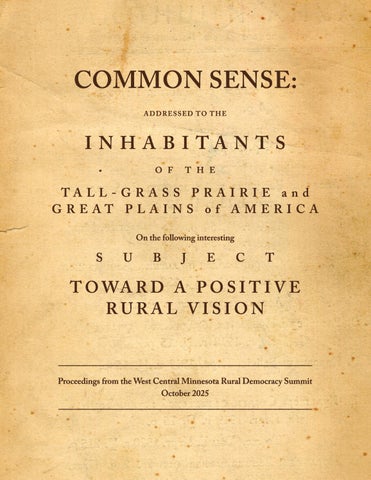
Common Sense In January 1776, an anonymously published pamphlet, Common Sense, exploded onto the colonial American political scene. Within months, nearly 150,000 copies were sold, a staggering number for any publication, let alone a political treatise in an era when news traveled on foot or by horse. Its readership reached far beyond the political elite or schooled—the pamphlet was read aloud in taverns, churches, and town meetings. In short, it was a viral sensation before the term was ever imagined. Common Sense debuted during one of the most politically divisive and precarious times in American history. Rumblings of revolt against the King, when openly expressed, were still considered treasonous. For more than a decade, political polarization had festered as a distant and disconnected monarchy grew increasingly erratic and authoritarian, perceived by many colonists as denying them their fundamental rights as British subjects. The King imposed unpopular duties and tariffs that made ordinary goods more expensive for most people. Violence and vigilantism increasingly erupted, pitting Loyalist neighbor against Patriot neighbor—sometimes family member against family member. British soldiers were harangued in the streets and outskirts of Boston and responded with outsized violence. And by 1775, the battles at Lexington and Concord and Bunker Hill had turned political tension into open warfare. By the end of 1775, the mood in the colonies was shifting, but most colonists still considered themselves loyal subjects of the King. The author, Thomas Paine, himself a recently arrived immigrant, worked as a journalist. In Common Sense he laid out a powerful moral, political, and economic case for independence. For him, it was just “common sense,” and his full-throated plea for a total break from the British Empire was rare and immediately impactful. He based one of his key arguments on America’s unique culture comprised of diverse people fleeing persecution and oppression. For Paine, this made American culture incompatible with monarchy. Only a democratic republic, with a government elected by the people and accountable to them, grounded in constitutional checks and balances, could cultivate and sustain liberty and economic self-sufficiency. Six months later, in Philadelphia’s Independence Hall, Thomas Jefferson penned the Declaration of Independence, and 56 colonial leaders joined in signing it. Paine’s rejection of monarchy and his core values that all people are born equal and that governments must derive legitimacy from the people, not kings, became the cornerstone of this declaration of separation. We hold these truths to be self-evident, that all men are created equal, that they are endowed by their Creator with certain unalienable Rights, that among these are Life, Liberty and the pursuit of Happiness. That to secure these rights, Governments are instituted among Men, deriving their just powers from the consent of the governed…
3
Four score and seven years later, on the battlefield of Gettysburg, in the midst of a great Civil War, President Abraham Lincoln reaffirmed these core values and challenged the nation to resolve that a “government of the people, by the people, and for the people, shall not perish from the earth.” Once again, we face a pivotal and divisive moment in our country’s history. We, too, confront a choice. And yet, despite our tumultuous times, we continue to believe we have far more in common than what pulls us apart. We publish this pamphlet—Common Sense: Toward a Positive Rural Vision—250 years after its predecessor. Like Thomas Paine, we hope that it will galvanize and deepen our collective commitment to the values of liberty, equality, and dignity for all. It is upon this foundation and our reaffirmation of the common good that our positive future begins.
The Challenge We Face Many local and national commentators are discussing polarization. Many of us have experienced it firsthand—the loss of friends or strained relationships with family at awkward holiday get-togethers. Loud and angry declarations often dominate the news, politics, and our social media feeds. In an essay for this pamphlet, I wrote, “Increasingly, we inhabit different, non-intersecting worlds, each informed by radically different information. Apples are talking right past oranges, seemingly unable to see they are both fruit.”1 This is not a typical political fight over policy priorities but something different. It’s not that we don’t know how to love and communicate with one another. We see that all the time. Neither is polarization because we lack the skills for civil conversation. Politics has rarely been “civil” when big differences lie at the heart of the disagreement and passions are flowing. There is something far deeper that communities are facing today: the experience of power and powerlessness, which is playing out in civic spaces without a center of gravity, the civic glue that holds communities together despite their disagreements. We have fewer shared experiences and spaces where community members can feel seen, valued, and heard even when others do not agree with them. Troy Goodnough calls this “democratic dysfunction,” a “systems problem” where “many people … simply don't have any idea about what is going on, whom to trust, and have become increasingly cynical about the power of the people to shape our own destiny.”2 Rural communities are not immune to this phenomenon, nor is it unique to them. Rural people don’t have fundamentally different values or issues from urban people. Still, there is a rural identity—or a sense of “linked fate”—that is strongly connected to a sense of place. Who defines this identity, for what purposes, and for whose benefit has consequences for our rural towns and neighbors. Nicholas Jacobs and Daniel Shea, in their book The Rural Voter, describe how rural identity has become increasingly polarized over the past 30 years and now primarily expresses itself along partisan lines.3 This distinct polarization is associated with geography and a sense of difference based on where one lives. Jacobs and Shea argue that for partisan, electoral reasons, some national party leaders intentionally sought 1
Erik Peterson, Polarization & Rural Identity Troy Goodnough, Plugging the Holes in Our Civic Culture 3 Nicholas F. Jacobs and Daniel M. Shea, The Rural Voter: The Politics of Place and the Disuniting of America (New York: Columbia University Press, 2024). 2
4
to create a rural identity experienced as “real America” under threat and attack from domestic and foreign enemies. In her study of rural Wisconsin, Katherine Cramer describes growing up with a “rural consciousness”— the sense that rural communities are ignored by urban-focused decision-makers and do not receive their fair share of resources.4 She argues that over the past couple of decades, this “consciousness” has hardened into a “politics of resentment” which has taken on distinctly partisan lines. Political leaders then reinforced and fanned this rural resentment of urban elites. The result Cramer found is that rural identity is less focused on what rural communities want to be and more focused “on whom they are against and whom they resent.” Suzanne Mettler and Trevor Brown, in their book Rural versus Urban, also trace the partisan polarization experienced in rural communities—a rural “us” versus an urban “them.”5 Like Jacobs and Shea, they do not find a predictable rural-urban partisan voting pattern until the last few decades. They trace the break back to place-based economic inequality stemming from deregulation and trade liberalization in the 1980s and 1990s. There was a growing perception by white rural residents that urban residents, and by inference Democrats, were affluent and disconnected elites who did not understand rural needs or care for rural culture. The cities, they believed, with substantial data to back up their impression, had disproportionately benefited from America’s economic benefits. This perception was reinforced and organized by rural networks—Evangelical churches, Anti-abortion groups, and Gun-rights organizations—who took widespread discontent and stamped it with partisan purpose. In her essay for this publication, Katherine Cramer writes, “The rural-urban divide is both real and imagined.”6 It is real in terms of the rural disparity in economic growth, less rural diversity, and slower population growth, but she continues, it “is also imagined because politicians have benefited from convincing us that people who are from a type of place that we aren’t from or don’t relate to are not just demographically different than us but are morally inferior and threatening.” These politicians win elections and secure other benefits by stoking fear about people on the other side of the divide. If there is hope in all these characterizations, it is this: since our current division and partisan polarization are manufactured, that means they are not inevitable.
4
Katherine Cramer, The Politics of Resentment: Rural Consciousness in Wisconsin and the Rise of Scott Walker (Chicago: The University of Chicago Press, 2016). 5 Suzanne Metler and Trevor E. Brown, Rural versus Urban: The Growing Divide that Threatens Democracy (Princeton and Oxford: Princeton University Press, 2025). 6 Katherine Cramer, Implications of the Rural-Urban Divide for Civic Life
5
Our North Star West Central Initiative (WCI) is a community foundation and regional planning and development organization created by the McKnight Foundation in 1986, one of six rural regional community foundations. It serves nine counties in west central Minnesota and White Earth Nation. WCI has long recognized that a flourishing civic life is necessary to meet its mission. In 2023, WCI launched the Rural Democracy Program (RDP) by asking a few simple questions. What is the heartbeat of our communities? What makes us strong? What carries us through when times get tough? What we heard back cut across the divides. We depend on family, friends, and neighbors. Being a good neighbor and helping others matters. We celebrate self-reliance and resilience. Tolerance makes us stronger and feel better, and diversity enriches our lives and communities. These widely shared values are a solid foundation to build on. They are the core values of a healthy democracy and civic culture. WCI identified three gaps. First, there is a public leadership gap: rural areas need more civic leaders but have fewer people willing to step up, and too often those who do represent a narrow slice of the community’s diverse cultures and experiences. Second, there is a civic engagement gap: many people find public decision-making confusing, hostile, or pointless. They do not understand where to be heard, how to be heard, or whether their voices even matter. Third, there is a civic space gap: there are fewer welcoming, inclusive public places for people of different backgrounds to connect and build community together. These gaps fuel isolation and tribalism, accentuated by digital media algorithms that reward conflict and validate what we already believe. WCI’s Model for Strengthening Rural To meet these gaps, we must invest in three key things: Democracy & Civic Culture 1. People. We need to create and support multiple ways and opportunities for people to engage with others around things that matter to them. 2. Spaces. We must ensure our public spaces are inclusive spaces that solicit and welcome a diversity of experiences and opinions. 3. Leaders. We need to develop and support effective local public leaders who represent the diversity of our communities. Engaged people, effective leaders, and welcoming, inclusive civic spaces are the elements of a thriving and sustainable community and democracy. They build bridging, linking, and bonding social networks. 7 These foster and sustain a sense of belonging, trust, and agency – the enabling conditions for thriving communities and civic life.
7
See the University of Minnesota Extensions “Model for Community Social Capital,” Community Social Capital Model | UMN Extension.
6
From Fragmentation to Common Ground: Seven Paths Forward WCI held its inaugural Rural Democracy Summit on October 30-31, 2025. Over two days, participants discussed the impact of polarization on rural communities and what is required to build a positive rural vision grounded in a politics of hope and cooperation. On the first day, 31 participants across multiple sectors grappled with how political polarization is impacting their sector and what it will take to bridge divisions and build collaboration. Following the summit, we asked them to reflect more deeply on what it would take to build a politics of hope and collaboration in rural Minnesota. We address key themes below and have included their full essays in the Appendix. The next day, we challenged more than 200 participants to put their ideas for strengthening local civic life into concrete, fundable action. We asked them: “If you had a million dollars today with no constraints, what would you do to increase participation in public life and develop a politics of hope and cooperation in your community?” We invited everyone to join with other participants at their table to discuss their ideas and submit them to our “Treasure Chest.” There were 91 responses. There was no shortage of vision and passion. The ideas ranged from creating a community-owned bank to supporting a community-owned pizza oven. From providing living wage compensation for people who serve in elected office and on community commissions to buying wagons so people without transportation can get their food home after visiting the food pantry. In the Appendix, we summarize the broad range of practical solutions into six categories. Over the two days of discussion, there was broad agreement that we are all neighbors—deeply interconnected with one another and our natural environment—and that hyper-polarization now poses a real threat to our democracy and collective well-being. Participants emphasized that a healthy democracy is not an abstract ideal, but a daily practice of listening, learning, showing up, and acting together at the community level. Civic renewal must be a bottom-up endeavor rooted in relationships, shared spaces, honest storytelling, and everyday acts of care. It will require the attention of civic-minded local leadership. Seven paths emerged. Collectively, they speak to a positive rural vision built locally, relationally, and collaboratively. Building this future will require shared information, everyday relationships, empowered youth, and grassroots leaders. It will rely on strong rural and urban connections, healthy civic spaces, and a moral commitment to seeing our neighbors as part of our own story in a shared place we call home. These leaders agree that polarization thrives when people live in separate information worlds, when we cannot agree on even the most basic facts of what is happening around us. Shared knowledge is the foundation of shared problem-solving. Cooperation requires a renewed sense of shared purpose and an ability to imagine what our communities might look like beyond fragmentation. This cannot happen if we cannot first agree on some shared information.
7
Stu Lourey of the Minnesota Farmers Union argues that social media “has at once hollowed out journalism and created division.”8 He doesn’t believe most people are angry partisans. Instead, “they just opt out, particularly when they feel like things aren’t going to change for the better.” His answer is not louder opinion or sharper rhetoric, but renewed investment in local, community-focused journalism that “celebrates the successes in our communities” while accurately reporting on the issues that matter most. Minnesota Star Tribune columnist Aaron Brown makes a similar point. 9 “Regardless of political views or location,” he writes, most people understand that “press releases from government agencies won’t always present the most important information.” We may disagree about what facts mean, or why decisions were made, but democracies depend on shared, reliable information to function. “Gathering, sharing and synthesizing information … is what journalists are paid to do,” Brown reminds us, and “shared knowledge creates a shared reality, and the more we share a reality, the more we can solve problems of all sizes— from bumpy roads to institutional failures in a rapidly changing world.” Tom Horner, former Independence Party candidate for governor, has spent a lifetime inside partisan crosscurrents. He recalls that two of his mentors—Democrat Walter Mondale and Republican Dave Durenberger—arrived at the same troubling conclusion: today’s leaders “can’t even agree on how to define the major problems of the
8 9
SEVEN PATHS FORWARD 1. Relationships and connection are the starting point Belonging, trust, and relationships are the foundation of thriving communities. These are built face-to-face, over time—not through algorithms or partisan debate. 2. Rebuild trust through shared, reliable information Shared knowledge makes shared problem-solving possible. Polarization grows when people live in separate information worlds. Communities cannot act together without some agreement on basic facts. 3. Rural values and community life are civic assets Rural communities are well-positioned to model cooperation through proximity, necessity, and shared responsibility. 4. Reinvigorate “third spaces” Shared spaces create shared community. Civic life depends on places where people naturally gather to serve, listen, share their stories and work together. 5. Empower grassroots leadership Bottom-up leadership is often more effective than top-down. Civic-minded servant leaders develop when there is institutional support for community members to participate and lead in meaningful ways. 6. Recognize rural–urban interdependence We are more connected—and dependent on each other—than our politics admit. Differences are real— but often amplified or distorted for political gain. 7. Reinvest in the capacity to care for one another A politics of hope and collaboration becomes real when communities invest in their own resilience and their capacity to care for one another and the common good.
Stu Lourey, Reliable Information, Relationships, & Keeping it Local and Real Aaron Brown, Why Journalism Matters in Everyday Community Life
8
day.”10 Without agreement on the problem, shared solutions are impossible. Horner doesn’t offer easy fixes, but he insists that change begins with personal responsibility—leading by example, choosing to “use your voice,” working to understand differences, and seeking common ground. For some, that may mean running for one of thousands of local nonpartisan offices. For others, it may be shaping effective policy through “nonprofit organizations, advocacy groups, schools, [or] places of worship.” Former Minnesota Secretary of State Mark Ritchie addresses the importance of good information and data from a different angle: the threat posed by AI-driven tools to election integrity.11 He cites studies that demonstrate that vote-manipulating bots work and suggests that powerful leaders with anti-democratic motivations want “to continue using AI to manipulate voters and voting.” Coupled with the unprecedented recent federal efforts to access state voter data, Ritchie calls for a “thorough investigation” and for states to regulate AI to protect democracy. Again and again, contributors return to the same truth: relationships must come first. Trust, belonging, and connection are not built through algorithms or partisan debate, but face-to-face, over time. Ben Hernandez reflects on immigrating from Mexico to Morris, Minnesota, as a child.12 He found strength in the town’s close-knit nature—“deep-rooted relationships [between] neighbors and friends”— but also discovered that “it is difficult for anyone to go unnoticed” and newcomers can struggle to feel integrated. Hernandez’s response was intentional curiosity: learning to hunt, asking why one fish mattered more than another. His curiosity opened conversations, which led to trust and eventually to “shared experiences and goals rather than exacerbating differences.” His lesson is simple and demanding: each of us has a responsibility to sustain the social fabric “one conversation at a time.” NeTia Bauman, working in economic development in the St. Cloud region, describes a community wrestling with a “dual identity”—both rural and urban.13 When people cannot agree on “who we are, what we value, and what our community needs,” even practical issues like housing, land use, child care, or transportation become difficult to address. Yet Bauman finds hope by centering interdependence. “Rural residents work in our urban core. Suburban families recreate in rural towns. Urban businesses rely on rural supply chains, land, and a skilled workforce.” When people recognize their shared stake in success, she writes, “civic life becomes more hopeful.” That hope requires leadership capable of shaping a new narrative—“a hopeful and proud story”—one that moves past self-deprecation and beyond rural-versus-urban resentment. Instead, Bauman urges us to leverage both rural and urban strengths “to build a more resilient, more hopeful ecosystem, together.” With shared ground beneath us, working through differences becomes possible. “Hope becomes actionable.” Elder Suzanne Kelly of the Minnesota Council of Churches views fragmentation not only as political but as spiritual—a deep sense of alienation and dislocation.14 Beneath the strain, she senses “a deep hunger for 10
Tom Horner, Overcoming Polarization and Re-engaging Minnesotans in Politics and Policy Mark Ritchie, Election Integrity in the Age of AI 12 Ben Hernandez, Rural Democracy Reflections 13 NeTia Bauman, The Rural-Urban Divide in Greater St. Cloud, MN 14 Elder Suzanne Kelly, Faith, Aspiration, and the Work of Repair in a Fractured Time 11
9
connection, for a shared moral vision that can hold us together.” She calls this moment “a sacred invitation” to remember that “our neighbors’ well-being is bound up with our own.” Faith communities, she argues, can help build what she calls a “democracy of neighbors,” because they teach us “how to stay in relationship when it’s uncomfortable, how to listen deeply, and how to hope stubbornly.” She leaves us with a grounding question: “Where in your community can you help repair what is fraying or nurture what is growing?” Troy Goodnough, Sustainability Director at the University of Minnesota Morris, puts it bluntly: “What do we do when we have multiple holes in the roof of our civic culture?” His answer is equally plain— “Start plugging holes.”15 For Goodnough, “digging up common ground is an act of civic duty right now,” beginning with civility, curiosity, and “a hunger for reality-based information.” For him, citizenship is an act of care—the “first act of love” must be our attention to building a better future for our children. Rural communities, many writers argue, are uniquely positioned to model this work. In my essay, I observed that rural identity can harden into a sense of siege—or it can reflect values we prize like “hard work, community service, resiliency, pride of place, and being neighborly.”16 These values are aspirational, and we don’t always live up to them, “but if democracy is to survive and our rural communities are to thrive,” I will bank on building on them. Political scientist Katherine Cramer similarly reminds us that the politics of resentment obscures a deeper truth. 17 “Whether the rural-urban divide is real or imagined,” she writes, it matters because it blocks what most people want: “a community that thrives [where] they can live a life of security and happiness.” The recognition that “we all do better when we all do better”—echoing Senator Paul Wellstone—remains a solid foundation. Minnesota’s own history offers a cautionary tale and a source of hope. The “Minnesota Miracle” of the 1970s rested on a bipartisan sense of shared fate that crossed regional and partisan lines. Foundational to the “miracle” was bipartisan agreement that funding should be based on need rather than geography—an explicit affirmation of mutual care across rural and urban regions. Journalist Lori Sturdevant recounts how that compact was deliberately unraveled.18 At Farmfest in 2014, she recalls warning a Republican political operative that pitting rural Minnesotans against the metro would damage Greater Minnesota more. His response was telling: “Maybe—but it works. It wins elections.” The strategy succeeded politically, but at the cost of shared trust. Yet mutuality did not disappear. There is something persistent in Minnesotans’ politics of care. We have seen waves of “neighborism” in the tens of thousands of ordinary Minnesotans who have resisted reckless federal immigration enforcement. Sturdevant believes Minnesotans just don’t like being “played by outsiders for the sake of short-term gain.” Over decades of reporting, she describes what she has seen
15
Troy Goodnough, Plugging the Holes in Our Civic Culture Erik Peterson, Polarization & Rural Identity 17 Katherine Cramer, Implications of the Rural-Urban Divide for Civic Life 18 Lori Sturdevant, A Turning Point in Minnesota’s Rural–Urban Relationship 16
10
happen when Minnesotans gather and share stories: they discover they are not alone, find allies, and renew their belief that democracy can still be “the people’s tool.” Liz Kuoppala, who leads MAHUBE-OTWA Community Action, sees this reality daily. 19 Despite political rancor, she witnesses people “pulling together to serve each other—volunteering, donating food, helping struggling families with rent.” No one checks party affiliation. They simply care. Drawing on insights from conflict resolution and intercultural work, Kuoppala urges moving from a “Partisan Mindset” of winning to a “Civic Mindset” of mutual gain. Polarization turns toxic when it becomes “othering”—when people are seen as less worthy of dignity. The antidote is “bridging,” beginning with those closest to us. “We know the paths forward,” she writes, “but leadership must focus not on outsmarting the other side, but on working together toward a future that includes us all.” Physical spaces matter, too. Brianna Kreft calls rural community networks a “superpower” and urges reinvestment in “third spaces” where people naturally gather and share ideas.20 Jeff Drake, Superintendent of Fergus Falls Public Schools, argues that hope is unlocked by investing in youth-led organizations.21 Students learn citizenship and “civic-minded servant leadership” by practicing it—identifying local problems, designing solutions, managing budgets, and building partnerships. Young people want meaningful roles, not symbolic gestures, he adds. Dr. Heidi Roop, an internationally recognized climate resilience expert, focuses on how rural communities can strengthen their resilience and preparedness to meet “our new climate reality.”22 She calls for a “cleareyed” view and cites the 2025 flooding in Chokio, Minnesota, as an example of the impossible “double bind” many rural communities face between providing critical community services and preparing for climate disasters. Although she cautions that “the will to act remains our biggest gap,” she finds hope in the examples of future-focused local leaders, equipped with accurate data who “embrace a spirit of collaboration, and act decisively.” For Dr. Wade Swenson, rural healthcare offers an opportunity to bridge through shared care. As a rural physician, Swenson has watched public health become “a battleground of ideology,” eroding trust in science and medicine with real human consequences.23 In response, his strategy draws on good medical practice: place the patient at the center, meet people where they are, “listen without judgment, explain without condescension,” and rebuild trust “one conversation at a time.” Finally, Janet Ericksen, former chancellor of the University of Minnesota Morris, reminds us that unfamiliarity can breed fear.24 She has witnessed the divisiveness and walls that often separate college students from the communities where they attend. But when walls of separation come down, she observes, “people are often much kinder and more generous to a person they get to know than they are to a group from whom they feel separate.” Third spaces—a free monthly meal at a church, shared athletic facilities, 19
Liz Kuoppala, Polarization & Civic Life Brianna Kreft, Connection: Rural America’s Superpower 21 Jeff Drake, From Student Service to Civic Leadership 22 Heidi Roop, Community Collaboration and Leadership Can Weather a Changing Climate 23 Dr. Wade Swenson, Building a Politics of Hope in Rural Health 24 Janet Ericksen, The Importance of Student-Community “Third Spaces” 20
11
internships, and volunteer opportunities—create the chance to know one another. Institutions, she argues, must make community participation possible. Taken together, these voices offer a clear picture. A hopeful rural future is possible. The paths are ours to follow. The commitment is ours to make. The stakes are high. Whether we have the courage and common sense to act remains an open—and our urgent—question.
12
Appendix A: Our Treasure Chest: Practical Investments to Move Us Forward On Day 2 of the Rural Democracy Summit, we invited participants to imagine what they would do to strengthen democracy and civic life. We asked: “If you had a million dollars today with no constraints, what would you do to increase participation in public life and develop a politics of hope and cooperation in your community?” Participants submitted 91 responses to what we called our “Treasure Chest.” The six categories below provide a quick summary of the range of their ideas for civic investment. 1. Inclusive Civic Participation & Removing Barriers Proposals emphasized that democracy only works when people can realistically show up and participate— particularly young parents, low-income residents, immigrants, and others often left out. Ideas included removing practical barriers—providing child care, food, transportation, and living-wage support for serving on boards; designing meetings that fit busy lives; creating welcoming spaces in libraries, schools, and community centers; and funding civic engagement coordinators by region or county to work with schools, elected government, churches, and others to facilitate community participation and engagement. 2. Civic Education, Media Literacy & Reliable Information Access Participants submitted ideas to help people better understand how democracy works, how to make a difference, and where to find trustworthy information. Proposals ranged from revitalizing civics education and hosting community “Civics 101” nights to media-literacy training for all ages. Participants also stressed the need to sustain local journalism through community-owned or student-run media, shared information hubs in libraries and schools, and creative storytelling that highlights what is working rather than just what is broken. 3. Relationship Building and Building Trust & Common Ground There was strong agreement that democracy is fundamentally relational and must be rebuilt through human connection. Participants envisioned community dinners, listening forums, shared service projects, and nonpartisan dialogues that bring people together across differences. Ideas like welcoming committees for newcomers, quarterly community work sessions on local issues, listening campaigns, a creative thinking competition inviting creative solutions for community challenges, and even a “matchmaker” program pairing people of different perspectives. 4. Youth & Intergenerational Engagement Participants consistently named youth engagement as essential to sustaining civic life. Ideas included democracy summits for middle schoolers, school-based community-focused newspapers, paid gap-year service programs, and meaningful youth representation on boards and councils. Intergenerational housing, mentorships, and rural-urban school exchanges were proposed as ways to pass civic knowledge across generations while giving young people real ownership and responsibility.
13
5. Investing in Children, Families & Basic Needs Many participants focused on meeting basic human needs—recognizing that democracy rests on the stability and well-being of people—and on the deep challenges rural communities face in doing so. Ideas included investments in community gardens, food hubs in churches, affordable child-care networks, healthcare, housing, transportation, and mental health services, so families have the stability required to engage in public life. 6. Community-Driven Economic & Civic Infrastructure Finally, participants emphasized building local systems that local people own, shape, and sustain together. Ideas included community foundations, cooperative businesses, shared kitchens and food processing hubs, and redesigned downtowns that invite people to gather, along with reinvesting local dollars to strengthen libraries and community centers as civic hubs. Other participants expanded beyond local community ownership to envision regional collaboration on child care, housing, and workforce development.
14
Appendix B: Sector Leader Essays The Rural-Urban Divide in Greater St. Cloud, MN NeTia Bauman One of the most unique cultural challenges we face in Greater St. Cloud is that we live at the intersection of competing identities. To the Twin Cities Metro, our region is considered rural, yet to the rest of outstate Minnesota, we are seen as urban; too large, too diverse, too politically mixed to be considered truly rural. This duality is more than a curiosity; it shapes how people see themselves, their neighbors, and their place in the broader democratic landscape. The truth is that Greater St. Cloud is both. Our roughly 200,000-resident metro area sits within a 25-mile radius that includes our urban core in St. Cloud with over 70,000 people AND towns of only a few hundred people. Our civic and economic systems reflect both a small metro and a deeply rural region. Our urban core houses the majority of our diverse populations, and politically, often the leaning left crowd, which is surrounded by rural areas that are more right-leaning and reflect the traditional expectations of rural conservatism. This is not an unusual pattern nationally, but the proximity and degree of overlap create a microcosm of Minnesota, and frankly, of the United States. This dual identity makes progress challenging. Business owners, legislative representatives, and residents alike often hold vastly different assumptions about who “we” are, what “we” value, and what “our community” needs. When people in the same region can’t agree on whether they are rural or urban, it becomes harder to find common ground on housing density, childcare investment, land use, transportation, or other economic priorities. When politics overlays so neatly onto our geography, conflict rarely stems from different desired outcomes. Instead, it comes from fundamentally different ideas about the route to reach them. Yet I am hopeful because I have seen signs of progress that feel meaningful, not superficial. The first source of hope is our interdependence. Whether people acknowledge it or not, our economies are woven together. Rural residents work in our urban core. Suburban families recreate in rural towns. Urban businesses rely on rural supply chains, land, and skilled workforce. This interconnectedness forces collaboration in ways that politics sometimes resists. When people recognize their shared stake in success, civic life becomes more cooperative. Second, I’ve witnessed a powerful shift when communities begin to reclaim their narrative. In both Fergus Falls and Greater St. Cloud, one of the greatest barriers wasn’t division, it was self-deprecation. Residents struggled to believe their own community could be admired or competitive. When people see their story reflected back with pride, when they feel ownership of a shared identity, the civic temperature cools. Hope becomes actionable!
15
And finally, I’m hopeful because the next generation of leaders, our entrepreneurs, young professionals, new Americans, and students, are less interested in the rural v. urban divide, and more intentional about opportunity, belonging, and impact. They are disrupting the binary, which gives me tremendous optimism. If Greater St. Cloud can learn to see itself as one region with many expressions, perhaps Minnesota, and the nation, can, too. Our challenge is not to erase the differences between rural and urban, but to leverage the strengths of each to build a more resilient, more hopeful ecosystem, together.
--NeTia Bauman serves as President & CEO of the Greater St. Cloud Development Corporation, where she leads inclusive and equitable economic development efforts across the region. A Certified Economic Developer (CEcD), she is deeply committed to fostering innovation, collaboration, and entrepreneurshipled growth. NeTia also serves on the International Economic Development Council’s Emerging Trends Advisory Committee and as an instructor for IEDC.
16
Why Journalism Matters in Everyday Community Life Aaron Brown The most hopeful sound I’ve heard recently was the high-pitched hum of my car zinging along some new pavement near my home in rural Itasca County. When I moved here from Hibbing more than 20 years ago, the Scenic Highway was one of the bumpiest roads in our northern Minnesota county. Today it sings like an angel choir. This project took three years to complete, and it wasn’t easy. Hundreds of beautiful old growth trees along the Scenic had to be felled to widen the road. Sections of the road cut through swamps, which required more work and fill than expected. Our small rural county couldn’t afford to do the project all at once, nor could residents tolerate the area’s primary road to be completely closed for a year. Each of these issues took time and caused conflict. So, instead, the project moved in stages, each with unique frustrations. Detours sent cars along quiet country roads unaccustomed to the traffic. People who lived along the highway had to navigate the construction equipment even to access the detours. Mail delivery was disrupted. And then the project would experience long, baffling pauses, where most of us could still drive along the graveled remains of the old highway with impunity. Something happened during this time that reminded me of what first attracted me to journalism. Because the project was constantly changing, and because each day’s status directly affected all of us who lived in this area, current information was vitally important. Like much of rural America, local journalism has deteriorated in our area. There are local weekly papers and other media sources, but none that took the level of interest that the people here needed. Thus, information was passed along informally, online, often using social media. I found that the best information came from rolling down my window and asking questions of the work crew, basic journalism at its core. I also see a lesson here. No matter the trends in media consumption, people will always want to know what’s happening in their communities. Regardless of political views or location, most understand that press releases from government agencies won’t always present the most important information. The official story (“The road is closed”) might not line up with the “real” story (“The road is passable if you live here”). Thus, we all have a role in gathering, sharing and synthesizing information. This project also showed the limitation of social media-based community groups. Repetitive questions from people who hadn’t read the comments meant that there was never a central narrative that was easy to read. It took work. And that work is what journalists are paid to do. It’s not only about gathering the information, but rather rendering it clear and accurate for those who need to know. Journalism is a word that’s easy to overanalyze. It’s simply the process of documenting what people are doing, saying and experiencing so that others know, too. Shared knowledge creates a shared reality, and 17
the more we share a reality, the more we can solve problems of all sizes — from bumpy roads to institutional failures in a rapidly changing world.
--Aaron Brown is a columnist and editorial board member for the Minnesota Star Tribune. He's based on his native Mesabi Iron Range in northern Minnesota, where he is also an author, historian, radio producer and former longtime college instructor. He shares his work at MinnesotaBrown.com.
18
Implications of the Rural-Urban Divide for Civic Life Katherine Cramer There’s a lot of talk these days about a rural-urban divide. What’s the big deal? Haven’t there always been differences between the way people in cities and people in rural places live, and some differences in opinion, too? Probably. But these days the divide itself is a hot topic that gets in the way of addressing challenges that people really care about. Here's what I mean. The rural-urban divide is both real and imagined. It's real in the sense that rural and urban places tend to lean toward different political parties. It’s real in other measurable things, too. Rural areas have not experienced population growth, economic growth, rise in education levels and increase in racial diversity that urban places have since the 1970s. In addition, the partisan gap between rural and urban areas, with rural areas leaning more Republican and urban areas leaning more Democratic, has been growing steadily since the early 1990s and is now about four times larger than it was in the early 70s. Those are real differences. But the rural-urban divide is also imagined because politicians have benefited from convincing us that people who are from a type of place that we aren’t from or don’t relate to are not just demographically different than we are but are morally inferior and threatening. They win elections by stoking our fear about people on the other side of the partisan divide, and that divide now runs along the lines of rural versus urban. This means that now we have a hard time getting along with people of different political opinions even within our own communities. But are people on the other side of the party or geographic divide really worse people than we are? Whether the rural-urban divide is real or imagined it is a problem because it gets in the way of what many people want: a community that thrives and in which they can live a life of security and happiness. As long as we see people of different partisan leanings as moral enemies, we have a hard time talking with one another and working together to get things done. Take, for example, issues related to our local economies. Without a vibrant business community and decent jobs and in a place, it’s hard to keep and attract people to the community and have the tax base that allows for community. A decent tax base provides for buildings and spaces like schools, libraries and parks in which people can gather and experience themselves as a community. Rural economic disadvantage is real in many ways, but the perception that this has occurred because government is generally on the side of urban people makes it even harder for government to function as part of the solution to these problems. Places that thrive have both a culture in which people spend time with one another and learn that they can trust one another and places and organizations that foster these opportunities. As long as we keep focusing on partisan divides, we will have a hard time maintaining or renewing a culture of trust and collaborating so that we can have the institutions that make our communities possible.
19
The upside is that in rural Minnesota, many people want to cooperate, and organizations are already working hard to bring people together. I witnessed this first hand at the Rural Democracy Summit organized by the West Central Initiative. I learned about the schools, libraries, local governments and business communities that are persisting despite contemporary challenges and fears. The large crowd that gathered is testament to the fact that rural Minnesota is full of people who care about their community and have the relationships with one another that are essential for doing something about local concerns. We can allow ourselves to be distracted by the rural-urban divide, or we can roll our sleeves up and place attention on things we really care about. What gives me hope is that many people are resisting the distraction of hate, and doing exactly that. --Katherine Cramer is the Natalie C. Holton Chair of Letters & Science and the Virginia Sapiro Professor of Political Science at the University of Wisconsin-Madison. She is known for studying public opinion the old-fashioned way: by listening to people. She is the author or co-author of six books, including the award-winning book, The Politics of Resentment: Rural Consciousness in Wisconsin and the Rise of Scott Walker, which brought to light rural resentment toward cities and its implications for contemporary politics (University of Chicago Press, 2016)
20
From Student Service to Civic Leadership Jeff Drake The politics of hope and cooperation—a commitment to shared progress —cannot be built without the intentional and meaningful engagement of the youth in our communities. The role of this generation, with its unparalleled digital fluency, sense of global justice, and commitment to authenticity, is not merely to inherit the future, but to actively design it. To move into collaborative action, I believe a model of shared leadership constructed around the core principles of what it means to be human offers the best outcomes. We have strengths to draw on -profound capacity for self-awareness, moral reasoning, and empathy. I firmly believe that these qualities create the compass to do the right work. Within our community, the key to unlocking the politics of hope lies in cultivating civic-minded servant leaders, and there is no more potent incubator for this than student organizations like Key Club, National Honor Society, Philanthropy and Youth and others. In particular, Key Club’s core values—leadership, character building, caring, and inclusiveness—perfectly align with the principles of service leadership, ensuring that our future leaders understand that true power is found in uplifting others. The Fergus Falls Public Schools Portrait of a Graduate identifies core competencies such as Communicator, Collaborator, Critical Thinker, and Citizen. Key Club, by design, acts as a high-impact laboratory for these skills. When students organize a book drive, they are not only acting as Citizens but also developing their skills as Collaborators and Communicators in complex, real-world settings. When they research and execute a community cleanup, they use Critical Thinking to solve logistical problems and engage diverse stakeholders. The service projects themselves are the curriculum, teaching students that the most effective way to address community challenges is through non-transactional, empathetic cooperation. How do we most effectively engage this generation in 2025? The strategy must move beyond tokenism and embrace digital-native, transparent, and high-impact methods: •
Grant Authentic Authority (Shared Leadership): Key Club is inherently student-led, which is its greatest strength. We must amplify this model. Instead of dictating service projects, adult mentors should empower Key Club officers to identify local systemic issues (e.g., food insecurity, digital literacy gaps) and design multi-year solutions, giving them full autonomy over budget, partnerships, and execution. This builds real-world confidence and ownership, addressing the youth desire for meaningful roles, not just "busy work."
21
•
Digital-First Activism and Education: Young people predominantly mobilize and communicate through digital channels. Effective engagement in 2025 means leveraging these platforms for civic action. Key Club should be equipped with tools for quick, issue-based advocacy (like creating and sharing short, compelling policy-related videos) and utilizing local apps to track and report on community needs, seamlessly connecting digital interest to physical service.
•
Cross-Sectoral Connection: The modern Key Club should explicitly build partnerships with local government (attending city council meetings), small businesses (for fundraising and mentorship), and non-profit advocacy groups. This cross-sector exposure demystifies adult institutions and shows students that civic engagement is not confined to politics but woven into every aspect of community function.
The energy, vision, and talent of today’s youth are a limitless resource for cooperation. By investing in Key Club as a vehicle for civic-minded servant leadership, we are not just preparing students for graduation; we are equipping them with the practical skills and hopeful mindset necessary to transform our communities and build the compassionate, cooperative world they both expect and deserve.
--Jeff Drake is Superintendent of Public Schools for ISD #544 in Fergus Falls, Minnesota, He grew up in Deer River, MN and is in his 25th year as a school administrator. Jeff is a past president of the Minnesota Association of Secondary School Principals and president-elect of the Minnesota Rural Education Association.
22
The Importance of Student-Community “Third Spaces” Janet Ericksen With about 1000 students, roughly half of whom come from urban areas and the great majority of whom are between 18 and 25, a liberal arts college—even one with particular strengths in the sciences—that operates in a small town in a rural area seems likely to offer a case study in political division. Voting maps support that view. In practice, though, a truism about individual interactions repeatedly undercuts that division and offers a path to even stronger connections: people are often much kinder and more generous to a person they get to know than they are to a group from whom they feel separate. This is even more true when one of those people is a college student and the context is related to community engagement. Through its Benson Center for Community Partnerships, UMN Morris hosts at one of the local churches a monthly free meal, open to anyone. College students and staff provide most of the labor, and the meal draws people from across the community to meet and eat together on neutral ground. The conversations may never touch on politics, but whether they do or do not, in sharing food and conversation, students and long-time residents at least interact enough to make political disagreements less threatening. Infrastructure yields natural 3rd spaces, too, as our shared college-community athletic facilities demonstrate, and student interns in the community, including with the local government, work toward common goals, such as advancing energy efficiency that saves the town money. Such interactions bring the college and surrounding community together and give me confidence that while divisions will persist in the community, the walls are not insurmountable. Students have the energy and interest to scale those walls. They mostly come from other places to go to college, and they bring an attitude of adventure along with a desire to accomplish things. They generally approach community engagement with optimism, which can be hugely persuasive even to those in the college or town community who might not necessarily want connections. While students sometimes want change at a much faster pace than can be achieved, at UMN Morris, at least—and elsewhere I am confident—their wonderful willingness to jump in and work with others toward common goals can impress even quite reluctant people. It’s harder to lump together as a problem the student whom you’ve sung in community choir with or who has helped pick up trash from the park across from where you live. Institutions must continue to make it more financially feasible for students to have local internships, to volunteer, to participate in the community instead of working at a job in addition to the job of being a full-time student. The experiences that students have while in Morris shape their attitudes going forward as well as the attitudes of those with whom they connect, and that’s true whether they stay in the region after graduation or move to other, often more populous areas. Through the community partnership center, UMN Morris students already serve more than 60 rural organizations and 7,000 people across the state in a typical year, but more is possible and important. Too, the campus itself continues to try to be a public square space itself whenever possible—we can blur the boundaries between town and campus and 23
3rd space, with hope that people feel more at home everywhere. Students won’t solve our political divisions, but by creating opportunities for them to engage meaningfully across differences, we give them—and ourselves—practice in the kind of cooperation our democracy needs. --Janet Ericksen is the former chancellor of the University of Minnesota Morris, and a passionate believer in the positive impact of higher education within a liberal arts learning community. She received her PhD from the University of Illinois Urbana-Champaign and is a professor of English with an academic specialization in early medieval English and Old Norse literature.
24
Plugging the Holes in Our Civic Culture Troy Goodnough I attended the Rural Democracy Summit at the University of Minnesota Morris. It might be helpful to say a bit about why we are having this conversation about rural democracy right now. In short, a key motivation for the Summit was: We (the People) are not at our best right now. This would be an understatement. I am a child of the 70s, and from my vantage, during the past half-century America seems to have inexorably scaled Mount Insanity to arrive at our present dysfunctional mountaintop. The past decade of American politics (2015-2025) will take decades for historians to unpack. Remarkably, in 2026, we will celebrate our 250th year as a nation. I have lived in rural western Minnesota for decades. The electorate in my region voted three times in favor of Donald Trump and the Make America Great Again or MAGA movement. A significant amount of our conversation about “politics” is determined by what the Trump administration says and does – and quickly flows from D.C. into our rural community life. A lot is going on right now. For example, our local USDA was shut down for weeks, including both the Soils Lab and NRCS in Morris. These organizations help research, fund, and deliver soil-and-water conservation farming practices. It was the longest federal shutdown in US history. Elon Musk, one of the richest men on Earth, is no longer working in the White House. For now, federal employees are released from submitting a weekly fivepoint accomplishment list. Congress, both the House and Senate, overwhelmingly voted to release the Epstein files, a trove of information about how rich and powerful people befriended a well-known sex trafficker of children, including the president. The Trump administration’s fickle tariff pronouncements have created uncertainty in our trade relationships, impacting Minnesota export markets, like soybeans. Many Americans continue to peacefully protest around the country. Meanwhile, the Commander in Chief uses the social media platform he owns to disseminate AI-generated videos of him dropping human waste from a fighter jet onto his political opponents – all while he champions his own cryptocurrency investments. Masked ICE agents are grabbing people off the streets. And the US military is being used in legally dubious ways, including deployments to US cities and foreign military strikes. All the while, Trump threatens politicians, universities, and organizations who challenge his behavior and actions, with jail, legal action, and physical harm. This is just the tip of the iceberg. What forces brought us to this moment? Our democratic dysfunction is clearly a “systems problem,” with many interconnecting parts. But, I think we can generally agree on a few things. First, we are not in a post-racial society. Anxieties about race, fairness, and who gets what – is ever present. Adding gender to the mix adds to the complexity. Second, economic anxieties about how we pay for food, medical care, elder care, education, retirement, housing, are ever present. It feels more tenuous to enter and remain middle class. Third, we live in corporately curated media and information bubbles. We can see a historic arc from talk radio to a myriad of online platforms that cater to our prejudices. Fourth, we can't escape 25
the creeping authoritarianism seen at home and abroad. Many people want leaders who say they can fix all of our problems and fast. This creates important tensions. One tension is between reality vs. fantasy. Another between democracy vs. authoritarianism. Political opportunists and unprincipled attentiongrabbing platforms can use this dysfunction to take a kernel of legitimate concern and pop a bucket of disinformation and confusion. Many people I talk to simply don't have any idea about what is going on, who to trust, and have become increasingly cynical about the power of the people to shape our own destiny. So what do we do when we have multiple holes in the roof of our civic culture? We start plugging holes. It starts with our own virtue and character. Especially, by saying what is true. To do this requires a bit of effort, curiosity, and a hunger for reality-based information. Next, we need the courage to share with our neighbors what is important to us. Our civility muscles have atrophied. A culture of civility means we can listen to people with whom we disagree without making them enemies. And, we know that across a wide range of public policy Americans overwhelmingly agree on many issues. It may be helpful to name specific challenges and specific solutions to help remove the partisan labels from our conversations. And for our communities to function, we need people to assume leadership positions. Principled leadership always matters in every organization, large and small. Digging up common ground is an act of civic duty right now. The role of a true citizen. In the world we live in, it is simply not OK to say we can't talk about “politics” in our lives with each other as citizens and neighbors. We have turned our thinking over to billionaires and screens for long enough. Our children are looking at us. We can model what it looks like to care about the common good and build a future worth inheriting. But, the first act of love is attention. Will we be able to pay attention to creating a positive future for our kids? Will they accept our excuses for inattention? I hope our children will thank us for not giving up the ship – and for sailing towards the North Star – our positive rural future. Let’s each make a choice to pursue this future. And then let’s act together. --Troy Goodnough serves as Sustainability Director at UMN Morris and has worked at the campus since 2005. Troy works with students, staff, faculty, and community to develop and implement sustainability initiatives and provides leadership to the Morris Model community partnership. In 2023 and 2024, the Morris Model won the Department of Energy's Energizing Rural Communities prize.
26
Community Collaboration and Leadership Can Weather a Changing Climate Heidi Roop The town of Chokio, Minnesota sits along the state’s western border with South Dakota. Chokio’s population is just over 400. Its annual budget is less than $300,000. In late July of 2025, heavy thunderstorms rolled across west central Minnesota. Large hail, gusty winds and torrential downpours downed trees and power poles across the region. But Chokio saw some of the worst. According to local observers, wind and hail “shredded” corn and soybean crops. Ditches, creeks and streams ran over their banks. Whitecaps crested on flooded fields. Local radar indicates about 8 inches of rain fell in Chokio in that single storm. The town, like many, has a combined storm sewer, meaning storm drains and sewage flow into the same pipes. That system was overwhelmed by the sheer volume of rain. Human waste flooded into residents’ basements. Besides the private cost to homeowners, the town itself is now shouldering a major bill for repairs. The storm damaged or destroyed multiple pumps and electrical equipment at the water treatment plant, and Chokio is purchasing additional backup systems to prevent future damage. In all, the current estimate for these fixes is $435,000 — an unexpected cost that’s well more than the town’s entire annual budget. As the director of Extension’s Climate Adaptation Partnership, I’m often asked how we can support communities like Chokio in responding to the threats they’re seeing — and in preparing for risks in the years to come. After all, Chokio’s experience is just one example of the many costly climate-related realities we’re navigating across the state. While Minnesota is known for its weather – and extremes – a warming world will increasingly amplify these extremes. Already, according to the Minnesota Department of Natural Resources, heavy rains in Minnesota are more intense than at any time on record. Our research suggests this trend will continue in decades to come. Now, more than ever, we need to look clear-eyed at this new reality, embrace a spirit of collaboration, and act decisively to prepare. That may be easier said than done. The reality is climate change is just one of many stressors we grapple with. Funding is tight. State and federal resources for preparedness are increasingly limited, while the costs of weather and climate disasters across the nation have never been higher. Small towns like Chokio have few avenues other than local property tax levies to support critical investments not just in infrastructure, but in education, public health and other much-needed services. This presents a near-impossible bind: preparedness should not come at the expense of essential services, but these very services are at further risk if we underinvest in designing for our new climate reality. 27
Schools can't provide a quality education when students are baking in the heat or struggling to breathe from pollution like wildfire smoke. When it comes to managing this “new normal”, one thing is clear: using the rearview mirror to design our wastewater treatment facilities, roads, bridges, and emergency response systems is insufficient. Historical observations of climate no longer capture the reality we are in today — nor what we expect in the years ahead. We must manage our limited resources with an eye toward the future rather than the past. As the climate shifts, a “best guess” for what rainstorms might look like, or the anticipated magnitude and duration of extreme heat events, is not a responsible use of public funds. My team has generated climate projections down to the 2.5-square-mile scale across Minnesota. This information is available online, free-of-charge — an invaluable resource for communities across the state. When opportunities arise to update public infrastructure like stormwater and wastewater systems — like those that failed in Chokio — we can use these future risk insights to inform the sizing and design of these projects. This will help us plan not just for today’s storms, but for those 5, 10 or 20 years down the line. These data and other strategic local and state investments in resilience put Minnesota ahead of the curve. Economic analyses suggest this approach yields both near and long-term fiscal benefits. But data alone won’t mitigate the risks we face as a state. Dialogue and action at the state and federal levels is increasingly frozen in partisan divides. Often overlooked is the power, leadership, and innovation already occurring at the local level where these impacts are most felt, and where solutions are better defined to meet local needs. Local-level decisionmakers — from commissioners and mayors to soil water conservation district boards — meaningfully influence the extent to which our homes, business, and landscapes are safe, productive and resilient. There are many examples across the state where local leadership has charted a productive path forward and where policy has led to reduced risks. While no elected leader or scientist has a crystal ball, we do have tools, resources and opportunities to collaborate. Together, we can help ensure we are ready to weather the storms today, tomorrow and in the future. Sewage-free basements, productive local economies, and clean air to breathe shouldn’t be a “nice to haves,” but rather necessities for all Minnesotans. We have much of what we need to foster resilience, but the will to act remains our biggest gap. --Dr. Heidi Roop is a national expert in climate science and adaptation. She is an Associate Professor at the University of Minnesota, where she directs the Climate Adaptation Partnership – which offers cuttingedge local climate science, resilience resources and technical assistance. Previously she served two presidential administrations as the Assistant Director of Climate Services in the White House Office of Science and Technology Policy. 28
Overcoming Polarization and Re-engaging Minnesotans in Politics and Policy Tom Horner We the people are in trouble. Politics has become the dividing line in communities. Too often, it is we who have allowed and even been partners in making “politics” a dismissive term, as in, “Oh, that’s just politics.” At its core, politics is the art of governance. It is how communities – from our neighborhoods to the nation – collaborate to find and implement solutions. At its best, politics engages us in shaping a future that is better than today. Today, politics often is at its worst. We the people can change this environment. There is no magic wand that will wipe away the divisiveness of today’s politics. There is, however, the magic in the ability and commitment each of us can make to promoting more productive politics. The boldest step is to lead by example. Be the change you want to see in your community. Minnesotans can take charge of their destiny by becoming candidates themselves. Throughout the state, there are thousands of elected public offices, many of them non-partisan. County commissions, city councils, school boards, soil and water conservation districts and on and on. Each one plays a valuable role in building a better Minnesota. Win or lose, a candidate can be a catalyst for change. Running for local office mostly is a series of conversations with your neighbors. Campaigns are the opportunity to engage residents of the community you share in building awareness and support for the good policies needed for a strong future. Running for office may be a step too far for some. There are other ways to bridge political divisions, especially in smaller communities. Good public policy doesn’t happen only through government. Many non-profit organizations, advocacy groups, schools, places of worship and others are promoting good public policy through their grassroots work. Helping a child learn to read, working to meet the needs of those who face a crisis of hunger or shelter, or joining neighbors to design and achieve a brighter future through political action among the many ways to collaborate and create a stronger community. And ultimately, that should be the goal of all policies, whether it comes through government or the volunteer actions of individuals. Finally, use your voice. Engage in conversations with family, friends and others in your network. The task isn’t to win a debate, but to understand differences and the areas of agreement that might help reach common ground.
29
Two of Minnesota’s most respected policymakers, Walter Mondale, a Democrat, and Dave Durenberger, a Republican, shared a dais a few years ago to discuss the deterioration of politics. They were asked why Congress had become so much less effective than it was in their days in office. Mondale and Durenberger came to the same conclusion: Republicans and Democrats are so polarized, they can’t even agree on how to define the major problems of the day. Are people struggling because wellpaying jobs are scarce or because they are lazy and welfare is too generous? Is the health care crisis one of costs that are too high or access that denies too many? Does government spend too much or tax the wealthy too little? And on and on. With no consensus on the problem, solutions are almost impossible. That’s a good place to start conversations. Let’s see if we can see eye-to-eye on at least part of the problem. Perhaps then we can find a shared solution. It’s a way neighbors in Minnesota’s communities can start building the bridges that divide us as a nation. --Tom Horner is Co-Founder of Himle Horner Incorporated and an Adjunct Professor of Corporate Communications/Public Affairs at the University of Saint Thomas. He was the 2010 Independence Party of Minnesota candidate for Governor of Minnesota. Horner is a frequent contributor to regional and national media on public policy and politics.
30
Election Integrity in the Age of AI Mark Ritchie Recent news reports on the use of social media to manipulate elections in a variety of ways need to be carefully monitored, and it should come with severe penalties for election criminals both within our country and outside. Of particular concern is the use of artificial intelligence tools to directly influence elections. One of these studies, published in Nature Magazine, was featured in an Atlantic article titled “Could ChatGPT Secretly Tell You How to Vote?” Here’s the opening. “In the months leading up to last year’s presidential election, more than 2,000 Americans, roughly split across partisan lines, were recruited for an experiment: Could an AI model influence their political inclinations? The premise was straightforward—let people spend a few minutes talking with a chatbot designed to stump for Kamala Harris or Donald Trump, then see if their voting preferences changed at all. The bots were effective. After talking with a pro-Trump bot, one in 35 people who initially said they would not vote for Trump flipped to saying they would. The number who flipped after talking with a pro-Harris bot was even higher, at one in 21. A month later, when participants were surveyed again, much of the effect persisted. The results suggest that AI “creates a lot of opportunities for manipulating people’s beliefs and attitudes,” according to David Rand, a senior author on the study.” The aggressive nature of Elon Musk’s DOGE-led assault on state election officials seems to be inspired by his success in using these bots in the last election. In these efforts to seize voter files from swing states, the Administration has set off flashing red lights inside the cybersecurity and election community. In Minnesota, the Office of the Secretary of State has a very large database of all registered voters, many of whose records with personal emails. Does the White House want to expand its use of these votemanipulating Bots to pre-determine the outcome of the mid-term elections? We need a thorough investigation of how AI tools are being used to manipulate voters and elections, and we need laws to prevent this intentional undermining of our democracy. It is a high priority for some in Washington DC to prohibit states from regulating AI and their motivation seems to be a hope to continue using AI to manipulate voters and voting. If I had to choose just one policy priority it would be preventing the federal government from limiting the ability of states to regulate AI to protect democracy – they have to be our red line.
31
--Mark Ritchie served as Minnesota’s Secretary of State from 2007 to 2015, focusing on expanding voter participation and election integrity. Before his tenure in public office, as Founder and President of the Institute for Agriculture and Trade Policy, he was deeply involved in agricultural policy and rural advocacy that supported family farms and rural communities.
32
Faith, Aspiration, and the Work of Repair in a Fractured Time Elder Suzanne Kelly In both my work and my daily life, I see communities straining under the weight of fragmentation—urban and rural, political and spiritual, digital and personal. Yet beneath this fracturing, I also sense a deep hunger for connection, for a shared moral vision that can hold us together. For those of us who serve in faith communities, this is not merely a social challenge; it is a sacred invitation. A rural politics of aspiration and cooperation begins not with policy, but with imagination—the conviction that our neighbors’ well-being is bound up with our own. In many rural Minnesota towns, churches embody this truth daily. They serve as gathering spaces, moral centers, and engines of cooperation. When a farmer falls ill, when a young family struggles, or when a community faces tragedy, it is often the church that mobilizes the network of care. That is democracy in action at the most local level—a democracy of neighbors. Faith at its best nurtures the civic virtues that democracy requires: empathy, hospitality, courage, and patience. Religion provides a language of aspiration—a reminder that we are not simply managing decline but participating in a story of redemption and renewal. In this way, rural cooperation and religious imagination are intertwined: both believe that what is broken can be made whole again. From my vantage point in an urban setting, I have learned much from these rural models of resilience. In cities, we often mistake proximity for community, while in rural places, people practice the slow, daily work of cooperation because survival depends on it. Still, both contexts share the same vulnerabilities. We are living through an age of polarization, exhaustion, and spiritual fatigue. The institutions that once wove us together—churches, schools, civic groups—are thinning. Economic pressures, digital echo chambers, and social isolation have deepened mistrust and narrowed our moral bandwidth. For the Minnesota Council of Churches, these dynamics shape every part of our ministry. Our work in truth-telling, racial healing, and interfaith understanding takes place in a landscape where people are weary and wary. But it also reminds us why faith communities are indispensable to democracy: they teach us how to stay in relationship when it’s uncomfortable, how to listen deeply, and how to hope stubbornly. As we look ahead, each of us—whether in a rural township or a city neighborhood—has a role in strengthening the civic and spiritual fabric of our communities. We can begin with small commitments: showing up for one another, listening across differences, rebuilding trust through shared work, and tending to the institutions that make belonging possible. I invite readers to reflect on one question: Where in your community can you help repair what is fraying or nurture what is growing? Our democracy, like our faith, is sustained not only by large systems but by everyday acts of care. If we answer that question with courage and imagination, we may yet discover that the path toward a more connected Minnesota begins right where we stand.
33
--Elder Suzanne P. Kelly is the first African American Chief Executive Officer of the Minnesota Council of Churches (MCC). With nearly 40 years of experience in leadership, education, and ministry, she has dedicated her career to advancing racial equity, justice, belonging, and inclusion. A former journalist, educator, and interim superintendent of Saint Paul Public Schools, she believes deeply in the vital role faith institutions play in fostering community vitality and collective healing.
34
Connection: Rural America’s Superpower Brianna Kreft The 2025 Rural Democracy Summit was all about a positive future for rural America. But what does positive really mean in these communities and to these people? How can a politics of hope and cooperation be fostered? Why is now the time to focus on this? These were the questions discussed at a round table of rural leaders ranging from religious elders, to emergency services coordinators, to Star Tribune writers, to elected public officials. Then, these conversations were shared with the community members during a public-facing panel session. The time is now for these conversations, as America is facing an era of intense polarization, which is no better pronounced than along the rural-urban divide. We are living in a time where rural Americans feel a lot of inferred polarization. Meaning that whether or not there is a true voting cleavage between rural and urban areas, or liberal and conservative America, rural people feel as if there is. Political conversations seem daunting and controversial. Leadership styles and decisions, even on the local level, feel polarized on a national scale. Rural people feel as if the challenging but well-mannered ideological debates over coffee at the town cafe are a thing of the past. Instead, people can hide behind their phones or laptops, becoming even more isolated and polarized. Thus, fostering politics of hope and cooperation in rural communities has never been more important. To do this—as was a key takeaway from the rural summit—we must uplift and celebrate local, grassroots leaders and programs. Rural America has long been home to tight-knit communities that leverage strong social networks, collaborative problem solving, and a strong sense of place identity. Frankly, small-scale, interpersonal organization is what rural America excels at. That is why celebrating and uplifting local leadership is so important. Organizations like West Central Initiative’s Rural Advocacy and Public Leadership Program, that train those running for office, should be utilized. Rural individuals need to feel encouraged to run for elected positions, as it takes thousands of people to effectively run one community. Strengthening rural leadership not only empowers communities to direct their own futures, but can help rebuild trust across our polarized divides. When decision making happens close to home and by people you know–-through town councils, cooperatives, and civic associations—rural individuals are more likely to encounter differing viewpoints in constructive, face-to-face settings. This fosters empathy and a shared collective interest. By supporting the amazing local leaders and grassroots efforts in rural areas, these communities can model a form of civic engagement that bridges these ideological divides. This goes hand-in-hand with the goal of approaching conversations and events with the mindset of belonging without othering. This means trying to welcome all people into community spaces to create a sense of belonging that focuses on the similarities of all Americans instead of their differences. Some concrete solutions on how to do this were discussed at the summit. For example, investing in and reinvigorating third spaces in rural areas. Access to free, public spaces where people can gather and share ideas is an important part of promoting belonging. Another way to do this is hosting regular community 35
conversations, where there is no agenda other than getting people together to share a meal and ideas. Ultimately, fostering belonging without othering in rural areas requires engagement and the recognition that every community already has assets and relationships that can serve as the foundation for a more inclusive civic life. The summit made one thing very clear: rural America is special. So are its people. So, instead of letting “rural” be just another line where polarization occurs, we should focus on making “rural” our superpower— leveraging the unique tools and community dynamics that make rural America so great to promote grassroots, local change that focuses on belonging and not othering. --Brianna Kreft grew up in Elbow Lake, MN, and is a graduate student in the Department of Political Science, University of Minnesota, Twin Cities, studying American politics and political methodology, particularly how "ruralness" affects political trust and efficacy in US elections. In 2024, she brought her research project, "Who Likes Politics Anyway? The Rural-Urban Divide in Political Attitudes," to the Minnesota State Fair.
36
Polarization & Civic Life Liz Kuoppala I live in two different realities: one with headlines about increasing polarization and the government shut-downs, hate crimes, economic uncertainty, and fear. The other reality is people pulling together to serve each other – volunteering, donating food, and helping struggling families with rent. In this local work, nobody checks in about political affiliation or policy beliefs, they are there with sleeves rolled up ready to care for their neighbors. Daniel Shapiro at Harvard describes shifting from a Partisan Mindset (which by necessity is adversarial) to a Civic Mindset which can exist in a vibrant political space and can create a thriving national unity. To get there, listen to a person we disagree with, not to change their mind but to understand what they believe and why. From those listenings, we can find opportunities to collaborate toward a mutual gain. In their book “Getting to Yes,” Fisher and Ury give us steps toward our “best alternative to a negotiated agreement”: 1. Separate the people from the problem; 2. Focus on interests, not positions; 3. Dream bigger to find space for mutual gain; 4. Develop objective criteria. After her assassination, colleagues of Melissa Hortman shared she’d given this book as a gift to her fellow negotiators in the House, Senate, and Governor’s office. She wanted everyone to get to a Yes they could live with. Mitchell Hammer created the Intercultural Development Inventory which describes a five step pathway: Denial (we know nothing about the culture); Polarization (we believe either our way or their way is better); Minimization (we focus on similarities rather than difference); Acceptance (we recognize similarities but also appreciate difference but sometimes are hesitant to engage for fear of offending or getting it wrong); Adaptation (we can be authentically ourselves while bridging cultural differences in appropriate ways). To move from Polarization to Minimization, they emphasize focusing on similarities, finding common ground, making it less scary. john a. powell at the Othering & Belonging Institute writes in “Power of Bridging” that we can start with a short bridge – start building the muscle practicing with people we aren’t in great tension with. As we practice, bridging becomes a spiritual orientation that requires vulnerability and openness on both sides. What doesn’t work is Othering – where people aren’t just different, they are less worthy of dignity. What stories are we telling about ourselves, about people with whom we disagree, about our hope for the collective good, about the pace of change? Finally, in her book “Hospicing Modernity,” Vanessa Machado de Oliverera asks us to think about what parts of the modern world are not serving us and to imagine a system we want. This systems-level thinking allows us to dream bigger together rather than blaming a perceived enemy. It allows us space to assess what is worth keeping and what we are ready to let go of.
37
We know the paths forward and see them daily in the way people pull together in crisis, serve funeral coffee, or attend graduation celebrations. The work of leadership in these times needs to be not how to outsmart the other side, but how to work together towards a future that includes us all. --Liz Kuoppala is a passionate advocate and seasoned organizer with a strong track record in community development and nonprofit leadership. She is Executive Director of MAHUBE-OTWA Community Action Partnership, where she has played a key role in advancing programs that promote economic growth and strengthen community engagement.
38
Reliable Information, Relationships, & Keeping it Local and Real Stu Lourey I enjoyed the Rural Democracy Summit and found the conversation both broadly motivating and practical. After the first day together, my head was spinning with ideas, and I called someone close to me. I needed a partner to process the day. ‘I don’t think most people are angry partisans,’ I remember saying, ‘or at least not as much as you’d think from the Facebook comments. Folks just opt out, particularly when they feel like things aren’t going to change for the better.’ ‘Yes!,’ he agreed, emphatically. ‘I listen to the news about the stock market, and I just know I’m never going to own a stock. What do I care?’ He’s young and works in a fabrication shop near where we grew up. He’s not polarized, but he knows some about how people get there. ‘I go on Facebook or Instagram and I see a totally different reality,’ he said. We live in a world where we’re not only able to find our own self-reinforcing communities online, but we’re pushed into camps based on other identifiers—or at least what digital platforms know of them. And because outrage is motivating and these companies benefit from keeping us on our phones, the content in our feed is made increasingly outrageous. This problem is well-defined. But while many conversations spin on lamenting the power of social media and the mind-melting power of cell phones, I was inspired by the way participants in the Summit took responsibility. First, our conversation continued to circle back to the importance of building community. If democracy is making important decisions together, it’s critical that we know our neighbors. That can look like gathering friends. One participant promised to host more dinner parties, an unexpectedly radical idea as it relates to democracy. I’d never considered why some of the most powerful organizers are also the most generous and prolific hosts. But it also means having tough conversation. Leaders of institutions—community foundations, schools, places of worship—talked about ways they’ve leaned into difficult conversations with community and, in particular, their boards.
39
It’s easy to stay divided when having conversations in the abstract, but harder when the decision is closer to home. Instead of the stock market, what if politics was about the future of a local community center? Or where to build affordable housing? And of course, we discussed policy solutions. Big Tech and the AI tools that increasingly fuel its more addictive, invasive, and divisive qualities are woefully unregulated. Open primaries and ranked choice voting could dampen incentives to fuel division, as could campaign finance reform. A bill that advanced in the Minnesota legislature this last session would tax social media companies and others that buy and sell user data. Speakers and attendees shared these ideas and many more. To close, we were asked to imagine that we were granted a million dollars. How would we strengthen democracy? Our table discussed the way social media has at once hollowed out local journalism and created division. We need someone to celebrate the successes in our communities! And report accurately on the issues that require our attention. In part, we decided to fund a newspaper housed at a local high school. Students would report on their community for their community, inspiring a sense of ownership and building opportunities for intentional conversations. I don’t know that funding a new generation of journalists will solve the divide we’re experiencing. But I know it won’t hurt! In Minnesota, maybe we could fund it with a tax on social media companies. __ Stu Lourey grew up on a farm in northern Pine County, MN, and now leads legislative and policy work for Minnesota Farmers Union (MFU) where he represents MFU members at the state Capitol on policy decisions that affect family farmers and rural communities. Previously he worked for Minnesota Senators Tina Smith and Al Franken on healthcare affordability and access.
40
Polarization & Rural Identity Erik Peterson Maybe the political heat we feel today is from the natural friction of democracy. Disruption propels change. Healthy democratic debate depends on conflict and requires competing visions. Feeling uncomfortable is how we learn and assimilate new ideas, and we all do better when we passionately work for what we believe in. But I don’t think that’s what’s happening right now. Polarization is our era’s buzzword, but it isn’t our first date with it. I once had a chance to interview Vice President Walter Mondale and asked him if, over the course of his career, politics had become nastier and more polarized. He laughed and reminded me that a Senator was nearly caned to death on the floor of the U.S. Senate; that a Treasury Secretary from one party was killed in a duel by the sitting Vice President from the other party; that we fought a bloody civil war; and that well into my lifetime, people were murdered for simply registering to vote. “No,” he replied, “politics has always been nasty and polarized.” The difference, he said, was that when he first got into office both sides at least agreed there was a role for government to solve problems and help make things better. On that shared commitment, they could usually reach some sort of agreement, however divergent their approaches. What we’re seeing today feels different. The fierceness of our disagreements is not over policy priorities or the usual tug-of-war about big government versus limited government, tax-and-spend versus austerity. Instead, our rancor often seeks to erase another person’s history, humanity, and lived experience. That is destructive to democracy and morally reprehensible. I’m not pining for a gauzy, nostalgic past—the “good old days of the Minnesota Miracle” when political opponents would chuckle over their whiskeys after a good day’s brawl. Labeling and name-calling have long been part of politics. When we are called conservative, liberal, radical leftist, MAGA Republican, or even fascist or communist, we are naming and judging ideas and beliefs. We are not erasing someone’s worthiness as a person. We can debate whether such name-calling violates civility; it does not violate humanity. But too much political rhetoric today aims to energize one group by hating and hurting another group. That isn’t democracy; it’s demagoguery. The communal bond of passionate debate over what’s best for “all of us” shifts into mortal combat to destroy an unworthy “other.” Increasingly, we inhabit different, non-intersecting worlds, each informed by radically different information—right or wrong determined by whether we’re red or blue, rural or urban, citizen or immigrant, “us” rather than “them.” Apples are talking right past oranges, seemingly unable to see they are both fruit. Rural communities are not immune. Local, non-partisan, even mundane practical issues—how to run our towns and schools—get swept into a nationally fueled identity food fight. So, it may be ironic that I see hope in strengthening our rural identity. Rural identity can be a double-edged sword: it can harden into a fortress mentality of being under siege, or it can open to values we prize—hard work, community service, 41
resiliency, pride of place, and being neighborly. We don’t always live up to these values, but if democracy is to survive and our rural communities are to thrive, I’m going to bank on building on them. Proximity and necessity give us an opportunity. My hope—my democratic faith—is that my rural neighbors and I choose to cross over the divide of our differences and disagreements, see in one another our full humanity, and begin to act like our futures are connected because they are—and that in the end we will “all do better when we all do better. “ --Erik Peterson, Founder and President of Bending the Arc Strategies, brings 40+ years approaching change as an organizer working with urban and rural communities to make change. He holds a PhD in American Studies, University of Minnesota, and is a faculty member in the Master of Advocacy Policy and Leadership program at Metro State. Erik facilitates rural democracy work in collaboration with West Central Initiative (WCI).
42
A Turning Point in Minnesota’s Rural–Urban Relationship Lori Sturdevant It was a steamy day – meteorologically and politically – at the 2014 Minnesota Farmfest when I cornered a Republican legislative operative near the pork chop stand and asked about the anti-metro message that many outstate GOP candidates were employing that year. Didn’t he know that pitting rural Minnesotans against the metro population was likely to produce a bad result – especially for Greater Minnesota? Maybe, he shrugged dismissively. “But it works” politically, he said. “It wins elections.” That year’s election results proved his point. Republicans captured a 72-62 Minnesota House majority in 2014, propelled by the GOP’s defeat of 10 DFL incumbents in Greater Minnesota. But I’ve got numbers to back up my point, too: Twin Cities taxpayers annually pony up more than 60 percent of state tax revenue. But upwards of 60 percent of state spending flows to Greater Minnesota in various forms -- aid to education, municipal governments, welfare and transportation. That funding imbalance is the result of decades of decisions by state policymakers of both parties. They opted to regulate the flow of money with measures of need, not geography. They were grounded in a sense of Minnesota mutuality – of shared fate – that crossed regional and partisan lines. If that sense erodes, those decisions could be undone. All of Minnesota will be diminished if that were to happen. But if population growth in the Twin Cities continues to outstrip growth outstate, as it has done in the last three decades, Greater Minnesota will suffer more. Awareness of that risk likely was an ingredient in the unease over rural/urban tensions that was palpable at the Oct. 30-31 Rural Democracy Summit at the University of Minnesota-Morris. I detected something else, too: resentment. It wasn’t the rural resentment of urban dwellers and urban advantages that University of Wisconsin Prof. Katherine Cramer so well documented in her 2016 book, “The Politics of Resentment.” Rather, it was resentment of the efforts of political operatives like the one I questioned at Farmfest to drive the urban/rural wedge deeper in Minnesota. Participants shared with me a growing feeling that their region had been played by outsiders for the sake of short-term gain, regardless of the long-term risk it might bring. 43
I’ve seen through many years of reporting that when Minnesotans gather in a setting like the summit to voice concerns about their shared lives, good can ensue. People discover that they are not alone. They find allies and ideas for positive change. They come away with renewed belief that democracy can indeed be the people’s tool – their tool. They resolve to use that tool more fully. All of that appeared to be happening at the Oct. 31 summit. Only the need to get home for trick-ortreaters curtailed conversations that buzzed with hopeful energy. Here’s hoping the participants find times and places – and companions – to keep talking. --Lori Sturdevant is a retired Star Tribune editorial writer, columnist and author. For 26 years she was an editorial writer and weekly columnist focused on Minnesotan politics and government. Her most recent book is “Martin Sabo: The Making of the Modern Legislature,” published by Minnesota Historical Society Press, 2025.
44
Building a Politics of Hope in Rural Health Wade Swenson In the wake of the inaugural Rural Democracy Summit, hosted by West Central Initiative, I am inspired to reflect on the urgent need for a politics of hope and cooperation in rural communities. As a voice from the rural health sector, I see this moment as pivotal for mending the social fabric torn by division. The COVID-19 pandemic exposed and exacerbated fissures in our society, turning public health measures like vaccinations and masking into battlegrounds of ideology. In rural areas, where access to care is already precarious, this bred widespread mistrust in science, institutions, and medicine itself. I've witnessed this firsthand: more cancer patients arriving skeptical of conventional therapies, delaying treatments that could save lives. This skepticism is born of a broader erosion of faith in systems perceived as distant and domineering. In healthcare, we cannot afford to let politics infiltrate the exam room. Keeping local healthcare apolitical is essential; our oath is to patients, not partisanship. By meeting people where they are—listening without judgment, explaining without condescension—we rebuild bridges one conversation at a time. Rural patients are resilient, accustomed to traveling miles for care, but this resilience is tested as vital services vanish. Obstetrics units and emergency medical services (EMS) in rural areas are disappearing at alarming rates, leaving families vulnerable. Rural healthcare systems must innovate to reverse this trend. Workforce shortages compound the issue; hospitals and clinics struggle to fill critical roles, from nurses to specialists. One proven solution is expanding training in rural settings. Since the early 2000s, the number of Critical Access Hospitals (CAHs) participating in medical residency programs has surged tenfold, fostering a pipeline of providers who understand and commit to rural life. Financially, many rural hospitals operate at a loss, as higher-revenue specialty services—such as advanced cardiology or oncology—are concentrated in urban and suburban centers. Decentralizing these services is key: bringing expertise closer to home through telehealth, mobile clinics, and partnerships that empower local facilities. This not only improves outcomes but also stimulates economic vitality, creating jobs and retaining talent in our communities. The path forward is clear: we must place patients at the heart of every decision, protecting the sacred provider-patient relationship from ideological intrusion. By decentralizing care, innovating access, and investing in rural training, we turn challenges into opportunities. Together, we can overcome polarization by embracing a shared vision: rural communities where health is a unifier, not a divider. This work goes beyond stabilizing healthcare systems; it is about rebuilding trust, renewing civic bonds, and demonstrating that rural communities can chart a hopeful and united future.
45
--Wade Swenson, MD, MPH, MBA, is a medical oncologist focusing on delivering cancer care to underserved rural areas. In his clinical practice at Lakewood Health System in Staples, Minnesota, he provides patient care and leads a team dedicated to closing the rural cancer gap. He is a Professor of Internal Medicine at Burnett School of Medicine at TCU in Fort Worth, Texas, and Clinical Associate Professor of Medicine at the University of North Dakota.
46
Rural Democracy Reflections Ben Hernandez Almost as soon as I arrived at the University of Minnesota Twin Cities, I was surprised by the notion that many of my peers seemed to have that “it must have been tough” for me to grow up in rural West Central Minnesota. While initially baffling, this recurring comment led me to reflect and form my rural identity. I was born and lived in Morelia, Mexico, until I was 11 years old. In 2012, my family decided to move to Morris, Minnesota, at a time when the Mexican population was not very big. I was one of a few non-White students in school, and my English was also limited. But to say that my biggest challenge was overcoming language barriers would not be an entirely accurate statement. I came from a Mexican city of almost a million people to a Minnesota town of about 5,000 residents. Kids in Morris seemed more interested in fishing and hunting than in playing soccer. I quickly realized that I’d have to learn a new culture if I wanted to form meaningful, lasting connections. Forming connections required intentionality and persistence. I focused on developing a genuine interest in people’s passions and motivations. How could one become interested in hunting, and what does hunting actually look like? What could make a type of fish more desirable than another? If nothing else, this type of questioning was a great way to start conversations. People typically felt more comfortable sharing additional information or asking questions about my background once a conversation was ongoing. All this built trust and made it easier to focus on shared experiences and goals rather than exacerbating differences. When I think of rural communities, it is almost inevitable for me to think about the warmth with which I was welcomed and embraced. Rural communities are typically so close- knit that it is difficult for anyone to go unnoticed. While this can be conducive to forming deep-rooted relationships with neighbors and friends, it can also be intimidating for newcomers who have no established relationships or connections and might struggle feeling integrated into the community. Creating more cohesive rural communities is incumbent upon all of us who live in one. I firmly believe that we can strengthen the social fabric and sense of belonging in our towns one conversation at a time. This, however, requires us to be intentional and look beyond superficial differences. If a little boy who hardly spoke English was able to connect and become a rural Minnesotan, so can you. And we will all be better off for it. --Ben was born in Morelia, Mexico. When he was 11 years old, he and his family moved to Morris, MN. Ben attended the University of Minnesota Twin Cities and majored in political science. He currently works at the intersection of agriculture and government. 47