AKE W
BAR FLYER
LEGAL COLLEGIALITY, SERVED WITH THE STANLEY CUP
JOHN B. WARD, PRESIDENT | WAKE COUNTY BAR ASSOCIATION
A
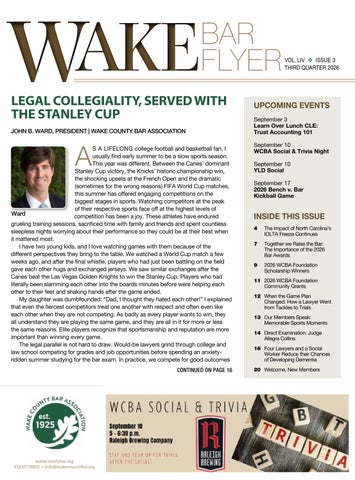
S A LIFELONG college football and basketball fan, I usually find early summer to be a slow sports season. This year was different. Between the Canes’ dominant Stanley Cup victory, the Knicks’ historic championship win, the shocking upsets at the French Open and the dramatic (sometimes for the wrong reasons) FIFA World Cup matches, this summer has offered engaging competitions on the biggest stages in sports. Watching competitors at the peak of their respective sports face off at the highest levels of Ward competition has been a joy. These athletes have endured grueling training sessions, sacrificed time with family and friends and spent countless sleepless nights worrying about their performance so they could be at their best when it mattered most. I have two young kids, and I love watching games with them because of the different perspectives they bring to the table. We watched a World Cup match a few weeks ago, and after the final whistle, players who had just been battling on the field gave each other hugs and exchanged jerseys. We saw similar exchanges after the Canes beat the Las Vegas Golden Knights to win the Stanley Cup. Players who had literally been slamming each other into the boards minutes before were helping each other to their feet and shaking hands after the game ended. My daughter was dumbfounded: “Dad, I thought they hated each other!” I explained that even the fiercest competitors treat one another with respect and often even like each other when they are not competing. As badly as every player wants to win, they all understand they are playing the same game, and they are all in it for more or less the same reasons. Elite players recognize that sportsmanship and reputation are more important than winning every game. The legal parallel is not hard to draw. Would-be lawyers grind through college and law school competing for grades and job opportunities before spending an anxietyridden summer studying for the bar exam. In practice, we compete for good outcomes CONTINUED ON PAGE 16
VOL. LIV v ISSUE 3 THIRD QUARTER 2026
UPCOMING EVENTS September 3 Learn Over Lunch CLE: Trust Accounting 101 September 10 WCBA Social & Trivia Night September 10 YLD Social September 17 2026 Bench v. Bar Kickball Game
INSIDE THIS ISSUE 4
The Impact of North Carolina’s IOLTA Freeze Continues
7
Together we Raise the Bar: The Importance of the 2026 Bar Awards
9
2026 WCBA Foundation Scholarship Winners
11 2026 WCBA Foundation Community Grants 12 When the Game Plan Changed: How a Lawyer Went from Tackles to Trials 13 Our Members Speak: Memorable Sports Moments 14 Direct Examination: Judge Allegra Collins 16 Four Lawyers and a Social Worker Reduce their Chances of Developing Dementia 20 Welcome, New Members
CENTENNIAL CELEBRATIONS 100 MILES FOR 100 YEARS CHALLENGE | May - September WCBA MEMBERS-ONLY OYSTER ROAST | September 25 2025 BAR AWARDS: $100K FOR 100 YEARS | October 23 wakecountybar.org 919.677.9903 • info@wakecountybar.org
CENTENNIAL GALA | December 5
VOL. LIV No. 3 | THIRD QUARTER 2026
FIVE LESSONS THE PRACTICE OF LAW CAN LEARN FROM SPORTS
Presidents
BY WHITNEY D.G. von HAAM | EXECUTIVE DIRECTOR
WAKE BAR FLYER JOHN B. WARD, WCBA LEANOR BAILEY HODGE, TENTH J.D. BAR
Presidents-elect
MEGAN WEST SHERRON, WCBA ERIKA N. JONES, TENTH J.D. BAR
Secretary
TIFFANY COX
Treasurer
JORDAN GROSS
Board of Directors
JONATHAN M. BOGUES JUDGE KEVIN BOXBERGER MEREDITH P. BREWER TARA CHO GABE JIMENEZ JOSUE JIMENEZ JENNIFER JONES MEGHAN KNIGHT DEAN J. RICH LEONARD JACOB MORSE ASHLEY PAYNE RATLIFF ELYSIA PRENDERGAST-JONES WARREN SAVAGE LINDSAY A. UNDERWOOD MALLORY UNDERWOOD PATRICK VANDERJEUGDT
Young Lawyers Division President KATIE MCCOY
Executive Director
WHITNEY D.G. von HAAM
Communications Manager AMY DAVIS
Wake Bar Flyer Designer ANNE STRICKLAND
Tenth Judicial District Bar Councilors
JUDGE JULIE L. BELL RUSSELL BABB ANNA DAVIS JUDGE KEITH GREGORY JESSICA HEFFNER KIMBERLY A. MOORE JUDGE ASHLEIGH S. PARKER DAVID SHERLIN Opinions expressed in Bar Flyer articles are those of members as individuals and does not necessarily represent the views or policies of the Wake County Bar Association. © 2026 Wake County Bar Association & Tenth Judicial District Bar
O
ne of the coolest parts of living in the Triangle is that we are surrounded by all kinds of great sports – hockey, soccer, basketball, von Haam baseball, softball…you name it, we probably have a professional or college team that is elite and fun to watch. Although our members might spend more time reading briefs than box scores, sports offer lessons that can translate to the practice of law. Whether you’re a lifelong fan or simply a parent trying to remember which field your child’s softball game is on, here are five reminders worth carrying into your career. 1. Preparation Wins More Than Talent Alone Although fans watch the game, they don’t see the countless hours of practice that came before it. The same is true in the legal profession. Clients remember the persuasive closing argument or the successful mediation, but they rarely see the hours of preparation leading up to it. Every deposition outline, every late-night review of exhibits, every practice argument contributes to the final performance. Of course, preparation doesn’t eliminate surprises, it simply makes us better equipped to handle them. As any lawyer who has appeared in court knows, things rarely unfold exactly as planned. The attorneys who adapt best are frequently the ones who prepared the most. 2. Great Teams Communicate Better Than They Compete Championship teams aren’t just talented; they’re connected. Players know their roles, trust one another and communicate constantly. The legal profession works much the same way. Judges, court staff, judicial assistants, clerks, bailiffs, paralegals, legal assistants,
WAKE BAR FLYER v THIRD QUARTER 2026
clients and opposing counsel all influence the outcome of our work. Success rarely belongs to one person. I’ve long believed that the greatest strength of the WCBA is its ability to bring lawyers together outside the courtroom through CLEs, committee work, service projects and social events. Those relationships make all of us better professionals and strengthen the administration of justice in our community. 3. Losses are a Part of Every Season Even the best teams lose: The Hurricanes don’t win every game. The Bulls don’t sweep every series. And if you’re a fan of Triangle college sports, you’ve probably experienced enough last-second heartbreak to qualify for honorary therapy. Lawyers understand this better than anyone: Not every motion is granted. Not every jury sees the facts the way we do. Sometimes the law isn’t on our side, and sometimes the facts simply aren’t there. Our reputation isn’t built on avoiding setbacks. It’s built on how we respond to them — with professionalism, resilience and the willingness to learn before the next case arrives. 4. Life Is Bigger Than the Scoreboard Sports are competitive, but they also remind us that there is life beyond the final score. Calendars fill with hearings, deadlines, client meetings and emails that somehow multiply overnight. Yet the moments we’ll remember years from now probably won’t be the perfectly formatted brief filed at 11:57 p.m. They’ll be coaching a team, watching your kid score their first goal, celebrating after the Hurricanes’ Stanley Cup win or enjoying a summer evening at the ballpark. Ironically, the lawyers who make time for life outside the office often return to work with clearer judgment, greater patience and renewed energy. 5. Enjoy the Game Somewhere between law school exams, billable hours and electronic filing deadlines, it’s easy to forget that this profession can actually be fun. Sports CONTINUED ON PAGE 16 PAGE 2
Better banking begins with purpose. Tailored banking solutions that keep your practice moving forward.
Watch Our Story PERSONAL BANKING | BUSINESS BANKING | MORTGAGE | SBA LENDING
THE IMPACT OF NORTH CAROLINA’S IOLTA FREEZE CONTINUES E.D. GASKINS, JR. | EVERETT GASKINS HANCOCK TUTTLE HASH LLP FORMER BOARD MEMBER AND TREASURER FOR LEGAL AID OF NC
I
N 2024, North Carolina had the 17th-highest poverty rate in the nation, with 12.5% of residents — more than 1.3 million North Carolinians — living below the poverty level. For many of these residents, meaningful access to the civil justice system depends on pro bono assistance from private attorneys or representation by civil legal aid organizations. Among North Carolina’s major civil legal aid providers are: • Pisgah Legal Services (Pisgah) — Western North Carolina • Charlotte Center for Legal Advocacy (Charlotte) — Mecklenburg County • Legal Aid of North Carolina (LANC) — all 100 counties in North Carolina These nonprofit law firms are a critical part of civil legal access for approximately 2 million low-income North Carolinians who qualify for legal aid. For decades, a significant portion of the funding that sustained civil legal aid organizations and allowed them to provide legal services came from Interest on Lawyers’ Trust Accounts (IOLTA). How IOLTA Works — and Why It Matters The North Carolina State Bar and North Carolina Supreme Court established NC IOLTA in 1983 to generate income from lawyers’ general trust accounts to fund civil legal services and other programs benefiting the public. The program became mandatory in 2007. IOLTA funds are generated by interest earned on client money held in lawyers’ trust accounts and deposited collectively into IOLTA accounts. The funds do not come from state tax dollars. For more than four decades, NC IOLTA provided sustained funding for civil legal aid and programs designed to improve the administration of justice. From the program’s inception through June 30, 2025, approximately $134 million in grants were awarded, most to legal aid organizations. In fiscal year 2025 alone, NC IOLTA awarded nearly $12 million in grants to organizations providing free civil legal services and other justice-related programs. Those grants supported essential civil legal services for low-income residents in our communities, including: • Securing domestic violence protective orders • Defending homeowners against foreclosures • Obtaining government benefits for children, seniors and veterans, including disaster-related benefits after floods, hurricanes and other emergencies These civil legal services not only help individuals and families but also strengthen our local communities and justice system.
The 2025 IOLTA Freeze and Its Consequences IIn 2025, the General Assembly enacted a one-year freeze on NC IOLTA grantmaking from July 1, 2025, through June 30, 2026. As a result, the NC IOLTA Board of Trustees did not make grants for the 2025-26 fiscal year. The impact on civil legal aid providers was immediate and Gaskins severe. Organizations reported office closures, staff reductions, reduced intake and cuts to programs serving low-income residents, particularly in rural communities. LANC reduced its workforce by 45 employees, many with decades of experience, and closed nine offices. Across organizations that received NC IOLTA civil legal aid grants in 2025, the effects became measurable. During the first quarter of 2026, those organizations reported closing an average of 22% fewer cases and serving 11% fewer clients compared with the same period in 2025. Organizations providing family law services reported serving 29.4% fewer clients in matters such as domestic violence protective orders, child custody agreements and guardianship proceedings. In July 2026, the General Assembly repealed the freeze but substantially changed how IOLTA funds may be used going forward. Under S.L. 2026-41, up to $15 million per fiscal year from IOLTA funds received on or after July 1, 2025, may be directed to the Office of Indigent Defense Services’ Private Assigned Counsel Fund. The fund pays private attorneys appointed to represent indigent defendants in criminal cases as required by the Fifth and 14th Amendments. The change redirects most future IOLTA revenue away from the traditional civil legal aid grant-making that IOLTA has helped support for decades. The new law preserves a more limited source of funding for justice-related grants but none for the three civil legal aid organizations. The legislature has placed restrictions on the award of IOLTA funds to those organizations. Unexpended and unencumbered IOLTA funds received before July 1, 2025, may be used for programs designed to improve the administration of justice if proposed by the IOLTA Board of Trustees and approved annually by the North Carolina Supreme Court. Subsequent legislation increased the amount available for those grants from $2 million to $2.5 million per fiscal year. CONTINUED ON PAGE 5
WAKE BAR FLYER v THIRD QUARTER 2026
PAGE 4
IOLTA Freeze Impact Continues | CONTINUED FROM PAGE 4 LANC entered 2026 with a budget that assumed no IOLTA funding and says it is continuing its work for fewer clients with support from federal, state, county, municipal, foundation, corporate and individual donors, along with pro bono volunteers. What This Means for the Courts — and for Justice North Carolina’s legal community has a direct stake in safeguarding meaningful access to justice. When legal aid capacity declines for people who cannot afford private attorneys, the effects can extend throughout the justice system: • Overloaded courts — More unrepresented litigants can mean longer hearings, more continuances and heavier burdens on clerks and judges. • Judicial strain — Judges may need to spend additional time explaining procedures to selfrepresented litigants, slowing dockets and creating additional challenges in the courtroom. • Inconsistent case outcomes — Unrepresented litigants may struggle to navigate procedures or present evidence effectively. • Higher social costs — Unresolved legal issues can contribute to homelessness, job loss and increased demand on public services. • Erosion of equal justice — When people cannot meaningfully access the civil justice system, public confidence in the promise of equal justice under law can suffer.
WAKE BAR FLYER v THIRD QUARTER 2026
North Carolina lawyers have a professional and ethical responsibility to help maintain the integrity of the civil justice system. At this moment, that responsibility remains urgent. What North Carolina Lawyers Can Do Now Three actions can make a meaningful difference: 1. Give generously — as individuals and through firms, bar associations and professional organizations — to Pisgah, Charlotte, LANC and other organizations providing civil legal aid across North Carolina. 2. Volunteer for pro bono service with these organizations to help fill the widening representation gap. 3. Advocate for sustainable funding for civil legal aid and make lawmakers aware of the effect reduced IOLTA support has on North Carolinians, local communities and the courts. The legislative landscape has changed, but the need has not. Without the level of IOLTA support civil legal aid providers historically received, private giving, pro bono service and continued advocacy will play an even greater role in protecting access to justice for North Carolinians but will have difficulty making up for the loss of IOLTA funds. WBF
PAGE 5
WAKE BAR FLYER v THIRD QUARTER 2026
PAGE 6
TOGETHER WE RAISE THE BAR: THE IMPORTANCE OF THE 2026 BAR AWARDS LINDSAY HUMBERT | ANNUAL FUND MANAGER, LEGAL AID OF NC
A
T A TIME WHEN millions of dollars in IOLTA funding have been permanently redirected away from civil legal aid, this year’s Wake Bar Awards will have a bigger impact than ever on equal access to justice in North Carolina. With no guaranteed right to a lawyer in civil cases, North Carolinians who cannot afford a lawyer are often left Humbert to face some of life’s toughest battles completely alone, without the guidance or support they desperately need. This is where Legal Aid of North Carolina steps in — providing a voice and hope for families and individuals when it feels like the odds are stacked against them. As a nonprofit law firm, Legal Aid NC provides free legal services in civil matters to people with low incomes to ensure equal access to justice and remove legal barriers to economic opportunity. Every sponsorship, ticket sale and donation to the Bar Awards will fuel Legal Aid NC’s mission. No amount is too big or too small to make a difference for a neighbor in crisis. North Carolinians in all 100 counties turn to Legal Aid NC in their moments of need. And now, we’re turning to you. Last year, the Bar Awards helped Legal Aid NC serve nearly 63,000 people facing issues such as domestic abuse, unsafe housing and human trafficking. We’re very proud of that accomplishment, yet the need for these services is significant and growing. With 2 million North Carolinians qualifying for Legal Aid NC’s services, there is more work to do. In North Carolina, 71% of low-income households experience at least one civil legal issue each year. In three out of four civil cases, at least one party does not have legal representation. These challenges hurt families and slow down courtrooms across the state, impacting the entire legal profession. By supporting the Bar Awards, you can turn compassion into action and strengthen North Carolina because equal access to justice is the foundation of every strong community. Your firm’s sponsorship, your individual ticket and your bid on auction items provide life-changing legal expertise for real North Carolinians like David, Greg and Sierra: David and his 72-year-old father experienced escalating abuse by a family member in their own home. Despite the danger, David took action. He reached out and was connected with Wendy Walker, a Legal Aid NC attorney who helped him navigate the legal system and secure a domestic WAKE BAR FLYER v THIRD QUARTER 2026
violence protective order. “Wendy made me feel comfortable and safe through this whole process,” David said. “We have peace in our home now.” Greg, a 55-year-old father and cancer survivor, had vital medical benefits suddenly terminated when his cancer went into remission. Though he appealed the decision and got his benefits reinstated, health care premiums previously covered by Medicaid were still being deducted from his checks. That’s when Greg found help at Legal Aid NC. His attorney helped Greg get placed back in the correct Medicaid category retroactively, and he even received a refund for the incorrect deductions, easing the financial strain on his family of four. Sierra, a new mom, was excited to return to work after maternity leave. But when she notified her employer, they told her she was no longer needed. Unsure of her rights, she turned to Legal Aid NC. We explained Sierra’s legal options, provided resources on North Carolina’s protections for new and expecting mothers and assisted with appealing the denial of unemployment benefits she had just received from the Division of Employment Security. We are deeply grateful for this continued annual financial support, which remains essential to sustaining and expanding access to justice across North Carolina. Because of your support for the Bar Awards, families will continue to feel safe, seniors will protect their homes and income, veterans will access the benefits they earned and children will have better opportunities to thrive. Together, Legal Aid NC and the Bar Awards deliver hope, opportunity and safety to neighbors facing a wide range of civil legal issues. Together, we defend seniors from scams. Together, we help children stay in school. Together, we keep families in their homes. Together, we protect survivors of domestic violence. Together, we alleviate barriers that keep people out of work. Together, we get people health care coverage and public benefits. Together, we support survivors of human trafficking. Together, we aid veterans who served their country. Together, we advocate for people recovering from natural disasters like Helene. Legal Aid NC matters, and so do the Bar Awards. Thank you for standing beside us as we navigate this time and continue our mission to expand access to justice for all North Carolinians. We hope to see you November 5 at Junction West. WBF
PAGE 7
WAKE BAR FLYER v THIRD QUARTER 2026
PAGE 8
2026 WCBA FOUNDATION SCHOLARSHIP WINNERS
T
HE FOUNDATION SCHOLARSHIP COMMITTEE is honored to recognize two deserving local law students as recipients of the 2026 WCBA Foundation Scholarship. Among an outstanding group of applicants, our recipients distinguished themselves through their commitment to their communities and the legal profession. They joined us at the July luncheon to each receive $4,000 to continue their education. Eric Little, is a Raleigh native who began his collegiate career at Wake Tech and says his commitment and ties to Wake County run deep. Eric has dedicated his time to serving our community through volunteer work at Oak City Cares and the soup kitchen at Pullen Memorial Baptist Church. He says these experiences Little Zuckerman helped shape the lawyer he hopes to become. He attends Wake Forest University School of Law and, upon graduation, hopes to serve in the Wake County Public Defender’s Office. Alyssa Zuckerman is a rising third-year student at Campbell Law School with deep ties to the Raleigh and Wake County community. Prior to law school, Alyssa worked at a YMCA summer camp for children with special needs and at a martial arts school. She says her experience working with families facing hardship has shaped the direction of her legal studies. Her goal is to pursue family law and advocate for families and children during some of the most difficult moments of their lives. Your donations to the WCBA Foundation make these scholarships possible. Thank you, and congratulations to Eric and Alyssa. WBF
We are proud to support the Wake County Bar Association Helping civil, criminal, bankruptcy and matrimonial attorneys with the financial aspects of their most important cases. • • • • • • •
Litigation Support Damages Services Valuation Services Intellectual Property Services Forensic Accounting Expert Testimony And More
Scan below to learn more Audit Tax Advisory Outsourcing
WAKE BAR FLYER v THIRD QUARTER 2026
PAGE 9
FREE LEGAL RESEARCH FOR WCBA MEMBERS With Decisis®, you can: Access state and federal case law from all 50 states Access exclusive North Carolina resources, including: - Civil & Criminal Jury Instructions - Industrial Commission Decisions
Quickly search case law and statutes by keyword, jurisdiction, or court name Verify case authority with InterCite™, Decisis’ trusted citator off eo ue V allu Va 0 40 74 $ $11,,7
Log in through your WCBA account to start researching today.
WAKE BAR FLYER v THIRD QUARTER 2026
PAGE 10
2026 WCBA FOUNDATION COMMUNITY GRANTS
T
HE WAKE COUNTY BAR Association Foundation exists because, as members of the legal profession, we know that when we come together, we can make a meaningful impact in our community. Each year, through our Annual Campaign and Community Grants Program, the Foundation supports organizations that promote justice, expand opportunity and strengthen our legal community. Thanks to the generosity of our members, we are able to invest in programs that embody those values and make a lasting difference. This year, we’re proud to support the North Carolina Mock Trial Program. Mock Trial introduces students to our justice system in a hands-on, engaging way, inspiring confidence, critical thinking, teamwork and public speaking while fostering a deep appreciation for the rule of law. It helps develop not only future lawyers but also informed citizens and future leaders, making it a perfect fit for our Foundation’s Community Grants Program. Thanks to the extraordinary generosity of our members and the tremendous support of the North Carolina Advocates for Justice, we are honored to present the North Carolina Mock Trial Program with a $25,000 grant to help continue this outstanding work. WBF
WAKE BAR FLYER v THIRD QUARTER 2026
L-R: Jacob Morse, WCBA President John Ward and Dale Stephenson
PAGE 11
WHEN THE GAME PLAN CHANGED: HOW A LAWYER WENT FROM TACKLES TO TRIALS RUSSELL BABB | THARRINGTON SMITH, LLP
I
STARTED PLAYING playing football when I was about 7 years old in my hometown of Wilson. At Hunt High School, I was fortunate to be named an all-state offensive tackle in 1990, earn honorable mention All-American honors and be invited to play on the North Carolina Shrine Bowl team. I attended the University of North Babb Carolina at Chapel Hill on a Morehead Scholarship, where I had the opportunity to play on teams that appeared in the Peach, Gator, Sun and Carquest bowls. In 1995, I received the Jim Tatum Award, recognizing the ACC’s top senior scholarathlete, was named honorable mention All-ACC and first-team Academic All-ACC and was invited to play in the Senior Bowl. I thought I knew exactly where my life was headed. I had a real opportunity to play in the NFL, and it was difficult to imagine any future without football. Then, in November 1995, everything changed. During a game against NC State at Carter-Finley Stadium, I broke both bones in my leg. In an instant, the football career I had built over the course of years was over. Losing football meant losing more than the game itself: I struggled with my identity and with figuring out what came next. For most of my life, I had known what I was working toward. Suddenly, I didn’t. The UNC School of Law gave me a new direction, and eventually, I graduated and passed the bar. But choosing law did not immediately mean finding my calling. I spent seven years as a civil litigator and was miserable. I began to question whether practicing law was really what I wanted to do with my life.
WAKE BAR FLYER v THIRD QUARTER 2026
Then, almost by chance, I agreed to represent a young man accused of dealing marijuana. Police had seized drugs, scales and money from his home. I threw myself into defending him, and ultimately, he avoided prison and received probation. That case changed the course of my life. For the first time since becoming a lawyer, I felt the same sense of purpose and drive that I had once found on the football field. I loved the challenge of the case, the responsibility of standing beside someone whose future was at stake and the opportunity to advocate for him when he needed it most. I knew I had finally found the kind of lawyer I wanted to be. I left my job and joined the Wake County Public Defender’s Office, a decision I have never regretted. As an assistant public defender, I gained invaluable courtroom experience and learned how to handle some of the most difficult criminal cases. More importantly, I found my calling. After years of wondering whether I belonged in the legal profession, I was finally happy practicing law. Eventually, I joined Tharrington Smith, where I have practiced ever since and now serve as co-managing partner. My criminal defense practice includes DWI cases, drug and sex offenses, assaults, domestic violence matters, whitecollar prosecutions and murder charges. Breaking my leg felt like the end of the world in 1995 because I couldn’t imagine my life without football. Now I know I was meant to travel a different path. I recognize that what I enjoy about criminal trial work — the preparation, competition, teamwork and the opportunity to stand up and fight for something that matters — is a whole lot like football after all. WBF
PAGE 12
OUR MEMBERS SPEAK: WHAT IS THE MOST MEMORABLE SPORTS MOMENT FOR YOU IN YOUR LIFE? Attorneys are often notoriously busy and goal-driven individuals, both within and outside the practice of law. We asked our members, “It can be you or a family member’s achievement. Did your high school team get a championship win? Did your university finally get that national championship? Is it a memorable Super Bowl or World Series that comes to mind? There are no wrong answers! Even this summer’s 2026 Carolina Hurricanes Stanley Cup win counts.”
“My most memorable sports moment was watching UNC win the 2009 Men’s Basketball National Championship. Rushing Franklin Street, jumping bonfires and celebrating a win with thousands is a quintessential Carolina experience. I was lucky enough to enjoy it during my first year of college.”
Amelia Serrat Smith Anderson
“As a true Carolina alum (South Carolina, sorry UNC), Gamecock football holds a special place in my heart. Having attended Carolina during the Spurrier years, never losing to Clemson while a student sits high on the list of memorable sports moments, but my favorite will always be when my Gamecocks upset No. 1 Alabama in 2010. It was an electric afternoon win, and the party continued all night in Five Points. Go Cocks!”
Spencer Fritts Morse Fritts PLLC
“If you know me, you know I am a diehard hockey fan. I grew up playing hockey and continue to play as an adult. Growing up in Minnesota, hockey isn’t just a sport; it’s everything, and the Minnesota State High School Hockey Tournament is a huge deal. When I say ‘huge deal,’ think statewide television coverage and games played in a professional sports arena. Playing in the state tournament with my high school team was an unforgettable experience because of all the hype surrounding it and how difficult it is to get there, given the sheer number of teams across the state. I remember our first game was against a team whose mascot was a ‘Spud’ (yes, as in a potato). Naturally, all of our fans showed up armed with potato mashers.”
Sarah Privette Oak City Family Law
“One of my most memorable sports moments was being a captain on my high school football team that set the record for best school record in a season, losing only one game to the state champs in Florida. We were undersized and most of us played both ways. The local sports beat had us as underdogs for half of our games but found a way to win all but one. It was such a tight team that players and coaches still all keep in touch.”
Gabriel Jimenez Jimenez Law Mediation
“One of my favorite sports memories is the 2025 Bench vs. Bar Kickball game, where the Judges staged an incredible comeback victory to capture the championship title. Now, the Judges are back and ready to defend the title. The annual showdown returns on September 17, and we’re looking forward to another great competition, plenty of fun and another championship celebration.”
Judge Rashad Hauter Wake County District Court
DIRECT EXAMINATION: JUDGE ALLEGRA COLLINS
D
IRECT EXAMINATION is the first opportunity for the jury to meet a witness. An effective lawyer will use the opportunity to personalize the witness, making the witness appear both likeable and credible. At the end of the day, the direct examination is a party’s best chance to tell his or her story. This is the story of Judge Allegra Collins, North Carolina Court of Appeals.
When you were in elementary school, what did you want to be when you grew up? An athlete or an actress, maybe — definitely not anything that required sitting at a desk. What was the most important lesson your parents taught you? Hard work beats talent alone. Especially during my teenage years, they constantly reminded me to think for myself and not follow something just because “everyone is doing it.” Who was your favorite teacher and why? Mr. DiBari, my freshman algebra teacher. His lessons were clear, he welcomed questions in and out of class, he was kind and patient and he allowed us to retake quizzes and tests and recoup one-third of the points we’d lost. He created an environment where I learned algebra rather than stressed about it.
Why did you become a lawyer? I was working in information technology and thought that combining my technical background with a law degree would create an interesting career path. What has been the most surprising or unexpected development in your career? That I’ve been able to practice appellate law as a career. When I discovered appellate work in law school, I assumed it would lead only to a time-limited clerkship. I feel fortunate to have spent my entire career clerking, practicing, teaching and judging appellate law. What is your favorite book? “Bridge to Terabithia” by Katherine Paterson.
What is your most marked characteristic? Competitive drive — I’m motivated by goals and the work required to achieve them. What is your hidden talent? I play team handball, an Olympic court sport that combines elements of basketball, soccer and water polo. Played on a 40-by-20-meter indoor court, two teams of six court players and a goalkeeper try to score by throwing the ball into the opponent’s goal. I’ve been a goalkeeper for more than 30 years and still compete nationally, including playing at the U.S. National Championships in Iowa in May and the World Series of Team Handball in Las Vegas in August. I also assist and play with the UNC Chapel Hill Women’s Handball Team. WBF
Did you love or hate law school? Loved it! I would be a professional student if possible. What was your most embarrassing courtroom experience? During a clerkship interview with Judge “Mountain Bob” Hunter, my foot fell asleep. When I tried to walk out of his office after the interview, I kept falling. I assume that’s (at least one reason) why he didn’t hire me. What was your best courtroom experience?Participating in oral argument for the first time as a judge. It felt surreal.
WAKE BAR FLYER v THIRD QUARTER 2026
PAGE 14
WAKE BAR FLYER v THIRD QUARTER 2026
PAGE 15
FOUR LAWYERS AND A SOCIAL WORKER REDUCE THEIR CHANCES OF DEVELOPING DEMENTIA MARIA M. LYNCH | LYNCH & EATMAN LLP
T
HE FIVE OF US —Scott and Laura Beaver (Laura is a social worker), Katie Dowell, Jerry Eatman and me— take ballroom dancing lessons at the same studio. In June 2025, we were the only dancers from our studio to sign up for a competition in Richmond. We had a great opportunity to get to know each other better, and we had a really good time. None of us took up dancing to reduce our chances of developing dementia, but The Washington Post recently (Jan. 5, 2026) featured a story highlighting research that associated dancing more than once a week with up to a 76 percent lower risk of developing dementia. A number of studies support this idea, and it makes sense if you think about it. Many studies have found that exercise is good for brain health. A small controlled trial compared walking with ballroom dancing among older adults. Both activities benefited memory and learning, but ballroom dancing may help protect the brain even more because it combines physical activity with cognitive challenges. Search online for “dancing and dementia,” and you will find a number of articles discussing the positive effects of dancing on the brain. Dancing requires dancers to do several things at once, finding the rhythm and remembering the steps. The leader has to signal the next step at the right time while navigating the floor, and the follower has to recognize the signal and follow. Because the follower is usually a woman, she is also dancing backward and in heels. The old saying about Fred Astaire and Ginger Rogers, “Ginger Rogers did everything Fred Astaire did. She just did it backwards and in high heels,” is actually inaccurate. She did a lot more than he did. In ballroom dancing, there are far more difficult steps for the follower than for the leader. But none of the five of us took up ballroom dancing for brain health, although it is certainly a welcome side effect. Laura and Scott were looking for an activity they could enjoy as a couple. They tried pickleball and ballroom dancing, and dance was the clear winner. Jerry and I started dancing four WAKE BAR FLYER v THIRD QUARTER 2026
years ago to have something to do together, and we have thoroughly enjoyed it. In addition to the benefits to the mind and body, we have found a community of people we enjoy spending time with. Our studio Lynch dance family is quite diverse and ranges in age from 27 to 82. Many, if not most, of these people are individuals we otherwise would not have crossed paths with. Last year, after the five of us arrived in Richmond, our fellow dancers back in Raleigh were clamoring for pictures, so I asked a woman finishing her dinner at the bar if she would take one. It’s a bad picture of me, but I included it because she asked whether we were in Richmond for an event, and we told her we were competing. She said that was great because she was a judge at the competition. Apparently ex parte communication is just fine in ballroom. She never fails to come over and greet us. The five of us went to Richmond as friendly acquaintances and came back as friends. This year, 14 dancers from our studio signed up for the Richmond competition, and, as always, the travel team had a big time. Our group had some success. This year, Katie earned two first-place finishes, two second-place finishes and one third-place finish in championship dances in a crowded field. Jerry and I repeated as Top Amateur Couple. The second picture includes our wonderful instructors. Hardware and brain health—what’s not to like? WBF PAGE 16
Legal Collegiality, Served with the Stanley Cup | CONTINUED FROM PAGE 1 for our clients and for business, awards and respect from our peers. We sacrifice nights and weekends with family and friends and spend sleepless nights worrying about cases and strategies so we can be at our best when it matters most. Competition is inherent in the practice of law. It is on full display in litigation, but competitiveness— wanting to win something, outperform someone or overcome a difficult circumstance—underlies every practice area in one way or another. It can be an incredible motivator and drive greatness and success, but it can also have adverse consequences if not approached with professionalism and respect. Sometimes lawyers get so fired up about competing that we forget (L-R) Screenshots from the WCBA challenge video to the Clark County Bar Association during about the part that comes after—the the Stanley Cup Final series via Instagram and CCBA president John Leavitt's response proverbial “jersey swap.” We must not forget that part. We lawyers are of a bar association that encourages and facilitates those all playing the same game, and we all got into it for more or less interactions because each positive interaction makes practicing the same reasons. We all swore the same oath, we all adhere in Wake County that much better. to the same Rules of Professional Conduct and we all bear Competition can also be a powerful tool for connection. allegiance to the rule of law. We must remember that respect— As some of you saw, the WCBA issued a challenge to the for clients, for the court and for each other—is at the heart of Clark County Bar Association when the Canes and the Golden what we do, and our reputations for professionalism, good or Knights were set to face off in the Stanley Cup Final. Even bad, will long outlast our win-loss records. Competition might though CCBA’s president waited until after Vegas won game make us better individual attorneys, but collegiality and respect one to accept the challenge, we went on to have some goodelevate the entire profession. natured banter over the course of the series, concluding with In Wake County, I like to think we remember the part that a friendly phone call and a promised trophy to be displayed comes after the final whistle. We compete fiercely and advocate in the WCBA office. Had you told me a year ago that I would zealously, but we do it in a respectful and professional way become friends with a lawyer in Las Vegas because of a bar vs. within the scope of our cases and consistent with the Rules of bar hockey wager, I would not have believed you. But here we Professional Conduct. We also know when to tone down the are, all thanks to some good-natured competition. It’s another competitive spirit and enjoy each other’s company over a plate example of the WCBA doing what it does best: helping lawyers of barbecue, a bushel of steamed oysters, donuts at the WCBA build relationships across practice areas and sometimes even across time zones. WBF house or drinks at happy hour. We are fortunate to be members
Five Lessons the Practice of Law Can Learn from Sports | CONTINUED FROM PAGE 2 remind us that excellence and enjoyment can exist together. Players celebrate great plays. Coaches laugh. Fans build lifelong friendships around shared experiences. The legal profession deserves more of that spirit. Mentor a young lawyer. Introduce yourself to someone new at a WCBA luncheon. Volunteer together on a public service project. Celebrate a colleague’s success as enthusiastically as your own.
Those connections often become the most rewarding part of a legal career. Our mission has long been to promote fellowship among lawyers while advancing professionalism — a reminder that relationships matter just as much as results. Sports don’t teach us how to draft a contract or argue a motion. They teach us something just as valuable: prepare well,
WAKE BAR FLYER v THIRD QUARTER 2026
communicate often, bounce back from losses, keep life in perspective and enjoy the people you’re fortunate enough to share the journey with. Hopefully these points (see what I did there?) help make the difference between simply practicing law and building a career — and life! — that you’re proud to look back on. WBF
PAGE 17
LAWYERS MUTUAL
NEW LAWYER REAL SUPPORT
Law school doesn’t hand you a manual for running a practice. Nobody warns you about malpractice claims, client disputes, or what happens when something goes wrong on a case. That’s where Lawyers Mutual comes in, and the benefits go way beyond insurance.
•
FREE on-demand CLE (80+ programs, including Ethics, Technology, and Professional Well-Being). Fulfill your 24-hour, 2-year requirement anywhere, anytime. A $900 value.
•
FREE consulting with a practice management advisor — 3 hour-long sessions annually to help you start, run, or grow your firm. A $900 value.
•
Hotline to 7 NC-licensed claims attorneys who can help you avoid problems before they start.
If you’re finishing law school or just starting out, this is the kind of support that matters. Visit our website www.lawyersmutualnc.com for toolkits and practice guides designed to help law students and young lawyers.
Lawyers Mutual NC — A better insurance experience. 919.677.8900 800.662.8843 www.lawyersmutualnc.com WAKE BAR FLYER v THIRD QUARTER 2026
PAGE 18
PRINT_AD_Scott Hoover Half Page Horizontal Ad (8.5x5.5").indd 1
WAKE BAR FLYER v THIRD QUARTER 2026
8/14/25 3:23 PM
PAGE 19
WELCOME, NEW MEMBERS David Anderson US Court of Appeals for the Armed Forces Ericka Arauco Gantt Family Law Caleb Barco US Army JAG Corps James Bernier, Jr. Womble Bond Dickinson LLP Aimee Bickers Alora Law Andrew Bowers Mary Brockman Rik Lovett & Associates Joshua Burgan Hannah Sheridan & Cochran LLP Hunter Caro
Caitlin Maguire North Carolina Supreme Court
James Ring DLA Piper LLP
Alicia Mathewson
Brenda Rivera Hall & Rouse PC
Elizabeth McCorkle Kairos Government Affairs Nathan McKinney Town of Wake Forest Lauren Mintz Practice Executive Kailyn Oakley LexisNexis Legal & Professional Sirena Paillot US Army JAG Corps Christopher Pate Arianna Pearson McIlveen Family Law
Jessica Colon North Carolina Administrative Office of the Courts
Ashton Perret-Gentil
Bailey Davis Rik Lovett & Associates
Caroline Plumides North Carolina Real Estate Commission
Kailah Douglas Amber Doyle Smith Debnam Narron Drake Saintsing & Myers LLP
Anthony Pierro Strategies for Youth
James Ramger
Aimee Roix Duke University Office of Counsel Ellen Rose Gavin Russell Hedrick Gardner Kincheloe & Garofalo LLP William Selph Monroe Wallace Morden & Sherrill PLLC Megan Simpson Apex Police Department Hannah Thompson North Carolina Supreme Court Kathryn Turk NC Court of Appeals Olivia Waynik Turner Law Office Nicholas Williams NC Department of Justice Enviromental Division
Sarah Reber Morningstar Law Group
Zechariah Etheridge Etheridge Law PLLC Darrilyn Fisher Tymus Beverly PLLC Yendi Fontenard Freshfields Bruckhaus Deringer US LLP Ashley Foster North Carolina Alcoholic Beverage Control Commission John Griffith John Hall Rodgers Waters Law PLLC Madison Herald Yasmin Khodaei Planned Parenthood of South Atlantic Caroline Kneedler Woodbury and Ybarra, PLLC David Levintow Smith Anderson Blount Dorsett Mitchell & Jernigan LLP
WAKE BAR FLYER v THIRD QUARTER 2026
PAGE 20