BAR FLYER
THE DECLARATION AND THE LAWYER’S CALLING
LEANOR BAILEY HODGE, PRESIDENT, TENTH JUDICIAL DISTRICT BAR
FIRST CITIZENS BANK

PERHAPS, LIKE SOME of you, I am a forward-looking — some may even say futuristic — person. If you come to me after being buffeted by life, my first reaction will not be to join you in feeling the weight of your reality or to validate the legitimacy of your feelings about it. While I think that would be a great response, and one I always appreciate receiving, it is simply not my natural go-to response. My innate reaction is to look beyond the situation at hand to the future and what it could become despite the circumstances.
As we approach the 250th anniversary of the United States Declaration of Independence, I have wondered whether sharing a birthplace with this legendary document contributed to my tendency to greet problems and challenges by looking beyond where I am and imagining what could be. Throughout elementary school, our annual field trips always included two places: the Philadelphia Zoo and Independence Mall, home of the Declaration of Independence and the Liberty Bell.
Like most of my classmates, I preferred the zoo. Trips there included free rein to explore the grounds with a small group of friends and a parent chaperone. By contrast, trips to Independence Mall included tours of old buildings along narrow cobblestone streets and lectures — seemingly endless lectures at the time — about the birth of our nation, including the Declaration of Independence.
It has been several years since I participated in those tours and lectures, but I wonder whether those many years of presentations partially shaped who I am today. Without realizing it, perhaps those childhood field trips planted the seed for a career advocating for others in pursuit of a future outcome better than their current reality.
I did not understand it then, but I now recognize that the Declaration of Independence was essentially a pleading, primarily drafted by the Committee of Five, a majority of whom were lawyers, designed to make the case for a better future. Through the Declaration of Independence, the group laid out several grievances against the Crown,
CONTINUED ON PAGE 14
June 2
June 4
Learn Over Lunch CLE: Technology in the Courtroom
June 12
WCACTL 2026 DWI Criminal Law CLE, WCBA Social at The Big Easy
June 18
Summer Clerks and Associates Orientation 2026, YLD Social at Le Dive
INSIDE THIS ISSUE
3 BarCARES: Support When you Need it Most
6 More Than a Field Trip: The Impact of Rule of Law on the Next Generation
8 Giving Back: The WCBA School Supplies Drive With WakeEd Parnership
11 Doing Hard Things
16 Lawyers, Leadership and the Work of Freedom

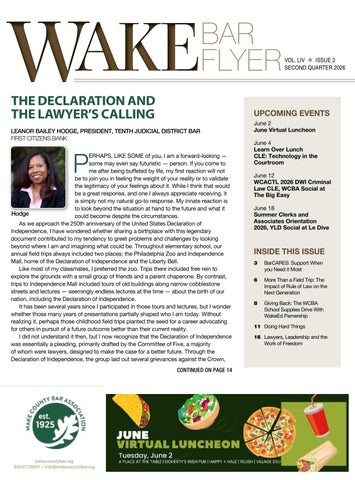
Hodge
WAKE BAR FLYER
VOL. LIV No. 2 | FIRST QUARTER 2026
Presidents
JOHN B. WARD, WCBA
LEANOR BAILEY HODGE, TENTH J.D. BAR
Presidents-elect
MEGAN WEST SHERRON, WCBA
ERIKA N. JONES, TENTH J.D. BAR
Secretary
TIFFANY COX
Treasurer
JORDAN GROSS
Board of Directors
JONATHAN M. BOGUES
JUDGE KEVIN BOXBERGER
MEREDITH P. BREWER
TARA CHO
GABE JIMENEZ
JOSUE JIMENEZ
JENNIFER JONES
MEGHAN KNIGHT
DEAN J. RICH LEONARD
JACOB MORSE
ASHLEY PAYNE RATLIFF
ELYSIA PRENDERGAST-JONES
WARREN SAVAGE
LINDSAY A. UNDERWOOD
MALLORY UNDERWOOD
PATRICK VANDERJEUGDT
Young Lawyers Division President
KATIE MCCOY
Executive Director
WHITNEY D.G. von HAAM
Communications Manager
AMY DAVIS
Wake Bar Flyer Designer
ANNE STRICKLAND
Tenth Judicial District Bar Councilors
JUDGE JULIE L. BELL
RUSSELL BABB
ANNA DAVIS
JUDGE KEITH GREGORY
JESSICA HEFFNER
KIMBERLY A. MOORE
JUDGE ASHLEIGH S. PARKER
DAVID SHERLIN
Opinions expressed in Bar Flyer articles are those of members as individuals and does not necessarily represent the views or policies of the Wake County Bar Association.
© 2026 Wake County Bar Association & Tenth Judicial District Bar
BETTER WITH YOU
BY WHITNEY D.G. von HAAM | EXECUTIVE DIRECTOR

In a sea of white Subaru Foresters, my daughter Nyah has a bumper sticker that makes her car distinct. I had never really given it much thought, other than smiling when I recognize her out and about, but recently, I have spent more time thinking about it. It reads: “The world is better with you in it, buddy.”
In early 2026, we lost a WCBA member to suicide. Sadly, this is not the first time that this has happened in my 16 years as executive director -- we know that the legal profession ranks among the top five in suicide rates among working professionals, but this time felt different. Unlike members in the past, whose names may have rung a bell or I remembered meeting on occasion, this person was an active, engaged member who was well liked by both colleagues and the staff, a past winner of the annual president’s award.
Family and friends pulled together a celebration of life, and my heart was so warmed by the number of WCBA members who came to pay tribute. Members from the YLD and Public Service Committee talked about how he always arrived with a smile on his face, ready, willing and able to provide
service to the local community. As I walked around the event, all I could think about was “I wish he were at this party and knew just how many peoples’ lives he’d touched and impacted.”
When something this catastrophic happens, one can’t help but reflect on “what if”…what if we’d reached out to him when we didn’t see him at events? What if he had said yes to that chair position years ago? What if, what if, what if…What I have reflected on in the past several months is that no one wins with “what if,” but perhaps all of us can learn and be better moving forward. Therefore, I am working to change my mindset to “what next.” I might not be able to move backwards, but I can look around and take inventory of those around me and reach out when I even think someone needs more support.
In the spirit of my mindset, I would love for all of our members to reflect on who of their family, friends and colleagues might need more help these days. Don’t keep thinking about how you should reach out, but just send a note of “thinking about you.” Remember that we offer BarCARES to all members of the Tenth, as well as WCBA members receive the benefit extended to your immediate family. Please take a moment to read Lawyer Wellness Committee member Kristine Sullivan’s piece about mental health and BarCARES. As an organization, we are committed to making sure we keep that information available to our members, so it is there when needed. Simply put, to all of our members: The world is better with you in it, buddy. WBF

von Haam
BARCARES: SUPPORT WHEN YOU NEED IT MOST

TWO MONTHS AGO, my 18-year-old client died by suicide. He was a funny, sarcastic and brave kid who wanted to leave the world better than he found it. After the initial shock of the news wore off, and the grief settled in, my first thought was: I need to call BarCARES.
BarCARES is a free, confidential resource for members of the North Carolina Bar who need support around mental health, substance use, eating disorders or family and relationship dynamics. BarCARES can help you find therapy and counseling in your area and will pay for your first three sessions.
As members of the Wake County Bar Association, BarCARES offers us even more. It is available not just to us members, but to our families as well. And BarCARES will cover three sessions per year with the counselor or therapist you select.
I’ve used BarCARES in the past, so I know it is an invaluable resource. We all struggle sometimes in this profession — stress, burn-out and the drive to succeed are
ubiquitous. We lose family members, colleagues and even clients we genuinely care about. More than 45% of lawyers will experience depression during their careers, and nearly 21% of us are considered “problem drinkers.”1 BarCARES is available for any struggle, 24 hours a day, 7 days a week, at 800-640-0735. WBF
Endnote
1.The Prevalence of Substance Use and Other Mental Health Concerns Among American Attorneys, Krill, Patrick R. et al., 10 Journal of Addiction Medicine, 46-52 (Jan.-Feb. 2016).



Hon. Cheri Beasley (Ret.)
Hon. Allyson K. Duncan (Ret.)
Better banking begins with purpose.

Tailored banking solutions that keep your practice moving forward.


THANK YOU
FOR YOUR 2026 DONATION*
Nathaniel Adcock
Carly Baker
Christina Belville
Brian Beverly
David Boaz
Bill Borden
Sandra& Steve Byrd
Ashley Campbell
Connie Carrigan
Jean Carter
Thomas Cook
Tiffany Cox
Amy Davis
Winifred Dillon
Root Edmonson
Carol Exum
Sandra Fried Fogleman
Spencer Fritts
Charles George
Rebecca Redwine Grow
Mary Gurganus
Robin Hammond

Nan Hannah Shari Hardy
Cecil Harrison
E.Haywood
Leanor Hodge
Mark Holt
Gabriel Jimenez
Shannon Joseph Erika Jones
Keith Kapp
Meghan Knight
David Long
Maria Lynch
Tania Malik
Richard McElroy
Benjamin McLawhorn
Carrie McMillan
Kimberly Miller
Atiya Mosley
Jacob Morse
Will Owens
Jerry Oliver
Drew Patty
Celia Pistolis
Cathleen Plaut
Judge Robert Rader

Judge Debra Sasser
Mark Scruggs
Richard Shackleford
Megan Sherron
John Silverstein
Samuel Slater
Theodore Smyth
Eugene Soar

Bettie Sousa
Matthew Stauff
Dale Stephenson
John Szymankiewicz
Hoyt Tessener
Bo Thompson
Lindsay Underwood
Mallory Underwood
Whitney von Haam
John Ward
Margaret Westbrook

MORE THAN A FIELD TRIP: THE IMPACT OF THE RULE OF LAW ON THE NEXT GENERATION
GUY MCCONNELL | SOCIAL STUDIES & LAW AND JUSTICE TEACHER, HOLLY SPRINGS HIGH SCHOOL
AS A SOCIAL STUDIES educator of nearly 20 years, teaching the principles of the Constitution and making them relevant to teenagers can sometimes be a challenge. I have often sought simulations and experiences as a way to translate those concepts into something more meaningful. Attending the Wake County Bar Association’s Rule of Law Day at Campbell University Law School in March was one of those experiences, and my students enjoyed it immensely. Students spent the day gaining knowledge, participating in active discussions led by practicing attorney facilitators, performing skits based on scenarios involving violations of the Bill of Rights and engaging in a Q&A session with a panel of legal experts.
After the welcome session, students enjoyed a taco bar lunch that many of them raved about. They were then divided into small groups and tasked with evaluating and debating a replica of an actual case involving the Bill of Rights. My students especially enjoyed the discussions and live simulation sessions. Watching them navigate the vignettes provided by the WCBA with such a high level of critical thinking was impressive.
Because several of the cases involved issues relevant to the Raleigh and Wake County area, the experience felt especially memorable for both me and my students. The panelists were incredibly knowledgeable, and their passion for their work was evident throughout the discussions. My students genuinely enjoyed hearing the panel’s insights and perspectives.
The day concluded with a Q&A session that could have lasted much longer if I had not needed to get students back to school. The high level of engagement from the audience demonstrated the impact of the event. Attorneys fielded numerous questions about their education and work experience while sharing stories and advice for the future. Their responses were thoughtful, detailed and clearly connected with the teenage audience.
In the group I observed, students took a deep dive into a specific case and analyzed how freedom of speech and expression under the First Amendment may have been violated. Our facilitator, WCBA President John Ward, ensured students were heard and encouraged them to share their thoughts and perspectives. He emphasized the importance of understanding both sides of an issue and continually asked thought-provoking questions. Rather than lecturing, he encouraged students to think critically and respond independently.
Once discussions concluded, students reenacted their scenario by developing and performing a skit in front of the entire group and panel of attorneys. While not all students took an active role, several of my students took center stage in the performances. Watching each group perform — especially my students — was entertaining and rewarding. After each skit, the panel discussed the actual case being portrayed and offered additional insights and analysis.
Ultimately, Rule of Law Day was more than just a field trip. By putting realworld civic education into practice and bridging the gap between the courtroom and the classroom, the program empowered students to see themselves as active participants in the justice system. Hearing students continue their conversations on the bus ride back to school was incredibly rewarding as an educator.
One of my students, Addison, shared that she “loved being in a room with likeminded people.” Another student, Julia, said, “I learned the most from the panel. I really enjoyed hearing from Judge Christine Walczyk. Really, the whole day was a lot of fun!”
Looking ahead, this experience provided by the WCBA was incredibly valuable and inspiring as a law teacher. I plan to attend future sessions and incorporate materials such as the vignettes into my lessons. By engaging with professionals like Mr. Ward and the WCBA panel, my students were able to visualize potential career paths and walk away with a greater understanding of our legal system.
WBF
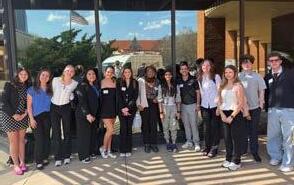
Law and Justice students from Holly Springs High School join the WCBA Public Service Committee on March 11.
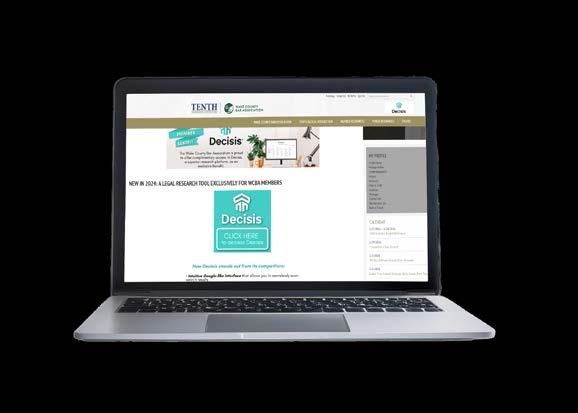
FREE LEGAL RESEARCH FOR
With Decisis, you can: ®
Access state and federal case law from all 50 states
Access exclusive North Carolina resources, including:
- Civil & Criminal Jury Instructions
- Industrial Commission Decisions
Quickly search case law and statutes by keyword, jurisdiction, or court name
Verify case authority with InterCite™, Decisis’ trusted citator

GIVING BACK: THE WCBA SCHOOL SUPPLIES
DRIVE WITH WAKEED PARTNERSHIP
BEN
MCLAWHORN
| THE LAW OFFICES OF BENJAMIN T. MCLAWHORN | YOUNG LAWYERS DIVISION

ONE OF THE main reasons I joined and volunteer with the WCBA is to give back to our community through acts of service. I’ve been involved with the Young Lawyers Division Board for several years, and one of the ways I routinely give back is through the annual school supply drive we host every summer. To help ensure those school supplies reach the people who need them most, we traditionally work with the WakeEd Partnership. The WakeEd Partnership’s mission is to “unite businesses and the community in supporting all educators and students in Wake County Public Schools.”
In particular, the WakeEd Partnership’s Tools4Schools program was created to address a clear and growing need: Teachers in North Carolina — especially in Wake County — were spending more than $1,000 of their own money each year to supply their classrooms. The Tools4Schools program created a free “store” where Wake County Public Schools teachers can access essential supplies at no cost, ensuring students have what they need to focus on learning while reducing the financial burden on educators. Teachers can visit the WakeEd Partnership’s location on Capital Boulevard and select school supply items to take back to
their classrooms. These supplies are then used by students who otherwise may not have had the ability to purchase them. The annual school supply drive hosted by the WCBA is just one way we can help support the educational future of students and teachers in Wake County Public Schools.
Last year, fellow YLD board member Gracie Gean assisted me as we personally dropped off donations to the WakeEd Partnership. While there, we saw how the Tools4Schools program operates and how the store is organized so teachers can select the items they need for their classrooms. In addition to donating supplies, we also assisted with sorting items throughout the store.
During our visit, we had the opportunity to meet with Superintendent Robert B. Taylor. He provided further insight into how Wake County Public Schools — the largest school district in the state, with more than 160,000 students — often relies on community donations to address budget shortfalls. Through those discussions, we saw firsthand how our efforts directly affected those in need within our school system. Following our visit and reflection on those conversations, my resolve to stay involved in helping others who may be less fortunate only strengthened.
Through intentional acts of service, I’ve been fortunate to help bolster the WCBA’s reputation as an organization dedicated to public service in the community. I encourage my fellow members to get involved in any way they can to give back to our community. WBF
The YLD’s 2026 School Supplies Drive runs through June and July. Please donate through the WCBA website this year. All donations can be made through an Amazon Wishlist link, and supplies are collected at the WCBA office.
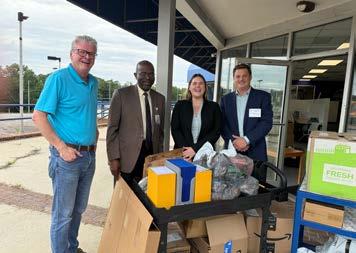
Donations being delivered to WakeEd Parnership in Raleigh in August 2025. (l-r) Keith Poston, President of WakeEd Partnership; Robert B. Taylor, Superintendent WCPSS; and YLD Board members Gracie Gean and Ben McLawhorn.
McLawhorn


We are proud to support the Wake County Bar Association
Helping civil, criminal, bankruptcy and matrimonial attorneys with the financial aspects of their most important cases.
•Litigation Support
•Damages Services
•Valuation Services
•Intellectual Property Services
• Forensic Accounting
• Expert Testimony
•And More
Scan below to learn more




WALNUT CREEK WETLANDS PARK

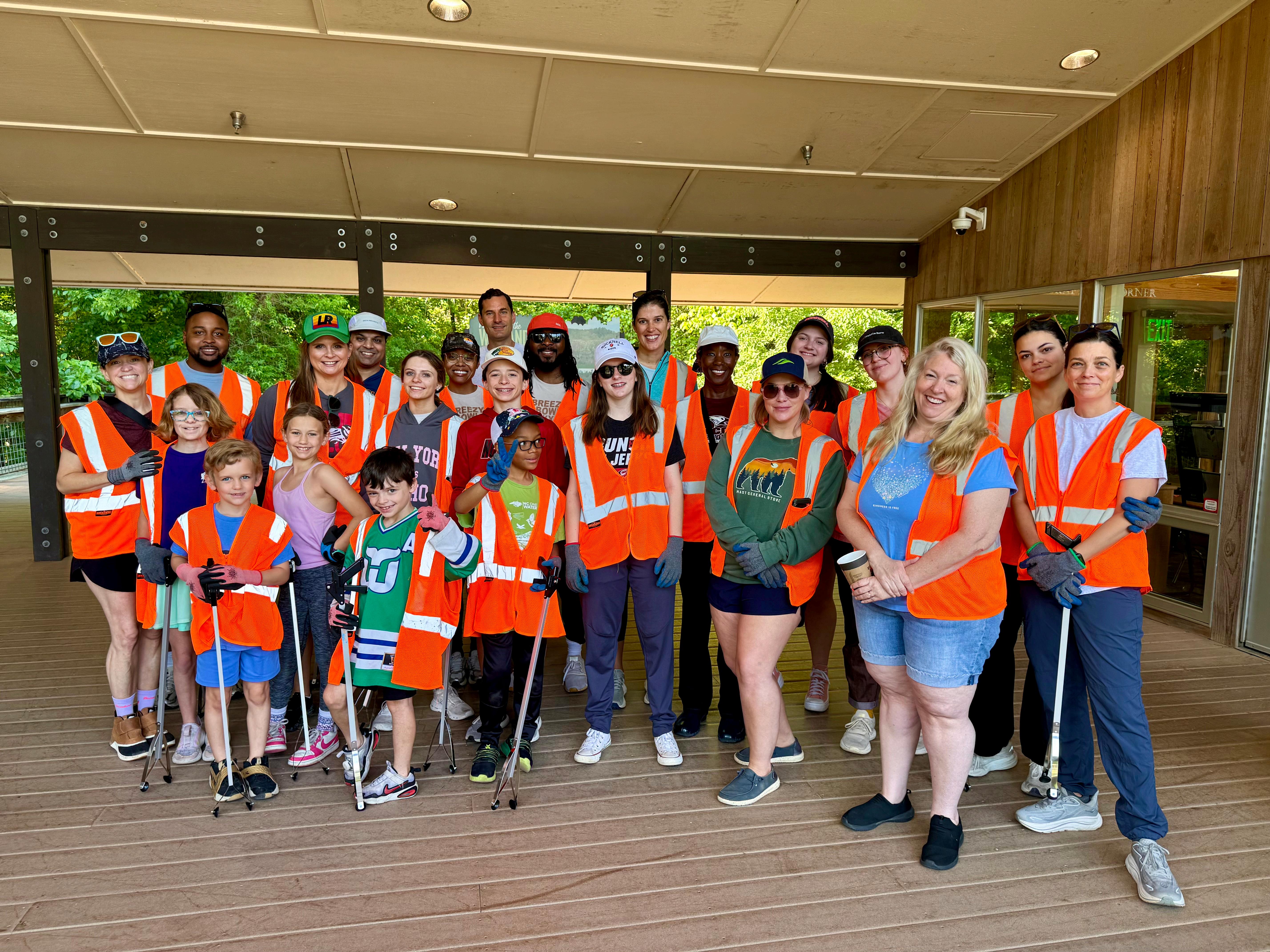
DOING HARD THINGS
EVIN L. GRANT | NORTH CAROLINA STATE BAR | CDEI COMMITTEE
AS LAWYERS, WE are all used to mentally demanding work — whether navigating law school, preparing for the bar exam or carefully analyzing a client’s case. Many of us also do emotionally demanding work, and we are usually comfortable supporting our clients through their struggles. When it comes to our own emotional challenges, however, we often find them harder to handle. That is a different issue.
Let’s talk about physical challenges. I know several lawyers personally who push their physical limits by running a 5K nearly every weekend, competing in marathons or practicing bodybuilding, Pilates or hot yoga. However, it is rare for lawyers to test their physical strength as much as they challenge their minds. I experienced a demanding physical challenge of my own in March — though not by choice.
Here is how it happened:
January
Amber: I want to do a Hyrox. Me: What’s that?
Amber shows me videos on TikTok. Me: Hmm, looks intense.
Amber: It’s like this fitness race that’s trending,and I want to try it.
Me: Oh, OK.
Mid-February
Amber: I did a thing … Me: What?
Amber: I signed us up for a Hyrox at the end of March.
Me: … bruh …
First things first: What is Hyrox?
According to Hyrox, “HYROX combines both running & functional workout stations, where participants run 1K, followed by one functional workout station, repeated eight times.”
So what does that look like? Here is the race order:
•Start
•1K run
•1,000-meter SkiErg
•1K run
•2-by-2-meter sled push (about 335 pounds, including sled)
•1K run
•2-by-25-meter sled pull (about 227 pounds, including sled)
•1K run
•80-meter burpee broad jump
•1K run
•1,000-meter row
•1K run
•200-meter kettlebell farmer’s carry (two 52-pound kettlebells)
•1K run
•100-meter sandbag lunges (44-pound sandbag)
•1K run
•100 wall balls (13-pound ball)
•Finish
This is an international fitness competition held around the world using a standardized format. While the race is officially timed, participants may approach it recreationally or competitively. There is no time limit to complete the race. What about my experience?
Here is some background: While I had been exercising regularly, I had not been specifically training for Hyrox. Over the years, I completed several 5Ks, but this was my first fitness race. Around October 2025, I ordered a compact in-home weight set from Tempo for workouts at home, which I used fairly consistently until the holidays. At that point, I had not gone for a run since the previous summer, and I certainly was not pushing 300-pound sleds at home. We had about six weeks to prepare for a race that most people spend 12 weeks or more training for.
Knowing we had a short window to prepare, we started developing a training regimen. Like most people, we turned to Google Gemini and ChatGPT to build a weekly training plan. Most of the training could be done at home with weights and running, but a few specialized exercises required equipment we did not have.
We spent about four weeks training for endurance and strength, lifting heavier weights and replicating many of the workouts at home or in a local park. By early March, however, we still had not fully simulated what Hyrox would require. We decided we needed more practice with the heavier exercises, as well as the

Grant
Many of us do emotionally demanding work, and we are usually comfortable supporting our clients through their struggles ... It is rare for lawyers to test their physical strength as much as they challenge their minds.
OUR MEMBERS SPEAK:
WHAT IS SOMETHING NEW THAT YOU HAVE CHALLENGED YOURSELF TO DO WITHIN OR OUTSIDE OF YOUR LEGAL CAREER?
Attorneys are often notoriously busy and goal-driven individuals, both within and outside the practice of law. We asked our members, “What is a new challenge you are taking on — either personal or professional?” Here’s what we heard:
“I’m working on mindful living and learning to be more present in each moment, rather than always thinking about what’s coming next. Yoga is really helping me in this regard.”
Pearla Alston, retired North Carolina Department of Health and Human Services

“I have been trying to learn to make chocolate gravy and biscuits (a breakfast staple growing up in Middle Tennessee that I was recently surprised to learn is regional) so that my chocolate-loving toddlers can grow up eating it, too.”
Lacy Hansen Tharrington Smith LLP
“Next fall, I will enter my second year teaching Legal Research and Writing as an adjunct professor at Campbell Law School. Now that I have the basics covered, I’m looking forward to sharing more of my practical experience, as well as finding innovative ways to teach the material.”
Jennifer Jones Wake County Attorney’s Office
“I am currently navigating a transition back to private practice from public interest, which alone might not seem like much, but I also had the unfortunate experience of going through the car-buying process after my old car decided it didn’t want to work anymore. Though it is nice to now have a car that my phone can connect to without having to plug it in.
Trynity Ojeda Legal Aid of North Carolina


“’A new challenge I’m taking on professionally is trying to grow into someone who not only solves problems, but also helps shape strategy and direction. I’m working on thinking beyond just the legal side of an issue and seeing the bigger picture moving forward.”
Ashley Ratliff North Carolina State Bar
DIRECT EXAMINATION: FREDDY IWAN
DIRECT EXAMINATION is the first opportunity for the jury to meet a witness. An effective lawyer will use the opportunity to personalize the witness, making the witness appear both likeable and credible. At the end of the day, the direct examination is a party’s best chance to tell his or her story. This is the story of Freddy Iwan of Obligo Law Group, CLO of ICE Global Consulting, Inc., and chair of the publications subcommittee of the Professionalism Committee.
When you were in elementary school, what did you want to be when you grew up?
I wanted to be an architect, because I loved to draw.
What was the most important lesson your parents taught you?
Hard to pick just one. I think the most important lesson that comes to mind is to “treat others the way I want to be treated.” But there are two other lessons that really shaped who I am today as well: “Perseverance matters most during the hardest times” and “Be skeptical of things the crowd follows.”
Especially during my teenage years, they constantly reminded me to think for myself and not follow something just because “everyone is doing it.”
Who was your favorite teacher and why?
My favorite teacher taught my history, politics and economics classes in high school. We disagreed on almost everything, but he challenged me — not in a bullying way, although it felt like that at times, but in a thought-provoking way. He pushed us to always be prepared to defend our arguments and to study all sides of a topic before forming an opinion.
Did you love or hate law school?
I went to law school twice, so people will probably think I’m lying if I say I hated it. Jokes aside, though, I loved law school. Most people who hate law school hate it because it’s tough. But I think if it weren’t tough, it wouldn’t be worth it. It wouldn’t have opened the doors it opened for me, and I probably wouldn’t have met many of the people who are still part of my life today.
What was your most embarrassing courtroom experience?
The most embarrassing experience was — and still is — every time I have to record and watch myself practice an opening statement, closing argument or anything else that requires practice. I hate watching myself speak on camera, especially when other people are watching too
What was your best courtroom experience?
Not at an actual trial, but during a trial-practice exercise with the full setup — judge, witnesses, everything — my opposing counsel kept objecting to almost every question I asked. Nonstop. She also spoke very fast and was difficult to keep up with.
At some point during her cross-examination of my witness, I had had enough. I can’t remember exactly what she said, but she was clearly responding to something I had asked earlier and doing it in a somewhat mocking way. So I objected on the grounds that “counsel is being sassy.” The judge sustained the objection. It was a great moment.
Why did you become a lawyer?
Quite honestly, when I first thought about becoming a lawyer — I was probably around 13 or 15 — it was because I wanted to dress well. Some members of my family are lawyers, and they always looked so sharp.
Years later, one of my uncles took me to a class taught by one of his law partners at the University of Buenos Aires Faculty of Law. It was a commercial law class — not very glamorous, I know. But something about sitting in that classroom and listening to the

interaction between the professor and the students reinforced my interest in becoming a lawyer.
After graduating in Argentina, I decided I wanted to become a lawyer in the U.S. because I believed it would give me the greatest opportunities — not only opportunities for myself, but also opportunities to add value to my community, offer solutions and be a resource for others.
What has been the most surprising or unexpected development in your career?’
I don’t think I ever expected to start a global company and support its operations as part of the leadership team.
What is your favorite book? Birds of Prey by Wilbur Smith, part of the Courtney saga.
What is your most marked characteristic? Being reliable.
What is your hidden talent?
In the age of social media, it’s hard to have a truly “hidden” talent. But here are a few things most people probably don’t know about me — all of which I think I’m decent at, though not necessarily great:
1.Fly fishing
2.Olympic weightlifting
3.Cooking
4.Writing fiction novels
5.Dance (mostly to older rock music). WBF
The Declaration and the Lawyer’s Calling
including some that, as lawyers, we can personally relate to:
•“He has obstructed the Administration of Justice, by refusing his Assent to Laws for establishing Judiciary powers.”
•“He has made Judges dependent on his Will alone, for the tenure of their offices, and the amount and payment of their salaries.”
The Declaration of Independence was advocacy. Through this document, the lawyer-drafters advocated:
1.On behalf of others for a future different from the current reality.
Doing Hard Things
2.For a future better than they could fully foresee or imagine at the time.
3.For a future that would ultimately include people whom the drafters themselves likely did not contemplate at the time.
“We hold these truths to be selfevident, that all men are created equal, that they are endowed by their Creator with certain unalienable Rights, that among these are Life, Liberty and the pursuit of Happiness.”
I may have preferred trips to the zoo as a child, but in hindsight, the trips to Independence Mall proved more impactful. Because of them, I developed
machines we did not have at home, such as the rower and SkiErg.
During the final three weeks of training, we visited a local Lifetime Fitness twice using $50 day passes. During those visits, we simulated a full Hyrox by completing each task in order. On average, we worked out three to five days a week, focusing on endurance through running, strength through weightlifting and practicing the actual exercises used in the competition. Because this is an international competition, we had several options for where to compete, but we signed up for the competition in Houston. Amber registered us for mixed doubles. That division consists of one man and one woman competing together and sharing the workload for all exercises, though both teammates must complete each 1K run between stations.

When we trained, we prepared as though each of us would complete every exercise independently, simply to
a tangible connection to the Declaration of Independence and the value that comes from combining a forward-looking perspective with legal skills.
I consider it an honor and privilege to serve as president of our Tenth Judicial District Bar this year as our sister organization, the WCBA, looks ahead to its next 100 years. The timing of my presidency, the start of the WCBA’s next century and the anniversary of the Declaration of Independence feels fitting because it reminds me that lawyers best serve society when we lean into advocating for a better future for others — perhaps one none of us can fully foresee. WBF

build the endurance and strength necessary to finish. During some of the simulations, we alternated exercises while ensuring we completed the required distance for each workout and identified our strengths and weaknesses. Although we experienced some ups and downs during training — and tested each other’s patience from time to time — we felt satisfied with our preparation and entered the competition aiming to finish in under two hours. As competition week approached, we reduced both the frequency and intensity of our workouts to ensure our bodies were rested for race day. We arrived in Houston on Thursday, March 26. Our initial plan was to rest, get breakfast the next morning and explore Houston because our competition heat was not until 6 p.m. Friday. That may have been our first mistake.
Tip No. 1: Choose an earlier competition time if possible. Attempting to tour Houston before a fitness competition was
CONTINUED ON PAGE 15
Doing Hard Things |
not our best idea. We walked the city, ate at local restaurants and even tried to take a nap before the competition. We also visited the venue as spectators to gauge the energy and atmosphere and get an idea of what the competition would entail because we had never attended one in person.
The energy was intense. It felt like a fitness party, complete with music, vendors, photo opportunities and even bars for spectators who were not participating. (I am sure some participants had drinks before and after as well.) The atmosphere puts you in the mindset of competing and doing something difficult.
Unlike many races, where everyone starts simultaneously, Hyrox divides competitors into heats, with a new group beginning every 10 minutes. Those heats may include solo men’s or women’s divisions, doubles or relay teams of four in which each participant completes two exercises and two runs.
Once it was our turn to compete, we warmed up, tested some of the equipment and prepared at the starting line. An emcee pumped up the crowd before reviewing a few rules. It felt like running out of the tunnel before a basketball game.


tough. More accurately, both calves locked up completely, and I could not move at all. Before starting the wall balls, we stopped several times so I could stretch my legs and keep going, but finishing remained our goal. Around us, participants lay on the floor near the track, several requiring medical assistance. I decided to push through because quitting was not an option.
When we finished the 100 wall balls, we crossed the line in 2 hours, 22 minutes and a few seconds — short of our two-hour goal, but still a fantastic achievement for our first attempt.
Would we do it again?
Absolutely. I would love to team up with three other people for a relay race to challenge ourselves and push beyond what we thought was possible. Washington is hosting a race in September 2026, and I would also be interested in traveling internationally to compete.
A quote I recently read stated: “Getting in shape is a psychological process disguised as a physical one.”
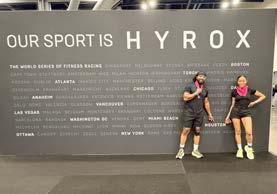
Our start was promising. We felt confident in our pace and focused on beating our own best times rather than competing against everyone else. We moved strongly through the first three or four workouts, although the burpee broad jumps challenged us. That was our first major hurdle. After that, we powered through the farmer’s carry, but the sandbag lunges slowed us down tremendously. Lunges without weight already require balance. Add a nearly 50-pound bag on your back, and things become even more difficult.
After the sandbag lunges, I experienced involuntary calf spasms during the final 1K run, which made things
Yes, I would challenge myself again to do hard things — something many lawyers, and people in general, do not often choose to do. Mental challenges feed who we are as lawyers, yet we still tend to limit our emotional and physical capacities to what already feels comfortable. Hyrox was my decision to
move beyond what felt physically comfortable and attempt something difficult. Emotionally, it gave me a renewed sense of confidence I had not felt since passing the bar exam. While I am not suggesting everyone should do a Hyrox — though you should try it — I am encouraging you to go beyond your limits. Things can be hard. But are they truly impossible, or are we simply unwilling to challenge ourselves, build strength and overcome new obstacles? WBF
LAWYERS, LEADERSHIP AND THE WORK OF FREEDOM
CAMILLE STELL | LAWYERS MUTUAL
AS OUR NATION marks the 250th anniversary of the Declaration of Independence, we are invited to reflect on what it means to carry that legacy forward. Anniversaries like this are about celebration, of course, but they are also about responsibility. They ask us to consider not only what has been handed down to us, but what we will leave behind. e
For those of us in the legal profession, that reflection feels especially meaningful. The Declaration gave voice to ideals that still shape our national identity: liberty, equality and self-government. Those ideals remain powerful. They still inspire. But ideals do not preserve themselves. Freedom requires functioning institutions.
Freedom depends on more than inspiring words on a historic page. It depends on courts people trust. It depends on laws being applied fairly and consistently. It depends on a justice system that people can access and understand. And it depends on lawyers who bring integrity, judgment and principle to their work every day.
The Declaration announced a promise. Institutions are how that promise is kept.
Without trusted institutions, rights can begin to feel distant or uncertain. Equality can start to look theoretical instead of real. Self-government can weaken when people lose confidence that disputes will be resolved fairly and peacefully. That is why the health of our institutions matters so much. They are not abstract structures operating somewhere in the background. They are the framework that allows liberty to function in real life.
This feels especially relevant now. Public trust in institutions has become strained, and the courts are no exception. Too often, people encounter the legal system with frustration, skepticism or confusion. Some see only cost and delay. Others wonder whether justice is truly available to everyone. In that environment, trust cannot simply be assumed. It must be built, protected and renewed.
Lawyers have a great deal to do with that.
You are not only advocates, advisers or problem-solvers. You are also participants in a system that depends on public confidence. Every time you counsel a client, appear in court, negotiate with opposing counsel or respond under pressure, you are shaping how the legal system is experienced. You help determine whether others see the law as something principled and steady, or something distant and discouraging.
This is why ethical leadership matters so deeply. Ethical leadership is not just about avoiding misconduct. It is about setting a tone. It is about exercising independent judgment when it would be easier to follow the crowd or yield to pressure. It is about speaking honestly to clients, even when the truth is hard. It is about advocating with strength while still showing respect for the court, for the process and for one another.
At its best, ethical leadership reminds people that the rule of law is one of the great protections of a free society.
Lawyers have always had a unique role in that work. Lawyers stand at the point where principle meets practice. You are asked to help people navigate conflict, uncertainty, risk and change. How the profession does that matters. Our professionalism matters. Our civility matters. Our judgment matters. These are not side issues. They are part of how public trust is formed.

And this is where the bar plays such an important role.
A bar association is more than a professional organization. At its best, it is a source of leadership, encouragement and stewardship. It reminds us that we belong to something larger than our individual practices. It creates space for mentorship, service and shared purpose. It helps shape the culture of the profession by reinforcing that competence, ethics, collegiality and community involvement are not optional extras. They are part of what it means to be a lawyer.
That work begins close to home. The future of the profession will be shaped not only in national conversations, but in local courtrooms, law offices and bar associations. It will be shaped by whether we welcome and guide younger lawyers. It will be shaped by whether we protect civility when tensions are high. It will be shaped by whether we see access to justice as a collective responsibility. It will be shaped by whether we meet change with wisdom and integrity.
In that sense, the questions before us are deeply connected. Where do we go as a country? Where do we go as a bar association? How do we shape our world?
We shape it by strengthening the institutions that make freedom possible.
We shape it by supporting courts that deserve the public’s trust. We shape it by practicing law in ways that reflect honor and responsibility. We shape it by leading ethically, mentoring generously and serving faithfully. We shape it by remembering that the profession is not only about making a living, but also about sustaining a system of justice on which others depend.
The next 250 years will not be shaped by ideals alone. They will be shaped by whether each generation is willing to do the steady, necessary work of preserving the structures that protect those ideals. That work may not always be celebrated. It is often quiet. It is often local. It is often carried out in ordinary moments of professionalism, courage and service. But it matters immensely.
As we reflect on the Declaration of Independence, perhaps that is one of the clearest lessons to carry forward: liberty is a promise, but it is also a responsibility. And one of the bar’s highest callings is to help ensure that the institutions supporting that promise remain strong, worthy of trust and ready for the future.
If liberty is the promise, functioning institutions are how we keep it. WBF
Camille Stell is the vice president of risk and practice management for Lawyers Mutual and the co-author of the book RESPECT – An Insight to Attorney Compensation Plans, available from Amazon. Continue this conversation by contacting Camille at camille@lawyersmutualnc.com or 800-662-8843.
Stell

NEW LAWYER REAL SUPPORT


Law school doesn’t hand you a manual for running a practice. Nobody warns you about malpractice claims, client disputes, or what happens when something goes wrong on a case. That’s where Lawyers Mutual comes in, and the benefits go way beyond insurance.
• FREE on-demand CLE (80+ programs, including Ethics, Technology, and Professional Well-Being). Fulfill your 24-hour, 2-year requirement anywhere, anytime. A $900 value
• FREE consulting with a practice management advisor — 3 hour-long sessions annually to help you start, run, or grow your firm. A $900 value
•Hotline to 7 NC-licensed claims attorneys who can help you avoid problems before they start.
If you’re finishing law school or just starting out, this is the kind of support that matters.
Visit our website www.lawyersmutualnc.com for toolkits and practice
to help law students and young lawyers.
WELCOME, NEW MEMBERS
Morningstar Law Group
Hardison Brooks Pierce McLendon Humphrey & Leonard LLP
Michelle Harkovich K&L Gates LLP-Raleigh Akram Hauter
Jessica Hill Troutman Pepper Locke Yancey Huie Moore & Van Allen PLLC
Lewis Hutchison Jr. Lewis Hutchison Attorney at Law
Inman
Jacqueline Landry
Matthew Liles
Shang Yun Lin Tharrington Smith LLP
James Longest III Law Office of F Bryan Brice Jr
Donelson Bearman
& Berkowitz PC
Goudelock & Courie PLLC
Nicholas Massey Wyrick Robbins Yates & Ponton LLP
Melissa Mayfield Eldreth Law Firm PLLC
Jessica McClellan Marshall & Taylor PLLC
Nichole McLaughlin
Pierce McLendon
& Leonard LLP Daniel Mullins Hartzog Law Group LLP Hannah Neighbors Wyrick Robbins Yates & Ponton LLP
Kelly Newcomb Poyner Spruill LLP
Olivia Nieri Phelps Dunbar LLP
David Noland Tharrington Smith LLP
Rebecca Olla
Teague Campbell Dennis & Gorham LLP
WELCOME, NEW MEMBERS
Continued from page 18 Corinne