20 YEARS AND COUNTING The Chief Justice’s Commission on Professionalism Celebrates Two Decades of Enhancing Professionalism Among NC Lawyers, Judges and Law Students.........19 ___________________________________ _
VOL. XLIV • ISSUE 3 | THIRD QUARTER 2018
BAR FLYER THE NEW PROFESSIONALS BY JUDGE NED MAGNUM, PRESIDENT / WAKE COUNTY BAR ASSOCIATION
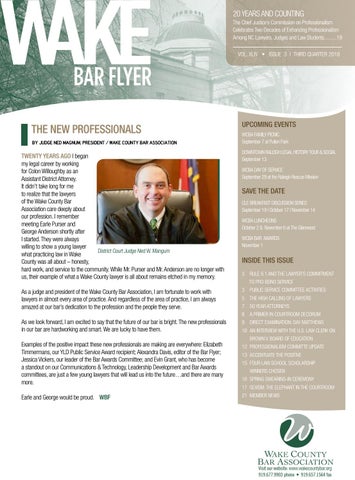
TWENTY YEARS AGO I began my legal career by working for Colon Willoughby as an Assistant District Attorney. It didn’t take long for me to realize that the lawyers of the Wake County Bar Association care deeply about our profession. I remember meeting Earle Purser and George Anderson shortly after I started. They were always willing to show a young lawyer District Court Judge Ned W. Mangum what practicing law in Wake County was all about – honesty, hard work, and service to the community. While Mr. Purser and Mr. Anderson are no longer with us, their example of what a Wake County lawyer is all about remains etched in my memory.
UPCOMING EVENTS WCBA FAMILY PICNIC September 7 at Pullen Park DOWNTOWN RALEIGH LEGAL HISTORY TOUR & SOCIAL September 13 WCBA DAY OF SERVICE September 29 at the Raleigh Rescue Mission
SAVE THE DATE CLE BREAKFAST DISCUSSION SERIES September 19 | October 17 | November 14 WCBA LUNCHEONS October 2 & November 6 at The Glenwood WCBA BAR AWARDS November 1
INSIDE THIS ISSUE 3 RULE 6.1 AND THE LAWYER’S COMMITMENT TO PRO BONO SERVICE
As a judge and president of the Wake County Bar Association, I am fortunate to work with lawyers in almost every area of practice. And regardless of the area of practice, I am always amazed at our bar’s dedication to the profession and the people they serve.
3 PUBLIC SERVICE COMMITTEE ACTIVITIES
As we look forward, I am excited to say that the future of our bar is bright. The new professionals in our bar are hardworking and smart. We are lucky to have them.
9 DIRECT EXAMINATION: DAY MATTHEWS
5 THE HIGH CALLING OF LAWYERS 7 50 YEAR ATTORNEYS 8 A PRIMER IN COURTROOM DECORUM
Examples of the positive impact these new professionals are making are everywhere: Elizabeth Timmermans, our YLD Public Service Award recipient; Alexandra Davis, editor of the Bar Flyer; Jessica Vickers, our leader of the Bar Awards Committee; and Evin Grant, who has become a standout on our Communications & Technology, Leadership Development and Bar Awards committees, are just a few young lawyers that will lead us into the future…and there are many more. Earle and George would be proud. WBF
10 AN INTERVIEW WITH THE U.S. LAW CLERK ON
BROWN V. BOARD OF EDUCATION
12 PROFESSIONALISM COMMITTE UPDATE 13 ACCENTUATE THE POSITIVE 15 FOUR LAW SCHOOL SCHOLARSHIP
WINNERS CHOSEN
16 SPRING SWEARING-IN CEREMONY 17 SEXISM: THE ELEPHANT IN THE COURTROOM 21 MEMBER NEWS
Visit our website: www.wakecountybar.org 919.677.9903 phone • 919.657.1564 fax
WAKE BAR FLYER
VOL. XLIV No. 3 | THIRD QUARTER 2018 Presidents JUDGE NED MANGUM, WCBA MARIA LYNCH, TENTH JUDICIAL DISTRICT BAR Presidents-elect DAVID L. SHERLIN, WCBA NANCY L. GRACE, TENTH JUDICIAL DISTRICT Secretary MEGHAN N. KNIGHT Treasurer ADAM M. GOTTSEGEN Immediate Past President ASHLEY H. CAMPBELL Board of Directors LISA M. ANGEL DANIEL T. BARKER JULIE L. BELL WILLIAM B. BYSTRYNSKI ANNA BAIRD CHOI MARGARET P. CURRIN STEPHANIE D’ATRI JUDGE ASHLEIGH P. DUNSTON REBECCA A. EDWARDS JUDGE KEITH O. GREGORY JUDGE JEFFERSON G. GRIFFIN JAMES M. HASH AIDA DOSS HAVEL DEAN J. RICH LEONARD CHRISTINA MEDLIN MCCOY JOHN E. MCKNIGHT JEFFREY R. MONROE ATIYA M. MOSLEY EDD K. ROBERTS III MEGAN W. SHERRON JOHN R. SZYMANKIEWICZ JOHN “BO” WALKER Young Lawyers Division President LAUREN A. GOLDEN Young Lawyers Division President-elect LEAH M. HERMILLER ABA Delegate JOHN I. MABE Executive Director WHITNEY von HAAM Wake Bar Flyer Editor ALEXANDRA DAVIS Communications SARAH L. JUSTICE Tenth Judicial District Bar Councilors HEIDI C. BLOOM WALTER E. BROCK NICHOLAS J. (NICK) DOMBALIS THEODORE C. EDWARDS II KATHERINE FRYE JUDGE ROBERT B. RADER DONNA R. RASCOE WARREN SAVAGE © 2018 Wake County Bar Association & Tenth Judicial District Bar.
FALL CLE Save the dates for these upcoming programs, and stay tuned for more to come! September 19 Breakfast Discussion Series | "Mastering Conflicts of Interest" October 2
WCBA Luncheon Professionalism Roundtable
October 2
Civil Law Update
October 17
Breakfast Discussion Series | "Eminent Domain Overview"
October 19
Criminal Law Blockbuster
ATHLETICS SOFTBALL LEAGUE SEPTEMBER 16 – NOVEMBER 4 Softball season is around the corner and teams are starting to form. Games will be held Sunday afternoons from 2 to 5 p.m. at Millbrook Exchange Park, September 16 through November 4. Cost is $25 to join and includes all games, equipment and umpires. Please register online and contact Softball Commissioner Cameron Stanton at cbstanto@gmail.com with any questions.
TENNIS TOURNAMENT | OCTOBER 5 The WCBA Tennis Tournament will take place on Friday, October 5 at 1:00 p.m. at Carolina Country Club. Trophies will be awarded to the winners and runners-up, food and refreshments will be awarded to everyone! Registration is now open online.
GOLF TOURNAMENT | NOVEMBER 12 The WCBA Golf Tournament will be held November 12 at River Ridge Golf Club. Registration is now open online.
PAGE 2
RULE 6.1 AND THE LAWYER’S COMMITMENT TO PRO BONO SERVICE BY SYLVIA NOVINSKY | DIRECTOR, NORTH CAROLINA PRO BONO RESOURCE CENTER
In North Carolina, our Rules of Professional Conduct strongly encourage every lawyer to fulfill 50 hours of pro bono legal services each year. Professional Rule 6.1 defines pro bono legal services as legal services provided without fee or expectation of fee to persons of limited means, charitable organizations that are designed to address the needs of persons of limited means, or public interest organizations who cannot afford to pay. This Rule recognizes the fact that pro bono legal service is just one way that members of our profession can ensure access to justice for all of our state’s citizens.
Pro bono legal representation is not the only type of volunteerism encouraged by the Rules, however. Rule 6.1 also describes other activities, though outside the 50-hour aspirational goal. Attorneys should also endeavor to provide:
The need for this type of service is great. Eighty percent of all the civil legal needs of the poor – legal representation in the areas of domestic violence, divorce, child custody, housing, consumer protection, employment, benefits, health and more – remain unfulfilled each year. Further, there is only one Legal Aid attorney for every 11,000 North Carolinians eligible for their services: more than 2.2 million citizens in 2016, compared to one private lawyer for every 362 state residents.
Additionally, the Preamble of the Rules of Professional Conduct also encourages non-legal community service.
(1) legal services at a substantially reduced fee to the same vulnerable populations as pro bono legal services; (2) activities to improve the law, such as leadership in professional legal associations, service on boards of legal service providers to clients of limited means, or active participation in employer pro bono committees; and (3) financial support to legal service providers, such as Legal Aid of North Carolina, the Charlotte Center for Legal Advocacy, and Pisgah Legal Services.
In addition to opportunities to engage in pro bono work through the Wake County Bar Association, please visit the North Carolina Pro Bono Resource Center’s website at ncprobono.org to view a variety of available pro bono volunteer opportunities to help you meet your Rule 6.1 goal! WBF
PUBLIC SERVICE COMMITTEE ACTIVITIES IN ADDITION TO pro bono work, our Public Service Committee offers multiple opportunities for lawyers to give back.
SUMMER EVENTS Lunch with A Lawyer | For 24 years, the WCBA has partnered with the City of Raleigh’s Summer Youth Employment Program to allow more than 170 high school students to meet, eat and interact with WCBA attorneys. This year, the program made even more progress under the leadership and direction of WCBA member Jacob Davis to ensure that every student has an opportunity to meet an attorney. The WCBA sponsored a luncheon for all of the students and attorneys on Friday, July 6 and Friday, July 13 at the Doubletree Hilton - Brownstone - University. Camp Confidence | The WCBA Public Service Committee and YLD have partnered with the Town of Cary and Cary Police Department as part of their 2018 Camp Confidence program. During the two-week sessions of camp, rising seventh and eighth graders work with the Cary Police
WAKE BAR FLYER • THIRD QUARTER 2018
Department school resource officers to explore career options, as well as learn about hot-button issues such as internet safety and conflict resolution. During the legal career portion (June 27, July 11 and July 31 at Campbell Law School), volunteer attorneys facilitated a mock trial for students with our local judges presiding. Anna Davis and Kristie Hedrick co-chaired this event. Note in the Pocket Clothing Drive | At the June and July luncheons, we collected new and gently used clothing for Note in the Pocket, a local organization that partners with the Wake County School System to provide clothing to impoverished and homeless children and their families. In 2017, Note in the Pocket provided 4,000 individuals with clothing packets and the WCBA was a part of that through our clothing drive last summer. WCBA volunteers also sorted and provided lunch for their staff and volunteers. Alexandra Davis is the subcommittee chair for this event.
CONTINUED ON PAGE 4
PAGE 3
PUBLIC SERVICE, CONTINUED FROM PAGE 3 FALL EVENTS WCBA Day of Service | This is the fourth year of our WCBA Day of Service, which offers an opportunity for all members of the bar to give back. By partnering with the Raleigh Rescue Mission, we provide residents with free legal advice, child care, devotion and lunch. At this event, there is something for everyone to do in order to make a small difference in a person’s life. This year’s WCBA Day of Service is scheduled for September 29 from 9 a.m. - 1 p.m. Ashleigh Dunston and Meredith Cross are the subcommittee co-chairs for this event. 5K Run for Charity | One thing we know about the WCBA is that we work hard and play hard. What better way to further our camaraderie and WCBA Public Service Committee team-building than by running together Members and volunteers at the to raise money for a local charity. 2017 Day of Service. Alexandra and Jacob Davis are the subcommittee co-chairs for this event.
SPRING EVENTS Rule of Law Program | On Wednesday, March 7 more than 100 high school students from across Wake County descended on Campbell Law School for the annual Rule of Law program. Rule of Law provides a great opportunity for practicing attorneys to work with civically-minded young people on constitutional issues as small group facilitators or by sitting on a discussion panel. Jess Mekeel will be the subcommittee chair for the 2019 program scheduled for March 12. WAKE Up and Read Book Drive | In partnership with WAKE Up and Read, the WCBA is doing its part to increase childhood literacy in Wake County. During our February luncheon, the WCBA donated over 450 books to this program this year! Jessica Heffner will be the subcommittee chair for next year’s program. NC Bar Foundation 4All Statewide Service Day | Each March, the NCBF and local bar associations partner to provide free legal advice. More than 560 attorneys registered to volunteer to take calls at seven call center sites statewide, answering almost 10,000 calls from NC residents who have the opportunity to speak to a lawyer for free. Several of our WCBA members have participated all 10 years! Nicolette Fulton organized this effort.
WAKE BAR FLYER • THIRD QUARTER 2018
Students and WCBA member attorneys enjoyed chatting over lunch during Lunch with a Lawyer in July.
YEAR-LONG EVENTS Lawyers Read | In this semester-long service activity led by Nicolette Fulton, volunteers donate 30 minutes per week investing their time and talent to read with a struggling first or second grade student at various schools across Wake County. Currently more than 25 schools participate and we proudly have more than 1% of our WCBA membership volunteering with this program! YLD | The WCBA Young Lawyers Division provides multiple opportunities for public service and pro bono work throughout the year including their annual Food Drive, running August 27-September 14. WBF
PAGE 4
THE HIGH CALLING OF LAWYERS BY CAMILLE STELL, VICE PRESIDENT OF CLIENT SERVICES | LAWYERS MUTUAL
FOR CENTURIES, the legal profession, along with the other original professions – divinity and medicine – experienced little change. While this is certainly not true today for the other two original professions, a lawyer from a few generations ago could walk into a courtroom today and represent a client with little assistance. But the last 10 years have wrought more change in the legal profession than perhaps the 100 years prior. I spent a good bit of time talking with lawyers about the changing legal profession, and a common complaint is that the business of law is destroying the profession of law. I disagree. I do not believe that the profession of law is so weak that a few technological advancements and some lawyers getting MBAs can destroy the professionalism that is a hallmark of the inviolate role of counselor at law. CAMILLE STELL is the Vice President of Client Services for Lawyers Mutual.
It is hard to deny the impact of technology on our lives, both personally and professionally. It is also hard to deny the impact of technology in the way that businesses operate, news is disseminated, medicine is practiced, and service providers of all types deliver solutions to clients. However, these advances are not mutually exclusive from professionalism.
Continue this conversation going by contacting Camille at camille@lawyersmutualnc.com or 800.662.8843.
How can the legal profession ensure that professionalism among lawyers does not disappear in light of technological and business innovations? Here are a few suggestions. 1. Pay attention to the advances in technology and the efficiencies they provide to your clients. This is not about you; it’s about your clients. Can the implementation of technology into our practices allow us to provide services to more people more efficiently? Unmet legal needs is one of the largest problems our profession faces. To know there are lawyers who do not have enough work and that the public is trying to navigate their own legal solutions does not make sense. Somehow, technology should be able overcome this challenge. Each of us should learn more about the problems of unmet legal needs and be more aware of the solutions that technology provides. 2. Meet new lawyers. The number of new lawyers in North Carolina has exploded in recent years. At the same time, the Great Recession’s impact resulted in many law firms slowing law firm hiring or cutting it completely. There are excellent mentoring programs across the state in cooperation with our bar associations and law schools, none better than the partnership between the Wake County Bar Association and Campbell Law School. Get to know new lawyers by serving as a mentor. Professionalism can be built one relationship at a time. 3. Build inter-generational relationships. This is more than participating in a mentoring relationship. This is about building multiple relationships across generations. Invite a senior lawyer to lunch. Treat a younger lawyer to coffee. You will learn from the war stories you hear, as well as the stories you share. Building relationships is mutually beneficial. In addition to providing sage advice and counsel, you may pick up tips on trends in technology and law that are new to you. 4. Advocate, not agitate. I have worked for many litigators during my career in law firms. And I have had to remind more than a few of them that I am not opposing counsel: I am on their side. Litigators can be aggressive, not only with opposing parties but with court personnel, staff, and even family members. Your role as an advocate does not give you free reign to walk all over everyone in your path. Leaving a scorched earth trail behind you leaves you no way to return home. 5. Mediate problems with colleagues. If you find yourself in an adversarial situation gone awry, look for professional help. Lisa Sheppard with the North Carolina Chief Justice’s Commission on Professionalism can serve as a resource to help you get back on track. Also, the NCBA’s Transitioning Lawyer Commission can provide a check-in point for concern about lawyers who are not acting like themselves or outside the boundaries of professionalism due to possible cognitive issues. 6. Take care of yourself. The legal profession is stressful. Often, when we are under stress, our professionalism is the first thing to go. Today, there are so many resources available to lawyers, so try a few to find what works best for you: BarCares, the State Bar Legal Assistance Program (LAP), personal or professional coaching, mindfulness, meditation, yoga, exercise and healthy eating. Some of my favorite resources include The Resilient Lawyer podcast, the Headspace phone app for five-minute mediations during my work day, talking with friends over lunch or dinner (or even a quick SOS text during the day!) and practicing mindful eating. The law is a profession. Practicing law is a privilege. Following these steps will help you do it for many years to come. WBF
WAKE BAR FLYER • THIRD QUARTER 2018
PAGE 5
When Lawyers Mutual was founded in 1977, we became the first insurance company of our kind in the country.
WE MADE HISTORY WHEN WE STARTED.
Since then, we’ve been the only one to provide continuous protection for North Carolina lawyers – year in and year out. That’s a legacy we’re proud of.
WE’VE BEEN DOING IT EVER SINCE.
But we’re not resting on our laurels. We keep finding new ways to serve you. When you do well, we do well. Let’s keep making history together.
919.677.8900 800.662.8843 LAWYERS MUTUAL
LIABILITY INSURANCE COMPANY OF NORTH CAROLINA
www.lawyersmutualnc.com connect with us
50 YEAR ATTORNEYS AT OUR JULY LUNCHEON, we recognized the following members who celebrated their 50th year of licensing in 2017. A video highlighting their accomplishments is available on the Wake County Bar Association YouTube channel. Congratulations again, gentlemen!
John M. “Mac” Boxley
Rufus L. Edmisten George Washington University | Edmisten & Webb Law; Attorney & Lobbyist
UNC Chapel Hill | Partner, Boxley, Bolton, Garber & Haywood
James C. “Clark” Brewer
UNC Chapel Hill | Retired; formerly with Young Moore & Henderson PA, Raleigh
John L. Jernigan
UNC Chapel Hill | Smith, Anderson, Blount, Dorsett, Mitchell & Jernigan, LLP
Ronald I. Kirschbaum
UNC Chapel Hill | Kirschbaum Nanney Keenan & Griffin PA
Judge John R. Jolly Jr.
UNC Chapel Hill | Private trial practice with Poyer & Spruill for 30 years; special Superior Court Judge for appx. 20 years (last 9 years w/ NC Business Court)
John B. McMillan
David W. Long
UNC Chapel Hill | Manning Fulton & Skinner PA; 50+ years
UNC Chapel Hill Poyner Spruill LLP
Frederick T. “Tim” Nicholls
UNC Chapel Hill | Nicholls & Crampton PA
Judge John C. Martin
Wake Forest | Resident Superior Court Judge; 14th J.D. (7 years); Judge, NC Court of Appeals (25 years)
John W. “Ward” Purrington
UNC Chapel Hill | Private practice
WAKE BAR FLYER • THIRD QUARTER 2018
PAGE 7
A PRIMER IN COURTROOM DECORUM BY CHARLES CALDWELL, CHIEF PUBLIC DEFENDER | TENTH JUDICIAL DISTRICT
DECORUM SUGGESTS conduct that is in accordance with good taste. Observances are customary practices or ceremonies. Are our routine courtroom observances falling below an acceptable standard of decorum? Courtroom decorum is the entire package of your courtroom presence. It is not just your ability to straighten your jacket and stand up. Decorum is expressed in your objective confidence and is recognized by others. We have an individual responsibility to our clients and a collective responsibility to the public and the Court to conduct our courtroom observances in good taste.
Show respect when court is opened. The bailiff’s hail to open court takes 12 seconds. Surely you can close your file, palm your phone or interrupt your conversation for 12 seconds.
Introduce yourself. Civil calendars always have counsel’s name because it is counsel who started the whole thing. Criminal defense counsel has to play catch-up. Assigned counsel is entered into ACIS at appointment. However, retained counsel is not entered into ACIS until written notice of appearance is filed. So, retained counsel, always file written notice of appearance and copy the District Attorney. Ask your client if counsel has been previously assigned, and please contact the assigned counsel. At calendar call there is a courtroom full of potential clients behind you. When your client’s name is called at calendar respond with “Amy Advocate for the defendant.” Aside from the free advertising, it really helps the clerk, judge and other attorneys to remember who you are. A common scenario is when you have been retained but assigned counsel’s name is on the calendar. You: “Judge, I have been retained and am making a general appearance.” Assigned Counsel: “Judge, I move to withdraw.” Judge: “Motion allowed. Madam Clerk, please make note of new counsel.”
are the star of that conversation, so get your name on the marquee. and for heaven’s sake, file your written notice of appearance.
Speak up. When you speak in court, it is assumed it is because you have something to say. Let’s hear it. And remember, if the professional listener in the room (the court reporter) cannot hear or understand you, neither can the jury. Speak audibly and distinctly. When the court reporter stops you and asks you to repeat, you can bet the jury has stopped hearing the testimony.
Stand up. When the judge is speaking to you or your client, stand. Can you imagine how lonely it must be for the client to be standing all alone during a plea soliloquy? What must the client think of you? “She talked me into this and now leaves me hanging,” or “Those guys in the jail were right, this attorney just wants me to plead guilty.” If you are not standing with your client you might as well be in the next room. For example, see NCGS 15A-602: “Except when he is accompanied by counsel, the judge must inform the defendant of his right to remain silent[.]” This means it is up to you to be the first line of defense from the client’s incriminating outbursts, and to be close enough to speak in his ear. Even when the client is asking the judge to fire you, remember you are still for the time being his attorney. Stand with him. Do not interrupt other counsel. You will get your turn. Let opposing counsel finish whatever foolishness they’re spouting, then come back with your well-reasoned rebuttal. Your calm demeanor will be appreciated.
Dress the part. Superior and District Court Rule 12 applies to men and women alike: Business Attire. Wear it. For your client, the Public Defender maintains an amply stocked clothes closet that you are free to utilize. Remember to gather used clothes from the lock up and return them clean. Dry cleaning is an IDS reimbursable expense. Read the rules. It is critical to become familiar with both the Superior and District Court Rules and the Rules of Professional Conduct. You might think you have to hunt for advice on decorum, as the word is used only once in the Court Rules (Rule 12), and only twice in the Rules of Professional Conduct (Rules 3.5 and 3.6). This dearth of direct reference might seem like a discounting of decorum until the realization that the rules prescribe, in essence, conduct in accordance with good taste. WBF
Notice that no one ever spoke your name? That is because they have forgotten it. Besides, it is not the judge’s job to announce you! You
WAKE BAR FLYER • THIRD QUARTER 2018
PAGE 8
DIRECT EXAMINATION: DAY MATTHEWS 6. What was your best courtroom experience?
DIRECT EXAMINATION IS THE FIRST opportunity for the jury to meet a witness. An effective lawyer will use the opportunity to personalize the witness, making the witness appear both likeable and credible. At the end of the day, the direct examination is a party’s best chance to tell his or her story.
That’s a hard one. But, I guess I’ll have to say my first trial, which came just two years into practice. It was my first no-negligence defense verdict and it gave me the confidence to know I could try other, more complex cases in the future. 7. Why did you become a lawyer? Sounds cliché, but I chose law because I wanted to help the “little guy” and those who felt they had no voice in society. 8. What’s your favorite book? It’s a toss-up between To Kill A Mockingbird and Wuthering Heights. 9. What is your most marked characteristic?
1. When you were in elementary school, what did you want to be when you grew up?
I love and appreciate the finer things in life but never pay full price for them. Amazon, Groupon and LivingSocial are my friends!
I always knew I wanted to be a lawyer, although that desire did later morph into wanting to be a politician as well. I’m glad I stuck with my first inclination.
10. What is your hidden talent?
2. What was the most important lesson your parents taught you?
Well, “back in the day,” when I was a teenager living in Queens, I was part of a breakdancing troop. I could “pop-lock” with the best of them…not so much today, of course.
A common refrain of my mom’s when I was growing up was, “Dayatra, people don’t have to do anything for you, so always show gratitude and appreciation when they do.” This taught me to never underestimate the power of a thank you. It’s one of those small touches that many take for granted but can absolutely make or break a situation. 3. Who was your favorite teacher and why? Mrs. Gleason, my fourth grade teacher at P.S. 133 (Public School #133 for you non-New Yorkers). She was always incredibly encouraging and supportive of me, and consistently told me I was smart. My fondest memory of her was when she took me to lunch for being her “Student of the Year.” We walked together, hand-in-hand, to the McDonald’s down the street from the school. I ordered a cheeseburger Happy Meal and she even bought me an ice cream sundae for dessert!
10. Who are your real-life heroes? My parents and grandparents, all of whom worked incredibly hard and, in many respects, sacrificed their own dreams to ensure I had the opportunity to go to the best schools and participate in the type of activities that would expose me to the people and resources needed to be successful in life. 11. When and where were you happiest? The evening of December 2008, as I walked down the aisle of the Meredith’s Chapel in Raleigh to meet the love of my life, Rickey Matthews. WBF
4. Did you love or hate law school? Can I choose something in between? I loved the challenge of learning new and complexed things with incredibly smart folk, but didn’t care too much for the stress and anxiety that often accompanied it. 5. What was your most embarrassing courtroom experience? The time I was held in civil contempt of court by Judge Toby Fitch in Wilson County for “allowing” my cell phone to go off while in the middle of trial. Judge Fitch, as many of you know, had a no cell phone, no-tolerance policy in his courtroom. So, with one ring, my phone was confiscated by the bailiff and not returned to me until I paid a $100 civil contempt fine, in cash, to the Clerk of Court. Judge Fitch made me walk two blocks, in the summer heat, to nearest teller machine!
WAKE BAR FLYER • THIRD QUARTER 2018
PAGE 9
WCBA HISTORY CORNER: AN INTERVIEW WITH THE U.S. LAW CLERK ON BROWN V. BOARD OF EDUCATION BY LEONARD T. JERNIGAN, JR., CHAIR WCBA HISTORY COMMITTEE
When Jack Fassett finished Yale Law School and headed to Washington, D.C. in July 1953 to become the head clerk for U.S. Supreme Court Justice Stanley Reed, he had never met the Justice. He had received a letter from Justice Reed telling him to show up and start working. His first assignment was reviewing Justice Reed’s handwritten and lengthy dissent to the landmark case of Brown v. Board of Education. He heard rumors that two other justices also intended to file dissents. Over the next 13 months he had many discussions with Justice Reed in an attempt to persuade the justice to change views. Fassett believed strongly that the majority decision was not only right in the law, but also that it was imperative that the court rule unanimously. Fassett was ultimately successful in his efforts and Justice Reed stated years later that he was extremely proud of that decision. In January 2017 Fassett was videotaped by the Wake County Bar Association’s History Committee, discussing his career and his time with Justice Reed, Justice William O. Douglas, Justice Felix Fankfurter, Justice Hugo Black, Chief Justice Earl Warren, and others. After Jack Fassett left the U.S. Supreme Court he worked in Connecticut as a lawyer for many years, taught constitutional law at Yale, and eventually became the CEO of a Fortune 500 utility company. He moved to Durham in 1999 and eventually left his collection of more than 800 books to N.C. Central University School of Law. He still resides in Durham, and has stated that “…my work at the U.S. Supreme Court was the defining experience of my entire professional life.” WBF
GET READY FOR FAMILY FUN AT THE WCBA FAMILY PICNIC | SEPTEMBER 7 Bring your families and enjoy all the good things that make the annual WCBA Family Picnic one of our most fun events! Join us Friday, September 7 from 4:30-7 p.m. at Pullen Park (520 Ashe Ave, Raleigh) for rides on the train and carousel, face painting, balloons, Warrior Tech Obstacle Course, Kona Ice and Moe’s Southwest Grill. Registration is open online. If your kids plan to participate in the Warrior Tech Obstacle Course, please fill out the waiver found here. We look forward to seeing you there!
WAKE BAR FLYER • THIRD QUARTER 2018
PAGE 10
WELCOME NEW MEMBERS WE WELCOME THE NEWEST MEMBERS APPROVED AT THE JUNE 2018 MEETING OF THE BOARD OF DIRECTORS:
Judge Kris Bailey | Wake County Courthouse
Elizabeth “Lisa” Nye | Poyner Spruill LLP
Jonathon “Jon” Boljesic | Womble Bond Dickinson (US) LLP
Gabriel “Gabe” Oros | Erie Insurance
Alexander Brick
Anthony Pettes | Alston & Bird LLP
Sarah Dixon | Legal Aid of NC
Stephanie Poston | Young Moore & Henderson PA
Michelle Gonzalez | Dauntless Discovery
Elizabeth Raymond Smith Anderson Blount Dorsett Mitchell & Jernigan LLP
Stephanie Lloyd Kathryn “Kate” McCullough | NC Community College Systems
Stephen Schanz | Solo Practitioner
Ebuni “Eb” McFall-Roberts | Autism Society of North Carolina
Stephen “Adam” Stallings | Vesper & Stallings PLLC
Atiya Mosley | Legal Aid of NC
Kendra Stark | Teague Campbell Dennis & Gorham LLP
Claudia Mundy
Patricia “Trish” Taylor | Gwynn & Edwards PA
Victoria Nabors
Christopher “Chris” Trusk | Ellis & Winters LLP
YLD NEWS 2018 YLD OFFICERS PRESIDENT: LAUREN A. GOLDEN SECRETARY/PRESIDENT-ELECT: LEAH M. HERMILLER TREASURER: JULIE CRONIN
SAVE THE DATES! YLD SOCIALS Our monthly socials are a great way to network and catch up with your colleagues outside of the office or courtroom. WCBA members aged 36 or younger, or in their first five years of practice, are automatically members of the YLD and are invited to attend. All socials begin at 5:30 p.m. – we look forward to seeing you there! September 13 –- TBD
MARK YOUR CALENDARS: YLD FOOD DRIVE COMPETITION AUGUST 27 - SEPTEMBER 14 Do you think your firm or organization can unseat McGuireWoods and Stuart Law Firm as the reigning champs? Start making plans to dominate the YLD’s annual Food Drive Competition now! This year’s collection will take place August 27 through September 14. Last year 11 firms/organizations participated and donated the equivalent of more than 3,223 canned food items to the Food Bank of Central & Eastern North Carolina. Let’s make 2018 the biggest drive yet! Details will be sent to firm/organization coordinators in early August. Please contact YLD Public Service Committee CoChairs Elizabeth Timmermans (eztimmermans@mcguirewoods.com) and Jane Paksoy (janepaksoy@gmail.com) with any questions or to make sure your firm/organization is signed up to participate!
WAKE BAR FLYER • THIRD QUARTER 2018
PAGE 11
PROFESSIONALISM COMMITTEE THE PROFESSIONALISM COMMITTEE is a joint committee of the WCBA and the Tenth Judicial District that promotes professionalism by and among members of the local bar in the broadest sense, including the members’ obligation to the system of justice, their clients, themselves, their colleagues and their community. The committee’s efforts are guided by the Professionalism Creed, which it developed, sponsored and adopted. The committee continues to actively promote professionalism through a number of different programs: MENTORSHIP: For the past several years, the committee has partnered with Campbell Law School to develop and implement the Connections Mentorship Program to help maintain and promote professionalism within the bar. Connections is a joint effort between the committee and Campbell to combine resources and efforts in operating an effective mentorship program for both Campbell third-year law students and newly licensed attorneys of the Tenth Judicial District Bar and the WCBA. After deliberate efforts and extensive preparations to design a successful mentorship program, Connections launched in 2013 and was fully implemented in 2014. BLOG POSTS: Twice per month the committee provides a blog post on the WCBA website covering relevant topics related to professionalism. BAR FLYER: Each edition of the Bar Flyer contains an in-depth professionalism article written by a member of the committee. PROFESSIONALISM SUPPORT INITIATIVE: In cooperation with the Chief Justice’s Commission on Professionalism, the committee implemented the Professionalism Support Initiative, a pilot project for peer counseling of lawyers and judges. It has been implemented statewide by the Commission using Wake County as the model. ROUNDTABLE DISCUSSION ON ETHICS (OCTOBER WCBA LUNCHEON): At the October luncheon, the committee hosts this 1-hour CLE focusing on ethics and professionalism issues. SPOTLIGHTS: The Committee created and administers the Spotlights on Professionalism Program. Spotlights provides local bar members a chance to proactively nominate and recognize their colleagues who have done specific acts or engaged in sustained efforts to promote professionalism. Past recipients include: Brian Oten (pictured, top right), Jean Gordon Carter (pictured, bottom right), Judge Robert Rader, Judge Ashleigh Dunston, Steve Petersen, Lorrin Freeman, Mark Thomas, Aida Doss Havel, Mark Thomas, John Sarratt, Nicolette Fulton, Duncan McMillan, Meredith Cross, Hardy Lewis, Mel Wright, Tom Worth, Carmen Bannon and Paul Suhr. If you know someone who is deserving of this recognition, please fill out a nomination form on the WCBA website. WBF
Pictured, Right Top: WCBA member Ronnie Ansley with his mentee Sammy Said Middle: 1st Quarter 2018 Spotlight Recipient Brian Oten with Katherine Frye Bottom: 2nd Quarter 2018 Spotlight Recipient Jean Gordon Carter with Doug Brocker
WAKE BAR FLYER • THIRD QUARTER 2018
PAGE 12
ACCENTUATE THE POSITIVE BY RIPLEY RAND | WOMBLE BOND DICKINSON (US) LLP
CHIEF JUSTICE MARK MARTIN
has named 2018 “The Year of Legal Professionalism” in North Carolina. This proclamation will not be the only focus on the professionalism of our lawyers this year, though. Recognition of lawyers with a history of exceptional professionalism happens every year in several ways. The Chief Justice’s annual Professionalism Award spotlights “individuals whose career commitments in areas such as legal ethics, disciplinary enforcements and lawyer professionalism demonstrate the high calling and higher achievement of lawyers in modern society.” The North Carolina Bar Association has two similar professionalism awards. The H. Brent McKnight Renaissance Lawyer Award recognizes the “enduring influence and high ideals of the full, accomplished life of a ‘Renaissance Lawyer.’” The Robinson O. Everett Professionalism Award is presented to younger lawyers who demonstrate professionalism through commitment to local, state, and national bar associations. Many county and district bars also honor local lawyers who exhibit the highest standards of professionalism and legal civility. These include Wake County (the Joseph Branch Professionalism Award) and Mecklenburg County (the Ayscue Professionalism Award). And there is recognition of the more practical side of legal professionalism. For example, the North Carolina Supreme Court created the Pro Bono Honor Society in 2017 to recognize lawyers who provide at least 50 hours of pro bono legal services during a calendar year. But when the word “professionalism” appears in a North Carolina judicial opinion, it’s rarely a happy occasion. Citations to professionalism in a court opinion generally take one of two forms. Sometimes, the Court will chastise a lawyer for straying outside the ethical rules in the context of a heated cross-examination or closing argument. Other times, the Court will detail the Disciplinary Hearing Commission’s findings about a lawyer’s unprofessional behavior (whether based on a specific incident or chronicling a longer period of problems). Our courts have referred to professionalism in a positive context on a couple of occasions, though. The very first time a North Carolina court cited “professionalism” in the context of the practice of law reflected a generally favorable view of lawyers. In Shankle v. Shankle, 289 N.C. 473, 486, 223 S.E.2d 380, 388 (1976), the Supreme Court noted that a fractious family dispute with several unrepresented parties “demanded the professionalism of an attorney” (and resulted in a trial far more unpleasant than most). And the Supreme Court indirectly made a positive reference to legal professionalism in State v. Barden, 356 N.C. 316, 386, 572 S.E.2d 108, 151 (2002). In Barden, the Court noted that “the trial court complimented all counsel for the professionalism demonstrated during trial.” But these are the exceptions rather than the rules. The Court of Appeals sadly reflected in Storey v. Hailey, 114 N.C. App. 173, 177, 441 S.E.2d 602, 605 (1994), that “legal etiquette and professionalism are becoming more rare.” It’s hard to say from reading North Carolina’s
WAKE BAR FLYER • THIRD QUARTER 2018
appellate opinions that things have gotten any better since then. Part of this may simply be a numbers game. As more lawyers join the North Carolina State Bar (which will have licensed over 24,000 active lawyers after the next bar exam), the odds are that the overall amount of unprofessional conduct will increase as well. Part of this may also be because of the structure of the rules. Many of North Carolina’s Rules of Professional Conduct are framed in the negative. “A lawyer shall not reveal information . . . . A lawyer shall not represent a client . . . . A lawyer shall not bring or defend a proceeding . . . .” When the standards are prohibitive, the focus naturally falls on conduct that violates those standards. These circumstances have not stopped courts in other states from pointing out examples of outstanding legal professionalism, though. In State v. Corleto, 161 A.3d 504, 509 n.4 (R.I. 2017), the Rhode Island Supreme Court noted the “commendable display of professionalism and candor” that the defense attorney made arguing a procedural motion. In Suter v. Commonwealth, 796 S.E.2d 416, 420 n.4 (Va. App. 2017), the Virginia Court of Appeals commended the prosecutor’s “level of professionalism in honoring counsel’s ethical duty of candor to this Court” during the appellate argument. And in State v. Woods, 393 P.3d 886, 889 n.3 (Wash. App. 2017), Washington’s 1st Division Court of Appeals acknowledged the work of the defense attorney, who had been appointed to represent the defendant late in the process – “We extend our gratitude to Mr. Womack, who handled this unusual assignment with a high degree of skill and professionalism.” The Florida Courts of Appeal are great role models in how they address the positive side of legal professionalism. They often note in their opinions when the conduct of lawyers goes beyond mere compliance with ethics rules, and they do this in several different contexts. They recognize when lawyers have done an exceptional job representing their clients in a professional manner. See, e.g., A.J.A. v. State, 215 So. 3d 639 (Fla. 5th DCA 2017) (“We acknowledge and appreciate the professionalism with which counsel on both sides addressed the sole issue on appeal.”). They point out when lawyers advise the court of information adverse to their own positions. See, e.g., Muse v. State, 23 So. 2d 763, 764 (Fla. 1st DCA 2009) (“The State having conceded the error, we note the professionalism and integrity with which the State has conducted itself in these proceedings.”). They acknowledge when lawyers make the system work more effectively. See, e.g., McLean v. State, 854 So. 2d 796, 799 (Fla. 2d DCA 2003) (“The discussion among the two lawyers and the trial judge is a model of professionalism; each lawyer advocating a position while assisting the court in its effort to reach a correct decision.”). They even note their appreciation when lawyers give notice that the court has made an error. See, e.g., Wood v. State, 655 So. 2d 212, 213 (Fla. 5th DCA 1995) (“We acknowledge the candor and professionalism of both counsel for bringing this to the attention of the court.”). They also recognize the professionalism of lawyers in the context of the unique role that lawyers play in society. A lawyer, among other things, is a “public citizen having special responsibility for the quality of justice.”
CONTINUED ON PAGE 14 PAGE 13
ACCENTUATE THE POSITIVE, CONTINUED FROM PAGE 13 N.C. Rules Prof. Conduct., Rule 0.1 [Preamble]. In Florida Department of Children & Families v. J.B., the Florida 3d District Court of Appeal acknowledged one lawyer’s undertaking of this “special responsibility”: This court takes this opportunity to thank the Attorney Ad Litem, Angela Vigil, Esquire, for her professionalism in providing representation to J.B. on a pro bono basis. Her representation benefits the child, our community, and the courts, and exemplifies the ideals of service in our profession. By advocating the child’s point of view, Ms. Vigil not only contributed an important viewpoint to aid the court’s deliberation, but also enabled the child to feel that her voice was heard, considered, and respected as part of the judicial process. The child’s perception that she was treated with good faith is important, our Supreme Court has noted, because “a child who feels that he or she has been treated fairly in the course of the commitment proceedings will likely be more willing to accept hospitalization and treatment.” Amendment to the Rules of Juvenile Procedure, Fla. R. Juv. P. 8.350, 804 So.2d 1206, 1211 (Fla.2001).”
J.B., 154 So. 3d 479, 480 n.1 (Fla 5th DCA 2015). Many of you will read these excerpts and think, “Well, I see lawyers doing things like that every day.” You do. Trial judges often compliment the professionalism of lawyers in open court. Appellate judges often
WAKE BAR FLYER • THIRD QUARTER 2018
congratulate the lawyers who appear before on having made outstanding arguments. Clients often write letters to their lawyers thanking them for the professional manner in which the lawyers handled their matters. All of this proves the nature of the problem: Lawyers know that most conduct of lawyers goes beyond the barest conformity with the ethics rules, but that’s not how it looks when you read judicial opinions (or read the paper, or watch the news). Knowledge of a lawyer’s commitment to the highest levels of professionalism is almost always limited to those who see and hear and experience it firsthand. North Carolina already does a lot to recognize legal professionalism. In addition to the various awards, we are one of 16 states that has a statewide legal professionalism commission – the Chief’s Justice Commission on Professionalism. Many local bars have professionalism committees and offer programs on professionalism-related issues. But we can, and should, do more, and the written works of our courts are a good place to start. North Carolina’s appellate opinions hold a special place in our state’s legal history as the only readily available summaries of what happens in our court system. It should be a matter of public record when our courts encounter outstanding examples of professionalism, and Florida has shown that it is not hard to make that happen. This “Year of Legal Professionalism” is a good time for our courts to start recognizing in their opinions the shining examples of professionalism they encounter all the time. WBF
PAGE 14
FOUR LAW SCHOOL SCHOLARSHIP WINNERS CHOSEN BY BILL BYSTRYNSKI, SCHOLARSHIP COMMITTEE CHAIR | EDWARDS KIRBY, LLP
CONGRATULATIONS TO the four law students who have been awarded Wake County Bar Association memorial scholarships. Tyra Pearson of Holly Springs, Brittany Levine of Raleigh, Georgia Hezain of Raleigh and Andrew Wasilick of Raleigh were each awarded a $3,000 scholarship. Tyra Pearson is a rising 3L at the University of North Carolina at Chapel Hill School of Law, where she has a 3.6 grade point average. Tyra attended UNC as an undergraduate, majoring in history and graduating with honors. She received the Boyatt Award for undergraduate research. She is on the First Amendment Law Journal and the Holderness Moot Court National Team. She won awards as Best Advocate at the Kilpatrick Townsend 1L Mock Trial Competition and for Outstanding Appellate Advocacy and Brief Writing Skills at the Holderness Moot Court Aycock Competition. This summer she is working in the McGuireWoods Charlotte office.
Brittany Levine is a rising 2L at Campbell University School of Law, where she is ranked sixth in her class. She serves as treasurer of the Christian Legal Society and is a member of the Student Animal Legal Defense Fund. As an undergraduate, she attended American University and majored in political science. She was event coordinator for Students for D.C. Statehood and was actively involved in political campaigns. She is working for the Austin Law Firm in Raleigh this summer.
WAKE BAR FLYER • THIRD QUARTER 2018
Georgia Hezain is a rising 2L at North Carolina Central University School of Law. She attended N.C. State University, where she was in the honors program. She majored in business management and graduated cum laude. She is working with Cranfill Sumner & Hartzog this summer.
Andrew Wasilick is a rising 3L at the University of North Carolina School of Law. He received his undergraduate degree in business administration and accounting from East Carolina University, where he graduated magna cum laude. He went on to get his Masters in accounting at ECU. He is dividing his time this summer between Cleary Gottlieb and Smith Anderson.
Since the first scholarship was awarded in 1989, 66 scholarships have been given to deserving students totaling $111,700. The scholarships are awarded annually to law students or persons about to enter law school who have Wake County ties. Money for the scholarships comes from donations made in memory of or in honor of WCBA members, from the annual golf tournament, and from late fees from District bar dues. The scholarship fund was started in memory of Edwin S. Preston Jr., former Chief Resident Superior Court Judge in Wake County. WBF
PAGE 15
2018 Spring Swearing-in Ceremony
24 NEWLY ADMITTED ATTORNEYS
3
SPEAKERS
20 VOLUNTEERS
JUDGE PAUL RIDGEWAY JUDGE NED MANGUM MARIA LYNCH
LAKE
TREE
CRAB
NORTH CAROLINA BAR CENTER
MAY 2018
8
TO O U R N E W LY A D M I T T E D AT TO R N E YS : 1) BE PREPARED.
PROFESSIONALISM starts with the idea
A lawyer who is not prepared is an unprofessional lawyer.
that you are in a profession. You will find your career more fulfilling if you will give something back to your community and to your profession.
2) TREAT OTHERS AS YOU WOULD WISH TO BE TREATED. This applies particularly to your encounters with those lawyers who struggle with the application of this rule.
3) NEVER TAKE ADVANTAGE OF ANOTHER LAWYER’S LACK OF EXPERIENCE. Taking advantage of a lawyer’s inexperience is unprofessional.
When someone asks you what line of business you are in, give him or her your biggest smile and say: I am in a profession. I am a lawyer. And remind yourself of that every day. I am in a profession.
EXCERPTED FROM THE KEYNOTE ADDRESS BY MARIA LYNCH, 2017 JOSEPH BRANCH PROFESSIONALISM AWARD RECIPIENT AND TENTH JUDICIAL DISTRICT BAR PRESIDENT
Next Swearing-In Ceremony: October 4, 2018 | Wake County Justice Center
WAKE BAR FLYER • THIRD QUARTER 2018
PAGE 16
SEXISM: THE ELEPHANT IN THE COURTROOM BY JUDGE ASHLEIGH PARKER DUNSTON | AS FEATURED ON THE PROFESSIONALISM COMMITTEE BLOG
MY DAD ALWAYS told me that I can be anything I put my mind to. He actually encouraged me to be a doctor instead of a lawyer, which is ironic since he retired as a prosecutor. He also made it very clear to me that I would be treated differently because of 2 “strikes” against me: my gender and my race. One common misconception is that the higher the education or profession, the less likely that sexism and racism exists. Even in light of the recent #metoo movement, we, as professionals, tend to distance ourselves from having this difficult conversation because we don’t believe that sexism is a problem in our field; hence, the elephant in the room. Sexism is prejudice or discrimination that fosters stereotypes of social roles based on sex, and is one of the least discussed topics when we talk about attorney professionalism. In fact, when I attempted to research applicable Rules of Professional Conduct that directly relate to inappropriate comments or actions not occurring in the courtroom to fellow attorneys, the closest that I found was Rule 3.5: Impartiality and Decorum, Comment 10, Rule 4.4: Respect for Rights of Third Persons, Comment 2, and Rule 8.4: Misconduct, Comment 5. I encourage you to take a look at these rules and determine for yourself whether you deem them directly on point. In my experience as an Assistant District Attorney and Assistant Attorney General, I have been asked in open court if I am “Mr. _____’s secretary,” if I am an intern, ignored during calendar call, discouraged from positions, so on and so forth. But this article isn’t about me, it’s about all of the women throughout our bar who have experienced sexism and misogyny in their professional careers. The following are true accounts from women throughout the 10th Judicial District Bar. I solicited their stories because I wanted to ensure that we all understand that this is a problem that we cannot avoid talking about. It’s the elephant in the courtroom, boardroom, and breakroom that is negatively affecting your colleagues every day. My hope is that through sharing these experiences, we can begin to discuss ways to change this dynamic and speak up when we see instances of sexism taking place. To those who bravely shared--thank you, to those who wanted to share, but couldn’t – thank you, and to those who stood up for these women – thank you! {These stories have been edited for brevity, clarity, and, in some cases, to protect the victims.}
“Several years ago, a male colleague called and berated me over the phone in the presence of another colleague for over 5 minutes. It was allegedly because of an email where he believed that I had belittled him, although I hadn’t. I was in complete shock and was busy trying to find a rational answer for his behavior that I didn’t call him out for his
WAKE BAR FLYER • THIRD QUARTER 2018
unprofessionalism and verbal abuse, which still makes me mad at myself today. I’m now aware of several other times when he has yelled at others, but like my interaction, most have been unreported or, if reported, not really dealt with.” I’ve never been treated differently by those in my firms because of my gender, but I have encountered issues from third-parties. I’ve been asked if I was my boss’ paralegal. Once he found out that that was an issue, he made sure to always introduce me as an attorney to try and prevent it. I’ve also had opposing counsel that has had an issue with the fact that he was litigating against a woman.” “When I was a brand-new attorney, I handled a motion in court extremely well. An older male partner in my firm was with me, and when I and opposing counsel finished our arguments, the judge proceeded to ignore me for the rest of the proceedings although I was the one who handled the case. I felt offended and confused, but it gave me energy and motivated me to not only continue to excel in my field, but also to never treat other people the way I’d been treated that day.” “Most notably, I have had a male attorney approach me and ask me to stand up and turn around in a circle so that he could see what kind of ‘little dress’ I was wearing that day and what it looked like on me. He then told me to not be surprised when he sent all of the other attorneys in to come and look at me. Later, when I was looking at something on a colleague’s computer, he proceeded to tell my superior that the reason that he was stopping by was so that he could watch me bend over. I’m a curvier woman who tries to clothe myself appropriately for my shape and age; however, I’ve noticed that men use that as an opportunity to pass judgment and make crude or inappropriate gestures to me.” “When I walked into the courtroom with my older, white, male paralegal, the judge asked him if he was ready to proceed, despite my name being on every pleading filed in the case. I stood, smiled, and advised him that I was the attorney for the department and was ready to proceed.” “When I was a new attorney, I was working on a case against an older male attorney who called my male boss to complain that I was referring to him by his first name instead of Mr. ___. He believed this to be disrespectful, although he had referred to me as, ‘honey, darling, sweetie,’ etc. in our phone conversations. Thankfully, my boss gave him a lesson in professionalism, informing him that, as colleagues, he expected we would all call each other by our first names regardless of years of practice--or gender.” “While at a firm retreat, a male associate groped my private parts without my consent. When I later confronted him, he claimed to be drunk. It caused me significant pain because I felt like, as an attorney, how could I advocate for anyone when I couldn’t advocate for myself?” “I have been consistently called ‘aggressive’ and a ‘ball buster’ by men.”
CONTINUED ON PAGE 18 PAGE 17
SEXISM, CONTINUED FROM PAGE 17 “I worked at a law firm where men were constantly scoping out new female hires to ‘grade’ them on their looks. If there was one who was deemed to be less attractive, they’d give the woman a nickname like ‘Fat So and So.’ I once heard them state that a very competent and kind female attorney had legs that looked like ‘pigs wrestling under her skirt.’” “Once, while in the attorney room, several male attorneys started complaining about prosecutors and began to demean one female prosecutor in particular. One referred to her as a c**t, and others chimed in using a variety of four and five letter words. It was as if I was invisible, so I eventually picked up my folders to make it evident that I was present and walked out.” “When my client’s name was called out, I went to the defense desk as my client made her way to the front. The male judge asked me where my lawyer was.” “I am a Wake County retired emergency judge. I graduated from UNC School of Law in 1975 and immediately went to work as the first female assistant district attorney in Wake County. There were only a handful of female attorneys in the county at the time. So few, in fact, that I used to say we could all meet in a courthouse elevator and still have room to spare! Several years into my job as a prosecutor, there was a vacancy on the district court bench. A rumor was going around that I was interested in it, which, at the time, I wasn’t. A white male prosecutor, who was interested, dropped by my office and asked if I was going to pursue an appointment to the vacant position. Apparently, just because I was female, he thought the appointment would be given to me, because he said ‘I’m tired of Anglo Saxon males being discriminated against.’ I have no recollection of how I responded to that, but I do remember thinking ‘You’ve got to be kidding. You have no idea what discrimination is!’ A few weeks later, I was attending a Wake County Bar Association
Christmas party. I was approached by a middle aged white male attorney who asked if I was going to try to get appointed to the vacant judgeship. I said no, and he said ‘Good. I don’t think women should be judges.’ I’m sure this was just an offhand comment to him, but I was shocked, offended and speechless. I quietly walked away, wishing I had been quick enough to come up with an appropriate response to his remark. I was surprised by what these two men had said to me, particularly since most of the men in the Wake County bar had been welcoming to me when I started working in the District Attorney’s Office. I doubt that the two lawyers who made these comments even remember them, but they have stuck with me all these years. In the 1980s, I became a judge, after running one time and losing, and then being on 4 separate appointment lists that went to two governors. It was obviously not as easy for me to get appointed to the bench as that male prosecutor thought it would be! I can’t begin to tell you how proud I was as we added one female judge after another to the Wake County District Court bench. With each new addition, I remembered the lawyers’ comments. The poetic justice in the number of women on the bench now is much better than any response I could have given when those sexist remarks were made to me so many years ago. They are certainly not the only personal examples I could share, as there have been others over the years, but these comments made a lasting impression on me. Fortunately, these experiences have been greatly outweighed by the tremendous support and kindness shown to me by numerous other male attorneys.” If you experience or witness these or similar acts of sexism, please find someone you trust and confide in them and remember that these experiences do not define you. Sexist and misogynistic comments and actions hurt, distract, and erode the profession. So now that we’re aware of the elephant, we should all do our part to end sexism and raise the bar of professionalism in Wake County. WBF
WCBA DAY OF SERVICE | SEPTEMBER 29 The annual WCBA Day of Service will be held on Saturday, September 29 from 9 a.m. to 1 p.m. at the Raleigh Rescue Mission. Free legal services will be provided to the residents and attorneys will be needed who specialize in criminal, family, landlord/tenant, driver license restoration and general practice. Volunteers will also be needed to assist with serving lunch, providing childcare and morning devotion. If you would like to assist with this event, please register on the website and contact Ashleigh Dunston at ashleighparkerdunston@gmail.com and/or Meredith Cross at mcross@divorceistough.com with any questions.
WAKE BAR FLYER • THIRD QUARTER 2018
PAGE 18
20 YEARS & COUNTING THE CHIEF JUSTICE’S COMMISSION ON PROFESSIONALISM CELEBRATES TWO DECADES OF ENHANCING PROFESSIONALISM AMONG NC LAWYERS, JUDGES AND LAW STUDENTS BY LISA SHEPPARD, EXECUTIVE DIRECTOR | THE CHIEF JUSTICE’S COMMISSION ON PROFESSIONALISM
ON JANUARY 26, Chief Justice Mark Martin issued a proclamation declaring 2018 the “Year of Professionalism” in recognition of the twentieth anniversary of the creation of the Chief Justice’s Commission on Professionalism (CJCP). In doing so, the Chief Justice reminded us of the values inscribed in Article I, Section 35 of the North Carolina Constitution: “A frequent recurrence to fundamental principles is absolutely necessary to preserve the blessings of liberty.” These values are applicable with equal force to the study of professionalism, because, “lawyers play a vital role in the preservation of civil society and are an important force in governing under law.”1 It has been a busy 20 years for the CJCP. Under the leadership of Melvin F. Wright, Jr., the CJCP developed a wide variety of programming, including training provided to law schools and CLE programs to help lawyers understand what “professionalism” actually means. It is now widely understood that, unlike specific rules of conduct embodied in the ethics rules, the concept of professionalism refers to a broader set of behavioral norms encompassing the entirety of a lawyer’s behavior, both in and out of the office, and include the conduct, aims or qualities that characterize or mark a profession or a professional person: the skill, good judgment and polite behavior that is expected from a person who is trained to do a job well. In this anniversary year, the Commission is showing a series of videos at CLEs and presentations throughout North Carolina highlighting the origins of the CJCP. Briefly, the notion of state commissions dedicated to promoting professionalism in the legal profession originated from efforts of various state and national Bar organizations throughout the 1980s and 1990s to clarify and strengthen the codification of the legal profession’s ethical and professional responsibilities, which began in the aftermath of the Watergate scandal. In 1996, the Conference of Chief Justices issued a report titled, A National Action Plan on Lawyer Conduct and Professionalism, which was adopted by the American Bar Association (ABA) on January 21, 1999.2 The Action Plan was published and distributed to state chief justices, lawyer disciplinary agencies and state Bar associations throughout the United States. The Action Plan specifically recommended that state judiciaries should establish “a Commission on Professionalism or other agency under the direct authority of the appellate court of highest jurisdiction.”
In 1997, Bill King, then-President of the North Carolina State Bar, and Jerry Parnell, the North Carolina Delegate to the ABA House of Delegates, raised the idea of forming a commission on professionalism in North Carolina to then-Chief Justice Burley Mitchell. King and Parnell were aware of the Action Plan and similar commissions established in Georgia (1989) and Florida (1990). Chief Justice Mitchell embraced the idea and created the CJCP by Order of the Supreme Court dated September 22, 1998:
BY THIS ORDER, the Court issues to the Commission the following charge: The Commission’s primary charge shall be to enhance professionalism among North Carolina’s lawyers. In carrying out its charge, the Commission shall provide ongoing attention and assistance to the task of ensuring that the practice of law remains a high calling, enlisted in the service of clients and in the public good. (Emphasis added).3 Since that time, the CJCP has played a significant role in the development and continued vitality of the culture of professionalism in North Carolina. Early activities of the CJCP included the adoption of the Professionalism Creed set forth above and, in 2000, the CJCP created the Historical Video Series, consisting of video interviews with distinguished lawyers, judges and professionals across the state to preserve their thoughts and commentary on professionalism issues and its evolution throughout the years. These videos serve as historical memoirs and have been used for educational purposes in presentations and CLE programs given by CJCP. In 2001, the CJCP awarded the first Chief Justice’s Professionalism Award, which recognizes lawyers who have exemplified principles of professionalism in all aspects of their careers. To-date, 26 outstanding
CONTINUED ON PAGE 20
WAKE BAR FLYER • THIRD QUARTER 2018
PAGE 19
Attributes of Disrespect
ttributes of ivility
incivility
Think carefully before speaking.
1
Interrupting & talking over others who have the floor.
Differentiate & articulate facts from opinions.
2
Destructive criticism & character attacks.
20 YEARS & COUNTING, CONTINUED FROM PAGE 19 3
Focus on the common good.
Using language that is perceived as being aggressive, sarcastic, demeaning, or profane.
Disagree with others respectfully.
North Carolina lawyers and judges have received prestigious Professional conduct by lawyers, judges and law students is a foundational 4 this Speaking too often or for too long. of the Chief Justice’s Professionalism Award and integral part of all of the mundane aspects of the practice of law – 5 Engaging in disrespectful non-verbal have been interviewed for the Historical Video Series. in anybehaviors practice area and at every stage of the legal process. We do not Respect diverse views & groups. (e.g., eye rolling, loud sighs). recognize it as such because it is so embedded Throughout the years, the CJCP has Offer a spirit of collegiality & collaboration. in all that we do. However, most North Carolina also offered assistance to and provided lawyers and judges recognize unprofessional Be supportive & encouraging of others. programming for North Carolina law conduct when they see it. This can be attributed Maintain professional independence from the CJCP schools. Beginning in 2003, to the efforts of law schools, evolving CLE clients’ disputes. Behavior is a began giving providing financial assistance requirements and the wide availability of training, mirror in which to support initiatives Never be too busy to beprofessionalism nice. including that provided by the CJCP, as well as through grant-making. The first recipients everyone displays a consensus in local bar associations of proper il·i·tee \ noun were North Carolina law schools, behavior, and, most importantly, active formal and his own image. urtesy; politeness. — Johann Wolfgang von Goethe followed by the Equal Access to Justice olite action or expression. informal mentoring in law firms and local bars. All (1749-1832), German Author, Philosopher. Commission, North Carolina Bar ty comes from Late Middle English: fromthe Old French civilite, from Novels and Tales by Goethe, 1868, p. 153. these activities have contributed to the fact that civitatem (nominative civitas) “the art of governing; courteousness,” from Association and local Bar organizations as, from civilis “relating to citizens; popular, affable, courteous” (see civil). In professional conduct has become habitual among use, the term denoted state of being a citizen professionalism and hence good citizenship and the their individual the majority of North Carolina lawyers. derly behavior. The sense “politeness” arose in the mid-16th century. initiatives. esse qua m v ider i to be r ather th a n to seem Be open toaward. others without hostility. Many recipients
E: dictionary.com / etymonline.com / oxforddictionaries.com
“
civility
“
Seeking to provide assistance to North Carolina judges, the CJCP formed the Judicial Response Committee. When requested, this group of highly respected members of the legal community responds to unwarranted attacks in the media on the judiciary. Another significant project undertaken by the CJCP was the formation of the Professionalism Support Initiative (PSI). This initiative serves as a confidential peer intervention program to improve professionalism among lawyers and judges.
North Carolina lawyers practice law in a wide range of environments, from solo practices to large law firms, in corporate counsel offices, government, and legal services organizations. They also practice in small towns, cities with large and small populations, in the mountains, the foothills and the piedmont, in verdant farming towns and on the Atlantic coast and the Outer Banks. Nonetheless, they share a common understanding of the expectations of professional conduct. They are part of a larger community of shared values and behavioral norms. They are part of a culture of professionalism in this state.
1 Think carefully before speaking. also taken its programming on the road by sponsoring, in conjunction with Lawyer’s Mutual Liability Insurance Company of North Carolina, 2 Differentiate & articulate facts from opinions. professionalism CLE and luncheon programs with the local North Carolina Judicial bars. the past 15 years, the CJCP has held these 3 District Focus on theOver common good. programs in 39 of North Carolina’s 44 Judicial Districts, totaling 49 4 Disagree othersisrespectfully. programs. In 2018,with the CJCP scheduled to sponsor six programs throughout the state in conjunction with the North Carolina Supreme 5 Be open to others without hostility. Court’s 200th Anniversary historic courthouse visits, from Asheville to New Bern.6 Respect diverse views & groups.
1
Interrupting & talking over others who have the floor.
2
Destructive criticism & character attacks.
3
Using language that is perceived as being aggressive, sarcastic, demeaning, or profane.
4
Speaking too often or for too long.
Attributes of Attributes of Disrespect Civility As part of its mission to serve all lawyers in North Carolina, the CJCP has
9
10
Maintain professional independence from clients’ disputes.
civility
Never be too busy to be nice.
\ si·vil·i·tee \ noun 1. courtesy; politeness. 2. a polite action or expression.
Civility comes from Late Middle English: from Old French civilite, from Latin civitatem (nominative civitas) “the art of governing; courteousness,” from civilitas, from civilis “relating to citizens; popular, affable, courteous” (see civil). In early use, the term denoted the state of being a citizen and hence good citizenship or orderly behavior. The sense “politeness” arose in the mid-16th century. SOURCE: dictionary.com / etymonline.com / oxforddictionaries.com
WAKE BAR FLYER • THIRD QUARTER 2018
Recognition of the culture of professionalism inspired the CJCP to adopt 5 Engaging in disrespectful non-verbal behaviors videri” in its re-branding efforts this year. the state “esse quam (e.g.,motto eye rolling, loud sighs). You will see it on all CJCP materials, staff business cards and stationery. Hopefully, now you understand the meaning of this phrase in this context: as a reminder to North Carolina lawyers, judges,and law students to treat everyone with dignity and respect in all aspects of their lives, both when it is uncomfortable and difficult, as well as when it is convenient and expedient, and to actually be professional, rather than to merely seem so.
“
Behavior is a mirror in which everyone displays END NOTES his own image. 1. See, Looking to the Future: The Work of the Chief Justice’s Commission on Professionalism”, WBF
“
Throughout theayears, CJCP has also participated in professionalism7 Offer spirit the of collegiality & collaboration. related activities on a national level, representing North Carolina at conferences, boards and&programs, including at the ABA and its Center for 8 Be supportive encouraging of others. Professional Responsibility.
incivility
— Johann Wolfgang von Goethe
video introduction by NCGerman Chief JusticeAuthor, Mark Martin, located on the NCCJCP Channel, www. (1749-1832), Philosopher. Novels and Tales by Goethe, 1868, p. 153. youtube.com. 2. A Guide to Professionalism Commissions August 2011 edition, ABA Standing Committee on Professionalism (2010-2011), Melvin F. Wright, Jr., Chair (“Commissions Guide”). 3. Order of the Court in Conference, dated September 22, 1998 (N.C.Sup.Ct, Orr, J.).
esse qua m v ider i to be r ather th a n to seem
PAGE 20
WCBA MEMBER NEWS The Members Ed Gaskins, Wade Smith, Gene Boyce and Joe Cheshire were inducted into the NC Lawyers Weekly Hall of Fame in June. This program recognizes lawyers aged 60 and older and are selected based on career accomplishments, contributions to the profession, contributions to the development of the law, contributions to the bar and the commonwealth and efforts to increase access to justice.
Several WCBA members and friends were recognized at the North Carolina Bar Association’s annual meeting held in Wilmington in June. Leah Hermiller was awarded the Charles F. Blanchard Young Lawyer of the Year Award. This prestigious award recognizes young lawyers for their distinguished and meritorious service. Poyner Spruill partner and former North Carolina Congressman Mike McIntyre received The Chief Justice I. Beverly Lake Jr. Public Service Award. The award is not given every year and recognizes an outstanding lawyer in North Carolina who has performed exemplary public service.
Victor J. Boone, managing partner of Legal Aid of NC’s Raleigh office, was honored in the third class of Legal Legends of Color from the NCBA’s Minorities in the Profession Committee. J. Rich Leonard, dean of Campbell Law School, was the recipient of the H. Brent McKnight Renaissance Lawyer Award. The award recognizes those North Carolina attorneys whose trustworthiness, respectful and courteous treatment of all people, enthusiasm for intellectual achievement and commitment to excellence in work, and service to the profession and community during a multi-faceted, accomplished life, inspires others. Sylvia K. Novinsky was recognized as part of the 11th class of Citizen Lawyer Award winners. Recipients of the award exemplify the ideals of a citizen lawyer by volunteering their time for worthy community or civic causes to improve the quality of life of those in their local or statewide communities.
legal service through an agency or other nonprofit entity that serves low-income citizens. Her legal and advocacy work over the past 30-plus years has benefited thousands of prisoners, people with disabilities, and people living in poverty. Sarah L. White of Ragsdale Liggett in Raleigh was honored by the NCBA Paralegal Division as the 2018 Distinguished Paralegal Award winner. Cranfill Sumner & Hartzog LLP (CSH Law) announced that Dora Kripapuri has joined the firm as its Director of Legal Recruitment & Development. Michael B. Cohen has also joined the firm as an associate where he will practice civil litigation. Both will be based in their Raleigh office.
Susan Pollitt received the Deborah Greenblatt Outstanding Legal Services Attorney Award, presented to an attorney who provides exemplary
SAVE THE DATE for the
Wake County Bar Awards Thursday, November 1, 2018 visit www.wakecountybar.org for more information
WAKE BAR FLYER • THIRD QUARTER 2018
PAGE 21
BarCARES
®
BarCARES can make a difference for Judicial District & Local Bar Members! BarCARES is a confidential short-term counseling, coaching and crisis intervention program created as a cost-free way of helping attorneys locate assistance to deal with the problems that might be causing stress. BarCARES is provided cost-free to members of bar groups that establish a BarCARES program. A number of judicial district and local bars, law schools and other bar related groups across the state have already chosen to offer this program. BarCARES of North Carolina, Inc, (BCNC) is a nonprofit corporation that works to expand the program to attorneys throughout North Carolina, and it monitors the overall BarCARES program operation. BarCARES, endorsed by the North Carolina Bar Association, is made possible by funding from bar groups that establish a BarCARES program, BCNC, the North Carolina Bar Association and its Foundation, and Lawyers Insurance Agency. BarCARES can be used for problems such as: Personal Issues • crisis intervention • depression and anxiety • substance abuse (drug or alcohol) • financial concerns • career counseling
Family Issues • marriage or relationship issues • children or adolescents • parenting • family conflict
Work Functions • professional stressors • course related stress • conflict resolution
BarCARES provides members of established programs in judicial districts, bar associations, law schools and organizations up to three free visits each year. In some programs the visits may be available to family members. Contact the BarCARES Program Coordinator for information about which BarCARES services are available to you. BarCARES Initiative extends a statewide program offer to any member of the NCBA who lives in an area where BarCARES is not yet available. This is a one-time benefit of three sessions under the program. You may contact the BarCARES Coordinator for information about which BarCARES services are available to you. BarCARES sessions can be used to provide assistance in resolving problems or accessing the appropriate source of help. Sometimes three sessions will be enough to take care of a problem. If it looks like the problem may require a longer term solution, the initial visits may be used to help identify the problem, to develop goals and a plan, and to access an appropriate resource, often covered under your health insurance plan. Every effort will be made for you to see a counselor who is also an approved provider under your group insurance in the event you wish to continue after the program visits are used. BarCARES is a confidential program, no one will know if you access the program but you and anyone you choose to tell. No personally identifiable information is shared with the BarCARES Board; the associated state, local voluntary or judicial district bar association; or any other entity without the permission of the BarCARES client/ user. Additionally, any health related information included in the sessions will follow federal HIPAA Privacy & Security Rules as stated in HRC’s HIPAA Privacy & Security statement. BarCARES program benefits are accessed by contacting the BarCARES Program Coordinator at HRC Behavioral Health & Psychiatry, PA, at 1.800.640.0735. You may also contact the BarCARES Program Coordinator just to ask questions about the program and the services it provides.
confidential counseling for the legal community and their families 1-800-640-0735 | barcares.ncbar.org