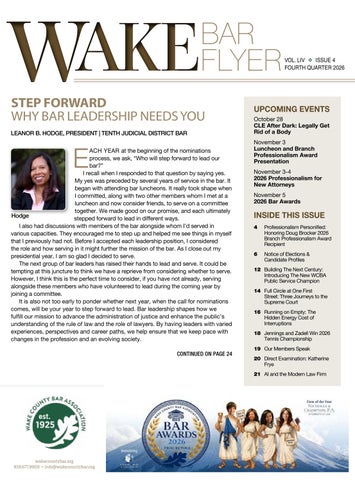
AKE W
BAR FLYER
STEP FORWARD WHY BAR LEADERSHIP NEEDS YOU
LEANOR B. HODGE, PRESIDENT | TENTH JUDICIAL DISTRICT BAR
E
ACH YEAR at the beginning of the nominations process, we ask, “Who will step forward to lead our bar?” I recall when I responded to that question by saying yes. My yes was preceded by several years of service in the bar. It began with attending bar luncheons. It really took shape when I committed, along with two other members whom I met at a luncheon and now consider friends, to serve on a committee together. We made good on our promise, and each ultimately Hodge stepped forward to lead in different ways. I also had discussions with members of the bar alongside whom I’d served in various capacities. They encouraged me to step up and helped me see things in myself that I previously had not. Before I accepted each leadership position, I considered the role and how serving in it might further the mission of the bar. As I close out my presidential year, I am so glad I decided to serve. The next group of bar leaders has raised their hands to lead and serve. It could be tempting at this juncture to think we have a reprieve from considering whether to serve. However, I think this is the perfect time to consider, if you have not already, serving alongside these members who have volunteered to lead during the coming year by joining a committee. It is also not too early to ponder whether next year, when the call for nominations comes, will be your year to step forward to lead. Bar leadership shapes how we fulfill our mission to advance the administration of justice and enhance the public’s understanding of the rule of law and the role of lawyers. By having leaders with varied experiences, perspectives and career paths, we help ensure that we keep pace with changes in the profession and an evolving society. CONTINUED ON PAGE 24
VOL. LIV v ISSUE 4 FOURTH QUARTER 2026
UPCOMING EVENTS October 28 CLE After Dark: Legally Get Rid of a Body November 3 Luncheon and Branch Professionalism Award Presentation November 3-4 2026 Professionalism for New Attorneys November 5 2026 Bar Awards
INSIDE THIS ISSUE 4
Professionalism Personified: Honoring Doug Brocker 2026 Branch Professionalism Award Recipient
6
Notice of Elections & Candidate Profiles
12 Building The Next Century: Introducing The New WCBA Public Service Champion 14 Full Circle at One First Street: Three Journeys to the Supreme Court 16 Running on Empty: The Hidden Energy Cost of Interruptions 18 Jennings and Zadell Win 2026 Tennis Championship 19 Our Members Speak 20 Direct Examination: Katherine Frye 21 AI and the Modern Law Firm
CENTENNIAL CELEBRATIONS 100 MILES FOR 100 YEARS CHALLENGE | May - September WCBA MEMBERS-ONLY OYSTER ROAST | September 25 2025 BAR AWARDS: $100K FOR 100 YEARS | October 23 wakecountybar.org 919.677.9903 • info@wakecountybar.org
CENTENNIAL GALA | December 5
VOL. LIV No. 4 | FOURTH QUARTER 2026
A NOVEL APPROACH TO BAR MEMBERSHIP
Presidents
BY WHITNEY D.G. von HAAM | EXECUTIVE DIRECTOR
WAKE BAR FLYER JOHN B. WARD, WCBA LEANOR BAILEY HODGE, TENTH J.D. BAR
Presidents-elect
MEGAN WEST SHERRON, WCBA ERIKA N. JONES, TENTH J.D. BAR
Secretary
TIFFANY COX
Treasurer
JORDAN GROSS
Board of Directors
JONATHAN M. BOGUES JUDGE KEVIN BOXBERGER MEREDITH P. BREWER TARA CHO GABE JIMENEZ JOSUE JIMENEZ JENNIFER JONES MEGHAN KNIGHT DEAN J. RICH LEONARD JACOB MORSE ASHLEY PAYNE RATLIFF ELYSIA PRENDERGAST-JONES WARREN SAVAGE LINDSAY A. UNDERWOOD MALLORY UNDERWOOD PATRICK VANDERJEUGDT
Young Lawyers Division President KATIE MCCOY
Executive Director
WHITNEY D.G. von HAAM
Communications Manager AMY DAVIS
Wake Bar Flyer Designer ANNE STRICKLAND
Tenth Judicial District Bar Councilors
JUDGE JULIE L. BELL RUSSELL BABB ANNA DAVIS JUDGE KEITH GREGORY JESSICA HEFFNER KIMBERLY A. MOORE JUDGE ASHLEIGH S. PARKER DAVID SHERLIN
I
love to read. Really, I do. As soon as I get into a book, I can’t put it down…or if it is one I’m listening to in the car, I have no problem running that extra errand or sitting in von Haam traffic. And, if I’m in the last days finishing something before book club meets, my mother will notice an immediate difference to the frequency of my phone calls: ensconced in a book, she never hears from me. Between books, dutiful daughter with multiple calls a week. But, like so many things, reading is something that has ebbed and flowed within my life over the years. I did my best when the kids were small, but the truth is that I would fall asleep as soon as I sat down with a book, no matter the time of day. There were years that the best I could do was a book a month, and I felt pretty accomplished when I hit the twelfth book just in time for Auld Lang Syne to be played. This year, I set a loftier goal, based on how into reading my older daughter was last year at Christmas: she’d received a kindle and used the Kindle Unlimited freebie as part of it. Feeling inspired by her rush of enthusiasm, I challenged myself to read 30 books – both audio and physical books. For comparison, my daughter set a goal of 75 books.
I knew my goal needed reconsidering when I hit 30 before the end of June. Riding a wave of excitement for the books I had lined up and enjoying the ones I’d heard everyone else talking about, I increased my goal to 60 books. Now, if you know me at all, I am very goal oriented. I am still on pace to hit my goal for the year, and perhaps have a couple extra. And, here is what I’ve found throughout the year: I’m constantly amazed that as many as I read, there are at least that many that friends, famous people, critics, TikTok’ers, etc. have waxed poetic about that I still can’t wait to read. In fact, the more I read, the more excited I am about what’s ahead. You might be asking yourself, but what on earth does this have to do with the Bar Association, Whitney? WCBA membership might be like my book reading – there are years when you just can’t get enough of all we have to offer, and other years where life keeps “life-ing”, and perhaps coming to 1-2 events that year was all you could muster. I encourage you to remember that we will be here, offering your favorite events and fresh new ideas, and we hope that you dive back in when you can. We’re here for how much or how little you have the ability to give. However, I also have no doubt that the more you do with your local bar, the more you will want to do! See you at our upcoming events, and be sure to tell me what great book you’ve been reading. WBF
Opinions expressed in Bar Flyer articles are those of members as individuals and does not necessarily represent the views or policies of the Wake County Bar Association. © 2026 Wake County Bar Association & Tenth Judicial District Bar
WAKE BAR FLYER v FOURTH QUARTER 2026
PAGE 2
“Our banker said, ‘we’ll make it work,’ and six weeks later our business closed on the property.” David Sherlin Epstein Sherlin Law
When it comes to your business, dream it, plan it, share it.
We’ll make it work.
GARNER | DOWNTOWN RALEIGH | NORTH HILLS | NORTH RALEIGH | WAKE FOREST | WEST RALEIGH | WILMINGTON
PROFESSIONALISM PERSONIFIED HONORING DOUG BROCKER 2026 BRANCH PROFESSIONALISM AWARD RECIPIENT
DEANNA BROCKER | THE BROCKER LAW FIRM PA
W
HEN I WAS ASKED to write this article about Doug At the same time, Doug uses his experience from the Brocker — my life partner and my law partner — I regulatory side to represent professionals in disciplinary initially thought it would be easy. After all, I probably investigations and proceedings before their respective licensing know him better than anyone. But as I began to think about boards and administrative agencies. He served for more than what makes Doug deserving of the Chief Justice Joseph Branch six years as trial and UPL counsel for the North Carolina State Professionalism Award, I realized that my Bar, where he investigated and perspective alone could never tell the full prosecuted disciplinary violations, story. I am, after all, fairly biased. the unauthorized practice of law Because this award recognizes the and related matters. impact a lawyer has on the profession That range of experience has and the practice of law, I decided that shaped Doug as a lawyer. But I needed to hear from those who know perhaps more importantly, it has Doug in different professional capacities: shaped the way he approaches past and present coworkers, colleagues, the profession and the people opposing counsel and longtime clients. within it. What I heard was one of the most rewarding parts of writing this article. Mentoring by Example Their stories and expressions of gratitude Doug’s commitment to each reflected a different way Doug mentoring is both formal and has touched their lives. They were both informal. When Doug and Ed humbling and, at times, a wonderful Gaskins were respectively surprise. co-presidents of the Tenth Listening to these reflections, three Judicial District Bar and Wake qualities emerged again and again: County Bar Association, Ed, a Doug’s commitment to mentoring others, previous recipient of the Branch his dedication to elevating and serving Professionalism Award, had a the legal profession and his unwavering vision for a mentorship program Doug Brocker, 2026 Joseph Branch Award Recipient belief that every person encountered in at Campbell Law School. Doug the legal process should be treated with helped Ed, along with then-Dean civility, dignity and respect, regardless of the circumstances. Melissa Essary, turn that vision into reality. The program remains strong today, and Doug continues to serve as a mentor. A Career Built on Experience and Service But mentoring is not limited to a formal mentor-mentee A bit of background is helpful. Doug Brocker has practiced relationship. Often, it happens quietly, simply by watching law for more than three decades and has gained experience someone who consistently demonstrates what it means to be a before numerous professional licensing boards, state and federal good lawyer and a good colleague. trial and appellate courts and other administrative agencies. His One staff member of a regulatory board described her first professional experience is unusually broad. He has worked in experience with Doug this way: “I had never participated in a state and federal government and in private practice with large, deposition, or any legal proceeding. I was as green as green medium-sized and small law firms in both North Carolina and can be, but Doug never treated me that way. He explained the Illinois. Those varied experiences have given him a breadth process and, although I’m sure his stress level was off the charts, of perspective that he draws upon when representing both he took the time to mentor me.” institutions and individual professionals. A lawyer who has worked alongside Doug described a similar For many years, Doug has served as outside counsel to lesson learned simply by observing him: “I’ve learned so much the North Carolina Board of Dental Examiners. In that role, by watching how Doug treats opposing counsel. The profound he represents the board in disciplinary investigations and respect, courtesy and transparency he demonstrates toward proceedings, judicial reviews, management arrangements, other attorneys elevates the entire proceeding and encourages litigation, appeals and rulemaking, among other matters. He advocacy in its highest, perhaps purest, form, unadulterated by has also been retained by other licensing agencies to handle hardball or dilatory tactics. Remarkably, Doug brings out the best disciplinary matters. in everyone, including his opponents.” CONTINUED ON PAGE 5
WAKE BAR FLYER v FOURTH QUARTER 2026
PAGE 4
Joseph Branch Award Winner Doug Brocker | CONTINUED FROM PAGE 4 Our other law partner noted, “[Doug] has been an incredible mentor, striking the perfect balance between exceptional advocacy and unwavering ethics.” Another colleague put it more simply: “When you work with Doug, he cannot help but make you a better lawyer.” And, as one agency staff member observed, Doug has been “a leader, a mentor, a listening ear.” Those comments capture something important about Doug’s approach to mentoring. He does not seem to view it as a separate responsibility that must be scheduled or assigned. Rather, it is woven into the way he practices law every day. Elevating and Serving the Profession Doug’s commitment to the legal profession extends well beyond his own practice. For more than 30 years, he has been an active member of the Wake County Bar Association’s Professionalism Committee, including serving as its chair. During his tenure, he helped implement the Campbell Connections Mentorship Program, which ultimately earned the committee an ABA Gambrell Professionalism Award in 2015. As chair, Doug also spearheaded the 25th anniversary of the Wake County Bar Association’s Professionalism Creed and helped establish a subcommittee structure that expanded the committee’s work in several areas. Those efforts included publications such as Flyer articles, blog posts and newsletter contributions; educational programs, including the Annual Professionalism Roundtable luncheon and Ethics Review; the Professional Support Initiative, which provides confidential peer counseling and intervention for lawyers and judges; mentorship opportunities for Campbell students and Wake County Bar members; and the Spotlight Award, created to recognize acts of professionalism among members of the Wake County and Tenth Judicial District bars. Doug has also served on the Wake County Bar Association’s Branch Professionalism Award Committee since 1998. He served as president of the Tenth Judicial District Bar in 2009 and on its board of directors in 2004 and 2005. He has twice received the President’s Award of Excellence, in 2004 and 2013, and has served as chair of the Bylaws Committee and as a member of the Nominations Committee for many years. Yet even this list of service does not fully capture Doug’s commitment to sharing knowledge. Hardly a year has gone by in his more than 33 years as a lawyer without Doug teaching a CLE, presenting a program or teaching a class to lawyers, newly admitted lawyers, law students or other professionals. During his time with the State Bar, he traveled throughout the state educating local district bars about the work of the North Carolina State Bar. He has presented a CLE program to new admittees for either the North Carolina Bar Association or the Wake County Bar Association nearly every year since the program’s inception. He also has published numerous articles on professional ethics and discipline and has lectured at legal education programs for local, state and national organizations. For Doug, service to the profession is not simply about holding a position or accumulating years of committee work. It is about making the legal profession better for lawyers and for those who depend upon them.
Respect for All Perhaps the quality that most consistently emerged from my conversations with Doug’s colleagues, clients and even opposing counsel was his fundamental respect for others. Doug believes that everyone involved in the legal process should be treated with dignity and respect. That begins with something deceptively simple: listening. Really listening. People often hire lawyers because they are too close to a situation themselves. Emotions run high, tempers flare and harmful, knee-jerk reactions often result. As effective advocates, lawyers must be able to set aside their own personal feelings and focus on what is in the client’s best interests. Doug has always understood that distinction. I recently watched a CBS Sunday Morning segment about holding grudges when we believe we have been wronged or disrespected and about the way righteous indignation seems increasingly in vogue in a world of social media and online outrage. I realized as I watched it that I have never known Doug to hold a grudge. More importantly, I have come to believe that forgiveness may be his superpower. Perhaps he learned it growing up as a preacher’s kid. Perhaps it is simply innate. I cannot say that forgiveness comes easily to me, but I have learned from Doug, and I am still learning. If someone, whether an opposing party, opposing counsel or even a client, uses angry or disrespectful words or an unnecessarily harsh tone, Doug is remarkably able to let it go. He often reminds me that we never know what is happening in another person’s life or what struggles they may be carrying. He gives the same advice to others in our firm: Take a step back before responding to hurtful words. Take 24 hours. Sleep on it. Then, think carefully and craft a professional response. That approach does not mean Doug is passive or unwilling to advocate zealously for his clients. Quite the opposite. He simply understands that professionalism and strong advocacy are not mutually exclusive. One member of a regulatory board staff shared an observation that made me smile: “One of my favorite qualities—or perhaps more of an observation—is when Doug gets frustrated, his ears turn bright red. That’s when you know….” But, as she went on to explain, Doug never lets that frustration take over. He manages to keep his cool even in challenging circumstances. Opposing counsel offered perhaps the clearest description of that balance: “Despite the fact that he and I represent adversaries, Doug demonstrates the qualities that all lawyers should strive for. He is collegial, respectful, and cordial, while still representing his client zealously and meticulously.” Sometimes, however, what a person needs from a lawyer is not advocacy in the traditional sense but simply a caring and nonjudgmental response. We never truly know what another person is experiencing until we have walked in their shoes. One longtime client described the impact Doug has had in precisely those terms: “There have been many times that just talking with Doug has lifted my spirits and allowed me to go forth with a renewed feeling of optimism. He listens without judgment… [and] provides a caring and concerned discussion.” CONTINUED ON PAGE 25
WAKE BAR FLYER v FOURTH QUARTER 2026
PAGE 5
ELECTIONS NOTICE OF ELECTION
T
HE NOMINATIONS COMMITTEE reviewed all submitted applications and member recommendation forms and selected candidates for available positions. There will be an electronic vote to affirm the slate at the December Annual Meeting and Luncheon. The officers of the Tenth Judicial District Bar and Wake County Bar Association hereby give notice pursuant to Article XII of the By-Laws of the North Carolina State Bar:
That the annual election of Officers will be held on Tuesday, December 8, 2026 at the Sheraton Raleigh Hotel (421 S. Salisbury Street, Raleigh) at 12:15 p.m. Lunch will be served and the cost of lunch will be borne by the Tenth Judicial District Bar at no additional cost to members. The election is for the purpose of choosing officers for both the Tenth Judicial District Bar and the Wake County Bar Association, and directors. 1. The following officers will be elected: President-elect, Treasurer, Secretary President-Elect, Tenth (Elect One)
President-Elect, WCBA (Elect One)
Treasurer (Elect One)
Secretary (Elect One)
Sam Hamadani
Lindsay A. Underwood
Jordan H. Gross
Jennifer M. Jones
2. The following directors have been selected by the Nominations Committee and will be affirmed by voice vote for a three-year term: Carly G. Baker Mariana Godwin
Marquita Pittman Daniel J. Root
Taylor Scruggs-Smith
Please see biographical information on the following pages for more information. WBF
WAKE BAR FLYER v FOURTH QUARTER 2026
PAGE 6
ELECTIONS PRESIDENT, TENTH JUDICIAL DISTRICT BAR VOTE FOR ONE
PRESIDENT, WAKE COUNTY BAR ASSOCIATION VOTE FOR ONE
Sam Hamadani
Lindsay A. Underwood
Wake County District Court Judge University of North Carolina School of Law, 2011
Skidmore Law Group, PLLC Wake Forest University School of Law, 2014
What’s one thing you think every young lawyer should know? In the practice of law, Hamadani consistent respect for everyone you encounter will serve you well throughout your career. If you weren’t a lawyer, what would you be doing? I would be a medical examiner.
What’s one thing you think every young lawyer should know? It’s crucial to have a solid group of friends who are also in the legal profession. Joining Underwood professional organizations, networking with attorneys in different practice areas, attending socials and meeting up with friends outside of work will keep you grounded. If you weren’t a lawyer, what would you be doing? Ideally doing something involving travel.
What’s something you’re surprisingly good at? Compartmentalizing and staying composed in highconflict situations
What’s something you’re surprisingly good at? Video games.
If you could have dinner with any two people—living or dead—who would they be? My grandfathers. I really miss them.
If you could have dinner with any two people—living or dead—who would they be? Robin Williams and Paul McCartney
What’s the strangest thing in your desk right now? A metal device for my key chain made to press elevator buttons during Covid.
What’s the strangest thing in your desk right now? I have one of those liquid glitter wands that was gifted to me by my mentor when he retired. It’s strangely soothing.
SECRETARY | VOTE FOR ONE Jennifer M. Jones Wake County Attorney’s Office Campbell Law, 2002 What’s one thing you think every young lawyer should know? Every young lawyer should know that it’s okay to take time for yourself, and your family and friends. Work isn’t going anywhere. Find something you enjoy that is not work-related and is a source of relaxation for you! Jones
If you weren’t a lawyer, what would you be doing? Before deciding in fourth grade that I wanted to be a lawyer, I wanted to be an actress or a flight attendant! But if I weren’t practicing law today, I think I would have become a high school history and civics teacher.
CONTINUED ON PAGE 8
WAKE BAR FLYER v FOURTH QUARTER 2026
PAGE 7
ELECTIONS SECRETARY, CONTINUED What’s something you’re surprisingly good at? Cooking. Not baking, but cooking. Taking 4-5 recipes and combining them into my own creation, something I learned from my dad! I’m also surprisingly good at taking random leftovers and whatever is in the pantry or freezer and making a great meal out of them. If you could have dinner with any two people—living or dead—who would they be? Michelle Obama and Ruth Bader Ginsburg. What’s the strangest thing in your desk right now? An RBG Christmas ornament that stays on my desk year-round! It’s a tribute to my favorite justice and a personal reminder of meeting her in 2016 just after my swearing-in at the Supreme Court (with the WCBA, of course!)
TREASURER | VOTE FOR ONE Jordan H. Gross Stauff & Gross, PLLC Florida Coastal School of Law, 2009 What’s one thing you think every young lawyer should know? It is very important how you treat others in your cases. This includes your client, opposing party, opposing counsel, clerks, case coordinators, etc. Showing kindness and respect to others invites them to show it in return. Just because being an attorney it is an adversarial role, that does not mean that everyone involved should not be treated with kindness and respect. If you weren’t a lawyer, what would you be doing? I would own a bakery. Gross
What’s something you’re surprisingly good at? Baking If you could have dinner with any two people—living or dead—who would they be? Dean Smith and Julia Child.
What’s the strangest thing in your desk right now? An inappropriate word a day calendar that was a gift.
SLATE FOR DIRECTORS | VOICE VOTE FOR ENTIRE SLATE Carly G. Baker Wake Family Law Group UNC School of Law, 2017 What’s one thing you think every young lawyer should know? Making connections and having friends in the industry are the best ways to make this job easier. If you weren’t a lawyer, what would you be doing? Sportscaster What’s something you’re surprisingly good at? Swimming
Baker
If you could have dinner with any two people—living or dead—who would they be? Simultaneously: Taylor Swift and Erin Andrews. Two separate dinners: Taylor Swift and Mary Magdalene What’s the strangest thing in your desk right now? Peanut butter dog treats. CONTINUED ON PAGE 9
WAKE BAR FLYER v FOURTH QUARTER 2026
PAGE 8
ELECTIONS DIRECTORS, CONTINUED
Godwin
Mariana Godwin
the other. At this point, it’s just decor or evidence of my latent procrastination.
Barefoot Family Law Campbell Law, 2008
Daniel J. Root
What’s one thing you think every young lawyer should know? Treat people respectfully and never sacrifice your integrity for a client or a result. And bonus answer but equally important – find a good mentor and check in with them regularly.
What’s one thing you think every young lawyer should know? Your name is your most valuable possession. Good reputation takes a lifetime to make and a minute to destroy.
Loebsack & Brownlee, PLLC UNC School of Law, 2020
If you weren’t a lawyer, what would you be doing? I would love to be a meteorologist or storm chaser. I love all things weather.
If you weren’t a lawyer, what would you be doing? Professor
What’s something you’re surprisingly good at? Decorating cakes
What’s something you’re surprisingly good at? Knowing obscure facts.
If you could have dinner with any two people—living or dead—who would they be? My grandmother and Taylor Swift.
If you could have dinner with any two people—living or dead—who would they be? G. K. Chesterton and Theodore Roosevelt
What’s the strangest thing in your desk right now? My cases bring mostly chaos. I need my desk to be calm and clean.
What’s the strangest thing in your desk right now? Disparaging (yet humorous) blog posts from a pro se opponent.
Marquita Pittman Legal Aid of North Carolina Cooley Law School, 2011 What’s one thing you thi every young lawyer should know? Being a lawyer is more than just knowing the law. It’s about using that knowledge and skills to make an impact on people’s lives and your community. Pittman But, that’s my view. What you should know is that you don’t have to be the same type of lawyer that anyone else is; you can be your own kind of lawyer. You can make this profession what you want it to be. If you weren’t a lawyer, what would you be doing? I would likely own a coffee shop. Free coffee!! What’s something you’re surprisingly good at? Cooking and the stock market. If you could have dinner with any two people—living or dead—who would they be? MLK and Malcolm X What’s the strangest thing in your desk right now? I have a broken desk lamp on my desk. It’s been there for a while, and I just keep moving it from one part of my desk to WAKE BAR FLYER v FOURTH QUARTER 2026
Root
Taylor Scruggs-Smith Batch, Poore & Williams PC Campbell Law, 2018 What’s one thing you think every young lawyer should know? The law can be a draining profession; start setting your boundaries early so you don’t burn out. This means taking your PTO, having regular family nights and date nights, walks in the park, and more. We can’t be great for our clients if we are running on empty.
Scruggs-Smith
If you weren’t a lawyer, what would you be doing? I would be a therapist or an author. What’s something you’re surprisingly good at? Public Speaking. If you could have dinner with any two people—living or dead—who would they be? Michelle Obama and Michael Jackson. What’s the strangest thing in your desk right now? Tailor’s business card.
PAGE 9
WAKE BAR FLYER v FOURTH QUARTER 2026
PAGE 10
WAKE BAR FLYER v FOURTH QUARTER 2026
PAGE 11
BUILDING THE NEXT CENTURY: INTRODUCING THE NEW WCBA PUBLIC SERVICE CHAMPION CHRIS PEREIRA | WCBA PUBLIC SERVICE COMMITTEE
R
eflecting on our centennial celebration last year, it is hard not to feel an overwhelming sense of pride in what our legal community accomplished. Marking 100 years of the Wake County Bar Association was a monumental milestone filled with energy, camaraderie and an inspiring outpouring of service across our community. From historic service projects to recordPereira setting attendance at volunteer days, we showed what happens when attorneys unite for the greater good. Yet, as the centennial year drew to a close, a quiet question lingered in the back of my mind: What happens next? After a landmark celebration, it is easy for a natural “hangover effect” to set in — a temporary lull in volunteerism once the celebrations and high-profile commemorative events conclude. But the needs in our community do not pause after an anniversary year, and neither can our commitment to service. As Wake County continues to grow, so does the need for community service. Fortunately, our growing bar association has an even greater capacity to make a difference. Giving back is one of the highest callings of our profession. When lawyers invest their time, talent and energy into the community, we strengthen our neighborhoods, uplift our neighbors and elevate public trust in the legal system. To maintain that momentum and shine a well-deserved spotlight on the extraordinary generosity within our ranks, the Public Service Committee is thrilled to announce the creation of a new annual honor: the Public Service Champion. Celebrating Exceptional Service Across Our Community The Public Service Champion was created with a clear mission: to recognize one individual each year who has gone above and beyond in their dedication to public service and community volunteerism. We believe that giving back takes many forms. While pro bono legal representation remains an essential cornerstone of our professional duty, this award embraces the full spectrum of community service. It honors nonlegal volunteerism, hands-on civic engagement and, in particular, active participation in community volunteer events sponsored throughout the year by the WCBA. Whether it’s packing meals at the food bank, mentoring local students, rolling up your sleeves for a community
WAKE BAR FLYER v FOURTH QUARTER 2026
cleanup or leading pro bono clinics, this award celebrates those who show up consistently and wholeheartedly for Wake County. Criteria and Selection When evaluating nominees, the selection subcommittee will prioritize: • Sustained long-term commitment: A continuous history of service and dedication to the local community. • Exceptional single-year impact: Outstanding effort, energy and measurable contributions during the past year. • Innovative public service initiatives: Creative problemsolving, launching new community service projects or finding fresh ways to engage others in volunteerism. All active members of the Wake County Bar Association are eligible for nomination for this inaugural award. In subsequent years, previous recipients will not be eligible. How to Submit a Nomination Behind every great community initiative is a colleague quietly putting in the extra hours. We need your help to ensure their efforts are recognized! Submitting a nomination is quick and straightforward: 1. Access the form: WCBA staff will distribute a dedicated Google Form link via email and on the bar association’s website. 2. Tell their story: Provide the nominee’s name and a narrative explaining why they deserve to be named our inaugural Public Service Champion. Tell us about their dedication, the projects they have supported and the impact they have had on our community. 3. Deadline: All nominations must be received by November 15, 2026. Following the deadline, a subcommittee of the Public Service Committee will review all submissions and select the recipient. Mark Your Calendars: December 8 We cannot wait to celebrate our inaugural recipient together. The Public Service Champion will be recognized during the Tenth Judicial District Bar and WCBA Annual Meeting on Tuesday, December 8. Our centennial proved that our bar has a boundless capacity for good. Let’s make sure the next 100 years start with that same vibrant spirit. Take a few minutes today to think of a colleague who inspires you through their service, submit a nomination and help us celebrate the very best of our profession. See you December 8! WBF
PAGE 12
WAKE BAR FLYER v FOURTH QUARTER 2026
PAGE 13
FULL CIRCLE AT ONE STREET: THREE JOURNEYS TO THE SUPREME COURT JENNIFER JONES | WAKE COUNTY ATTORNEYS OFFICE
S
TANDING ON THE STEPS of the Supreme Court of the United States, looking up at the grand marble columns inscribed with “Equal Justice Under Law,” is an experience that never loses its gravitas. For members of the Wake County Bar Association, our group admission trips to the Supreme Court are among our most cherished traditions. Having had the privilege of making this Jones journey three times — first as an admittee, then as chair of the Swearing-In Committee and finally as the sponsoring movant — I’ve watched this trip transform from a personal career milestone into a profound lesson in service and professional community. Finding My Niche at Home First My path to One First Street began years earlier, right here in Wake County. After nine years of practicing law, I joined the Wake County Attorney’s Office and decided it was time to become more intentionally involved in the Wake County Bar Association. I was initially assigned to the Public Service Committee, but it was such a large, busy group that I struggled to determine how to get actively involved. Seeking direction, I reached out to a trusted colleague. We had both previously chaired, years earlier, the North Carolina Bar Association’s Young Lawyers Division Law Day Committee, a multifaceted committee that organized various school competitions culminating in a Law Day celebration at the North Carolina Supreme Court and a ceremony honoring award recipients. When I asked where she thought I might fit best, she recommended the Swearing-In Committee without hesitation. Taking her advice, I joined the committee and started small, simply handing out programs at our twice-yearly open sessions
of Superior Court, held at that time at Memorial Auditorium. I was too afraid to sponsor a new admittee! Over time, I became more involved in the committee, began sponsoring new admittees and rarely missed a swearing-in ceremony. By the time the WCBA organized its 2016 trip to Washington, D.C., I knew I wanted to go and was eager to experience the Supreme Court ceremony for myself. May 2, 2016: The Admittee My first trip to the Supreme Court began at 7:55 a.m. on a quiet Monday morning. Standing at the base of the Supreme Court steps before the public arrived, I was able to have my picture taken to commemorate the moment. Our group went through security and enjoyed a lovely breakfast in the East Room. Then we were led into the Supreme Court. Taking the oath inside the historic courtroom before the justices was unforgettable, but the defining moment came after the formal proceedings concluded. Justice Ruth Bader Ginsburg took the time to meet personally with our Wake County delegation. Justice Antonin Scalia had died just over two months earlier, and she spoke candidly to our group about their legendary friendship and how deeply she missed him. Hearing her reflect on collegiality across their ideological differences and taking photos with her created memories I will never forget. Leading Through Lockdowns and Postponements When I stepped up to chair the Swearing-In Committee, none of us could have anticipated the pandemic. For two years, everything was shut down, forcing our twice-yearly traditions to adapt. I ended up chairing four consecutive local swearing-in ceremonies conducted entirely remotely instead of in person at the Wake County Justice Center. COVID-19 also upended our national plans. We had Supreme Court trip dates set for both 2021 and 2022, only to watch them get repeatedly canceled and delayed as the court remained CONTINUED ON PAGE 25
WAKE BAR FLYER v FOURTH QUARTER 2026
PAGE 14
FREE LEGAL RESEARCH FOR WCBA MEMBERS With Decisis®, you can: Access state and federal case law from all 50 states Access exclusive North Carolina resources, including: - Civil & Criminal Jury Instructions - Industrial Commission Decisions
Quickly search case law and statutes by keyword, jurisdiction, or court name Verify case authority with InterCite™, Decisis’ trusted citator off eo ue V allu Va 0 40 74 $ $11,,7
Log in through your WCBA account to start researching today.
WAKE BAR FLYER v FOURTH QUARTER 2026
PAGE 15
RUNNING ON EMPTY: THE HIDDEN ENERGY COST OF INTERRUPTIONS WILL GRAEBE | LAWYERS MUTUAL OF NC
This article was originally featured on the Lawyers Mutual Byte of Prevention Blog in July.
W
HEN WE TALK ABOUT lawyer burnout and exhaustion, we often focus on the obvious culprits like long hours, demanding clients, looming deadlines, difficult cases and the emotional weight of the profession. Those factors certainly contribute to fatigue. But there is another source of exhaustion that often goes unnoticed because it has become such a normal part of modern legal practice. It is the constant interruption of our attention. Many lawyers begin the day with a clear plan. There is a motion to draft, a contract to review, an estate plan to prepare or a difficult legal issue that requires focused attention and careful analysis. Then reality arrives. An email notification appears. A client calls. A colleague stops by with a question. A text message buzzes. A calendar reminder pops up. Before long, the lawyer who intended to spend the morning focused on one or two tasks has spent it bouncing between ten different ones. Research suggests that knowledge workers are interrupted approximately every three minutes. Other studies have found that after an interruption, it can take more than twenty minutes to fully regain focus. Whether the exact numbers vary from study to study is almost beside the point. Most lawyers experience this reality every day. The interruption itself is not usually the problem. The problem is the mental effort required to recover from it. Lawyers often think of interruptions as costing time, but they also cost energy. Every time we are pulled away from a task, our brain must effectively shut down one line of thinking and start another. When we return, we do not simply pick up where we left off. We must remember what we were doing, reconstruct our train of thought, and rebuild the mental momentum that was lost. All that takes energy. That process may occur dozens of times throughout the day. Each interruption may seem insignificant in isolation, but the cumulative effect can be substantial. A lawyer may reach the end of the day feeling surprisingly drained despite never encountering a major crisis. The exhaustion comes not from one difficult event but from repeatedly rebuilding focus after interruptions. In other words, many lawyers finish the day with a partially depleted mental battery before they ever begin the process of recharging. This helps explain why so many lawyers struggle to recharge. When we talk about solutions for burnout and exhaustion, we tend to focus primarily on what we can do to recharge. We talk about vacations, hobbies, exercise, sleep and leisure
activities. All those things matter. But if we focus only on recharging and ignore what is creating the energy deficit in the first place, we will always be fighting an uphill battle. It is a little like trying to fill a bathtub while the drain remains open. You can keep pouring Graebe water into the tub, but part of your effort is being lost continuously. Frequent interruptions create a similar problem. We try to recharge in the evenings and on weekends, yet throughout the workday our mental energy steadily drains away through constant task switching and fragmented attention. The answer is not simply to increase the flow of water. We must also slow the leak. Creating periods of uninterrupted work, limiting unnecessary notifications and protecting time for deep concentration help preserve the mental energy we already have. Recharging becomes much easier when we stop losing so much energy in the first place. The goal is not to eliminate interruptions entirely. That would be impossible in a profession built on serving clients and solving problems. But recognizing the hidden cost of interruptions can help us become more intentional about protecting our attention. In a profession where mental energy is one of our most valuable assets, learning to preserve that energy may be just as important as learning how to restore it. WBF
WAKE BAR FLYER v FOURTH QUARTER 2026
PAGE 16
WAKE BAR FLYER v FOURTH QUARTER 2026
PAGE 17
JENNINGS AND ZADELL WIN 2026 TENNIS CHAMPIONSHIP WILLIAM PLYLER | MILLER MONROE HOLTON & PLYLER
V
ANCE JENNINGS AND KYLER ZADELL won the Wake County Bar Association Championship Division doubles title October 2 at Carolina Country Club. Jennings and Zadell defeated Webster Harrison and Wyatt Schline in the final. In the semifinals, Jennings and Zadell defeated Bryan Brice and James Longest, while Harrison and Schline defeated Hart Miles and William Plyler. Duane Hall won the Open Division, with Sharon Horne finishing as runner-up. With perfect weather, great food and drinks, and plenty of friendly competition, a good time was had by all! WBF Plyler
Left, Sharon Horne, Runner-Up of the Open Division. Center, Vance Jennings and Kyler Zadell, Winners of the Championship Division. Right, Wyatt Schline and Webster Harrison, Runners-Up of the Championship Division
WAKE BAR FLYER v FOURTH QUARTER 2026
PAGE 18
OUR MEMBERS SPEAK: WHAT IS YOUR FAVORITE BOOK YOU READ IN SCHOOL, AND WHY? Attorneys are often notoriously busy and goal-driven individuals, both within and outside the practice of law. We asked our members, “What was your favorite book you read in school? From elementary school through law school, which one was your favorite and why?”
“In high school, Catcher in the Rye. It was well written. In law school, Conway on Contracts. It got me two A’s.”
“The Circuit by Francisco Jimenez. I read it for the first time when I was in eighth grade after moving from Los Angeles to Charlotte. Outside of our shared last name, I related to a lot of the experiences the author described in his book. It also gave me an even stronger appreciation for all of the workers that provide us with essential supplies we need to live but often take for granted.”
Root Edmonson Retired
Josue Jimenez Duke University School of Law
“The Hunger Games. I initially read it in high school, and I reread it a year ago. It still stands out as my favorite book because during my reread I gained a deeper appreciation for the layers of the story that I did not fully understand at 16. The book is suspenseful, exciting and a reminder that anyone— even a young girl from District 12—can spark a movement towards positive change and justice.”
Gracie Gean Wake Family Law Group
“The Bluest Eye by Toni Morrison was a favorite. As a young Black girl who struggled with self-esteem and feeling beautiful in a world that celebrated Eurocentric beauty standards, I could relate to so much of what Pecola experienced. The Bluest Eye really made me reflect on how society shapes the way we see ourselves and how important it is to recognize our own beauty and worth.”
Judge Ashleigh Parker Wake County District Court
“As a teenager, when I would get in trouble (which wasn’t very often!), my parents would ground me from reading books because that was the most painful punishment they could think of for me. I know ... I’m a book nerd! I have so many favorite books, and it has been such a joy to share my love of reading with my own daughter. In elementary school, Number the Stars by Lois Lowry had a particular impact on my understanding of discrimination and the incredibly brave efforts of those involved in the resistance during World War II. Johnny Tremain by Esther Forbes is a wonderful historical fiction novel about a teenage silversmith’s apprentice whose hand is injured in an accident, leading him to work as a horse boy during the Revolutionary War, distributing newspapers and serving as a messenger for the Sons of Liberty. Lastly, the Harry Potter series was a wonderful distraction during law school, providing me with a much-needed break from all the not-so-fun required reading.”
Lindsey Granados Granados Law
WAKE BAR FLYER v FOURTH QUARTER 2026
PAGE 19
DIRECT EXAMINATION: KATHERINE FRYE
D
IRECT EXAMINATION is the first opportunity for the jury to meet a witness. An effective lawyer will use the opportunity to personalize the witness, making the witness appear both likeable and credible. At the end of the day, the direct examination is a party’s best chance to tell his or her story. This is the story of Katherine Frye of Oak City Family Law and the outgoing State Bar President. When you were in elementary school, what did you want to be when you grew up? I honestly don’t remember having one particular thing I wanted to be. I certainly didn’t want to be a lawyer because I picked up that interest in high school. Both of my parents were teachers, though, so I played school a lot. My pets were my students. They were great listeners…. although not particularly active participants. What was the most important lesson your parents taught you? My parents always said, “Do it right the first time.” I probably think about that lesson almost every day. Life is hectic, and I have a tendency to want to rush from one thing to the next just to get everything done. I have to remind myself to slow down, pay attention and do it right the first time. Who was your favorite teacher and why? I had a lot of great teachers, but one of the most memorable was my sixth-grade teacher, Mrs. Johnson. She was probably the only person who ever managed to get me excited about science. She was also a singer and would occasionally just break out into song in the middle of class. She had an amazing voice. I don’t remember nearly enough of the science she taught me, but I definitely remember her. Did you love or hate law school? I wouldn’t say I loved law school. I loved becoming a lawyer. Those are two different things. What was your most embarrassing courtroom experience? One day I managed to go the entire day wearing one navy-blue shoe and one black shoe. I apparently got
dressed in the dark and never noticed. Once I finally realized it, I was convinced that everyone I had interacted with all day had noticed and was quietly questioning whether I was actually competent to practice law. What was your best courtroom experience? Professionally, being elected President of the North Carolina State Bar is pretty hard to beat.
and recommend are Sammy’s Hill by Kristin Gore and Eats, Shoots & Leaves by Lynne Truss. Sammy’s Hill is funny and smart, and Eats, Shoots & Leaves is an entire book about punctuation, which probably tells you more about my personality than I intended to reveal.
Why did you become a lawyer? I always liked solving problems. I like taking something complicated, figuring out what actually matters, and then finding a way through it. I realized in high school that being a lawyer might allow me to do that for a living. Family law ended up being a particularly good fit because people come to us when their lives can feel completely out of control. My job is to take all of that information and emotion, help them identify what actually matters, and figure out how we get from where they are to somewhere better.
What is your most marked characteristic? Self-reliance. I’ve always been someone who assumes that if something needs to get done, I need to figure out how to do it. I started my own law practice right out of law school, and when you do that, there really isn’t anyone else to solve the problems for you. You learn to make decisions, trust your judgment, and keep moving forward even when you don’t have all the answers. That has served me well throughout my career, both practicing law and in leadership roles.
What has been the most surprising or unexpected development in your career? Without question, becoming President of the State Bar. I opened my own law practice in an unknown city where I knew very few people. I built it from the ground floor and just tried to do a good job every day. I said yes to opportunities, worked hard, met some really great people along the way, and one opportunity led to another.
What is your hidden talent? I don’t know that I have a hidden talent, or if I do, I’ve managed to keep it hidden from myself, too.
What is your favorite book? I’m dedicated to returning to my book club once my State Bar work wraps up, so unfortunately, I don’t have anything particularly current to recommend. Two books I’ve really enjoyed
WAKE BAR FLYER v FOURTH QUARTER 2026
What is your proudest accomplishment as State Bar President this past year? I’m proudest of focusing on humanizing the State Bar. The regulatory work is not going to change, but lawyers should also understand that the people at the State Bar want them to succeed. We want lawyers to practice ethically, we want them to be well and, when they’re struggling, we want them to ask for help before a problem becomes a crisis. WBF
PAGE 20
AI AND THE MODERN LAW PRACTICE CAMILLE STELL | LAWYERS MUTUAL
A
RTIFICIAL INTELLIGENCE HAS moved from something lawyers were curious about, or even skeptical of, to something many use a large support these practitioners carry the entire weight of running a lawof lawyers, the riskoften can be especially acute. Without the buffer everysystem, day. -firm
practice — legal work, client service, administration, billing, marketing and more. by Microsoft Copilot, with lawyers also Just a couple of years ago, the questions I reporting use of Gemini, Claude, Clio, Lexis+ heard most often from lawyers were: Should AI and other products. lawyers even be using AI? Can I ethically This wasn’t a scientific survey. We were use ChatGPT? polling lawyers who had voluntarily registered Those aren’t the questions I’m hearing for an AI webinar, so they were probably nearly as often today. more interested in, and perhaps more likely Instead, lawyers are asking: What to use, AI than our insured population as information can I safely put into an AI tool? a whole. Still, the results were remarkably Does the vendor use my information to train consistent with national findings. its model? How do I verify AI-generated Interest in learning about AI from our research? Should my firm have an AI policy? insureds has been extraordinary. Our AI What should I tell my clients? And if AI allows webinars this year have averaged 300 me to complete in 20 minutes something that registrants. Our previous average webinar once took two hours, how should I bill for it? attendance was around 40. Of the 50 live Those are much better questions. They CLE programs we’ve offered in 2026, 17 also tell us something important about have addressed AI in some fashion. where we are with AI in the legal profession: Lawyers are paying attention. The conversation has moved from whether lawyers will use AI to how they will use it The Bigger Concern: Adoption responsibly. Is Outpacing Governance Lawyers are adopting AI faster than AI Use Is Becoming Mainstream many law firms are developing policies and Clio’s 2025 Legal Trends Report shows procedures around its use. that 71% of solo practitioners and 75% of In our poll, many lawyers said their firms small firms are using AI to perform legal work. either had no formal AI policy or relied on Smaller firms tend to be more selective in how informal guidance. Very few had changed they use it, often relying on general-purpose their billing policies because of AI, and only a tools such as ChatGPT and AI-enabled legal minority reported advising clients about the research products rather than implementing risks of entering confidential case information AI throughout the entire firm. into an AI platform. National research shows a That makes sense. In a solo or small similar gap. firm, a lawyer may wear the hats of lawyer, I think of this as the adoption-versusresearcher, marketer, business developer, governance gap. office manager and sometimes IT department A lawyer downloads an AI app, creates — all before lunch. AI has the potential to an account and begins experimenting. A provide meaningful help with some of those paralegal discovers another tool that makes a additional jobs. routine task much faster. An associate uses Lawyers are already using it for research, ChatGPT to help draft something. Before first drafts, summarization, document review, long, AI is being used throughout the office, client communications, intake, scheduling but no one has stopped to decide which and other administrative work. tools are approved, what information may We’re seeing similar trends at Lawyers be entered into them, how output should be Mutual. During an AI webinar this spring, verified or who is responsible for supervising we polled 200 insured lawyers. About 70% their use. reported using AI in their legal work at least That’s where a useful technology can occasionally, and roughly half said they used become a risk management problem. it occasionally or regularly. ChatGPT was by far the most frequently identified tool, followed CONTINUED ON PAGE 22 WAKE BAR FLYER v FOURTH QUARTER 2026
Stell
The conversation has moved from whether lawyers will use AI to how they will use it responsibly. Lawyers are adopting AI faster than many law firms are developing policies around its use.
PAGE 21
AI and the Modern Law Practice | CONTINUED FROM PAGE 21 The Ethics Rules Haven’t Disappeared Fortunately, lawyers don’t need an entirely new ethical framework for AI. The North Carolina State Bar addressed generative AI in 2024 Formal Ethics Opinion 1. The basic message is straightforward: Lawyers may use AI, but professional obligations still apply. Lawyers must use the technology competently, protect client confidentiality, appropriately supervise its use and independently review the resulting work product. The American Bar Association reached a similar conclusion in Formal Opinion 512. In other words, AI doesn’t outsource the lawyer’s judgment. That point is especially important with generative AI because the output can sound remarkably authoritative even when it is wrong. We have all heard the stories about hallucinated cases and citations. But verification isn’t limited to checking case citations. Lawyers also need to consider whether an AI-generated summary accurately reflects a document, whether a draft correctly applies the facts, whether confidential information is adequately protected and whether the lawyer actually understands and agrees with the work product being submitted under the lawyer’s name. Start With the Problem, Not the Tech Tool One of the most useful ways to approach AI may be to stop asking, “How can I use AI?” and instead ask, “What problem in my practice am I trying to solve?” Where are the repetitive tasks? Where are things falling through the cracks? What work consumes lawyer time but doesn’t necessarily require lawyer judgment? Where could better documentation, organization or follow-up reduce risk? This philosophy influenced Lawyers Mutual’s first partnership with an AI company, Querious AI, a confidential AI-powered notetaking tool developed by a North Carolina lawyer. Rather than simply generating a verbatim transcript, the tool is designed to help lawyers capture the substance of client conversations and identify followup tasks and action items. Lawyers Mutual insureds receive a 20% discount on their subscriptions. That interests us from a risk management perspective because malpractice claims don’t typically begin with a lawyer getting the law wrong. Communication failures, inadequate documentation and missed follow-up can create significant problems. Technology that helps strengthen those processes can potentially improve both efficiency and client service. The same principle can apply to other AI tools: Don’t adopt technology simply because everyone is talking about it. Identify a real workflow problem, select an appropriate tool, understand how that tool handles your data and develop a process for using it responsibly. AI Is Changing More Than Law Firms There is another part of the AI conversation that deserves our attention: Our clients and opposing parties have access to these tools, too. Generative AI makes it remarkably easy for someone with no legal training to create something that looks like a legal document. A selfrepresented litigant who once might have struggled to draft a motion can now produce a lengthy, polished-looking filing in minutes. That may have positive implications for access to legal information. But it can also create new challenges. A document may look WAKE BAR FLYER v FOURTH QUARTER 2026
sophisticated while containing inaccurate facts, nonexistent cases, incorrect statements of law or arguments the person submitting it doesn’t fully understand. Courts are beginning to address this reality. In July, the U.S. District Court for the Western District of North Carolina issued an updated AI standing order applicable to attorneys and pro se litigants. It permits AI-assisted research and drafting while emphasizing that the person filing the document remains responsible for its factual and legal accuracy and for compliance with Rule 11 and duties of candor. Cabarrus County’s Superior Court Judicial District 25 has also adopted an AI administrative order addressing uses including research, drafting, discovery support, summarization and translation, subject to human oversight and independent verification. I expect we’ll see much more development in this area. Where Do We Go From Here? For me, the most interesting thing about AI in 2026 isn’t that lawyers are using it. We already know that. The more important question is whether our risk management practices will catch up with our technology use. If your firm is already using AI — and there’s a good chance someone in your office is — this is a good time to ask a few questions: • Do we know which AI tools people in our firm are using? • Have we decided which tools are approved? • Do we understand what happens to the information entered into those tools? • Have we established rules for protecting confidential client information? • Do lawyers and staff know how AI-generated work must be reviewed and verified? • Have we considered when clients should be informed about AI use? • Have we thought about billing when AI significantly reduces the time required to perform a task? • Are lawyers adequately supervising AI use by staff? • Most importantly, are we still exercising our own independent professional judgment? Widespread use shouldn’t be confused with mature use. Lawyers have become comfortable experimenting with AI remarkably quickly. The next stage will require us to become equally comfortable establishing boundaries around it. AI isn’t going away, and I don’t think the most productive conversation is whether lawyers should embrace it or resist it. Our challenge is to become competent, informed and disciplined users, taking advantage of what the technology can do while preserving the confidentiality, accuracy, judgment and accountability our clients have every right to expect from us. WBF
Camille Stell is the Vice President of Risk & Practice Management for Lawyers Mutual and the co-author of the book, RESPECT — An Insight to Attorney Compensation Plans available from Amazon. Continue this conversation by contacting Camille at camille@ lawyersmutualnc.com or 800.662.8843
PAGE 22
INSURANCE LAWYERS LIABILITY COMPANY OF MUTUAL NORTH CAROLINA
BEYOND THE BAR EXAM
Law School Taught You the Law. We’ll Teach You the Rest. Nobody warns you about malpractice claims, client disputes, or what happens when something goes wrong on a case. That’s where Lawyers Mutual comes in, and the benefits go way beyond insurance.
•
FREE on-demand CLE (80+ programs, including Ethics, Technology, and Professional Well-Being). Fulfill your 24-hour, 2-year requirement anywhere, anytime. A $1800 value.
•
FREE consulting with a practice management advisor — 3 hour-long sessions annually to help you start, run, or grow your firm. A $900 value.
•
Hotline to 7 NC-licensed claims attorneys who can help you avoid problems before they start.
If you’re finishing law school or just starting out, this is the kind of support that matters. Visit our website www.lawyersmutualnc.com for toolkits and practice guides designed to help law students and young lawyers.
Lawyers Mutual NC — More than insurance. 919.677.8900 800.662.8843 www.lawyersmutualnc.com WAKE BAR FLYER v FOURTH QUARTER 2026
PAGE 23
Step Forward | CONTINUED FROM PAGE 1 We all have a role in keeping the leadership pipeline of our bar strong. For members: • • • •
Notice leadership potential. Invite a member to take a small step, such as facilitating a discussion or leading a small task. Invite a member to serve on a committee or project with you. When the time comes, nominate a colleague whose commitment, judgment or perspective would strengthen our bar.
For current and former bar leaders, offer guidance, answer questions, share lessons learned and help newer leaders navigate their responsibilities. We can create an environment that makes stepping up to lead desirable. Volunteering in the bar requires a dedication of time and energy. In my opinion, it was all time and energy well spent. Serving in a leadership role has allowed me to develop
PRINT_AD_Scott Hoover Half Page Horizontal Ad (8.5x5.5").indd 1
WAKE BAR FLYER v FOURTH QUARTER 2026
professional relationships beyond my workplace and afforded me the opportunity to work with others to help make our bar stronger. Our bar’s future will be shaped by the members who choose to participate and lead. I plan to continue to serve and help keep our leadership pipeline strong. I hope you will join me. WBF
Questions about Tenth and WCBA leadership roles? Email Executive Director Whitney von Haam at whitney@wakecountybar.org.
8/14/25 3:23 PM
PAGE 24
Joseph Branch Award Winner Doug Brocker | CONTINUED FROM PAGE 5 That may be one of the most meaningful measures of professionalism: not simply how a lawyer handles a case but how people feel after they have encountered that lawyer. The Person Behind the Lawyer For all of Doug’s professional accomplishments and service, he also understands that a fulfilling life cannot be defined solely by the practice of law. He makes work-life balance a priority and stays busy outside the office. He enjoys the outdoors, RV and other travel adventures, bluegrass music and, most of all, time with his extended family, most of whom live here in the Triangle. He is simply “Opa” to his grandchildren. Perhaps that balance is part of what allows Doug to bring such steadiness to his professional life. He knows that a lawyer is more than a résumé or a list of accomplishments. When I began writing this article, I thought I knew exactly what I would say about Doug.
What I did not anticipate was how much I would learn by asking others to tell me about him. Their stories filled in a picture that my own perspective could never have provided. Taken together, those stories describe a lawyer who mentors through action, who serves the profession, who advocates without sacrificing civility and who treats others with dignity even when circumstances make that difficult. They describe someone who understands that professionalism is not merely a set of rules or ideals. It is a way of practicing law and, ultimately, a way of treating people. And perhaps that is the greatest testament to Doug’s deserving this award: The people who have worked with him, learned from him, opposed him, relied upon him and sought his counsel do not simply remember what he did. They remember how he made them feel, and in many cases, they say he made them better. WBF
Three Journeys to the Supreme Court | CONTINUED FROM PAGE 14 closed to public group admissions and subsequently updated its rules to exclude guests. Navigating those postponements and changes kept our committee on its toes, but it also made us all the more determined to get our members back to Washington when the doors finally reopened. May 18, 2023: The Organizer Seven years after my first trip, and following those long pandemic delays, we finally returned to Washington in May 2023. Moving from participant to organizer after years of virtual ceremonies provided a renewed appreciation for what makes these traditions possible. Standing in the marble halls that morning — reflecting on four remote local ceremonies and two canceled Washington trips — and watching a new group of Wake County colleagues experience the court in person was extraordinarily rewarding. It was during these visits in 2023 and 2025 that we encountered the court’s strict updated electronic device protocols: absolute separation from technology. No phones, no cameras and, yes, you even have to lock up your smartwatches. In our hyperconnected world, surrendering every screen creates a rare, forced mindfulness. Without the distraction of buzzing wrists or checking emails, you are completely immersed in the significance of the building and the moment. It also forces you to talk to your colleagues who are being admitted with you that day!
February 21, 2025: The Movant My third trip brought the journey full circle. On Friday, Feb. 21, 2025, I had the immense honor of serving as the official movant to present 21 of my fellow Wake County Bar Association members for admission. Holding the court’s official instruction sheet — with its precise directives to proceed to the rostrum when called and wait for the chief justice to announce your name — made the weight of the responsibility palpable. But nothing quite prepares you for standing at the lectern inside the chamber itself. One thing you cannot truly appreciate from photographs is how surprisingly intimate the space is. The distance from the podium to the edge of the bench where the chief justice sits is a mere 8 feet! WAKE BAR FLYER v FOURTH QUARTER 2026
Standing at the lectern, with 21 of my local colleagues seated directly behind me waiting to take their oaths, was a deeply humbling milestone. During the visit, I paused in the hallway for a photo in front of Justice Ginsburg’s portrait — a quiet, personal moment connecting my 2016 admission to the attorneys I was now sponsoring nearly a decade later. Reflections on Our Community These three trips reflect the natural trajectory of our legal careers: We start small in local bar service, pivot through unexpected challenges and eventually step up to sponsor and lift up those coming behind us. It was also across these trips that I gained a profound appreciation for our WCBA staff. Over the years, three different staff members have stepped up to lead the complex coordination required for these visits, with Nathaniel expertly guiding our most recent trip. Navigating strict Supreme Court security protocols, credentialing deadlines and organizing our evening pre-ceremony receptions — whether hosted on Capitol Hill by U.S. Rep. Deborah Ross in 2023 or held at a local Washington restaurant in 2025 — is a tremendous undertaking. They make a complex, high-stakes operation feel effortless for every attendee. Beyond the solemnity of the courtroom, the true strength of the WCBA Supreme Court trip lies in the resilience and camaraderie of our community. Whether raising a glass together at our preceremony receptions, walking through the Great Hall or celebrating on the plaza after the gavel falls, these trips forge bonds across practice areas and generations. I am deeply grateful to our WCBA staff and leadership for these opportunities, and I encourage every member to find their niche, get involved and make the trip to One First Street. WBF PAGE 25
WELCOME, NEW MEMBERS Meera Al-Henaey Wisconsin State Public Defender’s Office
Stella Fields Smith Debnam Narron Drake Saintsing & Myers LLP
Delaney O’Neill North Carolina Administrative Office of the Courts
Alexander Alton Manning Fulton & Skinner PA
Joshua Fife The Fife Law Firm PA
Miranda Papes K&L Gates LLP-Raleigh
Dnya Awamleh
Joshua Flemings NC Judicial Branch
Emily Race North Carolina Business Court
Tammara Gardner
Nicole Rafferty Legal Aid of North Carolina
Seena Bahhur Midtown Law Gibson Bass Maginnis Howard
Jarod George Myers Bigel PA
Haydn Bauer Vector Law Group
Joyce Glass Joyce M. Glass PC
Emma Baynard
Nardine Guirguis Guirguis Law PA
Amy Bernhard Dylan Bland North Carolina General Assembly
Katheryn Haas McIlveen Family Law
Audrey Bowman Smith Anderson Blount Dorsett Mitchell & Jernigan LLP
Marim Habib Istafanos Carter Hall Willson Jones Carter & Baxley PA
Owen Breen Phelps Dunbar LLP
Macie Hardin Strive Law Firm
Brandon Brillant Phelps Dunbar LLP
Anne Hoben Wyrick Robbins Yates & Ponton LLP
Kristi Brown Brown & Brown PLLC
Brett Jackson Fragomen Del Rey Bernsen & Loewy LLP
Laurel Brown Midtown Law Aidan Carley North Carolina General Assembly Legislative Analysis Division Peter Christopherson Poyner Spruill LLP Jennifer Chun Jennifer Chun PLLC Daniel Chunko N.C. Office of Administrative Hearings Lance Coleman PM Dubbeling PLLC Wright Crawford Smith Anderson Blount Dorsett Mitchell & Jernigan LLP Laura DellaBadia Alaina Dixon Legal Aid of North Carolina Meghan Drum Ragsdale Liggett PLLC Daniel Ebbighausen Murray Moyer PLLC Christina Emerick Marshall & Taylor PLLC Celsey Fannin Legal Aid of North Carolina
Emily Jacobson Hall Booth Smith PC Rebekah Johnson Legal Aid of North Carolina Emma Jones Teague Campbell Dennis & Gorham LLP Hunter Klas Assistant Public Defender Frank Laney NCCM Hailey LaRock Batch, Poore, & Williams, PC Kim Le Natalie Livingston North Carolina Supreme Court Abigail Martin Peter Martin, Jr. Brown Advisory Anneliese McInnis Manning Fulton & Skinner
Talley Ridgeway Cranfill Sumner LLP Brandon Scicluna NC Prisoner Legal Services Inc Kelsey Shamblin Wake County Attorneys Office Madelyn Shelton Walker Allen Grice Ammons Foy Klick & McCullough LLP Madison Sholar North Carolina Sentencing & Policy Advisory Commission Tanisha Sims Tanisha Sims, Attorney at Law, LLC Macon Singletary, Jr. James S Adcock III PA Tamara Skrobacki Steven Stenquist Smith Anderson Blount Dorsett Mitchell & Jernigan LLP Mason Storm McGuireWoods LLP Kevin Sullivan, Jr. Charles R Ullman & Associates PLLC Krystal Telfair Matthew Vincenti Eldreth Law Firm PLLC Nikhil Vyas Slate Legal Rachael Warden Jackson Webb Poyner Spruill LLP Kelly Wilburn J David Tax Law Katherine Williams Perry & Brandt Davis Williams Syncfusion
Molly Moran Whitley Law Firm Miguel G Munoz Erin Nolan
WAKE BAR FLYER v FOURTH QUARTER 2026
PAGE 26