My CROWN Is Professional: Wearing Natural Hair in the Courtroom...... 12 ___________________________________ _
VOL. XLIV • ISSUE 4 | FOURTH QUARTER 2019
BAR FLYER UPCOMING EVENTS
BE YOU
BLOCKBUSTER CRIMINAL LAW CLE OCTOBER 18 | 8 A.M. | WAKE COUNTY JUSTICE CENTER
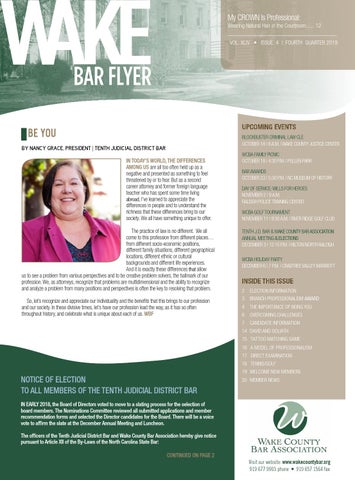
BY NANCY GRACE, PRESIDENT | TENTH JUDICIAL DISTRICT BAR IN TODAY’S WORLD, THE DIFFERENCES AMONG US are all too often held up as a negative and presented as something to feel threatened by or to fear. But as a second career attorney and former foreign language teacher who has spent some time living abroad, I’ve learned to appreciate the differences in people and to understand the richness that these differences bring to our society. We all have something unique to offer. The practice of law is no different. We all come to this profession from different places… from different socio-economic positions, different family situations, different geographical locations, different ethnic or cultural backgrounds and different life experiences. And it is exactly these differences that allow us to see a problem from various perspectives and to be creative problem solvers, the hallmark of our profession. We, as attorneys, recognize that problems are multidimensional and the ability to recognize and analyze a problem from many positions and perspectives is often the key to resolving that problem. So, let’s recognize and appreciate our individuality and the benefits that this brings to our profession and our society. In these divisive times, let’s have our profession lead the way, as it has so often throughout history, and celebrate what is unique about each of us. WBF
WCBA FAMILY PICNIC OCTOBER 18 | 4:30 P.M. | PULLEN PARK BAR AWARDS OCTOBER 23 | 5:30 P.M. | NC MUSEUM OF HISTORY DAY OF SERVICE: WILLS FOR HEROES NOVEMBER 2 | 9 A.M. RALEIGH POLICE TRAINING CENTER WCBA GOLF TOURNAMENT NOVEMBER 11 | 9:30 A.M. | RIVER RIDGE GOLF CLUB TENTH J.D. BAR & WAKE COUNTY BAR ASSOCIATION ANNUAL MEETING & ELECTIONS DECEMBER 3 | 12:15 P.M. | HILTON NORTH RALEIGH
WCBA HOLIDAY PARTY DECEMBER 6 | 7 P.M. | CRABTREE VALLEY MARRIOTT
INSIDE THIS ISSUE 2 ELECTION INFORMATION 3 BRANCH PROFESSIONALISM AWARD 4 6 7 14 15
THE IMPORTANCE OF BEING YOU OVERCOMING CHALLENGES CANDIDATE INFORMATION DAVID AND GOLIATH TATTOO MATCHING GAME
16 A MODEL OF PROFESSIONALISM 17 DIRECT EXAMINATION 18 TENNIS/GOLF
NOTICE OF ELECTION TO ALL MEMBERS OF THE TENTH JUDICIAL DISTRICT BAR
19 WELCOME NEW MEMBERS 20 MEMBER NEWS
IN EARLY 2018, the Board of Directors voted to move to a slating process for the selection of board members. The Nominations Committee reviewed all submitted applications and member recommendation forms and selected the Director candidates for the Board. There will be a voice vote to affirm the slate at the December Annual Meeting and Luncheon. The officers of the Tenth Judicial District Bar and Wake County Bar Association hereby give notice pursuant to Article XII of the By-Laws of the North Carolina State Bar: CONTINUED ON PAGE 2 Visit our website: www.wakecountybar.org 919.677.9903 phone • 919.657.1564 fax
WAKE BAR FLYER VOL. XLIV No. 4 | FOURTH QUARTER 2019
Presidents DAVID L. SHERLIN, WCBA NANCY L. GRACE, TENTH JUDICIAL DISTRICT Presidents-elect CARMEN H. BANNON, WCBA ADAM M. GOTTSEGEN, TENTH JUDICIAL DISTRICT Secretary CRYSTAL CARLISLE Treasurer JUDGE ASHLEIGH DUNSTON Immediate Past President JUDGE NED MANGUM, WCBA MARIA LYNCH, TENTH JUDICIAL DISTRICT Board of Directors LISA M. ANGEL YVONNE ARMENDARIZ DANIEL T. BARKER JULIE L. BELL JEAN CARTER REBECCA EDWARDS WILLIAM FINN, JR. EVIN GRANT JUDGE KEITH O. GREGORY JUDGE JEFFERSON G. GRIFFIN KATIE H. KING DEAN J. RICH LEONARD CHRISTINA MEDLIN MCCOY JOHN E. MCKNIGHT JEFFREY R. MONROE ATIYA M. MOSLEY EDD K. ROBERTS III JUDGE VINCE ROZIER, JR. MEGAN W. SHERRON JOHN R. SZYMANKIEWICZ ELIZABETH TIMMERMANS JESSICA VICKERS JOHN “BO” WALKER Young Lawyers Division President SARAH BETH BARNES Young Lawyers Division President-elect JEREMY WILLIAMS Executive Director WHITNEY von HAAM Wake Bar Flyer Editor LUCY AUSTIN Communications SARAH L. JUSTICE Wake Bar Flyer Designer CLAIR SMITH Tenth Judicial District Bar Councilors HEIDI C. BLOOM WALTER E. BROCK THEODORE C. EDWARDS II KATHERINE FRYE FRED T. MORELOCK JUDGE ROBERT B. RADER DONNA R. RASCOE WARREN SAVAGE © 2019 Wake County Bar Association & Tenth Judicial District Bar.
NOTICE OF ELECTION: CONTINUED FROM PAGE 1 1.That the annual election of officers will be held on Tuesday, December 3, 2019 at the Hilton North Raleigh/Midtown, 3415 Wake Forest Road in Raleigh at 12:15 p.m. Lunch will be served and the cost of lunch will be borne by the Tenth Judicial District Bar at no additional cost to members. 2.The election is for the purpose of choosing officers for both the Tenth Judicial District Bar and the Wake County Bar Association, an open Bar Councilor position due to the end of Donna R. Rascoe’s third term and Badger-Iredell Foundation Board Members. 3.The following officers will be elected: President-elect, Treasurer, Secretary
PRESIDENT-ELECT (ELECT ONE) Russell D. Babb David E. Holm
TREASURER (ELECT ONE) Judge Ashleigh Parker Dunston
SECRETARY (ELECT ONE) Crystal S. Carlisle 4. The following State Bar Councilor positions will be elected by the Tenth Judicial District Bar: One Councilor (to fill the Donna R. Rascoe seat at the end of her term)
STATE BAR COUNCILOR | RASCOE SEAT (ELECT ONE) Julie L. Bell Vasiliki "Celia" Pistolis The following State Bar Councilor positions will be elected by the Tenth Judicial District Bar and are running unopposed as a continuation of their current position:
STATE BAR COUNCILOR | RADER Judge Robert B. Rader
STATE BAR COUNCILOR | BLOOM Heidi C. Bloom 5. The following Directors have been selected by the Nominations Committee and will be affirmed by voice vote (three-year term): Niya T. Fonville Brian P. Oten
Kristi B. Thompson John B. Ward Benjamin O. "Boz" Zellinger
6. The following Badger-Iredell Foundation members will be elected by the Wake County Bar Association: Two Foundation Members.
BADGER-IREDELL FOUNDATION | WCBA MEMBERS VOTING (ELECT TWO) Lucy T. Austin Jeffrey P. Gray Please see biographical information on each of the candidates inside this issue of the Bar Flyer. We look forward to seeing you at the annual meeting and luncheon on December 3 at the North Raleigh Hilton.
PHYLLIS B. PICKETT 2019 RECIPIENT OF THE JOSEPH BRANCH PROFESSIONALISM AWARD BY MARIA M. LYNCH | LYNCH & EATMAN, LLP
THE 2019 RECIPIENT OF THE JOSEPH BRANCH PROFESSIONALISM AWARD is Phyllis B. Pickett. Phyllis is an outstanding lawyer, bar leader, community leader and occasional fountain pen surgeon. Phyllis started her legal career working for Legal Aid in southeastern and northeastern North Carolina. From Legal Aid she moved to Wake County and served as an assistant county attorney for more than four years. In 1991, Phyllis was recruited to join the staff of the General Assembly, in part because of her expertise in local government law and county issues. She has been a staff attorney at the General Assembly ever since.
are active at St. Ambrose Episcopal Church, and Phyllis served four years as a delegate to the annual convention of the North Carolina Episcopal Diocese. In writing this piece, I learned a lot about her main hobby. She collects and uses mostly modern and some vintage fountain pens. She is especially fond of Japanese and Italian brands, but apparently there is an emerging brand based here called Franklin-Christoph. She has visited their factory in Wake Forest. She also repairs pens, including performing delicate ink bladder “surgery.” The Triangle has a very active fountain pen community and hosts annual pen meets in Durham and Raleigh. Phyllis believes one of the most important aspects of professionalism is mentoring, both being a mentor to others and having mentors your entire career. She cites among others who have been mentors to her, Lisbon Berry and Jim Wall, two civil rights lawyers she admired for their grit. In her mid-career, former Wake County Attorney Mike Ferrell and North Carolina Supreme Court Justice Patricia Timmons-Goodson gave her insight and calm in framing issues. Gerry Cohen at the Legislature was always a willing teacher. One aspect she loves about the law is working closely with diverse lawyers; not just in terms of gender, race, ethnicity and political views, but also generational diversity. Phyllis says she learns so much from her younger colleagues. They have affected her worldview and her perspective on issues and problems, but I believe she has had an even more profound effect on theirs. WBF
Phyllis serves as the principal legislative analyst and staff attorney for the Legislative Drafting Division. While her initial focus at the legislature was county law, today she primarily handles appropriations and information technology issues, as well as employment law. Employment law is the one constant throughout her legal career. As a legal services attorney she represented plaintiffs, as an assistant county attorney she represented the county as a defendant, and at the general assembly she drafts labor and employment laws. The Legislative Drafting Division is non-partisan, and as a staff attorney Phyllis deals with people from all walks of life with various political viewpoints. Phyllis is a double Tar Heel, having obtained her undergraduate degree in 1979 as a history major and James M. Johnson Scholar, then her law degree in 1982. Throughout her legal career, Phyllis has been involved with local, state and national bar associations. At our own Wake County and Tenth Judicial District Bars, Phyllis has served on the Leadership Development Committee, the Nominating Committee and the Grievance Committee. She also served as secretary of the WCBA and Tenth for two years. Phyllis has also held a number of leadership positions at the North Carolina Bar Association. She has chaired the Endowment Committee, served on the Board of Governors, has chaired the Membership Committee, the Administrative Law Section Counsel and served as Co-chair of the Committee on Women in the Profession. Phyllis has also been heavily involved with the American Bar Association where she has chaired the Judicial Division Lawyers Conference and the Perceptions of Justice Steering Committee. She served on the Standing Committee on the Law Library of Congress and served as Section Advisor to the Uniform Law Commission Drafting Committee on the Uniform Electronic Legal Material Act. When asked what she does for fun, Phyllis says “I’m a baby boomer… work is my fun.” She does, however, enjoy traveling with her spouse LaVie. They
WAKE BAR FLYER • FOURTH QUARTER 2019
PAGE 3
THE IMPORTANCE OF BEING YOU BY CAMILLE STELL | LAWYERS MUTUAL
IF I ASK YOU TO CLOSE YOUR EYES AND ENVISION A LAWYER, MANY OF US WOULD SEE A SIMILAR PICTURE.
Earlier this year, Lawyers Mutual produced a podcast discussing the A certain, age, a certain stature, dressed in a suit. Perhaps you see a changing nature of the practice. briefcase, or a trial bag, or a yellow pad and pen. But in reality, the image is Michael Burger, with NC Planning in Cary, says death and taxes are two changing. And that is a good thing. certainties and you can add change as the third certainty. He acknowledges Today, we have non-traditional career paths, non-traditional work schedules, and non-traditional work environments. And this will ultimately we can run and hide from change or make the practice healthier and accessible for a more diverse population. we can embrace it.
Camille Stell is the president of Lawyers Mutual Consulting & Services. Continue this conversation by contacting Camille at camille@ lawyersmutualnc.com or 800.662.8843.
Valerie Johnson, a partner with Copeley, Johnson & Groninger, is meeting change by developing a podcast discussing sexual harassment issues. Valerie and her partner When the path looks too similar and there is no room for who we are Leto thought a podcast was a way to educate folks who would never pick up a law book or search out an as individuals to shine, some of those people drop out along the way. So employment lawyer in a traditional way. law firms continue along, looking the same.
Law is a traditional career and while a variety of people have made their way here, they don’t always stay. I’ve worked in law firms of all shapes and sizes over the years, and I’ve seen many lawyers exit the profession. I know you have as well.
When I worked in law firm recruiting, I often knew a candidate would be a great addition to a firm. They would bring a fresh perspective and a new personality. But I also knew the chances of that person choosing the firm or staying with the firm long term if they were hired was slim. There is so much pressure in law firms already without adding the additional challenge of being in a culture where you may not fit.
Kevin Pratt is a lawyer in Charlotte. He founded CoLaw, a co-working space dedicated to lawyers, because he wanted to make law practice management easier, more cost effective, as well as more innovative and agile. More importantly, he wanted to bring people together in a whole new way. To hear more of the podcast, visit www.lawyersmutualnc.com/ annual-report/2018.
Today is an exciting time to a lawyer. And there is no excuse not to I recently talked with a senior partner about his frustration with next find the law practice or work environment that best suits you. WBF generation lawyers. “They don’t show up. They are always on their phones. They want to work from the soccer field.” What he finally said, in a moment that exploded with honesty, is that he was jealous of them. He was jealous that they didn’t feel tied to a chair from 8 a.m. until 6 p.m. He was jealous that they felt comfortable practicing law from their mobile devices. And he What can you do to find your true self? was jealous that they didn’t seem bothered by texting with clients after Here are a few tips: hours. The senior lawyer lamented that in the old days, you worked a long • Appreciate who you are and your differences day, but when it ended, you went home and your work did not follow you. Stop trying to please other people With today’s modern conveniences and technology abilities, he said, “I feel Develop confidence building skills like I’m working 24 hours a day and I hate it.” Set goals and milestones for yourself It should be an advantage today for lawyers to not feel trapped by an antiquated system. It is healthy for lawyers to find non-traditional jobs that better suit their lifestyles. It is self-awareness that allows lawyers to strive for a work-life integration that feels healthy and makes them happy. I encourage lawyers of all ages to explore the law in a way you haven’t before. Now, more than ever, there are jobs that fit everyone. It’s not just young lawyers that are making these changes. Lawyers at every stage of career are exploring flexible work schedules and non-traditional work environments.
WAKE BAR FLYER • FOURTH QUARTER 2019
Learn from your mistakes without beating yourself up for making them • For as Oscar Wilde says,
“BE YOURSELF, EVERYONE ELSE IS TAKEN."
PAGE 4
How to give our insureds a competitive edge?
HERE TODAY,
CHANGE IS HERE
TOMORROW
By offering them more services – from risk management to loss prevention and claim repair. And by never forgetting that relationships are the bedrock of our business. Here today, here tomorrow. That’s one thing that will never change.
LAWYERS MUTUAL
LIABILITY INSURANCE COMPANY OF NORTH CAROLINA
919.677.8900 800.662.8843
connect with us
www.lawyersmutualnc.com
OVERCOMING CHALLENGES: A PROFILE OF DANIEL JOHNSON BY LUCY AUSTIN | WAKE BAR FLYER EDITOR
“WE ALL HAVE CHALLENGES,” Daniel Johnson explains. “It’s a challenging profession.” Few attorneys, however, have to face the physical challenges that Daniel has endured. In 1999, Daniel was in the Navy and had an accident at sea. As a result, at the age of 23, he lost both legs beneath the knee. While undergoing long and grueling rehabilitation at Walter Reed, he developed an interest in medicine and started taking undergraduate science classes anticipating a medical career. It didn’t take long, however, for Daniel to discover he didn’t like those classes. A vocational rehabilitation counselor for Veterans Affairs gave him a test and although he tried to rig it to say he should be a medical professional, the test labeled him as being interested in law. His counselor said he could pursue medicine if he wanted, but that he really should pursue law. Daniel, who had two uncles who were attorneys, went to work in Washington D.C. for a year for Senator Max Cleland, a Vietnam War veteran and triple amputee. Senator Cleland served as an inspiration to Daniel, who then enrolled at UNC School of Law. Following law school,
Daniel went to work for the Wake County District Attorney’s Office, one of the most physical jobs you can have as an attorney. Daniel admits that eight hours on his feet as a district court prosecutor was very challenging, but his challenges didn’t slow him down. He worked his way up to the felony rotation before deciding to move back to his hometown of Hickory to run for Congress. After losing his Congressional bid, Daniel opened a small private practice in Raleigh before going to work for the State of North Carolina, where he is now General Counsel for the Department of Transportation. Although there are days that are more challenging than others, Daniel says his physical limitations have become more of a fact of life that he doesn’t even think about on a daily basis. He has a good sense of humor, laughing about the time he was working for the DA’s office and one of his prosthetics cracked in court. A coworker had to find a rolling chair to roll him back to his office where his wife could bring him a backup prosthetic. Daniel met his wife Creecy in law school, and they have two kids, ages 11 and 9. Daniel says he is able to be fully engaged in his kids’ lives, doing the zip line at Y-Guides outings and coaching his son’s baseball team. He says support from friends and great medical care helped him recover, and his own stubbornness keeps him going. He cites a love of problem-solving and says he doesn’t let circumstances limit his opportunities; he encourages anyone facing a challenge to focus on enduring and overcoming. WBF
You know how it feels to be ready. So do we. Let’s talk.
230 Fayetteville Street, Suite 100 919.723.2300 NMLS# 411971
WAKE BAR FLYER • FOURTH QUARTER 2019
PAGE 6
ELECTIONS CANDIDATES FOR TENTH JUDICIAL DISTRICT BAR & WCBA ELECTIONS PRESIDENT-ELECT ELECT 1 OF 2 CANDIDATES RUSSELL D. BABB
DAVID E. HOLM
Tharrington Smith, LLP UNC School of Law, 1999
Parker Bryan Family Law University of Miami School of Law, 2000
Hidden Talent: I play bass guitar, and was in a jazz band years ago. Best Piece of Advice a Mentor Ever Gave You: Before my senior football season at Carolina, Mack Brown challenged me to stop having a second-string mentality, and to become a leader on the team. This advice has been applicable in many areas of my life since then. WCBA/Tenth JD Bar Activities: Tenth Judicial District Grievance Committee, 2018 - present Wake County Bar Association Strategic Planning Committee, 2015 & 2018 Wake County Bar Association Board of Directors, 2014 – 2017 Other Bar related activities: Member, Wake County Academy of Criminal Trial Lawyers Member, North Carolina Advocates for Justice, Criminal Defense Section Member, North Carolina Bar Association, Criminal Justice Section
Hidden Talent: Softball. I played for the Bad News Barristers in the WCBA softball league (2002 to 2010). I also managed the team for a couple of years. I proudly display the WCBA Lawyers League Softball 2010 Champions trophy in my conference room. It is about the size of a 12-ounce Coke can. Best Piece of Advice a Mentor Ever Gave You: “Chair the WCBA social committee.” WCBA/Tenth JD Bar Activities: Wake County Bar Association and Tenth Judicial District Board of Directors, 2009-2010 Wake County Bar Association Social Committee member since 2003, chair 2012-2015 Wake County Bar Association’s Strategic Planning Committee, 2009 and 2015 Campbell Law Connections Mentorship Program mentor every year since its inception Other Bar-related Activities: NCBA Family Law Section, Chair 2017-2018 NCBA Family Law Section, co-chair of the legislative committee of the Family Law Council, 2010-June 2017; July 2018 - present NCBA Lawyer Referral Service Committee, 2003 – 2013; chair, 2009-2010 North Carolina Family Court Advisory Committee, 2011-2017 Wake Family Court Rules Improvement Committee, 2008 – present NC State Lawyers Alumni Network event planning committee, 2008 present CLE speaker at 12 seminars ABA Family Law Section
WAKE BAR FLYER • FOURTH QUARTER 2019
PAGE 7
ELECTIONS CANDIDATES FOR TENTH JUDICIAL DISTRICT BAR & WCBA ELECTIONS TREASURER ELECT 1 CANDIDATE
SECRETARY ELECT 1 CANDIDATE
JUDGE ASHLEIGH PARKER DUNSTON
CRYSTAL CARLISLE
Wake County District Court Judge NCCU School of Law, 2012
The Brocker Law Firm, P.A. Thomas M. Cooley Law School, 2009
Hidden Talent: I’m not sure if it’s hidden, but I love public speaking and finding creative ways to serve people.
Hidden Talent: Powerlifting — especially bench press.
Best Piece of Advice a Mentor Ever Gave You: “Never sacrifice who you are for where you want to be.”
Best Piece of Advice a Mentor Ever Gave You: “Everyone should have a personal board of directors that will guide and challenge them.”
BADGER-IREDELL FOUNDATION ELECT 2 OF 2 CANDIDATES JEFF GRAY
LUCY AUSTIN
Bailey & Dixon, LLP Campbell Law School, 1985
NC Industrial Commission Campbell Law School, 2008
Hidden Talent: The ability to focus others’ attention, or make a point, through humor.
Hidden Talent: Writting Fiction.
Best Piece of Advice a Mentor Ever Gave You: “In all things, remember your obligations to your client.”
WAKE BAR FLYER • FOURTH QUARTER 2019
Best Piece of Advice a Mentor Ever Gave You: Quoting Yoda, “Do or do not; there is no try.”
PAGE 8
ELECTIONS CANDIDATES FOR TENTH JUDICIAL DISTRICT BAR & WCBA ELECTIONS BAR COUNCILOR (RASCOE SEAT) ELECT 1 OF 2 CANDIDATES JULIE BELL
CELIA PISTOLIS
Gaylord Rodgers, PLLC UNC School of Law, 1992
Legal Aid of North Carolina, Inc. UNC School of Law, 1982
Hidden Talent: I can write and deliver raps.
Hidden Talent: Bread baker- 2nd place State Fair whole wheat bread; bake cakes for office birthdays.
Best Piece of Advice a Mentor Ever Gave You: “Be yourself.” WCBA/Tenth JD Bar Activities: Board of Directors, Wake County Bar Association and Tenth Judicial District Previous service on Grievance Committee, Fee Dispute Committee, Bench Bar Committee.
Best Piece of Advice a Mentor Ever Gave You: “Don’t be afraid to try and fail because you will always learn from the experience.” “It never hurts to be nice.” WCBA/Tenth JD Bar Activities: WCBA member Other Bar-related Activities: NCBA Pro Bono and Professional Vitality Committees Previous service on NCBA committees: Pro Bono, Quality of Life, Free Legal Answers, Call4All and Lawyer on the Line Former advisory member of Authorized Practice Committee of the NC State Bar Member of NCAJ and NCAWA
BOARD OF DIRECTORS SLATED ANNA DAVIS
NIYA FONVILLE
NC Department of Justice NCCU School of Law, 2010
Campbell Law School University of Miami School of Law, 2008
Hidden Talent: Cooking Korean, Israeli, and Cambodian cuisine. Best Piece of Advice a Mentor Ever Gave You: “Failure only marks the end of success at that thing, and it may be a gift that pushes you in a better direction.”
WAKE BAR FLYER • FOURTH QUARTER 2019
Hidden Talent: I have a photographic memory (although age has begun to impair its reliability!) Best Piece of Advice a Mentor Ever Gave You: “If you never lose, then that means you’re not taking risk.”
PAGE 9
ELECTIONS CANDIDATES FOR TENTH JUDICIAL DISTRICT BAR & WCBA ELECTIONS BOARD OF DIRECTORS SLATED KIMBERLY MILLER
BRIAN OTEN
Owens & Miller PLLC Campbell Law School, 2007
North Carolina State Bar UNC School of Law, 2005
Hidden Talent: Mind reading. Well, not everyone - just my twin sister Kara. When we were growing up, I could look across the room and know exactly what she was thinking. Unfortunately, this was not due to the gift of telepathy, but instead because we knew each other so well we could read each other’s expression and body language. It has been 19 years since we have shared a room and we now live two hours apart, but it is still pretty amazing to see the accuracy of our mind reading skills!
Hidden Talent: My practical joke skills are being undermined by this question.
Best Piece of Advice a Mentor Ever Gave You: My grandmother is second only to my mother as my longest running mentor, but she by far bestowed the best advice when I was getting married. She told me that it is much easier to go around someone than through them. I have thought of this advice and applied it often over the last dozen or so years of marriage and practicing law. Let’s just say that Grandma knows best!
Best Piece of Advice a Mentor Ever Gave You: “Grow where you’re planted.” Grandma
JOHN WARD Yates, McLamb & Weyher UNC School of Law, 2012 Hidden Talent: I make a pretty mean jambalaya.
North Carolina Industrial Commission NCCU School of Law, 2008
Best Piece of Advice a Mentor Ever Gave You: If you say you are going to do something, do it. If you say you are not going to do something, don’t do it. There is no quicker way for a lawyer to lose credibility than to go against his or her own word.
Hidden Talent: My handwriting is excellent. One day I’d love to get training and have some fun. I find it relaxing.
BOZ ZELLINGER
KRISTI THOMPSON
Best Piece of Advice a Mentor Ever Gave You: “Always take the high road.” – Leonard T. Jernigan, Jr.
NC Attorney General’s Office UNC School of Law, 2007 Hidden Talent: Amazing basketball coach/tactician based on my experience coaching 11-12 year olds. Best Piece of Advice a Mentor Ever Gave You: “First with the head, then with the heart.”
WAKE BAR FLYER • FOURTH QUARTER 2019
PAGE 10
WEDNESDAY, OCTOBER 23 NORTH CAROLINA MUSEUM OF HISTORY SILENT AUCTION | 5:30 P.M. SHOW | 7 P.M. For sponsorship opportunities, please visit our website at www.wakecountybar.org
MY CROWN IS PROFESSIONAL: WEARING NATURAL HAIR IN THE COURTROOM BY JUDGE ASHLEIGH PARKER DUNSTON | PHOTOS BY EVIN L. GRANT PHOTOGRAPHY
FROM THE TIME THAT I WAS A LITTLE GIRL, I never knew what my hair looked like without chemicals. Every six weeks, my mom took me to the hair salon to have my hair relaxed because if you had kinky or non-straight hair, you would be seen as unkept. Generally, I was always the only African-American female in my classes and I didn’t want to stand out any more than I already did. My belief that I had to conform to European beauty standards made me extremely insecure about my hair. This insecurity continued throughout my life even when I began my first job after law school as a prosecutor at the Wake County District Attorney’s Office. As the only African-American female out of 45 attorneys, I wanted to appear as “professional” as I could and dole out justice fairly and efficiently without being seen as a distraction. It wasn’t until I began to work at the North Carolina Attorney General’s Office, surrounded by other African-American female lawyers who wore their hair in a variety of styles such as afros, locs, and braids that I realized that their hair was professional too. It was through this representation that I realized my inferiority complex didn’t make sense. So on November 11, 2014, I “big chopped” (meaning I cut all of my relaxed hair off) and wore my hair in a short, blonde afro. For the first time in my life, I felt like I was finally free to embrace my natural beauty--my crown. Since returning to the courthouse as a district court judge, I have been intentional in wearing my hair in different styles monthly from crotchets, braids, cornrows, faux locs, passion twists and everything in between. While I no longer struggle with hair insecurity, I’ve been approached while on the bench and told that my hair looks better straight than kinky curly. We also have implicit biases, but comments such as these are distracting, hurtful, and fuel the self-consciousness that African-American women already face in accepting who we are while suffering stigmatization of underrepresentation, oversexualization and imposter syndrome.
HERE ARE OTHER EXAMPLES OF THIS DYNAMIC FROM AFRICAN-AMERIAN FEMALE MEMBERS OF OUR BAR: “I made the decision to stop chemically relaxing my hair several years ago. In order to ease my transition period, I wore a lot of protective styles such as Senegalese twists, faux locs and curly crochet styles. I recall one situation years ago when I had gotten my hair done a few weeks prior but I had a jury trial coming up. I didn’t want to take out my protective style because: 1) I could get several more weeks out of the hairstyle and 2) It was not an inexpensive hairstyle. However, I was also concerned about how a jury in a rural area would respond to a black woman with natural hair. I was very conflicted because I felt that I had a duty to represent my client (the State of North Carolina) in the most effective way I knew how. I had spent countless hours preparing for this case to be tried but I didn’t want all of my preparation to go to waste because some jury members were distracted by my hair or deemed it unprofessional. I also felt like I had a duty to be true to myself and not allow the potential prejudices of others to dictate how I would present and carry myself. My dilemma was compounded by knowledge that a male in my office had an unfavorable jury verdict and when the jury was polled afterwards, one of the issues that came up was how distracting his hair was. I did not want a repeat of that situation. However, in the end, I decided to keep my protective style and try the case with my natural hair. It was a win-win because not only did I get the verdict I wanted for my client but this experience gave me the confidence to try more cases in front of a jury while donning my natural hair.” “I first decided to go natural 10 years ago.To be more specific, I was studying for the Bar Exam. I was hesitant because I hadn’t entered the legal profession yet and didn’t necessarily know how it would be perceived. I also didn’t know what it would “look like." This profession can be very judgmental when you are female and even more so when you are a woman of color. I was concerned I would be judged before I even opened my mouth. Looking back it’s crazy how I even allowed that to affect what naturally grows from my crown (all puns intended). Ultimately I am happy I decided to go natural.” “I had so many concerns about going natural such as: 1) Too much commentary in professional settings/court about my hair. I once had a judge call me out in court about changing my hair (I had crochets), and I was so embarrassed. Natural hair is often labeled unprofessional; 2) natural hair makes others think your are militant, especially when wearing afros; 3) I had a hard time adjusting to seeing myself as pretty without straight hair; 4) Since I am currently looking for work, I felt comfortable transitioning to natural. That way, when I start a new position they will meet me with natural hair. Honestly, I
WAKE BAR FLYER • FOURTH QUARTER 2019
PAGE 12
don’t know if I would have had the courage to do it while employed.” “Aside from the concern that I felt caring for natural hair would be more time consuming than my relaxed hair, my primary concern was the credibility issues I would encounter as a lawyer. I was already practicing in rural, western NC, where, as a young black female attorney I had already encountered blatant racism and was the target of microaggressions (although I didn’t know the term at the time). Quite frankly, I was concerned about whether I had the time or energy to draw more attention to myself. Who wants to deal with unnecessary looks and hushed comments that come along with being a black professional? I wondered how clients would react and how judges may treat my clients based on my appearance. I know that my appearance had no bearing on my competency and ability to serve my clients, but I had lived long enough to know that no matter how true that statement was, there were people who just couldn’t grasp that understanding. By the time I came to Wake County (that also had its own shares of issues with inclusivity), I was more confident, although I still want to be mindful of how adjudicators would view my appearance in relationship to how they received my clients. I was representing some of the most vulnerable sects of our society who already had the cards stacked against them...I didn’t want to add to to it. Now I’m confident in my natural hair journey and wouldn’t change it for the world!” One common theme throughout these examples is the fear of retribution or discrimation due to our natural hair. This fear is not unfounded when there are several recent incidents of young children having their hair colored in with a sharpie or their locs cut off for a wrestling match. Discrimination whether explicit or implicit in regard to African American hair is a problem in the workplace, schools, and in our military. On July 3, 2019, California became the first state to pass the CROWN (Create a Respectful and Open Workplace for Natural Hair) Act which bans discrimination based on hair texture and style and specifically recognized that, (a) The history of our nation is riddled with laws and societal norms that equated “blackness,” and the associated physical traits, for example, dark skin, kinky and curly hair to a badge of inferiority, sometimes subject to separate and unequal treatment. (b) This idea also permeated societal understanding of professionalism. Professionalism was, and still is, closely linked to European features and mannerisms, which entails that those who do not naturally fall into Eurocentric norms must alter their appearances, sometimes drastically and permanently, in order to be deemed professional. -CA SB 188 African American women having to worry about whether or not our hair will be seen as a distraction to a potential employer, judge, or juror is traumatic and no demographic throughout our profession should be penalized for something that naturally comes from their body. Natural hair or our “crown” in all it’s gravity-defying, versatile forms, is professional and no other attorney, client, defendant, victim, witness, or little girl should fear discrimination or the need to suppress their identity to meet someone else’s beauty or professionalism standards. We must continue to work towards inclusivity in our profession because discrimination anywhere, in any setting, is intolerable. WBF
HAIR STYLE DEFINITIONS • Relaxed — A cream or lotion that chemically alters the texture of the hair by breaking down the hair strand to make the hair straight. • Natural — Hair that has not been chemically treated or altered. The hair that grows naturally from one’s scalp. • Protective Styles — A hairstyle that is used to prevent the hair from becoming damaged due to exposure from damaging agents such as sun, heat, and constant manipulation. EXAMPLES OF PROTECTIVE STYLES: Buns, Braids, Twists, Crotchets, Wigs, Weaves • Crotchet Style — A form of protective styling which involves crotcheting synthetic hair extensions to a person’s natural hair with a latch hook/crotchet needle and securing it with a knot. • Wash and Go Style — When the hair is worn it its natural curl pattern, without manipulating the style with tools, braids or stretching. • Blow-Out/Silk Press — A form of styling natural hair by using a blow dryer and/or flat-iron to temporarily straighten the hair. • Big Chop — The act of cutting of all of the relaxed hair, leaving on the natural, unprocessed hair behind
WAKE BAR FLYER • FOURTH QUARTER 2019
PAGE 13
DAVID AND GOLIATH: HOW LAWYERS WITH DISABILITIES OVERCOME THE ODDS BY CODY J. DAVIS | CAMPBELL LAW SCHOOL WALLACE PUBLIC SERVICE FELLOW
THE STORY OF DAVID AND GOLIATH tells of a military standoff between the Philistines and Israelites. The Philistines greatest warrior, a giant named Goliath, challenges the Israelites to send their greatest warrior to fight him in hand to hand combat. As the story goes, a small shepherd boy, David, inexperienced in battle, is the only volunteer. David prevails over Goliath by stunning Goliath with a strike from a single stone propelled by his sling. With Goliath incapacitated, David beheads the giant, defeating the Philistines. Malcolm Gladwell’s book “David and Goliath: The Advantage of Disadvantage,” illustrates how this biblical allegory reflects our habit of underestimating the value of people based on inaccurate assumptions about or misconceptions of the able and competent person. Goliath and the Israelite army underestimate David’s ability by relying on their understanding of a capable warrior. They assume David’s approach to combat would be similar to theirs, and they fail to consider how David’s skills could be utilized in this battle. In a similar way, people may discount or fail to accurately perceive the capacity of individuals with disabilities as collaborators, adversaries, leaders, or in a variety of other roles. I believe this is not due to malice but to one’s failure to comprehend how a person with a disability can do what they cannot imagine doing themselves were they to be the one with the disability. This often stems from uninformed, false or harmful perceptions of disability that we rely on in assessing the aptitude and competency of persons with disabilities. The legal profession is not immune to discrediting the abilities of persons with disabilities. Just as the Israelites and Goliath underestimated David based on their perceptions of a capable warrior, so might we underestimate our colleagues with disabilities based on our perceptions of the capable lawyer. One obvious impact this has on our profession arises in the employment context. When employers fail to understand the competencies of a candidate with a disability, they not only prejudice the candidate, they also deny themselves, their firm or their organization the value of the candidate’s contributions. In the aggregate this reality starves the legal profession of talented lawyers, judges and leaders, stifling the legal profession’s validity in the eyes of the public. Perhaps less obvious is how a failure to recognize the capacity of persons with disabilities may affect a lawyer’s approach to her work with a colleague or adversary with a disability. In the context of collaboration, a lawyer who underestimates the competency and abilities of a colleague with a disability may fail to ask for contributions to a project. Similarly, a lawyer may believe they must overcompensate for what they think the colleague with disabilities is lacking. Further, a collaborating lawyer may inadvertently place arbitrary limitations on a colleague with a disability by denying them an opportunity to demonstrate their true aptitude. As an adversary, it would be a great disservice to oneself and one’s client to discount the capacity of a lawyer with disabilities. To do so could result in being ill-prepared for a negotiation, hearing, or trial. This is Goliath’s fatal flaw. He underestimates David as a warrior; thus, he is ill-prepared to match David’s skill. The key to David’s success is his aptness to capitalize on his abilities rather than highlighting his weaknesses. David cannot defeat Goliath by the means the Israelites and Goliath expect him to use. Instead, David takes a different approach to battle, relying on his remarkable skills as a stone slinger. To avoid the fault of Goliath and the Israelites, we as a profession must refrain from assessing colleagues with disabilities based on our own limited conception of a capable lawyer. In every interaction with a colleague with a disability, we must reach beyond our own understanding of legal practice and be open to learning about myriad alternative techniques and approaches to practice that colleagues with disabilities offer. It very well may turn out that, through their efforts to conquer some barrier, they have developed more efficient or effective methods that you can use to your advantage. WBF
THE 2019 BAR AWARDS SILENT AUCTION IS LIVE! Visit www.32auctions.com/BarAwards2019 to check out all the fantastic and unique items you can bid on or buy now, including beach house weekends, private chef dinners, original artwork, courtside NBA tickets and so much more. Join us for the Bar Awards next Wednesday, October 23 at 5:30 p.m. at the NC Museum of History for an evening of hilarity, inspired performances, the live silent auction, wine roulette and a dazzling raffle courtesy of Bailey's Fine Jewelry. All proceeds support our friends at Legal Aid of North Carolina!
WAKE BAR FLYER • FOURTH QUARTER 2019
PAGE 14
TATTOOS? IN THE LEGAL PROFESSION?! TATTOOS ARE ONE OF THE OLDEST AND MOST CREATIVE FORMS OF ART AND PERSONAL EXPRESSION. Once viewed as something only acceptable for military men, motorcycle gangs and prisoners, tattoos have quickly become common to see in every day life - including within the professional, high stakes legal world. Can you match these lawyers and bar staff members with theirs?
Stephanie McGee
Nancy Grace
Emily Mistr
WAKE BAR FLYER • FOURTH QUARTER 2019
Josh McIntyre
John McKnight
Melinda Keck
Carmen Bannon
PAGE 15
A MODEL OF PROFESSIONALISM BY BRADLEY BANNON | PARTNER, PATTERSON HARKAVY LLP
ONE OF THE BEST LAWYERS I KNOW ISN’T A LAWYER. I was lucky enough to meet her before I became one myself, and to spend nearly half my personal and professional life learning from her. She’s taught me as much as anyone with a law license about professionalism and what I always believed to be at its core: humanity. She taught me that the first and most important lesson of communication is to listen respectfully to everyone. Listen to the client. Listen to their loved ones. Listen to the law enforcement officer investigating them. Listen to the lawyer or legal assistant on the other side of the case. Listen to any other lawyer or legal assistant who may have been involved in the case. Do this for three reasons: to know as much as possible to inform the important decisions you must make; to create trust and space for further communication; and to be as persuasive as possible when it’s time for you to talk. She helped me understand that it’s amazing how much you can accomplish if you don’t care who gets the credit. As lawyers, we’ve all relied on others to teach us, help us and guide us. Rarely is a legal problem solved by a single legal professional, but I’ve seen quite a few legal professionals take single credit for the solution. Watching her deal with all manner of problems over 20 years, without seeking or needing credit, and while others (including me) often received that credit, reminded me time and again to refocus on my own aspirational maxim: the work is the reward. She also taught me about what women face in the legal profession, particularly when they don’t have law licenses. Sexism in law offices
and courthouses still abounds. Demeaning and objectifying behavior and rhetoric, that lawyers and judges would never dream of visiting upon men, still rains down on women. The way she experienced and dealt with it helped me see it and motivated me to become part of the solution rather than the problem. She taught me how important it is to have deep connections with your professional colleagues. We worked together in the world of criminal defense, often a miserable and stressful space. That misery and stress can be very lonely and paralyzing—unless you have a co-worker and friend who completely understands it and never hesitates to be the ear or voice you need to stay upright and moving forward. She was that for me, and she made me strive to be that for others. She’s a paralegal. Her name is Moira Rigutto Bitzenhofer. If you’ve ever received an email from her, you’ve probably seen “Paralegal to Joseph B. Cheshire V” in the signature block. But I’m sure Joe would be the first to tell you it’s really his signature block that should read “Lawyer to Moira R. Bitzenhofer.” Because the good work he has done and been credited with doing for people over the last couple of decades, including any of it I was able to help with, simply could not have been done without Mo. No, she doesn’t have a license to practice law. And no, the State Bar doesn’t need to come for any of the principals of my old firm under Rule 5.3. But the fact remains that as far as dealing with and solving real-world legal problems, Mo is as good as any lawyer I’ve ever met, and better than many of them. She’s a model of professionalism. WBF
Experienced in Fiduciary Sales, Estates a n d Tr u s t s
Adam Parker, Broker | REALTOR® Office Listing Agent of the Year-2016 Chairman’s Club-2017 Fonville Morisey Realty – Stonehenge Office 8100 Creedmoor Rd. Raleigh, NC 27613 CALL TODAY TO LEARN HOW I CAN HELP YOU AND YOUR CLIENTS 919.518.5549
WAKE BAR FLYER • FOURTH QUARTER 2019
PAGE 16
DIRECT EXAMINATION: EMILY MISTR DIRECT EXAMINATION IS THE FIRST opportunity for the jury to meet a witness. An effective lawyer will use the opportunity to personalize the witness, making the witness appear both likeable and credible. At the end of the day, the direct examination is a party’s best chance to tell his or her story.
6. What was your best courtroom experience? Anytime a client expresses gratitude (and sometimes a hug) for something I have done on their case. 7. Why did you become a lawyer? I was trying to decide what to “do with my life.” I started thinking about how I could do the most good with my particular skill set and landed on public interest lawyer. And here I am 16 years later, entering my 14th year of practice as an assistant public defender.
1. When you were in elementary school, what did you want to be when you grew up? A mom – To be honest, being a mom was all I really wanted. And while I’m late to the game (I didn’t have my first child until I was 40 years old), it’s everything I had hoped for and more!
8. What has been the most surprising or unexpected development in your career? My entire law school career, I focused on working for Legal Aid when I graduated. I was an MLK Intern with LANC my second summer and chose my elective classes with LANC in mind. When now Superior Court Judge Bryan Collins hired me as an assistant public defender in 2006, I had zero criminal law experience, beyond the basic classes in law school. Imagine my surprise when it turned out to be exactly where I belonged.
2. What was the most important lesson your parents taught you? My mom taught me to live my life with compassion and kindness. My dad imparted the importance of financial security and stability. They both have contributed significantly to the person I am today, just in very different ways. I like to think that their divergent perspectives have contributed to my becoming a (somewhat) balanced adult.
9. What is your favorite book?
3. Who was your favorite teacher and why?
Like Water for Chocolate – It’s one of the only books I have ever read more than once.
My college advisor, but unfortunately, I can’t remember her name. She was a faculty member in the anthropology department at UVA in the 1990s. She worked with me at a time in my life that was tumultuous, and she was very kind and thoughtful in her guidance.
10. What is your most marked characteristic? Physical – my pink hair Emotional – fierce determination
4. Did you love or hate law school? Hate – although I can’t be sure because I’ve suppressed most of the memories. 5. What was your most embarrassing courtroom experience? On my very first day of practice, September 1, 2006, I was sent to court to continue a case for a colleague from the public defender’s office. It was the first time I had set foot in a criminal court as someone other than a traffic defendant (I had a heavy foot at 16yo). I ended up in front of Judge SD, and when she asked me why we needed a continuance, I said, “because the attorney is overwhelmed with his caseload.” The ADA erupted in laughter, and the judge proceeded to yell at me for several minutes. I did manage a retort about how most of the prior continuances were for the state. When I later recounted the story to my new boss, he laughed and walked me back to court to introduce me to the judge and explain that I was brand new. Clearly it hasn’t shaken my determination.
WAKE BAR FLYER • FOURTH QUARTER 2019
☺
11. What is your hidden talent? Knitting 12. Who are your real life heroes? RBG, of course. Ashley Campbell, Blanchard Community Law Clinic. Daniel Bowes, NC Justice Center. 13. When and where were you happiest? I am happiest every night when I sit down with my children to read books at bedtime.
PAGE 17
JENNINGS AND MCCABE CAPTURE 2019 WCBA TENNIS CROWN Vance Jennings and John McCabe won the Wake County Bar Association Championship Division doubles title on October 4 at Carolina Country Club. They beat Jason Tuttle and David Peters in the final. Jennings and McCabe beat Macy Fisher and Mark Gunter in one semifinal, and Tuttle and Peters beat Keith Satisky and William Plyler in the other semifinal. Caleb Thomas won the Open Division, and Carol Ann Hussey was the runner-up. Congratulations to all! WBF
Vance Jennings and John McCabe Champions of the Championship Division
Jason Tuttle and David Peters Runners Up in the Championship Division
Caleb Thomas (Champion) and Carol Ann Hussey (Runner Up) of the Open Division
Mark Gunter and Macy Fisher.
Will Webb, Keith Satisky, William Plyler, and Judge William Pittman.
WELCOME NEW MEMBERS Travis Barkley | Barkley Law Offices, P.C. Johnnie Larrie | Legal Aid of North Carolina, Inc. Jitendra Malik | Katten Muchin Rosenman LLP Matthew Meinel Daniel Covas | Womble Bond Dickinson (US) LLP Charlotte Stewart Thomas Patrick | Campbell School of Law WilliamScott | NC Conservation Network Paul Sloderbeck | US Committee for Refugees and Immigrants Joshua Cox
WAKE BAR FLYER • FOURTH QUARTER 2019
Catherine Bryant Meredith Kittrell | Getter Law Offices PA Helen Smith Marvin Smith David Morhrmann Seth Morris | University of North Carolina at Chapel Hill Patrick VanderJuegdt | Young Moore & Henderson PA Marie Hervey | Troutman Sanders LLP Robert Hagemann | Poyner Spruill LLP
PAGE 19
WCBA MEMBER NEWS WCBA Past President Ashley Campbell, Director of Campbell Law’s Blanchard Community Law Clinic, is one of two recipients of the 2019 Gwyneth B. Davis Public Service Award from the North Carolina Association of Women Attorneys (NCAWA). The public service award is given annually for the promotion of women attorneys in the legal profession and women’s rights under the law. Campbell has been supervising clinic students who provide legal services to clients being served by non-profit agencies including the Raleigh Rescue Mission, Urban Ministries, Alliance Ministry and StepUp Ministry since the clinic’s opening in 2016. Tharrington Smith LLP is pleased to announce that Roger Smith, Jr. has been named Best Lawyers in America 2020 Lawyer of the Year in DUI/DWI Defense Section for the Raleigh Metropolitan Area, and that a total of 15 of our lawyers have been listed in 10 separate practice sections of the Best Lawyers in America 2020 Edition. Additionally, Best Lawyers in America has recognized Tharrington Smith as a Top Listed Firm in both the City (Raleigh) and State (North Carolina) categories for our Family Law and Criminal Defense: White Collar practices. Our 2020 included lawyers are Hill Allen, Russell Babb, Jonathan Blumberg, Lynn P. Burleson, Daniel Clark, Melissa Hill, Evan Horwitz, Douglas Kingsbery, Steve Mansbery, Jaye Meyer, Fred Morelock, Randall Roden, Roger Smith, Jr, Wade M. Smith, and Alice Stubbs. Tharrington Smith LLP is also pleased to announce that Caitlin Bush has joined the firm’s family law team as a first-year associate. Caitlin Bush is an associate attorney at Tharrington Smith and practices exclusively in the area of family law. Caitlin grew up in Lenoir, North Carolina. A Wake Forest University alumna all the way, Caitlin earned her Juris Doctor in 2019, a Master of Arts in Psychology in 2016, and a Bachelor of
Arts in Psychology with Honors in 2014. While attending law school, Caitlin served as Chief Justice of the Moot Court Board, Symposium Editor of the Wake Forest Journal of Law and Policy, was a student in the Child Advocacy Clinic and served as a family law research assistant for Dean Suzanne Reynolds. Caitlin was the recipient of the American Academy of Matrimonial Lawyers’ Outstanding Family Law Student Award and the North Carolina Advocates for Justice Most Outstanding Advocate Award. The Law Office of David C. Franklin is pleased to announce that David Franklin has been listed in the 2020 Edition of Best Lawyers in America’s Trust and Estates Section. Originally licensed in Washington State, David now holds licenses in North Carolina and Louisiana, and is admitted to the United States Tax Court, the Fourth and Fifth Circuit Courts of Appeal, and the Eastern and Middle Districts of North Carolina. David earned his Juris Doctor from Seattle School of Law in 1986, as well as an LL.M. in Taxation from Georgetown School of Law with honors in 2001. David’s undergraduate is in Chemistry at Millsaps College in Jackson, Mississippi. His career experience includes international tax consultation for Ernst & Young, and earlier as a chemist and partner in a private oil and natural gas production business. The Raleigh criminal defense and litigation firm of DeMent Askew & Johnson is pleased to announce that Russell (Rusty) DeMent III has been named to the 2020 Edition of Best Lawyers in America. Previously named to the Criminal Defense: General Practice Section, Rusty is additionally named to the DUI/DWI Defense Section in 2020. Rusty is a seasoned criminal trial attorney that has more than two decades of experience in the courtroom. He is recognized as an AV Preeminent Peer Rated Lawyer by Martindale Hubbell, is listed
in Best Lawyers in America Criminal Defense General Practice Section and DUI/DWI Defense Section, and is included in the criminal defense section of Business North Carolina’s Legal Elite. Rusty is ethical, straightforward and aggressive in his defense and advocacy of his clients. Cranfill Sumner & Hartzog LLP (CSH Law) announced that Steven Bader has joined the firm’s Raleigh office as Of Counsel. Bader focuses his practice in appellate law. He previously partnered at a mid-sized insurance defense firm in Saint Cloud, Minnesota where his practice centered on general tort litigation, insurance coverage, and appellate advocacy. He briefed and argued numerous cases before the Minnesota Court of Appeals and the Minnesota Supreme Court, and also tried more than a dozen cases to jury. Bader was named a Rising Star by Minnesota Super Lawyers in 2019. He is an active member of the Defense Research Institute and has been published in For the Defense (monthly publication of DRI), Minnesota Defense, and Bench and Bar of Minnesota. Cranfill Sumner & Hartzog LLP (CSH Law) also announced that Zachary S. Anstett has joined the firm’s Raleigh office as an associate attorney in the firm’s Workers’ Compensation Practice Group. Anstett previously served as a judicial law clerk where he worked directly with North Carolina’s trial court judges on complex and nuanced issues. Anstett served as a judicial extern for Senior Associate Justice Paul Martin Newby and in the United States Attorney’s Office for the Eastern District of North Carolina. Williams Mullen is pleased to announce that Veronica Barkley has joined the firm Finance & Real Estate Section as an Associate in Raleigh. Ms. Barkley focuses on matters relating to commercial real estate, including leases, acquisitions, sales, loans, land development and financings. She also assists in negotiations between tenants and landlords. WBF