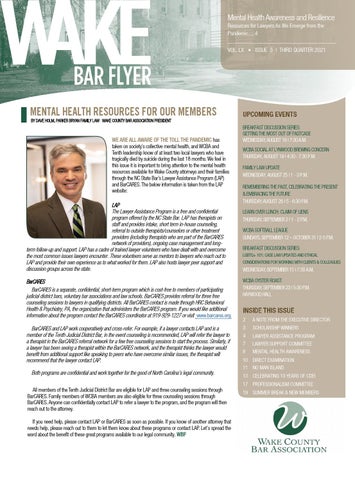
Mental Health Awareness and Resilience Resources for Lawyers As We Emerge from the Pandemic.....4 ___________________________________ _
VOL. LX • ISSUE 3 | THIRD QUARTER 2021
BAR FLYER MENTAL HEALTH RESOURCES FOR OUR MEMBERS BY DAVE HOLM, PARKER BRYAN FAMILY LAW | WAKE COUNTY BAR ASSOCIATION PRESIDENT
WE ARE ALL AWARE OF THE TOLL THE PANDEMIC has taken on society’s collective mental health, and WCBA and Tenth leadership know of at least two local lawyers who have tragically died by suicide during the last 18 months. We feel in this issue it is important to bring attention to the mental health resources available for Wake County attorneys and their families through the NC State Bar’s Lawyer Assistance Program (LAP) and BarCARES. The below information is taken from the LAP website:
LAP The Lawyer Assistance Program is a free and confidential program offered by the NC State Bar. LAP has therapists on staff and provides intake, short term in-house counseling, referral to outside therapists/counselors or other treatment providers (including therapists who are part of the BarCARES network of providers), ongoing case management and longterm follow-up and support. LAP has a cadre of trained lawyer volunteers who have dealt with and overcome the most common issues lawyers encounter. These volunteers serve as mentors to lawyers who reach out to LAP and provide their own experience as to what worked for them. LAP also hosts lawyer peer support and discussion groups across the state. BarCARES BarCARES is a separate, confidential, short-term program which is cost-free to members of participating judicial district bars, voluntary bar associations and law schools. BarCARES provides referral for three free counseling sessions to lawyers in qualifying districts. All BarCARES contact is made through HRC Behavioral Health & Psychiatry, PA, the organization that administers the BarCARES program. If you would like additional information about the program contact the BarCARES coordinator at 919-929-1227 or visit www.barcares.org. BarCARES and LAP work cooperatively and cross-refer. For example, if a lawyer contacts LAP and is a member of the Tenth Judicial District Bar, in the event counseling is recommended, LAP will refer the lawyer to a therapist in the BarCARES referral network for a few free counseling sessions to start the process. Similarly, if a lawyer has been seeing a therapist within the BarCARES network, and the therapist thinks the lawyer would benefit from additional support like speaking to peers who have overcome similar issues, the therapist will recommend that the lawyer contact LAP. Both programs are confidential and work together for the good of North Carolina’s legal community. All members of the Tenth Judicial District Bar are eligible for LAP and three counseling sessions through BarCARES. Family members of WCBA members are also eligible for three counseling sessions through BarCARES. Anyone can confidentially contact LAP to refer a lawyer to the program, and the program will then reach out to the attorney. If you need help, please contact LAP or BarCARES as soon as possible. If you know of another attorney that needs help, please reach out to them to let them know about these programs or contact LAP. Let’s spread the word about the benefit of these great programs available to our legal community. WBF
UPCOMING EVENTS BREAKFAST DISCUSSION SERIES: GETTING THE MOST OUT OF FASTCASE WEDNESDAY, AUGUST 18 | 7:30 A.M. WCBA SOCIAL AT LYNWOOD BREWING CONCERN THURSDAY, AUGUST 19 | 4:30 - 7:30 P.M. FAMILY LAW UPDATE WEDNESDAY, AUGUST 25 | 1 - 3 P.M. REMEMBERING THE PAST, CELEBRATING THE PRESENT & EMBRACING THE FUTURE THURSDAY, AUGUST 26 | 5 - 6:30 P.M. LEARN OVER LUNCH: CLAIM OF LIENS THURSDAY, SEPTEMBER 2 | 1 - 2 P.M. WCBA SOFTBALL LEAGUE SUNDAYS, SEPTEMBER 12 – OCTOBER 31 | 2-5 P.M. BREAKFAST DISCUSSION SERIES: LGBTQ+ 101: CASE LAW UPDATES AND ETHICAL CONSIDERATIONS FOR WORKING WITH CLIENTS & COLLEAGUES
WEDNESDAY, SEPTEMBER 15 | 7:30 A.M. WCBA OYSTER ROAST THURSDAY, SEPTEMBER 23 | 5:30 P.M. HAYWOOD HALL
INSIDE THIS ISSUE 2
A NOTE FROM THE EXECUTIVE DIRECTOR
3
SCHOLARSHIP WINNERS
7 8
LAWYER ASSISTANCE PROGRAM LAWYER SUPPORT COMMITTEE MENTAL HEALTH AWARENESS
10 DIRECT EXAMINATION 11 NO MAN ISLAND 13 CELEBRATING 10 YEARS OF CDEI 17 PROFESSIONALISM COMMITTEE 19 SUMMER BREAK & NEW MEMBERS
WAKE BAR FLYER VOL. LX | ISSUE 3 | THIRD QUARTER 2021
A NOTE FROM THE EXECUTIVE DIRECTOR BY WHITNEY D.G. VON HAAM | EXECUTIVE DIRECTOR, WAKE COUNTY BAR ASSOCIATION
Presidents DAVE HOLM, WAKE COUNTY BAR ASSOCIATION RUSSELL D. BABB, TENTH J.D. BAR Presidents-Elect YVONNE ARMENDARIZ, WAKE COUNTY BAR ASSOCIATION DAYATRA MATTHEWS, TENTH J.D. BAR Secretary MEREDITH PACE Treasurer JUDGE ASHLEIGH P. DUNSTON Immediate Past Presidents CARMEN H. BANNON, WAKE COUNTY BAR ASSOCIATION ADAM M. GOTTSEGEN, TENTH J.D. BAR Board of Directors TIFFANY COX JEAN CARTER ANNA DAVIS JAKE EPSTEIN DAVID FERRELL WILLIAM FINN JR. NIYA T. FONVILLE EVIN GRANT JUDGE SAM HAMADANI KATIE H. KING DEAN J. RICH LEONARD (EX OFFICIO) KELLIE MYERS KIMBERLY MILLER BRIAN P. OTEN SARAH PRIVETTE JUDGE VINCE ROZIER, JR. KRISTINA THOMPSON JESSICA VICKERS JOHN WARD BENJAMIN O. “BOZ” ZELLINGER Young Lawyers Division President KENDRA N. STARK Young Lawyers Division President-elect JONATHAN M. BOGUES Executive Director WHITNEY D.G. von HAAM Wake Bar Flyer Editor CANDACE B. MARSHALL Communications SARAH L. JUSTICE Wake Bar Flyer Designer CLAIR S. SMITH Tenth Judicial District Bar Councilors JULIE L. BELL HEIDI C. BLOOM WALTER E. BROCK THEODORE C. EDWARDS II KATHERINE A. FRYE FRED T. MORELOCK JUDGE ROBERT B. RADER WARREN T. SAVAGE
MENTAL HEALTH WAS AN IMPORTANT and regular topic in my house growing up – my mother was a social worker with the mentally ill, and was passionate about the importance of helping every person live a fulfilling life beyond their health issues. Recently, my 14-year-old daughter Nyah was assigned a school project to create her own “I have a dream” speech. She chose the topic of mental health, and I feel like this excerpt of her remarks best defines our family’s commitment to this topic:
Mental health. The wellbeing of your brain. Something that is so important to the lives of 7.9 billion people that is so avoided in conversation. How could such an important part of every individual’s life that impacts them so remarkably be so difficult to find help? How could something so crucial have such a stigma surrounding it? Could it be that mental health and illness are always discussed as if they are the same thing? The two could not be more different, like islands in the middle of a vast ocean we call our brain. The key words are even opposites: health and illness. So many people are afraid to talk about mental health because of the prejudice around people who struggle with their mental illness. Although we have come a long way from when people were put in concentration camps if they were mentally ill and were considered lesser if they got help, we live in a world where there is still bias against those who suffer from it. We need to live in a world where mental health is normalized and able to be spoken about comfortably. We need to live in a world where mental health centers are included on all health insurances, because therapy shouldn’t be considered a luxury. Where workplaces view mental health days as sick days, not vacation. If you were sick, you wouldn’t wait to go to the doctor, so if you are stressed or feeling down, why would you wait to talk to someone? Because sometimes, if it gets bad enough, you can reach the lowest of lows. We need to see mental health and mental illness as a priority and not as an afterthought. You are not weak for getting help. You are strong for recognizing you need it. I dream to live in a world where people aren’t judged for speaking out about mental health and that the bias of people who struggle with their mental wellbeing diminishes. I dream to live in a world where mental health services are easily accessible to all, and it is viewed as a necessity instead of a privilege. And even if this change is like putting a puzzle together, piece by piece… I have a dream. WBF
© 2021 Wake County Bar Association & Tenth Judicial District Bar.
WAKE BAR FLYER
2
THIRD QUARTER 2021
LAW SCHOOL SCHOLARSHIP WINNERS CHOSEN Congratulations to Sofia Baneth and Claudia Barcelo of Raleigh, who each received a $4,000 Wake County Bar Association Foundation memorial scholarship. The scholarships are awarded annually to law students or persons about to enter law school who have Wake County ties and are funded through donations, the annual golf tournament and late fees from district bar dues. The scholarship fund was founded in memory of Edwin S. Preston Jr., former Wake County Chief Resident Superior Court Judge.
Ten years from now, I hope to work for the North Carolina state or federal government, given my interest in public service, so I can provide tangible legal representation and help individuals on a day-today basis, while also influencing policy and law. In addition to employment law, I am interested in housing law and tenants’ rights. Similar to employment, housing is categorically intertwined with individual and economic well-being. Access to housing creates a more equitable society by providing financial stability and acting as preventative health care, protecting individuals from extreme weather and ensuring regular access to running water. Like employment, ensuring greater access to housing helps individuals in a tangible way, which aggregates to strengthen the national welfare and economy. I am interested in employment and housing given how it directly benefits people on a day-to-day basis, but also gets to deeper societal structures that need improvements, which in turn benefit society overall. Ultimately, I entered Campbell Law School to work in public interest law. Beyond law school, I hope to work for the North Carolina or federal government to represent the interests of the under-served. My eyes are set on employment or housing law, given that I can provide tangible legal representation to communities in need, while also influencing essential legal doctrine that can lead to a more just and equitable society in the long term. WBF
SOFIA BANETH 2L, CAMPBELL LAW SCHOOL
Through law school I have dedicated my research to child trafficking, specifically, child sexual exploitation and its attendant cyber crimes. My research not only exposed me to the medical perspectives on human trafficking but demanded in-depth consideration and synthesis of difficult data sources. My investigations in cyber crimes and child trafficking required keen attention to recorded network activity; the tracking of financial data and channels of expenditure; the studying of online codes used in platforms such as Backpage to facilitate trafficking and acquisition; victimology; psychological profile of perpetrators and geo-profiles, as well as the most recent medical and psychological research on sex crimes. Not only was I collecting data, but I was to synthesize it and present my findings. The degree of analytic scrutiny and tenacity demanded by my research is particularly well suited for the North Carolina State Bureau of Investigations, where I plan to work upon completing my studies.
CLAUDIA BARCELO 3L, CAMPBELL LAW SCHOOL
WAKE BAR FLYER
Know that my demonstrated commitment to public service stems from my own history as a child-refugee, a survivor of sexual trauma, and as a photosensitive epileptic. In dealing with exile, chronic seizures, and sexual trauma I felt a visceral pull toward a legal career. The Law presented itself the logical conclusion of not merely having survived but having redefined my traumas: from their misery germinated the purpose with which today I punctuate these events: my commitment toward public service. WBF
3
THIRD QUARTER 2021
LAWYER ASSISTANCE PROGRAM COVID – LIKE ORANGE JUICE CONCENTRATE ROBYNN E. MORAITES, ESQ. | EXECUTIVE DIRECTOR, NC LAWYER ASSISTANCE PROGRAM
LAWYER WELL-BEING IS A POPULAR REFRAIN THESE DAYS, but what is it really? Lawyer well-being influences and correlates to ethical behavior, professionalism, and competence. It can be tricky to discuss lawyer well-being because there are not objective, measurable well-being standards. We are only alerted that something is amiss when a lawyer begins to have malpractice claims, ethical violations or behaves unprofessionally enough that colleagues start to notice. It is often helpful to frame the discussion on a well-being continuum rather than to think of well-being and impairment as either/or propositions.
Lawyers and judges move along this continuum over the course of a career. Where an individual falls on the continuum at a given point in time can be influenced by a number of factors ranging from the stress of a certain legal matter or life situation, say the death of a close family member, to medically based illnesses like depression or alcoholism – enter stage left…or a global pandemic. By the time a lawyer is committing malpractice or violating the Rules of Professional Conduct, he or she has slid very far down the well-being continuum. The asterisk is an indicator of where a lawyer in a cycle of impairment usually hits the regulator’s radar. Graphically illustrating this another way, here is a slide often used in LAP’s compassion fatigue/burnout CLE presentation: The pandemic has thrown us all into the “Danger Zone of Too Much Stress” and slid all of us further to the left on the well-being continuum. Recent research has verified that the pandemic has taken a far greater toll, emotionally and psychologically, on women and minorities. Across all demographics, anxiety is at an all-time high. We’ve seen a huge rise in day drinking. Where we once were crawling out of our skin from having to suddenly stay at home, research is showing a collective social anxiety about gathering in person again (this is more than feeling awkward…think…dread). All of this makes sense when understood in the larger context of our collective psychology. Deeply embedded in the human psyche is a survival-based instinct around the need to feel in control. For our survival as a species, we rely upon our ability to predict future circumstances. When we can predict, we can then plan and prepare. But when we cannot predict, plan and prepare, our brain takes off in fight-or-flight mode. To our brains, we have spent the last 15 months running for our lives from a saber tooth tiger. We spend a fair amount of time educating the bar about the effects of stress, including the fight-or-flight response. In a great video by Nat Geo entitled Stress: Portrait of a Killer (available on YouTube), the opening scene shows a lion chasing a zebra. It also shows a man holding a briefcase waiting to get on the subway. The narrator explains that for the zebra, the fight-or-flight response is over in about three minutes. Either the zebra has gotten away or it’s over for the zebra. The narrator goes on to explain that the man on the subway is experiencing this heightened sense of fight or flight as well. But what is supposed to be a short-term, acute, survival response is experienced by many of us as a chronic day-in-and-day-out condition. Lawyers and judges are uniquely positioned for a lifetime of this chronic day-in-and-day-out fight-or-flight condition. We often say, and we have published in our law school brochure, “You are having a normal reaction to an abnormal situation.” The legal profession is a super abnormal situation, right from the forced-curve get go. With its winner-take-all adversarial nature, its unrelenting demands and the inherently competitive people who are attracted to it, it creates a pronounced and prolonged abnormal situation for its members. And then we added COVID to the mix, which, for many of us, flooded our surge capacity. See, e.g., Your Surge Capacity is Depleted and It’s Why You Feel Awful.
WAKE BAR FLYER
4
THIRD QUARTER 2021
LAWYER ASSISTANCE PROGRAM So, we have to take it as a given that none of us is at the top of our game and thriving right now, even as life resumes to pre-pandemic activity. Let’s talk about the concept of resilience. Resilience is the capacity to endure hardship and spring back; it is the capacity to bend without breaking. Resilience is not an innate quality that one is either born with or without. Rather, it is a set of skills that can be practiced and learned. People in recovery often talk about the “tools of recovery.” This is a kind of coded speech for a set of resilience skills that is taught and learned on the recovery journey. Resilience skills are a collateral byproduct or effect of practices like yoga, mindfulness, meditation, letting go and accepting what we cannot change (aka the serenity prayer). If you want to see well-being practices being put to the test day in and day out, just take a look at our active volunteers. They are walking demonstrations of the power of resilience tools and skills. In fact, when the pandemic first forced everyone into seclusion, LAP volunteers documented how they were applying resilience tools that they learned in recovery to the situation of the pandemic. That tool kit is available on LAP’s website. Our CLE titled Mental Health and Well-being During Covid, is essentially a crash course in resilience practices, and our handouts page has another set of tools available for anyone. I encourage you to visit these webpages to peruse these tools. Think of it as a pocketknife and only use those tools that speak to you. The key is practice. It is one thing to read about a 32-second square breathing technique. Reading about it may be interesting, but without practice, it will do you no good at all. It is quite another thing to stop four or five times a day to do this simple 32-second practice to calm and stabilize your nervous system and trick your body into thinking it is more relaxed than it is. In some ways, the gift of Covid, is that it brought into sharp focus the chronic fight-or-flight psychological process we experience in the legal profession every day. Like orange juice concentrate versus an orange, however, Covid has forced us to immediately put some of these resilience practices into play to maintain our collective sanity. But the truth is, we all need them, all the time. Law is a tough profession dealing with the big uglies in life. To the extent we can leverage the most unfortunate circumstance of Covid to begin actually using some of these practices, the less despair we will be feeling as life resumes at its once again breakneck speed. If you find you are having difficulty navigating, you are paralyzed by anxiety, you are day drinking or whatever, give us a call. You are not alone. In fact, you will be surprised to learn you are in quite good company. WBF
WAKE BAR FLYER
5
THIRD QUARTER 2021
BarCARES
®
BarCARES can make a difference for Judicial District & Local Bar Members! BarCARES is a confidential short-term counseling, coaching and crisis intervention program created as a cost-free way of helping attorneys locate assistance to deal with the problems that might be causing stress. BarCARES is provided cost-free to members of bar groups that establish a BarCARES program. A number of judicial district and local bars, law schools and other bar related groups across the state have already chosen to offer this program. BarCARES of North Carolina, Inc, (BCNC) is a nonprofit corporation that works to expand the program to attorneys throughout North Carolina, and it monitors the overall BarCARES program operation. BarCARES, endorsed by the North Carolina Bar Association, is made possible by funding from bar groups that establish a BarCARES program, BCNC, the North Carolina Bar Association and its Foundation, and Lawyers Insurance Agency. BarCARES can be used for problems such as: Personal Issues • crisis intervention • depression and anxiety • substance abuse (drug or alcohol) • financial concerns • career counseling
Family Issues • marriage or relationship issues • children or adolescents • parenting • family conflict
Work Functions • professional stressors • course related stress • conflict resolution
BarCARES provides members of established programs in judicial districts, bar associations, law schools and organizations up to three free visits each year. In some programs the visits may be available to family members. Contact the BarCARES Program Coordinator for information about which BarCARES services are available to you. BarCARES Initiative extends a statewide program offer to any member of the NCBA who lives in an area where BarCARES is not yet available. This is a one-time benefit of three sessions under the program. You may contact the BarCARES Coordinator for information about which BarCARES services are available to you. BarCARES sessions can be used to provide assistance in resolving problems or accessing the appropriate source of help. Sometimes three sessions will be enough to take care of a problem. If it looks like the problem may require a longer term solution, the initial visits may be used to help identify the problem, to develop goals and a plan, and to access an appropriate resource, often covered under your health insurance plan. Every effort will be made for you to see a counselor who is also an approved provider under your group insurance in the event you wish to continue after the program visits are used. BarCARES is a confidential program, no one will know if you access the program but you and anyone you choose to tell. No personally identifiable information is shared with the BarCARES Board; the associated state, local voluntary or judicial district bar association; or any other entity without the permission of the BarCARES client/ user. Additionally, any health related information included in the sessions will follow federal HIPAA Privacy & Security Rules as stated in HRC’s HIPAA Privacy & Security statement. BarCARES program benefits are accessed by contacting the BarCARES Program Coordinator at HRC Behavioral Health & Psychiatry, PA, at 1.800.640.0735. You may also contact the BarCARES Program Coordinator just to ask questions about the program and the services it provides.
WAKE BAR FLYER
6
confidential counseling for the legal community and their families 1-800-640-0735 | barcares.ncbar.org
THIRD QUARTER 2021
LAWYER SUPPORT COMMITTEE PUBLIC SERVICE ANNOUNCEMENTS FROM THE LAWYER SUPPORT COMMITTEE (LSC) BY KRISTI THOMPSON, NC INDUSTRIAL COMMISSION | LAWYER SUPPORT COMMITTEE CHAIR
YOU JUST SURVIVED (AND ARE CONTINUING TO SURVIVE) a historic pandemic which placed stress, isolation and challenges on everyone. The LSC is here to encourage you. You are not alone. Whatever you are doing, you are doing a great job! Most importantly, the LSC encourages all members to reach out to BarCARES for free mental health services. It was a traumatic year. Mental health is critical to your well-being and being a grounded attorney for your colleagues and clients. The majority of BarCARES counselors are offering virtual sessions so it is so easy to fit mental health into your schedule. It is a good time for a mental health checkup. I encourage you to make an appointment with a mental health professional to chat about this past year, and make your mental health a priority. Additionally, the LSC is brainstorming ways to support our members. WCBA member, trademark and copyright attorney, and certified yoga instructor, Emily Haas provided a free yoga class in June at the NC Museum of Art for all of our members. She did a wonderful job and we had a great turnout! To learn more about Emily, see her Direct Examination on page 10. If you have a suggestion or talent to support our membership, please reach out to us and let us know. Finally, the LSC also exists to lift each other up in times of hardship. We have a team of dedicated letter writers who love to send individualized notes of kindness and support. If you know of a colleague who could use a note, please let us know at lawyersupport@wakecountybar.org. A personalized note from one of our Lawyer Support Committee members is what unites our organization and brings us together. I hope you will not hesitate to let us know how we can help you. Keep up the good work! WBF
LOCAL MARKET EXPERTS REIMAGINING COMMERCIAL REAL ESTATE WITH A LEGAL BACKGROUND AND REAL ESTATE EXPERTISE, I CAN ASSIST YOU AND YOUR BUSINESS SURROUNDING ANY REAL ESTATE NEEDS AND GOALS. CALL ME TODAY TO DISCUSS DETAILS.
JAMES BAILEY, J.D., BROKER 919.576.2514
WAKE BAR FLYER
7
LOCAL MARKET EXPERTS REIMAGININGLEERALEIGH.COM COMMERCIAL REAL ESTATE
THIRD QUARTER 2021
COMMITTEE FOR DIVERSITY, EQUITY & INCLUSION THE IMPORTANCE OF MENTAL HEALTH AWARENESS AS WE EMERGE FROM THE PANDEMIC BY MARISA N. GRANT | NC STATE UNIVERSITY
AFTER A TAXING YEAR AND A HALF a post-pandemic world presents welcome relief to those who have missed social interaction, working from the office, or struggled with restricted activities. Many people are excited about the return of indoor dining, meeting up with friends and summer travel. However, for people with new or pre-existing mental health illnesses, thinking about the reality of returning to a pre-pandemic way of life results in fear, general and social anxiety, and stress. The pandemic has created a new divide among people: those who are anxious about reintegration and those who welcome it. No matter one’s personal feelings about the reintegration process, one thing is true: the entire world experienced a collective trauma with COVID-19, and like with any trauma, time is necessary for healing and working through it will take longer for some. The trauma experienced during the past 16 months has led to far-reaching mental health issues that can be uncomfortable for most people to discuss. Those who still have concerns about COVID-19, especially with new strains emerging, are experiencing major anxiety about “getting back to normal” and what that means for their daily lives. Not feeling ready or safe to return to indoor dining, social events, or in-office work can result in feelings of despair. It is no wonder that many people, especially those who experience social anxiety, have thrived during the pandemic. Consequently, for some, receiving the notification to return to work or feeling forced to interact with colleagues or clients without masks or social distancing may result in a downward spiral of well-being. The stigma around mental health can leave people feeling isolated, embarrassed, or more anxious and depressed and the result is a vicious cycle that can leave one feeling out of control. That’s why focusing on mental health as we emerge from the pandemic should be embraced and normalized. If you are feeling anxious about the world opening back up, you are not alone. Robynn E. Moraites, executive director of the NC Lawyer Assistance Program, said, “[people are] anxious and nervous about re-entry, even people who do not have a prior history of anxiety.” In fact, the American Psychiatric Association found in a recent poll that 43% of adults report the pandemic has had a serious impact on their mental health, up from 37% in 2020. Fiftynine percent of adults younger than 30 and 54% of adults aged 30 to 44 reported serious impacts on their mental health. In addition to COVID-19, the pandemic led to more publicized racial disparities and strife. Lawyers of color have faced additional issues during the pandemic leading to increased anxiety. Staying at home has provided safety for lawyers, especially those who are Black or Asian, who have experienced and/or witnessed acts of racism. Although complete isolation is not healthy for anyone, lawyers of color may find continued remote work appealing because it can reduce the chance of being harassed or even assaulted while out in public. So while White lawyers were significantly more likely than lawyers of color to miss interacting with people at the office according to a survey by the American Bar Association, conversely, The Washington Post found that Black employees especially have benefited from remote work as it significantly reduces the (sometimes unintended) acts of microaggressions against them. The article notes that allowing employees of color the opportunity to work in environments where they do not have to “keep their guard up” allows them to focus on work productivity rather than expending energy on race-based biases. Furthermore, lawyers in high-risk categories like those with autoimmune diseases may experience increased anxiety and depression about the world reopening and returning to the office since becoming infected with COVID-19 is still a possibility, despite the increase in vaccinations. In reality, remote work opportunities or the ability to avoid social gatherings will continue to dwindle as we are encouraged to return to a pre-pandemic lifestyle. Therefore, setting boundaries to protect your mental health will be crucial. Feeling pressure to attend everything from an office lunch to happy hour is normal. However, re-engaging in social activities should be taken at your own pace and you should not feel guilty about saying “no” to an invitation. It’s important to remember that everyone has handled the stress of the pandemic differently. Stop and think about what another person might be going through and practice compassion, for both yourself and others. Moraites said it can be helpful to share feelings of anxiousness as a way to “normalize” mental health discussions. Other ways to protect your mental health are to consume less news about the pandemic or current events in general and engage in healthy, fun and relaxing activities and routines. Whether it’s exercising, listening to music, reading, gardening or talking with friends more frequently, continuing self-care is important for overall well-being. Finally, remember that self-care is not selfish, mental health is as important as physical health, and it is ok to seek help. Making your mental health a priority doesn’t make you weak, it makes you strong. WBF
For more tips and resources on mental health, visit the NC LAP Mental and Well-Being Tool Kit or contact BarCARES at 919-929-1227 or visit www.barcares.org.
WAKE BAR FLYER
8
THIRD QUARTER 2021
A MISSION TO HELP. PEOPLE WHO CARE. PROTECTION THAT COUNTS.
TODD JONES, ANDERSON AND JONES HOPE LINE MURAL, RALEIGH
Lawyers and murals have a lot in common. They’re both diverse and creative. Each is unique. Each tells a story. Lawyers Mutual has helped tell the story for North Carolina lawyers since 1977. It’s a story of people who care and a mission to help.
919.677.8900 800.662.8843
www.lawyersmutualnc.com
It’s a story of people, protection, and a mission. IT’S A STORY THAT KEEPS GETTING BETTER. WAKE BAR FLYER
9
SECOND QUARTER 2021
DIRECT EXAMINATION: EMILY M. HAAS DIRECT EXAMINATION IS THE FIRST opportunity for the jury to meet a witness. An effective lawyer will use the
opportunity to personalize the witness, making the witness appear both likeable and credible. At the end of the day, the direct examination is a party’s best chance to tell his or her story.
Emily Haas is a lawyer and yoga instructor who led a morning class for our members on the grounds of the NC Museum of Art.
1. When you were in elementary school, what did you want to be when you grew up? Young-me wanted to be a dolphin trainer.
8. What has been the most surprising or unexpected development in your career? I expected I would be a patent attorney, considering my STEM background. Instead, I’ve become really passionate about trademarks, and working with businesses to develop and protect their reputations.
2. What was the most important lesson your parents taught you? As a trademark attorney, the thing my parents told me that I most often recite when talking with my clients is that the most valuable thing that you have is your reputation. If people know you as honest, hardworking and dependable, it is important to maintain that reputation.
9. What is your favorite book? "The Silmarillion” by J. R. R. Tolkien 10. What is your most marked characteristic? I have a really large imagination.
3. Who was your favorite teacher and why? When I was in elementary school, I was told that I was bad at math. My third grade math teacher realized the problem wasn’t that I was bad at math, but how math was being taught. She restored my confidence and I eventually went on to get an advanced STEM degree as a result.
11. What is your hidden talent? I’m not sure if it’s hidden, but something most people in law do not know about me is that I’m a trained contralto.
4. Did you love or hate law school? I was the sick, sad person who thought it was really fascinating. Of course, I was coming from chemistry, so context is key.
12. Who are your real life heroes? I greatly admire my yoga sister, Beth, who is able to walk through the world both with confidence and compassion. She is the type of leader I aspire to be.
5. What was your most embarrassing courtroom experience? The first time I had to go to court by myself, I got sick in the bathroom before. The courtroom experience that had baby-lawyer-me so terrified? A scheduling conference.
13. When and where were you happiest? I’m not quite sure how to answer this one, to be honest. I don’t think I can narrow things down to one time and place. I try to make every day an adventure, and that’s the best any of us can do.
6. What was your best courtroom experience? After I did my first major hearing as first chair, I realized that I was able to represent my client and respond to the judge’s questions. I took a moment afterwards to let out a deep breath and say, ‘I really can do this.’ 7. Why did you become a lawyer? When I was a senior in college, I needed to fulfill the gen-eds that I had been putting off. I took U.S. Government thinking it would be an easy class. Spoiler Alert: it was not – but I really became fascinated during our study of the Constitution and said to the friend I had roped into taking the class with me, “I wish I had taken this as a freshman. I would have been a lawyer. Too bad science majors cannot go to law school.” (Two years later I found out science majors could go to law school and I went). WAKE BAR FLYER
10
THIRD QUARTER 2021
NO MAN ISLAND BY CAMILLE STELL | LAWYERS MUTUAL CONSULTING & SERVICES
Each summer, Lawyers Mutual participates in the North Carolina Bar Association Minorities in the Profession 1L Summer Associate Program. This summer we have been fortunate to have Shawn Singleton from North Carolina Central University School of Law with us for six weeks. Shawn and I collaborated on this story, and I hope it helps you realize you are not alone in any of the emotions you have experienced during the COVID-19 pandemic.
SHAWN SINGLETON’S STORY My first couple of weeks in North Carolina were difficult. I moved to Durham from Virginia Beach – hours away from all of my friends and most of my family. When I moved, the country was still dealing with the COVID-19 pandemic, so there were not many places open. Since I knew no one and could go nowhere, I was stuck in my apartment. A short time later, I started law school online at North Carolina Central University, which made things even more challenging. Taking classes online did not make law school easier. We still had to read all the material. We still had to come to class, with our cameras on. We still had to pray not to be cold called. Some might argue that taking classes online was actually more difficult. Sometimes your Internet will go out, or your hand-me-down laptop will shut-off randomly, or the professor will have technical problems and be incomprehensible. There is also something lost by not being able to learn in person, and even more lost when you are being tasked with learning from a pre-recorded lecture. Despite the difficulties, I was able to stay on top of everything and do what was asked of me. I’m glad I didn’t have a breakdown, which is what some 2Ls and 3Ls said happened to them, but I was already starting to feel fatigued, just a few weeks in.
The second lesson came while I worked at a summer camp. My jobs at the camp changed every summer, from being a dishwasher to helping co-run the camp. Because I worked so long and in so many different roles, I was able to gain a great understanding of how camp worked.
Camille Stell is the president of Lawyers Mutual Consulting & Services. Continue this conversation by contacting Camille at camille@ lawyersmutualnc.com or 800.662.8843.
In my time there, I learned that the best determination for whether it would be a good summer wasn’t funding, weather, programming or which kids attended. The biggest determining factor was the staff – picking good leaders able to motivate their staff, making sure that there is as little interpersonal drama as possible and keeping workers focused on the mission. If those could be achieved, the summer would be a great one. And so, out of a desire to listen to my professor’s advice, a belief in the idea that collaboration can make bad experiences bearable and produce great outcomes and a need to get out of the house and talk to other people, I decided to join a study group. Joining the group was one of the best decisions I have made.
My Civil Procedure professor gave us a worksheet to do over a weekend on Rule 4. When assigning the worksheet to us, he encouraged us to get into study groups to work on it. My professor said no one makes it in the legal profession alone; and that he still helps and receives help from the people with whom he went to law school with.
My study group helped me revolutionize my study habits so I could better perform in law school. I never needed to use flashcards before, but my study partners wanted them, so we made flash cards together. My regular tools for retaining information were only taking me so far, but flash cards took my retention to the next level. My study group helped me realize that.
I had never been a part of a study group before. When it came to academics, I always worked alone; and since my grades were good, I never saw the need to change that. The statement that ‘no one can make it in the legal profession alone’ made me remember lessons from previous jobs I worked.
My study group is great at helping each other. If someone feels like they’re not getting a concept, the entire group will help them catch up. We do this for two reasons: 1) No one is left behind, and 2) the members of the group ask thought-provoking questions, prompting each of us to have a deeper understanding of the concepts.
The first lesson came during my time as a manual laborer at an event venue. The job consisted of long, late hours, little pay and few breaks. During these harrowing shifts, I would often think to myself: “What am I doing here? What are any of us doing here?”
My social needs were also met by my study group. We are not just study partners but genuine friends. None of us are from Durham, so we have taken the time to explore the city together, we’ve celebrated birthdays and holidays together, and we provide support for each other. When I had a family member die in November 2020, my study group was there for me while I was in North Carolina and away from the rest of my family.
I don’t know what my co-workers’ answers to those questions were, but I discovered that what kept me coming back was my team – our interactions and conversations as we worked throughout the night. That job taught me that I could get through anything if I was doing it with the right team.
WAKE BAR FLYER
Our study group started with the goal of all of us making it to the top 10% of our class. For the most part, we have met that goal. Because of
11
THIRD QUARTER 2021
my amazing study group, I had a GPA that qualified me for the Minorities in the Profession Program. Through the program, I received an internship at Lawyers Mutual. It’s my belief that without my study group, I would not be where I am today.
I am feeling more hopeful and optimistic, much more like myself. I regret waiting so long to reach out. Of course, the depression was a factor in not being able to motivate myself, while the Pandemic had health care providers in short supply.
CAMILLE STELL’S STORY As I mentioned in my Winter column, I have felt ALL the emotions during this pandemic: anxious, depressed, tired, lethargic, happy to be home, sad to be isolated, guilty for having a job that allowed me to work remotely. We began working remotely in March 2020 and by the fall, I could begin to feel myself wearing down. I was physically tired and emotionally exhausted. I was sad about being isolated but scared to go out for fear of getting sick. I knew I needed to talk with a professional mental health provider, but I could barely muster the energy to keep one foot in front of the other. I reached out to Laura Mahr, the mindfulness expert with Conscious Legal Minds, and she gave me some suggestions for finding a therapist. However, it was a challenge to find someone who was taking on new patients. I grew frustrated and once the holidays arrived, I stopped looking. In early 2021, I started my search again. I had one disastrous in-person session before I found Jill. Through MindPath Care Centers, I was able to have video chats with a therapist. Jill’s advice and guidance helped me to take control of my mental health situation and to realize that asking for help was not a sign of weakness, but of strength. I continue to talk with Jill and have seen steady improvement since the beginning of the year. I am more focused on work and able to accomplish projects with more concentration. My mood has lifted, and my emotions are more in check.
Don’t wait, reach out if you need help. There are many resources highlighted in this issue of the Wake Bar Flyer. Also, sharing your challenges with a group of friends as Shawn did can provide relief. 2020 showed us that humans can’t excel when we are isolated, we need community in order to thrive. Shawn’s professor shared a great wisdom, no one makes it in the legal profession alone. The poet John Donne expressed this sentiment in his poem, "No Man is an Island," in part below:
No man is an island, entire of itself, Every man is a piece of the continent, a part of the main. Any man’s death diminishes me, because I am involved in mankind. And therefore never send to know for whom the bell tolls; it tolls for thee. WBF
Shawn Singleton is an Old Dominion University Monarch, a rising 2L at the North Carolina Central University School of Law, a reader and writer who enjoys participating in the National Novel Writing Month Challenge each November. Shawn was a 2021 summer intern with Lawyers Mutual. Contact Shawn at ssingl24@eagles.nccu.edu. Camille Stell is the President of Lawyers Mutual Consulting & Services and works with law firms to modernize their law practices through strategic planning and succession planning. Continue this conversation by contacting Camille at camille@lawyersmutualconsulting.com or 919.677.8900.
Thursday, November 4 5 p.m. Social | 7 p.m. Show NC Museum of History WAKE BAR FLYER
12
THIRD QUARTER 2021
CELEBRATING 10 YEARS OF DIVERSITY, EQUITY & INCLUSION EFFORTS BY NIYA FONVILLE, CAMPBELL UNIVERSITY SCHOOL OF LAW | COMMITTEE FOR DIVERSITY, EQUITY & INCLUSION CHAIR
N
JOIN THE COMMITTEE FOR DIVERSITY, EQUITY & INCLUSION (formerly the Leadership Development Committee), as we celebrate 10 years of great work toward pushing the conversations of diversity, equity and inclusion (DEI) within the legal profession forward. To commemorate this milestone, the CDEI invite you to a social on Thursday, August 26 at the WCBA and Tenth offices, 5 - 6:30 p.m. for food, fun and fellowship. There will be a 15-minute short program, but the majority of time will be spent socializing and networking with peers. Our theme, Recognizing the Past, Celebrating the Present and Embracing the Future, will take us on a journey down memory lane as we end by walking boldly into the next season of what’s to come in DEI work within the legal profession. Each part of this event, from marketing to final program execution, will center around these three areas. THE PAST
Remembering the Past, Celebrating the Present & Embracing the Future
D NC
In order for our bars to fully appreciate where we are and appropriately prepare for future DEI work, we must acknowledge where we’ve been and who led the way. To that end, we will revisit the past by honoring CDEI’s leaders: Ted Edwards, the WCBA President who started the conversation, and its six past chairs, Day Matthews, Benn Brewington, Jane Paksoy, Judge Vince Rozier, Yvonne Armendariz and Niya Fonville. As with any endeavor, an organization’s leader sets the tone for the group’s work. CDEI is fortunate to have a well-respected, dedicated attorney who laid the foundation. What better way to recognize the Committee’s past than with a chat with Mr. Ted Edwards himself?
How do you think contributing to the endowment can help the WCBA reach these goals?
I wanted to create a systematic pathway to increase diversity in bar leadership. I wanted to help the Wake County Bar identify and nurture minority lawyers in areas outside of programs that were specifically targeted towards minority lawyers. I wanted to see more minority lawyers speaking at CLEs within their practice area and leading the various bar committees. My experience had been that these things did not just happen organically, so I felt it was necessary to create a committee with the responsibility for identifying problems which hinder inclusion and opportunities for making positive change within our Bar.
The program’s theme is Remembering the Past, Celebrating the Present, and Embracing the Future. What do you envision for the WCBA specifically, and the WAKE BAR FLYER
R
It takes money to make progress. The WCBA endowment allows the WCBA to invest in programs supporting equity and inclusion. Our participation gives us the right to hold the WCBA accountable and encourage the WCBA to continue to invest in furthering these efforts.
0
What prompted you to organize LDC and why was it important to you to focus on Leadership Development?
What message do you have to attorneys who wish to be allies in the space of equity and inclusion? Speak up! I think that most attorneys want progress in this area but many are hesitant to confront their friends or colleagues when they see bias occurring. It may seem risky to confront someone when they are not being directly affected by the behavior, but our profession often requires us to take action when we become aware of violations of the Rules of Professional Conduct. I believe that we have a duty to our profession and to each other to take action to rid our profession of discrimination. We don’t have the luxury of looking the other way. We have a responsibility to make things right.
13
P
T T
Set your goals and make a plan to get there. There are many people that will help you get where you want to go, but you have to be willing to ask for help and take risks. Success is rarely a straight line, but it is obtainable if you are persistent, humble enough to accept advice and assistance, and willing to learn from your mistakes. Ted’s insight and vision began CDEI’s journey, and subsequent chairs helped it expand and grow. While we will highlight the chairs in the coming weeks, we would like to acknowledge them in this publication and share some of their thoughts on the committee and its work.
71
V R
My hope is that we can continue to accelerate the pace of change. Diversity benefits everyone, especially our clients and the community that we serve. I hope that everyone will feel welcomed and respected both in the WCBA and in our profession generally.
As a veteran attorney, what message can you share with attorneys from minoritized identities as they continue navigating a profession that was created without them in mind?
T
legal profession generally, in the space of DEI over the next 10 years?
N V N HO
Committee for Diversity, Equity & Inclusion presents
REMEMBERING THE PAST, CELEBRATING THE PRESENT & EMBRACING THE FUTURE
Committee for Diversity, Equity & Inclusion Past Chairs Day Matthews (2012-2014) Benn Brewington (2015) Jane Paksoy (2016) Judge Vince Rozier (2017) Yvonne Armendariz (2018-2019) Niya Fonville (2020-2021) THIRD QUARTER 2021
AN EVENT HO
I
"Where do I begin? In 2020, two accomplishments stand out. First, the name change itself. Using the foundation of credibility past chairs laid, our members felt it was time to unequivocally indicate who we are—a group aiming “to guarantee that our bar creates and maintains an environment of inclusivity, in words and deed, where members’ voices are heard, experiences acknowledged, and contributions valued.” The second was CDEI’s partnership with the Bench Bar Committee for a collaborative community forum and CLE. Legal professionals who engage with Wake County courts were invited to identify blind spots in interactions between the courts and its personnel and historically under-supported communities. More importantly, 60+ practitioners came together for a facilitated a discussion to propose solutions to the blind spots. This resulted in a report and recommendation being submitted to Senior Superior Court Judge Paul Ridgeway.
WAKE BAR FLYER
Finally, we will embrace our future through action. CDEI has decided to include a voluntary giving component to this celebration during the August 26 social. We intend to build the Wake County Bar Foundation’s endowment, which currently awards annual scholarships to law students with Wake County ties. Executive Director Whitney von Haam shares: “[a]s the foundation is being reorganized and is trying to grow, the hope is that we will be able to broaden that reach and impact.” With a mission to be “lawyers serving our community by promoting justice,” the Foundation intends to achieve this mission by: • Providing grants to Wake County-based organizations with projects and services that serve the public, provide access to justice, or promote the rule of law; • Supporting programs that enhance professionalism, well-being and collegiality among Wake County lawyers; or • Awarding scholarships to law students with Wake County ties.
5-6:30 P.M.
"Our committee had an incredible time during our headline social events in 2018 & 2019. In 2018 our social mixer was held at the NC Museum of Art for the screening of 'Black Panther.' We enjoyed music, drinks and light hors d'oeuvres from Iris Restaurant as well as a Wakanda-inspired fashion show. Our event was so much fun we were one of the last groups to leave the museum! In 2019, our committee held a Camaraderie + Connections social in conjunction with the WCBA Social and Membership committees. The social began at Jose & Sons followed by games and friendly competition at Boxcar Arcade. We had great participation from members, including our Superior and District Court judges. Many bragging rights were earned that evening at the arcade!" - Yvonne Armendariz
THE FUTURE
712 W. NORTH ST., RALEIGH
"Having the committee’s first inaugural event – a panel discussion on the importance of diversity and inclusion in our profession and our association, followed by a reception. The event took place at the Center of Architecture & Design downtown. Phyliss Pickett moderated the panel, which included Yvonne Armendariz, Gabriel Jimenez, Christina McCoy, Benn Brewington and David Baker. We had around 50 members attend. Four our first event, it was a hit!" - Day Matthews
In 2021, a highlight has been awarding CDEI inaugural Equity Champion recognition. While the final execution happened within my tenure, this is a prime example of leaders paving the way. An annual award was Yvonne’s desire, so I was thrilled when it became reality. It serves as a reminder that delayed is not denied, which is helpful on this journey of DEI work." - Niya Fonville
THURSDAY, AUGUST 26
F DIVERSITY, EQUITY AND INCLUSI N EFFORTS
The second prong of this celebration involves highlighting the committee’s work, including its recent shift in focus. I asked past chairs to relay a memorable achievement or activity during their tenure. Responses included:
Join us for an evening of celebration as we honor past chairs, highlight the growth and work of the committee and cast vision for our future alongside the WCBA Foundation.
THE PRESENT
&
Committee for Diversity, Equity & Inclusion presents
REMEMBERING THE PAST, CELEBRATING THE PRESENT & EMBRACING THE FUTURE
If we want to have long-term impact in the profession’s DEI work, then we must support community partners, educate lawyers on DEI issues, and help remove the financial barrier of entering the profession. CDEI intends endowment contributions from our 10-year celebration be used to advance these goals. When asked what they envision for the WCBA or the legal profession in the space of DEI over the next 10 years, chairs offered: "The next decade will be filled with opportunities to meet the challenges of the past. The divisions revealed last year have highlighted the unfulfilled promise of our nation. We have been reminded of the imperfections of our Union. Meanwhile, we have been able to see how our professional service and [CDEI] can serve our legal community. I expect that we will meet this challenge directly." - Judge Vince Rozier
"At our local WCBA level, I see us being at a place where we’ve successfully fought off DEI fatigue (you know, that place where so much attention is paid to issues of diversity that at some point folks become disengaged) and are continuing our efforts to acknowledge and yes, celebrate our DEI wins, just as we are doing today with this upcoming celebration. Having successfully fought off this fatigue, I envision us being an organization that continues to show its intentionality by reaffirming, year after year, a strategic plan that places DEI at the top of its priority list." - Day Matthews Finally, when asked how building the endowment can help ensure what we envision is realized, thoughts included:
14
THIRD QUARTER 2021
"The WCBA can meet the challenges of the future by learning from its past while also reevaluating its present culture. In doing this, WCBA has proactively taken steps to promote the advancement of our profession by establishing an endowment. The endowment further supports our ongoing efforts. It allows space and backing to promote those entering the profession who will represent the future of our profession with the mindset of addressing the past." - Judge Vince Rozier
"It is important to invest in the long-term success and sustainability of diversity, equity and inclusion principles within our bar. Diversity increases not just operational and organizational performance, but it also fosters more group innovation, creativity, and satisfaction. Having an endowment dedicated to DEI goals will ensure the sustained support of these principles for our members." - Yvonne Armendariz
WAKE BAR FLYER
15
5-6:30 P.M.
712 W. NORTH ST., RALEIGH
THURSDAY, AUGUST 26
Join us for an evening of celebration as we honor past chairs, highlight the growth and work of the committee and cast vision for our future alongside the WCBA Foundation.
"As a member of the Endowment Scholarship Committee, I see the real impact our scholarships have on promising law students who will soon become practicing attorneys. The need demonstrated by applicants is staggering. Building the endowment will allow us to grant more aid to more applicants and further the WCBA's impact. " - Jane Paksoy
AN EVENT HONORING 10 YEARSO F DIVERSITY, EQUITY AND INCLUSION EFFORTS
Future
REMEMBERING THE PAST, CELEBRATING THE PRESENT & EMBRACING THE FUTURE
As we gear up for this momentous occasion, I implore you to get excited with us. Save the date, bring a friend, and commit to promoting DEI work. WBF
THIRD QUARTER 2021
The Wake County Bar Association & Tenth Judicial District Bar Committee for Diversity, Equity & Inclusion presents
Remembering the Past, Celebrating the Present & Embracing the Future AN EVENT HONORING 10 YEARS OF DIVERSITY, EQUITY AND INCLUSION EFFORTS
Join us for an evening of celebration as we honor past chairs, highlight the growth and work of the committee and cast vision for our future alongside the WCBA Foundation.
THURSDAY, AUGUST 26 712 W. NORTH ST., RALEIGH 5-6:30 P.M. We'd like to thank our past leaders for further supporting our continued CDEI efforts by serving as hosts for the evening: Ted Edwards, 2012 WCBA President Day Matthews
Jane Paksoy
Yvonne Armendariz WAKE BAR FLYER
Judge Vince Rozier Niya Fonville 16
SECOND THIRD QUARTER 2021
PROFESSIONALISM COMMITTEE THE ARC..(OF) THE MORAL UNIVERSE...BENDS TOWARDS JUSTICE BUT WE HAVE TO WORK FOR IT BY DEBORRAH L. NEWTON | NEWTON LAW | BOARD CERTIFIED SPECIALIST, FEDERAL & STATE CRIMINAL LAW
TAKE A MOMENT ... think about what life is like for the innocent wrongfully convicted:
satisfied with the first, and aggrieved collectively with the latter.
Imagine going to bed tonight, but instead of petting the kitten and getting the dog settled on his corner of your bed before you snuggle in to watch tv, relax and hug your wife or husband before you drift off to sleep, you close your eyes to the sound of metal bars clanging shut and lights going out down the block. Now ... imagine being there, night after night, for a crime you did not commit. No pet, no warm bed, no peace. Innocent. Not guilty. Wrongful conviction. Failed appeals. Justice denied. When Justice eludes our efforts, it is an affront to morality, requiring response. “The Arc of the Moral Universe ... Bends Towards Justice”1 is an abbreviation derived from a sermon delivered in 1853 by abolitionist Theodore Parker. Minister Parker studied at Harvard Divinity School in 1810, and was a transcendentalist and minister in the Unitarian church. In that sermon giving birth to the abbreviated quote, he actually said: “I do not pretend to understand the moral universe. The arc is a long one. My eye reaches but little ways. I cannot calculate the curve and complete the figure by experience of sight. I can divine it by conscience. And from what I see I am sure it bends toward justice.” We do Minister Parker an injustice to abbreviate his modest thoughtfulness. That is because, by doing so, we run the risk of insouciance. If we believe Justice (depending on your definition of that will inevitably win out, we may not be as vigilant in its pursuit.
When we do fail in our all too human endeavor at justice, the moral compass leads us forward down yet another road to the Truth. Sometimes DNA provides the relief; sometimes uncovered evidence sheds light; sometimes it is a long awaited confession; and sometimes it is too late. During this unintended circumstance, personal suffering by the innocent convicted - and the family who should have enjoyed their company - is a daily burden. Compensation can never soothe that kind of horror. Fortunately, in North Carolina we offer remedy. Recognizing the inevitable frailty of a human justice system, in North Carolina in 1999 Chief Justice I. Beverly Lake, Jr., urged by his Law Clerk Chris Mumma, realized that justice may require more than our legal precedents and statutes provided for. It requires a safety valve as insurance against wrongful imprisonment or execution. Since 1999, North Carolina has seen multiple fine organizations step up who participate in providing a “safety valve” to the wrongfully convicted. While some are advocacy agencies who pursue Justice from a purely defense perspective, like the “North Carolina Center On Actual Innocence” whose work follows in the lauded footsteps of the “Innocence Project” formed in 1992 by Barry Scheck and Peter Neufeld2 in New York, Justice Lake envisioned a different remedy. The commission Justice Lake convened, the North Carolina Innocence Inquiry Commission (NCIIC), is an unbiased coalition representing all parties involved in a criminal case. The NCIIC is comprised of two parts: staff who investigate claims of actual innocence by prisoners who come to the NCIIC, and Commissioners from each represented segment of the justice process who hear the case the staff presents and decide whether the claim proceeds to a hearing before a three judge panel. This unique, and rigorous, vetting process seeks to give due respect to the prior jury proceeding, while it also offers opportunity for a second review by the uniquely qualified professionals seated. Short of appealing to the Governor of North Carolina, who wields the power of Executive Pardons,
I raise this issue by way of lauding all those who do pursue justice actively, cautioning complacency. No matter your inclinations towards prosecution, or defense, it is an undeniable truth that no moral person will agree that the imprisonment, or death, of an innocent convicted meets the at times elusive demands of justice. In unison with that concept, all battles, personal or political, must submit to the effort to seek truth for that innocent in jeopardy. In the often tortured path to the truth, many anonymous actors perform their part in selfless dedication. Let me explain:
2
In the halls of justice, the moral arc begins with an act, by someone, offending decency and our human moral contract with each other. It often ends with anguish, whether the criminal actor is rightly pursued or whether an innocent is wrongfully convicted. We are as a society 1 In 1964 Reverend Martin Luther King, Jr. delivered the Baccalaureate sermon at the commencement exercises for Wesleyan University in Middletown, Connecticut, and in closing said, “The arc of the moral universe is long, but it bends towards justice.”
WAKE BAR FLYER
In between, those who choose to devote their lives to the stability of this moral contract proceed well intentioned. At every stage - investigation, prosecution, grand jury, defense, jury, judgment, incarceration, and appeal - hours, effort, intellect and sacrifice of personal time are devoted. And we struggle to seek Justice, always with the ghost of mistakes past riding on our shoulders.
17
Quoting The Innocence Project: A Short History Since 1983 March, 18, 2018, Rory O’Sullivan: “Gary Dotson [wrongfully convicted of rape] became the first person exonerated based on DNA evidence. In 1992, [Barry] Scheck and [Peter] Neufeld founded the Innocence Project so that they could work on wrongful convictions in a more systematic manner. Initially, the Innocence Project was a clinic at the Cardozo School of Law in New York City. In 2004, after 12 years and approximately 150 exonerations, the Innocence Project became an independent nonprofit although it remains affiliated with Cardozo School of Law. Other innocence projects have sprung up around the country and around the world. In 1997, Professor Jacqueline McMurtrie founded the Innocence Project Northwest at the University of Washington School of Law which has been responsible for the exoneration of 14 wrongly convicted individuals in Washington State. The Innocence Project Northwest is a member of the Innocence Network, an organization that connects the nearly 70 innocence project organizations worldwide.”
THIRD QUARTER 2021
the NCIIC is truly the only safety valve. Through the work of the commission staff, and all advocacy groups who participate in the process, hope is offered for the innocent wrongfully convicted.
Upcoming YLD Events
While we who work in the justice system strive, and often lose sleep and time with our families, to employ our training in our best efforts to aid in the search for the truth, when we nevertheless fail, the “Arc of the Moral Universe” is guided in its journey by the vision of all those wise men and women who knew a safety valve was required, and who pursue its cause with relentless focus and energy.
Connections Mentorship Program Interest Social Wednesday, August 18 | 5 p.m. Tobacco Road (505 W. Jones St., Raleigh) Attorneys within their first three years of practice are invited to a protégée interest social to hear more about the program and experiences from past participants.
And while we may not be able to see over the long arc of the moral universe, as Minister Parker so astutely observed, vision is aided by all those who continue to pursue the truth.
Summer Clerk Day of Service Thursday, August 12 | 1-4 p.m. Food Bank of Central & Eastern North Carolina Join the YLD Public Service Committee for a great opportunity to serve our community and connect with summer clerks and practicing young attorneys as summer comes to a close.
In the cause of justice, I personally believe there is no more noble calling than that of pausing, turning to listen to the anguish of the innocent convicted and imprisoned, and offering time, consideration and ... hope. We must all be vigilant to ensure the North Carolina Innocence Inquiry Commission is responsibly supported and remains available to provide an attainable process to seek justice for the wrongfully convicted. WBF
WAKE BAR FLYER
Expunction Day at Blanchard Community Law Clinic Training: Thursday, August 19 | 3 - 5 p.m. Event: Saturday, September 11 | 9 a.m. - 3 p.m. The YLD Pro Bono Committee is seeking YLD members to assist the Blanchard Community Law Clinic with an in-office expunction day. No prior expunction experience is required. Two hours of CLE credit will be awarded for attending the training.
18
THIRD QUARTER 2021
SUMMER BREAK Self-care, spending time outdoors, family vacations and fun in the sun- summertime is always a great time to relax and recenter. We asked a few of our members to share what their big summer plans are.
ANNA DAVIS
LAWRENCE CAMERON
Getting outside and being in nature have been absolutely crucial in the last year. I’m going hiking in New Mexico this summer. I’m so excited to see the Southwest for the first time!
This summer, my family and I plan to catch up on all of the family visits we missed out on during the pandemic. Our plans include trips to Fort Lauderdale and New Orleans. We’re ready to rack up those frequent flyer miles!
MISSY WELCH
KRISTEN FETTER
I take a trip to the Caribbean each year with a group of friends. This picture was taken when we visited the Cayman Islands. We didn’t go this year due to COVID-19 so I’m hopeful we can get back together in 2022! In the meantime, I am looking forward to an upcoming vacation to Edisto Island in July!
WAKE BAR FLYER
19
Traveling! I am going on a few mini vacays with family this summer. We plan to travel to the mountains and to the beach. Looking forward to take advantage of the beautiful weather and scenic views NC has to offer.
THIRD QUARTER 2021