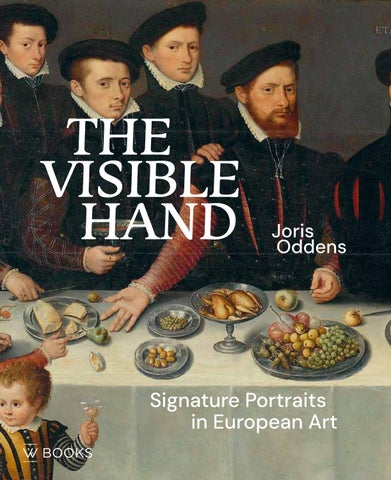
Previous scholarship has proposed a variety of interpretations. Ingenious and illuminating though they are, these explanations miss a crucial point. Portraits featuring hand gestures can be read as signatures. They draw the viewer’s attention to the makers and commissioners of the artworks in which they appear. Once this insight is gained, no museum visit will ever be the same again. Joris Oddens is a senior researcher at the Huygens Institute of the Royal Netherlands Academy of Arts and Sciences. He writes about art and history.
THE VISIBLE HAND
The Italian Renaissance, the Flemish Primitives, the Dutch Golden Age: the great achievements of premodern European painting are connected by a shared visual language. Hand gestures are everywhere in that language. We encounter them in religious art, family portraits, and corporate group portraits alike. What do these gestures have to tell us?
THE VISIBLE HAND
Joris Oddens
Signature Portraits in European Art
Il più grande valore della mano consiste quindi nella sua attività. Martin Kirigin (1976)1
4
TABLE OF CONTENTS Introduction — 6 Chapter 1. The angel’s hand — 11 Chapter 2. Active bystanders — 25 Chapter 3. Donors and intercessors — 41 Chapter 4. Family affairs — 55 Chapter 5. The master’s hand — 73 Chapter 6. Hands and bodies — 91 Chapter 7. Private portraits — 123 Conclusion — 146
Notes — 150 Image credits — 157 Bibliography — 160 Index — 172
5
☞
INTRODUCTION In 1559, Pieter Bruegel the Elder completed the painting Netherlandish Proverbs in Antwerp (fig. 1).2 This work represents proverbs and phrases used in colloquial Dutch at the time.3 For some of them, Bruegel’s work is the earliest source we have. More than 120 expressions have been identified, but at least one has been overlooked until now.4 Bruegel’s signature can be found in the lower right corner of the painting (fig. 2). Directly above it is a figure holding a lamp in his left hand. This lamp has been recognized as a representation of the phrase ‘to shed light on something’.5 The fact that this
6
1 Pieter Bruegel the Elder, Netherlandish Proverbs, 1559.
2 Signature of Pieter Bruegel the Elder.
☞
expression can be found here is no coincidence. Bruegel wanted to show that the painting reflected his view of the world. The same figure, however, expresses something else as well. His right arm is outstretched and his hand is open. This gesture has so far not been recognized as the expression ‘to have a hand in something’ (‘ergens de hand in hebben’). In this case, too, the representation above the signature is deliberate: Bruegel wanted to show that he had a hand in the painting – he was responsible for it, having conceived and executed it. It is noteworthy that this particular phrase had not yet been identified, but it is not entirely surprising. The expression ‘to have a hand in something’ is so ingrained in the Dutch language that users of this language no longer realize that they are dealing with metaphorical usage.6 Moreover, this gesture is so familiar to us in art that we have not recognized it as an expression.7 Bruegel also appears to have used this gesture in other works.8 The print The Fair at Hoboken was also published in 1559. This print was a collaboration with Frans Hogenberg, who made it based on Bruegel’s design. In it, we see Bruegel’s own signature on the right, next to a figure making a gesture, while on the left, Hogenberg’s monogram on a barrel is also flanked by a small gesturing figure (figs 3-5). Signatures of artists and craftsmen can be found as far back as Ancient Egypt and among the Greeks and Romans.9 In Antiquity, they often took the form of a sentence such as ‘Aristonothos made (me)’.10 We are most familiar with this phrase in its Latin variant, which remained in use throughout the Middle Ages and Renaissance: ‘Johannes de Eyck me fecit’ (‘Jan van Eyck made me’).11 From the late Middle Ages onwards, other verbs were also used to indicate different forms of craftsmanship, for instance invenit, pinxit, delineavit, sculpsit or excudit. The hand gesture that is central to this book – an active, open hand – served as a visual equivalent of fecit: the gesture indicates responsibility for having created a work of art, or an object that we would now deem to be one.12 What we see in Bruegel is a playful variation on a pattern of meaning that appears in its standard form not as a signature but as a portrait. The portrait
7
Chapter 1
THE ANGEL’S HAND When the troops of the Byzantine emperor Justinian conquered the city of Ravenna from the Ostrogoths in 540 CE, an ambitious plan was already in place for the completion of a church. Seven years later, the Basilica of San Vitale was consecrated. Today, this church is world-famous for its mosaics, which represent Justinian and Empress Theodora, among others.18 The mosaic in the apse (the semicircular extension behind the choir) also contains a posthumous portrait of the local bishop Ecclesius (fig. 6). When Ravenna was still the capital of the Ostrogoth Kingdom, he had granted permission for the church’s construction to the wealthy banker Julius Argentarius.19 The bishop is depicted holding a miniature version of the basilica in his hands.20 This model church symbolizes Ecclesius’s founding of the Basilica of San Vitale. In medieval art, we often encounter portraits of individuals who were depicted as founders (fundator, patronus) or donors (donator, benefactor) of churches and liturgical objects.21 They hoped that their generosity would win the favour of God or a saint. Images of angels or other saints are therefore often found near their portraits. These figures acted as intercessors who could ensure that their message reached the intended recipient.22
11
In the apse mosaic of San Vitale, the foundation by Ecclesius is represented as a dedication to Christ and to Saint Vitalis, the patron saint of the church. Two angels act as intercessors. When we compare these two angels – presumably the archangels Michael and Gabriel – we notice that how they express their mediating role with their hands differs. The angel next to Saint Vitalis is resting his right hand on the saint’s shoulder. The angel next to Ecclesius is making an active gesture with his open right hand. The usual explanation is that this is how the intercessor presents the donor to the recipients of the gift. This interpretation of the gesture as a presenting gesture is not necessarily
incorrect, but something needs to be added. The intercessor’s active gesture highlights the active role that the donor played in establishing the church that is being dedicated. In human societies, the hand is universally regarded as pars pro toto for the human being as a whole, as well as a symbol of human and divine action. This metaphor is deeply embedded in European languages. Germanic words for ‘action’, like the Dutch handeling and the German Handlung, are themselves evidence of this. Through the Latin word for ‘hand’ (manus), various words suggesting action and control, such as ‘manipulate’, ‘mandate’, ‘command’ and ‘manage’, have found their
☞
6 Anonymous, ‘Dedication to Christ and Saint Vitalis with Bishop Ecclesius’, before 547.
12
way into modern European languages.23 In the Judeo-Christian tradition, the hand of God (manus Dei or dextera Domini) symbolizes creation and divine intervention. The Old Testament contains numerous references to God’s (right) hand. In early Christian art, this hand is often represented as a disembodied hand emerging from heaven, owing to the prohibition then in force against representing God as a full human figure.24 We also encounter such hands several times in the decorative programme of the Basilica of San Vitale (fig. 7). By analogy with the hand as a symbol of God’s creative power, we can understand the gesture of the bishop’s intercessor. Here, the angel’s
active hand gesture, together with the miniature church, symbolizes Ecclesius’s responsibility for the construction of the church. It shows that he had a hand in it. The difference between the passive and active gestures of the two angels does not stem from a desire on the part of the unknown maker of the mosaic to enliven the composition. Instead, it reflects the different roles of the two figures for whom they are mediating: the bishop as founder of the church (active) and the saint as the one to whom the church is dedicated (passive).25 As we shall see in this book, the active hand gesture of the intercessor developed into a recognizable pattern of meaning that could also
☞
7 Anonymous, ‘The Sacrifices of Abel and Melchizedek’, before 547.
13
☞
in the Middle Ages and was often copied. The oldest surviving copy is now in the Vatican Library.31 That copy contains two dedication images. In one of them, Hrabanus dedicates the manuscript to Saint Martin (fig. 9).32 He is flanked by a second figure. This is Alcuin of York, his teacher. Until his death in 804, Alcuin was the abbot of St Martin’s Abbey in Tours, where Hrabanus was educated. Before his teacher’s death, Hrabanus left Tours for Fulda, where he would eventually become abbot himself. By the time he completed the text
16
9 Anonymous, ‘Dedication to Saint Martin with Hrabanus Maurus and Alcuin of York’, c. 825.
there, Alcuin had already been dead for several years. In the illustration, we see Alcuin placing one arm around Hrabanus’s shoulder, while extending his other arm with his hand open. How should we interpret this? The usual explanation is that Alcuin is presenting Hrabanus to Saint Martin. Alcuin is therefore regarded as Hrabanus’s intercessor.33 The association with intercession will undoubtedly play a role here, but Alcuin’s hand seems to refer primarily to his own involvement in
10 Anonymous, ‘Dedication to Christ with Emma of Normandy and Cnut the Great’, 1031.
17
☞
☞
108 Jan van Scorel, Portraits of Twelve members of the Utrecht Brotherhood of Jerusalem, c. 1525.
for the brotherhood. Both works depict twelve brothers in procession, each holding a palm branch, a reference to the brotherhood’s annual Palm Sunday procession.202 This type of painting lacks the holy figures that had previously been customary in group portraits. One of the Utrecht paintings contains a selfportrait of Van Scorel (the fifth figure from the right). Another figure (the third from the right) is making a gesture (fig. 108). This gesture has been noted in the literature, but its meaning has not been clarified.203 Now we can come up with a plausible hypothesis. The twelve figures depicted in this painting had made their journey to Jerusalem between 1463 and 1525. The brother making the gesture is Canon Jacob Crol, who himself had only recently returned from the Holy Land. This makes it likely that he played an active role in commissioning the painting. It is not known who paid for the paintings, but it is unlikely that Crol was the sole commissioner. Written sources tell us that
92
later Netherlandish corporate group portraits were usually commissioned jointly: all members of a corporation who were portrayed paid for their own portrait.204 It is likely that this was also the case here.205 This points us toward a new form of responsibility that could be highlighted with a gesture: in addition to the commissioner, adviser and artist, we can also distinguish the role of initiator. The initiator mobilized others for a group portrait and differed from the commissioner in that they were not the only one to pay for a work of art.206 In this case, it must have been Crol who proposed to the other members of the brotherhood that their fellow brother Van Scorel be given the commission for two group portraits. ✵ A contemporary of Jan van Scorel was the Amsterdam painter Dirck Jacobsz. Both
worked for some time in the workshop of Jacob Cornelisz, Jacobsz’s father.207 Like Van Scorel, Jacobsz developed a new type of corporate group painting in the 1520s. In 1529, he completed what is believed to be the first civic guard portrait, a secular group portrait of members of an urban militia (fig. 109).208 Sixteenth-century civic guards were guilds whose purpose was to maintain order and protect the city from external threats.209 At that time, there were three guilds in Amsterdam: the archers (handboogschutters), the crossbowmen (voetboogschutters) and the arquebusiers (kloveniers). During the sixteenth century, all three guilds started using firearms, but their names continued to refer to the weapons they had originally used.210 Civic guard portraits were made for the schuttersdoelen: the word doelen (literally ‘targets’) originally meant shooting range but came to be used for the buildings where the guardsmen gathered. Each of the three guilds had its own headquarters.
There were already portraits of guardsmen in the stained-glass windows of a chapel belonging to one of the guilds. The fact that the guardsmen now donated a group portrait to their headquarters instead of a church is probably related to the rise of Protestantism, which resulted in them becoming religiously divided.211 The new genre of civic guard portraits would remain popular for over a century in Amsterdam, Haarlem and other cities in the Northern Netherlands. In Amsterdam during the 1520s, each of the three guilds was divided into three or four units. A unit (rot) consisted of seventeen guardsmen and was led by a captain and a lieutenant. Jacobsz’s group portrait depicts the guardsmen of a unit from the arquebusiers’ guild. The painting was hung in the Kloveniersdoelen (the arquebusiers’ headquarters). In this painting, four guardsmen are making an active gesture. They are the third figure from the right in the top row and the figures
93
☞
147 Frans Hals, Banquet of the Officers of the St George Civic Guard, 1627.
Vinckenbrinck may have taken the initiative for the group portrait to show his gratitude for Huydecoper’s patronage, but he may also have done so with a view to the future. In the caption to his portrait, an engraving by Pieter Holsteyn from 1648 based on a painting that is no longer known, he refers to himself as sculptor of the city Amsterdam. No documents have survived to confirm that Vinckenbrinck held the official title of city sculptor.276 It is therefore assumed that he wanted to present himself with this portrait as the obvious candidate for the sculptural decoration of the town hall.277 At that time, Huydecoper was not only the principal building patron in the Amsterdam city government, but also its rising star; between 1651 and 1660, he would hold the office of burgomaster six times. If Vinckenbrinck had any interest in flattering anyone, it was
114
Huydecoper. Ultimately, he was passed over in favour of the Flemish sculptor Artus Quellinus, whose classicist style was more in line with the decorative programme that the burgomasters had in mind.278 The variant of the civic guard portrait in which a lower-ranking guardsman makes a gesture in the margin of the painting while the higher-ranking officers are given a place of honour in the centre of the composition refers back to religious art, where it was not the captain of the civic guard who was honoured in this way, but Christ or the Virgin Mary. There is an even stronger affinity with Florentine paintings in which, besides a portrait of the commissioner, honorary portraits of members of the Medici family also appear. This type of veneration served more than one goal: the person paying homage could hope to receive
☞
148 Jacob Colijns, Civic Guard Portrait with Ensign Hendrick Oetgens van Waveren, copy after Jan Tengnagel, 1653 (original from 1622-1623).
something in return, and at the same time showed those around him that he was someone who could afford such a gesture.279 For Vinckenbrinck, a desire to prove his worth may also have played a role. Such sentiments may be suspected in others as well. In Haarlem, Frans Hals completed his second Banquet of the Officers of the St George Civic Guard in 1627 (fig. 147). In this painting for the headquarters of the St George civic guard (Sint Jorisdoelen), Captain Nicolas le Febure makes an active gesture in the lower right corner. Previous scholarship has repeatedly noted that Le Febure is depicted in this position in the painting and as a halflength figure. This is thought to be due to his short stature, the result of dwarfism, which was thus concealed.280 About five years earlier, Jan Tengnagel painted a group portrait for the Amsterdam Handboogdoelen, which has
only survived in copy form (fig. 148). In this painting, it is the guardsman on the far left who is making a gesture. He is the ensign, Hendrick Oetgens van Waveren, who the copy suggests can be identified as cross-eyed, as was also noted by seventeenth-century viewers of the original painting.281 For Le Febure and Oetgens van Waveren, achieving an officer’s rank may have been less obvious, and that is precisely why they may have actively contributed to the creation of a group portrait in which this feat was immortalized. ✵ To conclude this chapter, let us look at some examples of seventeenth-century corporate group portraits from a genre other than the civic guard portrait. In 1662, Rembrandt
115
COLOPHON Publication WBOOKS, Zwolle info@wbooks.com wbooks.com Text Joris Oddens Editors Tessera Translation Design Vera Post © 2026 WBOOKS Zwolle / Joris Oddens All rights reserved. Nothing from this publication may be reproduced, multiplied, stored in an electronic data file, or made public in any form or in any manner, be it electronic, mechanical, through photocopying, recording or in any other way, without the advance written permission of the publisher. The publisher has endeavoured to settle image rights in accordance with legal requirements. Any party who nevertheless deems they have a claim to certain rights may apply to the publisher. Copyright of the work of artists affiliated with a CISAC organisation has been arranged with Pictoright of Amsterdam. © c/o Pictoright Amsterdam 2026.
ISBN 978 94 625 8779 3 (English edition) ISBN 978 94 625 8778 6 (Dutch edition) NUR 646
This book was made possible in part thanks to support from: Huygens Institute for the History and Culture of the Netherlands, Netherlands Interuniversity Institute for Art History Florence, Stichting Fonds voor de Geld- en Effectenhandel, Stichting Pieter Haverkorn van Rijsewijk, Stichting Professor van Winter Fonds, Dr. C. Louise Thijssen-Schoute Stichting. The author wishes to thank Mathilde van Dijk, Jim van der Meulen, Maarten Prak en Leendert van der Valk for reading the manuscript and many other colleagues for providing him with feedback and answering his questions.
Previous scholarship has proposed a variety of interpretations. Ingenious and illuminating though they are, these explanations miss a crucial point. Portraits featuring hand gestures can be read as signatures. They draw the viewer’s attention to the makers and commissioners of the artworks in which they appear. Once this insight is gained, no museum visit will ever be the same again. Joris Oddens is a senior researcher at the Huygens Institute of the Royal Netherlands Academy of Arts and Sciences. He writes about art and history.
THE VISIBLE HAND
The Italian Renaissance, the Flemish Primitives, the Dutch Golden Age: the great achievements of premodern European painting are connected by a shared visual language. Hand gestures are everywhere in that language. We encounter them in religious art, family portraits, and corporate group portraits alike. What do these gestures have to tell us?
THE VISIBLE HAND
Joris Oddens
Signature Portraits in European Art