Derek Au, artist and founder of the Glazy website.
The Nature of Glazes
I started making glazes the way many of us did, by randomly testing recipes I came across, then gradually making my own versions with local materials, adding a bit of this or that just to see what would happen or whether I could adjust a recipe for my studio’s conditions. Along the way I read every glaze book I could get my hands on, but most sat at opposite ends of a spectrum: practical recipe books that didn’t explain the “why,” and materials science books that didn’t explain the “how.” As a beginner, I found it difficult to connect those two extremes. It felt like wandering through a dark forest without a map. Anton Reijnders’s The Nature of Glazes illuminates that landscape, giving us a way to understand the hidden interactions that shape how glazes work.
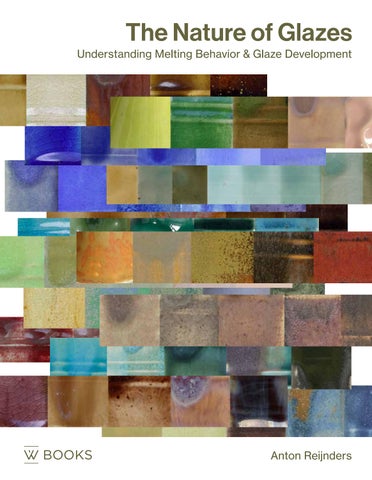
The Nature of Glazes
Understanding Melting Behavior & Glaze Development
Understanding Meltinging Behavior & Glaze Development
Anton Reijnders
Anton Reijnders
The Nature of Glazes Understanding Melting Behavior & Glaze Development
In cooperation with the European Ceramic Work Center (EKWC)
Contents Leaching Scratch Resistance Thermal Expansion Rate Mechanical Strength
Foreword 10
Major Types of Glazes 29 Temperature Range 29 Surface Quality 29 Base Glazes 30 Micro & Macrocrystalline Glazes Saturated Glazes 32 Textured Glazes 33
Introduction 12
Part I What You Need to Know About Glazes
15
Melting, Glass Formation & Phase Separation When a Liquid Turns into a Solid 16 Glass Formers/Network Formers Fluxing Oxides/Network Modifiers Stabilizers (Intermediate Oxides) Boron Oxide Heatwork 17 Finding Balance 18 Eutectic Reaction & Phase Separation Phase Diagrams It’s All About Relationships Predicting Melting Behavior Glaze Properties 20 Viscosity & Surface Tension 20 How Viscosity Evolves Revealing Viscosity & Surface Tension Viscosity Stages & Melting Range Surface Quality 22 Crystallization Bubbles & Undissolved Particles Translucency & Opacity 24 Liquid Phase Separation Boron Opacity Opacifiers & Colorants Color 26 Firing Stability 27 Durability 28 4
16
32
Ingredients 34 Basic Ingredients 34 Additional Ingredients 34 Composition Variations Particle Size Colorants 38 Coloring Oxides Glaze Stains Opacifiers 39 Glaze Additives 40 Glaze Calculation 41 The Weight Percentage Formula (WPF) Recipe Calculation Matching Alumina & Silica The Wt.% Chart WPF vs UMF 46 Wt.% Chart vs Stull Chart
42
Developing Your Own Glaze 47 Guidelines for Stable Shiny Cone 6–7 Glazes 47 Guidelines for Stable Alumina Matte Cone 6–7 Glazes Health & Safety Footprint
55
Summary
55
51
54
Contents
Part II Eutectic Interaction 57
Eutectic Reactions & Phase Separation Eutectic Research 58 Phase Diagrams 59 Eutectic Systems & Sources Relationships Revealed
58
Eutectic Glazes & Melting Behavior 62 Matching a Eutectic Composition 62 Fusion & Eutectic Glazes 63 Crystallization & Eutectic Glazes 63 The Role of Oxides & Ingredients Individual Fluxes 64 Na2O K2O Li2O CaO MgO ZnO BaO SrO Flux Combinations 70 KNaO CaO-MgO-KNaO ZnO-CaO BaO, SrO, CaO, ZnO & KNaO Eutectics & B2O3 84 CaO-B2O3 Fe2O3-Na2O-CaO 88
Eutectics & Durability
5
Summary
64
Understanding Cone 6 Glazes 92 Cone 6 Shiny Glazes 92 Cone 6 Matte Glazes 92 Cone 6 Micro & Macro Crystalline Glazes
Materials, Eutectics & History of Glazes 94 Alkaline Glazes 95 Calcium Glazes 96 Lead Glazes 100 Salt Glazes 102 Zinc Glazes 102 Magnesium Glazes 102 Barium & Strontium Glazes 102 High-Temperature Matte Glazes 103 Lead free Low- and Mid-range Glazes 103 103
Part III Durability 105
Acid Leaching 106 In-Studio & Laboratory Testing 106 Using Copper as Indicator of Acid Leaching Resistance Acid Leaching of CaO-MgO Eutectic Related Compositions Complying to Proposed Future EU Limits The Impact of Zinc Oxide Copper Leaching as References Acid Leaching Conclusion 112 Copper Leaching Barium Leaching in Copper holding Glazes Other Metals & Eutectic-Based Calcium and Boron Glazes Other Metals & Eutectic-Based Barium, Strontium and Zinc Glaze
92
Alkali Leaching 113 In-Studio Alkali Leaching Testing 113 Test Results Alkali Leaching Resistance Conclusion 114
94
Contents
Hazardousness & Toxicity
Glazes with Cobalt Oxide Glazes with Copper Oxide Scratch Resistance 115 In-Studio Scratch Resistance Testing Scratch Resistance Conclusion 116
115
Thermal Expansion Rate 117 Methods to Determine Thermal Expansion Rate In-Studio Methods Calculating the CTE Wt.% Thermal Expansion Rate Conclusion 117
117
Mechanical Strength 118 In-Studio Methods to Determine Mechanical Strength Mechanical Strength Conclusion 118 Easy to Clean Surfaces Overall Conclusion
118
119
Part IV Ingredients 121
Variations in Composition Chemical Analysis 122
122
Variation in Particle Size 122 Particle size for Shiny Glazes 123 Particle Size & Matte Glazes 123
6
118
124
Basic Ingredients 124 Quartz (Silica) 124 Flint (Silica) Sand Kaolin (China Clay) 126 Calcining Kaolin Clay Molochite Aluminum Oxide Nepheline syenite 127 Soda Feldspar Potash feldspar Cornwall Stone (Cornish Stone) Granite, Basalt & Pumice Whiting 131 Wollastonite Shells Vegetable ashes Calcium sulphate Dolomite 133 Talc Magnesium Carbonate Additional Ingredients 134 Zinc Oxide 134 Barium Carbonate 136 Barium sulfate Strontium Carbonate 137 Alkaline Frits 137 Sodium Bicarbonate, Soda Ash & Pearl Ash Boron Containing Ingredients 138 Lithium Carbonate 139 Petalite & Spodumene Calcium Phosphate 140 Bone Ash Vegetable ashes
Contents
Silicon Carbide
141
Colorants 142 Coloring Oxides 142 Chromium Oxide Cr2O3 Cobalt Oxide Co3O4 & Cobalt Carbonate CoCO3 Copper Oxide CuO & Copper Carbonate CuCO3 Red Iron Oxide Fe2O3 Manganese Oxide MnO2 Nickel Oxide Ni2O3 Colors in Reduction Glaze Stains 148 Opacifiers 149 Titanium Oxide (TiO2) Rutile (TiO2 & Fe2O3) Tin oxide (SnO2) Zirconium Silicate (ZrO2.SiO2) Glaze Additives 151 Plasticizers 151 CMC Gum 151 Deflocculants Suspension Agent Checking Particle Size & Composition 152 Checking Graine Size 152 Checking the Composition of Ingredients 152 Checking Kaolin Checking Whiting Checking Nepheline Syenite Summary
7
155
Part V Recipes 157
Recipe Format & Glaze Categories Additives & Colorants
158
Dissimilar Results 159 Recalculating Using Another Particle Size Using Other Materials The Impact of Colorants Sieving Layer Thickness & Clay Body Firing & Cooling Speed The Recipes 162 Shiny Glazes 162 Shiny Calcium Glazes Shiny Zinc Glazes Shiny Barium Glazes Shiny Strontium Glazes Shiny Boron Glazes Shiny Alkaline Glazes Matte Glazes 182 Matte Calcium Glazes Matte Zinc Glazes Matte Magnesium Glazes Matte Barium Glazes Matte Strontium Glazes Celadon 204 Fusion, Opacity, Color & Surface Nuances Celadons & Eutectics Shiny & Semi Shiny Celadon Longquan Semi-Matte Celadon Floating Glazes 214 Floating Blue Glazes Microcrystalline Glazes 218 Iron Red Mottled Matte
Contents
Macrocrystalline Glazes 224 Crystallization Rate Cooling Rate Structure Glazes 232 Crawling Glazes Lava & Crater Glazes
Part VI Applying, Firing, Testing & Glaze Defects 239
Preparing & Applying Glazes 240 Ways of Applying 240 Brushing Spraying Dipping Pouring Glaze Additives Combinations 240 CMC & Bentonite Deflocculant Weighing & Mixing 241 Prevent Dust Sieving Determining the Water Content Storing 242 Firing 242 Kilns 242 Electric Kiln Gas Kiln Measuring Heatwork & Obtaining Consistent Results 243 Firing & Cooling Speed Oxygen Probe & Measuring the Kiln Atmosphere
8
Firing Cycles & Ways of Firing 245 Twice Firing Refiring a Glaze Single Firing Firing Reduction Cooling Cycle of Macrocrystalline Glazes Testing Glazes 248 Melt Test 248 Line Blend Testing Gradient Testing Glaze Defects & Remedies 251 Orange Peel, Pinholes, Blisters & Craters 251 Orange Peel Pinholes Blisters & Craters Colorant Flashing & Fumes 253 Flashing Copper Oxide Fumes Chromium Oxide Fumes Crawling 254 Runny Glazes 256 Crazing, Shivering, Dunting & Shelling 256 Crazing Shivering & Dunting Flaking/Shelling Warping & Bulging 258 Cracking 259 Undesired Crystallization 260 Insufficient Crystallization 260 Summary
261
Contents
Part VII UMF vs WPF
Appendix 283
263
Hermann Seger’s Approach 264 Seger’s Cone Research 264 Mole UMF Cones Cones & the Eutectic Phenomenon Relative Values & Proportionate Relationships Setting Fluxes to Unity Molecular Mass
Calculating the Composition of a Eutectic Mixture Othon Cone Chart
283
285
266
The Limits of the UMF & UMF-Based References Example 1: Adding Silica 267 Example 2: Exchanging Fluxes and Silica 268 Example 3: Exchanging CaO & B2O3 269 Example 4: Impact of the Molecular Mass 269 Example 5: Exchanging B2O3 and SiO2 270 Al2O3:SiO2 Ratio 271 The UMF & Functional Ware 271
267
The Limits of Stull Chart 272 Melting, Crystallization and Crazing 272 The Position of Glazes on the Stull Chart 273 Tracing the Impact of the K2O VI and Na2O Eutectic Varying Only the Fluxes & WPF 275 The Family Likeness of Glazes Tracing the Impact of Zinc and Barium-Based Eutectics Tracing the Impact of Zinc-Based Eutectics Varying Only the Fluxes & the UMF 279 Conclusion
9
281
Contents
Foreword Some books begin with an idea. Others are the result of years of research.The Nature of Glazes is the result of something larger: a lifetime of dedication. Anton Reijnders has devoted his life to the arts and, more specifically, to understanding ceramics. He is a visual artist and at the same time a ceramicist. That combination is essential to understanding both Anton and this book. He approaches materials as an artist: through curiosity, observation and experimentation. Once a question presents itself, he does not easily let go. He wants to know what happens, why it happens, and whether the technical systems we have inherited are necessarily the best ones for understanding the process. Anton’s relationship with EKWC goes back to its very foundations. As one of its co-founders, and later as an artist, researcher, teacher and member of staff, he helped shape a culture in which artistic ambition and technical knowledge are inseparable. His influence can still be felt today. Anton returns to EKWC every month, not primarily to discuss glazes or firing curves, but to talk with residents about art: about what they are making, what they are trying to achieve and why. For Anton, technical knowledge is never an end in itself. It exists in service of the work. The same persistence characterises his own artistic practice and material research. Anton can pursue a question for years, with remarkable precision, yet his research is never simply about solving a technical problem. As he shared with us before, creativity begins when we move beyond a projected outcome and remain open to possibilities we had not anticipated. It is what, in his words, ‘distinguishes creation from production’. That distinction is fundamental to The Nature of Glazes. For decades, Anton has investigated ceramic glazes, systematically deepening his research into eutectic interactions, and their significance for the behaviour and properties of glazes. With his extraordinary technical knowledge, he opens up the possibilities of making. Rather than offering makers a collection of recipes they can reproduce, this book asks a fundamental question: how can a better understanding of materials give us greater freedom to create?
10
The method Anton has developed makes the relationship between glaze composition, raw materials and melting behaviour more visible and accessible. Taking eutectics as a starting point, it reduces the dependency on very specific ingredients. This becomes particularly relevant when we consider the future of ceramics. As artists and ceramisists look for more sustainable practices, they increasingly turn to recycled and secondary components that may not conform to the standardised ingredients on which established recipes are based. Understanding how materials behave therefore becomes essential to developing new glazes from the ingredients that are available to us. Anton’s research offers an important tool for this more sustainable and exploratory approach to ceramics, one of the central areas of research at EKWC. There is a close connection here with the way we work. Understanding develops through making: through testing, failing, observing, discussing and trying again. Each year, some sixty artists, designers and architects arrive at EKWC with questions that cannot be answered straight away. Our role is not simply to provide technical solutions, but to create an environment in which new possibilities can emerge from those questions, and where what is learnt can be passed on to others. ‘To get inspired and to inspire are the most powerful abilities of mankind,’ Anton once wrote. This is also one of the most powerful reasons for sharing what we know about ceramics. In 2005, Anton and EKWC published The Ceramic Process. More than twenty years later, the book continues to find new readers around the world. Recently, we received an email from a book club in the United States whose members were reading and discussing The Ceramic Process together. I can think it’s a wonderful illustration of how knowledge, once shared, can remain alive. I hope The Nature of Glazes will have a similar life. That it will not simply sit on a shelve, but will be opened in studios, workshops and classrooms; that its pages will acquire stains and annotations; that artists and makers will disagree with it, test it and return to it. And, above all, that it will encourage them to look more closely at the materials in front of them and to keep asking questions.
Foreword
A book of this scope only comes into being because many people share a conviction that it needs to exist. I would therefore like to thank everyone who has contributed their knowledge, time and commitment to this publication: especially Johan de Bruijn and WBooks for taking it on; Rutger Fuchs for giving Anton’s research a form in which it can be explored and understood. My thanks also go to the many artists, researchers, ceramicists and material specialists who, through their work, questions and conversations, have contributed to Anton’s thinking and research over the years, and to everyone who, at different moments in this long process, understood that this was a book that simply had to be made. And Anton: thank you for never letting go of the question. Geertje Jacobs Director, EKWC
11
Foreword
Introduction As a student at the school for art teachers, I was pulled into the world of glazes through the magical transformation caused by heat; I felt like an alchemist. It was an exciting quest due to the remarkable variety of rich surface and color nuances that could be achieved. Opening the kiln door was always filled with anticipation and wonder and this feeling remains to this day. It could also be a moment of disappointment; the kiln revealing a whole host of questions. Step by step I was confronted with the many aspects and complex interactions that influenced the outcome. The need for a more systematic approach became clear and I learned how to use the Seger Formula (UMF). Encountering an image of a Song Dynasty Longquan Celadon vase deepened my interest in glazes further. Nigel Wood’s book ‘Chinese Glazes’ then fueled my curiosity about eutectics and the weight percentage approach to glaze formulation. My research on glazes for The Ceramic Process book is based on the latter, but the glazes discussed are mainly variations of existing recipes. While finishing I realized how little I knew and felt the absence of a reference which is reflected in the definition of ceramics used in the book: “Ceramics: made out of minerals with a varying composition and dubious purity being exposed long enough to a (non-measurable) treatment of heat in order to let unknown reactions take place, whereby heterogeneous compounds are formed.”1
In the Fall semester of 2004, during my time as a visiting professor at Alfred University, I stumbled upon a glaze on a test tile with a surface quality that caught my eye. It had a remarkably simple recipe marked on the back side: quartz, kaolin, and whiting in a ratio of 1:1:1. It turned out to be a composition closely related to the Calcium Eutectic, a eutectic interaction that Nigel Wood linked to the emerging of the early stoneware glazes in China two thousand years ago. This resulted in a lingering question; can eutectic mixtures be used as reference to develop glazes? Years later in 2015 whilst having access to the book Phase Diagrams for Ceramists, I decided to investigate and started the research that resulted in this book. Step by step, using the weight percentage approach, it became clear that most common glazes are determined by multiple eutectic interactions. Additionally, it became clear that eutectics not only play a key role in obtaining fusion readily, but they also play a decisive role in how surface quality evolves and how durable craze free glazes can be obtained. Michael Cardew in his book Pioneer Pottery, talks about the uncomfortable position of building a bridge between the territories of science and art. His question “how much science do you need to know to make art?” was always at the back of my mind. However, following the common practice of merely varying successful recipes does not advance the field. That is why some complex topics will be discussed, but still this book is first and foremost a practical manual, which I hope will help you to make many more discoveries.
1 Reijnders 2005, 17.
12
Introduction
How to Read this book This book can be read from cover to cover, but I assume most of you will use it as a reference. Begin with Part V if you are mainly interested in recipes, however, if you want to know more about the basics begin with Part I. It addresses the role of oxides in glass formation, fusion and stability, as well as the basics of eutectic interactions. The weight percentage approach and the Weight Percentage Formula (WPF) will also be discussed, which allows you to develop your own glaze or finetune the melting behavior of an existing glaze. Part II can be referred to if you want to know more about eutectics and covers in-depth about their impact on melting behavior. Durability will be discussed in Part III which is important if you are involved in functional ware or outdoor sculptures. In Part IV we will take an extensive look at the ingredients. You will learn about the impact of composition variations and particle size. We will also look at alternatives, should an ingredient be unavailable. In Part VI the steps in the process of applying and firing glazes and how to successfully analyze glaze faults will be addressed. In Part VII the UMF, the most used standard to denote and develop glazes will be discussed in detail. Its limitations will be addressed by contrasting it with the weight and mole percentage approach.
13
Acknowledgement Being deeply immersed in research for many years and having a desire to share insights does not necessarily deliver a text that is easy to grasp. I am very fortunate to have several knowledgeable colleagues, with a variety of backgrounds willing to proofread and offer profound feedback. I want to thank Marianne Pijnenburg, Shu-Mei Chan, Hans van Wijck and Derek Au for their involvement early on, Jeannine Vrins, Froukje van Baren and Linda Bloomfield who stepped in later and Derek Au for the final edit. I’m grateful to Sierra Looijkens for helping with glaze making tests and Alexis Stephenson for editing the text. Thanks to Linda Sikora at Alfred University for offering a research opportunity in 2015 and 2019. Andrew Kennedy and Magda Dejose of Sculpture Space NYC, New York, for allowing the use of their materials and facilities in 2017 and 2018. Ranti Tjan for offering a research period at the EKWC in 2021. I am most grateful to the Achterbergh Domhof Stichting for the research grant, the TCKI (Dutch laboratory for the ceramic industry) for the leaching test and material analyses, the PXL University, Hasselt, Belgium for offering a grant to Jeannine Vrins for further leaching testing and to the Dutch Cultuurfonds for the financial contribution to make this publication possible. Finally, special thanks to Geertje Jacobs, director of the EKWC, because of her commitment this book could be realized.
Introduction
14
What You Need to Know About Glazes
PART I
What You Need to Know About Glazes Glazes are produced by mixing mineral-based ingredients which are fired at a high enough temperature to allow melting. Depending on the composition and the firing temperature the surface can range from smooth to textured, from stony matte to high gloss, and various gradations of transparency. Used for their appealing qualities, glazes also improve the mechanical properties of functional ware and outdoor sculptures by reducing porosity, increasing surface hardness and corrosion resistance. A glaze can also contribute to or direct the meaning of a sculptural work. A glaze can be made from scratch, bought as a premixed powder, or as a ready-to-use brush-on mixture. Developing your own glaze has the advantage of accessing a rich range of surface and color nuances. How much do you need to know to get started? Do you need to understand oxides and how to calculate oxide composition, or about glaze properties, crystals, particles, bubbles, and eutectics? It all depends on what you are aiming for. Simply mixing a set of ingredients and marveling at the magical transformation during firing may be enough. But this inevitably makes repeating interesting results difficult. What if one aims for a specific outcome? Systematically mixing ingredients requires patience due to the vast number of possible combinations. Perhaps a good recipe is all that is needed, and the good news is, there is no shortage. Thousands of recipes and compendiums can be found online, often with appealing high-quality images. Without a doubt, recipes are useful starting points that save work; you do not need to start from scratch. However, recipes have their limits and, as potters say, “recipes do not travel well”.
What do you do if a recipe calls for an ingredient that is not available or a material that is no longer produced? Inevitably, many ingredients will stop being mined or manufactured for a variety of reasons. What do you do when the color or surface quality does not match the beautiful image? How do you get rid of crazing, crawling, pinholes, or orange peel? Or what if crazing, crawling, foaming, blistering, or orange peel is exactly what you are looking for? How do you tweak a glaze; for example, make it shinier, more transparent or matte, make it work in a hotter or cooler part of the kiln, or adjust it to a lower firing temperature? In short, if you want to adapt to everyday studio realities, it is critical to dive more deeply into the glaze universe. This part is an introduction into the essential aspects needed for reading the other parts of the book. The basics of melting and glass formation and how this is related to eutectic interaction will be discussed. Glaze calculation and how to calculate a recipe from a pre-determined oxide composition will be addressed next. We will also discuss various glaze properties such as viscosity and surface tension, which are important in fine-tuning the melting behavior. Additionally, we will briefly consider commonly used ingredients. Next, we explore how eutectic mixtures can be utilized as a basis to developing glazes. At the end of this part we will touch upon sustainability and what to consider when formulating, applying and firing glazes.
Fig. 1.01 High-boron glaze (25% nepheline syenite and 75% J. M. Frit 3221). Boron opacity occurs at the bottom section where the glaze is more thickly applied, higher fired, and slower cooled. A four-part piece, slab-built. White, heavily grogged clay body. Red clay slip beneath the glazed parts. Cone 09 raku firing. Netty van den Heuvel, Box, 1981. H. 26.5 cm (10 ½ in.).
15
What You Need to Know About Glazes
Base Glazes Glazes are typically distinguished by the main flux or the presence of boron oxide. The thresholds listed in Table 1.06 that emerged as a result of my research allow a clearer distinction between the main types of base glazes as well as their subcategories. Calcium glazes, specifically lime and lime-alkali glazes, are the earliest examples of stoneware glazes and remain the most common types of glaze found within the mid- and high-temperature range. This is linked to calcium oxide’s engagement in a wide range of eutectic interactions involving sodium, magnesium, zinc and boron oxide. Additionally, calcium glazes can be composed of affordable and non-toxic ingredients, and if well balanced, they are amongst the most suitable shiny glazes for functional ware, due to high durability and resistance to crazing. The surface nuances are vast, ranging from high gloss, subtle sheen, semigloss, semi-, high- and stony matte. Shiny calcium glazes yield more neutral colors when coloring oxides are used, however glaze stains allow a wide range of vibrant colors. When firing below cone 6 boron and/or zinc oxide are required to sufficiently fuse. Matte and semi- matte glazes with different rates of translucency are possible, along with an extended color palette when coloring oxides are used. The vividness of glaze stains in matte glazes is less. Table 1.06
Main Types of Glazes & Subcategories Calcium Glazes
CaO Main Flux Lime glazes
Up to 3% KNaO
Lime-Alkali Glazes
Beyond 3% up to 7% KNaO
Alkali-Lime Glazes
Beyond 7% up to 12% KNaO
Alkaline Glazes
Beyond 12% Alkali Alumina Alkaline
Beyond 12% Alkali and 18% Al2O3
Boron Glazes
Beyond 7% B2O3
Magnesium-Glazes
Beyond 3% MgO
Zinc Glazes
Beyond 7% ZnO
Barium Glazes
BaO the main flux
Strontium Glazes
SrO the main flux
Alumina Matte Glazes
12% Al2O3 and beyond
Silica Matte Glazes
Below 12% Al2O3
30
Magnesium glazes fired within the mid-temperature range usually turn matte because magnesium oxide strongly accelerates crystallization. The range of fusible compositions rapidly declines if a lot of magnesium oxide is present because eutectic interactions involving high amounts of magnesium oxide act out at relatively high temperatures. When combined with coloring oxides an interesting range of color nuances can be obtained. Opacity is usually high. Zinc glazes fuse readily due to zinc oxide’s involvement in several strong eutectic interactions with calcium oxide. High gloss can be obtained throughout the mid-temperature range without boron oxide being needed. Matte glazes are often marked by a sheen due to crystal formation oriented parallel to the surface. They are more receptive to leaching compared to calcium glazes. Coloring oxides yield a richer color scheme. Glaze stains can be affected, causing shifts in color, and red stains can be subject to cadmium leaching. Zinc matte glazes can have a silky matte quality and a rich palette of colors. Macrocrystalline glazes are generally zinc-based and often quite glossy. Barium glazes are less widespread. An important reason for this is that barium carbonate, the most common ingredient used to introduce barium oxide, is a relatively expensive and toxic material. Still, well balanced shiny barium glazes can be very durable. Barium glazes are appealing for their potential to achieve high brilliance, silky matte finishes, and a variety of vibrant colors if chromium, cobalt and copper oxide are used. Strontium glazes are not widespread either. They have a similar melting behavior and color response as barium glazes and are somewhat less durable. The essential ingredient, strontium carbonate, is even more expensive. Boron glazes are typical low-range glazes. Calcium-based boron glazes melt due to strong eutectic interactions between boron and calcium oxide, alumina and silica, happening at low temperatures. They have a low tendency to craze and can be fired within a wide temperature range. Shiny glazes can be made durable and work well with glaze stains. Interesting color shifts can be obtained with coloring oxides if boron opacity occurs, which happens more readily if a glaze holds a moderate or low amount of alumina. Alkaline glazes are typically low-range glazes, although shiny glazes that are well balanced can be fired at high temperatures without overfiring. They are primarily used for their bright color scheme with coloring oxides. These glazes are not suited for functional ware due to a strong tendency to craze and poor leaching resistance. Alkaline matte glazes work best within the mid-temperature range and offer interesting color nuances. Alumina matte glazes are marked by a very wide range of surface nuances ranging from semi-matte, silky matte and waxy matte, up to high matte. They can be made stable more readily, particularly around 18% alumina. Silica matte glazes generally yield semi-matte results and tend to show strong shifts in surface quality within a narrow temperature range. Examples of these glazes will be discussed in Part V Recipes.
What You Need to Know About Glazes | Major Types of Glazes
Fig. 1.32 High-gloss and stony-matte glaze. The sphere and disc hold two coats of the same high-alkaline glaze (related to Recipe # 14). The first layer is a copper-saturated glaze containing 11.5% copper carbonate. The second coat contains 7% tin oxide. A stony matte glaze on the bottom part (related to Recipe # 19). Fired at Cone 6–7. Anton Reijnders, Stack 24a, 2017, H. 22.5cm (9 in.).
31
What You Need to Know About Glazes | Major Types of Glazes
Colorants
Table 1.10
Two major kinds of colorants exist: coloring oxides, also referred to as metal oxides, and glaze stains. Coloring oxides allow for a wide range of color nuances. However, vivid red, orange, or yellow are not really an option, and for this we use glaze stains.
Chromium Oxide (Cr2O3)
0.01–2.0%
Cobalt Oxide (Co3O4)
0.2–1.0%
Copper Oxide (CuO)
2.0–4.0%
Red Iron Oxide (Fe2O3)
1.5–6.0%
Manganese Oxide (MnO2)
3.0–6.0%
Nickel Oxide (Ni2O3)
1.5-3.0%
Coloring Oxide Additions
Coloring Oxides
The most used coloring oxides are chromium, cobalt, copper, iron, manganese, and nickel oxides. The type of glaze and firing method (oxidation or reduction) determines color response and the amount to be added. They also affect viscosity and crystallization rate in different ways. Focusing on oxidation firing: chromium oxide is usually added in small amounts because it hardly dissolves, and viscosity increases as more is added. It often yields green colors, brown is possible also and raspberry and pink can be obtained if chromium oxide is present in very small amounts. Cobalt oxide slightly accelerates fusion, and only small amounts are needed to obtain saturated colors. Most glazes turn blue, but violet or green are also possible. Copper oxide is a very strong flux. Colors range from Egyptian blue to green, brown, grey, and black. Red iron oxide is a mild flux and mostly leads to brown shades. Manganese oxide acts as a flux and generally yields shades of brown. Nickel oxide increases viscosity and readily crystallizes, particularly in calcium, zinc, and magnesium glazes. Green and brown are common. Red is possible with copper oxide when fired in reduction, and grayish green or blue tones can be obtained with iron oxide. Cobalt and particularly copper leach most readily in less stable glazes, which is a concern for functional ware. Coloring oxides often yield different nuances, or even different colors, in matte glazes. The same is true when combined with titanium oxide. Many of the coloring oxides are available as carbonates. Generally similar colors will be obtained but they need to be added in somewhat higher amounts because part of it is released as carbon dioxide during firing.
Table 1.11
Coloring Oxides Additions, Impact on Viscosity & Crystallization of Calcium Dominated Shiny Glazes Approximate Cone Differences
Accelerates Crystallization 0
0.7%
Chromium Oxide
=
0.5%
Cobalt Oxide
=
0
4.0%
Copper Oxide
-2
0/+
6.0%
Red Iron Oxide
-1
+
4.0%
Manganese Oxide
- 1½
+
3.0%
Nickel Oxide
+1
+++
Table 1.11 lists the additions I have used as standard in my research and the approximate effect on viscosity and crystallization rate when used in calcium-dominated shiny glazes. Saturated glazes are obtained when high amounts of coloring oxides are present. This can result in phase separation (microcrystalline glazes and oil-spot glazes with red iron oxide) or metallic effects (copper and manganese oxides). Combining coloring oxides with opacifiers further widens the range of color nuances.
Fig. 1.43 Different rate of fusion and crystallization of the same glaze.. Particularely nickel oxide stands out. Fired around cone 6.
0.7% Chromium Oxide
38
0.5% Cobalt Oxide
4.0% Copper Oxide
6.0% Red Iron Oxide
4.0% Manganese Oxide
3.0% Nickel Oxide
What You Need to Know About Glazes | Ingredients
Fig. 1.44 The color range of glaze stains allow bright colors, particularly red, yellow and orange.
Glaze Stains
Table 1.12
The range of colors can be extended by using glaze stains. They are manufactured to be less affected by glaze composition. For this coloring and non-coloring oxides are combined, such as inclusion stains, which hold colorants, silica and zirconium oxide. Inclusion stains encapsulate colorants so that they more stable. The amount to be added varies from 1.5% up to 12%, depending on the type of stain and firing temperature. Inclusion stains require between 6–10% within the low-temperature range and 9–12% in mid- and high-range glazes. Generally, they tend to increase viscosity somewhat. They work well in shiny calcium and calcium-dominated boron glazes, particularly if they hold a low total flux which affects their stability the least. Cadmium leaches out in less stable glazes, which is a concern when using cadmium-containing stains in glazes for functional ware. For more information on cadmium leaching data, see Part III: Durability.
Opacifiers Addition 4–20%
Titanium Oxide (TiO2)
4–20%
Rutile (TiO2 + Fe2O3)
6–12%
Tin Oxide (SnO2)
6–12%
Zirconium Silicate (ZrO2. SiO2)
Fig. 1.45 Opacifiers added to a shiny calcium glaze and applied on a ocher colored clay body. Titanium and rutile yield matte results. Fired at cone 9.
Opacifiers
12% Titanium Oxide
39
12% Rutile
12% Tin Oxide
12% Zirconium Silica
Opacifiers are added to achieve or adjust opacity, and to hide the clay body beneath. Opacity is obtained because they resist dissolving. The amount needed depends on the opacity of the initial glaze, whether it crystallizes, and the clay body. Coloring oxides and opacifiers combined can yield lively results and interesting color shifts, particularly titanium oxide and rutile and to a lesser extent tin oxide. Zirconium oxide yields more neutral results. The first two also tend to strongly accelerate the crystallization rate of (semi-) shiny or matte glazes. Tin oxide and zirconium silicate are often used to obtain white opaque shiny glazes. They increase surface tension, an effect particularly noticeable beyond 12%.
What You Need to Know About Glazes | Ingredients
56
Eutectic Interaction
PART II
Eutectic Interaction Developing glazes can be challenging due to the many variables and complex interactions that occur during firing and cooling. Where to start? Which oxide or ingredient combination works well, and at what temperature? Through eutectic research outcomes, we can gain more insight into which of the numerous possible oxide combinations work well. Additionally, seemingly counterintuitive melting behavior can be better understood, as can the impact of ingredient choice and ingredient variations. Closely related compositions to eutectic mixtures allow stable, shiny glazes at relatively low temperatures. By systematically deviating from these oxide configurations, surface quality and firing temperature can be adjusted, and stable matte glazes can be obtained. Eutectics are also a link to durability and how glazes have developed throughout history. The impact of eutectics on durability will be addressed in the following part. Examples of how eutectic compositions can be used to formulate glazes will be discussed in Part V Recipes.
Fig. 2.01 Granite and slate stone chunks and nepheline syenite are placed in a ceramic mold and fired between cone 9–10. Nepheline syenite melts early because its composition is closely related to the Na2O-K2O Eutectic. The glass created is very viscous and so it works well as glue. Ho Lai, Stones/Lava, 2026, H. 55 cm (22 in.). Made at the European Ceramic Work Center. Photographer René van der Hulst.
57
Eutectic Interaction
Eutectic Reactions & Phase Separation Specific combinations of oxides allow eutectic reactions to take place, so that melting occurs at a temperature lower than that of each individual oxide. Phase separation can occur in compositions that deviate from eutectics; oxides that do not have “eutectic partners” separate from the melt and cling together in a highly organized way to form crystals, a process referred to as solid-liquid phase separation. Another type of phase separation can occur, though less frequently: liquid phase separation, the formation of ultra-fine globules of a different glass chemistry that do not mix with the surrounding liquid. Glazes that match eutectic compositions are also marked by high firing stability. This stability comes from a suitable balance of fluxes and the optimal amount of alumina, which results in high connectivity within the silica network. Eutectic compositions are determined through laboratory testing. First, we will discuss how this research was carried out, followed by phase diagrams and visual representations of the research outcomes. Both allow us to better understand how eutectic interactions impact the melting behavior of glazes.
Fig. 2.02 Establishing a phase diagram through interpolation based on changes in the cooling rate of five pre-fused samples. When crystallization occurs, small changes in the cooling rate are detected, and temperature arrests occur when the solid phase is entered.
Fig. 2.03 A ternary phase diagram is based on three binary phase diagrams.
58
Eutectic Research Exploring the eutectic phenomenon and obtaining verifiable results requires implementing specific procedures and well controlled laboratory conditions, which differ greatly from our studio setting. To bypass the impact of impurities, ingredients of high purity are used, which often need to be prepared in a laboratory. Additionally, pre-fired samples are used, and eutectic interaction is detected during cooling. The samples are fired to extremely high temperatures to achieve full interaction: all particles and crystals have dissolved. This allows to bypass the impact of particle size and crystal formation which would affect outcome if eutectic interaction would be determined if raw samples are used (see Eutectic Glazes & Melting Behavior). In addition, samples are fired in noble metal crucibles, such as platinum, to prevent contamination. Often, several firing cycles and intermittent grindings are needed to obtain an exact match to the intended composition. Essential to a melt with a eutectic composition is that, during cooling, it shifts directly from the liquid into a solid phase. While this transition occurs, an equilibrium exists in which no energy passes into or out of the melt until the transition is completed (Figure 2.02). Within mixtures that deviate from eutectic compositions, crystals form within the liquid before the solid phase is entered, and once again a small change in cooling rate occurs. Currently, there are two main methodological approaches through which eutectic reactions and phase separation are studied: dynamic and static.1 In the first approach, the slight changes in cooling rate are detected while samples are cooled. In the second approach, the composition of the crystals is studied at room temperature through microscopic and x-ray means.2
1 Roth 2004, 4. 2 When exposed to x-rays, a distinctive pattern will be obtained which can be used to identify the type of crystals. In contrast, amorphous solids have poorly defined patterns because molecules are not arranged in a regular array.
Eutectic Interaction | Eutectic Reactions & Phase Separation
The static approach is most relevant for compositions involving silica and therefore for ceramics. Silica yields viscous melts, causing the shifts between phases to occur at a less identifiable temperature. Like the dynamic method, samples are fired at adequately high temperatures to ensure all components are fully dissolved, followed by an extremely fast cooling process (quenching). This freezes the high-temperature condition, after which the crystal composition is studied. Repeating this process at increasingly lower temperatures allows the temperature at which crystals form to be determined.
Eutectic Systems & Sources
Phase diagrams are distinguished by the number of oxides involved. Two to five oxide systems exist. Research on two and three oxide systems is most common. Four oxide systems, and particularly five oxide systems, are rare, as it becomes increasingly complex to determine eutectic interactions. Three to five oxide systems are the most relevant for understanding the melting behavior of common glazes. Table 2.01 lists the most influential eutectic systems and the types of glazes for which their influence is most pronounced. The main sources of phase diagrams I have used for my research are Phase Diagrams For Ceramists, 1964 (1969 edition), 1969 Supplement, and Volume III, 1975, published by the American Ceramic Society. Of the many diagrams available in these publications, a relatively small number are of direct relevance. The threshold for cone 10 glazes and below is the eutectic temperature of 1250°C (2282°F). In the tables below phase diagram numbers are mentioned, such as Phase Diagram 407. These number are related to the above sources. Like anything in life, eutectic research findings are not absolute. Different sources reveal different outcomes, which, considering the complexity of eutectic research, should not come as a surprise. Table 2.02 lists the various compositions of the CaOAl2O3-SiO2 system and related eutectic points collected from different sources. The average value will be used in the upcoming chapters. The wt.% compositions of most eutectic mixtures are not listed in the Phase Diagrams for Ceramists publications. They therefore need to be calculated. The calculation method used is discussed in the Appendix. The diagrams are generally small in size, which results in limited calculation accuracy. Therefore, the calculated mixtures discussed in this and the upcoming sections are listed in half or full decimals.
Phase Diagrams The outcomes of eutectic research are plotted in a phase diagram. A phase diagram shows all the phases that occur within a specific oxide combination, which is referred to as “system”. Several types of diagrams exist. A binary diagram shows the phases that occur between two oxide compositions (Figure 2.02). A ternary phase diagram is three binary phase diagrams, and all mixtures in between, seen from above (Figure 2.03 and 2.04). The ternary phase diagram below shows the eutectic reactions and the crystal phases that occur between calcium oxide, alumina, and silica (the CaO-Al2O3-SiO2 System). We are looking at a topographical map of mountains and valleys. Isotherms indicate the temperatures at which the liquid phase transforms into the solid-liquid phase. The various eutectics and crystal phases are also indicated. Besides the different crystal phases, such as Tridymite, Pseudo Wollastonite,3 and Anorthite, liquid phase separation also occurs in the upper left part of the diagram, referred to as “Two Liquids.”
Table 2.01
Most Influential Eutectic Systems CaO BaO
Secondary Flux-Based Eutectics
Boron-Based Eutectics
Na2O Sodium & Secondary Flux-Based Eutectics
SiO2 SiO2
SrO
Al2O3
SiO2
CaO
MgO
Al2O3
SiO2
CaO
ZnO
Al2O3
SiO2
Al2O3
SiO2
Al2O3
SiO2
CaO
B2O3
CaO
B2O3
K2O
Al2O3
SiO2
K2O
Al2O3
SiO2
Na2O
CaO
Na2O
CaO
Shiny Mid-and High-Range Glazes
SiO2
Na2O Alkali-Based Eutectics
Al2O3 Al2O3
MgO
Al2O3
SiO2
Al2O3
SiO2
Shiny Low-Range Glazes Shiny Mid-and High-Range Glazes Matte Mid-and High-Range Glazes
Table 2.02
CaO-Al2O3-SiO2 System CaO
Al2O3
SiO2
Eutectic Point
(a)*
23.5
14.5
62.0
1170
Source
(b)
23.3
14.8
62.0
1170
Nigel Wood, Chinese Glazes
(c)
23.0
14.7
62.3
1170
Gustav Wess, Keramik Lexicon
Phase Diagrams for Ceramist, Volume I.
(d)
25.1
13.4
61.5
1184
Polytechique Montréal, Canada
(e)
24.3
13.3
62.4
1195
Royal Institute of Technology, Sweden
CaO Eutectic
24.0
14.0
62.0
* Calculated composition. 3 A high temperature form of wollastonite.
59
Eutectic Interaction | Eutectic Reactions & Phase Separation
Cone 03 Boron Glazes Cone 03 has been used to further explore the melting behavior of calcium-based boron glazes. The diagram in Figure 2.37 shows the boundary (blue line) within which at least moderate viscosity is obtained at cone 03. The boundary is based on the presence of 3% of KNaO and the 1: 1.2 CaO-B2O3 ratio. Within the 12.5–16% alumina range (darker green area), stable shiny transparent glazes are located. Within the turquoise area with a yellow crosshatch, glazes are likely to be subject to orange peel, see more on orange peel Part VI under Glaze Defects & Remedies. Below 12.5% alumina, boron opacity tends to occur more readily (light blue area), even more so if more KNaO is present. Within the vertical orange crosshatched region, which partly overlaps all other regions, matte glazes are obtained if calcium oxide is set beyond a B2O3:CaO ratio of 1: 1.6. Figure 2.38 and 2.39 show how changes in viscosity and opacity can be obtained. They are plotted in the Wt.% Chart below.
Cone 03–3 Boron Glazes Increasingly less boron oxide is required to achieve fusion beyond cone 03; therefore, the 1:1.2 B2O3:CaO ratio no longer needs to be maintained. Table 2.25 can be used as a reference. As can be seen, the flux content remains unchanged while the boron oxide content is reduced, and the silica content is increased. Table 2.25
Cone 03–3 Shiny Transparent Boron Glazes Cone
KNaO
CaO
Total Flux
B2O3
Al2O3
03
3.0
17.0
20.0
14.0
14.0
SiO2 52.0
02
3.0
17.0
20.0
12.0
14.0
54.0
01
3.0
17.0
20.0
10.0
14.0
56.0
1
3.0
17.0
20.0
8.0
14.0
58.0
2
3.0
17.0
20.0
7.0
14.0
59.0
3
3.0
17.0
20.0
6.0
14.0
60.0
Table 2.24
Cone 09–03 Shiny Transparent Boron Glazes KNaO
CaO
Total Flux
08
3.0
32.0
35.0
26.5
14.0
24.5
1:1.2
07
3.0
29.0
32.0
24.0
14.0
30.0
1:1.2
06
3.0
26.5
29.5
22.0
14.0
34.5
1:1.2
05
3.0
23.5
26.5
19.0
14.0
40.5
1:1.2
04
3.0
20.5
23.5
17.0
14.0
45.5
1:1.2
03
3.0
17.5
20.5
14.5
14.0
51.0
1:1.2
Cone
B2O3
Al2O3
SiO2
B2O3:CaO
Cone 4–7 Boron Glazes When making use of the impact of the CaO-MgO Eutectic, which implies the presence of magnesium oxide, the amount of boron oxide can be limited within the mid-temperature range. Table 2.26 shows how boron holding shiny calcium glazes can be adjusted. At cone 6, 1–2% boron oxide is sufficient, and 1% at cone 7. In the latter case, boron oxide is no longer needed, but it helps to counteract unwanted crystallization when a kiln fires unevenly and natural cooling is implemented. Table 2.26
Cone 4–7 Shiny Calcium Glazes Cone
KNaO
4
3.0
5
3.0
6
3.0
7
3.0
MgO:CaO
1:9.5
B2O3
Al2O3
SiO2
4.0–5.0
14.0
59.0–61.0
3.0–4.0
14.0
60.0–62.0
1.0–2.0
14.0
63.0–64.0
-–1.0
14.0
63.0–65.0
Fig. 2.37 Viscosity boundary at cone 03 (blue line) of mixtures of quartz (400 mesh), kaolin, nepheline syenite, whiting (400 mesh), and JM frit 3221 in relation to the Cone 7 Viscosity Boundary (green line). The cone 03 boundary is based on 3% of KNaO and the 1: 1.2 CaO-B2O3 ratio. Below the horizontal blue line, less than 3% KNaO is present. Left of the dotted blue line, glazes become very runny. The position of line blend 1B (red line) and B2, indicated by the black arrow.
86
Eutectic Interaction | The Role of Oxides & Ingredients
Fig. 2.38 Line Blend C: Adapting Viscosity & Opacity Boron opacity is obtained below 12% alumina. Close to 42% silica yields runny glazes; beyond 52%, viscous melts are obtained. Fired at cone 04.
1
2
3
4
5
KNaO
2.3
2.9
3.4
3.9
4.5 14.5
CaO
26.2
23.2
20.3
17.2
B2O3
21.5
19.0
16.7
14.3
11.9
Al2O3
7.3
9.0
10.7
12.4
14.0
SiO2
42.8
45.9
49.0
52.0
55.0
Quartz (400 m)
28.3
28.6
28.9
29.2
29.4
Grolleg Kaolin
9.8
12.2
14.7
17.1
19.5
Neph. Sy. Spect D30
11.6
14.5
17.4
20.3
23.2
JM Whiting (400 m)
14.4
12.7
11.1
9.4
7.7
JM Frit 3221
35.9
31.9
28.0
24.1
20.1
Fig. 2.39 Line Blend D: Adapting Opacity & Crystallization Rate Mixtures 1–3 are semi-shiny and show boron opacity. A higher amount of CaO, meaning a greater deviation from the 1 :1.2 B2O3-CaO ratio, causes a shift to matte and a decline in boron opacity (mixtures 4 and 5). Fired at cone 03.
87
1
2
3
4
5
KNaO
2.3
2.9
3.4
3.9
4.5 14.5
CaO
26.2
23.2
20.3
17.2
B2O3
21.5
19.0
16.7
14.3
11.9
Al2O3
7.3
9.0
10.7
12.4
14.0
SiO2
42.8
45.9
49.0
52.0
55.0
Quartz (400 m)
28.3
28.6
28.9
29.2
29.4
Grolleg Kaolin
9.8
12.2
14.7
17.1
19.5
Neph. Sy. Spect D30
11.6
14.5
17.4
20.3
23.2
JM Whiting (400 m)
14.4
12.7
11.1
9.4
7.7
JM Frit 3221
35.9
31.9
28.0
24.1
20.1
Eutectic Interaction | The Role of Oxides & Ingredients
120
Ingredients
PART IV
Ingredients The ingredients of a glaze are mineral-based and are typically obtained through surface mining. They then undergo various processing steps, such as grinding, milling, sieving, and blending. In some cases, chemical processing may be required. Glaze frits are made by blending raw materials according to a predetermined molecular composition. This is followed by fusion, crushing, and grinding. There is an extensive range of basic ingredients available to choose from. Creating glazes that require both visual quality and durability demands only a small selection of these materials to meet such high standards. In this section, we will discuss these source materials, along with the impact of variations in ingredient composition and particle size. Furthermore, we will look at how colorant additives are used to achieve color, and how translucency can be adjusted using opacifiers. We will discuss glaze additives that help in the application process and promote consistent results. Lastly, studio methods to check particle size and ingredient composition will be addressed.
Fig. 4.01 Ingredients and colorants mixed with water and dried on a plaster board. After drying chunks are mixed in a glaze slop with the same composition but without colorants. This mixture is dried and fired in a ceramic mol. After firing the “rock” is sanded to reveal the individual chunks. The composition matches the average of granite rock. Laura Canha, Granite Rock, 2024. H. 13 cm (5¼ in.).
121
Ingredients
Recipe Format & Glaze Categories Most glazes list two recipes, one with the ingredients used in my studio and the other with the ingredients used at Alfred. Two Weight Percentage Formulars will be listed with each recipe if a difference beyond 0.5% of one of the oxides occurs.1 The ingredients will be discussed in more detail in Part IV Ingredients; their chemical analyses are also provided. Table 5.01 shows the abbreviations used in the recipes. The categories listed in table 5.02 will be used to distinguish between the different glaze types.
Table 5.01
Additives & Colorants Ingredients always add up to 100, and glaze additives are added as percentages of the base recipe. Colorants are not listed in the recipes of base glazes and are added as percentages of the base recipe, in the case of colored glazes. The listed amounts of CMC gum and bentonite are based on brush application to bone dry pieces. The amount of CMC Aqualon 7L used in the Alfred recipes is set higher to achieve similar results. The amount of bentonite varies according to the amount of kaolin present in the glaze. It is added when less than 20% kaolin is present, increasing up to 1.2% when kaolin is absent. To maintain good paintability, CMC and bentonite are increased by up to 0.1% in glazes containing high amounts of quartz and nepheline syenite, and by up to 0.2% when high amounts of frit are also present. CMC can be reduced by 1/5 if the glaze is applied to a less porous bisque. If you are spraying the glaze, it can be reduced by 1/3, and by 1/2 if you are pouring. The addition of CMC for dipping is less common, but small amounts can help make the glaze coat less vulnerable during handling. It can also help counteract the settling of the glaze slop. For more information on applying glazes, see Part VI.
Table 5.02
Ingredient Notation Quartz, 400 mesh
Quartz (400 m)
Quartz IMSIL, ball milled
Quartz IMS. (ball m.)
Nepheline Syenite Spectrum D 30
Neph. Sy. Spect D 30
Soda Feldspar Forshammar
Soda Feldspar Frsh.
Johnson Mathey Whiting, 400 mesh
JM Whiting (400 m)
Whiting Castel Carb, ball milled
Whiting C C (ball m.)
Dolomite Dolocron 4013
Dolomite D 4013
Johnson Mathey Frit 3221
JM Frit 3221
Main Types of Glazes & Subcategories Calcium Glazes
CaO Main Flux
Lime glazes
Below 3% KNaO*
Lime Alkali Glazes
3% up to 7% KNaO
Alkali-Lime Glazes
Beyond 7% up to 12% KNaO
Alkaline Glazes Alumina Alkaline
Beyond 12% Alkali (KNaO + Li2O) Beyond 12% Alkali and 18% Al2O3
Boron Glazes
Beyond 7% B2O3
Magnesium-Glazes
Beyond 3% MgO
Zinc Glazes
Beyond 7% ZnO
Barium Glazes
BaO the main flux
Strontium Glazes
SrO the main flux
Alumina Matte Glazes
12% Al2O3 and beyond
Silica Matte Glazes
Below 12% Al2O3
* Nigel Wood uses this threshold in Chinese Glazes, 1999, 32.
1 This mainly occurs due to the differences in composition of whiting and the glaze frits.
158
Recipes | Recipe Format & Glaze Categories
Dissimilar Results Testing glazes before applying them to a piece is advisable because many factors determine the outcome, such as differences in the composition and particle size of your ingredients, the sieve size you are using, layer thickness, and the firing method. The glazes on the test pieces shown in the images below have been sieved through a 120 mesh sieve and applied by brush to an average layer thickness of approximately 1 g per 10 cm2. An off-white stoneware casting clay is used, and the pieces are single fired according to the firing cycle of Table 5.03. It will be specifically indicated if different layer thickness, firing and cooling speed, or clay body are used.
Recalculating Because your ingredients most probably have a different composition, the WPF of each glaze is listed along with each recipe. This allows you to recalculate the ingredient amounts based on the chemical analysis of the ingredients you have on hand. For clarity, impurities below 0.3% are left out; they have been compensated for among the main flux(es). When recalculating the total flux, alumina and silica content are used as the starting point. Impurities, or non-matching oxides, which may be encountered if you use another frit, are compensated for among the main fluxes. Still, dissimilar results can occur if the chemical analysis you are using is not in line with the actual composition of your ingredients. This is most noticeable with whiting. In Part IV Ingredients, a method is discussed for determining whether this is the case.
Using Another Particle Size
Fig. 5.02 This image shwos the proportions of some of the test pieces and a test tile. The hieght of the smallest test piece, the sphere, is 3.7 cm (1½ in.). The tallest test piece, the calabas shape, is 12.7 cm (5 in.) The test tile is 6.3 cm (2½ in.) high.
159
The particle size of quartz and whiting can have a big impact. A higher firing temperature is needed to counteract unwanted crystallization in shiny glazes if 200 mesh is used. This can also happen with 325 mesh quartz and whiting, but to a lesser degree, however, a less smooth surface tends to occur. Matte glazes fuse less readily, tend to crystallize more, and show a grainier surface.
Recipes | Dissimilar Results
Publication WBOOKS, Zwolle, The Netherlands info@wbooks.com wbooks.com In collaboration with European Ceramic Work Centre (EKWC), Oisterwijk, The Netherlands info@ekwc.nl ekwc.nl Text and concept Anton Reijnders Final edit Derek Au Photography Anton Reijnders
With thanks to the following artists, museums and galleries for kindly supplying images: Anne Ausloos Laura Canha Margeaux Claude Ho Lai Su Melo André Pielage Marien Schouten Nataliya Zuban Keramiekmuseum Princessehof, Leeuwarden, the Netherlands Rijksmuseum van Oudheden, Leiden, the Netherlands 45 Southside Gallery, Plymouth, UK
© 2026 WBOOKS / Anton Reijnders All rights reserved. Nothing from this publication may be reproduced, multiplied, stored in an electronic data file, or made public in any form or in any manner, be it electronic, mechanical, through photocopying, recording or in any other way, without the advance written permission of the publisher. Text and data mining of this publication is also prohibited without the publisher’s written consent. The publisher has endeavoured to settle image rights in accordance with legal requirements. Any party who nevertheless deems they have a claim to certain rights may apply to the publisher. Copyright of the work of artists affiliated with a CISAC organisation has been arranged with Pictoright of Amsterdam. © c/o Pictoright Amsterdam 2026 ISBN 978 94 625 8820 2 NUR 655 This book was made possible by generous support from ‘Fonds Jong geleerd, Oud gedaan’.
287