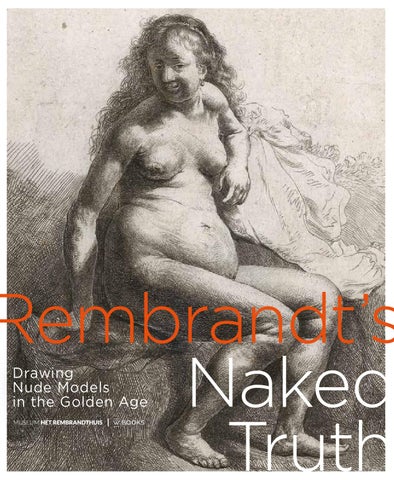
In the 1640s in Amsterdam, a pioneering group of artists began drawing directly from the nude model. This included, for the first time in European art, female models. These artists not only studied correct anatomy, they also pursued ideal beauty and judicious poses. Rembrandt noted this development, and responded with a further innovation, embracing nature’s imperfections and often leaving his models at ease. This catalogue presents a groundbreaking exhibition at The Rembrandt House Museum that traces this remarkable artistic confrontation, played out in drawings, paintings and prints of great power and beauty. Edited by: Judith Noorman and David de Witt With contributions by: Franziska Gottwald, Victoria Sancho Lobis, Judith Niessen, Michael Zell
WWW.WBOOKS.COM WWW.REMBRANDTHUIS.NL
Rembrandt’s Naked Truth Drawing Nude Models in the Golden Age
In the 1640s in Amsterdam, a pioneering group of artists began drawing directly from the nude model. This included, for the first time in European art, female models. These artists not only studied correct anatomy, they also pursued ideal beauty and judicious poses. Rembrandt noted this development, and responded with a further innovation, embracing nature’s imperfections and often leaving his models at ease. This catalogue presents a groundbreaking exhibition at The Rembrandt House Museum that traces this remarkable artistic confrontation, played out in drawings, paintings and prints of great power and beauty. Edited by: Judith Noorman and David de Witt With contributions by: Franziska Gottwald, Victoria Sancho Lobis, Judith Niessen, Michael Zell
WWW.WBOOKS.COM WWW.REMBRANDTHUIS.NL
Rembrandt’s Naked Truth Drawing Nude Models in the Golden Age
Rembrandt’s Naked Truth
R
Rembrandt’s Naked Truth drawing nude models in the golden age
edited by judith noorman david de witt
Contents Foreword
7
Lenders to the Exhibition judith noorman
On Truth and Beauty. Drawing Nude Models in Rembrandt’s Time
11
david de witt
Rembrandt’s Moral Caution Concerning the Beautiful Female Nude
45
victoria sancho lobis
Invention as Instruction: Rembrandt’s ‘Academic’ Prints and Their Function
63
Appendix Rembrandt's Drawing Book: A Reconstruction
73
michael zell
Graphic Images: Rembrandt’s Printed Nudes
87
Catalogue 102
The Haarlem Academy
106
Mastering the Nude without a Life Model
113
Finishing What Rembrandt Started
117
Learning from Life
126
Govert Flinck
131
Rembrandt’s Colleagues in Amsterdam
138
Prostitutes as Nude Models
143
Rembrandt’s Nude Female Models
156
The Role in the Studio
160
Checklist of the Exhibition
164
References
175
Bibliography
182
Index of names
183
Photography Credits
184
Colophon
R N
6
Rembrandt’s Naked Truth Besides being Rembrandt’s former house and workshop, The Rembrandt House Museum is also the place where around forty pupils received instruction from the master. With a series of exhibitions, the Museum seeks to illustrate the
Cat. 59 Rembrandt, Woman at the Bath with a Hat beside Her, Amsterdam, The Rembrandt House Museum (detail)
relationship between the master and his pupils from a variety of viewpoints, and so shed light on the pedagogical side of The Netherlands’ most famous artist. Sagging breasts, belly rolls and dimpled thighs. Rembrandt’s Naked Truth reveals the unidealized way in which Rembrandt and his pupils drew from the nude model. Rembrandt depicted the models as they were and hid nothing, and in so doing occupies a special place in the history of western art. As Rembrandt and his pupils were drawing from the nude model, they discussed art, beauty and transience: topics that touched nerves then as they do today. Based on new research carried out by Dr. Judith Noorman, this exhibition and publication are the first to bring together 17 th -century nude studies in such large numbers. This could only be realized through cooperation and generous loans from museums and private collectors, both from within The Netherlands and internationally, whom we acknowledge in the list that follows. We are likewise grate-
7
ful for the financial support that has come from the City of Amsterdam, Mondriaan Fonds, Fonds 21 and De Gijzelaar-Hintzenfonds. The Rembrandt House Museum receives a substantial financial subsidy from the city of Amsterdam. The drawing Seated Female Nude by Rembrandt can be seen in the exhibition Rembrandt's Naked Truth thanks to a contribution by the Turing Foundation. I would also like to extend special thanks to the following people for vital contributions to this project. We must first thank guest curator Judith Noorman for her unflagging commitment and zest, and her learned insights on a theme that is vital to the story told by The Rembrandt House Museum. We are grateful in this respect to the eminent scholar Eric Jan Sluijter, whose comprehensive study of the female nude in Rembrandt’s art formed a point of departure for this exhibition, but who also shared his thoughts on the wider topic of nude studies in Dutch art of this period at a critical developmental phase of the project. Thanks also goes to our other guest authors, Michael Zell and Victoria Sancho Lobis, Michael Zell, Victoria Sancho Lobis, Judith Niessen and Franziska Gottwald, for placing their research in this publication. Distinguished Rembrandt drawings scholar Peter Schatborn, a long-time champion of these fascinating figure studies, helped with various insights and the realization of critical loans. Lender George Abrams likewise stepped in with critical support of the project. Erik AriÍns Kappers lent assistance with some very relevant items. With these pieces in place, a whole team could go to work to supplement the committed efforts of our staff: translators Hein Horn, Eddy Schavemaker, Rieke van Leeuwen, and editor Koos de Wilt helped to cross language borders. Johan de Bruijn and the team at WBOOKS seized the moment, and saw this publication through its long path to completion. Special thanks goes to Bart van den Tooren for his vision for, and his engagement with, this compelling material. There are others who helped in more subtle or less direct ways, for which we are grateful. The final weeks of preparation of this text fell under the shadow of a passing cloud, with the death of Werner Sumowski, whose work on the drawings of the Rembrandt school laid the foundation for our understanding of the studies of nude models by the master and his pupils. The Rembrandt House Museum hosts his rich research archive. This book is dedicated to the memory of Werner Sumowski. michael huijser
8
L t
Lenders to the Exhibition The Maida and George Abrams Collection, Boston The Art Institute, Chicago Ashmolean Museum of Art and Archaeology, Oxford Bibliothèque Nationale de France, Paris Museum Boijmans van Beungingen, Rotterdam Trustees of the British Museum, London Collection Frits Lugt, Fondation Custodia, Paris Gemäldegalerie, Staatliche Museen zu Berlin Harvard Art Museums/Fogg Museum, Cambridge, Massachusetts Hessisches Landesmuseum Darmstadt Kupferstichkabinett, Staatliche Museen zu Berlin Leiden University Libraries Musée du Louvre, Paris Museum of Fine Arts, Budapest National Library of The Netherlands, The Hague Rijksmuseum Amsterdam Rijksmuseum Twenthe, Enschede and several private collectors
9
O a
10
On Truth and Beauty
Drawing Nude Models in Rembrandt’s Time JUDITH NOORMAN
It has long been known that there were artists in Amsterdam in the 17 th -
Cat. 25 Govert Flinck, Seated
century who drew from nude models. On July 27, 1658, a group of painters
Female Nude before a Tree,
1
– Willem Strijcker (c. 1606/7-1673/7), Nicolaes van Helt Stockade (1614-69), Ferdinand Bol (1616-1680), Govert Flinck (1615-1660), and Jacob van Loo
London, British Museum (detail).
(1614-1670) – officially declared that a woman named Catarina Jans posed for them stark naked. 2 The document survives because Catarina was being prosecuted for prostitution. At the time, prostitution was as illegal as it was rampant; much like today, 17th-century Amsterdam enjoyed an international reputation as a centre for prostitution, and attracted many visitors because of it. 3 The city archives hold thousands of legal documents of prosecutions of such sexual offenses. Some of these concern prostitutes posing nude before artists. Because of these particular circumstances, we have come to know more about the artistic practice of drawing living nude models in mid-17thcentury Amsterdam. Seen in a broad European perspective, the Amsterdam practices are remarkable. European artists increasingly used models in what they called ‘academies’, but they were, as a rule, male. 4 In Amsterdam, however, women
11
posed naked in artists’ studios—a first in European art history. Nevertheless, art historians have largely overlooked the Amsterdam sessions as a subject of study. In his survey about Academies of Art, Past and Present, Nikolaus Pevsner writes that a survey of Dutch academies before 1750 does not take much space. 5 He mentions Rembrandt, of course, but none of his Amsterdam colleagues, or their practices. Most articles on the subject address the question of whether or not Amsterdam had an actual Academy, like other European art centres such as Florence, Rome, and later Paris. 6 The consensus has been that Amsterdam did not have an Academy with set rules, an all-round pedagogical program, or recognition from the city government. 7 With Rembrandt as an exception, the subject of drawing nude models has consequently disappeared from art historical discourse. 8 This, as I shall demonstrate, is unjust: Amsterdam artists had the liberty to hire women as nude models, because the Amsterdam drawing sessions were informal in contrast to European academies, which had strict rules about nude models, especially women. This essay, and the accompanying exhibition, describes and illustrates the practice of drawing nude models in Amsterdam from the 1630s to the 1660s. The subject is complex enough to merit a book, with sections on the market, nude studies and their role in the studio, a history of European academies, an analysis of the art theoretical debate about beauty and drawing 'from life', and the erotic aspect of depicting nude models. Reaching out to a broader audience, however, this research-based exhibition showcases the highlights. With a selection of important drawings, lent by outstanding European and American collections, public and private, Rembrandt’s Naked Truth shows how and why Amsterdam artists drew from nude models. It also demonstrates that two groups of draftsmen were active around the midpoint of the 17 th -century, and that they developed their practices and artistic ideas, in large part in relation, or rather, in response to one another. They battled out their differences with ink and chalk, drawing the nude models who posed before them.
AC A D E M I E S O N T H E R I S E The oldest documented cases of women posing nude in the history of Western art originate in Rembrandt’s time. 9 Three long-known archival documents inform us about this practice in the city of Amsterdam. 10 The earliest, dated 1648, states that Govert Flinck painted three sisters ‘as stark naked as one
12
could possibly be, lying asleep on a pillow in a most indecent manner’. 11 Then, around 1648/9, Dirck Bleker (c. 1620-1672) is documented to have had a ‘regular model’, Maria de la Motte, who also sat for ‘the collegium of painters’. 12 This reference demonstrates that artists came together to draw nude models, which is further confirmed by another archival document, already mentioned, in which Strijcker, Van Helt Stockade, Bol, Flinck, and Van Loo acknowledge that they had engaged a prostitute to model for them nude. 13 In addition to these court documents, books, and auction catalogues document the practice, and provide additional data. To begin, Joachim von Sandrart (1606-1688) wrote that Jan Gerritsz van Bronchorst (1601/5-1661), an artist who worked in Amsterdam between 1647 and his death in 1661, joined him and other young students at the ‘Academy’ (Academia). 14 Arnold Houbraken (1660-1719) recorded that Jacob Backer (1608-1651) drew so-called ‘Academiebeelden’ on blue paper, 15 and that Barend Graat (1628-1709) organized life drawing sessions at his home twice a week for fifteen years. 16 The auction catalogue of Jan Pietersz. Zomer (1641-1726) contains a surprising number of albums with ‘Academi-beelden na ‘t leven’. The catalogue does not mention whether the figures are nude, but includes the names of Backer, Van Loo, Graat, Jan van Noordt (1623/1624-after 1676), Karel Dujardin (1626-1678), Cornelis Holsteyn (1618-58), Jan van Neck (c. 1634/5-1714), and Dirck Ferreris (1639-1693). 17 Finally, Gerard Pietersz van Zijl (1607-1665) and Adriaen van de Velde (1636-1672) signed some of their nude life studies. 18 To judge by these sources, the practice of drawing living models was common, even lively, among the city’s history painters. Another well-known document concerns Rembrandt’s studio. Samuel van Hoogstraten (1627-1678), one of Rembrandt’s pupils, wrote about ‘my old academy drawings’ (mijn oude Academiteykeningen’). 19 Rembrandt’s pupils would take turns posing, and drawing one another. Such drawing sessions were not available everywhere in the Dutch Republic; Van Hoogstraten regrets that some cities had no ‘schools of nude modelling’. 20 In addition to the many surviving drawings of nude young men, the document serves as proof that Rembrandt’s studio was no exception to the rule that Amsterdam history painters drew nude models. Art historians hesitate to use the word ‘academy’ to describe the above practices. 21 At the time, however, the word was used profusely and consist-
13
Fig. 1 Rembrandt, Reclining Female Nude, Amsterdam, Rijksmuseum.
ently, and in relation to the Amsterdam joint life drawing sessions, specifically
Fig. 2 Cat. 32 Jacob van Loo, Reclining Female Nude, Leiden, Leiden University Libraries.
stance, Rembrandt’s pupil van Hoogstraten used the word to describe his nude
with living models. Hessel Miedema stated that the word ‘academy’ seldom appears in Dutch, 17th-century texts. 22 However, this is incorrect. 23 For instudies. 24 In 17th-century Dutch literature, and Italian as well, an academy could also be a private, informal drawing group. 25 Today, however, when we hear ‘academy’ we think ‘royal’ or at least ‘official’, and as already mentioned, Amsterdam had no such established institution. 26 So to avoid confusion, perhaps, art historians tend not to apply the word to the Amsterdam situation. Furthermore, ‘academic’ has become a loaded description. 27 Since the 19 th -century, it has been associated with established aesthetics, and the slavish following of predetermined rules, contrasting with individuality and artistic rebellion. In Rembrandt’s time, however, ‘academic’ said nothing about an artist’s artistic persuasions. It merely meant that an image was believed to be a product of a joint drawing session with a living model. Therefore, it makes sense that both Jacob Adriaensz Backer’s nude studies, and those by Rembrandt, were known as ‘Academy drawings’, even though the rebellious Rembrandt is, in 19 th -century terms, the polar opposite of academicism.
V I S UA L A LT E R C AT I O N S Around the midpoint of the 17 th century, two groups of draftsmen organized drawing sessions with nude models in Amsterdam. New research based on surviving drawings indicates that these groups’ drawings are distinctly different yet internally coherent. 28 One group originated in Rembrandt’s studio, where pupils took turns drawing and posing before one another, and where the master himself hired women to pose nude before him and his more advanced pupils. This has long been known. Another clearly demarcated yet internally coherent group, however, has received relatively little attention. 29 This loose network of artists regularly came together elsewhere in the city to draw nude models, often women. Among them were Flinck, Backer, Van Loo, and many others (see below). These artists – all of whom were fully trained masters with independent studios – belonged to the very summit of the Amsterdam art scene and enjoyed at least as high a status as Rembrandt at the time. Comparing these groups allows new insight into their practical routine, as well as their artistic aims.
14
This catalogue accompanies the exhibition Rembrandt's Naked Truth. Drawing Nude Models in the Golden Age at The Rembrandt House Museum, 12 February to 16 May 2016. PUBLISHER WBOOKS, Zwolle info@wbooks.com www.wbooks.com in collaboration with Museum Het Rembrandthuis, Amsterdam info@rembrandthuis.nl www.rembrandthuis.nl EDITORS Judith Noorman and David de Witt GUEST CURATOR Judith Noorman TEXTS Franziska Gottwald Judith Niessen Judith Noorman Victoria Sancho Lobis David de Witt Michael Zell TRANSLATION Hein Horn Rieke van Leeuwen Eddy Schavemaker Koos de Wilt DESIGN Bart van den Tooren, Amsterdam
WITH THANKS TO De Gijselaar-Hintzenfonds Fonds 21 Mondriaan Fonds Turing Foundation The Rembrandt House Museum receives a substantial financial subsidy from the City of Amsterdam.
Š 2016 WBOOKS All rights reserved. Nothing from this publication may be reproduced, multiplied, stored in an electronic data file, or made public, in any form or in any matter, be it electronic, mechanical, through photocopying, recording or in any other way, without the advance written permission of the publisher. The publisher has endeavoured to settle image rights in accordance with legal requirements. Any party who nevertheless deems they have claim to certain rights may apply to the publisher. Copyright for work of artists affiliated with a CISAC organization has been arranged with Pictoright of Amsterdam. Š c/o Pictoright Amsterdam 2016. ISBN 978 94 625 8134 0 (English) ISBN 978 94 625 8133 3 (Dutch) NUR 646
In the 1640s in Amsterdam, a pioneering group of artists began drawing directly from the nude model. This included, for the first time in European art, female models. These artists not only studied correct anatomy, they also pursued ideal beauty and judicious poses. Rembrandt noted this development, and responded with a further innovation, embracing nature’s imperfections and often leaving his models at ease. This catalogue presents a groundbreaking exhibition at The Rembrandt House Museum that traces this remarkable artistic confrontation, played out in drawings, paintings and prints of great power and beauty. Edited by: Judith Noorman and David de Witt With contributions by: Franziska Gottwald, Victoria Sancho Lobis, Judith Niessen, Michael Zell
WWW.WBOOKS.COM WWW.REMBRANDTHUIS.NL
Rembrandt’s Naked Truth Drawing Nude Models in the Golden Age
In the 1640s in Amsterdam, a pioneering group of artists began drawing directly from the nude model. This included, for the first time in European art, female models. These artists not only studied correct anatomy, they also pursued ideal beauty and judicious poses. Rembrandt noted this development, and responded with a further innovation, embracing nature’s imperfections and often leaving his models at ease. This catalogue presents a groundbreaking exhibition at The Rembrandt House Museum that traces this remarkable artistic confrontation, played out in drawings, paintings and prints of great power and beauty. Edited by: Judith Noorman and David de Witt With contributions by: Franziska Gottwald, Victoria Sancho Lobis, Judith Niessen, Michael Zell
WWW.WBOOKS.COM WWW.REMBRANDTHUIS.NL
Rembrandt’s Naked Truth Drawing Nude Models in the Golden Age