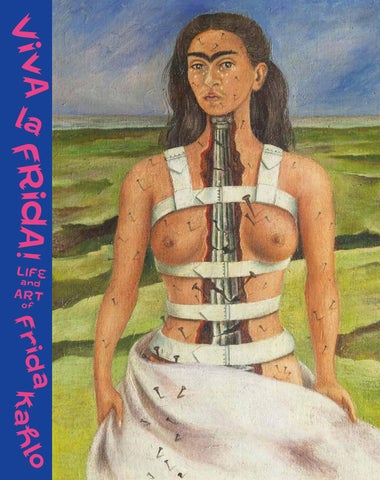
English edition
16
con t en ts
__________________________________________
Visual Explorations I 1-7 A Visual Exploration of Frida Kahlo – Suzanne Hertogs __________________________________________
PREFACE
10 14
The Most Beautiful Dream – Harry Tupan Frida! – Carlos Phillips Olmedo
Life
Beyond
20
144 The Impact of a Phenomenon – Toos Arends
Appearances Can Be Deceiving – Circe Henestrosa
CATALOGUE I
CATALOGUE III
27
155 Art – Toos Arends 181 Fashion – Neja Kaiser 188 Music – Rannilt Pol
Things That Were Dear to Her – Circe Henestrosa
MEET FRIDA – Suzanne Hertogs
60 66 72 76
Frida’s life – Jan van Zijverden Frida Seen by Nickolas Muray Close to Frida – Rannilt Pol At home by Frida & Diego
Art 84 Constructing Her Selves – Gannit Ankori 94 Frida Kahlo’s Anatomy Lesson – Annemiek Rens CATALOGUE II
FRIDAMANIA – Suzanne Hertogs
191 Frida seen at Home 194 Frida seen in a World of Fabric 196 Frida seen on Books 200 Frida seen in Value __________________________________________ 202 206 207 208
Notes Credits Authors Colophon
105 Paintings and Drawings – Annemiek Rens
__________________________________________
209-216 A Visual Exploration of Frida Kahlo – Suzanne Hertogs __________________________________________
17
Visual Explorations II
22
Vi va l a Fr ida!
In her twenties she embraced traditional Mexican garb
Ricardo Ayluardo, The Family of Matilde Calderón y Gonzalez, 1890, Inscriptions: in translation ‘Mother (Oaxaca) Mathilde Calderón, age 7 1890’ and ‘Matilde Calderón, now Kahlo, with four daughters Matita, Adri, Frida and Cristi.’, gelatin silver print, 20.2 x 25.2 cm, Museo Frida Kahlo, Mexico City
Gisèle Freund (19082000), Frida Kahlo works on the portrait of her father Guillermo, 1951, photo, 25.5 x 28.5 cm, Museo Dolores Olmedo, Mexico Bernard Silberstein (1905-1999), Frida in Tehuana Costume, Coyoacán, 1940, photograph, 40.6 x 50.8 cm, Throckmorton Fine Art, New York
acclaim was also fuelled by feminists in the second half of the twentieth century who took her as an example for sexual politics and post-colonial debates.5 Later, Julie Taymor’s 2002 film Frida (featuring Salma Hayek); Gannit Ankori’s book Imaging Her Selves (2002),6 which analysed Kahlo’s paintings as deliberate examinations of her constructed identities, and a major 2005 retrospective at Tate Modern, London, followed by many worldwide exhibitions of her work likewise raised her international profile. Today a simple Google search yields over 46 million entries on Kahlo.
She created her iconic self-image as ‘La Tehuana’
T
Tehua na clothing
and scholars, Kahlo and Rivera among them, were attracted to the isthmus, known for its matriarchal society and rich native culture that resisted European domination. Although Kahlo never visited the isthmus, she adopted its regional dress, creating her iconic self-image as ‘La Tehuana’. Kahlo wore embroidered blouses, long skirts, elaborate hairstyles, and woven shawls from Tehuantepec in her own mesmerising version of mexicanidad (Mexican-ness). At the same time, these sartorial choices deflected attention from her disabilities and injuries. Kahlo
23
he unlocking of the archive at La Casa Azul made it possible to learn more about Kahlo’s construction of identity through her ethnicity, her disability, her political beliefs, and her art. We can examine how she used complementary modes of creativity – painting, photography, and her meticulously composed fashion – to express herself. As a teenager Kahlo dressed in unconventional ways to express her individuality and hide her damaged leg. In her twenties she embraced traditional Mexican garb, which she wore throughout her life. She affirmed this idea of ‘otherness’ as someone who made the unconventional the norm in her own way and on her own terms. Even though she created a singular hybrid style, mixing elements from diverse regions and periods (garments from Guatemala, China, Europe, and the United States, for example), she especially identified with the indigenous women from the Isthmus of Tehuantepec in the state of Oaxaca in southern Mexico. Prominent Mexican artists
Vi va l a Fr ida!
Unkown photographer, Frida Kahlo in La Casa Azul, circa 1950, photo, 5.9 x 7.8 cm, Museo Dolores Olmedo, Mexico
Tehua na ou tfit
This top has criss-cross lines of stitching worked in chain stitch on a treadle sewing machine, and is worn with a cotton skirt with a band of machine embroidery. Tehuana women were fond of printed cotton, and large quantities were imported from Manchester, England, up until the 1930s.
30
Huipil (tunic), before 1954 Isthmus of Tehuantepec, Oaxaca, Mexico, cotton muslin with machine embroidery (chain stitch) Enagua (skirt) and holán (flounce), before 1939 Isthmus of Tehuantepec, Oaxaca, Mexico, skirt: printed cotton with machine embroidery (chain stitch); flounce: cotton Museo Frida Kahlo, Mexico City (tunic and skirt), colección Cibeles Henestrosa (flounce)
T hi ngs t h at w er e de a r to her
Long t u nic a nd skirt
Although peacocks are not native to Mexico, they became popular subjects for traditional needlework. This huipil was probably made to sell at the market, as the embroidery is on a larger scale than that of garments worn by the local community. The skirt is embellished with a wide band of satin and was made especially for Kahlo.
Lydia Whitlock, Frida Kahlo at a sketch for the mural Pan American Unity that Diego Rivera is creating for San Francisco City College, 1940, photo, 24.5 x 19.7 cm, Museo Frida Kahlo, Mexico City
Skirt, before 1954, Coyoacán, Mexico City, Mexico, synthetic blend complex weave, applied satin ribbon Museo Frida Kahlo, Mexico City
31
Huipil (tunic), before 1954, Mazatec community, Huautla de Jiménez, Oaxaca, Mexico, cotton with cotton-thread hand embroidery (stem stitches)
42
Eclectic collection of rings
Kahlo’s collection of rings was extensive, eclectic and constantly changing. During the final years of her life her rings featured particularly strongly both in photographs and written accounts. The photographer Gisèle Freund described how ‘every one of her fingers bears enormous rings with finely carved precious stones’, although many were of more modest value. Often exchanged as tokens of friendship, Hayden Herrera, Kahlo’s biographer, described how ‘people gave them to Frida, and with impulsive generosity, she just as often gave them away’.
Collection of rings, before 1954, Mexico, silver set with red layered agate; silver set with turquoise and jadeite; gold-plated copper; silver set with a fused glass plaque; gold set with rose-cut diamonds, Museo Frida Kahlo, Mexico City Lola Álvarez Bravo (1903-1993), Frida Kahlo, 1952, gelatine silver print, 22.7 x 18.5 cm, Museo de Arte Moderno, Mexico City Antonio Pineda (1919-2009) Bracelet of silver and amethyst Taxco Mexico, 1940s, Museo Frida Kahlo, Mexico City
43
Unknown photographer, Frida Kahlo and Diego Rivera in La Casa Azul, c. 1930, photo, 6.2 x 9.8 cm, Museo Dolores Olmedo, Mexico
Unknown photographer, Frida Kahlo, 1931, photo, 5.6 x 4.5 cm, Museo Dolores Olmedo, Mexico
1932
Frida and Diego temporarily live in Detroit
Unknown photographer, Frida at the art academy in Detroit, 1932, photo, 11 x 16 cm, Museo Dolores Olmedo, Mexico
1933
1936
62
Lucienne Bloch (19091999), Frida Kahlo on her way back from Detroit, 1932, photo, 7.4 x 5.5 cm, Museo Dolores Olmedo, Mexico
Unknown photographer, Frida Kahlo, c. 1933, photo, 8 x 5.2 cm, Museo Dolores Olmedo, Mexico
ents ‘There have been two mthajoe rtracamcidand in my life. One was ego. the other was Di r’ Diego was the worst by fa
Frida and Diego move into their new home in San Angel
Frida is operated on her foot
Frida makes a lot of paintings 1937
1934
Diego is unfaithful to Frida with her sister Cristina
1935
1938
Frida and Diego break up
Frida has her first solo exhibition in New York
Nickolas Muray (1892-1965), Frida Kahlo with artist and ethnologist Miguel Covarrubias, 1938, photo, 10.8 x 14.7 cm, Museo Dolores Olmedo, Mexico
1939
Frida participates in a Paris exhibition
The Louvre buys her self-portrait The Frame
1939
‘Frida Kahlo’s art is like a ribbon around a bomb’ — André Breton
1939
1940
Frida and Diego get a divorce Frida and Diego remarry
u Why did I call you ‘my Diego’?miYo never were and never will be ne. You are your own ... 1941
Frida and Diego move back to La Casa Azul
Nickolas Muray (1892-1965), Frida Kahlo painting on her back at the Mexico City hospital, with Miguel Covarrubias looking on in the background, 1940, photo, 11.9 x 15.2 cm, Museo Dolores Olmedo, Mexico
1942
Frida starts teaching at the art academy La Esmeralda
Unknown photographer, Diego Rivera and Frida Kahlo on the Casa Azul terrace, c. 1945, photo, 5 x 7.5 cm, Museo Dolores Olmedo, Mexico
Guillermo Zamora (19152002), Diego Rivera and Frida Kahlo at La Casa Azul, c. 1952, photo, 12 x 17.5 cm, Museo Dolores Olmedo, Mexico 63
68
Nickolas Muray (1892-1965), Frida Kahlo in blue blouse, 1939, photo, 32.4 x 24.1 cm, Throckmorton Fine Art, New York
Nickolas Muray (1892-1965), Frida Kahlo in New York, 1946, photo, 36.8 x 27.3 cm, Throckmorton Fine Art, New York
69
Frida’s lov e for Diego
There are two near-identical versions of Diego and I commemorating Frida and Diego’s marriage. Kahlo painted one version for Rivera (this painting) and another for herself. The special shellencrusted frame bears two dates: 1929, the year of their marriage, and 1944, the current year in which they celebrated their fifteenth anniversary. Kahlo did not count the period that they were divorced (from the end of
1939 until their second marriage in December 1940). All that mattered was that they were reunited and belonged together. The portrait itself depicts this close connection. The two halves of their faces together form a whole. That their marriage was not always rose-coloured is symbolised by the thorny yet intertwined roots binding the couple together. The shells represent the male and female sex organs. This painting is not only about Frida’s love for Diego but about the relationship between men and women in general. This is reinforced by the female moon and the male sun depicted at the upper right. grapher, Unknown photo ul, in La Casa Az ra Diego Rive , cm .3 20 x .8 24 c. 1945, photo, Olmedo, Mexico Museo Dolores
), avo (1903-1993 Lola Álvarez Br , photo, 44 19 g, do Frida with , Throckmorton 25.4 x 20.3 cm rk Yo w Fine Art, Ne
1 30
Modern m a rt y r
Diego and I, 1944, oil on masonite, 12.3 x 7.4 cm, Private collection
In Self-Portrait with Small Monkey, Frida Kahlo presented herself surrounded by her favourite animals: the monkey draping its arms around her shoulder and the dog Señor Xólotl (named after the Aztec god of death). The artist owned many animals and considered them to be the children she would never bear. Three pairs of eyes look at the viewer with a piercing gaze. Kahlo’s hair is coiffed in the authentic style of Southeast Mexico. The thick unibrow and hairy upper lip underscore her unconventional beauty. The work also features a number of disconcerting elements. For example, the Pre-Columbian figurine on the right refers to the – for Kahlo – authentic Mexico to which she felt bound. They are all connected by a ribbon looped around a nail that seems almost real. This is not only an illusionistic artistic device called trompe l’oeil but probably also a reference to the Catholic faith as experienced in Mexico. The nail symbolises the martyrdom of Christ. Kahlo presented herself as a modern martyr in several paintings, as is probably the case here too. This is without question one of her best self-portraits.
134
What does not kill me, nourishes me Without Hope, 1945, oil on canvas on masonite, 28 x 36 cm, Museo Dolores Olmedo, Mexico
Gavage
The oak easel which would have normally held Kahlo’s canvas is now a structure supporting a huge funnel bursting with an enormous amount of food that is being stuffed into her, including whole chickens, pigs, fish and sausages. There is also a sugar skull bearing Kahlo’s name that she had received from Diego while in hospital. In the painting, Kahlo lies under a cover of microscopic organisms that probably allude to the frailty of the human body. She had become emaciated because of her illness and the many treatments, for which the doctor prescribed absolute bed rest and force-feeding. On the back of the painting the artist wrote: ‘A mí ya
no me queda ni la menor esperanza... todo se mueve al compás de lo que dicta la panza...’ (‘Not the least hope remains to me ... Everything moves in tune with what the belly contains...). Frida’s bed is set in a desolate volcanic landscape, and the many cracks in the ground symbolise her broken body. The sun and moon refer to the Aztec conception of the eternal battle between light and dark.6
Pa in t ings a n d Dr aw ings
Fruit
and pregnancy. In one of the flowers, a foetus can be discerned shedding tears, just like the eye in the sun she painted under it. The sun is a familiar symbol of fertility. The painting is reminiscent of the Flower of Life she made a few years earlier.
1 35
Sun and Life, 1947, oil on masonite, 40 x 49.5 cm, Private collection
Kahlo’s traumatic miscarriage at Henry Ford Hospital in 1932 had made it painfully clear to her that although she could become pregnant, she would probably never be able to carry a child to term. Once again she had lost a baby, this time not Diego’s but that of a lover. She painted Sun and Life shortly after this event. It features a number of plants in the form of male and female genitals, all in a different stage of reproduction