from
Raymond Hains, 1926, Saint-Brieuc (France) – 2005, Paris (France). Film abstrait [Abstract Film], 1952–1976 Synthetic paint on aluminium, 200 x 280 cm. Gift of Raymond Hains, 1978. Centre Pompidou, Paris. Musée National d’Art Moderne / Centre de Création Industrielle, AM 1977-619
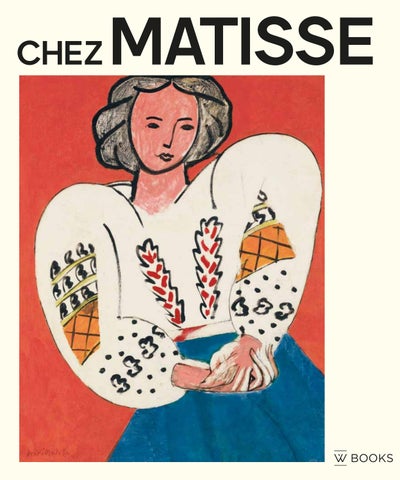
→ Henri Matisse, 1869, Le Cateau-Cambrésis (France) – 1954, Nice (France). La Blouse roumaine [The Romanian Blouse], April 1940 Oil on canvas, 92 x 73 cm. Gift of Henri Matisse to the French State, 1953; attribution 1953. Centre Pompidou, Paris. Musée National d’Art Moderne / Centre de Création Industrielle, AM 3245 P
Centre Pompidou
MATISSE
The work one of the greatest colourists encourages the forming of a new sensory path for our present. As Matisse himself said, “The characteristic of modern art is to participate in our life.”
CHEZ
Chez Matisse sets out to follow a trajectory defined by the artist’s influence in the real and imaginary territories of artistic creation in the twentieth century, through its contact with the international avant-gardes.
CHEZ
MATISSE
in
H’ART Museum
Henri Matisse in front of the cut-out gouaches, former Hôtel Régina, Niza. Photograph by Lydia Delectorskaya, n. d. Archives Matisse.
Contents Preface
5
Matisse: the Exploratory Modernist Aurélie Verdier
7
The Algerian Woman, 1909 – 2025 Zoulikha Bouabdellah
15
Intersections: Henri Matisse, Natalia Goncharova Elitza Dulguerova
20
On the Threshold of the Studio “à l’Orientale”: Matisse in Nice (1917–1930) Deepak Ananth
30
Matisse, Le Corbusier: a Dialogue Olivier Cinqualbre
40
The Ends of Painting: Matisse, Buren, Parmentier Molly Warnock
50
1. “Schematisse”: Line, Colour (1900 – 1905) Aurélie Verdier
61
2. Primitivism, or emotion (1907 – 1914) Aurélie Verdier
75
3. Abstraction/Apparitions (1914 – 1917) Aurélie Verdier
95
4. The heart points south (1917 – 1928) Aurélie Verdier
107
5. Classical modernism. Matisse, Bonnard, Picasso (1930 – 1940) Aurélie Verdier
123
6. Kodachrome. Colour supreme (1939 – 1960) Aurélie Verdier
135
7. “Working in plural" (1966 – 2000) 165 Aurélie Verdier Chez Matisse / Timeline Marjolaine Beuzard
174
Centre Pompidou H'ART Museum Exhibition colophon Book colophon Artistic credits, photo credits
186 189 190 191 192
6 “I believe I have only ever made a direct reference to Matisse once, but in a specific work, a piece created for the permanent collection of the Stedelijk Museum in Amsterdam.1That museum owns a large paper cut-out by Matisse,2 one of the major works in its collection, which I used as a colour reference—that is to say, as a palette. During the museum’s closing hours, I went to study, how this work was made, colour by colour, and how many different colours it contained, and to mix all the necessary shades, paint cans in hand, in order to get as close as possible to the original colours. In this way I identified some ten of them. Once I had completed this study and determined the frequency of these colours’ appearance in Matisse’s work, I arranged them symmetrically and in descending order—referring to their use in Matisse’s work—across all the angles forming the architectural framework surrounding the doors and other passageways in this museum. As in a mirror, all these colours answer one another across the museum’s central axis, on either side of the main entrance staircase. The only direct connection with Matisse’s work was therefore to use it once as a palette. But apart from this untypical example, I see no connection in my work with this artist. When working on colour, it seems perfectly logical to me to refer to those who have tackled this subject, such as Matisse, who is certainly one of the greatest colourists of the twentieth century. But that is where it ends. His thinking, like that of a few others, is there for me whenever I feel the need for it. Should I mention, in this regard, the lessons of Cezanne, the experiments of the Fauves, the large zones of colour in Barnett Newman’s work, the colour of gold in Masaccio?”3 Daniel Buren
1 Kaléidoscope, un travail in situ, 1983. 2 Henri Matisse, La Perruche et la Sirène [The Parakeet and the Mermaid],1952. 3 Daniel Buren, Au sujet de…. Interview with Jérôme Sans (1998), Paris: Flammarion, 2000, pp. 177–178.
7
Matisse: the Exploratory Modernist Aurélie Verdier I. Let’s talk about work In 1948, aged nearly eighty, Henri Matisse said he subjected himself to a “strict preparation to be worthy”4 of colour. Nothing had changed, or very little, since 1912 when he wrote to the poet Gertrude Stein: “Painting is always very hard for me – always this struggle – is it natural? Yes, but why have so much of it? It’s so sweet when it comes of its own accord.”5 Contrary to the image frozen that freezes Matisse as the painter of “joie de vivre” in an eternal present, the artist in fact “gambled” with his art repeatedly throughout his life – and with all the risks this implied. It is indeed in this unbroken succession of re-starting his work that we can gauge the full exploratory dimension inherent in his oeuvre, as it emerges in the great female portraits of the radical decade of 1909–1916, with those “Byzantine” or ghostly apparitions of his daughter Marguerite and the actress Greta Prozor. Or again, the experiments of the 1930s when his highly distinctive fusion of colour and line emerged, or when this distinctly pictorial tension manifested itself in the chromatic and decorative flamboyance of the Intérieurs in Vence in 1947 and 1948, like a resurgence of Fauvism. From 1948 onwards, it falls to a final body of work to recapitulate the reflective laboratory that spanned the years of Matisse’s training under Gustave Moreau at the École des Beaux-Arts in the 1890s, right up to his death in Nice in 1954: for one last time, in the brush drawings on ceramics and the stained-glass windows of the Chapel of Vence (1948–1953), the artist quite literally brought to light the reflections on colour, drawing and space that he had pursued throughout his life. Matisse’s work is a process or, just as much, a
laboratory, and the idea of labour is the thread running through his life, evident in his rare public statements as well as in his correspondence, whether expressing his desire to paint or the difficulties he experiences in achieving a certain “spark that cannot fail to come,”6 the one that marks his greatest achievements with a particular brilliance. II. Chez Matisse/hospitality What does it mean, for artists, to work in close proximity? What is a gaze that is actively engaged with a work, or one that is more diffuse? And what does the idea of hospitality or welcome express in art history? Are there only open doors? Sometimes we let go, or even drive away, those we have welcomed. In 1942, having completed his work on drawing in his collection “Thèmes et Variations,” Matisse embarked on an ambitious programme to “restart Painting”7 –personified by a capital “P.” A few years later, a sixteen-year-old girl named Baya, born Fatma Haddad in Bordj-elKiffan, near Algiers, painted ornamental motifs resembling cloisonné enamels or gemstones. She depicted female figures, musical instruments and hybrid animals on
4. Henri Matisse, “Letter to Henry Clifford,” February 1948, used as a preface to the exh. cat., Philadelphia Museum of Art, 1948, repr. Matisse on Art, New York: E. P. Dutton, 1973, p. 121. 5. Alfred Barr, Matisse, His Art and His Public, New York: The Museum of Modern Art, 1951, p. 144. 6. Letter from Henri Matisse to Pierre Matisse dated September 1, 1940, repr.
Henri Matisse, Écrits et propos sur l’art, Paris: Herman, 2014p. 184. 7. Henri Matisse to Pierre Rosenberg, letter dated April 10, 1942, New York Pierpont Morgan Library, quoted by Rémi Labrusse, “Les briques du temple, Vence, 1948,” in Cécile Debray (ed.), Matisse. Paires et séries, exh. cat., Paris: Centre Pompidou, 2012, p. 235.
8
Screen capture of the film Matisse by Frédéric Rossif, produced by Henri Langlois, France, 1951 7:40 minutes, silent. Cinémathèque Française.
9 large sheets of coloured paper. That same year, Aimé Maeght, who had discovered her work in Algiers, exhibited over 150 of Baya’s works in Rue du Bac, Paris, in the gallery that he had opened two years earlier, in late 1945, with a major exhibition dedicated to Matisse. Their effective awareness of each other’s work, although imperfectly established, illustrates the limits of the concept of influence. The Nature morte au magnolia [Still Life with Magnolia] may or may not have been influenced by Baya, just as Baya’s work may or may not have been influenced by the contributions of the great modern master. Matisse travelled to Biskra in Algeria in 1906, reportedly bringing back a red, yellow and black carpet and various ceramics, among other objects. It is enough for us to know that these, like other sources, gave him the vital impulse towards the decorative. Baya loved Matisse’s painting. Ultimately, the only real question concerns the work itself—this body of work born of the dream of a lush yet enclosed garden, inhabited by haughty women who are as much the keepers of a secret as they are of a muted pain, perhaps obscured by the extreme decorative quality. After the Maeght exhibition, Baya made ceramics alongside Picasso at the Madoura studio in Vallauris in 1948. She visited Georges Braque and a few others. But she returned, near Algiers, because that was where, for her, art could be made, the place of her Arab-Berber roots. Baya interrupted her artistic practice in 1953 (she would resume it after Algerian independence) as she took up the duties of motherhood and marriage. These facts contradict an aestheticizing or ahistorical perspective. The necessary contextualisation of art highlights layers of complexity, in this case that of a regime of domesticity assigned to women in a country colonised, in this instance, by France. After a pilgrimage to Mecca in 1972, which she described as “one of the greatest events of my life,” Baya wrote of her determination to
paint, and in the simplicity of her statement we could be reading Matisse himself: “I have a great desire to work.”8 III. Painting as thought Despite the multitude of mediums used by Matisse in the course of his creative life, in the popular imagination it is the idea of him as a “painter” that predominates. It is impossible to understand Matisse without his drawing and sculpture (which he downplayed as being done “as a painter”), and yet this native of northern France, born in Le Cateau-Cambrésis in 1869, was indeed a painter. To his friend Pierre Bonnard, with whom he shared the same “genealogical” love of painting, Matisse wrote on May 7, 1946: “I have found three reproductions of Giotto of Padua, which I am sending to you. Giotto, for me, is the pinnacle of my desires, but the path leading to an equivalent in our day and age is too long for a single lifetime.”9 The exhibition “Chez Matisse” traces the trajectory of one of the most significant bodies of work of the twentieth century, one that is remarkably well represented in the collections of the Musée National d’Art Moderne (MNAM). Today, we need to rethink the all-too-conventional notion of influence. The impact of his work, felt very early on and beyond national borders, is a subject with multiple angles. We might say here that being “Chez Matisse” is like being in a house; or even on a tree with
8. Letter to Marguerite Caminat, February 1972, Archives Nationales d’Outre-mer, Aix-en-Provence, quoted by Anissa Bouayed, in Baya. Femmes en leur jardin, exh. cat., Paris, Institut du Monde Arabe, 2022, p. 273.
9. Henri Matisse, letter to Pierre Bonnard, 7 May 1946, reprinted in Bonnard/ Matisse. Correspondence (1925–1946), preface by Jean Clair, introduction and notes by Antoine Terrasse, Paris: Gallimard, 1991, p. 127.
On the Threshold of the Studio “à l’Orientale:” Matisse in Nice (1917–1930) Deepak Ananth If the studio is the privileged domain of Matisse’s art, visualized by him as the ideal space for the artist as creator and as connoisseur of his own creations – the epiphanic ambience of L’Atelier rouge [The Red Studio] of 1911 is surely its sublime epitome of this – then the element which shores up the pictorial autonomy of this realm is the frame. The demarcation which the frame formally instantiates between the space of representation and real space can, in an extended sense, also be taken as emblematic of an ontological or metaphysical boundary between the work and its larger context, between the utopian projection of Matisse’s art – the promesse de bonheur that is its desired horizon – and the ideologically and historically contingent ground from which it seeks to elevate itself. What the frame achieves within a local compass, the institution of the museum
30 enacts on a global scale in that in the one as in the other it is a question of defining limits, drawing up parameters, the function of the frame in securing the formal autonomy of the work paralleled by the (rather more nebulous) role of the museum in the creation of a canon. The strategies of supplementing or supplanting operative in both are, in the case of the museum, masked by the legitimizing fictions of selection, classification and display, procedures which are the preconditions for creating a consensus, with the latter crystallizing or congealing, over a period of time, into a norm, a model, and eventually a canon for artists and audience alike. One such consensus concerns Orientalist painting, whose consecration by the museum commences in the midnineteenth century (during the heyday of European colonialism) and reaches some kind of climax with the acquisition in 1922 of Matisse’s Odalisque à la culotte rouge [Odalisque in Red Trousers, 1921]. An earlier crescendo is surely the entry into the Louvre in 1911 of Ingres’s Le Bain turc [The Turkish Bath, 1863], an acquisition
Henri Matisse, Odalisque à la culotte rouge, 1921, oil on canvas, 67 × 84 cm. Musée National d’Art Moderne, Centre Pompidou, Paris.
31
Jean-AugusteDominique Ingres, Étude pour Le Bain turc, 1859, Black pencil, 6,2 × 4,9 cm. Musée du Louvre, Department of Prints and Drawings.
61
Henri Matisse 1869, Le CateauCambrésis (France) – 1954, Nice (France) Autoportrait [Self-Portrait] 1900 Oil on canvas 55 x 46 cm Acceptance in Lieu Pierre Matisse, 1991 Centre Pompidou, Paris Musée National d’Art Moderne / Centre de Création Industrielle AM 1991-271
1. Pierre Schneider, Matisse, New York: Rizzoli, 1984, p. 13. 2. E stienne, “Des tendances de la peinture moderne ,” Les Nouvelles, 12 April 1909, in Henri Matisse, Écrits et propos sur l’art [1972], Dominique Fourcade (ed.), Paris, Hermann, 2014, p. 60.
Aurélie Verdier
1 Born in Le Cateau-Cambrésis in northern France, into a family of weavers and dyers, Matisse was anything but a natural revolutionary. Having come to art relatively late in life, he spent a long time searching for his identity before becoming one of the major artists of the twentieth century, an unrivalled master of colour. Having decided to pursue an artistic career after a few years working as a solicitor’s clerk, he entered the atelier of the Symbolist painter Gustave Moreau at the École des Beaux-Arts, Paris, in 1892. He furthered his training by copying the old masters at the Louvre whilst developing his own artistic personality. Years later, he would recall that “a painter is already wholly present in his first pictures.”1 Finding his way: in 1898 and again in 1904, the artist eked out a path alongside the Neo-Impressionists and, while in Saint-Tropez, painted Luxe, calme et volupté (1904) in accordance with the principles of Divisionism championed by Paul Signac. At once a dead end and a revelation, this painting of a singular pastoral scene allowed Matisse to apply the laws of contrast between dominant and complementary colours, and to deploy a pure chromaticism rendered by a divided brushstroke. But it is precisely the untenable tension between colour and line – the flat patches of colour coexist strangely with the delineation of figures, defying Signac’s logic – that made Matisse aware of the contradictory nature of his project: to unify line and colour. For someone who had condemned the Impressionists’ pursuit of the fleeting moment, the “visual flutter”2 of his painting lacks the desired solidity. Yet Luxe, calme et volupté was not a futile exercise, for it provided a repertoire of figures that the artist would occasionally deploy in both painting and sculpture.
“Schematisse”: Line, Colour (1900 – 1905)
← Henri Matisse 1869, Le CateauCambrésis (France) – 1954, Nice (France) L’Algérienne [Algerian Woman] Spring1909 Oil on canvas 81 x 65 cm Bequest of Viscount Guy de Cholet to the network of French museums, 1916; attribution 2009 Centre Pompidou, Paris Musée National d’Art Moderne / Centre de Création Industrielle AM 2009-214 → Henri Matisse 1869, Le CateauCambrésis (France) – 1954, Nice (France) Marguerite au chat noir [Marguerite with Black Cat] Early 1910 Oil on canvas 94 x 64 cm Gift of Barbara Duthuit in memory of Claude Duthuit, 2013 Centre Pompidou, Paris Musée National d’Art Moderne / Centre de Création Industrielle AM 2013-544
104
105
← Henri Matisse 1869, Le CateauCambrésis (France) – 1954, Nice (France) Le Peintre dans son atelier [The Painter and His Model] Between late 1916 and early 1917 Oil on canvas 146.5 x 97 cm Purchase, 1945 Centre Pompidou, Paris Musée National d’Art Moderne / Centre de Création Industrielle AM 2585 P → Henri Matisse 1869, Le CateauCambrésis (France) – 1954, Nice (France) Le Violoniste à la fenêtre [The Violinist at the Window] Spring 1918 Oil on canvas 150 x 98 cm Purchase, 1975 Centre Pompidou, Paris Musée National d’Art Moderne / Centre de Création Industrielle AM 1975-260
Henri Matisse 1869, Le CateauCambrésis (France) – 1954, Nice (France) Nature morte au buffet vert [Still Life with Green Sideboard] 1928 Oil on canvas 81.5 x 100 cm
Gift of the Association des amis des artistes vivants, 1929 Centre Pompidou, Parijs Musée National d’Art Moderne / Centre de Création Industrielle LUX 1719 P
5
123
1. Jacques Guenne, “Entretien avec Henri Matisse,” L’Art vivant, no. 18, 15 September 1925, repr. in Jack Flam (ed.), Matisse on Art, New York: E. P. Dutton, 1973, p. 55.
2. Jean Cocteau in “Déformation professionnelle,” Le Rappel à l’ordre, 12 May 1919; reprinted in Cocteau, Carte blanche, Paris: Éditions de la Sirène, 1920, p. 98.
Aurélie Verdier
The late 1920s proved to be a veritable pictorial impasse for Matisse, who was looking for space after a long decade of confinement. A work such as Nature morte au buffet vert [Still Life with Green Sideboard, 1928] testifies as much to a solidity in execution and composition reminiscent of Cezanne as it does to his need to get beyond the figure/ground problem. Cezanne always offered succour in difficult times, as Matisse had convinced himself by the mid-1920s: “If Cezanne is right, I am right.”1 The Matisse of the early 1930s was a recognised master, confirmed by a retrospective at the Museum of Modern Art, New York, in 1931. That same year, Galerie Georges Petit celebrated him in Paris, showcasing his work from Nice whilst also exhibiting pre-1914 works that highlighted the radicalism and diversity of his artistic enterprise. Whether all his painting was imbued with this innovativeness that remained largely unassimilated in France, or whether from 1917 onwards he began revisiting Impressionism, Matisse was at that time either lauded or reviled. The former Fauvist had become akin to a “little Bonnard cat.”2 This dig from Jean Cocteau must scarcely have affected Matisse, who had long been convinced of the importance of his friend Pierre Bonnard, a former Nabi and a painter who defied categorisation as either classical or modern – or, to put it another way, who was capable of continuing Impressionism while by his allover approach to scenes of intimacy anticipating many of the pictorial questions of the post-war period. In the 1930s, Matisse and Bonnard shared the same concern regarding the placement of the figure within a
Classical modernism. Matisse, Bonnard, Picasso, Gilot (1930 – 1940)
174 CHEZ MATISSE. TIMELINE (1869-1970) Marjolaine Beuzard 1869–1890 Birth of Henri Matisse in Le Cateau-Cambrésis, northern France, on 31 December 1869. After studying law in Paris, in 1888 he takes a position as a solicitor’s clerk in Saint-Quentin. During a long convalescence following an operation for appendicitis in 1890, he produces his first works of art. 1891 October: Matisse travels to Paris to study at the Académie Julian under the painter William Bouguereau, then under Gabriel Ferrier. He leaves the following year. 1892–1894 October: Matisse enrols in evening classes at the École des Arts Décoratifs, where he meets and befriends Marquet and Manguin.
Matisse in his studio in Collioure with his wife and his daughter Marguerite, summer 1907. Matisse is standing in front of Le Luxe I (1907). Archives Henri Matisse, Issy-les-Moulineaux
December: he enrols at the École Nationale des Beaux-arts in Paris, joining the atelier of the symbolist painter Gustave Moreau, which he attends until 1897. Matisse moves to 19 Quai Saint-Michel, Paris, in 1894. 1895–1897 With his friend, the painter Émile Wéry, Matisse discovers Brittany. He spends three summers there, in 1895, 1896 and 1897, and is introduced to Impressionist painting. This pivotal period, marked in particular by his frequent visits to the Louvre to see the great masters, is crowned by success: he exhibits for the first time at the Salon de la Société Nationale des Beaux-arts in 1896, and the French state acquires La Liseuse [The Reader, 1895, Paris, MnamCci/Centre Pompidou]. 1898 In January Matisse marries Amélie Parayre, with whom he will have two children: Jean-Gérard, born in 1899, and Pierre, in 1900. He also has a
daughter, Marguerite, born in 1894, from a previous relationship. The following month, the young couple travels to London and then to Corsica, where Matisse is deeply moved by the Mediterranean light. During the summer, he reads Paul Signac’s essay “D’Eugène Delacroix aux néo-impressionnistes.” 1899 March: Matisse enters Eugène Carrière’s atelier at the Académie de Camillo and meets André Derain there. He also makes his first sculptures between 1899 and 1903. During this period, he takes part in several salons and group exhibitions, which bring him little financial reward. Matisse makes great sacrifices to acquire Paul Cezanne’s Trois baigneuses [Three Bathers, 1879–1882], a “talismanic painting” that will inspire his future work. 1900 Matisse rents a new Parisian studio on the fifth floor at 19 Quai Saint-Michel. Facing financial difficulties, he works with Marquet on the creation of a monumental set design for the 1900 Exposition Universelle at the Grand Palais. 1901 March: at Bernheim-Jeune, Derain introduces Matisse to his friend Maurice Vlaminck. April–May: Matisse exhibits for the first time at the Salon des Indépendants.
175 1904 June: Matisse’s has a first retrospective at Galerie Ambroise Vollard. This recognition does not keep the artist from exploring; during the summer, while staying in Saint-Tropez, he experiments with the principles of Divisionism alongside Paul Signac and Henri-Edmond Cross. This is evidenced by Luxe, calme et volupté [Pleasure, Calm and Voluptuousness, cat. p. 68], executed in his studio when back in Paris. 1905 January: Matisse visits Derain and Vlaminck in their studio in Chatou. May: Matisse stays in Collioure, a village close to the Spanish border. July: Joined by Derain, they paint landscapes in vivid colours. October–November: At the Salon d’Automne, Matisse presents recent works with aggressive colour schemes, alongside paintings by Derain, Manguin, Marquet and Vlaminck. Their room, Salle VII, is dubbed the “cage aux fauves” (cage of wild beasts) by a hostile press. Works by Bonnard, Alex von Jawlensky, Czòbel and Van Dongen are exhibited in other rooms. On this occasion the American writer and collector Gertrude Stein buys her first Matisse painting, Femme au chapeau [Woman with a Hat, 1905, San Francisco Museum of Modern Art].
Appears to show the group at the time of the Knave of Diamonds. Larionov’s Autumn (1912) can be seen in the background. Bibliothèque Kandinsky, Centre Pompidou, Paris, fonds Larionov.
Sonia Terk arrives in Paris and attends the Académie de la Palette. Robert Delaunay paints his first self-portrait (cat. p. 72). 1906 March–April: Matisse is given a solo exhibition at Galerie Eugène Druet. The Russian collector Sergei Shchukin buys several of his works. At the Salon des Indépendants, Matisse exhibits Le Bonheur de vivre [The Joy of Life, 1905–1906, Philadelphia, Barnes Foundation], alongside works by Camoin, Czóbel, Delaunay, Derain, Van Dongen, Manguin, Marquet and Vlaminck. Matisse meets Pablo Picasso at the Stein home. In May: Matisse spends a fortnight in Algeria, where he travels to Biskra. Matisse, who is interested in African primitive art, buys a Vili statuette (Congo).
1907 March–April: Matisse exhibits Nu bleu: Souvenir de Biskra [Blue Nude: Memory of Biskra, 1907, Baltimore Museum of Art] at the Salon des Indépendants, causing a furore. Georges Braque joins the Fauves group. Works by Matisse are included in an exhibition of French artists shown successively in Munich, Frankfurt, Dresden, Karlsruhe and Stuttgart. September: Paul Cassirer exhibits works by Matisse in his Berlin gallery. December: Cassirer includes drawings by Matisse in the Berlin Secession exhibition held at the same gallery. This is undoubtedly the Brücke artists’ first opportunity to see Matisse’s work.
191
Colophon book
This book was published to accompany the exhibition ̒Chez Matisse' at the H'ART Museum, from 3 October 2026 till 14 February 2027. Publication WBOOKS, Zwolle info@wbooks.com in collaboration with H’ART Museum, Amsterdam Centre Pompidou, Paris Editor Aurélie Verdier Text Deepak Ananth Marjolaine Beuzard Zoulikha Bouabdellah Olivier Cinqualbre Elitza Dulguerova Aurélie Verdier Molly Warnock Translation from French Charles Penwarden Graphic design Vanessa van Dam, in collaboration with Selina Landis Typeface Jungka (Jungmyung Lee & Karel Martens)
All works depicted are by Henri Matisse, unless otherwise stated. ISBN 978 94 625 8787 8 (English edition) 978 94 625 8786 1 (Dutch edition) NUR 646
© 2026 WBOOKS / H'ART Museum Amsterdam. Original texts © Éditions du Centre Pompidou, Paris, 2026. All rights reserved. Nothing from this publication may be reproduced, multiplied, stored in an electronic data file, or made public in any form or in any manner, be it electronic, mechanical, through photocopying, recording or in any other way, without the advance written permission of the publisher. The publisher has endeavoured to settle image rights in accordance with legal requirements. Any party who nevertheless deems they have a claim to certain rights may apply to the publisher.