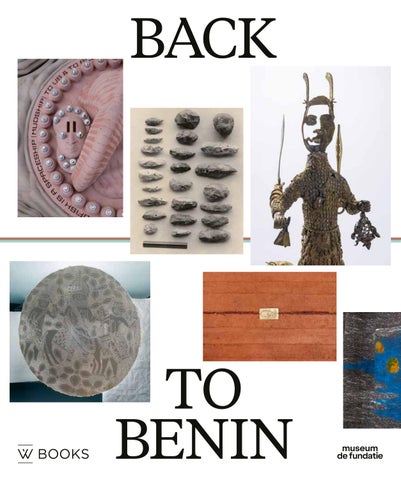
Back to Benin: nieuwe kunst, eeuwenoud erfgoed
Back to Benin: New Art, Ancient Legacy
06 VOORWOORD / FOREWORD
Beatrice von Bormann
12 Ama O Ghe Ehen
16 Phil Omodamwen
20 MODDERVIS IN TROEBEL WATER—AMA O GHE EHEN / MUDFISH IN CLOUDY WATERS—AMA O GHE EHEN
Kristian Garssen, Johan Koers, Aude Christel Mgba
26 Leo Asemota
32 Osaze Amadasun
38 AMA EHEN—EEN BRONZEN PLAQUETTE VAN DE BOODSCHAPPER VAN OLOKUN / AMA EHEN—A BRONZE PLAQUE OF THE MESSENGER OF OLOKUN
Osaisanor Godfrey Ekhator-Obogie
50 Enotie Ogbebor
56 BACK TO BENIN: NIEUWE KUNST, EEUWENOUD ERFGOED / BACK TO BENIN: NEW ART, ANCIENT LEGACY
Aude Christel Mgba
64 Favour Jonathan
68 Taiye Idahor
74 WAT JE GEVANGEN HEBT, IS NIET WAT JE HEBT GEVANGEN / WHAT YOU CAUGHT, IS NOT WHAT YOU CAUGHT
Victor Ehikhamenor
82 Victor Ehikhamenor
88 TENTOONSTELLING VAN BRONZEN PLAQUETTES UIT BENIN EN BESCHOUWING VAN GEBEURTENISSEN IN BENIN: DE MODDERVIS-PLAQUETTE / EXHIBITION OF BENIN BRONZE PLAQUES AND RECOLLECTION OF EVENTS IN BENIN: THE MUDFISH PLAQUE Kokunre Agbontaen-Eghafona
100 Abraham Onoriode Oghobase
106 Osaru Obaseki
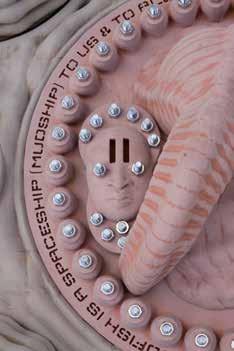
112 DE MODDERVIS IS EEN RUIMTESCHIP! / THE MUDFISH IS A SPACESHIP!
Minne Atairu
118 Minne Atairu
124 BIBLIOGRAFIE / BIBLIOGRAPHY
126 BIOGRAFIEËN / BIOGRAPHIES
128 COLOFON / COLOPHON
Herkomstonderzoek naar de bronzen plaquette met een moddervis
Kristian Garssen, Johan Koers, Aude Christel Mgba
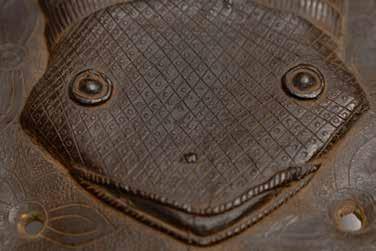
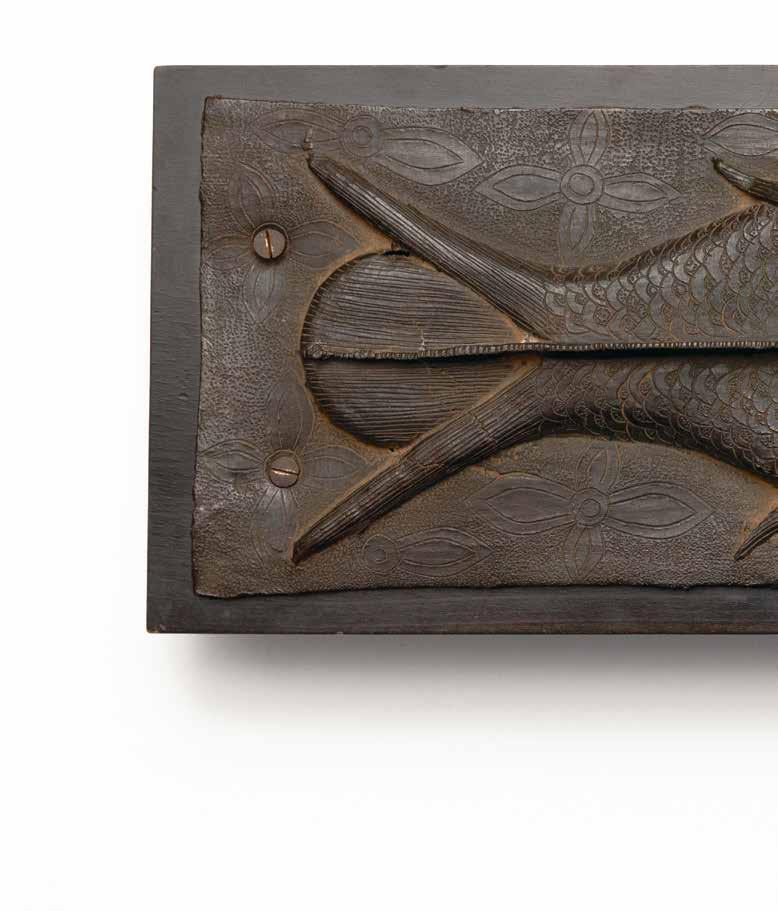
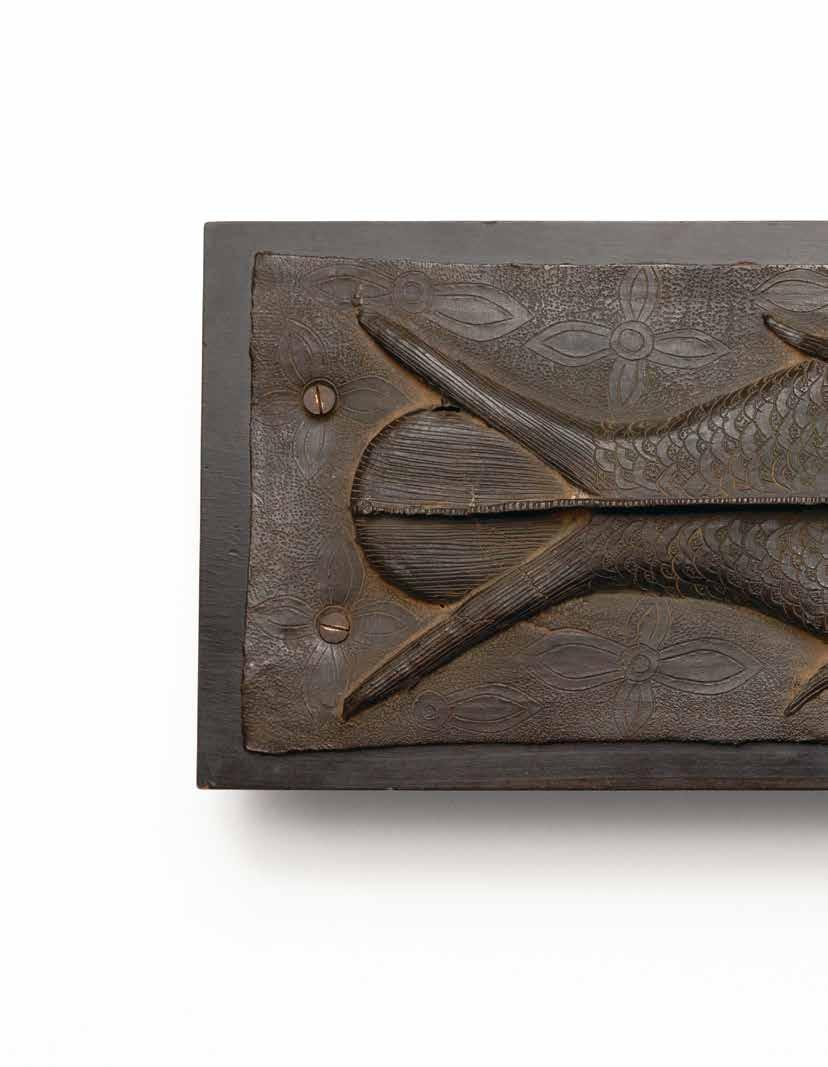
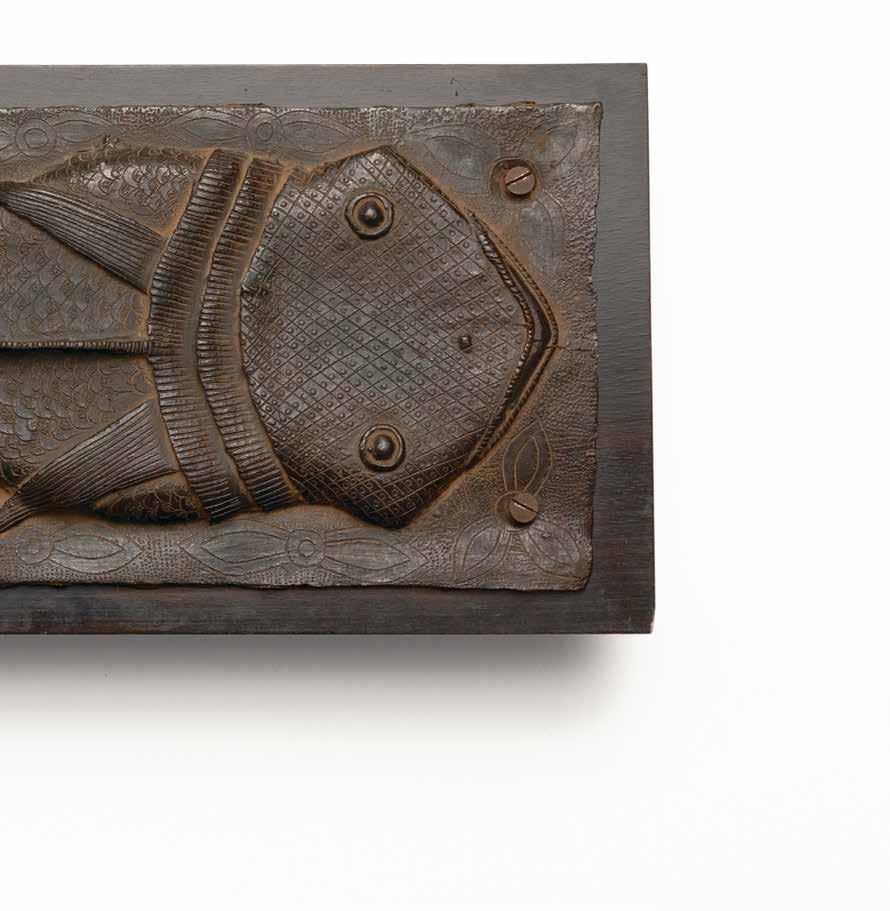
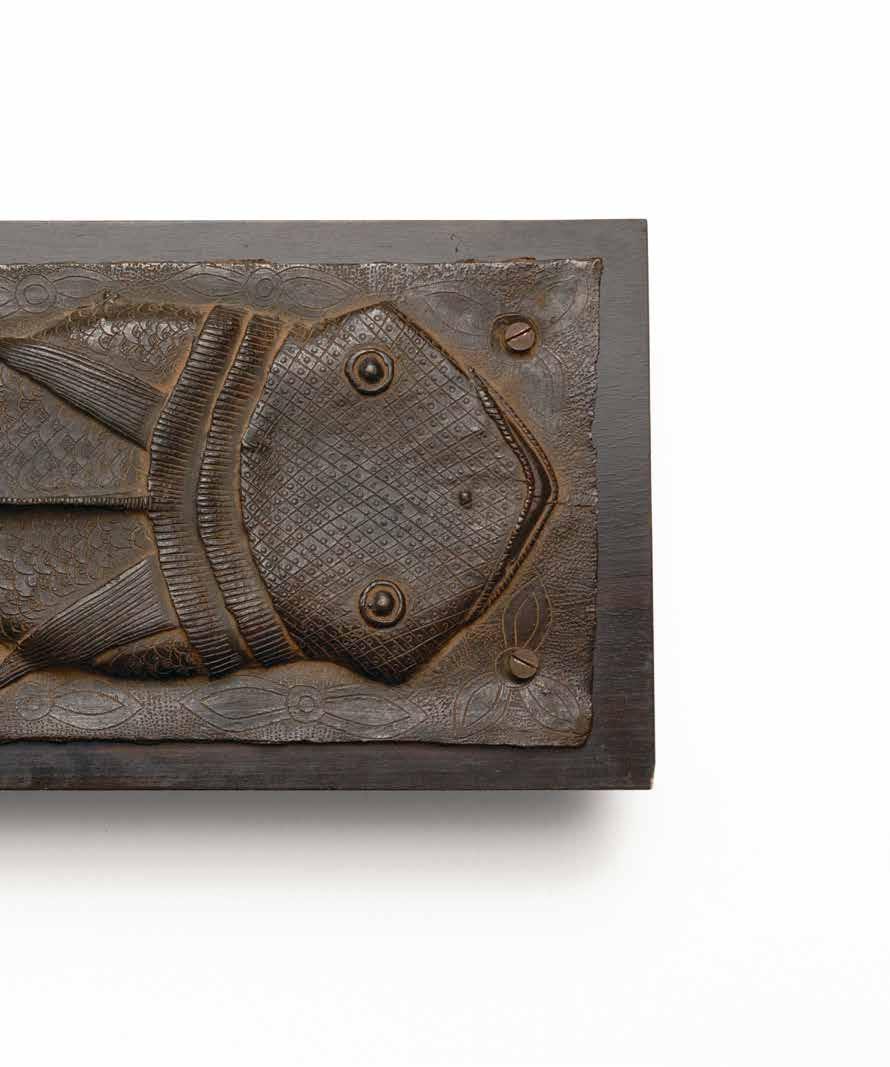
Ama O Ghe Ehen (plaquette met vis), 18de eeuw, brons (messing), 43 ×18 cm | Hof van de Oba van Benin, Nigeria | Met dank aan het NCMM, namens de Oba van Benin | Foto: Martijn Schmidt / Ama O Ghe Ehen (Fish Plaque), 18th century, bronze (brass) | Court of the Oba of Benin, Nigeria | Courtesy of the NCMM, on behalf of the Oba of Benin | Photo: Martijn Schmidt
Provenance research on the bronze plaque depicting a mudfish
DE EERSTE STAPPEN (2009–2013)
Tussen 2009 en 2013 nam Museum de Fundatie deel aan het landelijke project herkomstonderzoek museale verwervingen vanuit de Nederlandse Museumvereniging. Het doel was om vast te stellen of objecten in collecties een geschiedenis van gedwongen bezitsverlies in de periode 1933–1945 kenden. Koloniale contexten maakten destijds nog geen deel uit van het onderzoek. In eerste instantie werd de Benin brons die zich in de collectie van Museum de Fundatie bevond, dan ook alleen in het kader van gedwongen bezitsverlies in de periode 1933–1945 onderzocht. Met behulp van onder andere de collectiedatabase en het archief van het museum werd de herkomst voor zover mogelijk in kaart gebracht.
DE BENIN DIALOGUE GROUP
Sinds 2010 onderhandelt de Benin Dialogue Group over restitutie van Benin bronzen. Leden zijn diverse musea in Duitsland, Nederland, Oostenrijk, Zweden en Groot-Brittannië, evenals vertegenwoordigers van de staat Nigeria en het koninklijk paleis van Benin. De onderhandelingen binnen deze groep hebben inmiddels tot diverse restituties geleid.
NIEUWE INZICHTEN SINDS 2020
Rond 2020 intensiveerde de discussie rond de restitutie van koloniaal erfgoed binnen musea. Daarmee kwam de plaquette bij Museum de Fundatie opnieuw in beeld. Het museum streefde ernaar de oorsprong, authenticiteit en herkomstgeschiedenis verder aan te vullen, die tot dan toe slechts tot 1937 was achtergehaald.
VASTGESTELDE HERKOMSTGESCHIEDENIS
Uit een aantekening van de grondlegger van Museum de Fundatie, Dirk Hannema, blijkt dat hij het reliëf in 1937 had gekocht bij kunstzaal Carel van Lier in Amsterdam, die zowel in moderne kunst als in buiten-Europese objecten handelde. Die laatste had het in consignatie van de Parijse
From 2009 to 2013 Museum de Fundatie took part in a national project to investigate the provenance of museum acquisitions, organised by the Dutch Museums Association (Nederlandse Museumvereniging.) The goal was to establish whether objects in collections had a history of forced expropriation in the period 1933–1945. The research did not encompass colonial contexts at that time. Initially, the Benin bronze in Museum de Fundatie’s collection was therefore only investigated in relation to forced expropriation between 1933 and 1945. The provenance of the object was traced as accurately as possible using the collection database, the museum’s archives and other sources.
Since 2010, the Benin Dialogue Group has been negotiating the restitution of Benin bronzes. Its members include various museums in Germany, the Netherlands, Austria, Sweden and Great Britain, as well as representatives of the Nigerian state and the Royal Palace of Benin. Negotiations within this group have already led to several restitutions.
Around 2020, the discussion surrounding the restitution of colonial heritage within museums intensified, and the spotlight fell once more on the plaque at Museum de Fundatie. The museum attempted to unearth more information about the origins, authenticity and provenance of the object, which had thus far been traced only up to 1937.
A note by the founder of Museum de Fundatie, Dirk Hannema, showed that he had bought the relief in 1937 at the Carel van Lier art gallery in Amsterdam, which dealt in both modern art and non-European objects. The latter had the piece on consignment from Paris dealer Charles Ratton. In 1937, Van Lier organised a sales exhibition featuring 59 objects from Ratton’s collection, includ-
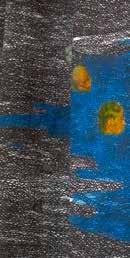
De werken van Osaze Amadasun vinden hun oorsprong in visuele verhalen en weerspiegelen de culturele rijkdom van zijn omgeving. Ze bieden een kijk op gelaagde geschiedenissen. Amadasun behandelt vaak thema’s die verband houden met het oude koninkrijk Benin en het veranderende stadsleven van Lagos. Zijn kunst is voor hem een manier om te documenteren en te reflecteren. Deze serie schilderijen van Amadasun laat figuren zien die interacteren met de plaquettes en brengt sommige van de scènes die op de plaquettes zijn afgebeeld tot leven. Zo brengt hij de intieme relatie tussen de plaquettes en de mensen die verschillende tijden met elkaar verbinden, naar voren. Amadasun nodigt hiermee uit tot reflectie over erfgoed en culturele continuïteit.
Osaze Amadasun’s works originate in visual narratives and reflect the cultural richness of his surroundings. They offer a glimpse into layered histories. Amadasun often addresses themes related to the ancient kingdom of Benin and the changing urban life of Lagos. For him, his art is a way of documenting and reflecting. This series of paintings by Amadasun shows figures interacting with the plaques, bringing some of the scenes depicted on them to life. In this way, he highlights the intimate relationship between the plaques and the people who connect different times. Amadasun invites us to reflect on heritage and cultural continuity.
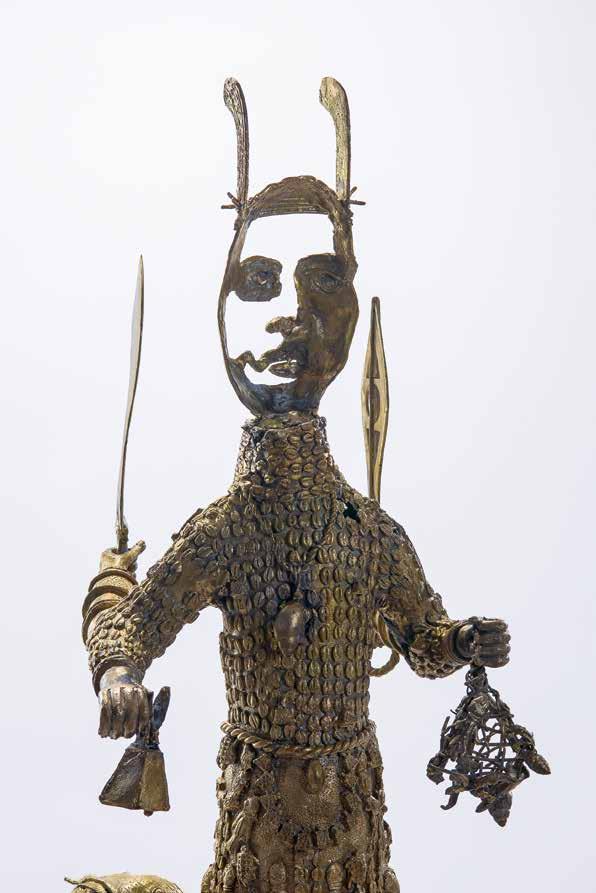
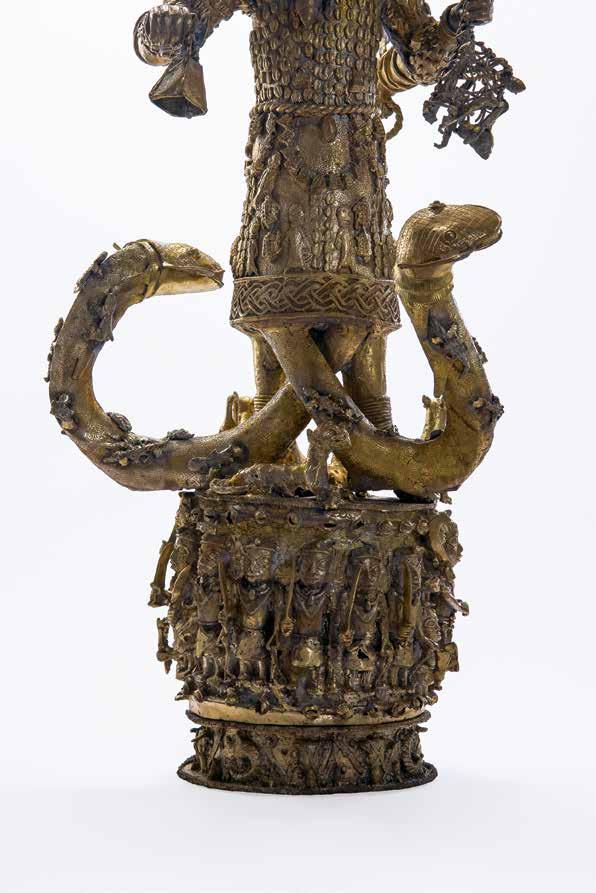
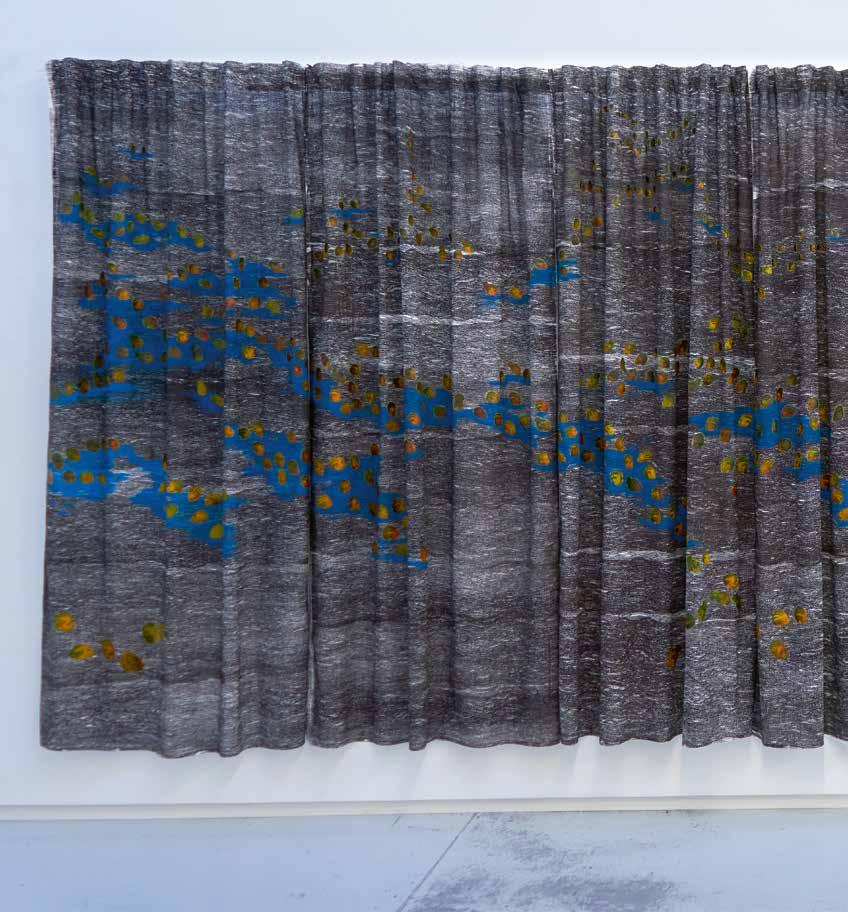
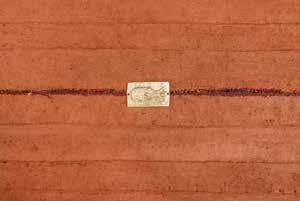
Osaru Obaseki verdiept zich in de werelden van materialiteit, geschiedenis, culturele identiteit, maatschappelijke dynamiek en de complexiteit van koloniale en postkoloniale verhalen. Obaseki’s installatie Gepantserd is gebaseerd op de symboliek van het vermogen van de moddervis om zowel op het land als in het water te gedijen en verweeft verschillende vormen van oude Beninese kunst, iconografie, motieven, materialen en architectuur. Het werk doet visueel denken aan de monumentale structuur van de Grote Muur van Benin. Bronzen hangers van een moddervis, een bel, een voorouderlijk hoofd, een luipaard, een krokodil en een krijger hangen allemaal aan stukjes draad in het onderste deel van de installatie. Obaseki reflecteert hiermee op de manieren waarop samenlevingen hun identiteit beschermen wanneer ze voor uitdagingen staan en proberen te redden wat er in het transformatieproces op het spel staat.
Osaru Obaseki delves into the realms of materiality, history, cultural identity, social dynamics and the complexity of colonial and postcolonial narratives. Obaseki’s installation Armored is based on the symbolism of the mudfish’s ability to thrive both on land and in water and interweaves various forms of ancient Benin art, iconography, motifs, materials and architecture. The work is visually reminiscent of the monumental structure of the Great Wall of Benin. Bronze pendants of a mudfish, a bell, an ancestral head, a leopard, a crocodile and a warrior all hang from bits of thread in the lower part of the installation. Obaseki hereby reflects on the ways in which societies protect their identity when faced with challenges and salvage what is at stake in the transformation process.
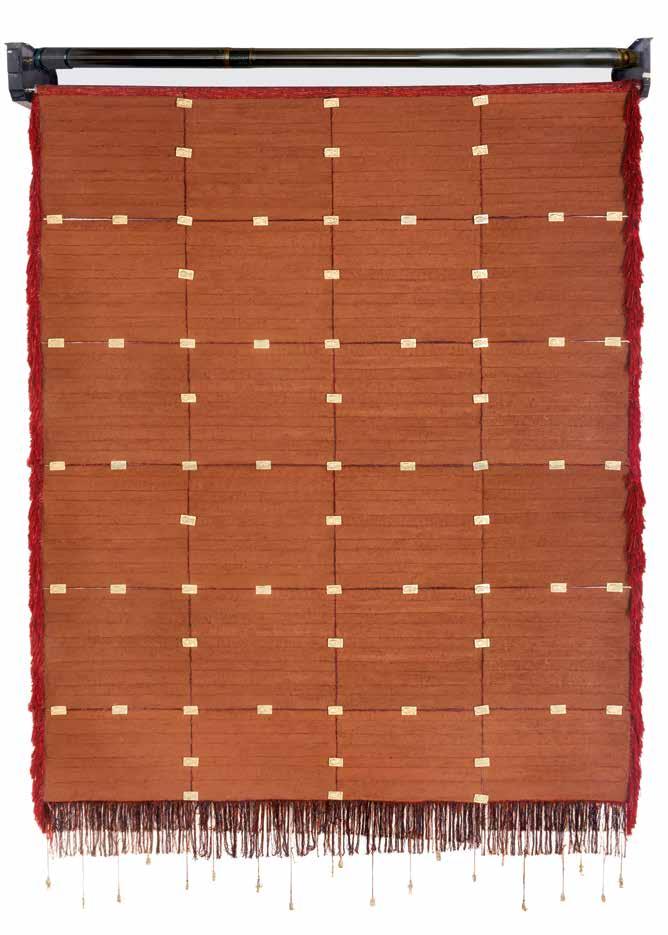
Osaru Obaseki, Gepantserd, 2025, zandschilderij (rode aarde op geweven en ontwoven materiaal), bronzen gietwerk dat moddervisplaten met elkaar verbindt, bronzen iconografische hangers met touwtjes, 320 x 430 cm | Bruikleen van de kunstenaar | Foto: Charles Ofikhenual / Armored, 2025, sand painting (red earth on woven and de-woven material), bronze cast connecting mudfish plates, stringed bronze iconography pendants | Courtesy the artist | Photo: Charles Ofikhenual
Dit boek is uitgegeven ter gelegenheid van de tentoonstelling Back to Benin: nieuwe kunst, eeuwenoud erfgoed, te zien van 21 februari tot en met 7 juni 2026 in Museum de Fundatie Zwolle.
This book is published on the occasion of the exhibition Back to Benin: New Art, Ancient Legacy, held at Museum de Fundatie, Zwolle, from 21 February to 7 June 2026.
uitgave / publication
WBOOKS, Zwolle, NL info@wbooks.com wbooks.com
Museum de Fundatie, Heino, Zwolle, NL info@museumdefundatie.nl museumdefundatie.nl
auteurs / authors
Minne Atairu
Kokunre Agbontaen-Eghafona
Beatrice von Bormann
Victor Ehikhamenor
Oisasonor Godfrey Ekhator-Obogie
Kristian Garssen
Johan Koers
Aude Christel Mgba
redactie / edits
Beatrice von Bormann
Siji Jabbar
Sanne van de Kraats
Aude Christel Mgba
vertaling / translation
Eveline Deul (ENG-NL)
Sue McDonnell (NL-ENG)
fotografie / photography
Elevine Berge
Usiosefe Mary Izegbuwa
Daniel Lawani
Maruani Mercier
ODH Studio
Charles Ofikhenual
Martijn Schmidt
ontwerp / design
Hamid Sallali
tentoonstelling / exhibition
Conservator / Curator
Aude Christel Mgba
Projectleider / Project Leader
Tessa van den Dolder, Adrie Kok
Registrar
Esmee Manubulu
© 2026 WBOOKS Zwolle / Museum de Fundatie / de auteurs
Alle rechten voorbehouden. Niets uit deze uitgave mag worden verveelvoudigd, opgeslagen in een geautomatiseerd gegevensbestand, of openbaar gemaakt, in enige vorm of op enige wijze, hetzij elektronisch, mechanisch, door fotokopieën, opnamen of op enige andere wijze, zonder voorafgaande schriftelijke toestemming van de uitgever.
De uitgever heeft ernaar gestreefd de rechten met betrekking tot de illustraties volgens de wettelijke bepalingen te regelen. Degenen die desondanks menen zekere rechten te kunnen doen gelden, kunnen zich alsnog tot de uitgever wenden.
Van werken van beeldende kunstenaars aangesloten bij een CISACorganisatie is het auteursrecht geregeld met Pictoright te Amsterdam.
© 2026 WBOOKS Zwolle / Museum de Fundatie / the authors
All rights reserved. Nothing from this publication may be reproduced, multiplied, stored in an electronic data file, or made public in any form or in any manner, be it electronic, mechanical, through photocopying, recording or in any other way, without the advance written permission of the publisher.
The publisher has endeavoured to settle image rights in accordance with legal requirements. Any party who nevertheless deems they have a claim to certain rights may apply to the publisher.
Copyright of the work of artists affiliated with a CISAC organisation has been arranged with Pictoright of Amsterdam.
© c/o Pictoright Amsterdam 2026.
ISBN 978 94 625 8751 9 NUR 646
Museum de Fundatie wordt ondersteund door / is supported by





Back to Benin wordt ondersteund door / is supported by