MONTHLY NEWS OF THE WAIKAWA BOATING CLUB
latitude 41 Yachting NZ
Corner
fishing
sounds style
simple galley
food
Online Magazine
Getting
knotTy part 1 Vol. 05 | January 2023
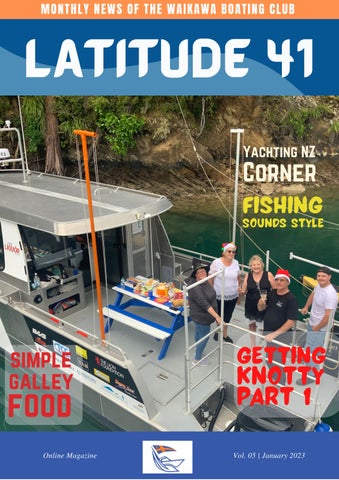
Cover photo - Club Support boat - Ray White pays a visit to our Christmas Raft-up.
Inside this month January 2023
Happy New Year & welcome to this edition of Latitude 41 Our aim is to bring you more insight into your club, its people and events. We welcome and encourage your contributions of photos, editorial content and suggestions and hope you enjoy this issue.
From last month when I asked if there was an architect or designer able to help us in drawing up our building rennovation plans, I am pleased to say we now have this important step covered. Closing in our mezzanine floor to make it a useable members lounge/meeting room with workspaces for members, has been in the background for over 6 years now, it would be fantastic to see this space purposefully used! Some members have asked why we would proceed with spending money on our club building in these uncertain financial times. I want to reassure everyone, the building work we will be proposing will not increase our physical footprint, but maximise the usability of our current spaces for the benefit of all our members and supportive community. Fund raising has already begun in a small way, with this renovation planned to be financed through grant funding and donations, not by dipping into our club reserves. If we are not able to raise the money the building work will not go ahead. As soon as the concept drawings are completed these will shared with all members and the Exec will make the decision to proceed or not.
Welcome to our newest members Sounds Kingi Fishing MNMRA -Latest News Yachting NZ Corner with Ian Gardiner The Hook-up you dont want Simple Galley Recipes Up close with our marine mammals
Join us and become a member We have two types of membership, Full and Crew. Crew Members: Join a racing yacht and take part in all our racing events as well as other club regattas. Enjoy members discount at our club bar. Have fun at our club social events and Friday club nights, including entry into our weekly members jackpot draw. Affiliation to both Yachting New Zealand and Clubs New Zealand. Full Members - All of the above plus:
Relax while cruising and enjoy the use of 100 secure and regularly serviced moorings throughout Queen Charlotte and Pelorus Sounds as well as D’Urville Island and Port Underwood Enter your yacht in any of our 80+ races held throughout the year as well as our annual regattas. Take part in our regular ‘on water’ cruising events. Make use of our discounted venue hire rates. Full voting rights. Eligible to stand for election on the club Executive. Click here for link to our membership application forms.
Welcome to our New Members Full members
Adrian Olsen Lynton Eveleigh Bob Huges Paul & Carolyn Rutherford Olly Davies & Graeme Castle. Nick Imrie Gerard Ness Thomas Vieregg Miranda & Elliot Baker
Argo Sakura ll Ocean Oasis Phantasea Share Magic Mr Fussy Meltemi Oi Fortaleza
Miller & Tunnage 16.7m Bayliner 9.1m Benetau 12m Hanse 315 Vindex 42 Bayliner 2855 Launch Spencer, 10m, 2t Mason 48
Click here for full list of our current boat register
Are you new to boating? Check out this FREE online course from Coastguard Boating Education
MEET YOUR EXECUTIVE Rear Commodore House Susie Caley Susie arrived in New Zealand with her partner, Martin, 12 years ago. It certainly has been a complete change of life. They knew no-one in NZ but fell in love with the region and stayed. Whilst waiting for legal acquisition of their new home they were invited to “turn up at WBC” by Ash Davey. He took Martin on board and Susie commenced sailing with Nicky Jenkins on Summer Wine. They have since sailed with numerous different skippers. John and Mary-Anne Jackson shared their love of cruising. Now with their own launch, Crusader. Their love of the Sounds increases every time they go out. Sharing a glass of Marlborough wine and a game of SkipBo with friends is wonderful and the fishing great fun. Martin and Susie ran their home as a guest lodge until Covid hit and stopped all overseas visitors. Their property, at Anakiwa, is set in ten acres of land they have sympathetically worked very hard to create beautiful grounds. Sitting high on the hillside, their views are breathtaking. They now undertake property renovation work. Susie is the “gofor” and does most of the painting work. In the UK Susie taught Food Safety and worked part-time here as a chef at Outward Bound. Together, she and Martin served delicious evening meals for their guests. So she has lots of experience for her current role of Rear Commodore House. She loves the team spirit and says she has a wonderful group of ladies, and sometimes their partners too who are her “Heros”. ‘We have great fun working together for the good of the whole club. Hopefully with Covid reducing, the opportunities to hold more social events will increase.‘
Open to all Members and members guests
Bookings for Friday evening meals make a big difference to our catering team we appreciate your support.
Tuesdays from 7.30pm Bistro style meals Members bar discount Racing prizegiving
Club Calendar January Giesen New Year regatta has been cancelled - please see below From Tuesday 10 - Versatile Summer Twilight Series Friday 13 - Mt Gay Friday Rum 3 Race Series begins Saturday 28 - Mt Gay Sentinal Rock Offshore Race Sunday 29 - Harbour Race - Short Handed and Fully Crewed divisions
From the Archives Looking down Beach Road from the Te Ara Kaimoana intersection early 1980’s
Christmas Raft-up 2022 Flipper Bay
REAR COMMODORE ROUND UP
house The old year of 2022 has gone and the House Committee is looking forward to a positive New Year with no Covid restrictions. We will be busy this weekend with the Regatta, running the outside bar. Ash, Ron, Steve T and Martin are all looking forward to wearing our “Hero” aprons!!!!!!! The House Heros will be helping Deanne and bar staff by clearing tables and glasses. We do hope you will all come in and support the club by booking a meal and buying drinks at the bar. Fingers crossed for good weather. In 2023 we hope to be able to return to organising a few social events. We very much look forward to seeing everyone supporting the club. Happy New Year everyone
A note from our Commodore Sue I woud like to add to Susie’s report a massive THANK YOU to all her team and their partners for generously lending a helping hand when asked, often at short notice, to cover for our caterer, or other sections of the club. Unfortunately Covid is still continuing to be a disruptive pest, taking out key personnel at short notice and seems likely to continue well into the New Year. I also thank our members who take a few minutes to book in for ther meals on Friday nights. It may not seem like a big deal but is incredibly helpful when our caterer is juggling staff and supplies to ensure our service is not disrupted. Look forward to seeing you in the Club over the next few weeks. Sue
REAR COMMODORE ROUND UP
cruisING
A huge thank you to everyone who came and joined us over Christmas. We had 9 boats on Christmas Eve and despite the rain, our spirits were not dampened! We enjoyed a shared lunch on the beach at Double Bay. Glorious sunny weather, lots of laughs, food and of course a few drinks. Followed later in the day by a Skipbo card tournament and delicious trifle.
It was great to see so many folks enjoy the beauty of the Sounds. To wake in the morning and listen to the birds singing and watch stingrays glide along the water was wonderful. We were disappointed not to have the Orca come in for our entertainment. Unfortunately the weather gurus accurately predicted weather/wind conditions unsuitable or our annual raft-up. This year we have several events planed including: Anchor and stern line management - Dinghy handling - Music in the Sounds concert - Outboard motors; electric vs petrol/diesel - Day Skipper training, So keep your eyes open. Dates and details will be to follow shortly.
e m o lc e W
New Year Regat n e s e i ta to G
Wee ken d
It is with great sadness the Sailing Committee of Waikawa Boating Club have made the difficult decision to cancel the Regatta due to take place this weekend. The weather is not conducive to running an event people will enjoy and also creates safety issues for support crew who are on the water. The committee have waited for a few days to see if the front bringing the bad weather was delayed but the forecast shows no improvement. We had a total of 26 boats entered and were looking forward to giving you a nice weekend of sailing and also off water enjoyment. We appreciate your support in entering the regatta and hope we will see you, and your crew, again at future events. Full refunds of entry fees/meals etc will be given, the office will send out the details we require to facilitate this. A lot of hard work and countless hours has been put in by club staff and volunteers to make this event happen and we are sad to have to pull the pin. The Club is open tonight and you are welcome to come in and socialise. For those that have travelled to get here we hope you have a safe trip back to your home port.
REAR COMMODORE ROUND UP
MOORINGS
Mooring Map Amendments, December 2022
These amendments are to the “WPM Mooring Locations 2020” combined club mooring map. GPS Locations – some of the exact locations of moorings have changed, however the coordinates on the map will be within close visual proximity to the mooring. Remember the mooring is attached to the block by a large chain, so will be anywhere within a large circle from the block. Also GPS accuracy is only 5-10m. Temporary Updates – This amendment is for permanent changes. Your club newsletter will detail any temporary changes – eg mooring unusable or missing.
Queen Charlotte Sound NEW - Torea Bay – #3211, maybe marked Cerveza. 174° 01.791E 41° 12.728S This is a single boat mooring, with a maximum length of 15m. This mooring maybe used to access Portage. Please ensure you leave the Torea Bay Jetty clear for commercial boats. Wind conditions: exposed to the S. Very gusty in W and N winds Double Bay South #6 – This is the left most of the three moorings when entering the bay. No change to position. The 6 moorings listed below are now all standard club moorings (5 boats) limited to 35 ton. Governors Bay South: #229 Kaipakirikiri South 2: #233 Tawa Bay West: #232 Endevour Inlet School House Bay East: #2675 Ships Cove East: #231 Coopers South: #2674
Pelorus Sound NEW - Duncan Bay (Tennyson Inlet) #533 41° 06.758S 173° 45.853E This is a standard club mooring (5 boats) limited to 35 ton
D’Urville Island Cherry Tree Bay, Catherine Cove – There is no club mooring in Catherine Cove. Please do not use the mooring in Cherry Bay that used to be the clubs. This is now a private mooring. This was relinquished as part of a resource consent condition
Yachting New Zealand Corner with Ian Gardiner Clean Clubs Yachting New Zealand, while many see and associate us primarily with yacht racing, the YNZ programs go way further. Just over twelve months ago Yachting New Zealand launched the clean club program. A world leading initiative for boating and yachting clubs to help protect and enhance the coastlines, oceans and waterways in this country. Click here for more info The program is a way for clubs to become more environmentally focused, and those efforts are recognised in a three-star rating system based on the number of best-practice criteria achieved. Yachting New Zealand have partnered with the New Zealand SailGP Team, who will share their knowledge with Yachting New Zealand's 108 member clubs as part of this collaboration. It has also been endorsed by Sailors for the Sea, recognised as the world’s leading ocean conservation organisation for sailors, and is believed to be the first initiative of its kind in the world. The Clean Club program has been built on the Clean Regatta concept, which was originally developed by Sailors for the Sea. This next iteration, which extends the sustainability criteria from single regattas to overall club operations, is something Sailors for the Sea are looking to use as a model for other countries.
The Clean Club program is a framework clubs can adopt to begin or further advance their sustainability journey in five focus areas • Administration & Leadership, • Waste Management, • Resource Conservation, • Community Outreach, • Education. To date twenty four (24) clubs have registered for the program, including three Australian Clubs. Four New Zealand clubs have now achieved accreditation including the first South Island Club, Mt Pleasant Yacht Club, Christchurch. One of the benefits of accreditation is with funders and funding applications, as many of the funders that traditionally support our clubs are looking for evidence and practical ways that their funding support is helping to create better societies and citizens for the future. Including a copy of a clubs clean club accreditation with your funding application is a great support document. Link to Sailors to the Seas Clean Regattas program
Race Management Code flag L Ashore, a notice to competitors has been osted. Check the notice board. Afloat, come within hail or follow me. Often it is flown to indicate that new course/s have been displayed on the signal boat for the next races. One sound signal with the display of the flag.
Code flag U If the “U” flag (Rule 30.3) is displayed as the preparatory flag for a race, no part of a Boats hull shall be in the triangle formed by the ends of the starting line and the first mark in the last minute before her starting signal. If a boat breaks this rule and is identified she shall be disqualified without a hearing.
Code flag Y If “Y” flag is displayed each competitorshall wear a personal floatation device, except when briefly changing or adjusting personal clothing or personal equipment
Often the Race Committee may shorten a race, what are the race committees’ actions • Where is the race committee boat placed? • What sound signals will the race committee boat signal? • How does the race committee boat signal when shortening only one division? • Is the race committee boat obliged to make a VHF communication for shortening a course
7 Essential knots from SailMagazine.com Once you cut a piece of rope off the spool at the chandlery and bring it aboard your boat and give it a job to do, it becomes a line you have put to work. Whatever job it is performing— whether it becomes a jib sheet, a fender whip, or a dockline—there is an ideal knot, hitch or bend for its given task. Types of knots fall into three general categories. The first are those tied on the end of a line and are commonly called “knots,” such as the bowline knot and the stopper knot. The second category is those used to join two lines together. They may have “bend” in their name, as in a sheet bend, because to bend, in sailor talk, means to join. The last group is those that secure a line to a cleat, piling, or stanchion, and they are known as “hitches.” If you didn’t learn knots when you were young, you can still master them quickly. The key is to learn what a given knot should look like when completed, then practice tying it until you can do it with your eyes closed. When studying knots, it helps to know some terms. The ends of a line are referred to as either “working” or “standing.” The working end is free, while the standing end is secured to something. A loop formed in a line is known as a bight
Knot # 1 is the BOWLINE The most useful knot aboard a sailboat is the bowline. It forms a fixed noose at the end of a line that cannot run or slip and is commonly used, for example, to secure sheets to the clew of a headsail and tying a line on a fender. Two bowlines can also be used to connect two lines. The great advantage of a bowline is that no matter
how tight it becomes after being loaded for a while, it can always be easily untied. The well-known ditty for tying a bowline runs as follows: “The rabbit comes out of the hole, goes around back of the tree, and then jumps back into the hole.” The “rabbit” is the working end of the line; the “hole” and “tree” are formed in the standing end. To finish the knot properly, give a hard pull on the tree and the rabbit’s ears at the same time, so the shape of the knot is not deformed. To untie a bowline, turn the knot over and break its back by bending it downward. Form a closed loop in the line, with the working end passing over the standing end. Pass the working end through the loop, around behind the standing end, then back into the loop. Give a hard pull to close the knot up tight. To untie a bowline, turn the knot over and break its back by bending it downward
Mike Ponder from Henderson’s on Grove Road in Blenheim shares some great tips and ideas for catching kingis this summer. Trolling For Kingfish With summer now well and truly upon us, it’s time to chase one of our favourite fish species, kingfish. Kingfish typically arriving inshore mid-November and hang around until early April. There are many methods for targeting kingfish including live baiting, topwater and jigging. But today we’ll focus on perhaps the easiest and most popular method for targeting the mighty green machines - trolling. Though trolling itself is simple, putting a lure out the back and dragging it around, there are a few things we can do to dramatically increase our chances of success. We prefer short, moderately heavy, and powerful rods for trolling. Most of your mechanical jigging rods are perfect for this as are some deep drop/hapuka rods. You can use either spin or overhead reels, but it needs to have plenty of drag and hold plenty of line capacity. If you prefer overhead reels, look for one with a lever drag allowing you to precisely adjust your drag and get it the same every time. One of our favourite trolling combos are the Squall Lever Drag from Penn. These combos offer great performance and value. As for spin reels, an 8000 – 14000 size is good due to their line capacity and drag strength. The Okuma Azores reels are a great spin option with both their 8000 and 14000 options packing 20kgs of drag making them a perfect all-round kingfish reel. As for line we run braid on all our trolling gear as it cuts through the water nicely and has no stretch allowing you to tell exactly what your lure is doing from your rod tip. Anywhere from 50-80lb braid is perfect. To our braid we connect either mono a fluorocarbon leader ranging from 80-130lb with an FG knot. When trolling we like to run longer leaders sometimes up to 5m+ giving you a slightly more natural presentation. There are a lot of lure options out there. Most of the lures we run are Bibbed minnow style and come from a range of brands like Nomad Design, Savage Gear and Halco. These lures dive from 2-10m deep. Our favourite here at the shop are the DTX minnow from Nomad. These come in 4 sizes from 85mm-220mm and a ton of really cool colours, (couple of the favourites being the bleeding mullet, sardine and silver green mackerel)
Other trolling lure options include some sinking stick baits such as Nomad Madscads and high speed trolling vibes like the Nomad Madmacs. Also, fresh out this season is the Slipstream 200 flying fish from Nomad, these are designed to flutter and skip on the surface and are sure to be deadly on sounds kingfish. Now it is time to set your lures. You can run your lures anywhere from a few meters behind the boat to a hundred plus meters back. Most of the time Nomad DTX Minnows are a firm favourite we like to run our lures round 50-70m behind the boat, keeping the lures a good distance away from the boat noise. If you are trolling in high traffic areas or at busy times of the year its always best to run your lure closer to the boat to help keep them away from other boaties.
DTX Minnows does it again
Once you are all setup, its time to troll. Kingfish can literally be anywhere but definitely frequent some places more than others. Kingfish like structure and current, so focusing your efforts along coastlines, points, reefs, mussel farms, drop-offs etc are your best bets. Most of the time if we are cruising along a piece of coast, we try to keep our lures in water around 15-25m deep. Much deeper and there’s often just barren sand and not much life and shallower you run the risk of reefing deeper diving lures. Trolling around bird activity and workups is also worth a shot, with kingfish often following baitfish schools waiting for an easy meal.
The Nomad Slipstream Flyng Fish is certainly an impressive lure
Trolling speed varies with lures but often we run between 5-7 knots most of the time. But don’t be scared to mix it up a bit, troll a bit slower for a while, then speed up of a bit. Just be aware most lures have a max speed and exceeding that speed makes them blow out and skid on the surface. Now all that is left is to put the time in, cover the ground and find some feeding fish. Like all forms of fishing the mornings and evenings are always the most productive, with fish on the move and looking for a meal. By putting the time in, trolling likely areas at the right time, its only a matter of time till you hook up. Just remember kingfish are dirty fighters and will try to run you aground and break you off at any opportunity. This is where having a reel with plenty of drag comes into play. Having the ability to put the brakes on a fish and be able to get its head up off the bottom quickly will increase your odds of landing it drastically. Keep in mind the fishing regulation limits for kingfish for our area - Challenger. Size minimum limit is 75cm with 3 fish per person.
Give us a call or come in and see us, you may have guessed - we love talking fishing….
38 Grove Road Blenheim Phone 03 578 9960 team@hendersons.co.nz
Marlborough-Nelson Marine Radio Association provides a monitored marine communication system in the wider Marlborough Sounds, Cook Strait, Tasman and Golden Bay. While we have all been out in our boats, the Marlborough-Nelson Radio Operators have been busy over the last couple of weeks recording Trip Reports, Position Reports, broadcasting weather forecasts and maritime safety messages. All with the aim of enhancing our time on the water. The channels have been busy with other traffic as well. Particularly vessels calling the various cafes and lodges with queries about the availability of a mooring to allow the various crews to go ashore for a coffee, beer or meal. While we are making these calls, a lot of us take the availability of the VHF channels for granted. After all, they are just there and available to be used, at no cost. Aren’t they??? No, they are paid for by the Association’s members and various other funding avenues. Marlborough-Nelson Marine Radio is always looking to improve the service we provide. We are currently running a trial variation to our weather broadcasts. The 0835 and 1735 reports will still include the full weather forecast including the next 4 days. The 1135 and 1335 broadcasts will be abridged with only the current and next day’s forecast. Our intention is to still give the required safety info, but reduce our time on air. If you are not currently a Member, please consider joining the Association, by clicking here
Here at E-Ko Tours our passionate World Cetacean Alliance qualified Marine Guides LOVE to share their knowledge with their customers! If you’ve never been out with us give it a go – this time of year is the BEST time for viewing Hector dolphin as they come to say kia ora with their new born calves! Hector Dolphin can be found around the coast of the South Island and nowhere else in the world! However the ones in the Queen Charlotte Sound are very special and have been genetically found to be slightly different to the other Hector Dolphin around New Zealand as they are paler and smaller - appearing almost white. This makes them the smallest oceanic going dolphin in the world! They are also the only dolphin with a truly rounded dorsal fin and they absolutely love to interact with our crew and passengers. Dolphin live in a world of sounds and use their squeaks, clicks and whistles not only to communicate with each other, but also build up a visual picture of their surroundings. By using their echo-location dolphins actually ‘see’ through sound building a picture which is similar to that produced in an ultrascan. Each boat produces a different sound signature under the water and by having respectful and careful interactions around our local species we have built up an amazing amount of trust with these very special creatures. Our Hector dolphin are now very relaxed around us and we even have one dolphin who likes to come and scratch her tummy on the pontoon of our catamaran! At this time of year they enjoy teaching their newer pod members about boats and in particular like to ‘show off’ their Hector calves to us! When born a hector dolphin calf is about the size of a rugby ball! This means that they are very vulnerable to boat strike in the first few weeks of life. With around just 30 Queen Charlotte Hectors these guys are super special and we are so lucky to have them here. How can you help?
Top tips for viewing dolphin as recommended by Department of Conservation and their SMART course and of course E-Ko Tours – we are SMART operators! SMART stands for Sustainable Marine Mammal Actions in Recreation and Tourism and SMART Operators lead by example in undertaking responsible marine mammal viewing activities to protect the wildlife. 1. PLEASE SLOW DOWN around dolphin 2. Approach dolphin from the side and to the rear slow down to 5 knots 3. If calves are present put your engines in neutral or switch them off 4. No more than 3 boats around the animals 5. Do not rev engines or make sudden direction changes 6. Keep viewing time to a maximum of 20 minutes 7. Do not ‘chase’ the animals around or cut off their path/direction in anyway 8. NEVER feed the animals or make artificial noise around them 9. When leaving do so by slowly increasing speed and peel off to the side By following these tips you too may get some amazing interactions with our very rare QC Hectors in your own boats 😊 Of course, if you don’t have your own boat and would love to see these amazing marine mammals please book onto a viewing tour with us. Our morning tour departs at 9am with a check in time of 8.30am. Keep an eye on our Facebook and Instagram pages and website for deals and discounts and let us take you out on an Adventure for your Soul! Nikki, WCA Marine Guide and Guest Services, E-Ko Tours
Phone: 03 573 8040 info@e-ko.nz www.e-ko.nz Cnr Wellington Street and London Quay, Picton Waterfront
Colorful Entanglement Fishing line around the propeller shaft. It can cost you $$$$$$. To date we've seen the total loss of outboard gear boxes, a few complete stern legs due to this fishing line wind up. The cost is staggering and I'm sure the person holding the fishing rod must realize that their line, hooks and sinkers have caught the boat somewhere. The line can get awfully tight, even melt and fuse like a solid piece. This damages the shaft seal letting the good oil out and the nasty salt water in. Let the skipper know straight away if you've caught the boat. Have the prop shaft inspected at least every 12 months too. Last stern leg replacement cost $15 k. You can buy a lot of fish for that
You can have a chat to Stuart on 03 573 8243 or email to: boatmarl@xtra.co.nz www.boatingmarlborough.co.nz
Looking for a venue? Our club Wardroom is available for hire for birthdays, anniversaries, weddings, funerals, meetings and training seminars. Seating for up to 100 Catering and bar options Member only discount on hire fee Dance floor Waterfront venue and large deck
Contact the club office: 03 573 6798 email to events@waikawaboatingclub.co.nz or click here for link to website
c ooking y e l l a G Recipes from WBC Members - we’d love to share your favourite recipe! Food is such an important part of being out on the boat. What can you make aboard with minimal ingredients commonly in found your galley? Sure you can bring meals from home, but what can you create when aboard? From Elspeth Macdonald, SV Lady Grey This simple recipe is from Lin Pardey’s book “Care and Feeding of Sailing Crew”. My adaptations are in italics. Lin says this is a recipe she often makes to take to potlucks or for parties: "It is deceptively simple and is a good one for the limited budget cruiser, but it always gets folks coming back for seconds and asking for the recipe.” Lin says for a party, she has prepared this the day before and let it sit for the night – no need to refrigerate if used within 24 hours. The ingredients are basic, but it requires a bit of forward planning - make sure you make it at least 2 hours before serving to let the flavours infuse and the raisins absorb the moisture. I serve it with rice or tortillas/wraps/roti and a dollop of greek/thick yoghurt or sour cream. Or serve with a cold or a warm salad if you prefer. And if on passage, it's good with some tinned sausages/chopped ham, or just on its own in a bowl. Capetown Beans Cook quickly plus 2 hrs ∙ Difficulty Easy ∙ Source Lin Pardey, "Care and Feeding of Sailing Crew" INGREDIENTS 1 onion, chopped coarsely 2/3 cup raisins or sultanas or currants 2 tsp. mild curry powder 1 tbs. cooking oil 2 tbs. sugar 2 large cans inexpensive baked beans DIRECTIONS Saute the onion, raisins, and curry in oil until the onions are transparent. Add sugar and beans. Stir as you bring mixture to a boil. Reduce the heat and cook for another 5 mins, stirring frequently. Turn off heat and let the mix sit at least 2 hours. Reheat before serving
Deanne and her team are available for all your catering needs, from morning teas and lunches to weddings, birthdays, anniversaries, funerals and business events. Deanne will work with your specific requirements and any dietary needs.
Give Deanne a call on 021 186 8823
Do you have an idea, an article or photos of interest for our members? Let us know what you would like to see in our new monthly newsletter. Give Sue a call on 021 287 8225 or email to events@waikawaboatingclub.co.nz
Owning it
send us your penny dropping moment so the rest of us feel better….. Funny how night passages in the open sea bring forth all kinds of sights and sounds, imagined and real…. This time about 8 miles out from the north Wairarapa Coast around 4am, it had been lovely calm, clear night with few ships passing some distance from us, perfect night sailing conditions. Further out to the east I spotted two white lights. Distance is difficult to judge at night, hard enough in the day! I kept my eye on them, they stayed same distance apart but grew a little larger, was it a very big ship - couldn’t see any nav lights or other lights, a tug and tow possibly? But still no nav lights. The radar was no help it didn’t see them either and they didn’t show up on AIS. 10 or so minutes later, the lights were getting larger, or rather longer, then eventually joining in the middle - it was brand new moon rising on it’s back - the relief… I laugh about it now….
The Benefits of Proactive Maintenance Like cars, boats today are complex machines that require regular maintenance to perform optimally. Our aim at BoatSmartHQ is to make that process easy as for boaties like yourself. If your primary interest as a boat owner is to enjoy your boat, here are three reasons you should have a chat with us:
We Stick to a Schedule
Periodic maintenance is part of the life cycle that all ship components go through. If not, parts can speed through that cycle and break unsuspectedly. That’s why we conduct regular boat inspections to detect and avoid scenarios
where repairs will be required. This maximizes the life of your vessel, and the time that you get to use it, at minimal cost.
Industry-backed Experience BoatSmartHQ First Mates work closely alongside marine service providers to ensure your boat is well looked after in every marina in New Zealand. Our streamlined service and nationwide network is why companies such as Sports Marine NZ and Ray White Marine NZ trust us to be their warranty care providers.
Get More Boat for Your Buck Not only will proactive maintenance keep your boat in better condition at lower costs, our detailed maintenance logs will ensure you get you the best value at resale. What’s more, Nautilus Marine Insurance now offers BoatSmartHQ members some of the lowest insurance premiums in the boating industry. Give us a call today to find out BoatSmartHQ can make boating easier for you.
Dion Brown Franchise Owner Marlborough Sounds Region Havelock, Picton & Waikawa Marinas Call: +64 (0)27 534 7686 Email: dion@boatsmarthq.com Web: www.boatsmarthq.com
Blumine Island / Ōruawairua Area - 3.8 km2, Highest elevation - 298 m The New Zealand Ministry for Culture and Heritage gives a translation of "meeting place of spirits". Blumine Island covers 377 ha (930 acres) It is the site of a scenic reserve meaning anyone can visit the island.
A visit by Captain James Cook left the island infested with introduced pests, which have since been eradicated through the use of helicopter poison drops, conducted by the Department of Conservation. In May 2008 the island was declared predator free and efforts began to reintroduce native species back to the island. During World War II, two gun emplacements were built on the island by soldiers and workmen from the Public Works Department. This was to protect a planned American Navy anchorage in the Marlborough Sounds from a feared Japanese invasion. The sites were abandoned in 1945 towards the end of the war. In 2012, walking tracks were built with staff from DOC and volunteers from Untouched World Charitable Trust, connecting the island's main campsite with the emplacements. Blacks Fasteners also contributed a sizeable sum to the track building. No dogs or fires are allowed. Allow approximately an hour each way for the walk along the track to the gun emplacements and enjoy all day long bird song. Camp on beautiful Blumine Island to hear kiwi at night and wake to a beautiful dawn chorus. When Joseph Banks visited Queen Charlotte Sound during Captain Cook’s first voyage there, he wrote of the being woken by the sound of birds singing from ashore. “Their numbers were certainly very great. They seemed to strain their throats with emulation, and made, perhaps, the most melodious wild music I have ever heard, almost imitating small bells, but with the most tunable silver imaginable.”
Our quiz master is on leave - back next month, but sent this through to help with your guests!!
Members Classifieds
Plastic Dinghy – Moulded Designed to carry 2- 3 people but able to comfortably hold a family of 4 or 5, this dinghy is virtually unsinkable. An aluminium outboard motor bracket on the rear of the boat suitable for a 22.5 hp motor. Aplywood seat with another two plastic moulded seats at either end of the dinghy. A 5” hatch at the front. (Put a netting bag here for storing phones, cameras, keys etc safely out of the way and dry!!!) Oars DIMENSIONS: Length= 2550 mm Width= 1365 mm Depth= 600 mm Weight= 45 kg Price $595.00 ono Phone Pete on 0275 434 184 Dinghy is in Blenheim
Wanted to Buy mooring in Waikawa Bay for 14m yacht. Contact: Liz 027 217 1564 or Dave 021 073 3612
Looking for Chrome locking winch handles in the Anderson style or similar for classic yacht. Any size considered. Ph: Ben 021 104 4879
Swap your Waikawa Mooring for a mooring in Whangaroa, Northland - this mooring has a 3 tonne for a 14.6m boat. Contact John for more info - 027 231 3001.
Heading away from Waikawa Marina for a time in 2022? 13m yacht seeks a berth for a few months. Contact: David, 022 505 2302 pinotd@icloud.com
If you have something boat related to sell/buy or swap, these ads (now with photo) are free for our members. If you would like a full or half page ad please talk to us. Please email to events@waikawaboatingclub.co.nz
Contacts: By phone - (03) 573 6798 Physical address - 12 Te Ara Kaimoana, Waikawa Marina Web Address - www.waikawaboatingclub.co.nz Facebook for our most up to date news and events Club Manager - Natasha Mason office@waikawaboatingclub.co.nz Assistant Manager - Julia Thomson events@waikawaboatingclub.co.nz Office Hours - Monday to Friday 9am to 3pm
Club Executive Commodore
Sue van Velzen svheatwave@gmail.com Vice Commodore - Anne Marett annemarett5@gmail.com Rear Commodore House - Susie Caley okiawbaylodge@gmail.com Rear Commodore Sailing - David Grigg tempello@xtra.co.nz Rear Commodore Moorings - Steve Dawson stevesuedawson@gmail.com Rear Commodore Crusing - Martin Cuthbert okiwabaylodge@gmail.com Executive Committee Graeme Riach - graeme@graemeriach.nz David Nelson - davidnelson1507@gmail.com Liz Nelson - liznelson16@gmail.com Mike Gould - mikegould@xtra.co.nz