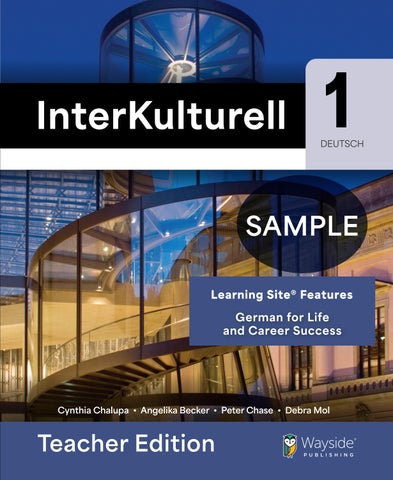
InterKulturell® is a comprehensive, four-level German program built around the ACTFL World-Readiness Standards and the NCSSFL-ACTFL Can-Do Statements. This ground-breaking series guides learners along a pathway to proficiency through the lens of interculturality, real-world communication, and literacy. Students discover how to interact appropriately within a variety of cultural contexts and to examine different perspectives through exposure to authentic resources and the lives of peers across the German-speaking world.
InterKulturell
1
DEUTSCH
Learning Site®
Transform language learning with the InterKulturell Learning Site! This powerful, easy-to-use platform enables instructors to effortlessly create dynamic lessons from a diverse range of authentic audio, video, and text resources, making each student’s learning path unique and engaging. To enhance interpersonal speaking proficiency, students interact with chatty little helpers, the Nualas in Nualang®, an environment designed for students to speak confidently.
SAMPLE
Program Components
Learning Site® Features
• Student Edition + Nualang (hardcover, eBook, and Learning Site)
• Annotated Teacher Edition (hardcover, eBook, and Learning Site) • Workbook (softcover and Learning Site)
German for Life and Career Success
• German for Life and Career Success (Learning Site)
LEARN MORE!
www.waysidepublishing.com IK1-N-SAM
IK1_1.5_Cover_SAMPLER.indd 3
Cynthia Chalupa • Angelika Becker • Peter Chase • Debra Mol
Teacher Edition 8/28/26 11:54 AM
InterKulturell 1 ®
Teacher Edition Learning Site® Features German for Life and Career Success
Cynthia Chalupa Angelika Becker Peter Chase Debra Mol
L1_TE_FM_SAMPLER.indd 1
8/21/26 3:55 PM
HIGH SCHOOL
Novice Low – Novice High
Novice High – Intermediate Low
A DVA N C E D P L AC E M E N T
Intermediate Low – Intermediate High
Intermediate High – Advanced Low
AP® Language & Culture
A Complete Pathway from Novice to Advanced Proficiency At Wayside Publishing, language learning is designed as a cohesive, proficiency-driven journey—one that supports students from Novice through Intermediate and Advanced levels, culminating in success in AP® German Language and Culture and readiness for the Seal of Biliteracy. Our programs are grounded in the ACTFL Proficiency Guidelines and built on researchbased instructional practices, ensuring that instruction consistently develops students’ ability to communicate effectively in real-world contexts. Across the pathway, students engage with authentic resources, performance-based tasks, and purposeful communication, building the skills and confidence needed to progress from guided language use to independent, advanced proficiency. Across this vertically aligned pathway, each stage is intentionally designed to build on the last—supporting continuous growth from Novice through Intermediate and Advanced proficiency. This coherence ensures that students develop skills in a meaningful progression, gaining the confidence and independence needed to succeed in advanced coursework, the AP® experience, and ultimately in achieving biliteracy. One pathway. One vision. Proficiency for all learners.
Vice President of Marketing, Product, and Professional Learning: Tanya Brown Senior Editorial Project Manager: Eliz Tchakarian Managing Editors: Nathalie Gaillot, Richard March Curriculum Coordinator: Helen Small Editors: Anika Rieper, Melissa Rife, Sandra Albrecht, Budimka Uskokovic, Dwayne Stange Cover Designer: Jaana Bykonich Graphic Designers: Hannah Rowlett, Sawyer McCarron-Rutledge Production Designers: Derrick Alderman, Rivka Levin Product Design and Production Designer: Tammy Norstrem
Cover image: Berlin new extension building, architect I M Pei, German Historical Museum, Arsenal, Unter den Linden, Berlin Mitte. ©Image Professionals GmbH / travelstock44 / Alamy Stock Photo
Copyright © 2025; 2027 by Wayside Publishing All rights reserved. No part of this publication may be reproduced, stored in a retrieval system, or transmitted in any form or by any means, electronic, mechanical, photocopying, recording, or otherwise, without the prior written permission of the publisher. The marks [InterKulturell®, Learning Site®, Wayside Publishing®](collectively “the Marks”) are registered in the U.S. Patent and Trademark Office and owned in their entirety by Wayside Publishing (“Wayside”). Any use of the Marks without the express written permission of Wayside is prohibited. Printed in USA 1 2 3 4 5 6 7 8 9 10 Print date: Hardcover ISBN 978-1-641599-57-3
L1_TE_FM_SAMPLER.indd 2
8/21/26 3:55 PM
Program Components
Print + Learning Site® Student Edition and Teacher Edition
Workbook
German for Life and Career Success
The Student Edition is comprised of units that provide learners with opportunities to interact and engage with authentic materials and adolescent speakers of the language. The Teacher Edition is a rich support system designed for effective, standardsaligned instruction.
The Workbook includes additional activities to practice vocabulary and grammar from each unit.
German for Life and Career Success provides lessons and activities that connect directly to a real-world career and the job skills associated with it. This component is seamlessly integrated into all levels of the Student Edition.
Learning Site eBooks: Student and Teacher Edition; Workbook
Assessment Program InterKulturell® 1 Kapitel 2 | Wir kommunizieren 2 Name: ____________________________________________________
Datum: _______________________
Unterwegs
Kapitel 1 | Wer bin ich?
25 Sport bei Jugendlichen
Interkulturelle Begegnung
You want to learn more about the types of sports German students like so that you can present the information at the next German Club meeting.
Videoblogger: Ich bin Malik In InterKulturell®, you will meet video bloggers from a variety of German-speaking regions who will talk about themselves and their lives. In this first unit, you will get to know Malik from the city of Fulda in Hesse, Germany. Where in Hesse is Fulda located? Why is this city important? Wie ihr seht, spiele ich gerne Fußball.
Hallo! Mein Name ist Malik.
Novice High
25.1 Ein Video über sportliche Aktivitäten von Jugendlichen ansehen v o k
Name: Malik
Watch the video with street interviews about preferred sports and record information about what the young people like to do by selecting the correct activities from those listed. Then answer the questions.
Sprachen: Deutsch, Englisch, Französisch Wohnort: Fulda
Ich bin 13 Jahre alt und wohne in Fulda.
Ich komme in die Klasse 7F1 und lerne Französisch.
Bundesland: Hessen Land: Deutschland
Person
1 Ich bin Malik You want to get to know Malik better. Watch his video to find out more.
★ Fulda
1.1 Vor dem Sehen b o Review what Malik says. What kind of information do you think he has included in his video blog? What do the phrases in the speech bubbles mean?
Sportart
Person 1
Fußball
Fitness/Kraftsport
Person 2
Handball
Volleyball
Person 3
Tischtennis
Fußball
Volleyball
Handball
Person 4
Fußball
Segeln
Fahrrad fahren
Joggen
Person 5
Skifahren
Basketball
Volleyball
1.2 Maliks Videoblog ansehen v o
Person 6
Handball
Tischtennis
Wandern
Watch the video blog and place the sentences below in the order you hear Malik say them.
Person 7
Fußball
Yoga
Das Wappen von Fulda
Hallo! Mein Name ist Malik.
The eBooks are the complete textbook with interactive activities, video, and audio. Ich bin 13 Jahre alt und wohne in Fulda. Wie ihr seht, spiele ich gerne Fußball.
Ich komme in die Klasse 7F1 und lerne Französisch.
1.3 Maliks Videoblog nochmal ansehen v o
Listen and watch again. Based on what you see and hear, write two sentences in English about the information Malik is sharing with us in his video blog.
38
Integrated Performance Assessments (IPAs), Midterm and Final Exams, and Alternate Objective Tests, along with assessment rubrics, are available in print and digital formats, providing flexible solutions for teachers and support for all learners. Segeln
Skateboard fahren
Wandern
Person 9
Kraftsport/Fitness
Tanzen
Fußball
© Wayside Publishing
036-089_IK_1-5e_L1_SE_U1.indd 38
6/12/26 12:34 PM
Tanzen
Person 8
Unterwegs | InterKulturell® 1
1
Nualang® is an innovative platform designed to engage students in conversation, harnessing the latest technology to create an interactive environment that effectively enhances the learning experience.
Additional Materials for Teachers Can-Do Statements Index Authentic Resources Index AP® and IB Correlation Guides Grammar Index Glossary
Assessment Program with Rubrics Audio and Video Transcripts Correlations Lesson Plans Pacing Guides InterKulturell® 1
L1_TE_FM_SAMPLER.indd 3
TE3
9/8/26 8:18 AM
Approaches to Teaching and Learning
Connections to STEM and Other Disciplines InterKulturell® features a contextualized, integrative approach that reflects the importance of explicitly connecting language acquisition to other fields of study.
Engaging with STEM InterKulturell® features a multitude of authentic resources with a focus on science, technology, engineering, and mathematics (STEM) and provides activities designed to assist students in integrating STEM with German language acquisition and a deeper understanding of cultural products and practices. Particularly in Germany, a country with a long history of significant accomplishments in STEM-related fields, InterKulturell® integratively illustrates the plethora of ways STEM is part of German social and cultural life. Students engage with a variety of STEM-related activities, each clearly marked with an t icon. Each unit features the following: •
Activities designed to develop STEM-related skills in conjunction with target language and culture acquisition. STEM activities in level one focus on mathematical and analytical skills, such as measurement conversions and analyzing and presenting data.
•
Instructional Teacher Edition notes with additional strategies for adding STEM components.
•
Cultural Teacher Edition notes with information to pique students’ interest in STEM content and to contextualize the importance of this material in German language and culture acquisition.
Connections to the Humanities Acknowledging the significance of the social sciences and the arts in shaping and defining culture, InterKulturell® features Fokus Kultur segments that encourage students to reflect on and make connections between German cultural products and practices and what they have learned in other subject areas. In addition, there are myriad Teacher Edition cultural notes on a range of cultural and historical topics that support the unit themes. Further integration of other disciplines is achieved throughout InterKulturell® with authentic resources and activities designed to focus students’ attention on language use in context. Students interact with paintings, sayings, poetry, and literary excerpts, and are exposed to architecture, musicians, and authors from the German-speaking world. The emphasis on connections to other disciplines encourages students to link the study of German to their learning in other subject areas.
TE4
InterKulturell® 1
L1_TE_FM_SAMPLER.indd 4
8/21/26 3:55 PM
Preparing Students for the Global Workforce
Preparing Students for the Global Workforce If you are looking for an alternative to Unsere globale Gemeinschaft or wish to include additional real-world activities, use the digital supplement titled German for Life and Career Success. This resource, which is located on Learning Site®, provides lessons and activities that connect directly to a real-world career and the job skills associated with it. The activities are designed to be used alongside vocabulary and materials from the InterKulturell® series, while showing students how German can be used in their current and future lives. The thematic content of each unit has been connected to a specific field and job skills to show students the relevancy of learning a language. For example, these job skills range from connecting with employers as a job candidate, and planning and organizing events to creating logos or company merchandise for branding and budgeting. For each unit of InterKulturell®, there is an online lesson in the German for Life and Career Success supplement which includes the following: •
An Essential Question that connects the unit theme to a life and career domain
•
Three activities, each connected to specific career skills that equip students to use German in a professional context
•
Can-Do statements aligned with career skills guide students towards clear learning goals
•
Teacher notes include guidance, differentiation, and extensions for heritage learners, with suggestions for guiding student use of AI
InterKulturell® 1
L1_TE_FM_SAMPLER.indd 5
TE5
8/21/26 3:55 PM
Scope and Sequence InterKulturell® 1
Scope and Sequence Note: We present structures in context; therefore the titles used in Sprache entdecken sections in the Student Edition do not call out the specific grammar point introduced. Units
Essential Questions
Unit Goals
Einstieg
How are German and English related?
Connect letters to sounds, identify words that are similar in German and English, read and listen to short texts about someone’s family and interests, and follow classroom commands.
Los geht’s!
How do we communicate in the German classroom?
Exchange personal information such as phone numbers and birthdays.
How are calendars in Germanspeaking countries similar to and different from my calendar?
Investigate where German is spoken, the connections between the German and English languages, traditions related to starting school, and typical holidays in Germany.
Kapitel 1
How do I get to know others?
Wer bin ich?
How do I describe people, places, and things?
How do I portray myself to others?
Tell someone which school supplies you have and make a list.
Interpret images, video, audio, and print texts in German to understand simple descriptions and basic conversational exchanges about identity. Interact in German by exchanging formal and informal greetings and asking and answering simple questions to meet and get to know others. Introduce and describe yourself and others and provide personal information about your age, where you are from, and where you live. Investigate, explain, and reflect on what information we share with others as we get to know them.
Kapitel 2
What role do hobbies and interests play in my life?
Interpret images, audio, audiovisual, and print texts to learn about others’ hobbies, sports, and volunteer activities.
Das macht
What role do sports and physical activities play in my community and German-speaking countries?
Present information about upcoming social activities during the year in German-speaking cultures and your community.
Spaß!
How can young people support the community through their interests?
Kapitel 3 Mein Schulalltag
Bunte Familien
Investigate, compare, and reflect on community-based clubs and youth volunteer opportunities in German-speaking cultures and in your community.
How does school life in Germanspeaking regions compare to school life in my community?
Interpret images, audiovisual, and print texts and learn about others’ school subjects, supplies, schedules, and rules.
How do I help create a positive environment in my classes and school?
Present information about your favorite school subjects, rules at your school, and your tips for school success.
What makes the school experience meaningful for me?
Kapitel 4
Exchange information and opinions about participating in sports and activities.
How do I define family? What does my private space say about me and my life? What is my role in the family?
Exchange information about school life, including supplies and schedules, favorite subjects, school rules, and tips for how to learn best. Investigate, compare, and reflect on school and learning communities, responsibilities and rules regarding school, and how you learn best.
Interpret audiovisual and print texts to learn about family structures, members of the family and their free-time activities, the personal space of teenagers, and household responsibilities. Exchange information about home life, family members, and your personal space. Present information about your personal space, family members, and how you and others can earn an allowance. Investigate, compare, and reflect on families, household responsibilities and allowances, as well as personal spaces.
Kapitel 5
What does food reveal about culture?
Interpret audiovisual and print texts about common traditional and regional foods in German-speaking cultures, popular fast foods, and healthy food choices.
Mahlzeit!
How does lifestyle affect food choices?
Exchange information about favorite foods, nutritional values of foods, and what one can eat and do to lead a healthier lifestyle.
How do my food choices affect my health?
Present information about different dishes and how they taste, favorite foods, and what one must do to be healthy.
Kapitel 6
What does my clothing say about my personality?
Interpret audiovisual and print texts about clothing item, the seasons in which they are worn, and sustainable clothing.
Kleider machen
What influences my clothing choices?
Leute
TE6
How can I dress stylishly and sustainably?
Investigate, compare, and reflect on foods both regional and international, fast foods, and healthy food choices and activities.
Exchange information about favorite clothing items, what one wears at different times of year, and how to shop for clothes sustainably. Present tips about clothing choices and creating a personal style. Investigate, compare, and reflect on clothing options and where to purchase clothes.
InterKulturell® 1
L1_TE_FM_SAMPLER.indd 6
8/21/26 3:55 PM
Scope and Sequence InterKulturell® 1
Intercultural Focus Vocabulary Topics In Context
Structures In Context (V= Video)
Additional Features
Fokus Kultur Produkte: Verwandte Sprachen: Deutsch und Englisch
The German Alphabet Das deutsche Alphabet
Lernstrategien Recognizing Cognates
Produkte: Die Schultüte
Expressions for the Classroom Ausdrücke fürs Klassenzimmer In the Classroom Im Klassenzimmer
Sprachtipp Ein besonderer Buchstabe; Die Artikel; Der Imperativ; Wie spricht man das aus?; Haben; Das Gendersternchen; Die Ordnungszahlen
Bräuche: Feiertage in Deutschland
Numbers Die Zahlen When Is Your Birthday? Wann hast du Geburtstag?
Fokus Kultur Bräuche: Begrüßungen
Greetings and Introductions Begrüßen und kennenlernen
Introducing Oneself Using the Verb heißen to Introduce Yourself and Others
Produkte: Deutsche Familiennamen
How Are You? Wie geht’s?
Describing Actions and Situations Using the Verbs kommen, wohnen, and lernen
Produkte: Bundesländer und Wappen
About Me Über mich
Describing People and Things Using the Verb sein
Lernstrategien Interpretive Listening
v
Sprachtipp Was ist das Dezimalkomma?; Wo vs. woher; “Sein oder nicht sein, das ist hier die Frage!”; Und du?; Sehr und nicht; Er, sie, es für Sachen
v
This Is How I Am So bin ich This Is How I Look So sehe ich aus Fokus Kultur Produkte: Was ist ein Verein?
Activities in the German Club Aktivitäten im Deutschklub
Talking to Each Other about Hobbies and Interests Conjugating Verbs in the du-, ihr-, and Sie- Forms
Bräuche: Wandern - Eine deutsche Tradition
Sports in Garmisch-Partenkirchen Sport in Garmisch-Partenkirchen
Describing Sports and Interests Using Vowel-changing Verbs
Produkte: Jugendorganisationen - Pfadfinder*innen und Jugendfeuerwehr
We Do Volunteer Work! Wir arbeiten freiwillig!
Describing Activities at Different Times Inverted Word Order
Fokus Kultur Produkte: Der Schultag in deutschsprachigen Ländern
Martin’s Schedule Martins Stundenplan
Describing What I Have and Need Definite and Indefinite Articles in the Accusative Case
My School Supplies Meine Schulsachen
Expressing What We Can, May, Must, or Should Do Using the Modal Verbs können, dürfen, müssen, and sollen
Tips and Tricks for School Tipps und Tricks für die Schule
Expressing What I Like and Why Using the Coordinating Conjunction denn and the Modal Verb mögen
Produkte: Das deutsche Schulsystem Produkte: AGs bringen Kultur in die Schule
Lernstrategien Decoding Compound Words
v
Sprachtipp Gern und gern haben; Idiomatische Ausdrücke; Die W-Fragen; Ein Verb für viele Sportarten; Gern und lieber; Einmal, zweimal, dreimal; Wie oft mache ich das?
v
Lernstrategien Speaking Politely with Others
v
v
What Motivates Me in School? Was motiviert mich in der Schule?
Fokus Kultur Bräuche: Familien fördern
Amalie’s Colorful Family Amalies bunte Familie
Showing Possession or Relation Using Possessive Adjectives
Produkte:Betten von gestern bis heute
Amalie’s Relatives Amalies Verwandte
Referring to Items I Have Using Personal Pronouns in the Accusative
Bräuche: Hausarbeiten, Taschengeld und Kinder
Describing My Room Mein Zimmer beschreiben
Talking about Household Chores
Helping at Home Zu Hause helfen
Sprachtipp Die Uhrzeit; MINT; Prozente besprechen; Viele Stifte; Kein/ Keine/Keinen; Man vs. du; Die Präpositionen mit und zu; Lust haben; Ich mag am liebsten … Lernstrategien Tips for Better Writing
v
Vocabulary in Context
v
Sprachtipp Über die Familien von anderen Menschen sprechen; Es gibt …; Nach Hause und zu Hause; Was mache ich für wen?
Using Separable Prefix Verbs
Earning Money Geld verdienen Fokus Kultur Produkte: Verschiedene Wörter für das gleiche Essen Produkte: Die ausländische Küche Bräuche: Gesund sein mit gutem Essen! Fokus Kultur Produkte: Die Fußgängerzone und Einkaufen Bräuche:Das Wetter in den deutschsprachigen Ländern Produkte: Die größten Modefirmen Deutschlands
Regional Specialities Regionale Spezialitäten
Explaining an Idea Using Connectors The Coordinating Conjunctions aber, denn, oder, sondern, and und
Describing Food Essen beschreiben
Providing Details with Prepositions Using the Accusative Prepositions durch, für, gegen, ohne, and um
Fast and Good Schnell und gut
Giving Guidance and Instructions Using the Imperativ or Command Form
v
v
Lernstrategien Reading Strategies Sprachtipp Wurst; Wir essen das Essen; Gut, besser, am besten!
We Are Being Served Wir kommen auf den Tisch Youth Fashion on Moodboards Jugendmode auf Moodboards
Referring to the People to Whom We Give Things, Part 1 Singular Possessive Adjectives in the Dative Case
What Should I Wear? Was soll ich anziehen?
Referring to the People to Whom We Give Things, Part 2 Pronouns in the Dative Case
How Important Is Fashion? Wie wichtig ist Mode?
Describing How Clothes Look and Fit The Verbs danken, gefallen, passen, and stehen with the Dative Case
v
Sprachtipp Wenn-Sätze; Das Wort ihr; Danken; Kennen vs. wissen; Das Modalverb wollen
v
InterKulturell® 1
L1_TE_FM_SAMPLER.indd 7
TE7
8/21/26 3:55 PM
Scope and Sequence InterKulturell® 2 Units
Essential Questions
Unit Goals
Why do we travel to different places?
Interpret images, video, audio, and print texts to understand descriptions of past travel.
How do we get around when we travel?
Exchange information and opinions with others about travel options, past trips, and positive and negative travel experiences.
fern
What do I do when I travel and how do I reflect on my experiences?
Express where you would like to go and what you would like to do on a trip, write an itinerary, and describe positive and negative travel experiences.
Kapitel 2
How does school stress impact my life?
Interpret images, audio, audiovisual, and print texts to understand and learn about wellness habits in Germanspeaking regions.
Alles um die
How does wellness contribute to my overall health?
Interact by exchanging information, surveying others, and providing advice about stress and wellness.
Wellness
What factors play a role in my wellness?
Investigate, compare, and reflect on perspectives about stress, wellness, and sleep habits in German-speaking cultures and in your community.
Kapitel 3
How do relationships with pets enrich our lives?
Interpret images, audio, audiovisual, and print texts about animals, zoos, and circuses in German-speaking regions.
Tierwelten
How do we interact with animals in public spaces?
Present information and data about animals and their characteristics, as well as personal opinions about the keeping of exotic and domestic animals in homes, zoos, and circuses.
Kapitel 1 Reisen nah und
Investigate how and why people travel in your community and in German-speaking regions.
What can we do to help and protect animals?
Kapitel 4 Wohnwelten
Present information and data about wellness habits.
Interact by exchanging information and opinions about the importance and treatment of animals.
Investigate, compare, and reflect on perspectives about the treatment of animals in captivity and in the lives of people in German-speaking cultures.
What makes a house a home?
Interpret images, audiovisual, and print texts about housing, furniture, and tips for settling in a new city.
How can I do more with less in my living arrangements?
Interact by exchanging information about the importance of living quarters, how they are made into a home, and adjusting to a new city.
How do I start life in a new community?
Present information and date about housing choices as well as personal opinions about smaller sustainable living spaces and adapting to a new community. Investigate, compare, and reflect on perspectives concerning housing in German-speaking countries and your own culture.
Kapitel 5
What events, experiences, and people shaped my life as a child?
Interpret images, audio, audiovisuals, and print texts about growing up, preferences, activities, values, and plans for the future.
Zwischen
What people, events, and situations helped me become an independent person?
Interact by exchanging information and opinions about favorite toys, activities, experiences, and traits and how they influence choices in life.
Kindheit und Erwachsensein
Kapitel 6 Authentizität in der Medienkultur
TE8
What will be important to me in the future?
How do I communicate with others? What are positive and negative aspects of social media? How do I determine whether information presented in the media is accurate?
Present information and data about favorite objects, activities, and values; describe traits important for a career; explain career choices and plans. Investigate, compare, and reflect on perspectives concerning what is important to youth and the decisions they make in adulthood. Interpret infographics, video blogs, articles, videos, and interviews about social media use, influencers, and reliability for media sources. Exchange information and opinions about communication platforms, pros and cons of being an influencer, and how to determine the reliability of media sources. Present and justify opinions about media platforms, describe pros and cons of being an influencer, and describe tips for finding reliable sources of information. Investigate ways to detect fake news and interact with young people to make them more aware about media literacy.
InterKulturell® 1
L1_TE_FM_SAMPLER.indd 8
8/21/26 3:55 PM
Scope and Sequence InterKulturell® 2 Intercultural Focus Vocabulary Topics In Context Fokus Kultur Bräuche: Die Deutschen im Urlaub Produkte: Steig ein - der Zug fährt ab! Bräuche: Weltmeister im Reisen
Youth Club on the Go! Jugendclub unterwegs! Travel Plans Reiseplanung Public Transportation Öffentliche Verkehrsmittel
Structures In Context (V= Video)
Additional Features Rückblick Spiele und Aktivitäten; Orte; Zeiten und Wetter
Expressing Preferences Using the Verb würden
v
Talking about a Past Trip Using Perfekt to Talk about the Past
Lernstrategien Interculturality: Travel Etiquette
v
Describing the Past Using the Verbs sein und haben in the Präteritum
Sprachtipp Urlaub oder Ferien?; Der See oder die See?; Nach oder zu? Hatte und war; Eine besondere Vergangenheitsform
A Class Trip Eine Klassenfahrt A Terrible Trip Eine furchtbare Reise
Fokus Kultur Bräuche: Schulstress
Stress in School
Bräuche: Wellness im deutschsprachigen Raum
Reasons for Stress in the Morning
Produkte: Schlafkulturen weltweit
Stress in der Schule Gründe für Stress am Morgen Less Stress through a Wellness Weekend Weniger Stress durch ein WellnessWochenende
Nicht vergessen! Das Verb sein; Was sind zusammengesetzte Wörter? Rückblick Gesunde Ernährung; Freizeit und Sport; Schule; Das Verb essen
v
Talking about Myself Reflexive Verbs in the Singular Talking about Ourselves Reflexive Verbs in the Plural
Lernstrategien Recognizing Word Families
v
Giving Reasons The Subordinating Conjunctions dass, obwohl, and weil
Sprachtipp Verbkicker
Why is Sleep Important? Warum ist Schlaf wichtig? Fokus Kultur Bräuche: Was für komische Laute! Produkte: Zoos im deutschsprachigen Raum Produkte: Der Zirkus
I’m Adopting a Pet Ich adoptiere ein Haustier A Visit to the Cologne Zoo Ein Besuch im Kölner Zoo The Tiger: A Profile Der Tiger: Ein Steckbrief
Nicht vergessen! Die Konjunktion denn; Möchten; Wörter (um)stellen Lernstrategien How Does It Sound: Positive or Negative?
v
Making Comparison Comparative and Superlative Forms of Adjectives
v
Showing Possession or Belonging Definite Articles in the Genitive Case
Sprachtipp Essen oder fressen?; Verkleinerungsform; Die meiste Arbeit; Andere Vergleiche
Showing Possession Possessive Adjectives in the Genitive Case
The Circus: Pro and Con Der Zirkus: Pro und Kontra Fokus Kultur Produkte: Funktionell wohnen Bräuche: Das Stadtleben Bräuche: Neu in Deutschland
A New Apartment Eine neue Wohnung Less is More Weniger ist mehr New in Town Neu in der Stadt
Fokus Kultur Produkte: Kinderspiele und Spielzeug
Rückblick Adjektive; Mein Zimmer; Hausarbeiten
v
Describing Where Things Are Located Two-Way Prepositions and the Dative Case
v
Describing Where to Place Things Two-Way Prepositions and the Accusative Case
Lernstrategien Reading Strategies
Expressing Oneself Using Verbs with Prepositions Verbs with Fixed Prepositions
Sprachtipp Wie viele Zimmer hat die Wohnung?; Beschreiben, wo etwas ist; Präpositionen mit Artikeln kombinieren; Akkusativ oder Dativ mit Präpositionen?
Aunt Helene’s Photo Album Tante Helenes Fotoalbum
Talking about What One Wanted to, Could, and Was Allowed to Do The Simple Past of Modal Verbs
Bräuche:Unabhängigkeit
A Slideshow about the Past Eine Slideshow über die Vergangenheit
Talking about and Comparing Events
Produkte: Wege in den Beruf in der Schweiz
Me in the Future Ich in der Zukunft
Talking About the Future Discussing the Future Using the Verb werden
Fokus Kultur Produkte: Wie beeinflussen soziale Medien die deutsche Sprache?
Means of Communication Kommunikationsmittel
Describing Why Something Is Done Using um … zu to Express the Purpose of Something
Bräuche:Wie schütze ich meine Privatsphäre in den sozialen Medien?
How Does One Become an Influencer? Wie wird man Influencer*in? Trustworthiness of Media Glaubwürdigkeit von Medien
Referring to People and Things Already Mentioned, Part 1 Using Relative Pronouns in the Nominative Case Referring to People and Things Already Mentioned, Part 2 Using Relative Pronouns in the Accusative Case
Produkte: Welchen Medien vertrauen die Deutschen am meisten?
v
Using Subordinating Conjunctions als, während, wann, and wenn
v
Rückblick Eigenschaften; Zu Hause; In der Schule; Aktivitäten; Wichtige Verbindungswörter Lernstrategien Making Nouns with Suffixes Sprachtipp Peinlich und andere Adjektive mit dem Dativ Rückblick Online-Aktivitäten; Wie ich mich fühle; Zeitangaben
v
v
Lernstrategien Reading an Infographic Sprachtipp: Wo-Fragen; Der Unterschied zwischen ähnlichen Wörtern
InterKulturell® 1
L1_TE_FM_SAMPLER.indd 9
TE9
8/21/26 3:55 PM
Scope and Sequence InterKulturell® Intermediate Units
Essential Questions
Kapitel 1
How do geographical features influence regions and recreational activities?
Mein Leben, meine Heimat
How are my activities and life choices influenced by the landscapes and resources around me? How does the place where I live influence my identity?
Kapitel 2
What people, values, and events shape my generation?
Generationen
How do trends and pop culture define a generation?
im Laufe der
How can the actions of young people today shape the future?
Zeit
Kapitel 3 Das isst die Welt!
What role does food play in my life? Where does my food come from? How does food reflect the diversity of a culture?
Unit Goals Interpret images, audios, audiovisuals, and print texts about geographical features, industries, products, and other cultural markers of a region. Exchange information and opinions about a trip and information pertaining to industries, natural resources, and attractions of a region. Present information about travel plans, landscapes, natural resources, and other characteristics of a region. Investigate, compare, and reflect on the impact of products and industries on daily life and the role of geography, language, pastimes, and festivals in creating identity. Interpret images, videos, and print texts about generational markers such as music, clothing, and historical events. Exchange information and opinions about objects and events associated with a generation as well as potential future generational issues. Present information and data about characteristics of generations, differences between past generations and your own, and hypothetical situations in the future. Investigate, compare, and reflect on generational differences, community involvement, and possible future outcomes of that involvement. Interpret images, audios, audiovisuals, and print texts about eating habits, global restaurants, food trucks, and fusion food. Exchange information and opinions about eating habits, sustainable food practices, and new food trends such as food trucks. Present information about meals for special occasions, sustainable food practices, and food truck concepts. Investigate, compare, and reflect on how culture is reflected in food choices, how food is produced, and the diversity of a region.
Kapitel 4
What do stories tell us about cultural values?
Interpret images, audios, audiovisuals, and print texts about childhood stories, fairy tales, and legends of Germanspeaking regions.
Erzähl mir eine
How do the stories of a culture change over time?
Exchange information and opinions about lessons learned from stories and modern adaptations of fairy tales and legends.
Geschichte
In what ways are stories of the past still relevant today?
Present ideas for modern adaptations of stories and write an original story with a moral.
Kapitel 5
What role does music play in my life?
Interpret images, audios, audiovisuals, and print texts about musicians and their music, why people listen to music, and how music shapes experiences.
Musik bewegt!
How does music shape our experience of an event? How does music reflect and contribute to our identity?
Investigate, compare, and reflect on perspectives about the role of stories in illustrating cultural values as well as how stories and values change over time.
Exchange information and opinions about musical genres and artists, music for an event, and the importance of music to identity. Present information about the role of music in your life and at public events, the music on your playlists, and global influences on music. Investigate when and where music is played, the types of music young people enjoy, and the role of music in Germanspeaking regions.
Kapitel 6
How do I decide on my path to the future?
Interpret images, audios, audiovisuals, and print texts about options after graduation, pros and cons of moving out on one’s own, and finding meaningful work.
Eine sinnvolle
What do I need to do to be independent?
Exchange information and opinions about plans after graduation, moving out, and maintaining work-life balance.
Zukunft
What are my long-term goals for a meaningful life and career?
Kapitel 7
What is art?
Kunst macht sichtbar
What role do form and function play in art? What role does art play in the community?
Describe and justify plans after high school, advocate for or against moving out, explain how you view meaningful work and work-life balance. Investigate, compare, and reflect on post-graduation options, similarities and differences in financing one’s education and attitudes toward traditional work schedules. Interpret images, audios, audiovisuals, and print texts about artists, important buildings, and why monuments are built. Exchange information and opinions about ideas for an art competition, designing a “green” building, and suggestions for a new memorial. Describe a piece of art and its message, explain the form and function of an art project, and present an idea for a new monument. Investigate, compare, and reflect on the use of “the golden ratio” in art, artistic elements in everyday objects, and the purpose of public art.
Kapitel 8 Tatort Kunstmuseum
How do people in different roles respond at the scene of an emergency?
Interpret images, audios, audiovisuals, and print texts about fictional crimes and emergency situations, how to contact help in an emergency, the work of police and forensic investigators, and opinions about detective stories and shows.
How do professionals cooperate to solve a crime?
Exchange information about the work of emergency personnel and crime scene investigators, place a phone call to emergency services and describe a scene, exchange opinions about preferred genres and reading habits, report on what others have said or should have done, and exchange theories to solve a crime.
How do I draw logical conclusions using available evidence?
Describe the work of rescue workers and investigators, describe an emergency situation, state and justify opinions about criminal investigation shows and the outcome of a crime. Investigate, compare, and reflect on opinions about criminal investigation as a genre, the use of emergency telephone numbers, and the use of video surveillance in public spaces.
TE10
InterKulturell® 1
L1_TE_FM_SAMPLER.indd 10
8/21/26 3:55 PM
Scope and Sequence InterKulturell® Intermediate Intercultural Focus Vocabulary Topics In Context Fokus Kultur Produkte: Der deutschsprachige Raum Produkte: Die Industrien der DACHL-Länder Produkte: Die Vielfalt der deutschen Sprache
Drei Reiseziele: Wohin geht die Klassenfahrt? Three Travel Destinations: Where to Go on a Class Trip? Handel und Industrie in Deutschland Commerce and Industry in Germany Was ist Heimat? What Is Home?
Structures In Context (V= Video)
Additional Features
Landschaften und Orte beschreiben, Teil 1 Adjective Endings with Definite Articles
v
Lernstrategien Eine formale E-Mail schreiben
Landschaften und Orte beschreiben, Teil 2 Adjective Endings with Indefinite Articles
v
Sprachtipp Zweiteilige Konjunktionen
Landschaften und Orte beschreiben, Teil 3 Adjective Endings without Articles
Fokus Kultur Bräuche: Prägende Ereignisse
Eine Generation definieren Defining a Generation
Über die Vergangenheit schreiben Writing about Events in the Past: Das Präteritum
Lernstrategien Einen formalen Brief schreiben
Bräuche: Jugendszenen des letzten Jahrhunderts
Was ist eine Jugendszene? What Is Youth Culture?
Bräuche: Umweltschutz gestern und heute
Gemeinsam für die Zukunft Together for the Future
Mittel und Zwecke beschreiben Expressing Means and Purposes: Die Infinitivkonstruktionen um … zu; anstatt … zu; ohne … zu
Sprachtipp Verben im Präteritum, wenn man spricht; Tipps für den Konjunktiv II
Fokus Kultur Bräuche: Essen zu Festtagen
Essgewohnheiten von Jugendlichen Eating Habits of Young People
Ideen mit Präpositionen und Relativpronomen beschreiben, Teil 1 Relative Clauses with Prepositions and Pronouns in the Accusative Case
Produkte: Alles um Bio
Essen aus aller Welt Food from Around the World
Details mit Präpositionen geben Prepositions that Take the Dative Case
Ein Foodtruck-Paradies in der Innenstadt A Food Truck Paradise Downtown
Ideen mit Präpositionen und Relativpronomen beschreiben, Teil 2 Relative Clauses with Prepositions and Pronouns in the Dative Case
Fokus Kultur Produkte: Die Rolle von Erzählungen in unserer Gesellschaft
Typische Figuren in Fabeln Typical Characters in Fables
Geschichten in der Vergangenheit erzählen Telling Stories Using Past Tenses
Produkte: Grimms Märchen und ihre Heldinnen
Merkmale von Märchen Characteristics of Fairy Tales
Über verschiedene Zeitpunkte in der Vergangenheit sprechen Talking about Different Points in Time Using Past Tenses
Eine Zeitreise ins Mittelalter Travel through Time to the Middle Ages
Komplexe Ideen mit da- und wo- kürzer ausdrücken Expressing Complex Ideas Using da- and wo- Compounds
Die Musik meines Leben The Music of My Life
Gegenwärtige Handlungen mit dem Passiv beschreiben Describing Impersonal Actions in the Present Tense
Die Melodie eines Events The Melody of an Event
Handlungen in der Vergangenheit mit dem Passiv beschreiben Describing Impersonal Actions in the Past Tense
Musik und Identität Music and Identity
Über sich nachdenken und reden: Reflexive Verben Reflecting and Talking about Oneself Using Reflexive Verbs
Tipps für den Weg in die Zukunft Tips for the Path to the Future
Situationen mit trennbaren Verben beschreiben Describing Situations Using Separable Prefix Verbs
Ausziehen - ja oder nein? To Move Out - Yes or No?
Situationen mit untrennbaren Verben beschreiben Describing Situations Using Inseparable Prefix Verbs
Eine sinnvolle Arbeit! A Meaningful Job!
Verben mit einer Vokaländerung verwenden Using Verbs with Stem-Vowel Changes
Fokus Kultur Bräuche: Der Goldene Schnitt
Die Rolle von Kunst The Role of Art
Elemente der Kunstwelt beschreiben und vergleichen Describing and Comparing Using Comparative and Superlative Adjectives
Produkte: Kunst für den Alltag von der Wiener Werkstätte
Form und Funktion in Architektur und Design Form and Function in Architecture and Design
Handlungen beschreiben: Verben im Präsens als Adjektive Describing Things Using Present Participles as Adjectives
Bräuche: Kunst im öffentlichen Raum
Public Art - interaktiv und progressiv Public Art - Interactive and Progressive
Vergangene Handlungen beschreiben: Verben in der Vergangenheit als Adjektive Describing Things Using Past Participles as Adjectives
Sprachtipp Street-Art; Künstlich oder künstlerisch?; Österreichische Begriffe für Räume in einem Haus; Verben als Adjektive; Die Kunstschaffenden; Ähnliche Wörter, verschiedene Formen; Partizipien als Adjektive
Fokus Kultur Produkte: Krimis in deutschsprachigen Fernsehen
Hilfe im Notfall Help in an Emergency
Ausdrücken, was ich für mich tue Expressing Things I Do for Myself Using Reflexive Pronouns in the Dative
Lernstrategien VISION-Tabelle
Produkte: Die Geschichte der Überwachungskamera
Eine Notfall-Szene beschreiben Describing an Emergency Scene
Die Aussagen anderer Menschen nacherzählen Retelling What Someone Else Said Using the Subjunctive Mode
Den Tatort untersuchen Investigating the Crime Scene
Über Hypothesen in der Vergangenheit sprechen Discussing Hypotheses in the Past Using the Past Subjunctive
Produkte: Jenseits des traditionellen Essens
Produkte: Der Märchenkönig und der Musiker
Fokus Kultur Produkte: Der Eurovision Song Contest Bräuche: Musik und Bewegung Produkte: Beethoven, Schiller und die Europahymne Fokus Kultur Bräuche: Schulabschluss und dann? Bräuche: Finanzierung von Ausbildung und Studium Bräuche: Die Arbeitswelt im Wandel
Produkte: Kinderbuchdetektive
v
v
Über hypothetische Situationen sprechen Speaking about Hypothetical Situations: Der Konjunktiv II
v
v
v
Nicht vergessen! Akkusativ-Präpositionen
Sprachtipp Wortfamilien; Drei Verbarten: Schwach, stark und gemischt; Perfekt oder Präteritum? Welche Form benutzt man wann?; Wichtige Erzählwörter; Über die Vergangenheit sprechen: Bevor und nachdem; Da- und wo- für Beschreibungen von Situationen Lernstrategien Mit Musik lernen
v v
Sprachtipp Es wird musiziert!; Es wird gemacht und getan!; Je … desto …
Lernstrategien SMARTe Ziele setzen
v
Sprachtipp Falsche Freunde; Partikeln in der deutschen Sprache; Verwandte Wörter
v
v
v
v
Sprachtipp Während
Lernstrategien Erzählungen analysieren und interpretieren
v
v
Lernstrategien Ein gutes Argument formulieren
Lernstrategien Die Loci-Methode
Sprachtipp In der Tat; Das Suffix -kraft; Wörter mit -mittel
Dem Täter auf der Spur Tracking Down the Perpetrator Wer ist die Tatperson? Investigation - Who Is the Perpetrator? Ermittlungsarbeit - Investigative Work
InterKulturell® 1
L1_TE_FM_SAMPLER.indd 11
TE11
8/21/26 3:55 PM
Program Components and Key Features
Program Components and Key Features InterKulturell® components are available digitally on Learning Site® unless noted.
For the Teacher •
Teacher Edition: Available in Print and Digital formats.
•
Assessment Program: Includes a suite of Formative and Summative Assessments and rubrics to customize to each student’s need.
•
Letters to Guardians: Highlight the key information for each unit for parents and guardians.
•
Lesson Plan Builder: Pulls directly from the textbook to create engaging, tailored lessons that can be exported to multiple formats, including slides—saving teachers time.
•
Personalized Assignments and Assignment Controls: Empower teachers to adapt tasks to each student’s needs, enhancing engagement and learning outcomes.
•
Learning Pathways: Aligned with Can-Do statements and assessments, our pathways guide teachers to essential activities for building proficiency, providing clear guidance for new teachers and flexibility for experienced educators.
•
Instructional Strategies Toolkit: Ready-to-use, research-based activities organized by communication mode, skill, and proficiency level.
•
Administrative Reporting: Provides powerful insights on student activity and user actions, making it easy for administrators to manage and safeguard the platform effectively.
•
Performance Towards Proficiency Growth: Gives insights into student growth towards proficiency.
•
Standards: At point of use, standards ensure our content aligns with educational benchmarks, empowering teachers to meet key learning goals with confidence.
•
Personalized Settings: Allow teachers to customize timed tasks, transcripts, and captions, giving them flexible tools to meet the unique needs of their students and classroom.
•
Professional Learning: Brings unmatched expertise and personalized training to support successful program implementation, empowering teachers with tailored, research-backed strategies to elevate language instruction and foster meaningful student engagement.
For the Student
TE12
•
Student Edition: Available in Print and Digital formats.
•
Workbook Grammar and Vocabulary Activities: Additional activities to practice vocabulary and grammar from each unit. Available in Print and Digital formats.
•
eBook: An interactive digital version of the Student Edition with note-taking functionality.
•
Nualang Activities with Heritage Path: Students engage in conversation and receive personalized feedback from our chatty little helpers, the Nualas.
•
Flashcards: Practice key vocabulary from the unit. Available in Print and Digital formats.
•
Companion Reader: Each level of the program includes a comprehensible German reader.
•
Portfolio: Students document the growth of language learning
•
German for Life and Career Success: Digital activities that connect directly to using German in real-world and professional contexts.
InterKulturell® 1
L1_TE_FM_SAMPLER.indd 12
8/21/26 3:55 PM
00i
Table of Contents
Table of Contents
Einstieg: Los geht’s! Willkommen! Meet six young people from the German-speaking world Interkulturelle Begegnung Wo spricht man Deutsch?
2 6
Wir kommunizieren 1 Wie sagt man das?: Das deutsche Alphabet Sprachtipp: Ein besonderer Buchstabe Sprachtipp: Die Artikel Lernstrategien: Recognizing Cognates Unterwegs Formative Assessment
10 10 11 12 17
Wir kommunizieren 2 Wie sagt man das? A: Ausdrücke fürs Klassenzimmer v Sprachtipp: Der Imperativ Wie sagt man das? B: Im Klassenzimmer Unterwegs Formative Assessment
18 19 20 23
Wir kommunizieren 3 Wie sagt man das? A: Die Zahlen Sprachtipp: Wie spricht man das aus? Wie sagt man das? B: Wann hast du Geburtstag? Sprachtipp: Haben Sprachtipp: Das Gendersternchen Sprachtipp: Die Ordnungszahlen Unterwegs Formative Assessment
24 25 27 28 28 30 33
Vokabeln zusammengefasst
34
Schlüsselfragen 1. How are German and English related? 2. How do we communicate in the German classroom? 3. How are calendars in German-speaking countries similar to or different from my calendar?
xvi
InterKulturell® 1
L1_TE_FM_SAMPLER.indd 00i-xxiii_IK_1-5e_L1_SE_FM.indd 13 16
InterKulturell® 1
TE13
8/3/2026 11:51:25 8/21/26 AM 3:55 PM
Table of Contents
Table of Contents
Kapitel 1: Wer bin ich? Interkulturelle Begegnung Meet Malik from Fulda, Germany
38
Wir kommunizieren 1 Wie sagt man das? A: Begrüßen und kennenlernen Lernstrategien: Interpretive Listening Wie sagt man das? B: Wie geht’s? Sprache entdecken: Introducing Oneself Sprachtipp: Was ist das Dezimalkomma? Unterwegs Formative Assessment
46 47 48 52 55 56
Wir kommunizieren 2 Wie sagt man das?: Über mich Sprachtipp: Wo vs. woher Sprache entdecken: Describing Actions and Situations v Sprachtipp: „Sein oder nicht sein, das ist hier die Frage!” Sprachtipp: Und du? Unterwegs Formative Assessment
58 59 62 63 64 67
Wir kommunizieren 3 Wie sagt man das? A: So bin ich Sprachtipp: Sehr und nicht Wie sagt man das? B: So sehe ich aus Sprache entdecken: Describing People and Things v Sprachtipp: Er, sie, es für Sachen Unterwegs Formative Assessment
68 69 72 78 79 81
Unsere globale Gemeinschaft Grammatik zusammengefasst Vokabeln zusammengefasst
82 84 86
SUMMATIVE ASSESSMENT Ziel erreicht! Interpretive Audio Assessment Presentational Writing Assessment Interpersonal Speaking Assessment
88 88 89 89
Schlüsselfragen 1. How do I get to know others? 2. How do I portray myself to others? 3. How do I describe people, places, and things?
TE14
InterKulturell® 1
00i-xxiii_IK_1-5e_L1_SE_FM.indd 17 L1_TE_FM_SAMPLER.indd 14
InterKulturell® 1
xvii
8/3/2026 8/21/26 11:51:25 AM 3:55 PM
00i
5 AM
Table of Contents
Table of Contents
Kapitel 2: Das macht Spaß! Interkulturelle Begegnung Meet Svea from Flörsheim am Main, Deutschland
92
Wir kommunizieren 1 Wie sagt man das?: Aktivitäten im Deutschklub Sprachtipp: Gern und gern haben Sprachtipp: Idiomatische Ausdrücke Sprachtipp: Die W-Fragen Sprache entdecken: Talking to Each Other about Hobbies and Interests Unterwegs Formative Assessment
98 99 102 103 106 113
Wir kommunizieren 2 Wie sagt man das?: Sport in Garmisch-Partenkirchen Sprachtipp: Ein Verb für viele Sportarten Sprachtipp: Gern und lieber Sprache entdecken: Describing Sports and Interests v Unterwegs Formative Assessment
114 115 119 120 126
Wir kommunizieren 3 Wie sagt man das?: Wir arbeiten freiwillig! Sprachtipp: Einmal, zweimal, dreimal Lernstrategien: Decoding Compound Words Sprache entdecken: Describing Activities at Different Times v Sprachtipp: Wie oft mache ich das? Unterwegs Formative Assessment
128 130 131 137 140 141
Unsere globale Gemeinschaft Grammatik zusammengefasst Vokabeln zusammengefasst
142 144 146
SUMMATIVE ASSESSMENT Ziel erreicht! Interpretive Print Assessment Interpersonal Speaking Assessment Presentational Speaking Assessment
148 148 149 149
Schlüsselfragen 1. What role do hobbies and interests play in my life? 2. What role do sports and physical activity play in my community and Germanspeaking countries? 3. How can young people support the community through their interests?
xviii
InterKulturell® 1
L1_TE_FM_SAMPLER.indd 00i-xxiii_IK_1-5e_L1_SE_FM.indd 15 18
InterKulturell® 1
TE15
8/3/2026 11:51:25 8/21/26 AM 3:55 PM
Table of Contents
Table of Contents Kapitel 3: Mein Schulalltag Interkulturelle Begegnung Meet Filip from Rostock, Germany
152
Wir kommunizieren 1 Wie sagt man das? A: Martins Stundenplan Sprachtipp: Die Uhrzeit Sprachtipp: MINT Sprachtipp: Prozente besprechen Wie sagt man das? B: Meine Schulsachen Sprachtipp: Viele Stifte Sprache entdecken: Describing What I Have and Need v Sprachtipp: Kein/Keine/Keinen Unterwegs Formative Assessment
156 158 160 161 162 163 167 169 172
Wir kommunizieren 2 Wie sagt man das?: Tipps und Tricks für die Schule Sprachtipp: Man vs. du Lernstrategien: Speaking Politely with Others Sprachtipp: Die Präpositionen mit und zu Sprache entdecken: Expressing What We Can, May, Must, or Should Do v Unterwegs Formative Assessment
174 175 177 178 184 189
Wir kommunizieren 3 Wie sagt man das?: Was motiviert mich in der Schule? Sprachtipp: Lust haben Sprache entdecken: Expressing What I Like and Why Sprachtipp: Ich mag am liebsten … Unterwegs Formative Assessment
190 193 199 201 205
Unsere globale Gemeinschaft Grammatik zusammengefasst Vokabeln zusammengefasst
206 208 210 SUMMATIVE ASSESSMENT
Ziel erreicht! Interpretive Print Assessment Interpersonal Writing Assessment Presentational Speaking Assessment
212 212 212 212
Schlüsselfragen 1. How does school life in German-speaking regions compare to school life in my community? 2. How do I help create a positive environment in my classes and school? 3. What makes the school experience meaningful for me?
TE16
InterKulturell® 1
00i-xxiii_IK_1-5e_L1_SE_FM.indd 19 L1_TE_FM_SAMPLER.indd 16
InterKulturell® 1
xix
8/3/2026 8/21/26 11:51:25 AM 3:55 PM
00i
25 AM
Table of Contents
Table of Contents
Kapitel 4: Bunte Familien Interkulturelle Begegnung Meet Korbinian from Vaduz, Liechtenstein
216
Wir kommunizieren 1 Wie sagt man das? A: Amalies bunte Familie Wie sagt man das? B: Amalies Verwandte Sprache entdecken: Showing Possession or Relation v Sprachtipp: Über die Familien von anderen Menschen sprechen Sprachtipp: Es gibt … Unterwegs Formative Assessment
222 227 233 235 236 238
Wir kommunizieren 2 Wie sagt man das?: Mein Zimmer beschreiben Sprache entdecken: Referring to Items I have v Unterwegs Formative Assessment
240 249 253
Wir kommunizieren 3 Wie sagt man das? A: Zu Hause helfen Sprachtipp: Nach Hause und zu Hause Wie sagt man das? B: Geld verdienen Sprachtipp: Was mache ich für wen? Lernstrategien: Tips for Better Writing Lernstrategien: Vocabulary in Context Sprache entdecken: Talking about Household Chores Unterwegs Formative Assessment
254 255 257 259 259 262 264 267
Unsere globale Gemeinschaft Grammatik zusammengefasst Vokabeln zusammengefasst
268 270 272
SUMMATIVE ASSESSMENT Ziel erreicht! Interpretive Audio Assessment Interpersonal Writing Assessment Presentational Speaking Assessment
274 274 274 274
Schlüsselfragen 1. How do I define family? 2. What does my private space say about me and my life? 3. What is my role in the family?
xx
InterKulturell® 1
L1_TE_FM_SAMPLER.indd 00i-xxiii_IK_1-5e_L1_SE_FM.indd 17 20
InterKulturell® 1
TE17
8/3/2026 11:51:25 8/21/26 AM 3:55 PM
Table of Contents
Table of Contents
Kapitel 5: Mahlzeit! Interkulturelle Begegnung Meet Michelle from Graz, Austria
278
Wir kommunizieren 1 Wie sagt man das? A: Regionale Spezialitäten Sprachtipp: Wurst Sprachtipp: Wir essen das Essen Wie sagt man das? B: Essen beschreiben Sprachtipp: Gut, besser, am besten! Nicht vergessen!: Das Dezimalkomma Sprache entdecken: Explaining an Idea Using Connectors Unterwegs Formative Assessment:
284 285 287 290 292 293 296 302
Wir kommunizieren 2 Wie sagt man das?: Schnell und gut Lernstrategien: Reading Strategies Sprache entdecken: Providing Details with Prepositions v Unterwegs Formative Assessment
304 308 311 317
Wir kommunizieren 3 Wie sagt man das?: Wir kommen auf den Tisch Sprache entdecken: Giving Guidance and Instructions v Unterwegs Formative Assessment
318 328 333
Unsere globale Gemeinschaft Grammatik zusammengefasst Vokabeln zusammengefasst
334 336 338
SUMMATIVE ASSESSMENT Ziel erreicht! Interpretive Print Assessment Interpersonal Speaking Assessment Presentational Writing Assessment
340 340 341 341
Schlüsselfragen 1. What does food reveal about culture? 2. How does lifestyle affect food choices? 3. How do my food choices affect my health?
TE18
InterKulturell® 1
00i-xxiii_IK_1-5e_L1_SE_FM.indd 21 L1_TE_FM_SAMPLER.indd 18
InterKulturell® 1
xxi
8/3/2026 8/21/26 11:51:25 AM 3:55 PM
00i
25 AM
Table of Contents
Table of Contents
Kapitel 6: Kleider machen Leute Interkulturelle Begegnung Meet Emilia from München, Germany
344
Wir kommunizieren 1 Wie sagt man das?: Jugendmode auf Moodboards Sprache entdecken: Referring to the People to Whom We Give Things, Part 1 Unterwegs Formative Assessment
350 356 360
Wir kommunizieren 2 Wie sagt man das?: Was soll ich anziehen? Sprache entdecken: Referring to the People to Whom We Give Things, Part 2 v Sprachtipp: Das Wort ihr Unterwegs Formative Assessment
362 370 371 376
Wir kommunizieren 3 Wie sagt man das?: Wie wichtig ist Mode? Sprachtipp: Danken Sprachtipp: Kennen vs. wissen Sprachtipp: Das Modalverb wollen Sprache entdecken: Describing How Clothes Look and Fit v Unterwegs Formative Assessment
378 381 383 383 387 393
Unsere globale Gemeinschaft Grammatik zusammengefasst Vokabeln zusammengefasst
394 396 398 SUMMATIVE ASSESSMENT
Ziel erreicht! Interpretive Print Assessment Interpersonal Speaking Assessment Presentational Speaking Assessment
400 400 401 401
Schlüsselfragen 1. What does my clothing say about my personality? 2. What influences my clothing choices? 3. How can I dress stylishly and sustainably?
xxii
InterKulturell® 1
L1_TE_FM_SAMPLER.indd 00i-xxiii_IK_1-5e_L1_SE_FM.indd 19 22
InterKulturell® 1
TE19
8/3/2026 11:51:27 8/21/26 AM 3:55 PM
Überblick Students can reflect on and discuss the essential questions in the discussion forum, exchanging ideas as they progress through the unit. While reviewing the Lernziele and Schlüsselfragen, encourage students to discuss the following: What kind of foods do you like to eat? What kinds of German foods (or those that sound German) have you eaten? What kind of vegetarian or vegan dishes have you tried?
Überblick Food plays an important role in German-speaking cultures. In this unit, you will meet Michelle, who lives in Graz, Austria, learn about regional foods, and make comparisons between foods in your culture and Michelle’s.
Lernziele • Interpret audiovisual and print texts about common traditional and regional foods in German-speaking cultures, popular fast foods, and healthy food choices. • Exchange information about favorite foods, nutritional values of foods, and what one can eat and do to lead a healthier lifestyle. • Present information about different dishes and how they taste, favorite foods, and what one must do to be healthy. • Investigate, compare, and reflect on foods, both regional and international, fast foods, and healthy food choices and activities.
276
276-341_IK_1-5e_L1_SE_U5.indd 276
8/3/2026 11:22:05 AM
Culture The term Mahlzeit! can be used to wish someone a good meal, similar to Guten Appetit!. In some regions, it is also used as a greeting and as a good-bye when workers go on their lunch break. Students may be interested to learn that Vienna has a well-developed coffee house culture, which has been recognized by UNESCO as an intangible cultural heritage. The slice of Sachertorte pictured here is a popular choice among coffee house patrons. The coffee house culture traces its roots to 1683 with the opening of the first coffee house in Vienna by an Armenian spy, Diodato. By the late 19th century, coffee houses had become favorite meeting places for authors and intellectuals, giving rise to an Austrian genre of literature known as coffee house literature, Kaffeehausliteratur. Arthur Schnitzler is an example of a famous author whose works belong to the genre of coffee house literature.
276
276-341_IK_1-5e_L1_TE_U5.indd 276
8/3/2026 12:55:04 PM
276-341_IK_1-5
26 11:22:05 AM
ACTFL Standards
KAPITEL 5
The following standards are addressed in the unit. Encourage students to preview all the unit’s Can-Do statements, especially those attached to the Unterwegs formative assessments.
MAHLZEIT! Interkulturelle Begegnung
278
Meet Michelle through her video blog. As you watch and listen, you will learn about her city, her family, and her favorite foods.
Wir kommunizieren 1
Wir kommunizieren 2
Wir kommunizieren 3
What does food reveal about culture?
How does lifestyle affect food choices?
How do my food choices affect my health?
Wie sagt man das? Learn to talk about regional specialties in Austria and Germany and how they taste. 284
Wie sagt man das? Learn to talk about fast foods and food delivery services.
Wie sagt man das? Learn to talk about healthy food choices as well as vegan and vegetarian options. 318
Sprache entdecken Discover ways to explain ideas using connectors.
Sprache entdecken Discover how to provide details using durch, für, gegen, ohne, and um.
296
Unterwegs Read a food blog about regional specialties, write a blog post to describe a dish, and read and respond to blog comments about food preferences. 302
304
311
Unterwegs Listen to an interview with a food delivery person, exchange text messages about what to order, and leave a message comparing fast-food culture in Austria to your region. 317
Sprache entdecken Discover ways to give instructions and tips to one or more people.
328
Unterwegs Read an article about healthy eating, exchange information and provide advice about healthy habits, and create a nutrition and fitness plan for others. 333
Unsere globale Gemeinschaft
334
Research typical foods served at school festivals in German-speaking regions and use the information to plan and carry out an event with regional foods from German-speaking countries.
Grammatik zusammengefasst und Vokabeln zusammengefasst
336
Access an overview of structures and a list of vocabulary expressions presented in this unit.
Ziel erreicht!
340
Read an article about typical dishes in Germany, exchange ideas to plan a dinner with options for people with a variety of food preferences, and create a flyer to advertise the event.
Interpretive Communication Interpret authentic texts and videos about the food preferences, food choices, and eating habits of young people in Germanspeaking countries. Interpersonal Communication Interact in oral and written conversations to exchange information and provide advice about food choices, discuss how foods taste, and what one likes to eat. Presentational Communication Present information about food choices, preferences, and healthy food options. Cultures Investigate and reflect on similarities and differences in foods, food establishments, regional and international food choices in German-speaking regions, and perspectives on healthy eating. Cultural Comparisons Compare food options and preferred foods in German-speaking cultures and local communities.
Unsere globale Gemeinschaft If you are looking for an alternative to Unsere globale Gemeinschaft or wish to include additional real-world activities, the digital supplement titled German for Life and Career Success on Learning Site® provides lessons that connect directly to a real-world career and the job skills associated with it.
Kapitel 5 | Mahlzeit! 277
276-341_IK_1-5e_L1_SE_U5.indd 277
8/3/2026 11:22:08 AM
AP® Strategies The vocabulary and cultural information provided in Unit 5 connects directly to the Food and Health subtopic of the AP® global theme, Contemporary Life, as well as the Science in Everyday Life subtopic of Science and Technology.
Kapitel 5 | Mahlzeit!
276-341_IK_1-5e_L1_TE_U5.indd 277
277
8/3/2026 12:55:09 PM
Kapitel 5 | Mahlzeit! Interkulturelle Begegnung
Interkulturelle Begegnung
The Interkulturelle Begegnung section provides background information about the video blogger and introduces students to the theme of the unit. Encourage students to draw connections between the video bloggers and themselves.
Videobloggerin: Ich bin Michelle
Students will continue to see Michelle throughout the unit, providing points of cultural comparisons and more practice with the vocabulary and grammar. Ask students to think about these questions: In what ways is the city of Graz, where Michelle lives, similar to or different from your town? How is family life similar or different? Why might Michelle be learning Slovenian? (Slovenia is the northernmost country of former Yugoslavia. Slovenian is a minority language in parts of the Austrian states of Kärnten and Steiermark.)
Servus! Ich bin die Michelle!
Im Winter gehe ich oft Ski fahren.
Ich komme aus Graz, das ist in Österreich bei den Bergen.
Mein Vater kommt ursprünglich aus Slowenien.
Name: Michelle Sprachen: Deutsch, Englisch, Slowenisch Wohnort: Graz Bundesland: Steiermark Land: Österreich
Graz
Das ist Michelle. Sie wohnt in Graz, Österreich. Sie ist 13 Jahre alt. Michelle hat viele Hobbys wie Tanzen, Turnen und Gitarrespielen. Sie verbringt ihre Freizeit gern mit ihren Freunden und Freundinnen, z.B. in Cafés. Michelle backt sehr gern und mag viele österreichische Spezialitäten wie Schnitzel und Kaiserschmarrn.
Die Fahne Österreichs
1 Servus, Michelle! Das ist Michelle, eine Schülerin aus Österreich. Lern über ihre Heimatstadt Graz, die Hauptstadt der Steiermark, und ihre Interessen. Welche Ähnlichkeiten (similarities) und Unterschiede (differences) gibt es zwischen dir und Michelle und zwischen euren Regionen?
Resource(s) Think-Pair-Share graphic organizer, Meine Kulturnotizen ACTFL Standard(s) Cultures: Products Cultures: Practices Comparisons: Cultural
Das Wappen von Graz
1.1 Vor dem Sehen b Sieh dir das Foto von Michelle und die Wörter in den Sprechblasen an. Welche Informationen gibt es wohl in ihrem Videoblog?
1.1 Vor dem Sehen ACTFL Standard(s) Communication: Interpretive Answers Answers will vary.
Altstadt in Graz, Steiermark, Österreich
278
276-341_IK_1-5e_L1_SE_U5.indd 278
8/3/2026 11:22:13 AM
Language Servus can be used as either a word of greeting or parting, similar to ciao in Italy, and is used commonly in Bavaria, Austria, and South Tyrol.
Culture Graz, the capital of Styria (Steiermark), is the second largest city in Austria with about 300,000 residents. It is situated on the Mur river and is known as a college and university town, with four colleges and four universities. The Graz Altstadt is one of the best preserved in Central Europe and was added to the list of UNESCO World Heritage Sites in 1999. The area was expanded to include Schloss Eggenberg in 2010. Other important tourist destinations include: The Funikular, a cog rail train that transports people up to the Schlossberg, the Kunsthaus for contemporary art, and the very modern Café on the Mur. Along with its farms and vineyards, die Steiermark is the home to over 150 green technology companies, a dozen of which are world leaders in that field.
278
276-341_IK_1-5e_L1_TE_U5.indd 278
8/3/2026 12:55:13 PM
276-341_IK_1-5
Interkulturelle Begegnung Play the video at least twice, once as a preview and once so that students can number the statements in the right order.
Sieh dir Michelles Video an und nummerier Michelles Aussagen in der richtigen Reihenfolge. Ich wohne in Graz.
Resource(s) Blogger video
Meine Familie findet, dass ich gut backen kann.
ACTFL Standard(s) Communication: Interpretive Cultures: Products
Ich gehe oft mit meinen Freunden in Restaurants und Cafés. Graz ist eine sehr schöne Stadt.
k
26 11:22:13 AM
1.2 Michelles Videoblog ansehen
1.2 Michelles Videoblog ansehen v o
Answers 1 Ich wohne in Graz. 5 Meine Familie findet, dass ich gut backen kann. 3 Ich gehe oft mit meinen Freunden in Restaurants und Cafés. 2 Graz ist eine sehr schöne Stadt. 6 Es gibt viele Skipisten in Graz, wo man gut Ski fahren kann. 4 Mein Vater kommt aus Slowenien.
Es gibt viele Skipisten in Graz, wo man gut Ski fahren kann. Mein Vater kommt aus Slowenien.
1.3 Miteinander über Ähnlichkeiten und Unterschiede sprechen s d Sprecht in Partnerarbeit über die Ähnlichkeiten und Unterschiede, die ihr mit Michelle und miteinander habt. Beispiel Partner*in A: Ich spreche Slowenisch, und Michelle spricht auch Slowenisch. Was sprichst du? Partner*in B: Ich spreche Spanisch. Michelle und du sprecht kein Spanisch.
1.3 Miteinander über Ähnlichkeiten und Unterschiede sprechen Have the students discuss what they do and do not have in common with Michelle and each other. Follow up the activity by having students share their similarities and differences with Michelle with the class. ACTFL Standard(s) Communication: Interpersonal Comparisons: Cultural Answers Answers will vary.
Der Uhrturm am Schlossberg
Kapitel 5 | Interkulturelle Begegnung
276-341_IK_1-5e_L1_SE_U5.indd 279
279
8/3/2026 11:22:18 AM
Language The dialect spoken in the area, a variant of Bairisch-Österreichisch, has mostly been replaced by Austrian Standarddeutsch, due to the influence of television and radio as well as industrialization and the movement away from farming villages, where the dialect is still well-preserved. Austrian Standarddeutsch differs only slightly from German Standarddeutsch with differences found in pronunciation and in some terminology (for example, Metzger vs. Fleischhacker). While InterKulturell® uses the term Standarddeutsch for Standard German, students may also encounter the word Hochdeutsch. Both expressions are used interchangeably.
Culture Kaiserschmarrn is a traditional Austrian dish made of flour, milk, eggs, and sugar with added fruit, raisins, and/or almonds and sprinkled with powdered sugar.
Kapitel 5 | Mahlzeit!
276-341_IK_1-5e_L1_TE_U5.indd 279
279
8/3/2026 12:55:15 PM
Kapitel 5 | Mahlzeit! Graz, Steiermark, Österreich
Graz, Steiermark, Österreich
Use the images to help students understand the text about Graz. They will need this information for the upcoming Interkulturelle Vergleiche activity. Use a map of Europe to show Austria’s location relative to other countries as well as its alpine geography.
Graz ist die Hauptstadt des österreichischen Bundeslandes Steiermark, das zweitgrößte Bundesland. Man nennt die Steiermark auch „Das Grüne Herz Österreichs”, denn 61 % des Bundeslandes sind Wald und 25 % sind Wiesen und andere Grünflächen. Slowenien ist das südliche Nachbarland der Steiermark. Graz liegt am Fluss Mur und ist eine wichtige Universitätsstadt. Graz wurde im Jahr 1140 gegründet und hat eine wunderschöne Altstadt, die seit 1999 ein UNESCOWeltkulturerbe ist.
Wiesen und Wald in der Steiermark
Die Murinsel im Fluss Mur
Funikular auf dem Schlossberg
Das Kunsthaus
Der Christkindlmarkt in Graz
Das Grazer Rathaus
Schloss Eggenberg
280
276-341_IK_1-5e_L1_SE_U5.indd 280
8/3/2026 11:22:21 AM
Culture Graz has many sister cities (Partnerstädte) around the world including Montclair, N.J. in the U.S. Every year UNESCO designates several sites as World Heritage Sites. Ask students if they know any in their region (in the U.S. they are mostly National Parks) and have students do a quick web search to investigate. Germany has 51 sites, Austria has 12, Switzerland has 13, the U.S. has 24, and Canada has 20.
280
276-341_IK_1-5e_L1_TE_U5.indd 280
8/3/2026 12:55:17 PM
276-341_IK_1-5
26 11:22:21 AM
Interkulturelle Begegnung 2.1 Ein Video über Linzer Torte ansehen
2 Eine österreichische Spezialität Michelle möchte eine österreichische Torte backen und findet dieses Video. Es zeigt, wie man eine Linzer Torte backt.
Show the beginning of the video a few times before moving on. Pause the video as needed.
2.1 Ein Video über Linzer Torte ansehen v o
Resource(s) Video
Authentisch
Was muss Michelle einkaufen? Sieh dir das Video und die Listen auf Deutsch und auf Englisch an. Ordne die englischen Wörter den deutschen Zutaten (ingredients) zu.
© Nick Meffert
ACTFL Standard(s) Communication: Interpretive Cultures: Products
1. Mehl
a. baking powder
2. Backpulver
b. butter
3. Zucker
c. cinnamon
4. Vanillezucker
d. cloves
5. Zimt
e. egg white
6. Nelken
f. egg yolk
7. Eiweiß
g. flour
8. Eigelb
h. ground hazelnuts
9. gemahlene Haselnüsse
i. lemon juice
10. Butter
j. milk
11. Zitronensaft
k. raspberry and strawberry jam
12. Himbeer- und Erdbeermarmelade
l. sugar
13. Milch
m. vanilla sugar
2.2 Ein Rezept umrechnen Point out to students that smaller amounts in a recipe are not expressed in teaspoons, but as one tip of a knife (Messerspitze) or a pinch (Prise). ACTFL Standard(s) Communication: Interpretive Connections: Other Disciplines
2.2 Ein Rezept umrechnen b T Du möchtest die Torte auch machen. Rechne das Dezimalsystem in das amerikanische System um (convert). Du hast keine Gramm-Waage (scale), aber du weißt, dass 100 Gramm 3,5 Unzen sind. 200 Gramm Mehl
125 Gramm Haselnüsse
120 Gramm Butter
50 Gramm Himbeermarmelade
125 Gramm Zucker
100 Gramm Erdbeermarmelade
Kapitel 5 | Interkulturelle Begegnung
276-341_IK_1-5e_L1_SE_U5.indd 281
Answers 1. g 2. a 3. l 4. m 5. c 6. d 7. e 8. f 9. h 10. b 11. i 12. k 13. j
Answers 200 Gramm Mehl = 7 oz. 120 Gramm Butter = 4.25 oz. 125 Gramm Zucker = 4.4 oz. 125 Gramm Haselnüsse = 4.4 oz. 50 Gramm Himbeermarmelade = 1.75 oz 100 Gramm Erdbeermarmelade = 3.5 oz. 281
8/3/2026 11:22:24 AM
Challenge For 2.2, students can convert the temperature from Celsius to Fahrenheit as well. Formula: 0°C × (9 ÷ 5) + 32 = 32°F Answer: 175°C × (9 ÷ 5) + 32 = 347°F
Culture A recipe for Linzer Torte dating back to 1653 makes this tart the oldest known cake to be named after a place. However, no one knows for certain why it is associated with the city of Linz, and there are different legends surrounding how the pastry got its name. One is that a baker named Linzer named it. The other one states that a Franconian confectioner started mass producing it in the city of Linz around 1823. In addition to that, an Austrian immigrant claimed to have introduced it to Milwaukee in the 1850s. Linz is the third biggest city in Austria, the capital of Upper-Austria, and located on the Danube River.
Kapitel 5 | Mahlzeit!
276-341_IK_1-5e_L1_TE_U5.indd 281
281
8/3/2026 12:55:17 PM
Kapitel 5 | Mahlzeit! 3 Interkulturelle Vergleiche
3 Interkulturelle Vergleiche d
The Interkulturelle Vergleiche questions encourage students to reflect on language and culture and make simple comparisons between the target culture and their own. To minimize the use of English during class, have students reflect and respond in the discussion forum.
You have learned about Michelle, her region, and some of the foods that people eat there. How are the landscapes, architecture, and local foods in your region similar to or different from Michelle’s? Styria (Steiermark) is a state (Bundesland) in Austria, and Graz is the capital. How do Graz and Austria differ from your own city and country? What similarities are there? Answer the questions in the discussion forum.
So weit bin ich interkulturell
Have students do an online search for Steirische Spezialitäten to learn more about the products and specialties of the region.
h
Investigate: I can compare foods, landscapes, and architecture from my region to those of a teen living in Austria.
Resource(s) Discussion forum, Meine Kulturnotizen, Portfolio ACTFL Standard(s) Comparisons: Cultural Communities: Lifelong Learning Answers Answers will vary.
So weit bin ich … Throughout each unit, the So weit bin ich kommunikativ and So weit bin ich interkulturell Can-Do statements allow students to self-assess and check their understanding. Encourage students to preview all unit Can-Do statements online or in Appendix A. As evidence of their progress, students can point to online tasks or upload images, documents, and other files.
Graz, vom Schlossberg
282
276-341_IK_1-5e_L1_SE_U5.indd 282
8/3/2026 11:22:30 AM
Culture Die Steiermark is one of nine Austrian states (Bundesländer). Actor and former Californian governor Arnold Schwarzenegger was born in Styrian village of Thal.
282
276-341_IK_1-5e_L1_TE_U5.indd 282
8/3/2026 12:55:22 PM
276-341_IK_1-5
26 11:22:30 AM
Interkulturelle Begegnung
Sackstraße in Graz
Kapitel 5 | Interkulturelle Begegnung
276-341_IK_1-5e_L1_SE_U5.indd 283
283
8/3/2026 11:22:36 AM
Kapitel 5 | Mahlzeit!
276-341_IK_1-5e_L1_TE_U5.indd 283
283
8/3/2026 12:55:24 PM
Kapitel 5 | Mahlzeit! Wie sagt man das?
Wir kommunizieren 1
The Wie sagt man das? sections introduce essential vocabulary in context. They present the vocabulary that learners need to know in order to be successful on the formative and summative assessments.
What does food reveal about culture?
For further practice, refer students to the online or print Workbook.
Wie sagt man das?
This Wie sagt man das? vocabulary presentation is divided into two parts. There are several activities to process the A vocabulary before the B vocabulary is presented.
A. Regionale Spezialitäten b a Eulenkoch.de
Probieren Sie mal! Haben Sie Hunger und Lust auf etwas Traditionelles? Hier bei www.eulenkoch.de finden Sie eine schöne Auswahl (selection) von regionalen Gerichten aus deutschsprachigen Regionen.
Encourage the students to go online and find recipes for the dishes pictured to see what the ingredients are and how involved or easy the preparation is. There are also lots of videos for these dishes that can be found online. Point out to students that Spätzle mit Käse can also be called Käsespätzle. Students may be tempted to say Ich bin voll to say that they are no longer hungry. Introduce them to the word satt and the phrase Ich bin satt as the idiom for expressing that sentiment.
mankerl aus der Sch regi .. onalen Kuche
Fisch und Fleisch
Resource(s) Audio, Printable flash cards, Workbook ACTFL Standard(s) Communication: Interpretive
Fisch mit frischem Salat essen die Norddeutschen, denn es gibt viele Fische in der Nord- und Ostsee.
Saumagen, Wurst und anderes Fleisch mit Sauerkraut sind beliebte Gerichte im Westen Deutschlands.
Hähnchen mit Kartoffelpüree und Salat gibt es in allen Regionen.
Schnitzel mit Kartoffeln findet man auch überall in Deutschland und Österreich.
284
276-341_IK_1-5e_L1_SE_U5.indd 284
8/3/2026 11:22:41 AM
Culture As in many cultures, some German meat dishes feature parts of the animal that many people do not consider eating. Examples include Saumagen (pig stomach), Ochsenschwanzsuppe (oxtail soup) und Blutwurst (blood sausage). Wiener Schnitzel is made from veal, a meat which is less popular in North America than in German-speaking regions.
Language Potato dishes are important in all parts of the German-speaking world and may go by different names in different regions: Bratkartoffeln (or Röstkartoffeln), Salzkartoffeln, Pellkartoffeln, Folienkartoffeln (or Ofenkartoffeln), Kartoffelbrei (or Kartoffelpüree, Kartoffelstampf), Kartoffelpuffer (or Reibekuchen). Are these similar to dishes your students eat regularly?
284
276-341_IK_1-5e_L1_TE_U5.indd 284
8/3/2026 12:55:30 PM
276-341_IK_1-5
26 11:22:41 AM
Wir kommunizieren 1 Sprachtipp The Sprachtipp features offer extra lexical or grammatical support for related activities.
Nudeln, Knödel und Brot
Gulasch und Nudeln mit Gewürzen, wie Salz und Pfeffer, sind im Osten beliebt.
Für den kleinen Hunger gibt es Brezeln mit Butter oder Käse.
Spätzle (mit Käse) und Knödel aus dem Süden sind traditionell und gut.
Sie essen kein Fleisch? Probieren Sie Gemüse Weißen Spargel mit Sauce Hollandaise oder Gemüse wie Brokkoli und Paprika findet man überall.
Und nach dem Essen Kaiserschmarrn …
… oder Apfelstrudel zum Kaffee.
Sprachtipp Wurst Wurst refers to all sorts of sausage as well as cold cuts, also called Aufschnitt (cuts). Sometimes people say, Es ist mir wurst (with a small w) meaning It doesn’t matter to me. Whether you bite into one end of the Wurst or the other, it is all the same!
Das Essen soll zuerst das Auge erfreuen und dann den Magen. — Johann Wolfgang von Goethe
Kapitel 5 | Wir kommunizieren 1 | Wie sagt man das?
276-341_IK_1-5e_L1_SE_U5.indd 285
285
8/3/2026 11:22:47 AM
Culture Johann Wolfgang von Goethe (1749–1832) is one of the most influential German-language writers having written numerous novels, plays, and collections of poems. Point out the connection between erfreuen and the phrase Freut mich!, which students saw in Kapitel 1. Have the students discuss whether they agree or disagree with the Goethe quote. Soll Essen das Auge erfreuen? Stimmt ihr zu? Warum? Warum nicht?
Language The German word for sauce is Soße, however Sauce Hollandaise retains its French spelling. Increasingly, Sauce is used interchangeably with Soße. Interestingly, both words are pronounced the same.
Kapitel 5 | Mahlzeit!
276-341_IK_1-5e_L1_TE_U5.indd 285
285
8/3/2026 12:55:35 PM
Kapitel 5 | Mahlzeit!
X 4.1 Eine Webseite über Gerichte lesen
4 Fleisch oder kein Fleisch? Das ist die Frage!
The x indicates that an activity supports an Unterwegs performance assessment task and shares the same Can-Do statement or a very similar one.
Du möchtest heute Abend mit deinen Freunden und Freundinnen zusammen essen. Du suchst auf der Eulenkoch-Webseite etwas, was du kochen kannst, denn nicht alle mögen Fleisch.
4.1 Eine Webseite über Gerichte lesen b
This interpretive activity allows students to process the meaning of the Wie sagt man das? A presentation.
Kategorisier die Gerichte! Haben sie Fleisch oder haben sie kein Fleisch? Gericht
Fleisch
kein Fleisch
1. Fisch mit Salat
Resource(s) Portfolio
2. Saumagen, Wurst, Sauerkraut
ACTFL Standard(s) Communication: Interpretive Communities: Lifelong Learning
3. Gulasch mit Nudeln 4. Hähnchen mit Kartoffelpüree und Salat 5. Schnitzel mit Bratkartoffeln
Answers 1. kein Fleisch 2. Fleisch 3. Fleisch 4. Fleisch 5. Fleisch 6. kein Fleisch 7. kein Fleisch 8. kein Fleisch 9. kein Fleisch 10. kein Fleisch
6. Brezeln mit Käse oder Butter 7. Käsespätzle 8. Spargel 9. Gemüse 10. Kaiserschmarrn
So weit bin ich kommunikativ
h
Interpretive: I can understand a text about eating habits and categorize important information.
Rathaus am Hauptplatz, Graz
286
276-341_IK_1-5e_L1_SE_U5.indd 286
8/3/2026 11:22:49 AM
Culture Friedrich der Große was also called der Kartoffelkönig. Under his reign, the Germans started to grow and eat potatoes. On his grave in Potsdam, people place potatoes to honor his contributions. Potatoes were not native to Europe, but were brought back from the Americas by explorers. People thought they were poisonous because they were eating the greenery and not the “bulb” growing in the ground.
286
276-341_IK_1-5e_L1_TE_U5.indd 286
8/3/2026 12:55:36 PM
276-341_IK_1-5
26 11:22:49 AM
Wir kommunizieren 1
X 4.2 Nachrichten übers Essen
4.2 Nachrichten übers Essen schreiben E
schreiben
Paul lädt dich und deine Freunde und Freundinnen Jan, Marie und Aliya zum Essen bei ihm zu Hause ein, aber nicht alle mögen alles. Lies Pauls Nachrichten und antworte logisch.
Paul
Du
Hallo, ich suche Rezepte, die kein Fleisch haben, denn Aliya ist Vegetarierin. Möchtet ihr Gemüse oder Fisch mit Kartoffeln essen?
…
Das ist gut! Was machen wir noch, Spätzle oder Spargel? Ich mag Spargel nicht so gern.
…
Prima! Essen wir Brezeln mit Käse oder Butter? Was mag Marie lieber?
…
Ja, das mag ich auch. Was möchtet ihr noch essen? Was mag Jan gern?
…
Gut, das kochen wir!
…
So weit bin ich kommunikativ
Students may write any logical replies. Encourage students to challenge themselves by writing in complete sentences, even though they may not normally do so in text message replies. Resource(s) Portfolio ACTFL Standard(s) Communication: Interpersonal Communities: Lifelong Learning Possible Answers Du: Ich möchte Gemüse essen, denn ich mag keinen Fisch. Du: Ich mag Spargel auch nicht so gern. Spätzle sind gut, aber ich mag auch Nudeln. Du: Brezeln mit Butter, denn Marie mag keinen Käse. Du: Jan isst und mag alles. Er isst auch gern Kartoffelpüree. Du: Super! Ich freue mich!
h
Interpersonal: I can read and respond to messages to share my opinions about foods.
X 4.3 Eine Liste mit Gerichten schreiben
Sprachtipp Wir essen das Essen
Students should know the conjunction denn as it was introduced in Kapitel 3, Wir kommunizieren 3. Remind them to put a comma in front of denn.
The verb essen (to eat) is irregular in the du and er/sie/es forms: Ich esse, but du isst and er isst. Essen can also be a noun for food.
4.3 Eine Liste mit Gerichten schreiben w Jetzt weißt du, was du und deine Freunde und Freundinnen essen möchtet. Mach eine Liste mit den Gerichten, die ihr mögt oder nicht. Schreib auch warum!
Resource(s) Portfolio
Beispiel
ACTFL Standard(s) Communication: Presentational Communities: Lifelong Learning
Paul mag keinen Spargel, denn er isst kein Gemüse.
So weit bin ich kommunikativ
h
Answers Answers will vary.
Presentational: I can tell people what foods I or others like.
Kapitel 5 | Wir kommunizieren 1 | Wie sagt man das?
276-341_IK_1-5e_L1_SE_U5.indd 287
287
8/3/2026 11:22:51 AM
Culture There is also a city called Essen, located in North Rhine-Westphalia. However, the name has nothing to do with eating or food. The oldest known name of the city is Astnide from Latin Assindia. The name may refer to an area in the East or an area with many Eschen (ash trees).
Kapitel 5 | Mahlzeit!
276-341_IK_1-5e_L1_TE_U5.indd 287
287
8/3/2026 12:55:36 PM
Kapitel 5 | Mahlzeit! 5.1 Miteinander über Gerichte sprechen
5 Regionale Gerichte Deine Freundinnen und Freunde möchten ein echtes (genuine) regionales Gericht kochen.
Encourage students to be creative with their answers. This can be a great Quiz-Quiz-Trade activity in which you give the students a card with an image or word and they have to ask each other about their food item, then trade cards and move on to the next person. See the Instructional Strategies Toolkit for more information.
5.1 Miteinander über Gerichte sprechen s Auf der Eulenkoch-Webseite findet ihr viele neue Gerichte. Entscheidet in Gruppenarbeit, was ihr probieren möchtet und warum oder warum nicht. Beispiel Partner*in A: Welches Gericht möchtest du probieren? Partner*in B: Ich möchte Spätzle mit Käse probieren, denn ich mag Käse. Und du?
ACTFL Standard(s) Communication: Interpersonal
Partner*in A: Ich möchte Käsespätzle nicht probieren, denn ich mag Käse nicht!
5.2 Ein Tagesmenü schreiben w
Answers Answers will vary.
Jetzt müsst ihr entscheiden, welches Menü ihr für eure Freunde und Freundinnen kocht. Sucht drei verschiedene Gerichte aus, die alle essen können. Schreibt euer Tagesmenü für das Abendessen auf! Seid kreativ!
5.2 Ein Tagesmenü schreiben Point out to students that Tagesmenü is a daily special and not a full restaurant menu (Speisekarte). This meal can include a soup, a main dish with sides, and a dessert. Often there is a choice of the main dish.
Tagesmenü
ACTFL Standard(s) Communication: Presentational Possible Answers Menü: Schnitzel mit Kartoffelpüree, Gemüse oder Spargel, Apfelstrudel
Die Murinsel, Graz
288
276-341_IK_1-5e_L1_SE_U5.indd 288
8/3/2026 11:22:54 AM
Culture The Murinsel is a man-made floating island located in the middle of the Mur River in Graz. It was designed by New York City artist Vito Acconci in 2003 to help celebrate Graz becoming a European Capital of Culture.
AP® Strategies An understanding of products and practices from German-speaking regions is important to the Project Presentation task on the AP® Exam. For this task, students use information about cultural products to make comparisons with their own culture. In activities like 5, students learn about food specific to German-speaking regions.
288
276-341_IK_1-5e_L1_TE_U5.indd 288
8/3/2026 12:55:39 PM
276-341_IK_1-5
26 11:22:54 AM
Wir kommunizieren 1 6 Ein Gedicht übers Essen lesen
6 Ein Gedicht übers Essen lesen b o
Ask students which additional food items could be pictured. Encourage them to look for cognates, such as Reis, to identify more foods.
Der Deutschklub möchte dieses Gedicht auf seiner Webseite posten, aber die Mitglieder brauchen Fotos. Lies das Gedicht und notier die Bilder, die zum Text passen. Wähl passt oder passt nicht.
ACTFL Standard(s) Communication: Interpretive Cultures: Products
Authentisch Gemüse, Obst und Fleisch und Fisch,
Answers 1. passt 2. passt nicht 3. passt 4. passt 5. passt nicht 6. passt
bei uns kommt alles auf den Tisch, Kartoffel, Reis, Nudel und Brei, das Essen ist nicht einerlei. Von … gekocht wurds heut, Danke … hat uns gefreut. Guten Appetit!!! — Anette Pfeiffer-Klärle _____ 1.
_____ 2.
_____ 3.
_____ 4.
_____ 5.
_____ 6.
Kapitel 5 | Wir kommunizieren 1 | Wie sagt man das?
276-341_IK_1-5e_L1_SE_U5.indd 289
289
8/3/2026 11:22:57 AM
Culture Anette Pfeiffer-Klärle is a freelance poet and speech writer from Baden-Württemberg. The ellipses in the last two lines refer to the name of the person who cooked the meal.
Kapitel 5 | Mahlzeit!
276-341_IK_1-5e_L1_TE_U5.indd 289
289
8/3/2026 12:55:42 PM
Kapitel 5 | Mahlzeit! Wie sagt man das?
Wie sagt man das?
In this second section of the vocabulary presentation, students will learn about different flavors in order to describe how food tastes.
B. Essen beschreiben b a
Wie schmeckt das?
Resource(s) Audio, Printable flash cards, Workbook ACTFL Standard(s) Communication: Interpretive
sauer
süß
scharf
eklig
salzig
mild
lecker
Das schmeckt wunderbar!
290
276-341_IK_1-5e_L1_SE_U5.indd 290
8/3/2026 11:22:59 AM
Language Hot peppers have two false friends in German: Chili and Peperoni. If students want pepperoni pizza, they have to order Pizza mit Salami! In Switzerland, however, a Peperoni is the word for bell pepper.
290
276-341_IK_1-5e_L1_TE_U5.indd 290
8/3/2026 12:55:43 PM
276-341_IK_1-5
26 11:22:59 AM
Wir kommunizieren 1 7 Wie schmeckt das Essen?
7 Wie schmeckt das Essen? b
This activity allows students to work with the new vocabulary presented in the Wie sagt man das? while expressing opinions. You can have them work individually or with a partner to make decisions about the different food items pictured. Expand on the activity by providing other food choices that are cognates or that students have seen in this unit.
Beschreib die Gerichte mit den Geschmacksrichtungen (flavors).
1. Blutwurst: lecker oder eklig?
2. Kartoffelpüree: mild oder scharf?
ACTFL Standard(s) Communication: Interpretive
3. Gulaschsuppe mit Chili: scharf oder mild?
Answers Answers will vary.
8.1 Einen Podcast über Gerichte anhören 4. Kaiserschmarrn: sauer oder süß?
5. Spargel: eklig oder lecker?
Students should listen to the audio 2–3 times. The initial listening is for global understanding, the second round for details, and the third to check their answers.
6. Popcorn: salzig oder süß?
8 Geschmack regionaler Gerichte
Resource(s) Audio
Du interessierst dich für regionale deutsche Gerichte und möchtest einen Blogpost darüber schreiben, wie sie schmecken.
ACTFL Standard(s) Communication: Interpretive
8.1 Einen Podcast über Gerichte anhören a Hör dir einen Podcast über regionales Essen an. Er erklärt, wie die Gerichte schmecken! Ordne den Geschmack dem richtigen Gericht zu. Gerichte
Answers 1. f 2. c 3. h 4. a 5. g 6. b 7. d 8. e
Flammkuchen ist salzig, aber sehr lecker!
Wie schmeckt es?
1. Kaiserschmarrn
a. eklig
2. Brezeln
b. sauer
3. Gulasch
c. salzig
4. Blutwurst
d. mild
5. Schnitzel
e. wunderbar
6. Sauerkraut
f. süß
7. Käsespätzle
g. lecker
8. Apfelstrudel
h. scharf
Kapitel 5 | Wir kommunizieren 1 | Wie sagt man das?
276-341_IK_1-5e_L1_SE_U5.indd 291
291
8/3/2026 11:23:01 AM
Culture In movie theaters and at carnivals in Germany, popcorn is sweet rather than salty.
Challenge For 8.1, you can introduce students to words they will see in 27. Ask if they can figure out which foods are Hauptspeise, Beilage, and Nachspeise.
Kapitel 5 | Mahlzeit!
276-341_IK_1-5e_L1_TE_U5.indd 291
291
8/3/2026 12:55:43 PM
Kapitel 5 | Mahlzeit!
X 8.2 Einen Blogpost über
8.2 Einen Blogpost über Gerichte schreiben w
Gerichte schreiben
Du schreibst jetzt einen Blogpost über verschiedene Gerichte. Schreib auf, wie die Gerichte schmecken.
Encourage students to not just state the facts, but give their opinion as well using expressions like ich mag das, ich mag das nicht, das schmeckt lecker, etc.
Beispiel Kartoffelchips sind salzig.
In addition to the four primary taste sensations bitter, süß, sauer, and salzig, students may ask about the taste called unami. Like English, German borrows umami, the Japanese word for Köstlichkeit, to describe this fifth taste.
bitter
eklig salzig
Resource(s) Portfolio ACTFL Standard(s) Communication: Presentational Communities: Lifelong Learning
gut sauer
mild scharf
nicht gut süß
1. Knödel
4. Schokolade
2. Kartoffelsalat
5. Brokkoli
3. Fisch
6. Curry-Hähnchen
So weit bin ich kommunikativ
Schweizer Rösti
h
Presentational: I can describe how foods taste.
Possible Answers 1. Knödel schmecken/sind gut. 2. Kartoffelsalat schmeckt/ist sauer. 3. Fisch schmeckt salzig/mild. 4. Schokolade schmeckt süß. 5. Brokkoli schmeckt eklig/bitter/mild. 6. Curry-Hähnchen schmeckt scharf.
Sprachtipp Gut, besser, am besten! As with English, -er and -(e)st endings are often associated with comparative (smaller) and superlative (smallest) forms. However, two frequently used adjectives, gut and gern, are irregular. Ich esse gern eine Pizza. Ich esse lieber eine Calzone. Ich esse am liebsten Spaghetti. Pizza schmeckt mir gut, eine Calzone schmeckt mir besser und Spaghetti schmeckt mir am besten!
9 Was essen wir gern? s m d
9 Was essen wir gern?
Du hast gelernt, was man in Österreich und Deutschland gern isst. Macht in Gruppenarbeit einen Vergleich. Was essen die Menschen in deutschsprachigen Regionen und was mögen die Menschen in eurer Region?
Resource(s) Double Bubble mind map graphic organizer ACTFL Standard(s) Communication: Interpersonal Communication: Presentational Comparisons: Cultural
a. Benutzt eine grafische Übersicht, um eure Gedanken zu ordnen. b. Präsentiert dann eure Ergebnisse einer anderen Gruppe oder vor der Klasse. Beispiel In den USA isst man gern Chili. In Österreich isst man lieber Kaiserschmarrn.
Answers Answers will vary.
In den USA und in Österreich isst man gern Schnitzel.
292
276-341_IK_1-5e_L1_SE_U5.indd 292
8/3/2026 11:23:01 AM
292
276-341_IK_1-5e_L1_TE_U5.indd 292
8/3/2026 12:55:44 PM
276-341_IK_1-5
26 11:23:01 AM
Wir kommunizieren 1 10 Welche Speisen lieben die Deutschen?
10 Welche Speisen lieben die Deutschen? b w o T Du möchtest wissen, wie viele Menschen in Deutschland diese Speisen gern essen. Du weißt, dass in Deutschland ca. 83 Millionen Menschen leben.
The students should round to the nearest tenth after the comma. Ask what Geflügelgerichte (poultry) might be by pointing out the drumstick.
a. Lies die Infografik; b. berechne (calculate) von den Prozenten, wie viele Millionen Personen diese Gerichte gern essen; und
ACTFL Standard(s) Communication: Interpretive Communication: Presentational Cultures: Products Connections: Other Disciplines
c. schreib Sätze mit den Daten.
Authentisch
© Statista
Answers 1. 44,0 Millionen Deutsche essen gern Fleisch. 2. 31,5 Millionen Deutsche essen gern Nudeln. 3. 16,6 Millionen Deutsche essen gern Gemüsegerichte. 4. 13,3 Millionen Deutsche essen gern Fischgerichte. 5. 12,5 Millionen Deutsche essen gern Suppen. 6. 11,6 Millionen Deutsche essen gern Kartoffelgerichte. 7. 10,8 Millionen Deutsche essen gern Pizza und Geflügelgerichte.
Nicht vergessen! The Nicht vergessen! features are reminders of structures and vocabulary that students have already seen but may need to review before applying them in an activity.
Beispiel 10,8 Millionen Deutsche essen gern Pizza.
Nicht vergessen! Das Dezimalkomma Remember that the decimal point in English-speaking countries is a comma in Germany. 10,8 Millionen is expressed as zehn Komma acht Millionen. Switzerland and Liechtenstein use a period, the same as the United States.
Kapitel 5 | Wir kommunizieren 1 | Wie sagt man das?
276-341_IK_1-5e_L1_SE_U5.indd 293
293
8/3/2026 11:23:03 AM
Scaffold In 10, students may write only the food and the number of people who eat it, or ask students: Was essen die Deutschen gern? lieber? am liebsten? Students reply orally with one word answers.
Challenge Encourage students to vary word order in 10, not always starting with the number, and to alternate the verbs essen and mögen.
STEM Students may use a calculator. To find the number of Germans who eat a certain dish, multiply 83,000,000 by the decimal form of the percentage. Example: 83,000,000 × .53 = 43,990,000 or, rounding up, vierundvierzig Komma null Millionen.
Kapitel 5 | Mahlzeit!
276-341_IK_1-5e_L1_TE_U5.indd 293
293
8/3/2026 12:55:44 PM
Kapitel 5 | Mahlzeit! 11 Verschiedene Wörter für das gleiche Essen
FOKUS KULTUR
Use the information about the cultural product or practice to help students reflect on their own culture and that of the Germanspeaking world. To maintain a high level of German during class, students should complete both Zusammenhänge and Perspektiven questions in the discussion forum. You may wish to follow this with a class discussion in comprehensible German.
11 Produkte: Verschiedene Wörter für das gleiche Essen 11.1 Zusammenhänge c How do terms for food or other items differ from region to region? What words do older family members use for objects and ideas that are different from the ones you use? Just as there are differences in English terms depending on where speakers are from (soda on the East Coast, pop in the Midwest or truck in the U.S. and lorry in Great Britain), there are differences in vocabulary between Germany and Austria, even though the countries border on one another. In particular, Germans and Austrians use many different words for the same foods, so much so that Germans may even have to ask about menu items in a restaurant when visiting Austria. In general, Austrians know the German terms as well as their own because they study Standard German in school and they also have access to German television and other media.
Resource(s) Discussion forum, Meine Kulturnotizen ACTFL Standard(s) Cultures: Products Connections: Other Disciplines Answers Answers will vary.
12 Interkulturelle Vergleiche The Interkulturelle Vergleiche questions encourage students to reflect on language and culture and make simple comparisons between the target culture and their own. To minimize the use of English during class, have students reflect and respond in the discussion forum.
ACTFL Standard(s) Comparisons: Cultural Comparisons: Linguistic Communities: Lifelong Learning Answers Answers will vary.
Austrian
English
Apfelsine
Orange
orange
Brötchen
Semmel
roll
Karotte
Möhre
carrot
Kartoffel
Erdapfel
potato
Kloß
Knödel
dumpling
Kohl
Kraut
cabbage
Pfannkuchen
Palatschinken
pancake
Tomate
Paradeiser
tomato
Wiener Würstchen
Frankfurter
hot dog
Die Kartoffel … oder der Erdapfel?
11.2 Perspektiven o How might Austrian food sellers change their vocabulary if they would like to sell their products across the border in Germany? What do you think Austrian restaurants might do that cater to German tourists?
Point out to the students that, whereas the terms for Frankfurter and Wiener are used in different regions, there is also a slight difference between the franks. One is made with pork and beef; the other one just with pork. Students who are not familiar with different words for everyday foods might be interested to hear the terms spuds or taters for potatoes. Sandwiches in a long roll have many names such as sub, hoagie, grinder, hero, and Italian sandwich to name a few! Resource(s) Discussion forum, Meine Kulturnotizen, Portfolio
German
Das Brötchen … oder die Semmel?
12 Interkulturelle Vergleiche d What food or dishes do you have in your region that have different names in other parts of your state or the country? Are they legitimate names or are they more like nicknames? Can you think of as many differences as there are listed above? Answer these questions in the discussion forum.
294
276-341_IK_1-5e_L1_SE_U5.indd 294
8/3/2026 11:23:06 AM
Culture The reasons for the different terminology vary. In some cases, there are ties between the words and the regions that figured closely to German or Austrian relations. Austrians took their word for pancakes (Palatschinken) from Hungarian (Austria-Hungary was an empire from 1867 to 1918), whereas Germans just say Pfannkuchen (literally pan + cake). The German word for potato, Kartoffel, comes from the same word as truffle; Austrians, on the other hand, take their name Erdapfel from a loan translation of the French pomme de terre, literally “apple of the earth.” Speaking of apples, the Austrian word Paradeiser for Tomate refers to “apple from paradise.” Austrians, however, do not refer to everything as an apple! Germans call oranges Apfelsine (“apple from China”) while the Austrians and Southern Germans prefer the word Orange from the French.
294
276-341_IK_1-5e_L1_TE_U5.indd 294
8/3/2026 12:55:46 PM
276-341_IK_1-5
26 11:23:06 AM
Wir kommunizieren 1 13 Ausdrücke vergleichen
13 Ausdrücke vergleichen b d
Have students think of other regional terms that may not be listed.
Hier gibt es verschiedene deutsche Wörter. Weißt du, was sie auf Englisch bedeuten (mean)? Such sie im Internet und schreib die englischen Wörter auf. Es gibt mehr als eine Option pro Wort.
grinder
bap
bun gumbo
chowder hoagie
flapjack griddle cake roll spud sub
ACTFL Standard(s) Communication: Interpretive Comparisons: Linguistic
tater
Answers 1. roll, bap, bun 2. spud, tater 3. grinder, hoagie, sub 4. flapjack, griddle cake 5. chowder, gumbo
1. Brötchen 2. Kartoffel 3. langes Sandwich 4. Pfannkuchen 5. Suppe
Das Kunsthaus, Graz
Kapitel 5 | Wir kommunizieren 1 | Wie sagt man das?
276-341_IK_1-5e_L1_SE_U5.indd 295
295
8/3/2026 11:23:08 AM
Language Mushrooms have many different names depending on type and region, including Pilze, Schwammerl, Pfifferlinge, and Champignons. Aside from Kartoffel and Erdapfel, potatoes are also called Grundbirne/Grumbeere (“pear of the ground”) in Austria. Because Southern German dialects share a great deal of grammar and vocabulary with Austrian dialects, the list of Austrian-German words in the Fokus Kultur are not necessarily Austrian-only terms.
Kapitel 5 | Mahlzeit!
276-341_IK_1-5e_L1_TE_U5.indd 295
295
8/3/2026 12:55:47 PM
Kapitel 5 | Mahlzeit! Sprache entdecken
Sprache entdecken
The Sprache entdecken sections provide clear examples of language used in context with targeted structures emphasized to help students focus on form.
Explaining an Idea Using Connectors a Hi, Natalia! Ich muss für die Schule eine Präsentation über das traditionelle Essen in den deutschsprachigen Ländern machen. Wie findest du Schnitzel, Wurst und Gulasch?
In this Sprache entdecken section, students will learn how to connect two sentences using the coordinating conjunctions aber, denn, oder, sondern, and und.
Ich mag Gulasch, denn es ist wie das Essen in Rumänien, aber ich mag Wurst und Schnitzel nicht.
Resource(s) Audio
Isst du gern Spätzle oder findest du andere traditionelle Gerichte besser?
14 Was sieht man hier?
Ich esse sehr gern Spätzle, denn meine Oma macht das für mich. Sie macht das nicht mit Emmentaler Käse aus der Schweiz, sondern sie benutzt Cheddarkäse. Es ist ein bisschen salzig und ich esse das sehr gern.
The Was sieht man hier? activity helps students process the structures presented in the Sprache entdecken. Have students work through the questions in pairs using the Think-Pair-Share graphic organizer before you lead a class discussion for students to share their observations.
Toll - danke für das Interview. Jetzt habe ich aber Hunger!
Remind students that they have already learned one of these connecting words, denn, in Kapitel 1, Wir kommunizieren 3, Sprache entdecken. Encourage students to make linguistic comparisons to their home languages.
14 Was sieht man hier? b d Read the interview and notice the words in black and blue bold that Caro and Natalia use to talk about food.
Resource(s) Think-Pair-Share graphic organizer, Workbook
1. What do you notice about these words? What is the purpose of the words in black bold?
ACTFL Standard(s) Communication: Interpretive Comparisons: Linguistic Answers 1. The words in black bold join two sentences or ideas together. 2. The blue bold words are in the same place they would be in a normal sentence. The order of the words in the sentence does not change after the connector. 3. The verb always seems to be in the second position in the part of the sentence after the connector. In cases where a yes/no question is being asked, the verb comes in the first position following the connector. 4. Sometimes the subject is before the verb and sometimes after. We have similar words in English, such as the word and.
2. Describe the position of the words in blue bold. Do they change or keep the same order as in a sentence without a connector? 3. Which position does the verb take following the connectors? 4. Share your observations about the function of these words with a partner. What do you notice together? What else can you add to your observations? Review the Wir kommunizieren 1, Sprache entdecken resources for this unit and check the Grammatik zusammengefasst at the end of the unit.
296
276-341_IK_1-5e_L1_SE_U5.indd 296
8/3/2026 11:23:09 AM
AP® Strategies Encourage students to use connectors like those presented in 14 as much as possible to vary their sentence structures and add complexity. Mastering a variety of grammatical structures will help students score higher on the Free Response tasks of the AP® Exam.
296
276-341_IK_1-5e_L1_TE_U5.indd 296
8/3/2026 12:55:48 PM
276-341_IK_1-5
26 11:23:09 AM
Wir kommunizieren 1
X 15.1 Neue Wörter
15 Meinungen zu traditionellem Essen
kategorisieren
Du und deine Mitschüler*innen möchtet auch die Meinungen zum Essen in den deutschsprachigen Ländern diskutieren.
During this activity, students should focus on the meaning of the conjunctions, rather than their effect on word order. Underscore how aber and sondern differ: aber can introduce a new idea that is contradictory or limits the first statement, while sondern is in direct opposition to the clause or sentence that occurs before it.
15.1 Neue Wörter kategorisieren b Du siehst in Caros Interview mit Natalia das Wort denn (das kennst du schon!) und drei neue Wörter, die zwei Sätze miteinander verbinden. Du möchtest die Funktion dieser Wörter besser verstehen. Schreib die Verbindungswörter auf und entscheide, ob sie eine Begründung (justification) ausdrücken, weitere Informationen (further information) oder eine andere Option (another option) geben oder einen Gegensatz (opposite) zeigen.
Sätze
Beispiel Natalia: Ich mag Gulasch sehr. Es ist wie das Essen in Rumänien.
Verbindungswort Konjunktion
Funktion des Worts (Begründung, Gegensatz, weitere Informationen, andere Option)
denn
Begründung
Resource(s) Portfolio ACTFL Standard(s) Communication: Interpretive Communities: Lifelong Learning Answers 1. aber, Gegensatz 2. oder, andere Option 3. denn, Begründung 4. sondern, Gegensatz 5. und, weitere Informationen
1. Natalia: Ich mag Gulasch. Ich mag Wurst nicht. 2. Caro: Isst du gern Gerichte wie Spätzle? Findest du andere traditionelle Gerichte besser? 3. Natalia: Ich esse gern Spätzle. Meine Oma macht das. 4. Natalia: Oma macht das nicht mit Emmentaler Käse. Sie benutzt Cheddarkäse. 5. Natalia: Es ist ein bisschen salzig. Das esse ich sehr gern.
So weit bin ich kommunikativ
h
Interpretive: I can understand a text about eating habits and categorize important information.
Kapitel 5 | Wir kommunizieren 1 | Sprache entdecken
276-341_IK_1-5e_L1_SE_U5.indd 297
297
8/3/2026 11:23:09 AM
Kapitel 5 | Mahlzeit!
276-341_IK_1-5e_L1_TE_U5.indd 297
297
8/3/2026 12:55:48 PM
t m.
Kapitel 5 | Mahlzeit! 15.2 Miteinander übers Essen sprechen
15.2 Miteinander übers Essen sprechen s
Ask students to follow the example so that they work with the conjunctions und and aber. In each response they should provide further information about the dish. Depending on the context, using aber or und could make sense.
Macht in Gruppenarbeit Interviews und stellt Fragen über die folgenden Gerichte. Erklärt eure Antworten mit und oder aber.
Resource(s) Portfolio
Gerichte
ACTFL Standard(s) Communication: Interpersonal Communities: Lifelong Learning
Knödel
Beispiel Partner*in A: Möchtest du Schnitzel essen? Partner*in B: Ja, Schnitzel ist traditionell und es schmeckt gut. ODER Nein, viele Leute mögen Schnitzel, aber ich esse kein Fleisch. Schnitzel Pommes Bratwurst
Answers Answers will vary.
Schnitzel Käsespätzle Spargel …
So weit bin ich kommunikativ
h
Interpersonal: I can exchange information about what I like to eat and why.
Mariensäule am Eisernen Tor, Graz
298
276-341_IK_1-5e_L1_SE_U5.indd 298
8/3/2026 11:23:11 AM
Culture Am Eisernen Tor is the name of a triangular public square in the historic city center of Graz. Point out to students that it marks the entrance to a Fußgängerzone that is accessible only on foot or by tram.
298
276-341_IK_1-5e_L1_TE_U5.indd 298
8/3/2026 12:55:50 PM
276-341_IK_1-5
26 11:23:11 AM
Wir kommunizieren 1 16.1 Eine Infografik über Lieblingsessen lesen
16 Was essen Kinder gern? Du möchtest über aktuelle (current) Essenstrends lernen.
Students can write any combination of sentences based on the infographic that they would like. Before they begin, go over the example and remind them the meaning of the conjunctions and that the sentences that follow them should contain a subject and a verb. While these words can be used in other combinations without complete sentences, for now, it is good to put parameters on their use. Point students to the Nützliche Ausdrücke to understand unfamiliar food items. Remind students that there is always a comma before aber, denn, and sondern when the second sentence contains a subject and verb. A comma should not be used with und when the second clause is a complete sentence.
16.1 Eine Infografik über Lieblingsessen lesen b w o Lies die Infografik über Kinder und Essen und beschreib die Daten. Benutz die Konjunktionen und, aber und sondern.
Authentisch
© Kinder-Kochkurs.com
ACTFL Standard(s) Communication: Interpretive Communication: Presentational Cultures: Products Answers Answers will vary.
Nützliche Ausdrücke
Beispiel
Nützliche Ausdrücke are useful expressions, transition words, and idioms for learners to use in communicative tasks. Although they are not required for success on the assessments, they can be useful in any conversation.
Kinder essen nicht so gern Spinat, sondern sie essen lieber Nudeln. Sie essen gern Hähnchen und sie finden Schnitzel gut.
Nützliche Ausdrücke das Fischstäbchen
fishstick
der Pfannkuchen
pancake
der Milchreis
rice pudding
der Spinat
spinach
Kapitel 5 | Wir kommunizieren 1 | Sprache entdecken
276-341_IK_1-5e_L1_SE_U5.indd 299
299
8/3/2026 11:23:12 AM
Language The term Kuchen is found in a wide range of foods, including both sweet and savory cake. Kuchen also tends to be a denser food because all ingredients are being baked, whereas in a Torte the filling and/or topping/whipped cream are added after the baking process.
Kapitel 5 | Mahlzeit!
276-341_IK_1-5e_L1_TE_U5.indd 299
299
8/3/2026 12:55:52 PM
Kapitel 5 | Mahlzeit! 16.2 Lieblingsessen von Kindern vergleichen
16.2 Lieblingsessen von Kindern vergleichen w d
Students can make any comparisons they think are fitting. Based on the region, children may typically like some foods more than others. Students can work individually or with a partner to make comparisons based on the infographic.
Vergleich das Lieblingsessen von deutschsprachigen Kindern und Kindern in deiner Region. Was denkst du? Sind die zwei Gruppen ähnlich (similar)? Beschreib beide Gruppen und benutz die Wörter und, aber und sondern.
Resource(s) Portfolio
Kinder in den deutschsprachigen Ländern essen gern Nudeln, aber Kinder in meiner Region essen nicht gern Nudeln.
ACTFL Standard(s) Communication: Presentational Communities: Lifelong Learning
So weit bin ich interkulturell
Answers Answers will vary.
17 Ein deutschsprachiges Fest in eurer Region
17.1 Michelles Videoblog über traditionelles Essen ansehen
17.1 Michelles Videoblog über traditionelles Essen ansehen v o
Beispiel Kinder in den deutschsprachigen Ländern essen gern Milchreis und Kinder in meiner Region essen auch gern Milchreis.
Der Deutschklub möchte eine Party mit traditionellem Essen machen.
Du möchtest zuerst wissen, was man an Festtagen in den deutschsprachigen Ländern macht. Sieh dir das Video von Michelle an und beantworte die Fragen.
Students may need some assistance in understanding traditional dishes that are unfamiliar to them. During the first viewing, they should jot down words that explain why Michelle likes them. They can then answer the questions after the second viewing, using the conjunctions that they have learned where possible.
1. Was essen viele Österreicher*innen an Festtagen? 2. Was isst Michelles Familie an Weihnachten und Silvester (New Year’s Eve) und warum? 3. Was gibt es in Michelles Familie an einem Geburtstag zu essen?
Resource(s) Blogger video
Fondue mit Schokolade, Käse oder Fleisch
ACTFL Standard(s) Communication: Interpretive Cultures: Products Possible Answers 1. Viele Österreicher*innen essen an Festtagen traditionelles Essen wie Schnitzel, Kaiserschmarrn, Apfelstrudel und Knödel mit Braten. 2. An Weihnachten und Silvester isst Michelles Familie Fondue oder Raclette. Dann muss nicht einer den ganzen Tag in der Küche stehen und kochen, sondern alle können zusammen ihr Essen zubereiten. 3. Michelle backt einen Kuchen, wenn es einen Geburtstag gibt.
h
Investigate: I can compare the favorite foods of children in German-speaking cultures and in my region.
300
276-341_IK_1-5e_L1_SE_U5.indd 300
8/3/2026 11:23:17 AM
Scaffold Students may be initially taken aback by the length of the example sentences in 16.2. Remind them that the simple sentences are quite manageable: Kinder … essen gern Milchreis …. Remind students to recycle adjectives that describe foods (lecker, süß, etc.).
AP® Strategies As part of the Project Presentation and Project Q&A tasks of the AP® Exam, students will be required to make cultural comparisons between their own culture and German-speaking ones. In 16.2, students have the opportunity to begin working on this skill by creating simple comparisons about a relatable topic in their lives. This will help them build confidence and later make more complex comparisons.
300
276-341_IK_1-5e_L1_TE_U5.indd 300
8/3/2026 12:55:52 PM
276-341_IK_1-5
26 11:23:17 AM
Wir kommunizieren 1 17.2 Unser Essen aufschreiben
17.2 Unser Essen aufschreiben w
Students should practice the basic form of aber here in preparation for the more complicated use of sondern. When going through the example with them, make sure they remember the subject-verb order after the conjunction and do not forget to add the comma. Students can mix and match the wishes of both the club members and Nadin.
Eine Person im Deutschklub, Nadin, ist eine Neinsagerin (naysayer) und möchte etwas Anderes als alle anderen. Schreib auf, was alle Leute möchten. Beispiel Alle möchten Bratwurst mit Pommes, aber Nadin möchte Fisch mit Salat. Was die Klub-Mitglieder möchten:
Was Nadin möchte:
Bratwurst mit Pommes
Fisch mit Salat
Käsespätzle und Salat
Falafel mit Spargel
Käsefondue
Raclette
Spargel mit Butter
Kartoffelsalat mit Speck
Brot mit Butter
Brezeln mit Käse
Kaiserschmarrn
Apfelstrudel
Schnitzel
Blutwurst
ACTFL Standard(s) Communication: Presentational Answers Answers will vary.
17.3 Miteinander übers Essen sprechen
17.3 Miteinander übers Essen sprechen s
Encourage students to be creative and come up with unusual combinations. They can use all of the vocabulary from Wie sagt man das? and any other food items they know.
Du und dein*e Partner*in möchtet Nadin glücklich machen und macht andere Vorschläge. Ihr habt aber auch unterschiedliche (differing) Meinungen. Eine Person macht einen Vorschlag und die andere macht einen Gegenvorschlag (countersuggestion).
ACTFL Standard(s) Communication: Interpersonal
Beispiel Partner*in A: Nadin möchte Falafel mit Spargel, aber wir möchten Fisch mit Spargel.
Answers Answers will vary.
Partner*in B: Nein, wir machen nicht Fisch mit Spargel, sondern wir machen Fisch mit Salat. Nadin möchte …
X 17.4 Einen Blogpost über dein Lieblingsessen schreiben
Partner*in A: Nein, wir machen …
17.4 Einen Blogpost über dein Lieblingsessen schreiben w
Encourage the students to be creative and come up with unusual combinations.
Die Party des Deutschklubs war super und jetzt möchtest du deine Meinung in einem Foodblog schreiben. Beschreib, was du gern isst. Benutz die Wörter aber, denn, oder, sondern und und.
Resource(s) Portfolio
Beispiel
ACTFL Standard(s) Communication: Presentational Communities: Lifelong Learning
Ich esse sehr gern Salat, aber ich esse nicht gern Wurst. Ich esse nicht gern Kartoffelsalat, sondern ich esse lieber Knödel.
So weit bin ich kommunikativ
h
Answers Answers will vary.
Presentational: I can tell people what foods I or others like.
Kapitel 5 | Wir kommunizieren 1 | Sprache entdecken
276-341_IK_1-5e_L1_SE_U5.indd 301
301
8/3/2026 11:23:17 AM
Kapitel 5 | Mahlzeit!
276-341_IK_1-5e_L1_TE_U5.indd 301
301
8/3/2026 12:55:53 PM
Kapitel 5 | Mahlzeit! Unterwegs
Unterwegs
Unterwegs is a formative performance assessment that also serves as practice for the end-of-unit summative Ziel erreicht!. The assessment in this section targets the Novice High proficiency level. Differentiated versions targeting levels Novice Mid and Intermediate Low can be found on Learning Site®, along with all related resources.
18 Blogs rund ums Essen You are interested in what people in German-speaking regions like to eat. Read a food blog, write your own, and respond to comments from others.
18.1 Einen Feinschmecker-Blog lesen b Read a food blog to find out more about the eating habits of people in Germanspeaking regions. Read about the favorite foods and then categorize them.
Preview the rubric with your students before assessing them, so they understand expectations. You should also remind them that this is a good time to self-assess their progress and upload evidence to their online Portfolio.
So weit bin ich kommunikativ
h
Interpretive: I can understand a text about eating habits and categorize important information.
18.2 Einen Foodblog schreiben w After reading the blog, you are inspired to write your own. Describe one of the dishes you learned about in this unit and give some details about whether or not people you know might like to eat it and how it tastes.
Resource(s) Tiered formative assessments, Rubrics (Single-point, Holistic, Analytic), Portfolio
So weit bin ich kommunikativ
Answers Answers are provided on the graphic organizer.
h
Presentational: I can tell people what foods I or others like and how they taste.
18.3 Antworten auf Kommentare schreiben E You are really into food blogs and read some of the comments people post on various blogs. Comment in as much detail as possible and give advice when appropriate.
18.1 Einen Feinschmecker-Blog lesen
So weit bin ich kommunikativ
Remind students that they do not need to understand every word to be successful on this task. Encourage them to look for cognates and use context clues.
h
Interpersonal: I can read and respond to messages to share my opinions about foods.
ACTFL Standard(s) Communication: Interpretive Communities: Lifelong Learning
18.2 Einen Foodblog schreiben Make sure students know that they can use the comparative forms besser and lieber, as well as denn for giving reasons why they would like it. They should also describe the taste of the food, such as salty or sweet. ACTFL Standard(s) Communication: Presentational Communities: Lifelong Learning
18.3 Antworten auf Kommentare schreiben
302
276-341_IK_1-5e_L1_SE_U5.indd 302
8/3/2026 11:23:23 AM
Students should reply in complete sentences. Review how to give advice using the conjunction denn and the modal verb können. ACTFL Standard(s) Communication: Interpersonal Communities: Lifelong Learning
302
276-341_IK_1-5e_L1_TE_U5.indd 302
8/3/2026 12:55:55 PM
276-341_IK_1-5
26 11:23:23 AM
Wir kommunizieren 1
Herrengasse in Graz
Kapitel 5 | Wir kommunizieren 1 | Unterwegs
276-341_IK_1-5e_L1_SE_U5.indd 303
303
8/3/2026 11:23:29 AM
Culture The Herrengasse is a popular promenade in Graz. It runs from north to south in the middle of Graz and is closed to all traffic except the Straβenbahn.
Kapitel 5 | Mahlzeit!
276-341_IK_1-5e_L1_TE_U5.indd 303
303
8/3/2026 12:55:57 PM
Kapitel 5 | Mahlzeit! Wie sagt man das?
Wir kommunizieren 2
Resource(s) Audio, Printable flash cards, Workbook
How does lifestyle affect food choices?
ACTFL Standard(s) Communication: Interpretive
Wie sagt man das? Schnell und gut b a Alle
Restaurants
Küche:
international regional
Cafés
Snackbars traditionell italienisch
Imbisse
Eisdielen
Steakhäuser
asiatisch amerikanisch
Schnelles Essen in der Stadt - Unsere Tipps für Schnellrestaurants! Man kann bar oder mit Kreditkarte bezahlen.
Zu Hause bleiben und mit dem Lieferservice Essen bekommen - Der Logo-Lieferservice ist schnell und freundlich.
Beim Imbissstand Curry-Eck bekommt man die beste Currywurst in der Stadt.
Die Speisekarte im Biergarten Brandl hat viele Favoriten, die man zu jeder Jahreszeit gern bestellt.
Beim Eiscafé Bolzano darf man viele Eissorten probieren und natürlich auch Spaghettieis bestellen.
Beim Imbissstand Anatoly gibt es Döner und Pommes mit Tsatsiki-Soße oder Mayonnaise. Gegen den Durst gibt’s auch Apfelschorle oder Mineralwasser.
Beim Bäcker Reinhold gibt es täglich frisch gebackenes Brot, sieben Sorten Brötchen und auch Brezeln und Kuchen.
Bei Omis Suppenstube findet man viele verschiedene Suppen. Unsere Spezialität ist Frittatensuppe! Zum Trinken gibt es verschiedene Sorten Limonade.
304
276-341_IK_1-5e_L1_SE_U5.indd 304
8/3/2026 11:23:43 AM
Language Point out that the term Limonade or the abbreviation Limo is a false friend. Instead of lemonade, it is the generic word for soda. Many young German speakers and even wait staff, however, may just refer to the soda by the brand name. In addition to Imbiss or Imbissstand, there are many different names for food stands throughout the German-speaking world such as Wurstbude and, especially in Austria, Würstlstand. Pommes (with the -es pronounced) is the short version for Pommes frites (French fries) (with silent -es endings on both words), which are often served with mayonnaise instead of ketchup.
Culture Apfelschorle is a common drink in the German-speaking world. It is a mix of apple juice and sparkling water. In Austria, it is called Apfelsaft gespritzt. Frittatensuppe is the Austrian term for Pfannkuchensuppe, essentially nothing more than crepe-style pancakes cut into thin slices and heated up in a beef or vegetable broth.
304
276-341_IK_1-5e_L1_TE_U5.indd 304
8/3/2026 12:55:59 PM
276-341_IK_1-5
26 11:23:43 AM
Wir kommunizieren 2 19 Wo finde ich das?
19 Wo finde ich das? E
This interpretive activity allows students to process the meaning of the Wie sagt man das? presentation.
Henri ist neu in der Stadt und hat Hunger. Er möchte verschiedene Sorten von Imbiss-Essen probieren, aber er weiß nicht, wo er sie finden kann. Er schickt dir eine Nachricht und bittet um Hilfe. Lies die Webseite und antworte auf Henris Fragen.
Henri
Du
Tag! Ich habe einen Bärenhunger! Weißt du, wo ich frische Brötchen kaufen kann?
…
Danke! Ich möchte auch einen Döner essen. Wo finde ich den besten Döner in der Stadt?
…
Ich freue mich auf einen Döner! Danach möchte ich Spaghettieis probieren. Wo kaufe ich das am besten?
…
Students should identify where to buy these items based on the vocabulary presentation. ACTFL Standard(s) Communication: Interpersonal Answers Beim Bäcker Reinhold Beim Imbissstand Anatoly Beim Eiscafé Bolzano
20.1 Einen Text über Essen lesen Students should guess whether or not they would like the food, if they have not tasted it before. Refer them back to the vocabulary presentation Schnell und gut.
20 Was essen wir gern? Du möchtest vergleichen, was Jugendliche in deutschsprachigen Regionen und in deiner Region gern essen und trinken.
ACTFL Standard(s) Communication: Interpretive
20.1 Einen Text über Essen lesen b
Answers Answers will vary.
Sieh dir zuerst die Schnellrestaurant-Essen und Getränke von der Webseite Schnell und gut an und markier, ob die Aussagen für dich stimmen.
1. Ich finde Currywurst lecker.
ja
nein
2. Ich mag viele verschiedene Eissorten.
ja
nein
3. Ich esse gern frisches Brot.
ja
nein
4. Ich mag Kuchen.
ja
nein
5. Ich denke, ich mag Döner.
ja
nein
6. Ich esse oft Pommes mit Mayonnaise.
ja
nein
7. Ich trinke Mineralwasser.
ja
nein
8. Ich möchte eine Apfelschorle probieren.
ja
nein
9. Ich esse gern Suppe.
ja
nein
10. Limonade schmeckt gut.
ja
nein
Kapitel 5 | Wir kommunizieren 2 | Wie sagt man das?
276-341_IK_1-5e_L1_SE_U5.indd 305
305
8/3/2026 11:23:45 AM
Language Ich habe einen Bärenhunger! is like saying I’m starving! Ask students if they can think of equivalent expressions in English. (I’m hungry as a wolf! I’m so hungry I could eat a horse!)
Kapitel 5 | Mahlzeit!
276-341_IK_1-5e_L1_TE_U5.indd 305
305
8/3/2026 12:56:00 PM
Kapitel 5 | Mahlzeit! 20.2 Ein Interview übers Essen machen
20.2 Ein Interview übers Essen machen s
Put students in the groups of your choice for these interviews in order to facilitate the graph activity in 20.3.
Jetzt möchtest du wissen, was die anderen Jugendlichen in deiner Klasse gern essen und trinken. Frag drei Mitschüler*innen und schreib ihre Antworten auf. Beispiel
ACTFL Standard(s) Communication: Interpersonal
Partner*in A: Findest du Schnitzel lecker oder eklig? Partner*in B: Ich finde Schnitzel lecker.
Answers Answers will vary.
Frage
Partner*in A Partner*in B Partner*in C
1. Schmeckt Currywurst lecker oder eklig?
X 20.3 Eine Grafik mit den Daten
2. Was schmeckt besser - Schokoladeneis oder Vanilleeis?
erstellen und präsentieren Provide the students with a graphic organizer for a bar graph and remind them which the x- and y-axes are. If they do a pie chart, remind them how to create it. Help students formulate initial statements using the phrase: … Prozent der Schüler*innen in meiner Gruppe …. Remind students that all percentages above 1% take a third-person plural verb form.
3. Isst du lieber frisches Brot oder Brötchen? 4. Magst du Kuchen oder Brezeln? 5. Möchtest du Apfelschorle oder Kaffee trinken? 6. Isst du Pommes mit Ketchup oder Mayonnaise? 7. Trinkst du Mineralwasser oder Limonade?
You can decide whether the groups share with each other or one student presents the findings to the rest of the class. This may also be presented in a Gallery Walk.
8. Isst du gern verschiedene Sorten Suppe? 9. …
Resource(s) Bar graph or pie chart graphic organizer, Discussion forum, Portfolio
20.3 Eine Grafik mit den Daten erstellen und präsentieren w m d T Erstellt in eurer Gruppe eine Infografik mit den Informationen, die ihr gefunden habt, und präsentiert eure Ergebnisse im Diskussionsforum. Welche Trends kann man sehen? Was mögen die meisten Mitschüler*innen und was mögen sie nicht? Vergleicht eure Resultate mit den Informationen von der Webseite Schnell und gut.
ACTFL Standard(s) Communication: Presentational Comparisons: Cultural Connections: Other Disciplines Communities: Lifelong Learning
Beispiel 50 % der Schüler*innen in meiner Gruppe finden Currywurst lecker.
Answers Answers will vary based on the results of the group work.
So weit bin ich kommunikativ
h
Presentational: I can present some similarities and differences between my community’s fast-food culture and that of a German-speaking region.
306
276-341_IK_1-5e_L1_SE_U5.indd 306
8/3/2026 11:23:45 AM
Challenge To expand upon 20.3, have students compare these results to their own.
306
276-341_IK_1-5e_L1_TE_U5.indd 306
8/3/2026 12:56:01 PM
276-341_IK_1-5
26 11:23:45 AM
Wir kommunizieren 2 21 Die ausländische Küche Explain that before the fall of the communist nations, there were many Vietnamese people working and studying in communist countries such as the former German Democratic Republic (East Germany), and they remained after the fall.
FOKUS KULTUR 21 Produkte: Die ausländische Küche 21.1 Zusammenhänge c What foods do you eat that come from another country? How much variety would there be in your region’s food offerings if there were no international influence? When visiting a new place, is it important to have access to food that you are accustomed to?
Döner
Resource(s) Discussion forum, Meine Kulturnotizen
For as long as people have moved from place to place, there has been an exchange of eating habits. For example, Europeans brought the first beef cattle to the Americas, while these travelers introduced Europe to America’s turkeys, potatoes, and bananas. Similarly, restaurants, food stands, and supermarkets in German-speaking society have been enriched by migration. In the 1950s and 1960s, West Germany and Austria lacked workers and began to welcome guest workers (Gastarbeiter*innen) from Italy, Turkey, and former Yugoslavia. These people brought their food preferences with them and soon, Germans and Austrians were embracing new foods such as Pizza, Döner (shaved meat on pita bread), and Bosna (long hotdogs with spicy curry powder). After Germany’s reunification in 1990, there was a large influx of Vietnamese people from eastern European countries. Berliners, for example, started to enjoy Banh Xeo, a kind of pancake filled with meat and/or vegetables. Most recently, immigrants from Syria have opened restaurants in Germany and Austria introducing their Lammfleischteller (lamb with rice and grilled tomatoes).
ACTFL Standard(s) Cultures: Products Connections: Other Disciplines
Bosna
Answers Answers will vary.
22 Interkulturelle Vergleiche The Interkulturelle Vergleiche questions encourage students reflect on language and culture and make simple comparisons between the target culture and their own. To minimize the use of English during class, have students reflect and respond in the discussion forum online.
Ein Bosna-Imbiss in Salzburg, Österreich
21.2 Perspektiven o Why has international cuisine followed immigrants moving to German-speaking countries? How do Gastarbeiter*innen differ from tourists and how does this difference contribute to changes in the food scene in German-speaking Europe?
Resource(s) Discussion forum, Meine Kulturnotizen, Portfolio
22 Interkulturelle Vergleiche d
ACTFL Standard(s) Comparisons: Cultural Communities: Lifelong Learning
Compare international food offerings in a German-speaking region with the international food available in your area. This can also include food available at your local supermarkets. Be sure to also state why the food you mention is significant. Answer the questions in the discussion forum.
So weit bin ich interkulturell
Answers Answers will vary.
h
Investigate: I can compare the influence of international cuisines on local dishes in German-speaking regions and in my community.
Kapitel 5 | Wir kommunizieren 2 | Wie sagt man das?
276-341_IK_1-5e_L1_SE_U5.indd 307
307
8/3/2026 11:23:50 AM
AP® Strategies The Fokus Kultur provides important cultural information about German-speaking regions. This information can be useful on the Project Presentation task of the AP® Exam, on which students must research a topic and then draw cultural comparisons. Because students do not know what the topic will be, it is important that they learn about a wide variety of products, practices, and perspectives.
Challenge If discussing student reflections from 22 in German during class, encourage students to say, Das ist wichtig, denn … after stating a similarity or difference. This adds to the elaboration of an answer.
Kapitel 5 | Mahlzeit!
276-341_IK_1-5e_L1_TE_U5.indd 307
307
8/3/2026 12:56:01 PM
Kapitel 5 | Mahlzeit! 23.1 Einen Kommentar zu einer App lesen
23 Lieferservice: Essen jetzt!
Help students use good pre-reading strategies before they dive into the entire text. Refer to the Lernstrategien in this section.
Du möchtest wissen, ob der Lieferservice in den deutschsprachigen Ländern so ähnlich ist wie Lieferanten (delivery services) in Nordamerika.
23.1 Einen Kommentar zu einer App lesen b
ACTFL Standard(s) Communication: Interpretive
Lies den Kommentar zu der App „Bärenhunger”. Sind die Sätze richtig oder falsch? Wenn der Satz falsch ist, schreib, was richtig ist.
Answers 1. falsch; sie haben kein Essen zu Hause, sie möchten nicht kochen 2. richtig 3. falsch; neu 4. falsch; man bestellt mit der App 5. falsch; mit Karte 6. richtig
Ein Lieferdienst für den Bärenhunger!
BÄRENHUNGER Pizza Il Sole Pizza Hans Dubrovnik Grill Harolds Burger Grill
Lernstrategien
Hannas Imbiss
Lernstrategien provide student-friendly strategies to help learners maximize their language learning.
Asia Glück Igors Pizza & Döner
Remind students that understanding every single word is not important.
Kommentar zu der neuen App „Bärenhunger” von Uwe Walter Wir alle kennen die Situationen sehr gut: Du bist zu Hause, aber es gibt nichts zu essen. Oder du hast keine Zeit oder keine Lust zu kochen. Eines ist sicher: du hast Hunger, nein, du hast Heißhunger – du hast einen Bärenhunger! Was kannst du machen? Einfach die App Bärenhunger downloaden! Ob Pizza, Suppe, Sushi, Döner, Kuchen oder Hamburger – es gibt kein Speisekarten-Chaos, denn alle Speisekarten von deinen Lieblingsrestaurants sind auf einer App. Such auf der Speisekarte das Essen aus und bestell es schnell bei Bärenhunger. Wenn du per App bestellst, telefonierst du nicht. Dann gibt es am Telefon keine Missverständnisse und du musst nicht lange warten. Du siehst deine Bestellung schwarz auf weiß, klickst „OK” und das Restaurant beginnt sofort, dein Essen zu machen. Bezahlung geht mit der Kreditkarte und der Lieferservice bringt das Essen zur Haustür - sehr einfach!
1. Viele Leute bestellen Essen mit einer App, denn sie haben keine Speisekarte.
Students can try out these strategies while working with the text in 23.1. In this activity, remind students an important pre-reading skill is to skim the questions in the activity before reading the text.
2. Heißhunger bedeutet „viel Hunger”. 3. Die App „Bärenhunger” ist alt.
4. Du musst mit dem Restaurant telefonieren. 5. Du musst bar bezahlen. 6. Man kann die Preise für das Essen schnell finden.
Lernstrategien Reading Strategies When you have a new text to read, it is important to think of reading as a three step process. 1. Vor dem Lesen Before you read, skim the text by looking at the bold print, pictures, titles, captions, and subtitles. 2. Während des Lesens As you read, check your understanding by noting important information in the text, focusing on key vocabulary. If working with a partner, ask each other questions about the text. 3. Nach dem Lesen After reading, summarize what you have read by having a small group or one on one discussion, by writing a short summary, or by drawing a picture of what you have just read.
308
276-341_IK_1-5e_L1_SE_U5.indd 308
8/3/2026 11:23:53 AM
AP® Strategies In addition to skimming the text for pictures, captions, titles, and subtitles, as mentioned in Lernstrategien, students should pay attention to whether a text provides an Übersicht or overview. On the listening and reading portions of the AP® Exam, these overviews give students a general idea of the topic of the selection, as well as information about the author, when it was published, and what side of an argument it takes. This information can help guide students before they even start reading.
308
276-341_IK_1-5e_L1_TE_U5.indd 308
8/3/2026 12:56:03 PM
276-341_IK_1-5
26 11:23:53 AM
Wir kommunizieren 2 23.2 Nachrichten an Sammi schreiben
23.2 Nachrichten an Sammi schreiben E Du und Sammi, ihr habt großen Hunger. Ihr möchtet bei einem Lieferservice bestellen und müsst euch entscheiden, was ihr essen möchtet. Lies die Nachrichten von Sammi und beantworte sie.
Remind students that, even though it is a text message, spelling and punctuation still count, and nouns need to be capitalized. ACTFL Standard(s) Communication: Interpersonal
Pizza Hans
Hannas Imbiss 1) Döner mit Fetakäse
3,80 €
+
5,00 €
2) Currywurst mit Pommes
3,70 €
+
3) Napoli Sardellen, Oliven, Tomatensoße, Käse
5,00 €
3) Schnitzelbrot
4,10 €
+
4) Cipolla Zwiebeln, Tomatensoße, Käse
4,50 €
4) Pommes mit Mayonnaise oder Ketchup
2,90 €
+
5) Prosciutto Schinken, Tomatensoße, Käse
5,00 €
5) Bratwurst mit Brötchen 3,30 €
+
1) Margherita Tomatensoße, Käse
4,00 €
2) Salami Salami, Tomatensoße, Käse
Sammi
Du
Ich habe großen Hunger. Von welchem Restaurant möchten wir bestellen?
…
Gute Idee! Was möchtest du essen?
…
Ok, was kostet das?
…
Ok, das nehme ich auch. Wie viel macht das?
…
Du, ich habe keine Kreditkarte. Hast du eine Karte von deinen Eltern?
…
Wo essen wir? Im Park oder zu Hause?
…
Possible Answers Du: Ich möchte von Hannas Imbiss bestellen. Du: Ich möchte Bratwurst mit Brötchen essen. Du: Eine Bratwurst kostet 3,30 Euro. Du. Zwei Bratwürste kosten 6,60 Euro. Du: Ich muss meine Eltern fragen. Du: Ich möchte im Park essen.
Kapitel 5 | Wir kommunizieren 2 | Wie sagt man das?
276-341_IK_1-5e_L1_SE_U5.indd 309
309
8/3/2026 11:23:54 AM
Culture Traditionally, adding a tip (Trinkgeld), either at a restaurant or for food delivery, has been seen as a rounding-up activity to a bill instead of a calculation of a percentage as it is in the U.S. For example, if a bill comes to 28€, a customer may round up the amount to 30€. Note that that would “only” be a 7% tip. Remind students that waitstaff in German-speaking countries earn higher wages than in the U.S. Obviously, if customers are particularly happy with a waitperson’s service, they can tip more.
Challenge For 23.2, have the students repeat the activity by choosing the other restaurant. You can also have students carry out the conversation adding a turn whereby a student plays the role of Sammi. Make sure Sammi wants to order from a different restaurant than the Du character. Students can practice transitions. Example: Aber das mag ich nicht. Ich bestelle lieber von …. A quick web search of Speisekarte yields many websites with PDF versions of restaurant menus. Take a screenshot of any menu and replicate the activity as an interpersonal speaking activity. Kapitel 5 | Mahlzeit!
276-341_IK_1-5e_L1_TE_U5.indd 309
309
8/3/2026 12:56:04 PM
Kapitel 5 | Mahlzeit! 24 Michelles Lieblingsessen vom Schnellrestaurant
24 Michelles Lieblingsessen vom Schnellrestaurant v o Imbiss-Essen ist überall auf der Welt beliebt. Sieh dir das Video von Michelle an und markier, was sie und ihre Freundinnen und Freunde gern essen. Magst du das auch? Schreib auf, was du gern und was du nicht gern isst.
Play the video blog several times, pausing as needed. Resource(s) Blogger video, Portfolio
Was essen Michelle und ihre Freunde und Freundinnen gern im Schnellrestaurant?
ACTFL Standard(s) Communication: Interpretive Cultures: Products Communities: Lifelong Learning
1. Döner mit Pommes 2. Nudelsuppe 3. Fischbrötchen 4. Pommes mit Mayonnaise
Answers 1. X Döner mit Pommes 2. Nudelsuppe 3. X Fischbrötchen 4. Pommes mit Mayonnaise 5. X Pizza 6. Wiener Schnitzel 7. Spaghettieis 8. X Hamburger
5. Pizza 6. Wiener Schnitzel 7. Spaghettieis 8. Hamburger
So weit bin ich kommunikativ
h
Interpretive: I can understand a video blog about someone’s fast-food preferences.
Students’ own answers will vary.
Fischbrötchen
310
276-341_IK_1-5e_L1_SE_U5.indd 310
8/3/2026 11:24:00 AM
Challenge For 24, have students name Michelle’s friends and which food they like. You may also ask students why Michelle and friends like to eat or do not like to eat at fast-food restaurants.
Culture Fischbrötchen are a type of fish sandwich typically found in Northern Germany, due to its border with the Baltic Sea and North Sea. They typically consist of a marinated raw filet of fish with the skin on or may be battered and fried. The filet is served in a roll with a combination of some or all of the following condiments: onions, cocktail sauce, horseradish, pickles, and ketchup. The sandwich is typically prepared using herring or cod, although other variations can be found.
310
276-341_IK_1-5e_L1_TE_U5.indd 310
8/3/2026 12:56:05 PM
276-341_IK_1-5
26 11:24:00 AM
Wir kommunizieren 2 Sprache entdecken
Sprache entdecken
This Sprache entdecken section focuses on the use of the accusative case following the prepositions durch, für, gegen, ohne, and um. Consider this treatment of the prepositions as an introduction in contextualized language. The students will see the topic again in the future.
Providing Details with Prepositions a
Heute in der Schulkantine — Unser Speiseplan Für den großen Hunger:
Gerichte ohne Fleisch:
Schnitzel mit Pommes
Gemüsesuppe mit Baguette
Fischfilet mit Currysoße und Reis
Pita mit Falafel und Salat
Döner mit Fleisch und Salat
Resource(s) Audio
25 Was sieht man hier? Was sieht man hier? activity helps students process the structures presented in the Sprache entdecken. Have students work through the questions in pairs using the Think-Pair-Share graphic organizer before you lead a class discussion for students to share their observations. Finally, have students go online to view the Wir kommunizieren 2, Sprache entdecken video while completing the related activity.
Brötchen mit Mozzarella und Tomate Pommes mit Ketchup
Salatbuffet um die Ecke - Preis pro Kilo! Da gibt es Bauernsalat, Gemüse, Kartoffelsalat, Nudeln und Oliven. Allergisch gegen Gluten? Probier unseren Reispudding - Am Dessertbuffet, durch die zweite Tür links.
Resource(s) Think-Pair-Share graphic organizer, Sprache entdecken video and activity, Workbook ACTFL Standard(s) Communication: Interpretive Comparisons: Linguistic
25 Was sieht man hier? b v d Read the menu from the cafeteria at Caro, Kemal, and Natalia’s school. Notice the words in bold and the words in yellow.
Possible Answers 1. The words in bold describe relationships to the nouns that follow them. 2. The feminine and neuter words stay the same. 3. The ending of the masculine articles change from der to den, for example für den großen Hunger. 4. Answers will vary.
1. What is the purpose of the words in bold? 2. How do the words in yellow look in the vocabulary lists you have seen in this book or elsewhere? 3. How do the words in yellow change? 4. Share your observations with a partner. What else do you notice together? What else can you add to your observations? Review the Wir kommunizieren 2, Sprache entdecken resources for this unit and check the Grammatik zusammengefasst at the end of the unit. Kapitel 5 | Wir kommunizieren 2 | Sprache entdecken
276-341_IK_1-5e_L1_SE_U5.indd 311
311
8/3/2026 11:24:22 AM
Language In 25, students have their first introduction to the accusative prepositions. Stress with students the importance of learning the meanings of these words, not just the changes to der- and ein- words. Students may be confused as to why an article would change depending on its usage in a sentence. Use an example of how English pronouns change: He knows the gift is for him. Allergisch gegen translates to allergic to. Point out that adjective/preposition combinations do not always translate word-for-word. Similarly, we say, Do you have something for a headache, whereas Germans say … etwas gegen Kopfschmerzen.
Kapitel 5 | Mahlzeit!
276-341_IK_1-5e_L1_TE_U5.indd 311
311
8/3/2026 12:56:06 PM
Kapitel 5 | Mahlzeit! 26.1 Einen Speiseplan lesen
26 Essen in der Schulkantine
The purpose of this activity is to process the Sprache entdecken presentation as an interpretive task. Students work with the new vocabulary without focusing specifically on the prepositions. You can make cultural comparisons by asking students if they have similar items on their cafeteria menu.
Du möchtest mehr über das Essen in Schulkantinen lernen.
26.1 Einen Speiseplan lesen b Lies den Speiseplan auf Seite 311 und entscheide, was du am liebsten in jeder Kategorie bestellen möchtest. 1. Für den großen Hunger 2. Gerichte ohne Fleisch
ACTFL Standard(s) Communication: Interpretive
3. Am Salatbuffet
26.2 Miteinander übers Kantinenessen sprechen s
Answers Answers will vary.
Sprecht jetzt in Partnerarbeit über eure Wahl (choice). Wählt ihr die gleichen Optionen?
X 26.2 Miteinander übers
Beispiel
Kantinenessen sprechen
Partner*in A: Was bestellst du für den kleinen Hunger?
Have pairs share out at the end to see everyone’s preferences.
Partner*in B: Für den kleinen Hunger bestelle ich Pommes.
So weit bin ich kommunikativ
Resource(s) Portfolio
h
Interpersonal: I can answer questions about my food choices.
ACTFL Standard(s) Communication: Interpersonal Communities: Lifelong Learning Answers Answers will vary.
Hauptplatz, Graz
312
276-341_IK_1-5e_L1_SE_U5.indd 312
8/3/2026 11:24:29 AM
312
276-341_IK_1-5e_L1_TE_U5.indd 312
8/3/2026 12:56:07 PM
276-341_IK_1-5
26 11:24:29 AM
Wir kommunizieren 2 27 Essen in der Mensa
27 Essen in der Mensa b w o
You can ask students to complete this activity individually or with a partner. Begin by pointing out that the word Mensa is used when talking about cafeterias at universities though some schools might also use that term. Ask students to identify the words they recognize, especially those that are hidden in compound words or long names of dishes. Ask personal questions about which of these dishes they would choose and how the menu compares with the offerings at their school cafeteria. Help students formulate their lists using the new words they have learned.
Michelles Cousine Charlotte studiert an der Uni und lädt Michelle und ihre Freundinnen zum Essen ein. Leider haben sie zu wenig Zeit und Charlotte holt (is getting) das Essen für sie. Sieh dir die Bedürfnisse (needs) der Schülerinnen an und schreib, was Charlotte für jede Person holen kann. Schreib eine Liste und begründe deine Antworten mit denn.
Authentisch Montag Orientalische Linsen-Apfel-Kürbissuppe
0,80€ | 1,00€ | 1,50€
Tagesgericht
Spaghetti mit veganer Linsen-Bolognese
2,00€ | 2,80€ | 3,60€
Falafel auf Tomatenrisotto
3,10€ | 3,90€ | 4,60€
Cordon Bleu Toskana vom Schwein mit Rosmarinkartoffeln
4,90€ | 5,90€ | 6,40€
Gartengemüse
1,20€ | 1,40€ | 1,90€
Gemischter Salat
1,30€ | 1,50€ | 2,00€
Kartoffel-Gurkensalat
1,40€ | 1,50€ | 2,00€
Rosmarinkartoffeln
1,40€ | 1,50€ | 2,00€
Beerenjoghurt
0,90€ | 1,10€ | 1,60€
Milchreis mit Fruchtspiegel
1,20€ | 1,50€ | 1,70€
Beilagen
Nachspeise
vegan
vegetarisch
mit Schwein
Students may not know the difference between vegetarian and vegan foods. Explain that vegetarian refers to non-meat items whereas a vegan menu includes no animal products whatsoever (e.g. dairy). Resource(s) Portfolio ACTFL Standard(s) Communication: Interpretive Communication: Presentational Cultures: Products Communities: Lifelong Learning
© Uni Regensburg
Suppe
Beispiel Michelle mag Suppe. Für Michelle ist die Kürbissuppe gut, denn sie mag Suppe. 1. Miriam isst nur Gerichte ohne Fleisch.
4. Nadja isst gern Fleisch.
2. Magda isst gern Gemüse.
5. Julia ist gegen Gluten allergisch.
3. Lola ist gegen Milchprodukte allergisch.
So weit bin ich kommunikativ
6. Natascha hat wenig Hunger.
h
Interpretive: I can understand a cafeteria menu and choose foods based on preferences.
Kapitel 5 | Wir kommunizieren 2 | Sprache entdecken
276-341_IK_1-5e_L1_SE_U5.indd 313
313
Possible Answers 1. Für Miriam ist Spaghetti mit veganer Linsen-Bolognese gut, denn sie isst kein Fleisch. 2. Für Magda ist ein gemischter Salat gut, denn sie isst gern Gemüse. 3. Für Lola sind Rosmarinkartoffeln gut, denn sie ist gegen Milchprodukte allergisch. 4. Für Nadja ist Cordon Bleu Toskana gut, denn sie isst gern Fleisch. 5. Für Julia ist Falafel mit Tomatenrisotto gut, denn sie ist gegen Gluten allergisch. 6. Für Natascha ist Beerenjoghurt gut, denn sie hat wenig Hunger.
8/3/2026 11:24:33 AM
Culture In 27, the three prices on the menu are for students (cheapest!), faculty, and visitors to the university.
Differentiate To provide more examples for 27, a web search of Gymnasium Mensa Speisekarte yields numerous examples of high school cafeteria menus.
Kapitel 5 | Mahlzeit!
276-341_IK_1-5e_L1_TE_U5.indd 313
313
8/3/2026 12:56:08 PM
Kapitel 5 | Mahlzeit!
X28 Michelles Videoblog über Schulessen ansehen
28 Michelles Videoblog über Schulessen ansehen v o
Students have the opportunity to get to know Michelle better while becoming acquainted with pertinent vocabulary. Help students formulate the statements based on what Michelle has said and the information they have gleaned throughout the unit.
Wenn man morgens Hunger hat, gibt es …
Michelle spricht über ihre Schulkantine. Sieh dir das Video an und schreib, was es zum Essen gibt.
Für Schüler*innen mit Allergien gibt es … Für Schüler*innen, die Gerichte ohne Fleisch essen, gibt es …
Resource(s) Blogger video, Portfolio
Für Schüler*innen, die gern Fleisch essen, gibt es …
ACTFL Standard(s) Communication: Interpretive Cultures: Products Communities: Lifelong Learning
So weit bin ich kommunikativ
h
Interpretive: I can understand a podcast or video blog to identify foods that are available.
29 Was essen diese Jugendlichen gern? s
Answers Wenn man morgens Hunger hat, gibt es Croissants, Brötchen, Kakao und Kaffee. Für Schüler*innen mit Allergien gibt es laktosefreie Gerichte und Gerichte ohne Nüsse. Für Schüler*innen, die Gerichte ohne Fleisch essen, gibt es Gemüse, Salate und Nudeln. Für Schüler*innen, die gern Fleisch essen, gibt es verschiedene Fleischsorten, wie Schnitzel, aber auch Nudeln.
Benutzt die grafische Übersicht. Was essen die Jugendlichen in den verschiedenen Situationen? Tauscht Informationen in Partnerarbeit aus.
29 Was essen diese Jugendlichen gern? This information gap activity provides students additional practice with the prepositions as well as vocabulary from the unit. As an extension activity, you can have students pose the same questions to each other in small groups. Resource(s) Graphic organizer ACTFL Standard(s) Communication: Interpersonal Answers Answers are provided on the graphic organizer.
Schüler*innen in der Schulkantine, Göttingen, Deutschland
314
276-341_IK_1-5e_L1_SE_U5.indd 314
8/3/2026 11:24:41 AM
Language In 28, point out to the students that the word die is used as who. There is no need for a complicated explanation of relative pronouns. Also, explain that wenn here means whenever.
Culture Point out that in the image of students in the cafeteria, the student in the middle is holding the knife in his right hand and his fork in his left hand. Students may enjoy a demonstration of proper German table manners and an opportunity to try them out.
314
276-341_IK_1-5e_L1_TE_U5.indd 314
8/3/2026 12:56:09 PM
276-341_IK_1-5
26 11:24:41 AM
Wir kommunizieren 2 30.1 Eine Infografik über Fast Food lesen
30 Einen Imbissstand planen Du und deine Mitschüler*innen möchtet für das Schulfest einen Imbissstand planen.
This infographic is based on real data and allows students to use the prepositions they are learning. Because it is difficult to get students to produce the prepositions on their own, you can also ask personal questions, such as Was isst du am liebsten für den kleinen Hunger? or general questions like Um wie viel Uhr isst man so etwas? or Gibt es auch eine Variante ohne Fleisch? Explain the idiom durch den Tag bringen, which means to get someone through the day. Remind the students how the prepositions affect the masculine articles.
30.1 Eine Infografik über Fast Food lesen b o Ihr möchtet zuerst wissen, was Menschen in den deutschsprachigen Ländern gern als Fast Food essen. Lest diese Infografik und kategorisiert das Essen.
Authentisch Welches Fast Food ist am beliebtesten? Anderes 13 % Belegtes Brötchen 6%
Döner 23 %
ACTFL Standard(s) Communication: Interpretive Cultures: Products
Pommes 8%
Possible Answers 1. Pommes, Bratwurst, Currywurst, belegtes Brötchen 2. Döner, Burger 3. Pommes, Pizza, belegtes Brötchen 4. Pommes, Bratwurst, Currywurst
Burger 21 %
Currywurst/ Bratwurst 12 %
Daten abgerufen von © Pressebox
Pizza 17 %
1. Für den kleinen Hunger: 2. Um die Mittagszeit, wenn der Hunger größer ist: 3. Für Vegetarier*innen (ohne Fleisch): 4. Snacks, die einen durch den Tag bringen:
Kapitel 5 | Wir kommunizieren 2 | Sprache entdecken
276-341_IK_1-5e_L1_SE_U5.indd 315
315
8/3/2026 11:24:45 AM
Challenge Have students form sentences using the percentages: 23 % der Deutschsprachigen essen gern Döner.
Scaffold A web search for video blogs can yield examples of German speakers talking about favorite foods and food habits.
Kapitel 5 | Mahlzeit!
276-341_IK_1-5e_L1_TE_U5.indd 315
315
8/3/2026 12:56:09 PM
Kapitel 5 | Mahlzeit! 30.2 Miteinander über euren Imbissstand sprechen
30.2 Miteinander über euren Imbissstand sprechen s w Plant jetzt zusammen euren Imbissstand. Was bietet ihr an? Sprecht über die folgenden Kategorien und schreibt eine Speisekarte. Ihr könnt ganz verrückte (crazy) Ideen aufschreiben.
This activity allows students to think more freely about the food items they have learned and what they would like to offer at a public event. Brainstorm other foods that would fit in each category. For snacks, you can introduce or review words such as Chips, Popcorn, Schokolade or healthier snacks that are cognates, such as Bananen, Äpfel, Nüsse. Help them formulate statements with the prepositions.
Beispiel Für ein Gericht ohne Fleisch gibt es Tofu mit Gemüse. Für den kleinen Hunger mit Fleisch: ohne Fleisch: Für den großen Hunger
ACTFL Standard(s) Communication: Interpersonal Communication: Presentational
mit Fleisch: ohne Fleisch: Kleine Snacks, die einen durch den Tag bringen:
Answers Answers will vary.
Für Menschen mit Allergien gegen Gemüse:
Nützliche Ausdrücke die Banane
banana
die Nüsse
nuts
die Chips
chips
der Smoothie
smoothie
Imbissstand in der Grazer Innenstadt
316
276-341_IK_1-5e_L1_SE_U5.indd 316
8/3/2026 11:24:47 AM
Challenge For students who are interested in doing more research for 30.2, have them search for recipes to make the items they have listed, providing both meatless dishes and options with meat.
Language In 30.2, students might notice the sss in the word Imbissstand. Some of the triple consonants were the result of a German spelling reform in the late 1990s whereby doubled letters in compounds were changed to reflect the correct spelling of each word in the compound. Other examples include Schifffahrt and Rollladen.
316
276-341_IK_1-5e_L1_TE_U5.indd 316
8/3/2026 12:56:10 PM
276-341_IK_1-5
26 11:24:47 AM
Wir kommunizieren 2 Unterwegs
Unterwegs
Unterwegs is a formative performance assessment that also serves as practice for the end-of-unit summative Ziel erreicht!. The assessment in this section targets the Novice High proficiency level. Differentiated versions targeting levels Novice Mid and Intermediate Low can be found on Learning Site®, along with all related resources.
31 Fast Food vom Lieferdienst Learn more about fast food and delivery services in German-speaking countries by listening to a podcast, then exchange text messages with a friend about what to order and create a video about fast food and delivery services in your community for an Austrian friend.
31.1 Einen Podcast anhören a Listen to this podcast produced by an Austrian Jugendgruppe (youth group) that discusses working as a courier for a food delivery service (Fast-Food-Kurier). Listen to Silke’s interview in which she describes her job and the foods she delivers and answer the questions.
So weit bin ich kommunikativ
h
Interpretive: I can understand a podcast or video blog to identify foods that are available.
App downloaden und klicken!
Resource(s) Tiered formative assessments, Rubrics (Single-point, Holistic, Analytic), Portfolio
31.2 Nachrichten an Ayo schreiben E Your friend Ayo is hungry and wants to get takeout through a delivery service. She writes you a text message to ask you some questions. Answer in as much detail as you can.
So weit bin ich kommunikativ
h
Preview the rubric with your students before assessing them, so they understand expectations. You should also remind them that this is a good time to self-assess their progress and upload evidence to their online Portfolio.
Ein Fahrrad-Kurier in Wien
Answers Answers are provided on the graphic organizer.
Interpersonal: I can answer questions about my food choices.
31.1 Einen Podcast anhören
31.3 Ein Video über Fast Food in meiner Region machen m d
Encourage students to listen to the podcast straight through the first time to get the general gist, then again to check off the food items, pausing as needed.
An Austrian friend is interested in how fast-food culture in your area compares to hers. Compare the popular fast-food offerings and delivery services of your region with those of Austria. Use the Venn diagram to organize your notes and then record your presentation.
So weit bin ich kommunikativ
Resource(s) Audio
h
ACTFL Standard(s) Communication: Interpretive Communities: Lifelong Learning
Presentational: I can present some similarities and differences between my region’s fast-food culture and that of a German-speaking region.
31.2 Nachrichten an Ayo schreiben Remind students to think about the types of foods they can order with a delivery service. They should also be prepared to talk about special food needs. Kapitel 5 | Wir kommunizieren 2 | Unterwegs
276-341_IK_1-5e_L1_SE_U5.indd 317
317
8/3/2026 11:24:48 AM
AP® Strategies The skills needed in 31.3 mirror the skills needed on the Project Presentation portion of the AP® Exam. Students must make comparisons between their own culture and a German-speaking one, and then present their findings. Before they record their video, you may want to remind them how to properly use a Venn Diagram to develop a plan and outline their presentation.
ACTFL Standard(s) Communication: Interpersonal Communities: Lifelong Learning
31.3 Ein Video über Fast Food in meiner Region machen Remind students that they do not need to write complete sentences in the Venn diagram, but can use words or phrases. Resource(s) Venn Diagram graphic organizer ACTFL Standard(s) Communication: Presentational Comparisons: Cultural Communities: Lifelong Learning
Kapitel 5 | Mahlzeit!
276-341_IK_1-5e_L1_TE_U5.indd 317
317
8/3/2026 12:56:11 PM
Kapitel 5 | Mahlzeit! Wie sagt man das?
Wir kommunizieren 3
Resource(s) Audio, Printable flash cards, Workbook
How do my food choices affect my health?
ACTFL Standard(s) Communication: Interpretive
Wie sagt man das? Wir kommen auf den Tisch b a Alles um die gesunde Ernährung Für maximale Energie und viel Erfolg in der Schule startet mit einem gesunden Frühstück! Obst wie Kirschen, Nektarinen und Aprikosen sind frisch und geben Energie!
Essen in der Mittagspause: Was isst man gegen den großen Hunger? Ein vitaminreiches Mittagessen! Vitamine sind gut für die Konzentration!
Joghurt oder Milch mit ein bisschen Müsli und Beeren sind immer ein Hit. Ein gekochtes Ei hat viel Protein. Saft ist ein gesundes Getränk.
Rote, gelbe und grüne Paprika haben Vitamin A. Zucchinis und Brokkoli haben Vitamin C. Blumenkohl in Olivenöl gebacken ist einfach, schnell und schmackhaft.
Zwischendurch: Brot mit Quark und Kräutern ist gesund. Kekse kann man auch schnell essen.
Abendbrot mit Aufschnitt (Salami, Wurst und Schinken) und Oliven ist ein leckeres und leichtes Abendessen. Du kannst vegetarisch essen, zum Beispiel ein belegtes Brot mit Butter, Tomaten und Käse. Oder du kannst Brot mit einem süßen Aufstrich wie Marmelade oder Honig essen.
Tofu mit Reis und Gemüse ist komplett vegan. Das Gericht hat viel Protein.
Achtung: Iss keine Süßigkeiten, bevor du ins Bett gehst. Sonst kannst du nicht gut schlafen.
318
276-341_IK_1-5e_L1_SE_U5.indd 318
8/3/2026 11:24:53 AM
Challenge Expand students’ vocabulary by providing a few alternate words for lecker such as schmackhaft, köstlich, appetitlich, or fein.
Language Paprika is masculine in some regions and the plural can also be Paprikas.
318
276-341_IK_1-5e_L1_TE_U5.indd 318
8/3/2026 12:56:12 PM
276-341_IK_1-5
26 11:24:53 AM
Wir kommunizieren 3
X 32.1 Essen kategorisieren
32 Wie isst man gesund?
This activity allows students to work with the vocabulary display as an interpretive text. Students will need guidance in working through the food groups that are listed in the food pyramid. The category names are listed in the Nützliche Ausdrücke.
Die Broschüre erklärt, was man bei jeder Mahlzeit essen kann, wenn man gesund sein will.
Authentisch
Resource(s) Portfolio
© DEBInet - Deutsches Ernährungsberatungs- und -informationsnetz
ACTFL Standard(s) Communicative: Interpretive Cultures: Products Communities: Lifelong Learning Answers Fette und Süßigkeiten: Olivenöl, Butter Eiweiß (Fleisch, Fisch, Eier): gekochtes Ei, Aufschnitt Milch und Milchprodukte: Joghurt, Quark, Käse Getreideprodukte: Müsli, Brot, Kekse Obst und Gemüse: Kirschen, Nektarinen, Aprikosen, Saft, Paprika, Zucchini, Brokkoli, Tomaten, Oliven
32.1 Essen kategorisieren b o Lies die Broschüre und die Ernährungspyramide und ordne das Essen in die richtige Kategorie ein. Fette und Süßigkeiten
Milch und Milchprodukte
Eiweiß
Getreideprodukte
Obst und Gemüse
Nützliche Ausdrücke Point out that protein in German is actually called Eiweiß, which also means egg white.
So weit bin ich kommunikativ
h
Interpretive: I can understand an article about healthy eating.
Nützliche Ausdrücke Fette und Süßigkeiten
fats and sweets
Getreideprodukte
grains
Eiweiß
protein
Milchprodukte
dairy products
Kapitel 5 | Wir kommunizieren 3 | Wie sagt man das?
276-341_IK_1-5e_L1_SE_U5.indd 319
319
8/3/2026 11:24:54 AM
Culture The Ernährungspyramide was designed by the DGE, Deutsche Gesellschaft für Ernährung in 2005. It is based on data collected from the D-A-CH countries.
Kapitel 5 | Mahlzeit!
276-341_IK_1-5e_L1_TE_U5.indd 319
319
8/3/2026 12:56:13 PM
Kapitel 5 | Mahlzeit! 32.2 Miteinander über Mahlzeiten sprechen
32.2 Miteinander über Mahlzeiten sprechen s
Have students use gern in their answers. They can also use lieber when talking about foods they would rather eat.
Schreib auf, was du gern isst, und frag dann in Partnerarbeit, was zwei andere Personen essen. Notiert eure Antworten. Beispiel
ACTFL Standard(s) Communication: Interpersonal
Partner*in A: Was isst du gern zum Frühstück? Partner*in B: Zum Frühstück esse ich gern Joghurt mit Müsli.
Answers Answers will vary.
ich
Partner*in A
Partner*in B
zum Frühstück zum Mittagessen als Snack zum Abendessen
Ein deutsches Frühstück
320
276-341_IK_1-5e_L1_SE_U5.indd 320
8/3/2026 11:25:02 AM
21st Century Skills Encourage students to reflect on the nutritional value of the foods they and their classmates enjoy. Ask students where those foods fall in the pyramid introduced earlier in this unit (Health Literacy).
320
276-341_IK_1-5e_L1_TE_U5.indd 320
8/3/2026 12:56:15 PM
276-341_IK_1-5
26 11:25:02 AM
Wir kommunizieren 3 33.1 Eine Infografik über das Frühstück lesen
33 Alles um das Frühstück Frühstück ist in jedem Land anders. Lern über das typische Frühstück in Deutschland.
Although the directions call for categorizing only the top six foods, you can have students categorize other items they recognize.
33.1 Eine Infografik über das Frühstück lesen b o Lies die Infografik, schreib die sechs beliebtesten Nahrungsmittel (foods) auf und ordne sie in die Kategorien der Ernährungspyramide ein. Schreib auch die beliebtesten Getränke auf.
ACTFL Standard(s) Communication: Interpretive Cultures: Products
Authentisch
Answers Fette und Süßigkeiten: süße Aufstriche Eiweiß: Wurst, Fisch, Eier Milch und Milchprodukte: Käse, Butter Getreideprodukte: Brot, Brötchen, Croissants, Plunder, Müsli & Cornflakes Obst und Gemüse: Obst Getränke: Kaffee, Tee, Saft, Smoothies, Proteinshakes
33.2 Über das deutsche Frühstück sprechen Students may disagree as to whether a food or drink is healthy. For example, students may or may not think that bread is healthy. Students can complete this activity either individually or with partners. You may also have them share out with the entire class as a follow-up activity. © YouGov
ACTFL Standard(s) Communication: Presentational Possible Answers 50 % der Deutschen trinken Kaffee. Ein bisschen Kaffee ist gut. Ich finde, zu viel Kaffee ist ungesund. 14 % der Deutschen essen Joghurt. Ich finde, das ist gesund.
Beispiel Milchprodukte: Käse, …
33.2 Über das deutsche Frühstück sprechen m Sag, wie viel Prozent der Deutschen etwas essen oder trinken. Dann sag, ob das gesund oder ungesund ist. Beispiel 29 % der Deutschen essen Brot zum Frühstück. Ich finde, das ist (un)gesund. Kapitel 5 | Wir kommunizieren 3 | Wie sagt man das?
276-341_IK_1-5e_L1_SE_U5.indd 321
321
8/3/2026 11:25:09 AM
Culture In 33.1, students may be surprised to see that 27% of Germans enjoy Wurst for breakfast. Explain that Aufschnitt (cold cuts) are a regular part of many breakfasts. An image search for Frühstücksbuffet yields many photos of hotel breakfast buffets featuring Wurst. Many of the foods mentioned in the infographic can be seen in the photo on p. 320. Have students say which foods from the infographic they do or do not see in the image.
Kapitel 5 | Mahlzeit!
276-341_IK_1-5e_L1_TE_U5.indd 321
321
8/3/2026 12:56:15 PM
Kapitel 5 | Mahlzeit! 34.1 Einen Artikel über das Frühstück lesen
34 Frühstück in verschiedenen Ländern Du möchtest das Frühstück in deutschsprachigen Ländern mit Frühstück in deiner Region vergleichen.
This activity provides a good review of vocabulary from earlier sections in the unit. Students should be specific about what they want to eat in preparation for the subsequent comparison activity. Explain to students that Speck is bacon that is slightly different from what they might know.
34.1 Einen Artikel über das Frühstück lesen b Sieh dir die Beschreibung von Café Helbing an und schreib, was du bestellen möchtest.
Frühstück genießen im Café Helbing
Resource(s) Portfolio
Innsbruck - Café Helbing in der Regensburger Straße bietet im März von Montag bis Freitag von 9 bis 11 Uhr ein Frühstück für nur 4,70€ an.
ACTFL Standard(s) Communication: Interpretive Communities: Lifelong Learning
1. Bauernfrühstück: Eier mit Speck, Schinken und Bratkartoffeln
Answers Answers will vary.
2. Kleines Frühstück: Käse, Butter, Marmelade, ein Brötchen, eine Scheibe Brot
34.2 Essen zum Frühstück vergleichen
Dazu gibt es eine große Tasse Kaffee, Tee oder heiße Schokolade und ein kleines Glas Orangensaft.
Encourage students to use a T-chart to list food items from Café Helbing on one side and those from their region on the other. Remind them to use conjunctions, such as aber and und to help them form sentences.
Für 2,00€ mehr kann man auch einen Becher Joghurt mit Beeren bestellen.
1. Zum Essen bestelle ich …
Resource(s) T-chart graphic organizer
2. Zum Trinken bestelle ich …
So weit bin ich kommunikativ
ACTFL Standard(s) Communication: Presentational Comparisons: Cultural
h
Interpretive: I can understand an article about breakfast foods.
34.2 Essen zum Frühstück vergleichen w d
Answers Answers will vary.
Welche Frühstückssachen findet man im Café Helbing? Vergleich diese mit deiner Region. Beispiel Im Café Helbing gibt es Eier und in meiner Region gibt es auch Eier. ODER Im Café Helbing gibt es Eier, aber in meiner Region isst man keine Eier zum Frühstück. 322
276-341_IK_1-5e_L1_SE_U5.indd 322
8/3/2026 11:25:13 AM
Scaffold For 34.1, have students first list the cognates they find in the article.
Challenge A web search for Speisekarte and Frühstück yields numerous websites with breakfast menus. Students can investigate these to see how much they can understand. Chances are good that they will understand a lot.
322
276-341_IK_1-5e_L1_TE_U5.indd 322
8/3/2026 12:56:17 PM
276-341_IK_1-5
26 11:25:13 AM
Wir kommunizieren 3 35.1 Michelles Videoblog ansehen
35 Mach mal Pause!
You may choose to show students just the segment in which Michelle talks about her lunch before showing them the entire video.
Michelle möchte vergleichen, was ihr zum Mittagessen esst und trinkt.
35.1 Michelles Videoblog ansehen v o
This video provides important information for a cultural comparison in the next activity. Suggest to students to use a Venn diagram to take notes so that they may add to it in 35.2 with their own information for the comparison.
Sieh dir das Video von Michelle an und schreib auf, was sie zum Mittagessen isst und trinkt. Schreib auch andere Details auf.
35.2 Ein Video für Michelle machen m Mach ein Video für Michelle, um ihr zu zeigen, was junge Leute in deiner Region zum Mittagessen essen. Vergleich, was Michelle zum Mittagessen isst und trinkt mit dem, was du und junge Leute in deiner Region zum Mittagessen essen und trinken. Schreib zuerst auf, was du gern isst und trinkst, und nimm dann dein Video auf. Benutz Fotos, um dein Video interessanter zu machen.
Resource(s) Blogger video ACTFL Standard(s) Communication: Interpretive Cultures: Products
36 Vegan und vegetarisch zu Mittag essen
Answers Michelle isst Mittagessen in der Schulkantine. Sie isst dort gern Nudeln, Schnitzel und Reis, und es schmeckt ihr sehr gut. Sie trinkt generell gern Wasser.
Ein Freund von dir, Alex, möchte mehr über veganes Essen lernen.
36.1 Veganes und vegetarisches Essen identifizieren b Welche Produkte sind vegan oder vegetarisch? Sieh dir die Preisliste vom Supermarkt an und markier, was vegan und/oder vegetarisch ist.
35.2 Ein Video für Michelle machen Encourage students to use visuals, images, or a slide presentation to support their video. Students can record their video directly online or use their own devices and upload a video. Encourage students to use the coordinating conjunctions in their comparisons. Michelle isst … zum Mittagessen, aber ich esse …
vegan vegetarisch
þ
þ
Brokkoli Emmentaler Käse Tofu Kirschen Eier Wurst Blumenkohl Schnitzel Rote Paprika Fisch
1,58 € /1 kg 4,39 € /400 g 1,79 € /400 g 3,90 € /1 kg 1,29 € /10 St. 4,99 € /1 kg 1,49 € /1 St. 9,97 € /1 kg 4,99 € /1 kg 6,21 € /1 kg
ACTFL Standard(s) Communication: Presentational Answers Answers will vary.
36.1 Veganes und vegetarisches Essen identifizieren Kapitel 5 | Wir kommunizieren 3 | Wie sagt man das?
276-341_IK_1-5e_L1_SE_U5.indd 323
323
8/3/2026 11:25:16 AM
Challenge As a challenge for 35.1, have students also note the food that Michelle eats for breakfast, as a snack after lunch, and for dinner.
Language Emmentaler Käse is a hard cheese from the area near Emmental in Switzerland. In Germany, it is also called Schweizer Käse, and in the U.S. it is often referred to as Swiss cheese. In 35.1, Michelle uses the word Jause when talking about dinner. Jause can refer to a snack between meals or a cold meal, often eaten at dinnertime. The word is commonly used in southern Germany and Austria.
ACTFL Standard(s) Communication: Interpretive Answers Essen Käse Tofu Kirschen Eier Wurst Blumenkohl Schnitzel Rote Paprika Fisch
vegan X X
vegetarisch X X X X
X
X
X
X X
Kapitel 5 | Mahlzeit!
276-341_IK_1-5e_L1_TE_U5.indd 323
323
8/3/2026 12:56:17 PM
Kapitel 5 | Mahlzeit! 36.2 Ein Video über vegane Eier ansehen
36.2 Ein Video über vegane Eier ansehen v o Es gibt ein neues Produkt im Supermarkt vegane, hart gekochte Eier! Sieh dir dieses Video an und sag, ob die Aussage stimmt oder nicht stimmt. Beantworte die letzten zwei Fragen.
Remind students to review the questions before watching the video. Resource(s) Video
Authentisch
Answers 1. stimmt nicht 2. stimmt 3. stimmt 4. stimmt nicht 5. schlecht 6. Answers will vary.
© Markus Paltian
ACTFL Standard(s) Communication: Interpretive Cultures: Products Deine Notizen 1. Diese Eier kommen aus Deutschland.
stimmt/stimmt nicht
2. Das Ei sieht wie ein Ei aus.
stimmt/stimmt nicht
3. Das Ei riecht (smells) nach Getreide.
stimmt/stimmt nicht
4. Das Ei schmeckt nach Eiern.
stimmt/stimmt nicht
5. Wie bewertet (rates) er das Ei?
gut/schlecht
6. Deine Meinung: Möchtest du das vegane Ei probieren? Warum oder warum nicht? Schreib eine kurze Rezension (review).
X 36.3 Über veganes Essen sprechen
36.3 Über veganes Essen sprechen s
This interpersonal activity simulates a realistic conversation or interview. Students hear a succession of prompts and record their answers without pausing the recording.
Du möchtest jetzt nur noch vegan essen und dein Freund Alex ist neugierig (curious), was du isst. Beantworte seine Fragen.
So weit bin ich kommunikativ
Have students review the vocabulary from the Mittagessen section of the Wie sagt man das? before beginning the conversation.
h
Interpersonal: I can exchange information about healthy food choices. Veganes Essen im Supermarkt, Erfurt, Deutschland
Resource(s) Portfolio ACTFL Standard(s) Communication: Interpersonal Communities: Lifelong Learning Answers Answers are provided on the graphic organizer.
324
276-341_IK_1-5e_L1_SE_U5.indd 324
8/3/2026 11:25:25 AM
Scaffold To prepare for 36.3, have students write interview questions they would use to interview a vegan; then role play, having one student take the role of the vegan person and one the role of the interviewer.
324
276-341_IK_1-5e_L1_TE_U5.indd 324
8/3/2026 12:56:20 PM
276-341_IK_1-5
Wir kommunizieren 3 37.1 Einen Artikel übers Abendbrot lesen
37 Abendbrot Du und deine Freunde macht ein deutsches Abendbrot für eine Seniorengruppe.
Encourage students to note all the foods they think people would like and can be bought at a store in your area. Brezen and Brezeln are regional variants referring to the same thing.
37.1 Einen Artikel übers Abendbrot lesen b
© Markus Paltian
Lies diesen Artikel und notier die Dinge, die man für ein deutsches Abendbrot braucht.
26 11:25:25 AM
Früher war es oft so, dass die Deutschen die große Mahlzeit zum Mittag gegessen haben. Das Mittagessen war warm. Die Menschen haben auf dem Feld gearbeitet und brauchten viel Energie. Am Abend haben sie dann eine kalte Mahlzeit gegessen, das Abendbrot. Das war dann auch immer Brot. Dazu gibt es Wurst und Käse. Auch Eier, Butter und frisches Gemüse, wie Gurken und Tomaten, gibt es zum Abendbrot. Zu trinken gibt es oft Tee, aber auch Saft und Mineralwasser sind oft zu haben.
ACTFL Standard(s) Communication: Interpretive Answers Answers will vary.
Zutaten
37.2 Eine Sprachnachricht übers Abendbrot aufnehmen Students should include a variety of foods to make sure that people with different tastes and needs are included.
Jetzt essen aber viele Leute abends warm, denn sie arbeiten bis 17 Uhr. Doch ist das Abendessen dann nicht fettig und schwer, sondern leicht und gesund. Es gibt Salate, Nudelgerichte, gebackenes Gemüse, Suppen und dazu eine der vielen Brotsorten: Vollkornbrot, Brötchen, Toast oder auch Brezen.
Resource(s) Portfolio ACTFL Standard(s) Communication: Presentational Communities: Lifelong Learning Answers Answers will vary.
37.2 Eine Sprachnachricht übers Abendbrot aufnehmen m Du weißt jetzt, was ihr für ein Abendbrot machen sollt. Erstell einen Speiseplan und nimm eine Sprachnachricht für deine Freunde und Freundinnen auf. Beispiel Hallo Leute! Für das deutsche Abendbrot müssen wir viel einkaufen. Wir brauchen …
So weit bin ich kommunikativ
h
Presentational: I can leave a voice message to tell someone what foods to buy for a meal.
Kapitel 5 | Wir kommunizieren 3 | Wie sagt man das?
276-341_IK_1-5e_L1_SE_U5.indd 325
325
8/3/2026 11:25:33 AM
Challenge Point out that the verbs in 37.1 are in a different form. Can they recognize what words are contained in gearbeitet oder gegessen?
Language Point out that the use of sondern in 37.1 is very common in German in that, often, simply the opposite attributes are mentioned after the conjunction instead of including an entire clause (e.g. Es ist nicht kalt, sondern heiß!).
Kapitel 5 | Mahlzeit!
276-341_IK_1-5e_L1_TE_U5.indd 325
325
8/3/2026 12:56:22 PM
Kapitel 5 | Mahlzeit! 38 So viel Zucker!
38 So viel Zucker! b o T
Point out the sizes of the drinks and put them into context for the students. You may show them a container to illustrate. Explain to students that comparing the number of sugar cubes can really only be done once all foods are based on 100 grams. Similarly, the amount of sugar in drinks can be compared once they are all based on 100 milliliters. Students may be surprised to learn that smoothies contain the most sugar per 100 ml. Also, apple juice has more sugar than soft drinks.
Ihr sprecht in eurer Klasse über gute Essgewohnheiten (eating habits). Du möchtest mehr Informationen zum Thema Zucker (sugar) sammeln. Lies diese Infografik und beantworte die Fragen.
Authentisch
HIER 3:
ZUCKER IM ESSEN
16:9 HIER ANSET
So viele Stücke Würfelzucker stecken in ausgewählten Lebensmitteln
10,9
ACTFL Standard(s) Communication: Interpretive Cultures: Products Connections: Other Disciplines
1 Portionsbeutel Ketchup (20 g)
1 Tiefkühlpizza Salami (390 g)
17
Answers 1. Tiefkühlpizza: 4,3 ÷ 390 g × 100 g = 1,1 Würfelzucker pro 100 g
1 Smoothie* (Orange, Karotte, Banane, 200 ml)
17,5
1 kleine Flasche Cola (500 ml)
1 Schokoriegel (51 g)
20
1 kleine Flasche Apfelsaft (500 ml)
© Welt
Becher Joghurt: 8 ÷ 150 g × 100 g = 5,3 Würfelzucker pro 100 g
1 Becher Fruchtjoghurt, 3,5 % Fett (150 g)
*Gesamtzuckergehalt inklusive Fruchtzucker Angaben gerundet QUELLE: Deutsche Gesellschaft für Ernährung
1,5
HIER „102“ S
8
4,3
Schokoriegel: 10,9 ÷ 51 g × 100 g = 21,4 Würfelzucker pro 100 g
Beispiel HIER 23:11 SCHNEIDEN, WENN VORHANDEN
UNTENKetchup: EINFACH LUFT LASSEN!!! 1 Portionsbeutel (1,5 Würfelzucker ÷ 20 g) × 100 = Es gibt 7,5 Würfelzucker pro 100 g.
2. Smoothie: 17 ÷ 200 ml × 100 ml = 8,5 Würfelzucker pro 100 ml
1. Essen: Wie viele Würfelzucker (sugar cubes) gibt es pro 100 Gramm?
Cola: 17,5 ÷ 500 ml × 100 ml = 3,5 Würfelzucker pro 100 ml
2. Getränke: Wie viele Würfelzucker gibt es pro 100 Milliliter? 3. Was hat den meisten Zucker pro 100 Gramm? Pro 100 Milliliter?
Apfelsaft: 20 ÷ 500 ml × 100 ml = 4,0 Würfelzucker pro 100 ml 3. Schokoriegel, Smoothie
TEASER FÜR XXL-AUFMACHER AUF DER HOME BITTE EXTRA BESTELLEN TITEL FLEXIBEL Unterzeile 40 Pt.
Graz vom Schlossberg aus
326
276-341_IK_1-5e_L1_SE_U5.indd 326
8/3/2026 11:25:36 AM
Challenge Have students make statements about what they consider to be most unhealthy in 38. They can also make comparisons. Ein Schokoriegel hat mehr Zucker pro 100 g als ein Becher Joghurt.
326
276-341_IK_1-5e_L1_TE_U5.indd 326
8/3/2026 12:56:23 PM
276-341_IK_1-5
Wir kommunizieren 3 39 Gesund sein mit gutem Essen! FOKUS KULTUR 39 Bräuche: Gesund sein mit gutem Essen! 39.1 Zusammenhänge c What foods do you consider to be healthy? What are healthy eating habits? Does the treatment of animals and
HIER 3:2 SCHNEIDEN farmers play a role in food-purchasing decisions?
Although many well-known dishes in German-speaking countries contain meat, fruits, and vegetables, dairy
6:9 HIER ANSETZEN!products are also important components of these Europeans’ diets. Vegetarians may make up only about 6% of
the population of Germany (and vegans 1%), but according to a recent study, only a little more than a quarter of all Germans said they eat meat every day while the vast majority of Germans consume fruits, vegetables, and dairy daily.
HIER „102“ SCHNEIDEN!
Although the majority of Germans report that they enjoy cooking from scratch, fewer than half do this daily. Because of ever busier work and school schedules, processed (quick) meals (Fertiggerichte) have become the easier option. Public service announcements and school programs have raised awareness regarding the high sugar and salt content of many processed meals. For this reason, food providers are trying to create ready-to-eat meals with less sugar and salt as well as fewer trans fats. The concept of fair trade in food production is also an important topic. Many people who eat meat only purchase food that carries a stamp promising the ethical treatment of animals (Tierwohlkennzeichen). Buying products close to home helps to ensure lower fuel consumption and lower CO2 emissions. Also, consumers want to know that farmers, for example, are receiving a fair wage for their hard work.
39.2 Perspektiven o Why is the production of non-meat products important to Germans even though a relatively small percentage of Germans are vegetarians? What has led to the popularity of processed meals and even fast food? What issues fall under the umbrella of “fair trade”?
40 Interkulturelle Vergleiche d Compare what Germans consider to be healthy eating with the beliefs of people in your region. Consider what thought, if any, goes into choosing food products in a supermarket or restaurant. What role does cooking play in each region? Answer the questions in the discussion forum.
So weit bin ich interkulturell
Resource(s) Discussion forum, Meine Kulturnotizen ACTFL Standard(s) Cultures: Practices Connections: Other Disciplines Answers Answers will vary.
40 Interkulturelle Vergleiche The Interkulturelle Vergleiche questions encourage students to rreflect on language and culture and make simple comparisons between the target culture and their own. To minimize the use of English during class, have students reflect and respond in the discussion forum. Resource(s) Discussion forum, Meine Kulturnotizen, Portfolio
h
Investigate: I can compare attitudes toward healthy eating in German-speaking regions and in my community.
ACTFL Standard(s) Comparisons: Cultural Communities: Lifelong Learning
A BESTELLEN!!!
26 11:25:36 AM
Share with students that many Germans consume more fruits, vegetables, and dairy daily than they do meat. Busy work and school schedules allow for less time to cook even though the majority of Germans report they enjoy cooking. Fair trade issues can include the ethical treatment of animals, buying locally, and demanding that food workers be paid fairly.
Answers Answers will vary.
Kapitel 5 | Wir kommunizieren 3 | Wie sagt man das?
276-341_IK_1-5e_L1_SE_U5.indd 327
327
8/3/2026 11:25:37 AM
AP® Strategies Students’ ability to clearly explain cultural contexts is essential for success on the AP® Exam Project Presentation. As students move further into Level 1, encourage them to progressively attempt a response in German for activities such as 40. Remind them to simplify what they want to say as they write in German.
Kapitel 5 | Mahlzeit!
276-341_IK_1-5e_L1_TE_U5.indd 327
327
8/3/2026 12:56:24 PM
Kapitel 5 | Mahlzeit! Sprache entdecken
Sprache entdecken
While students have already been exposed to the command forms for du and ihr in activity instructions, this Sprache entdecken section also includes the Sie and wir forms.
Giving Guidance and Instructions a Caros Ernährungsblog
Resource(s) Audio
41 Was sieht man hier?
Caro
The Was sieht man hier? activity helps students process the structures presented in the Sprache entdecken. Have students work through the questions in pairs using the Think-Pair-Share graphic organizer before you lead a class discussion for students to share their observations. Finally, have students go online to view the Wir kommunizieren 3, Sprache entdecken video while completing the related activity.
Kommentar
Caro
Kommentar
Resource(s) Think-Pair-Share graphic organizer, Sprache entdecken video and related activity, Workbook
@Zuckersüchtig in Saarbrücken: Hallo Caro, ich liebe Schokolade, aber sie hat zu viel Zucker! Was soll ich machen? Liebe*r @Zuckersüchtig - kauf mehr Obst! Obst hat Zucker, aber Äpfel sind gesünder als Schokolade. @Fleischfans in Frankfurt: Liebe Caro, wir essen zu jeder Mahlzeit Fleisch … ist das zu viel?
Caro
Liebe @Fleischfans, esst mehr Gemüse! So könnt ihr gesünder sein.
Kommentar
@VeggieViktor: Caro, ich bin Vegetarier und brauche mehr Protein in meiner Ernährung. Hast du eine Idee?
Caro
Lieber @VeggieViktor: Probier Tofu - der ist sehr gesund!
Kommentar
@HerrLindt: Hallo Caro, ich möchte fitter sein. Wie mache ich das am besten?
Caro
Lieber @HerrLindt: Machen Sie mehr Sport, trinken Sie weniger Kaffee und mehr Wasser und essen Sie weniger Pizza, aber mehr Salat!
ACTFL Standard(s) Communication: Interpretive Comparisons: Linguistic Possible Answers 1. The words in bold are being used to give advice or tell someone what to do. 2. The verbs occur at the beginning of the sentences. In the du form, the -st or -t is dropped. 3. We do not follow the verb with du or ihr, but we do use Sie and wir when making formal commands and we or let’s commands. 4. Answers will vary.
Hallo meine Lieben! Mein Name ist Caro und ich möchte später Ernährungsberaterin werden. Das heißt: Ich möchte Leuten Tipps zum gesunden Essen geben. Schreibt mir eure Kommentare - ich gebe euch gern Rat! Sprechen wir jetzt über einen gesunden Lifestyle!
41 Was sieht man hier? b v d Read Caro’s blog and take notice of the words in bold. 1. What function do the words in bold have? 2. How do the words in bold look different from other occurrences of the verbs you have seen? 3. What differences do you notice between the forms used with du, ihr, wir, and Sie? 4. Share your observations with a partner. What else do you notice together? What else can you add to your observations? Review the Wir kommunizieren 3, Sprache entdecken resources for this unit and check the Grammatik zusammengefasst at the end of the unit. 328
276-341_IK_1-5e_L1_SE_U5.indd 328
8/3/2026 11:25:39 AM
328
276-341_IK_1-5e_L1_TE_U5.indd 328
8/3/2026 12:56:24 PM
276-341_IK_1-5
26 11:25:39 AM
Wir kommunizieren 3 42 Caro gibt Rat zum Essen
42 Caro gibt Rat zum Essen b
The purpose of this activity is to process the Sprache entdecken presentation as an interpretive task as well as review vocabulary from the Wie sagt man das? section and to link advice with the problem listed in preparation for work with the imperative.
Caro gibt verschiedenen Personen Rat auf ihrem Ernährungsblog. Du möchtest dir einige Tipps merken (make a mental note) und liest den Blog noch einmal. Ordne die Probleme den Lösungen (solutions) zu. 1. zu viel Fleisch
a. mehr Sport machen
2. zu viel Pizza
b. mehr Wasser trinken
3. zu viel Kaffee
c. mehr Obst essen
4. zu viel Schokolade
d. mehr Salat essen
5. zu wenig Eiweiß
e. mehr Gemüse essen
6. nicht fit genug
f. mehr Tofu essen
ACTFL Standard(s) Communication: Interpretive Answers 1. e 2. d 3. b 4. c 5. f 6. a
43 Leb dich wohl: Ein Gesundheitsblog Du und deine Mitschüler*innen findet Caros Blog super und habt euren eigenen Blog mit Gesundheitstipps für eure Schule und eure Partnerschule erstellt.
43.1 Auf Kommentare antworten E
x 43.1 Auf Kommentare
Es gibt schon einige Kommentare von Jugendlichen (auch aus deiner Partnerklasse) auf eurer Blogseite. Antworte auf die Fragen und sag den Jugendlichen, was sie machen oder nicht machen sollen.
antworten This activity allows students to practice the imperative in the informal forms. Draw their attention to the instance in which they need to use the ihr-form. Point out the Nützliche Ausdrücke that follow this activity for more support.
Beispiel Kommentar: @WaltherWurstl
Ich esse jeden Tag Wurst. Ist das ein Problem?
Antwort:
Iss mehr Salat! essen
probieren kaufen kochen machen finden trinken
Resource(s) Portfolio
1. @TinaTofu: Ich möchte Veganerin werden, aber ich esse viel Käse.
ACTFL Standard(s) Communication: Interpersonal Communities: Lifelong Learning
2. @SchlaflosinStuttgart: Ich trinke jeden Tag Kaffee und schlafe nicht gut. 3. @CouchkartoffelKurt: Ich bin nicht sehr aktiv und immer müde. 4. @Fleischfans: Wir möchten Vegetarier sein. Hast du einen Tipp?
Possible Answers 1. Iss keinen Käse! 2. Trink weniger Kaffee! Trink mehr Wasser! 3. Mach mehr Sport! 4. Kauft Gemüse und Salat! 5. Koch Mittagessen zu Hause!
5. @imbissemmi: Ich esse jeden Tag Mittagessen am Imbissstand. Das ist nicht so gut, oder?
So weit bin ich kommunikativ
h
Interpersonal: I can exchange information about healthy food choices.
Kapitel 5 | Wir kommunizieren 3 | Sprache entdecken
276-341_IK_1-5e_L1_SE_U5.indd 329
329
8/3/2026 11:25:39 AM
Language The old fashioned command form for du-forms is still seen in writing (e.g. Kaufe mir 2 Brötchen!. When speaking, the final e is often dropped. After most verbs that end in -ieren, an -e is often found. Some stem endings necessitate an -e (e.g. Arbeite mit mir!, Wandere mit uns!, but these are not as common. Some verbs retain their irregular vowel change that we see in the du-form: du liest ein Buch ➞ Lies ein Buch!, Isst du Cornflakes? ➞ Iss deine Cornflakes!
Challenge Have students page or scroll through the textbook to identify in activity directions examples of commands that they have already read.
Kapitel 5 | Mahlzeit!
276-341_IK_1-5e_L1_TE_U5.indd 329
329
8/3/2026 12:56:25 PM
Kapitel 5 | Mahlzeit! 43.2 Herrn Dolinski im Chat schreiben
Nützliche Ausdrücke
This activity provides students with the opportunity to practice the imperative in the formal form. Remind them that the plural form, although it does not appear here, is the same as the singular form when using the formal register. Encourage students to use a different verb in each sentence.
mehr
more
weniger
less, fewer
43.2 Herrn Dolinski im Chat schreiben E Du hast auch Fragen von Herrn Dolinski (das ist der Cousin von Herrn Lindt und ein Lehrer an eurer Partnerschule) bekommen. Antworte auf seine Fragen und gib ihm Rat.
ACTFL Standard(s) Communication: Interpersonal
Herr Dolinski mit seinem Hund Otto
Herr Dolinski: Hallo und viele Grüße aus Österreich. Ich brauche deine Hilfe, um gesünder zu leben. Zum Beispiel: Ich bekomme nachts nicht genug Schlaf. Ich gehe immer zu spät ins Bett. Hast du einen Tipp?
Possible Answers Du: Schlafen Sie mehr! Du: Trinken Sie weniger Kaffee! Du: Kochen Sie Ihr Abendessen zu Hause! Du: Sehen Sie Batman! Du: Gehen Sie mit Otto spazieren!
Du: … Herr Dolinski: Hmmm, gute Idee. Ich bin auch immer so unruhig. Ich trinke wahrscheinlich zu viel Kaffee. Welchen Rat hast du? Du: … Herr Dolinski: Okay, ich habe aber ein anderes Problem. Ich esse ganz viel Fast Food, denn ich habe zu wenig Zeit zu kochen. Du: … Herr Dolinski: Das kann ich probieren. Ich habe zu viel Stress und möchte einen guten Film sehen. Welchen Film soll ich sehen? Du: … Herr Dolinski: Vielleicht. Aber ich bin nicht aktiv genug. Vielleicht ist es besser, etwas zu machen, um fitter zu werden. Du: … Herr Dolinski: Das sind alles tolle Ideen. Mein neues Leben beginnt morgen …
330
276-341_IK_1-5e_L1_SE_U5.indd 330
8/3/2026 11:25:41 AM
330
276-341_IK_1-5e_L1_TE_U5.indd 330
8/3/2026 12:56:26 PM
276-341_IK_1-5
26 11:25:41 AM
Wir kommunizieren 3 43.3 Ideen für ein Video über gesundes Essen sammeln
43.3 Ideen für ein Video über gesundes Essen sammeln v b o Du möchtest mehr Tipps für deinen Gesundheitsblog sammeln und findest dieses Video auf lecker.de. Du hast alle Tipps aufgeschrieben, aber sie sind nicht in der richtigen Reihenfolge. Nummerier sie nach Wichtigkeit im Video.
Authentisch
© lecker.de/Bauer Media
Iss, weil du Hunger hast. Brich die Regeln ohne schlechtes Gewissen. Kauf keine Produkte, deren Zutaten du nicht aussprechen kannst.
Resource(s) Video
Ignorier alle Experten und hör auf deinen Bauch.
ACTFL Standard(s) Communication: Interpretive Cultures: Practices
Iss weniger Fleisch. Nimm dir Zeit zu kochen. Iss zu jeder Mahlzeit Gemüse oder Obst.
Answers 1 Iss, weil du Hunger hast. 7 Brich die Regeln ohne schlechtes Gewissen. 4 Kauf keine Produkte, deren Zutaten du nicht aussprechen kannst. 6 Ignorier alle Experten und hör auf deinen Bauch. 3 Iss weniger Fleisch. 5 Nimm dir Zeit zum Kochen. 2 Iss zu jeder Mahlzeit Gemüse oder Obst.
43.4 Ein Video mit Tipps machen m Du findest das Video gut, aber du möchtest es für Gruppen adaptieren und ein neues Video mit Ton und anderen Ideen machen. Schreib den Text um, so dass er deine Mitschüler*innen anspricht. Nimm dann das Video mit Ton neu auf. Beispiel mehrmals am Tag essen
Esst mehrmals am Tag!
1. Gemüse nicht zu lange kochen 2. viel Wasser trinken 3. Essen mit wenig Zucker kaufen
X 43.4 Ein Video mit Tipps machen
4. acht Stunden am Tag schlafen 5. jeden Tag Sport machen
So weit bin ich kommunikativ
This activity provides students with the opportunity to recognize the informal forms in an authentic context. Prior to watching the video, have students identify any cognates they recognize to predict the tips. Ask students how many people are being addressed in these commands. Point out that weil means the same as denn and changes the word order.
Encourage students to be creative in making their videos. They can incorporate images and music in addition to their tips. Also suggest that they use additional verbs in their videos. They can, for example, have ten tips instead of just these five.
h
Presentational: I can give advice for healthy food choices and activities.
Resource(s) Portfolio
Kapitel 5 | Wir kommunizieren 3 | Sprache entdecken
276-341_IK_1-5e_L1_SE_U5.indd 331
331
8/3/2026 11:25:43 AM
Language In 43.3, students will likely wonder about … , deren Zutaten …. No need to go into the grammar behind genitive relative pronouns. Just explain that it means whose ingredients.
ACTFL Standard(s) Communication: Presentational Communities: Lifelong Learning Answers 1. Kocht das Gemüse nicht zu lange! 2. Trinkt viel Wasser! 3. Kauft Essen mit wenig Zucker! 4. Schlaft acht Stunden am Tag! 5. Macht jeden Tag Sport!
Challenge A web search with Zehn Tipps für yields a number of articles with bulleted commands on how to do various things better. If the tips are in command forms, students can try to read these for understanding. If the tips are in infinitive form (mehr schlafen), they can rewrite these as informal or formal commands.
Kapitel 5 | Mahlzeit!
276-341_IK_1-5e_L1_TE_U5.indd 331
331
8/3/2026 12:56:27 PM
Kapitel 5 | Mahlzeit! 44.1 Miteinander über verschiedene Gerichte sprechen
44 Ein Gesundheitsfestival Der Deutschklub kocht ein gesundes Essen für ein Gesundheitsfestival in der Region.
This activity allows students to form the imperative with wir. Prior to beginning, remind students of the similar formation of wir and Sie commands using the examples in the Sprache entdecken. Before starting the activity, you can brainstorm together a list of foods they have talked about throughout the unit.
44.1 Miteinander über verschiedene Gerichte sprechen s Diskutiert in Gruppen von drei Personen, welches Essen ihr macht. Denkt an alle Gerichte (traditionell und am Imbissstand), die ihr kennengelernt habt. Macht nach der Diskussion eine Liste mit einem vegetarischen Gericht, einem veganen Gericht, einem traditionellen Gericht und etwas für den kleinen Hunger. Beispiel Partner*in A: Was wollen wir für Veganer*innen machen?
ACTFL Standard(s) Communication: Interpersonal
Partner*in B: Machen wir einen Salat! Partner*in C: Gute Idee. Was kochen wir für Vegetarier*innen?
Answers Answers will vary.
44.2 Eine Sprachnachricht mit Anweisungen aufnehmen m Du musst die letzten Pläne für das Essen machen. Nimm eine Sprachnachricht für die anderen Mitglieder im Klub auf, in der du sagst, wer was machst. Du kannst die Nachricht als Liste organisieren.
44.2 Eine Sprachnachricht mit Anweisungen aufnehmen
Beispiel
Students may need guidance getting into the activity. If you would prefer to have students practice interpersonal speaking further rather than transitioning to presentational speaking, you can have them give directions to each other in their groups after they decide on a menu. Encourage them to give directions both to individuals and groups of people.
John, kauf die Chips für das Essen! Lila und Micah, holt Getränke vom Supermarkt!
ACTFL Standard(s) Communication: Presentational Answers Answers will vary.
Universität Graz
332
276-341_IK_1-5e_L1_SE_U5.indd 332
8/3/2026 11:25:44 AM
Language In spoken German, the verb lassen is also used much like the English let: Lassen wir uns mal sehen!
332
276-341_IK_1-5e_L1_TE_U5.indd 332
8/3/2026 12:56:29 PM
276-341_IK_1-5
26 11:25:44 AM
Wir kommunizieren 3 Unterwegs
Unterwegs
Unterwegs is a formative performance assessment that also serves as practice for the end-of-unit summative Ziel erreicht!. The assessment in this section targets the Novice High proficiency level. Differentiated versions targeting levels Novice Mid and Intermediate Low can be found on Learning Site®, along with all related resources.
45 Gesund mit dem Deutschklub The German Club is starting a new initiative called Gesund mit dem Deutschklub. You want to inform your fellow students about how to lead a healthier lifestyle.
45.1 Eine Infografik über gesundes Essen lesen b o c k You are in charge of gathering information about the topic of Gesundes Essen. Read about the food pyramid and answer the questions about the most important tips so you can use them later to write a nutritional plan for five days.
So weit bin ich kommunikativ
Preview the rubric with your students before assessing them, so they understand expectations. You should also remind them that this is a good time to self-assess their progress and upload evidence to their online Portfolio.
h
Interpretive: I can understand an article about healthy eating.
45.2 Mit Sascha über Ernährung sprechen s A member of the German Club, Sascha, wants to improve his diet and calls you to ask for advice. Answer Sascha’s questions with concrete details.
So weit bin ich kommunikativ
Resource(s) Tiered formative assessments, Rubrics (Single-point, Holistic, Analytic), Portfolio
h
Interpersonal: I can exchange information about healthy food choices.
Answers Answers are provided on the graphic organizer.
45.3 Einen Plan entwerfen w You have gathered enough information about nutrition and activity levels to write a weekly plan for members of the German Club to follow.
So weit bin ich kommunikativ
45.1 Eine Infografik über gesundes Essen lesen
h
Presentational: I can give advice for healthy food choices and activities.
The information about healthy eating will be familiar to students by this point in the unit, but they should record the details of the information so they can use them in the third section of the Unterwegs. ACTFL Standard(s) Communication: Interpretive Cultures: Practices Connections: Other Disciplines Communities: Lifelong Learning
45.2 Mit Sascha über Ernährung sprechen
Kapitel 5 | Wir kommunizieren 3 | Unterwegs
276-341_IK_1-5e_L1_SE_U5.indd 333
333
8/3/2026 11:25:46 AM
This interpersonal activity simulates a realistic conversation or interview. Students hear a succession of prompts and record their answers without pausing the recording. Remind students that they will need to use the command forms to tell Sascha what to do. ACTFL Standard(s) Communication: Interpersonal Communities: Lifelong Learning
45.3 Einen Plan entwerfen Students need to provide some detail, but they do not need to write a full menu for each meal. Remind them to use the imperative when telling German Club members what to do. ACTFL Standard(s) Communication: Presentational Communities: Lifelong Learning
Kapitel 5 | Mahlzeit!
276-341_IK_1-5e_L1_TE_U5.indd 333
333
8/3/2026 12:56:30 PM
Kapitel 5 | Mahlzeit! Unsere globale Gemeinschaft
Unsere globale Gemeinschaft
In each Unsere globale Gemeinschaft section, students will be asked to investigate products and practices to understand cultural perspectives and interact with others in and from another culture.
46 Ein internationales Essen Ihr möchtet ein deutsches Essen für ein internationales Schulfest organisieren und deutschsprachige Personen aus der Region einladen.
The activities of each Unsere globale Gemeinschaft meet many of the goals of Project-Based Learning, including a focus on product and process, alignment to academic standards and success skills, collaboration with other students, real-world context and application of learning, and interaction with a German-speaking public beyond the classroom.
46.1 Essen bei Schulfesten recherchieren r b o c Bevor ihr eure Speisekarte plant, möchtet ihr wissen, welches Essen typisch bei Schulfesten ist. Macht eine Internetsuche mit dem Begriff „Essen und Ideen für ein Schulfest”. Schreibt einige Essensmöglichkeiten auf und ordnet sie in die Kategorien ein.
Internationales Schulfest in der Sporthalle
Für den kleinen Hunger Für Fleischfans Für Vegetarier*innen
Resource(s) German for Life and Career Success
Für Veganer*innen
46.1 Essen bei Schulfesten recherchieren
Investigate: I can use German to investigate typical foods served at a Schulfest.
You can help students find out information by doing a search for Essen bei Schulfesten. You can work through one of these images or texts with students as an extension activity to help them better understand the types of foods offered at similar events in the target cultures.
Jetzt müsst ihr euch entscheiden, was ihr kochen möchtet. Diskutiert in Gruppen und macht eine Speisekarte mit Gerichten für das Fest. Denkt an folgende Kategorien:
So weit bin ich interkulturell
h
46.2 Eine Speisekarte planen s
Wie viele Gerichte: Gerichte mit Fleisch: Vegetarische oder vegane Gerichte: Schnelles Essen:
Resource(s) Portfolio
Etwas für den kleinen Hunger: Beispiel
ACTFL Standard(s) Communication: Interpretive Cultures: Products Connections: Acquiring Information Communities: Lifelong Learning
Partner*in A: Was machen wir mit Fleisch? Partner*in B: Wir können Wiener Schnitzel machen.
So weit bin ich interkulturell
h
Interact: I can interact in German to plan a menu for and participate in a community event.
Answers Answers will vary.
46.2 Eine Speisekarte planen Have students review the different dishes in each of the Wir kommunizieren sections to help them decide what to make. Remind them to think about a variety of food needs, what would be easy to prepare in advance, and what they want to communicate about the German-speaking cultures. Resource(s) Portfolio ACTFL Standard(s) Communication: Interpersonal Communities: Lifelong Learning Answers Answers will vary.
334
276-341_IK_1-5e_L1_SE_U5.indd 334
8/3/2026 11:25:47 AM
Differentiate As an alternative to the Unsere globale Gemeinschaft, you may wish to use lessons and activities from the online resource titled German for Life and Career Success. This supplement provides activities for each unit that connect to real-world careers and how German can be used to develop job-related skills. All lessons and necessary materials are located on Learning Site®.
AP® Strategies Conducting research about German-related topics, as in 46.1, is an essential skill for success on the Project Presentation part of the Free-Response section of the AP® Exam. Although the directions provide a starting search term for students’ research, encourage students to brainstorm additional terms that could help them find more information. Provide tips on how to take good notes about the information they find online without writing everything down.
334
276-341_IK_1-5e_L1_TE_U5.indd 334
8/3/2026 12:56:31 PM
276-341_IK_1-5
26 11:25:47 AM
Unsere globale Gemeinschaft 46.3 Einen Flyer für das Schulfest erstellen
46.3 Einen Flyer für das Schulfest erstellen w p Ihr möchtet Leute in der Gemeinschaft über das Schulfest und eure Speisekarte informieren. Erstellt in Gruppenarbeit einen Flyer mit dem Datum, den Uhrzeiten und der Speisekarte. Schreibt eine passende Anrede (appropriate greeting) am Anfang des Flyers. Seid kreativ und macht den Flyer einladend (inviting).
Students can use an online template (search “flyer templates”) or create their own from scratch. Encourage them to be creative and to incorporate culturally rich images of places as well as the dishes they are planning to make. Help the student print out and distribute the flyers in the school and the local Germanspeaking community, or digitally via email and on social media.
Datum: Uhrzeit: Speisekarte:
46.4 Aufgaben für das Abendessen verteilen m Das Essen findet bald statt und ihr müsst die Aufgaben für die Vorbereitung des Essens verteilen. Nehmt eine Sprachnachricht für eure Mitschüler*innen online auf und sagt, wer was macht.
ACTFL Standard(s) Communication: Presentational Communities: School and Global
Beispiel
Answers Answers will vary.
Michael, hol Wasser und Saft! Lisa und Sahar, kauft Gemüse im Supermarkt ein!
46.4 Aufgaben für das Abendessen verteilen
47 Interkulturelle Vergleiche d Which foods from German-speaking cultures do you think would appeal most to the students and members of your community? Why do you think these dishes would be appealing? How do you think these likes and dislikes compare to the favorite foods and food needs of people living in the German-speaking regions? Are there similar foods offered at school festivals in the German-speaking regions? Are foods from your region served at such events? What are the pros and cons of taking part in such an event? Answer the questions in the discussion forum.
Before this final step of the planning, remind students of the imperative forms, which they should use in their message. Students can choose to record audio or video. They can also create a written version of the list that can be sent to all the teachers in the program so they can enlist help from their students. If your school does not hold an international dinner, you can make the event German-focused and invite students from other German programs to contribute. ACTFL Standard(s) Communication: Presentational Answers Answers will vary.
Ein internationales Fest
Kapitel 5 | Unsere globale Gemeinschaft
276-341_IK_1-5e_L1_SE_U5.indd 335
335
8/3/2026 11:25:50 AM
47 Interkulturelle Vergleiche The Interkulturelle Vergleiche questions encourage students to reflect on language and culture and make simple comparisons between the target culture and their own. To minimize the use of English during class, have students reflect and respond in the discussion forum. Resource(s) Discussion forum, Meine Kulturnotizen ACTFL Standard(s) Comparisons: Cultural Answers Answers will vary.
Kapitel 5 | Mahlzeit!
276-341_IK_1-5e_L1_TE_U5.indd 335
335
8/3/2026 12:56:31 PM
Kapitel 5 | Mahlzeit! Grammatik zusammengefasst
Grammatik zusammengefasst
This section provides a summary of the language structures introduced in this unit through the Sprache entdecken sections and videos.
1. Explaining an Idea Using Connectors
The Coordinating Conjunctions aber, denn, oder, sondern, and und
For further practice, refer students to the online or print Workbook.
A coordinating conjunction is a word that connects two stand-alone clauses or sentences into one. This allows for longer sentences and more variety. The word order after these conjunctions does not change. A comma ordinarily separates the two clauses. A comma is not required when connecting two equal clauses with und or oder.
1. Explaining an Idea Using Connectors
Ich esse gern Schokolade. Ich mag Schokomilch nicht. Ich esse gern Schokolade, aber ich mag Schokomilch nicht.
Coordinating conjunctions connect two main sentences without changing the word order. Students have already been exposed to und and oder, and learned to give reasons with denn in Kapitel 3. Here, two other coordinating conjunctions are introduced, aber and sondern, that can help students express their ideas in a more precise way.
Ich esse gern Omas Schnitzel. Sie kann sehr gut kochen. Ich esse gern Omas Schnitzel, denn sie kann sehr gut kochen. Gehen wir ins Café? Gehen wir ins Restaurant? Gehen wir ins Café oder gehen wir ins Restaurant? Marija trinkt nicht gern Mineralwasser. Sie liebt Limo. Marija trinkt nicht gern Mineralwasser, sondern sie liebt Limo. Meine Mutter bestellt eine Pizza. Mein Vater bestellt einen Döner. Meine Mutter bestellt eine Pizza und mein Vater bestellt einen Döner.
Und and oder connect two equal sentences and while a comma may be used, we do not. To avoid any possible misunderstandings, a comma may be used for clarification.
2. Providing Details with Prepositions
Using the Accusative Prepositions durch, für, gegen, ohne, and um
The conjunctions aber, denn, and sondern all take a comma in front of them. They will always start the second clause and cannot begin a sentence. Aber is used the same way as the English but, and denn gives a reason and means because.
A small number of prepositions take what is called the accusative case. The only change is seen with masculine nouns in the word der which changes to den and ein which becomes einen. This applies to all ein words such as the possessive adjectives (mein, dein, etc.). Feminine, neuter, and plural articles remain unchanged.
Sondern is the outlier here because it has to be preceded by a negated sentence. The clause that starts with sondern often omits its subject and verb. Ich habe keinen Computer, sondern (ich habe) nur ein Smartphone. Sondern is best translated with but rather or but instead; it presents a positive alternative to the first sentence’s negative.
den/meinen
die/meine
das/mein
die/meine
Die Katze läuft durch
den Garten
die Halle
das Haus
die Häuser
Die Pizza ist für
den Mann
die Frau
das Mädchen
die Kinder
Ich habe nichts gegen
den Film
die Lehrerin
das Buch
die Aktivitäten
Paula singt ohne
den Partner
die Gitarre
das Klavier
die Instrumente
Gehen wir um
den See
die Blumen
das Haus
die Leute
Resource(s) Workbook
2. Providing Details with Prepositions Certain prepositions always take the accusative case. Two-way prepositions are introduced in InterKulturell® 2, Kapitel 4, while prepositions that take the dative case are taught as fixed expressions like mit dem Bus, or they are interspersed when the dative case is introduced in Kapitel 6.
336
276-341_IK_1-5e_L1_SE_U5.indd 336
8/3/2026 11:25:50 AM
While the prepositions introduced here take the accusative case, in some instances the article is omitted altogether. Ich bin allergisch gegen Erdnüsse, or Ich trinke meinen Kaffee ohne Zucker.
336
276-341_IK_1-5e_L1_TE_U5.indd 336
8/3/2026 12:56:32 PM
276-341_IK_1-5
26 11:25:50 AM
Grammatik zusammengefasst 3. Giving Guidance and Instructions
Using the Imperativ or Command Form
Command forms exist for du, ihr, wir, and Sie (formal). Although there are exceptions, the command form of verbs for du is most always the root form, that is the infinitive without the -en ending. For ihr, wir, and Sie, the normal verb forms are used. For du and ihr commands, the pronoun is not used. For wir and Sie commands, the pronoun is inserted after the verb. Kurt, kauf mehr Gemüse! Harry und Jessica, kauft keine Schokolade!
Gegen can be used in two different ways, as a preposition of locality or temporality. Er wirft den Ball gegen die Wand (He throws the ball against the wall.), and Er kommt gegen achtzehn Uhr (He is coming around 6 pm.). The same goes for the preposition um. It can be used with a time, Der Bus fährt um vierzehn Uhr, or as a preposition of locality, Der Bus fährt um die Ecke. Please note that für and gegen are opposites and will come in handy for debates, like in InterKulturell® 2, Kapitel 3.
Frau Kraus, kaufen Sie Wasser im Supermarkt! Ich habe Hunger, und du? Gehen wir essen! Some irregular verbs that see a vowel change in the du form also have a vowel change in the command form.
The opposite of ohne is mit, which takes the dative case.
Hamu, iss weniger Schokolade! Simon und Niklas, esst immer gesund!
Resource(s) Sprache entdecken video and related activity, Workbook
3. Giving Guidance and Instructions Students have already come across the du and ihr command forms in activity instructions. Now they learn to form those commands themselves. The formal command for Sie is also introduced as well as the wir form, as in Gehen wir ins Café!. The du imperative is formed by using the verb in its root form, like Geh nach Hause!. The ihr command is the present tense for ihr, but the personal pronoun is omitted, Geht nach Hause!. The wir and formal Sie forms also use the present tense of the verb but instead of dropping the personal pronoun it is placed after the verb, Gehen Sie nach Hause!, or Probieren wir die Pizza!.
Kapitel Kapitel 5 |5Grammatik | Grammatik zusammengefasst zusammengefasst
276-341_IK_1-5e_L1_SE_U5.indd 337
337
8/3/2026 11:25:51 AM
Verbs that have a vowel change from e to i or ie in the present tense, as taught in Kapitel 2, Wir kommunizieren 2, will also be irregular in the Imperativ. Here the -t ending in the present tense for the third person singular is dropped in order to form the command form. Liest becomes Lies!, Wirft becomes Wirf!. Resource(s) Sprache entdecken video and related activity, Workbook
Kapitel 5 | Mahlzeit!
276-341_IK_1-5e_L1_TE_U5.indd 337
337
8/3/2026 12:56:32 PM
Kapitel 5 | Mahlzeit! Vokabeln zusammengefasst
Vokabeln zusammengefasst
This summary shows vocabulary from the Wie sagt man das? contextualized presentations and the Nützliche Ausdrücke support features. Wie sagt man das? vocabulary is required for success on assessments. Nützliche Ausdrücke are additional useful expressions that allow students to personalize their responses. Assign the activities in the online or print Workbook for each Wir kommunizieren section for additional reinforcement. Printable flash cards are also available.
Wir kommunizieren 1 Regionale Spezialitäten Regional Specialities der Apfelstrudel (-) der Fisch (-e) das Fleisch (sing. only) das Gemüse (sing. only) das Gericht (-e) das Hähnchen (-) der Kaiserschmarrn (-) die Kartoffel (-n) das Kartoffelpüree (-s)
Resource(s) Audio, Printable flash cards, Workbook
apple strudel fish meat vegetables meal, course chicken cut-up and sugared crepes potato mashed potatoes
der Käse (sing. only) der Knödel (-) die Nudel (-n) probieren das Schnitzel (-) der Spargel (-) die Spätzle (plural only) die Wurst (⸚e)
cheese dumpling noodles (usually plural) to try, to taste breaded cutlet asparagus spaetzle sausage, wurst
disgusting tasty mild salty
sauer scharf schmecken süß
sour spicy to taste (good, bad) sweet
fishstick rice pudding
der Pfannkuchen (-) der Spinat (sing. only)
pancake spinach
beim Eiscafé die Eissorte (-n) der Imbissstand (⸚e) beim Imbissstand der Kuchen (-) der Lieferservice (sing. only) das Mineralwasser (-) die Pommes (frites) (plural only) das Schnellrestaurant (-s)
at the ice cream parlor kind of ice cream food stand at the food stand cake delivery service
Essen beschreiben Describing Food eklig lecker mild salzig
Nützliche Ausdrücke das Fischstäbchen (-) der Milchreis (sing. only)
Wir kommunizieren 2 Schnell und gut Fast and Good die Apfelschorle (-n) der Bäcker (-) die Bäckerin (-nen) beim Bäcker bar bestellen bezahlen das Brot (-e) das Brötchen (-) der Döner (-) das Eiscafé (-s)
apple spritzer baker (male) baker (female) at the baker’s cash to order to pay bread roll doner kebab ice cream parlor
mineral water French fries fast-food restaurant
338
276-341_IK_1-5e_L1_SE_U5.indd 338
8/3/2026 11:25:51 AM
338
276-341_IK_1-5e_L1_TE_U5.indd 338
8/3/2026 12:56:32 PM
276-341_IK_1-5
26 11:25:51 AM
Vokabeln zusammengefasst Schnell und gut Fast and Good die Sorte (-n) das Spaghettieis (sing. only)
kind, type spaghetti ice cream
die Speisekarte (-n) die Suppe (-n) trinken
menu soup to drink
banana chips
die Nuss (⸚e) der Smoothie (-s)
nuts smoothie
light dinner dinner cold cuts spread berry cauliflower egg nutrition breakfast baked cooked, boiled healthy drink cookie cherry
die Kräuter (plural only) die Milch (sing. only) das Mittagessen (-) das Müsli (-) das Obst (sing. only) die Paprika (-) der Quark (-s/-e) der Saft (⸚e) der Schinken (-) die Süßigkeit (-en) vegan vegetarisch vitaminreich
herbs milk lunch granola, muesli fruit bell pepper dairy product similar to Greek yogurt juice ham sweets, candy vegan vegetarian rich in vitamins
protein fats and sweets grain product
mehr das Milchprodukt (-e) weniger
more dairy product less, fewer
Nützliche Ausdrücke die Banane (-n) der Chip (-s) (usually plural)
Wir kommunizieren 3 Wir kommen auf den Tisch We Are Being Served das Abendbrot (-e) das Abendessen (-) der Aufschnitt (-e) der Aufstrich (-e) die Beere (-n) der Blumenkohl (-e) das Ei (-er) die Ernährung (sing. only) das Frühstück (-e) gebacken gekocht gesund das Getränk (-e) der Keks (-e) die Kirsche (-n)
Nützliche Ausdrücke das Eiweiß (sing. only) Fette und Süßigkeiten das Getreideprodukt (-e)
Kapitel Kapitel 5 |5Vokabeln | Vokabeln zusammengefasst zusammengefasst
276-341_IK_1-5e_L1_SE_U5.indd 339
339
8/3/2026 11:25:52 AM
Kapitel 5 | Mahlzeit!
276-341_IK_1-5e_L1_TE_U5.indd 339
339
8/3/2026 12:56:33 PM
Kapitel 5 | Mahlzeit! Ziel erreicht!
Ziel erreicht!
The Ziel erreicht! summative Integrated Performance Assessment (IPA) addresses the essential questions for the unit through a series of interrelated performance tasks. All supporting material for the IPA can be accessed online. The IPA rubric is designed to be shared with students well in advance of the Ziel erreicht! so they know what is expected of them.
Ein internationales Abendessen You are participating in an international dinner with a group of friends. You have decided to focus on traditional foods in Germany.
Interpretive Assessment
Resource(s) Ziel erreicht! graphic organizer, Rubrics (Ziel erreicht!, Holistic, Analytic)
1. What does food reveal about culture? 2. How does lifestyle affect food choices? 3. How do my food choices affect my health?
Was isst man in Deutschland? b o k You need to provide background information about the cuisine of your chosen area. Read this article and write types of food for each of the categories.
Answers Answers are provided on the graphic organizer.
Interpretive Assessment Explain to the students that they should write the food items in the different categories. Some items will be general while others will be more specific. ACTFL Standard(s) Communication: Interpretive Cultures: Products
340
276-341_IK_1-5e_L1_SE_U5.indd 340
8/3/2026 11:25:58 AM
340
276-341_IK_1-5e_L1_TE_U5.indd 340
8/3/2026 12:56:35 PM
276-341_IK_1-5
d y
26 11:25:58 AM
Ziel erreicht! Interpersonal Assessment
Interpersonal Assessment
This interpersonal activity simulates a realistic conversation or interview. Students hear a succession of prompts and record their answers without pausing the recording.
Mit Ernesto telefonieren s Your friend Ernesto calls you to discuss plans for the international dinner. Answer his questions in detail and provide your reasoning.
This section of the IPA reviews vocabulary and grammar from all three Wir kommunizieren sections. Encourage students to provide reasons for their answers using the new conjunctions and the imperative with wir they have learned.
Presentational Assessment Ein Flyer für das internationale Abendessen w You have chosen the recipes for the Abendessen and are now preparing a flyer for the international dinner. Describe three of the dishes you are making (one with meat, one vegetarian, and one vegan). Explain which choices are good for vegetarians or vegans and those that are not, and why. Post your flyer online.
ACTFL Standard(s) Communication: Interpersonal
Presentational Assessment Encourage students to be creative in their descriptions and provide justifications for the food choices they have made. ACTFL Standard(s) Communication: Presentational
Kapitel 5 | Ziel erreicht!
276-341_IK_1-5e_L1_SE_U5.indd 341
341
8/3/2026 11:26:03 AM
Kapitel 5 | Mahlzeit!
276-341_IK_1-5e_L1_TE_U5.indd 341
341
8/3/2026 12:56:37 PM
Schloss Neuschwanstein, Deutschland
IK1_LCS_openingspread.indd 2
8/3/26 2:40 PM
DEUTSCH
SAMPLE
German for Life and Career Success IK1_LCS_openingspread.indd 3
8/3/26 2:40 PM
German for Life and Career Success
About German for Life and Career Success Introduction German for Life and Career Success offers life and career skill lessons which complement each unit of the InterKulturell® series. The program was designed to forge links between the German classroom and Career and Technical Education, encouraging learners to explore careers while highlighting the value of bilingualism in their future work. This approach, focusing on language skills for particular professions, is known as Language for Specific Purposes (LSP). German for Life and Career Success was created with three key goals in mind. • Teach transferable real-world and life skills. • Spark student interest and highlight the value of global communication in the 21st-century workplace. • Prepare future workers with the language and cultural competence needed to compete in today’s connected economies. This supplement enriches the InterKulturell® curriculum by connecting German language learning to real-world career pathways. Designed as a flexible companion to the Student text, this supplement connects career exploration, workplace skills, and authentic professional contexts to the thematic units in InterKulturell® 1. Students engage with meaningful scenarios that reflect global industries, community roles, and emerging career fields, all while developing proficiency in interpretive, interpersonal, and presentational communication. Each activity situates students in realistic roles, such as recruiter, event coordinator, housing services assistant, nutrition adviser, or fashion designer, allowing them to apply language skills in purposeful, career-aligned tasks. Can-Do statements aligned with career competencies guide students toward clear learning goals and help them see the relevance of German beyond the classroom. This supplement supports teachers with practical guidance, differentiation strategies, extension ideas for heritage and multilingual learners, and suggestions for using AI tools ethically. Thoughtfully designed tasks encourage creativity, reflection, responsible technology use, and intercultural competence. The result is a dynamic, intellectually engaging approach to language education that prepares students not only to communicate in German, but to thrive in an interconnected, multilingual workforce. 2
IK1_1-5e_L1_SE_CTE.indd 2
2
IK1_1-5e_L1_TE_CTE.indd 2
InterKulturell® 1
6/17/2026 11:53:53 AM
InterKulturell® 1
8/3/26 2:42 PM
IK1_1-5e_L1_S
6 11:53:53 AM
German for Life and Career Success
Lesson Structure The program has six lessons per level, each correlating with the themes, vocabulary, and structures of the six units in each level of InterKulturell®. German for Life and Career Success exposes learners to authentic language through text, audio, and video and places students in real-world and career-connected communicative contexts. This supplement also leads learners through scaffolded activities to interact with high-interest content through all three modes of communication. • Each unit is connected to a specific Career domain. • A Schlüsselfrage provides an overarching framework for the lesson and stimulates discussion. • Each task develops a specific Career skill and ends with a communicative or intercultural So weit bin ich self-assessment. • Activity 1 presents a communicative context that includes a country or region of focus. Students then move through three tasks incorporating ACTFL modes of interpretive, interpersonal, and presentational communication. A Can-Do statement helps students assess their progress. • Activity 2, Interkulturelle Vergleiche, encourages learners to research and reflect on the products or practices of the culture of focus and, using perspectives, compare them to their own culture(s). • Activity 3 encourages students to engage in a simulated professional task, applying language and career skills in an authentic context. Students are provided a list of useful vocabulary.
Icons Legend The icons in this program serve the following purposes: • to indicate the mode of communication; • to reference the five goal areas as listed in the World-Readiness Standards for Learning Languages; and • to prepare teachers and learners for the type of each task or activity. Interpretive
a Audio Interpretive v Audiovisual Interpretive i Visual b Interpretive Print Interpersonal s Speaking
Interpersonal
e Writing Presentational m Speaking Presentational w Writing o Cultures d Comparisons
German for Life and Career Success
IK1_1-5e_L1_SE_CTE.indd 3
German for Life and Career Success
IK1_1-5e_L1_TE_CTE.indd 3
p Communities c Connections Career Skills AP® Exam
r Preparation AI Extension Activity
3
6/17/2026 11:53:53 AM
3
8/3/26 2:42 PM
5
1 Gesunde Zutaten wählen
You’re spending two months studying cuisine in Regensburg, Germany. You have a job at Café Mephisto, one of the oldest, most traditional cafés in town, which has been serving the same dishes for over 100 years. Your boss Chef Tatiana is adjusting the menu to reflect more current nutritional trends and has asked you to do some research to support her work.
1.1 Über Trends in der Ernährung lesen b o During your research you find an infographic and article about how Ernährung has changed over time. Read the information and answer the questions about how eating trends have changed. MehrMitWeniger.au
Heutzutage ist es wichtiger, dass man gesund bleibt und mehr auf seine Ernährung achtet. Wir wissen heute viel besser, welche Produkte gut für uns sind und welche weniger gesund sind. Zum Beispiel wissen wir, dass wir frisch und bio (organic) essen sollten. Weniger Chips und Süßigkeiten, mehr Obst und Gemüse. In früheren (earlier) Zeit war das Essen einfach: Kartoffeln, Fleisch, Brot. Heute sind diese Zutaten noch wichtig, aber wir haben auch mehr Optionen. Wenn man Pommes macht, kann man Süßkartoffeln oder Zucchini statt (instead of) Kartoffeln benutzen. Wenn man weniger Fleisch will, kann man Eiweiß von Fisch oder Nüssen bekommen. Statt immer Brot als Beilage (side dish) zu essen, kann man Spargel oder Blumenkohl essen.
Before starting the activities, encourage students to review the Schlüsselfrage and share their responses and ideas in the Forum on Learning Site®.
1 Gesunde Zutaten wählen In 1, students are exposed to authentic German language before a vocabulary list is introduced. Encourage students to rely on context, visuals, and prior knowledge to understand new words. In 3, students are provided with a Vokabeln glossary that encourages them to begin using these new terms in their own speaking or writing.
20
IK1_1-5e_L1_TE_CTE.indd 20
Authentisch
1. Konsumieren Deutsche heutzutage diese Produkte mehr (more) oder weniger (less) als im Jahr 1900? a. Öl
c. Brötchen
e. Äpfel
b. Orangen
d. Hähnchen
f. Kartoffeln
2. Schreib das passende Wort, um den Satz komplett zu machen. a. Statt (instead of) Fleisch kann man _______ essen.
1.1 Über Trends in der Ernährung lesen
Answers 1. a. mehr b. mehr c. weniger d. mehr e. mehr f. weniger 2. a. Fisch, Nüsse b. Spargel, Blumenkohl c. Süßkartoffeln, Zucchini d. Optionen e. mehr, frisches, bio
Gesunde Rezepte
Adapting Recipes for Nutritional Purposes
In Activity 1, students build interpretive, interpersonal, and presentational communication by analyzing authentic materials about nutrition and trends in nutrition, and making suggestions for food substitutions. In Activity 2, students strengthen intercultural competency as they research professions that are connected to food sciences and healthy eating. They will also compare the roles and responsibilities of those professions in the German-speaking world to those in their own communities. In Activity 3, students develop presentational communication by creating a healthy fourcourse menu for a restaurant.
ACTFL Standard(s) Communication: Interpretive Cultures: Practices
German for Life and Career Success
© Statista
This unit aligns with InterKulturell® 1 Kapitel 5, Mahlzeit! and introduces students to career-relevant communication through the Nutrition and Food Science domain. Students develop the skills of adapting recipes for nutritional purpose, demonstrating cultural competence, and planning a menu.
Kapitel
20
Scaffold
IK1_1-5e_L1_SE_CTE.indd 20
b. Statt Brot als Beilage kann man ________ essen.
InterKulturell® 1
6/17/2026 11:54:28 AM
For 1.1, provide students with a vocabulary list of key nutrition terms such as Obst, Gemüse, Nüsse, Milchprodukte, gesund, and bio.
InterKulturell® 1
8/3/26 2:42 PM
IK1_1-5e_L1_S
6 11:54:28 AM
Career Connection
Schlüsselfrage How can I adapt ingredients to make meals healthier?
c. Statt Pommes aus Kartoffeln zu machen, kann man ________ benutzen.
Nutrition & Food Science
Ernährungswissenschaften
ACTFL Standard(s) Communication: Interpersonal Possible Answers @BäckerBrian: Es soll neue Gerichte geben, denn ich möchte gesunde Alternativen anbieten.
e. Wenn man Produkte kauft, sollte man immer _______ Obst und Gemüse kaufen.
d. Wir essen heute gesünder, weil wir mehr _______ für Zutaten haben.
So weit bin ich kommunikativ
1.2 Auf Kommentare antworten
@Naschkatze: Es soll mehr Obst und Gemüse als Beilage geben. Zum Beispiel einen Salat, Spargel oder Jogurt mit Beeren.
h
Interpretive: I can identify healthy ingredients and substitutions from a short article in German.
@LimoKind: Viele traditionelle Gerichte bleiben, denn viele Leute mögen sie. Sie können Hähnchen, Knödel, Spätzle und Kartoffeln auf unser Speisekarte finden.
1.2 Auf Kommentare antworten e You have created a forum on the café website to ask people to post their thoughts about possible changes to the menu. Read through the posts and write a response to each.
@Tierfreund920: Ich kann mehr vegetarische Gerichte anbieten. Es gibt Nudelgerichte mit Gemüse und leckeren Soßen.
BäckerBrian Hallo! Café Mephisto ist fantastisch. Ich liebe alle Gerichte. Warum soll es neue Gerichte geben?
Naschkatze Die Brötchen im Café Mephisto sind lecker, aber manchmal wäre es gut, weniger Brot zu essen. Welche neuen Optionen für Beilagen gibt es?
LimoKind Ich finde, Sie sollten nicht alle Gerichte auf der Speisekarte ersetzen. Welche traditionellen Gerichte bleiben?
Tierfreund920 Ich bin schon zwei Jahre lang Vegetarier, aber ich brauche mehr Eiweiß. Viele Restaurants und Cafés haben nur wenige interessante Gerichte ohne Fleisch. Können Sie ein paar neue Gerichte finden, die vegetarisch sind?
So weit bin ich kommunikativ
h
Interpersonal: I can respond to posts about food alternatives and healthy menu options.
German for Life and Career Success
Heritage and Multilingual Learners Differentiation
IK1_1-5e_L1_SE_CTE.indd 21
21
6/17/2026 11:54:28 AM
For 1, multilingual learners may benefit from first identifying familiar food-related words or cognates on the menu (for example Zucchini, Vegetarier, Eiweiß). Heritage learners can challenge themselves by providing more detailed explanations, using complete sentences to justify their choices and preferences.
German for Life and Career Success
IK1_1-5e_L1_TE_CTE.indd 21
21
8/3/26 2:42 PM
Kapitel 5 | Gesunde Rezepte 1.3 Ein Video für die Köchin machen
1.3 Ein Video für die Köchin machen m
Before students record their videos, have them practice speaking with a partner. Have them go through each piece of required information and practice, speaking the answers to each other. If you would like to add an interpersonal aspect, have the partners react to the information their partner says.
Now that you have gathered information in 1.1 and read customer input on the forum in 1.2, you should summarize what you found to Chef Tatiana. Record a presentation describing what trends you found and suggest substitutions she can make on the menu. You should also ask her questions about how you can help with the changes. Include the following information: • Wie Ernährung heute anders (different) ist • Welche Zutaten sie ersetzen soll
ACTFL Standard(s) Communication: Presentational
• Warum diese Zutaten besser sind • Was Personen am Café Mephisto lieben • Ein oder zwei Fragen für Köchin Tatiana
Answers Answers will vary.
So weit bin ich kommunikativ
h
Presentational: I can suggest how to make dishes healthier using food substitutions.
2 Interkulturelle Vergleiche Be sure that students understand what each profession in 2 does to promote healthy eating habits. An Agronomist*in is an expert in crops, agriculture, and soil, and helps plan what farms and Gemüsegärtner*innen will grow. A Landwirt*in actually manages the crops and products once they have been planted. A Gastronomist*in works with restaurants and other organizations to determine what products to buy and prepare menus.
Demonstrating Cultural Competence
2 Interkulturelle Vergleiche r o d p
There are a lot of people needed to help ensure healthy meals get from the field to restaurants and onto the menu. Investigate two of the careers in the food sciences field who play a role in that process. What role do they play? How do they help ensure food is healthy? Are these types of career common in your region? How important is eating healthy in your region? Share your answers in the Forum.
ACTFL Standard(s) Cultures: Products Comparisons: Cultural Communities: Lifelong Learning
Diätassistent*in (dietician)
Agronom*in (agronomist)
Landwirt*in (farmer)
Koch, Köchin (chef)
Gemüsegärtner*in (vegetable gardener)
Gastronom*in (gastronomist)
Answers Answers will vary.
So weit bin ich interkulturell
h
Investigate: I can investigate different careers that play a role in healthy farming and eating.
22
InterKulturell® 1
AP® Strategies IK1_1-5e_L1_SE_CTE.indd 22
6/17/2026 11:54:32 AM
2 helps students develop the research skills needed for the Project Presentation task of the AP® Exam. In this portion of the Exam, students must learn about a specific cultural topic and present the information they find. The Project Presentation also requires students to create comparisons between German-speaking countries and their own. Although students usually write their answers in English in the Forum, work with them on writing simple sentences in German about the careers they choose.
22
IK1_1-5e_L1_TE_CTE.indd 22
InterKulturell® 1
8/3/26 2:42 PM
IK1_1-5e_L1_S
6 11:54:32 AM
German for Life and Career Success 3 Ein gesundes Menü planen
Planning a Menu
This activity is a guided mini-project that allows students to apply what they have learned in an open-ended, real-world context. Before beginning, review the task requirements with the class, and model an example. Help students break the task into manageable steps (planning, drafting, revising, presenting) and encourage them to use the vocabulary and structures provided in the Vokabeln. For differentiation, allow students to work individually or in pairs and provide options for presentation (written, visual, or video).
3 Ein gesundes Menü planen w o p
You are in charge of planning a menu for a dinner party for 10 people happening at the café on the weekend. The guests coming are health-conscious and one of them is vegetarian, and have asked that the dishes they eat use healthy ingredients. Plan and create a menu to serve, which includes a Vorspeise (appetizer), a Hauptspeise (main dish), two Beilagen (side dishes), and, a Nachtisch (dessert). Then, create a shopping list for Chef Tatiana, including the amounts she should buy of main ingredients. Be sure to include the following: • Name der Gerichte, die du servierst • Eine kurze Beschreibung für jedes Gericht und warum es gesund ist • Welches Gericht vegetarisch ist • Eine kurze Einkaufsliste mit den Zutaten, die du brauchst
ACTFL Standard(s) Communication: Presentational Cultures: Products Communities: Lifelong Learning
Café Mephisto Menü Vorspeise
Beilagen
Answers Answers will vary. Hauptspeise
Nachtisch
Indicates vegetarian
So weit bin ich kommunikativ
h
Presentational: I can plan and describe a healthy dinner menu, using healthy food alternatives.
Vokabeln die Beilage etwas zum Essen etwas zum Trinken anbieten empfehlen verkaufen
side dish something to eat something to drink to offer to recommend to sell
Es wäre ... Ich schlage vor, ... mehr weniger statt
German for Life and Career Success
Using Technology & AI for Critical Thinking
IK1_1-5e_L1_SE_CTE.indd 23
It would be ... I suggest ... more less instead of
23
6/17/2026 11:54:33 AM
Using AI to Help With Conversions: For 3, students may use an AI tool to help convert recipe measurements or suggest healthy ingredient substitutions. Encourage students to write their German description first and then use AI to verify conversions or vocabulary. Students should revise the final explanation so it reflects their own ideas and accurate German structures.
German for Life and Career Success
IK1_1-5e_L1_TE_CTE.indd 23
23
8/3/26 2:42 PM
Rothenburg ob der Tauber, Deutschland
IK1_workbook_SAMPLER.indd 2
8/3/26 3:02 PM
SAMPLE
IK1_workbook_SAMPLER.indd 1
8/3/26 3:02 PM
Kapitel 5
Wir kommunizieren 2 | Wie sagt man das?
Name: __________________________________________________________ Datum: ___________________
Übung 18 Pizza, Pasta und Co b o Lies den Artikel über Schnellrestaurants und Eiscafés in Deutschland. Beantworte dann die Fragen. Du musst nicht alle Wörter verstehen. Lies zuerst die Fragen und konzentrier dich auf diese Informationen.
Authentisch
Pizza, Pasta und Co Mit den Italienern, die einst zum Arbeiten nach Deutschland kamen, eröffneten auch bald die ersten italienischen Eiscafés und Restaurants. Wobei es das erste Eiscafé sogar schon 1799 gegeben haben soll. Es wurde im Alsterpavillon in Hamburg eröffnet, allerdings von einem Franzosen. Die Eisdielen und Restaurants mit italienischen Speisen und Getränken sind jedenfalls bis heute sehr beliebt. Neben Eis kann man im Eiscafé ja auch Cappuccino oder Latte macchiato bekommen. Neben Pizza Margherita oder Pizza Tonno schmecken den Deutschen auch Nudelgerichte gut, zum Beispiel Spaghetti bolognese. In Italien isst man die Hackfleischsoße allerdings eher mit Tagliatelle statt Spaghetti. Bei uns sind sie vielleicht sogar noch beliebter als in Italien.
eröffneten neben
IK1_workbook_SAMPLER.indd 00i-211_IK_L1_1-5e_WB.indd 2 158
diversity
die Kochtöpfe weiterer Länder
besides
wurde eröffnet
158
die Vielfalt
opened was opened
InterKulturell® 1
Workbook
the cooking pots of other countries
© Kinderweltreise
Die Vielfalt ist ebenfalls groß, wenn man in die Kochtöpfe weiterer Länder schauen will. Griechische und chinesische Restaurants gibt es in jeder Stadt, häufig kann man auch japanisch, spanisch oder vietnamesisch essen und vielleicht sogar karibisch oder australisch.
© Wayside Publishing
8/3/26 8/3/26 2:53 PM 3:02 PM
00
3 PM
Wir kommunizieren 2 | Wie sagt man das?
Kapitel 5
Name: __________________________________________________________ Datum: ___________________
1. In welchem Jahr gab es das erste Eiscafé in Deutschland? In welcher Stadt war das? 1799; in Hamburg ________________________________________________________________________ 2. Woher kam die Person, die das erste Eiscafé eröffnete? Possible Answers: Frankreich/Er war Franzose. ________________________________________________________________________ 3. Was kann man außer Eis in einem Eiscafé bestellen? Possible Answers: Kaffee, Cappuccino, Latte macchiato ________________________________________________________________________ 4. Die Deutschen mögen Pizza, aber welches andere italienische Gericht ist in Deutschland beliebt? Possible Answers: Nudelgerichte, Nudeln, Pasta, Spaghetti bolognese ________________________________________________________________________ 5. In vielen Städten gibt es Restaurants mit Gerichten aus vielen anderen Ländern. Nenn drei andere Essen neben italienisch. Es gibt mehr als drei Antworten! Possible Answers: griechisch, chinesisch, japanisch, spanisch, vietnamesisch, ________________________________________________________________________ karibisch, australisch ________________________________________________________________________
© Wayside Publishing
IK1_workbook_SAMPLER.indd 00i-211_IK_L1_1-5e_WB.indd 3 159
InterKulturell® 1
Workbook
159
8/3/26 8/3/26 2:53 PM 3:02 PM
Kapitel 5
Wir kommunizieren 2 | Sprache entdecken
Name: __________________________________________________________ Datum: ___________________
Übung 21 Den, die oder das? b Schreib den, die oder das in den Satz. die 1. Ich bringe Apfelstrudel für _______________ ganze Klasse mit, denn ich habe morgen Geburtstag. das 2. Ohne _______________ Geld von Tobi kann er nicht bezahlen! den 3. Kevin isst Chips und überall um _______________ Tisch herum sind Krümel. den 4. Die Pfadfinder*innen laufen durch _______________ Wald und halten kurz, um Sandwiches zu essen. den 5. Manchmal bestellt er auch Eis für _______________ Hund. die 6. Meine Mutter hat nichts gegen _______________ Bäckerei, aber ich finde die Brötchen zu hart. die 7. Der Geruch (smell) von frischem Brot zieht früh am Morgen durch _______________ Straßen. die 8. Wenn ich den Hund füttere, ist er so glücklich! Er läuft schnell durch _______________ Tür.
Übung 22 Einen, eine oder ein? b Schreib einen, eine oder ein in den Satz. ein 1. Im Sommer sitze ich gerne im Eiscafé und blättere (flip) durch _______________ Magazin. eine 2. Das ist Natalias Haustier? Es ist aber groß für _______________ Katze! einen 3. Das sind viele Lebensmittel für _______________ Haushalt, aber Frau Hubbard hat acht Kinder. einen 4. Die Wandergruppe ist um _______________ großen See gegangen. ein 5. Ohne _______________ Handy können wir nicht leben! eine 6. Wir spielen am Freitag gegen _______________ sehr starke Gruppe.
162
IK1_workbook_SAMPLER.indd 00i-211_IK_L1_1-5e_WB.indd 4 162
InterKulturell® 1
Workbook
© Wayside Publishing
8/3/26 8/3/26 2:53 PM 3:02 PM
00
3 PM
Wir kommunizieren 2 | Sprache entdecken
Kapitel 5
Name: __________________________________________________________ Datum: ___________________
Übung 23 Was passiert hier? w Sieh die Fotos an und schreib Antworten auf die Fragen. Benutz durch, für, gegen, ohne oder um in jedem Satz. Possible Answers: 1. Wo schwimmt der Fisch? Der Fisch schwimmt durch das Wasser. _____________________________________________ _____________________________________________
2. Was macht die Frau mit dem Geld? Die Frau bezahlt für die Lebensmittel. _____________________________________________ _____________________________________________
3. Gegen wen spielt Frank Tischtennis? Frank spielt gegen seine Freundin. _____________________________________________ _____________________________________________
4. Wo gehen Saskia und ihre Oma spazieren? Sie gehen durch den Park spazieren. _____________________________________________ _____________________________________________
5. Wie soll Jaeda ihren Salat bestellen? Ohne was? Jaeda soll ihren Salat ohne Zwiebeln bestellen. _____________________________________________ _____________________________________________
© Wayside Publishing
IK1_workbook_SAMPLER.indd 00i-211_IK_L1_1-5e_WB.indd 5 163
InterKulturell® 1
Workbook
163
8/3/26 8/3/26 2:53 PM 3:02 PM
InterKulturell® is a comprehensive, four-level German program built around the ACTFL World-Readiness Standards and the NCSSFL-ACTFL Can-Do Statements. This ground-breaking series guides learners along a pathway to proficiency through the lens of interculturality, real-world communication, and literacy. Students discover how to interact appropriately within a variety of cultural contexts and to examine different perspectives through exposure to authentic resources and the lives of peers across the German-speaking world.
InterKulturell
1
DEUTSCH
Learning Site®
Transform language learning with the InterKulturell Learning Site! This powerful, easy-to-use platform enables instructors to effortlessly create dynamic lessons from a diverse range of authentic audio, video, and text resources, making each student’s learning path unique and engaging. To enhance interpersonal speaking proficiency, students interact with chatty little helpers, the Nualas in Nualang®, an environment designed for students to speak confidently.
SAMPLE
Program Components
Learning Site® Features
• Student Edition + Nualang (hardcover, eBook, and Learning Site)
• Annotated Teacher Edition (hardcover, eBook, and Learning Site) • Workbook (softcover and Learning Site)
German for Life and Career Success
• German for Life and Career Success (Learning Site)
LEARN MORE!
www.waysidepublishing.com IK1-N-SAM
IK1_1.5_Cover_SAMPLER.indd 3
Cynthia Chalupa • Angelika Becker • Peter Chase • Debra Mol
Teacher Edition 8/28/26 11:54 AM