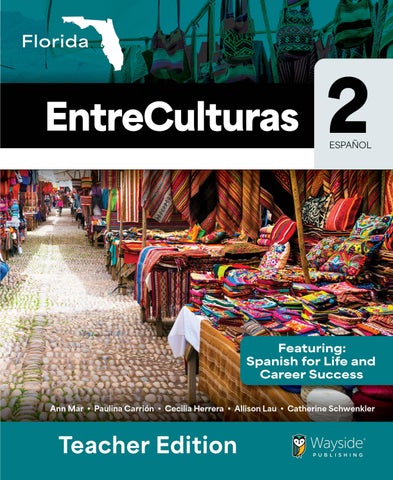
Florida
Teacher Edition
EntreCulturas 2 ®
Florida Edition
Ann Mar Paulina Carrión Cecilia Herrera Allison Lau Catherine Schwenkler
Director of Editorial: Tanya Brown Managing Editor: Lindsey Colling Senior Developmental Editors: Deborah Edson, Dr . Jan Hagedorn, Kelly Hass Digital Developmental Editor: Jacob Asnicar Senior Editor: Kathryn Strasser Editors: Lariza Fuentes, Isaily Pérez Cover Designer: Jaana Bykonich Graphic Designers: Jaana Bykonich, Sawyer McCarron-Rutledge, Hannah Rowlett Production Designers: Derrick Alderman, Rivka Levin
Cover image: Market with colourful traditional Peruvian textiles in Pisac, Sacred Valley, Peru . ©Nathaniel Noir / Alamy Stock Photo
Copyright © 2026 by Wayside Publishing All rights reserved . No part of this publication may be reproduced, stored in a retrieval system, or transmitted in any form or by any means, electronic, mechanical, photocopying, recording, or otherwise, without the prior written permission of the publisher . The marks [EntreCulturas®, EntreCultures®, FlexText®, Learning Site®, Wayside Publishing®] (collectively “the Marks”) are registered in the U.S. Patent and Trademark Office and owned in their entirety by Wayside Publishing (“Wayside”) . Any use of the Marks without the express written permission of Wayside is prohibited . Printed in USA 1 2 3 4 5 6 7 8 9 10 XX 24 Print date: Hardcover ISBN 978-1-641597-12-8
Mapa del mundo hispanohablante . . . . . . . . . . . . TE4 Welcome to EntreCulturas® . . . . . . . . . . . . . . . . . . . . . TE6 Scope and Sequence . . . . . . . . . . . . . . . . . . . . . . . . TE8 Florida’s CPALMS World Languages Standards . . TE16 Approaches to Teaching and Learning . . . . . . . . .TE17 High-Leverage Teaching Practices . . . . . . . . . . TE17 Cultivating Interculturality . . . . . . . . . . . . . . . . TE20 Integrating Interculturality in Teaching and Learning . . . . . . . . . . . . . . . . . . . . . . . . . . . . TE21 Staying in the Target Language . . . . . . . . . . . . TE24 Instructional Strategies . . . . . . . . . . . . . . . . . . . TE26 Integrated Differentiated Instruction . . . . . . . TE28 Heritage Learners . . . . . . . . . . . . . . . . . . . . . . . TE30
Vocabulary Instruction in Context . . . . . . . . . . TE31 Grammar Instruction in Context . . . . . . . . . . . TE32 Assessing Language Performance in Context . TE34 Rubrics . . . . . . . . . . . . . . . . . . . . . . . . . . . . . . . . . TE35 Unit Organization . . . . . . . . . . . . . . . . . . . . . . . . . . TE36 Our Digital Learning Experience . . . . . . . . . . . . . . TE48 Using Readers to Support Language Acquisition . . . . . . . . . . . . . . . . . . . . . . . . . . . . . . TE50 Program Components and Key Features . . . . . . . TE51 Table of Contents . . . . . . . . . . . . . . . . . . . . . . . . . . TE52 Appendices Table of Contents . . . . . . . . . . . . . . . . TE58 Acknowledgements . . . . . . . . . . . . . . . . . . . . . . . . TE59 Spanish for Life and Career Success . . . . . . . . . . . LCS1
Ciudad de Guatemala, Guatemala
EntreCulturas® 2
TE3
El mundo hispanohablante
ESTADOS UNIDOS ALASKA
(Estados Unidos)
ALASKA
(Estados Unidos)
OCÉANO
Percentage of U.S. population that speaks Spanish according to 2020 U.S. Census data
Percentage of U.S. population that speaks Spanish according to 2020 U.S. Census data
PACÍFICO
<5%
5-10%
10-15% 15-20% 20-25% 25-30% <5%
Canadá
NORTE
5-10%
PACÍFICO NORTE
>30%
Canadá
ESTADOS UNIDOS ESTADOS UNIDOS
OCÉANO
>30%
10-15% 15-20% 20-25% 25-30%
MÉXICO
Golfo de
OCÉANO PACÍFICO NORTE
MÉXICO
MÉXICO
Golfo de México
Golfo de México
EL SALVADOR Las Bahamas REPÚBLIC Jamaica COSTA R Belice PUERT REPÚBLICA DO Las Bahamas
Jamaica Belice
PUERTO RIC T
EL SALVADOR COSTA RICA PANAMÁ EL SALVADOR
HAWAII
(Estados Unidos)
COSTA RICA OCÉANO PANAMÁ OCÉANO
HAWAII
Guayan Su
(Estados Unidos)
PACÍFICO HAWAII
Trinidad
OCÉANO
(Estados Unidos)
PACÍFICO
SUR
PACÍFICO
PERÚ
SUR PERÚ
SUR
TE4
EntreCulturas® 2
25-30%
ATLÁNTICO
>30%
% 15-20% 20-25% 25-30%
>30%
OCÉANO
STADOS UNIDOS
ATLÁNTICO NORTE
Dinamarca Reino Dinamarca El mundo hispanohablante Unido NORTE Reino Irlanda (RU) Unido Alemania Irlanda (RU) Alemania Portugal ESP Francia Francia
OCÉANO ATLÁNTICO NORTE
Portugal
MÉXICO
Golfo de México
Las Bahamas
Jamaica Belice
Las Bahamas de México Las Bahamas
ca
ESPAÑA
Portugal
DOR ÉANO TA RICA Á PANAMÁ CÍFICO
PERÚ
Guinea
Guinea
Sierra Leona
LiberiaSierra Leona Liberia
Mauritania
Guinea Sierra Níger Leona Malí LiberiaNíger
GUINEA E
Nigeria
Nigeria
Camerún
Camer GUINEA ECUATORIAL Gabón GUINEA ECUATORIAL
Brasil
Gabón
SUR
PERÚ
Túnez
Senegal
REPÚBLICA DOMINICANA Trinidad y Tobago EL SALVADOR Mauritania REPÚBLICA DOMINICANA Malí COSTA RICARICO Mauritania Guayana Jamaica PUERTO Belice Surinam Senegal PANAMÁ PUERTO RICO Guayana Francesa Senegal Trinidad y Tobago Trinidad y Tobago Guayana Surinam Guayana Guayana Francesa Surinam Guayana Francesa
ESPAÑA
Marruecos
Islas Canarias
PUERTO RICO
Islas Canarias
MarruecosItal
Túnez
Marruecos
Islas Canarias REPÚBLICA DOMINICANA
Italia
PERÚ
Brasil
Brasil OCÉANO ATLÁNTICO OCÉANO ATLÁNTICO SUR
EntreCulturas® 2
SUR OCÉANO ATLÁNTICO SUR
TE5
Welcome to EntreCulturas®
EntreCulturas® Mission and Vision EntreCulturas® is a four-level, standards-based, thematically-organized program . Each level is comprised of six units that provide learners with opportunities to interact and engage with authentic materials and adolescent speakers of the language . By learning in an intercultural context, students acquire communication skills and content knowledge while exploring the products, practices, and perspectives of Spanish-speaking cultures .
EntreCulturas® Mission EntreCulturas® aims to prepare learners to communicate, explore, and connect across cultures in order to foster attitudes of mutual understanding and respect .
EntreCulturas® Vision Our vision is a world where language learning takes place through the lens of interculturality, so students can discover appropriate ways to interact with others whose perspectives may be different from their own.
TE6
EntreCulturas® 2
Welcome to EntreCulturas®
Welcome to EntreCulturas® 2 Dear colleagues, Welcome to EntreCulturas®: Communicate, Explore, and Connect Across Cultures, an innovative approach to teaching languages through the lens of interculturality . The goal of the four-level program is to help learners develop communicative and cultural competences as well as intercultural understanding . EntreCulturas® was written by Spanish teachers who understand and appreciate the dynamics of language education and know that teachers need strong support in their daily instruction . Using the World-Readiness Standards for Learning Languages as a framework, the program provides engaging activities that emphasize authentic language use in all three modes of communication . Through topics and materials that are carefully aligned to the themes, structures, and tasks of the Advanced Placement® (AP®) and International Baccalaureate® (IB) programs, students begin preparing early for advanced coursework . In each unit of EntreCulturas®, learners meet a videoblogger from a Spanish-speaking country and are immersed in meaningful contexts . Rich, authentic resources allow students to learn about the products, practices, and perspectives of Spanish-speaking countries and to engage with people from other linguistic and cultural backgrounds . To promote an attitude of curiosity and intercultural understanding, students are provided with frequent opportunities to reflect and comment on what they have learned. Muy atentamente,
Ann Mar Paulina Carrión Schwenkler
Cecilia Herrera
Allison Lau
Catherine
València, España
EntreCulturas® 2
TE7
Scope and Sequence: EntreCulturas® 1 UNITS
Unidad 1 ¡Hola, mucho gusto!
Unidad 2 La escuela de la vida
Unidad 3 Mi familia es tu familia
Unidad 4 La comida es cultura
Unidad 5 ¡A pasarla bien!
Unidad 6 Caminando por el mundo
TE8
ESSENTIAL QUESTIONS
UNIT GOALS
INTERCULTURAL FOCUS
How does who I meet affect how I communicate? How does where I live influence who I am? How do my interests and talents shape who I am?
Recognize basic information that people share about themselves Exchange information to get to know people Present basic information about yourself, your identities, and your preferences Reflect on how to communicate respectfully when meeting people from other cultures
Conexiones culturales Práctica cultural: Los saludos Producto cultural: ¡Soy latino! y otros eslóganes Práctica cultural: La danza de la botella
Where, how, and why do we learn throughout life? How do communities create a culture of learning? How do schools prepare students for the future?
Interpret images, videos, and schedules to gain insight into learning in different cultures Exchange information about school schedules and classes Present information about school activities Investigate how approaches to learning throughout life reflect cultural perspectives
Conexiones culturales Producto cultural: Los colegios técnicos y las pasantías Práctica cultural: El día escolar costarricense Práctica cultural: Servicio comunal estudiantil
What does it mean to be a family? How does where we live influence family life? How do family and friends shape who we are?
Interpret short texts about family structures and activities Exchange information about home life and family Present a digital album about home and family Explore the role of family and where we live in shaping who we are
Conexiones culturales Práctica cultural: Nuevos modelos de familia Producto cultural: Los espacios donde vivimos Práctica cultural: Comidas en familia
How are our ideas about balanced diets formed? How do food practices shape cultural identity? How does where we live influence what we eat?
Interpret short texts to discover how geography and culture affect food traditions Share preferences, opinions, and habits about foods Create and present menus that express your food preferences and traditions Describe how sharing in the food of another culture can lead to intercultural understanding
Conexiones culturales Producto cultural: La gastronomía mexicana Práctica cultural: ¿Comer afuera o en casa? Práctica cultural: Comprar los alimentos
What leisure activities define my community and me? How do popular celebrations reflect history and culture? How do leisure activities create bridges between cultures?
Interpret images and texts to learn about celebrations in the Dominican Republic Interact with others to make simple plans for leisure activities Express preferences for leisure activities in short presentations Find and create opportunities for intercultural communication through leisure activities
Conexiones culturales Producto cultural: La pelota dominicana y la vitilla Práctica cultural: La bachata Producto cultural: El dominó en la comunidad
How do surroundings shape one’s identity? How do people connect across the world? How do my actions affect the world beyond me?
Interpret images and texts to learn about climate and weather in diverse regions of the Spanish-speaking world Exchange information about ways to connect with others across cultures Share how geography and culture shape identity in your own and other communities Identify ways in which our actions impact other communities around the world
Conexiones culturales Producto cultural: El sistema métrico Práctica cultural: El ciclismo Práctica cultural: La globalización
EntreCulturas® 2
Scope and Sequence: EntreCulturas® 1 VOCABULARY TOPICS IN CONTEXT
STRUCTURES IN CONTEXT (With Video)
ADDITIONAL FEATURES
¡Mucho gusto! Pleased to meet you! Mi identidad My identity Mis actividades favoritas My favorite activities
Greeting Others Appropriately: Formal vs. Informal Language Expressing Identity: The Verb ser Expressing Likes and Dislikes: The Verb gustar with Infinitives
Detalle gramatical: Los sustantivos en español; Las conjunciones y, o; Preguntas con la forma tú Detalle lingüístico: Los números del 1 al 100; Los títulos formales; ¿Quiénes son americanos?; Las etapas del proceso educativo
¿Dónde aprendemos? Where do we learn? Mi horario escolar My school schedule Mi día típico My typical day
Expressing Existence: Indefinite Articles and hay Referring to People, Places, and Things: Definite Articles Expressing Activities: Present -ar Verbs
Estrategias: Listening and Reading for Cognates Detalle gramatical: Cómo expresar la fecha; Muy y mucho; ¿A qué hora?; Los días de la semana
Esta es mi familia This is my family Donde vive mi familia Where my family lives ¿Qué quieres hacer este fin de semana? What do you want to do this weekend?
Describing People: Adjective Agreement Expressing Location: The Verb estar Expressing Activities with More Verbs: Present of -er and -ir Verbs
Estrategias: Follow-up Questions Detalle gramatical: La preposición de; Los adjetivos posesivos; Estar en para indicar lugar; Las contracciones al y del; El verbo ver; El verbo ir Detalle lingüístico: Las preguntas de confirmación
Bien comer, buen vivir Good eating, good living ¿Qué te gusta comer durante el día? What do you like to eat during the day? De compras en el mercado Shopping in the market
Making Requests and Recommendations: ie Stem-Changing Verbs e Expressing Preferences: Gustar and encantar Referring to Specific Items: Demonstrative Adjectives
Detalle gramatical: ¿Cuánto cuesta?
¡Es difícil hacer planes! It is difficult to make plans! Celebraciones con amigos y familiares Celebrations with friends and family members Preparando un viaje Preparing for a trip
Expressing What I Can Do: ue Stem-Changing Verbs o Telling What I Do: Present Irregular yo Forms Discussing the Future: Ir + a + Infinitive
Estrategias: Scanning a Text
Me visto según el clima I dress according to the climate ¿Cómo te conectas? How do you connect? Un mundo conectado A connected world
Expressing Reflexive Actions: Reflexive Verbs Talking about Actions in Progress: Present Progressive Describing Actions: Adverbs
Detalle gramatical: Los verbos conocer y saber Cómo hablar de deseos o expectativas futuras
EntreCulturas® 2
TE9
Scope and Sequence: EntreCulturas® 2 UNITS
Unidad 1 Aficionados unidos
Unidad 2 La plaza mayor
Unidad 3 La cocina de mi familia
Unidad 4 La cultura de la naturaleza
Unidad 5 Las piedras hablan
Unidad 6 Comunidades unidas
TE10
ESSENTIAL QUESTIONS
UNIT GOALS
INTERCULTURAL FOCUS
What does it mean to be part of a group or team? How do we connect through community events? How does music build a global community?
Listen to and read about the interests and activities of young people in Spanish-speaking communities Exchange invitations and information about sports and extracurricular groups or clubs Share information with others about community events Investigate how common interests unite people in different cultures
Conexiones culturales Práctica cultural: Participar en los deportes de Chile Producto cultural: Los equipos profesionales Producto cultural: El Festival Internacional de la Canción de Viña del Mar
How do public spaces shape social interaction? How are shopping habits shaped by culture? How has technology transformed gathering spaces?
Listen to and read about places in the Spanishspeaking world where people interact in person and virtually Exchange information about the places and ways you interact with others Present information about your shopping habits and social interactions Investigate how technology can provide opportunities for intercultural experiences
Conexiones culturales Práctica cultural: Historia y memoria Práctica cultural: La compra diaria Práctica cultural: Los préstamos lingüísticos
How do foods connect us to our past? How does food connect us to family and community? How do our eating habits impact the environment?
View, listen to, and read information about food Exchange information about your own food preferences now and in the past Present to others about some foods you enjoy with family and friends Investigate how the foods we eat connect us with the world and impact the environment
Conexiones culturales Producto cultural: Las diferentes influencias en la comida cubana Producto cultural: Los paladares Producto cultural: El ajiaco
How do cultures show appreciation for the natural world? How are we connected with nature? How can we care for the world around us?
Interpret images, texts, and videos to discover the natural world in Spanish-speaking areas and the activities people enjoy there Exchange information about past travel and experiences in nature Present information about past experiences Investigate and compare how cultural practices reflect values relating to the natural world and conservation
Conexiones culturales Producto cultural: El Sistema Nacional de Áreas Protegidas en Ecuador Producto cultural: El bosque de Polylepis Perspectiva cultural: El ecocidio y los derechos de la naturaleza
Why do people and civilizations construct monuments? How does life today reflect our past? What will our future communities look like?
Interpret texts about past civilizations and future communities Exchange information about communities past and present Present ideas for the development of communities in the future Explore the influence of the past on the present lives of individuals and communities
Conexiones culturales Producto cultural: Las líneas de Nasca Producto cultural: Los quipus Práctica cultural: Wifi para todos
How do personal responsibilities shape my daily life? How do individuals contribute to their communities? How does diversity strengthen communities?
Interpret information about volunteer projects and opportunities Exchange information about the ways in which people contribute to their home, school, and greater communities Describe the ways in which people can work together and make connections with each other Explore the ways in which people celebrate cultural heritage and contribute to united communities
Conexiones culturales Práctica cultural: La división del trabajo Producto cultural: El canal de Panamá Producto cultural: Los palenques
EntreCulturas® 2
Scope and Sequence: EntreCulturas® 2 VOCABULARY TOPICS IN CONTEXT
STRUCTURES IN CONTEXT (With Video)
ADDITIONAL FEATURES
¿En qué grupos participas? What groups do you participate in? ¿Quieres ir conmigo? Do you want to go with me? Opiniones sobre la música Opinions about music
Asking Questions: Interrogatives Expressing Preferences and Obligations: Infinitive Expressions Making Comparisons: Comparatives
Estrategias: Asking Questions
¿Qué lugares quieres conocer? What places would you like to know about? ¿Adónde puedo ir? Where can I go? ¿Hacemos una reunión virtual? Should we have a virtual meeting?
Making Suggestions: Affirmative tú Commands Indicating Enduring Actions: Impersonal and Passive se Expressing Reciprocal Actions: Reciprocal Verbs
Detalle gramatical: Mandatos afirmativos informales de verbos irregulares
Recordar la cocina de mi abuela Remembering my grandmother’s kitchen ¿Dónde quieres comer? Where do you want to eat? La agricultura sostenible en las ciudades Sustainable agriculture in cities
Describing Habitual Actions in the Past: Imperfect -ar Verbs Avoiding Repetition: What or Whom: Direct Object Pronouns Describing Habitual Actions in the Past with More Verbs: Imperfect -er and -ir Verbs
Estrategias: Increasing Your Vocabulary Detalle gramatical: Pronombres de objeto directo con el infinitivo; Los verbos irregulares en el imperfecto
Viajar sin causar daño Traveling without causing harm Mi viaje inolvidable My unforgettable trip Hábitos para cuidar nuestro planeta Habits for taking care of our planet
Expressing Completed Actions: Preterit -ar Verbs Expressing Completed Actions with More Verbs: Preterit -er and -ir Verbs Expressing Completed Actions with Irregular Verbs: Irregular Preterit Stems
Estrategias: Cómo entender una narración en diferentes tiempos Detalle gramatical: Los verbos terminados en -car, -gar, -zar en el pretérito; El uso de antes y después; Verbos irregulares en pretérito; El verbo hacer en el pretérito
Cusco, una ciudad antigua y también moderna Cusco, an ancient and also modern city El valor de la tradición The value of tradition Las ciudades del futuro Cities of the future
Describing the Past: Imperfect and Preterit Expressing Interruptions in the Past: Imperfect and Preterit for Interrupting Actions Expressing an Opinion: Impersonal Expressions with Infinitives
Estrategias: Conectar ideas usando elementos de transición Detalle gramatical: El superlativo; Los verbos con cambios y en el pretérito i
Mis responsabilidades My responsibilities Voluntariado en la comunidad Volunteer work in the community Comunidades diversas y unidas Diverse and united communities
Expressing Completed Actions with Stem Changers: Preterit Stem-Changing Verbs Avoiding Repetition: To Whom or for Whom: Indirect Object Pronouns Telling Someone What Not to Do: Negative tú Commands
Estrategias: Observar los productos, las prácticas y las perspectivas culturales en los videos Detalle gramatical: La a personal
EntreCulturas® 2
TE11
Scope and Sequence: EntreCulturas® 3 UNITS
Unidad 1 ¡Cuéntame!
Unidad 2 ¡Tanta belleza!
Unidad 3 ¡Pura vida!
Unidad 4 #UnFuturo Conectado
Unidad 5 Una mano ayuda a la otra
TE12
ESSENTIAL QUESTIONS
UNIT GOALS
INTERCULTURAL FOCUS
How does storytelling impact our identities? How do characters embody different traits? How do shared stories help us make sense of events?
Interpret stories and legends from Puerto Rico Exchange information about the attributes and actions of characters and people Tell a story about a familiar event Examine how stories contribute to cultural identity
Conexiones culturales Producto cultural: El cuentacuentos Producto cultural: Los vejigantes de Puerto Rico Producto cultural: La naturaleza como símbolo de la resiliencia boricua
How do we appreciate the beauty of a country? How do a community’s traditions reflect its beauty? How is beauty expressed through the arts?
Interpret videos, articles, and messages about how the beauty of a country is represented in its landscapes, traditions, and arts Exchange information about the beauty of a country, its traditions, and its arts Present personal interpretations of beauty and how it is represented across communities Explore how beauty is represented throughout Guatemala and your own community
Conexiones culturales Producto cultural: Reserva de la Biosfera Maya Práctica cultural: El Rab’in Ajaw Producto cultural: El Popol Vuh
What does it mean to live a healthy life? How can we achieve a balanced life? How can we achieve healthier communities?
Interpret images and text about what it means to live a healthy life Exchange information about healthy living and its many benefits Present the elements of healthy lifestyles in your own and other communities Explore how healthy living is represented throughout Costa Rica and our own communities
Conexiones culturales Práctica cultural: Pura vida Producto cultural: El turismo de bienestar Práctica cultural: Un país sin ejército
How do online platforms influence young people’s lives? How can digital tools improve life within a community? How can influence be used for positive change?
Interpret videos, articles, and online messages about how communities connect with technology Exchange information about technology uses and apps with a positive impact on communities Present digital messages to promote causes and positive use of social media Explore how online platforms impact communities in Bolivia and throughout the world
Conexiones culturales Práctica cultural: El carnaval de Oruro Producto cultural: La diversidad lingüística de Bolivia Práctica cultural: El Willkakuti
How can young people overcome obstacles to meet goals? How does knowing who I am help me connect with others? What role do youth play in forming a strong community?
Discover perspectives on friendship and solidarity as you interpret authentic resources from Uruguay Interact to share ambitions, experiences of friendship, and volunteer opportunities to build a better world Encourage others to pursue their goals, work together to volunteer, and promote community solidarity Communicate across cultures to exchange ways to build friendship and solidarity
Conexiones culturales Producto cultural: El gaucho Práctica cultural: Tomar un mate como gesto de amistad Producto cultural: Las ollas populares
EntreCulturas® 2
Scope and Sequence: EntreCulturas® 3 VOCABULARY TOPICS IN CONTEXT
STRUCTURES IN CONTEXT (With Video)
ADDITIONAL FEATURES
Las partes de un cuento The parts of a story ¿Cómo son los personajes? What are the characters like? Lo que se expresa a través de los cuentos What is expressed through stories
Talking about the Past: Preterit Verbs that Change Meaning Describing Who, What, and How: Ser vs. estar Using Multiple Pronouns to Avoid Repetition: Direct and Indirect Object Pronouns
Estrategias: Comprender el vocabulario en contexto Detalle gramatical: Los pronombres de doble objeto
La belleza de un país The beauty of a country La artesanía de mi región The arts and crafts of my region La creatividad artística Artistic creativity
Telling a Reason or Purpose: Por vs. para Emphasizing to Whom Something Belongs: Stressed Possessive Adjectives Talking about the Recent Past: Present Perfect
Estrategias: Interpretar videos Detalle lingüístico: Los sustantivos ambiguos
Acciones para mejorar el bienestar físico Actions to improve physical well-being Acciones para elevar el bienestar emocional Actions to raise emotional well-being Las claves para la longevidad The keys to longevity
Giving Orders or Suggestions: Usted, ustedes, and nosotros Commands Giving Orders or Suggestions with Pronouns: Commands with Pronouns Expressing Opinions About Others’ Actions: Subjunctive with Impersonal Expressions
Estrategias: Hacer una presentación formal Detalle gramatical: Los mandatos de nosotros con pronombres; El presente de subjuntivo de los verbos irregulares
Conéctate en Bolivia Get connected in Bolivia La transformación digital Digital transformation Conectando comunidades Connecting communities
Talking about the Future: Future Talking about Possible or Likely Events: Si + Present + Future Asking for Information: Qué vs. cuál
Estrategias: Utilizar aplicaciones y sitios web en español Detalle gramatical: Los verbos irregulares en el tiempo futuro
Los desafíos de los adolescentes de hoy The challenges adolescents face today Pasar un rato con amigos Spending time with friends Fortalecer la comunidad con el voluntariado Strengthening the community with volunteer work
Expressing Emotions: Subjunctive for Emotions Specifying Who or What: Relative Pronouns Talking about Hypothetical Situations: Conditional
Estrategias: Interpretar un texto poético Detalle gramatical: El subjuntivo con antecedentes indefinidos; Los verbos irregulares en el condicional Detalle lingüístico: El voseo
EntreCulturas® 2
TE13
Scope and Sequence: EntreCulturas® 4 INTERCULTURAL FOCUS
UNITS
ESSENTIAL QUESTIONS
UNIT GOALS
Unidad 1
How are we influenced by the people around us? How do we communicate in today’s world? What is the difference between a traveler and a tourist? As a traveler, how do we experience daily life in another culture?
Compare products, practices, and perspectives about human connections and experiences in your own and other cultures. Understand information in authentic sources about human connections and experiences. Exchange information and express opinions about human connections and experiences. Present information about human connections and experiences.
Conexiones culturales Práctica cultural: Celebrando el Día de la Amistad Práctica cultural: Probando tortillas en Ecuador
How is artistic creativity a form of cultural expression? How are universal themes reflected in various forms of art? How does design reflect cultural identity? How does globalization impact what we wear?
Compare products, practices, and perspectives in different forms of art, fashion, and design; analyze the impact of globalization on what you wear. Understand information in authentic sources about creativity, art, and globalization. Exchange information and express opinions about creativity, art, and globalization. Present information about creativity, art, and globalization.
Conexiones culturales Práctica cultural: La restauración de la paz Práctica cultural: Las cholitas luchadoras
What can we learn from historical figures? How can an individual transform history? What elements shape our identity? How do language and traditions contribute to form a cultural identity?
Compare products, practices, and perspectives about cultural heritage and identity and describe how these are linked to language and traditions. Understand information in authentic sources about cultural heritage and identity. Exchange and share ideas, information, and opinions about cultural heritage and identity. Present information about cultural heritage and identity.
Conexiones culturales Producto y perspectiva cultural: Guernica: Una obra de arte que refleja un evento histórico español Producto cultural: El fútbol
What is a global citizen? How can we support the well-being of communities? What are the barriers to education? How can a community collaborate in the educational process?
Compare products, practices, and perspectives about global citizenship and support for learning in your own and other cultures. Understand authentic sources about global citizenship and support for learning. Exchange information and express opinions about global citizenship and support for learning. Present information about global citizenship and support for learning.
Conexiones culturales Práctica y perspectiva cultural: José Andrés, un chef humanitario Producto cultural: Las escuelas clandestinas en Ecuador
How do traditional and modern health practices co-exist? How can we improve access to medical care? How does technology use affect health? How can we use technology to maintain a healthy lifestyle?
Compare products, practices, and perspectives about health and technology in your own and other cultures. Understand information in authentic sources about health and technology. Exchange information and express opinions about health and technology. Present information about complementary health and technology.
Conexiones culturales Práctica y perspectiva cultural: La medicina mapuche
La vida actual
Unidad 2 La creatividad
Unidad 3 Las identidades
Unidad 4 Las comunidades
Unidad 5 El bienestar
TE14
EntreCulturas® 2
Scope and Sequence: EntreCulturas® 4 VOCABULARY TOPICS IN CONTEXT
STRUCTURES IN CONTEXT (With Video)
ADDITIONAL FEATURES
La amistad Friendship La comunicación Communication Los viajes Travel La vida cotidiana Daily life
Talk about Someone or Something Unknown: Presente de subjuntivo
Detalle gramatical: Presente de subjuntivo de verbos que terminan en -cer
Las bellas artes Fine arts El arte escénico Theatrical arts La vestimenta y los diseños Clothing and design Los estilos globales Global clothing styles
Describe Objects, Places, or People: Participio pasado como adjetivo
Detalle gramatical: Palabras femeninas que empiezan con a; Presente de subjuntivo después de expresiones impersonales; Pronombres relativos
Las figuras históricas Historical figures Los personajes legendarios Legendary personalities Las raíces culturales Cultural roots La lengua y las tradiciones Language and traditions
Express Emotions or Recommendations in the Past: Imperfecto de subjuntivo Express something possible or conditional: Oraciones con si
Detalle gramatical: Números ordinales; Como si + el imperfecto de subjuntivo; Formación de adverbios Variedad lingüística: Formación del subjuntivo
La solidaridad
Express Emotions or Desires about a Completed Action: Presente perfecto de subjuntivo
Detalle gramatical: El pluscuamperfecto de indicativo
Express Uncertain Future Actions: Expresiones temporales con indicativo o subjuntivo
Detalle gramatical: Hace + el tiempo + que + el pretérito de indicativo
Solidarity
El voluntariado Volunteerism Los desafíos a la educación Challenges to education Las comunidades de aprendizaje Learning communities La medicina tradicional y moderna Traditional and modern medicine El acceso a la salud Access to health care Los efectos de la tecnología Effects of technology La tecnología y el bienestar Technology and health
EntreCulturas® 2
TE15
Florida’s CPALMS WorldCPALMS Languages Standards Florida’s World Languages Standards
Florida’s CPALMS World Languages Standards EntreCulturas® is a four-level Spanish program aligned with Florida CPALMS standards and the ACTFL World-Readiness Standards. It promotes communicative competence, critical thinking, and cross-curricular connections in Mathematics, ELA, and ELD. The program supports students’ progress from Novice to Advanced proficiency using ACTFL Proficiency Guidelines, Performance Descriptors, and NCSSFL-ACTFL Can-Do Statements.
World Languages Communication
Interpersonal: Interactive speaking and writing activities for sharing and expressing opinions. Interpretive: Understand authentic audio, video, and text resources. Presentational: Deliver information using culturally appropriate media.
Cultures
Explore the relationship between cultural products, practices, and perspectives, promoting cultural awareness and respect. Reflect on global diversity through rich, authentic resources and themes.
Connections
Interdisciplinary lessons link language learning to subjects like geography, history, and STEM, enhancing critical thinking skills. Broaden perspectives with tasks rooted in academic and career-related contexts.
Comparisons
Highlight the differences and similarities between Spanish and English, deepening understanding of linguistic and cultural nuances.
Communities
Engage with real-world Spanish-speaking communities through projects. Equip students for lifelong learning with practical language applications.
Mathematics (B.E.S.T.): Strand: Mathematical Thinking and Reasoning 1. Actively participate in effortful learning both individually and collectively. 2. Demonstrate understanding by representing problems in multiple ways. 3. Complete tasks with mathematical fluency. 4. Engage in discussions that reflect on the mathematical thinking of self and others. 5. Use patterns and structure to help understand and connect mathematical concepts. 6. Assess the reasonableness of solutions. 7. Apply mathematics to real-world contexts.
English Language Arts (B.E.S.T.): Expectations 1. Cite evidence to explain and justify reasoning. 2. Read and comprehend grade-level complex texts proficiently. 3. Make inferences to support comprehension. 4. Use appropriate collaborative techniques and active listening skills when engaging in discussions in a variety of situations. 5. Use the accepted rules governing a specific format to create quality work. 6. Use appropriate voice and tone when speaking or writing.
English Language Development (ELD) 1. Language of Social and Instructional Purposes
TE16 EntreCulturas® 2
EntreCulturas®v2
Approaches to Teaching and Learning
High-Leverage Teaching Practices EntreCulturas® fully supports the ten High-Leverage Teaching Practices (HLTP) identified by Glisan and Donato.1
1. Facilitating Target Language Comprehensibility Acquiring language is an unconscious process. In order for an independent language system to develop in the brain, learners must interact with large amounts of compelling input that is comprehensible and meaningful to them. Likewise, learners must have opportunities to engage with others to express themselves in the language. We strongly encourage classes to be conducted 90% or more in Spanish from the beginning of level 1. To facilitate this, EntreCulturas® focuses on high frequency vocabulary used in real-world contexts that interest students. Authentic resources are supported by images and other context clues. Emphasis is also placed on word families and cognates to expand vocabulary.2
2. Building a Classroom Discourse Community Interacting with others is at the heart of communication. EntreCulturas® provides a variety of real-world oral and written interpersonal communication tasks in every unit. Students have opportunities to exchange information and ideas; to meet needs and address situations; and to express, react, and support preferences and opinions in formats ranging from in-class pair or group discussions, text message exchanges, formal and informal email exchanges, AP®-style simulated conversations, posting and responding to posts in an online discussion forum, and more. The communication is meaningful, purposeful, and engaging. Where needed, there is just-in-time support such as Recuerda features to remind students of previously learned material, Variedad lingüística and Detalle gramatical features with useful language information, and Vocabulario personal features for personalized vocabulary. Glisan, E. W. & Donato, R. (2017). Enacting the Work of Language Instruction. The American Council on the Teaching of Foreign Languages. Glisan, E. W. & Donato, R. (2021). Enacting the Work of Language Instruction: Volume 2. ACTFL.
1
See Staying in the Target Language in this section for more information about the roles of Comprehensible Input and Comprehensible Output in EntreCulturas®.
2
EntreCulturas® 2
TE17
Approaches to Teaching and Learning 3. Guiding Learners to Interpret and Discuss Authentic Texts Authentic materials provide language in real-life contexts as well as insight into target culture perspectives. Learners interact with authentic resources in a wide variety of text types involving print, audio, video, and images. Activities that accompany these resources are designed to “edit the task, not the text” to ensure that students can access the information. Interacting with resources created for and by native speakers allows learners to reflect on cultural products, practices, and perspectives to develop interculturality. In addition to a wealth of authentic resources, videobloggers from across the Spanishspeaking world provide unscripted language and a glimpse into their lives. See Cultivating Interculturality and Integrating Interculturality in Teaching and Learning in this section.
4. Focusing on Form in a Dialogic Context Through PACE Observa sections in each unit introduce language structures in context through PACE, an acronym for Presentation, Attention, Co-Construction, and Extension. Learners are encouraged to look for language patterns and develop hypotheses about how language works. Short videos provide additional language in context and model the discovery process. See Grammar Instruction in Context in this section for more information.
5. Focusing on Cultural Products, Practices, Perspectives in a Dialogic Context In addition to interacting directly with authentic resources, Conexión cultural segments provide information about products and practices seen in the unit and include questions designed to guide students in reflecting about similar products or practices in their own communities as well as the target culture. Students respond in a discussion forum where they can read and respond to each other’s ideas. Reflexión intercultural questions encourage students to identify perspectives and make cultural comparisons. The Vive entre culturas summative assessments include an assessment of interculturality based on the unit theme. Each unit concludes with a section called Mi comunidad global, which provides opportunities to use Spanish in the real world to investigate culture and interact with the global community of Spanish speakers.
6. Providing Oral Corrective Feedback to Improve Learning Performance Providing specific and timely feedback is one of the top ten influences on student achievement, according to Hattie (2009).3 While oral corrective feedback is the responsibility of the teacher, EntreCulturas® supports other ways of providing feedback to students. Teachers have access to a variety of rubrics, including analytic growth, holistic, single-point, and assessment-specific. Teachers can give written feedback or record oral feedback for every activity on Learning Site® as well as in response to student selfassessment using the Portfolio. See Assessing Language Performance in Context and Rubrics in this section. 3
TE18
Hattie, J.A.C. (2009). Visible learning. New York, NY: Routledge.
EntreCulturas® 2
Approaches to Teaching and Learning 7. Establishing a Meaningful and Purposeful Context for Language Instruction EntreCulturas® provides real-world settings and purposes for every activity so that learners understand the greater purpose and benefits of developing their proficiency in Spanish. The Mi comunidad global section of each unit encourages students to engage directly with Spanish speakers to make language and culture come alive. See Vocabulary Instruction in Context, Grammar Instruction in Context, and Assessing Language Performance in Context in this section.
8. Planning for Instruction Using an Iterative Process for Backward Design EntreCulturas® was developed using the backward design process. Authors began planning each unit by identifying the essential questions and learning objectives based on target proficiency levels and Advanced Placement® (AP®) themes, finding authentic resources, developing the Vive entre culturas summative assessment, and then creating each Comunicación section, beginning with the En camino formative assessment and working backwards to design the learning experiences. In this way, authors ensure that activities support formative assessments and formative assessments lead to success on summative assessments.
9. Engaging Learners in Purposeful Written Communication EntreCulturas® provides many opportunities for students to engage in presentational writing in real-world contexts in a variety of genres including narrating a story or personal event, describing events, giving instructions, expressing and supporting opinions, sharing research, and more. Students interact with authentic resources that become models for presentational writing tasks as they develop literacy in Spanish. In addition, Estrategias features provide students with explicit guidance for tasks such as writing a formal email, inviting someone to an event, preparing a comparative presentation, and constructing an argumentative essay.
10. Developing Contextualized Performance Assessments EntreCulturas® uses performance-based assessments to show what students can do in real-world contexts. While activities within the Comunicación sections may push students to higher performance levels, the formative and summative assessments are written to demonstrate proficiency at the target levels, which have been determined based on current research in the field. All assessments are designed around authentic, respectful tasks that mirror what has been taught and practiced in the Comunicación sections. Each assessment includes tasks in each mode of communication: Interpretive, Interpersonal, and Presentational. The summative assessment in each unit is an Integrated Performance Assessment (IPA) that includes interculturality and brings together the unit’s essential questions. See Assessing Language Performance in Context in this section.
EntreCulturas® 2
TE19
Approaches to Teaching and Learning
Cultivating Interculturality What is Interculturality?
EntreCulturas® operates on the cutting-edge principle that to develop language skills and foster intercultural understanding, learners need multiple opportunities to reflect on their own culture and gain cultural knowledge of Spanish-speaking communities early in the language learning process . Intercultural reflection prompts and Can-Do self-assessments featured in each unit support teachers with the integration of cultural awareness, appreciation, and understanding within each theme .
How Can Students Demonstrate Interculturality? •
Cultural Products & Practices:4 Learners use their language skills to investigate the world beyond their familiar environment.
•
Cultural Perspectives: Learners use their language skills to recognize and understand others’ ways of thinking as well as their own.
•
Intercultural Interactions: Learners use their language skills and cultural understanding to interact in a cultural context other than their own.
4
TE20
LinguaFolio®, NCSSFL . (2014) . Interculturality. Retrieved from http://ncssfl.org/secure/index. php?interculturality, March 6, 2016 .
EntreCulturas® 2
Approaches to Teaching and Learning
Integrating Interculturality in Teaching and Learning This graphic shows interculturality (i) at the core of learning languages, encompassing all of the goal areas of the World Readiness Standards, the communicative modes, and the steps a learner takes to acquire the mindset of an intercultural citizen: Knowing Myself, Exploring Communities, and Engaging with the World . The learning environment cultivates the attitudes of curiosity, open-mindedness, respect, tolerance, and empathy toward others that lead learners to want to communicate and engage in another language .
Reproduced with permission from Clementi, D & Terrill, L . (2017) . Keys to Planning for Learning . Alexandria, VA: American Council on the Teaching of Foreign Languages . EntreCulturas® 2
TE21
Approaches to Teaching and Learning Interculturality is an outcome of a learning environment that purposefully cultivates the attitudes of curiosity, open-mindedness, respect, tolerance, and empathy toward others. As learners become comfortable with learning about others and their cultures through products, practices, perspectives, and interactions, they develop the skills to reflect on their feelings, thoughts, perceptions, and reactions to understand what it is like to be in someone else’s shoes. 1. Knowing Myself:5 How can learners understand their own culture and use their own language skills to investigate products and practices of Spanish-speaking cultures? •
By investigating, explaining, and reflecting on common cultural products of Spanish-speaking cultures.
Mi progreso intercultural
h
Investigate: I can identify how sports connect people in my own and other communities.
•
By investigating, explaining, and reflecting on common cultural practices of Spanish-speaking cultures.
Mi progreso intercultural
h
Investigate: I can identify shopping practices in my own and other communities.
2. Exploring Communities: How can learners use their language skills to recognize, understand, and connect to others’ ways of thinking in their own community and beyond? •
By demonstrating curiosity, open-mindedness, respect, tolerance, and empathy while exploring communities in order to gain a balanced understanding of Spanish-speaking cultures.
Mi progreso intercultural
h
Investigate: I can identify some similarities and differences between public spaces in Argentina and in my own community.
•
By identifying and comparing cultural beliefs and values in order to understand the cultural perspectives of Spanish-speaking speakers.
Mi progreso intercultural
h
Investigate: I can identify some similarities and differences between perspectives about healthy eating in Cuba and in my own community. Clementi, D. & Terrill, L. (2017). Keys to Planning for Learning. Alexandria, VA: American Council on the Teaching of Foreign Languages.
5
TE22
EntreCulturas® 2
Approaches to Teaching and Learning 3. Engaging with the World: How can learners use their language skills and cultural understanding to function at a survival level (Novice) or functional level (Intermediate) in cultural contexts outside of the classroom? •
By developing a sensitivity and awareness of cultural practices and perspectives to participate appropriately in cultural interactions .
Mi progreso intercultural
h
Investigate: In Panama and my own community I can compare reasons for participating in community volunteer projects.
•
By engaging with age-similar native speakers in a variety of Spanishspeaking countries by means of video blogs, interviews, blogs, podcasts, and social media messages to participate in cultural interactions .
Mi progreso intercultural
h
Interact: I can interact to learn about ingredients used to prepare dishes.
•
By engaging in self-assessment and intercultural reflections to participate in cultural interactions .
Mi progreso intercultural
h
Investigate: I can identify some similarities and differences between an Ecuadorian teen’s perspectives on local excursions and my own.
•
By problem-solving global issues in different cultural contexts to participate appropriately in cultural interactions .
Mi progreso intercultural
h
Investigate: In my own and other communities I can identify ways that groups work to protect historic sites that connect people to their ancestral past.
Patagonia, Argentina
EntreCulturas® 2
TE23
Approaches to Teaching and Learning
Staying in the Target Language How to Get Started?
First of all, talk to learners about the use of Spanish in the classroom. Remind them that they are not expected to understand everything that they hear, read, or see. Just like in English, they need to infer meaning based on the words they know along with any visual clues or body language. Learning a language requires learners to tolerate ambiguity.
The Role of Comprehensible Input (CI) Comprehensible input (CI) is based on Stephen Krashen’s Input Hypothesis,6 that second language acquisition occurs when learners receive an optimal quantity of comprehensible input that is a little beyond the current level of competence (i +1); “i” indicates input at the current competence of the learner, and “+1” represents the next level of competence. It is the language that the learner is not yet able to produce but still understands. Hearing and seeing chunks of functional and high frequency language: Ahora vamos a...
Real world and/or personalized examples and tasks set in a cultural context.
The Role of Comprehensible Output (CO) Comprehensible output is based on Merrill Swain’s Output Hypothesis,7 that learners need opportunities to produce output that is meaningful, purposeful, and motivating so students can engage in collaborative dialogue, using and reflecting on what they have learned, to produce output that communicates what they want to say or write. The learning takes place in the struggle to produce appropriate output. Negotiating meaning: Asking for clarification and using circumlocution.
Participating actively in the process of noticing and discovery.
See Instructional Strategies in this section for specific examples of what comprehensible input (CI) and comprehensible output (CO) look and sound like in the classroom.
TE24
6
Krashen, S. (1982). Principles and practice in second language acquisition, Oxford, UK: Pergamon Press.
7
wain, M. (2000). The output hypothesis and beyond: Mediating acquisition through collaborative dialogue. S In J. P. Lantolf (Ed.) Sociocultural theory and second language acquisition (pp. 97-114). Oxford, UK: Oxford University Press.
EntreCulturas® 2
Approaches to Teaching and Learning EntreCulturas® is designed to assist teachers in achieving at least 90% use of Spanish in the classroom beginning in level 1 and eventually move to 100% in levels 2 and 3, providing guidance to help teachers implement the ACTFL Position Statement (2010) on Use of the Target Language in the Classroom.8 Bill VanPatten sums it up this way: “Communicative ability develops in only one way: through engaging in communication. That is, people learn to communicate by engaging in acts of expressing and interpreting meaning in many varied contexts. Communicative ability cannot be “drilled.” It cannot be practiced in the traditional sense of practice. Communicative ability develops because we find ourselves in communicative contexts. Thus, output (the expression of meaning) plays a major role in the development of communicative ability.” VanPatten, B. (2014) Creating Comprehensible Input and Output: Fundamental Considerations in Language Learning (pp. 24-26). ACTFL, The Language Educator, Oct/Nov 2014.
There are multiple levels of support to assist teachers to “stay in the target language”: •
Teacher notes in the Teacher Edition address what to say and do to make meaning comprehensible for learners.
•
Learning Strategies teach learners to build their communicative skills (for example, tips for reading comprehension).
•
A rich variety of visuals in the Student Edition and Learning Site® allows learners to associate vocabulary and structures directly with images and contexts, rather than with a translation.
•
Activities have built-in comprehension checks and formative assessments.
•
A variety of scaffolded interpersonal tasks encourage learners to negotiate for meaning and be creative with the target language.
•
Rubrics, designed as informative tools for teachers, provide feedback to learners to help them monitor their own growth.
•
Ongoing progress checks encourage learners to monitor how well they are able to meet the communicative and intercultural goals.
•
Learning Site® allows learners to record audios and videos, while teachers can provide audio and textual feedback on each recording.
•
Animated instructional videos for grammatical concepts (Observa) have learners focus on noticing grammatical patterns in Spanish after they have processed for meaning. These videos include explanations in English, except at level 4, so that learners can view them outside of the classroom, and class time can be dedicated to target language use.
8
CTFL Position Statement. (2010). Use of the Target Language in the Classroom. American Council A on the Teaching of Foreign Languages: Alexandria, VA, Retrieved 3/9/16 from http://www.actfl.org/news/position-statements/use-the-targetlanguage- the-classroom-0
EntreCulturas® 2
TE25
Approaches to Teaching and Learning
Instructional Strategies What do Comprehensible Input (CI) and Comprehensible Output (CO) look like and sound like in the classroom? As the teacher provides CI in the ways described under What The Teacher Does (CI), student engagement in the learning process What Students Do (CO) builds proficiency toward Comprehensible Output. See Staying in the Target Language in this section for an overview of Comprehensible Input (CI) and Comprehensible Output (CO) Language Acquisition Theories. What The Teacher Does (CI)
TE26
What Students Do (CO)
Related Materials And Resources in EntreCulturas®
Provides meaningful, authentic, and personalized communicative activities that meet a communicative goal
Know expectations, activate prior Activities, Mi progreso comunicativo knowledge, make connections, and Can-Do statements, Teacher engage with topic notes, and online Instructional Strategies Toolkit
Makes connections from prior learning contexts to new learning objectives
Build on prior language and content
Activities begin with pre-reading, pre-viewing, and pre-listening tasks.
Uses body language: actions, gestures, and facial expressions
Demonstrate comprehension through gestures, actions, and L2 production
Activities, Teacher notes, and Learning Strategies
Uses rich visuals and concrete objects
Use graphic organizers to record observations, take notes, and support collaborative interactions
A rich variety of visuals: images for vocabulary, advertisements, photos, infographics, graphic organizers, and drawings.
Integrates target vocabulary and structures into natural connected context
Process (by hearing and seeing) target vocabulary and structures in real life contexts, not in isolated lists
Vocabulary presentations, grammar presentations, activities, and Estrategias
Provides useful expressions and questions to negotiate meaning
Negotiate meaning, ask for Vocabulario personal, activities, clarification, and use circumlocution and Estrategias
Uses a variety of relevant and appropriate authentic sources
Interact collaboratively with peers Activities and Estrategias to infer meaning based on context, visual clues, and sensible guessing
Emphasizes meaning and content over form
Demonstrate comprehension, make connections, and ask for clarification
Activities and Estrategias
Uses frequent comprehension checks (e.g., questioning, pointing, signaling, and cueing with incomplete statements)
Demonstrate comprehension (e.g., answering; pointing; signaling, such as thumbs up/down; and drawing)
Mi progreso comunicativo CanDo statements and the online Portfolio, activities, and Más práctica (Workbook)
Enhances comprehension by using cognates, when appropriate
Make connections and demonstrate comprehension
Vocabulario personal, Variedad lingüística, and Estrategias
EntreCulturas® 2
Approaches to Teaching and Learning What The Teacher Does (CI)
What Students Do (CO)
Related Materials And Resources in EntreCulturas®
Uses repetition, rephrasing, and paraphrasing, and adjusts rate of speech to level of learners
Focus on new language with multiple opportunities to process meaning and demonstrate comprehension
Teacher notes, online Instructional Strategies Toolkit, and Estrategias
Uses tone of voice and intonation to target new language in context
Focus on new words and structures in connected contexts
Teacher notes and online Instructional Strategies Toolkit, audio recordings of vocabulary and grammar presentations, and Observa videos
Elicits language repairs and requests clarification.
Demonstrate comprehension and use self-correction to improve the comprehensibility of message
Teacher notes, student recording, self-correction, and teacher feedback on Learning Site®
Uses a variety of questions: simple to complex: yes/no, either/or, WH-questions, and open-ended questions
Produce language using scaffolded input
Activities provide a variety of question sequences and sentence starters.
Models tasks with examples in context
Demonstrate comprehension, produce language, act as peer motivator and peer editor
Tasks provide models and examples, graphic organizers, and checklists (Student Edition and Learning Site®).
Uses real world purposeful communicative tasks set in a cultural context
Engage in theme, interact collaboratively and socially with peers to make and negotiate meaning
Activities set in real-world contexts and Mi comunidad global projects
Models simple to complex language elements in context to scaffold output as learners: build from words and phrases to sentences, to question words to question formation
Progress from simple to complex language elements to produce language in a manageable sequence
Activities and Estrategias
Uses co-construction: has students notice words and structural patterns in contexts
Notice, make connections, and participate actively in the process of discovery
Language examples in context with targeted forms in bold and Observa videos
Uses pair- and small-group formats for activities: flexible and heterogeneous grouping
Interact collaboratively, assist, negotiate, and make meaning using language
Teacher notes, Instructional Strategies Toolkit
Provides specific, interactive, and meaningful feedback
Notice, reflect, process, and self-correct to provide evidence of learning
Mi progreso comunicativo Can-Do statements, Teacher notes, and the online Portfolio
EntreCulturas® 2
TE27
Approaches to Teaching and Learning
Integrated Differentiated Instruction As the world shrinks and global interaction is more commonplace, acquiring more than one language becomes essential for all students – not just those in advanced programs . Moreover, world language classrooms are composed of a mix of students who acquire language at different rates and in different ways. EntreCulturas® recognizes that teachers must actively plan for varied approaches to what students will learn, how they will learn, and how they will show what they know and can do . Therefore, the program embraces a differentiated instructional approach, which meets the needs of the learner by appealing to a variety of interests and offering varied levels of complexity to accommodate multiple rates of learning . Detailed Teacher Edition notes provide suggestions for scaffolding activities as well as challenging students, and the searchable, online Instructional Strategies Toolkit offers hundreds of strategies for personalizing learning in your classroom . According to Carol Ann Tomlinson,9 differentiation is a teacher’s response to learners’ needs based on guiding principles, such as continuous assessment, flexible grouping, and respectful tasks. Effective teachers weave differentiation into three areas of the curriculum: content (what they will learn), process (how they will acquire the content), and product (how they will demonstrate and extend what they know and can do) based on learners’ interests, learning profiles, and readiness levels. EntreCulturas® invites teachers to differentiate their classrooms through the five “nonnegotiable” principles of Tomlinson’s approach by incorporating a variety of strategies and activities . 9
TE28
Carol Ann Tomlinson, The Differentiated Classroom, 2nd ed., ASCD, Alexandria, VA (2014).
EntreCulturas® 2
Approaches to Teaching and Learning 1. Supportive Learning Environment Units are designed to build a sense of community among students, which promotes risktaking and collaboration. The online Learning Site® extends support through a variety of resources to facilitate differentiation, such as scaffolding and supplementary resources.
2. Continuous Assessment Each unit consists of a series of activities and steps that provide teachers with ongoing feedback on learners’ progress. These activities include the following: •
Pre-assessment tasks, which tap into learners’ background knowledge, interests, and readiness levels.
•
Formative assessments, which build learners’ content knowledge and skills in the language and provide both teacher and learner with evidence of progress toward proficiency through a variety of tasks and check-ins. When needed, the En camino formative assessments have two additional tiered versions on Learning Site® so that teachers can empower students of all ability levels to demonstrate their progress with an appropriately rigorous and challenging task.
•
Summative assessments, which are performance based to enable learners to demonstrate what they know and can do in the language.
3. Articulated Curriculum EntreCulturas® lays the foundation for learners to build proficiency from Novice through Intermediate levels, preparing them to tackle the more advanced proficiency and content expectations in programs such as AP® and IB.
4. Respectful Tasks Unit topics are relevant and based in contexts that immerse students in the cultures that speak the language. Activities and assessments incorporate authentic sources and are set in theme-related, real-life cultural contexts. Tasks promote student choice and demonstration of what learners can do in the language. Moreover, tasks are tiered from the Novice through the Intermediate levels to promote higher level thinking.
5. Flexible Grouping Suggestions are provided for diversified grouping scenarios that are dynamic in nature and that vary based on learners’ interests, learning modalities, and readiness levels.
EntreCulturas® 2
TE29
Approaches to Teaching and Learning
Heritage Learners EntreCulturas® recognizes that students in North American classrooms come from increasingly diverse backgrounds, and that a growing number of them are heritage learners of Spanish—students who may have varying levels of exposure to the language and/or its cultures in their homes or communities . Our Learning Site® contains resources that will help meet the needs of heritage learners of Spanish .
Engaging Heritage Learners of Spanish Heritage learners... 1. grow up in homes or communities where Spanish is spoken; 2. may speak Spanish or only understand it; 3. may never have studied the language in school .
Effective Strategies for Engaging Heritage Learners of Spanish: Vocabulary Development Provide rich exposure to Spanish and develop vocabulary through comprehensible input . Encourage heritage learners to expand their vocabulary by seeking out online resources such as magazines or films that interest them.
Literacy Development
Expand the bilingual range of heritage learners by providing engaging text, audio, and visual materials from a variety of contexts . Heritage learners may struggle with reading and writing; provide open-ended writing tasks to allow them to express themselves at their level . Provide specific feedback and support to help them improve.
Cooperative Learning
Provide learners with opportunities to use Spanish in meaningful, purposeful, and interesting ways to build self-esteem and confidence in their academic and social skills.
Culturally Relevant Instruction
Include references to students’ bicultural world and acknowledge their bilingual abilities . Bilingual and heritage students often receive negative messages about their language ability and cultural identity, so stay positive; validate and include in your curriculum examples of the language varieties used in heritage communities .
TE30
EntreCulturas® 2
Approaches to Teaching and Learning
Vocabulary Instruction in Context EntreCulturas® introduces vocabulary in thematic chunks to fulfill the specific communicative goals indicated in the Mi progreso comunicativo Can-Do learning targets throughout the units . Vocabulary is presented visually, in context, and with Spanish synonyms or definitions. All unit activities include listening, reading, and/or viewing comprehensible input that focuses on the target vocabulary in the thematic context . Following the input, a variety of interpretive, interpersonal, and presentational tasks in communicative and cultural contexts enable learners to produce the vocabulary they have processed for meaning . Additional vocabulary practice and tasks in the context of each unit are in the Workbook . EntreCulturas® presents unit vocabulary in several manageable groupings: •
Así se dice is essential vocabulary for the thematic unit needed for success on the formative and summative assessments, and for use beyond the classroom .
•
Vocabulario personal is a collection of thematic vocabulary words and expressions that allow students to further personalize with language .
•
Vocabulario: Resumen is a compilation of unit vocabulary organized by topics at the end of each unit .
EntreCulturas® has a series of student-friendly Learning Strategies that help learners maximize their language learning, including vocabulary building . These are geared for Novice- through Intermediate-level learners .
EntreCulturas® 2
TE31
Approaches to Teaching and Learning
Grammar Instruction in Context The EntreCulturas® series aligns with the collaborative, co-constructive or dialogic10 approach to grammar instruction. This approach takes into account the sociocultural and interactive aspects of learning while balancing inductive and deductive discovery techniques. Learners are provided with multiple opportunities to personalize meaning of language in context through listening, viewing, and reading before they are asked to notice patterns or word order in the same familiar context.
Observa Learners observe highlighted grammatical features in communicative contexts that they have previously processed for meaning, then are asked to analyze the salient features, e.g., associating verb ending patterns with the meaning. This approach allows learners to take an active role in co-constructing the grammar concept by collaborating with peers and the teacher. The structures are integrated into thematic-based communicative tasks. Additional optional grammar practice, tasks, and animated videos on Observa concepts are available on Learning Site®.
Recuerda This feature provides grammar or vocabulary reminders from prior levels or units that learners will need for communicative tasks at their current level.
Detalle gramatical Here, students see an explicit explanation of a new grammar concept needed to complete specific communicative tasks in the unit activities. In levels 1 and 2, the explanations are in English; in levels 3 and 4, they are in Spanish.
Gramática: Resumen This reference resource summarizes the structures presented in the unit for self study outside of class and when preparing for assessments.
10
TE32
lisan, E. W. & Shrum, J. L. (2016). Teacher’s Handbook: Contextualized Language Instruction. 5th ed. Boston, G MA: Cengage Learning. EntreCulturas® 2
Approaches to Teaching and Learning Animated Videos The animated videos provide reinforcement and additional instruction of the grammatical concepts. They are designed to be used outside the classroom to help the teacher to speak Spanish more consistently in the classroom. The videos feature recurring characters who focus learners’ attention on noticing grammar patterns in a familiar context. •
Observa videos model the inductive approach to teaching grammar. The videos are in English in levels 1, 2, and 3. Students can watch the Observa video after they have been through the discovery of patterns (inductive) process on the same grammar structure in the classroom.
•
If the teacher is new to the inductive approach, these Observa videos can serve as models for how to present new material in this framework.
•
Enfoque en la forma videos in level 4 model the deductive approach, with an explicit description of the grammatical structures. All videos are in Spanish, and are designed to be used outside of the classroom to provide additional examples in context beyond what students see in the classroom. Steps to follow to guide learners to discover grammatical patterns: 1. Focus attention on the properties of language after ensuring students comprehend the meaning of the language that they are asked to notice. 2. Use guiding questions such as the following: a. What patterns did you see? b. Can you summarize your observations? 3. Engage in a think-pair-share hypothesis process: a. Jot down any observations individually. b. Share observations with classmates. c. Share conclusions with the class and teacher. 4. Co-construct grammar paradigm explanations with the teacher and the class: a. Collaborate: What are the hypotheses? What conclusions have you drawn? b. Provide more models for the students to test their hypotheses. c. Draw final conclusions. 5. Provide purposeful communicative applications.
EntreCulturas® 2
TE33
Approaches to Teaching and Learning
Assessing Language Performance in Context Assessments
EntreCulturas® applies the backward-design planning process, beginning with the end in mind; that is, each unit leads students to what they will need to know and be able to do to demonstrate their communicative skills and cultural and content knowledge at the end of the unit. Essential questions and unit performance goals were developed first, followed by a Standards-Based Integrated Performance Assessment12 (IPA) for the unit. The unit activities, communicative tasks, and formative performance-based tasks are developed with the IPA in mind. The Can-Do Assessment Path highlights the backward design by incorporating the Assessed in the Teacher’s Edition at point-of-use for each paso where it applies. This visual Can-Do Icon indicator quickly allows teachers to identify which Mi progreso comunicativo Can-Do statements are threaded into formative and summative assessment.
x
Vive entre culturas, a summative IPA, is a series of interrelated performance-based tasks integrating each communicative mode in a personalized cultural context based on the unit goals of the thematic unit. Each unit’s Table of Contents provides a glimpse of the IPA; a more detailed overview of the thematic summative assessment is at the end of each unit. The assessment itself, instructions, and IPA analytic rubrics are on Learning Site®. En camino is a formative assessment that prepares students for the summative IPA. This assessment, its differentiated versions, instructions, and single-point rubrics are on Learning Site®. Mi progreso comunicativo and Mi progreso intercultural are Can-Do Statements13 embedded in the activities encouraging students to self-assess their level of performance: I can do this consistently, I can do this with help, or This is still a goal.14 The Can-Dos were developed so that learners can keep track of their own progress. To document their progress, learners use the Portfolio on Learning Site® to upload evidence of their linguistic and intercultural development. Access the Portfolio Guidelines on Learning Site® for details about using the Can-Do statements. Understanding of their current level of performance allows students to remain sensitive to their needs for either additional support or for extensions. This facilitates the use of tiered formative assessments. All students taking an En camino assessment will be completing the same tasks, but slightly different versions of the tasks are provided so that students performing at different levels can experience an appropriately rigorous assessment. ACTFL proficiency levels are used to identify the leveled formative assessments. The below targetlevel version provides additional supports for students who are currently struggling to apply the expected concepts. The on-level version is likely to be the most used as it is designed for students performing as expected. Finally, the above target-level version of the assessment is differentiated to provide advanced students with an appropriately rigorous task that will allow these students to be challenged.
TE34
12
he IPA was designed by ACTFL to measure learners’ knowledge and skills in authentic “real-world” situations within a T cultural context that reflects the content in the thematic unit.
13
he Can-Do Statements are Wayside Publishing’s alone and are aligned to the NCSSFL-ACTFL Can-Do Statement T Performance Indicators.
14
NCSSFL-ACTFL Can-Do Statements for Use with LinguaFolio®, NCSSFL (2018). Novice Low. Retrieved from https://ncssfl.org/linguagrow-linguafolio/2017-can-do-statements/, April 14, 2023. EntreCulturas® 2
Approaches to Teaching and Learning
Rubrics
Analytic Growth Rubrics15 Level-specific analytic rubrics are informative tools for teachers and learners to measure growth on the learner’s path to proficiency for the following communicative modes: •
Interpretive Reading, Listening, and Viewing
•
Interpersonal Communication: Speaking and Writing
•
Presentational Speaking
•
Presentational Writing
Learners are encouraged to self-assess their communicative skills, intercultural growth, and use of strategies that help them progress on their path to proficiency. Teachers are encouraged to meet with students one-on-one to provide specific feedback on their communicative skills and intercultural growth.
Holistic Rubrics Teachers and learners are encouraged to apply Can-Do holistic rubrics for daily use and formative assessments: •
Interpretive Reading, Listening, and Viewing: Daily comprehension checks and formative assessments.
•
Interpersonal Communication: Classwork, exchange of information, messaging, participation, pair and group work.
•
Presentational Speaking: Reporting or presenting to the class, presenting in a group, oral reflections.
•
Presentational Writing: Reflections, exit slips, short notes, letters, summaries, descriptions, reviews, questions and answers.
Formative Assessment Rubrics You can use the single-point rubric to provide detailed feedback on what students were able to complete for each Can-Do statement and which areas they could work to improve. Whichever combination of rubrics you choose to use, make sure that your students are aware of and understand how to work with the rubrics themselves.
Integrated Performance Assessment Rubrics The summative Integrated Performance Assessment Rubrics align with the task components for the unit IPAs. The rubrics describe the level of performance for each communicative task in the three communicative modes: Interpretive, Interpersonal, and Presentational. There are four levels of performance on each rubric, adapted from the ACTFL Proficiency Guidelines.16 There are Assessment Guidelines on Learning Site® teacher resources, with explanations of the assessment components, how to use the online Portfolio in Learning Site®, and how to score an IPA performance using the rubrics provided. 15
dapted from Jefferson County Public Schools World Languages: Performance Assessment Rubrics (Kentucky) and Howard A County Public Schools World Languages (Maryland).
ACTFL Proficiency Guidelines (ACTFL, 2012) Retrieved (3-1-2016). https://www.actfl.org/sites/default/files/pdfs/public/ ACTFLProficiencyGuidelines2012_FINAL. pdf
16
EntreCulturas® 2
TE35
UnitUnit Organization Organization Encuentro intercultural País y mi comunidad Videoblog
Comunicación 1 Conexión cultural
En camino 1
Así se dice 1
Formative Assessment
Observa 1 La perspectiva del videobloguero 1
Embedded Elements
Comunicación 2 Conexión cultural
d Reflexión intercultural h Mi progreso intercultural h Mi progreso comunicativo
En camino 2
Así se dice 2
Formative Assessment
Observa 2 La perspectiva del videobloguero 2
Detalle gramatical
Comunicación 3
Detalle lingüístico
Conexión cultural
Estrategias
En camino 3
Así se dice 3
Recuerda
Formative Assessment
Observa 3
Variedad lingüística
La perspectiva del videobloguero 3
Vocabulario personal
Mi comunidad global Gramática: Resumen
Vive entre culturas
Vocabulario: Resumen
Integrated Performance Assessment
Icons Legend
The icons in this program serve the following purposes: •
Indicate the mode of communication;
•
five goal areas as listed in the World-Readiness Standards for Reference the five Learning Languages; and,
•
task/activity . Prepare teachers and learners for the type of each task/activity. Interpretive
A Audio a
Interpretive
V Audiovisual v
Interpretive
I Visual i
Interpretive
B Print b
TE36 vi
Interpersonal
S Speaking s
Interpersonal
E Writing e
Presentational
M Speaking m
Presentational
W Writing w
O Cultures o C Connections c P Communities p Linguistic
D or Cultural d
Comparisons
AP®®Task Task R AP r
Fuente auténtica
Authentic Authentic Resource Resource
x
Can-Do Assessment Path Appears in TE only
EntreCulturas EntreCulturas®® 22
Unit Unit Organization Organization
Unit Overview A
Learning Site® EntreCulturas®2 Learning Site® resources include videoblogs, audio/ video authentic resources, vocabulary, grammar and learning strategies videos, additional vocabulary practice, discussion forums, and more. You will also collect evidence of growth in your online Portfolio.
Tema Get a glimpse of what you will be learning in a new unit.
B
C
Metas
Preguntas esenciales Connect day-to-day learning to bigger questions.
Review learning targets for interpretive, interpersonal, and presentational communication as well as intercultural learning. UNIDAD
Aficionados unidos
1
Tema
B
D
Encuentro intercultural
E
Comunicación 1
Comunicación 2
Comunicación 3
¡Quiero ser miembro!
¿Vamos juntos?
La comunidad global de la música
• • •
Listen to and read about the interests and activities of young people in Spanishspeaking communities
•
Exchange invitations and information about sports and extracurricular groups or clubs
•
Share information with others about community events
•
Investigate how common interests unite people in different cultures
H I
002-079_ECS_2e_L2_SE_U1_FL.indd 2
Comunicación Integrate language and culture to communicate.
H
10
Así se dice 2 ¿Quieres ir conmigo?
32
Así se dice 3 Opiniones sobre la música
54
Observa 1 Asking Questions: Interrogatives
20
Observa 2 Expressing Preferences and Obligations: Infinitive Expressions
42
Observa 3 Making Comparisons: Comparatives
62
La perspectiva de Valeria 1 Mis actividades extracurriculares
27
La perspectiva de Valeria 2 Mis excursiones
49
La perspectiva de Valeria 3 La música que me gusta
69
En camino 1 ¿Quieres participar en nuestro club?
29
En camino 2 Una invitación
51
En camino 3 ¡A crear una lista de reproducción!
71
Mi comunidad global
K
Vive entre culturas
L Aficionados de un club de fútbol chileno
Unidad 1
72
¡Exploremos la música en español!
74
F
Gramática: Resumen
76
Vocabulario: Resumen
78 3
Unidad 1
12/4/24 5:20 PM
002-079_ECS_2e_L2_SE_U1_FL.indd 3
G
Así se dice Begin with the essential vocabulary chunks.
Mi comunidad global Connect and interact with communities, authentic products, and native speakers.
K
12/4/24 5:20 PM
Observa View and make hypotheses as you reflect on language patterns.
I
La perspectiva
®® EntreCulturas 22 EntreCulturas
Así se dice 1 ¿En qué grupos participas?
J
View and gain the vlogger’s unique cultural perspectives about the themes via unscripted language. J
4
Una invitación al festival de música
2
E
What does it mean to be part of a group or team? How do we connect through community events? How does music build a global community?
Chile y mi comunidad Videoblog de Valeria
Metas •
Start with interculturality.
Preguntas esenciales
G
Sports, music, and community events provide opportunities for people to connect in a global community.
Encuentro intercultural
C
F A
D
En camino Check progress with these formative assessments after each unit section.
Vive entre culturas Apply learning in the summative unit assessment.
L
Resúmenes Review core structures and vocabulary presented.
vii TE37
Unit Organization
Interculturality
Unidad 6 | Comunidades unidas
A
A
Encuentro intercultural Panamá y mi comunidad
Encuentro intercultural
Panamá es un país centroamericano que conecta a América Central con Sudamérica. Es famoso por su canal, que permite una ruta de comercio entre el océano Pacífico y el Atlántico. Panamá es uno de los países más diversos de Latinoamérica. El 65 % de la población es mestiza y solo una pequeña minoría son descendientes de europeos. La cultura, las costumbres y la lengua representan a diferentes grupos étnicos panameños. ¿Cómo se ve la diversidad en tu comunidad?
Begin each unit by making comparisons between the country of focus and your own community.
El canal de Panamá
Baile congo, Portobelo
1 ¡Qué fascinante es Panamá! Panamá es un país diverso y fascinante.
1.1 Empareja el dato con la imagen i b Mira las fotos y lee Un vistazo a Panamá. Empareja cada dato con la foto correspondiente.
1.2 Compara a Panamá con tu comunidad d w Responde a las preguntas. 1. Panamá es un istmo. ¿Qué características geográficas tiene tu comunidad? 2. Panamá eligió a una presidenta. ¿Cómo es el gobierno en tu comunidad?
B
3. El Tapón del Darién sirve como barrera. ¿Vives tú cerca de una barrera? ¿De qué tipo?
Videoblog
2 Reflexión intercultural d
What similarities and differences can you identify between Panama and your community? Share your ideas in the Forum.
You will be introduced to the Spanish-speaking world with the assistance of videobloggers.
Mi progreso intercultural h Investigate: I can identify some similarities and differences between Panama and my community.
382
Unidad 6
380-453_ECS_2e_L2_SE_U6_FL.indd 382
11/15/24 11:36 AM
Unidad 6 | Comunidades unidas
B
Comunicación 1
La perspectiva de Josué 1
Videoblog de Gilorie Ciudad de Panamá
COSTA RICA
Nos encantaba a mí y a mis primos correr por el campo.
Mar Caribe
A mi abuela siempre le encantaba consentirnos con platos muy especiales.
PANAMÁ
Oceáno Pacífico
Era una persona muy pero muy inteligente.
COLOMBIA
Gilorie es de la Ciudad de Panamá, la capital.
3 Conoce a Gilorie
Conoce a Gilorie, nuestra videobloguera de Panamá. Escúchale hablar de ella y de la cultura, geografía y clima de su comunidad.
Me encanta cocinar, bailar con mis amigas o incluso hacer karaoke.
19 La cocina de la abuela de Josué
Puedes encontrar muchas cosas dentro de la cultura típica de Panamá, tanto en gastronomía como en vestuario.
Josué nos cuenta lo que hacía durante su niñez, cuando visitaba a su abuela.
19.1 Empareja la idea del videoblog con el icono b Antes de mirar el videoblog de Josué, empareja cada idea del video con el icono o el conjunto de iconos correspondiente.
Me encanta ayudar dentro de mi comunidad.
a.
b.
c.
d.
3.1 Lee y conversa s Antes de mirar el video, mira las fotos y lee las oraciones. En parejas, conversen sobre las fotos y oraciones y tomen apuntes. ¿Tienen ustedes algo en común con Gilorie?
1. Mi abuela siempre nos contaba historias.
MODELO
3. Mi abuela siempre nos consentía (spoiled us) y nos daba cariño.
2. Metía los postres en el refrigerador y no nos los dejaba tocar.
Estudiante A: A Gilorie le encanta cocinar y a mí también me gusta. ¿A ti te gusta cocinar?
4. Subíamos a los árboles y jugábamos al pega y pega.
Estudiante B: A mí no me gusta. Yo prefiero…
19.2 Mira el videoblog y toma apuntes v Mira el videoblog. Escribe todo lo que comprendes del videoblog.
384
380-453_ECS_2e_L2_SE_U6_FL.indd 384
TE38 viii
Unidad 6
Unidad 3
11/15/24 11:36 AM
154-227_ECS_2e_L2_SE_U3_FL.indd 179
179
12/9/24 9:08 AM
® EntreCulturas 2 ® EntreCulturas 2
Unit Organization Unit Organization C
D
E
Conexión cultural
Reflexión intercultural
Mi progreso intercultural
Learning about cultural products, practices, and perspectives will give you a foundation for intercultural reflections.
After a variety of experiences with cultural products, practices, and perspectives, you will reflect on your growing intercultural awareness.
This unique self-assessment feature clarifies your intercultural goals and guides you throughout the unit.
You will share reflections on Learning Site®.
You will provide evidence of growth in your Portfolio on Learning Site®.
You will share reflections on Learning Site®.
Comunicación 1 C
Conexión cultural 6 Producto cultural: El Sistema Nacional de Áreas Protegidas en Ecuador
6.1 Conexiones: El gobierno c Are there national, state, or local parks in the area where you live? What programs in your region inform visitors about the geography, biodiversity, permitted activities, or cultural aspects of the area? El Sistema Nacional de Áreas Protegidas (SNAP) es una iniciativa del Ministerio del Ambiente y Agua del Gobierno de Ecuador. Protege aproximadamente el 20 % del territorio del país. Las 56 reservas naturales que forman el SNAP están distribuidas en las cuatro regiones del país: los Andes, la Amazonia, las islas Galápagos y la Costa. Algunos objetivos del SNAP son: • proteger los recursos naturales; • mantener las áreas culturales, históricas, geológicas o arqueológicas; • preservar las tradiciones de las comunidades indígenas del área;
Un tapir en una zona protegida del Parque Nacional Yasuní en la Amazonia.
• ofrecer educación ambiental a los visitantes; • proteger a los animales silvestres o fauna nativa en peligro de extinción.
6.2 Reflexión o What percentage of Ecuador’s land is protected by SNAP? What are the main objectives of this system of protected areas?
D
E
7 Reflexión intercultural d
Investigate SNAP (Sistema Sistema Nacional de Áreas Protegidas del Ecuador Ecuador) online to learn about one of the protected areas of Ecuador. Compare it to one of your national, state, or local parks. Are their objectives similar? What could park systems in your region learn from SNAP? Share your thoughts in the Forum.
Mi progreso intercultural h Investigate: In my own and other cultures I can identify initiatives to protect wildlife and nature.
Unidad 4
228-305_ECS_2e_L2_SE_U4_FL.indd 235
® ® EntreCulturas EntreCulturas 2 2
235
12/4/24 5:28 PM
ixTE39
Unit Organization
Vocabulary A
Así se dice You will learn essential vocabulary presented visually in manageable chunks and in authentic contexts. Unidad 3 | La cocina de mi familia
A
Comunicación 2
Así se dice 2
Un Unpuesto puestode decomida comida
¿Dónde quieres comer? a
A Aveces, veces,nonoquiero quierococinar cocinary yprefiero prefierocomprar comprardedeun unpuesto puestodedecomida comida cercano. cercano.Para Parallevar llevartienen tienenbocaditos bocaditoscalientes calientesy yfríos. fríos.También Tambiénhay hay puestos puestosdedefrutas, frutas,verduras verdurasy yotras otrascomidas comidasnutritivas. nutritivas.Y Ynonoolvides olvidesque que también tambiénhay haypuestos puestoscon conchurros, churros,que queson sonmis misfavoritos. favoritos.
Kyle y Nancy están en La Habana por primera vez. Consultan su guía de viaje para saber dónde comer.
Un Unpaladar paladar Quiero Quierocomer comerenenun unpaladar. paladar.Hay Haymucha muchavariedad variedaddedecomida comiday ylos loscamareros camareros nos nosayudan ayudana aescoger escogeralgo algorico. rico.Las Lasmesas mesastienen tienencubiertos cubiertoselegantes. elegantes. elel vaso vaso
puesto puesto dede bocaditos bocaditos
puesto puesto dede verduras verduras
puesto puesto dede churros churros
elel tenedor tenedor
Un Uncarrito carritode decomida comida ¿Qué ¿Quétaltalsisicompramos compramosuna unamerienda meriendadedeuno unodedeesos esoscarritos carritosde decomida? comida? Uno Unotiene tienehelado; helado;otro, otro,frutas frutasdedevarios variostipos, tipos,y yelelhombre hombreallá allátiene tiene chiviricos. chiviricos.Me Meencanta encantacomer comeralalaire airelibre librey ynonotengo tengomucha muchahambre. hambre. Paladar Paladar LaLa Guarida, Guarida, Cuba Cuba lala cuchara cuchara
elel cuchillo cuchillo
EnEneste estepaladar paladarsirven sirvensopa sopadedemariscos. mariscos.Tiene Tienecamarones camaronesy ylangosta langostaenenun un caldo caldodedepescado. pescado.También Tambiénhay haypuré purédedemalanga malangasisiquieres quieresprobar probaralgo algomuy muy cubano. cubano.EsEsmuy muynutritivo. nutritivo. carrito carrito dede frutas frutas
carrito carrito dede helados helados
vendedor vendedor dede chiviricos chiviricos
25 25 Decide Decidedónde dóndecomer comerbb
Lee Leelas lasfrases frasesy ydecide decidedónde dóndevas vasa acomer. comer. a.a.un unpuesto puestodedecomida comida b.b.un uncarrito carritodedecomida comida c.c. un unpaladar paladar sopa sopa dede mariscos mariscos
puré puré dede malanga malanga
Comunicación 2
1.1. Tengo Tengoprisa prisay ynonotengo tengomucha muchahambre. hambre. 2.2. Quiero Quierorelajarme relajarmey ycenar cenardespacio. despacio.
27 Las celebraciones familiares 3.3. Solo Solotengo tengoveinte veinte minutos minutospara paraalmorzar. almorzar.
Tus amigos4. y4. túNo están hablando sobre laNecesito importancia de laopciones. comida en las Noséséqué quéquiero quiero comer. comer. Necesitomuchas muchas opciones. celebraciones. 5.5. No Nopuedo puedoresistirme resistirmea aun unhelado. helado.
27.1 Escucha yQuiero escribe la información a 6.6. Quiero comprar comprar unas unasverduras verduras para paralalacena. cena. 184
Recibes un mensaje de tu amiga Flor sobre sus celebraciones familiares. Escucha su Unidad 3la información en el organizador gráfico. mensaje y escribe
Unidad 3
Las celebraciones 154-227_ECS_2e_L2_SE_U3_FL.indd 184
12/9/24 9:09 AM
B
Los platos
185
Las personas
154-227_ECS_2e_L2_SE_U3_FL.indd 185
12/9/24 9:09 AM
Mi progreso comunicativo h
Vocabulario personal
Interpretive: I can understand someone describing a special dish.
27.2 Conversa sobre tus celebraciones familiares s Flor quiere saber más sobre las celebraciones y la comida en tu comunidad. En parejas, conversen sobre los eventos y sus comidas. Usen las siguientes ideas para guiar la conversación. Tomen apuntes.
These additional words and phrases help you personalize your communication, often in multiple contexts.
•
una celebración importante para tu familia o tu comunidad
•
un evento que celebras al aire libre o en un restaurante
•
un evento o festival en tu comunidad con carritos o puestos de comida
MODELO
Estudiante A: ¿Qué celebración es importante para tu comunidad? Estudiante B: Una celebración importante es el Día de la Independencia. Estudiante A: ¿Qué comen en esta celebración? Estudiante B: Comemos hamburguesas en mi jardín. Después, salimos para ver el desfile y compramos helado de un carrito de comida.
B
Vocabulario personal el Año Nuevo New Year’s Day
el Día de los Reyes Magos Three Kings Day
la Nochebuena Christmas Eve
el Día de Acción de Gracias Thanksgiving
el Janucá Hanukkah
la Pascua Easter
el Día de la Independencia Independence Day
la Kwanzaa Kwanzaa
el Ramadán Ramadan
el Día de los Muertos Day of the Dead
la Navidad Christmas
Unidad 3
154-227_ECS_2e_L2_SE_U3_FL.indd 187
xTE40
187
12/9/24 9:09 AM
® EntreCulturas 2 ® EntreCulturas 2
Organization UnitUnit Organization Unidad 3 | La cocina de mi familia 26 Opciones para comer
Planeas una celebración en familia en Cuba y quieres saber qué comida comprar o preparar para la ocasión.
26.1 Escucha y empareja el mensaje con la foto a Recibes unos mensajes con audios y fotos donde tus amigos describen sus celebraciones. Escucha sus mensajes y empareja cada mensaje con la foto correspondiente. 1. Lucas
2. Manolo
a
3. Raquel
4. Ramón
c
C
5. Berta
Variedad lingüística
d
b
Appreciate the linguistic diversity of the Spanish-speaking world.
e
26.2 Lee y responde a las preguntas w Lee la descripción de cada situación. Responde a las preguntas. 1. Necesitas comida rápida para un pícnic en el parque. ¿Qué compras? 2. Hace buen tiempo y quieres comer bocaditos afuera. ¿Adónde vas? 3. Es un día para celebrar y quieres tener una cena formal. ¿Qué llevas? 4. Quieres comprar algo rápido para comer cuando estás en la calle. ¿Adónde vas? 5. Estás en un paladar y no tienes cubiertos. ¿A quién llamas?
D
6. Vas a comer sopa en un paladar. ¿Quieres sopa caliente o fría? 7. Vas a un festival en la plaza y te gustaría comer frutas. ¿Adónde vas? MODELO
C
Compramos cubiertos, vasos de plástico y bocaditos de jamón y queso con una ensalada de pasta para un pícnic en el parque.
These lists summarize the vocabulary studied in the unit to help you review.
Variedad lingüística En el mundo hispanohablante, hay muchas palabras diferentes para referirse a las personas que trabajan y sirven la comida en un restaurante. camarero/a (Cuba, España)
mesonero/a (Venezuela)
garzón/garzona (Chile)
mozo/a (Argentina/Perú)
mesero/a (México)
salonero/a (Ecuador)
186
Vocabulario: Resumen
Unidad 3
154-227_ECS_2e_L2_SE_U3_FL.indd 186
12/9/24 9:09 AM
Unidad 3 | La cocina de mi familia
D
Vocabulario: Resumen
Vocabulario: Resumen
La agricultura sostenible en las ciudades el beneficio con moderación consumir cultivar disponible evitar la grasa el huerto malgastar mejorar
Recordar la cocina de mi abuela La comida casera el aceite el ajo el alimento la bebida el chocolate la comida (casera) frito/a la fruta la galleta la guayaba
oil garlic food beverage chocolate (homemade) food fried fruit cookie guava
la harina el ingrediente la miel el pastelito el pavo pedir (e➞i) la piña el plato principal la verdura la zanahoria
flour ingredient honey Cuban pastry turkey to ask for pineapple main dish, plate vegetable carrot
to beat, whip to cut to boil
mezclar pelar
to mix to peel
frío/a llevar los mariscos la merienda nutritivo/a el puesto de comida el tenedor el vaso
cold to bring, take seafood, shellfish snack nutritious food stand fork drinking glass
benefit with moderation to consume to cultivate available to avoid grease, fat vegetable garden to waste to improve
orgánico/a el planeta procesado/a proteger la proteína el recurso saludable sostenible la tierra el trigo
organic planet processed to protect protein resource healthy sustainable land, soil wheat
Las técnicas básicas batir cortar hervir (e➞ie)
¿Dónde quieres comer? al aire libre el bocadito el caldo caliente el/la camarero/a el carrito de comida los cubiertos la cuchara el cuchillo
outdoors sandwich broth hot server food cart cutlery, utensils spoon knife
226
154-227_ECS_2e_L2_SE_U3_FL.indd 226
®® EntreCulturas EntreCulturas 22
Unidad 3
Unidad 3
12/9/24 9:09 AM
154-227_ECS_2e_L2_SE_U3_FL.indd 227
227
12/9/24 9:09 AM
xi TE41
Unit Organization
Grammar
Unidad 2 | La plaza mayor
A A
Observa
Observa 1
Estructura
Making Suggestions a
Affirmative tú Commands
¡Bienvenidos a una semana en
Examples of new structures in context help you to become “grammar detectives.”
BUENOS AIRES!
You will find helpful videos called Observa on Learning Site®.
Si quieres tomar un café, ¡ve a La Boca!
Si quieres comprar ropa linda, ¡visita el centro comercial Galerías Pacífico!
Si quieres ver tango, ¡pasea por la plaza San Telmo!
Si quieres ver fútbol, ¡compra boletos para un partido en el estadio La Bombonera!
Si quieres pasar tiempo con amigos, ¡sal con ellos a un parque y bebe mate!
Si quieres probar comida auténtica, ¡come una parrillada en La Cabrera!
13 ¿Qué observas? b v
Read the flyer. What is the purpose of the flyer? What do you notice about the words in blue? What are these words used for? What do you notice about how these words are written? Discuss your ideas with your classmates and teacher, view the Observa video online, and check the Gramática: Resumen pages at the end of this unit to help you find out.
Comunicación 1
B
Detalle gramatical: Mandatos afirmativos informales de verbos irregulares When you tell a friend compra en el mercado or bebe agua, you are using informal (tú) commands to make recommendations. Some affirmative informal commands do not follow the pattern used with regular verbs. Ve a la plaza. Go to the plaza.
Sal con amigos. Go out with friends.
di (decir)
sal (salir)
ve (ir)
haz (hacer)
sé (ser)
ven (venir)
pon (poner)
ten (tener)
96
Unidad 2
080-153_ECS_2e_L2_SE_U2_FL.indd 96
11/15/24 11:27 AM
15.3 Graba un mensaje m Graba un mensaje para Ariel para recomendarle lugares para visitar en tu comunidad. MODELO
B
Detalle gramatical
Hola, Ariel. Si quieres probar comida vegetariana, come en el restaurante Azafrán. Pide el arroz con verduras.
15.4 Crea un póster w
Timely grammar details will help you communicate.
Escoge un lugar en tu comunidad y crea un póster para recomendar las actividades que se pueden hacer en ese lugar. MODELO
Si te gusta estar afuera, ve al parque. Pasea con tu perro. Toma unos refrescos. Practica vóleibol con tus amigos. Sé feliz.
Mi progreso comunicativo h Presentational: I can present places in my community where people gather.
16 ¿Es lógica o ilógica? s
Recibes unos mensajes de tu amiga Martina con recomendaciones para pasarla bien este fin de semana. Lee sus recomendaciones. En parejas, conversen sobre las recomendaciones y expliquen si cada una es lógica o ilógica. 1. Haz tu tarea por la tarde antes de salir con amigos.
5. Visita el centro comercial para comprar regalos.
2. Si quieres comer algo rico, ve a la oficina 6. Ten paciencia con los empleados de correos. de las tiendas. 3. Ve al estadio para ver una obra de arte.
7. Sé amable con todos tus amigos.
4. Pasea por la calle histórica para ver edificios antiguos. MODELO
Unidad 2
080-153_ECS_2e_L2_SE_U2_FL.indd 99
TE42 xii
Estudiante A:
Haz tu tarea por la tarde. ¿Es una recomendación lógica?
Estudiante B:
Sí, es lógica. Es buena idea terminar la tarea antes de salir con amigos.
99
11/15/24 11:27 AM
® EntreCulturas 2 ® EntreCulturas 2
Unit Organization Unit Organization Unidad 4 | La cultura de la naturaleza
C
Gramática: Resumen
Gramática: Resumen
Expressing Completed Actions with Irregular Verbs
Expressing Completed Actions
Irregular Preterit Stems Some verbs have irregular stems in the preterit but follow a pattern in their endings.
Preterit -ar Verbs
Irregular Verbs
The preterit in Spanish allows you to express actions completed in the past that have clear beginnings or endings. To form the preterit of any regular -ar verb, remove the -ar ending to form the stem, and then add the appropriate ending to match the subject from the chart below.
decir
causé
(nosotros/as)
causamos
(tú, vos)
causaste
(vosotros/as)
causasteis
(usted)
causó
(ustedes)
causaron
(él, ella)
causó
(ellos, ellas)
causaron
hacer
dijimos
estuve
estuvimos
hice
hicimos
dijiste
dijisteis
estuviste
estuvisteis
hiciste
hicisteis
Regular -ar Verbs: Causar (yo)
estar
dije
dijo
dijeron
estuvo
estuvieron
hizo
hicieron
dijo
dijeron
estuvo
estuvieron
hizo
hicieron
poner
When using the preterit, use words and phrases to express exactly when the action occurred. For example: El año pasado, un volcán causó muchos problemas en Ecuador. Last year, a volcano caused many problems in Ecuador. La semana pasada, yo volé en parapente durante un viaje de ecoturismo. Last week, I went paragliding during a ecotourism trip.
tener
puse
pusimos
tuve
tuvimos
pusiste
pusisteis
tuviste
tuvisteis
puso
pusieron
tuvo
tuvieron
puso
pusieron
tuvo
tuvieron
Yo le dije al director de la escuela la semana pasada: “Necesitamos reciclar”. Last week I said to the school director, “We need to recycle.” El panda gigante estuvo en peligro de extinción en 1990, pero ahora no lo está. The giant panda was in danger of extinction in 1990, but now it is not.
Expressing Completed Actions with More Verbs
Las mujeres pusieron las latas en la bolsa de tela. The women put the cans in the cloth bag.
Preterit -er and -ir Verbs To conjugate -er and -ir verbs in the preterit tense in Spanish, remove the -er or -ir ending and add the following endings to match the intended subject.
Note that the ser and ir preterit conjugations are identical. ir/ser
Regular -er and -ir Verbs: Descubrir (yo)
descubrí
(nosotros/as)
descubrimos
(tú, vos)
descubriste
(vosotros/as)
descubristeis
fui
fuimos
fuiste
fuisteis
(usted)
descubrió
(ustedes)
descubrieron
fue
fueron
(él, ella)
descubrió
(ellos, ellas)
descubrieron
fue
fueron
Use words or phrases that indicate a specific beginning or ending of an event completed in the past.
Fui a usar una máquina de reciclaje ayer. I went to use a recycling machine yesterday.
El verano pasado, un científico descubrió un lago nuevo durante una caminata. Last summer, a scientist discovered a new lake during a hike.
Ustedes fueron imprudentes y botaron muchos materiales reusables anoche. You all were reckless and threw away many reusable materials last night.
Durante nuestro viaje de acampada el mes pasado, decidimos alquilar un kayak. During our camping trip last month, we decided to rent a kayak. 302
UnidadUnidad 1 4| Aficionados unidos
Unidad 4
228-305_ECS_2e_L2_SE_U4_FL.indd 302
12/4/24 5:30 PM
303
16 Los clubes de mi escuela
228-305_ECS_2e_L2_SE_U4_FL.indd 303
C
12/4/24 5:30 PM
Gaspar, un estudiante de Chile de intercambio, va a estudiar en tu escuela. Él quiere saber qué clubes y otras actividades extracurriculares hay en la escuela.
Gramática: Resumen
Gaspar
This summary contains explanations of grammatical structures to help you review.
16.1 Escucha y selecciona las preguntas a Recibes un mensaje de voz de Gaspar. Escucha el mensaje. Selecciona solo las preguntas que hace Gaspar en el audio. ❑ ¿Hay un club de fútbol?
❑ ¿Por qué te gusta el club?
❑ ¿Hay un club de teatro?
❑ ¿Cuál es el club más popular?
❑ ¿Dónde son las reuniones?
❑ ¿Quién más participa?
❑ ¿Cuándo son las reuniones?
❑ ¿En qué otros clubes puedo participar?
16.2 Conversa sobre los clubes s En parejas, conversen sobre los clubes usando las preguntas de Gaspar de 16.1.
D
Estrategias These brief learning strategies will help you maximize your learning.
MODELO
D
Estudiante A:
¿Hay un club de teatro en la escuela?
Estudiante B:
Sí, hay un club de teatro en la escuela.
Estrategias: Asking Questions When conversing in Spanish, ask your partner a variety of follow up questions about the topic. This strategy keeps the interaction moving. Luca:
Participo en el club del medioambiente.
Eva:
¿Dónde son las reuniones?
¿Quién más participa?
¿Qué actividades hacen?
¿Por qué te gusta?
¿Cuándo son las reuniones?
16.3 Responde a las preguntas m Graba un mensaje a Gaspar para responder a sus preguntas sobre los grupos extracurriculares. También incluye información sobre otros dos clubes escolares. MODELO
Hola, Gaspar. Hay un club de teatro en mi escuela. Es muy popular y grande…
Mi progreso comunicativo h Presentational: I can present information about extracurricular activities in my school.
24
002-079_ECS_2e_L2_SE_U1_FL.indd 24
® EntreCulturas EntreCulturas 2 ®2
Unidad 1
12/4/24 5:20 PM
TE43 xiii
Unit Organization
Assessment Comunicación 2
A A
En camino
En camino 2 38 Una celebración de la comida
Formative assessment will help you measure your progress toward unit goals.
You are helping to organize a celebration of foods that people in your community enjoy.
38.1 Mira el video sobre un plato cubano v Your neighbor, el señor Álvarez, who grew up in Cuba, sends you a video of a dish he enjoyed as a child and that he would like to prepare for the celebration.
Find supporting materials on Learning Site®.
Fuente auténtica
B
Mi progreso comunicativo You will provide evidence of growing proficiency in your online Portfolio on Learning Site®, which contains all Can-Do statements included throughout the unit.
B
Mi progreso comunicativo h Interpretive: I can understand someone describing a special dish.
38.2 Intercambia mensajes con el señor Álvarez e
C
El señor Álvarez wants to help plan the celebration. Exchange messages with him to answer his questions about your food preferences.
Vive entre culturas
Mi progreso comunicativo h Interpersonal: I can ask and answer questions about the ingredients in dishes I enjoy.
A summative assessment set in an authentic intercultural context will assess your progress.
38.3 Graba un mensaje sobre un plato que te gusta m Record a message for el señor Álvarez describing a dish that you like to eat with your friends and family.
Mi progreso comunicativo h Presentational: I can describe a special dish I enjoy with other people.
Find supporting materials on Learning Site®.
199
Unidad 3
154-227_ECS_2e_L2_SE_U3_FL.indd 199
Unidad 3 | La cocina de mi familia
C
12/9/24 9:09 AM
Vive entre culturas
Vive entre culturas
Interpretive Assessment ¿Qué se prepara en Cuba para los cumpleaños? v
Una celebración de las recetas familiares
Watch the video from La cocina de Vero to learn more about a dish that people enjoy during birthday celebrations.
You are participating in an online culinary class in which participants are sharing their favorite recipes from family and community celebrations.
Fuente auténtica
Metas •
View, listen to, and read information about food
•
Exchange information about your own food preferences now and in the past
•
Present to others about some foods you enjoy with family and friends
•
Investigate how the foods we eat connect us with the world and impact the environment
Mi progreso comunicativo h Interpretive: I can understand someone describing a special dish.
Interpersonal Assessment ¿Qué te gustaba comer en la niñez? r s The cooking video inspires Roberto, another participant in the culinary class, to ask about what kinds of dishes you enjoyed in celebrations when you were younger.
Mi progreso comunicativo h Interpersonal: I can exchange information about what I did when I was younger.
Presentational Assessment Los alimentos sostenibles w The culinary instructor has asked each participant to document what they typically enjoy eating and to think about how those dishes could be adapted to encourage sustainable eating practices. Create an infographic describing the ingredients of dishes you typically eat and providing suggestions to make their consumption more sustainable.
Mi progreso comunicativo h Presentational: I can present information about my eating habits and suggest ways to make them more sustainable.
222
154-227_ECS_2e_L2_SE_U3_FL.indd 222
TE44 xiv
Unidad 3
Unidad 3
12/9/24 9:09 AM
154-227_ECS_2e_L2_SE_U3_FL.indd 223
223
12/9/24 9:09 AM
® EntreCulturas 2 ® EntreCulturas 2
Unit Organization
Global Community A
Mi comunidad global Investigate the local or global community and interact with Spanish speakers in your community or internationally.
Unidad 1 | Aficionados unidos
A
Mi comunidad global
Mi comunidad global
57 La música latina
Hay aficionados a la música en español en todo el mundo. Cuando escuchamos música en español, formamos parte de una comunidad global. ¿Reconoces a estos artistas? ¿Sabes de dónde son?
¡Exploremos la música en español!
57.1 Investiga a los artistas p b i En parejas, investiguen a uno de los artistas. Busquen fotos, imágenes, pósteres de conciertos e información relevante para compartir. Junten canciones y creen una lista de reproducción. Investiguen una de las canciones del artista. ¿Cómo es la letra y el mensaje de la canción?
Mi progreso intercultural h Investigate: I can identify songs in Spanish to create a personal playlist. Mon Laferte
Víctor Jara
57.2 Comparte la lista de reproducción e
Susana Baca
Comparte tu lista de reproducción con las imágenes y otra información de 57.1 en el Foro. Lee las listas de reproducción y escribe comentarios o preguntas para dos compañeros sobre sus listas.
57.3 Interactúa con la comunidad p s w En tu comunidad, encuentra a alguna persona hispanohablante y pregúntale sus preferencias en relación con la música en español. Presenta una de las canciones que has investigado y pregúntale sus opiniones sobre la letra y el mensaje de la canción. Toma apuntes durante la conversación y comparte las notas en el Foro. Carlos Baute
Juanes
Violeta Parra
MODELO
Estudiante:
¿Te gusta la música en español?
Persona:
Sí, me gusta la música en español.
Estudiante:
¿Quién te gusta?
Persona:
Me gusta la música de Violeta Parra. Me fascina la letra de sus canciones. ¿Y a ti?
Estudiante:
Me gusta la música de Rosalía. Es muy bailable.
Mi progreso intercultural h Inti Illimani
Los prisioneros
Interact: I can communicate music preferences with others using memorized phrases.
Rosalía
58 Reflexión intercultural d
Even when you do not know all the words, do you still understand a song’s message? Do you think that people from other countries and cultures listen to music from your region? How does music communicate across languages and cultures?
72
002-079_ECS_2e_L2_SE_U1_FL.indd 72
® ® EntreCulturas EntreCulturas 2 2
Unidad 1
Unidad 1
12/4/24 5:22 PM
002-079_ECS_2e_L2_SE_U1_FL.indd 73
73
12/4/24 5:22 PM
TE45 xv
Unit Organization
Teacher’s Edition A
Florida Benchmarks Florida World Languages CPALMS benchmarks associated with every activity are indicated on each page to assist with lesson planning .
Unidad 5 | Las piedras hablan
A
B
Participas en una visita virtual a Arequipa, la segunda ciudad más grande de Perú.
11.1 Lee el artículo y verifica b Lee la información sobre Arequipa. Indica si las oraciones son ciertas (C) o falsas (F).
Answers 1. F; Está hecha de piedra. 2. F; No había muchos edificios grandes. 3. C 4. F; Había un mercado en el pasado. Ahora no hay un mercado en la plaza. Hay árboles y bancos.
Additional tips to expand students’ cultural knowledge or provide supplementary information . C
D
1. C F
La catedral en la Plaza de Armas está hecha de ladrillo.
2. C F
En el pasado, había muchos edificios grandes en Arequipa.
3. C F
Ahora hay edificios modernos en Arequipa.
4. C F
Construyeron un mercado moderno en la Plaza de Armas el año pasado.
1
E co
12
Le co
M
Fuente auténtica
11.2 Mira el video y empareja v c
Paso 11.2
Instructional Notes
M
Mira el video Lugares que visitar en Arequipa. Empareja cada lugar con su descripción.
Preparation: Write the following words from the video transcript on the board: atractivo (n, for noun), portal, sagrado/a, tallado (n), ubicado/a, ubicación (n). Guide students to discuss what the words mean using knowledge of cognates, images, and circumlocution to support understanding. Teaching Tip: After watching the video, direct students to read the video transcript to check their own answers. Encourage them to underline any new or unknown language in the script while they’re reading, and clarify the meaning of this language afterwards.
In
1. la Plaza de Armas 2. las canteras de sillar
12
3. el Monasterio de Santa Catalina
C u a
4. los arcos del Mirador de Yanahuara a. Los preincas y los españoles usaban piedras de estas canteras para construir.
12
G ex
b. Desde aquí se puede ver toda Arequipa. c. Este convento histórico está abierto a los turistas.
M
d. Es conocida por su histórica catedral.
Pr
Mi progreso comunicativo h Interpretive: I can identify key details in a tourism video.
Answers 1. d 2. a 3. c 4. b
318
D
Answers
Unidad 5
Strategies for Differentiation 306-379_ECS_2e_L2_SE_U5_FL.indd 318
E
Answers or possible answers, where appropriate . E
En la Arequipa antigua, había arquitectura colonial en la Plaza de Armas, con una catedral hecha de una piedra llamada sillar. También había un mercado informal. Antes no había muchos edificios grandes. Arequipa ha cambiado bastante porque se construyeron edificios modernos y altos en el centro de la ciudad. Conservaron la arquitectura colonial y la catedral. Ahora en la plaza, donde había un mercado, encontramos árboles grandes y palmeras.
Culture Note: Tell students that linguists don’t know exactly where the name Arequipa comes from. Some think it comes from the indigenous Aymara language while others think it comes from Quechua, the language spoken by the Incas. Both languages are official languages in Peru today alongside Spanish.
Culture
Details and tips for planning and implementing activities .
11 Una visita a Arequipa, la Ciudad Blanca
WL.K12.IM.1.2 (11.2) WL.K12.IM.2.3 (11.1, 11.2) WL.K12.IM.7.1 (11.2) WL.K12.IM.7.2 (11.2) WL.K12.IM.8.2 (11.2)
Paso 11.1
B
C
Florida Benchmarks
Scaffold In order to bring all learners to a complete understanding of the video in Paso 11.2, play the first section and then stop. Get students to share in pairs anything that they understood. Play that section again and then get pairs to check their answer to question 1. Continue in this way for the next three parts of the video.
U
11/15/24 11:35 AM
Challenge In Paso 11.2, create a cloze activity for part, or all, of the video transcript. Blank out previously learned structures such as the verbs ser/estar, definite and indefinite articles, and prepositions (but not content words such as nouns and adjectives). Have pairs compare their answers before playing the video again for students to listen and check their answers.
Scaffold, Challenge, Differentiate Three different types of differentiation notes that rotate with suggestions for adding support, providing an extra challenge, or meeting students’ learning preferences .
TE46
318
Unidad 5 | Las piedras hablan
306-379_ECS_2e_L2_TE_U5_FL.indd 318
12/9/24 10:51 AM
EntreCulturas® 2
306-379_ECS_2e_L2_SE
Unit Organization
F Comunicación 1 Florida Benchmarks Detalle gramatical: El superlativo
WL.K12.IM.3.1 (12.1) WL.K12.IM.3.3 (12.1) WL.K12.IM.3.6 (12.1) WL.K12.IM.4.1 (12.3) WL.K12.IM.4.3 (12.3) WL.K12.IM.5.2 (12.2) WL.K12.IM.5.5 (12.2)
Usamos el superlativo relativo para describir el grado extremo de una cualidad de una persona, cosa o lugar, en relación con otros elementos de un conjunto. El monumento es el más antiguo en el continente americano. The monument is the oldest on the American continent. Esas flores son las menos frágiles del parque. Son de la mejor calidad. Those flowers are the least fragile of the park. They are of the best quality.
12 Un folleto turístico de tu comunidad
Recycle: Go to Unidad 1, Observa 3 to review comparative adjectives before moving on to superlative adjectives. Remind students to add más or menos to an adjective to form the comparative. Say several adjectives in Spanish (e.g., interesante) and have the students tell you the comparative adjective in Spanish (más interesante(s)/menos interesante(s)). Teaching Tip: When guiding students to understanding the superlative, highlight that we must use a definite article (el/la/los/las) + más/menos + adjective, and that the articles and adjectives must agree in gender and number with the subject they refer to.
12.1 Conversa sobre tu comunidad s Lee las categorías. En parejas, conversen sobre lugares en su comunidad que corresponden a cada categoría. el mejor restaurante
el parque más divertido
el sitio más antiguo
el museo más interesante la tienda menos tranquila
MODELO
Estudiante A:
el lugar más moderno
¿Cuál es el mejor restaurante?
Estudiante B:
En mi opinión, el mejor restaurante es El Café del Sol.
Estudiante A:
No estoy de acuerdo. El mejor restaurante es La Parrilla Azul.
Mi progreso comunicativo h Interpersonal: I can ask and answer questions about places in a community.
Teaching Tip: Find a tourist brochure (or download one) for a large city or area other than the students’ own community. Have the students look through it and discover what some of the main features of it are (e.g., colorful photos, short descriptive texts, exciting language, etc.).
Crea un folleto turístico (travel brochure) de tu ciudad para los visitantes. Escribe una descripción de por lo menos tres o cuatro lugares que ellos puedan visitar o actividades que puedan hacer. Incluye fotos de cada lugar o actividad.
12.3 Presenta tu folleto m Graba tu presentación en un audio que tus visitantes puedan escuchar mientras exploran tu comunidad. Describe tres o cuatro lugares.
Mi progreso comunicativo h Presentational: I can describe the historic and modern parts of a community.
Unidad 5
11/15/24 11:35 AM
Strategies for Differentiation
306-379_ECS_2e_L2_SE_U5_FL.indd 319
F
Supporting Heritage Learners G For Paso 12.2, have heritage learners create their brochure in a word processor. Teach them different ways to type accents, e.g., ALT codes, special character insertion, etc. Show them how to set the language to Spanish in the software. Have them do a spelling check, correct the different underlined words, and take note of the corrections. Have them keep journals on what they learn and the patterns they notice.
Unidad 5 | Las piedras hablan
306-379_ECS_2e_L2_TE_U5_FL.indd 319
EntreCulturas® 2
G
319
11/15/24 11:35 AM
IB Strategies H For Paso 12.3, get students to create a social media post to present their tourist brochure. They can upload a digital form of the brochure they create and add their audio to the post as well.
Other Additional categories include AP® Strategies, IB Strategies, College and Career Readiness, and additional connections to the goal areas of the ACTFL Standards .
Paso 12.1
12.2 Crea un folleto turístico w
5
These notes provide suggestions for meeting the individual needs of heritage learners in your class .
Detalle gramatical
Estudiantes y profesores del colegio municipal de Arequipa van a visitar tu comunidad y tu escuela. Tú vas a servir como guía.
Supporting Heritage Learners
H
Answers Answers will vary.
Can-Do Icon
Paso 12.2
Activities with x support and share a Can-Do statement with the En camino formative performance assessment and in some instances, the Vive entre culturas summative IPA .
Teaching Tip: Have students brainstorm activities that can be done in a few of the places they discussed in Paso 12.1. What words would they use to describe these places? Encourage students to include these words in their brochures. Answers Answers will vary.
x Paso 12.3 Preparation: Before recording their audios, get pairs to practice them for each other. Encourage listeners to provide constructive feedback for their partners. Monitor and support students when it comes to producing appropriate pronunciation. Answers Answers will vary.
319
12/9/24 10:51 AM
TE47
Our Digital Learning Experience
Elevate Teaching and Learning with the NEW Learning Site® Your All-in-One Digital Teaching Companion Learning Site empowers educators with streamlined tools for classroom management, student engagement, and measurable outcomes—all from one unified platform. Engaging and Varied Learning Tools •
Select from diverse activities, media, assessments, games, and interpersonal speaking practice with Nualang.
•
Provide students with dynamic learning paths tailored to their language goals and proficiency levels.
Simplified Classroom Management •
Find, present, assign, and grade—all in one place, eliminating the need for multiple tabs and tools.
•
Generate actionable reports for courses, schools, or districts to track engagement and progress.
Seamless Integration for Effortless Collaboration •
Fully compatible with LMS and SIS systems using standards like LTI 1.3, OneRoster, and QTI.
•
Easily exchange rosters, assignments, and grades to streamline workflows across your institution.
Safe, Accessible, and Reliable •
TrustED App certified to meet the highest standards of security, ensuring all students can access resources in a safe environment.
What’s New on Learning Site?
xvi TE48
•
NEW Enhanced eBook Features: Enjoy mobile support, highlighting, notetaking, search functionality, and more.
•
NEW Administrative Reporting: Gain insights into student activity and user actions with detailed reports.
•
NEW Embedded Portfolio: Help students track their progress towards Can-Do Statements and personal goals.
•
NEW LMS/SIS Integrations: Benefit from streamlined rostering, grade exchange, and SSO compatibility.
•
NEW Accessibility and Security: Certified for safety and equity, ensuring equal opportunities for learning.
® ® EntreCulturas EntreCulturas 2 2
Our OurDigital DigitalLearning LearningExperience Experience
Unlock Language Confidence with Nualang™ Nualang transforms language learning by breaking down barriers and making practice engaging, effective, and fun. Its immersive, judgment-free platform inspires confidence and accelerates progress for students and teachers alike.
For Teachers: Empower Your Classroom •
Simplify Lesson Planning: Save time with ready-made lessons and role-plays, or create personalized content tailored to your class’s goals.
•
Track Progress Easily: Gain insights into student growth and provide targeted feedback with interactive tools and recorded sessions.
•
Build Speaking Confidence: Give students frequent opportunities to practice speaking in a low-pressure, high-impact environment.
For Students: Build Confidence in Every Conversation •
Judgment-Free Practice: Interactive tools like role-plays and real-time feedback help students improve without fear of making mistakes.
•
Motivating and Fun: Features like Nualang LIVE let students compete in games, earn medals, and boost fluency.
•
Personalized Learning: Adjustable accents, voice speeds, and chat companions make every session adaptable to the learner’s pace.
A Game-Changer for Language Mastery Nualang makes speaking a new language natural and exciting. Whether students practice with peers, solo, or in real-world scenarios, Nualang equips them with the skills they need to succeed. Inspire confidence. Spark engagement. Achieve results with Nualang.
Practice more with ™
® ® EntreCulturas EntreCulturas 2 2
TE49 xvii
Using Readers to Support Language Acquisition
Using Readers to Support Language Acquisition This edition of EntreCulturas® includes a companion reader, El nuevo Houdini, that is aligned to the goals and content of EntreCulturas® 2 . On Learning Site®, the reader appears as an additional component along with activities, a glossary, and a Teacher’s Guide with detailed teacher tips and answer keys . Reading has been shown to have a strong impact on both vocabulary development and the acquisition of language structures. Just as young learners benefit from leveled readers to develop reading skills in their first language, these companion readers provide targeted input of the vocabulary and structures Spanish learners need to progress toward reading authentic literature. Students benefit from stories that are both comprehensible and compelling to them . You can provide additional support by doing the following: •
Pre-teach any needed vocabulary so that the comprehension level is very high while students are reading, especially if they will be reading at home .
•
Do pre- and post-reading activities to get students to interact at a deeper level with the content they are learning about in the story .
Readers as Part of Your Curriculum Here are some suggestions for incorporating readers to enhance student progress toward proficiency. The Teacher’s Guide on Learning Site® contains additional ideas .
TE50
•
Plan to include the reader at any point in the year. The reader, El nuevo Houdini, was chosen for its simplicity and repetition of basic structures, allowing it to be effectively integrated at almost any point throughout the year. Guide students through the book with in-class reading during the first semester or give them a chance to find success more independently toward the end of the year .
•
Set aside time daily/weekly over a set period. Read a little bit each day or on a set day each week until the reader is completed . To keep students’ interest level high, read regularly and avoid long gaps between reading sessions .
•
Replace other homework with daily reading. Assign the chapters to be read independently outside of class . Preview the chapter when it is assigned and follow up with comprehension tasks after reading .
EntreCulturas® 2
Program Components and Key Features
Program Components and Key Features EntreCulturas® Second Edition components are available digitally on Learning Site® unless noted as also available in print format.
For the Teacher •
Teacher Edition: Available in Print and Digital formats.
•
Assessment Program: Includes a suite of assessments and rubrics to customize to each student’s need, from proficiency-based Formative and Summative Assessments to Alternative Objective Tests in an autograded delivery format.
•
Letters to Guardians: Highlight the key information for each unit of study for parents and guardians.
•
Lesson Plan Builder: Pulls directly from the textbook to create engaging, tailored lessons that can be exported to multiple formats, including slides—saving teachers time and boosting student engagement.
•
Personalized Assignments and Assignment Controls: Empower teachers to adapt tasks to each student’s needs, enhancing engagement and learning outcomes.
•
Learning Pathways: Aligned with Can-Do statements and assessments, our pathways guide teachers to essential activities for building proficiency, providing clear guidance for new teachers and flexibility for experienced educators.
•
Instructional Strategies Toolkit: Ready-to-use, research-based activities organized by communication mode, skill, and proficiency level—keeping students engaged and helping every learner thrive in the target language.
•
Administrative Reporting: Provides powerful insights on student activity and user actions, making it easy for administrators to manage and safeguard the platform effectively.
•
Performance Towards Proficiency Growth: Gives insights into student growth towards proficiency.
•
Standards: At point of use, standards ensure our content aligns with educational benchmarks, empowering teachers to meet key learning goals with confidence.
•
Personalized Settings: Allow teachers to customize timed tasks, transcripts, and captions, giving them flexible tools to meet the unique needs of their students and classroom.
•
Professional Learning: Brings unmatched expertise and personalized training to support successful program implementation, empowering teachers with tailored, research-backed strategies to elevate language instruction and foster meaningful student engagement.
For the Student •
Student Edition: Available in Print and Digital formats.
•
Workbook Grammar and Vocabulary Activities: Additional activities to practice vocabulary and grammar from each unit. Available in Print and Digital formats.
•
Spanish for Life and Career Success: Students engage with practical, real-world language skills that connect directly to future careers.
•
eBook: A page-by-page representation of the Student Edition with highlight and note-taking functionality.
•
Nualang Activities with Heritage Path: Students engage in conversation and receive personalized feedback from our chatty little helpers, the Nualas.
•
Flashcards: Practice key vocabulary from the unit. Available in Print and Digital formats.
•
Companion Reader: Each level of the program includes a comprehensible Spanish reader.
•
Portfolio: Students document the growth of language learning.
EntreCulturas® 2
TE51
Table of Contents UNIDAD 1: Aficionados unidos Encuentro intercultural Chile y mi comunidad Videoblog de Valeria v
4
Comunicación 1: ¡Quiero ser miembro! Conexión cultural: Participar en los deportes en Chile Así se dice 1: ¿En qué grupos participas? Observa 1: Asking Questions v La perspectiva de Valeria 1 v En camino 1 Formative Assessment
8 9 10 20 27 29
Comunicación 2: ¿Vamos juntos? Conexión cultural: Los equipos profesionales Así se dice 2: ¿Quieres ir conmigo? Observa 2: Expressing Preferences and Obligations v La perspectiva de Valeria 2 v En camino 2 Formative Assessment
30 31 32 42 49 51
Comunicación 3: La comunidad global de la música Conexión cultural: El Festival Internacional de la Canción de Viña del Mar Así se dice 3: Opiniones sobre la música Observa 3: Making Comparisons v La perspectiva de Valeria 3 v En camino 3 Formative Assessment
52 53 54 62 69 71
Mi comunidad global
72
Vive entre culturas Summative Assessment Interpretive Audio Assessment Interpersonal Speaking Assessment Presentational Writing Assessment
74
Gramática: Resumen
76
Vocabulario: Resumen
78
Preguntas esenciales 1. What does it mean to be part of a group or team? 2. How do we connect through community events? 3. How does music build a global community?
xviii TE52
® ® EntreCulturas EntreCulturas 2 2
Table of Contents UNIDAD 2: La plaza mayor Encuentro intercultural Argentina y mi comunidad Videoblog de Violeta v
82
Comunicación 1: Nos reunimos en la plaza Conexión cultural: Historia y memoria Así se dice 1: ¿Qué lugares quieres conocer? Observa 1: Making Suggestions v Detalle gramatical: Mandatos afirmativos informales de verbos irregulares La perspectiva de Violeta 1 v En camino 1 Formative Assessment
86 87 88 96 99 103 105
Comunicación 2: ¡De compras en la ciudad! Conexión cultural: La compra diaria Así se dice 2: ¿Adónde puedo ir? Observa 2: Indicating Enduring Actions v La perspectiva de Violeta 2 v En camino 2 Formative Assessment
106 107 108 116 123 125
Comunicación 3: Las conexiones virtuales Conexión cultural: Los préstamos lingüísticos Así se dice 3: ¿Hacemos una reunión virtual? Observa 3: Expressing Reciprocal Actions v La perspectiva de Violeta 3 v En camino 3 Formative Assessment
126 127 128 136 143 145
Mi comunidad global
146
Vive entre culturas Summative Assessment Interpretive Audio Assessment Interpersonal Speaking Assessment Presentational Writing Assessment
148
Gramática: Resumen
150
Vocabulario: Resumen
152
Preguntas esenciales 1. How do public spaces shape social interaction? 2. How are shopping habits shaped by culture? 3. How has technology transformed gathering spaces?
® ® EntreCulturas EntreCulturas 2 2
TE53 xix
Table of Contents UNIDAD 3: La cocina de mi familia Encuentro intercultural Cuba y mi comunidad Videoblog de Josué v
156
Comunicación 1: Los recuerdos del pasado Conexión cultural: Las diferentes influencias en la comida cubana Así se dice 1: Recordar la cocina de mi abuela Observa 1: Describing Habitual Actions in the Past v La perspectiva de Josué 1 v En camino 1 Formative Assessment
160 161 162 170 179 181
Comunicación 2: ¡Buen provecho! Conexión cultural: Los paladares Así se dice 2: ¿Dónde quieres comer? Observa 2: Avoiding Repetition: What or Whom v Detalle gramatical: Pronombres de objeto directo con el infinitivo La perspectiva de Josué 2 v En camino 2 Formative Assessment
182 183 184 192 194 197 199
Comunicación 3: Una dieta sostenible Conexión cultural: El ajiaco Así se dice 3: La agricultura sostenible en las ciudades Estrategias: Increasing Your Vocabulary Observa 3: Describing Habitual Actions in the Past v Detalle gramatical: Los verbos irregulares en el imperfecto La perspectiva de Josué 3 v En camino 3 Formative Assessment
200 201 202 206 210 211 217 219
Mi comunidad global
220
Vive entre culturas Summative Assessment Interpretive Audio Assessment Interpersonal Speaking Assessment Presentational Writing Assessment
222
Gramática: Resumen
224
Vocabulario: Resumen
226
Preguntas esenciales 1. How do foods connect us to our past? 2. How does food connect us to family and community? 3. How do our eating habits impact the environment?
xxTE54
® ® EntreCulturas EntreCulturas 2 2
Table of Contents Unidad 4: La cultura de la naturaleza Encuentro intercultural Ecuador y mi comunidad Videoblog de Paul v
230
Comunicación 1: La riqueza de la biodiversidad Conexión cultural: El Sistema Nacional de Áreas Protegidas de Ecuador Así se dice 1: Viajar sin causar daño Observa 1: Expressing Completed Actions v Detalle gramatical: Los verbos terminados en -car, -gar, -zar en el pretérito Detalle gramatical: El uso de antes y después La perspectiva de Paul 1 v En camino 1 Formative Assessment
234 235 236 244 247 249 251 253
Comunicación 2: Explorando el mundo natural Conexión cultural: El bosque de Polylepis Así se dice 2: Mi viaje inolvidable Estrategias: Cómo entender una narración en diferentes tiempos Observa 2: Expressing Completed Actions with More Verbs v Detalle gramatical: Verbos irregulares en pretérito La perspectiva de Paul 2 v En camino 2 Formative Assessment
254 255 256 263 264 267 273 275
Comunicación 3: Un planeta sano y habitable Conexión cultural: El ecocidio y los derechos de la naturaleza Así se dice 3: Hábitos para cuidar nuestro planeta Observa 3: Expressing Completed Actions with Irregular Verbs v Detalle gramatical: El verbo hacer en el pretérito La perspectiva de Paul 3 v En camino 3 Formative Assessment
276 277 278 286 289 295 297
Mi comunidad global
298
Vive entre culturas Summative Assessment Interpretive Audio Assessment Interpersonal Speaking Assessment Presentational Writing Assessment
300
Gramática: Resumen
302
Vocabulario: Resumen
304
Preguntas esenciales 1. How do cultures show appreciation for the natural world? 2. How are we connected with nature? 3. How can we care for the world around us?
® ® EntreCulturas EntreCulturas 2 2
TE55 xxi
Table of Contents UNIDAD 5: Las piedras hablan Encuentro intercultural Perú y mi comunidad Videoblog de Vania v
308
Comunicación 1: Los recuerdos del pasado Conexión cultural: Las líneas de Nasca Así se dice 1: Cusco, una ciudad antigua y también moderna Detalle gramatical: El superlativo Observa 1: Describing the Past v Detalle gramatical: Los verbos con cambios i y en el pretérito La perspectiva de Vania 1 v En camino 1 Formative Assessment
312 313 314 319 322 325 329 331
Comunicación 2: Las costumbres de ayer y de hoy Conexión cultural: Los quipus Así se dice 2: El valor de la tradición Observa 2: Expressing Interruptions in the Past v La perspectiva de Vania 2 v En camino 2 Formative Assessment
332 333 334 342 349 351
Comunicación 3: Las comunidades del futuro Conexión cultural: Wifi para todos Así se dice 3: Las ciudades del futuro Observa 3: Expressing an Opinion v Estrategias: Conectar ideas usando elementos de transición La perspectiva de Vania 3 v En camino 3 Formative Assessment
352 353 354 362 365 369 371
Mi comunidad global
372
Vive entre culturas Summative Assessment Interpretive Audio Assessment Interpersonal Speaking Assessment Presentational Writing Assessment
374
Gramática: Resumen
376
Vocabulario: Resumen
378
Preguntas esenciales 1. Why do people and civilizations construct monuments? 2. How does life today reflect our past? 3. What will our future communities look like?
xxii TE56
® ® EntreCulturas 2 EntreCulturas 2
Table of Contents UNIDAD 6: Comunidades unidas Encuentro intercultural Panamá y mi comunidad Videoblog de Gilorie v
382
Comunicación 1: ¡Somos responsables! Conexión cultural: La división del trabajo Así se dice 1: Mis responsabilidades Observa 1: Expressing Completed Actions with Stem Changers v La perspectiva de Gilorie 1 v En camino 1 Formative Assessment
386 387 388 396 403 405
Comunicación 2: Voluntarios por la comunidad Conexión cultural: El canal de Panamá Así se dice 2: Voluntariado en la comunidad Observa 2: Avoiding Repetition: To Whom or for Whom v Detalle gramatical: La a personal La perspectiva de Gilorie 2 v En camino 2 Formative Assessment
406 407 408 416 418 423 425
Comunicación 3: Celebrando las comunidades diversas Conexión cultural: Los palenques Así se dice 3: Comunidades diversas y unidas Estrategias: Observar los productos, las prácticas y las perspectivas culturales en los videos Observa 3: Telling Someone What Not to Do v La perspectiva de Gilorie 3 v En camino 3 Formative Assessment
426 427 428 430 436 443 445
Mi comunidad global
446
Vive entre culturas Summative Assessment Interpretive Audio Assessment Interpersonal Speaking Assessment Presentational Writing Assessment
448
Gramática: Resumen
450
Vocabulario: Resumen
452
Preguntas esenciales 1. How do personal responsibilities shape my daily life? 2. How do individuals contribute to their communities? 3. How does diversity strengthen communities?
® ® EntreCulturas EntreCulturas 2 2
TE57 xxiii
Table of Contents Appendix A: Can-Do Statements . . . . . . . . . . . . . . . . . . . . . . . . . . . . . . . . . . . . . . . . . . . . . . . . . . . . . . . . . . . . . . . . . . . . . . . . . . . . . . . . . . . . . . . . . . . . . . . . . . . . . . .A2 Appendix B: Rubrics . . . . . . . . . . . . . . . . . . . . . . . . . . . . . . . . . . . . . . . . . . . . . . . . . . . . . . . . . . . . . . . . . . . . . . . . . . . . . . . . . . . . . . . . . . . . . . . . . . . . . . . . . . . . . . . . . . . . . . . . . . . .A8 Appendix C: AP® and IB Correlation Guides . . . . . . . . . . . . . . . . . . . . . . . . . . . . . . . . . . . . . . . . . . . . . . . . . . . . . . . . . . . . . . . . . . . . . . . . . . . . . . . . . . A23 Appendix D: Grammar Index . . . . . . . . . . . . . . . . . . . . . . . . . . . . . . . . . . . . . . . . . . . . . . . . . . . . . . . . . . . . . . . . . . . . . . . . . . . . . . . . . . . . . . . . . . . . . . . . . . . . . . . . . . A26 Glossary of Classroom and Activity Instructions . . . . . . . . . . . . . . . . . . . . . . . . . . . . . . . . . . . . . . . . . . . . . . . . . . . . . . . . . . . . . . . . . . . . . . . G1 Glossary: Spanish – English . . . . . . . . . . . . . . . . . . . . . . . . . . . . . . . . . . . . . . . . . . . . . . . . . . . . . . . . . . . . . . . . . . . . . . . . . . . . . . . . . . . . . . . . . . . . . . . . . . . . . . . . . . . . . . . G3 Glossary: English – Spanish . . . . . . . . . . . . . . . . . . . . . . . . . . . . . . . . . . . . . . . . . . . . . . . . . . . . . . . . . . . . . . . . . . . . . . . . . . . . . . . . . . . . . . . . . . . . . . . . . . . . . . . . . . . . . . . G9 Credits . . . . . . . . . . . . . . . . . . . . . . . . . . . . . . . . . . . . . . . . . . . . . . . . . . . . . . . . . . . . . . . . . . . . . . . . . . . . . . . . . . . . . . . . . . . . . . . . . . . . . . . . . . . . . . . . . . . . . . . . . . . . . . . . . . . . . . . . . . . . . . . . . . .C1
San Juan, Puerto Rico
TE58
EntreCulturas® 2
Acknowledgements We offer our heartfelt appreciation to the authors Ann Mar, Paulina Carrión, Cecilia Herrera, Allison Lau, and Catherine Schwenkler for their hard work and dedication to improving an already incredible product. Because of your efforts, thousands of teachers and students across the country will be on the path to proficiency and becoming intercultural citizens of our world. Thank you to the Wayside Publishing Spanish Editorial team for your contributions too numerous to cite: Jacob Asnicar for his tireless work on securing permissions for all of our authentic resources; Deborah Edson for her work on incorporating culture into vocabulary and grammar spreads through text and visuals; Lariza Fuentes and her extensive knowledge of the Spanish language and familiarity with its associated cultural products, practices, and perspectives; Dr. Jan Hagedorn for her vision and precision behind the program’s scope and sequence, overseeing all components of backward design; Kelly Hass for her mission to increase comprehensibility of the vlogger video program through visual supports and scaffolded activities; Erika Liebel for her drive to create intercultural curiosity through authentic resources; Isaily Pérez for questioning everything in her relentless pursuit of linguistic and cultural perfection; and Kathryn Strasser for her pedagogical leadership and content contributions to the Teacher’s Editions. We appreciate the unending support from Senior Managing Editor Tanya Brown and Managing Editor of Spanish Lindsey Colling. Their everlasting belief in us, and in this project, has been key since day one. To our contributing authors and editors Michael Allred, Leah Donohue, Scot Esposito, Gabriela Ferland, Jason Kemp, Ana Martínez, María Matilla, Megan McDonald, and María Carolina Reyt, we are thankful for all of the wonderful supporting activities and teacher notes that you so thoughtfully created and reviewed. Thank you to Dr. Mary Risner for her vision and enthusiasm in creating the Spanish for Life and Career Success supplement. We thank the Wayside Publishing Digital Development team for their work in transforming our manuscripts into such a beautiful book and engaging digital experience. We are especially thankful to Jaana Bykonich for her work on the cover and interior template designs, Sawyer McCarron-Rutledge and Hannah Rowlett for creating the beautiful graphics and layouts in each unit, and Sarah Schimidt-Boldon for converting everything into an interactive digital experience. We extend a special thank you to the Wayside Publishing Technology & Operations team and the Sales, Adoptions, Marketing, and Professional Learning team for their support during this journey. We are so grateful for the wisdom, vision, and support of everyone at Wayside Publishing who contributed to the creation of this wonderful program.
EntreCulturas® 2
TE59
Tema
UNIDAD
Las piedras hablan
5
Unidad 5 centers around the theme of communities, which provides the context for students to build communicative and cultural proficiency. Teaching Tip: As you view the image and title, talk about the idea of community. Read the Metas and Preguntas esenciales, then have students brainstorm and jot down ideas to answer the questions: • ¿A qué comunidades pertenecen ustedes? • ¿Qué significa formar parte de una comunidad? • ¿Qué es una civilización? • ¿Qué es un monumento? • ¿Por qué son importantes algunos monumentos? • ¿Qué podemos aprender de los monumentos? • ¿Qué influencia tiene el pasado en el modo en que vivimos hoy?
Tema Communities are shaped by nature and the many cultures that have left their mark on the land.
Using the Photo/Title Teaching Tip: Guide students to read the title and observe the picture. Then ask: ¿Qué significa el dicho “las piedras hablan”? (Significa que las piedras muestran la historia del sitio.) ¿Quién está en la foto? (Una chica/muchacha.) ¿Y dónde está? (Está en Machu Picchu, Perú.) ¿Ella forma parte de la comunidad en la foto? (No.) ¿Cómo se sabe? (Es una comunidad del pasado.) Culture Note: Tell students that Machu Picchu was first believed to be a war defense site, but many modern researchers agree that it was a retreat used by Inca royals and guests from different regions of the Inca Empire. Ask them what other facts they know about Machu Picchu.
Metas •
Interpret texts about past civilizations and future communities
•
Exchange information about communities past and present
•
Present ideas for the development of communities in the future
•
Explore the influence of the past on the present lives of individuals and communities
306
Machu Picchu, Perú Unidad 5
Path to Proficiency 306-379_ECS_2e_L2_SE_U5_FL.indd 306
Planning for Proficiency Review Proficiency Benchmarks and Performance Indicators on ACTFL’s website for Intermediate learners in each mode of communication and intercultural communication. The Can-Do statements and rubrics in EntreCulturas® follow these guidelines. Before students begin the Vive entre culturas section, you can review the Unidad 5 Integrated Performance Assessment Rubric in Appendix B and on the EntreCulturas® Learning Site®.
306
11/15/24 11:34 AM
Each assessment has been designed through backward planning with students’ successful pathway to proficiency in mind. See the notes near assessments for activities that help prepare students for each assessment. Access the EntreCulturas® 2 transcripts in the Authentic Resources Transcripts Appendix and on Learning Site®. You can also stream and download all audio and video files on Learning Site®.
Unidad 5 | Las piedras hablan
Preguntas esenciales • •
Why do people and civilizations construct monuments? How does life today reflect our past?
•
What will our future communities look like?
Encuentro intercultural
Preguntas esenciales
Use Preguntas esenciales to guide the learning goals of the unit, connect to other disciplines, and spark curiosity and deeper understanding of the unit theme. Return to the Preguntas esenciales throughout the unit as students gain related vocabulary in Spanish. At the end of each Comunicación, guide students to answer the questions in a basic way using what they have learned.
308
Perú y mi comunidad Videoblog de Vania
Comunicación 1 Los recuerdos del pasado Así se dice 1 Cusco, una ciudad antigua y también moderna
Comunicación 2 Las costumbres de ayer y de hoy 314
322 Observa 1 Describing the Past: Imperfect and Preterit
La perspectiva de Vania 1 Mi comunidad
329
En camino 1 Un viaje a Perú
331
Así se dice 2 El valor de la tradición
Comunicación 3 Las comunidades del futuro 334
342 Observa 2 Expressing Interruptions in the Past: Imperfect and Preterit for Interrupting Actions La perspectiva de Vania 2 Las tradiciones
349
En camino 2 Las costumbres de nuestra comunidad
351
Mi comunidad global
Así se dice 3 Las ciudades del futuro
Encuentro intercultural
354
Tell students this unit’s Encuentro intercultural invites them to compare similarities and differences among the cultural products, practices, and perspectives of Peru and their own community. They will also meet Vania from Chincha, Peru, who will tell them about the culture, geography, and climate of Chincha.
362 Observa 3 Expressing an Opinion: Impersonal Expressions with Infinitives La perspectiva de Vania 3 La sostenibilidad
369
En camino 3 Una colaboración internacional
371
Mi comunidad global
Tell students that in this unit’s Mi comunidad global, they will read and listen to an interview. Then they will interview a Spanishspeaking member of their own community. Finally, they will write a summary of their interview and share it in the Forum on Learning Site®.
372
Vive entre culturas
Nuestras comunidades: antes, ahora y en el futuro
Vive entre culturas
The Vive entre culturas summative assessment for this unit asks students to imagine their class will participate in an international youth project to plan future cities. First, students will watch and discuss a promotional video. Next, they will participate in an online chat. Finally, students will create a video with ideas for the future of their own community.
374
Ciudades del futuro
Gramática: Resumen
376
Vocabulario: Resumen
378
Unidad 5
Path to Proficiency
306-379_ECS_2e_L2_SE_U5_FL.indd 307
Communication Modes Throughout this unit, students will continue to develop their skills in the three modes of communication. Some highlights are: students will listen to this unit’s videoblogger describe her community and their traditions; they will read a Quechua legend about the creation of people; they will converse about changes they want to see in their community and compare the past and present of Cusco, Peru; they will create and share a video about a club that works to improve their community.
307
11/15/24 11:34 AM
Use the Forum on Learning Site® to reflect on the Preguntas esenciales, Conexiones culturales, and Reflexiones interculturales. The Forum can serve as a place for students to respond outside of the classroom in English on a deeper level than their current target language performance allows. Forum responses can also be added to the student Portfolio as evidence of their intercultural growth.
Forum Unidad 5 | Las piedras hablan
307
Unidad 5 | Las piedras hablan Florida Benchmarks
Encuentro intercultural
WL.K12.IL.7.2 (1.1) WL.K12.IL.8.1 (1.2) WL.K12.IL.8.2 (1.2) WL.K12.IM.2.1 (1.1) WL.K12.IM.5.2 (1.2) WL.K12.IM.6.3 (1.1) WL.K12.IM.8.3 (1.2, 2)
Perú y mi comunidad
En Perú, las culturas del pasado están presentes hoy. La sofisticación de los pueblos precolombinos es evidente en lo que queda de lo que construyeron en Cusco, Machu Picchu, Nasca y Chan Chan. Hoy en día, la influencia de estas culturas antiguas está presente en la ropa, en las celebraciones y en los idiomas del pueblo peruano. ¿Cómo se puede ver la historia en tu comunidad?
Encuentro intercultural
Discuss these Mi progreso intercultural Can-Do statements so students understand expectations: Investigate: I can identify some similarities and differences between Peru and my community. Investigate: I can identify some similarities and differences between a teen in Peru and myself.
La cordillera Blanca en los Andes
1 ¡Qué fascinante es Perú!
Paso 1.1
Perú es un país muy interesante.
Teaching Tip: Bring in some images of other cultural icons from Peru (e.g., cocina nikkei, Plaza Mayor de Lima, llamas/alpacas/vicuñas, Paracas mummy bundles). Assign small groups a photo to research online. Have groups write a one or two-line caption for their picture and present it to the class.
1.1 Empareja el dato con la imagen b i Mira las fotos y lee Un vistazo a Perú. Después, empareja cada dato con la foto correspondiente.
1.2 Compara a Perú con tu comunidad d w Responde a las preguntas. 1. Sofía Mulánovich es una famosa surfista peruana. ¿Hay atletas u otras personas famosas que son de tu comunidad? ¿Quiénes son?
Answers 1. d 2. f 3. h 4. b 5. e 6. g 7. a 8. c
2. Algunos productos importantes de Perú son los metales, la quinua y las papas. ¿Qué se produce en tu comunidad?
Paso 1.2
3. El río Amazonas es una fuente de agua para millones de personas. ¿De dónde viene el agua de tu comunidad?
Teaching Tips: • On the board, write: novelista, flora, fauna. Ask students to give an example of each from their community. Then have students answer the questions in pairs. • Draw three columns on the board: personas famosas, productos, agua. Elicit students’ ideas for each column. Answers Answers will vary.
Actividad 2 Preparation: Provide students with the T-chart on Learning Site® and ask them to label one column Cosas similares and the other Cosas diferentes. Have students write a list of similarities and differences between their community and Peru. Mi progreso intercultural: Have students read the Can-Do statement and rate their progress.
308
Islas flotantes en el lago Titicaca
2 Reflexión intercultural d
What similarities and differences can you identify between Peru and your community? Share your ideas in the Forum.
Mi progreso intercultural h Investigate: I can identify some similarities and differences between Peru and my community.
308
Unidad 5
Strategies for Differentiation 306-379_ECS_2e_L2_SE_U5_FL.indd 308
Scaffold For Paso 1.1, provide a glossary for the short reading texts on the board. Write the words campeón/campeona, joyería, oro, plata, mina, integral, maravilla on the board. Then pass out a definition in Spanish for each word on large slips of paper. Have students work together to try and match the words to the definitions. Leave the glossary on the board for reference as students read and match.
11/15/24 11:34 AM
Challenge With students’ books closed, dictate the sentences and questions in Paso 1.2. Read each sentence or question twice. Have students check their answers in pairs. Repeat any sentence or question they need to hear again. Then have students open their books and check their answers.
Unidad 5 | Las piedras hablan
Encuentro intercultural Perú y mi comunidad Teaching Tips: • Read the introduction and look at the map and pictures together. Ask: ¿En qué sitios se puede ver evidencia de las culturas precolombinas en Perú hoy? (En Cusco, Machu Picchu, Nasca y Chan Chan.) ¿Dónde se ve la influencia de estas culturas antiguas hoy? (En la ropa, las celebraciones y los idiomas.) • Ask students to compare and contrast the two photos. Ask: ¿Cómo creen que es la vida, la comunidad, la cultura y el clima en estos dos sitios? • In pairs, have students discuss the question: ¿Cómo se puede ver la historia en tu comunidad? Elicit ideas from the class. • While people in Latin American and the Canary Islands call potatoes papas, in mainland Spain people use the word patatas instead.
b
a
Un vistazo a Perú
h
1. En Perú existen muchos de los mejores sitios del mundo para surfear. Sofía Mulánovich es una surfista peruana y campeona mundial. 2. El río Amazonas nace en Arequipa, en las montañas de los Andes peruanos. 3. María Reiche, conocida por sus estudios de las líneas de Nasca, fue una arqueóloga y matemática alemana nacionalizada peruana.
c
4. Se hace joyería con el oro y la plata extraídos de las minas de Perú.
g
Un vistazo a Perú
5. Perú es el mayor productor del mundo de quinua, un grano integral. 6. Machu Picchu en quechua significa ‘montaña vieja’, y está considerada una de las siete maravillas del mundo. 7. Considerado un país megadiverso, Perú tiene una gran variedad de climas, ecosistemas, especies de flora y fauna y culturas.
f
d
8. Hay más de 400 variedades de papas en Perú, ¡y se venden todas!
e
Unidad 5
Strategies for Differentiation
306-379_ECS_2e_L2_SE_U5_FL.indd 309
Supporting Heritage Learners After students complete Actividad 2, have all students bring in an artifact that represents a practice, product, famous person, celebration, etc of their culture. Create groups of four, putting heritage learners together. Have each member share, compare, and contrast. Create new groups, separating heritage learners and having students repeat the process. Remind them to share ideas and comment on classmates’ posts in the Forum on Learning Site®.
Unidad 5 | Las piedras hablan
309
11/15/24 11:34 AM
Preparation: On the board, write the following list of words from the texts: campeón/campeona, joyería, oro, plata, mina, integral, maravilla. Read these descriptions and ask students to identify which word they refer to: Es un lugar bajo la tierra para buscar minerales. (mina) Algunos ejemplos son brazaletes, collares, anillos, aretes. (joyería) Es un metal blanco. (plata) Es un lugar, una persona o una cosa excepcional. (maravilla) Es un metal amarillo. (oro) Es una persona que gana competencias. (campeón/campeona) Describe algo, como una semilla o un cereal, que mantiene todos sus elementos. (integral) Have pairs discuss what the words mean and tell them to use an online dictionary to look up the words they don’t know. Culture Note: Send students online to find more information about Lake Titicaca, including its geology and the cultural groups that live in its vicinity. Then have them write a page from a guide book for visitors to Lake Titicaca. Remind students to use their own words in their writing.
AP® Strategies Using the short texts in Un vistazo a Perú as a model, have students write similar texts about their own community. If possible, ask students to find a picture for each text and make a poster for other students to read and match.
309
Unidad 5 | Las piedras hablan Florida Benchmarks
Videoblog de Vania
WL.K12.IM.2.1 (3.1)
Videoblog de Vania Tell students they will meet Vania from Chincha, Peru and will hear her describe herself and her family and compare her community’s past and present.
PERÚ BRASIL
Paso 3.1 Teaching Tip: As students complete Paso 3.1 have them focus on looking for cognates. Write the cognates found on the board and then discuss their English equivalent as a class. Also, have students make predictions about what they notice visually.
COLOMBIA
ECUADOR
Lima Chincha Océano Pacífico
Ica
BOLIVIA
CHILE
Answers Answers will vary.
La provincia de Chincha es parte del departamento de Ica.
3 Conoce a Vania
Conoce a Vania, nuestra videobloguera de Perú. Escúchale contar sobre quién es y la cultura, geografía y clima de su comunidad natal, Chincha.
Yo me considero una persona extrovertida.
La cultura es muy conocida por su rica gastronomía.
Yo soy de la costa, entonces el clima es más árido. Es más seco.
3.1 Escribe algunas predicciones b Antes de mirar el videoblog, observa el mapa, las fotos y las oraciones correspondientes. Escribe algunas predicciones. ¿De qué va a hablar Vania? 310
Unidad 5
Strategies for Differentiation 306-379_ECS_2e_L2_SE_U5_FL.indd 310
Scaffold For Paso 3.2, provide a handout of the video transcript and have students circle words that they understand and underline words they do not understand. Then have a discussion as a class or in small groups to negotiate meaning.
310
11/15/24 11:34 AM
Challenge After students have completed all Pasos in Actividad 3, have them create a visual presentation to present the vlogger in pairs or groups. The presentation should include complete sentences and information learned from the video. They could then also develop a presentation or video to present themselves in a parallel manner.
Unidad 5 | Las piedras hablan
Encuentro intercultural Florida Benchmarks
3.2 Mira el videoblog y toma apuntes v
WL.K12.IL.8.3 (3.4) WL.K12.IM.1.4 (3.2, 3.4) WL.K12.IM.3.4 (3.3) WL.K12.IM.5.2 (3.4) WL.K12.IM.6.1 (4) WL.K12.IM.6.4 (4) WL.K12.IM.8.3 (4) ELA.K12.EE.4.1 (4)
Mira el videoblog. Toma apuntes. Escribe la información que entiendes de cada categoría. personalidad
idiomas
familia
gustos
cultura
clima
3.3 Conversa sobre lo que comprendiste s En parejas, conversen sobre las categorías de 3.2. Toma más apuntes de lo que aprendes durante tu conversación. MODELO
Estudiante A:
¿Cómo es la personalidad de Vania?
Estudiante B:
Ella es extrovertida.
Regiones geográficas del Perú
Paso 3.2 Preparation: Take screenshots from the video (about 8–10). As a class, categorize them into the categories from Paso 3.2. Use the Picture Talk strategy as presented in the Instructional Strategies Toolkit on Learning Site® to guide the conversation. Consider adapting into a handout.
3.4 El clima de Perú y de tu comunidad v w Mira el mapa de las regiones geográficas de Perú. Responde a las preguntas. Puedes mirar el videoblog otra vez para obtener la información necesaria. 1. ¿De qué región es Vania? ¿Cómo es?
Costa
2. ¿Qué región prefiere Vania? ¿Por qué? 3. ¿Cómo es el clima dónde vives tú? ¿Es parecido a una de las tres regiones de Perú?
Sierra
Answers Answers will vary.
Selva
Paso 3.3
Recuerda el bosque forest
la montaña mountain
el frío cold
la costa coast
el río river
la lluvia rain
el desierto desert
la selva jungle
la nieve snow
el llano plain
el valle valley
el sol sun
el mar sea
el calor hot
Teaching Tip: Remind students about how to best form a question when talking with their peers. Provide a list of sentence starters and common verbs on the board to guide the conversation. (e.g., ¿Dónde vive…? ¿Cómo es…? ¿Qué le gusta…?, etc.) Answers Answers will vary.
Paso 3.4
4 Reflexión intercultural d
Culture Note: Peru only has two main seasons due to its proximity to the equator. They are the wet and dry season. Their wet season is typically from November to March, which sees warmer temperatures with intermittent showers. Dry season is from April to October where you can expect more consistent weather, sun, and clear skies.
What have you learned about life in Peru? What is similar or different between life in Peru and life in your community? What is Vania like? How are you two similar? How are you different? Share your ideas in the Forum.
Mi progreso intercultural h Investigate: I can identify some similarities and differences between a teen in Peru and myself.
Unidad 5
Strategies for Differentiation
306-379_ECS_2e_L2_SE_U5_FL.indd 311
Supporting Heritage Learners To expand Paso 3.4, have students choose a Spanish-speaking region that interests them and have them research its geography. Encourage heritage learners to do the same or to research where their family is from or a nearby place. Ask each student to create a presentation of that region with pictures to situate it in the world, to show its geography, and to demonstrate its climate. Have students present to the class.
Unidad 5 | Las piedras hablan
311
11/15/24 11:34 AM
IB Strategies Use Actividad 4 as a springboard to discuss the IB theme of sharing the planet. Be sure to discuss these questions: ¿Cómo afecta nuestro entorno la forma en que vivimos? and ¿Qué podemos hacer para mejorar el mundo?
Answers Answers will vary.
Recuerda Teaching Tip: To help students review these words, assign each student one of the words and have them visualize their assigned word and use it in a sentence. They may do this by hand or digitally. Use the visualizations to create a word wall for your classroom.
Actividad 4 Teaching Tip: Divide the class into two groups: Peru and Vania. Each group responds to the appropriate questions and jigsaw to share their thoughts and findings. Mi progreso intercultural: Have students read the Can-Do statement and rate their progress.
311
Unidad 5 | Las piedras hablan Florida Benchmarks
Comunicación 1:
WL.K12.IM.3.4 (5) WL.K12.IM.3.6 (5)
Los recuerdos del pasado
Comunicación 1 Several Can-Do statements appear in Comunicación 1. Those below are assessed in En camino 1. Encourage students to upload evidence of their progress toward each CanDo statement in their Portfolio on Learning Site®.
Mi progreso comunicativo
x Interpretive: I can understand key details in an article about a historic site. x Interpersonal: I can exchange information in writing about a community I visited or lived in when I was younger. x Presentational: I can describe the historic and modern parts of a community. Pregunta esencial
Teaching Tip: Put students into pairs. Ask them to make a list of different monuments that they can think of. Then ask them to work in pairs to discuss why people might have created each of the monuments (e.g., El Monumento a Lincoln se creó para recordar a un presidente que fue muy importante en la historia de nuestro país…). Afterwards, ask pairs to compare their ideas with the ideas of another pair. Remind students to share ideas regarding the Pregunta esencial and comment on classmates’ posts in the Forum on Learning Site®.
Pregunta esencial Why do people and civilizations construct monuments? Una viajera visita el Valle Sagrado de los Incas.
5 Conversa sobre tus ideas i s
En Comunicación 1 vas a descubrir las características de una ciudad antigua y moderna. En parejas, conversen sobre lo que observan en la imagen.
Actividad 5 Teaching Tips: • If you would like to model the conversation or if students need ideas to continue their conversations, you can share these questions: ¿Cómo llegó la joven a este lugar? ¿Le gusta el lugar? ¿Qué tipo de estructura es? ¿Para qué se usó? ¿Hay una ciudad moderna cerca? • Have students discuss some of the main differences between ancient and modern cities. Then get them to think about whether there are any characteristics which all cities share. Call on volunteers to share their ideas with the class. Answers Answers will vary.
312
MODELO
Estudiante A:
¿Es turista o residente local?
Estudiante B:
Pienso que es turista. ¿Por qué lleva chaqueta?
Estudiante A:
Está en un valle donde hace fresco.
312
Unidad 5
Strategies for Differentiation 306-379_ECS_2e_L2_SE_U5_FL.indd 312
Scaffold Provide prompts to scaffold students in discussing the picture in Actividad 5 and generating ideas by writing these questions on the board: ¿Qué tipo de monumento se ve en la foto? ¿Para qué se usaba? ¿Quién lo construyó y cuándo? ¿A ti te gustaría visitar este sitio? ¿Conoces algún sitio similar?
11/15/24 11:35 AM
Differentiate Have students imagine that they are the person taking the picture in Actividad 5. Ask them to write a description of what they can see around them (outside of the picture), what they can smell in the air, what they can hear, and what they feel. Provide a few prompts as needed: A la derecha/izquierda veo un(a)…, Puedo oler (smell)…, Siento (I feel) alegría/interés/ curiosidad…
Unidad 5 | Las piedras hablan
Comunicación 1 Florida Benchmarks WL.K12.IL.6.1 (7) WL.K12.IL.6.4 (6.1, 6.2) WL.K12.IM.2.1 (6.1, 6.2) WL.K12.IM.7.2 (6.1, 7) WL.K12.IM.8.2 (6.1, 7)
Conexión cultural 6 Producto cultural: Las líneas de Nasca
Las líneas de Nasca son un producto de una civilización antigua de Perú.
6.1 Conexiones: La arqueología c
Conexión cultural
What monuments or remains of ancient civilizations are present in your region, state, or country? How can these remains inform us about the life and traditions of civilizations that existed before ours? Las líneas de Nasca son figuras gigantes solo visibles desde las alturas, y son uno de los grandes enigmas arqueológicos de la Tierra. Se encuentran en Perú, entre las poblaciones de Nasca y Palpa. En el suelo parecen (they look like) un laberinto de caminos trazados sobre la tierra, pero desde las alturas se revelan como gigantescas figuras que representan formas geométricas, figuras de animales, plantas y humanos. Hay diversas teorías sobre su creación y significado. Algunas personas piensan que fueron creadas por las culturas prehispánicas de Perú y otras creen que están relacionadas con la visita de extraterrestres a la Tierra.
Paso 6.1 Preparation: Have students research specific sites such as Mesa Verde National Park (CO), Serpent Mound (OH), Chaco Culture National Park (NM), or Cahokia Mounds (IL). Then have students submit their findings along with their answers to the activity questions in the Forum on Learning Site®. Answers Answers will vary.
Esta imagen de un gato fue descubierta en Nasca en octubre de 2020.
Paso 6.2
6.2 Reflexión o
Teaching Tips: • Create more interest in the topic by preparing a presentation with images of the Nasca lines. Elicit the Spanish names of the images created by the lines i.e. un colibrí, un gato, un mono, una araña, un pájaro, etc. Encourage students to say: Creo que es/Parece un/a + name of the animal or object. Remind students to share their thoughts on Reflexión questions and comment on classmates’ posts in the Forum on Learning Site®. • Have students go online and research some of the reasons why archeologists think the lines were created. Then put students into small groups to discuss their findings. Encourage each group to choose one theory that they believe is the correct one and explain to the class why.
What do you think was the purpose of creating these gigantic drawings? How do these drawings reflect the connection between Peruvians and their ancestors?
7 Reflexión intercultural d
Investigate organizations in Peru that work to protect historic sites and educate the people who visit them. Compare their work with that of groups in your own country. How can people collaborate across cultures to protect monuments and noteworthy structures from the past? How do such structures connect people to their ancestors or ancestral past? Share your findings in the Forum.
Mi progreso intercultural h Investigate: In my own and other communities I can identify ways that groups work to protect historic sites that connect people to their ancestral past.
Unidad 5
Strategies for Differentiation
306-379_ECS_2e_L2_SE_U5_FL.indd 313
Supporting Heritage Learners The preservation of historic sites protects our cultural heritage which connects us to our ancestors and to our past. As heritage learners write their Reflexión intercultural, invite them to also compare the organization they studied to their own work learning Spanish. How are they preserving their linguistic and cultural heritage? How does this connect them to their family and ancestors? Why is this worth doing?
Unidad 5 | Las piedras hablan
313
11/15/24 11:35 AM
AP® Strategies Have the students give a brief presentation in Spanish using their ideas from Paso 6.2. Give them five minutes to prepare. Tell them to answer the questions: ¿Son similares las líneas de Nasca a un monumento que yo conozco? ¿Son diferentes? ¿Cómo? ¿Qué conexión hay entre las líneas y la vida actual en Perú? ¿Qué conexión hay entre el monumento que yo conozco y mi vida actual? Have them give their presentations in small groups.
Actividad 7 Teaching Tip: Once students have done their research about an organization, ask them to imagine that they work for one of them. They can do a short presentation in Spanish to the class Then ask them to present the organization in English, explaining what work they do and why it is important, in the Forum on Learning Site®. Mi progreso intercultural: Have students read the Can-Do statement and rate their progress.
313
Unidad 5 | Las piedras hablan
Así se dice 1
Así se dice 1
Así se dice introduces essential vocabulary through visuals and in written contexts to make new language comprehensible without translation. Access the audio and Más práctica de vocabulario for additional vocabulary practice on Learning Site®.
Cusco, una ciudad antigua y también moderna a Cusco, cómo era y cómo es En el pasado, Cusco fue la capital del Imperio de los incas.
Teaching Tips: • Create interest in the topic by having a class discussion about ancient and modern cities. Ask: ¿Visitaste una ciudad antigua alguna vez? ¿Cómo era? ¿Visitaste una ciudad moderna en el pasado? ¿Cómo era? ¿Usaste el transporte público? • After reading, ask students questions about the text to check their understanding: ¿Para qué usaron las piedras en el Cusco antiguo? (Las usaron para construir muchas cosas.) ¿Cómo y por dónde llevaron sus productos? (Usaron llamas y viajaban por las carreteras por todo el imperio.) ¿Cómo son las casas hoy en día en Cusco? (Las casas están hechas de ladrillos de adobe y muchas tienen balcones de madera.) ¿Cómo se mueve la gente por la ciudad? (Se mueven en sus coches o en transporte público.)
Los incas usaron muchas piedras enormes para construir su Imperio.
Los indígenas usaban las llamas para llevar productos.
Los incas viajaban por todo el Imperio en una extensa red de caminos.
Utilizaban técnicas agrícolas avanzadas que incluían terrazas y canales.
Hoy Cusco es una ciudad moderna que honra su pasado.
Los edificios están hechos de ladrillo de adobe. Muchos tienen balcones de madera.
Hoy en día hay mucho tráfico en la ciudad.
Muchas personas manejan sus coches por la ciudad.
Otros usan el transporte público.
Aunque hay carreteras grandes en Perú, no siempre están en buenas condiciones.
La agricultura todavía es importante en Cusco. Las granjas son pequeñas en las montañas.
314
Unidad 5
Strategies for Differentiation 306-379_ECS_2e_L2_SE_U5_FL.indd 314
Scaffold Divide the text in Así se dice 1 into two parts to scaffold comprehension. First, ask students to cover the bottom half of the text about modern Cusco, and to only focus on ancient Cusco. Use comprehension questions. Then have students cover the top half about ancient Cusco. Have them read about modern Cusco and use questions to check their understanding.
314
11/15/24 11:35 AM
Challenge After reading the text in Así se dice 1, write the blue words and phrases from the text on the board in order in a column. Have students work in pairs to try and reconstruct what they remember about the text, making sure to use the words and phrases on the board.
Unidad 5 | Las piedras hablan
Comunicación 1 Hola, soy Dánica. Vamos a hacer una visita a Cusco, la ciudad donde nací. En mi ciudad hay monumentos antiguos.
WL.K12.IM.2.3 (8)
Teaching Tips: • On the board, write: En mi pueblo/ciudad hay… Elicit one or two ideas from the class, e.g., En mi ciudad hay un cine. En mi pueblo hay una biblioteca. Put students into small groups. Direct students to make a list in Spanish of the different places in their town or city. Encourage them to use a bilingual dictionary to look up any words they may need. • Remind students how to correctly use the plural masculine and feminine forms. On the board, write: En mi ciudad, hay edificios hechos de piedra. Y hay casas hechas de madera. Point out that –os is the plural masculine form and that –as is the plural feminine form.
También hay edificios modernos.
el aeropuerto el monumento al inca Pachacutec la Plaza de Armas el estadio de fútbol
Los líderes quieren construir un aeropuerto nuevo cerca de Machu Picchu.
Florida Benchmarks
Actividad 8
el gimnasio
Teaching Tip: Have students read the list individually and check the boxes that apply to their town or city. Then have students compare their answers in pairs. Encourage students to use En mi ciudad hay… and En mi ciudad no hay… to compare what they have checked.
el parque acuático abierto de 11 a 22 h y cerrado los domingos
Mucha gente cree que el aeropuerto va a destruir la vida tradicional del pueblo.
Answers Answers will vary.
8 Selecciona los elementos en tu comunidad b Lee la lista. Selecciona los elementos que hay en tu comunidad. ❑ un parque acuático
❑ una granja
❑ un edificio hecho de piedra
❑ un gimnasio
❑ un edificio hecho de madera
❑ una carretera
❑ un monumento antiguo
❑ un sistema de transporte público
❑ un aeropuerto
Unidad 5
Strategies for Differentiation
306-379_ECS_2e_L2_SE_U5_FL.indd 315
Supporting Heritage Learners As you discuss the places and modes of transportation in Así se dice 1, invite your students to share about their trips to Cusco or if they have walked on a camino in a Spanishspeaking country. Invite heritage learners who have lived in or visited their heritage country to share about their favorite places to visit or hang out in their heritage culture. What memories do they have of them? Are there any fun facts or important cultural details related to these places?
Unidad 5 | Las piedras hablan
315
11/15/24 11:35 AM
AP® Strategies To develop students’ skills in active listening, do a listening gap fill. After having read the texts in Así se dice 1 and checked comprehension, have students close their books. Then start reading one of the texts and stopping at different places. When you stop, the students should try to provide the next word.
315
Unidad 5 | Las piedras hablan Florida Benchmarks
9 Un intercambio en tu comunidad
WL.K12.IM.2.1 (9.1) WL.K12.IM.3.2 (9.2)
Héctor, un estudiante peruano de intercambio cultural, te va a visitar por un mes el próximo verano.
9.1 Lee y escribe listas b
Actividad 9
Lee el correo electrónico de Héctor sobre las actividades que le gusta hacer. Después, escribe dos listas: una de los lugares que a Héctor le gustaría visitar y otra de los que no le gustaría.
Preparation: Draw a mind map on the board. In the middle, write: Lugares en una ciudad. Then draw a circle to the left (Me gusta visitar) and a circle to the right (No me gusta visitar). Have students complete the mind map with their own preferences, and then compare in pairs. Students can look back at Así se dice 1 and Actividad 8 for ideas if necessary.
De: Héctor Asunto: ¿Cómo es tu ciudad? ¡Hola!
Paso 9.1
Tengo muchas ganas de visitarte este verano. ¿Exploraremos la comunidad donde vives? ¿Hay lugares antiguos allí? No me gusta mucho visitar los edificios modernos. ¿Usan ustedes el transporte público? En mi ciudad, tomo el autobús para llegar a mi cine favorito que muestra películas en muchos idiomas. Me encanta ver los deportes en vivo. También me gusta practicar básquetbol.
Preparation: Set the scene for the email by asking: Cuando un/una amigo/a te visita en tu pueblo/ciudad, ¿adónde te gusta llevarlo/a? Write students’ ideas on the board as you elicit them.
¿Hay parques cerca de tu hogar? Me reúno con mis amigos en el parque los sábados. Allí hablamos, escuchamos música y compramos de nuestro carrito de comida (food truck) favorito. No me divierto mucho en los centros comerciales. Siempre hay mucha gente allí, y prefiero lugares tranquilos como los museos o las bibliotecas. ¿Visitamos otras ciudades también? ¡Ojalá que sí!
Sample Answers Le gustaría visitar: cines, estadios, parques, museos, bibliotecas, otras ciudades No le gustaría visitar: edificios modernos, centros comerciales
Hasta luego, Héctor
Paso 9.2
9.2 Interactúa escribiendo sobre tu comunidad e
Preparation: Have a short discussion with the class about which kinds of places would be most appropriate to take a visitor. Point out that a visitor from another country might find certain places to be very interesting even though the students themselves might not.
Antes de responder al correo electrónico de Héctor, quieres verificar unos datos sobre tu comunidad. Escribe una pregunta en el Foro sobre tu comunidad. Después, responde a dos o tres preguntas de otros estudiantes. MODELO
Answers Answers will vary.
Estudiante A:
¿En nuestra comunidad hay un teatro?
Estudiante B:
No, no tenemos un teatro, pero tenemos un cine cerca de la escuela. Se llama Cine Estrella.
Mi progreso comunicativo h Interpersonal: I can ask and answer questions about places in a community.
316
Unidad 5
Strategies for Differentiation 306-379_ECS_2e_L2_SE_U5_FL.indd 316
Differentiate Before students read the email in Paso 9.1, use it to practice interpretive listening. With books closed, read the email aloud to the class. After the first reading, have pairs reconstruct what they understood. Then read the email again and have pairs reconstruct further by adding additional details. Repeat this several times until the students feel that they have understood most of the main points in the email.
316
11/15/24 11:35 AM
Challenge Have pairs practice reading and listening. Estudiante A covers the second paragraph of the email in Paso 9.1 and reads the first paragraph to Estudiante B, who must draw the details of the paragraph as they listen. Then Estudiante B covers the first paragraph and reads the second paragraph to Estudiante A, who draws what they hear. To finish up, both students check what they have drawn with the email in their books.
Unidad 5 | Las piedras hablan
Comunicación 1 Florida Benchmarks
9.3 Graba un mensaje m
WL.K12.IM.1.3 (10.1) WL.K12.IM.4.1 (10.3) WL.K12.IM.4.2 (9.3) WL.K12.IM.4.3 (10.3) WL.K12.IM.5.2 (10.2) ELA.K12.EE.6.1 (10.3)
Graba un mensaje a Héctor. Describe adónde van ustedes y lo que van a hacer durante la visita de Héctor. MODELO
Hola, Héctor. Durante tu visita, vamos a ir al parque cerca de mi casa. Podemos jugar fútbol.
10 Un lugar en mi comunidad
Unos estudiantes de Lima van a estudiar en tu escuela. Tu consejero/a te pide que les prepares una guía de los lugares históricos y modernos de tu comunidad.
Paso 9.3 Preparation: Have students script their message. Model structures as needed and input any needed vocabulary. Then allow students time to practice their recording in pairs.
10.1 Escucha el pódcast y escribe los detalles a Para inspirarte, escucha el pódcast sobre los lugares que los adolescentes en Lima prefieren visitar. Escribe en el organizador gráfico los detalles que mencionan César y Samara sobre la catedral de Lima y el gimnasio nuevo. Lugar que menciona César: la catedral de Lima ¿De qué está hecho/a?
Lugar que menciona Samara: el gimnasio nuevo
Un lugar en mi comunidad: __________
Answers Answers will vary.
Paso 10.1
Está hecha de piedra.
Preparation: Explain that students are going to listen to two teens from Lima talking about places where they like to spend their free time. Ask students to focus on general ideas, not details, and to ignore unknown words. Play the recording once and have students compare ideas in pairs. Play again if necessary.
¿Cuándo está abierto/a? ¿Qué se puede hacer allí? ¿Cómo se puede llegar allí?
Answers Col. 1: Está abierta todos los días menos los lunes. Está en el centro histórico de la ciudad. Puedes sentarte en la catedral, imaginar, sacar fotos. Se puede usar el transporte público. Col. 2: Está hecho de madera. Está abierto todos los días. Está lejos del centro de la ciudad. Puedes tomar clases de boxeo, yoga o artes marciales. Se puede tomar la carretera 20. Col. 3: Answers will vary.
10.2 Escribe sobre un lugar en tu comunidad w Escoge un lugar en tu comunidad donde te gusta pasar tiempo. Escribe los detalles en el organizador gráfico de 10.1.
10.3 Presenta el lugar en un video m Tu consejero/a quiere crear un sitio web con videos de los lugares que los estudiantes pueden visitar en la comunidad. Usando la información de 10.2, graba un video donde presentes el lugar que escogiste.
Mi progreso comunicativo h Presentational: I can describe the historic and modern parts of a community.
Paso 10.2 Unidad 5
Strategies for Differentiation
306-379_ECS_2e_L2_SE_U5_FL.indd 317
Supporting Heritage Learners For Actividades 9 and 10, invite heritage learners to give more details about places in their community. They can describe their appearance, activities, why they like going there, memories of that place, etc. Have them write or speak on each topic. Extended language samples are good to increase expression and for editing to help students with their own language needs. Future notes will focus on editing specifics.
317
11/15/24 11:35 AM
AP® Strategies To develop students’ use of appropriate language and vocabulary in presentational speaking, highlight in Paso 10.3 that when making a public video, we need to consider the different members of our community, or other communities, who will watch it. Point out that it is important to sound engaging and appear friendly, but to not sound too informal.
Preparation: Think of a place where you like to spend free time. Say: Les voy a describir uno de mis lugares favoritos. Me tienen que hacer preguntas para adivinarlo. Have students use the questions in the chart in Paso 10.1 and others to help them guess your place. Answers Answers will vary.
x Paso 10.3 Teaching Tip: Create a model. Record yourself talking about your own favorite place for the students to see. Point out how you smile, use appropriate pronunciation, and speak at a natural pace. This will help students visualize the task. Answers Answers will vary.
Unidad 5 | Las piedras hablan
317
Unidad 5 | Las piedras hablan Florida Benchmarks
11 Una visita a Arequipa, la Ciudad Blanca
WL.K12.IM.1.2 (11.2) WL.K12.IM.2.3 (11.1, 11.2) WL.K12.IM.7.1 (11.2) WL.K12.IM.7.2 (11.2) WL.K12.IM.8.2 (11.2)
Participas en una visita virtual a Arequipa, la segunda ciudad más grande de Perú.
11.1 Lee el artículo y verifica b Lee la información sobre Arequipa. Indica si las oraciones son ciertas (C) o falsas (F).
Paso 11.1
En la Arequipa antigua, había arquitectura colonial en la Plaza de Armas, con una catedral hecha de una piedra llamada sillar. También había un mercado informal. Antes no había muchos edificios grandes. Arequipa ha cambiado bastante porque se construyeron edificios modernos y altos en el centro de la ciudad. Conservaron la arquitectura colonial y la catedral. Ahora en la plaza, donde había un mercado, encontramos árboles grandes y palmeras.
Culture Note: Tell students that linguists don’t know exactly where the name Arequipa comes from. Some think it comes from the indigenous Aymara language while others think it comes from Quechua, the language spoken by the Incas. Both languages are official languages in Peru today alongside Spanish. Answers 1. F; Está hecha de piedra. 2. F; No había muchos edificios grandes. 3. C 4. F; Había un mercado en el pasado. Ahora no hay un mercado en la plaza. Hay árboles y bancos.
1. C F
La catedral en la Plaza de Armas está hecha de ladrillo.
2. C F
En el pasado, había muchos edificios grandes en Arequipa.
3. C F
Ahora hay edificios modernos en Arequipa.
4. C F
Construyeron un mercado moderno en la Plaza de Armas el año pasado.
Fuente auténtica
11.2 Mira el video y empareja v c
Paso 11.2
Mira el video Lugares que visitar en Arequipa. Empareja cada lugar con su descripción.
Preparation: Write the following words from the video transcript on the board: atractivo (n, for noun), portal, sagrado/a, tallado (n), ubicado/a, ubicación (n). Guide students to discuss what the words mean using knowledge of cognates, images, and circumlocution to support understanding. Teaching Tip: After watching the video, direct students to read the video transcript to check their own answers. Encourage them to underline any new or unknown language in the script while they’re reading, and clarify the meaning of this language afterwards.
1. la Plaza de Armas 2. las canteras de sillar 3. el Monasterio de Santa Catalina 4. los arcos del Mirador de Yanahuara a. Los preincas y los españoles usaban piedras de estas canteras para construir. b. Desde aquí se puede ver toda Arequipa. c. Este convento histórico está abierto a los turistas. d. Es conocida por su histórica catedral.
Mi progreso comunicativo h Interpretive: I can identify key details in a tourism video.
Answers 1. d 2. a 3. c 4. b
318
Unidad 5
Strategies for Differentiation 306-379_ECS_2e_L2_SE_U5_FL.indd 318
Scaffold In order to bring all learners to a complete understanding of the video in Paso 11.2, play the first section and then stop. Get students to share in pairs anything that they understood. Play that section again and then get pairs to check their answer to question 1. Continue in this way for the next three parts of the video.
318
11/15/24 11:35 AM
Challenge In Paso 11.2, create a cloze activity for part, or all, of the video transcript. Blank out previously learned structures such as the verbs ser/estar, definite and indefinite articles, and prepositions (but not content words such as nouns and adjectives). Have pairs compare their answers before playing the video again for students to listen and check their answers.
Unidad 5 | Las piedras hablan
Comunicación 1 Florida Benchmarks Detalle gramatical: El superlativo
WL.K12.IM.3.1 (12.1) WL.K12.IM.3.3 (12.1) WL.K12.IM.3.6 (12.1) WL.K12.IM.4.1 (12.3) WL.K12.IM.4.3 (12.3) WL.K12.IM.5.2 (12.2) WL.K12.IM.5.5 (12.2)
Usamos el superlativo relativo para describir el grado extremo de una cualidad de una persona, cosa o lugar, en relación con otros elementos de un conjunto. El monumento es el más antiguo en el continente americano. The monument is the oldest on the American continent. Esas flores son las menos frágiles del parque. Son de la mejor calidad. Those flowers are the least fragile of the park. They are of the best quality.
12 Un folleto turístico de tu comunidad
Detalle gramatical
Estudiantes y profesores del colegio municipal de Arequipa van a visitar tu comunidad y tu escuela. Tú vas a servir como guía.
Recycle: Go to Unidad 1, Observa 3 to review comparative adjectives before moving on to superlative adjectives. Remind students to add más or menos to an adjective to form the comparative. Say several adjectives in Spanish (e.g., interesante) and have the students tell you the comparative adjective in Spanish (más interesante(s)/menos interesante(s)). Teaching Tip: When guiding students to understanding the superlative, highlight that we must use a definite article (el/la/los/las) + más/menos + adjective, and that the articles and adjectives must agree in gender and number with the subject they refer to.
12.1 Conversa sobre tu comunidad s Lee las categorías. En parejas, conversen sobre lugares en su comunidad que corresponden a cada categoría. el mejor restaurante
el parque más divertido
el sitio más antiguo
el museo más interesante la tienda menos tranquila
MODELO
Estudiante A:
el lugar más moderno
¿Cuál es el mejor restaurante?
Estudiante B:
En mi opinión, el mejor restaurante es El Café del Sol.
Estudiante A:
No estoy de acuerdo. El mejor restaurante es La Parrilla Azul.
Mi progreso comunicativo h Interpersonal: I can ask and answer questions about places in a community.
Paso 12.1
12.2 Crea un folleto turístico w
Teaching Tip: Find a tourist brochure (or download one) for a large city or area other than the students’ own community. Have the students look through it and discover what some of the main features of it are (e.g., colorful photos, short descriptive texts, exciting language, etc.).
Crea un folleto turístico (travel brochure) de tu ciudad para los visitantes. Escribe una descripción de por lo menos tres o cuatro lugares que ellos puedan visitar o actividades que puedan hacer. Incluye fotos de cada lugar o actividad.
12.3 Presenta tu folleto m Graba tu presentación en un audio que tus visitantes puedan escuchar mientras exploran tu comunidad. Describe tres o cuatro lugares.
Answers Answers will vary.
Mi progreso comunicativo h Presentational: I can describe the historic and modern parts of a community.
Paso 12.2
Unidad 5
Strategies for Differentiation
306-379_ECS_2e_L2_SE_U5_FL.indd 319
Supporting Heritage Learners For Paso 12.2, have heritage learners create their brochure in a word processor. Teach them different ways to type accents, e.g., ALT codes, special character insertion, etc. Show them how to set the language to Spanish in the software. Have them do a spelling check, correct the different underlined words, and take note of the corrections. Have them keep journals on what they learn and the patterns they notice.
Unidad 5 | Las piedras hablan
319
11/15/24 11:35 AM
IB Strategies For Paso 12.3, get students to create a social media post to present their tourist brochure. They can upload a digital form of the brochure they create and add their audio to the post as well.
Teaching Tip: Have students brainstorm activities that can be done in a few of the places they discussed in Paso 12.1. What words would they use to describe these places? Encourage students to include these words in their brochures. Answers Answers will vary.
x Paso 12.3 Preparation: Before recording their audios, get pairs to practice them for each other. Encourage listeners to provide constructive feedback for their partners. Monitor and support students when it comes to producing appropriate pronunciation. Answers Answers will vary.
319
Unidad 5 | Las piedras hablan Florida Benchmarks
13 La cumbre internacional en Cusco
WL.K12.IM.2.3 (13.1)
El gobierno de Cusco organiza una cumbre (summit) anual de adolescentes de varios países. Durante la cumbre, los adolescentes aprenden sobre el pasado y el presente de Perú. Vas a participar en la cumbre este año.
Paso 13.1
13.1 Lee y responde a las preguntas b
Preparation: Create interest in the topic by having a discussion with the class about cumbres. Ask: ¿Por qué son necesarias las cumbres? ¿Qué temas debaten los líderes en las cumbres? ¿Creen que los líderes mejoran el mundo asistiendo a las cumbres? Teaching Tip: Point out to students that the word cumbre, just like summit, has different meanings. It can mean an important meeting between leaders or the highest point of a mountain. Highlight that it is a feminine noun in Spanish.
Lee el folleto sobre la cumbre y responde a las preguntas: 1. ¿Qué actividades te interesan más de la cumbre? 2. ¿Hay algo que quieres hacer? 3. ¿Hay un sitio que deseas visitar?
Cumbre Internacional de la Cultura Andina ¡Vengan a Cusco a conocer una rica herencia!
Answers Answers will vary.
Día 1 (10 de mayo) Llegada Ceremonia de apertura (5 de la tarde) Palacio Municipal
La cena (7 de la noche) Banquete inspirado en las 400 variedades de papas peruanas
Día 2 y 3 (11-12 de mayo) Clases y Actividades Actividades en la tarde (elige tres) Clases en la mañana (elige dos) ❑ Fabricación de joyas ❑ Caminar por Machu Picchu ❑ Geografía regional ❑ Asistir el partido de fútbol ❑ Historia prehispánica ❑ Tarde en el parque acuático ❑ Lengua quechua ❑ Gira (Tour) por una granja de papas ❑ Participar en una clase de baile Salidas Independientes (todos los días) • Gira (Tour) por la Basílica de la Merced • Gira por los monumentos antiguos de Cusco (cerrada el domingo) • Visita al Museo de Arte Popular (cerrado • Visita al Museo Inka (cerrado el domingo) el domingo) Día 4 (13 de mayo) Salida Transporte al aeropuerto:
320
• Para los vuelos domésticos: autobús 32 o 44 • Para los vuelos internacionales: autobús 26 o 57
Unidad 5
Strategies for Differentiation 306-379_ECS_2e_L2_SE_U5_FL.indd 320
Scaffold For Paso 13.1 Preparation, first write the discussion questions on the board. Allow students individual thinking time to formulate what they want to say about each question, using dictionaries to check any language they need. Then have students compare their ideas in pairs. Finally have a class discussion. Students can refer to their notes if necessary.
320
11/15/24 11:35 AM
Challenge After students complete all the Pasos in Actividad 13, have students research one aspect of Andean culture (e.g., indigenous languages, flora and fauna, food and agriculture, geography, the role of women). Have them prepare a digital presentation about their topic. Remind students to carefully choose an appropriate amount of good visuals, use large text but not too much of it on each slide, and to prepare and practice what they are going to say in their presentation ahead of time.
Unidad 5 | Las piedras hablan
Comunicación 1 Florida Benchmarks
13.2 Responde a los mensajes sobre la cumbre e
WL.K12.IM.3.2 (13.2) WL.K12.IM.4.1 (13.4) WL.K12.IM.4.3 (13.4) WL.K12.IM.5.3 (13.3) WL.K12.IM.5.4 (13.4) WL.K12.IM.5.5 (13.4) WL.K12.IM.5.6 (13.3) ELA.K12.EE.6.1 (13.3)
Recibes unos mensajes de texto de otro participante en la cumbre. Responde a sus mensajes.
La cumbre en Perú me interesa mucho. ¿En cuáles actividades quieres participar? ¡Qué divertido! Me gustan las actividades deportivas. ¿Qué clases o actividades me recomiendas?
Paso 13.2 Teaching Tip: Give students time to write their responses individually. Monitor student responses and model correct language or provide sentence frames as needed. Remind students that they can use the tú form and do not need to use usted.
Gracias. También quiero visitar un museo. ¿El Museo Inka está abierto todos los días? Muy bien. ¿Y cómo llegamos al aeropuerto? ¿Manejamos juntos o usamos el transporte público?
Answers Answers will vary.
Gracias. ¡Nos vemos pronto!
Paso 13.3 Preparation: Review how to open and close a formal email in Spanish. On the board, elicit how to begin a formal email: Estimado/a… And how to sign off: Saludos cordiales, Atentamente, Sinceramente, etc. Remind students that this is a more formal situation and they should use usted when addressing the directora.
13.3 Escribe un correo electrónico w Escribe un correo electrónico a la directora de la cumbre. Explícale que te interesa participar y describe lo que te gustaría hacer y aprender como representante de tu comunidad. MODELO
Estimada directora: Leí el anuncio sobre la cumbre anual en su sitio web. Me gustaría participar porque…
Answers Answers will vary.
13.4 Escribe sobre la historia de tu región w m Piensas proponer una cumbre en tu comunidad para que los jóvenes puedan aprender la historia de la región. Crea un póster que explique las actividades y los lugares que a los adolescentes les gustarían. Incluye lugares históricos y modernos. Presenta tu póster en grupos pequeños.
x Paso 13.4 Teaching Tip: If possible, get students to display their posters on a bulletin board somewhere in the school for other classes to read and learn about local history.
Mi progreso comunicativo h Presentational: I can describe the historic and modern parts of a community.
Answers Answers will vary. Unidad 5
Strategies for Differentiation
306-379_ECS_2e_L2_SE_U5_FL.indd 321
Supporting Heritage Learners For Paso 13.3, review conventions of formal emails with students, salutations, closings, tone, formal forms, etc. Have them write a draft of their email and exchange with a partner to peer edit for required elements, grammar, spelling, punctuation, and tone. For ease, provide students with codes for correction: SP- spelling, VC- verb conjugation, A- accent, P- punctuation, MW- missing word, C- contraction, etc.
Unidad 5 | Las piedras hablan
321
11/15/24 11:35 AM
IB Strategies Use Actividad 13 as a springboard to reflect on the IB theme of identities. Have a class discussion about issues that face teens. Prompt students with these questions: ¿Qué temas son relevantes para los adolescentes en Perú? ¿Cuáles son los temas más importantes para los adolescentes en nuestra comunidad? ¿Qué temas pueden ser diferentes en una cumbre para jóvenes peruanos y en una para jóvenes locales? ¿Qué temas pueden ser similares?
321
Unidad 5 | Las piedras hablan Florida Benchmarks WL.K12.IM.1.4 (14) WL.K12.IM.2.1 (14) MA.K12.MTR.1.1 (14) MA.K12.MTR.2.1 (14) MA.K12.MTR.3.1 (14) MA.K12.MTR.4.1 (14) MA.K12.MTR.5.1 (14) MA.K12.MTR.6.1 (14) MA.K12.MTR.7.1 (14) ELA.K12.EE.3.1 (14) ELD.K12.ELL.SI.1 (14)
Actividad 14 Teaching Tips 2. Guide pairs to use the questions in Actividad 14 to uncover patterns. They should note their observations on the graphic organizer on Learning Site®. Encourage students to make linguistic comparisons to their home language. Write these questions on the board to focus discussions: ¿Qué expresan las palabras en azul? ¿Qué expresan las palabras en verde? 3. Ask: ¿Qué observan Uds.? and note answers on the board for the previous questions. Guide students to check their hypotheses with Gramática: Resumen. Invite students to share how accurate their hypotheses were and celebrate their pattern detection.
322
Estructura
Describing the Past a
Imperfect and Preterit
Abuelo, ¿cómo era la vida cuando usted era niño?
Observa 1
Observa presents grammar through a coconstructive approach or discovery method. Access audio, the Observa video, and Más práctica de gramática activities on Learning Site® Teaching Tip: Follow these steps to facilitate co-construction of grammar with students. 1. Tell a story about your or another person’s childhood in which you can share about descriptions, repeated actions, and specific actions. If possible, have images that represent your story. During your story, ask simple questions that focus only on meaning while using the two structures, e.g., Cuando yo era joven, vivía en la ciudad. Levanta la mano si vivías en una ciudad de niño. Yo visitaba a mis parientes con frecuencia. Ask a student: Cuando eras joven, ¿visitabas a tus parientes con frecuencia? After sharing using the imperfect, share some details using the preterit, e.g., Cuando tenía cinco años, empecé la escuela. Ask a student: ¿Cuántos años tenías cuando empezaste la escuela? En la escuela, un día fuimos al centro de la ciudad para visitar sitios históricos. Ask a student: ¿Fuiste a ver sitios históricos alguna vez? ¿Qué sitios históricos? Continue sharing and asking questions like these.
Observa 1
Era diferente. No había muchos edificios cerca de mi casa. Mis hermanos y yo ayudábamos en la granja donde mis padres cultivaban papas. No veíamos a muchos turistas en la región, y no había mucho tráfico. Jugaba fútbol casi todos los días. Vivíamos una vida ideal.
¿Qué cambios vio usted en su región en esa época?
Cuando tenía ocho años, los representantes del gobierno decidieron construir un aeropuerto. Construyeron más calles también. Después de la construcción del aeropuerto, había más turistas y más tráfico.
En 1965, mis padres vendieron su granja, y mi padre empezó a trabajar en el aeropuerto. Fuimos a vivir más cerca de la ciudad.
Busqué un trabajo en un restaurante donde aprendí a preparar lomo saltado, mi plato favorito.
14 ¿Qué observas? b v
Read the conversation between the grandfather and his grandchildren. What do you notice about the words in blue and green? What do the words in blue express? What do the words in green express? Discuss your ideas with your classmates and teacher, view the Observa resources online, and check the Gramática: Resumen pages at the end of this unit to help you find out.
322
Unidad 5
Strategies for Differentiation 306-379_ECS_2e_L2_SE_U5_FL.indd 322
Challenge After doing Actividad 14, have students pick a sentence to draw. For example, model: Cuando tenía ocho años, los representantes decidieron construir un aeropuerto. Draw in a thought bubble above the narrator, a young boy with an 8 on his shirt and an airplane in the thought bubble. After students complete their drawings, post them at the front of the room and label them A, B, C, etc. Read the sentences for students to decide which drawing you are describing.
11/15/24 11:35 AM
Scaffold Go through the text boxes in Observa 1 one by one with students as a whole class. This will help students begin successfully. After you make observations about three or four of the text boxes together, have students either work in pairs or individually to complete the rest of the sentences, all the while revising their notes.
Unidad 5 | Las piedras hablan
Comunicación 1 Florida Benchmarks
15 Los cambios en mi comunidad
WL.K12.IM.1.4 (15.1) WL.K12.IM.2.3 (16.1) WL.K12.IM.3.1 (15.2) WL.K12.IM.3.7 (15.2) WL.K12.IM.5.1 (15.3) WL.K12.IM.5.3 (15.3) WL.K12.IM.5.5 (15.3) WL.K12.IM.5.6 (15.3)
Mariana, una estudiante peruana, estudia el progreso de las ciudades.
15.1 Escucha la presentación e indica lo que se menciona a Mariana hace una presentación en tu clase. Escucha su presentación. Selecciona solo las descripciones del pasado y las acciones específicas que Mariana menciona. Descripciones del pasado
Acciones específicas
❑ El centro comercial estaba en el centro.
❑ Construyeron un estadio.
❑ Había muchos árboles.
❑ Construyeron cafés y restaurantes.
❑ Plantaron más árboles.
❑ Había mucho tráfico.
Paso 15.1 Teaching Tip: Play the audio four times. Tell students: First, listen for descriptions of the past; second, listen for specific actions; third, double check your answers. During the fourth time; I will provide the transcript so you can check your work.
❑ Destruyeron el parque.
❑ No teníamos muchos restaurantes.
❑ La ciudad conservó los edificios y monumentos históricos.
❑ No había mucha gente.
15.2 Conversa sobre los cambios en tu comunidad s En parejas, miren la lista de elementos presentes en una comunidad. Para cada elemento (y otros elementos de tu comunidad), conversen sobre: •
cómo era el sitio cuando eras niño/a;
•
cómo cambió;
•
cómo es ahora.
1. el parque
4. los restaurantes
2. la escuela
5. los caminos, las calles o las carreteras
3. el tráfico
6. ¿otro lugar?
MODELO
Estudiante A:
¿Cómo era el parque central en el pasado?
Estudiante B:
Cuando éramos niños, el parque era más pequeño y no tenía bancos. El año pasado construyeron bancos. Ahora es más cómodo pasar tiempo allí.
Answers Descripciones del pasado: El centro comercial estaba en el centro. Había mucho tráfico. No teníamos muchos restaurantes. Acciones específicas: Construyeron cafés y restaurantes. La ciudad conservó los edificios y monumentos históricos.
Paso 15.2 Preparation: Brainstorm a list of places in your community and discuss how they were and how they are now and provide them as models, e.g., La escuela secundaria estaba en el centro y ahora está en el campo. Antes no había un estadio y ahora hay un estadio en el centro.
15.3 Escribe un correo electrónico w Mariana quiere aprender sobre los cambios en los últimos años en tu comunidad. Escríbele un correo electrónico. En tu mensaje, responde a estas preguntas: •
¿Cómo era tu comunidad cuando eras niño/a?
•
¿Qué cambios hicieron en tu comunidad en los últimos años?
•
¿Qué cambios te gustaron más?
•
¿Hay algún cambio que no te gustó?
Unidad 5
Strategies for Differentiation
306-379_ECS_2e_L2_SE_U5_FL.indd 323
Supporting Heritage Learners For Paso 15.2, rather than having heritage learners talk about each place, ask them to focus on two or three and go into more depth, with each partner speaking and taking turns adding to the description. Encourage them to explain the historical or cultural importance of the place or to tell stories of the place such as a fun memory. This will help them to practice the preterit and imperfect in extended speech acts.
Unidad 5 | Las piedras hablan
Answers Answers will vary.
Paso 15.3
323
11/15/24 11:35 AM
Teaching Tip: To challenge students, have them create an audio-visual presentation to match their email. They can audio record over a slides-style presentation, create a podcast, a video, etc. Students can then share their presentations with their peers. Answers Answers will vary.
AP® Strategies Before completing Paso 15.1, give a time frame for students to scan the sentences in the chart and find key words before they listen to the audio. They should find key words and write them down. This will prepare students to detect when these themes are mentioned in the audio.
323
Unidad 5 | Las piedras hablan Actividad 16
16 Una visita al antiguo Perú
Preparation: Create a set of digital flashcards using words from the article. Include students in the process by creating the set during class and asking students to look for words they understand and do not understand. Give them time to practice the finalized set. Teaching Tip: As students become more comfortable with authentic materials, let them work together to dissect portions of the texts and summarize the articles in pairs. They can then present what they have learned to a small group.
Tu clase va a hacer una visita virtual a un sitio antiguo en Perú.
Fuente auténtica
Las líneas de Nazca En el Perú, muchas culturas del pasado siguen presentes hoy en día. En el desierto de la Pampa Colorada, en el área de Nazca, existen múltiples jeroglíficos gigantes dibujados en el suelo.
El colibrí
¿Quién ha creado las líneas de Nazca?
Los investigadores suponen que las imágenes se crearon hace 2.000 años como parte de un ritual para invocar a la lluvia. Muchos atribuyen la realización de las imágenes a la propia cultura nazca, una civilización muy antigua que vivió en este lugar. Otras personas no creen que las líneas puedan ser creación humana y piensan que son obra de seres extraterrestres. En las líneas están representados más de 70 animales y plantas. Algunas de estas figuras miden hasta 370 metros. En 1984, las líneas de Nazca fueron declaradas por la UNESCO Patrimonio Cultural de la Humanidad. 1
nunca se han borrado - have never been erased
2
trazados - traced
El inca Pachacutec, constructor de Machu Picchu Según investigaciones, Machu Picchu fue construída en 1450, cuando gobernó el imperio el famoso inca Pachacutec. Para su construcción, el emperador Pachacutec trajo a miles1 de hombres de los pueblos conquistados. La edificación de Machu Picchu obedeció a varios motivos. Primero, sirvió como residencia provisional del inca Pachacutec y su familia. También se cree que fue un puesto de vigilancia.2 Finalmente, sirvió como templo y lugar de residencia de mil personas aproximadamente.
Estatua de Pachacutec en Aguas Calientes
De acuerdo a algunos cronistas, el nombre real de Machu Picchu era Patallaqta y es el lugar que eligió Pachacutec para su tumba. Algunos investigadores sugieren que allí está la momia3 del inca. Otros creen que está en la ciudad del Cusco. 1
miles - thousands
2
puesto de vigilancia - guard post
324
3
momia - mummy
© AeroNasca, “Líneas de Nazca para niños”. © Boleto Machu Picchu, “El inca Pachacutec, el constructor de Machu Picchu”.
Este es el gran misterio que hace que Nazca sea un lugar especial en el mundo. Los jeroglíficos o líneas de Nazca tienen siglos y nunca se han borrado1 del desierto peruano donde están trazados.2
Unidad 5
Strategies for Differentiation 306-379_ECS_2e_L2_SE_U5_FL.indd 324
Scaffold Prior to introducing students to the first article in Paso 16.1, create a presentation to summarize the main components of the article. Use easily understood Spanish and visuals to describe las líneas de Nazca so that students go into the article with prior knowledge.
324
11/15/24 11:35 AM
Challenge After reading the articles in Paso 16.1, have students write two questions on a sheet of paper. In pairs, they should pass their questions to each other and use the articles to answer the questions. They then write two more questions, find another partner, and pass the paper again. Repeat this process for several rounds. You can find this strategy as Quiz-Quiz-Trade in the Instructional Strategies Toolkit on Learning Site®.
Unidad 5 | Las piedras hablan
Comunicación 1 Florida Benchmarks
16.1 Lee los artículos e indica el sitio b c
WL.K12.IM.3.2 (16.2) WL.K12.IM.3.3 (16.2) WL.K12.IM.3.5 (16.2) WL.K12.IM.3.6 (16.2) WL.K12.IM.5.5 (16.3) WL.K12.IM.5.7 (16.3) WL.K12.IM.7.1 (16.1) WL.K12.IM.7.2 (16.1) WL.K12.IM.8.2 (16.1) ELA.K12.EE.1.1 (16.2, 16.3)
Antes de escoger el sitio para la visita virtual, tu profesor/a encuentra unos artículos sobre dos sitios antiguos: las líneas de Nasca y Machu Picchu. Lee los artículos e indica a cuál(es) sitio(s) se refiere cada oración. a. las líneas de Nasca
b. Machu Picchu
c. los dos sitios
1. Es un sitio antiguo de Perú. 2. Este sitio fue la residencia de un emperador inca. 3. Se creó este sitio, probablemente, como parte de un ritual. 4. Mil personas vivían en este lugar. 5. Miles de personas construyeron esta residencia. 6. Las personas que crearon este sitio querían más lluvia.
x Paso 16.1
Mi progreso comunicativo h
Teaching Tip: Instruct students to read the article in pairs. Estudiante A reads the first line of text in Spanish. Estudiante B then tells Estudiante A what that line means in English. Students alternate roles between Spanish reader and English interpreter until they have read the entire text.
Interpretive: I can understand key details in an article about a historic site.
16.2 Conversa sobre qué sitio prefieres visitar s En parejas, conversen sobre las líneas de Nasca y Machu Picchu. Explica qué sitio prefieres para la visita virtual. MODELO
Estudiante A:
¿Qué sitio prefieres visitar?
Estudiante B:
Prefiero visitar las líneas de Nasca porque…
Answers 1. c 2. b 3. a 4. b 5. b 6. a
Detalle gramatical: Los verbos con cambios i ➞ y en el pretérito
Paso 16.2
Some verbs, like construir, destruir, and leer have a spelling change in some forms in the preterit. In the él/ella/usted and ellos/ellas/ustedes forms, the final i or e changes to y. The first person plural form has an accent on the i.
Teaching Tip: To give students more practice with speaking, complete this activity using the Inside-Outside Circles or the Speed Dating strategies from the Instructional Strategies Toolkit on Learning Site®. These both engage students in the speaking activity with multiple partners.
Construimos una mesa de madera. Ellos construyeron un edificio nuevo en el centro de la ciudad. El joven destruyó su carro cuando manejaba por la zona de construcción.
16.3 Escribe un resumen w Quieres invitar a otros estudiantes de la escuela a participar en la visita virtual. Escoge uno de los sitios antiguos y escribe una breve descripción. Responde a estas preguntas en tu descripción:
Answers Answers will vary.
•
¿Quién construyó el sitio?
•
¿Cuándo se construyó?
Detalle gramatical
•
¿Por qué se construyó?
Unidad 5
Strategies for Differentiation
306-379_ECS_2e_L2_SE_U5_FL.indd 325
Supporting Heritage Learners For Paso 16.3, have heritage learners write a persuasive, informal email to classmates to convince them to participate in the virtual tour. Ask them to describe the conventions of formal emails from Paso 13.3 and how an email to a classmate would be different. How does this reflect previous conversations of formality and informality? How is an email to a classmate different from a text message?
Unidad 5 | Las piedras hablan
Teaching Tip: Consider having students make foldable, three-dimensional graphic organizers to organize and take notes about verbs with spelling changes or irregular forms. 325
11/15/24 11:35 AM
AP® Strategies To prepare for the multiple choice section of the AP® Spanish Language and Culture Exam, after students have read the articles from Actividad 16, have them write four or five multiple choice questions about the texts. Then have them exchange questions and answer each other’s work. They should review their answers together and provide feedback.
Paso 16.3 Teaching Tips: • Before writing, encourage students to engage in the activities presented in The Writing Process: Pre-Writing strategy in the Instructional Strategies Toolkit on Learning Site®. • Use a gallery walk for first drafts. Allow peers to edit each other’s work. • Instruct students to create a poster for their final draft. Answers Answers will vary.
325
Unidad 5 | Las piedras hablan Florida Benchmarks
17 ¿Cómo fue la arquitectura inca? b
WL.K12.IM.2.3 (17)
Quieres saber más de la arquitectura inca. Lee el artículo e indica si las oraciones son ciertas (C) o falsas (F).
Actividad 17
http://www.arquitecturahistorica.pe/arquitectura_precolombiana/inca
Teaching Tips: • As students complete Actividad 17, provide them with a copy of the text and instruct them to highlight or mark up the text to provide support for their answers. • To extend this activity, have students make corrections to the false statements. Answers 1. C 2. F 3. F 4. C 5. C 6. F 7. F
La arquitectura inca Considerada como la más importante de la América precolombina, la arquitectura inca resiste el paso del tiempo. Los escultores incas esculpieron en piedra magníficas obras de arte que, por su gran estructura, sobreviven a lo largo de la historia. Sus edificaciones guardan un profundo respeto por el medioambiente, ya que se adaptaron a la naturaleza sin destruirla. El estilo almohadillado (cushiony) da suavidad a sus construcciones sencillas, sin muchas decoraciones y adornos, y las piedras están colocadas en perfecta simetría. Su arquitectura es tan sólida que ningún terremoto ha logrado derribar estas colosales construcciones. La imponente estructura con puertas y ventanas poligonales, así como las piedras únicas que encajan a la perfección, son sus mayores atractivos. Sin duda alguna, la arquitectura inca es una de las más hermosas y colosales a nivel mundial.
1. C F
Los incas esculpieron obras de piedra.
2. C F
Los incas destruyeron la naturaleza para construir sus edificios.
3. C F
Un terremoto (earthquake) destruyó muchas construcciones incas.
4. C F
Todavía se pueden ver las construcciones de los incas.
5. C F
Los incas construyeron edificaciones que respetaban el medioambiente.
6. C F
Las esculturas de los incas llevaban muchas decoraciones y adornos.
7. C F
Los incas usaron ladrillos y madera en muchas de sus construcciones.
326
Unidad 5
Strategies for Differentiation 306-379_ECS_2e_L2_SE_U5_FL.indd 326
Challenge After reading the article in Actividad 17, challenge students to build architectural models similar to those of the Inca empire using only rocks, dirt, water, and straw. Test their durability using a DIY shaker table. Instructions for building a shaker table can be found online by searching ‘Seismic Shake-up Activity.” Have students write a summary about the activity using the past tense.
326
11/15/24 11:35 AM
Scaffold For Paso 18.2, provide students with an outline to guide their writing, including prompts to ensure they provide enough details. For example: Cuando eras pequeño/a, ¿qué lugar visitabas?; ¿Con quién visitabas este lugar?; ¿Qué hacías?; ¿Qué cosas había?; etc.
Unidad 5 | Las piedras hablan
Comunicación 1 Florida Benchmarks
18 Las comunidades del pasado
WL.K12.IM.2.3 (18.1) WL.K12.IM.3.2 (18.3) WL.K12.IM.3.4 (18.3) WL.K12.IM.5.7 (18.2) ELA.K12.EE.4.1 (18.3)
Una organización de jóvenes está creando un proyecto internacional de memoria para documentar los cambios recientes en las comunidades.
18.1 Lee y selecciona las actividades b Lee sobre la comunidad donde vivía Camila cuando era más joven. Selecciona solo las actividades que ella menciona. ❑ comía
❑ tomaba el bus
❑ jugaba
Paso 18.1
❑ manejaba
❑ hacía las compras
❑ nadaba
Teaching Tip: To help students better comprehend the text, have students interpret one sentence at a time. Working in pairs, they can co-interpret meaning and create a visualization of each sentence.
¿Cómo era tu comunidad cuando eras niño/a? Camila_siglo21
Cuando era pequeña, pasaba mucho tiempo con mi hermano en mi apartamento. Había un jardín detrás del edificio donde jugábamos. No había parques cerca de donde vivía. En nuestra ciudad había muchos restaurantes populares. A veces cenábamos en uno de ellos. El transporte público en nuestro barrio era excelente. Los buses circulaban con frecuencia. Con mis abuelos, íbamos en autobús todos los sábados al mercado donde comprábamos pollo y verduras frescas.
Answers comía, tomaba el bus, hacía las compras, jugaba
Paso 18.2 Preparation: Prepare a model describing where you used to live and present it to the students. Then give students ample time to write about a community where they lived or visited as a younger child.
18.2 Escribe sobre tu comunidad w Escribe una descripción de la comunidad donde vivías o de una que visitaste cuando eras más joven. MODELO
Answers Answers will vary.
Cuando era pequeño/a, visité la ciudad de Miami. Había un parque donde jugaba con mi primo. También había un parque acuático divertido.
18.3 Interactúa escribiendo sobre tu comunidad e
x Paso 18.3
Comparte tu descripción de 18.2 en el Foro. Interactúa en el Foro, escribiendo preguntas y respondiendo las que recibes. MODELO
Estudiante A:
Teaching Tip: To expand Paso 18.3 have students write two truths and a lie. Then have students share their statements with their peers. After they have shared with each other, ask for volunteers to share their statements and play as a class.
Cuando era niña había un estadio en mi pueblo, cerca de mi escuela.
Estudiante B:
¿Ibas al estadio frecuentemente? ¿Qué hacías allí?
Estudiante A:
¡Sí! Mi hermano y yo íbamos cada fin de semana. Nosotros…
Mi progreso comunicativo h
Answers Answers will vary.
Interpersonal: I can exchange information in writing about a community I visited or lived in when I was younger.
Unidad 5
Strategies for Differentiation
306-379_ECS_2e_L2_SE_U5_FL.indd 327
Supporting Heritage Learners To expand Pasos 18.2 and 18.3, have students interview a family or community member to learn about how their community was in the past. Encourage them to conduct the interview in Spanish, English, another language, or a mix depending on their level of comfort and that of their interviewee. They can translate their findings into Spanish. Encourage heritage learners to interview someone from their heritage culture.
Unidad 5 | Las piedras hablan
327
11/15/24 11:35 AM
AP® Strategies For Paso 18.1, have students write an email responding to Camila. Modify Camila’s message to include questions, e.g., Y tú, ¿qué hacías?; ¿Adónde ibas?; ¿Con quién pasabas mucho tiempo?; etc. Then have students share their responses with a peer. During this sharing process they should be peer editing, providing praise and feedback.
327
Unidad 5 | Las piedras hablan Florida Benchmarks
19 Recuerdos de los momentos históricos
WL.K12.IM.2.3 (19.1) WL.K12.IM.3.4 (19.1) WL.K12.IM.5.2 (19.2)
Los cafés de tu comunidad quieren recordar la historia realizando una exhibición con imágenes del pasado y del presente.
19.1 Mira y describe las imágenes i s En parejas, conversen sobre las imágenes presentadas en un café peruano. Describan cada una.
Paso 19.1 Preparation: Create enough copies of the images so each student has a set. Instruct students to play a “guess who” style game where Estudiante A describes a photo and Estudiante B guesses which photo is being described, e.g., Estudiante A: Había mucha gente. Estudiante B: Es el mercado de 1843.
MODELO
Answers Answers will vary.
Estudiante A:
En el pasado, no había mucho tráfico en Lima.
Estudiante B:
Es verdad. Hoy muchas personas manejan. En el pasado…
Puente de Piedra (Lima), sin autor, 1878
Lima moderna
Mercado en la Plaza de la Inquisición (Lima), Johann Moritz Rugendas, 1843
Mercado en Lima
El distrito Rimac (Lima), G. Batta Molinelli, 1850
El distrito de San Isidro en Lima
Paso 19.2 Teaching Tips: • Allow students time to write and conference with peers or the teacher. • To allow students to share their writing with their peers, use the Inside-Outside Circles strategy from the Instructional Strategies Toolkit on Learning Site®. This allows students to hear some or all of the presentations. Answers Answers will vary.
19.2 Escribe una descripción w Para exhibir en un café local, presenta dos imágenes que muestren el pasado y el presente de un lugar de tu comunidad. Escribe una descripción para acompañar las imágenes. MODELO
En el pasado, el mercado en mi comunidad era muy pequeño. Solo se vendían frutas. Hoy, el mercado es grande. Se venden comida, ropa y libros.
328
Unidad 5
Strategies for Differentiation 306-379_ECS_2e_L2_SE_U5_FL.indd 328
Challenge Print copies of each image in Paso 19.1 so there are enough sets for students to be divided into groups of three or four. Then play a game where you describe the image and students must relay and pass the image to the front of the room. The goal is to be the first team to post the image described to the board after the statement has been made.
328
11/15/24 11:35 AM
Scaffold Provide students with a concept map to use as they view the video from Paso 20.2. At the center of the concept map they should write La ciudad de Vania. As they view the video encourage them to take notes that adhere to their learning style. For example: If they are a visual learner and Vania mentions an airport, they can draw an airplane and label it aeropuerto, or they can simply write key words or sentences.
Unidad 5 | Las piedras hablan
Comunicación 1 Florida Benchmarks
La perspectiva de Vania 1 Antes, en esa plaza, existían palmeras gigantes que fueron destruidas.
WL.K12.IM.1.4 (20.2) WL.K12.IM.1.6 (20.2) WL.K12.IM.2.3 (20.1) WL.K12.IM.3.2 (20.3) WL.K12.IM.3.4 (20.3) WL.K12.IM.5.6 (20.1)
En mi ciudad faltan edificios modernos, ya que la construcción es muy antigua.
La perspectiva de Vania
En mi ciudad no tenemos aeropuerto.
Paso 20.1 Teaching Tip: To help students who may need more scaffolding, prewrite questions for the statements. Give them to the students so they can decide which question belongs with which statement. For example: ¿De dónde es Vania? ¿Por qué solo hay construcción antigua?, etc.
20 La comunidad de Vania
Vania nos habla sobre los cambios que ha experimentado su comunidad y cuáles son los métodos de transportación más usados.
Answers Answers will vary.
20.1 Lee lo que dice Vania y escribe preguntas b w Lee lo que dice Vania. Para cada oración, escribe una pregunta. MODELO
Paso 20.2
¿Por qué fueron destruidas las palmeras de la plaza?
Teaching Tip: First watch the video as a class. As you view the video, pause and use comprehensible Spanish to check for understanding of unfamiliar words Vania uses and the main ideas she expresses. Then have students watch the video independently or in small groups to complete the rest of the Paso.
20.2 Mira el videoblog y toma apuntes v Mira el videoblog. Escribe palabras y frases que escuchas. Después, organízalas en categorías o temas generales. MODELO
Lugares en la ciudad: la Plaza de Armas con piletas de agua.
20.3 Conversa sobre las preguntas y apuntes s En parejas, conversen sobre el videoblog. ¿Fueron contestadas sus preguntas de 20.1? Confirmen las respuestas. Después, conversen sobre los apuntes y categorías de 20.2 y escriban más de lo que aprenden en su conversación. MODELO
Estudiante A:
¿Por qué fueron destruidas las palmeras de la plaza?
Estudiante B:
Vania dijo que fueron destruidas porque representaban un peligro.
Unidad 5
Strategies for Differentiation
306-379_ECS_2e_L2_SE_U5_FL.indd 329
Supporting Heritage Learners For Paso 19.2, ask heritage learners to pretend that they are writing an entry for a community history project. Encourage them to write a short spread with the two images. Challenge them to write five or six sentences for each image with more detail than is found in the modelo. They can describe the appearance, sights, smells, and activities of the places. What did people do there in the past and what do they do there now?
Unidad 5 | Las piedras hablan
Answers Answers will vary.
Paso 20.3 Teaching Tip: After students have participated in their conversations, ask them to share a summary of what they discussed with the whole class. Write their questions and findings on the board.
329
Answers Answers will vary.
11/15/24 11:35 AM
AP® Strategies As an extension to Paso 19.2, have students write a speech to present to a local politician asking them to bring something new to the community. Remind them to use appropriate formal language.
329
Unidad 5 | Las piedras hablan Florida Benchmarks
20.4 Compara tu comunidad con la de Vania m
WL.K12.IM.4.1 (20.4) WL.K12.IM.4.3 (20.4) WL.K12.IM.4.4 (20.4) WL.K12.IM.6.1 (21) WL.K12.IM.8.3 (21)
Graba una descripción donde incluyas una semejanza y una diferencia entre la comunidad de Vania y la tuya. MODELO
En Chicha no hay aeropuerto, y nosotros tampoco tenemos aeropuerto en nuestra ciudad. En la Plaza de Armas de Chincha, la gente bailaba, pero aquí no es común bailar en lugares públicos.
21 Reflexión intercultural d
Paso 20.4
What elements of Vania’s community are similar to your own? What differences can you identify? What changes have occurred in Vania’s community? Have similar changes occurred in yours? Share your ideas in class and in the Forum.
Teaching Tip: To scaffold this activity, provide students with the video transcripts. Have them indicate statements from Vania. Then instruct them to write comparisons to their own life/community. Before they record, tell students to practice with a peer.
Mi progreso intercultural h Investigate: I can identify some similarities and differences between a Peruvian community and my own.
Answers Answers will vary.
Actividad 21 Teaching Tip: Have students create a poster to depict the similarities and differences between their home community and Vania’s. Display these posters in a public setting so the entire community can learn about Peruvian culture. Mi progreso intercultural: Have students read the Can-Do statement and rate their progress.
330
Unidad 5
Strategies for Differentiation 306-379_ECS_2e_L2_SE_U5_FL.indd 330
Differentiate While facilitating Pasos 20.1–20.4, consider setting up three stations: independent learners, small group learners, and teacher-lead learners. This allows students to work through the activities in an environment that is comfortable for their individual learning style, allowing them to be in charge of their learning.
330
11/15/24 11:35 AM
Pregunta esencial To reflect on the Pregunta esencial, create a digital wall titled ¿Cómo es mi comunidad? Emphasize that a community can include ancient and modern elements. Have students create a post with an image and their answers to these questions: ¿Qué monumentos antiguos hay en mi comunidad? ¿Cuándo los construyeron? ¿Por qué los construyeron? ¿Qué edificios modernos hay en mi comunidad? ¿Cómo son?
Unidad 5 | Las piedras hablan
Comunicación 1 Florida Benchmarks
En camino 1
WL.K12.IM.2.1 (22.1) WL.K12.IM.3.8 (22.2) WL.K12.IM.4.6 (22.3)
22 Un viaje a Perú
You are planning a trip to Peru with a group from your school. To prepare, you read some articles and communicate with some Peruvian friends.
En camino 1
Formative Assessment: This performance assessment targets the Intermediate Low proficiency level. Use one, two, or all three of these tasks based on your students’ needs. The full prompts, all related resources, and answer keys can be found on Learning Site®, along with differentiated versions that target Novice High and Intermediate Mid levels. Use the provided rubrics to assess your students’ performance.
Fuente auténtica
22.1 Lee el artículo y responde a las preguntas b You are planning a trip to a historical site in Peru. You read an article describing a historical site to decide whether you would like to visit that site.
Mi progreso comunicativo h Interpretive: I can understand key details in an article about a historic site.
22.2 Lee y responde al correo electrónico r e
Paso 22.1
Since you plan to visit Peru soon, your classmate who used to live in Peru writes you an email about what the community she lived in was like when she was younger. Read her email and write a response to answer her questions and request more information.
Teaching Tip: As students complete this task, have them markup the text to cite evidence in support of their answers.
Mi progreso comunicativo h
x Paso 22.2
Interpersonal: I can exchange information in writing about a community I visited or lived in when I was younger.
Teaching Tip: Consider allowing students their choice of output. Instead of an email, a student could create a text chain, write a letter, or write a script to an interpersonal conversation. This gives students a voice and choice during the formative assessment process. Mi progreso comunicativo: Tell students the communicative goal they are targeting in this Paso will be assessed again in Vive entre culturas.
22.3 Describe tu comunidad m The family with whom you will be staying in Peru would like to know more about the historic and modern parts of your community or a community you know well. Record a voice memo or video to present places and characteristics of your community.
Mi progreso comunicativo h Presentational: I can describe the historic and modern parts of a community.
Paso 22.3
Unidad 5
Building Proficiency
306-379_ECS_2e_L2_SE_U5_FL.indd 331
Previewing the Rubric Preview the provided rubric with students prior to beginning the En camino formative assessment. Give specific on-level examples using language from the unit for each domain so that students understand how they are being assessed. Consider providing paper or digital copies to students and encourage them to take notes on the rubric.
Unidad 5 | Las piedras hablan
331
Preparation: Prepare a model presentation and present it to the students twice, modeling appropriate language and expectations and inappropriate language and expectations. After each presentation, have discussions where students can provide feedback and constructive criticisms.
11/15/24 11:35 AM
Intercultural Development Remind students they are not only learning to communicate in Spanish, but also about communities in Peru. Ask the class to list some ideas they have learned in Comunicación 1. Then ask them to categorize each as a product, practice, or perspective. Ask how students’ communities are similar and different. ¿Los cambios en nuestras comunidades son similares o diferentes a los cambios en las comunidades de Perú? Aprendimos varias cosas sobre las comunidades de Perú, ¿cómo nos ayuda esta información para tener una mente abierta a ideas y perspectivas nuevas?
331
Unidad 5 | Las piedras hablan Florida Benchmarks
Comunicación 2:
WL.K12.IM.3.2 (23) WL.K12.IM.3.4 (23)
Las costumbres de ayer y de hoy
Comunicación 2 Several Can-Do statements appear in Comunicación 2. Those below are assessed in En camino 2. Encourage students to upload evidence of their progress toward each CanDo statement in their Portfolio on Learning Site®.
Mi progreso comunicativo
x Interpretive: I can identify key details when I listen to someone describe a cultural event. x Interpersonal: I can ask and answer questions about what is most important to me and others. x Presentational: I can describe an event in which I participated in the past. Pregunta esencial
Teaching Tip: Read the Pregunta esencial together with the class. Have students discuss in small groups: ¿Cómo son nuestras vidas diferentes de la vida de las personas en el pasado? ¿Cómo son similares? ¿De qué manera el pasado afecta la forma en que vivimos hoy? Remind students to share ideas regarding the Pregunta esencial and comment on classmates’ posts in the Forum on Learning Site®.
Pregunta esencial How does life today reflect our past? Un grupo de personas llevando máscaras bailan en Cusco, Perú.
Actividad 23
23 Conversa sobre tus ideas i s
Preparation: On the board, write Valores and Costumbres. Ask pairs to discuss and write a definition in Spanish for each term and post it on the board under the term. Read out some of the students’ definitions and elicit feedback from the class on them.
MODELO
Teaching Tips: • Have students observe the picture. Ask: ¿Qué es lo que hace la gente en la foto y por qué? ¿Dónde tiene lugar? ¿Qué expresan las máscaras? ¿Cómo se sienten los participantes? • If you would like to model the conversation or if students need ideas to continue their conversations, you can share these questions: ¿Cómo es el clima en ese lugar? ¿Quiénes participan en esta actividad? ¿Cómo aprendieron sobre esta tradición? Answers Answers will vary.
332
En Comunicación 2 vas a aprender sobre los valores y las costumbres. En parejas, conversen sobre lo que observan en la imagen. Estudiante A:
¿Qué hacen estas personas?
Estudiante B:
Bailan. ¿Te gusta la ropa que llevan?
Estudiante A:
Sí, me gustan los colores de su ropa.
332
Unidad 5
Strategies for Differentiation 306-379_ECS_2e_L2_SE_U5_FL.indd 332
Scaffold Before completing Actividad 23 and discussing the Pregunta esencial, on the board write Valores and Costumbres. Elicit one example for each term from the class (e.g., Valores: honestidad; Costumbres: dar regalos de cumpleaños). Then have pairs add more ideas to their lists. Finish by eliciting ideas from the pairs and writing a few ideas on the board.
11/15/24 11:35 AM
Differentiate Before students discuss the image in Actividad 23, on the board write Valores and Costumbres. Ask students to look up a Spanish definition for each of the terms. Have the class agree on the best definitions and write them on the board.
Unidad 5 | Las piedras hablan
Comunicación 2 Florida Benchmarks WL.K12.IL.6.1 (25) WL.K12.IL.6.3 (24.1) WL.K12.IL.6.4 (24.1, 24.2) WL.K12.IM.2.1 (24.1) WL.K12.IM.6.3 (25) WL.K12.IM.7.2 (24.1) WL.K12.IM.8.2 (24.1) WL.K12.IM.8.3 (25)
Conexión cultural 24 Producto cultural: Los quipus Los quipus son un producto de Perú.
24.1 Conexiones: La arqueología c What methods do people in your community use to keep track of information? What methods did our ancestors use before digital systems existed? Why is it important for communities to gather and document information?
Conexión cultural Paso 24.1
Los incas tenían un sistema para registrar números llamado quipu, que significa ‘nudo’ (knot). Un quipu es una colección de cuerdas (ropes) de distintos colores con nudos. Cada color representa un objeto y los nudos indican la cantidad de ese objeto. Los incas lo usaban para llevar la contabilidad (accounting), el control de la población, la posesión de tierras, el trabajo y la producción. Algunas personas dicen que los colores de las cuerdas o el tipo de nudo también contienen información aún más compleja. Los incas no tenían un sistema de escritura formal. Muchos investigadores suponen que el quipu era no solo un registro numérico, sino un sistema de escritura. Hoy en día, algunos descendientes incas aún consultan este objeto textil para determinar el calendario de cultivos y los cambios de la luna.
Teaching Tips: • Have students brainstorm other methods or ancient artifacts used for collecting information such as wampum, runes, scribes, abacus, etc. Wrap up with a class discussion. Ask: ¿Vieron estos objetos antes? ¿Usaron algunos de estos objetos? ¿Cuál les parece más interesante y por qué? • Encourage students to research images and more information about quipus. Have them look for other Inca cultural artifacts such as yupana and Q’eswachaka. Then have pairs share what they found out with the class.
Un quipu
24.2 Reflexión o What was the quipu and how was it used by the Incas? How is this artifact important in maintaining Incan culture and values? How can artifacts like the quipus help us learn more about the life of the Incas?
Answers Answers will vary.
Una persona trabaja en un quipu
Paso 24.2
25 Reflexión intercultural d
Teaching Tip: Explain to students that the adjectives inca and incaico/a are both acceptable words for describing Incan people, products, and traditions.
Investigate places in Peru where quipus are still used. What other Inca cultural artifacts are still used today in Peru? What is their purpose? What type of ancient cultural artifacts can you find within your community or culture? How do they compare to the quipus? Share your findings in the Forum.
Actividad 25
Mi progreso intercultural h Investigate: I can compare cultural artifacts from Peru to those from my community.
Unidad 5
Strategies for Differentiation
306-379_ECS_2e_L2_SE_U5_FL.indd 333
Supporting Heritage Learners For Actividad 25, ask heritage learners to share if there is an artifact in their heritage culture that their family still uses. Does it serve a similar function? How does their family keep track of and share its stories? Why are family stories important and why is it important to pass them through the generations? Are there other ways that their family keeps track of family memories and their cultural heritage?
Unidad 5 | Las piedras hablan
333
11/15/24 11:35 AM
IB Strategies Use the reading in Paso 24.1 as a springboard to discuss the theme of human ingenuity. Have students write a paragraph about an item that they consider essential to their own lives or their community life. Make sure they address this question: ¿Cómo afecta mi vida ese objeto?
Preparation: Generate interest in the topic. Ask: ¿Qué es un artefacto cultural? (Un artefacto cultural es un objeto que contiene información importante sobre las personas y la cultura que alguna vez lo usaron.) Elicit some ideas in Spanish from the class. Mi progreso intercultural: Have students read the Can-Do statement and rate their progress.
333
Unidad 5 | Las piedras hablan
Así se dice 2
Así se dice 2
Así se dice introduces essential vocabulary through visuals and in written contexts to make new language comprehensible without translation. Access the audio on Learning Site®.
El valor de la tradición a
La cultura única de Iquitos
Teaching Tips: • Tell students that they are going to read about a place in Peru called Iquitos. Have students read the introduction to find out where Iquitos is located. (En el Amazonas) • Have students look at the pictures of Iquitos and its traditions. Ask: ¿Cómo es el clima en Iquitos? ¿Y cómo es la comida? ¿Es parecida a las cosas que ustedes comen en casa? ¿Qué tipo de gente creen que vive en Iquitos? • Ask students to write one or two more questions in Spanish that they would like to ask Ximena about Iquitos.
Las ciudades de Perú son diversas. Cada una tiene su propio carácter y cultura. Hoy entrevistamos a Ximena Condori y hablamos sobre la vida en el Amazonas.
Entrevistador: Buenos días. Ximena, ¿por qué Iquitos es tan diferente de otras ciudades peruanas? Ximena:
La plaza central
Bueno, pienso que la diferencia tiene su origen en las características tan particulares de nuestro hogar. No puedes llegar aquí en coche. Solo llegas por avión o en barco. Además de eso, tenemos una cultura muy interesante y viva. Por ejemplo, acoger a nuestros visitantes es de suma importancia. Aquí vive gente de todas partes del mundo: indígenas, europeos, asiáticos… y es por eso que apreciamos la diversidad. Así que incluir a todos no solo es una parte de las costumbres iquiteñas, sino una necesidad.
Entrevistador: ¿Y cómo son las costumbres de los iquiteños? Ximena:
Nos gusta mantener tradiciones como la fiesta de San Juan, que ocurre cada 24 de junio. Antes, por ejemplo, en el San Juan había una gran alegría. Se tocaba música y se bailaban danzas típicas mientras comíamos platos amazónicos como el juane1 y la patarashca.2 Hoy la tradición Juane, plato tradicional continúa casi sin cambios.
334
Unidad 5
Strategies for Differentiation 306-379_ECS_2e_L2_SE_U5_FL.indd 334
Differentiate After reading the interview in Actividad 26, answering the questions, and going over them, give students a chance to practice pronunciation. In pairs, have one student take the role of entrevistador/a, and the other the role of Ximena. Students can act out the interview and then change roles.
334
11/15/24 11:35 AM
Challenge Photocopy and cut up several copies of the interview in Así se dice 2. Make sure to separate the interview questions from the answers. In groups, have students read the questions and the answers, and match them. Students can check their answers in their books.
Unidad 5 | Las piedras hablan
Comunicación 2 Florida Benchmarks WL.K12.IM.2.3 (26)
Servir comida a los invitados es nuestra forma de respetar a los amigos y a la comunidad. Siempre apagamos los teléfonos cuando nos reunimos. Nos gusta disfrutar de la conversación.
Actividad 26
Entrevistador: ¿Cuáles crees que son sus valores fundamentales? Ximena:
Entrevistador: Dado que la población es tan diversa, ¿cómo se comunican entre ustedes? Ximena:
Preparation: Do a running dictation. Photocopy and put up questions 1–3 somewhere in the classroom. Estudiantes A have to get up, read the questions, go back to their partner, and dictate each question. Estudiantes B have to write down the questions they hear. Then put up questions 4–6, and Estudiantes B dictate them to Estudiantes A. Have students check their answers in the book. Teaching Tip: Have students correct the false sentences orally in pairs so that they are true: 1. Iquitos no es una típica ciudad peruana. 3. Sí, es posible incluir a todos en una ciudad diversa. 6. No se comunican frecuentemente en lenguas indígenas.
Ser honestos, confiar en los amigos y parientes y tener paciencia con las otras personas son algunos de los valores que honramos. También colaborar entre todos para defender los derechos. Ahora mismo hay muchos desafíos que nos demuestran que tenemos que respetar la tierra y el medioambiente. Casas en el río Amazonas en Iquitos
Nos comunicamos en español, y el nuestro tiene un acento especial. Por ejemplo, pronunciamos la jota como una efe. La palabra juanes se pronuncia fanes. Aún existen lenguas indígenas, pero ya no se hablan mucho. Sin embargo, las tradiciones indígenas todavía viven aquí. Por ejemplo, nos gusta contar leyendas sobre el chullachaqui, un diablillo3 que se dedica a engañar a la gente. En las leyendas, las personas están tranquilas hasta que, de repente, el chullachaqui las engaña.
1
Es un plato con arroz, pollo, huevos y aceitunas.
2
Es un plato que consiste en un pescado envueltos en hojas.
3
diablillo - devilish imp
El chullachaqui
Answers 1. F 2. C 3. F 4. C 5. C 6. F
26 Lee la entrevista y responde b
Lee la entrevista de Ximena e indica si las oraciones son ciertas (C) o falsas (F). 1. C F
Iquitos es una típica ciudad peruana.
2. C F
Apagan los teléfonos celulares cuando tienen invitados.
3. C F
No es posible incluir a todos en una ciudad diversa.
4. C F
Ser honestos, confiar en los amigos y tener paciencia son tradiciones importantes.
5. C F
A los iquiteños les gusta contar leyendas de los indígenas.
6. C F
Nos comunicamos frecuentemente en lenguas indígenas.
Unidad 5
Strategies for Differentiation
306-379_ECS_2e_L2_SE_U5_FL.indd 335
Supporting Heritage Learners For Actividad 26, ask students to provide sentences from the text that support the correct answer. This is a great way to teach students to support assertions with primary sources. To expand, ask heritage learners and all students to look at how the interviewer and Ximena phrase their thoughts in Spanish. How do they connect their thoughts? What verb forms do they use? What makes their language lively or interesting?
Unidad 5 | Las piedras hablan
335
11/15/24 11:35 AM
IB Strategies The content in Así se dice 2 explores the theme of sharing the planet. Guide students to research the problem with oil spills in the Peruvian Amazon. In class, have students share what they have found out. Remind students to use dependable online sources only. Then have a class discussion about how to manage the use of limited natural resources.
335
Unidad 5 | Las piedras hablan Florida Benchmarks
27 Un nuevo grupo estudiantil
WL.K12.IM.2.3 (27.1) WL.K12.IM.3.1 (27.2) WL.K12.IM.3.3 (27.2) WL.K12.IM.5.3 (27.3)
Tu escuela quiere formar un grupo nuevo que represente a estudiantes con una variedad de perspectivas.
27.1 Lee y responde a la encuesta b Lee la encuesta ¿Qué es importante para ti? Indica el grado de importancia de cada valor en tu vida, según esta escala:
Paso 27.1
1
Preparation: Have an open-class discussion about the topic of what is important to different people. Ask: ¿Qué es importante para ti?, ¿para tus amigos?, ¿para tu familia?, ¿para tus vecinos? Teaching Tip: Highlight some features of pronunciation in this task. Model the correct pronunciation of respetar, pointing out that there is no c like in English respect. Remind students that the h in honesto/a is silent like in English honest.
No importa.
2
3
Importa un poco.
Importa mucho.
Es necesario.
¿Qué es importante para ti?
1
2
3
4
mantener las tradiciones de mi familia
❍ ❍ ❍ ❍ ❍ ❍
❍ ❍ ❍ ❍ ❍ ❍
❍ ❍ ❍ ❍ ❍ ❍
❍ ❍ ❍ ❍ ❍ ❍
respetar el medioambiente incluir a todos en las actividades ser honesto/a defender los derechos de los miembros de mi comunidad
Answers Answers will vary.
4
apagar el teléfono en reuniones para atender a los amigos
xPaso 27.2
27.2 Conversa sobre tus opiniones s
Teaching Tip: Once students have discussed their answers, do a ranking activity. Tell the students to rank the ideas from 1 (más importante para mí) to 6 (menos importante para mí). Then find out which are the most important and least important ideas to the class. Have students justify their answers.
En parejas, conversen sobre la encuesta. Intercambien preguntas para entender sus perspectivas. ¿Qué opiniones tienen en común?
Answers Answers will vary.
Interpersonal: I can ask and answer questions about what is most important to me and others.
Paso 27.3
Escríbele una carta al profesor que va a supervisar al grupo estudiantil. Explícale cuáles ideas son importantes para ti y por qué.
MODELO
Pienso que es necesario respetar el medioambiente.
Estudiante B:
¿Por qué?
Estudiante A:
Necesitamos a las plantas y a los océanos para vivir.
Mi progreso comunicativo h
27.3 Escribe una carta w
Preparation: As a class, review functional language for expressing an opinion. Create a list on the board for reference: Creo/Pienso/ Opino que, Me parece que, Para mí (casi) lo más importante es… porque, En mi opinión. Answers Answers will vary.
Estudiante A:
MODELO
Creo que es importante apreciar la diversidad de nuestra escuela.
336
Unidad 5
Strategies for Differentiation 306-379_ECS_2e_L2_SE_U5_FL.indd 336
Challenge Guide students to add five or six more ideas to the survey in Paso 27.1. Students can use the entire list to interview each other. Have a class discussion about the ideas that the students themselves have included.
336
11/15/24 11:35 AM
Differentiate Encourage students to use the questions in Paso 27.1 to survey friends outside of class, family members, and neighbors. Tell students to bring their results back to class to share. Identify together whether similar results are shared by those interviewed or not.
Unidad 5 | Las piedras hablan
Comunicación 2 Florida Benchmarks
28 Un evento cultural
WL.K12.IM.1.2 (28.1) WL.K12.IM.1.3 (28.1) WL.K12.IM.3.2 (28.4) WL.K12.IM.3.3 (28.4) WL.K12.IM.4.6 (28.3) WL.K12.IM.5.5 (28.2) WL.K12.IM.5.7 (28.2)
Intercambias información sobre eventos culturales con Juana, una joven peruana.
28.1 Escucha la descripción y responde a Escucha a Juana describir un evento de su niñez. Después, responde a las preguntas: 1. ¿Qué evento describe Juana? 2. ¿Cuándo ocurre el evento? 3. ¿Cómo celebraban Juana y su familia cada año?
4. ¿Qué pasó cuando Juana tenía diez años? 5. ¿Qué comieron? ¿Qué bebieron?
x Paso 28.1
6. ¿Qué hizo el abuelo de Juana? ¿Por qué?
Teaching Tip: To increase listening success, do a gist task with books closed. Tell students that they are going to listen to a Peruvian girl named Juana talking, and they have to listen for the main idea of what Juana is describing. On the board write: a. un miembro especial de su familia, b. una comida típica peruana, c. una celebración importante. (Answer: c)
Mi progreso comunicativo h Interpretive: I can identify key details when I listen to someone describe a cultural event.
28.2 Crea un póster sobre un evento cultural w Para compartir con Juana, crea un póster digital o en papel sobre un evento cultural. Incluye imágenes y escribe una descripción respondiendo a las preguntas: •
¿Cuándo fue?
•
¿Qué pasó durante el evento?
•
¿Qué valores o costumbres se expresaron en el evento?
•
¿Por qué es importante para ti?
Answers 1. Las Fiestas Patrias de Perú 2. El 28-29 de julio 3. Se juntaban en la casa de un pariente, escuchaban música criolla, bailaban, veían los desfiles en la tele y hablaban sobre sus vidas. 4. Todos los parientes de Juana llegaron a su casa. 5. Comieron arroz con pollo y ceviche. Bebieron chicha morada. 6. El abuelo contó leyendas porque era importante para él mantener las tradiciones peruanas.
28.3 Presenta tu póster m En grupos pequeños, presenten sus pósteres.
28.4 Conversa sobre los eventos culturales s En sus grupos de 28.3, conversen sobre los eventos. MODELO
Estudiante A:
Tu familia y tú escuchaban música criolla. ¿Qué es música criolla?
Estudiante B:
¡Buena pregunta! La música criolla es un género de la música peruana que tiene influencias europeas, africanas y andinas.
Paso 28.2 Preparation: Make a poster for a cultural event to serve as a model. Have students ask you questions in Spanish about the event. They can use the ones in the task. Answers Answers will vary.
Paso 28.3
Unidad 5
Strategies for Differentiation
306-379_ECS_2e_L2_SE_U5_FL.indd 337
Supporting Heritage Learners For Paso 27.2, invite heritage learners to elaborate their answers, giving a couple of reasons to explain their reasoning and using connector words to bridge these ideas. They can also spiral in previously learned structures like superlatives to emphasize their opinions and practice their formation and use. They can also extend the conversation by asking their partner if they agree or disagree and why.
337
11/15/24 11:35 AM
Connections: Social Studies In Paso 28.1, Juana describes listening to la música criolla. Tell students that múisca criolla was influenced by the music that enslaved people brought with them from Africa. Ask students to investigate the history of the slave trade in Peru, including its eventual abolition and the legacy it has had on the country. They should post their ideas in the Forum.
Preparation: Provide students practice time before presenting in their groups. Have pairs present their posters to each other. Then break up the pairs and put them into new groups for their presentations. Answers Answers will vary.
Paso 28.4 Culture Note: Explain to students that música criolla is a type of music that has been influenced by Andean, African, and European musical styles and instruments. It was developed in Lima and coastal areas of Peru. Play some examples of this unique music for the class to experience. October 31st is celebrated in Peru as Día de la canción criolla. Answers Answers will vary.
Unidad 5 | Las piedras hablan
337
Unidad 5 | Las piedras hablan Florida Benchmarks
29 Una ceremonia inca
WL.K12.IM.2.3 (29.1) WL.K12.IM.2.4 (29.1) WL.K12.IM.7.2 (29.1) WL.K12.IM.8.2 (29.1)
Raúl, tu amigo peruano por correspondencia, te invita a viajar a Perú para observar la representación moderna de una ceremonia antigua, el Inti Raymi.
29.1 Lee el artículo y escribe ejemplos b c Quieres aprender más sobre la ceremonia. Lee el artículo ¿Qué es el Inti Raymi y cómo se celebra en Cusco? Escribe un ejemplo tomado del artículo que corresponda a cada categoría.
Paso 29.1 Preparation: Prepare the class for the type of information they will need to complete Paso 29.1. Ask the class for examples of languages, ancient civilizations, important historical figures, dates, and other characteristics that they can expect to see in a celebration. Teaching Tip: To create interest in this lesson, find a video online of the contemporary Inti Raymi celebration that takes place every year in Cusco. Show it to the class and ask: ¿A ustedes les gustaría ir a ese festival?
El idioma
La civilización
Una figura importante
La fecha
Algunas características de la celebración
Fuente auténtica
¿Qué es el Inti Raymi y cómo se celebra en Cusco?
Answers Col. 1: quechua Col. 2: los incas, los españoles Col. 3: el emperador Pachacutec, el artista Faustino Espinoza Col. 4: 24 de junio, durante el solsticio de invierno Col. 5: honrar al sol, dar las gracias a la diosa de la tierra, hacer una representación teatral, llevar ropa típica de los incas
Inti Raymi significa en la lengua quechua ‘fiesta del Sol’. En el siglo XV, el emperador inca Pachacutec estableció esta ceremonia para honrar al sol y dar las gracias a Pachamama, la diosa de la tierra. Los incas creían que el sol era esencial para tener una buena cosecha (harvest). Es por eso que cuando ocurría el solsticio, los incas honraban al sol con estos rituales religiosos. Luego de la conquista española en el siglo XVI, los españoles prohibieron el ritual. Esta tradición fue rescatada en 1944 por la iniciativa del artista Faustino Espinoza. La moderna celebración del Inti Raymi recrea y revaloriza la antigua ceremonia que practicaban los incas y ocurre el 24 de junio, durante el solsticio de invierno. Una representación teatral llena de color e historia es realizada en el Cusco por cientos de actores con ropa típica de los incas. Es un día feriado y de gran atractivo turístico en el Perú. © Boleto Machu Picchu, “¿Qué es el Inti Raymi y cómo se celebra en Cusco, Perú?”.
338
Unidad 5
Strategies for Differentiation 306-379_ECS_2e_L2_SE_U5_FL.indd 338
Differentiate For learners in need of additional support when it comes to listening tasks, provide them with a copy of the audio script for Paso 29.2. They can read and listen at the same time.
338
11/15/24 11:35 AM
Challenge After reading the article in Paso 29.1, have pairs discuss what they read and what they can see in the pictures. Guide them to exchange ideas about what they think of the celebration, and what questions they might have for someone who has attended the celebration.
Unidad 5 | Las piedras hablan
Comunicación 2 Florida Benchmarks
29.2 Escucha el pódcast y responde a
WL.K12.IM.1.4 (29.2) WL.K12.IM.1.5 (29.2) WL.K12.IM.5.6 (29.3) WL.K12.IM.5.7 (29.3)
Raúl te mandó un pódcast sobre el Inti Raymi. Escucha el pódcast e indica si las oraciones son ciertas (C) o falsas (F). 1. C F
Juana vivía en Cusco cuando asistió a la ceremonia del Inti Raymi.
2. C F
Hacía mucho calor durante la ceremonia.
3. C F
Juana leía una guía turística cuando empezó la procesión.
4. C F
Mientras Juana miraba la representación teatral, su padre compró un plato típico de Cusco.
x Paso 29.2 Teaching Tip: Play the podcast once all the way through as students listen to mark the statements C or F. Let pairs compare answers before playing it again. If students are finding it challenging, stop the recording after the answer to each question is said.
Mi progreso comunicativo h Interpretive: I can identify key details when I listen to someone describe a cultural event.
29.3 Describe un evento cultural w Raúl quiere aprender sobre un evento en tu escuela o en tu comunidad. Escríbele un mensaje de texto para describir un evento en el que participaste. Explica: •
¿Cuándo fue el evento?
•
¿Qué hiciste allí?
•
¿Te comunicaste con otras personas?
•
¿Qué valores estaban representados?
•
¿Qué tradiciones formaban parte de este evento?
MODELO
Answers 1. F 2. F 3. F 4. C
x Paso 29.3 Preparation: Have a class brainstorm about different eventos culturales that take place in their community. Ask: ¿Qué eventos culturales podemos disfrutar viviendo aquí? ¿Qué es lo que les gusta o no les gusta de estos eventos culturales?
El año pasado asistí al festival de otoño. Fue el último sábado del mes. Vi un desfile y saqué fotos de los participantes con disfraces de Halloween. Este festival es una celebración de la unidad de nuestra comunidad y de la llegada del otoño.
Answers Answers will vary.
Mi progreso comunicativo h Presentational: I can describe an event in which I participated in the past.
Fiestas Patrias en Puno Unidad 5
Strategies for Differentiation
306-379_ECS_2e_L2_SE_U5_FL.indd 339
Supporting Heritage Learners For Paso 29.3, ask heritage learners to also describe the event’s cultural significance. Have them edit and then edit a partner’s writing using the correction codes from the Supporting Heritage Learners note for Paso 13.3. It might not seem worth editing, but a short exchange is a great way to focus on stylistics and make language livelier and clearer, especially after seeing a good example in the interview in Así se dice 2.
Unidad 5 | Las piedras hablan
339
11/15/24 11:35 AM
IB Strategies Use Paso 29.3 to support students in the IB Experiences theme. Have pairs discuss some questions to reflect on this. Ask: ¿Por qué marcamos la vida con eventos culturales? ¿Cómo conforman nuestras vidas los eventos culturales?
339
Unidad 5 | Las piedras hablan Florida Benchmarks
30 Una leyenda quechua
WL.K12.IM.2.2 (30.1, 30.2) WL.K12.IM.2.4 (30.1) MA.K12.MTR.2.1 (30.1)
La biblioteca pública organiza un festival de leyendas.
30.1 Lee y dibuja los eventos b La directora del festival pide tu ayuda para presentar ilustraciones sobre las leyendas. Lee la leyenda quechua La creación de las personas, por el Ministerio de Educación de Perú. Dibuja los eventos importantes.
Paso 30.1 Preparation: Activate students’ background knowledge of legends by asking: ¿Conocen algunas leyendas? ¿Por qué la gente cuenta estas leyendas? ¿Se puede aprender algo sobre los valores en las leyendas? Teaching Tip: Check students’ understanding of the legend by using some questions. Write these on the board or ask them orally: ¿Quién es Pachacamac? (Es el creador del mundo.) ¿Qué hacía mal el hombre de piedra? (Maltrataba a las plantas y los animales cuando andaba.) ¿Cómo ayudaron las plantas y los animales al hombre de piedra? (Le dieron sus extremidades, su cerebro, sus ojos y su lengua.)
Fuente auténtica
La creación de las personas
Answers Answers will vary.
los carrizos
el picaflor
el halcón
el zorro
“Para que ese nuevo hombre tenga movilidad, vamos a darle nuestro tallo (stalk) para sus extremidades”, dijeron los carrizos. “Para que ese nuevo hombre sea inteligente le vamos a dar nuestro cerebro”, indicaron los picaflores. “Para que ese nuevo hombre vea bien, vamos a poner nuestros ojos”, se sumaron los halcones y gavilanes. “Para que ese nuevo hombre hable con facilidad, le vamos a dar nuestra lengua”, dijo el zorro. Así, Pachacamac, las plantas y los animales hicieron al nuevo hombre, poniendo cada uno lo mejor de sí. Cuando ya estaba terminado, Pachacamac le dio un soplo de vida. Con eso se levantó y empezó a habitar la tierra.
340
© Ministerio de Educación, la Digeibira, “Runakunapa parqarisqantmanta / La creación de las personas”.
Pachacamac había creado el mundo y había hecho un hombre de piedra. El hombre cuando andaba y se caía maltrataba a las plantas y animales que vivían con él. “¿Cómo podría hacer un hombre mejor?”, se preguntó Pachacamac. Una papita que escuchó le dijo: “Nosotros, los animales y las plantas, también podemos ayudar en hacer ese nuevo hombre que quieres”.
Unidad 5
Strategies for Differentiation 306-379_ECS_2e_L2_SE_U5_FL.indd 340
Challenge Write a list of key words or phrases from the legend in Paso 30.1 in order on the board (e.g., Pachacamac, hombre de piedra, un hombre mejor, papita, carrizos, picaflores, halcones, zorro, soplo de vida, habitar la tierra). In pairs, students aim to reconstruct the story orally. If necessary, they can refer back to the original story for support.
340
11/15/24 11:35 AM
Differentiate For Paso 30.1, ask students to close their eyes and tell them that you are going to tell them a legend. When you finish reading the story, ask them to answer a question: ¿Qué hacen las plantas y los animales en la leyenda y por qué? (Ayudan al hombre de piedra porque los maltrataba cuando se caía.) Read the story aloud more than once if necessary.
Unidad 5 | Las piedras hablan
Comunicación 2 Florida Benchmarks
30.2 Empareja los eventos con las opiniones b c
WL.K12.IM.3.4 (30.3) WL.K12.IM.5.6 (30.4) WL.K12.IM.5.7 (30.4) WL.K12.IM.7.2 (30.4) WL.K12.IM.8.2 (30.4) WL.K12.IM.8.3 (30.2, 30.4, 31)
Después de presentar la leyenda, organizas una charla para discutirla. Empareja cada opinión con un momento de la leyenda. 1. Es esencial comunicarnos con otras personas.
a. Pachacamac creó a las personas con la ayuda de animales y plantas.
2. Es importante preservar la diversidad de la tierra.
b. Los carrizos dieron su tallo al hombre.
3. Es importante apreciar la belleza del mundo.
c. Los halcones dieron sus ojos al hombre.
4. Es necesario ser cuidadosos con los otros.
d. El zorro dio su lengua al hombre.
Paso 30.2 Preparation: In pairs, have students cover the opinions expressed in 1-4. Ask them to read the events from the story (a–d) and try to guess what the value is in each action. Then they can uncover 1–4 and match them to the actions.
Mi progreso comunicativo h Interpretive: I can identify some basic concepts expressed in a legend.
Answers 1. d 2. a 3. c 4. b
30.3 Conversa para reunir ideas s En parejas, conversen sobre posibles elementos nuevos para la leyenda. ¿Qué otras características físicas o psicológicas pueden incluir? ¿De dónde o de quiénes se recibieron estas características? Presenten una de sus ideas a la clase. MODELO
Estudiante A:
Las personas pueden ser reflexivas. ¿De dónde recibieron esta característica?
Estudiante B:
Recibieron esta característica del lago. En el lago, las personas pueden ver su reflejo. El lago ayuda a las personas a reflexionar.
Paso 30.3 Teaching Tip: If students are finding this task a challenge, provide them with some ideas for human physical or psychological characteristics on the board: la simpatía, los pulgares, el pelo, las cejas, la risa, el bostezo, las uñas, la canción, el baile, etc.
30.4 Escribe tu propia leyenda w c
Answers Answers will vary.
Al final del festival, los participantes tienen la oportunidad de presentar una leyenda que crearon. Escribe una leyenda corta para explicar un fenómeno natural. MODELO
En el pasado, los animales se preguntaban por qué las hojas de los árboles cambiaban de color en otoño.
Paso 30.4 Teaching Tip: Encourage students to use pretérito and imperfecto to explain what happened in their original legends. Students can create illustrations to accompany their legends. Have students record audio or video versions of their written legends to share in the Forum or organize a storytelling day in which students tell their legends in small groups or to the whole class.
31 Reflexión intercultural c d
What role do legends and stories have in transmitting culture and helping us understand the world around us? Compare the Quechua legend La creación de las personas to other legends you have studied or learned from your own or other cultures. What elements are similar? What elements are different?
Mi progreso intercultural h Investigate: I can compare elements in legends from my own and other communities.
Answers Answers will vary. Unidad 5
Strategies for Differentiation
306-379_ECS_2e_L2_SE_U5_FL.indd 341
Supporting Heritage Learners For Paso 30.4, put students in groups with a heritage learner to create their legends. If they are aware of a legend from their culture, ask them to share it in Spanish. Have the groups use this legend with the one here as inspiration for their own. They can incorporate elements from these stories, but the final product must be something original. Have each group edit the story together for spelling, grammar, and style.
Unidad 5 | Las piedras hablan
341
11/15/24 11:35 AM
AP® Strategies Provide practice of using appropriate language and vocabulary when presenting their legends in Paso 30.4. Have students research a legend from Latin America and tell it to the class. They can search for such stories as La llorona from Mexico, stories about pink dolphins from the Amazon, La tunda, El hombre caimán from Colombia, etc.
Actividad 31 Preparation: As a class, brainstorm different legends that students know such as William Tell, The Headless Horseman, King Arthur, Robin Hood, Atlantis, The Fountain of Youth, etc. Encourage students to tell what they know about each story. Teaching Tip: Prepare a slide presentation with images of well-known legends from around the world to help students remember the stories. Mi progreso intercultural: Have students read the Can-Do statement and rate their progress.
341
Unidad 5 | Las piedras hablan Florida Benchmarks WL.K12.IM.1.4 (32) WL.K12.IM.2.1 (32) WL.K12.IM.2.4 (32) WL.K12.IM.8.1 (32) MA.K12.MTR.1.1 (32) MA.K12.MTR.2.1 (32) MA.K12.MTR.3.1 (32)
Observa 2
MA.K12.MTR.4.1 (32) MA.K12.MTR.5.1 (32) MA.K12.MTR.6.1 (32) MA.K12.MTR.7.1 (32) ELA.K12.EE.3.1 (32) ELD.K12.ELL.SI.1 (32)
Estructura
Expressing Interruptions in the Past a Durante sus vacaciones, Lucía y su familia asistieron a Inti Raymi, la Fiesta del Sol, en Cusco. Después, Lucía subió algunas fotos y descripciones del día a sus redes sociales.
Imperfect and Preterit for Interrupting Actions
celebracionesperuanas.pe/IntiRaymi
Observa 2
La fiesta de Inti Raymi
Observa presents grammar through a coconstructive approach or discovery method. Access audio, the Observa video, and Más práctica de gramática activities on Learning Site®. Teaching Tip: Follow these steps to facilitate co-construction of grammar with students. 1. Share a story about an event with interrupting actions. Find images that represent your story or draw them on the board. During your story, ask simple questions that focus on meaning using the two structures, e.g., Muchas cosas pasaron anoche mientras cocinaba. Cortaba las cebollas cuando mi mamá me llamó. Después, mientras pelaba las papas, mi gato entró a la cocina para pedirme comida. Le daba comida al gato cuando una amiga me mandó un mensaje de texto. Say to students: Levanta la mano si hacías la tarea anoche cuando un amigo te mandó un mensaje de texto. Ask a student who raised their hand: ¿Le respondiste a tu amigo mientras hacías la tarea? Call on volunteers to answer: ¿Qué más pasó mientras hacías la tarea? Students might answer using a variety of tenses. Rather than correcting them, recast their answers to confirm, e.g., ¿Tu perro entró mientras hacías tu tarea? It may be helpful to use gestures or clapping to highlight the ongoing actions and interruptions.
Actividad 32 Teaching Tip: 2. Assign pairs a sentence from Observa and ask them to draw a visual representation of it. Guide pairs to use the questions in Actividad 32 to uncover patterns. They should note their observations on the graphic organizer on Learning Site®. Encourage students to make linguistic comparisons to their home language. Write these questions on the board to focus discussions: ¿Qué expresan las palabras en azul? ¿Qué expresan las palabras en verde? 3. Ask: ¿Qué observan Uds.? and note answers on the board for the previous questions. Guide students to check their hypotheses with Gramática: Resumen. Invite students to share how accurate their hypotheses were and celebrate their pattern detection.
342
Mi familia y yo fuimos a la ciudad de Cusco para asistir a Inti Raymi, una tradición inca que se celebra cada 24 de junio. Era muy temprano en la mañana cuando fuimos a Coricancha, el Templo del Sol. Yo hablaba con mi familia cuando, de repente, la celebración empezó. Todos estábamos muy emocionados mientras los actores bailaban y cantaban en quechua. Después, la celebración continuó en la Plaza de Armas. Mientras caminábamos hacía allí, mi hermanito empezó a llorar porque tenía hambre. Comió unos alfajores peruanos (¡son muy ricos!) y seguimos caminando. Entrábamos a la plaza cuando vimos a todos los actores enfrente de la catedral. Yo sacaba fotos cuando escuché a otro turista hablar de la importancia de mantener las tradiciones. ¿Sabes qué? Estoy completamente de acuerdo.
Hacía sol cuando fuimos al parque arqueológico de Sacsayhuaman para ver la ceremonia central, la última parte de la fiesta. Yo volví a mi comunidad con una apreciación más profunda de las costumbres de otras culturas y de la mía.
32 ¿Qué observas? b v
Read the social media post. What do you notice about the words in blue and the words in green? What do the words in blue express? What do the words in green express? What other words provide clues about the meaning of the sentences? Discuss your ideas with your classmates and teacher, view the Observa resources online, and check the Gramática: Resumen pages at the end of this unit to help you find out.
342
Unidad 5
Strategies for Differentiation 306-379_ECS_2e_L2_SE_U5_FL.indd 342
Challenge As preparation for Actividad 33, think about drawing a sentence or two from the Observa 2 text for your students. For example, for the sentence, Yo sacaba fotos cuando escuché a otro turista hablar de la importancia de mantener las tradiciones, draw a picture of yourself taking pictures with a camera and then draw a person with a talk bubble with the word tradiciones and a heart in it. Ask students to identify other sentences from the text to illustrate.
11/15/24 11:35 AM
Differentiate For Actividad 34, have students read the questions individually and think of their answers. Then ask them to work in pairs to support each other in writing their answers. Finally, have students share their answers in groups.
Unidad 5 | Las piedras hablan
Comunicación 2 Florida Benchmarks
33 Lee e indica la acción que se interrumpe b
WL.K12.IM.2.1 (33) WL.K12.IM.5.6 (34)
Lucía describe otros momentos de su viaje a Perú. Lee las oraciones que escribió en su diario e indica cuál de las dos imágenes muestra el evento que ocurría cuando otro lo interrumpió.
Actividad 33
1. Leía una revista en el parque cuando empezó a llover. a.
Teaching Tip: Have students draw a long line to describe what was happening and label it accordingly. Then have them draw a slash through the first line and label it to represent what happened to interrupt the first action. For example: leía ➞ /empezó a llover/ ➞ leía
b.
2. Decidimos ir al restaurante mientras llovía. a.
b.
Answers 1. a 2. b 3. a 4. b
Actividad 34 Teaching Tip: Remind students that when they respond they will want to start by saying what happened once while they were in the process of doing something else. Provide multiple models before letting students work on these activities on their own as this is a complex concept.
3. Papá apagaba su teléfono cuando recibió una llamada de su amigo. a.
b.
4. La comida llegó mientras papá hablaba con su amigo. a.
Answers Answers will vary.
b.
34 Responde a las preguntas w
Responde a las preguntas describiendo lo que hacías cuando cada evento pasó. 1. ¿Qué hacías cuando aprendiste algo interesante? 2. ¿Qué hacías cuando tu profesor/a anunció la tarea? 3. ¿Qué hacías cuando tu programa de televisión favorito empezó? 4. ¿Qué hacías cuando conociste a un buen amigo? 5. ¿Qué hacías cuando viste algo sorprendente? MODELO
Aprendí que los incas honraban al sol con sus rituales cuando escuchaba un pódcast sobre la historia de Perú.
Unidad 5
Strategies for Differentiation
306-379_ECS_2e_L2_SE_U5_FL.indd 343
Supporting Heritage Learners For Actividad 34, ask heritage learners a few more questions for extra practice to solidify their understanding of the concept. If some of their classmates finish quickly, they can join the challenge too! Project these on the screen: ¿Qué hacías cuando escuchaste tu canción favorita por primera vez? ¿Qué hacías cuando recibiste una buena noticia? ¿Qué hacías cuando un amigo te llamó por teléfono?
Unidad 5 | Las piedras hablan
343
11/15/24 11:35 AM
AP® Strategies Actividad 34 includes the AP® Spanish Language and Culture theme of contemporary life. What other types of contemporary life can you add? Contemporary life includes: education and careers, entertainment, travel and leisure, lifestyles, relationships, and social customs.
343
Unidad 5 | Las piedras hablan Florida Benchmarks
35 Un día especial
WL.K12.IM.1.2 (35.1) WL.K12.IM.3.4 (35.3) WL.K12.IM.5.1 (35.2) WL.K12.IM.5.6 (35.2) WL.K12.IM.5.7 (35.2) ELA.K12.EE.5.1 (35.3)
Tus amigos y tú hablan sobre momentos importantes en el pasado.
35.1 Mira el video y escribe los detalles v Vania te mandó un video sobre un momento especial de su vida. Escucha a Vania contar ese día. Responde a las preguntas: 1. ¿Cómo era el día?
Paso 35.1 Teaching Tip: Ask students to use the graphic organizer on Learning Site® to organize the information. Show the video three times. During the first viewing, the focus should be on cómo era el día, the second viewing focuses on qué hizo Vania, and the third viewing allows for answers to be checked.
2. ¿Qué hizo Vania?
Answers Answers will vary.
35.2 Describe un día importante en tu vida w Piensa en un día memorable en tu vida. Escribe una descripción del día respondiendo a las preguntas: •
¿Cómo era el día?
•
¿Qué tiempo hacía?
•
¿Quién estaba?
•
¿Qué hiciste? ¿Qué hicieron otras personas?
•
¿Cómo te sentías?
35.3 Interactúa escribiendo sobre tu día e
Paso 35.2
Comparte tu descripción de 35.2 en el Foro. Interactúa en el Foro, escribiendo preguntas y respondiendo las que recibes.
Preparation: Provide an example of a memorable moment from your life. Be sure to use Spanish that students will understand even if they do not know all the words or target structures. Use visuals to help facilitate understanding. Then allow students time for a free write.
MODELO
Estudiante A:
Tenía cuatro años cuando fui al parque zoológico con mis abuelos.
Estudiante B:
¿Qué animales viste?
Answers Answers will vary.
Paso 35.3 Teaching Tip: Consider expanding on this activity by using the Pass the Paper strategy from the Instructional Strategies Toolkit on Learning Site®. In pairs, have students write their description on a sheet of paper, leaving space for others to write questions. Students then pass the paper back and forth, writing questions and responding to the questions. Answers Answers will vary.
344
Unidad 5
Strategies for Differentiation 306-379_ECS_2e_L2_SE_U5_FL.indd 344
Challenge For Paso 36.1, have students write their own reasons for being able or not being able to attend the festival. Then, as a class, read through each submission and decide if the writer is or is not able to attend the festival. For example: Mientras estaba navegando en la página web del festival, mi tableta se apagó. (No pudo ir al festival.)
344
11/15/24 11:35 AM
Scaffold To facilitate comprehension for Paso 35.1, provide students with a version of the transcript that is missing words or segments. As students view the video they should fill in the missing words. To further support students, consider providing a word bank with all the required words and a few distractors.
Unidad 5 | Las piedras hablan
Comunicación 2 Florida Benchmarks
36 Una invitación al festival culinario
WL.K12.IM.2.3 (36.1) WL.K12.IM.5.6 (36.2)
Hay un festival esta primavera en tu comunidad.
36.1 Lee e indica quién pudo asistir al festival b Tu grupo recibe un mensaje donde se los invita al festival. Tus amigos responden explicando qué les pasó esa mañana. Para cada mensaje, indica si la persona pudo ir o no. a. Pudo ir al festival.
El festival culinario es hoy. ¿Vamos?
Paso 36.1 Teaching Tip: Provide students with hard copies of the text message exchanges and have them highlight or mark up the information that supports their answers. Then go over the answers as a class.
b. No pudo ir al festival.
1. Bárbara
Answers 1. a 2. a 3. b 4. b 5. a
Mi tía y yo caminábamos por la ciudad cuando vimos el anuncio y decidimos comprar billetes.
2. Li
Paso 36.2
Estaba escuchando música cuando mi hermano entró en mi dormitorio para darme los billetes para el festival.
Recycle: Go to Unidad 1, Observa 1, to review interrogatives in order to remind students of the variety of question types available in Spanish. This will make sure that students are producing diverse questions, not just using the same interrogative over and over again.
3. Teresa Esperaba el autobús para ir al festival cuando empezó a llover. Como no tenía paraguas, tuve que regresar a casa y perdí el bus.
4. Karim
Answers Answers will vary.
Compraba un billete en línea cuando mi computadora dejó de funcionar.
5. Benjamín Navegaba por internet cuando mi prima me mandó el enlace para comprar billetes.
36.2 Escribe preguntas para saber del festival w No pudiste asistir al festival. Escribe un correo a tus amigos con preguntas sobre el festival. MODELO
Hola, no pude ir al festival. ¿Qué tiempo hacía en el festival? ¿Probaron platos de Perú?
Unidad 5
Strategies for Differentiation
306-379_ECS_2e_L2_SE_U5_FL.indd 345
Supporting Heritage Learners For Pasos 35.2 and 35.3, ask heritage learners to complete the assignment as a diary entry. Have them start with the date at the top in Spanish and Querido diario. Encourage them to include as much detail as possible with descriptive adjectives about the day, the weather, how they were feeling, and times at which they did certain activities so that their future selves can remember better upon reading the entry.
Unidad 5 | Las piedras hablan
345
11/15/24 11:35 AM
AP® Strategies Remind students to consider these points in their description for Paso 35.2: 1. Read the instructions. 2. Add a greeting. 3. Know your audience. 4. Know your tense (past). 5. Add cultural elements. 6. Be creative. 7. Reread your description.
345
Unidad 5 | Las piedras hablan Florida Benchmarks
37 Las costumbres de mi familia
WL.K12.IL.5.7 (37.3) WL.K12.IM.3.1 (37.2) WL.K12.IM.5.7 (37.3) ELA.K12.EE.6.1 (37.2)
Víctor, un estudiante peruano, va a pasar tiempo con tu familia durante las vacaciones.
37.1 Lee y verifica b Recibes un correo electrónico de Víctor sobre las costumbres de su familia. Lee el correo e indica si las oraciones son ciertas (C) o falsas (F).
Paso 37.1 Teaching Tip: To further expand upon this activity, have students write additional questions based on information from the email so that they can play two truths and a lie. Answers 1. F 2. C 3. C 4. F 5. C
Paso 37.2
1. C F
Víctor apagaba su teléfono cuando trabajaba con su familia.
2. C F
La familia de Víctor apreciaba la tierra.
3. C F
Los miembros de la familia de Víctor trabajaban voluntariamente en los parques.
4. C F
La familia de Víctor conversaba sobre los deportes y el arte mientras estaba en los parques.
5. C F
Los invitados comían en el parque después de trabajar.
De: Víctor
es de mi familia Preparation: Prior to completing this activity,
take the questions asked by the speaker and
Asunto: Las costumbres de mi familia
amilia siempre pasaba tiempo en los parques naturales put them in a cup. Draw them one by one and escolares. Para mis padres era importante aprender a review them as class. país. This Mientras helps front load eciar los recursos naturales de a nuestro the information from the conversation and minos del parque, hablábamos sobre nuestras raíces will help with understanding. itaba frecuentemente a los miembros de la comunidad los parques. En equipos pequeños, colaborábamos s. Mientras Answers mis hermanas y los vecinos recogían will vary. eparábamosAnswers los bancos y las mesas para pícnic. Nos ensajes de texto mientras trabajábamos. A veces el mi padre siempre tenía paciencia. Al final del día, mida a todos los participantes.
Cuando era joven, mi familia siempre pasaba tiempo en los parques naturales durante las vacaciones escolares. Para mis padres era importante aprender a respetar la tierra y apreciar los recursos naturales de nuestro país. Mientras paseábamos por los caminos del parque, hablábamos sobre nuestras raíces indígenas. Mi padre invitaba frecuentemente a los miembros de la comunidad a recoger la basura de los parques. En equipos pequeños, colaborábamos para limpiar los parques. Mientras mis hermanas y los vecinos recogían basura, mi padre y yo reparábamos los bancos y las mesas para pícnic. Nos comunicábamos por mensajes de texto mientras trabajábamos. A veces el trabajo era difícil, pero mi padre siempre tenía paciencia. Al final del día, siempre servíamos comida a todos los participantes.
Paso 37.3
Teaching Tip: Use a writer’s workshop to allow students time to free write and conference with their peers. This also gives you the opportunity to provide feedback in a one-on-one setting. After receiving feedback, students can then draft and turn in their final work.
37.2 Conversa con Víctor sobre tus costumbres r s Víctor tiene preguntas sobre tus costumbres cuando eras más joven. Responde sus preguntas e incluye una para él.
37.3 Escribe un correo electrónico w Víctor quiere saber más sobre tu juventud. Escríbele un correo electrónico para explicar qué hacías de niño/a y qué era importante para ti o para tu familia o amigos.
Answers Answers will vary.
MODELO
Hola, Víctor. Cuando era niño/a, mi familia y yo siempre…
346
Unidad 5
Strategies for Differentiation 306-379_ECS_2e_L2_SE_U5_FL.indd 346
Challenge In Paso 37.1, have students correct the false statements. Students can work in pairs to find the evidence from the text needed to correct each statement.
346
11/15/24 11:35 AM
Scaffold Before starting Paso 37.3, brainstorm a list of things that students used to do as children to help them with this task.
Unidad 5 | Las piedras hablan
Comunicación 2 Florida Benchmarks
38 Un viaje sorpresa w
WL.K12.IL.5.4 (38) WL.K12.IM.5.1 (38)
La agencia de viajes donde trabajas regaló un viaje a una familia local, y quieres publicar fotos de la familia en el blog de la agencia. Escribe un comentario para cada foto. ¿Qué hacían los miembros de la familia cuando escucharon la noticia de su premio? MODELO
Actividad 38 Teaching Tip: Print a set of the images from the blog. Hang them around the room. Have students circulate the room writing captions for each picture. If what they want to write is already written, they must write something else. Have them edit each other’s work.
El padre trabajaba en su oficina cuando recibió una llamada de la agencia de viajes. http://agenciadeviajesmirabel.com/blog07349/premio_viaje_sorpresa
Answers Answers will vary.
Agencia de Viajes Mirabel ¡Viaje sorpresa! ¡Sorpresa! Una familia local ganó el viaje de sus sueños a Perú. Era un día normal cuando escucharon la noticia de su premio. 1
2
3
4
5
6
Unidad 5
Strategies for Differentiation
306-379_ECS_2e_L2_SE_U5_FL.indd 347
Supporting Heritage Learners Have heritage learners complete Paso 37.3 as a text message exchange. One student will be Víctor who must come up with questions to ask their partner. Have the student playing Víctor create five questions. This will help heritage learners practice forming questions in Spanish. Review some of the Spanish texting abbreviations, e.g., k= que, tqi/tki= tengo que irme, ntp= no te preocupes, t= te, mdi= me da igual, etc.
Unidad 5 | Las piedras hablan
347
11/15/24 11:35 AM
AP® Strategies Paso 37.1 deals with the topic of customs, which falls under the Families and Communities theme. Have a class discussion by asking: ¿Qué diferencias hay entre las experiencias de ustedes y las experiencias de Víctor?
347
Unidad 5 | Las piedras hablan Florida Benchmarks
39 Un intercambio de memorias del pasado
WL.K12.IM.3.5 (39.2) WL.K12.IM.3.7 (39.2) WL.K12.IM.5.6 (39.1) WL.K12.IM.5.7 (39.1)
Tus amigos y tú comparten sus recuerdos de eventos del pasado.
39.1 Describe un evento del pasado w Describe un día del pasado. ¿Dónde estabas? ¿Con quién(es) estabas? ¿Qué hiciste? MODELO
Paso 39.1
El año pasado fui a la playa con mis padres. Mientras nadaba en el océano, vi a unos delfines. Fue muy divertido.
39.2 Conversa sobre los eventos s
Preparation: Model the writing process for students by explaining a school event or personal event in the past. For example: El año pasado la clase de español y yo fuimos a España… Use easily understood Spanish and drawings or images to help facilitate understanding.
En parejas, conversen sobre los eventos que describieron en 39.1. MODELO
Estudiante A:
El año pasado fui a la playa. Nadaba en el océano cuando vi a unos delfines saltando en el mar. ¡Qué sorpresa!
Estudiante B:
¿Sacaste una foto de los delfines?
Estudiante A:
No, no tuve tiempo para sacar una foto. Pero después los dibujé en mi cuaderno.
Answers Answers will vary.
Paso 39.2 Teaching Tip: In pairs, have students verbally describe their past event to each other. As Estudiante A describes their event, Estudiante B should be drawing and labeling what they hear. To check for accuracy they should compare their drawing to the text. Answers Answers will vary.
348
Unidad 5
Strategies for Differentiation 306-379_ECS_2e_L2_SE_U5_FL.indd 348
Scaffold For Paso 39.1, go through the questions and the Modelo with students. Point out the verbs in the preterit and the imperfect.
348
11/15/24 11:35 AM
Differentiate For Paso 39.1, display or provide printed copies of photos of a few events or activities in the local community. Students can describe one of the photos in the past, imagining that they were there, rather than describing a personal memory.
Unidad 5 | Las piedras hablan
Comunicación 2 Florida Benchmarks
La perspectiva de Vania 2
WL.K12.IM.1.1 (40.2) WL.K12.IM.5.1 (40.1) WL.K12.IM.5.7 (40.1)
En mi familia es muy común, para mantener las tradiciones, reunirnos siempre en una festividad especial.
La perspectiva de Vania Paso 40.1 Preparation: Use Spanish that can easily be understood by students who may not know all words or structures to discuss celebrations from your community. Brainstorm how these events are celebrated and why they are valued. Next, have students work independently or in small groups to discuss three more local celebrations or events.
Uno de los valores más importantes que me ha inculcado mi familia es ser honesto.
40 Las celebraciones y los valores de Vania
Answers Answers will vary.
Vania nos cuenta sobre las celebraciones de su comunidad y los valores más importantes en su familia y en Perú.
40.1 Escribe sobre los días festivos y los valores w
Paso 40.2
Antes de mirar el videoblog de Vania hablando sobre estos temas, escribe cómo celebras tres días festivos diferentes y los valores más importantes para ti. Usa la columna “Yo” del organizador gráfico. Yo
Teaching Tip: After students have viewed the video and filled in the graphic organizer, have them complete a Venn diagram to help facilitate comparing and contrasting themselves with Vania.
Vania
Celebración #1
Answers Answers will vary.
Celebración #2 Celebración #3 Valores importantes
40.2 Mira el videoblog y toma apuntes v Mira el videoblog. Toma apuntes de toda la información posible en la columna “Vania” del organizador gráfico de 40.1. Resalta la información que tienes en común con Vania.
Unidad 5
Strategies for Differentiation
306-379_ECS_2e_L2_SE_U5_FL.indd 349
Supporting Heritage Learners Proficient heritage speakers often speak quickly and can convey more information in Spanish than their classmates. For Paso 39.2, set up minimum task completion requirements for partners to speak for three minutes total about their two events to add as much detail as possible and practice speaking at length on one topic. This also avoids the issue of some students finishing quickly and waiting while others finish.
Unidad 5 | Las piedras hablan
349
11/15/24 11:35 AM
AP® Strategies Provide practice of using appropriate language and vocabulary when presenting by expanding upon Paso 40.1. Have students research a celebration or festival from Peru to present to the class. They can search for celebrations such as Inti Raymi, Mistura, or La Procesión del Señor de los Milagros.
349
Unidad 5 | Las piedras hablan Florida Benchmarks
40.3 Conversa sobre las celebraciones peruanas s
WL.K12.IL.8.1 (41) WL.K12.IL.8.2 (41) WL.K12.IM.3.4 (40.3)
En parejas, conversen sobre los eventos culturales que describió Vania en su videoblog. Escribe lo que aprendes de tu conversación en el organizador gráfico de 40.1. MODELO
Paso 40.3 Teaching Tip: To help facilitate completion of this Paso, provide students with the transcript of the video in Paso 40.2 and give them ample time to write questions to ask their peers.
Estudiante A:
Vania describió el día de la vendimia. ¿Qué entendiste sobre esta celebración?
Estudiante B:
Yo entendí que se sirven platos típicos como la carapulcra. ¿Qué entendiste tú?
41 Reflexión intercultural d
How do Peruvian celebrations compare to your own? What are some similarities and differences between the ideas that Vania expressed and the ones that are important to you? How do the practices and products in Vania’s videoblog reflect Peruvian perspectives? How do they compare with your own? Share your ideas in class and in the Forum.
Answers Answers will vary.
Actividad 41
Mi progreso intercultural h
Culture Note: Ask students to think about what Peruvians might value based on the information provided by Vania. Tell them that Peruvians tend to be collectivistic and value solidarity. Peruvians often prioritize the needs of the group over personal desires. Mi progreso intercultural: Have students read the Can-Do statement and rate their progress.
Investigate: I can identify some similarities and differences between Peruvian celebrations and my own.
Carapulcra con fideos y chicharrón
350
Unidad 5
Strategies for Differentiation 306-379_ECS_2e_L2_SE_U5_FL.indd 350
Scaffold To support novice level students in Paso 40.3, provide them with sentence starters and answers so that they can pair them together. Then allow them to use these manipulatives to help guide their conversation. Encourage them not to read, but to produce more natural conversations. For example: Yo entendí que se sirven ➞ platos típicos como la carapulcra, ¿y tú?
350
11/15/24 11:35 AM
Pregunta esencial To reflect on the Pregunta esencial, ask groups to make a presentation to share about how our traditions influence our lives. Use these questions to help students generate ideas: ¿Qué son más importantes para nuestra comunidad? ¿Por qué? ¿Qué tradiciones crees que se deben conservar? ¿Por qué?
Unidad 5 | Las piedras hablan
Comunicación 2 Florida Benchmarks
En camino 2
WL.K12.IM.1.5 (42.1) WL.K12.IM.3.3 (42.2) WL.K12.IM.5.7 (42.3)
42 Las costumbres de nuestra comunidad
You are a member of a social club that plans monthly events. The club members are looking for ideas for the next event.
En camino 2
42.1 Escucha el pódcast y responde a las preguntas a
Formative Assessment: This performance assessment targets the Intermediate Low proficiency level. Use one, two, or all three of these tasks based on your students’ needs. The full prompts, all related resources, and answer keys can be found on Learning Site®, along with differentiated versions that target Novice High and Intermediate Mid levels. Use the provided rubrics to assess your students’ performance.
A member of the club sends the link to a podcast to inspire ideas. Listen to the podcast about cultural events in Peru and answer the questions.
Mi progreso comunicativo h Interpretive: I can identify key details when I listen to someone describe a cultural event.
42.2 Conversa sobre los valores s You and a friend want to know more about what matters most to club members. Have a conversation with a classmate about what is most important to you and to your family and community.
Paso 42.1
Mi progreso comunicativo h
Teaching Tip: Play the audio twice for students. Encourage students to read the questions before they listen, so they know what to listen for. The first time they listen, students should take notes on the main ideas. The second time they listen, they should fill in their notes with the details needed to answer the questions.
Interpersonal: I can ask and answer questions about what is most important to me and others.
42.3 Describe un evento w The club president has requested descriptions of social or cultural events in which members have participated, in order to gather ideas for future club events. Describe an event in which you participated in the past.
Mi progreso comunicativo h Presentational: I can describe an event in which I participated in the past.
Paso 42.2 Preparation: Prior to facilitating this activity, have students write down a few ideas about what is important to them. Write the ideas on the board and encourage students to take notes. This activates students’ background knowledge and gets them thinking about vocabulary needed to complete the activity.
Paso 42.3
Unidad 5
Building Proficiency
306-379_ECS_2e_L2_SE_U5_FL.indd 351
Previewing the Rubric Preview the provided rubric with students prior to beginning the En camino formative assessment. Give specific on-level examples using language from the unit for each domain so that students understand how they are being assessed. Consider providing paper or digital copies to students and encourage them to take notes on the rubric.
Unidad 5 | Las piedras hablan
351
Preparation: • Ask students to bring in images to serve as a springboard for their writing. • Provide a model of the expectations. • As a class, brainstorm several sentence starters to scaffold students as their language skills are developing.
11/15/24 11:35 AM
Intercultural Development Remind students they are not only learning to communicate in Spanish, but also about customs and traditions from Peru. Ask the class to list some ideas they have learned in Comunicación 2. Then ask them to categorize each as a product, practice, or perspective. Ask how the history of students’ communities are similar and different. Aprendimos varias cosas sobre las costumbres y tradiciones de Perú, ¿cómo nos ayuda esta información para tener una mente abierta a ideas y perspectivas nuevas?
351
Unidad 5 | Las piedras hablan Florida Benchmarks
Comunicación 3:
WL.K12.IM.3.2 (43) WL.K12.IM.3.6 (43)
Las comunidades del futuro
Comunicación 3 Several Can-Do statements appear in Comunicación 3. The following are assessed in En camino 3. Encourage students to upload evidence of their progress toward each CanDo statement in their Portfolio on Learning Site®.
Mi progreso comunicativo
x Interpretive: I can understand the main idea and some details in a promotional video. x Interpersonal: I can exchange information about my current and future community. x Presentational: I can give my opinion about changes I would like to see in my community. Pregunta esencial
Teaching Tip: Have students come up with a list of five ways cities will be different in the future and five ways they will be the same. Remind students to share ideas regarding the Pregunta esencial and comment on classmates’ posts in the Forum on Learning Site®.
Pregunta esencial What will our future communities look like? Una representación de una ciudad del futuro
Actividad 43 Teaching Tips: • If you would like to model the conversation or if students need ideas to continue their conversations, you can share these questions: ¿La imagen representa un futuro cercano o lejano? ¿Te gustan los edificios? ¿Cómo se transportan las personas que viven ahí? ¿Qué actividades hacen para divertirse? • Have students find an image that expresses what they think a city in the future will look like. Then set the class up using the Inside-Outside Circles strategy from the Instructional Strategies Toolkit on Learning Site®. Have the inner and outer circles rotate enough times so that the students have explained their pictures to several partners. Answers Answers will vary.
352
43 Conversa sobre tus ideas i s
En Comunicación 3 vas a discutir de las ciudades del futuro. En parejas, conversen sobre lo que observan en la imagen. MODELO
Estudiante A:
¿Cómo son los edificios?
Estudiante B:
Son muy altos. ¿Qué tipo de edificios son?
352
Unidad 5
Strategies for Differentiation 306-379_ECS_2e_L2_SE_U5_FL.indd 352
Challenge Set students up for Actividad 43 by using the Back-to-Back drawing activity from the Instructional Strategies Toolkit on Learning Site®. Find two images of futuristic cities. One student explains what they see in the first image, and their partner has to draw what they understand. Then they switch roles, describing and drawing a different picture, before discussing the image in Actividad 43 together.
11/15/24 11:35 AM
Scaffold Scaffold students for the reading in Paso 44.1. Provide help with unknown vocabulary (e.g., en línea, sostenibilidad, mayor costo, etc.) or text structure (para + verb, e.g., para ser líderes, para vender sus productos).
Unidad 5 | Las piedras hablan
Comunicación 3 Florida Benchmarks WL.K12.IL.6.1 (45) WL.K12.IL.6.2 (44.2) WL.K12.IM.2.1 (44.1) WL.K12.IM.6.1 (44.1) WL.K12.IM.6.2 (44.2) WL.K12.IM.6.4 (44.1, 45)
Conexión cultural 44 Práctica cultural: Wifi para todos
Mucha gente utiliza el wifi para conectarse con el mundo.
44.1 Conexiones: La tecnología c Are there places in your community where the public can access the internet at no cost? Where would you like to be able to connect to the internet?
Conexión cultural
Perú quiere modernizarse y las diferentes ciudades del país se preparan para ser líderes en sostenibilidad y tecnología. Por ejemplo, en la Plaza de Armas de la ciudad del Cusco, el alcalde (mayor) instaló un servicio de internet con wifi gratis. Esto facilita la comunicación entre las personas, así como el trabajo en el caso de estudiantes o profesionales que visitan la plaza. Los turistas que llegan a la ciudad también tienen acceso a información en línea.
Teaching Tip: Set a reading task. On the board, write these sentences which students have to read and decide if they are C (cierto) or F (falso): El alcalde de Cusco instaló internet en todas la bibliotecas. (F); Los turistas no pueden usar el servicio de internet gratis porque es solo para estudiantes. (F); Los peruanos suelen usar plataformas para sus negocios internacionales. (C).
Paso 44.1
Un joven se conecta al wifi en la plaza.
Hay plataformas que son muy populares en Perú para comunicarse con familiares, amigos y compañeros. Muchas personas utilizan estas plataformas para vender sus productos en el mercado internacional. Tener acceso gratuito a este servicio en plazas centrales de la ciudad ayuda a mantener al país conectado, sin mayor costo para la población.
Answers Answers will vary.
44.2 Reflexión o
Paso 44.2
Why is it important that the city of Cusco provides free wifi ? How does providing this service free of cost reflect a cultural perspective? Do you believe that having access to the internet is a right for all citizens?
Teaching Tip: Write this sentence on the board: El gobierno debe ofrecer servicio de internet gratis para todos. Ask students to choose if they are for or against the statement. Then have them write a persuasive text including an opening sentence to introduce their opinion, three to five reasons why they think that way, and a conclusion sentence.
45 Reflexión intercultural d
Investigate where free wifi is provided in your community. How does internet access in your community compare to that in Cusco? Why might people use this service and how would they benefit? What are the pros and cons to this kind of internet access? Do you think this is a service that should be provided freely for public access? Why or why not?
Actividad 45
Mi progreso intercultural h Investigate: I can compare the availability of free wifi and what internet access represents for different communities.
Unidad 5
Strategies for Differentiation
306-379_ECS_2e_L2_SE_U5_FL.indd 353
Supporting Heritage Learners For Paso 44.1, help heritage learners develop connections between written and spoken words by having them read aloud to the class. Reading a few sentences regularly is more consistent practice than an entire reading once. They may come across words with which they struggle. Have them sound them out. If they are not familiar with the word, give some cognates and related words in Spanish to aid in comprehension.
Unidad 5 | Las piedras hablan
353
11/15/24 11:35 AM
AP® Strategies As an extension to Actividad 45, have students write an email to a local politician arguing for the installation of free wifi in their community. Remind them to use a formal tone, start with a greeting, introduce themselves, provide two or three reasons for their argument (they can use expressions like Primero, Después, Por último), include a closing sentence, and end with a formal goodbye. Ask students to read their emails before submitting to identify potential grammar or spelling errors.
Teaching Tip: List these sentences on the board: El gobierno local debe regalar laptops a todos los estudiantes de secundaria. Solo los chicos de 16 años o más deben tener celular. Algunas aplicaciones y plataformas deben limitar el tiempo en que los menores de edad las pueden usar cada día. Ask students to choose one of the statements and decide if they are for or against it. Then have them write a persuasive text including an opening sentence to introduce their opinion, three to five reasons why they think that way, and a conclusion sentence. Mi progreso intercultural: Have students read the Can-Do statement and rate their progress.
353
Unidad 5 | Las piedras hablan
Así se dice 3
Así se dice 3
Así se dice introduces essential vocabulary through visuals and in written contexts to make new language comprehensible without translation. Access the audio on Learning Site®.
Las ciudades del futuro a Un arquitecto presenta su plan para una nueva ciudad.
Teaching Tips: • Direct students to look at the picture Una ciudad funcional and read the words. Then ask some questions about it to check comprehension: ¿Quiénes son las personas que caminan por la ciudad? (los peatones) ¿Quién maneja el coche? (el conductor/la conductora) ¿Cómo se llaman las luces que hacen parar los coches? (los semáforos) ¿Dónde se puede usar la bicicleta? (la vía para bicicletas) ¿Quiénes son las personas que viajan en el autobús? (los pasajeros) • Direct students to look at the rest of the pictures and read the words. Make a list on the board of words that students have questions about. Encourage them to look for a definition in a dictionary. Then have them add the words and a synonym or definition into a list of vocabulary of personal interest.
Una ciudad funcional el área verde
el cruce peatonal la conductora
el semáforo
los pasajeros
el conductor
los peatones
la vía para bicicletas
Es recomendable tener muchas áreas verdes en la ciudad. Es mejor tener una vía destinada a las bicicletas.
Una ciudad habitable En esta ciudad queremos...
crear arte en los espacios públicos
construir espacios accesibles a todos
utilizar vehículos seguros
reducir el estrés de la población
tener un sistema de transporte automatizado
Es frustrante no tener espacios accesibles a todos.
354
Unidad 5
Strategies for Differentiation 306-379_ECS_2e_L2_SE_U5_FL.indd 354
Challenge Ask students to close their books. Read aloud the sentences from Así se dice 3, but leave out one key word. Have students fill in the missing word in writing from memory. For example, say: Es ____ (necesario) pensar en nuestro futuro ahora. Check answers as a class.
354
11/15/24 11:36 AM
Differentiate Ask students to close their books. Write key words from several sentences in Así se dice 3 in a word box on the board, e.g., conservar, reducir. Then read the gapped sentences aloud: En esta ciudad damos prioridad a ____ (conservar) los recursos naturales. Call on students to choose the correct words from the word box to complete the sentences.
Unidad 5 | Las piedras hablan
Comunicación 3 Florida Benchmarks WL.K12.IM.2.3 (46)
Teaching Tips: • Explain that the masculine singular form of peatones is peatón, and has an accent on the o unlike the plural form. • Play a game of Charades from the Instructional Strategies Toolkit on Learning Site® to reinforce vocabulary learning. • After students look at the images, ask questions to check their understanding: ¿Qué espacios públicos hay en tu comunidad en los que se puede crear arte? ¿Qué haces para reducir el estrés? ¿Cuándo usas las vías para bicicletas en tu comunidad?
Una ciudad sostenible En esta ciudad damos prioridad a…
usar energías renovables como el sol y el viento
conservar los recursos naturales
reducir la contaminación ambiental
proteger los sitios históricos
Actividad 46 Preparation: Practice spelling and pronunciation of vocabulary from Así se dice 3 by writing words on the board with letters missing: el c _ _ c_ p_at_nal la _ía _ara biciclet_s el _emá_o_o _ _ área verd_ l_s e_er_ías _eno_a_les l_s pe_to_es Say the words aloud and have students fill in the missing letters. Students can use Así se dice 3 to check their answers. Teaching Tip: Point out that área is a feminine noun, but we use the articles el and un with it because it starts with a. This is true for other similar words e.g., agua, asma, águila, etc.
Es importante crear una ciudad sostenible. Es necesario pensar en nuestro futuro ahora.
46 Indica las imágenes b
Quieres escribir una pregunta en el sitio web de la nueva ciudad. El sitio te pide completar primero una verificación. Indica en qué imágenes se ve cada elemento mencionado.
No soy robot a.
b.
c.
d.
1. el cruce peatonal 2. la vía para bicicletas 3. el semáforo 4. el área verde 5. las energías renovables 6. los peatones
Unidad 5
Strategies for Differentiation
306-379_ECS_2e_L2_SE_U5_FL.indd 355
Supporting Heritage Learners For Así se dice 3, have students use new phrases to express opinions (Es recomendable, Es frustrante, etc.) to create a public service announcement poster about something to highlight or improve in your community. Heritage learners can do the same for their heritage culture or focus on an issue where one community could learn from another, e.g., En Morelia, México, se puede caminar por todas partes. Es frustrante tener que manejar en Dallas.
Unidad 5 | Las piedras hablan
355
Answers 1. a 2. a 3. a, d 4. b, c 5. c 6. a
11/15/24 11:36 AM
College and Career Readiness To practice applying the expressions in Así se dice 3 to other contexts, write these sentence starters on the board: Es recomendable…; Es mejor…; Es frustrante…; Es importante…; Es necesario… Then have students complete the sentences with suggestions on how to prepare for an exam. Finally, have a class discussion for students to share their ideas.
355
Unidad 5 | Las piedras hablan Florida Benchmarks
47 Las opiniones de los ciudadanos
WL.K12.IM.2.3 (47.1) WL.K12.IM.3.1 (47.2) WL.K12.IM.3.4 (47.2)
Un grupo de ciudadanos que contribuye con ideas al ayuntamiento (city council) se reúne todas las semanas para hablar de las necesidades de la comunidad.
47.1 Empareja el comentario con el punto de vista b Al comenzar la reunión, el presidente comparte algunos comentarios que recibió sobre la comunidad. Empareja cada comentario con el punto de vista que expresa.
Paso 47.1 Preparation: Teach the word necesidades. Then ask: ¿Cuáles son las necesidades de su comunidad? Piensen en varios grupos distintos: los niños, los adolescentes, la gente mayor, la gente discapacitada. Have pairs discuss their ideas.
Cuando manejo por el centro de la ciudad, me siento frustrado. Hay muchos semáforos que no están bien sincronizados. Un día, tuve que esperar tres minutos frente al semáforo y no había ningún coche Antonio en la calle perpendicular.
Answers 1. c 2. a 3. b
¡Qué suerte vivir en una comunidad en la que hay tantas vías para las bicicletas! Es necesario instalar cruces peatonales en las intersecciones, porque con tantas bicis y carros circulando es Graciela imposible cruzar la calle. Voy a pie a mi clase de baile y siempre llego tarde porque tengo que esperar mucho tiempo para cruzar la calle en las horas punta.
Paso 47.2 Teaching Tip: Have a pyramid discussion. First, have students write five needs for their community, and then rank them from 1–5, with 1 being the most important and 5 being the least important. Then have students work in small groups and come to an agreement about the most important need. Finally, have the entire class work to decide which is the most important need. Encourage students to provide reasons for their choices.
Kenji
Answers Answers will vary.
Me encanta pasar tiempo en las áreas verdes de nuestra comunidad, pero algunas están muy lejos de mi apartamento y no tengo coche. Por favor, instalen más vías para bicicletas para poder acceder a los parques del centro de la ciudad.
1. Antonio
a. peatón/peatona
2. Graciela
b. ciclista
3. Kenji
c. conductor/a
47.2 Conversa sobre los cambios necesarios s Turnándose en grupos pequeños, representen cada uno de los diferentes puntos de vista de 47.1. Conversen sobre los cambios necesarios en su comunidad. MODELO
Estudiante A:
Soy ciclista y ando en bicicleta todos los días. No hay vía para bicicletas cerca de los restaurantes. Es necesario instalar una.
Estudiante B:
Estoy de acuerdo, manejo allá todos los días. Pero hay mucho tráfico en esa parte de la comunidad, y no hay espacio para una vía para bicicletas.
356
Unidad 5
Strategies for Differentiation 306-379_ECS_2e_L2_SE_U5_FL.indd 356
Challenge Provide students with additional vocabulary practice. Use the texts in Paso 47.1 as the basis for a Cloze Activity. See the Instructional Strategies Toolkit on Learning Site® for ideas for this reading comprehension strategy. Omit words that students have been learning in this unit. For example: Cuando manejo por el centro de la ciudad, me siento ____ (frustrado). Hay muchos ____ (semáforos) que no están bien sincronizados.
356
11/15/24 11:36 AM
Scaffold Use visuals to scaffold students’ understanding of the short texts in Paso 47.1. Put up an image of traffic for Antonio’s text, a picture of bicycle traffic in a city for Graciela’s text, and a picture of a green city park for Kenji’s text. Ask the students to read the texts and match them to the pictures.
Unidad 5 | Las piedras hablan
Comunicación 3 Florida Benchmarks
47.3 Deja un mensaje de voz m
WL.K12.IM.4.2 (47.3, 48) WL.K12.IM.4.6 (47.3) WL.K12.IM.5.2 (48) WL.K12.IM.5.7 (48) MA.K12.MTR.2.1 (48)
Deja un mensaje de voz para uno de los ciudadanos en 47.1. Responde a sus preguntas o ideas con una solución. MODELO
Buenos días, Kenji. ¿Piensas que necesitamos más vías para bicicletas? Estoy de acuerdo. Es necesario…
48 Diseña tu comunidad ideal w m
Paso 47.3
Dibuja un mapa de tu comunidad ideal con etiquetas (labels) que identifiquen las partes más importantes. Después, graba una descripción. MODELO
Teaching Tips: • Allow students time to think about and script their messages. Have peers check each other’s messages for grammar and vocabulary errors. • Have students record their messages, but they shouldn’t say who they are leaving the message for. Then play the messages one-by-one and have the class guess which person (Antonio, Graciela, or Kenji) they are for.
En mi comunidad ideal hay carreteras grandes. No hay semáforos porque no hay mucho tráfico. En el centro de la ciudad hay cruces peatonales en todas la calles. Todos los edificios son accesibles.
Answers Answers will vary.
Actividad 48 Preparation: Have students discuss these questions: ¿Qué parte de tu comunidad crees que tiene problemas? ¿Cómo se pueden mejorar esos aspectos que no son tan ideales? ¿Qué características hacen ideal a una comunidad? Answers Answers will vary.
Unidad 5
Strategies for Differentiation
306-379_ECS_2e_L2_SE_U5_FL.indd 357
Supporting Heritage Learners The best way to help heritage learners develop general and academic language skills in Spanish is to give them authentic practice relevant to current or future personal, scholastic, or professional needs. With activities like Paso 47.2 and 47.3, you can help model task completion and give feedback on linguistic and stylistic areas of improvement to this end, e.g., Is the tone too informal for the interaction?
Unidad 5 | Las piedras hablan
357
11/15/24 11:36 AM
AP® Strategies As students complete Paso 47.1, remind them that they must have a knowledge of a wide range of varieties of Spanish for successful communication. Point out that in Spain people do not say manejar un coche, they say conducir un coche. Other examples where different terms exist are: cruce peatonal = paso de cebra; vía para bicicletas = carril bici, ciclovía, ruta para bicicletas, ciclo carril.
357
Unidad 5 | Las piedras hablan Florida Benchmarks
49 Construyendo comunidades sostenibles
WL.K12.IM.1.4 (49.1) WL.K12.IM.2.3 (49.2)
Los miembros de un comité de sostenibilidad (sustainability) de tu región buscan la opinión de los jóvenes sobre el futuro de la comunidad.
49.1 Mira y selecciona los elementos v c
x Paso 49.1
El comité comparte el video Construyendo un Perú sostenible al 2050, publicado por PlanCC Perú. Mira el video. Selecciona solo los elementos que se mencionan en el video como parte del plan para el futuro.
Preparation: Have students read through the list and ask any vocabulary questions. Write any new or difficult vocabulary on the board with a definition next to it. Encourage students to add the words and a synonym or definition into a list of vocabulary of personal interest. Teaching Tip: In pairs, have students discuss the list. Ask: ¿Por qué son importantes estos elementos para el futuro en general? En su opinión, ¿cuáles son los más importantes? Call on each pair to say which are the most important in their opinion.
Fuente auténtica
❑ las ciudades seguras ❑ el acceso gratis a internet ❑ las ciudades accesibles ❑ la conservación de la biodiversidad ❑ el acceso garantizado al agua ❑ el uso de las energías renovables ❑ un cruce peatonal en cada calle ❑ un sistema de reciclaje eficaz (efficient)
Mi progreso comunicativo h
Answers las ciudades seguras, las ciudades accesibles, la conservación de la biodiversidad, el acceso garantizado al agua, un sistema de reciclaje eficaz, el uso de las energías renovables
Interpretive: I can understand the main idea and some details in a promotional video.
49.2 Escribe los elementos más importantes b Mira los elementos de 49.1. Escribe los tres elementos que consideras más importantes para el futuro de tu comunidad.
Paso 49.2 Teaching Tip: Remind students to think back to the discussion they had in Paso 49.1. They can also read the video transcript for further ideas. Then provide them with these sentence frames: • Personalmente, yo creo que uno de los elementos más importantes es… porque… • En mi opinión, el elemento más importante es… porque… Answers Answers will vary.
358
Unidad 5
Strategies for Differentiation 306-379_ECS_2e_L2_SE_U5_FL.indd 358
Differentiate Play Back to the Board with Vocabulario personal. In pairs, Estudiantes A face the board and Estudiantes B put their backs to the board. Write up a list of vocabulary items (e.g., el banco, la pista de patineta, el servicio de entregas a domicilio). Estudiantes A explain what the words mean to Estudiantes B, and Estudiantes B have to come up with the words. Then they switch. Write up a new list of words (e.g., la fuente, el vehículo eléctrico, el cargador de vehículos eléctricos) and Estudiantes B have to explain the words while the Estudiantes A guess them.
358
11/15/24 11:36 AM
Challenge Create a Cloze Activity with sentences to assess comprehension of the video in Paso 49.1. Tell students: Completen las frases con las palabras o números que faltan. 1. La gente recicla el ___ % de su basura. (80) 2. Las ciudades más importantes son seguras, ___, inteligentes y ___. (accesibles/conectadas) 3. El sistema de transporte conecta las ciudades con las _____. (zonas rurales) 4. Su fuente principal de energía es la energía ___. (renovable)
Unidad 5 | Las piedras hablan
Comunicación 3 Florida Benchmarks Vocabulario personal el banco bench
la pista de patineta skate park
el cargador de vehículos eléctricos electric vehicle charger
el servicio de entregas a domicilio delivery service
la fuente fountain
el vehículo eléctrico electric vehicle
WL.K12.IM.3.3 (49.3) WL.K12.IM.5.3 (49.4)
Vocabulario personal Remind students this vocabulary is not assessed, but it may help them personalize their communication in Paso 49.3 and Paso 49.4. Preparation: Create a digital flashcard presentation of this vocabulary. Make sure to first reveal images and then teach the words in Spanish. If necessary, provide the English translations. At the end, show only the pictures and call on students to provide the Spanish name for each item.
49.3 Conversa sobre los elementos importantes s En grupos pequeños, conversen sobre sus listas de 49.2. MODELO
Estudiante A:
En tu opinión, ¿qué es necesario para el futuro de nuestra comunidad?
Estudiante B:
Pienso que lo más importante es tener una ciudad accesible para todos.
Estudiante C:
Estoy de acuerdo. Por ejemplo, la biblioteca no es accesible. Es necesario construir rampas.
49.4 Escribe un comentario w
Paso 49.3
Escribe un comentario en la página del comité de sostenibilidad para explicar qué es importante para los estudiantes de tu clase cuando piensan en el futuro. MODELO
Teaching Tip: Put students into small groups. Have them quickly practice the model dialog. Ask: ¿Qué frases podemos usar para preguntar sobre otras opiniones y expresar las nuestras? (En tu opinión…, Pienso que…, Estoy de acuerdo…) Then explain that they should have a discussion about their own community.
Para tener una comunidad sostenible en el futuro, necesitamos tener ciudades accesibles. El cruce peatonal es necesario. Preferimos…
Mi progreso comunicativo h Presentational: I can give my opinion about changes I would like to see in my community.
Answers Answers will vary.
x Paso 49.4
Unidad 5
Strategies for Differentiation
306-379_ECS_2e_L2_SE_U5_FL.indd 359
Supporting Heritage Learners For Paso 49.4, help heritage speakers learn argumentation in Spanish by asking that they support their assertion with at least two reasons why their proposed change is important to the community. Explain that this is a building block to writing compositions in Spanish, similar to the writing process in English and History classes. Encourage connector words like porque and además to give their reasons and add depth to their statements.
Unidad 5 | Las piedras hablan
359
11/15/24 11:36 AM
Communities Foster responsible decision-making skills by guiding students to reflect on their own role in promoting community well-being. Have pairs compare the most important elements that they chose in Paso 49.4. Provide functional language on the board as support: X (no) es tan importante como Y; X (no) es igual de importante que Y.
Teaching Tips: • Have students write a draft comment first. Circulate and suggest corrections or improvements. Then provide time for students to write a second draft. • On a bulletin board in the classroom, create a display of the students’ comments. Have students read the comments and ask any questions. Then tell the class to imagine that they are the comité de sostenibilidad. They need to vote for three comments to focus on first when planning for the future of the community. Answers Answers will vary.
359
Unidad 5 | Las piedras hablan Florida Benchmarks WL.K12.IM.2.1 (50.1)
50 ¿Son importantes las áreas verdes?
Paso 50.1
50.1 Lee e indica la idea central b
Trabajas con una organización ecológica que quiere crear más áreas verdes en tu comunidad. Como miembro de la organización, recibes un artículo sobre las áreas verdes en Perú. Lee el artículo. Indica la idea central.
Preparation: Pre-teach some of the more difficult verbs in the article. Draw two circles on the board. In one circle, write the Spanish verbs: hacer frente, enfriar, aumentar, fomentar, arrojar, respirar, recoger. In the other circle, write synonyms, definitions, or examples in comprehensible Spanish. In pairs, students try to match the verbs. Elicit ideas to check. If necessary, use the verbs in an example so students can hear the verb in context. Teaching Tip: Have pairs discuss the two questions that are addressed in the article: ¿Cuáles son las ventajas de las áreas verdes? ¿Cómo podemos mantener las áreas verdes? Elicit a few ideas from the class.
a. No es bueno construir áreas verdes en las ciudades porque los ciudadanos no cuidan estos espacios. b. Es necesario mantener las áreas verdes por sus beneficios y porque muchas personas las utilizan. c. Es necesario mantener las áreas verdes para proteger a las plantas. https://areasverdesdeperu.pe/ventajas_como_mantenerlas
Áreas verdes ¿Cuáles son las ventajas de las áreas verdes? Según la Organización de las Naciones Unidas para la Alimentación y la Agricultura, las áreas verdes urbanas tienen beneficios económicos, sociales y ambientales. Gracias a la presencia de los árboles, las áreas verdes reducen los niveles de contaminación y mejoran la calidad del aire. En las áreas verdes, los animales y las plantas tienen protección, lo que es importante para aumentar la biodiversidad urbana. Finalmente, como fomentan el ejercicio físico y las caminatas, las áreas verdes reducen el estrés de los ciudadanos.
Answer Option: b
¿Cómo podemos mantener las áreas verdes? La mayoría de los peruanos usa los parques como principal espacio para la recreación. Cuidar y proteger estos espacios es nuestra responsabilidad ciudadana. Sigue estos consejos para ayudar a mantener las áreas verdes en buen estado. No arrojes basura: Deposita la basura en los tachos, y si no hay uno cerca, guárdala hasta encontrar uno. Evita cortar las plantas: Recuerda que gracias a ellas puedes respirar un aire más limpio. Recoge las heces de tus mascotas: Si paseas a tu mascota, lleva contigo una bolsa para recoger sus heces.
360
Unidad 5
Strategies for Differentiation 306-379_ECS_2e_L2_SE_U5_FL.indd 360
Challenge For Paso 50.1, pass out slips of paper. On one side, students choose a verb and write a sentence with it, but omit the verb and write it on the back (e.g., Front: Me gusta ____ el agua antes de beberla. Back: enfriar). Students read their sentences to each other and guess the correct verbs. They then switch slips, find a new partner, and repeat until they have used most of the slips.
360
11/15/24 11:36 AM
Scaffold In order to reinforce the meaning of the verbs from Paso 50.1, have students write the verbs in context in their lists of vocabulary of personal interest. Students can work in pairs to write a sample sentence for each verb. Circulate to make sure that students are producing correct sentences that reflect the meaning of the verbs.
Unidad 5 | Las piedras hablan
Comunicación 3 Florida Benchmarks
50.2 Conversa sobre las áreas verdes s
WL.K12.IM.3.5 (50.2) WL.K12.IM.4.1 (50.4) WL.K12.IM.4.3 (50.4) WL.K12.IM.4.4 (50.4) WL.K12.IM.5.2 (50.3)
En parejas, conversen sobre las áreas verdes en tu comunidad. Usen las palabras del banco de palabras para guiar la conversación. área verde
actividades
¿cuándo?
¿dónde?
¿quién?
accesible
seguro/a
¿por qué?
MODELO
Estudiante A:
¿Dónde hay áreas verdes cerca de la escuela?
Estudiante B:
Hay dos parques al lado de la escuela.
Paso 50.2 Preparation: As a class, brainstorm a list of áreas verdes in your area. You could project a digital map of your county or state so that students can see áreas verdes on a map in green. Then proceed to the speaking activity.
50.3 Crea una propuesta w En parejas, creen un póster para proponer la creación de nuevas áreas verdes en tu comunidad. Incluye ideas sobre: •
¿Dónde necesitan áreas verdes en la comunidad?
•
¿Qué pueden hacer las personas en estas áreas verdes?
•
¿Por qué son importantes para la comunidad?
Answers Answers will vary.
50.4 Presenta las ideas m
Paso 50.3
En parejas, presenten sus ideas sobre la necesidad de crear áreas verdes en tu comunidad.
Preparation: Have students prepare the language that is going to appear on their poster first in a rough draft. Provide feedback on students’ rough drafts before they write them onto their posters. Remind students of the importance of choosing appropriate images to convey their ideas. Answers Answers will vary.
Paso 50.4 Teaching Tip: Allow students practice time to focus on pronunciation and clear delivery before presenting. Learners in need of additional support when it comes to presenting could script what they want to say. Answers Answers will vary.
Unidad 5
Strategies for Differentiation
306-379_ECS_2e_L2_SE_U5_FL.indd 361
Supporting Heritage Learners Similar to Paso 49.4, for Paso 50.4, ask that heritage learners support each assertion with at least two reasons, e.g., Las áreas verdes son importantes para tener zonas en las cuales la gente puede hacer ejercicio y las familias pueden pasar tiempo juntas. If they have difficulty with the concept of an assertion, have them think of them as the main arguments of which they are trying to convince their audience.
Unidad 5 | Las piedras hablan
361
11/15/24 11:36 AM
AP® Strategies After students have read the article in Paso 50.1, tell them that they should be prepared to understand different varieties of Spanish for the exam. Point out that in Spain, people use tirar basura instead of arrojar basura. There are also different words for tacho; in Spain people say papelera and in Colombia people use caneca. Remind students to use other contextual clues to figure out the meaning of unknown words.
361
Unidad 5 | Las piedras hablan Florida Benchmarks WL.K12.IM.1.4 (51) WL.K12.IM.2.1 (51) WL.K12.IM.8.1 (51) MA.K12.MTR.1.1 (51) MA.K12.MTR.2.1 (51) MA.K12.MTR.3.1 (51) MA.K12.MTR.4.1 (51) MA.K12.MTR.5.1 (51) MA.K12.MTR.6.1 (51) MA.K12.MTR.7.1 (51) ELA.K12.EE.3.1 (51) ELD.K12.ELL.SI.1 (51)
Observa 3
Estructura
Expressing an Opinion a
Impersonal Expressions with Infinitives
Guillermo y Rosa planean un viaje a la ciudad de Chincha para ver el festival Verano Negro. El festival presenta la cultura afroperuana y se celebra durante diez días en febrero y marzo.
El bus llega tarde hoy debido al tráfico.
Observa 3
Observa presents grammar through a coconstructive approach or discovery method. Access audio, the Observa video, and Más práctica de gramática activities on Learning Site®. Teaching Tip: Follow these steps to facilitate co-construction of grammar with students. 1. Share some opinions using the impersonal expressions from Observa 3. Then ask students simple questions that focus on meaning, e.g., En mi opinión, es bueno levantarme temprano. ¿Están de acuerdo ustedes? Escriban sí o no en sus pizarritas. También, creo que es esencial dormir, por lo menos, siete horas. Ask a student: ¿Crees que es esencial dormir siete horas? Escriban en sus pizarritas cuántas horas duermen usualmente. Then ask: ¿Es mejor salir de tu casa temprano o tarde para ir a la escuela? Escriban sus respuestas. Continue sharing opinions and asking questions until you have reviewed all of the expressions in blue. Consider having students answer on whiteboards. They can also answer on paper, by giving a thumbs up or down, or by raising their hands.
Actividad 51 Teaching Tip: 2. Guide pairs to use the questions in Actividad 51 to uncover patterns. They should note their observations on the graphic organizer on Learning Site®. Encourage students to make linguistic comparisons to their home language. Write these questions on the board to focus discussions: ¿Qué observan de las palabras en azul? ¿Qué observan de las palabras en verde que aparecen después de las marcadas en azul? 3. Ask: ¿Qué observan Uds.? and note answers on the board for the previous questions. Guide students to check their hypotheses with Gramática: Resumen. Invite students to share how accurate their hypotheses were and celebrate their pattern detection.
362
Sí, es frustrante esperar el bus. Prefiero manejar, pero es mejor usar el transporte público, ¿verdad?
Se tarda unas tres horas en ir de Lima a Chincha, así que es bueno salir lo antes posible. El festival tiene música, baile, comida y muchas cosas más.
Hay tanto que hacer que es normal sentirse abrumado (overwhelmed).
¡Ay, no! Es necesario salir temprano si queremos llegar a Chincha a tiempo para el festival.
Estoy de acuerdo. No es bueno malgastar recursos como la gasolina. ¿Cuánto tiempo dura el viaje a Chincha? Me parece bien. Para mí, es esencial experimentar todo lo local… ¡especialmente la comida!
51 ¿Qué observas? b v
Read the conversation between Rosa and Guillermo. What do you notice about the words in blue? What do you notice about the words that come after in green? Discuss your ideas with your classmates and teacher, view the Observa resources online, and check the Gramática: Resumen pages at the end of this unit to help you find out.
362
Unidad 5
Strategies for Differentiation 306-379_ECS_2e_L2_SE_U5_FL.indd 362
Scaffold Have students give their opinions of the items presented in Observa 3 if they were in the same situation.
11/15/24 11:36 AM
Challenge Have students group the blue and green words in Observa 3 into groups that make sense to them. This will deepen their understanding of the meaning of the structures. For example, students could group words as: positivo, negativo, and neutral.
Unidad 5 | Las piedras hablan
Comunicación 3 Florida Benchmarks
52 ¿Qué opinas tú?
WL.K12.IM.2.3 (52.1) WL.K12.IM.5.3 (52.2) ELA.K12.EE.3.1 (52.1)
Tu amigo Raúl prepara un pódcast sobre las opiniones de los limeños. En la universidad de Lima, escuchó la conversación entre Guillermo y Rosa.
52.1 Lee e indica quién opina b Raúl quiere usar las opiniones de Guillermo y Rosa en su pódcast. Lee la conversación de Observa 3 e indica la persona que expresa cada opinión. Guillermo
Paso 52.1 Teaching Tip: Have students participate in the Readbacks (Playbacks) strategy presented in the Instructional Strategies Toolkit on Learning Site® where they paraphrase what they read or heard in Observa 3 in pairs or small groups. This allows time for students to confirm or adjust for comprehension.
Rosa
No me gusta el tráfico de Lima. Es mejor conservar los recursos naturales. Prefiero manejar a Chincha.
Answers Guillermo: No me gusta el tráfico de Lima. Prefiero manejar a Chincha. Rosa: Es mejor conservar los recursos naturales. Es recomendable llegar al festival temprano. Es divertido probar de todo en el festival.
Es recomendable llegar al festival temprano. Es divertido probar de todo en el festival.
52.2 Escribe comentarios para dar tu opinión w Para promocionar su pódcast, Raúl publica unas fotos de Chincha y del festival Verano Negro. Escribe un comentario para cada foto, expresando tu opinión. Usa el formato que ves en Observa 3. MODELO
Paso 52.2
Es recomendable probar la comida tradicional de Chincha.
1.
2.
3.
4.
5.
6.
Unidad 5
Strategies for Differentiation
306-379_ECS_2e_L2_SE_U5_FL.indd 363
Supporting Heritage Learners For Paso 52.2, ask heritage learners to support their recommendations with two details to persuade their reader, e.g., Es esencial ver los bailes tradicionales porque los bailarines llevan ropa bonita y bailan muy bien. This is the same skill from the last few notes, but with a different application as students need continued practice for applications like compositions and speaking assessments similar to the AP® Spanish Language and Culture Exam.
Unidad 5 | Las piedras hablan
Preparation: Create an online collaborative workspace (Jamboard, Padlet, etc.) using the images presented. Then have students participate in the activity digitally. Encourage peer editing. Make sure to set class expectations prior to any online collaboration. Answers Answers will vary.
363
11/15/24 11:36 AM
AP® Strategies For Paso 52.2, have students practice interpersonal speaking. Provide them with sample audio prompts for each photo and have them practice responding to each prompt. For example: ¿Qué piensas de la comida? ¿Es necesario experimentar todo lo local?, etc. Encourage students to take notes as they listen to each audio and to respond to all questions.
363
Unidad 5 | Las piedras hablan Florida Benchmarks WL.K12.IM.3.3 (53.2) WL.K12.IM.5.7 (53.1)
Paso 53.1 Teaching Tips: • Encourage students to research planning projects from local government websites or community forums. • Ask students to use the graphic organizer on Learning Site® to list their ideas for Mi comunidad hoy and En el futuro.
53 El pódcast Hoy y el día de mañana
Tu amigo Raúl te invita a contribuir a su nuevo pódcast y hablar de tu comunidad.
53.1 Escribe tus ideas w
Answers Answers will vary.
Antes de participar en el pódcast, prepara una descripción de tu comunidad. Incluye algunas ideas sobre cómo mejorarla en el futuro.
x Paso 53.2
MODELO
Preparation: Model the conversation and refer back to the Así se dice 3 and Observa 3 sections as resources. Consider creating a minipodcast as an example so students understand the expectations of the task and have an exemplar.
En mi comunidad, la biblioteca no está abierta todos los días. Es frustrante no tener acceso a los libros el fin de semana. Es necesario construir bibliotecas pequeñas en diversas partes de la comunidad.
53.2 Conversa sobre el futuro s En parejas, conversen sobre lo que es necesario hacer para el futuro de su comunidad. MODELO
Answers Answers will vary.
Estudiante A:
¿Cómo es nuestra comunidad?
Estudiante B:
Es pequeña y no tenemos tanta contaminación porque mucha gente usa la bicicleta para transportarse.
Estudiante A:
Es necesario construir más vías para bicicletas.
Mi progreso comunicativo h Interpersonal: I can exchange information about my current and future community.
364
Unidad 5
Strategies for Differentiation 306-379_ECS_2e_L2_SE_U5_FL.indd 364
Scaffold Before starting Paso 53.1, use the sentence starters from the Modelo to get students talking about their community.
364
11/15/24 11:36 AM
Challenge Have students add transition words to the conversation in Paso 53.2.
Unidad 5 | Las piedras hablan
Comunicación 3 Florida Benchmarks Estrategias: Conectar ideas usando elementos de transición
WL.K12.IM.4.2 (53.3) ELA.K12.EE.5.1 (53.3)
Usa palabras de transición para conectar tus ideas. Debido al tráfico, Perú va a construir más carreteras. Due to the traffic, Peru is going to build more highways.
Estrategias
Los coches contaminan el aire. Por eso, es importante usar el transporte público. Cars pollute the air. That is why it is important to use public transportation.
Teaching Tips: • Create a text with transition words. Have students mark up the text to identify where one idea ends and the next one starts to indicate understanding of how transition words work. • Use whiteboards to have students practice writing transition words in context.
Mi ciudad va a crear más áreas verdes. Entonces, vamos a tener más parques. My city is going to create more green spaces. So, we will have more parks.
53.3 Presenta tus opiniones m Finalmente es el momento de participar en el pódcast de Raúl. Graba tu descripción sobre cómo debe ser tu ciudad en el futuro. MODELO
Es bueno tener más espacios verdes porque…
Mi progreso comunicativo h
x Paso 53.3
Presentational: I can give my opinion about changes I would like to see in my community.
Teaching Tip: Prior to recording, have students practice their presentation in pairs. This would be a great opportunity to also work with students in a one-on-one setting to give them feedback on all aspects of their presentation: pronunciation, grammar, etc. Answers Answers will vary.
Unidad 5
Strategies for Differentiation
306-379_ECS_2e_L2_SE_U5_FL.indd 365
Supporting Heritage Learners For Paso 53.3, invite heritage learners to create their own five minute podcast. Have the host introduce themselves, the podcast, and their guest. They can include elements like a paid promotion, and end to the podcast. Ask each partner to speak more or less the same amount. Thus, the guest will likely have to speak a little more for each exchange. Have them listen to an authentic podcast to model language use.
Unidad 5 | Las piedras hablan
365
11/15/24 11:36 AM
AP® Strategies Encourage students to incorporate as many of the transition words as possible from Estrategias. Students should practice connecting ideas and transitioning between topics to allow their language to flow naturally.
365
Unidad 5 | Las piedras hablan Florida Benchmarks WL.K12.IM.2.3 (54.1)
Paso 54.1 Teaching Tip: Divide students into pairs. Each student assumes a persona from the activity. While Estudiante A is reading, Estudiante B should review the statements and indicate those that apply to the persona. Students should then switch roles and repeat the process. Answers 1. b 2. b 3. a 4. a 5. b
54 ¿Cómo creamos una escuela moderna? Los directores de tu escuela quieren modernizarla.
54.1 Lee e indica quién prefiere la solución b Lee los comentarios de los estudiantes David y Sara. Después, lee las cinco ideas para modernizar la escuela. Indica quién prefiere cada solución.
David
a. David
Utilizamos mucha electricidad, y la escuela no usa energía renovable. Hay televisores, computadoras y luces en todos los salones de clase. Es frustrante usar tanta energía.
Sara
En nuestra escuela no hay muchas ventanas y no vemos el sol durante todo el día. Los estudiantes tienen mucho estrés porque no hay espacios para descansar ni para hablar entre clases.
b. Sara
1. Es necesario salir de la escuela para almorzar. 2. Es importante crear áreas verdes alrededor de la escuela. 3. Es necesario instalar paneles solares detrás de la escuela. 4. Es mejor hacer el trabajo en cuadernos y no en computadoras. 5. Es esencial crear espacios artísticos en la biblioteca para reducir el estrés. 366
Unidad 5
Strategies for Differentiation 306-379_ECS_2e_L2_SE_U5_FL.indd 366
Challenge For Paso 54.1, have students write two or three more statements. Then they read each statement to a classmate who tries to guess who would say that.
366
11/15/24 11:36 AM
Scaffold Before starting Paso 54.3, review interrogative words so students ask a variety of different questions. Form a few possible questions as a class before students begin their conversation in pairs.
Unidad 5 | Las piedras hablan
Comunicación 3 Florida Benchmarks
54.2 Escribe las situaciones problemáticas w
WL.K12.IM.3.8 (54.3) WL.K12.IM.4.1 (54.4) WL.K12.IM.4.2 (54.4) WL.K12.IM.4.3 (54.4) WL.K12.IM.5.3 (54.2)
Piensa en las situaciones problemáticas en tu escuela. Escribe por lo menos tres problemas e incluye algunas soluciones.
54.3 Conversa sobre las soluciones s En parejas, conversen sobre las situaciones problemáticas en su escuela y las ideas para crear una escuela moderna. Escriban otros problemas y soluciones que resulten de su conversación. MODELO
Estudiante A:
¿Qué problema quieres solucionar en nuestra escuela?
Estudiante B:
Las escaleras en la cafetería no son accesibles a todos. Es necesario un ascensor. ¿Qué piensas?
Estudiante A:
Estoy de acuerdo. Yo pensé en el problema...
Paso 54.2 Preparation: Brainstorm a list of ideas and post them on chart paper around the classroom. Divide students into small groups and have them provide at least three answers to the prompt.
54.4 Presenta tus ideas en un video m Graba para los directores una presentación de tus ideas para modernizar la escuela. MODELO
Answers Answers will vary.
En la mañana, hay mucho tráfico frente a la escuela. Es necesario construir una vía para bicicletas.
Paso 54.3 Teaching Tip: Using their answers from Paso 54.3, have students participate in a Jigsaw or Gallery Walk from the Instructional Strategies Toolkit on Learning Site® to share their responses. Answers Answers will vary.
Paso 54.4 Teaching Tip: To challenge students, have them prepare PechaKucha style presentations as explained in the Instructional Strategies Toolkit on Learning Site®. Consider inviting administrators to your class so students can share their ideas. If invitees do not speak the target language, encourage students to develop a bilingual presentation. Answers Answers will vary.
Unidad 5
Strategies for Differentiation
306-379_ECS_2e_L2_SE_U5_FL.indd 367
Supporting Heritage Learners For Pasos 54.2 and 54.3, invite heritage learners to focus on issues relevant to heritage learners at your school, e.g., ¿Qué problemas enfrentan los estudiantes que hablan otro idioma? ¿Cómo se pueden resolver? ¿Son razonables tus ideas? ¿Qué más podemos hacer? Encourage them to use the impersonal expressions and other vocabulary from this unit. The class can bring their proposed solutions to administration.
Unidad 5 | Las piedras hablan
367
11/15/24 11:36 AM
AP® Strategies For Paso 54.4, ask students to try to incorporate transition words into their presentation.
367
Unidad 5 | Las piedras hablan Florida Benchmarks
55 ¿Qué es importante en mi vida personal?
WL.K12.IM.3.3 (55.2) WL.K12.IM.5.3 (55.1)
Tienes planes para alcanzar (achieve) tus objetivos en el futuro.
55.1 Escribe tus objetivos w Escribe un objetivo que quieres completar en el futuro. Después, escribe una lista de lo que es necesario hacer (o no) para alcanzar tu objetivo.
Paso 55.1 Teaching Tip: Have students write a personal blog to share with their peers detailing their objective for the future. The blog should include visuals, and at least three needed actions and three actions that are not needed, and an optional audiovisual component.
MODELO
Quiero ser bailarín profesional. Para ser bailarín profesional, es necesario bailar todos los días. También es importante tener una dieta balanceada. No es bueno…
55.2 Conversa sobre los objetivos s En grupos pequeños, conversen sobre sus objetivos. MODELO
Answers Answers will vary.
Paso 55.2
Estudiante A:
Para ser bailarín profesional, es importante tener una dieta balanceada.
Estudiante B:
Sí. También es necesario tomar mucha agua todos los días, ¿verdad?
Estudiante A:
Sí, estoy de acuerdo. Es una buena idea.
Preparation: Create a handout for students to complete. The handout should include questions such as: ¿Cuál es tu objetivo para el futuro? ¿Qué es necesario hacer para completar el objetivo? ¿Qué no es necesario para completar el objetivo? Answers Answers will vary.
368
Unidad 5
Strategies for Differentiation 306-379_ECS_2e_L2_SE_U5_FL.indd 368
Scaffold Before completing Paso 55.1, use the sentence starters in the Modelo to create a model text as a class, replacing the information with details that apply to a different goal.
368
11/15/24 11:36 AM
Challenge Take the items in Paso 56.1 and discuss what is important for your community according to your students.
Unidad 5 | Las piedras hablan
Comunicación 3 Florida Benchmarks
La perspectiva de Vania 3
WL.K12.IM.2.3 (56.1)
La perspectiva de Vania
Es necesario construir muchos más aeropuertos en el Perú.
Paso 56.1 Preparation: Read the options to the students aloud. Stop and discuss any words students do not understand using easily understood Spanish and gestures or nonverbal cues to co-interpret meaning. Then have students work in small groups or individually to complete the task. Reconvene to discuss.
Es necesario mejorar las áreas verdes.
Es recomendable preservar las playas.
Answers Answers will vary.
56 Mejoramiento para Perú
Vania nos comenta su perspectiva de las comunidades sostenibles y cómo se pueden mejorar algunos elementos de su comunidad.
56.1 Pon las ideas en orden de importancia b Antes de mirar el videoblog, lee las ideas de cómo hacer una comunidad más sostenible. Pon las ideas en orden de importancia de uno (menos importante) a cinco (más importante), según tu opinión. ___ Invertir en el transporte público. ___ Construir más aeropuertos. ___ Mejorar las áreas verdes y los parques. ___ Invertir en los sistemas y en la promoción del reciclaje. ___ Preservar las playas.
La playa de Máncora, Perú
Un parque en Lima, Perú
Unidad 5
Strategies for Differentiation
306-379_ECS_2e_L2_SE_U5_FL.indd 369
Supporting Heritage Learners For Paso 55.1, ask heritage learners to also discuss their goals for continuing to learn their heritage language and culture and to reflect on why goals are important, e.g., Quiero aprender más español para poder hablar con mis parientes en Colombia. Voy a estudiar cada día y hablar con mis padres en español. Las metas son importantes para saber lo que quieres de la vida. Help them with phrasing of complex ideas.
Unidad 5 | Las piedras hablan
369
11/15/24 11:36 AM
IB Strategies Have students use the statements in Paso 56.1 as a springboard to discuss human ingenuity. Have students write a paragraph about what is necessary to improve a community. Make sure they address this question: ¿Qué es necesario para el mejoramiento de mi comunidad?
369
Unidad 5 | Las piedras hablan Florida Benchmarks
56.2 Mira y empareja los fragmentos v
WL.K12.IM.1.1 (56.2) WL.K12.IM.3.4 (56.4) WL.K12.IM.4.1 (56.3) WL.K12.IM.4.3 (56.3) WL.K12.IM.6.1 (57) WL.K12.IM.6.4 (57)
Mira el videoblog. Empareja cada idea del video con la razón que Vania da para apoyarla.
Paso 56.2 Teaching Tip: Instruct students to work independently first. When they have completed the task, they may compare answers with a peer. If peers have different answers, they can watch the video again together and try to find evidence (key words and phrases) to support their responses.
1. Es importante invertir en el transporte público…
a. para generar un ambiente de recreación.
2. Es imprescindible mejorar las áreas verdes…
b. para reducir la contaminación en general.
3. Es bueno crear una cultura del reciclaje…
c. para reducir el estrés entre los peruanos.
4. Es necesario preservar las playas…
d. para reducir la contaminación del aire.
5. Es importante invertir en parques acuáticos…
e. para desarrollar el turismo del país.
56.3 Crea un video promocional m Vania expresa muchas ideas para mejorar la comunidad en que vive. Escoge una de sus ideas e inventa un club o una organización para implementarla. Crea un video promocional para tu club. Incluye imágenes e información para describir qué hacen los miembros del club para ayudar a la comunidad.
Answers 1. d 2. a 3. b 4. e 5. c
MODELO
Paso 56.3
El club de limpieza de playa Es importante preservar las playas de Perú. Es frustrante ver tanta basura en nuestras playas. ¡Tú puedes ayudar! Trabajamos para mantener las playas limpias. Cada sábado nos reunimos en una playa diferente para recoger basura. Tú puedes ser parte del cambio y ayudar a desarrollar el turismo y generar bienestar económico en nuestra comunidad.
Preparation: Look into local educational agencies that support educational efforts to rent greenscreens. This will allow students to make their videos professional looking like Vania’s. If no agency has any, consider using green fabric, sheets, or paper.
56.4 Interactúa escribiendo sobre los videos e Comparte tu video promocional de 56.3 en el Foro. Interactúa en el Foro, escribiendo preguntas y respondiendo las que recibes.
Answers Answers will vary.
57 Reflexión intercultural d
In her video, Vania shares about what she thinks is important for the future of her community. What do you think is important for the sustainability and development of your own community? Would Vania’s ideas be as helpful in your community as they might be in Peru? Why or why not? Answer the questions in the Forum.
Paso 56.4 Teaching Tip: Review words and phrases for making commentaries on what others are saying so that students can provide praise to one another and ask questions. For example: ¡Qué interesante! ¡Me encanta tu video! ¡Qué idea tan buena!, etc.
Mi progreso intercultural h Investigate: I can identify some similarities and differences between a Peruvian’s perspective on development and my own.
Answers Answers will vary.
Actividad 57 Preparation: Provide students with a Venn diagram in order to organize their ideas. Instruct them to write in the target language. That way they will have a template from which to work when they go to the Forum on Learning Site®. Mi progreso intercultural: Have students read the Can-Do statement and rate their progress.
370
370
Unidad 5
Strategies for Differentiation 306-379_ECS_2e_L2_SE_U5_FL.indd 370
Challenge Write some true statements and some false ones about Vania’s video in Paso 56.2. Put students in pairs or small groups and set a marker in front of them. When you read a true statement, students race to grab the marker and the receiver gets a point. When you read a false statement, students do not grab the marker. If no one touches the marker, everyone gets a point. If someone touches the marker, they lose a point. The team or player with the most points at the end wins.
11/15/24 11:36 AM
Pregunta esencial To reflect on the Pregunta esencial, create a digital wall titled El futuro de mi comunidad. Have students reflect on their work on Actividad 48 and use sentence starters like these: Es esencial…, Es necesario…, Es importante…, Es bueno…, etc.
Unidad 5 | Las piedras hablan
Comunicación 3 Florida Benchmarks
En camino 3
WL.K12.IM.1.4 (58.1) WL.K12.IM.3.2 (58.2) WL.K12.IM.3.8 (58.2) WL.K12.IM.4.2 (58.3)
58 Una colaboración internacional
Your local Department of Planning and Development has partnered with a sister city, Lima. The Department is offering internships to collaborate with students in Peru.
En camino 3
Formative Assessment: This performance assessment targets the Intermediate Low proficiency level. Use one, two, or all three of these tasks based on your students’ needs. The full prompts, all related resources, and answer keys can be found on Learning Site®, along with differentiated versions that target Novice High and Intermediate Mid levels. Use the provided rubrics to assess your students’ performance.
Fuente auténtica
58.1 Mira el video y responde v To gather ideas about future innovations, watch the video Nueva Lima: El tren del futuro en el Perú.
x Paso 58.1 Teaching Tip: Use the Mind Mapping graphic organizer on Learning Site® to help students better understand the material. Have students fill out the center square as ventajas. Allow them to view the video several times, taking notes of advantages presented in the video.
Mi progreso comunicativo h Interpretive: I can understand the main idea and some details in a promotional video.
58.2 Lee y responde al correo electrónico r e
Paso 58.2
During the interview process for the internship, Cecilia, an intern from Peru, contacts you with some questions. Write an email to respond to her questions.
Teaching Tips: • While students read the email, have them mark up the text looking for questions that need to be answered. • Students can participate in a five to ten minute quick write to respond to the email. • Have students read their writing aloud to themselves to self-edit.
Mi progreso comunicativo h Interpersonal: I can exchange information about my current and future community.
58.3 Presenta tu opinión sobre el futuro m As part of the final selection process, the internship directors ask you to share information with the Department of Planning and Development in Lima. Present your opinion.
Mi progreso comunicativo h
x Paso 58.3
Presentational: I can give my opinion about changes I would like to see in my community.
Unidad 5
Building Proficiency
306-379_ECS_2e_L2_SE_U5_FL.indd 371
Previewing the Rubric Preview the provided rubric with students prior to beginning the En camino formative assessment. Give specific on-level examples using language from the unit for each domain so that students understand how they are being assessed. Consider providing paper or digital copies to students and encourage them to take notes on the rubric.
Unidad 5 | Las piedras hablan
371
11/15/24 11:36 AM
Intercultural Development Remind students they are not only learning to communicate in Spanish, but also about different elements in communities from Peru. Ask the class to list some ideas they have learned in Comunicación 3. Then ask them to categorize each as a product, practice, or perspective. Ask how students’ ideas for the future are similar and different. Aprendimos sobre el presente, pasado y futuro de las comunidades de Perú, ¿cómo nos ayuda esta información para tener una mente abierta a ideas y perspectivas nuevas?
Preparation: Create a choice board to provide students with choice and to differentiate on readiness. Ideas for choice activities include the following: Create an online video, develop a podcast, or create a pre-recorded audiovisual presentation. Mi progreso comunicativo: Tell students the communicative goals they are targeting in Pasos 58.1 and 58.3 will be assessed again in Vive entre culturas.
371
Unidad 5 | Las piedras hablan Florida Benchmarks
Mi comunidad global
WL.K12.IM.2.1 (59.1)
59 Nuestras comunidades: antes, ahora y en el futuro
Mi comunidad global
59.1 Lee la entrevista y escribe b
In preparing to interview a Spanish speaker, students explore a written interview with a Peruvian architect to learn about changes in his hometown. This exploration grows students’ interculturality by providing insight into the ways in which communities develop through time and the expectations people have for their local communities both in Peru and in their own community.
Lee la entrevista al arquitecto peruano Fernando Pedregal Salas sobre los cambios en Arequipa, la ciudad donde nació. Escribe los cambios que menciona.
Mi progreso intercultural In Mi comunidad global, students demonstrate their progress toward this intercultural Can-Do statement: Interact: I can interact to find out about the changes that have taken place in a town or city.
Entrevistadora: Gracias por hablar conmigo. Mi primera pregunta, ¿de dónde es usted? Sr. Pedregal Salas: Soy de la ciudad de Arequipa, que queda en Perú. Entrevistadora: ¿Cómo era Arequipa cuando usted era niño? Sr. Pedregal Salas: Era una ciudad chiquita, con muchas construcciones antiguas y jardines. Todas las casas tenían árboles frutales y un espacio donde se cultivaban muchas frutas.
Paso 59.1 Preparation: Have students review what they remember about the city of Arequipa from Actividad 11. Then have them make a list of vocabulary related to describing a city. They can look back through their previous notes and Así se dice 1 and 2 for ideas.
Entrevistadora: ¡Qué lindo! ¿Y qué cambios ha notado en la moderna ciudad de Arequipa? ¿Cómo es ahora? Sr. Pedregal Salas: Como ha ido creciendo a través de los años, esos espacios han sido ocupados por otras construcciones y se han ido perdiendo todos estos huertos. Han surgido calles y avenidas nuevas. Antes era una ciudad tranquila, ahora es una ciudad más movida, con mucha más población. Entrevistadora: ¿Qué cambios le gustaría ver en el futuro? Sr. Pedregal Salas: A mí me gustaría, por ejemplo, que el centro, que es la zona más antigua, quede intacto. Igualmente me gustaría que las avenidas y las vías rápidas sean modernas. Me gustaría ver más trenes, que hayan sistemas de transporte organizados y también espacios al aire libre, que se pueda disfrutar del río que cruza la ciudad, con espacios para pasear, con bosques. Entrevistadora: Muy interesante, muchas gracias.
372
Unidad 5
Strategies for Differentiation 306-379_ECS_2e_L2_SE_U5_FL.indd 372
Scaffold Before students read the interview in Paso 59.1, review how to put accent marks on question words in Spanish. On the board, write: ¿Como…? ¿Cuando…? ¿Por que…? ¿Donde…? ¿Cuanto tiempo…? ¿Quien…? ¿Cual…? Ask students where to put the accent mark on each question word. (¿Cómo…? ¿Cuándo…? ¿Por qué…? ¿Dónde…? ¿Cuánto tiempo…? ¿Quién…? ¿Cuál…?)
372
11/15/24 11:36 AM
Differentiate Write the interview questions from Paso 59.1 on the board. Then post the answers around the room. Students walk around, read the answers, and match them to the questions on the board. Students then sit back down and check their answers in the book as they read the interview again.
Unidad 5 | Las piedras hablan
Mi comunidad global Florida Benchmarks
59.2 Conversa sobre la entrevista s
WL.K12.IM.3.2 (59.3) WL.K12.IM.3.4 (59.2) WL.K12.IM.5.5 (59.4) WL.K12.IL.9.2 (59.3)
En parejas, conversen sobre: •
los cambios en la ciudad que mencionó Pedregal Salas;
•
las preguntas adicionales que les gustaría hacerle al arquitecto.
59.3 Entrevista a una persona de la comunidad p s Localiza a una persona hispanohablante con quien te puedas comunicar en persona o virtualmente. Entrevista a esa persona sobre los cambios en su ciudad natal. Usa las mismas preguntas de la entrevista en 59.1 e incluye otras.
Paso 59.2 Teaching Tip: First students discuss what they remember about the changes that Pedregal Salas mentions. They can look back at the interview and underline the changes. Then suggest students work together to write a list of the questions that they would like to ask Pedregal Salas. Remind them to use proper question format (e.g., ¿…?) and accent marks on question words in the correct places.
1. ¿De dónde es usted? 2. ¿Cómo era su ciudad o pueblo cuando era niño/a? 3. ¿Qué cambios hay en su ciudad o pueblo? ¿Cómo es ahora? 4. ¿Qué cambios le gustaría ver en el futuro?
Mi progreso intercultural h Interact: I can interact to find out about the changes that have taken place in a town or city.
59.4 Resume y comparte w
Paso 59.3
Escribe un resumen de las respuestas a la entrevista y compártelo en el Foro.
Teaching Tip: Provide extra practice of writing Spanish questions. Jumble the questions in Paso 59.3 and have students reorder the words in the correct order. They can check their answers in the book. (e.g., 1. ¿ / es / dónde / usted / de / ? (¿De dónde es usted?) Mi progreso intercultural: Have students read the Can-Do statement and rate their progress.
Paso 59.4 Teaching Tip: In order to bring their interviews to life for others who are going to read them, encourage students to include pictures of the person they interview and pictures of the place they describe in the interview. Remind them to ask their interviewees for permission to use their pictures.
Unidad 5
Strategies for Differentiation
306-379_ECS_2e_L2_SE_U5_FL.indd 373
Supporting Heritage Learners For Pasos 59.3 and 59.4, invite heritage learners to interview someone from their family or community. Challenge them to meet someone they do not know well and to come up with two more questions to deepen their discussion and because they might already know the answer to certain questions. Have them share their summary with the interviewee so they can see what was written about them and to help the student edit.
Unidad 5 | Las piedras hablan
373
11/15/24 11:36 AM
Communities For Pasos 59.3 and 59.4, help students to be sensitive to the response they get in their interviews. Many people leave Latin American countries to look for better opportunities, so some of the answers the interviewees give may reflect the unjust social conditionals in their own countries. Remind students to be sensitive and nonjudgmental when conducting their interviews.
373
Unidad 5 | Las piedras hablan
Vive entre culturas
Vive entre culturas
Summative Assessment: Use these interrelated performance-based tasks to assess students’ proficiency in all three communicative modes. Tell students they can demonstrate their intercultural understanding in the Presentational Assessment by making a connection between the way they would like their community to look in the future and the cultural perspectives that would be reflected in the elements of the community they consider important. Use the Integrated Performance Assessment Rubric on Learning Site® to assess students’ proficiency. The full assessment prompts, all related resources, and answer keys can be found on Learning Site®.
Ciudades del futuro Your class is participating in an international youth project to develop plans for future cities. Young people from several countries will take part in a virtual conference to share ideas about what is important for future communities.
Metas
Metas
Teaching Tip: The day before students complete Vive entre culturas, go over the Metas and point out how each one corresponds to one of the assessments. In pairs, ask students to name the Can-Do statements aligned with each meta, discuss their confidence level and progress, and then make a review plan to prepare for the assessment. Circulate to encourage and ensure students plan to review vocabulary and structures.
•
Interpret texts about past civilizations and future communities
•
Exchange information about communities past and present
•
Present ideas for the development of communities in the future
•
Explore the influence of the past on the present lives of individuals and communities
374
Unidad 5
Building Proficiency 306-379_ECS_2e_L2_SE_U5_FL.indd 374
Previewing the Rubric Preview the provided rubric with students prior to beginning the Vive entre culturas summative assessment. Give specific on-level examples using language from the unit for each domain so that students understand how they are being assessed. Consider providing paper or digital copies to students and encourage them to take notes on the rubric.
374
11/15/24 11:36 AM
Intercultural Development Remind students they have engaged in numerous conversations about cultural products, practices, and perspectives related to the past, present, and future of communities. Ask students to list products, practices and perspectives they have learned in this unit and chart them on the board. Discuss information that was new to them.
Unidad 5 | Las piedras hablan
Vive entre culturas Florida Benchmarks
Fuente auténtica
WL.K12.IM.1.4 (Interpretive Assessment) WL.K12.IM.3.2 (Interpersonal Assessment) WL.K12.IM.4.1 (Presentational Assessment) WL.K12.IM.4.3 (Presentational Assessment) WL.K12.IM.6.4 (Presentational Assessment)
Interpretive Assessment ¿Qué es importante construir en las comunidades del futuro? v
Interpretive Assessment
The conference organizers have sent a video proposal from a design team in Peru to inspire creative thinking among the participants. Watch the promotional video and answer the questions.
Teaching Tip: Have students use the web organizer on Learning Site® while viewing the video. In the center they can write Lima, Perú. On the offshoots have them write the three questions to be answered. This will help students to organize their findings as they view the video.
Mi progreso comunicativo h Interpretive: I can understand the main idea and some details in a promotional video.
Interpersonal Assessment
Interpersonal Assessment
¿Cómo fue tu experiencia en una comunidad? e
Teaching Tips: • Students should read Edgar’s messages and highlight any questions so they know what needs to be answered. • Remind students they will be writing in the past tense. • Students can create a texting story using an online platform. They can include Edgar’s messages, their responses and even emojis, GIFs, and other visuals to accompany their answers.
To get ideas about how different communities are organized, you participate in an online chat with Edgar, another summit participant. You and Edgar are wondering how much communities have changed since you were younger. Participate in a text conversation to share information about a community you visited or lived in when you were younger.
Mi progreso comunicativo h Interpersonal: I can exchange information in writing about a community I visited or lived in when I was younger.
Presentational Assessment Un plan para el futuro m
Presentational Assessment
Create a video presentation to share your ideas on the future of your community or a community with which you are familiar. Describe the elements of the community that you consider important to have, protect, or build and the cultural values that are important to reflect.
Recycle: Review the structures presented in Observa 3 with the class. Remind students that these structures will be important for expressing their opinions.
Mi progreso comunicativo h Presentational: I can give my opinion about changes I would like to see in my community.
Unidad 5
Strategies for Differentiation
306-379_ECS_2e_L2_SE_U5_FL.indd 375
Supporting Heritage Learners Ask heritage learners to consider presenting an organization that has an impact on and can help to cultivate a better future for their community for the Presentational Assessment. After students have recorded their video, encourage them to share it with the leaders of the organization. Have your students share their video and comment on classmates’ videos in the Forum on Learning Site® to raise community awareness.
Unidad 5 | Las piedras hablan
375
11/15/24 11:36 AM
AP® Strategies As students view the video for the Interpretive Assessment, remind them that taking notes is encouraged, as long as it is not a distraction. They should write down the main ideas and any important names, key dates, events, or other key details. This can then serve as a referral source when they are interpreting and responding to the questions.
375
Unidad 5 | Las piedras hablan Florida Benchmarks
Gramática: Resumen
MA.K12.MTR.5.1 (Gramática: Resumen)
Describing the Past
Gramática: Resumen
Imperfect and Preterit
Tell students Gramática: Resumen is a reference they can use to check their hypotheses regarding structures presented in Observa 1–3 and see other examples of the concepts.
The imperfect and the preterit are both used to describe the past. Use the imperfect to describe the way things were in the past. Antes del gran Imperio inca, había caminos locales. Before the great Inca empire, there were local roads. Los diferentes grupos no estaban conectados. Different groups were not connected.
Imperfect and Preterit Preparation: Develop a review game to help students distinguish between the imperfect and the preterit. There are many pre-made resources on the internet. For example: search for “Preterit vs. Imperfect La silla caliente”.
Use the preterit to indicate specific actions that happened in the past. Los incas conquistaron a los otros grupos y dominaron un gran territorio. The Incas conquered the other groups and dominated a large territory. Pachacutec decidió construir un camino para conectar Cusco con Machu Picchu. Pachacutec decided to build a road to connect Cusco with Machu Picchu.
Imperfect and Preterit for Interrupting Actions
Expressing Interruptions in the Past
Teaching Tip: Give students ten questions on a sheet of paper. Around the room post images of characters that were doing something that gets interrupted by something that happened. For example: Post a picture of people eating dinner and then a car accident next to it. Write the name La Familia González at the top of the image. Students would have to match this image to the question ¿Quién estaba cenando cuando un conductor tuvo un accidente?
Imperfect and Preterit for Interrupting Actions Use the imperfect to express an action that was ongoing or taking place before another action occurred, and the preterit to express an action that interrupted that ongoing action. Manejaba a la escuela cuando vi un accidente en la carretera. I was driving to school when I saw an accident on the highway. Use the imperfect and the word mientras to express ongoing actions, and the preterit with expressions like cuando and de repente to signal an interrupting action. Los niños jugaban en el parque cuando, de repente, empezó a llover. The kids were playing in the park when, all of a sudden, it started to rain. Los invitados llegaron mientras preparaba la cena. The guests arrived while I was preparing dinner.
376
Unidad 5
Strategies for Differentiation 306-379_ECS_2e_L2_SE_U5_FL.indd 376
Scaffold Activate students’ background knowledge by asking them questions in the past, e.g., Ana, ¿fuiste al parque ayer? Felipe y Sabrina, ¿estaban en sus casas anoche a las 7? Ask the class to identify if each question and answer uses the preterit or the imperfect.
376
11/15/24 11:36 AM
Challenge Have students create visual representations in order to practice. They should draw an image of something they were doing at some point in the past and then an image of something that interrupted the action. Then have them share their paper with a peer so they write about the images.
Unidad 5 | Las piedras hablan
Gramática: Resumen Impersonal Expressions with Infinitives
Expressing an Opinion
Teaching Tip: Have students brainstorm a list of topics that students have strong opinions about, e.g., piña en la pizza, la tarea, asistir a la escuela todo el año, etc. Put the topics in a container and draw them one at a time. On white boards have students write their opinions. For example: Es necesario tener piña en la pizza porque es delicioso. Encourage volunteers to share their opinions.
Impersonal Expressions with Infinitives Use impersonal expressions to give your opinion about something. Follow the pattern: Es + adjective + infinitive Es necesario construir apartamentos accesibles en la ciudad. It is necessary to build accessible apartments in the city. Es importante incluir a todos. It is important to include everyone. Era frustrante manejar en la carretera porque había mucho tráfico. It was frustrating to drive on the highway because there was a lot of traffic.
Unidad 5
Strategies for Differentiation
306-379_ECS_2e_L2_SE_U5_FL.indd 377
Supporting Heritage Learners Provide authentic resources for heritage students related to concepts in the unit showing realworld usage as heritage learners are more used to natural language than decontextualized grammar explanations. For example, find a podcast about la protección de los animales that contains examples of impersonal expressions, e.g., Es importante proteger a los animales para preservar la biodiversidad.
Unidad 5 | Las piedras hablan
377
11/15/24 11:36 AM
Connections: Social Studies Develop a list of several current events topics. For example: el salario mínimo, el cambio del clima, los derechos de los refugiados, la pobreza, etc. Then have students participate in a discussion where they express their opinions about a topic. The instructor should serve as the facilitator, but students should drive a majority of the conversation.
377
Unidad 5 | Las piedras hablan
Vocabulario: Resumen
Vocabulario: Resumen
Vocabulario: Resumen includes the words and expressions from Así se dice 1–3. Tell students this vocabulary is essential for completing assessments. Supplementary terms from Vocabulario personal do not appear here since they are not assessed.
Cusco, una ciudad antigua y también moderna abierto/a el aeropuerto antiguo/a el camino la carretera cerrado/a construir destruir en el pasado el estadio el gimnasio la granja hecho/a (de)
Cusco, una ciudad antigua y también moderna Teaching Tip: Have students work in pairs to review. Have one student look at the words on the left, and the other student to look at the words on the right. They should try to describe each word or phrase in Spanish, and get their partner to come up with the word. They could also produce a Cloze sentence, saying “beep” where the word or phrase goes.
open airport ancient, old path, road highway closed to build, to construct to destroy in the past stadium gym farm made, constructed (from, with)
hoy indígena el ladrillo la madera manejar moderno/a el monumento nuevo/a el parque acuático la piedra todavía el tráfico el transporte público
today indigenous brick wood to drive modern monument new water park stone still traffic public transportation
mantener (e➞ie) las tradiciones mientras una parte de pensar (e➞ie) (que) respetar servir (e➞i) comida a los invitados sobre tener (e➞ie) paciencia el valor
to maintain traditions
El valor de la tradición
El valor de la tradición
acoger apagar apreciar la diversidad colaborar confiar (en) contar (o➞ue) leyendas la costumbre creer (que) de repente honesto/a incluir a todos defender (e➞ie) los derechos
Teaching Tip: First have students work individually. Have them cover the English translation of the vocabulary items with slips of paper. They should read through the list and think about what each word or phrase means. Then they can check with a partner. Once they have gone through all of the words, they can reveal the English translations to check their ideas.
to welcome to turn off to appreciate diversity to collaborate to trust (in) to tell legends custom to believe (that) suddenly honest to include everyone to defend rights
378
while a part of to think (that) to respect to serve food to guests about to have patience value
Unidad 5
Strategies for Differentiation 306-379_ECS_2e_L2_SE_U5_FL.indd 378
Challenge Create a crossword puzzle with vocabulary items from Vocabulario: Resumen for students to work on in pairs. Provide the clues in Spanish. Students can peek at the vocabulary lists in Vocabulario: Resumen for support.
378
11/15/24 11:36 AM
Differentiate Have students use the words in the section El valor de la tradición to talk about traditions in their own families. Ask them to bring in pictures of their own family traditions and to put them in their Portfolio. They should also include a few sentences in Spanish about the traditions.
Unidad 5 | Las piedras hablan
Vocabulario: Resumen Las ciudades del futuro
Las ciudades del futuro
Teaching Tip: First ask students to read the vocabulary items and help each other in pairs with words or phrases that they don’t immediately remember. Then project some stock images of future cities. In small groups, students should discuss their ideas about future cities, using language from this page.
Una ciudad funcional el área (f.) verde el/la conductor/a el cruce peatonal mejor el peatón/la peatona
green space driver crosswalk best, better pedestrian
el/la pasajero/a recomendable el semáforo la vía para bicicletas
passager recommendable stoplight bike lane
la población reducir el estrés seguro/a el sistema
population to reduce stress safe system
necesario/a usar energías renovables
necessary to use renewable energies
Una ciudad habitable accesible automatizado/a crear frustrante
accessible automated to create frustrating
Una ciudad sostenible conservar los recursos naturales la contaminación importante
to conserve natural resources pollution important
Unidad 5
Strategies for Differentiation
306-379_ECS_2e_L2_SE_U5_FL.indd 379
Supporting Heritage Learners If heritage learners are having trouble remembering certain words or how to spell them, have them write sentences to practice writing and using them in context. They can also do this during spoken activities and keep track of them in the journal for writing corrections (Supporting Heritage Learners note for Paso 12.2). If it is more than a few words, have them create handwritten flashcards as writing and regular review should commit them to memory.
Unidad 5 | Las piedras hablan
379
11/15/24 11:36 AM
College and Career Readiness Encourage students to be technologically prepared for college and future careers. Guide them to use a free online app to make flashcards with the words and phrases they find most challenging from this vocabulary review. Remind them to use the flashcards they prepare to review before exams. Point out that they can keep adding new words and phrases to their collection.
379