
EntreCultures
Elizabeth Zwanziger • Sara Deveaux • Françoise Vandenplas • Kyle Woollums














Livre du professeur



EntreCultures® 3
Second Edition

Elizabeth Zwanziger
Sara Deveaux
Françoise Vandenplas
Kyle Woollums
Contributing Author
Catherine Ousselin
Director of Editorial: Tanya Brown
Senior Editorial Project Manager: Eliz Tchakarian
Managing Editor: Nathalie Gaillot
Developmental Editor: Vanessa Ta
Curriculum Coordinator: Helen Small
Editors: Eileen Angelini, Ana-Maria M’Enesti, Henry Menninger, Jennifer Murphy, Cécile Rebolledo
Product Design and Production Manager: Sawyer McCarron-Rutledge
Cover Designer: Jaana Bykonich
Graphic Designers: Jaana Bykonich, Tawny Dougherty, Ryan Hamner, Hannah Rowlett
Production Designers: Derrick Alderman, Rivka Levin
Cover image: Beautiful view of a bamboo bridge. Luang Prabang. Laos landscape. ©Olga Khoroshunova / Alamy Stock Photo
Copyright © 2026 by Wayside Publishing
All rights reserved. No part of this publication may be reproduced, stored in a retrieval system, or transmitted in any form or by any means, electronic, mechanical, photocopying, recording, or otherwise, without the prior written permission of the publisher.
The marks [EntreCulturas®, EntreCultures®, FlexText®, Learning Site®, Wayside Publishing®] (collectively “the Marks”) are registered in the U.S. Patent and Trademark Office and owned in their entirety by Wayside Publishing (“Wayside”). Any use of the Marks without the express written permission of Wayside is prohibited.
Printed in USA
1 2 3 4 5 6 7 8 9 10 XX 25
Print date:
Hardcover ISBN 978-1-641596-02-2
EntreCultures® Mission and Vision •
Welcome to EntreCultures® 3
. TE5
Scope and Sequence ....................... TE6
World-Readiness Standards for Learning Languages .................... TE14
Approaches to Teaching and Learning ........ TE15
High-Leverage Teaching Practices .......... TE15
Cultivating Interculturality ............... TE18
EntreCultures® Mission and Vision, Welcome to EntreCultures® 3 ............. ii
Le monde francophone
Heritage Learners
TE28
Vocabulary Instruction in Context TE29
Grammar Instruction in Context TE30
Le monde francophone
Assessing Language Performance in Context TE32
Rubrics TE33
Unit Organization TE34
Our Digital Learning Experience
TE46
Integrating Interculturality in Teaching and Learning TE19
World-Readiness Standards for Learning Languages ............................iii
Learning Site® .
Our Digital Learning Experience ..........xiv
Learning Site® .....................................xiv
Developing and Assessing Interculturality in Teaching and Learning TE20
Unit Organization ....................................iv
TE46 Nualang™
TE47
Using Readers to Support Language Acquisition TE48
Nualang™ .............................................xv
Program Components and Features .
Table of Contents ...................................xvi
Staying in the Target Language TE22
Table of Contents
Appendices Table of Contents .............xxii
Instructional Strategies TE24
Integrated Differentiated Instruction TE26
. TE49
TE50
Appendices Table of Contents TE56
Acknowledgments TE57
Pays et gouvernements membres de la Francophonie
56 membres
5 associés
32 observateurs
Pays membres
Albanie
Andorre
Arménie
Belgique
Bénin
Bulgarie
Burkina Faso
Burundi
Cabo Verde
Cambodge
Cameroun
Canada
Canada/Nouveau-Brunswick
Canada/Québec
Chypre
Comores
Congo
Congo (RD)
Côte d’Ivoire
Djibouti
Dominique
Égypte
France
Gabon
Ghana
Grèce
Guinée
Guinée-Bissau
Guinée équatoriale
Haïti
Laos
Liban
Luxembourg
Macédoine du Nord
Madagascar
Mali
Maroc
Maurice
Mauritanie
Moldavie
Monaco
Niger
République centrafricaine
Roumanie
Rwanda
Sainte-Lucie
Sao Tomé-et-Principe
Sénégal
Seychelles
Suisse
Tchad
Togo
Tunisie
Vanuatu
Vietnam
Wallonie-Bruxelles (Fédération)
Welcome to EntreCultures ®
EntreCultures® is a four-level, standards-based, thematically organized program consisting of six in-depth units per level, providing learners with opportunities to interact and engage with authentic materials and adolescent speakers of the language. By learning in an intercultural context, students acquire communication skills and content knowledge while exploring the products, practices, and perspectives of French-speaking cultures.
EntreCultures® Mission
EntreCultures® aims to prepare learners to communicate, explore, and connect across cultures in order to foster attitudes of mutual understanding and respect.
EntreCultures® Vision
Our vision is a world where language learning takes place through the lens of interculturality, so students can discover appropriate ways to interact with others whose perspectives may be different from their own.




Welcome to EntreCultures® 3
Dear colleagues,
Welcome to EntreCultures®: Communicate, Explore, and Connect Across Cultures, an innovative approach to learning languages through the lens of interculturality. Our goal is to help learners discover effective ways to communicate with others whose perspectives may be different from their own and become more global citizens.
EntreCultures® 3 is based on the belief that the purpose of learning languages is to communicate and interact with cultural competence and understanding. EntreCultures® balances communicative and intercultural goals through dynamic and engaging activities and tutorials that emphasize authentic language use, develop skills in all modes of communication, and embrace technology as a tool for language learning.
EntreCultures® immerses learners in meaningful, authentic contexts from the beginning of each unit, when they are introduced to vloggers from francophone countries. These young people recount their own experiences surrounding the themes of each unit to help students engage authentically with the products, practices, and perspectives of the vlogger’s culture.
Following the guidelines of the World-Readiness Standards for Learning Languages, EntreCultures® features multiple strategies designed to help students interpret language and express themselves with expanding literacy and oracy while learning to communicate and interact with cultural acumen.
EntreCultures® 3 is designed to help all learners build proficiency through the Intermediate Low and Intermediate Mid levels. It features many scaffolds to support students through higher-level themes and language, including frequent in-text review opportunities from material presented in EntreCultures® 1 and 2, differentiated presentation of key concepts, and in-text learning strategies for teachers and students. Through the use of authentic sources and carefully designed and aligned themes, structures, and tasks, students will be prepared to meet the more advanced proficiency challenges in programs such as AP® and IB.
Bienvenue à EntreCultures® 3.


Elizabeth Zwanziger Sara Deveaux
Françoise Vandenplas Kyle Woollums
EntreCultures ® 1
Scope and Sequence: EntreCultures
UNITS
Scope and Sequence
UNITS ESSENTIAL QUESTIONS
Unité préliminaire
Unité préliminaire
Bonjour !
Bonjour !
Unité 1
Unité 1
L’identité
L’identité
ESSENTIAL QUESTIONS
How do I begin and maintain a simple conversation when meeting a French speaker?
How do I begin and maintain a simple conversation when meeting a French speaker?
How do we communicate in the classroom?
How do we communicate in the classroom?
How do I use numbers to share information?
How do I use numbers to share information?
How do I talk about who I am?
How do I talk about who I am?
What do my preferences reveal about my identity?
What do my preferences reveal about my identity?
What are cultural similarities and differences between me and others in francophone communities?
What are cultural similarities and differences between me and others in francophone communities?
UNIT GOALS
UNIT GOALS
Interpret charts, graphs, and images to learn about diverse francophone places, people, and cultures
Interpret charts, graphs, and images to learn about diverse francophone places, people, and cultures
Interact with others in French by asking and answering some basic questions about months, days of the week, numbers and phone numbers
Interact with others in French by asking and answering some basic questions about months, days of the week, numbers and phone numbers
Explore opportunities to investigate French-speaking resources in my community
Explore opportunities to investigate French-speaking resources in my community
Interpret images, video, audio, and print texts in French to understand various aspects of identity
Interpret images, video, audio, and print texts in French to understand various aspects of identity
Interact to exchange personal information and express preferences
Interact to exchange personal information and express preferences
Present basic information about yourself
Present basic information about yourself
Investigate, explain, and reflect on the role of language in shaping identity in France, Quebec, and your community
Investigate, explain, and reflect on the role of language in shaping identity in France, Quebec, and your community
INTERCULTURAL FOCUS
INTERCULTURAL FOCUS
Zoom culture
Zoom culture
Pratique culturelle : Les salutations et l’espace vital
Pratique culturelle : Les salutations et l’espace
vital
Pratique culturelle : Téléphoner en France
Pratique culturelle : Téléphoner en France
Produit et pratique culturels : Un grand festival
Produit et pratique culturels : Un grand festival
Pratique culturelle : Les années
Pratique culturelle : Les années
La France et le Québec
La France et le Québec
Zoom culture
Zoom culture
Pratique culturelle : Justin Trudeau, un Canadien à plusieurs identités
Pratique culturelle : Justin Trudeau, un Canadien à plusieurs identités
Pratique culturelle : Le handball
Pratique culturelle : Le handball
Pratique culturelle : L’identité linguistique du Québec
Pratique culturelle : L’identité linguistique du Québec
Unité 2
Unité 2
À l’école
À l’école
Unité 3
Unité 3
La vie en famille
La vie en famille
How is student life in francophone cultures similar to or different from my own?
How is student life in francophone cultures similar to or different from my own?
How do class schedules reflect the customs of a community?
How do class schedules reflect the customs of a community?
What habits help me to succeed in school?
What habits help me to succeed in school?
What makes a family?
What makes a family?
What attributes and interests can family members have?
What attributes and interests can family members have?
How does a home reflect cultural values?
How does a home reflect cultural values?
Interpret images, videos, and schedules to learn about school life in a francophone country
Interpret images, videos, and schedules to learn about school life in a francophone country
Exchange and compare information about school, people, activities, and schedules
Exchange and compare information about school, people, activities, and schedules
Present information about my school activities and preferences
Present information about my school activities and preferences
Investigate and interact with others about attitudes towards school in francophone cultures
Investigate and interact with others about attitudes towards school in francophone cultures
Interpret charts, graphs, images, and videos to learn about family life and activities in the French-speaking world
Interpret charts, graphs, images, and videos to learn about family life and activities in the French-speaking world
Interact with others in French by exchanging information about home and family life
Interact with others in French by exchanging information about home and family life
Present information about what home, family, or friends mean to you
Present information about what home, family, or friends mean to you
Investigate and compare family structures in francophone communities and your own
Investigate and compare family structures in francophone communities and your own
L’Algérie
L’Algérie
Zoom culture
Zoom culture
Pratique culturelle : Le système scolaire algérien
Pratique culturelle : Le système scolaire algérien
Pratique culturelle : La récré
Pratique culturelle : La récré
Pratique culturelle : La technologie à l’école
Pratique culturelle : La technologie à l’école
Le sud-ouest de la France
Le sud-ouest de la France
Zoom culture
Zoom culture
Pratique culturelle : Les animaux de compagnie
Pratique culturelle : Les animaux de compagnie
Pratique culturelle : Le PACS et le mariage en France
Pratique culturelle : Le PACS et le mariage en France
Produit culturel : Les bâtiments et le logement
Produit culturel : Les bâtiments et le logement
Unité 4
Unité 4
Bon appétit !
Bon appétit !
Unité 5
Unité 5
Le temps libre
Le temps libre
What influences my taste in foods?
What influences my taste in foods?
How does cuisine contribute to cultural values?
How does cuisine contribute to cultural values?
What habits and traditions are affiliated with meals in the francophone world?
What habits and traditions are affiliated with meals in the francophone world?
In what ways do sports and music contribute to culture?
In what ways do sports and music contribute to culture?
How do leisure activities bring people together?
How do leisure activities bring people together?
What impact does regional weather have on daily life?
What impact does regional weather have on daily life?
Share opinions and habits about food preferences and food purchases
Share opinions and habits about food preferences and food purchases
Interpret photographs, videos, advertisements, infographics, blogs, and menus to understand food choices and culinary customs
Interpret photographs, videos, advertisements, infographics, blogs, and menus to understand food choices and culinary customs
Create a menu based on food preferences and traditions of a francophone country
Create a menu based on food preferences and traditions of a francophone country
Investigate and interact with others about healthy food choices and the problem of hunger in francophone cultures
Investigate and interact with others about healthy food choices and the problem of hunger in francophone cultures
Identify information from print and audiovisual materials relating to leisure activities
Identify information from print and audiovisual materials relating to leisure activities
Exchange information about leisure activities
Exchange information about leisure activities
Make simple social plans and invite someone to an event
Make simple social plans and invite someone to an event
Investigate how and why people use their leisure time and interact with francophone cultures and in your community
Investigate how and why people use their leisure time and interact with francophone cultures and in your community
Le Rwanda
Le Rwanda
Zoom culture
Zoom culture
Produit culturelle : Le marché en Afrique
Produit culturelle : Le marché en Afrique
Pratique culturelle : L’heure des repas
Pratique culturelle : L’heure des repas
Pratique culturelle : Le gaspillage alimentaire
Pratique culturelle : Le gaspillage alimentaire
Le Togo
Le Togo
Zoom culture
Zoom culture
Pratique culturelle : Le Tour de France et le Tour du Togo
Pratique culturelle : Le Tour de France et le Tour du Togo
Produit culturelle : La pétanque
Produit culturelle :
La pétanque
Pratique culturelle : Le festival Eke Epke à Glidji, au Togo
Pratique culturelle : Le festival Eke Epke à Glidji, au Togo
Unité 6
Unité 6
En ville
En ville
What is the relationship between shopping and eating habits in a community?
What is the relationship between shopping and eating habits in a community?
What do shopping habits reveal about a culture?
What do shopping habits reveal about a culture?
How does culture affect how I get around?
How does culture affect how I get around?
Interpret blogs, lists, proverbs, and promotional materials about shopping choices and activities
Interpret blogs, lists, proverbs, and promotional materials about shopping choices and activities
Share information and preferences about places in your community and in the French-speaking world
Share information and preferences about places in your community and in the French-speaking world
Describe the relative location of stores in a community using maps
Describe the relative location of stores in a community using maps
Explore some of the unique features of transportation in francophone communities and how they impact the environment
Explore some of the unique features of transportation in francophone communities and how they impact the environment
Pratique culturelle : Le système métrique
Pratique culturelle :
Le système métrique
La France
La France
Zoom culture
Zoom culture
Pratique culturelle : Faire les courses en France
Pratique culturelle : Faire les courses en France
Pratique culturelle : Les soldes
Pratique culturelle : Les soldes
Pratique culturelle : Les transports en commun
Pratique culturelle : Les transports en commun
Pratique culturelle : L’Office de Tourisme
Pratique culturelle : L’Office de Tourisme
Scope and Sequence: EntreCultures
Scope and Sequence
VOCABULARY TOPICS IN CONTEXT
Premières conversations
Initial Conversations
Les expressions dans la salle de classe
Classroom Expressions
Les mois de l’année
Months of the Year N/A
Les nationalités
Nationalities
Les occupations
Occupations
Les descriptions
Descriptions
Mes activités préférées
My Favorite Activities
Questions et réponses
Questions and Answers
Les fournitures scolaires
School Supplies
Les numéros de 31 à 60
Numbers from 31 to 60
Les matières
School Subjects
Les activités
Activities
Les lieux et les personnes de l’école Places and People in School
Les membres de la famille
Family Members
Les adjectifs
Adjectives
Les numéros de 70 à 100
Numbers from 70 to 100
Chez moi
At Home
Au supermarché
At the Supermarket
Au café/restaurant
At the Café/Restaurant
Les numéros de 101 à 1 000
Numbers from 101 to 1,000
Les aliments et les bonnes pratiques
Foods and Best Practices
Le sport
Sports
La musique
Music
Où faire les activités ?
Where to Do the Activities?
Les activités du week-end
Weekend Activities
Les vêtements
Clothing
Le temps
Weather
Les saisons
Seasons
Faire les courses
Grocery Shopping
Faire du shopping
Shopping
Le shopping en ligne
Online Shopping
L’emplacement
Location
STRUCTURES IN CONTEXT (V=VIDEO)
Expressing Who I Am
The Verb être
Expressing Preferences
The Expressions j’aime and tu aimes (V)
Asking and Answering Questions
(Part 1 and Part 2)
Forming Information Questions (V)
Identifying People or Things
Indefinite Articles and the Expression il y a
Telling Time
Using the 24-Hour Clock (V)
Expressing Daily School Activities
Using -er Verbs (V)
Indicating Family Relationships
Possessive Adjectives (V)
Describing Family Members
Adjective Agreement (V)
Asking Informational Questions
Interrogative Words (V)
Expressing Quantity of Foods
Partitive Articles (V)
Expressing What You Eat and Drink
Manger, choisir, prendre, boire, and -ir
Verbs (V)
Negating
Negation with ne... pas, ne... plus, and ne... jamais (V)
Stating Where You Are Going
The verb aller
Expressing Upcoming Plans
Futur proche with aller + INFINITIVE (V)
Requesting Information
Questions with quel (V)
Requesting Information
Formal and Informal Questions (V)
ADDITIONAL FEATURES
Prononciation
Final Consonants
Learning Strategy Video
Interpretive Print
Détail grammatical
Quelle est la date ?
Prononciation
/r/ sound ; /é/ sound (é, ez, er)
Learning Strategy Video
Interpretive Listening
Détail grammatical
Le genre des noms ; Le verbe être ; Les questions avec est-ce que ; L’ordre des mots dans les questions ; L’expression est-ce que
Prononciation
Word Stress in French; Hard and Soft g Sounds
Learning Strategy Video
Recognizing Cognates
Détail linguistique
Les sigles et abréviations ; Pourquoi, parce que et pendant
Détail grammatical
Les articles définis ; À quelle heure ? ; Le système horaire sur 12 heures ; L’infinitif ; Les pronoms sujets et les verbes en -er
Prononciation
Liaison
Learning Strategy Video
Interpersonal Speaking
Détail linguistique
Lexique de la famille ; Les petits noms familiaux ; Les adverbes
Détail grammatical
Le verbe avoir ; C’est vs. Il/Elle est ; Où placer les adjectifs ? ; Le mot combien
Prononciation /o/ sound
Learning Strategy Video
Elaborating and Connecting Ideas
Détail linguistique
Suivez les instructions ; La politesse ; L’entrée ; Avoir ou prendre ; Les adjectifs de nationalité
Détail grammatical
Les expressions avec avoir ; Les verbes irréguliers ; Au négatif
Prononciation /è/ Sound
Learning Strategy Video
Expanding Vocabulary
Détail linguistique
Le pronom on pour exprimer une généralité ; Les pays et les prépositions ; Le verbe vouloir ; Les abréviations en ligne
Détail grammatical
Le verbe faire ; Le verbe aller + à ; Le futur proche à la forme négative
Expressing What I Want to Do, Must Do, and Can Do
The Verbs vouloir (to want), devoir (to have to, must, should), and pouvoir (to be able)
Saying What People Buy and Where Verbs Conjugated Like acheter (V)
Using Verbs Like vendre, attendre, and répondre
-ir Verbs (V)
Prononciation
/e/ Without Accent
Learning Strategy Video
Understanding and Being Understood
Détail linguistique
Le pronom on ; Les prix ; Un grand magasin
Détail grammatical
Le mot pour ; Le pronom on ; Les prix ; Un grand magasin
EntreCultures ® 2
Scope and Sequence: EntreCultures
UNITS ESSENTIAL QUESTIONS
Unité 1
Réussir
ESSENTIAL QUESTIONS
UNIT GOALS
année scolaire
Réussir son année scolaire
Unité 2
À table !
À table !
Unité 3
Au boulot, les bénévoles !
Au boulot, bénévoles
Unité 4
Une ville qui bouge
Une qui bouge
Unité 5
Des conseils pour une vie saine
What influences our school calendars and schedules?
How do our school environments influence our interactions?
How do we organize our time for enjoyment and success?
influences our school and do our school influence our interactions? do we time for success?
Read and view information about school schedules and activities
Exchange information about ways to be successful in school
Present information about my school and my academic experience
Read information about school schedules and Exchange information about be my school and my experience
Investigate the ways students in approach their extracurricular activities
Investigate the ways in which students in francophone cultures approach their academic and extracurricular activities
INTERCULTURAL
INTERCULTURAL FOCUS
L’île de La Réunion
Zoom culture
L’île de Zoom
Pratique culturelle : Trouver sa voie
Pratique culturelle : Trouver
Produit culturel : Le foyer des élèves
Produit culturel : foyer des élèves
Pratique culturelle : Les périscolaires
Pratique culturelle : Les activités périscolaires
do traditional dishes about cultural values?
What do traditional dishes reveal about cultural values?
How does geography influence our food choices?
How does geography influence our food choices?
How does food bring people together?
Exchange information about traditional dishes related to food
Exchange information about traditional dishes from francophone cultures and share memories related to food
Read, view, and listen to recipes, menus, videos, and invitations to food in francophone culture
Read, view, and listen to recipes, menus, videos, and invitations related to food in francophone culture
Invite others
Invite others to events and special meals
Investigate how food plays an integral part in family, traditions,
Investigate how food plays an integral part in family, traditions, and celebrations in francophone cultures
La Belgique
La Belgique
Zoom culture
Zoom
Produit culturel : La baraque à frites
Produit culturel : La baraque à frites
Pratique culturelle : On va au marché ?
Pratique culturelle : On va au marché ?
Produit culturel : forêt dans l’assiette
Produit culturel : La forêt dans l’assiette
How do my daily responsibilities and routines shape my life?
How can community members work together to improve their quality of life?
What motivates people from different cultures to volunteer?
do shape community members work to improve their of motivates people from different cultures to
What experiences are available to young people in a city or town?
What information do I need to make plans?
experiences are to young people do I need to plans?
cultural experiences
What makes cultural experiences unique?
What does health and wellness mean to me?
How do people care for themselves and others?
What factors contribute to the health and wellness of individuals and communities?
Interpret print, audio, and audiovisual informational texts such as announcements and personal stories about household tasks and working as a volunteer
Negotiate with others to decide on household tasks and a volunteer opportunity
print, audio, and informational such as announcements and personal stories about household tasks and as a volunteer with others decide household opportunity
Provide information about yourself to apply a organization
Provide information about yourself in order to apply to a volunteer organization
Investigate and reflect environment interact
Investigate and reflect on how volunteering impacts communities and the environment and interact with francophone associations
Read, view, and listen to a variety of sources like brochures, reviews to access information
Read, view, and listen to a variety of sources like brochures, schedules, and online reviews to access information to make plans
Exchange preferences to go fun in a town
Exchange preferences about places to go for fun in a francophone city or town
Describe past activities
Describe past events and activities
Investigate how and where in francophone cultures and in a area
Investigate how and where teens in francophone cultures and in your community enjoy a metropolitan area
Read, view, and listen to as websites, infographics, and habits with others the ways they and
Read, view, and listen to informational texts such as websites, infographics, and personal stories about healthy habits
Discuss with others the ways in which they and others stay healthy
Research health order to on
Le Québec
Zoom culture
Le Québec Zoom
Pratique culturelle : Les tâches ménagères au Canada
Pratique culturelle : Les tâches ménagères
Pratique culturelle : La jeunesse engagée au Canada
Pratique culturelle : La jeunesse engagée Canada
Pratique culturelle : Le bénévolat comme intégration
Pratique culturelle : Le comme intégration
Paris
Paris
Zoom
Zoom culture
Produit culturel : Les arrondissements
Produit culturel : arrondissements
Pratique culturelle : Allons au café ! Pratique culturelle : Comment se déplacer à Paris
Research health information in order to make a presentation on adolescent health
Unité 6
What do I need to know to explore another country or culture?
Voyager autrement
Voyager autrement
What is the difference between a tourist and a traveler?
How do travel experiences shape our intercultural understanding and respect for the communities we visit?
do I need to culture? between a and a do experiences shape our intercultural understanding for the visit?
Investigate how people in francophone cultures maintain their physical as well as social and emotional health
Investigate how people in francophone their as well as social and emotional health
Dijon et la Bourgogne-FrancheComté, en France
Pratique culturelle : Allons au café ! Pratique culturelle : Comment se déplacer à pour saine mean to me? do people care for themselves and contribute and of individuals
Dijon la Bourgogne-FrancheComté, France
Zoom culture
Zoom
Pratique culturelle : L’assurance maladie en France
Pratique culturelle : L’assurance maladie en France
Produit culturel : La pharmacie
Produit culturel : pharmacie
Read, view, and listen to informational texts such as announcements, videos, and personal stories about world travel
Participate in an interview in which you discuss your travel plans
Read, view, and listen to as stories about world your travel
Provide information about yourself to apply a
Provide information about yourself in order to apply for a travel scholarship
Investigate how and why travel than just tourism
Investigate how and why people travel around the world for more than just tourism
Le Cameroun
Le Cameroun
Zoom culture
Zoom
Pratique culturelle : Voyager autrement
Pratique culturelle : Voyager autrement
Pratique culturelle : Voyager à l’étranger
Pratique culturelle : Voyager à l’étranger
Pratique culturelle : Loger famille d’accueil
Pratique culturelle : Loger en famille d’accueil
Scope and Sequence: EntreCultures
Scope and Sequence
VOCABULARY TOPICS IN CONTEXT
Le calendrier scolaire
School Calendar
Les matières et les moments de la journée
School Subjects and Times of Day Les endroits dans l’école Places in School
Le personnel de l’école School Staff
Comment réussir à l’école How to Succeed in School
Les plats traditionnels belges
Traditional Belgian Dishes
Des spécialités du Congo
Specialty Dishes from Congo
Souvenirs de la ferme
Memories from the Farm
La cuisine de mon enfance
What I Ate As a Child
Une invitation à dîner
A Dinner Invitation
Mes responsabilités à la maison
My Responsibilities at Home
Avant de s’engager
Before Vounteering
Servir sa communauté
Serving One’s Community
Où faire du bénévolat
Where to Volunteer
Pourquoi suis-je bénévole ?
Why Am I a Volunteer?
Les endroits en ville
Places in the City
Sortir en ville
Going Out in the City
Les transports en ville
Transportation in the City
Comment prendre le métro
Taking the Subway
Des habitudes saines
Healthy Habits
Présenter des statistiques
Presenting Statistics
Le corps et la santé
Body and Health
Les maladies et les symptômes
Diseases and Symptoms
Ma santé émotionnelle
My Emotional Well-Being
La vie en ligne
My Life Online
Choisir sa destination
Choosing a Destination
Vive les vacances alternatives !
Alternative Vacations
Se préparer au voyage
Preparing a Trip
Les hébergements et les activités de voyage
Lodging and Travel Activities
Des conseils pour les voyageurs
Tips for Travelers
STRUCTURES IN CONTEXT (V=VIDEO)
Expressing Preferences and What You Are Going to Do aimer + INFINITIVE and aller + INFINITIVE
Describing Roles and Responsibilities
Masculine and Feminine Word Forms (V)
Comparing How Much or How Often Using the Expression plus... que (V)
Prononciation
The final s in French
ADDITIONAL FEATURES
Vous savez déjà (Review)
Les fournitures scolaires ; Les matières ; Les activités à l’école ; Les personnes et les endroits de l’école
Learning Strategy Video
Interpretive Listening; Interpretive Reading
Détail linguistique
Les synonymes ; Les notes (3 définitions)
Détail grammatical
Suivre un cours ; Le verbe devoir ; L’expression ne… jamais ; Les verbes lire, écrire et apprendre
Expressing Descriptions and Continuous or Repeated Actions in the Past
Using the imparfait (V)
Talking About What You Used to Do Forming the imparfait (V)
Avoiding Repetition
Using the Pronoun en
Describing What People Can and Want to Do
The Verbs vouloir, pouvoir, choisir, and finir (V)
Asking “Which” and “What” Questions
Asking Questions with quel and qu’est-ce que Connecting Phrases
Relative Pronouns qui, que, and où
Expressing the Most, Least, Best, and Worst
The Superlative of Adjectives
Describing What You Did and When Adverbs of Time with passé composé (V)
Telling Where You Went and How You Got There The passé composé with être (V)
Giving General Advice
The Infinitive After Certain Expressions (V)
Telling Someone What to Do
The Imperative (V)
Describing My Routine
Reflexive Verbs (V)
Describing What Will Happen and What You Will Do (Part 1)
The Future Tense of Common
Irregular Verbs (V)
Avoiding Repetition When Talking About People or Things
Third-Person Direct Object Pronouns le, la, and les (V)
Describing What Will Happen and What You Will Do (Part 2)
The Future Tense of Regular Verbs (V)
Prononciation
L’accent tonique
Vous savez déjà (Review)
Les repas et la nourriture ; La famille ; Au café ou au restaurant
Learning Strategy Video
Word Families
Détail linguistique
Une moule ou un moule ? ; Quelques expressions idiomatiques
Détail grammatical
Le pluriel en -x ; Le verbe mettre ; Le verbe venir ; Je t’invite ou je vous invite ?
Prononciation
La double consonne “ll”
Vous savez déjà (Review)
Chez moi ; Mots interrogatifs ; Adjectifs
Learning Strategy Video Arriving at a Decision
Détail linguistique
Les verbes en -ir ; Les anglicismes ; Des expressions idiomatiques
Détail grammatical
La formation des verbes servir et accueillir ; L’adjectif nouveau
Prononciation
La lettre s en français
Vous savez déjà (Review)
Pour s’amuser en ville ; Le transport ; Pour faire des achats ; Les activités en ville
Learning Strategy Video
Navigating Websites and Mobile Apps
Détail linguistique
Synonymes
Détail grammatical
La place de l’adjectif ; En métro et à vélo
Prononciation
L’élision
Vous savez déjà (Review)
Quelques aliments ; Les activités entre amis
Learning Strategy Video
Delivering a Presentation
Détail linguistique
Les expressions avec avoir et être ; Famille de mots : tendu
Détail grammatical
Le mot trop
Prononciation
Les digrammes au, ou et eu
Rappelle-toi (Review)
Les vêtements ; Les endroits et les activités ; Le temps
Learning Strategy Video
Culturally Sensitive Travel
Détail linguistique
Le patrimoine
Détail grammatical
Le pronom y ; L’impératif des verbes pronominaux
EntreCultures ® 3
Scope and Sequence: EntreCultures ® 3
UNITS ESSENTIAL QUESTIONS
UNITS ESSENTIAL QUESTIONS
Unité 1
De l’enfance vers l’indépendance
How do relationships with others shape who I am?
How did experiences and events impact my childhood?
Unité 1 vers do others who am? did experiences do life events
How do life events in my adolescence influence the person I am becoming?
I
Unité 2
La citoyenneté numérique
How do digital media affect my life and that of others in francophone cultures?
What are my rights and responsibilities as a digital citizen?
citoyenneté numérique do affect and that others in francophone cultures? my rights responsibilities technology help me my interests?
How can technology help me pursue my interests?
Unité 3
Je prends en charge
Je me prends en charge
Unité 4
Une génération responsable
What do young people need to consider when planning for their future?
How do young people balance their time between what they need to do and want to do in francophone cultures and in my community?
What impact will my generation have on society?
do young people need to planning for their future? do young people between to in francophone cultures will have
What is my role as an eco-friendly citizen?
How do my actions towards sustainability impact the future?
Une an eco-friendly citizen? do my towards sustainability impact the future? can we from various communities to improve the environment?
What can we learn from various communities to improve the environment?
Unité 5
La quête de soi
quête de
Unité 6
L’art et la vie
What makes me unique?
How do people express their individuality in my community and in francophone communities?
How do the choices we make define who we are?
What makes me unique? do people individuality do the choices we are?
What is art to me?
L’art et vie to relationship between and and emotions?
What is the relationship between art and culture?
How can art convey ideas, opinions and emotions?
UNIT GOALS
UNIT GOALS
Interpret authentic insights into and life events of adolescence in the francophone world
Interpret authentic texts to gain insights into friendship and life events of childhood and adolescence in the francophone world
Exchange present information about friendship during childhood adolescence
Exchange and present information about friendship and life events during childhood and adolescence
Narrate past experiences that have affected your or another person’s present life and path toward independence
Narrate past that have affected or person’s present life and path
Investigate how friendships and life events shape the lives of young people in francophone cultures
Investigate how friendships and life events shape the lives of young people in francophone
INTERCULTURAL FOCUS
INTERCULTURAL FOCUS
Le Sénégal Zoom culture
Pratique culturelle : Parler de ses amis en français
Produit culturel : Les fournitures scolaires
Zoom culture culturelle : Parler amis en français culturel : Les scolaires
Pratique culturelle : Obtenir son permis de conduire
Pratique culturelle : Obtenir son permis de conduire
Exchange present information about social responsibilities, and safe use of
Exchange and present information about social networking, digital responsibilities, and safe use of technology
La Martinique
Zoom culture
Read, listen authentic texts about citizenship and social
Read, view, and listen to authentic texts about digital citizenship and social media
Interact with authentic texts such as infographics, or charts to gain insights into of technology world
Interact with authentic texts such as data, infographics, or charts to gain insights into patterns of technology used in the francophone world
Investigate how access to and use of technology affect daily life in francophone cultures and in your community
Investigate to use of technology daily life francophone cultures and in
Exchange information about competencies, interests, and future plans
Interpret authentic texts such as videos, infographics, or articles to gain insights into the transition toward adulthood among young people in the francophone world
Exchange competencies, interests, Interpret authentic such as infographics, or to gain insights into the transition toward adulthood among young people in the francophone world
Present advice about describe workrelated competencies
Present advice about planning for the future and describe workrelated competencies and goals
Investigate francophone prepare their future
Investigate how young people in francophone cultures prepare for their future
Exchange information and advice about what it means to be ecofriendly
Exchange means to be ecofriendly
Interpret authentic texts such as videos, charts, infographics, brochures, and articles to gain insights into patterns of sustainability in the francophone world
Interpret authentic such as charts, infographics, brochures, and articles gain insights into patterns in the francophone world
Present and defend plans for protecting the environment and meeting global sustainability
Present and defend plans for protecting the environment and meeting global challenges related to sustainability
Investigate francophone face challenges such as protection
Investigate how young people in francophone cultures face global challenges such as the protection of the environment
Exchange information about past experiences and other factors that affect identity
Exchange information about past experiences and other factors that affect personal identity
Read, view, and listen to authentic texts such as charts, infographics, videos, ads, and articles to gain insights into different aspects of personal identity
Read, listen authentic texts such as charts, infographics, videos, articles into aspects of personal identity
Create a short biography that includes important facets of your identity and present advice about making good decisions
Create a short that includes facets of identity good
Investigate how people in francophone cultures express their individuality, and make comparisons with your community
Investigate how people in francophone cultures express their individuality, your community
Exchange constitutes art value of
Exchange information and opinions about what constitutes art and the value of art
Read, view, and listen to authentic texts such as interviews, videos, ads, and articles to gain insights into the role of art in our lives
Express personal beliefs and opinions about art and works of art, explain why something should or should not be considered art, and present justifications for supporting the arts
Read, listen authentic texts such as videos, ads, articles to into the role of Express personal opinions art and of explain why something should or should be art, and present justifications for
Investigate how people in francophone cultures view art, and make comparisons with your community
Investigate francophone view comparisons with your community
Pratique culturelle : Accès aux portables à l’école
Zoom culture culturelle : Accès à l’école culturel : Les
Produit culturel : Les devises et les droits
culturelle : technologie ? »
Pratique culturelle : « Parlez-vous technologie ? »
Belgique
La Belgique
Zoom culture
Pratique culturelle : Le travail de l’étudiant
Pratique culturelle : « Métro, boulot, dodo »
Zoom culture culturelle : Le de l’étudiant culturelle : « Métro, dodo » culturelle :
Pratique culturelle : Faire la grève
Québec
Le Québec
Zoom culture
Pratique culturelle : Le recyclage au Canada
Zoom culture culturelle : Le recyclage au Canada
Pratique culturelle : Sauvegarder l’environnement
Pratique culturelle : Sauvegarder l’environnement culturel : Les énergies renouvelables
Produit culturel : Les énergies renouvelables au Québec
La France
France
Zoom culture
Zoom culture culturelle : Les prénoms, un de notre
Pratique culturelle : Les prénoms, un aspect de notre identité
culturelle : Les choix
Pratique culturelle : Les choix d’expression personnelle
culturel : français,
Produit culturel : Le français, une langue genrée
Le Laos
Le Laos
Zoom culture
Produit culturel : L’art du quotidien
Produit culturel : Les bandes dessinées
Produit culturel : Les crêpes autour du monde
Zoom culture culturel : L’art du quotidien culturel : Les bandes culturel : Les crêpes
Scope and Sequence: EntreCultures
Scope and Sequence
VOCABULARY TOPICS IN CONTEXT
L’amitié
Friendship
Les activités entre amis
Activities with friends
Quand j’étais petite
When I Was Young
Je deviens indépendant(e)
Becoming Independent
Je cherche un job
Looking for a Job
La conduite
Driving
Les avantages et inconvénients d’Internet
Advantages and Disadvantages of the Internet
Les droits et les responsabilités
Rights and Responsibilities
À la recherche de nouveaux intérêts •
Comment trouver ce qui m’intéresse
Finding New Interests
Je me prépare mentalement • Je prends mon avenir en main !
Heading Toward the Future
Trouver un équilibre de vie
Work-Life Balance
Quelles sont mes compétences sociales ?
Future Goals and Impact on Society
Moi, j’agis ! • Nous agissons ensemble Eco-Volunteering
Prendre conscience de son impact • À nous maintenant !
Individual and Collective Impact
Actions autour du monde
Actions Around the World
STRUCTURES IN CONTEXT (V=VIDEO)
Décrire les actions réciproques
Les verbes pronominaux réciproques (V)
Décrire les actions dans le passé
L’imparfait et le passé composé (V)
La narration au passé
L’imparfait de description (V)
Mon identité
My Identity
Je m’exprime ici et ailleurs
Maintaining My Identity in a New Culture
Je prends de bonnes décisions
Making Good Decisions
Qu’est-ce que l’art ?
What Is Art?
L’importance de l’art
The Importance of Art
Artistes ou vandales ?
Où suis-je ? En France ou au Laos ?
Art and Culture Intertwined
Éviter la répétition en employant me, te, nous, vous, lui et leur
Les pronoms compléments d’objet direct et indirect (V)
Décrire les actions hypothétiques
Le conditionnel (V)
Présenter une hypothèse
Le conditionnel avec si + imparfait (V)
Relier des idées avec ce qui et ce que
Les pronoms relatifs ce qui et ce que (V)
Exprimer ce qui arrivera peut-être
Le futur après si (V)
Exprimer ce qui arrivera dans certaines situations
Le futur après les conjonctions temporelles (V)
Exprimer ce qu’il est nécessaire de faire
Le subjonctif avec les expressions d’obligation (V)
Donner des directives
L’impératif (V)
Exprimer ce que nous savons, ce que et qui nous connaissons
Les verbes savoir et connaitre (V)
Exprimer des généralités (1re partie)
Les expressions impersonnelles avec de + INFINITIF (V)
Exprimer des généralités (2e partie)
Les expressions impersonnelles avec que + SUBJONCTIF (V: Découvrons 1 and 2 are in one video)
Exprimer la possession
Les pronoms possessifs (V)
Exprimer et mettre en doute des opinions et des croyances
L’indicatif et le subjonctif avec les verbes d’opinion et de doute
Exprimer des désirs et des émotions
L’indicatif et le subjonctif avec les expressions de sentiment et de volonté (V)
Éviter la répétition avec me, te, nous, vous, le, la, les, lui et leur
Les pronoms compléments (V)
ADDITIONAL FEATURES
Vous savez déjà (Review)
À l’école ; Les traits de caractère ; Les traits physiques
Learning Strategy Video
Discovering New Words
Rappelle-toi (Review)
La vie en ligne ; Les responsabilités sociales ; Pour donner des conseils ; Le futur simple ; Les pronoms compléments d’objet direct ; Le pronom en
Détail linguistique
Les familles de mots ; Encore des verbes réciproques ; Parler des examens ; Les familles de mots ; Les automobiles
Détail grammatical
La permission et l’interdiction
Learning Strategy Video
Intercultural Communication
Détail linguistique
Les familles de mots ; Quel mot utiliser ? ; Le verbe sortir
Rappelle-toi (Review)
Les tâches que nous faisons ; Les personnes qui travaillent ; Les endroits où on travaille ; Les activités professionnelles ; Les emplois du temps ; Le futur simple
Learning Strategy Video Formal Written Communication
Rappelle-toi (Review)
Les éléments d’une génération responsable ; Pour dire quand ; Pour créer un monde meilleur ; L’impératif
Learning Strategy Video Writing to Persuade
Détail linguistique
Synonymes ; Après + avoir/ être + le participe passé ; Ce que j’aime ; ce que je n’aime pas ; Les « soft skills » ; Quelques mots apparentés ; Les familles de mots ; Les connecteurs
Détail grammatical
Dont et ce dont ; Où et ou ; Je sais ou je connais ?
Détail linguistique
Quelques mots apparentés ; Les noms de certains verbes en -uire ; Les planètes du système solaire ; Les familles de mots ; Les formules de politesse ; Quelques mots apparentés ;Le suffixe -able ; Quelques mots empruntés
Détail grammatical Pour exprimer la nécessité ; La cause et l’effet
Rappelle-toi (Review)
Les défis quand on voyage ; Bien recevoir quelqu’un à la maison ; Notre environnement ; Quelques caractéristiques positives ; C’est à qui ? ; La possession ; L’obligation
Learning Strategy Video
Using Language Resources
Rappelle-toi (Review)
Les endroits et les événements ; Les activités ; Les personnes ; Les visites ; Les émotions et caractéristiques
Learning Strategy Video
Interpreting Longer Texts
Détail linguistique
Les familles de mots ; Le subjonctif ou l’indicatif ? ; « C’est » ou « Il est » ? ; Exprimer les sentiments ; Les familles de mots ; Partir, quitter ou sortir ? ; Le pluriel ; Les pronoms démonstratifs
Détail grammatical
Exprimer l’importance d’une action
Détail linguistique
Le genre de certains pays ; Le vocabulaire emprunté dans les arts ; Les familles de mots ; Penser à ou penser de ? ; Nul(le) ; Amener, emmener, apporter ou emporter ? ; Pour prononcer deux pronoms ensemble
Détail grammatical
Deux actions simultanées ; Les verbes utilisés avec la double pronominalisation
EntreCultures ® 4
Scope and Sequence: EntreCultures ® 4
UNITS ESSENTIAL QUESTIONS
UNITS ESSENTIAL QUESTIONS
Unité 1
Unité 1
Raconteznous !
Raconteznous !
Quelles histoires raconte-t-on ?
Quelles histoires raconte-t-on ?
What stories do people tell?
What stories do people tell?
Que révèlent les histoires sur les individus et les cultures ?
Que révèlent les histoires sur les individus et les cultures ?
What do stories reveal about individuals and their cultures?
What do stories reveal about individuals and their cultures?
Comment les gens racontaient-ils les histoires autrefois ? Et aujourd’hui ?
Comment les gens racontaient-ils les histoires autrefois ? Et aujourd’hui ?
How did people tell stories in the past and how has this changed over time?
How did people tell stories in the past and how has this changed over time?
Unité 2
Unité 2
Citoyens du monde
Citoyens du monde
De quelle manière une communauté peut-elle être diversifiée ?
De quelle manière une communauté peut-elle être diversifiée ?
In what ways can a community be diverse?
In what ways can a community be diverse?
Quels sont les défis d’une communauté multiculturelle ?
Quels sont les défis d’une communauté multiculturelle ?
What kinds of issues does a multicultural community need to address?
What kinds of issues does a multicultural community need to address?
Comment les cultures s’enrichissent-elles les unes les autres ?
Comment les cultures s’enrichissent-elles les unes les autres ?
How do cultures enrich each other?
How do cultures enrich each other?
Unité 3
Unité 3
Ça reste à inventer
Ça reste à inventer
Comment la technologie influence t-elle notre monde ?
Comment la technologie influence t-elle notre monde ?
How does technology shape our world?
How does technology shape our world?
Quelles innovations faut-il pour améliorer notre vie et notre monde ?
Quelles innovations faut-il pour améliorer notre vie et notre monde ?
What innovations do we need to improve our life and world?
What innovations do we need to improve our life and world?
Quelles limites faut-il imposer à l’invention ?
Quelles limites faut-il imposer à l’invention ?
What limits should we impose on inventions?
What limits should we impose on inventions?
Unité 4
Unité 4
Tous ensemble
Tous ensemble
Quels genres d’événements rassemblent les gens ?
Quels genres d’événements rassemblent les gens ?
What kinds of events draw people together?
What kinds of events draw people together?
Pourquoi les gens se rassemblent-ils lors d’ événements ?
Pourquoi les gens se rassemblent-ils lors d’ événements ?
Why do people gather for events?
Why do people gather for events?
Comment les célébrations et les événements fontils tomber les barrières ?
Comment les célébrations et les événements fontils tomber les barrières ?
How do events and celebrations break down barriers?
How do events and celebrations break down barriers?
Unité 5
Unité 5
S’informer pour mieux consommer
S’informer pour mieux consommer
Pourquoi s’informer avant de consommer ?
Pourquoi s’informer avant de consommer ?
Why is it important to be informed as a consumer?
Why is it important to be informed as a consumer?
Comment consommer l’information de manière responsable ?
Comment consommer l’information de manière responsable ?
How can we consume information responsibly?
How can we consume information responsibly?
Devrions-nous changer notre façon de consommer ?
Devrions-nous changer notre façon de consommer ?
Should we change the ways in which we consume?
Should we change the ways in which we consume?
UNIT GOALS
UNIT GOALS
Exchange information and opinions about stories, their origins, and how they reflect culture
Exchange information and opinions about stories, their origins, and how they reflect culture
Interpret authentic sources such as stories, cartoons, blogs, infographics, videos, and interviews to learn about the importance of stories in the cultures of the French-speaking world
Interpret authentic sources such as stories, cartoons, blogs, infographics, videos, and interviews to learn about the importance of stories in the cultures of the French-speaking world
Tell and retell stories in spoken and written form to entertain an audience, to teach them a moral, and to pass down aspects of culture
Tell and retell stories in spoken and written form to entertain an audience, to teach them a moral, and to pass down aspects of culture
Examine how stories are shared in the French-speaking world
Examine how stories are shared in the French-speaking world
Interact with members of French-speaking communities to share their stories and reflect on the importance of stories in different cultures
Interact with members of French-speaking communities to share their stories and reflect on the importance of stories in different cultures
Exchange information and opinions about diversity through conversations, blogs, emails, and discussion forums
Exchange information and opinions about diversity through conversations, blogs, emails, and discussion forums
Interpreting authentic sources such as infographics, videos, audio recordings, charts, posters, and websites to discover types of diversity and understand the stories of different people
Interpreting authentic sources such as infographics, videos, audio recordings, charts, posters, and websites to discover types of diversity and understand the stories of different people
Create invitations, discussion questions, personal diaries, voice messages, and posters dealing with multiculturalism
Create invitations, discussion questions, personal diaries, voice messages, and posters dealing with multiculturalism
Examine how people celebrate and promote multiculturalism in the French-speaking world
Examine how people celebrate and promote multiculturalism in the French-speaking world
Interact with members of francophone communities while speaking French in conversation groups
Interact with members of francophone communities while speaking French in conversation groups
Exchange information and opinions about innovation and technology via conversations, debates, emails, and online discussions
Exchange information and opinions about innovation and technology via conversations, debates, emails, and online discussions
Interpret authentic sources such as infographics, videos, podcasts, articles, and quotes
Interpret authentic sources such as infographics, videos, podcasts, articles, and quotes
Create podcasts, personal accounts, blogs, posters, ads, voice messages, and suggest a new invention
Create podcasts, personal accounts, blogs, posters, ads, voice messages, and suggest a new invention
Examine what people think about innovation and how they react to it
Examine what people think about innovation and how they react to it
Interact with members of French-speaking communities by asking for their point of view about technological advances
Interact with members of French-speaking communities by asking for their point of view about technological advances
Exchange information and opinions about gatherings and events via conversations, emails, texts,and online discussions
Exchange information and opinions about gatherings and events via conversations, emails, texts,and online discussions
Interpret authentic sources such as infographics, videos, podcasts, articles and posters
Interpret authentic sources such as infographics, videos, podcasts, articles and posters
Present reports, personal accounts, blogs, advertisements, voice messages and posters
Present reports, personal accounts, blogs, advertisements, voice messages and posters
Examine how and why people get together
Examine how and why people get together
Interact with members of French-speaking communities by posting reports on events that took place in your school
Interact with members of French-speaking communities by posting reports on events that took place in your school
Interpret authentic sources such as infographics, videos, blogs, magazines, ads,interviews, reports, announcements and product reviews and packaging
Interpret authentic sources such as infographics, videos, blogs, magazines, ads,interviews, reports, announcements and product reviews and packaging
Exchange ideas about the consumption of information and products via conversations, texts, emails, discussion forums and online posts
Exchange ideas about the consumption of information and products via conversations, texts, emails, discussion forums and online posts
Present reports, podcasts, posters, critiques, product reviews, surveys and public service announcements
Present reports, podcasts, posters, critiques, product reviews, surveys and public service announcements
Examine how and why people become informed and make purchases
Examine how and why people become informed and make purchases
Interact with French speakers in order to create, distribute and analyze a survey about their buying habits
Interact with French speakers in order to create, distribute and analyze a survey about their buying habits
INTERCULTURAL FOCUS
INTERCULTURAL FOCUS
La Côte d’Ivoire
La Côte d’Ivoire
Zoom culture
Zoom culture
Pratique culturelle : Les griots
Pratique culturelle : Les griots
Produit culturel
Produit culturel
La littérature noire francophone et la négritude
La littérature noire francophone et la négritude
Produit culturel
Produit culturel
Le jeu vidéo va-t-il s’imposer en Afrique de l’Ouest ?
Le jeu vidéo va-t-il s’imposer en Afrique de l’Ouest ?
Haïti
Le Québec
Le Québec
Zoom culture
Zoom culture
Produit culturel
Produit culturel
Montréal, une parade d’expressions culturelles ?
Montréal, une parade d’expressions culturelles ?
Pratique culturel
Pratique culturel
L’héritage francophone aux États-Unis
L’héritage francophone aux États-Unis
Pratique culturelle
Pratique culturelle
Le jumelage
Le jumelage
La France Baptiste from Rennes, France
La France Baptiste from Rennes, France
Zoom culture
Zoom culture
Produit culturel
Produit culturel
Les innovations scientifiques du monde francophone
Les innovations scientifiques du monde francophone
Pratique culturelle
Pratique culturelle
L’accès internet universel
L’accès internet universel
Pratique culturelle
Pratique culturelle
L’éthique de la recherche scientifique au sein de l’Union européenne
L’éthique de la recherche scientifique au sein de l’Union européenne
Le Maroc Ghali from Casablanca, Maroc
Le Maroc Ghali from Casablanca, Maroc
Zoom culture
Zoom culture
Produit culturelle
Produit culturelle
Les festivals d’humour
Les festivals d’humour
Pratique culturelle
Pratique culturelle
Un festival original
Un festival original
Pratique culturelle
Pratique culturelle
Fêtons la diversité !
Fêtons la diversité !
La Polynésie française
La Polynésie française
Teora from Papeete, Polynésie française
Teora from Papeete, Polynésie française
Zoom culture
Zoom culture
Pratique culturelle
Pratique culturelle
La publicité destinée à l’exportation
La publicité destinée à l’exportation
Pratique culturelle
Pratique culturelle
La désintox de l’information publique
La désintox de l’information publique
Pratique culturelle
Pratique culturelle
Une économie circulaire en Polynésie
Une économie circulaire en Polynésie
Unité 6
Unité 6
Savoir, vouloir, pouvoir !
Savoir, vouloir, pouvoir !
En quoi devrait consister l’éducation ?
En quoi devrait consister l’éducation ?
What does education mean to you?
What does education mean to you?
Comment le savoir peut-il améliorer la vie ?
Comment le savoir peut-il améliorer la vie ?
How can knowledge improve one’s life?
How can knowledge improve one’s life?
Comment assurer une éducation de qualité pour tous ?
Comment assurer une éducation de qualité pour tous ?
How can we ensure a quality education for all?
How can we ensure a quality education for all?
Exchange information about education via conversations, posts, emails and discussion forums
Exchange information about education via conversations, posts, emails and discussion forums
Interpret authentic texts such as infographics, articles, websites, videos, poems and brochures
Interpret authentic texts such as infographics, articles, websites, videos, poems and brochures
Present posts, reports, presentations, posters, ads, stories, voice mails, videos and poems
Present posts, reports, presentations, posters, ads, stories, voice mails, videos and poems
Examine language learning and multilingualism around the world
Examine language learning and multilingualism around the world
Interact with other French speakers by discussing the benefits of being bilingual
Interact with other French speakers by discussing the benefits of being bilingual
Le Bénin
Le Bénin
Romaine from Abomey-Calavi, Bénin
Romaine from Abomey-Calavi, Bénin
Zoom culture
Zoom culture
Perspective culturelle
Perspective culturelle
Les rôles de l’éducation
Les rôles de l’éducation
Perspective culturelle
Perspective culturelle
La scolarisation des filles
La scolarisation des filles
Pratique Perspective
Pratique Perspective
Des approches éducatives qui font le buzz
Des approches éducatives qui font le buzz
Haïti
Scope and Sequence: EntreCultures
Scope and Sequence
VOCABULARY TOPICS IN CONTEXT
Qu’est-ce qui constitue un conte ?
Parts of a story
Le conte, reflet d’une culture
Cultural aspects of stories
De multiples façons de raconter une histoire
Media for sharing stories
Vive la différence !
Types of diversity
Accueillir le monde
Addressing challenges in a multicultural society
S’enrichir des cultures
How cultures enrich one another
STRUCTURES IN CONTEXT (V= VIDEO)
Rapporter ce qui a été dit – le discours rapporté
Expressing what others said
Parler d’une action antérieure à une autre action - le plus-que-parfait
Expressing an action that occurred before another action (V)
Exprimer les actions accomplies et l’antérioritél’infinitif passé
Expressing completed actions and precedence
Désigner une personne ou une chose déjà mentionnée - les pronoms démonstratifs
Referring to a previously mentioned person or item (V)
Indiquer une quantité nulle - la négation avec aucun(e)
Indicating none or not any (V - Découvrons 2 and 3 are in one video)
Indiquer l’absence de quelqu’un ou de quelque
chose - la négation avec personne et rien
Indicating the absence of someone or something (V - Découvrons 2 and 3 are in one video)
ADDITIONAL FEATURES
Vous savez déjà
Cognates related to stories
Learning Strategy Video
Interpreting Complex Texts ; Comment aborder des textes complexes
Détail linguistique
Famille de mots ; Le français parlé dans la littérature
Détail grammatical
Le passé simple ; Le début et la fin de la vie ; Expressions pour remercier
Notre communauté mondiale
Investigate and interact about important stories in francophone cultures.
Vous savez déjà
Cognates related to diversity
Learning Strategy Video
Writing a Formal Email ; Écrire un e-mail formel
Détail linguistique
Famille de mots
Détail grammatical
Tout être humain doit être respecté ; Que craignez-vous ? ; Inclure ou exclure ? ; De « transformer » à la « transformation » ; Qu’est-ce que tu promeus ?
Notre communauté mondiale
Investigate and interact about organizations and songs that promote diversity.
Les innovations au quotidien
Technology in everyday life
Innover pour améliorer
How innovation will change the world of the future
Des questions éthiques
Ethical questions in innovation
En route pour un festival convivial !
Types of community events
Des moments de partage
Why people gather
À bas les barrières !
Breaking down barriers through celebrations and gatherings
Votre guide pratique pour acheter raisonnablement
Being an informed consumer
Plus vous en savez
Consuming information responsibility
Savoir consommer autrement
Responsible consumerism
Les bienfaits de l’éducation
Defining what education should be
L’éducation pour une meilleure qualité de vie
How education improves quality of life
Vers une meilleure éducation
Improvements in education
Exprimer deux actions simultanées - en + le participe présent
Expressing two simultaneous actions
Parler d’une action antérieure à une autre dans le futur - le futur antérieur
Expressing one action taking place before another in the future (V)
Relier deux idées pour exprimer un objectif ou une concession - les conjonctions pour que, afin que et bien que
Connecting two ideas to express a purpose or concession (V)
Spécifier quelque chose avec une préposition + lequel
Specifying something with a preposition + lequel (V)
Exprimer des actions à sens idiomatique avec se
Expressing actions with idiomatic verbs using se (V)
Insister sur la personne qui parle ou la personne dont on parle avec moi, toi, lui, elle, nous, vous, eux et elles
Focusing on the person speaking or about whom one is speaking using disjunctive pronouns
Exprimer une action faite par quelqu’un ou quelque chose d’autre–la voix passive
Expressing an action done by another (V)
Poser des questions complexes
Asking complex questions
Exprimer des regrets–le conditionnel passé
Expressing regrets
Connecter des idées avec dont et ce dont
Connecting ideas using dont and ce dont (V)
Parler du passé, du présent et de l’avenir
Talking about the past, present, and future
Exprimer des actions avec l’infinitif
Expressing actions using the infinitive
Vous savez déjà
Cognates related to innovations and inventions
Learning Strategy Video
Taking Notes on What You Watch or Hear ; Prendre des notes sur ce que vous regardez ou entendez
Détail linguistique
Le préfixe télé- ; Famille de mots ; L’expression en train de Détail grammatical
Le faire causatif ; Pour parler de l’avenir
Notre communauté mondiale
Investigate and interact about augmented and virtual reality.
Vous savez déjà
Cognates related to gatherings and events
Learning Strategy Video
Inviting People and Making Plans ; Inviter quelqu’un à un événement
Détail linguistique
« Pour gagner, il faut risquer de perdre » ; Famille de mots ; Beaucoup de personnes !
Notre communauté mondiale
Investigate and interact about community gatherings.
Vous savez déjà
Cognates related to consumerism and marketing
Learning Strategy Video
Preparing a Comparative Presentation ; Préparer une présentation comparative
Détail linguistique
Famille de mots ; Les acteurs dans la vie d’un produit
Détail grammatical
Le verbe jeter ; Le si suivi du plus-que-parfait
Notre communauté mondiale
Investigate and interact about consumer trends.
Vous savez déjà
Cognates related to learning and education
Learning Strategy Video
Developing a Persuasive Essay ; Rédiger un argument à l’écrit
Détail linguistique
Famille de mots ; Le mot devoir
Détail grammatical
Être instruit(e) ; Dont comme marqueur de possession ; Des actions sans indicateur de temps ; La négation de l’infinitif
Notre communauté mondiale
Investigate and interact about the study of languages.
World-Readiness Standards For Learning Languages
GOAL AREAS STANDARDS
COMMUNICATION
Communicate effectively in more than one language in order to function in a variety of situations and for multiple purposes
CULTURES
Interact with cultural competence and understanding
CONNECTIONS
Connect with other disciplines and acquire information and diverse perspectives in order to use the language to function in academic and career-related situations
COMPARISONS
Develop insight into the nature of language and culture in order to interact with cultural competence
COMMUNITIES
Communicate and interact with cultural competence in order to participate in multilingual communities at home and around the world
Interpersonal Communication
Learners interact and negotiate meaning in spoken, signed, or written conversations to share information, reactions, feelings, and opinions.
Interpretive Communication
Learners understand, interpret, and analyze what is heard, read, or viewed on a variety of topics.
Relating Cultural Practices to Perspectives
Learners use the language to investigate, explain, and reflect on the relationship between the practices and perspectives of the cultures studied.
Making Connections
Learners build, reinforce, and expand their knowledge of other disciplines while using the language to develop critical thinking and to solve problems creatively.
Language Comparisons
Learners use the language to investigate, explain, and reflect on the nature of language through comparisons of the language studied and their own.
School and Global Communities
Learners use the language both within and beyond the classroom to interact and collaborate in their community and the globalized world.
Presentational Communication
Learners present information, concepts, and ideas to inform, explain, persuade, and narrate on a variety of topics using appropriate media and adapting to various audiences of listeners, readers, or viewers.
Relating Cultural Products to Perspectives
Learners use the language to investigate, explain, and reflect on the relationship between the products and perspectives of the cultures studied.
Acquiring Information and Diverse Perspectives
Learners access and evaluate information and diverse perspectives that are available through the language and its cultures.
Cultural Comparisons
Learners use the language to investigate, explain, and reflect on the concept of culture through comparisons of the cultures studied and their own.
Lifelong Learning
Learners set goals and reflect on their progress in using languages for enjoyment, enrichment, and advancement.
Approaches to Teaching and Learning
High-Leverage Teaching Practices
EntreCultures® fully supports the ten High-Leverage Teaching Practices (HLTP) identified by Glisan and Donato.1
1. Facilitating Target Language Comprehensibility
Acquiring language is an unconscious process. In order for an independent language system to develop in the brain, learners must interact with large amounts of compelling input that is comprehensible and meaningful to them. Likewise, learners must have opportunities to engage with others to express themselves in the language. We strongly encourage classes to be conducted 90 percent or more in French from the beginning of Level 1. To facilitate this, EntreCultures® focuses on high-frequency vocabulary used in real-world contexts that interest students. Authentic resources are supported by images and other context clues. Emphasis is also placed on word families and cognates to expand vocabulary.2
2. Building a Classroom Discourse Community
Interacting with others is at the heart of communication. EntreCultures® provides a variety of real-world oral and written interpersonal communication tasks in every unit. Students have opportunities to exchange information and ideas; to meet needs and address situations; and to express, react, and support preferences and opinions in a range of formats, including in-class pair or group discussions, text message exchanges, formal and informal email exchanges, AP®-style simulated conversations, posting and responding to posts in an online discussion forum, and more. The communication is meaningful, purposeful, and engaging. Where needed, there is just-in-time support such as Rappel features to remind students of previously learned material, Détail linguistique and Détail grammatical features with useful language information, and Expressions utiles or On peut aussi dire features for personalized vocabulary.
3. Guiding Learners to Interpret and Discuss Authentic Texts
Authentic materials provide language in real-life contexts as well as insight into target-culture perspectives. Learners interact with authentic resources in a wide variety of text types involving print, audio, video, and images. Activities that accompany these resources are designed to “edit the task, not the text,” to ensure that students can access the information. Interacting with resources created for and by native speakers allows learners to reflect on cultural products, practices, and perspectives to develop interculturality. In addition to a wealth of authentic resources, vloggers from across the francophone world provide unscripted language and a glimpse into their lives. See “Cultivating Interculturality” (p. TE18) and “Integrating Interculturality in Teaching and Learning” (p. TE19) in this section.
1 Glisan, E. W. & Donato, R. (2017). “Enacting the Work of Language Instruction.” The American Council on the Teaching of Foreign Languages. Glisan, E. W. & Donato, R. (2021). Enacting the Work of Language Instruction: Volume 2. ACTFL.
2 See “Staying in the Target Language” in this section (pp. TE22) for more information about the roles of comprehensible input and comprehensible output in EntreCultures® .
Approaches to Teaching and Learning
4. Focusing on Form in a Dialogic Context Through PACE
Découvrons sections in each unit introduce language structures in context through PACE, an acronym for Presentation, Attention, Co-Construction, and Extension. Learners are encouraged to look for language patterns and develop hypotheses about how language works. Short videos provide additional language in context and model the discovery process. See “Grammar Instruction in Context” (p. TE30) in this section for more information.
5. Focusing on Cultural Products, Practices, Perspectives in a Dialogic Context
In addition to interacting directly with authentic resources, Zoom culture segments provide information about products and practices seen in the unit and include questions designed to guide students in reflecting about similar products or practices in their own communities and in the target culture. Students respond in a discussion forum, where they can read and respond to one another’s ideas. Réflexion interculturelle encourages students to identify perspectives and make cultural comparisons. The J’y arrive summative assessments include an assessment of interculturality based on the unit theme. Each unit concludes with a section called Notre communauté mondiale, which provides opportunities to use French in the real world to investigate culture and interact with the global community of French speakers.
6. Providing Oral Corrective Feedback to Improve Learning Performance
Providing specific and timely feedback is one of the top ten influences on student achievement, according to Hattie (2009).3 While oral corrective feedback is the responsibility of the teacher, EntreCultures® supports other ways of providing feedback to students. Teachers have access to a variety of rubrics, including analytic, holistic, single-point, and assessment-specific. Teachers can give written feedback or record oral feedback for every online activity as well as in response to student self-assessment using the Portfolio. See “Assessing Language Performance in Context” (p. TE32) and “Rubrics” (p. TE33) in this section.
7. Establishing a Meaningful and Purposeful Context for Language Instruction
EntreCultures® provides real-world settings and purposes for every activity so that learners understand the greater purpose and benefits of developing their proficiency in French. The Notre communauté mondiale section of each unit encourages students to engage directly with French speakers to make language and culture come alive. See “Vocabulary Instruction in Context” (p. TE29), “Grammar Instruction in Context” (p. TE30), and “Assessing Language Performance in Context” (p. TE32) in this section.
3 Hattie, J.A.C. (2009). Visible learning. New York, NY: Routledge.
Approaches to Teaching and Learning
8. Planning for Instruction Using an Iterative Process for Backward Design
EntreCultures® was developed using the backward design process. Authors began planning each unit by identifying the essential questions and learning objectives based on target proficiency levels and Advanced Placement® (AP®) themes, finding authentic resources, developing the J’y arrive summative assessment, and then creating each Communiquons section, beginning with the J’avance formative assessment and working backwards to design the learning experiences. In this way, authors ensure that activities support formative assessments and that formative assessments lead to success on summative assessments.
9. Engaging Learners in Purposeful Written Communication
EntreCultures® provides many opportunities for students to engage in presentational writing in real-world contexts in a variety of genres, including narrating a story or personal event, describing events, giving instructions, expressing and supporting opinions, sharing research, and more. Students interact with authentic resources that become models for presentational writing tasks as they develop literacy in French. In addition, Learning Strategy videos provide students with explicit guidance for tasks such as writing a formal email, inviting someone to an event, preparing a comparative presentation, and constructing an argumentative essay.
10. Developing Contextualized Performance Assessments
EntreCultures® uses performance-based assessments to show what students can do in real-world contexts. While activities within the Communiquons sections may push students to higher performance levels, the formative and summative assessments are written to demonstrate proficiency at the target levels, which have been determined based on current research in the field. All assessments are designed around authentic, respectful tasks that mirror what has been taught and practiced in the Communiquons sections. Each assessment includes tasks in each mode of communication: interpretive, interpersonal, and presentational. The summative assessment in each unit is an Integrated Performance Assessment (IPA) that includes interculturality and brings together the unit’s essential questions. See “Assessing Language Performance in Context” (p. TE32) in this section.
Approaches to Teaching and Learning
Cultivating Interculturality
What is Interculturality?
EntreCultures® operates on the cutting-edge principle that to develop language skills and foster intercultural understanding, learners need multiple opportunities to reflect on their own culture and gain cultural knowledge of francophone communities early in the language-learning process.
In each unit, prompts for intercultural reflection and can-do self-assessments support teachers with the integration of cultural awareness, appreciation, and understanding within each theme.
How Can Students Demonstrate Interculturality?
• Cultural Products & Practices1: Learners use their language skills to investigate the world beyond their familiar environment.
• Cultural Perspectives: Learners use their language skills to recognize and understand others’ ways of thinking as well as their own.
• Intercultural Interactions: Learners use their language skills and cultural understanding to interact in a cultural context other than their own.
1 LinguaFolio®, NCSSFL. (2014). Interculturality. http://ncssfl.org, March 6, 2016.


















Approaches to Teaching and Learning
Integrating Interculturality in Teaching and Learning
This graphic shows interculturality (i) at the core of learning languages, encompassing all of the goal areas of the World-Readiness Standards, the communicative modes, and the steps a learner takes to acquire the mindset of an intercultural citizen: Knowing Myself, Exploring Communities, and Engaging with the World. The learning environment cultivates the attitudes of curiosity, open-mindedness, respect, tolerance, and empathy towards others that lead learners to want to communicate and engage in another language.
Reproduced with permission from Clementi, D & Terrill, L. (2017). Keys to Planning for Learning. Alexandria, Va.: American Council on the Teaching of Foreign Languages.
Approaches to Teaching and Learning
Developing and Assessing Interculturality in Teaching and Learning
Interculturality is an outcome of a learning environment that purposefully cultivates the attitudes of curiosity, open-mindedness, respect, tolerance, and empathy towards others.
As learners become comfortable with learning about others and their cultures through products, practices, perspectives, and interactions, they develop the skills to reflect on their feelings, thoughts, perceptions, and reactions to understand what it is like to be in someone else’s shoes.
1. Knowing Myself 2: How can learners understand their own culture and use their own language skills to investigate products and practices of francophone cultures?
By investigating, explaining, and reflecting on common cultural products of francophone cultures
Mon progrès interculturel h
I can identify how students transport school supplies in francophone cultures and how this reflects the culture.
By investigating, explaining, and reflecting on common cultural practices of francophone cultures
Mon progrès interculturel h
I can compare attitudes about the use of mobile communication devices in schools in France and in my community.
2. Exploring Communities: How can learners use their language skills to recognize, understand, and connect to others’ ways of thinking in their own community and beyond?
By identifying and comparing cultural beliefs and values in order to understand the cultural perspectives of francophone speakers
Mon progrès interculturel h
I can investigate how to obtain a driver’s license in francophone communities and compare how it affects daily life.
By demonstrating curiosity, openmindedness, respect, tolerance, and empathy while exploring communities in order to gain a balanced understanding of francophone cultures
Mon progrès interculturel h
I can compare national mottos to gain insight into cultural perspectives.
2 Clementi, D. & Terrill, L. (2017). Keys to Planning for Learning. Alexandria, VA: American Council on the Teaching of Foreign Languages.
Approaches to Teaching and Learning
3. Engaging with the World: How can learners use their language skills and cultural understanding to function at a survival level (Novice) or functional level (Intermediate) in cultural contexts outside of the classroom?
By developing a sensitivity and awareness of cultural practices and perspectives to participate appropriately in cultural interactions
Mon progrès interculturel h
I can identify examples of biased and inclusive language use in French and other languages.
By engaging with age-similar native speakers in a variety of francophone countries by means of video blogs, interviews, blogs, podcasts, and social media messages to participate in cultural interactions
Mon progrès interculturel h

I can identify what I have in common with a francophone teen.
By engaging in self-assessment and intercultural reflections to participate in cultural interactions
Mon progrès interculturel h




I can compare how people express their individuality through personal appearance in francophone cultures and in my community.
By problem-solving global issues in different cultural contexts to participate appropriately in cultural interactions
Mon progrès interculturel h










I can describe the benefits of a solar energy project and compare it to clean energy projects in the francophone world and in my community.






Approaches to Teaching and Learning
Staying in the Target Language
How to Get Started?
First of all, talk to learners about the use of French in the classroom. Remind them that they are not expected to understand everything that they hear, read, or see. Just as in English, they need to infer meaning based on the words they know, along with any visual clues or body language. Learning a language requires learners to tolerate ambiguity.
The Role of Comprehensible Input (CI)
Comprehensible input (CI) is based on Stephen Krashen’s input hypothesis6 that second-language acquisition occurs when learners receive an optimal quantity of comprehensible input that is just beyond their current level of competence (i +1); “i” indicates input at the current competence of the learner, and “+1” represents the next level of competence. It is the language that the learner is not yet able to produce but still understands.
Hearing and seeing chunks of functional and high frequency language: Maintenant nous allons…
Real world and/or personalized examples and tasks set in a cultural context
The Role of Comprehensible Output (CO)
Comprehensible output is based on Merrill Swain’s output hypothesis7 that learners need opportunities to produce output that is meaningful, purposeful, and motivating so that they can engage in collaborative dialogue, using and reflecting on what they have learned, to produce output that communicates what they want to say or write. The learning takes place in the struggle to produce appropriate output.
Negotiating meaning: asking for clarification and using circumlocution
Participating actively in the process of noticing and discovery
See pages T28 and T29 for specific examples of what comprehensible input (CI) and comprehensible output (CO) look and sound like in the classroom.
6 Krashen, S. (1982). Principles and Practice in Second Language Acquisition. Oxford, U.K.: Pergamon Press.
7 Swain, M. (2000). “The output hypothesis and beyond: Mediating acquisition through collaborative dialogue.” In J. P. Lantolf (Ed.) Sociocultural theory and second language acquisition (pp. 97–114). Oxford, U.K.: Oxford University Press.
Approaches to Teaching and Learning
EntreCultures® is designed to assist teachers in achieving at least 90 percent use of French in the classroom beginning in Level 1 and eventually moving to 100 percent in Levels 2 and 3, providing guidance on implementing the ACTFL Position Statement (2010) on Use of the Target Language in the Classroom. 8
Bill VanPatten sums it up this way: “Communicative ability develops in only one way: through engaging in communication. That is, people learn to communicate by engaging in acts of expressing and interpreting meaning in many varied contexts. Communicative ability cannot be “drilled.” It cannot be practiced in the traditional sense of practice. Communicative ability develops because we find ourselves in communicative contexts. Thus, output (the expression of meaning) plays a major role in the development of communicative ability.”
VanPatten, B. “Creating Comprehensible Input and Output: Fundamental Considerations in Language Learning” (pp. 24-26). ACTFL, The Language Educator, Oct/Nov 2014.
There are multiple levels of support to help teachers stay in the target language:
• Teacher notes in the Teacher Edition address what to say and do to make language comprehensible for learners.
• A series of Learning Strategies videos teaches learners to build their communicative skills (for example, showing how to request clarification and assistance).
• A rich variety of visuals in the Student Edition and online allows learners to associate vocabulary and structures directly with images and contexts, rather than with a translation.
• Activities have built-in comprehension checks and formative assessments
• A variety of scaffolded interpersonal tasks encourage learners to negotiate for meaning and be creative with the target language.
• Rubrics, designed as informative tools for teachers, provide feedback to learners to help them monitor their own growth.
• Ongoing progress checks encourage learners to monitor how well they are able to meet the communicative and intercultural goals.
• Online resources allows learners to record audios and videos, while teachers can provide audio and textual feedback on each recording.
• Animated instructional videos for grammatical concepts (Découvrons) help learners to focus attention on grammatical patterns in French after they have processed contextual examples. These videos include explanations in English, except in Levels 3 and 4, so that learners can view them outside of the classroom and class time can be dedicated to target-language use.
8 ACTFL Position Statement. (2010). “Use of the Target Language in the Classroom.” American Council on the Teaching of Foreign Languages: Alexandria, Va. www.actfl.org
Approaches to Teaching and Learning
Instructional Strategies
What do comprehensible input (CI) and comprehensible output (CO) look like and sound like in the classroom?
As the teacher provides CI in the ways described under What The Teacher Does (CI), student engagement in the learning process What Students Do (CO) builds proficiency toward comprehensible output. See “Staying in the Target Language” in this section for an overview of language-acquisition theories on comprehensible input and comprehensible output.
What The Teacher Does (CI) What Students Do (CO) Related Materials And Resources in EntreCultures®
Provide meaningful, authentic, and personalized communicative activities that lead to a communicative goal
Make connections from prior learning contexts to new learning objectives
Use body language: actions, gestures, and facial expressions
Use rich visuals and concrete objects
Integrate target vocabulary and structures into natural connected context
Provide useful expressions and questions to negotiate meaning
Use a variety of relevant and appropriate authentic sources
Emphasize meaning and content over form
Use frequent comprehension checks (e.g., questioning, pointing, signaling, and cueing with incomplete statements)
Know expectations, activate prior knowledge, make connections, and engage with topic
Build on prior language and content
Demonstrate comprehension through gestures, actions, and L2 production
Use graphic organizers to record observations, take notes, and support collaborative interactions
Process (by hearing and seeing) target vocabulary and structures in real-life contexts, not in isolated lists
Negotiate meaning, ask for clarification, and use circumlocution
Interact collaboratively with peers to infer meaning based on context, visual clues, and sensible guessing
Demonstrate comprehension, make connections, and ask for clarification
Demonstrate comprehension (e.g., answering; pointing; signaling, such as “thumbs up” or “thumbs down”; and drawing)
Activities, Mon progrès communicatif Can-Do statements, teacher notes, and online Instructional Strategies Toolkit
Activities begin with pre-reading, pre-viewing, and pre-listening tasks
Each unit includes a Vous savez déjà section to review previously learned content
Learning Strategies videos (see Appendix D of each level)
A rich variety of visuals: images for vocabulary, advertisements, photos, infographics, graphic organizers, and drawings
Learning Strategies videos (see Appendix D of each level)
Learning Strategies videos (see Appendix D of each level)
Activities and Learning Strategies videos (see Appendix D of each level)
Activities and Learning Strategies videos (see Appendix D of each level)
Mon progrès communicatif Can-Do statements and online Portfolio
What The Teacher Does (CI)
Enhance comprehension by using cognates, when appropriate
Use repetition, rephrasing, and paraphrasing, and adjusts rate of speech to level of learners
Use tone of voice and intonation to target new language in context
Elicit language repairs and requests clarification.
Use a variety of questions: simple to complex, yes–no, either–or, “wh-” questions, and open-ended questions
Model tasks with examples in context
Use real-world, purposeful communicative tasks set in a cultural context
Model simple to complex language elements in context to scaffold learner output: build from words and phrases to sentences, to question words to question formation
Use co-construction: have students notice words and structural patterns in contexts
Use pair- and small-group formats for activities: flexible and heterogeneous grouping
Provide specific, interactive, and meaningful feedback
Approaches to Teaching and Learning
What Students Do (CO) Related Materials And Resources in EntreCultures®
Make connections and demonstrate comprehension
Focus on new language with multiple opportunities to process meaning and demonstrate comprehension
Focus on new words and structures in connected contexts
Demonstrate comprehension and use self-correction to improve the comprehensibility of message
Produce language using scaffolded input
Demonstrate comprehension, produce language, act as peer motivator and peer editor
Engage in theme, interact collaboratively and socially with peers to make and negotiate meaning
Progress from simple to complex language elements to produce language in a manageable sequence
Notice and make connections, and participate actively in the process of discovery
Interact collaboratively, assist, negotiate, and use language to make meaning
Notice, reflect, process, and self- correct to provide evidence of learning
Learning Strategies videos (see Appendix D of each level)
Learning Strategies videos (see Appendix D of each level)
Teacher notes and online Instructional Strategies Toolkit
Teacher notes, student recording, self-correction, and online teacher feedback
Activities providing a variety of question sequences and sentence starters
Tasks providing models and examples, graphic organizers, and checklists (Student Edition and online)
Learning Strategies videos (see Appendix D of each level)
Learning Strategies videos (see Appendix D of each level)
Language examples in context, Découvrons videos
Teacher notes, Instructional Strategies Toolkit
Mon progrès communicatif Can-Do statements, teacher notes, and the online Portfolio.
Approaches to Teaching and Learning
Integrated Differentiated Instruction
As the world shrinks and global interaction becomes more commonplace, acquiring more than one language is essential for all students, not just for those in advanced programs. Moreover, world language classrooms are comprised of a mix of students who acquire language at different rates and in different ways. EntreCultures® recognizes that teachers must actively plan for varied approaches to what students will learn, how they will learn, and how they will show what they know and can do.
For this reason, the program embraces a differentiated instructional approach, which meets the needs of the learner by appealing to a variety of interests and offering varied levels of complexity to accommodate multiple rates of learning.
According to the work of Carol Ann Tomlinson9, differentiation is a teacher’s response to learners’ needs based on guiding principles, such as continuous assessment, flexible grouping, and respectful tasks. Effective teachers weave differentiation into three areas of the curriculum: content (what students will learn), process (how students will acquire the content), and product (how students will demonstrate and extend what they know and can do) based on their own interests, learning profiles, and readiness levels.
EntreCultures® invites teachers to differentiate their classrooms through the five “non-negotiable” principles of Tomlinson’s approach by incorporating a variety of strategies and activities.

9 Carol Ann Tomlinson, The Differentiated Classroom, 2nd ed., ASCD, Alexandria, Va. (2014).
Approaches to Teaching and Learning
1. Supportive Learning Environment
Units are designed to build a sense of community among students, which promotes risktaking and collaboration. Online activities extend support via a variety of tools to facilitate differentiation, such as scaffolding and supplementary resources.
2. Continuous Assessment
Each unit includes a series of activities and steps that provide teachers with ongoing feedback on learners’ progress. These activities include the following:
• pre-assessment tasks, which tap into learners’ background knowledge, interests, and readiness levels
• formative assessments, which build learners’ content knowledge and skills in the language and provide both teacher and learner with evidence of progress toward proficiency through a variety of tasks and check-ins (When needed, two additional tiered versions of the J’avance formative assessments are available online so that teachers can empower students of all ability levels to demonstrate their progress via an appropriately rigorous and challenging task.)
• summative assessments, which are performance based to enable learners to demonstrate what they know and can do in the language
3. Articulated Curriculum
EntreCultures® lays the foundation for learners to build proficiency from Novice through Intermediate levels, preparing them to meet the more challenging expectations for proficiency and content in programs such as Advanced Placement® and International Baccalaureate.
4. Respectful Tasks
Unit topics are relevant and based in contexts that immerse students in the cultures that speak the language. Activities and assessments incorporate authentic sources and are set in theme-related, real-life cultural contexts. Tasks promote student choice and demonstration of what learners can do in the language. Moreover, tasks are tiered from the Novice through the Intermediate levels to promote higher-level thinking.
5. Flexible Grouping
Suggestions are provided for diversified grouping scenarios that are dynamic in nature and that vary based on learners’ interests, learning modalities, and readiness levels.
Approaches to Teaching and Learning
Heritage Learners
EntreCultures® recognizes that students in North American classrooms come from increasingly diverse backgrounds, and that a growing number of them are heritage learners of French—students who may have varying levels of exposure to the language or its cultures in their homes or communities. Online resources help meet the needs of heritage learners of French.
Engaging Heritage
Learners of French
Heritage learners...
1. grow up in homes or communities where French is spoken;
2. may speak French or only understand it;
3. may never have studied the language in school.




























































Effective Strategies for Engaging Heritage Learners of French
Vocabulary Development
Provide rich exposure to French and develop vocabulary through comprehensible input. Encourage heritage learners to expand their vocabulary by seeking out online resources such as magazines or films that interest them.
Literacy Development
Expand the bilingual range of heritage learners by providing engaging textual, audio, and visual materials from a variety of contexts. Heritage learners may struggle with reading and writing; provide open-ended writing tasks to allow them to express themselves at their level. Provide specific feedback and support to help them improve.
Cooperative Learning
Provide learners with opportunities to use French in meaningful, purposeful, and interesting ways to build self-esteem and confidence in their academic and social skills.
Culturally Relevant Instruction
Include references to students’ bicultural world and acknowledge their bilingual abilities. Bilingual and heritage students often receive negative messages about their language ability and cultural identity, so stay positive; validate and include in your curriculum examples of the language varieties used in heritage communities.
Approaches to Teaching and Learning
Vocabulary Instruction in Context
EntreCultures® introduces vocabulary in thematic chunks to fulfill the specific communicative goals indicated in the Mon progrès communicatif can-do learning targets throughout the units. Vocabulary is presented visually, in context, and with French synonyms or definitions at Levels 3 and 4 when appropriate.
All unit activities include listening, reading, and/or viewing comprehensible input that focuses on the target vocabulary in a thematic context. Following the input, a variety of interpretive, interpersonal, and presentational tasks in communicative and cultural contexts enables learners to produce the vocabulary they have processed for meaning. Additional vocabulary practice and vocabulary tasks in the context of each unit are in the Workbook.
EntreCultures® presents unit vocabulary in several manageable groupings:
• Comment dit-on ? is essential vocabulary for the thematic unit, needed for success on the formative and summative assessments, and for use beyond the classroom.
• Expressions utiles are useful expressions, transition words, and idioms highlighted for learners to use in communicative tasks.
• Vous savez déjà reminds students of previously learned vocabulary and structures that are relevant to the current unit.
• Synthèse : Vocabulaire is a compilation of unit vocabulary organized by topics at the end of each unit, before the summative assessment.
EntreCultures® provides a series of Learning Strategies videos demonstrating studentfriendly strategies that help learners maximize their language learning, including vocabulary building. These videos are geared for Novice through Intermediate learners; all videos are in English with examples in French and are available online.

Approaches to Teaching and Learning
Grammar Instruction in Context
The EntreCultures® series aligns with the collaborative, co-constructive or dialogic10 approach to grammar instruction. This approach takes into account the sociocultural and interactive aspects of learning while balancing inductive and deductive discovery techniques. Learners are provided with multiple opportunities to personalize meaning of language in context through listening, viewing, and reading before they are asked to notice patterns or word order in the same familiar context.
Découvrons
Learners observe highlighted grammatical features in communicative contexts that they have previously processed for meaning, and are then asked to analyze the salient features of the targeted structure. This approach allows learners to take an active role in co-constructing the grammar concept by collaborating with peers and the teacher. The structures are integrated into theme-based communicative tasks. Additional, optional grammar practice, tasks, and animated videos on most Découvrons concepts are available online.
Rappel
This feature provides grammar or vocabulary reminders from prior levels or units that learners will need for communicative tasks at their current level.
Détail grammatical
Here, students see a detailed explanation of a new grammar feature needed for them to complete specific communicative tasks in the unit activities. In Levels 1 and 2, the explanations are in English; in Levels 3 and 4, they are in French.
Synthèse : Grammaire
This reference resource summarizes the structures presented in the unit for self study outside of class and when preparing for assessments.

10 Glisan, E. W. & Shrum, J. L. (2016). Teacher’s Handbook: Contextualized Language Instruction. 5th ed. Boston, Mass.: Cengage Learning.
Approaches to Teaching and Learning
Animated Videos
Animated videos provide reinforcement and additional instruction of grammatical concepts. They are designed to be used outside the classroom to help the teacher to speak French more consistently in the classroom. The videos feature recurring characters who focus learners’ attention on noticing grammar patterns in a familiar context. Graphic organizers and activities are available online to support the learner while the videos are being viewed.
• Découvrons videos model the inductive approach to teaching grammar. The videos are in English in Levels 1 and 2; videos in Levels 3 and 4 are in French. Students can watch the Découvrons video after they have discovered patterns on the same grammatical structure in the classroom.
• If the teacher is new to the inductive approach, these Découvrons videos can serve as models for how to present new material in this framework.
• Structure en avant videos model the deductive approach, with an explicit description of the grammatical structures. All videos are in English with examples in context in French, and are designed to be used by learners outside the classroom.
How to Guide Learners to Discover Grammatical Patterns
1. Focus attention on the properties of language after ensuring students comprehend the meaning of the language that they are asked to notice.
2. Use guiding questions such as the following:
• What patterns did you see?
• Can you summarize your observations?
3. Engage in a think-pair-share hypothesis process:
• Jot down any observations individually.
• Share observations with classmates.
• Share conclusions with the class and teacher.
4. Co-construct grammar paradigm explanations with the teacher and the class:
• Collaborate: What are the hypotheses? What conclusions have you drawn?
• Provide more models for the students to test their hypotheses.
• Draw final conclusions.
5. Provide purposeful communicative applications.
Approaches to Teaching and Learning
Assessing Language Performance in Context
Assessments
EntreCultures® applies the backward-design planning process, beginning with the end in mind; that is, each unit leads students to what they will need to know and be able to do to demonstrate their communicative skills and cultural and content knowledge at the end of the unit. Essential questions and unit performance goals were developed first, followed by a standards-based Integrated Performance Assessment12 (IPA) for the unit. The unit activities, communicative tasks, and formative performancebased tasks are developed with the IPA in mind.
J’y arrive, a summative IPA, is a series of interrelated performance-based tasks integrating each communicative mode in a personalized cultural context based on the goals of the thematic unit. Each unit’s table of contents provides a glimpse of the IPA; a more detailed overview of the thematic summative assessment can be found at the end of each unit. The assessment itself, instructions, and IPA analytic rubrics are available online.
The Can-Do Assessment Path highlights the backward design by incorporating the Assessed Can-Do Icon x in the Teacher’s Edition at point-of-use for each activity where it applies. This visual indicator allows teachers to identify which Mon progrès communicatif Can-Do statements are threaded into the formative assessment, the J’avance section.
J’avance is a formative assessment that prepares students for the summative IPA, giving teachers the opportunity to provide specific feedback to learners on their performance and to adjust instruction as needed, prior to administering the IPA. This assessment, its differentiated versions, instructions, and single-point rubrics are on Learning Site®.
In any J’avance assessment, all students complete the same tasks; however, slightly different versions of the tasks are provided.
The labels Bleu, Blanc, and Rouge are used to identify the leveled formative assessments. The Bleu version provides additional supports for students who are currently struggling to apply the expected concepts. The Blanc version is designed for students performing at level. Finally, the Rouge version challenges advanced students with an appropriately rigorous task.
Mon progrès communicatif and Mon progrès interculturel are Can-Do statements13 embedded in the activities, encouraging students to self-assess their level of performance: “I can do this consistently,“ “I can do this with help,” or “This is still a goal.”14 The Can-Do statements were developed both for the communicative and the intercultural goals so that learners can keep track of their own progress. To document their progress, learners use the online Portfolio to upload evidence of their linguistic and intercultural development. Access the Portfolio Guidelines online for details about using the Can-Do statements and the online Portfolio with students.
Understanding their current level of performance allows students to remain sensitive to their needs for either additional support or for extensions, thereby facilitating the use of tiered formative assessments.
12 The IPA was designed by ACTFL to measure learners’ knowledge and skills in simulated “real-world” situations within a cultural context that reflects the content in the thematic unit.
13 The Can-Do statements are Wayside Publishing’s alone and are aligned with the NCSSFL-ACTFL Can-Do Statement Performance Indicators.
14 NCSSFL-ACTFL Can-Do Statements for Use with LinguaFolio®, NCSSFL (2018). Novice Low. https://ncssfl.org, April 14, 2023.
Approaches to Teaching and Learning
Rubrics
Analytic Growth Rubrics
Level-specific analytic rubrics15 are informative tools that teachers and learners can use to measure growth on the learner’s path to proficiency for the following communicative modes:
• Interpretive Reading, Listening, and Viewing
• Interpersonal Communication: Speaking and Writing
• Presentational Speaking
• Presentational Writing
Learners are encouraged to self-assess their communicative skills, intercultural growth, and use of strategies that help them progress on their path to proficiency. Teachers are encouraged to meet individually with students to provide specific feedback on their communicative skills and intercultural growth.
Holistic Rubrics
Teachers and learners are encouraged to apply can-do holistic rubrics for daily use and formative assessments.
• Interpretive Reading, Listening, and Viewing: daily comprehension verification and formative assessments
• Interpersonal Communication: classwork, exchange of information, messaging, participation, pair and group work
• Presentational Speaking: reporting or presenting to the class, presenting in a group, oral reflections
• Presentational Writing: reflections, exit slips, short notes, letters, summaries, descriptions, reviews, questions and answers
Formative Assessment Rubrics Available Online
You can use the single-point rubric to provide detailed feedback on what students were able to complete for each Can-Do statement and which areas they could work to improve.
No matter which rubrics you choose to use, make sure that students understand how to work with them.
Integrated Performance Assessment Rubrics
The summative Integrated Performance Assessment Rubrics align with the task components for the unit IPAs. The rubrics describe the level of performance for each communicative task in the three communicative modes: interpretive, interpersonal, and presentational. There are four levels of performance on each rubric, adapted from the ACTFL Proficiency Guidelines.16
“Assessment Guidelines” are available in the online teacher resources on Learning Site®, with explanations of the assessment components and instructions on using the online Portfolio and the rubrics in order to attribute a score to a student’s work on an IPA.
15 Adapted from Jefferson County Public Schools World Languages: Performance Assessment Rubrics (Kentucky) and Howard County Public Schools World Languages (Maryland).
16 ACTFL Proficiency Guidelines (ACTFL, 2012) www.actfl.org (3-1-2016).
Unit Organization
Rencontre interculturelle
Présentation du vlogueur ou de la vlogueuse
Vous savez déjà
Mots apparentés
Communiquons 1
Comment dit-on ?
Zoom culture 1
Réflexion interculturelle 1
Découvrons 1
Communiquons 2
Comment dit-on ?
Zoom culture 2
Réflexion interculturelle 2
Découvrons 2
Communiquons 3
Comment dit-on ?
Zoom culture 3
Réflexion interculturelle 3
Découvrons 3
J’avance 1
Formative Assessment
J’avance 2
Formative Assessment
J’avance 3
Formative Assessment
Notre communauté mondiale
Synthèse : Grammaire
Synthèse : Vocabulaire
Icons Legend
Embedded Elements
d Réflexion interculturelle
h Mon progrès communicatif
h Mon progrès interculturel
Détail linguistique
Détail grammatical
Expressions utiles
Rappel
Stratégies
J’y arrive !
Integrated Performance Assessment
The icons in this program serve the following purposes:
• Indicate the mode of communication;
• Reference the five goal areas as listed in the World-Readiness Standards for Learning Languages; and,
• Prepare teachers and learners for the type of each task/activity. a Interpretive Audio s Interpersonal Speaking o Cultures r AP® Task v Interpretive Audiovisual e Interpersonal Writing c Connections Authentic Resource
i Interpretive Visual m Presentational Speaking p Communities x Can-Do Assessment Path
b Interpretive Print w Presentational Writing d Linguistic or Cultural Comparisons
Unit Overview Learning Site®
Objectifs
Review learning targets for interpretive, interpersonal, and presentational communication as well as intercultural learning.
Questions essentielles
Connect day-to-day learning to bigger questions.
Rencontre interculturelle
Start with interculturality.
EntreCultures® 3 Learning Site® resources include vlogs, authentic audio and video resources, vocabulary, grammar and learning strategies videos, additional vocabulary practice, discussion forums, and more. You will also collect evidence of growth in your online Portfolio.
Vous savez déjà
Review previously learned material to activate prior knowledge.












F J’avance
Comment dit-on ?
Begin with the essential vocabulary chunks.
Découvrons
View and make hypotheses as you reflect on language patterns.
Check progress with these formative assessments after each unit section.
Notre communauté mondiale
Connect and interact with communities, authentic products, and native speakers.
Communiquons
Integrate language and culture to communicate. E

Synthèse de grammaire et de vocabulaire
Review structures and vocabulary presented.
J’y arrive
Apply learning in the summative unit assessment.
Interculturality
Rencontre interculturelle
You will be introduced to the francophone world with the help of our vloggers.
Vlogger videos are available on Learning Site®.
Rencontre interculturelle
Prénom : Lily Langues parlées français, anglais Ville d’origine : Dakar (Sénégal)
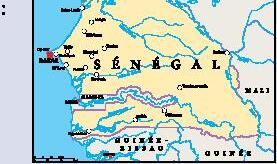
Dakar, au Sénégal
Le Sénégal est un pays situé sur la côte ouest du continent africain. Le français est la langue officielle, mais il y a aussi six autres langues nationales. Le Sénégal est entouré d’autres pays francophones et anglophones : le Mali, la Mauritanie, la Guinée et la Guinée-Bissau. Le climat est désertique dans le nord du pays et tropical dans le sud.
Rencontre interculturelle




Le Sénégal est connu pour le Rallye Dakar, une grande course de voitures, de motos et de camions. À l’origine, la course commençait à Paris, en France, et se terminait à Dakar, la capitale sénégalaise. De nos jours la course a lieu dans d’autres pays ou même sur d’autres continents. Le football, la lutte (wrestling) et la boxe sont d’autres sports très pratiqués au Sénégal.
Le Sénégal est connu pour sa littérature. L’un des personnages sénégalais les plus célèbres est Léopold Sédar Senghor (1906–2001). C’était le premier président du Sénégal. Il était aussi écrivain, poète, philosophe et professeur. Aujourd’hui la passerelle Léopold-Sédar-Senghor à Paris porte son nom. En littérature féminine, Mariama Bâ est l’une des premières écrivaines africaines à avoir revendiqué l’identité de la femme et les inégalités sociales. Son premier roman, Une si longue lettre, est connu dans le monde entier. D’autres auteurs importants sont Fatou Diome, Ken Bugul, Nafissatou Diallo Diouf et Mohamed Mbougar Sarr.
La musique sénégalaise a eu une influence internationale grâce à ses artistes comme Baaba Maal, Mansour Seck et MC Solaar.
Le plat traditionnel du Sénégal s’appelle le yassa. C’est un plat à base d’oignons frits et de riz avec de la viande marinée ou du poisson.
002-063_ECF_2e_L3_SE_U1.indd


L’ancien (former président du Sénégal, Léopold Sédar Senghor

1 Un tour au Sénégal b Vous avez envie de mieux connaître le pays de Lily. Avec un(e) partenaire, sélectionnez les quatre faits (facts) qui sont corrects d’après le texte et les images de la Rencontre interculturelle
1. Le Sénégal a plusieurs pays voisins où on parle français.
2. L’océan est loin du Sénégal, alors on n’y mange pas de poisson.
3. Le rallye Dakar est une course de cyclisme.
4. Au Sénégal, le climat est variable.
5. Senghor était un homme politique et un auteur célèbre.
6. L’autrice Mariama Bâ est surtout connue pour avoir écrit une œuvre littéraire importante. 7 Unité 1
002-063_ECF_2e_L3_SE_U1.indd 7 12/16/24 8:03 AM
Sénégal est un pays de l’Afrique de l’ouest.
Sénégal
L’île de Gorée, l’un des 19 arrondissements de Dakar (Sénégal)
Fatou Diome, écrivaine sénégalaise
Baaba Maal, chanteur et guitariste sénégalais
Rencontre interculturelle
aspects de la vie Lily moi nous deux originaire d’un autre pays spectateur/spectatrice d’événements sportifs écouter de la musique découvertes culturelles sorties (outings) à la plage matchs de tennis cours de yoga sorties au café
2.3 Discutez des résultats s Comparez vos résultats de 2.2 à l’oral avec ceux d’un(e) partenaire.
Mon progrès interculturel h
Investigate: I can identify what I have in common with a francophone teen.
3 Réflexion interculturelle o d p
Quels aspects de la vie au Sénégal vous intéressent ? Qu’est-ce que vous voulez apprendre de plus sur ce pays ? En quoi la vie à Dakar serait-elle (would it be) semblable à ou différente de la vie dans votre communauté ? Répondez aux questions dans le forum de discussion.
4 Lisez un texte et regardez une vidéo b v Répondez aux questions suivantes d’après les informations du texte de la Rencontre interculturelle et de la vidéo de Lily. Pour chaque question, choisissez la meilleure réponse.
1. Quel est l’objectif du texte ?
A. de présenter plusieurs pays francophones en Afrique centrale
B. d’expliquer comment voyager au Sénégal
C. de présenter une jeune Francophone et son pays natal
2. Qu’est-ce que le rallye Dakar ?
A. une spécialité culinaire
B. une compétition automobile
C. une école technique
3. Selon la vidéo de Lily, elle a fait ses études dans un lycée
A. éthiopien
B. anglais
Mon progrès interculturel
This unique self-assessment feature clarifies your intercultural goals and guides you throughout the unit.
You will provide evidence of growth in your online Portfolio.
Réflexion interculturelle



C. français Vlog
002-063_ECF_2e_L3_SE_U1.indd 9
Zoom culture
Learning about cultural products, practices, and perspectives will give you a foundation for intercultural reflections.
You will share your reflections online.
Interpretive:
After a variety of experiences with cultural products, practices, and perspectives, you will reflect on your growing intercultural awareness. You will share reflections in the online discussion forum.
Zoom culture Produit
27 Les fournitures scolaires
27.1 Connexions o c
Comment transportez-vous votre matériel scolaire ? Comment avezvous choisi votre cartable ou votre sac ? Qu’est-ce qui a influencé votre choix : la facilité, l’apparence ou le prix ? Ou bien d’autres facteurs comme le poids (weight) du matériel scolaire, la distance entre les classes, votre identité, vos activités avant et après l’école ?
Comme la plupart des élèves de par le monde, les élèves sénégalais mettent leurs fournitures scolaires dans un cartable. Le cartable, c’est une sorte de sac, généralement de forme rectangulaire, avec une poignée et parfois des bretelles ou une bandoulière s’il est porté sur le dos ou sur une épaule. Les premiers cartables sont apparus au 19e siècle et à l’époque, ils étaient faits maison à partir de toile, de cuir et même parfois de bois.
De nos jours, il existe une grande sélection de cartables de couleurs et de styles différents. Il y a des modes de modèles, de couleurs et de marques. Certains élèves, à cause du poids du matériel scolaire, optent pour un cartable à roulettes et d’autres préfèrent transporter leur matériel scolaire dans un sac à dos.
Quelles fournitures scolaires utilise-t-on au Sénégal ? Des trousses, bien entendu, pour ranger les stylos, les crayons de couleur, les gommes et les crayons à papier. Il y a aussi des classeurs (de deux à quatre anneaux) et des pochettes en plastique, des cahiers et des copies doubles de différents formats.


27.2 Perspectives o d Saviez-vous qu’au Sénégal, le papier a des dimensions différentes du papier aux États-Unis ? Au Sénégal, comme dans d’autres pays francophones, on utilise le format A4 qui a des dimensions différentes de celles du format US Letter. Comparez vos fournitures scolaires avec celles des jeunes Sénégalais.
28 Réflexion interculturelle o d p
À votre avis, est-ce que les élèves sénégalais prennent les mêmes décisions que vous pour choisir leurs fournitures scolaires ? Pourquoi ou pourquoi pas ?
Répondez aux questions dans le forum de discussion.
Mon progrès interculturel h
Investigate: I can identify how students transport school supplies in francophone cultures and how this reflects the culture.
Vocabulary in Context
Unité 1 | De l’enfance vers l’indépendance
Communiquons 3
Comment dit-on ?
A. Je deviens indépendant(e) a
Comment rendre votre ado indépendant(e) en cinq étapes
Quand un(e) enfant devient adolescent(e), cet enfant se découvre et essaye de faire partie du monde des adultes. Devenir indépendant(e) est un moment-clé. C’est un passage dont il faut parler avec l’ado pour s’assurer qu’il ou elle soit bien prêt(e) pour cette nouvelle étape.



Voici cinq étapes pour faciliter la transition vers l’adolescence.
1. Laissez-le/la organiser son travail scolaire. Un(e) ado a besoin d’avoir plus de liberté et de pouvoir prendre des choses en main comme son travail scolaire ou même ses petits problèmes.
2. Donnez-lui de l’argent de poche et permettez-lui de gérer un petit budget et même un compte en banque.
3. Encouragez-le/la à devenir de plus en plus autonome et confiant(e) et n’oubliez pas de promouvoir une bonne estime de soi. Aidez-votre adolescent(e) à avoir confiance en lui ou en elle.
4. Pouvoir retrouver ses ami(e)s et sortir avec eux/elles est très important pour un(e) ado donnez-lui donc plus de liberté. Un(e) adolescent(e) peut très bien gérer son travail scolaire et certains aspects de sa vie.
5. Il est aussi important que les parents aident les ados à reconnaître leurs erreurs et à se valoriser L’humour aide beaucoup dans de telles situations. Les ados veulent se sentir écoutés


Grâce à ces cinq étapes, l’ado deviendra plus autonome, plus valorisé(e) et plus confiant(e).
002-063_ECF_2e_L3_SE_U1.indd 44
Expressions utiles
À mon avis...
Comment dit-on ?
You will learn essential vocabulary presented visually in manageable amounts and authentic contexts.
C’est pareil/différent pour moi.
Je suis d’accord.
Le plus/moins important pour moi, c’est...
Qu’en penses-tu ?
Tu as raison/tort.
12/16/24 8:03 AM
10 La religion en France
Expressions utiles
These useful expressions can boost communication skills, often with phrases that work across themes.
Communiquons 1
In my opinion ...
It’s the same/different for me. I agree.
The most/least important for me is ...
What do you think? You are right/wrong.
Pour mieux comprendre d’autres cultures, vous lisez cette infographie.
Authentique
Rapports personnels des Français à la religion
Les chiffres présentés ci-dessous s’appuient sur un sondage commandé par l’Observatoire de la laïcité à l’Institut
Viavoice et publié en février 2019 afin de faire un état des lieux de la laïcité en France.
Rapport à la religion
À titre personnel, diriez-vous que dans votre rapport à la religion en règle générale, vous vous sentez plutôt… ?
Pratique religieuse
À quelle fréquence avez-vous des pratiques religieuses, qu’elles soient individuelles ou collectives (prières, offices ou rites, fêtes religieuses) ?
37 % DE CROYANTS 14 % ont des pratiques religieuses au moins une fois par mois
31 % DE NON-CROYANTS OU D’ATHÉES
Personnellement, comment estimez-vous l’intensité de votre pratique ?
15 % D’AGNOSTIQUES (agnostique + sceptique quant à l’existence d’un Dieu) + 15 % « très importante »
10 % D’INDIFFÉRENTS – 30 % « peu importante »
47 % « inexistante ou nulle » © etalab.gouv.fr
10.1 Lisez les données et répondez aux questions r b o
Lisez les données, puis répondez aux questions.
1. Quel pourcentage des Français se déclarent religieux ?
2. Quel pourcentage des Français participent régulièrement à des activités religieuses ?
For every vocabulary section, there are online Workbook activities that provide extra practice if needed or desired. You do not need to complete all of these activities to be successful on J’avance or J’y arrive assessments.
12.2 Discutez avec des partenaires s
a. Comparez vos résultats de 12.1 avec ceux d’un(e) partenaire. Parlez aussi des avantages que Sylvette n’a pas mentionnés.
b. Classez tous les avantages par ordre d’importance dans la colonne de droite.
Mon progrès communicatif h
Interpersonal: I can exchange information about some advantages and disadvantages of technology.
12.3 Présentez votre classement m
C

Enregistrez des phrases qui justifient votre classement des avantages de la technologie.
MODÈLE Je suis d’accord avec Sylvette qu’on peut s’informer en ligne. Mais pour moi, l’usage d’internet le plus important est... parce que...
Stratégies v
La communication interculturelle
Qu’est-qu’il faut faire pendant une conversation ?
1. Observez le langage corporel.
2. Soyez tolérant.
3. Préparez-vous à parler.
4. Prenez des risques.
Détail linguistique
D
Stratégies
These brief learning strategies will be available throughout the units.
All Learning Strategies videos from all four levels are available on Learning Site®.


Quel mot utiliser ?
Courriel est un mot québécois composé de courrier et électronique
Cependant, les mots suivants sont aussi utilisés : email, e-mail, e-mail, mail, mél et mèl
C’est à vous de choisir
064-127_ECF_2e_L3_SE_U2.indd
Synthèse : Vocabulaire
To help you review, these lists summarize the vocabulary studied in the unit.
You will find more practice in context on Learning Site®.
Détail linguistique
You will explore curious and useful details of the language.
Synthèse : Vocabulaire
Communiquons 1
L’amitié
Friendship amical(e) l’amitié (f.) attentionné(e) digne de confiance drôle ensemble fier/fière orgueilleux/orgueilleuse ouvert(e) d’esprit le pote le rapport s’entendre (avec)
Les activités entre amis
Activities with Friends avoir des intérêts en commun compter sur quelqu’un faire partie de/d’ parler derrière le dos de quelqu’un rigoler s’amuser s’aimer (bien)
Communiquons 2
Quand j’étais petit(e) When I Was Young à l’extérieur avoir hâte (de/d’) avoir la trouille la colonie de vacances (la colo) les dessins animés l’émission de télé la fois (où) gagner une fois
friendly friendship thoughtful, considerate trustworthy funny, comical together proud pretentious, arrogant open-minded buddy relationship, connection to get along (with)
to have common interests to count on someone to be a part of something, belong to something to gossip about someone to laugh, have fun to have fun to love each other (like each other)
outside, outdoors to be excited (to), look forward (to) to be afraid summer camp cartoons
TV show the time (when) to win, earn once
Unité 1 | De l’enfance vers l’indépendance
Grammar in Context
Découvrons
Exprimer ce qu’il est nécessaire de faire a Le subjonctif avec les expressions d’obligation
Des élections municipales approchent. Comme vous vous intéressez à l’écoresponsabilité, vous lisez des commentaires d’un compte sur un réseau social qui résument les points de vue de plusieurs candidats à ce sujet.

Je suis candidate parce je me sens responsable de l’avenir. Il faut que je fasse quelque chose pour notre communauté et il faut que nous fassions quelque chose pour la planète. C’est notre devoir !
Il est nécessaire que nous soyons conscients de nos actions. Il faut que je parle de l’écoresponsabilité. Il faut que chaque personne soit responsable.
Il faut que nous parlions plus de nos comportements quotidiens en ce qui concerne la technologie. Il est nécessaire que vous en parliez à vos amis et qu’ils limitent que nous limitions tous notre consommation énergétique. Mes chers concitoyens, c’est le moment de partir : il faut que je m’en aille. N’oubliez pas, il est nécessaire que vous alliez aux urnes et que vous votiez vert !
15 Découvertes b v d
Réfléchissez à ce que vous observez et répondez aux questions.
1. Lisez les commentaires des candidats et regardez les mots en caractères gras.
2. Quelles sont les expressions que vous connaissez déjà ?
Expressions utiles Il faut que je file Il faut que je m’en aille. I have to go! I have to leave.
Détail grammatical Pour exprimer la nécessité Pour les verbes en -er notez qu’il y a plusieurs formes du subjonctif qui ressemblent aux formes du présent.
16 Ce qu’il faut qu’on fasse
Après avoir lu les messages des candidats aux élections municipales, votre ami et vous réfléchissez à vos propres comportements. Qu’est-ce qu’il faut que vous fassiez pour vous améliorer en tant qu'écocitoyen(ne) ?
16.1 Relevez les actions responsables b Lisez le texto de votre ami(e) et notez les actions responsables qu’il suggère.


Impressionnant Il est nécessaire


il est nécessaire que les profs impriment moins de documents ! Je le leur dirai lundi. Qu’est-ce qu’il faut que tu fasses ?
MODÈLE changer certaines choses


3. Quelles sont les différences entre les expressions que vous connaissez déjà et celles que vous voyez ici ?
4. Partagez vos observations avec un(e) partenaire. Que remarquez-vous d’autre dans ces citations, et que pouvez-vous ajouter aux observations de votre partenaire ?
Découvrons
Examples of new structures in context encourage you to become a “grammar detective.”
16.2 Répondez au message e Et vous, qu’est-ce que vous comptez faire comme actions responsables ? Répondez au message de votre ami(e).
MODÈLE Il est nécessaire que je… Il faut que je...
Mon progrès communicatif h Interpersonal: can answer questions to provide details about a plan of action for protecting the environment.
You will find helpful videos called Découvrons and Structure en avant online.
Timely grammar details will help you communicate. B
Détail grammatical
C
Synthèse : Grammaire
To help you review, this summary contains helpful explanations of grammatical structures to help you review.
You will find more practice in context online.
For every grammar section, there are online Workbook activities that provide extra practice if needed or desired.
Unité 2 | La citoyenneté numérique
Synthèse : Grammaire
1. Éviter la répétition avec me, te, nous, vous, lui et leur
Direct and Indirect Object Pronouns
In order to avoid repeating oneself when communicating orally or in writing, it
is sometimes preferable to replace some parts of a sentence.
Direct objects:
— Tu me vois sur le forum ?
— Oui, je te vois sur le forum.
— Non, je ne te vois pas sur le forum
— Nous vous parlons en classe ?
— Oui, vous nous parlez en classe.
— Non, vous ne nous parlez pas en classe.
Indirect objects:
— Je te rends visite samedi ?
— Oui, tu me rends visite samedi.
— Vous écrivez à vos ami(e)s ?
— Oui, nous leur écrivons.
— Non, nous ne leur écrivons pas.
— Non, tu ne me rends pas visite samedi.
— Tu rends visite à ton ami(e) ?
— Oui, je lui rends visite.
— Non, je ne lui rends pas visite.
2. Décrire les actions hypothétiques
The Conditional
If you want to say what you would do in a situation or in someone’s place, use le conditionnel
To form it, add the following endings to the infinitive of the verb. When using an -re verb, drop the final -e before adding these endings: -ais -ions -ais -iez -ait -aient
Some common verbs don’t use the infinitive to form the conditional. For these verbs, use the forms below and then add the endings. aller : ir- envoyer enverr- pouvoir : pourr- venir : viendravoir : aur- être ser- recevoir : recevr- voir : verrdevoir : devr- faire fer- savoir : saur- vouloir : voudr-
Formative Assessments
J’avance
Formative assessments will help you measure your progress towards unit goals.
Find supporting materials on Learning Site® .
Mon progrès communicatif
You will provide evidence of growing proficiency in your online Portfolio, which contains all Can-Do statements included throughout the unit.
Communiquons 3
J’avance
45 De nouvelles applications de technologie Clément suggests an idea for an app, and he would like your opinion.
45.1 Écoutez et notez les points importants a
Listen to Clément’s idea and select the correct completion(s) for each sentence.
Mon progrès communicatif h
Interpretive: I can understand when people explain an app they would create.
45.2 Écrivez une réponse e

Fill out the form to tell Clément your reaction and your comments regarding his idea. Explain how you and others would use his app.
Mon progrès communicatif h
Interpersonal: I can respond to posts about how I would use a new app.
45.3 Préparez un argument de vente m Clément's idea has inspired you to create your own website or app. Prepare a sales pitch between 30 and 60 seconds long for your new website or app.
Mon progrès communicatif h
Presentational: I can explain how an app would be useful as a tool to pursue interests.



Global Community
Notre communauté mondiale
Investigate the local or global community and interact with French speakers in your community or internationally.
Unité 2 | La citoyenneté numérique
Notre communauté mondiale
46 Explorons les applis populaires
Vous allez explorer comment les étudiants dans votre communauté et les étudiants en Martinique utilisent les applis disponibles gratuitement afin de communiquer et de rester en contact avec les membres de leur famille ou les ami(e)s qui sont éloigné(e)s géographiquement.
46.1 Faites des recherches b c

a. Faites un remue-méninges. Quelles sont les applis que vous utilisez le plus souvent afin de communiquer ? Prenez des notes.
b. Ensuite, commencez votre recherche en utilisant certains mots-clés (par exemple : applis, applications, gratuit, réseaux sociaux, rester en contact). N’oubliez pas les guillemets !
c. Classez les sites et les infos que vous trouvez selon leur valeur.
Pendant votre recherche, répondez aux questions suivantes.
• Quelles sont les applis utilisées le plus souvent par les étudiant(e)s de votre âge ?
• Les étudiant(e)s martiniquais(e)s utilisent-ils/elles les mêmes applis que les étudiant(e)s de votre école ?
• De quoi les étudiants aux États-Unis aiment-ils parler via les réseaux sociaux avec les membres de leur famille ? Et avec leurs ami(e)s ?
• De quoi les étudiants en Martinique aiment-ils parler via les réseaux sociaux avec les membres de leur famille ? Et avec leurs ami(e)s ?
• Quel(s) élément(s) faut-il prendre en considération quand on veut communiquer en direct avec quelqu’un qui est éloigné géographiquement ?
Quels autres détails relatifs au sujets vous ont paru intéressants ou surprenants ?
Mon progrès interculturel h
Investigate: I can investigate how francophone students use applications that allow them to communicate and stay in touch with family members or friends who live abroad.
46.2 Faites des comparaisons w d
Identifiez les similarités et les différences entre votre expérience personnelle en ce qui concerne l’utilisation d’applis pour rester en contact et l’expérience typique d’un(e) étudiant(e) martiniquais(e). Utilisez un diagramme de Venn.
46.3 Échangez vos idées s
En petits groupes, discutez du résultat de votre/vos recherche(s) au sujet de l’utilisation des applis pour rester en contact aux États-Unis et en Martinique. Qu’avezvous appris ? Qu’est-ce qui est surprenant ?
064-127_ECF_2e_L3_SE_U2.indd 120 12/16/24 8:13 AM
47 Un sondage à partager
Vous aimeriez identifier les applis préférées des étudiant(e)s de votre âge.
47.1 Créez un sondage w Créez un sondage qui va vous permettre de découvrir la liste d’applications utilisées le plus souvent ou préférées. Ne vous limitez pas simplement à établir une liste selon la fréquence ou la popularité. Vous pouvez aussi demander aux participant(e)s d’expliquer pourquoi ou quand ils/elles utilisent telle ou telle application.
47.2 Présentez les résultats e w Contactez un établissement scolaire secondaire ou universitaire martiniquais. Demandez aux étudiant(e)s de répondre à votre enquête. Si vous avez besoin d’aide pour identifier un établissement scolaire en Martinique, demandez de l’aide à votre prof. Lorsque vous aurez reçu les résultats de l’enquête, écrivez une synthèse et partagez-la avec les élèves de votre classe.
Mon progrès interculturel h
Interact: I can create a survey for francophone peers and interpret the results.
peers
48 Réflexion interculturelle p Réfléchissez aux résultats de votre recherche et de votre enquête. Dites comment vos sentiments ou opinions sur les applications de messagerie instantanée ont évolué. Que pensez-vous de ces applis qui permettent de communiquer et de rester en contact avec les membres de sa famille ou avec ses ami(e)s ?
aux de votre Dites pensez-vous de de communiquer

Summative Assessment
J’y arrive
A summative assessment set in an authentic intercultural context will assess your progress.
Find supporting materials on Learning Site® .
J’y arrive
Questions essentielles
What is art to me?
What is the relationship between art and culture?
• How can art convey ideas, opinions, and emotions?
Une rencontre artistique
You have decided to help organize your community’s Spring Arts Festival. First, you participate in a meeting in which you meet one of the festival’s featured artists virtually. A few days after the meeting, you decide to share your ideas with one of the organizers.
Before you begin, refer to the J’y arrive rubric to familiarize yourself with the evaluation criteria.
Interpretive Assessment Elle s’exprime v
Watch a video in which the featured artist talks about organizing an art exhibition.




Teacher’s Edition
Scaffold
A variety of scaffolding notes allow for support when needed. A
B
Challenge
A variety of notes allowing learners to perform at their highest level.
C
Culture
Information about cultural topics allows for further connections to and discussions about products, practices, or perspectives of a community, region, or country.
votre décision d’acheter le produit ? Expliquez. L’art joue un rôle important dans notre vie quotidienne. Les produits qu’on consomme et qu’on utilise sont conçus par des designers, qui doivent choisir la forme et les couleurs du produit. La chaise sur laquelle vous êtes assis(e) a été dessinée par un(e) artiste. Charlotte Perriand (1903–1999) était une grande architecte d’intérieur française. Ses meubles (y compris ses chaises et ses fauteuils) ont été exposés dans beaucoup de musées, notamment dans le musée des Arts décoratifs à Paris et dans la Fondation Louis Vuitton à Paris. Avec ses designs, elle s’est concentrée sur les besoins des gens dans leur vie quotidienne. Elle a travaillé souvent avec Le Corbusier (1885–1965), un architecte franco-suisse qui a révolutionné le domaine de l’architecture avec ses idées modernes et parfois radicales. L’architecte burkinabé Francis Kéré (né en 1965) continue la tradition de planifier les espaces pour le bien-être des gens. Au Burkina Faso, il a conçu les bâtiments de plusieurs écoles. Il utilise les sciences et l’architecture pour réduire le réchauffement de la structure pour que les élèves puissent apprendre mieux dans un espace plus confortable sans climatisation. 11.2 Perspectives o Qu’est-ce qui est plus important, la forme ou la fonction ?




Rencontre interculturelle

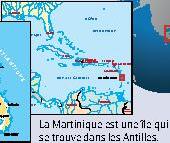



éruptions volcaniques. Le mont Pelé est un volcan qui est encore actif. L’île de la Martinique est surnommée « l’île aux fleurs ». L’île est connue pour les couleurs de sa faune et


Aujourd’hui nous nous sommes arrêtés à une exposition d’artistes locaux dans la petite ville de Luang Probang, au nord du Laos, et j’ai rencontré des artistes divers peintres, sculpteurs, artisans. Ces artistes locaux contemporains jonglent entre tradition et modernité. Certains exposent régulièrement leurs arts dans des galeries, d’autres vendent leurs œuvres dans les marchés ou en ligne.
Cette artiste locale s’appelle Ai Nom Phomlou. Elle crée des peintures qui représentent la scène de tous les jours paysages, éléments naturels, relations humaines. Quand on l’interroge sur les techniques et influences de son art, elle répond que sa thématique s'inspire de l’art du dix-neuvième siècle les paysages impressionnistes et l’architecture linéaire et graphique de l'expressionnisme. Une autre passion d’Ai est la bijouterie. En effet, l’artiste confectionne
1. Comment pourrait-on décrire la profession d’Ai Nom Phomlou ? A. Elle est artiste.
B. Elle est professeur.
Connections
C. Elle est peintre.
D. Toutes les réponses sont correctes.
2. Qu’est-ce qui influence la peinture d’Ai Nom Phomlou ?
A. les paysages du Laos
B. les mouvements artistiques du dix-neuvième siècle
C. les arts traditionnels laotiens
D. les relations humaines contemporaines
3. Quel autre moyen artistique Ai Nom Phomlou utilise-t-elle pour exprimer sa créativité ?
A. la photographie
B. la musique
C. la poésie
D. la création de bijoux
4. Quel est le message principal que cherche à exprimer Ai Nom Phomlou à travers son art ?
A. un appel à l’engagement politique et social
B. la préservation des traditions culturelles laotiennes
C. la beauté artistique dans la vie quotidienne
D. l’expression de ses émotions personnelles

Resources
Find audio, video, and any other resources indicated here.
Answers
Discrete and suggested answers are provided wherever possible.

Strategies
1. Cette personne dit que Julie est très compréhensive.
2. Cette personne dit qu’il doit prendre une décision importante.
3. Cette personne dit qu’il faut identifier ce qui est important.
4. Cette personne propose une solution qui résout les deux problèmes d’Alex.
5. Cette personne suggère de considérer le pour et le contre de chaque option.
6. Cette personne encourage Alex à faire son propre choix. Mon progrès communicatif h Interpretive: I can understand advice about making positive decisions.
31.2 Demandez et répondez s Pendant la réunion, vous discutez des opinions et suggestions des membres de la Société honoraire. À tour de rôle, posez des questions et répondez aux questions qu’on vous pose.
MODÈLE Moi, je crois qu’il est vraiment important que nous laissions la parole à nos amis. Qu’est-ce que vous en pensez ? Mon progrès communicatif h Interpersonal: can share my ideas and comment on the ideas of others.
42
42.1
Mon progrès communicatif h
Interpretive: can understand advice about making positive decisions.

42.2 Échangez vos idées s You are part of a social network group with other students who, like you, would like to be part of the French Honor Society. You discuss what is important and necessary to do as a member of the French Honor Society.
Mon progrès communicatif h
Interpersonal: can share my ideas and comment on the ideas of others.
42.3 Laissez un message vocal m
You
ACTFL Standards
Mon progrès communicatif h
Presentational: can present some personal objectives for participating in an activity.
ACTFL Standards are indicated for each activity.
Can-Do Statements
Activities with x support and share a Can-do statement that appears with the J’avance formative assessment for that section.

Differentiate
Suggestions to adapt activities allowing to differentiate learning for students with various learning types.
Our Digital Learning Experience
Elevate Teaching and Learning with the NEW Learning Site®
Your All-in-One Digital Teaching Companion Learning Site empowers educators with streamlined tools for classroom management, student engagement, and measurable outcomes—all from one unified platform.
Engaging and Varied Learning Tools
• Select from diverse activities, media, assessments, games, and interpersonal speaking practice with Nualang.
• Provide students with dynamic learning paths tailored to their language goals and proficiency levels.
Simplified Classroom Management
• Find, present, assign, and grade—all in one place, eliminating the need for multiple tabs and tools.
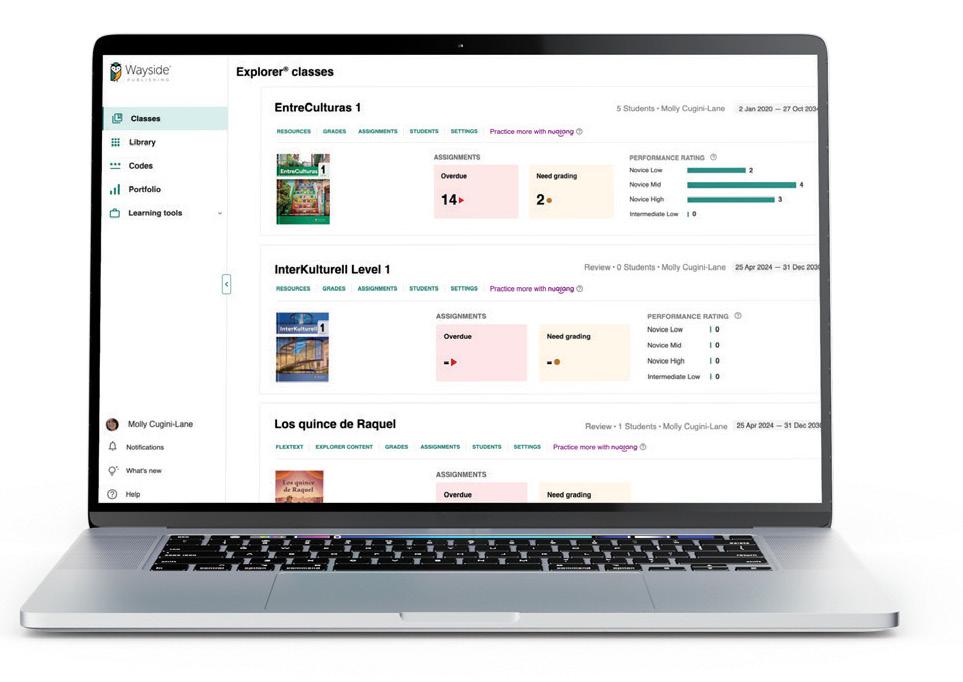
• Generate actionable reports for courses, schools, or districts to track engagement and progress.
Seamless Integration for Effortless Collaboration
• Fully compatible with LMS and SIS systems using standards like LTI 1.3, OneRoster, and QTI.
• Easily exchange rosters, assignments, and grades to streamline workflows across your institution.
Safe, Accessible, and Reliable
• TrustED App certified to meet the highest standards of security, ensuring all students can access resources in a safe environment.
What’s New on Learning Site?
• NEW Enhanced eBook Features: Enjoy mobile support, highlighting, notetaking, search functionality, and more.
• NEW Administrative Reporting: Gain insights into student activity and user actions with detailed reports.
• NEW Embedded Portfolio: Help students track their progress towards Can-Do Statements and personal goals.
• NEW LMS/SIS Integrations: Benefit from streamlined rostering, grade exchange, and SSO compatibility.
• NEW Accessibility and Security: Certified for safety and equity, ensuring equal opportunities for learning.
Unlock Language Confidence with
Nualang™
Nualang transforms language learning by breaking down barriers and making practice engaging, effective, and fun. Its immersive, judgment-free platform inspires confidence and accelerates progress for students and teachers alike.
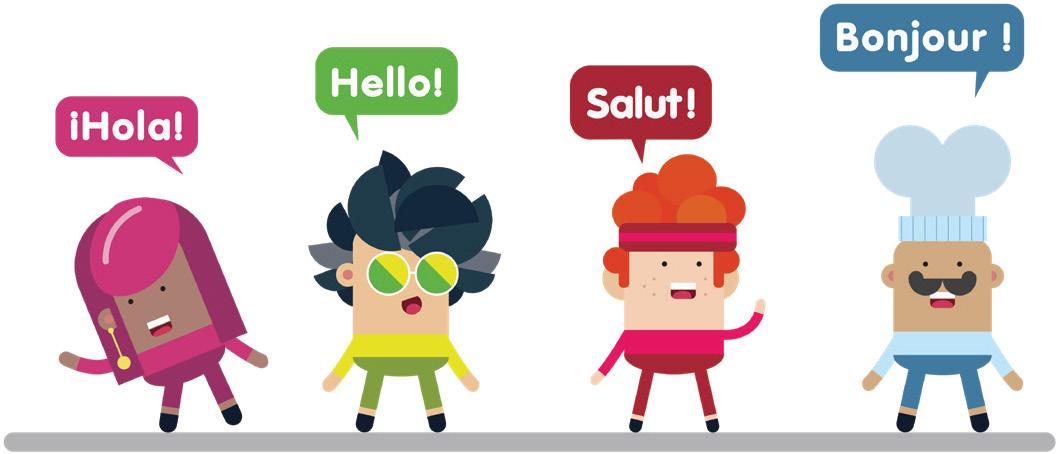
For Teachers: Empower Your Classroom
• Simplify Lesson Planning: Save time with ready-made lessons and role-plays, or create personalized content tailored to your class’s goals.
• Track Progress Easily: Gain insights into student growth and provide targeted feedback with interactive tools and recorded sessions.
• Build Speaking Confidence: Give students frequent opportunities to practice speaking in a low-pressure, high-impact environment.
For Students: Build Confidence in Every Conversation
• Judgment-Free Practice: Interactive tools like role-plays and real-time feedback help students improve without fear of making mistakes.
• Motivating and Fun: Features like Nualang LIVE let students compete in games, earn medals, and boost fluency.
• Personalized Learning: Adjustable accents, voice speeds, and chat companions make every session adaptable to the learner’s pace.
A Game-Changer for Language Mastery
Nualang makes speaking a new language natural and exciting. Whether students practice with peers, solo, or in real-world scenarios, Nualang equips them with the skills they need to succeed.
Inspire confidence. Spark engagement. Achieve results with Nualang.


Using Readers to Support Language Acquisition
Using Readers to Support Language Acquisition
This edition of EntreCultures includes a companion reader, Marie-Antoinette et le collier de la mort, an entertaining work of fiction based on events in French history. The story is written to be comprehensible to students in a Level 3 French course. In the printed program, you will find the reader as the final section, following the appendices. On Learning Site®, the reader appears as an additional component, complete with an audio recording, a glossary, activities and assessment tools, and a Teacher’s Guide.
Reading has been shown to have a strong impact on both vocabulary development and the acquisition of language structures. Just as leveled readers help young learners to develop reading skills in their first language, these companion readers help French learners by providing targeted input of the vocabulary and structures they need to progress toward reading authentic literature. Students benefit from stories that are both comprehensible and compelling to them. You can provide additional support by doing the following:

• Pre-teach any needed vocabulary so that comprehension level is very high while students are reading, especially if they will be reading at home.
• Do pre- and post-reading activities to get students to interact at a deeper level with the content they are learning about in the story.
Readers as Part of Your Curriculum
Here are some suggestions for incorporating readers to enhance student progress toward proficiency. The Teacher’s Guide on Learning Site® contains additional ideas.
• Plan to include the reader in the second half of the year. Marie-Antoinette et le collier de la mort reflects content from the entirety of EntreCultures 3, so the students will comprehend more after they have encountered more of the vocabulary and structures.
• Set aside time daily/weekly over a set period. Read a little bit each day or on a set day each week until the reader is completed. To keep students’ interest level high, read regularly and avoid long gaps between reading sessions.
• Replace other homework with daily reading. Assign the chapters to be read independently outside of class. Preview the chapter when it is assigned and follow up with comprehension tasks after reading.
Components and Key Features
Program Components and Key Features
EntreCultures® Second Edition components are available digitally on Learning Site® unless noted as also available in print format.
For the Teacher
• Teacher Edition. Available in Print and Digital formats.
• Assessment Program. Includes a suite of assessments and rubrics to customize to each student’s need, from proficiency-based Formative and Summative Assessments to Alternative Objective Tests in an autograded delivery format.
• Letters to Guardians. Highlights the key information for each unit of study for parents and guardians.
• Lesson Plan Builder. Pulls directly from the textbook to create engaging, tailored lessons that can be exported to multiple formats, including slides—saving teachers time and boosting student engagement.
• Personalized Assignments and Assignment Controls. Empower teachers to adapt tasks to each student’s needs, enhancing engagement and learning outcomes.
• Learning Pathways. Aligned with Can-Do statements and assessments, our pathways guide teachers to essential activities for building proficiency, providing clear guidance for new teachers and flexibility for experienced educators.
• Instructional Strategies Toolkit. Ready-to-use, research-based activities organized by communication mode, skill, and proficiency level—keeping students engaged and helping every learner thrive in the target language.
• Administrative Reporting. Provides powerful insights on student activity and user actions, making it easy for administrators to manage and safeguard the platform effectively.
• Performance Towards Proficiency Growth. Gives insights into student growth towards proficiency.
• Standards. At point of use, standards ensure our content aligns with educational benchmarks, empowering teachers to meet key learning goals with confidence.
• Personalized settings. Allow teachers to customize timed tasks, transcripts, and captions, giving them flexible tools to meet the unique needs of their students and classroom.
• Professional Learning. Brings unmatched expertise and personalized training to support successful program implementation, empowering teachers with tailored, research-backed strategies to elevate language instruction and foster meaningful student engagement.
For the Student
• Student Edition. Available in Print and Digital formats.
• Workbook Grammar and Vocabulary Activities. Additional activities to practice vocabulary and grammar from each unit. Available in Print and Digital formats.
• Spanish for Life and Career Success. Students engage with practical, real-world language skills that connect directly to future careers
• eBook. A page-by-page representation of the Student Edition with highlight and note-taking functionality.
• Nualang Activities with Heritage Path. Students engage in conversation and receive personalized feedback from our chatty little helpers, the Nualas.
• Flashcards. Practice key vocabulary from the unit. Available in Print and Digital formats.
• Companion Reader. Each level of the program includes a comprehensible Spanish reader.
• Portfolio. Students document the growth of language learning.
Unité 1 : Ma vie et moi
Rencontre interculturelle : Dakar, au Sénégal 6
Vous savez déjà 10
Communiquons 1
Comment dit-on ? : A. L’amitié 14
Zoom culture : Parler de ses amis en français 16
Comment dit-on ? : B. Les activités entre ami(e)s 21
Découvrons : Décrire les actions réciproques v 23
J’avance : Fêtons l’amitié ! 27
Communiquons 2
Comment dit-on ? : Quand j’étais petit(e)
culture : Les fournitures scolaires
Découvrons : Décrire les actions du passé v
J’avance : C’était comment, la rentrée ?
Communiquons 3
Comment dit-on ? : A. Je deviens indépendant(e)
: Obtenir son permis de conduire
Questions essentielles
• How is friendship experienced in my community and in francophone cultures?
• Which experiences and events shape childhood?
• How do life events and relationships as an adolescent influence whom I am becoming?
Unité 2 : Citoyenneté numérique
Rencontre interculturelle : Le François, en Martinique 66
Vous savez déjà 71
Communiquons 1
Comment dit-on ? : A. Les avantages des technologies numériques 74
Zoom culture : Accès aux portables à l’école 78
Comment dit-on ? : B. Les inconvénients des technologies numériques 82
Découvrons : Éviter la répétition avec me, te, nous, vous, lui et leur 87
J’avance : Mon premier portable 90
Communiquons 2
Comment dit-on ? : A. Nos droits
culture : Les devises et les droits
Comment dit-on ? : B. Nos responsabilités
Découvrons : Décrire les actions hypothétiques v 102
J’avance : Citoyenneté numérique : ce que je devrais faire
Communiquons 3
Comment dit-on ? : A: La recherche de nouveaux intérêts
culture : « Parlez-vous technologie ? »
Comment dit-on ? : B. Bien se servir des outils numériques
Découvrons : Présenter une hypothèse: Et si…?
: De nouvelles applications de technologie
SUMMATIVE ASSESSMENT
Questions essentielles
• What effects do digital media have on my life and the lives of those in francophone cultures?
• What are my rights and responsibilities as a digital citizen?
• How can technology help me pursue my interests?
Unité 3 : Je me prends en charge
Rencontre interculturelle : Hombourg, en Belgique 130
Vous savez déjà 135
Communiquons 1
Comment dit-on ? : A. Je me prépare mentalement
Comment dit-on ? : B. Je prends mon avenir en main ! 144
Zoom culture : Le travail de l’étudiant 148
Découvrons : Relier des idées avec les pronoms relatifs ce qui et ce que 149
J’avance : Du rêve à la réalité 154
Communiquons 2
Comment dit-on ? : J’essaye d’équilibrer ma vie
Zoom culture : « Métro, boulot, dodo » 159
Découvrons : Exprimer ce qui arrivera peut-être v 162
J’avance : Je concilie mes études et mon travail 165
Communiquons 3
Comment dit-on ? : J’identifie mes compétences sociales
Découvrons : Exprimer ce qui arrivera dans certaines situations v 170
Zoom culture : Faire la grève
J’avance : Je m’engage à réussir
J’y arrive : Penser à l’avenir
Questions essentielles
• What do young people need to consider when planning for their future?
• How do young people balance their time between what they need to do and want to do in francophone cultures and in my community?
• What impact will my generation have on society?
Unité 4 : Génération responsable
Rencontre interculturelle : Saint-Hyacinthe, au Québec 190
Vous savez déjà 194
Communiquons 1
Comment dit-on ? : Qu’est-ce que l’écocitoyenneté ? 198
Zoom culture : Le recyclage au Canada 202
Découvrons : Exprimer ce qu’il est nécessaire de faire 205
J’avance : À vos marques ! 209
Communiquons 2
Comment dit-on ? : A. Prendre conscience de son impact individuel 210
Comment dit-on ? : B. À nous d’agir maintenant ! 215 Zoom culture : Sauvegarder l’environnement 218
Découvrons : Donner des directives v 220
J’avance : Le jour de la Terre 227
Communiquons 3
Comment dit-on ? : Être responsable dans le monde 228 Zoom culture : Les énergies renouvelables au Québec 235
Découvrons : Exprimer ce que nous savons, ce que et qui nous connaissons v 237
J’avance : Nous agissons pour le bien de tous
SUMMATIVE ASSESSMENT
J’y arrive : Un projet mondial pour le bien-être de tous
Questions essentielles
• What is my role as an eco-friendly citizen?
• Why does sustainability matter and how do my actions impact the future?
• How are the beliefs of community members reflected in their actions regarding the environment in francophone communities and my own?
Unité 5 : La quête de soi
Rencontre interculturelle : Nantes, capitale des Pays de la Loire, en France
Vous savez déjà
Communiquons 1
Comment dit-on ? : Qui suis-je ?
Zoom culture : Les prénoms, un aspect de notre identité
Découvrons : Exprimer des généralités (1re partie) v
J’avance : Les correspondants de notre école jumelée
Communiquons 2
Comment dit-on ? : Je partage mes expériences
Zoom culture : Les choix d’expression personnelle
Découvrons : Exprimer des généralités (2e partie) v
J’avance : Bienvenue dans notre école
Communiquons 3
Comment dit-on ? : Je prends de bonnes décisions
Zoom culture : Le français, une langue genrée
Découvrons : Exprimer la possession v
: Exprimons nos convictions personnelles
Notre communauté mondiale
J’y arrive : La société
SUMMATIVE ASSESSMENT
Questions essentielles
• What makes me unique?
• How do people express their individuality in my community and in francophone communities?
• How do the choices we make define who we are?
Unité 6 : L’art et la vie
Rencontre interculturelle : Vientiane, au Laos
Vous savez déjà
Communiquons 1
Comment dit-on ? : Qu’est-ce que l’art ?
Zoom culture : L’art du quotidien
Découvrons : Exprimer et mettre en doute des opinions et des croyances 328
J’avance : L’art de la rue : Qu’en penses-tu ?
Communiquons 2
Comment dit-on ? : L’importance de l’art dans ma vie
Zoom culture : Les bandes dessinées
Découvrons : Exprimer des désirs et des émotions v 340 J’avance : Se battre pour les arts
Communiquons 3
Comment dit-on ? : A. C’est de l’art ou pas ?
Comment dit-on ? : B. Les liens culturels entre le Laos et la France
Découvrons : Éviter la répétition avec me, te, nous, vous, le, la, les, lui, et leur
: Les crêpes autour du monde
: Une exposition virtuelle
SUMMATIVE ASSESSMENT
Questions essentielles
• What is art? How do we define it?
• What is the value of art?
• How is art expressed in my community and in francophone cultures?

Appendice A – Can-Do Statements ...................................................................................... A2
Appendice B – Rubrics ........................................................................................................... A8
Appendice C – AP® and IB Correlation Guides ................................................................. A22
Appendice D – Grammar and Learning Strategies Index A25
Glossary of Classroom and Activity Instructions G1
Glossary French–French G3
Glossary English–French G10
Credits C1








Acknowledgments
We extend our sincere gratitude and appreciation to all who accompanied us on our journey from the conception to the completion of this edition of the EntreCultures® program. We had the privilege to work with a talented and hard-working professional team that served as our anchor during the entire creative process.
We would like to thank Wayside Publishing®’s Content team Eliz Tchakarian, Helen Small, Nathalie Gaillot, Henry Menninger, and Vanessa Ta, who coached us through every step of the journey and pulled all the pieces together in order to create this program. We extend our gratitude to the outstanding contributing editors and authors who partnered with us on this project. EntreCultures® would not have been as truly authentic nor as engaging without the generous contribution of our international video vloggers, incredible young people from across the francophone world who shared their lives with our readers to help make a true connection to the French language and French-speaking cultures. Thanks so much to Ariane, Clément, Charles, Lily, Maggie, and Nickar for being the faces of EntreCultures® 3.
We thank the talented and artistic Production team and graphic designers, Derrick Alderman and Rivka Levin at Bookwonders, Ryan Hamner, Sawyer McCarron-Rutledge, Tawny Dougherty, and cover designer Jaana Bykonich at Wayside Publishing ® for their beautiful graphics and design.
We extend a special thank you to the Wayside Publishing Technology & Operations team and the Sales, Adoptions, Marketing, and Professional Learning team for their support during this journey. We are so grateful for the wisdom, vision, and support of everyone at Wayside Publishing who contributed to the creation of this wonderful program.
Elizabeth Zwanziger Sara Deveaux
Françoise Vandenplas Kyle Woollums
For each unit there is an online discussion forum where you and your students can participate in open discussions on the topics presented in the unit.
Encourage students to preview all Can-Do statements for the unit in their Portfolio. You can also review the Portfolio in class to emphasize the importance of uploading evidence for the Can-Do statements. If technology or Internet access is limited, there are printable document versions of the Can-Do statements online and in Appendix A of the Student Edition.
While reviewing the Objectifs and the Questions essentielles, encourage students to respond to the following questions: Qu’est-ce que c’est que l’art ?
Avez-vous un talent artistique ou êtes-vous plutôt consommateur/consommatrice d’art ?
Quelle sorte d’art préférez-vous ? Allez-vous au théâtre, aux concerts, ou au musée, par exemple ?
Avez-vous suivi des cours d’art ? Lesquels ? (Par exemple, sculpture, peinture, musique, théâtre, etc.)
L’art est-il important dans votre école ou votre communauté? Pourquoi ou pourquoi pas ?
L’art et la vie





Objectifs

• Read, view, and listen to authentic texts such as interviews, videos, ads, and articles to gain insights into the role of art in our lives
• Exchange information and opinions about what constitutes art and the value of art






• Express personal beliefs and opinions about art and works of art, explain why something should or should not be considered art, and present justifications for supporting the arts


• Interact with artists, investigate how people in francophone cultures view art, and draw comparisons with









As an anticipatory activity, create a visual slideshow with products and practices from Laos. Search the television episode of Échappées belles : Laos and use clips from the show during class work time or as a brain break. Francophone singers of Laotian heritage to include are Thérèse, Yourananh, and Willy Denzy. The French Embassy in Laos (as well as other francophone countries) has an active presence on social media.
Questions essentielles
What is art to me?
• What is the relationship between art and culture?
• How can art convey ideas, opinions, and emotions?
Rencontre interculturelle
Vientiane, au Laos
Vlog de Nickar
Vous savez déjà
Communiquons 1 Communiquons 2 Communiquons 3
Comment dit-on ?
Qu’est-ce que l’art ?
Découvrons
Exprimer et mettre en doute des opinions et des croyances
J’avance
Participez à une discussion sur l’art de la rue.
320 Comment dit-on ? L’importance de l’art dans ma vie
Comment dit-on
A. C’est de l’art ou pas ?
B. Les liens culturels entre le Laos et la France
328 Découvrons
Exprimer des désirs et des émotions 340 Découvrons
Éviter la répétition avec me, te, nous, vous, le, la, les, lui, et leur
331 J’avance
Faites une vidéo pour défendre les arts dans votre école.
Notre communauté mondiale
345 J’avance
Participez à une rencontre virtuelle pour inviter des personnes à une exposition d’art.
Investigate art forms and interact with artists in francophone regions and your community.
Questions essentielles
All Questions essentielles for all units are also online as a discussion forum, where students can continue to share ideas.
The following standards are addressed in the unit.
ACTFL Standards
Interpretive Communication
Understand the main idea and key information in brochures, cartoons, videos, blog posts, articles, and other authentic texts about works of art, types of art, and the role of art in our lives.
Interpersonal Communication
Exchange information and opinions about art and its value in francophone communities and in your community.
Presentational Communication
Express opinions about what constitutes art, describe personal experiences with art, and make recommendations for an art exhibit.
Cultures
Investigate perspectives about the role of art in everyday life, the popularity of graphic novels and comics in francophone cultures and in your community, how food re ects culture, and how art from other cultures can be re ected in one’s own culture.
Cultural Comparisons
Compare the role of art in the lives of francophone teens and in your community. Before students begin J’y arrive, review the Unité 6 Integrated Performance Assessment Rubric in Appendix B.
J’y arrive
Le prix Goncourt is the most prestigious literary prize in France. Each year in November, the title of the winning novel is announced in Paris. That novel usually becomes a bestseller. Its author quickly becomes a celebrity through multiple media interviews. The Goncourt Prize is usually awarded to a younger, lesser-known author. Marguerite Duras (1914–1996) was an exception: she was already well-known when she was awarded the 1984 Goncourt Prize for L’Amant
Rencontre interculturelle
The Rencontre interculturelle is meant to activate students’ prior knowledge about francophone countries, territories, regions, or cities to help them learn more about francophone cultures around the world. In each unit a francophone vlogger from a speci c location is introduced. This section also provides an opportunity for reading comprehension practice by allowing students to digest comprehensible French language in context.
Rencontre interculturelle

Prénom : Panyphorn
Surnom : Nickar
Langues parlées : lao, français, anglais
Ville d’origine : Vientiane (Laos)

G o e d u Tonkin
Vientiane, au Laos
Bonjour, tout le monde !
Vous voulez vous changer les idées ? Je vous invite à venir visiter le Laos : un pays d’eau, de plaines, de montagnes, de temples et monastères bouddhiques et de forêts centenaires !

Le Laos est situé au milieu de l’Asie du Sud-Est. Une des trois anciennes colonies françaises en Indochine (Vietnam, Laos, Cambodge), le pays a acquis son indépendance de la France le 19 juillet 1949.
Le pays est enclavé, c’est-à-dire qu’il est complètement entouré d’autres pays : la Thaïlande à l’ouest, le Vietnam à l’est, la Birmanie et la Chine au nord et le Cambodge au sud-ouest.
C’est un pays au climat tropical influencé par deux saisons : la saison sèche entre novembre et mars et la saison humide entre avril et octobre. Le Laos, surnommé le « pays du million d’éléphants » est traversé du nord au sud par le Mékong, un des plus grands fleuves d’Asie du Sud-Est.
Pendant votre visite, il faut absolument que vous...
• visitiez Luang Prabang, l’ancienne capitale du Laos, classée au patrimoine mondial de l’humanité par l’UNESCO, qui est connue pour ses nombreux temples bouddhiques
• vous arrêtiez au sanctuaire des ours lorsque vous êtes en route vers les chutes d’eau de Kuang Si
• fassiez une croisière sur le Mékong
• louiez un vélo ou une moto et partiez à la découverte des villages pittoresques des marchés locaux, des rizières et des lagons et surtout du plateau des Bolovens
• passiez quelques jours à Vientiane, capitale du Laos, et preniez le temps de visiter ses temples, le Parc du Bouddha, le Pha That Luang, le Patuxai, le musée du textile ou le musée national du Laos
Et finalement, je vous conseille de conclure votre séjour avec un peu de repos aux 4 000 îles… Faites du kayak ou un pique-nique sur la plage, allez voir les dauphins d’eau douce ou les chutes du Khone, la plus large cascade au monde.
Amusez-vous bien, Nickar

Culture
Teachers may want to discuss Laos, Vietnam, and Cambodia in the context of their history related to France as well as the current status of the French language in the region. The websites of the French embassies in all three countries have rich information on the presence of French and on cultural cooperation and collaboration with France.
Language
Remind students that large (wide) is a false cognate. The Khone Falls, together with the Pha Pheng Falls, form the widest waterfall in the world but not the largest overall.
Rencontre interculturelle

Le Laos en un clin d’œil
Capitale : Vientiane
Langue officielle : le lao
Monnaie officielle : le kip
Devise : « Paix, indépendance, démocratie, unité et prospérité »
Population :
7 234 171 habitants
Drapeau :



Duras
une
de
ACTFL Standards
Communication: Interpretive (1.1)
Communication: Presentational (1.1)
Communication: Interpersonal (1.2)
Détail linguistique


Détail linguistique
Le genre de certains pays
Le Pha That Luang, ou stoupa suprême, est le monument bouddhiste le plus sacré du Laos. Situé à Vientiane, il est entièrement recouvert d’or.
et réalisatrice française du 20e
Elle a obtenu le prix Goncourt pour son livre L’Amant qui décrit son adolescence en Indochine dans les années 1930.
En général, les pays dont le nom se termine par -e sont du genre féminin, comme par exemple la Suisse ou la Guinée. Il existe cependant des exceptions, comme le Cambodge ou le Mexique.
1 Je vous présente le Laos
1.1 Lisez la lettre et notez des idées b w

Pour votre cours de français, vous devez préparer un compte-rendu sur le Laos. Vous venez de lire la lettre de la Rencontre interculturelle et vous commencez par choisir un autre surnom pour le pays.
a. Écrivez le nouveau surnom au centre du remue-méninges.
b. Écrivez un fait important ou intéressant dans chaque ovale.
1.2 Demandez et répondez s
a. Comparez votre remue-méninges à celui d’un(e) autre élève de la classe en lui posant des questions.
b. Répondez aux questions de votre partenaire à l’aide de votre remue-méninges.
c. Réagissez aux réponses de votre partenaire.
MODÈLE Élève A : À ton avis, quel est le fait le plus important à propos du Laos ?
Élève B : Je crois qu’il est important de savoir que le Laos est un pays enclavé.
Élève A : Je suis d’accord avec toi ! Et il est aussi nécessaire de savoir que le pays est traversé par le Mékong.
Challenge
Teachers may want to consider extending the interpersonal speaking pair activity to a whole-class discussion by inviting students to come to a consensus regarding the three or four most interesting facts from the Rencontre interculturelle.
Détail linguistique boxes provide additional insight about aspects of the French language that are related to elements in the unit.
1.1 Lisez la lettre et notez des idées
Resources
Mind Map
Answers
Answers will vary.
1.2 Demandez et répondez
Resources
Mind Map
Answers
Answers will vary.
Marguerite
était
femme
lettres, dramaturge, scénariste
siècle.
Abaca Press /
Communication: Interpretive (2)
Rencontre interculturelle
The purpose of the second part of the Rencontre interculturelle is to provide students with some background information on the featured vlogger(s). Have students read about Nickar and watch her video online.
Students will continue to see Nickar throughout the unit, which will provide points of cultural comparison and more practice with the vocabulary and grammar.
2 Ce que dit Nickar
Resources
Video
Answers
1, 4, 5, 6, 8
Nickar
Je suis laotienne.
J’ai deux petits frères.


J’ai 15 ans.
J’aime le français, la musique et la photographie.
Nickar a 15 ans. Elle habite à Vientiane, la capitale du Laos. Elle a deux petits frères.
Nickar est très active. Elle fait de nombreuses activités artistiques et sportives pendant son temps libre. Elle aime écouter de la musique, chanter, prendre des photos, créer des clips vidéo qu’elle publie sur les médias sociaux et faire du taekwondo. Nickar est en 2e dans la classe bilingue au lycée de Vientiane, où elle suit des cours en français et en lao (appelé aussi laotien). Le français est très important pour Nickar, non seulement parce que le français est utilisé comme langue diplomatique et commerciale et est également étudié par plus d’un tiers des étudiants au Laos, mais aussi parce que Nickar aimerait faire ses études universitaires en France.
2 Ce que dit Nickar v
Regardez la vidéo dans laquelle Nickar nous parle de sa famille, de son école, de ses activités préférées et de son pays, le Laos. Cochez (✔) les images qui représentent des faits mentionnés par Nickar dans la vidéo.















Does your school or district have a Dual-Language Immersion program? Nickar’s story provides a discussion topic or “Academic Seminar” on the importance of language instruction from the elementary through high school years. If any of your students have gone through immersion, invite them to share their insights.
3 Salut, Nickar ! r b v
Rencontre interculturelle
Répondez aux questions suivantes d’après les informations dans le texte de la Rencontre interculturelle et dans la vidéo de Nickar. Pour chaque question, choisissez la meilleure réponse.
1. Le Laos est situé…
A. près de la France.
B. près du Cambodge.
C. dans le nord de l’Asie.
D. dans l’ouest de l’Asie.
2. Le grand fleuve qui traverse le Laos s’appelle…
A. Luang Prabang.
B. le Patuxai.
C. Kuang Si.
D. le Mékong.
3. La capitale du Laos s’appelle...
A. Vientiane.
B. Cambodge.
C. Patuxai.
D. Khone Pha Pheng.
ACTFL Standards
Communication: Interpretive (3)
Communication: Interpersonal (4)
Comparisons: Cultural (4)
4 Réflexion interculturelle o d
Mon progrès interculturel h
AP® Strategies
4. Nickar aimerait...

A. étudier en France.
B. devenir chanteuse.
C. faire une carrière dans la diplomatie.
D. gagner un concours de taekwondo.
5. En Asie du Sud-Est, on parle français aussi…
A. en Thaïlande.
B. au Vietnam.
C. en Chine.
D. en Birmanie.
Nickar suit ses cours dans une école bilingue. Existet-il des programmes bilingues là où vous habitez ? Si oui, quelles langues peut-on étudier dans ces programmes ? À votre avis, est-il important d’être bilingue de nos jours ? Pourquoi ? Comme Nickar, aimeriez-vous aller étudier ailleurs ? Où et pourquoi ?

Investigate: I can compare opportunities for developing bilingualism in a francophone country and in my community as well as describe some advantages of learning another language.
3 is formatted like the interpretive print and audio on the AP® French Language and Culture Exam. It is meant to provide practice prior to an AP® course.
The ability to understand audio clips from a variety of contexts and themes is an important skill for the Interpretive Communication sections of the AP® Language and Culture Exam. The multiple choice activity in 3 mirrors the format of that exam task.
Challenge
Support students’ prior knowledge and growth in cultural competencies of Southeast Asia. This is not an area that is often examined in US high school social studies courses beyond the Vietnam War. After 3, ask the students to use an online map to locate the places in that exercise and the Rencontre interculturelle.
Communities: Lifelong Learning (4)
Cultures: Products (4)
3 Salut, Nickar !
Resources
Video
Answers
1. B
2. D
3. A
4. A
5. B
4 Réflexion interculturelle
The Réflexion interculturelle questions encourage students to recognize how they can use their knowledge of language and culture to communicate e ectively across cultures. To minimize the use of English during class, have students re ect and respond online in the discussion forum.
Resources Forum, Portfolio
Answers
Answers will vary.
Mon progrès interculturel
For Mon progrès communicatif and Mon progrès interculturel, the goal is to have students continuously re ect on their learning, take responsibility for their progress, and identify ways in which they can improve. The three bars represent levels of progress.
This is still a goal.
I can do this with support (notes, my teacher, a classmate).
I can do this independently.
See the Instructional Strategies Toolkit for further suggestions on how to introduce and implement this routine.
Communication: Interpretive (5.1)
Vous savez déjà
This review section provides a short introduction to the topics and vocabulary students will need to be successful in this unit. You could use any or all of these activities as a pre-assessment leading into the unit to check students’ background knowledge. These activities are meant to activate prior knowledge and serve as a brief introduction to the unit.
Material in the Vous savez déjà section and the Rappel box refers primarily to Unités 1, 2, 3, and 5 of EntreCultures® 1, and Unités 1, 4, and 6 of EntreCultures® 2
5.1 Lisez et notez les informations
Answers
Answers will vary.
Vous savez déjà
5 Les événements importants au Laos
Nickar va visiter votre école. Elle partage le calendrier des événements de son pays pour vous montrer ce que les gens y font à différentes périodes de l’année.
5.1 Lisez et notez les informations b Lisez le calendrier.
Commémorations et événements


le 8 mars : La Journée internationale des droits de la femme est particulièrement importante au Laos, où elle est fériée. le 22 mars : le jour du Parti du peuple lao, successeur du parti communiste d’Indochine créé le 22 mars 1955 le 28 mars 2020 : À l’initiative du World Wildlife Fund for Nature, de 20h30 à 21h30, toutes les lumières s’éteignent pour une pensée particulière pour la préservation de notre planète. Cela s’appelle l’Heure de la Terre. le 1er mai : la fête du Travail le 1er juin : Au Laos, la Journée internationale des enfants et la Journée nationale de la plantation des arbres sont volontairement associées afin de montrer que la préservation des arbres est étroitement liée à l’avenir de nos enfants. Chacun des élèves des écoles, accompagné de ses professeurs et de personnalités politiques, plante ce jour-là un arbre. Après des années de déforestation, le Laos a mis en œuvre une politique ambitieuse de reboisement et ambitionne de recouvrir 70 % de sa superficie en forêt. le 2 décembre : La fête nationale commémore l’instauration de la République populaire lao en 1975. le 31 octobre : Se déroulant à Vientiane, au That Luang, le stoupa le plus vénéré du Laos, Boun Pha That Luang est à la fois une fête religieuse et une grande foire se déroulant sur une semaine. Elle rassemble des milliers de moines, de pèlerins et d’exposants venus de toute l’Asie du Sud-Est : processions, offrandes de guirlandes de fleurs et de nourritures aux moines, épreuves sportives et expositions commerciales et artistiques. Elle débute par un impressionnant défilé au flambeau au Vat Simuang, le temple abritant le pilier central de la ville. Elle se termine par un grand feu d’artifice. Les pèlerins du Laos et de Thaïlande viennent nombreux recevoir les bénédictions et participer à la foire au son de la musique traditionnelle et au rythme des danses et des compétitions sportives. le 31 décembre : Au Laos comme partout sur la planète, on marque la nouvelle année internationale. Les sapins de Noël et les costumes de père Noël, plus présents qu’on ne pourrait le penser en Occident, donnent une ambiance festive un peu décalée sous le beau soleil du Laos.
310-369_ECF_2e_L3_SE_U6.indd 316 12/16/24 9:02 AM
Challenge
Create specialist groups for each of the holidays and events listed. Ask the groups to nd websites, social media posts, pictures, and videos for the events and share them to a collaborative document. Students can create infographics or basic fact sheets about their events to share with the class. Alternatively, they could use an online screen recording tool to create a video for the class.
Language
As a reminder, religions (bouddhisme, christianisme, l’islam, l’hindouisme) are not capitalized in French. The same rule applies to languages.
Moines bouddhistes lors d’un festival à Ventiane (Laos)
Groupe d’enfants à Luang (Laos)
Après avoir lu le calendrier,
a. notez des informations qui correspondent à chaque catégorie de la représentation schématique ; puis
b. écrivez ce que vous pouvez apprendre de la culture du Laos d’après ces informations.
Vous savez déjà
événements qui ressemblent à ceux de ma communauté événements qui sont différents de ceux de ma communauté
5.2 Discutez des événements s
Parlez avec un(e) partenaire des activités et des événements au Laos pour pouvoir partager vos idées avec Nickar pendant sa visite. À tour de rôle, posez-vous des questions et répondez-y. Inspirez-vous des points suivants pour guider votre conversation. Si nécessaire, servez-vous de la liste de vocabulaire à la fin de Vous savez déjà
• les événements qui vous intéressent le plus
• les raisons pour lesquelles ces événements vous intéressent
• ce que vous avez appris de nouveau sur le Laos
• ce que vous aimeriez savoir de plus
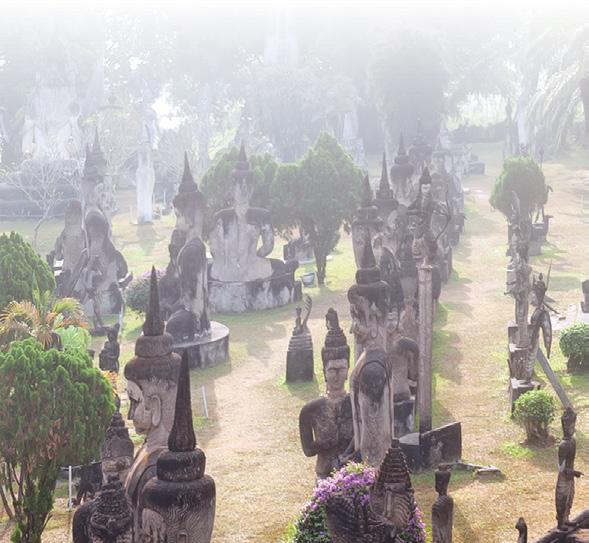




ACTFL Standards
Communication: Interpersonal (5.2)
5.2 Discutez des événements
Answers
Answers will vary.
Scaffold
You may want to ask students which events they would put on a calendar to share with a student from another country. What types of events would be important to include (National holidays, family traditions, school events, religious holidays, etc.)
Le Parc du Bouddha, près de Vientiane (Laos) 317
Unité 6
6.1 Écrivez un e-mail
Answers
Answers will vary.
6.2
Laissez un message
Answers
Answers will vary.
6 Les activités culturelles ici
Avant de visiter votre école, Nickar voudrait en savoir plus sur les activités pour les jeunes dans votre communauté.
6.1 Écrivez un e-mail r e
Lisez le message de Nickar, puis répondez à toutes ses questions.

a. Expliquez-lui quelles activités sportives, artistiques ou culturelles vous ferez dans les semaines qui viennent.
b. Expliquez-lui pourquoi vous choisissez ces activités.
c. Envoyez-lui votre adresse sur une appli de messagerie instantanée pour pouvoir communiquer plus facilement après.
De : nickarpany@mail.la
Objet : Ma visite !
Bonjour, les élèves.
Je m’appelle Nickar et je suis laotienne. Je visiterai votre école et votre ville dans quelques semaines. J’ai hâte ! J’aime beaucoup participer à des activités sportives et à des événements artistiques et culturels. Est-ce que vous pouvez me dire quelles activités auront lieu pendant mon séjour ? Est-ce que je peux vous accompagner à quelques activités ? Je suis curieuse de voir quelles activités vous sont proposées à l’école et lesquelles vous faites après l’école et le week-end. À votre avis, quelles activités ou quels événements est-il important de faire ou de voir ? J’aimerais bien les faire avec vous ! Je voudrais vous connaître et apprendre quelles activités vous choisissez et pourquoi.
Amicalement, Nickar
6.2 Laissez un message s
Nickar a bien reçu votre e-mail et vous envoie un message sur l’appli de messagerie instantanée. Répondez-y dans un message vocal.
Coucou ! C’est Nickar. Oui, merci pour les infos sur tes activités et tes explications. Je peux les faire avec toi ? Lesquelles est-ce que tu veux faire ? Je te parlerai plus de mes activités sportives et culturelles au Laos si un jour tu veux y aller. :) À bientôt !
AP® Strategies
Responding to an email is an important skill for working in the interpersonal mode on the AP® Language and Culture Exam. Before writing, students should plan their response by reading through the information given.
Vous savez déjà
Les endroits et les événements le concert
l’exposition (f.) le festival la fête foraine le musée le parc
Les visites le billet d’entrée partager le site historique
Les activités s’amuser chercher quelque chose le ciné-club le club théâtre danser le dessin dessiner
Les émotions et caractéristiques ambitieux, ambitieuse artistique compréhensif, compréhensive courageux, courageuse créatif, créative dynamique énergique fascinant(e) fidèle
Les personnes
l’artiste (m./f.)
l’athlète (m./f.) le chanteur, la chanteuse le musicien, la musicienne
la place le quartier la rue la soirée le spectacle le théâtre
le tarif du temps libre tenter de nouvelles choses
la fanfare flâner inviter quelqu’un jouer (au sport, d’un instrument) l’orchestre (m.) passer du temps la sortie
généreux, généreuse gentil, gentille isolé(e) motivé(e) organisé(e) positif, positive sérieux, sérieuse sportif, sportive travailleur, travailleuse
Expressions utiles Ça te/vous dit de… ?
Je t’invite à...
Je vous invite à...
Je (te/vous) propose…
12/16/24 9:02 AM
Comment dit-on ?
In EntreCultures®, the visually rich Comment dit-on ? section presents essential vocabulary and expressions in manageable segments for each thematic unit. These segments target the vocabulary that learners need to know to be successful on the formative J’avance and summative J’y arrive assessments, and for use beyond the classroom. Students will be assessed on vocabulary presented in blue type in this section.
Resources
Audio, Workbook
Comment dit-on ?
Qu’est-ce que l’art ? a Communiquons 1
Les domaines de l’art
Les arts visuels
La peinture et le dessin sont les formes d’art visuel les plus connues. Quand on pense aux arts visuels, on imagine les œuvres des grands peintres comme Van Gogh, Monet ou Picasso. Ces œuvres d’art expriment les sentiments des artistes et la façon dont ils comprennent le monde. La sculpture permet de créer des œuvres d’art à partir de matière brute. La transformation est impressionnante. Les sculpteurs peuvent impressionner le public par la grande taille ou les petits détails d’une sculpture.
L’architecture a beaucoup d’influence sur notre vie quotidienne et exprime les valeurs culturelles d’une société à travers les périodes historiques. C’est aussi l’art le plus lié aux connaissances mathématiques et scientifiques.
La musique
Quand on combine le rythme et la tonalité des sons, on fait de la musique. On peut utiliser la voix, le corps ou un instrument. La musique provoque fréquemment des sentiments, comme par exemple la joie, la tristesse ou l’inquiétude.


France compte
La littérature
Quand les auteurs s’expriment en utilisant des mots, on fait de la littérature. Les écrivains ont plusieurs formes pour transmettre leurs pensées : La poésie utilise les vers, le rythme et les rimes. Le roman raconte une histoire fictive assez longue. La pièce de théâtre utilise le dialogue pour montrer les relations entre les personnages
Les arts de la scène
La danse et le théâtre font partie des arts de la scène. Une pièce de théâtre ou une comédie musicale se jouent devant des spectateurs
C’est souvent une expérience émotionnelle partagée.
Le cinéma
Le plus moderne de ces domaines artistiques est le cinéma : les films utilisent les arts visuels, la musique, le texte, des intrigues captivantes ou complexes, et les arts de la scène pour faire une œuvre unique qui peut être transmise dans une salle de cinéma ou plus récemment sur internet.
Mais il y a tant d’autres domaines artistiques, et les catégories ne cessent d’évoluer ! La photographie, la bande dessinée (le dessin souvent avec de l’écriture), le stylisme (le design des vêtements) et les arts médiatiques et culinaires, par exemple, sont reconnus comme faisant partie du monde des arts.

310-369_ECF_2e_L3_SE_U6.indd 320 12/16/24
Culture
As students discover well-known artists of many genres from the francophone world throughout this unit, they may want to re ect on artists or aspects of art from their own community, region, country, or cultural heritage. How would these be classi ed according to the terms introduced here?
Differentiate
Assess your students’ current knowledge of francophone and non-American artists in the di erent categories. Create stations around the classroom with butcher paper or sticky notes. Use each of the bolded art categories and a selection of the words highlighted in blue and ask students to add names of non-American artists or products (songs, sculptures, paintings, novels, etc.) for each category. Keep these lists throughout the unit and add on as your students discover more. Share them with your other French levels to entice them to explore new forms of art.
Vincent van Gogh, artiste postimpressionniste
Sculpture de JeanPhilippe Richard Musée Branly par l’architecte Jean Nouvel
La
des géants de la musique classique, tel Marcel Moyse.
Victor Hugo est l’un des écrivains les plus connus au monde.
Molière (1622–1673), grand dramaturge français
C’est la France qui a inventé le cinéma.
Dior, grande marque française
Stratégies v
Comment aborder une lecture plus longue
1. Décomposez le texte en plus petits passages.
2. Lisez attentivement chaque passage pour trouver l’idée principale.

ACTFL Standards
Communication: Interpretive (7)
Connections: Other Disciplines (7)


3. Prêtez attention aux mots et aux structures que vous connaissez déjà.
7 C’est l’art qui… b



4. Identifiez les mots ou les structures que vous ne connaissez pas encore et essayez d’utiliser le contexte pour deviner leur sens.
Vous discutez sur internet de vos artistes préférés avec d’autres élèves francophones. Lisez ces messages, puis classez les artistes dans l’un des domaines artistiques de l’article précédent.
MODÈLE Molière a écrit beaucoup de pièces de théâtre qui sont toujours importantes dans la culture. la littérature
1. Eugène Delacroix a peint des toiles magnifiques. On peut voir certains de ses tableaux au musée du Louvre à Paris.
2. En 1831, Victor Hugo a publié son roman Les Misérables. Environ 150 ans plus tard, son roman a inspiré une comédie musicale portant le même titre.
3. Auguste Rodin a créé des statues impressionnantes (comme Le Penseur) en utilisant la pierre et d’autres matières brutes.
4. Agnès Varda a fait des films et des documentaires dans un style très original.
5. Le ballet de l’Opéra national de Paris est la troupe de danseurs la plus ancienne de France.
6. Gustave Eiffel a fait construire sa tour magnifique entre 1887 et 1889, mais au début elle n’était pas populaire.
7. Amadou et Mariam sont deux musiciens du Mali qui font des chansons en français et en bambara.
8. Yves Saint Laurent a fait des vêtements qui ont changé le style des femmes pour toujours.
Détail linguistique c
Le vocabulaire emprunté aux arts
On trouve beaucoup de mots et d’expressions empruntés au français dans les domaines de l’art : dans le ballet on parle de pas de deux, pas de chat et plié, et dans la cuisine au jus, au gratin et sauté. Connaissez-vous d’autres mots ou expressions artistiques qui viennent du français ?
Find the “Categories” activity in the Instructional Strategies Toolkit for an engaging way to review the vocabulary from Vous savez déjà and Comment dit-on ?
Stratégies
The Learning Strategies videos in EntreCultures® provide student-friendly strategies regarding di erent aspects of the language-learning process. They are designed to enhance students’ awareness of how language is acquired.
Resources
Video
7 C’est l’art qui…
Answers
Suggested answers:
1. les arts visuels, la peinture
2. la littérature
3. la sculpture
4. le cinéma
5. les arts de la scène, la danse
6. l’architecture
7. la musique
8. le stylisme
Détail linguistique
Détail linguistique boxes provide additional insight about aspects of the French language that are related to elements in the unit.
Communication: Interpersonal (8)
Communities: Lifelong Learning (8)
8 Moi, j’aime…
Resources
Portfolio
Answers
Answers will vary.
Mon progrès communicatif
For Mon progrès communicatif and Mon progrès interculturel, the goal is to have students continuously re ect on their learning, take responsibility for their progress, and identify ways in which they can improve. The three bars represent levels of progress. This is still a goal.
I can do this with support (notes, my teacher, a classmate).
I can do this independently.
See the Instructional Strategies Toolkit for further suggestions on how to introduce and implement this routine.
Expressions utiles
Expressions utiles are useful expressions, transition words, and idioms highlighted for learners to use in communicative tasks.
Unité 6 | L’art et la vie
8 Moi, j’aime… s
Vous expliquez vos préférences artistiques à de nouveaux membres de votre communauté. Dans de petits groupes, expliquez les œuvres que vous aimez le plus dans chaque catégorie et expliquez pourquoi.
1. le cinéma
2. le roman
3. le théâtre
4. la musique populaire
5. la bande dessinée
6. l’architecture
Mon progrès communicatif h
Presentational: I can tell others why I like a work of art.
Expressions utiles
le chef d’orchestre, la chef(fe) d’orchestre le compositeur, la compositrice
le/la dramaturge
l’écrivain(e) le metteur en scène, la metteuse en scène le réalisateur, la réalisatrice le romancier, la romancière
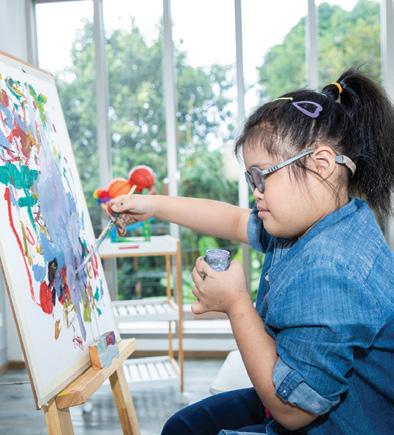
conductor (orchestra) composer playwright writer (movie) director filmmaker novelist
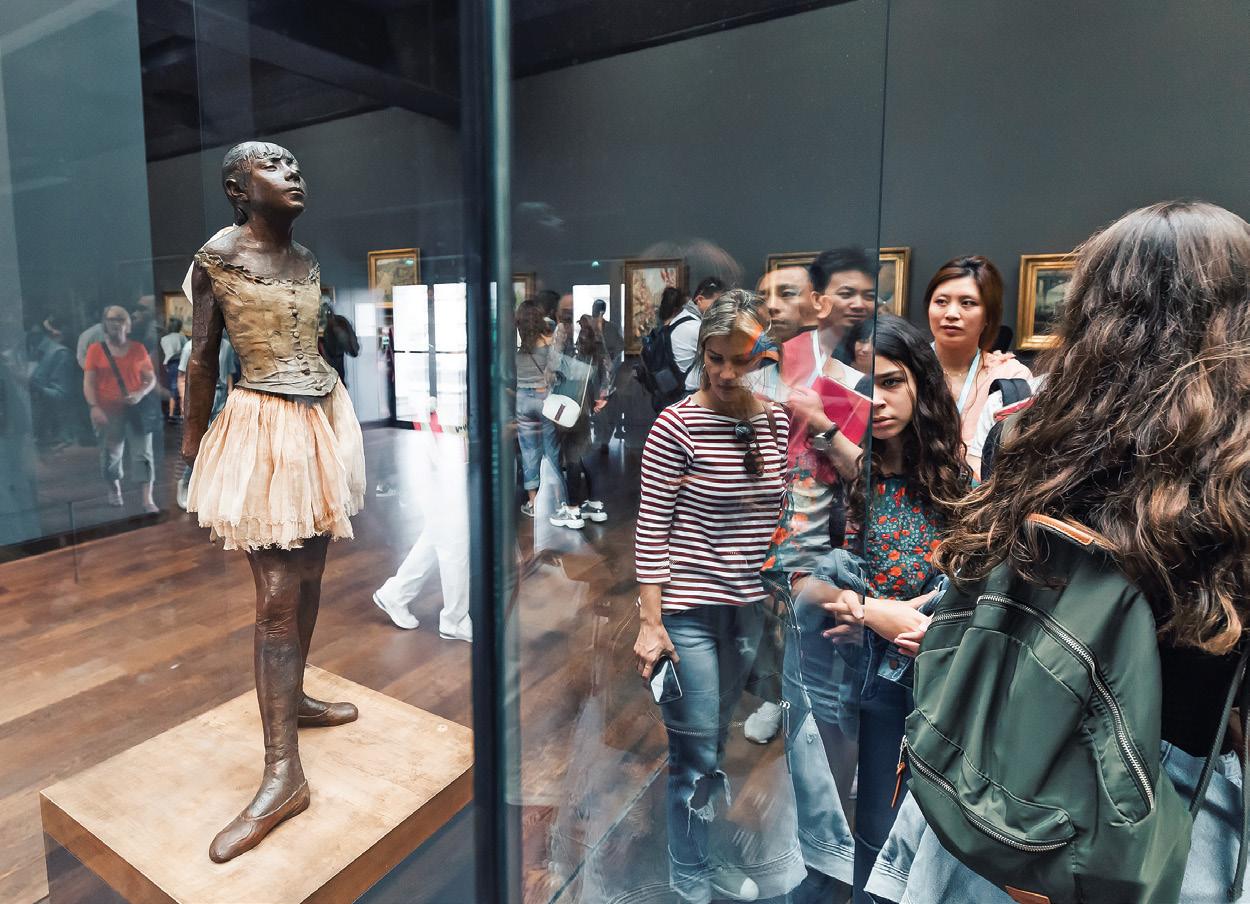
Point out to students that for their art preferences, they may draw from their personal experience at school or in their communities, or they may think of the question in broader terms and choose artists and works that they know and appreciate from around the world. Students may want to make use of expressions of preference in the Expressions utiles box in this section.
If your region does not have access to museums, concert halls, etc. ask your students to consider unique artistic products and perspectives around them. What is art? How do local music classes, street art, a student publication, and other instances of art enrich their lives? How can the students integrate virtual museum tours, online concerts, and book discussions into their lives?
Des visiteurs étudient La Petite Danseuse de quatorze ans (1880) du sculpteur français Edgar Degas (1834–1917).
9 Tu le trouves comment ? a
Communiquons 1
Vous écoutez un podcast sur les événements artistiques dans votre communauté. Écoutez les cinq commentaires, puis notez l’événement artistique auquel chaque personne a assisté et si elle l’a aimé.
MODÈLE Vous entendez :
Qu’est-ce que tu as pensé de l’exposition de stylisme à la mairie ?
C’était très bien fait. Je ne savais pas que ces couturiers avaient tellement d’influence sur la mode quotidienne !
Vous écrivez : une exposition de stylisme ; oui
événement artistique
Expressions utiles
C’est une œuvre de/d’…
Je trouve ça beau (moche, créatif, intéressant).
me plaît.
Est-ce qu’on l’a aimé ?
This is a work by ... I find this beautiful (ugly, creative, interesting). I like ....

ACTFL Standards
Communication: Interpretive (9)
9 Tu le trouves comment ?
Resources
Audio
Answers
1. une exposition d’art moderne ; non
2. un concert ; oui
3. une pièce de théâtre ; un peu
4. un lm de science- ction ; non
5. une discussion avec un auteur ; oui
Expressions utiles
Expressions utiles are useful expressions, transition words, and idioms highlighted for learners to use in communicative tasks.
For 9, you may ask advanced students to provide a more detailed explanation of why the speakers did or did not like the art event.
Differentiate
After 9, practice pronunciation and interpersonal communication using the provided transcript of the podcast. Print the interviewer’s questions on one color and the answers on another. Form groups of two or three students and give them the questions and answers. Students will take turns reading the questions while their partner chooses and reads the correct answers.
Musée du Palais Royal Luang Prabang (Laos) Comment
10 L’art de la cuisine
Vous aidez votre école à planifier un voyage en France. La professeure de cuisine et le professeur d’art vous ont demandé de trouver un restaurant pour déjeuner près d’un musée que vous allez visiter. Pendant vos recherches, vous avez trouvé ce site web.
L’atelier
de 10h à 20h
Un repas gastronomique et artistique, parfait pour votre visite au musée
Pourquoi avoir un restaurant dans un musée ?
Cette question m’a aidé à créer les plats, la carte et l’ambiance de notre restaurant. Les expositions d’un musée montrent la diversité de notre monde. Elles donnent l’occasion de réfléchir et d’essayer de nouvelles expériences. Pourquoi pas le restaurant du musée aussi ?
Culture
L’art est l’émotion et la communication. Notre cuisine aussi.
Bon appétit !
Chef Rémi Desjardins

Supporting Heritage Learners
Nous vous proposons des plats de plusieurs traditions culinaires des recettes traditionnelles et modernes. Nous vous invitons à réfléchir et à goûter un nouveau plat. Notre carte est comme la salle d’exposition où vous pouvez choisir ce que vous voudriez explorer plus profondément.











Pour planifier les plats de notre restaurant, j’ai invité plusieurs artistes culinaires du monde entier à faire une collaboration. Dans cette carte, vous trouverez les noms de ces grand(e)s artistes. Ils ont choisi les goûts, les arômes, les couleurs et les formes de chaque plat. Vous pourrez faire un tour du monde dans lequel vous vous familiarisez avec le style de chaque artiste ou vous ferez une étude profonde d’un(e) artiste. C’est à vous de décider.
Néanmoins, la cuisine, ce n’est pas que les plats. C’est aussi l'expérience de partager la nourriture et les histoires ensemble dans une espace unique. Pour faire les décors et les meubles de notre restaurant, nous avons invité des architectes d’intérieur pour faire le design de nos trois salles à manger : la salle contemporaine, la salle rouge et la salle néo-rococo. Veuillez indiquer votre préférence de salle à notre personnel en faisant votre réservation.
L’art est une mosaïque de petits détails pour faire une œuvre parfaite. Notre cuisine aussi. L’art est une expérience partagée. Notre cuisine aussi.













Have students share traditions concerning cuisine that are important to their families.










Incorporate pre-reading strategies of highlighting cognates and known words, making predictions about unknown words, and skimming for the main ideas.
Since cuisine and les arts de la table are an important part of francophone culture, students may enjoy investigating websites of restaurants in the francophone world to see images and read comments that make reference to this art form.
10.1 b
10.1 Lisez le texte et répondez aux questions b
Parcourez (browse) le site, utilisez la représentation schématique et identifiez les détails qui pourraient convaincre les profs de dîner dans ce restaurant.
1. Quels sont les mots et les phrases de ce site qui montrent l’importance de l’art ?
Quels domaines artistiques représentent-ils ?
les mots et phrases du site qui montrent l’importance de l’art le domaine d’art qui est représenté
2. Quels sont les détails les plus notables de ce restaurant ? Pourquoi sont-ils intéressants ?
les détails les plus notables du restaurant Pourquoi sont-ils intéressants ?
10.1 Lisez le texte et répondez aux questions
Answers
1. Suggested answers:
l’ambiance : les arts de la scène, l’architecture
la salle d’exposition : les arts visuels plusieurs artistes culinaires : les arts culinaires
les couleurs et les formes de chaque plat : les arts culinaires, les arts visuels
Expressions utiles
utiles
Il est important/essentiel de/d’...
Il faut…
On devrait… la scène l’édifice (m.) les arts (m.) culinaires
It is important/essential to ...
It is necessary …
We should … scene, stage building culinary arts
l’expérience de partager la nourriture et les histoires ensemble dans un espace unique : l’architecture, les arts de la scène, les arts culinaires
l’émotion et la communication : la littérature, les arts de la scène, le cinéma, les arts visuels, la musique une mosaïque de petits détails : les arts visuels, la sculpture
10.2 m
10.2 Laissez un message aux profs m
Vous essayez de convaincre les profs d’aller à ce restaurant pendant le voyage. Vous leur envoyez un mémo vocal pour présenter ce que vous avez trouvé. Utilisez ce que vous avez lu dans votre réponse.

Challenge
As students write their messages for the teachers, challenge them to think of the most creative or unique reasons to visit this restaurant. For the artistic students, allow them to create a comic strip, animated clip, or other visual that portrays the message both visually and aurally.
Culture
Due to its scenic surroundings, the city of Vang Vieng has become a major tourist destination in Laos. The river provides swimming, diving, and boating opportunities. There is also rock climbing in the surrounding mountains, as well as exploring the numerous caves.
2. Answers will vary.
10.2 Laissez un message aux profs
Answers
Answers will vary.
Vang Vieng (Laos)
Communication: Interpersonal (11.1, 11.2, 12)
Cultures: Products (11.1)
Connections: Acquiring Information (11.1)
Comparisons: Cultural (12)
Communities: Lifelong Learning (12)
Zoom culture
Each Zoom culture focuses on a cultural product (produit) or practice (pratique) and invites students to develop insights into underlying perspectives (perspectives) in the francophone world and in their own culture. Products are tangible and intangible items—such as books, food, laws, music, and games— required or justi ed by the underlying values and beliefs of a culture. Practices are patterns of social interactions or behaviors, such as greetings, holidays, events, and daily schedules. Perspectives are the values, attitudes, and ideas of a culture.
Before students read the Zoom culture selections in the unit, use the Connexions questions to have them re ect on this product or practice in their own culture. Then have them read the information in the section before responding to the Perspectives questions. To minimize the use of English during class, have students read silently and respond for homework. Students should complete both the Connexions and Perspectives questions in the discussion forum, as they will use English for their responses.
11.1 Connexions
Resources Forum
11.2 Perspectives
Resources Forum, Portfolio
12 Réflexion interculturelle
The Réflexion interculturelle questions encourage students to recognize how they can use their knowledge of language and culture to communicate e ectively across cultures. To minimize the use of English during class, have students re ect and respond online in the discussion forum.
Resources Forum, Portfolio
Answers Answers will vary.
Zoom culture
11 L’art du quotidien
11.1 Connexions o c
Le design d’un produit influence-t-il votre décision d’acheter le produit ? Expliquez. L’art joue un rôle important dans notre vie quotidienne. Les produits qu’on consomme et qu’on utilise sont conçus par des designers, qui doivent choisir la forme et les couleurs du produit. La chaise sur laquelle vous êtes assis(e) a été dessinée par un(e) artiste. Charlotte Perriand (1903–1999) était une grande architecte d’intérieur française. Ses meubles (y compris ses chaises et ses fauteuils) ont été exposés dans beaucoup de musées, notamment dans le musée des Arts décoratifs à Paris et dans la Fondation Louis Vuitton à Paris. Avec ses designs, elle s’est concentrée sur les besoins des gens dans leur vie quotidienne. Elle a travaillé souvent avec Le Corbusier (1885–1965), un architecte franco-suisse qui a révolutionné le domaine de l’architecture avec ses idées modernes et parfois radicales. L’architecte burkinabé Francis Kéré (né en 1965) continue la tradition de planifier les espaces pour le bien-être des gens. Au Burkina Faso, il a conçu les bâtiments de plusieurs écoles. Il utilise les sciences et l’architecture pour réduire le réchauffement de la structure pour que les élèves puissent apprendre mieux dans un espace plus confortable sans climatisation.
11.2 Perspectives o
Qu’est-ce qui est plus important, la forme ou la fonction ?
12 Réflexion interculturelle o d
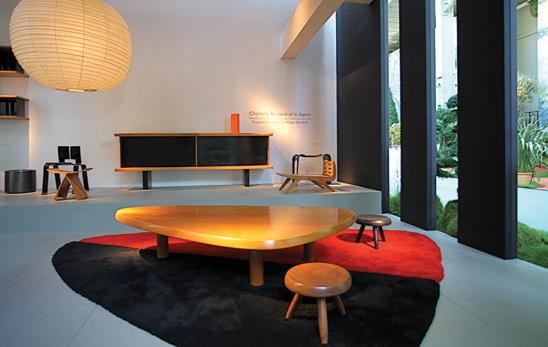
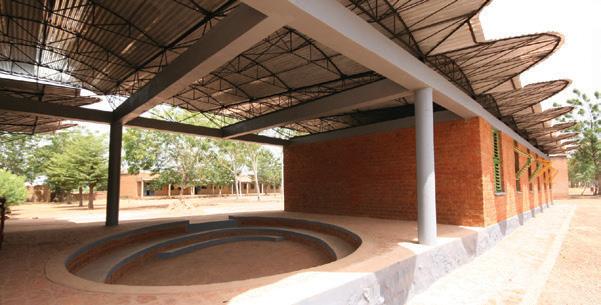
Comment l’art influence-t-il la vie quotidienne ? Quel impact le climat ou la localisation géographique peuvent-ils avoir sur l’art en général et l’architecture en particulier ?
Mon progrès interculturel h
Investigate: I can give examples of how art influences daily life in francophone cultures and in my community.
STEAM Connections
Encourage students to identify the presence of art in their everyday lives in the clothing they wear, the way they decorate their rooms or lockers, the window art they see in local businesses, etc.
Language
During reading strategies: remind students to read between the lines. They will most likely not understand 100% of a text, so they should try to gather meaning from the words that they do understand and to make connections between those words. Ask students to identify available linguistic clues surrounding a word with which they are not familiar.
Charlotte Perriand, architecte d'intérieur française (1903–1999)
Une exposition des meubles de Charlotte Perriand au Grand Palais (Paris)
L'architecte burkinabé Francis Kéré
Francis Kéré a conçu le lycée à Dano, au Burkina Faso, en 2007.
13 Des artistes laotiens b
Dans votre cours d’histoire de l’art, vous étudiez l’art du Laos. Lisez le blog et répondez aux questions.
Lisez le blog d’un amateur d’art puis répondez aux questions.
Aujourd’hui nous nous sommes arrêtés à une exposition d’artistes locaux dans la petite ville de Luang Probang, au nord du Laos, et j’ai rencontré des artistes divers : peintres, sculpteurs, artisans.
Ces artistes locaux contemporains jonglent entre tradition et modernité. Certains exposent régulièrement leurs arts dans des galeries, d’autres vendent leurs œuvres dans les marchés ou en ligne.
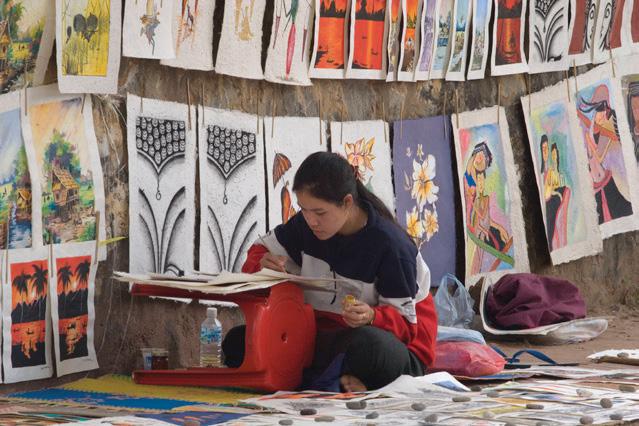
Cette artiste locale s’appelle Ai Nom Phomlou. Elle crée des peintures qui représentent la scène de tous les jours : paysages, éléments naturels, relations humaines. Quand on l’interroge sur les techniques et influences de son art, elle répond que sa thématique s'inspire de l’art du dix-neuvième siècle : les paysages impressionnistes et l’architecture linéaire et graphique de l'expressionnisme. Une autre passion d’Ai est la bijouterie. En effet, l’artiste confectionne des bijoux en utilisant des matériaux récupérés de meubles ou d'objets usés qui s’entassent dans son atelier et qu’elle transforme en colliers et bracelets, dont elle orne parfois ses vêtements et se sert d’inspiration pour ses peintures.
Désintéressée par l’engagement politique ou social, Ai cherche tout de même à se faire entendre à travers son expression artistique. Cette polyvalence nous laisse nous interroger sur son message, que cherche-t-elle à exprimer ? La beauté, tout simplement, nous dit-elle.
1. Comment pourrait-on décrire la profession d’Ai Nom Phomlou ?
A. Elle est artiste.
B. Elle est professeur.
C. Elle est peintre.
D. Toutes les réponses sont correctes.
2. Qu’est-ce qui influence la peinture d’Ai Nom Phomlou ?
A. les paysages du Laos
B. les mouvements artistiques du dix-neuvième siècle
C. les arts traditionnels laotiens
D. les relations humaines contemporaines
3. Quel autre moyen artistique Ai Nom Phomlou utilise-t-elle pour exprimer sa créativité ?
A. la photographie
B. la musique
C. la poésie
D. la création de bijoux
4. Quel est le message principal que cherche à exprimer Ai Nom Phomlou à travers son art ?
A. un appel à l’engagement politique et social
B. la préservation des traditions culturelles laotiennes
C. la beauté artistique dans la vie quotidienne
D. l’expression de ses émotions personnelles
Challenge
Create a photo challenge for the students that encourages them to nd the various types of art in their lives. If your school allows the use of social media, students can add a hashtag with your school’s name and an artistic phrase (#MVHSArtAutourDeNous). Alternatively, create a shared visual presentation or photo album where students can upload their pictures. Discuss a few pictures each day and ask students to write re ections on their preferences and discoveries.
ACTFL Standards
Communication: Interpretive (13)
13 Des artistes laotiens
Answers
ACTFL Standards
Communication: Interpretive (14)
Comparisons: Linguistic (14)
Découvrons
The Découvrons sections in EntreCultures® provide clear examples of language used in context, with targeted structures emphasized, helping students focus on form. Instead of presenting grammar rules, the segment invites students to observe, discover, and re ect on form in context.
Students will write their observations on the graphic organizer and then work with a partner to see if they can come up with additional observations. Students may consult the Synthèse : Grammaire at the end of the unit to con rm their hypotheses. Encourage students to make linguistic comparisons to their home languages.
Resources
Audio
14 Découvertes
Resources
Think-Pair-Share Graphic Organizer, Workbook
Answers
Suggested answers:
2. une expression avec le verbe penser ou croire se terminant par le mot que, suivie d’un sujet et d’un verbe ; Nous avons déjà vu les expressions impersonnelles qui fonctionnent d’une manière similaire. Answers will vary.
3. l’indicatif après je crois que et le subjonctif après je ne crois pas que
4. Dans le cas du négatif, l’action est hypothétique et n’existe pas en réalité selon la personne qui parle.
5. Answers will vary.
Découvrons
Exprimer et mettre en doute des opinions et des croyances a L’indicatif et le subjonctif avec les verbes d’opinion et de doute

fanadart

fouduballet

pro-graphiste


gourmandine

toujoursphilo
kelbote

pourslesfans
Marcel Duchamp définit l’art ainsi : « Je crois que l’art est la seule forme d’activité par laquelle l’homme en tant que tel se manifeste comme véritable individu. » Et vous, les artistes, j’aimerais savoir si vous croyez que c’est vrai. Quelle est votre définition de l’art ?
En tant que danseur qui fait de l’art avec son corps, je crois certainement que ça a un effet affectif chez les spectateurs : c’est magique ! Penses-tu que tous les arts aient un effet pareil (the same) ?
Mes collègues et moi croyons que l’art numérique représente de la créativité autant que les autres arts visuels et les arts de la scène.
Mon père, chef de cuisine, me dit toujours qu’il croit que l’art de la table affecte les cinq sens, que ça dépasse le plaisir de manger. Il ne pense pas que ce soit uniquement une question de goût.
Crois-tu que l’art aille plus loin que l’esprit ?
Oui, tout à fait ! La prochaine fois que vous serez au musée, demandez aux spectateurs. Ils croient que c’est le cas !
Vous, les spectateurs, pensez-vous que l’art nous permette de mieux comprendre et naviguer les réalités de la vie ?
14 Découvertes b d
Réfléchissez à ce que vous observez et répondez aux questions suivantes dans la représentation schématique.
1. Lisez les commentaires des artistes ou des connaisseurs d’art et regardez les mots en caractères gras de différentes couleurs.
2. Qu’est-ce que vous remarquez ? Avez-vous déjà vu des expressions similaires ? Lesquelles ?
3. Quelle forme verbale utilise-t-on avec ces structures ?
4. Pourquoi la forme verbale est-elle différente selon les propositions ?
5. Partagez vos observations avec un(e) partenaire. Que remarquez-vous d’autre ? Que pouvez-vous ajouter aux observations de votre partenaire ?
310-369_ECF_2e_L3_SE_U6.indd
Spanish Language Connections
The Spanish verbs creer (to believe) and pensar (to think) follow the same rules as French. The indicative is used for positive statements and the subjunctive is used for negative and question statements. Students who speak Spanish will be interested to know that the use of the subjunctive di ers slightly between French and Spanish. Ask them to check their resources when in doubt about usage.
Culture
Marcel Duchamp was a French sculptor and artist whose works range from Post-Impressionism, Dadaism, Realism, to Cubism.
15 Ce que les artistes ont écrit b s
Communiquons 1
Avec un(e) autre élève dans votre classe, vous lisez le blog où les artistes ont écrit des commentaires.
1. Les artistes qui ont fait des commentaires sur le blog se respectent-ils les uns les autres, en général ?
2. Quelles déclarations des artistes sont des faits (facts) selon eux ?
3. Lesquelles sont seulement possibles ou hypothétiques ?
16 Qu’est-ce qu’ils pensent ? s
Vous avez fait un petit sondage en cours des beaux-arts et vous présentez maintenant les résultats avec un(e) autre élève qui fait souvent des fautes. D’abord, une personne doit choisir une expression de chaque encadré pour faire une phrase complète qui explique ce qu’on pense. Ensuite, l’autre personne dit le contraire. Après ça, changez de rôles pour faire une nouvelle phrase. Continuez jusqu’à ce que vous utilisiez toutes les expressions des encadrés jaune et violet.
MODÈLE Élève A : Moi, je crois que les impressionnistes sont les meilleurs peintres.
Élève B : Non, je ne suis pas d’accord. Je ne crois pas que les impressionnistes soient les meilleurs peintres.
Moi, je…
Toi, tu…
La majorité des élèves…
La professeure…
Nous…
Vous…
Les critiques… Mes amis... croire que/qu’… penser que/qu’… ne pas croire que/qu’… ne pas penser que/qu’…
Mon progrès communicatif h
Interpersonal: I can exchange opinions about art.
Expressions utiles
Je ne suis pas d’accord.
Je pense que tu as mal compris.
Tu as tort.
Language
ACTFL Standards
Communication: Interpretive (15)
Communication: Interpersonal (15, 16)
Communities: Lifelong Learning (16)
15 Ce que les artistes ont écrit
Answers
Suggested answers:
1. Oui, les artistes qui ont fait des commentaires se respectent en général.
l’art moderne n’est pas important les impressionnistes sont les meilleurs peintres l’art joue un rôle important dans la vie quotidienne on va visiter des musées cet été les élèves de notre école savent faire de la musique on ne doit pas avoir de cours d’art ou de musique dans les écoles les pièces de théâtre sont ennuyeuses on lit rarement des romans par plaisir
I disagree. I think you’ve misunderstood. You’re wrong.
Sentence frames provide a solid foundation for students who are still progressing towards Intermediate Low/Mid writing. Provide extra structure for students who are not con dent in their conjugation skills by projecting various conjugations of the verbs in the green and purple boxes. The students will still need to identify the correct forms, but they will serve as a reminder that the verbs will need to be conjugated.
2. Je crois que l’art est la seule forme d’activité par laquelle l’homme en tant que tel se manifeste comme véritable individu. Je crois certainement que ça a un e et a ectif chez les spectateurs. Mes collègues et moi croyons que l’art numérique représente de la créativité autant que les autres arts visuels et les arts de la scène. Mon père croit que l’art de la table a ecte les cinq sens. Les spectateurs croient que c’est le cas !
3. Penses-tu que tous les arts aient un e et pareil ? Il ne pense pas que ce soit uniquement une question de goût. Crois-tu que l’art aille plus loin que l’esprit ? Pensez-vous que l’art nous permette de mieux comprendre et naviguer les réalités de la vie ?
x 16 Qu’est-ce qu’ils pensent ?
Resources
Portfolio
Answers
Answers will vary.
Découvrons
Communication: Interpretive (17.1)
Communication: Presentational (17.2)
Communities: Lifelong Learning (17.1, 17.2)
x 17.1 Lisez l’article et comparez
les faits
Resources
Portfolio
Answers
1. F : Onet croit qu’il est possible de faire une bonne exposition de tags.
2. V
3. V
4. F : Onet ne croit pas que tous les artistes soient de bons artistes.
5. V
x 17.2 Écrivez un e-mail
Resources
Portfolio
Answers
Answers will vary.
17 Le tag, la prochaine exposition au musée ?
Le musée d’art moderne dans votre communauté pense à lancer une nouvelle exposition de graffitis et on vous a demandé de déterminer si c’est une bonne idée.
17.1 Lisez l’article et comparez les faits b
Vous avez trouvé cet article en ligne. Lisez-le, puis indiquez si la phrase est vraie (V) ou fausse (F). Corrigez les phrases fausses.
Authentique
Le tag a-t-il sa place au musée ? Éternel débat. Libération a demandé à trois artistes de la culture graffiti ce qu’ils en pensaient : le Franco-Américain Jonone, le punk RCF1, et Onet - ce dernier ayant refusé de participer à l’exposition « Le T.A.G. au Grand Palais ».
Onet
« Le tag au musée, pourquoi pas ? Mais ça dépend surtout de la manière dont on le présente. Là, je n’y vois aucune intelligence. On met en avant le collectionneur, enfin plutôt une personne qui a découvert le graffiti récemment et qui collectionne des noms. Il a imposé un thème, un format. L’exact contraire du graffiti.
« Notre mouvement est encore jeune, ses pionniers sont vivants. C’est encore trop tôt pour pouvoir juger s’il s’agit d’art ou pas. Certains graffiti-artists ont envie de montrer des choses intelligentes. Mais cette exposition ressemble à un fast-food, une sorte de cour des miracles où tout est possible mais où rien n’est esthétisant. Ceux qui ont vraiment du talent vont se retrouver noyés au milieu de plein d’autres. »
1. Onet croit qu’il n’est pas possible de faire une bonne exposition de tags.
2. Onet ne croit pas que cette exposition soit bien organisée.
3. Onet pense que la façon d’organiser une exposition doit changer pour une exposition de graffitis.
4. Onet croit que tous les artistes de graffitis sont de bons artistes.
5. Onet ne pense pas qu’on doive exposer autant d’artistes que possible.
Mon progrès communicatif h
Interpretive: I can understand an article about the pros and cons of street art.
17.2 Écrivez un e-mail r w
Après avoir fait vos recherches, vous envoyez ce que vous avez trouvé à l’administration du musée. Écrivez un e-mail qui explique ce que vous pensez et ce que vous ne croyez pas en ce qui concerne la possibilité d’une exposition de graffitis au musée.
Mon progrès communicatif h
Presentational: I can express my opinion about whether something is art.
Culture
Libération is a French daily newspaper that started out as a left-wing (“Liberal” in the US) newspaper. Jean-Paul Sartre was one of the founders.
Scaffold
Choose six to eight high-level sentences from 17.1 and write simpli ed versions. Ask the students to read the high-level statements rst and make predictions on the meaning. Then, pass out the simpli ed versions (out of order) and ask them to match to the originals. Remind students to use a variety of pre, during, and post-reading strategies
J’avance
18 L’art de la rue : qu’en pensez-vous ?
There is currently a heated debate about street art in your city. You decide to get more information and then join the conversation.
18.1 Lisez le message b

You find an opinion piece online about street art in the community. Read it, then fill in the table that follows.
Mon progrès communicatif h
Interpretive: I can understand an article about the pros and cons of street art.
18.2 Demandez et répondez s
Tell a friend or two what you thought about the article. Explain whether you agree with the opinions expressed in it, and then ask each other questions about your opinions. Ask for everyone’s thoughts.
Mon progrès communicatif h
Interpersonal: I can exchange opinions about art.
18.3 Remplissez le formulaire w
Go to the town hall’s website to express your opinions. Fill out and submit the form explaining what you and your friends believe about street art in your community.
Mon progrès communicatif h
Presentational: I can express my opinion about art.

AP® Strategies
Responding to an email is an important skill for working in the interpersonal mode on the AP® Language and Culture Exam. Writing an initial message (instead of responding to one) is a good way to practice this skill. Before writing, students should plan their response by reading through the information given.
Culture
As an anticipatory activity to the tasks on page 331, create a visual presentation with links and citations with street art from Oceania, the Caribbean, West Africa, and Canada. Ask the students to identify colors, objects, verbs, etc. and then to make predictions about the country of origin, the theme, and perspective.
ACTFL Standards
Communication: Interpretive (18.1)
Communication: Interpersonal (18.2)
Communication: Presentational (18.3)
Communities: Lifelong Learning (18.1, 18.2, 18.3)
J’avance
You can access the J’avance formative assessments online. Tiered versions are available for di erentiation. The Blanc version matches the description in the Student Edition of the textbook. The Rouge version may be used with students who wish to challenge themselves, and the Bleu version provides extra support and sca olding.
Have students self-assess based on the J’avance Can-Do statements prior to taking the formative assessment, and update their Portfolio by adding this assessment as evidence of their growing language pro ciency.
Resources
Tiered Assessments (Bleu, Blanc, Rouge), Rubrics (Single-Point, Holistic, Analytic), Portfolio
Answers
Answers are provided in the J’avance key available online.
Comment dit-on ?
In EntreCultures®, the visually rich Comment dit-on ? section presents essential vocabulary and expressions in manageable segments for each thematic unit. These segments target the vocabulary that learners need to know to be successful on the formative J’avance and summative J’y arrive assessments, and for use beyond the classroom. Students will be assessed on vocabulary presented in blue type in this section.
Resources
Audio, Workbook
Communiquons 2
Comment dit-on ?
L’importance de l’art dans ma vie a
Blogart
Quel est le but de l’art ?

Emilie

Marc

Séverine

Dominique

Quand je contemple une œuvre d’art, que ce soit une peinture, un poème, une chanson, une sculpture, une pièce de théâtre ou une comédie musicale, non seulement je questionne l’œuvre mais aussi je m’interroge. Comment est-ce que je réagis à une œuvre ? Est-ce que je me sens joyeuse ? Fâchée ? Ennuyée ? Me permet-elle de rêver d’une culture différente, ou bien d’un autre lieu que je ne connais pas ? Y a-t-il plusieurs buts de l’art ou un but universel ? Comment est-il possible qu’on puisse admirer une œuvre d’art mais que la même œuvre laisse froid son ami(e) ? Ce dont je suis certaine, c’est que l’art me permet de contempler mes émotions et la vie et quelquefois de me calmer.
On peut aussi imaginer que l’art est une façon de s’échapper de la vie réelle, un voyage, une introspection. Pour le lecteur, l’auditeur ou le spectateur, l’art peut être une simple invitation à quitter la monotonie du quotidien pour se réfugier dans un monde parallèle où l’imagination est le chef d’orchestre, où les seules limites sont celles que nous posons.
Le but de l’art ? Je dirais secouer quelque chose à l’intérieur de celui qui regarde.
La question est bonne, mais la réponse ne peut pas l’être de nos jours. Le but de l’art est une recherche spirituelle. Dans le passé, l’art était utilisé pour représenter les dieux ou des déités adorées à cette période. Le but de l’art maintenant est de choquer ou d’inventer quelque chose de nouveau pour faire de l’argent.
Peut-être que justement il n’a pas de but.

Luc Frederic
La principale vocation de l’art est de rendre la vie plus légère
lecteur, lectrice
laisser froid auditeur, auditrice s’échapper
310-369_ECF_2e_L3_SE_U6.indd 332
Language
secouer
Use a graphic organizer from the Instructional Strategies Toolkit such as a Y Chart. Ask the students to classify words from the text based on positive, negative, and neutral emotions. How do our choice of words re ect our perspectives and opinions.
Communiquons 2
19 Et vous ? b
Les réseaux sociaux nous permettent de lire des réponses courtes aux questions souvent compliquées. Lisez les réponses à la question « Quel est le but de l’art ? ».
a. Indiquez le(s) prénom(s) approprié(s) de chaque vlogueur ou vlogueuse avec chaque but.
b. Écrivez les mots du blog qui justifient votre réponse.
le but, c’est...
1. de nous surprendre
2. de nous calmer
3. d’évoquer un sentiment religieux
4. de nous faire penser ou imaginer
5. de nous faire ressentir une émotion
6. de ne pas penser à la réalité
7. de découvrir quelque chose sur soi-même
Détail linguistique
le prénom du vlogueur ou de la vlogueuse
les mots qui justifient votre réponse
Les familles de mots contempler, contemplation interagir, interaction réagir, réaction

Culture
Le musée d’Orsay is housed in a former train station in Paris. The museum was opened in 1986, after extensive renovation of the vast nineteenth-century building. Its collections include Impressionist and post-Impressionist paintings and sculptures. It is the second most visited art museum in France, after the Louvre.
Language
Remind students that all nouns ending in -tion and -sion are feminine.
ACTFL Standards
Communication: Interpretive (19)
19 Et vous ?
Answers
Suggested answers:
1. Séverine, Dominique ; secouer, choquer
2. Frédéric, Émilie ; rendre la vie plus légère, me calmer
3. Dominique ; spirituelle, des dieux, des déités
4. Émilie, Marc ; quitter le quotidien, rêver, contempler, s’interroger, questionner, choquer, introspection
5. Émilie, Dominique ; choquer, laisser froid, joyeuse, fâchée, ennuyée
6. Marc ; s’échapper de la vie réelle
7. Séverine ; l’intérieur
Musée d’Orsay, Paris (France)
Communication: Interpersonal (20.1, 20.2)
Communities: Lifelong Learning (20.1)
x 20.1 Choisissez et expliquez Resources
Portfolio
Answers
Answers will vary.
20.2 Partagez vos réponses Answers
Answers will vary.
Unité 6 | L’art et la vie
20 Comment interagir avec l’art ?
Dans votre cours d’art, votre prof vous a demandé d’expliquer votre point de vue concernant l’art dans votre vie. Pour vous inspirer, vous relisez le blog.
20.1 Choisissez et expliquez e Choisissez le commentaire auquel vous vous identifiez le plus et écrivez une réponse à son auteur. Dans votre réponse, expliquez pourquoi vous vous identifiez à son commentaire en parlant de vos expériences personnelles avec l’art. Vous pouvez mentionner les réactions que vous avez eues aux peintures et aux sculptures dans un musée, à une chanson préférée, à votre film préféré, à une pièce de théâtre ou une comédie musicale préférée, ou à un bâtiment admiré, par exemple.
MODÈLE Chère Emilie, Je m’identifie le plus à votre blog parce que…
Mon progrès communicatif h

Interpersonal: I can read and respond to posts about the value of art.
20.2 Partagez vos réponses s Réfléchissez à vos interactions et vos sentiments avec les œuvres d’art que vous avez mentionnées dans votre réponse. Choisissez une œuvre à laquelle vous avez eu une réaction fortement positive ou négative.
a. D’abord, sur une feuille de papier, organisez vos idées, vos sentiments et vos interactions.
b. À tour de rôle, partagez avec votre partenaire ce que vous avez écrit.
c. Réagissez à votre partenaire en lui donnant votre opinion, un conseil ou un commentaire.
Détail linguistique
Penser à ou penser de
On utilise penser à si on pense à quelqu’un ou quelque chose. On utilise penser de pour exprimer une opinion sur quelqu’un ou quelque chose.
Je pense à ma grand-mère quand j’entends cette chanson. Que penses-tu de cette nouvelle peinture dans l’entrée de l’école ? (On cherche une opinion.)
310-369_ECF_2e_L3_SE_U6.indd 334
Scaffold
Using the provided transcriptions of SEV’s commentary, create a visual guide for students to reference as they listen to her clip. You may choose to highlight chunks with glosses or icons or simplify sentences with comprehensible language. Use this guide as an anticipatory activity and ask students to annotate with questions and discoveries.
Agnès Varda, cinéaste française
21 Une artiste nous parle !
Communiquons 2
La forme d’art qui vous intéresse le plus en ce moment, c’est la bande dessinée. En cherchant (while looking for) des informations sur les artistes, vous trouvez cet entretien avec l’artiste Séverine Colmet-Daâge (SEV). Depuis (from) son atelier (studio) personnel, elle répond à la question suivante : « Quel est le but ou l’importance de l’art ? ».
21.1 Faites des recherches b c
Avant d’écouter la réponse de SEV, faites des recherches avec un(e) partenaire sur les bandes dessinées francophones. En connaissez-vous ?
Mon progrès communicatif h
Interpretive: I can use French to learn about francophone comics or graphic novels.
21.2 Réfléchissez et prédisez sa réponse s
Avec un(e) partenaire, réfléchissez à ce que vous pensez que SEV va dire. Quel est le but de l’art pour quelqu’un qui fait des BD ?
vos prédictions
SEV a-t-elle mentionné cette prédiction ?
21.3 Écoutez et répondez v Écoutez cet extrait d’un entretien avec SEV.
a. Si elle dit quelque chose que vous avez prédit (predicted), mettez une croix (✘) à côté de votre prédiction, dans la deuxième colonne de la représentation schématique.
b. Si elle a dit des choses que vous n’avez pas prédites, ajoutez-les dans la troisième colonne de la représentation schématique.
c. Pour résumer ce que vous avez appris, écrivez deux ou trois phrases de réflexion.
autres choses que SEV a mentionnées

Culture
ACTFL Standards
Communication: Interpretive (21.1,
Communication: Interpersonal (21.2)
Communities:
Connections:
21.1 Faites des recherches
Resources
Portfolio
Answers
Answers will vary.
21.2 Réfléchissez et prédisez sa réponse
Resources
Portfolio
Answers
Answers will vary.
21.3 Écoutez et répondez
Answers
Answers will vary.



Before beginning 21.1, ask students if they are familiar with any francophone bandes dessinées If not, provide them with a few that you are familiar with, perhaps Tintin, Lucky Luke, Astérix et Obélix, Les Cahiers d’Esther, Elle, L’Arabe du futur. Depending upon their age, they may also be aware of graphic novels such as Maus, Persépolis or others. Students may also have a favorite BD in English that they could refer to.
Communication: Presentational (22.1)
22.1 Choisissez une œuvre et notez des idées
Answers
Answers will vary.
Unité 6 | L’art et la vie
22 Présenter l’œuvre d’art de votre choix
Vous proposez aux autres élèves de votre cours de français de former des groupes et de créer de petits musées. Dans chaque musée, les membres du groupe présenteront une œuvre d’art qu’ils ou qu’elles ont choisie.
22.1 Choisissez une œuvre et notez des idées w D’abord, trouvez par vous-même un objet d’art que vous admirez pour le proposer aux membres de votre groupe. Utilisez la représentation schématique pour organiser vos idées avant de les présenter.






Comment vous sentez-vous en admirant cette œuvre d’art ? À quoi vous faitelle penser ?

Quelle est l’œuvre d’art que vous avez choisie pour le musée ?









Qu’est-ce qui fait de cette œuvre de l’art, selon vous ?
Connections




Quelle est la forme de cette œuvre d’art (architecture, musique, arts visuels, etc) ? Pourquoi l’avez vous choisie ?

est le but de cette œuvre ?

Connect with your art, CTE, and music colleagues to create an art gallery near your classroom. QR codes can be used to link to band or choir pieces. Highlight your students in Fine Arts, Graphic Arts, and AV Arts classes. QR codes can also be linked to online reaction forms.
Quel
22.2 Présentez, écoutez et répondez s
Communiquons 2
a. En groupes de trois ou quatre, à tour de rôle, partagez et défendez votre œuvre d’art. Prenez des notes sur la représentation schématique quand vos partenaires présentent leurs objets. Posez au moins une question à chaque membre de votre groupe.
b. Choisissez en tant que groupe une œuvre pour votre musée.
c. Comment votre groupe veut-il organiser votre exposition ? Donnez un nom à votre musée.




ACTFL Standards
Communication: Interpersonal (22.2) Communication: Presentational (22.3) Communities: Lifelong Learning (22.2)
22.2 Présentez, écoutez et répondez

Je suis convaincu(e) que cette œuvre d’art est importante parce que...


Mon progrès communicatif h



L’œuvre d’art à laquelle je réagis, c’est...





J’admire cette œuvre parce que... Quand je la vois, je pense à... Je me sens...
Interpersonal: I can propose a work of art to be included in an exhibition.
22.3 Présentez votre œuvre m w
À tour de rôle, visitez les autres musées dans la classe. Choisissez deux œuvres d’art des autres musées et commentez-les sur votre représentation schématique. Présentez votre œuvre quand les autres groupes visiteront votre musée.
Expressions utiles
Ça me fait penser à (ma famille)... It makes me think of (my family) ...
Refer to the Gallery Walk instructional strategy in the Instructional Strategies Appendix and in the Instructional Strategies Toolkit online.
You may want to organize the musée so that each group represents one art form. For example, put all the students who chose a painting together, all who chose a play or musical together, etc.
Differentiate
For students who are not artistically inclined, o er options such as creating an AI generated image or their favorite song, poem, work of literature as an option.
Resources Portfolio Answers Answers will vary.
22.3 Présentez votre œuvre Answers Answers will vary.
Communication: Interpersonal (23.1, 23.2)
Connections: Acquiring Information (23.1) Cultures: Products (23.1, 23.2)
Zoom culture
Each Zoom culture focuses on a cultural product (produit) or practice (pratique) and invites students to develop insights into underlying perspectives (perspectives) in the francophone world and in their own culture. Products are tangible and intangible items—such as books, food, laws, music, and games—required or justi ed by the underlying values and beliefs of a culture. Practices are patterns of social interactions or behaviors, such as greetings, holidays, events, and daily schedules. Perspectives are the values, attitudes, and ideas of a culture.
Before students read the Zoom culture selections in the unit, use the Connexions questions to have them re ect on this product or practice in their own culture. Then have them read the information in the section before responding to the Perspectives questions. To minimize the use of English during class, have students read silently and respond for homework. Students should complete both the Connexions and Perspectives questions in the discussion forum, as they will use English for their responses.
23.1 Connexions Resources Forum
23.2 Perspectives Resources Forum, Portfolio
Zoom culture Produit
23 Les bandes dessinées
23.1 Connexions o c
Aimez-vous toutes sortes de littérature ? Quand vous voulez lire, qu’est-ce que vous choisissez ? Pourquoi ?
Si vous aimez les histoires de western (Lucky Luke), d’aventure (Les Aventures de Tintin, Astérix ou Spirou et Fantasio), ou humoristique (Titeuf ou L’Élève Ducobu), vous pouvez sans aucun doute trouver une bande dessinée (BD) qui vous plaira. L’auteur d’une BD vise à nous choquer, à nous faire rire, à nous relater une histoire d’amour. Cependant, les BD se différencient d’un roman car il y a des images qui remplacent les longues descriptions. L’auteur permet donc au lecteur d’interpréter l’histoire lui-même ou ellemême, rendant l’histoire parfois plus vivante. En lisant une BD, on trouve un moyen de s’échapper de la vie réelle, de rêver, ou même d’explorer une culture différente de la nôtre.
L’importance et la popularité de la BD francophone ne doivent jamais être sous-estimées ; en fait, de nos jours, la bande dessinée est considéré un art à part entière.
Savez-vous que les films populaires tels que Spiderman, Batman, ou Avengers étaient à l’origine des bandes dessinées ?
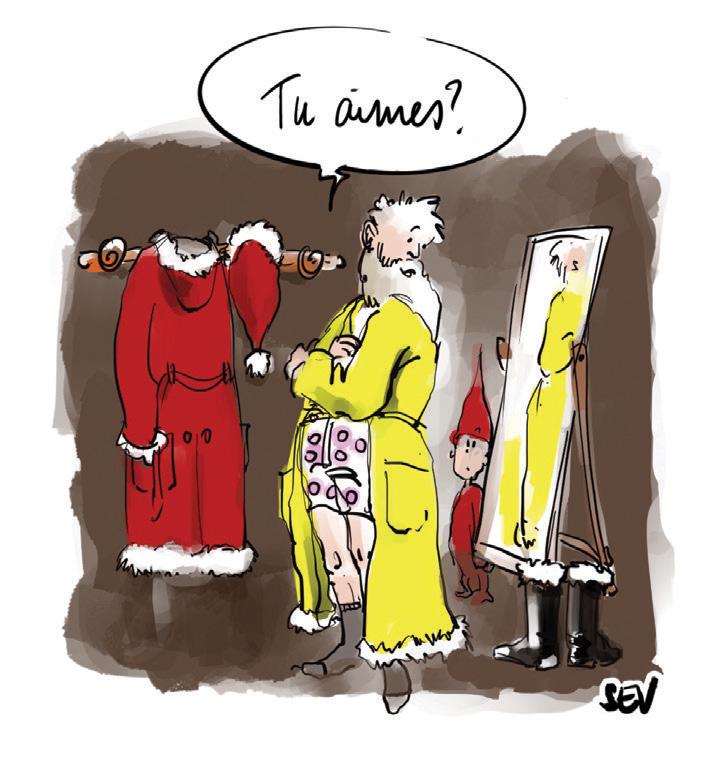
© Séverine
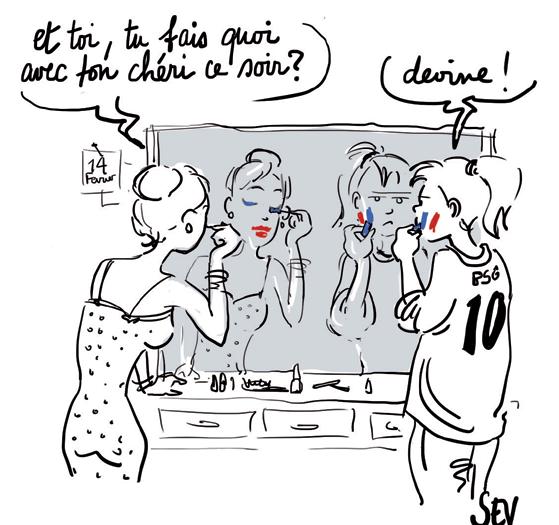
Noël sera-t-il jaune ? Saint-Valentin vs PSG
© Séverine Colmet-Daâge (2020), “Saint-Valentin vs PSG”, Récupéré de https://www.sevthequeen.com/dessin-de-presse.
23.2 Perspectives o À votre avis, pourquoi les bandes dessinées sont-elles aussi populaires chez les jeunes, les adolescents et les adultes ? Lisiez-vous des comics ou des mangas quand vous étiez jeune ? Expliquez.
310-369_ECF_2e_L3_SE_U6.indd
The two comics in the Zoom culture and another comic that appears later in the unit were created by artist Séverine Colmet-Daâge, whom we also see in the Découvrons section of this unit’s Communiquons 2.
You may want to explain to students the cultural implications behind the two cartoons by SEV. Noël, sera-t-il jaune ? refers to the Gilets jaunes movement that began in the fall of 2018 and St-Valentin vs PSG (Paris Saint-Germain) refers to the popularity of soccer in French culture.
Communiquons 2
24 Réflexion interculturelle o d
Comment les comics, les bandes dessinées, les romans graphiques ou les mangas communiquent-ils des messages dans votre culture ? Quels titres les adultes lisent-ils ? Et les enfants ? Les adolescents ? Les BD en France et en Belgique sont-elles aussi populaires que les comics en Amérique du Nord ?
Mon progrès interculturel h
Investigate: I can compare the popularity of comics and graphic novels in francophone cultures with their popularity in my community.








Supporting Heritage Learners
Ask students to think about and share art genres or examples of speci c art or artists from other francophone countries that they know.
Culture
Currently the country’s fourth-largest city, Luang Prabang is one of the centers of Buddhist life in Laos. Its rich architectural heritage includes many temples and monasteries.
ACTFL Standards
Communication: Interpersonal (24)
Communities: Lifelong Learning (24) Comparisons: Cultural (24)
Cultures: Products (24)
24 Réflexion interculturelle
The Réflexion interculturelle questions encourage students to recognize how they can use their knowledge of language and culture to communicate e ectively across cultures. To minimize the use of English during class, have students re ect and respond online in the discussion forum.
Resources Forum, Portfolio
Answers Answers will vary.
Luang Prabang (Laos)
ACTFL Standards
Communication: Interpretive (25)
Comparisons: Linguistic (25)
Découvrons
The Découvrons sections in EntreCultures® provide clear examples of language used in context, with targeted structures emphasized, helping students focus on form. Instead of presenting grammar rules, the segment invites students to observe, discover, and re ect on form in context.
Students will write their observations on the graphic organizer and then work with a partner to see if they can come up with additional observations. Students may consult the Synthèse : Grammaire at the end of the unit to con rm their hypotheses. Encourage students to make linguistic comparisons to their native language(s).
Resources
Audio
25 Découvertes
Découvrons videos and practice activities are available online throughout the series to support the explanation and understanding of newly presented grammar points. Students can view them at home and absorb grammatical patterns and structures at their own pace. Alternatively, you may wish to use these videos in class to support your own teaching.
Resources
Video, Think-Pair-Share Graphic Organizer, Workbook
Answers
Suggested answers:
1. Elle parle d’elle-même, des spectateurs d’art, de ses désirs et de ses émotions et de ceux des spectateurs.
2. Quand elle parle de ses propres désirs et émotions, elle mentionne d’abord le désir ou l’émotion, et puis elle utilise un in nitif pour la deuxième action. Quand elle parle de ses désirs ou de ses émotions et puis de quelqu’un d’autre, elle emploie le mot que suivi par un verbe conjugué au subjonctif.
3. Dans le cas où elle parle de quelqu’un d’autre, l’action n’a pas réellement lieu. Elle est hypothétique au moment où la phrase est dite.
4. Answers will vary.
Unité 6 | L’art et la vie
Découvrons
Exprimer des désirs et des émotions a
L’indicatif et le subjonctif avec les expressions de sentiment et de volonté
Vous continuez à regarder l’entretien de l’artiste Séverine Colmet-Daâge, où elle donne des conseils et exprime son point de vue en tant qu’artiste professionnelle. Elle parle aussi de ses émotions et de ses désirs.

Je suis ravie de parler aux futurs artistes de notre métier.
Je ne suis pas étonnée que vous me posiez des questions. Artiste, c’est un beau métier.

Je désire avoir la liberté de créer. Voulez-vous être curieux ? Voulez-vous accentuer la beauté dans le monde ? Si oui, je veux que vous soyez mon collègue !

Un petit conseil pour le futur artiste : je veux que vous attendiez un peu avant de faire ce métier à plein temps.
25 Découvertes b v d
Language
Je veux plaire, oui, je veux que le public soit obligé de regarder le monde différemment.
En général, les spectateurs veulent que l’artiste réussisse, mais il y en a d’autres qui préfèrent critiquer.
Je suis triste de vous quitter, mais je suis heureuse que vous me fassiez confiance avec vos questions.
Réfléchissez à ce que vous observez, et répondez aux questions suivantes dans la représentation schématique.
1. Lisez ce que dit SEV et regardez les mots en caractères gras et en différentes couleurs. Qu’est-ce que vous remarquez ? De qui et de quoi parle-t-elle ?


2. Quelles sont les différences dans la structure lorsqu’elle parle de ses propres (own) désirs et émotions et de ceux des autres ?
3. Pourquoi pensez-vous qu’il y a une différence dans la forme verbale dans les deux cas ?
4. Partagez vos observations avec un(e) partenaire. Que remarquez-vous d’autre dans ces citations, et que pouvez-vous ajouter aux observations de votre partenaire ?
As students more instances that require the subjunctive, create a student-friendly Anchor Chart (see the Instructional Strategies Toolkit) with color-coded examples similar to those in Découvrons. At Intermediate Low/Mid level, students will not use these multiple moods and tenses correctly at all times, but they should be able to understand the message and distinguish between in nitives and conjugated verbs. Exposure and practice will provide the students with the basic skills.
Rappel
Les émotions content(e)
désolé(e) étonné(e) heureux, heureuse
26 Les souhaits de Séverine b
triste
Communiquons 2
Vous avez lu les conseils et les désirs de Séverine. Qu’est-ce qu’elle veut pour elle-même et pour vous, les futur(e)s artistes ? Comme vous vous intéressez à l’art, vous voulez prendre en compte ce qu’elle dit. Notez vos réponses dans la représentation schématique.
ce que veut Séverine...
... pour elle-même :
... pour vous, les futur(e)s artistes : ... pour le public :
27 Et si je ne veux pas y aller ? s a
Votre tante a acheté deux billets pour une comédie musicale. Vous ne voulez pas y aller sans votre meilleur ami, mais vous recevez un message vocal dans lequel il décline votre invitation par manque d’intérêt.
a. Écoutez le message de votre ami. b. Organisez bien votre réponse avant de lui répondre. Enregistrez votre réponse. Essayez de le convaincre d’y aller en lui donnant votre opinion sur la comédie musicale. Que pensez-vous de cette forme d’art ?

MODÈLE Je veux que tu m’accompagnes (que tu viennes avec moi) parce que…
Mon progrès communicatif h
Interpersonal: I can convince someone to attend an artistic event.
Differentiate
Building on the emotion words on page 319, review emotion words and phrases that the students have encountered since level one. Preparation tasks can be crowd-sourced in English or French or you can write the sentences yourself. Ask the students to think of a one sentence situation that involves an emotion. Collect the ideas, create a word bank (or project the options on the board), and choose a review game from the Instructional Strategies Toolkit such as Password that encourages circumlocution or the prepared sentences. Follow up with a group debrief on how to use the emotion words and phrases with the subjunctive, in nitive, or indicative.
AP® Strategies
A simulated conversation is a task used in the Advanced Placement tests that is intended to seem like a real conversation. 27 is a one-directional phone message, but it does provide the context and setup of the Interpersonal Speaking Task on the AP® French Language and Culture Exam. On the exam, students hear a succession of prompts and record their interactions without pausing the recording. There is a 20-second pause for each student response.
ACTFL Standards
Communication: Interpretive (26)
Communication: Interpersonal (27)
Communities: Lifelong Learning (27)
Rappel
Rappel boxes are just-in-time reminders of structures and lexical items that students have already seen but may need to quickly review before applying them again.
26 Les souhaits de Séverine
Answers pour elle-même : avoir la liberté de créer plaire pour vous, les futur(e)s artistes : que nous soyons sa collègue que nous attendions un peu pour faire ce métier à plein temps pour le public : qu’il soit obligé de regarder le monde di éremment
27 Et si je ne veux pas y aller ?
Resources Audio, Portfolio
Answers
Answers will vary.
Communication: Interpretive (28.1)
Communication: Presentational (28.2)
Communities: Lifelong Learning (28.2)
Cultures: Products (28.1)
x 28.1 Regardez l’entretien
Resources
Video, Portfolio
Answers
Suggested answers:
1. le professeur :
L’art fait appel à d’autres sens. Il y a toute la partie vraiment expressive où c’est plus les émotions, le ressenti avec la nature.
2. l’élève :
Ça m’apporte de développer de plus en plus ma créativité.
3. l’élève :
Dans une œuvre d’art, on peut envoyer un message important pour la société.
4. le professeur :
On s’inspire d’histoires ou de toutes sortes de choses qui demandent de la ré exion.
x 28.2 Écrivez une lettre
Resources
Portfolio
Answers
Answers will vary.
28 L’importance des arts plastiques à l’école
Un(e) de vos ami(e)s vous dit que sa sœur et son professeur ont filmé un message d’intérêt public (public service announcement) qui parle de l’importance de l’enseignement des arts à l’école.
28.1 Regardez l’entretien v o Regardez l’entretien et complétez la représentation schématique.
Authentique

thème
Qui en a parlé ? (✔)
1. émotion l’élève le professeur
2. créativité
l’élève le professeur
3. message l’élève le professeur
4. réflexion
l’élève le professeur
Mon progrès communicatif h

Quel est l’essentiel de son commentaire à ce sujet ?
Interpretive: I can understand a message about the importance of art.
28.2 Écrivez une lettre w Écrivez une lettre à un professeur d’un cours d’art : d’arts arts plastiques, de musique, de théâtre, etc. Parlez-lui de ce dont vous vous souvenez de l’expérience que vous avez eue dans son cours. En êtes-vous reconnaissant(e) (grateful) ? Pourquoi ?
Mon progrès communicatif h
Presentational: I can present justifications for supporting arts programs.
310-369_ECF_2e_L3_SE_U6.indd
Culture
Remind students that a collège is a middle school, in general for students aged 11–15, and that a lycée is a high school.
Scaffold
As a pre-listening activity, create a list of words and descriptive sentences that are seen in the video and add distractors. Watch the video without sound and ask the students to check o what was seen. Next, ask them to predict in French or English what they think the video will be about. You may choose to watch the video a second time with pauses to con rm and discuss vocabulary.
Differentiate
For students who have not taken any ne arts classes or who do not have positive connections to the subject or a teacher, invite them to use a movie or story character. Provide sentence frames, letter openings and closings, and examples of polite appreciation.
29 L’art poétique de Verlaine
Communiquons 2
Votre groupe de conversation français a partagé un poème sur l’art. Lisez-le et répondez aux questions.
29.1 Lisez et écoutez le poème b a o
Lisez le poème, puis indiquez si les phrases sont vraies (V) ou fausses (F). Justifiez votre réponse en citant le texte pour chaque strophe (stanza).
Authentique

Art poétique

De la musique avant toute chose, Et pour cela préfère l’Impair1
Plus vague et plus soluble dans l’air, Sans rien en lui qui pèse2 ou qui pose.
Il faut aussi que tu n’ailles point Choisir tes mots sans quelque méprise3:
Rien de plus cher que la chanson grise Où l’Indécis au Précis se joint.
[...]
Que ton vers soit la bonne aventure
Éparse4 au vent crispé du matin
Qui va fleurant la menthe et le thym, Et tout le reste est littérature.
Paul Verlaine (1844–1896)
1 l’asymétrie
2 qui est lourd 3 erreur 4 ouverte, répandue


1. Le poète recherche l’ordre et la symmétrie dans la musique. (première strophe)
2. Les paroles d’une chanson ne doivent pas être contrôlées par l’artiste. (deuxième strophe)
3. C’est la musicalité du poème qui est la plus importante. (dernière strophe)
As a pre-reading activity, ask students to identify cognates to get a feel for what the poem is about. Point out the footnoted words, and challenging forms such as the word cieux, the plural for ciel.
Culture
Ask students to research the poet, Paul Verlaine. Lead them to discover important aspects of his work, such as the century during which he wrote and the liteary movements with which he is associated.
ACTFL Standards
Communication: Interpretive (29.1)
Cultures: Products (29.1)
29.1 Lisez le poème
Resources
Audio
Answers
Suggested answers:
1. F : préfère l’impair, plus vague et plus soluble dans l’air
2. V : que tu n’ailles point, choisir tes mots sans quelque méprise
3. V : tout le reste est littérature
Communication: Interpretive (29.2)
Communication: Interpersonal (29.2, 29.3)
29.2 Parlez à votre partenaire
Answers
Suggested answers:
1. L’idée principale parle des règles et des principes de la poésie. Le poète nous explique comment écrire un poème et donne des conseils.
2. Le poète dit que la musique est très importante à la poésie. L’aspect musical rend le poème expressif.
3. Il dit qu’il faut écrire d’une façon musicale ; de “choisir des mots sans quelque méprise.” ; “que le vers soit la bonne aventure”. Il parle aussi de l’importance des mots et d’images poétiques.
29.3 Discutez en groupe
Answers
Answers will vary.
29.2 Parlez à votre partenaire s
Maintenant, répondez aux questions suivantes avec un(e) partenaire.
1. En une ou deux phrases, de quoi Paul Verlaine parle-t-il dans ce poème ? À votre avis, quelle est l’idée principale ?
2. Qu’est-ce que le poète dit à propos de la musique dans le poème ? Pourquoi estce important ?
3. Quels sont les conseils que Verlaine offre aux poètes dans le poème ?
29.3 Discutez en groupe s
Après avoir lu le poème, discutez de vos réponses en groupe. Lesquelles de vos réponses sont similaires ? Partagez-vous les mêmes opinions à propos des suggestions que Verlaine offre aux poètes ? Partagez vos idées et les paroles des chansons que vous avez identifiées dans la question de réflexion.





Scaffold
Give students ideas for talking about the poem’s themes in 29.2, such as semantic groups or the capitalization of certain words. When explaining their opinion of the poem, they may want to look at the rhyming schemes or syllabi cation.
Le Patuxai, monument emblématique de la ville de Vientiane (Laos)
Communiquons 2
J’avance
30 Se battre pour les arts
After having breakfast, you read an online post from parents who are concerned about the potential budget cuts at your school, which will affect arts programs.
30.1 Lisez l’annonce b
Read the post and then reflect on your personal experiences.
Mon progrès communicatif h
Interpretive: I can understand a message about the importance of art.
30.2 Lisez les réponses et ajouter la vôtre e
Read some comments on the post. Choose one and respond to it.
Mon progrès communicatif h
Interpersonal: I can read and respond to posts about the value of art.
30.3 Créez une vidéo m
Record a video to convince your principal to preserve the art program in your school.
Mon progrès communicatif h
Presentational: I can present justifications for supporting arts programs.
ACTFL Standards
Communication: Interpretive (30.1)
Communication: Interpersonal (30.2)
Communication: Presentational (30.3)
Communities: Lifelong Learning (30.1, 30.2, 30.3)
J’avance
You can access the J’avance formative assessments online. Tiered versions are available for di erentiation. The Blanc version matches the description in the Student Edition of the textbook. The Rouge version may be used with students who wish to challenge themselves, and the Bleu version provides extra support and sca olding.
Have students self-assess based on the J’avance Can-Do statements prior to taking the formative assessment, and update their Portfolio by adding this assessment as evidence of their growing language pro ciency.
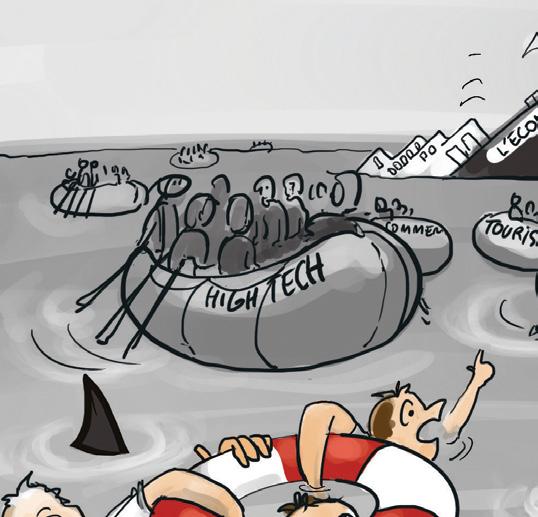
Language


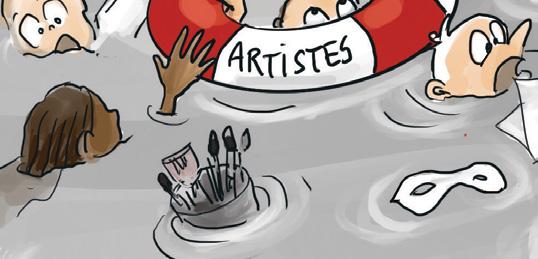

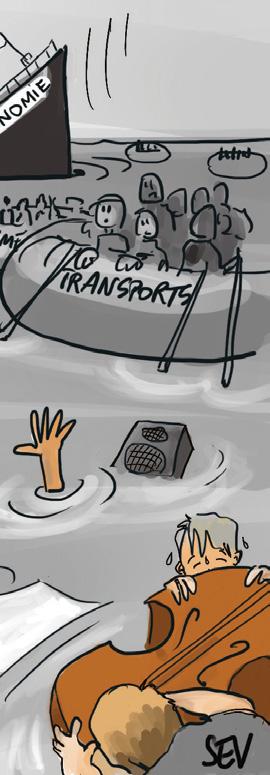
Resources
Your school or district may have faced or be facing a similar situation as 30.1, if students prefer, they could use their personal experiences to write to the school board, the community newspaper, or their legislature.
Expand on the vocabulary for this image: un bateau qui coule, un naufrage, un canot de sauvetage, une bouée de sauvetage, lancer un appel à l’aide, se noyer, un requin
Tiered Assessments (Bleu, Blanc, Rouge), Rubrics (Single-Point, Holistic, Analytic), Portfolio
Answers
Answers are provided in the J’avance key available online.
Comment dit-on ?
In EntreCultures®, the visually rich Comment dit-on ? section presents essential vocabulary and expressions in manageable segments for each thematic unit. These segments target the vocabulary that learners need to know to be successful on the formative J’avance and summative J’y arrive assessments, and for use beyond the classroom. Students will be assessed on vocabulary presented in blue type in this section.
Resources
Audio, Workbook
Communiquons 3
Comment dit-on ?
A. C’est de l’art ou pas ? a
L’art au quotidien :
les
graffitis sont-ils de l’art ?
Jetez un coup d’œil autour de vous. Que voyezvous ? À la maison, dans la rue, à l’école, on peut voir de nombreux objets qui contiennent un élément artistique ou qui sont exposés comme objets d’art. Ces objets font partie intégrale de notre vie, nous en avons besoin pour des usages quotidiens. L’art est tout autour de nous !
L’utilisation la plus commune de l’art est de transmettre des idées ou des émotions. Quand on s’intéresse aux différentes branches artistiques, comme le théâtre, les arts plastiques, la danse, le chant, la musique, la photographie, on s’enrichit à travers les concepts et les sentiments profonds que d’autres personnes ont développés ou dévoilés à travers leurs créations.
L’art est tout autour de nous : dans nos quartiers, sur les bâtiments, dans les transports en commun. Il est souvent utilisé afin de rendre un lieu plus attrayant pour les petits comme pour les grands.
L’art représente un témoignage du temps passé et parfois lointain. Un temps où la communication n’existait pas encore, un temps où la capacité d’écrire n’était pas encore établie.
L’art est tout autour de nous ! Il nous permet de réfléchir à travers un autre langage : parfois musical, parfois théâtral et parfois gestuel. C’est un langage universel et éternel. Nul besoin d’un livre pour l’apprendre, laissez l’art vous emporter, tout simplement !



Language
The directions for Comment dit-on ? provide an opportunity to practice the pronunciation of words ending in -emment and -ant. Review the /ã/ nasal vowel and remind the students that the -ent ending of 3rd person plural verbs in the present indicative and subjunctive are not pronounced. These endings are also seen in the reading task.
Differentiate
As a pre-reading activity, assign small groups a paragraph (shorter paragraphs can be combined) from the Comment dit-on ? reading to each group and ask them to render the main ideas into visuals of their choice: tag-style, icons, sketches, word clouds, etc. Groups who are assigned the same paragraph can compare their products. Post the products around the room as a Gallery Walk and ask students to take notes and re ections.
Expressions utiles le besoin l’écriture (f.) s’enrichir le fonctionnement
Communiquons 3
need writing to be enriched operations
31 Qu’est-ce qui est important ?
Pour vous préparer pour les activités du cours d’art, votre prof vous a demandé de lire l’article et d’organiser vos idées.
31.1 Lisez le texte et organizez vos idées b
Après avoir lu « L’art au quotiidien », vous commencez par organiser vos idées. Complétez le remue-méninges en ligne avec les points les plus importants de l’article.
Mon progrès communicatif h
Interpretive: I can understand and summarize key ideas.
31.2 Discutez s
Vous comparez votre remue-méninges à celui d’un(e) autre élève. Choisissez un de vos concepts et exprimez votre opinion. Demandez ensuite à votre partenaire de réagir.
MODÈLE Élève A : Moi, je crois que l’art est très important et qu’il nous permet d’exprimer nos émotions et nos sentiments. Qu’est-ce que tu en penses ?
Élève B : Je suis contente de savoir que nous sommes d’accord. Je pense qu’il faut que l’école nous permette d’exprimer notre créativité. L’art est partout, pourquoi pas sur les murs de l’école ? Tu es d’accord ?
Élève A : ...
Détail linguistique
Le mot nul(le)
Le mot nul(le) a plusieurs signifiications :
• C’est nul. = Cela n’a aucune qualité.
• Nul n’est certain de son avenir. = Personne n’est certain de son avenir.
• nulle part ailleurs = à aucun endroit
• Match nul ! = C’est un match où les deux adversaires ont le même score.
Teachers should encourage students to add as many ideas or concepts as they can in the mind map. Explain that they do not have to ll every shape.
ACTFL Standards
Communication: Interpretive (31.1)
Communication: Interpersonal (31.2)
Communities: Lifelong Learning (31.1)
x 31.1 Lisez le texte et organisez vos idées
Resources
Brainstorm Graphic Organizer, Portfolio
Answers
Answers will vary.
31.2 Discutez
Resources
Remue-méninges
Answers
Answers will vary.
Détail linguistique
Détail linguistique boxes provide additional insight about aspects of the French language that are related to elements in the unit.
Communication: Presentational (31.3)
Communication: Interpersonal (32)
31.3 Notez des idées
Answers
Answers will vary.
x 32 Soyez convaincant(e) !
Answers
Answers will vary.
31.3 Notez des idées w
Le débat arrive, et vous résumez votre discussion avec votre partenaire en trois points. Soutenez vos idées avec des exemples concrets adaptés à l’environnement scolaire.
concept du texte exemple concret adapté à l’environnement scolaire
MODÈLE L'art est partout : dans les jardins, dans les parcs, sur les bâtiments de la ville.
Je pense qu’il faut créer des endroits dans l’école où les élèves peuvent s’exprimer librement.
The Kuang Si waterfalls or cascades are near the city of Luang Prabang. They form several natural pools that attract tourists. ACTFL
32 Soyez convaincant(e) ! s
Le débat sur les graffitis continue. De quoi s’agit-il pour vous ? D’un acte d’expression artistique ou d’autre chose ?
Vous en discutez pendant le cours de français avec un(e) partenaire que vous essayez de convaincre.
MODÈLE Élève A : Je crois que les graffitis dévoilent des sentiments très profonds et que c’est un moyen pour l’artiste de nous les montrer de manière attrayante.
Élève B : Alors là, je ne suis absolument pas d’accord avec toi. Je pense que le responsable, par ses actions, a rendu notre école moins attrayante.

310-369_ECF_2e_L3_SE_U6.indd 348
STEAM Connections
Ask students to take pictures of, draw, or nd examples of what they consider to be vandalism versus artistic expression either in their community or a francophone setting. Use the Line Ups or Speed Dating strategies from the Instructional Strategies Toolkit to encourage quick and engaging discussions based on the pictures. The model provides a more formal discussion, but the multi-partner activities can be modeled for more student-leveled language.
Culture
Les chutes de Kuang Si (Laos)
Communiquons 3
33
C’est de l’art, ça ? w
Le débat continue en classe. Votre professeur de français a choisi cinq images différentes. Vous êtes plus que jamais décidé(e) à défendre les arts, alors vous créez une brochure avec deux des images ci-dessous.
a. Choisissez une image qui, selon vous, représente une expression artistique et une autre qui représente un acte qui est allé trop loin.
b. Expliquez dans votre brochure quelle image représente de l’art et laquelle représente un acte rebelle.

ACTFL Standards
Communication: Presentational (33)
Communities: Lifelong Learning (33)
x 33 C’est de l’art, ça ?
Resources
Portfolio
Answers


Answers will vary.







Comment dit-on ?
For certain units in EntreCultures® 3, Comment dit-on ? is divided into Sections A and B. Each of these sections presents essential vocabulary and expressions in manageable segments targeting the vocabulary that learners need to know to be successful on the formative J’avance and summative J’y arrive assessments, and for use beyond the classroom. Students will be assessed on vocabulary presented in blue type in this section.
Resources
Audio, Workbook
B. Les liens culturels entre le Laos et la France
a
Chaque année, les professeurs d’histoire-géo et de français enseignent une unité pluridisciplinaire. Cette année, ils se focalisent sur l’histoire des colonies à travers le monde. Votre professeur de français a choisi de lire un texte du journal intime d’une amie sur le Laos.

Aventure francophone au Laos











Aujourd’hui je suis partie à la découverte du patrimoine culturel de la capitale du Laos, Vientiane, et à la recherche du petit déjeuner parfait. Je l’ai trouvé en me promenant dans les jolies ruelles du centre-ville et en suivant l’odeur qui se dégageait d’une boulangerie. Je me suis tout de suite crue en France. J’étais consciente de l’influence de la France au Laos, mais quelle excellente surprise de trouver dans ce petit commerce de Vientiane, non seulement des pâtisseries typiquement laotiennes, mais aussi des baguettes et des viennoiseriesquelle merveille ! Tous les matins, le boulanger fabriquait croissants, pains au chocolat, chaussons aux pommes, chouquettes...








Après avoir mangé, j’ai emprunté l’avenue






Lang Xang et, de loin, j’ai vu un monument massif qui se dressait devant moi. Cette image d’un énorme arc au milieu d'une grande avenue me rappelait une autre capitale et un autre monument dans une autre avenue. Je n’en croyais pas mes yeux ! Un arc de triomphe bordé de feuilles de lotus et surmonté de quatre petits tours. C’était le Patuxai. En lao, patu veut dire « la porte » et « xai la victoire ». Triomphe, victoire. Coïncidence ? Je crois que non !










Je ne cesse de penser à cette belle journée où j'ai vu deux cultures en une.
310-369_ECF_2e_L3_SE_U6.indd















Laotian pastries and desserts include: Khaonom mokeng (cake), nam van (fruit salad with coconut milk), khao tom (sweet sticky rice). Ask the students to search regional and authentic Laotian dishes and to share their opinions. If you have a Vietnamese, Cambodian, or Laotian restaurant in your area, connect with them to learn more about their food traditions and specialties.
Does your city or region have connections to previous Indigenous and/or colonial societies? If so, ask the students to take pictures of the historical architecture and businesses that re ect the past as well as modern developments. How do cities change and develop after cultural and political changes?
une baguette
Patuxai
Expressions utiles
l’essor (m.) fait(e) maison
34 Je découvre le Laos b i
homemade
Communiquons 3
Après avoir lu le texte « Aventure francophone au Laos » du journal intime, quelles images pouvez-vous associer aux mots suivants ?
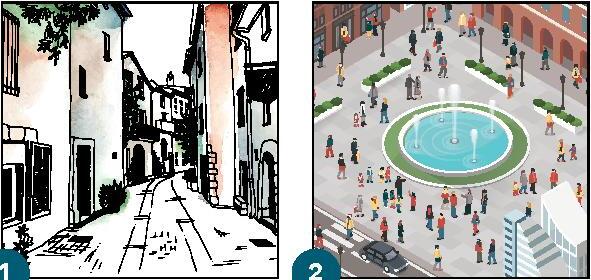

A. au bout de B. cesser de C. fabriquer
D. être bordé(e) de E. le patrimoine F. les ruelles
Mon progrès communicatif h
G. le centre-ville H. se dresser
Interpretive: I can understand main ideas and key details in a personal journal about how cultures influence one another.
Détail linguistique
Amener, emmener, apporter ou emporter ?
Quand peut-on utiliser ces quatre verbes ?
• apporter/emporter + objet qu’il faut porter
• amener/emmener + personne qui peut bouger par elle-même
Language
One option for a mnemonic device for English-speakers: the di erence between amener and apporter: Words with “men” are for people and words with “port” are objects that can be transported.
Culture
Let students know that since 2022, the French baguette has been an o cial symbol of world heritage by UNESCO.
ACTFL Standards
Communication: Interpretive (34)
Communities: Lifelong Learning (34)
34 Je découvre le Laos
Resources
Portfolio
Answers
Suggested answers:
A, D, F
G
A
Communication: Interpretive (35.1)
Communication: Presentational (35.2)
Communication: Interpersonal (35.3)
Communities: Lifelong Learning (35.3)
35.1 Lisez, regardez et écrivez
Answers
Answers will vary.
35.2 Écrivez et expliquez
Answers
Answers will vary.
x 35.3 Discutez des cultures
différentes
Resources
Portfolio
Answers
Answers will vary.
35 La culture au Laos et en France
Votre professeur de français vous demande de réfléchir à ce que vous avez lu. Qu’avez-vous remarqué ?
35.1 Lisez, regardez et écrivez b i D’après ce que vous avez lu et vu, quelles similarités et différences remarquez-vous entre la culture au Laos et celle en France ? Faites une liste de similarités et de différences.
35.2 Écrivez et expliquez w
Choisissez une similarité et une différence qui vous intéressent. Expliquez un peu la similarité et la différence et pourquoi cela vous intéresse.
MODÈLE Le Patuxai m’intéresse beaucoup. Il y a des similarités avec l’architecture de l’Arc de Triomphe à Paris. Cependant, le Patuxai a son propre style...
35.3 Discutez des cultures différentes s
Il y a de l’influence de la France au Laos, mais la culture laotienne est tout à fait unique. Existe-t-il d’autres endroits dans le monde où l’influence d’une autre culture est visible ? Discutez-en avec un(e) partenaire.
Mon progrès communicatif h
Interpersonal: I can share my opinion about the value of art from different cultures.

To support the students’ global comprehension of colonial in uence and heritage, show pictures of these vestiges of French colonial times in Laos: The Old Market in Phongsaly, the Bureau de la Résidence (now government o ces) in Vientiane, and Le Bistro Ban Vat Sene and the Royal Palace in Luang Prabang. Many of the colonial heritage sites in Luang Prabang are protected by UNESCO. There are concerns that global real estate and business investors will diminish these heritage sites.
Un pont à Vang Vieng (Laos)
36 L’art du Laos et de la France
Regardez la vidéo de Nickar, une blogueuse qui parle de l’art au Laos.
36.1 Regardez la vidéo v
Regardez la vidéo, puis choisissez la réponse qui décrit le mieux ce qu’elle dit.
1. Quels domaines de l’art Nickar évoque-t-elle notamment lorsqu’elle parle du Laos ?
A. les arts de la scène et la musique
B. le cinéma et la sculpture
C. la littérature et les arts de la scène
D. la musique et l’architecture
A. les arts de la scène et la musique
B. le cinéma et la sculpture
C. la musique et les arts visuels
D. l’architecture et les arts visuels
3. Nickar fait une comparaison entre...
A. un peintre laotien et un peintre français.
B. deux différents styles de peintures.
C. la bande dessinée asiatique et européenne.
D. les spectateurs des deux pays.
4. Quel bienfait de l’art est-ce que Nickar ne mentionne pas ?
A. Il diminue le stress de tous les jours.
B. Il crée une ambiance conviviale.
C. Il développe l’estime de soi.
D. Il transmet un message culturel.
36.1 Regardez la vidéo
Resources
A. partage, pensées
B. cuisine, poésie
C. intrigue, personnages
D. comédie, théâtre
36.2 Faites des comparaisons s
Culture


2. Quand Nickar parle de l’art en France, quels domaines mentionne-t-elle ?
5. Quels mots-clés décrivent le mieux ce que dit Nickar dans cette vidéo ?
Avec un partenaire, parlez de vos avis sur l’art et comparez-les aux avis de Nickar.
In the 19th century, France colonized Vietnam, Cambodgia, and Laos. During this period, French became an o cial language of Laos until 1953, when Laos regained its independence. Today, there is a connection between French and Laotian cultures. The French language is electively taught in schools and used in business and politics.
Differentiate
After 36.1, ask students to use a graphic organizer such as a T-Chart to compare and contrast the heritage sites in Nickar’s city with those in the area where they live. To do this, students should use the places and materials that Nickar details. This will provide a good opportunity for students to research the pre- and post-colonial history of your region and to look for new heritage sites they may not have known about previously.
Video
Answers 1. A 2. D 3. B 4. C 5. A
36.2 Faites des comparaisons
Answers
Answers will vary.
Découvrons
The Découvrons sections in EntreCultures® provide clear examples of language used in context, with targeted structures emphasized, helping students focus on form. Instead of presenting grammar rules, the segment invites students to observe, discover, and re ect on form in context.
Students will write their observations on the graphic organizer and then work with a partner to see if they can come up with additional observations. Students may consult the Synthèse : Grammaire at the end of the unit to con rm their hypotheses. Encourage students to make linguistic comparisons to their native languages.
Resources
Audio
Découvrons
Éviter la répétition avec me, te, nous, vous, le, la, les, lui, et leur a Les pronoms compléments
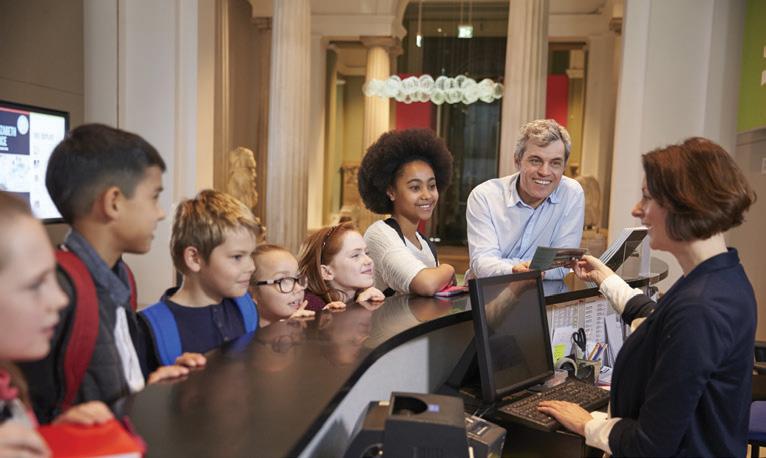
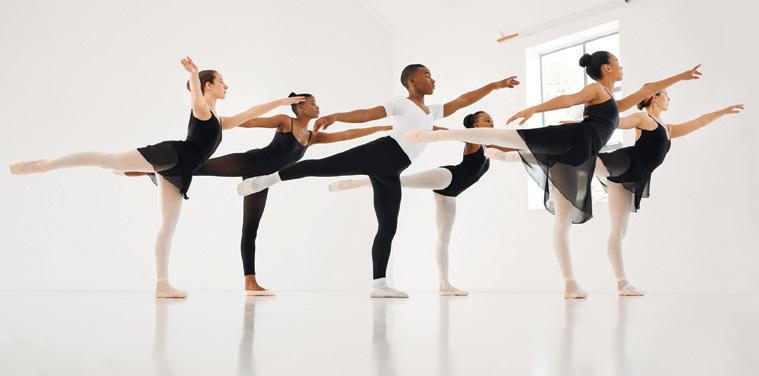
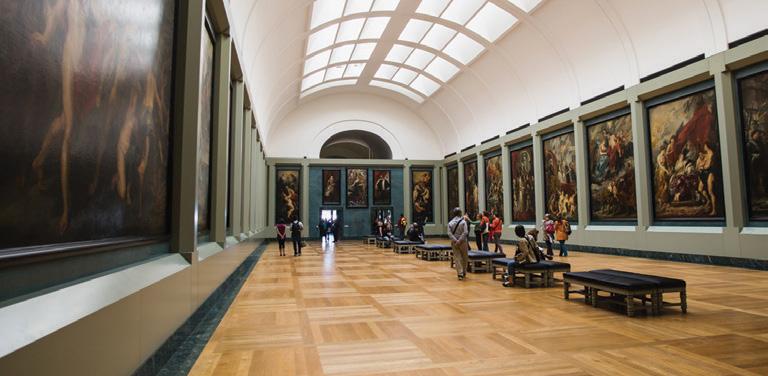
Vous nous les donnez ? Merci, c’est gentil !
Bienvenue à tous ! Je m’appelle Charlie. Je suis votre guide-accompagnatrice pour la visite guidée. Je veux que vous, le public, sachiez que nous vous proposons des concerts, des spectacles et des expositions. En plus, nous vous en proposons certains gratuitement ! Il y en a beaucoup !
Et tu vois, nous avons un studio de danse. Le voici. Dedans il y a un endroit où les parents s’installent pour regarder les spectacles. Je te le montre.
Voici la grande galerie. Les professeurs d’art y donnent les cours. Ils les y donnent le matin, en général. Ils ne les y donnent pas l’après-midi ni le soir car les salles sont réservées aux spectateurs. On les leur réserve car exposer les œuvres, c’est la mission principale de la galerie. Ce professeur enseigne un concept de peinture à son élève. Il le lui explique.
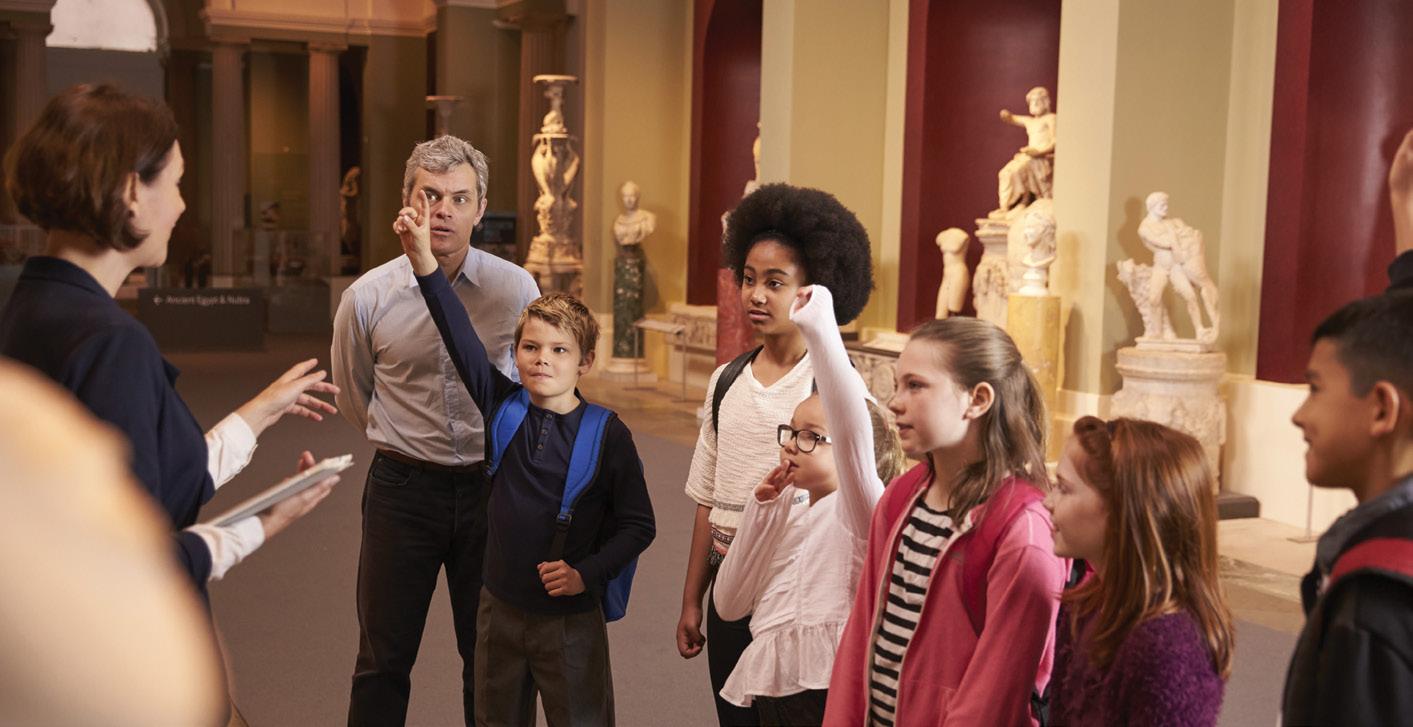
Oui, je vous la recommande. Je vous l’ai recommandée car les sculptures sont magnifiques et la sculptrice vient nous les présenter dimanche. Merci d’être venus à la galerie. J’ai une surprise pour vous. La galerie a quelques billets qui restent pour le récital de ce soir, et je vous les donne !
Excusez-moi, Mademoiselle. J’aime beaucoup les arts visuels. Vous avez parlé de l’exposition de sculpture.
Vous me la recommandez ?
There is one example of agreement with a preceding direct object pronoun (recommandée), which students may notice. This concept is not explicitly addressed at this point since the focus here is on double object pronouns.
ACTFL Standards
37 Découvertes b v d
Réfléchissez à ce que vous observez, et répondez aux questions suivantes dans la représentation schématique.
1. Lisez ce que Charlie et les visiteurs disent, et regardez les mots en caractères gras. Qu’est-ce que vous remarquez ? Connaissez-vous déjà ces mots ? Dans quels contextes les avez-vous vus ?
2. Pourquoi emploie-t-on les mots en caractères gras ?

Communication: Interpretive (37)
Comparisons: Linguistic (37)



3. Qu’est-ce que vous remarquez pour l’ordre des mots dans chaque phrase ? Où se trouvent les mots en caractères gras par rapport aux autres mots ?
4. Concernant les mots en caractères gras, avez-vous remarqué dans quel ordre ils apparaissent (appear) s’il y en a deux ? Lesquels apparaissent toujours en première position ? En deuxième position ?
5. Partagez vos observations avec un(e) partenaire. Que remarquez-vous d’autre dans ces citations, et que pouvez-vous ajouter aux observations de votre partenaire ?






37 Découvertes
Découvrons videos and practice activities are available online throughout the series to support the explanation and understanding of newly presented grammar points. Students can view them at home and absorb grammatical patterns and structures at their own pace. Alternatively, you may wish to use these videos in class to support your own teaching.
Resources
Video, Think-Pair-Share Graphic Organizer, Workbook
Answers
Suggested answers:
1. Nous connaissons tous les mots en caractères gras. Nous avons vu les pronoms le, la, l’ et les in EntreCultures® 2 and me, te, lui, nous, vous et leur dans l’Unité 2 d’EntreCultures® 3.
2. pour éviter la répétition, pour ne pas avoir à répéter les mots en caractères gras
3. Les mots en caractères gras se trouvent toujours avant le verbe conjugué (au présent ou au passé).
4. Me, nous et vous sont toujours en première position. Lui et leur sont toujours en deuxième position. Le, la, les sont placés après me, te, nous et vous. Se place après les, mais avant en ou y, qui se place en dernière position.
5. Answers will vary.
There are several educator-created songs on the use of double-object pronouns. Consider sharing a song with your students if this ts your group’s personality.
The songs, “No me mires más” by Kendji (bilingual in Spanish), “Quelqu’un m’a dit ” by Carla Bruni, and “Comme des enfants” by Cœur de Pirate are good songs to use for exposure to pronouns in context. Consider multiple activities for comprehension beyond a Cloze Activity such as drawing the lyrics, sentence line ups, and tallying the pronouns use.
Des rizières au Laos
Découvrons
Communication: Interpretive (38)
Communication: Presentational (38)
Communication: Interpersonal (39)
38 Elle le leur a dit ?
Answers
Suggested answers:
1. Elle nous en a proposé et certains gratuitement. Il y en a beaucoup.
2. Elle nous a montré le studio de danse et la grande galerie.
3. Oui, les profs d’art les y donnent le matin. Ils ne les y donnent pas l’après-midi ou le soir.
4. Oui, la galerie les leur réserve l’après-midi et le soir.
39 Raconte-moi la visite !
Answers
Suggested answers:
1. Oui, elle nous en a proposé.
2. Oui, je la lui ai posée. Non, je ne la lui ai pas posée.
3. Oui, elle nous en a donné.
38 Elle le leur a dit ? b w
Votre prof d’art a entendu que vous avez déjà visité la galerie. Elle vous demande ce que la guide vous a dit pendant votre visite guidée.
MODÈLE …vous a montré l’endroit où les parents s’installent pour regarder les spectacles. Elle nous l’a montré.
Votre prof vous demande si la guide... Vous répondez :
1. ... vous a parlé des événements musicaux ou culturels. Elle...
2. ... vous a donné une visite guidée de plusieurs endroits dans la galerie. Elle...
3. ... vous a dit si les profs d’art donnent des cours à la galerie et quand. Oui, les profs d'art...
4. ... vous a dit quand la galerie réserve les salles d’exposition uniquement aux spectateurs. La galerie...
39 Raconte-moi la visite ! r s
Votre amie n’a pas pu aller voir la galerie avec vous. Elle vous a laissé un message avec quelques questions sur votre visite. Enregistrez vos réponses à ses questions.
Détail grammatical
Les verbes utilisés avec la double pronominalisation apporter demander donner écrire montrer offrir présenter prêter proposer réciter recommander vendre quelque chose à quelqu’un
310-369_ECF_2e_L3_SE_U6.indd 356
For 38, to encourage the use of a variety of pronouns, encourage students to speak in the third person about what the guide said. Students may want to practice recounting their experience in the past tense, or they may wish to use the present tense to focus on correct pronoun use.
Differentiate
Using ve to seven verbs in the Détail grammatical, nd the Inside-Outside Circles activity in the Instructional Resource Toolkit. Students can practice asking and answering questions such as “Tu peux me prêter ton crayon ? Tu vas me réciter ce poème ? ” and answering with “Oui, je peux te le prêter. Non, je ne vais pas te le réciter.” Using fun props (stu ed animals, plastic foods, etc.) and humorous proposals will increase engagement and build community.
40 Les crêpes autour du monde
40.1 Connexions o c
Quel genre de cuisine préférez-vous et pourquoi ?
À votre avis, les arts culinaires mériteraient-ils de faire officiellement partie des arts ? Expliquez votre réponse.
Bien qu’ils ne fassent pas officiellement partie de la liste des plus grandes disciplines artistiques, les arts culinaires méritent toutefois une mention plus qu’honorable.
En effet, la cuisine d’un pays est le miroir de son histoire, de sa géographie, de sa culture et de bien d’autres facteurs. Chaque pays ou région, chaque culture a développé au cours du temps une cuisine bien spécifique. De ces distinctions, certains plats semblent avoir traversé le temps et la distance. Un des exemples les plus flagrants est la crêpe, qui se prépare différemment selon les cultures.
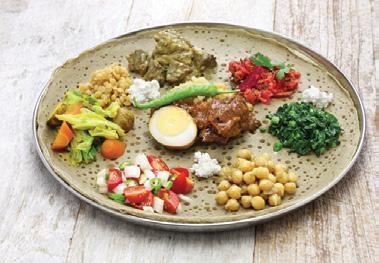


D’après les historiens, la crêpe serait apparue aux environs du 12e siècle. C’était alors une galette de sarrasin (buckwheat) et d’eau, cuite d’un seul côté pour accompagner des mets comme de la soupe, des œufs ou de la viande. Au fil du temps, la recette a évolué, aujourd’hui on utilise généralement de la farine de blé, des œufs et du lait pour faire des crêpes. Selon la culture, ces différentes variétés de crêpes peuvent être plutôt salées ou plutôt sucrées selon les occasions. Mais la crêpe n’existe pas seulement dans la culture francophone. Avez-vous déjà entendu parler de blini, de roti, d’injera, ou même de banh chiao ? Quelles images pouvez-vous identifier ? Auxquelles avez-vous déjà goûté ?
40.2 Perspectives o
Avez-vous déjà mangé une crêpe salée ou sucrée ? Comment l’avez-vous trouvée ? Si vous n’avez pas encore mangé de crêpe, aimeriez-vous en goûter une ? Quel type de crêpe vous tente (tempts) le plus ?
Supporting Heritage Learners
Ask students if there is a version of a crêpe in their cultures of origin.
Culture
Teachers should note the origin of the following crêpe-like dishes: blini → Russia, roti → India, injera → Ethiopia, and banh chiao → Cambodia.
ACTFL Standards
Communication: Interpersonal (40.1, 40.2)
Cultures: Products (40.1, 40.2)
Connections: Acquiring Information (40.1)
Zoom culture
Each Zoom culture focuses on a cultural product (produit) or practice (pratique) and invites students to develop insights into underlying perspectives (perspectives) in the francophone world and in their own culture. Products are tangible and intangible items—such as books, food, laws, music, and games—required or justi ed by the underlying values and beliefs of a culture. Practices are patterns of social interactions or behaviors, such as greetings, holidays, events, and daily schedules. Perspectives are the values, attitudes, and ideas of a culture.
Before students read the Zoom culture selections in the unit, use the Connexions questions to have them re ect on this product or practice in their own culture. Then have them read the information in the section before responding to the Perspectives questions. To minimize the use of English during class, have students read silently and respond for homework. Students should complete both the Connexions and Perspectives questions in the discussion forum, as they will use English for their responses.
40.1 Connexions
Resources Forum
40.2 Perspectives
Resources Forum, Portfolio
Injera, cuisine éthiopienne
Blini au saumon et au caviar
Roti, cuisine indienne
Banh chiao, cuisine cambodgienne
Communication: Interpersonal (41, 42)
Cultures: Products (41)
Comparisons: Cultural (41)
Communities: Lifelong Learning (41)
41 Réflexion
interculturelle
The Réflexion interculturelle questions encourage students to recognize how they can use their knowledge of language and culture to communicate e ectively across cultures. To minimize the use of English during class, have students re ect and respond online in the discussion forum.
Resources Forum, Portfolio
Answers
Answers will vary.
Détail linguistique
Détail linguistique boxes provide additional insight about aspects of the French language that are related to elements in the unit.
42 On vous en propose
Answers
Suggested answers:
1. Oui, on y en mange.
2. Non, nous n’en mangeons pas. Oui nous en mangeons. Je n’en mange pas. J’en mange.
3. Nous leur proposons… 4. Nous les leur proposons parce que…
41 Réflexion interculturelle o d
Quel(s) autre(s) exemple(s) de « crêpes » connaissez-vous ? Quelle en est l’origine et le nom ? S’agit-il d’une crêpe plutôt sucrée ou salée ? Pouvez-vous citer d’autres exemples de plats qui semblent avoir « traversé » les cultures et les frontières ? Lesquels ?
Mon progrès interculturel h
Investigate: I can give examples of how variations among similar dishes reflect cultural differences.
Détail linguistique
Pour prononcer deux pronoms ensemble
Dans une phrase qui a deux pronoms, la voyelle e à la fin des pronoms me et te peut disparaître pour que la phrase se prononce d’une manière plus fluide, avec moins de syllabes.
Tu me les donnes. « Tu m’les » donnes
(Le e du mot me ne se prononce pas.)
Je te les présente. « je t’les » or « j’te les » présente (Le e du mot te, ou le e du mot je, ne se prononce pas.)
Vous connaissez un phénomène similaire dans la phrase « je ne sais pas », qui est plus souvent prononcée en trois syllabes au lieu de quatre. (Le e du mot ne ne se prononce pas.)
42 On vous en propose e
En tchattant sur internet avec Nickar, vous parlez de nourriture. Elle connaît les « crêpes » du Cambodge, un des pays à côté du Laos. Elle vous dit que les gens y mangent des crêpes et qu’elle aimerait vous poser quelques questions à ce sujet.

En Asie on mange des crêpes ! Et en Europe ? Et au Mexique ?
Chez toi, tu manges des crêpes ?
Sinon, quels plats proposez-vous aux invités ?
Pour quelles raisons est-ce que vous leur proposez ces plats ?
310-369_ECF_2e_L3_SE_U6.indd
Scaffold
Color-coded sentence building cards allow students to visualize the use of double object pronouns. Create sets of sentence cards with the nouns and a choice of pronouns. Students will rst build the full sentence with the nouns and then substitute them with pronouns. Remind the students that not all French speakers use double pronouns in everyday speech.
Challenge
Encourage students to use object pronouns to demonstrate their French skills by avoiding the repetition of nouns in their speech and writing.
Nickar
Communiquons 3
J’avance
43 Une exposition virtuelle
Each year, your school organizes an exhibition to showcase the artistic accomplishments of its students. This year, there will also be a virtual exhibition of young artists from around the world with connections to your school, as the theme of the exhibition is “Cultural Connections through the Arts.”
43.1 Lisez le post b
Read a post by one of the young artists who will participate in the exhibition, and then fill out a graphic organizer about it.
Mon progrès communicatif h
Interpretive: I can understand and summarize key ideas.
43.2 Créez un dépliant w
Create a pamphlet to invite members of the French Honor Society to participate in or go to the exhibition. Focus on the various influences of art in francophone countries.
Mon progrès communicatif h
Presentational: I can present my point of view about a work of art.
43.3 Demandez et répondez r s
Discuss the upcoming exhibit with someone who is hoping to attend. She talks to you about what she plans to exhibit. Answer her questions and ask her some of your own.
Mon progrès communicatif h
Interpersonal: I can share my opinion about the value of art from different cultures.

AP® Strategies
A simulated conversation is a task used in Advanced Placement® tests that is intended to seem like a realistic conversation. Students hear a succession of prompts and record their interactions without pausing the recording. There is a 20-second pause for each student response, as is the case on the AP® French Language and Culture Exam.
ACTFL Standards
Communication: Interpretive (43.1)
Communication: Presentational Communication: Interpersonal (43.3)
Communities: Lifelong Learning (43.1, 43.2, 43.3)
J’avance
You can access the J’avance formative assessments online. Tiered versions are available for di erentiation. The Blanc version matches the description in the Student Edition of the textbook. The Rouge version may be used with students who wish to challenge themselves, and the Bleu version provides extra support and sca olding. Have students self-assess based on the J’avance Can-Do statements prior to taking the formative assessment, and update their Portfolio by adding this assessment as evidence of their growing language pro ciency.
Resources
Tiered Assessments (Bleu, Blanc, Rouge), Rubrics (Single-Point, Holistic, Analytic), Portfolio
Answers
Answers are provided in the J’avance key available online.
43.3 Demandez et répondez
Resources
Audio
J’avance
Communication: Interpretive (44.1)
Communication: Presentational (44.2)
Connections: Acquiring Information (44.1)
Communities: Lifelong Learning (44.1)
Comparisons: Cultural (44.2)
44.1 Réfléchissez
Resources
Brainstorm Graphic Organizer, Portfolio
Answers
Answers will vary.
44.2 Faites des comparaisons
Resources
Venn Diagram
Answers
Answers will vary.
Notre communauté mondiale
44 Explorons les sept domaines de l’art
Vous allez explorer les différentes manières dont les sept différents domaines de l’art sont mis en valeur dans votre communauté et dans une communauté au Laos.
44.1 Réfléchissez b c
1. Commencez par faire un remue-méninges :
Y a-t-il, là où vous habitez ou étudiez, des exemples d’œuvres artistiques accessibles en permanence et gratuitement à tout le monde ?
• Citez quelques exemples concrets, et agrémentez vos exemples de photos ou d’images si possible.
• Savez-vous si de telles initiatives existent ailleurs ?
• Si oui, citez quelques exemples concrets. Ajoutez des photos ou des images si possible.
2. Ensuite, vous allez choisir un domaine artistique et faire une recherche sur l’art au Laos, ou dans un autre pays francophone. Utilisez des mots-clés selon votre catégorie : domaines artistiques, arts visuels, peinture, peintres, sculpture, architecture, édifices, bâtiments, musique, littérature, poésie, arts de la scène, théâtre, spectateurs, spectatrices, cinéma, bande dessinée, stylisme, arts culinaires
Au cours de votre recherche, prenez note des éléments suivants :
• les arts et les artistes qui sont représentés le plus souvent et qui sont les plus accessibles ;
• les différentes manières dont la communauté francophone fait la promotion des arts ; et
• toute autre information intéressante ou surprenante relative au sujet.
Mon progrès interculturel h
Investigate: I can investigate which art forms and artists are celebrated in a variety of communities.
44.2 Faites des comparaisons w d
Identifiez les différences et les similarités entre les initiatives qui existent aux États-Unis et au Laos, ou dans le pays que vous avez recherché, en ce qui concerne la promotion et la mise en valeur de l’art en général.
Utilisez un diagramme de Venn pour noter ce que vous avez appris.
Scaffold
As students progress through each step of the multi-task research, provide support on how to organize their notes, collect and present data, and collaborate with their classmates. Ask students to delegate tasks and responsibilities to each group member: Note taker, research specialist, time keeper, etc. Examples of past student work and clearly de ned expectations will support the students through this tiered set of activities.
Differentiate
Depending on the size and make up of your class, you may wish to open the research to Vietnam and Cambodia. Remind students to start their searches in French and then, if necessary, use English. Not all web resources from Southeast Asia will be in French. If you prefer, you can provide a pre-chosen list of websites for students to use for this project.
Poterie traditionnelle
44.3 Échangez vos idées s
Notre communauté
En petits groupes, discutez du résultat de vos recherches au sujet des différences et des similarités entre les initiatives qui existent aux États-Unis et au Laos en ce qui concerne la promotion et la mise en valeur de l’art en général.
Qu’avez-vous appris ? Qu’est-ce qui est surprenant ?
45 Un spectacle francophone
Vous voulez faire un spectacle pour représenter les arts de diverses communautés francophones.
45.1 Créez un sondage w
Vous allez interviewer des artistes francophones dans votre communauté. Préparez des questions pour leur demander dans quel(s) domaine(s) artistiques ils travaillent et quelles sont leurs influences artistiques et culturelles. Vous pouvez aussi poser des questions sur leurs critères de sélection, leur(s) priorité(s) locale(s), et leurs objectifs.
45.2 Présentez les résultats w p

Écrivez une synthèse de votre entretien avec un ou une artiste francophone et partagez-la avec les élèves de votre classe. Vous vous servirez de ce que vous avez appris pour faire votre spectacle et représenter des arts de vos communautés francophones locales.
46 Réflexion interculturelle o d p
Suite à votre recherche et aux résultats de votre enquête, expliquez ce que vous avez appris en ce qui concerne les différentes manières dont les sept différents domaines de l’art sont mis en valeur dans votre communauté et la communauté francophone que vous avez interrogée.
Mon progrès interculturel h
Interact: I can create a survey for francophone community leaders and interpret the results.
Global Connections
Notre communauté mondiale aligns with one or more of the 17 Sustainable Development Goals of the UNESCO Education 2030 Framework for Action. Unité 6 of EntreCultures® 1 aligns with Goal 4 (Quality Education: Ensure inclusive and equitable quality education and promote lifelong learning opportunities for all.)
Challenge
Choose an easy-to-manage tool to document and save your students’ projects for future groups, parent-teacher conferences, school board presentations, and language conferences. If possible, invite your Art/CTE/Graphic Arts colleagues into the class to share their insights and perspectives. If your region has an Alliance française or other francophone organization, contact them to see if they have ideas for guest speakers. Consult online US and international non-pro ts who organize webinars for schools. You may consider connecting with artists via their social media or YouTube channel to invite them to speak with your students.
ACTFL Standards
Communication: Interpersonal (44.3, 46)
Communication: Presentational (45.1)
Communication: Presentational (45.2)
Communities: School and Global (45.2)
Communities: Lifelong Learning (45.2, 46)
Comparisons: Cultural (46)
Cultures: Products (46)
44.3 Échangez vos idées
Answers
Answers will vary.
45.1 Créez un sondage
Answers
Answers will vary.
45.2 Présentez les résultats
Resources Portfolio Answers Answers will vary.
46 Réflexion interculturelle
Resources Portfolio Answers Answers will vary.
Synthèse : Grammaire
This section presents a brief overview of the language structures presented in the three Découvrons. Note that there are Workbook activities for more support available in the respective Découvrons sections online.
Resources
Workbook
Synthèse : Grammaire
1. Exprimer et mettre en doute des opinions et des croyances
The Indicative and the Subjunctive with Verbs of Opinion and Doubt
Use the verbs penser and croire to express an opinion.
Je crois que la cuisine française est aussi populaire que la cuisine italienne.
I believe that French cuisine is as popular as Italian cuisine.
Usually, when you use the verbs penser and croire in the negative form, the next part of the sentence will be in the subjunctive.
Mon père ne pense pas que le cinéma moderne soit très créatif.
My father does not think that modern cinema is very creative.
If you are asking someone a question with penser or croire, the verb that follows will usually be in the subjunctive.
Croyez-vous que notre musée d’art doive avoir une exposition de graffitis ?
Do you believe that our art museum should have a graffiti exhibit?
2. Exprimer des désirs et des émotions
The Indicative and the Subjunctive with Expressions of Emotion and Desire
To talk about one’s own desires and emotions, use an expression of desire or emotion followed by an infinitive.
Je veux étudier l’architecture à l’université.
I want to study architecture in college.
Add de after expressions of emotion that use avoir or être before using the infinitive.
Je suis heureux d’aller à une exposition de photographie avec mes copains.
I am happy to go to a photography exhibit with my friends.
To express emotional reactions to what someone else does, or to state what one person wants another to do, use the subjunctive in the second part of the sentence.
Je suis triste que Paul ne vienne pas avec nous pour voir la pièce de théâtre.
310-369_ECF_2e_L3_SE_U6.indd 362
I am sad that Paul is not coming with us to see the play.
Consider using an activity similar to “Two Truths and a Lie”with modi cations for the opinion and belief expressions. Teams can be paired up to guess who is telling the truth. Incorporate topics such as music, movies, video games, food, school life, and social media to connect with students’ interests.
Language
Refer students to the supplemental activities online to review grammar structures and vocabulary expressions. If you have created anchor charts or other reference materials throughout the unit, ask the students to re ect on their comprehension and growth via Cornell Notes, vocal messages, or other strategies.
Synthèse : Grammaire
3. Éviter la répétition avec me, te, nous, vous, le, la, les, lui et leur
Object Pronouns
You have already learned how to use object pronouns to avoid repeating previously stated people and things. Sometimes two pronouns, rather than just one, can be replaced by object pronouns.
Je vais donner les dessins à Christine ce soir.
Je vais les lui donner ce soir.
I’m going to give Christine the drawings tonight.
I’m going to give them to her tonight. In the second sentence, the object les dessins is replaced by les, and à Christine is replaced by lui. Use the chart below to determine the correct order of multiple pronouns.
me te nous vous before le la l’ les before lui leur before y before en
La guide expliquera la peinture à mes amis et moi. Elle nous l’expliquera.
Est-ce qu’il y a de bons musées à Montréal ? Oui, il y en a beaucoup.
The guide will explain the painting to our group. She will explain it to us.
Are there good museums in Montreal? Yes, there are a lot of them.
Synthèse : Vocabulaire
This section provides a summary of the vocabulary studied in this unit. For further reinforcement, activities for practice are available in the Workbook and online.
Resources
Flashcards, Workbook
Synthèse : Vocabulaire
Communiquons 1
Les arts
The Arts
l’architecture (f.)
les arts (m.) de la scène
les arts (m.) visuels
la bande dessinée
la comédie musicale fictif/fictive impressionnant(e)
l’intrigue (f.)
la matière brute
l’œuvre (f.)
le/la peintre la peinture la pensée
la pièce de théâtre le personnage la poésie le roman la sculpture le sentiment le spectateur, la spectatrice le stylisme la taille
architecture, design performing arts visual arts comic book, graphic novel musical fictional impressive plot raw material work painter painting thought, thinking play character poetry novel sculpture feeling spectator, audience member (fashion) design size
310-369_ECF_2e_L3_SE_U6.indd 364
Language
Consult the Instructional Strategies Toolkit for interactive and communicative ideas to practice the vocabulary using context and student strengths. PechaKucha is a fun way to connect the art theme with vocabulary and structure revision. Use twenty of the words from the lists with a variety of wellknown and challenging words. Find twenty pictures that depict those words or that would trigger their use. This activity can be done in small groups or as a class. Students should try to speak for twenty seconds (modify as necessary) about the image using as much vocabulary from the unit and previous knowledge as possible.
Communiquons 2
L’effet de l’art sur ma vie How Art Affects My Life admirer
l’auditeur (m.), l’auditrice (f.) le but se calmer choquer contempler s’échapper (de/d’) laisser quelqu’un froid le lecteur, la lectrice léger/légère réagir rêver secouer
Communiquons 3
C’est de l’art ou pas ? Is This Art or Not?
Synthèse : Vocabulaire
to admire listener goal, objective, purpose to calm down, settle down to shock to contemplate, to look at to escape to leave someone indifferent reader light to react to dream to shake (up)
attrayant(e) autour de/d’ le bâtiment la capacité contenir dévoiler s'enrichir attractive, appealing around building capacity, ability to contain, hold to unveil, reveal to enrich oneself exposer le lieu lointain(e) profond(e) le témoignage l’usage (m.) to show place, location, site far, remote, distant deep testimony use, usage
Les liens culturels entre le Laos et la France Cultural Links Between Laos and France bordé(e) cesser se dégager se dresser fabriquer le patrimoine la ruelle surmonté(e) bordered to cease, stop, discontinue to emerge to stand to fabricate heritage, legacy narrow street, alley topped
Communication: Interpretive (Interpretive Assessment)
J’y
arrive
The J’y arrive summative Integrated Performance Assessment (IPA) addresses the essential questions for the unit through a series of interrelated performance tasks. All supporting materials for the IPA can be accessed online. The IPA rubric is designed to be shared with students in advance of J’y arrive so that they know what is expected of them.
Resources
Rubrics (Holistic, Analytic, Integrated Performance Assessment)
Answers
Answers are provided in the J’y arrive key available online.
Interpretive Assessment
Resources
Video
J’y arrive
Questions essentielles
What is art to me? What is the relationship between art and culture?
• How can art convey ideas, opinions, and emotions?

Une rencontre artistique
You have decided to help organize your community’s Spring Arts Festival. First, you participate in a meeting in which you meet one of the festival’s featured artists virtually. A few days after the meeting, you decide to share your ideas with one of the organizers.
Before you begin, refer to the J’y arrive rubric to familiarize yourself with the evaluation criteria.
Authentique
Interpretive Assessment
Elle s’exprime v
Watch a video in which the featured artist talks about organizing an art exhibition.







Each student has their strengths and challenges. An Integrated Performance Assessment allows students to demonstrate their language and intercultural development in a variety of modes using real-world tasks. One option to support students with learning di erences (IEPs, etc.) is to allow them to choose out of the three modes that best re ects their skills. In later assessments, encourage these students to try the other mode to compare and strategize for success.
Scaffold
Find a short video or documentary in English or French that will help you tie up the ends for this unit. Re ect with the class how they can use the themes and ideas in their other classes or in their personal lives.
Interpersonal Assessment
Comment on fait ? Discutons-en e
Respond to an email from the president of the organization running the art festival and answer her questions.
Presentational Assessment
Je propose une idée m
Present an idea for an exhibit or performance to be included in the arts festival. Explain your idea and justify why it should be part of the festival.

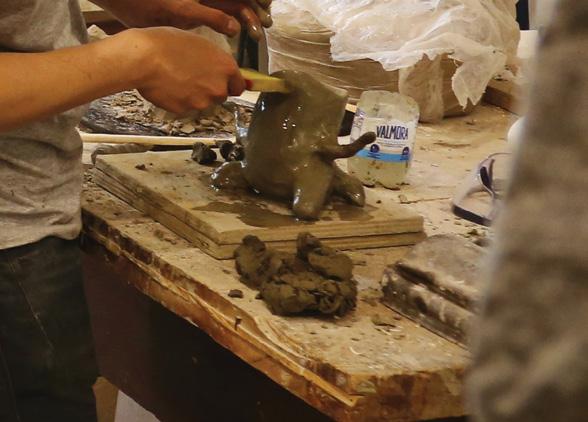
ACTFL Standards
Communication: Interpersonal (Interpersonal Assessment)
Communication: Presentational (Presentational Assessment)