Florida


Elizabeth Zwanziger
Florence Falloux
Jan Hagedorn
Tracy Rucker
Contributing Author
Catherine Ousselin
Director of Editorial: Tanya Brown
Senior Editorial Project Manager: Eliz Tchakarian
Managing Editor: Nathalie Gaillot
Developmental Editor: Vanessa Ta
Curriculum Coordinator: Helen Small
Editors: Eileen Angelini, Ana-Maria M’Enesti, Henry Menninger, Jennifer Murphy, Cécile Rebolledo
Product Design and Production Manager: Sawyer McCarron-Rutledge
Cover Designer: Jaana Bykonich
Graphic Designers: Jaana Bykonich, Tawny Dougherty, Ryan Hamner, Hannah Rowlett
Production Designers: Derrick Alderman, Rivka Levin









Cover image: Japan Bridge in the modern business district of La Defense. Paris. France. ©D.Yell / Alamy Stock Photo
Copyright © 2026 by Wayside Publishing
All rights reserved. No part of this publication may be reproduced, stored in a retrieval system, or transmitted in any form or by any means, electronic, mechanical, photocopying, recording, or otherwise, without the prior written permission of the publisher.
The marks [EntreCulturas®, EntreCultures®, FlexText®, Learning Site®, Wayside Publishing®] (collectively “the Marks”) are registered in the U.S. Patent and Trademark Offi ce and owned in their entirety by Wayside Publishing (“Wayside”). Any use of the Marks without the express written permission of Wayside is prohibited.
Printed in USA
1 2 3 4 5 6 7 8 9 10 XX 24
Print date:
Hardcover ISBN 978-1-641596-95-4
EntreCultures® Mission and Vision • Welcome to EntreCultures® 2
Vocabulary Instruction in Context .
TE5
Scope and Sequence ....................... TE6
Florida’s CPALMS World Languages Standards . TE14
Approaches to Teaching and Learning ........ TE15
High-Leverage Teaching Practices … TE15
Cultivating Interculturality ............... TE18
Integrating Interculturality in Teaching and Learning ........................... TE19
Developing and Assessing Interculturality in Teaching and Learning TE20
Staying in the Target Language ............ TE22
Instructional Strategies TE24
Integrated Differentiated Instruction
Heritage Learners .
Pays membres
Albanie
Andorre
Arménie
Belgique
Bénin
Bulgarie
Burkina Faso
Burundi
Cabo Verde
Cambodge
Cameroun
Canada
Canada/Nouveau-Brunswick
Canada/Québec
Chypre
Comores
Congo
Congo (RD)
Côte d’Ivoire
Djibouti
Dominique
Égypte
France
Gabon
Ghana
Grèce
Guinée
Guinée-Bissau
TE26
TE28
. TE29
Grammar Instruction in Context TE30
Assessing Language Performance in Context . . TE32 Rubrics . .
TE33
Unit Organization TE34 Our Digital Learning Experience .
. TE46
Learning Site® TE46 Nualang™
Using Readers to Support Language Acquisition . .
TE47
TE48
Program Components and Features TE49
Table of Contents
TE50
Appendices Table of Contents TE56
Acknowledgments
Guinée équatoriale
Haïti
Laos
Liban
Luxembourg
Macédoine du Nord
Madagascar
Mali
Maroc
Maurice
Mauritanie
Moldavie
Monaco
Niger
République centrafricaine
Roumanie
Rwanda
Sainte-Lucie
Sao Tomé-et-Principe
Sénégal
Seychelles
Suisse
Tchad
Togo
Tunisie
Vanuatu
Vietnam
Wallonie-Bruxelles
(Fédération) D’après: Organisation internationale de la francophonie (OIF)
TE57
EntreCultures® is a four-level, standards-based, thematically organized program consisting of six in-depth units per level, providing learners with opportunities to interact and engage with authentic materials and adolescent speakers of the language. By learning in an intercultural context, students acquire communication skills and content knowledge while exploring the products, practices, and perspectives of French-speaking cultures.
EntreCultures® aims to prepare learners to communicate, explore, and connect across cultures in order to foster attitudes of mutual understanding and respect.

Our vision is a world where language learning takes place through the lens of interculturality, so students can discover appropriate ways to interact with others whose perspectives may be diff erent from their own.



Dear Colleagues,
Welcome to EntreCultures® 2!
EntreCultures® is based on the belief that the purpose of learning languages is to communicate and interact with cultural competence. EntreCultures® balances communicative and intercultural goals via dynamic and engaging activities, interactions, and tutorials. Students will see and hear a variety of young people throughout the program, helping them to interact with the relevant and culturally rich topics that they are studying in class.
EntreCultures® 1 laid the foundation for students to build profi ciency through the Novice level. With EntreCultures® 2, students continue from Novice High and enter into the Intermediate range. This approach prepares students to eventually progress toward the profi ciency levels expected in programs such as AP® and IB.
In order to achieve the intercultural goals of each unit, students are off ered frequent opportunities to comment and refl ect on what they have learned about the target cultures, which promotes an attitude of understanding and acceptance of other cultures.

Following the guidelines of the World-Readiness Standards for Learning Languages, EntreCultures® features multiple strategies designed to help students interpret and express themselves with expanding literacy while learning to communicate and interact with cultural acumen.


Unité préliminaire
Bonjour !
Unité 1
L’identité
How do I begin and maintain a simple conversation when meeting a French speaker?
How do we communicate in the classroom?
How do I use numbers to share information?
How do I talk about who I am?
What do my preferences reveal about my identity?
What are cultural similarities and differences between me and others in francophone communities?
Interpret charts, graphs, and images to learn about diverse francophone places, people, and cultures
Interact with others in French by asking and answering some basic questions about months, days of the week, numbers and phone numbers
Explore opportunities to investigate French-speaking resources in my community
Interpret images, video, audio, and print texts in French to understand various aspects of identity
Interact to exchange personal information and express preferences
Present basic information about yourself
Investigate, explain, and reflect on the role of language in shaping identity in France, Quebec, and your community
Zoom culture
Pratique culturelle : Les salutations et l’espace
vital
Pratique culturelle : Téléphoner en France
Produit et pratique culturels : Un grand festival
Pratique culturelle : Les années
La France et le Québec
Zoom culture
Pratique culturelle : Justin Trudeau, un Canadien à plusieurs identités
Pratique culturelle : Le handball
Pratique culturelle : L’identité linguistique du Québec
Unité 2
À l’école
Unité 3
La vie en famille
How is student life in francophone cultures similar to or different from my own?
How do class schedules reflect the customs of a community?
What habits help me to succeed in school?
What makes a family?
What attributes and interests can family members have?
How does a home reflect cultural values?
Unité 4
Bon appétit !
Unité 5
Le temps libre
What influences my taste in foods?
How does cuisine contribute to cultural values?
What habits and traditions are affiliated with meals in the francophone world?
In what ways do sports and music contribute to culture?
How do leisure activities bring people together?
What impact does regional weather have on daily life?
Interpret images, videos, and schedules to learn about school life in a francophone country
Exchange and compare information about school, people, activities, and schedules
Present information about my school activities and preferences
Investigate and interact with others about attitudes towards school in francophone cultures
Interpret charts, graphs, images, and videos to learn about family life and activities in the French-speaking world
Interact with others in French by exchanging information about home and family life
Present information about what home, family, or friends mean to you
Investigate and compare family structures in francophone communities and your own
Share opinions and habits about food preferences and food purchases
Interpret photographs, videos, advertisements, infographics, blogs, and menus to understand food choices and culinary customs
Create a menu based on food preferences and traditions of a francophone country
Investigate and interact with others about healthy food choices and the problem of hunger in francophone cultures
Identify information from print and audiovisual materials relating to leisure activities
Exchange information about leisure activities
Make simple social plans and invite someone to an event
Investigate how and why people use their leisure time and interact with francophone cultures and in your community
L’Algérie
Zoom culture
Pratique culturelle : Le système scolaire algérien
Pratique culturelle : La récré
Pratique culturelle : La technologie à l’école
Le sud-ouest de la France
Zoom culture
Pratique culturelle : Les animaux de compagnie
Pratique culturelle : Le PACS et le mariage en France
Produit culturel : Les bâtiments et le logement
Le Rwanda
Zoom culture
Produit culturelle : Le marché en Afrique
Pratique culturelle : L’heure des repas
Pratique culturelle : Le gaspillage alimentaire
Le Togo
Zoom culture
Pratique culturelle : Le Tour de France et le Tour du Togo
Produit culturelle :
La pétanque
Pratique culturelle : Le festival Eke Epke à Glidji, au Togo
Pratique culturelle :
Le système métrique
Unité 6
En ville
What is the relationship between shopping and eating habits in a community?
What do shopping habits reveal about a culture?
How does culture affect how I get around?
Interpret blogs, lists, proverbs, and promotional materials about shopping choices and activities
Share information and preferences about places in your community and in the French-speaking world
Describe the relative location of stores in a community using maps
Explore some of the unique features of transportation in francophone communities and how they impact the environment
La France
Zoom culture
Pratique culturelle : Faire les courses en France
Pratique culturelle : Les soldes
Pratique culturelle : Les transports en commun
Pratique culturelle : L’Office de Tourisme
Premières conversations
Initial Conversations
Les expressions dans la salle de classe
Classroom Expressions
Les mois de l’année
Months of the Year
Les nationalités
Nationalities
Les occupations
Occupations
Les descriptions
Descriptions
Mes activités préférées
My Favorite Activities
Questions et réponses
Questions and Answers
Les fournitures scolaires
School Supplies
Les numéros de 31 à 60
Numbers from 31 to 60
Les matières
School Subjects
Les activités
Activities
Les lieux et les personnes de l’école
Places and People in School
Les membres de la famille
Family Members
Les adjectifs
Adjectives
Les numéros de 70 à 100
Numbers from 70 to 100
Chez moi
At Home
Au supermarché
At the Supermarket
Au café/restaurant
At the Café/Restaurant
Les numéros de 101 à 1 000
Numbers from 101 to 1,000
Les aliments et les bonnes pratiques
Foods and Best Practices
Le sport
Sports
La musique
Music
Où faire les activités ?
Where to Do the Activities?
Les activités du week-end
Weekend Activities
Les vêtements
Clothing
Le temps
Weather
Les saisons
Seasons
Faire les courses
Grocery Shopping
Faire du shopping
Shopping
Le shopping en ligne
Online Shopping
L’emplacement
Location
N/A
Expressing Who I Am
The Verb être
Expressing Preferences
The Expressions j’aime and tu aimes (V)
Asking and Answering Questions (Part 1 and Part 2)
Forming Information Questions (V)
Identifying People or Things
Indefinite Articles and the Expression il y a Telling Time
Using the 24-Hour Clock (V)
Expressing Daily School Activities
Using -er Verbs (V)
Indicating Family Relationships
Possessive Adjectives (V)
Describing Family Members
Adjective Agreement (V)
Asking Informational Questions
Interrogative Words (V)
Expressing Quantity of Foods
Partitive Articles (V)
Expressing What You Eat and Drink
Manger, choisir, prendre, boire, and -ir
Verbs (V)
Negating
Negation with ne... pas, ne... plus, and ne... jamais (V)
Stating Where You Are Going
The verb aller
Expressing Upcoming Plans
Futur proche with aller + INFINITIVE (V)
Requesting Information
Questions with quel (V)
Requesting Information
Formal and Informal Questions (V)
Prononciation
Final Consonants
Learning Strategy Video
Interpretive Print
Détail grammatical
Quelle est la date ?
Prononciation
/r/ sound ; /é/ sound (é, ez, er)
Learning Strategy Video
Interpretive Listening
Détail grammatical
Le genre des noms ; Le verbe être ; Les questions avec est-ce que ; L’ordre des mots dans les questions ; L’expression est-ce que
Prononciation
Word Stress in French; Hard and Soft g Sounds
Learning Strategy Video
Recognizing Cognates
Détail linguistique
Les sigles et abréviations ; Pourquoi, parce que et pendant
Détail grammatical
Les articles définis ; À quelle heure ? ; Le système horaire sur 12 heures ; L’infinitif ; Les pronoms sujets et les verbes en -er
Prononciation
Liaison
Learning Strategy Video
Interpersonal Speaking
Détail linguistique
Lexique de la famille ; Les petits noms familiaux ; Les adverbes
Détail grammatical
Le verbe avoir ; C’est vs. Il/Elle est ; Où placer les adjectifs ? ; Le mot combien
Prononciation /o/ sound
Learning Strategy Video
Elaborating and Connecting Ideas
Détail linguistique
Suivez les instructions ; La politesse ; L’entrée ; Avoir ou prendre ; Les adjectifs de nationalité
Détail grammatical
Les expressions avec avoir ; Les verbes irréguliers ; Au négatif
Prononciation /è/ Sound
Learning Strategy Video
Expanding Vocabulary
Détail linguistique
Le pronom on pour exprimer une généralité ; Les pays et les prépositions ; Le verbe vouloir ; Les abréviations en ligne
Détail grammatical
Le verbe faire ; Le verbe aller + à ; Le futur proche à la forme négative
Expressing What I Want to Do, Must Do, and Can Do
The Verbs vouloir (to want), devoir (to have to, must, should), and pouvoir (to be able)
Saying What People Buy and Where Verbs Conjugated Like acheter (V)
Using Verbs Like vendre, attendre, and répondre
-ir Verbs (V)
Prononciation
/e/ Without Accent
Learning Strategy Video
Understanding and Being Understood
Détail linguistique
Le pronom on ; Les prix ; Un grand magasin
Détail grammatical
Le mot pour ; Le pronom on ; Les prix ; Un grand magasin
Réussir son année scolaire
What influences our school calendars and schedules?
How do our school environments influence our interactions?
How do we organize our time for enjoyment and success?
Read and view information about school schedules and activities
Exchange information about ways to be successful in school
Present information about my school and my academic experience
Investigate the ways in which students in francophone cultures approach their academic and extracurricular activities
À table !
Unité 3
Au boulot, les bénévoles !
What do traditional dishes reveal about cultural values?
How does geography influence our food choices?
How does food bring people together?
Exchange information about traditional dishes from francophone cultures and share memories related to food
Read, view, and listen to recipes, menus, videos, and invitations related to food in francophone culture
Invite others to events and special meals
Investigate how food plays an integral part in family, traditions, and celebrations in francophone cultures
L’île de La Réunion
Zoom culture
Pratique culturelle : Trouver sa voie
Produit culturel : Le foyer des élèves
Pratique culturelle : Les activités périscolaires
How do my daily responsibilities and routines shape my life?
How can community members work together to improve their quality of life?
What motivates people from different cultures to volunteer?
Une ville qui bouge
What experiences are available to young people in a city or town?
What information do I need to make plans?
What makes cultural experiences unique?
Des conseils pour une vie saine
Interpret print, audio, and audiovisual informational texts such as announcements and personal stories about household tasks and working as a volunteer
Negotiate with others to decide on household tasks and a volunteer opportunity
Provide information about yourself in order to apply to a volunteer organization
Investigate and reflect on how volunteering impacts communities and the environment and interact with francophone associations
Read, view, and listen to a variety of sources like brochures, schedules, and online reviews to access information to make plans
Exchange preferences about places to go for fun in a francophone city or town
Describe past events and activities
Investigate how and where teens in francophone cultures and in your community enjoy a metropolitan area
La Belgique
Zoom culture
Produit culturel : La baraque à frites
Pratique culturelle : On va au marché ?
Produit culturel : La forêt dans l’assiette
Le Québec
Zoom culture
Pratique culturelle : Les tâches
ménagères au Canada
Pratique culturelle : La jeunesse engagée au Canada
Pratique culturelle : Le bénévolat comme intégration
Paris
Zoom culture
Produit culturel : Les arrondissements
Pratique culturelle : Allons au café ! Pratique culturelle : Comment se déplacer à Paris
What does health and wellness mean to me?
How do people care for themselves and others?
What factors contribute to the health and wellness of individuals and communities?
Read, view, and listen to informational texts such as websites, infographics, and personal stories about healthy habits
Discuss with others the ways in which they and others stay healthy
Research health information in order to make a presentation on adolescent health
Investigate how people in francophone cultures maintain their physical as well as social and emotional health
Dijon et la Bourgogne-FrancheComté, en France
Zoom culture
Pratique culturelle : L’assurance maladie en France
Produit culturel : La pharmacie
Unité 6
Voyager autrement
What do I need to know to explore another country or culture?
What is the difference between a tourist and a traveler?
How do travel experiences shape our intercultural understanding and respect for the communities we visit?
Read, view, and listen to informational texts such as announcements, videos, and personal stories about world travel
Participate in an interview in which you discuss your travel plans
Provide information about yourself in order to apply for a travel scholarship
Investigate how and why people travel around the world for more than just tourism
Le Cameroun
Zoom culture
Pratique culturelle : Voyager autrement
Pratique culturelle : Voyager à l’étranger
Pratique culturelle : Loger en famille d’accueil
Le calendrier scolaire
School Calendar
Les matières et les moments de la journée
School Subjects and Times of Day Les endroits dans l’école Places in School
Le personnel de l’école
School Staff
Comment réussir à l’école How to Succeed in School
Les plats traditionnels belges
Traditional Belgian Dishes
Des spécialités du Congo
Specialty Dishes from Congo
Souvenirs de la ferme
Memories from the Farm
La cuisine de mon enfance
What I Ate As a Child
Une invitation à dîner
A Dinner Invitation
Mes responsabilités à la maison
My Responsibilities at Home
Avant de s’engager
Before Vounteering
Servir sa communauté
Serving One’s Community
Où faire du bénévolat
Where to Volunteer
Pourquoi suis-je bénévole ?
Why Am I a Volunteer?
Les endroits en ville
Places in the City
Sortir en ville
Going Out in the City
Les transports en ville
Transportation in the City
Comment prendre le métro
Taking the Subway
Des habitudes saines
Healthy Habits
Présenter des statistiques
Presenting Statistics
Le corps et la santé
Body and Health
Les maladies et les symptômes
Diseases and Symptoms
Ma santé émotionnelle
My Emotional Well-Being
La vie en ligne
My Life Online
Choisir sa destination
Choosing a Destination
Vive les vacances alternatives !
Alternative Vacations
Se préparer au voyage
Preparing a Trip
Les hébergements et les activités de voyage
Lodging and Travel Activities
Des conseils pour les voyageurs
Tips for Travelers
Expressing Preferences and What You Are Going to Do aimer + INFINITIVE and aller + INFINITIVE
Describing Roles and Responsibilities
Masculine and Feminine Word Forms (V)
Comparing How Much or How Often Using the Expression plus... que (V)
Prononciation
The final s in French
Vous savez déjà (Review)
Les fournitures scolaires ; Les matières ; Les activités à l’école ; Les personnes et les endroits de l’école
Learning Strategy Video
Interpretive Listening; Interpretive Reading
Détail linguistique
Les synonymes ; Les notes (3 définitions)
Détail grammatical
Suivre un cours ; Le verbe devoir ; L’expression ne… jamais ; Les verbes lire, écrire et apprendre
Expressing Descriptions and Continuous or Repeated Actions in the Past
Using the imparfait (V)
Talking About What You Used to Do Forming the imparfait (V)
Avoiding Repetition
Using the Pronoun en
Describing What People Can and Want to Do
The Verbs vouloir, pouvoir, choisir, and finir (V)
Asking “Which” and “What” Questions
Asking Questions with quel and qu’est-ce que Connecting Phrases
Relative Pronouns qui, que, and où
Expressing the Most, Least, Best, and Worst
The Superlative of Adjectives
Describing What You Did and When Adverbs of Time with passé composé (V)
Telling Where You Went and How You Got There The passé composé with être (V)
Giving General Advice
The Infinitive After Certain Expressions (V)
Telling Someone What to Do
The Imperative (V)
Describing My Routine
Reflexive Verbs (V)
Describing What Will Happen and What You Will Do (Part 1)
The Future Tense of Common
Irregular Verbs (V)
Avoiding Repetition When Talking About People or Things
Third-Person Direct Object Pronouns le, la, and les (V)
Describing What Will Happen and What You Will Do (Part 2)
The Future Tense of Regular Verbs (V)
Prononciation
L’accent tonique
Vous savez déjà (Review)
Les repas et la nourriture ; La famille ; Au café ou au restaurant
Learning Strategy Video
Word Families
Détail linguistique
Une moule ou un moule ? ; Quelques expressions idiomatiques
Détail grammatical
Le pluriel en -x ; Le verbe mettre ; Le verbe venir ; Je t’invite ou je vous invite ?
Prononciation
La double consonne “ll”
Vous savez déjà (Review)
Chez moi ; Mots interrogatifs ; Adjectifs
Learning Strategy Video Arriving at a Decision
Détail linguistique
Les verbes en -ir ; Les anglicismes ; Des expressions idiomatiques
Détail grammatical
La formation des verbes servir et accueillir ; L’adjectif nouveau
Prononciation
La lettre s en français
Vous savez déjà (Review)
Pour s’amuser en ville ; Le transport ; Pour faire des achats ; Les activités en ville
Learning Strategy Video
Navigating Websites and Mobile Apps
Détail linguistique
Synonymes
Détail grammatical
La place de l’adjectif ; En métro et à vélo
Prononciation
L’élision
Vous savez déjà (Review)
Quelques aliments ; Les activités entre amis
Learning Strategy Video
Delivering a Presentation
Détail linguistique
Les expressions avec avoir et être ; Famille de mots : tendu
Détail grammatical
Le mot trop
Prononciation
Les digrammes au, ou et eu
Rappelle-toi (Review)
Les vêtements ; Les endroits et les activités ; Le temps
Learning Strategy Video
Culturally Sensitive Travel
Détail linguistique
Le patrimoine
Détail grammatical
Le pronom y ; L’impératif des verbes pronominaux
Unité 1
Unité 1
De l’enfance vers l’indépendance
How do relationships with others shape who I am?
vers do others who am? did experiences do life events I
How did experiences and events impact my childhood?
How do life events in my adolescence influence the person I am becoming?
Unité 2
citoyenneté numérique
La citoyenneté numérique
Unité 3
Je prends en charge
Je me prends en charge
Unité 4
Une génération responsable
How do digital media affect my life and that of others in francophone cultures?
What are my rights and responsibilities as a digital citizen?
How can technology help me pursue my interests?
do affect and that others in francophone cultures? my rights responsibilities technology help me my interests?
What do young people need to consider when planning for their future?
How do young people balance their time between what they need to do and want to do in francophone cultures and in my community?
What impact will my generation have on society?
do young people need to planning for their future? do young people between to in francophone cultures will have
What is my role as an eco-friendly citizen?
How do my actions towards sustainability impact the future?
Une an eco-friendly citizen? do my towards sustainability impact the future? can we from various communities to improve the environment?
What can we learn from various communities to improve the environment?
Unité 5
La quête de soi
quête de What makes me unique? do people individuality do the choices we are?
Unité 6
L’art et la vie
What makes me unique?
How do people express their individuality in my community and in francophone communities?
How do the choices we make define who we are?
What is art to me?
L’art et vie to relationship between and and emotions?
What is the relationship between art and culture?
How can art convey ideas, opinions and emotions?
Interpret authentic texts to gain insights into friendship and life events of childhood and adolescence in the francophone world
Interpret authentic insights into and life events of adolescence in the francophone world
Exchange and present information about friendship and life events during childhood and adolescence
Exchange present information about friendship during childhood adolescence
Narrate past experiences that have affected your or another person’s present life and path toward independence
Narrate past that have affected or person’s present life and path
Investigate how friendships and life events shape the lives of young people in francophone cultures
Investigate how friendships and life events shape the lives of young people in francophone
Le Sénégal
Zoom culture
Pratique culturelle : Parler de ses amis en français
Produit culturel : Les fournitures scolaires
Zoom culture culturelle : Parler amis en français culturel : Les scolaires
Pratique culturelle : Obtenir son permis de conduire
Pratique culturelle : Obtenir son permis de conduire
Exchange present information about social responsibilities, and safe use of
Exchange and present information about social networking, digital responsibilities, and safe use of technology
La Martinique
Zoom culture
Read, listen authentic texts about citizenship and social
Read, view, and listen to authentic texts about digital citizenship and social media
Interact with authentic texts such as data, infographics, or charts to gain insights into patterns of technology used in the francophone world
Interact with authentic texts such as infographics, or charts to gain insights into of technology world
Investigate how access to and use of technology affect daily life in francophone cultures and in your community
Investigate to use of technology daily life francophone cultures and in
Exchange information about competencies, interests, and future plans
Interpret authentic texts such as videos, infographics, or articles to gain insights into the transition toward adulthood among young people in the francophone world
Exchange competencies, interests, Interpret authentic such as infographics, or to gain insights into the transition toward adulthood among young people in the francophone world
Present advice about planning for the future and describe workrelated competencies and goals
Present advice about describe workrelated competencies
Investigate francophone prepare their future
Investigate how young people in francophone cultures prepare for their future
Exchange means to be ecofriendly
Exchange information and advice about what it means to be ecofriendly
Interpret authentic texts such as videos, charts, infographics, brochures, and articles to gain insights into patterns of sustainability in the francophone world
Interpret authentic such as charts, infographics, brochures, and articles gain insights into patterns in the francophone world
Present and defend plans for protecting the environment and meeting global sustainability
Present and defend plans for protecting the environment and meeting global challenges related to sustainability
Investigate how young people in francophone cultures face global challenges such as the protection of the environment
Investigate francophone face challenges such as protection
Exchange information about past experiences and other factors that affect identity
Exchange information about past experiences and other factors that affect personal identity
Read, view, and listen to authentic texts such as charts, infographics, videos, ads, and articles to gain insights into different aspects of personal identity
Read, listen authentic texts such as charts, infographics, videos, articles into aspects of personal identity
Create a short biography that includes important facets of your identity and present advice about making good decisions
Create a short that includes facets of identity good
Investigate how people in francophone cultures express their individuality, your community
Investigate how people in francophone cultures express their individuality, and make comparisons with your community
Exchange constitutes art value of
Exchange information and opinions about what constitutes art and the value of art
Read, view, and listen to authentic texts such as interviews, videos, ads, and articles to gain insights into the role of art in our lives
Express personal beliefs and opinions about art and works of art, explain why something should or should not be considered art, and present justifications for supporting the arts
Investigate how people in francophone cultures view art, and make comparisons with your community
Read, listen authentic texts such as videos, ads, articles to into the role of Express personal opinions art and of explain why something should or should be art, and present justifications for Investigate francophone view comparisons with your community
Zoom culture culturelle : Accès à l’école culturel : Les
Pratique culturelle : Accès aux portables à l’école
Produit culturel : Les devises et les droits
culturelle : technologie ? »
Pratique culturelle : « Parlez-vous technologie ? »
La Belgique
Belgique
Zoom culture
Pratique culturelle : Le travail de l’étudiant
Pratique culturelle : « Métro, boulot, dodo »
Zoom culture culturelle : Le de l’étudiant culturelle : « Métro, dodo » culturelle :
Pratique culturelle : Faire la grève
Québec
Le Québec
Zoom culture
Pratique culturelle : Le recyclage au Canada
Zoom culture culturelle : Le recyclage au Canada
Pratique culturelle :
Sauvegarder l’environnement
Pratique culturelle : Sauvegarder l’environnement culturel : Les énergies renouvelables
Produit culturel : Les énergies renouvelables au Québec
France
La France
Zoom culture
Pratique culturelle : Les prénoms, un aspect de notre identité
Pratique culturelle : Les choix d’expression personnelle
Produit culturel : Le français, une langue genrée
Zoom culture culturelle : Les prénoms, un de notre culturelle : Les choix culturel : français,
Le Laos
Le Laos
Zoom culture
Produit culturel : L’art du quotidien
Produit culturel : Les bandes dessinées
Produit culturel : Les crêpes autour du monde
Zoom culture culturel : L’art du quotidien culturel : Les bandes culturel : Les crêpes
L’amitié
Friendship
Les activités entre amis
Activities with friends
Quand j’étais petite
When I Was Young
Je deviens indépendant(e)
Becoming Independent
Je cherche un job
Looking for a Job
La conduite
Driving
Les avantages et inconvénients d’Internet
Advantages and Disadvantages of the Internet
Les droits et les responsabilités
Rights and Responsibilities
À la recherche de nouveaux intérêts •
Comment trouver ce qui m’intéresse
Finding New Interests
Je me prépare mentalement • Je prends mon avenir en main !
Heading Toward the Future
Trouver un équilibre de vie
Work-Life Balance
Quelles sont mes compétences sociales ?
Future Goals and Impact on Society
Moi, j’agis ! • Nous agissons ensemble Eco-Volunteering
Prendre conscience de son impact • À nous maintenant !
Individual and Collective Impact
Actions autour du monde
Actions Around the World
Décrire les actions réciproques
Les verbes pronominaux réciproques (V)
Décrire les actions dans le passé
L’imparfait et le passé composé (V)
La narration au passé
L’imparfait de description (V)
Mon identité
My Identity
Je m’exprime ici et ailleurs
Maintaining My Identity in a New Culture
Je prends de bonnes décisions
Making Good Decisions
Qu’est-ce que l’art ?
What Is Art?
L’importance de l’art
The Importance of Art
Artistes ou vandales ?
Où suis-je ? En France ou au Laos ?
Art and Culture Intertwined
Éviter la répétition en employant me, te, nous, vous, lui et leur
Les pronoms compléments d’objet direct et indirect (V)
Décrire les actions hypothétiques
Le conditionnel (V)
Présenter une hypothèse
Le conditionnel avec si + imparfait (V)
Relier des idées avec ce qui et ce que
Les pronoms relatifs ce qui et ce que (V)
Exprimer ce qui arrivera peut-être
Le futur après si (V)
Exprimer ce qui arrivera dans certaines situations
Le futur après les conjonctions temporelles (V)
Exprimer ce qu’il est nécessaire de faire
Le subjonctif avec les expressions d’obligation (V)
Donner des directives
L’impératif (V)
Exprimer ce que nous savons, ce que et qui nous connaissons
Les verbes savoir et connaitre (V)
Exprimer des généralités (1re partie)
Les expressions impersonnelles avec de + INFINITIF (V)
Exprimer des généralités (2e partie)
Les expressions impersonnelles avec que + SUBJONCTIF (V: Découvrons 1 and 2 are in one video)
Exprimer la possession
Les pronoms possessifs (V)
Exprimer et mettre en doute des opinions et des croyances
L’indicatif et le subjonctif avec les verbes d’opinion et de doute
Exprimer des désirs et des émotions
L’indicatif et le subjonctif avec les expressions de sentiment et de volonté (V)
Éviter la répétition avec me, te, nous, vous, le, la, les, lui et leur
Les pronoms compléments (V)
Vous savez déjà (Review)
À l’école ; Les traits de caractère ; Les traits physiques
Learning Strategy Video
Discovering New Words
Rappelle-toi (Review)
La vie en ligne ; Les responsabilités sociales ; Pour donner des conseils ; Le futur simple ; Les pronoms compléments d’objet direct ; Le pronom en
Détail linguistique
Les familles de mots ; Encore des verbes réciproques ; Parler des examens ; Les familles de mots ; Les automobiles
Détail grammatical
La permission et l’interdiction
Learning Strategy Video
Intercultural Communication
Détail linguistique
Les familles de mots ; Quel mot utiliser ? ; Le verbe sortir
Rappelle-toi (Review)
Les tâches que nous faisons ; Les personnes qui travaillent ; Les endroits où on travaille ; Les activités professionnelles ; Les emplois du temps ; Le futur simple
Learning Strategy Video Formal Written Communication
Rappelle-toi (Review)
Les éléments d’une génération responsable ; Pour dire quand ; Pour créer un monde meilleur ; L’impératif
Learning Strategy Video Writing to Persuade
Détail linguistique
Synonymes ; Après + avoir/ être + le participe passé ; Ce que j’aime ; ce que je n’aime pas ; Les « soft skills » ; Quelques mots apparentés ; Les familles de mots ; Les connecteurs
Détail grammatical
Dont et ce dont ; Où et ou ; Je sais ou je connais ?
Détail linguistique
Quelques mots apparentés ; Les noms de certains verbes en -uire ; Les planètes du système solaire ; Les familles de mots ; Les formules de politesse ; Quelques mots apparentés ;Le suffixe -able ; Quelques mots empruntés
Détail grammatical Pour exprimer la nécessité ; La cause et l’effet
Rappelle-toi (Review)
Les défis quand on voyage ; Bien recevoir quelqu’un à la maison ; Notre environnement ; Quelques caractéristiques positives ; C’est à qui ? ; La possession ; L’obligation
Learning Strategy Video
Using Language Resources
Rappelle-toi (Review)
Les endroits et les événements ; Les activités ; Les personnes ; Les visites ; Les émotions et caractéristiques
Learning Strategy Video
Interpreting Longer Texts
Détail linguistique
Les familles de mots ; Le subjonctif ou l’indicatif ? ; « C’est » ou « Il est » ? ; Exprimer les sentiments ; Les familles de mots ; Partir, quitter ou sortir ? ; Le pluriel ; Les pronoms démonstratifs
Détail grammatical
Exprimer l’importance d’une action
Détail linguistique
Le genre de certains pays ; Le vocabulaire emprunté dans les arts ; Les familles de mots ; Penser à ou penser de ? ; Nul(le) ; Amener, emmener, apporter ou emporter ? ; Pour prononcer deux pronoms ensemble
Détail grammatical
Deux actions simultanées ; Les verbes utilisés avec la double pronominalisation
1
Unité 1
Raconteznous !
Unité 2
Citoyens du monde
2 Citoyens monde
Unité 3
Ça reste à inventer
Quelles histoires
Quelles histoires raconte-t-on ?
What stories do people tell?
What stories
Que révèlent les histoires sur les individus et les cultures ?
Que révèlent les sur et les cultures ?
What do stories reveal about individuals and their cultures?
What reveal individuals and their
Comment les gens racontaient-ils les histoires autrefois ? Et aujourd’hui ?
Comment histoires autrefois ? Et
How did people tell stories in the past and how has this changed over time?
How did people tell stories in the past and how has changed over
De quelle une peut-elle être diversifiée
De quelle manière une communauté peut-elle être diversifiée ?
In what ways a
In what ways can a community be diverse?
Quels communauté multiculturelle ?
Quels sont les défis d’une communauté multiculturelle ?
What of issues does a multicultural community address?
What kinds of issues does a multicultural community need to address?
Comment les unes les autres ?
Comment les cultures s’enrichissent-elles les unes les autres ?
How do cultures enrich each other?
How do cultures enrich each other?
3 Comment la technologie influence t-elle notre monde ?
Unité 4
Comment la technologie influence t-elle notre monde ?
How does technology shape
How does technology shape our world?
Quelles innovations faut-il notre vie et notre
Quelles innovations faut-il pour améliorer notre vie et notre monde ?
What innovations improve our life and world?
What innovations do we need to improve our life and world?
Quelles limites faut-il imposer à l’invention ?
What limits should we impose on inventions?
Quelles limites à What should we on inventions?
Quels genres d’événements rassemblent les gens ?
Tous ensemble
Exchange information and opinions about stories, their origins, and how they reflect culture
Interpret authentic sources such as stories, cartoons, blogs, infographics, videos, and interviews to learn about the importance of stories in the cultures of the French-speaking world
information and opinions about stories, their origins, and they reflect culture authentic sources such as stories, cartoons, infographics, videos, and interviews to learn about the importance of the cultures of
Tell written to entertain an to them a moral, and pass down aspects
Tell and retell stories in spoken and written form to entertain an audience, to teach them a moral, and to pass down aspects of culture
Examine how stories are shared in the French-speaking world
Interact with members of French-speaking communities to share their stories and reflect on the importance of stories in different cultures
Examine how shared in the with members of communities to share on the importance of
Exchange information and opinions about diversity through conversations, blogs, emails, and discussion forums
Interpreting authentic sources such as infographics, videos, audio recordings, charts, posters, and websites to discover types of diversity and understand the stories of different people
Create invitations, discussion questions, personal diaries, voice messages, and posters dealing with multiculturalism
information and opinions about diversity through blogs, emails, discussion authentic sources as infographics, videos, charts, posters, and diversity the stories of different people invitations, discussion questions, diaries, voice with multiculturalism
Examine how people celebrate and promote multiculturalism in the French-speaking world
Interact with members of francophone communities while speaking French in conversation groups
Examine how celebrate and promote multiculturalism French-speaking world with members of speaking French conversation groups
Exchange information and opinions about innovation and technology via conversations, debates, emails, and online discussions
Interpret authentic sources such as infographics, videos, podcasts, articles, and quotes
Create podcasts, personal accounts, blogs, posters, ads, voice messages, and suggest a new invention
Exchange information and opinions about innovation and technology conversations, debates, emails, and online authentic sources such as videos, podcasts, articles, and quotes personal accounts, ads, voice a invention
Examine what people think about innovation and how they react to it
Interact with members of French-speaking communities by asking for their point of view about technological advances
Examine what people think innovation and how they react with members of communities by their point of about technological advances
La Côte d’Ivoire
Zoom culture
La Zoom culture
Pratique culturelle : Les griots
Pratique
Produit culturel
Produit
La littérature noire francophone et la négritude
La francophone et la négritude
Produit culturel
Produit
Le jeu vidéo va-t-il s’imposer en Afrique de l’Ouest ?
Le en Afrique de l’Ouest ?
Haïti
Haïti
Le Québec
Zoom culture
Le Zoom culture
Produit culturel
Produit culturel
Montréal, une parade d’expressions culturelles ?
Montréal, une parade culturelles ?
Pratique culturel
Pratique culturel
L’héritage francophone aux États-Unis
L’héritage aux États-Unis
Pratique culturelle
Pratique
Le
Le jumelage
La France
Baptiste from Rennes, France
La Baptiste from Rennes, France
Zoom culture
Zoom culture
Produit
Produit culturel
Les du monde francophone
Les innovations scientifiques du monde francophone
Pratique
Pratique culturelle
L’accès internet universel
L’accès internet universel
Pratique culturelle
Pratique
L’éthique de la recherche scientifique au sein de l’Union européenne
L’éthique scientifique au sein de l’Union européenne
What kinds of events draw people together?
What of events draw together?
Pourquoi les gens se rassemblent-ils lors d’ événements ?
4 ensemble Quels les
Pourquoi les gens se rassemblent-ils lors d’ événements ?
Why do people gather for events?
Why do
Comment les célébrations et les événements fontils tomber les barrières ?
Comment les célébrations et les événements fontils
How do events and celebrations break down barriers?
How events celebrations down barriers?
5
Unité 5
S’informer mieux
S’informer pour mieux consommer
Pourquoi s’informer
Pourquoi s’informer avant de consommer ?
Why is it important to be informed as a consumer?
Why is important informed as consumer?
Comment l’information manière responsable ?
Comment consommer l’information de manière responsable ?
How can we consume information responsibly?
How can we consume information responsibly?
Devrions-nous changer consommer ?
Devrions-nous changer notre façon de consommer ?
Should the ways in which we consume?
Should we change the ways in which we consume?
Exchange information and opinions about gatherings and events via conversations, emails, texts,and online discussions
Interpret authentic sources such as infographics, videos, podcasts, articles and posters
Present reports, personal accounts, blogs, advertisements, voice messages and posters
information and opinions about texts,and discussions authentic sources such as videos, podcasts, articles and posters reports, accounts, blogs, advertisements, and posters
Examine how and why people get together
Le Maroc
Ghali from Casablanca, Maroc
Le Maroc Ghali from Casablanca, Maroc
Zoom culture
Zoom culture
Produit culturelle
Produit culturelle
Les festivals d’humour
Les festivals d’humour
Pratique culturelle
Pratique culturelle
Interact with members of French-speaking communities by posting reports on events that took place in your school
Examine how and why people get together Interact with members of French-speaking communities by posting on events that took place in
authentic sources such as videos, blogs, ads,interviews, reports, announcements and product packaging
Interpret authentic sources such as infographics, videos, blogs, magazines, ads,interviews, reports, announcements and product reviews and packaging
Exchange ideas about the consumption of information and products via conversations, texts, emails, discussion forums and online posts
Present reports, podcasts, posters, critiques, product reviews, surveys and public service announcements
Exchange ideas about the consumption of information and products conversations, texts, discussion online posts reports, podcasts, posters, critiques, reviews, surveys service
Examine how and why people become informed and make purchases
Interact with French speakers in order to create, distribute and analyze a survey about their buying habits
Examine how why informed and purchases with French in order create, distribute a survey buying
Un festival original
Pratique culturelle
Un Pratique
Fêtons la diversité !
Fêtons la diversité !
La Polynésie française
Teora from Papeete, Polynésie française
La Teora from Papeete, française
Zoom culture
Zoom culture
Pratique culturelle
Pratique
La publicité destinée à l’exportation
Pratique culturelle
La à Pratique
La désintox de l’information publique
La l’information publique
Pratique
Pratique culturelle
Une économie circulaire
Une économie circulaire en Polynésie
Unité 6
Savoir, vouloir, pouvoir !
6 pouvoir
En quoi devrait consister l’éducation ?
En quoi devrait l’éducation ?
What does education mean to you?
What does education mean
Comment le savoir peut-il améliorer la vie ?
Comment le peut-il
How can knowledge improve one’s life?
How can knowledge
Comment assurer une éducation de qualité pour tous ?
Comment assurer une éducation de qualité pour tous ?
How can we ensure a quality education for all?
How can we ensure a quality education for all?
Exchange information about education via conversations, posts, emails and discussion forums
information discussion
Le Bénin
Romaine from Abomey-Calavi, Bénin
Le Romaine Abomey-Calavi, Bénin
Interpret authentic texts such as infographics, articles, websites, videos, poems and brochures
Present posts, reports, presentations, posters, ads, stories, voice mails, videos and poems
authentic texts such as infographics, articles, poems posts, presentations, posters, ads, videos and poems
Examine language learning and multilingualism around the world
Interact with other French speakers by discussing the benefits of being bilingual
Examine language learning and multilingualism with other French by benefits bilingual
Zoom culture
Zoom culture
Perspective culturelle
Perspective culturelle
Les rôles de l’éducation
Les rôles de l’éducation
Perspective culturelle
Perspective
La scolarisation des filles
La scolarisation des filles
Pratique
Pratique Perspective
Des approches éducatives qui font le buzz
Des qui font le buzz
Qu’est-ce qui constitue un conte ?
Parts of a story
Le conte, reflet d’une culture
Cultural aspects of stories
De multiples façons de raconter une histoire
Media for sharing stories
Vive la différence !
Types of diversity
Accueillir le monde
Addressing challenges in a multicultural society
S’enrichir des cultures
How cultures enrich one another
Rapporter ce qui a été dit – le discours rapporté
Expressing what others said
Parler d’une action antérieure à une autre action - le plus-que-parfait
Expressing an action that occurred before another action (V)
Exprimer les actions accomplies et l’antérioritél’infinitif passé
Expressing completed actions and precedence
Désigner une personne ou une chose déjà mentionnée - les pronoms démonstratifs
Referring to a previously mentioned person or item (V)
Indiquer une quantité nulle - la négation avec aucun(e)
Indicating none or not any (V - Découvrons 2 and 3 are in one video)
Indiquer l’absence de quelqu’un ou de quelque
chose - la négation avec personne et rien
Indicating the absence of someone or something (V - Découvrons 2 and 3 are in one video)
Vous savez déjà
Cognates related to stories
Learning Strategy Video
Interpreting Complex Texts ; Comment aborder des textes complexes
Détail linguistique
Famille de mots ; Le français parlé dans la littérature
Détail grammatical
Le passé simple ; Le début et la fin de la vie ; Expressions pour remercier
Notre communauté mondiale
Investigate and interact about important stories in francophone cultures.
Vous savez déjà
Cognates related to diversity
Learning Strategy Video
Writing a Formal Email ; Écrire un e-mail formel
Détail linguistique
Famille de mots
Détail grammatical
Tout être humain doit être respecté ; Que craignez-vous ? ; Inclure ou exclure ? ; De « transformer » à la « transformation » ; Qu’est-ce que tu promeus ?
Notre communauté mondiale
Investigate and interact about organizations and songs that promote diversity.
Les innovations au quotidien
Technology in everyday life
Innover pour améliorer
How innovation will change the world of the future
Des questions éthiques
Ethical questions in innovation
En route pour un festival convivial !
Types of community events
Des moments de partage
Why people gather
À bas les barrières !
Breaking down barriers through celebrations and gatherings
Votre guide pratique pour acheter raisonnablement
Being an informed consumer
Plus vous en savez
Consuming information responsibility
Savoir consommer autrement
Responsible consumerism
Les bienfaits de l’éducation
Defining what education should be
L’éducation pour une meilleure qualité de vie
How education improves quality of life
Vers une meilleure éducation
Improvements in education
Exprimer deux actions simultanées - en + le participe présent
Expressing two simultaneous actions
Parler d’une action antérieure à une autre dans le futur - le futur antérieur
Expressing one action taking place before another in the future (V)
Relier deux idées pour exprimer un objectif ou une concession - les conjonctions pour que, afin que et bien que
Connecting two ideas to express a purpose or concession (V)
Spécifier quelque chose avec une préposition + lequel
Specifying something with a preposition + lequel (V)
Exprimer des actions à sens idiomatique avec se
Expressing actions with idiomatic verbs using se (V)
Insister sur la personne qui parle ou la personne dont on parle avec moi, toi, lui, elle, nous, vous, eux et elles
Focusing on the person speaking or about whom one is speaking using disjunctive pronouns
Exprimer une action faite par quelqu’un ou quelque chose d’autre–la voix passive
Expressing an action done by another (V)
Poser des questions complexes
Asking complex questions
Exprimer des regrets–le conditionnel passé
Expressing regrets
Connecter des idées avec dont et ce dont
Connecting ideas using dont and ce dont (V)
Parler du passé, du présent et de l’avenir
Talking about the past, present, and future
Exprimer des actions avec l’infinitif
Expressing actions using the infinitive
Vous savez déjà
Cognates related to innovations and inventions
Learning Strategy Video
Taking Notes on What You Watch or Hear ; Prendre des notes sur ce que vous regardez ou entendez
Détail linguistique
Le préfixe télé- ; Famille de mots ; L’expression en train de Détail grammatical
Le faire causatif ; Pour parler de l’avenir
Notre communauté mondiale
Investigate and interact about augmented and virtual reality.
Vous savez déjà
Cognates related to gatherings and events
Learning Strategy Video
Inviting People and Making Plans ; Inviter quelqu’un à un événement
Détail linguistique
« Pour gagner, il faut risquer de perdre » ; Famille de mots ; Beaucoup de personnes !
Notre communauté mondiale
Investigate and interact about community gatherings.
Vous savez déjà
Cognates related to consumerism and marketing
Learning Strategy Video
Preparing a Comparative Presentation ; Préparer une présentation comparative
Détail linguistique
Famille de mots ; Les acteurs dans la vie d’un produit
Détail grammatical
Le verbe jeter ; Le si suivi du plus-que-parfait
Notre communauté mondiale
Investigate and interact about consumer trends.
Vous savez déjà
Cognates related to learning and education
Learning Strategy Video
Developing a Persuasive Essay ; Rédiger un argument à l’écrit
Détail linguistique
Famille de mots ; Le mot devoir
Détail grammatical
Être instruit(e) ; Dont comme marqueur de possession ; Des actions sans indicateur de temps ; La négation de l’infinitif
Notre communauté mondiale
Investigate and interact about the study of languages.
EntreCultures® is a four-level French program aligned with Florida CPALMS standards and the ACTFL WorldReadiness Standards. It promotes communicative competence, critical thinking, and cross-curricular connections in Mathematics, ELA, and ELD. The program supports students’ progress from Novice to Advanced proficiency using ACTFL Proficiency Guidelines, Performance Descriptors, and NCSSFL-ACTFL Can-Do Statements.
World Languages
Communication Interpersonal: Interactive speaking and writing activities for sharing and expressing opinions.
Interpretive: Understand authentic audio, video, and text resources.
Presentational: Deliver information using culturally appropriate media.
Cultures Explore the relationship between cultural products, practices, and perspectives, promoting cultural awareness and respect.
Reflect on global diversity through rich, authentic resources and themes.
Connections Interdisciplinary lessons link language learning to subjects like geography, history, and STEM, enhancing critical thinking skills.
Broaden perspectives with tasks rooted in academic and career-related contexts.
Comparisons Highlight the differences and similarities between French and English, deepening understanding of linguistic and cultural nuances.
Communities Engage with real-world French-speaking communities through projects. Equip students for lifelong learning with practical language applications.
1. Actively participate in effortful learning both individually and collectively.
2. Demonstrate understanding by representing problems in multiple ways.
3. Complete tasks with mathematical fluency.
4. Engage in discussions that reflect on the mathematical thinking of self and others.
5. Use patterns and structure to help understand and connect mathematical concepts.
6. Assess the reasonableness of solutions.
7. Apply mathematics to real-world contexts.
1. Cite evidence to explain and justify reasoning.
2. Read and comprehend grade-level complex texts proficiently.
3. Make inferences to support comprehension.
4. Use appropriate collaborative techniques and active listening skills when engaging in discussions in a variety of situations.
5. Use the accepted rules governing a specific format to create quality work.
6. Use appropriate voice and tone when speaking or writing.
1. Language of Social and Instructional Purposes
EntreCultures® fully supports the ten High-Leverage Teaching Practices (HLTP) identified by Glisan and Donato.1
Acquiring language is an unconscious process. In order for an independent language system to develop in the brain, learners must interact with large amounts of compelling input that is comprehensible and meaningful to them. Likewise, learners must have opportunities to engage with others to express themselves in the language. We strongly encourage classes to be conducted 90 percent or more in French from the beginning of Level 1. To facilitate this, EntreCultures® focuses on high-frequency vocabulary used in real-world contexts that interest students. Authentic resources are supported by images and other context clues. Emphasis is also placed on word families and cognates to expand vocabulary.2
Interacting with others is at the heart of communication. EntreCultures® provides a variety of real-world oral and written interpersonal communication tasks in every unit. Students have opportunities to exchange information and ideas; to meet needs and address situations; and to express, react, and support preferences and opinions in a range of formats, including in-class pair or group discussions, text message exchanges, formal and informal email exchanges, AP®-style simulated conversations, posting and responding to posts in an online discussion forum, and more. The communication is meaningful, purposeful, and engaging. Where needed, there is just-in-time support such as Rappel features to remind students of previously learned material, Détail linguistique and Détail grammatical features with useful language information, and Expressions utiles or On peut aussi dire features for personalized vocabulary.
Authentic materials provide language in real-life contexts as well as insight into target-culture perspectives. Learners interact with authentic resources in a wide variety of text types involving print, audio, video, and images. Activities that accompany these resources are designed to “edit the task, not the text,” to ensure that students can access the information. Interacting with resources created for and by native speakers allows learners to reflect on cultural products, practices, and perspectives to develop interculturality. In addition to a wealth of authentic resources, vloggers from across the francophone world provide unscripted language and a glimpse into their lives. See “Cultivating Interculturality” (p. TE18) and “Integrating Interculturality in Teaching and Learning” (p. TE19) in this section.
1 Glisan, E. W. & Donato, R. (2017). “Enacting the Work of Language Instruction.” The American Council on the Teaching of Foreign Languages. Glisan, E. W. & Donato, R. (2021). Enacting the Work of Language Instruction: Volume 2. ACTFL.
2 See “Staying in the Target Language” in this section (pp. TE22) for more information about the roles of comprehensible input and comprehensible output in EntreCultures®
Découvrons sections in each unit introduce language structures in context through PACE, an acronym for Presentation, Attention, Co-Construction, and Extension. Learners are encouraged to look for language patterns and develop hypotheses about how language works. Short videos provide additional language in context and model the discovery process. See “Grammar Instruction in Context” (p. TE30) in this section for more information.
In addition to interacting directly with authentic resources, Zoom culture segments provide information about products and practices seen in the unit and include questions designed to guide students in reflecting about similar products or practices in their own communities and in the target culture. Students respond in a discussion forum, where they can read and respond to one another’s ideas. Réflexion interculturelle encourages students to identify perspectives and make cultural comparisons. The J’y arrive summative assessments include an assessment of interculturality based on the unit theme. Each unit concludes with a section called Notre communauté mondiale, which provides opportunities to use French in the real world to investigate culture and interact with the global community of French speakers.
Providing specific and timely feedback is one of the top ten influences on student achievement, according to Hattie (2009).3 While oral corrective feedback is the responsibility of the teacher, EntreCultures® supports other ways of providing feedback to students. Teachers have access to a variety of rubrics, including analytic, holistic, single-point, and assessment-specific. Teachers can give written feedback or record oral feedback for every online activity as well as in response to student self-assessment using the Portfolio. See “Assessing Language Performance in Context” (p. TE32) and “Rubrics” (p. TE33) in this section.
EntreCultures® provides real-world settings and purposes for every activity so that learners understand the greater purpose and benefits of developing their proficiency in French. The Notre communauté mondiale section of each unit encourages students to engage directly with French speakers to make language and culture come alive. See “Vocabulary Instruction in Context” (p. TE29), “Grammar Instruction in Context” (p. TE30), and “Assessing Language Performance in Context” (p. TE32) in this section.
3 Hattie, J.A.C. (2009). Visible learning. New York, NY: Routledge.
EntreCultures® was developed using the backward design process. Authors began planning each unit by identifying the essential questions and learning objectives based on target proficiency levels and Advanced Placement® (AP®) themes, finding authentic resources, developing the J’y arrive summative assessment, and then creating each Communiquons section, beginning with the J’avance formative assessment and working backwards to design the learning experiences. In this way, authors ensure that activities support formative assessments and that formative assessments lead to success on summative assessments.
EntreCultures® provides many opportunities for students to engage in presentational writing in real-world contexts in a variety of genres, including narrating a story or personal event, describing events, giving instructions, expressing and supporting opinions, sharing research, and more. Students interact with authentic resources that become models for presentational writing tasks as they develop literacy in French. In addition, Learning Strategy videos provide students with explicit guidance for tasks such as writing a formal email, inviting someone to an event, preparing a comparative presentation, and constructing an argumentative essay.
EntreCultures® uses performance-based assessments to show what students can do in real-world contexts. While activities within the Communiquons sections may push students to higher performance levels, the formative and summative assessments are written to demonstrate proficiency at the target levels, which have been determined based on current research in the field. All assessments are designed around authentic, respectful tasks that mirror what has been taught and practiced in the Communiquons sections. Each assessment includes tasks in each mode of communication: interpretive, interpersonal, and presentational. The summative assessment in each unit is an Integrated Performance Assessment (IPA) that includes interculturality and brings together the unit’s essential questions. See “Assessing Language Performance in Context” (p. TE32) in this section.
EntreCultures® operates on the cutting-edge principle that to develop language skills and foster intercultural understanding, learners need multiple opportunities to refl ect on their own culture and gain cultural knowledge of francophone communities early in the language-learning process.
In each unit, prompts for intercultural refl ection and can-do self-assessments support teachers with the integration of cultural awareness, appreciation, and understanding within each theme.
• Cultural Products & Practices1: Learners use their language skills to investigate the world beyond their familiar environment.
• Cultural Perspectives: Learners use their language skills to recognize and understand others’ ways of thinking as well as their own.
• Intercultural Interactions: Learners use their language skills and cultural understanding to interact in a cultural context other than their own.
1 LinguaFolio®, NCSSFL. (2014). Interculturality. http://ncssfl .org, March 6, 2016.


















This graphic shows interculturality (i) at the core of learning languages, encompassing all of the goal areas of the World-Readiness Standards, the communicative modes, and the steps a learner takes to acquire the mindset of an intercultural citizen: Knowing Myself, Exploring Communities, and Engaging with the World. The learning environment cultivates the attitudes of curiosity, open-mindedness, respect, tolerance, and empathy towards others that lead learners to want to communicate and engage in another language.
with permission from
Interculturality is an outcome of a learning environment that purposefully cultivates the attitudes of curiosity, open-mindedness, respect, tolerance, and empathy towards others.
As learners become comfortable with learning about others and their cultures through products, practices, perspectives, and interactions, they develop the skills to reflect on their feelings, thoughts, perceptions, and reactions to understand what it is like to be in someone else’s shoes.
1. Knowing Myself 2: How can learners understand their own culture and use their own language skills to investigate products and practices of francophone cultures?
By investigating, explaining, and reflecting on common cultural products of francophone cultures
Mon progrès interculturel h
Investigate: I can identify some produce that is grown locally in Belgium and in my community and explain why people buy seasonal produce.
By investigating, explaining, and reflecting on common cultural practices of francophone cultures
Mon progrès interculturel h
Investigate: I can identify similarities and differences in cultural factors that affect teenage independence in francophone cultures and in my community.
2. Exploring Communities: How can learners use their language skills to recognize, understand, and connect to others’ ways of thinking in their own community and beyond?
By identifying and comparing cultural beliefs and values in order to understand the cultural perspectives of francophone speakers
Mon progrès interculturel h
Investigate: I can identify how a francophone teen uses free time and why.
By demonstrating curiosity, open-mindedness, respect, tolerance, and empathy while exploring communities in order to gain a balanced understanding of francophone cultures
Mon progrès interculturel h
Investigate: I can identify why community members organize an event to benefit a cause in francophone cultures and in my community.
2 Clementi, D. & Terrill, L. (2017). Keys to Planning for Learning. Alexandria, Va.: American Council on the Teaching of Foreign Languages.
3. Engaging with the World: How can learners use their language skills and cultural understanding to function at a survival (Novice) level or functional (Intermediate) level in cultural contexts outside of the classroom?
By developing a sensitivity and awareness of cultural practices and perspectives to participate appropriately in cultural interactions
Mon progrès interculturel h
Investigate: I can compare the role of pharmacies in francophone cultures with that of pharmacies in my community.
By engaging with age-similar native speakers in a variety of francophone countries by means of video blogs, interviews, blogs, podcasts, and social media messages to participate in cultural interactions
Mon progrès interculturel h
Interact: I can interact in French to invite others to an international event.
By engaging in self- assessment and intercultural reflections to participate in cultural interactions
Mon progrès interculturel h
Investigate: I can compare how local infrastructure supports the pursuit of a healthy lifestyle in a francophone city and in my community.
By problem-solving global issues in different cultural contexts to participate appropriately in cultural interactions
Mon progrès interculturel h
Interact: I can interact in French to volunteer and help the environment.
First of all, talk to learners about the use of French in the classroom. Remind them that they are not expected to understand everything that they hear, read, or see. Just as in English, they need to infer meaning based on the words they know, along with any visual clues or body language. Learning a language requires learners to tolerate ambiguity.
Comprehensible input (CI) is based on Stephen Krashen’s input hypothesis6 that second-language acquisition occurs when learners receive an optimal quantity of comprehensible input that is just beyond their current level of competence (i +1); “i” indicates input at the current competence of the learner, and “+1” represents the next level of competence. It is the language that the learner is not yet able to produce but still understands.
Hearing and seeing chunks of functional and high frequency language: Maintenant nous allons…
Real world and/or personalized examples and tasks set in a cultural context
Comprehensible output is based on Merrill Swain’s output hypothesis7 that learners need opportunities to produce output that is meaningful, purposeful, and motivating so that they can engage in collaborative dialogue, using and reflecting on what they have learned, to produce output that communicates what they want to say or write. The learning takes place in the struggle to produce appropriate output.
Negotiating meaning: asking for clarification and using circumlocution
Participating actively in the process of noticing and discovery
See pages T28 and T29 for specific examples of what comprehensible input (CI) and comprehensible output (CO) look and sound like in the classroom.
6 Krashen, S. (1982). Principles and Practice in Second Language Acquisition. Oxford, U.K.: Pergamon Press.
7 Swain, M. (2000). “The output hypothesis and beyond: Mediating acquisition through collaborative dialogue.” In J. P. Lantolf (Ed.) Sociocultural theory and second language acquisition (pp. 97–114). Oxford, U.K.: Oxford University Press.
EntreCultures® is designed to assist teachers in achieving at least 90 percent use of French in the classroom beginning in Level 1 and eventually moving to 100 percent in Levels 2 and 3, providing guidance on implementing the ACTFL Position Statement (2010) on Use of the Target Language in the Classroom. 8
Bill VanPatten sums it up this way: “Communicative ability develops in only one way: through engaging in communication. That is, people learn to communicate by engaging in acts of expressing and interpreting meaning in many varied contexts. Communicative ability cannot be “drilled.” It cannot be practiced in the traditional sense of practice. Communicative ability develops because we find ourselves in communicative contexts. Thus, output (the expression of meaning) plays a major role in the development of communicative ability.”
VanPatten, B. “Creating Comprehensible Input and Output: Fundamental Considerations in Language Learning” (pp. 24-26). ACTFL, The Language Educator, Oct/Nov 2014.
There are multiple levels of support to help teachers stay in the target language:
• Teacher notes in the Teacher Edition address what to say and do to make language comprehensible for learners.
• A series of Learning Strategies videos teaches learners to build their communicative skills (for example, showing how to request clarification and assistance).
• A rich variety of visuals in the Student Edition and online allows learners to associate vocabulary and structures directly with images and contexts, rather than with a translation.
• Activities have built-in comprehension checks and formative assessments
• A variety of scaffolded interpersonal tasks encourage learners to negotiate for meaning and be creative with the target language.
• Rubrics, designed as informative tools for teachers, provide feedback to learners to help them monitor their own growth.
• Ongoing progress checks encourage learners to monitor how well they are able to meet the communicative and intercultural goals.
• Online resources allows learners to record audios and videos, while teachers can provide audio and textual feedback on each recording.
• Animated instructional videos for grammatical concepts (Découvrons) help learners to focus attention on grammatical patterns in French after they have processed contextual examples. These videos include explanations in English, except in Levels 3 and 4, so that learners can view them outside of the classroom and class time can be dedicated to target-language use.
8 ACTFL Position Statement. (2010). “Use of the Target Language in the Classroom.” American Council on the Teaching of Foreign Languages: Alexandria, Va. www.actfl.org
What do comprehensible input (CI) and comprehensible output (CO) look like and sound like in the classroom?
As the teacher provides CI in the ways described under What The Teacher Does (CI), student engagement in the learning process What Students Do (CO) builds proficiency toward comprehensible output. See “Staying in the Target Language” in this section for an overview of language-acquisition theories on comprehensible input and comprehensible output.
What The Teacher Does (CI) What Students Do (CO) Related Materials And Resources in EntreCultures®
Provide meaningful, authentic, and personalized communicative activities that lead to a communicative goal
Make connections from prior learning contexts to new learning objectives
Use body language: actions, gestures, and facial expressions
Use rich visuals and concrete objects
Integrate target vocabulary and structures into natural connected context
Provide useful expressions and questions to negotiate meaning
Use a variety of relevant and appropriate authentic sources
Emphasize meaning and content over form
Use frequent comprehension checks (e.g., questioning, pointing, signaling, and cueing with incomplete statements)
Know expectations, activate prior knowledge, make connections, and engage with topic
Build on prior language and content
Demonstrate comprehension through gestures, actions, and L2 production
Use graphic organizers to record observations, take notes, and support collaborative interactions
Process (by hearing and seeing) target vocabulary and structures in real-life contexts, not in isolated lists
Negotiate meaning, ask for clarification, and use circumlocution
Interact collaboratively with peers to infer meaning based on context, visual clues, and sensible guessing
Demonstrate comprehension, make connections, and ask for clarification
Demonstrate comprehension (e.g., answering; pointing; signaling, such as “thumbs up” or “thumbs down”; and drawing)
Activities, Mon progrès communicatif Can-Do statements, teacher notes, and online Instructional Strategies Toolkit
Activities begin with pre-reading, pre-viewing, and pre-listening tasks
Each unit includes a Vous savez déjà section to review previously learned content
Learning Strategies videos (see Appendix D of each level)
A rich variety of visuals: images for vocabulary, advertisements, photos, infographics, graphic organizers, and drawings
Learning Strategies videos (see Appendix D of each level)
Learning Strategies videos (see Appendix D of each level)
Activities and Learning Strategies videos (see Appendix D of each level)
Activities and Learning Strategies videos (see Appendix D of each level)
Mon progrès communicatif Can-Do statements and online Portfolio
Enhance comprehension by using cognates, when appropriate
Use repetition, rephrasing, and paraphrasing, and adjusts rate of speech to level of learners
Use tone of voice and intonation to target new language in context
Elicit language repairs and requests clarification.
Use a variety of questions: simple to complex, yes–no, either–or, “wh-” questions, and open-ended questions
Model tasks with examples in context
Use real-world, purposeful communicative tasks set in a cultural context
Model simple to complex language elements in context to scaffold learner output: build from words and phrases to sentences, to question words to question formation
Use co-construction: have students notice words and structural patterns in contexts
Use pair- and small-group formats for activities: flexible and heterogeneous grouping
Provide specific, interactive, and meaningful feedback
Make connections and demonstrate comprehension
Focus on new language with multiple opportunities to process meaning and demonstrate comprehension
Focus on new words and structures in connected contexts
Demonstrate comprehension and use self-correction to improve the comprehensibility of message
Produce language using scaffolded input
Demonstrate comprehension, produce language, act as peer motivator and peer editor
Engage in theme, interact collaboratively and socially with peers to make and negotiate meaning
Progress from simple to complex language elements to produce language in a manageable sequence
Notice and make connections, and participate actively in the process of discovery
Interact collaboratively, assist, negotiate, and use language to make meaning
Notice, reflect, process, and self- correct to provide evidence of learning
Learning Strategies videos (see Appendix D of each level)
Learning Strategies videos (see Appendix D of each level)
Teacher notes and online Instructional Strategies Toolkit
Teacher notes, student recording, self-correction, and online teacher feedback
Activities providing a variety of question sequences and sentence starters
Tasks providing models and examples, graphic organizers, and checklists (Student Edition and online)
Learning Strategies videos (see Appendix D of each level)
Learning Strategies videos (see Appendix D of each level)
Language examples in context, Découvrons videos
Teacher notes, Instructional Strategies Toolkit
Mon progrès communicatif Can-Do statements, teacher notes, and the online Portfolio.
As the world shrinks and global interaction becomes more commonplace, acquiring more than one language is essential for all students, not just for those in advanced programs. Moreover, world language classrooms are comprised of a mix of students who acquire language at different rates and in different ways. EntreCultures® recognizes that teachers must actively plan for varied approaches to what students will learn, how they will learn, and how they will show what they know and can do.
For this reason, the program embraces a differentiated instructional approach, which meets the needs of the learner by appealing to a variety of interests and offering varied levels of complexity to accommodate multiple rates of learning.
According to the work of Carol Ann Tomlinson9, differentiation is a teacher’s response to learners’ needs based on guiding principles, such as continuous assessment, flexible grouping, and respectful tasks. Effective teachers weave differentiation into three areas of the curriculum: content (what students will learn), process (how students will acquire the content), and product (how students will demonstrate and extend what they know and can do) based on their own interests, learning profiles, and readiness levels.
EntreCultures® invites teachers to differentiate their classrooms through the five “non-negotiable” principles of Tomlinson’s approach by incorporating a variety of strategies and activities.
9 Carol Ann Tomlinson, The Differentiated Classroom, 2nd ed., ASCD, Alexandria, Va. (2014).

Units are designed to build a sense of community among students, which promotes risktaking and collaboration. Online activities extend support via a variety of tools to facilitate differentiation, such as scaffolding and supplementary resources.
Each unit includes a series of activities and steps that provide teachers with ongoing feedback on learners’ progress. These activities include the following:
• pre-assessment tasks, which tap into learners’ background knowledge, interests, and readiness levels
• formative assessments, which build learners’ content knowledge and skills in the language and provide both teacher and learner with evidence of progress toward proficiency through a variety of tasks and check-ins (When needed, two additional tiered versions of the J’avance formative assessments are available online so that teachers can empower students of all ability levels to demonstrate their progress via an appropriately rigorous and challenging task.)
• summative assessments, which are performance based to enable learners to demonstrate what they know and can do in the language
EntreCultures® lays the foundation for learners to build proficiency from Novice through Intermediate levels, preparing them to meet the more challenging expectations for proficiency and content in programs such as Advanced Placement® and International Baccalaureate.
Unit topics are relevant and based in contexts that immerse students in the cultures that speak the language. Activities and assessments incorporate authentic sources and are set in theme-related, real-life cultural contexts. Tasks promote student choice and demonstration of what learners can do in the language. Moreover, tasks are tiered from the Novice through the Intermediate levels to promote higher-level thinking.
Suggestions are provided for diversified grouping scenarios that are dynamic in nature and that vary based on learners’ interests, learning modalities, and readiness levels.
EntreCultures® recognizes that students in North American classrooms come from increasingly diverse backgrounds, and that a growing number of them are heritage learners of French—students who may have varying levels of exposure to the language or its cultures in their homes or communities. Online resources help meet the needs of heritage learners of French.
Heritage learners...
1. grow up in homes or communities where French is spoken;
2. may speak French or only understand it;
3. may never have studied the language in school.




























































Vocabulary Development
Provide rich exposure to French and develop vocabulary through comprehensible input. Encourage heritage learners to expand their vocabulary by seeking out online resources such as magazines or fi lms that interest them.
Literacy Development
Expand the bilingual range of heritage learners by providing engaging textual, audio, and visual materials from a variety of contexts. Heritage learners may struggle with reading and writing; provide open-ended writing tasks to allow them to express themselves at their level. Provide specifi c feedback and support to help them improve.
Cooperative Learning
Provide learners with opportunities to use French in meaningful, purposeful, and interesting ways to build self-esteem and confi dence in their academic and social skills.
Include references to students’ bicultural world and acknowledge their bilingual abilities. Bilingual and heritage students often receive negative messages about their language ability and cultural identity, so stay positive; validate and include in your curriculum examples of the language varieties used in heritage communities.
EntreCultures® introduces vocabulary in thematic chunks to fulfi ll the specifi c communicative goals indicated in the Mon progrès communicatif can-do learning targets throughout the units. Vocabulary is presented visually, in context, and with French synonyms or defi nitions at Levels 3 and 4 when appropriate.
All unit activities include listening, reading, and/or viewing comprehensible input that focuses on the target vocabulary in a thematic context. Following the input, a variety of interpretive, interpersonal, and presentational tasks in communicative and cultural contexts enables learners to produce the vocabulary they have processed for meaning. Additional vocabulary practice and vocabulary tasks in the context of each unit are in the Workbook.
EntreCultures® presents unit vocabulary in several manageable groupings:
• Comment dit-on ? is essential vocabulary for the thematic unit, needed for success on the formative and summative assessments, and for use beyond the classroom.
• Expressions utiles are useful expressions, transition words, and idioms highlighted for learners to use in communicative tasks.
• Vous savez déjà presents cognates related to the unit theme.
• Synthèse : Vocabulaire is a compilation of unit vocabulary organized by topics at the end of each unit, before the summative assessment.
EntreCultures® provides a series of Learning Strategies videos demonstrating studentfriendly strategies that help learners maximize their language learning, including vocabulary building. These videos are geared for Novice through Intermediate learners; all videos are in English with examples in French and are available online.















The EntreCultures® series aligns with the collaborative, co-constructive or dialogic10 approach to grammar instruction. This approach takes into account the sociocultural and interactive aspects of learning while balancing inductive and deductive discovery techniques. Learners are provided with multiple opportunities to personalize meaning of language in context through listening, viewing, and reading before they are asked to notice patterns or word order in the same familiar context.
Learners observe highlighted grammatical features in communicative contexts that they have previously processed for meaning, and are then asked to analyze the salient features of the targeted structure. This approach allows learners to take an active role in co-constructing the grammar concept by collaborating with peers and the teacher. The structures are integrated into theme-based communicative tasks. Additional, optional grammar practice, tasks, and animated videos on most Découvrons concepts are available online.
This feature provides grammar or vocabulary reminders from prior levels or units that learners will need for communicative tasks at their current level.
Here, students see a detailed explanation of a new grammar feature needed for them to complete specific communicative tasks in the unit activities. In Levels 1 and 2, the explanations are in English; in Levels 3 and 4, they are in French.
This reference resource summarizes the structures presented in the unit for self study outside of class and when preparing for assessments.

10 Glisan, E. W. & Shrum, J. L. (2016). Teacher’s Handbook: Contextualized Language Instruction. 5th ed. Boston, MA: Cengage Learning.
Animated videos provide reinforcement and additional instruction of grammatical concepts. They are designed to be used outside the classroom to help the teacher to speak French more consistently in the classroom. The videos feature recurring characters who focus learners’ attention on noticing grammar patterns in a familiar context. Graphic organizers and activities are available online to support the learner while the videos are being viewed.
• Découvrons videos model the inductive approach to teaching grammar. The videos are in English in Levels 1 and 2; videos in Levels 3 and 4 are in French. Students can watch the Découvrons video after they have discovered patterns on the same grammatical structure in the classroom.
• If the teacher is new to the inductive approach, these Découvrons videos can serve as models for how to present new material in this framework.
• Structure en avant videos model the deductive approach, with an explicit description of the grammatical structures. All videos are in English with examples in context in French, and are designed to be used by learners outside the classroom.
1. Focus attention on the properties of language after ensuring students comprehend the meaning of the language that they are asked to notice.
2. Use guiding questions such as the following:
• What patterns did you see?
• Can you summarize your observations?
3. Engage in a think-pair-share hypothesis process:
• Jot down any observations individually.
• Share observations with classmates.
• Share conclusions with the class and teacher.
4. Co-construct grammar paradigm explanations with the teacher and the class:
• Collaborate: What are the hypotheses? What conclusions have you drawn?
• Provide more models for the students to test their hypotheses.
• Draw final conclusions.
5. Provide purposeful communicative applications.
EntreCultures® applies the backward-design planning process, beginning with the end in mind; that is, each unit leads students to what they will need to know and be able to do to demonstrate their communicative skills and cultural and content knowledge at the end of the unit. Essential questions and unit performance goals were developed first, followed by a standards-based Integrated Performance Assessment12 (IPA) for the unit. The unit activities, communicative tasks, and formative performance-based tasks are developed with the IPA in mind.
J’y arrive, a summative IPA, is a series of interrelated performance-based tasks integrating each communicative mode in a personalized cultural context based on the goals of the thematic unit. Each unit’s table of contents provides a glimpse of the IPA; a more detailed overview of the thematic summative assessment can be found at the end of each unit. The assessment itself, instructions, and IPA analytic rubrics are available online.
The Can-Do Assessment Path highlights the backward design by incorporating the Assessed CanDo Icon x in the Teacher’s Edition at point-of-use for each activity where it applies. This visual indicator allows teachers to identify which Mon progrès communicatif Can-Do statements are threaded into the formative assessment, the J’avance section.
J’avance is a formative assessment that prepares students for the summative IPA, giving teachers the opportunity to provide specific feedback to learners on their performance and to adjust instruction as needed, prior to administering the IPA. This assessment, its differentiated versions, instructions, and single-point rubrics are on Learning Site®.
In any J’avance assessment, all students complete the same tasks; however, slightly different versions of the tasks are provided.
The labels Bleu, Blanc, and Rouge are used to identify the leveled formative assessments. The Bleu version provides additional supports for students who are currently struggling to apply the expected concepts. The Blanc version is designed for students performing at level. Finally, the Rouge version challenges advanced students with an appropriately rigorous task. Mon progrès communicatif and Mon progrès interculturel are Can-Do statements13 embedded in the activities, encouraging students to self-assess their level of performance: “I can do this consistently,“ “I can do this with help,” or “This is still a goal.”14 The Can-Do statements were developed both for the communicative and the intercultural goals so that learners can keep track of their own progress. To document their progress, learners use the online Portfolio to upload evidence of their linguistic and intercultural development. Access the Portfolio Guidelines online for details about using the Can-Do statements and the online Portfolio with students.
Understanding their current level of performance allows students to remain sensitive to their needs for either additional support or for extensions, thereby facilitating the use of tiered formative assessments.
12 The IPA was designed by ACTFL to measure learners’ knowledge and skills in simulated “real-world” situations within a cultural context that reflects the content in the thematic unit.
13 The Can-Do statements are Wayside Publishing’s alone and are aligned with the NCSSFL-ACTFL Can-Do Statement Performance Indicators.
14 NCSSFL-ACTFL Can-Do Statements for Use with LinguaFolio®, NCSSFL (2018). Novice Low https://ncssfl.org, April 14, 2023.
Level-specific analytic rubrics15 are informative tools that teachers and learners can use to measure growth on the learner’s path to proficiency for the following communicative modes:
• Interpretive Reading, Listening, and Viewing
• Interpersonal Communication: Speaking and Writing
• Presentational Speaking
• Presentational Writing
Learners are encouraged to self-assess their communicative skills, intercultural growth, and use of strategies that help them progress on their path to proficiency. Teachers are encouraged to meet individually with students to provide specific feedback on their communicative skills and intercultural growth.
Teachers and learners are encouraged to apply can-do holistic rubrics for daily use and formative assessments.
• Interpretive Reading, Listening, and Viewing: daily comprehension verification and formative assessments
• Interpersonal Communication: classwork, exchange of information, messaging, participation, pair and group work
• Presentational Speaking: reporting or presenting to the class, presenting in a group, oral reflections
• Presentational Writing: reflections, exit slips, short notes, letters, summaries, descriptions, reviews, questions and answers
You can use the single-point rubric to provide detailed feedback on what students were able to complete for each Can-Do statement and which areas they could work to improve.
No matter which rubrics you choose to use, make sure that students understand how to work with them.
The summative Integrated Performance Assessment Rubrics align with the task components for the unit IPAs. The rubrics describe the level of performance for each communicative task in the three communicative modes: interpretive, interpersonal, and presentational. There are four levels of performance on each rubric, adapted from the ACTFL Proficiency Guidelines.16
“Assessment Guidelines” are available in the online teacher resources on Learning Site®, with explanations of the assessment components and instructions on using the online Portfolio and the rubrics in order to attribute a score to a student’s work on an IPA.
15 Adapted from Jefferson County Public Schools World Languages: Performance Assessment Rubrics (Kentucky) and Howard County Public Schools World Languages (Maryland)
16 ACTFL Proficiency Guidelines (ACTFL, 2012) www.actfl.org (3-1-2016).
Rencontre interculturelle
Présentation du vlogueur ou de la vlogueuse
Communiquons 1
Comment dit-on ?
Zoom culture 1
Réflexion interculturelle 1
Découvrons 1
Communiquons 2
Comment dit-on ?
Zoom culture 2
Réflexion interculturelle 2
Découvrons 2
Communiquons 3
Comment dit-on ?
Zoom culture 3
Réflexion interculturelle 3
Découvrons 3
J’avance 1
Formative Assessment
J’avance 2
Formative Assessment
d Réflexion interculturelle
h Mon progrès communicatif
h Mon progrès interculturel
Détail linguistique
Détail grammatical
J’avance 3
Formative Assessment
Notre communauté mondiale
Synthèse : Grammaire
Synthèse : Vocabulaire
Expressions utiles
Rappel
Stratégies
J’y arrive !
Integrated Performance Assessment
The icons in this program serve the following purposes:
• Indicate the mode of communication;
• Reference the five goal areas as listed in the World-Readiness Standards for Learning Languages; and,
• Prepare teachers and learners for the type of each task/activity.
a Interpretive Audio s Interpersonal Speaking o Cultures r AP® Task
v Interpretive Audiovisual e Interpersonal Writing c Connections Authentic Resource
i Interpretive Visual m Presentational Speaking p Communities x Can-Do Assessment Path
b Interpretive Print w Presentational Writing d Linguistic or Cultural Comparisons
Objectifs
Review learning targets for interpretive, interpersonal, and presentational communication and for intercultural learning.
EntreCultures® 2 Learning Site® resources include vlogs, authentic audio and video resources, vocabulary, grammar and learning strategies videos, additional vocabulary practice, discussion forums, and more. You will also collect evidence of growth in your online Portfolio.
Connect
Review previously learned material to activate background knowledge.
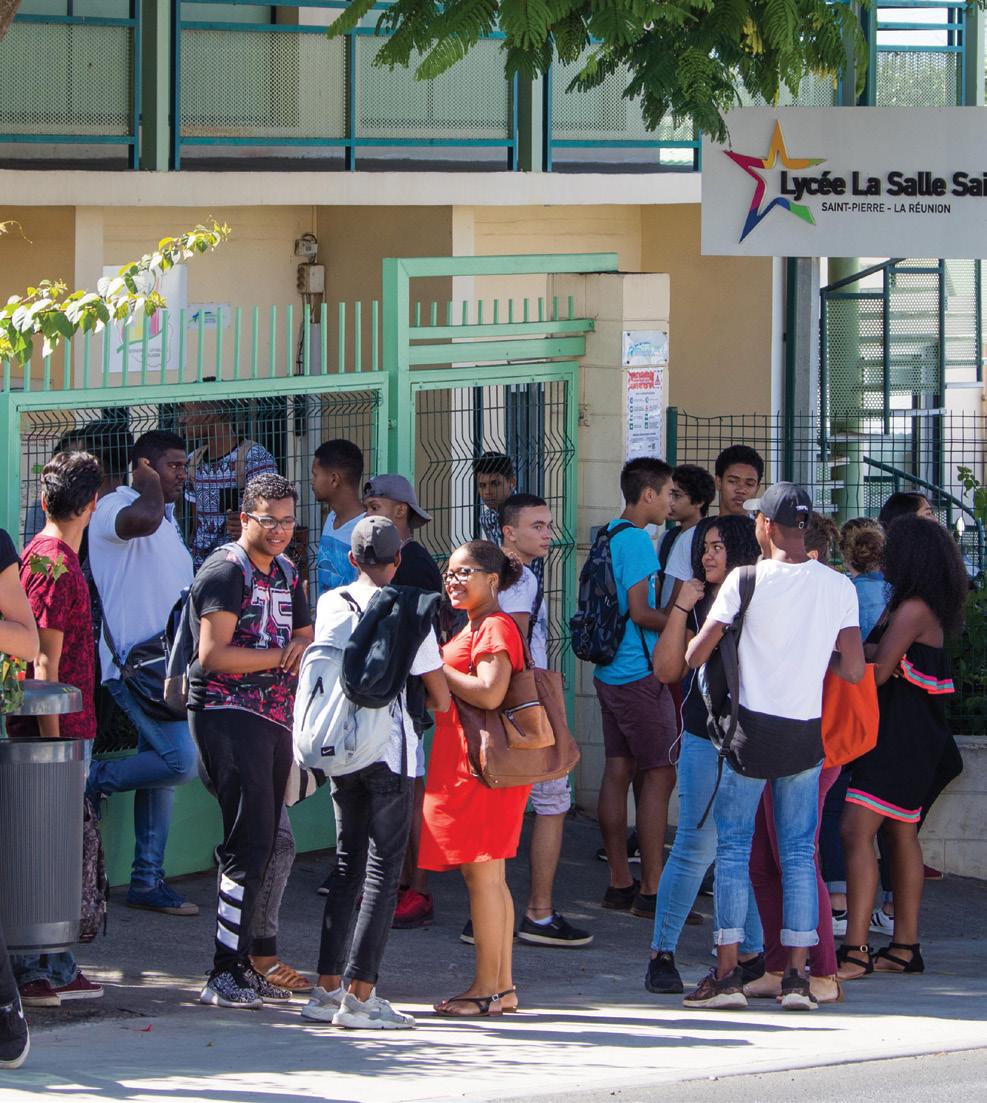

Begin with the essential vocabulary chunks.
Découvrons
View and make hypotheses as you refl ect on language patterns.
Check progress with these formative assessments after each unit section.
Notre communauté mondiale
Connect and interact with communities, authentic products, and native speakers.
Integrate language and culture to communicate. E

Synthèse de grammaire et de vocabulaire
Review structures and vocabulary presented.
Apply learning in the summative unit assessment.
Rencontre interculturelle
You will be introduced to the francophone world with the help of our vloggers.
Vlogger videos are available on Learning Site®.

Prénom : Lou-Ann Langues parlées : français, espagnol, anglais
Ville d’origine : Saint-Denis (La Réunion)
La Réunion est une ancienne colonie française qui est devenue un département et une région d’outremer (DROM) en 1946. C’est petit. En un jour, on peut faire le tour de cette petite île volcanique, et on peut aller nager dans l’océan et escalader la montagne toute l’année ! Les Réunionnais ont un passeport de l’Union européenne, et les élèves réunionnais suivent le programme de l’Éducation nationale de France ; ils doivent passer le diplôme national du brevet (DNB) et le baccalauréat comme les élèves en France métropolitaine.





L’île de La Réunion (France)
1.3 Parlez et faites des comparaisons s d
Avez-vous les mêmes préférences que Lou-Ann ?
a. Comparez vos opinions sur les cours.
b. Partagez vos réponses avec la classe.
MODÈLE Lou-Ann vit sur l’île de La Réunion. Je ne vis pas à La Réunion. Lou-Ann adore étudier les mathématiques. Moi aussi, j’adore étudier les maths !
2 Réflexion interculturelle o d
What did you notice in the video about Lou-Ann’s preferences at school? Are her preferences similar to or different from yours? Which aspects of her school life in La Réunion (such as schedules, classes, and activities) are similar to your school life? Which aspects are different? Answer the questions in the discussion forum.
Mon progrès interculturel h
Investigate: I can identify some similarities and differences between a francophone teen’s school life and my own.

002-065_ECF_2e_L2_SE_U1.indd
Learning about cultural products, practices, and perspectives will give you a foundation for intercultural reflections.
You will share your reflections online.
After a variety of experiences with cultural products, practices, and perspectives, you will reflect on your growing intercultural awareness.
You will share reflections in the online discussion forum.
This unique self-assessment feature clarifies your intercultural goals and guides you throughout the unit.
You will provide evidence of growth in your online Portfolio.
21 Où va-t-on pour… ? b w Écrivez où vous allez pour faire les activités. Choisissez un ou deux endroits pour chaque activité.
MODÈLE Je vais au CDI pour faire mes devoirs.
1. étudier pour un examen
2. utiliser un ordinateur
3. parler avec un prof
4. manger avec les amis
5. faire du sport
6. organiser un club avec des amis
7. faire une expérience scientifique
8. prendre la voiture
9. chercher une fiche (form) importante

Expressions utiles aller voir… to go see … demander conseil à… to ask for advice from …
Zoom culture Produit
22.1 Connexions o c
Where do you go at school to relax and spend time with friends?

In the DROMs and in France, students in middle school and in high school have access to le foyer des élèves, an association managed by and for the students. It is a place to relax with friends or to learn something new. A group of elected students usually meets at the beginning of the school year to brainstorm ideas for le foyer such as working to get a TV, video game console, books, or indoor games, or organizing workshops, presentations, and tournaments. It is a place where students are encouraged to pick up a guitar, a paintbrush, a deck of cards, or a game controller, and enjoy themselves.
22.2 Perspectives o Search online for la charte du foyer des élèves and skim the documents you find. What do they tell you about how students use these spaces? What kinds of rules do students set for themselves?
Comment dit-on ?
Comment réussir à l’école ? a


Comment dit-on ?
You will learn essential vocabulary presented visually in manageable amounts and authentic contexts.


Stratégies
These brief learning strategies will be available throughout the units.
All Learning Strategies videos from all four levels are available on Learning Site®.
These useful expressions can boost communication skills, often with phrases that work across themes.
Stratégies v Interpretive Reading
Here are a few ideas to help you become a more skillful reader in French.
1. Scan the text to see what you notice.
2. Notice headlines, titles, or text in bold.
3. Find keywords you already know.
4. Identify the main idea.
11 Que va faire Lou-Ann au lycée ?


Lou-Ann rentre en 3e cette année au collège de La Montagne. L’année prochaine, elle va aller au lycée Bellepierre pour trois ans.
11.1 Lisez la fiche d’inscription o b Regardez la fiche d’inscription du lycée Bellepierre à l’île de La Réunion. Sur la fiche d’inscription pour l’année prochaine, Lou-Ann a indiqué les cours qu’elle voudrait suivre. Lisez les information et faites les activités.
LV 1 ANGLA IS C HINO S (5h LV 2 ALLEMAND ESPAGNOL
S ec ion européenne : ANGLAIS ESPAGNOL Dispositif EHP é èves à haut potent e ) ENSEIGNEMENTS d exploration seul)
ENSEIGNEMENTS Obligatoires Matières HoraireElève França s 4 00 H stoire Géographie 3 00 3h/5h
Choix des Langues Vivantes Étrangères en enseignement commun (1 Sc entif ques (MPS)
Création Activités Artistiques option « Arts du spectac e Informat queet Création Numérique (ICN) Littérature et Société (L S Méthodeset Prat ques Santé & Socia S S) Sciences de l’I ngéni eur (SI) Informatique et création numér que(ICN Me c de a re 2 vœux en cas d mpossibi té de vous donner sat sfact on sur e vœu 1) Sciences Économiques et Sociales (SES) (Obligatoire)
EMC : enseignement moral et civique SVT : sciences de la vie et de la terre
EPS : éducation physique et sportive LV : langue vivante (étrangère ou régionale)
For every vocabulary section, there are online Workbook activities which provide extra practice if needed or desired. You do not need to complete all of these activities to be successful on J’avance or J’y arrive assessments.
Détail
Les notes
In French, une note can have different meanings, depending on the context in which the word is used.
• a musical note Tu dois écouter toutes les notes de cette chanson. what you write in your notebook during class J’écoute mes profs et je prends toujours des notes en cours. the grade that you earn Je vais bien étudier pour avoir une bonne note en histoire-géo. J’ai une mauvaise note en EPS.
32 Prononciation
Détail linguistique
You will explore curious and useful details of the language.
Communiquons 1
Le calendrier scolaire
School Calendar
l’année (f.) scolaire le jour férié school year holiday la rentrée les vacances (f. pl.) back-to-school vacation
Les matières
School Subjects
Je vais suivre un cours de/d’…
l’allemand (m.) la chorale
l’économie (f.)
l’histoire-géo (f.) l’orchestre (f.) la physique-chimie
I’m going to take a/an … class. German choir economics history-geography orchestra physics-chemistry
Les moments de la journée Times of Day en début de journée avant les cours en fin de journée après les cours le temps libre la permanence (perm) at the beginning of the day before school at the end of the day after school free, unscheduled time study hall
Communiquons 2
Les endroits de l’école Places at School l’accueil (m.) le bureau central le complexe sportif le couloir le foyer reception area main office sports complex hallway student lounge
Le personnel de l’école School Staff le conseiller, la conseillère d’orientation le/la documentaliste l’entraîneur
l’infirmerie (f.) le laboratoire le parking la salle informatique (salle info) le terrain de sport
The final s in French
When a French word ends in an s, is the s pronounced or not?
Read what Lou-Ann says when she talks about her schedule. In which words do you think the final s will be pronounced? In which words will the final s be silent?
32.1 Faites des prédictions b
In the text, select Oui if you predict that the final s in the word is pronounced and Non if you predict that it is not.
Hey, aujourd’hui, je reviens pour vous parler du collège. J’ai environ sept heures de cours par jour, de huit heures à seize heures trente, ce qui me laisse le temps de pouvoir faire des activités extrascolaires après l’école. J’ai onze professeurs qui m’enseignent différentes matières comme par exemple, le français , l’histoire, la physique-chimie, les sciences , les maths et encore plein d’autres
32.2 Écoutez l’enregistrement a
Now, listen to the recording.
1. In which words did you hear the final s pronounced?
2. In which words was it not pronounced?
3. What patterns do you notice in the text? How can you predict whether a final s is pronounced in French?
32.3 Répétez a
Listen to the recording again and repeat carefully the words that end in s, being careful to pronounce or not pronounce the final s
002-065_ECF_2e_L2_SE_U1.indd 44 11/25/24 3:59 PM
To help you review, these lists summarize the vocabulary studied in the unit.
You will find more practice in context on Learning Site®.
Describing What Will Happen and What You Will Do (Part 1) a The Future Tense of Common Irregular Verbs
Salut, Félix. Qu’est-ce que tu feras pendant les vacances ? Tu sais déjà ?
Ma famille et moi, nous irons au Maroc. Ma mère est photographe, donc elle fera de la photographie du Sahara, et mon père est journaliste, alors il fera




Examples of new structures in context encourage you to become a “grammar detective.”
You will find helpful videos called Découvrons and Structure en avant online.
Détail grammatical
Timely grammar details will help you communicate.



14 Découvertes b v d Reflect on what you observe, and respond to the following items.
1. Can you identify which of the words in bold are forms of the following verbs: faire aller être voir, and avoir?


Expressions utiles arriver à l’heure arriver en retard J’ai passé (la journée)... Je suis rentré(e) (chez moi). la billetterie (en ligne) le

2. Are Océane and Félix talking about the past, the present, or the future?
3. What do you notice about the beginnings and endings of the words in bold?
4. How are these words similar to or different from other verb forms you have seen?
5. Share your observations with a partner. What else do you notice together? What else can you add to your observations?
1. Expressing Descriptions and Continuous or Repeated Actions
Using the imparfait
When talking about things that happened in the past, especially events that happened on a regular basis, or general descriptions about the way things were and what there was in a given place, use the imparfait
C’était génial !
It was great!
Il y avait des framboises et des fraises. There were raspberries and strawberries.
Les légumes étaient délicieux. The vegetables were delicious. You can usually recognize the imparfait by its endings: -ais -ait -aient and others. C’était is the imparfait of c’est ; il y avait is the imparfait of il y a. You can describe many things that happened in the past just by knowing these two expressions.
Contrast this new verb tense, the imparfait with the tenses you already know.
Le présent: Je mange des gaufres. I eat (am eating) waffles.
Le futur proche: Je vais manger des gaufres. I am going to eat waffles.
L’imparfait: Je mangeais des gaufres. I used to eat (was eating) waffles.
Note: The -aient ending is pronounced in the same way as -ais and -ait
2. Talking About What You Used to Do Forming the imparfait
a. To determine the stem of a verb in the imparfait, remove the final -ons from the nous form of the present tense. nous faisons faisnous aimons aimnous voulons voul-
b. The verb être does not follow this pattern. All forms of être in the imparfait begin with ét- j’étais, c’était, etc.
30 Qu’est-ce qu’elle a fait pour son anniversaire ? Élisa partage ses souvenirs d’anniversaire.
30.1 Regardez la vidéo v Regardez la vidéo qu’Élisa a postée sur l’Atelier des Lumières et notez les détails importants.
1. Élisa et son amie Lola sont allées à un (où ?).



2. L’Atelier des Lumières se trouve dans le (quel numéro ?) arrondissement.
3. Comme transport, elles ont pris le (quelle sorte de transport ?) et le (quelle autre sorte de transport ?)
4. Leur trajet était de (combien de temps ?).
5. À l’Atelier des Lumières, elles ont vu (quoi ?).
6. Élisa a payé le billet de Lola parce que c’était (quel jour spécial ?).
Mon progrès communicatif h Interpretive: I can understand key details in a vlog about where people went and how they arrived there.
Détail grammatical En métro et à vélo
Quand on parle des modes de transport, surtout après le verbe aller on utilise généralement la préposition en Je vais en voiture, en métro, en train, en bateau, etc. Mais on utilise parfois
Synthèse : Grammaire
To help you review, this summary contains helpful explanations of grammatical structures to help you review.
You will find more practice in context online.
For every grammar section, there are online Workbook activities which provide extra practice if needed or desired.
Formative assessments will help you measure your progress towards unit goals.
Find supporting materials on Learning Site® .
Mon progrès communicatif
You will provide evidence of growing proficiency in your online Portfolio, which contains all Can-Do statements included throughout the unit.
42 Une nouvelle page dans mon album
You are creating a new page in your photo album about a day you recently spent in the city.
42.1 Lisez les informations et associez les images b
Read the information about your recent day in the city. Match each image with the appropriate description.
Mon progrès communicatif h
Interpretive: I can understand key details from visitor information.
42.2 Créez une page d’album w
Write a caption or short description for each item or photo to complete your album page.
Mon progrès communicatif h
Presentational: I can tell where I went and what I did during a day in the city.
42.3 Présentez votre page d’album s
Show a classmate your album page. Ask and answer questions to compare your page to that of your classmate.
Mon progrès communicatif h
Interpersonal: I can have a conversation about where I went and what I did.

Investigate the local or global community and interact with French speakers in your community or internationally.
Unité 5 | Des conseils pour une vie saine 258-321_ECF_2e_L2_SE_U5.indd 314 11/26/24 9:45 AM
42 La relaxation à travers les cultures (ou « entre cultures »)
D’après l’Organisation mondiale de la santé (OMS), « la santé est un état de complet bien-être (well-being) physique, mental et social, et ne consiste pas seulement en une absence de maladie ou d’infirmité ».
Vos amis et vous avez créé un club, Quipecoule, pour aider les élèves à bien se sentir. Votre but est d’organiser une séance pour présenter et échanger des techniques multiculturelles de relaxation.
42.1 Faites des recherches b c
Comment éviter le stress et se sentir mieux ? Certains disent qu’il faut créer avec ses mains, d’autres proposent de marcher dans la forêt ou de faire du sport. En petits groupes, faites une liste de vos idées de relaxation. Ensuite, faites une recherche du web francophone et trouvez d’autres idées de relaxation. Identifiez les techniques qui intègrent les éléments suivants
• l’environnement et la nature ; la création et les passe-temps ; l’activité physique ;
• la méditation ; et • la nutrition.
Mon progrès interculturel h
Investigate: I can search the French-speaking web for relaxation techniques.
42.2 Faites des comparaisons m d Comparez les techniques de relaxation de votre groupe et celles que vous avez recherchées en ligne. Pour la séance de relaxation, choisissez-en trois que vous présenterez aux élèves d’une autre classe de français.
42.3 Échangez vos idées s c
Présentez vos techniques de relaxation. Gardez du temps à la fin pour échanger vos idées. Que pensent les autres élèves des techniques que vous avez présentées ?
Est-ce qu’ils ont d’autres stratégies de relaxation à partager avec vous ?
43 Participez à un forum de discussion e Maintenant, cherchez un forum en ligne sur les techniques de relaxation. Lisez et répondez ou partagez vos idées avec des Francophones. Écrivez un paragraphe pour résumer votre expérience.
Mon progrès interculturel h
Interact: I can interact in French to exchange ideas of relaxation techniques.
44 Réflexion interculturelle o d
How does culture influence relaxation strategy choices? Has your approach to relaxation evolved or changed as a result of your research?

J’y arrive
A summative assessment set in an authentic intercultural context will assess your progress.
Find supporting materials on Learning Site® .
Questions essentielles
What experiences are available to young people in a city or town?
• What information do I need to make plans?
• What makes cultural experiences unique?
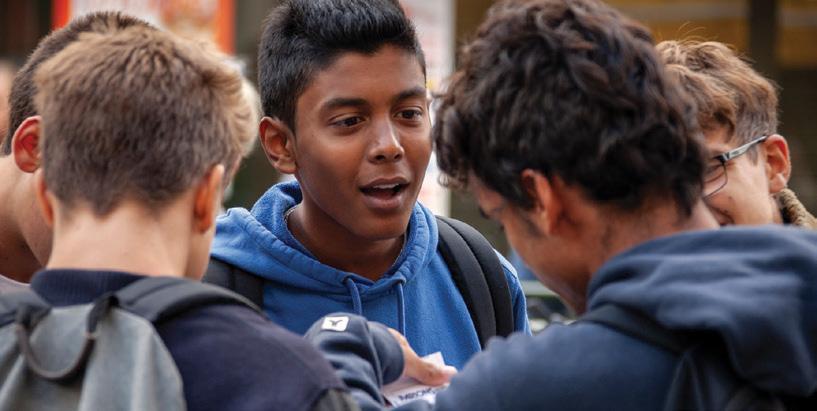
You are spending a week in Paris with your teacher and classmates. You make plans for a day in the city and then share your experiences.
Before you begin, refer to the J’y arrive rubric to familiarize yourself with the evaluation criteria.
Que faire à Paris ? v
The manager of the hotel where you are staying shares videos with you in which young people share information about interesting places to visit. Watch the videos, answer the questions, and rank the places in order of your preference.

Nos avis sur Paris w Write a description of your day in the did and saw.












A variety of scaff olding notes allow for support when needed.
A variety of notes allowing learners to perform at their highest level.
Workbook. See the Instructional Strategies Toolkit for an additional suggestion for a fun whole-class or small-group guessing game to practice describing school supplies.
002-065_ECF_2e_L2_TE_U1.indd 10 12/10/24 3:49 PM
Connections
Connections to other disciplines, such as STEAM, Spanish Language, and Global connections.
36.2 Parlez avec Lola r s Vous êtes la première personne à arriver au cinéma. Vous téléphonez à Lola pour savoir où est tout le monde et vous regardez votre smartphone pour lui donner des informations.
(étudiants/–26 ans/retraités) tous les jours sauf week-ends et jours fériés Matin (séance jusqu’à 13h00) : 6,50 € Accès Ségur
37 Comment expliquer le métro parisien à un ami Votre ami arrive à Paris demain, mais il n’a jamais pris le métro.
37.1 Écoutez
(6, 9) 2. Arc de Triomphe ; Charles de Gaulle–Étoile (6) 3. un bateau-mouche ; Alma–Marceau (9)

Strategies leading to success on AP® and IB assessments.
30 Tu viens à la fête ?
Vous faite un stage (internship) de marketing chez une entreprise qui fait la promotion d’événements.
30.1 Lisez et notez les détails b En petits groupes, regardez les annonces des événements et complétez la représentation schématique. Quelle sorte d’événement ?
Florida Benchmarks WL.K12.IL.2.3 (30.1) WL.K12.IL.2.4 (30.1) WL.K12.IL.6.2 (30.1) WL.K12.IL.6.4 (30.1)
WL.K12.IL.9.1 (30.1)
WL.K12.IL.1.1 (30.2)
WL.K12.IL.1.4 (30.2)
Expressions utiles
Expressions utiles are useful expressions, transition words, and idioms highlighted for learners to use in communicative tasks.
x 30.1 Lisez et notez les détails
Resources Portfolio
Answers
1. un festival culinaire, un dîner de gala ; des adultes, des gourmets ; la ville de Namur ; du 13 au 18 avril 2. une fête, un déjeuner ; des élèves/ étudiant(e)s ; au restaurant scolaire d’un
ACTFL Standards are indicated for each activity.
Activities with x support and share a Cando statement that appears with the J’avance formative assessment for that section.
1.
3.
30.2



presented in the Stratégies video for success on listening comprehension tasks.
Connections to strategies reinforce language skills or information on language structure or etymology, allowing for linguistic comparisons.
Information about cultural topics allows for further connections to and discussions about products, practices, or perspectives of a community, region, or country.







Discrete and suggested answers are provided wherever possible.
Find audio, video, and any other resources indicated here.







Find suggestions on adapting activities, allowing you to diff erentiate learning for students with various learning types.
Your All-in-One Digital Teaching Companion
Learning Site empowers educators with streamlined tools for classroom management, student engagement, and measurable outcomes—all from one unified platform.
Engaging and Varied Learning Tools
• Select from diverse activities, media, assessments, games, and interpersonal speaking practice with Nualang.
• Provide students with dynamic learning paths tailored to their language goals and proficiency levels.
Simplified Classroom Management
• Find, present, assign, and grade—all in one place, eliminating the need for multiple tabs and tools.
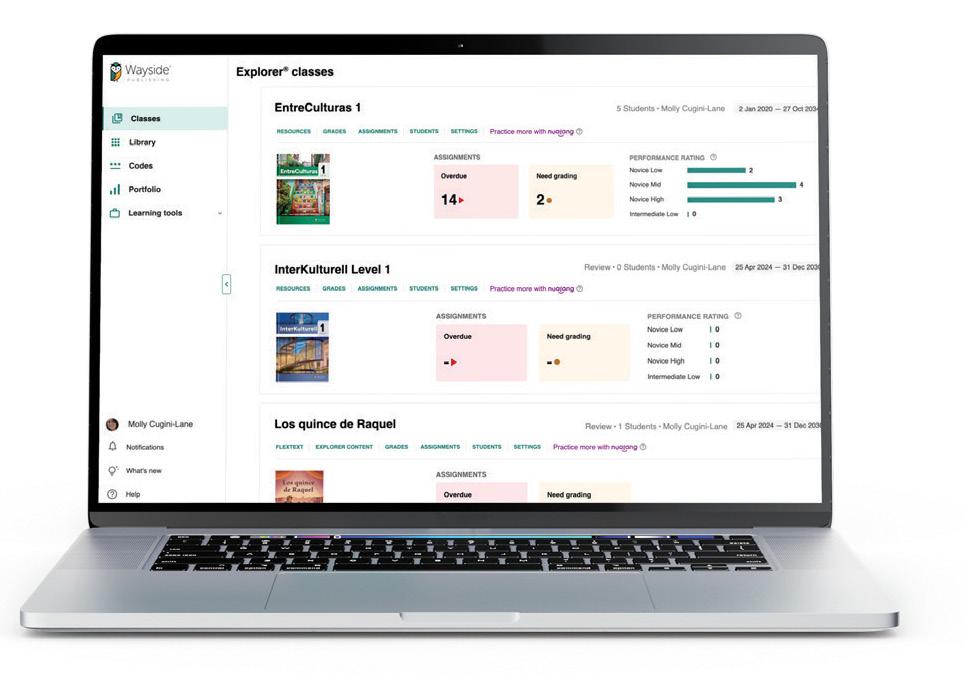
• Generate actionable reports for courses, schools, or districts to track engagement and progress.
Seamless Integration for Effortless Collaboration
• Fully compatible with LMS and SIS systems using standards like LTI 1.3, OneRoster, and QTI.
• Easily exchange rosters, assignments, and grades to streamline workflows across your institution.
Safe, Accessible, and Reliable
• TrustED App certified to meet the highest standards of security, ensuring all students can access resources in a safe environment.
• NEW Enhanced eBook Features: Enjoy mobile support, highlighting, notetaking, search functionality, and more.
• NEW Administrative Reporting: Gain insights into student activity and user actions with detailed reports.
• NEW Embedded Portfolio: Help students track their progress towards Can-Do Statements and personal goals.
• NEW LMS/SIS Integrations: Benefit from streamlined rostering, grade exchange, and SSO compatibility.
• NEW Accessibility and Security: Certified for safety and equity, ensuring equal opportunities for learning.
Nualang transforms language learning by breaking down barriers and making practice engaging, effective, and fun. Its immersive, judgment-free platform inspires confidence and accelerates progress for students and teachers alike.
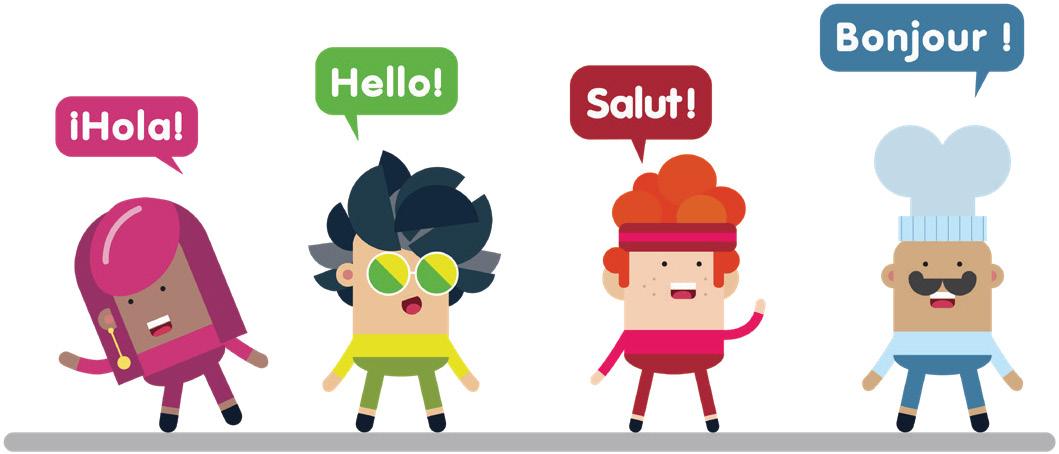
• Simplify Lesson Planning: Save time with ready-made lessons and role-plays, or create personalized content tailored to your class’s goals.
• Track Progress Easily: Gain insights into student growth and provide targeted feedback with interactive tools and recorded sessions.
• Build Speaking Confidence: Give students frequent opportunities to practice speaking in a low-pressure, high-impact environment.
• Judgment-Free Practice: Interactive tools like role-plays and real-time feedback help students improve without fear of making mistakes.
• Motivating and Fun: Features like Nualang LIVE let students compete in games, earn medals, and boost fluency.
• Personalized Learning: Adjustable accents, voice speeds, and chat companions make every session adaptable to the learner’s pace.
Nualang makes speaking a new language natural and exciting. Whether students practice with peers, solo, or in real-world scenarios, Nualang equips them with the skills they need to succeed.
Inspire confidence. Spark engagement. Achieve results with Nualang.
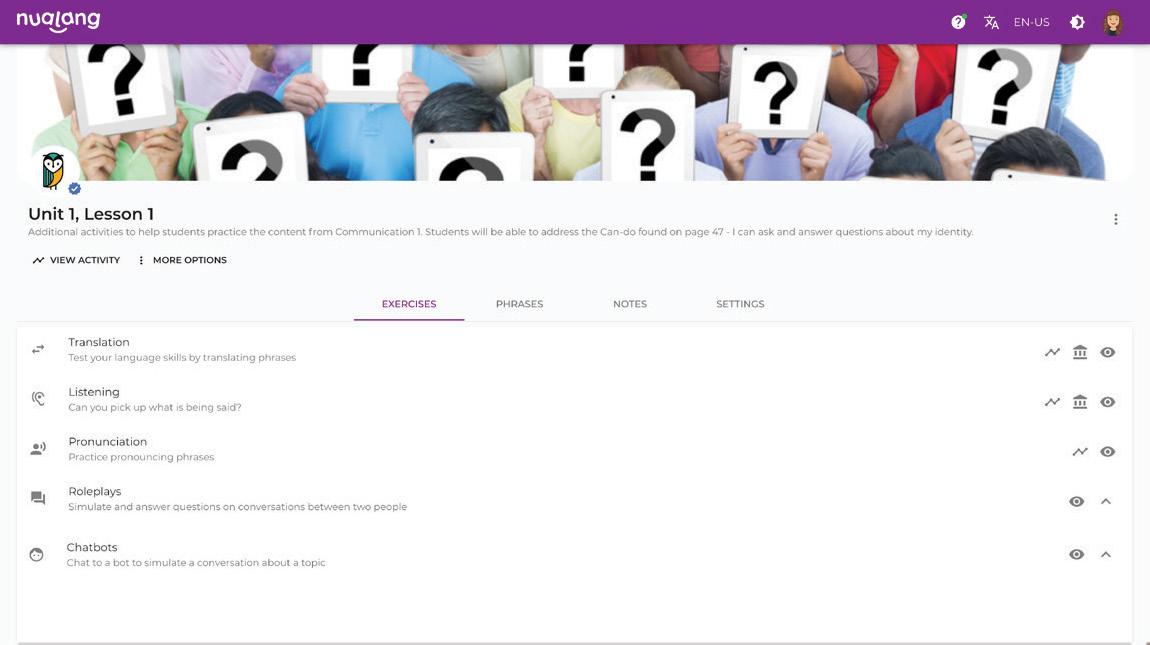


This edition of EntreCultures® includes a companion reader, Le nouvel Houdini, that is aligned to the goals and content of EntreCultures® 2. On Learning Site®, the reader appears as an additional component along with activities, a glossary, and a Teacher’s Guide with detailed teacher tips and answer keys.
Reading has been shown to have a strong impact on both vocabulary development and the acquisition of language structures. Just as young learners benefi t from leveled readers to develop reading skills in their fi rst language, these companion readers provide targeted input of the vocabulary and structures French learners need to progress toward reading authentic literature. Students benefi t from stories that are both comprehensible and compelling to them. You can provide additional support by doing the following:

• Pre-teach any needed vocabulary so that the comprehension level is very high while students are reading, especially if they will be reading at home.
• Do pre- and post-reading activities to get students to interact at a deeper level with the content they are learning about in the story.
Here are some suggestions for incorporating readers to enhance student progress toward profi ciency. The Teacher’s Guide on Learning Site® contains additional ideas.
• Plan to include the reader at any point in the year. The reader, Le nouvel Houdini, was chosen for its simplicity and repetition of basic structures, allowing it to be eff ectively integrated at almost any point throughout the year. Guide students through the book with in-class reading during the fi rst semester or give them a chance to fi nd success more independently toward the end of the year.
• Set aside time daily/weekly over a set period. Read a little bit each day or on a set day each week until the reader is completed. To keep students’ interest level high, read regularly and avoid long gaps between reading sessions.
• Replace other homework with daily reading. Assign the chapters to be read independently outside of class. Preview the chapter when it is assigned and follow up with comprehension tasks after reading.
EntreCultures® Second Edition components are available digitally on Learning Site® unless noted as also available in print format.
• Teacher Edition: Available in Print and Digital formats.
• Assessment Program: Includes a suite of assessments and rubrics to customize to each student’s need, from proficiency-based Formative and Summative Assessments to Alternative Objective Tests in an autograded delivery format.
• Letters to Guardians: Highlight the key information for each unit of study for parents and guardians.
• Lesson Plan Builder: Pulls directly from the textbook to create engaging, tailored lessons that can be exported to multiple formats, including slides—saving teachers time and boosting student engagement.
• Personalized Assignments and Assignment Controls: Empower teachers to adapt tasks to each student’s needs, enhancing engagement and learning outcomes.
• Learning Pathways: Aligned with Can-Do statements and assessments, our pathways guide teachers to essential activities for building proficiency, providing clear guidance for new teachers and flexibility for experienced educators.
• Instructional Strategies Toolkit: Ready-to-use, research-based activities organized by communication mode, skill, and proficiency level—keeping students engaged and helping every learner thrive in the target language.
• Administrative Reporting: Provides powerful insights on student activity and user actions, making it easy for administrators to manage and safeguard the platform effectively.
• Performance Towards Proficiency Growth: Gives insights into student growth towards proficiency.
• Standards: At point of use, standards ensure our content aligns with educational benchmarks, empowering teachers to meet key learning goals with confidence.
• Personalized settings: Allow teachers to customize timed tasks, transcripts, and captions, giving them flexible tools to meet the unique needs of their students and classroom.
• Professional Learning: Brings unmatched expertise and personalized training to support successful program implementation, empowering teachers with tailored, research-backed strategies to elevate language instruction and foster meaningful student engagement.
• Student Edition: Available in Print and Digital formats.
• Workbook Grammar and Vocabulary Activities: Additional activities to practice vocabulary and grammar from each unit. Available in Print and Digital formats.
• eBook: A page-by-page representation of the Student Edition with highlight and note-taking functionality.
• Nualang Activities with Heritage Path: Students engage in conversation and receive personalized feedback from our chatty little helpers, the Nualas.
• Flashcards: Practice key vocabulary from the unit. Available in Print and Digital formats.
• Companion Reader: Each level of the program includes a comprehensible French reader.
• Portfolio: Students document the growth of language learning.
Unité 1 : Réussir son année scolaire
• What influences our school calendars and schedules?
• How do our school environments influence our interactions?
• How do we organize our time for enjoyment and success?
• What do traditional dishes reveal
• How does geography influence our food choices?
• How does food bring people together?
Unité 3 : Au boulot, les bénévoles!
Rencontre interculturelle : Le Québec
Vous savez déjà
Communiquons 1
Comment dit-on ? : Mes responsabilités à la maison
Zoom culture : Les tâches ménagères au Canada
Découvrons : Describing What People Can and Want to Do
J’avance : Comment s’organiser pour habiter ensemble ?
Communiquons 2
Comment dit-on ? : A. Avant de s’engager
Comment dit-on ? : B. Servir sa communauté
Découvrons : Asking “Which” and “What” Questions
Zoom culture : La jeunesse engagée au Canada
J’avance : Choisissez le citoyen du mois !
Communiquons 3
Comment dit-on ? : A. Où faire du bénévolat ?
Comment dit-on ? : B. Pourquoi suis-je bénévole ?
: Le bénévolat comme intégration
: Connecting Phrases
: Notre projet de bénévolat
J’y
Questions essentielles
• How do my personal responsibilities and routines shape my daily life?
• How can community members work together to improve their quality of life?
• What motivates people from different cultures to volunteer?
Questions essentielles
• What experiences are available to young people in a
• How can I access information to make plans?
or town?
• How does culture influence where I go and what I do in a Francophone city or town?
Rencontre interculturelle : Dijon et la Bourgogne-Franche-Comté, en France 260
Vous savez déjà 264
Communiquons 1
Comment dit-on ? : A. Des habitudes saines
Comment dit-on ? : B. Présenter des statistiques
Zoom culture : L’assurance maladie en France
Découvrons : Giving General Advice
J’avance : Et toi ? Que fais-tu pour avoir une vie saine ?
Communiquons 2
Comment dit-on ? : A. Le corps et la santé
Zoom culture : La pharmacie
Comment dit-on ? : B. Les maladies et les symptômes
Découvrons : Telling Someone What to Do
J’avance : Qu’est-ce que tu as ?
Communiquons 3
Comment dit-on ? : A. Ma santé sociale et émotionnelle
Comment dit-on ? : B. La vie en ligne
Découvrons : Describing My Routine
J’avance : Des ressources pour la santé sociale et émotionnelle de notre école
ASSESSMENT
J’y arrive : Une conférence sur la santé des adolescents
• What do health and wellness mean to me?
• How do people care for themselves and others?
• What factors contribute to health and wellness of individuals and communities?
• What do I need to know to explore another country or culture?
• What is the difference between a tourist and a traveler?
• How do travel experiences shape our intercultural understanding and respect for the communities we visit?
Appendice A – Can-Do Statements A2

Appendice B – Rubrics ........................................................................................................... A8
Appendice C – AP® and IB Correlation Guides ................................................................. A22
Appendice D – Grammar and Learning Strategies Index .............................................. A25
Glossary of Classroom and Activity Instructions .......................................................... G1
Glossary French–French G3
Glossary English–French....................................................................................................G11
Credits C1















We would like to express our sincere gratitude to all those who accompanied us on the journey that is this edition of EntreCultures® 2. It was an honor to work with such talented professionals.
We would like to thank Wayside Publishing®’s Content team Eliz Tchakarian, Helen Small, Nathalie Gaillot, Henry Menninger, and Vanessa Ta, who coached us through every step of the journey and pulled all the pieces together in order to create this program. We extend our gratitude to the outstanding contributing editors and authors who partnered with us on this project.
Our series would not have been as truly authentic nor as compelling without the generous work and contributions of our diverse vloggers. With gratitude, we acknowledge Lisa Allen, Issiaka Diakité-Kaba, Terri Hammatt, Laura Lieberman, Leslie Natzke, Elizabeth Rench, Jan Solberg, and Sharon Wilkinson who led us to them, and, in some cases, worked directly with us to deepen our understanding of the cultures featured in this level. We also thank our main vloggers, Mariam, Hamdan, Laure, Laura, Baptiste, Ghali, Teora, and Romaine, and our cameo vloggers Marianne, Maggie, Zoé, Will McGrew, Mavis Frugé.
We thank the talented and artistic production team and Graphic Designers Derrick Alderman and Rivka Levin at Bookwonders, Ryan Hamner, Sawyer McCarron-Rutledge, Tawny Dougherty, and cover designer Jaana Bykonich at Wayside Publishing® for their beautiful graphics and design.
We extend a special thank you to the Wayside Publishing Technology & Operations team and the Sales, Adoptions, Marketing, and Professional Learning team for their support during this journey. We are so grateful for the wisdom, vision, and support of everyone at Wayside Publishing who contributed to the creation of this wonderful program.
Elizabeth Zwanziger Florence Falloux Jan Hagedorn Tracy Rucker
For each unit there is an online discussion forum where you and your students can participate in open discussions on the topics presented in the unit.
Encourage students to preview all Can-Do statements for the unit in their Portfolio. You can also review the Portfolio in class to emphasize the importance of uploading evidence for the Can-Do statements. If technology or Internet access is limited, there are printable document versions of the Can-Do statements online and in Appendix A of the Student Edition.
While reviewing the Objectifs and the Questions essentielles, encourage students to respond to the following questions:
How do you help out around the house? What about in your community?
Comment aidez-vous à la maison ? Et dans votre communauté ?
What do you know about volunteer opportunities near where you live?
Est-ce qu’il y a des possibilités de bénévolat près de chez vous ?
What kinds of opportunities for volunteering do you think are available in francophone cultures?
À votre avis, quelles sont les possibilités de bénévolat dans les cultures francophones ?

• Interpret print, audio, and audiovisual informational texts such as announcements and personal stories about household tasks and working as a volunteer
• Negotiate with others to decide on household tasks and a volunteer opportunity

• Provide information about yourself in order to apply to a volunteer organization
• Investigate and reflect on how volunteering impacts communities and the environment, and interact with francophone associations


Not all students are able to participate in out-of-school activities due to family constraints. Encourage engagement in school clubs or via online opportunities to support others. Poll students on the volunteer opportunities or service groups at your school such as Key Club, Scouts, Earth Club, etc. and in your community such as Meals on Wheels, Habitat for Humanity, etc.
• How do my daily responsibilities and routines shape my life?
• How can community members work together to improve their quality of life?
• What motivates people from different cultures to volunteer?

Comment dit-on ? Mes responsabilités à la maison
Découvrons Describing What People Can and Want to Do
J’avance
Interpret a chart and ask and answer questions about chores.
Avant de s’engager
Servir sa communauté
Découvrons Asking “Which” and “What” Questions
Describe an exemplary member of your community.
Notre communauté mondiale
Investigate opportunities to partner with volunteer associations in the

All Questions essentielles for all units are also online in a discussion forum, where students can continue to share ideas.
Access the EntreCultures 2 transcripts online, where you can also stream and download all audio and video les.
The following standards are addressed in the below unit sections.
ACTFL Standards
Interpretive Communication
Understand the main idea and some related information in authentic texts, audios, videos, and personal stories related to household tasks and volunteer opportunities.
Interpersonal Communication
Negotiate and exchange information about household tasks and express some opinions about volunteer opportunities using simple sentences.
Presentational Communication
Present information about household tasks, where to volunteer and why, and provide information to apply to a volunteer organization.
Cultures
Investigate how and why people in francophone cultures contribute to their communities through volunteerism.
Cultural Comparisons
Identify a francophone teen’s interests, describe ways a francophone teen helps in the household or volunteers in the community, and compare sports and leisure activities in di erent areas.
Before students begin J’y arrive, review the Unité 3 Integrated Performance Assessment Rubric online.
The Rencontre interculturelle is meant to activate students’ prior knowledge about francophone countries, territories, regions or cities to learn more about francophone cultures around the world. In each unit a francophone vlogger from that location is introduced. This section also provides an opportunity for reading comprehension practice by allowing students to digest comprehensible French language in context.

Prénom : Éloïse
Langues parlées : français, anglais
Ville d’origine : Montréal (Canada)
Le Québec est la plus grande province du Canada. Le français est la langue officielle du Québec. La langue française est considérée comme un élément essentiel de l’héritage culturel québécois. Le drapeau du Québec s’appelle le fleurdelisé parce qu’il a quatre fleurs de lys.
La ville de Québec, la capitale de la province du Québec, a été fondée (founded) en 1608 par l’explorateur Samuel de Champlain. Cette province, comme le reste du Canada, utilise le système métrique et le dollar canadien. Elle offre un système de santé (health) accessible à tous.
Il y a beaucoup de choses à faire et à voir au Québec. La nature est très belle, avec de vastes forêts et une multitude d’animaux.




Le Québec and le Nouveau-Brunswick are the two provinces where French is an o cial language. Whereas le Québec has French as its o cial language, le Nouveau-Brunswick is the only o cially bilingual province (French and English) in Canada. In addition to French and English, there are more than 50 languages spoken by the First Nations peoples. The Inuit language is Inuktitut, and Métis peoples speak many First Nations or European languages as well as several varieties of the Michif language.
For centuries, the eur de lys was the emblem of the French monarchy. In Québec, it is a linguistic and cultural symbol that distinguishes the francophone province from the anglophone provinces of Canada.
1 Un tour au Québec
Vous voulez organiser un voyage au Québec.
1.1 Lisez les informations b
Lisez les informations sur la province du Québec et trouvez les mots pour compléter chaque phrase.
1. La plus grande province canadienne est...
2. Le drapeau du Québec s’appelle...
3. Un explorateur important pour la ville de Québec s’appelle...
4. Le plus grand animal du fleuve ou de l’océan s’appelle...
5. Une activité amusante avec des chiens est de faire...




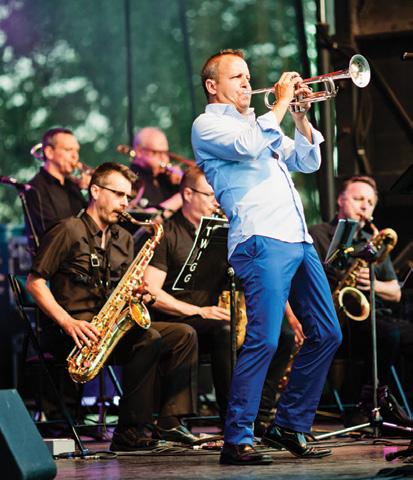

1.2 Discutez de vos préférences s
Sélectionnez quelques activités au Québec que vous trouvez intéressantes. Comparez vos choix avec ceux de deux ou trois élèves de la classe.
MODÈLE Moi, je veux voir une aurore boréale parce que c’est unique et beau. Et toi ?
Unité 3
The weather, ora, and fauna of your region may di er from those of Québec. Before 1.2, ask students to name well-known animals, outdoor activities, and local festivals in your city or state. Compare and contrast the activities on a T-Chart or other graphic organizer.
Culture
Point out in 1 that Canada enjoys great diversity. Its constitution recognizes three distinct groups of Aboriginal or Indigenous peoples: First Nations, Inuit, and Métis (mixed ancestry of European and First Nations origins). All of these peoples possess unique histories, cultural perspectives, spiritual beliefs, and languages.
Supporting Heritage Learners
French is sometimes a rst language for Canadians. For others, it is an additional language learned at school. Ask heritage learners about the linguistic situation of the French language within their family or their place of origin.
Florida Benchmarks
WL.K12.IL.2.1 (1.1)
WL.K12.IL.6.4 (1.1)
WL.K12.IL.7.1 (1.1)
WL.K12.IL.3.1 (1.2)
WL.K12.IL.3.3 (1.2)
WL.K12.IL.6.4 (1.2)
1.1 Lisez les informations
Answers
1. le Québec
2. le eurdelisé
3. Samuel de Champlain
4. la baleine
5. du traîneau
1.2 Discutez de vos préférences
Answers
Answers will vary.
WL.K12.IL.2.1 (2.1)
WL.K12.IL.2.2 (2.1)
The purpose of the second part of the Rencontre interculturelle is to provide students with some background information on the featured vlogger(s). Have students read about Éloïse and watch her video online. Students will continue to see Éloïse throughout the unit, which will provide points of cultural comparison and more practice with the vocabulary and grammar.
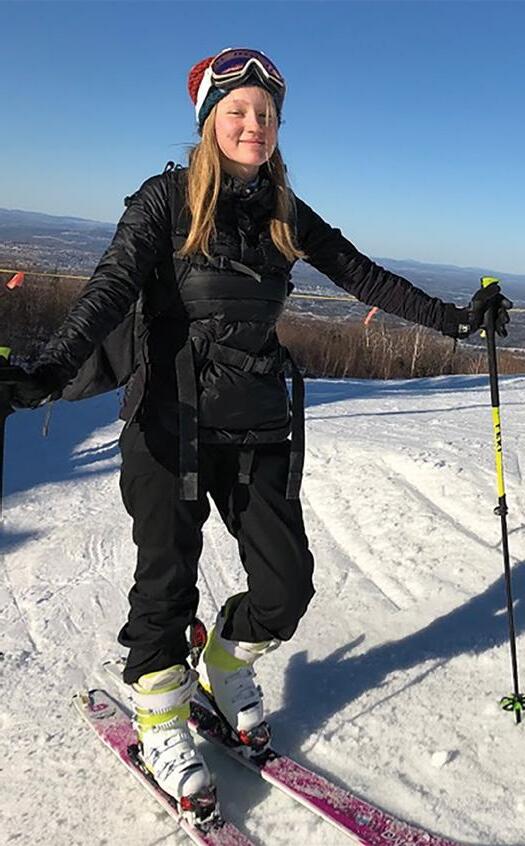
Je m’appelle Éloïse.
J’adore le sport et surtout le ski !
Je vis à Montréal, la plus grande ville du Québec.
J’aime beaucoup lire et écrire.

Éloïse a 16 ans et elle habite à Montréal dans une maison près de l’université Concordia avec ses parents et ses deux frères, Maxence et Médéric. Elle est en terminale à l’École internationale de Montréal. Elle parle français et anglais mais elle apprend aussi l’espagnol. Éloïse aime beaucoup la lecture et l’écriture. Elle apprécie la nature et le sport. Quand il y a de la neige, donc du mois de novembre au mois d’avril, elle est monitrice (instructor) de ski.
2 Salut, Éloïse !
Vous allez faire la connaissance d’Éloïse, une élève de Montréal.
2.1 Lisez le profil d’Éloïse b
Avec un(e) partenaire, regardez la photo d’Éloïse et lisez son introduction et ce qu’elle dit. Est-ce que les déclarations suivantes sont vraies (V) ou fausses (F) ?
1. Éloïse aime rester chez elle.
2. Éloïse aime passer du temps à lire des livres.
3. Il y a cinq membres dans la famille d’Éloïse.
4. Elle habite à la campagne.
5. Elle est sportive.
Mont Royal is a mountain in Montréal and is believed to be the origin of the name of the city. Réal is an older spelling of Royal. Florida Benchmarks
130-193_ECF_2e_L2_SE_U3.indd 134 12/10/24 10:10 AM
In the text for 2, note that Montréal is a diverse and multicultural city. Show a picture of the ag of Montréal and ask students to re ect on the emblems. What type of emblems were chosen for the ag? In 2017, the ag was updated with the white pine tree that represents the Autochtone/ Indigenous peoples. The other emblems represent the English, the Scottish, the Irish, and the French. Compare this ag to your city’s ag: What updates could be made or what symbols would students choose?
2.2 Regardez la vidéo et répondez v Regardez la vidéo d’Éloïse. Discutez avec un(e) partenaire pour numéroter les informations dans l’ordre où vous les entendez de 1 à 8.
A. Elle aime beaucoup le frisbee et le volley-ball.
B. Elle habite à Montréal.
C. Elle aime beaucoup la lecture et l’écriture.
D. Elle va à l’École internationale de Montréal.
E. Son prénom est Éloïse.
F. L’an prochain, elle va aller au Cégep Saint-Laurent.
G. Elle est monitrice de ski.
H. Elle a deux frères qui s’appellent Médéric et Maxence.
3 Réflexion interculturelle d v
In her introduction video, Éloïse shares information about herself and some things she does in her free time. What is the connection between where Éloïse lives and the things she does for fun? Which of your own activities are related specifically to the place where you live? Answer the questions in the discussion forum.
Mon progrès interculturel h
Florida Benchmarks

WL.K12.IL.1.1 (2.2)
WL.K12.IL.1.2 (2.2)
WL.K12.IL.6.1 (3)
Investigate: I can identify how a francophone teen uses free time and why.




2.2 Regardez la vidéo et répondez
Resources
Video
Answers
A. 7
B. 2
C. 5
D. 3
E. 1
F. 4
G. 8
H. 6


The Ré exion interculturelle questions encourage students to recognize how they can use their knowledge of language and culture to communicate e ectively across cultures. To minimize the use of English during class, have students re ect and respond online in the discussion forum.
Resources
Video, Forum, Portfolio
Answers
Answers will vary.
For Mon progrès communicatif and Mon progrès interculturel the goal is to have students continuously re ect on their learning, take responsibility for their progress, and identify ways in which they can improve. The three bars are meant to represent levels of progress.
This is still a goal.
I can do this with support (notes, my teacher, a classmate).
I can do this independently.
The Presentational Speaking portion of the AP® test requires students to deliver a 2-minute presentation based on a prompt in which they compare a cultural feature in their community to one from a francophone community. Ré exion interculturelle activities provide an opportunity to prepare students for this task.
Point out in 2.2 that Cégep is a public pre-university two-year college in Quebec and is comparable to a junior college in the United States. Originally an acronym for Collège d’enseignement général et professionnel, Cégep is now considered a word in itself.
See the Instructional Strategies Toolkit for further suggestions of how to introduce and implement this routine.
WL.K12.IL.1.1 (4.1)
WL.K12.IL.1.2 (4.1)
WL.K12.IL.2.1 (4.2)
WL.K12.IL.2.3 (4.2)
This review section provides a short introduction to the topics and vocabulary students will need to be successful in this unit. You could use any or all of these activities as a pre-assessment leading into the unit to assess students’ background knowledge. These activities function to activate prior knowledge and are meant to be a brief introduction to the unit.
Note that the material in the Vous savez déjà section and Rappel sidebars primarily refer to Unit 3 of EntreCultures® 1
Resources
Audio
Answers
Madame et monsieur Singh : trois ; les enfants sont à l’université
Manuela : canadienne, courageuse, active ; elle aime dormir et avoir du silence le matin
Caleb : Chicoutimi ; à 5h du matin
Ayoub : programmer des ordinateurs ; dans son jardin
4.2 Lisez l’e-mail
4 Quelle chambre pour chacun ?
Vous allez passer un séjour culturel au Québec pendant l’été pour apprendre l’histoire des communautés autochtones (indigenous).
4.1 Écoutez les messages a Écoutez vos hôtes et les trois autres élèves se présenter dans le bulletin électronique du programme. Notez les réponses aux questions suivantes.
Nous vous invitons à connaître l’histoire et les traditions des Premières Nations du Saint-Laurent. Faites la connaissance de vos hôtes et des autres élèves qui participent au programme.

Combien d’enfants ont-ils ?
Pourquoi ont-ils de la place pour vous et d’autres élèves ?
D’où vient-il : de Chicoutimi ou de Trois-Rivières ?
Quand est-ce qu’il fait du sport ?

Comment est-elle ?
Qu’est-ce qu’elle fait généralement le matin ?

Que fait-il comme activités ?
Où sont les animaux qu’il mentionne ?
4.2 Lisez l’e-mail b
Lisez l’e-mail que madame Singh vous a envoyé.
a. Écrivez une liste des quatre endroits (places) possibles où les autres élèves et vous pouvez dormir.
b. Pour chaque endroit, notez les caractéristiques importantes dans la représentation schématique.
To brush up on listening and reading comprehension skills, refer students to the Stratégies videos of the Unité préliminaire and Unité 1 in EntreCultures® 1 and of Unité 1 in EntreCultures® 2. Before 4.1 ask students to read over the questions and to make predictions about what type of vocabulary they should listen for.
À : manuela32@mail.ca, kleb@mail.ca, ayoubb@mail.ca
De : r.singh@mail.ca
Objet : Chez nous
Bonjour.
Je voudrais expliquer un peu plus le fonctionnement de la maison. Notre chambre est au premier étage, et les deux autres chambres sont au rez-de-chaussée avec le salon, la salle de bain, la cuisine et le bureau de mon mari, Raj.
Moi, je fais le petit déjeuner assez tôt le matin et j’ai quelques élèves de piano, donc pour les personnes qui ont besoin de silence le matin, je recommande la chambre à côté du bureau. Cette chambre est aussi un peu plus grande que l’autre.
Dans l’autre chambre, il y a beaucoup de soleil mais la connexion wifi n’est pas très bonne. Les deux chambres ont des lits pour deux personnes.
À part les deux chambres, il y a un sofa convertible dans le bureau de Raj. Nous en avons un dans le salon aussi, mais il n’y a pas de porte à fermer, bien entendu !
Avez-vous des suggestions ? Qui doit dormir dans chaque endroit ?
À bientôt,
Madame Singh

1. la chambre à côté du bureau de M. Singh
2.
3. 4.
As a pre-reading task for 4.2, ask students to highlight cognates in the email, known French words, and then to choose 4-5 unknown words that they consider essential to support their comprehension. Discuss in small groups and then as a class to support stronger comprehension.
Language
Students may need guidance with the levels of the house. Find an online picture with the vocabulary or sketch a quick house and label le rez-de-chaussé, le premier étage, and le sous-sol
Answers a.
Suggested answers:
l’une des deux chambres au rez-de-chaussée, le sofa convertible dans le bureau de M. Singh, le sofa dans le salon b.
Suggested answers:
1. Possibilités : la chambre à côté du bureau de M. Singh ; Détails : rez-de-chaussée, bonne pour les personnes qui ont besoin de silence le matin, plus grande que les autres chambres
2. Possibilités : l’autre chambre au rez-dechaussée ; Détails : beaucoup de soleil, pas une bonne connexion wi , deux lits pour deux personnes
3. Possibilités : le bureau de M. Singh ; Détails : sofa convertible
4. Possibilités : sofa convertible dans le salon ; Détails : pas de porte à fermer
WL.K12.IL.3.1 (4.3)
WL.K12.IL.3.4 (4.3)
WL.K12.IL.3.8 (4.3)
WL.K12.IL.5.3 (4.3)
WL.K12.IL.5.4 (4.3)
WL.K12.IL.5.1 (4.4)
WL.K12.IL.5.1 (5)
4.3 Parlez avec d’autres élèves
Answers
Answers will vary.
4.4 Écrivez une réponse Answers
Answers will vary.
5 Où sont-ils ? Answers
Answers will vary.
4.3 Parlez avec d’autres élèves s
Discutez avec d’autres élèves : quelle personne doit dormir dans quelle partie de la maison ?
MODÈLE Manuela doit dormir dans la chambre à côté du bureau parce qu’elle…
4.4 Écrivez une réponse r w
Répondez à l’e-mail de madame Singh. Indiquez où chaque élève international peut dormir. Dites aussi où vous allez dormir.
MODÈLE Bonjour Madame. J’ai des idées. Moi, je peux dormir dans…
Expressions utiles à côté de dans sur next to in on
5 Où sont-ils ? w
Vous jouez à un jeu de simulation qui a lieu (takes place) dans une grande maison virtuelle, mais vous ne savez pas où sont vos amis. Vous regardez leurs profils pour le savoir.
Lisez chaque profil. Inspirez-vous de l’icône et de la biographie de chaque joueur pour lui écrire une question.
MODÈLE Tu écoutes de la musique dans la chambre ?
PSEUDO : ZackarySim
MA BIOGRAPHIE EN 3 MOTS : courageux, canadien, généreux
PSEUDO : JaydenLeMeilleur
MA BIOGRAPHIE EN 3 MOTS : jeune, créatif, sportif

PSEUDO : SimuMégane
MA BIOGRAPHIE EN 3 MOTS : canadienne, active, cuisinière
PSEUDO : CharlotteChampionne
MA BIOGRAPHIE EN 3 MOTS : musicienne, québécoise, ambitieuse
Responding to an email as in 4.4 is an important skill for working in the interpersonal mode on the AP® Language and Culture Exam. Before writing, students should plan their response by reading through the email and noticing the questions that are asked.
6 À qui penses-tu ?
Votre classe célèbre les héros de votre communauté.
6.1 Décrivez trois personnes w Décrivez trois personnes que vous connaissez qui représentent bien votre école, votre maison, votre ville et le monde.
6.2 Présentez les trois personnes m Présentez les trois personnes à un groupe d’élèves dans votre classe.

As 6 comes at the beginning of the unit, it is a low-stakes opportunity for students to engage in peer feedback. Teach students the “sandwich” method: a compliment, a constructive criticism, and another compliment. Students can write their feedback on an index card or scrap of paper and pass it anonymously to the speaker after each presentation.
In case students are not able to think of local community heroes, consult the local newspaper or city website and nd a few examples. Provide a model for the type of description you expect using the adjectives from page 140 and previous learned words.
Culture
Use an online map and explore rue Saint-Paul (pictured), one of the oldest and main European streets in Montréal. It is located in Vieux Montréal, a popular tourist section of the city. In this section of the city, visitors will see place Jacques-Cartier and Notre-Dame de Bon Secours (pictured), one of the oldest churches in the city founded by Marguerite Bourgeoys, a religious sister from France who later was named Canada’s rst female saint.
Florida Benchmarks
WL.K12.IL.5.1 (6.1)
WL.K12.IL.5.7 (6.1)
WL.K12.IL.4.2 (6.2)
6.1 Décrivez trois personnes
Encourage students to use the adjectives provided in the Vous savez déjà list. Answers Answers will vary.
6.2 Présentez les trois personnes Answers Answers will vary.
Chez moi
l’appartement (m.)
la chambre (à coucher) le jardin
la maison
la salle à manger la salle de bains le salon les toilettes (f. pl.) la ville
Mots interrogatifs
Combien ?
Comment ?
Où ? D’où ?
Pourquoi ?
Quand ?
Que ? (Qu’) ?
Qui ?
Adjectifs
actif, active âgé, âgée ambitieux, ambitieuse canadien, canadienne courageux, courageuse créatif, créative dynamique énergique généreux, généreuse gentil, gentille intelligent, intelligente jeune patient, patiente positif, positive québécois, québécoise sportif, sportive
Expressions utiles à côté de dans sur
Mention the relevant vocabulary: les sports d’hiver, une station de ski, une piste de ski, faire du ski, faire de la planche à neige (du snowboard). Show where Mont-Tremblant and les Laurentides are on a map of Quebec.
What products, practices, and perspectives can be seen in this picture? Ask students to use the sentence frames, Je vois…/Il y a… and others to name activities, places, and nature words. Extend the activity by creating questions with the vocabulary on page 140 to learn more about what is depicted.

Winter for Canadians provides many activities, festivals, and communal connections. How is winter experienced in your region? Ask students to look up videos and the website of the Mont Tremblant ski area to discover the other options besides skiing and snowboarding.
Comment dit-on ?
In EntreCultures®, the visually rich Comment dit-on ? section presents essential vocabulary and expressions in manageable segments for each thematic unit. These segments target the vocabulary that learners need to know to be successful on the formative J’avance and summative J’y arrive assessments, and for use beyond the classroom. Students will be assessed on vocabulary presented in blue type in this section.
Resources
Audio, Workbook
Mes responsabilités à la maison a
Salut, je m’appelle Kylian. Je suis le cousin d’Éloïse et j’habite à Trois-Rivières. Dans ma famille, je donne un coup de main et je participe aux tâches ménagères. Je vais vous parler de mes tâches quotidiennes, hebdomadaires et mensuelles
Mes tâches quotidiennes
Tous les jours, je dois faire le lit. Dans la cuisine, je dois mettre le couvert, débarrasser le lave-vaisselle, et donner à manger au chien.
Mes tâches hebdomadaires
Une fois par semaine, je dois laver et plier mon linge, ranger ma chambre, passer l’aspirateur et garder ma petite sœur.
Mes tâches mensuelles
Une fois par mois, je dois arroser les cactus sur mon bureau et ramasser les déchets dans le jardin. En plus, je fais du jardinage avec ma mère.
For the new vocabulary in Comment dit-on ?, be aware that some students may be experiencing housing insecurity or may be in foster care. Provide alternative options by allowing them to describe a ctional character’s or a partner’s daily activities and responsibilities.
Language
The word hebdomadaire comes from the Greek hebdomas, which means seven, referring to the number of days in a week.
While faire du baby-sitting is a common expression in France, garder les enfants is more common in Québec.
7 Kylian fait-il ses tâches ménagères ?
Kylian et vous voulez comparer vos tâches ménagères.
7.1 Lisez la présentation b
Regardez les informations sur les tâches ménagères de Kylian. Quelles tâches fait-il dans les endroits suivants ?
Dans sa chambre :
Dans la cuisine :
Dans la maison en général :
À l’extérieur de la maison :











Florida Benchmarks
WL.K12.IL.2.4 (7.1)
7.1 Lisez la présentation
Answers
Suggested answers:
Dans sa chambre : faire le lit, ranger, arroser les cactus sur son bureau
Dans la cuisine : mettre le couvert, débarrasser le lave-vaisselle, donner à manger au chien
Dans la maison en général : donner un coup de main, passer l’aspirateur, garder son petit frère, laver et plier son linge
À l’extérieur de la maison : faire du jardinage, ramasser les déchets
Challenge
See the Instructional Strategies Toolkit for activities such as “Bumper Cars” or “Heads Up” to create an engaging interpersonal activity with the vocabulary. Use hand-drawn images or printed icons to reinforce prepositions of location, housing vocabulary, and chores/responsibilities.
Florida Benchmarks
WL.K12.IL.2.1 (7.2)
WL.K12.IL.2.4 (7.2)
Answers
1. semaine 2
2. semaine 3 ; semaine 4
3. semaine 4
4. semaine 4
5. semaine 3
7.2 Lisez l’aide-mémoire b
Regardez l’aide-mémoire de Kylian et lisez les déclarations de ses parents. Déterminez à quelle(s) semaine(s) ses parents font ces déclarations.
tâches quotidiennes lun mar mer jeu ven sam dim
Semaine 1 mettre le couvert ✔ ✔ débarrasser le lave-vaisselle ✔ ✔ ✔ ✔ ✔ ✔ ✔ donner à manger au chien ✔ ✔ ✔ ✔ ✔ ✔ ✔
débarrasser le lave-vaisselle
Semaine 2 mettre le couvert ✔ ✔ ✔ ✔ ✔
Semaine 3
donner à manger au chien
mettre le couvert
débarrasser le lave-vaisselle ✔
donner à manger au chien
Semaine 4 mettre le couvert
débarrasser le lave-vaisselle
donner à manger au chien
tâches
hebdomadaires sem 1 sem 2 sem 3 sem 4
laver et plier mon linge
garder mon frère après l’école
passer l’aspirateur dans ma chambre
MODÈLE
tâches mensuelles laver le chien ✔ arroser mon cactus ✔ faire du jardinage ✔
Kylian, tu dois mettre le couvert plus régulièrement ! semaine 1, semaine 3, semaine 4
1. Bravo, Kylian. Toutes tes tâches ménagères sont faites !
2. Kylian, pourquoi tu ne débarrasses pas le lave-vaisselle le jeudi ?
3. Kylian, comment était ton week-end de camping ?
4. Kylian, tu dois laver et plier ton linge !
5. Kylian, pourquoi tu ne passes pas l’aspirateur dans ta chambre ?
130-193_ECF_2e_L2_SE_U3.indd 144
Strategies
The ability to work with graphs, charts, and infographics is critical to success on AP® Cultural Comparisons. Students should be familiar with the terminology and be able to express what they see in the infographic in 7.2.
7.3 Échangez des messages e Kylian veut comparer ses tâches ménagères avec les vôtres (yours). Il vous demande par texto si vous avez aussi des responsabilités chez vous. Répondez à Kylian via texto.
Kylian
MODÈLE:
Salut, c’est Kylian ! J’ai beaucoup de tâches ménagères à faire. Est-ce que tu en as, toi ?
Salut Kylian ! Oui, je dois participer et aider aux tâches ménagères chez moi.
1. Est-ce que tu aides ta famille dans la cuisine chez toi ?
2. Et est-ce que tu dois faire quelque chose dans ta chambre ?
3. D’accord. Et dans le reste de la maison ?
4. Je vois. Et est-ce que tu as des tâches mensuelles ?
5. D’accord, c’est très intéressant. Merci pour toutes tes réponses, et à plus tard !
8 Quelles sont leurs responsabilités ?
Éloïse participe à une conférence virtuelle sur les responsabilités des jeunes avec Yngara, une participante de la République centrafricaine. Elles échangent des vidéos sur leurs tâches ménagères.
8.1 Regardez la vidéo v Regardez la vidéo d’Éloïse. Choisissez le bon mot pour compléter ses phrases.
linge chambre tâches ménagères toilettes semaines aspirateur
Florida Benchmarks
WL.K12.IL.3.1 (7.3)
WL.K12.IL.3.2 (7.3)
WL.K12.IL.1.1 (8.1)
WL.K12.IL.1.3 (8.1)
Answers
Suggested answers:
1. Oui, je range les assiettes du lave-vaisselle.
2. Oui ! Je dois plier mon linge.
3. Je passe l’aspirateur une fois par semaine.
4. Non, toutes mes tâches sont quotidiennes ou hebdomadaires.
5. À bientôt !
Resources
Video
Answers
1. tâches ménagères
2. aspirateur

3. chambre
4. linge
5. toilettes




Chez moi, comme (1) , je passe l’ (2) une fois par semaine, je fais ma (3) , je fais mon lavage et je plie mon (4) , et finalement, je lave les (5) environ une fois par deux (6)
In 8.1 Éloïse uses the expression faire son lavage and faire sa chambre instead of laver and ranger These are examples of linguistic variation that exists between speakers of the same language. This variation may be due to geographical or individual di erences.
As a previewing strategy for all of the videos in 8.1, have students use the words in the list to make predictions about the context of the video.
6. semaines
Florida Benchmarks
WL.K12.IL.1.2 (8.2)
WL.K12.IL.1.5 (8.3)
WL.K12.IL.6.1 (8.3)
8.2 Regardez la vidéo
Resources
Video
Answers
1. Bonjour, je m’appelle Yngara. Je suis centrafricaine, j’ai 17 ans et je suis en terminale.
2. Aujourd’hui, je vais vous parler de quelques responsabilités que j’ai à la maison.
3. D’habitude, je fais marcher mon chien. Après, je fais du linge si j’en ai besoin.
4. Et aussi, si j’ai besoin de le faire, je range ma chambre.
8.3 Comparez les vidéos
Resources
Videos Answers a.
1. Yngara
2. Éloïse
3. Yngara
4. Éloïse
5. Éloïse
b.
ranger la chambre, faire le linge
8.2 Regardez la vidéo v Regardez la vidéo d’Yngara. Avec un(e) partenaire et à l’oral, remettez ce qu’elle dit en ordre. Ensuite, écrivez les phrases ordonnées.
1. je suis en terminale. j’ai 17 ans et je m’appelle Yngara. Bonjour, Je suis centrafricaine,
4. si j’ai besoin de le faire, je range ma chambre. Et aussi,
8.3 Comparez les vidéos v Regardez les deux vidéos d’Éloïse et de son amie Yngara.
a. Identifiez si c’est Éloïse ou Yngara qui dit chaque phrase.
1. Moi, je suis centrafricaine.
2. Je passe l’aspirateur.
3. J’ai un chien adorable !
4. Je dois laver les toilettes.
5. Je plie mon linge.

2. que j’ai à la maison. je vais vous parler de quelques Aujourd’hui, responsabilités
3. si j’en ai besoin. Après, je fais du linge D’habitude, je fais marcher mon chien.


b. Quelles sont les deux tâches ménagères qu’Yngara et Éloïse ont en commun ? ranger la chambre donner à manger au chien passer l’aspirateur faire le linge

Making comparisons is an important skill for the AP® Language and Culture Exam.
Rue Couillard (pictured) is in the Vieux-Québec neighborhood of Quebec. This area was originally populated by artisans and then became known as le Quartier Latin (as in Paris) because of the number of instructors from the nearby (in the 19th century) Université Laval who lived in the area. The university is now located outside the old city. Numerous language camps for students and teacher professional development workshops are held at Laval in the summer.
9 Comment organiser les tâches ?
Pendant les vacances d’hiver, vous voyagez à une station de ski près de Montréal, où vous restez dans un appartement avec d’autres élèves.
9.1 Écoutez la conversation a Écoutez la conversation entre Charlotte et Binta, deux élèves qui veulent organiser leurs tâches pendant les vacances. Associez chaque image avec le nom de l’élève qui préfère cette tâche, Charlotte ou Binta.




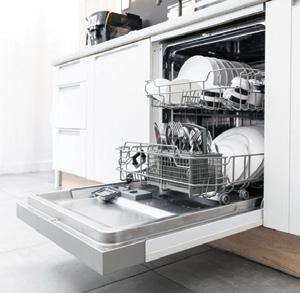

Mon progrès communicatif h
Interpretive: I can understand when people talk about the chores they do.
9.2 Discutez de vos tâches s Écrivez quatre tâches ménagères que vous faites. Posez des questions à trois autres élèves pour savoir s’ils ou si elles ont des responsabilités comparables aux vôtres.
MODÈLE Est-ce que tu fais ton lit chez toi ?
Florida Benchmarks
WL.K12.IL.1.2 (9.1)
WL.K12.IL.1.3 (9.1)
WL.K12.IL.1.4 (9.1)
WL.K12.IL.3.4 (9.2)
WL.K12.IL.3.6 (9.2)
x 9.1 Écoutez la conversation
Resources
Audio
Answers
1. Charlotte
2. Binta
3. Charlotte
4. Binta
5. Charlotte
6. Binta
7. Binta
9.2 Discutez de vos tâches
Answers
Answers will vary.
Mon progrès communicatif
For Mon progrès communicatif and Mon progrès interculturel the goal is to have students continuously re ect on their learning, take responsibility for their progress, and identify ways in which they can improve. The three bars are meant to represent levels of progress.
This is still a goal.
I can do this with support (notes, my teacher, a classmate).
I can do this independently.
See the Instructional Strategies Toolkit for further suggestions of how to introduce and implement this routine.
Before listening to 9.1, ask the students to make predictions on the vocabulary they will hear. Extend the pre-listening activity with a short interpersonal conversation with a partner using that vocabulary and their responsibilities.
Florida Benchmarks
WL.K12.IL.2.1 (10.1)
WL.K12.IL.2.3 (10.1)
Resources
Portfolio
Answers
Suggested answers:
1. Il faut d’abord sortir l’aspirateur. Il faut passer l’aspirateur à la n, après les autres tâches.
2. Non, il faut mettre le linge dans le panier à linge ; ça prend 30 secondes.
3. Quand on range rapidement, ce n’est pas nécessaire d’arroser les plantes. Il faut identi er les priorités.
Expressions utiles
l’éponge (f.) sponge par terre on the floor/ground
10 Peut-on ranger sa chambre en 10 minutes ?
Vos amis arrivent chez vous dans une heure. Vous voulez ranger rapidement votre chambre.
10.1 Lisez et corrigez les phrases b
Vous trouvez une infographie qui présente des idées pour ranger sa chambre en dix minutes. Lisez l’infographie et corrigez les phrases fausses.
Ranger sa chambre en 10 minutes

Sortez tout ce qu’il faut pour ranger (des sacs poubelle, une éponge et l’aspirateur). (2 minutes)

Faites le lit (1 minute) – C’est rapide et simple de faire le lit pour avoir une chambre plus jolie.
les vêtements sales dans le panier à linge. (30 secondes)


Identifiez les priorités (30 secondes) –Les chaussettes sales par terre ? Les papiers et les livres ? Le lit défait ?



Sortez la poubelle et le recyclage. (2 minutes)
C’est bientôt fini ! Passez un coup d’éponge rapide sur le bureau et la table de nuit. Puis passez l’aspirateur. (4 minutes)


2. L’auteur pense qu’il faut laver et plier le linge.
3. L’auteur pense qu’il faut passer deux minutes à arroser les plantes.
Mon progrès communicatif h
Interpretive: I can understand an infographic about chores in the home.
130-193_ECF_2e_L2_SE_U3.indd






1. L’auteur pense que pour ranger rapidement, il faut tout d’abord passer l’aspirateur.
As an extension of 10.1, have students discuss whether they agree with the author’s ideas for a 10-minute clean-up.
Combine 10.1 and 10.2 into an activity to see who can complete the household chores faster than listed in 10.1. Students can submit videos of themselves doing the task as fast as they can. Watch the videos together and invite the students to rate the completed tasks based on speed and accuracy. As a reminder, provide alternative options (such as picking up trash on the school campus) for students who are not comfortable videoing their home situations.
10.2 Écrivez un message e Lisez le texto d’Éloïse. Quelles sont ses trois priorités pour ranger sa chambre en cinq minutes ?
Éloïse
Tu peux m’aider ? Mes parents rentrent à la maison dans cinq minutes et ma chambre n’est pas rangée ! Qu’est-ce que je peux faire en cinq minutes ?
MODÈLE Éloïse, tu dois…
Mon progrès communicatif h
Presentational: I can write short messages to tell people which chores they will do.
11 Que font les jeunes comme tâches ménagères ?
Un organisme international des jeunes étudie les tâches ménagères que les enfants et les adolescents font dans des pays différents.
11.1 Regardez la vidéo et sélectionnez les tâches v o
Regardez la vidéo et sélectionnez les tâches ménagères mentionnées par chaque enfant français.
1. Agathe
A. ranger ma chambre
B. mettre la table
C. faire du jardinage
3. Anaël
A. faire la vaisselle
B. faire le lit
C. débarrasser la table
5. Samuel
A. vider le lave-vaisselle
B. garder ma petite sœur
C. faire le lit
2. Casey
A. laver le linge
B. passer l’aspirateur
C. plier le linge
4. Mathéo
A. arroser les plantes
B. ramasser les déchets
C. mettre du linge à laver
6. Ethan
A. ranger ma chambre
B. mettre la table
C. débarrasser la table
11.2 Présentez vos tâches ménagères m
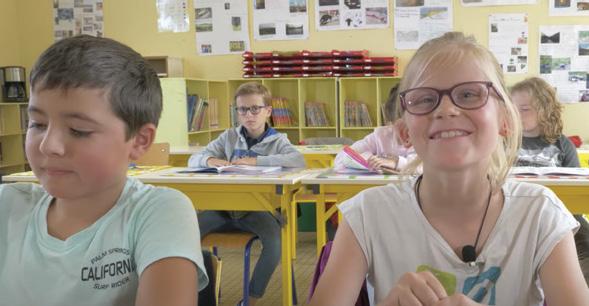
Florida Benchmarks
WL.K12.IL.3.3 (10.2)
WL.K12.IL.3.8 (10.2)
WL.K12.IL.1.3 (11.1)
WL.K12.IL.6.1 (11.1)
WL.K12.IL.4.1 (11.2)
WL.K12.IL.4.2 (11.2)
WL.K12.IL.5.3 (11.2)
x 10.2 Écrivez un message
Resources Portfolio Answers Answers will vary.
11.1 Regardez la vidéo et sélectionnez les tâches


Dans une vidéo à envoyer à l’organisme international, présentez les tâches ménagères que vous faites à la maison. Mentionnez les détails suivants :
• les tâches ;
• la fréquence ; et
• si vous aimez chaque tâche.
AP® Strategies
The ability to understand audio passages is an important skill for the Interpretive Audio and Interpretive Print and Audio sections of the AP® Language and Culture Exam. Students can apply the tips presented in the Stratégies video from Unité 1 for success on listening comprehension tasks.
Di erentiate
See the Instructional Strategies Toolkit for an engaging activity entitled “Headband Charades” to reinforce the household chore vocabulary before or after 11. Invite the students in drama to provide creative interpretations of each task to add a challenge.
Resources Video Answers 1. A, B 2. B 3. A, B, C 4. C 5. A
6. A, B, C
11.2 Présentez vos tâches ménagères
Answers Answers will vary.
WL.K12.IL.6.1 (12.1)
WL.K12.IL.6.2 (12.1)
WL.K12.IL.7.1 (12.1)
ELA.K12.EE.2.1 (12.1)
WL.K12.IL.6.1 (12.2)
WL.K12.IL.6.2 (12.2)
WL.K12.IL.7.1 (13)
Each Zoom culture focuses on a cultural product (produit) or practice (pratique) and invites students to develop insights into underlying perspectives (perspectives) in the francophone world and in their own culture. Products are tangible and intangible items—such as books, food, laws, music, and games— required or justi ed by the underlying values and beliefs of a culture. Practices are patterns of social interactions or behaviors, such as greetings, holidays, events, and daily schedules. Perspectives are the values, attitudes, and ideas of a culture.
Before students read the Zoom culture selections in the unit, use the Connexions questions to have them re ect on this product or practice in their own culture. Then have them read the information in the section before responding to the Perspectives questions. To minimize the use of English during class, have students read silently and respond for homework. Students should complete both the Connexions and Perspectives questions in the discussion forum, as they will use English for their responses.
12.1 Connexions
Resources Forum
12.2 Perspectives
Resources Forum
Answers
Answers will vary.
13 Ré exion interculturelle
Resources Forum, Portfolio Answers
Answers will vary.
12.1
Which types of chores do you do at home? Are the chores that you are expected to do similar to or different from those of family members of different ages?
The sharing of household tâches by family members is more equal in Canada than in many other countries. While tâches ménagères used to be divided by gender, over the last 40 years, the sharing of household tasks in families has become more equal.
In general, Canadians see chores as important in influencing development. Two thirds of Canadians report a belief that doing work around the house helps children build independence and work well with others. About half of Canadian families with children report a clear division of responsibilities in the home, with parents and enfants helping with chores. About a quarter of Canadian families try to do housework together, and a fifth of households report parents doing all the chores themselves. For many Canadians, small tasks like doing laundry or preparing meals are acts of care that contribute to a positive family environment.
What are the advantages and disadvantages of sharing chores in a home and in a society? What can you learn from doing chores for and with older adults?
What role do culture, gender, and age play in influencing the types of chores that people choose to do or are expected to do? What are your considerations (or your parents’ considerations) when you are choosing or being assigned chores at home? Answer the questions in the discussion forum.
Mon progrès interculturel h
Investigate: I can identify some ways that culture, gender, and age affect the types of chores people do.
130-193_ECF_2e_L2_SE_U3.indd
(Research) Use the search terms “Partage des tâches domestiques & Canada” to nd an infographic related to the Zoom culture. You will nd other similar resources that discuss appropriate chores for di erent ages. Ask the students to search for similar infographics, videos, or print materials from di erent francophone cultures. Compare and contrast the practices and perspectives of two-three cultures via either a short writing task or an oral summary.
14 Que faut-il faire ? m
Quel désastre ! La famille d’Yngara va inviter des amis à la maison, mais la maison est en désordre. Regardez les mèmes qu’Yngara poste sur internet et répondez à chacun avec des suggestions.
MODÈLE Il faut ramasser les déchets ! Et tu dois passer l’aspirateur.


Mon progrès communicatif h

Presentational: I can record a message to tell people which chores they have to do.

Florida Benchmarks
WL.K12.IL.5.1 (14)
WL.K12.IL.5.2 (14)
14 Que faut-il faire ?
Resources
Portfolio
Answers Answers will vary.
Challenge
Using humor in a second language to create memes as in 14 shows creativity and requires higherlevel thinking. Since students may be accustomed to reading and writing memes, lead them to express themselves in French with the language structures and vocabulary they already know.
WL.K12.IL.2.1 (15)
ELA.K12.EE.4.1 (15)
MA.K12.MTR.4.1 (15)
MA.K12.MTR.5.1 (15)
MA.K12.MTR.6.1 (15)
Découvrons
The Découvrons segments in EntreCultures® 2 provide clear examples of language used in context, with targeted structures in boldface type, helping students focus on form. Instead of presenting grammar rules, the segment invites students to observe, discover, and re ect on form in context.
Students will write their observations on the graphic organizer, and then they will work with a partner to see if they can come up with additional observations. Students may consult the Synthèse : Grammaire at the end of the unit to con rm their hypotheses. Encourage students to make linguistic comparisons to their home languages.
Resources
Audio
Découvrons videos and practice activities are available online throughout the series to support the explanation and understanding of newly presented grammar points. Students can view them at home and absorb grammatical patterns and structures at their own pace. Alternatively, you may wish to use these videos in class to support your own teaching.
Resources
Video, Think-Pair-Share Graphic Organizer, Workbook
Answers
1. Answers will vary.
2. Answers will vary.
3. The je and tu forms are the same, but the il/elle/on forms di er in the ending. The il/elle/on forms end either in -t or in -it.
4. The je/tu forms end either in -x or in -is.
5. Answers will vary.
Verbs pouvoir, vouloir, choisir,
Il faut ranger la maison avant la fête. Tu peux m’aider avec les tâches ménagères ? Tes amis et toi, vous pouvez donner un coup de main ?
Super ! Merci. Je ne veux pas ranger la chambre, mais mes parents veulent avoir une maison organisée et bien rangée. Mon frère ne veut jamais ramasser les déchets. Tu veux ramasser les déchets ?
C’est vrai ? Vous choisissez vos tâches ménagères à la maison ?

15 Découvertes b v d


Oui, bien sûr ! Mes amis peuvent aider aussi. Par exemple, mon ami Rashid peut laver les tables, et je peux passer l’aspirateur. Nous pouvons tous participer. Avec ta famille, vous voulez faire quelles tâches ?
Oui, je choisis souvent de ramasser les déchets chez moi. Mon frère et moi, nous choisissons nos tâches.
Oui. Mon frère finit ses tâches rapidement. Mes parents, ils finissent de ranger la maison rapidement aussi. Moi, je finis mes tâches ménagères lentement. Et vous, vous finissez vos tâches rapidement ?
Reflect on what you observe and respond to the following questions.
1. Look at all of the words in bold in the conversation above. Sort the words in bold into categories that make sense to you.

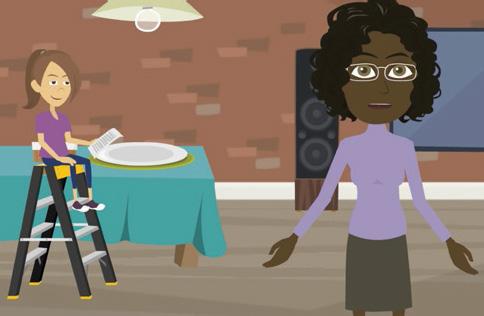

2. Explain to a partner how you decided to group the words in bold.
3. What do you observe about the il/elle/on forms of the verbs? How is it similar to or different from the je and tu forms?
4. What do you observe about the je and tu forms of the verbs?
5. Share your observations with a partenaire or with your teacher. What else do you notice together? Can you add to your observations?
Remind all students that sometimes verb forms sound the same in the je, tu, and il/elle/on forms, but they may be spelled di erently. Examples include veux/veut and choisis/choisit.
The objective of this Découvrons section is not to introduce every present tense form of all -ir verbs. Rather, the two goals are (a) for students to notice patterns that occur in verbs as a way to predict the forms of verbs that they will encounter in the future, and (b) to be able to work speci cally with the verbs vouloir, pouvoir, choisir, and nir, all used naturally in the communicative tasks in this unit. Assign the Découvrons 1 video for practice online.
If students need to review the singular forms of these verbs, refer them to Unité 4 of EntreCultures® 1 Unité 4 or to the Synthèse : Grammaire of this unit.
16 Ils peuvent nous aider ? w
Votre prof organise un projet de service dans le parc à côté de l’école. Lisez la liste de tâches que le prof a écrite dans un message et suggérez des tâches pour les autres personnes sur la liste du prof.
Tu veux participer avec les amis au projet de service dans le parc ? Je choisis des tâches pour tout le monde. Les secrétaires peuvent organiser l’horaire des tâches. Le documentaliste finit les invitations au projet. Tu peux suggérer des volontaires pour les autres tâches, s’il te plaît ?
MODÈLE Salut ! Je peux planter des arbres. Mon ami José choisit de laver les tables…. je le proviseur mon ami
mes amis et moi les élèves travailleurs
Détail linguistique
Les verbes en -ir
choisir (de) finir (de) pouvoir vouloir
arroser les fleurs faire du jardinage inviter les amis laver les tables planter des arbres ramasser les déchets
Voici des verbes dans le même groupe que finir et choisir qui sont utiles pour parler du bénévolat ou du travail:
Les bénévoles accomplissent beaucoup en peu de temps.
Si on travaille ensemble, on réussit à finir plus rapidement. Mon frère nourrit nos chiens. Ils lui obéissent, je suis content !
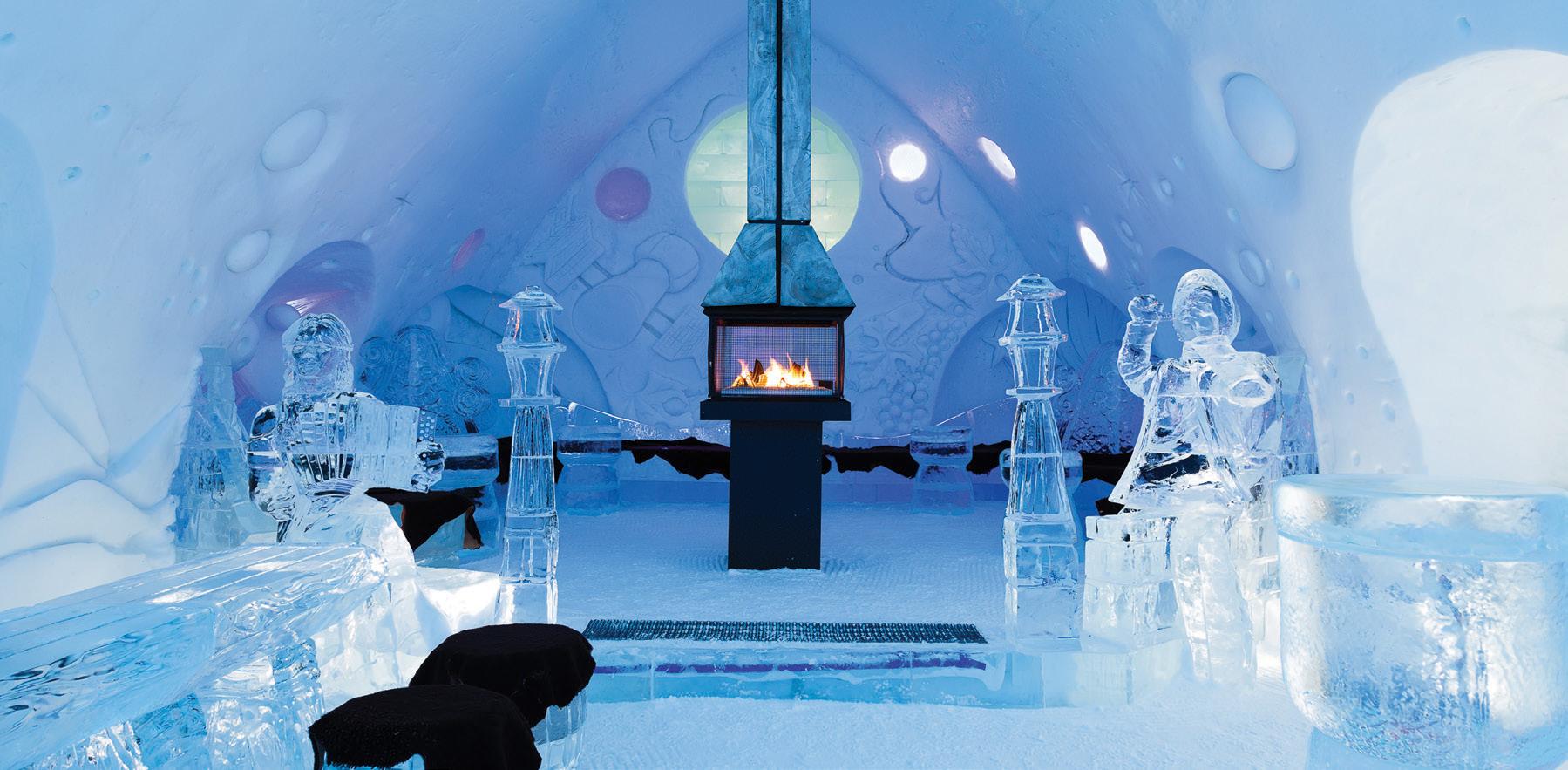
For 16 encourage students to make inferences about the skill sets or interests of the people listed in order to suggest appropriate ways for them to participate. Ask them to take it a step further and explain why they are making these suggestions.
Because of its cold climate in the winter, residents of and visitors to Quebec enjoy a wide variety of winter activities involving snow or ice, including a lodging option at the Hôtel de Glace. This hotel o ers a Grand Hall, chapel, ice slide, and rooms with ice furnishings. If you order a beverage there, it will be served in a drinking glass made of ice.
Florida Benchmarks
WL.K12.IL.5.1 (16)
16 Ils peuvent nous aider ?
Answers
Suggested answers: Je peux arroser les eurs. Le proviseur veut laver les tables. Mes amis choisissent de planter des arbres. Les élèves travailleurs nissent de faire du jardinage.
WL.K12.IL.2.4 (17.1)
WL.K12.IL.3.8 (17.2)
17.1 Lisez et sélectionnez des tâches
Students may need a quick review of what CDI stands for (centre de documentation et d’information). If they cannot remember, refer them to Unité 1
Answers
Answers will vary.
17.2 Discutez des tâches
Encourage students to be creative in their responses. They might suggest another group member do the task. (Je ne peux pas, mais tu peux ranger…) Encourage students who nish discussing these tasks to think of other tasks to discuss.
Answers
Answers will vary.
17 Tu peux passer l’aspirateur ?
Votre classe de français va organiser un club de culture francophone.
17.1 Lisez et sélectionnez des tâches b Votre prof veut organiser les tâches avant la première réunion du club. Lisez le formulaire et sélectionnez les trois tâches que vous préférez.
Réunion d’organisation pour le projet bénévole jeudi à 16h dans le CDI
Nom et prénom :

Choisissez trois tâches que vous préférez faire. Dans la colonne « Qui ? », écrivez votre prénom à côté des trois tâches que vous pouvez et voulez bien faire. Qui ?
Je peux passer l’aspirateur dans le CDI.
Je veux ranger les livres dans le CDI.
Je peux inviter le proviseur.
Je peux ramasser les déchets après la réunion.
Je finis les invitations pour les élèves.
Je finis d’organiser les documents pour la réunion.
Je veux laver les tables dans le CDI.
Je choisis les boissons pour la réunion.
Autre tâche :
17.2 Discutez des tâches s Demandez à d’autres élèves de faire les tâches que vous n’aimez pas et que vous n’avez pas sélectionnées.
a. Posez des questions aux autres élèves.
b. Écrivez leurs prénoms dans le formulaire.
MODÈLE Moi : Tu peux inviter le proviseur ?
Élève A : Non, je ne peux pas inviter le proviseur. Mais je veux ranger les livres dans le CDI.
130-193_ECF_2e_L2_SE_U3.indd
Sca old
For 17.1, remind the students that role-playing is part of their learning process. While the presented situations may not apply to their experiences, they can use these situations to develop skills that they may use later in life. Connect these types of tasks to other activities in their lives to encourage engagement and participation. Brainstorm other duties and activities associated with groups or jobs they have that could be used for a more personalized conversation.
AP® Strategies
A simulated conversation is a task used in Advanced Placement® tests that is intended to seem like a realistic conversation. Students hear a succession of prompts and record their interactions without pausing the recording. Live interpersonal conversations as in 17.2 help prepare students for simulated conversations.
17.3 Écrivez un e-mail w Écrivez un e-mail à votre professeur. Expliquez qui va faire chaque tâche pour préparer la réunion.
MODÈLE Madame, Monsieur,
Avant la réunion, je peux ranger les livres dans le CDI. Corinne et Jong-Hyok veulent laver les tables. Moi, je choisis les boissons, et Takhi finit les invitations.
17.4 Répondez aux questions r s
Avant la réunion dans le CDI, le documentaliste pose des questions sur les tâches que les élèves vont faire. Répondez à ses questions.
Mon progrès communicatif h
Interpersonal: I can answer some questions about the types of chores that need to be done.

Strategies
Responding to an email is an important skill for working in the interpersonal mode on the AP® Language and Culture exam. Writing an initial message (instead of responding to one) is a good way to practice this skill. Students should read through the information given for ideas to plan their response before writing.
The AP®-style conversation as in 17.4 has 20-second pauses for student responses as does the AP® French Language and Culture Exam.
Culture
The Château Frontenac is one of the most photographed hotels in the world. Its architecture is reminiscent of the castles of the Loire Valley. Explore the hotel’s website with the students and ask them to compare the hotel to an emblematic hotel they have heard of in the United States. Point out the traditional red and silver roofs and the stone architecture. How does the climate of Quebec in uence the building materials and architectural styles?
Florida Benchmarks
WL.K12.IL.5.1 (17.3)
WL.K12.IL.5.2 (17.3)
WL.K12.IL.3.1 (17.4)
WL.K12.IL.3.4 (17.4)
17.3 Écrivez un e-mail
Answers
Answers will vary.
x 17.4 Répondez aux questions
Resources
Portfolio
Answers
Answers will vary.
WL.K12.IL.1.2 (18.1)
WL.K12.IL.3.2 (18.2)
WL.K12.IL.5.7 (18.2)
WL.K12.IL.3.5 (18.3)
J’avance
You can access the J’avance formative assessments online. Tiered versions are available for di erentiation. The Blanc version matches the description in the Student Edition of the textbook. The Rouge version may be used with students who wish to challenge themselves, and the Bleu version provides extra support and sca olding.
Have students self-assess based on the J’avance Can-Do statements prior to taking the formative assessment and update their Portfolio by adding this assessment as evidence of their growing language pro ciency.
Resources
Tiered Assessments (Bleu, Blanc, Rouge), Rubrics (Single-Point, Holistic, Analytic), Portfolio
Answers
Answers are provided in the J’avance key available online.
Resources
Audio
18.3 Discutez de vos tâches
Resources
Audio
18 Comment s’organiser pour habiter ensemble ?
You are planning to participate in a volunteer summer camp with students from all over the world who are interested in volunteering in Montreal. You will be sharing a common area (kitchen, living room, and dining room) with Olivier and Amina for two months at the camp. You would all like to keep your living area clean, so your roommates have asked you to decide which roommate will do which chores.
18.1 Écoutez et indiquez les tâches a
Listen to Olivier and Amina as they describe the ways they in which they help out at home. Then, indicate indicate the chores that each student does, as well as the chores that you do at home.
Mon progrès communicatif h
Interpretive: I can understand when people talk about the chores they do.
18.2 Écrivez un e-mail w
Based on the chores you, Olivier, and Amina do at home, divide chores equally among you for the two months you will be living together at camp. Write an email to Olivier and Amina explaining the chores that you have assigned to each person.
Mon progrès communicatif h
Presentational: I can write short messages to tell people which chores they will do.
18.3 Discutez de vos tâches r s
Amina has received your email and would like to discuss the chores with you. She has some questions about the chores that you have assigned to her.
Mon progrès communicatif h
Interpersonal: I can answer some questions about the types of chores that need to be done.

Before 18.1, review the vocabulary pictured in the graphic organizer to con rm that students are prepared for the listening tasks. Quick reviews with a partner allow students to verify their vocabulary awareness.
18.3 prepares students for the simulated conversation task used in Advanced Placement® tests that is intended to seem like a realistic conversation. Students hear a succession of prompts and record their interactions without pausing the recording. There is a 20-second pause for each student response, as is the case on the AP® French Language and Culture Exam.

Comment dit-on ?
In EntreCultures®, the visually rich Comment dit-on ? section presents essential vocabulary and expressions in manageable segmentss for each thematic unit. These segments target the vocabulary that learners need to know to be successful on the formative J’avance and summative J’y arrive assessments, and for use beyond the classroom. Students will be assessed on vocabulary presented in blue type in this section.
Resources
Audio, Workbook
QUIZ : Quel rôle est fait pour toi ?
Quel rôle occupes-tu dans ton groupe d’amis ou quand tu réalises un projet scolaire ? Choisis les cinq options qui te semblent (seem) les plus intéressantes.
Aimes-tu...

servir des repas ? conseiller des amis ? gérer des projets ?
aider les autres à travailler ?
… accueillir de nouveaux élèves à ton école ? … organiser ton emploi du temps ?
… contribuer à des projets ?
Total (A)
Résultats :
… réconforter quelqu’un qui est triste ? … lancer de nouvelles idées ?
Total (B)
Total (C)
• Majorité colonne A : Comme tu es travailleur/travailleuse ! On aime travailler avec toi parce que tu bosses beaucoup et tu fonctionnes bien en équipe.
• Majorité colonne B : Tu es compréhensif/compréhensive et un(e) ami fidèle. Tu écoutes bien les autres et tu as de l’intelligence émotionnelle.
• Majorité colonne C : C’est toi, le/la chef du groupe ! Tu es quelqu’un d’organisé et de motivé
Sca old
Refer to the Instructional Strategies Toolkit for ideas on how to present the Comment dit-on ? vocabulary.
Language
You may want to call students’ attention to some of the faux amis in the Comment dit-on ? section: travailler/travailleur (not to be confused with each other or with voyager/voyageur), bosser, and chef. While chef is not a true faux ami, you should give a few examples of how it is used outside of the kitchen. Students may nd it interesting that the word chef in old French meant head, as a person in charge of something.
A tip to help students remember the meaning of réaliser is to have them apply the Stratégies from Unité 2: The root of réaliser is réel, meaning to make something a reality or to make it really happen.
Rappel
L’accord des adjectifs
N’oubliez pas de changer les lettres à la fin d’un adjectif pour l’accorder à son nom.
Il est patient.
Elle est patiente
Il est travailleur
Elle est travailleuse
19 Quel est ton rôle ?
Ils sont compréhensifs Elles sont compréhensives
Votre prof vous demande de répondre aux questions du quiz de personnalité avant de vous organiser en groupes de travail.
19.1 Répondez aux questions du quiz b
a. Répondez aux questions du quiz de personnalité.
b. Comptez vos réponses pour arriver à votre résultat.
19.2 Comparez vos résultats s
Parlez avec d’autres élèves de la classe. Comparez vos résultats du quiz et posez des questions.
MODÈLE Le quiz dit que je suis travailleuse. Quels sont tes résultats ?
Détail linguistique
Les anglicismes

En français moderne, on dit souvent certains mots en anglais. Ces mots s’appellent des anglicismes
Notre principal est un bon leader. C’est moi, le boss !
Il est impossible d’arrêter le mélange des langues, surtout avec internet, mais on fait un grand effort dans le monde francophone pour encourager l’usage de la langue française.

Before 19, you may want to review adjective agreement. There are several songs that explain the rules for adjective agreement. If you have not used one in the past, ask a colleague or in an online French teacher group for suggestions. Spanish adjectives have fewer adjective endings, so Heritage Spanish Speakers may have questions about the French rules. See the Instructional Strategy Toolkit for ideas on how to co-create a visual handout or wall chart for the students to consult. Adjective agreement takes multiple exposures and interactions with resources to con dently use the rules with accuracy.
Florida Benchmarks
WL.K12.IL.2.1 (19.1)
WL.K12.IL.3.1 (19.2)
WL.K12.IL.3.4 (19.2)
19.1 Répondez aux questions du quiz
Answers Answers will vary.
19.2 Comparez vos résultats Answers Answers will vary.
WL.K12.IL.2.3 (20.1)
WL.K12.IL.3.1 (20.2)
WL.K12.IL.3.7 (20.2)
x 20.1 Lisez les annonces
Resources
Portfolio
Answers
Answers will vary.
20.2 Discutez des o res de bénévolat
Resources
Audio
Answers
Answers will vary.
20 Quelle offre t’intéresse ?
Vous allez participer à un projet de bénévolat cet été à Montréal.
20.1 Lisez les annonces b
Lisez ces deux annonces qui proposent des offres de bénévolat aux jeunes à Montréal. Choisissez l’offre que vous trouvez la plus intéressante et notez trois raisons pour expliquer votre préférence.
Opération
Bibliothèque de bienvenue
Nous cherchons quelqu’un de compréhensif, patient et motivé pour accueillir nos clients. Cette personne va aider des enfants réfugiés à trouver et lire des livres de notre collection. Cette personne va aussi gérer la collection.
Veuillez contacter monsieur
Gilles Aglukkaq (gaglukkaq@bibliobienvenue.asso.ca)
Première raison :
Deuxième raison :
Troisième raison : Mon progrès communicatif h
L’école du leadership
Tu as entre 13 et 17 ans ? Tu as des capacités de chef ? Inscris-toi avant le 19 janvier pour notre 11e cours du leadership chaque fin de semaine du mois de février. Nous allons t’enseigner à lancer des projets, gérer une équipe et conseiller les autres chefs pour réussir. Contacte-nous au +1 418 657 4321
Interpretive: I can understand an announcement about a volunteer opportunity.
Rappel
Pour faire des suggestions Ça te dit de… ?
Tu peux… ?
20.2 Discutez des offres de bénévolat r s William, un ami d’Éloïse, veut faire du bénévolat mais ne sait pas quelle(s) activité(s) choisir. Répondez à ses questions pour l’aider.
130-193_ECF_2e_L2_SE_U3.indd 160
Language
The term n de semaine is much more common than week-end in Canada.
Remind students in 20.1 that the word accueillir has accueil as its root, which students saw in Unité 1. Students may be tempted to treat servir and accueillir like the verbs introduced in Découvrons of Communiquons 1. Reinforce the correct forms often with appropriate input and interaction.
A simulated conversation like the one in 20.2 is a task used in Advanced Placement® tests that is intended to seem like a realistic conversation. Students hear a succession of prompts and record their interactions without pausing the recording. There is a 20-second pause for each student response, as is the case on the AP® French Language and Culture Exam.
12/10/24
21 Qui est fait pour ce rôle ?
Des élèves de votre classe se présentent comme candidats pour être président ou présidente du club multiculturel votre école.
21.1 Écoutez et identifiez les qualités a Écoutez les présentations de chaque élève et faites correspondre chaque personne aux qualités qui la décrivent.
1. accueille de nouveaux élèves
2. est un(e) ami(e) fidèle
3. contribue aux projets des autres
4. donne un coup de main
5. gère des projets
Détail grammatical
6 lance de nouvelles idées
7. est motivé(e)
8 est organisé(e)
9. organise des groupes
10 est travailleur (-euse)
La formation des verbes servir et accueillir
Voici quelques exemples de ces verbes en contexte : J’accueille le nouvel élève à mon école.
Tu accueilles aussi des parents qui visitent l’école ?
A. Gaby
B. Emmanuel
C. Phara
Je sers des repas aux personnes qui en ont besoin.
Elle sert des goûters aux enfants après l’école.
21.2 Écrivez une recommendation w
Dans un post du réseau social (social network), recommandez quelqu’un comme président ou présidente de l’organisation. Expliquez pourquoi vous recommandez cette personne.
MODÈLE Je recommande comme président(e) de l’organisation parce qu’il/elle…
Mon progrès communicatif h
Presentational: I can write a recommendation for someone and give reasons.
For students who are still developing their interpretive listening con dence, remind them before 21.1 that they can focus on one person’s description at a time and listen several times to con rm their comprehension. Breaking the task up into smaller chunks will support students with auditory processing challenges.
In the Détail grammatical, prompt students to apply what they learned in Découvrons of Communiquons 1. “If the ils form of construire is construisent, what would the je form be?”
Florida Benchmarks
WL.K12.IL.1.2 (21.1)
WL.K12.IL.5.2 (21.2)
21.1 Écoutez et identi ez leurs qualités
Resources Audio Answers
x 21.2 Écrivez une recommandation
Encourage students to use adjectives from the Je fais ma part vocabulary presentation.
Resources
Portfolio
Answers
Answers will vary.
For certain units in EntreCultures® 2, Comment dit-on ? is divided into Sections A and B. Each of these sections presents essential vocabulary and expressions in manageable chunks targeting the vocabulary that learners need to know to be successful on the formative J’avance and summative J’y arrive assessments, and for use beyond the classroom. Students will be assessed on vocabulary presented in blue type in this section.
Resources
Audio, Workbook
B. Servir sa communauté a
Accueil QUI SOMMES-NOUS ? Nos projets Faire un don Ressources

Citoyens, nous avons besoin de vous ! Ensemble, on peut est un groupe de bénévoles engagés qui contribuent à aider la communauté. Chaque semaine, nous avons une réunion pour parler de nos objectifs hebdomadaires.
Nous avons besoin d’aide au bureau pour...
• trier et distribuer le courrier

• répondre au téléphone
• planifier une réunion


• mettre en place un projet


Nous avons besoin d’aide sur le terrain pour...
• planter des arbres dans les espaces publics
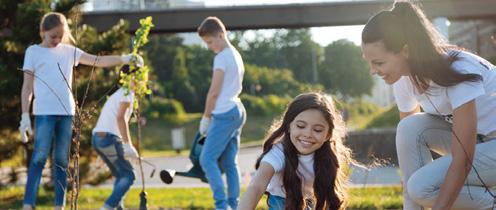

• faire du jardinage, faire du recylage et sortir recyclage et la poubelle chez les personnes âgées


• faire des tâches ménagères chez les personnes à mobilité réduite
• construire des maisons

Parlez-en à vos amis et venez nombreux à notre prochaine réunion d’orientation !
Expressions utiles expérimenté(e) répondre au téléphone experienced to answer the phone
130-193_ECF_2e_L2_SE_U3.indd


While introducing the Comment dit-on ? vocabulary, note that each community has its own characteristics and areas of need to ensure that all members are welcome and enjoy the same bene ts. Ask students to brainstorm ways that they can serve the speci c needs of their community with the time and skills they possess.
Before de ning bénévole ask the students to brainstorm on the origin and derivation of the word. Bene in italian means good and vole is related to volition: wanting to do good. Ask the students how this word aligns with their current activities and future interests. Are there other ways that they feel connected to this word?
22 Comment placer ces bénévoles potentiels ?
Vous faites un stage (internship) à l’association de bénévoles Citoyens en action.
22.1 Écoutez les messages a Écoutez les messages des personnes qui ont téléphoné à l’association et indiquez la bonne tâche pour chaque personne.
1. Isaac
2. Jade
3. Maeva
A. travailler comme chef de l’équipe
B. aider au bureau
C. travailler hors du bureau
Mon progrès communicatif h
Interpretive: I can identify key information about what volunteers are like and what they are willing to do.
22.2 Répondez aux textos e Répondez aux textos d’Isaac, de Jade et de Maeva avec des recommandations plus exactes.
Ça vous dit de répondre aux téléphones ? Préférez-vous … ou … ?
Vous pouvez… Vous voulez… ?
Isaac, Jade, Maeva
Isaac Jade
Bonjour. Vous avez des suggestions pour moi ?
Est-ce que vous avez des nouvelles ?
Maeva
Bonjour. Avez-vous reçu mon message ?
Mon progrès communicatif h
Interpersonal: I can respond to text messages with recommendations.
Sca old
Use a Think-Pair-Share to check answers for 22.1 before moving on to the rest of the activity.
Language
In 22.2, Ça vous dit de…? is an idiomatic expression with a similar construction to ça me plait. In this context it means “Do you feel like…?” Trier and sortir are notorious faux amis
Florida Benchmarks
WL.K12.IL.1.1 (22.1)
WL.K12.IL.3.2 (22.2)
22.1 Écoutez les messages
Resources Audio Answers
22.2 Répondez aux textos
Resources
Portfolio
Answers
Answers will vary.
WL.K12.IL.2.1 (23.1)
WL.K12.IL.8.1 (23.1)
WL.K12.IL.1.1 (23.2)
WL.K12.IL.8.1 (23.2)
WL.K12.IL.1.1 (23.3)
MA.K12.MTR.5.1 (23.3)
WL.K12.IL.8.1 (23.4)
travailleurs et patients, pour soutenir le programme petits enfants au mois de juillet. Le travail consiste principale, les aider à compléter les feuilles aller à la piscine une fois par semaine. Si cela directrices. Elles peuvent répondre à vos questions.
23 Prononciation : Une combinaison de lettres à deux sons
Prononciation is helpful to Level 1 students as they discover the French phonetic system. Have students review the accompanying videos to assist them further with improving their French pronunciation.
23.1 Anticipez la prononciation
Answers
Answers will vary.
23.2 Véri ez vos réponses
Resources
Audio
Answers
1. belle, salle, aller, elles
2. travailleurs, juillet, accueillir, familles, feuilles, conseiller
23.3 Analysez vos réponses
Resources
Audio
1. 4
2. 6
3. Students should conclude that when ll is preceded by a vowel combination +ill (aille, eille, euille, uille), the ll is pronounced like y. If ll is preceded by other vowels, ll is pronounced like l.
23.4 Répétez et enregistrez l’annonce
Resources
Audio Sca old
23.1 Anticipez la prononciation b
How do we pronounce ll in French?
You already know that ll in French words can be pronounced either as an l sound, as in elle or ville, or as a y sound, as in travailler. When we see a word with ll, how do we know whether to pronounce it as an l sound or as a y sound?
Read the transcription of a radio announcement for a volunteer opportunity and predict the following:
1. the words containing ll pronounced as an l sound; and 2. the words containing ll pronounced as a y sound.
On recherche des bénévoles travailleurs et patients pour soutenir le programme d’été de notre belle école pour les petits enfants au mois de juillet. Le travail consiste à accueillir les familles dans la salle principale, les aider à compléter les feuilles d’inscription, conseiller les enfants et aller à la piscine une fois par semaine. Si cela vous intéresse, téléphonez aux directrices. Elles peuvent répondre à vos questions.
23.2 Vérifiez vos réponses a
Listen to the recording. Then indicate the following:
1. the words containing ll pronounced as an l sound; and 2. the words containing ll pronounced as a y sound.
23.3 Analysez vos réponses a
Listen to the recording again and answer the questions.
1. How many times did ll produce an l sound? What did you notice about the letters that came before or after ll in these words?
2. How many times did ll produce a y sound? What did you notice about the letters that came before or after ll in these words?
3. Did you notice any patterns?
23.4 Répétez et enregistrez l’annonce a
Listen to recording again and do the activities.
1. Bearing in mind what you have observed, practice reading the transcript aloud.
2. When you are ready, record yourself reading the transcript.
The main point for students to notice in 23 is how ll is pronounced based on the vowels that precede it. You may want to begin by showing some examples of words containing ll that students already know (aller, travailler).
Students will discover that the vowel i is often a trigger for the following ll to be pronounced as Y, but point out some of the notable exceptions to this rule: ville, mille, tranquille
Use the following tongue twister (virelangue) for students to practice the very light and forward French l that is pronounced as l: Lulu lit la lettre lue à Lili et Lola alla à Lille où Lala lie le lilas .
Vous cherchez des exemples de jeunes bénévoles pour inspirer votre communauté à faire du bénévolat.
24.1 Regardez la vidéo et répondez v o
a. Regardez la vidéo d’Édrige Oris, un jeune Haïtien, qui a lancé un projet de bénévolat dans sa communauté. Faites correspondre les informations pour identifier les détails importants.
1. sa motivation
2. un défi (challenge) qui existait dans sa communauté
3. une catastrophe naturelle
4. sa méthode pour lancer son projet
A. l’intérêt des jeunes pour la musique plus que l’école
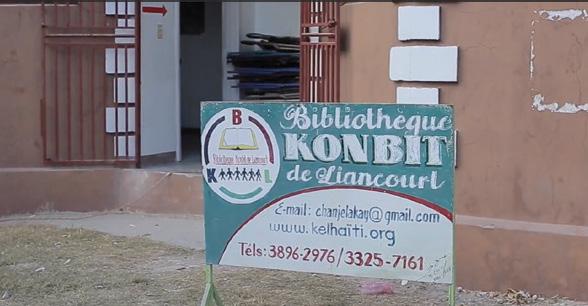
Florida Benchmarks
WL.K12.IL.1.2 (24.1)
WL.K12.IL.1.5 (24.1)
WL.K12.IL.6.1 (24.1)
24.1 Regardez la vidéo et répondez
Have students preview questions before watching the rst time.

B. le tremblement de terre de 2010
C. réunir de jeunes leaders de la communauté
D. encourager les jeunes à lire
b. Complétez la mini-biographie d’Édrige Oris en écrivant des détails que vous entendez dans la vidéo.
Nom : Édrige Oris
Occupation : Fondateur de Liancourt Magazine
Ville : Liancourt (Artibonite, Haïti)
Son projet bénévole : Il organise (1) où les (2) écrivent pour parler de leur communauté.

Before 24.1, download the transcription and print out formatted copies for the students. Ask the students to annotate the transcription with markers to identity cognates, learned French words, and words that they are unsure of. Next, refer the students to the exercise to prepare them what they will be listening for. You may choose to allow them to keep the transcription visible during the viewing or ask them to put it away. Remind the students that they are to focus on listening for basic, not full comprehension.
Culture
The January 12, 2010, earthquake in Haiti killed hundreds of thousands of people, devastated the country’s infrastructure and economy, and led to long-term civil and governmental issues that have not yet been recti ed. It is important for students to be aware of the history and impact of this natural and humanitarian disaster before watching the video in 24.1.
Language
Point out in 24.1 that the word konbit is Haitian Creole for working together
Resources
Video
Answers
un magazine 2. jeunes / ados
WL.K12.IL.5.1 (24.2)
WL.K12.IL.6.1 (24.2)
WL.K12.IL.6.3 (24.2)
WL.K12.IL.4.1 (24.3)
WL.K12.IL.6.3 (24.3)
WL.K12.IL.6.1 (25)
WL.K12.IL.6.2 (25)
WL.K12.IL.8.1 (25)
ELA.K12.EE.1.1 (25)
24.2 Faites des comparaisons
Resources
Venn Diagram
Answers
Answers will vary.
24.3 Discutez de vos comparaisons
Students should work in groups of three to four. Have each group turn in their similarity and di erence as an exit ticket.
Answers
Answers will vary.
25 Ré exion interculturelle
Resources
Forum, Portfolio Answers
Answers will vary.
24.2 Faites des comparaisons w Avec un(e) partenaire, pensez à une personne que vous connaissez qui fait du bénévolat. Comparez cette personne à Édrige Oris dans le diagramme de Venn.
• Comment est cette personne ?
• Que fait cette personne bénévole ?
Édrige Oris une personne que je connais
24.3 Discutez de vos comparaisons s
a. Parlez avec d’autres élèves de la classe et partagez votre diagramme de Venn.
b. Notez une similarité et une différence entre les personnes que vous avez présentées.
25 Réflexion interculturelle d
In the video, you discovered how Édrige Oris responded to a difficult time in his country. What are some ways in which people in your community have responded to challenges together? What life lessons can you take away from Édrige’s example? Answer the questions in the discussion forum.
Mon progrès interculturel h
Investigate: I can identify ways people in my community and in francophone cultures respond to challenges, and I can give reasons for their responses.
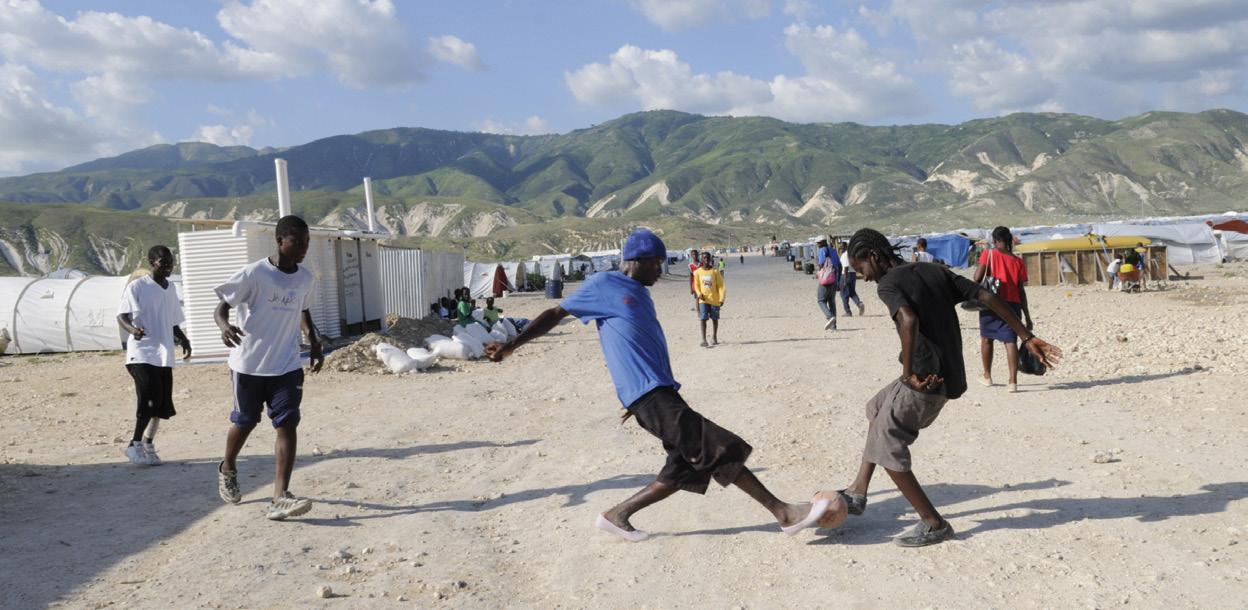
For 24.2, keep in mind that students may not know someone who volunteers. Provide examples of volunteer opportunities in your school or city or ask students to think of the qualities that they would want a volunteer to have.
While the geographical focus of this unit is Québec, it should be noted that Canada is one of the major destinations of Haitian immigrants because of the large Haitian communities in the Frenchspeaking provinces. Canada also provides extensive economic and humanitarian support to Haiti.
AP® Strategies
Making comparisons as in 24.3 is an important skill for the AP® Language and Culture Exam.
qu’est-ce que
Tu veux aider pour quelles raisons ?
Quel projet est-ce que tu aimes le plus ?
Qu’est-ce que tu préfères : planter des arbres ou construire des maisons ?
Quelle tâche est-ce que tu préfères : répondre au téléphone ou sortir la poubelle ?
26 Découvertes b d
Quels sont des exemples de rôles que tu peux prendre ?
Reflect on what you observe, and respond to the following questions in the graphic organizer.
1. Can you identify all the forms of the word quel? When is each one used? masculin féminin singulier pluriel
2. Compare the use of quel and qu’est-ce que. What do they have in common? When should you use one or the other?
qu’est-ce que quel
Share your observations with a partner. What else do you notice together? What else can you add to your observations?
Language
In this Découvrons section, note that American English speakers often struggle to di erentiate between which and what. Provide a simple rule that quel is always followed by a noun.
For 26, students who know Spanish should note that there are four forms of which in French because they agree in both gender and number, whereas in Spanish there are only two forms (cuál and cuáles), which agree in number only.
Florida Benchmarks
WL.K12.IL.2.1 (26)
ELA.K12.EE.4.1 (26)
MA.K12.MTR.3.1 (26)
MA.K12.MTR.4.1 (26)
The Découvrons segments in EntreCultures® 2 provide clear examples of language used in context, with targeted structures in boldface type, helping students focus on form. Instead of presenting grammar rules, the segment invites students to observe, discover, and re ect on form in context.
Students will write their observations on the graphic organizer, and then they will work with a partner to see if they can come up with additional observations. Students may consult the Synthèse : Grammaire at the end of the unit to con rm their hypotheses. Encourage students to make linguistic comparisons to their home languages. This Découvrons 2 segment guides students to review and contrast the use of quel and its variations with that of qu’est-ce que
Resources
Audio
Découvrons videos and practice activities are available online throughout the series to support the explanation and understanding of newly presented grammar points. Students can view them at home and absorb grammatical patterns and structures at their own pace. Alternatively, you may wish to use these videos in class to support your own teaching.
Resources
Video, Think-Pair-Share Graphic Organizer, Workbook
Answers
Suggested answers:
1. quel, quelle ; quels, quelles
2. Quel is used before a noun or the verb être (est or sont) and means which. Qu’est-ce que is used before a subject pronoun and has the more general meaning of what.
WL.K12.IL.3.3 (27.1)
WL.K12.IL.3.1 (27.2)
WL.K12.IL.3.6 (27.2)
WL.K12.IL.4.2 (27.3)
Resources
Portfolio
Answers
Answers will vary.
x 27.2 Interviewez un(e) autre
élève
Resources
Portfolio Answers
Answers will vary.
27.3 Laissez un message Answers
Answers will vary.
27 Quelles questions peux-tu poser ?
Citoyens en action vous demande d’évaluer les autres élèves de votre classe pour leur suggérer des projets bénévoles.
27.1 Écrivez des questions w Écrivez des questions que vous pouvez poser aux autres élèves. Utilisez ces débuts de phrases pour construire vos questions et ajoutez une autre question. questions réponses des autres élèves
Modèle : Quelles sortes de tâches est-ce que tu fais à la maison ?
Quels sont tes projets pour [période de temps] ?
Qu’est-ce que tu préfères : … ou … ? [votre question]
27.2 Interviewez un(e) autre élève s
Interviewez un(e) partenaire et notez ses réponses dans la représentation schématique.
Mon progrès communicatif h
Interpersonal: I can ask and answer questions about traits and preferences related to volunteering.
27.3 Laissez un message m
Laissez un message pour l’association Citoyens en actions pour expliquer les qualités et les expériences de votre partenaire.
MODÈLE Ma partenaire Shaeda aime trier et distribuer le courrier. Elle choisit des tâches d’organisation à la maison. Elle peut travailler cet été.

Note that students must come up with an original question in 27.1 before starting their interviews. If they are struggling, it might be a good idea to brainstorm questions as a class.
Asking questions is a key skill for the Interpersonal Speaking task on the AP® French Language and Culture Exam. 27.2 is an opportunity for students to practice forming and asking questions. Encourage them to practice using a variety of di erent interrogative words and word orders in questioning.
28 Tu voudrais devenir bénévole ?
Vous voulez trouver un projet bénévole au Canada cet été avec d’autres jeunes.
28.1 Lisez les informations b o
Vous trouvez un site web sur une association au Canada. Lisez les informations et répondez aux questions.
Authentique
Devenir bénévole
L’équipe de Chantiers jeunesse est régulièrement à la recherche de personnes motivées et engagées pour se joindre à elle en tant que bénévoles ! Nous encourageons le bénévolat comme acte de loisir. Nous vous invitons à vous joindre à nous afin de contribuer à notre mission.
Contactez-nous !
Nom
Courriel
Message
1. Qu’est-ce que c’est que Chantiers jeunesse ?
2. Quelle sorte de personnes est-ce que cette association cherche ?
Expressions utiles à la recherche de devenir
l’organisme (m.) à but non-lucratif (OBNL) in search of to become not-for-profit organization (NPO)
28.2 Écrivez un message w
Écrivez un message à l’association. Dans votre message…
• expliquez pourquoi vous voulez devenir bénévole ;
• expliquez pourquoi vous êtes un(e) bon(ne) candidat(e) ; et
• posez des questions pour en savoir plus.
MODÈLE Je voudrais devenir bénévole parce que…
Quel(le) est votre… ?
Quel(le)s sont vos… ?
For 28, have each student nd a volunteer opportunity while researching Chantiers jeunesse or a similar organization. Ask students to link the volunteer work described to one or more IB themes. Some obvious connections:
Organisation sociale : - communauté, engagement social
Partage de la planète : - créer un monde meilleur, protéger la planète
Expériences : voyages, diversité culturelle (for international students)
Florida Benchmarks
WL.K12.IL.2.2 (28.1)
WL.K12.IL.2.3 (28.1)
WL.K12.IL.5.2 (28.2)
WL.K12.IL.5.5 (28.2)
28.1 Lisez les informations
Answers
Suggested answers: 1. C’est un organisme à but non-lucratif. 2. On cherche de jeunes bénévoles motivés et engagés.
28.2 Écrivez un message
Answers
Answers will vary.
WL.K12.IL.6.1 (29.1)
ELA.K12.EE.2.1 (29.1)
WL.K12.IL.2.3 (29.2)
WL.K12.IL.6.1 (29.2)
WL.K12.IL.7.2 (29.2)
Each Zoom culture focuses on a cultural product (produit) or practice (pratique) and invites students to develop insights into underlying perspectives (perspectives) in the francophone world and in their own culture. Products are tangible and intangible items—such as books, food, laws, music, and games— required or justi ed by the underlying values and beliefs of a culture. Practices are patterns of social interactions or behaviors, such as greetings, holidays, events, and daily schedules. Perspectives are the values, attitudes, and ideas of a culture. Before students read the Zoom culture selections in the unit, use the Connexions questions to have them re ect on this product or practice in their own culture. Then have them read the information in the section before responding to the Perspectives questions. To minimize the use of English during class, have students read silently and respond for homework. Students should complete both the Connexions and Perspectives questions in the discussion forum, as they will use English for their responses.
29.1 Connexions
29.2 Perspectives
Answers
Answers will vary.
29.1
Do you or people you know volunteer in your community? What kinds of things do people do as volunteers? Why do they decide to volunteer?
On the whole, Canada has a strong tradition of community involvement and volunteerism, as it is estimated that 79 percent of Canadians age 15 and older participate in volunteerism. Each year, les bénévoles dedicate about five billion hours to their volunteer activities. What motivates Canadians to volunteer? Their top reasons differ across generations. For example, members of iGen (also known as Generation Z, born between 1996 and 2012) want to improve their job opportunities, while other generations cite contributing to the well-being of the community and spiritual motivations as their primary motivation.
A variety of volunteer opportunities is available to Canadians. From restoring historic buildings and public spaces to fundraising to provide help directly to specific populations such as senior citizens, refugees, or children, whatever your interest, you can find a volunteer opportunity in Canada.

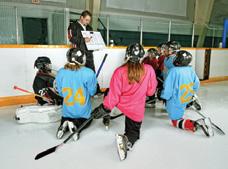
29.2 Perspectives o d



Look at the graph from Statistique Canada to see some of the ways in which Canadians volunteer their time. How many can you identify?
The ability to work with graphs, charts, and infographics is critical to success on AP® Cultural Comparisons. Students should be familiar with the terminology and be able to express what they see in the infographic in the Zoom culture
See the Instructional Strategies Toolkit for a graphic organizer to extend 29.1. For each organization type in the infographic, what personality types and what skills would t the volunteer opportunities? Ask the students to create a pro le of someone who would best connect with and support the organization. Alternatively, you could spotlight students in your class and school based on their skills and personalities. As suggested on page 169, ask the students to look up francophone volunteer organizations and connect students to the organizations based on their pro les.
30 Choisissez le citoyen du mois !
Citoyens en action is sponsoring a prize for volunteerism and leadership in the community. Watch their video announcement about the prize and then make your recommendation for the best candidate.
30.1 Regardez la vidéo v
Watch the video and indicate the traits you hear so that you know what kind of volunteer Citoyens en action would like to honor with its award.
Mon progrès communicatif h
Interpretive: I can understand an announcement about a volunteer opportunity.
30.2 Écrivez une nomination w

Florida Benchmarks
WL.K12.IL.1.3 (30.1)
WL.K12.IL.5.3 (30.2)
WL.K12.IL.3.8 (30.3)
J’avance


Fill out the online form to nominate someone you know as citoyen or citoyenne de l’année
Mon progrès communicatif h
Presentational: I can write a recommendation for someone and give reasons.
30.3 Parlez des nominations s
Read two of your classmates’ nominations and, with a partner, decide which one of the nominations is the better choice. Record your conversation.
Mon progrès communicatif h
Interpersonal: I can ask and answer questions about traits and preferences related to volunteering.

You can access the J’avance formative assessments online. Tiered versions are available for di erentiation. The Blanc version matches the description in the Student Edition of the textbook. The Rouge version may be used with students who wish to challenge themselves, and the Bleu version provides extra support and sca olding.
Have students self-assess based on the J’avance Can-Do statements prior to taking the formative assessment and update their Portfolio by adding this assessment as evidence of their growing language pro ciency.
Resources
Tiered Assessments (Bleu, Blanc, Rouge), Rubrics (Single-Point, Holistic, Analytic), Portfolio
Answers
Answers are provided in the J’avance key available online.
30.3 Parlez des nominations
Choose a handful of especially well-done nominations that are comprehensible and use the unit vocabulary. Randomly choose two of these for each interpersonal speaking group but avoid giving students their own writing from 30.2
The ability to understand audio passages is an important skill for the Interpretive Audio and Interpretive Print and Audio sections of the AP® Language and Culture Exam. Students can apply the tips presented in the Stratégies video for success on listening comprehension tasks in Unité 1 of EntreCultures® 1 and in Unité 1 of EntreCultures® 2.
WL.K12.IL.6.1 (31)
Comment dit-on ?
In EntreCultures®, the visually rich Comment dit-on ? section presents essential vocabulary and expressions in manageable segments for each thematic unit. These segments target the vocabulary that learners need to know to be successful on the formative J’avance and summative J’y arrive assessments, and for use beyond the classroom. Students will be assessed on vocabulary presented in blue type in this section.
Resources
Audio, Workbook
31 Ré exion interculturelle
Resources
Forum, Portfolio
Answers
Answers will vary.
A. Où faire du bénévolat ? a
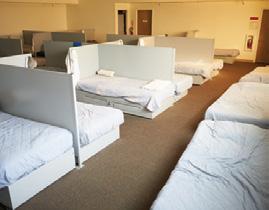
refuge pour sans-abri
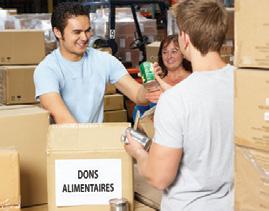


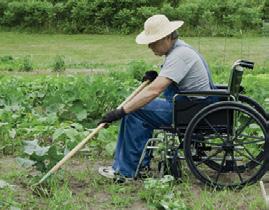

Sca old
Où donner du sang ? Où faire des dons de vêtements ? Où faire une collecte alimentaire ? Pour plus d’informations, cliquez sur les liens de notre page.


l’abri (m.) le chantier shelter construction site les fonds (m. pl.) le réseau funds network
31 Réflexion interculturelle o d
Look at the volunteer sites shown in the Bénévol@ app. How many of them do you have in your community? Choose at least three of the places from the app and find an example online of one in Montreal, where Éloïse lives. Answer the questions in the discussion forum.
Mon progrès interculturel h
Investigate: I can identify and locate volunteer sites in my community and in a francophone community. Bénévol@
130-193_ECF_2e_L2_SE_U3.indd
Students will probably need some practice distinguishing between the nouns bénévole and bénévolat introduced in the Comment dit-on ? section. Consider a few forced responses as bellringer or warm-up activities. See the Instructional Strategies Toolkit for more details.
You or your students may encounter other words for some of the places in this vocabulary section, depending on the region and social climate. Un foyer de soins is also often called une maison de retraite, and un sans-abri can also be called un(e) SDF (sans domicile xe).
To extend 31, collect information in English (as homework or as an exit slip) about which kinds of volunteering your students do. If necessary, provide students with the appropriate French vocabulary for words they suggest in English so they are able to contribute one or two personalized expressions.
32 Quel bénévole pour quel projet ?
L’association Citoyens en action a beaucoup de nouveaux bénévoles, mais il faut mettre chaque personne avec le projet où elle peut bien travailler.
32.1 Lisez les profils b
Lisez les profils de bénévoles potentiels, puis associez un projet de l’appli Bénévol@ à chaque personne.





1. Nicolas : Moi, j’ai deux chiens et un chat à la maison. Je leur donne à manger tous les jours !
2. Mia : Je suis un vrai chef. J’aime gérer des groupes de personnes et organiser des projets. Je préfère être active (pas rester assise devant un ordinateur !).
3. Yaël : Ce que j’aime, c’est arroser les plantes chez moi le matin. Je cherche un projet de bénévolat où je peux contribuer à la communauté. Je suis travailleur !
4. Norha : Garder des enfants, c’est un plaisir pour moi ! J’aime bien les réconforter quand ils sont tristes et j’aime aussi proposer des jeux.
5. Zacharie : Je voudrais être bénévole, mais j’ai beaucoup d’allergies (aux animaux, aux plantes… à beaucoup de choses !). Je suis un peu timide aussi, alors je cherche un projet de bénévolat où je peux être calme et accueillir quelqu’un qui a besoin d’aide.
Two of the responses in 32.1 are intentionally ambiguous (Mia and Zacharie). This will require students to use details from the text to justify their answers. Encourage this skill by asking Pourquoi ? as you circulate and listen to student conversations.
In 32.1, use the photo of a man moving his hands across the pages of a book to introduce your students to Braille. French educator Louis Braille lost his sight at the age of three as a result of an injury. He went on to make signi cant contributions in the eld of special education by developing the language now internationally known as Braille, a system of raised dots that correspond to the alphabet, punctuation, and symbols.
The Braille language was extended from alphabet, punctuation, and symbols to include musical notation and mathematical symbols.
Florida Benchmarks
WL.K12.IL.2.1 (32.1)
32.1 Lisez les pro ls
Answers
Suggested answers:
1. Nicolas : un refuge pour animaux
2. Mia : une banque alimentaire, un jardin communautaire
3. Yaël : un jardin communautaire, un refuge pour sans-abri
4. Norha : une garderie, un hôpital
5. Zacharie : une fondation, un foyer de soins
Florida Benchmarks
WL.K12.IL.3.3 (32.2)
WL.K12.IL.5.6 (32.2)
ELA.K12.EE.4.1 (32.2)
WL.K12.IL.1.2 (33.1)
WL.K12.IL.5.7 (33.2)
32.2 Discutez de vos choix
Resources
Portfolio
Answers
Answers will vary.
33.1 Regardez la vidéo
Given that this video has no dialogue but has quite a bit of print text, either allow students to watch at their own pace on their own devices or pause each frame where new text appears during an initial viewing.
Resources Video
Answers
a.
1. la Semaine de l’action bénévole
2. du 15 au 21 avril 2018 3. 12,7 millions
b.
Suggested answers: bénévoles, ré échissez, impact, qualité de vie, nouvelles, personnel, création, signi catifs, socio-économique, changement social, causes environnementales, source, célébrez, apprécier
33.2 Créez une publicité
Students can complete 33.2 on paper or with their favorite tech tool.
Answers
Answers will vary.
Expressions utiles
Bonne idée !
Je suis d’accord (avec toi).
Je ne suis pas d’accord (avec toi).
32.2 Discutez de vos choix s
Good idea! I agree (with you). I disagree (with you).
a. Expliquez aux autres élèves pourquoi vous associez ces personnes à certains projets bénévoles.
b. Si les autres élèves ont des réponses différentes, posez des questions pour arriver à un consensus.
MODÈLE Élève A : Je pense que Zacharie va mieux avec un refuge pour animaux. Élève B : Mais non ! Je ne suis pas d’accord avec ça. Il a des allergies !
Mon progrès communicatif h
Interpersonal: I can recommend volunteer locations based on preferences.
33 Comment peut-on participer à cet événement spécial ?
Le bénévolat est si important qu’il y a parfois des événements pour fêter et encourager les bénévoles.
33.1 Regardez la vidéo v o
a. Regardez la première partie de la vidéo (12 secondes) et répondez aux questions pour comprendre cette occasion spéciale.
1. Comment s’appelle l’événement ?
2. Quand se passe cet événement ?
3. Combien de bénévoles est-ce qu’il y a au Canada (selon cette vidéo) ?


b. Regardez le reste de la vidéo et écrivez une liste de tous les (groupes de) mots que vous comprenez.
33.2 Créez une publicité w
Avec un(e) partenaire, créez une publicité pour un site où l’on peut faire du bénévolat (refuge, hôpital, etc.) pour cette occasion spéciale. Donnez les détails suivants :
• le nom du site ;
• la ville (et peut-être l’adresse) ;
• la date et l’heure ; et
• les tâches ou les rôles que les bénévoles peuvent faire.
130-193_ECF_2e_L2_SE_U3.indd
Collect group responses for 32.2 as an exit slip. This will helps students to get ready for the summative J’y arrive where the interpersonal task will require them to negotiate before arriving at a clear decision.
For Part b of 33.1, take a moment to remind students about les mots apparentés. Even if they see words in the video that are not from their vocabulary list, they can add these words to their personal vocabulary. For students who need more support for this activity, see the graphic organizer online.
Expressions utiles
C’est important de… It’s important to … un monde meilleur a better world
Stratégies
Arriving at a Decision v
Some conversations have a desired outcome, like arriving at a decision. When discussing choices with another person, here are a few things to keep your conversation clear and focused.
Stratégies
The Learning Strategies videos in EntreCultures® provide student-friendly strategies regarding di erent aspects of the language-learning process. They are designed to enhance students’ awareness of how language is acquired.
3. Discuss the pros and cons of the different possibilities.



1. Decide what the goal of the conversation is and present the topic of the conversation to your listener.
2. Ask questions if you need to know more information or need clarification.
4. Acknowledge the decision out loud to be sure that you and your partner agree.

Comment dit-on ?
For certain units in EntreCultures® 2, Comment dit-on ? is divided into Sections A and B. Each of these sections presents essential vocabulary and expressions in manageable chunks targeting the vocabulary that learners need to know to be successful on the formative J’avance and summative J’y arrive assessments, and for use beyond the classroom. Students will be assessed on vocabulary presented in blue type in this section.
Resources
Audio, Workbook
Language

Rencontrez nos bénévoles





J’aime travailler comme bénévole pour rencontrer de nouveaux amis dans ma communauté.
J’adore être bénévole ! Je peux améliorer la qualité de vie des autres.
Comme bénévole, je peux apprendre le monde du travail pour préparer mon avenir.
Je fais du bénévolat pour essayer quelque chose de nouveau.
Je suis bénévole parce que je veux créer un monde meilleur.



Détail grammatical
L’adjectif nouveau

Je travaille comme bénévole avec ma sœur. Pour nous, c’est important de soutenir les autres.
You may have noticed that the word nouveaux comes before amis
In general, French adjectives are placed after the noun they describe. une fille intelligente
Forms of the adjective nouveau are placed before the noun they describe. un nouveau projet (m. s.)
un nouvel ordinateur (m. s. starting with a vowel sound) de nouveaux amis (m. pl.)
une nouvelle tâche (f. s.) de nouvelles idées (f. pl.)
The in nitive soutenir is presented lexically so that students can use it with expressions such as c’est important de and je peux. Students should not be expected to produce the irregular present-tense forms of soutenir.
Although the use of de (rather than des) before an adjectif antéposé is shown in the Détail grammatical, students should not be expected to master it at this stage.
Sca old
See the Instructional Strategies Toolkit for ideas on how to present the vocabulary in Pourquoi suisje bénévole ? as comprehensible input.
34 Quelles sont nos motivations pour faire du bénévolat ? a Écoutez les amis qui parlent de leurs motivations pour faire du bénévolat. Sélectionnez la motivation de chaque personne.
1. Aïcha
2. David
3. Monique
4. Jacques
5. Vikram
Mon progrès communicatif h
A. motivation personnelle
B. motivation professionnelle
C. motivation communautaire
Interpretive: I can understand the reasons people give for volunteering.
35.1 Connexions o c
What are the reasons people get involved in volunteerism in your community? Have you ever formed a friendship through volunteering?
In Canada, volunteering is a popular activity for people from a variety of backgrounds. Immigrants and refugees are two groups of people in Canada who can benefit in a special way by becoming volunteers. Through volunteering, immigrants may find opportunities to learn about the culture of the country where they live, experience the work culture of the country, and make connections with friends and future colleagues. Le bénévolat is a way for people of any background to have a sense of accomplishment and belonging in their community.
Le réseautage (networking) is an important skill that can be developed by becoming a volunteer. Forming connections with other volunteers, community leaders, and business people can lead to improved job opportunities. Apart from helping people find work, le bénévolat can help people find others who have similar interests and motivations.
35.2 Perspectives o
Other than for job opportunities, why might people who are new to a community need to establish connections with those who live around them?
Florida Benchmarks
WL.K12.IL.1.3 (34)
WL.K12.IL.1.4 (34)
WL.K12.IL.6.1 (35.1)
WL.K12.IL.7.1 (35.1)
ELA.K12.EE.2.1 (35.1)
WL.K12.IL.6.1 (35.2)
34 Quelles sont nos motivations pour faire du bénévolat ?
Resources
Audio, Portfolio
Answers
Suggested answers:
1. Aïcha : A, C
2. David : B
3. Monique : A, C
4. Jacques : C
5. Vikram : A, B, C
Zoom culture
Each Zoom culture focuses on a cultural product (produit) or practice (pratique) and invites students to develop insights into underlying perspectives (perspectives) in the francophone world and in their own culture. Products are tangible and intangible items—such as books, food, laws, music, and games— required or justi ed by the underlying values and beliefs of a culture. Practices are patterns of social interactions or behaviors, such as greetings, holidays, events, and daily schedules. Perspectives are the values, attitudes, and ideas of a culture.
Before students read the Zoom culture selections in the unit, use the Connexions questions to have them re ect on this product or practice in their own culture. Then have them read the information in the section before responding to the Perspectives questions. To minimize the use of English during class, have students read silently and respond for homework. Students should complete both the Connexions and Perspectives questions in the discussion forum, as they will use English for their responses.
35.1 Connexions
Resources Forum
35.2 Perspectives
Resources Forum
Answers
Answers will vary.
WL.K12.IL.2.2 (36.1)
WL.K12.IL.2.3 (36.1)
x 36 .1 Lisez et notez les informations
Le soccer, which appears in the rst volunteer post, is often used in Québec, rather than le football, which is used more commonly in the rest of the francophone world.
Resources
Portfolio
36 Où faire du bénévolat ?
Vous parlez avec Éloïse, qui veut être bénévole à Montréal. Elle veut des conseils pour choisir une offre de bénévolat.
36.1 Lisez et notez les informations b o
a. Lisez la lettre de motivation d’Éloïse. Elle veut faire du bénévolat, mais elle ne sait pas quelle offre choisir.
b. Lisez les annonces de deux offres de bénévolat.
c. Indiquez sur la représentation schématique si les motivations d’Éloïse vont avec ces offres.
Association récréative Milton-Parc
Madame, Monsieur, Je voudrais travailler comme bénévole à Montréal. J’ai 16 ans et je veux essayer quelque chose de nouveau. J’aimerais apprendre à travailler avec les autres et rencontrer de nouveaux amis. Je suis sportive et j’aime passer du temps dans les jardins et les parcs. Je suis bilingue (français/anglais), patiente et travailleuse. J’adore travailler avec les jeunes enfants. Je ne parle pas souvent avec les personnes âgées.
Bien cordialement, Éloïse
Entraîneurs adjoints pour le programme de soccer récréatif et les ligues de maison. Les tâches incluent : réunion des entraîneurs avant la pratique ; accueillir les enfants (de 2 à 7 ans) et les parents et encourager les joueurs ; aider les personnes moins confiantes, encourager les enfants à rester en ligne et écouter. Les compétences requises incluent : bilinguisme, patience, enthousiasme. | Lieu de travail : Parc Jeanne-Manceterrain de soccer | Bénévoles requis : 6 ; 2h, 2 à 3 fois par semaine.
Contact : Helen Angelopoulos, Coordinator sport & leisure 514.843.7000 helen.angelopoulos@miltonpark.org http://cabm.net/v/30811
Hôpital Gloire des Neiges
Le CHSLD (centres d’hébergement et de soins de longue durée) de l’hôpital Gloire des Neiges recherche des bénévoles. Les résidents du CHSLD sont des personnes âgées et nous voulons trouver des bénévoles pour leur rendre visite. Les tâches consistent à faire diverses activités avec nos résidents. Par exemple, le ou la bénévole peut organiser des jeux, des activités manuelles, des discussions ou des promenades dans le parc avec nos résidents. Vous aimez le contact avec les personnes âgées ? Vous pouvez faire une visite hebdomadaire de deux heures ? Vous êtes bilingue (français-anglais), dynamique, patient, et compréhensif ? Alors, cette offre est pour vous !
Contact : Florent Lajeunesse, responsable des ressources humaines bénévoles florent.lajeunesse@hopitalgloiredesneiges. ca
130-193_ECF_2e_L2_SE_U3.indd
If students ask why or when to use je voudrais versus je veux versus j’aimerais, ask them to look at the context of the statements in 36.1. What do they notice? The conditional mood can be used as a polite form of “to want” when asking for and o ering help.
See the Instructional Strategies Toolkit for an activity entitled, “Numbered Heads” that will support the interpretive reading in 36.1. For each volunteer post, ask students to identify cognates and French language chunks that they understand. Create at least four questions about the announcements and present one question at a time. One student per group will con rm that their group understood the main message of the reading task. Discuss any unknown vocabulary with small groups and the whole class.
association récréative hôpital
1. travailler avec les enfants
2. passer du temps dans le parc
3. rencontrer de nouveaux amis
4. faire du sport
5. essayer quelque chose de nouveau
Mon progrès communicatif h
Interpretive: I can identify key elements in descriptions of volunteer opportunities.
36.2 Laissez un message m
Téléphonez à Éloïse et laissez un message pour lui proposer une offre de faire du bénévolat. Expliquez-lui pourquoi c’est une bonne offre pour elle.
MODÈLE Bonjour, Éloïse. Tu peux être bénévole à… Tu veux… ? Vous pouvez…
Mon progrès communicatif h
Presentational: I can tell someone where to volunteer and why.
Détail linguistique
Des expressions idiomatiques
Avez-vous le cœur sur la main ? (Êtes-vous généreux/généreuse ?)
In French, idiomatic expressions often use interesting imagery or figurative language to convey ideas. Consider some other examples of idiomatic expressions associated with la main avoir la main verte (réussir son jardinage)
mettre la main à la pâte (aider à la tâche)
Can you think of any similar idiomatic expressions in English or in other languages?
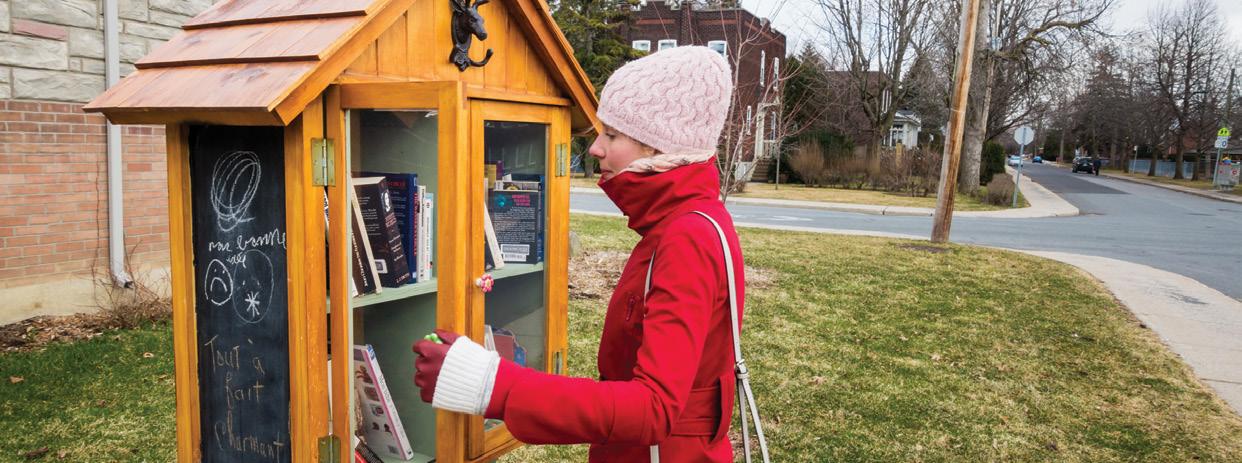
Language
You may want to note in the Détail linguistique that in Quebec, the expression to have a green thumb is as in English: avoir le pouce vert.
Challenge
As an extension activity for these idiomatic expressions in the Détail linguistique, have students draw side-by-side de nitions of (a) the literal meaning of the idiom and (b) the gurative meaning of the idiom (or the English-language equivalent).
IB Strategies
In 36.1 have students identify the two types of texts presented here (texte professionnel : lettre de motivation and textes professionnels : propositions) and explain their reasoning. As a way to remind students of the categories, you could ask: Pourquoi ce n’est pas un texte personnel ? or Pourquoi ce n’est pas un texte des médias de masse ? Qui est le public visé ?. Have students make connections between acquiring and experiencing volunteer positions such as those mentioned in the ads and the development of their IB learner attributes (e.g., risk-taking and caring).
Florida Benchmarks
WL.K12.IL.4.1 (36.2)
WL.K12.IL.4.3 (36.2)
Answers
1. association récréative
2. association récréative, hôpital
3. association récréative, hôpital
4. association récréative
5. hôpital
x 36.2 Laissez un message
Resources
Portfolio
Answers
Answers will vary.
Détail linguistique
Détail linguistique boxes provide additional insight about aspects of the French language that are related to elements in the unit.
WL.K12.IL.2.1 (37)
ELA.K12.EE.4.1 (37)
MA.K12.MTR.4.1 (37)
MA.K12.MTR.5.1 (37)
MA.K12.MTR.6.1 (37)
Découvrons
The Découvrons segments in EntreCultures® provide clear examples of language used in context, with targeted structures in boldface type, helping students focus on form. Instead of presenting grammar rules, the segment invites students to observe, discover, and re ect on form in context.
Students will write their observations on the graphic organizer, and then they will work with a partner to see if they can come up with additional observations. Students may consult the Synthèse : Grammaire at the end of the unit to con rm their hypotheses. Encourage students to make linguistic comparisons to their home languages. This Découvrons section guides students to discover the relative pronouns qui, que, and où in context. Assign the Structures en avant video for practice online.
Resources
Audio
Découvrons videos and practice activities are available online throughout the series to support the explanation and understanding of newly presented grammar points. Students can view them at home and absorb grammatical patterns and structures at their own pace. Alternatively, you may wish to use these videos in class to support your own teaching.
Resources
Video, Think-Pair-Share Graphic Organizer, Workbook
Answers
Suggested answers:
1. Qui, que, and où are connectors that allow the ideas from two separate sentences to be combined into one.
2. After où and que there is a subject noun or pronoun. After qui there is a verb.
3. Answers will vary.
4. a. qui b. où c. que

Madame Wu est une prof qui travaille comme bénévole à la banque alimentaire.


Un hôpital à Montréal qui a besoin de bénévoles s’appelle Hôtel Dieu.



Il faut trouver un projet de bénévolat que tu aimes !

Le projet de bénévolat que je préfère est le refuge pour sans-abris de Montréal. pour animaux où mes amis font du bénévolat.



Le 4 juin, c’est le jour où je peux donner du sang pour la première fois !




Reflect on what you observe and respond to the following questions.
1. What is the purpose of où, qui, and que in these examples?






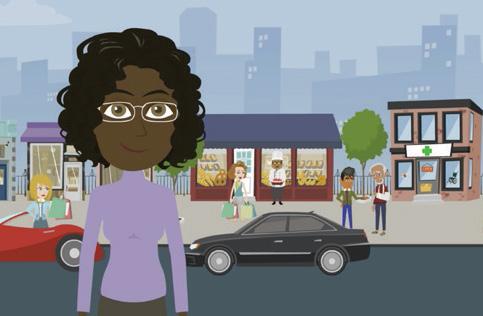
2. Notice which phrases or kinds of words come before and after où, qui, and que. avant le mot où : après le mot où : conclusion : avant le mot qui : après le mot qui : conclusion : avant le mot que : après le mot que : conclusion :
3. Share your observations with a partner. What else do you notice together? What else can you add to your observations?
4. Test your theory! Which word would you use in the blank in each of the following examples?
a. C’est ma mère encourage ma sœur à devenir bénévoles.
b. C’est le moment je suis devenu bénévole.
c. Il y a une affiche je vois tous les jours à mon école. C’est pourquoi je suis bénévole !

For 37, students may need a cue to remember to contract que with il, elle, on, ils, elles, and other words starting with a vowel.
Students who speak Spanish may nd it useful to compare the French relative pronouns in 37 to the Spanish equivalents: quien, que, donde. A critical di erence to note is that in French, both qui and que can represent people or things, whereas in Spanish que can refer to people or things, but quien can refer only to people.
Florida Benchmarks
WL.K12.IL.1.2 (38)
38 Qu’est-ce qu’il y a comme possibilités de bénévolat ? v o Éloïse vous envoie une vidéo sur un projet bénévole au Québec.
a. Regardez le reportage et complétez le résumé de la vidéo en écrivant les mots qui, que, ou où dans les blancs.
Dans cette vidéo, on voit de jeunes bénévoles (1) restaurent (are restoring) une maison (2) est importante pour l’héritage culturel du Québec. Le jour (3) on filmait, il y avait du soleil et il faisait beau. La maison (4) ils dorment, c’est une autre maison à côté de la maison (5) les bénévoles restaurent.
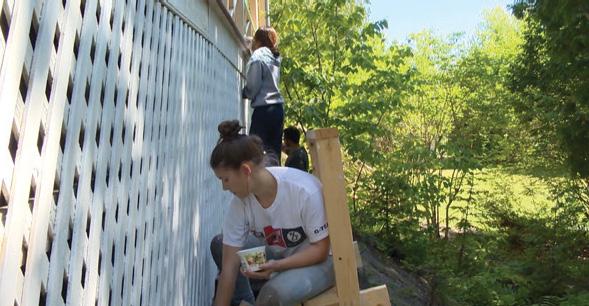
WL.K12.IL.1.5 (38)
WL.K12.IL.6.1 (38)
38 Qu’est-ce qu’il y a comme possibilités de bénévolat ?
b. Dans la représentation schématique, notez les activités faites par les bénévoles dans la vidéo et leurs motivations probables.
MODÈLE Ils repeignent une maison. Pour…
Expressions utiles gratter (re)peindre to scrape to (re)paint
For more practice with the relative pronoun qui in 38, ask students to share their answers by completing the sentence framework On voit des bénévoles qui…
Language
The comprehension and formation of connected sentences such as those in 38 are an indicator of Intermediate Low level. Students at this level may still be working on creating complex sentences with multiple descriptors. Encourage and model these types of sentences, but understand that using this skill with con dence and correctness takes multiple exposures over a year or more.
Resources Video Answers a. 1. qui 2. qui 3. où 4. où 5. que b.
Suggested answers: activités : Ils font du jardinage. Ils grattent la peinture. Ils restaurent une maison. Ils travaillent dans la maison. motivations : pour rencontrer de nouveaux amis ; pour créer un monde meilleur ; pour améliorer une maison qui est importante pour l’héritage culturel du Québec
39.1 Lisez et associez les images
Resources
Portfolio
39 Pouvez-vous le définir pour moi ?
Avec d’autres bénévoles, vous voulez mettre un texte créatif sur le site de votre école pour inspirer d’autres élèves à faire du bénévolat.
39.1 Lisez et associez les images b o Lisez ce poème et décidez où mettre les images pour l’illustrer. Indiquez l’image qui va le mieux avec chaque strophe (stanza) du poème.

Définitions du bénévolat
Le bénévolat, c’est l’art de la gratuité du cœur, du geste et du temps.
Le bénévolat ne connaît d’autres lois que le besoin de l’autre, percevoir avec lui et trouver ensemble les solutions nécessaires.
L’engagement bénévole, ne serait-ce pas là une façon d’humaniser une société qui s’individualise de plus en plus ?
Le bénévolat, c’est une fleur que l’on s’offre.
Le bénévolat, c’est un cheminement personnel : c’est une fenêtre ouverte sur le monde.
Le bénévolat a tellement de valeur qu’il n’a pas de prix.
Auteur inconnu


1. première strophe
2. deuxième strophe
3. troisième strophe
Mon progrès communicatif h
Interpretive: I can understand the main idea of a poem.


4. quatrième strophe
5. cinquième strophe
6. sixième strophe
Play students some examples of le slam (slam poetry, such as that by artist Grand Corps Malade). Then allow students to nd beats online to play underneath the recitations of their poems from 39.2. Slam poetry is a fun way to reinforce l’accent tonique.
39.2 Improvisez un poème m
Avec d’autres élèves, utilisez ces débuts de phrases (ou d’autres) pour improviser un poème à l’oral qui définit un mot lié au bénévolat. Partagez vos meilleures strophes avec la classe.
• Le bénévolat, c’est quelque chose que je fais pour...
• Un refuge pour animaux, c’est un endroit où…
• Un bénévole, c’est une personne qui…
40 Pourquoi fais-tu du bénévolat ?
Une fondation à Montréal veut être partenaire de votre école et cherche de jeunes bénévoles.
40.1 Complétez le formulaire w Complétez le formulaire pour exprimer votre intérêt.
Nom : Prénom(s) :
Date de naissance :
Compétences particulières :
Langues :
À quel site voulez-vous travailler comme bénévole ?
Pourquoi voulez-vous devenir bénévole dans notre organisme ?
40.2 Échangez des messages e
Cet organisme a aussi demandé une interview. Comme préparation avec votre partenaire, vous participez à un tchat pour anticiper les questions de l’interview.
Posez des questions sur les sujets suivants :
• vos intérêts et vos compétences ;
• votre site ou projet préféré ; et
• vos motivations.
MODÈLE
Élève A : Où voulez-vous travailler comme bénévole ?
Élève B : Je préfère être bénévole à l’hôpital.
Mon progrès communicatif h
Interpersonal: I can participate in an online discussion about a volunteer opportunity.
130-193_ECF_2e_L2_SE_U3.indd 183
Sca old
For 40.2, refer students to the Comment dit-on ? sections for useful vocabulary.
Direct students to the sentence starters in the previous activity for some ideas of what to say for 40.2.
In 39.2, students co-wrote poems about their personal de nitions on the meaning of bénévole. To extend this activity, students can create visual slide presentations with online or hand-drawn images that represent their ideas (like 39.1) and record themselves reading their poems in groups via screen recording or videos. Share these videos with your upper-level classes, ask them to re ect on the messages, and to send congratulatory messages. If your school allows, publish the videos on the school website or share them with the ASB or Key Club groups.
Florida Benchmarks
WL.K12.IL.4.5 (39.2)
WL.K12.IL.5.3 (40.1)
WL.K12.IL.3.4 (40.2)
39.2 Improvisez un poème Answers
Answers will vary.
40.1 Complétez le formulaire Answers
Answers will vary.
x 40.2 Échangez des messages
Assign students pairs prior to having them complete the chat in the discussion forum. One partner will initiate the exchange and the other partner can respond.
Resources
Portfolio Answers Answers will vary.
WL.K12.IL.2.1 (41.1)
WL.K12.IL.2.2 (41.1)
WL.K12.IL.3.6 (41.2)
WL.K12.IL.4.3 (41.3)
You can access the J’avance formative assessments online. Tiered versions are available for di erentiation. The Blanc version matches the description in the Student Edition of the textbook. The Rouge version may be used with students who wish to challenge themselves, and the Bleu version provides extra support and sca olding. Have students self-assess based on the J’avance Can-Do statements prior to taking the formative assessment and update their Portfolio by adding this assessment as evidence of their growing language pro ciency.
Resources
Tiered Assessments (Bleu, Blanc, Rouge), Rubrics (Single-Point, Holistic, Analytic), Portfolio
Answers
Answers are provided in the J’avance key available online.
41 Notre projet de bénévolat
Your French club would like to participate in a service project on your class trip to Montreal next summer.
41.1 Lisez et notez les informations b
Read the testimonials (témoignages) of volunteers from Montreal. In the graphic organizer, identify where they volunteer, what they do there, and why they do it.
Mon progrès communicatif h

Interpretive: I can identify key elements in descriptions of volunteer opportunities.
41.2 Échangez des messages e
Based on what was shared in the testimonials, select an organization you’d like to volunteer with during your class trip to Montreal. Write to Mamadou, Thérèse, or Serge in response to their testimonial and share why you’d like to volunteer with them.
Mon progrès communicatif h
Interpersonal: I can participate in an online discussion about a volunteer opportunity
41.3 Créez une annonce m
Prepare a video announcement to be shown at your school to announce your class’s preferred volunteer organization. Include information about the types of activities available there, and share some reasons for volunteering there.
Mon progrès communicatif h
Presentational: I can tell someone where to volunteer and why.
The Presentational Speaking portion of the AP® test requires students to deliver a two-minute presentation based on a prompt in which they compare a cultural feature in their community to one from a francophone community. 41.2 prepares students to read a prompt and prepare a presentation.
For students who do not have many experiences with volunteering, they may need extra linguistic support to feel successful for 41.3. Provide students with sentence frames, examples, and collaborative writing partners. If possible, invite students from French 3 or above to volunteer to work with students in French 2 on this writing task.

130-193_ECF_2e_L2_SE_U3.indd 185
Culture
12/10/24 10:11 AM
La rue Sainte-Catherine is one of Montréal’s best known streets for shopping, the arts, and an inclusive, welcoming atmosphere for all. It becomes a pedestrian-only street in the summer for various street fairs, music festivals, artisan markets, and other events.
WL.K12.IL.3.1 (42.1)
WL.K12.IL.2.1 (42.2)
WL.K12.IL.7.1 (42.2)
WL.K12.IL.7.2 (42.2)
WL.K12.IL.9.2 (42.2)
Notre communauté mondiale provides an even deeper focus on interculturality as you and your class wrap up and review the three Communiquons sections and students re ect on feedback received from J’avance prior to completing the summative assessment in J’y arrive
The activities of each Notre communauté mondiale meet many of the goals of Project-Based Learning, including a focus on product and process, alignment to academic standards and success skills, collaboration with other students, real-world context and application of learning, and interaction or sharing of a nal product with a Frenchspeaking public beyond the classroom.
42.1 Lisez les questions et discutez-en Answers
Answers will vary.
42.2 Faites des recherches
Resources Portfolio
Answers
Answers will vary.
Vous voulez améliorer votre français et l’environnement. Vous choisissez d’aller au Québec pour rechercher des opportunités de bénévolat. Explorez vos options.
42.1 Lisez les questions et discutez-en s Avec votre partenaire, répondez aux questions pour vous aider à orienter vos recherches.
• Quel est mon objectif ? Qu’est-ce qui est important pour moi ?
• Qu’est-ce que je veux apprendre de mon expérience ?
• Quelles sont les compétences ou expériences que je peux partager ?
• Quel est le meilleur environnement pour moi ?
• Est-ce que je peux faire du bénévolat avec des amis ?
42.2 Faites des recherches b c Avec votre partenaire, cherchez en ligne les associations pour l’écologie qui recrutent des bénévoles au Québec et qui proposent des activités qui vous intéressent. Identifiez quatre ou cinq possibilités qui vous inspirent, et notez-les dans le tableau.
nom de l’association
Quelles sont les tâches demandées que je peux faire ?
Pourquoi je veux faire ce type de travail bénévole ?
Mon progrès interculturel h
Investigate: I can investigate what associations offer volunteering opportunities and activities in Quebec.
For 42.2 it may be helpful for the whole class to generate a list of helpful key words before doing the Internet search.
42.3 Échangez vos idées s
En petits groupes, partagez ce que vous avez appris sur les possibilités de faire du bénévolat pour protéger la nature au Québec. Expliquez votre sélection de travail bénévole.
42.4 Écrivez un e-mail e p
Choisissez une des associations québécoises que vous avez recherchées et écrivez un e-mail pour présenter vos compétences et proposer votre aide. Demandez plus d’informations sur les tâches bénévoles et l’environnement de travail.
Mon progrès interculturel h
Interact: I can interact in French to volunteer and help the environment.
43 Réflexion interculturelle d
How can members of different communities and associations benefit from one other to improve their quality of life and wider community?
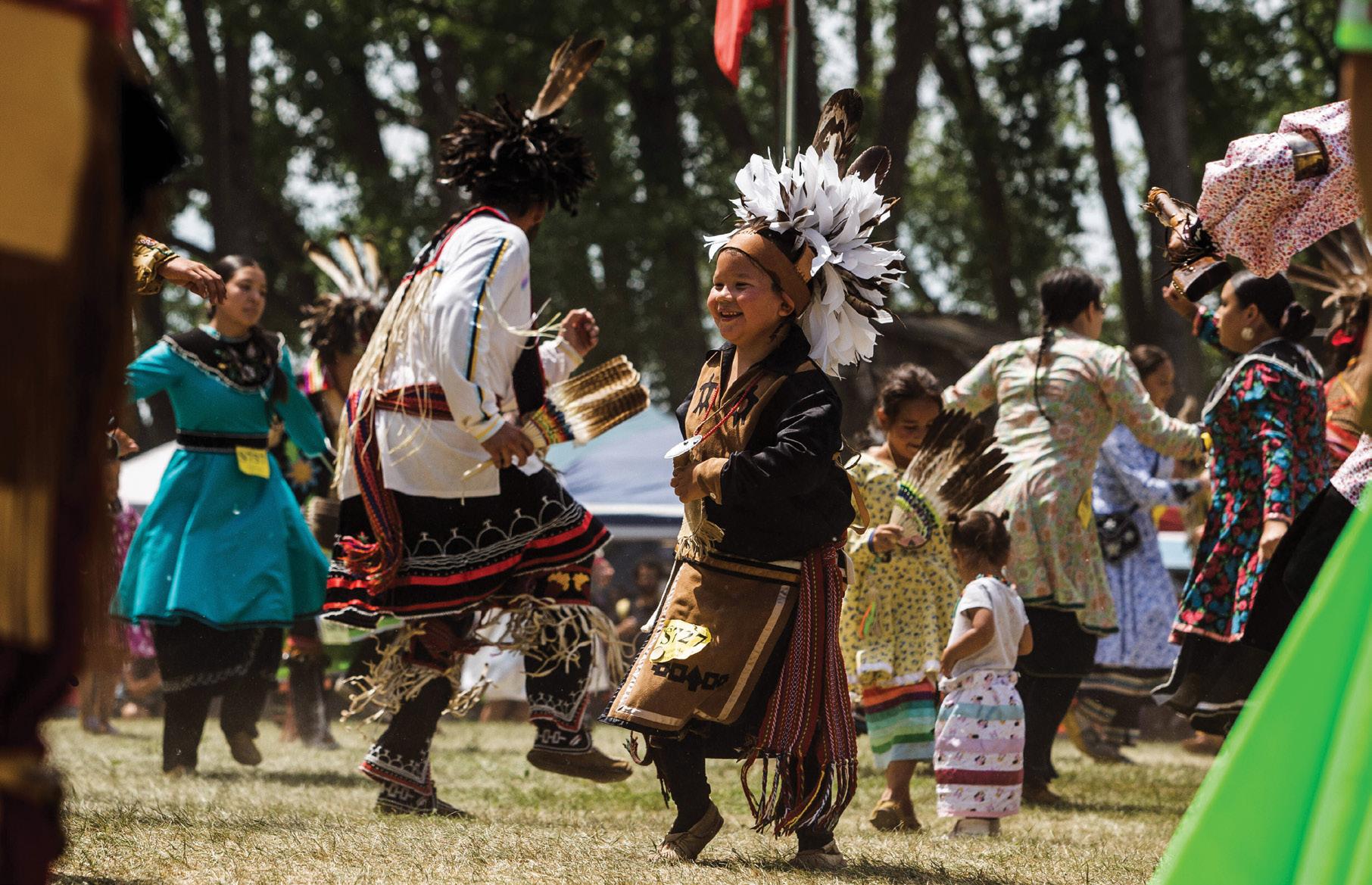
Both 42.3 and 42.4 are real-life versions of the Interpersonal Conversation and the email. Remind students of the practice they have had on both of these types of communication and congratulate them on carrying out these activities authentically.
Florida Benchmarks
WL.K12.IL.3.1 (42.3)
WL.K12.IL.3.3 (42.3)
WL.K12.IL.9.2 (42.3)
WL.K12.IL.5.1 (42.4)
WL.K12.IL.5.5 (42.4)
WL.K12.IL.9.2 (42.4)
WL.K12.IL.6.2 (43)
42.3 Échangez vos idées Answers Answers will vary.
42.4 Écrivez un e-mail Answers
Answers will vary.
43 Ré exion interculturelle
Resources Forum, Portfolio
This section presents a brief overview of the language structures presented in the three Découvrons. Note that there are Workbook activities for more support available in the respective Découvrons sections online.
Resources
Workbook
Verbs vouloir, pouvoir, choisir,
When talking about volunteering, it is useful to express what people want to do, what they can do, what they choose to do, and what they are finishing. Here are the present-tense forms of the verbs vouloir, pouvoir, choisir, and finir
vouloir pouvoir
je veux nous voulons je peux nous pouvons tu veux vous voulez tu peux vous pouvez
il/elle/on veut ils/elles veulent il/elle/on peut ils/elles peuvent choisir finir
je choisis nous choisissons je finis nous finissons tu choisis vous choisissez tu finis vous finissez
il/elle/on choisit ils/elles choisissent il/elle/on finit ils/elles finissent
Although vouloir, pouvoir, choisir, and finir have different endings from those of the -er verbs you have already seen, they still have a few recognizable patterns:
1. The je and tu forms of each verb are identical to each other, but the il/elle/on form is different. It is also common that verbs that end in -x or -s in the je and tu forms change to a -t ending in the il/elle/on form.
2. Forms of the verb vouloir start with veu- or voul-, and forms of the verb pouvoirstart with peu- or pouv-.
3. Choisir and finir have longer endings: -issons, -issez, and -issent
Language
Remind the students of the other verb forms of these -ir verbs that they have seen: Je voudrais, Je pourrais, Je vais choisir, J’ai ni, etc.
Asking Questions with quel and qu’est-ce que
When asking an open-ended what question, use qu’est-ce que:
Qu’est-ce que tu préfères ?
Qu’est-ce que nous faisons après l’école ?
When asking about a specific kind of noun, use a form of quel followed by the noun.
masculin féminin
singulier
pluriel
Quel projet est-ce que tu choisis ?
Quels bénévoles vont au refuge ?
Quelle tâche est-ce que tu préfères ?
Quelles idées est-ce que tu vas lancer ?
Relative Pronouns qui, que, and où
The words qui, que, and où are connectors that can be used to create longer, more complex sentences. They allow you to give more information about a person, place, or thing mentioned earlier in the same sentence. You may recognize the words qui and où as question words.
Use où when you want to give more information about a place or time in the same sentence.
C’est l’hôpital où je fais du bénévolat.
C’est l’heure où nous commençons à travailler.
Use qui when the following word is a verb.
C’est un bénévole qui est compréhensif.
C’est un organisme qui aide les personnes âgées.
Use que when the word that comes next is a subject
C’est une tâche que monsieur Gassama fait bien.
C’est un projet qu’elles lancent au mois de décembre.
Notice that où in the second example does not mean where but when
Notice that qui in the second example does not mean who; it means that
Notice that que becomes qu’ before a vowel sound.
As an enrichment activity for relative pronouns, create a set of sentence building strip cards that will allow students to choose a logical pronoun to connect the sentences. Use the Instructional Strategy of color coding the vocabulary for nouns, verbs, adjectives, and relative pronouns to reinforce the grammatical function of the words.
The grammar point in Découvrons of Communiquons 2 can be challenging for English speakers who do not understand the di erence between the interrogatives what and which in their native language. Point out to students that which is used for a question that requires a choice between a number of items.
Synthèse : Vocabulaire
This section provides a summary of the vocabulary studied in this unit. For further reinforcement, activities for practice are available in the Workbook and online.
Resources
Flashcards, Workbook
Les tâches ménagères
Household Tasks
arroser
débarrasser le lave-vaisselle
donner à manger
donner un coup de main faire du jardinage faire le lit
laver et plier le linge garder
mettre le couvert passer l’aspirateur
ramasser les déchets ranger
hebdomadaire
mensuel, mensuelle quotidien(ne) le lave-vaisselle la tâche ménagère
Avant de s’engager Before Volunteering accueillir aider conseiller contribuer gérer
lancer de nouvelles idées organiser son emploi du temps réaliser
réconforter le/la chef compréhensif, compréhensive fidèle motivé(e) organisé(e) travailleur, travailleuse
to water to empty the diswasher to feed to lend a hand to garden to make the bed to wash and fold laundry to keep, look after, babysit to set the table to vacuum to pick up the trash to clean up, put away weekly monthly daily dishwasher household task
to welcome to help to give advice to contribute to manage to introduce new ideas to organize one’s schedule to make (something) a reality, to get (something) done to comfort leader understanding loyal motivated organized hardworking
Consult the supplemental activities online as well as the vocabulary games in the Instructional Strategies Toolkit.
Servir sa communauté
Serving One’s Community le/la bénévole le citoyen, la citoyenne le projet la réunion engagé(e) construire des maisons faire du recyclage planifier planter des arbres sortir la poubelle trier et distribuer le courrier
Où faire du bénévolat Where to Volunteer la banque alimentaire la collecte (de sang) le don donner du sang faire du bénévolat la fondation le foyer de soins la garderie l’hôpital (m.) le jardin communautaire le refuge pour animaux le refuge pour sans-abris
volunteer citizen project, plan meeting actively involved to build houses to recycle to plan to plant trees to take out the garbage to sort and distribute the mail
food bank (blood) drive donation to give blood to volunteer, do volunteer work foundation assisted-living facility childcare facility hospital community garden animal shelter shelter for the unhoused
Pourquoi suis-je bénévole ? Why Am I a Volunteer? améliorer apprendre l’avenir (m.) créer essayer quelque chose de nouveau rencontrer de nouveaux amis soutenir to improve to learn future to create to try something new to meet new friends to support
Language
Invite the students to organize the vocabulary lists into segments that best t their learning styles or review preferences. Provide alternative review options for students who demonstrate anxiety or confusion with how the vocabulary is presented in whole. By o ering strategies to compartmentalize and chunk vocabulary, students will develop more con dence in their acquisition.
WL.K12.IL.2.3 (Interpretive Assessment)
J’y arrive
The J’y arrive summative Integrated Performance Assessment (IPA) addresses the essential questions for the unit through a series of interrelated performance tasks. All supporting materials for the IPA can be accessed online. The IPA rubric is designed to be shared with students in advance of J’y arrive so that they know what is expected of them.
Resources
Rubrics: Holistic, Analytic, Integrated Performance Assessment
Answers
Answers are provided on the J’y arrive graphic organizer.
Questions essentielles
• How do my daily responsibilities and routines shape my life?
• How can community members work together to improve their quality of life?
• What motivates people from different cultures to volunteer?

Your French teacher is organizing a class trip to Montreal. Your class has decided that since volunteerism is so important to the Québécois, the trip will include community service. After seeing some of the sites of the city, you will pair up with another classmate to spend part of your trip serving the communities of Montreal. Once you have decided, you will each need to complete the formulaire pour devenir bénévole.
Before you begin, refer to the J’y arrive rubric to familiarize yourself with the evaluation criteria.
Choisir l’offre bénévole idéale b
Read postings about two volunteer opportunities in Montreal and answer the questions.

On va faire du bénévolat, mais où ? s
You and a classmate are planning to participate together in one of the two volunteer opportunities. Discuss which opportunity to choose, giving reasons for your preference. Give a conclusion before you end your conversation.
Je commence tout de suite ! w
Now that you have decided which volunteer opportunity to try, complete the volunteer application by providing some basic information and explaining a bit more about yourself.

WL.K12.IL.3.1 (Interpersonal Assessment)
WL.K12.IL.3.2 (Interpersonal Assessment)
WL.K12.IL.3.3 (Interpersonal Assessment)
WL.K12.IL.5.2 (Presentational Assessment)
ELA.K12.EE.5.1 (Presentational Assessment)
ELA.K12.EE.5.1 (Presentational Assessment)
To administer the Interpersonal Assessment of this J’y arrive, students will need access to both texts from the Interpretive Assessment. This will help ensure that students (and you) know when the conversation has reached a natural end.
If you prefer to have students submit recorded conversations, be explicit about how you want them to submit these. One student could record the conversation and then sends the recording to the other student, or both students record simultaneously on their respective devices.