Finding Friendship
Issue Issue No. 3
Katy Shevel | Friday, July 17, 2026
Did you know trees have friends? Turns out, they do! Well, sort of. In The Hidden Life of Trees, German forester Peter Wohlleben claims that the colorful maples in our backyard and the towering pines in the park are inherently social creatures—more like us than we realize. Eager to explore further, I put my ear buds in and listened to a delightfully soothing British narrator read aloud the words of Wohllenben’s book to me. In doing so, I looked up and considered the trees. Thankfully, I had a spectacular view. Last week, I spent a short time away in Upstate New York. I rented a little cabin in the mountainous forest of the Northern Catskills. As the fading sun dipped closer to the horizon, I cozied up by a crackling campfire. I leaned back in my wooden chair and peered up at the forest canopy above me, drinking in the sights and sounds as I listened to my audiobook. As I looked up, two, lean, deciduous trees above my cabin site caught my eye. They soared over me, growing up and up, in parallel. Their trunks—of similar diameters—couldn’t have been more than three feet apart from each other. They had limited branches on their trunks. That is, until they
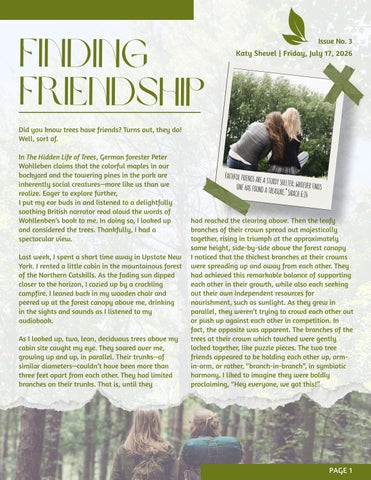
Faithful friends are a sturdy sh one has found a trea elter; whoever finds sure.” Sirach 6:14 had reached the clearing above. Then the leafy branches of their crown spread out majestically together, rising in triumph at the approximately same height, side-by-side above the forest canopy I noticed that the thickest branches at their crowns were spreading up and away from each other. They had achieved this remarkable balance of supporting each other in their growth, while also each seeking out their own independent resources for nourishment, such as sunlight. As they grew in parallel, they weren’t trying to crowd each other out or push up against each other in competition. In fact, the opposite was apparent. The branches of the trees at their crown which touched were gently locked together, like puzzle pieces. The two tree friends appeared to be holding each other up, armin-arm, or rather, “branch-in-branch”, in symbiotic harmony. I liked to imagine they were boldly proclaiming, “Hey everyone, we got this!”
PAGE 1
(Tree photo courtesy of Katy’s Catskills cabin adventure—two friends growing strong, side by side.)
In studying these two trees, I recalled one of my favorite quotes on friendship, albeit an obscure one. In the Book of Sirach, a wisdom text found in the Apocrypha, the subject of friendship is significant and addressed repeatedly. According to Sirach, each one of us has varying kinds of peers in our social circles: companions, neighbors, advisors, friends, enemies and even so-called, “false friends”, just to name a few. Sirach also highlights “true friends.” For, true friends are rare indeed. During the second century BCE in Jerusalem, the context in which author Ben Sira lived and wrote, a true friend was regarded as someone who showed up in difficult times and could always be trusted to keep confidences (Harper Collins Study Bible, “Sirach.”) Drawing from the rich wells of both the Wisdom tradition and personal experience, Ben Sira knew true friends to be few and far between. They are to be prized, cherished even. Finding a true friend is a gift of grace in a broken world. He went so far as to claim that faithful friends are “lifesaving medicine” (Sirach 6:16). Now, for my favorite Sirach quote on friendship. It popped into my head that evening in the Catskills
because it also happens to remind me a lot of trees. “Faithful friends are a sturdy shelter; whoever finds one has found a treasure” (Sirach 6:14). Sturdy shelter. As I contemplated my two tree friends, they were clearly sturdy companions that provided shelter for each other. I reflected upon their combined strength—as well as their shared vulnerability. Peter Wohlleben points out that a forest full of trees have no choice but to rely on each other for support. They are stronger together. Interdependence helps trees flourish and thrive. The older, taller trees shelter the smaller, fledgling trees below the canopy. These two trees in my cabin site were so intertwined to the naked eye. I can scarcely imagine how interwoven their root systems were underground. If one of these two trees fell, the other would surely topple over as well. They needed each other. Curiously, I had never thought about plants needing one another before. Of course, this level of mutual dependence brings great risk, too. If one tree goes down, even if the others remain, that space in the canopy bursts wide open. The shade from the former tree vanishes and exposes its neighbors. Rays of light immediately break through and scorch the bark of the remaining trees for years to come. Some are damaged irreparably. Drought, floods, pests, humans, and even unwelcome trees all pose a threat. To withstand such threats of nature, Wohlleben believes that trees not only have feelings and also
PAGE 2
have a deeply rooted social network. He writes, “Trees may recognize with their roots who are their friends, who are their families, where their kids are.” The key to a tree’s community is what he calls the “wood-wide web.” This is how they communicate and protect each other. He believes that trees may even send signals through their roots warning other trees of incoming threats. Being a tree in the world demands a whole lot of trust. Well, as it turns out, we aren’t trees. Therefore, our “human” concept of sturdy shelter won’t look physically the same as mighty oaks, spruces, or beeches towering in parallel above the forest floor. (Unless, you’ve really been serious about your vitamin regimen.) Nevertheless, Sirach’s analogy is one to which I believe we can all relate. Like trees, we need each other. We are essentially communal beings as well. God knew this when God created us. “It is not good that man should be alone…” (Genesis 2:18). Unlike trees, our struggles to trust one another are deeply personal. When the storms of life rage around us, we hope that we can rely on each other. We hope to be reliable, too. We also hesitate to open up and have this level of vulnerability with each other. Because our problem is, of course, that as human beings, we are also flawed and broken. We say and do the wrong things. We hurt each other. We betray one another. As such, we repeatedly let each other down in the trust department. While holding such a high view of friendship, at the same, Sirach is not naïve. True trust in friendship does not come without effort. “When you gain friends,” cautions Ben Sira, “gain them through testing, and do not trust them hastily” (Sirach 6:7). Sometimes it’s nice to know that even in the ancient world, folks struggled with trust issues, too. One of
the hard-earned lessons of friendship from generation to generation is learning to trust: learning to trust each other and even to trust ourselves. Perhaps these lessons aren’t as far removed from the world of trees after all. Keep in mind, everything a tree does is at a very slow pace. The two trees by my cabin did not instantly shoot out of the ground together, make an immediate pact to become best friends, and then proceed to grow 50 feet tall overnight in perfect harmony. On the contrary, it took decades to overcome all that it takes to become two very tall and healthy trees side-by-side in the forest of the Northern Catskills together. No waaaay it was smooth sailing. There were undoubtedly many bumps, bruises, and obstacles along the way. Their journey was a long, slow, and steady process of navigating all that it takes to be a tree—while thankfully not having to do it all alone. My takeaway? How does one become a treasured friend, a sturdy shelter for those in our lives? Practice, practice, practice. Each day, we might ask ourselves: How can show that I am a trustworthy friend? How can I demonstrate that I show up, that I am reliable, that I am someone who can be leaned upon in times of trouble? Indeed, even as I am only a fragile and flawed human being, how might I embody the qualities of a “sturdy shelter?” If we ever need some visual inspiration for how to be a sturdy shelter in the world today, all we need to do is look up and consider the trees. Maybe bring your friend along! After all, it’s always good to spend more time outdoors together, too.
PAGE 3