Katy Shevel
FindingFriendship
Issue 1 ~ Friday, June 5, 2026
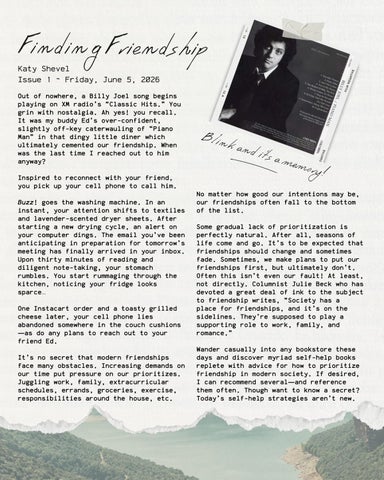
Out of nowhere, a Billy Joel song begins playing on XM radio’s “Classic Hits.” You grin with nostalgia. Ah yes! you recall. It was my buddy Ed’s over-confident, slightly off-key caterwauling of “Piano Man” in that dingy little diner which ultimately cemented our friendship. When was the last time I reached out to him anyway?
Inspired to reconnect with your friend, you pick up your cell phone to call him.
Buzz! goes the washing machine. In an instant, your attention shifts to textiles and lavender-scented dryer sheets. After starting a new drying cycle, an alert on your computer dings. The email you’ve been anticipating in preparation for tomorrow’s meeting has finally arrived in your inbox. Upon thirty minutes of reading and diligent note-taking, your stomach rumbles. You start rummaging through the kitchen, noticing your fridge looks sparce…
One Instacart order and a toasty grilled cheese later, your cell phone lies abandoned somewhere in the couch cushions —as do any plans to reach out to your friend Ed.

No matter how good our intentions may be, our friendships often fall to the bottom of the list.
Some gradual lack of prioritization is perfectly natural. After all, seasons of life come and go. It’s to be expected that friendships should change and sometimes fade. Sometimes, we make plans to put our friendships first, but ultimately don’t. Often this isn’t even our fault! At least, not directly. Columnist Julie Beck who has devoted a great deal of ink to the subject to friendship writes, “Society has a place for friendships, and it’s on the sidelines. They’re supposed to play a supporting role to work, family, and romance.”


It’s no secret that modern friendships face many obstacles. Increasing demands on our time put pressure on our prioritizes. Juggling work, family, extracurricular schedules, errands, groceries, exercise, responsibilities around the house, etc.
Wander casually into any bookstore these days and discover myriad self-help books replete with advice for how to prioritize friendship in modern society. If desired, I can recommend several and reference them often. Though want to know a secret? Today’s self-help strategies aren’t new.
Ancient wisdom has and continues to shed insight on the high value and equally high challenge of maintaining generations of friendships in a fallen world. Because I believe that the foundation for true, lasting friendships derive its source from the heart of God, I propose we look no further than the Bible as our field guide for how to be an intentional, faithful, and overall better friend.
For one, we know that good, lasting friendships don’t happen by accident but by choice. Throughout the Old and New Testaments, friends make spoken commitments to one another to declare their intention. Friends promise to show up for one another, to be devoted partners in following God, and even to put their lives at risk for each other. Friends are steady partners in the faith that meet joys and tragedies together over the course of time. The commitments friends make, also known as covenants, shape the course of their lives—as well as the course of their friendships.
th116-17 th116-17

In the Book of Ruth, tragedy strikes suddenly, leaving both Naomi and her two daughters-in-law (Ruth and Orpah) as widows. Noami believes they would be better off returning to their families, which Orpah does. Remarkably however, Ruth vows to stay: “Where you go, I will go; where you lodge, I will lodge; your people will be my people and your God; where you die, I will die, and there I will be buried…” (Ruth 1:16-17).
Ruth declares her intention for their relationship, and it is forever altered. Ruth and her mother-in-law travel together, remain by one another’s sides, and interweave their lives. So much so, that Naomi eventually settles down with Ruth and Ruth’s new husband Boaz, helping to care for her new grandbaby. Because of their spoken commitment, Ruth and Naomi’s lives remained bound to one another.

Whereyougo,Iwillgo;wh youlodge,Iwilllodge;your peoplewillbemypeopleand yourGod;whereyoudie,I illdie,andthereIwillbe buried…



Throughout scripture, biblical examples of strong friendships share this commonality: a spoken covenant.Each is sealed by a heartfelt utterance, in one way or another, to be friends, well, forever. Maybe you’ve stood at the altar and made a vow similar to this to your future spouse. Now, perhaps thinking about friendship similarly, as “forever,” feels a little too long. Even so, does your friend know how you feel about them and your relationship? When was the last time you declared your true intentions to one another?
Julie Beck asks us to think outside the box. We don’t have to view friendship as a lesser priority. She advises, “It takes imagination not to default to this norm, and to design your life so that friendship plays the role you really want it to.” She illustrates this by listing examples she’s seen of friends who buy homes together and go to therapy together. Two friends walk thirty minutes every day to give each other a high-five. This ritual lasts for years — and even survives through memory loss.
Julie Beck stresses the importance of making an intentional commitment to our friends. Beck notes the value of having a scheduled rhythm to help maintain our friendships. She writes, “It’s much easier when something is baked into my schedule, and all I have to do is show up.” A mental plan to call a friend that is ultimately abandoned doesn’t help communicate to your friend they matter to you. Joining a monthly book club together might.
If you’re looking for rituals to create with friends, thankfully you’ve come to the right place. Church friends have only been practicing rituals together for thousands of years. As we transition to our summer worship schedule here at Wayne Presbyterian Church, what a great time to set a new rhythm and pattern of being together. Maybe you commit to saving a seat for your friend in worship each Sunday and going to brunch afterwards. Perhaps you decide to volunteer for something as a pair once a month, signing up to greet folks at the door on Sunday mornings or helping out as adult leaders at Youth Group. Leaning in as weekly prayer partners is a wonderful way to share one’s joys and concerns even while apart, as time permits either over the phone or with a quick email.
In her book Modern Friendship: How to Nurture Our Most Valued Connections, Anna Goldfarb lifts up friendship rituals like celebrating a “friendiversary,” or an annual Hallmark movie marathon. Goldfarb writes, “When you make space to celebrate your magical connection, you send the message that you – and your bond –matters.”
Perhaps we should dream a little then. Make space for imagining what could be. Voice our intentions out loud. In other words, let’s tell our friends they matter, create rituals together, and make promises that honor that one special thing about these integral relationships that bind us together.
My new ritual this summer is to share this newsletter with you: an offering to help us navigate together how to better friends in Christ. Modern friendships must cleave to this ancient, sacred wisdom: all friendships start with a promise, a fledgling intent, which by God’s grace will grow over time and change lives.
Do our best-laid plans fall through? All the time. We are human, after all. However imperfectly, may we communicate to the best of our abilities:
You,myfriend,areimportantto me.Letmetellyouwhy.Letme showyouhow…

It'snineo'clockonaSaturday
Theregularcrowdshufflesin
There'sanoldmansittin
Makin'lovetohistonica
Hesays "Son,canyouplay I'mnotreallysurehowi
Butit'ssadandit'sswee complete
WhenIworeayoungerm
La la-la,di-di-da
La-la,di-di-da da-dum
Singusasong,you'reth
Singusasongtonight
Well,we'reallinthemoo Andyou'vegotusfeelin'