



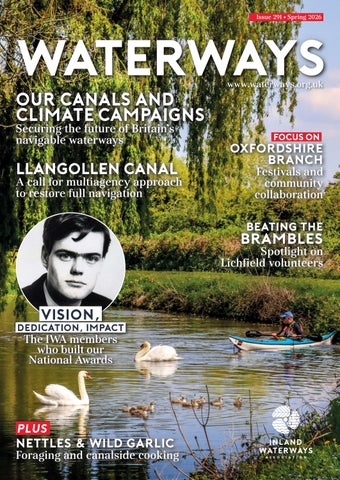
Our Canals and Climate campaigns
Securing the future of Britain’s navigable waterways
Llangollen Canal






Our Canals and Climate campaigns
Securing the future of Britain’s navigable waterways
Llangollen Canal






















































P5 WELCOME




Seasonal thoughts from National Chair, Mike Wills


P6 NEWS
Latest topical updates from IWA


P12 CAMPAIGN UPDATE
With your help we’ve been actively campaigning on these recent issues


WATERWAYS EDITOR: Rachel Mead Tel: 01283 742962 rachelmeadwrites@outlook.com
IWA Communications & Content Coordinator Jenny Davison jenny.davison@waterways.org.uk
ART EDITOR: Claire Davis
ADVERTISING DESIGN: Jo Ward
ADVERTISing MANAGER: Sharon Gretton Tel: 01283 742 971 Email: s.gretton@wwonline.co.uk
ADVERTISING PRODUCTION: Samantha Furniss s.furniss@wwonline.co.uk
REPROGRAPHICS: Waterways World Ltd, 151 Station Street, Burton-on-Trent, Staffordshire, DE14 1BG. Printed in England by Warners (Midlands) PLC, Bourne, Lincs
Articles may be reproduced provided permission is obtained and acknowledgement made. ISSN 0969-0654
A non-profit distributing company limited by guarantee (612245), Registered as a Charity (No. 212342)
Founded: 1946, Incorporated 1958
REGISTERED OFFICE: Hardy House, Northbridge Road, Berkhamsted, HP4 1EF. iwa@waterways.org.uk www.waterways.org.uk
For press enquiries contact: pressoffice@waterways.org.uk
All IWA national and branch committee volunteers can be contacted by email: firstname.lastname@waterways.org.uk
Nothing printed in Waterways may be construed as policy or an official announcement unless stated, otherwise IWA accepts no liability for any matter in the magazine. Although every care is taken with advertising matters no responsibility whatsoever can be accepted for any matter advertised. Where a photo credit includes a note such as CC-BY-SA, the image is made available under that Creative Commons licence; full details at www.creativecommons.org
P16 IWA'S NATIONAL AWARDS
Reflecting on past IWA members whose vision shaped these prestigious accolades
P18 OUR 80th ANNIVERSARY
Celebrate our collective impact at IWA Canalway Cavalcade
P20 WATERWAY FORAGING
Meet Chef and Author, Frankie Paz, who relishes life on the water
P22 BRITAIN'S WATERWAYS ON CAMERA
Meet Uy Hoang who is capturing striking images of Britain’s waterways for Google Maps
P26 REVIVING THE COTSWOLD CANALS
Turning the Cotswold Canals restoration into a living story of heritage and renewal
P28 BRANCH FOCUS
Let’s take a closer look at IWA Oxfordshire Branch
P30 SPRING WALK
Cromford heritage walk in Derbyshire
P34 LICHFIELD VOLUNTEERS
Meet the branch heroes tackling the brambles
SEVEN REASONS WHY YOUR MEMBERSHIP CONTRIBUTION IS VITAL
1. Your voice is counted when IWA speaks up for all those who enjoy the country’s canals and rivers
2. IWA lobbies national and local government and works with other organisations to repair, improve and protect our waterways heritage
3. Restoration is kept high priority through IWA’s Waterway Recovery Group
4. IWA campaigns to defend the waterways from unwelcome development
5. IWA branch Canal Clean-ups keep many waterways clear of rubbish
6. Over 10,000 days of volunteering each year will be supported with the right training, tools and materials
7. IWA provides training in traditional and work site skills for the waterway restoration sector





























My welcome, and this issue of Waterways, is printed and distributed early in 2026, although due to publishing deadlines and my own schedule I am writing this on Christmas Eve.
My thoughts today are very much related to the subject of giving.
Indeed, I believe that for all of us the most precious gi we can o er is our time. Once given it cannot be taken back, and of course the gi of time is what every volunteer gives to the inland waterways in so many ways.
IWA members, along with many others om waterway restoration societies, have gi ed literally millions of hours to help restore and remake the network. I am sure that you will join me in thanking everyone for their contributions. IWA is a chari , as are virtually all restoration societies, and the giving eely of our time helps to fulfil our key charitable objectives.
You will, I am sure, be aware that when Canal & River Trust was created out of the nationalised industry that was
BWB, it was formed as a chari . One of its principal charitable objectives is waterways restoration. To be precise it is: “To promote, facilitate, undertake and assist in, for public benefit, the restoration and improvement of inland waterways.” I do wonder if, based on current behaviour, parts of CRT would, in fact, be surprised to be made fully aware of their restoration objective. We will keep reminding them!
I think that all of us can rightfully feel alarmed to discover that CRT has indicated that restoration cannot be seen as a priori , or that it has to do restoration at all. CRT’s dra Restoration Delivery Plan has created considerable concern. I understand that its financial resources are limited, but surely that implies that it should do everything in its power to encourage and support all the volunteers who do wish to assist with restoration.
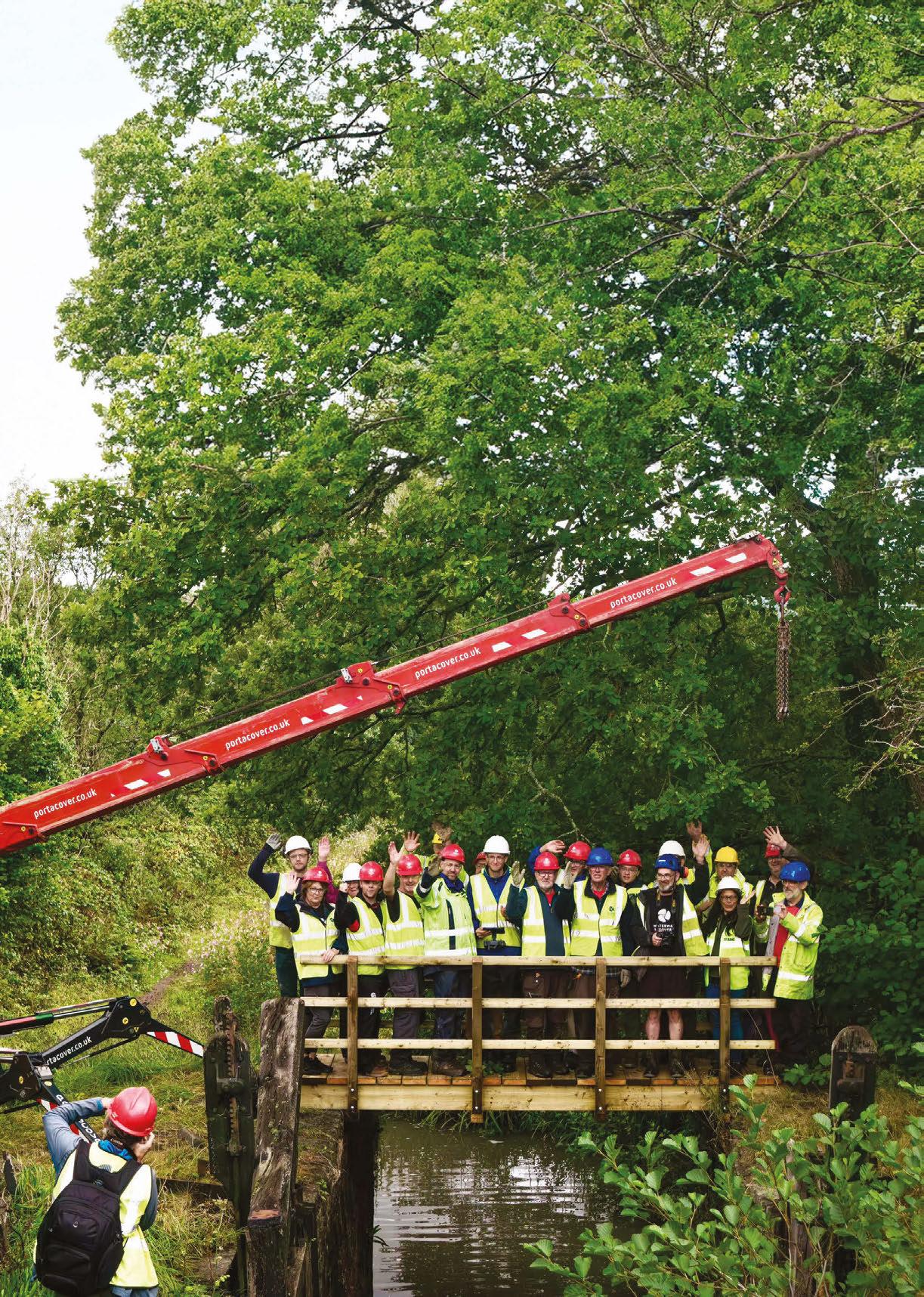
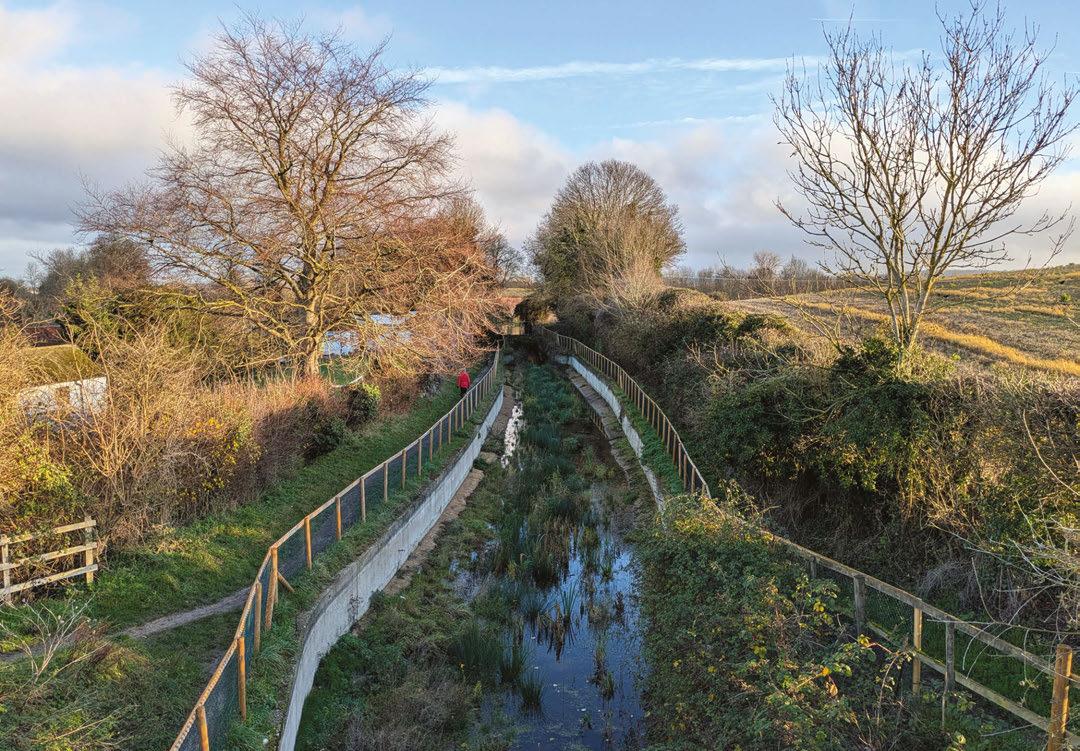
An unwanted gi at Christmas and New Year for our canals was a serious breach on the Llangollen Canal less than a year a er the major embankment failures on the Bridgewater and Huddersfield Narrow canals. Will this
lead to all available CRT funds being spent on simply maintaining the existing network? Would that not be a recipe for managed decline?
Think of the gi of volunteering; it is not all about money. IWA and restoration charities working together with CRT can help create long-term solutions.
IWA will be 80 years old this year and I hope our gi s of time can help us to continue to celebrate a cooperative spirit of restoration.
mike.wills@waterways.org.uk


Anglian Water, in collaboration with Cambridge Water, is progressing with plans for a new reservoir to be established within the Cambridge Fens. This development aims to secure a reliable water supply for Cambridge, neighbouring communities and west Norfolk.
The region is among the driest in the United Kingdom, and the growing number of technology firms and housing developments is expected to place further demand on existing water resources.
The proposed reservoir will be located to the north of Chatteris, spanning around 6 square miles. The site is bordered by two navigable waterways: the 40 Foot River to the south and the 16 Foot River to the east. These rivers are significant features of the local landscape and will shape both the integration of the reservoir into its surroundings and the arrangements for water supply.
IWA was involved at an early stage of the Fens Reservoir Project, participating as a member of the consultation group formed to offer feedback and guidance on the reservoir’s design, its projected impact on the area, and the effects on local residents and organisations.
In October 2025, the latest phase of proposals, termed Phase Three, was made available for review. IWA submitted formal feedback to the Fens Reservoir Project Team in early December.
Ongoing local consultation will continue in advance of the Development Consent Order (DCO) application, scheduled for early 2027. The Secretary of State is expected to issue a determination in 2028. If approved, construction would begin in 2030, with water supply operations commencing from 2036.
A group of IWA experts has reviewed the Phase Three proposals, raising concerns about the effects on navigation, waterway channels, air draughts and moorings. These concerns specifically relate to the River Nene and the River Great Ouse, the primary water sources, and the Middle Level navigation system, which will be the conduit for water abstraction and movement both during and after construction.
The reservoir is planned to feature a ‘lagoon’ in the top north-west corner, designated for visitor facilities and water sports. IWA welcomes these amenities and has recommended that infrastructure such as roads, walkways and utilities be incorporated into the project design early on. Pathways and nature zones are proposed around the reservoir, and IWA has suggested that these zones should also include moorings to improve access for boaters and the general public to and from the rivers that bound the site.
Approximately 2 million tonnes of aggregates and rock will be required for the reservoir’s construction. Although the adjacent rivers are navigable, no practicable access from seaports has been identified. Two potential transport routes have been selected for further consideration, both involving initial movement by rail to local sidings, followed by delivery to the site via heavy goods vehicles. This latter stage is expected to place considerable strain on local roads and residents. IWA has proposed amending one preferred route and substituting barges for HGVs to deliver materials directly to the site.
In earlier project phase proposals, water was to be abstracted from the Ouse Washes and transferred to the reservoir by restoring Horseway Channel (a section of the 40 Foot River), which has been closed to navigation since 2006. The Phase Three proposals now favour transfer by pipeline, primarily to address concerns over crosscontamination of waterways. IWA has suggested reconsidering the restoration of Horseway Channel, arguing that reopening the channel and its towpath or cycle path would benefit both boaters and the wider public, particularly by enhancing access to the Ouse Washes – a 30-mile corridor featuring walks and abundant wildlife.
IWA has strongly challenged CRT’s new draft Restoration Delivery Plan, arguing that it treats restoration as a low priority rather than a core charitable objective. Several major restoration projects (including the Grantham Canal, Wendover Arm and Pocklington Canal) have stalled under CRT ownership.
The RDP would see volunteer groups face new financial burdens and bureaucratic obstacles that seem contrary to the collaborative spirit that CRT purports to offer, and a different mindset from that with which British Waterways delivered spectacular reopenings 25 years ago.
As a critical friend to CRT, IWA is leading the charge to refocus attention on restoration, engaging directly with CRT’s senior management and its new CEO to ensure waterway restoration receives the leadership, support and priority it deserves.
After consulting widely with restoration groups and other interested parties, we have concluded that CRT’s plan is misguided because it addresses symptoms, not underlying issues. IWA has always thought of itself as a critical friend to the trust and, on this issue, we must lean into the former part of the description of our long relationship.
Restoration work has been halted on several restoration projects where CRT is a landowner, either owning most of the waterway, as is the case for the Grantham Canal, the Wendover Arm and Pocklington Canal, or where it is a minority landowner, as with the Cromford Canal. In fairness, in some cases, CRT says work has stopped because of health and safety arrangements or environmental issues, but it most cases it just claims that it doesn’t have the resources to review work plans or respond to restoration groups’ correspondence.
However, waterway restoration is one of CRT’s principle objectives alongside other important objectives such as maintaining the navigable system, heritage and natural environment and landscape – yet the RDP seems to position waterway restoration as something it might consider when funds permit. We think this is an abandonment of one of CRT’s principle duties.
The RDP requires restoration promoters to commission professional studies for planned works, and to pay CRT for such studies and work proposals to be reviewed by additional staff or contractors. This has led to some outrage that CRT planned to charge £40 per hour to deal with
correspondence and plans put forward by restoration promoters. Other complaints concern external training courses to be undertaken at considerable expense, although this requirement has since been reduced to compulsory onsite training.
The latest draft of CRT’s plan (published last summer as part of a consultation) met strong criticism from several restoration groups, particularly where works had been stopped, resulting in financial cost and volunteer disillusionment. A planned WRG Canal Camp on the Cromford Canal had to be cancelled, for example.
Overall, it is our view that the plan reads as a defensive document; more like a commercial business on a cost-cutting mission, far from the ‘can do’ manifesto and operational plan expected of a highprofile national charity. So, on the one hand, CRT wants to be a leader of the restoration movement with a high profile at national events, on the other hand it is custodian of multiple canals that were abandoned by its predecessors (which it is frustrating work to restore).
Twenty-five years ago, with lottery funding and regional development agency support, the then British Waterways Board management launched ambitious plans to revive and regenerate these waterways leading to spectacular restoration reopenings: the Huddersfield Narrow, Rochdale, Droitwich, Forth & Clyde and Union canals are fine examples. Momentum has now faltered in a more difficult economic climate and CRT is perceived, rightly or wrongly, as a blocker of restoration.
We are clear about the challenges: the Grantham Canal, for example, is a complex and major restoration; on the other hand, the Pocklington Canal and the Wendover Arm, both wholly owned by CRT, are probably the two easiest waterway restoration schemes in the country, notwithstanding that the Wendover Arm has two difficult road crossings and some minor footbridges and pipes, yet these schemes have been dragging on for more than 50 and 40 years, respectively.
Surely CRT, given its charitable duties, should be taking the lead on these restorations rather than leaving them to two small groups. We accept that CRT must adhere to building, environmental
and heritage protection legislation, and in some cases restoration promoters need to improve their operational practices, and where required, we support CRT’s moves to raise standards. However, this needs leadership and support rather than just raising obstacles.
We don’t wish merely to criticise. IWA wants to work constructively to resolve challenges and to provide support. Over the years, IWA and the restoration sector have provided a broad range of professional services and know-how to bring about successful restorations. Work is also underway to ensure that IWA raises its support for waterway restoration and will do so as a 2026 priority.
In conclusion, we are pleased to report that CRT is taking IWA’s views seriously. We are now engaged in direct meetings with senior management, the latest on 15th December 2025, and we have ensured that Campbell Robb, CRT’s new CEO, is fully aware of our concerns. We will continue to work constructively with CRT to achieve the best outcome for the waterways, including restoration.
IWA has welcomed December’s announcement by the Welsh government of a financial settlement to resolve the water abstraction crisis that has threatened the future of the Monmouthshire & Brecon Canal. The Welsh government will provide cover for up to £400,000 every year, for the next five years. CRT will also contribute up to £100,000 annually. The funding will support a vital water supply agreement.
IWA has been at the forefront of the campaign as a key member of the Preserve & Protect the Mon & Brec Canal (PPMB) coalition. IWA representatives helped organise the Senedd Rally on 9th July 2025, which preceded the Senedd Petitions Committee debate that saw overwhelming cross-party support for action. Following the rally and debate, the Welsh government announced the creation of the Task & Finish Group on 17th July 2025.
The agreement, announced by Deputy First Minister & Cabinet Secretary Huw Irranca-Davies, follows months of intensive campaigning, and negotiation between CRT, local authorities and the Welsh government through the specially convened Task & Finish Group.
The water abstraction crisis has seen CRT spend nearly £1m last year alone purchasing water from Dŵr Cymru Welsh Water, with costs reaching up to £40,000 per week at peak times. This expenditure has diverted vital funds away from essential maintenance and dredging work on the canal.
Paul Thomas, Secretary of IWA South West & South Wales Region, said: “This announcement is a major victory for everyone who has fought to preserve this historic waterway. The Mon & Brec Canal is not just a navigation route, it’s a vital part of our heritage, a significant economic asset for the region, and a much-loved recreational resource for thousands of people. We are delighted that the Welsh government has recognised its importance and taken steps to secure its future.”
The Task & Finish Group, which includes representatives from Welsh government, CRT, Natural Resources Wales, Dŵr Cymru and local councils, finally convened on 17th November 2025 after delays. The announcement follows intensive behind-the-scenes negotiations between all parties.
Paul Thomas added: “This shows what can be achieved when organisations work together with a common purpose. I want to pay tribute to all our partners in PPMB, the Commercial Operators Group, Brecon Beacons Tourism, the Bridge 46 to Five Locks Canal Group, and the many individual campaigners who have given their time and energy to this cause.”
IWA particularly acknowledges the crucial role played by members of the public who signed the Senedd Petition in their thousands and contacted their local MSs and MPs to demand action. The support of Councillor Jan Butler, other local councillors, MSs and MPs across party lines has been instrumental in keeping pressure on decision-makers.
Paul Thomas concluded: “We await the full details of the agreement. CRT will now be able to focus its resources on maintaining and improving the canal rather than simply keeping water in it. However, our work doesn’t end here – we will continue to monitor the situation closely to make sure this agreement delivers real, lasting benefits for the Mon & Brec Canal and all who use and love it.”
The report from an independent commission set up by CRT to review the legal framework around boat licensing was published on 19th November 2025.
IWA welcomes the endorsement by the Commission on the Future of Boat Licensing of four of the five main points put forward in its submission: a simpler licensing framework, the encouragement of more cruising across the whole network, the discontinuation of the term ‘continuous cruising’, and more thought to be given to the wider issues of residential boating.
Some of the other major recommendations by the commission are also welcome, including clearer and simpler definitions, appropriate strengthening of enforcement powers, and the need to improve the reputation of the trust among boaters.
The one point made by IWA in its submission which was not included in the recommendations was the desirability of the review covering licensing for all navigation authorities, as a step towards a joint system. While it is understandable that the commission did not feel able to address this in its review, CRT waterways nonetheless form a part of the overall network, and a consistent approach across all navigation authorities would be very beneficial.
The commission has set out recommendations and guidance for further consideration but specific ways forward have been left to CRT to consider and consult on. There is much work still to be done to get to implementation, especially if as suggested legislative changes prove to be needed.
The independent commission was established by CRT at the start of 2025 to review the legal framework around boat licensing, to explore its continuing appropriateness in view of the changes in use of the waterway network over the last 30 years. The commission was tasked with reporting to the CRT Board of Trustees, which will decide whether and how to take the recommendations forward.
The commission ran a survey of boaters and other stakeholders in March and April 2025, covering both user experiences of the boat licensing system and any desired changes. IWA submitted a response to the survey and representatives of IWA’s Navigation Committee discussed the submission in a meeting with the commission members in May.
Although the publication of the report produced by the commission was slightly delayed from the timescale originally set out, IWA welcomes the prompt publication as soon as the report had been submitted to CRT’s Board of Trustees, in advance of their consideration of it.
Peel Ports Clydeport has halted plans to charge small boatowners a £100 annual ‘leisure vehicle conservancy fee’ following widespread opposition from IWA, other waterways interest groups, politicians and individual boat-owners.
The proposed fee would have applied to all boats between 6m and 24m in length operating over a range of 450 square miles of the Firth of Clyde, including Loch Fyne and Gare Loch, the southern entrance to the Crinan Canal and the River Clyde up to Albert Bridge in Glasgow.
Peel Ports stated the fee was intended to cover costs of managing leisure activity and dealing with accidents, and warned that a comprehensive review was still underway to assess waterway usage and reserved the right to revisit the issue in future.
The decision represents a victory for recreational boating communities who successfully campaigned against what they saw as an unfair charge on a natural resource, though boat-owners remain cautious that the fees could be reintroduced later.
Our North West Region has been active over the Anderton Boat Lift closure and has had detailed briefings from CRT’s regional director. Our dissatisfaction has been expressed and CRT has readily accepted our concerns.
Jim Forkin, IWA Chester & Merseyside Branch chair said that to have a visitor attraction for 18 months without an attraction is “most disappointing” and akin to going to Disneyworld and finding the rides are out of commission.
The lift itself is unique and a highly protected facility. Works to get the lift operational again are complex: they will see a new lifting mechanism installed on ten separate gates, replacing the current ropes, wires and pulleys. CRT has announced that it would prioritise the programme of works to get the lift operational for navigation again, pausing a larger project on the site.
We are pleased the pressure we have applied, along with others, has resulted in CRT prioritising this work to get the lift open and operational again as soon as possible.
But a 2027 reopening lacks ambition and leaves the River Weaver, its users and businesses, effectively severed from easy access to the rest of the network (Marsh Lock is not yet fully reopened at time of writing and, even when operable, remains a more difficult route). The Anderton Boat Lift (and Marsh Lock) remain on our Risk Index map as Indefinite Stoppages and we will keep pushing for options to get the River Weaver connected again sooner.
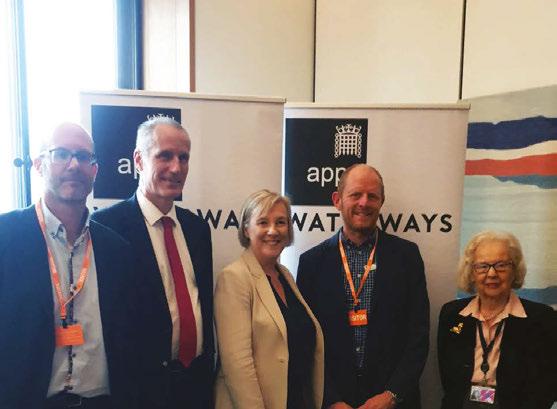
On 14th October 2025, under the secretariat of IWA, the AllParty Parliamentary Group for the Waterways convened to hear expert evidence from CRT and the Middle Level Commissioners on the growing impact of climate change across the nation’s waterways.
Members heard that changing rainfall patterns in the Middle Level are affecting vegetation management, while reduced water flows in the River Nene, combined with sealevel and bed-level rises, could prevent boats from entering or leaving the system. Flooding and coastal surge risks are also increasing, leaving low-lying areas vulnerable. Responsibility for these regions lies primarily with the Environment Agency but navigation authorities are operating under mounting financial pressures.
The session highlighted that, while waterways are among the first to experience the effects of climate change, they can also be part of the solution through adaptation, mitigation and enhancement of the natural environment in pursuit of net zero.
Mr Esterson, Sefton Central MP, and chair of the Waterways APPG, questioned the MLC on their experience of recent flooding, which revealed how many communities remain disconnected from the risks of living below sea level. He said: “There are real challenges as the impacts of climate change intensify but also significant opportunities in how we adapt and mitigate. These are serious issues relating to our waterways, that go far beyond those who live and work on the water.
“Our changing climate affects communities, economies and environments alike. Yet within that jeopardy lies opportunity; opportunity to improve how people enjoy our waterways and to remind MPs just how many of their constituents live near and depend upon them.”
A major theme of the discussion was the question of funding, with Defra’s settlement for CRT reduced at a time when climaterelated infrastructure costs are rising sharply.
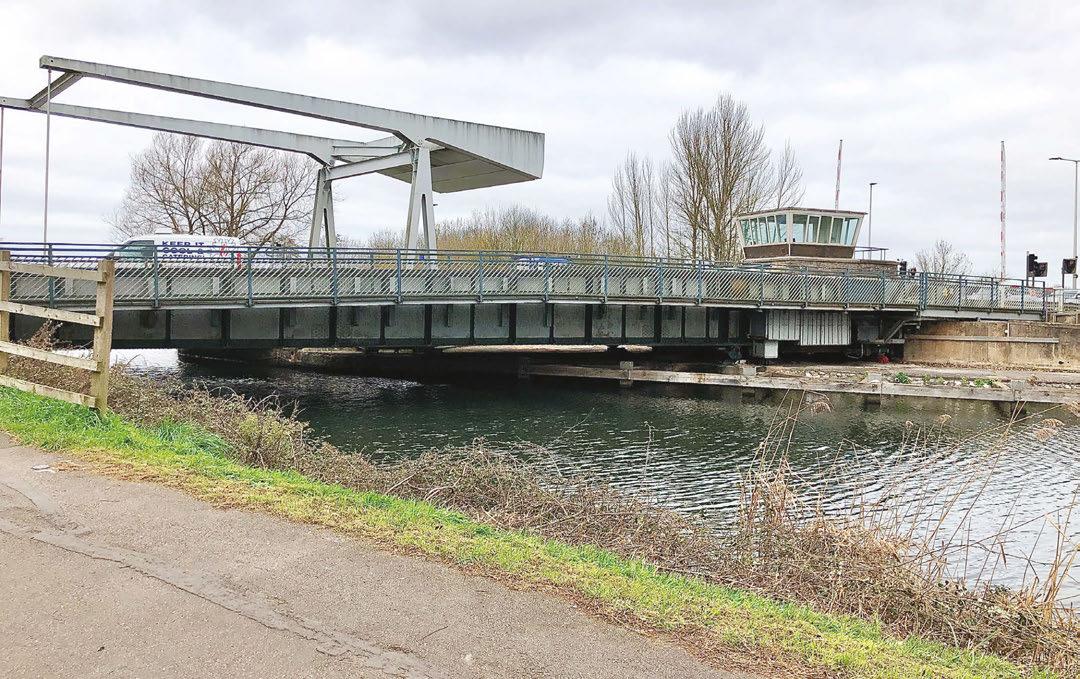
IWA is campaigning for increased airdraught clearance as Devon County Council plans to replace two ageing moveable bridges across the Exeter Ship Canal, to improve access for paddlers and boaters.
Devon County Council held workshops for stakeholders on 22nd October 2025, at which it presented the emerging proposals for two new replacement bridges across the Exeter Ship Canal on the A379 dual carriageway. This followed from an announcement by the Department for Transport in July 2025 of a number of local authority road-improvement schemes that were to be taken forward.
The new bridges will be bascule bridges, similar in concept to the existing bascule bridge on the eastbound carriageway but of modern design. They will replace the existing westbound steel swing-bridge, built in the 1930s, and the eastbound bascule bridge, installed in the early 1970s, both of which are becoming life-expired.
The air draught of the existing bascule bridge is larger than that of
the existing swing-bridge and IWA is keen for advantage to be taken of the rebuilding to increase the air draught of both bridges. IWA argues that the new bridges should provide sufficient air draught to permit a good number of leisure craft, including yachts with their masts lowered, to pass through without raising the bridges. Opening moveable bridges is not only time consuming but also holds up the traffic using the busy A379 dual carriageway.
Devon County Council has identified five options for replacing the existing bridges. Option 3 provides for the road surface to be raised by 1.7m and Option 4 provides for the road surface to be raised by 0.7m with an opportunity for incremental increases above this. IWA has a preference for Option 3 but Option 4 could also be supported if it results in leisure craft with an air draught of up to 3m being able to pass under the bridges.
The council is currently assessing the comments made at the workshops, with a view to holding a public consultation in spring 2026.
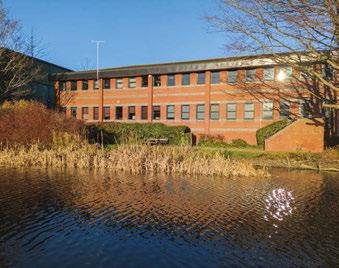
The Association has vacated its former head office building in Chesham and moved to new premises beside the Grand Union Canal in Berkhamsted. IWA’s head office and registered office address are now at Hardy House, Northbridge Road, Berkhamsted HP4 1EF.
The existing telephone number (01494 783453) remains unchanged.












With your help, we’ve been actively campaigning on these recent issues
As you’ll no doubt have seen across our channels, our latest campaign went live in early November 2025. We produced a first-of-its-kind map revealing the likely impact of 2°C degrees warming (predicted by the Climate Change Committee to be possible by 2050) on Britain’s 5,000-mile network of canals and navigable rivers, as well as other risks.
These were our key findings:
• Three-quarters of Britain’s canals face financial insecurity, with the majority of the nation’s navigation authorities struggling to maintain essential infrastructure amid declining funding.
• Climate pressures are intensifying, with new mapping showing every waterway in Britain will face greater risk from drought in summer and floods in winter.
• The combination of reduced funding and rising climate impacts creates a ‘perfect storm’ for the nation’s 5,000-mile canal and river network, threatening heritage, navigation, tourism, wildlife, utilities, homes, communities and businesses.
Charlie Norman, IWA’s director of campaigns, said: “Right now, Britain’s matchless canal and river network faces a perfect storm of underinvestment and climate risk.
“Our findings paint an alarming picture of vital national infrastructure under increased strain. Decades of erratic government support, along with more frequent extreme weather events, have left many waterways vulnerable to breaches, closures and mounting maintenance costs. This year’s drought led to the closure of dozens of canals across the country, affecting wildlife, tourism, businesses and people living on the canals.
“Without intervention the network, a cornerstone of the UK’s industrial heritage, providing leisure and tourism destinations for millions, as well as green corridors for wildlife, faces irreversible decline by 2050.”
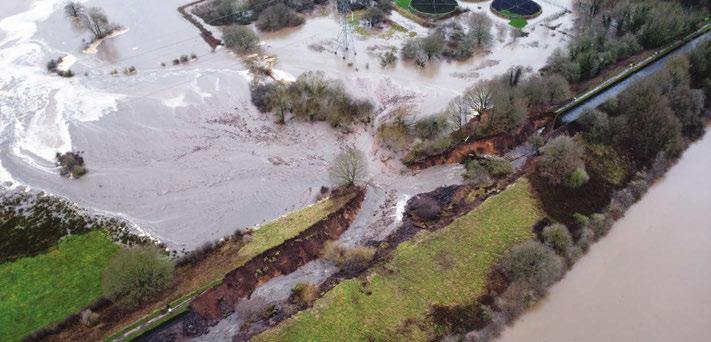
Lack of funding to maintain waterways in the face of climate change is a key factor and IWA has used expert knowledge of the status of the various navigation authorities looking after our waterways to categorise them. Only 25% of waterways are considered to be financially stable, leaving three-quarters of the network facing moderate to severe funding threats.
On the map, we’ve also plotted the at-risk heritage features (as explored in Waterways, Summer 2025 issue) and all the indefinite stoppages – closures across the system which have no published end date, e.g. Anderton Lift, Welches Dam and Brandon Lock.
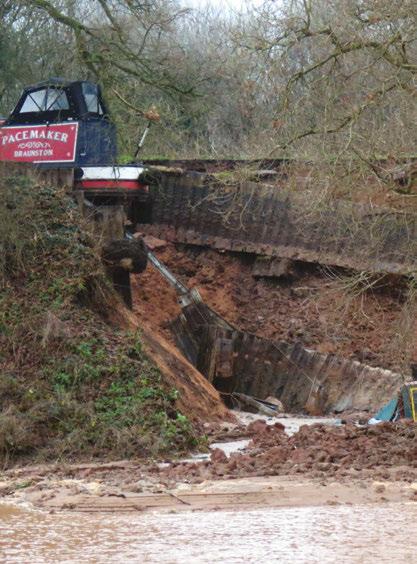
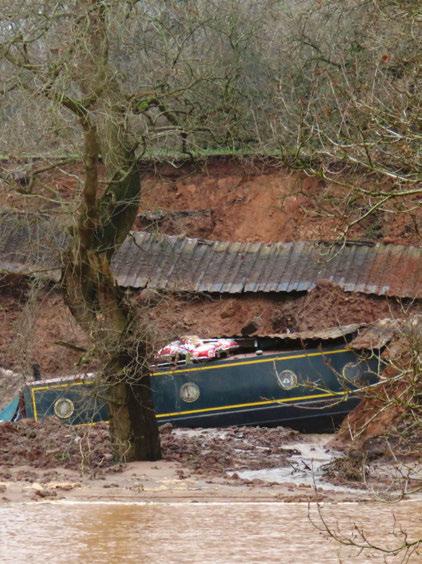
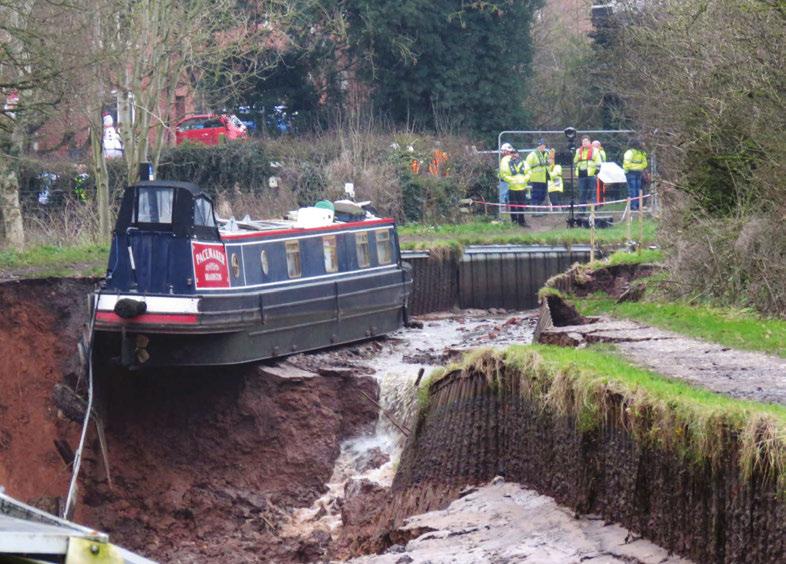
Rising winter rainfall is placing Britain’s waterways under increasing strain. While reservoirs rely on winter rainfall to prepare for summer, excessive precipitation is already causing major damage, as seen in the dramatic breach on the Llangollen Canal near New Mills Lift Bridge at Whitchurch just before Christmas. The incident led to the evacuation of many boaters, and once again brought into sharp focus the vulnerability of our waterways. With the Bridgewater Canal breach on New Year’s Day 2025 still fresh in many minds, this latest incident serves as another reminder of the challenges facing the network.
Commenting on the breach, Michael Haig, Chair of the Shrewsbury & North Wales Branch of IWA, highlighted the importance of the Llangollen Canal: “As one of the most popular and heavily used canals on the entire network, the Llangollen Canal holds a special place
in the hearts of thousands of visitors from across the UK and overseas.
“Along its 49-mile length, it supports local businesses, recreation and the health and well-being of communities, while neighbouring waterways and holiday-boat-hire operators further amplify its economic and social value.”
While acknowledging the engineering complexities involved in repairing the breach itself, he emphasised the need for co-ordinated action. “We are calling for a multiagency approach to restore full navigation to as much of the canal as possible, including sections downstream of the breach. Keeping the waterway open wherever safely achievable is vital if it is to continue delivering economic, social and well-being benefits to the many predominantly rural communities it serves.”
He also paid tribute to those who responded in the immediate aftermath of the incident when over 50 firefighters were deployed: “Our thanks go to everyone who acted so swiftly and professionally in what were clearly frightening circumstances. Their efforts undoubtedly prevented a serious situation from becoming far worse.”
As repairs progress on what appears to have been embankment failure, we acknowledge that these incidents take time to properly investigate. Once again, this incident shows the importance of sustained investment, partnership working and long-term resilience planning which are all needed to safeguard the future of the waterways we all care so deeply about.
IWA’s new mapping using Met Office climate projections shows no part of the network will escape increased winter rainfall under 2°C of global warming. In the south, rivers such as the Thames
were closed to navigation for nearly five months last winter due to flooding: a blow to local businesses and leisure users alike. Many of the major navigable rivers in England (Thames, Nene, Great Ouse, Medway) are managed by the Environment Agency, which faces the threat of serious underfunding for maintenance.
Following last summer’s drought, with the driest spring ever recorded, we used Met Office climate projection maps to show how waterways are likely to be affected by lack of water in the future. This map shows the median projected drought severity for a global 2°C rise, which Intergovernmental Panel on Climate Change (IPCC) data suggests could happen within the next few decades.
Higher drought severity figures are predicted for several crucial areas for the waterways – in areas of higher ground where canals cross summits and therefore where key reservoirs are located. The Pennine summit provides canal links between the North-East and North-West waterways (Leeds & Liverpool, Rochdale and Huddersfield canals) and this whole area is predicted to see increased drought.
The other key area of concern is the Midlands, the heart of the canal network, fed by many reservoirs whose water resources will be increasingly stretched. An area rich in canal heritage and home to numerous waterways businesses depending on a connected network, it will be increasingly hit by drought in the future.
Britain’s 5,000 miles of navigable waterways are a national asset, but
reduced funding and climate change put them at severe risk.
The government should review Britain’s inland waterways to create a long-term investment plan. With relatively modest investment, the government can secure huge returns in public health, economic growth, climate resilience and regional renewal.
Improved infrastructure will attract new businesses, boost tourism and enhance the experience of everyone who enjoys Britain’s waterways.
IWA’s evidence-based climate risk map shows where and why our waterways face the greatest threats by 2050: now, we need solutions.
As well as a Guardian exclusive the day we launched, the story was also featured on ITV’s news. Our Campaigns & Public Affairs Director, Charlie Norman, spoke to ITV News about the new map and the current crisis facing our inland waterways.
It was also good to see the campaign gain political engagement. For example, Lisa Smart MP, who is a valued and active member of the All-Party Parliamentary Group for the Waterways, shared the news on her social channels.
Since the map launched, we have formally contacted each navigation authority responsible for indefinite stoppages to request a realistic and current assessment of their status. The map is very much a framework on which to build next year’s campaigns, and we’ll keep it live as more heritage at risk or indefinite stoppages are identified.
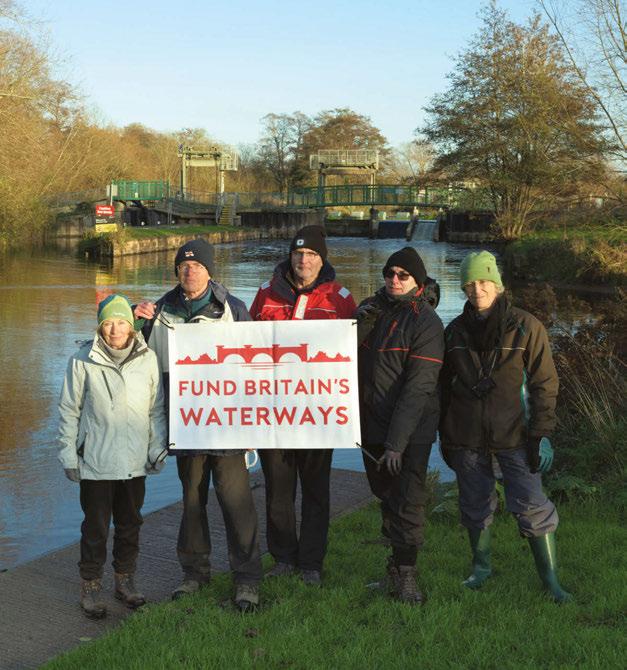
The Wilderness Boat Owners’ Club is celebrated for its members’ willingness to venture into li le-known waters with their distinctive trailable, shallow-draughted cruisers. But even they were unable to complete a planned FBW campaign cruise to Brandon on the River Li le Ouse on 21st November 2025. Although Brandon was accessible om the Ely Ouse as recently as 2024, silting, fallen trees and the closure of Brandon Lock have reduced navigabili , with Environment Agency navigation funds unavailable to remove the silting.
Despite these obstacles, a single Wilderness boat, skippered by Ivan Cane, managed to reach far enough upriver to moor within walking distance of Brandon. Ivan reported: “We were welcomed by local canoeists and paddleboarders, as well as IWA representatives and other Ouse club members. We hope our e orts on behalf of FBW will help a li le towards EA navigation assets funding deficits being improved.”
In 2023, three boats a week visited Brandon. Now the town is virtually cut o , just as the town council and local businesses work to improve facilities, while EA moorings and the lock remain inaccessible.
The newly elected Lady Mayor of the Ci of London, Dame Susan Langley, is also a keen narrowboater, and a champion of the FBW campaign. She told us: “The UK’s 5,000 miles of canals and rivers create incredible bluegreen corridors that millions of people enjoy. They support domestic tourism, help create jobs and bring real economic benefits to local communities. They also play a big role in improving people’s health and well-being – an experience I’ve enjoyed time and again on my own travels. For the sake of our economy, our environment and our communities, this is a national asset we simply can’t a ord to lose.”


FBW has a new chair, Hazel Owen, who also chairs the Association of Waterways Cruising Clubs. Hazel, a very experienced boater, organised and led the monumental FBW campaign cruise over spring and summer 2025. Starting in March at Strawberry Island Boat Club near Doncaster, Hazel and her husband Richard in their narrowboat Rum’a’Gin headed a convoy to London. On 7th May they joined the flotilla of 26 boats travelling up the tidal Thames to the Palace of Westminster, drawing the a ention of Parliamentarians and national media to the FBW cause.
They continued to Boston in Lincolnshire and, in June, carried FBW banners over the Wash in what is believed to be the largest-ever narrowboat convoy to make the crossing. Their journey was delayed by stoppages and water shortages, highlighting the urgency of the FBW message. Hazel said: “Britain’s inland waterways are a vital part of our national in astructure, yet face increasing deterioration due to insu cient funding. We are calling on government to secure sustainable funding so waterways remain open, safe and beneficial for future generations.”
How you can help
• SIGN THE PETITION: Our petition has amassed over 56,000 signatures. If you haven’t already, please add your name and help us by circulating widely.
• MAKE A DONATION: The Fund Britain’s Waterways group can accept donations via JustGiving, so please consider donating to FBW.
• DOWNLOAD RESOURCES: Please download and proudly display a window sticker or one of our social media banners to show your support for the campaign.
fundbritainswaterways.org.uk


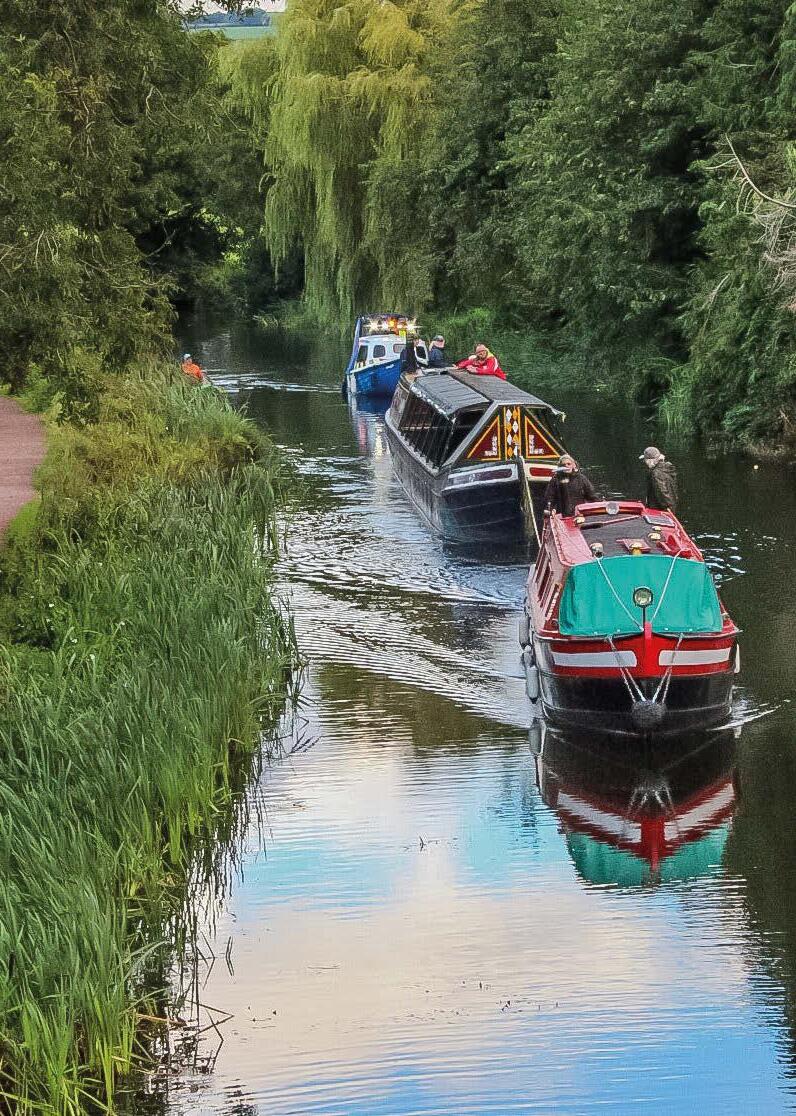
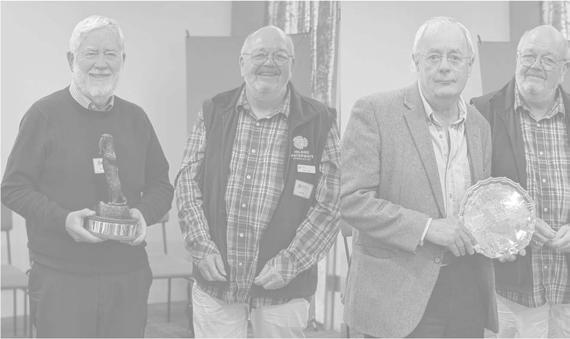
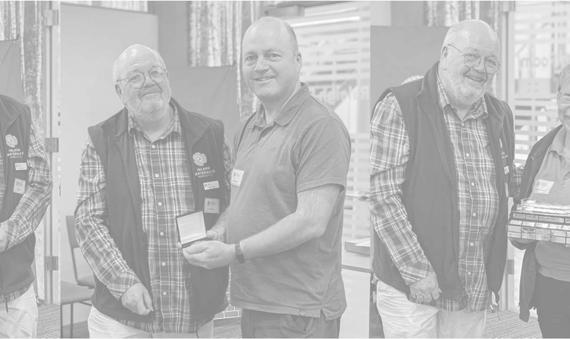

Every year, IWA honours those who go above and beyond to protect, improve and champion Britain’s waterways at our National Awards. Here we share the stories of some of the past IWA members whose vision and dedication helped shape these prestigious accolades
Words: Jenny Davison
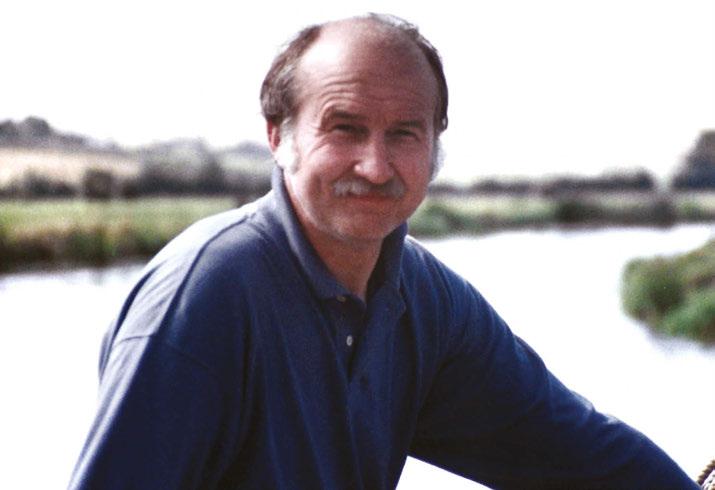
The Richard Bird medals: For members of the Association whose e orts and support are considered to have brought significant benefit to the Association over a sustained period.
Richard Bird joined IWA in 1975 and quickly became an active and much-loved member in both the London Branch and the South East Region. Richard was a prolific fundraiser and supporter of IWA events for over 20 years.
Richard’s expertise in organising and fundraising first saw him involved with national rallies and later the National Waterways Festivals. He became a director of IWA Rallies Ltd in 1982 and organised the trade show at various national rallies: Titford (1982), Hawkesbury (1984), Brentford (1986), Hawkesbury (1987) and Waltham Abbey (1989).
A er stepping down om his festivals directorship around 1990, he was persuaded to bring his experience to
Canalway Cavalcade, where he continued to run the trade show until he died. At events, he always made time to ensure traders were happy, and his London team celebrated him surpassing previous trader-a endance records in the former London region magazine, Excalibur. By profession he was a printer and equently used these skills on behalf of IWA, including the printing of Excalibur. Richard was a boat-owner and had a keen interest in historic working narrowboats. He owned Rigal for some years and was a part-owner of Hadley Rail, Fulbourne and Tarn.
During his very active time with the Association, he won the John Heap Salver twice for his fundraising activities. In 1996, during IWA’s Golden Jubilee Year, he raised over £7,000 for the London Region Draw as well as considerable amounts through Cavalcade and in other areas. Richard’s memory and legacy continue to live on through IWA’s National Awards. Also, did you know, one of Waterway Recovery Group’s vans is dedicated to Richard with the number plate ending RFB? (The registration was funded by a collection of Richard’s iends in place of a memorial bench, not taken om IWA funds.) Richard’s open and iendly character and his great sense of humour resulted in him becoming personal iends with numerous people and won him universal respect.
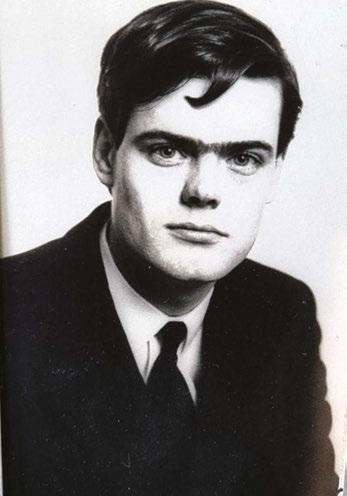
The Christopher Power prize: For a person, socie or trust who has made the most significant contribution to the restoration of an inland waterway.
John Heap
The John Heap salver: For an IWA member who, in the opinion of the trustees, has made an outstanding contribution to raising funds for the Association.
John Heap served as IWA National Chair for ten years, om October 1972 to October 1982, and prior to that was chair of IWA’s North West Region. His family were private owners of Lyneal Wharf on the Llangollen Canal. The wharf co age became a base for John and his family for more than 40 years.
John owned a boat named Duchess which many people remember seeing at events such as the 1969 National Rally of Boats in Birmingham. Duchess also appeared in the 1972 BBC series Nairn Across Britain
He served as Vice-Chair of the Association, prior to his appointment as national chair and he chaired the 1972 National Rally at Lymm, which was organised in just six months. His decade as chair saw him guide the Association through a period of change and growth, helping shape the structure that IWA still works within today.
John was known for stepping into challenging roles. When a major breach occurred on the Bridgewater Canal, John helped organise the 1972 Lymm rally at Agden Bank so that members could see the damage and lend support to
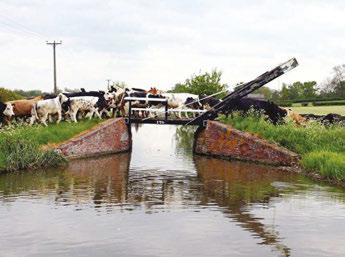
Christopher Power was born in 1951 and had a keen interest in engineering om a young age. His sister Anne remembers them building a bridge together on some farmland, out of concrete posts, tree trunks and wooden sleepers. Christopher oversaw the lowbudget design and must have done a good job as the cows are still using it 50 years later. Christopher also loved fairground rides, particularly the steam engines which powered them. He used to help out and fuel his fascination with mechanisms.
Christopher went on to study Engineering in Birmingham during the 1970s. A er universi he joined the Royal Navy as an engineering o cer before working at Watney, Combe & Reid, running the plant at the brewery.
Christopher became interested in the canal network through his study of engineering. He also had the fantastic Birmingham Canal Navigations on his doorstep. He had particular interest in the mechanical aspects of the network and would holiday on the canals with his engineering iends.
Christopher passed away in 1981. In his will, he le a sum of money to IWA. His family were consulted and it was decided that the money be earmarked for a prize in Christopher’s name. Christopher’s parents a ended IWA’s annual general meeting for many years to see the presentation of the prize and trophy, now a carved wooden o er (originally donated for a di erent award). A cash prize associated with this award, which came om the legacy, is given to the restoration group associated with winner. When the legacy amount started to run out, Christopher’s family gave a further substantial donation to continue supporting restoration work.
Anne also recalled a special moment, years later, when she happened to meet a lady wearing an IWA polo shirt at her local choir. When Anne asked whether she’d heard of the Christopher Power prize, her face lit up and she told Anne about a recent project funded by the prize. Anne said: “It was honestly an exceptionally happy moment in my life – hearing that my brother had le this mark on the world.”
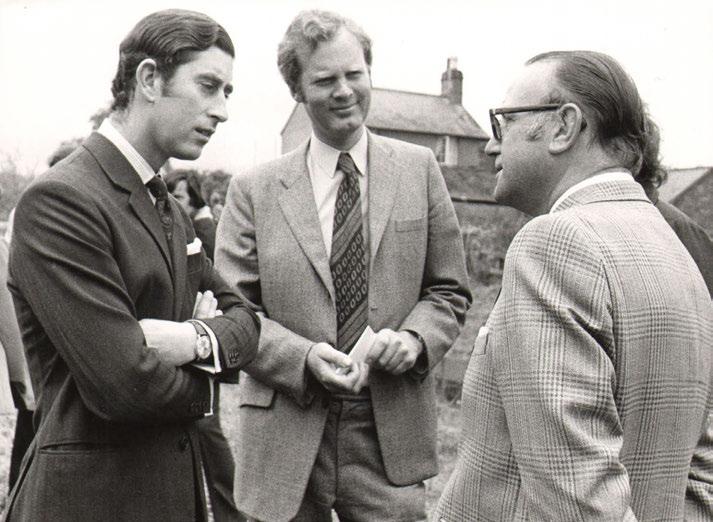
the repair e ort. He also served on the Inland Waterways Ameni Advisory Council, formed under the 1968 Transport Act, working alongside government to champion the interests of the waterways. Alongside his IWA roles, John and his wife Joan were closely connected with the Heulwen Trust, formed in 1985 a er the build of a 70 boat designed for disabled children. Heulwen is Welsh for sunshine and has brought joy to disabled
and vulnerable people for 50 years. In the early 1980s, John and Joan generously o ered Lyneal Wharf to any organisation helping disabled people access the canals. The Lyneal Trust celebrated its 40th anniversary in 2025.
John’s work for IWA spanned leadership, fundraising and hands-on campaigning. His dedication le a lasting impact on both the Association and the wider waterways communi .
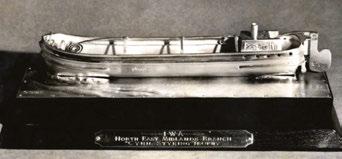
The Cyril Styring trophy: For an IWA member who has, in the opinion of trustees, made an outstanding contribution in furthering the Association’s campaign.
Shortly after the end of World War II, Cyril Styring started boating on the River Thames in a wide-beam cruiser. He subsequently met and became a good friend of one of IWA’s founders, Robert Aickman. Although Cyril was living and working in Sheffield, he regularly cruised on the Thames and was active in IWA’s campaign to save the Basingstoke Canal.
In 1950 Cyril organised local IWA members to form a Sheffield sub-branch (of IWA’s then North East Branch) which was based in Leeds, and he was chair until it became the North East Midlands Branch in 1954. A formal dinner in Sheffield celebrating the formation of the new branch was addressed by Robert Aickman and Ray Slack, an active member and IWA trustee from North West Region.
In 1952, members of the Sheffield sub-branch were tired of meeting at one another’s houses and decided to purchase a boat on which to hold meetings (and to give the public trips on the summit pound of the canal from its base in Sheffield Basin). An old iron BCN day-boat was found at Guest, Keen & Nettlefold’s in Birmingham, and the boat was bow hauled by members over several weeks. On its arrival in the basin, the members continued to raise funds to fit out the boat for its new purpose and other members fitted new bulkheads and other items. But the scheme was dogged by ill-luck; the boat sank several times, became badly damaged, and was ultimately beyond repair.
Following the demise of the boat, the Branch Committee decided to put the residue of the money towards the purchase of a memorial to its late chair in the form of a silver narrowboat. This was to be awarded annually to the person doing the most for IWA’s campaign effort.
Sincere thanks to Anne Power, Dorothy Robbie, Mike Palmer, Neil Edwards and Audrey Smith for generously sharing their stories, memories and expertise. Their insight has been invaluable in bringing to life the remarkable achievements and experiences of these extraordinary individuals.
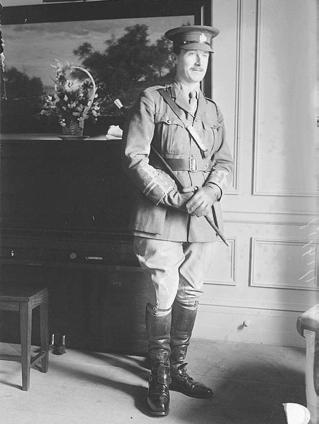
The Vivian Bulkeley Johnson salt:
For the person or organisation who, in the opinion of trustees, upon a recommendation from IWA’s Inland Waterways Freight Group, has made an outstanding contribution to the furtherance of commercial waterways transport in the United Kingdom.
Vivian Bulkeley Johnson was a veteran of World War I. He was the aide-de-camp to Victor Cavendish, 9th Duke of Devonshire, the Governor General of Canada from 1916 to 1918. He served in the offices of the Imperial War Cabinet in World War I and in the Air Ministry from 1919 to 1922. Vivian held
IWA National Awards
Open for nominations from 1st February 2026
IWA’s National Awards recognise exceptional contributions to the waterways, from fundraising achievements and restoration work to campaigning, community engagement and day-to-day volunteering.
With 2026 marking IWA’s 80th anniversary, the awards provide an especially important opportunity to acknowledge the individuals, societies and groups whose efforts have helped the Association make a difference throughout the decades. Recognising their work is not only a celebration of past achievements, but also a way of demonstrating the strength and continuity of our movement as we look ahead.
However, many excellent projects and dedicated volunteers remain unseen simply because too few nominations are submitted each year.
Ensuring strong and varied nominations is essential: it allows the
an important position at the Rothschild Bank of London.
Vivian took an interest in IWA’s cause and canoed down the River Avon in 1948. A year later, he married Cornelia Stuyvesant Vanderbilt, a wealthy heiress. Vivian became IWA’s Honorary Treasurer from 1951 to 1958 and frequently provided funds for the Association through his wife’s Mrs Smith Trust.
Together with Cornelia, he lived between a four-storey brick home in Kensington and a farm in the village of Churchill, near Oxford. It was here that Vivian took an interest in inland waterways, running a company that operated boats on the Oxford Canal.
Vivian was a co-founder of the wellknown Willow Wren Carrying Co in 1953. The other founders were Robert Aickman ( IWA founder), and Leslie Morton of the Grand Union Canal Carrying Co. Together, their aim was to continue commercial freight carrying throughout the canal system. The company bought and operated several pairs of narrowboats, many of which were renamed after birds.
Early in 1963, a decision was made to cease operations due to extreme weather conditions and financial constraints. Leslie was determined not to give up the dream of waterway transport, so Willow Wren Transport Services Ltd was formed. This operated as a co-operative until 1970.
awards to reflect the full scope of activity taking place, provides public recognition for work that might otherwise go unnoticed, and helps demonstrate to stakeholders the depth of engagement across our network.
If you are aware of a member, group or society whose contribution has had a meaningful impact – locally or nationally – we strongly encourage you to put them forward. We rely on IWA members, branches and regions to help identify those whose work deserves national recognition.
Make a nomination
Nominations for the 2026 awards (excluding the Branch Achievement Award) should be submitted to awards@ waterways.org.uk by 30th June. The Awards Panel reviews all submissions and makes recommendations to trustees, who determine the final recipients. Awards are usually presented at the National AGM in September. Find out more: waterways. org.uk/about-us/national-awards.
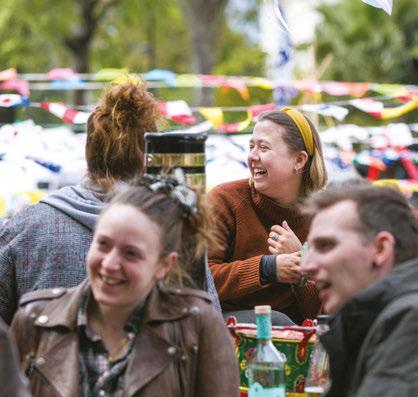
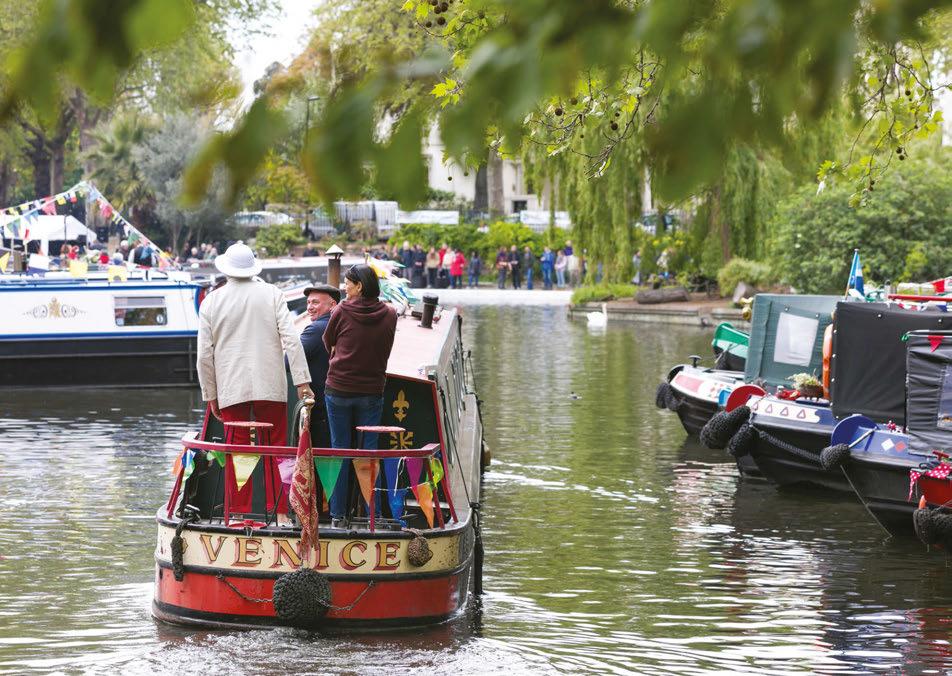
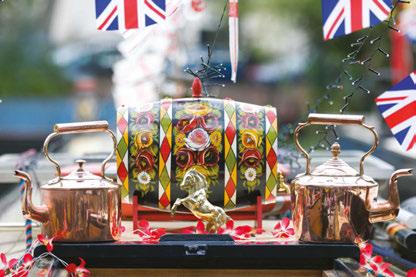
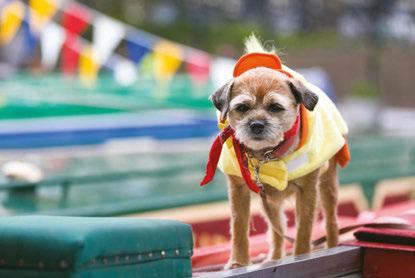

Join IWA at Canalway Cavalcade this spring for one of our biggest events of the year - let’s celebrate our collective impact
We are excited to share that 2026 marks the 80th anniversary of IWA – a fantastic opportuni to celebrate our past achievements, reflect on where we are today, and inspire new members and supporters to join us as we work towards our future goals.
For 80 years, IWA has protected and restored our waterways. Now it’s time to imagine what they – and IWA – will look like when we reach 100.
We want this to be a year-long celebration, with particular focus on the upcoming IWA Canalway Cavalcade. There’s something for everyone as this vibrant canal festival takes place in the heart of London’s waterways. Whether visiting by boat or on foot, it’s a splendid day out for you and your family.
Soak up the atmosphere surrounded by colourful cra of all shapes and sizes, alongside a multitude of unique stalls, an onsite bar and delicious foods for all appetites.
Each year we celebrate the best of life on the waterways and its communi . With eclectic live music around the site, special boating activities like the legendary illuminated procession, and kids’ entertainment for all ages.
If you wish to volunteer at any of IWA’s events, please email verena.leonardini@waterways.org.uk. Please tag IWA in your photos on social media too – we’d love to see them! Instagram: @iwa_uk

Bluesky: @iwa-uk.bsky.social FB: facebook.com/ inlandwaterwaysassociation
More information: waterways.org.uk/cavalcade
Event dates: 2nd to 4th May
Cost: Free public admission
Location: Li le Venice (W9 2PF and W2 6NE)

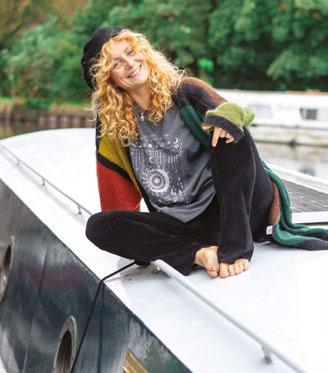
As a plant-based chef and writer who lives on a narrowboat in London, FRANKIE PAZ has appeared on Channel 4’s The Great Cookbook Challenge in 2022. More recently, her debut cookbook Plant Feasts was chosen for Jamie Oliver’s Cookbook Club

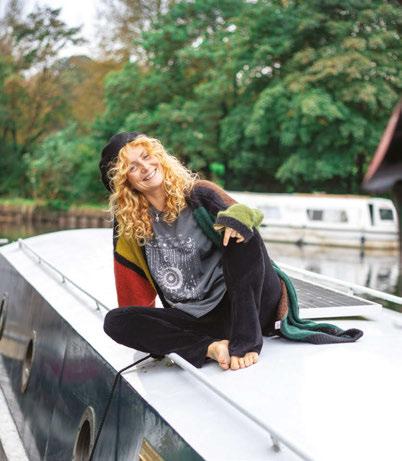

I’ve always felt most free on the water. For years, I lived deep in the Colombian jungle, fully immersed in communities and married to a local man. Life there felt seamless, nature wasn’t something outside of us but a part of who we were. We followed its lead. We breathed with it. We honoured it. We saw it as the Great Mother, because without her, we had nothing.
To be honest, it blew my mind. It made so much sense. After years of living that way, I began to understand what true belonging feels like; a sense of connection to nature that we’re rarely taught on this side of the world.
When my husband and I eventually decided to part ways, the heartbreak was brutal. In the midst of rebuilding myself, I moved onto my boat Zambezi, finally putting safety in me and my cute floating home. I came back to my roots, back in London, finding my way again. My mission was to find balance in this chaos. I figured that if I could do it here, I could do it anywhere.
Living on a boat became a way of weaving my jungle life into the city. No internet. No TV. I wake with the sunrise. I watch the seasons pass in real time. Everything is a cycle and, on the water, you can’t help but be fully immersed in that rhythm. My favourite time of year is now, when the land begins to stir after its long winter sleep. The birds sing louder and, honestly, so do I.
As a plant-based chef who blends ancient practices with modern approaches, I’ve never resonated with the whole ‘new year, new me’ idea. My new year begins when nature’s new year begins; when green returns. Winter is for feasting and going inward. I’ve never believed in forcing salads during the cold months. The seasons ask things of us and I try to honour that.
When
spring arrives, the first edible plants to push through are nettles, dandelion, cleavers and wild garlic. These bitter herbs are nature’s gentle way of helping us cleanse after winter’s indulgence. The earth is always telling us what we need –if we listen
Working with the plant world has not only nourished my body but also strengthened my mind. It reminds me daily that we are cyclical beings, intimately connected to nature. By tuning into these cycles, we can benefit from the nutrient-dense, free plants found through foraging that truly support our physical and mental well-being.
At sunrise, I head out to the marshes to gather.
There is something magical about incorporating foraged plants into my meals. Not only is it a huge nutrient boost, great for the microbiome, but it also reconnects me to the land. My hands get busy, my mind slows, and I feel the presence of ancestors who walked these same paths. In a time of rising living costs, foraging is also a way to live affordably in the city while eating abundantly and well.
One of my favourite drinks is cleaver water. This is a beautifying drink, a little like cucumber water. I gather fresh cleavers, add them to a jug of water, and leave them overnight or for a few hours. It’s said to cleanse the liver and kidneys, support the lymphatic system and, in

Step 1:
Make a salty paste by blending 100g of chopped wild garlic with 100g of sea salt until thick.
Step 2:
Mix this paste into 700g of sea salt until the mixture turns vibrant green. Spread it on a tray and leave to dry overnight. Store in a jar in a cool, dry place – ready to transform any dish.
folklore, break ties with relationships or habits you no longer need. It’s simple, fresh and utterly magical.
Nettles are another powerhouse. I use them anywhere I would spinach, packed with iron and growing abundantly (just avoid spots where dogs may have peed). Nettles are connected to the god of thunder and, historically, their stems were used as fishing rods and even woven into clothing. They are versatile, nourishing and potent – but watch out for the sting! Funny how so many of us were told to stay away from nettles, when in fact they are one of the most nutrient-dense wild plants out there. In folklore, nettles were said to sting us as a reminder of boundaries and to take only what we need. Toss some into a stew; you’ll be amazed at their power and flavour.
My favourite plant of spring is wild garlic. Its aroma wakes us up after the long winter, a reminder of protection and renewal. I usually turn it into wild garlic salt to preserve its magic all year round. People love it and I think it’s because it carries the season itself: fresh, wild and full of life. This spring, I encourage you to step outside, notice the first shoots of green, and reconnect with the wild abundance around you. Nature is waking up, reminding us of new beginnings, a reminder to follow its lead.

Plant Feasts by Frankie Paz is available now at all good bookshops. You can follow Frankie on Instagram @ moodymangoalchemy for plant-based inspiration and reflections on life on the water, blending the ancient world with the modern.
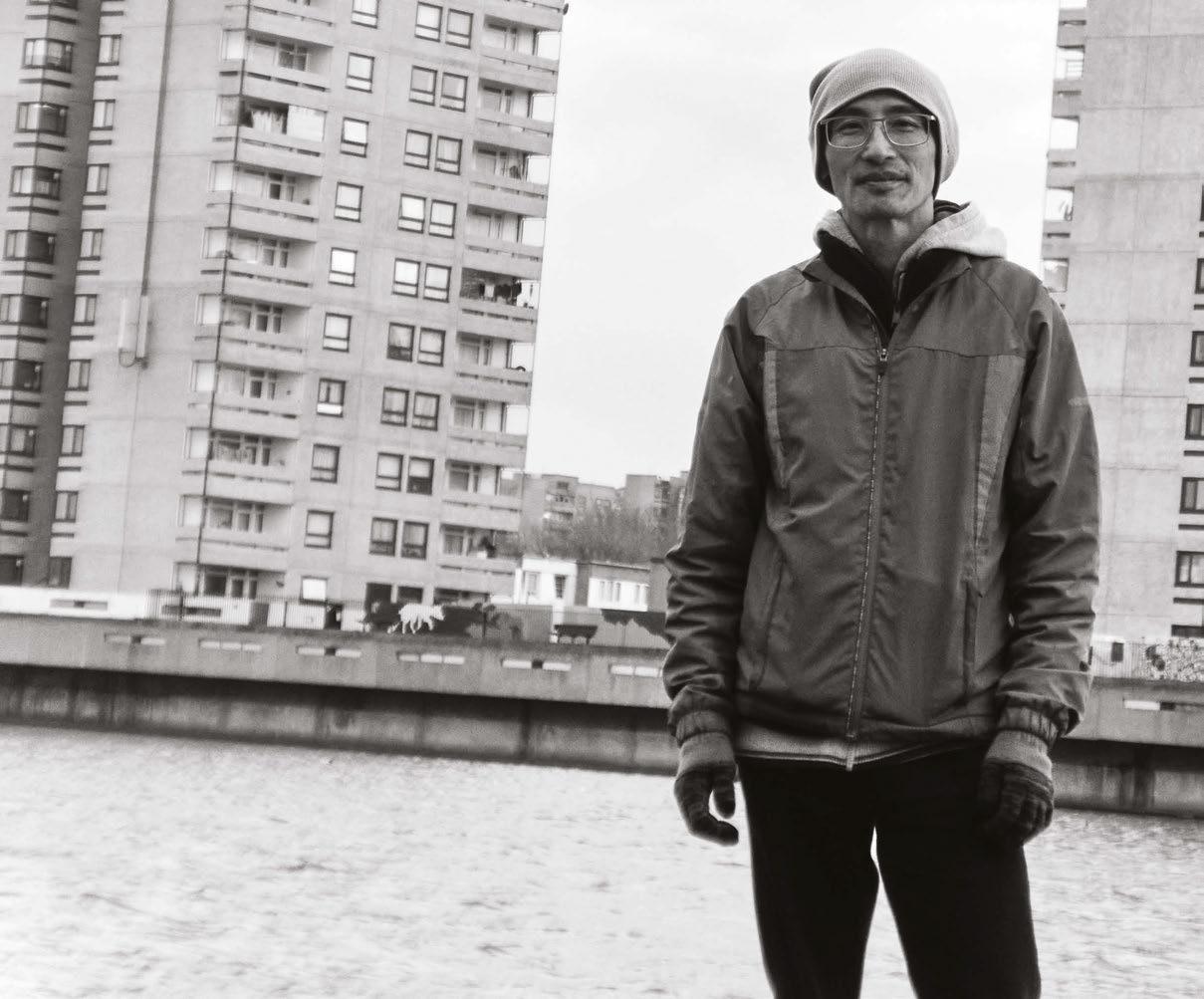

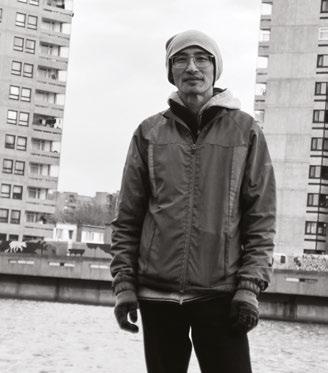
A health services researcher is spending his ee time capturing striking images of Britain’s waterways for Google Maps. A er discovering a YouTube documentary showcasing Hoang’s ambitious e orts, IWA’s Communications Team had a chat with him to learn more about the person behind the camera
We learnt that you have walked 1,600 miles along the country’s waterways. How has that journey changed how you see Britain’s network?
I don’t even know how many miles I’ve walked! I looked at some of the canals and rivers that I’ve already covered, and searched them to see how long they were. I walk om beginning to end until I finish, and sometimes I could veer o down another canal or down another river.
I wasn’t really a water person, to be honest. It’s just really made me appreciate the beau of the waterways we have here. I think we’re really privileged and we take that for granted. When I was photographing some of the tributaries of the Thames, I was absolutely disgusted
“What
has changed is my love of the waterways, that passion to get people out and exploring their waterways. I’m just an individual who walks around with a camera. I don’t work for the waterways or anything like that”


by how polluted they were and shocked at how li le people realised. I think our rivers and waterways are hidden om people and can be unloved spaces. They’re outside, out of mind, People need to see it. As users, we don’t necessarily know the people who own the waterways or who has responsibili for them. If you ask the Port of London Authori or the Environment Agency, I don’t think they know because they own certain sections. They don’t really know the continui of that, all the waterways. I mean, you [IWA] are the closest to knowing it all and being responsible for it all. I think some of the organisations need a wake-up call. We need be er connectedness because water itself doesn’t see these boundaries.
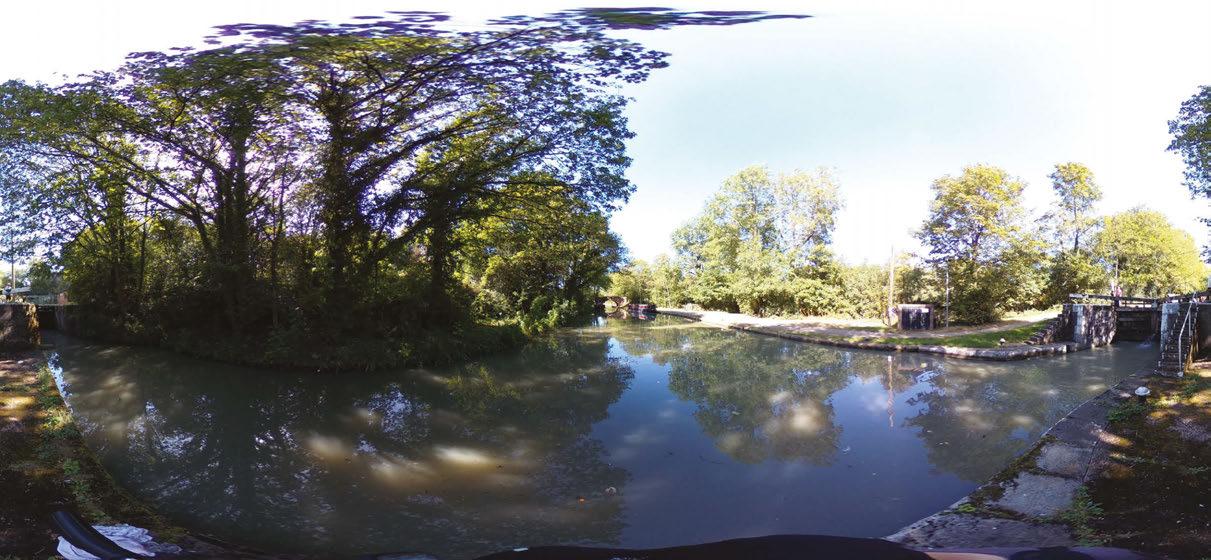
We have read that flood-risk modellers are using your photos. Have you thought about working with charities, local councils or environmental groups to help inform resilience planning? Let’s talk about the engineers, the people who are responsible for the infrastructure. They said: “We sit here in our London offices, planning these things. It costs us money if we have to leave our offices and go on site so we look at your Google images.” I thought, wait a second. Isn’t that wrong? Shouldn’t you be going down to the site? I don’t take the photos for you. I take them for me and others as users. I’m happy to take you down there and we’ll do an expedition.
An example I’ll give you is from the Canal & River Trust. They were going down to Little Venice, and then they noticed my pictures on Google. They said that they are so useful because they’ve got infrastructure and assets on the canals. They tell their contractors to go and fix this lock, this water pipe etc. In 2012 CRT invited Google, wanting really high-quality photos like the roads, but of our canals. Google wouldn’t share the images with CRT, so they asked me to do it. I responded that you must realise that my photo is not for that purpose. It is for users: to give them an impression of what’s there, to encourage people to go there.
What’s been the most challenging moment you’ve had while photographing the waterways? I think the challenges are plentiful. One is around the timings. To do a proper photoshoot, I usually walk about 10 to 15 miles. So the challenge for me often is actually having enough resources to do that. To have enough light, I start very early, at the crack of dawn. I run out of time, I run out of light, I run out of battery power, I run out of storage. And then I basically get tired. It’s all of those things as well as being aware of all the dangers, like being near the water. I’m very, very conscious that I actually don’t look at the pictures, I look at where I’m stepping next.
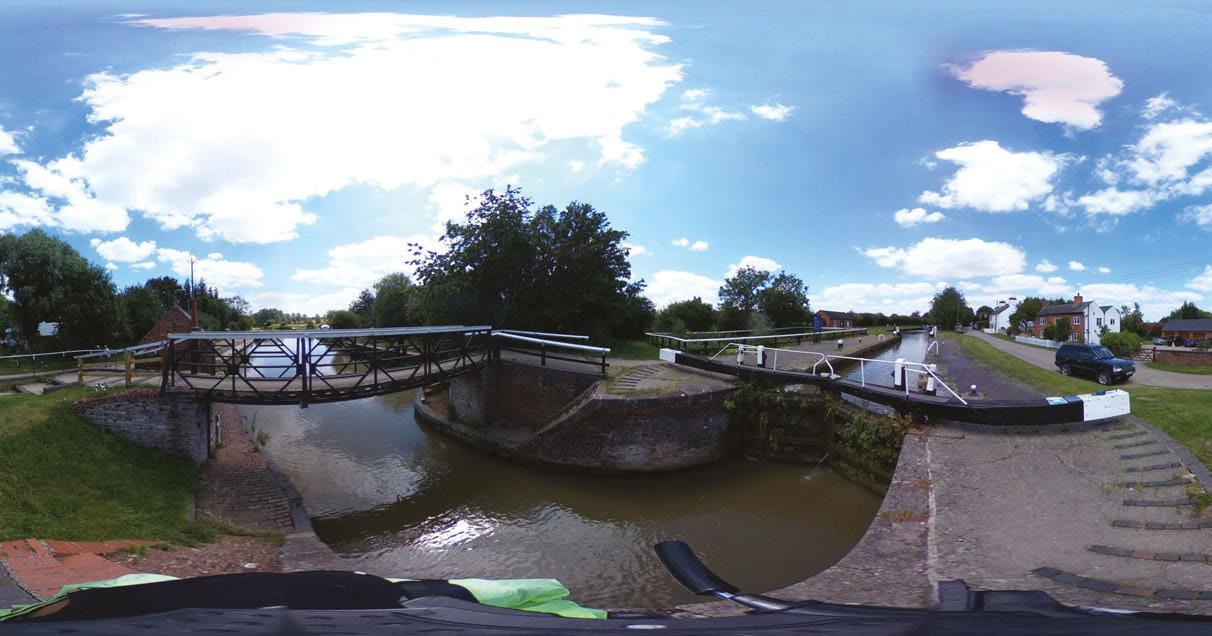
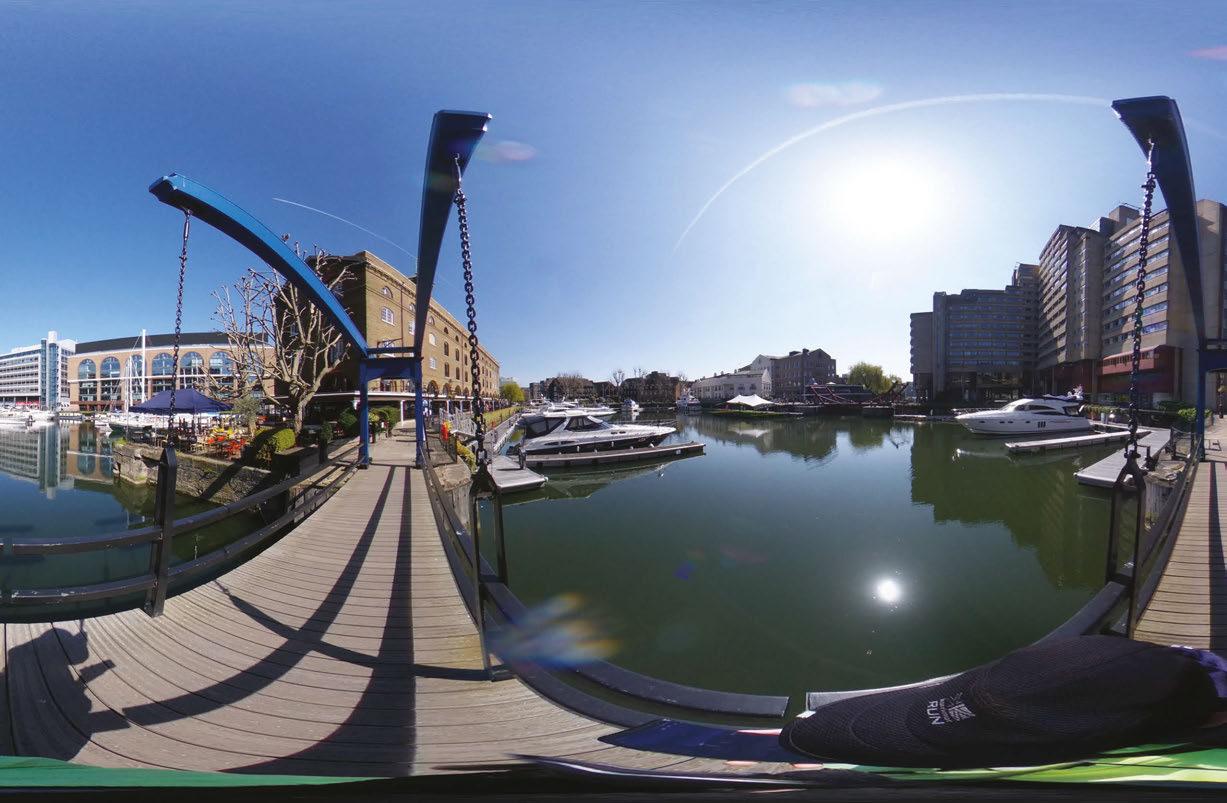
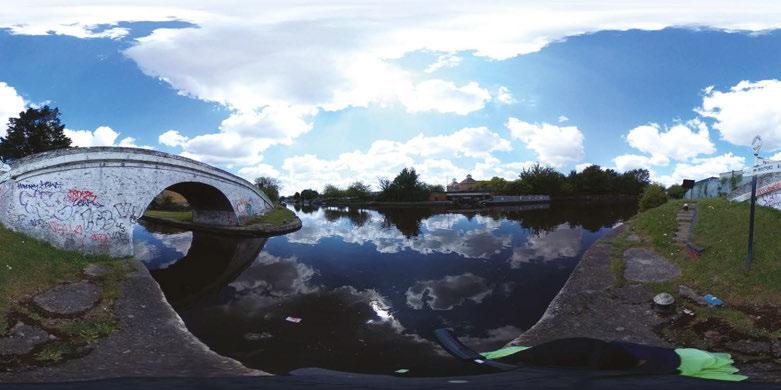
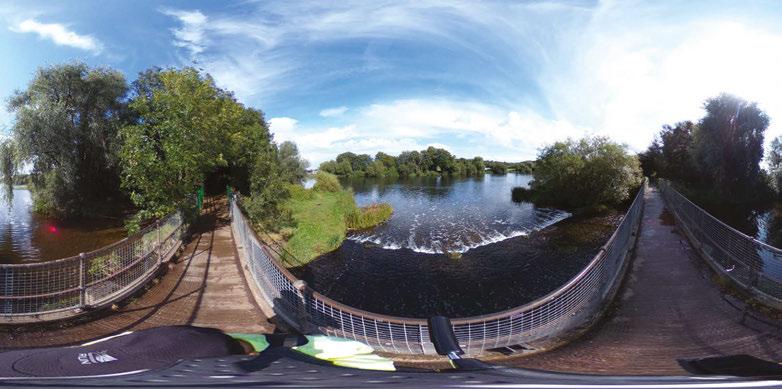
Thinking towards the future, what are you hoping to achieve by taking these photographs?
The reason that I take photographs in this specific way is that I want to make the waterways look beautiful. I want people to go to the waterways.
Long term, I want waterways to be less of a neglected space than they currently are. If people take care of those spaces, not just in terms of less rubbish and stuff like that, but that they really think about the management of those spaces, we may be able to alleviate some of what’s coming up around climate change. The issues of rising water levels and how we manage them. I don’t think we are, as a nation, as connected as we should be to our waterways. If my pictures can stimulate interest in the waterways and help us reconnect with them, that would really fulfil what I’m trying to do.
Obviously, I can’t do it all by myself. I’d be happy to teach others how to do it. Different organisations may end up with versions of the photos, but there needs to be a readily accessible version for everybody. I think that it’s probably more important than having the pictures of the roads. The roads will change but our waterways will be with us, come rain or shine. They were here way before us and they will be here way after us.
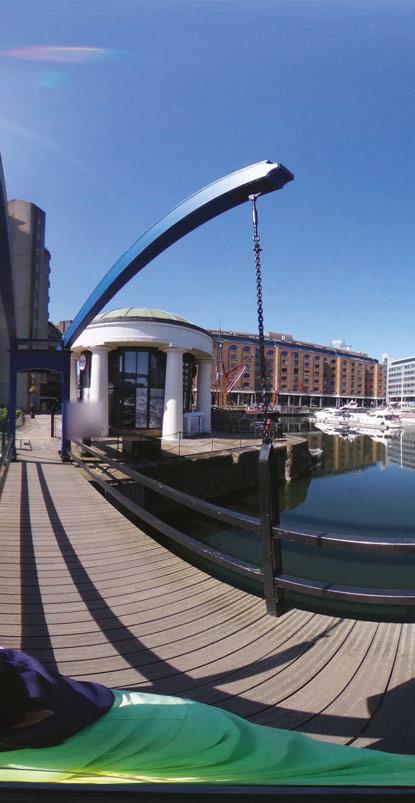
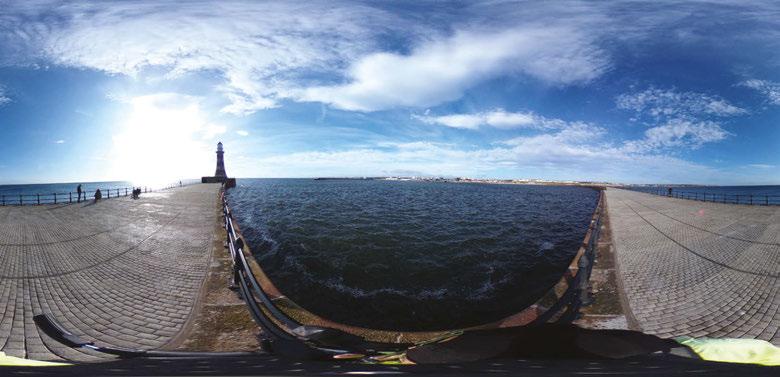
What’s the strangest thing you’ve seen floating in a canal?
Well, it wouldn’t be the canal actually. I was walking along the Trent, past Cromwell Lock, the last lock before the tidal Trent. I was walking along and, as I was photographing, the tide was coming in. You can see all these boats trying to make use of the tide. Then, there was this massive piece of polystyrene, bigger than a boat. It was coming in and travelling much faster than me. I was photographing the other bank the next day, and it was going down the other way. It was big; it’s probably still there, because of how the tide moves in and out.
Obviously you have quite a long day of walking. What is your favourite snack to keep you going?
I try to carry something as energy dense and light as possible, so that I don’t have to carry much. So, I carry a lot of pork pies or Cornish pasties. Actually, I think the more vital thing is water. I carry 1.5 litres with me.
What’s the best reaction you’ve had from someone who spotted you walking with your camera?
I’ve had a few but, honestly, most people aren’t awake because I photograph so early in the morning. I do remember an American guy in particular though. I was taking photographs and his canal boat was coming up behind me, so I’d been photographing him for ages. Eventually when he caught up with me. he said, “Aren’t you that guy that takes photographs? We’re from Wisconsin and we’ve been planning this canal-boat holiday for six months – and we’ve been using your photos to do it!”
Do you listen to anything on your walks, like a podcast or music, or do you just enjoy the sounds of nature? I just immerse myself. One of the reasons why I do this is that I find it very comforting. I enjoy walking by the river. I’m as mesmerised by the water as my viewers are by my photos.
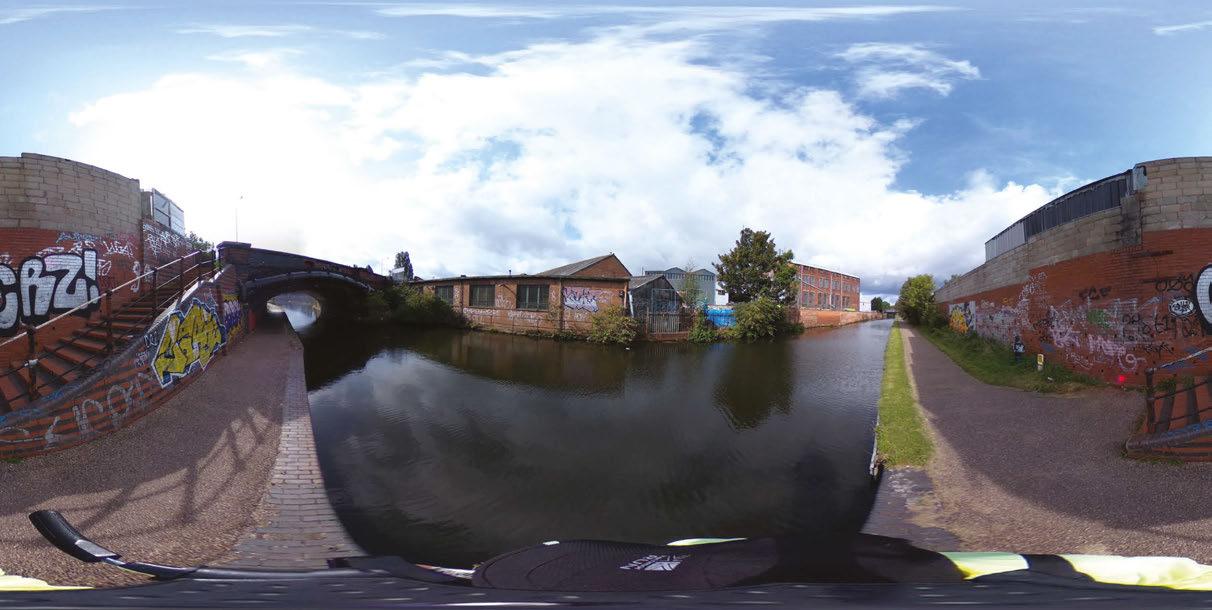
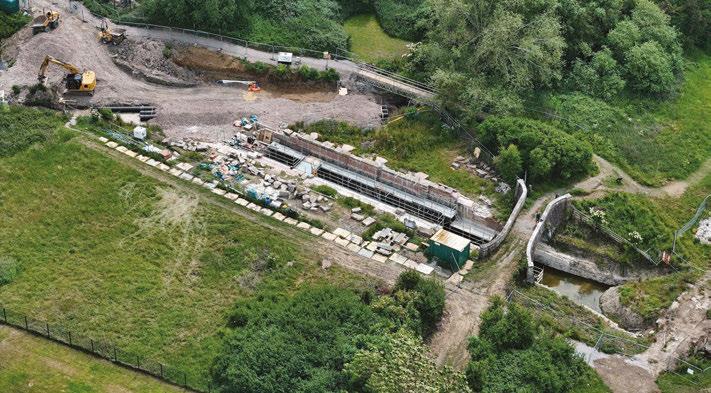
Through skilled volunteer work and unwavering commitment, IWA and WRG have helped turn the Cotswold Canals restoration into a living story of heritage and renewal
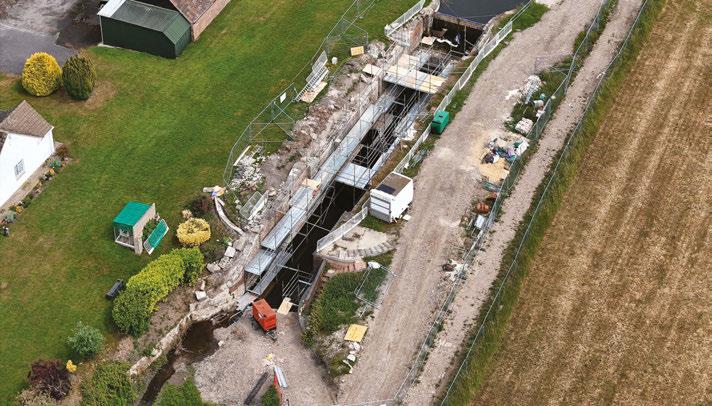
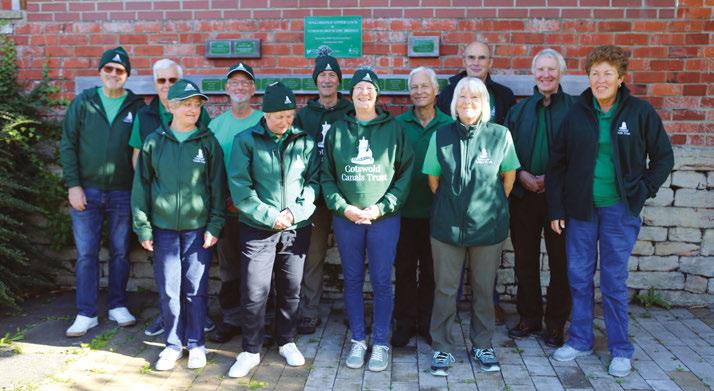
The story of the Cotswold Canals restoration is closely tied to the longstanding commitment of IWA and WRG. Their involvement stretches back to the early 1970s when the Stroudwater Canal Society was established. The Society has evolved over the years, becoming the Cotswold Canals Trust in 1990. IWA championed the project, not just to restore a disused waterway, but to protect a unique piece of industrial heritage and rebuild a lost east–west artery across the Cotswolds.
For WRG, the Cotswolds became a key site for practical volunteer work. Early clearance and lock repairs evolved into regular Canal Camps at Inglesham, Bowbridge and Ham Mill, with volunteers playing a hands-on role in bringing the canals back to life. In 2010, IWA launched the Tom Rolt Appeal to secure Inglesham Lock. A national mobilisation of volunteers, donors and specialists, showed the depth of support for the Cotswolds Canals restoration.
Among the most recent collaborations, under Phase 1B, Cotswold Canals Trust and WRG have continued their hands-on partnership at Weymoor Bridge and Dock Lock. From 2023, WRG Canal Camps at Weymoor Bridge have seen volunteers shaping the canal channel, installing culverts and laying the base for the future towpath. Last year at Dock Lock, CCT volunteers have been restoring the lock chamber – clearing vegetation, rebuilding brickwork and creating a safe ramp – with WRG assisting on the heaviest tasks, lifting large stones and dismantling an unstable wall. Together, they are steadily bringing the locks back to life.
As the restoration has advanced, from major civil works to bridge reconstructions and channel rewatering, IWA and WRG have provided what no contractor could: thousands of hours of skilled volunteer labour, sustained advocacy and an enduring belief in the value of these canals. Today, the Cotswold Canals are more than a restoration project; they are a living story of volunteers, expertise and lasting commitment bringing a historic waterway back to life.
an update by Cotswold Canals Trust
As winter loosens its grip on the Cotswolds, a remarkable transformation continues to ripple along two historic waterways: the Stroudwater Navigation and the Thames & Severn Canal. Once derelict, these linked routes are being lovingly restored by the Cotswold Canals Trust, whose vision is to reconnect England’s inland waterways om the Severn to the Thames.
More than a heritage project, this is the creation of a thriving blue and green corridor – a living landscape that supports navigation, wildlife and communi life alike.
Where restoration meets nature
Step by step, volunteers and engineers have been returning the canals to working order. Along the Stroudwater Navigation (Phase 1A), reopened in 2019 by the then Prince of Wales, the operational Wallbridge Upper Lock and Capel’s Mill section now form a continuous navigable route through Stroud, reconnecting town and waterway for the first time in over 70 years.
The current focus, Phase 1B, will reconnect the Stroudwater Navigation to the Gloucester & Sharpness Canal om Eastington through to Saul Junction – the final link to reinstating this nationally important waterway.
But restoration here means more than bricks, gates and paddles. It’s also about reviving the canals as a living habitat. As part of the National Lo ery Heritage Fund–supported Cotswold Canals Connected project, CCT volunteers are restoring waterways not only for navigation, but also for wildlife and local communities to thrive together. Canalside vegetation is being re-established with native species, new margins and reedbeds provide shelter for aquatic life, and careful dredging ensures a balanced environment for both fish and fowl.
Environmental Volunteer Trustee Director Nick Rowson leads the trust’s commitment to biodiversi . He said, “The Cotswold Canals aren’t just a route for boats – they’re lifelines for wildlife. Every restored section creates a richer ecosystem, om dragonflies and kingfishers to the return of water voles and o ers. Restoration, when done right, strengthens nature rather than disturbing it.”
This approach – treating the canal as both heritage in astructure and wildlife corridor – is now recognised as a national model for sustainable restoration. Within Phase 1B, our partners are reinstating the
“We come om all walks of life – engineers, teachers, retirees, students – but when we’re out there together, covered in mud or manning a stall, we’re all working towards the same vision”
canal, towpaths and habitats, including a new nature reserve with bird hide near Occupation Bridge, once used by local farmers to move livestock.
Powered by volunteers, united by purpose
The scale of this work would be impossible without the 350-plus volunteers who make up the heart of the Cotswold Canals Trust. Across five main depots, teams of skilled cra speople – carpenters, welders, stonemasons – rebuild lock gates and fabricate metalwork to heritage standards. Workboat crews keep navigation clear, dredging and maintaining channels using restored tugs and barges.
Along the towpaths, length wardens care for the day-to-day maintenance: checking locks, cu ing vegetation, welcoming boaters and walkers. Behind the scenes, dedicated volunteers sta the trust’s chari book and music shops, manage administration and fundraising, and help keep the organisation running smoothly.
Every lock restored and every towpath tended are a tribute to this extraordinary volunteer e ort. Canal restoration, a er all, is as much about communi spirit as engineering.
As spring returns, the canals will once again come alive with visitors. From March 2026, the trust’s popular volunteer-led boat trips and guided walking tours will resume across several restored sections, including Stroud, Ebley and Saul, giving visitors a close-up view of restoration in progress while proceeds directly fund ongoing work.
CCT’s visitor centres at Saul, Stonehouse, Stroud and the Cotswold Lakes will be open to share the remarkable story of the past 50 years since the chari ’s creation in 1972, celebrating how far the restoration has come.



Walkers can explore the towpath network, tracing restored stretches to those still awaiting renewal and witnessing first-hand how a once-silent corridor has become a haven for both nature and people. A highlight for visitors will be the Phase 1B restoration sites at Eastington and Fromebridge, where volunteers are actively reinstating the canal and locks. At the eastern end, at the Cotswold Lakes, more than 4,000 volunteer hours have gone into creating the area’s only fully accessible towpath, o ering wonderful views across Lake 4 and the wider canal network.
Flowing forward together
Looking ahead, the trust’s ambitions remain as strong as ever. The announcement of £6.46m in National Lo ery Heritage Fund support for Phase 1B in late 2025 secures the continuation of work on the ‘missing mile’: reinstating 1.6km of canal bed and towpath, passing under the M5, re-routing an oil pipeline, restoring and refurbishing six locks, creating a new canal basin near the A38, and developing a nature reserve and new wildlife hedgerows.
With an opening aimed for 2029, marking 250 years since the creation of the Stroudwater Navigation, this milestone will celebrate both the canal’s heritage and its future.
The Cotswold Canals story is, at its heart, one of connection between waterways and wildlife, between heritage and communi . Each lock rebuilt and each stretch rewatered brings history, nature and people together once again.
This spring, that flow continues –powered by the passion of hundreds of volunteers and the promise of a greener, bluer Cotswolds.
To find out more, become a member or volunteer, or to book a trip, visit cotswoldcanals.org.
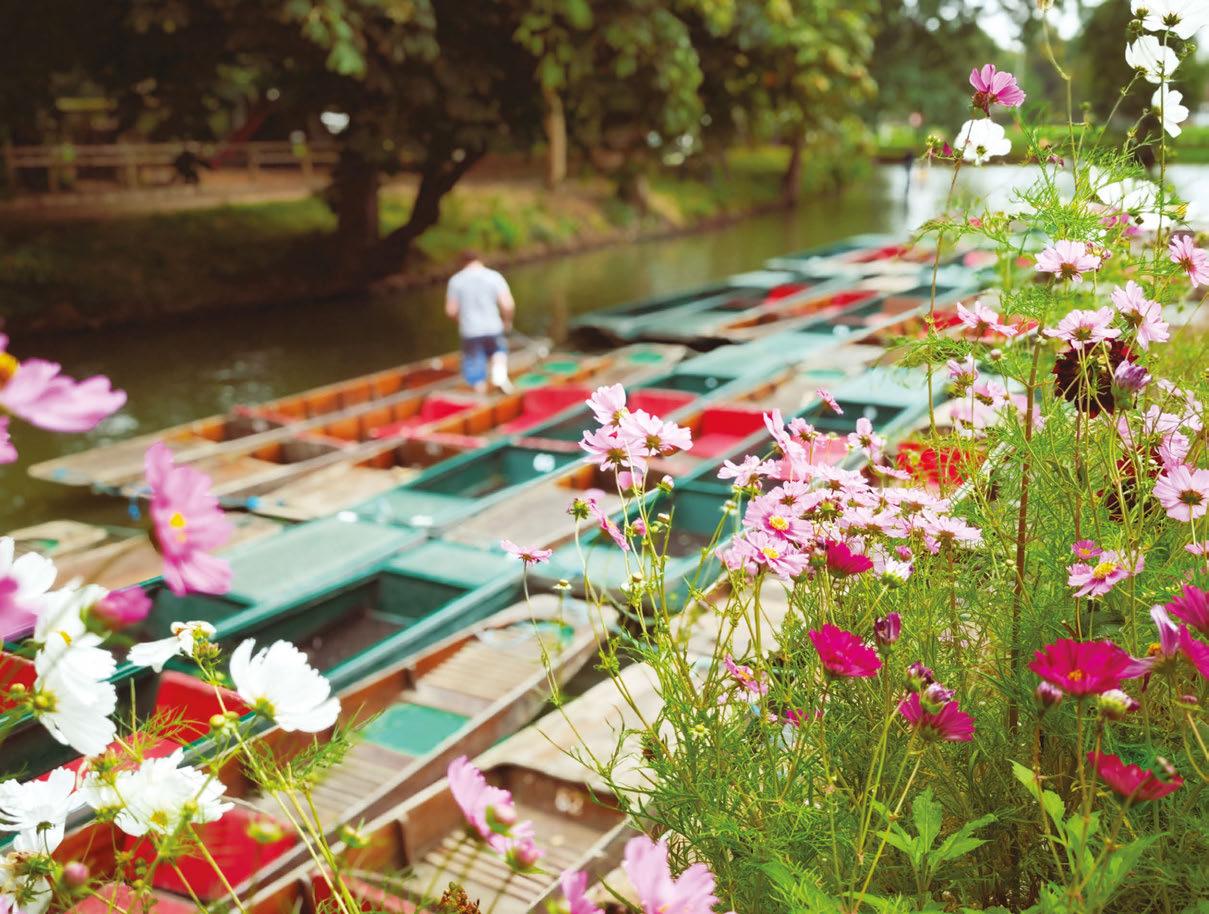
Let’s take a closer look at IWA’s Oxfordshire Branch, where collaboration with local communi groups is high on the agenda
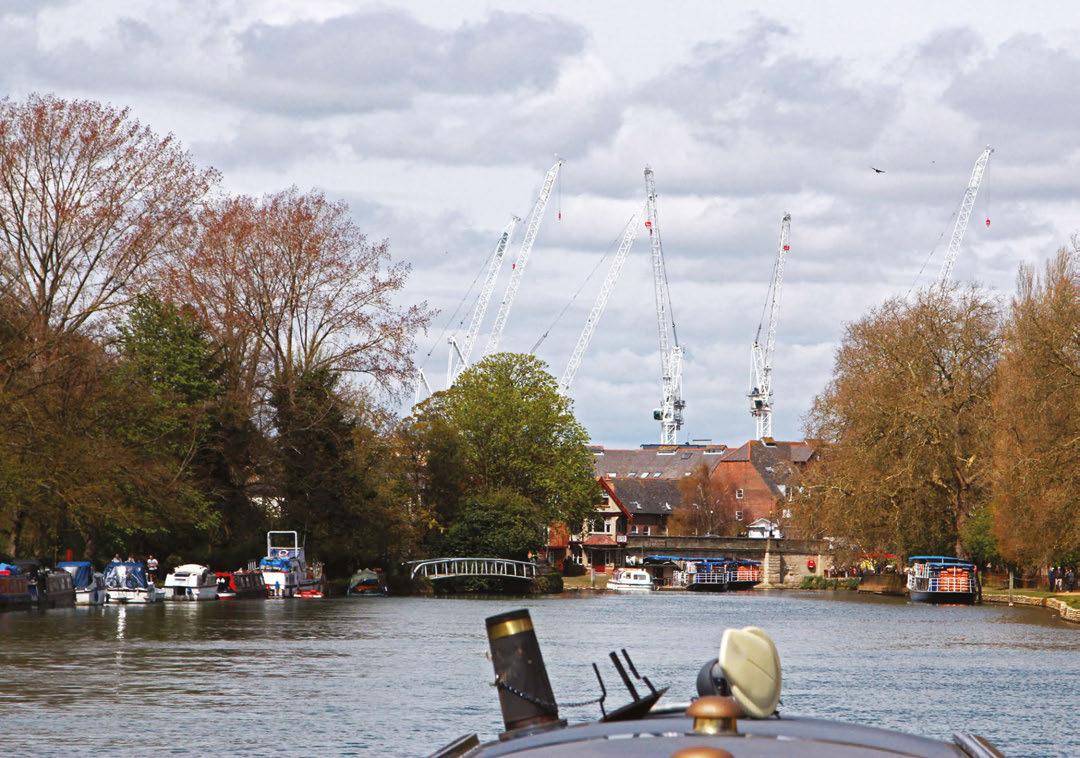
IWA’s Oxfordshire Branch Chair, Ian Lindsay, is a prime example of demonstrating how much local waterways work relies on collaboration. Not only is Ian chair of IWA’s Oxfordshire Branch, he also chairs the Environment Agency’s River User Groups 1 and 2, is a member of the Environment Agency’s Thames Waterways Forum, chair of the British Marine Federation London & Thames Valley, a member of the River Thames Socie , and owner of Lechlade Marina.
Ian’s involvement across these groups gives him a broad overview of how decisions are made and how di erent organisations operate along the Thames and its connected waterways.
IWA’s Oxfordshire Branch has long played an active role locally.
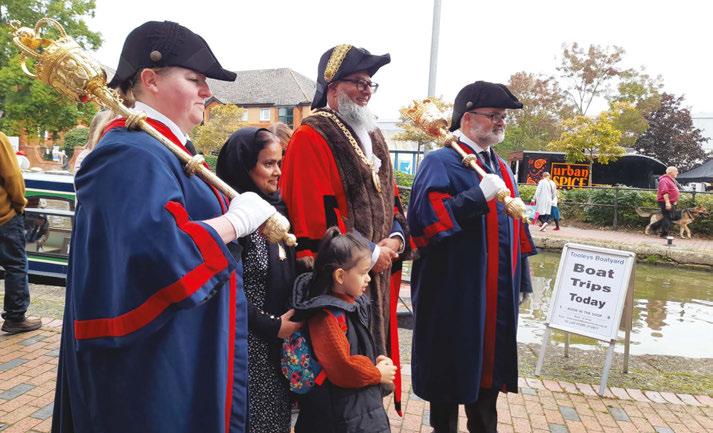
It was a founding member of the Oxford Ci Canal Partnership and continues to support several well-established communi events. One of the biggest commitments each year is the Banbury Canal Festival, held in 2025 on 4th-5th October across Castle Quay, Tooley’s Boa ard and the towpath. It’s a large, well-a ended event with live music, boat trips, food, trade boats, cra stalls and heritage displays.
Because the canal runs right through the town centre, the festival gives the branch an opportuni to speak to a wide mix of people, not only boaters and enthusiasts but also local residents who

may not normally think of the canal as part of their town’s heritage.
IWA’s Oxfordshire Branch is also represented at the Oxford Canal Festival, a biannual communi event at Aristotle Lane Recreation Ground with a more informal, village-fete feel. The festival raises funds for projects, such as restoring Kilsby the Theatre Boat, and includes music, food, children’s activities, canal walks, history displays and spoken-word performances.
Again, it o ers a good chance to talk to families and local visitors about what IWA does and why waterways ma er, including to those who don’t own boats.
Alongside events, the branch works with neighbouring branches on the
Cargoes newsletter and maintains links with organisations such as the Cotswold Canals Trust and the Wilts & Berks Canal Trust. These relationships help keep information flowing between groups and ensure local issues are picked up early.
The branch’s activities, whether festivals, responses to local developments or day-to-day engagement, depend entirely on volunteers. Ian brings a great deal of experience and energy to the role, but it is more work than one person can sustain alone.
IWA’s Oxfordshire Branch would benefit from a small team to help share tasks and keep momentum going. Anyone interested in getting involved, even occasionally, would be very welcome. A little support goes a long way in helping the branch continue its work across the county.
Branch opened: 1974
Local waterways: River Thames – Goring to Cricklade South Oxford Canal – Oxford to Claydon Wilts & Berks Canal – Abingdon to Shrivenham
Fact: The Oxfordshire Branch was previously a section of London & South East Branch
Membership: 148
Find out more: waterways.org.uk/waterways/branches/ iwa-oxfordshire-branch facebook.com/IWAOxfordshireBranch Ian.Lindsay@waterways.org.uk
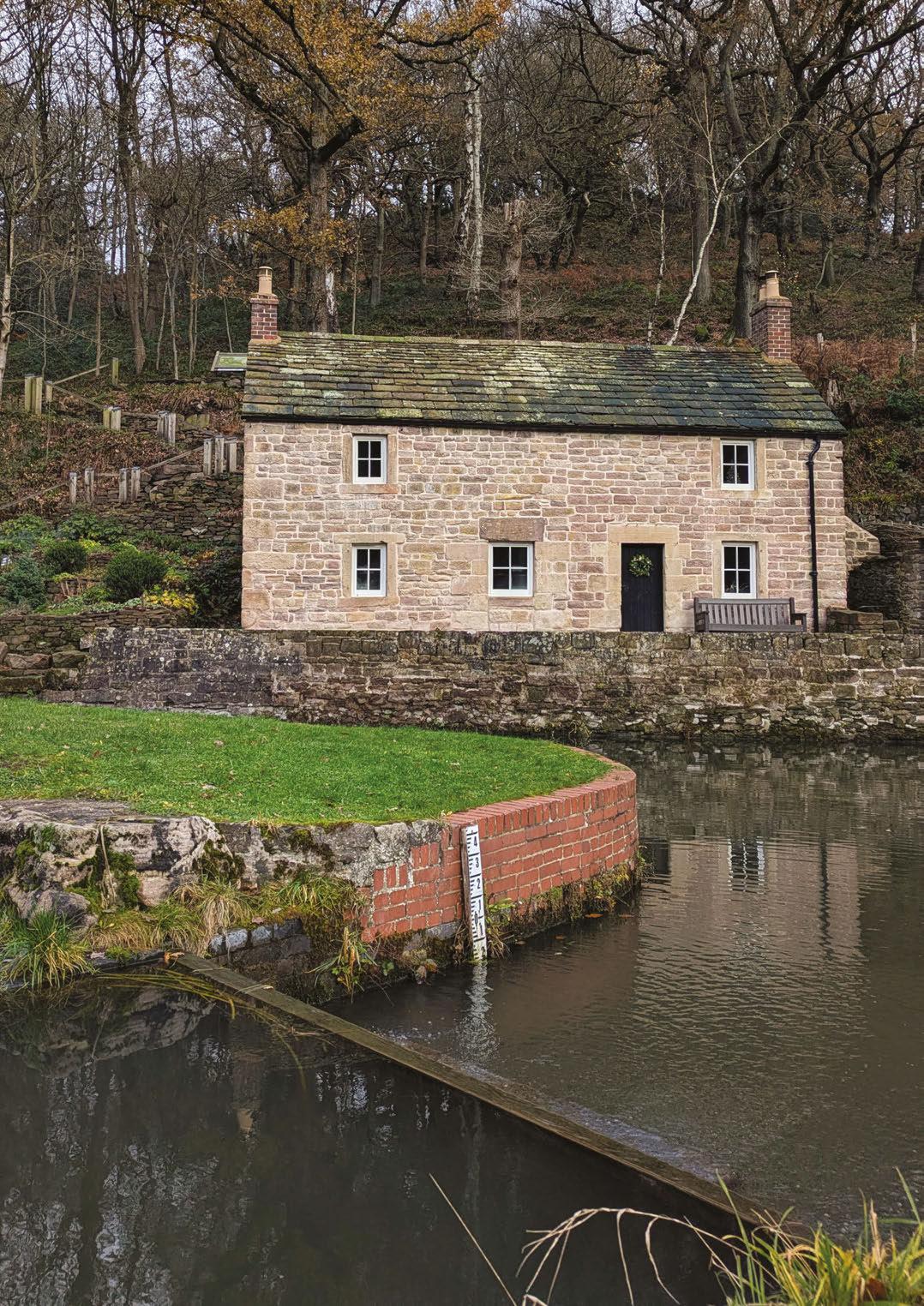




Join IWA’s Commununications & Content Coordinator, JENNY DAVISON, as she delves into the history and heritage of Derbyshire’s Cromford Canal
The heritage-soaked Cromford Canal, in the Derbyshire Dales, o ers endless places to explore on foot and afloat. Whether you love industrial heritage, wildlife, walking, or simply watching boats dri by, the Cromford Canal shows just how much magic there is to discover when you slow down and follow the water.
We live near the old line of the Cromford Canal, close to where Bullbridge Aqueduct once stood, and our local pub is still proudly named the Canal Inn, a reminder of the waterway that shaped this landscape long before we arrived.
The Cromford Canal we know today is a calm, wildlife-filled corridor through the Derwent Valley, but 200 years ago it was a key part of the area’s industrial transformation. The northern stretch lies inside the Derwent Valley Mills World Heritage Site, and even a short wander reveals just how much history this canal still holds.
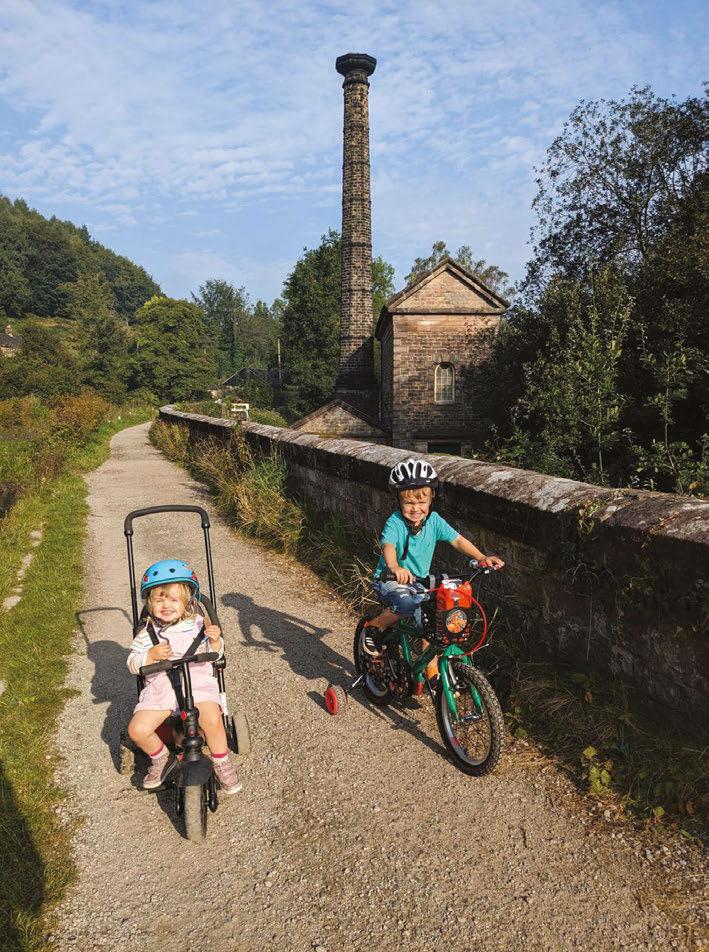
Five miles of uninterrupted towpath link Cromford Wharf to Ambergate, passing old warehouses, railway buildings, a swing-bridge and the stilloperational Leawood Pumphouse. Thanks to its rich varie of plants and wildlife, the canal is also designated as a Site of Special Scientific Interest.
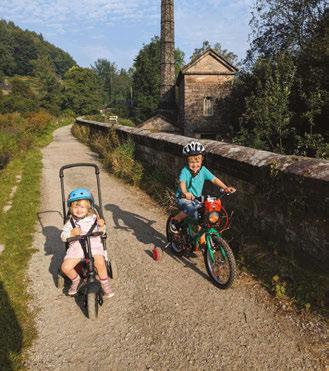
Cromford is one our favourite places to explore with our young children, whether the kids are on their bikes or we’re wandering with snacks and muddy boots. The canal has become a place where nature, history and esh air come together beautifully.
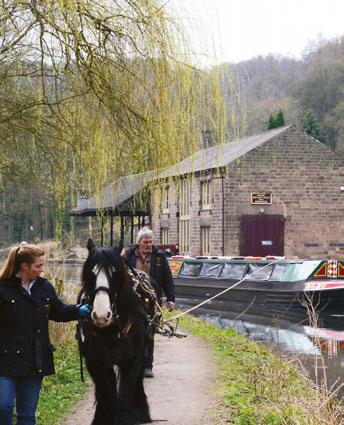


DISTANCE: 4.7km (9.4km there and back)
EASE: Easy, flat terrain
PARKING: Pay and Display parking available at Cromford Mill (W3W pills.lampost.over) or Cromford Wharf (W3W doubts.shrug.woodstove)
ROUTE MAP: h ps://footpathapp.com/routes/d6b8a21d9aa9-47fe-aef5-d29167717345
A stroll through our industrial heritage
START: Cromford Wharf
Cromford Wharf still echoes with its past: the old warehouse, smithy, stables and counting houses remain. Depending on the time of year, li le grebes, water voles and dragonflies dart between the reeds. Don’t forget to look out for Stella the Stegosaurus, visible in the trees om the towpath, a firm favourite with my children.
1. Cromford Wharf to High Peak Junction
Follow the towpath to High Peak Junction, home to some of the earliest railway workshops in the world. This is where the Cromford & High Peak Railway once linked Derbyshire’s mills and mines across the hills. The area is beautiful for nature spo ing and marks the start of the High Peak Trail.
2. High Peak Junction to Leawood Pumphouse
Continue along the towpath to the impressive Leawood Pumphouse. Built in 1849, this steam-powered beam engine once pumped water om the River Derwent to keep the canal topped up. On steaming days, the heat, the smell of coal and the rhythmic thud of the machinery make it feel like you’ve stepped into a time machine.
3. Leawood Pumphouse to Aqueduct Cottage
A li le further on sits Aqueduct Co age, now beautifully restored a er years of dereliction. It sits at the junction of the Lea Wood Arm and is now an important piece of the Derbyshire Wildlife Trust’s vision for a more biodiverse valley. You can return to the wharf om here to complete the 5km loop, or continue toward Ambergate if you’re in the mood for a longer adventure.
Much of what we enjoy today exists because of the work of the Friends of the Cromford Canal (FCC) – a volunteer-led chari dedicated to restoring, preserving and championing the waterway. Their pride and joy is Birdswood, a heritage narrowboat built just before World War II. Since being restored, it has become a familiar sight running passenger trips om Cromford Wharf.
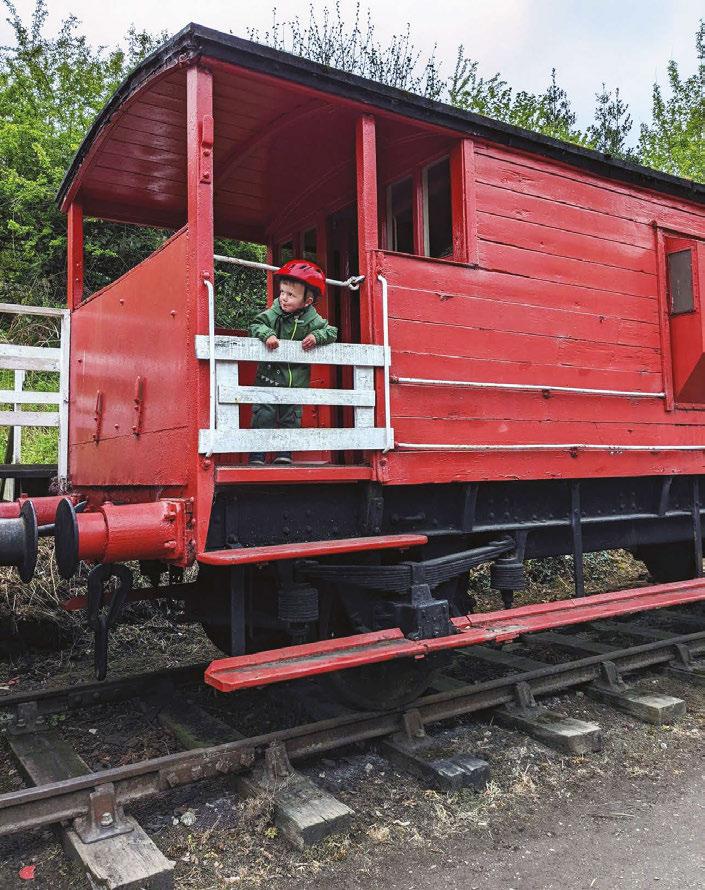

Restoration in Progress: The Beggarlee Extension
While we’re in the area, let’s take a moment to look at the No inghamshire end of the Cromford Canal where restoration continues. FCC has begun work on the Beggarlee Extension, which will reconnect the canal north om Langley Mill through a pair of staircase locks and under the A610. Volunteers and Waterway Recovery Group teams have helped on multiple occasions, using heavy machinery and careful planning to push the project forward. A endees of IWA’s AGM, in September 2025, were invited to a guided walk with FCC to visit the Beggarlee Extension and hear about the planned restoration.
Work also continues at Hartshay, along council-owned stretches, and across sections in mixed ownership. Birdswood’s volunteer-run trips have generated record income, which directly funds these ongoing e orts. The recent restoration of Aqueduct Co age is a brilliant example of just what determined volunteers can achieve. You can read more about the Beggarlee Extension here: cromfordcanal.org/restoration.

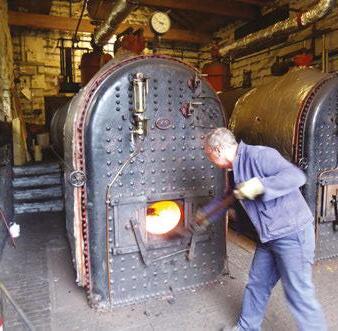










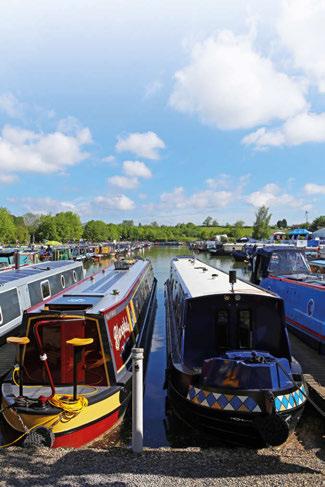



IWA Lichfield volunteers tell us how they have been busy tackling the tricky off-side growth to keep our canals safe
Words: Neil Barnett, IWA Lichfield Branch Chair
Last November saw the IWA Lichfield Branch start its eighth consecutive winter of off-side vegetation cutting.
The team started a little later than planned due to the low water levels and a few other issues which needed sorting but, in conjunction with CRT volunteers (IWA Lichfield Branch works two days a week), they began near Whittington on the Coventry Canal. They are currently working their way south and aim to be reaching Marston Junction by the end of February when the cutting has to stop due to the nesting season.
The off-side (non-towpath side) is notoriously the most difficult to tackle due to the challenges with getting to it – a boat is essential for works to be completed. As a result, the off-side doesn’t get cut back as often as it should, and naturally protruding vegetation has an impact on boats being able to navigate the canals safely, so it is essential that the work is carried out.
From the outset, the hope of reaching Marston was a tall order, even before the delayed start affected proceedings. With a limited cutting time, the volunteers are only able to concentrate on the vegetation which is most adversely impacting navigation. Neil Barnett, a volunteer who has been
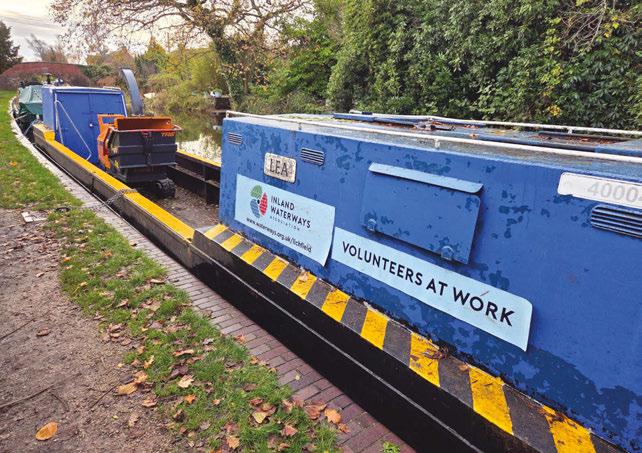
working on the branch since 2017, said, “It’s most frustrating having to bypass vegetation which we would really love to tackle but don’t have the time to do. If we dealt with everything we passed, it would mean that by the end of the season there would be more severely impacting vegetation further ahead which would end up not being cut.”
For this reason, the team has to focus on dealing with vegetation in key places such as on bends, narrow stretches, approaches to bridges and locks, opposite popular moorings if the canal is rather narrow, and where sightlines are affected. Some years they work from two boats (a workboat pushing a 60ft hopper boat) and other years just a workboat. It all depends upon what CRT has available. Neil says, “Two boats work very well, despite the fact that they require separating when going through the narrow locks. One boat houses the huge wood chipper into which the cut branches are fed, leaving plenty of room in the other boat solely to do the cutting from.”
This winter, however, they just have the workboat and, as the chipper takes up a lot of room, their progress is slowed down considerably because the boat becomes full of branches very quickly and cutting has to be halted frequently because there
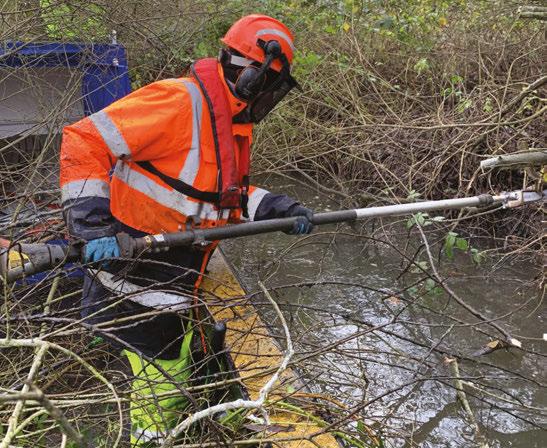
is no room to safely work from within it. Neil continues, “Because we are using long-reach pole-chainsaws and hedge trimmers, it’s imperative to have a stable footing. The last thing we want is any of us stumbling over branches while the blade of the chainsaw is whirring!”
When asked what motivates the volunteers to spend winter days outside during what can sometimes be rather harsh winter weather, Neil said, “That’s an easy one to answer. It’s for the same reasons as other types of outdoor volunteering. It’s the fresh air, the exercise, the sense of achievement, the camaraderie and the banter with each other.”
“Plus, I’m retired and live with my wife aboard our narrowboat, so for me (and my wife) another benefit is having a day’s peace and quiet away from each other!” Neil jokes. “It’s also nice that we receive compliments and appreciation from passing boaters, as well as from members of the general public. We have magnetic IWA signs on each side of the boat so it’s good publicity for the Association too. All of our branches are looking for volunteers for both physical and administrative help, so please contact your local branch if you are interested in joining in.”
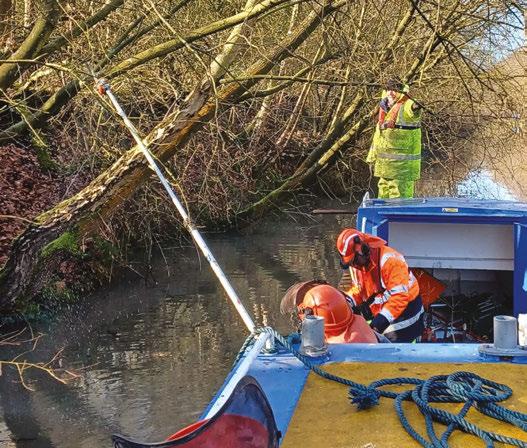

Weekend 27-28 June, 2026
Opening of the rally by legendary song composer / producer
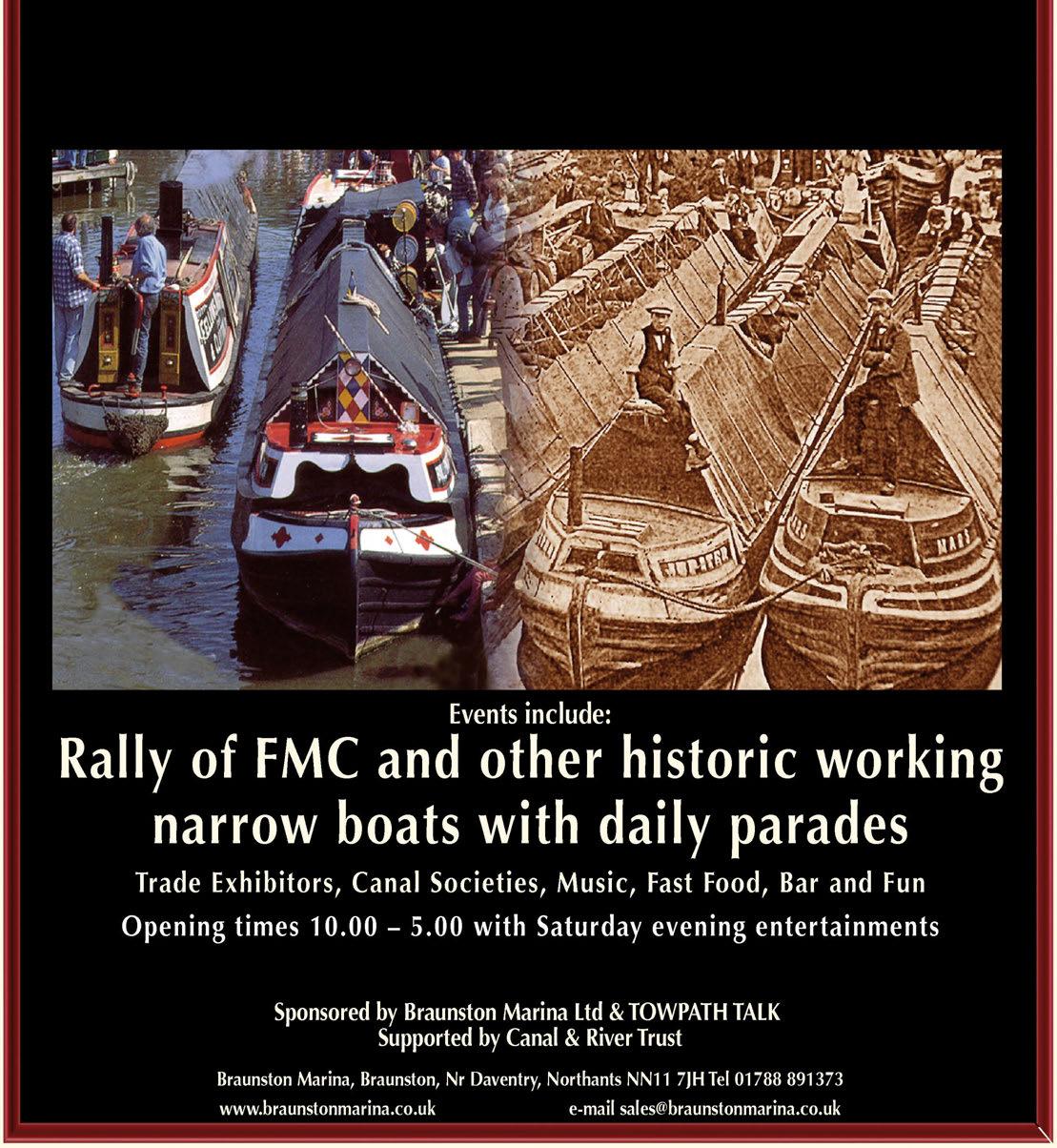
ENTRANCE £30 per car (all profits to canal & local causes)




Automatic 10% discount for marina berth holders in the
Industry leading 25% NCB** after 5 years claim free.
No excess to pay and NCB fully protected should any loss occur while moored or ashore in a marina.
Emergency out of hours claims helpline for when you need us most.