Great Ouse Branch
Ouse News - Autumn 2026 Newsletter covering the Great Ouse and tributaries Contents:
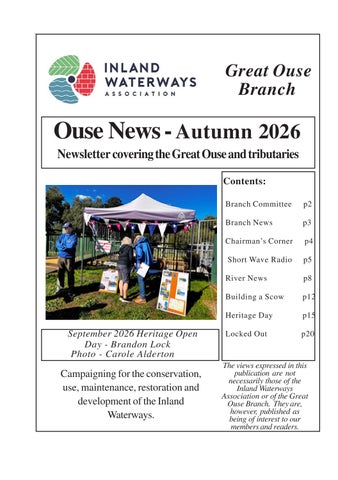
September 2026 Heritage Open Day - Brandon Lock Photo - Carole Alderton
Campaigning for the conservation, use, maintenance, restoration and development of the Inland Waterways.
Branch Committee
p2
Branch News
p3
Chairman’s Corner
p4
Short Wave Radio
p5
River News
p8
Building a Scow
p12
Heritage Day
p15
Locked Out
p20
The views expressed in this publication are not necessarily those of the Inland Waterways Association or of the Great Ouse Branch. They are, however, published as being of interest to our members and readers.
Ouse News Page 2
Great Ouse Branch Committee:
Chairman: Keith Alderton Tel : 01366 727236 Secretary: John Hodgson Tel : 01234 344884 Treasurer: Enid Hodgson Tel : 01234 344884 Ouse News Editor: Carole Alderton Tel : 01366 727236 Membership Officer Stephen Foote Tel: 01763 838936 Member: Robin Adams Tel: 01223 862026
Do you have a few hours to spare? We need your help! We are a small, friendly group and desperately need more committee members to help us organise meetings and events.There are only 6 of us!! Please contact the Chairman if you would lik to help us.
Ouse News Page 3
Branch News Winter Meetings are at 8.00 pm at the North Lodge Pavilion, North Lodge Park, Milton, CB24 6UD. T HURSDAY 19 TH N OVEMBER 2026 This meeting will be a ‘Waterways Themed Quiz’ followed by a fish and chip supper.
Welcome to our latest member and we hope to welcome more new members soon.
Please note change of date.
T HURSDAY 25 TH F EBRUARY 2027 At this meeting we will be given an illustrated talk by Enid Hodgson titled ‘Comparing the Rivers Great Ouse and Barrow (Southern Ireland).
T HURSDAY 25 TH M ARCH 2027 This will be our AGM followed with an update by a River Manager from the Environment Agency.
Rupert Bull Saffron Walden
If anyone is reading this newsletter and would like t o b e c o m e a m e m b e r, p l e a s e c o n ta c t St e p h e n Foote, our Membership Officer, on 01763 838936.
Ouse News Page 4
Chairman’s Corner After a record hot, dry summer, we find ourselves well into autumn with still little sign of much-needed prolonged rainfall. Although the level of the main River Great Ouse has held up remarkably well, levels and flows in the Eastern tributaries continue to deteriorate. Anglian Water have stated that ‘reservoir levels started 2026 below average and since then the Great Ouse catchment areas have experienced the 4th lowest March to September rainfall on record, resulting in a further significant reduction in reservoir levels’. If forecasts suggest that they will not achieve significant refill heading into 2027, a drought permit will be sought from the Environment Agency to allow them to draw water from the Great Ouse to support the winter refilling of Grafham Water Reservoir. The Environment Agency will no doubt find themselves having to make difficult decisions balancing competing calls for finite water resources. We shall have to remain alert to any decisions likely to adversely affect navigation. However, I suspect that the provision of drinking water will of necessity take priority. We started our off-season meeting programme with a talk by committee member Robin Adams showing how he hand-built a wooden scow and sailed it on the River Cam (see report on page 12). Our November meeting will consist of a fish and chip supper together with a waterways related quiz. The event will provide a good opportunity to meet and socialise with other like-minded members. Please do try and make an effort to attend. We would be very pleased to see you.
Keith Alderton
Ouse News Page 5
Continued from our Summer newsletter: Short-range Radio Part 3 – Radio and Inland Boating Inland boaters can apply to ‘OFCOM’ for a short-range radio licence. The applicant must produce a ‘Certificate of Competence’ to operate a shortrange radio. The certificates are issued by the Royal Yachting Association (RYA) and a short training course must be attended and an exam passed before a certificate can be issued. Courses to enable a certificate are available from many cruising schools and clubs around the country. These licences are issued free of charge if you apply ‘on-line’ but must be renewed at intervals – and OFCOM don’t send out reminders. It’s up to the licence holder to renew on time. All the necessary details are on the OFCOM website - but like so many government websites, it’s not easy to navigate through. But why? Where’s the point? Well, if you’re cruising solely on the canals and inland river navigations, probably none. But – if you venture out onto tidal waters (Severn, Trent, Thames below Teddington lock – even our own Great Ouse beyond Denver Sluice), cross the Wash, the Channel or venture even further afield, a short-range radio is a ‘must-have’. As you leave non-tidal’ areas the lock-keepers will like to know that you are carrying radio so they can keep track of you and get in touch with you quickly if necessary. Having attended a course and passed your exam you will get an RYA certificate. Then you can apply to OFCOM for a licence to operate. Your boat will be issued with a call-sign and an MMSI (Maritime Mobile Service Identity). In my experience, call-signs are rarely used; most operators use the name of their boat as an ID. The ‘MMSI’ is important because if you have a ‘fixed’ (as opposed to a ‘portable’) radio, the MMSI must be programmed into the transmitter. Then – if you get into trouble you press the ‘emergency’ button on your transceiver and it should send out your MMSI. Coast-guards, lockkeepers and other services should pick this up and will know - who you are and what you are and can summon emergency help. (NB the rules for portable (hand-held’) sets are a bit different – see the OFCOM website.)
Ouse News Page 6 Modern short-range transceivers are mostly equipped with GPS - which can be very helpful in all sorts of ways. Owners of steel boats will need an external GPS aerial if their transceivers are mounted inside the boat – as the steel superstructure is very likely to screen the radio and prevent the GPS signals from getting through. We have enjoyed having a short-range radio on our boat. We’ve never had to use it in an emergency but lock-keepers have always been very complimentary – and we have been surprised how many captains of big seagoing cruisers have hailed us and asked ‘Where are you heading for, skipper?’ ‘Wolverhampton. How about you?’ ‘St. Helier and Cherbourg. ‘Let’s see who gets there first…! Short-range radio adds a little extra to cruising and introduces a useful element of safety. Not to be dismissed lightly! References: Reade, L ‘Marconi and the Discovery of Wireless. (Faber and Faber, 1962) Clarricoats, J. ‘World at Their Fingertips’ (RSGB , 1962) Anon. ‘Marconi and his Original Experiments’ Short Wave Magazine Vol XIX (1962) (11) 593-596 Trippett, M.. ‘Course Notes for VHF Radio Short Range Certificate’ Crest Cruising School 2003 OFCOM.org.uk
Stephen Foote
Ouse News Page 7
Ouse News Page 8
River News from the Environment Agency Great Ouse Navigation - Update Winter works, fair registration and local stewardship On the Great Ouse and its tributaries, two strands of work are especially important this autumn: planning essential winter maintenance and ensuring that vessel registration requirements are applied fairly. Preparing the navigation for the seasons ahead The Environment Agency is finalising its 2026/27 winter works programme. Projects being considered include completing the downstream landing stage at Bedford Lock, further improvements at Upware Lock, and larger schemes at Isleham Lock and Denver Sluice. Together, these works are intended to protect key infrastructure and support a safer, more resilient navigation. Priorities are assessed against safety, asset condition, operational need, deliverability and the wider benefit to the navigation. Work at Bedford does not mean that concerns elsewhere have been set aside. Denver Sluice Lock issues including closed 48-hour moorings and needs at Brandon remain under review for future programmes. The challenge is familiar to everyone with an interest in the waterways: maintenance needs exceed the funding and delivery resources currently available. Choices must therefore be made carefully, balancing immediate risks with the longer-term condition of locks, gates, landing stages and associated structures. Why winter working matters Winter offers the best opportunity to undertake much of this work while limiting disruption during the main cruising season. Dates are not yet fixed and will depend on detailed planning, contractor availability and river conditions. Early communication will be particularly important for people arranging winter moorings, boat maintenance or early-season journeys.
Ouse News Page 9 Confirmed restrictions, closures and expected reopening dates will be published through the Environment Agency’s annual Winter Works Navigation Notices. IWA members and other river users are encouraged to monitor those notices and share relevant updates through their local networks. Registration and enforcement: supporting a fair system Maintaining the navigation also depends on boat owners meeting their registration obligations. The Environment Agency’s Navigation Enforcement Team combines advice, engagement and compliance monitoring with formal action where repeated efforts to resolve a case have not succeeded. Progress in numbers During 2025/26, the team recovered more than £230,000 in unpaid or overdue registration income and brought 580 vessel registrations into compliance. Progress has continued in 2026/27. With five months of the financial year remaining, £240,000 had already been recovered and 549 vessels brought into compliance. A further 192 cases were progressing through the enforcement process. Around 70 active cases on the Great Ouse system were estimated to involve liveaboard vessels, which can require particularly careful and sensitive management. Engagement first, formal action when necessary Most boat owners register their vessels without difficulty. Where registration remains unresolved, the team seeks to engage with owners and help them comply before considering formal measures. Removal is a last resort. In 2025/26, enforcement action resulted in the removal of 33 unregistered vessels across Anglian Waterways, most from the Great Ouse system in March 2026. Locations included Buckden and St Neots marinas,mooring sites at Avalon, Little Ouse Downham Market and Denver East Bank. Improved monitoring and case management are now helping the team intervene earlier and spread activity more evenly through the year.
Ouse News Page 10 Up to 10 vessels may be removed before the end of November where owners have not resolved outstanding registration issues despite repeated intervention. A visible presence on the Great Ouse Emma Murphy, the Environment Agency’s Enforcement Ranger for the Great Ouse Public Right of Navigation and its tributaries, supports much of the day-to-day work. Her role includes advising boat owners, working with marinas and mooring providers, investigating concerns and supporting formal action when required. That visible, locally informed presence matters. It supports voluntary compliance, helps address problems before they escalate and strengthens communication between the Environment Agency and the communities that use and care for the river. Floating Pennywort: moving from concern to action Floating Pennywort is an invasive non-native aquatic plant that has become a serious concern across parts of the Ely Ouse and associated waterways. It can grow rapidly, form dense floating mats and spread from small fragments. Where growth becomes extensive it can restrict channel availability, impede navigation and place additional pressure on the waterway environment. Recent correspondence and public updates have reflected understandable concern about the scale of the problem. Control is not a simple one off task: the plant can regenerate after treatment, and large infestations require specialist equipment, trained operators, safe access, arrangements for removed material and careful follow-up. Long term magagement and containment are therefore more realistic objectives than promising immediate eradication. Responsibility for controlling Floating Pennywort generally rests with riparian landowners, The Environment Agency does not have a general duty to remove it wherever it occurs, although it has powers to intervene in certain circumstances. Given the effect on navigation and channel availability, work is now progressing towards large-scale mechanical removal in early winter. Contractor and operational arrangements are still being finalised, so exact dates cannot yet be confirmed.
Ouse News Page 11 How members can help Reports from boaters and local groups help build a clearer picture of where growth is obstructing navigation and where intervention may have the greatest benefit. Waterway users should avoid cutting through dense mats where possible, because fragments can be carried downstream and establish elsewhere. Boats, propellers, trailers, clothing and equipment should be checked, cleaned and dried after contact with affected water. Further information will be shared when the programme and dates are confirmed. Mechanical clearance will be an important first step, but sustained monitoring, follow-up control and cooperation between landowners, navigation authorities, local organisations and river users will remain essential. A shared interest in a healthy waterway Winter works and registration enforcement are connected by a common purpose: sustaining a navigation that is safe, usable and fairly supported. Investment protects the physical fabric of the waterway, while effective registration helps recover income that contributes to locks, moorings, infrastructure and customer services. Local organisations and individual members also have an important part to play. By reporting concerns clearly, following navigation notices and sharing accurate information, the waterways community can help target attention, reduce disruption and encourage constructive engagement. The Great Ouse is valued not only as a cruising route, but as part of the region’s heritage and living environment. Continued cooperation between the Environment Agency, IWA, other boating organisations and river users will be essential if it is to remain welcoming and resilient for future generations. Further details of the 2026/27 winter works programme, including confirmed restrictions and dates, will be published through Environment Agency Navigation Notices. Lee Cobbold Waterways Operations Team Leader EAN (Great Ouse and Stour Waterways)
Ouse News Page 12 Building and Sailing a Scow At our October meeting Robin Adams explained how he became interested in and eventually built a wooden scow and went on to sail it on the River Cam. As a child, Robin obtained a book from his brother entitled ‘The Junior Week-End Book’. Published in 1939, it was in effect a Boy Scout style guide to interests and activities for boys with enquiring minds. In the book he found a chapter called ‘Boats and the Making of Them’ which included a section on ‘A Scow’ which it defined as being ‘a flatbottomed boat which draws very little water and is therefore particularly suitable for use in shallow rivers and creeks’. Robin really wanted to construct the boat, but his father was unable to afford the timber to build the boat at the time. However, Robin never forgot about the craft and eventually managed to do so when he was well into his adulthood. He managed to obtain permission to build the craft in the back yard of the block of flats where he lives. The necessary wood, copper nails, glue, caulking and preservatives were duly ordered from specialist marine timber merchant Robbins of Bristol. A pile of pallets and an old stillage were putto-use as a workbench and the job got underway. Much advice, tools etc. were provided by friends and neighbours. By his own admission, Robin is no carpenter, but still managed to build the boat himself, only requiring the services of a skilled carpenter once to plane a mating angled joint in the floorboards.
Ouse News Page 13 Painting was duly completed and a seat, buoyancy bags, fenders, paddles, mooring rings and ropes fitted. With the assistance of a borrowed trailer and a few friends the craft was eventually launched on the River Cam.
Robin enjoyed paddling the boat around the locality but was always glad to accept a tow from a passing narrowboat, especially when travelling upstream against the current. He even once managed to persuade a Telehoist operator to lift his boat over a lock! However, all good things come to an end and Robin eventually found the craft too heavy to handle due to his decreasing mobility. The boat is now used as a planter in his allotment. All present really enjoyed Robin’s tale and congratulated him on his achievement. Keith Alderton
Ouse News Page 14
Bridge Boatyard Bridge Road Ely, Cambs CB7 4DY
email info@bridgeboatyard.com Website www.bridgeboatyard.com Telephone 01353 663726
Moorings in marina and on riverside in historic Ely. Close to rail station.
Repairs and servicing Engineering and glassfibre workshops Slipway Suppliers of diesel, gas and coal Authorised Nanni dealership Gas safe engineer
Ouse News Page 15
Putting Brandon on the map – but can we get there by river? Brandon has wonderful heritage and opportunities to enjoy the river and the outdoors, with recently launched heritage trail and events to publicise the town, including an enjoyable river themed walk highlighting its long and important history of navigation, industry and recreation. However access by powered boats is limited by water levels, silting and an inoperable lock, so the campaign to open it up to all is important so that the town can benefit along with anyone wanting to enjoy a trip up the lovely river Little Ouse. The September 2026 Heritage Open Days (HODs) festival was a fantastic opportunity for Brandon to celebrate the town and its heritage. Local community organisations and groups worked together to put on events to highlight the wonderful paths, open spaces, buildings and fascinating history of the town, including the river that was so key to its development. The aim was to show what it offers to locals and visitors, to attract people to enjoy the town, and to put it on the map! It’s the first time that the town has taken part in HODs – a long-standing respected national festival that showcases this country’s heritage. OSBrecks was one of the groups that took part. As a group of volunteers active in gathering and highlighting local history and recreational activities in recent Brecks river projects we jumped at the chance to put together these two closely linked areas of interest. We helped devise then launch the new Brandon Heritage Trail during the festival by leading walks around the trail and other parts of town, culminating in a walk and activities to celebrate the river history – industry and recreation – and our past, present and future connections to the river. We started and finished at Bridge House Hotel, where we had a small display of images of recreation and navigation in Brandon and beyond. The hotel stands next to Brandon Bridge, whose position as the key crossing point of the river Little Ouse drove the town’s importance as a settlement. People crossed by ford, ferry and a succession of bridges, travelling from London to King’s Lynn or Norwich.
Ouse News Page 16 They travelled as pilgrims to Walsingham, and transported heavy goods on the river making it a local centre of industry until fairly recent times. This year’s HODs had a theme of workers’ lives, and so it was appropriate to look at navigation and industries now gone but key to the town’s development, and to consider how things have changed – with workers having more leisure time, access to recreation including on the rivers is more important. Riverside inns served travellers by coach and boat, some buildings still existing, one (the Ram) continues to operate as a popular pub. Most industrial buildings went in the mid 20th century but we have images showing them and the river lighters in action and a wide variety of leisure activities. Sailing, rowing, punting and cruising boats appear in postcards of the stretch of river upstream and downstream of the bridge, and a swimming club operated from the garden of the house formerly known as The Limes in the 1930s in a deep area of water known as ‘The Bathing Pool’. Nowadays Bridge House Hotel hires out rowing boats and a pedalo shaped as a large swan, and welcomes visitors by kayak or paddleboard, and those who would like to swim from their dock. They would love to welcome motorboats as well if they could get up the river to them. Although the official head of navigation is just upstream of the bridge at a jetty (now closed), currently this isn’t possible. Our walk continued along the High Street passing several important historic buildings that reflect its past as a bustling centre of retail, industry and entertainment. We took a footpath to some lovely green spaces in the town – the Orchard that is a wonderful place for picnics and to watch wildlife, along the always beautiful lime tree lined Victoria Avenue, which has seen celebrations of Queen Victoria’s 1887 Golden Jubilee, Queen Elizabeth II’s Platinum Jubilee, King Charles III’s Coronation, and is enjoyed daily by many, and through the extensive Brandon Remembrance Playing Fields which was devoted as a memorial to those who served in World War II for use by the people of the town in perpetuity for sport and leisure.
Ouse News Page 17 We passed the site of a 1980s archaeological discovery of a much older riverside town from the 7th to 9th century with evidence of riverside industries, craftwork and literacy. At Brandon Staunch, a location crucial for navigation and recreation, we spent more time looking at the history of navigation of the river Little Ouse. For centuries it has been used to carry goods such as stone to build Thetford Priory in the 11th century, corn for the maltings and mills, coal for the gasworks, and mined and worked flints from the town and from Thetford further upstream, and along the linked Great Ouse to Cambridge and out through King’s Lynn to the sea, to London and beyond, so connecting the town with far-flung locations for trade. As a relatively small and shallow river, structures were needed to make navigation possible – single gated ‘staunches’ which were usually worked by a man ‘tread milling’ a large wheel that winched the gate up and down to let water through or stop it. Nowadays the name remains but the old structures have been removed and turned into weirs and sluices to regulate the flow of the river. Use of the river for pleasure boating has long been important and over the last century or so has taken over from trade. We know of trips taken up and down the river including excursions to Cambridge, and more locally for recreation and fishing, including commercially for eels or for food for the family, and we even have stories of poaching by punt! This leisure use was recognised by the building of a 40 foot lock in 1995, and for a few years motorboats could reach and moor at Santon Downham (45 feet long or shorter to get through the Brandon lock, probably shorter to be able to turn round further upstream) but then they were limited to reaching just above Brandon Bridge. The lock is now out of use, along with the jetty just below, and boaters are advised not to go beyond Hockwold Sluice. In fact smaller boats can get to the GOBA wild mooring about 200 yards downstream.
Ouse News Page 18 Boaters are advised however to check the latest conditions as even this is not possible when water is very low. But campaigners point out that it is important to help the campaign to get the river cleared and the lock reopened by those that can visit the mooring – which is a delight and gives access to the town’s facilities (as GOBA describes on its website) – as it would show that boats can and do want to travel up the beautiful Little Ouse to this welcoming and fascinating town. Popular use of the river and its importance for wildlife were recognised by adding a fish pass and canoe slide to the staunch weir in 2021 as part of a heritage landscape scheme – though canoes can’t use it (yet) and the official portage is closed, making it difficult for those wishing to pass through upstream or downstream. Other recreational uses of the river continue to include swimming, boating – more usually kayaks and paddle boards these days – and fishing. And alongside the river, in a channel that was originally part of the main river and remains the border between Norfolk and Suffolk, is a popular fishing lake managed for the community by ensuring membership is affordable and by inviting a variety of groups including those with special needs to experience this activity. Our walk stopped at Brandon Staunch to meet and talk with boaters, swimmers and anglers about the long history of recreational enjoyment of the river, its present popularity, and how important access to the town by water has always been and should be into the future, and to discuss the GOBA/IWA campaigns for funding for our waterways, so that all can enjoy them and towns like Brandon can benefit. Read more: https://osbrecks.co.uk/putting-brandon-on-the-map-in-2026/ Imogen Radford, OSBrecks, 15 October 26
Ouse News Page 19
The bridge below Brandon Lock in past times.
The bridge above Brandon Lock in past times.
Looking over the bridge at the Bridge Hotel this year.
Shallow water Brandon.
at
Ouse News Page 20
Locked Out Brandon Lock on the River Great Ouse has been closed for over two years and is likely to remain so for the foreseeable future. The Environment Agency has recently issued the following statement :• A bathymetric survey was completed in March 2026 to establish the extent and distribution of silt downstream of the lock. • A contractor is undertaking an initial optioneering assessment for managing the accumulated silt. • Options must consider environmental constraints and regulatory requirements before a preferred approach can be progressed. • Repairs to the lock lining also need to take place before the lock can reopen, these works can only be undertaken once the desilting has been completed. • We expect enough information to cost desilting options by December 2026. A reopening timetable cannot yet be confirmed because works remain subject to financial approval. All of the above verbiage would seem to suggest that the EA has other priorities and would rather like the problem to go away. However, it is imperative that we continue to apply pressure and not let the lock suffer the same fate as Welches Dam. To this end we recently attended a gathering at the lockside organised by Brandon Heritage Open Days and GOBA in support of the Fund Britains Waterways campaign (see page 15). This provided an opportunity to meet members of the public and explain a little about the history and current plight of the navigation. Whilst we were there, we watched a little girl walk across the navigation channel with the water level only coming up halfway to her knees! The top end of the navigation remains closed, but GOBA have established a temporary bankside mooring a few hundred yards below the official EA mooring. However, longer boats still have to wind a few miles downstream at Hockwold.
Ouse News Page 21 I understand that the last time the weir pool was desilted, the contractor attempted to use a suction dredger to clear the channel and deposit the silt behind a temporary bund in the adjacent park. However, this was not successful, and the silt was just moved to the side of the channel. Jesus Lock on the River Cam has been closed since May 2024. The navigation authority, Cam Conservators have still to establish the extent of the repairs required. Cambridge City Council have offered some financial support towards the cost of a comprehensive survey. However, CamCon do not currently have the financial resources to carry out any major repairs and external sources of capital are therefore being sought. A further problem has now arisen due to a section of the concrete embankment wall just downstream of the lock slowly collapsing into the river. The cost of repairs was initially thought to be £850k, but now a more detailed survey has recently revealed that more extensive work will be required. The revised estimate has now risen to £2.44m, triple the original budget! The increase has been reported to be due to the necessity for the civil engineering work to be carried out from the river rather than from the bank. Fortunately for CamCon, the cost of repairs to the embankment will be borne by Cambridge City Council. However, the two organisations are working together to determine if savings can be made by appointing one contractor to complete the repairs simultaneously. Bates Bite Lock on the River Cam is now operational, but the recent repairs are deemed to be a ‘temporary fix’ and significant additional funding will be required to affect a more permanent solution. It must be apparent to all interested parties that CamCon’s income falls far short of that needed to maintain this ancient seven-mile-long navigation to a reasonable working standard. Merging CamCon with another local or national navigation authority has long been mooted, but such moves have been hampered by the complexity of the founding 19th century legislation and the fact that all other such organisations are equally underfunded.
Ouse News Page 22 Local boaters will no doubt recall that it took many years to enact a private members bill to modify the Middle Level legislation. However, if we are to save the River Cam Navigation an urgent solution must be found. Keith Alderton
Jesus Lock
Ouse News Page 23
Advertising in Ouse News ♦ Do you want to contact boating enthusiasts? ♦ Advertisements cost £30 (+VAT) per half page or £60 (+VAT) for a whole page for a year. ♦ Three editions a year. ♦ Circulation = 300 within 30 miles of Cambridge. ♦ Contact the Editor on 01366 727236 or (carole.alderton@waterways.org.uk)
Ouse News Page 24
The Inland Waterways Association is a non-profit distributing company limited by guarantee. Registered in England No 612245. Registered as a charity No 212342. Registered Office: Hardy House, Northbridge Road, Berkhamsted, HP4 1EF. Phone No 01494 783453.