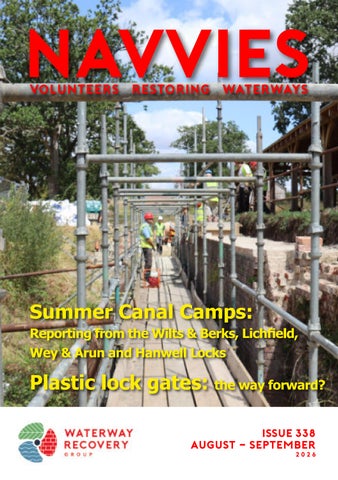
navvies Volunteers restoring waterways
Summer Canal Camps: Reporting from the Wilts & Berks, Lichfield, Wey & Arun and Hanwell Locks
Plastic lock gates: the way forward? Issue 338 august - september 2026
Intro Summer Camps
Pictures taken on this summer’s Canal Camps on the Wey & Arun Canal (above, by Bill Nicholson) and on the Hanwell Locks side-ponds (Martin Ludgate). See reports in this issue
In this issue Contents For latest news on our activities visit our website wrg.org.uk See Facebook group: WRG Follow us on @wrg_navvies Contents
Production
Intro Canal Camps pictures 2 Editor: Martin Ludgate, 35 Silvester Road, Editor’s Welcome an uncertain future? 4-5 East Dulwich London SE22 9PB. Letters to the editor modern materials? 5 020-8693 3266 martin.ludgate@wrg.org.uk Chairman’s Comment 6-7 Camp reports Wilts & Berks, Wey & Arun 8-18 Contributions welcome, by email or post, WRG Wear WRG logo clothing returns 19 to the address above. If sending a lot of Diary Camps and working weekends 20-21 large picture files, please contact the editor Camp reports Lichfield and Hanwell 22-30 first. Press date for issue 339: 15 September. Progress a roundup of restoration around the network 31-36 Subscriptions: A year's subscription (6 issues) is News First aid course, another Leader Day, a minimum of £5.00 (please add a donation if and the Driver Authorisation Scheme is back! 37 you can) to WRG, Hardy House, Infill including Dear Deirdre and George’s Northbridge Road, Berkhamsted HP4 profitable sideline 38-39 1EF. Cheques must be made out to The Inland Waterways Association (although the proceeds will be put to WRG / PLEASE NOTE: subscriptions Navvies use).
renewal cheques should be made out to The Inland Waterways Association. Note our new address (above right)
Distribution: John Hawkins, 4 Links Way, Croxley Green WD3 3RQ 01923 448559 john.hawkins@wrg.org.uk
Navvies is published by Waterway Recovery Group and is available to all interested in promoting or supporting the restoration and conservation of inland waterways by voluntary effort in Great Britain. Articles may be reproduced in allied magazines provided that the source is acknowledged. WRG may not agree with opinions expressed in this magazine, but encourages publication as a matter of interest. Nothing printed may be construed as policy or an official announcement unless so stated - otherwise WRG and IWA accept no liability for any matter in this magazine. Waterway Recovery Group is part of The Inland Waterways Association, (registered office: Hardy House, Northbridge Road, Berkhamsted HP4 1EF), a non-profit distributing company limited by guarantee, registered in England no 612245, and registered as a charity no 212342. VAT registration no 342 0715 89. Directors of WRG: Rick Barnes, George Eycott, John Hawkins, Dave Hearnden, Nigel Lee, Mike Palmer, George Rogers, Jonathan Smith, Harry Watts, Mike Wills. ISSN: 0953-6655
© 2026 WRG
Cover picture: Pewsham Bottom Lock during the Wilts & Berks Canal Camp, with concrete coping ‘stones’ being cast along the top of the offside chamber wall. Picture by Martin Ludgate Back cover (top): ‘Before’ and ‘after’ pictures on the Lichfield Canal, showing the approach to the site for the new Darnford Lane bridge at the start and end of the Canal Camps (Colin Hobbs) Back cover (bottom) ‘Before’ and ‘after’ pictures of the demolition and excavation for the foundation trench for the offside lower wing wall at Pewsham Bottom Lock at the start and end of the KESCRG-led Canal Camp (Stephen Davis) Page 3
Welcome from the editor Martin welcomes new readers, some initiatives that might just help with the waterways’ funding issues, and the first rain for months… Welcome…
I have to say that this set a few alarm bells ringing for me: were we heading back …to another issue of Navvies, the magazine for the bad old days when the (then) British that takes its name from the original navvies Waterways system categorised waterways into ‘commercial’ (the few large-scale freight who travelled the country 250 years ago, carriers); ‘cruising’ (most of the smaller working on building canals wherever they canals, to be maintained for leisure boating) were needed. And which caters for today’s 21st century volunteer navvies who tour the and ‘remainder’ – the rest, to be dealt with as cheaply as possible? CRT hasn’t made any country, working on whichever canal secret of its view that new current public restoration projects can benefit from our funding package (which runs 2027-37 and help. And in particular, a welcome to those of sees the annual grant fall every year – and no indication that there will be any money at you who are new volunteers, perhaps who all post-2037) is inadequate. And that if have signed up for a Canal Camp as part of their participation in the Duke of Edinburgh’s more money can’t be found it will ultimately be impossible to keep running the entire Award scheme. You’ll see in this issue that network, with canals likely to close down. there are reports from no fewer than seven In response to my query, CRT week-long Camps on four different projects, responded that for the present this was all of which have made a great deal of progress thanks to your (and everyone else’s) solely an exercise in dealing with the current water emergency (although CRT will look to support. And as I (rather belatedly) write this column, work is in progress on the fifth learn lessons for future droughts): “We're looking at routes where there is more and final site in this summer’s programme, potential of keeping a waterway open, based the Cotswold Canals, with some camp on where there is water and whether water reports expected (please!) from the three weeks’ work on that project in the next issue. can be got into that waterway - and targeting work to those areas.” It’s all going very well. But elsewhere Which is something of a relief for now. on the canal system, unfortunately things But in the longer term and on the wider aren’t looking quite so rosy. In fact, if subject of coping with reducing funding, CRT anything, things are looking rather brown. said it would form part of the organisation’s I’m talking, of course, about the weather – 10-year strategy work and discussions. So the second very dry year in a row has once no, the threat hasn’t gone away. again resulted in significant numbers of But continuing on a brighter note… temporary closures of canals around the (inasmuch as ‘we probably aren’t going to country as their reservoirs and other water close down any canals just yet’ is really sources ran dry. much brighter), there have been just a few So much so that in early August the things in the news recently to suggest that Canal & River Trust (CRT, the authority responsible for maintaining most of the canal there’s a chance that some ways could be found to cut the costs of maintenance network and a fair proportion of the rivers) and/or increase the funding for the canals… announced that it was looking at (1) On this page you’ll see the response concentrating on keeping a set of ‘key routes’ open. "We are changing our planned to my question last time about use of cheaper or longer-lasting modern materials – maintenance to give priority to engineering and I saw them ‘in the flesh’ at a recent work that addresses movement constraints on key routes where there are higher levels event on the Chesterfield (see page 31). Nobody knows for sure how long the ‘plastic’ of boats and boating businesses, as well as water transfer obligations. These are difficult (actually fibre-reinforced polymer or FRP) lock gates will last, but there was a calls to make as it means other work will suggestion that they might not need inevitably get delayed." Page 4
replacing in the lifetime of anyone present (including one 3-year-old child). Are there enough other cash-saving ideas like this to make a difference? (2) A study by Manchester University has published its results which confirm that simply having canals running through urban areas contributes significantly to keeping the temperature more moderate, particularly in heatwaves. It received widespread press coverage. Could it one day justify some funding? (3) A call by our friends in the Buckingham Canal Society for Anglian Water to formally integrate canal restoration into the regional Water Resources Management Plan 2029, arguing that “historic waterways are re-emerging as nationally significant climate resilience infrastructure.” BCS says
restoration of the Buckingham Canal would provide a water transfer corridor moving water to where it’s needed, as well as providing a buffer for flood water after extreme rainfall. Would it provide enough benefits to justify the water company paying for restoring and maintaining the canal for navigation? I’m not suggesting any of these will replace £50m a year of public money. But between them – plus there will need to be a fair few more good ideas – it’s just possible that things might not be quite as gloomy. Speaking of which… On a brighter or duller note, depending on how you look at it, it’s currently chucking down rain outside! See you on a working party somewhere! Martin Ludgate
letters to the editor There has been a good response to the editor’s questions about use of ‘plastic’ lock gates and other new materials on restoration projects. More contributions to the debate are welcome Interesting that the new materials question has again arisen. When the Huddersfield Canal restoration began around 1974, we realised that the 74 locks would each require three gates i.e. over 220 sets. Not a small order. We explored amongst other things glass reinforced concrete and various plastics. with timber attached to make a good seal. The fundamental issue is how resilient they would be if someone crashed into them. Or what would happen if the masonry could adapt to minor settlement etc.? How much flexibility would there be? Timber often just bounces back after a collision and says "sorry". A craftsman can often quickly set in a new piece of timber to create a temporary repair. The other issue is whether the locks are sufficiently identical/similar to allow a mould to be an option. I’ll watch the debate with interest. Bob Dewey Interesting item about the reinforced plastic lock gates; as you say the Dutch know a thing or two about canals... Considering that good quality large timber is somewhat rare these days (and shockingly expensive) this seems like a really good idea. No problem with rot either. I know non-traditional change is a problem for some, but imagine if Telford had been put off from using cast iron for aqueducts by the "traditionalist" lobby? Regards Andrew Harris, Whitby, Ontario I've just read, cover to cover, your latest offering and how uplifting and spirited a read it is. I respectfully tip my sun hat to all those that toil on our behalf. Great work. With regard to what materials should be used in recovery work, my take is straightforward. Exactly the same as those pioneers of two centuries ago would have used - if they were working today and subject to the same budgetary constraints. Cost and durability should always be considerations. Thanks again Michael Lott Page 5
chairman’s Comment Mike Palmer reflects on a successful summer of Great Work, Great Events, Great Laughter - and great plastic watering cans… Chairman’s Comment
• Excellent working partnership (good communication and cooperation) with the onsite contractors (COSLIN – wonderful Mark and Shaun), • A busy, vibrant site – quite a few volunteer teams working on different parts of the “Missing Mile” project, • Good support from Cotswold Canals Trust – not just in terms of supplies and similar (thanks Jon and Stuart) but also access to the engineering team meaning issues could be dealt with and agreed to everyone’s satisfaction (thanks Clive). Page 6
Mike Palmer
This edition of Navvies certainly maintains the tradition that the first edition after the summer is full of reports of Great Work, Great Events and Great Laughter. There is just one summer location still to report in and, to be fair, that’s because the three weeks of Canal Camps we are running at John Robinson Lock on the Cotswold Canals have yet to finish (the last week has just started as I’m typing this). However, I was lucky enough to run* week 1 of these Camps and I can certainly confirm that that site too was full of GW/GE/GL. However, while you will have to wait for the reports detailing everything that happened in those three weeks, I’ll give you the highlights from my perspective:
Progress on John Robinson Lock’s nearside wing wall during the first Camp…
As I say, those are the highlights from my perspective. Yes, there are other (important) issues to consider in making sure the Camps run well and are enjoyable BUT, speaking as a leader, these three points are the sort of thing that make the leaders’ life much easier, meaning that we can take more time and effort to address those other issues. Back to the subject of all our Canal Camps – as mentioned in the last edition of Navvies we trialled an Online Health and Safety Reporting Tool this summer and it was certainly embraced by many of you. It clearly needs a bit of refining to make it more usable, but we will be keeping it on. However, as stated in the last edition: the paperwork version of our Near Miss / Incident reporting will still be available should you not have a phone or network coverage. As a final point I’d like to return to John Robinson Lock. Obviously, no matter what your experience, you should always approach a site/day/task with the understanding that you may learn something. I would like to suggest that perhaps the biggest lesson for many of us was just how useful a simple plastic watering can is for mixing and bricklaying teams. Definitely a case of the Right Tool for the Right Job. I wouldn’t be surprised if they get added to the Camps kit. Mike Palmer
Stephen Rice
* Alongside Bex and Jude of course. Oh and some brilliant volunteers.
…and the offside wall nearing completion on the second Camp. Reports next time (please!) Page 7
camp report Wilts & Berks Canal Our friends in the KESCRG mobile group lead a week at Pewsham casting lock coping ‘stones’, digging big holes, and lots more… places to sit along the low walls and seemed Wilts & Berks Canal Camp, to catch any breeze that was available. Pewsham Locks Led by the KESCRG mobile group
Ed Walker
Sunday: first day on site and a slightly slow start as tools were counted and people got Nineteen volunteers turned up at Christian used to where everything was. Teams split Malford village hall near Chippenham on up to start the various jobs, Natalie headed Saturday 1st August looking forward to a week’s canal work on Pewsham locks on the off to carry on pointing-up the top lock wing walls, William started the excavation for the Wilts & Berks canal. Four of the volunteers carpenter’s workshop water tanks, Mick led a were new and didn’t know quite what to team to start assembling shuttering for expect; everyone else was confident that concrete coping ‘stones’ on bottom lock, with Eli cooking at least they would be well John Hawkins and Dan started the repair fed! The usual kit sorting, organising and safety talk was followed by excellent Spanish work on a retaining wall below top lock and Stephen and Nigel started excavating the chicken for dinner (setting the tone for the foundations for the off-side lower wing wall week) and a trip to the pub a few doors down (also a theme for the week for some). of bottom lock. Work cracked on steadily, two coping stones were cast in the afternoon The work for the camp had evolved and William had made a start on the first over the previous few months: the original tank hole after a morning removing the plan had been to start rebuilding the towpath side lock wall of the bottom lock of unused pipe and conduit that crossed where he needed to dig. Everyone headed home the flight of three locks, but the final plans via Sutton Benger rugby club showers for for this work had not been developed enough for us to start. Not to be held back, dinner (lasagne and lemon posset for dessert the local society handed us a relatively long with extra cake to celebrate Mick’s birthday) list of other, fully planned, tasks that needed before a group went on an after dinner walk along the restored canal section that leads to be done around site and with a highly from almost Dauntsey to Foxham. experienced team of volunteers we aimed to complete a lot of them. Pewsham locks are in a very idyllic position, set in the rolling fields south-east of Chippenham, and have had quite a few WRG weekends and camps over the years but not for quite a while. The local society the Wilts & Berks Canal Trust are very active and have recently completed the restoration of a drydock (parallel with the lower lock of the flight), a very nice brick bridge over the tail of the top lock, and are working on completing the carpenter’s workshop to be used as an education centre. The dry dock made an excellent tea break area supplying plenty of shade, Laying the initial ‘blinding’ concrete of the wing wall Page 8
Martin Ludgate
Monday: A very hot day but the teams routine of the day’s copers would be poured carried on with a will. James (one of our between tea break and lunch which gave the Duke of Edinburgh’s Award volunteers) had afternoon to pour a stage of the blinding developed very well as a dumper driver (with concerns over the clay drying out it under the expert tutelage of Mk2 and carried was decided to only dig to final depth what on with the task, helping Stephen and Nigel we could reliably cover with blinding in a with the wall foundation excavation. William day). With the wall repair complete John carried on creating a large, rectangular Hawkins moved on to complete a small crater in the Wiltshire countryside, ably patch repair of the lock wall to allow the assisted by Jon Christmas. John Hawkins and coping stone run to be completed and Dan, having completed the breaking out Natalie, ably assisted by Alan and Jon work on the wall the previous day, rebuilt the Christmas, finished off the pointing on the wall. Natalie and team carried on pointing lower wing walls of top lock. As we had to be while Mick, ably assisted by the dream out of the hall this evening, dinner was floating team of Steve P, Bob and George picnic style on the benches in Sutton Benger (another DofE) struck shuttering, cleaned up before resetting the hall. Whereupon James the concrete copers, reset shuttering and and Stan decided they hadn’t done enough cast two more copers. Dinner was Roast exercise that day and headed off to a gym in Pork followed by a trip to the cinema to avail Chippenham – the rest of us felt that this ourselves of the air con. was way to much hard work and headed for a pint or two at the Rising Sun a few doors Tuesday: The regular local work party day down instead. and a number of extra people arrived to see what we had been up to. Discussions were Wednesday: down to three jobs left now, had to further define what could be done on Alan taught Geoff dumper driving with the wing wall rebuild job as Nigel had pretty William on excavator – by this time William much completed the excavation – it was was demonstrating a fine ability to dig a decided that we could carry on the task and round hole with a square excavator bucket, pour the initial concrete ‘blinding’ layer which some expert trimming with a spade by Geoff would allow the locals to start the wall and William meant that this hole was ready rebuild after we had left. The coping gang for its concrete the next day. Further down were now getting so good at striking the site, the usual schedule of two coping shuttering and resetting that we got into a stones in the morning and blinding concrete
Levelling the top of the concrete coping ‘stones’ Page 9
fact file Wilts & Berks Canal Thames & Severn Canal (Cotswold Canals) under restoration To Inglesham
To Stroud and Saul Junction
Length (originally): 52 miles (main line) 8 miles (North Wilts branch) Locks: 42 (main line) 11 (N Wilts) Date closed: 1914 (an aqueduct failure had already closed the canal to through trade)
Cricklade North Wilts Canal
Royal Wootton Bassett Possible replacement arm on new route
Dauntsey Foxham
Chippenham
Possible diversion around Cricklade Wilts & Berks Canal
Moredon
SWINDON
Strategic project 3: Link together the restored Swindon and Royal Wootton Bassett lengths
Planned diversion around Swindon: western part already built / restored / under construction as part of Wichelstowe developments
Calne Strategic project 2: Develop Pewsham site
Canal Camp site: Pewsham Locks Strategic project 1:
Melksham Create Melksham Link diversion via To Reading River Avon to reconnect Wilts & Semington Berks to Kennet & To Bath Avon Canal Kennet & Avon Canal
in the afternoon continued. Each blinding pour consisted of 2-4 dumper loads of concrete, each of which was made up of 3 mixes made in a large cement mixer – I don’t think I’ve ever been on a camp that has made this much hand mix concrete in a week before! We had to be out of the hall again for a yoga class so the annual intervan pub skittles competition was held at the Wellesley Arms pub in Sutton Benger, after six rounds BOB narrowly beat EHP and friends.
The Wilts & Berks Canal was opened in 1810 and ran for 52 miles from the River Thames in Abingdon to the Kennet & Avon Canal at Semington. In 1814 a branch canal, the North Wilts Canal, opened linking the Wilts & Berks in Swindon to the Thames & Severn Canal near Cricklade. Following competition from the Great Western Railway and the collapse of an aqueduct, the Wilts & Berks Canal closed in 1914.
With this task complete the next pair of copers were cast before everyone concentrated on that day’s blinding pour.
Friday: last day on site; William completed the second hole for the other tank (this one required a rectangular hole so was a bit faster), another two copers were cast by Mick’s crack team and Stephen and Nigel (aided by John Hawkins and Stan) excavated the penultimate blinding section – this was duly cast in the afternoon, leaving a final section for the locals to dig Thursday: A Day of many concrete pours; out and pour. while the shuttering gang were stripping off Ian Williamson arrived for a day visit the previous day’s copers, a crack mixing and was promptly handed a shovel. We also team of George, James and Stan with the managed to give each of our new volunteers assistance of Fiona was assembled to pour a 20 minute demo session in an excavator the base slab for the first tank. The while tools were gathered, cleaned and necessary 0.7m3 was quickly mixed and packed. Back at the accom, Eli had created barrowed to the excavator where Ed placed it an amazing curry for dinner and there were in the hole for William to float it off to depth. the usual awards. Page 10
Possible diversion River Thames to Oxford and Inglesham using drawdown channel of new Abingdon Thames Water reservoir (if built) To Reading and London Strategic project 4: Bring boats back from the Thames to Wantage
The Canal Camp project: Various restoration joba on Pewsham Locks and associated structures. Why? This flight of locks appears t have been an important site on the canal historically, with a dry dock, a saw-pit, a lock house and other structures. The Wilts & Berks Canal Trust is restoring / recreating it all as a heritage site, canal centre and community resource, with plans for a trip-boat in the future.
The wider picture: Ultimately the Trust aims to restore the entire historic route - a number of lengths have been restored either by volunteers or by housing developers as part of the Wichelstowe residential expansion on the south side of Swindon. For the medium to long term, WBCT has agreed on a 25 year plan to focus its efforts on four projects where its resources can be used to best effect. Melksham is one of these four; the others are:
Wantage
Melksham Link: Reconnecting the Wilts & Berks canal to the Kennet & Avon canal at Semington and bringing the canal to Melksham town centre via a new route using the River Avon Connecting Royal Wootton Bassett to Swindon: With sections of the canal in water in both towns, it should be a relatively easy task to connect the two towns… except that the M4 motorway is in the way! Bringing Boats Back to Wantage: Reconnecting the Wilts & Berks canal to the River Thames, getting under the A34 main road and Great Western railway line, and bringing the canal back to Wantage and Grove. An important part of this is the proposed Thames Water reservoir known as SESRO (South East Strategic Reservoir Option) being planned near Abingdon. over the week and particular thanks to Eli for the excellent food all week. Ed Walker Stephen Davis
Martin Ludgate
All in all, a very good camp – loads done; 12 concrete coping stones cast (requiring in total about 8 tonnes of concrete), 10m of wing wall excavated out and blinded, pointing completed, one tank hole ready for its tank and the other just needing a concrete base. The local society were very pleased with what we had done, particularly how much further on a project can be pushed by a week’s work of a group of experienced volunteers. Many thanks to Nigel, William, Mick, John Hawkins and Natalie for leading teams on various tasks
Casting the coping stones Page 11
Camp report Wey & Arun Canal Reporting from the deep south, where two weeks were spent building a new section of channel to link together two recent restoration projects Wey & Arun Canal Rooks Hill Project camps on the project. This was great news NWPG Camp 2026-08, 11-18 July for the Trust. The first of two consecutive This time last year we reported on two very successful and productive WRG summer Camps led respectively by the NWPG and KESCRG independent mobile working party groups at Rooks Hill Farm on the Wey & Arun Canal. In this edition, one year on, are reports on two further camps on the same site where further great progress has been made. But first, a reminder about what that project is all about.
The first week’s Canal Camp: Looking back at the camp, three words come to mind: Heat, football and staples. Heat: it was forecast to be hot and it was. Fortunately it managed to just stay below 30 degrees for most of the week. Gazebos were in abundance both on site and at the accommodation – six in total. Fans came a close second. These are perhaps both essential items when running camps -
Pictures by Hild Watts
The Rooks Hill Project: Rooks Hill is towards the northern end of the canal on a section to the south of Bramley village. The area of work forms a southern extension to a 900 metre length at Birtley restored between 2019 and 2023. This includes two new lifting bridges, one of which was built with the support of WRG camps. Having established an attractive, in water, section of canal together with a very popular and well used circular footpath, the Trust has the opportunity to extend it south. This next length of new waterway has been divided into three phases. Phase 1 includes a new brick-clad arched bridge, a 150m length of new canal and banks and portals for a culvert passing under the canal. Work on this phase began last year and should be substantially complete by the end of September this year. Phase 2 is the construction of 300m of new canal adjacent to the line of former canal which was infilled and is now a farm track. At its northern end the new canal will join with the existing Birtley section. This is where this year’s camps were focussed. Phase 3 will comprise a further 150m of restored canal and a new Fanesbridge Lock on the southern section of the project. Work may start in 2027 but see below. Late last year the WRG Board agreed that it could support two 2026
weeks would be led by NWPG with the second by WRG, led by Harry and Hild Watts. This report covers the NWPG week.
Page 12
Gabion canal bank construction
especially in July anywhere south of Birmingham. Should they be provided in the WRG kits to reflect the changing climate? Nevertheless, we managed to keep cool enough to keep the work going and to chill out in the evenings at the hall. By the way, the WRG ice water barrel is brilliant! Football: our camp included the quarter and semi-finals of the World Cup and so it was inevitable that 50% of the camp would want to watch it. Fortunately, those who didn’t were either Scottish or were not likely to support any other social activity that we might have arranged (Jigsaws preferred).
Linking the WRG projector to a laptop and using the hall’s wi-fi and the back room, everyone was happy – at least until the end of the semi-final. Staples: There is always one thing that becomes a persistent problem on a camp. This year it was staples – yes those things that hold bits of paper together. We needed these to attach felt to the waterproof butyl liner that had to go behind the gabion baskets forming the new canal bank. Despite our best efforts and trips to Screwfix, we never managed to get the right size to fit the stapler provided. In the end we gave up and
23 miles fact file Wey & Arun Canal Length: Locks: originally 26 Date closed: 1871 The Canal Camp project: Creating a canal channel at Rooks Hill
River Wey to the Thames
Why? To bypass the original canal, buried under a farm track. The wider picture: This section connects two restored lengths: the Birtley Bridges section and Rooks Hill Bridge. Godalming These in turn are part of the Wey & Arun Canal Birtley lift Trust’s plan to expand progress northwards from previously restored Summit and Loxwood lengths. bridges section Eventually the aim is to link all these sections together and reopen the route from the Thames and London to the River Arun and South Coast
Shalford Bramley Birtley Canal Camp site: Rooks Hill Rowly
The Rooks Hill project Dunsfold Restored Summit length Locks 8-16
Loxwood
Restored Loxwood Link section Newbridge
Wey & Arun Canal Trust
Orfold
Pallingham River Arun to the South Coast Page 13
left it to Camp 2 to sort out which they did transferred to brick laying on the south without any trouble or fuss. They bought two parapet of the bridge. This latter task was in new staplers. At least it wasn’t the digger. support of Graham and Mike F who got to within one course of completing the northern To the work. The main work area was to parapet. (which has since been completed progress the so called soft bank of the new and is ready for the copings). canal in phase 2. Not that ‘soft’ really as the I shouldn’t moan about the hot weather whole process involved: as if it had been wet, the site and the work would have been unworkable. • Excavating a 2.5m wide level trench As well as the brickwork on phase 1 we that forms the base of the wall installed a further 37 plastic wood piles, • drilling holes with an auger attached to numerous gabions and tie bars and set the a 5 tonne digger, inserting plasticwood piles job up for the second week who were to to the correct position & level, concreting make even greater progress on the bank. them in and then doing a similar back row of Thanks to Adrian, Mike O’D and Dave shorter piles but without the concrete bit (pile placing), Ian and Pete Taylor (gabions), • Assembling, levelling and filling gabion Pete Turville and Duncan (Tie rods), Steve baskets placed between the front and back and Georgia (support and logistics), Mike F, piles Graham, Phil and Rob (bricklaying) and of • Placing a felt protected butyl liner course Sue for providing us with splendid behind the gabion baskets meals. • Tying it all together with stainless steel I mentioned Phase 3 earlier. Whether threaded bars the Trust goes ahead will depend on a • Laying a cable duct and inspection number of factors – progress on phase 2, chambers availability of grant money through the • Attaching a back rail and geogrid – the Community Infrastructure levy, and how it latter to form the base of the new towpath fits in with the Trust’s restoration priorities. If • Placing and tying a line of coir rolls we do proceed then expect a bid for camps along the front edge on top of the gabions. in 2027 to support the building of the lock! Bill Nicholson Our camp tackled all but the last three of Camp 2026-08 led by the NWPG group was these stages, with three teams of 2 – 3 immediately followed by Cammp 2026-10, people working full time for the 6 working led by WRG leaders Harry and Hild Watts. So days of the camp. The work demanded skills over to Hild to continue the story… in digger driving, the use of laser levels and many other tasks and a production line was soon established with some healthy competition between the teams. As well as starting on phase 2, phase 1 needed more work. For our week this involved completing the brickwork and copings on the east culvert portal started on last years camps. Messrs Brotherston and Cardy had this dealt with by Wednesday lunch and Rob puts the final courses of bricks on Rooks Hill Bridge Page 14
Wey & Arun Canal Rooks Hill Project theme of the week – filling gabions, giant wire cages which are filled with stone to Camp 2026-10, 18-25 July Work on the Wey & Arun Canal between the new bridge and the existing canal (with actual water in) has now begun in earnest and we were there for week two of this summer’s camps. Week one had made a grand start [see above] and left us with a clear route to follow, so off we went! The leadership team on the camp was Harry Watts (leader), Anne Lilliman (cook) and undersigned (assistant leader) – in a slightly late change to plan due to some lastminute changes to the Hanwell camp. We had no fewer than six lovely “DoE’ers” young volunteers taking part in the Duke of Edinburgh’s Award (Cameron, Darcy, Elvis, James, Lola and Meggie) on our camp plus another two newbies, so lots of fresh faces who will hopefully come back in the future. Saturday started with the usual amount of running around and setting things up, before heading off to site for a little lookaround to prepare people for the work ahead. We also met up with the volunteer who had inexplicably elected to stay with his brother who lives locally (which of course meant missing out on Anne’s lovely meals – but also meant an actual bed – you win some, you lose some…). Evening rounded off with chilli for dinner before a delegation ran off to watch the footie. Sunday morning saw us all bright-eyed and bushy-tailed on site and most of us got stuck into what quickly was to become the
form the canal bank. It rapidly became clear to everybody that the Rook’s Hill site comes in two flavours – dust or quagmire. Due to the hot weather and lack of rain, we got lashings of the former which - unpleasant as it might be - was still much preferable to the latter. The site settled into a routine with the ground being levelled to very precise measurements, Adrian drilling holes after careful instructions from Pete, posts being inserted into the holes, postcrete and concrete being applied after more careful measurements. Then the ground was levelled, gabions erected and finally filled with stones – apparently known as ‘bold’ locally. If anyone knows why it’s called bold, let us know! We just know we filled a lot of gabions with the things. Midway through the afternoon a somewhat distraught Adrian thought there was something really wrong with the digger as it would not auger (we will leave out the obvious puns on how well this augured). Alternatively, a switch MAY have been knocked out of position… As we had six DoE’ers and six days on site a cunning plan was quickly hatched on Saturday and one of them assisted Anne in the kitchen each day which worked really well and provided many lovely cakes and puddings during the week. In amongst the many gorgeous meals, the stand-out mention has to go to Meggie for the Biscoffi ice-cream she made! Quote of the day from
The Rooks Hill site comes in two flavours: dust or quagmire. This summer it was the former… Page 15
Beth to Adrian – ‘Yes, but I can run faster than you!’ – what prompted this remains unclear. A delegation once again sallied forth to the pub to watch the World Cup final – the general consensus was that the England v. France match the previous day was considerably more entertaining. On Monday the work on the gabions had progressed far enough to start putting in the back-strips and fasten the geogrid. Gabions continued to be filled at such a fast rate we ran out of bold by lunchtime and were just contemplating scrabbling around in the dirt like a particularly dishevelled version of Oliver Twist when the lovely delivery man turned up at the 11th hour with a selection of bold, aggregate, postcrete and concrete. Posts continued being installed very carefully (auger wasn’t broken after all as it turned out – who knew there was an extra switch in the cab! Well, Adrian does - NOW) – work proceeding at rate of knots until running headlong into a too-highlevel-between-posts issue. Heads It doesn’t augur well… until you find the secret switch were being scratched and some remedial careful scraping with a digger was Tuesday morning and the too-high-level decided would likely be on the cards for was dealt with by dual efforts from Adrian Tuesday morning. There had been lots of with a digger and multiple people (not plans for games in the evening, but in the including Adrian) with mattocks and shovels. end we were all too tired and it was Back-strips and geogrid were being put in so suddenly too late for games! fast it caught everybody else up so was put
Lola installs geogrids Page 16
on the back burner for a few days. The day’s biggest problem – generators. The Wey & Arun one just stopped and wouldn’t start up again – the WRG one started but then putput-putted out. After much head-scratching and poking about, a blockage was found and dislodged in the outlet pipe from the fuel tank of the WRG generator – after our glorious leader had first tried clearing the pipe by blowing into it, a slightly less foultasting method involving some thin metal strips being wiggled about met with more success. Leader smelt somewhat of diesel afterwards, but at least the process of concreting in the posts could continue. The Wey & Arun generator refused to cooperate again and the locals promised it would be taken away for corrective action and a stern talking-to. As the gabions continued being filled at pace, it was time to start thinking about what to do with the backfill. Harry thought he would test out a Jumping Jack to see if the backfill could be tamped down with it – as the jack went down, Harry went up and vice versa. Control was limited and the decision was made that perhaps this wasn’t the right tool for the job right next to carefully installed gabions, so the tamping-in had to be done by more manual means – a combination of feet-stomping and sledgehammer whacking. In the evening, the assistant tried leading people astray with card games and suddenly it was well past bedtime! On Wednesday a group of locals from the Wey & Arun Canal Trust were on site, initially for a concrete pour and then continued a push on bricklaying the parapet on the bridge. We did lots more drilling of holes and lots of people got some tastersessions on the digger, under the watchful eyes of either Adrian or Harry. Felt like quite a luxury having not only one, but two digger-instructors on the camp! William had a go at some post-hole-augering and decided it wasn’t as easy as it looked (and it didn’t look particularly easy in the first place). As we were drilling the holes we realised that the clay that was being drilled up was actually quite wet and malleable so we decided to use this as the underlay for the backfill behind the gabions. Tamping-in with feet and sledgehammer was hard work, but worked quite well. This had to be done pretty much immediately after digging up the clay as it hardens quite quickly and turns into something more akin to stone. We left
Culprit No 1 and (below) Culprit No 2
site early for a quick scoot through the showers and then a mass-outing to Wonersh for skittles. Darcy had kept his skittlesprowess under a bushel and proceeded to trounce the rest of us by some margin! By Thursday morning it was clear the vans were in need of refuelling, which involved a trip via Dunsfold aerodrome first thing. The W&A have their compound here and some people got very excited by all the things they had on site! When we got to site there were another W&A-delegation working on the bridge and they very kindly gave Darcy and Julie a chance to try some bricklaying as well. Several more people got to try their hand at driving the digger and Beth and Lola did sterling work with the saw on preparing a load of posts with decorative chamfering. When they ran out of posts to chamfer they had completed 21 of the 10 they were asked to do – above and beyond! Numpty-prize of the week awarded to the assistant for walking off site with one of the Page 17
dumper keys in her pockets… D’oh! It was a jolly fine thing that Adrian had a spare set of keys, otherwise there would have been Problems. In the evening most of the crew went for a walk along the already operational bit of the canal, some at a leisurely pace whilst learning about the history of the canal whilst others hot-footed to the pub for a restorative pint or two. On Friday it was time for a final bit of tidying up, filling the last gabions, tidying up the site, drilling the last holes and backfilling as far as the tamping-in would let us – and as far as geogrid installation would let us. The lovely delivery-man from earlier in the week also turned up and put lots more bags of bold very delicately next to where we were working which saved us from a lot of double-handling of the bags. We all found watching it quite mesmerising and agreed that level of precision took some serious skill. In the evening most of us popped along to the pub next door to prop up the local economy. The clearing up on Saturday went really
quickly and most were away before 11am – the regular cleaners at the hall sent us a very lovely letter afterwards expressing their delight at how well we’d cleaned up and what a nice state we’d left the hall in. That’s the kind of testimony we like and goes to show what a reputation we are building wherever a WRG camp lands. Various members of the local W&A group came to visit during the week and were also very happy and impressed with the work and felt the two weeks WRG had been there has laid an excellent foundation for them to continue from. Finally – as always, the food throughout the week was excellent and Anne ran a tight ship in the kitchen. The quote of the week came from Darcy – ‘Canal camps are worth it for the food alone!’ – and from the quality of the work and enthusiasm from all the campers, newbies and old hands alike, all I can say is I hope you will all want to come back on future camps!
Darcy lays bricks on the bridge
Progress at the end of the last day
Page 18
Hild Watts Assistant leader and chief-forgetter-of-keys
WRG Wear logo clothing is back! Remember WRG Wear? Quite possibly you don’t remember it if you’ve joined us in the last ten years or so, but those with longer memories will recall when we ran a range of ‘WRG Wear’ logo clothing including everything from rugby shirts to baseball caps. Well the good news is that WRG Wear is back just in time for the summer Canal Camps season, initially with a small selection of clothing besides the usual short-sleeved Camps T-shirt (which - unlike all the new items - is also available to buy at the summer Camps). This year there are long-sleeved T shirts, sweatshirts, hoodies and polo shirts, featuring the WRG logo as well as the ‘Navvy man’ - see illustration below. They are available in red and black only, and in sizes small / medium / large / extra large / XX large. Please order directly with Julian at Jancraft via email to mail@jancraft.com, and make payment via BACS to account number 34033368, sort code 30 98 21. Please give your surname as reference on the payment. Alternatively mark the item(s) you want (and what size and colour) on the form below and send it with a cheque made payable to Jancraft at Balaclava, High Park Avenue, Wollaston, Stourbridge DY8 3NJ. Remember to add postage of £5 for up to two items, £10 for more, to your payment. Please give your name, email address and phone number on every order. For enquires only call on 07977 491629, but all orders by email or post please. ITEM
WRG logo on front
Navvy only on front
WRG logo front / navvy Logo back
Camps 2026 WRG logo front / Camps logo back
T-shirt short sleeve
£7.50
£7.50
£10.50
£8.50
T-shirt long sleeve
£9.50
£9.50
£12.50
£10.50
Sweatshirt
£14.00
£14.00
£17.00
Hoodie
£17.00
£17.00
£20.00
Polo shirt
small chest logo £11.50
Navvy back Small WRG front print only £11.50 Navvy back £14.50
Left: the ‘navvyman’ logo Right: the WRG logo (modelled by the editor)
Page 19
navvies
diary
Week-long Canal Camps cost £90 or as stated. Booking for events labelled ‘WR Road, Berkhamsted, HP4 1EF. Tel: 01494 783453, enquiries@wrg.org.uk. Diary Sep 12-13
KESCRG
Wilts & Berks Canal: Scrub clearance & profiling 80m above Dauntsey Lock
Sep 19-20
London WRG
Cotswold Canals: John Robinson Lock
Sep 19-20
MBBCS
Manchester, Bolton & Bury Canal: Nob End Locks
Sep 20 Sun
WRG
WRG Committee/Board Meeting: Rowington Village Hall
Sep 25-27
wrg Forestry Team
Wilts & Berks Canal: Swindon Branch, accommodation at Watchfield
Sep 26 Sat
WRG
WRG Autumn Leaders Day: Lowsonford Village Hall. See page 37
Sep 26-27
wrgBITM
Maidenhead Waterways: Bray Cut
Oct 3-4
KESCRG
To be arranged
Oct 10-11
London WRG
Shrewsbury & Newport Canals
Oct 17-18
MBBCS
Manchester, Bolton & Bury Canal: Nob End Locks
Oct 17-18
wrgBITM
Basingstoke Canal: To be confirmed
Oct 17 Sat
WRG
One-day first aid course at Hinton Parva. See page 37
Oct 18 Sun
WRG
One-day first aid course at Hinton Parva. See page 37
Oct 19 Mon
WRG
One-day first aid course at Hinton Parva. See page 37
Oct 24-31
wrg Forestry Team
Wilts & Berks Canal: East Vale & Abingdon branch. Return to Grove Locks. Accom at Kemp
Nov 7-8
WRG
Possible WRG Reunion: Date and venue TBA
Nov 21 Sat
WRG
WRG Committee/Board Meeting: Location & date TBC
Nov 21-22
wrgBITM
To be arranged
Nov 21-22
MBBCS
Manchester, Bolton & Bury Canal: Nob End Locks
Dec 12-13
London WRG
Joint Christmas dig with KESCRG and WRG Forestry on the Chelmer & Blackwater N
Dec 12-13
KESCRG
Joint Christmas dig with WRG Forestry and London WRG on the Chelmer & Blackwat
Dec 11-13
wrg Forestry Team Joint Christmas dig with London WRG and KESCRG on the Chelmer & Blackwater Na
Dec 12-13
wrgBITM
Maidenhead Waterways: Bray Cut
Dec 19-20
MBBCS
Manchester, Bolton & Bury Canal: Nob End Locks
Dec 26-Jan 1
WRG Canal Camp
Christmas / New Year camp: venue to be confirmed in future issues of Navvies
Jan 22-24
wrg Forestry Team
To be arranged
Page 20
WRG and mobile groups
RG Canal Camp’ should go to: WRG Canal Camps, Hardy House, Northbridge y contributions to Dave Wedd, Tel 07816 175454, dave.wedd@wrgbitm.org.uk
psford
Ed Walker
07887-568029
ed@edwalker.org.uk
Tim Lewis
07802-518094
london@wrg.org.uk
Sam Kennion
07843-394161
samklancs@yahoo.com
Mike Palmer
01494 783453
enquiries@wrg.org.uk
Nigel Lee
07802-854694
nigel.lee@wrg.org.uk
Mike Palmer
01494 783453
enquiries@wrg.org.uk
Dave Wedd
07816-175454
dave.wedd@wrgbitm.org.uk
Ed Walker
07887-568029
ed@edwalker.org.uk
Tim Lewis
07802-518094
london@wrg.org.uk
Sam Kennion
07843-394161
samklancs@yahoo.com
Dave Wedd
07816-175454
dave.wedd@wrgbitm.org.uk
George Eycott
bungle@wrg.org.uk
George Eycott
bungle@wrg.org.uk
George Eycott
bungle@wrg.org.uk
Clive Alderman
Mike Palmer
01494 783453
enquiries@wrg.org.uk
Dave Wedd
07816-175454
dave.wedd@wrgbitm.org.uk
Sam Kennion
07843-394161
samklancs@yahoo.com
Navigation
Tim Lewis
07802-518094
london@wrg.org.uk
ter Navigation
Ed Walker
07887-568029
ed@edwalker.org.uk
avigation
Clive Alderman Dave Wedd
07816-175454
dave.wedd@wrgbitm.org.uk
Sam Kennion
07843-394161
samklancs@yahoo.com
01494 783453
enquiries@wrg.org.uk
07802-854694
nigel.lee@wrg.org.uk
Nigel Lee
Page 21
camp report Lichfield Canal An epic fortnight of setting up reinforcing, building Stepoc walls and concreting leaves the Lichfield Canal with a new section of channel took seven sheets of A393 mesh and about Lichfield Canal Camps 2026 “Concrete, Stepoc and Strawberries” 15 cubic metres of concrete.
For several of the Duke of Edinburgh’s Award volunteers it was a steep learning curve. Sunday was spent getting to grips with rebar (steel reinforcing bar) tying, site terminology and the metalwork that would eventually disappear beneath the concrete. Week One: giving Week Two a footing By Monday the group was working more The first Lichfield camp arrived at Darnford Moors on the edge of Lichfield knowing that independently, despite the heat. That evening brought a welcome change of pace: the following week depended on us leaving behind a sound reinforced concrete base for kayaking on the canal. One volunteer described starting out at 'all odd angles' the section of canal channel under construction. The job was divided into 5m by before finally getting the kayak to go roughly where intended. 7m bays. Road forms had to be set and Tuesday was the long one. A few levelled, liners placed, reinforcement cages volunteers went to site early and were at assembled and starter bars fixed accurately before the concrete trucks arrived. Each bay Greggs for breakfast at 5.00am. With bays 1 A fortnight of rebar, concrete deadlines, canalside adventures, rockets, birthday cake and around 2,000 volunteer hours.
Length: 7 miles Locks: 30 Date closed: 1954 The Canal Camp project: Building sections of reinforced concrete canal channel at Drnford Moors
fact file Lichfield Canal
Why? The canal runs in a cutting through sandy porous soil, and will need a waterproof channel and banks that will retain the cutting sides.
unde
Birmingham
HS2
R ai lw ay
Rd
The wider picture: This is actually a new section of canal, excavated some years ago. It will bypass a length of original channel, running at a different level and on a different alignment. This is to make it easier to get build a new bridge (for which the concrete bridge sections are already on site) to carry the canal under Darnford Lane. It’s all part of a medium-term plan to connect together various sections of new and restored canal (some already complete) to create a route running from the Coventry Canal at Huddlesford Junction to Lichfield. In the longer term the aim is to continue beyond to link up to the navigable length of the Lichfield To Fradley Darnford Moors Wyrley & Essington Canal at Ogley Junction. City centre Ecology Park Coventry Canal This would not only create an attractive restored Planned Huddlesford Junction waterway, it would also encourage more boats diversions Tunnel needed onto the navigable but underused 30 To Coventry under railway Cappers northern reaches of Lane New deep lock the Birmingham 8 planned 24-26 Darnford By p Canal Navigations ass Lane New stream network. 18 culvert built Motorway 61 A4
M 6 To ll
The Boat Inn Wyrley & Essington Canal to Wolverhampton
Page 22
Summerhill section
A New staircase locks planned Canal diversion under construction
Tamworth Road (Borrowcop Canal Park)
n
A5
Gallows Wharf 38
uctio
Fosseway 9-11 Heath Muckley
nstr
8
1
12
r co
A5
Ogley Junction
22-23
13-17
aqueduct Anglesey Branch to Anglesey Basin
Canal Camp site
and 3 needing to be ready for Wednesday's pour, work continued into the evening. Incorrectly spaced L-bars had to be corrected and more mesh shifted into position. It was hot, tiring work, but it meant the first concreting day could go ahead. Wednesday's concrete arrived even earlier than expected. The first bay quickly became memorable when a side bracket began to give way and concrete started escaping. Plywood, extra supports and ratchet straps came to the rescue. Lessons were learned immediately and the second pour was much better behaved. Two bays were completed that Week 1: reinforcement, starter bars etc ready for base pours day, followed by two more on Friday: four bases and about 60 cubic metres of concrete in the week. By Thursday the team was noticeably faster and more confident. A simple marked timber guide helped keep starter bars at the correct spacing, and two bays were prepared in a single day. Friday brought the final pours, a chance to try the excavator, a curry from Tina, paper rockets and the inevitable pub visit. The DofE volunteers summed it up well: they had worked hard, learned a lot and achieved something worthwhile. Rebar on the move during week 1 A well-earned evening paddle after a hot day on site. By the end of Week One, the difference on site was obvious. What had begun as setting out, loose reinforcement and empty bays had become four substantial reinforced foundations. Just as importantly, the volunteers had become a team: jobs that had seemed unfamiliar at the start of the week were being tackled confidently, with people checking levels, tying steel, moving mesh and helping one another without waiting to be told every step. The concrete for the base being poured Page 23
Week Two: the walls go up A completed reinforcement bay ready for concrete. Week Two inherited the footing and immediately started going upwards. Road forms were removed, equipment sorted and the first Stepoc [see below] courses laid. Keeping the base swept clean mattered: every block depended on the course below being level. Mortar that was too wet had to be reworked, and plenty of blocks needed cutting to keep the lines right. The walls grew course by course, with horizontal and vertical The Stepoc wall is filled with concrete via David’s chute rebar installed through the hollow Stepoc blocks. The work demanded patience: courses had to remain was already four high; later both reached straight, level and correctly tied into the seven blocks before the first concrete fill. reinforcement, because small errors low Cracks and gaps were sealed to stop the down would become much more obvious as concrete escaping when the hollow Stepoc the walls rose. The double towpath wall was filled. By the end, the second wall was reached four courses while the single wall eight blocks high and ready for an early 7:30am concrete operation. What is Stepoc? When it came time to fill the Stepoc, access from the concrete wagon above the cutting presented another practical problem. David made a wooden chute to guide the concrete safely towards the wall, a simple site-made solution that became an important part of the pour. The team controlled the flow, filled the hollow blocks and kept a close eye out for leaks while working along the wall. The quantities tell only part of the story: around 1,600 Stepoc blocks, roughly 15 tonnes of rebar and about 4,000 ties went into the work, with approximately 20 cubic metres of concrete used to fill the Stepoc walls. Combined with Week One, the camp handled around 80 cubic metres of concrete. Volunteers contributed roughly 1,000 hours each week. There was a strong effort to make sure everyone could take part, even when heavy lifting meant jobs had to be shared. The DofE notes particularly mention Rex for regularly offering to share his tasks. That spirit mattered during the slower periods as much as during the busy concrete fills. Stepoc is a precast concrete block retaining Of course, a canal camp needs stories wall system that can be laid dry. The wall is that have nothing to do with cubic metres. built from hollow blocks allowing reinforcing On the canoeing trip Nigel attempted to bars to be threaded through the blocks. stand on a moving board, collided with the They are then filled with concrete, turning the construction into a strong reinforced wall canal wall and ended up in the water. Andy, acting as unofficial photographer, made sure Page 24
the evidence survived. Indoor bowls provided another evening's 60m3 entertainment, with competition Base concrete in figures apparently becoming rather intense. 28 4 As the walls climbed, the job A393 mesh sheets Base bays changed character. There was less 5mx7m room for improvisation in the Each base bay setting-out and more emphasis on 2000 15 tonnes keeping every course true. Blocks Volunteer hours Rebar had to be cut, reinforcement 1080 threaded through, gaps sealed and 4000 Van miles the next lift prepared for concrete. 2 Ties It was repetitive at times, but each 1600 Vans course gave the team a visible Stepoc blocks 3 20m measure of progress. By concrete Lots Stepoc fill day the Stepoc walls were no Strawberries longer a collection of individual blocks: they had become the unmistakable outline of the restored canal fixed concrete delivery slots. Lichfield and structure. Hatherton Canal Restoration Trust were Another day on the wall - teamwork, equally appreciative of the volunteers' levels and plenty of lifting. efforts. Week Two then turned that footing into substantial reinforced walls. Across the Sue's birthday, rockets and camp food fortnight, the visible transformation was Day Four of Week Two was also Sue's enormous. birthday. After the concrete fill and an But the best measure of the camp was evening at the bowls club, everyone returned not just concrete, steel or blocks. It was two to birthday cake - a particularly welcome groups of volunteers learning new skills, reward after a long day. The celebration solving problems together and making the deserves its place in the camp record sort of memories that involve kayaks, alongside the engineering achievements. birthday cake, paper rockets and the The final rocket session was equally occasional person falling into a canal. That's a memorable. Paper rockets were launched pretty good fortnight by any WRG standard. with very mixed results: some flew With thanks to all volunteers, the impressively, some exploded, some reached Lichfield and Hatherton Canal Restoration the canal and one reportedly finished up on Trust, and the DofE volunteers whose notes the accommodation roof. The team did its helped tell the story. best to retrieve the resulting litter. Colin Hobbs Food was a major part of keeping both camps going. Tina's cooking was repeatedly praised by the Week One DofE volunteers, while Week Two enjoyed fantastic two-course evening meals from Matthew. There were also lots of strawberries - enough to earn a mention in the unofficial camp statistics.
Lichfield Camps
A footing for what comes next The camp leader's verdict after Week One was simple: pride in the amount and standard of work completed, despite the heat, long hours and the pressure of
A well-earned evening paddle after a hot day on site Page 25
Camp report Hanwell locks Evvo reports on a couple of Canal Camps with a difference: working on an active navigable canal, restoring a set of historic water-saving side-ponds
First Camp the August 25 July - 1
A TALE of TWO CAMPS
Camp report – Hanwell Flight: A TALE OF TWO CAMPS Now, what the Dickens am I going to write?! Not about two sites across a channel, but just the one at Lock 95 on the Hanwell Flight of the Grand Union Canal in West London.
Camp Demographics (Author’s note: I am always interested in where the volunteers come from and their careers. It also shows what a fabulous and varied community we are.) The two camps provided 239 WRG volunteer days. Lots more days and half days should be added to this total by the Canal & River Trust people who were helping us daily and also the many interested visitors, who included individuals and groups from Historic ? s n e e Dick England, CRT Heritage, Engineering and What th d n Seco Planning, ITV News and WRG’s parent body Camp the the Inland Waterways Association.. 1 - 8 August The WRG citizenry were: Martin D, Bev W, Dan N, Ted M, Charlotte T, Andy C, David M, Susan M, Michael H, Nick H, William H, Emily L, Eve T, Ziv C, Yollande E, Claire R, Dave P, Mikk B, Martin L, Paul S, Anne L, Daniel M, Ben E, Jonny L, Charlie H, Sam T, Tilly B, Ajay S, Adem C, Jacob F, Chris B, John R, Philip S and yours truly. Eleven were doing the Duke of Edinburgh Gold Award Residential Session. Is eight DofEs in one week a record? As with all WRG Canal Camps, we had a wonderful range of ages (18 to 82), home locations (as near as Hanwell, as far as Stockholm via such places as a few more London boroughs, Gosport, Marlborough, Swindon, Cardiff, Hereford, Birmingham, Ottery St Mary, Dundee, Paris, Delft, Sheffield, Wigan, Milton Keynes, Bradford and Bedford, to name just some. Occupations (former or intended) included engineering (electrical, mechanical, chemical, software, landscape and aeronautical), Health Service, teaching, military, photography, climate, IT, construction, meteorology, dentistry, psychiatry, law enforcement and a Clerk in Holy Orders. A wonderful melange, who all worked Pond A at top, Pond B with faded WRG gazebo (gets more and lived together so well. use than the CRT ones!) Pond C at bottom, lock on right Page 26
Evvo
That’s the Foreword out of the way, now for the story. With the ponds having been drained as much as possible, we were ready to start repairing, restoring, rebuilding, renovating (choose any appropriate ‘ing’ word) the walls. They were built 200 years ago to conserve water by storing it when the lock was emptied, and then the ponds were drained and the water reused to start refilling the lock to allow boats to rise up through the flight. This side-pond system has not been Pond A walls 4, 3, 1 (left to right) in some disrepair at start of camps operational for decades and has been on Historic England’s At Risk Register for many years. HE want it off the register so are providing most of the funding to CRT to get this done. The work was generally repetitive and strength-sapping but this didn’t weaken anyone’s resolve or good humour during the heatwave conditions we ‘enjoyed’. We weren’t allowed in the lowest pond because Mr and Mrs Moorhen and their four new arrivals had set up home there. Good job they chose Pond C and not Pond A, where we had agreed with CRT to concentrate our work. The first task was to clear muddy sludge away from the walls and place pallets and other appropriate objects to walk on and work from. The first week was all about taking down / out the rotten elements of the three brick walls (Walls 1, 3 and 4) in Pond A (the top one - see diagram overleaf) with hand tools only. There were horrible repairs from years ago involving engineering bricks and cement mortar which were incredibly hard to Week 1 team chip out engineering bricks on wall 3 chop out. Few bricks came out whole! Page 27
This work took two WRGies two days, most of which was on their knees. As the end of the second week approached, we changed our strategy slightly. We were never going to complete the three walls so we focused on getting a few small key sections completed to include the coping bricks. This would help whoever came next (more WRG?) by giving them the levels to work to and the coping detail to be used (different on Wall 4 – a weir wall – from Walls 1 and 3). Page 28
Evvo Martin Ludgate Martin Ludgate
• Loose material to be removed • Mortar beds on three courses to be chased out to a depth of 50mm and a distance of 500mm each side of the crack • Dust to be blown out • A spray of water • Special extra sticky mortar to be squashed in • Helical stainless steel bars (like stainless steel fusilli) to be inserted • More special extra sticky mortar to be pressed in • When dry, the joints to be repointed
Evvo
The second week still had some chopping out of bricks to do but concentrated on bricklaying with lime mortar, most of which was laying them in and around existing bricks in the wall; like playing Jenga in reverse. There were six significant cracks in the three walls which needed stitching, three in the left third of Wall 1. Each crack needed:
‘Stitching’: The cracks in walls before repairs, inserting grout into the chased-out mortar beds, putting in the stainless steel bars, and the completed job with little sign of the cracks
Evvo
Our Duke of Edinburgh Gold Award Volunteers All 11 of the DofE volunteers played magnificent parts in their different ways. To reward them, they were asked to give 90 second-ish presentations to the rest of the camp after dinner on the Fridays. Just like their work, they enthusiastically did this and we enjoyed very much hearing about the fun had on site and socially, more about the Grand Union Canal and its history, a mini-quiz about the week gone by to see how much we had remembered, the story of one volunteer’s DofE award progress and, the highlight for me, a poem about the people who were there for the last days on Week 2 [see page 38]. The Week 2 crew dining al fresco
How the Hanwell triple side-ponds work Top gates
Bottom gates
Lock chamber
Top paddles
Bottom paddles
Side-pond paddle culvert
Wall 4
Wall 1
Wall 2 Side-pond Side-pond To empty the lock: paddle ‘A’ paddle ‘C’ Close the lock gates. Open side-pond paddle Side-pond ‘C’ ‘A’, allowing water to pass from the lock Side-pond chamber into side-pond paddle ‘B’ ‘A’. Wait until the water has made a level and Side-pond ‘A’ stopped flowing. Close Side-pond ‘B’ side-pond paddle ‘A’ Wall 3 and open side-pond paddle ‘B’ allowing water to flow into side-pond ‘B’. Wait until the water has made a level and stopped flowing. Close side-pond paddle ‘B’ and open side-pond paddle ‘C’, allowing water to flow into side-pond ‘C’. Wait until the water has made a level and stopped flowing. Close side-pond paddle ‘C’ and open the bottom paddles to empty the remaining water into the canal below the lock. Open the bottom gates and close the bottom paddles. To refill the lock: Basically it’s the reverse of the above. Having closed the bottom gates, use sidepond paddle ‘C’ to start filling the lock from side-pond ‘C’, then side-pond paddle ‘B’ to fill it some more from side-pond ‘B’, then side-pond paddle ‘A’ to fill it a bit more from side-pond ‘A’, and then fill the last bit of the lock from the canal above, using the top paddles. Congratulations, you’ve saved something like 60 percent of a lockful of water
Page 29
At the end of every book, there are the acknowledgements. Many, many thanks to all the WRGies on the two teams, and additional pats-on-the-back to Bev and Anne (the cooks) and Paul and Martin (my assistant leaders). The CRT heroes were Phil E, Morgan H, Emillie, Mick and Sophie who all did their bit to help and look after us. Last but not least, to Mamta, the manager at the Short Breaks special needs educational facility in Green Lane for allowing us to park the vans there, saving someone nearly £500 in parking licence fees and making our lives much easier. Evvo (David Evans)
Evvo
PS - ITV News visited us on 04 Aug and we appeared at the end of that day’s 6pm London news programme. I thought the back of my head looked particularly………grey! Ben and Ajay spoke very well Wall 1 where it meets wall 2 at the end of the camp in their interviews. Here is the link: https://www.itv.com/watch/news/historic-canal-engineering-could-help-conservewater-in-a-changing-climate/thghg36
fact file Hanwell Locks The Canal Camp project: Restoring a water-saving side-pond system on the Grand Union Canal Why? Because it’s a unique heritage site falling into dereliction The wider picture: Although the work is largely being done for reasons of heritage conservation, side-ponds could have a useful role in reducing the need to temporarily close numerous canals due to water shortage in dry years (as has happened in 2025 and 2026). Using the triple side-ponds at Hanwell (the only triples anywhere in Britain) reduced the amount of water used by boats passing through the locks by about 60 percent. Although it would be necessary to reinstate all the side-ponds in the entire flight of eight locks to get the full saving (which would be difficult as one set have been filled in and the land sold) smaller savings could be made by concentrating on the deeper locks (which use the most water). Whilst the Canal & River Trust has said that it does not currently plan to put them back into use, the three side-ponds at Lock 95 are being restored to working order (including replacing the paddles, and CRT says the work could inform any future work to put side-ponds in operational use either at Hanwell or on the numerous other locks around the system where they survive out-of-use. The ability of CRT’s volunteer lock keepers to supervise operation could negate one of the main earlier objections by CRT (and its predecessor British Waterways) - who argued that boaters unfamiliar with them could use side-ponds incorrectly and waste more water than they save. Page 30
Progress Chesterfield Canal The Staveley Town Deal supported project reaches a major milestone with the rewatering of the canal - and a public walk-through first… Chesterfield Canal
Martin Ludgate
Martin Ludgate
site before the water was let in. The pictures show most of the main Progress on the Staveley Town Deal project elements: (below) the former skew railway bridge in the foreground, the new Keith (which is reinstating a short but critical Ayling Lock (with plastic gates) and the new length extending from the Staveley end of the five mile isolated restored Chesterfield to Trans Pennine Trail bridge beyond; and Staveley length) has reached the re-watering (bottom) the abutments for the new Bell Lane Bridge and the recreated former stage. To mark this, a ‘walk through’ was organised for the public and press to see the gasworks arm junction basin beyond.
Page 31
progress Shrewsbury & Newport On the Shrewsbury and Newport Canals, work continues on converting the historic Wappenshall warehouses - and restoring a lift bridge Shrewsbury and Newport Canals our many customers. The dumb waiter is At Wappenshall Junction, where the Shrewsbury Canal met the Newport Branch of the Shropshire Union Canal, the Shrewsbury & Newport Canals Trust’s volunteers have been converting the two historic transhipment warehouses for use as a canal centre, community centre and café, starting with the smaller warehouse which houses the café. Progress has been rapid to complete the second kitchen above the first one to cope with demand at the café. The new kitchen opened for business on 5th June and has been instrumental in increasing efficiency in successfully serving
working as planned too. Meanwhile work is continuing to restore the larger transhipment warehouse that will become a Visitor Centre to celebrate the life of engineer Thomas Telford. After completing the roof insulation, first fix electrics were installed for lighting, emergency lighting and fire detection. We have just had the plasterboards delivered and have started fixing the interstitial barrier, so this can be fixed over it. Also at Wappenshall, the damaged stone wall that abuts the skew bridge over the canal at the junction of the two waterways needs to be repaired and we have now obtained the stone to do this. Bernie Jones
Shrewsbury & Newport Canals Length to be restored: 25 miles Rodington Bridge site
Locks: 25
Closed: 1944
Wappenshall Junction site
Berwick Tunnel site
The Shrewsbury and Newport Canals is the name used by canal restorers for what were originally two separate waterways. The Shrewsbury Canal, built to Ironbridge take small 20ft by 6ft ‘tub boats’ (towed in trains, and sharing the locks four at a time), was opened in Coalport 1797 from Shrewsbury to Trench, where an inclined plane boat lift linked it to the network of tub boat canals that already existed around what is now Telford New Town. The Newport Branch of what is now the Shropshire Union Canal opened in 1835 from the Shropshire Union Main Line at Norbury to meet the Shrewsbury Canal at Wappenshall. The locks between Shrewsbury and Wappenshall were widened to take standard 70ft by 7ft narrow boats, but the length south of Wappenshall including the Trench inclined plane was never enlarged, and went out of use in 1921. The rest of the Shrewsbury Canal, and the whole of the Newport Branch were abandoned by the canal’s then owners the LMS Railway in 1944 Page 32
CRT Pictures by Bernie Jones
Right: Wappenshall warehouses in the smaller warehouse the new ‘upper deck’ second kitchen is all nicely fitted out and ready to go Below: Wappenshall skew bridge a selection of stone assembled ready for repairing the wall that abuts the skew bridge at the junction of the Shrewsbury Canal and the Newport Branch.
Page 33
progress Montgomery Canal Shropshire Union Canal Society volunteers make excellent progress on lining the next length of the Montgomery Canal to Schoolhouse Bridge
Crickheath South work party report 25 July: Progress brings a change of activities. The focus for the Shropshire Union Canal Society’s volunteers has now firmly shifted to the Schoolhouse Bridge wash wall (the vertical channel wall through the new bridge) and Phase 3 (see map for explanation of the phases). Although there was no lining (laying the waterproof liner that’s necessary on what was a persistently leaky section of canal) and blocking (laying a protective layer of concrete blocks on top of the liner) scheduled this time, a prep day before the main work party started on Friday still proved valuable. Further excavation and spoil removal to the heap in the compound was carried out, primarily from the wash wall site. This allowed for final setting out
Pictures by SUCS
Montgomery Canal
Setting out before building the wash wall Crickheath Heath Bridge 85
Crickheath South Project: the phases
Schoolhouse Bridge 86
Malthouse Bridge 87
Pant Bridge 88 To Llanymynech and Welshpool
Page 34
To Crickheath Wharf and Frankton
and levels to progress smoothly on Friday and by Saturday, the task of installing shuttering for the footings began. The wash wall will run for approximately 44 metres, extending either side of the bridge hole, and will be constructed using a proprietary system of dry-joint, hollow interlocking blocks. Horizontal and vertical reinforcing bar will run through the wall and once assembled, the wall will be filled with pumped concrete. However, we are getting ahead of ourselves: the task this time was to prepare the footings which include two layers of mesh and
Shuttering and rebar ready for wash wall footings
Montgomery Canal
Llangollen Canal To Llangollen
To Hurleston
Frankton
Length: 33 miles Locks: 27 Closed: canal shut by breach 1936, officially abandoned 1944
Reopened in stages from Frankton to Crickheath 1995-2023
Maesbury Crickheath
Former Weston Arm
Current SUCS “Crickheath South” work site
Llanymynech En Short restored length W gla with tripboat at al n es d Llanymynech Arddleen The Crickheath South Project is Shropshire Union Canal Society’s current project to clear, restore and (where necessary) re-line the canal from the current limit of navigation (since the 2023 reopening) at Crickheath Bridge to the recently rebuilt Schoolhouse Bridge and on to Waen Wen. This length has been subdivided by SUCS into three phases, as shown in the detail map opposite.
Welshpool
Reopened in stages from Arddleen to Refail 1970s-2000
Berriew Refail Garthmyl
Newtown
Three locks restored south of Refail but road blockages remain. Final length into Newtown blocked by sewer, terminus built on. Not planned for restoration but possible diversion to new terminus
Page 35
incorporate the vertical rebar. There were a number of details to puzzle through: footings are at three different levels to accommodate reclaimed coping stones of three different heights and a method for keeping the vertical rebar correctly aligned and held upright prior to pouring concrete for the footing needed to be determined. Excellent progress was made – by the end of the work party, the system had been developed and finessed. All being well, the footing shuttering and steelwork was expected to be complete in August. In addition to the work on the wash wall, strong numbers of volunteers attending on Friday and Saturday enabled two further work groups to be established. In Phase 2, rip rap (coarse grade stone) and soil, which covers the liners above block level, was completed for the last remaining 20 metres of lined channel – always a laborious job. There are a further 30 metres of channel in Phase 2 that can be lined before the compound access point is reached. This month, some progress was achieved in profiling this remainder, in between other tasks. It will be completed before the autumn, as time permits. However, in Phase 3 – the length between Schoolhouse Bridge and Malthouse Bridge – dramatic progress was The Phase 3 length before vegetation clearance… achieved. Joined by five corporate volunteers from Aico on Friday, vegetation clearance along the entire 340 metre length was completed by Saturday afternoon. A handful of thickets remained untouched as potential nesting sites. These, and some remaining trees growing up the channel banks, will now wait till September before being removed prior to site strip. Plenty more odd jobs were undertaken, including a new lick of paint for the welfare cabin. …and after completion of vegetation clearance… Page 36
Navvies news Leaders Day 2 The WRG Driver Authorisation system is back up and running at last, there’s some first aid training, and another WRG Leader Training Day Driver Authorisation Scheme
M4 J15) and we are running the course for two or possibly three days (depending if we get enough takers). Dates are 17, 18 and 19 Good news, the WRG DA (Driver October. Authorisation) system, used by WRG and Anyone wanting a place should email some other restoration organisations to control who is authorised to operate various me at bungle@wrg.org.uk with a contact plant, vehicles and power tools) is now back number and which of the days of the three they can make; at this stage I will only be in operation and all outstanding cards have acknowledging the request and will sort who is been sent out (or queries have been raised going to be going on which day nearer the time. with those requesting them) as have Note, following some issues in past renewals. years, please ask those who want to go on Note that if your card was due for the course to contact me directly rather than renewal AND you have asked for more someone in between attempting to "collate" categories, we have added them to the record without printing a card then sent your a list. George ‘Bungle’ Eycott renewal form (rather than starting by sending you an expired card with your new Autumn Leaders Day categories and then sending a renewal request….). Although we are now up to date there We are planning to run a second WRG will still be a glut of processing the incoming Leadership Day this year. Details are: renewals as they are returned as well as a When: Sat 26 September (10:00 to 16:00) number of new applications following the Where: Lowsonford Village Hall, Rookery summer camps so the turnaround may still be a bit slower than normal. It is also worth Ln, Henley-in-Arden, B95 5ER adding that with such a big backlog we have Who should attend: Volunteers interested shown no mercy, so whereas some “known” in knowing more about Canal Camp leadership, assistant leaders considering the people would often get a direct email or step up to leadership, and leaders who have phone call from me if something was going only recently started their leadership journey. to lapse I’m really sorry but this time I’m What we will cover: The agenda is being afraid the process just ran its course finalised, but will include undertaking a site (including rather awkwardly sending a final remainder for a licence check to my wife…..). visit, site planning, demystifying the Lastly, please send all DA related emails paperwork, canal camp logistics, and what to consider away from site. to da@wrg.org.uk and not direct to me or head office as that way when processing DA The day will specifically be focused around stuff we know where to look rather than WRG Canal Camps, and a back-to-basics look hunting for it spread around different at leadership. inboxes. The Autumn Leaders Day is free to George ‘Bungle’ Eycott attend, but spaces are limited. To secure your place, please book online. First Aid training Go to waterways.org.uk (home page of WRG’s parent body the Inland WRG is funding a first aid training course Waterways Association); from the again. This will be the normal one day ‘support’ drop-down menu select emergency first aid course but with the additional forestry module which now covers ‘events’; and scroll down until you see ‘WRG Autumn Leaders day’ tourniquets, haemostatic dressings and tick Thank you and we look forward to bites, so it will be a full day. seeing some of you there. Location will be Hinton Parva (just off Page 37
infill including ‘Dear Deirdre’ A poem about fellow Canal Camp volunteers, George’s sideline, and how can you have a canal when there’s no water to be seen?
Charlie’s End of Camp Poem As camp leader Evvo mentioned in his Camp Report from Hanwell (pages 26-30), volunteer Charlie, taking part in the Canal Camp for his Duke of Edinburgh’s Award, wrote a poem about all of the other volunteers on the second week’s camp… Tilly’s been fun and helpful and kind, And done well to put up with Jonny’s interesting mind. Adem’s been shy at times but fun when you know him, It felt like our room was full to the brim. Jonny is figuring out which hammer he likes best, And only liked demolition, wasn’t too keen on the rest. Anne’s smashing cooking welcomed us home in the evening, I’m sad we won’t get it again, now that we’re leaving. Ajay’s non-stop chatter about his girl best friend, Like his chatter in general, never seemed to end. John’s bricklaying skills were a 10 out of 10 Slapping down bricks, again and again. Philip and I were speedy on Thursday, And he was super quick every workday. Paul’s jokes about Jonny made us all laugh, Even though on reflection they were all pretty naff. Jacob always asking where his glasses were hid, Then always realising they were stuck on his head. Sam was the lifeline that kept us all here, Cracking the jokes and bringing good cheer. Ben was amazing, but destroyed me at chess, But our shared love for music made up for the rest. Evvo’s patience was put to the test, But in the end we all know he knows best. Chris’ snores tried keeping us up all night long, But in our room we made him feel he belonged. While carrying the bricks, Daniel proved he was strong, And in general was perfect, never did any wrong. Dave was a machine, so needed his batteries, And that’s the end, coz nothing rhymes with batteries… Page 38
Dear Deirdre Can you ask the Editor to stop pestering me about writing a report for my Easter camp. I’ve still got 2 to do from last year. I’m not a machine! - Malcolm, Sutton-under-Lyne Deirdre writes Just hang in there Malcolm, he mostly gives up after the first 3 years.
Dear Deirdre No matter how hard I scrub I don’t seem to be able to get the mud off from my recent camp. It’s completely stained my skin brown. Is it going to stay like this? - JJ, Newport Drayton Deirdre writes I know it’s unfamiliar but don’t worry, that tan will fade in a few weeks. Use some sunblock next year.
Dear Deirdre I went on a canal camp this summer but I’m worried it was some kind of con. There was absolutely no water anywhere to be seen but those lunatics were building a lock anyway. How can we have a canal when there’s no water? - Sally, Stratford-in-Arden Deirdre writes This is just one of those situations where you need to take Noah's approach and trust in God that the water will come. Failing that, I’m sure it can be converted into a skateboard park for the kids. I am indebted to George Rogers of Chesterfield Canal Trust (not to mention WRG Canal Camps sites group and more) for the fascinating statistic that the new length of canal between Staveley Town Lock and the new Keith Ayling Lock holds enough water for everyone in Staveley to have a bath. I’m afraid this led to some uncharitable comments… “But has it ever happened?” “Not since the last mine closed and the pit-head baths shut down…”
And on the subject of George…
…he’s either found a sideline, or a novel way of getting boats around the Killamarsh blockage Page 39
Page 40