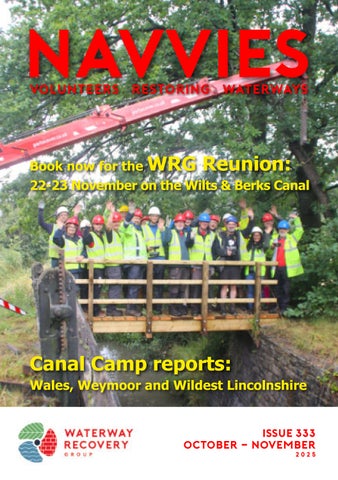
navvies Volunteers restoring waterways
Book now for the WRG Reunion: 22-23 November on the Wilts & Berks Canal
Canal Camp reports: Wales, Weymoor and Wildest Lincolnshire
Issue 333 october - november 2025
Intro more bollards…
You may recall that issue 327 last year carried a page of pictures of our London WRG regional group’s working weekend at the Leighton Buzzard basin on the navigable Grand Union Canal, putting in service ducting and a service bollard to supply water and electricity to the Bedford & Milton Keynes Waterway Trust’s electric trip-boat Electra. Well there was another similar working party recently at Wolverton, once again combining WRG and Buckingham Canal Society volunteers. These pictures taken by the editor show (clockwise from top left) the volunteers digging a trench through the hard surfaced towpath mostly by hand (to avoid disturbing buried fibre optic cables) putting in the ducting, filling in the trench, and installing and connecting up the bollard.
In this issue Contents For latest news on our activities visit our website wrg.org.uk See Facebook group: WRG Follow us on @wrg_navvies Contents
Production
Intro bollards at Wolverton 3 Editor: Martin Ludgate, 35 Silvester Road, Editor’s Welcome and worries 4-5 East Dulwich London SE22 9PB. Chairman’s Comment 6-7 020-8693 3266 martin.ludgate@wrg.org.uk Reunion dig Book now for Wilts & Berks 8-10 Coming soon Christmas digging 11 Contributions welcome, by email or post, Diary Camps and working weekends 12-13 to the address above. If sending a lot of Camp Reports Weymoor, Swansea, large picture files, please contact the editor Neath and Louth 14-29 first. Press date for issue 334: 15 November. Sue Burchett An appreciation 30-31 Progress updates from around the Subscriptions: A year's subscription (6 issues) waterways network 32-36 is a minimum of £5.00 (please add a donation Guildford festival Looking back 55 years 37 if you can) to WRG, Unit 16B, First Floor, Saafety Excavator safety levers 38 Chiltern Court, Asheridge Road, Navvies News the return of WRGWear? 39 Chesham HP5 2PX. Cheques must be made out to The Inland Waterways Association (although the proceeds will be PLEASE NOTE: subscriptions put to WRG / Navvies use).
renewal cheques should be made out to The Inland Waterways Association. Note new address (right)
Distribution: John Hawkins, 4 Links Way, Croxley Green WD3 3RQ 01923 448559 john.hawkins@wrg.org.uk
Navvies is published by Waterway Recovery Group and is available to all interested in promoting or supporting the restoration and conservation of inland waterways by voluntary effort in Great Britain. Articles may be reproduced in allied magazines provided that the source is acknowledged. WRG may not agree with opinions expressed in this magazine, but encourages publication as a matter of interest. Nothing printed may be construed as policy or an official announcement unless so stated - otherwise WRG and IWA accept no liability for any matter in this magazine. Waterway Recovery Group is part of The Inland Waterways Association, (registered office: Unit 16B, First Floor, Chiltern Court, Asheridge Road, Chesham HP5 2PX), a nonprofit distributing company limited by guarantee, registered in England no 612245, and registered as a charity no 212342. VAT registration no 342 0715 89. Directors of WRG: Rick Barnes, George Eycott, Helen Gardner, John Hawkins, Dave Hearnden, Nigel Lee, Mike Palmer, George Rogers, Jonathan Smith, Harry Watts, Mike Wills. ISSN: 0953-6655
© 2025 WRG
Cover picture: Volunteers celebrate the completion of a successful week’s Canal Camp on the Neath Canal with this group photo taken on one of the two bridges they built. See camp report on pages 21-25 (picture by the editor) Back cover: Aerial view of the new Rooks Hill Bridge on the Wey & Arun Canal showing the continued progress on the wing walls that has been achieved since the end of the two successful weeks of canal Camps that we reported in the last Navvies. (picture by Gordon Powell, Wey & Arun Canal Trust) Page 3
Navvies welcome from the editor The editor encourages you to book a winter work party and sign up for the forthcoming Reunion. And worries just a little about concrete… Editor’s welcome A warm welcome from the editor to another issue of our magazine Navvies, especially to any new volunteers who joined us on one of our summer Canal Camps. You’ll be able to look back on what you and all the rest of the volunteers got up to this summer, with four more camp reports in this issue reporting back from the Cotswold Canals, Louth Navigation, Neath Canal and Swansea Canal. But it’s not just about looking back, because there’s plenty more to look forward to, starting with something called the Reunion. The Reunion? Yes, as you’ll see on the front cover, it’s coming up on 22-23 November, and there’s lots more about it on pages 8-10. So I’ll just mention here that it’s usually the biggest event in the WRG calendar, a major working party attracting 80-plus people and doing a great deal of work (at the same time as having a lot of fun). It’s been in abeyance for the last six years as a result of the pandemic followed by a struggle to find a suitable site with enough work and large enough overnight accommodation - but now it’s back. Originally conceived many years ago as a way for new volunteers to get back together with their new friends from the summer Camps, it also attracts returning volunteers from previous years’ Camps, new recruits, and seasoned navvies from the regional mobile groups. Regional mobile groups? Yes, the work doesn’t stop when the summer Canal Camps programme ends. Look at our diary on pages 12-13 and you’ll find groups with odd names like NWPG or BITM or KESCRG - as well as some with slightly more ‘normal’ names like London WRG - are out most weekends on canals all over the country. Between them, in the next few months they’re supporting the Wey & Arun, Maidenhead, Chelmer & Blackwater, Basingstoke, Wilts & Berks, Shrewsbury & Newport and Cotswold canals. You’ll find more experienced ‘old hands’ in these groups, but they welcome new volunteers too on all their work parties. And meanwhile, our Canal Camps sites group are already looking forward to next year’s summer Camps programme… What? Summer 2026 already? Yes, we’ve been writing to canal restoration societies and trusts all over the country (and some of them have been writing to us) about possible week-long camps for summer 2026. Altogether over 20 different waterways were mentioned at the most recent WRG committee meeting. Not all of them will actually end up on the 2026 programme - inevitably the time taken up by planning and securing the necessary permissions for the work will mean that some won’t be ready to host a Canal Camp until the following year or later, or they will decide that it makes sense to do the work in other ways that don’t involve week-long camps. But hopefully by the time of the Reunion weekend (see above) we’ll have the beginnings of a plan for ’26, and something more concrete in time for at least a ‘prepreview’ article in the next Navvies. Hang on, ‘something more concrete’, is that some kind of punning reference to the kind of work we’ll be doing? Well, yes, possibly it is. And this is where I get into the ‘serious’ bit of the editorial column… On the back cover of this magazine (and in detail in issue 332) you’ll see where volunteers have made a great deal of progress in building the concrete abutments and wing walls for the new Rooks Hill Bridge on the Wey & Arun Canal. On pages 14-16 this time you’ll see that our teams at Weymoor Bridge on the Cotswold Canals have completed the concrete channel base and walls over the top of the new concrete culvert. In issue 332 you will have seen the reports of weeks of progress on constructing a new length of concrete Page 4
Ed Walker
Traditional rebuilt bridge meets modern concrete channel at Weymoor on a London WRG / Kescrg dig sided canal channel as part of a project to lower the canal to enable it to pass under a road that currently blocks it. And finally on the Swansea Canal, you can read about a team working all week to put an attractive stone facing on an overflow channel wall which was made of… you guessed it… concrete! You could get the impression that only the wooden footbridges on the Neath Canal and brickwork repairs on the Louth Navigation, also reported in this issue, keep the flag flying for traditional methods and materials. Should we be concerned at that? On the one hand, maybe we shouldn’t. On the Wey & Arun, thanks to (a) the loss of so many original structures during the 100 years that the canal was abandoned before restoration began and (b) the excellent progress by the Wey & Arun Canal Trust since then, the canal has long since reached the stage where there are hardly any original locks or bridges left to restore. Almost everything now is new build - and Rooks Hill Bridge is being built for a purpose that didn’t exist in 1816 when the canal opened: to carry the Greensand Way walking trail (which currently crosses the infilled canal) across the reinstated channel. And it’s the same story at Weymoor, where all the work was necessitated by the requirement to cross a land drain which was cut through the canal bed while the canal was abandoned. And at Lichfield, as mentioned, the new construction work is necessary to cross a road, where the original hump-backed bridge has long gone, and couldn’t be replaced like-for-like because of today’s requirements regarding traffic sight lines for new road bridges. There are good engineering and planning reasons for these choices. On the other hand, some would say that concrete isn’t a very environmentally friendly material - either when it comes to the natural environment and the sheer amount of carbon emissions involved in it production, or in terms of the built environment if the end result isn’t in keeping with the historic fabric of the canal. Then again, if the restoration movement did choose to do everything the old-fashioned way, with masonry bridges, brick culverts, clay-lined channels and the like, it would almost certainly cost a lot more. And trying to find some middle way - we’ve helped build or restore a fair few brick-faced locks and bridges with a fairly traditional appearance but with a considerable amount of concrete hidden away out of sight - might be seen as an acceptable compromise, or dismissed as a pastiche of heritage. “After all”, as someone said in Navvies a long while ago, “If [original canal engineers] Brindley and Telford had been around today, they would have used steel and concrete”. “Yes,” I replied, “but they wouldn’t have been restoring heritage waterways, they’d have been working on modern engineering jobs like HS2 and Crossrail”. With funding increasingly tight, but with greater concerns for the environment, it seems CRT and the restoration movement are being pulled in both directions. And I don’t think there’s a simple answer - I guess it’s a case of treating each challenge on its individual merits. Is that fair? Or an editorial cop-out? Feel free to send in your views. Finally, to lighten up, I’d like to mention the forthcoming revival of a range of WRG logo clothing. See Navvies News on page 39, and look out for more information in the future on how to get kitted out properly for those winter work parties coming up! Martin Ludgate Page 5
chairman’s Comment …on healthy scepticism, why you shouldn’t fill the new insulated water containers with squash, and the tricky question of restoration materials Chairman’s Comment Hello there, and welcome to an edition of Navvies that I consider to be both “bumper” and “upbeat”! Now, regular readers of Navvies will not be surprised by the fact it is “bumper”. It’s the edition that follows on from a summer of Canal Camps & Festivals so has page upon page of reports that are full of the sort of rewarding fun that has been enjoyed by those of us lucky enough to get our boots on the ground recently. But perhaps my suggestion of “upbeat” needs a little explaining from me. Because, as you may have noticed, there is a tradition in the Restoration movement of what diplomatic people might describe as “healthy scepticism” (but less diplomatic folk might call cynicism): • • •
No matter how perfect that brick you have just laid is, the next one probably won’t go in level Yes, the pump has worked well all day, but it’s probably about to block The people on this week have been brilliant, but my next Camp will probably be full of southerners / morris dancers / snorers / vegetarians (delete as applicable)
Now I’m not stupid enough to believe that (even if I wanted to) I could generate a convincing argument that this was a bad / negative attitude – there is a reason it is called “healthy scepticism”. No – I think my job here is to supply the raw materials for that attitude to feed on. Fortunately, as well as lots of reports of fun and frolics on restoration sites all over the country, this summer has generated quite a few messages for me to fill my Chairman’s bit with. But, as you read through them, I couldn’t resist reminding you all that I too can fall prey to that “healthy scepticism”. We have introduced an IGLOO insulated water container to the Canal Camp kits. Important message 1: Don’t ever think STOP PRESS: want some road stone (free)? “Hey, let’s fill it with squash” – they are Contractors have some stone available, it’s difficult to clean / free, and canal restoration groups (especially flush out. So clean in the South East) might be interested… water only, please. Important message � Over 20,000 tonnes of MOT Type 1 stone, only used once 2: Four or so of the as crane pads for piling. plastic beakers in the � It’s located near Tring in Hertfordshire - you will have to kit will happily freeze arrange the haulage but the contractors can load it. overnight in the � Buckingham Canal Society are anticipating having 1,000 freezer and provide tonnes - think of 10 dumpy bags by 10 dumpy bags by 10 the “ice cubes” for a dumpy bags high - but that still leaves another 19,000 tonnes day’s worth of chilled for everyone else water. Sceptic’s version: Please contact Terry Cavender of Buckingham Canal Society on “Oh good, some terry.cavender@buckinghamcanal.org.uk for more details chilled water – that if interested, and help avoid this going to waste or landfill. will come in handy on the winter Camps”. Page 6
Gas Burcos – the manufacturers have stopped making them. Important message: Therefore, because they are going to get very difficult to source, please look after them. Sceptic’s version: “Oh great – that cup of the tea was the best thing about the dig!”
Tim Lewis
The tricky question of Restoration materials. Important message: Why is Mike covering this when Martin has already raised it on the previous page? Well actually it does look like the necessary “critical mass” is forming to investigate this subject and create some advice and guidance for all restoration schemes. The gas Burco: look after it - there won’t be any more! Sceptic’s version: “Another committee and some handouts? Hardly gonna have any impact, is it?” Important message 2: Yes – committees / discussions / advice / guidance are a vital part of what we have always done. Safety reporting cards Important message: We put a bit of effort in making sure these were easily available on our sites and have been rewarded with a decent return of useful info. Our thanks as we process them and look for trends, etc. Sceptic’s version: Actually, I don’t think there is a sceptic / cynic version here. The concept of Safety Reporting is well accepted throughout WRG. In fact I’ll give two reports from the summer that don’t need any further processing: Heras fencing: Don’t forget that adding banners to a Heras panel will vastly increase its susceptibility to wind. Always think carefully about adding banners to temporary structures – they may not be able to take it. Tidy sites: Now I’m fairly sure that this concept is well held by all of us BUT just a reminder that it should also apply to our vans and our trailers. There were a couple of reports from this summer relating to trips (one in a trailer and one in the back of a van) that could have ended up with a nasty injury. WRG merchandise Important message: We are lucky enough to have some volunteers who are willing to take on this role (see Page 39), so let’s wear our name with pride. Sceptic’s version: Hang on – he’s nicking stuff from Martin’s pages again. Anyway, unless it results in new underpants for the people on my Camp, I’m not interested… A splendid summer, my thanks to all. Mike Palmer Page 7
wrg reunion 22-23 Nov What used to be the biggest event on the WRG calendar is back at last… The WRG Reunion: WHAT is it? It’s a major weekend working party that used to happen every year until 2019, where a large number of WRG volunteers get together to support a canal restoration project and really make a difference. And we all get to meet up with WRG friends that we haven’t seen for ages and have a good time in the accommodation on the Saturday night. It’s being led this year by Becky Parr, and we’ve got Harri Barnes in charge in the kitchen. And during the weekend we might even be able to announce where some of next year’s Canal Camps will be held. In the past the event was sometimes also called the Bonfire Bash, which gives a clue that the work is likely to involve clearing trees and vegetation from the canal bed and burning it on big bonfires - but there’s likely to be other work too.
WHO goes on it? Everyone is welcome to come - whether you’re a new Canal Camps volunteer from one of this summer’s Camps, an old hand who’s been doing this for ages, a regular with one of the WRG regional groups or other mobile groups, or somebody who’s never been on a working party before and fancies giving it a go.
WHERE is it happening? This year’s site is on the Wilts & Berks Canal, clearing vegetation around Grove Locks in the Wantage area. For more information about the canal restoration project that we’re supporting and how it fits into the rest of the waterways system, see the panel on the next page. And information on where the accommodation is - in an outdoor activity centre WITH BEDS! - and how to get there will be sent out to everyone who books on. Pickups can be arranged for those coming by public transport.
WHEN is it happening?
Pictures by Martin Ludgate
It’s taking place over the weekend of 22-23 November. Volunteers will arrive on the evening of Friday 21, and depart on late afternoon on Sunday 23.
Just some of the volunteers at the WRG Reunion dig on the Chesterfield Canal in 2016 Page 8
Wilts & Berks Canal: BE THERE! …so book your place now on a great weekend, to avoid disappointment
The Chesterfield Canal emerges from the undergrowth during one of two WRG Reunions held there
HOW do I book? Book online via the WRG website wrg. org.uk, follow the links to ‘Canal Camps & Weekend Digs and then scroll down to ‘Waterway Recovery Group Reunion 2025’ and click ‘Book now’. It costs £20 for the weekend, which includes three meals on Saturday, plus breakfast and lunch on Sunday. Don’t delay - we do have room for 80 people, but bookings were coming in steadily as we went to press. For more information contact enquiries@wrg.org.uk or 01494 783453 It isn’t just about the work: socialising at the 2018 Uttoxter Reunion Page 9
WHY is it happening? It’s happening because (following several years when we haven’t been able to find a site with enough of the right kind of work and accommodation to make it work) we’re finally in a position where the Wilts & Berks Canal Trust’s restoration scheme has suitable work for us, and we can use it to give their project a big boost. And because it’s a great opportunity to get together, have a fun weekend, at the same time as doing loads of useful work.
fact file Wilts & Berks Canal Length (originally): 52 miles (main line) 8 miles (North Wilts branch) Locks: 42 (main line) 11 (N Wilts) Date closed: 1914 (an aqueduct failure had already closed the canal to through trade) The work for the Reunion: Vegetation clearance around (and for 50 metres above and below) four of the six Grove Locks near Wantage, and around the remains of three bridges on the same length of canal. Why? The Wilts & Berks Canal Trust plans to begin restoration work on these structures in the not-toodistant future. Our clearance work will allow investigation and planning, enabling restoration to start. The wider picture: The canal is divided into three sections by Swindon (where a major diversion is needed to bypass parts of the original canal which have disappeared under the town centre - and where some parts of this new route and the original line are already being (re)opened as part of the Wichelstowe series of residential developments on Swindon’s south side). The western section of the canal leads from Swindon to the Kennet & Avon Canal at Semington, and has seen most of the restoration work carried out so far, at sites including Royal Wootton Bassett, Dauntsey, Foxham and currently Pewsham. On the northern arm, the North Wilts Canal branch which runs from Swindon to the Cotswold Canals (Thames & Severn Canal) at Cricklade, there has been a certain amount of restoration work including at Moredon and on the River Key Aqueduct. But the eastern section from Swindon to the River Thames at Abingdon, the longest of the three sections, has seen relatively little work to date. The planned work to restore Grove Locks will help to redress the balance, and our Reunion weekend will help to give it a good kick-start.
To Stroud and Saul Junction
Cricklade Possible diversion around Cricklade
River Thames to Thames & Severn Canal Oxford and Inglesham (Cotswold Canals) under restoration Abingdon WRG Reunion 2025 To Inglesham work site: Grove Locks
North Wilts Canal
Moredon
Dauntsey
Pewsham Melksham
Possible replacement arm on new route
Calne
Grove
East Locks Challow Wantage
SWINDON
Royal Wootton Foxham Bassett Chippenham
To Reading and London
Wilts & Berks Canal
Planned diversion around Swindon: western part already built / restored under construction as part of Wichelstowe developments
Possible diversion using drawdown channel of new Thames Water reservoir (if built)
Planned diversion via River Avon
To Reading To Semington Bath Kennet & Avon Canal
Page 10
20250818_120518
Coming soon Christmas? Book now for the Reunion, join the regional groups for their Christmas dig, think about a Christmas Camp, and get the BCN Cleanup in your 2026 diary The London WRG / KESCRG / WRG Forestry Christmas dig Wey & Arun Canal, 6-7 December As usual the curtain-raiser for the Navvies festive season is a joint weekend working party on the first weekend in December by three of our mobile groups - WRG’s London and Forestry teams and the KESCRG independent group. They will be getting together on 6-7 December for a weekend of scrub-bashing and whatever else the Wey & Arun Canal Trust has for them to do. The event is open to anyone, wherever you’re from, and whether or not you’re a regular volunteer with any or none of these groups. On the Saturday evening we’ll be having a Christmas dinner with themed fancy dress and the editor’s quiz and games, and this year’s theme is… Countries of the World. See the groups’ contact details on the diary pages 12-13 or any of the groups’ Facebook pages for details and to book your place.
The Christmas / New Year Canal Camp, 26 December - 1 January To occupy those ‘cold turkey days’ between Christmas and New Year we hope to be running another festive Canal Camp. Once again it looks like the leader will be Dave ‘Moose’ Hearnden, the site and accommodation aren’t quite confirmed yet but there’s a good chance that we will be back doing more scrub-bashing on the Buckingham Canal again. Keep an eye on the WRG website or contact enquiries@wrg.org.uk or 01494 783453.
The BCN Cleanup, 14-15 March 2026
Martin Ludgate
It might not seem that long since we were last throwing our grappling hooks in the murky waters of the underused reaches of the Birmingham Canal Navigations on this year’s BCN Cleanup, but we’re already planning the next one. We’ll have more information in the next issue but it’s looking like we’re heading north to go fishing for shopping trolleys, bikes, prams, old tyres and who knows what else in the Wyrley & Essington Canal - and that probably means moving away to new accommodation too. In the meantime note the date 14-15 March in your diary. What will we find next year in the Wyrley & Essington Canal? Page 11
navvies
diary
Week-long Canal Camps cost £80 or as stated. Booking for events labelled ‘WRG Asheridge Road, Chesham HP5 2PX. Tel: 01494 783453, enquiries@wrg.org.uk. Oct 17-19
NWPG
Wey & Arun Canal, Rooks Hill
Oct 18-19
wrgBITM
Basingstoke Canal: Offside rhododendron clearance
Oct 18-19
MBBCS
Manchester, Bolton & Bury Canal: Nob End Locks
Oct 25-26
London WRG
Wey & Arun Canal at Rooks Hill Bridge
Nov 15-16
wrgBITM
Maidenhead Waterways: Bray Cut
Nov 15-16
MBBCS
Manchester, Bolton & Bury Canal: Nob End Locks
Nov 22-23
WRG
WRG Reunion on the Wilts & Berks Canal: vegetation clearance at Grove Locks - see
Nov 22-23
London WRG
Supporting the WRG Reunion - see above
Nov 22 Sat
WRG
WRG Committee/Board Meeting: at WRG Reunion
Nov 22-23
NWPG
To be arranged
Dec 6-7
London WRG
Wey & Arun Canal. Joint Christmas dig with KESCRG and WRG Forestry
Dec 6-7
KESCRG
Wey & Arun Canal. Joint Christmas dig with London WRG and WRG Forestry
Dec 6-7
WRG Forestry
Wey & Arun Canal. Joint Christmas dig with London WRG and KESCRG
Dec 13-14
wrgBITM
To be arranged: Xmas Work Party
Dec 20-21
MBBCS
Manchester, Bolton & Bury Canal: Nob End Locks
Dec 26-Jan 1
WRG Canal Camp
Christmas / New Year Canal Camp, details to be announced
Jan 10-11
London WRG
Chelmer & Blackwater Navigation (to be confirmed)
Feb 7-8
KESCRG
Wilts & Berks Canal. Joint dig with WRG Forestry
Feb 7-8
London WRG
To be arranged, possible joint dig with KESCRG
Feb 28-Mar 1
London WRG
Shrewsbury & Newport Canals
Mar 7-8
KESCRG
Wilts & Berks Canal. Bank protetion at Rushey Platt
Mar 14-15
IWA/BCNS/WRG
BCN Cleanup: likely to be on northern part of BCN, possibly Wyrley & Essington.
Mar 14-15
London WRG
Supporting the BCN Cleanup
Mar 22
NCA
Northern Canals Association: Meeting on Chesterfield Canal
Apr 11-12
KESCRG
Cotswold Canals (Thames & Severn Canal), Weymoor bridge, hopefully finishing
Apr 18-19
London WRG
To be arranged, possibly Cotswold Canals
May 9-10
KESCRG
Cotswold Canals (Stroudwater Navigation), John Robinson lock area, progressing
Jun 6-7
KESCRG
Wey & Arun Canal, Rooks Hill Bridge, hopefully starting excavation / towpath creation
Page 12
WRG and mobile groups Canal Camp’ should go to: WRG Canal Camps, Unit 16B, First Floor, Chiltern Court, Diary contributions to Dave Wedd, Tel 07816 175454, dave.wedd@wrgbitm.org.uk Bill Nicholson
01844-343369
bill.nicholson@weyarun.org
Dave Wedd
07816-175454
dave.wedd@wrgbitm.org.uk
Sam Kennion
07843-394161
samklancs@yahoo.com
Tim Lewis
07802-518094
london@wrg.org.uk
Dave Wedd
07816-175454
dave.wedd@wrgbitm.org.uk
Sam Kennion
07843-394161
samklancs@yahoo.com
01494 783453
enquiries@wrg.org.uk
07802-518094
london@wrg.org.uk
01494 783453
enquiries@wrg.org.uk
Bill Nicholson
01844-343369
bill.nicholson@weyarun.org
Tim Lewis
07802-518094
london@wrg.org.uk
Ed Walker
07887-568029
ed@edwalker.org.uk
Ed Walker
07887-568029
ed@edwalker.org.uk
Dave Wedd
07816-175454
dave.wedd@wrgbitm.org.uk
Sam Kennion
07843-394161
samklancs@yahoo.com
01494 783453
enquiries@wrg.org.uk
Tim Lewis
07802-518094
london@wrg.org.uk
Ed Walker
07887-568029
ed@edwalker.org.uk
Tim Lewis
07802-518094
london@wrg.org.uk
Tim Lewis
07802-518094
london@wrg.org.uk
Ed Walker
07887-568029
ed@edwalker.org.uk
01494 783453
enquiries@wrg.org.uk
07802-518094
london@wrg.org.uk
pages 8-10 Tim Lewis
More info next time Tim Lewis Ivan Cane
northern.canals2021@btinternet.com
up the landscaping Ed Walker
07887-568029
ed@edwalker.org.uk
Tim Lewis
07802-518094
london@wrg.org.uk
the work on the lock Ed Walker
07887-568029
ed@edwalker.org.uk
north of bridge
07887-568029
ed@edwalker.org.uk
Ed Walker
Page 13
Camp report Cotswold Canals Ricey reports from the final week of the project to install a stream culvert at Waymoor Bridge an rebuild the canal channel above it Weymoor bridge, Cotswold Canals site, along with various clips, clamps and struts, and half of the panels being over Week 2: 16-23 August
45kg each, this took a real team effort. Rebar work progressed quickly, shuttering started to be installed. The first couple of panels were headscratchers and
Guten Tag. Das ist richtig, es ist der zweite Lagebericht in deutscher Sprache für 2025!
Pictures by Ricey
Only joking, Duolingo only got me as far as being able to confidently order a beer and chocolate cake, but what more do I really need? But, as for week two at Weymoor Bridge, our aims were simple: construction of two reinforced concrete walls to form the next section of the sides of the reinstated canal channel where it crosses over a buried stream culvert, continue a blockwork wall forming the edge of the towpath, lay a coping stone or two and ensure we left something fun for KESCRG and London WRG to do on their upcoming weekend. Week 1 had done a cracking job getting us into a position where the giant Meccano set that we call rebar (or reinforcing bar in full) was ready to be tied with our handy twiddlers. On Sunday Camp commenced with the twiddling ties on the south wing wall whilst backfilling around the north wing wall and various other cavities rumbled on in the background. The walls were to be shuttered using system formwork, so with seventy panels to Assembling the rebar and (below) shuttering and bracing ready for the concrete pour be loaded and unloaded and carried onto
Page 14
required a little percussive persuasion to get in place, but once that was done, the rest followed quickly. Monday evening’s entertainment occurred organically with a camp member playing a jaunty tune with the trailer on the village hall railings, followed by a ‘team building exercise’ to workshop multisyllable words to put together a near miss report. Tuesday was the turn of the north wall, rebar, twiddling and shuttering like a well-oiled machine. Well almost, there was still plenty of head scratching, a few leaders leaning on things, and only a slight delay due to being one panel short, but it is a WRG camp after all! Wednesday, our big deadline, two vehicles full of concrete were heading for site from 8am with a pump and 35m boom to fill our walls. After an early start for some, our intrepid campers split into two teams. One stayed at Weymoor to double-check the formwork and ensure the concrete pour went well, whilst another headed north to help the locals progress a towpath, behind
The concrete is pumped in
fact file Cotswold Canals
Length: 36 miles Locks: 56 Date closed: 1927-1946 The Canal Camp project: Reinstating the canal channel in reinforced concrete alongside Weymoor Bridge Why? A new culvert was installed under the canal last year, to replace an open ditch cut through the canal bed which had been carrying a small stream. The channel then needed to be rebuilt above the culvert. The wider picture: Although most of the restoration effort on the canal in recent years has been concentrated on getting the western Phase 1a and 1b sections (both supported by major Lottery grants) open and connected to the network, the Cotswold Canals Trust will work on other sites when the opportunity arises. One such site is Weymoor Bridge, which was reinstated several years ago thanks to a legacy specifically for this purpose. Other work carried out nearby over the years has included lock restorations and a new bridge in the Cerney area, meaning that a significant length of restored canal could be put together here in the medium term. Ultimately the aim is for it to form part of the restored through route. To Gloucester Phase 1b Saul to Stonehouse: Lottery grant confirmed 2020 Stonehouse Phase 3 Brimscombe to Water Park: Some To Sharpness 5 2 Stroud 12 restoration completed mainly around Cerney 6 Sapperton Tunnel Canal Camp site Phase 1a Stonehouse to Brimscombe 43 Inglesham R Thames Brimscombe: complete (except Port 3 to Oxford Brimscombe Port length) Cerney 2 ‘Cotswold Canals’ is a name given Cotswold Water Park Eisey by canal restorers to the through route comprising the Stroudwater Navigation from Phase 2 Water Park to Inglesham: Saul Junction to Stroud and the Thames & Severn North Wilts Canal Some work completed around to Swindon Canal from Stroud to Inglesham. It has been Eisey. Inglesham Lock restored subdivided into restoration phases as shown here Saul Junction
Page 15
the Cotswold Outdoors Centre. During an after-work celebration trip to the Daneway Portal (and Daneway Inn) at Sapperton, Harry was considered as a sacrifice to the canal gods to give thanks for a successful concrete pour, but fortunately for our Duke of Edinburgh’s Award volunteers it was collectively decided a walk back to the pub would be just as an appropriate way to celebrate. On Thursday the removal, transporting back to the yard, and cleaning of shuttering was completed alongside numerous digger experiences, blockwork unloading, and plenty of concrete being mixed for more of those cavities that needed filling around the site. We were an ambitious group, we had managed two walls, but could we build a The other job: towpath surfacing by the Cotswold Outdoors Centre third, albeit blockwork wall before the end of the week? The answer was off for our cook Lou. Thankfully, after an inno, we didn’t finish it, but we gave it a pretty depth discussion held in the local pub earlier good go over the last two days. We had to in the week, we had the perfect ratio of leave something for the next camp after all. ingredients to ensure the structural integrity To end the week, we had a Ricey/ and success of her “imagined in a dream” Sandra traditional Friday night boat trip with Rice Krispies cheesecake. a chippy tea, to give a well-deserved evening Stephen ‘Ricey’ Rice
With the completed concrete wall visible behind, construction of the blockwork towpath wall begins Page 16
Camp report Swansea Canal Down in South Wales, our team spent a week putting a stone cladding on the new bywash for the recently uncovered ‘buried lock’… Swansea Canal Camp – 30 Aug to 06 Sep 2025 Ten years ago, the first volunteer to arrive on my first camp as leader introduced me to Haikus when she wrote one on the whiteboard as a greeting to the other arriving volunteers. When thinking about the form of this report – and I don’t like being too conventional – I remembered that first Haiku from all those years ago. I had to remind myself that a Haiku is a traditional Japanese short form of unrhymed poetry, typically consisting of three lines with a 5, 7, 5 syllable format. Haikus often have a focus on nature and the seasons but ours below tell the story of our week. Now knowing what I had to do, off I rambled. Ideas and contributions, serious and not so, were gratefully received from everyone on the camp.
Saturday Last camp of season Clydach Buried Lock, Swansea Summer, ’25 Arrived Saturday Set up our beds, had a brew Visited the site We had some dinner Saw you-know-what video Went off to the pub
Sunday All morning it rained But after lunch on Sunday The sun showed its face Cladding of slag stone Was laid against the ugly Concrete bywash walls Right tool for right job When bywash flow is too much WRG boards save the day
Pictures by Evvo
Super cook Ian Prepared a fab roast dinner Followed by crumble We’re a WhatsApp group Dinner in fifteen minutes Hope phone signal good Page 17
Monday On Monday 1st Sep White Rabbit greetings were shared To bring us good luck No luck with weather The rain did fall heavily We ran for cover Finally working Cladding laid, dry mix bags filled Tangible progress Banner put up for Harry’s birthday on this day Two whole months early Times are a-changing Youngsters reading paperbacks Old-uns reading phones
Tuesday Tuesday, we sorted Slag stones in piles for cladding Blue stone dust mortar
Had to work all day No forecasted thunderstorms Everyone tired
A fine lunch with hosts Swansea Canal Society Sarnies and great cakes
Emma offered help Out came her Swiss army knife Not a near miss!
Pete, ’Arry, Harry Mixed mortar, too wet, too dry Six grumpy cladders
We chose the items From the coffin of food stuff For Ian to use
Page 18
Wednesday More mortar mixing Lots more cladding in bywash Plenty of tea drunk
Canoes on canal From Clydach to Trebanos Both have been WRGied.
Disc-cutter training Dust suppression not working Very short lesson!
Five kayaked up to Trebanos locks, one fell in Footwear lost in cut!
Thursday Amy out in wellies Bywash water filled them up Soggy socks and feet More dodging the rain Avoiding inundation More brew and cake breaks ’Arry still mixing Now getting the hang of it Old dog has new trick! Dinner in the pub Courtesy of our great hosts Many, many thanks Antidisestablishmentarianism is a very long word! Page 19
Friday BOB sent to Bungle For unplanned titivation Nice new paint coming! Temp bridge now removed West wall cladding completed Bywash prettier Trailer and kit count Lots of dirty tools made clean Top WRGies were we
Saturday Time to give my thanks To Ian for tasty meals ’Arry assisting And not forgetting Pete, Emma, Andrew, Paul, Sam Amy and Harry Lastly but not least Swansea Canal Society Gordon and Alan Clydach Buried Lock Soon be back in use again WRG pleased to have helped Compiled by David (Evvo) Evans
fact file Swansea Ca Length: 16 miles (originally) Locks: 36 (originally) Date closed: 1928-1960 The Canal Camp project: Putting stone cladding on the concrete bywash (overflow) channel that has been built to bypass Clydach (Upper) Lock. Why? The lock was formerly buried under a council yard but has been uncovered and restored by Swansea Canal Society. It will need a bywash to function.
Ynysmeudw
The wider picture: This lock will link together the length passing through Trebanos Locks, scene of previous Canal Camps, and Clydach Lower (or Pontardawe Locks Mond) lock (planned for restoration) Trebanos Locks and SCS’s new Canal Centre. In the longer term SCS Swansea Canal Ca hopes to restore the site: Clydach Lock Mond Lock or surviving six miles C Clydach Lower Lock from Clydach to Aberdula Godre’r Graig (but Aqueduc Proposed new canal see also ‘Swansea Bay Inland route via River Tawe Waterway’, below left) Tennant NE
The Swansea Bay Inland Waterway scheme It’s a long term aim of some involved in canal restoration in South Wales to eventually link together the existing projects to create a 35 mile regional waterways network. It would involve the following: • Restore the surviving Swansea Canal from Clydach to Godre’r-Graig • Get the Neath restoration back on track and open past the obstructions down to Aberdulais and Neath SWANSEA • Restore the Tennant Canal from Aberdulais to Swansea Docks • Bypass the lost lower Swansea Canal using the River Tawe • Link them together via a new route through Swansea Docks
Page 20
Go
Canal
Length of Swansea Canal south of Clydach largely buried under Swansea
Neath Canal
Briton Fe
Camp report Neath Canal Still in South Wales, Paul Rodgers reports from a week building footbridges and creating an overflow culvert on the Neath Canal Neath Canal Camp with Tŷ Banc Canal Group 23rd – 30th August 2025
Scout Hall in South Wales for what was originally going to be the final Camp of summer 2025. Getting back to a full-sized Camp with the addition of other long-term WRGies and three Duke of Edinburgh’s What a Team! Award volunteers on their Gold Award residential, gave us a strong team of The last week in August saw a group of experienced volunteers, bringing brains and familiar faces from previous WRG Canal Camps at Swansea in 2022 and the Cotswold brawn to what was a complex and novel set Canals in 2023 heading back to Ystradgynlais of tasks not normally encountered on WRG Camps. It was great for me to be able to hand over the leadership reins and take up the role of assistant camp leader. It was a leadership team that had worked well in 2023 and it was time to shuffle the roles, Length of Swansea Canal with Will Horne taking the lead. It was
anal
north of Godre’r-Graig largely buried by road improvements
fact file Neath Canal
Swansea Canal
16-19 15
odre’r Graig
wy Locks
amp k
Maesgwyn Lock 13 Ynys-yr-Allor Lock 12 Neath Canal Camp 11 site: near Resolven 9-10 Resolven Lock 8 5-6
Ynysbwllog Aqueduct
7
14
Length: 13 miles Locks: 19 Date closed: 1930s
The Canal Camp project: Building and installing wooden lock tail footbridges at locks 12 and 13, and creating an overflow culvert under the canal towpath near Resolven.
Why? The footbridges will allow access to the offside (non towpath side) of the canals, and facilitate future restoration work on the locks themselves. And the new culvert will prevent excess water after heavy rain from overtopping and damaging the canal bank
The wider picture: A great deal of restoration work was carried out on the Neath Canal CLyne Locks 3-4 back in the 1980s to 2000s, led by the Neath & Tennant Canal Preservation Society and ais supported by visiting mobile volunteer groups including WRG, as well as significant ct Tyn-yr-Heol external funding. This enabled a series of seven locks (numbers 8 to 14) from Resolven to Lock 2 Ysgwrfa to be restored and a trip boat to operate. A major new aqueduct was built across the Machin Lock 1
EATH
erry
River Neath at Ynysbwllog to replace one washed away by floods in the 1970s, and further lock restorations were carried out at Clyne, Machin and Tyn-yr-Heol locks (numbers 1 to 4). There were still serious obstacles to further restoration including blockages from road crossings in Neath and at the south west end of the main restored length at Resolven, but there appeared good prospects for reopening through from Neath to Ysgwrfa but also along the connected Tennant Canal from the junction at Aberdulais towards Swansea. However the restoration’s progress faltered, major funding proved hard to find, and ultimately the lack of sufficient money and support to maintain the existing restored lengths meant they began to deteriorate and become unnavigable again. However recently a new organisation, the Tŷ Banc Canal Group, has been formed to try to get the restoration back on track again. It has a long list of priority works, and the Canal Camp jobs formed part of this work to begin to reverse the decline. Page 21
certainly a baptism of fire – a new site, a new local group (the Tŷ Banc Canal Group), new projects – as well as an assistant not skilled in assisting! Months of preparation, supported by George Rogers and Pete Fleming of the WRG Sites Group, meant that we went into the camp armed with our technical drawings, method statements and risk assessments for two wooden lock-tail footbridges and a culvert/weir to alleviate towpath flooding. We were blessed to have Bev Williams join us as camp cook. Her indulgence and flexibility in coping with the new leadership team’s changing requirements for breakfast times and the late - and split - dinner times after the extended hours on site must have tested her cheerful demeanour to breaking point – but it didn’t show! Her hearty breakfasts were enough to get even the most exhausted of us out of bed on time, the choice of sandwich fillings was the most adventurous I’ve seen, and the evening menus gave us something to look forward to as our weary bodies left site. A polypin of the local 9 Lives Brewing’s best beer kept the beer drinkers happy for the week!
Tŷ Banc Group
camp and during the week was invaluable especially with Rob and Simon joining us all week and providing much needed extra energy and experience as well as vital insights and local knowledge.
Location The Neath Canal follows the Neath River (Afon Nedd) for most of its length and, above Resolven Basin, is sandwiched between the river and the B4242. Our work focused on the canal northeast of Resolven Basin – if you can call it ‘focused’, with the ‘site’ encompassing a 2½ mile-long stretch between the access at the Basin and the locks where the bridges would be installed. We got on top of the challenging logistics by establishing a ‘base camp’ compound near the Basin access track and the South Wales Adventure Company’s kayaking and paddle boarding centre. The culvert site was ‘just’ 500m up the canal from base camp. It’s always nice to be introduced to the site – especially a new one – on the first afternoon/evening so, in our wisdom, we marched the team from base camp to the closest lock that was to have a bridge installed. In hindsight, that two-mile walk (each way) was a bit too challenging and I think we were lucky that we still had a full complement of volunteers for the Sunday!
Pictures by Paul Rodgers
Given that this is the first time a WRG camp has worked with the Tŷ Banc team, it would be remiss of me not to introduce the wider Navvies readership to this wonderful group that has energy, determination, and a clear vision of how to bring the Neath Canal to their local community. Yun Yun and Kevin Herbert, Rob and Simon Hughes, and the wider volunteer team are fearless! I encourage every Navvies reader to follow them on Facebook and Instagram. We felt very welcome and the WRG gazebo became part of the Canal Festival when we arrived properly on site on the Sunday. As well as bringing the local community together for a Canal Festival on the first Saturday and Sunday of our camp, we also enjoyed the most generous hospitality with local caterer, The Soup Dragon, providing a wide choice of food at an evening on site to bring the local group’s volunteers together with the WRG team. Their support in the run-up to the Thanks to local caterer Soup Dragon for hospitality Page 22
Key Tasks The week was characterised by highs and lows – all good, even the lows! The Bridge Builders: Spending most of the week firmly on the ground (very wet, flooded, Somme-like by the end of the week), the Bridge Builders team was focused on measuring, checking, measuring, checking then sawing and drilling test pieces of the timber for the The bridges are assembled and (below) delivered for installation bridges, and then doing a little bit more measuring and checking before tackling the main build. The design templates were straightforward and with a few final checks on the span and parapet widths of the two locks, the final dimensions were agreed. Fortunately, we had skilled woodworkers with their tools at the ready and the base-camp compound became a hive of activity. Working slowly and meticulously over the first three days on one bridge, and having mastered all the necessary skills, the second bridge was completed in less than two days! The real high of the week came when the spider crane crew receive such esteemed attention. To see a arrived in site at 08:30 on the Friday morning. We all headed up to the top lock to bridge soaring through the air and being deftly lowered into place after having been witness this marvel in materials handling. Such was the spectacle that Navvies Editor- skilfully transported down a narrow towpath on a mini tracked crawler was a unique and in-Chief, Martin Ludgate, graced us with his memorable moment for each and every one presence - and his camera - with our DoE of us. volunteers in awe that our work would Page 23
Final Thoughts Across each of the core tasks, both teams picked up some new skills – even basic sawing and drilling took on a whole new level of precision. Much to the delight of our DoE volunteers, the reworking of the clay recovered from the canal bank excavation into carefully qualitycontrolled ‘turds’ to be used in the relining of the canal edge face of the culvert, provided a window into the experiences of the early canal engineers when puddling their canals. The Tŷ Banc quad-bike was an essential addition to Excavation under way for the culvert under the towpath the camp’s equipment. The Culvert Crew: If the Bridge Builders We would not have completed the work were flying high, the Culvert Crew’s focus without it. Will had taken the driver was all about going low. Nothing we would authorisation training before the camp and do in the week would ever get above we added two more quad-bikers early in the ground! On day one, having agreed the ideal camp. Perhaps the WRG and IWA Boards water level, the Culvert Crew set about should anticipate a request for quad-bikes in excavating the canal side to 1400mm below the not-too-distant future! Equally useful was towpath level; 900 mm below the water a bike – remember, it’s always worth just level. Making sure that canal didn’t end up in throwing those ‘might-use’ useful things in at the river was the core of our risk the last minute before you head off on a assessment. Digging through a towpath is camp! not to be taken lightly but by securing The hard work and need for 500mm of the existing canal bank, we resourcefulness helped build a new team created a ‘bund’ that was to keep our that Will and I hope will go on to have more workings dry all week. adventures with us and across the wider Equally, keeping a towpath open WRG family in future. through a Canal Festival weekend and a bank holiday presents its challenges. Pouring Weather the deep canalside concrete toe on day two and completing the base slab excavation, The weather forecast for the week was reinforcing bar and mesh, and concrete pour pretty good until the remnants of hurricane on day three kept us on track for the brick Erin started veering across the Atlantic which and blockwork on the Wednesday. The lintel meant that the Summer of Sun was coming spans went in on the Thursday to allow the to an end! The first three days of the camp Culvert Crew to join the Bridge Builders in were mainly dry but that all changed for the their moment of glory on the Friday morning Wednesday, Thursday, Friday. It felt rather before heading back to work on the insulting when the weather cleared as the reprofiling of the towpath, putting in the last van was packed on the Saturday stop-planks and breaking through the bund. morning. Page 24
A social-lite camp Will worked the Bridge Builders hard and I kept the Culvert Crew on site for a couple of late shifts so the scope for evening social activities was somewhat curtailed. We still managed to get a couple of semi-social activities across the week. For the Sunday evening, as a way to really get to know each other better, we have invented an ice-breaker game that we hope will become a feature of the The culvert: preparing to cast a section of the concrete base… opening night of all future camps… With an extra camp added to the 2025 schedule to follow ours, the last task was to take the vans a few miles down the road to the Swansea Canal Society’s wonderful new canal centre in Clydach. What great scheduling - it couldn’t have made for an easier wrap up and everyone was soon on their way home, exhausted, but with a real sense of achievement and a determination to book …before bricking / blocking the walls and (below) adding the lintels early for a canal camp in 2026. I hope WRG will be back in South Wales again soon. There is a lot that we can assist the local groups with - and we can learn a lot too when we push the boundaries, encounter new sites, take on projects that we don’t usually do, and have to think afresh about how we might deliver the full value of WRG to a canal restoration group for the first time. Paul Rodgers Page 25
Camp report Louth Navigation Mick Lilliman reports from another week at Ticklepenny Lock repairing and patching lock walls, and casting new coping ‘stones’ Camp Report: Louth Navigation 9-16 August …or should this be Louth 2025 Navigation Camp report, as we were working on the Louth Navigation, not the Louth Canal? For a third year in a row WRG and Louth Navigation Trust (LNT) held a camp in Louth to continue the refurbishment of Ticklepenny Lock. Previous camps had started rebuilding the buttress wall, carried out repairs to the lock wall brickwork and rebuilt an arch, as well as repointing a lot of the lock walls. The lock is unusual in having scalloped sides, some of the other remaining locks on the Navigation have a similar construction. The lock was designed this way to give stability in poor ground conditions. So, what can 13 WRG volunteers and a dinosaur called Stanley, together with very keen locals from LNT achieve in a week? Please read on! The accommodation is a bit quirky, a
Community Centre with blinds on a few windows, so first job was to fit tarps to the windows to block out some of the light. Gaffer tape to the rescue. Locals joined us for the safety brief, followed by an excellent meal of pasta and Bolognese sauce, followed by chocolate fudge cake with strawberries and cream/ yogurt. One of the many achievements was eating nearly all the amazing food prepared by Anne. More about food later. One of the smaller jobs was to repair some cracks in the lock wall, digging out the mortar, inserting Helifix reinforcing and remortaring. Susan donned waders and lifejacket, along with local Malcolm, stitch drilling and raking out mortar either side of the cracks, to a depth of 35mm. Mick’s recent purchase of a rotary mortar rake fitted to a battery drill was very useful (almost as though it was planned ahead!). Another small-ish job was the rebuilding of the upstream offside arch support wall, the arch itself being structurally sound.
fact file Louth Navigation Length: 11 miles
Locks: 8
Date closed: 1924
The Canal Camp project: Continuing repairs to Ticklepenny Lock including chamber wall and wing wall repairs, as well as casting ‘fake’ concrete coping stones.
Humber Estuary
Spurn Head North Sea
Why? The lock is a historic structure which has suffered Cleethorpes from decay and damage from water running through the chamber and would deteriorate further if left unrepaired .
Tidal gates
Sand and
Tetney mud The wider picture: The Louth Navigation was an 11-mile Tetney waterway which connected Louth with the mouth of the Humber Lock Estuary at Tetney Haven. Although mostly built as an artificial canal, it made some use of the River Lud in its upper reaches near Louth. It fell into disuse and was abandoned in the 1920s but survived as a water channel because much of it formed part of the local land drainage system. Since the 1980s Saltfleet Outfen Lock the Louth Navigation Trust has been working to conserve and ud er L restore what survives of its structures, as well as promoting the Alvingham Lock Riv Salterfen Lock towpath as a walking route, and restoring the Navigation Canal Camp site: Willows Lock Warehouse at Canal Head in Louth as a community Ticklepenny Lock Keddington Lock centre, and generally raising awareness of the Navigation. Louth Town Lock
Page 26
Pictures by Mick Lilliman
Mick donned waders and lifejacket (common theme here) and carefully removed brickwork until sound brickwork was encountered. Fortunately, sound brickwork was found above water level. Brickwork was rebuilt, and local Pete completed the brickwork wearing waders and lifejacket. On the offside downstream side the lock tail wall had collapsed. Our ace bricklayer Rob B and his gang worked in the shade to first clear the wall down to sound brickwork and then start the rebuild. Assisting at various times were Peter, James, Robert and Hannah (owner of dinosaur). On the other side of the lock the buttress wall had reached the level of requiring an access platform to do sloping brickwork at one end and coping stones at the wharf wall end. We noted a coping stone in the lock (River Lud flows through the lock so it’s always in water) so with the help of local man Phil, Nigel and John managed to get the stone into position. This “real” stone was used to demark the transition to sloping brickwork. Nigel and John, assisted by Peter and local Roger started the sloping wall. This required bricks and blocks cut at an angle, provided by Mick once he managed to start the bricksaw. “Fake” coping stones were required to fill in the remaining part of the flat wall. It was originally going to be cast in situ, but difficulties with heritage approval meant
The ‘crack’ repair team
Offside culvert arch repaired Page 27
that we cast them separately and placed them in position without mortaring them in. So, we needed a production team to make “stones”. Tony provided the expertise and the tools to make the formwork ably assisted by apprentice chippy Hannah and old hand Steve (not by any means the oldest hand). Once the formwork was unpeeled the stones were “distressed” to make them look more like the real thing. Susan and Hannah distressed the stones. Stones were manhandled, sack-barrowed, rollered and grunted into position. Local reclamation yard man Lee helped a great deal by bringing his
telehandler to lower the stones into position. He also donated most of the bricks. The job nobody likes got tackled by Robert, brick cleaning. At least he was in the shade of the second gazebo. We needed a lot of lime mortar for the various brick repairs plus cement mortar and concrete for the coping stones so our mixing champion Paul was kept busy, especially on days when we needed stones making and lime mortar. The electric mixer was washed out regularly between mix changes and to keep the brickies happy we mixed lime mortar in a barrow. Paul was helped by
Expertly cast new coping ‘stone’, and (below) the old and new stones in place, but with the new ones not mortared in pending heritage approval
Page 28
The offside wall gang Robert, James and Mick, with Steve helping when mortar needed delivery. None of this work could have happened without the amazing cook Anne. Meals were fabulous, with even Rob B having enough to eat. Meals as follows: • • • • • • •
It was hot all week so the “igloo” water container which is now part of the camp kit was very useful. No-one overheated. Finally, we had the LOSCAR’s (Louth Special Camp Awards); in accordance with modern practice, everyone got an award (see below). Bolognese sauce with pasta, choc fudge Mick Lilliman cake and strawberries/cream/yogurt. Slow cooked brisket, assorted roast The LOSCARS vegetables, chickpea tagine, cherry (Louth Special Camp Awards) plum and apple crumble with custard. Chicken, leek and ham pie, veggie pie, Most Illustrious Leader Nigel jacket potatoes, assorted veg and Veteran Bricklayer John and Rob B (joint) chocolate cheesecake. Carpenter of the Week Tony Cottage pie, veggie pie, assorted veg, Apprentice Carpenter Hannah blueberry and strawberry cinnamon Apprentice Bricklayer James pudding. Most Improved Bricklayer Peter Chicken with peppers, veggie with Labourer / Dogsbody/ peppers, Biscoff ice cream (yummy). Lender of Hands Steve Beef and mushroom stew, veg stuffed Brick Cleaner Robert squash, cheese and biscuits. Distresser of Stones Susan Leftover Spanish omelette, veg squash Bricksaw Artist Mick omelette, strawberry tart with cream/yogurt. Most Important Person Anne (the cook)
All were absolutely delicious.
Favourite Local Society Louth Navigation Trust
Page 29
Sue Burchett An appreciation RIP Sue Burchett 1942-2025 “It’s a sad end to Josie and Sue’s Hard Hat Café. At least we had the T shirt.”
Martin Ludgate
Tim Lewis
As we mentioned briefly in the last issue of Navvies Sue Burchett, longstanding former WRG and KESCRG volunteer, boater (with her husband Roger), one time Chair of the National Association of Boat Owners, and legendary cook and caterer for volunteers, sadly died on 25 August after a short illness. Her funeral in Bristol was led by Edwina Wallace who many of you will remember from IWA festivals in the past, and was well-attended by many old WRGies and other waterways folk, and is probably the only occasion when the ‘Navvies Jerusalem’ has ever been performed as part of a religious service. We’ve collected individual volunteers’ memories of Sue and quotes from Edwina’s piece to create this appreciation… Born in Luton, Sue held many jobs over the years, often two or three at once, and while working at a petrol station she met police officer Roger – marrying him four months later and remaining with him for the remaining 59 years of her life. Their involvement in volunteer waterway restoration began with the KESCRG group, then continued Roger and Sue at a surprise party for Roger’s 70th birthday at Saul Canal Festival later with WRG’s BITM regional group (where Sue and Roger’s legendary German Shepherd Dog ‘Blue’ was memorably elected as Chair of the group. Well, WRG rules were that it had to have a chair – but didn’t say anywhere that they had to be human). Very soon Sue was getting a name for herself on account of her catering on working parties and increasingly at festivals, often in partnership with the late Josie Fisher in earlier days (hence the Josie & Sue’s Hard Hat Café T-shirt mentioned at the start)… Sue abseils down the Anderton Lift to raise funds for restoration Page 30
“Sue’s sandwiches were legendary. I remember cold fried egg and curry, cold sausage and beans, and am told opal fruit sandwich was also made on request. Sue taught my seven year old to make sandwiches with a proper sharp knife… not the blunt one I would let her use.” “Breakfast and supper leftovers became the sandwiches for lunch, no food was ever wasted. The standing joke about the soup was not to stir it: the top was the vegetables for the vegetarians and the meat was at the bottom...” When Roger retired from the police, they took to the canals as liveaboard boaters in narrowboat Fruitcake followed by their second boat Nackered Navvy, which they kept for 24 years. Their boats were pressed into service in support of various events… “The time when we pedalled the boat to the National Festival” – the unique pedal-powered narrowboat Escargot, which a team of WRG and other volunteers laboriously pedalled all the way from Dudley to Henley, with Nackered Navvy as support boat. “The illuminated boats entry ‘Christmas at Canalway Cavalcade’ (in May – with a notice saying ‘Christmas delayed due to British Waterways stoppage’) featuring Roger as Santa and a couple sitting down to a Christmas dinner at a table set up on the roof of the boat. There was rather a danger of the whole shebang going in the water, either due to slippery roof or low headroom on the bridge.” This is a reminder of Sue’s rebellious streak, and of her involvement as the Chairman of the National Association of Boat Owners, where she trod (not always terribly cautiously) the path between ‘critical friend’ and ‘pain in the backside’ to the waterways authorities. Under her leadership the Association kindly donated a building site mixer to WRG’s Right Tool for the Right Job appeal at the 2003 IWA Festival at Beale Park: “…but only after they had mixed a cake in it first” This was a warm-up act (either by WRG Boat Club or WRG BITM if memory serves) for a WRG Pantomime – unfortunately the mixer didn’t get cleaned until the following day: “Ab and I had to clean the mixer out the next morning as it was due back on the WRG ‘Have a go at Bricklaying’ stand. Removing a slurry of flour, water and eggs (including shells and mushed egg box…) with a significant hangover... not recommended!”
David Worthington
Then there was the WRG Boat Club ‘Three Witches’ act featuring Sue as one of the three in the WRG TV (aka ‘The Recovery Channel’) sketch show at the IWA Worcester festival – “The volume might have been a little low for the audience to hear some of the words, but it got turned right up just as they denounced BW as “Bureaucratic Wasters”, if I remember rightly”
When they sold Nackered Navvy and moved back onto the land, Sue didn’t show any sign of slowing down. She took up ballet classes, tried a zip wire in Wales, took a trip in a hot air balloon and a flying lesson, and joined a WRG team abseiling down the Anderton Boat Lift to raise funds towards its restoration. Those are just a few of the memories. Farewell Sue, and our condolences to Roger, to their daughters Lynn and Helen, and to all their other relatives and friends. Page 31
progress Montgomery canal Shropshire Union Canal Society’s volunteers move to a new home, and carry on channel clearance from Crickheath towards the border Montgomery Canal: Shropshire Union Canal Society
between Schoolhouse Bridge and Malthouse Bridge (Bridge 87, the next bridge beyond at Penygarreg Lane), we have occupied the August work party: We’ve moved! Over a compound previously used to build Schoolhouse Bridge. work party extended to four days, the two The Phase 2 site is quite constrained, main events were starting work in the Phase much of it is in a shallow cut. There is no 2 section of the Montgomery Canal’s Crickheath South project and relocating the haul road, all access will be made along the channel so once again we start at the far compound. end and work back to the access point, in The Crickheath South project consists this case the new compound by the bridge. of rebuilding / restoring the canal channel Whilst there had been brush cutting in this from the existing limit of navigation on the area last month, there still remained a good restored English length of the canal at number of saplings and small trees to Crickheath Wharf southwards towards the Welsh border, and it’s been split into phases remove from the banks. Excellent progress was made in bone dry conditions and by - see map below. Phase 2 of the project is the remaining 270 metres beyond the end of Sunday afternoon, 90 metres had been cleared. the completed Phase 1A and Phase 1B Elsewhere, there were a host of lengths until we reach the recently built Schoolhouse Bridge (Bridge 86). In order to different activities at both compounds to prepare for the move on Monday. At the work in this area and also the Phase 3 site Crickheath Heath Bridge 85
Crickheath South Project: the phases
Schoolhouse Bridge 86
Malthouse Bridge 87
Pant Bridge 88 To Llanymynech and Welshpool
Page 32
To Crickheath Wharf and Frankton
Pictures by SUCS
Crickheath end, materials were tidily assembled, accessible for Monday’s crane lorry. The welfare shelter was dismantled and the framework substantially (and lovingly) rejuvenated. The containers were packed ready for lifting. At the Schoolhouse end, final preparations were made including filling two skips with rubbish and setting out pads for the Removing small trees from the banks of the Phase 2 section in August containers to rest on. On Monday, two trucks with driver/ September work party: New compound, operators plus four volunteers spent the day new era. As mentioned above, we are now moving the goods and getting organised in working on Phase 2 and Phase 3 sections the new compound. This was the day of (see map) but during this work party we also Storm Floris with yellow weather warnings in worked in the wooded Waen Wen area North Wales, but we escaped with a few beyond – which stretches from Bridge 87 to light showers and finished moving the where Penygarreg Lane turns away from the containers before the weather became really canal towards Pant. Where we worked this gusty. There will still be some sorting out to time is shown in dark orange on the map. do next time, not least erection of a Bridge 85 to Bridge 86 is 1/2 mile, gleaming welfare shelter, but we now have a Bridge 86 to Bridge 87 is 1/5 mile and the new home. Waen Wen area is 1/4 mile. All of these Thanks to all who helped out, also with sections are part of the “Shropshire Gap”, the plethora of other activities going on over the last two miles of unrestored canal in the work party including thistle bashing and Shropshire from Crickheath south to the refresher training for dumper operators. previously-restored section spanning the Welsh border at Llanymynech. On Thursday, a wide variety of housekeeping jobs were undertaken to unpack and organise items from the move after the last work party. Most notable amongst these was assembly of the “new” welfare shelter. What had originally started as a few repairs of the previous shelter turned into a virtually complete rebuild with increased dimensions. Work continued through Friday but by the Saturday morning break, the job was complete and marked by guest of honour Thelma cutting a ribbon. Over the weekend, a water supply to the compound The site compound containers depart for their new home was established from Page 33
Schoolhouse Bridge Cottage (thank you Chris and Julie) and a few remaining items were moved from the old compound to the new in Tim’s trailer (thank you Tim). On site, Friday started with an early morning visit from the ecologist to confirm that all the badger licence conditions had been met – there had been no activity – and we could proceed with removing the remaining setts in the Phase 2 channel. This was completed by Friday lunchtime. During the rest of the work party, tremendous progress was achieved in Phase 2 removing vegetation and small trees which, along with that generated last time, could now be burned thanks to recent rainfall reducing the wildfire risk. The ‘new’ welfare shelter is officially opened By Sunday afternoon, all the material generated had been disposed of, together with some large stumps left over from previous work, and site strip completed in 240 metres of the 270 metre Phase 2 area. It has now been confirmed Phase 2 will need to be lined with a waterproof liner covered with concrete blocks. Profiling the channel ready for this was due to start in October. Although still well into the future, work must be done to develop the design for the Waen Wen area, in particular the basin where there will be a winding hole and moorings. This section of the channel is heavily wooded and in places almost impenetrable with undergrowth. To do the surveys and investigations required Before and (below) after views of Phase 2 clearance to inform the design, some clearance is required and 130 metres of channel was cleared of undergrowth and small trees. Despite the recent wet weather, Friday and Saturday were sunny with a breeze and the neighbouring farmer requested we did not have a bonfire due to a remaining risk of wildfire. Instead, we continued with clearance and accumulated a large quantity of material by the bonfire site. It’s not often that we are grateful for wet weather but on Sunday, steady light rain developed in the morning allowing us to create a substantial bonfire and dispose of everything by the end of the day. As ever, huge thanks are due to all those who helped out. Page 34
progress Sankey Canal Next we head up to the north west for the latest from the Sankey Canal Society, who are working at Spike Island, Blackbrook and elsewhere Sankey Canal The Sankey Canal Restoration Society has been busy conducting work parties along various stretches of the Sankey Canal; we have recently been cleaning the coping stones along the Spike Island section in Widnes, which has had a new dam constructed to allow the Mersey high tide brine water to fill up the marina section, the dam keeping the water contained. This will allow us to assist in managing the water levels there, especially Blackbrook after the loss of water due to the Broad Oak Penkford Bridge closure of the nearby Fiddlers Ferry power station. Other work parties have seen us maintaining the water flow at the Blackbrook stretch by removing overgrown reed beds and overhanging tree branches. It is hoped that this will help the flow of water and help to ease any flooding that may occur during high rainfall. We also continue to work on various projects and restoration ideas, such as our recent clearance of the Penkford Bridge stretch and the Broad Oak Basin area of the canal. Our new website has also been recently launched and can be seen via this link: https://scrs.uk Dr David Harrison
Sankey Canal Length: 16 miles Locks: 16 (including later additions and branches Date closed: 1931-1963
Page 35
progress Stafford Riverway Link The project to reconnect the Staffs & Worcs Canal to Stafford continues, with the new basin nearly complete and plans in hand for a new bridge Stafford Riverway Link.
Stafford Riverway Link
Despite the very generous donations from our supporters the project still needs to raise cash. Before the final connection to the The dedicated group of Stafford Riverway canal the Sky cable will need to be Link volunteers have continued to make redirected over the new bridge. The progress on their aim to reconnect the volunteers will not be permitted to make the Staffordshire & Worcestershire Canal at Baswich to the town of Stafford. The holding connection to the canal. This will be carried out by Canal & River Trust approved basin where it will begin at Baswich, with room for ten permanent moorings, is almost contractors, at a substantial cost. One opportunity to donate is the “Buy a complete. The next phase, starting later this autumn, is to build the towpath bridge over Brick” appeal on the project’s website www. Stafford-Riverway-Link.co.uk. what will be the entrance to the basin. This Moving forward, the project is in the will be achieved thanks in part to the very process of changing from a Community generous donation of cement and ready mixed concrete from Breedon and an equally Interest company to a Charitable Incorporated Organisation. generous donation of bricks from Ibstock. Up to date information on progress and In addition to the hardy band of volunteers, groups of Construction Industry opportunities to volunteer and details of regular work parties and social events can be students from Newcastle and Stafford found on the website and Facebook page. Colleges Group will be gaining practical onPaul Bryan site brick laying experience, under the Chair Stafford Riverway Link guidance of their tutors.
Aerial view of the new basin built by Stafford River Link volunteers where the Link will meet the Staffordshire & Worcestershire Canal at Baswich. The Staffs & Worcs runs from the top centre of the picture to just below the top left corner. The rough unlined section of basin wall is the site for the new connection under a new towpath bridge. The channel heading off the right hand side of the picture led to the now demolished aqueduct over the River Penk and lock connecting to the River Sow, which will not be rebuilt. The channel heading off the bottom leads to where a new lock will lead into the River Penk, and boats will one day continue on to the Sow and Stafford. Page 36
Guildford 55 years on… Yet another anniversary has come and gone, almost without celebration but our publicity display was in the right place at the right time… WRG at 55
Harry Arnold
Moose
weeks), our WRG publicity team took our display to the National Trust’s Wey River Festival, also in Guildford. OK, I know 55 years old isn’t exactly a We hope you can tell which is which… landmark anniversary compared to a century or half-century, but in the case of WRG’s 55th birthday it’s worth noting on account of where exactly Waterway Recovery Group came into existence. Navvies magazine had been around for four years already, providing information about volunteer work parties all over the country for the benefit of the increasing number of ‘new navvies’, the mobile volunteers who travelled around the country, working on whichever waterway restoration projects would benefit from their support. But in 1970, original editor Graham Palmer and the other people behind the magazine decided that the way forward was to launch an organisation to back up the magazine, coordinating mobile labour and building up a resource of equipment and expertise - and Waterway Recovery Group was the result. It was launched on an unsuspecting public at the National Rally of Boats held by the Inland Waterways Association (now WRG’s parent body) in early August 1970. The event (which moved around to different sites each year) was at Guildford. And 55 years on (give or take a few
Page 37
Safety Excavator safety levers Attention all excavator operators: Bungle has an important message about when and why you should use the excavator safety lever… Excavator safety update There was an incident on a canal restoration site earlier this year which resulted in a serious injury to a volunteer. The exact circumstances are still under investigation but one thing that has come to light is that the operator of an excavator left the cab while the bucket was still in the air and if it had been lowered to the ground it is unlikely the injury would have occurred. Co-incidentally HSE have recently sent out a safety notice on a related subject, you can read it in detail at https://www.hse.gov. uk/safetybulletins/excavators-safety-controllever-isolation-devices.htm but the short version is, you should ALWAYS reduce the throttle to idle and isolate the controls of an excavator before leaving the cab or when someone is working in the arc of the machine, normally by lifting the arm or a lever attached to it. We will be updating our instructor guidance notes as well as the assessment sheets for excavators to make it clear that “testing the controls” also includes checking the safety lever is working (i.e. it stops the controls working when lifted). Also to ensure that when leaving the machine, not only is the bucket lowered to the ground but that the throttle is set to idle, remember that if you have a machine with automatic throttle you will need to move the throttle to idle even though the engine is idling. That way if for some reason a control is operated (I personally had an experience some years ago where my hi vis jacket caught the arm pulling it down as I exited the machine before moving the joystick causing the machine to start slewing) with the bucket on the ground and the machine at idle nothing should move, and if it does it will happen very slowly. Of course there are exceptions when lowering the bucket isn’t practical (for example changing a bucket, slinging a load) and in this case you should take extra care to check you have definitely isolated the controls with the safety lever and do not catch any of the controls when entering or exiting the machine. Page 38
The safety lever: use it! An extra note to instructors, please make sure you are using the latest copy of the instructors guidance notes and DA application forms, printed versions that are in various folders are rarely the latest! The latest versions are available from DA section of the website, so if you think you may be training someone at a camp or dig, print some out and take them with you and please, only put one person on each assessment form, even if that means taking notes on some scrap paper and filling the proper form in later. Lastly, if you are unfortunate enough to have an incident while operating on a site or driving a vehicle using the wrg DA scheme, remember that your driver authorisation is suspended until re-approved by the wrg board. This means you (or the site leader) need to fill in an incident report which is available from the Driver Authorisation section of the wrg website and either post it to head office or email it to da@wrg.org.uk. You cannot operate or drive any plant/ vehicle until re-approved (depending on the situation this can be done quickly by phone/ email for minor incidents). For the avoidance of doubt this applies to ALL sites using the wrg DA scheme including those operated by local societies. Some local societies have their own incident report forms that they will also want you to complete and if they cover all the details of the IWA/WRG report form we are happy to accept them instead to save you filling out two lots of paperwork though note it is your responsibility to ensure a copy is sent to us, not just to the local society.
Navvies News Coming soon: the successor to the old ‘WRGWear’ logo clothing range. And which of WRG’s behind-the-scenes activities would you like to hear about? Remember WRGWear?
Behind the scenes…
Longstanding WRG volunteers will recall that for many years, in addition to the annual Canal Camps T-shirts we used to also sell a wider range of WRG logo clothing. Under the banner of ‘WRGWear’, this came in an assortment of colours rather than just WRG red, and ranged from Rugby shirts to baseball caps. The latest new lines were regularly advertised in Navvies, and the editor even took part in a WRGWear fashion photo shoot on a dig in Woking once! Well, it’s looking like it’s going to be making a comeback, updated to the new (current) WRG logo, and there should be something about it in the next issue of Navvies, and we hope to have some sample items on sale at the Reunion dig. “What Reunion dig?” I hear you ask. Well, the one that’ happening on the Wits & Berks Canal on 22-23 November: see page 8 And thanks to Ian Johnson and Maria Hearnden for volunteering to get the WRG clothing range going again.
Back in the spring, we ran a couple of articles about ‘behind the scenes’ aspects of WRG - one on the Logistics team’s regular volunteer days spent maintaining and sorting out the tool and catering kit for the Canal Camps, and another about the Sites Group’s work liaising with local canal societies regarding suitable work sites for our Camps. We’d like to continue this series - we’ve got plans to run one on Canal Camp leader recruitment, and maybe another on being a WRG cook. But are there any other aspects of WRG that you’d like to read about? If so, contact the editor with you suggestions.
IWA seeks H&S volunteer… WRG’s parent body the Inland Waterways Association has an Honorary Health & Safety Advisor, and is now seeking to complement this role with the appointment of a volunteer officer. This new role will help ensure good Health & Safety practice across the IWA’s activities. The officer will work closely with the Honorary Health and Safety Advisor to review Health & Safety arrangements and make recommendations to Trustees and to the Waterway Recovery Group board as to where improvements could be made. IWA says “This is an unpaid but important role, and we welcome expressions of interest from anyone who would like to contribute in this way. Please contact charlie. norman@waterways.org.uk”
Thank you… …as ever to Chris Griffiths for his continued assistance with Navvies magazine printing.
Welcome…
Just some of the old WRGWear range
…to new members of IWA / WRG head office staff Vicki Eeles and Jenny Davison, taken on to strengthen IWA’s digital voice and publications. Page 39
Page 40