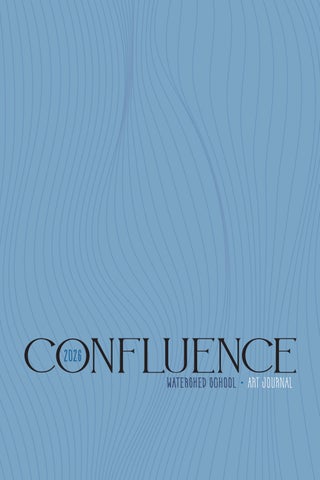
CONFLUENCE 2026
Watershed School • art journal
Intro The Green and the Colorado. North, Middle, and South Boulder Creek. When these waters converge, they flow together, becoming something new… something bigger. So it is with the ideas, partnerships, and fleeting moments that define our artistic endeavors. When paint meets canvas or hands mold clay, the artist enters that same state of convergence. Whether within our own minds or in the world around us, new combinations continue to emerge. Confluence aims to capture and celebrate the beauty and brilliance that unfold each year at Watershed. Art requires listening, seeing clearly, and envisioning the unknown. It demands taking risks, embracing failure, and getting lost in those creative trances where you find yourself flowing with something new. Here’s to the process and the result. Let’s keep creating, imagining what might be possible, and working together to fan the flames of our wildest dreams.
CLOCKWISE FROM TOP LEFT: Life
Drawing class, “Pleiades” stained glass mosaic 2.5’ x 5’, Ella Fiske (‘31)
4
Art Department Lena
Lena Oliver, ‘27 Lena has taken several painting, film, and mosaic classes over her 3 years at Watershed She enjoys the freedom of oil painting, but also the rigidity and satisfaction of mosaics. Outside of school she enjoys life drawing, side quests, fly fishing, and exploring new places. Lena wrote the biographies and conducted interviews for the Student Artist of the Year section.
Izzy
Isabel Rhodes-Wolin, ’28, Izzy has explored a wide range of creative work during her time at Watershed, although painting remains her favorite. She’s especially drawn to work that allows her to build meaning and tell a deeper story. Outside of school, she enjoys life drawing, working on personal art projects, and going on adventures. Izzy contributed to the Common Good Projects section of Confluence.
Sasha
Sasha Weiner, ‘26, is an artist of many mediums. She is drawn to oil paints for its richness and depth and has recently begun painting large-scale abstract paintings. She also loves to make plein-air watercolor paintings at her favorite river spot. Outside of art, she loves music, writing, and adventuring on long drives with her sister. Sasha was responsible for the Course Highlights and one of her paintings graces the front cover of Confluence.
Sierra
Sierra Griffith, ‘28 Sierra is a lifelong artist. She has taken extensive drawing, filmmaking, and ceramics classes over the course of her five years at Watershed. Her work is primarily centered on simple pen and ink and graphite portraits, as well as watercolor life drawing. She holds a special passion for music, writing, world travel, learning, and exploration. Sierra wrote for Confluence’s expert and alumni artist interviews.
6
Chris
Chris Carithers has been teaching at the Watershed School for sixteen years and currently teaches oil painting, urban sketching, life drawing, cartooning, mosaics, and mural painting. Outside of school, Chris loves adventure sketching, combining his passion for a variety of outdoor adventures with ink and watercolor field sketches.
Jeff 2026 was Jeff Osgood’s 15th year at Watershed and he has been a part of the Art Department since 2019. Jeff predominantly offers a collection of courses in ceramics and film. Outside of Watershed, Jeff is a potter and hustles his wares whenever he can. When he is not making art he scans the ground for cool rocks and shiny objects.
7
Table of contents 10 Common Good Projects 24 Art Course Highlights 32 Student Artists of the year 38 Experts and Alumni 44 Gallery
9
COMMON headline headline GOOD larger PROJECTS What does it really mean to create art for someone else? Whether you’re a painter, a potter, a woodworker, a welder, a jeweler, a baker, any kind of maker, creating something for another person is an act of love. It’s its own language. A handmade gift carries a different kind of weight because it comes directly from the hands and heart of the giver. Those gifts matter so much because they hold a piece of the person who made them; a bit of their time, their care, their love, and even their vulnerability. That’s what makes them meaningful. That’s what makes them unforgettable. Common Good Projects are more than just tasks or assignments, they are expressions of empathy and compassion. These projects allow students to step beyond themselves, to see the needs of their communities, and to contribute in ways that matter. At Watershed, Common Good Projects take many forms, giving space for kids to experience different forms of impact. For students, crafting something that goes beyond the classroom has an impact on student effort. Students work more diligently, with more thought and more care. What they are creating isn’t just another assignment for school. What they create reaches beyond the classroom setting. This drives students to work more intentionally, as the projects have real weight and importance. The outcome of these projects leave students feeling proud and accomplished. This section of the art annual showcases three common good projects that advanced students’ learning and gave students an experience they’ll never forget.
2
10
1
3
1
Meridian Oil Painting Last year, fourteen Watershed students took part in a meaningful painting project at The Meridian, a senior living center in South Boulder. Each student was paired with a resident and spent time listening to their stories and passions. From those conversations, the students created paintings meant to reflect what they heard and help each resident feel seen. The project challenged students to translate someone else’s story into art and to imagine what their partner would want represented in a painting. After weeks of work, the students presented their final pieces, along with heartfelt letters explaining their meaning. More than just an assignment, the project built real relationships. Students formed bonds and friendships with their partners and felt proud when they finally handed over the paintings. The exchange filled the room with emotion; residents felt understood, and students felt accomplished. This project showed how listening, empathy, and creativity can come together to make art that truly matters, and it gave everyone involved an experience they’ll remember.
“Watershed has created such a bond of friendship and joy for both our residents and the students. The residents had to feel brave enough to trust that what they shared with the students would be treated with respect and love. The students needed to trust themselves to bring the memory to life in their painting.” − Ann Marquis, Activity Director at Ciel of Boulder
12
COMMON GOOD PROJECTS
ARTIST: McCall Sherman (‘25)
13
ARTIST: Isabel Rhodes-Wolin (‘28)
14
COMMON GOOD PROJECTS
ARTIST: Josie Eckert (‘27)
15
2 Empty Bowls Fundraiser Watershed’s Empty Bowls fundraiser is a powerful way for the community to make a difference in the fight against hunger. This event partners with the Harvest of Hope food pantry; students in the Watershed Ceramics courses and members of the Boulder Potters’ Guild create handmade bowls for the event. Once tickets are purchased, attendees can choose a handmade bowl and enjoy a meal of soup and bread, which is provided by local restaurants. This experience connects our community and service in a meaningful way. 2026 Empty Bowls was a major success as it raised over $9,300 to support Harvest of Hope’s mission to address food insecurity, which fills more than 16,000 bowls. This project showed how creativity and compassion can come together to make a real impact, proving that even small efforts like making a bowl can help bring people together to support causes that matter.
ABOVE: 2026 Bowl-a-Thon RIGHT: Jethro Gottlieb (‘29)
16
18
COMMON GOOD PROJECTS
LEFT: Lilla Bauer (‘29) ABOVE LEFT: Experts & Staff at 2026 Bowl-a-Thon ABOVE RIGHT: Sadie Thompson (‘27)
19
3 Centennial Mural Over two years, recent graduate, McCall Sherman, and art teacher, Chris Carithers, worked with Centennial Middle School’s Latinos in Action (LIA) program to create a 4’x8’ mural for the school. LIA is a national program that encourages positive change and opportunity for all students. At Centennial Middle School, a year-long elective class is offered to students. This particular year, Latinos in Action was looking for an opportunity to celebrate their first set of Latinos in Action officers. Collaborating with Watershed to create a mural seemed like the perfect way to
20
celebrate. After meeting with LIA students, conducting interviews, and doing a photoshoot, McCall and Chris developed several design ideas and finalized a mural design. The design was then turned into a project for Watershed’s mural painting class, where students brought the artwork to life, each contributing their own section while working together as a team. After one trimester of painting, the result was a meaningful, collaborative mural that celebrated student voices, inspired hope, and reflected the spirit of a Common Good Project.
COMMON GOOD PROJECTS
ABOVE: Transferring the design BELOW: Final stages of the painting
“Because of this painting, the Collaboration Lab has become a designated place where we celebrate the racial, cultural, and ethnic diversity of our school through visual representation. Art and beauty bring us together as a school community. Before this painting, the walls were empty and bare. Now, every day, I see students working under and around the painting, and I’m so grateful Watershed gave us the opportunity to highlight rising stars of our community.” – Mo Breed, Centennial Middle School Teacher
21
PARTICIPANTS: McCall Sherman, Lena Oliver, Chloe Campbell, Chris Carithers,
Mila Griffith, Bella Swift, Emi Heinrick, Gabi Nelson. 4’ x 8’ Acrylic paint mural.
22
COMMON GOOD PROJECTS
23
Art course headline headline larger Highlights Confluence aims to highlight student art at Watershed, which largely takes place in art classes. From Life Drawing to Digital Design, students hone and nurture their skills in small classes. Watershed’s art educators expose students to a wide variety of mediums, and encourage deep engagement and curiosity. Community partnerships and visits from experts create depth and relationships in courses. Art displayed in the school is beautiful and intriguing, urging the viewer to wonder how one class could give students the ability to create such eye-catching works. From gourd painting to floor-to-ceiling murals to landscape mosaics, art classes at Watershed don’t just aim to create, but to leave a lasting impact.
2 24
1
>
3
1
Life Drawing In this exploratory drawing course, students were focused on deeply studying and understanding the human form. Through uncovering the patterns and wholly unique characteristics that make up a person, students were able to steadily capture depth of humanity and expression through learned techniques. Educator Chris Carithers reached out to live models and centered the course around their weekly visits, allowing for a high degree of trial and error and dedicated work time. The live models who visited the studio held both short and long poses, in a variety of garments and spaces around campus.
Students used tools like handheld proportional dividers to transfer the scale of real life down to their paper. Drawing from life supported students in training their eyes to see proportions, value and texture.
“The students were respectful, focused, and produced some amazing renderings. I loved our Thursdays.” –Chris Carithers
William Yu, local drawing expert, modeling a gesture drawing of Sierra Griffith.
26
ART COURSE HIGHLIGHTS
FROM LEFT, DRAWING BY: Marley Firsenbaum (‘26), Sierra Griffith (‘28),
Sadie Thompson (‘27)
27
2 Photography Photography is not just about capturing moments: it’s about making intentional decisions using light, time, optics, and composition to shape how an image is experienced by a viewer. In this course taught by educator Locke Hasset, students learned to treat the camera as a tool for control and communication, rather than as an automatic image-making device. Students learned the fundamentals of photographic technology, composition theory, and what it means to work with
light to create art, narratives, and convey ideas. By the midway point, students began branching off into their own focus areas, dictated by interest and equipment availability. Their fully self-directed final project ranges from digital portfolios to larger prints, in both digital and film photography. During class outings, in their free time, and on school breaks, students were encouraged to photograph their surroundings, playing with different settings like aperture, shutter speed, and ISO.
Ayden Dedrick-Fodeman (‘26)
28
ART COURSE HIGHLIGHTS
FROM LEFT: Desmond Yelpaala (‘29, Gabi Nelson (‘26)
FROM LEFT: Nadav Link (‘28), Gabi Nelson (‘26)
FROM LEFT: Eli Goldstein (‘27), Marley Firsenbaum (‘26)
29
3 Southwest Pottery The course taught by educator Jeff Osgood is a union of art history and studio ceramics. Students dive into Ancestral Puebloan history of the US Southwest and focus on how the ceramics reflect the
“My favorite moments in the course are when a student finds the first fragment of pottery. It’s a moment when their learning is literally in hand and they can begin to interpret and connect with what they are holding.” –Jeff Osgood
30
people and the journey Pueblo culture has taken up to today. Getting into proximity with historic pots, students can see up close how forms were constructed and decor was rendered. As artists, students are challenged to take on the role of a replicator. By using methodology, materials and tools that are akin to what historic potters used, students have an avenue to build understanding and interest for art of the past and the people who made it. The course typically attends the Southwest Kiln Conference. This is a gathering of historians, potters and archaeologists who all share a curiosity and passion for all things Southwest pottery. While there, students get the chance to support the logistics that go along with the conference. This could mean some set up and tear down, checking in guests, prepping wood for one of the many firings and even hosting a small art project. Best of all, the conference provides an opportunity for students to work and learn alongside experts and visit sites where the historic pottery was made and used.
ART COURSE HIGHLIGHTS
LEFT: 2026 SW Pottery Course at Hovenweep National Monument ABOVE LEFT: Maddy Frye (‘26) and Mila Griffith (‘28) LOWER RIGHT: Campbell Flynn (‘28)
31
Student Artists of The Year Student artists are at the heart of the Watershed community. From collaborative projects such as the Latinos in Action mural and Riverwalk mosaic to individual paintings and drawings, our community is capable of creating incredible work. Talent is abundant across every grade level, class, and medium. Over the course of the year, our community noticed the particular talents of two individuals and nominated these standout artists, Calvin Boal, ‘26 (Upper School), and Eleanora Gold, ‘32 (Middle School), to be featured in the inaugural Watershed art annual, Confluence.
ABOVE: “Shell” by Calvin RIGHT: sculptures
by Eleanora
32
ABOVE: “Pit Stop” by Calvin
33
Calvin Boal (‘26) Calvin draws inspiration from artists around him, his community, his friends, and people on the internet. For him, artistic inspiration is all over the world. Whether it’s the way light hits
34
a tree, a scene from a movie, or classical painters like Monet, he is inspired to create beautiful, unique pieces using his preferred media: colored pencils, markers, and alcohol-based pens.
STUDENT ARTISTS OF THE YEAR
Calvin’s artistic journey started at a young age while creating art after school. His consistency and love for what he does have dramatically improved his skill level over the years. “It’s what I’ve always done,” he says.
Every day since then, he has made an effort to work in a sketchbook, and even though these pieces are small and do not take much time, they “keep [me] at it every single day, slowly but surely improving the craft.” Looking back on his journey as an artist, Calvin advises other students to make art for themselves rather than creating what other people want. “Just make sure that if you’re doing art, you’re doing it for yourself. Don’t try to draw what other people want you to draw. Art should be mainly for you.” If he were to go back in time and have a conversation with a younger, less artistically developed version of himself, he would tell himself, “Don’t quit soccer. I’d also tell him to keep doing art, you’re on the right path.”
TITLE: “Pickett’s Charge July 3, 1863”
35
Eleanora Gold (‘31) Eleanora has always been naturally creative and began her art journey at age 4 with simple doodling. Since then, she has become an extremely talented and capable potter, mixed media
36
artist, and sketcher. Her favorite thing about creating art is the freedom that it gives her to create whatever comes to mind, and she often draws inspiration from other artists’ work. She mentioned that the creative freedom that a pencil and paper give her is what enables her to create detailed and unique artwork. She tells other artists, “Don’t erase mistakes, it’s a part of the process, and sometimes it can become something unexpected in its own way.”
STUDENT ARTISTS OF THE YEAR
37
Alumni and headline headline larger Experts
1
Some students come out of their Watershed art experience and continue to pursue creative passions. Whether this passion leads the former student to art school, a career as a creative, or dabbling with a lifelong hobby, it’s exciting to receive an update. Confluence seeks out former student artists with the goal of shining a light on what they’ve created recently and where their art has taken them since graduation. Watershed prides itself on leveraging the knowledge and skills of experts to add depth to the courses offered. In this spirit, the Art Department strives to invite artists from our local creative community to share their stories, advice and skills with young artists. Many of these expert artists have partnered with Watershed year after year. We are excited to highlight one of these experts that has been a mainstay of the ceramics program.
Devin Duster (‘19) in his studio exploring the possibilities with oil paints.
38
2
Mark Rossier demonstrates wheel throwing techniques for upper school studio ceramics students.
39
1
Devin Duster (‘19) Upon first glance, Devin’s paintings appear calm and quiet and could even be mistaken for idyllic. But as you look, the more something begins to shift in the general unease of a landscape or the unobvious symbolism behind his seemingly random still-life incorporations in his paintings. Beneath the beauty, there lies an atmosphere that asks its viewer to question what might not be shown or said loudly, but rather what is being whispered in the undertones of the scene and what lies in the shadows. Devin’s work explores the complex relationship between beauty and violence in the American landscape. His paintings often reference the forests and wilderness that many people
TITLE: “Chimney”
40
imagine are untouched paradises, yet his work challenges and uncovers these ideals. Drawing inspiration from the nineteenth century, an era defined by railroads, expansion, and the socalled “discovery,” Devin reflects on how industrialization transformed the American land itself and the stories Americans tell about it. Forests were cut through by rail lines, communities were displaced, and stories were erased. In Devin’s work, peaceful landscapes become sites of underlying tension, where traces of these histories linger beneath the surface. His artistic influences span centuries of landscape and stilllife painting, as well as literature, with themes he encounters in his readings often shaping the
EXPERTS AND ALUMNI
LEFT: “The Horizon” MIDDLE AND RIGHT: “Datura”
concepts and framework of his art. Elements of seventeenth-century Dutch still life appear in his delicate compositions and layered symbolism. At the same time, the idealized landscapes of the Hudson River School and the luminous atmosphere of Luminism echo through his scenes. Yet Devin approaches these traditions with an unmistakable gothic-style lens. Rather than simply celebrating the beauty of nature, it houses these visual cues and symbols to question them. Revealing the land’s complex histories and experiences. Devin’s time at Watershed played an important role in shaping his thinking. He is quick to indicate that it was more than any single class or assignment; it was the mentorship and guidance of his teachers, especially Chris Carithers, that influenced his path. He also emphasized his valuable experience as a middle school art class TA here at Watershed, reinforcing his
love for teaching and sharing a spirit of exploration that lasted far beyond his high school years. Watershed encouraged him to build meaningful relationships with his teachers and, later on, with his university professors. This skill proved invaluable as he entered the art world, where connections mean everything. Just as importantly, he learned to think critically about the work he was creating. Art for Devin became about making beautiful works of art and asking questions to grow as an artist. To this day, Devin shows how curiosity guides him through his practice, from his connections with his teachers and community to the quiet, ongoing process of questioning what lies beneath the surface of his work and the stories it holds. Devin shines as an example of how a watershed shapes artists into people who thrive with minds of open thinking, curiosity, creativity, and more.
41
2 Mark Rossier A calling for the arts is often discovered in unexpected ways. For the Boulder County potter Mark Rossier, his introduction to ceramics was not his original plan, but rather something that emerged through a collection of circumstances. While studying art in college, Mark Rossier primarily focused on drawing and painting; ceramics was simply another
class. Yet something about the experience of working with clay resonated with him in a way previous mediums simply hadn’t. What began as an unassuming college course has developed over 40 years into something so much more: a practice of pure dedication, commitment, and love. Mark decided not to pursue ceramics through formal academic study. He continued to develop his skills through apprenticeships and studio work, learning his now-refined skills through repetition and in a space where making pottery became a practice of daily life. These early experiences helped form Mark’s skills and his understanding of both the ceramics practice and the community surrounding it. Over the years, Rossier has also become a familiar face in the Watershed community. Through his work with students in ceramics courses and over many years of involvement with Watershed School, he has passed down
Firing the trench kiln at Edge of the Cedars Museum in Blanding, Utah.
42
EXPERTS AND ALUMNI
his knowledge of a truly organic and intentional art form. He has demonstrated techniques such as sliptrailing decoration and wheel-throwing tips, and has also joined the Southwest Pottery class at the Southwest Kiln Conference. Mark also participates in Watershed’s Bowl-a-Thon, throwing alongside students in an effort to amass a collection of works for the annual Empty Bowls Fundraiser. He not only shared the technical aspects of pottery but also the mindset that is required to interact well with the sensitive material of clay. This is a mindset of experimentation, persistence, resilience, and a willingness to slow down in this modern, fast-paced world. Mark Rossier’s presence in the Watershed community has been an inspiration to many young ceramists and has encouraged them to follow their artistic visions. He has become a consistent figure in the Watershed arts community and will continue to teach students to follow art, even if it is discovered unexpectedly.
43
Gallery of Student artwork
“Caught in a Pause” by Bella Ingalls (‘29)
44
Aislynn Kelly (‘30)
45
ABOVE: Marley Firsenbaum (‘26) BELOW: Sadie Thompson (‘27)
46
GALLERY
Ella Andersen (‘28)
47
“Hidden Canyon” 2' x 3' stained glass mosaic created by the 2026 Mosaic’s class
48
GALLERY
ABOVE: Maddy Frye (‘26) LEFT: Sierra Townsend (‘26) & Junior Parikh (‘30)
49
ABOVE: Chloe Campbell (‘26) RIGHT: Sierra Townsend (‘26)
50
GALLERY
ABOVE: Fin Prairie (‘26) LEFT: “I’ll Fly Away” by Chris
Carrithers and Jeff Osgood
51
ABOVE: Will Hampton (‘30) BELOW: Teagan Kelly (‘30)
52
GALLERY
Chloe Laird (‘26) “Taken by ICE”
53
ABOVE: Desmond Yelpaala (‘29) BELOW: Marley Firsenbaum (‘26)
54
GALLERY
Lena Oliver (‘27) “Why Don’t You Wear A Suit?”
55
Lelah Herrington (‘26) “The Tea Party”
56
GALLERY
ABOVE: Crosby Manz (‘32) RIGHT: Jz Hullet (‘26)
57
Cover Art Sasha Weiner Design and Layout Brenda Gallagher Printing: Morrell Graphics in Lafayette, CO