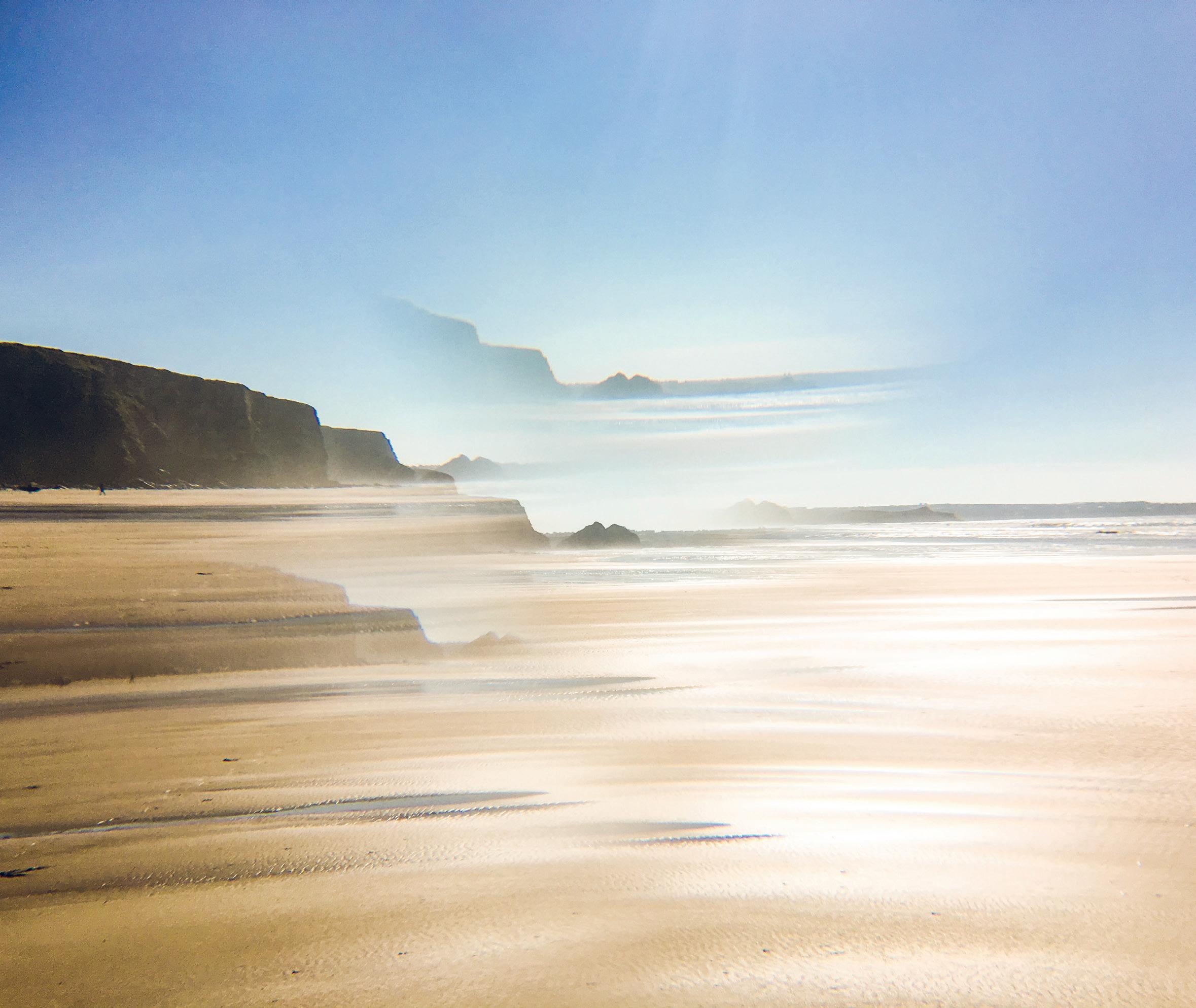
A listening walk on the beach with Attenborough's sound man, Chris Watson
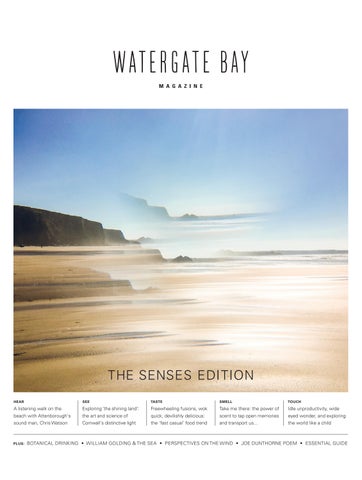
A listening walk on the beach with Attenborough's sound man, Chris Watson
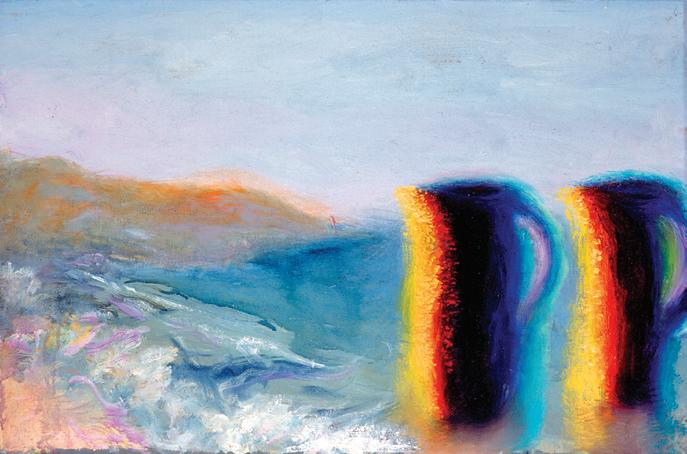
Exploring ‘the shining land’: the art and science of Cornwall's distinctive light
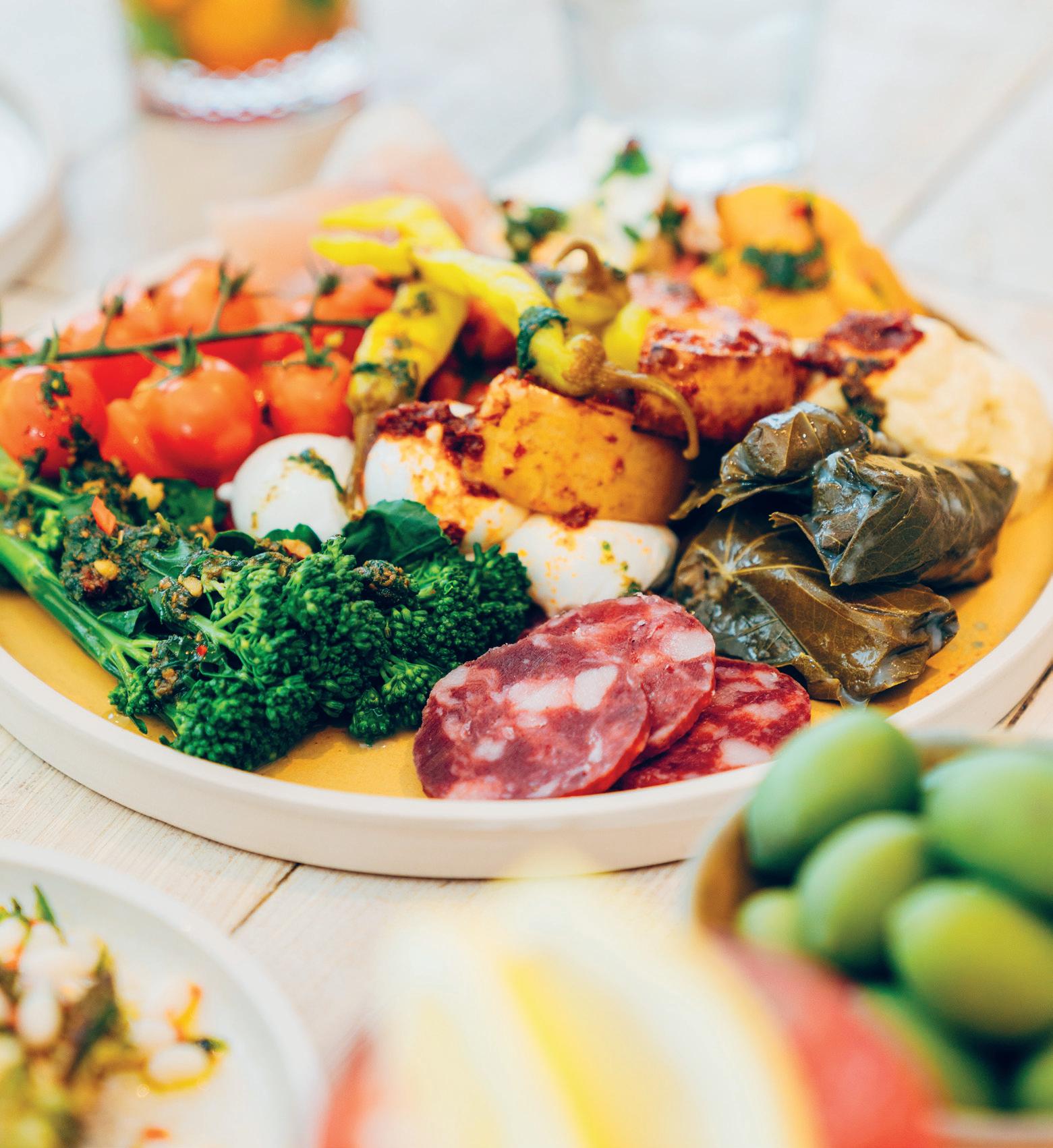
Freewheeling fusions, wok quick, devilishly delicious: the ‘fast casual’ food trend
Take me there: the power of scent to tap open memories and transport us...
Idle unproductivity, wide eyed wonder, and exploring the world like a child

Growing up at Watergate Bay, I have some particularly vivid memories; most of them from the wild north end of the beach. There has always been an amazing collection of coloured sea glass in the caves and coves up there, worn smooth and frosted by the waves. As children, we’d spend hours looking for the blue pieces that were our favourites, then take them home, put them in a jar of water, and watch the colours come alive again.
Climbing on the rocks, covered in barnacles and mussels, the textures underfoot were intense. By the end of the summer, my feet were pretty much bulletproof – until school socks and shoes gradually turned them soft again.
But those mussels gave intense pleasure, too. On very low spring tides, we’d go mussel-picking – then light a fire and cook them with a little bit of white wine and a few shallots. The smell from those mussel pots as they were cooking was something else. And every Christmas for about 20 years, we’d take a platter of smoked salmon sandwiches and a bottle of Champagne or two, to that same spot. Cold, cloudy and windswept, we’d wrap up warm and fill our lungs with fresh air, before heading inside for log fires and a late Christmas lunch.

Visitors and locals alike always talk about the light down on the beach. When the sun is sparkling off the sea and the waves, it’s literally dazzling. But it’s even better in the winter when the sun is low in the sky, or just after rain, when the sun breaks out between the clouds. The colours and the contrast make it feel like nature is really showing off.
It seems very natural, then, that this issue explores the senses – which are so ingrained in all of our experiences of this place. But putting this magazine together has taught me new things, too. When leading sound recordist Chris Watson (p8) put his microphones into the rockpools I’d spent my childhood exploring, it opened my ears to something completely new – their rhythmic scraping sounds revealing exciting new layers to the familiar. And hearing both a Met Office weather presenter and Tate St Ives curator talking about the special qualities of the light (p14) again gave me a fresh understanding. As for our impromptu mussel feasts, now I realise we were just whipping up the ultimate ‘fast casual’ dinner (p20)…
However you enjoy Watergate Bay, and whichever senses are most poignant for you, I hope the memories will linger for many years, too.
A walk along the beach with audio pioneer and Attenborough’s right-hand (sound)man, Chris Watson. Ever heard limpets grazing?
14
Green flashes, golden hours and red skies: we investigate the allure of the Cornish light via art, science and meteorology.
Fast casual dining: getting stuck in and saucecovered with the booming global food trend.
From gin cocktails to extravagant green teas, an exploration into the beauty of botanicals.
Fragrance fanatic Lizzie Ostrom on the potency of smell for conjuring scenes, making moods and evoking powerful memories.
Sight, emotion, land and sea: a gallery of stories told through the lenses of two photographers.
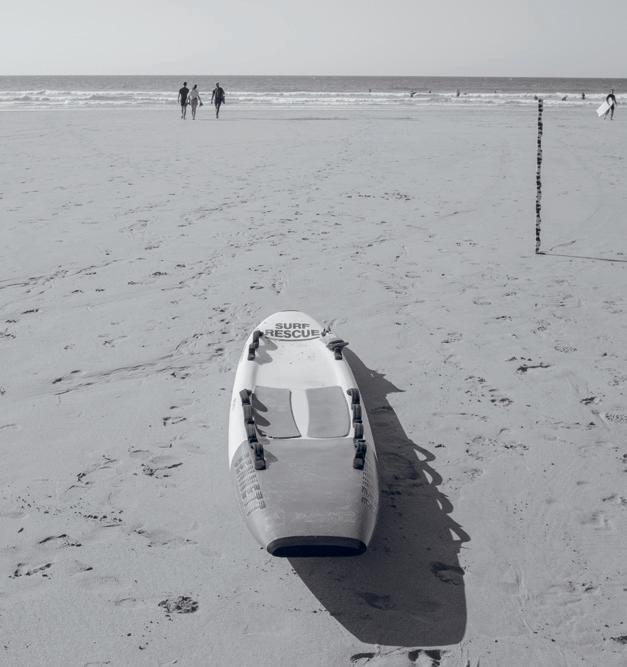
The story of Lord of the Flies author William Golding’s complex relationship with the sea, through the eyes of his daughter.
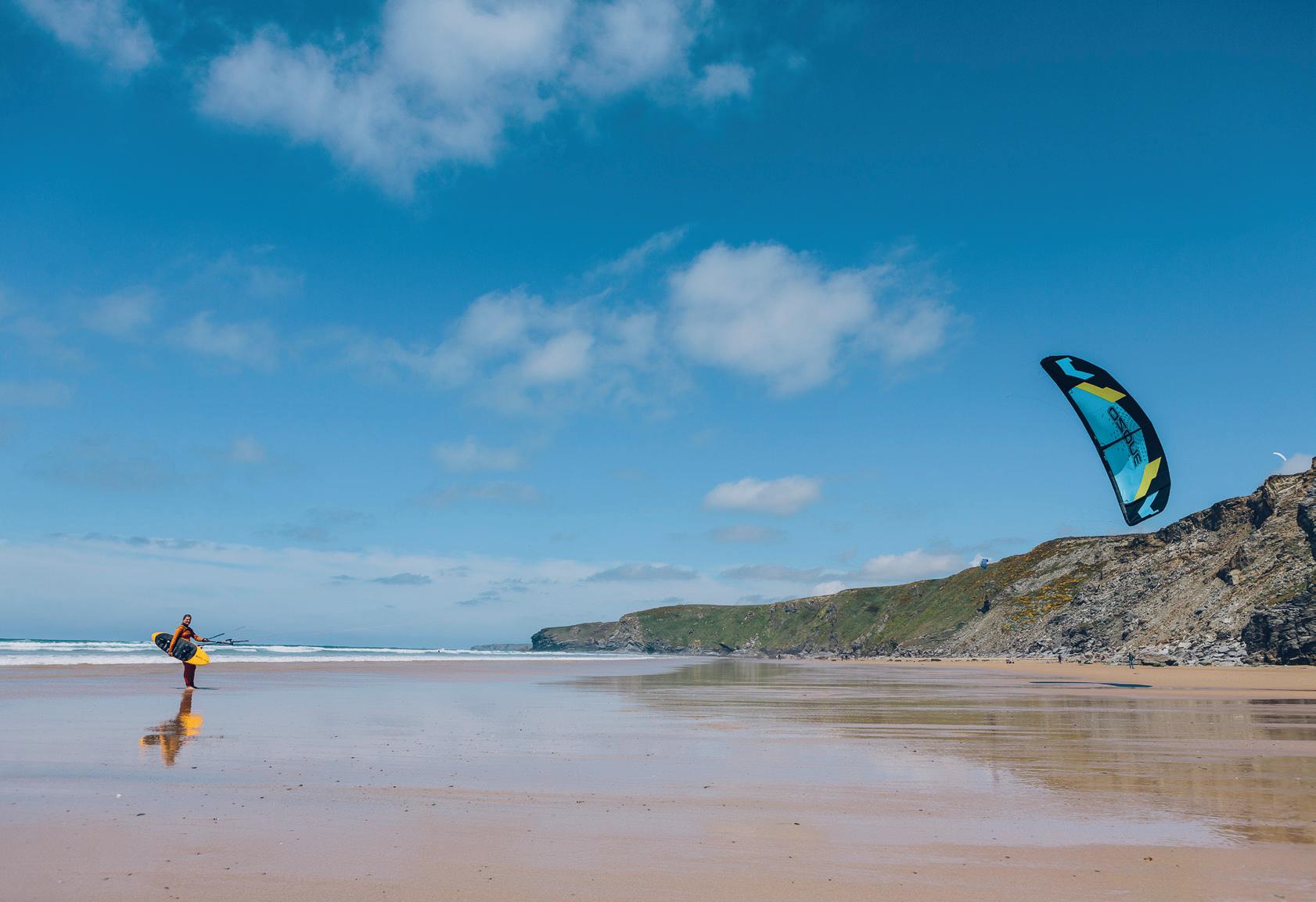
A kitesurfer, fisherman and wind farm founder talk gales, gusts and going with the wind.
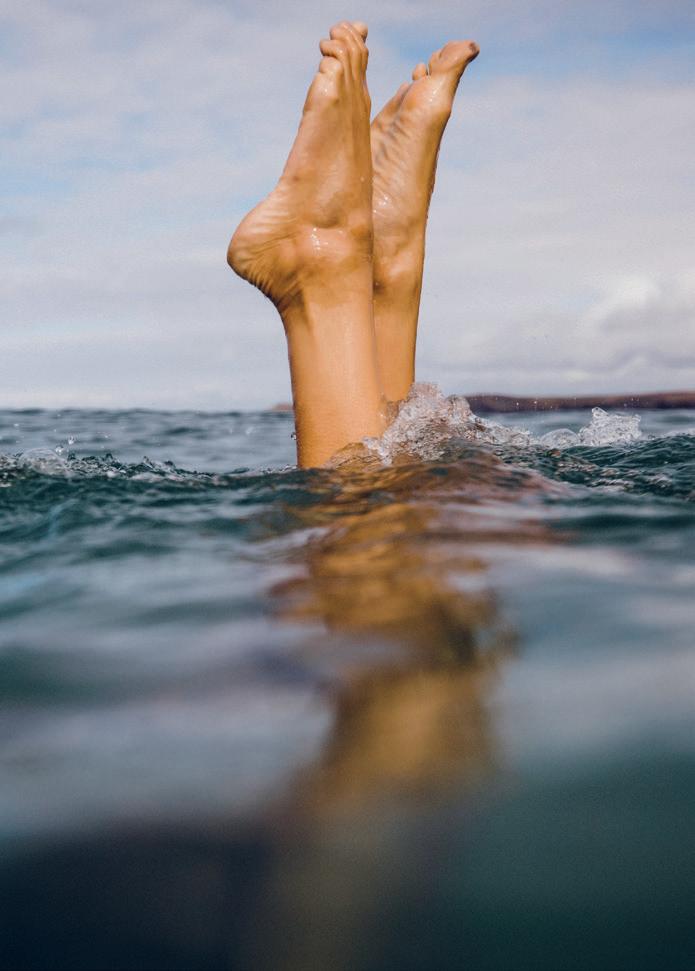
Parking productivity, walking barefoot and thinking like a child: how to rediscover the world again, through touch.
Looking
Feast nights, tasting with the nose, wildlife spotting by paddleboard, podcast playlists, parental treats… Everything you need and more for planning your next trip west.
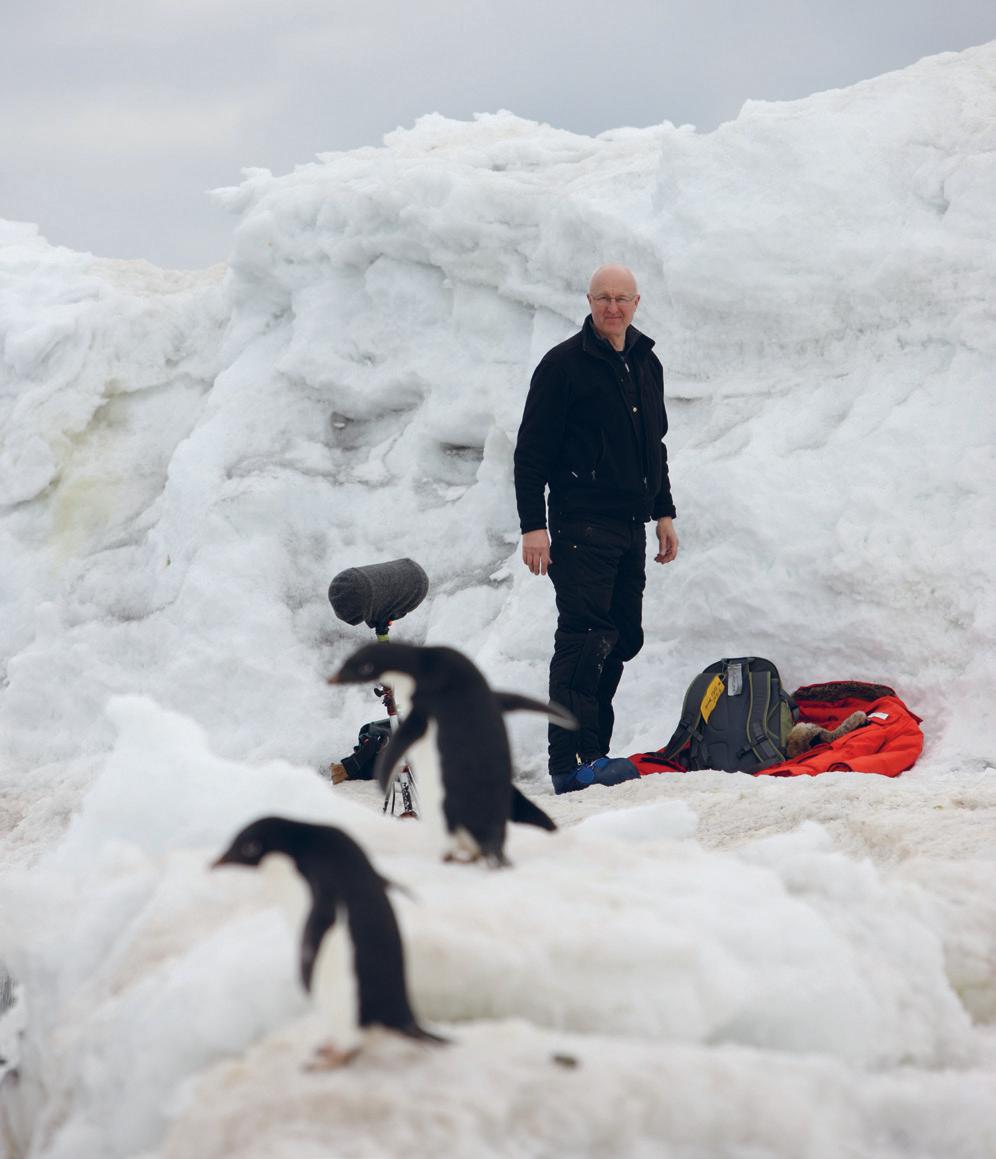
From the Arctic ice of Norway to the humble rockpool, the sounds of the ocean are endlessly fascinating – if you have the right guide. We join Chris Watson, long-time Sir David Attenborough collaborator, on the hunt for one of his favourite sounds of all… Splish. Splosh.
Chris Watson is fishing for sound. He’s just dropped a pair of hydrophones (underwater microphones that respond to vibration), into the shallow water of a rockpool in a deserted northern corner of Watergate Bay. Now he dangles the cable like a baited line. “There’s no magic technique in these circumstances,” he says, in his quietly enthusiastic Sheffield drawl. “You just throw it in and hope.”
As the long-time field recordist for Sir David Attenborough, Chris’s rich and varied recording career has taken him from the South Pole to the North. His trusty hydrophones have brought back some of the weirdest and most wonderful sounds in nature – whether the echolocation clicks of bottle-nosed dolphins or the guttural squelch of South Australia’s giant earthworm. “A few weeks ago I was recording cod off the coast of Norway,” he says, as if that was the most natural sentence in the world. »

“I’m sure sound is part of the embodiment and spirit of a place. This beach has a signature sound like nowhere else.”
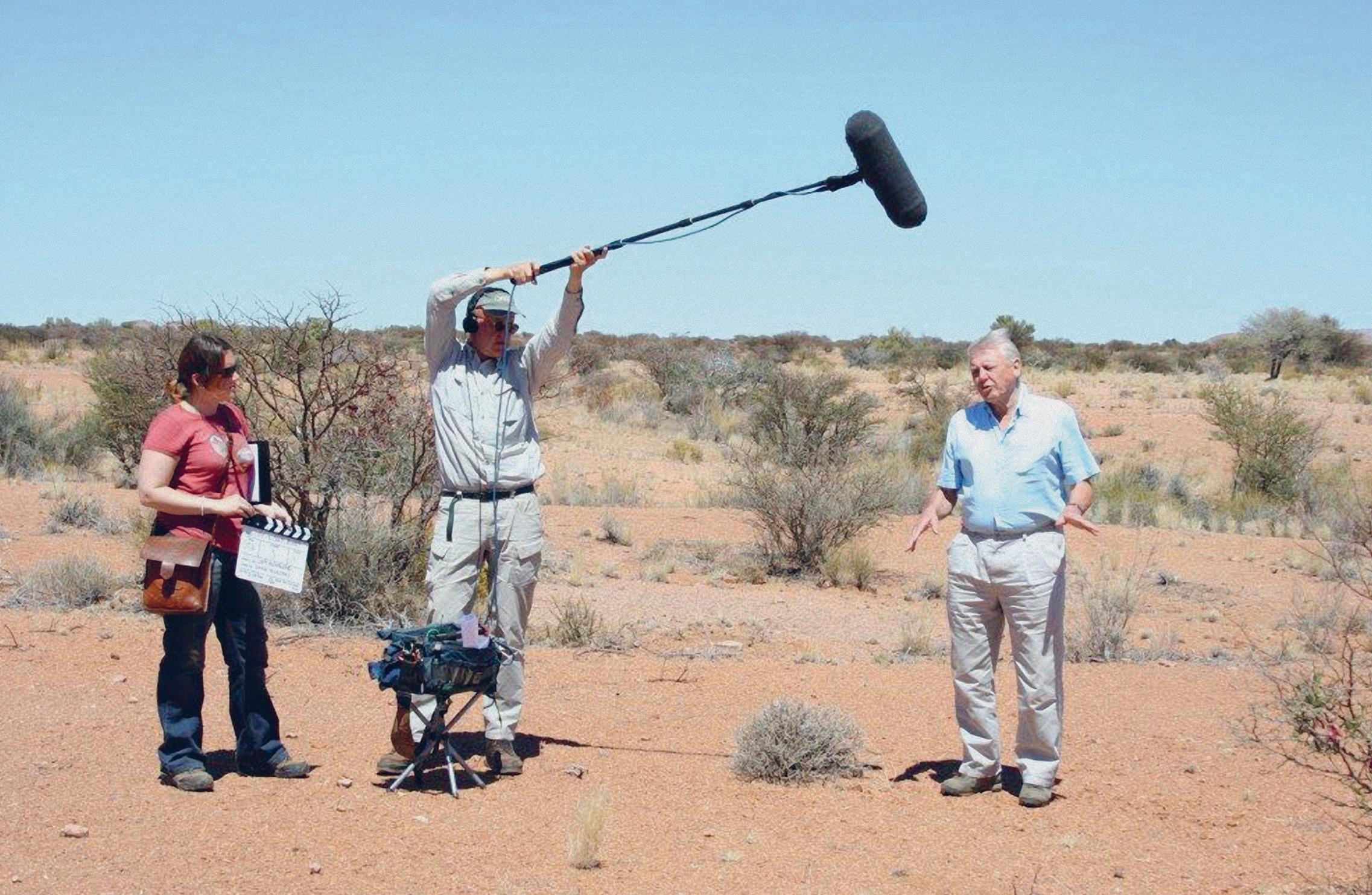
Here Chris is hoping to capture one of his favourites: the sound of limpets grazing. Beneath their conical shell, limpets feed with a radula, a tongue-like organ that’s equipped with more than 100 rows of teeth. So while they may appear the silent type, they actually make a rhythmic scraping sound as they harvest algae from the rock. “A chorus of those is wonderful,” says Chris.
One of the most striking examples of Chris’s ‘throw and hope’ hydrophone technique came in 2010, in the Norwegian archipelago of Svalbard, when filming Attenborough’s Frozen Planet for the BBC. Having walked a couple of hundred metres out onto the Arctic ice, he screwed a hole beneath his feet and dropped his instruments into the mysterious depths below.
Then he put on his headphones.
The sound that came back was like a fathomless sub-aquatic concert hall.
“It was the most hauntingly beautiful thing,” he says. “The sound of male bearded seals hanging head-down, singing descending glissando tones in the darkness to gather their harem of females. They sounded like a choir, but some may have been 20 kilometres away. It was astonishing – like listening to the sounds of another planet.”
After even a short conversation with Chris, it soon becomes apparent just how much there is to be gained by tuning your ears beyond the immediate. And in actively listening. Even the rumble of surf starts to sound different – first more insistent, then more nuanced. “I’m sure sound is part of the embodiment and spirit of a place,” says Chris. “This beach has a signature sound like nowhere else.”
It’s in the water
Chris began his audio career in the 1970s, as a member of Sheffield band Cabaret Voltaire, using the tape recorder as a creative instrument and performing with the likes of Joy Division. But while he works with sound in all its facets, he is particularly fond of the soundscape within our oceans. Water, he explains, is the most sound-rich medium on the planet, where vibrations travel almost five times faster than they do through air.
Not that this rockpool appears, at first, to be the best example. Aside from a couple of large rocks bordering one end, it is otherwise almost featureless. Chris remains enthusiastic. “It’s just endlessly fascinating, listening to nothing,” he says. “This appears to be a silent world, as Jacques Cousteau once described the ocean. It’s anything but.”
He passes the headphones. “If you listen to that, you experience how shrimp hear the sound of the Atlantic coming through the sand.”
At first, that sound is a rumbling white noise. But once you try putting yourself in a shrimp’s shoes, the whole picture shifts. With closer listening, other sounds emerge too: a squeaking seaweed; a sudden scuttling which, Chris suggests, is a hermit crab; the shrimp’s own high-pitched squeal made by rubbing its limbs together.
For Chris, the journey into sound began with a ‘silent movie’. As a child of 12, he was gripped by the action of the grey tits, blue tits and sparrows feeding beyond his kitchen window. For his birthday that year, his parents gave him a battery-powered reel-to-reel tape recorder. He was fascinated, and before he clocked its true potential he’d recorded everything from the vacuum cleaner to the toilet flushing.
Then one day he loaded it with ten minutes of tape, took it out to the bird table, and set it recording. When the tape ran out he hurried to recover it and play it back. He heard the sounds of those birds and was suddenly “transported to another world, another place where we could never be”.
It’s a place he’s been forever drawn to since.
Audio pioneers
Chris spots a second rockpool, to the east of the first. This one appears more interesting, full of enticing nooks, gullies and shadows. And there on the edge, glued stoically to the rock, sit two limpets. He puts the headphones on again.
It’s now 25 years since Chris first donned his cans for Attenborough, in his groundbreaking Life of Birds series. The two instantly clicked. Again, sound played a critical role, as Chris found he wasn’t alone in his love and appreciation of its powers.
Attenborough was among the first to take a portable tape recorder on location for natural history films, way back in 1951, when the gear really wasn’t designed for the rigours of the field. “He was pushing it to its limit,” Chris says. “He was a real pioneer.”
And Chris was soon delighting the pioneer with innovations of his own. The BBC’s Life of the Undergrowth was conceived to capture the life-and-death drama of the world’s tiniest creatures and turn it into a full cinematic spectacular. Chris’s task was to do the same for their sounds. He began to explore the potential of personal lapel mics, the type used to record Attenborough’s monologues, experimenting with planting them on the edges of cobwebs and inside nests. If he spaced them correctly, it turned out, even tiny movements were massively amplified. The results were a revelation: the sound of Matabele ants, fresh from raiding a colony of termites, whistling a victory song on their return. “Hearing that and playing it to David – that was a remarkable moment,” says Chris.
Back at the rockpool, Chris is beaming again. He passes the headphones. They play the syncopated scratching of the two limpets, an intimate call-and-response chorus. “Absolutely crazy,” Chris says. “Fantastic. I love doing this because it’s so completely unpredictable. You might sit here till the tide comes in and not hear anything. Or in 15 minutes you might hear something amazing. I like that nature doesn’t read the script.”
He presses record and stands for a few minutes in silence. As his ears soak in the sound, his eyes rise up to watch the relentless crashing of the Atlantic. »
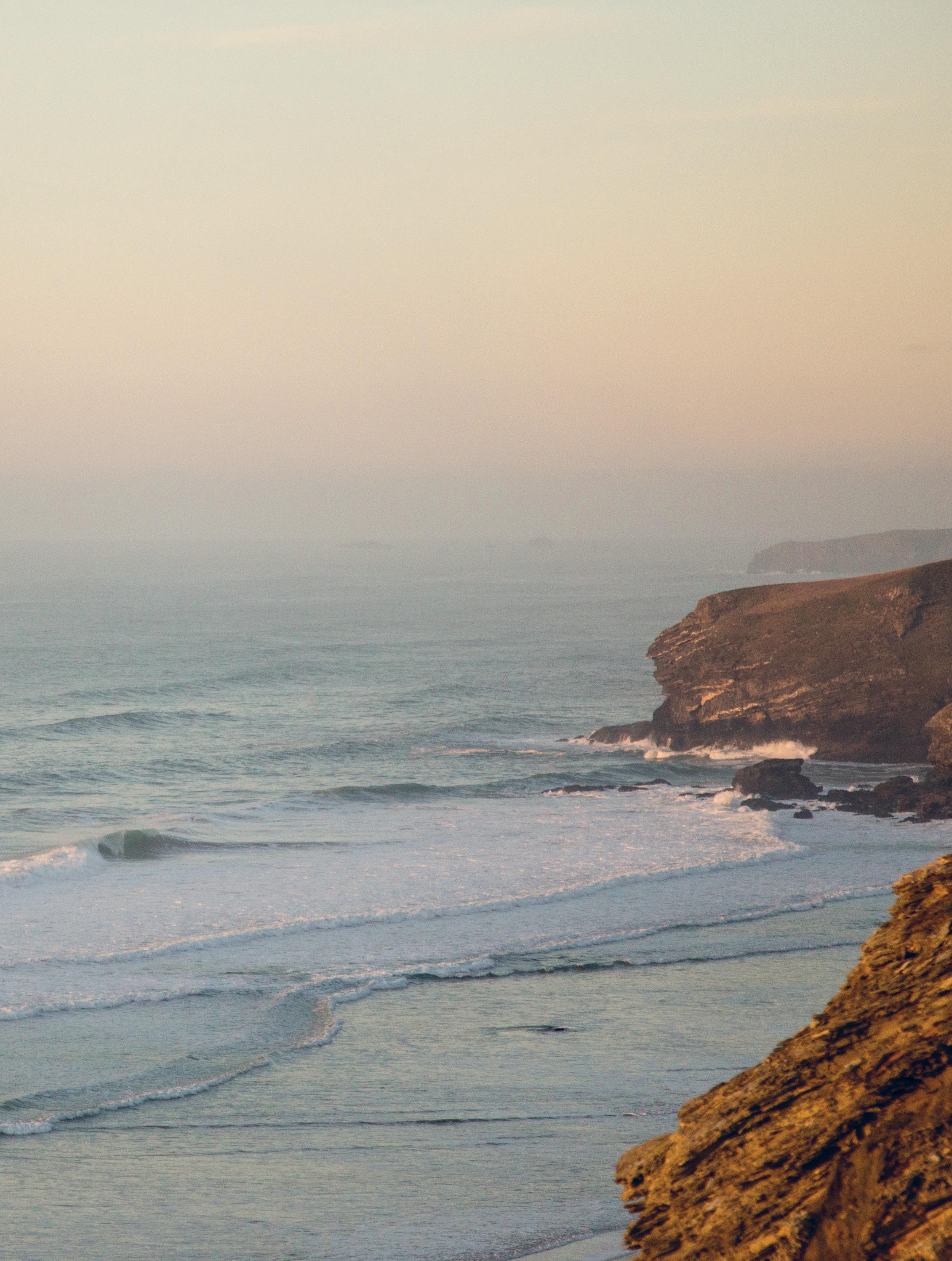
“You might sit here till the tide comes in and not hear anything. Or in 15 minutes you might hear something amazing. I like that nature doesn’t read the script.”
He and Attenborough have a running debate: Chris likes to insist that the Atlantic surf sounds different to the Pacific – it’s sharper, he says, while the Pacific is softer, more gentle. Attenborough was apparently “incredulous that it might be the case”. So Chris recently made his friend a two-track CD, comprising a recording of each, to prove his point. Apparently he stubbornly refuses to concede that Chris is right.
Pleased with his limpet chorus, Chris gathers his line back in and packs up, carefully brushing the sand from the case containing his recorder. On the walk back he begins to enthuse about the intelligence of orcas, a sensitive species he’s recorded from the Antarctic to the Arctic, which uses echolocation sound in a way we’ve barely begun to comprehend.
But, mirroring a new sombre slant to the pair’s more recent documentaries, Chris’s tone here is laced with sadness. “There’s so much interesting work being done in the oceans,” he says. “But we’re messing it up with so much noise pollution, before we understand what things are being said there.”
He explains how hydrophones on the East Coast of America have monitored humpback whales coming up the Cornish coast, and can hear them calling back to their peers in the East Atlantic. But those same hydrophones can also hear ships passing Ireland – 2500 miles away.
Such reflections are now an unwelcome fixture of his travels with Attenborough. These days the two tend towards long discussions with the stresses placed on nature in the time they’ve been travelling together, whether that’s specific glaciers in Iceland receding, or the sea ice melting around the North Pole. “It’s chilling,” says Chris. “It’s sickening to see it, and quite scary. I worry. It’s happening – in some places literally – in front of our eyes.”
Chris is proud that Attenborough has become such a figurehead in the drive to protect our climate. But his work with sound surely has a vital role to play too: the more we turn our senses
Even if you don’t own a hydrophone, there are plenty of soundscapes to explore in the Bay…
Falling thunder
The sight of swell stacked to the horizon is always welcome on Cornwall’s coast, but it’s worth spending a moment listening in, before waxing up your board. Concentrate on the rhythm of the sound, training your ear in on each wave as it lands, to hear the layer upon layer of noise coming together.
Snap, crackle, pop
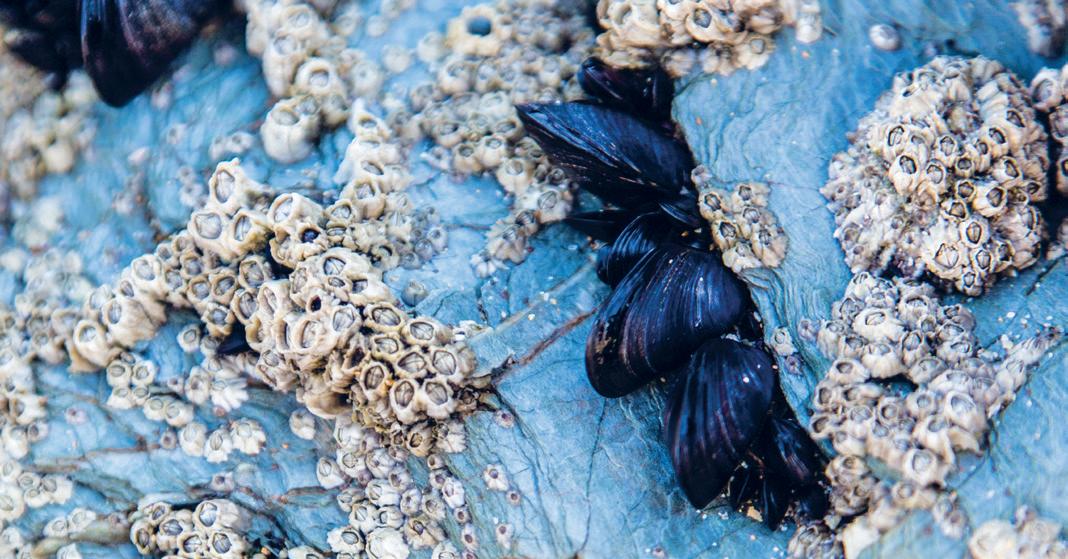
Barnacles are noisy beasts. Covering the rocks that are exposed on Watergate Bay at low tide, their fizzing as tiny air bubbles pop and sometimes tapping as they move in their shells makes a symphony of shoreline sound. Head down to the rock cluster as the tide drops and listen as the water washes over them.
Sundown stridulation
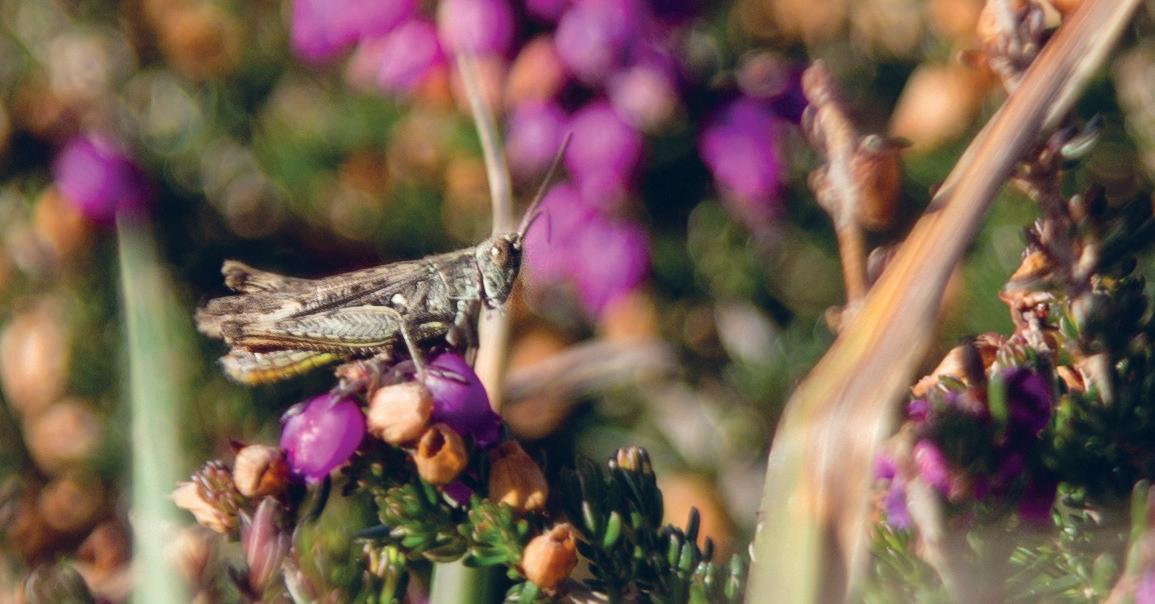
Climb the coast path along the Bay as the sun starts to set and listen out as the air fills with the vibrations of insects calling. Rubbing their limbs together to communicate, it’s a sound that shouts out summer.
beyond the obvious, to pay attention to the untold wonders that comprise our natural world – and to feel the vast benefits that can bring us – the more likely we are to be inspired to fight for them.
The pair are about to embark on further adventures, across Croatia, Costa Rica and California, as they record an update of the series Life of Plants. For now, though, he’s here at Watergate Bay, watching the sky paint itself in pastels, as he sets up a microphone to record the ocean with the evening tide coming in.
As Chris is keen to point out, even the Atlantic’s relentless, razor-sharp roar is the expression of something far more delicate and wonderful: it’s the sound of hundreds of millions of bubbles, bursting. •
chriswatson.net
Hear the sound of limpets grazing at Watergate Bay at watergatebay.co.uk/good-vibrations
Listen to Oceans of Noise, Chris Watson’s three-part journey into the ocean’s sonic environment – from marine life to seismic explosions – at tinyurl.com/oceans-of-noise
Artists refer to Cornwall’s light with reverence. Stand on Watchful Mary’s sea wall and you’ll see what they mean. From red skies at night to Hepworth’s delight, we went in pursuit of illumination.
In 60BC, Greek historian Diodorus Siculus wrote of a distant place he called ‘Belerion’ – meaning ‘the shining land’ – at the southernmost tip of the British Isles. Woven in with its ancient identity, Cornwall has always been known for luminosity. And if you ask an artist, ‘Why here?’, they’ll probably croon, ‘The light’; the shadow-casting, stone-bleaching, studio-filling brightness that keeps them in the county. Together, the atmosphere, our eyes and bright sunlight collaborate to conjure Cornwall’s distinctive colour palette: languid golden hours and sharp blue mornings, clouds on fire at the end of the day and a flash of green if you’re lucky.
Notorious light-seeker, painter J M W Turner journeyed to ‘the shining land’ in 1811, like a moth drawn to the coast’s bright horizons and dramatic contrasts. In his watercolour sketches St Michael’s Mount shimmers like a mirage and St Mawes in Falmouth Bay is made incandescent in oils. In a time before the trains, Cornwall was a world away from Turner’s London home. “He had to work really hard to get this far west, but his work was all about light, life and landscape,” explains Sara Matson, curator at Tate St Ives. It was only natural he would end up here.
Down the decades a string of artists made the journey west in Turner’s wake. After the Second World War a raft of painters, writers, and sculptors arrived. Among them was Barbara Hepworth, who wrote in letters of the inspiration she found in the “strong sunlight and a radiance from the sea which surrounds this spit of land”. Hepworth took to working outside, in Carbis Bay near St. Ives, “in a back yard, annoying all of her neighbours”, laughs Sara. “She loved marble. Carving outside, developing her sculpture in relation to the landscape, was so important to how her work evolved,” she explains. “Marble is extraordinary in brilliant light, and would come to life in the daylight and warmth of St. Ives. There’s no doubt the power of the Cornish landscape has an impact on the shape and direction of artists when they come here. It can’t possibly not.”
All curves, clean lines and cool blue movement, artworks like her ‘Pelagos’ (meaning ‘sea’), capture and hold the radiance Hepworth wrote home about. But it’s hard to pin down what exactly makes the light here so special. “There are a number of factors
that affect the light in a given place”, explains Met Office meteorologist and broadcaster Clare Nasir, on Cornwall’s unique atmosphere. “A key one is the amount of particles in the atmosphere. The more particles, the more the light is scattered. If the air is travelling in from a non-polluted direction, the air can deliver a bright and sparkling ambience.”
Closeness to the sea, and the clear air that comes with it, helps explain why Cornwall’s coastline shines; especially when the sunshine reflects on the water. “A sea surface reflects light depending on its state,” Clare continues. “A rough sea reflects less than a calm shimmery sea. On those days, the light can bounce off the sea’s surface like a mirror, adding an extra shine to the day.”
All natural light comes from the same place; every beam starts with the sun. It refracts, reflects and diffuses before it reaches our eyes, to create the colours we see. Cornwall’s hues tell a story of hidden particles in the atmosphere and conditions out at sea. It tells us where we are in the world and when. It sets our clock at the start of the day, and winds us down at the end.
“When the angle of the sun is at a greater angle – at sunrise and sunset, rather than overhead – the light has to travel through more atmosphere,” Clare explains of the day’s changing colours. “Light is broken down into colours with different wavelengths – peaks and troughs that propagate through the atmosphere until they hit something solid. Blue has the shortest wavelength and red the longest, so particles in the atmosphere scatter blue light first. The more particles and the lower the sun, the redder the sky will be.”
It’s why there’s truth in the ‘red sky at night’ maxim. So the proverb goes, a red sunset promises good weather by morning. Our weather systems roll in from the west, where the sun sets. Clare explains they come in a progression from an upper cloud through to a lower cloud, that thickens and then produces rain.
“The first sign of a frontal system is this upper cloud,” she says. “If it comes in the evening, heralding a change in the weather, the low angle of the sun hits the cloud and the atmospheric moisture that’s been building up, and scatters the blue light. The reddish hue delivers the news that rain is on the way overnight, and should be gone by morning.”
Symbolic moments of transition, when the world changes hands between night and day, sunsets and sunrises have inspired countless artists and writers with eyes on the Atlantic horizon. Present in the most ancient stories, we’ve held tight to the terms ‘rise’ and ‘set’ even though we’ve known for centuries it’s not the sun that’s moving after all – it’s us. And it’s a principle that can be applied to all our colour experiences: they’re more about us than we think.
When wavelengths reach our eyes, our retinas’ light-sensitive cells convert the light to nerve impulses, sending messages to our brain and producing the sensation we call colour. However, we tend to forget that when we say, ‘the sky is orange’, or ‘the sea is gold’, colour is actually a conversation happening between our brains, light and objects.
Colour as we experience it is not inherent in things, and your experience may be different from mine. Remember when ‘the dress’ was all over the internet? Over ten million tweets debated whether a circulating photo of a dress was black and blue, or white and gold. And colours don’t only change from person to person, but from minute to minute. Metamerism describes the phenomenon where colours that appear to match in one light, will clash in another, proving the physical surface properties of an object don’t dictate how we see it.
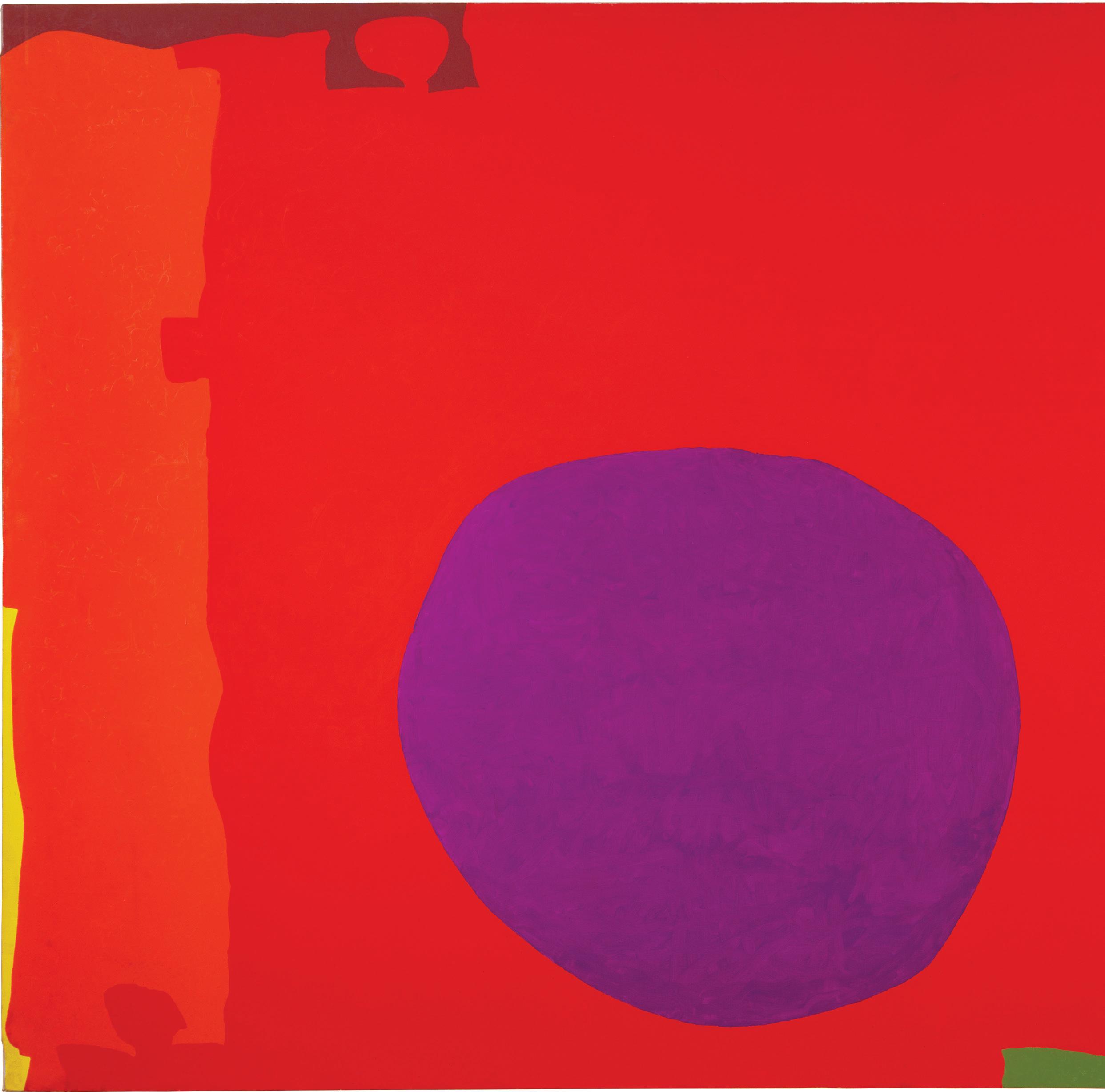
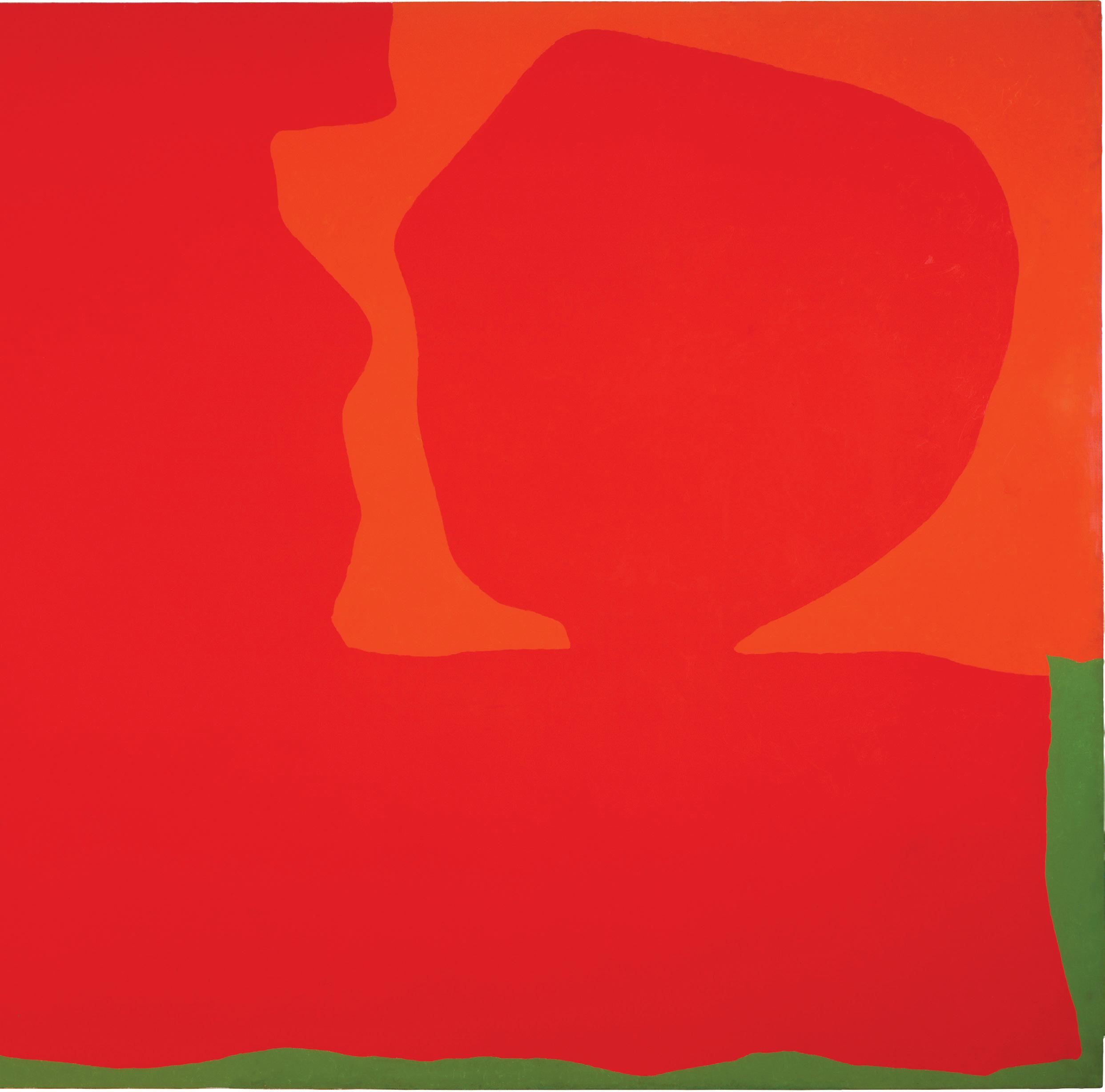
Sara tells a story about the artist Patrick Heron, who would host dinner parties in his home in Zennor, surrounded by his own paintings. “The guests would sit there, and gradually the light would dim. Eventually they’d be sitting there in the dark. For him, it was all about how the paintings would change, how a purple would shift over the changing light of the day, and suddenly be vibrating from its green background.”
Heron was fixated by Cornwall’s light. “Colour was everything to him,” Sara says, explaining the sensorial pull of Heron’s surroundings. “He wasn’t trying to visually imitate the landscape, but capture the vibrancy and sensorial excitement of being in the Cornish light.” Light, for Heron, was something you feel. “His works got bigger and bigger, he captured light on the surface of the canvas. Light was complicit in the viewer’s experience, standing in front of the painting, absorbed and immersed in colour.”
»
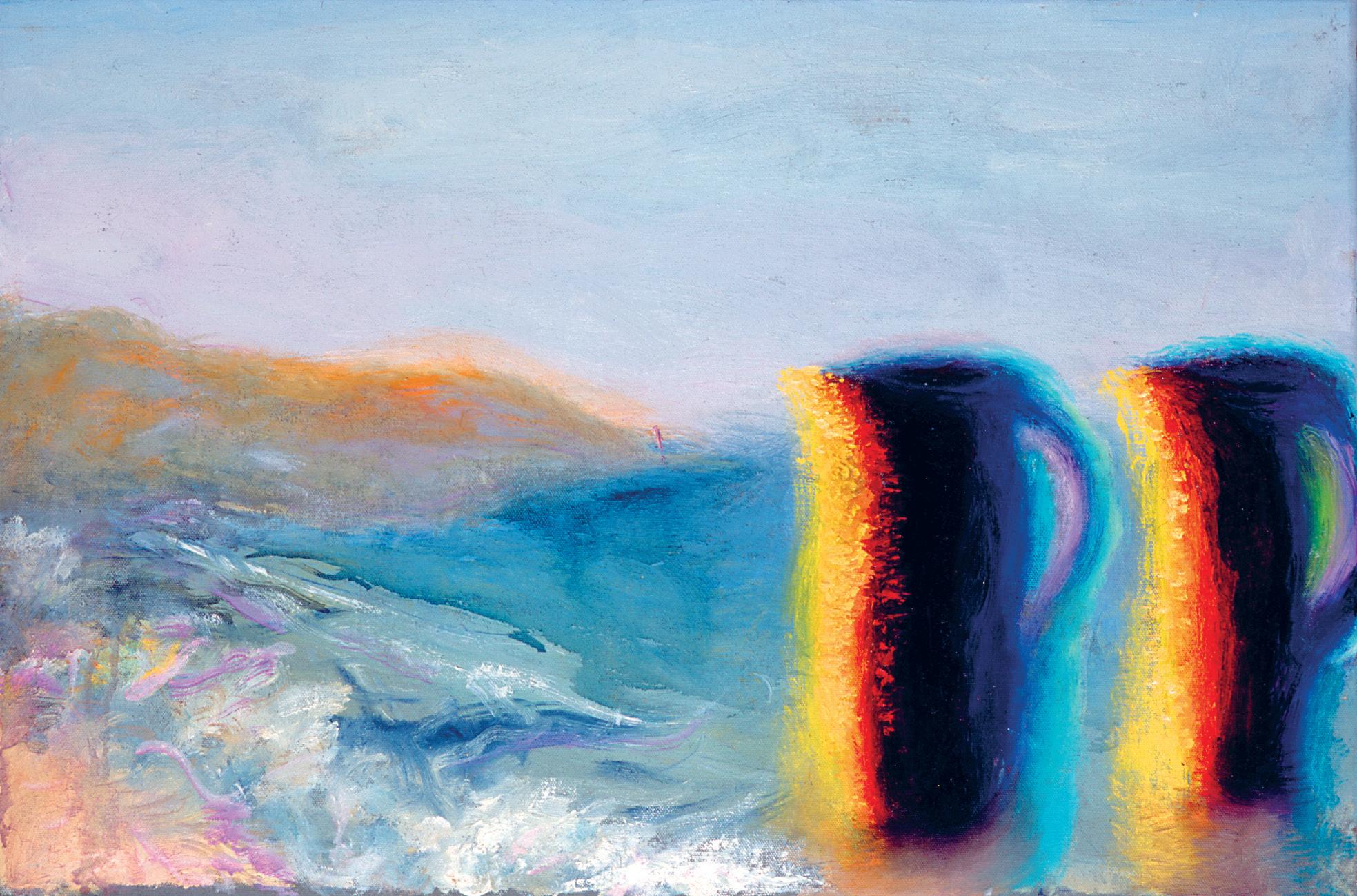
Beyond sight, abstract artists like Heron understood that colour and light can inflame all the senses. St Ives painter Winifred Nicholson thought of colour like music. Using prisms to experiment with wavelengths, she spent her career exploring the intricacies of colour language; letting colours ‘fly’, investigating sunlight and the way light changes. Nicholson wrote that she wanted to paint, “…the colour that hid beneath another or flickered briefly on the edge before disappearing. Unseen colours at either end of the spectrum and on either side of the rainbow”.
Like Nicholson’s flickering colours, at a brief moment between glowing sunset and the dark blue of night, the sun’s light can hit the atmosphere at such an angle as to
glow bright green. Elusive, mystical, the so-called ‘Green Flash’ is another trick of the light, “caused, again, by light refracting in the atmosphere,” explains Clare, “and the behaviour of different wavelengths within the spectrum of light. The Green Flash happens when blue and violet light are scattered by the atmosphere, while red, orange and yellow are absorbed. During the last few seconds before the sun sets below or rises above the horizon, the green light is the most visible. It’s utterly magical.”
With clear air and an unbroken view to the horizon, you’re as likely to see the Green Flash at Watergate Bay as anywhere. Think like Hepworth, feel like Heron, see like Nicholson and take your eyes back to the sea wall again. Cornwall’s light has some more secrets to show you... •
Winifred Nicholson (St Ives) “
Colours wish to fly, to merge, to change each other… to radiate, to shine, to withdraw deep within themselves.”
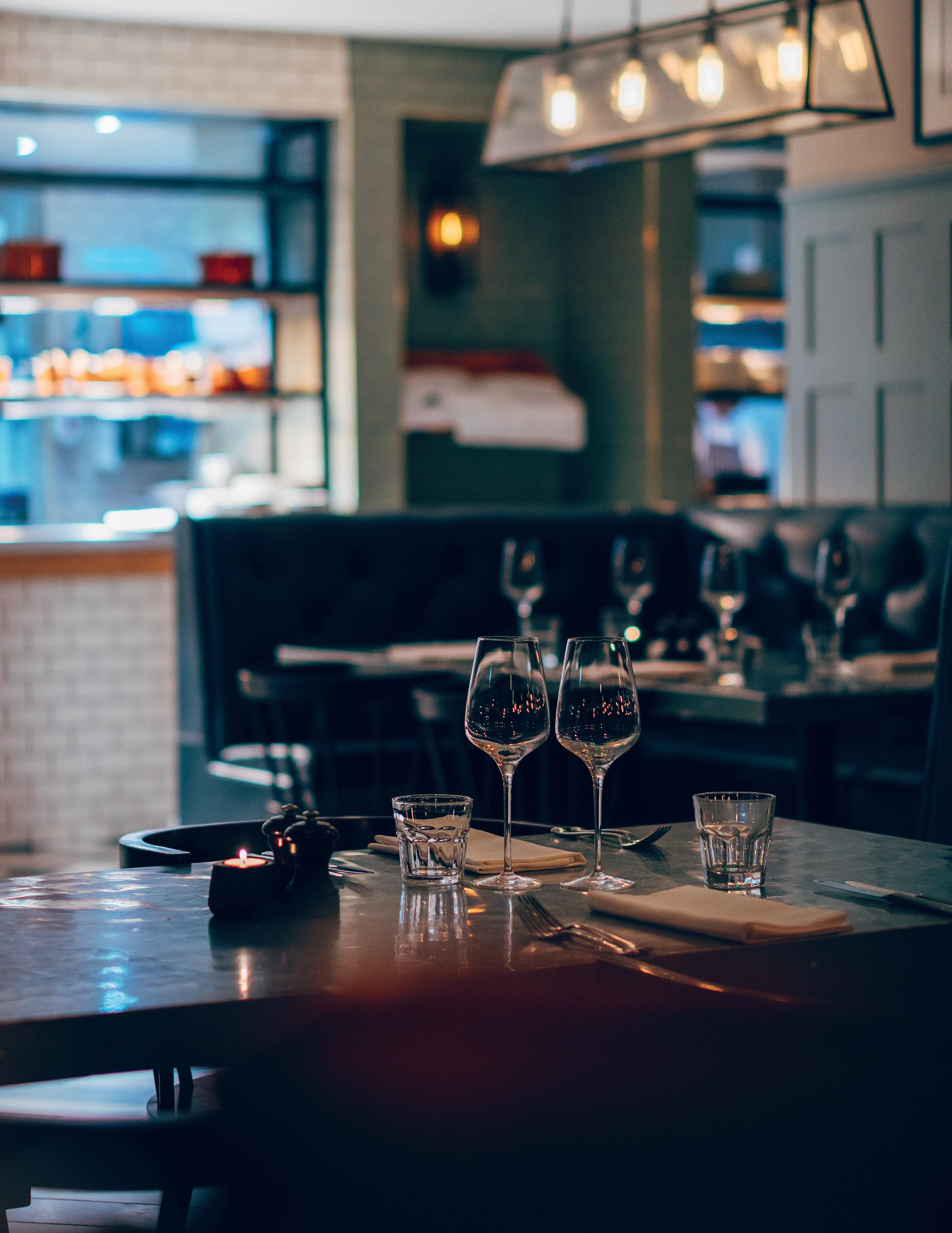
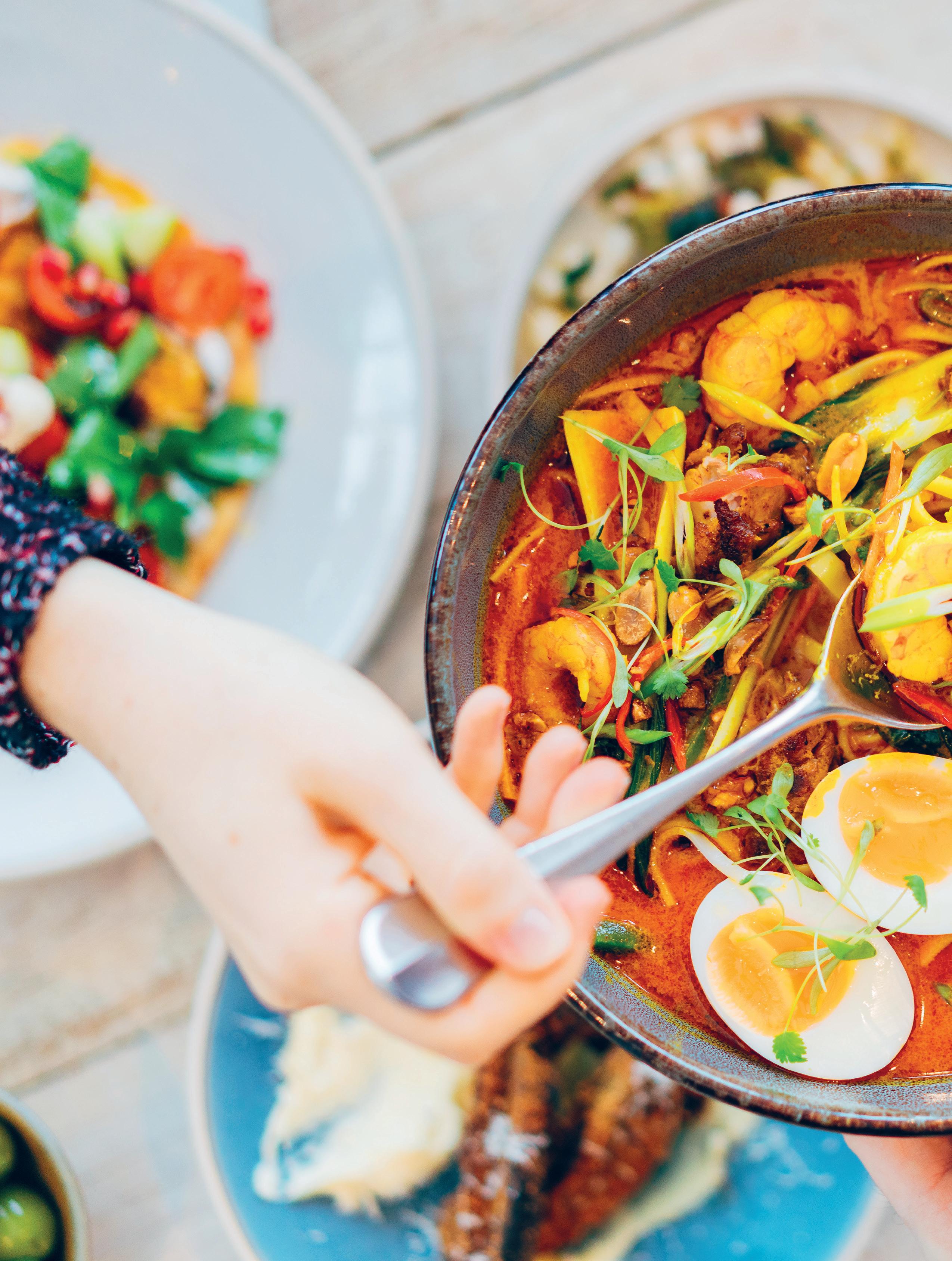
From chowing on a Dead Hippie in Brighton’s premier burger joint, to getting lost in a Hong Kong hawker site, we’re devouring ‘fast casual’ dining the world over – whether we know it or not. Gareth May tucks into the global food trend that’s found its way to Cornish shores.
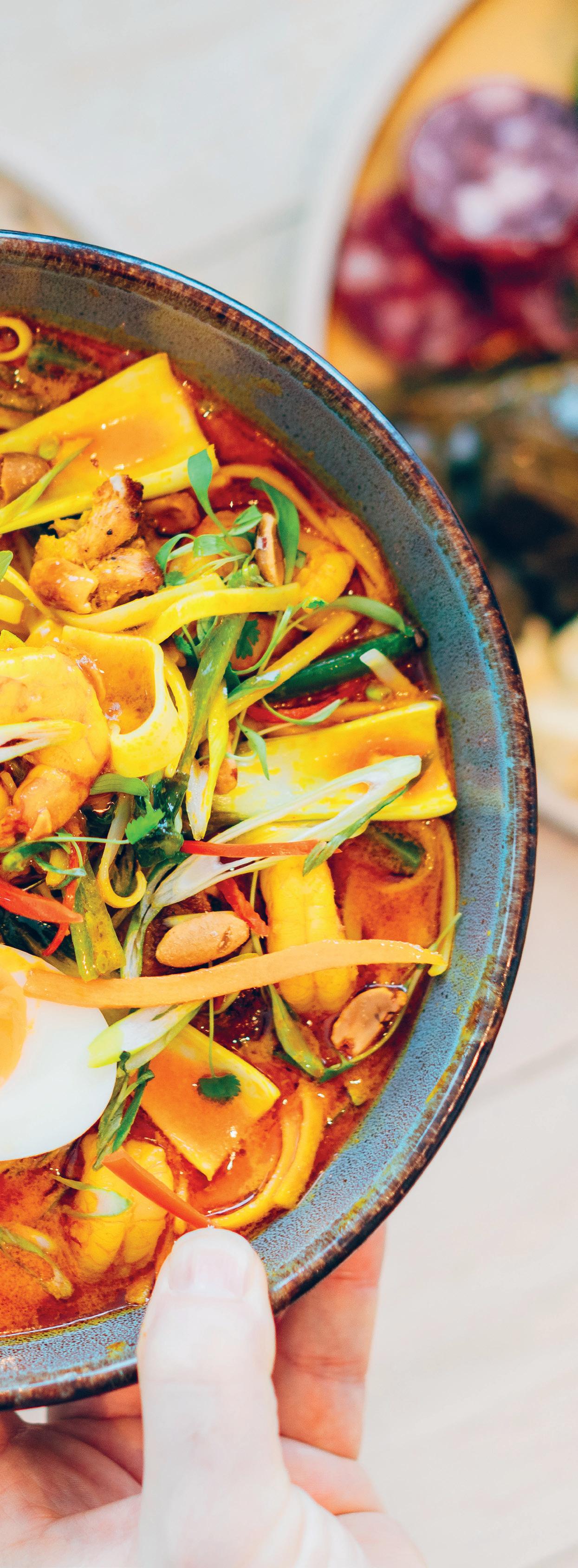
Pulled up a pew and slurped down a bowl of glistening, unctuous orange ramen in London’s Bone Daddies? Wandered down Satay Street in Singapore for its namesake grilled chicken skewer? Or visited Croqueteria at Time Out Market Lisboa and feasted on a cone of cuttlefish-with-ink breaded flavour bombs? Guess what? You’ve experienced fast casual dining. The food for the fibre-optic world, this century’s culinary touchstone – as at home in buzzy 80-cover restaurants as off-piste food truck lots – is sweeping across the globe.
Fast casual (or quick-and-casual) is a concept that sits between fast food and casual dining. In 2014, The New York Times described fast casual simply as “a subset of fast food … with fewer frozen and highly processed ingredients, more-comfortable seats, and (sometimes) healthier food.” But what does it taste like, smell like, and how is it served?
The scene has boomed in recent years, with restaurants drawing on the soul of street food and fast food chain convenience to foster creative dining experiences that are wok-quick, Michelin Star-stylish and devilishly delicious. In the UK, from Wahaca (est. 2007) to Leon (est. 2004) and back again, restaurants with relaxed environments but something interesting to say with their ingredients have been doing well for over a decade, joined more recently by quirky food vans, pop-ups and food halls bringing approachable, health-conscious, tasty and interesting snacks to the masses.
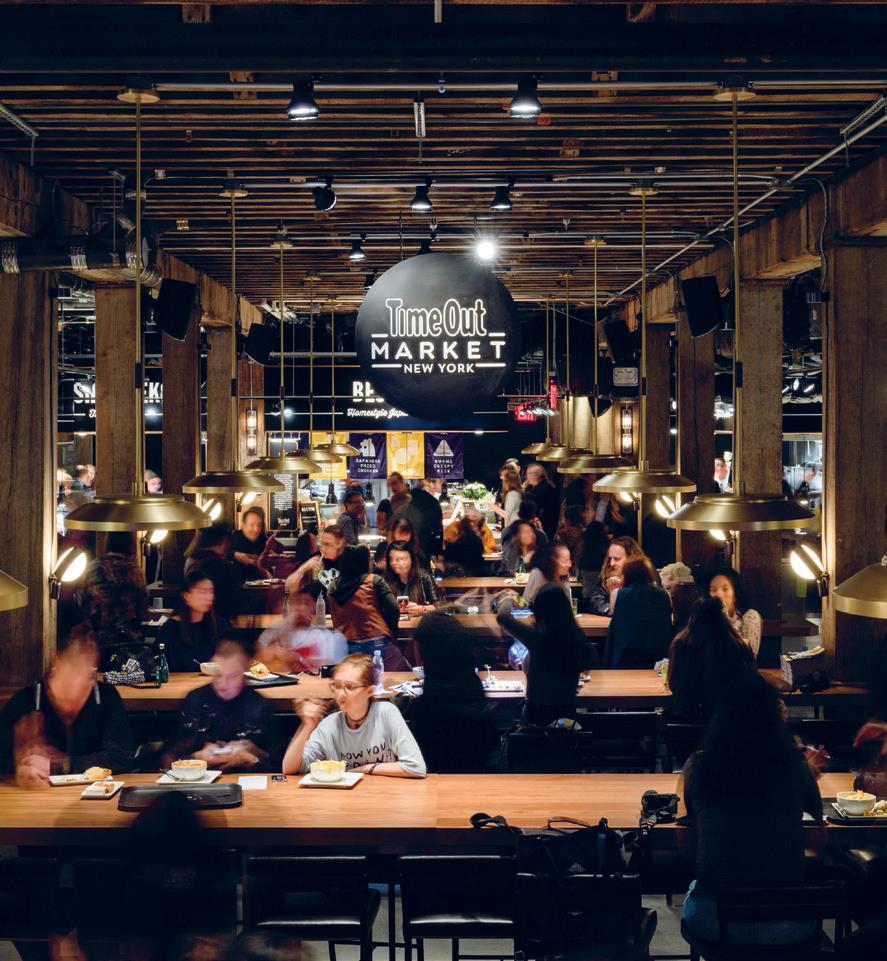
“It’s the democratisation of fine dining. You get to experience excellent and affordable food from top chefs, in a casual-communal space that is beautifully designed,” says Didier Souillat, CEO of Time Out Market, one of the core destinations of this second wave of fast casual, with must-visit hotspots in cities all over the world, from Lisbon, New York and Miami to London (coming spring 2021). These are the dining destinations where memories are made, and shared, and tagged, and listed as ‘must-visit’ in the annals of Eater, Thrillist.com, and the now defunct Lucky Peach zine. This is fast casual. It’s everywhere and everything.
Check on
Eclectic as it comes, it’s far easier to say what fast casual is instead of where it came from. Traits include virtuous speed and convenience, high quality produce and guaranteed flavour, a cool urbane atmosphere and Instagram-able plates. Borderless, boundless and defying clarification it may be, but it shares the same freewheeling fusions of Asian hawker sites where international cuisines like Indian, Korean and Vietnamese come together in a circus of flavours. It’s also heavily influenced by America’s iconic tip-fuelled, super-friendly service, while discarding the ostentation and stuffiness of the haute cuisine.
“It’s food that’s exciting and a little bit challenging,” says Neil Haydock, Watergate Bay Hotel’s executive chef. “Not just something that feeds and fuels.” »
“It’s food that’s exciting and a little bit challenging... Not just something that feeds and fuels.
”
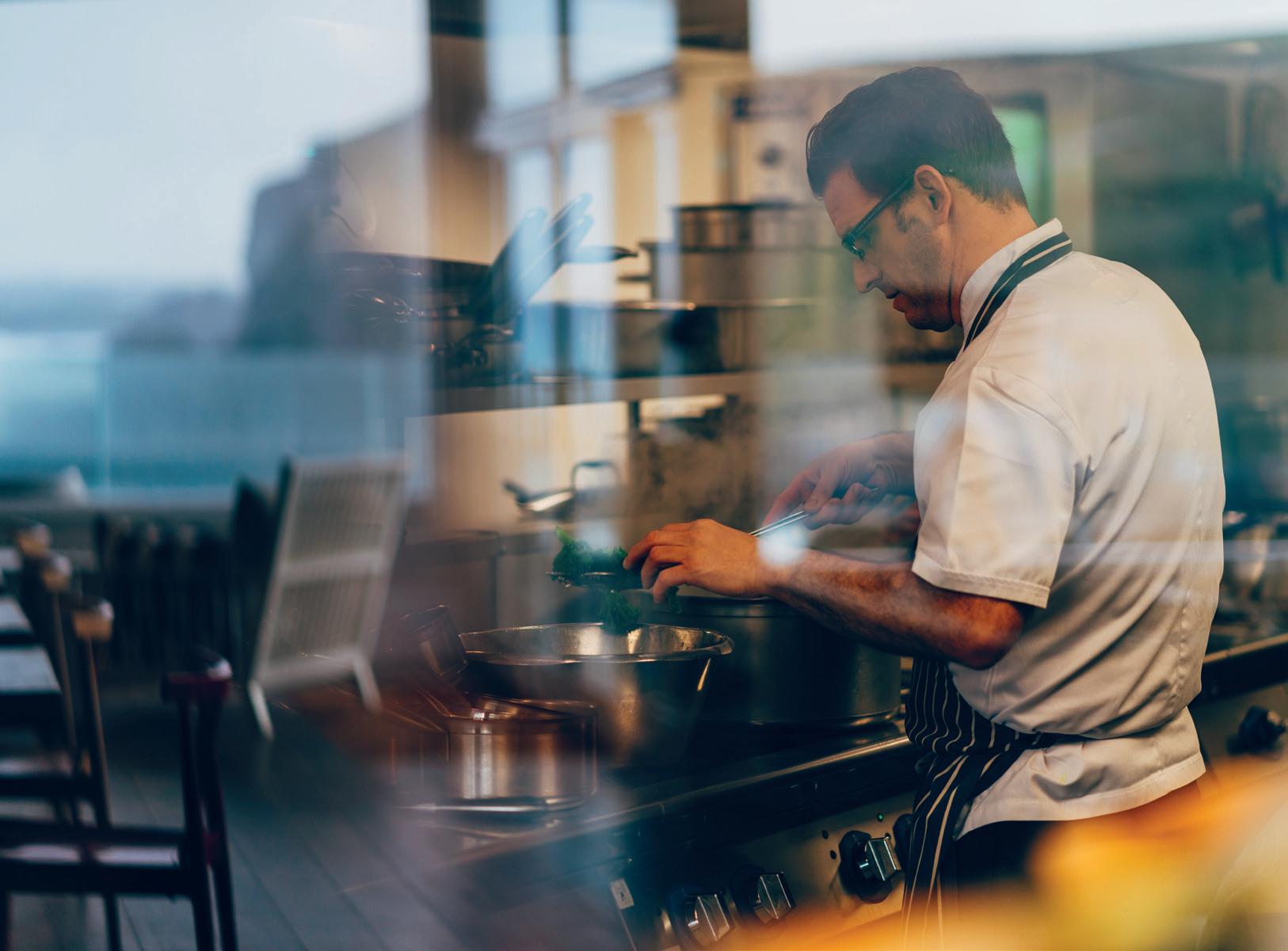
Neil has long been a fan of the concept of fast casual –the atmosphere it creates and the food experiments and flavours it enables him and his team to play with. Ask him about his favourite hotspots and he’ll wax lyrical on the dishes he’s eaten as enthusiastically as a surfer recounting different breaks on their travels. “I’m classically trained and that’s a great grounding, but the French way is stuck in its ways, formulaic and traditional. Food has changed,” he says.
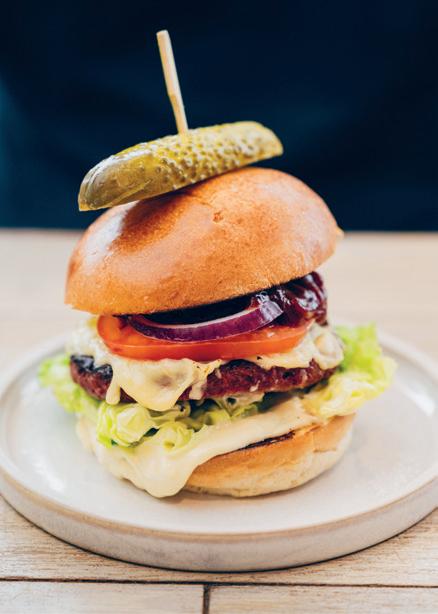
Now younger, self-educated chefs who don’t have these traditional ties are taking over –those more likely to go gaga for a flat plancha than a sous vide, with experiences and cooking scars from kitchens far and wide. People like David Chang, chef and founder of Momofuku, the father of the fast casual scene in the US; and Roy Choi, Korean-American creator of the Korean-Mexican taco truck Kogi and star of the Netflix
series The Chef Show – two of Haydock’s cooking heroes. “These guys morphed Asian and South American street food with Western tastes. Ten years on it’s become something even more tangible.”
London calling If the white tablecloth, penguin waiter venues still cater for a certain kind of eater, a fast casual invasion traffics a different kind of ritual. One-time hangouts for the in-the-know, hipster-ish and hungover, these arenas of foodie heaven have become the stuff of modern pilgrimages. Hashtag factories with queues as thick as flash mobs. Churches where the sumptuous spirit of street food leaves influencers and tourists reeling from a blitz of flavours and youth-fuelled vibes.
Pip Lacey is one of the chefs who has benefited from a change in demand. She sensed the air in the kitchen was shifting, gave up her role of head chef at Michelin-starred Murano in Mayfair and opened up Hicce in
London’s new uber-trendy chowcapital, King’s Cross Coal Drops Yard. Pronounced ‘ee-che,’ the wide, airy, industrial space with exposed retractor fans and orb pendant light fittings – Guardian food critic Grace Dent compared the restaurant to “a capacious, repurposed Manhattan loft” – serves wood-fired dishes, speckled with curing and pickling, and ingredients that include hispi cabbage, shimeji mushrooms and shiso leaves. Not that the customers are fazed; they’ve seen it all before.
“Sometimes people ask, What cuisine are you? Italian? French?’ And I say, ‘It doesn’t have to be anything.’ That partly comes from my travelling and all my experiences in different countries [Pip nearly became a pro snowboarder], but because of multimedia influences, our customers are that much more open to new tastes and world foods,” she explains. “The standard and the quality is all still there [as it was at Murano], ‘

but it’s in a different setting. There’s no stiff atmosphere. I wanted somewhere that if I wasn’t working, I’d like to go to. It’s accessible. Everyone is welcome, regardless of age or bank balance.”
This latter point is something Neil believes too. “We don’t want an exclusive space. If you want to come in wearing board shorts, you can,” he says. It’s a relaxed vibe that slows the pacing of a meal too. Gone are the days of starter, main course, dessert; small sharing plates are where it’s at now. “People are curious. Order six small dishes and take a few spoonfuls of each. That’s the best way to eat,” he continues. “That’s why street food halls work so well. People want to wander around, have some oysters, soak up the atmosphere, grab a drink, then have some tacos. They want choice. And restaurants are trying to tap into that too. Somewhere you can eat around the world in one place.”
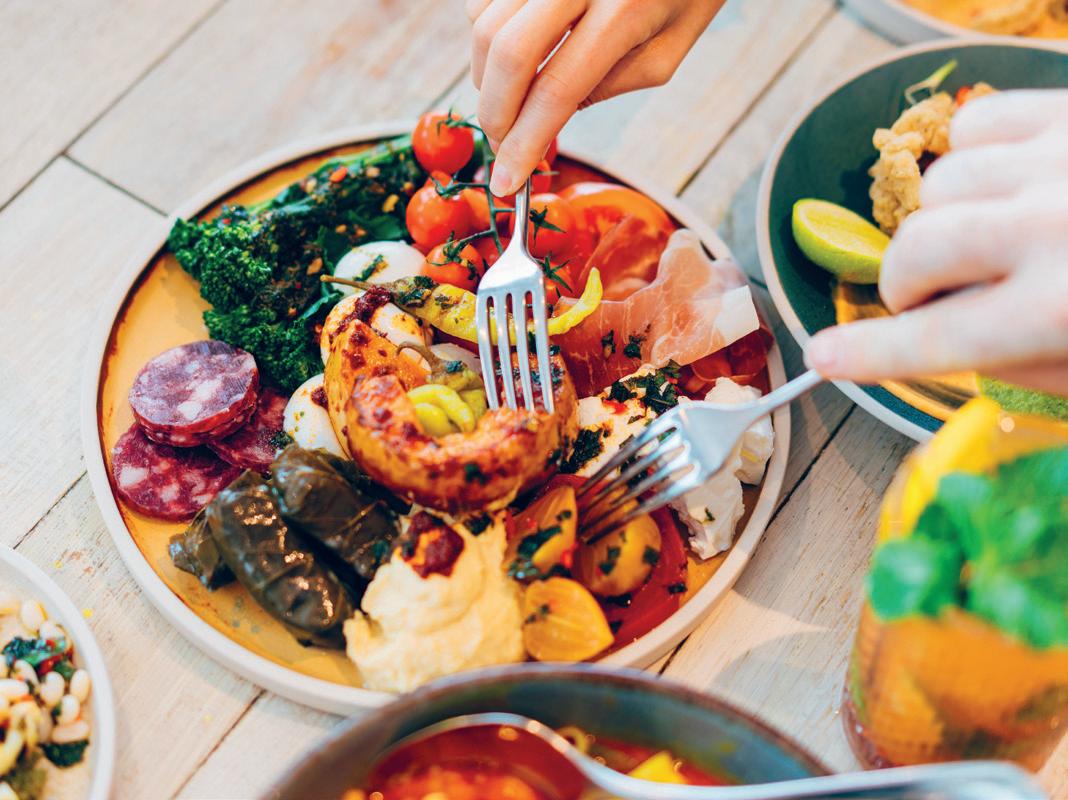
Po’ boys (a traditional sandwich from Louisiana) and Philly Cheesesteak on the menu in the Living Space. Chicken liver parfait with a waffle and ‘KFC rabbit’ (“an elevated, more sustainable replacement for fried chicken with a celeriac remoulade, instead of coleslaw”) at Zacry’s. Corn on the cob covered in nduja butter with a crunch and a kick that rolls on and on. The influence is loud and clear. “I want my flavours to be big and punchy, every single dish to go wow,” says Neil. Quick fix, gloriously inventive, accessible dishes to share amongst would-be gourmands. This is fast casual.
Cheesed off
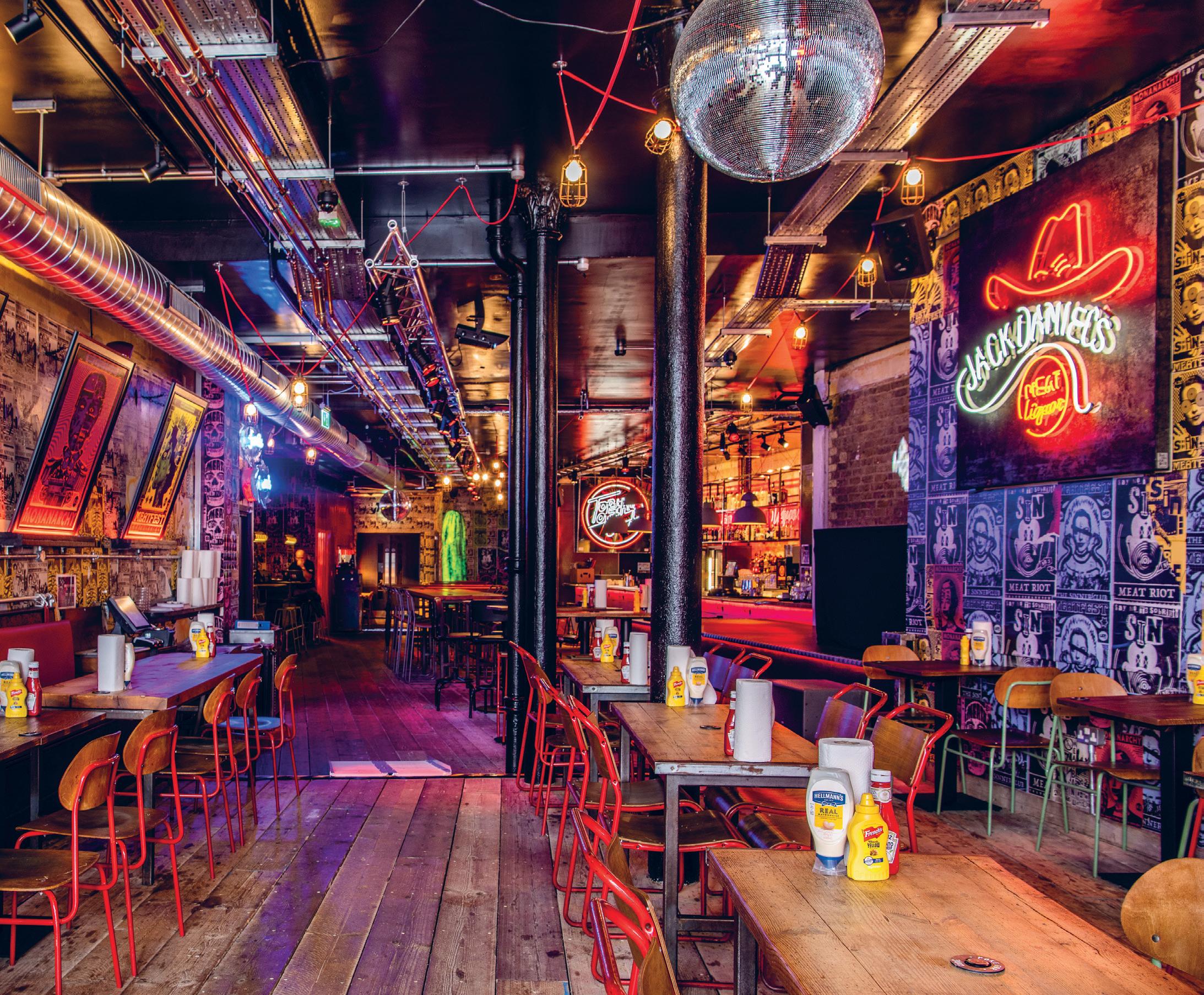
A cornerstone of London’s global foodie scene, MEATliquor was an early adopter of the fast casual ethos. It started life as a food truck in Peckham, but after the theft of the MEATwagon in late 2010, a summer residency as a speakeasy eatery above a pub in New Cross became a word-of-mouth sensation resulting in a permanent bricks-and -mortar site in Hoxton Square. Today, the 11-restaurant UK-wide empire stretches from Brighton to Manchester, with patrons kneeling at its graffitied, ruby red-lit altar for a communion of burgers and beer.
And while it’s easy to get floored by the menu design channelling frontier ‘wanted’ posters, tattooed ‘burgerette’ wait staff, and highschool canteen trays – all the “little ingredients that make people think of America”, according to co-founder Scott Collins – there’s more here than wings, rings, and ‘tails. This is messy, bib-wearing fare, served with a forest of serviettes to mop up the juices. But as much as MEATliquor’s menu was inspired by a handful of US road trips, the adored patties are the product of German techniques (homeland of the humble hamburger) and an unadulterated love of British beef. MEATliquor is more than a sophisticated rip-off of the American diner.
“Some of us may have romantic memories of a brilliant dive bar in New York, and eating the best burger ever – but that’s probably down to jetlag and a hangover,” says Scott. “We wanted to draw on that memory and pay homage to it, with better quality, faster food. An ‘American-ist’ experience. That’s what people wanted at the time and that’s what people want now.”
While nouvelle cuisine is having a comeback in the column inches of New York food reviews and raw veganism is surging on social media, fast casual remains the global grub – and the hottest ticket on UK shores. Click through the pages of online eat-sites and the scene is sizzling. Visit Wahaca in Bristol for a taste of Mexico and to take in the
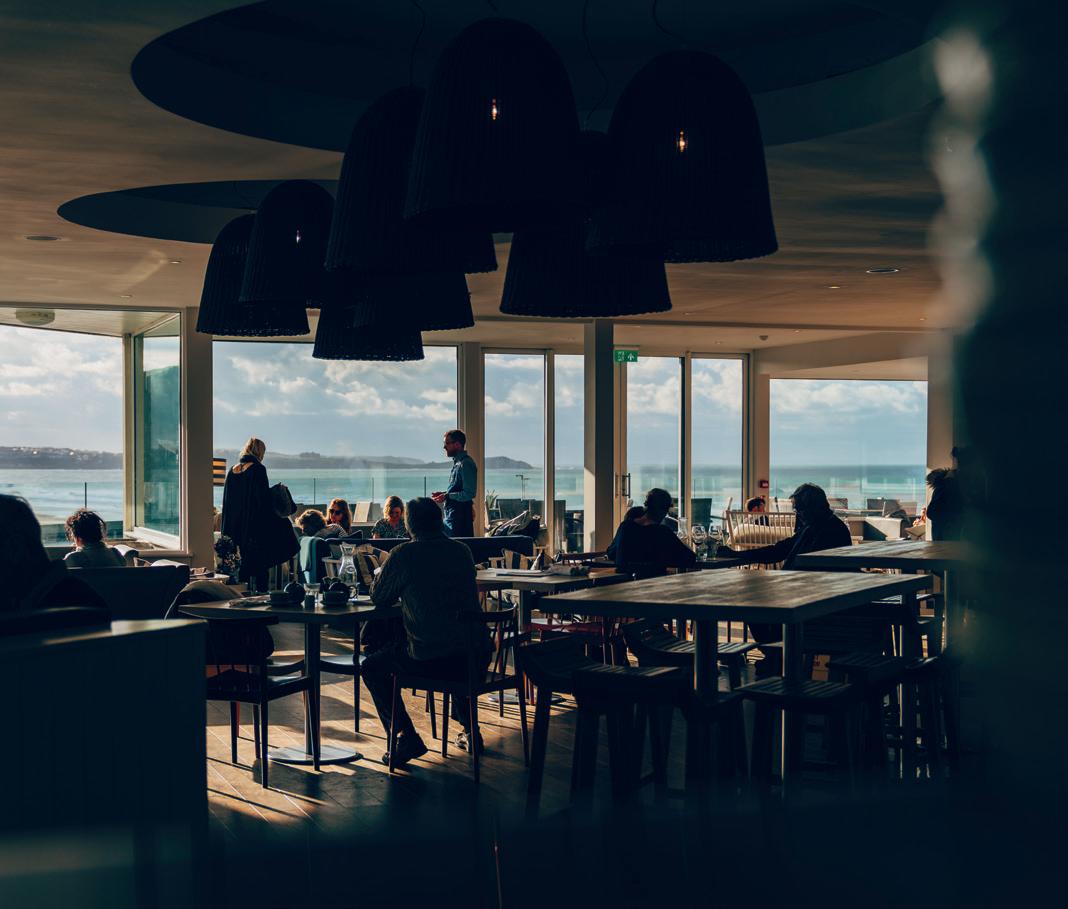
murals by local street artist Will Barras; drop by Red Panda on Gandy Street in Exeter for authentic Asian street food; tuck into an MC Elvis burger made from Cornish beef at The Meat Counter in Falmouth –each one a little bit of escapism on a plate.
London is soon to get its own Time Out Market, too. Following the openings of food halls in Chicago, Montréal and Dubai in 2019 and 2020, spring 2021 will see a London Waterloo site offering 500 seats across 32,500 square feet, channelling the cultural hub of the surrounding South Bank neighbourhood.
“What connects all Time Out Markets is a carefully curated mix of top culinary and cultural talent, capturing the soul of each city,” says Didier. “The execution of each market is completely local. We choose the types of food that are hallmarks of the area, we handpick outstanding chefs and artists, and even the design is a reflection of the city.
“They’re all unique places but they all have outstanding food and a relaxed atmosphere in common. They’re designed for people to come together around communal tables, to eat, drink, and talk.” What more could you want? These are accelerated times – and thanks to fast casual, our appetite is keeping up. •
Pig and Khao, New York
On the Lower East Side, a fusion of US, Thailand and the Philippines, hailed as casually hip” by the New Yorker. Turns heads with a menu including entire pig’s head, braised, chopped, and served on an iron platter, with raw egg.
Saltie Girl, Boston
A narrow barred, tinned seafood haven in New England, serving fried lobster and waffles, snow crab rolls and warm sticky rice, and salmon brushed with teriyaki and blasted with a blowtorch.
Fuku, Los Angeles
David Chang’s casual fried chicken restaurant in SocialEats food hall in Santa Monica is Asian-American comfort food personified, and this year’s dining darling for the Hollywood elite.
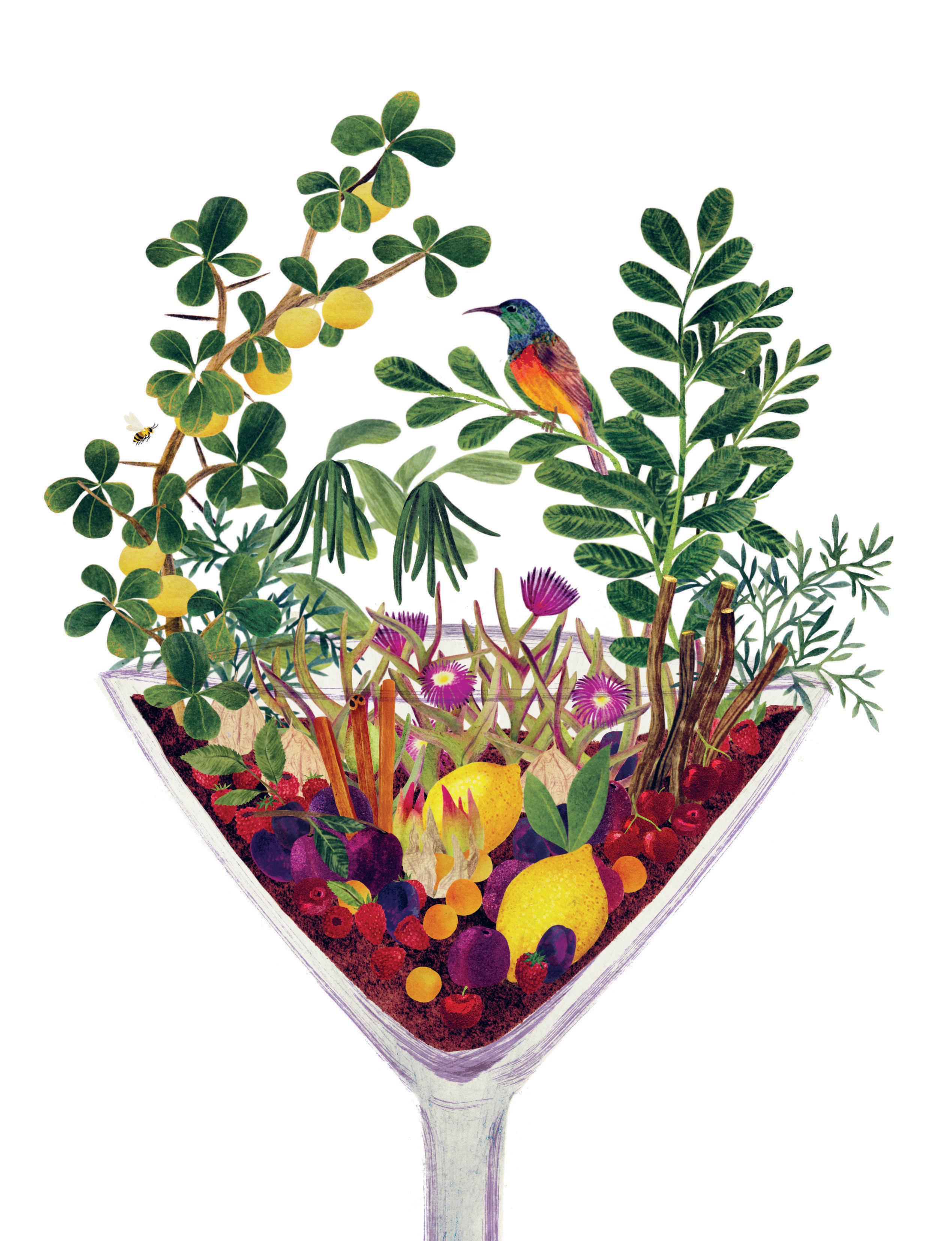
When it comes to flavouring our favourite tipples, juniper berries or wormwood are just the tip of the iceberg. Drinks writer Alice Lascelles dives into the delicious world of botanical experimentation.
The history of drinks is, in many ways, also a history of plants. From the grapes trodden into wine by the ancient Romans, and the juniper used by Londoners to flavour 18th century gins, through to the micro-herbs tweezered by bartenders onto 21st-century cocktails, plants have played an integral part in the evolution of liquid culture.
These days, we add botanicals to drinks, because they give us pleasure – but in centuries gone by, herbs, fruit and spices were often added to drinks in the belief that they would do you good. Wormwood in particular was regarded as a herb that could cure many ills. The Greek physician Hippocrates famously prescribed wine infused with wormwood and dittany for ailments including rheumatism, anaemia and indigestion. Archaeologists have found evidence of the Chinese making elixirs from rice wine macerated with wormwood, chrysanthemum and elemi, as far back as 1000BC. And diarist Samuel Pepys also wrote about taking his ‘morning draft’ of wormwood-spiked ale, a restorative known as ‘purl’.
One of the great legacies of these drinks is vermouth, an aperitif which started life in 18th century Italy, and which is now experiencing a wonderful renaissance in distilleries around the world. In its simplest form, vermouth is just a fortified, sweetened wine flavoured with bitterest wormwood. But most vermouths are flavoured with dozens of botanicals. At the Sacred Distillery in north London, they make an amber vermouth from English wine and botanicals including thyme, savory, cherry and plum stones. The South African vermouth Caperitif, meanwhile, is laced with more than 35 ingredients harvested from around the Western Cape: sour figs from the dunes, citrusy naartjies, cape gooseberries, kei apples. There are vermouths flavoured with lemon verbena, lavender, citrus peels, cinnamon, raspberries, vanilla, nutmeg, liquorice, rosemary and even myrrh.
Some of these recipes read more like perfumes than drinks. And there was a time when perfumes and libations were almost interchangeable (distillation was, after all, invented not to make strong liquor, but to capture essences to make scent). The earliest eau de colognes, with their uplifting notes of citrus, exotic flowers and herbs, were elixirs designed to be worn or imbibed. In the 19th century, there was also a fashion for adding ambergris – a rarity more often used by perfumers – to alcoholic punch.
Every great drink starts with a plant. Every advance in botanical exploration or horticultural science has brought with it a corresponding uptick in the quality of our spirituous liquors.” “
Drinkable perfumes might be thin on the ground these days. But there are plenty of unusual spirits that still allude scent. Muyu is a new range of perfumery-inspired liqueurs that leads on notes such as jasmine and vetiver. At the Comte de Grasse distillery in Grasse, the heartland of France’s perfume industry, they make a gin flavoured with the kind of local flora usually destined for Guerlain or Chanel: lavender, mimosa, jasmine and sweet immortelle.
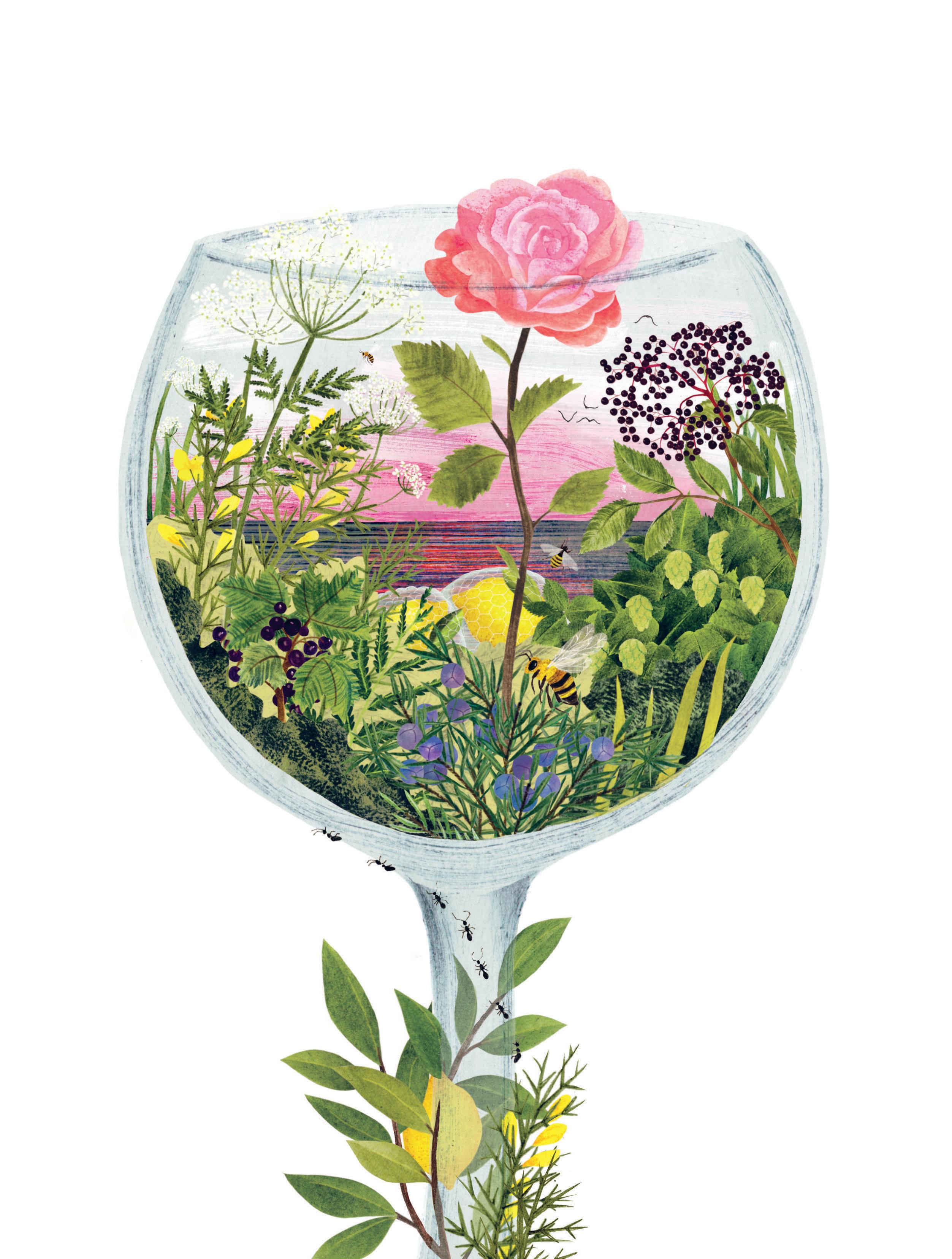
Sometimes botanicals can have the most unexpected, and delightful, side effects. Tinkture is a Cornish gin flavoured with organic David Austin roses grown in England. On its own, the gin is amber-coloured, but when the rose pigments come into contact with tonic water or lemon juice, the citric acid turns them bright pink.
“We even turned a few test distillations green when we tried different rose varieties… not exactly the look we were going for!” laughs Tinkture founder Hannah Lamiroy, who auditioned more than 190 different varieties of roses in her search for the perfect blend. “We were essentially looking for subtle, delicate aromas – when you taste our gin we want you to feel like you are taking a stroll through an English garden in bloom, not drowning in sickly perfume.”
Gin has traditionally been made with botanicals from all over the world: juniper from Tuscany, citrus peels from Spain, coriander from Morocco, liquorice from China. But more and more, we’re now seeing craft distillers shift their focus closer to home, using local, seasonal and foraged ingredients to give their recipes a strong sense of place.
Cambridge Distillery produces a seasonal gin that changes twice a year: this year’s spring/summer edition was flavoured with wisteria, cow parsley and flowering currants, all hand-picked from the gardens and hedgerows around the distillery in Grantchester. When founder Will Lowe was commissioned to create a gin for the Nordic Food Lab – a think tank founded by Noma chef René Redzepi – he used formic acid derived from native woodruff ants to give the recipe a Scandinavian tang.
At her north London bar Tayēr + Elementary, International Bartender of the Year Monica Berg uses all kinds of unusual ingredients to give her drinks a culinary twist. “I always try to work with what’s around me, because it’s important to me to pay respect to the time and place I’m part of,” she says. “Some of my favourite ingredients are sea truffle (not to be confused with truffle seaweed ), sea buckthorn and green juniper – it’s always such a treat when they become available.”
If you’re having a drink in Watchful Mary, the bar on the sea wall at Watergate Bay, you’ll notice a rather fine limoncello behind the bar made by the nearby Atlantic Distillery – a recipe originally made
using lemons grown in the Mediterranean biome at the Eden Project. Demand for the liqueur has grown so much that they’re forced to use organic lemons from abroad these days, but the distillery still uses a wealth of local ingredients to flavour its gins, including hops, elderflower, gorse flower and its own homegrown fig leaves.
But all this botanical activity isn’t just confined to alcoholic drinks – the burgeoning non-alcoholic sector is now producing some fascinating recipes, too.
Everleaf is a golden, non-alcoholic aperitif flavoured with more than 16 different botanicals including saffron, vetiver, orange blossom and voodoo lily. Created by conservation biologist-turned-bartender Paul Mathew, it’s bittersweet, fragrant and slightly fruity/floral: delicious with tonic water or soda.
Or how about an alternative high? Three Spirit is a new herbal aperitif compounded from (fully legal) botanicals with a reputation for psychic enhancement: damiana, lion’s mane, yerba mate, tulsi. It tastes a little like a craft cola, or a rather earthy vermouth. Not an alternative G&T exactly – but after a couple of these I certainly found myself more than usually content to spend the evening just lying on the sofa, listening to records.
Some botanical drinks are outrageously extravagant. It takes an astonishing 1500 lotus flowers to scent just a kilo of Vietnam’s rare Lotus Lake Green Tea. But there are other drinks companies who are now finding new ways to be resourceful. Discarded is a new red vermouth that’s flavoured with cascara, or the fruit of the coffee berry, a by-product of coffee production that would otherwise go to waste.
At Kwant cocktail bar in Piccadilly, they’ve cut down on air miles by growing all their micro-herbs in-house. Sitting at the black-lacquer bar, you can sip a sour topped with a tiny Mexican marigold, or a martini garnished with a peppery nasturtium leaf the size of a one pence piece.
“Every great drink starts with a plant,” says Amy Stewart, author of The Drunken Botanist, a hugely entertaining encyclopaedia of more than 160 plants that have shaped our drinks throughout history. “Every advance in botanical exploration or horticultural science has brought with it a corresponding uptick in the quality of our spirituous liquors.”
Which sounds like a very good excuse to pour yourself a G&T, roll up your sleeves, and get out there in the garden. •
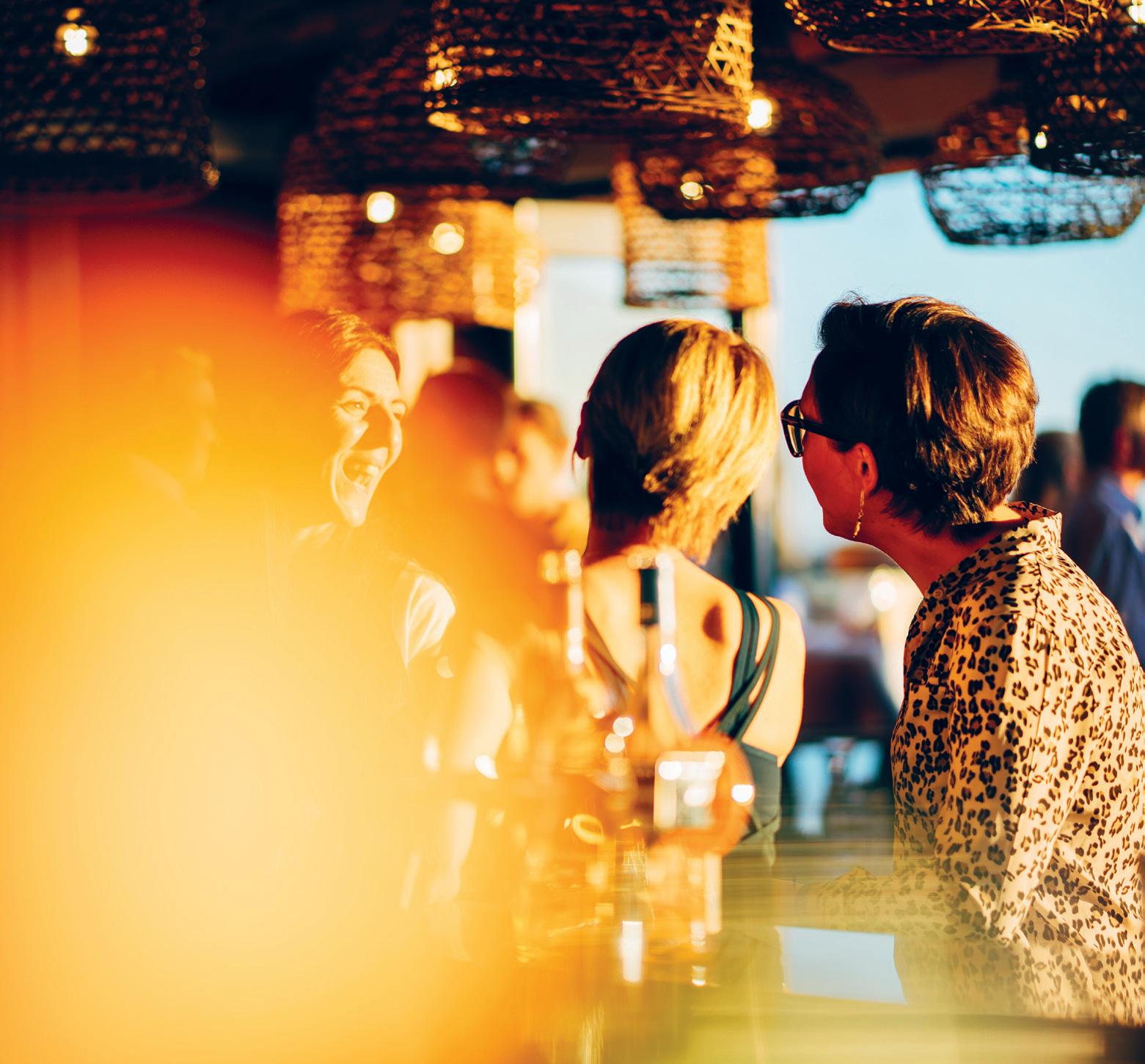
Evocative, transporting, mystifying…the sense of smell continues to intrigue neuroscientists, psychologists and writers. Author, broadcaster and fragrance aficionado Lizzie Ostrom considers smell from the vantage point of Watergate Bay.
Smells are potent memory and mood joggers because the ‘sense of the sense’ is delayed. We are hit with feeling before logic.
From my first sighting on the sand, it was difficult to tell how far the cave would go. But as soon as I stepped inside, I realised it went deep – a corridor to carry us into the cliff. How quickly the atmosphere changed from one stride to the next. Turning back, I stared at the surfers, the dog walkers, the beach-combing families as if through a seal. Moving further in, following dozens of other sandy human and dog footprints, the air felt both more stilled – held away from the wind outside – yet more saturated. Its heavy scent gathered itself into greater concentration with every advance. Perhaps those odorous biomaterials produced by algae and smelling of iodine, called bromophenols. Or the sulphurous dimethyl sulphide which is made by plankton-eating bacteria. Or trimethylamine, which is partly responsible for the fishy whiff produced by sea creatures as they degrade.
At that moment, hundreds of compounds came together to produce that instantly recognisable sea smell. My sea smell, as well as yours. Its intensity turned the cave momentarily into a chamber for consciously examining olfactory memories on a theme, as if I had a direct line to all the other moments in life in which I had explored a coastal cave.
The earliest memory was a time in Cornwall, just down the road from Watergate Bay, when I was three. We’d spent all day on the beach, and I had to go to the loo in a cave. I felt faintly mortified in case this were to be discovered. Oddly, I felt a tiny bit of that emotion again over 30 years later; the me of three and the me of 36 coming together (for the record: I didn’t use the cave as a bathroom this time).
Where does this potency come from? The sense of smell haunts and it taunts. In the cave, as in a florist’s, a swimming pool or a pine forest, we are in environments that prime us for their aroma. The look, the feel, the air conditions are in concert with the smell to produce an experience loaded with resonance. But just as often we are ambushed by a surprise smell, which gives no clue where it came from. We are tugged somewhere, teased that we can’t even come up with a name for it, while fully aware of its power.
The primal brain
When we smell, inhaled odour molecules dissolve in mucous at the top of our olfactory cleft and bind themselves to receptor cells, producing a signal which is carried to the olfactory bulb on the brain’s frontal lobe. Our other senses pass their initial signals to the thalamus for processing before they make their way to the amygdala. Smell, however, bypasses this step, and the signals head straight for the amygdala. This is the oldest reptilian part of our brain, responsible for mood, emotion and behaviour. This means that before we might semantically ‘tag’ an aroma, it has already triggered an emotional response which may have been laid down during our first ever exposure to that smell years prior; our formative experiences matter.
Smells are potent memory and mood joggers because the ‘sense of the sense’ is delayed. We are hit with feeling before logic. Some odours – coffee or cake, for example – are more readily retrieved and labelled, especially if they occur in a congruent context like a café. But others, those that are more occasionally experienced, can be more mercurial. Depending on the frequency of exposure, they are also more likely to be attached to a singular memory rather than general sense of time or place.
Perfumed potency
This is perhaps why fragrances, specific ‘designed’ aromas, often attached to a person, can be so transporting. Years ago in 2008, I worked with a colleague for a couple of months. She was totally different to me; super organised, gum-chewing, with perfectly filed nails that tap tap tapped on her Blackberry. She kept talking about this thing called Twitter. She smelt sensational. One day I asked her what it was: Musc Ravageur (‘devastating musk’) she revealed, extracting an enormous perfume bottle from a bag looking too small to contain it. It was ‘the thing’, she said. ‘Cats follow me home,’ she added. Was this a situation to be desired?
A while later, finding the perfume for sale, I bought a bottle. I enjoyed wearing it for a while but it never felt quite right. The other week, I came across it in the cupboard and gave a spray. Instantly, it was as if this colleague were standing in front of me. She and I haven’t met in over a decade. But here she was. My emotional switchboard went haywire. I suddenly felt so young, uncertain and out-of-my-depth, just as if I was still working on this project.
Smells disrupt our sense of proportion and hierarchy. They trip us into recalling the minor (in our worldview) figures in as much detail as our loved ones. And then we realise that somehow, these people were important to us in an unforeseen way.
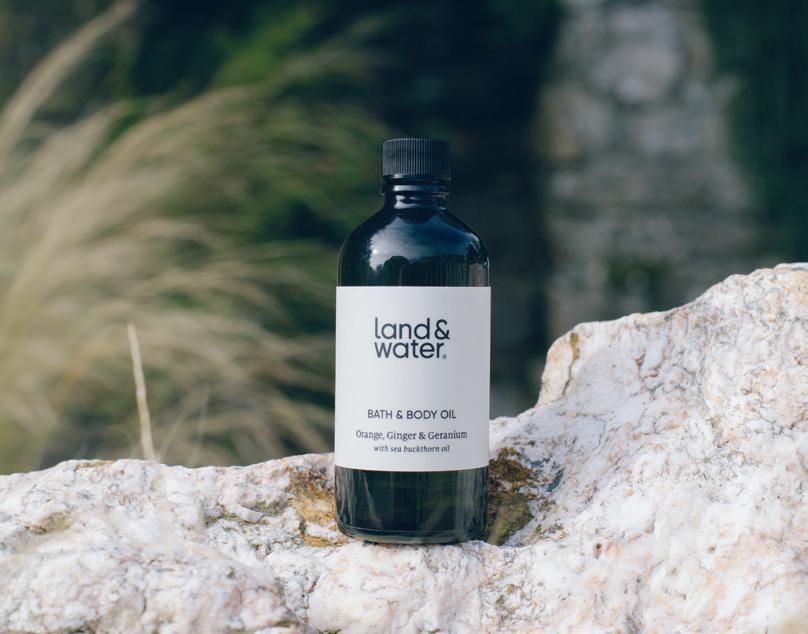
Sometimes, as with my encounter with Musc Ravageur, the emotional response is maverick. But is it possible for a creator to gently guide us towards a mood using collective smell associations, while offering space for personal interpretation? Perfumer Richard Howard of Arcania Apothecary has deftly managed the feat in his fragrances for Watergate Bay’s new land&water brand of bath and body products. They are designed not to offer a literal facsimile of the smells of the Bay (no cavey dimethyl sulphide here, thankfully), but to translate the emotion of being on the threshold of the elements.
Relaxation and alertness are often positioned as contrary states, yet at Watergate Bay, they absolutely co-exist. Chilling out can occur as much in the bracing arms of the cold sea as it does back in the pool, looking out over a changing sky. Richard has yoked the forces together: “I created two different scent worlds – the one occupying an exhilarating airy territory, and the other a more serene mystical territory.”
For Richard these two themes were extrapolated into ‘chords’, the building blocks of perfumery in which raw materials are combined into creative concepts. The first chord is expressed through buoyant citrus oils and the latter through green and woody notes. The balance shifts across each product depending on the emotional experience
intended in their use, so that the hand wash lifts with lime, grapefruit and mint, while its paired lotion takes us into a more hypnotic space with glimpses of heady ylang ylang and neroli. These partnerships – dynamic and restful – are repeated across the hair and body products.
Preferring to work with a palette of essential oils, Richard finds plant materials stimulate strong mood effects. “Nature’s design is infinite and these oils contain the complexity in life itself. These are more than just lovely smells; you have to have enormous respect for them. The most powerful experiences come when a smell not only reaches your emotional self and your memory, but has a therapeutic effect on the body, so it is truly holistic.”
Dr Mark Moss, a founding member of Northumbria University’s Cognitive Neuroscience Unit, has led many studies on the effects of photo-aromatics on mood and cognitive function. His research has helped to evidence the theory that the aromatic properties of some herbs improve contentedness while decreasing memory performance (lavender), while others improve short-term memory. His study on exposure to rosemary essential oil aroma showed that one compound within rosemary, 1,8-cineole, crosses the blood brain barrier and acts on receptor sites to improve performance in cognitive tasks.
Fascinated by the shared use of plant oils for particular purposes across very different global cultures, Mark suggests that our visceral responses to smells could be part of an inherited screening capability. “Genes that code for the detection of smells existed in our ancient ancestors more than 700 million years ago – before the evolution of eyes, or indeed brains,” he says. “And there are many more genes for smell now than there were then, demonstrating its continued evolution.”
Our interaction with plants and their odours has helped shape the development of our very sense of smell, Mark argues. “Over millions of years, we have evolved a largely common smell palette that helps us distinguish foods that might be dangerous or good to consume, read bodily and waste aromas, and recognise a range of plants that exhibit medicinal and socially functional actions,” he says. “This cannot be purely by chance. Many of these herbs have historical uses beyond any records, and it seems plausible that we’ve evolved to become hard-wired to identify them quickly due to their value.”
Our sense of smell is arguably much more sophisticated than we could even begin to believe, and much operates outside of our conscious awareness. But sometimes, we cannot fail to notice what is happening. The smell that most endears me to Watergate Bay (and I suspect this is true of many other guests) is the aroma of toasting waffles that calls out as soon as you open your bedroom door in the morning and head down to breakfast. You breathe in deep, smile, and feel full of giddy joy. And you just know this one’s going in the memory bank. •
Also known as Odette Toilette, Lizzie Ostrom is the author of Perfume: A Century of Scents, published in the UK by Hutchinson. odettetoilette.com
Psychologist Dr Andrew Johnson of Bournemouth University has been investigating whether smell memory has unique properties. “We’ve been looking at working memory, which is when you attempt to keep items active in memory (like trying to repeat a telephone number someone’s just given you),” he explains.
“In one study we used something called the n-back olfactory working memory task. Participants are presented with a long sequence of smells – a new odour every ten seconds. They are asked to say whether the odour they have just smelled is the same as the odour presented two items ago. On the face of it, this seems really difficult. But remarkably, participants perform this task well above chance. Our early tentative suggestions are that smell memory has much greater capability than one would expect.”
Inspired by years of enjoying the ‘active relaxation’ lifestyle at Watergate Bay – a place where invigoration and calm, alert and serene are endlessly intertwined – land&water founder Pix Ashworth set about capturing its essence; to, literally, bottle it. Using natural recipes of pure essential oils and actives (including moisturising samphire and spike moss extracts), the land&water range of bath, body and home products has been designed to “evoke that warm glow after time in the elements”.
land-and-water.co.uk
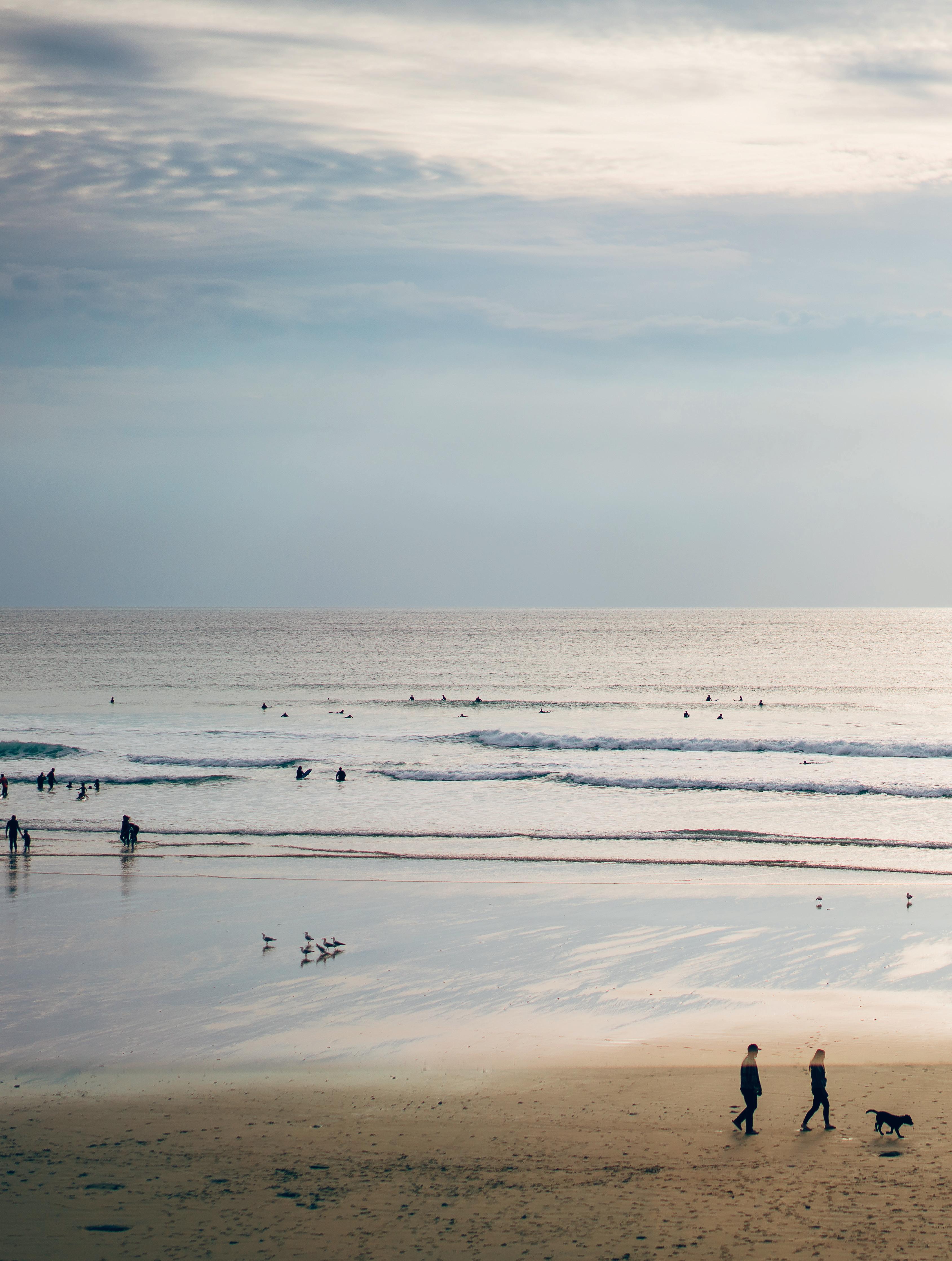
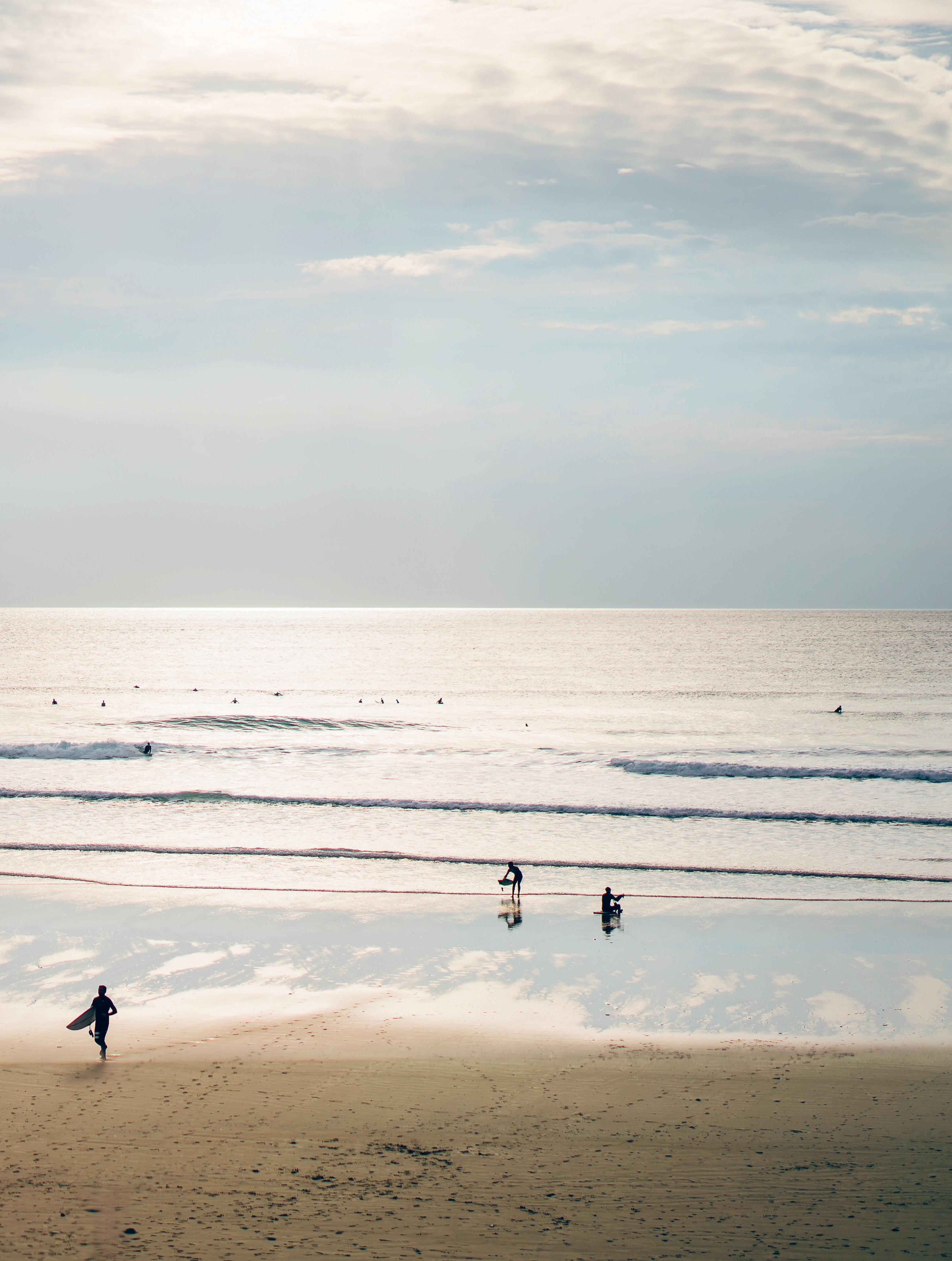
Sun on skin. Everyday rituals: calm invigorating, familiar. Floating and cold, splashing camaraderie. A nutritious find in the mist. Watching, waiting...
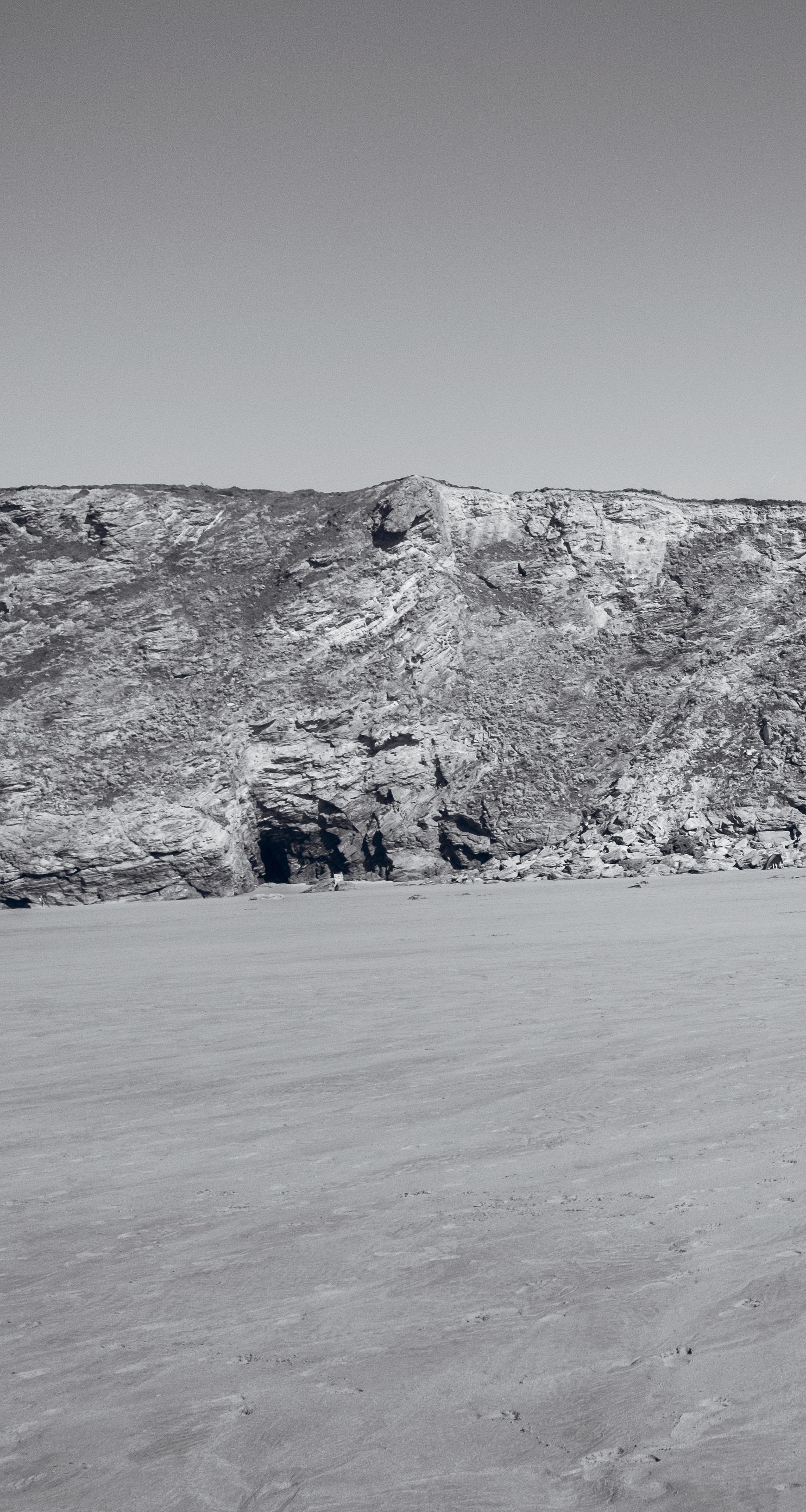
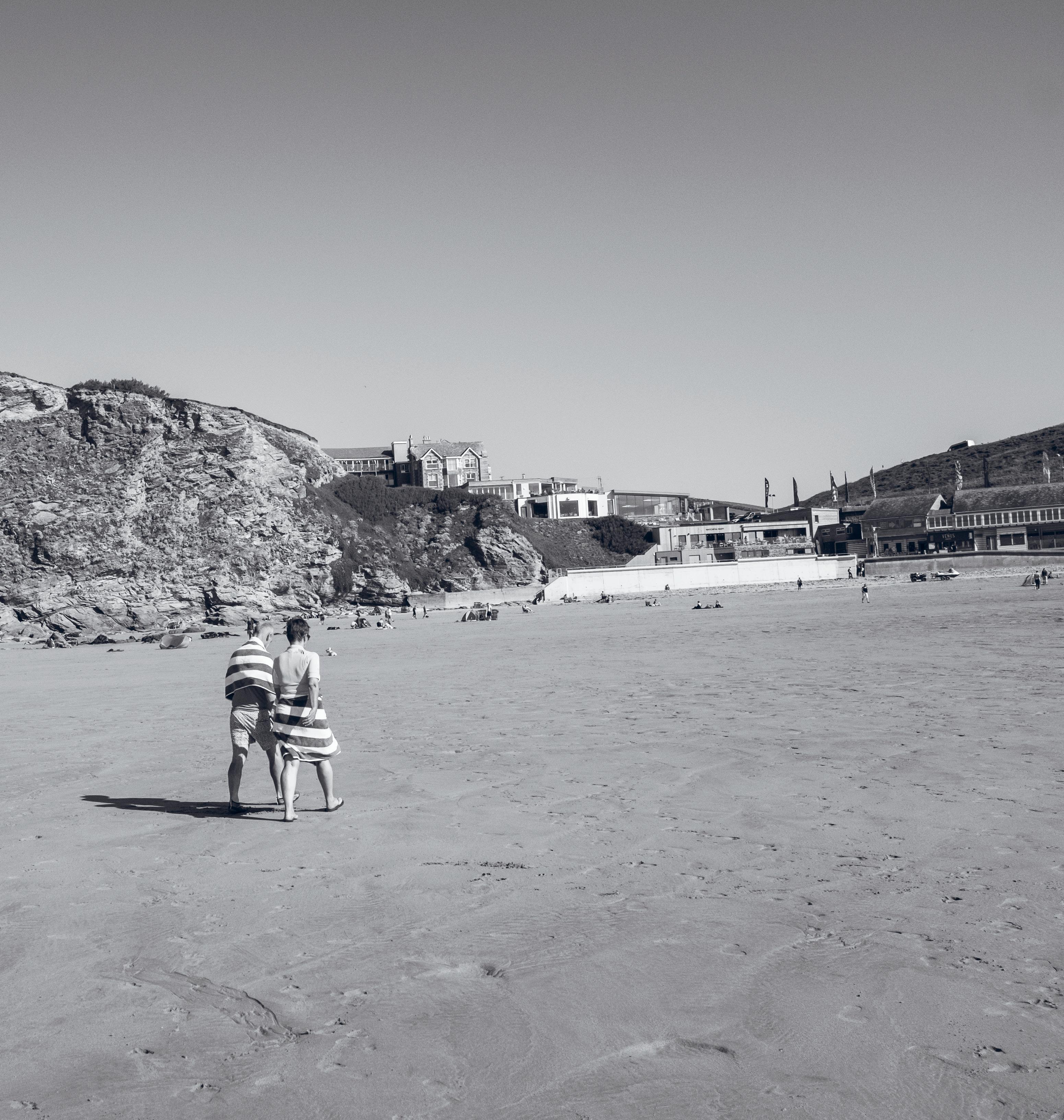
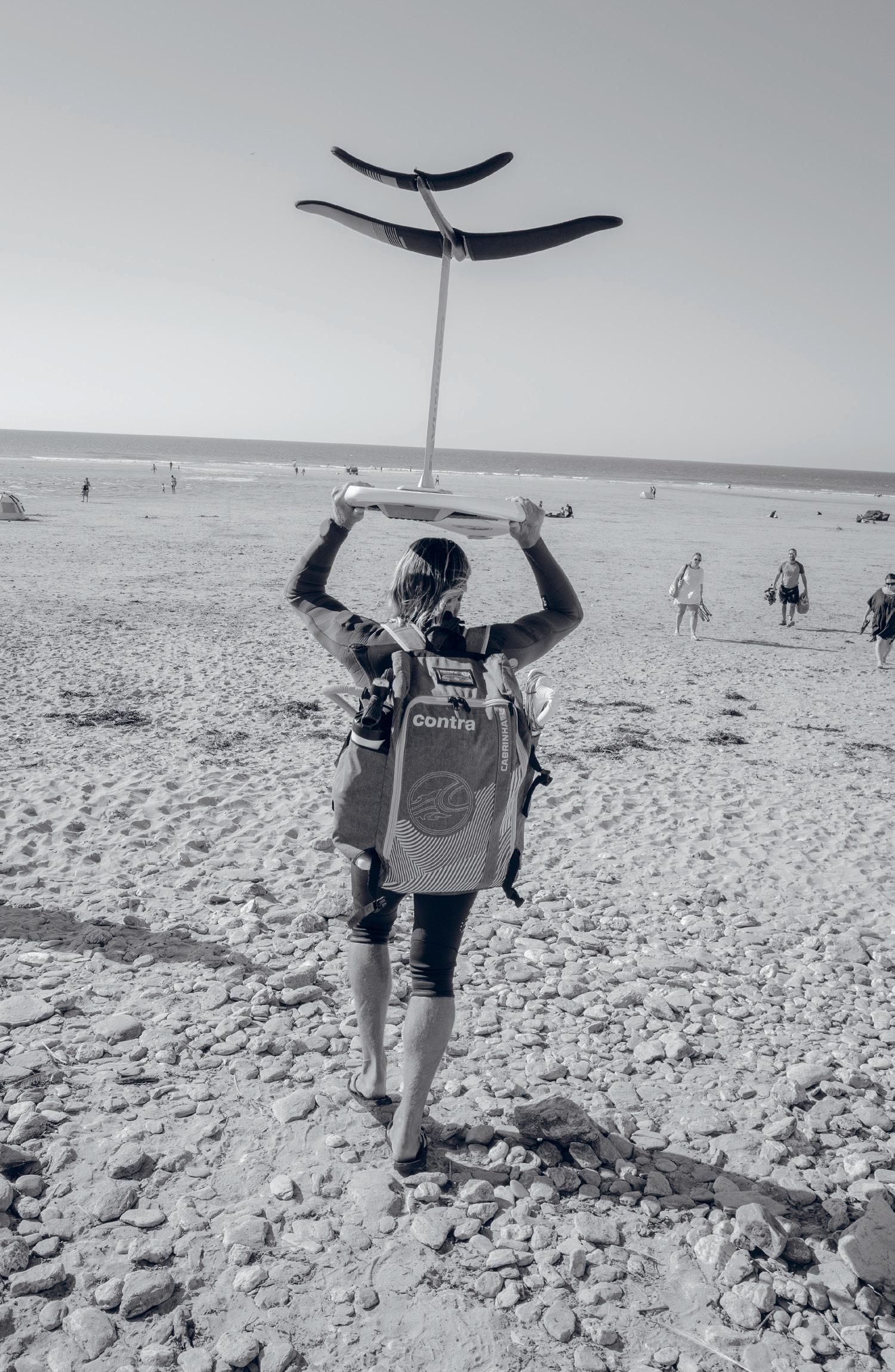
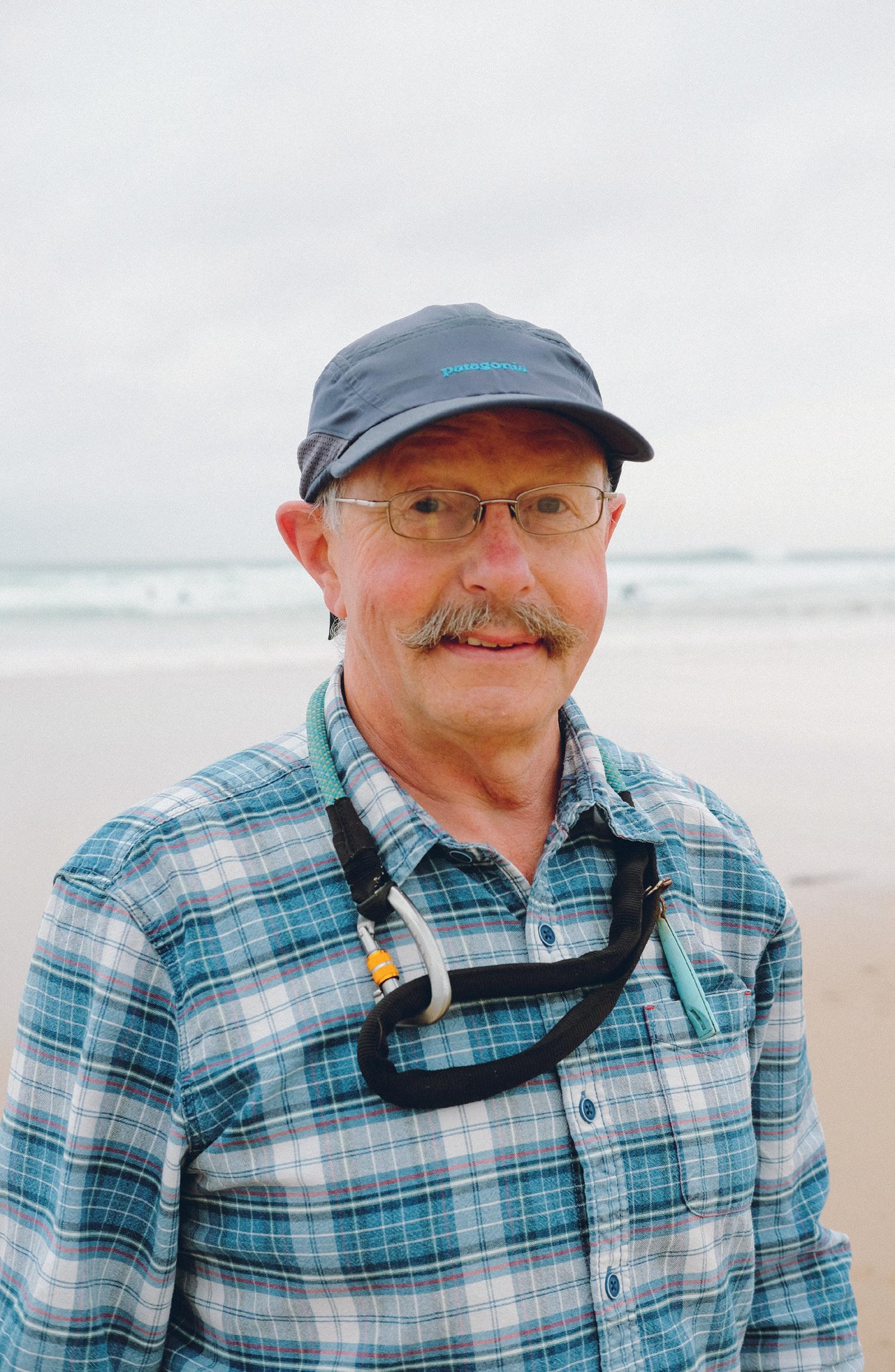
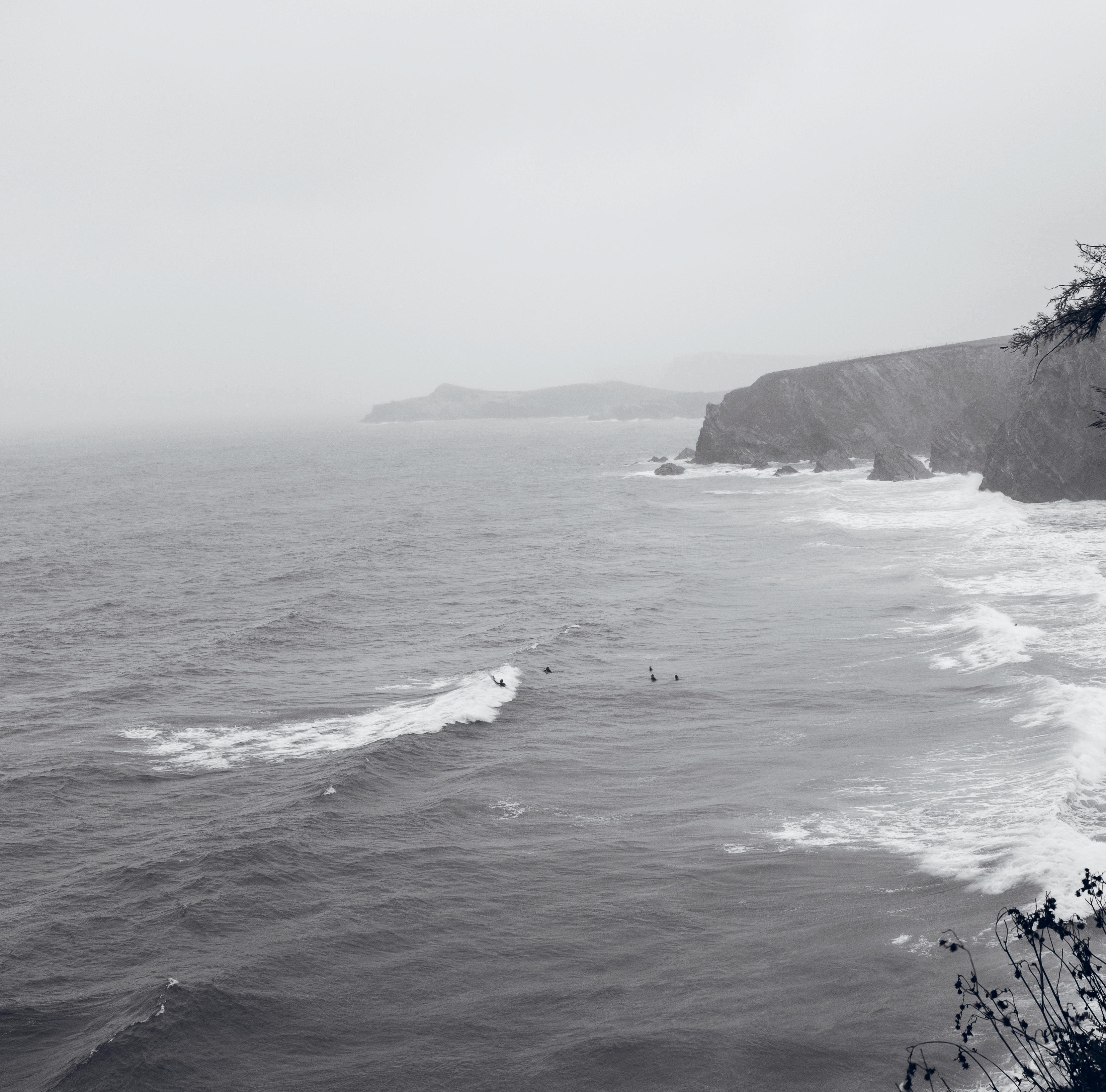
Intrigued by ideas of how sight translates into emotion, we asked two photographers – one working in black and white, Jon Denham, and the other in colour, Sophie Davidson – to explore the evocative power of photography, by documenting people who work and play where the land meets the sea.
Roaming in and around Watergate Bay over several days late summer, Jon and Sophie wandered, watched, and shot, capturing distinct moments that reflect the way people interact with their surroundings – and what it means to them. Basking in hot sun one day, lashed by Atlantic squalls the next, the variety of life in this elemental frontier certainly kept them on their toes.
“What makes photography a strange invention is that its primary raw materials are light and time,” said the English art critic, novelist, painter and poet, John Berger. What follows on these pages is a slice of light, time and life from these shores.
See more images from this photo essay online at watergatebay.co.uk/light-and-time
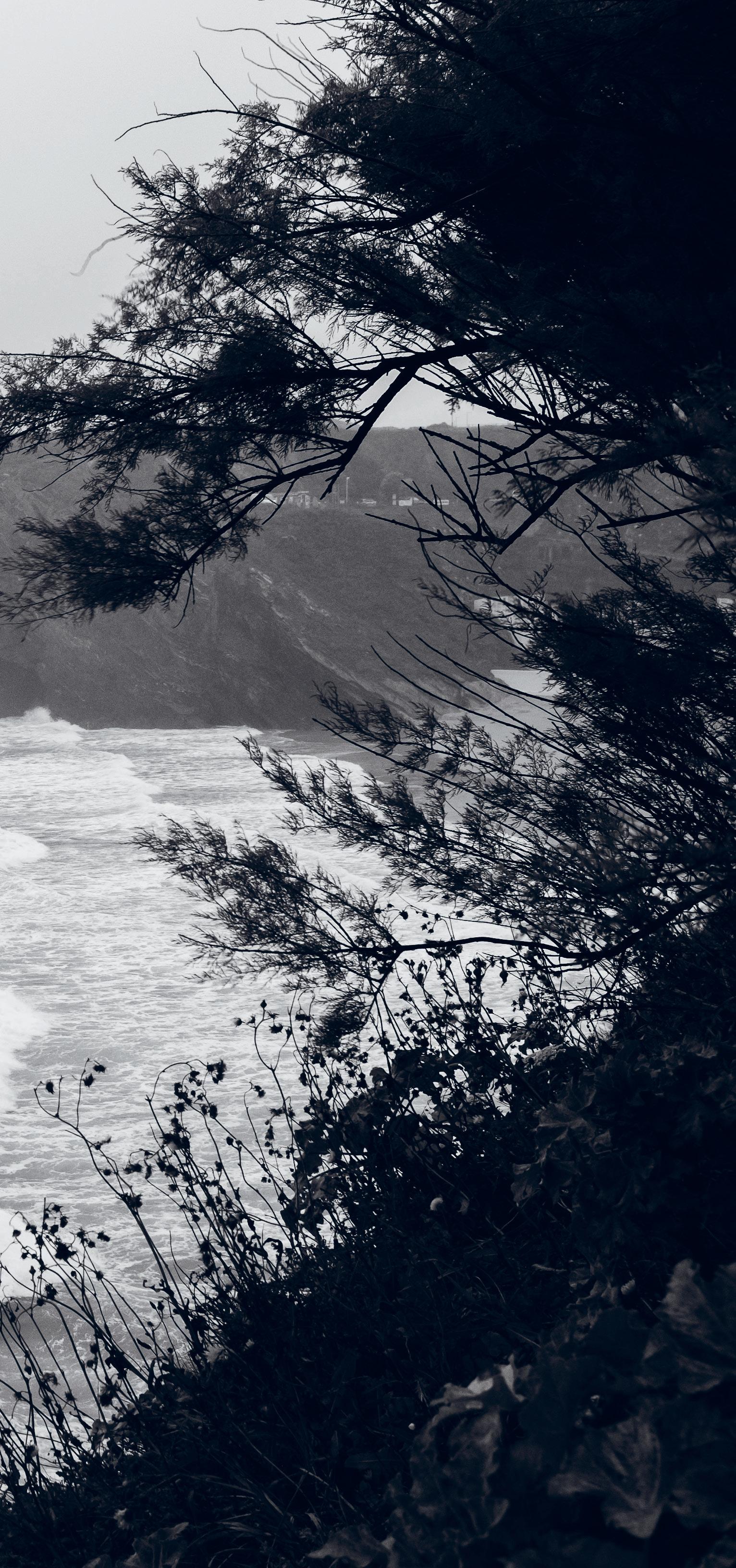
Left
Overlooking Tolcarne Beach in Newquay, with Watergate Bay in the distance. The rain, onshore wind and crumbling waves failed to dampen these surfers’ enthusiasm. Photograph: Jon Denham.
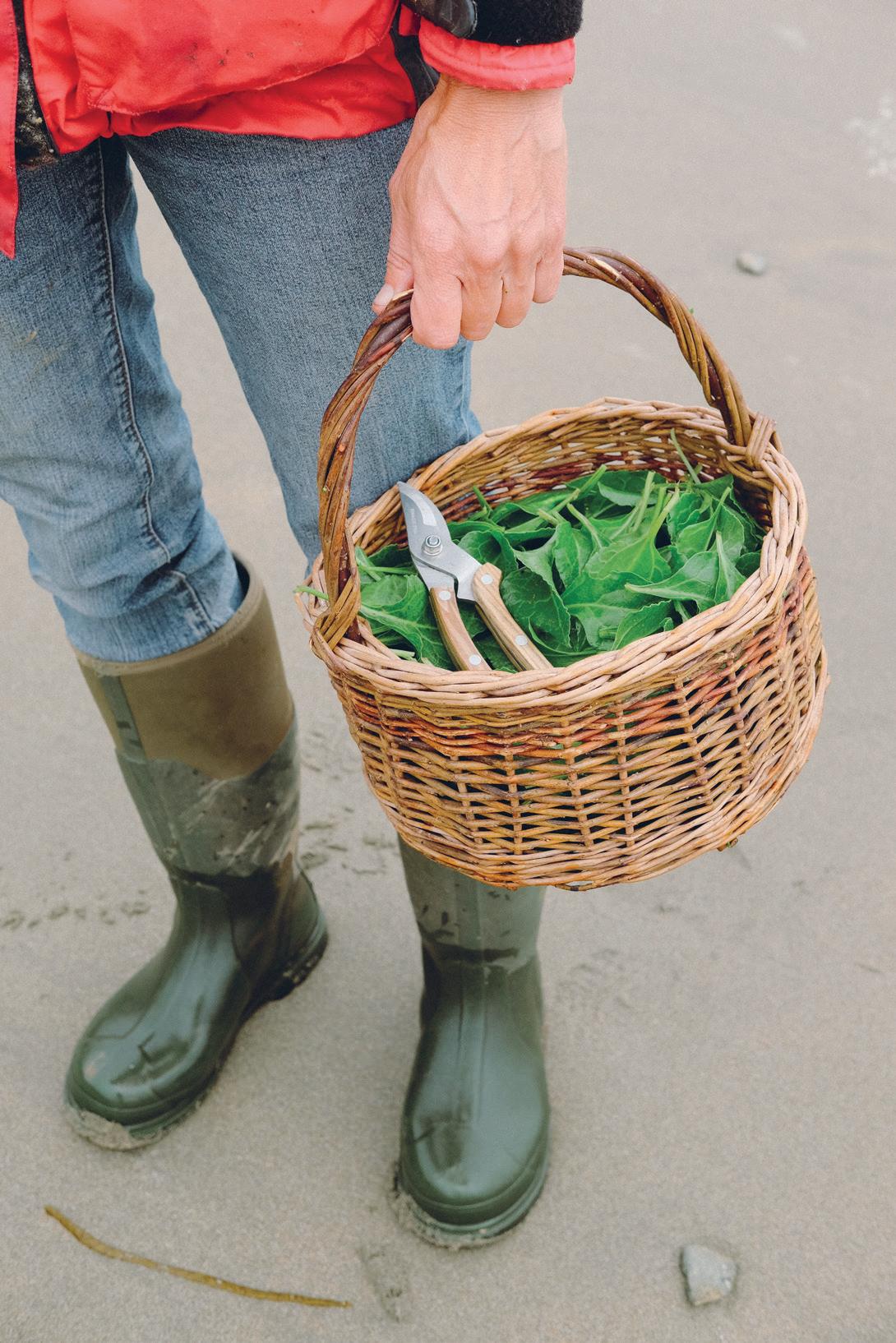
Above
Rachel Lambert, author of Wild Food Foraging in Cornwall and the Isles of Scilly, with a basket of freshly picked sea beet, “the mother and father of most cultivated beets, including spinach, beetroot and sugar beet”. Photograph: Sophie Davidson.
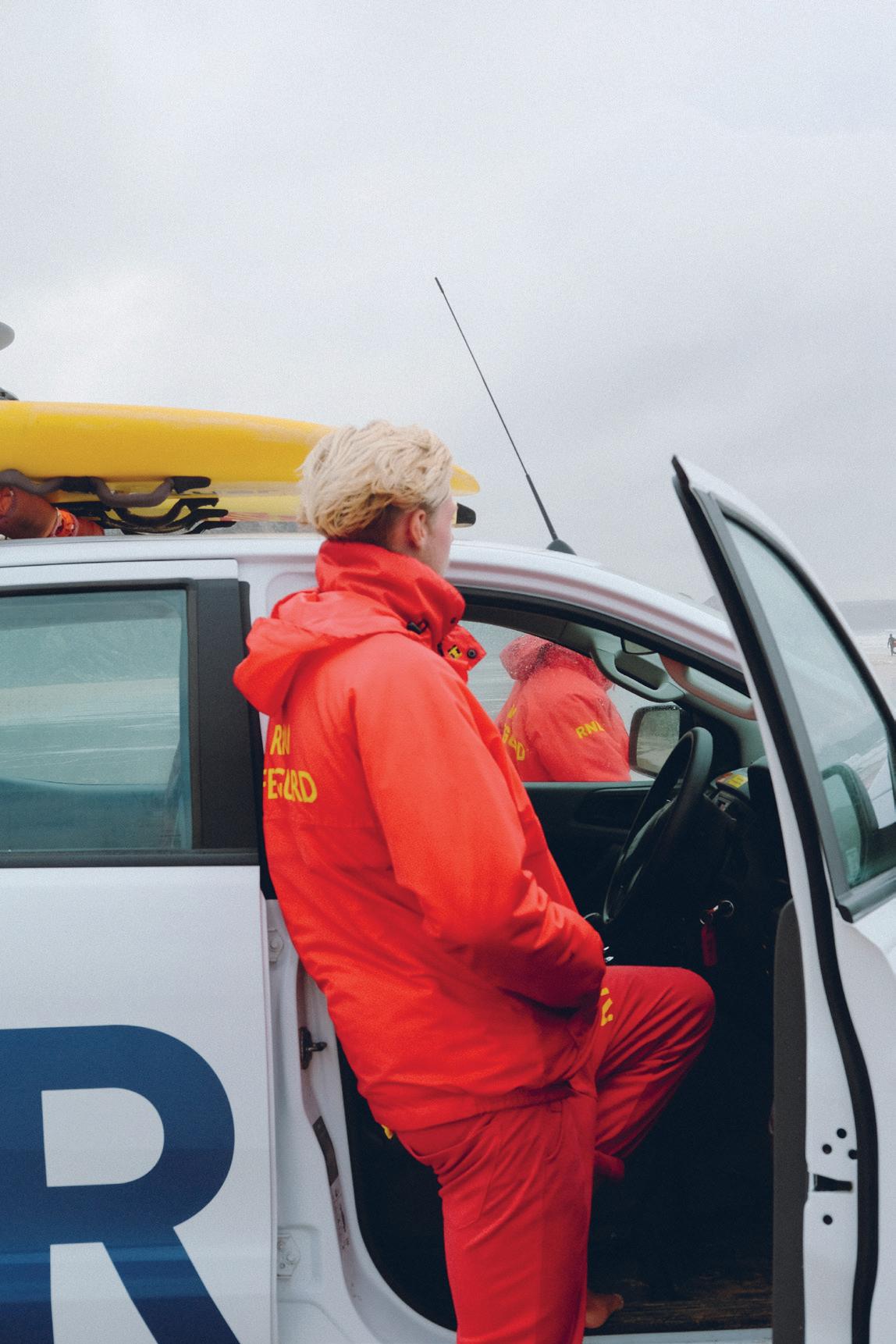
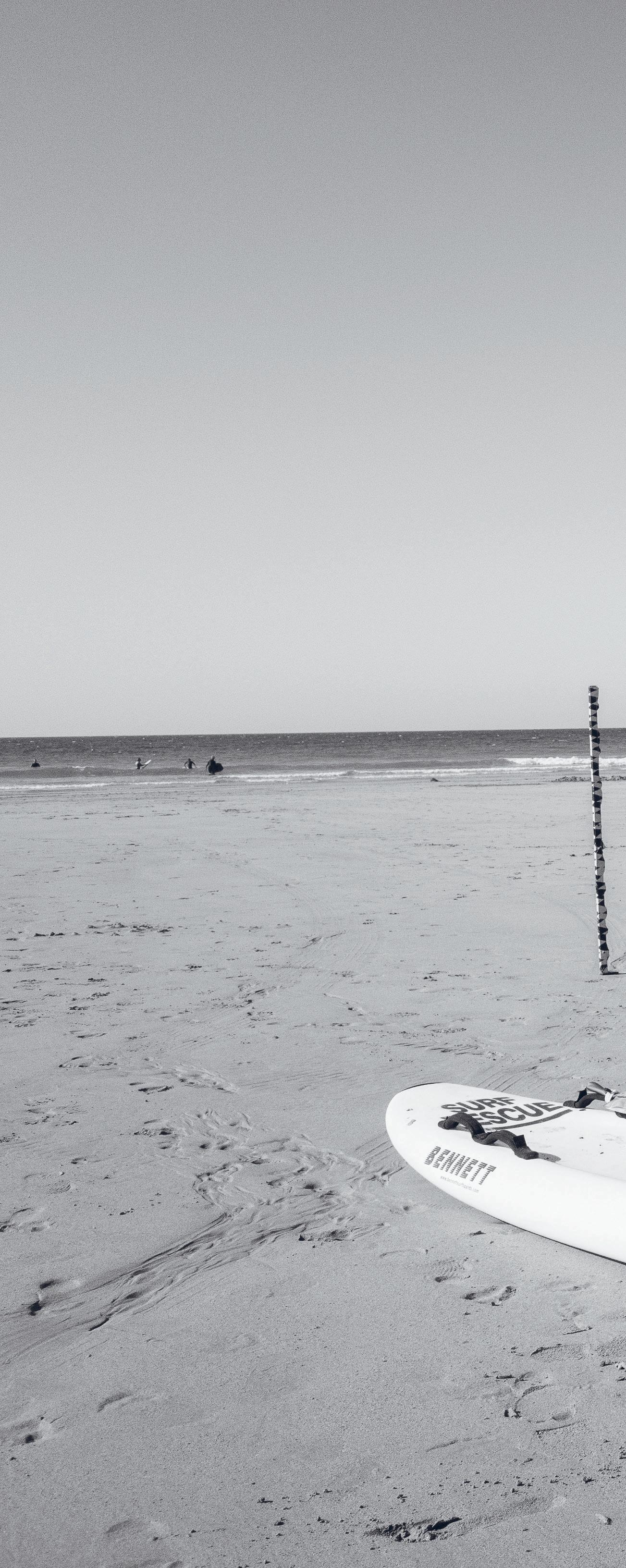
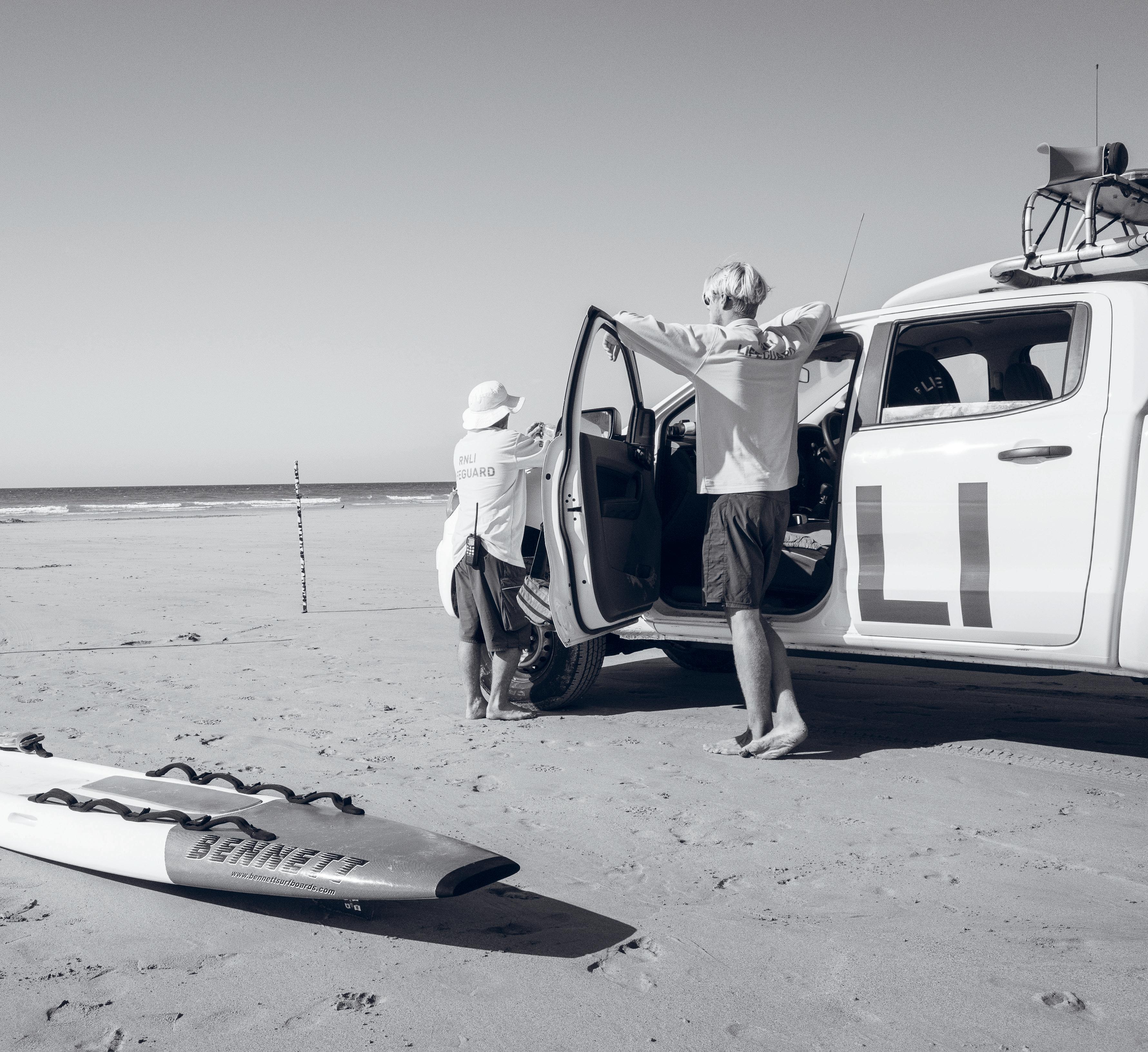
A glorious day late September, with small ‘glassy’ (see p78) waves perfect for beginners. RNLI Lifeguard daily cover, from 10am–6pm, stretches from Easter to October half term (weekends only in late April and early October).
Photograph: Jon Denham.
Thirty years after the publication of Fire Down Below – the final instalment in Newquay-born author William Golding’s ‘Sea Trilogy’ –we visit the house where Golding lived for the last eight years of his life, to speak with his daughter, Judy, about her father’s relationship with the sea.
It is the late 1980s. Nobel Prize-winning Lord of the Flies author William Golding strokes his thin white beard, reaches forward and flings open the door to his study; a small ground-floor room at the front of Tullimaar House, the Georgian pile in Perranarworthal he shares with his wife, Ann. He pauses, not to contemplate the next chapter of Fire Down Below, but rather to allow whatever bad spirit is lurking in the room to escape before he enters.
“My father slept here on his own once,” says Golding’s daughter, Judy, recalling that her father had arranged for his housekeeper, Mrs Humphries, and her husband to come and sleep in the house if he “couldn’t cope” on his own. “This was a man of 70-something!” Judy, who admits to having felt uncomfortable on the two occasions she has stayed alone in Tullimaar, explains that her father believed that there is “something else”, something unexplainable –a source of both fascination and fear for him.
In her acclaimed memoir, The Children of Lovers (2011), Judy recalls how, as a child, her father would comfort her when her fear of the dark kept her awake at night. “His own childhood had been shot through with terrors of the dark,” she writes. “And he had still not conquered those fears, even as an adult.”
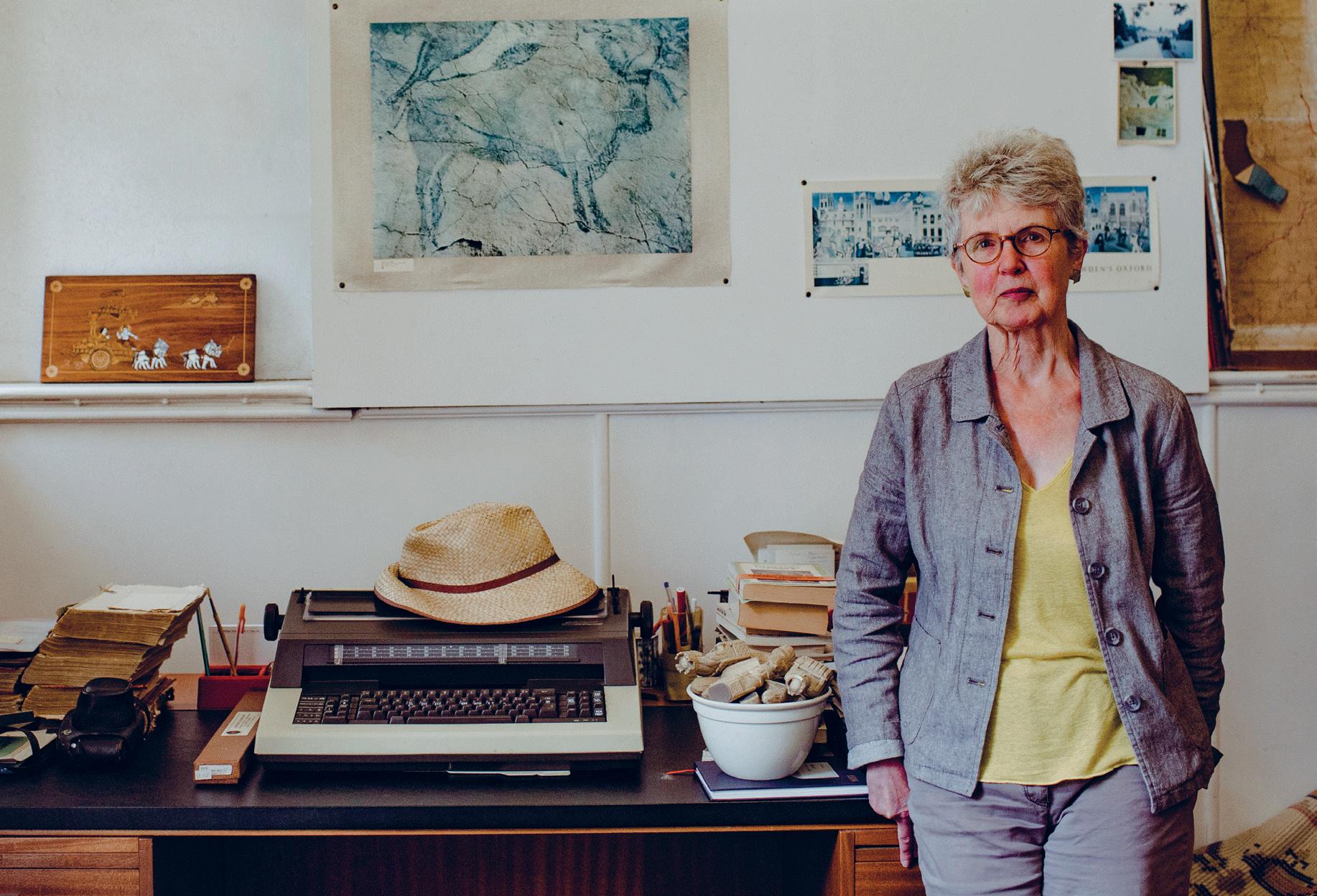
There seems to be nothing to fear in Tullimaar, where Judy – a former copy editor for Oxford University Press and Jonathan Cape, who is now CEO of William Golding Limited – has invited me to discuss her father’s life and work. It is full of light. In the library where we sit, it spills through the big sash window and washes over the two empty leather recliners, the large table strewn with black and white photographs, and across the crowded bookshelves. It is also full of life. Judy, her husband, their three children and seven grandchildren have just celebrated her 74th birthday in the house, and the flotsam and jetsam of childhood summers – a wooden tricycle, cardboard boxes overflowing with Wellington boots and sporting paraphernalia – litters the hallway.
Nevertheless, it is haunted. “I half expect him to walk in the room and say, ‘No, that’s complete rubbish’,” Judy jokes later. Her father is everywhere present in Tullimaar.
In the dining room, American painter Lewis Owens Thompson’s 1961-1962 portrait of Golding – stern countenance, mustard jumper – imperiously surveys the space. His study is a room frozen in time: bank statements from 1993, the year of his death, are pinned to the noticeboard; a pair of leather gloves on a cabinet, still holding the shape of their last wearer’s fingers; shelves lined with copies of books “by William Golding”; and a worn straw hat sitting on top of the huge typewriter, as if its owner has just set it down while he nips out. On the piano is the sheet music for Chopin’s first nocturne, the piece Golding –an accomplished amateur pianist – played the night he died.
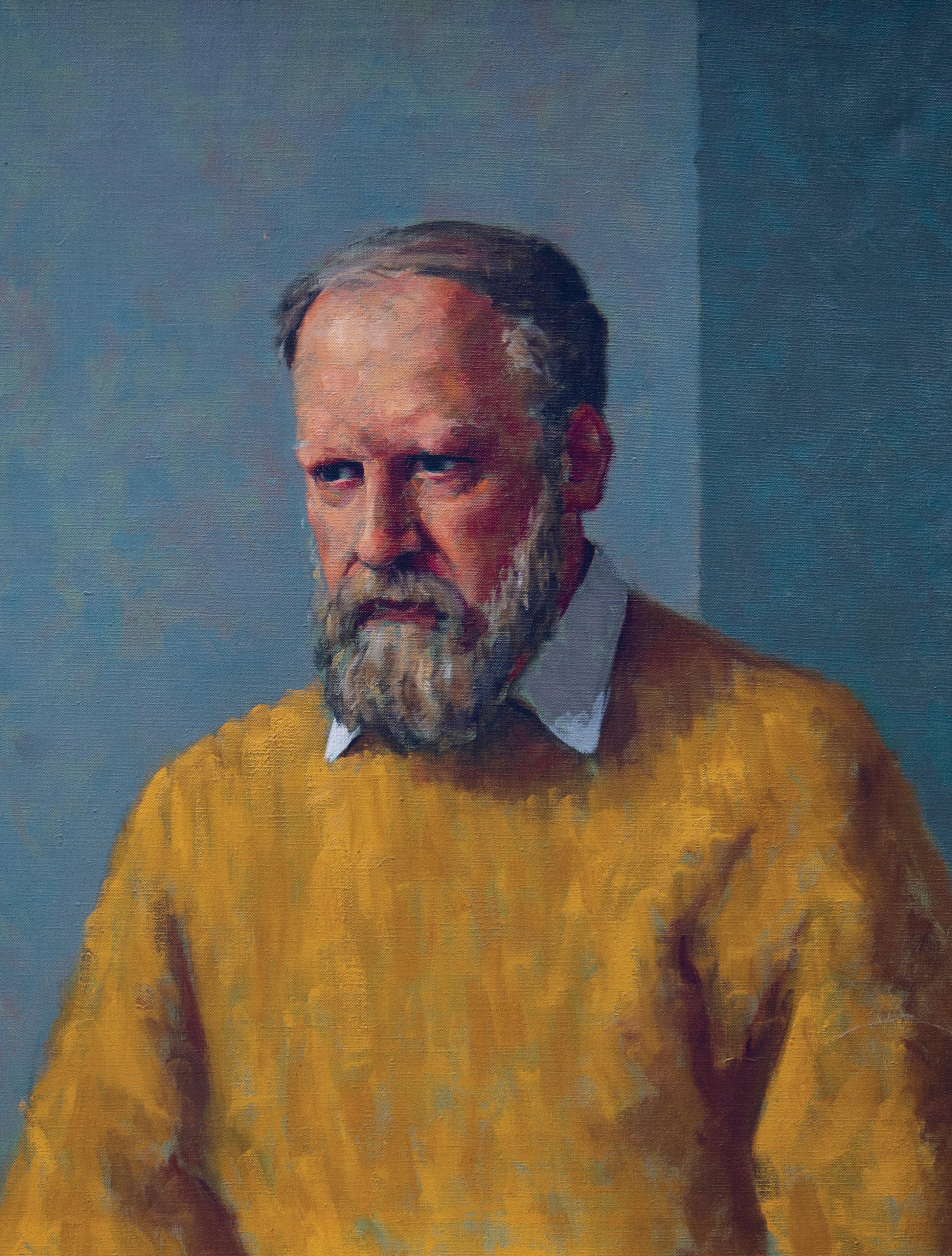
English painter Michael Ayrton’s 1965 monochrome portrait of a wild and windswept Golding hangs over the doorway in the library. While between the gilted Gibbons and the leatherbound Johnsons, can be found E F Knight’s Small-Boat Sailing, originally published in 1901 – the book Golding used to teach himself to sail.
Born in 1911 in his grandmother’s house, Karenza, in Newquay, Golding’s bond with the sea was forged in his earliest years. But he didn’t start sailing until the 1930s, when, returning to Cornwall – “his place of childhood delight” – he hired a sailing dinghy and set to work refining his seamanship in the waters around Penzance.
In The Children of Lovers, Judy shares “brilliant memories” of her childhood adventures at sea with her father, mother and brother, David. A large part of the attraction for her father, however, seemed to be the risk involved in sailing, attempting to control the uncontrollable. “He was fantastically lucky as a sailor,” says Judy. “We had so many narrow escapes. He was confident and daring, and I think he had enough imagination to have known that there could have been an alternative ending.”
Judy jokes about some of their “narrow squeaks”, like the time her father managed to capsize Aphrodite, a hired redwing, while at anchor in Mousehole harbour. “That was the most embarrassing incident in my father’s entire life,” she laughs. But in 1967, the fun ended when the family’s Dutch racing barge, Tenace, sank after a collision with a Japanese freighter in the English Channel. “I thought to myself then, I am never going to be responsible for anybody’s life at sea again’, so I just stopped,” Golding explained in an interview with Melvyn Bragg for The South Bank Show in 1980.
Despite having witnessed the horrors of war serving in the Royal Navy during World War II – an experience he seldom spoke about to his daughter – the sinking of Tenace inflicted lasting damage on Golding. “The shock of the crash was so immense it took him years to recover,” says Judy, adding that it coincided with, in her words, a midlife crisis. “He had begun to find writing a bit more difficult. If he had been able to go off sailing it would’ve helped, because that was when he let everything mulch down and ideas would come to him. But this was a deprivation.”
The sea was intricately linked to Golding’s creative process. He needed it. But he had mixed feelings towards it, saying, “Anybody who knows the sea enough hates it. It’s really incredibly hateful and loathsome: beautiful, grand, tremendous. It’s really the cruellest bit of nature.”
In both Lord of the Flies (1954) and Pincher Martin (1956), the sea is a malevolent power, acting as gaoler to a group of schoolboys marooned on an island in the former and causing the shipwreck that leaves a naval officer stranded on a rock, fighting off madness, in the latter. Then in Golding’s ’Sea Trilogy‘ – the Man Booker Prize-winning Rites of Passage (1980) and its sequels Close Quarters (1987) and Fire Down Below (1989) – it is again an omnipotent and omnipresent force, relentlessly propelling a ship of emigrants from England to Australia, allowing no escape for the unfortunate Reverend Colley.
Golding, again speaking with Melvyn Bragg in 1980, suggested the sea could be an image of our unconscious, or something deep within us that we return to when we dream. For the author, there was a mystical element to the sea. It symbolised something fundamental. “I think his life was an attempt to acknowledge it, but not to understand it,” says Judy. “I don’t think he wanted to understand it; he liked to leave it quite vague. He was a great believer in not pinning things down, and thought that people pinned things down and destroyed them, rather like a butterfly.”
Like the sea, Golding himself was hard to pin down. In his biography, William Golding: The Man Who Wrote Lord of the Flies, John Carey references an entry in Golding’s journal in which he describes himself as “a monster in word, deed and thought”. But although in The Children of Lovers Judy paints a portrait of her father as a sometimes difficult man, with whom she had a complex relationship, there is no suggestion he was anything other than a loving husband and father, at least to his daughter.
She admits that her father “occasionally behaved in a way that I would find hard to accept” and that when David was little her father might have been tough on him – something he “felt terrible about”, especially when his son later developed mental health problems. But on the whole she remembers him as a generous, kind and self-aware man. “I think he was being ludicrously unfair,” she says. “I don’t think he was a monster at all. I felt much more sympathy for him after he died, when I read his journal and realised how much he had struggled. He was so all-encompassing, and such a strong character, and so attractive that it was hard to break away. I’m not sure I ever really did.”
Nevertheless, Judy has built her own life. She doesn’t write fiction; she doesn’t sail; and she is ambivalent about the sea. Although she does share her father’s fear – a fear of something beyond our comprehension, a fear both indispensable and loathed, a fear that cannot be classified and pinned to a board like a butterfly. “It was a limitation, but I think he would have been sorry to lose it,” she says. “I wouldn’t like to be without it.” •
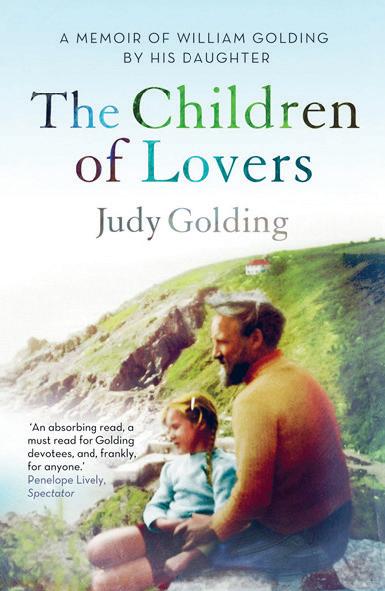
The Children of Lovers (Faber & Faber) is available from Amazon, Waterstones and all good bookshops.
Golding suggested the sea could be an image of our unconscious, or something deep within us that we return to when we dream.
From 1971 until his death, William Golding kept a journal. He often recorded his encounters with the sea, in both his dreaming and waking life.
31 October 1971
“(now I am walking through the vast wide, shallow run of waves on a Cornish beach, thinking...)”
In one of his earliest recorded dreams, he recalls the beaches of his childhood.
18 March 1972
“I see a vividly real seascape, one of those molten metal seas, dashes everywhere with light, and everywhere moving, the waves keeping nothing but the merest suggestion of order. In the middle of [the] bay, the seascape, is an old man […]. He is rowing a dinghy slowly out against the sea and wind. He is a dark shape against the silvery highlights and so is his dinghy. I suppose that this is the action that he was born to.”
This dream references a neighbour in Wiltshire who had recently died.
4 October 1985
“We drove to the Lizard this afternoon.
There was a middling sea running and in the sun the spray sparkled dramatically. We both enjoyed it.”
The record of a trip to the Lizard Peninsula.
Quotations from William Golding’s journal appear courtesy of and copyright © William Golding Limited. Not for reproduction for any purpose without the consent of William Golding Limited.
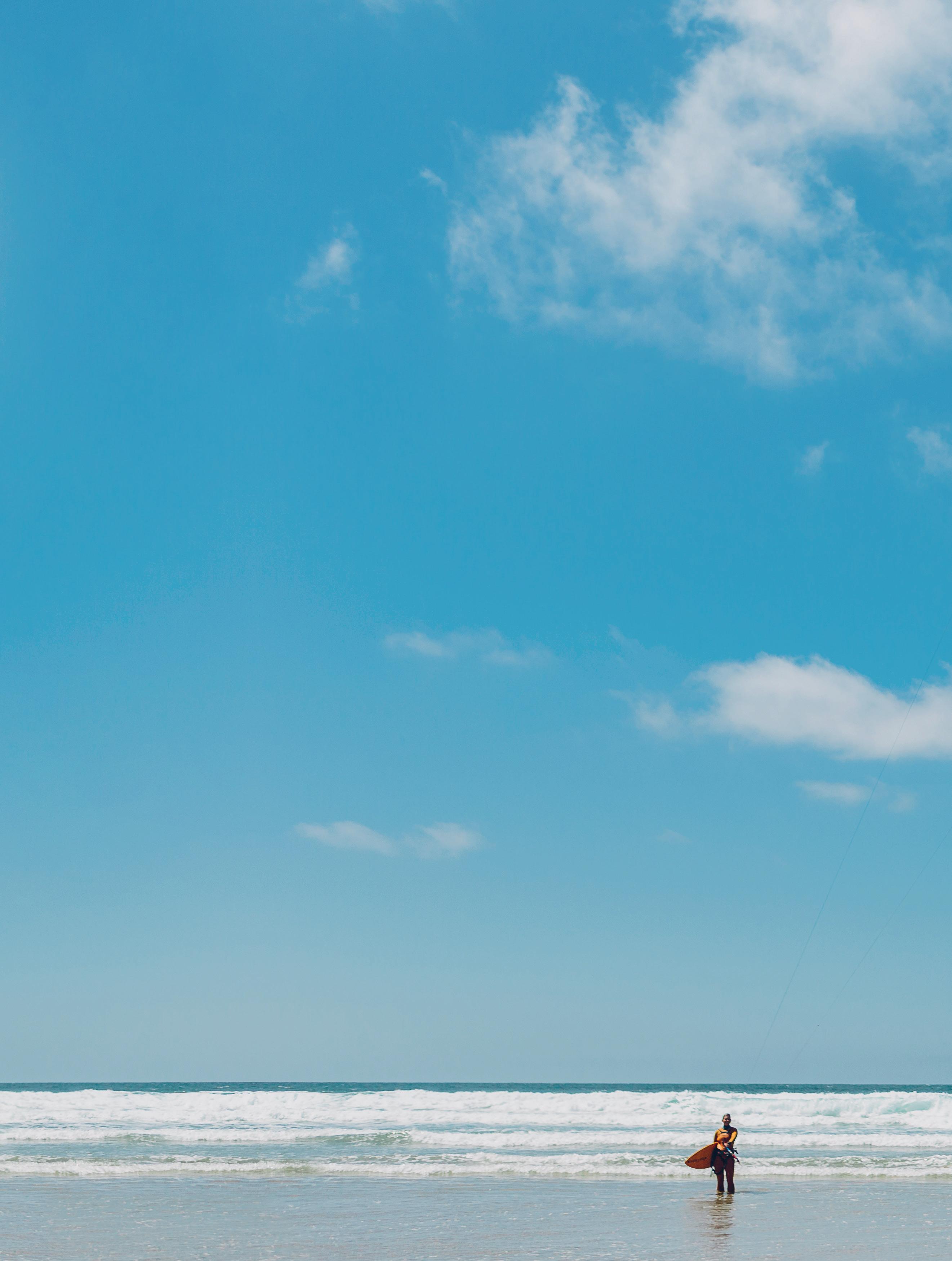
Invisible, changeable and unconquerable, the wind is a mighty force. It can destroy, but also offers immense power – for energy, freedom, and even food. Three conversations in three windswept Cornish locations explore the wind’s different faces…
Hayle Bar is an exposed spot across the bay from St Ives, on the far west of Cornwall’s north coast, where Lee Carter fishes for crab and lobster (some of which end up on the menus at Watergate Bay). While his catch may lack the symbolism of Ahab’s epic hunt for the whale, Lee is no stranger to adventure – often navigating swells big enough to drench the deck of his 10-metre, three-man boat, Jazzy C.
The sea off Hayle is often volatile, with big swells whipped up out in the Atlantic by fierce southwesterly, northwesterly and northerly winds. Still, he’d rather have those than easterlies, any day. “Shellfish don’t like easterlies,” he says.
Lee spends mornings watching weather apps and the speed of clouds moving across the sky. If there’s a suitable window, he’ll venture out, whether that’s into rough northerlies, the frigid easterlies (which tend to follow cold fronts – the reason his shellfish may stop biting) or the westerlies which, legend has it, are more likely to summon a good catch.
But while the wind plays conductor to the rhythms of Lee’s work, he’s not one to romanticise the relationship. For the Cornish fisherman, things tend to remain pragmatic. “If prices are good, we’ll go in stronger winds,” he says. “If they’re not so good, we’ll stay in.” »
Fickle force
The dictionary defines the wind simply as “a natural current of air that moves fast enough for you to feel it”. It’s perhaps because we can’t see the wind that we ascribe to it so many contradictory faces. It’s the wind that makes up the Feng part of Feng Shui, the Chinese concept of harmony with the environment. Yet ‘divine wind’ is the literal translation of the Japanese term ‘kamikaze’, the name for the suicide flying missions that wreaked havoc upon US forces in the Battle of Okinawa.
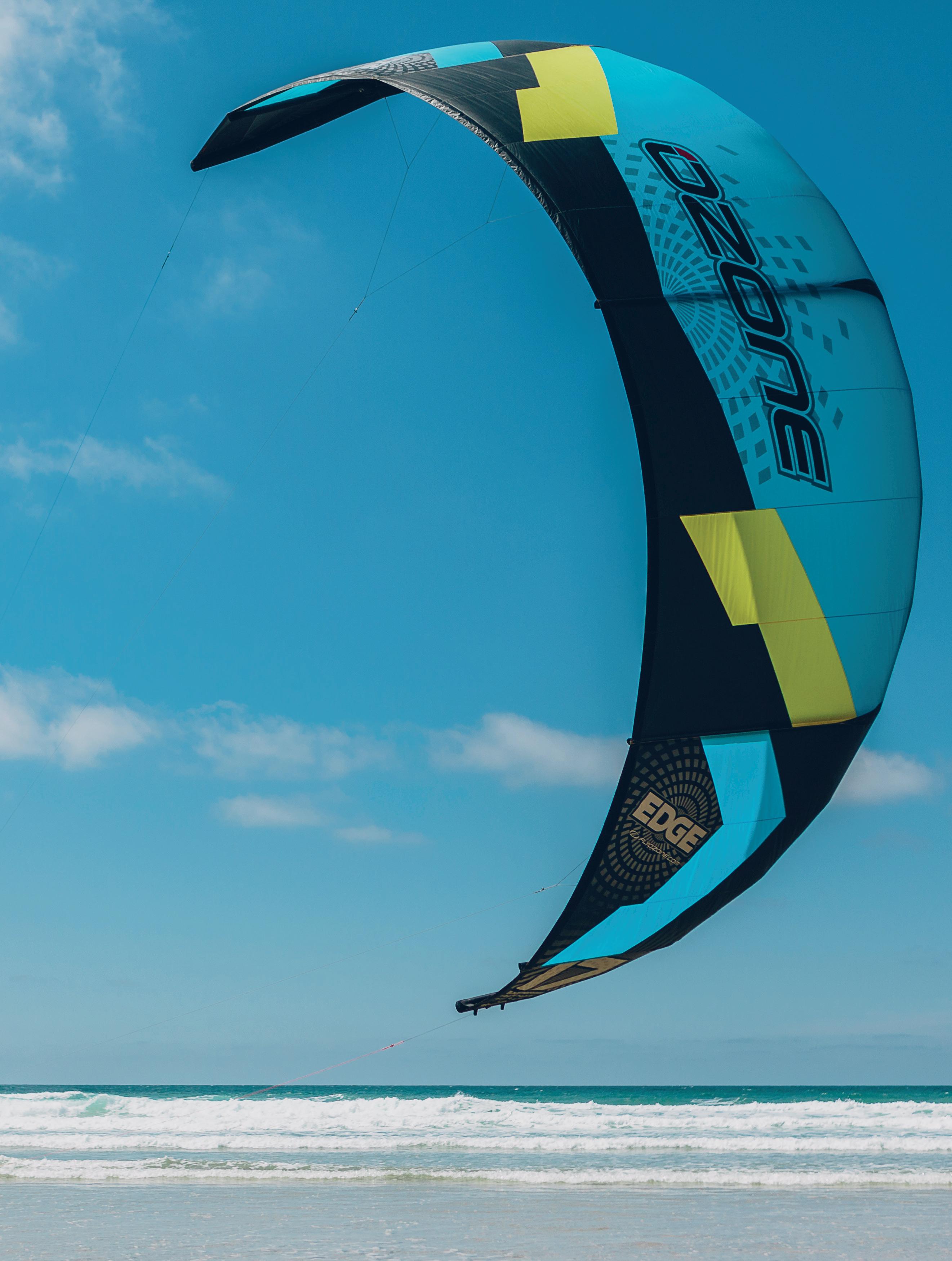
Dreya Bennett works out of a glass-making studio in Newquay, a town that’s similarly wind-hewn. Dreya, a former professional kitesurfer and world record-holder, sees the wind purely in terms of kite sizes. “I’ll talk about it as ‘four-metre weather’ or ‘a 10-metre day’,” she says.
Dreya explains how the stronger the wind, the smaller the kite you need to get power out of it. In a professional career that saw her ranked as high as third in the world, she’s ridden that wind across the globe. In the Swiss Alps she learned how the thin air of high altitudes is disconcertingly weak, even when the wind is howling. In Cabarete, in the Dominican Republic, meanwhile, the winds seem to gift the surfer a delicious extra half-second of coveted ‘hang time’. Suspended 30 feet in the air, hang time is when the kiter feels most free. She’s actually flying, the wind making literal the stuff of dreams.
But even in a sport that promises escape, those bitter blows are still never far away. “It can all go wrong very fast with kiting,” says Dreya. “Mother Nature lets you play for a while, lulling you into a false sense of security. And then she often teaches you who’s boss.”
This typically means the wind choosing to disappear when you’re in the middle of a trick. Suddenly your line goes slack and you drop from the sky. “A horrible feeling,” says Dreya. But it can be more serious. In 2002, Dreya’s friend and competitor, Silke Gorldt, then the world number two, was killed in a freak accident in the Baltic Sea. She was just 24 years old.
Dreya’s voice still cracks when she recounts the story. The kitesurfing world was shellshocked by her death but soon united in loving tribute: six of the world’s best kiters, including then number one Cindy Mosey of New Zealand, came together as friends to surf a route Dreya had spotted from the sky.
The 70 miles from the Scilly Isles to Watergate Bay.
But the wind would get up to its tricks there too. First, it disappeared. “Cindy and I were the only two who just managed to keep our kites flying,” says Dreya. “But we couldn’t kite – we were just in the water trying to keep them moving.”
Then, with the pair finally approaching Watergate, it turned: a full 180-degree shift, from the perfect direction to totally offshore, which pushed them further out to sea. “We went from looking at the land to having our backs to it,” she says. “I could see the beach for nearly two hours before we actually got to the shore, just trying to edge up wind, edge up wind, and get to the land.”
The trip was, however, a triumph. And for Dreya, it led to an even more spectacular effort: a world record 135-mile kitesurf from Watergate to Dungarvan, Ireland. This time she started with no wind, flogging away on a 15-metre kite. By the time she arrived, eight-and-ahalf hours later, she’d trailed dolphins in the bow of her support boat, and watched the ocean turn a completely unfamiliar shade of blue. And now the wind was howling. The shore party kited out to meet her on nine-metre kites. Her desperately tired arms were still wrestling her 15-metre.
Dreya has since retired from competition, but still kitesurfs for pleasure. These days the wind dictates every holiday she takes with her husband, a windsurfer. Her choice spots are the Gulf of Roses and Tarifa in Spain. But it could be anywhere that’s blowing. “It’s always the wind for us,” she says.
With an elevation of 800 feet, Delabole is Cornwall’s third-highest village. Look at the old hedges in the surrounding area and you’ll see them stripped and twisted by centuries of the prevailing wind. So it’s always the wind for the residents of Delabole too, whether they like it or not.
Back in 1989, Delabole locals Peter and Pip Edwards found themselves protesting against a nuclear power plant being proposed for Cornwall. Coming to believe they should offer an alternative, they took advantage of Delabole’s geography and, with a self-starting environmentalism that now seems remarkably ahead of its time, built the UK’s first commercial wind farm, which opened in 1991.
The first time Juliet Davenport visited Delabole, she was ten years out of a physics degree at Oxford, and working on European energy policy in Brussels. She’d already had one life-changing encounter with the wind, when the Great Storm of 1987 gave her visceral evidence of a changing climate. Atmospheric physics would soon become the subject matter she was most drawn to.
Arriving at Delabole she was struck, not just by the force of the wind and the extraordinary power of the ten 50-metre windmills, but by the Edwards’ spirit and vision. “A lot of the original wind turbines were owned by individuals or small communities, who came together and just decided they wanted to build them,” she says. “People are often far more capable of taking risks, being bold and brave and asking, ‘Why not?’ than businesses are. I loved Mrs Edwards’ tenacity.”
Juliet founded Good Energy in 1999, with the idea of supplying renewable energy direct to customers; three years later, the company bought Delabole wind farm from the Edwards. Fast-forward to today, and the UK now produces 33% of its electricity from renewables, and 17% from the wind.
Juliet concedes that not everyone in Delabole loves the wind farm, but for many it’s become part of the landscape. When Good Energy took the old turbines down in 2009 in order to replace them (the four
“
Tis a noble and heroic thing, the wind! Who ever conquered it? In every fight it has the last and bitterest blow. Run tilting at it, and you but run through it.”
Captain Ahab, on his third day of chasing Moby Dick.

new turbines would double the output of the original ten), she received a letter from a local asking when their replacements would be up –because they used the blades as a weather vane. If their rotation showed a prevailing wind was blowing through, they knew they needed to light the fire.
At the Delabole wind farm at dusk, as the gnarled hedges slip into silhouette, the army of turbines turn effortlessly on the hill. With the light fading across the farmland below, the lights of the neighbouring villages flicker to life, as if they were charmed by the rotation of the blades. While not exactly conquering the wind, it’s a picture of what happens when you live in harmony with it.
“The wind can get people down, especially if it’s blowing all the time,” says Juliet. “So the concept that you’re actually doing something good with it, creating something from it, is quite entrancing.” She begins daydreaming a means of harnessing the planet’s increasingly intense
hurricanes as an energy source, mulling whether it would ever be feasible to throw a three-bladed generator into its centre, to drain the energy from the storm and turn it into something positive.
And why not? “I think wind has delivered much more than we ever expected,” she says. •
Watergate Bay Hotel has been powered by Good Energy since 2013, with all the hotel’s electricity coming from Good Energy’s renewable generators.
Slowing down, awakening the senses and exploring the world like a child can boost mental and physical wellbeing. Suzie Inman embraces idle unproductivity to rediscover that wide-eyed wonder…
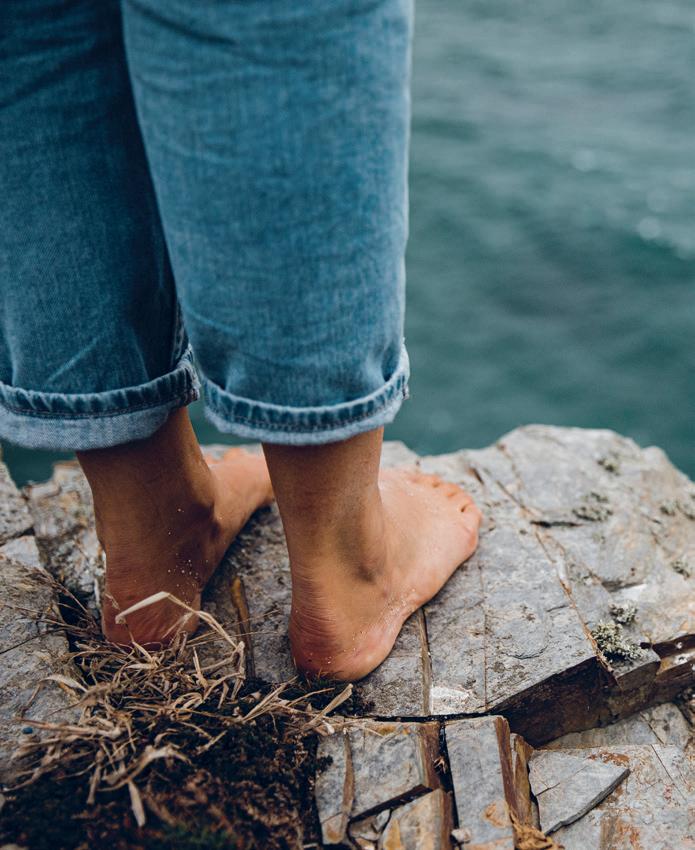
Watching children at play is fascinating, and never more so than when they’re outdoors. Playing in and with nature they become utterly absorbed in experiencing the world through their senses. They’ll abandon clothes and shoes at the first available opportunity, plunging bare-legged into the sea, or rolling naked in sticky sand. It’s a sense of freedom in nature, and a connection with our bodies that we can lose as adults. But getting it back can have tangible benefits for our health and wellbeing.
In a world where we’re constantly busy and our minds are always chattering with internal tales of the past, present and future, losing ourselves is rare indeed. We’re obsessed with productivity, and with filling our world with more stuff, more doing, more noise. There are so many distractions in our lives, not least technology. The Great British Screentime Survey revealed that in 2019 we spent an average of 3 hours 23 minutes looking at our smartphones every day. And while we have more leisure time than ever, our fast-paced lives are increasingly stressing us out: a 2018 survey carried out by wellbeing specialists Forth With Life revealed that 85% of UK adults are experiencing stress regularly.
Engaging in simple pastimes that entertain us rather than activities that require instruction and learning can help us to reconnect with ourselves and to find moments of calm. When we experience the world as a child might, abandoning productivity in favour of simply enjoying idle moments, we can create a time-out to reconnect with our bodies, experiencing through our sense of touch.
Walk into the Kids’ Zone at Watergate Bay and you’ll find children playing freely with a range of objects from the natural world, including herbs and spices, shells and twigs. It’s called heuristic play and it’s all about awakening the senses using natural stimuli. “We see first-hand how this type of sensory play is calming,” says Kids’ Zone manager Tammy Driscoll. “It helps children to regulate their internal emotional discomfort and eases separation anxiety.”
Tammy also explains that it’s about making space and time to experiment – and says she often witnesses parents and grandparents getting lost in playtime, too. “You’ll come in and find adults sat with the playing dough, just running it through their fingers. They can be there for 20 minutes doing it and the kids will be off playing somewhere else. It seems to be therapeutic and calming for them.” »
When we’re young we’re not concerned with what happens next: the only thing that’s important is leaping headfirst into now. Little fingers ache to poke starfish in rockpools, to grip onto rocks and to hunt for shells and smooth stones. Little toes are barely out of the car before shoes are slung off ready for submerging and clambering. Touch is a child’s sense of choice: and nothing is off limits when it comes to exploration.
There’s a growing body of evidence suggesting that reawakening our hankering for the wild, switching off our brains (and phones) and experiencing the world through our senses could work wonders for our sense of mental wellbeing.
Our skin is our largest organ with a total surface area of around 20 feet. Within it are millions of receptors that detect pressure, temperature, vibrations and pain. And some scientists now believe there is a direct link between our skin and our brains.
Embodied cognition is a relatively recent development in psychology. It recognises that the brain, whilst important, is not the only way we have to generate behaviour. “[It] changes the job description for the brain,” explain Dr Andrew Wilson and Dr Sabrina Golonka of blog Psychsciencenotes. “Instead of having to represent knowledge about the world and using that knowledge to simply output commands, the brain is now a part of a broader system that critically involves perception and action as well. The actual solution an organism comes up with for a given task includes all these elements.” Understanding, then, is a job for our entire body and not just for our brains.
Using your sensations as a way of anchoring yourself in the present is one of the core elements of mindfulness: a considered attempt to close out our buzzy hubbubs, calm internal monologues and centre yourself in the here and now; listening to your body and the way it experiences the world. It’s been proven as a way to benefit your body, mind, spirit and creativity, and it’s great for chasing away anxiety.
Journalist and Guardian columnist Madeleine Bunting recently described mindfulness as “the most important life skill
to learn”, and believes that in a decade or less it will be “vital for the complexities of our information-rich lives”. Perhaps unsurprisingly, the outdoors is the perfect place to try it out. The stress-busting benefits of outdoor swimming have been well documented of late – and with good reason. That beat of cold water on your skin brings with it a razor-sharp focus on the present, letting your woes drift away as you enjoy floating or powering through the deep blue. But what if you’re not ready or willing to take the plunge? How can you put all this information to use in a practical – and less chilly – way?
Start simply. Get outside. Sit on the beach and let the sand run through your fingers. Perhaps try making something out of sand. Sandcastle? Sculpture? Picture? Get lost in the experience. Go for a paddle and pay attention to the contrasting temperatures of sand, sea and air; the sensations as the waves recede and your feet sink into the tideline. Explore rockpools to reconnect with nature and enjoy an activity for its own sake. Rather than focusing on identifying creatures and plants, instead rely on your sense of touch to experience unusual textures and surfaces: from slick, seaweed-coated rocks to jelly-like anemones, knobbly barnacles, starfish and crabs. Take time out to play. Try to still your mind and focus on physical sensations.
Stepping out
Barefoot walking has been proven to strengthen feet and joint mobility, improving balance and promoting foot health.
Neuroscientist and author of In Praise of Walking, Shane O’Mara believes that even the act of walking itself is an overlooked superpower. “Our sensory systems work at their best when they’re moving about the world,” he says. “When we get up and walk, our senses are sharpened. Rhythms that would previously be quiet suddenly come to life, and the way our brain interacts with our body changes.”
His research as a professor of experimental brain research has uncovered links between movement and mental and cognitive health, and between walking and stress reduction. There’s also a growing body of research into what’s known as ‘earthing’ or ‘grounding’, which is based around your absorption of the negative electrons in the earth through
your bare feet. A recent study published in the Journal of Environmental and Public Health suggests this as a potential treatment for a variety of health issues including chronic stress, inflammation and pain, and even cardiovascular disease.
Connecting with your own physicality, awakening your inner child and improving your health and wellbeing may very well begin with something as simple and liberating as kicking off your shoes and going for a wander. •
Louise Gluck, poet “
We look at the world once, in childhood. The rest is memory.”
1. Turn off your phone. Leave it behind if you can so you won’t be tempted to take a quick photo or respond to that text.
2. Clear a space in your schedule, when you know you can indulge in some quiet time without worry of missing something important.
3. Ditch the watch. Use an awareness of time instead.
4. Find a suitable spot. A beach or a large patch of grass is perfect. Somewhere away from concrete and tarmac where you can reconnect with nature.
5. Lose your shoes. It’s important that you can feel your feet against the earth.
6. Start walking. Pay attention to the way your feet feel, how they move, how the ground feels beneath them. Are they damp or dry? Hot or cold? Does the ground feel smooth or textured?
7. Turn off your inner monologue. If you’re aware of your mind straying, coax it back to the present by focusing on physical sensations; immediate experience rather than thinking.
8. Tune into your other senses. What can you hear? What can you smell? Also try to tune into your emotions, experiencing how they make you feel and how your body responds to them.
9. Keep walking. Be fully aware as your feet make contact with the ground, noticing how your weight shifts and how your body works to propel you forwards.
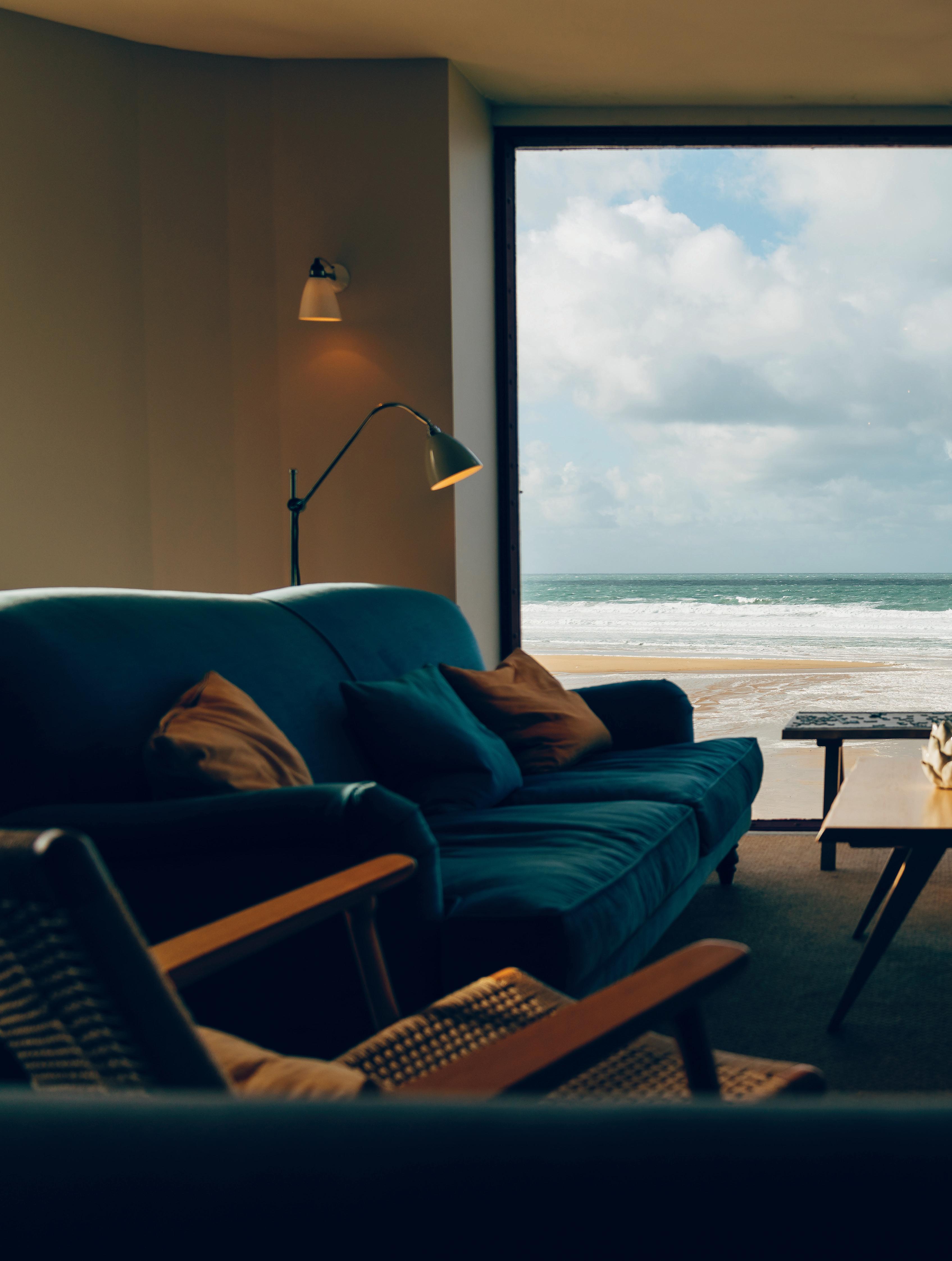
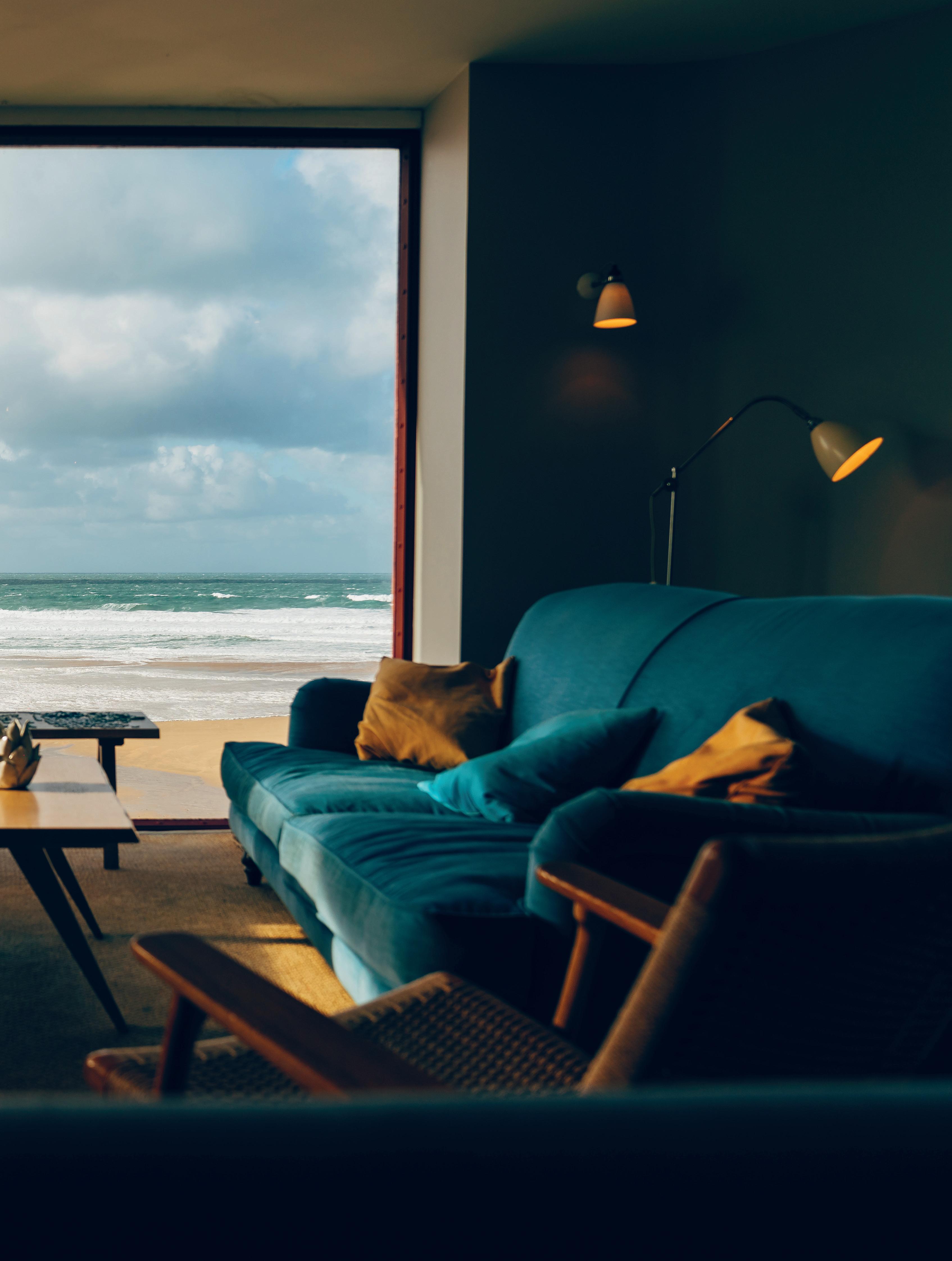
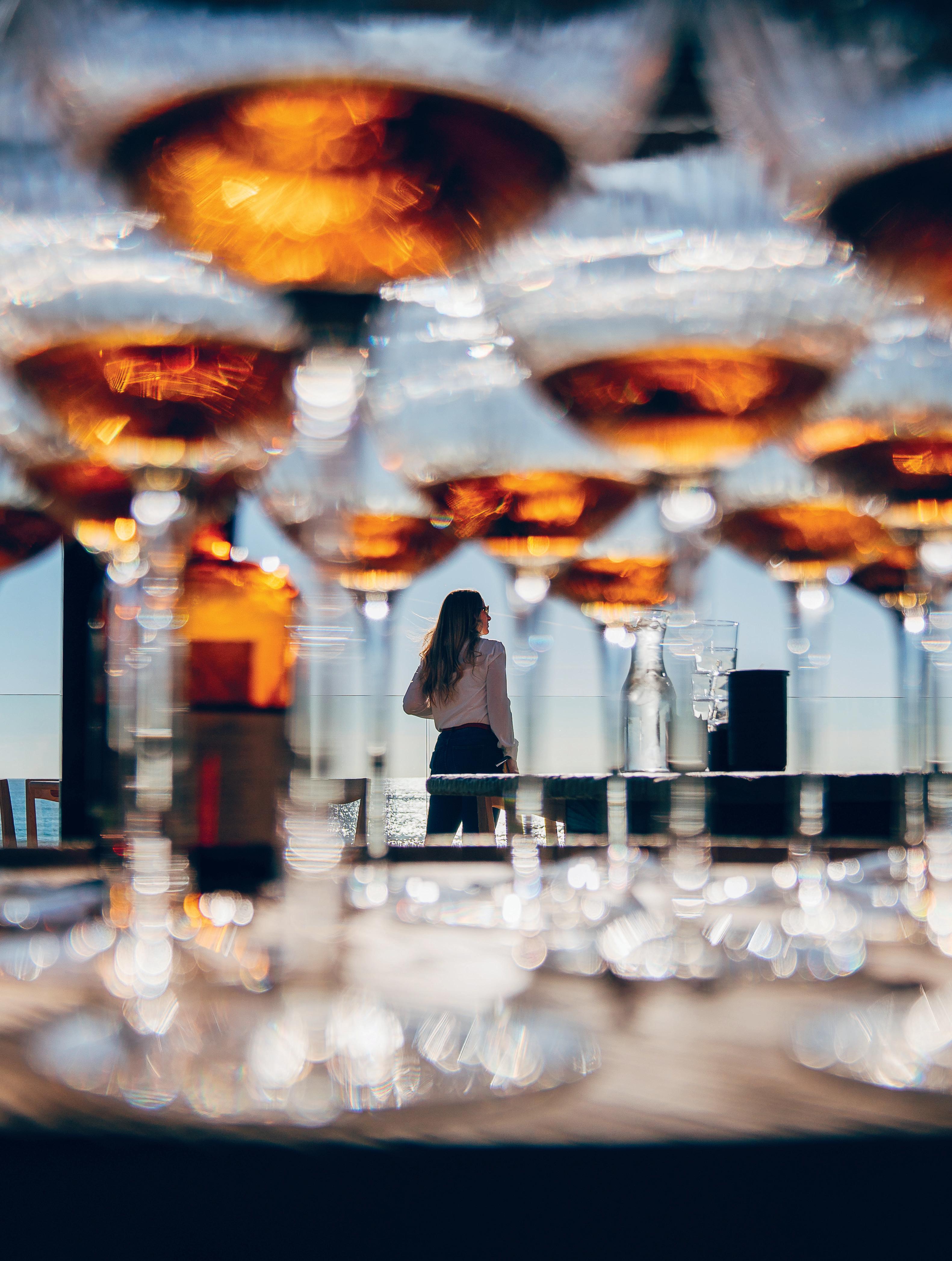
Emotive, thought provoking, magnetic. Poetry is powerful stuff. We consider the rise, relevance and resonance of wordplay for our times.
The café is overflowing. Shoulders jostle around small tables. Glasses chink, conversations undulate and the last of the evening’s light falls through the room’s high windows. There’s a stool by the bar. A teenager, all tattoos and wristbands, walks over, sits. He starts to rhyme. And everyone listens.
From underground spoken word get-togethers like this one, to sell-out theatres the country over, poetry is having a moment. In the hands of a hungry new generation with digital tools at their disposal, more people are making and hearing poetry than ever. Youtube is awash with straight-to-camera stanzas. Instapoet Rupi Kaur has 3.7 million followers and her books accounted for almost 10% of all poetry sales worldwide in 2018. Open mics, curated salons and regular monthly events are popping up all over, with broadening audiences, better turnouts and consistently positive buzz around them.
Self discovery
“I definitely see more people coming out to give poetry a shot these days, and that is, in part, to do with its visibility,” says Molly Naylor, a Cornwall-born poet, theatremaker and screenwriter whose work has been turning heads since her groundbreaking Edinburgh show ten years ago. “The most common response I get after a gig is, ‘I don’t usually like poetry, but I liked that!’, which I think shows that people are more open to the possibilities of what poetry can be for them.”
Poet and academic David Devanny agrees. “Digital platforms are helping bridge a gap and encouraging people to see and hear poetry in a way that they may not have before,” he explains. “Participation is definitely increasing. I’m seeing more young people in the audience and performing at events these days, and that must be connected to how easy it is to find and consume forms of poetry online.” »
By Joe Dunthorne
by witnessing the sunset turn the green of a traffic light – as though the sky were telling me: go – I have, in fact, seen spider crabs chatter on a slab of kelp, stacked it a dozen times on an eight-foot foam board, carefully poured maple syrup into every single hole of a waffle as big as my head. And these things may not sound as deep as the rare atmospheric phenomena – how the sun doth flash the green of an emergency exit sign –but you can’t always choose your epiphanies. Every single evening a giant ball of fire smashes itself against the ocean and most days I don’t notice. So if it’s all the same with you I’ll have my life changed forever by this tub of very hot water, this open window, this book of poems about the sea.
Poetry can provide a space to pause and reflect, to immerse yourself in an experience and revel in the beauty of language.” “
But poetry’s recent rise and resonance can’t just be down to access. There must be something to be said for its role, its appeal in today’s breakneck world? Molly certainly thinks so. “We are living in a time when people are constantly bombarded with endless news, updates, overtime and stress,” she continues. “Poetry can provide a space to pause and reflect, to immerse yourself in an experience and revel in the beauty of language.
“I write to make sense of the world around me,” she continues. “I write in an attempt to get close to our grubby, embarrassing truths. I think often that’s what listeners and readers are drawn to – an authenticity of experience that invites them to be seen, or to look at something differently, to step back and think, to enjoy the company of words for a while.”
It’s true that whether read or heard, at its best poetry envelopes us, draws all our attention, triggers visceral reactions even. Many of us will have had a moment where a beautiful line has made our hairs stand up – whether listening at a festival, reading on a cliff top, or even watching an advert. For award-winning novelist, poet and journalist, Joe Dunthorne, that connection which poetry forges is vital – and shapes his work. “When I write to perform, I think as much about delivery as I do the language; how to connect using tone, volume, breathing – it’s all important. With writing I am still constantly thinking about how to connect too, how to tell the story, capture the moment or share the experience in a way that readers will gravitate to.”
Of course, poetry as exploration, as a lens on life, as an escape, a sanctuary or simply a shift in
Joe Dunthorne is a Welsh novelist, poet and journalist. He first made his name with his novel Submarine (2008), which was made into a film in 2010 (directed by Richard Ayoade). His second novel, Wild Abandon (2011), won the RSL Encore Award and his third, The Adulterants (2018) was published to critical acclaim. A selection of his poetry was published in 2010 in the Faber New Poets series, and his first poetry collection O Positive was published by Faber in 2019.
In September 2019, Joe visited Watergate Bay in search of the Green Flash (see p17) and wrote this poem about his time here.
The South West’s poetry scene is vibrant. If you’re keen on catching some for yourself here’s where to look:
Sprout Spoken
Run monthly in a health food store in Newquay, Sprout Spoken programmes feature performers alongside open mic antics for an evening of lively, inspiring wordplay. Check out Sprout Spoken on Facebook for more information.
focus, isn’t a new thing. Poets have helped humankind interpret, question, challenge and embrace the world around us for centuries. Books have long been battered in back pockets, pored over on wild walks, or contemplated by the fire. Performances have filled the rafters with applause, or created silences so rich you can feel them in your bones. But perhaps today, with better visibility, access and exposure, poetry has a new opportunity – to reach further and connect more broadly than before. To bring new ears and eyes into the fold. To show just what poetry can do for the many, not the few. And if that means more people find a moment away from it all, to open themselves up to the power of words, we’re all for it. •
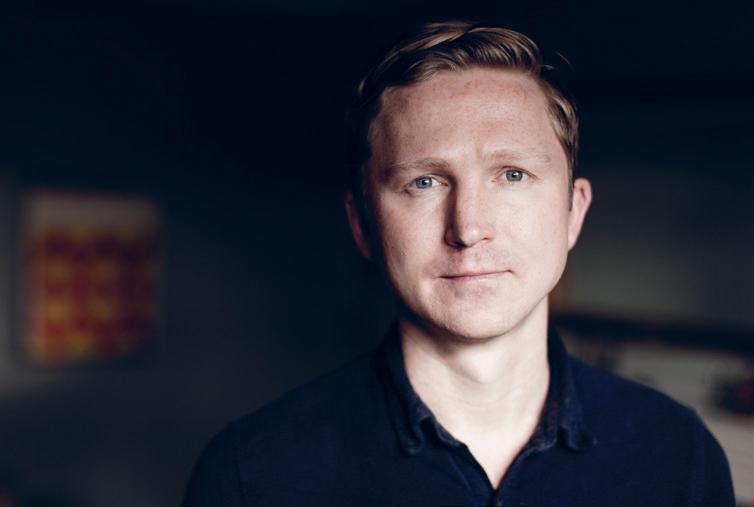
Showcasing and inspiring Cornwall’s writing scene for the last ten years, Telltales is a bi-monthly curated night of performance with readings from established writers and rising stars. telltales.org.uk
Bodmin Moor Poetry Festival
An annual event with the next one set for May 2020 (p77), this poetry festival takes to the wilds
of Cornwall for a weekend of talks, workshops and performance from local, national and international poetry talent. bodminmoorpoetryfestival.com
Look out for the spoken word open mic night at Watchful Mary on 27 February, plus poetry and writing workshops in 2020: watchful.co.uk/events
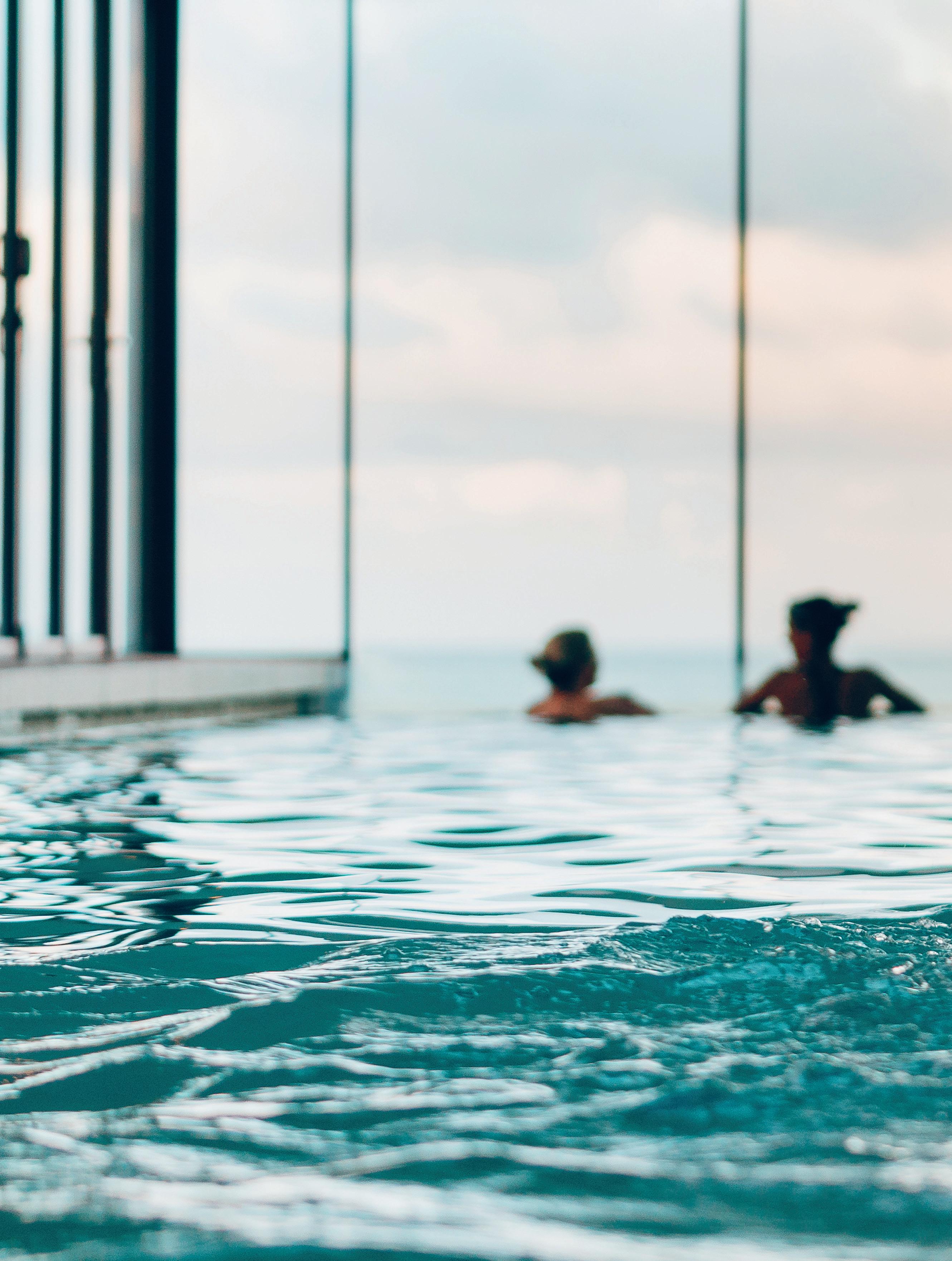
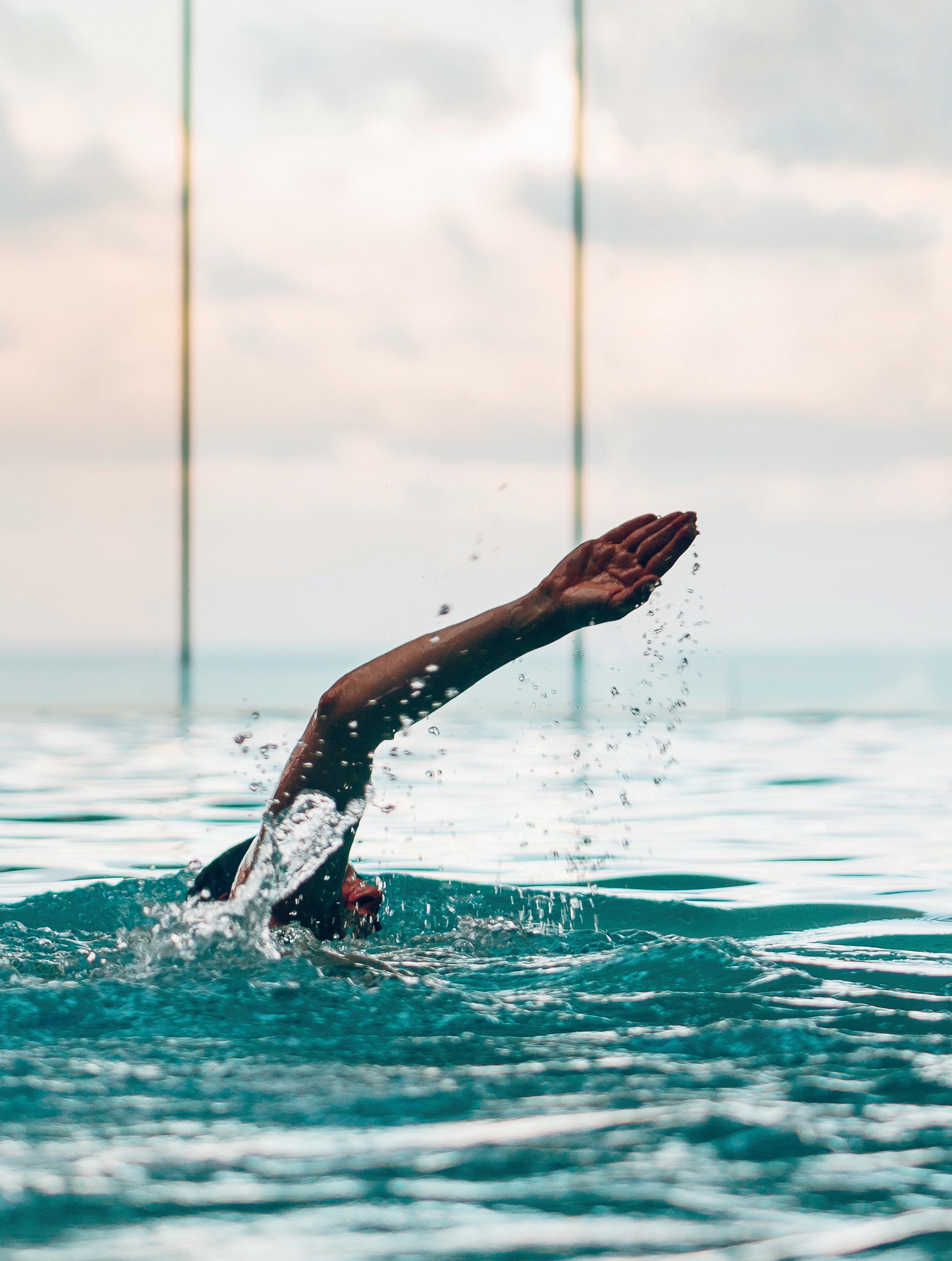
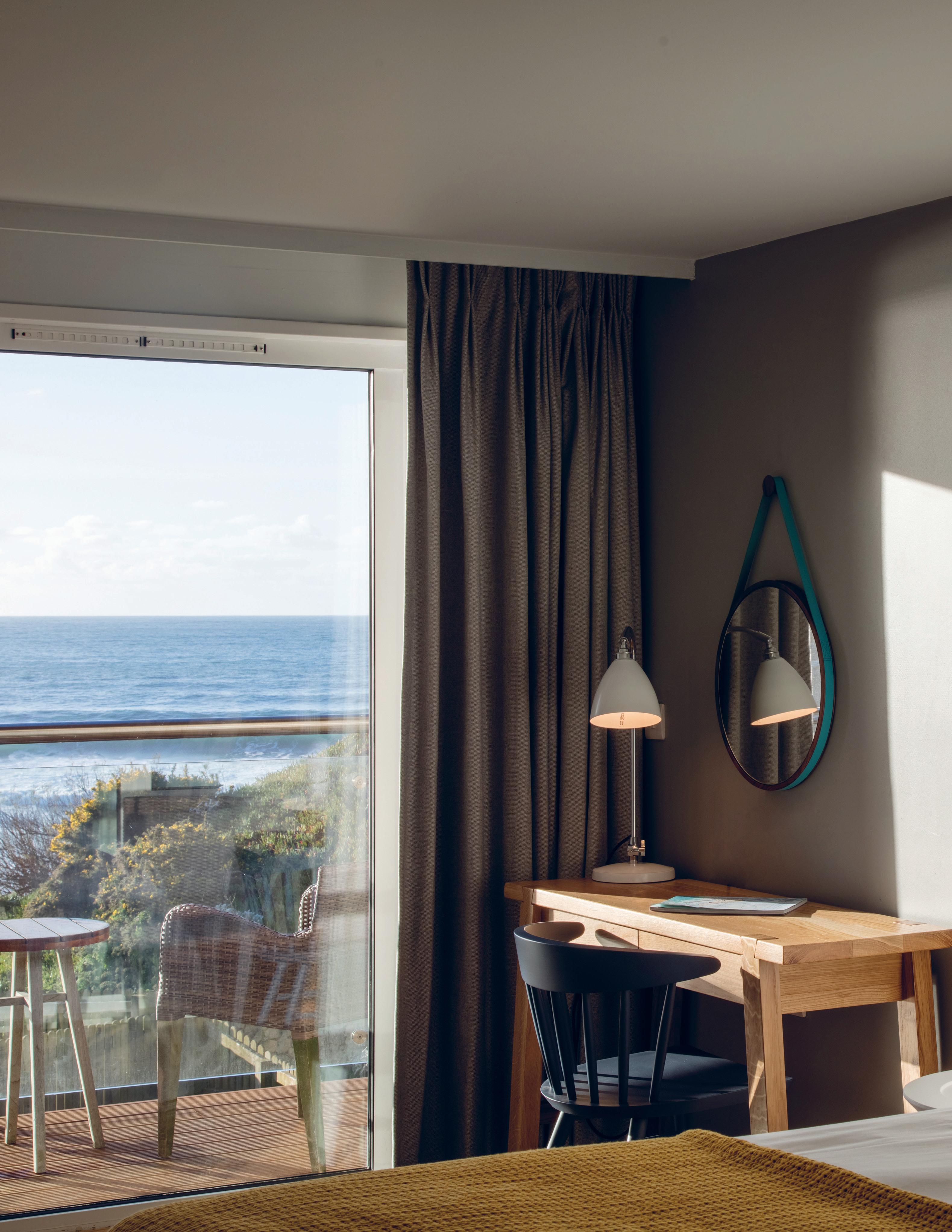
Flavours to seek out, wildlife to watch for, live music and podcasts to listen to – discover what 2020 has in store for all your senses in Watergate Bay and beyond...
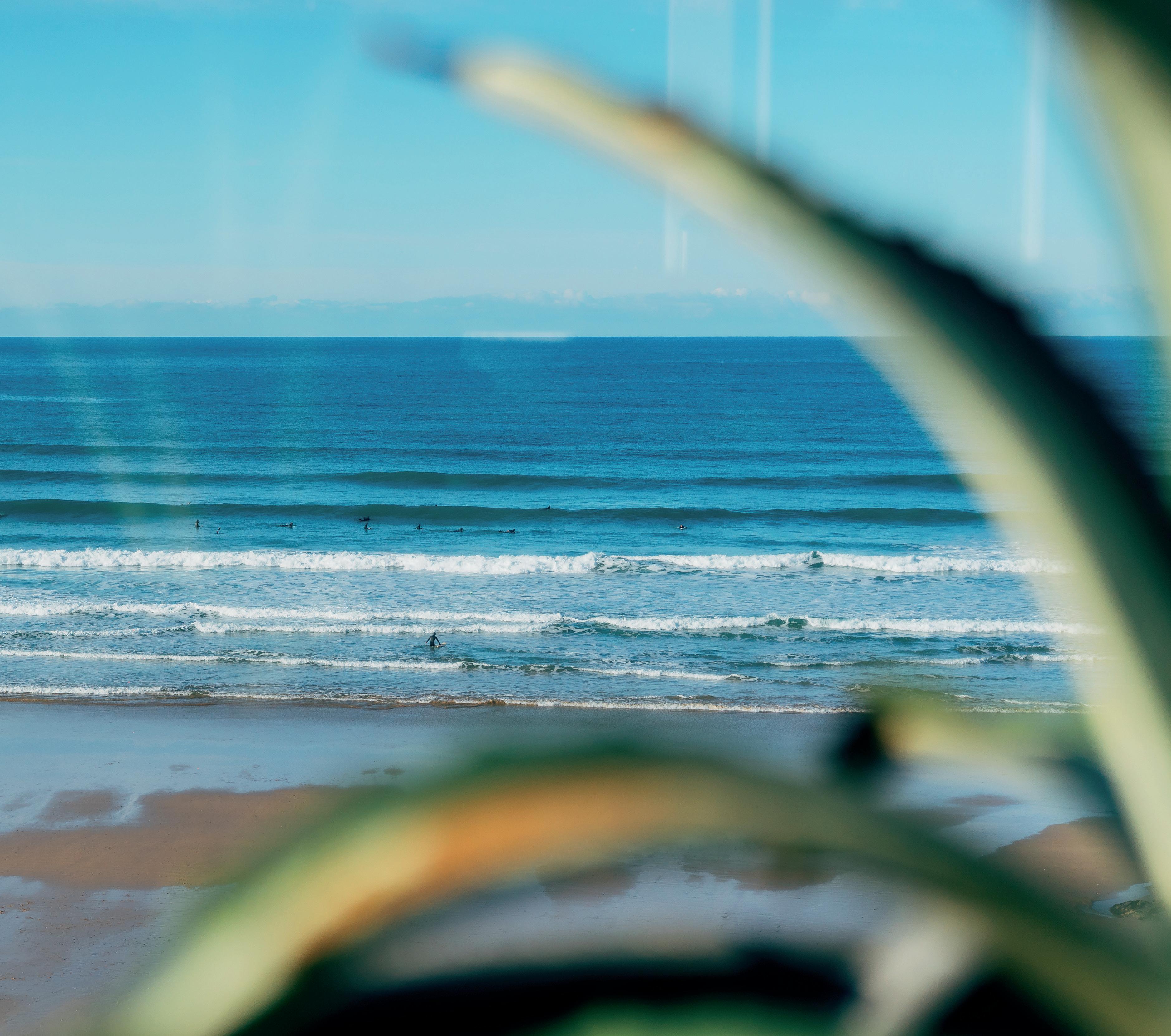
More and more people are becoming vegan – for their own health and that of the planet. But you don’t have to go all the way to make a difference…
Áine Carlin remembers the first time she ordered a vegan meal. It was 2010, long before the BBC dreamed of a series called Dirty Vegan, or Greggs dared to launch a vegan sausage roll. This was a time when simply asking for a soya latte in the UK could get you funny looks.
But back then Áine was living in Chicago, a famously foodie city. Her friends took her to a vegan restaurant called Karyn’s Cooked, and she had the pizza and nachos. It blew her mind. “It was beautifully cooked,” she says. “And with so much colour; everything was jumping off the plate. The owner, Karyn Calibrese, was in her 50s but looked in her 30s. That alone was enough to make me say: ‘Ok I’ll go vegan.’”
After a three-week experiment, where Áine realised she felt far better –and that she could live happily without ice cream and cheese – she was hooked.
More and more people are making a similar choice. The Vegan Society says the number of vegans in the UK quadrupled in the four years to 2018, to around 600,000. Meanwhile, one in three people in the UK are adopting the way of the flexitarian – actively reducing the amount of animal products they eat. “You don’t have to 100% commit,” says Áine, “but it’s so easy to be vegan nowadays.”
Indeed, just as social media (and writers like Áine, whose cookbooks include The New Vegan and Cook Share Eat Vegan) offer inspiring new recipes, so plant-based food, from vegan tuna to jackfruit, is spreading its roots across the supermarket shelves. Even KFC is now testing fried ‘chicken’ from Beyond Meat, the LA-based pioneer of the pea-protein burger, which comes complete with beetroot juice to replicate blood. Beyond Meat’s IPO last year was one of the best performing of all time.
At Watergate Bay, executive chef Neil Haydock recently had a flexitarian awakening of his own. As he turned 50, Bess, Neil’s black Labrador, sadly died –which put paid to his main source of exercise. So he got a personal trainer, who happened to be vegan. Now half his protein comes not from meat and fish, but nuts and pulses, and his passion for good vegan food is clear in Zacry’s and The Living Space restaurants – boosted in no small part by guests’ changing tastes, and those of many in the Hotel’s young team.
“It’s exciting for us,” says Neil. “It’s like finding a new cuisine to explore.” He and the team are now experimenting with everything vegan, from brownies to Caesar salad and BLTs using aubergine brushed with paprika. “A guest the other day said it was the best vegan sandwich they’d ever tasted, because of the texture,” says Neil.
Of course it’s not just the health element that drives people to eat less meat. According to the Vegan Society, carbon emissions could be reduced by two-thirds if the world adopted a vegan diet. This kind of thinking drives the Cool Food campaign, run by Cornwall Food Foundation – the charity behind Jamie Oliver’s Fifteen restaurant. Cool Food encourages people to be more conscious about how they buy and consume food, to increase awareness of food’s impact on the environment.
“It could be a commitment to introduce one vegan meal or coffee-free day a week, or to reduce your meat,” says Rachael Anderson, Cornwall Food Foundation’s community food manager. “We’re hoping to help people take
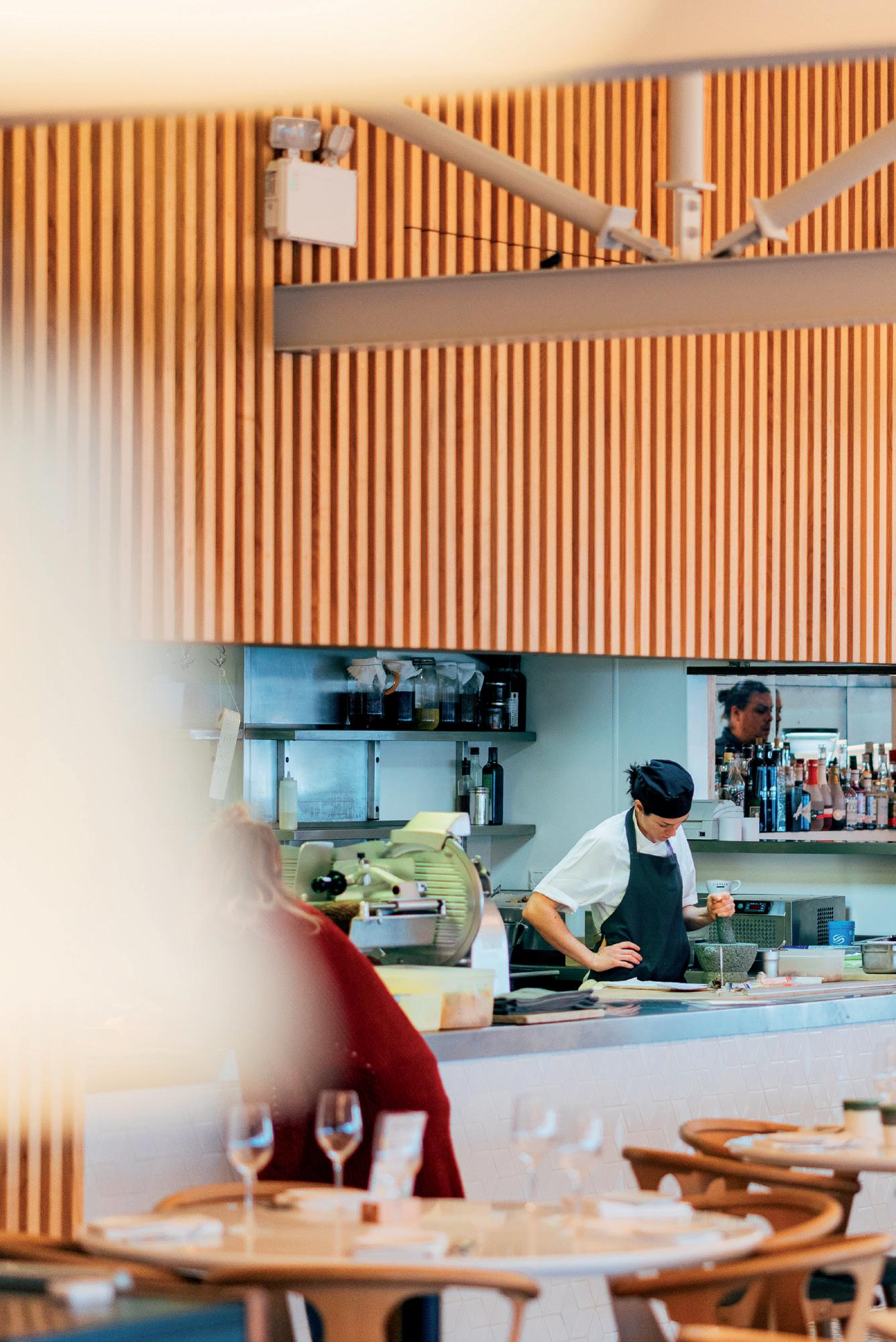
ownership over small actions, which can collectively have a larger impact towards reducing carbon.”
Fifteen Cornwall’s head chef Adam Banks has seen a rise in flexitarian tastes there too: more couples sharing both its vegetarian and meat tasting menus, for example, rather than just sticking with meat. He’s responding to this demand by ensuring Fifteen’s dishes remain individual, clever and enticing. Take the beetroot dish on the Fifteen taster menu as an example: “We slow cook it in the oven, almost like you would a fondant potato – so it’s semi-roasted and semi-brazed in beetroot juice,” he says. “It creates an insane flavour as it reduces down. Then we colour it up in a pan, and serve it with beetroot leaves, charred fennel and fermented blackcurrants, with a hazelnut sauce. We make it exciting so people come back.”
Ten years on from her Windy City epiphany, Áine follows the same playful philosophy. Her current vegan obsession: abundant salads, loaded with breadcrumb toppings and griddled asparagus.
And for anyone interested in going vegan – or flexitarian – she makes it all sound suitably simple. “It’s about getting in the kitchen, and getting to know your food and where it comes from,” she says. “And keeping it exciting.”
@ainecarlin
The New Vegan and Cook Share Eat Vegan are published by Octopus.
cornwallfoodfoundation.org/ getinvolved/cool-food
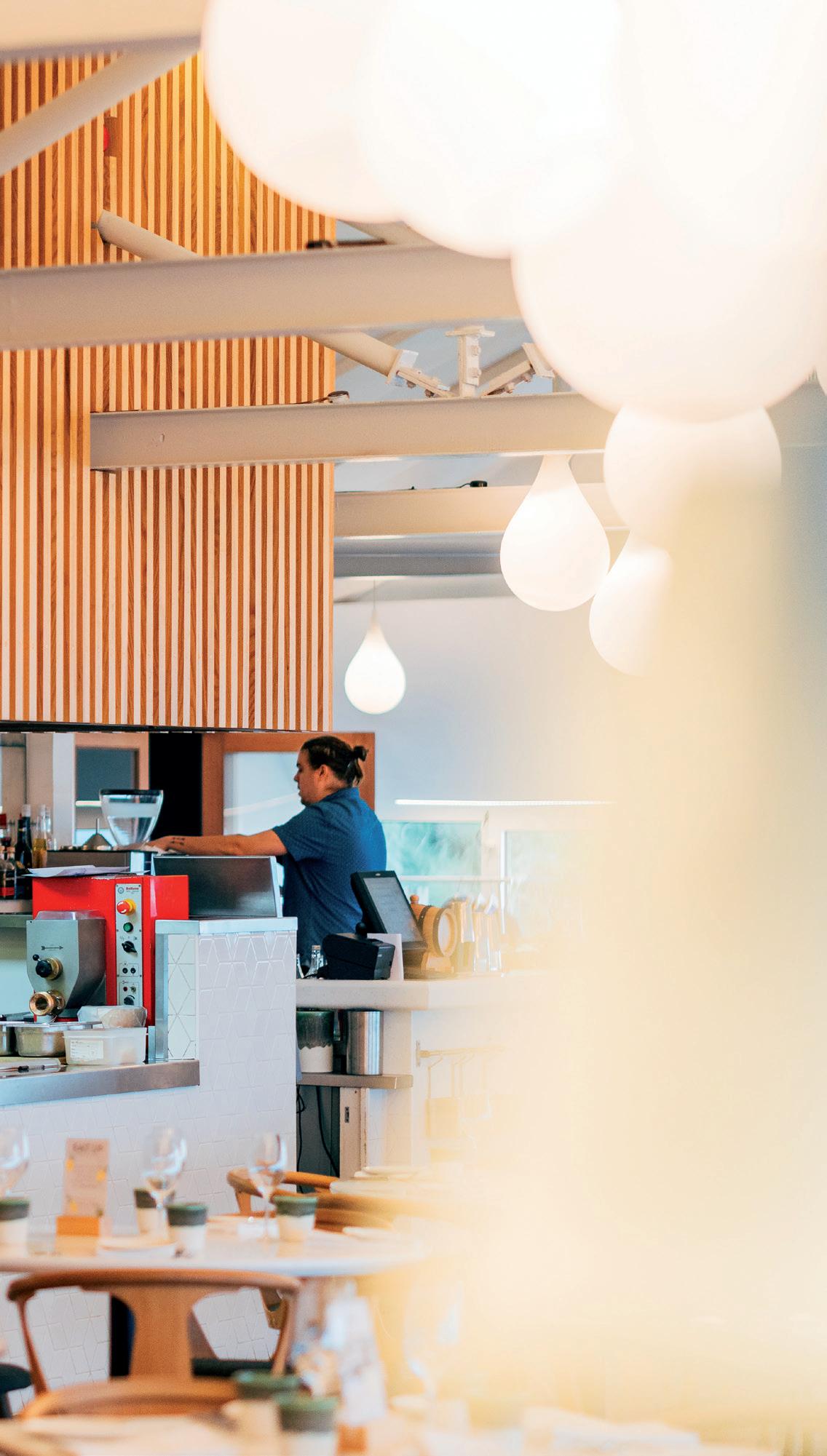
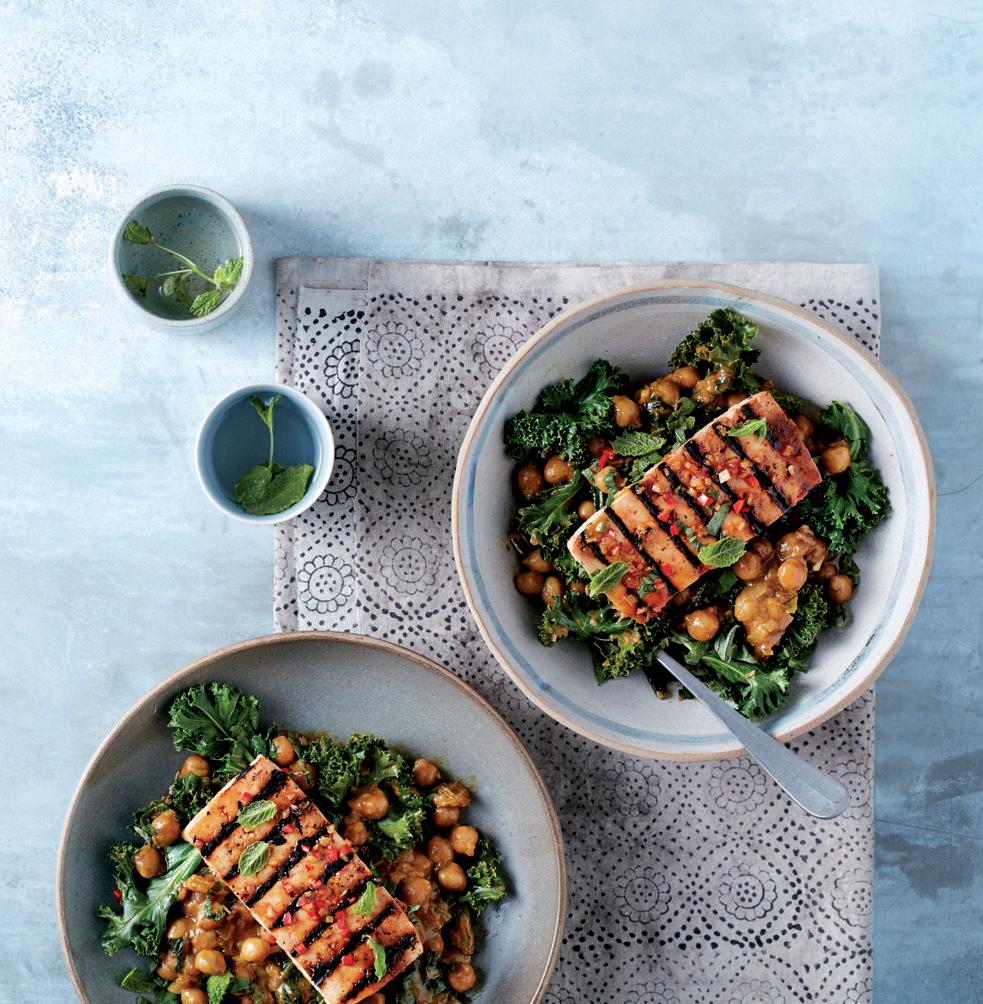
By Áine Carlin
This creamy chickpea curry can be on the table in around 30 minutes, and is packed to the rafters with goodness and flavour.
Ingredients
½ tablespoon coconut oil
1 red onion, finely chopped
1 thumb-sized piece of fresh root ginger, peeled and minced
2 garlic cloves, minced
1 green chilli, minced
230g canned chickpeas, rinsed and drained
1 teaspoon ground turmeric
1 heaped teaspoon garam masala
¼ teaspoon chilli powder
1 heaped teaspoon tomato purée
1–2 tablespoons water
400ml canned coconut milk
1 kaffir lime leaf
½ tablespoon palm sugar
1 heaped teaspoon cornflour
Handful of kale
Method
50g golden raisins
Sea salt flakes and black pepper
1 tablespoon finely chopped mint, to garnish
Cooked basmati rice, to serve
For the teriyaki tofu:
100ml water
50ml tamari
50ml rice mirin
1 thumb-sized piece of fresh root ginger, peeled and minced
1 garlic clove, minced
2 tablespoons agave nectar
1 teaspoon tomato purée
Juice of ½ lemon
1 x 400g firm tofu block, pressed and cut into 4 equal-sized wedges
½ teaspoon olive oil
1. Heat the coconut oil in a large saucepan over a medium heat. Add the onion, season and sweat for 4–5 minutes until translucent. Add the ginger, garlic and chilli to the pan and cook, stirring, for a further 2–3 minutes until aromatic.
2. Tumble in the chickpeas and sprinkle over the turmeric, garam masala and chilli powder. Stir to coat, season generously and cook for 2–3 minutes until the spices are nicely toasted. Stir through the tomato purée and loosen with a splash of water, then pour over the coconut milk, add the lime leaf and palm sugar and season generously. Bring to a simmer, cover with a lid and leave to simmer for 15 minutes.
3. Meanwhile, for the teriyaki tofu, place all the ingredients except the tofu and oil into a saucepan and bring to the boil, then reduce to a simmer and cook for 5–10 minutes, or until thickened and reduced. Take off the heat and leave to cool slightly.
4. Place the tofu wedges in a baking dish. Pour over two-thirds of the teriyaki sauce and brush to coat.
5. Dissolve the cornflour in a little water and whisk into the curry sauce. Add the kale and raisins and simmer for a further 10–15 minutes.
6. Set a griddle pan over a medium–high heat and lightly brush with the oil. Add the tofu wedges and griddle for 10–12 minutes, turning, until marked on all sides. Remove from the heat and brush over the remaining teriyaki sauce while they are still warm.
7. Spoon the curry into warmed bowls, top with the tofu steaks and garnish with some finely chopped mint. Serve with basmati rice.
Our resident mixologist, martini aficionado and operations manager tells us about tasting with the nose and what she’ll be having when it’s our round…
What goes into the perfect drink? I read books on cocktails all the time; I know all the rules of thumb. But when it comes to making them, I’ll just experiment. It’s intuition. I like to bend the rules, so my idea of the perfect drink changes regularly.
Is it true that you taste with the nose first?
My eyesight’s not great, nor my hearing – from listening to music too loud when I was younger! I think I’ve made up for it on my taste and smell. I get sent lots of samples and after looking at the packaging, the first thing I do is take the top off and have a smell. If it smells really good, it’s probably going to be a good drink.
What’s your favourite smelling drink? I’ve been working on the Watchful Mary menu most recently and I adore the smell of the Tinkture rose gin. It tastes so real and pure compared to anything else I’ve tried. Rose-flavoured things can be quite synthetic.
Perfect drink for the height of summer? I like an Aperol Spritz; it takes me back to holidays in Rome. I like things that come with memories; smells and tastes that remind you of happy times.
And the depths of winter? Full-bodied red wines: Amarone, Barolo – the Italians. When someone comes round to mine for dinner they’ll know to bring a good bottle of red.
What about at the end of a long working day?
A good, simple, espresso martini. I’ve fantasised about that many times. It perks you up, but it’s cold and refreshing at the same time.
Gin and tonic garnish of choice? Blood orange.
Sparkling wine or a mellow red? Red wine all the way. I like a prosecco but it’s got to be perfectly chilled.
Espresso or iced latte? Espresso.
Fruity cordial or floral? Floral, I love elderflower.
Gin martini or vodka? Absolutely gin.
From food trucks fired with woodsmoke, to oysters on the quay: take your senses on a tasting tour of Cornwall. Winter to summer, there’s plenty to sip, share and sample in our corner of the world.
7 February / The Beach Hut, Watergate Bay Smoked aubergine, walnuts, pomegranates, falafel, good times. The Beach Hut’s long tables are made for Middle Eastern mezze-style tasting and sharing. Think tagines, tabbouleh and shwarma – piled with flavour, for dividing amongst friends.
the-beach-hut.co.uk/events
29 February / The Eden Project Professionals and amateurs, traditionalists and mavericks all take to the Eden Project’s leafy arena to compete for pasty accolades, and the respect of the county. edenproject.com
20 March / The Beach Hut, Watergate Bay Bringing fresh thinking back from his world travels, this is executive chef Neil Haydock’s favourite kind of food: hands-on, punchy flavours, small plates. Wrap your slow-cooked adobo brisket, Yucatan chicken or peri peri prawns in proper corn tortillas, then dress with salsas and sauces that sing. the-beach-hut.co.uk/events
Porthleven Food Festival
17–19 April / Porthleven
Every year spring brings colour, spice and sounds to Porthleven, as 40,000 people gather in the harbour for this acclaimed food festival. Go for chef demonstrations, live music, outdoor drinks and world-class street food. porthlevenfoodfestival.com
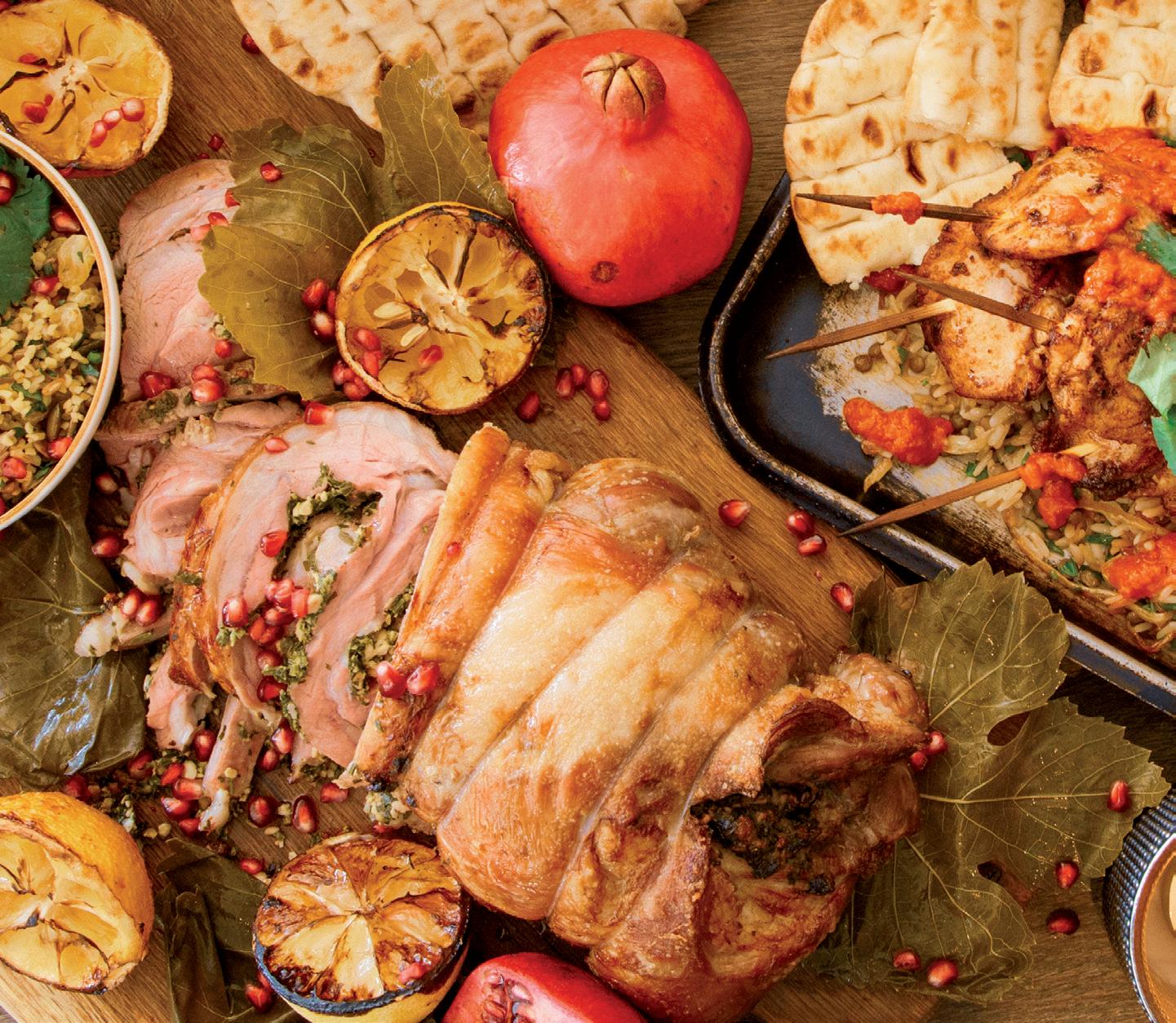
26 June / The Beach Hut, Watergate Bay
Our kitchen team’s relationship with our Hayle-based lobsterman (see p50) goes way back. With a real depth of flavour and unique sweetness, we think Cornish lobsters are the best around. A night to celebrate all that local produce has to offer, with an international influence – try it crispy with waffles or spicy with sushi ginger rice. the-beach-hut.co.uk/events
18–20 September / Newquay
For the freshest fish of all, head to Newquay’s fish festival for Cornwall’s best catches, served right on the harbour. Cooking demos, music and plenty of seafood draw the local fishing community and visitors alike. newquayfishfestival.co.uk
Crab Festival
25 September / The Beach Hut, Watergate Bay
A banquet of crab caught right on our doorstep and piled whole into the middle of the table. Come, roll up your sleeves, grab a bib and get stuck in. With rich drawn butters, mayo, fries and bread to accompany, dive into a joyfully messy night of feasting. the-beach-hut.co.uk/events
9–13 October / Events Square, Falmouth Lemon, tabasco, or a touch of salt? Marking the start of dredging season, Falmouth’s oyster festival is the place to get your fix, with straight-from-the-sea oysters to taste, appearances from Michelin-starred chefs, local produce stalls, bars, live music and a Falmouth Working Boat race. falmouthoysterfestival.co.uk
Various dates throughout the year / Nancarrow Farm
Sit around a long table, bedecked with fresh flowers, and share food straight from the kitchen garden. At the heart of a working family farm, Nancarrow’s feast nights are famous for their warmth and flavour. nancarrowfarm.co.uk/feasts
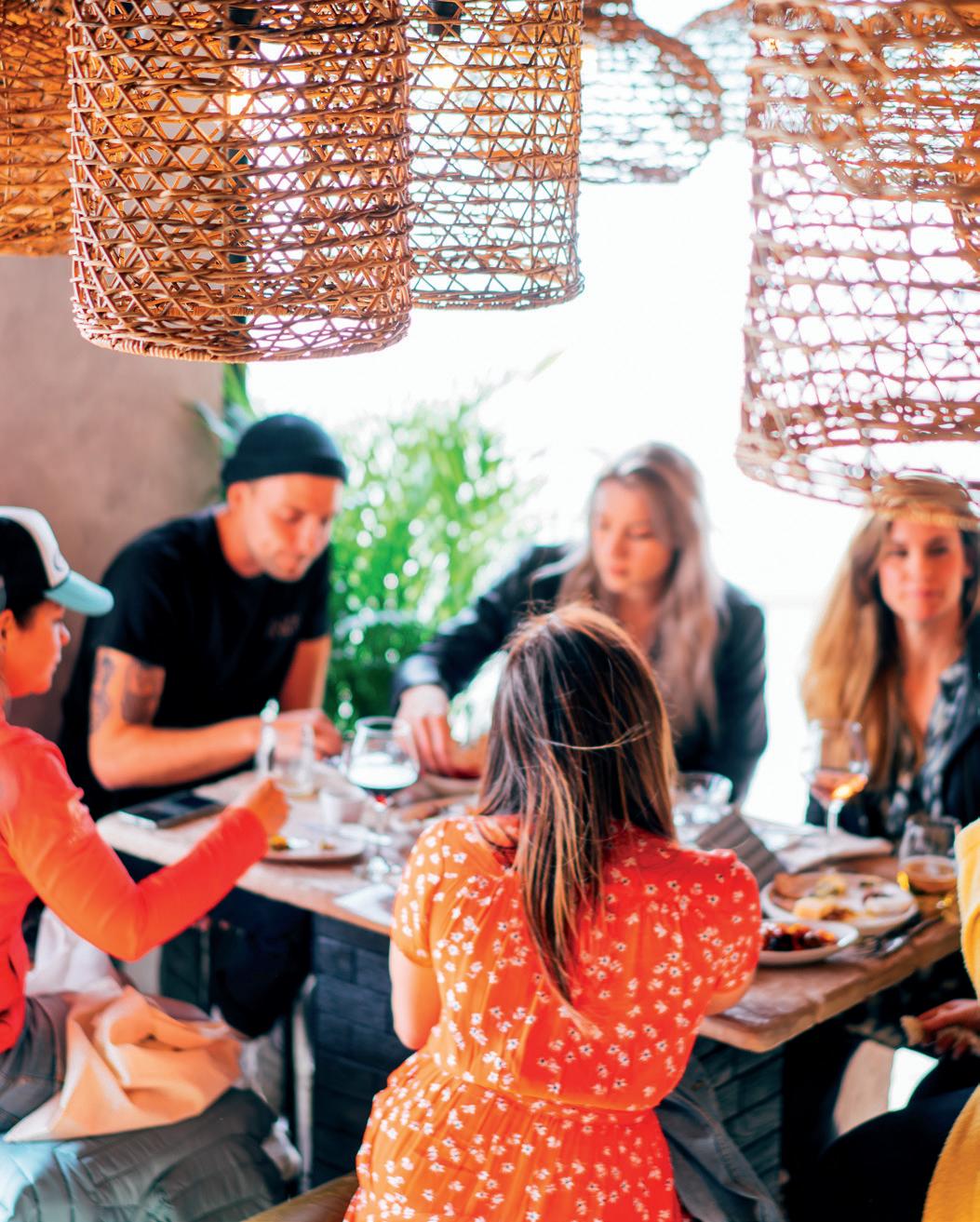
26 April & 21 June / Watchful Mary, Watergate Bay
Look out to the horizon. The sound of waves, music and conversation surrounds you, while smells of maple bacon, caramelised onion and grilled peaches waft from the fire pit. Watchful Mary’s spring and summer brunches are a feast for the senses – even before your first bite. Gather your friends and book a table on the decking. Come for specialty coffee, smoothie bowls, cocktails, brioche vanilla French toast, oyster mushroom ‘steaks’... Stay for the good vibes and chilled out DJ sets. watchful.co.uk
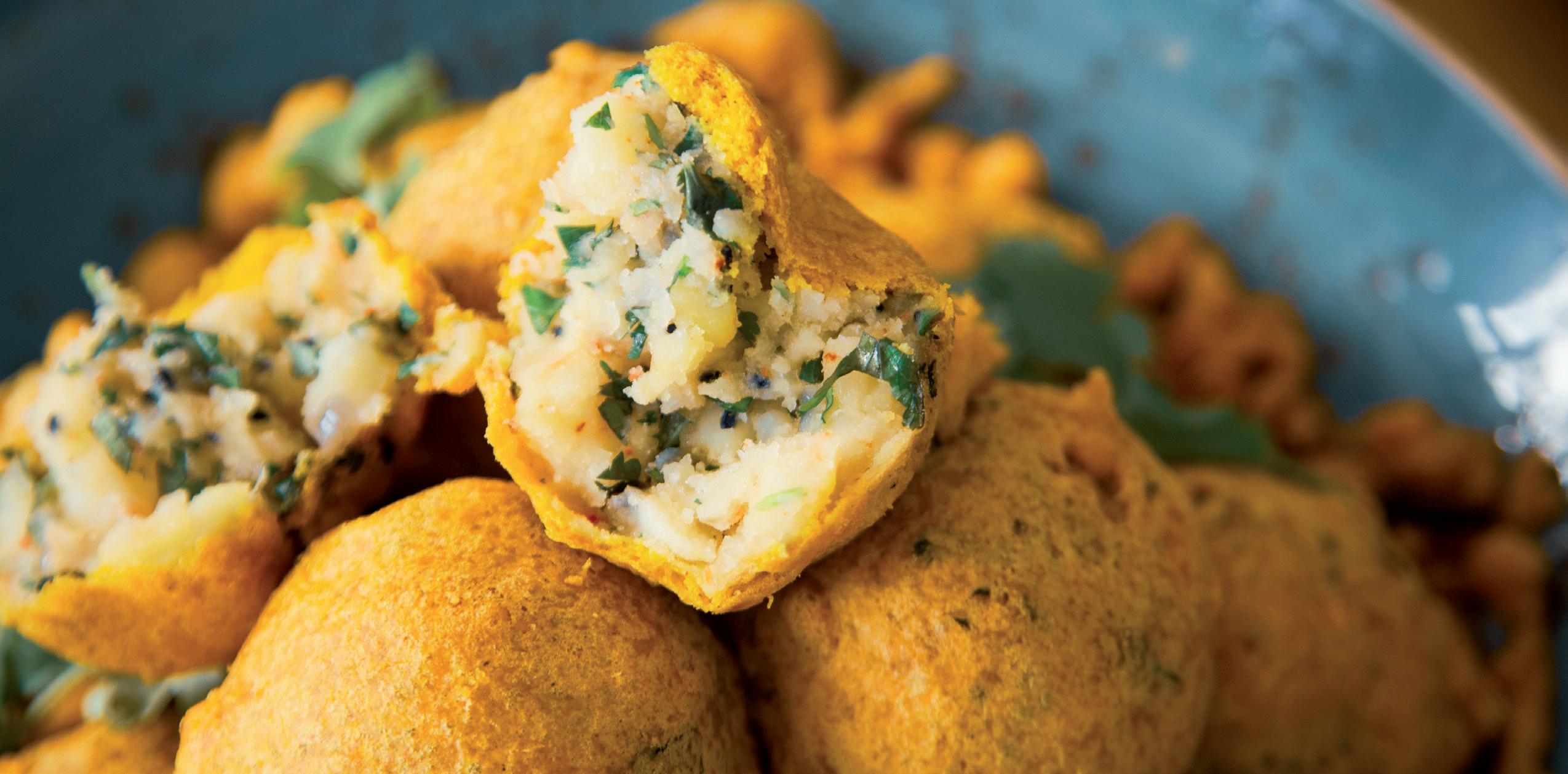
Friday 13 November / The Beach Hut, Watergate Bay
Our executive chef Neil Haydock has been riding the vegan wave (p68), tinkering, experimenting and looking for creative plant-based options from around the world. Reap the rewards of his passionate exploration with a delicious sharing feast that’s an adventure in taste, colour and texture. the-beach-hut.co.uk/events
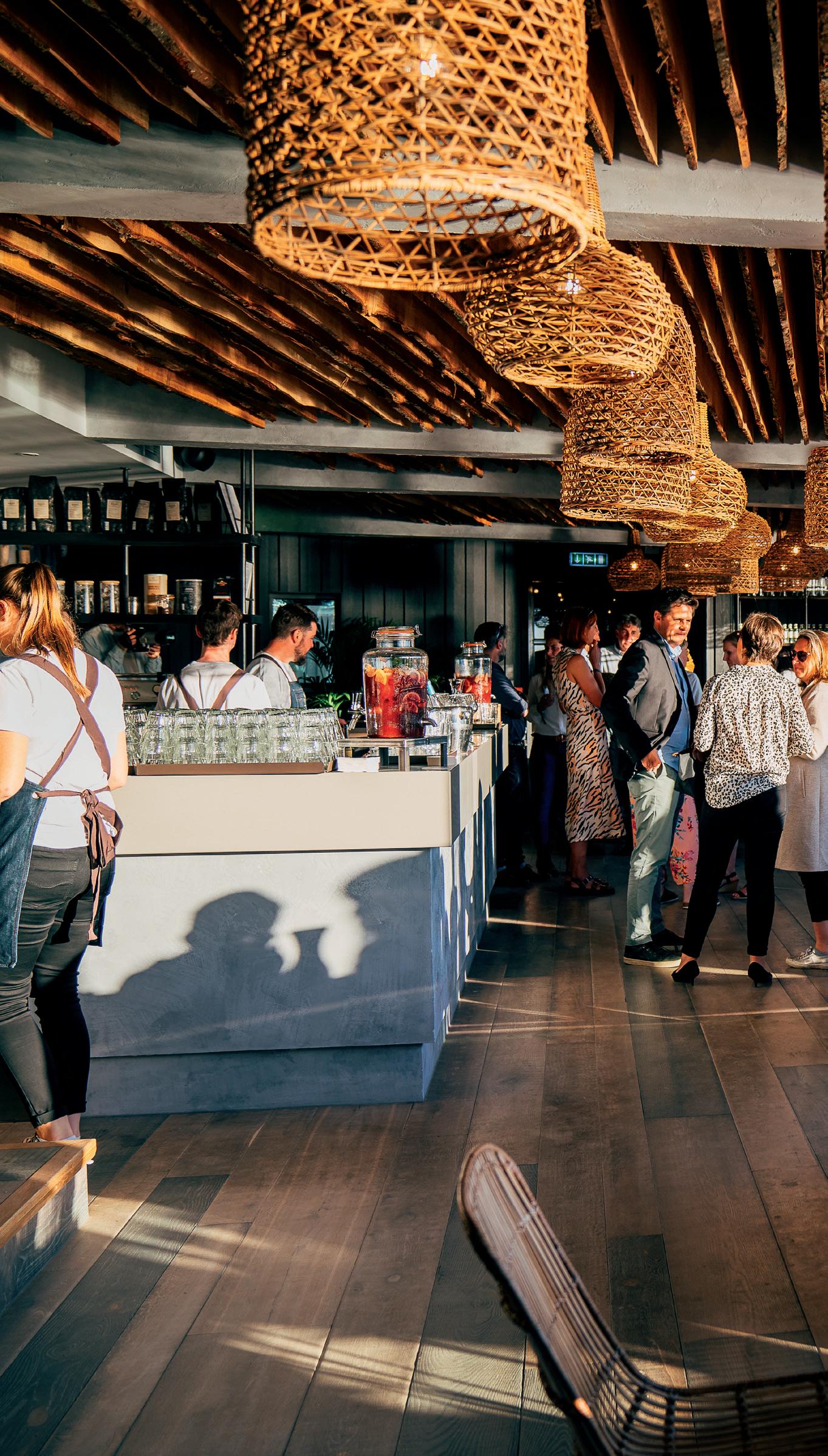
“In the very first design meeting, I remember standing on the beach, looking back at the sea wall. There were beautiful ripple and wave patterns in the sand, created by the tide, and it sparked the idea for the ceiling. We installed locally-sourced live edge timber for a natural feel. Each piece was individually drilled to the ceiling, then staggered at various heights to create a ‘wave’ effect.”
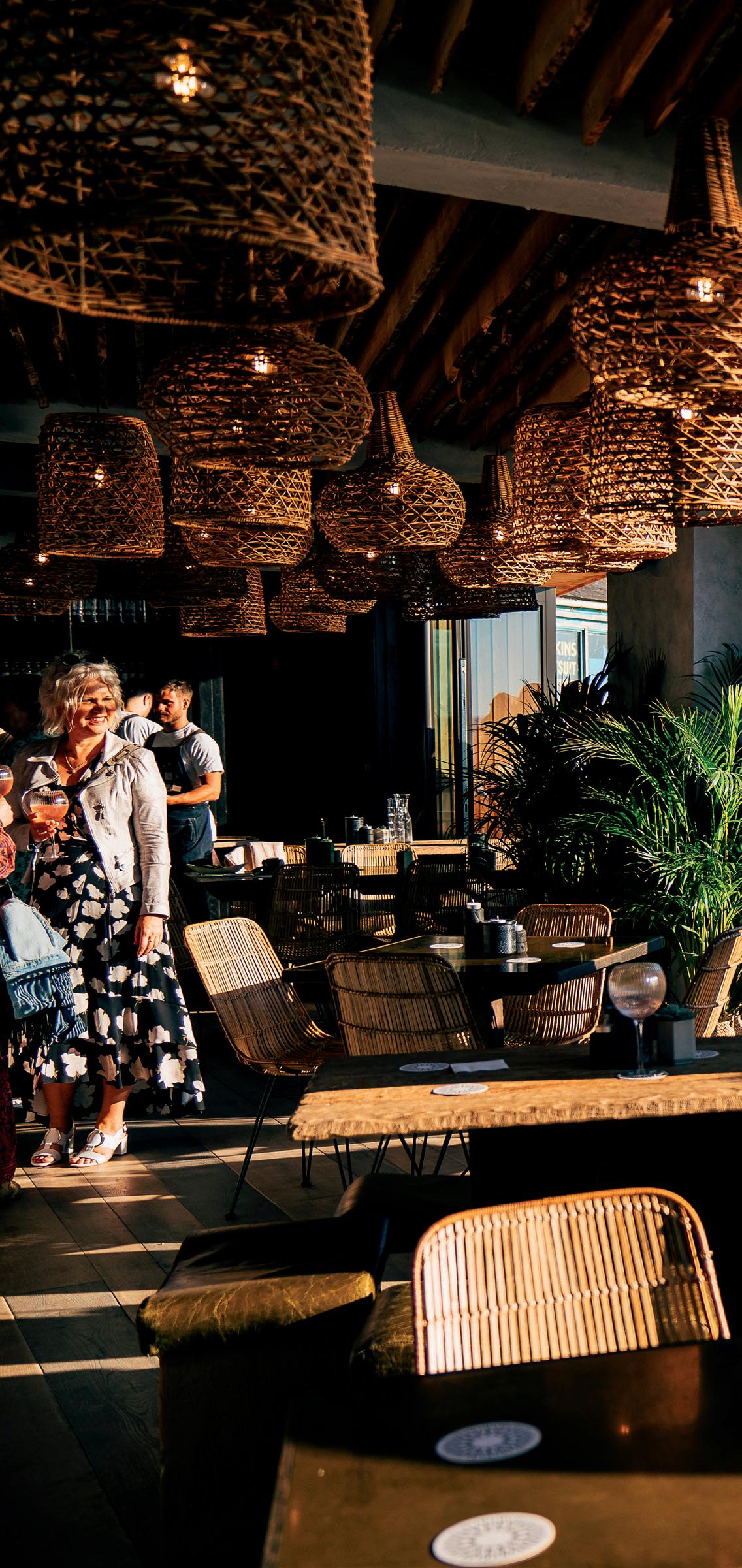
“The woven pendant lights are from South West supplier Nkuku. I wanted to highlight the ceiling with staggered light, and create a focus at night for when it’s dark outside and the view has gone. They give a real warmth to the space. The lights above the banquette seating are bespoke fittings from another local supplier called Apt Studios, in Falmouth. We helped source silver birch branches nearby and Apt stripped the bark to make a smooth surface, which was then sprayed for texture and an industrial feel.”
“When I first saw the bar’s location, I loved the texture of the sea wall’s concrete; its weathered look and the symmetrical grid-like pattern created by the concrete slabs. I wanted the interior to sit in partnership with the structural and architectural details of the building, so liked the idea of bringing the concrete of the sea wall into the interiors.”
Order a cocktail, take a look around. These walls have stories (and so does the floor). Watchful Mary’s designer Matt Hulme walks us through his inspirations for the bar’s interior.
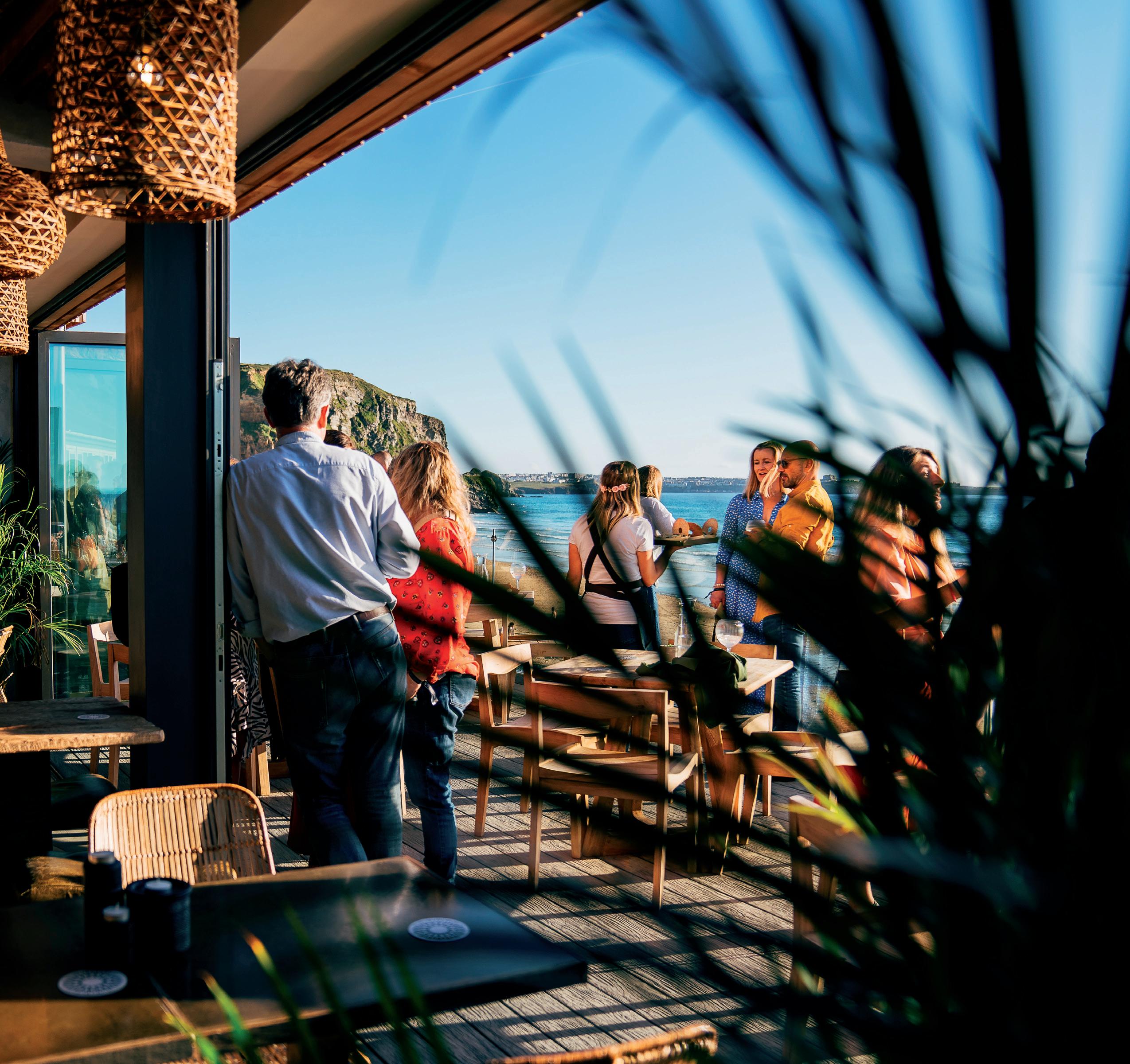
“A huge part of Watchful’s appeal is the location. We wanted to create a lively, atmospheric space, that people could hear from the beach and be drawn up and inside. The floor to ceiling windows were an obvious choice. We had to capitalise on the view, and they fully slide open, turning the interior and the external deck into one incredible space during the summer months.”
“All the low-level stools were bespoke and made to order, also by Apt Studios. I love the peg details, which I designed into their framework. They slightly stick out of the legs of the green leather stools and the round four-legged stools. It’s a tiny joinery detail most people won’t spot, but it makes them look authentic, and shows they’re handmade.”
“The timber floor’s unique finish was also created specifically for Watchful Mary. I wanted it to look battered by the beach crowd from the get-go, rather than clean and sharp – so worked with the supplier, Oak Artisans, to create something that looked like a few hundred people had walked through with sand on their feet, wearing texture and colour into the timber. They were a bit baffled at the start, but it ended up just how I’d hoped.”
@watchfulmary / watchful.co.uk @dynarghdesign / dynarghdesign.com
The still blue waters, secluded coves and craggy outcrops along from the Bay host an ecosystem full of surprises.
For a chance at spotting a dolphin pod or gazing at wheeling guillemots, your best bet is to take a stand-up paddleboard (SUP) beyond the reaches of the beach. On a scale from (almost) dead cert (1) to rare sighting (6), here’s what to watch out for round these parts, however you choose to explore…
1. Sea anemone
Amongst the rockpools, dark red sea anemones hide their tentacles when the tide comes in. Look for mysterious gelatinous blobs, that release their wiggling fronds when covered back up by the sea.
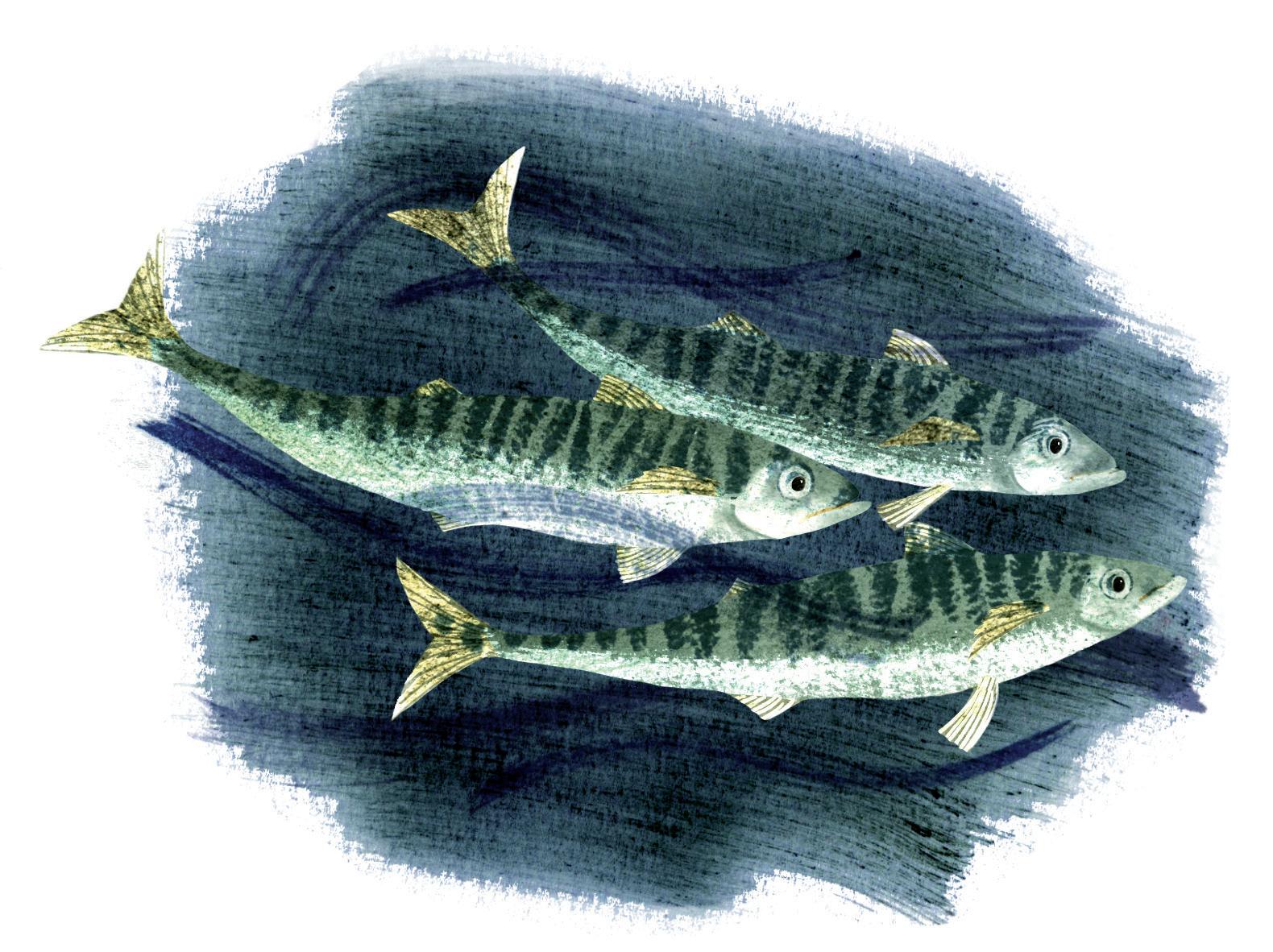
4. Spider crabs
With a claw span of up to 80cm and a life span of up to 40 years, spider crabs lurk on the seabed. You’ll know them by their size, long limbs and reddish colouring.
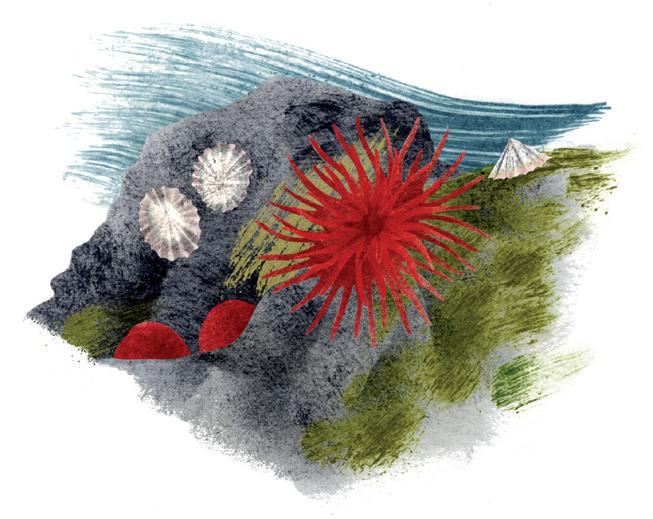
3. Mackerel
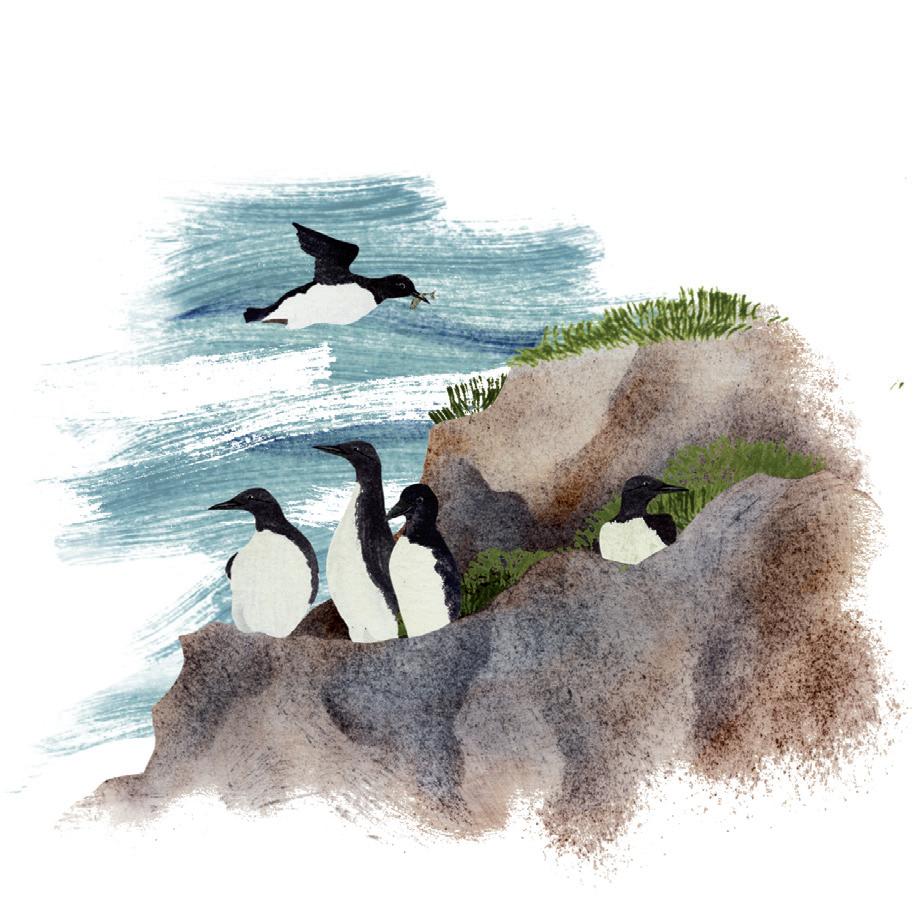
2. Guillemot
The guillemot lives its life at sea, coming in to land to nest. Look out for a colony, clinging to the cliffs. You’ll know they’re guillemots by their black and white feathers.
With their shimmering backs of green and blue stripes, a shoal of mackerel will glisten in the water. Look out for them as they dart beneath the surface in spring and early summer.
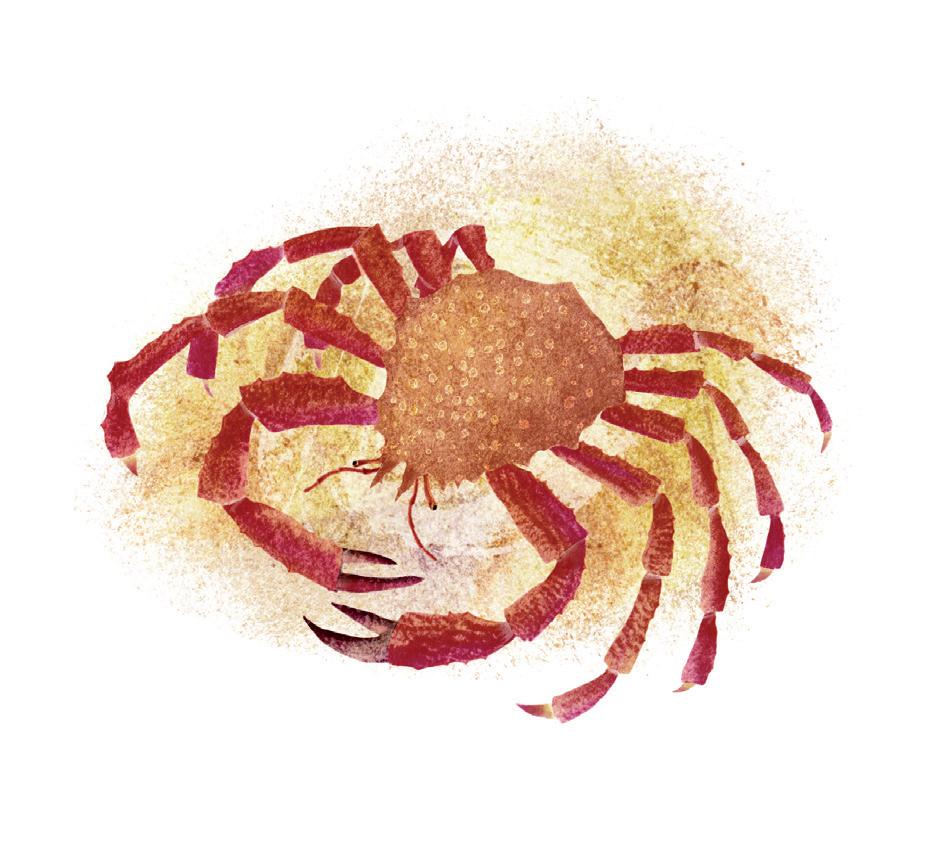
Book a SUP Safari to Beacon Cove with the Extreme Academy extremeacademy.co.uk
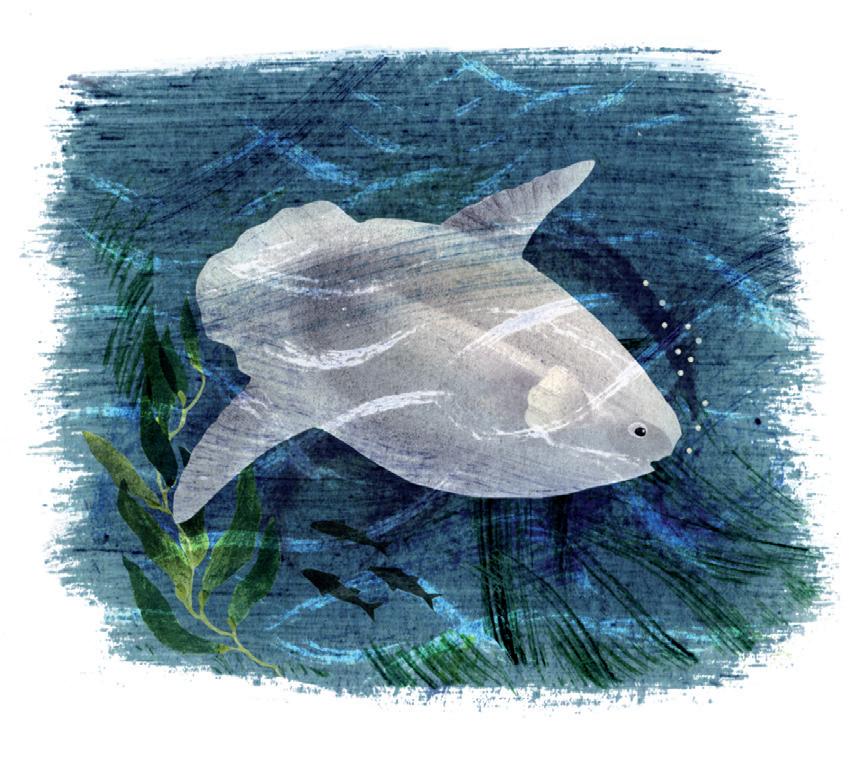
6. Pod of dolphins
The most magical sighting of all, SUP-ers around Watergate Bay have been known to paddle amongst a leaping pod of common dolphins. Sociable and inquisitive, you’ll find them in groups – look out for dancing fins amongst the waves.
5. Sunfish
A bizarre-looking beauty that, if lucky, you might see ‘sunbathing’ on its side at the sea’s surface. The sunfish comes to our waters in the summer and feasts on jellyfish. Look for its pointy fin and flat round body.
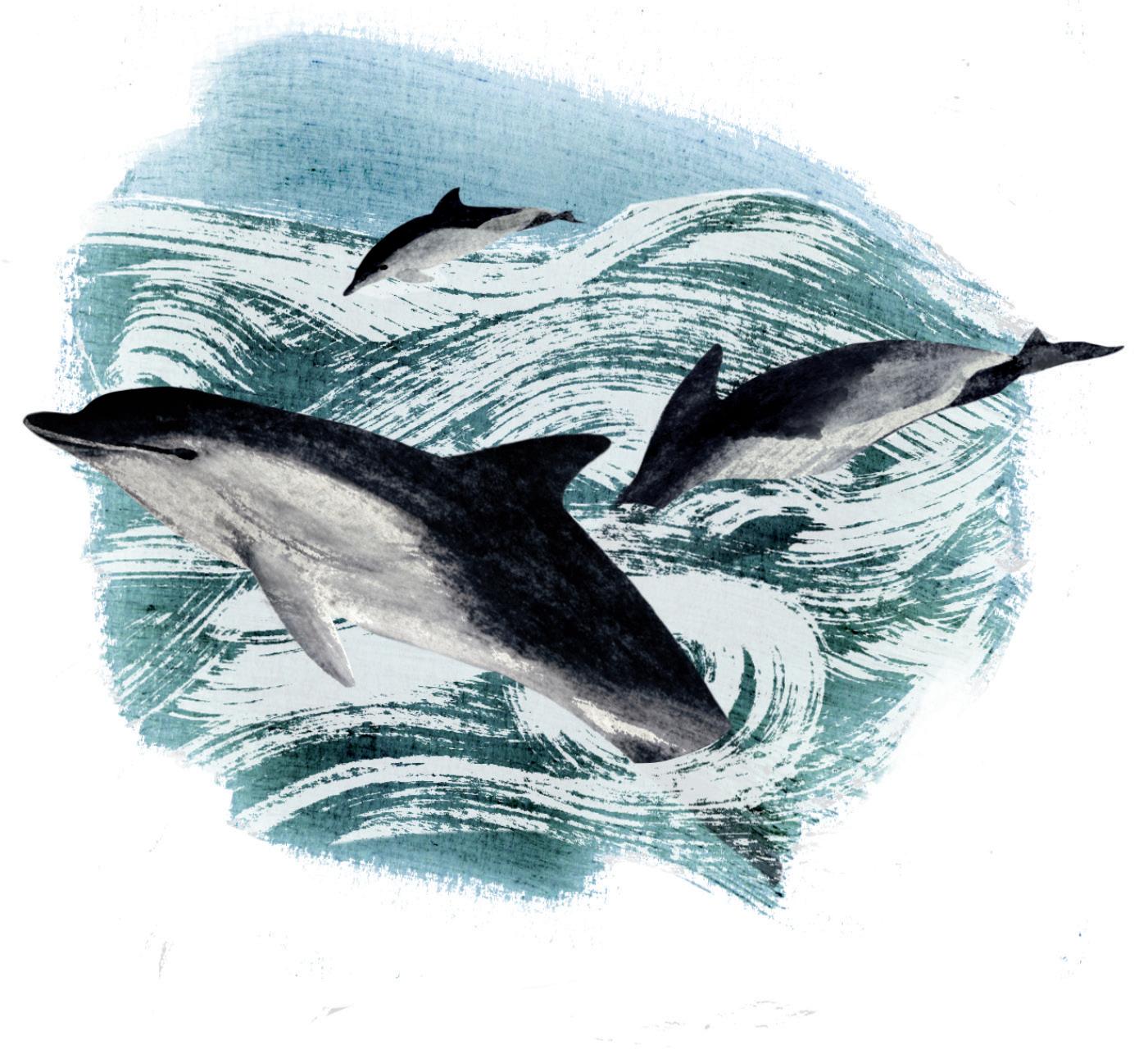
How does an artist see? We asked the painter behind the striking Polly Joke and Displacement artworks in the hotel where her creative visions begin...
What inspires your work? Being out, surrounded by nature. As a visual artist I find certain things jump out at me. I’m always looking for pattern and colour and taking photographs. For the painting in the hotel, I’d been walking on the beach at very low tide and this orange sponge caught my eye. I’d never seen it before. I wanted to capture all the life forms within that tiny little space – barnacles, limpets, anemones, the sponge. It’s about really looking, not just at the horizon and the beach, but at all the life forms in our environment.
Does painting affect the way you see?
The more you paint and the more you look, the more you see. It’s something I teach my art students. You might look at a rock and say at first it’s grey, but then you learn to discern colour, to see blues and all different shades within the grey.
Why Cornwall? Artists have always come to Cornwall to seek out the light. But for me it’s also the areas that are still untouched. The natural environment is still intact here – albeit hanging on a thread because of climate change. Cornwall enables you to have that connection again, to feel part of the natural world.
How do you spend time in nature? I walk every day with my dog. Every day’s different, depending where we go, what the light’s like, the time of year. I make sure I allow myself space to experience and observe it.
What’s the most beautiful sight around here?
The drive along the coast road, towards Watergate. When you’re coming from Newquay, there’s suddenly an incredible view at the top of the hill, opening up the vista all along Watergate Bay. It gets me every time.
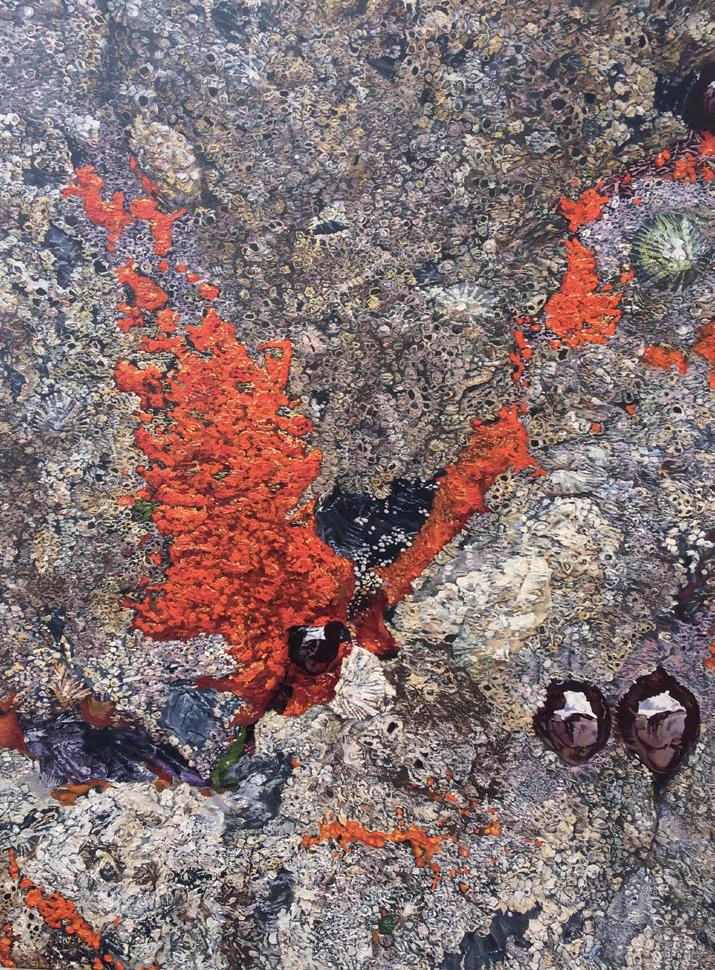
There’s more to Cornwall than wild landscapes and pretty harbours. Find yourself spellbound by the speed and grace of surfers and vintage racers, or transported by pop-up theatre, dark starlit skies and international artists.
Gabo: 25 January–3 May
Yang: 23 May–11 October / St Ives
The Tate continues its bold run of international programming by showing the diverse work of constructivist pioneer Naum Gabo. Timed to mark a major landmark in modernism, it’s the UK’s first major exhibition of the avant-garde Russian in over 30 years, and features everything from sculpture to architectural and public projects. The work of Haegue Yang, a contemporary South Korean artist who uses industrial and everyday materials to create immersive, creature-like sculptures, follows shortly after. Expect an energy of ‘enlightenment and mysticism’.
tate.org.uk/visit/tate-st-ives
23 May / Watergate Bay
Local charity St Francis has been rescuing and rehoming dogs for more than 50 years. At this annual fundraiser, it’s all about pooches winning prizes: for having the most lovable eyes, or the waggiest tail, or being the dog the judges would most like to take home. The whole event takes place on the beach, creating a fun, friendly spectacle for young pups and old hounds alike. watergatebay.co.uk/events
June–August / Penzance
From performances by Shakespeare’s Globe Theatre to sea shanties from Cornwall’s own Fisherman’s Friends, plus gin and jazz nights on a summer’s eve, there’s a wealth of cultural gems to be found in the heart of Penzance in the beautifully sheltered surroundings of Penlee Park. penleeparktheatre.com
Kneehigh Theatre’s Asylum
August–September / Carlyon Bay
Cornwall’s most lauded theatre company has travelled the world with its colourful, audacious blend of comedy, mischief and romance – wowing critics from Sydney to New York. But the Asylum,
its ‘pop-up palace for fun, hope and escape’ is its sanctuary. Last year the tent hosted an eclectic mix of plays, singalongs and the Bowie Lounge – keep an eye on the website for the 2020 line-up. Unmissable fun. kneehigh.co.uk
19–20 September / Watergate Bay
This is the only motorsport event held in Cornwall on a closed public road, and is “an iconic event on the UK motorsport calendar” (Motorsport UK). Over 100 cars race 850 metres of hills and hairpin bends on the B3276 coast road towards Newquay. The thrills get faster and more furious every year: the quickest time in 2019 came from a man in a five-litre Pilbeam MP43. If you like to soak up epic views with the roar of engines and perfect racing lines, this is for you.
watergatebayhillclimb.co.uk
First Thursday of the month, October to March / Mawgan Porth
Cornwall’s night skies are some of the clearest and most awe-inspiring in the country. This regular meet-up is a great chance to meet others and share in the beauty and mystery of the cosmos. It’s hands-on too: you can learn about amateur astronomy and observing techniques, with the help of others who know their planetoids from their pulsars.
kernowastronomers.com
For those who love the smell of board wax in the morning, Cornwall hosts competitions in surfing, kitesurfing, stand-up paddleboarding (SUP) –and even good old-fashioned belly boarding. At Watergate Bay you can see pros, disabled athletes and grommets (kids) catching the best waves, and soak up all the nail-biting action from the serenity of the shore. Here’s when… Surfaced Pro (surf), 18–19 April
English Nationals (surf), 1,2,3 May
Legend of the Bay (SUP and kitesurf), 6–7 June
The Wave Project (see p81), 11–12 July
Rip Curl Grom Search (surf), 15–16 August
BSUPA (SUP), 26–27 September
World Belly Board Championships (Perranporth), 13 September
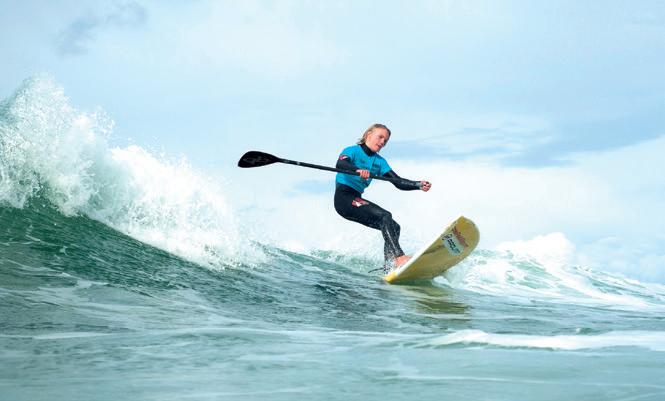

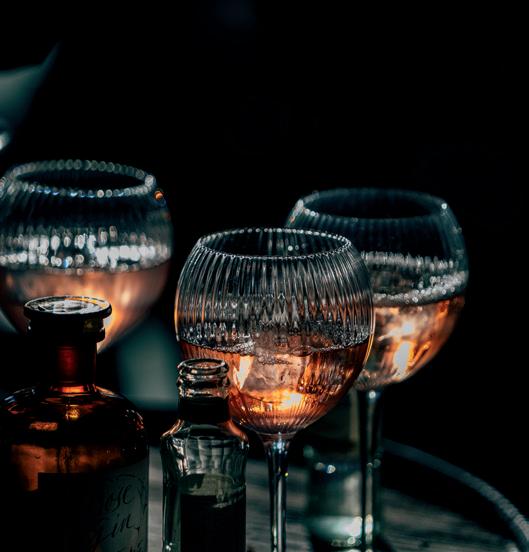

At Watchful Mary it’s not just the glorious view that will give your spirits a lift. Our regular music nights –Watchful Live and Watchful Lates – will too. Here’s a handful of musicians and DJs to keep an eye, and ear, out for in 2020…
Sam Green and the Midnight Heist
Sam plays slide guitar surf roots-rock from the North Devon coast. The Midnight Heist back him with upright bass and harmonica, creating a timeless mix of British folk and American Delta blues – a sound that’s somehow introspective yet upbeat and downright rocking.
Rosie Crow
Rosie’s synth-driven ‘dark pop’ is influenced by PJ Harvey and Young Fathers, and the ‘beautiful twisted energy’ of the Cornish landscape. GQ named her eponymous solo debut an album of the month in 2016. The title of her latest LP says a lot about what to expect: Weirdiful.
Adam Isaac
Singer-songwriter and surfer Adam played festivals and gigs for ten years before taking part in The Voice in 2013, when he found himself subject of a bidding war between Sir Tom Jones and Will.I.Am. His soaring pop-rock sound is designed to get you moving.
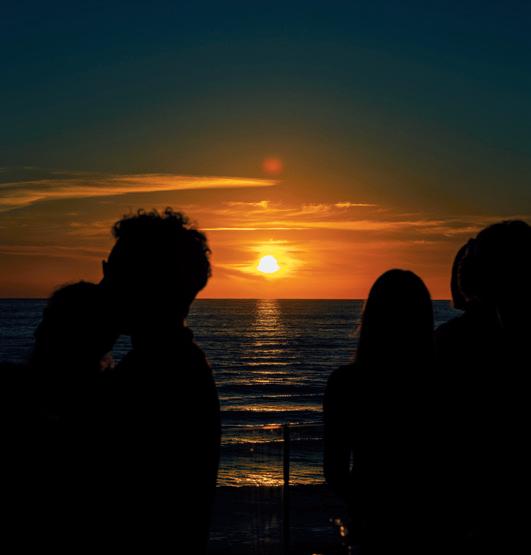
Hong Kong Ping Pong Club
An eclectic DJ crew with something a bit different, for people who prefer dancing over posing. DJs Morphosis, Fat Harry and Spinforth bring everything from hip hop to dubstep and breaks, with the onus on freshness, funk and fun.
SkyDanc3r
Electronic producer and DJ SkyDan3r composes tracks that encompass chillwave, low–fi, house, drum ‘n’ bass, pop, funk and classical. Having honed her skills at the Musicians Institute in Hollywood, she’s now endorsed by French synth company Arturia.
Check what’s coming up at watchful.co.uk/events
Dance the night away under the glow of Eden’s biomes, swing to the lilt of a heartily sung shanty, sit with the quiet of a soft spoken poem. Cornwall’s got rhythm, soul and plenty of stories to tell, so here are our tips on where to take your ears this year…
8–16 May / Fowey
The world’s finest wordsmiths descend on Daphne du Maurier’s hometown in this week-long celebration of books, music and ideas. Guided walks and big-name speakers promise hours of literary wandering and pondering, in a stunning location. foweyfestival.com
Moor Poetry Festival
22–24 May / Sterts Arts Centre
Up amongst the tors and heathland, at the edge of Bodmin Moor, this poetry festival gathers some of the country’s most exciting poets together for readings, workshops and talks. A mixture of big names and new voices, it’s a word-lover’s dream of a weekend. bodminmoorpoetryfestival.com
Various dates / The Wyldes
Tucked away in a wooded valley near Bude, the Wyldes can really put on a show. With past line-ups featuring Fatboy Slim, Paloma Faith, Paul Weller and The Zombies, keep an ear out for their 2020 announcements (which so far include Rag & Bone Man and Keane), and their summer festival, Leopallooza. intothewyldes.com
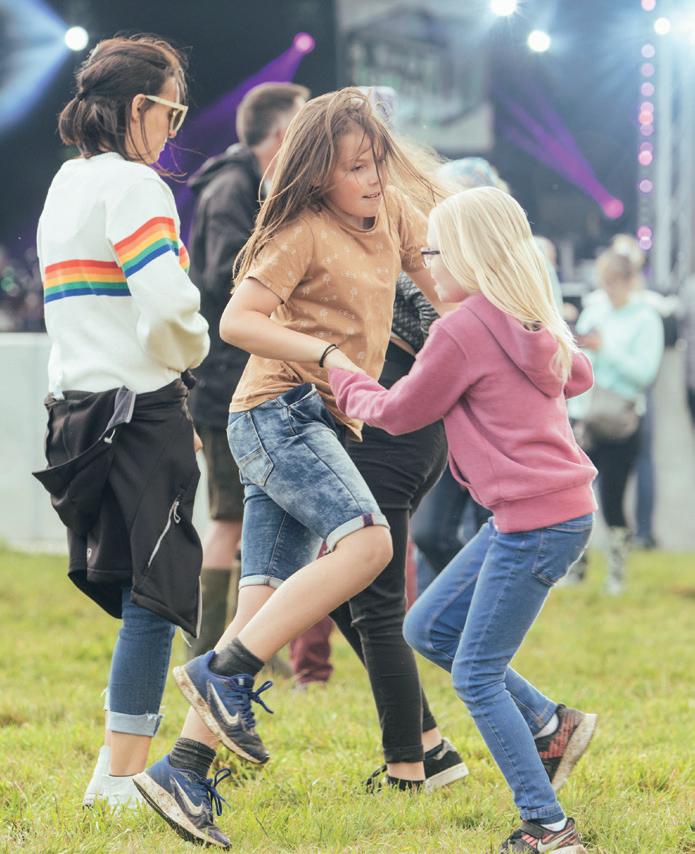
12–14 June / Falmouth
Stroll to the uplifting sound of traditional shanties, ringing from the quayside pubs and courtyards. Falmouth’s sea shanty festival brings over 65 singing groups, thousands of visitors and gallons of good cheer to the lively south coast town – “hooray and up she rises!”
falmouthseashanty.co.uk
11–13 September / Healey’s Cyder Farm
A proper Cornish party, amongst the apple-laden orchards of Healey’s Cyder Farm. Live music, camping, glamping, games and plenty of cider on tap. Grab a pint and join in. cornwallciderfestival.co.uk
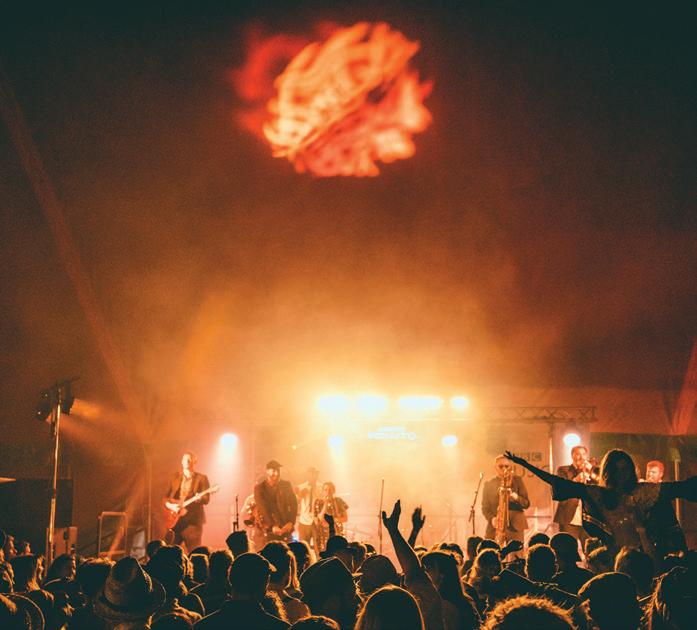
12–26 September / St Ives
An autumn feast of music, performance, art and poetry, the St Ives September festival has been making noise since the 1970s. Soak up all the creative action down cobbled streets and on the shore, all in Cornwall’s mecca for modern art. stivesseptemberfestival.co.uk
23 October (tbc) / Truro College
The Cornish offspring of the global, idea-spreading TED talks, TEDxTruro has hosted talks by speakers sharing their wisdom on everything from the love life of dolphins, to polar exploration, to the truth about robots. One for the curious. tedxtruro.com
Various dates / The Eden Project Since the Sessions began in 2002, The Eden Project has hosted the likes of Kylie Minogue, Björk, Massive Attack, Chemical Brothers, Primal Scream, Brian Wilson, Lionel Richie and many, many more in front of its world-famous biomes. Keep an eye out for 2020 line-up announcements from January. edensessions.com
Eyes on the sea, ears on the melodies, hands in the air – all around you. For five days every year, thousands of music lovers descend on Watergate Bay for the Boardmasters festival. We asked, what makes it stand out?
How would you sum up the Boardmasters experience? It’s a completely unique UK festival experience. Like-minded souls with a love of music, surfing and the outdoors come together for five days on the Cornish coast – with an unmissable line-up at Watergate Bay and international surf competitions at Fistral Beach.
What music will people hear? We bring over 200 artists to Newquay, playing across more than 12 stages at Watergate Bay, various venues in the town and at Fistral Beach. From international headliners to breaking acts, the eclectic bill includes songwriters, indie, pop, grime, DnB, house, rock and more.
How does the soundscape change through a typical day? We host the UK’s largest silent disco. There’s something wonderfully weird about hearing 10,000 campers singing at the top of their lungs whilst the rest of the main stage area is completely silent.
Most memorable musical moment?
Jamiroquai’s headline set in 2017 was really poignant. The set itself was electric, as you’d expect – but it was also the first year the festival sold out (at 50,000 capacity). Being part of that crowd and reflecting on the years of hard work that had gone into making that moment, is a standout memory.
Is there such a thing as a quiet place at Boardmasters? Yes! As well as the music, we have a substantial wellbeing and family offering. You can take time out in a yoga class, the kids can head to a Teddy Bears’ Picnic or superhero workshop, and if you’re in Cloud Nine (our boutique campsite) you can relax in a sauna.
What about the location? We truly have the most beautiful festival site in the UK. The view across Watergate Bay makes for a stunning backdrop. It’s something that the artists comment on every year.
Boardmasters 2020 takes place on 5–9 August. Follow line-up announcements at boardmasters.com
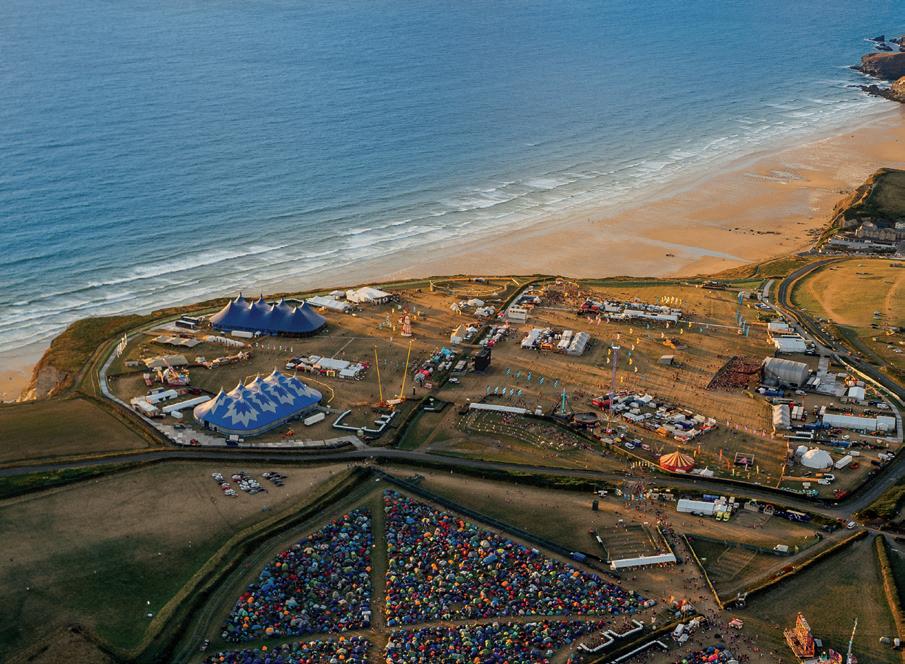
Amongst the adrenalin hunters and the nature spotters, the artists and the weather-watchers, we’ve been collecting some of our favourite words. Learn the Bay’s lexicon, and you’ll fit right in…
When the wind is light and blowing offshore, making the waves well-shaped and clean, surfers will enthuse upon the ‘glassy’ conditions.
A Cornish measure of unspecified time, that means ‘soon enough’, or ‘in the future, at some point’. In Cornwall, most things get done ‘dreckly’…
Whether you’re running on the beach or curled in a window seat gazing at the surf, podcasts open up the world in new and unexpected ways. Here are 10 of our favourites to fish for…
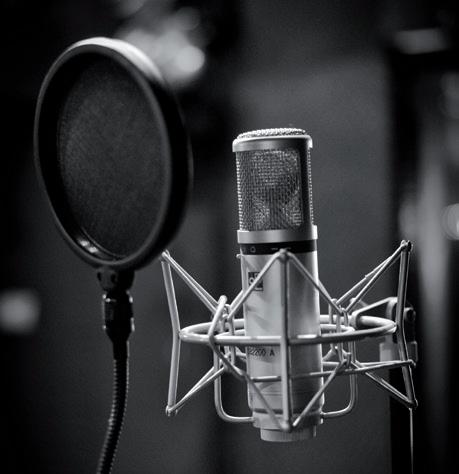
The measurement of how well a surface reflects light and energy from the sun. The sea’s albedo varies according to how rough or calm it is. A flat sea has a high albedo – one of the reasons Cornwall shines on a calm day.
A kitesurfing word, used to describe the point directly above the surfer’s head, where the kite flies at its highest. It’s a neutral position that stops the surfer from moving.
The collective term for a gang of black and white guillemots, as seen (and heard) nesting in their hundreds along the cliffs.
The place at the edge of land and sea that’s covered then uncovered by the tide.
Adventure: Outside
Outside Online has a mission to inspire active participation in the outside world. Its ‘adventures in audio’ comprise interviews and reports on everything from the health benefits of nature to the real science behind the keto diet (and the wrong way to fight off a bear).
Nature: Tweet of the Day
Each episode of this Radio 4 podcast starts with a particular bird song, followed by a story it has inspired – whether that’s from Michael Morpurgo musing on the sinister magpie, or a wistful Will Young on the woodland kingfisher.
Food and Drink: Table Manners
Singer-songwriter Jessie Ware sits at the dinner table with her mum, and a famous guest who’s popped by to chew the fat. Expect anyone from Nigella Lawson to Neneh Cherry, Mark Ronson and Paul Smith.
Food and Drink: Off Menu
Comedians Ed Gamble and James Acaster invite guests into their ‘restaurant’ to choose their dream meal. With food as the conversation’s base, they wind up reaching for some fairly random toppings. Available episodes feature guests including news presenter Krishnan Guru-Murthy, comedian Nish Kumar and rapper Loyle Carner.
Music: Song Exploder
In each episode a singer or musician takes apart one of their songs and shares how it was made, from their inspiration to specific creative decisions. You get rare intimate insight, and hear individual tracks from the recordings. Subjects include U2, Björk, and Solange.
Inspiration: Tim Ferriss Show
The author of The 4-Hour Workweek talks to successful people (Neil Gaiman, Maria Sharapova, Arnold Schwarzenegger, LeBron James…) and digs into what makes them tick: favourite books, morning routines, exercise habits and time-management hacks.
Inspiration: Short Cuts
Convivial comic Josie Long hosts this Radio 4 podcast, comprising short atmospheric documentaries exploring everything from our experience of time to the North Sea micronation of Sealand. Expect unlikely human stories that are fascinating, funny or full of wonder.
Laughs: The Adam Buxton Podcast
Revealing and infectious ‘ramble chat’ from the cult comic and former co-host of The Adam & Joe Show. Things regularly veer from the heartfelt to the ridiculous, with guests including Charlotte Church, Booker Prize-winning author Marlon James and, regularly, Buxton’s old schoolmate Louis Theroux.
Brain Work: Something Rhymes with Purple TV’s Countdown duo Susie Dent and Gyles Brandreth share their love of words and walk us through the hidden origins of language. You’ll end up entertained and enlightened, with your vocabulary suitably engorged – even if you’re not sesquipedalian.
A Fresh Perspective: 99% Invisible
A show about all the hidden thought that goes into designing things that shape our world, from unnoticed architecture to the origin of the fortune cookie, or Sigmund Freud’s decision to use a couch instead of an armchair.
Found on her mat in the studio or up on the coast path, our Pilates instructor tells us how she stays in touch – with herself, her body and with nature.
Where did it all start? For years, I worked as a PA in music law in London. Sitting at a desk hunched over a computer took its toll on my body, and a physio suggested I try Pilates. I was hooked from the first class.
What does Pilates do? It strengthens the deep core muscles that support your spine, to maintain good posture and avoid back pain. It teaches you to move with control and awareness, recruiting the correct muscles. It improves flexibility, co-ordination and balance. And it’s for everyone – you don’t have to be flexible, or a fitness fanatic.
How does it make you feel? In a class we work the whole body, from top to toe. You leave feeling taller, stronger and more energised. You can forget about everything outside the studio and focus completely on yourself for an hour; on your body and your mind, breath and movement.
How important is nurturing that connection to our bodies? Extremely. We place huge demands on them. We’re so busy, we don’t always notice the little warning signs our bodies give us – or we ignore them. We need to pause, tune in and pay more attention. We need to start showing our bodies some love.
What do you do when you need to get away from it all? I spend time with my husband. I go for walks with my beautiful bulldog, Ronnie. I go to the beach or up to the coastal path and look at the ocean. I go for coffee and cake. I cook with produce from our allotment. I read. I do Pilates!
watergatebay.co.uk/active-breaks
In the aftermath of a major race, you may spy long distance legend Charlotte Purdue winding down around these parts, along with her dad Nick. We briefly disturbed their peace to chat racing, relaxation, and a lifetime of visiting Watergate Bay.
British and European cross-country champion, unbeaten holder of the junior 10,000-metre record, third fastest female marathon and half marathon runner of all time in the UK. Charlotte Purdue has barely stopped moving since she was 11, when a coach first spotted her talent and suggested she might like to join an athletics club. Finishing 10th overall in this year’s London Marathon, also achieving the Olympic qualifying time, it’s safe to say that coach was onto something.
Nick’s own mother used to come to Watergate Bay in the 1960s and he spent his honeymoon camping on the cliffs. He brought his children here when they were little, too.
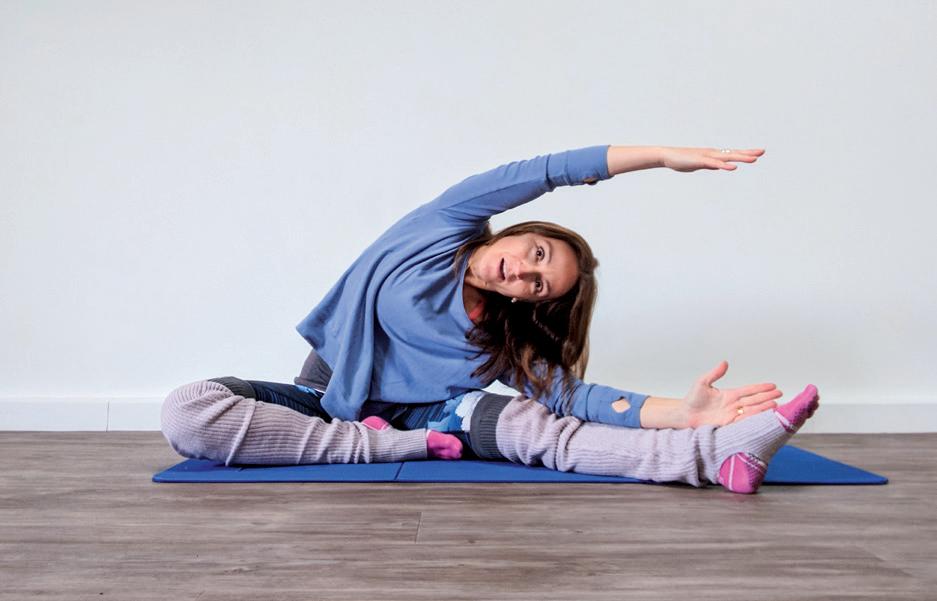
Hitting those heights (and distances) takes tenacity. “I remember in one of the early cross-country days, she lost her shoe halfway round and carried on with one shoe – and still won!” Charlotte’s father, Nick, laughs. “In the mud and muck and horrible weather.” In September 2019, Charlotte was forced to pull out of her marathon race at the IAAF World Championships in Doha. 70% humidity levels created the sensation of running in 44°C heat – even past midnight, when the race took place. “I trained in a physiology lab, set at 36°C and high humidity, which was like running in a sauna,” she says. “But in the end it was like nothing we’d prepared for – almost half the athletes had to pull out.” Numerous athletes collapsed, and a makeshift hospital was set up beside the road.”I didn’t want to ruin my chances, or longer term health, for future races.”
A few years ago Nick first prescribed Watergate Bay’s restorative powers for his daughter’s vital post-race relaxation, after countless summers spent here as a child himself. “I’ve been all over Cornwall, but Watergate Bay is like a second home to me,” Nick says. “We used to go towards the end of the season, surfing on the old wooden belly boards.”
The elements are always putting Charlotte through her paces, from those early rain-lashed cross-country races through British fields and woods, to Qatar’s fierce humidity. But in the spaces between competitions, she comes to Watergate Bay to make peace with the elements. “I find it really relaxing to be near the water, whatever the weather,” she says.
“After a marathon, you can’t really do much – your legs are useless!”
So, after the rigours of training, Charlotte finds respite here. “I usually book a spa treatment, eat lots of food, go for an easy jog along the beach or use the pool, shake out my legs.” And Nick is also able to relive his early beachside memories.
“There’s something about that smell of salt and the fierceness of the waves,” he says. “I think the kids have adopted this place now, too.”
When Charlotte has recovered, it will always be back to the road and the treadmill – and this time her sights are firmly set on Tokyo 2020. Her biggest supporter will, of course, be along for the journey.
“I must have driven 30,000 miles a year in the early days, here there and everywhere,” Nick says.
“And I still get emotional when she’s coming around the corner in the lead.” Of course, whatever happens at the Olympics, you can bet we’ll be waiting for her return, with soft towels, forbidden foods and miles of sand and water.
1. Excitement for them, time out for you
There’s nothing like that buzz of new experiences, all bright eyes and enthusiastic chatter. While parents sometimes feel guilty about dropping children off at the Kids’ Zone or XA Club, children soon revel in trying something they’ve never done before. Love them as you do, can you really compete with flour bomb dodge ball, surf lessons, graffiti art or drinking hot chocolate around a firepit on the beach? So relax and revel in a bit of time to yourself, too.
2. Outdoors, great
Scrambling on the rocks, jumping over the waves, or hunting for sea glass are not just free and easy ways to while away the afternoon. Research shows this sort of activity can help young children build positive self-esteem, autonomy and confidence, while sunlight and fresh air contribute to bone development and stronger immune systems. The Kids’ Zone’s outdoor play area is also designed for climbing, balancing, hiding and exploring, and can be watched from some tables on the Living Space decking.
3. Sea air + exercise = longer sleep
The day may be over, but the benefits go on. A study by the National Trust in 2015 found that people slept on average for 47 minutes longer the night after a decent seaside hike, while those who went for an inland walk of a similar length slept only for an additional 12 minutes. Of course, there are no guarantees, but any increased chance of a lie-in can only be a good thing?
Slow down with yoga and Pilates, or up your pace in the pool. Whatever your body needs, our active breaks mean time to clear your mind, stretch your limbs and breathe in the Bay’s fresh air.
13–15 March
19–21 June
2–4 October
Get to know your body again and learn to move consciously. Marina Huxley (p79) leads an ocean-facing Pilates break that will build core strength and boost energy. This two-day break is new for 2020, and offers a mix of pre-breakfast energiser classes, designed to mobilise the body from head to toe; a selection of focused workshops, including core stability/ abdominals, healthy hips, toned arms and shoulders, spine extension, and a focus on feet; free afternoons; and gentle classes to end the day and prepare for a peaceful night’s sleep. Suitable for beginners and experienced Pilates practitioners alike.
10–12 May 20–22 September
11–13 October 11–13 November
Take time to reconnect body and mind at our yoga break by the sea. Led by Oceanlight yoga instructor Julia Poole, you’ll explore Vinyasa, Yin and Acro styles, take part in brain-expanding workshops and share in calming reflections. Suitable for beginners to intermediate level.
4. Lie-ins all round
Whatever your take on morning TV at home, no one can deny the delights of a lazy holiday lie-in. The family suites at Watergate Bay include a separate bunk room with closing door and television – so early birds can tune in while sleepy parents tune out for a bit more well-deserved snoozing time.
5. A night off
Remember uninterrupted conversations? Enjoying your own dinner without stopping to mop up spilt drinks? Catching up and reconnecting over a meal, drinks or live music (see p76) can be a real treat – if the sea air hasn’t knocked you out completely. The hotel’s free baby monitoring and listening service can be used in all restaurants throughout Watergate Bay, including The Beach Hut, Fifteen Cornwall and Watchful Mary –or book a babysitter and venture further afield.
See watergatebay.co.uk/stay/families for more information on our provision for babies, children and teenagers, including the Ofsted-registered Kids’ Zone and XA Club.
6–8 March 24–26 April 20–22 November
Perfect your form in the water, in our 25m horizonfacing pool. These bespoke clinics, led by swim lab coach Salim Ahmed, combine land sessions with pool time and video analysis. Streamline your strokes and work on your body alignment, for smoother, faster swimming.
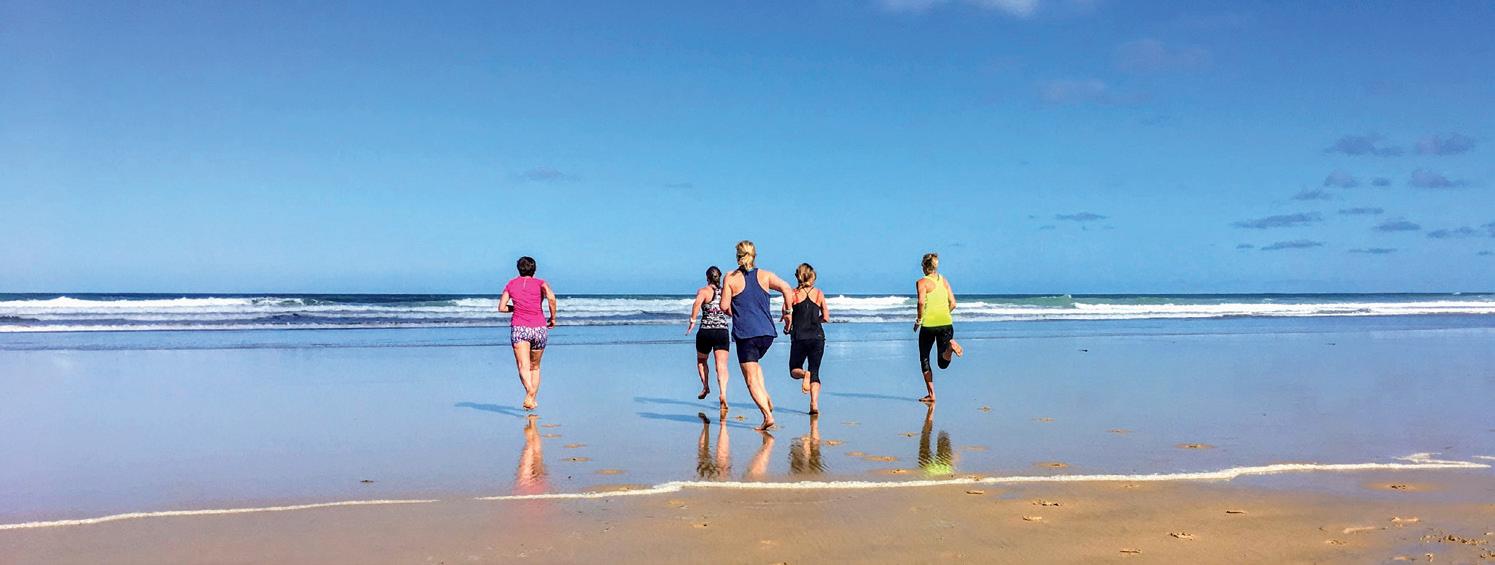
Find out more about all our Active Breaks at watergatebay.co.uk/active-breaks
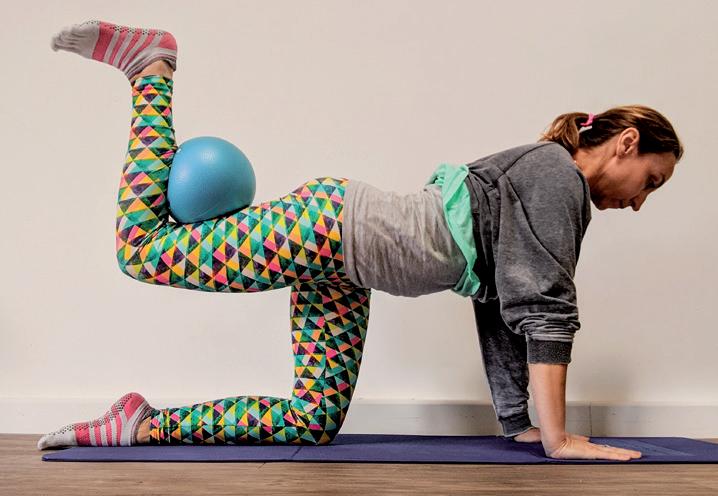
20–23 April
10–13 September
Make the most of nature’s gym by hitting the coast paths and taking on the waves. Emma and Lottie from Mountain Beach Fitness retreats will put you through your paces in the fresh air, with your holistic fitness in mind. All levels are welcome, and a pre-arrival consultation means they’ll work to meet your individual goals.
Rise early, get salty, get stuck in. Every corner of Cornwall has things to try and new experiences to discover. From goat-milking to ice-skating, via a dip in our hot tub, here are some tips on where you might have a go and immerse yourself this year.
Year round / Padstow and Rock
One of the best ways to experience Cornwall is from the water. Wavehunters offers tours along the Camel Estuary and out into the Atlantic, as far north as Tintagel and Port Isaac, to spot everything from puffins, fulmars and peregrine falcons to porpoises, basking sharks and minke whales. There’s no telling which kinds of Cornwall wildlife you’ll encounter– which is all part of the excitement, of course. wavehunters.co.uk/boat-tours-cornwall
First Sunday of the month / Kudhva Kudhva is Cornish for ‘hideout’. Kudhva’s Sunday Service offers a monthly family-friendly afternoon of locally-sourced food, cocktails and music from the pick of the local DJs spinning everything from reggae to disco, all in their beautifully secluded hideout in a disused quarry near Trebarwith Strand. kudhva.com
Piran’s
5 March / Across Cornwall
A celebration of Cornwall’s patron saint, St Piran’s Day celebrations take place across the county. For the pick of the events, head to Perranporth, Truro, Redruth or Falmouth. Expect pasties, marches, waving of the iconic black and white St Piran’s cross flags, and singalongs –including the obligatory ‘Trelawny Shout’, Cornwall’s unofficial anthem.
5 May / Saltash
Rise with the lark and listen to the spectacular dawn chorus birds on the Churchtown Farm Natural Reserve, just one of many events held by the Cornwall Wildlife Trust year-round. And if you’re not so much of an early bird, the Cornwall Wildlife Trust offers coastal photography courses, and a range of talks and walks at more sensible hours.
cornwallwildlifetrust.org.uk
For one weekend in May 2020, Watergate Bay’s long stretch of sand will play host to a world of new experiences, bringing food, music and fresh ideas to the foreshore – against the backdrop of the ocean and under the shade of a spectacular open tent. With performances from opera to spoken word poetry; food trucks and pop-up feasts; workshops, beach yoga and dance parties on the sand – it will be like nothing the Bay has seen before. There will be a mixture of free and ticketed events, so everybody’s welcome to come down and join in. watergatebay.co.uk/events
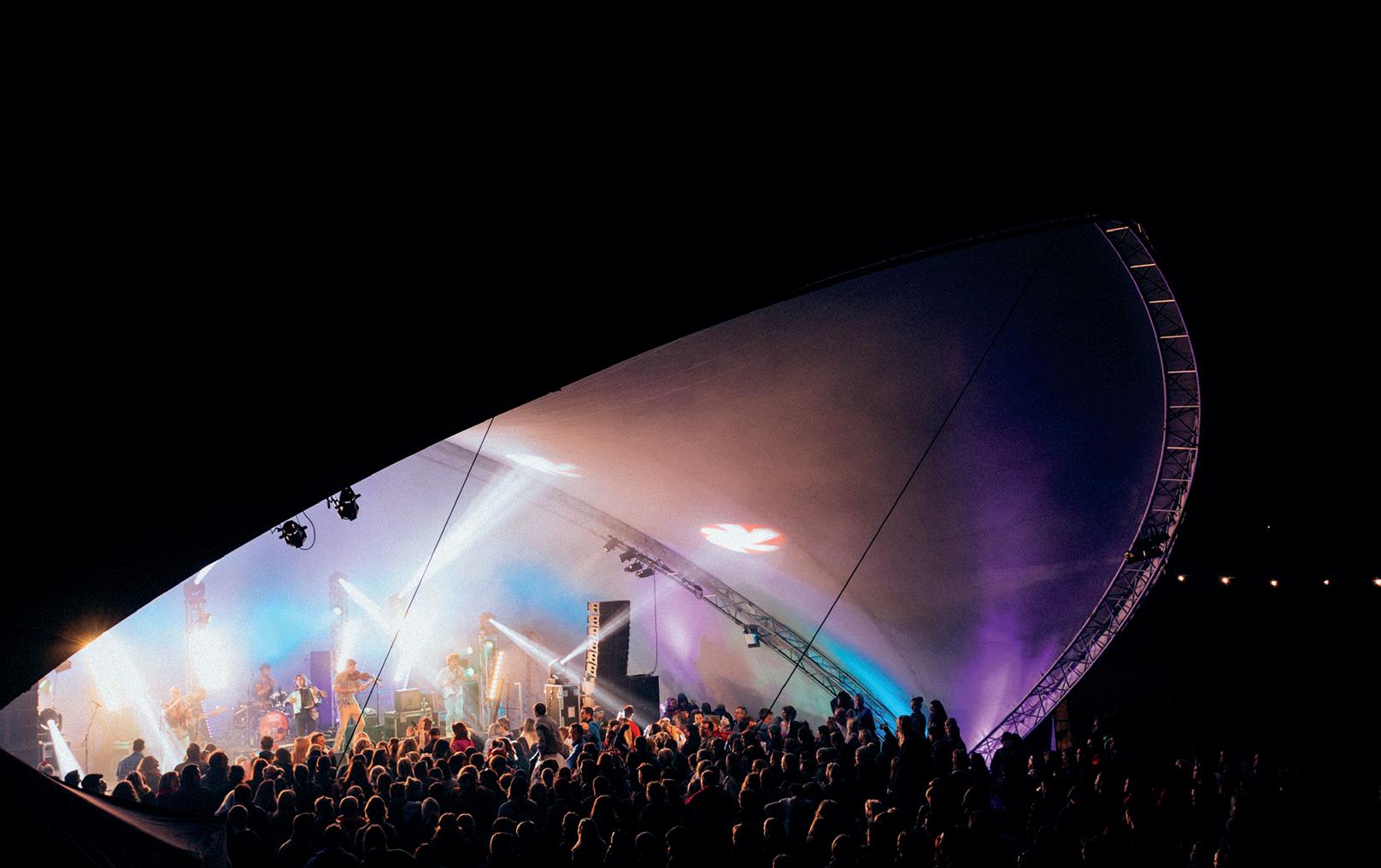
18 July / Watergate Bay
This family event blends a sunset beach run with a music festival and fireworks. Runners of all abilities are encouraged to get active in the 2k and 5k races. There are bands playing before the run and again after, while stalls serve food through the evening, so you can soak up the sounds and feed your soul as you polish your medal and watch the horizon for sunset. Then the fireworks begin.
rock2rockletsrock.co.uk
July / Watergate Bay
The annual Summer Surf Challenge is a whole weekend of surfing activities at Watergate Bay for people with disabilities of all ages, led by trained surf instructors with adaptive equipment. Family fun for those who fancy catching their first waves. waveproject.co.uk
November / Wadebridge
A celebration of Cornish farming and food, there’s a definite hands-on feel to the proceeedings at the Cornwall Winter Fair. Have a go at milking a mock goat, grooming a pony or simply enjoying the food, drink and local crafts on offer.
Late October – February / Eden Project
Lace up your skates at Cornwall’s only indoor ice skating rink in the heart of the Eden Project’s atmospheric surroundings. Fun for all ages – even toddlers, who can enjoy special toy sessions and penguin skating supports. Alternatively, get yourself a hot chocolate or mulled wine and take the photos. edenproject.com
Various dates in December / across Cornwall
Get festive and stock up on original gifts and delicious local produce at one of many Christmas markets held across the county, from Falmouth’s December Festival to the Macmillan Christmas Market at the Eden Project and Padstow’s Christmas Festival, featuring food events, lantern parades, carol concerts, live music and more.
End of November – end of December
Follow the sound of live music and the smell of mulled wine – as it mixes with sea spray on the air. From late November, when the sea lane’s decked with lights, Watergate Bay’s restaurants enter into the spirit. Expect festive pop-ups and seasonal cocktails at Watchful Mary, beach bonfires and marshmallow-piled hot chocolate at The Beach Hut and New Year’s feasting in Zacry’s. Book a Christmas party, or keep your eyes out for ticketed events.
watergatebay.co.uk/christmas-nights
For a Christmas without the stress, we offer the full-on festive experience, from mulled wine and carols around the tree to warm winter hot tubs and Christmas Eve surfs for the hardy.
watergatebay.co.uk/stay/christmas
Everything you need, at a glance…
Stay Book online: watergatebay.co.uk life@watergatebay.co.uk
Reservations: 9am–5pm (seven days a week) 01637 860543
Eat & Drink
The Beach Hut 01637 860877 | the-beach-hut.co.uk
Zacry’s 01637 861231 | zacrys.com
The Living Space 01637 860543 | watergatebay.co.uk/living-space
Watchful Mary 01637 861007 | watchful.co.uk
Jamie Oliver’s Fifteen Cornwall 01637 861000 | fifteencornwall.co.uk
Venus Café lovingthebeach.co.uk/watergate-bay
Active
Extreme Academy – surf lessons and hire 01637 860840 | extremeacademy.co.uk
Swim Club – treatments and classes 01637 861237 | watergatebay.co.uk/swim-club
Events and meetings 01637 861295
Shop
Watergate Bay Shop

Find the land&water bath and body collection, gifts, books and homeware watergatebay.co.uk/shop
land&water
Visit the land&water online store land-and-water-co.uk
Shop on the Beach
Right where you’d expect to find it, selling seaside clothing and footwear, technical surf equipment, buckets and spades and... toothpaste. Everything you could ever need for a stay at Watergate Bay. 01637 860051
Hannah Bailey
Inspired by the natural world, growing things and history, Hannah has illustrated for the likes of National Geographic, Simon & Schuster and Waitrose Magazine. Making sense: “Walking barefoot, early morning in the dewy grass.”
James Bowden
Alice Lascelles
Award-winning journalist and author Alice writes about drinks for the Financial Times. She’s explored everything from the science of wood-ageing to Brian Cox’s champagne collection. Making sense: “Watering the garden on a hot evening.”
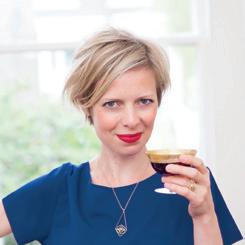
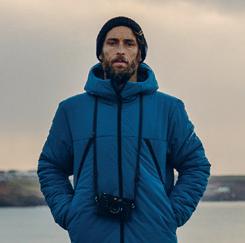
Adventure seeker and surfer, James has wandered the world in search of stories to tell, and shot for everyone from Finisterre to Samsung, Kinfolk to the Guardian. Making sense: “The deep feeling of warmth after an ice-cold swim.”
Sophie Davidson
London-based photographer
Sophie is the creator of ‘Women Cook for Me’, and has taken photos for Vice, Vogue, Penguin and Granta.
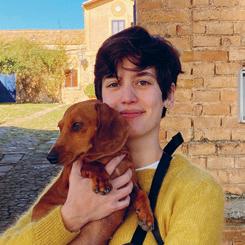
Making sense: “Anchovy on toast with salted butter.”
Jon Denham
Shooting on film and processing by hand, Jon captures the moments often missed. His work has been published in the likes of Huck and Rouler magazines.
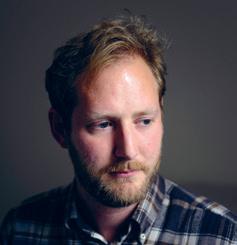
Making sense: “Listening to Max Richter’s Vivaldi Recomposed. Loud.”
Joe Dunthorne
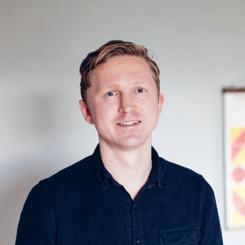
Novelist and poet Joe wrote Submarine (Hamish Hamilton) and The Adulterants (Penguin). His debut poetry collection, O Positive, was published by Faber in 2019. Making sense: “Jumping off rocks into the sea. Unoriginal but true.”
Gareth May
Gareth writes about food, gaming, technology and relationships for Metro, the Telegraph, Vice, Dazed and Wareable amongst others. Making sense: “The sound of a well-made sauce thickening.”
Lizzie Ostrom

Fragrance expert, Lizzie –a.k.a Odette Toilette – is a broadcaster, consultant and author, who has worked with the Tate, Radio 4, Monocle, Liberty London and the Royal Institution. Making sense: “Lighting far too many scented candles.”
Maia Walczak
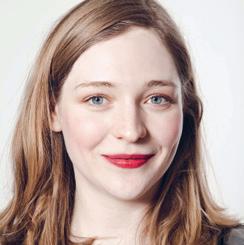
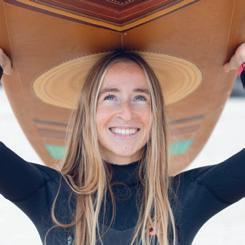
Newquay-based Maia is an artist, author and awardwinning children's book illustrator, inspired by time spent in nature. Her latest wordless picture book, Wylder, is out now. Making sense: “Tuning into birdsong (blackbird is my favourite).”
Dave Waller
Dave writes stories of people forging their own path and making a positive contribution to the world, working on everything from The Times to independent music and comedy. Making sense: “Sniffing a forgotten LP, then playing it.”
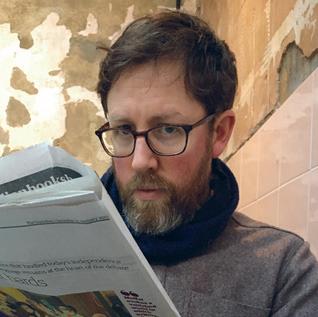
Editor
Judi Blakeburn
Managing editors
Stranger Collective
Assistant editor
Heidi Fitzpatrick
Art director
Nick Wylie
Designer
Holly Donnelly
Illustration
Hannah Bailey
Maia Walczak
Additional writers
Phyllida Bluemel, Áine Carlin, Helen Gilchrist, Clare Howdle, Suzie Inman, Gareth Rees
Cover image
Holly Donnelly
Additional photography
Dr Patrick Avery, Tor Bailey, Miles Barton, Monty Cholmeley, Nic Crilly-Hargrave, Matthew Hawkey, Luke Hayes, Rob Jewell, Tom Medwell, Lewis HarrisonPinder, Kirstin Prisk, Rebecca Rees, Jason Roberts, Filip Wolak, Danielle Wood
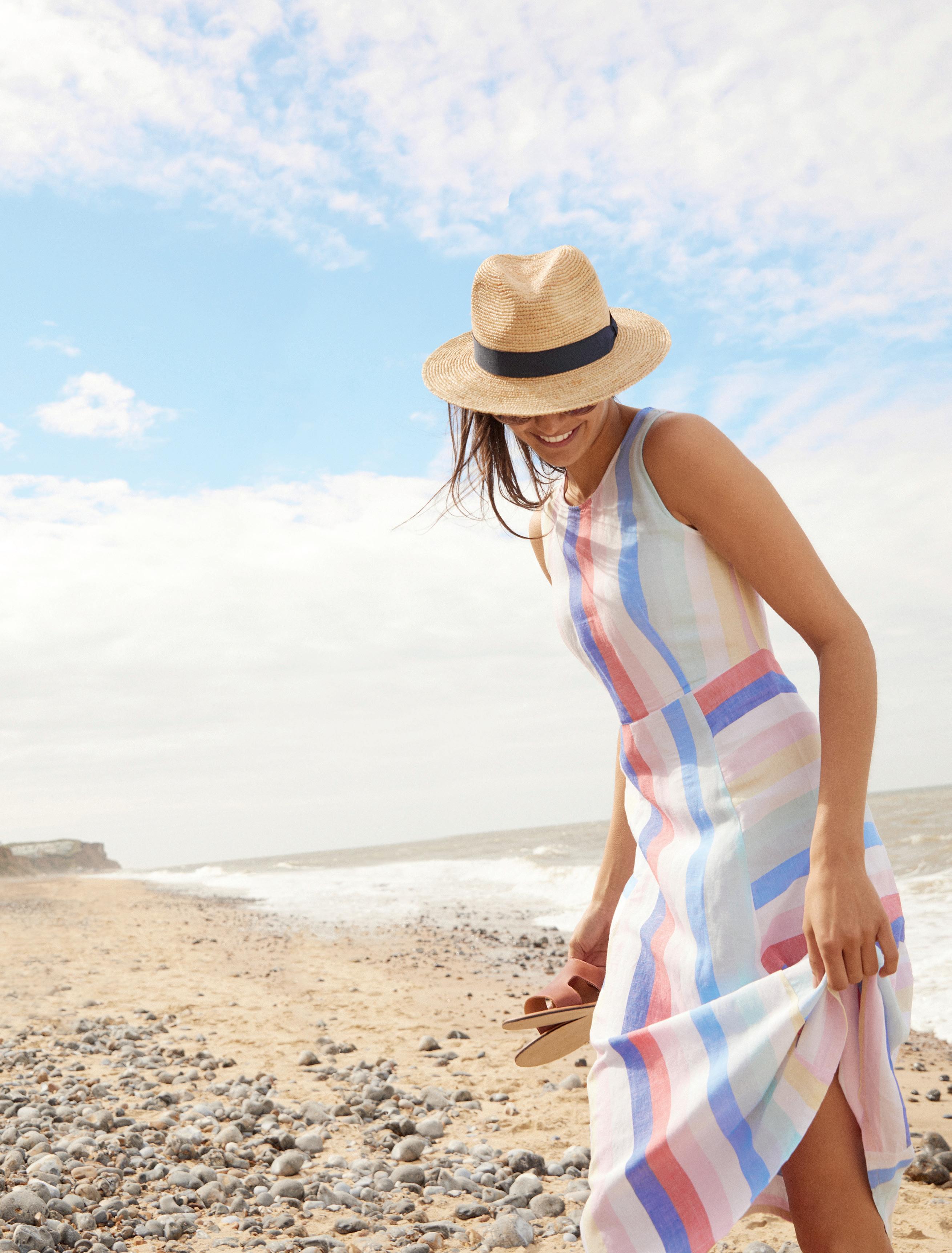
At Joules we create clothing and homeware that we hope will brighten every mood and moment. For classics with a twist, feel-good fabrics, head-turning prints and small details that make a big difference, look no further. Shop