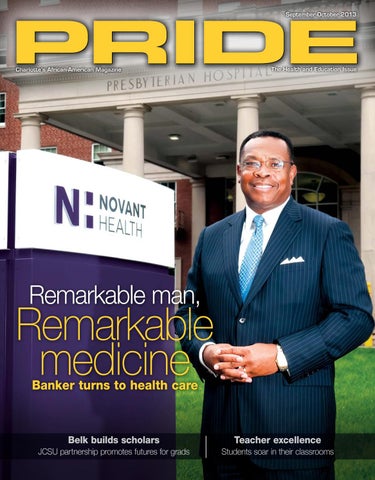
PRIDE September-October 2013
Charlotte’s African-American Magazine
The Health and Education Issue
Remarkable man,
Remarkable medicine Banker turns to health care
Belk builds scholars
JCSU partnership promotes futures for grads
Teacher excellence
Students soar in their classrooms
Eat Smart & LivE a HEaLtHy LifEStyLE Food Lion wants to make it easier for you to make healthy choices when you’re shopping for yourself and your loved ones. We’ve developed personalized information to help you eat healthy, live green and stay well. Visit foodlion.com for information on how to choose and maintain a healthy lifestyle.
follow us on
to the future
to each other
Life’s better when we’re connected tm
to giving back
We know we’re not the center of your life, but we’ll do our best to help you connect to what is.
Bank of America, N.A. Member FDIC. © 2013 Bank of America Corporation. AR397459
bankofamerica.com/connect
for making health a top priority. PNC is proud to support the Pride Communications Health & Education issue. Your caring and dedication has made an incredible impact on the community. For information, contact Conrad Wood at conrad.wood@pnc.com pnc.com
Š2013 The PNC Financial Services Group, Inc. All rights reserved. PNC Bank, National Association. Member FDIC
September-October 2013
Departments 10 From the CEO 12 Notable Names 14 By Faith 16 Good Life 18 Book Review 20 The Mindful Parent 22 Green Movement 67 Scene and Seen 71 Jazz Notes
28
46
64
72
72 Creative Arts 74 Events Calendar
Health 40 Dental Care
Back-to-basics brushing
42 Stroke
Not just an old person’s problem
Business 64 Banking
PNC helps city to ‘grow up great’
On the
Web:
66 FYI
News and notes
Features 24 Silencing
the stigma
Straight-talk about mental health
28 Brand
man
Banker turns to health care
34 What’s
up doc?
The implications of health care reform
On the Cover
Jesse Cureton is the Chief Consumer Officer for Novant Health. Photo by Jon Strayhorn.
Preparing teens for tomorrow
CPCC helps West Corridor students see beyond high school 38 Pink-ribbon
passion
Dr. Vetta Higgs has a heart for women and breast cancer
46 T eacher
excellence
Private school students and families benefit
60 Raging
‘war’ on education
CMS Teacher of the Year makes learning relevant
62 ‘ For
these kids’
Charter school principal demands respect, loves unconditionally September-October 2013 | Pride Magazine
5
Revolutionizing the way you cut grass ... again. IntRoducIng All-Wheel dRIve Husqvarna’s latest innovation is a sleek All-Wheel Drive mower designed for uneven terrain and the toughest mowing conditions.This rugged mower features a heavy-duty steel deck and a powerful Honda® engine. With a premium comfort grip and variable drive speed, you can mow more comfortably and at your own speed.
Get Scan the free mobile app at here with your smartphone
http:/ / gettag.mobi to see it in action.
Learn more at husqvarna.com/us/awd
©2013 Husqvarna AB (publ). All rights reserved.
Celebrating Charlotte’s
Criteria PRIDE MBE OR WMBE OF DISTINCTION:
Pride Awards 2014 Saturday, January 18th
Westin Hotel
The Pride Awards are presented annually to honor achievement in the African-American community. This year’s gala will spotlight business diversity in the Charlotte region. The gala will honor one outstanding minority-owned business; one youth entrepreneur and recognize one corporation for its supplier/business diversity best practices. A selection committee will choose winners for the following awards: “Pride MBE or WMBE of Distinction; Pride Teen Entrepreneur of Distinction and the "Pride Corporate Business Diversity Champion." This year’s monetary donation will be given to a nonprofit organization whose mission is to promote, support or help entrepreneurs. Members of the community may submit nominations or qualified candidates may self-nominate. Celebrating excellent achievement of AfricanAmericans in the Charlotte region for over 20 years. The heroes who will be recognized at Pride Awards 2014 will be African-Americans who have excelled as minority entrepreneurs with a passion for their work and commitment to excellent job performance and community involvement. They may be well-known citizens or behind-the-scenes individuals who have not been recognized for their work. Their achievements may affect many in small ways or a few in big ways. All qualified nominees will be considered. Nominees must be African-American (or African) residents of the Charlotte region. They must meet the criteria as outlined on this page. Employees of Pride Communications and their immediate families are not eligible. Pride Awards sustaining sponsors are ineligible to receive the Corporate Business Diversity award.
NOMI NAT I ONS MUST INCLUDE A nomination form along with any additional information and supporting material as specified in the accompanying criteria.
The DEADLINE for submitting nomination forms and all supporting material is
MONDAY, OCTOBER 21, 2013. Send Pride Awards Nominations to: Pride Magazine: P.O. Box 30113, Charlotte, NC 28230. Or, you may hand deliver your nominations to 312 West Trade Street, Suite 600.
Winners will be honored at a black tie gala on Saturday, January 18, 2014 at the Westin Hotel. All winners will be recognized for their accomplishments. One nonprofit organization will receive a monetary donation.
Be sure to mark your package “Pride Awards 2014 Nomination.”
Nomination Form (Please print or type)
Please circle one category PRIDE MBE OR WM BE OF DIS TINCTION P RIDE CORPORAT E BUSINE SS DIVERSITY CHAMPION PRIDE TE EN E NTREPRENEUR OF DIS TINCT ION
INFORMATION ABOUT THE NOMINEE Address: City/State/Zip: Phone:
Email:
PRIDE TEEN ENTREPRENEUR OF DISTINCTION Name: Grade:
Age:
School: Phone:
Email:
INFORMATION ABOUT PERSON MAKING NOMINATION Name: Address: City/State/Zip: Email: Business:
1. In what way does your nominee qualify to win this Pride Award? 2. How has your nominee been outstanding?
Name:
Phone:
Please respond to the following on a separate sheet of paper. The quality of your responses will influence the selection.
3. Explain other relevant information about the nominee and his or her accomplishments. **Make sure all of the requirements listed under the criteria section are submitted either by you or the nominee.
This year’s monetary donation will be given to a nonprofit organization whose mission is to promote, support or help entrepreneurs.
Deadline for nominations and all supporting materials:
MONDAY, OCT. 21, 2013 You may download a reservation form at www.prideawards.net
This prestigious award will honor an African-American male or female, properly certified, entrepreneur who has established a footprint of outstanding business performance through participation in a corporate supply chain and beyond. They have been able to maintain viable collaborative relationships with large companies and have employed creative and innovative strategies to not only get the job done, but to also provide diversity of thought, allowing for a measurable return on the investment. The following must be submitted: 1. A one-page letter stating why the MBE/WMBE should be considered 2. Proof of current minority certification 3. Letters of recommendation from at least two (2) companies which include (a) information on the nominee's overall business performance; and (b) what impact this had on the project's bottom line 4. A work history from the nominee, including a summary of his or her accomplishments and community involvement. Please include major products or services supplied along with any innovative approaches implemented 5. Any other relevant information for consideration
PRIDE TEEN ENTREPRENEUR OF DISTINCTION
This prestigious award will be presented to an African-American high school senior in the Charlotte region who has started a business or who has been involved in a formidable businessrelated venture. He or she is entrepreneurial minded and demonstrates a proclivity for leadership and being socially responsible. This student has a satisfactory academic record and will attend college with plans to put entrepreneurial skills into practice. The following must be submitted: 1. A letter from the nominator stating why the student should win, citing specific examples of the student's entrepreneurial activities 2. Two (2) letters of recommendation: one from a teacher and one from a person familiar with his or her work 3. An official transcript of grades 4. An essay by the student regarding entrepreneurship and the importance of social responsibility (Two-page maximum) 5. Any other relevant information for consideration
PRIDE CORPORATE BUSINESS DIVERSITY CHAMPION
This prestigious honor will be given to a corporation in the Charlotte region that implements strong supplier diversity initiatives as a part of its overall company strategy. It can be an emerging or well-established organization. (Pride Award sustaining sponsors are not eligible to receive this award.) This company is aware of the demographic change in our society as it relates to buying power and understands the potential positive return on investment incorporating minorities, women and disabled veteran owned companies into the supply chain will have. The following must be submitted: 1. A one page letter outlining why this organization should be considered. (Companies may self-nominate.) 2. Provide evidence (in writing) of the following best practices (or plans) with regard to supplier diversity: (Please use specific examples when appropriate.) A. Have support from the top with a holistic approach B. Provide education on how women and minorities can become a part of the supply chain C. Provide clearly defined opportunities that demonstrate the value diverse vendors bring to the table D. Monitor and measure the return on investing in diverse businesses E. Become involved with community organizations that promote, support and certify minority owned businesses F. Any other relevant information for consideration
PRIDE M
A
G
A
Z
I
N
E
Charlotte’s African-American Magazine
CEO/Publisher Dee Dixon
Editor
Lee McCracken
Lead Writer Angela Lindsay
Creative Director Fabi Preslar
Distribution/Web Site Liaison Tye Feimster
Account Executive Nikelle Fesperman
Public Relations Nepherterra Estrada
Design & Production
SPARK Publications www.SPARKpublications.com
Subscribe to Pride
$13.25. Please subscribe online at www.pridemagazine.net or mail to P.O. Box 30113, Charlotte, NC 28230
Letters to the Editor Please send an e-mail to info@pridemagazine.net fax to 704-375-9550 or mail to Pride Magazine 312 W. Trade St., Suite 600, Charlotte, NC 28202 www.pridemagazine.net
Copyright© 2013 Pride Magazine All rights reserved. Copying or reproduction, in part or in whole, is strictly prohibited.
Pride Magazine prints with soy ink. Vol. 21 No. 5 September-October 2013 All rights reserved for PRIDE Communications Inc. Find us on Facebook Facebook.com/NCPrideMagazine
September-October 2013 | Pride Magazine
9
FromTheCEO
by Dee Dixon
E
Stay tuned …
ducation and health care are two of the hottest buzzwords across the country, and both are vital to the well-being of our city. Decisions we make on both fronts will impact our quality of life right now, as well as in the future.
and co-workers. Dr. Vetta Higgs at Levine Cancer Institute talks straight about what black women need to know. Pride also applauds the highest-ranking African-American at Novant Health: Jesse Cureton. He’s a native Charlottean and is top-of-the-line.
Our kids, our health
As far as education goes, the new state budget passed in July is pretty “ugly” with regard to our already struggling children. Did you know North Carolina ranks 46th in the nation in terms of teacher pay? Money for teacher assistants, instructional supplies and more has been cut. How are our students expected to learn? Many teachers and parents are outraged, saying the state cannot raise accountability and lower resources at the same time. In addition, North Carolina’s new law, which says low scores on third-grade reading exams can hold children back from promotion to fourth grade, has a lot of people talking. In July, the YMCA, MeckEd, WFAE and Teach For America held a discussion at Friendship Missionary Baptist Church about the Read to Achieve program and what could happen to all the third-graders who fail the reading exam next spring. Get this: In 2012, almost 30 percent of third-graders in CMS (some 3,200 children) failed the test! There are some GOOD things going on in Charlotte educationwise, though. This issue spotlights educators who are making a difference despite the difficulties they face. Local private schools boast significant teacher passion (and employment tenure), which contributes significantly to student satisfaction and academic success. Plus, we applaud James Ford, 2013 CMS Teacher of the Year. He is 32 and phenomenal! And, six new charter schools opened in Charlotte in August, making more options for families. By the way, the number of charter schools in Mecklenburg County could double in two years, going from 12 in 2012 to 25 in 2014. So parents, you MUST do your homework in order to make the best choice for your children. Speaking of charter schools, there is one making a huge difference in the lives of its students: Crossroads Charter. Turn to page 62 and read about principal Gentry Campbell. I personally visited with her, and she is truly the female version of “Joe Clark.” Moving on. Health care reform has everyone asking questions. Our article on page 34 lays out a few of the ways Carolinas HealthCare and Novant are at work getting ready to handle the influx of newly insured people. And next month, our city will be all pinked up for breast cancer awareness. It's a good thing, because African-American women are dying! We are at risk for the most aggressive types of breast cancer, and twice as many of us are dying than our white friends, neighbors 10
Pride Magazine | www.pridemagazine.net
PEEP camp
Friends, I want to tell you how fantastic our Pride Entrepreneur summer camp was this year! PEEP partnered with Firm Foundations to serve 25 students ages 10-14 for eight weeks of all-day education, enrichment and fun. We are so grateful to PNC Bank, Johnson C. Smith University and other contributors that made this entrepreneurial experience possible. We’ll share more in our next issue.
Call for nominations — Lowe’s Pride Awards 2014
Ladies and gentlemen, the 21st annual Pride Awards is set for Saturday, Jan. 18, 2014, at The Westin. It’s going to be a gamechanger, for sure. We’re looking to award an MBE or WMBE, a teen entrepreneur and a corporation with outstanding supplier diversity practices. Please send your nominations to us ASAP, so we can get this show on the road. (Flip back to page 8 for details.)
Arsenio Hall
Did you know Arsenio is back with a late-night talk show on WSOC-TV? I had the opportunity to interview him when he visited the Queen City in July. It was a trip, as you can see from the photo. Go to pridemagazine.net to enjoy the entire interview. I know you’ll laugh with me. I must run, but in closing, please don’t forget the Sunset Jazz festival on the Sept. 14 at Symphony Park, SouthPark. Bring a picnic and chill with us, like in the good ol’ days. We all need some down time.
THE WORST DAY AT WORK BEATS THE BEST DAY IN FORECLOSURE. SEEKING A SOLUTION FOR THOSE SEEKING JOBS
With job loss responsible for up to half of all mortgage delinquencies, getting people back on their feet became our focus. But the economy and the job market have changed. People desperately looking for work need help. Which is where Fifth Third Bank and NextJob, a nationwide reemployment solutions company, came in. Last year we initiated a pilot program that provides mortgage customers up to 39 weeks of job training – including live coaching, job search training and software – fully paid for by Fifth Third Bank. Participating Fifth Third
customers at risk of defaulting on their mortgages had experienced, on average, 22 months of unemployment. After six months of reemployment assistance, nearly 40% of participants had secured meaningful employment. BUSINESS AS UNUSUAL
Our commitment to reemployment continues to grow with the signing of a multiyear contract with NextJob, which allows us to move the program out of the pilot phase and incorporate it into the way we do business. Curious behavior for a bank? Maybe. But we’re proud to be the first financial institution to offer such assistance and hope we won’t be the last.
Fifth Third Bank. Member FDIC. Equal Housing Lender .
NotableNames
James Taylor
Last September, Carolinas HealthCare System hired James Taylor as its first diversity officer. For Taylor, who calls himself a Gen-Xer, “diversity in health care is very different — it deals in matters of life and death.” Taylor came to Charlotte from Oakland, Calif., where he had worked with Kaiser Permanente for 10 years, most recently as executive director for diversity strategy execution and workplace inclusion. He earned his undergraduate degree from Ithaca College in New York and his master’s and doctorate degrees from the California School of Professional Psychology at Alliant International University. Taylor was recruited by CHS, but he says it wasn’t a hard sell. “It’s a provider of people who often don’t often have a voice, and that’s important to me. The organization is ready and willing to advance the great work it already is doing to integrate diversity into its core business and make it part of its strategy to grow.” Charlotte’ growth, culture and progressiveness also attracted Taylor, who is single. It was also a homecoming of sorts. “My family originally was from the South, but I’ve lived in New York and California all my life,” Taylor says. So although I haven’t lived in the South before, the South has lived in me.”
12
A. Fulton Meachem, Jr.
Fulton Meachem recently applauded 100 local students in a ceremony where scholarships were awarded to help youth move forward toward their dreams. He was named president and CEO of the Charlotte Housing Authority last October. Living and working in Charlotte had been a long-time dream. Meachem was born and raised in Greensboro, graduated from N.C. Central University and worked as the head of the Winston-Salem Housing Authority. He then spent six years in a similar position at the Housing Authority of the City of Pittsburgh. “I was in Charlotte for my interview while the Democratic National Convention was here. I saw that the city was progressive and had great leadership,” he says. “The city doesn’t hide from the issues of the day. There’s a great deal of collaboration to address... homelessness and generational poverty. I wanted to be part of it.” Meachem, 44, and his wife have two sons. He has spent his entire 19-year career in the affordable/public housing field. “It’s a perfect field for me, because it gives me the opportunity to help people. There’s nothing more gratifying than working with a family to help them into an apartment or providing a support system for youth so they know there is more to life than the four corners of their apartment or neighborhood.”
Pride Magazine | www.pridemagazine.net
Dr. Anthony Stallion
After 12 years as a staff surgeon at Cleveland Clinic Children’s Hospital, Dr. Anthony Stallion joined Carolinas HealthCare System in July as the chief of pediatric surgery. He will work throughout CHS, including Levine Children’s Hospital and Jeff Gordon Children’s Hospital in Concord. Stallion also was an associate professor of surgery at the Cleveland Clinic Lerner College of Medicine and is a recognized leader in pediatric surgery, having been included on the 2013 National Best Doctors in America list. He is a three-year member of the American College of Surgeon’s National Committee on Trauma and a former associate and interim director of a level I pediatric trauma center. Carolinas HealthCare operates the region’s only Level-1 trauma center. “I’m committed to helping (CHS) provide world-class care by promoting health and wellness for children in the Carolinas, developing educational programs and building robust community and clinical programs that deliver the very best quality care,” he says. Stallion, 52, earned his medical degree from the University of Michigan Medical School, did his general surgical residency at the University of Cincinnati Hospital and then completed pediatric surgery fellowships at Children’s Hospital Medical Center in Cincinnati and Children’s Hospital of Michigan in Detroit. Stallion has two children.
Joseph Butler
Looking for a good place to raise two teenage daughters, Joseph Butler and his wife moved to Charlotte in 2006. The Queen City has proven to be a good place for him also to live out his commitment to inner-city youth. Butler, 43, joined Big Brothers Big Sisters of Greater Charlotte as its director of community engagement in May 2010. In June 2012, he was named its director of corporate relations and events. He had previously held development positions in Charlotte with the Arts and Science Council and the United Way of Central Carolinas. “I was involved in direct service before, but now I raise money to help put people with heart and passion in relationships with kids who need love, caring and oneon-one attention. It’s the nature of who I am.” Butler’s father was a minister, so the family lived all over the United States. He earned his accounting degree from the University of Toledo and his undergraduate degree in business from Montreat College, where he’s now working on a graduate degree in management and leadership. Butler came to Charlotte from Augusta, Ga., where he had worked with the Boy Scouts of America and Augusta Urban Ministries. His Saturday morning radio show, “Start Something,” can be heard on WGIV. — Bea Quirk
CharRadAd.pdf
1
8/14/13
8:57 AM
C
M
Y
CM
MY
CY
CMY
K
MUSIC
Violin
Viola
Cello
Double Bass
REGISTER NOW! Online OR In Person
LESSONS
50% OFF
Traditional and Suzuki Private Lessons Group Lessons Ensemble Coaching
First Month’s Lessons One coupon per family. Expires: 11/1/13
704-286-6386
www.uptownstringacademy.com
ByFaith
by Rev. Dwayne Bond
W
ords are powerful tools. They have a tremendous impact on people and their relationships, both positively and negatively. In a positive way, words can encourage, strengthen, affirm, edify and celebrate. Humanity benefits from positive words. Negative words can discourage, frustrate, humiliate, destroy and disappoint. Words can take an emotional, mental and physical toll on our well-being. There is a clear connection between human health and spoken words. The Bible explains how speech directly impacts our health. (“Gracious words are like a honeycomb, sweetness to the soul and health to the body.” Proverbs 16:24) What are gracious words? First, let’s understand the meaning of grace: love that pursues, even when the target of pursuit
Speak graciously to feed and nurture offered to someone who has not necessarily earned them. Gracious words are given based on the love of the giver, not the merit of the recipient. Gracious words are life giving. The Bible verse compares gracious words to a honeycomb — a structure of hexagonal, thin-walled cells made from beeswax in order to store bee honey, pollen and larvae. Simply stated, a honeycomb is the bee’s storage unit for honey. The Scripture is saying that gracious words create a nourishing supply of nutritious “sweetness” to the soul, as well as health to the human body. It also refers to both our bodies and our souls. Man is not only a physical creature, but he is also a living soul. The physical nature of our bodies comprises cells, tissues, organs and fluids.
“Gracious words are life giving.” has nothing to offer or give in return. Grace gives generously to the undeserved. Extending grace is to lavish the unmerited with a gift. Grace is thinking the best about a person when there is no reason to do so. Grace is amazing. Grace is free. Grace is inexhaustible. Therefore, gracious words are more than just kind words; they are words that are generously 14
The immaterial part of our bodies consists of a soul. God formed the man of dust from the ground (material) and breathed into his nostrils the breath of life (immaterial), and the man became a living creature. (Genesis 2:7) Our bodies and souls are affected by words. When we speak gracious words to one another, they holistically
Pride Magazine | www.pridemagazine.net
feed and nourish health and offer delight, satisfaction and refreshment. (“There is one whose rash words are like sword thrusts, but the tongue of the wise brings healing.” Proverbs 12:18) Gracious words heal, soothe and comfort. On the contrary, rash words destroy, harm and break hearts. How do we become more gracious in our speech? We
become gracious with our words when we place our faith in the grace given by the Gracious One — Jesus Christ. May His relentless pursuit of you and His offering of the gift of grace engulf your heart and empower you to be a dispenser of grace to those in your midst. P Rev. Dwayne Bond is the lead pastor of Wellspring Church.
GoodLife
by Kenston Griffin
13 steps to go from average to awesome
A
n author once said: “Never stop a task until it’s done. Be the laborers, big or small, do it well or don’t even think about doing it at all.” It’s my business to coach and motivate people in achieving their dreams. Now, it’s my privilege and honor to offer you these tips, which can enhance your ability to obtain the necessary skills to consistently acquire the good life. Whether you work in corporate, for a non-profit or are an entrepreneur, it is essential to always have a positive outlook on life. This is the most important thing, and it will assist you in ensuring you are able to transition your average to awesome. Here are some key strategies. 1. Accept reality, so you can change it. To move forward in life, you must first accept the reality of what it is. This will provide you with an important starting point from which you can move into any direction you choose. To deny this reality, or fight against the past, will merely waste your time and energy. So in Michael Baisden’s famous words, “It is what it is.” 2. Set goals. Most people know goalsetting is important, but they never assess their goals. Always inspect what you expect from multiple lenses, and your goals and dreams can become a reality. 3. Hold yourself accountable. Write your vision and make it plain by means of steps and strategies. 4. Live within your means. There is an old saying, “Don’t keep up with the Joneses.” Consider this: Unless your last name is Jones, you never have to keep up with them. And if it is, evaluate if your bank account is like theirs. 5. Pay attention to your feelings, thoughts and spirit-snatchers. Some people don’t want to win, nor do they want
16
Pride Magazine | www.pridemagazine.net
Accept reality, so you can change it. To move forward in life, you must first accept the reality of what it is.
you to win. Remember, misery loves company. 6. Appreciate the simple things in life. Don’t let your highs get too high, or your lows get too low. 7. Eat healthy and exercise. Never forget, by the yard is hard, but by the inch is a cinch. Track this daily and in 90 days or less, your health outcomes will change. 8. Monitor your thoughts. Your thoughts become words, and your words become actions. Your actions can become your character, and your character ultimately becomes your destiny. 9. Identify friends versus associates. Accept the reality that some people never intended for you to have the good life. 10. Let go of your past. Remember, yesterday ended last night. It’s a new day. Get up, get out and do something. 11. Don’t fall for the lie of impossibility. If no one ever told
you that something was impossible, would it be possible? The thing that makes it impossible is the belief you cannot achieve it. 12. Replace “I can’t” with “I can.” Negative thoughts will receive negative outcomes. Therefore, purge unnecessary headaches and relinquish your gifts to the universe. 13. Lucky 13: If God is for you, who can be against you? Now that you have the key steps to acquiring the good life, on your mark, get set … GO and GROW! P Kenston J. Griffin is the founder and CEO of Dream Builders Communication, Inc., a consulting/development, training, coaching and public speaking firm headquartered in Charlotte. Visit www.dreambuilderscommunication.com.
IT’S THE EXPERIENCE!
“2011, 2012, 2013 Charlotte Magazine Top Dentist”
“2012, 2013 Best Dentist by Elevate Lifestyle Magazine”
www.southendsmiles.com facebook.com/southenddentistry
1520 South Boulevard, Suite 110 • Charlotte, NC 28203 • 704.335.8266
Bradford L. Picot, DDS, PA
BookReview
by Angela Haigler
R
eady for a wickedly scathing and furiously funny view of AfricanAmerican life? This book, by Baratunde Thurston (HarperCollins, 2012), is more than a primer about black culture. It gives insight into Thurston’s life — a man who grew up to be a comedian and author, and who is the former director of digital for The Onion.
‘How to be Black’ His father was killed in a drug deal gone bad. Raised by a single mother he described as a “pro-black, Pan African, tofueating, hippie,” young Thurston straddled two worlds. On the one hand, he was encouraged to explore all things African and to connect with African-American culture. On the other hand, he accessed the many opportunities offered to mainstream society,
such as attending The Sidwell Friends School, known for educating the children of elder statesmen and presidents. Likely this juxtaposition of cultures provided a multiplicity of
considered a new crop of young activists fighting for the right to exist in the social media sphere and beyond. Their voices are refreshing. Don’t expect a run-of-themill humor based on traditional
Baratunde Thurston
views that became the sharpening stone for Thurston’s cutting wit. Once the book is opened or is listened to, the humor flies out. First, Thurston teases readers that his book is the perfect gift for Black History month. Later, he picks fun at the perception that blacks rarely know how to swim. In addition, he interviews some of his like-minded colleagues to get their views on the book’s topics. Friends who assist with the storytelling, by providing their unique perceptions as thirtysomethings from Thurston’s era, include Cheryl Contee, the co-founder of Jack and Jill Politics; Christian Lander, the white author of the blog and book titled, “Stuff White People Like;” and Elon James White, an awardwinning blogger. The assortment of friends featured in the book are about as interesting as Thurston’s views. They represent what could be 18
Pride Magazine | www.pridemagazine.net
themes. These are the kids who may have been told they were too black, or not black enough. Baratunde and his cast of reallife characters pride themselves on encouraging a different way of thinking about what it means to be black in society. Baratunde’s responsibilities at The Onion included producing the “War For The White House” 2008 election coverage; helping the company adapt its storytelling to new digital platforms, such as smartphones and social media; and expanding The Onion’s public voice. He’s been a standup comedian for more than 10 years and was named one of the 100 Most Creative People in Business by Fast Company magazine in 2011. P Angela Haigler explores the literary world at www.angelicmusings.wordpress.com and on Twitter @angelicmusings.
PROUD TO GIVE BUSINESSES A LIFT CATS is proud to provide opportunities for businesses to create local jobs through the advancement of transit projects. CATS also seeks to create an environment that gives small and socially or economically challenged local businesses the opportunity to compete for publicly funded contracts by participating in the Small Business Opportunity (SBO) and the Disadvantaged Business Enterprise (DBE) Programs. On the LYNX Blue Line project, for example, CATS spent $42.9 million with 38 DBE firms to build the new light rail system. As the major provider of public transportation to Charlotte and the surrounding region, CATS relies on the communities we serve to build and operate the service every day. By working together on these new opportunities, we can all keep our communities moving in the right direction. For more information, visit ridetransit.org.
TheMindfulParent
by Christina Christian
Multitasking moms and dads
I
t’s a new school year, and life is bustling once again. At the end of the day, we subconsciously set our alarm clocks before falling into what we hope to be a well-deserved sleep. We wake to a daily routine of preparing ourselves for work while our children prepare for school. Each morning as we part, we call out, “Have a good day,” and then at the dinner table, we reconvene and ask our children, “How was your day?” and “Do you have any homework?” These two questions
are asked virtually every weekday for the entire academic year and represent the focus, and often the extent, of parent-child communication. Certainly, though, when children receive an award or boast about something extraordinary in the classroom, the conversation becomes more exciting and focused. How is it that we have become so regimented and fixed in limited communication and engagement with our children? 20
Pride Magazine | www.pridemagazine.net
Going through the motions
The human brain performs functions that range from the mundane to the miraculous. Any behavior that is performed daily or routinely qualifies as the mundane and is regulated by two special areas of the brain: the dorsolateral and the dorsomedial. These small areas, located in the rear midline of the brain, are designed to store and aid us in unconsciously performing routine daily tasks, such as brushing our teeth, putting on our shoes
and driving to work. Our brains are spared from using unnecessary energy and power on something that we clearly have mastered … and this is how we are able to multitask (i.e., plan for a meeting at work while taking a shower and ask the kids about school while fixing dinner). The truth is, most of the time most parents are unconscious to what is really going on around them. It’s called mindwandering, and research has shown the
average person spends 46.9 percent of the day in an unconscious state. We’re not fully present or conscious of what is going on unless the routine is broken.
Awakening to the moment Regrettably, it takes extreme circumstances and events to rouse us from this sleepy state of mind. When it comes to talking with children, mothers and fathers often become conscious to what’s really going on in their children’s lives for the rewards and referrals, terrific and traumatic, the celebratory and ceremonial — breaks in the normal routine. What is more unfortunate is that, while in this unconscious state, children are growing and developing. Their beliefs are forming, and they are learning and mastering … but parents aren’t entirely certain what they’re children are mastering. Perpetually wandering, unconscious minds prevent parents from being fully (mentally and emotionally) present in children’s lives. When they are young, this seems rather harmless. But once they reach high school or young adulthood, their beliefs are more firmly embedded in their thought processes and demonstrated in their behaviors, and parents discover who their children are under life’s pleasant and unpleasant circumstances. Living unconsciously prevents us from teaching and modeling how children should resolve the moral conflicts they face from day to day. While we wrestle with tomorrow’s worries and rest in yesterday’s regrets — routinely going about our days, the world is teaching our children how to deal with the issues they face. The mindlessness must stop. We must awaken to be present in our children’s lives … to be mindful of what’s really going on with them. Unconscious parenting costs, and the price tag comes when we least expect it. P Christina Christian has worked as an educator for 20 years. She is the current Head of School for Bethune Mays Classical Academy and the author of “Re-Engaging the Village: The Essence of Parenting.”
GreenMovement
by Jonathan Pullin
How ‘green’ smart are you? 1. Recycling helps to save space in landfills. (True or False) 2. A 100-watt light bulb is equivalent to 1,000 lumens. (True or False) 3. The strength or weakness of the economy impacts the solar and wind farm industries. (True or False) 4. A water-efficient showerhead can save 100 gallons of water a month. (True or False) 5. The toilet in a home uses 57 percent of household water. (True or False) 6. Energy vampires in a home (computers, modems, printers, televisions, microwaves, programmable coffee makers, etc.), continue to draw power when turned off. (True or False) 7. President Obama declared November as Energy Action Month. (True or False) 8. Global warming can decrease the level of heat-related strokes and deaths. (True or False) 9. The documentary “An Inconvenient Truth” was produced by Al Pacino. (True or False) 10. A plug-in hybrid is more fuel efficient than an electric car. (True or False)
Answers:
3. True
1. True
4. False. A water-efficient shower head can save 1,000 gallons per month.
2. False. 100 watts = 1,600 lumens; watts measure the amount of energy required to light products, whereas lumens measure the amount of light produced. With new light bulbs, shopping by lumens is more important than shopping by watts when choosing energy-efficient bulbs.
22
Pride Magazine | www.pridemagazine.net
5. False. One toilet in a home uses 27 percent of the household water. 6. True 7. False. October is Energy Action Month.
8. False. Global Warming can elevate heatrelated strokes and deaths. 9. False. Former Vice President Al Gore produced “An Inconvenient Truth” in 2006. 10. False. An electric car gets 122 miles per gallon, whereas a plug-in hybrid gets 51 miles per gallon. P Jonathan Pullin is a sustainability consultant and academic success coach at Johnson C. Smith University.
ne Built for everyone From the knowledge of many To bring health to all One system Connecting and transforming Breaking down the walls of access Focused on delivering the latest, the most effective, and the best One team Driven to make a difference Bringing together hundreds of locations and thousands of minds To care for millions of people One belief That patients are partners That communities can collaborate To prevent and educate, to eradicate and cure One mission To move possible, forward To advance the cause and change the face of medicine Together as one
Carolinas HealthCare System
by Zacch Estrada-Peterson
Silencing stigma the
Straight-talk about mental health
M
ental illness is race-neutral and ethnicity-blind. It affects AfricanAmericans, Asians, Latinos and whites on a near-equal basis. Factor in cultural and societal dynamics, however, and the disparity widens dramatically. “There is still a significant stigma attached to mental illness — or discussing mental health in general — within the African-American community,” says Dr. Nyaka NiiLampti, a psychologist at Southeast Psych and an assistant professor 24
Pride Magazine | www.pridemagazine.net
of psychology at Queens University of Charlotte. “It’s taken seriously, but most often in a retroactive or reactive manner, rather than taking a more preventive approach.”
More than sadness, stress
For many in the Black community, only physical illness is provable, diagnosable and treatable. For a broken limb, there are X-rays to prove it and casts to mend it. For cancer, there are biopsies and chemotherapies.
Yet for depression, the symptoms of feeling numb, not wanted to get out of bed or the inability to stop crying can be viewed as laziness or mood swings. The self-diagnosis? Often, a bad attitude or self-pity. The recommended treatment? Get over it. A 2008 study revealed that while only a reported 6 percent of African-Americans ages 18-25 had a serious mental illness in the prior year, only 45 percent received any treatment (Substance Abuse and Mental Health
Melinda Harper Services Administration, a branch of the U.S. Department of Health and Human Services). What constitutes mental illness? Diagnoses such as schizophrenia, psychosis and bi-polar disorder rank among the more serious concerns, but even issues as common as anxiety, depression and phobias are considered threats to mental health. Melinda Harper, a Queens University assistant professor of psychology and the board co-president of the Mental Health Association (MHA) of Central Carolinas, says mental health is defined as “the state of well-being as evidenced by psychological resilience: the ability to cope with stressful situations; the ability to regulate emotions balanced with rational thinking; empathy and awareness of others; and self-awareness in general.”
‘Working through the pain’ The barriers to seeking help affect various ethnic groups disproportionately. Certainly finances exclude many from getting treatment.
Although legislation is changing and the scope of health insurance is broadening, not all mental health treatments are covered. For the uninsured, a psychiatric visit alone could run upwards of $100 per session. The social stigma of a mental disorder also can be a problem for African Americans in need of treatment or care. “For many within our community, the idea of seeking support for mental health concerns, or asking for help in general, is a sign of weakness,” laments NiiLampti. “There is a history within the African-American community of ‘working through the pain,’ which leads many to believe that this pain is just a part of life, and we ‘should’ be able to handle everything.” In addition, some people “brush away” the symptoms as being precipitated solely by an environmental trigger. For example, depression may be attributed to a job loss, a romantic break-up, or the death of a loved one, and, unfortunately, help isn’t sought to determine any root cause that may have preceded and prolonged the depressive episode.
Cultural constraints hinder many, too. “There also is a sentiment among some in our community that suggests any struggles we have should be kept private, or held within the family,” says NiiLampti. “There is a sense of betrayal that occurs sometimes around the decision to go ‘outside of the family.’ Also, for some, there is a belief that mental health treatment may be in opposition to their faith or religion.”
Depression in the Black community One of the foremost precursors to attempted and completed suicides for all populations, depression is impacting African Americans significantly. The statistics are alarming, especially among young Black males. A 1998 report released by the Centers for Disease Control found a 233 percent increase in the suicide rate for AfricanAmerican males ages 10-14 from 1980-1995, compared with a 123 percent increase for
“There is a history within the African-American community of ‘working through the pain’ …” —Dr. Nyaka NiiLampti whites in the same demographic. A later CDC report released in 2007 found that between 1999 and 2004, suicide was the third-leading cause of death for African Americans ages 15-24, behind only homicide and accidents. “In the African-American community, we tend to believe suicide, depression and other mental health disorders don’t impact our community,” says Nepherterra Estrada, immediate past board co-president of the MHA of Central Carolinas. “That couldn’t be further from the truth.” And while depression is commonly linked to suicide, stress — including economic and work-related stress, as well as post-traumatic stress disorder — often can lead to crime. “I think a series of multiple stressors, including the economic downturn and unemployment that have impacted populations of color disproportionally, have exacerbated preexisting conditions,” notes NiiLampti, “or have contributed to a ‘breaking point’ for those already stretched thin.” September-October 2013 | Pride Magazine
25
Breaking Stigma One Conversation at a Time Take a Pledge Today to break the stigma of mental health issues! Stigma is the #1 reason people do not ask for help when they need it. Your voice is a lifeline! Nepherterra Estrada, Immediate Past Co-President MHA Board
Visit www.mhacentralcarolinas.org to learn about our campaign, watch a video that will make you think, and add your name to MHA’s Anti-Stigma Pledge Wall. Call us or scan here> 704-365-3454 = www.mhacentralcarolinas.org
26
Pride Magazine | www.pridemagazine.net
“It’s time to start having candid, honest conversations about mental health in order to find some solutions.” —Nepherterra Estrada Getting help
Although the Black community has a tendency to be insular and less open to discussing health concerns, especially mental illness, professionals urge individuals, families, churches and social groups to talk more openly about it to help remove the stigma. “Mental health is an uncomfortable topic most people would rather not talk about,” says Estrada. “Clearly that isn’t working. It’s time to start having candid, honest conversations about mental health in order to find some solutions.” If you or a loved one has a mental health concern, the most important thing to do is find support. The Mental Health Association of Central Carolinas is one example of a trusted resource, where people can connect with a professional who can guide them through their journey to mental wellness. Visit www.mhacentralcarolinas.org for more information. P
SET UP FOR SUCCESS: Y ACHIEVERS
What legacies, what lessons does history offer us today? What work is still needed to win equality for all?
____
The YMCA of Greater Charlotte’s Y Achievers program helps students stay in school, graduate and pursue post-secondary opportunities. In 2013 2014, Y Achievers will serve more than 350 students at Vance, West Charlotte and West Mecklenburg High Schools. Y Achievers includes: • Job Shadowing • Paid Summer Internships • College Tours • International Travel • SAT/ACT Prep & Tutoring
To get involved or learn more, visit www.ymcacharlotte.org\yachievers YMCA Mission: To put Christian principles into practice through programs that build healthy spirit, mind and body for all. Ask about My Y Pricing – making the YMCA available to all.
Changing exhibits and programs NOW THROUGH 2015
photo courtest of The Charlotte Observer
200 E. 7th Street., Charlotte 704.333.1887 Open daily www.museumofthenewsouth.org www.facebook.com/LevineMuseum PRESENTING SPONSOR
by Lee McCracken photos by Jon Strayhorn
Brand maN: Jesse Cureton leads Novant
A
native Charlottean and two-term student body president of West Charlotte High School, Jesse Cureton still continues to be a community leader and business hotshot. After 25 years at Bank of America, he joined Novant Health at the beginning of the year and has been the executive force behind the organization’s rebranding initiative. He is Novant’s highestranking African American. The new Novant brand is about more than just changing signs and logos for the 13 hospitals and more than 100 outpatient facilities and 350 physician practice locations in the Carolinas and Virginia. Cureton, who was named Chief Consumer Officer for Novant Health in January, says it “speaks to where health care is going.” The capital N, Cureton explains, is bold and represents an organization that is aligned and patient-centric. The colon initiates dialog. “The uniqueness of the brand is the conversation it elicits around health care and Novant’s commitment to building a culture of wellness.” And, although subtle, the embedded H in the symbol, says Cureton, is the health piece. “We’ve unsolicited marketing bloggers write about us within stories about antiquated, stoic health care brands, saying Novant’s powerful new brand is perfectly tied to the future,” he adds.
‘Should have been obvious’
A physically active and healthy man, Cureton admits he has not had a lot of personal experience with medicine. Two of his children were born at Presbyterian Hospital, and his father was a patient in 2005. “All three of these experiences impressed us immensely,” he says. “I’m very proud now to be part of this organization. The new brand exemplifies that remarkable patient experience.” Launched in April, the rebranding initiative will continue into 2014. “It has gone extremely well internally,” says Cureton. “We have taken what was once a fragmented organization, with more than 400 different brands, and brought people together to think as one organization with one strategy.” He says it will take longer
28
Pride Magazine | www.pridemagazine.net
for the external part of the campaign, as the name Presbyterian has an emotional component attached to it for many people. “I can’t tell you that by the end of the year everyone will ‘get it,’ but I can tell you phase two commercials will be airing toward the end of the year,” says Cureton. “It’s going to be the ongoing strategy focused on the new brand coupled with the remarkable care … and coupled with the differentiated experience.” He continues, “Time will build that Novant Health equity. And I can tell you with assurance it will happen — I grew up with an organization that was brilliant at it. I remember when we went from NCNB to NationsBank, and my wife questioned if the new name would stick. Within a year, she had forgotten the old name. Same deal with Bank of America.” Cureton’s journey from banking to health care was fueled by relationships and his recognition as a servant leader in both his personal and professional lives. In 2007, he moved back to Charlotte from San Francisco, where he’d been for three years as Bank of America’s regional banking executive. Upon his return to the Queen City, he was asked to join the Presbyterian Healthcare Board of Trustees by the hospital’s then president Carl Armato. Cureton and Armato quickly became friends and buddies on the golf course. When Armato was named chief operating officer of Novant in 2011, and then appointed to president in 2012, Cureton was asked to join him on the Novant Health Board of Trustees. “I always joked, saying, ‘Carl, ever since we’ve been connected, your career has taken off. Just take me with you!” says Cureton. “It was wonderful to have the opportunity as a board member to listen to Carl’s vision and strategy for a unified system, and then be able to approve it.” Armato soon approached Cureton about joining Novant to execute the strategy. “I did not see it coming. It just did not cross my mind,” says Cureton. “Even my wife said to me, ‘Really, Jesse? After all the time you’ve spent with Carl, it should have been obvious.”
“We have taken what was once a fragmented organization, with more than 400 different brands, and brought people together to think as one organization with one strategy.�
September-October 2013 | Pride Magazine
29
Novant Health Presbyterian cited as No. 1 hospital The U.S. News & World Report 20132014 Best Hospitals ranks Novant Health Presbyterian (main location) the top hospital in the Charlotte metro area and Novant Health Matthews as No. 5. In order to be considered, a hospital must be in the top 25 percent of all hospitals that qualified for possible national ranking. These hospitals met various standards; Presbyterian was ranked based on being high-performing in nine specialties.
A risk-taker
Cureton and his wife, Angela, have been married 26 years. She is actively involved with the Junior League of Charlotte and South Charlotte Jack and Jill. The couple has three daughters: Alicia, 17; Brittany, 19; and Chanel, 22. Cureton says his oldest girls, who plan to become doctors — Brittany is at Elon studying biology, and Chanel is studying public health at UNC Greensboro — also poked fun at him. The banker’s career was still soaring, and Cureton says he had just been promoted within
The uniqueness of the new Novant brand “is the conversation it elicits,” says Cureton.
Bank of America. Even though he trusted Armato’s leadership, moving into a new industry seemed risky. His faith guided him in knowing what to do and embracing the new challenge. In an article published in the May issue of Black Business Ink in Winston-Salem. Cureton explains, “I think that when you (take a risk) and you’re doing it based on the purest of reasons, meaning because it’s right, the byproduct of taking care of people is that you will be successful. … I’m not defining that (exclusively) by monetary wealth, I’m
just defining that by state of mind.” Cureton is taking care of people and a lot more at Novant. As chief consumer officer, he oversees strategic planning, marketing and public relations, government relations, community relations and outreach, the foundations, business development and sales, and network development and corporate health. He also is at the helm of web development and call center relationships. It’s a big job, but he has the well-developed business acumen and success track record to get it done. Born at Charlotte Memorial Hospital, Cureton says his earliest memories were of growing up in Brooklyn, one of Charlotte’s southside black neighborhoods, with his sister and two brothers. He attended Marie G. Davis until the second grade, and then finished elementary school at Long Creek after the family moved. After succeeding at both Ranson and Alexander middle schools, he was a top student and leader at West Charlotte High School, graduating in 1978. “My mother was a teacher and a local principal,” says Cureton. “She and my grandfather provided a lot of motivation for us to work hard and strive to be good students.” His paternal grandfather was an astute business owner and the pastor of Mt. Olive Baptist Church in Huntersville. “He was relentless about his commitments to his work and his church.” Cureton’s mother, Pearly Cureton Borders, remains an active member at Mt. Olive Baptist and serves as the church’s historian.
From law to finance
Cureton graduated from the University of North Carolina with a degree in criminal justice. As the vice chair of the Black Student Movement, he also served as the director of campus affairs for the student government. Cureton studied business, too, and planned to continued on page 32
30
Pride Magazine | www.pridemagazine.net
S T A T E S V I L L E K A N N A P O L I S •
G A S T O N I A
•
become a corporate lawyer. “I believed in political and economic empowerment, and I saw using my business acumen and law as a way to help people,” he says. When asked how his student government roles in high school and college didn’t lead to a career in politics, Cureton laughs, “There are people still waiting for me to go into politics! One day, maybe, but I believe a person makes a more effective politician when he or she has had an opportunity to build wealth.” Advice from mentor and renowned civil rights attorney Julius Chambers changed Cureton’s mind about becoming a lawyer. “It was a pivotal point in my life, but it was very subtle,” remembers Cureton. “I was dating his niece, and in the summer of my junior year, we were hanging out his place at Tega Cay and just talking. He was asking me about my interests and what I thought I was going to do after graduation, and I shared that I planned on going to law school.” Cureton adds, “He told me about how he and his brother, Kenneth, who was a physician, didn’t have as many choices. He said, ‘My advice to you is to explore all your options, because you have more than I ever had. Although I would welcome you into the legal profession, if you take time after you graduate and explore some other options, it will be well worth it.’” Standing out in his mind as “unbelievable advice,” Cureton says, “(Chambers) probably had no idea what an impact that made on me.” During his senior year at UNC, Cureton decided not to head directly to law school, but rather to take a year and work. When business recruiters came on campus, he
spoke to many of them, noting “The bankers were really interested in me.” Recruited into the management program at N.C. Federal Savings and Loan (now First Citizens), Cureton soon found himself at the helm of a local branch. “I was 23 years old and managing a banking center. There I was looking like a kid and talking to people about saving their money and checking accounts,” he recalls. ”My grandfather was so proud.” He later was recruited to North Carolina National Bank (NCNB) to become a mortgage banker. “NCNB became NationsBank, which then became Bank of American,” explains Cureton, “and the rest is history.” Cureton also earned a master in business administration from Queens University of Charlotte, and he completed Wharton’s Executive Education Institute in investment management. He has been honored for many years for his dedication as a proactive leader in the Charlotte business community. He has been lauded as a phenomenal mortgage banker, having put more than 4,000 people in homes as an advocate for first-time home buyers with Bank of America. Cureton consistently was recognized in the bank’s platinum club. He also was named the Charlotte Chamber University City chapter’s Man of the Year in the mid ’90s, and was one of the charter members of 100 Black Men of Charlotte, along with founding member Lenny Springs. Again in the mid’90s, he was recognized as the organization’s Mentor of the Year. Whether helping families buy homes, mentoring young leaders or driving a health care system’s strategic plan, Cureton is the man with the mind and heart for the job. P
C H A R L O T T E
Your Savings are Federally Insured up to $250,000 and are backed by the full faith and credit of The United States Government.
For over 70 years, our pledge has remained the same... superior customer service, Free Checking, great rates on Saving and Loans, lower fees on services and a true commitment to the community.
More than just a pledge... a commitment.
•
S A L I S B U R Y
•
www.firstlegacyccu.org
continued from page 30
Jesse Cureton is Novant Health’s highest-ranking African-American employee. 32
Pride Magazine | www.pridemagazine.net
Dr. Kim Blanding, DDS
pediatric dentist
1843 South Ridge Avenue | Kannapolis, NC 28083 | 704.938.8523 | www.drblanding.com
cleaning sealants fluoride varnish correction fillings crowns prevention nitrous oxide
by Bea Quirk
Supply and demand
What’s up doc? The implications of health care reform 34
Pride Magazine | www.pridemagazine.net
I
n recent months, hundreds of thousands — if not millions — of words have been written about the federal Patient Protection and Affordable Care Act that was signed into law in March 2010. The words primarily have focused on how the legislation, often referred to as ObamaCare, will affect employers, individuals and their families, as well as how to shop for insurance and the cost of premiums. Not so much has been written about how hospitals, doctors and other health care providers are preparing for the deluge of new patients who will be entering the mainstream health care system. Here’s a look at how Carolinas HealthCare System and Novant Health are preparing.
Blue Cross Blue Shield of North Carolina estimates that, in North Carolina alone, as many as 1.2 million newly insured people will be entering the health care system. Yet, the need for free and low-cost medical clinics won’t be eliminated. The poorest of the poor still may not be able to afford even subsidized premiums for plans offered by the government. And undocumented residents are not covered by ObamaCare. “People don’t realize just how poor some people are, and even with better access under ObamaCare, studies done at Wake Forest estimate there still will be 130,000 uninsured people in Mecklenburg County by 2016,” says Don Jonas, executive director of Care Ring, whose uptown clinic sees about 3,000 people annually. “North Carolina has elected not to expand Medicaid, so the need for our services will be huge. We will be the last resort for people with limited resources.” Handling the onslaught of those with new insurance will be the primary care physicians, whose practices are owned by one of Charlotte’s two health care systems: Carolinas HealthCare and Novant Health. Both are taking similar steps to prepare for what will be a fundamental change in the way health care is delivered and paid for in the U.S. But their basic concerns are quite different. James McDeavitt, senior vice president and chief academic officer at CHS, is concerned about the level of reimbursement the system will receive from newly insured patients. “We lose money with government reimbursements and make money with private insurance reimbursements. The policies offered (by the government) through the health insurance exchanges are not going to be high-end insurance products; they’re going to look a lot like Medicare and Medicaid. There’s going to be a cost shifting in health care like we haven’t seen in 30 to 40 years.” McDeavitt adds, however, “Reform is looking to fundamentally improve the quality of care, achieve better outcomes and improve efficiency.” Dr. Andrew Mueller, Novant’s senior vice president for Physician Services and a practicing family doctor, says, “It’s an exciting time to be in health care. For us, health care reform isn’t about how we will receive continued on page 36
These days, people can’t stop talking about healthcare. We can’t stop listening. It’s simple, you know people better when you spend time together. That’s why our staff goes beyond today’s standards and spends more time with you. More time starting conversations about your healthcare. More time listening to your questions and concerns. That way you’re receiving the most attention and best treatment possible. It’s that simple.
Visit us at NovantHealth.org to learn more
continued from page 34
payment, but how we deliver care. It is trying to transform health care to create access that is meaningful for patients so that delivery is of the highest quality, affordable and convenient.” Both hospital systems realize the traditional one-on-one doctor-patient relationship has changed. The TV doctors of old haven’t been around for a long time, and there isn’t much opportunity for bonding between a physician and patient in a 15-minute appointment one or two times a year. CHS and Novant are taking steps to make this change — now being further intensified — one for the better. Carolinas HealthCare is experimenting with the concept of group visits, in which several people with the same diagnosis, such as rheumatoid arthritis, meet with a doctor at the same time. “It’ll have the flavor of a focus group, so patients will get more time and attention and feel more satisfied,” McDeavitt says. “They also will receive one-on-one time with the physician.” CHS and Novant also are taking a more decentralized team approach to care. A patient may develop relationships with, and receive care from, a variety of healthcare providers working in tandem, such as nurse practitioners, physician assistants (PAs), medical assistants and teaching nurses. “This approach creates better care,” Novant’s Mueller says.
program for these caregivers this fall. Novant is developing relationships with UNC Charlotte, which has a degree program for nurse practitioners, and Wingate University, which provides training programs for PAs.
Virtual care
Technology also will play a major role in the transformation of health care delivery. Recognizing that not everyone needs to see a
but some facilities may only have a few beds. The latest technology in monitoring every ICU patient 24/7, despite limited staff, is enabling CHS to achieve optimum outcomes. Both Mueller and McDeavitt emphasize all changes are being developed with input from the physicians themselves. Meanwhile, organizations and clinics like Care Ring are looking for ways to handle the influx of patients — many of them members
“People don’t realize just how poor some people are, and even with better access under ObamaCare, studies done at Wake Forest estimate there still will be 130,000 uninsured people in Mecklenburg County by 2016.”
—Don Jonas
doctor every time he or she feels ill, Novant is introducing “electronic visits.” From the convenience of the home or office, a patient answers a series of questions online. Using an evidence-based design tree, the program determines if a face-to-face visit is required, or what treatment to suggest. “This way (physicians) can charge less,” says Mueller, who adds that Novant soon will pilot the use of video visits, as well. Novant recently went live with its electronic medical health record system
of the working poor — through their programs. “Although we have great hospital systems in Mecklenburg that see the need to serve the poor and underserved,” says Jonas, “there still are a lot of people who have nowhere to go — and they need a medical home.” He continues, “Some think that everyone will be covered by insurance so that free or low-cost health care won’t be an issue any more. (Care Ring’s) major challenge will be convincing the community and donors that there is still a need for our services.” Change is coming that will have far-reaching effects on practically every American. The transition undoubtedly will be rocky, but both McDeavitt and Mueller say there is light at the end of the tunnel. “Transformational change — when you are making sweeping changes — takes longer than people think,” McDeavitt says. “In a year or two, the system will feel much different.” Says Mueller, “One of the greatest things health care reform has done is allowed us to have a conversation about how to change health care to deliver more value and create patientcentered care. We are embracing it at Novant.” P
“Transformational change … takes longer than people think. In a year or two, the system will feel much different.” —James McDeavitt But just as there is a growing shortage of primary care physicians, there also aren’t enough PAs and nurse practitioners (now being called Advance Care Practitioners) to meet the growing need. In response, CHS will begin offering a year-long residency training 36
Pride Magazine | www.pridemagazine.net
that connects all its facilities. It also enables patients (who login to MyNovant.org) to get test results and communicate with their medical providers. CHS has begun a virtual Intensive Care Unit command center. Carolinas has some 600 ICU beds scattered throughout the metro area,
by Bridgette Johnson
Pink-ribbon Dr. Vetta Higgs has a heart for women and breast cancer
M
passion
ore than 40,000 women die every year in the United Stated from breast cancer. It is the second leading cause of death in women (aside from non-melanoma skin cancer), and more African-American women die from breast cancer than white women. Each year black women are 40 percent more likely to die from the disease than white women. Dr. Vetta Higgs, a hematology and oncology specialist with the Levine Cancer Institute and a graduate of Wake Forest University School of Medicine is one of few African Americans in her field. She has 17 years of experience and has dealt with breast cancer personally, losing both her sister and aunt to the disease. Higgs explains breast cancer is a malignant tumor that develops in the cells of the breast; it is most often curable when found early. Higgs wants African-American women to understand what breast cancer is, as well as the importance of screening, follow-ups and treatment, so they can eliminate their fear and enjoy longer lives. She is a Komen Charlotte board member, and she knows that differences exist in how women of different racial and socioeconomic groups are diagnosed and how well they survive breast cancer. She recently shared her passion with me about mammograms and patient clinical trials.
Why is breast cancer so significantly impacting the Black community?
Higgs: Deaths are going down the fastest among white women, compared to women of other races and ethnicities. Black women have the highest death rates of all racial and ethnic groups, because they are diagnosed with more aggressive cancers, and they have fewer social and economic resources. Recently, information has been presented showing that 20 percent of black women have an abnormality in at least one of 18 genes linked to breast cancer vulnerability. To improve this disparity, black women need more timely follow-up and improved access to high-quality treatment. 38
Pride Magazine | www.pridemagazine.net
What are the early signs of breast cancer? Higgs: Some of the warning signs include a lump or thickening in or near the breast or underarm areas, a change in the size or shape of the breast, a discharge from the nipple or a change in the color or feel of the skin (dimpled, puckered or scaled) of the breast, areola or nipple. Some of these symptoms also may be caused by diseases that aren’t cancer, so seeing your healthcare provider is the only way to find out what may be causing these symptoms.
Can men develop breast cancer?
Higgs: Men can get breast cancer, too, but it’s less common; for every 100 cases of breast cancer, less than one is in men. The single most effective way a woman can detect breast cancer early is routine mammography. A mammogram potentially can detect a tumor before it can be felt by a woman or her healthcare provider. Breast cancer is most often curable when found early. A screening mammogram is an X-ray of the breast used to find changes in women who have no signs of breast cancer. It provides a good picture of the breast tissue that can be examined by a radiologist.
How is breast cancer diagnosed?
Higgs: Your doctor may conduct a complete medical history; a physical exam, including palpation of the breast and nearby lymph nodes; and refer you for imaging tests, such as a diagnostic mammography and breast ultrasound. If needed, a radiologist performs an aspiration/needle or surgical biopsy to determine if a lump is a cyst or a solid mass, and to check for cancer cells.
How is breast cancer treated?
Higgs: There are four main treatment options — surgery, chemotherapy, radiation therapy and hormonal therapy — which, most often, are used in combination. The treatment plan chosen is based on the type and stage of the cancer, the hormone (estrogen and progesterone) receptor levels in the cancer and measures of how rapidly the cancer is likely to grow.
Doctors also consider factors such as age, menopausal status, general health and the patient’s feelings regarding treatment options.
Are there different surgical options?
Higgs: The options range from a lumpectomy, which is the removal of only the lump and a surrounding margin of normal breast tissue, or a modified radical mastectomy, which is the removal of the entire breast and underarm lymph nodes. Your option can be dependent on things such as the size and location of the tumor, size of the breast and results from genetic testing, which help determine if a woman has an abnormality in one of the breast cancer genes.
What can be done to reduce the risk of breast cancer?
Higgs: The strongest risk factors for breast cancer are things that women cannot control, such as age, personal or family history of breast cancer and age at menopause. The American Cancer
Society advises that maintaining an ideal weight and reducing alcohol consumption may reduce breast cancer risks. Women at high risk due to family history should discuss their concerns with their doctor. Most important, early detection through clinical breast exams and screening mammograms provides the best means of reducing the risk of dying from breast cancer.
Advances in medicine have helped improve the diagnosis of breast cancer and its treatment. Clinical trials are very important. They have helped doctors identify newer treatments for breast cancer and ways to reduce the risk of the disease. My key recommendations for women are to clearly understand their diagnosis and treatment options, and consider participating in clinical trials when eligible. P
Charlotte gets 3D mammography Digital breast tomosynthesis (also known as three-dimensional mammography) is the most advanced technology for early detection of breast cancer. Tomosynthesis, which was approved by the Food and Drug Administration in February 2011, became available to women in the Queen City in August at Charlotte Radiology’s Pineville Breast Center, 10650 Park Road. The procedure is a modification of the current digital mammography. It creates multiple images, or “slices,” that step through the breast tissue, which allows radiologists to see greater detail and helps reduce the impact of overlapping breast tissue. It is performed at the same time as a traditional digital mammogram, and does not change the experience or lengthen the time of the appointment. Tomosynthesis is an optional service, but radiologists are particularly talking with those who have dense breasts. A woman’s breast tissue density is determined by a prior mammogram. “Tomosynthesis gives us the ability to see masses, particularly in dense breast tissue, that we might have difficulty detecting with traditional mammography,” explains Dr. Matthew Gromet, chief of mammography at Charlotte Radiology. “Because it reduces the overlap of tissue, most investigators have found that it leads to fewer callbacks and therefore less anxiety for women.” Dr. Terry Wallace a Charlotte Radiology specialist in breast imaging, says, “Tomosynthesis is an exciting revolutionary technology that gives us the ability to scroll through each layer, or slice of tissue, to see what it really looks like. It reveals greater detail, which may help us detect cancer sooner.”
The radiation dose is about the same for tomosynthesis as it is for traditional digital mammography, which means the amount of radiation a women is exposed to if she elects to have 3D imaging is roughly double. Charlotte Radiology reports that this combined dose still is below the FDA-regulated limit for traditional mammography and has been found by the FDA to be safe and effective for patient use. With a 2D mammogram, dense breast tissue may look similar to cancer tissue. Sometimes, a radiologist decides to investigate further and order a diagnostic mammogram, ultrasound or biopsy. Tomosynthesis helps a radiologist to see the difference between a woman’s dense tissue and cancer cells. “We now may see that the tissue is, in fact, normal breast tissue. In this scenario, the patient likely avoided a callback for an additional mammogram,” explains Dr. Deborah Agisim, a specialist for Charlotte Radiology. Insurance does not yet cover tomosynthesis. While the 2D portion of a mammogram is covered 100 percent by most plans, patients will be required to pay $50 out of pocket at the time of their appointment if they opt to supplement their mammogram with tomosynthesis. To learn more, as well as look at photos and videos, visit www.charlotteradiology.com/tomo. September-October 2013 | Pride Magazine
39
PrideHealth
Let’s get real by Dr. Michael Stout
A
Back-to-basics brushing
rticles and advertisements about dentistry are, all too often, about the latest and greatest techniques — crowns, implants and the prettiest veneers. I’m talking about the veneers that transform your smile to one like that of Tyler Perry or Paula Dean (and I’m not just kidding ya’ll)! Even though dentists love transforming smiles cosmetically and have become quite the experts at it, we still have far too many of our “non-Hollywood” patients desperately in need of the basic 101 dental oral hygiene and dental nutrition courses. The point is to get real about the things that ensure healthy gums, healthy teeth and healthy bodies. Too many patients, both young and old, are afflicted with periodontal disease that causes premature loss of teeth, stroke, increased risk of heart disease, increased risk of complications from diabetes, premature birth and increased risk of some cancers. Even though science claims daily flossing can add more than four years to a person’s life, most people underestimate the importance of flossing and, even worse, those who have the manual dexterity to properly floss never learn how to do it correctly. The other main ingredient is sheer discipline. First and foremost, flossing prevents gum disease 40
Pride Magazine | www.pridemagazine.net
and interproximal decay (cavities between the teeth). The extra four-plus years of extra life are gravy on the top. Children and young adults (ages 3-22), in my opinion, are developing cavities at an alltime high because of poor diet, lack of daily oral hygiene and reduction of fluoridated water intake. An over-abundance of sugary foods, including candy, pastry and sugarproducing carbs, along with sugary drinks are the main culprits. Also, because many feel that local water supplies are unhealthy, people now consume less fluoridated water. In my opinion, race, ethnicity, gender and age, nor socio-economic status, have a bearing on the propensity to get tooth decay and gum disease. In fact, affluence often goes along with more money spent on sugary drinks and foods, as well as snacking more between meals without brushing and flossing. Let’s me add a little more about the addiction to sugary drinks and candy. People are consuming soda, fruit juice, Gatorade, PowerAde and other energy drinks at an alarming rate. Not only do they promote tooth decay, but cancer cells love sugar. Many of my patients, who are young athletes and in great physical shape, are developing tooth decay. As one patient-athlete puts it, “They supply us with these energy drinks
like there’s no tomorrow,” and he’s had many areas of decay between his teeth. And what about the teachers, grandparents and others who pass out candy to children as a reward for their accomplishments or to win their affection? Some of my patients have told me, “Doctor, I can’t stop eating candy.” Teeth are designed to last a lifetime free of cavities, barring some illnesses, an accident or a congenital abnormality. So let’s get real. Let’s put excellent oral health care at the top of the priority list. Start by consuming less refined sugar and sugar from too many carbohydrates. Eat more fruits, vegetables and fiber, and drink more water. Floss at least once daily and brush after every meal or snack. And be sure to visit the dentist and get a good cleaning at least once a year. Then, and only then, is it reasonable to talk about creating a smile so beautiful that no one can stop looking. P Dr. Michael Stout is an ambassador for the Charlotte N.C. Missions of Mercy Dental Clinic and a member of the Charlotte Medical Society. Previously, he was chief of the Carolinas Medical Center Dental Residency Program, past president of the Charlotte Dental Society and past president of the A.J. Williams Study Club.
THE
#
RANKED MBA PROGRAM IN NC FOR WORKING PROFESSIONALS
I was in the Wake Forest MBA program for less than a year before I received a promotion and raise. Keith Burney, MBA ’12 Director of National Accounts, Liberty AV Solutions, a division of WESCO International
— NOT J U S T A N M B A —
A WAKE FOREST MBA In the Wake Forest MBA program I was surrounded by professionals who are intelligent, confident, and committed to ensuring that we all succeed together. Nia McDonald, MBA ’12 Assistant Planner, Belk
Schedule your PERSONAL CONSULTATION 1.888.WAKE.MBA (925.3622) UptownMBA.com
May-June 2013 | Pride Magazine
41
PrideHealth
Stroke risk factors
by Dr. Carlene Kingston
Stroke: Not just an old person’s problem Steps young adults can take now
H
ow many stroke survivors do you know? The number might surprise you. Today, stroke is the fourth-leading cause of death and the leading cause of adult disability in the United States. Even more disturbing is that African Americans are more affected by stroke than any other group. We’re more likely to have health issues like high cholesterol, high blood pressure and diabetes, all of which increase the risk for stroke. African Americans also have strokes earlier than other populations. It is not uncommon for those of us with poorly controlled high blood pressure to have strokes in their 20s and 30s. We live high-octane, chaotic lives, and we crave convenience. Even if we want to be healthy, sometimes it’s easier to grab a quick bite out after picking up the kids from soccer practice. Even if you think you’re young and healthy, take steps now to control your risk, especially if you have a family history of stroke. Stroke prevention is similar to heart disease prevention. For most people, hearing “exercise and improve your diet” is a blanket statement that means little. But it’s very important, so don’t let yourself get overwhelmed by the task. Focus on small, incremental changes, rather than extreme changes that you cannot maintain. Give up small conveniences: park farther away at the grocery store; pick up a salad for lunch, opting not to drive to a fast-food window; take the stairs instead of the elevator; reach 42
Pride Magazine | www.pridemagazine.net
for a glass of water instead of sweet tea. I tell my patients they don’t have to give up all of the foods they love. Trade one highfat or fried food for a vegetable … and choose a colorful vegetable, like a sweet potato (in place of a white potato). If ice cream is your weakness, treat yourself after a healthy meal, but eat a smaller portion. After dinner, take a walk with a family member or friend instead of watching television. Join your local YMCA or gym, or start a walking group with friends from your neighborhood or church. Having a doctor you know and trust is another important step. If you don’t have a doctor, make a personal commitment to find one today. Make sure your doctor is someone with whom you feel comfortable — someone who will treat you as an individual and work with you to help you reduce your risk factors for stroke, heart disease and other issues. This is my job, but it’s also my passion. Both my grandmothers had a stroke, and I also have heart disease and high blood pressure in my family, so it’s personal for me. Stroke isn’t going away anytime soon. But with a team behind you, you can overcome it. P Dr. Carlene Kingston is a board-certified vascular neurologist with Novant Health Stroke and Neurosciences. She earned her medical degree at New York University School of Medicine in and completed a neurology residency and vascular neurology fellowship at Emory University in Atlanta. Regular checkups are an important part of stroke prevention. To find a primary care doctor, call Novant Health at 704-384-CARE (2273) to find one near you.
Controllable: Alcohol use Atherosclerosis (hardening of the arteries) Atrial fibrillation Circulation problems Diabetes High blood pressure High cholesterol Lack of exercise Obesity Smoking and tobacco use Uncontrollable: Age (over 55) Gender (male) Family history Fibromuscular dysplasia Patent foramen ovale (PFO, or hole in the heart) Previous stroke history Race (African-American, Asians/Pacific Islander or Hispanic)
Warning signs Act fast and call 911 immediately at any sign of a stroke. Use FAST to remember the most common warning signs:
Face numbness or tingling Arm weakness or paralysis Speech abnormality Time is critical! Act now.
September-October 2013 | Pride Magazine
43
Call today to enroll your middle school student! (704) 919 -2031 Visit us at: www.bethunemaysclassical.org 800 Briar Creek Road Suite DD-400 Charlotte, NC 28205
Learning-focused, international, personalized education providing unlimited opportunities for success Dynamic International Curriculum Innovative and proven curriculum takes a broader and deeper world view, constructing meaningful connections between subjects and the international world. Personal Approach to Learning Highly-trained British teachers create an educational experience for each child that is based on highly customized academic, social and personal goals. Preparation for the Future Our rigorous international curriculum is skills-based, ensuring children have the flexibility and adaptability to be successful in a changing world. Enrolling students ages 2 through high school. e.causier@wclschools.org • 704.341.3236 www.britishschoolofcharlotte.org
BASC Pride Magazine 7.5x10 Ad.indd 1
7/19/13 2:57 PM
by Angela Lindsay
Teacher excellence Local private schools value the contributions, dedication of classroom educators
T
students. … School choice, small schools and decentralized decision-making, for example, are among the features commonly associated with private education that many have suggested might benefit public schools.” Many Charlotte-area private schools can boast such benefits, and parents are choosing to take advantage of the offerings.
eaching is a tough, and often thankless, job. But it is well-documented that students’ performance in the classroom can be directly related to the teacher standing at the front of it. And, quality of instruction plays a large part in parents’ decisions about where to enroll their children. Findings from the National Center for Research Statistics state “private schools often are perceived to be more successful in teaching
Photo courtesy of Bethune Mays
Smaller classes, less behavior issues
At Bethune Mays Classical Academy, students in grades 6-8 excel under the leadership of teachers who nurture family Christian values and strong work ethic. 46
Pride Magazine | www.pridemagazine.net
a fifth-grade language arts and social studies teacher at Charlotte Country Day School. “My classes are small and manageable. I get to truly know who my students are and, therefore, can teach each child based on his or her strengths and weaknesses, likes and dislikes.” Woodard adds, “The students also get to know each other well, and we become a true learning community.” Teachers in private schools also have greater flexibility when dealing with issues inside the classroom. Private schools are able to set their own admission and graduation requirements, and can exercise more power over the discipline of students, including whether or not a child remains enrolled. This advantage allows greater leeway for private school teachers to be able to concentrate their efforts on instruction versus discipline instruction … which often is challenging in a public school setting.
One of the biggest selling points for private schools is the ability to keep class sizes small, so teachers are able to establish more personal connections with their students and give them individualized attention. A USA Today article reported students benefited from more “face time” with teachers and the “opportunity to work in small groups with classmates.” Most private schools can be selective about the students they enroll, while public schools are required to take every student who lives in the district. “One of the most significant differences According to studies by the National (between public and private schools) is the Assessment of Educational Progress, private student-to-teacher ratio,” says Tameka Woodard, schools required more high school coursework
Magic happens
Photo courtesy of British American School
Regular school curriculum, not preschool, begins at age 2 at the British American School.
Photo courtesy of Charlotte Latin
Happy teachers make for happy students. At Charlotte Latin, faculty remain on staff for an average of 16 years.
Every faculty member at Charlotte Christian started this school year off with a new iPad for use in the classroom.
Recruiting and retaining top talent
Some schools offer a unique education model for families who desire a more global perspective. The British American School of Charlotte is based on the British, or UK, model of education, and actual teaching at the school begins at age 2, which is not considered preschool. “We deliver a differentiated curriculum, where each child is assessed and brought forth on his or her learning with rigor and structure,” explains Ellen Causier, admissions and marketing director at BASC. “Curriculum is not ‘boxed’ by year group; there is no limit to children’s learning. They will get extension in the areas they have mastered and support in their developing areas of learning.”
She continues, “In this way, BASC is very different than the U.S. model, (which is) based on the Common Core Standards. Our children, on average, are about two years ahead of Common Core.” Causier adds that BASC employs fullytrained British head teachers, and all of the school’s UK teachers have advanced degrees. The teachers initially are brought to Charlotte on a two-year contract, with most of them remaining at BASC for years. Recruiting top-notch teachers is essential for private and independent schools looking to attract parents’ dollars. A better-educated teacher means a better-performing student. Face the Facts USA reports that young students whose teachers hold advanced degrees produce better raw math scores, for instance. But public schools have certain minimum requirements (set by the state) for certified teachers. Hiring criteria at continued on page 49
Photo courtesy of Cannon School
Photo courtesy of Trinity Episcopal
in social studies, mathematics, science, foreign language and computer science. In fact, foreign language instruction can be as much as a full year more in private schools. In addition, students also engage in more art and music, and take more field trips. Many schools place an emphasis on values, morals and/or religion. Private schools also are four times more likely than public schools to require students to engage in community service to graduate. “Charlotte Christian School faculty members are dedicated professionals who are committed to helping each student grow to their full potential,” says Barry Giller, head of school at Charlotte Christian School. “Our teachers model daily a Biblical worldview and are lifelong learners who love being with students and guiding them in their intellectual, spiritual, physical and social development.” Trinity Episcopal School’s Tom Franz says, “Place a star teacher with a group of children and something magical happens. At Trinity, there is magic in our midst every day thanks to our incredible teachers.” Franz, who is the head of school at Trinity, describes his faculty as the school’s “foundation,” applauding their “expertise, passion, dedication and professionalism.” Private schools, which do not have to adhere to state-mandated curricula due to being funded by tuition and fundraising rather than tax dollars, can develop and implement their own curricula, courses and assessments. With the belief that education is about more than just teaching test questions, teachers at private schools enjoy more flexibility and creativity with choice of texts and teaching methodologies.
Trinity Episcopal’s headmaster, Tom Franz, says, “There is magic in our midst every day thanks to our incredible teachers.”
Cannon School teachers know their students personally and are able to interact easily to inspire engagement and learning. September-October 2013 | Pride Magazine
47
You are invited to our
ADMISSIONS OPEN HOUSE TK / Kindergarten October 3, 2013 7 p.m. TK / K through Grade 12 October 17, 2013 9:30 a.m. RSVP to the Admissions Office: 704.846.7207 9502 Providence Road Charlotte, North Carolina 28277 704.846.1100
www.charlottelatin.org Financial assistance is available. Please inquire about the Malone Scholarship for gifted students in Grades 7-12.
CLS PRIDE Full Page Shared.indd 1
‌ lives well shared 8/1/13 2:39 PM
private schools, on the other hand, are set by schools’ governing boards. Sixty-six percent of Charlotte Latin’s 186-member faculty has advanced degrees. And, more than 50 percent of the 100 fulltime teachers at Cannon School have advanced or master’s degrees. The same can be said for teachers at Trinity Episcopal School. Nearly half the faculties at Davidson Day School, Charlotte Christian School and Charlotte Country Day have advanced degrees. The numbers aside, however, what private schools tout is having teachers who can teach. Research has shown good teachers know how to communicate with their students extremely well — an ability that has little or nothing to do with certification. Experience also is a bonus, and private schools value passion and experience as much as, if not more than, education or additional training. “Our teachers are knowledgeable and compassionate educators, who know their students and their families. They are passionate about education and strive to be each student’s best teacher,” says Kendell Barry, head of school at Davidson Day. At Bethune Mays Classical Academy, founding headmaster Christina Christian says she seeks the ability “to recognize and understand the importance of the
Photo courtesy of British American School
continued from page 47
Teachers at the British American School of Charlotte hail from the United Kingdom and have advanced degrees. Children are set up for success with structure and rigor.
development stages of the population within the middle school” and those who “recognize the relationships with families and the students.” Many private schools desire well-rounded, diverse candidates; they pursue teachers who are not only qualified, but also are willing to adopt the culture and values of the school, essentially becoming a part of the school family. “Cannon School seeks teachers who will embrace our teaching philosophy and inspire
our students. We also look for teachers who will become an important part of our school culture,” says Beth Levanti, Cannon’s director of marketing and communications. Mark Reed, head of school at Charlotte Country Day, uses the words “able to inspire” and “have and infectious enthusiasm for life and learning” when describing what CCDS looks for in teachers. The school also strives to find continued on page 52
JrK – Grade 12
Going beyond since 1969.
Open House
Information Session (JrK-K)
Thursday, October 10
Friday, October 18
7:00 p.m.
10:00 a.m.
Concord, NC | www.CannonSchool.org September-October 2013 | Pride Magazine
49
CHARLOTTE COUNTRY DAY SCHOOL
Come explore academic excellence for your child. Start exploring: charlottecountryday.org OPEN HOUSES: Junior Kindergarten–Kindergarten: October 8, 7 pm Junior Kindergarten–Grade 4: October 15, 7 pm Grades 9–12: November 7, 1:30 pm For more information and to RSVP go to: charlottecountryday.org/pride
educators who exemplify the highest ideals of their profession and are committed to working in a professional and mission-driven culture. “Equally important, CCDS seeks men and women of diverse personalities and backgrounds to fill the needs of a similarly diverse student body,” says Reed.
Beyond the paycheck
Allowing input, creativity While the dedication of teachers is reflected in student achievement, private schools place great value on supporting them in continuing their education and making sure they care taken care of on a daily basis. “There’s an old saying, ‘If you don’t feed the teachers, they’ll eat the students!’” says Jessica Masanotti, communications and alumni
relations manager at Trinity Episcopal. “This basically emphasizes the importance of taking excellent care of teachers in a variety of ways: meaningful professional development, opportunities to learn and explore new things, building a sense of community and support that allows them to do their best work with students and other adults.”
Photo courtesy of Charlotte Latin
Even though teacher instruction may be better at private schools, faculty pay typically isn’t. Teacher salaries at private schools are based on how many students are enrolled and the tuition brought in by them. While Charlotte’s schools have teacher salaries at or above the national average, in most cases, private school teachers make less than their public school counterparts. Still, teachers remain extremely dedicated to their craft and their students, and teacher retention is impressively high. Perhaps it’s
because they endure less headaches and they receive strong support from parents. Charlotte Latin reports teachers’ average length of service is 16 years. At CCDS, more than half of the teaching staff at CCDS has been there for more than 10 years and 6 percent have remained for 30 years or more. Similarly, 65.5 percent of teachers at Charlotte Christian, 61 percent of teachers at Trinity, and just more than 50 percent of teachers at Cannon report five or more years of service. “No matter how many hats they wear — advisor, classroom teacher, coach, mentor, friend — they are profoundly committed to discovering the key to each student’s talent and ability, and to helping each one grow in character, intellect and confidence,” says Reed.
Photo courtesy of Trinity Episcopal
Photo courtesy of Charlotte Country Day
continued from page 49
“Charlotte Country Day School seeks men and women of diverse personalities and backgrounds to fill the needs of a similarly diverse —Mark Reed student body.”
Of the 186 teachers at Charlotte Latin, 66 percent have advanced degrees. 52
Pride Magazine | www.pridemagazine.net
Teachers have the opportunity to express their creativity and autonomy at Trinity Episcopal.
She continues, “One of the things research tells us about motivation is that adults in the workplace — and this certainly applies to teachers — want to have input in making decisions and the opportunity to express their creativity and autonomy. ” Evelyn Mack knows that if the teachers aren’t happy, the students aren’t happy. “When teachers are working in an environment that is safe and peaceful, where they are respected and they give respect, then they are teachers who will work hard for the cause,” says Mack, founder of Evelyn Mack Academy. Christian says, at Bethune Mays, the reward is in the results. “Our staff sets high expectations for student achievement and provides the necessary support to teachers to help students reach their highest potential. Our end-of-year test scores are evidence of this commitment.” Arch McIntosh, Charlotte Latin headmaster, says he is extremely proud of the school’s faculty members and the commitment they have to teaching. “These professionals are dedicated to the success of each student, and they are actively involved in helping prepare Latin’s graduates to be honorable, contributing citizens. … Each Latin teacher is a key partner in achieving the (school’s) mission on behalf of our students and their families.” P
WE INVITE YOU TO JOIN US AT AN OPEN HOUSE
OCT 1
OCT 20
NOV 14
Transitional Kindergarten & Kindergarten
Transitional Kindergarten through 12
Transitional Kindergarten through 12
6:00 PM
2:00 PM
9:30 AM
www.ProvidenceDay.org/openhouses
Scan this code or visit ProvidenceDay.org/qr-headofschool for a personal invitation from our Head of School
scholars discover multiple solutions to life’s questions.
...where
Mark Your Calendars for Our Admissions Open House: October 16, 7pm or October 28, 9:30am
Creating Scholars, Nurturing Spirituality & Embracing Diversity in Charlotte’s Center City.
Visit our website or tour our beautiful Uptown campus today!
www.TEScharlotte.org | 704.358.8101
We will help her strive to be: An independent thinker who articulates her ideas with confidence A student who advocates for herself and others An engaged student who takes intellectual risks A critical thinker who is an enthusiastic problem solver A lifelong learner who charts her own path in college and life A respectful ethical citizen who is adept at addressing global challenges
Call for a Tour TODAY! www.davidsonday.org 704-237-5229
Our open house will open more than doors for your child.
It will open a world of opportunities beyond their imagination. Our focus on students with learning differences and all types of ADHD means your child receives an education that helps close the gap and provides a path to educational success. OPEN HOUSE
SPEAKER SERIES
Thurs. Sept. 12th- 8:30 am Tues. Sept. 24th- 8:30 am Wed. October 16th- 8:30 am
RSVP
704-365-5490 or peley@johncroslandschool.org
JohnCroslandSchool.org 5146 Parkway Plaza Blvd. • Charlotte, NC 28217 • 704.365.5490 •
/JohnCroslandSchool
Crosland does not discriminate on the basis of race, color, sex, age, marital status, disability, religion, creed, or national or ethnic origin in the administration of its educational programs, admissions, financial aid policies or employment practices.
Sponsored Story
Belk builds
future leaders A ndre Collins is proof an internship is one of the most effective ways of gaining access to employment. A May 2013 graduate of Johnson C. Smith University, he is employed as a financial analyst in Belk, Inc.'s Financial Planning and Analysis department, as well as a member of the 2013 Belk, Inc. Executive Trainee Program. “Through the Belk experience, I have been able to create new friendships, an extended family, and lifelong mentors,” says Collins, who participated in the Belk Retail Management Endowed Scholars Program created by The Belk Foundation. The Belk Foundation, which supports K-12 public education, also works with JCSU to select business majors in their junior year of college who have an
interest in retailing and have demonstrated academic success during their first two years of college, explains Katie Belk Morris, chair of The Belk Foundation Board. These students are named JCSU Belk Scholars and they receive support toward tuition and fees. The Belk Foundation is a private, family foundation that partners with Belk, Inc. to support select education initiatives. These students are named JCSU Belk Scholars and they receive support toward tuition and fees. Students are paired with professionals at Belk, Inc. who mentor them and, in some cases, they are offered a formal internship with the company. “The Belk Foundation believes that, with the right support, every student can be successful. The foundation endowed a scholarship program at JCSU in order to help remove barriers to students’ success and to offer students some real-life work experiences before graduation,” says Morris. “Affordability is a big issue in higher education. The students who participate in this scholarship program are very capable students, but they are students who do not always have the resources to pay for a college education.”
“The Belk Foundation believes that, with the right support, every student can be successful." Andre Collins is applauded by (from left) Ronald Carter, president of Johnson C. Smith University; Catherine Bracey, director of accounting at Belk; and Audrey Abron, Belk Recruiting Coordinator. 58
Pride Magazine | www.pridemagazine.net
—Katie Belk Morris
“I learned the importance of community and involvement in the community for the greater good.”
Collins had been a Johnson C. Smith University Belk Scholar since 2011. Through the program, he garnered two internships with Belk, Inc., including having the opportunity to shadow senior executives. Because of his dedication and hard work, he was offered a full-time position with the company upon graduating in May. “The Belk program fostered my professional development and assisted me in meeting my financial obligations,” says Collins. “I learned the importance of community and involvement in the community for the greater good.” Students are invited to become candidates based on their grade point averages (Collins had a 3.9 GPA), says Yvette Russell, instructor of marketing and manager of the retail management program at JCSU. The plan for the 20132014 academic year includes significant engagement between Belk, Inc. associates
and the students, such as job shadowing, classroom training and field visits designed to give the students in-depth exposure to retail management. “Andre excelled in his assignments and exhibited a genuine curiosity of the business,” recalls Catherine Bracey, director of accounting at Belk, Inc., who had the responsibility of facilitating Collin's 2012 summer internship. “He always
went a bit further than the basic requirement of his assignments. He took the time to build professional relationships with all team members.” Collins affirms his experience with the Belk Foundation JCSU Scholars program challenged him and prepared him for the workplace. He encourages others to follow his lead. “The program will help you understand yourself better and help you get to where you want to be,” he says. “It ultimately does one thing very well, and that is to inspire you to be great.”
“The program will help you understand yourself better and help you get to where you want to be. It ultimately does one thing very well, and that is to inspire you to be great.” —Andre Collins
September-October 2013 | Pride Magazine
59
by Jared Chatman photos by George Harrison
Raging ‘war’ on education 2013 CMS Teacher of the Year makes learning relevant 60
Pride Magazine | www.pridemagazine.net
I
t’s a new school year, and some students at Garinger High School are learning they have the brains and the ability to fight the negative stereotypes about their community and change their future for the better. World history, taught by James Ford, has never been so interesting. An inviting smile, passion for teaching and tremendous enthusiasm is a huge reason why Ford, 32, was honored as the 2012-13 Charlotte-Mecklenburg Teacher of the Year
in May. He says education is his calling, and he arrives each morning with a smile on his face ready to help change lives.
Relevance makes learning real
Kondra Rattley, the principal at Garinger High, says she is overwhelmingly proud of Ford and praises his ability to move his students forward. “His welcoming personality is helping improve the culture at
classroom. He considers it his personal contribution to society. In just his fourth year of teaching, he’s still setting higher goals for himself and searching for what else he can accomplish. Growing up in Rockford, Ill., Ford was an average student at Auburn High School. For him, school was “a path of self-discovery.” It wasn’t until college that he began to mature, not only as a student in the classroom, but as a young adult beginning to prepare himself for life. As a 2003 graduate of Illinois State University with an interest in journalism and a member of the Alpha Phi Alpha fraternity, Ford created the independent newspaper named Truth-Seekers Journal. He also tutored
be conscious of yourself and the stereotypes.” Believing strongly that the way people view themselves is anchored in history, Ford says education is emancipation for self-hate. It’s also a form of activism. “You can change history, if you know what happened,” he says. Like all teachers, Ford battles against technology and other distractions to hold his students’ attention. And, while he knows it’s difficult, he wants to develop a relationship with each student and find out what works best for him or her individually. He advocates improving students focus is by changing the way education is marketed. Traditionally, teens are told to stay in school and study so they can get a good job.
“You can change history, if you know what happened.” Relating to teens’ interests, Ford uses pop culture metaphors to make the history lessons come alive.
James Ford sparks enthusiasm for education as the 2012-13 Charlotte-Mecklenburg Teacher of the Year.
Garinger and making a difference in many students’ lives.” Good teachers use various strategies to keep students engaged in learning. Ford excels in using humor and storytelling to capture teens’ attention. He uses metaphors related to pop culture to make the history lessons more relevant to their lives and easier for them to grasp. “Teachers don’t do stuff for accolades,” says Ford, adding it’s a privilege for him to work with students every day in the
and did nonprofit work. In 2009, he went back to school to receive his master’s degree from Rockford College in arts and teaching. He realized the classroom was calling him full time. “It all comes down to choice and the decisions you make,” says Ford, noting his parents always made education a requirement and failure was never an option.
Changing stereotypes, nurturing character
“It’s a teacher’s job to inspire students,” says Ford. In his self-proclaimed “war” for education, he shows students how to combat the negative stereotypes society tells them to believe by showing them how to write their thoughts down clearly and directly. He tells them, “If you can argue, then you know how to write.” Ford also constantly reminds himself and his students, “You don’t just represent yourself;
Ford says it would be better to show them how education is beneficial in creating a better person. “Everyone can’t be a sports athlete, an entertainer or actor, but talent can take you where your character can’t keep you,” says Ford. When this young teacher is not in the classroom, he volunteers his time as a mentor. The Freshman Academy is a program at Garinger where freshmen receive tutoring from upperclassmen to learn the keys to success in high school. Ford also runs Be More, a nonprofit social marketing campaign geared toward re-shaping the values of minorities and changing negative stereotypes. He also uses his public speaking platform, Filling the Gap, to further educate and inspire youth, with instruction in self-presentation and financial literacy. To connect with Ford about Be More or Filling the Gap, email him at jefordjr@yahoo.com. P September-October 2013 | Pride Magazine
61
by June Dunham
Students praise the unconditional support offered to them at Crossroads Charter. From left: Jimmira Santiago, Da'reem Gaskin, Marisha Avery and Tsavouri Harris.
kids’
Charter school principal demands respect, loves unconditionally and changes lives
G
entry Campbell has a job she can’t wait to get to every morning … even on weekends and holidays when, officially, she’s supposed to be off. As the principal of Crossroads Charter High School, Gentry is as no-nonsense as she is proud. Described as a “lighthouse” along North Tryon Street, the school is a neat, single-story brick building, surrounded by city noise and traffic. Crossroads serves 270 children — some homeless, some dropouts, some “misfits” until they found Crossroads — but all cherished by Campbell.
Respect reigns Gentry Campbell is in her sixth year as the principal of Crossroads Charter. 62
Pride Magazine | www.pridemagazine.net
In a learning environment, where “there is no mess,” Gentry demands respect for authority and other students. The classrooms and hall ways are quiet, and cell phones are not allowed. “These kids know,” she says.
Students have professional and student mentors while they attend Crossroads. They visit colleges and universities. They celebrate success. “Look at my kids at the prom!” Campbell declares, sounding like a kid herself while showing off pictures. This principal also gives the respect, calling the students Mr. and Miss. While she’s been compared to Joe Clark, the New Jersey principal whose success sparked the movie “Lean On Me,” Campbell says, “I’m tough, but I’m not anything like Joe Clark.” Perhaps that level of tough love isn’t needed anymore. Campbell talks about the reputation the school used to have and the trouble kids used to find. In 2007, during her first year as principal, she received a phone call from someone complaining about how a group of Crossroads students were behaving at the uptown bus terminal.
Photos courtesy of Crossroads Charter
‘For these
From cereal to calculators
Cash In
The ongoing challenge of running a charter school is funding, but Gentry Campbell remains undaunted. Donations and discounts bless everyone and help the staff sleep more peacefully at night. Last year, the partially complete gym (a transformed classroom) was outfitted with donated equipment and exercise machines. “Can you believe we didn’t have a gym until last year?” exclaims Campbell. “These kids need exercise!” She continues, “When (corporations) donate, they lift the burden of every adult in the building.” Campbell says her greatest concern is how to help homeless students in a state that lacks sufficient support to accommodate them. She stocks items for basic hygiene, as well as pencils and notebooks, and even shoes, in her office.
Your Unwanted Treasures
“The students know they can come in here and get anything they need.” To make a donation and help fulfill Crossroads Charter High School’s wish list, call Campbell at 704-597-5100. Novels Calculators School supplies Laptops
Smart boards Computers and printers Headphones Stage floor repairs
“I got in my car and went right up there! After that day, we didn’t have any trouble with kids riding the bus home,” says Campbell. “If they wear the Crossroads uniform, they know how they’d better act.” Students at Crossroads enter the school through a metal detector, and the school has fulltime security guards, one of whom graduated seven years ago. Once, a student brought a box cutter to school. “He works in a grocery store after school,” says Campbell, “and said he needs it to open boxes at work.”
Love and support of ‘family’
Campbell says she knew early on she wanted to be a teacher, adding, “I have never met a student I didn’t like.” A native of Humboldt, Tenn. (near Memphis), she was raised by a grandmother who stressed the importance of education and taught her to manage her resources. “Without my grandmother, I easily could have been a child without direction.” She first taught at an alternative school in Memphis. In 2007, after 15 years of teaching English, she landed her current job. Marisha Avery, valedictorian of the class of 2012 at Crossroads Charter, says she’ll never forget the hugs and support. “The staff will not let you walk around with something bothering you. You may come here sad, but they make
Field trip donations Theater tickets 15-passenger van
you talk about what’s bothering you. You forget you even had a problem!” says Avery, who is attending NC A&T State University for business education. “All my teachers had an impact on me. I’m going to teach here,” she adds. Da’reem Gaskin is a recent CCHS graduate. “We’re like a family here. It’s different … from the property, to the zero tolerance, to the outfits,” he says, gingerly touching the lapel of his black uniform jacket. “These teachers and Ms. Campbell care about us.” Older than most traditional students at 20, Gaskin graduated in June and completed “finishing touches” in summer school. He plans on owning a heating and air conditioning business in five years. And 20-year-old Jimmira Santiago says, “I gave up three times, but Ms. Campbell and the teachers kept calling me. They let me know I could make it.” Brianna Blake, 18, says, “love is in the air,” at Crossroads, and Tsavouri Harris, 17, a recent graduate who continues to volunteer, says, “I’ve never felt a negative vibe here. The teachers give everlasting love.” Harris continues, “At Crossroads, you can be yourself, and you won’t be judged. I’ve never known any place like this.” Campbell loves her school — her students, her staff and her job. Ever smiling, the still-single principal says, “Everything I do is for the students.” P
Wow! Perry’s pays the highest prices for your old gold, silver and silver-plated items.
Our team of more than a dozen appraisers and our professional coin specialist have years of experience in buying and appraising gold, silver, silverplated items and coins. And they pay top dollar. So come on in – you’ll leave saying, “Wow!”
Wow, what a find! 6525 Morrison Blvd. Charlotte, NC 28211 Store Hours: Mon-Sat 10-6, Thurs 10-7
www.perrysjewelry.com 704.364.1391 • 800.339.0734 facebook.com/PerrysSouthPark twitter: @PerrysSouthPark
September-October 2013 | Pride Magazine
63
PrideBusiness
Spotlight
by Tiffany Bell
PNC helps city to
‘grow up great’
More than 230 PNC Bank volunteers helped to build a playground earlier this year at the Bethlehem Center
T
he phrase “giving back” is commonplace these days, but PNC Bank pays more than lip service to corporate philanthropy. PNC is helping to make a difference in the lives of families and young children in Charlotte, and in doing so, is drawing accolades as a relatively newcomer to the Queen City, where Bank of America Corp. and Wells Fargo & Co. control the market.
1.5 million served
PNC Bank, founded 30 years ago in Pittsburgh, entered the highly competitive Charlotte banking landscape about 18 months ago, following the acquisition of Raleigh-based RBC Bank. In addition to plans for branch expansion in the high-growth south Charlotte area and major advertising initiatives, PNC is making its mark locally through the effective implementation of community development initiatives. “PNC Grow Up Great,” launched last November in Charlotte, is a $350 million, multi-year, bilingual initiative that began in 2004 64
Pride Magazine | www.pridemagazine.net
to improve early childhood education for children ages birth-5. Nationally to date, the program has served more than 1.5 million preschool children. “We believe it is our responsibility as good corporate citizens to do good work, help others do well and market to communities where we work and live,” says Lori Jones Gibbs, PNC vice president and market manager of Community Development Banking-The Carolinas. “Philanthropically, we are absolutely known for our leadership and our education advocacy, and that’s what ‘Grow Up Great’ is all about — providing funding to organizations in the area of early childhood education,” continues Dorsey Tobias, who handles media relations for Eastern Carolinas region of The PNC Financial Services Group.
Coaching and field trips
Jones Gibbs leads a team of three that is charged with determining how PNC can partner with organizations to initiate and/or expand existing community and economic development
Photo courtesy of PNC Bank
Community development initiative propels preschoolers into the arts and sciences
r ehem Cente esy of Bethl Photos court
creates art vices Group er S l ia nc e PNC Fina ployee in Th Center. A bank em e Bethlehem th at ild ch g with a youn
The Sesa me Street “Happy, H preschoo ealthy, Re l kits are h ady for Sc elping fam hool — M ilies enjoy ath Is Eve learning o rywhere” utside of sc hool.
Community Wellness at the Mint l is fun. Children at the Bethlehem Center learn schoo
activities. Her team connects with community initiatives, makes loans and investments, and oversees community development philanthropy. “PNC Grow Up Great” works in partnership with three organizations — the Bethlehem Center, Community School of the Arts and Discovery Place — which are sharing a $530,000, two-year grant to increase the exposure of arts and science programs to underserved preschool children. The organizations are working together to hire early childhood education specialists, provide one-on-one coaching for teachers, and plan arts and science field trips. In addition, 5,100 Sesame Street “Happy, Healthy, Ready for School — Math Is Everywhere” preschool activity kits are being given out in Charlotte-Mecklenburg schools and Bethlehem Center facilities. These colorful kits comprise arts and science activities for families to enjoy outside of school hours to supplement mathematics learning. Through community development and early childhood education, says Jones Gibbs, PNC Bank is poised to continue to make a powerful impact in community development in the Charlotte area. P
As a part of the “Grow Up Great initiative,” PNC Bank is sponsoring a Mint Museum Community Wellness Day on Saturday, Sept. 28, 11 a.m.-3 p.m., at the Mint Museum-Randolph, 2730 Randolph Road. The free event will feature health-focused activities with free museum admission. Also, through February 2014, the bank is the lead sponsor of the Mint Museum-Uptown’s “Sunday Fun Days” every third Sunday of the month. These are drop-in family events offering hands-on art and healthy movement activities, in addition to connections to the Mint’s exhibitions and permanent collection. Admission is free for children under 18 and half-price for adults. Mark your calendars for these “Sunday Fun Days:”
September 15, October 20, November 17, December 15, January 19 and February 16.
“We believe it is our responsibility as good corporate citizens to do good work, help others do well and market to communities where we work and live.” —Lori Jones Gibbs September-October 2013 | Pride Magazine
65
FYI Celebrating black philanthropy
The 2013 Black Philanthropy Month campaign in August, “Of Dreams and Mountaintops,” commemorated the 50th anniversary of Dr. King’s “I Have A Dream” speech and 1963 March on Washington. BPM activities are still inspiring philanthropic giving and leadership — online and offline throughout the Charlotte region. The 2013 N.C. Center for Nonprofits Statewide Conference, September 19-20 at the Concord Convention Center, is expected to draw more than 600 attendees. Valaida Fullwood, author of “Giving Back,” is keynote speaker and will address “Philanthropy For and By The People.” Visit www.ncnonprofits.org for details.
Ramona Holloway of 107.9 The Link ready for the 2012 Ties & Tales gala with her dog Henri, right.
Ties & Tales Gala
The best “pawty” in town benefits the Humane Society. Rub elbows with all the top dogs in town for the fifth annual gala on Saturday, Oct. 19, 6-11 p.m., The Westin Charlotte, 601 S. College St. Tickets $175 per person and $25 per dog. Call Jennifer Peele at 704-494-7711. www.humanesocietyofcharlotte.org
White House honors Michael DeVaul
The YMCA of Greater Charlotte’s Michael DeVaul was one of 12 Y leaders honored in June at the White House as Champions of Change for their efforts in transforming communities and 66
Pride Magazine | www.pridemagazine.net
White House Champions of Change award recipient Michael DeVaul poses with (from left) his son Cole, AJ Calhoun and Andy Calhoun, CEO of the YMCA of Greater Charlotte.
making them better places to live. Created as part of President Barack Obama’s Winning the Future initiative, the Champions of Change program features individuals, businesses and organizations that are doing extraordinary things to empower and inspire members of their communities. A 28-year veteran of the YMCA, DeVaul was recognized for his community building and diversity work, as well as his leadership in supporting the Charlotte Y’s global partners in Senegal, Gambia and Jerusalem. DeVaul joined the YMCA of Greater Charlotte in 1999 and currently serves as Senior Vice President of Organizational Advancement.
News and notes strategies aligned with the Charlotte community. The award recognizes Premier member hospitals or health systems for supporting minority-owned, women-owned, veteran-owned and small business enterprises. Of the more than 2,800 eligible members, CHS was the only health care system to be awarded.
Walk to stop diabetes
The African-American community in Charlotte is one of the hardest hit by type 2 Children and parents enjoy art and games as education diabetes. Walking is one of the easiest, most during MayFest at Johnson C. Smith University. relaxing forms of exercise for many people, but especially for those living with diabetes. It helps Johnson C. Smith studies families control blood glucose levels and improves overall learning and playing together quality of life. The 2013 Charlotte Step Out: A day of family fun was held in early May on Walk to Stop Diabetes (non-competitive, 3-mile the campus of JCSU, and amid all the activities walk) is Saturday, Nov. 2, 9 a.m., in Symphony and games, the university’s Smith Institute Park. Visit www.diabetes.org/in-my-community. for Applied Research studied what factors Tour de Cure — the premier cycling contribute to increased parental engagement fundraising event of the American Diabetes and the connection between learning and play. Association —is coming to Charlotte in 2014. Ron Carter, president of JCSU, has had a Committee members and volunteers are needed. vision for Smith Institute to conduct just this Contact Rolly Sauls at 704-373-9111, ext. 3262 kind of applied research in the Northwest or email rsauls@diabetes.org. Corridor. He and Charlotte-Mecklenburg Schools Superintendent Heath Morrison have partnered in a pilot program focused on parental engagement Carolinas HealthCare in learning in CMS Title 1 schools. Diane Bowles, recognized for diversity The Premier healthcare alliance has recognized executive director of Smith Institute and Connie Van Brunt, manager of Smith Institute and Carolinas HealthCare for its support of minority designer of the research study, are spearheading suppliers in the Charlotte metro area. Presented the program with Indaba and group of Northwest with the 2013 Premier Diversity Award, CHS was Corridor community leaders and residents. P honored for purchasing goods and services from diverse suppliers and for developing procurement — Lee McCracken
Local student wins housing authority scholarship The Charlotte Housing Authority (CHA) recently awarded Javari Parks the 2013 Stephen J. Bollinger Memorial Scholarship by the Public Housing Authority Directors Association. Conquering many hardships, Parks has maintained his focus on school and getting into college. He is attending Hampton University this fall. The CHA Scholarship Fund has awarded more than $2.5 million in scholarships to more than 500 CHA students since its inception.
SceneandSeen
Angelou and art The summer sizzled with the annual gathering of business women and a special reception for renowned art collectors.
UNCF Maya Angelou Women Who Lead Luncheon
For the 11th year, hundreds of elegant women, wearing stunning hats and fascinators, filled the ballroom at The Westin on July 29 for the United Negro College Fund “Women Who Lead Luncheon.” Honored this year for their volunteerism were Nancy Webber, recipient of the 2013 Maya Angelou/Elizabeth Ross Dargan Lifetime Achievement Award; and Mary Gill, Stacey McCray and Denise Mitchell, recipients of the 2013 Maya Angelou “Women Who Lead Award.” In addition to Angelou’s words of wisdom, attendees also were delighted to hear from Emmy award-winning actress Lynn Whitfield,
UNCF Maya Angelou Women Who Lead Luncheon
who delivered a special 85th birthday tribute to Angelou. Novant Health was the presenting sponsor of the event, and gold sponsors were PNC Bank, FDY Inc. and Wells Fargo. Photos by Cynthia Mitchell.
Private Reception for The Kinsey Collection
Wells Fargo and United Way of Central Carolinas hosted a private wine and champagne reception on July 29 at the Harvey B. Gantt Center for AfricanAmerican Arts + Culture for philanthropists Bernard, Shirley and Khalil Kinsey. The family’s renowned art collection, The Kinsey Collection: Shared Treasures of Bernard and Shirley Kinsey — Where Art and History Intersect, features art and artifacts examining 400 years of the AfricanAmerican experience, including an early
by Tiffany L. Jones
copy of the Emancipation Proclamation. Community and business leaders met the Kinseys and enjoyed an exclusive personal tour of their collection. Over more than 40 years of marriage, the Kinseys have accumulated one of the largest private collections of AfricanAmerican artifacts and artwork, which includes rare books, manuscripts, paintings, prints, sculpture and photographs. The exhibit is open until October 12. On display are letters by Zora Neale Hurston and the Rev. Dr. Martin Luther King, Jr., correspondence between Malcolm X and Alex Haley, slave shackles, a first-edition copy of poems by Phillis Wheatley and slave documents. There’s also works by Romare Bearden, Henry O. Tanner, Richmond Barthé, Lois Mailou Jones, Richard Mayhew, Artis Lane and Jacob Lawrence. Photos by Jon Strayhorn.
Private Reception for The Kinsey Collection
September-October 2013 | Pride Magazine
67
Advertisement
Better Money Habits:
A pathway to financial know-how By Glenda Gabriel, Neighborhood Lending Executive, Bank of America People and money don’t always go together the way they could. Achieving great financial success starts with accessible guidance to practical and straightforward solutions. According to the National Foundation for Credit Counseling, two-thirds of Americans said the majority of their financial problems are self-inflicted, and 40 percent gave themselves a grade of C, D or F when asked to grade their knowledge of personal finance.1 That’s why when it comes to achieving financial know-how, the more informed people are about their money, the better their financial outlook. Achieving financial success starts with accessible guidance to practical and straightforward solutions. Developing better money habits is essential. From understanding how a mortgage works to creating a safety net for unexpected events to basic budgeting, the best way to improve long-term financial success is by changing habits slowly, step by step.
Obtaining a solid grasp on financial know-how Imagine a financial learning experience that’s actually enjoyable. Through a Bank of America–Khan Academy partnership, tools and resources on BetterMoneyHabits.com take complex financial topics and make them easier to understand. The site features videos that take a bite-sized, plain-language approach to connect people to practical, impartial financial information. The online learning experience is fact-based and conversational, and shows how small changes can make a big difference. The videos address topics such as easy ways to save, steps to get out of debt, setting and sticking to a budget, as well as understanding mortgages. In fact, a healthy understanding of home loan options or how a mortgage works is critical
in today’s real estate market, where homebuyers are again noticing more real estate opportunities.
Understanding how to make money work harder On the pathway to financial know-how, learning the steps involved in becoming a homeowner is important to many who need a better understanding of how to finance a home. According to a Zillow Mortgage Marketplace survey, homebuyers answered basic questions about mortgage information incorrectly nearly half (46 percent) of the time, with 44 percent saying they are not confident in their knowledge of mortgages or the mortgage process.² From anticipating lender expectations to determining a suitable mortgage option, homebuyers need relevant, up-todate insights and advice when making one of the biggest purchases of their lives. For those who do not have access to good information and resources, roadblocks may occur before, during and after the mortgage process.
Developing better money habits There’s no question that people want to develop better money habits. In fact, according to the National Foundation for Credit Counseling survey mentioned earlier,1 Americans show a strong desire to improve their level of financial know-how, with 78 percent saying they would benefit from advice and answers to everyday financial questions from a professional. The good news is that consumers can seek this guidance from resources like BetterMoneyHabits.com to address what they want to learn in a way that best suits their needs and their family’s goals. This style provides a better learning experience where online visitors’ thoughts, ideas and suggestions are heard and put into action.
Today, there are good resources to address what people want to learn, in a way that best suits their needs and their family’s goals. For example, a new video on BetterMoneyHabits.com provides the basics on how a mortgage works and offers advice for homebuyers, including:
• Mortgage Preparation: Reviews how homebuyers can check to see if they prequalify for a mortgage to estimate their buying power and demonstrate to sellers that they’re a serious buyer.
• Budgeting: Gives insight into how rates influence the amount being paid each month and how to estimate a monthly mortgage payment with an online mortgage calculator.
• Understanding Interest: Provides an understanding of how initial mortgage payments are weighted so that more funds go toward interest than principal; as the loan term progresses, payments will be weighted more heavily toward the principal than interest as the interest owed goes down.
For more information visit BetterMoneyHabits.com
Life’s better when we’re connected
National Foundation for Credit Counseling; “Financial Literacy Survey”: 2013 ² Zillow Mortgage Marketplace; “Mortgage IQ Quiz”: 2013 Bank of America, N.A., Member FDIC. Equal Housing Lender. ©2013 Bank of America Corporation.
1
AR66PPXB
08-2013
AD-07-13-0678
JazzNotes
by Lonnie Davis
Even in Moscow
L
egendary drummer Art Blakey once said, “No America — No jazz.” Jazz music always has been a direct reflection of who we are, where we’ve been and where we’re going. With humble beginnings over one century ago, it was born out of the rhythms of Congo Square and the brothels of Storyville right off the river crescent in New Orleans. Like a brewing pot of savory gumbo, it was created with layers of individualized flavors and layers of cultural experiences. Only in America could this music have been created … all a product of our collective pain, perseverance, creativity and aspiration. Like skyscrapers and cocktails, jazz is our gift to the world. As a musician and student of the music, I’ll always have a deep, loyal and ever-complicated loving relationship with jazz. Like most relationships, it requires work. However, the reward is the music itself. Perhaps, I’ll find it in an early Bessie Smith blues, a classic live recording from the masters of ’59, or in the jazz-funk-fusion from the 70s. Nevertheless, it is evident I am not alone in my adulation. The WORLD also loves jazz. Tokyo, Paris, Moscow, Brazil, TelAviv, Johannesburg, Copenhagen, Cuba … the list goes on indeed. During your next trip abroad, take time to observe how others enjoy live jazz. Do not be surprised to find savvy jazz audiences and aficionados in well-attended venues, countless major jazz festivals, jazz cruises, jazz education programs and even as part of an “American Idol-like” TV game show in Russia. Yes, the world loves jazz. In a 2003 interview, President Bill Clinton said, “All of those (foreign diplomats) liked us because they saw
us through the eyes of jazz. … We don’t appreciate the extent to which (jazz) has made people feel good about America.” This is all the more reason why this creative American treasure should be supported right here on our own shores and in our own backyards. Is it safe to believe the early fathers and mothers of jazz had no intent for their music to be used as a tool for international diplomacy and unity? In 2011, the United Nations Educational, Scientific and Cultural Organization (UNESCO) officially designated April 30 as “International Jazz Day” — a culminating celebration at the end of Jazz Appreciation Month — in order to highlight jazz and its diplomatic role of uniting people from all corners of the globe. What’s more, right here in Charlotte, in an official proclamation this past spring, former Mayor Anthony Foxx officially named April 30 as the Queen City’s own “Jazz Appreciation Day.” That’s right: Jazz LIVES in Charlotte. We must all be proud of what we have done. Not many others within the past 100 years can take credit for creating a brilliant modern art form, let alone creating one that has influenced and inspired the world through democracy, collaboration, innovation and sophistication. Let’s own it. Let’s cherish it. Let’s support it. P Lonnie Davis is a performing artist and the executive director and president of the Charlottebased nonprofit organization Jazz Arts Initiative (JAI).
Support the future of jazz
Register your children (grades 7-12) for Fall 2013 JAI Jazz Youth Ensembles (beginneradvanced). Visit www.theJazzArts.org for more information. September-October 2013 | Pride Magazine
71
CreativeArts by Angie Moses photos by Jon Strayhorn
TC on TV
Hollywood hits right from home
L
ast May, Toochukwa (TC) Anyachonkeya landed a speaking part in “Iron Man 3.” For many years the Nigerian American had worked as a part-time actor and model, but after making it to the Big Screen, TC decided to give up his sales job, acquire a Screen Actors Guild card and pursue acting full-time. His resume now boasts such movies and TV shows as “The Remaining,” “Under the Dome” and “Homeland.” Yet the 30-year-old has never had to travel to Los Angeles or New York. All the acting has been while living right here in Charlotte, commuting only as far Wilmington.
Toochukwa Anyachonkeya’s career as a model and actor is thriving here in Charlotte.
‘A hot spot’ “A lot of opportunities are coming to Charlotte,” he says. “It’s funny, because I have friends who moved to New York, and they’re struggling. And then me just being here, I’ve been blessed with a lot of opportunities. Charlotte is going to be a hot spot.” TC and I met on the set of “Homeland” in an inconspicuous warehouse in north Charlotte. We sat in folding chairs at one end of the warehouse, cluttered with stacks of props. TC and about 15 other extras were waiting to film their scene. But just 40 feet from this humble corner stood a portal to Hollywood. The door, protected by two security guards and marked by a light that flashed and buzzed when everyone needed to be quiet, led to the set where actress Morena Baccarin was transforming herself into Brody’s wife. About a year ago, TC sat in a similar room full of extras on the set of “Iron Man 3” in Wilmington. Even though he had been contracted as a background 72
actor, he still had prayed that somehow God would provide a speaking part. Sure enough, a casting person walked into the room asking for an AfricanAmerican male to play “Iron Patriot Fan No. 1.” TC jumped at the chance. All his preparation and experience as an actor funneled into that one moment. He nailed the performance, and when he finished, everyone on the set applauded. Just as exciting, after the film’s final edits, his
Pride Magazine | www.pridemagazine.net
scene remained in the movie. “Toochukwa Anyachonkeya” appears on the credits, and he will earn residuals.
From modeling to acting TC’s path into acting began in college, where he studied art and wrote poetry. (He has published a book of poems titled “Deeper than Rhymes.”) He joined a college modeling troupe that participated in runway competitions against other colleges. Eventually, he auditioned for a modeling agency and then moved to a bigger agency, Carolina Talent.
In 2008, TC began doing commercials, which led to work as an extra in movies and TV shows. He now works with agent Marc Soper at Carolina Talent. “Actors are getting continuous work right here in North Carolina, to where they’re making a living doing it,” says Soper, adding that when he joined Carolina Talent in 2009, only 30 percent of the business came from acting and voiceover work. It has since increased to about 60 percent. “The more Hollywood and New York see that there are very talented people in North Carolina, like TC, the better they’re going to think, ‘Hey, I can get the actors I need there. I don’t necessarily have to bring everybody from LA or New York,’” says Soper. In addition to the emerging talent pool, Soper attributes the growth of the North Carolina film industry to tax incentives for production companies, the attractive climate and diverse settings just hours away — rural, urban, mountain, beach and military. For more and more aspiring actors like TC, Charlotte is becoming a place where Hollywood dreams can come true. P
“Clients are coming in droves. But so are expenses.”
We’re here to help. Learn more about Corporate Supplier Diversity. Emerging entrepreneurs are the future of business, and they can need a lot of help in making important decisions about hiring, debt, business plans, capital, and resource allocation. That’s why we partner with external groups to provide the next generation of business owners with: • Relevant networking opportunities • Leadership development • Coaching and mentoring • Education and experience At Wells Fargo, we’re committed to strengthening and supporting certified minority, women, disadvantaged, and small business enterprises in the communities where we do business. For more information, please contact the Wells Fargo Corporate Supplier Diversity team at corporatesupplierdiversity@wellsfargo.com.
wellsfargo.com © 2013 Wells Fargo Bank, N.A. All rights reserved. Member FDIC. ECG-1030027
EventsCalendar Special events
September 13-15 Prince Hall Masonic Celebration
Annual celebration and Founders Day commemoration features events coordinated by the 32nd and 33rd Masonic District, with more than 2,000 members, and the Order of Eastern Stars. Recognizing contributions to the community and ties to the Charlotte Mecklenburg Schools, particularly Project Lift schools, with community service, a festival (donations of food and school supplies given away free to the public), an awards black tie dinner/ dance, a church service and recognition of local leaders. Double Oak Masonic Outreach Center, 1326 Prince Hall Ave. (formerly Woodward Avenue). Call 704-491-1809, or contact Sharen McGlothen at sharen.mcglothen@hotmail.com or David Cannady at dcan395627@aol.com.
September 13-14 22nd Annual Pride Sunset Jazz Festival
Two-day extravaganza with family entertainment for all. Friday is an indoor concert at the Knight Theatre, 430 S. Tryon St., with Roy Ayers headlining. Saturday is a day filled with fun, food and free music, 2-9 p.m., at Symphony Park, 4400 Sharon Road. 704-375-9553. www.charlottesunsetjazzfestival.com
September 19 Women’s Inter-Cultural Exchange Conference
WIE’s 2013 theme is “Women In Power: Getting There and Giving Back,” with keynote speaker Connie Lindsey, executive vice president and head of Corporate Social Responsibility at Northern Trust, Chicago, and national board president of Girl Scouts of the USA. Tickets $85, includes one ticket to the Southern Women’s Show. 10 a.m.-1:30 p.m. Charlotte Convention Center, 501 S. College St. www.ci-ce.org
September 20-22 Southern Women’s Show
Annual weekend features beauty, fashion, shopping, food and speakers. Admission $5-$10; parking $7. See website for times and event descriptions. Charlotte Convention Center, 501 S. College St. www.southernshows.com
Eighth annual benefit for Dress for Success Charlotte. Enjoy a fashion show, lunch and networking opportunities. Tickets $90. 11:30 a.m.-1:15 p.m. The Filmore Charlotte, 1000 N.C. Music Factory Blvd.704525-7706 www.dressforsuccess.org/charlotte
October 4-25 Women on Fire
“Storytelling Portraits of Victory” is a photography/art exhibit and breast cancer fundraiser by artist Cindy P. Canty at SouthEnd Dentistry. Opening reception is Friday, Oct. 4, 6-9 p.m. A contribution from art sales go to Carolina Breast Friends. 1520 South Blvd, Suite 110. Call 864-205-0188. www.CindyPCanty.com
October 5 Komen Race for the Cure
17th annual Susan G. Komen for the Cure 5K. Join in the fight against breast cancer and a morning to be spent with friends and family at Marshall Park. Registration $35 before Oct. 5; $40 day of the event. 7 a.m. 800 E. 3rd St. www.komencharlotte.org
October 5 Women’s Health: No Laughing Matter
A day of information about issues that affect women of all ages and abilities. Sponsored by Disability Rights & Resources. 8:30 a.m.-4:30 p.m. Tickets $20. The Comedy Zone, 900 N.C. Music Factory Blvd. 704-537-0550. www.disability-rights.org
October 5 Chocolate For A Cure
Third annual fundraising event benefitting breast cancer awareness in the underprivileged and uninsured communities. Tickets $35. 6-9 p.m. Hilton Charlotte Center City, 222 E. 3rd St. www.chocolateforacure.eventbrite.com
October 8 Abyssinian: A Gospel Celebration
Breakfast to support the Belva Wallace Greenage Cancer Foundation, prior to the Southern Women’s Show. Keynote speaker is Charlotte’s own Dr. Russell Greenfield (who has been featured on “Dr. Oz”). Also speaking are cancer survivors Moira Quinn and Morgan Thompson, sharing words of wisdom about how to make the best possible life for you. Tickets $40. 7:3010 a.m. Charlotte Convention Center, 501 S. College St. www.belvascancerfoundation.org
Performed by the world-renowned Jazz at Lincoln Center Orchestra, with Wynton Marsalis and Chorale Le Chateau conducted by Damien Sneed. The Jazz at Lincoln Center Orchestra (a 15-piece big band), Marsalis and Chorale le Chateau (a 70-person gospel choir conducted by Damien Sneed) will perform “Abyssinian Mass, ” a piece traversing jazz history from spirituals to hard-bop. The work includes modernist variants of New Orleans dirges and struts, the modal excursions of hard-bop and the Duke Ellington big-band legacies of brassy interplay and harmonized ballads. Tickets $20. 7:30 p.m. Friendship Missionary Baptist Church, 3400 Beatties Ford Road. www.carolinatix.org
September 20-21 49th Annual Festival in the Park
October 10 Buddy Guy
September 20 5th Annual Coffee & Conversation
Two-day free event for all ages. Music, food and engaging activities. Freedom Park, 1409 East Blvd. 704-338-1060. www.festivalinthepark.org
September 21 Funk Fest
An evening of great music for fans, featuring artists such as Charlie Wilson, Rakim, Bell Biv Devoe, Lisa Lisa, Cult Jam and EU. Tickets $35-$100. 5-10 p.m.; gates open at 3 p.m. Memorial Stadium, 310 N. Kings Drive. 704-336-2884. www.funkfest2013.com
74
September 26 Look At Her Power
Pride Magazine | www.pridemagazine.net
Concert features a large selection of rhythm and blues by Buddy Guy and The Sliders. Tickets $34.50-$69.50. Knight Theatre, 430 S. Tryon St. 704-372-1000. www.carolinatix.org
October 17-19 Carmen
Experience this classic twisted tale of love presented by the North Carolina Dance Theatre. Tickets $25-$85. Knight Theatre, 430 S. Tryon S. 704-372-1000.www.carolinatix.org
October 18-20 Nation’s Ford Community Church 25th Anniversary
The weekend celebration includes a Friday evening service with guest speaker Archbishop Leroy Bailey; a Saturday evening black-tie gala in uptown Charlotte, featuring Tavis Smiley; and Sunday morning services hosted by Bishop Phillip Davis with musical guest Maurette Brown Clark. www.nationsford.org/25years
October 19 Making Strides Walk for Breast Cancer
Annual event of the American Cancer Society. 9 a.m. NASCAR Hall of Fame, 400 E. Martin Luther King Blvd. 704-553-5361. www.acs.org/events
October 19 PEARL Award Luncheon
The Pursuit of Excellence in Achievement through Responsive Leadership Award is presented at the Alpha Lambda Omega Chapter of Alpha Kappa Alpha Sorority’s 19th annual luncheon and fashion show. The 2013 theme is “Advocates Promoting Healthy Lifestyles.” Enjoy food, fashions, raffles and vendors. Remember to wear your favorite hat. Tickets $45. 11:30 a.m.-2 p.m. The Hilton Charlotte University Place, 8629 J.M. Keynes Drive. 704-532-1070. http://alphalambdaomega.org
October 21 NKF Cadillac Golf Classic
Annual (national) premier amateur golf tournament benefiting the National Kidney Foundation. Thousands of golfers participate nationwide for the chance to win prizes. Each qualified winning team, and the second and third finishers from every local event, is invited to compete for the National Championship held at Pebble Beach Resorts. Registration 10:30 a.m. Shotgun start at noon. Team Scramble format. Ballantyne Country Club, 11120 Ballantyne Crossing Ave. For fees and more information, call Jane Weaver at 704519-0020. www.kidney.org/news/nkfgolfclassic
October 26-27 Avon Breast Cancer Walk
11th annual fundraising walk. Opening ceremony begins Saturday at 6:30 a.m. at the NASCAR Hall of Fame, 400 E. Martin Luther King Blvd., and closing ceremony is Sunday at 2:30 p.m. www.avonwalk.org/charlotte
Save the date January 18, 2014 Pride Awards
21st celebration of this annual gala at The Westin. 704-375-9553. www.pridemagazine.net
Find us on
Facebook Need reminders?
Stay up to date at www.facebook.com/ NCPrideMagazine.
WE LIKE THE WAY
YOU THINK.
If “thinking outside the box” comes so naturally to you that you didn’t even know there was a box, you’re what we call a “Pioneering Spirit.” That’s what we want in potential suppliers — and now you’re invited to see what it takes to be one. Learn what Lowe’s and other retailers look for in supplier partnerships. Lowe’s is hosting a series of supplier development sessions this fall and winter at the Mooresville corporate offices. For more details, email supplierdiversity@lowes.com.
©2013 Lowe’s Companies, Inc. All rights reserved. Lowe’s, the gable design and Never Stop Improving are trademarks of LF, LLC.
S O U T H PA R K • C H A R L O T T E Selection, Education, Value & Guidance – Redefined. 4521 Sha r o n Ro a d, Cha r l ott e NC 28211 | 70 4.532.9 0 41 o r 8 8 8.4 0 0.4 4 47 w w w.D ia m o n d s-D i r e c t.co m
Diamonds Direct Birmingham | Mountain Brook, AL | 205 – 201–7400 Diamonds Direct Crabtree | Raleigh, NC | 919 – 571 – 2881 Diamonds Direct The Domain | Austin, TX | 512 - 691 - 9950 Diamonds Direct Short Pump | Richmond, VA | 804 - 967 - 0500
O ff i cia l Jew el er of t h e Ca r ol i na Pa nt h er s
Monday-Friday 10:00–7:00 Saturday 10:00–6:00 Closed on Sundays Across from South Park Mall
PRIDE |
September-October 2013
|
The health and education issue
www. PRIDE magaz i ne.net