January - February 2017
The Men's Issue
Charlotte’s African-American Magazine
Little Known Facts in Charlotte’s Black History Test your knowledge
CIAA Tournament
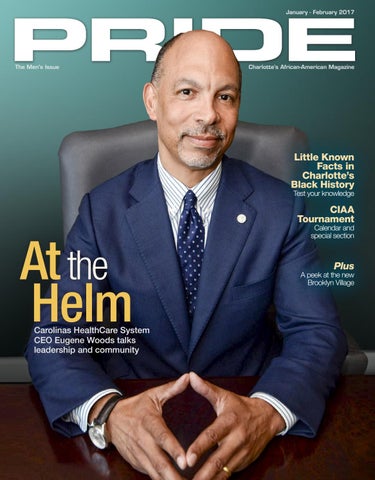
At the Helm
Carolinas HealthCare System CEO Eugene Woods talks leadership and community
Calendar and special section
Plus
A peek at the new Brooklyn Village
STOP BY FOOD LION AND PICK UP YOUR MEN’S HAIR STYLING PRODUCTS, TODAY!
available in select stores
OUR HEALTH, OUR ZIPCODES, OUR PRIORITY
WE ARE DYING TOO SOON BECAUSE WE LIVE HERE
JOIN OUR MOVEMENT TO SAVE LIVES WWW.VILLAGEHB.ORG
l WWW.FACEBOOK.COM/VILLAGEHEARTBEAT
Buying your first home is now even more affordable We’re ready to help Charlotte area homebuyers By Glenda Gabriel
Neighborhood Lending Executive, Bank of America
Work with an experienced mortgage specialist at Bank of America to learn about programs to help eligible homebuyers with down payment and closing costs. The America’s Home Grant® Program, offered by Bank of America,1 can help eligible homebuyers in the Charlotte area who earn less than $51,280 per year. With this program, you may receive a lender credit of up to $2,500 toward nonrecurring closing costs, such as title insurance and recording fees. The Bank of America Down Payment Resource Center helps you find out about local down payment and cost savings programs that can be combined with most home loans to help make home buying more affordable.2 bankofamerica.com/downpaymentcenter Learn about the Affordable Loan SolutionTM mortgage, a fixed-rate loan for low- and moderate-income homebuyers with a down payment as low as 3% to help make buying a home more affordable.3 Plus, find out about additional low down payment options such as FHA loans4 and VA loans.5 bankofamerica.com/affordableloansolution
Contact a mortgage specialist today to learn more: visit mortgage.bankofamerica.com. Qualified borrowers must meet eligibility requirements including, but not limited to, being owner-occupants, meeting certain qualifying income limitations and purchasing a home within a certain geographical area. Homebuyer education will be required if all borrowers on an eligible loan are first-time homebuyers. The America’s Home Grant Program is a lender credit and not eligible to be used for down payment, escrowed taxes or homeowner’s insurance. No cash back to borrower. America’s Home Grant Program is available for properties in the following counties: North Carolina: Cabarrus, Gaston, Iredell, Lincoln, Mecklenburg, Rowan and Union; South Carolina: Chester, Lancaster and York, and the maximum borrower/co-borrower annual qualifying income limit is $51,280 for properties not located in a low-to-moderate income census tract (LMICT). Qualifying income of $51,280 is 80% of Federal Financial Institutions Examination Council (FFIEC) Area Median Income and is subject to change without notice. For properties in eligible counties and located within a LMICT, the maximum borrower/coborrower annual qualifying income limit is $100,000. The home loan must fund with Bank of America. America’s Home Grant Program is only available with conventional, FHA and VA first mortgage loan products. Bank of America may change or discontinue the America’s Home Grant Program or any portion of it without notice. Please ask for additional details. 2 Down payment and/or closing cost assistance programs may not be available in your area. Down payment and/or closing cost assistance amount may be due upon sale, refinance, transfer, or repayment of the loan, or if the senior mortgage is assumed during the term of the loan. Some programs require repayment with interest, and borrowers should become fully informed prior to closing. Not all applicants will qualify. Minimum credit scores may apply. Sales price restrictions and income requirements may apply. Homebuyer education may be required. Owner-occupied properties only. Maximum loan amounts may apply. 3 Available for fixed-rate purchase loans with terms of 25 or 30 years and on primary residences only. Certain property types are ineligible. Borrower(s) must not have an individual or joint ownership interest in any other residential property at time of closing. Maximum purchase loan-to-value is 97% and maximum combined purchase loan-to-value is 103%. For loan-to-values > 95%, any secondary financing must be from an approved Community Second Program; ask for details. Homebuyer education may be required. Restrictions apply regarding co-borrowers. Maximum income and loan amount limits apply. 1
Work with an experienced mortgage specialist who will answer your questions and be there to help you, from application to closing. mortgage.bankofamerica.com The Home Loan NavigatorTM is an interactive tool you can use to keep up to date on the status of your home loan application, upload and sign certain documents electronically, and more. Your mortgage specialist will also be there to help you every step of the way. Not available on certain loan types.6 bankofamerica.com/homeloan-navigator We offer loans at competitive rates to meet your needs, from loans with a low down payment to jumbo loans.7 bankofamerica.com/mortgagerates
Minimum credit scores will apply. Monthly Mortgage Insurance Premiums (MIP) and Upfront Mortgage Insurance Premiums (UFMIP) apply. Maximum loan amounts vary by county. VA loans require a VA funding fee at closing. The fee is higher with a zero down payment, and maximum loan limits vary by county. If a down payment of 5% or more is made, the fee is reduced. The VA funding fee is non-refundable. Ask for details about eligibility, documentation and other requirements. 6 Home Loan Navigator is not available on certain loan types. Please contact a mortgage specialist for more information or to assist with questions about the status of your loan. Home Loan Navigator is a trademark of Bank of America Corporation. 7 Minimum down payment requirements vary by property type and location; ask for details. For jumbo loan amounts used to purchase a single-family residence on a loan amount of less than $1 million, borrower must provide documentation totaling a minimum reserve of 6 months of principal, interest, taxes, homeowners/hazard insurance and assessments (homeowner’s association fees/dues/special assessments) – (“PITIA”) related to subject loan property. For loan amounts greater than $1 million and up to $2 million, documentation totaling a minimum reserve of 12 months of PITIA is required. Interest-only payment option, property and/or occupancy type may require a higher level of reserves, please ask for details. For loan amounts greater than $2 million and less than or equal to $3 million, borrower must provide documentation of reserves totaling a minimum of 24 months of PITIA related to subject loan/property. For loan amounts greater than $3 million, the same reserves are required and must be held in a Bank of America and/or its affiliates (Merrill Lynch and/or U.S. Trust) account. Two separate full appraisals are required. Excellent credit required, including proof of recent consistent housing payment history. Loan to value and property type restrictions apply, ask for details. Not available on all loan programs. Other restrictions apply. Credit and collateral are subject to approval. Terms and conditions apply. This is not a commitment to lend. Programs, rates, terms and conditions are subject to change without notice. Bank of America, N.A., Equal Housing Lender. ©2016 Bank of America Corporation. ARSHDQD8 07-2016 AD-08-16-0064 Member FDIC. 4 5
there
Building Communities
Changing Lives HABITAT FOR HUMANITY • CHARLOTTE
PRIDE AWARDS 2017 will honor Habitat for Humanity, spotlighting the West Boulevard Corridor and Reid Park. In addition to recognizing the accomplishments of West Boulevard Neighborhood Coalition and Reid Park Neighborhood Association president Rickey Hall, we’ll salute Mallard Creek high school senior Taye Martin for his achievements while residing in a Habitat home.
SATURDAY, JANUARY 14, 2017 The Westin Charlotte
Rickey Hall
Reception: 6PM Dinner and Program: 7PM Attire: Jeans and Other Creative Things (Gowns and Tuxes OK)
Taye Martin
After Glow: 9:45PM “Raising The Roof” with DJ Kool
2017 SPONSORS
Log on to prideawards.net for updates PRESENTED BY:
|
Call 704-375-9553 to reserve seating SUPPORTED BY:
January-February 2017
Departments 10 From the Publisher 12 Notable Names 13 By Faith 14 The Mindful Parent 15 Family Notes 16 Book Review 47 Scene and Seen 54 Events Calendar
14
21
23
52
Business 48 Innovation at Work
Kushion
49 Plan Ahead in 2017
Tackling Estate Planning
51 FYI News & Notes
Health 52 G et Fit
Local churches offer fitness
53 P ure Inspiration
Paul West's remarkable story
For these stories and more, visit us on the web! www.pridemagazineonline.com
Features 18 Men
to Watch Men shaping Charlotte’s history
21 Making
It Count Charlotte STEAM
23 Vacation
Leads to Self-Discovery South Carolina’s painful history
28 At
the Helm of Healthcare Meet the head of CHS Eugene Woods
33 4
Questions for CIAA Commissioner Jacqie McWilliams shares her thoughts
On the Cover
43 The
Eugene Woods, president and chief executive officer of Carolinas HealthCare System shot on location at Carolinas HealthCare System offices in Charlotte, N.C. Photo by Jonathan Cooper
46 “How
New Brooklyn Village Building the future and honoring the past Not To Get Killed By Police” Former FBI agent writes a book January-February 2017 | Pride Magazine
7
PROUD TO GIVE BUSINESSES A LIFT CATS is proud to provide opportunities for businesses to create local jobs through the advancement of transit projects. CATS also seeks to create an environment that gives small and socially or economically challenged local businesses the opportunity to compete for publicly funded contracts by participating in the Small Business Opportunity (SBO) and the Disadvantaged Business Enterprise (DBE) Programs. To date, 100 DBE firms have been awarded contracts of $76 million to help build the LYNX Blue Line Light Rail Extension. As the major provider of public transportation to Charlotte and the surrounding region, CATS relies on the communities we serve to build and operate the service every day. By working together on these new opportunities, we can all keep our communities moving in the right direction. For more information, visit ridetransit.org.
CATS. YOUR RIDE IS HERE.
M
A
G
A
Z
I
N
E
Charlotte’s African-American Magazine
CEO/Publisher Dee Dixon
Editor-in-Chief Lashawnda Becoats
Copy Editor Polly Paddock
Lead Writer Angela Lindsay
Design & Production SPARK Publications www.SPARKpublications.com
Creative Director Larry Preslar
Junior Art Director Genna Baugh
Distribution
Watch Dog Entertainment®
©
Account Executive Nikelle Fesperman
Public Relations Nepherterra Estrada
Subscribe to Pride
$13.25. Please subscribe online at www.pridemagazineonline.com, mail to P.O. Box 30113, Charlotte, NC 28230 or call 704- 375-9553
Letters to the Editor Please send an e-mail to info@pridemagazine.net fax to 704-375-9550 or mail to Pride Magazine 402 W. Trade St., Suite 102, Charlotte, NC 28202 www.pridemagazineonline.com
Copyright© 2017 Pride Magazine All rights reserved. Copying or reproduction, in part or in whole, is strictly prohibited.
Pride Magazine prints with soy ink. Vol. 25 No. 1 January-February 2017 All rights reserved for PRIDE Communications Inc. Find us on Facebook: Facebook.com/NCPrideMagazine
January-February 2017 | Pride Magazine
9
FromTheCEO
By Dee Dixon
I
Thank You!
would like to kick off the New Year by first thanking all of our loyal corporate sponsors and friends. We truly appreciate your continued support and willingness to sustain our mission of being a voice for African Americans and people of color. Bank of America, Wells Fargo, Carolinas HealthCare, Food Lion, Compass, Belk– we could not exist without you. You have stuck with us year after year. When will more organizations begin to value and support minority-owned businesses?
The Need to Support Black Media “America’s Multiethnic Destiny” is the title of an article I recently read. In short, it says the U.S. Census Bureau estimates minorities will outnumber whites in America within the next three decades. Right now, even, there are more minority babies than white babies being born in America and more minority children than white children attending public schools. (Minorities are already the majority in Charlotte, and African Americans make up 35 percent of the population. So, it seems to me, Black and other minority media outlets should be thriving. Instead, we are just surviving. With a few exceptions, we don’t get a lot of support via advertising and sponsorships from the majority of companies here in the Queen City. We target and reach the market of the future, and yet most organizations don’t budget us in. If they do, it’s through their diversity budgets, which are usually extremely small. So, we have to divide
Consolidated Media Alliance Glenn Burkins of Qcitymetro.com, yours truly and Gerald Johnson of The Charlotte Post.
10
Pride Magazine | www.pridemagazineonline.com
Grand Canyon
the leftovers. It’s hard to optimize on this kind of diet. Also, though we’ve been in this market for decades, when the power brokers and leaders come together to “solve” big problems, we are seldom called to the table. Consolidated Media Alliance Perhaps you’ve heard. Pride Magazine, the Charlotte Post and Qcitymetro (Charlotte’s three most respected AfricanAmerican news outlets) are joining forces to harness the power of their platforms in order to raise awareness about Black media, build social capital and identify solutions to address social and cultural issues. Although our businesses will remain separate entities, we have pledged to work together via the Consolidated Media Alliance in order to help tackle tough problems impacting our city. We are busy working on our first event in February. Stay tuned. Pride Awards 2017 Folks, this gala will be like no other. If you think you know what we typically do at the Pride Awards, think again. We are going to have SO MUCH FUN, as we honor Habitat for Humanity and educate our attendees about the West Boulevard corridor and Reid Park. You still have time to get your tickets.
Dress code: “Jeans and Other Creative Things”(gowns and tuxes are still OK). Log on to www.prideAwards.net or call us at 704-375-9553. The Grand Canyon I want to share one last thing, quickly. Again breaking with tradition, I went to Las Vegas for Thanksgiving with my two best friends – me and myself. We had a fabulous time while staying on the strip! None of us gambles, so we spent most of our time resting, eating, shopping and taking in a Motown show. The absolute highlight of the trip was visiting the Grand Canyon. What an awe-inspiring creation of our God! P P.S. Though not a fan of social media, I have started to tweet and twitter with some Instagram mixed in. Here are my handles: @deedixonpride deedixonpride1
Dee
Start your banking relationship with us. BNC Beginnings Checking
Features: No minimum balance • Mobile Check Deposit1 • Text Alerts1 • No monthly service charge when you enroll to receive e-Statements2 • Online and Mobile Banking1 • ATM/Debit card •
1
Message, data, connectivity and usage rates may apply. Contact your wireless service provider for details.
2
$5 monthly service charge for paper statements
bncbanking.com 1.800.262.7175
NotableNames By Charles Kelleher Harris
TIMISHA BARNES-JONES
Timisha Barnes-Jones, Ed.D, is the principal of West Charlotte High School/ The L.I.F.T. Academy. “I enjoy building relationships with students and seeing them successfully reach goals,” says Jones. A native of Kannapolis, Jones received her bachelor’s degree from Davidson College, a master’s degree from UNC Charlotte and a doctorate degree from Gardner Webb University. Jones began her career with Charlotte-Mecklenburg Schools in 1999 as an elementary school music teacher, and became West Charlotte’s co-principal in 2013. “It is a challenge to continue to motivate and recruit effective teachers in the current educational scene in North Carolina,” says Jones. Jones says that despite this challenge, it is her love of students that keeps her motivated. Jones lives in Charlotte with her husband, Antonio, and the couple’s four children. P
CHERON PORTER
Cheron Porter has been named senior vice president of public relations for the Charlotte Housing Authority. Porter, a native of New Jersey, received her bachelor’s of art and mass communication degree at James Madison University. Porter later received a master’s of arts degree in public communication and a graduate certificate in real estate development. In her role as senior vice president of public relations, Porter oversees all internal and external media relations for the CHA. “Honestly, I work with amazing people,” Porter says. “I’m from the North, so the Southern hospitality is a great welcome. The people I work with truly care about the residents we serve. They are committed, and I’m glad to be on the team.” P
12
Pride Magazine | www.pridemagazineonline.com
GARY YOUNG II
Gary Young II has been named board chair for the Charlotte Mecklenburg Black Chamber of Commerce. A native of Charlotte, Young attended Vance High School. He received his bachelor’s in political science from North Carolina A & T University in 2007. Young previously owned the Young Oliver Sports Group, where he worked as a registered player’s agent with the NBA Players Association. Young is also the director of economic development for the CMBCC. Young advocates entrepreneurship, business capital and funding. Young runs Inclusive Solutions, LLC, a consulting firm that helps young business owners incorporate and develop their businesses. Young lives with his family in Charlotte. P
TERRY M. BROWN
Terry M. Brown was honored as one of Charlotte’s Agenda’s 30 under 30 in 2016. Brown, 29, is a native of Fayetteville. Brown is a graduate of the University of North Carolina at Charlotte and Campbell University of Law. Brown joined the law firm of Horack, Talley, Pharr & Lowndes, P.A., Horack Talley in 2015. “I enjoy the problem-solving and critical thinking aspect of practicing law,” says Brown. “Each case is unique, and fitting the intricate factual pieces together with the law makes things interesting.” Brown also says that his age sometimes offers a challenge to his career. “As a younger attorney, one of my biggest challenges is coming up with inventive ways to attract younger business clients,” Brown says. “The landscape in Charlotte is changing so much, and there are so many great young entrepreneurs, start-ups and small businesses, and figuring out ways to work with them is a challenge. I want to make sure that millennials take advantage of every resource they can to succeed and make the city better.” Brown is engaged to mental health counselor Arielle DeDeaux and plans to wed in 2017. P
ByFaith
Freedom
By Rev. Dr. Dwayne Bond
I
s there hope for the man or woman who sheepishly lurks through the shadows of deceit, seeking opportunities to indulge in his or her secret addiction? The shame of pornography, the undercover obsession, is crippling people of their ability to glorify the Lord Jesus Christ. Why is this deep, dark obsession slaying so many people? It is destroying people and affecting their emotional, physical, mental, spiritual and relational health. Sad but true, we live in an oversexed and perversion-filled society. Viagra, the powerful three-day erectile pill for men that is constantly paraded on the television, is marketed as innocently as if it were a cure for the common cold. Seductive images are showcased in almost every magazine and commercial. Provocative allurements and enticements for sexual fulfillment exist in all forms of media, including internet and telephone. In our sex-crazed culture, the sin of pornography presents itself like a patient puppy lying at the door of every man and woman’s heart, waiting for a crack to enter and destroy. Pornography is a ravaging beast that destroys people, their families, reputations, testimony, integrity, relationships and ultimately, their lives. Whether its manifestation is video masturbation, sexting (sending pornographic images via text), illicit magazine perusing or website and peep show visits, people young and old are clearly addicted to satisfying their fleshly desires. Despite the fact that most people know and have seen the devastating effects of pornography, the deceptive nature of sin and the short-lived pleasure associated with its indulgence cause people to ignore what they know to be truth. How much does truth matter to someone who is addicted to immoral sexual pleasure? Oftentimes, “truth”
from Pornography can be known, but suppressed by those who are blinded by enslaving desires. In Romans 1:18-19, Paul shares that “…the wrath of God is revealed from heaven against all ungodliness and unrighteousness of men, who by their unrighteousness suppress the truth. For what can be known about God is plain to them, because God has shown it to them.” Lurking in the shadows of pornographic addiction are people who have an awareness of right and wrong, but refuse to submit their hearts to the Lordship of Jesus. The shame, guilt and pleasure of the sin work in harmony to deceive them into either continually embracing their obsession or acknowledging it without seeking the desperately needed help. As I reflect on past counseling sessions with those who indulge in and are addicted to pornography, I realize that the introduction for many of them was linked to immoral sexual exposure during their formative years. This early exposure often becomes a seed parked in their hearts, waiting idly to take root and to be nurtured and fed. If this unfortunate, unfair and uninvited seed is never destroyed by the truth and power of the gospel, any future fertilizing spark can set ablaze a life. It can create an untamed appetite against which a passionate battle must be fought. Is the power of the gospel great enough to overcome such an addiction? Does the power of the addiction make healing unlikely or even impossible? Where is the hope for someone struggling with pornography? Can he or she be set free? Emphatically yes! However, true and lasting freedom from the power of sin can result only from a clear understanding and embracing of the power of the gospel. Freedom from enslavement to pornography is far from an effortless sprint. It is a painstaking journey – one of confession, repentance and turning
back to the grace and mercy of God. Paul gives us great wisdom when he encourages us to walk in accordance with the Holy Spirit, so that we will not gratify the desires of the flesh (Galatians 5:16). Walking in the Spirit means living our new life according to what pleases the Spirit. As people seek to live this way, moment by moment, decision by decision and victory by victory, they can experience mastery over the addiction to pornography. What can we do in order to stay clear of the damaging effects of pornography? 1. Avoid watching late-night, provocative television or movies that seek to arouse you sexually. 2. For the sake of every facet of health, destroy all pornographic media and print materials. 3. Install internet filters on your personal computer, phones, iPad and PDA, and disable illicit cable or satellite stations. 4. If you are struggling with pornography, forgo spending extended time alone without accountability. 5. Seek to establish an accountability relationship with someone of the same sex, for support and encouragement. 6. Regularly confess and repent of sinful thoughts and actions. 7. Consistently seek Jesus through his Word, in order to cultivate a renewed love for Him and a passionate desire to please and serve Him. 8. Develop a devotional routine of spending time with Jesus in prayer. 9. Seek professional help from a trusted counselor. Although the devastation of this addiction is great, the freedom from this addiction is even greater (Romans 5:20). May God give you the wisdom and grace to help you live in the freedom that Jesus offers to all of humanity. P The Rev. Dwayne Bond is the lead pastor of Wellspring Church.
January-February 2017 | Pride Magazine
13
TheMindfulParent
The Power of the By Shavonda Bean
Resilient Child OK to fail! Don’t shield them from all risks. Encourage children to try new things and to see for themselves that mistakes lead to opportunities, and failure is often found on the pathway to success. Remember, sometimes teaching also means modeling the behavior. And when you fail, lead by example. Children watch how you handle situations.
Relationships Matter
Teaching children the concepts of respect, care and compassion is invaluable. Parents and caregivers offer the first experience of a relationship. Be consistent, reliable and provide a good balance of support, while also offering opportunities for growth and exploration. Teach children to give compliments, spread love, pay it forward and consider others. Doing so helps to make connections, build friendships and widen their support system. The less isolated your children are, the more likely they are to be strengthened by those around them and get through difficult times.
D
uring my years as a psychologist, one young girl stands out. Her environment was lacking in consistent love, was unpredictable and neither abuse nor trauma escaped her. Yet, she rose to the top of the chaos and set sights on her future. Unfortunately, this is not always the outcome. According Merriam-Webster, resilience is the capability of a strained body to recover its size and shape after deformation, caused especially by compressive stress, or the ability to recover from or adjust easily to misfortune or change. Is one born with resilience or is it taught and learned by experience and the presence of protective factors? I believe a combination of these factors and many others shape the resilient person. Research indicates that one of the single most important factors in building resiliency is a supportive and reliable adultchild relationship. This includes the task of filling a child’s tool belt with skills to manage life’s challenges.
14
Pride Magazine | www.pridemagazineonline.com
Perspective and Problem Solving Identifying and Managing Stress
Children experience many stressors. The child who is responsible, thoughtful, the perfectionist and the one who likes to please others is most likely to experience high levels of stress and anxiety. At the core of resiliency is the ability to cope, and being prepared matters. Teach your children to recognize stress so they can implement coping skills before becoming overwhelmed. Offer opportunities for conversation and provide the words to describe the stress you see. Label and identify their emotions and even your own. Stress management includes adequate sleep, healthy eating habits, yoga, spirituality and mindfulness-- literally stop and smell the roses!
Give Permission to Fail
Some children can be paralyzed by the fear of failure. One of the greatest gifts you can give your children is permission to be bold in pursuing their dreams and goals, while also teaching them that it is
Show children how to keep things in perspective, and have an outlook that is hopeful, realistic and optimistic. Age is important here. Some younger children are unable to look too far into the future and are highly focused on the immediate situation. For each negative perspective, challenge your children to match it with at least two potential positive outcomes. Don’t be so quick to give them the answers and solve problems for them. Help them brainstorm options, choices and alternative approaches. Pour into the children you love. Arm them with skills that ultimately provide fertile ground for good character, healthy relationships and an overcoming spirit. The prepared child becomes resilient adults, who have the power to manage and regain their shape in the face of adversity. P
Shavonda Bean is a licensed psychological associate and owner of Essential Assessments & Behavioral Health. Visit www.EssentialHealthNC.com for more information.
FamilyNotes
Compiled by Lee McCracken
Walk Against Birth Defects January is National Birth Defects Prevention Month. While the March of Dimes supports mandated newborn screening of all babies born in the United States, some 380,000 babies are born premature each year. Prenatal testing and effective pre- and postnatal care are available for the more than 30 conditions that are life-threatening for babies. The nonprofit’s March for Babies is held every year in more than 900 communities across the country and has raised more than $1.8 billion since 1970. The March of Dimes reports that 76 cents of every dollar raised is spent on research and programs to help prevent premature birth, birth defects and infant mortality. Interestingly, the very first person to walk for the March of Dimes was a textile worker from High Point. This year, on Saturday, April 29, families, individuals and corporate teams will gather at Romare Bearden Park in uptown Charlotte, 300 S. Church St., at 8 a.m. for the 3.5-mile walk. For details and to register, visit www.marchforbabies.org.
Inauguration…and Beyond Following a contentious and crazy U.S. presidential election, children are still tuned in — watching and listening to their parents and other adults, and engaging in their own political banter. Inauguration Day is Friday, January 20 followed by the State of the Union address to Congress. Whether a household is ready to watch the TV coverage with admiration or disgust, parents are urged to remember that little eyes and ears are tuned in. Children also pick up on adults’ emotions and angst. Parenting.com alerts parents to the fact that politics affects children as much as adults, and helping to ease their worry and fear (no matter their age) is just as important as modeling appropriate behavior. And, just like adults, children need to learn how to disagree with one another respectfully as the year unfolds. It isn’t wrong for kids to disagree with their peers and teachers, but parents must teach them how to disagree well. January and February are perfect months, too, to discuss character, integrity and leadership, as Presidents Day approaches and students study the nation’s Founding Fathers. Parenting.com encourages families to talk about the democratic process — why adults vote and what they stand for or against — and how such decisions not only affect them, but also can have positive and adverse effects on other people.
A Mitten Mystery A fun and educational tale for all ages, “Junie B. Jones Is Not a Crook” will play Feb. 3-19 at McColl Family Theatre at ImaginOn, 300 E. 7th St., Charlotte. The storybook kindergartner, Junie B. Jones, is very excited about her brand-new furry, black mittens – until a rotten thief steals them. But she’s faced with a dilemma when she finds a colorful pen on the classroom floor: Should she keep it and stay quiet or try to find the owner? Will Junie B. Jones do the right thing? Tickets are $12-28. Ctcharlotte.org
For the Family Bookshelf These titles are recent American Library Association/Association for Library Service to Children winning storybooks: • Caldecott Medal — “Finding Winnie: The True Story of the World’s Most Famous Bear,” by Lindsay Mattick (Little, Brown and Co., 2015, $12). This is an account of the friendship and love shared between a soldier and the real bear that inspired Winniethe-Pooh. The multidimensional family story is beautifully illustrated through distinctive Chinese ink and watercolor art — enchanting children as they visually follow along Winnie’s journey from the forests of Canada to the Hundred Acre Wood. • Caldecott Honor — “Voice of Freedom: Fannie Lou Hamer, Spirit of the Civil Rights Movement,” by Carole Boston Weatherford (Candlewick Press, 2015, $14). This biography is written in verse, and the rich, complex illustrations capture Hamer’s power and bravery. • Newberry Honor — “Last Stop on Market Street,” by Matt de la Peña (G. P. Putnam’s Sons, 2015, $11). CJ’s journey with his Nana is more than just a bus ride. His grandmother answers his simple questions, and CJ learns much about the beautiful music, nature and people that surround him. A perfect read-aloud book — the language elicits questions, sparks imagination and makes children and adults laugh.
January-February 2017 | Pride Magazine
15
BookReview
By Angela Haigler
Books to Get Your New Year Started
Add these four adult books and a young adult novel to your reading list for a mix of mystery, modern-day race and politics and more.
The Underground Railroad
Charcoal Joe
Doubleday
Walter Mosley’s latest installment of the Easy Rawlins franchise give fans exactly what they are hooked on: excitement, a mystery to solve and a continued glimpse into Easy’s world, where his skills and intelligence almost always prevail. Easy’s latest client, Charcoal Joe, is a somewhat suspicious fellow who needs help and lots of it. As Easy tests his newly legit detective agency, Joe gives Easy a run for his money.
by Colson Whitehead Whitehead pairs historically accurate slavery with a magical-metaphoric Underground Railroad, in which things don’t happen quite as we remember from history class. Main character Cora endures horrific conditions as a slave on a plantation, and like her mother before her, escapes to discover an uncertain and precarious freedom. Both cruel and triumphant, Railroad is a page-turner sure to leave readers on the edge of their seats.
by Walter Mosley Doubleday
Children’s Choice
Between the World and Me by Ta-Nehisi Coates Spiegel & Grau
Another Brooklyn by Jacqueline Woodson
In today’s racially-charged reality, a nonfiction voice such as Coates’ is needed to help remind us how far we’ve come and how far we still need to go. A New York Times best-seller, National Book Award winner and NAACP Image Award recipient, Between the World and Me is a must-read for anyone looking to improve his or her understanding of race and racial politics in society. Through essays meant as a letter to his son, Coates provides the education about race the whole world needs.
Young Adult
The Blossoming Universe of Violet Diamond by Brenda Woods Nancy Paulsen Books Brenda Woods brings us Violet, a Black child of mixedrace parentage, whose Black father passed away and whose her white mother tries to fill the gap. Violet struggles with her identity, living as the only child of color in a family of whites. Her search for self involves connecting with her father’s family and finally finding what she needs to help bring peace to her young mind.
Amistad Award-winning author Jaqueline Woodson uses beautiful words, phrases and just enough description to paint a vivid picture of friendship, betrayal, love and discovery. It’s a treasure trove of black girl experiences that readers are hungry for.
16
Pride Magazine | www.pridemagazineonline.com
Angela Haigler explores the literary world at www.angelicmusings.wordpress.com and on Twitter @angelicmusings.
Robert S. Gessner, Ciudadela I (Citadel I) (detail), 1965, oil on canvas. Š Galleria il Tesoro, Switzerland
Bechtler Museum of Modern Art at Levine Center for the Arts 420 S. Tryon St. | Charlotte, NC | 704.353.9200 | bechtler.org 
January-February 2017 | Pride Magazine
17
TOUSSANT ROMAIN
Men to Watch A New City Manager, A Citizen Journalist And 2 Others Are Shaping Charlotte
MARCUS JONES Marcus Jones is Charlotte’s first black city manager. Jones spent his career in Virginia as the budget director in Norfolk from 2004 to 2007, before becoming Norfolk’s assistant city manager. In 2011, he became the city manager in Norfolk after a stint with Richmond city government,
By Tonya Jameson
The Essentials
Jones has more than 23 years of experience in public service. He is married to Jillian and they have three children.
A
s we begin a new year, Charlotte is a city faced with troubling questions about the type of city it wants to be, and the type of city that currently exists. In Men to Watch, we share a glimpse of men who we expect to make an impact on this city in the coming year from the new city manager to attorneys who have a deep commitment to the community.
TOUSSANT ROMAIN
18
He isn’t running for office, but he will continue to work with nonprofits, foundations and the Charlotte School of Law to see how we can all work together to provide support and care to everyone in our community. “Provide avenues for the ‘white community’ to get involved,” he said. “We’re really trying to connect the resources with the needs in the community.”
Why Did You Step Up?
Personal Motto
Pride Magazine | www.pridemagazineonline.com
Jones steps into his new role at a time when Charlotte has suffered a gut check after the fatal police shooting. He plans to build partnerships with residents, the business community and city staff to develop and create priorities for the city.
always done this kind of stuff. We’ve been engaged in the community doing the work.”
Toussant Romain, 39, spent the last 8½ years toiling quietly as a Charlotte public defender, but he burst onto the national scene in the days following the Keith Lamont Scott fatal shooting. As tempers flared between CharlotteMecklenburg police officers clad in riot gear and angry protestors, Romain tried to keep the peace. In one photo, Romain is shown wearing a white shirt and tie, leading away a heavyset man who angrily confronted the police. Romain walked with protestors nightly, and that scene was captured live on CNN. “There’s nothing different that I did that night that I haven’t done before” he said. “I’ve
What Can We Expect in 2017?
What Can We Expect in 2017?
“Do your part. If everyone does their part, collectively we can change the world.”
MARCUS JONES
BRAXTON WINSTON Braxton Winston is most recognized for standing shirtless with fist raised in front of Charlotte-Mecklenburg police officers wearing riot gear on the night that police fatally shot Keith Lamont Scott in Charlotte. He was on the front lines during the September 2016 protests. Throughout the protests, press conferences and public meetings, Winston, 33, could be found recording the events for his blog. His efforts landed him in jail and in the media spotlight, thanks to that jarring image of him in front of police.
What You Don’t Know
Winston is a Brooklyn native and attended boarding schools in Massachusetts, and graduated from Davidson College in 2007. He and his wife, Sheena, have a daughter and a son. Winston is a union stagehand, freelance camera operator and a grip for television shows and movies. He is also an assistant lacrosse coach at Providence Day and he coaches football there as well.
What Made You Step Up During the Protests?
Winston said he’s always been active
and vocal in his community. He was on his way home when heard about the protest on Sept. 20 on Old Concord Road. He went to the crime scene to see what was happening. He started live-streaming. He showed how the dismantling of the crime scene devolved into a protest. “I had a choice to either fall back or step up,” he said. “I decided to stand up…I’ve done everything I can do to stand up for what I think is right. The emotion of the moment, the relevance of the moment, the use of social media really created an environment where people were looking at me and seeing me.”
What Can We Expect in 2017?
He has started a Go Fund Me page to finance a documentary to tell a chronological account of the Charlotte protests. “I’m going to continue to fight,” he said. “I’m going to continue to struggle. I’m going to continue to work to this. I have a job as a citizen journalist. I’m going to continue to be present, to be active at meetings that are important to the struggle for equal protections and rights under the law.”
BRAXTON WINSTON
January-February 2017 | Pride Magazine
19
2_19592 75x9.875 4C
Communities are like families THEO NYAME
THEO NYAME Theo Nyame (pronounced Miami with an “N”) is a plastic surgeon who specializes in black skin-care. His journey started with humble beginnings in Ghana and is woven through his childhood years in the Bronx. A friendly sibling rivalry between Nyame and his brother, a neurosurgeon, led them to the medical field. Nyame, 33, realized that many of his countrymen in Ghana needed reconstructive surgery.
The Essentials
When everyone comes together, wonderful things can happen. The spirit of community is alive and well, right here and now. wellsfargo.com
Nyame married cardiologist Sandy Charles in fall 2015. The two celebrated the birth of their daughter, Nichole, in summer 2016.
What’s innovative skin care?
He finds nonsurgical options to restore and maintain youthful skin. African Americans scar differently from whites, so Nyame doesn’t use external sutures, because they show up as little dots on the skin. “Dealing with a diverse population, there are different methods you can use to get superior results,” he said.
What Can We Expect in 2017?
Nyame plans to find ways to educate the community on how to stay healthy and active, and to age gracefully. In addition to health education, Nyame works with young people. He speaks to them about the importance of reaching your potential: “It’s really just a tool to motivate some of the youth to capitalize on the education that they are getting.”
Personal Motto
“Winning is a habit. Losing is a habit.”
© 2016 Wells Fargo Bank, N.A. All rights reserved. Member FDIC. (3529602_19592) 20
Pride Magazine | www.pridemagazineonline.com
P
MakingItCount
Above, Members of the Maiden High School rat rod team, from left to right, Dilawar Khan, Lillian Butler, Brandon Allison, Haylee Allen, Alex Thompson, Christian Spinner, Noah Honeycutt (kneeling), Dale Swanger, and Colby White (in cab) stand around their rat rod. Left, Kameron Layton and Megan Akers, part of Walker County Center of Technology›s team in Jasper, Alabama work on parts for their rat rod. By Eren Simpson
Charlotte STEAM
A
teacher and an investor have teamed up to bring more kids into the fields of science, technology, engineering, arts and math – and in April, their program is going to introduce the city of Charlotte to the idea of a rat rod. Charlotte STEAM is a nonprofit started by math teacher Scott Brown, who saw the need to make the sciences accessible to more students. The organization has several different projects in the works, but its big project is Charlotte STEAM Fest and the high school rat rod program, which is being funded by Jim Harper and Harper Image Inc. A rat rod is a car or truck built using parts from 10 different salvage vehicles, and each team only has $5,000 to spend on parts. Most of the rat rods through Charlotte STEAM are being built as part of school auto clubs, in which teams are encouraged to include other departments – such as art, English, math and science -- within the school. “We slowly start to get everyone involved and excited. and next thing you know, you get school cultural change, and that’s what’s happened in the
January-February 2017 | Pride Magazine
21
Tiovionne Cade from Hickory High School sits in the front seat of the rat rod her school has been working on for the last year.
The first rat rod the Applied Technology Center created is made up of parts from 12 different vehicles, including an old VW beetle, 1994 dump truck, model A-Ford, 1948 tractor, headlights from a tractor, 1965 Chevy dump truck motor, 1967 Mustang transmission, the seats from a Pontiac Grand Am, and the frame was hand-build, but modeled after the Model-A Ford. Everything that holds it together was student made, hand-fabricated.
schools we’re in,” Brown said. “Kids are getting excited in this program.” So far, the rat rod program is in 10 high schools across the Carolinas and Alabama – and all will be debuting their vehicles at the Charlotte STEAM Fest on April 23 at the University of North Carolina at Charlotte, in conjunction with the UNC-Charlotte Science Expo, as part of the N.C. Science Festival. Debuting two of its rat rods in April is
22
Pride Magazine | www.pridemagazineonline.com
the Applied Technology Center (ATC) in Rock Hill, S.C. - the first school to sign on to the rat rod program in 2015. Auto tech instructor Gilbert Vaulk said his school was the guinea pig of the program and that the STEAM Fest is going to be a wonderful source of validation for his students. “A lot of people assume they can’t do stuff like this, but this puts all that to shame,” Vaulk said. “We set the bar really
high and expected them to meet it to the best of their ability. When we set the bar high enough, they’re going to meet it. If you can get their interest, they’re going to step up and do it.” One of the other teams presenting its vehicle is Maiden High School in Catawba County. The team has 52 students involved and is being led by senior Lydia Rice. Rice, who grew up in a racing family and has spent years in the garage, said the rat rod challenge has been a completely different experience. “It’s really crazy to see how you can go from parts from different cars to putting it all together in one vehicle,” she said. “It’s crazy, actually … We have two frames and we put them together to make one vehicle. It looks odd, but in the long run it’ll look cool.” In addition to seeing kids more involved in the auto club at Maiden, Rice said she’s seen how their involvement in the club has also transferred into the classroom. “The hands-on skills … You’re not just learning sitting down; you have ways to problem-solve. In class, sometimes you don’t have the opportunity to get up and do it, but they can think differently and think of a different way to do it. and that’s the main reason for this,” Rice explained. And that’s exactly why Harper said he wanted to fund this program. “It’s not just building an automobile,” Harper said. He said he wanted to give students an opportunity they wouldn’t otherwise have – “To use their hands and feel accomplished.” And for students such as Providence High School sophomore Trey Harris, who Brown taught in middle school, it’s also a chance to step out of their comfort zone. Harris is heavily involved with JROTC at school, but is also interested in pursuing engineering in college, which is what led Brown to recruit him for the stand-alone rat rod team that Brown started for students whose schools didn’t want to participate. “So far, I really enjoy it,” Harris said. “It’s a great thing for me.” To learn more about Charlotte STEAM and STEAM Fest, visit www.charlottesteam.org. P
The beautiful antebellum and Civil War-era homes in Oaks trees with Spanish moss in Beaufort, SC.
A South Carolina Vacation Leads to
SELF-DISCOVERY By Lashawnda K. Becoats
I
love to read, but never thought a book about slavery would lead me on an unexpected journey of self-discovery. It all started after I began reading Colson Whitehead’s “The Underground Railroad.” The novel chronicles the journey of a young slave girl named Cora, who escapes from her plantation in Georgia onto a real train that runs underground through the South towards freedom. I was fascinated by her story. We all know the story about Harriet Tubman and the Underground Railroad. I could not imagine an underground train taking slaves to freedom. As Cora begins her journey to freedom from Georgia to the Carolinas, our worlds begin to collide. I embarked on a 15-day working vacation to the Sea Islands, a group of barrier islands on the southeastern Atlantic coast that begin in South Carolina. A few days after I arrived in Hilton Head Island on my vacation, I read about the Underground Railroad dropping
Cora off in South Carolina. As I lay on the beach reading about Cora, I began to become deeply disturbed. I came here for vacation and she came here to escape the slave catcher’s whip and the master's manacles. We both had our own on kind of freedom in mind, me from stress and her for freedom. How can I lay on this beach soaking up the sun when Cora was running toward her new life? Thinking about her story, I got so caught up, I couldn’t eat. I wanted to know if she would be free. She and I were kindred spirits now and we were on a journey together. After talking about the “The Underground Railroad” endlessly on the trip, my best friend and I decided to visit some of the nearby places rich with slave history. Our first stop was Beaufort, S.C. We rode our bicycles over the Woods Memorial Bridge which was featured in “Forrest Gump.” We walked around the downtown area on the waterfront, ate lunch and people-watched in the Henry R. Chambers Waterfront Park.
January-February 2017 | Pride Magazine
23
I enjoyed riding my bicycle and exploring parts of the Sea Islands.
My obsession with trees started after I saw trees like this.
tH A CoMmUnItY ExHiBiT OrGaNiZeD By lEvInE MuSeUm oF ThE NeW SoU
Image courtesy of Alvin C Jacobs Jr
JaNuArY 13, 2017 – oCtObEr 22, 2017
History was all around us. The park which overlooks the bay, has plaques that tell the story of how the area was settled. Then we rode our bicycles behind a horse-drawn carriage tour past beautiful antebellum and Civil War-era homes. As we peeked through fences and took pictures, my thoughts lingered on the reality of the slaves whose backs were broken to build these homes that are still standing. Beaufort is known as “Tree City U.S.A.” You can’t help but stop and take notice of the large majestic oaks with hanging Spanish moss that stand guard at every turn. As I marveled at their magnificence, a lyric from the song “Strange Fruit” hit me: Co-created in partnership with community stakeholders, K(NO)W Justice K(NO)W Peace explores the historical roots and contemporary issues that shape the complexity of policing and community in the 21st century.
#COMETOUNDERSTAND
@LevineMuseum 200 E. 7th St Charlotte NC 28202 | museumofthenewsouth.org
Presenting Sponsor 24
Pride Magazine | www.pridemagazineonline.com
“Southern trees bear strange fruit Blood on the leaves and blood at the root Black bodies swinging in the southern breeze Strange fruit hanging from the poplar trees.” Cora’s escape took her through a trail of trees with hundreds of corpses hanging from their branches. What a horrifying sight that would be! From that moment on I became enthralled by every 200 year-old tree I saw — “hanging trees,” I couldn’t stop wondering about all the blood soaked into their roots. After leaving downtown Beaufort, we went to Old Sheldon Church in Yemassee, SC. The church was built in 1745 and has a complicated history. According to the plaque, it was burned twice: once in 1779 by the British, and then it was rebuilt only to be burned down again in 1865 by the Federal Army. The walk up to the remnants felt eerie. There were only massive brick walls with open arches, and grass growing where church benches might have been. I walked behind the church and read some of the gravestones. There was a dry breeze from the trees and the birds chirped now and then.
The ruins of Old Sheldon Church.
The plaque outside of Penn Center founded in 1862.
There was a peaceful quietness that was loud enough for me to hear our ancestors singing or maybe crying. We didn’t stay long. Five miles east of Beaufort, we explored St. Helena Island, the rural low country island known for its shrimp docks, farmland and Gullah culture. The island is home to the Penn Center, one of the first schools for children of freed slaves. When it opened in 1862, 80 students enrolled. How amazing that had to be. It is said that Martin Luther King, Jr. drafted his famous “I have a dream” speech there. Unfortunately, it was closed so we didn’t get to go inside the building. In our search for a local Gullah festival, we stumbled on St. Helena’s Chapel of Ease Ruins. I had to stop and touch the walls. I wanted to soak in the history. I later learned it was burned down in 1886 by a forest fire. Our day ended after we found the annual Land’s End Woodland River Festival, which celebrates the ancestry of Gullah families with food, music, storytelling and arts and crafts. When we arrived near dusk, the setting was beautiful. More “hanging trees”
St. Helenas's Chapel of Ease Ruins.
overlooked the river. It looked so peaceful except, the bugs were out in full force. How did our ancestors endure the attack of mosquitoes! That night, Cora and I fled to North Carolina where she endured the most difficult time on her entire journey. This is where I live. It was hard for me to believe this was the worst place for her to be. I won’t spoil it for you. Reading “The Underground Railroad” made me realize that if I read the book while at home in Charlotte, it would not have touched me the way it did. In Charlotte, a tree is just a pretty canopy but on the Sea Islands, bodies once hung from many of those trees. Being in that environment and walking the land my ancestors toiled gave me a deep spiritual connection to them that I will never forget. P
7 January-February 2017 | Pride Magazine
25
Notable Moments in Charlotte’s Black History
1886
Myers Street School opens at 515 S. Myers St. It is the first public school for Black children. Students called it the “Jacobs Ladder” because of the exterior staircases (it would later be the design inspiration for the Harvey B. Gantt Center for African-American Arts + Culture).
1891
Good Samaritan Hospital opens. Located at 411 W. Hill St., it is the city’s second hospital, and reportedly the first privately-funded, independent hospital built for African Americans in the country.
By Tonya Jameson
D
esegregation of schools and the election of Harvey Gantt as mayor are two of the most commonly known historical and cultural milestones for Blacks in the city of Charlotte. Those are two events that impacted the city for generations, but Charlotte’s history is filled with other interesting historical facts that have shaped this city and sometimes put us in the national spotlight. This timeline is not a comprehensive Black history of Charlotte, but it is a curated list of noteworthy moments in the city’s history, which is still being written.
1929 - 1974
The N.C. Eugenics Board authorizes the forced sterilization of nearly 8,000 people, of which about 60 percent are Black. Mecklenburg County sterilizes the most women in the state.
1943
Pearl Street Park opens “as a park for Negro children” off Kenilworth Avenue. It is the city’s first publicly funded park for African Americans.
1946
First section of Independence Boulevard opens, slicing through Black neighborhoods in Second Ward.
Photo Pub. by Dixie News Company, Charlotte, N.C.; Tichnor Bros. Inc., Boston, Mass., Boston Public Library, Print Department
1960
The Charlotte-Mecklenburg Community Relations Committee is established. Mayor James Saxon Smith originally created it as the Mayor’s Friendly Relationship Committee, in response to sit-ins at uptown lunch counters, led by Johnson C. Smith students.
1948
First Miss Queen City Classic crowned. This annual football matchup between Second Ward and West Charlotte high schools is an annual must-attend event for Charlotte’s Black community. It features a halftime “battle of the bands” and the crowning of Miss Queen City Classic.
1960s – 1970s
Urban renewal causes the demolition of Black neighborhoods such as Brooklyn and Earle Village as well as the “Old Greenville area.”
26
Pride Magazine | www.pridemagazineonline.com
1962
Louis Armstrong stays at the Hotel Alexander, 513 N. McDowell and 9th streets. It is advertised as “one of the Nation’s finest and most exclusive and newest Negro hotels.”
1963
Martin Luther King, Jr. speaks at the commencement ceremony for six Black high schools at the old Charlotte Coliseum.
Uncle Leo / Shutterstock.com
1964
The Seal of Mecklenburg County, designed by Harvey H. Boyd, who is African American, is officially adopted.
February
1965
James Brown cuts “Papa’s Got a Brand New Bag” at Arthur Smith Studios (now Studio East) on Monroe Road.
May 1965
Fred Alexander takes the oath of office as a Charlotte City Council member. He is the first African American to hold elected public office in Mecklenburg County since the 1890s.
1976
The Afro-American Cultural Center opens. It is a single room in the former First Baptist Church, known as Spirit Square.
1970s – 1980s Construction of I-77 and later the Brookshire Freeway dissects Black neighborhoods such as McCrorey Heights, Washington Heights and Biddleville.
1992
Serial killer Henry Louis Wallace, who is Black, begins a killing spree that leads to the death of 10 Black women. His rampage highlights the lack of interest in the murders of working-class Black women.
2002
The NBA awards Charlotte its second NBA franchise. Bob Johnson becomes the first African‑American principal owner of a North American major-league sports franchise, the Charlotte Bobcats.
2016
Keith Lamont Scott riots. The fatal police shooting of Keith Lamont Scott sparks two days of riots and a week of protests that highlight disparities here.
Contributors: Historic Charlotte Inc., Tom Hanchett, Thereasea D. Elders, Charlotte Landmarks Commission, Mattie Marshall Brooklyn Village and The alexander Hotel Images from collections held at J. Murrey Atkins Library, UNC Charlotte. Special thanks to Thereasea D. Elders, who organized a group of longtime Charlotte residents to provide insight on this article. January-February 2017 | Pride Magazine
27
At the Helm
of Health Care Meet the New Head at CHS By Angela Lindsay
E
Photo by Jonathan Cooper
mbracing challenge is nothing new for Eugene A. Woods. He’s fluent in Spanish, is an accomplished guitar player and climbed Mt. Kilimanjaro several years ago. His latest challenge? Bringing 24 years of health care leadership experience to Carolinas HealthCare System as its new president and chief executive officer. The board of commissioners of Carolinas HealthCare System unanimously approved the appointment of Woods in February of 2016, to succeed Michael C. Tarwater, who retired in June 2016. In the past, Woods has overseen nonprofit and for-profit-managed hospitals, academic and community-based delivery systems, and rural and urban facilities, including most recently serving as president and CEO of CHRISTUS Health. It is based in Irving, Texas, and has more than 50 hospitals and long-term care facilities, 175 clinics and outpatient centers and 30,000 associates. Now, the new leader at CHS shares what he has in store for the future of one of the most comprehensive and highly integrated health care systems in the nation.
28
Pride Magazine | www.pridemagazineonline.com
Answers have been edited for brevity.
Q
What was it about the possibility to lead Carolinas HealthCare that intrigued you, and why did you think it would be a good fit for you?
A
I have followed Carolinas HealthCare System for a number of years, because I have admired the depth of clinical excellence that exists here, which rivals systems from across the country. Beyond that, I was really attracted to the mission. Going back to the days when it was Charlotte Memorial, this organization has always been there 24/7, 365 days a year, for everyone in the community, no matter who they were, what they looked like or where they were from. I felt those values very much aligned with mine. I sincerely believe that our biggest obligation is to improve the health of our communities, and I can’t think of a better place in the country than at Carolinas HealthCare System to do this really important work.
Q A
How would you describe your leadership style?
One might argue that not really listening to each other is the cause of major societal ills. So listening well has always been central to my leadership approach. When I arrived at Carolinas HealthCare System, I spent a lot of time ‘rounding’ – visiting our hospitals and facilities and hearing from patients and teammates on the front lines of the organization – listening to their stories, finding the ‘bright spots’ and learning from them. I think that the best way to stay close to the pulse of an organization, especially one as large as Carolinas HealthCare System, is by listening at all levels of the organization. That way, when I make major decisions, I am informed by the many perspectives I have heard.
Q
What do you think will be some of the biggest challenges you may face in your role with Carolinas HealthCare System?
A
One of the biggest challenges will be to reduce the health care disparities that plague our communities of color. We know that African Americans and Latinos are more likely to die from almost every kind of cancer, including breast, colon, lung and prostate cancer. We’re also more likely to suffer, and die from, chronic illnesses like diabetes, high blood pressure and heart disease. Addressing these challenges
means we need to find ways to help people prevent and manage chronic illnesses. But, in addition to good medical care, eliminating health disparities requires a focus on the social determinants of health, including access to nutritional food, safe and affordable places to play and exercise,; a strong educational system, stable housing, reliable transportation and committed social support and organizations. That requires a sustainable commitment and strong partnerships among the public and private sectors, and it requires listening to those who are most vulnerable among us on what they need most. So in some ways, it will be one of the biggest challenges but also a tremendous opportunity. I see a lot of willingness to work together and tackle these issues, so that we can be a national model in how a community can come together around an agenda focused on health – in the broadest sense of the word.
Q
Are there other areas within Carolinas HealthCare System that are of particular interest to you, and why?
A
I think our work in population and community health is extremely important. I also think that with advances in cancer treatment, like immunotherapy, we’re on the verge of changing the game with that disease. At our Levine Cancer Institute, we’ve created a cancer program with centers across the Carolinas. What that means is that people who normally wouldn’t have access to groundbreaking clinical trials are able to enroll. For people of color, whose cancer is often discovered later and is more often fatal, these trials can be lifesaving. We’re also working hard to ensure early detection, which also can make a huge difference in outcome. In 2017, we’re launching a mobile lung cancer screening unit that will travel to areas most at-risk for lung cancer. This unit, the only one of its kind in the country, will help us identify the disease before it’s too late, hopefully saving lives. Behavioral health is another area where we have really led, not only regionally but nationally. We don’t talk about mental health issues like we should, especially in the African-American and Hispanic communities. But the truth is that one in four people deal with some form of behavioral health issue, like depression. And for people with chronic diseases, like diabetes, that number is even higher. The problem is, there is still a stigma attached
to seeing a mental health professional. So, tackling the stigma and making behavioral health more accessible is key. Right now, we have more than two dozen primary care and family practices connected to a behavioral health headquarters virtually. This gets us closer to treating the whole person, not just separate ailments. It’s exciting, because we’re already starting to see reductions in anxiety and depression scores – we’re also seeing better management of A1c and cholesterol in these patients. We’re also partnering with churches, schools and community organizations to teach mental health first aid and train lay people on how to spot potential mental health issues in their families and friends, and how to get them help. So far, we’ve trained more than 7,000 people.
Q
Overall, what has been the most rewarding aspect about your career path thus far?
A
Muhammad Ali said, ‘Service to others is the rent you pay for your room here on earth.’ This is a career where I’ve had an opportunity to pay my rent, and I can focus on paying it to this community every day. I have the privilege of working with a talented team of people who are committed to improving our community. I saw it firsthand during the unrest that hit our city a few months ago. I saw our teammates band together and work to heal police and protestors alike. Their work and humanity is inspiring to me, and I’m privileged to be part of that team. My career has also allowed me to be involved with people and groups that are focused on improving the lives of those in our own communities. I’ve been able to work with other AfricanAmerican men and women – like Jesse Cureton at Novant and Brett Carter at Bank of America – to establish One Charlotte, an organization committed to finding ways we can come together and support grass-roots organizations and help make real contributions to the African-American community.
Q
I understand you are an accomplished musician. What instrument(s) do you play, what type of music do you enjoy and what or who inspired your interest in music?
A
Music was an important part of my childhood. When I was 10, my parents missed one month of rent in order to buy me a guitar for Christmas, and I have been
January-February 2017 | Pride Magazine
29
Eugene Woods kicks off the start of the One Charlotte Day symbolic march through Uptown (with Brett Carter, Bank of America & Jesse Cureton, Novant)
playing ever since. From my earliest days, I remember my father wearing out the reelto-reel and record player with everything from B.B. King and Stevie Wonder to Little John Taylor, Jimmy Smith, Joe Tex and so on. In fact, I paid the bills in college by playing in different bands, including many genres: jazz, rock, soul and blues. There is just something that has always been very special about connecting with people through music.
Woods on stage
30
Pride Magazine | www.pridemagazineonline.com
“Muhammad Ali said, ‘Service to others is the rent you pay for your room here on earth.’ This is a career where I’ve had an opportunity to pay my rent, and I can focus on paying it to this community every day.” – Eugene Woods
Q
It’s football season—are you a Carolina Panthers fan yet, or do you have an allegiance to another team?
A
How can you live in Charlotte and not root for the Panthers? Particularly with so many of the players being involved with our patients. Cam Newton has been an integral part of our 5210 program, which targets childhood obesity. Greg Olsen has a special connection to Levine Children’s Hospital and has been one of the organization’s most active supporters through his ‘Heartest Yard’ program. Thomas Davis was one of the earliest supporters of our Heart of a Champion free athletic screening program for high school athletes. And there probably isn’t a week that goes by that members of the Panthers organization – along with many of the other athletes in our area – are [not] visiting with kids at our hospital. It’s always great to see their faces light up when they meet and talk to their sports heroes. With that said, I did grow up in Philadelphia and I am an Eagles fan, first and foremost. My son is a Cowboys fan, so there are a couple weeks a year where it can a little tense. And my wife is a Steelers fan, so there are plenty of rivalries in the house during football season.
Q
I saw from the CHS website that you tweet quite a bit. Why is that important to you, and what role(s) do you think social media can/will play in the future of the health care industry?
A
Social media has been a great tool to connect and communicate with over 60,000 teammates as directly as possible. When used effectively, it facilitates dialogue between our teammates and closes the distance between people figuratively and literally. I believe social media will continue to play a role in how patients find and choose doctors. In fact, Yelp has had a huge impact in health care. People expect to be able to read and leave reviews on just about anything, and health care is no different. More patient feedback and transparency gives us good insight into what patients want and what they consider to be valuable from their providers. We believe this is a good thing, and have started an initiative to publish provider star ratings and patient comments on our own website. We’re the first and only health system in the region to do this, and I believe this helps our patients and the community make informed decisions about their health care, and that’s important. P
IT’S NOT OVER UNTIL YOU WIN UA TECH®—DESIGNED WITH PERFORMANCE FEATURES TO KEEP YOU GOING. Find more at Belk.com
UNDER ARMOUR® Men’s SC30 Offcourt top; SC30 Lock In shorts
4
QUESTIONS for Jacqie McWilliams, CIAA Commissioner Recently Pride Publisher and CEO Dee Dixon talked to Jacqie McWilliams, Central Intercollegiate Athletic Association (CIAA) commissioner, about the state of the annual conference and it’s powerful impact on the community.
Pride: What opportunities does the CIAA provide to its studentathletes today? McWilliams: CIAA schools offer an unique educational and athletic experience for student-athletes. They are able to play the sport they love, while pursuing a higher education degree—for many, at no full expense to them. As a conference, we are focused on celebrating and sharing the traditions; exposing and training leaders; and helping our student-athletes serve in our communities, which is connected to the NCAA Division II model. This is achieved through professional development and community service activities our studentathletes participate in. The CIAA team works hard to ensure that every experience our student-athletes encounter with our championships and events is excellent, memorable and impactful. The student-athletes should always feel that they matter, despite the sport and season. Pride: What message do you want to share with others about the importance of supporting the CIAA? McWilliams: We have strategically reinvented our conference into a progressive business model, and we continue to be one of the most recognizable conferences with well-known events across the country. Partnering with key
stakeholders consistently assists and supports our growth to be able to provide athletic and educational opportunities for our students. We are appreciative of the supporters who have been with us along the journey of change, transition and opportunities. Through efforts such as attending sporting events; spreading the news about our rich history, achievements and philanthropic endeavors; as well as monetary contributions, we will continue to thrive and remain one of the most relevant and historical conferences in the country. Everyone’s support and attendance counts. We depend on the success of the tournament to provide solid championships and educational opportunities for our students, and to preserve 105 years of excellence. Pride: What is the significance of keeping the CIAA tournament in North Carolina for 2017? McWilliams: The CIAA values its partnership with Charlotte. Beyond the tournament, we have established ourselves as members of the community and are committed to being part of the solution to impact change through sports and higher education. Eight of our member schools are residents of North Carolina, and our headquarters office is an engaged partner in Charlotte. It is important to note and dispel misunderstandings about the value of the
CIAA tournament in this community. We are considered an extraordinary event with significant strategy surrounding it, communications and public safety. There is an investment of over $12 million from 2015 through 2020 that allows the CIAA to reduce expenses, in efforts to execute the third largest tournament in the country; distribute over $1.4 million in scholarship annually to its members; among other administrative expenses. Additionally, our CIAA studentathletes are counting on us to lead and to make sound financial decisions for their opportunities to compete and receive an education in a healthy and balanced conference with a strong brand. We understand that Charlotte knows the economic value of our event, but we also know that we are part of the greater community of North Carolina and that we have the necessary support to ensure we are successful beyond the game. The conference is a member of organizations such as Carolina-Virginia Minority Supplier Development Council, the Charlotte Chamber, the Black Chamber, and we support over 700 jobs and educational programming for over 10,000 middle and high school students annually. Pride: Why is it important for the conference to promote and support diversity and inclusion, as well as include student-athletes in such efforts?
January-February 2017 | Pride Magazine
33
We see you as more than a patient We believe in putting people first. We always see you as more than your condition. We see you. And you’re the reason we’re committed to making healthcare remarkable.
NovantHealth.org/shareyourstory
McWilliams: Since my arrival, the CIAA has been intentional about providing consistent programming and encouraging its membership to support diversity and inclusion. Though the CIAA was founded as a historically Black college and university (HBCU) conference, it is important that we understand our role of inclusion to support the cultural and demographic of students, faculty and administrators we serve daily. In fact, I serve as a board member of the National Association of Collegiate Women Athletic Administrators (NACWAA), a member of the NCAA Board of Governors Gender Equity Task Force and the NCAA Ad Hoc Committee to Promote Cultural Diversity and Equity. We must continually educate and create awareness to naturally see the value of individuals regardless of their sexual orientation, gender and ethnicity. That is part of the overall experience of our student-athletes that we must create and include in our decisions. We have a diverse population of student-athletes, private and public schools, and a nonHBCU member institution. The conference has a responsibility to ensure that our members feel included
CIAA Commissioner, Jacqie McWilliams and Pride Publisher and CEO Dee Dixon at the CIAA headquarters in Charlotte. and that a pathway to success is provided. Inclusion is a shared responsibility for all of our stakeholders that are part of this conference. As a minority woman who has faced discrimination and other “isms,” I will continue to do my best to seek, promote and provide opportunities and access for our student-athletes, administrators, coaches and sponsors. We have retained an LGBTQ inclusion consultant with the support of the CRVA
(Charlotte Regional Visitors Authority) to continue the great work that began with our membership last spring and extend it to collaboration efforts with the CRVA, Human Rights Campaign, Equality N.C. and the Human Rights Coalition. Challenges for the CIAA have always opened up new opportunities for growth and exposure, and what we have faced in North Carolina allows us to position ourselves differently in the space. P
If values aren’t shared, they aren’t lived. For more than 140 years, BB&T has never taken a relationship for granted. We set out to earn your business each and every day. Our strong value system helps us determine what is right and reasonable. And to remain focused on doing what’s in the best interests of the clients and communities we serve. Discover the value a values-driven bank can offer you. Talk to us today. BBT.com
B A N K I N G
.
I N S U R A N C E
.
I N V E S T M E N T S
Member FDIC. Only deposit products are FDIC insured. © 2016, Branch Banking and Trust Company. All rights reserved. January-February 2017 | Pride Magazine
35
36
Pride Magazine | www.pridemagazineonline.com
EXCELLENCE IN ALL THAT WE DO. THE LIVINGSTONE WAY.... Livingstone College, a private, African Methodist Episcopal Zionaffiliated, historically black institution, celebrates a tradition of excellent liberal arts and religious education programs secured by a strong commitment to quality instruction. Livingstone College is accredited by the Commission on Colleges of the Southern Association of Colleges and Schools to award the Bachelor of Arts, Bachelor of Science, Bachelor of Fine Arts, and Bachelor of Social Work degrees. Livingstone provides an environment in which students of all backgrounds can develop their potential for leadership and service to society. We work tirelessly to advance our values as we continue to transform Livingstone College into a vibrant educational institution for the 21st century.
www.livingstone.edu
Livingstone College LIVINGSTONE Jimmy R. Jenkins, Sr., President COLLEGE
ROUNDBALL
RULES AT But a
FOOD LION GIFT CARD
is quite a story! House-Autry salutes the fans and participants ®
of the 2017 CIAA Basketball Championship. Since 1812, House-Autry has brought families together at the dinner table with Southern Crafted Goodness.®
VISIT THE HOUSE-AUTRY BOOTH DURING CIAA FAN FEST AND YOU COULD WIN A FOOD LION GIFT CARD! Then, pick up plenty of House-Autry products for your next great family meal.
House-Autry.com
JCSU MEN’S BASKETBALL ciaa championships 2009, 2008, 2001 150 years
of
undeniable progress
1867 - 2017
CIAA men’s finals Appearances: 2006, 2002, 1998, 1992, 1974, 1964, 1961, 1952
JCSU WOMEN’S BASKETBALL ciaa championships 2009
CIAA women’s finals Appearances: 2012, 2011, 2008, 2006 2003, 1989
CIAA Hall of Fame Stephen Joyner Sr. ’73 head men’s coach-2014Mark Sherrill ’92 assistant men’s coach-2016
Stephen Joyner Sr. Winningest Active Coach in the CIAA
www.chowan.edu 1(888)4-CHOWAN
Choose Chowan
Choose a new start. Choose a second chance. Choose affordability. Choose choir. Choose community. Choose compassion. Choose competition. Choose confidence. Choose diversity. Choose extraordinary. Choose faith in your future. Choose family. Choose gratitude. Choose growth. Choose home. Choose impact. Choose individual attention. Choose innovation. Choose involvement. Choose joy. Choose legacy. Choose love. Choose momentum. Choose possibilities. Choose progress. Choose service. Choose significance. Choose something different. Choose thankfulness. Choose to belong. Choose to change the world. Choose to finish strong. Choose to listen. Choose
Choose Faith in Your Future.
42
Pride Magazine | www.pridemagazineonline.com
BROOKLYN VILLAGE Building the Future and Honoring the Past By Angela Lindsay
Y
ou could call him “The Deal Whisperer,” as Harris Faulkner of Fox News once referred to him. But R. Donahue “Don” Peebles will tell you that maintaining strong relationships, discipline and integrity are really the main contributing factors to his being one of the most successful entrepreneurs in the nation. Now, Peebles is bringing his vision and 30 years of experience to Charlotte as the R. Donahue “Don” Peebles head of BK Partners, a group selected by Mecklenburg County to transform 17 acres in Second Ward into a massive and dense mixed-use project of retail, apartments, offices, open space and
hotel rooms called Brooklyn Village. Peebles is founder, chairman and CEO of the Peebles Corporation, which specializes in residential, hospitality, retail and mixed-use commercial properties. Founded in 1983, the company is the nation’s largest minority-owned real estate development firm and boasts a multi-billion dollar portfolio of completed and current developments, totaling more than 6 million square feet and $5 billion. Having already achieved successful projects in gateway cities such as New York, Philadelphia, Washington, D.C., Boston, San Francisco, Miami and Miami Beach, Peebles has a vision for Brooklyn Village that is no less grand than the others. “I am here because of the history of Brooklyn Village, as well as its tremendous business potential,” he says. “It is a large
area in the heart of an emerging market. Finally, and perhaps most importantly, I see this development as an opportunity to assist and lead in many ways the positive transformation of an area, with regards to economic inclusion and social upward mobility that has been neglected for over 40 years.” From the late 1800s, Second Ward in uptown—once known as the Brooklyn neighborhood—was one of the city’s oldest and most prominent black communities, before its homes, churches and black-owned businesses were razed during a push for urban renewal in the 1960s. It included such institutions as the Mother House of United House of Prayer For All People and Second Ward High School, which opened in 1923 as an African-American high school. “The issue of communities being razed is
January-February 2017 | Pride Magazine
43
a national one that has persisted in multiple cities across America. Once we examined the potential magnitude for economic opportunity, I was fixated on how to revitalize and restore that area and do my personal part in righting a historical wrong,” Peebles says. In addition to the Peebles Corporation, BK Partners is comprised of Conformity Corporation, a local company, and Boston-based Stantec, which has had a presence in Charlotte since 2010. According to Mecklenburg County Manager Dena R. Diorio, the Brooklyn Village development will include Brooklyn Village North and Brooklyn Village South. Though all of the design elements haven’t been determined, she says, it will be a mixed-use, mixed-income development with open space, affordable housing components Dena R. Diorio and mid-rise buildings. The total program is just over 2.3 million square feet, which includes residential, retail, office and hotel components. “The project will help revitalize the city’s Second Ward neighborhood by bringing economic development opportunities, creating jobs, providing affordable housing and open space and working toward the Second Ward Master Plan goals,” she explains. “Further, BK Partners commitment to MSWBE (minority, women and small business enterprise) participation and affordable housing should be something we can look to as an example of the things that developers can and should do in our community.” As part of the goal to create opportunity and spur social mobility, Peebles says BK Partners has a 35 percent MWSBE commitment goal. He anticipates the number of temporary jobs on the project is more than 2,900 and the number of permanent jobs is 2,719. “Their creative approach to retail provides access to uptown customers for new and emerging businesses,” Diorio says. “The team plans to establish a local Entrepreneurship Institute to ensure that businesses and youth have the ability to learn leadership and management skills associated with
44
Pride Magazine | www.pridemagazineonline.com
THE KEY TO EXPONENTIAL GROWTH IS ALWAYS THINKING AHEAD
Studies show, people are 63% more likely to buy from and do business with those associated with a chamber.
the hospitality industry. The model for the institute is the Peebles Entrepreneurial Academy within the D.C. Hospitality High School in Washington, D.C. BK Partners is intent on creating a pathway of economic opportunity for minorities, women and small business owners. With these efforts and more, I believe that no one will do a better job of respecting the spirit and history of Brooklyn.” To that end, a series of community meetings was held to hear feedback from Second Ward alumni, residents and other stakeholders about how best to honor the original Brooklyn, she adds—noting that BK Partners proposes “a creative celebration of the spirit of the neighborhood with good detail around a proposed memorial, current and future monuments, planned open space, a cultural center and public art.” “The overall vision is to create a transformational development that will rejuvenate and revitalize the Brooklyn Village area for all to enjoy,” Peebles says. “We plan on weaving the history of the Second Ward throughout the development in a thoughtful and meaningful way for this development to inspire and pay homage to the essence of Brooklyn’s past while building a mixed-use community for the future.” P
“The project will help revitalize the city’s Second Ward neighborhood by bringing economic development opportunities, creating jobs, providing affordable housing and open space and working toward the Second Ward Master Plan goals.”
What Are You Waiting For?
www.cmbcc.org
Get instant brand visibility in our Member Directory, opportunities to connect with Charlotte area business owners & professionals and resources you need to grow.
— Dena Diorio
Visit www.cmbcc.org to join today! January-February 2017 | Pride Magazine
45
Former FBI Agent Writes Book to Prevent
POLICE VIOLENCE acknowledge the officer. As you pull over to the side of the freeway or [a] safe place, do it below the speed limit in a strategic way. When you get to that safe place, you roll down all of your windows, put it in park, turn the car off and take out the keys. All of these things show the officer you are complying. You have to have a general mind-set of compliance. Because the officer doesn’t know what they’re approaching. At the time of the stop, that’s not where you battle if there’s an unprofessional officer. You do everything to get home safely. You comply, then complain. Pride: Why do you think police departments have been so supportive of your book? By Edward Henderson
M
. Quentin Williams likes to wave at police officers. He feels it’s important to acknowledge their service and let them know they’re appreciated. One day after waving at a police officer, however, he was called over and arrested on the spot. He was never given an explanation for the arrest. Little did the officer know, at the time, that Williams was an undercover Federal Bureau of Investigation agent. Williams has experienced several encounters with police during his life due to apparent racial profiling, but he’s survived all of them. The same can’t be said for the rising number of black lives that have become hashtags in recent years. Because of this disturbing trend and the birth of his son, Williams used his experience with the FBI and knowledge from law school to write a book entitled “A Survival Guide: How to Not Get Killed by the Police”. The manuscript has been ordered by corporate entities, school systems and as well as police departments. Proceeds from his book go toward funding Williams’ nonprofit “Dedication to Community,” which has offices in Charlotte and Raleigh. Spending time living between Charlotte and New York, I had the opportunity to interview Williams on his motivations toward the community.
46
Pride Magazine | www.pridemagazineonline.com
Pride: What were some of your motivations behind writing ‘How to Not Get Killed by the Police’? Williams: The book was written as a result of [my] being stopped several times on I-95, and my wife at the time would say you need to write a book on how you interact with police. I didn’t do it willingly at first, but then my wife told me she was pregnant with my son. After a couple of weekends, I had written the book for him. I put [in] some of the stories about when I was stopped and arrested while I was undercover. I wrote these stories and gave tools on how to interact with the police. I shelved it, and two years after he was born, the tensions had become so thick with law enforcement and the communities they serve, my wife said “You need to release that book immediately.” I edited the book for public consumption, and released it online for free. Pride: What are a few pieces of advice that you give to your readers in the book if they find themselves in a traffic stop situation? Williams: As soon as you see the blue lights, you put on your hazards to
Williams: They know the information in the book was released to make them safer, too. We teach law enforcement just as much as we teach communities about these issues. Both communities and law enforcement are advocates for this work in the same conversation, and it brings them to the middle to have outcomes that are strategic and actionable. Pride: With the recent killing in Charlotte of Keith Scott by police, how do you feel the police and community can rebuild a positive relationship? Williams: It’s about how you create relationships where you know you can support each other. Without that trust, you have a cycle of despair. Another really important piece is how you get to trust. You don’t get there by saying, ‘Trust me.’ You do it by being in the community, and working in the community. We have to have actual engagement that is genuine, where no matter the color of the officer or community members, they are engaged and trusting each other. The only way is to have contact and sustained relationships over a period of time. What I’m doing here is my calling. Visit www.survivalguideseries.com to order a copy of Williams’ book. P
SceneandSeen
Jazzy Holiday Gala held at The Convention Center. Photos by Tyrus Ortega Gaines
Red Pump/ Red Tie Affair held at LaCa Projects. Photos by Kendall Weddington and Imany Wiggins
January-February 2017 | Pride Magazine
47
PrideBusiness
Innovation at Work
Kushion By Eren Simpson
I
magine being able to fall asleep on the phone or while listening to music, safely and comfortably, without having to hold your phone or use headphones. That’s exactly what Shelton McCoy imagined when he came up with the idea for the Smart Pillo, a Bluetooth pillow/speaker now known as the Kushion. “The pillow was a result of me trying to protect my daughter,” McCoy said. “Before going to bed, she’d wrap her hair up and she’d stick her phone in the wrap so she could be hands-free, and I’d just seen the story on CNN talking about cell phone radiation. The next day, I woke up and I had the idea for the pillow, sketched it out on paper and three months later had a prototype. When a father protects, he goes all out.” It took McCoy about five years to go from idea to final product, but his journey to becoming an inventor is a much longer one. McCoy was born and raised in Brooklyn. A self-proclaimed “typical middle child,” McCoy said he was always seeking attention, which is how he ended up joining a rap group in high school. When he was a senior, his group’s first record, “What People Do for Money” came out and eventually went platinum. After 9/11, McCoy moved out to L.A. for a change of pace, and six months later got a job working security for “American Idol.”
48
Pride Magazine | www.pridemagazineonline.com
Shelton McCoy, left, presents Damian and Jermain Johnson with Kushions, along with McCoy’s business partner, André Walters (far right). Damian Johnson was the first person McCoy told about his idea for a Bluetooth pillow nearly five years ago.
He was working the year Carrie Underwood won, so when she came back three years later for a special visit, she asked him to join her security team on tour. While touring with Underwood, he created his first patent, for a dual screened netbook. He shared some of his other ideas with people he met on tour, and eventually met someone working for the North Dakota State University Tech Incubator, which focuses on research and development of new technologies. So he left his security gig and moved to Fargo, North Dakota to pursue his dreams of becoming an innovator. After a year in North Dakota, he moved to Charlotte to be closer to his daughter, “and that’s where it all happened.” Once McCoy had the idea for his Smart Pillo, he only shared it with one other person --Damian Johnson of No Grease Barbershop. “When he spoke about this smart pillow, he painted the picture so clearly I could see it -– to me, it was just like an ingenious concept,” Johnson said. “So I just really encouraged him to go for it.” And did he ever. A few years ago, with a prototype in hand, Johnson took his pillow to the Ritz Carlton with the intention of pitching it to Randy Jackson of “American Idol,” but instead ended up pitching it to the owner of Comfort Revolution -– a
company specializing in memory foam pillows and products. McCoy said it was a divine connection. That pitch resulted in a multi-million dollar deal, and the Kushion, as it’s now known, was born. And McCoy’s “baby’” went live on the marketplace in August of last year. “It hasn’t hit me yet, because I haven’t received my first royalty check -– but I still don’t believe it,” McCoy said. “I just took a Kushion out of the package and I’m just like, ‘Wow is this real?’ It really doesn’t seem real that you had an idea and now it’s on the market.” While the Kushion is being marketed on its own, McCoy still has his company, called The Smart Pillo Company LLC, which is working on developing new pillows and an app called Squabbler, which is designed to help folks settle an argument. Damian and his brother, Jermaine were the first ones McCoy gave a pillow to, naturally. “He came by and gave us a Kushion, and it was awesome – he made it happen,” Damian said. “He wanted us to be the first one to get the gift. From the first pillow he had, that first one was huge and it was heavy, so for the Kushion now to be so modern and slick and light, it’s great.” To learn more about Kushion, visit www. Kushion.com. P
PrideBusiness
By Raeneice Taltoan
Plan Ahead Now’s the Time to Tackle Estate Planning “If you fail to plan you plan to fail.” — Ben Franklin
I
t’s 2017, and we are all working on our resolutions as we embark on this new year. Did you know that the top New Year’s resolutions made by Americans (according to The Nielsen Research Company) are centered around health and wealth? Everyone starts out going to the gym, others start a new budget. But few take the time to legally plan to impact their health and wealth. According to research by a Midwest law firm, approximately 40 percent of Americans do not think it is necessary to do any estate planning. The reasons provided were: People do not think they have anything worth passing on, or they think that their family members are equipped to figure things out on their own. Please do not let that be the case for you. You have an estate. Yes, I am speaking to you. Your estate consists of your financial affairs. So, if you have an income, own anything (even if it’s just a car) and have bills, you have an estate. Taking the time to do estate planning ensures that should something happen to you, someone can legally handle your affairs. If there is no plan in place, then the state courts of North Carolina will control your affairs. Therefore, if you are thinking that you do not “have anything” to ponder over, think again. Not too long ago, I received a call from a woman whose brother had a stroke and needed to be placed in a rehabilitation center to recover. Her brother was unable to consent with his doctors, or even pay his bills, and neither could his family. The sister was frustrated, as she just wanted to properly care for her brother. When she tried to help her brother, she was met with requests for a copy of a power of attorney, and when she disclosed that there was none, she was told she needed to hire a lawyer. As she
grieved, she was also faced with coming up with the money to go to court, in order for the court to grant her permission to act on her brother’s behalf. You see, estate planning is not just about death and beneficiaries. It is not even all about you. Taking time to have the proper documents in place, such as a power of attorney, saves your loved one’s money, heartache and headaches. A power of attorney is a tool used to specify who can legally act on your behalf when you are not available. Another key
tool to have is a will, which details how to distribute your assets at death. Also, estate planning allows you to inform your loved ones of your end-of-life decisions, such as organ donation or even life support. You can accomplish setting an estate plan by partnering with an attorney or even doing some research. So, resolve to protect what you work hard for every day - plan ahead in 2017. For more information about estate planning, contact R.V. Taltoan at 980-785-4625 P
January-February 2017 | Pride Magazine
49
We keep Our eye on Your prize Our Team: Nykole Wyatt, Brittany Lowery, Valarie R. Brooks, Christopher L. Bristow, Tish Brown
The Valarie R. Brooks Real Estate Company simply understands the importance of Real Estate, when it comes time for you to buy or sell! We are YOUR BEST MOVE. We are a boutique Real Estate Company that is growing by leaps and bounds. Valarie R. Brooks is LOOKING FOR A FEW GOOD AGENTS.
Now Coaching Success Having owned several small successful businesses for 21 years, Valarie R. Brooks understands business. The natural progression of coaching has taken a positive place. Coaching Realtors, and any entrepreneurs whether new beginnings or re-inventing, Valarie has a proven track record for helping to place business owners where they need to be.
O: 704.488.2420 C: 704.488.5458 Valarie@ValarieRBrooks.com l www.ValarieRBrooks.com Twitter @ValarieMovesCLT l Instagram @ValarieRBrooks
www.facebook.com/vrbrealestate
PrideBusiness FYI
Compiled by Lee McCracken
Howard Levine Foundation Creates New College Scholarships
Charlotte Gets $25K from GE HealthyCities
A generous grant from the Howard R. Levine Foundation will support 45 low-income, minority students from five area high schools: Garinger, Harding, Vance, West Charlotte and West Mecklenburg. Selected students will receive the financial resources and support services needed to earn a two-year, jobfocused degree from Central Piedmont Community College. The foundation’s support is the lead gift to CPCC’s Opportunity Scholarship Initiative, which will expand the amount of financial assistance available to at-risk students to secure familysustaining employment. CPCC encourages others in the community to contribute to the initiative to increase the number of scholarships and the number of families impacted. “We are grateful to Howard Levine for his compassion and vision. His desire to invest in young people in need will transform lives and build a stronger, more inclusive community,” says Tony Zeiss, CPCC president. “Education beyond high school fosters greater economic mobility and helps lift individuals and families out of poverty. Through the Opportunity Scholarship Initiative, the college will engage other like-minded donors to add to the scholarship opportunities created by the Howard R. Levine Foundation. The scholarships will cover tuition, books and fees to earn a two-year technical, career-focused degree. Students also will receive notebook computers and participate in CPCC’s Summer Bridge academic enrichment program prior to their first fall semester to help prepare them for collegelevel work. The support of an academic counselor/career coach will help students with course and career path selection, secure internships and other workplace learning opportunities, and assist with job placement. For more information, call the CPCC Foundation at 704-330-6869.
The national GE HealthyCities Leadership Academy has recognized the Charlotte Chamber’s Healthy Charlotte initiative, along with just eight other programs around the country. The development of an employer tool kit, designed to promote a culture of health and well-being among Charlotte-area employees and residents, is expected to reach nearly 3,000 chamber member businesses and organizations that employ some 300,000 people. Awarded funding of $25,000, the Healthy Charlotte Council will work with representatives from area companies in a yearlong learning collaborative. Some of the businesses using the Healthy Charlotte Toolkit in their workplaces include Novant Health, Carolinas HealthCare System, Bissell, ReadyFitness, YMCA of Greater Charlotte, Pfizer and Forge Communications. For more information about the GE Leadership Academy Open Innovation Challenge, visit healthycitiesleadership.com.
Early Head Start Available for At-Risk Babies and Toddlers Quality child care isn’t affordable for many families, but Child Care Resources Inc. has full-day child care, as well as free infant formula and diapers, for qualified parents. Early Head Start-Child Care is a federallyfunded program that also offers comprehensive health, mental health and family support services for infants and toddlers whose families live at or below the poverty level in Mecklenburg County. “We are excited for the opportunity to help families access the kinds of comprehensive early childhood services that will help their children, 0-3 years reach their full potential,” says Janet Singerman, CCRI president. Families are also encouraged to apply if their child has a disability or is being evaluated and/or if they foster children in Mecklenburg County. Talk with a CCRI Early Head Start enrollment specialist about applying by calling 704- 348-2181.
BB&T Commits $125K to Johnson C. Smith A STEM (science, technology, engineering and math)-endowed scholarship is being established at Johnson C. Smith University from BB&T Bank’s commitment of $125,000 in honor of Cynthia Williams’ retirement and her passion for continuing education. Part of BB&T’s executive management team, Williams retired recently following a 30-year career as an audit, banking and communications professional. She was a senior vice president and chief corporate communications officer at the bank. She was an honoree at the Women Celebrating Undeniable Progress luncheon on last November at the Mint Museum Uptown, in conjunction with the “Women of Abstract Impressionism” exhibition. “Johnson C. Smith is an outstanding leader in education, and I am proud that this gift will help provide deserving students the financial support to earn a degree and make the world a better place for all of us,” says Williams. The scholarship will provide support for students pursuing science, technology, engineering or mathematics disciplines. “This gift will help prepare a new generation of leaders with the skills to address the increasingly complex challenges facing the world,” says Ronald Carter, JCSU president. “Cynthia Williams has not only provided financial support, but a model of excellence and altruism that will resonate beyond these halls for years to come.” P
January-February 2017 | Pride Magazine
51
PrideHealth
Local Churches Offer Faith and Fitness to Congregants By Tonya Jameson
I
nside the cafeteria at Pleasant Hill Baptist Church in the Cherry neighborhood, about a dozen ladies curled dumbbells while lunging to contemporary gospel music. Groans bounced off the wall, but the women kept working during the weekly, Tuesday evening dance exercise class. Throughout Charlotte, churches offer fitness classes as part of an effort to combat chronic diseases that plague AfricanAmerican communities. Churches have long been at the forefront of critical battles in the African-American community. Today’s latest battlefield is the kitchen table. “Anything that the church can do around diet and exercise, or anything else they can do that can be stress relievers, that’s vitally important,” said Pastor Ricky Woods of First Baptist Church West, which hosts a popular Friday fitness class. “We have far too many of our people who die prematurely because of hypertension, diabetes and stroke.” Church health ministries now have fitness and nutrition components. Exercise ranges from on-site gyms to dance classes to health fairs. Pleasant Hill started its health and wellness ministry in 2004. One of the congregants cut down the “smoking tree,” where everyone once gathered to smoke outside. The campus became 100 percent smoke-free. The church worked with the Cabarrus County Health Alliance to train congregants to be fitness trainers. The trained congregants lead group exercise classes at the church. The alliance also provided dumbbells, stability balls, treadmills, steppers and other equipment for the church’s fitness center. “We’ve helped people who have been on blood pressure medicine get off medicine,” said Edna Sherer. “It’s really been a big help.” Pleasant offers strength and cardio class taught by a YMCA personal trainer. There’s also a seniors exercise class. Usually about 25 people attend programs. The church also
52
Pride Magazine | www.pridemagazineonline.com
offers nutrition classes every two months, with topics ranging from vitamins to herbal remedy alternatives. Pleasant Hill is one example of a church partnering with a government agency. First Baptist West is another example. First Baptist West is one of more than a dozen Charlotte-area churches participating in the Village HeartBEAT program, which is sponsored by the Mecklenburg County Health Department. Village HeartBEAT participants take advantage of free health classes, walks, nutrition classes, health screenings and more. Most church wellness programming is open to non-church members. Friendship Baptist Church has an expansive program that ranges from on-site fitness programming to walk teams that participate in citywide races. “The church is such a trusted source. There’s so much peer support,” said Jennifer West, program manager of the Cabarrus
County Health Alliance.“Folks are set up for more support that way. When we have pastors and churches leadership on-board, members are more likely to participate.” Other churches simply do their own thing. They have fitness rooms and group exercise classes to help their congregants get healthy. Scripture says the body is the temple of the Holy Spirit, which makes churches a good place to battle health conditions. Unlike a gym, the church is a place where people are comfortable. Plus, the church is a place where people are already involved in other activities. Woods added: “Anytime you can be in a group environment with other people that encourage you and hold you accountable, it improves the likelihood of you staying with it and succeeding.” Considering the dire stats related to African-Americans and health, we need churches to succeed now more than ever. P
Paul West before.
PrideHealth
200 Pounds of Pure Inspiration By Jimese Orange
W
hen death nearly took him, Paul West made drastic changes in his lifestyle to lose the 200 pounds that were debilitating his body with diabetes, high blood pressure and high cholesterol. He lost the weight naturally over a year, conquered his emotional overeating and found his calling. Now, he celebrates seven years of keeping the weight off and helping others as a certified personal trainer, nutritionist and behavioral change specialist. Today, he is the embodiment of health, inspiration, strength and holistic wellness.
Answers have been edited for brevity. Pride: What inspired you to get fit and healthy from the inside out? West: I lost close family members who suffered with diseases that I, too, suffered with. Hypertension, diabetes and high cholesterol. My uncle buried three of his daughters within a year of each other. The youngest of the three was only 42. Also, I began to suffer chest pains during this time and realized I had to change. Inconvenience was also an issue. I hated having to quickly scan any room I entered to see if I could find a chair without arms, a steel chair and/or sit at tables instead of booths. I hated being out of breath during simple conversations, or gasping for air after only walking a block or up a stairwell. Pride: What are some common mistakes people make when trying to lose weight? West: Many people make the mistake of doing too much resistance training and not enough cardio, or too much cardio and not enough resistance. It’s all about balance. Men tend to focus on the weights, but the scale goes up because you’re gaining muscle. Focus on more repetitions and more sets for weight loss. Don’t rely solely on the scale; take your measurements to see inches lost. Weigh in a minimum of once a week,
Photo courtesy of Paul West
but I also encourage twice a week initially. If you weigh in on a Friday and also on Monday, you know the progress you made throughout the week and you know what you’ve done over the weekend. You also know if you need to make adjustments at the beginning of each week. Pride: What have you learned from your journey? West: My health is my most important asset. Without my health, how can I enjoy my family, become a good parent, be a good employee, be a strong leader, and enjoy the success that comes along with hard work? I learned that this is a lifestyle, and not a quick fix or fad diet. I’ve learned to appreciate the little things and to celebrate the small victories and milestones along the way. That was huge in my success. Whether those milestones were inches lost in my pants or being able to sit in a chair comfortably. Pride: Share key elements of your eating and fitness regimens that can help others implement healthy lifestyle changes. West: Commitment — You must stick to commitments you make to yourself. We make so many commitments to other people and we stick to them, but we often don’t stick to the commitments we make to ourselves. Consistency — You have to be consistent with the little things. Cardio — Commit to a minimum of 30 minutes of cardio four to five days per week. Core — Commit to core training two to three days per week. The P’s: Planning, Preparation, Proper Nutrition — You must plan to be successful. That entails planning and preparing your meals with proper nutrition in advance and planning to exercise. Resistance Training — You should commit to a minimum of three to four days of resistance training. Rest and Relaxation — We should aim
Current. Photo courtesy of Kimberly Danielle Photography
for eight-10 hours per day. In order for your body to successfully lose weight and maintain weight loss, you have to get your rest. One of West’s greatest accomplishments is helping his mother lose 60 pounds at nearly 70 years-old. “She’s three years into keeping the weight off and reversed her hypertension, diabetes and high cholesterol,” he said proudly with a big grin on his face. He provides personal training at clients homes and at gyms of their choice. He also leads health and wellness programs at a few local churches and is opening a studio this year. For more information contact West at 704-705-9511. P
WEST’S HEALTHFUL TIPS • Eat healthy before you go shopping. • Always read labels and be mindful of serving sizes, sodium, sugar, fat and caloric content, as well as processed and artificial ingredients. • Plan to have healthy snacks on hand. • If you buy in bulk, separate into single servings in advance. Even healthy foods can be unhealthy if eaten in abundance. • Cook or prepare foods at home. • When you are going out to eat, view the restaurant’s menu in advance. • Plan “cheat days” and stick to them. • Don’t cheat over an entire weekend and never choose back-to-back “cheat days.” • Avoid simple carbohydrates such as white bread, white rice, white potatoes and sugar AND stay away from buffets.
January-February 2017 | Pride Magazine
53
EventsCalendar
Mark Your Calendar Compiled by Shawn Allison, II
January 5
Start the year off feeding yourself a healthy dose of knowledge as the League of Intelligence presents Regaining Our Power: An African History Course. This free class focuses on various subjects ranging from cultural development to financial literacy and more. The class is every Thursday at Clinton Chapel AME Zion Church starting at 7 p.m. 1901 Rozzelles Ferry Rd. 980 224-9709
January 13
The Deltas of Charlotte Foundation presents its 14th Annual Legacy of Black Women Film Showcase this evening at Spirit Square. This showcase will feature short films of both local and national independent Black women filmmakers, fellowship and fund-raising for scholarships. carolinatix.org Grab your light saber and come join the Charlotte Symphony Orchestra for an electrifying journey to a galaxy far, far away as it celebrates the 40th anniversary of “Star Wars.” Relive the excitement of John Williams’ majestic scores with selections spanning all seven films. January 13-14. carolinatix.org
January 14
Pride Awards The 24th Annual Pride Awards gala continue its focus on upward mobility. This unprecedented affair will be a collaboration with Habitat for Humanity, spotlighting the West
54
Boulevard Corridor, with a focus on Reid Park. The black-tie event will be held at The Westin Charlotte. 601 S. College St. 6 p.m. 704 3759553. prideawards.net The beautiful, bold and talented Kierra “KiKi” Sheard headlines the 2017 MLK Gospel Showcase at CPCC’s Halton Theatre. This event is for all ages and is sure to be filled with all sorts of joyful noises. 7 p.m. Tickest start at $15. tix.cpcc.edu
January 15
Come celebrate MLK Day at The Gantt Center, featuring an entire day full of art, music, dancing, spoken word, lectures, children’s activities, film screenings and more. Admission is free for everyone. The Gantt Center is located at 551 S. Tryon St. www.ganttcenter.org
February 19-21
Kids, it’s time to explore the colorful world of building blocks, because LEGO KidsFest 2017 is coming to town. Enjoy two days of creating, learning, designing and playing with these legendary toys in a multisensory exhibition full of nonstop fun. legokidsfest.com
February 3
The Jazz Arts Initiative rings in 2017 with a soulful edition of its acclaimed Jazz Room performances. For some cool listening pleasures, come experience jazz flautist Kent Jordan channeling the great Hubert Laws with a string ensemble. carolinatix.org
Enjoy an evening of love at the Bechtler Museum of Modern Art, as it presents a special edition of “Jazz at the Bechtler” entitled Jazz for Lovers, featuring the beautiful and melodic Toni Tupponce on vocals. It’ll be sure to set the mood for love. 6 and 8:15 p.m. 420 S. Tryon St. 704 353-9200
January 26
February 10
January 20-21
From Chicago’s South Side to the Queen City comes a flavor of joyful noise unlike any other, gear your ears and get ready for the Hypnotic Brass Ensemble, playing an intoxicating blend of street jazz mixed with doses of hip hop and funk. Tickets start at $19.50. carolinatix.org
Pride Magazine | www.pridemagazineonline.com
Travel halfway across the world with your words and come out for Igbo Conversation Hour at International House. Every second Friday of the month, learn the basics of the Igbo language and culture and engage with native speakers. Free. 7 p.m. 1817 Central Ave. www.ihclt.org
February 24
You want soul? Come on down to Ovens Auditorium this evening for the Nu Soul Revival Tour. Kick back, relax and feel the grooves from Musiq Soulchild, Lyfe Jennings, Kindred the Family Soul and The Foreign Exchange, starting at 8 p.m. 2700 E. Independence Blvd. ticketmaster.com
February 21-25
Come and get your HBCU courtside cheer on at the 2017 CIAA Tournament. Our beloved institutions all congregate in the Queen City for another week full of games, fellowship and events for the entire family! ciaatournament.org. Various times and prices
24/7 ONLINE CARE FROM VIRTUALLY ANYWHERE.
Virtual Visit from Carolinas HealthCare System brings you 24/7 access to online care from the comfort of your home.* Use your tablet, phone or computer to log on, chat one-on-one with a medical professional, and get a prescription if needed. Visit for cold or flu-like symptoms, pink eye, backaches and more. Enrollment is free. Sign up today at CarolinasHealthCare.org/VirtualVisit
*Patients must be physically located in North Carolina at the time of the Virtual Visit.