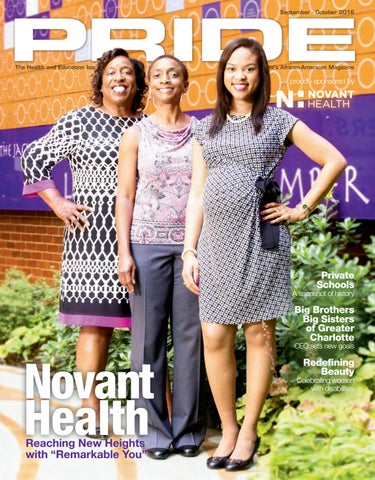
September - October 2016
The Health and Education Issue
Charlotte’s African-American Magazine
proudly sponsored by
Private Schools
A snapshot of history
Big Brothers Big Sisters of Greater Charlotte
CEO sets new goals
Novant Health Reaching New Heights with “Remarkable You”
Redefining Beauty
Celebrating women with disabilities
RAISING OUR
STANDARDS
WITHOUT
RAISING OUR
PRICES HOW
REFRESHING
At Food Lion, supporting the community is important to us. That’s why we’re committed to always providing you with fresh foods at affordable prices. Thank you for choosing our home to feed your home.
Novant Health is pleased to be the lead sponsor of Pride’s Health and Education issue
O
ver more than 30 years of practicing family medicine, I’ve found this to be true: Good health is the foundation of a person’s overall well-being. At Novant Health, we are committed to creating healthy communities and keeping people healthy so they can enjoy living life fully. While much of the worldclass care we provide takes place within our hospitals and physician offices, our mission to improve the health of our communities extends far beyond our walls. We’ve discovered shared health issues in communities across our footprint — prediabetes, obesity and high blood pressure. Separately, each health condition is dangerous. Together, they are a deadly combination for a downward spiral of ill health. Our organization has pledged to tackle these comorbidities through an unprecedented, multiyear, system-wide initiative called Remarkable You. Through Remarkable You, we offer free health screenings, wellness services and community symposiums featuring Novant Health providers and public health experts. An abundance of health-and-wellness tips, articles, healthy recipes and other information are also offered on our Remarkable You website. There is great reason for concern. The American Diabetes Association estimates that in the Charlotte metro area alone, roughly 170,000 people have diabetes. Many individuals in our community are at risk for developing type 2 diabetes and don’t even know it. What’s more, the obesity epidemic in the United States continues to worsen, according to the latest research by the Centers for Disease Control and Prevention. One report shows that more than 40 percent of American women were obese as of 2014,
setting a new high. The same study found that 35 percent of men were obese. Our children are impacted, too. Seventeen percent of U.S. kids are obese. People who are obese have higher rates of heart disease, diabetes, some types of cancer and other illnesses. The risk of heart disease and stroke are alarmingly high for African Americans. In fact, nearly 44 percent of African-American men and 48 percent of African-American women have some form of cardiovascular disease. While we have made headway in raising awareness about the link among these three conditions, there is still much work to be done. Furthermore, we must continue to address health disparities across the communities we serve, pushing forward with the fervent belief that everyone deserves respect and should have access to quality healthcare. On behalf of the 24,000 team members at Novant Health, know that we are your partners in health. We are committed to building and sustaining healthy communities for generations to come. As a woman of faith, I offer to you these keys for a healthier life — love yourself, nurture yourself, love others, care for others, keep your mind and body moving and become still within.
Dr. Ophelia Garmon-Brown Senior vice president of community wellness and education Novant Health
We see you as more than a patient We believe in putting people first. We always see you as more than your condition. We see you. And you’re the reason we’re committed to making healthcare remarkable.
NovantHealth.org
© Novant Health, Inc. 2016 7/16 • NH-0002
September-October 2016
Departments 8 From the CEO 12 Notable Names 13 By Faith 14 The Mindful Parent 16 Book Review 17 Family Notes 51 Scene and Seen 62 Events Calendar
13
19
33
49
Health 54 Bariatrics
A strategy for obesity
56 Diabetes
Are you at risk?
58 Opiods
Understanding the epidemic
Business 59
FYI News & Notes
60 Small Business
Evaluating funding options
61 Innovation at Work
Arrive: After-Hours Shipping September - October 2016
The Health and Education Issue
For these stories and more, visit us on the web! www.pridemagazineonline.com
Features 19
33 Take
Heart African Americans and heart disease
Charlotte’s African-American Magazine
proudly sponsored by
Private & Independent Schools A snapshot of history and curriculum
40 Big
Brothers Big Sisters of Greater CEO sets new goals
41 Charter
Schools Students, parents navigate more choices
Private Schools
A snapshot of history
Big Brothers Big Sisters of Greater Charlotte
CEO sets new goals
Novant Health
Redefining Beauty
Celebrating women with disabilities
Reaching New Heights with “Remarkable You”
On the Cover Novant’s Dr. Ophelia Garmon-Brown, Dr. Nmemka Ekwueme-Sturdivant and Dr. Sandy Charles. Photo by Vic LeDan Photography.
39
aking It Count M Hip Hop University
45 Champion
for Students Meet educator Jordan Todd
49
edefining Beauty R Exhibit celebrates women September-October 2016 | Pride Magazine
5
BUILDING COMMUNITIES
Pride Awards 2017 Westin Charlotte
CHANGING LIVES
l Saturday, January 14th
The Pride Awards are presented annually to honor achievement in the African-American community. This year’s gala will be a collaboration with Charlotte’s Habitat for Humanity. With social mobility as the backdrop, the gala will focus on the transformation of the West Boulevard Corridor with a focus on Reid Park and Habitat's contribution to that community.
Celebrating excellent achievement of African-Americans and Africans in the Charlotte region for 24 years. The heroes who will be recognized at Pride Awards 2017 will be a Reid Park community leader and an area high school senior, currently residing in a Habitat home. Winners will be honored at a black tie gala on Saturday, January 14, 2017 at the Westin Charlotte. Both winners will be recognized for their accomplishments. Habitat Charlotte will receive the monetary donation.
HABITAT SENIORS OR PARENTS MUST DO TWO THINGS: (1)
Send an email to info@pridecommunications.net with the following information right away: (Or call the Pride office at 704-375-9553 and supply the information)
Name of Student ________________________________________ Address________________________________________________ Age:___________________________________________________ Phone:______________________ Mobile_____________________ School__________________________________________________ Parent Name and Contact Information ________________________ (2)
Respond to all of the criteria at the right and send a package along with a cover letter to Pride Magazine by MONDAY, OCTOBER 24 AT 5PM. Completed packages can be mailed or dropped off to Pride Magazine, 402 West Trade St., Ste. 102, Charlotte, NC 28202. OR:
A cover letter and other criteria can be emailed to info@pridemagazine.net – Subject: Youth Nominee
The DEADLINE for submitting nomination forms and all supporting material is
Monday, October 24, 2016. Call 704-375-9553 with questions.
Criteria for Youth Winner Annually, the Pride Awards and its sponsors provide a scholarship to a Charlotte area high school senior for outstanding achievement. This year, a committee will select the YOUTH WINNER based on the following:
• Must currently reside or once have lived in a Habitat home • Must be a current male or female high school senior, heading to college • Must be in good standing with his or her school and community • Must have acceptable grades for college admission • Must submit official school transcript • Must submit a 2-page essay on the positive value of living in a Habit home • Must submit 2 letters of recommendation from a teacher, counselor or other • Submit details of any noteworthy accomplishments or other relevant information
M
A
G
A
Z
I
N
E
Charlotte’s African-American Magazine
CEO/Publisher Dee Dixon
Editor-in-Chief Lashawnda Becoats
Copy Editor Polly Paddock
Lead Writer Angela Lindsay
Design & Production SPARK Publications www.SPARKpublications.com
Creative Director Larry Preslar
Junior Art Director Genna Baugh
Distribution Watchdog Entertainment
Account Executive Nikelle Fesperman
Public Relations Nepherterra Estrada
Subscribe to Pride
$13.25. Please subscribe online at www.pridemagazineonline.com, mail to P.O. Box 30113, Charlotte, NC 28230 or call 704- 375-9553
Letters to the Editor Please send an e-mail to info@pridemagazine.net fax to 704-375-9550 or mail to Pride Magazine 402 W. Trade St., Suite 102, Charlotte, NC 28202 www.pridemagazineonline.com
Copyright© 2016 Pride Magazine All rights reserved. Copying or reproduction, in part or in whole, is strictly prohibited.
Pride Magazine prints with soy ink. Vol. 24 No. 5 September-October 2016 All rights reserved for PRIDE Communications Inc. Find us on Facebook: Facebook.com/NCPrideMagazine
September-October 2016 | Pride Magazine
7
FromTheCEO
By Dee Dixon
Small Things That Make Me Want to Scream
T
he entire world is on edge and I feel the pain. Sometimes, though, it’s the small things that make me want to holler.
1. Walking while distracted. Nowadays, people walk all over the sidewalk; have you noticed? It’s so annoying. I have to weave my way through all kinds of human beings whenever I walk uptown. No one cares. Everybody is just lumbering along like zombies, talking on their cell phones, mostly. I was taught to walk on the right side of the sidewalk. You? Can’t tell you how many standoffs I have had when walking uptown. People won’t move, either – I’m on the right they are on the left. A collision is imminent, if someone doesn’t move. I feel tension building and my mind says, “Don’t move, Dee Dixon.” So, I hold my ground until the bitter end. I move over first only if the person I’m about to run into looks vicious. (It’s not worth my life.) We need walking rules. We need help. 2. “I seen.” I’ve written about this before, and it still causes my brain to shut down. I want to scream when I hear high school and college grads say, “I seen.” Someone told me it’s a regional expression. Listen, this is not an expression. Saying “I seen” is just plain wrong. (I was thinking “ignorant.”) There’s no justification. We must reinstate verb conjugation in our classrooms! What’s worse than saying “I seen?” The past tense: “I seent.” Please, somebody. 3. Folding fitted sheets. After decades of changing linens, I don’t know how to fold fitted sheets, and I get really, really frustrated every time I make the attempt. I feel “less than.” After all, I won the “Miss Betty Crocker” award in high school. (I can hear millennials saying,
8
Pride Magazine | www.pridemagazineonline.com
“Betty WHO??”) Never mind. How do you properly fold fitted sheets? Please, someone, tell me so I can move on. 4. Group texting. It’s particularly irritating to me. Not a big social media fan, with a sincere dislike for Facebook, I am completely dependent upon my smartphone. So, whenever I hear that sharp, crisp bell, telling me I have an important text message, I respond 24-7. Oftentimes, it’s a group text from family members, with darling photos of my grandchildren or some joke, meme or thought meant to brighten the day. The intent is good, but I cringe when my texting bell sounds five or six more times with a response from everyone in the group, most of the time saying nothing important. So, family, if you’re reading this, will you please just send whatever you’re sending to me alone first and then send to the group? Thanks a million. Pride Awards 2017 Illuminate Habitat Charlotte Year number 24 for the Pride Awards is straight ahead – Saturday, January 14, 2017. This year, we will collaborate with Charlotte’s own Habitat for Humanity for
an unusual evening you will long remember. In the vein of last year’s “Paths out of Poverty” theme, we will spotlight Reid Park and show how, with Habitat as a key stakeholder, this community has been strengthened and lives transformed. We’ll salute one of Reid Park’s community leaders and honor a high school senior currently living in a Habitat home. Just a couple more juicy tidbits. We are planning an actual on-site “build” for Pride and Pride Award sponsors and friends in December. Then, we’ll solicit volunteers at the gala to finish what we started. (We hope to identify the recipient of the home at the gala.) It’s going to be a heartwarming experience you don’t want to miss, with lots of interactive fun. Also, in light of our theme, this year’s gala will be a “dress down,” black tie affair. (You are reading correctly.) We are asking you to dress “ to the nines” in JEANS AND OTHER CREATIVE THINGS! Got it? If so, reserve your seating now. Go to PrideAwards.net or call the office at 704‑375-9553. Sponsorships, tickets and tables are still available. In closing, I want to thank Novant Health for sponsoring this fabulous September issue. We appreciate it and all it does for our community.
Dee YOUR ORGANIZATION CAN HELP PRIDE
Say "Thank You" to our Veterans Go to pridemagazineonline.com and click "Thank You" under the BUSINESS TAB for details.
PROUD TO GIVE BUSINESSES A LIFT CATS is proud to provide opportunities for businesses to create local jobs through the advancement of transit projects. CATS also seeks to create an environment that gives small and socially or economically challenged local businesses the opportunity to compete for publicly funded contracts by participating in the Small Business Opportunity (SBO) and the Disadvantaged Business Enterprise (DBE) Programs. To date, 100 DBE firms have been awarded contracts of $76 million to help build the LYNX Blue Line Light Rail Extension. As the major provider of public transportation to Charlotte and the surrounding region, CATS relies on the communities we serve to build and operate the service every day. By working together on these new opportunities, we can all keep our communities moving in the right direction. For more information, visit ridetransit.org.
CATS. YOUR RIDE IS HERE.
From runway to your everyday, the hottest trends in modern, Southern style. See them all at Belk.com/trends
SKIN PRINTS
We’re loving new leopard, snake, zebra and cowskin— wear one or mix them up.
ANNE KLEIN: Leather cap sleeve snakeskin dress
Get the look in store or on belk.com
NotableNames By Charles Kelleher Harris
ARETHA BLAKE
CHERYL TUNING
CHRISTOPHER BANKS
SONJA GANTT
Aretha Blake was named president of the Mecklenburg Bar Foundation. Blake is the first African-American woman to be chosen for that role. Blake is an attorney with Blake Law PLLC. “As president of MBF, I’m responsible for collaboratively working with the board of directors and staff in setting and implementing the strategic goals of the MBF in…supporting legal services organizations and community nonprofits providing access to justice for indigent members of our community,” said Blake. Blake received her law degree from the University of Georgia and a degree in psychology from the University of Florida. Blake is native of Johns Island, S.C. “I most enjoy developing innovative fund development and communitybuilding ideas to increase the ability of the 5,200 lawyers in Mecklenburg County to collectively and positively impact our system of justice,” said Blake. Blake is also running for Mecklenburg District Court judge in the November election. P
Christopher Banks now serves as a registered securities representative for AXA Advisers. Banks has 12 years of experience in the financial services industry. A native of Milwaukee, Wisc., he graduated from the University of Phoenix and is currently enrolled at Queens University, where he is studying to become a certified financial planner. In his current role, Banks recommends strategies to clients to help them achieve financial goals and objectives. “The best part of my job is the moment a client says, ‘thank you,’ ” said Banks. “I love when clients feel prepared for all phases of their life. Empowering others to financial success is definitely a large part of my core purpose. Doing what I feel called to do makes my business both worthwhile and fulfilling.” Banks lives in Charlotte with his wife, Tewanna, and daughter, Kennedi. P
Cheryl Tuning has been named vice president of marketing for Elior North America. Elior is a culinary management and corporate catering company that caters to customers in education, corrections, cultural institutions and health care. Besides developing innovative marketing strategies, Tuning is also responsible for executing Elior North America’s vision, values and branding. “It’s great being part of a growing company where I can have a positive impact on the business,” says Tuning. Tuning, who is also the executive board chair for the Charlotte Mecklenburg Black Chamber of Commerce, earned her MBA from Northwestern University’s Kellogg School of Management. Tuning also earned a bachelor of science in marketing and business administration from Illinois State University. She and her husband, Jeff, live in Charlotte. P
Sonja Gantt was recently named the executive director of the Charlotte-Mecklenburg Schools Foundation. “[I] work with school leaders to identify the highest priorities for private donations, help secure donors and then make sure that those who gave know the impact of their contributions,” Gantt said. Gantt is a graduate of the University of North Carolina at Chapel Hill where she earned a bachelor’s in broadcast journalism. “I enjoy talking about CharlotteMecklenburg Schools with those who understand and appreciate the importance of supporting our school system. CMS is one of the largest sources of potential in our community. The district’s success is essential to our county’s future,” Gantt said. Gantt lives in Charlotte with her husband and two children. P
DID YOU KNOW? Dr. Charles Drew was a surgeon who pioneered methods of storing blood plasma for transfusions and organized the first large-scale blood bank in the United States. 12
Pride Magazine | www.pridemagazineonline.com
ByFaith
Black and Blue Men By Rev. Dr. Dwayne Bond
A
s shocked, disgusted and stunned as we all are over the vicious and heinous executions of Alton Sterling and Philando Castile, my heart breaks for their family and friends. Why the shots? Why the murders? Why are these Black men dead? Why do their families now have to grieve their loss? African-American men are dying for no reason, and this must stop! Every American should be concerned, not just African Americans. This is an American problem, not an issue just for African Americans to resolve or be burdened by. Those who are meant to protect humans are killing humans created in the image and likeness of God.
What can we do now? How can we respond?
1. Grieve with those who are grieving. (Romans 12:15) This verse doesn’t call us to grieve only for those in our race or tribe. It calls us to engage our hearts around the sorrows and pain that others may feel. It’s normal. I’m grieving, crying, angry and heartbroken for my people and fellow human beings. 2. Seek the Lord in prayer for America. (Isaiah 55:6) We are in a fragile time in the history of America. Trust is waning and questions are unanswered. Let’s seek the Lord in prayer. Let’s beg and plead with Him to bring justice into our law enforcement system and into our polarized culture, where white is always right and the proof of innocence and perpetual suspicion become an African American’s dilemma to overcome. 3. Inform and enlighten your children and relatives about the new world that we live in. If you are African American, educate your children about the world that we currently live in so that they will not innocently find themselves threatened or harmed by law
enforcement. I emailed my son, reminding him to be polite and courteous if he’s confronted by the police for any reason. I told him to keep his hands visible, to avoid sarcasm or being defensive. 4. Don’t make the mistake of believing that white people are the problem. (John 8:44) While it may artificially soothe our sorrow, it is a vital mistake to demonize a race of people. The real enemy is Satan. He wants to destroy men, families, communities, cities, the world and our nation. I can only draw assumptions based on the actions of these respective police officers as it relates to African-American men. However, white people aren’t the problem; Satan, unconfessed sin, fear, hatred, superiority, misuse of authority and dehumanization are some of the many problems. 5. If you are a pastor, educate your congregation about these heinous and violent murders and injustices. Regardless of the ethnic makeup of your church, urge your congregation to learn more abut the challenges of ethnic minorities. Call your people to pray for justice. Confess and repent over
apathy and disinterest or even the idea that “this is their problem, not mine.” 6. Identify and love people who don’t look like you or have your same educational background or history. If justice will prevail, it will come only through the kindness and grace of God through people who live out of love instead of fear, privilege and preference idolatry. Fear, preference and privilege can keep us unaware, unconcerned and unemotional. We must create a movement that leverages privilege for someone else’s good. 7. Unite together. Instead of these senseless murders and truth-twisting outcomes that are dividing human beings, let’s allow tragedy to soften our hearts to care, to love, to engage, to mobilize and to unite. Let’s prayerfully continue the conversation and trust Jesus to change our world together. With an overwhelmingly heavy heart as I think about the future of America and my two African-American sons, I write. P The Rev. Dwayne Bond is the lead pastor of Wellspring Church.
September-October 2016 | Pride Magazine
13
TheMindfulParent
By Shavonda Bean
Mass Violence with Mass Misperceptions: The Myths about Mental Illness
E
xtreme violence has become all too common in America. We are often inundated with news, graphic images and details of mass shootings, terrorism and the very personal and frequent violence that occurs in domestic situations. In the process of making sense of tragedy, the question of mental illness is often introduced into the conversation. This hurried association of mental illness and mass violence elicits feelings of confusion, frustration and judgment for those diagnosed with mental health conditions. I know, because I hear it from my patients and so do others providing treatment. Imagine if your own health condition were associated with mass or extreme violence. A 2013 online study by McGinty, Webster and Barry found that viewing media associating mass shooting and mental illness increased respondents’ negative attitudes toward persons with serious mental illness, and increased support for gun restrictions among the same group. This is a frustrating and inaccurate portrayal of mental illness that increases stigma and can delay treatment. So, let’s talk about the truth. The truth is that overall, mental illness alone can account for only 4 percent of those who commit violent crimes, based on
14
Pride Magazine | www.pridemagazineonline.com
information provided by U.S. Department of Health and Human Services in 2014. The greater predictors of violence are past acts of violence or alcohol and drug abuse. More specifically, those who are male, in poverty, and abuse drugs or alcohol are more likely to commit violent acts than those with mental illness alone. While those who suffer from severe and persistent mental illnesses such as schizophrenia can become violent during active hallucinations, the more startling truth is that those with severe mental illnesses are 10 times more likely to be victims of violence than others and are more likely to commit violence against themselves through suicidal behavior. So mental illness alone cannot take the blame for mass violence. An accurate understanding of these risks will help educate the community about the need for addressing substance abuse issues, poverty in our communities and enhanced treatment for those with a history of violence. It can help bridge the gaps between services and those in need, and help reduce the stigma. What can you do to dispel the myths? Be sure those around you, and especially children, understand how to process the violence they might be exposed to. More and more children have access to social media and need to talk about the
violence they see and get answers to their questions. The earlier children have an understanding of mental health, the better. Older children and teenagers are able to have more detailed conversations and search for ways to help. Engage them in the conversation about misperceptions and reiterate that having a mental illness alone does not make someone more likely to commit acts of violence. Look for the positives in each situation. Often times, tragedy can bring out the best in humankind. Point out these examples and highlight the fact that people with physical and mental health conditions are helping their communities and are a part of resolving the problems. Avoid using terms that increase stigma, such as “crazy” or “psycho” when referencing violence. The truth is, many people with mental illnesses lead productive lives, are highly active in the community and on their jobs. Adults must help decrease the stigma, and it starts in our own homes and with our family members and children. P Shavonda Bean is a licensed psychological associate and owner of Essential Assessments & Behavioral Health. Visit www.EssentialHealthNC.com for more information.
24/7 ONLINE CARE FROM VIRTUALLY ANYWHERE.
Virtual Visit from Carolinas HealthCare System brings you 24/7 access to online care from the comfort of your home.* Use your tablet, phone or computer to log on, chat one-on-one with a medical professional, and get a prescription if needed. Visit for cold or flu-like symptoms, pink eye, backaches and more. Enrollment is free. Sign up today at CarolinasHealthCare.org/VirtualVisit
*Patients must be physically located in North Carolina at the time of the Virtual Visit.
BookReview
‘The Happy Vegan’
By Angela Haigler
by Russell Simmons
I
n addition to being a successful entertainment mogul and entrepreneur, Russell Simmons, 58, is also a New York Times bestselling author. In his previous books, he shared business successes and offered advice. His most recent book, “The Happy Vegan,” chronicles his journey to a vegan lifestyle, providing suggestions and a path for others to follow. A highlight of the book is a lesson from Simmons in basic meditation. Meditating for at least 20 minutes per day is something that Simmons commits to and says has led to his own success. Simmons says that after giving up drugs and becoming sober at age 30, he then turned to yoga and later meditation. These healthy, centering behaviors led him to a crop of new friends, many of whom had already eliminated animal products from their diets. While he figured intellectually that going vegan was probably a good idea, something stopped him from taking that next step. It wasn’t until a colleague cornered him on a rainy vacation with the documentary, “Diet for a New America,” that Simmons gained the courage to fully embrace a vegan lifestyle. The documentary showcased the health benefits achievable from going vegan, while also showing the horrors experienced by animals raised for meat, milk and eggs through factory farming. Available on audio and narrated by hip-hop poet Black Ice, “The Happy Vegan” is the perfect educational option for transitioning or new vegans. Simmons gently eliminates most objections to veganism by citing his own struggles. He even provides suggestions for vegan fast-food options, such as the Bean Burrito with Guacamole at Taco Bell, or the Veggie Whopper at Burger King.
16
“The Happy Vegan” provides great insight into what makes a successful mogul such as Russell Simmons tick. In the process, there’s an even greater lesson about physical, mental and spiritual health.
One of the most disturbing facts for this reviewer was hearing about the misery many farm animals are subjected to on a daily basis. Simmons explains what happens to cows, pigs and chickens in the production of milk, beef, pork, eggs and poultry. It isn’t pretty. In every case, it is pretty awful.
What Works:
“The Happy Vegan” provides great insight into what makes a successful mogul such as Russell Simmons tick. In the process, there’s an even greater lesson about physical, mental and spiritual health. Even if veganism isn’t something you’re leaning toward, this book is a good choice for expanding minds.
What Needs Work:
There really isn’t much to dislike about this book. Simmons does not come across as too preachy. He provides the facts and shares his own personal journey. Those not interested in learning about the things Simmons attempts to teach might be turned off.
Pride Magazine | www.pridemagazineonline.com
FamilyNotes
Compiled by Lee McCracken
Children’s New Picture Book About Diabetes “Nana’s Favorite Things” (Eifrig Publishing, 2015), by Charlotte mother and writer Dorothy H. Price and illustrated by TeMika Grooms of Atlanta, highlights the bond between 7-year-old Sasha, who loves playing basketball, and her young-at-heart Nana, who has diabetes. The storybook for children ages 4-7 encourages dialogue about nutrition and healthy living between young and old, as Sasha learns her grandmother can no longer eat the sugary treats they love to bake together. The two devise a new plan to enjoy some new favorite things. The picture book is available at Amazon, as well as locally at Park Road Books and Main Street Books in Davidson. Loosely based on Price’s mother, a diabetic, and her own daughter, Price says, “ ‘Nana’s Favorite Things’ aims to bring greater diabetic awareness among today’s youth.” Diabetes affects more than 29 million people in the United States, but diet and exercise help patients live long, fulfilling lives. Price, a former English teacher, blogs at Momscharlotte.com and is a longstanding member of the Society of Children’s Book Writers and Illustrators (SCBWI) and the Charlotte SCBWI critique group. Price also is the founder of the Young Authors Program, which provides youths with fun, exciting and imaginative ways to express their voices through writing; she has collaborated with the Library of Charlotte and Mecklenburg County Charlotte Mecklenburg Library, S.T.A.R.S. Math & English Academy, Communities In Schools, Arise & Shine Therapy and the Nzinga Creative Arts Center.
Explore the Wilds of America
“Education is for improving the lives of others and for leaving your community and world better than you found it.” — Marian Wright Edelman, founder and president of the Children’s Defense Fund
Skip the Soda and Sports Drinks What are you packing in those lunch boxes this month? A study published in January in the journal Pediatrics revealed that despite healthwarning labels on sugary beverages (similar to what’s on cigarettes), some 40 percent of parents might still buy them. Fruit drinks, sports drinks and soda can have as many as seven teaspoons of sugar in a 6.5-ounce serving — nearly twice the amount of recommended sugar intake daily for children — and about 66 percent of children ages 2-11 drink these beverages daily, according to Christina Roberto, an assistant professor of medical ethics and health policy at the University of Pennsylvania Perelman School of Medicine. Potential health effects of drinking sugary beverages include tooth decay, weight gain, obesity and type 2 diabetes. Physicians, educators and legislators are striving to get warning labels required on certain sugary drinks. Water is best for children, say experts, or at least choose 100-percent fruit juice with no added sugar. Sports drinks are needed only for physical activity, with a lot of sweating, for more than 90 minutes.
It doesn’t take a big travel budget to expose your children to amazing sights across the country. Playing at Discovery Place until November 18, “National Parks Adventure,” through IMAX® cinematography, takes viewers soaring over red rock canyons, hurtling up craggy mountain peaks, cruising through the Everglades and more. Narrated by Academy Award-winner Robert Redford, the film takes families on the ultimate off-trail adventure into untamed wilderness. The film celebrates the 100-year anniversary of the National Park Service. Find show times and prices at DiscoveryPlace.org
September-October 2016 | Pride Magazine
17
Celebrating 25 Years of Academic Excellence and Community Service
Safe, Bully-Free & Nurturing Environment Caring, Passionate & Qualified Teachers Small Student/teacher Ratio (10:1) Individualized Curriculums
Currently Enrolling for the 2016 –2017 School Year
http://www.brisbaneacademy.org
Private & Independent Schools A Snapshot of History & Curriculum
By Angela Lindsey
I
f asked which existed first in the U.S., public or private schools, most people would probably guess public schools. They would be wrong. Private schools were created first—not only to educate, but also to instill basic principles in students and to build and sustain the new nation. Schooling for students in the colonial days was provided by small, private schools where boys learned core subjects such as math and reading, while girls learned the domestic arts (www. boardingschoolreview.com). Only white children received an education until slavery was abolished, and most teachers were men who were “well-intentioned” but did not have much formal education themselves. It wasn’t until the mid-19th century that the government began to compel children to attend K-12 public schools (www.privateschoolreview.com). In the 1840s, a uniform, organized system of public education began to take shape, along with the concept of public funding for schools at the local level—a model which still flourishes today (www. boardingschoolreview.com). Though 80 percent of American children are educated in the public system today, the other 20 percent find certain needs fulfilled in private schools that are not provided for in the public sector. Local private and independent schools offer such options through their curriculums.
Charotte Latin School
The founders of Charlotte Latin School (CLS) wanted to establish a school which provided a traditional education with strong leadership training and an appreciation of western civilization. CLS models its academic program on the best practices of the early Latin schools, focusing on core academic mastery, including classical languages, critical thinking and a strong student-teacher relationship. Latin’s curriculum is traditional in design yet innovative in implementation. Students are expected to work hard and stretch academically. They receive substantial support from their teachers. Elective courses and extracurricular activities are
available on an age-appropriate basis, and students are encouraged to explore their interests in the arts and athletics, as well as master their academic subjects, to develop a balanced educational experience. Honors and Advanced Placement courses are taught in the upper school. Middle school students who excel in a subject area may be placed in higher level courses to engage their intellects. “We encourage active learning through problem-solving techniques and worthwhile, relevant learning experiences in all areas of study, including cooperative and team-based learning. Charlotte Latin School is committed to an environment of inclusion, where everyone is treated with September-October 2016 | Pride Magazine
19
CHARLOTTE LATIN SCHOOL
dignity and respect,” says CLS Associate Headmaster for Academic Affairs Dr. Rod Chamberlain. “It is through our rigorous, creative curriculum that we deliver on our mission to encourage development and civility in our students by inspiring them to learn, by encouraging them to serve others and by offering them many growthpromoting opportunities.”
The Fletcher School
The Fletcher School grew from a group of parents frustrated by the lack of educational options for their children with learning disabilities. For more than 30 years, it has served the Charlotte region as the largest and most comprehensive program for students with specific learning disabilties and attention defecit disorders. The independent, K-12 school offers a college-preparatory curriculum and prepares students with learning disabiities and attention deficit hyperactity disorder to mainstream into elementary, secondary and post-secondary academic environments. “Our bright, talented and often gifted students learn in small, structured classes with a 6:1 student-to-teacher ratio,” says Susie Culp, director of admissions. The Fletcher School’s academic programs are based on the Orton-Gillingham method of instruction, which utilizes phonetics and emphasizes visual, auditory and kinesthetic learning styles. Instruction begins by focusing on the structure of language and gradually moves toward reading. The program provides students with immediate feedback and a predictable sequence that integrates reading, writing, and spelling. Content courses such as social studies, science and math are taught using the same multisensory techniques of instruction.
20
Pride Magazine | www.pridemagazineonline.com
Culp explains, “Our comprehensive program is designed to build the academic, social and emotional competence of our students. Instruction is sequential, cumulative and repetitious in order for students to achieve mastery. Individual and prescriptive plans of instruction are developed for each student. Multisensory learning techniques are employed, and school-issued, 1:1 Apple® devices support 21st century learning and enhance students’ organizational skills.”
The John Crosland School
To support children and families in their educational journey, The John Crosland School utilizes methods such as: an educational management plan tailored to each child; Measure of Academic Progress (MAPS) testing to follow growth and set goals; social skills classes; exposure to the arts (physical education, music, traditional
THE JOHN CROSLAND SCHOOL
art and graphic arts); technology to support differentiated instruction; and a quality staff. “The John Crosland School strives to be an innovative pioneer in the field continued on 25
THE FLETCHER SCHOOL
Ready. For. Anything. Ready to explore. Ready to create. Ready for whatever life has in store for me. Country Day Ready.
charlottecountryday.org/Pride (704) 943-4530
Open House Dates: October 5
October 18
Kindergarten)
(Junior Kindergarten – Grade 4)
(Junior Kindergarten –
November 3 (Grades 9 – 12)
Call or Come Visit: (704) 943-4530 or charlottecountryday.org/Pride
You are invited to attend our
ADMISSIONS OPEN HOUSES TK, K and Grade 1: October 7, 2016 9:30 a.m. Grades 6 – 12: October 14, 2016 9:30 a.m. www.charlottelatin.org/visit
…lives well lived Financial assistance is available. Please inquire about the Malone Scholarship for gifted students in Grades 7-12. 9502 Providence Road CLS2016_PrideSept.indd 1
Charlotte, NC 28277 |
704.846.7207 7/26/16 10:03 AM
Your extraordinary child deserves an extraordinary education. Visit us today to see how Charlotte’s #1 LD and ADHD school can create opportunities from challenges and success from frustration.
5146 Parkway Plaza Blvd., Charlotte, NC 28217 | 704.365.5490 |
/JohnCroslandSchool | JohnCroslandSchool.org
Crosland does not discriminate on the basis of race, color, sex, age, marital status, disability, religion, creed, or national or ethnic origin in the administration of its educational programs, admissions, financial aid policies or employment practices.
A LIFETIME OF LEARNING BEGINS WITH A WALK THROUGH OUR DOORS. Charlotte Prep understands children are inherently hungry to learn. Our child-centered focus and innovative approach to education ensures that each child reaches his or her full potential. charlotteprep.org | 704-366-5994
CHARLOTTE PREPARATORY SCHOOL
continued from 25
of educating children with learning differences,” says Portia Eley, director of enrollment management and admissions. “While offering personal attention, focusing on the needs of the child’s whole development, Crosland encourages creative thinking and exploration in an effort to foster a love of learning.” While the school follows the N.C. Department of Instruction curriculum, it has an enhanced program using an integrated, multidisciplinary approach to teaching children with learning differences, dyslexia, Asperger’s Syndrome and attention deficit hyperactivity disorder. This approach involves enhancing classroom instruction by offering alternative instructional and assessment methods. In addition to a rigorous curriculum in reading, writing, mathematics, science and social studies, the incorporation of technology and the arts helps to create new pathways in the brain and provides the opportunity for children to express themselves in new ways.
Charlotte Preparatory School
Charlotte Preparatory School, a non-religious independent school, was originally founded as Charlotte Montessori School and converted to a 501(c)(3) not-for-profit in 2012. Its educational approach consists of a hybrid program, which includes a Montessori early school and a traditional lower and middle school and is intentionally small in size because “students learn better in an intimately-scaled environment,” says Blair Fisher, head of school at Charlotte Preparatory. Charlotte Prep’s course of study has three major philosophical bases: student-centered, research-based and success-oriented. “That educational philosophy expresses itself in the creation of the curriculum that is based on research-proven best practice in all areas,” says Fisher. Charlotte Prep implements the strongest curriculum available in all areas, including Montessori teaching principles in the early school and Math in Focus (a Singapore math approach), Columbia University’s language arts program, inquiry-based science and Total Physical Response for foreign language in the lower and middle schools. “Curriculum isn’t a ‘thing’ or a simple methodology,” Fisher explains. “Instead, curriculum is a holistic process which derives from a school’s core values and educational philosophy and, thus, shapes the school’s mission. Curriculum, both written and unwritten, builds over time in a cumulative manner, and students derive the greatest value of the steady application of these forces in their lives over time.”
WWW.PRIMECAREMED.ORG 3627 Beatties Ford Rd. Charlotte NC, 28216
8:30 a.m.
continued on 27
September-October 2016 | Pride Magazine
25
TRINITY EPISCOPAL SCHOOL
CHARLOTTE COUNTRY DAY
continued from 25
Charlotte Country Day School
Celebrating its 75th year on Sept. 22, Charlotte Country Day School is Charlotte’s first independent school and, fittingly, has led the way with several other “firsts” throughout the years, including the first International Baccalaureate Diploma Program in North Carolina (1992), the first Office of International Studies (1988), the first Office of Diversity Planning (1998), the first sports medicine program (1987), the first high school Big Brothers Big Sisters mentoring program (2002), the first high school in North Carolina to have students traveling to Cuba (2015). In every CCDS classroom—from junior kindergarten to its most rigorous advanced placement (AP) and International Baccalaureate (IB) courses—students gain the practical skills they need to succeed as scholars: how to break large problems into small parts, how to conduct research and how to express their ideas. Beginning in lower school, students are immersed in math, science, social studies and language arts, as well as modern and classical languages, public speaking, physical education, research, technology and the arts. By the time middle school students complete the eighth grade, they have the skills and confidence to thrive in upper school, where they can choose from a wide course catalogue that includes IB, AP and honors courses in every discipline, explains Scott Waybright, assistant head of school at CCDS. “The most important aspect of our curriculum is bringing relevance to the educational experience of our students,” he says. “By fulfilling our mission, we will facilitate the development of young adults that are ready to not only impact their community, but also learn from the experiences that await them in the world. The adaptability and humility that comes from a curriculum that continuously challenges the student’s understandings and perceptions will provide a foundation that will serve the individual and the greater good.”
of giving voice and choice to students, building ownership and responsibility for their own learning,” says Chris Weiss, head of lower school at Trinity Episcopal School. “Also known as ‘constructivist,’ our educational philosophy redefines academic rigor by placing more emphasis on the students’ ability to construct their own knowledge and understanding.” Trinity’s academic program brings all members of the school community to a richer intellectual, spiritual, social, physical and aesthetic awareness through an interdisciplinary and progressive approach to instruction. As students make connections across continued on 29
Trinity Episcopal School
“As a collaborative, experiential and process-focused school, Trinity follows the structure of the workshop model as a means
September-October 2016 | Pride Magazine
27
my inspiring moment
Cast of Character - “I’ve never actually been cast in a role that I originally auditioned for... I’ll continue to grow as an actor and use every audition as an opportunity to learn something new.” – Adaora, auditions for “Eurydice”
ProvidenceDay.org/Admissions
continued from 27
subject areas, they expand their creativity, enhance their critical thinking and problem2949001_18627 solving skills, sharpen their communication and leadership dexterity and develop their 4.875 x 9.875 independence. “The school’s founding educators believed 4c strongly in a balanced literacy approach to the teaching of reading and writing, and continues to model the workshop instructional method in those subjects, as well as in mathematics and science. Our authentic and formative assessment—including student work, observations and tests—is seen as a tool to inform instruction, where the process is as important as the product,” she says. In addition, its Service Learning program, one of the most important aspects of its curriculum, encapsulates its three core values of creating scholars, nurturing spirituality and embracing diversity.
When you’re ready to go from napkin to making it happen.
Providence Day School
Providence Day School was the first school in the nation to offer a separate and distinct Global Studies Diploma, which has its own curricular and co-curricular requirements. Originally designed to meet N.C. public school standards, its course of study has evolved significantly over 45 years. The current version is informed not only by roots in traditional literacies (science, math, English, science, arts, physical education) that are meant to produce a collegeready graduate, but also by a set of core competencies it feels they feel students need to thrive in a global marketplace. continued on 31
We can help you with your business plan With Wells Fargo business plan resources you’ll have access to:
Additional tools and resources are available at the Business Plan Center on wellsfargoworks.com/plan.
• An online learning center, a business plan tool to develop or enhance your business plan, and the competitive intelligence tool that lets you size up the competition. • Support and guidance of a banker from your community. • Innovative products, services, and programs.
Photo credit: Mike McCarn/Providence Day School.
Stop by and speak to a local banker today, or go to wellsfargo.com/appointments to schedule an appointmentat a time that’s most convenient for you.
PROVIDENCE DAY SCHOOL
© 2016 Wells Fargo Bank, N.A. All rights reserved. Member FDIC. (2949001_18627)
September-October 2016 | Pride Magazine
29
BRISBANE ACADEMY
continued from 29
“Independent schools like PDS have the ability to treat curriculum development as a more fluid process, rather than adopting a uniform product issued by a government agency or religious entity. We empower our grade team leaders and subject-area department chairs to establish our standards, then analyze and change curriculum to meet the needs of our students. So, envision a
SCHOOL
process where there are many experienced leaders involved in a continuous process of improvement to produce our curriculum,” says Derrick Willard, assistant head of school for academic affairs at PDS. Its their most current curricular TK (Transitional Kindergarten)-12 framework is known as the PD Passport, and it dictates the content knowledge, essential skills and
YEAR FOUNDED
FOUNDERS
ENROLLMENT
DIVERSITY
BRISBANE ACADEMY
1992
Geraldine Brisbane Crooks
80
Predominantly African American
CHARLOTTE COUNTRY DAY
1941
Dr. Thomas Burton and a group of Charlotte leaders
1,660
20% multicultural
CHARLOTTE LATIN SCHOOL
1970
A group of Charlotte families
1,400+
18% diversity
1971
Maury Leahy-Tucker
380
13% African American; 7% Asian; 4% Hispanic; 9% Indian; 9% Caucasian International; 58% Caucasian
THE JOHN CROSLAND SCHOOL
1978 (as Dore Academy; renamed in 2012 to The John Crosland School)
Dr. Mary Dore
100
Not Available
FLETCHER SCHOOL
1982
A group of parents, including Mac Fletcher
265
9% students of color
PROVIDENCE DAY
1970
Families of James Williams, Thomas Ridenhour and Gilbert Bell
1,595
25% students of color
2000
A group of parishioners from several Episcopal churches in Charlotte
441
76% Caucasian; 11% African American; 8% Hispanic; 4% Multicultural; 1% Asian
CHARLOTTE PREPARATORY
TRINITY EPISCOPAL SCHOOL
character dispositions that a PDS graduate should acquire by completing the entire course of study. The graduate should appreciate and value cultural diversity and achieve a high level of proficiency in a language other than English. At PDS, leaders envision a graduate being prepared to be an active global citizen—someone who can help create and lead peaceful, thriving and sustainable communities in the future. “At Providence Day School, our commitment to diversity and inclusion is central to our identity as a community and is emphasized in our core values,” says Nadia Johnson, PhD, executive director of diversity and multicultural education at PDS. “It is not only reflected in the composition of our student body, faculty and administration, but also in our curriculum, which mirrors the diversity of Providence Day and the world. In addition, faculty embrace a culturally responsive approach to classroom instruction, experiential learning and social responsibility, as well as to the socioemotional development of our students.”
Brisbane Academy Preparatory School
Brisbane Academy Preparatory School’s course of study is foundationally aligned with North Carolina’s Common Core State Standard. Its individualized plans use a variety of resources and educational strategies to ensure mastery of grade level skills, allowing scholars to be challenged at their level of learning and encouraging their continued academic success. “Our curriculum focuses on allowing each scholar to fully express themselves as individuals, with genuine respect for themselves and others. Our program also teaches overall wellness and development from the inside out. Healthy, happy scholars are successful citizens who contribute to our communities,” says Christopher Crooks, executive director at Brisbane. Diversity is essential to Brisbane’s learning community, and has been integral throughout its 25-year history. It embraces a “come one, come all” approach to learning, says Crooks, and instills the same in its scholars. Brisbane currently has two sister schools in South Africa and several partnerships throughout the communities and country, including school outreach projects with senior citizen programs, homeless shelters and International House. P
September-October 2016 | Pride Magazine
31
32
Pride Magazine | www.pridemagazineonline.com
TAKE HEART African Americans can lower their risk of heart disease, stroke
H
eart disease is the No. 1 killer for all Americans, while stroke is the fifth leading cause of death and a leading cause of disability among U.S. adults. As startling as those facts may be, the statistics are much worse for African Americans, according to the American Heart Association (AHA). Nearly 44 percent of African-American men and 48 percent of African-American women have some form of cardiovascular disease. African Americans are also twice as likely to die from strokes as whites, and their rate of first strokes is almost double that of whites. Despite the high risk of heart disease and stroke, African Americans can decrease their chances of developing heart-related diseases by taking charge of their health. The most common conditions that affect the risk of heart disease are high blood pressure (also called hypertension), obesity and diabetes. In some cases, the conditions can be interrelated. “The high rate of hypertension, obesity, diabetes and high cholesterol all contribute to a higher prevalence of heart disease and stroke among African
Americans,” said Dr. Sandy Charles, a cardiologist at Novant Health Heart & Vascular Institute in Charlotte. It’s important to develop a relationship with your provider Dr. Sandy Charles to monitor your health. “Studies suggest that AfricanAmerican patients are less likely to receive routine health care and medical screening when they are well, which poses a major barrier to the prevention of heart disease and stroke,” Charles said. The most important step to controlling heart disease and stroke is leading a healthy lifestyle, the doctor said. She recommends patients begin focusing on diet and exercise when they are young. “For diets, I tell patients to practice portion control, and for exercise, even going for a 30-minute walk five days a week can improve your overall health,” she said.
High Blood Pressure
The AHA says that the prevalence of high blood pressure in African Americans is among the highest in the world. Blacks also develop high blood
pressure earlier in life and their average blood pressure is higher than that of whites. Known as the “silent killer,” high blood pressure can permanently damage your heart before you are even aware of it, and it also increases the risk of heart disease and stroke. That’s why you should see a medical provider to assess whether you have high blood pressure and learn what steps to take to manage your condition. While there is no cure for high blood pressure, the condition can be managed with medication. “In most cases, we can use medication to get blood pressure within the normal range, but it’s important that patients take the medication as prescribed or it won’t be effective,” Charles said. She also said not to underestimate the benefit of weight loss, healthy diet and exercise in controlling high blood pressure.
Obesity
The rate of obesity in the AfricanAmerican community is also quite high. More than 75 percent of African Americans are overweight or obese. This affects 82 percent of Black women and 69 percent of Black men. People with a body mass index (BMI) of 30 or higher are considered obese.
September-October 2016 | Pride Magazine
33
guiding light
14 karat white gold ring featuring a 1.03 carat center diamond, accented by 0.62 carat in additional diamonds. Uniquely yours $6,299.
A brilliant diamond will never steer you wrong. Antique, contemporary, or custom-designed, Perry’s has options to fit your taste and budget
Wow, what a find! 6525 Morrison Blvd. Charlotte, NC 28211 704.364.1391 800.339.0734 Store Hours: Mon-Sat 10-6, Thurs 10-7 PerrysSouthPark
PerrysJewelry.com Jewelry enlarged to show detail. Items displayed are one-of-a-kind and subject to prior sale.
34
Pride Magazine | www.pridemagazineonline.com
Those with BMIs over 25 are overweight. The AHA says obesity can increase your risk of heart disease, stroke and other chronic conditions. That is why it is important to work with your doctor to lose weight. Even losing small amounts of weight helps provide cardiovascular benefits and is the first step toward a healthier life, Charles said. The AHA recommends that adults check their BMI once a year and seek medical treatment if their body mass index is 30 or higher.
Diabetes
Diabetes disproportionately affects African Americans. More than 13 percent of Black adults ages 20 and older have been diagnosed with diabetes. Cardiovascular disease is the leading cause of death for people with diabetes, with about two-thirds of people with diabetes dying from heart attack or stroke. Type 2 diabetes is treatable and
preventable, but many people don’t recognize the early warning signs. “Unfortunately, diabetes affects the blood vessels throughout the body, and in its earliest stages, there are often no symptoms,” Charles said. It’s important to have your provider check your blood sugar levels, your blood pressure and your cholesterol to see if you are predisposed to diabetes. Charles also warned that smoking even a small amount can markedly increase the risk of heart disease and stroke. Also, having multiple family members who have suffered from heart disease and stroke may increase your risk of these conditions. P Through its Remarkable You initiative, Novant Health offers free health screenings, wellness services, community symposiums and more. Visit NovantHealth.org/RemarkableYou for health-and-wellness tips, articles, healthy recipes and other information.
Buying your first home is now even more affordable We’re ready to help Charlotte area homebuyers By Glenda Gabriel
Neighborhood Lending Executive, Bank of America
Work with an experienced mortgage specialist at Bank of America to learn about programs to help eligible homebuyers with down payment and closing costs. The America’s Home Grant® Program, offered by Bank of America,1 can help eligible homebuyers in the Charlotte area who earn less than $51,280 per year. With this program, you may receive a lender credit of up to $2,500 toward nonrecurring closing costs, such as title insurance and recording fees. The Bank of America Down Payment Resource Center helps you find out about local down payment and cost savings programs that can be combined with most home loans to help make home buying more affordable. 2 bankofamerica.com/downpaymentcenter Learn about the Affordable Loan SolutionTM mortgage, a fixed-rate loan for low- and moderate-income homebuyers with a down payment as low as 3% to help make buying a home more affordable.3 Plus, find out about additional low down payment options such as FHA loans4 and VA loans.5 bankofamerica.com/affordableloansolution
Contact a mortgage specialist today to learn more: visit mortgage.bankofamerica.com. Qualified borrowers must meet eligibility requirements including, but not limited to, being owner-occupants, meeting certain qualifying income limitations and purchasing a home within a certain geographical area. Homebuyer education will be required if all borrowers on an eligible loan are first-time homebuyers. The America’s Home Grant Program is a lender credit and not eligible to be used for down payment, escrowed taxes or homeowner’s insurance. No cash back to borrower. America’s Home Grant Program is available for properties in the following counties: North Carolina: Cabarrus, Gaston, Iredell, Lincoln, Mecklenburg, Rowan and Union; South Carolina: Chester, Lancaster and York, and the maximum borrower/co-borrower annual qualifying income limit is $51,280 for properties not located in a low-to-moderate income census tract (LMICT). Qualifying income of $51,280 is 80% of Federal Financial Institutions Examination Council (FFIEC) Area Median Income and is subject to change without notice. For properties in eligible counties and located within a LMICT, the maximum borrower/coborrower annual qualifying income limit is $100,000. The home loan must fund with Bank of America. America’s Home Grant Program is only available with conventional, FHA and VA first mortgage loan products. Bank of America may change or discontinue the America’s Home Grant Program or any portion of it without notice. Please ask for additional details. 2 Down payment and/or closing cost assistance programs may not be available in your area. Down payment and/or closing cost assistance amount may be due upon sale, refinance, transfer, or repayment of the loan, or if the senior mortgage is assumed during the term of the loan. Some programs require repayment with interest, and borrowers should become fully informed prior to closing. Not all applicants will qualify. Minimum credit scores may apply. Sales price restrictions and income requirements may apply. Homebuyer education may be required. Owner-occupied properties only. Maximum loan amounts may apply. 3 Available for fixed-rate purchase loans with terms of 25 or 30 years and on primary residences only. Certain property types are ineligible. Borrower(s) must not have an individual or joint ownership interest in any other residential property at time of closing. Maximum purchase loan-to-value is 97% and maximum combined purchase loan-to-value is 103%. For loan-to-values > 95%, any secondary financing must be from an approved Community Second Program; ask for details. Homebuyer education may be required. Restrictions apply regarding co-borrowers. Maximum income and loan amount limits apply. 1
Work with an experienced mortgage specialist who will answer your questions and be there to help you, from application to closing. mortgage.bankofamerica.com The Home Loan NavigatorTM is an interactive tool you can use to keep up to date on the status of your home loan application, upload and sign certain documents electronically, and more. Your mortgage specialist will also be there to help you every step of the way. Not available on certain loan types.6 bankofamerica.com/homeloan-navigator We offer loans at competitive rates to meet your needs, from loans with a low down payment to jumbo loans.7 bankofamerica.com/mortgagerates
Minimum credit scores will apply. Monthly Mortgage Insurance Premiums (MIP) and Upfront Mortgage Insurance Premiums (UFMIP) apply. Maximum loan amounts vary by county. VA loans require a VA funding fee at closing. The fee is higher with a zero down payment, and maximum loan limits vary by county. If a down payment of 5% or more is made, the fee is reduced. The VA funding fee is non-refundable. Ask for details about eligibility, documentation and other requirements. 6 Home Loan Navigator is not available on certain loan types. Please contact a mortgage specialist for more information or to assist with questions about the status of your loan. Home Loan Navigator is a trademark of Bank of America Corporation. 7 Minimum down payment requirements vary by property type and location; ask for details. For jumbo loan amounts used to purchase a single-family residence on a loan amount of less than $1 million, borrower must provide documentation totaling a minimum reserve of 6 months of principal, interest, taxes, homeowners/hazard insurance and assessments (homeowner’s association fees/dues/special assessments) – (“PITIA”) related to subject loan property. For loan amounts greater than $1 million and up to $2 million, documentation totaling a minimum reserve of 12 months of PITIA is required. Interest-only payment option, property and/or occupancy type may require a higher level of reserves, please ask for details. For loan amounts greater than $2 million and less than or equal to $3 million, borrower must provide documentation of reserves totaling a minimum of 24 months of PITIA related to subject loan/property. For loan amounts greater than $3 million, the same reserves are required and must be held in a Bank of America and/or its affiliates (Merrill Lynch and/or U.S. Trust) account. Two separate full appraisals are required. Excellent credit required, including proof of recent consistent housing payment history. Loan to value and property type restrictions apply, ask for details. Not available on all loan programs. Other restrictions apply. Credit and collateral are subject to approval. Terms and conditions apply. This is not a commitment to lend. Programs, rates, terms and conditions are subject to change without notice. Bank of America, N.A., Equal Housing Lender. ©2016 Bank of America Corporation. ARSHDQD8 07-2016 AD-08-16-0064 Member FDIC. 4 5
there
MakingItCount
Organization Uses Hip-Hop to Make More Than Music
Tracey Battle, Hip-Hop University education director and participants at the Hip-Hop Summit held at Johnson C. Smith University.
By Tonya Jameson Photos by Darian Hayes
G
raffiti writing, deejaying, B-boying and MCing are the four pillars of hip-hop, but a Charlotte group is adding another pillar – digital literacy. Charlotte-based Hip-Hop University uses hip-hop to bridge the socioeconomic gap strangling underserved communities. Most hip-hop-based programs focus on youth and traditional hip-hop mediums. Hip-Hop University, however, is showing that hiphop can be more than beats and battles. “We are trying to create a generation of productive citizens,” said co-founder Albert Carter, 31, a middle school math teacher. “We’re trying to engage the community through hip-hop, since that’s the common denominator.” For the youths ages 13-18, the organization provides mentoring, public speaking programs, technology and education. For adults, the organization tries to provide useful skills, such as digital literacy, influence and responsibility. Carter and Reginald LaRoche started the organization in 2014. Their vision is to increase the economic mobility of at-risk youths through mentorship, education and digital literacy through bridging the digital divide. The group hopes its mentees will graduate from high school and a
post-secondary educational program or enter the workforce. The goal is to make Hip-Hop University a national model. Carter and his team say hip-hop is the best vehicle to reach their target population. It’s the language that youths from every class and ethnicity speaks. “In order to make learning cool for urban students, you have to narrow it down to hip-hop and sports,” said Tracey Battle, 29, Hip-Hop University education director, and an English teacher at West Charlotte. Battle and Carter are teachers. Other team members include an author, lecturer and consultant. The team is young enough to relate to the youths in the program, but old enough to understand the sobering impact of the digital and economic divide on people of color. Parents and students may have iPads and other technological tools, but some don’t understand how to fully use these devices to improve their economic status, Battle said. It can be as simple as creating a resume or as aspirational as using technology to become an entrepreneur, she said. “Everyone doesn’t understand digital inclusion,” Battle said. “We don’t want our community to be left behind.” From September of last year to May, the organization hosted free weekly sessions
at the Wallace Pruitt Recreation Center. Events featured rappers, deejays and graffiti artists from the local hip-hop community. This traditional hip-hop programming opened the door for other events such as a school-to-prison simulation which simulates different factors that can lead children on the path from school to prison. There was also the father’s education challenge to encourage father’s to be more engaged in their children’s education. One of the most successful events was the Black Hipstory program during Black History Month at ImaginOn. Black Hipstory panel discussions addressed careers in hip-hop and the social impact of hip-hop. “They really care about the demographic they are serving,” said Lillian Blanche, Teen Services Specialist for ImaginOn. “They really care about the needs of children in the areas that they serve.” They care about more than just children. In July, Hip-Hop University hosted the Digital Hip-Hop Summit at Johnson C. Smith University. The event featured discussions about issues such as email etiquette and digital footprints. Hip-Hop University is leaving its own footprint. It’s one that follows the path of hip-hop’s origins and takes its disciples into the digital age. P
September-October 2016 | Pride Magazine
39
CEO Sets New Goals for Big Brothers Big Sisters of Greater Charlotte By Tiffany Bell
D
onna Dunlap believes in caring. As the new CEO of Big Brothers Big Sisters of Greater Charlotte, she is poised to continue to set the organization apart by finding more ways to serve and prepare children for success. Born in Charlotte and raised in Connecticut, she says giving back is a part of her DNA. “My mother was a Big Sister. As a teenager, I was able to see [the volunteers] were always helping children by serving them in the community,” she said. Now Dunlap will help the organization continue to be at the forefront of child advocacy, by providing volunteers an opportunity to mentor at-risk youths. “I’m so passionate about helping children. We have to get children to know there are things they can aspire to, and we can give them the support to get there,” said Dunlap. She has already begun partnering with local agencies to achieve objectives. “Alpha Phi Alpha [Fraternity, Inc.] has signed up to have Big Brothers conduct financial literacy classes at University of North Carolina at Charlotte, for 50 young men,” she said. Additionally, under her leadership, improvements to maximize child safety have
40
Pride Magazine | www.pridemagazineonline.com
been made. Children up to age 6 are now restricted to the schoolbased program, in which mentors visit them at school. The age minimum has been raised to 9 years for home or overnight visits. Donna Dunlap “Each year, we review a contract with the family and the mentor so that everyone understands the guidelines,” said Dunlap. After the first year, the parent, child and mentor meet face-to-face with a trained match support specialist to assess the relationship before it is allowed to continue. Next year, BBBSGC will celebrate its 45th anniversary. Dunlap’s vision for the organization’s short-term goals include increasing the 1,553 children served by 50 percent by 2020, and providing as many children as possible with a mentoring experience through high school. An area the administration would like to place focus on is the lack of African-American male mentors. The key, she believes, is educating more potential volunteers about the process and the level of commitment. “School-based programs involve mentors meeting with a child at school once a week. Community-based programs require mentors to connect with the child twice [a week] for
activities, such as park visits or going to sports games. The commitment is two hours per month,” she said. Her hope is that mentors will also see the direct impact of their involvement. “Eighty-four percent of our children with a low grade average have improved their grades, 97 percent avoid the juvenile justice system and 60 percent have a greater sense of social acceptance,” she said. She is determined to continue reaching out to African-American organizations for support. As a part of her organization’s anniversary celebration next year, one of the objectives is to enhance the brand. Among other exciting news, BBBSGC will be moving into York County, S.C., by the end of this year, and there will be a major announcement of the brand name change: Central Carolinas. Those who know Dunlap well are confident that the organization’s leadership team has made the right choice. Martin Hurden, BBBSGC board vice chairman and search committee chair, says that her “business acumen, combined with her ability to forge new partnerships and develop effective relationships with donors… will allow Donna to immediately contribute to the success of Big Brothers Big Sisters in our community.” For more information about Big Brothers Big Sisters, visit bbbscharlotte.org P
Students, Parents
‘Charter’ Academic Waters with More School Choices By Kallan Louis
F
all brings relief in more ways than one: cooler temperatures, the return of football and for parents, the kids are back in school. But before parents go back-toschool shopping, many face a more challenging task --- figuring out what school to send their child to. Public? Private? Boarding? What school suits your child best? One type of school is steadily growing statewide and especially in Charlotte --the charter school. So what exactly is a charter school? A charter school is a tuition-free, government-funded public school that provides more autonomy than traditional public schools but also more accountability. A charter school has an authorizer, usually a board of directors, who ensures that the school follows state and local, legal and academic guidelines. Charter schools are reviewed periodically and can have their charters revoked for underperformance or noncompliance of state and local guidelines. The concept is still relatively new. Minnesota was the first state to pass laws establishing charter schools in America in 1991. In 1992, City Academy Charter School in St. Paul became the country’s first charter school. Currently, more than 40 states have passed charter legislation, including North Carolina in 1996. Back then, the state set a 100-charter school cap statewide. The cap was reached in just six years. In 2011, the legislature passed Senate Bill 8, which lifted the cap, leading to a steady stream of schools popping up all over. “For the first time, families have
options,” said Craig Smith, principal of Lake Norman Charter High. “And with options comes more opportunity.” The surge in the number of schools is not the only way charter schools are growing. A study from the National Center of Education Statistics shows enrollment in charter schools increased 1.7 million between 2003–04 and 2013–14. Earlier this year, Charlotte-Mecklenburg Schools announced that of the approximately 3,200 new students projected to enter the school district, about 2,700 will enroll in a charter school. Lake Norman Charter is a prime example of the growth. The school started off as a middle school in 1998 and later added a high school. Recently, Lake Norman Charter received approval to build an elementary school. “I think it has to do with the general growth this community has seen across Mecklenburg and in the surrounding areas. There is more of a need for educational opportunities,” Smith said. But it’s not just a need; there’s a demand for schools such as Lake Norman Charter, which is ranked as one of the top 10 high schools in the state, according to U.S. News and World Report. When the school held a lottery this past year for about 300 open spots, it received about 3,000 applications. Because charter schools have more autonomy than other public schools, they have the ability to tailor curriculum for certain types of students. The Knowledge Is Power Program (KIPP) Academy is an example. KIPP was established in 1994 in Houston to educate underserved inner-city students. The school was
September-October 2016 | Pride Magazine
41
A K-8 tuition-free public charter school in Uptown Charlotte
Build a better tomorrow Now serving kindergarten and grades 4-8. Be a part of the story as we build an exemplary academic program to prepare children for life.
College prep • Public charter • Transportation available
Visit us at ictransform.org or email us at enrollment@ictransform.org!
kippcharlotte.org
A tuition free, public charter school open to all students in grades 6th -12th
Each student will have a Personalized Education Plan (PEP) created based on their specific academic achievement data and needs. Students will be immersed in a student-centered learning environment in which they are active participants in the learning process. Academic clubs and Sports.
ENROLL NOW FOR THE 2016-2017 SCHOOL YEAR! The school application can be found and submitted online through our website.
Charlotte Learning Academy (980)355-2077 701 Scaleybark Rd. Charlotte, NC 28209 www.charlottelearningacademy.org
42
Pride Magazine | www.pridemagazineonline.com
Photos Courtesy of Lake Norman Charter
Lake Norman Charter School
quickly among the highest - performing in its district. KIPP now has nearly 200 schools in 20 states, including KIPP Charlotte. “I think charter schools in the state of North Carolina and even in the city of Charlotte are kind of split,” said Tiffany Flowers, KIPP Charlotte executive director. “There are a group of charter schools that are more affluent, then there are charter schools that seek to serve students from underserved populations.” According to Flowers, on average, students come to KIPP Charlotte two to three grade levels behind, but by the time they finish the eighth grade, they have caught up with or exceeded their peers at other schools. KIPP Charlotte currently serves 400 middle school students. It is more than 90 percent African-American and about 20 percent of its students have special needs. About 75 percent receive free and reduced lunch --- a stark contrast to Lake Norman Charter, which is about 75 percent Caucasian and 14 percent African-American. Lake Norman Charter was unable to provide data on special needs students or those participating in food assistance programs. But these two schools have commonality...growth. KIPP Charlotte added an elementary school this year for about 200 students. The topic of charter schools versus traditional public schools can quickly turn into a heated discussion for a number of reasons. Some of the flexibility in charter schools can potentially create advantages for some. For example, in North Carolina, residents can attend any charter school,
but charter schools do not need to provide transportation or food services -- potentially limiting underserved students. Hiring quality teachers is also a concern for some charter schools. According to CMS, only 50 percent of teachers in a charter school must be licensed. Some proponents of charter schools argue that students are no better or worse than those at traditional public schools. Studies have sided with both types of schools over the years. And poorly managed charter schools close nationwide annually, leaving students and their families as casualties. While the effectiveness of charters schools is still being measured, one thing that can be agreed upon is they offer additional choices for parents. P
Do you have a highly gifted child? Scholars Academy, a K-8 public charter school, has been serving the unique needs of highly gifted students since 2000. Find out more by attending one of our 2016 Open Houses: Saturday, November 5th 10:30am to 12:00pm Saturday, December 3rd 10:30am to 12:00pm
KIPP Charlotte students in the classroom.
Information on the admissions process, our school program and how Scholars Academy defines giftedness will be presented.
704-503-1112 SCHOLARSACADEMY.ORG September-October 2016 | Pride Magazine
43
44
Pride Magazine | www.pridemagazineonline.com
Champion for Students Meet Educator Jordan Todd By Edward Henderson
H
ollywood isn’t a stranger to the story line of a teacher coming into a struggling school and turning things around in dramatic fashion. In real life, it takes a village of dedicated educators with a common goal to manifest this type of change. However, there are standouts in every group who set the tone for the others. In the Jordan Todd spring, Jordan Todd was named Charlotte Mecklenburg Schools’ Teacher of the Year as a representative of Walter G. Byers School. Todd’s journey toward education began in her hometown of Dublin, Va. The rural community only had one high school, where Todd’s mother was one of two African-
American teachers. The example she set planted the seed in her daughter’s mind that teaching might be her calling. “My mom is an educational beast,” said Todd. “She played no games, but we knew she cared. I saw her take students home after class and visit the homes of students. I got to see what it meant to be the consummate educator.” Todd graduated from the University of North Carolina at Charlotte with a degree in elementary education, and went into the mental health field after college. During her time in the field, Todd was able to get a deep understanding of how mental health affects children. She eventually felt the pull back into teaching after learning more about how effectively addressing these issues in early education could be a preventive tool. “I went back into it knowing what population I wanted to serve and what the
issues were,” said Todd. “Because of my training in mental health, I was able to come up with some solutions to quell a lot of the behaviors in schools.” Todd received her position at Walter G. Byers through the Project Leadership and Investment for Transformation (L.I.F.T.) Learning Community. Project L.I.F.T. is a nonprofit organization that staffs struggling schools to create a caring culture that is connected with the community. L.I.F.T. schools funnel into West Charlotte High School and have contributed to the graduation rate rising from 29 percent to 72 percent during the partnership. Dan Swartz, human capital strategies specialist for Project L.I.F.T, recognized Todd’s gift for education early on. “Three words come to mind when I think of what makes Jordan such a unique teacher -- skill, passion and vision,” said Swartz. “… She is an extremely gifted teacher who is able to understand the needs of her scholars and make learning a joyful experience for them. Her students and their families can see and feel the love she has for them through her teaching.” Todd created these strong relationships by petitioning to stay with the same students from kindergarten to second grade. By establishing this core group, she was able to connect with students and parents on a deeper level. Much like her mother, Todd often takes take children home after school, visits them for additional help outside of class and provides a nurturing environment in the classroom. “The relationships I’ve formed with my students and their parents are probably the most crucial aspect of what I do, because it made the difference between that child achieving and not achieving,” said Todd. Her dedication to building community within her classroom wasn’t ignored, as Todd received a nomination for teacher of the year on the school level. After that honor, she moved on to the district level and ultimately received the highest honor as the CMS Teacher of the Year. “It’s very humbling, because I work with some pretty rock star people,” said Todd. “We’ve been in situations with the school we’re in where you’re not just an educator. You’re a mother, you’re a chauffeur, you’re a psychologist, you’re a doctor, and not too many people can wear all of those hats.” Todd plans to stay in the public school system and lobby for them. After her honor from CMS, Todd is creating a platform called “‘A Campaign for Change,” in which’ where she will advocate for increased focus on relationship-building among teachers, students and parents. P
September-October 2016 | Pride Magazine
45
EVERYONE HAS A PART TO DO
TO If you are HIVEveryone HIV- or HIV+ If you are HIV+
HIV
{ { {
GET TESTED
If you are sexually active, there’s only one way to know about your HIV status - and that’s to get tested. Testing is free and confidential at many local agencies.
Take PrEP
PrEP means Pre-Exposure Prophylaxis PrEP is using an anti-HIV medication that helps keep HIV negative people from becoming infected.
Stop Stigma
Avoid using language that stigmatizes others. Don’t be silent - challenge attitudes and behaviors that contribute to stigma. Treat people with HIV as you would treat anyone else: with respect, empathy, and compassion.
Practice Safer Sex
Use Condoms every time Avoid exchanging bodily fluids Limit the number of sexual partners Think twice while using drugs and alcohol Use HIV medications to prevent transmission
HIV Stops with Me!
Always use condoms. Stay on treat-ment and remain virally suppressed (undetectable viral load). Suggest PrEP for any HIV-negative partners.
Get Treatment and Always Take Your Meds
When people living with HIV have access to healthcare and successful treatment, there is almost no risk of transmission - plus you have better health!
Mecklenburg County Public Health | www.meckhealth.org For testing or more information call: 704-432-TEST (8378)
In It Together
Our Health, Our Priority, Our Community
Village HeartBEAT (VHB), a health and wellness friendly competition challenge with adults who have self-identified at least one chronic disease health risk factor. The competition challenge is conducted primarily among local churches representing 10-team members committing to compete for 16 weeks.
Join us Jan. 2017 for Season 5! Join us NOW in the race against Mississippi to recruit 100 congregations in the fight against heart attacks & strokes! 100 Congregations for Million Hearts® is a faith-based program designed to help guide congregations toward a heart-healthy lifestyle. We are recruiting local faith-based organizations to join us by Oct. 31, 2016.
Join Us for Our Ribbon Cutting Ceremony Honoring the Thereasea C. Elder Community Health Leadership Academy For more details, visit www.villagehb.org
For More Info About Our Programs Contact: Cheryl Emanuel • 980.314.9027 • Cheryl.Emanuel@MecklenburgCountyNC.gov Gwendolyn Devins • 980.314.9143 Gwendolyn.Devins@MecklenburgCountyNC.gov
Visit Us Online • WWW.VILLAGEHB.ORG
@VillageHeartBT
Village Heart B.E.A.T
Internal Medicine Research has provided safe, state of the art clinical trial medical treatments for more than 10 years. Our mission is to help our Doctors at Metrolina Internal Medicine bring sound and effective medical advances to Charlotte and the world. Pa#ent screening for clinical trials
Free lab tes#ng, procedures, medica#ons and supplies to qualified pa#ents Partnered with global leading pharmaceu#cal companies
704.374.0030 www.mimpa.com
700 South Torrence St. Ste. 110, Charlotte NC 28204
48
Pride Magazine | www.pridemagazineonline.com
Exhibit Celebrates Women with Disabilities By Tonya Jameson
Photograph by Silvio Suarez
M
Monique Stamps (Disability Tetriplegic Spinal Cord Injury)
REDEFINING
BEAUTY
onique Stamps is tired of being invisible. She’s a Black woman, a mother and a Zumba instructor. Stamps is also paralyzed below her chest. This summer, she hosted The Raw Beauty Project Charlotte, a photography exhibit at Dupp & Swat. It featured 19 women, mostly of color, with various disabilities. The photos show the women with prosthetic limbs, wheelchairs and other devices that help them live. They look beautiful, but are often seen by society as only disabled or not seen at all. “We’re literally invisible,” Stamps, 38, said. “It’s like we’re a hidden community. We’re kind of discarded out of society.” Raw Beauty seeks to bring people with disabilities out of the shadows. The project shows women with disabilities as mothers, sisters, desirable, fun, happy, emotional and the full gamut of the human experience. The Raw Beauty Project grew out of a Miami exhibit in 2006. Wendy Crawford, founder of mobileWomen. org, photographer Ginny Dixon and Susan Solman, a podiatrist and pharmacist, collaborated to create the photography exhibit to show that women with disabilities are more than their wheelchairs or prosthetics. The current version debuted in New York in 2014. Charlotte has hosted an exhibit, and Los Angeles is scheduled to host one, as well. The exhibit celebrates the lives of women with disabilities and showcases the beauty, power and passion of the women, according to Rawbeauty.com. Each exhibit primarily features women living in the host city or region. Stamps became an advocate for the disabled by happenstance. A car accident in 1995 paralyzed her below the chest, but she can use both arms. In 2003, she became
September-October 2016 | Pride Magazine
49
Photo by Ginny Dixon
pregnant. She hadn’t been to an ob-gyn once since the accident. “You’re so focused on the injury that being a woman and all of that stuff kind of got lost until I got pregnant,” she said. Stamps said she had to be examined in her wheelchair or bring two people to help lift her onto the examination table whenever she visited the doctor. Since her legs are paralyzed, she can’t hold them in the stirrups. Two people must hold her legs. “Your dignity goes out of the window,” she said. To make matters worse, her friends (now former friends) questioned why she would get pregnant. Others Melissa Soriano (Disability asked if she was raped - Muscular Dystrophy) or assaulted. “It’s like just because I’m in a wheelchair, I don’t get to love?” she asked tearfully. “I don’t get to be in a relationship or have children? I’m not allowed to feel?” Her pregnancy motivated Stamps to do research about being pregnant and disabled. She needed to find adaptive cribs and other equipment. She also wanted support from other women who faced the challenge of being pregnant and disabled. She became more active in the disabled community and volunteered for organizations locally. She met other women facing challenges in health care, as well as women who were college-educated, qualified and jobless. In her research, she stumbled on the Raw Beauty Project. She reached out to see if the exhibit could be brought to Charlotte. Instead, the organizers invited her to participate in the New York showcase. Then they asked her to be the Charlotte ambassador to create an exhibit here. “She is an amazing, powerful, passionate woman and a shining example of Raw Beauty,” said Ginny Dixon. “She is extraordinary! I love that woman. She’s a hero!” Stamps found 19 women in the Carolinas to share their stories, and several local photographers to volunteer to take pictures. “I was blessed and honored to be a part of it,” said photographer Carol Larsen, who recently moved to Greenville, S.C. from Charlotte. “They were such amazing women. They had testimonies and stories of how they’ve overcome disabilities. It was a wonderful experience.” The exhibit debuted at Dupp & Swat in June, but since then, Stamps hasn’t found another gallery or space to host the exhibit. She received positive reception to her pitches, but then her phone calls weren’t returned. The photos are collecting dust in her home for now. “It’s super-frustrating,” she said. “I need to get these stories out there so people will give us a chance, just to see us, include us, listen to us.” Regarding those who questioned her pregnancy, Stamps is the proud mother of a 10-year-old son and a 12-year-old daughter. “My kids are my everything,” she said. “It’s just us.” Not exactly. It’s them, and everyone else who has been touched by women of the Raw Beauty Project. P
50
Pride Magazine | www.pridemagazineonline.com
SceneandSeen
Harper Roddey Society Celebration for The Harvey B. Gantt Center for African-American Arts + Culture Photos courtesy of The Harvey B. Gantt Center
INKED Photography exhibit at The Gallery At South End Photos by Mark Pendergrass, Gianna Pendergrass and Joseph Johnson
Charlotte Tastemaker Summit Presented by The Black Southern Belle Collective at Tuft Photos courtesy of The Black Southern Belle
Morehead Tavern Launch Weekend at The Morehead Tavern Photos by Darian Hayes
September-October 2016 | Pride Magazine
51
Made You Blush
The Pretty Blouse
Plaid
Plush Touch
Prairie Booties
The Over The Knee Boot
FROM RUNWAY TO YOUR EVERYDAY, THE HOTTEST TRENDS IN MODERN, SOUTHERN STYLE. SEE THEM ALL AT BELK.COM/TRENDS
Sparkle and Shine
The Saddle Bag
The Dark Lip
Skin Prints
GET THE LOOK IN STORE OR AT BELK.COM
PrideHealth
Bariatrics:
A Strategy for Obesity
A
ccording to the Centers for Disease Control and Prevention, 57 percent of African-American women and 38 percent of African-American men 20 years and older are obese. Although this statistic is alarming, it doesn’t offer much support on what African Americans can do to make positive lifestyle changes. Dr. Carl Lowe Jr., a bariatric surgeon at Carolina Surgical Clinic of Charlotte, provides nutrition education and surgery to his patients to help promote successful lifestyle changes. “The most important Dr. Carl Lowe Jr. factor to manage weight is to burn more calories than we take in, which means eating fewer calories and exercising more per day,” said Lowe. “Bariatric surgery is an increasingly important tool to help people eat fewer calories.” Bariatric surgery is a safe, proven way to lose weight, and those who receive the procedure typically lose 100 pounds or more. Lowe said that bariatric surgery is the most effective way to end or reduce diabetes, high blood pressure and sleep apnea. “Every other treatment for diabetes just tries to control the sugar, but you still need to take medication for it. Bariatric surgery is one of the only hopes to give people full control over blood sugar without needing medication.” Although bariatric surgery helps patients reach their goal weight, they should also seek a good goal lifestyle instead, Lowe said: “Consistency is the key to reach this lifestyle.” “Most jobs are eight hours per day of sitting,” said Lowe. “We have easy access to high calorie foods, and exercise for many people is uncomfortable, painful or undesirable. Because we don’t pursue exercise on a regular basis and we are eating so many high-calorie foods all day long, it is easy for us to gain weight.” For someone who is struggling with his or her weight, Lowe’s first tip is to exercise. “When is the last time you drove down the street and saw a group of cyclists or joggers that were overweight?
54
Pride Magazine | www.pridemagazineonline.com
That’s not a coincidence,” said Lowe. “The reason they are fit and have control over their weight is because they exercise. If we could just exercise more, a lot of our weight problems would go away.” Lowe recommends making exercise enjoyable to increase the chances of it becoming a habit. “If it’s not fun and you don’t like it, then it won’t stick,” he said. “Find people who like to exercise, or find a sport or activity that you really enjoy doing, and make that a regular part of your weekly activity at least four days a week.” The exercise can vary from walking to light jogging, aerobics, swimming, Zumba or work on the elliptical. “Do anything to get the heart rate up to burn the calories and fat off of the body,” Lowe said. Bariatric surgery has come a long way since gastric bypass was first introduced over 20 years ago. “Now,” he said, “the procedures are performed laparoscopically and take
anywhere from 40 to 50 minutes to complete. Patients are back to work in a week or two, due to the minimally invasive approach.” Carolina Surgical Clinic of Charlotte dietitians help patients formulate their own healthy meal plans that they will enjoy. The dietitians instruct patients how to read food labels, count calories, grocery shop and prepare food properly. Lowe sees patients at two locations: Novant Health Presbyterian Medical Center and 2104 Randolph Road in Charlotte, North Carolina. He also has an office at Novant Health Matthews Medical Center. P Through its Remarkable You initiative, Novant Health offers free health screenings, wellness services, community symposiums and more. Visit NovantHealth.org/RemarkableYou for health-and-wellness tips, articles, healthy recipes and other information.
PrideHealth
Are You at Risk for Diabetes? M African Americans are disproportionately affected by the disease
ore than 29 million Americans have diabetes, according to the Centers for Disease Control and Prevention. However, of those with the disease, the agency estimates that more than 8 million have not been diagnosed and are not being treated for the condition. On top of that, African Americans are disproportionately affected by diabetes, as they are 1.7 times more likely to develop diabetes compared with non-Hispanic whites. In fact, 13.2 percent of all Blacks ages 20 or older have diagnosed diabetes.
Risk Factors
Some risk factors for type 2 diabetes can be decreased with lifestyle changes, while other risk factors are tied to family history. Risk factors include: • Heredity. Having a parent, brother or sister with diabetes increases your risk. • Age. Most people diagnosed with diabetes are older than 40. • Ethnic background. Type 2 diabetes is more common among Native Americans, African Americans, Hispanics, Latinos and Asians than among whites. • Being overweight. People with inactive lifestyles, weighing at least 20 percent more than the recommended weight for their height and build, are at risk. • High blood sugar. Higher-than-normal blood glucose levels indicate greater chances for diagnosis. • High blood pressure or heart disease. These comorbidities together greatly impact one’s health. • Sedentary lifestyle. Inactivity or sitting for prolonged periods of time has been linked to chronic disease. • Gestational diabetes. Women who develop gestational diabetes while pregnant are at an increased risk. • Baby’s birth weight. Women who have given birth to babies weighing 9 pounds or more are a higher risk. • Using certain medicine. Diuretics used to manage high blood pressure and steroids used to help with inflammatory conditions may contribute to type 2 diabetes.
56
Pride Magazine | www.pridemagazineonline.com
Signs and Symptoms
Dr. Nnemka Ekwueme-Sturdivant of Novant Health Endocrinology said it is common for people to have diabetes for years before they are diagnosed, and it’s important to be aware of the typical symptoms. According to the American Diabetes Association, type 2 diabetes symptoms include: • Urinating often. • Feeling very thirsty. • Feeling very hungry – even though you are eating. • Extreme fatigue. • Blurry vision. • Cuts or bruises that are slow to heal. • Tingling, pain or numbness in the hands and/or feet. “Patients who have diabetes should not ignore it,” Sturdivant said. “They often don’t claim it, but they need to own it and control it.”
Prevention
Lifestyle is the cornerstone of diabetes prevention, Sturdivant said. “The best way to prevent diabetes is to keep a normal weight,” she said. “Younger children especially should
follow a healthy diet and stay active.” Sturdivant recommends 30 minutes of aerobic exercise five days per week, and if possible, exercise including weight and resistance activities Dr. Nnemka Ekwueme-Sturdivant three days a week. She also recommends limiting your carbohydrate intake and filling your diet with vegetables and healthy proteins.
Get Tested
If you have any risk factors or are concerned you may have diabetes, your physician can check using a simple blood test to measure your blood sugar. P
Through its Remarkable You initiative, Novant Health offers free health screenings, wellness services, community symposiums and more. Visit NovantHealth.org/RemarkableYou for health-and-wellness tips, articles, healthy recipes and other information.
PrideHealth
By Dr. Dale Misiek
Making Sense of the Opioid Epidemic
O
pioid use, abuse and addiction have taken over the news on a daily basis. An estimated 44 people die every day in the United States from overuse of opioids, from teens to senior citizens, in isolated rural towns and large cities alike – this epidemic doesn’t discriminate. But what do we really know about these powerful painkillers? According to the National Institute on Drug Abuse, opioids “reduce the intensity of pain signals reaching the brain and affect those brain areas controlling emotion, which diminishes the effects of a painful stimulus.” Physicians often prescribe opioids such as hydrocodone, oxycodone, morphine and codeine to help patients deal with postsurgical discomfort or chronic conditions. In fact, more than 70 million patients are prescribed opioids following surgery annually, and research shows that one in 15 will go on to long-term use, which can lead to misuse or dependence. This epidemic is hitting us right in our backyard. In 2012, a federal report from the Centers for Disease Control and Prevention (CDC) showed that in North Carolina, 97 painkiller prescriptions were written per 100 people – making it the 13th highest state for prescribing opioids in the United States. It has also been reported that more than 1,700 prescribers may have been overprescribing painkillers in North Carolina. This has led roughly 34,000 licensed doctors (including myself, an oral surgeon) to take action against this crisis and work together to combat the opioid epidemic by limiting the medications they prescribe to patients.
58
Pride Magazine | www.pridemagazineonline.com
A recent study published in the Journal of the American Medical Association (JAMA) found that dentists are among the leading prescribers of opioids, and that these medicines are most commonly prescribed for surgical tooth extractions for patients between the ages of 14 and 24. Unfortunately, what can start as a method for pain relief can end in a serious addiction problem, due to lack of communication between patients and doctors on the effects of taking prescription painkillers. It’s important that health care providers have open, honest dialogues with their patients about their pain control options, including non-opioid alternatives. In my own practice, I recently started using a long acting non-opioid option called Exparel that is injected during surgery. Unlike the usual numbing agents that last only four to six hours, Exparel provides pain relief for up to two to three days. With this pain management alternative, my patients have needed only to take ibuprofen to manage their postsurgical pain following most wisdom tooth extractions. This strategy has been shown to reduce, or, in some cases, completely eliminate, the use of prescription opioids. Since I have been using this approach, the number of patients who
come in for follow-up visits for problems due to pain or nausea and vomiting from opioids has gone way down. I have never seen my patients’ pain more effectively managed and with so few side effects in the 34 years I’ve been practicing. Non-opioid options are becoming more popular in the health care industry as the opioid epidemic continues to be a hot topic for national and local legislatures, and media. The fight against prescription drug abuse must be waged on many fronts, but for many patients, it starts in their doctor’s office. It’s imperative that we actively educate patients on the pain management options available to them, including non-opioids. By doing so, we empower patients to have control over their own pain management plan, while potentially mitigating the societal burden of opioid use. P Dr. Dale Misiek, an oral surgeon at the Carolinas Center for Oral and Facial Surgery.
PrideBusiness FYI
By Edward Henderson
Johnson C. Smith University announces new board chair and vice chair
Chairman Monroe Miller recently announced Shirley J. Hughes as the chairelect and Kevin Henry as vice chair-elect of Johnson C. Smith University’s Board of Trustees. Hughes, who currently serves as vice chair of the board and chairs JCSU’s Trustee Committee on Governance, will be the first woman to lead the board. She and Henry Shirley J. Hughes Kevin Henry began their three-year terms on August 1. “Hughes and Henry have deep ties to the JCSU community that continue the historic tradition of our trustees,” said President Ronald L. Carter. “This includes, according to JCSU historian Inez Moore Parkers’ observation, ‘visiting campus frequently [and] mingling with the staff and students with a personal touch that said concern.’ Both have generously shared their resources and personal wealth to support scholarships, key campus programs and the University’s comprehensive campaign Tomorrow is What WE Make It. We are delighted that the University will now enjoy the benefits of their respective expertise, vision and leadership in a new and more meaningful way.”
Linda Lockman-Brooks Appointed to CPCC Board of Trustees
Linda Lockman-Brooks has been appointed to the Central Piedmont Community College board of trustees by the CharlotteMecklenburg Schools board. Lockman-Brooks’ four-year term as a CPCC trustee began July 1. Lockman-Brooks is president and principal of Lockman-Brooks Marketing Services LLC. A graduate of the University of Missouri-St. Louis, she worked in St. Louis, New York City and Charlotte as a corporate marketing executive with Fortune 500 firms including American Express, NationsBank (now Bank of America) and Duke Energy. During her time in New York, Linda LockmanBrooks she also worked for the J. Walter Thompson Advertising Agency. In addition to the CPCC board, she currently serves as vice chair of the board of directors for the Charlotte-Mecklenburg Library Foundation and is on the advisory board of Child Care Resources. She is a past board chair for the Arts and Science Council, Children’s Theatre of Charlotte, Women’s Inter-Cultural Exchange and the YWCA of the Central Carolinas.
Olympic High School Track and Field Standout Represents U.S. in Cuba
Khayla Dawson-Blackett was one of 28 high school track and field athletes selected to represent the United States in the Caribbean Scholastic Invitational, which took place in Havana, Cuba in May. Dawson-Blackett was virtually unbeatable at the shot-put and discus in state competition. She’s a five-time N.C. High School 4A State Champion and the record holder in both the shot-put and discus for Olympic High School. Dawson-Blackett has also garnered honors for her academic endeavors (3.94 GPA), being recognized as an Academic and Athletic AllAmerican, winning The Charlotte Post’s Top Senior Scholar Award and the 2016 Principal’s Award from the School of Math, Engineering, Technology, and Science at Olympic. She recently accepted an athletic scholarship from Indiana University to join their track and field program, while majoring in information systems.
Silver Fox Cheerleaders Prove Spirit Doesn’t Age
The Silver Fox Cheerleaders are a group of 12 seniors ranging in age from 55-79. Their goal is to stay active and healthy while serving the community through participation and education. The group cheers at a variety of events, including 5K runs, walks for breast cancer and diabetes research, parades and festivals. The Silver Foxes were founded in 2007 by Blanche Penn, who saw a need for this type of activity locally and statewide. The group also visits assisted living facilities and performs at local school events, birthday parties and churches. In 2012, the group participated in the Senior Games Silver Arts event at the Levine Center and won the right to represent Charlotte on the state level. The group then traveled to Raleigh to compete against six other cheerleading squads, and won the gold medal.
September-October 2016 | Pride Magazine
59
PrideBusiness
What Small Business Owners Should Think About When By Tim Elleby
Evaluating Funding Options
T
he lending environment is constantly evolving, which means more options for small business owners. In the last few years, non-bank online lenders have entered this landscape, adding more choices, and making it as important as ever for business owners to closely evaluate what each lender offers, including the rates and terms of their products and pricing. We know there are many factors to consider when shopping for business financing. Here are five of the top questions to ask yourself as you evaluate lenders:
1
Do they have a track record of serving small businesses? It’s a competitive market for small business credit options, and that’s good for small business owners. When choosing a lender, you should consider financial institutions that have demonstrated a commitment and a track record of working with small business owners. Make sure they have a team that’s focused on helping small business owners at every stage – from those starting up and expanding to those looking to transition or sell their business. Determine whether your lender can provide financial guidance and answer questions in a variety of ways, either online, by phone or in-person. It can demonstrate that the lender is focused on more than just booking loans – it shows the lender’s commitment to serving and helping small businesses, anytime and anywhere.
2
Do they offer comprehensive support to small business owners? When you’re looking for funding, it’s important to thoroughly research and assess your options. It’s helpful to prioritize those lenders who provide a full array of small business offerings. For example, Wells Fargo recently introduced Wells Fargo Works for Small Business® – a broad initiative to deliver resources, guidance and services for small business owners. Within the site, business owners can review articles on starting a business, watch videos on how to navigate the SBA loan application process, and even prepare a business plan through
60
Pride Magazine | www.pridemagazineonline.com
a free, step-by-step Business Plan Tool. Every small business can benefit from more comprehensive support to achieve financial success.
3
Do they offer a range of lending options? Selecting the right small business lender and type of loan for your business can be difficult, as there are so many options available. From traditional loans, credit cards and lines of credit to community development micro loans, grants or U.S. Small Business Administration (SBA)backed loans, you’ll want to seek out a lender that offers a variety of funding options to meet you, wherever you are in the business lifecycle. But before you start the process, it might be helpful to think about the following: • How much money do I need? • What do I need the money for? • How quickly do I need the money? • How long have I been in business? • What is the current financial shape of my business? Answering these questions will help determine if you should pursue a government-backed loan, a loan or line of credit through a bank, or a loan from an alternative lender. Consider making time to meet with your banker to learn more about the various financing options.
4
Do they offer fast and convenient lending products? While numerous factors can impact the length of time it takes to get a decision on a small business loan application, the best lenders make it as easy as possible and keep customers informed throughout the process. Many small business owners are strapped for time, and are seeking faster, more convenient online lending options at competitive interest rates. With Wells Fargo’s new FastFlexSM Small Business Loan, for example, a business owner can complete an application in minutes, receive a quick decision
after applying and obtain funding in as little as one day. Other credit products – such as real-estate secured loans – will require more time to gather necessary documentation.
5
Are they transparent about terms and pricing? Borrowers should look for a loan product that clearly states its terms and pricing up front. Take time to fully understand how much the loan will cost, frequency of payments and any additional fees associated with the loan. As you pursue credit for your business, make sure lenders provide you with the interest rate as well as how much you will owe each payment period. Compare all of your options to ensure you’re getting the product that best meets your financial needs. Obtaining funding for your business may seem challenging, but entrepreneurs have more options today than ever before. It’s important that you take the time early on to research and assess all your options, so you can determine what type of lender you want to work with and which financing option is best suited to meet your business needs. P
Tim Elleby is business banking manager and market president for Wells Fargo in Cabarrus and Stanly Counties
PrideBusiness
Innovation at Work
Arrive: After-Hours Shipping Service Solves Package Problem By Simone McDowell
Photo by Darian Hayes
T
he anticipation of waiting for your mailman or the Fed-Ex guy to drop off your package can be agonizing. Even worse, you come home to a damaged package—or you receive a notice that your package has been delivered, but it’s not on your doorstep. Could it have been stolen? Rance Smith, 37, hopes to eliminate those problems with his new business, Arrive Shipping, an after-hours package delivery service. The idea to open Arrive came out of necessity for Smith. “In my home, we do a large amount of online shopping, and we know it’s a matter of time before a package is stolen or gets rained on,” said Smith. The research began with Google searches to see if this type of service existed, locally or even as a franchise. The answer was no. Now that his business has been open for three months, Smith said, “The goal for Arrive is to provide a long term solution for package theft and missed deliveries. This in turn saves the customer and delivery companies time, money and headaches.” The company currently delivers to south Charlotte, west Charlotte and center city/ uptown, and Smith has plans to expand in the future. With any business, there come challenges and Smith said one of the biggest ones he has encountered is getting people to understand the concept of Arrive. With his service, you still enjoy
Rance Smith
purchasing from your favorite online retailer, but instead of putting your address in the shipping section, you provide the Arrive address. The item will come to its secure, climate-controlled facility where Arrive will then assess the package for any damage, check the package in, notify the customer and set up a convenient drop-off time between the hours of 5 p.m. and 11:30 p.m. The noncontract service includes a $4.99 pay-as-you-go option or a monthly option of $19.99 for unlimited package delivery. There is a $15 additional fee for packages over 50 pounds or with dimensions of 50 inches or more. Once clients understand the process, Smith said “the light bulb goes off and they love it.” Most Arrive clients are 30-year-old homeowners who are heavy online shoppers with discretionary income of $60,000 or more. Tim Odom, a frequent user of the service, had a great experience: “I’ve used it three or four times already. I am planning to go
to the beach soon. I will be using the service again.” Before Arrive, Odom, who travels often, has had to leave packages outside his home for days: “Having it in his (Smith’s) hands is a whole lot safer for me.” Smith prides himself on giving superior customer service, and anticipates more customers and orders coming in. While Smith hasn’t had any customers ask for any unusual delivery requests, he does anticipate some saying being creative and wanting to use the service to
help deliver themselves in a refrigerator box for something like a wedding proposal or birthday surprise gift. In the future, Smith would like to create an app and an API (applications program interface) for Arrive, as well as partner with high-end stores and outlets to offer same day delivery. “If you want that Coach bag, we will get it to you,” said Smith. He continues saying “We pretty much want to be the cherry on top and delivery service of choice.” For more information visit www.arriveshipping.com P
your future is our focus Our Financial Professionals are knowledgeable and experienced on a wide variety of investment, financial protection and retirement savings strategies. • Executive Compensation Plans • Life Insurance • Employee benefits plans • Annuities • Mutual Funds CHRISTOPHER BANKSDesignations Financial Professional Christopher.Banks@axa-advisors.com Tel: (704) 540-2925 www.christopherlbanks.com AXA Advisors, LLC 11325 North Community House Rd Suite 450 Charlotte, NC 28277
Securities offered through AXA Advisors, LLC (NY, NY 212-554-1234), member FINRA, SIPC. Annuity and insurance products offered through AXA Network, LLC, which does business in CA as AXA Network Insurance Agency of California, LLC, in UT as AXA Network Insurance Agency of Utah, LLC, in TX as AXA Network Insurance Agency of Texas, Inc., and in PR as AXA Network of Puerto Rico, Inc. AXA Advisors and AXA Network do not provide tax or legal advice.
GE-98865 (10/14) (Exp. 10/16) G30447
September-October 2016 | Pride Magazine
61
EventsCalendar
Mark Your Calendar Compiled by Shawn Allison
September 3
Take your family and your stomachs on a “Tour De Food Culinary Showcase” in uptown, NoDa, PlazaMidwood, Lake Norman or any of the various locations. Explore and taste the eclectic and historic vibe of each area with an array of entrees, desserts, coffees, wines, brews and other delectable treats. (336) 406-6294. tourdefood.com
September 16 The Jazz Arts Initiative has been on a streak this year with its critically-acclaimed “Jazz Room” series. For its final Season 7 performance, head down to the Stage Door Theater and witness a special edition, “Piano Night,” which will feature a slew of local musicians channeling the tunes of great jazz pianists of yesteryear. 6 p.m. and 8:15 p.m. 704-372-1000. carolinatix.org
Twocoms / Shutterstock.com
September 22
September 17
The Queen City is getting ready to be hit with a brilliant dash of “British Soul” as the one and only Corinne Bailey Rae blesses our ears with her soothing voice and immeasurable talents at The Neighborhood Theatre. This Grammy Award-winning artist has been making serious rounds on the contemporary “R&B/Neo-Soul” music scene, and she has become an in-demand performer. For additional info and ticket purchases: 704-942-7997. neighborhoodtheatre.com
62
The Harvey B. Gantt Center hosts its Gantt Symposium 2016 featuring speaker, actress, playwright and professor Anna Deavere Smith. Smith uses her singular brand of theater to highlight issues of community, character and diversity in America. Best known for crafting one-woman shows based on conversations with real people from all walks of life, this beacon of talent turns her interviews into scripts, transforming herself into an astonishing number of characters. She will speak at The Knight Theater at 7 p.m. 704-547-3700. ganttcenter.org The Bechtler Museum of Modern Art screens the documentary “Journeyman Architect: The Life and Work of Donald Wexler” as a part of the Bechtler’s Modernism + Film series. This film highlights the acclaimed work of Donald Wexler, whose work is based on logic and efficiency and can be seen through his buildings that fit together perfectly with nothing out of place. bechtler.org
Pride Magazine | www.pridemagazineonline.com
September 23
Enjoy a weekend of art, color and fellowship at the annual Festival in the Park at Freedom Park, from Friday, September 23 – Sunday, September 25. This popular festival showcases both handmade art and performing artists. 704-338-1060. festivalinthepark.org
September 30
Get ready, because it’s time once again for Breakin’ Convention CLT. This renowned international festival of hip-hop culture and dance is returning to the Queen City. It will showcase several free activities, workshops and performances at various venues in the uptown area on Friday, September 30 and October 1. carolinatix.org
October 6
The Arts Empowerment Project invites corporate and individual sponsors to support our second annual New Day Luncheon and join us as we help inspire at-risk youth through the transformative power of the arts. The luncheon will be held at the Mint Museum in Uptown at Noon. 704-765-1845. theartsempowermentproject.org
October 8
Bring the entire family to Discovery Place for the Charlotte Mini Maker Faire. This one-day celebration of will host a family-friendly showcase of invention, arts and crafts resourcefulness and science. The aim of Maker Faire is to entertain,
inform, connect and grow this community. cltmakerfaire.org
October 9
MALIK Fraternity, Inc. will be hosting a red carpet movie premiere of the Nat Turner biopic, “The Birth of a Nation,” at Regal Stonecrest at Piper Glen Stadium 22 & IMAX Theaters . 3 p.m. For tickets visit malikfraternity.org
October 21
Get ready for a mystical, magical and magnificent show as world-renowned magic troupe The Illusionists appears in Charlotte for a one-night-only show. This nonstop show is packed with thrilling and sophisticated magic of unprecedented proportions. Performances will run from October 21 – October 23 at Ovens Auditorium. 704-372-1000. carolinatix.org
October 22
Returning to the Queen City is the critically-acclaimed soulful, multitalented and outrageously gorgeous trio known as KING. The innovative L.A. trio ismade up of twins Paris and Amber Strother and musical sister Anita Bias. Their sound blends an array of genres and eras, and heard throughout each track is the common thread of soulful authenticity. These beacons of artistic greatness and beauty will be performing at The Neighborhood Theatre. For tickets 704-942-7997. neighborhoodtheatre.com
Save the Date! Saturday Jan. 14, 2017, Pride Awards, The Westin
Start your banking relationship with us. BNC Beginnings Checking
Features: No minimum balance • Mobile Check Deposit1 • Text Alerts1 • No monthly service charge when you enroll to receive e-Statements2 • Online and Mobile Banking1 • ATM/Debit card •
1
Message, data, connectivity and usage rates may apply. Contact your wireless service provider for details.
2
$5 monthly service charge for paper statements
bankofnc.com 1.800.262.7175
diabetes We don’t just treat the disease. We treat the person. We believe in putting people first. We never forget you’re more than your disease. You’re you. And you’re the reason we’re committed to making healthcare remarkable for all of our patients.
NovantHealth.org
© Novant Health, Inc. 2016 7/16 • NH-0002