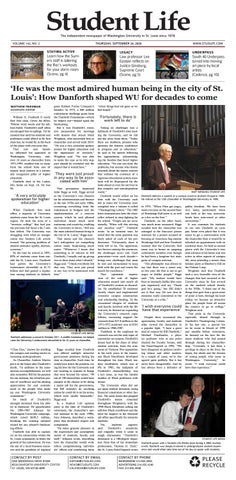
The independent newspaper of Washington University in St. Louis since 1878 THURSDAY, SEPTEMBER 24, 2020
VOLUME 142, NO. 2
STAYING ACTIVE
Learn how the Sumers staff is tailoring the Rec’s workouts for your dorm room (Scene, pg 4)
WWW.STUDLIFE.COM
LEGACY
UNDERPASS
Law professor Lee Epstein reflects on Justice Ginsburg, Supreme Court (Scene, pg 5)
South 40 Underpass turned into moving art piece by local artists (Cadenza, pg 10)
‘He was the most admired human being in the city of St. Louis’: How Danforth shaped WU for decades to come MATTHEW FRIEDMAN ASSOCIATE EDITOR William H. Danforth II rarely flew first class. Given his 60-to70-hour work weeks and his tall, lean build, Danforth’s staff often encouraged him to splurge. Yet he insisted that until his students and professors could afford to fly first class too, he would fly in the back of the plane with everyone else. That care and humility informed his approach to Washington University, and, over 24 years as chancellor from 1971-1995, enabled him to transform the school from one of mainly local renown to a nationally recognized pillar of higher education. Danforth died in his Ladue, Mo. home on Sept. 16. He was 94.
‘A very articulate spokesman for higher education’ When Danforth first took office, a majority of University students came from the St. Louis region. He took the reins of a “streetcar college” that had just the previous fall faced a $6.7 million deficit. The University was struggling with what an inauguration day Student Life article termed “the growing problem of student attitudes: apathy, distrust, cynicism.” By the time he retired in 1995, 85% of students came from outside the St. Louis area. Danforth had grown the University’s endowment elevenfold to $1.72 billion and had gained a reputation among students as fatherly
giant Ralston Purina Company’s founder. In 1973, a $60 million endowment challenge grant from the Danforth Foundation—which he helped run—helped spark the fundraising. But it was Danforth’s extensive preparation for meetings with donors that struck Mark Wrighton, who succeeded him as chancellor and served until 2019. “He was a very articulate spokesperson for higher education and the importance of research,” Wrighton said. “He was able to make the case as to why support should be extended and the impact that it would have.”
‘They were just proud in any way to be associated with him’ That persuasion impressed John Biggs as well. Biggs served as the University’s vice chancellor for administration and finance in the late 1970s and early 1980s, overseeing everything from the endowment to budgets and the implementation of a reserves system, which he said allowed individual deans much more autonomy and creativity, enabling the University to thrive. “Bill was the most admired human being in the city of St. Louis,” Biggs said. That status and the chancellor’s soft-spoken yet compelling nature made fundraising much easier. “Whenever I know that something is of interest to Bill Danforth, I usually end up giving two or three times what I should,” Biggs said. “I think everybody felt that way. They were just proud in any way to be associated with him.”
STUDENT LIFE MEDIA
Danforth addresses a crowd in October 2011. A prolific fundraiser, he helped raise the University’s endowment elevenfold in his 24 years as chancellor.
“Chan Dan,” known for strolling the campus and reading stories to incoming undergraduates. As Chancellor Andrew Martin put it in the hours after Danforth’s death, “In addition to his innumerous accomplishments, we will also remember Bill for his passion for our mission, his relentless pursuit of excellence and his abiding appreciation for and commitment to the people who make up our Washington University community.” So much of Danforth’s strength stemmed from his ability to fundraise. He spearheaded the 1983-1987 Alliance for Washington University campaign, which raised $630.5 million, breaking the existing national record for any school’s fundraising efforts. Danforth was able to capitalize on his connections within the St. Louis community to foster the growth of the endowment. He was the son of a local business executive and the grandson of regional
Biggs recalled how Danforth was offered multiple attractive government positions during his time as chancellor. Each time, he would turn down the position, citing his love for the University and not wanting to commit to things that were beyond his values. “99 out of 100 chancellors would have jumped at the chance to be doing a major job for the government, but Bill wouldn’t do anything unless he could do it on his terms, which were totally honorable,” Biggs said. In a Student Life opinion piece at the time of Danforth’s retirement, the chancellor’s special assistant in the early 1990s, Sara Johnson, described a workplace that facilitated respect and compassion. “He takes genuine pleasure in the experiences and accomplishments of students, faculty and staff,” Johnson wrote, describing how the chancellor would write letters complimenting individuals’ efforts and comforting them
“when things had not gone as we had hoped.”
‘Fortunately, there is work left to do’ Taking on challenges was a hallmark of Danforth’s time leading the University, and he did not shy away from them. “Today there are doubters, persons who question the historic confidence in progress and in education,” he said in his speech following his appointment, acknowledging the hurdles that faced higher education. “No one can deny the problems, but anyone who thinks seriously about the matter realizes that without the existence of a vigorous educational system mankind will be ill-prepared for the tasks ahead or even for survival in this complex and interdependent world.” Danforth would reflect on his time with the University each fall in notes the University later compiled into a volume it called “Thanksgiving Letters.” The 1985 letter demonstrates how the chancellor refused to stop fighting for the school. “People ask me occasionally, ‘When will this striving and sacrifice end?’” Danforth wrote. In an insistent tone, he noted that the same question was likely asked of each of his predecessors. “Fortunately, there is work left to do. The opportunities forever outstrip the resources; the challenges never end. Each generation—even each decade— brings new challenges that must be met and surmounted to keep faith with the past and renew the search for excellence.” That optimistic impression of the role of higher education seeped into nearly all of Danforth’s actions as chancellor. He established 70 endowed faculty chairs and implemented extensive campus construction and scholarship funding. To the occasional chagrin of students and faculty involved with the liberal arts, he focused on expanding the University’s research capabilities, increasing support for research from $27.8 million in the 1971-1972 academic year to $101 million in 1986-1987. Pushback to the emphasis on research was not the only topic of contention on campus. Danforth’s tenure had its fair share of other student activism, from the remnants of Vietnam War opposition in his early years to the numerous Black Manifestos developed throughout his time. Black student enrollment, which was at 6% in 1983, the midpoint of Danforth’s chancellorship, was a key issue, as was the limited number of Black professors with tenure. The University often did not act upon student demands, citing financial constraints or other factors. The same issues that plagued Danforth’s tenure remained throughout Wrighton’s, with the 1998 Black Manifesto calling out still-low Black enrollment and the need for support in the financial aid office specifically for minority students. Yet, students appreciated Danforth’s sensitivity and empathy when it came to tough discussions. “Danforth’s demeanor is a 180-degree departure from that of his immediate predecessor, Thomas H. Eliot,” the St. Louis Post-Dispatch wrote
MATT MITGANG | STUDENT LIFE
Danforth delivers a speech at a campus event in Graham Chapel in 1999. He retired as the 13th chancellor of Washington University in 1995.
in 1975. “When Eliot got angry, most everyone on the second floor of Brookings Hall knew it, as well as a few on the first.” Danforth, on the other hand, was much more measured. Biggs recalled how the chancellor was outraged at the four-year prison sentence for a person accused of burning an American flag outside Brookings Hall and how Danforth insisted that the University find some way to honor an outgoing community member even though he had been a longtime key instigator of campus activism. “His philosophy was always to say that there was a smart way to live your life that is not to get angry or dislike people,” Biggs said. “My instinct would have been to intensely dislike [the campus organizer] and say ‘Thank god he’s going,’ but Bill didn’t see it that way. He saw him as someone really committed to the University as a critic.”
‘I wish everyone could have that experience’ Despite their occasional disagreements, faculty and students alike viewed the chancellor in a popular light. “I have a great deal of respect for Bill Danforth,” Michael Friedlander, a physics professor who at one point chaired the Faculty Senate, told the Post-Dispatch in 1994. “We have disagreed on policies involving tenure and other matters. In a couple of cases, we’ve disagreed quite publicly. But it has never been disagreeable. And he has always been a defender of
public freedom. We have been very lucky, particularly when you look at the way university heads have intervened at other universities.” It was common for students to run into Danforth on campus. Some even joked that it was easier to get a conversation with the chancellor than it would be to schedule an appointment with an academic dean. He held an annual picnic with the University’s resident advisors at his house and was active in other aspects of campus life, once attending a senior class holiday party at Blueberry Hill on the Delmar Loop. Wrighton said that Danforth took a very favorable view of the changes that had occurred at the University since he first arrived on the medical school faculty in the 1950s. “I think one of the things that gave him a great sense of pride is how, through his leadership, we became an attractive place for people from all across the country to go to college,” Wrighton said. That pride in the University especially shined through in Danforth’s Thanksgiving Letters. In his last one, a special letter he wrote in March of 1995 just months before retirement, he focused on his love for the many students who had passed through during his chancellorship. “Certainly, it has been a privilege to share in the lives, the hopes, the ideals and the dreams of young people who come to Washington University,” he wrote. “I wish everyone could have that experience.”
STUDENT LIFE MEDIA
Danforth poses with a Student Life Media alum during a 2003 reunion event. Danforth was deeply involved in undergraduate student experience and would often take time out of his day to speak with students.
CONTACT BY POST
CONTACT BY EMAIL
CONTACT BY PHONE
ONE BROOKINGS DRIVE #1039 #320 DANFORTH UNIVERSITY CENTER ST. LOUIS, MO 63130-4899
EDITOR@STUDLIFE.COM NEWS@STUDLIFE.COM CALENDAR@STUDLIFE.COM
NEWSROOM 314.935.5995 ADVERTISING 314.935.4240 FAX 314.935.5938
2 STUDENT LIFE
THURSDAY, SEPTEMBER 24, 2020
EM MCPHIE & TED MOSKAL | SENIOR NEWS EDITORS | NEWS@STUDLIFE.COM
theFLIPSIDE FLIPSIDE FRI 25
THU 24
MON 28
PARTLY CLOUDY 73/56
SUN 27
SAT 26
SUNNY 83/60
SUNNY 77/54
MOSTLY SUNNY 85/58
SUNNY 89/64
TUES 29
Faculty and students adjust to online and hybrid classes, notes drawbacks and benefits OLIVIA POOLOS CONTRIBUTING REPORTER
WED 30
PARTLY CLOUDY 74/53
PARTLY CLOUDY 67/46
EVENT CALENDAR THURSDAY 24 Center for Diversity and Inclusion’s The Racism Pandemic Town Hall Virtual Event, 2 p.m. The Center for Diversity and Inclusion (CDI) is proud to continue the Racism Pandemic Town Hall Series. Starting in Spring 2020, the office has been committed to highlighting the various intersections around race and racial justice. For September, we will feature student leaders from WashU and across the country to share their experiences to the WUSTL community and beyond.
FRIDAY 25 ‘Border South’ Film Screening Virtual Event, 3 p.m. Courtesy of Hostile Terrain 94 and the Undocumented Migrant Project, “Border South” will be available for screening for 24 hours from Sept. 24 at 3 p.m. CDT to Sept. 25 at 3 p.m. CDT. There will be a live Q&A with director Raúl O. Paz Pastrana and Jason De León at 4 p.m. CDT on the 25. Register online to participate in the live Q&A on Zoom (limited to 300 participants). Otherwise, watch the live stream on Facebook. Review the event website to read the film synopsis and find appropriate links and passwords to access the film.
SUNDAY 27 Da Vinci The Exhibition: Last Day St Louis Science Center, 10 a.m. Discover the world of Renaissance Master Leonardo da Vinci and his passion for science and nature. Featuring more than 60 life-size recreations of da Vinci’s inventions and interactive machines, as well as 20 replicas of his art, explore da Vinci’s discoveries in engineering, flight, hydraulics, light, music and more. Each invention featured in this special exhibition was handcrafted utilizing modern translations of da Vinci’s writing. Trained artisans used these translations to construct full-scale models and bring da Vinci’s two-dimensional plans to life.
MONDAY 28 WashU Virtual Connecting Virtual Event, 4 p.m. Join the Skandalaris Center for a weekly Meetaway. This is 30 minutes of virtual connecting and all of WashU is invited, so spread the word! You never know who you might bump into. If it’s someone you know, catch up like you would in a hallway conversation. If you’ve never met, tell each other how you’re affiliated with WashU and share a good vibe or a project you are working on now.
Washington University is back in full swing—almost. While classes are ramping up after a whirlwind first week, the COVID-19 pandemic has forced faculty and students alike to be flexible and cautious in order to stay safe. Courses this fall are being taught in either fully remote or hybrid models, the latter of which vary greatly between departments and individual faculty members. Dean of the College of Arts and Sciences Jennifer Smith emphasized that the University had not made any blanket mandate to dictate how classes should be instructed. “We asked departments to determine what if any courses in their programs needed to be taught in person or remotely based on the pedagogical need…or public health considerations,” she said. After that, individual professors were given leeway to create courses based on their personal preferences. Associate Professor of Earth and Planetary Sciences Phil Skemer is teaching remotely from his office, where he said that he feels most comfortable. He has configured microphones, whiteboards and monitors to display visuals, and even put together GoPro-filmed field trips for students to watch from their rooms. “I don't want to do it like this forever,” Skemer said. “But for a semester or two, [it’ll be] pretty interesting.” Professor of Anthropology
Michael Frachetti is exploring ways of reducing risk of transmission while still meeting in person. He has decided to conduct classes partially outdoors as weather permits, a method he hopes will benefit both him and his students. “My teaching style is very face-to-face, it’s very off the cuff,” Frachetti said. “And so for me, going onto Zoom where everything should be regulated and everything has to be communicated in a pre-cooked format is more difficult.” While professors are working to teach effectively, many students are struggling to adjust to the newly-formatted college courses. Freshman Rafi Diamond is taking all online classes, and said that she misses the social aspect of typical classroom learning. “I feel like it’s a lot less gratifying, not being able to have an in-person connection,” she said. For upperclassmen used to a bustling first week on campus, the switch to remote learning and living has been similar. Senior Joanna Grill said that she misses the excitement of reconnecting with old friends during the first week. “I definitely miss the joyful nature of seeing people around campus,” she said. Grill also has to make the choice between taking all of her classes online, or sitting in a three-hour seminar with a mask on for her single hybrid class. “I elected to take the first class remotely, but [I’m] not exactly sure what I want to
do going forward,” she said. For all the challenges in navigating the first week, however, there have been successes as well. Many professors said the change in teaching format forced them to take a deeper look into their courses. “In the digital pedagogy courses I took, I've exchanged more ideas about teaching with faculty in the last two months [than] in the previous 10, 15 years,” Professor of Drama and Comparative Literature Robert Henke said. Skemer also appreciated the opportunity to mix things up, saying he wouldn’t have done this in a more normal school year. “The thing that’s been really nice for me is having the opportunity to really rethink this class from scratch and really build it up again from its base level,” he said. This extra planning and effort has not gone unnoticed by students. “Every professor I’ve had has clearly put in so much work to try to make this the best experience for [us],” Grill said. Throughout the ups and downs of the first classes, many remain optimistic for the weeks to come. “It’s not as good as the normal thing, but I feel like we can maybe learn some things that we wouldn’t have learned otherwise and have a good experience,” Henke said. Frachetti shared a similar viewpoint. “This will pass, and we will get through it,” he said.
TUESDAY 29 Breakthroughs in Medicine: AI Applied to Big Genomic Data Virtual Event, 2 p.m. Alex Aravani, Chief Technology Officer and Senior Vice President at Illumina will present the Gaurav Garg & Komal Shah Distinguished Lecture. The application of artificial intelligence to genomics is accelerating biological insights, drug target discovery and diagnostic classification of disease. Two recent examples of applying deep learning methods to large datasets of combined genomic and clinical data are classification of rare variants as pathogenic or benign, and early detection of cancer through classification of methylation signals in the blood.
WEDNESDAY 30 Climate Conversation: Election 2020 Virtual Event, 4 p.m. WUCCP is hosting an interactive event about the upcoming election. Participants will learn about the history and direction of America’s climate policies, hear the details of the Democratic and Republican climate platforms, and discover the context of international climate politics. Attendees will also get to discuss their hopes for future climate policies!
CURRAN NEENAN | STUDENT LIFE
An outdoor tent sits empty in McMillan Courtyard. Tents have been assembled across the Danforth campus to allow for more group meeting spaces for students and faculty.
EST announces reduced hours, new safety protocols for fall semester TED MOSKAL SENIOR NEWS EDITOR This semester, the Washington University Emergency Support Team (EST) will no longer provide 24/7 service due to new COVID-19 protocols. Starting Sept. 28, EST will operate from 9 a.m. to 9 p.m. from Sunday to Thursday, and 9 a.m. to 12 a.m. on Fridays and Saturdays. Although the first day of
class took place Sept. 14, the two-week delay will allow all EST members to familiarize themselves with their organization’s new safety protocols regarding COVID-19. “[The reason for the delay] is to make sure that we have these protocols down, because this is a new clinical workflow for our team,” EST President senior Claire Wild said. “We want to make sure that everyone is well versed and has this
mastered before we go into service at all...and then also to take care of the students’ well-being too, who are administering this care, just to make sure that we're not doing too much right away.” While on call, EST members will wear N-95 masks, goggles, gloves and gowns in order to be able to safely interact with those involved in an emergency. “We probably will look a little bit silly running around campus,” EST member
junior Lauren Puplampu said. “We are in goggles, we have N-95 masks, we have surgical gowns and we also have to wear gloves when we respond to calls, and so I think that with all this PPE [personal protective equipment] like we're totally protected…because of how strict our decontamination rules are.” Still, despite the abundance of PPE, the pandemic still impacts EST’s ability to operate around the clock.
Concerns about social distancing in the office where EST members generally congregate during night shifts are one reason why operations will not continue late into the night this semester. However, according to EST Field Director senior Julia Giordano, the reduced operating hours should not significantly impact service, due to the fact that the majority of EST’s work takes place during daytime hours.
“[Most EST calls taking place at night] is actually a misconception,” Giordano said. “Most of our calls are during the day, so given the shift hours that we have, we anticipate most of our calls will still be responded to…The calls that we get most often at night are usually alcoholrelated calls, which is why we're still doing weekends from 9:00 p.m. to midnight.”
SEE EST, PAGE 3
Subscribe to our free e-newsletter... head to studlife.com now and sign up!
Wherever you are, stay connected: Social icon
Rounded square
FACEBOOK.COM/STUDLIFE
@ STUDENTLIFENEWSPAPER
Only use blue and/or white. For more details check out our Brand Guidelines.
@STUDLIFE
STUDLIFE.COM
EM MCPHIE & TED MOSKAL | SENIOR NEWS EDITORS | NEWS@STUDLIFE.COM
THURSDAY, SEPTEMBER 24 , 2020
STUDENT LIFE 3
EST from page 2 During operating hours, limitations will also be imposed on the size of duty crews, who often end up sharing spaces and being in close contact. “One of the other big changes is our duty crew size,” Giordano said. “Typically our duty crews are three to four members. This semester they're going to only be two members. Again, this is just to try to limit transmission on calls and streamline all the processes that are going on.” Both Wild and Giordano are open to the possibility of increasing EST’s hours of operation later in the semester, and plan to revisit the idea one month after operations have resumed. “We're just going to
reevaluate everything and see where we're at and consider adding more hours back,” Giordano said. “Likely that would be the 9:00 p.m. to midnight shifts on non-weekend days, but there's still a lot to consider. I think one of the most important factors is whether our team members are able to get home safely at that late of an hour every night of the week.” However, Wild maintained that the wellness of EST members themselves should also be an important consideration when drawing up hours for the semester. “Because our team members are volunteers, we're not getting credit or pay for this, it becomes a question
of balance with the patient care that we are able to give and the wellbeing of our own team members,” Wild said. “So when we made that decision, we felt that it was the best compromise, at least in the beginning, to make sure that we're taking care of our own people as well as the population of students that we serve.” Although Puplampu hoped that EST would eventually be able to bring hours back to their pre-pandemic levels, she acknowledged that decisions to expand hours should be made with the needs of EST members in mind. “We are eager to expand those hours,” Puplampu said. “We like being in
MATT MITGANG | STUDENT LIFE
Emergency Support Team member Gaby Gonzalez and her colleague rush arrive at a call in Liggett Hall in September 2014. EST will only operate until midnight on Fridays and Saturdays this semester.
service as much as we possibly can, but we do
recognize how much more we're asking for when we
ask members to stay even an extra hour.”
WU climbs three spots to 16th in new U.S. News & World Report rankings KIMBERLY BUEHLER CONTRIBUTING REPORTER Washington University rose three spots to 16th place in the 2021 U.S. News & World Report rankings of the best universities nationwide, unveiled on the first day of classes, Sept. 14. The University is tied for 16th with Rice University. Globally, the University rose one spot, putting it at 31. With their release of the rankings list, U.S. News & World Report mentioned several updates to their methodology that “address important issues directly impacting students and their families.”
Some of the most relevant updates included the addition of indicators measuring student debt and an increase in the importance of outcome measures, as well as a simultaneous reduction in the weight of standardized test scores, high school class rank and alumni giving. Incoming freshmen in the class of 2024 were required to read the book Weapons of Math Destruction by Cathy O’Neil. One section of the book discussed the dangerous feedback loop within the college ranking system, primarily focused on the U.S. News & World Report, which was the first publication to release college rankings starting in 1983.
GRAPHIC BY CHRISTINE WATRIDGE | DATA FROM U.S. NEWS & WORLD REPORT
Freshman Matt Cummings agreed with O’Neil’s argument. “While the rankings push colleges to excel, the items colleges are graded on favor wealthy and expensive schools that may not fit everyone’s needs and tend to push ‘lower ranked’ schools out of the public eye even if they may perfectly suit your needs,” Cummings said. While he appreciated the University's rise in the rankings, he said it was solely due to the advantages it would provide for job recruitment. Freshman Shraya Sandhir pointed out that a high ranking does not mean every student will have a remarkable experience or that the University is the right place for them. “While it is amazing that Wash. U.’s ranking has gone up recently, it does mean that the University must continue to match its new standing,” Sandhir said. “The position is based on the reputation and prestige of the school rather than the atmosphere and education that students experience.” College of Arts & Sciences Dean Jennifer Smith said that
WE ARE OPEN with safe social distancing practices. We offer curb side pick-up.
LIVE GLASS BLOWING BY LOCAL ARTISTS Come check out our CBD selection Brands we carry: BeLeaf Life Oils - Missouri Grown! • Eclipse Green Roads • JustCBD • Koi • Rescue CBD
Open Monday through Saturday, 10am to 9pm • Sunday 11am to 8pm
6254 DELMAR BLVD IN THE LOOP www.emporiumsmokeshopstl.com
she appreciated the increase in rankings and how well it reflects on the University, but that it did not mean the University does not have areas that need continued attention and improvement.
“Of course it feels good to see an improvement, but we should nevertheless still remember that there is a lot of arbitrariness in the way metrics were chosen and weighted to create
the rankings,” Smith said. “There’s always more work to be done in improving our education, and we remain committed to progress in many areas, not just those measured by U.S. News.”
COLLEGE GRAD REBATE!
$500 toward any new Toyota
ACKERMANTOYOTA.COM
2020 HAMPTON AVE. ST. LOUIS, MO 63139 AT THE INTERSECTION OF HIGHWAY 44 314-351-3000 Toyota Care is a no cost maintenance program that covers the first 2 years or 25k miles, whichever comes first. The Ackerman For Life is valid only at Ackerman Toyota and is non-transferable. Offer contains 1 oil change maximum, per calendar year, when Toyota Care expires. Offer good to primary owner only.
VOLUME 142, NO. 2 Emma Baker Editor-in-Chief editor@studlife.com
Kya Vaughn Senior Forum Editor forum@studlife.com
Curran Neenan Senior Photo Editor photo@studlife.com
Matthew Friedman Associate Editor
Dorian DeBose Josh Shapiro Senior Sports Editors sports@studlife.com
JJ Coley Isabella Neubauer Copy Chiefs copy@studlife.com
Isabella Neubauer Sabrina Spence Senior Cadenza Editors cadenza@studlife.com
Vivienne Chang Kathleen White Engagement Directors
Jayla Butler Kya Vaughn Managing Editors Em McPhie Ted Moskal Senior News Editors news@studlife.com Benjamin Simon Senior Scene Editor scene@studlife.com
Mia Goldberg Design Chief design@studlife.com
HN Hoffmann Jaden Satenstein Christine Watridge Multimedia Editors
Sabrina Spence Social Media Director Nathan Springman Website Editor Jamila Dawkins Forum Editor Christine Watridge Design Editor Jaime Lee Designer
Adrienne Levin Coleman General Manager a.coleman@studlife.com Tammy Dunsford Advertising Sales Supervisor dunsfordt@wustl.edu
Copyright © 2020 Washington University Student Media, Inc. (WUSMI). Student Life is a financially and editorially independent, student-run newspaper serving the Washington University community. Our newspaper is a publication of WUSMI and does not necessarily represent the views of the Washington University administration.
4 STUDENT LIFE
SCENE
BENJAMIN SIMON | SENIOR SCENE EDITOR | SCENE@STUDLIFE.COM
THURSDAY, SEPTEMBER 24 , 2020
‘We’ll just keep pivoting’: Sumers Recreation to keep students active from afar BENJAMIN SIMON SENIOR SCENE EDITOR Throughout the summer, Washington University had hopes to reopen the Gary M. Sumers Recreation Center for the school year. They had a full plan featuring mask requirements, appointment slots and spaced-out outdoor classes. But as cases failed to lower in the St. Louis area, they had to abandon their plan. As a result, the recreation center is providing its range of classes, from strength training to kickboxing to yoga, online. And while Washington University students cannot workout indoors at Sumers, they can, as of this week, visit Francis Field and the Tao Tennis Center for single-use only. Student Life spoke with Assistant Director of Fitness & Wellness Meghann Feely over the phone to learn more about how the rec center is tailoring its workout virtually for students. This interview has been edited for length and clarity.
STUDENT LIFE: How can students continue to stay active? What resources is Sumers currently offering?
MEGHANN FEELY: Yeah, starting this week, September 21, we'll have a new virtual fitness schedule. We're adding a few more classes that are focused on being in small spaces
in your dorm room. We're encouraging everybody again, as a single person, to go outside…Right now we're headed into the fall. It's a perfect time for outdoor walking. Forest Park is right next to us. So go and take a walk into Forest Park and enjoy the park there.
SL: What have the online courses looked like?
MF: If you go to YouTube, WashU Rec is our channel, we have our schedule for our live classes. We are really focusing on classes that you can do without a lot of equipment. We don't see in the foreseeable future ever lending out or renting our equipment. So with that in mind, our classes are designed for bodyweight exercises. We have HIIT [high-intensity interval training] classes, we have BearFlex, which is one of our strength training classes. It is being rewritten for minimal to no equipment. The yoga classes are also focusing on small spaces with minimal equipment. And we have at least two classes every evening, and we'll be offering a couple over the weekend as well. The nice thing is you can do them live with us, or if the time doesn't work, you can look through all the different playlists and find your favorite class. SL: Has it been hard to rewrite a lot of the workouts?
STEPHEN HUBER | STUDENT LIFE
Although students cannot workout inside Sumers Recreation Center, it has continued to offer virtual programming for students to utilize from their home. “We’ve had to use our creative brains,” Assistant Director of Fitness and Wellness Meghann Feely said.
MF: We've had to use our
MF: I always use the word
creative brains. But it's actually really fun. And I would say most of our trainers and instructors enjoy it. There's something really fun about moving just your body—it's very playful. A lot of times we get away from that, we just pick up weights and tend to move that way. So to be able to move your body, I actually find it to be more difficult than weightlifting.
play. So it's like really playful movements. For instance, you may want some really good upper body strength, but don't have a pair of weights to do a heavy chest press. So you can do something like a “breakdancer” where you're kicking your leg underneath your body and twisting your body and bending your elbows to really engage your chest, all of a sudden, this chest move becomes difficult yet fun. It is challenging in a way rather than just laying on your back and doing a chest press. It's kind of looking at these moves and coming up with creative ways to get as much weight behind it as you can so that you can build that strength. SL: [As an instructor,] what has it been like for you? MF: It's been really good. It's been fun. Again, it's being really playful with your body. Normally, at this point in our year, my body is very sore, it's very tired. But when we do bodyweight exercises and things that we're doing, it's actually been really rejuvenating and reviving to my body.
SL: In what ways is it more difficult than weightlifting?
is fun. Wednesday, I take a break, but often I will go and do kickboxing class. That's like a fun, lighter cardio day and just a different way to move my body. I don't go around everyday kicking things, so to lift my leg and use my joints in that way is really good. And then Thursday is BearFlex. So again, that's always fun. It's a strength training kind of workout. But we've done it now with mostly bodyweight, and if we do use the weights, we try and get away with “just grab one heavy object.” So I've encouraged people, like if you have a dog or an animal, get their bag of food, carry that around. You can get really creative when you just need one heavy object. Fill your backpack up with books and use that for the workout. So we've written it in a way that you can use household items in order to do your strength training.
SL: What have you been focusing on with social media and why are you using it to interact with students?
MF: Over the summer, we SL: What has your workout schedule been like?
MF: My workout schedule is, and always has been, whatever classes I'm teaching that week. On Mondays, we have a bar class, so we can think of it as a nice stretch, lots of core, elongating movements. Tuesday is a class called Energy Sculpt, so that's a little more cardio, bouncy-bounce, plyometric. It's a lot of agility, a lot of endurance, a lot of power behind the muscle, which
used social media to get our workouts out there to try and keep people engaged. I think now we're kind of switching directions, and we'll start using our social media for just like trainer tips, Wellness Wednesdays, [and] when we start doing a little more intramural sports, we will use it for that kind of virtual platform for IMs. Of course, that's going to be the first place that we will update any information. When we decided to open up our fields, that was
the first place that you are going to find that information. I always say follow us on all of our social media platforms because that's where you're going to get your information first. SL: A lot of students are obviously struggling to find the motivation and space to work out. What has been the biggest thing in helping you work out and find a routine of staying active?
MF: Yeah, I think that's a great question. Especially as we get further into the semester, I think all of us will struggle with that motivation. One of the best ways to try and stay connected is getting a group together and making a commitment to each other. Like, “Okay, even though we can't work out together, at this time we're all going to go to our dorm rooms, and we're going to do this workout.” And then afterwards talk about it. Try and hold each other accountable. I think challenges are always really fun ways to do things, and there's lots of different ones, like the push up challenge, the squat challenge. As a BearFit group, we'll release a few different challenges for people to work on. So even if you're not feeling the motivation to do a full workout, maybe you can do 22 push-ups and at least you've moved your body, you've done something, you've released some hormones, you're feeling good. So little challenges like that, I really encourage, if you're just not feeling the full workout, to do these challenges that are out there.
ARUSHEE AGRAWAL | STUDENT LIFE
The gym at the Sumers Rec Center as seen from the second floor. This semester, Wash. U. Rec’s virtual offerings will include yoga, high intensity interval training, strength-training and BearFlex.
THURSDAY, SEPTEMBER 24 , 2020
BENJAMIN SIMON | SENIOR SCENE EDITOR | SCENE@STUDLIFE.COM
STUDENT LIFE 5
WU law professor on Justice Ruth Bader Ginsburg’s legacy and what her death means for the Supreme Court
meet Justice Ginsburg or get to interact with her at all?
President Trump were to get a third appointment to this court, there are areas of the law that will change. No question. You think about this: They really haven’t decided a gun case since 2010, despite the fact that they get many petitions every year challenging restrictions on guns. They haven’t taken them. I could give you reasons, but I think today one reason is [Chief Justice] John Roberts. There is a lot of uncertainty on how he would vote in these gun cases and so they haven’t taken them. I would predict that within months of a [third Trump] appointment, they will start taking gun cases. They will flesh out that entire area of Second Amendment law. Affirmative action is another area where we might expect to see big change. Abortion, and on and on. Obviously, you know, I’m not a seer, I can’t see the future with complete clarity, but my prediction would be that there are several areas of the law that will move to the right with a [third] Trump appointee. What will happen? Your guess is probably as good as mine.
LE: I have met her a couple
SL: Well, I doubt it would
of times, but I can’t say we sat down and had a conversation.
be as good as yours.
SL: Did you ever get to already been so much conversation over this weekend about Justice Ginsburg’s legacy, so I’m curious what you think is being left out of that conversation so far.
LEE EPSTEIN: I think
SL: In terms of that second
LE: In many instances,
SL: Wow. On a more specific level, how have you seen Justice Ginsburg’s impact in your classrooms?
LE: Certainly when I’ve taught law and social change and we spend time
announce a nomination. After that, I don’t know.
Trump were successfully to appoint someone to the Court now and Trump was reelected and the Republicans held the Senate, I think that the Republican conservatives on the Court would feel empowered. Now, if there’s a different scenario, if Biden is selected and there’s a Democratic Senate, [the Court’s conservatives] might feel less empowered. They might feel worried about their institutional legitimacy. And we may see some of that, that we saw this term. I think a lot hinges on what happens in the next couple of months.
SL: I’m not sure whether
SL: Wow, the stakes of this
you’re going to want to give your opinion on this, but do you think the Senate should vote before the election?
election were already high, but now even more so. My final question was about all this conversation about the potential for Democrats
LE: Surely, Trump will
COURTESY OF TERI M. WEBER
Professor Lee Epstein’s research focuses on legal institutions and the behavior of judges. She was named the Ethan A.H. Shepley Distinguished University Professor in 2014.
to expand the Supreme Court. If they do that, how would that change Justice Ginsburg’s legacy?
LE: Oh, tell me. Do you think it would? I don’t know. I don’t know that it affects her personal legacy. So, go back to FDR and how he proposed expanding the size of the Court. The Court was invalidating his New Deal legislation and he wanted to dilute the conservative power. It strikes me that today’s proposals to expand the size of the Court are less
about the Court. I mean, they are about the Court: Democrats don’t want the Republicans to have a big majority. But [the proposals] are really, in a sense, payback. Don’t they strike you as sort of payback for Merrick Garland and now possibly payback for Trump three?
SL: Yeah, that makes sense as payback.
LE: And we can’t be naive about it. They would love to have a Democratic majority on the Court.
LE: I’ll give you the answer LE: She was an unfailingly polite person. The thing that really comes to mind with me for Justice Ginsburg was how, even at the end, her questions at oral argument were so fantastic. She very often asked the first question. I guess that changed when they went to the telephone thing, where they went in order. But when they were sitting in the courtroom, she would very often ask the first question. It was always a very good question and she could always do a follow-up. She was a very, very smart person. Very clever.
SL: For activists on the left, especially as there’s been this movement to treat Justice Ginsburg as more of a cult-like figure, there’s been this critique that she posited more of a sort of white feminism rather than fully leaning into the fight for racial justice. What do you make of that critique? Is it something that sounds fair to you? Or does it not really acknowledge the realities of her position on a conservative court?
LE: Maybe? I mean, I don’t have any real comment on that. I think that she had a goal in mind of gender equality for decades and it was a real motivating force for her, but I don’t really have a comment on that critique.
SL: In the last couple minutes that we’re on the phone, I’m curious as to what you think of what the near-immediate battle for Justice Ginsburg’s seat says for the future of the institution. What does it tell us about the Supreme Court that so much power can lay with a single person? LE: It’s pretty crazy, isn’t it? The fact of it is that if
I always give on this kind of question: The Senate can do whatever it wants. There are no rules here. All it says is that the president makes appointments to the federal courts with the advice and consent of the Senate. When they didn’t hold hearings on Merrick Garland, I got a lot of questions like ‘Is that legal?’ ‘Is that constitutional?’ And basically, the answer is ‘Yeah, it’s in the hands of the Senate once the nomination is made.’ That’s why I say it’s a pretty unpredictable situation. But I can tell you this. When the Court is treated as a political body, it’s never good for the Court. It’s never good for the Court’s legitimacy. And right now the Court is being treated as a political football, and that can’t help the Court.
SL: That gets at another question that I wanted to ask. I found a quote from an article you and University of Chicago Professor Eric Posner wrote for the New York Times. You were wondering whether a Supreme Court that was so rigidly divided by ideology could sustain public confidence for much longer.
G YOUR OW N I water bottle
EST REUSAB U Q Plate or
utensils
dishware
eco2go eco2go: request & return I’m hungry. Let’s think for a minute..
CE & DIVE U DAvoid single use plastics
COMPOST
RT
she ended up dissenting. So you look at the Second Amendment gun cases—she dissented. The voting rights cases—she dissented. Some of the religion cases—she dissented. I mean, it’s not to say that she lost every battle. Certainly during her time, abortion rights stayed intact, affirmative action stayed intact. There were of course the same-sex marriage cases and so on. This is not to say that every case went in a conservative direction or that she was always dissenting or lost every battle. In several major areas of the law, her legacy may be as a kind of great dissenter. If you look at the data, she was one of the top five dissenters on the court since 1953.
anecdotes that stand out to you not necessarily from your interactions with her but just from her career. Any moments or specific quotes, something like that, that crystallized who she was?
LE: Here’s the thing. If
LE
legacy and talking about her role on the conservative courts, how did she go about doing that being a defender of the left? What was her approach like?
SL: Gotcha. Are there any
Trump appointing a third justice to the Court before the November election would undermine that work that Roberts and the others did in the last term? How much does this situation with Justice Ginsburg undermine public confidence in the Court?
N
there are two legacies here. First is her legacy as a lawyer: What did she do? She worked to upend vast swathes of the law by convincing judges to eliminate gender lines. So there’s that whole kind of equality lawyering aspect to her. And then there’s the court legacy, and I think the court legacy is a little bit different because she served on pretty conservative courts. It was hard for her to make a lot of progressive headway and I think her role on the court was less as an effective disruptor of law—as she was as an attorney—and more as a sort of defender of the left-leaning legal regimes. And that was really challenging on the conservative courts on which she served.
SL: Do you think that
RE
STUDENT LIFE: There’s
and [Justice Samuel] Alito dissented, meaning that the other three Republicans joined the Democrats. There was a lot of work on the Court last year, in very high-profile cases, where that split that Eric and I were talking about just didn’t happen. I think that’s the kind of thing that helps the Court.
RE
The death of Supreme Court Associate Justice Ruth Bader Ginsburg sent the United States political sphere into a tumult this weekend as people sought to honor the storied justice while taking into account her death’s immediate consequences for the makeup of the Court. President Donald Trump announced Monday that he would make a nomination late this week and Senate Majority Leader Mitch McConnell has pledged to vote on the nominee’s confirmation this year. To reflect on Justice Ginsburg’s legacy and the near future of the Court, Student Life called Lee Epstein, Washington University’s Ethan A.H. Shepley Distinguished University Professor. Epstein is a political scientist whose research has focused on legal institutions and the behavior of judges. This interview has been edited for length and clarity.
on her litigation strategies, I think that the students are—I don’t want to say in awe—but ‘Boy, what she did was pretty amazing,’ is their kind of view: ‘Wow, she really took this on and would not give up.’ So I think they’re pretty amazed at her accomplishments as a lawyer. I’m probably missing things because I don’t teach [Law 508: Constitutional Law] until next semester, but there is one opinion of hers that always elicits conversation in Con Law. And that’s her concurrence-slash-dissent in the Obamacare case. If you read that opinion, Matthew, it’s so clear. It so clearly lays out the issues. She does a much better job, I’ll be honest, in laying out the Commerce Clause issue, in that dissent, than the lawyer for the government did. The students, I think, understand the Commerce Clause argument from her opinion better than from reading the briefs, so that’s certainly one case we spend some time on.
BR
MATTHEW FRIEDMAN ASSOCIATE EDITOR
Request a compost bucket
LE: You know what happened last term, Matthew: Roberts did a really good job of softening that partisan, ideological split. He voted with the Democrats on the abortion case. Many people were very surprised. They thought there were clearly five votes to uphold those restrictions on abortion. But Roberts went the other way. However it happened, look at the Trump tax cases. Two tax cases and, you know, it was 7-2 decisions. Only [Justice Clarence] Thomas
Sustainability sustainability.wustl.edu
6 STUDENT LIFE
SPORTS
DORIAN DEBOSE & JOSH SHAPIRO | SENIOR SPORTS EDITORS | SPORTS@STUDLIFE.COM
THURSDAY, SEPTEMBER 24 , 2020
The existential horror of Clyde Edwards-Helaire DORIAN DEBOSE SENIOR SPORTS EDITOR When I was a young man, I dreamed of being a football player. On Sunday nights in December and January, bunkered down in my dad’s bedroom watching every pixel of his TV intently, I saw my favorite athletes compete and imagined it was me under the lights. I’d close my eyes and envision quarterback Dorian DeBose throwing a backshoulder fade to wide receiver Dorian DeBose. When the defense excelled, in my head it was elite defensive lineman Dorian DeBose earning the sack. I never held any illusion of it being possible. Both my parents are short and stout. My dad is 5’8” and he towers over my mother. I defied the odds to not be a manlet, but it would have taken a miracle to give me the bare minimum size to even dream of the NFL. Aaron Donald, a Smurf by the herculean standards of the NFL, is still two inches taller than me. Biology was not on my side. Come to think of it, psychology wasn’t either. I was a lazy child. I am often a lazy adult. And that laziness manifested every time I attempted a sport. The only physical activities that I was good at were the ones that rewarded sheer girth. I was a dominant pee-wee football player because I was the size of three pee-wee football players. I was
a dominant wrestler because 2nd grade heavyweight wrestling is a game of chance where either side of a coin flip ends with a Vienna Sausage on top. The old adage goes, “hard work beats talent when talent don’t work hard.” I had neither the talent nor the hard work. My career was doomed before it was even conceived of. I hadn’t thought about my athletic career in years. But this weekend, I realized something that left me shocked. The starting running back of my hometown Kansas City Chiefs—Clyde EdwardsHelaire—is younger than me by two months. We are in the same grade. We started high school at the same time. We went to college at the same time. But earlier this year, he won a National Championship while I was writing existential dribble about growing older. And the divergence of our paths isn’t what alarmed me. Other professional athletes are even younger than EdwardsHelaire. But those athletes are usually literal giants who you would question if you saw them doing anything besides playing a sport. If you saw the hulking, ripped frame of Zion Williamson saunter into a cubical, you’d think you were going mad. Even Luka Doncic, a player not considered an elite athlete by NBA standards, has truly preposterous proportions (only in the NBA can someone argue that
a 6’7” freak athlete is actually too fat). What alarms me about Edwards-Helaire is that he’s a tiny guy. He’s 5’7” (and a quarter). He was clearly not the best athlete among the running backs drafted this year (an honor that likely goes to Colts’ running back Jonathan Taylor). Hell, he wasn’t even the best athlete drafted by the Kansas City Chiefs this year (linebacker Willie Gay, Jr.). By no means is he a subpar athlete. But while many of the people who have succeeded in professional sports have seemed superhuman, EdwardsHelaire seems…human? I can think of people I know who have Clyde Edwards-Helaire’s build and athleticism. I see them dominate rec leagues and pick-up basketball games. Then I see them shower and head to their real jobs. And that doesn’t feel abnormal in the slightest. In fact, it would be weirder to see those guys in an NFL uniform than in a suit. When Clyde EdwardsHelaire performs well, I’m forced to reckon with the consequences of my actions. He is where he is because he outworked countless people who fit the mold of a football player more than him. He demonstrates that preternatural ability is the fastest way to success, but dedication is the next best thing. And he lays bare that I still have neither.
COURTESY OF TAMMY ANTHONY BAKER
Clyde Edwards-Helaire in a game for Louisiana State University. Edwards-Helaire, two months younger than Senior Sports Editor Dorian Debose, has rushed for 176 yards in his first two games in the NFL.
STUDENT LIFE 7
THURSDAY, SEPTEMBER 24 , 2020
Upcoming Events: Sept. 24-Oct. 1 21
M
22
T
23
W
24
T
1-1:30 PM: Virtual Career Fair Prep
4-4:30 PM: Virtual Career Fair Prep: Int’l Students
1-2 PM: Senior Pre-law Information Session
VIRTUAL INFORMATION SESSIONS:
1-2 PM: Work Group: Government, Politics, and Public Policy Internships and Jobs
2 PM: Facebook, Inc.
Virtual Information Sessions Thursday, September 24- Oct 1
F
4-4:30 PM: Virtual Career Fair Prep
11 AM: Microsoft Corporation
Save the Date: EMPLOYER INFORMATION SESSIONS
25
4:30 PM: L’Oreal USA, Inc.
2-3 PM: Med School Mock Interview Lab
5:30 PM: Deloitte Consulting LLP 6 PM: Abbott
26
27
28
29
30
4-4:30 PM: Virtual Career Fair Prep
3-6 PM: McKelvey Engineering Virtual Career Spotlight
3-4 PM: Applying to Graduate School for Fall 2021
VIRTUAL INFORMATION SESSIONS:
5 PM: Paylocity
VIRTUAL INFORMATION SESSIONS:
11 AM: Microsoft Corporation 3 PM: Facebook, Inc.
1
4-4:30 PM: Virtual Career Fair Prep 4-5 PM: Rework + Refine Design Seniors: Resumes + Cover Letters 5-6 PM: Pro Practices Design Juniors: Resume + Cover Letters VIRTUAL INFORMATION SESSIONS:
12 PM: ZS Associates
3-6 PM: Fall Virtual Internship and Job Career Fair: Corporate
2 PM: Bates White, LLC 5 PM: Facebook, Inc.
VIRTUAL INFORMATION SESSIONS:
5 PM: Microsoft Corporation
4:30 PM: L’Oreal USA, Inc.
5:30 PM: Edgemont Partners
6 PM: Chewy
Log into CAREERlink for more information and to RSVP: students.wustl.edu/careerlink SPONSORED BY:
puzzle
mania
Minor in the Business of the Arts
your AD here
Open to all undergrads. Find out more. olin.wustl.edu/arts
sandraphilius@wustl.edu
2019
FORUM
8 STUDENT LIFE
KYA VAUGHN | SENIOR FORUM EDITOR | FORUM@STUDLIFE.COM
THURSDAY, SEPTEMBER 24, 2020
STAFF EDITORIAL
O
nline classes has proven to add both benefits and setbacks to the semester. For some courses there is more flexibility, for others there are more assignments. But for everyone, there is some form of virtual learning, and with that comes the dreaded “Zoom fatigue.” The members of the Student Life Editorial Board share their methods to avoid burnout with online education.
Use breaks in between class
Take breaks! After every class, I do something that I enjoy. Be it grabbing coffee, crafting or chasing my puppy (who refuses to sit down during any length of time), I make sure that in between classes I give myself the opportunity to take a mental break. On campus, this is harder with in-between-class times often being used to grab food or simply make it to the next class. But online, I can actually utilize the break in between classes, and I make sure to take advantage of the time by doing something that brings me joy. - Kya Vaughn, Managing Editor
Set boundaries for yourself
I’ve found in studying and working entirely remotely, it’s very easy to forget to take breaks and time away from the computer. This semester, I’m trying to treat my days as I would during an on-campus semester with “working hours.” For me, this means not starting classwork before a certain time in the morning, closing my computer and having dedicated time to prepare meals and setting a consistent bedtime routine so I don’t go from homework or meetings straight to sleep. While blocking out these times in my calendar can feel
How to not burn out in online classes a little unnecessary, it allows me to hold myself accountable to the work I need to do without feeling like I need to be working 24/7 just because I could. - Emma Baker, Editor-in-Chief
Take exercise breaks
Exercise is so important to reduce burnout! Since the beginning of quarantine, I have scheduled time with my friends every day to meet on Zoom for an hour to either do a dance workout or some yoga. It is also important to remember not to just exercise in the middle of the night as the last thing to “check off ” your daily to-do list. Instead, do it in the morning between classes or in the afternoon in the middle of your study session. Then, exercising will provide a fantastic break from constant Zoom lectures and will serve to motivate you to complete some work beforehand so as to not feel “guilty” about not having done anything before you exercise! - Vivienne Chang, Director of Engagement
Write down your daily or weekly goals
I am a huge proponent of lists, lists, lists! Writing down the tasks that I want to get done, whether it’s specific to the day or the week, helps me visualize the amount of work I have. My personal method is to use weekly Post-its that I put on the table where I work or on my computer—I can easily write down any new assignments that might come up, and (the best part in my opinion), I can cross them off as they get done and watch that list dwindle. If you’re the kind of person that prefers digital lists, then be my guest! Adding tasks to Google Calendar or to a new Note is also an
extremely useful method. - Christine Watridge, Multimedia Editor
Keep your work space separate from your play space
I’m the type of person who tends to work anywhere where there’s an available surface. Doing this blurs the areas of my apartment that I’ve designated for working and studying and the areas I’ve designated for relaxing and enjoying myself. If you don’t keep the two separate, you’ll start to stress yourself out, because every corner of your environment will make you think about work and there won’t be a place for you to just relax and stop thinking about the paper that’s due next week or the lab you’ll have to finish. Keeping your work space and your play space separate can help you keep the balance between your work time and your leisure time. - Sabrina Spence, Senior Cadenza Editor
Journal
You’ve probably heard this bit of advice from countless people before me. I’m here to tell you that it really can be beneficial. I’ve found journaling is a great way to take a step back from the constant marathon of college life and reflect on the events of the day, ponder something I’m curious about, or just shout into a void where I won’t be judged for typos. As the school year starts to ramp up, I’m getting back into the habit of spending ten minutes writing before bed, but there are so many other ways it can work as well. Maybe you jot down some thoughts as you ride the Circ every morning or maybe you have a set of Post-it notes at the corner of your desk at home. At least give it a shot. - Matthew Friedman, Associate Editor
Give your eyes a break As someone who suffers
from chronic migraines, looking at a screen all day just leads to more headaches and fatigue. While many of my typical relaxation activities include watching Netflix or mindlessly scrolling through Twitter, having to spend increased time on the computer for school has challenged me to find alternative ways to spend my break periods. Whether it’s painting, cooking, learning an instrument or reading a physical book (wild, I know), non-tech activities can provide a lot of relief. - Jaden Satenstein, Multimedia Editor
Be kind to yourself
Giving advice on this topic poses a unique challenge for me, as I’m already burnt out from online school. But seriously, just be gentle with yourself. There’s so, so much going on in the world right now, and online school requires us to reconfigure how we approach our learning environment. Just do your best, and remember that there are going to be some mistakes and hard days, but it’s okay to mess up sometimes. This is a completely new experience, and while it may take time, know that you are completely capable of doing an amazing job this semester. - JJ Coley, Copy Chief
Reward yourself
Choose one day a week during which you don’t do any school work or can give yourself very minimal responsibility. I’ve found that it’s easier to get through the school week and stay focused on my work if I know that come Saturday I can completely relax and do something fun. Some of my favorite stress-relieving activities are visiting a state park, apple picking, or just staying in and having a movie night. Constantly worrying about your next task or deadline is not healthy, so please let go of your responsibilities for at least
one day! - Kathleen White, Director of Engagement
Sleep
Honestly, I think it’s more important now than it was in pre-pandemic school. Throughout this first week, it has been easy to say, “Oh, I’m not doing anything but sitting on Zoom today, so I don’t really need to sleep.” But I’ve learned that can’t be further from the truth. Without the constant energy and movement of a normal year on campus, I have instead found the energy of a good night’s sleep. Even though it may seem like I am not doing anything during the day, I still feel wiped from a day of staring at my computer screen. The nights where I get the most sleep lead to by far my most productive days. - Benjamin Simon, Senior Scene Editor
Create a self-care plan
Think about the activities that help you feel the most relaxed and re-energized, and work them into your regular schedule. This way, you can be as proactive as possible at protecting your emotional and mental health and make sure that it is a daily priority before you feel overly burned out. Whether you need to meditate, exercise, journal or reach out to your friends to feel centered, don’t forget to make time in your schedule for these activities. Don’t forget: Making time for yourself and taking the time to check in with your mental health is equally as important (honestly, more important) as studying for that midterm or staying up late to finish that essay. In turn, you’ll often feel better equipped to be academically productive later on! - Jayla Butler, Managing Editor
Mentally prepare and protect yourself
I’m definitely already burnt
out, so take everything I say with a grain of salt. Prepare yourself for a slog. This semester will be an exercise in mental fortitude. You might not feel like you’re doing as well as you usually do, but we’re living in unprecedented times and you’re still going to class and trying. As hard as this semester will be, don’t forget to praise yourself for showing some resilience. - Dorian DeBose, Senior Sports Editor
Switch up your surroundings
There isn’t much you can do about having three straight hours on Zoom, but that doesn’t mean all of your schoolwork has to be done in one place. Do some homework outside. Zoom from someplace else occasionally, whether that means just moving to the other side of your bedroom or reserving an on-campus study cubby. A lot of my burnout, especially in the spring semester, had to do with logging in to classes from the same desk, day in and day out. This semester, I’m moving from desk to kitchen to outside, and I’ve found that the different scenery can make a big difference. - Isabella Neubauer, Senior Cadenza and Copy Editor
Remember that people are understanding
Don’t forget that people will be kinder than you think. This semester has been and will continue to be isolating, whether you’re on campus or studying from home. It can be easy to forget that everyone else is going through something pretty similar to what you are. People will understand if you need space, or need some extra time, or need to flake on those plans and reschedule. Don’t be afraid to reach out. Ask for the things you need to stay happy, healthy and sane. - Jamila Dawkins, Forum Editor
OP-ED SUBMISSION
Danforth to SL Editors: ‘Keep publishing’ JAMES T. MADORE CLASS OF 1987, FORMER STUDENT LIFE CO-EDITOR-IN-CHIEF
U
ncle Bill saved Student Life 35 years ago. That’s the first memory that came to mind on Sept. 16 when friends in St. Louis sent the news that Chancellor William H. Danforth, affectionately called Uncle Bill by generations of Wash. U. students, had died at age 94. In the fall of 1985, the fate of Student Life (SL) was in the hands of
Danforth. The newspaper’s business manager had skipped town with the treasury. There was no money to even publish the next issue. That news was gleefully delivered to Erick Norlin and me the day before fall break by the Dean of Student Affairs. Erick and I had been co-editors-in-chief for about six months and had been SL staffers since Freshman Year, but we had no idea about the paper’s finances. We were doubly shocked when the dean told us there was nothing he could do to
OUR VOICE: EDITORIAL BOARD Staff editorials reflect the consensus of our editorial board. The editorial board operates independently of our newsroom and includes members of the senior staff and forum section editors.
help. There was no money in his budget for printing a newspaper. As Erick and I walked back to the SL office, then on the top floor of Karl Umrath Hall, we vented our anger at the paper’s thieving business manager. We also vowed to keep publishing. I believe it was Erick’s idea to contact Danforth. I placed a call to the chancellor’s office and in less than an hour we were telling him about the SL crisis. When we asked what we should do, he said, “Keep publishing.” Danforth said the
Senior Forum Editors: Kya Vaughn Senior Scene Editor: Benjamin Simon Senior Sports Editor: Dorian DeBose Senior Cadenza Editors: Isabella Neubauer, Sabrina Spence
Copy Chiefs: JJ Coley, Isabella Neubauer Engagement Directors: Vivienne Chang, Kathleen White
Editor-in-Chief: Emma Baker Associate Editor: Matthew Friedman Managing Editors: Jayla Butler, Kya Vaughn
Forum Editor: Jamila Dawkins Multimedia Editors: Jaden Satenstein, Christine Watridge
University would make a loan to SL with generous terms and recruit an honest business manager. “But we can’t put the paper out, only you and the Student Life staff can do that," he said. "Promise me you won’t miss an issue.” Erick and I were in disbelief. Danforth was rescuing SL, which often was a thorn in his side. The news and opinion pages were filled with criticism about tuition hikes, funding for science over the arts, the need for a more diverse student body and other controversies.
I remember asking Danforth why he was helping us. “Student Life serves the Washington University community with its reporting,” he said. “And you and the staff are learning as much in Umrath Hall as you are in the classroom.” The following Sunday night, as the SL staff was editing stories, writing an editorial and designing pages, I received a telephone call from Danforth asking if he could stop by. Around 9 p.m., he and wife Ibby arrived with Ted Drewes Frozen Custard. They didn’t stay long,
YOUR VOICE: SUBMISSIONS We welcome letters to the editor and op-ed submissions from our readers. Submissions may be sent to letters@studlife. com and must include the writer’s name, class and phone number for verification. Letters should be no longer than 350 words in length, and readers may
but I remember Danforth insisting on shaking hands with every staff member and thanking them for their dedication to the paper. Student Life, started in 1878, remains the oldest continuously published newspaper in Missouri because of Uncle Bill’s dedication to student journalism and the First Amendment. James T. Madore, AS’87, is the economics writer at Newsday. He earned a master’s degree at Columbia University Graduate School of Journalism in 1988 with the encouragement of Danforth.
OUR WEB POLICY also submit longer op-eds of up to 750 words. We reserve the right to print any submission as a letter or op-ed. Any submission chosen for publication does not necessarily reflect the opinions of Student Life, nor does publication mean Student Life supports said submission.
Once an article is published on studlife. com, it will remain there permanently. We do not remove articles or authors’ names from the site unless an agreement was reached prior to July 1, 2005.
THURSDAY, SEPTEMBER 24, 2020
DORIAN DEBOSE & JOSH SHAPIRO | SENIOR SPORTS EDITORS | SPORTS@STUDLIFE.COM
STUDENT LIFE 9
MATT’S MUSINGS Can we please get the inept men of the world off my TV? MATT SINGER SPORTS COLUMNIST During quarantine— especially in the first few months—one of my favorite pastimes was watching clips from sports debate shows from that day. “First Take,” “Get Up!,” and “Undisputed” were my big three. I’m not sure why I watched so much, especially at a time during which no sports were being played. Maybe it’s like my version of reality TV or cooking shows: something to just put on that I half pay attention to. As I watched these videos, I came to a realization, something that I already kind of knew but did not grasp the full extent of until now: People say some really dumb things on those shows. Like, preposterously dumb. I’m sure the fact that there were no sports made the shows difficult to do, a reality made obvious by the fact that they talked about the same exact things nearly every day. LeBron, Brady, Kawhi, Mahomes, rinse, repeat. I don’t really blame them for going this route, as there was basically nothing to
talk about. But after listening to the same voices make the same heinous points day after day, I really began to wonder why some of these pundits were being paid to talk about sports. The crown is still Skip Bayless,' and if his most recent viral take is any indication, he doesn’t look like he's relenting his title anytime soon. Earlier this week, though, another member of the I Have No Business Talking About Sports Club reared its big, fedora-laden head in the form of Jason Whitlock. I could write a dissertation about all of Whitlock’s bad opinions over the years, but for now, let’s just focus on his most recent. In the wake of Maria Taylor forgetting about Los Angeles Lakers’ forward Anthony Davis on her All-NBA ballot (she was a voting member of the press) and subsequently being told she didn’t deserve a vote if she made a mistake like that, Whitlock penned an article decrying so-called “beauty privilege” in the sports world. Essentially, he said that certain women (he named Taylor alongside Katie Nolan, Erin Andrews and Michelle
Beadle) were only given the coveted positions they held in sports media due to their looks. Nolan responded on Twitter pointing out how close Whitlock was to understanding just how difficult it is to be a woman in sports media while still missing the point. Then, Whitlock wrote another article, this one a direct attack on Nolan, whom he called, “Karen, the epitome of white privilege masked by woke posturing and protected by the white and Black media elites allegedly dedicated to ending white privilege.” He emphasizes just how average of a talent he thinks Nolan is, saying she has “[little] on camera ability.” Note that Katie Nolan has won a Sports Emmy Award for her work. The article reads like an incel subreddit, which probably isn’t too far from the truth. The most ridiculous moment is when he likens Nolan to Michael Brown, the young man who was killed by a cop in Ferguson, just a few miles from campus, six years ago. The idea he tries to express is that all the struggles Nolan and other women in sports
media talk about are fabricated by liberals just to push a certain narrative, just like he claims happened with “hands up, don’t shoot” in the Brown case. I could spend all day making fun of Whitlock. (Seriously, if anyone wants to spend all day making fun of Whitlock, hit me up.) But for the sake of this article, let’s think about Whitlock’s point here. He’s saying that a lot of women in sports television have their jobs partially or entirely due to the fact they are pretty. He points to Taylor as someone who is actually “super-talented” but is aided by her looks, and he points to Nolan as someone whom the media elites collectively decided was going to become a star and thus became one. Not at all on her own merit, but just because she is attractive. In short, he thinks she’s undeserving. I met Katie Nolan last year. It was at the ESPYs afterparty, and we were in the same closed-off area (that’s right, only V.I.P. for this guy). I really wanted to talk to her, as I found her to be an incredibly charming and refreshing
personality in sports media. Also, she was a Liverpool fan, and I wanted to ask about that. I ended up talking to her for a while that night. I was more nervous than I thought I’d be and stumbled over a few words, but she was incredibly gracious the entire time. I have no idea whether she actually enjoyed talking to me, but if she didn’t, she did a damn good job at hiding it. I’m telling this story to give you an idea of the type of person Nolan is. Not a diva, not an egomaniac. A regular girl from Boston who was a bartender just a decade or so ago. She also happens to be talented at what she does. But let’s imagine, just for a second, that she isn’t a great sports personality. Let’s say Whitlock is right, and she is just merely okay at her job. Would that be the worst thing in the world? Equal representation in sports media has been a long time coming, but equality will not be achieved if the only women being hired are bona fide superstars. The bar for a woman to get a job shouldn’t be being the next Doris Burke.
Based on the standards for men, a woman should only have to be as good at her job as Jason Whitlock is at his: in other words, average. Clearly, Whitlock is jealous that no one cares what he has to say about anything anymore, especially when women are (deservedly) getting more attention than he is. There are so many great women in sports media right now, from Taylor and Nolan to others like Chiney Ogwumike, who has been killing it on TV and radio while still being a WNBA player, and Rebecca Lowe, the host of NBC’s Premier League coverage, the overall best live sports product in the U.S. Across the pond, Alex Scott, former England and Arsenal player, has been killing it as the first full-time woman pundit on Sky Sports’ Premier League coverage. Women being held to a higher standard than men is not a new phenomenon, nor is it unique to sports. But that makes it no less frustrating, especially when we’re reminded every day of just how mediocre some men are at their jobs.
What could have been: The banging sports weekend that never was DORIAN DEBOSE SENIOR SPORTS EDITOR It’s been two months since Washington University announced it would be canceling all sports competitions this fall. In many ways, it still doesn’t feel real. I still envision myself walking past Francis Field, hearing the grunts and whistles that characterize the Bears’ practices. Or I imagine walking onto the track, scanning the faces in the crowd for friends before heading up to the press booth and jotting down notes that would eventually become a recap. The last few months have revealed that Wash. U. sports were so ingrained in my daily ritual that their absence is profound and disheartening. Looking at the schedule of the season that never was, this would have been an excellent weekend in sports. Here’s a look at what almost was this week:
ITA Central Regional Wash. U.’s women tennis would have played
in the central regional in Kalamazoo, Mich., this weekend. It would have been a test of their mettle in the wake of the departure of coach Kelly Stahlhuth. I honestly don’t know how they would have done, and that would have been exciting. The women’s tennis team is riddled with potential. I wouldn’t have been surprised if they lost early. I wouldn’t have been surprised if they were contending for victory in the latter rounds of the tournament. And that uncertainty would have made for a fun weekend. Regardless of whether they won or lost, the chance to interact with the team is what I mourn the most. What I love about being a sports editor is the chance to build connections. Talking to the new tennis coach, seeing how the players celebrate each other in success and embrace each other in adversity is what makes following sports so fulfilling. I can still interview members of the tennis team. But there’s no replacement for the heat of competition.
Men’s soccer at Wheaton The men’s soccer team was going to be good this year. Last season, they were a team of largely underclassmen who competed at a high level. With a year of development, I think they would have been one of the better teams in the University Athletic Association. Wheaton would have been a solid barometer for how good they would be. Wheaton bested the Bears 3-2 last season. They were a solid soccer team, finishing 10-4-4 on their season. If the Bears were going to be a great team, they’d need to beat teams like Wheaton. This weekend would have given us a glimpse of where the Bears could end up.
Women’s soccer at Wheaton This game is the reason why I wrote this article. Wheaton and Wash. U. were going to be two of the best teams in Division III. Every clash
they’ve had since I arrived in St. Louis in 2017 has been spectacular. Last season, Wheaton goalkeeper Lauren Ketchum played an excellent game. She stopped shot after shot and helped keep the game tied against a vicious onslaught from the Bears. This season, every major onfield contributor for the Bears besides graduated senior Taylor Cohen was returning for the 2020-2021 year. They looked like a UAA favorite, if not a championship favorite. Could Wheaton have posed a threat to the Bears this weekend? And if they didn’t, how bullish would we have been about Bears chances in the postseason? As a sports writer, the excitement was palpable. Wash. U. vs. Wheaton always had a lot of significance to me. Seeing this game might have been worth the trip to Illinois. I cut my teeth as a writer covering the women’s soccer team my freshman year. They’re a team that I care about a great deal. There was always this glee about them. They won so often, you’d think
they’d be desensitized to it. But they responded to every win with such joy. They took nothing for granted, and perhaps that’s what makes them such a phenomenal team.
Football vs. Elmhurst The Bears beat the tar out of Elmhurst last year, 47-7. With a new offensive-minded coach in Aaron Keen and a talented roster, I think they would have done it again. Look, I love a close game as much as the next guy. But a good ol’ fashioned blow-out can be really fun too.
Golf at the NCAA preview Annie Mascot is so good at golf. She was the best golfer in Division III last season. She likely would have been the best golfer in Division III this season. I’m confident she would have finished at or near the top of the NCAA preview. However, the more interesting storyline at the NCAA preview would have been how
the other underclassmen for the Bears progressed over the summer. Sophomores Emma Lee, Alena Lindh, Emmy Sammons and Helen Ye all made strides last season. With former top contributors Samantha Haubenstock and Emily Carnes gone, the top slots on the golf team outside of Mascot seemed wide open. Who would have emerged as the Bears’ secondbest golfer? Would the team’s progression be enough to put them in contention for a team championship? In the spring, hopefully we’ll get to see how the golf team looks after a year of development. But the NCAA preview would have been a good gauge for where this team was and where they might go. Wash. U. is a top-tier Division III athletic department. In every fall sport, they had a chance to make some noise. Thinking about what was lost can be devastating. But it also provides a chance to reflect and celebrate the work that was put in to realize their immense potential.
10 STUDENT LIFE
CADENZA ISABELLA NEUBAUER & SABRINA SPENCE | SENIOR CADENZA EDITORS | CADENZA@STUDLIFE.COM
THURSDAY, SEPTEMBER 24, 2020
Local artists bring social justice art to South 40 Underpass SABRINA SPENCE SENIOR CADENZA EDITOR One of the most iconic parts of the South 40 is the Underpass. Freshmen and sophomores pass by the colorful ads for student events painted by Washington University student groups on their way to and from class every day. Traditionally when the freshman class arrives on the 40, there’s a welcome message painted on the Underpass greeting them as they move
in. However, when the Class of 2024 arrived on the South 40 two weeks ago, they were greeted by a different kind of message. Over the course of nine days, five St. Louis artists and one documentarian— De’Joneiro Jones, the lead on the project, Brock Seals, Danny McGinnist, Roland Burrow, Damon Addison and Nicholas Coulter—worked together to create the vibrant and emotionally stirring Underpass mural, bringing a
message of social justice to the space. After becoming an art practitioner in 2005, Jones has used his artwork to give back to and inspire the St. Louis community. Jones was led to the project on the South 40 after being referred to the First Year Center (FYC) by Adrienne Davis, William M. Van Cleve Professor of Law and vice provost of the University. “We really didn’t have a game plan,” said Jones, “but
CURRAN NEENAN | STUDENT LIFE
A student bicycles past panels of “The Story That Never Ends,” the new mural on the Underpass. The mural features the images of and quotes from prominent figures in Black history.
I knew I wanted to make a historical impact.” The mural, titled “The Story That Never Ends,” was a collaborative “freestyle” between the artists. “I wanted it to include a lot of history, because I knew in the height of where we were...with the racial tension and all of the things going on in the world—the political climate, the socio-political ills of society—I thought it would be appropriate to add words into the artwork, and also incorporate images of Black [people], [especially] dealing with a lot of St. Louis history,” said Jones. One such figure depicted in the mural is Homer G. Phillips, a Black civil rights attorney from St. Louis who was murdered in the early 1930s after advocating for a medical facility for AfricanAmericans, which was later named after him. Another prominent individual depicted in the mural is Annie Malone, one of the first Black millionaires, who made her fortune selling hair-care products and was the founder of the St. Louis Colored Orphans Home, which is now most commonly known as the Annie Malone Children’s
Home. The artists also chose to incorporate someone close to home: the late Dr. Robert L. Williams, a former Wash. U. professor of Psychology and African and AfricanAmerican Studies as well as the coiner of the term “ebonics.” The first Black athlete to win an Olympic medal— George Poage, who won two bronze medals at the 1904 St. Louis Olympics—is also featured in the mural. When asked what he hoped students take from the mural, Jones immediately mentioned collective art. The entire team of artists who worked on the project are accomplished artists in their own rights and they deal with tough issues in their art like public health, racial disparities and more. However, the artists were not the only ones who contributed to the creation of the mural. “We wanted to be reflective of people’s thoughts and people’s feelings,” Jones said, “because we interacted with people who would come up and see us paint, so we started taking in and internalizing what they were saying.” This internalization led to the inclusion of prominent
figures in Black history as a whole, like the depiction of late U.S. Senator and civil rights hero John Lewis, who passed away in July—painted by Danny McGinnist—and the addition of late actor Chadwick Boseman, most famous for playing the titular role in Marvel’s 2018 film “Black Panther,” Jackie Robinson in the 2013 film “42” and Thurgood Marshall in the 2017 biographical cinematic drama “Marshall.” His image was added to the mural by artist Brock Seals. Very graphic in style, the mural is an elevated take on graffiti, serving as an educational art piece and a very memorable experience for those who see it. The colors are rich and the images and messages are moving, even if you take a fleeting glance on the way to class or on the way home after a long day of studying. “The Story That Never Ends” is thoughtprovoking and inspiring in a way that breathes a new purpose to role of the South 40 Underpass, not just as an avenue for student groups to publicize their events, but as a space for artwork that provides a message that we all need to hear.
Quarantine Music Superlatives: This year’s best music ORLY EINHORN CONTRIBUTING WRITER
Wash. U. students spent 188 days away from campus, and we had to find something to fill the time. Luckily, the music gods blessed our ears with some amazing new music from artists across the board. Here are your Quarantine 2020 Music Superlatives:
Best Quarantine Album “Folklore” by Taylor Swift is hands down the best album of 2020. With only an Instagram post as promo the day before its launch, “Folklore” has blown minds by breaking the Guinness World Record for biggest opening day for a female artist on Spotify, selling 2 million copies worldwide in its first week and earning the spot for largest sales in one week for any album in 2020. “Folklore” also made Taylor Swift the first ever act to debut at number one on both the Billboard 200 and Hot 100 charts at the same time. Beyond these unbelievable
feats, “Folklore” is a testament to the talented singer and writer that is Taylor Swift. It is the perfect escape from the stress of pandemic life with its chill, indie-folk vibes, in addition to being the perfect background studying playlist. Hats off to Taylor Swift for another amazing album added to her discography.
Best Quarantine Pop Bop “F2020” made its debut on TikTok and has only grown since then. With its comical take on the terrible, horrible, no good, very bad events of 2020, Avenue Beat’s most recent single immediately blew up and now has more than 17 million streams on Spotify alone. “F2020” handles dead pets, a global pandemic, a failed music launch and larger patterns of social unrest with perfect harmonies and fun attitude. It succinctly sums up the collective sentiment regarding 2020 and is highly recommended whenever you “kinda hate it here and you wish that things would just, like, chill for like two minutes.”
Best Quarantine Rap/ TikTok Anthem This iconic rap collaboration between Cardi B and Megan Thee Stallion has taken the world by storm. “WAP” is the female sexuality anthem that we deserve. Its NSFW lyrics are empowering and hilariously explicit, angering conservatives and low-key sexists in the best way possible. It has exposed some of the double standards in rap, particularly how male rappers are allowed to talk about sex constantly, while women in rap are expected to avoid the topic. It has inspired TikTok dance trends and mashups that have sustained our souls through the past few quarantine months, and will no doubt continue to entertain through the start of the school year. I would like to personally thank Cardi B and Meg for this song that will undoubtedly define our quarantine memories.
Best Quarantine TV Show Soundtrack “Julie and the Phantoms,” released Sept. 10, is one of
GRAPHIC BY MIA GOLDBERG
Netflix’s most recent projects. The show stars Madison Reyes, Charlie Gillespie, Owen Patrick Joyner an Jeremy Shada as members of a band named Julie and the Phantoms. This show was extremely surprising; categorized as a kids’ show according to Netflix, there
were very low expectations for the quality of music, but this fictional band did not come to play. Reyes is a powerhouse whose sheer vocal ability is complemented by the musical talent of Gillespie, Joyner and Shada. Beyond that, the quality of acting and plot further secures this show as one
to add to any music lover’s Netflix list. However, if the start of the semester is proving too busy for another binge watching session, this album has pop and rock options, in addition to some heartfelt ballads, giving all listeners quality options from which they can pick.
drink. dine. play.
WEEKLY BAR, RESTAURANT AND FUN GUIDE
V LARGE SPECIALTY OR UNLIMITED TOPPING PIZZA
13
$
WE ARE THE DELIVERY EXPERTS!
7018 PERSHING AVE 314-726-3030 CLAYTON/WASH U
99
EACH CODE: 9025
OPEN LATE! SUN-THURS 10:30AM-12AM FRI & SAT 10:30AM-1AM