15
10
Photo: Matt Bernstine Photo: K. Mitch Hodge via Unsplash
02/LETTER FROM THE DIRECTOR
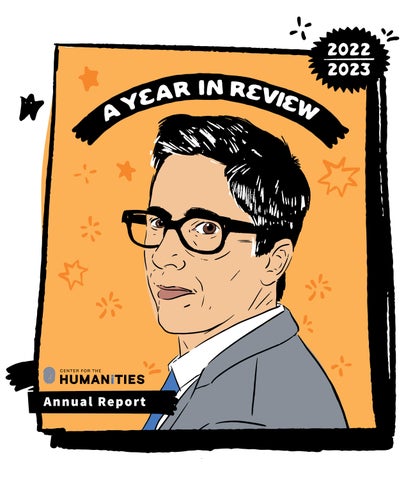
ON THE COVER Cartoonistmemoirist Alison Bechdel received the 2022 Washington University International Humanities Prize, presented by the Center for the Humanities. Bechdel’s work has made deep impacts in the fields of art, comic studies, literature and queer studies. Read more about Bechdel, her selection and her visit to campus starting on page 20.
2022–23 ANNUAL REPORT TABLE OF CONTENTS
04/HUMAN TIES 04/ Florida v. Black studies: An insider’s overview The 2023 launch of the College Board’s newest offering, AP African American Studies, sparked both attacks on and defenses of its curriculum. With an insider’s perspective, Shanti Parikh, who is chair of the Department of African and African American Studies and professor of sociocultural anthropology and of African and African American studies, and who helped develop the AP course, details the process of developing the course, the controversy over the College Board’s dealings with Florida and what’s next for Black studies in the United States. 06/Why do comics get banned? Curator Skye Lacerte pulls out three comics from the D.B. Dowd Modern Graphic History Library — Batman: The Killing Joke, Eightball 22 and Elektra, Assassin — and recaps the history and outcomes of their challenges.
08/Pitching the humanities on the Hill Every March, humanities scholars and practitioners talk directly to the congressional offices that decide how much of the federal budget supports programs such as the National Endowment for the Humanities and the Department of Education’s international education programs. Assistant Director Laura Perry sums up the experience: “It’s up to us to make persuasive cases for why the humanities matter, in 30 minutes or less.” 10/ On Derry Girls and remembering the Good Friday Agreement When the final episode of Derry Girls, set in late 1990s Northern Ireland, dropped last fall, it presaged an important milestone — the inevitable remembrance of the Good Friday Agreement referendum, sparked by its upcoming 25th anniversary. Irish literature PhD candidate Ian Clark walks us through the series’ complicated relationship with the Troubles and what it says about how people remember the violence today.
17 Photo: Dan Donovan
21 Photo: Whitney Curtis
12/THE DIVIDED CITY INITIATIVE
20/International Humanities Prize
Protect and preserve The Divided City Initiative brings together Arts & Sciences and the Sam Fox School of Design & Visual Arts to support communityled efforts to save north St. Louis’ historic Sumner High School.
More than a medal The biennial International Humanities Prize, which was awarded to Alison Bechdel in 2022, builds community and celebrates excellence in the world of arts and letters. 24/Faculty Book Celebration
16/REDEFINING DOCTORAL EDUCATION IN THE HUMANITIES (RDE) Memory studies beyond the classroom A new RDE StudioLab graduate course led by Anika Walke and Geoff Ward explored trauma and memory in community spaces beyond campus.
‘Very careful’ in the Ivory Tower may not be enough Ahead of Davarian Baldwin’s Faculty Book Celebration keynote lecture, “What Good Is Higher Education for Our Cities?” Michael R. Allen deliberated on the ethical considerations of university– community partnerships.
18/EVENTS + OUTREACH 18/James E. McLeod Memorial Lecture on Higher Education ‘WashU is not for us’: Universities embracing the public good Do colleges and universities bear responsibility for K–12 public education? Prompted by the title of the McLeod Lecture on Higher Education, Associate Professor of Education Michelle Purdy reflected on WashU’s relationship to students in St. Louis.
29/FELLOWS 30/Learning from Haiti’s classical music culture Lauren Eldridge Stewart, Assistant Professor, Department of Music 31/Teaching modernity in the mountains Javier García Liendo, Associate Professor, Department of Romance Languages and Literatures
32/Social hierarchies and domination Lori Watson, Professor of Philosophy 33/From pétroleuse to pornstar, the radical theorizing of sex workers Heather Berg, Assistant Professor, Department of Women, Gender and Sexuality Studies 34/On the ‘ugliness’ of whiteness Stephanie Li, the Lynne Cooper Harvey Distinguished Professor, Department of English 35/Rwanda’s privatized polis and the people in the path of progress Samuel Shearer, Assistant Professor, Department of African and African American Studies 40/FACULTY RESEARCH SUPPORT 44/MINORS 46/GIVING OPPORTUNITIES
2
LETTER FROM THE DIRECTOR
The humanities are more consequential than ever. So many of the so-called culture wars and debates around identity have humanistic inquiry at their heart, and they function as a constant reminder of the urgency of our work as teachers, scholars and public intellectuals. From book banning, curriculum interference in public schools and universities, rewriting of historical narratives and attempts to circumscribe expressions of sexual, gendered and racialized identities, the political desire to homogenize and sanitize conceptions of culture, arts and history is gaining ground across the country. As teachers, scholars and staff members employed by Washington University in St. Louis, we enjoy an unfettered academic freedom that our colleagues in public institutions no longer possess. Our role as a university is thus more salient and more scrutinized than it has been in years, and our connection to our K–12 colleagues and our wider communities more vital than ever.
The Center for the Humanities provides a critical forum for marshaling interdisciplinary interests around these questions and this year responded with several public events. In our annual McLeod Lecture on Higher Education and in our Faculty Book Celebration keynote presentations, our speakers, Mary Schmidt Campbell and Davarian Baldwin, interrogated the responsibilities higher educational institutions hold to the underserved and minoritized communities around them in terms of both education and the built environment. With the awarding of the International Humanities Prize to Alison Bechdel and a connected panel held at the St. Louis Central Public Library on book banning and graphic novels featuring Jerry Craft, Phoebe Gloeckner and an ACLU attorney, we confronted conservative political acts of book banning. In this Year in Review, we also bring you examples of the written reflections our faculty and staff have produced for our Human Ties blog in which they engage with these attacks on historical and cultural narratives and purging of literary materials from schools. We hope you find inspiration and information in these writings as humanists resist these blatant assaults on our fields of study.
3
Stephanie Kirk Director, Center for the Humanities Professor of Spanish, Comparative Literature, and Women, Gender and Sexuality Studies
Photo: Whitney Curtis
This was quite a year, as you can see from the materials gathered here. My predecessor, Jean Allman, noted last year in her letter that the directorship of the Center for the Humanities is one of the best gigs in town, and I am beyond thrilled to hold this position. I am also grateful to the highly skilled team here at the center: Alicia Dean, Kathleen Fields, Caitlin McCoy, Laura Perry and Trisha Sutton. My thanks also go out to the center’s executive committee for their support and advice. Thanks and good luck to Ignacio Infante in his new role as co-director of the Center for the Literary Arts, as well as to Wendy Love Anderson, who has left us to pursue a new career. Finally, I would like to dedicate this Year in Review to the memory of Barbara Leibmann, our longtime administrative coordinator who retired in 2021 and died unexpectedly this year after a short illness. A key part of our work here at the humanities center is the building of a welcoming and inclusive community for the study and dissemination of humanistic knowledge, and Barb’s warmth and generosity of spirit guided these efforts for years.
4
human ties
FLORIDA V. BLACK STUDIES: AN INSIDER’S OVERVIEW Interview with Shanti Parikh, Chair of African and African American Studies (AFAS) and Professor of Sociocultural Anthropology and of African and African American Studies and Member of the College Board AP in Higher Education Advisory Committee
Photo: Gara Lacy
The year 2023 began with news reports that the College Board — the nonprofit education organization responsible for Advanced Placement (AP) courses and exams — was engaged in a back-andforth with the state of Florida and then subsequently with scholars of Black studies over its newest offering, AP African American Studies. Into these turbulent waters, the College Board released a final draft of the course framework that removed sections, some of which were opposed by Florida’s right-wing government, on topics such as the Black Lives Matter movement, intersectionality and Black feminism. After mounting pressure, in April the College Board promised yet another revision, pledging an “unflinching encounter with the facts and evidence of African American history and culture.” While the story is still unfolding, we asked Shanti Parikh, who was involved in the development of the AP course framework, for a rundown of the process of developing the course, the conservative pushback and what it reveals about the history and future of Black studies in the United States.
WHAT WAS YOUR INVOLVEMENT IN THE AP AFRICAN AMERICAN STUDIES CURRICULUM DESIGN? After about two and a half years of research, in line with its usual practice, the College Board consulted scholars from different universities to ask what should be included in the course framework. That’s when I got involved. These focus group discussions with faculty from across the U.S. were fascinating in and of themselves because the field is so vast and diverse. There was little consensus, and the suggested content was rich and expansive. Then, they created a course framework and list of readings. They invited 200–300 faculty members to D.C. to review and to determine which topics were definitely necessary, which ones were “yes, if it fits,” which ones they should condense and which ones they could trim away. Only three of the 38 AP frameworks have required readings, so the decision to have them in this course was already unique but also leads to issues when certain readings don’t make the list.
center for the humanities
WHY DO YOU THINK THERE IS OPPOSITION TO THIS CURRICULUM — THAT THERE ARE SOME PEOPLE WHO CONSIDER AFRICAN AMERICAN STUDIES “CONTROVERSIAL”? In some ways, it emerged out of the context of anti-Blackness and the rolling back of civil rights gains in the United States. As a discipline, Black studies emerged out of resistance in the 1960s, with Black students demanding more emphasis in the curriculum on Black people; Black people’s lives; Black people’s experiences, including their joy and creativity; Black people’s accomplishments; that there needs to be more Black faculty, more offerings for Black students and more Black students.
WHY WAS THIS COURSE NEEDED? The AP African American Studies course exposes high school students to the field of Black studies and topics of Black culture, history and experiences earlier than is currently the case. Students will come to college understanding that it is a robust field with many different areas of inquiry. For many students — Black, white and Asian — taking their first class in AFAS is their initial exposure to the study of the Black experience, and they say, “Wow, this is the first I’m learning about Black Wall Street or the East St. Louis race massacre or Islamic inventions in Africa.” High school teachers are interested in better incorporating aspects of Black studies into pre-existing, mainstream curriculum. They’re interested in decolonizing how and what they teach. They want to know how to teach about slavery, African American soldiers in World War II, the GI Bill or African kingdoms. The excitement from teachers on the front line is promising. They have the sense that young people are really interested in these topics and that they’re ready. We have to trust them.
Sowande' Mustakeem (standing), an associate professor of history and of African and African American studies, discusses the history of Black medicine in St. Louis with local high school teachers.
AS THIS PROCESS UNFOLDED, WAS THERE ANY DISCUSSION ABOUT POTENTIAL PUSHBACK? Many Black studies faculty members and I imagined that there would be pushback. It was naive on the part of College Board not to anticipate that there would be controversy given the attacks on so-called wokism and diversity, or that they would have to stand their ground when it came to certain topics. Likely, the College Board had not experienced such strong opposition to a subject or curriculum. Many of the Black studies faculty members at the D.C. meeting tried to give a warning and asked really tough questions about the commitment to the course and the implementation. At the same time, Black studies faculty were also invested in making sure that there was an AP African American Studies.
So, the idea that Florida thinks an AP course that centers on Black experiences and productions is controversial is not surprising. In the same sense that Reconstruction appeased the Southern states by building Confederate monuments up North — most of the Confederate monuments were built after the Civil War — we need to examine why we keep trying to appease people who don’t want to move the country forward. It might make white people feel uncomfortable, but certainly it makes Black people also feel very uncomfortable with having to wrestle with the violent history and legacies of enslavement, Jim Crow, lynchings and all forms of discrimination. But Black studies moves beyond this to also explore Black joy, resistance, systems of caring and other innovations born alongside, within and out of struggle. This AP controversy is a watershed moment. We are all being reminded of the urgency and necessity of our field and what we study. It’s a moment for us as Black studies scholars to say, “What are the things that are key to our field and how do we want to shape the creativity of future scholars of Black studies?”
5
6
human ties
WHY DO COMICS GET BANNED? Skye Lacerte is the curator of the D.B. Dowd Modern Graphic History Library in the Department of Special Collections at Washington University Libraries.
Comic books have sparked controversy and prompted censorship for almost as long as they have existed. The most consequential case occurred in the 1950s when the psychiatrist Fredric Wertham investigated what he saw as the negative effects of comic books on children. In his book on the topic, Seduction of the Innocent, Wertham claimed that there were direct correlations between children reading comics and juvenile delinquency. His crusade against comics led to the 1954 formation of the Comics Code Authority — a set of rules created by the publishers and distributors themselves in an effort to avoid government intervention. The code was in use in some form for the better half of the 20th century. With the eventual suspension of the code, and with authors and illustrators pushing the creative boundaries of storytelling, comic books have been experiencing a backlash of intense criticism in recent years. At the same time, comic books have also become increasingly visible and integrated in libraries and learning environments. This trend has made them regularly vulnerable to challenges and bans. They are denounced for all of the same content reasons that other books are, such as containing profanity, violence, sex/nudity and drug or alcohol use. However, comics are uniquely susceptible to criticism because of the medium’s visual nature.
Photos courtesy the D.B. Dowd Modern Graphic History Library, Washington University Libraries
The explicitly visual nature of the comic book medium makes them uniquely susceptible to calls for bans, says curator Skye Lacerte.
The purpose of the D.B. Dowd Modern Graphic History Library at Washington University Libraries is to preserve and provide access to important works of modern visual culture, including comic books and graphic novels that have been scrutinized, lauded, overlooked and dismissed. We believe strongly that these works support the serious research of American history, culture, literature, identity and so much more. The three comics featured at right are in the DMGHL’s collections and have been challenged in libraries and schools by community members. But thanks to the diligent efforts of librarians and advocates of free speech, they were ultimately kept in circulation.
center for the humanities
BATMAN: THE KILLING JOKE, ALAN MOORE, BRIAN BOLLAND, JOHN HIGGINS. DC COMICS, 1988. Batman: The Killing Joke is a comic that features the Joker’s violent torture of Commissioner Jim Gordon and his daughter, Barbara. It is widely recognized as the Joker’s origin story. The villain’s portrayal influenced later adaptations in print and on screen, yet the story’s treatment of Barbara Gordon has been widely criticized as exploitative. In May 2013, a patron of the public library in Columbus, Nebraska, requested that the book be removed from the collection, claiming that it “advocates rape and violence.” The challenge was brought to a library board meeting where members voted unanimously to keep the book on the shelves. EIGHTBALL 22, “ICE HAVEN” BY DANIEL CLOWES. FANTAGRAPHICS BOOKS, JANUARY 1, 2003. Eightball 22 contains a series of comic vignettes that together tell a story about the characters’ interrelated lives. The uniting plot line of the book describes the disappearance of a local boy named David Goldberg. The work explores the emotional lives of the small-town citizens, in a darkly humorous examination of alienation, regret and desire. In 2008, Guilford, Connecticut, high school teacher Nate Fisher was forced to resign from his job after a parent filed both a formal and a police complaint against him for lending a high school freshman a copy of Eightball 22. Despite the fact that Fisher resigned, investigators did not find evidence to back up claims of wrongdoing.
ELEKTRA, ASSASSIN. FRANK MILLER, BILL SIENKIEWICZ. MARVEL COMICS GROUP, 1986–1987. Elektra Assassin tells the story of an innocent young woman driven to a life of violence as a martial arts assassin. The series is universally known for being uniquely dark and complex and is admired for artist Bill Sienkiewicz’s experimental treatment and skillful, expressionist painting style. Elektra Assassin found itself at the center of an obscenity case that lasted from 1986 to 1989. The display of these books in Friendly Frank’s comic book store in Lansing, Illinois, led to the arrest of its manager, Michael Correa. The works were said to be obscene and full of satanic influences. Correa was found guilty of obscenity, but the verdict was later overturned by an appeals court. The incident led to the formation of the Comic Book Legal Defense Fund, which protects the First Amendment rights of comics and its community of retailers, creators, publishers, librarians and readers.
7
8
human ties
PITCHING THE HUMANITIES ON THE HILL Laura Perry is assistant director for research and public engagement in the Center for the Humanities.
“Are the humanities a dying art?” This hair-raising question came from a congressional aide during last year’s Humanities Advocacy Day, organized by the National Humanities Alliance (NHA). Every year, the NHA assembles teams of academics and practitioners to advocate for funding the humanities across the United States. The House and Senate vote each year on appropriations bills that include support for key programs like the National Endowment for the Humanities, the National Archives and Records Administration and the Department of Education’s international education programs Title VI and Fulbright-Hays. Humanities Advocacy Day aims to boost that federal funding by connecting humanities supporters directly with the representatives who decide how much money goes where. The NHA trains advocates in pitching elected officials, offering talking points about funding priorities and practical advice about what to expect. Then it’s up to us to make persuasive cases for why the humanities matter, in 30 minutes or less. In 2022 and 2023, I joined advocates from universities across Missouri to spend a day talking with House and Senate offices about the importance of the humanities for the state. We met with congressional aides for elected officials including senators Roy Blunt, Josh Hawley and Eric Schmitt, and representatives Mark Alford, Blaine Luetkemeyer and Ann Wagner. Each meeting followed roughly the same arc as we made our collective pitch for the humanities. We talked about the millions of dollars that Missouri has received in federal support for humanities programs and the innovative research and initiatives that funding made possible. We offered packets of materials with more information, and they graciously took them. Meetings were brief and polite, in stereotypical political style — nod, smile and make no promises. And then came the provocation: “Are the humanities a dying art?” [sic]
In a moment like that, the NHA’s exhaustive training came in handy. We smoothly pointed out to this skeptical aide that his boss just happened to have a humanities degree himself. We knew this because the NHA provides advocates with member profiles of every representative, like deeply researched baseball cards, which share key details about their backgrounds, voting records, and caucuses and committees. In fact, I wonder if the aide came to regret asking the question, since we answered so enthusiastically and fulsomely. My colleagues spoke about the importance of humanities research and methods for fields like bioethics and international relations. I pointed to the impassioned debates around education, what books are in school libraries and which lessons are taught in history class. People across the United States and on both sides of the aisle appear to care deeply about art, literature and history, even as we disagree profoundly about the purpose and place of them in our lives. Book-banning is an ever-present threat across the United States and especially in Missouri, and it paradoxically speaks to the power of the humanities. Why try to ban a dying art? These ongoing attempts at censorship are not evidence that the humanities are no longer relevant, but quite the opposite.
center for the humanities
Three WashU humanities PhD students joined assistant director Laura Perry for a day of humanities advocacy on Capitol Hill.
Photo: Caleb Perez via Unsplash
At this year’s Humanities Advocacy Day, Missouri’s team was ready for more challenges. This time, we had help from three WashU PhD students, sponsored by the humanities center to hone their skills in advocating for the humanities: Gicela Medina (Spanish), Maurice Tetne (French) and Lacy Murphy (Art History) (left to right). On a chilly spring morning in D.C., we gathered for a whirlwind day of walking back and forth across the Hill. In our meetings with Senate and House offices, Gicela, Maurice and Lacy spoke compellingly about the importance of federal support for their education and how humanities research contributes to global connections and helps local Missouri communities thrive. Pitching to the public is a useful skill, since articulating why the humanities matter can help in giving a job talk, writing a grant or explaining what we do as practitioners to our families. But what I came to appreciate most about this experience was the rare chance to advocate on behalf of all of Missouri — universities, museums, libraries, artists, scholars, schoolchildren. Humanities Advocacy Day reminds us that humanities scholarship never truly happens alone, and our work is always sustained by these webs of collective effort.
Photo: Laura Perry
9
10
human ties
ON DERRY GIRLS AND REMEMBERING THE GOOD FRIDAY AGREEMENT Ian Clark is a PhD candidate in the Department of English and a 2020 Divided City Graduate Summer Research Fellow.
In theory, I know what the Good Friday Agreement was. It was a political referendum, signed on April 10, 1998, often remembered for bringing an end to the Northern Irish Troubles by forging paths for reconciliation between Catholic and Protestant communities. I use this description when teaching about Northern Irish poetry or writing about sectarian violence and urban segregation in Belfast. Yet, with the 25th anniversary of the Agreement looming, this definition doesn’t seem quite right. It certainly didn’t fit when I visited Derry, a city near the Northern Irish border that saw some of the Troubles’ worst violence. I took a walk there in 2012, over a decade into the “post-Agreement” era. Strolling through the city, I was struck by murals depicting children wearing gas masks, British paratroopers or bleeding Bloody Sunday victims. Murals like these often marked borders between neighborhoods segregated along sectarian lines. As I recall, the Troubles didn’t seem finished. The violence was still part of the landscape, the ghost of a memory I could feel in the city’s streets. But it’s dangerous to believe the stereotype that the Irish are always mired in past grievances. The truth is more complicated than that — at least, it is for Lisa McGee’s Derry Girls (2018–22). The show draws on memories of growing up during the end of the Troubles, but only indirectly. In McGee’s Derry, sectarian violence exists as a slowsimmering backdrop to the hopes and dreams of her adolescent protagonists; Erin and her lovably misfit friends are as likely to obsess over a high-school romance as worry about sectarian bombings. In interviews, McGee has admitted she was reluctant to set Derry Girls during the Troubles at all. This reluctance is palpable in the show’s desire to both remember and forget violent history. Take, for instance, the series finale. The episode opens on one of the characters, Orla, preparing to vote on the Good Friday Agreement. But rather than musing about politics, Orla walks into the street, switches on her Walkman, and starts grooving to Dario G’s upbeat
Set in Northern Ireland during the sectarian violence known as the Troubles, Derry Girls depicted the period’s complexity — and how it’s remembered today.
Photo: K. Mitch Hodge via Unsplash
center for the humanities
shot depicts another, less lucky pedestrian being directed off-screen to an uncertain fate by an armed British soldier.
1997 dance jam “Sunchyme.” She proceeds to shoulder shimmy and twirl her way through Derry, dancing from the modern shopping district to the top of the city’s 17th-century walls, where a troop of little girls joins her in a jubilant blend of traditional Irish stepdance and robotic ’90s dance moves. Interspersed throughout this montage are shots of the main characters going about daily lives that don’t have much to do with either sectarianism or political referendums. Erin walks to a bookstore to read Hamlet, then Shakespeare Made Simple, then Teen Bulletin; her parents gush, not about the end of the Troubles, but over a new microwave. The joyful physical movement of Orla’s walk seems to personify Derry Girls’ refusal to remember Troubles-era Northern Ireland purely through sectarianism, illustrating alternative ways of remembering historical moments defined by violent conflict. Still, violence remains part of the city, as becomes clear when Orla is stopped at a military checkpoint. Alarmed, she removes her headphones, declares “I need to get past,” and is allowed to proceed. McGee undermines any conciliatory possibility, however, with reminders of surveillance and control. For the corner of the
The Good Friday Agreement’s complexity lies in how it’s remembered. Northern Ireland’s social division and sectarian conflict did not end with the Agreement but remain fraught political issues, as events like Brexit illustrate. It’s not as if the Agreement didn’t have an impact; it’s just that defining this impact remains uncertain, even a quarter-century later. The Agreement marked the beginning of a period in which a collective impulse to “move on” from the past was complicated by a need to make sense of the violence that had occurred. Artists like McGee grapple with this complexity, offering ways of defining Northern Ireland beyond the Troubles, yet acknowledging that conflict’s enduring legacy. As Orla’s dance suggests, remembering the Troubles and the Agreement does not entail arriving at fixed destinations or definitions. It’s an ongoing process, one that must work through a haunting past time and again, even after the fanfare of anniversaries fades away.
11
12
the divided city
THE DIVIDED CITY: AN URBAN HUMANITIES INITIATIVE The Divided City 2022 is a long-running urban humanities initiative in partnership with the Mellon Foundation and the Sam Fox School of Design & Visual Arts at Washington University that focuses on one of the most persistent and vexing issues locally and globally today — segregation. In May 2023, the Divided City hosted a year-end gathering to celebrate the diverse communities that have come together through the initiative. It was a fitting end for this era of the Divided City initiative: a room full of faculty, staff and students from across schools at WashU joined with local community partners and accompanied by good food, music and conversations. Displays designed by graduate assistant Yamile Ferreira honored the many people and programs who helped the Divided City thrive over the last nine years. Projects crossed generations, connecting elementary and high school students with elders and other experts. Joining this community, the projects below were supported by new grants in 2022–23. The Divided City also offered programming including the Sumner StudioLab (more on page 14) and the Alberti Program for young St. Louisans (more on that and the full scope of the initiative at https://thedividedcity.com/). The reflections at right offer a sense of the initiative’s ripple effects that will endure even as this chapter closes.
SUMMER RESEARCH GRAD FELLOWS These fellowships, co-sponsored by the university’s Office of the Provost as part of the 10-year “Here and Next” strategic plan, are aimed at forging sustainable interdisciplinary connections among Washington University graduate students in the humanities, architecture and urban design. Recipients for summer 2023 include the following: • Gbenga Adeoba, “‘Poetry for the People’: Taxi Poetry Project, Placemaking, and the Lyric Form” • Rajnesh Chakrapani, “Periphery as the New Center: Translation Workshops in Ferentari, Bucharest” • Kevin Corrigan, “Shifting Sands: Depositing Possibilities Amidst a Coal Plant Decommissioning” • Zihan Feng, “Narrating the Audiophile Soundscape in PostSocialist Beijing: An Acoustic Reinforcement and/or Interrogation of Urban Segregation” • Sarah María Medina, “Feminine Experimental City Networks: Paris, Mexico City, and New York (1910s to the 1940s)” • Lee M. Morrison, “The Men of Santo Stefano: Witnessing and Local Identity around a 13th-Century Urban Monastery”/“The Women of the Gate: Neighborhood Development in Late Medieval Genoa” • Michael Lamont Scarboro, “ ‘Funeral Home, Church, Church, Liquor Store’: Supportive Housing as a Reparative Typology for Black St. Louisans” • Sylvia Sukop, “Performing Black Memory in St. Louis: An Oral History of Public Historian and Community Elder Angela da Silva” • Francisco Tijerina, “Urban Extractivism: An Ecofeminist Reading of Monterrey (2000–2023)” • Karla Aguilar Velásquez, “Artistic Landmarks: Remembrance through Interaction in Counterpublic 2023” FACULTY COLLABORATIVE GRANTS These grants support collaborative working groups, field institutes and community engagement on urban segregation broadly conceived. Receiving funding this year are the following: • “A Sorry Stop” is an initiative led by Trivers architecture firm, along with filmmakers Daniel Parris and Aisha Sultan. It seeks to address the state of local bus stops, an issue that involves not only safety and transportation quality, but also equity, dignity and urban inequality. • The STLr City Working Group gathers people from St. Louis universities and cultural institutions. The group is planning Indigenous STL, a summer 2023 conference to foster connections among local organizations, deepen relationships with Indigenous groups, bring Indigenous issues and voices to the forefront of the St. Louis community, and lay foundations for future projects and partnerships.
center for the humanities
COMMUNITY GRANTS Also co-sponsored by “Here and Next,” these grants support community work or creative practice related to urban segregation in the St. Louis metro area. The 2023 recipients include: • The Village Path and Undo Bias for “UnMasc: A Men’s Storytelling Event” to highlight how dominant social ideas about masculinity affect men • Shine Goodie for Goodie House, a space for emerging poets and established writers that highlights the work of queer and Black, Indigenous and other minority authors • Robert E. Green to establish a multimedia site-specific art installation that speaks to the spatial displacement and systemic oppression of African Americans in St. Louis • Shabez Jamal for “Somewhere Above the Earth and Beneath God (I Found Home)” to explore the Black vernacular (space/photographs/ objects) as sites of preservation and self-realization for Black people of queer experience • Youth Council for Positive Development for the Phoenix Project, an oral history project where youth in the 22nd Ward will interview and gain insights from elders • Harvey Galler for the STL Reentry Collective to create a documentary film about three formerly incarcerated individuals who re-enter their communities • St. Louis Story Stitchers Art Collective for “The WHY of MY City” to produce podcast episodes in which African American youth talk with professionals about topics like poverty, violence and disinvestment in Black neighborhoods
“I have become a better designer because of the Alberti Program. I am just like my students: There is so much space to grow.” — Undergraduate Teaching Assistant
Photo: James Byard
“Ultimately, this project has taught me a lot about what community looks like or should look like.” — Community Grant Recipient “We are continuing to build an audience and community. The Divided City was the first grant the project was awarded. That funding and support became the momentum that propelled the project forward.” — Community Grant Recipient
Photo: Santiago Rozo Sanchez
“With the support of the Divided City, I was able to properly greet and thank my interviewees. We arrived with gifts like fish, chontaduro (a local fruit) and biche (an alcohol derived from sugarcane that was created and popularized by enslaved Africans).” — Summer Research Grad Fellow “In parallel to the research we conducted, this fellowship permitted us to create a public-facing podcast, in which we were able to engage in meaningful conversations with activists and academics.” — Summer Research Grad Fellow Divided City “brings the history of St. Louis onto the global stage.” — Postdoctoral Fellow
Photo: Kathleen Fields
“The workshop in Copenhagen was a transformative intellectual experience and a nuclear stepping stone in my development as an Urban Humanities Scholar.” — Lively City Workshop Graduate Student “Thank you so much for all you have done to support our collaborative research over these past several years.” — Faculty Collaborative Grant Recipient
Photo: Kathleen Fields
13
14
the divided city
PROTECT AND PRESERVE
WHAT DOES A BUILDING MEAN TO A COMMUNITY? Ask Michael Allen, lecturer in American culture studies, and he’ll tell you a building is more than a physical structure. Preserving the built environment can act as a “storehouse” against the forces that sweep in and change communities, said Allen, also a senior lecturer in the Sam Fox School of Design & Visual Arts. We save a space “not to prevent change, but to give neighborhoods the resources to push back and uphold collective values.” So, when the Divided City was invited to pitch in on a plan to save historic Sumner High School, the idea for the Sumner StudioLab was born. Sumner is the oldest Black high school west of the Mississippi. It’s located in the Ville, a neighborhood just five miles northeast of WashU’s Danforth Campus with a rich legacy of Black excellence in culture, business, sports, art, music and education. In its prime, Sumner High School’s striking Georgian-revival brick building was bursting with 3,000 students. But since the 1960s, the neighborhood has experienced the effects of disinvestment and depopulation. Today, the high school is down to roughly 300 students. In 2021, St. Louis Public Schools slated it for potential closure. Sumner’s closure would devastate the Ville, according to Aaron Williams, board president of the community group 4theVille. Williams, AB ’08, formed the task force that crafted the Sumner Recovery Plan, an ambitious arts integration curriculum that seeks to save the school. The Sumner StudioLab — organized by Laura
Photo: Sean Garcia
Perry, the Center for the Humanities’ assistant director for research and public engagement, and Matt Bernstine, associate director of the Office for Socially Engaged Practice at the Sam Fox School — aims to support those existing community-driven efforts through internships, courses and community engagement. Housed in an annex of the high school, the StudioLab is a community hub that brings together Sumner High School students, WashU students and Ville residents to discuss and design the school’s future and celebrate its past. “In some ways we are testing a model for thinking about Sumner High School’s future — a new model for public high schools as civic anchors,” Bernstine said. The first year of the Sumner StudioLab wrapped up in June, and organizers Perry and Bernstine are now planning for the future. “Moving slowly to build trust means that a year seems like the blink of an eye,” Perry said. “We are just getting started.”
center for the humanities
THE SUMNER STUDIOLAB Internship Sumner High School students Shahanah Hill, Kayleigh Lang, Erylise Solis and Christian Windsor spent their twosemester internships learning community-building and design skills, working closely with WashU grad fellows Crystal Payne (English) and Shameen Akhtar (Sam Fox School). Perry and Bernstine developed the program, funded by the Office of the Provost, in response to feedback from community leaders about the importance of StudioLab programs that offer direct, tangible benefits to Sumner students. The interns also served on a Community Advisory Committee alongside Ville residents and local leaders, an eye-opening experience for students like Lang. “I’m still a teenager, and I’m in a room full of adults,” she said. “And it’s like, ‘Oh, we are making real decisions.’”
The Sumner StudioLab grounds WashU students’ learning in local communities and with community members.
Photo: First Name Last Name
Photo: Matt Bernstine
By Jenny Bird/Arts & Sciences Communications. Full version available at https://artsci.wustl.edu/ampersand. Read more about the Sumner StudioLab at https://thedividedcity.com/sumner-studiolab/
Courses Michael Allen taught two WashU courses at the Sumner StudioLab: “Historic Preservation, Community, and Memory” and “The Unruly City.” Teaching off campus offered his students — including majors in architecture, social work, African and African American studies, English and musicology — a rare opportunity to directly address the issues they study. This spring, “The Unruly City” was split between discussion of readings and consideration of real-life issues in the Ville. Sylvie Raymond, a junior majoring in English, said the course helped her speak clearly about systems of power. “This class has given me lots of language to talk about how almost every issue of physical space is a social issue,” she said. Community engagement The Sumner StudioLab also serves as a gathering place for Ville residents. Community workshops have covered topics like urban design, holistic wellness and civic engagement. Bernstine and Perry have been intentional about centering community voices in those events, and every workshop proposal goes through a careful selection process. The StudioLab Community Advisory Committee — comprising Sumner staff and students, Ville residents and local leaders — must approve each idea to ensure workshops truly serve the neighborhood.
15
16
rde
REDEFINING DOCTORAL EDUCATION IN THE HUMANITIES (RDE) After a pause during the 2021–22 academic year, competitions for new funding resumed this year. With a $1.5 million grant from the Mellon Foundation in 2018, Washington University’s Redefining Doctoral Education in the Humanities (RDE, or “Ready”) initiative has focused on providing humanities faculty with opportunities to acquire the skills, capacities and experiences necessary for training the next generation of humanities PhDs for success both within academia and in the world beyond. Those efforts have been supported with faculty retreats, cross-training grants, curricular innovation grants and StudioLab competitions. This year, RDE widened its scope in response to the on-the-ground needs of WashU humanities faculty to include support for departmental graduate education initiatives (in addition to individual efforts) as well as the inclusion of graduate students in RDE programming.
FACULTY RETREAT With guest speaker Davarian Baldwin, the Paul E. Raether Distinguished Professor of American Studies at Trinity College in Connecticut — founding director of the Smart Cities Lab and this year’s Faculty Book Celebration speaker (see page 24) — RDE’s 2023 workshop centered humanities scholars who seek to incorporate community engagement in their teaching, research and service. For the first time, graduate students in the humanities were invited to participate. The two-day workshop, held February 23–24, emphasized the ethics and process of community engagement and guided participants through designing a mutually beneficial and reciprocal project or course. Sessions were held at the WashU campus and at the Sumner StudioLab and introduced local experts, on-campus resources and fruitful models of engaged humanities projects. Community members joined the workshop for a frank conversation about the power dynamics and practical aspects of communityengaged projects. GRANTS StudioLab Zhao Ma (East Asian Languages and Cultures) Using a 19th-century Chinese bed as a starting point, the 2023–25 StudioLab “The World of an Antique Wedding Bed: Material Culture and Digital Humanities” will combine digital tools with humanistic research methods to facilitate a cultural history that engages questions of intimacy, nuptials, curation and conservation, and global trade and cultural exchanges. Students enrolled in the yearlong course will develop information and data literacy skills including database mining and introductions to software such as NVivo, ArcGIS, Python and HTML parsing, StoryMap, and digital cartography; engage
in comparative research with community partners such as Hanley House Museum, Campbell House Museum, Daniel Boone House, the Chatillon-DeMenil Mansion, and Scott Joplin House; and disseminate research findings in genres including documentary films, public-facing sessions, virtual galleries, 3D models, online games and exhibition materials. Cluster grant Department of African and African American Studies Cross-Training Grant: Participation for six faculty members in Training in Public Scholarship, Podcasting the Humanities, National Humanities Center Curricular Innovation Grant: Summer stipends for graduate program proposal writing for a postdoc and non-tenuretrack faculty “Bridge” Curricular Innovation Grant: Support for collaboration between the Department of African and African American Studies and neighboring institutions: • Site visits to leading Black studies graduate programs in the United States • Conference travel to the Association for the Study of the Worldwide African Diaspora • Hosting workshops/symposia on Innovations in Global Black Studies Graduate Program
Photo: Dan Donovan
Photo: Dan Donovan
center for the humanities
Led by (photo at right) Santiago Rozo-Sanchez, postdoctoral fellow; Anika Walke, associate professor of history; and Geoff Ward, professor of African and African American studies, students in the Memory for the Future StudioLab created public scholarship projects, such as Germanic Languages and Literatures PhD student Sylvia Sukop’s project on Angela da Silva, a scholar and historian of St. Louis’ Black heritage.
MEMORY STUDIES BEYOND THE CLASSROOM To understand how communities memorialize the trauma of systemic racial violence, researchers need to work in those communities, according to Anika Walke and Geoff K. Ward. In the StudioLab course “Memory for the Future,” Walke, associate professor of history, and Ward, professor of African and African American studies and director of the WashU & Slavey Project, asked graduate students to forget about the standard graduate seminar research paper. Instead, students partnered with local organizations such as the St. Louis Kaplan Feldman Holocaust Museum, Griot Museum of Black History and Culture, Reparative Justice Coalition, Mildred Lane Kemper Art Museum and CounterPublic to develop projects that benefit the community. The projects aimed to participate and intervene in current debates about the possibility of repair and forms of memory and commemoration that address ongoing inequalities and injustice.
Students engaged with questions of trauma and memory in St. Louis and Tulsa, Oklahoma, thanks to a grant from the Feldman Education Institute. The St. Louis region has its own history of racial violence — among them, the removal of the Missouri and Osage tribes, colonial-imperialist displays at the 1904 World’s Fair and the 1917 race massacre in East St. Louis — and is home to victims of racialized violence abroad, including Holocaust survivors and Bosnian refugees. A study trip to Tulsa in September allowed the students to learn how another city with a similar record of racialized violence responded to its own history — via visits to the city’s memorials to victims of systemic racial violence, including the Greenwood Cultural Center, Greenwood Rising and the John Hope Franklin Reconciliation Park, as well as the nearby Sherwin Miller Museum of Jewish Art and the Cherokee National History Museum — and drew on this experience to develop community-based projects.
“How do we commemorate the victims of racialized violence in the past while also educating the public about the dynamics and contingencies of atrocities against particular social groups?” Walke asked. “Our class offered a framework to think critically about memorial practices and, during the practicum, put these insights to work to facilitate change.”
The StudioLab course was part of the Center for the Humanities’ Redefining Doctoral Education initiative, which helps equip doctoral students in the humanities with professional skills beyond teaching and research. Walke and Ward note that students had to think about the academic theory involved in studying trauma and memory, and also learn how to manage complex communityengagement projects.
The StudioLab leveraged the concept of multidirectional memory, developed by scholar Michael Rothberg, to develop new forms of humanities education and practical public history. The concept emphasizes the productive relationship between different, yet related, histories and legacies of violence such as the Holocaust, slavery, apartheid and colonialism that emerges if and when they confront each other in the public sphere.
Ward said that public engagement was the most challenging aspect of the course. “Some students found it challenging to be comfortable with uncertainty, but we wanted them to be uncomfortable to a certain degree,” he explained. “That will prepare them to do the kind of work that the world will actually demand of them, to take chances and work together with people you don’t know to achieve something for the community.” By John Moore/Arts & Sciences Communications. Full version available at https://artsci.wustl.edu/ampersand.
17
18
e v e n ts + o u t r e a c h
McLEOD MEMORIAL LECTURE ON HIGHER EDUCATION On October 24, Mary Schmidt Campbell, the 10th president of Spelman College (2015–22), gave the James E. McLeod Memorial Lecture on Higher Education. This annual lecture honors the esteemed vice chancellor of students, who died in 2011, and addresses the role of the liberal arts in higher education. Campbell’s lecture, “Do Colleges and Universities Bear Responsibility for K–12 Public Education?” addressed what responsibility, if any, elite, well-resourced institutions of higher education should assume for the public school outcomes of the communities in which they reside, especially in large urban centers where public school education has been underresourced, and students have been dramatically underserved. During her visit, Campbell also met with the students of the Mellon Mays Undergraduate Fellowship, a program that encourages talented and underrepresented students to develop their academic interests to the fullest, obtain PhDs and pursue careers in higher education. Prompted by the title of Campbell’s lecture, Michelle Purdy, associate professor of education, wrote on WashU’s relationship to students in St. Louis for the humanities center’s blog, Human Ties. A condensed version of Purdy’s article follows, which is available in its entirety on the humanities center website at https://humanities.wustl.edu/.
‘WASHU IS NOT FOR US’: UNIVERSITIES EMBRACING THE PUBLIC GOOD Michelle A. Purdy is associate professor in the Department of Education. Do colleges and universities bear responsibility for K–12 public education? Mary Schmidt Campbell, the 10th president of Spelman College (2015–22), pushed us to respond to that prompt at the James E. McLeod Memorial Lecture on Higher Education. As I mulled over this question and thought about my late mentor, Dean James E. McLeod, I couldn’t help but remember one of my earliest experiences at Washington University in St. Louis. As a first-year Black woman undergraduate in the fall of 1997, I volunteered with the admissions office to speak to prospective undergraduate students at recruiting events. On one such occasion, a young Black woman staff member and I were partnered to represent WashU at a college fair at Vashon High School, the second high school built for African Americans in St. Louis in
the early 20th century, in north St. Louis. We arrived early, set up the table and waited for students to come. Just before the fair ended, we decided to approach a group of students who were looking at other college displays across the gym. We introduced ourselves, but they quickly dismissed us, saying, “WashU is not for us.” The staff member and I were new to WashU and to St. Louis, and that afternoon served as our introduction to understanding many Black students’ perceptions of WashU. I contend that understanding some Black students’ perceptions of WashU, especially for those in underresourced public schools in St. Louis City and in the larger metropolitan area, requires a historical reckoning of WashU’s relationship with St. Louis, a city defined by historical state-sanctioned racism. There were no Black students at WashU from the early 20th century to the mid 20th century. Concurrently during the first half of the 20th century, schools like Sumner High School — the first Black high school west
center for the humanities
of the Mississippi River and located in the Ville neighborhood in north St. Louis — and Vashon High School would become the alma maters of Black St. Louisans who led in politics and activism, the arts, education, science and athletics.
Speaker Mary Schmidt Campbell, former Spelman College president, made the case that elite universities should respond to community needs, especially in underresourced areas.
Photo: Whitney Curtis
As WashU enrolled Black students and hired Black faculty and staff, and shifted from streetcar college to top-tier elite, global institution from the mid-20th century to the present, many St. Louis public schools — both in the city and, now, in the firstring suburbs — would simultaneously experience desegregation and then the subsequent resegregation of their schools. Indeed, WashU leaders were at the center of some these changes and remedies, including the Voluntary Interdistrict Choice Corporation (VICC), the largest interdistrict desegregation program that served as a remedy to the 1972 desegregation case Liddell v. Board of Education of City of St. Louis. Due in part to resistance to public school desegregation, white flight from the city took hold in the 1970s and 1980s, and the divisions between predominately white south St. Louis and largely Black north St. Louis became even more stark. The realities of Black schooling in the 21st century were sharply illustrated by the death of the recent high school graduate
Michael Brown at the hands of police officer Darren Wilson in Ferguson, Missouri, in August 2014. Journalist Nikole HannahJones’ examination of the Normandy School District, in which Brown had been enrolled, provides some of the reasons why: ingrained institutional policies that undergird poverty and lack of political representation; reduction in court-ordered desegregation; lack of highly qualified, experienced teachers; and insufficient access to technology. WashU’s new strategic plan calls for “WashU and St. Louis to be a global hub for transformative solutions to the deepest societal challenges.” These efforts exist because there seems to be recognition that universities are responsible for the communities around them, including the underresourced public schools that became that way as elite universities grew in prominence. Yet, have universities grappled with their past histories and present trajectories to address their possible role in contributing to such glaring present-day realities? Answering the aforementioned question is paramount to confronting our most pressing social issues, including inequitable education. Despite our individual and collective efforts, I surmise that like those students I met at Vashon in 1997, there are still Black students and other marginalized students in the St. Louis area who do not believe a school like WashU is for them.
19
20
e v e n ts + o u t r e a c h
INTERNATIONAL HUMANITIES PRIZE & LECTURE During a public ceremony on November 9, cartoonist-memoirist Alison Bechdel, known for her groundbreaking depictions of queer life and family relationships, received the 2022 Washington University International Humanities Prize. The Center for the Humanities makes the biennial award, which is accompanied by a $25,000 prize, to honor a noted scholar, writer or artist who has contributed significantly to the humanities either through a supremely well-crafted work or an entire body of work that has dramatically changed how we see or understand a particular place, event, person, idea or field of expression, or through courageously persevering in a humanities pursuit in an atmosphere of persecution. Past winners include choreographer Bill T. Jones (2016), documentary filmmaker Ken Burns (2012), and novelist Orhan Pamuk (2006). Bechdel was nominated for the award by the Department of Women, Gender and Sexuality Studies. Department chair and professor Rebecca Wanzo noted, “Alison Bechdel is one of the preeminent cartoonists of the 21st century. Her work invites conversations about sexuality, trauma, medium and genre, women in the academy, place and childhood.” In 1983, Bechdel launched the comic strip Dykes to Watch Out For, which was syndicated in feminist and gay and lesbian newspapers across the country for 25 years. Her 2006 memoir, Fun Home, about her relationship with her closeted father, was later adapted into a Tony Award-winning musical. “Its status as an instant classic speaks to the number of fields it touches — art, queer studies, literary studies, theater and, of course, comics studies,” Wanzo added. Bechdel’s second memoir, Are You My Mother? (2012), explores the author’s relationship with her mother while also contemplating the work of Virginia Woolf, Dr. Seuss and, especially, pioneering psychoanalyst Donald Winnicott, among others. Her comics have appeared in The New Yorker, Slate, McSweeney’s, The New York Times Book Review and Granta. She has been awarded Guggenheim and MacArthur Fellowships.
Banned Comic Books In advance of Alison Bechdel’s campus visit, this September 22 event considered banned comic books from the perspectives of the artists who create them and the advocates who defend them. Book bans across Missouri and the United States often target graphic novels and comic books, especially those that depict issues of gender, sexuality and race. New Missouri laws will punish educators and school librarians who provide restricted materials to students with fines and jail time. Moderator Rebecca Wanzo led a discussion with Jerry Craft, author and illustrator of the often-banned New Kid and Class Act; Phoebe Gloeckner, graphic novelist of the semi-autobiographical The Diary of a Teenage Girl; and Molly Carney, staff attorney of the ACLU of Missouri at the St. Louis Public Library’s premier Central Library.
center for the humanities
A DAY WITH ALISON BECHDEL Alison Bechdel spent a full day on campus, engaging with graduate and undergraduate students throughout the day and then addressing large in-person and virtual public audiences at her lecture. Finally, she met and mingled with admirers at a reception and pop-up exhibit. The activities underscored Bechdel’s importance to students in the humanities and the arts. Take a closer look at her day at WashU.
After meeting with a small group of graduate students from the Sam Fox School of Design & Visual Arts for coffee and informal conversation, Bechdel participated in a critique of the worksin-process of students enrolled in the MFA Illustration & Visual Culture Studio, led by Shreyas R. Krishnan, assistant professor in the Sam Fox School.
Next up, Bechdel lunched with a selected group of undergraduate students of Christopher Eng (English), Paige McGinley (Performing Arts) and Rebecca Wanzo (Women, Gender and Sexuality Studies), who covered Bechdel’s Fun Home as part of their course work in advance of her visit.
More than 200 WashU and community members gathered in Hillman Hall for the presentation of the International Humanities Prize and Medal and Bechdel’s lecture (more on that event on the following pages). An additional 150 viewed the program at an official watch party site or on their own screens.
The celebration continued with a pop-up exhibit of work by local cartoonists, organized and hosted by Mildred Lane Kemper Art Museum. Attendees, joined by online viewers, processed a short distance to the museum’s lobby, where they perused artwork, graphic novels, illustrations and more by WashU and St. Louis community artists. Photos: Whitney Curtis
21
22
e v e n ts + o u t r e a c h
MORE THAN A MEDAL
It’s a warm fall afternoon and Clark-Fox Forum is buzzing with anticipation. A capacity crowd has gathered to see cartoonist Alison Bechdel, known for her richly layered depictions of queer life and family relationships, receive the 2022 International Humanities Prize from Washington University. Hundreds more tune in to the livestream at home and from an overflow watch party in Givens Hall. “Today we are celebrating Alison Bechdel,” begins Rebecca Wanzo, author of The Content of Our Caricature: African American Comic Art and Political Belonging (2020) and professor and chair of women, gender and sexuality studies. “We are celebrating her ambassadorship of comics and cartooning, her decades-long celebration of lesbian communities and chosen families, and above all, her beautiful and heart-transformative work.” That work includes Dykes to Watch Out For, the much-loved comic strip Bechdel syndicated from 1983 to 2008, and her celebrated memoir Fun Home: A Family Tragicomedy (2006), which chronicles Bechdel’s relationship with her closeted father. Adapted into a Tony Award–winning musical, Fun Home was followed by two additional memoirs: Are You My Mother? (2012) and The Secret to Superhuman Strength (2021). “Every author has one subject that they write about again and again,” Bechdel quips in her acceptance speech. “My subject is myself.”
Photo: Whitney Curtis
But no artist is an island, and Bechdel’s true theme for the evening is the often-circuitous nature of artistic influence. For Bechdel, this is exemplified by poets Anne Bradstreet (1612–72) and, especially, Adrienne Rich (1929–2012), whose writing displayed an uncanny knack for finding the cartoonist at key moments in her own personal and professional development. Days later, Stephanie Kirk, director of the Center for the Humanities — which organizes the prize — is still thinking about Bechdel’s talk. “The humanities, by their nature, are deeply interdisciplinary,” Kirk muses. “Few scholars are able to work on, say, a body of literature without considering the context in which it was formed or other intersecting discourses.” That sense of bridging communities, Kirk adds, has become a defining feature of the WashU humanities prize. Bechdel’s work, for example, can be situated within literary and visual arts traditions, but it also speaks to the concerns of gender studies, psychology, performing arts and social justice activism. “This is work that engages multiple publics,” Kirk says.
center for the humanities
Cartoonist-memoirist Alison Bechdel received the 2022 Washington University International Humanities Prize, presented by the Center for the Humanities.
Cathedral of ideas As a student at University City High School, Phyllis Wilson Grossman, AB ’66, would sometimes cut class to attend the WashU Assembly Series. “It was a cathedral of ideas,” Grossman remembers of the lecture series. “I could learn about things that weren’t part of my everyday life. That was so exciting.” In many ways, the biennial International Humanities Prize follows the Assembly Series model. Conceptualized by Grossman and her husband, David M. Grossman, PhD ’73 — through conversations with Gerald Early, the Merle Kling Professor of Modern Letters and founding director of the Center for the Humanities — it spans a variety of disciplines to honor sustained and significant contributions to the world of arts and letters. The Grossmans also created a permanent endowment to fund a cash prize, recently increased to $50,000, that accompanies the award. The inaugural recipient, Turkish novelist Orhan Pamuk, was awarded the prize in 2006 — weeks before accepting the Nobel Prize in literature. Subsequent recipients have included journalist Michael Pollan (2008), novelist Francine Prose (2010), filmmaker (and future WashU Commencement speaker) Ken Burns (2012), influential poetry scholar Marjorie Perloff (2014), and dancer and choreographer Bill T. Jones (2016).
Photo: Whitney Curtis
Grossman notes that recipients are nominated entirely by WashU faculty, who present plans to include the recipient’s work in WashU classrooms. For example, last fall, Bechdel’s Fun Home was taught by Wanzo as well as Paige McGinley, associate professor of performing arts, and Chris A. Eng, assistant professor of English. While on campus, Bechdel met with students from all three classes and conducted studio critiques with MFA students studying illustration and visual culture in the Sam Fox School of Design & Visual Arts. She also attended a reception in WashU’s Mildred Lane Kemper Art Museum, which included a pop-up exhibit showcasing St. Louis–based comics artists. Grossman, observing the critiques, was struck by Bechdel’s thoughtful engagement. “The care with which she went over each work was amazing,” Grossman concludes. “It was a marvelous day.” By Liam Otten/Washington University Marketing & Communications. Originally published in Washington magazine.
23
24
e v e n ts + o u t r e a c h
FACULTY BOOK CELEBRATION Every year, the Center for the Humanities leads an effort to honor Arts & Sciences’ newly published authors with the Faculty Book Celebration. Alongside a virtual and in-person display of these works, the center asks two of the new authors to give a brief talk on their books and invites a nationally recognized scholar-author to give a lecture. The keynote speaker for this year’s event, held on February 23, was leading urbanist, historian and cultural critic Davarian Baldwin, the Paul E. Raether Distinguished Professor of American Studies, Trinity College (Conn.), and author of In the Shadow of the Ivory Tower: How Universities Are Plundering Our Cities. Baldwin first joined several Washington University faculty members for the panel discussion, “Humanities and the City.” Together with Shanti Parikh, professor and chair of African and African American studies and professor of sociocultural anthropology; Samuel Shearer, assistant professor of African and African American studies; Geoff Ward, professor of African and African American studies, Baldwin discussed what the humanities can uniquely contribute to the understanding of urban environments. Recalling his first urban studies conference, Baldwin said, “I was thinking literature and design and how people build and imagine and grow and contest and love and dream and die. What they meant was bridges and tunnels and roads. I was like, ‘What the fuck. I’m talking about people.’”
Baldwin’s afternoon lecture expanded on this idea. Following brief talks by Miguel Valerio (assistant professor, Department of Romance Languages and Literatures) and Lynne Tatlock (Hortense and Tobias Lewin Distinguished Professor in the Humanities, Department of Germanic Languages and Literatures and Program in Comparative Literature) about their books (Sovereign Joy: Afro-Mexican Kings and Queens, 1539–1640 and Jane Eyre in German Lands: The Import of Romance, 1848–1918, respectively), Baldwin spoke on “What Good Is Higher Education for Our Cities?” With St. Louis as the backdrop for his lecture, he considered the benefits and especially the costs to the people who live in close proximity to (or share a tax base with) universities. Ahead of Baldwin’s visit, Michael R. Allen, a lecturer in the American culture studies program, senior lecturer at the Sam Fox School of Design & Visual Arts, and executive director of the National Building Arts Center, provided an introduction to Baldwin’s work and deliberated on the ethical
considerations of university-community partnerships on the humanities center’s blog, Human Ties. An abridged version follows and is available in its entirety at https://humanities.wustl.edu/. ‘VERY CAREFUL’ IN THE IVORY TOWER MAY NOT BE ENOUGH Washington University scholar Michael R. Allen is also an academic researcher, historian, design critic, public artist, critical spatial tour guide and heritage conservationist in private practice. He wrote this reflection after leading the first of two courses taught at the Divided City’s Sumner StudioLab. “Be careful what you wish for” goes the axiom. If true, then I should be the most careful person in the world right now. As a scholar who came to academia through a community-immersed public practice, after nearly nine years of teaching at Washington University, I now am teaching university courses out in a city neighborhood. Since last semester, I have been teaching WashU students in a community hub located at
center for the humanities
Speaker Davarian Baldwin (author, In the Shadow of the Ivory Tower: How Universities are Plundering Our Cities) spoke on the benefits and costs to those who live alongside universities and colleges.
Photo: Whitney Curtis
Sumner High School as part of The Divided City’s Sumner StudioLab. Last semester, it was historic preservation; this semester, it’s power, politics and urban design. As Sumner alums and local organizations like 4theVille will testify, Sumner High School is the heart of the Ville, a historic Black neighborhood in north St. Louis with a rich legacy in culture, business and education. Working with community members at a public school, I have well-supported means of connecting my courses to public life and to adjacent initiatives including the targeted involvement of the city’s economic development agency. I should rejoice, but instead, I am being careful. Very careful.
For one thing, there is no positive model for a major research university’s engagement of a historically Black neighborhood through the oldest Black high school west of the Mississippi River. Davarian L. Baldwin offers a cogent critique of university-led social engagement through In the Shadow of the Ivory Tower: How Universities Are Plundering Our Cities, reminding us that “publish or perish” has a problematic parallel in “partner or perish” relationships with neighborhoods. As Baldwin narrates, we see community partnerships largely serving opportunities for universities to appropriate cultural authenticity, community desire for change and real estate. Although legally nonprofit, universities are arrangements of private capital whose interests in universities often are the roles universities play in generating capital opportunities. You can’t always look at what faculty members do to judge a university’s intentions. Strikingly, Baldwin reminds us that the era of diversity, equity and inclusion in higher education is more reactionary than revolutionary. Universities are adapting to popular demands while maintaining the sanctity of their discrete, private interests. While some reform has been achieved in increasing financial aid and tuition waivers, fundamentally universities are loathe to cede real power to either mass movements or local community activists. Instead, they pose as allies in order to divert popular demands and maintain what bell hooks termed the dominator culture. Private universities like WashU resist calls to pay basic land taxes into public school districts, and fight efforts to tax endowments, while they fund faculty members calling for racial and social justice.
When it comes to my courses in the Ville, I must think about a specific sentence in Baldwin’s book: “These neighboring communities of color frequently sit in zones of relatively cheap and sometimes divested land, while holding little political influence.” After years of deprivation, the Ville is depopulated and depleted (in terms of buildings), and land has little economic value. Sumner High School’s cultural value represents one of the few places to initiate capital accumulation in the Ville. The focus on the high school as site of untapped market potential, instead of the neighborhood as a complex social organism that may reject the university’s involvement, does trouble me. I draw hope from Stefano Harney and Fred Moten’s theory of the “undercommons.” Harney and Moten would return Baldwin’s volley by stating that universities never were supposed to be anything but what Baldwin describes. However, they also remind those of us enmeshed in systems of power relations beyond our control that we can extract goods for social change from inside. Instead of lamenting the corrupt basis of the system, we can take material resources from within and deliver them to groups that have not previously been beneficiaries. Perhaps part of being careful, though, is to accept that doing scholarly work in the community is always going to be incomplete, complicated and contradictory. The scholar in the community has an awesome opportunity to deliver goods to people who need them. Baldwin will remind us of how that opportunity carries great responsibility, and just maybe, great hope.
25
26
e v e n ts + o u t r e a c h
NEW BOOKS BY FACULTY IN THE HUMANITIES AND HUMANISTIC SOCIAL SCIENCES, 2022
Press, 2022)
Tazeen Ali* Assistant Professor of Religion and Politics, John C. Danforth Center on Religion and Politics The Women’s Mosque of America: Authority & Community in US Islam (New York University
Kurt Beals* Associate Professor of German and Comparative Literature and Director of the Max Kade Center for Contemporary German Literature, Department of Germanic Languages and Literatures Franz Kafka: The Drawings (with Andreas Kilcher and Pavel Schmidt ) (Yale University Press, 2022) Rebecca Copeland Professor of Japanese Language and Literature, Department of East Asian Languages and Cultures Handbook of Modern and Contemporary Japanese Women Writers (editor) (MHM Limited, 2022) Kathryn Davis Hurst Writer in Residence and Professor of the Practice, Department of English Aurelia, Aurélia: A Memoir (Graywolf Press, 2022) “Aurelia, Aurélia began as a craft book for Graywolf’s ‘Art Of’ series — it was to be titled The Art of Transition, several chapters having appeared in slightly different form in a variety of journals. When I wrote the chapter ‘Aurelia, Aurélia’ I realized I wasn’t writing a craft book, but a memoir. Luckily, Graywolf concurred.” Todd Decker* Professor of Musicology, American Culture Studies, and Film and Media Studies, Department of Music, Affiliate Professor, Performing Arts Department Astaire by Numbers: Time & the Straight White Male Dancer (Oxford University Press, 2022) “This book began with an invitation to join an international and interdisciplinary team of film
scholars working on the Hollywood studio-era musical. We gathered five times over three years for conferences in Paris and the core of the book emerged from the papers I presented at each of these meetings. The digital humanities approach I use in the book involved learning an entirely new methodology that complemented my typical reliance on archival research (as found in my first book on Fred Astaire from 2011). Similarly, I read widely in masculinity and whiteness studies to approach Astaire from a further fresh angle.”
adding images (some based on slides that had accompanied the initial talk), and then their designer turned it into this gorgeous physical object, printed in Venice during the pandemic.”
El Hadji Samba Amadou Diallo Lecturer, Department of African and African American Studies Sciences et confréries soufies au Sénégal: Approches nouvelles de la violence et de la démocratie (Brill, 2022)
Matthias Goeritz Professor of Practice of Comparative Literature, Department of Comparative Literature & Mary Jo Bang, Professor, Department of English Colonies of Paradise (trans. Mary Jo Bang) (Northwestern University Press, 2022)
“This book emerged from an article I wrote about the first political regime change (2000–12) in Senegal, a country where Islam plays an important role in stabilizing the society. The more I developed the article, the more voluminous it became. I thought it was more appropriate to continue the work by observing the succeeding and current regime to better understand relationships between religious guides, the Islamic civil society, citizens/disciples and politicians/state officials toward consolidating that model democracy. In 2020, the article turned into a complete book manuscript. Briefly said, the urgency to divulgate knowledge about the Tijāniyya — the most widespread Sufi order in Africa — and its role in democratic politics in Senegal, pushed my decision to pursue the project to its completion.” Danielle Dutton Associate Professor, Department of English A Picture Held Us Captive (Image Text Ithaca Press, 2022) “A Picture Held Us Captive started as a talk at a conference, then it morphed into a course, then it became a book. Initially, I was asked to speak about my relationship to ekphrasis as a fiction writer (since it tends to be talked about in terms of poetry). A few years later, I was invited to teach a course in the Image Text Ithaca MFA program, at which point I went back to the talk and used it to help me build the class. Eventually, the people who run Image Text Ithaca asked me to write something based on the class for their publication series. Together we worked on
Amy Heath-Carpentier Lecturer, Program in Global Studies The Challenge of Complexity: Essays by Edgar Morin (editor) (Sussex Academic Press, 2022)
Taewoong Kim Lecturer in Korean, Department of East Asian Languages and Cultures Understanding Success and Failure in Adult ESL: Superación vs Dropout of Adult English Learners in the US (Multilingual Matters, 2022) Caroline Kita* Associate Professor of German and Comparative Literature, Department of Germanic Languages and Literatures and Affiliate Professor, Performing Arts Department The Arts of Democratization: Styling Political Sensibilities in Postwar West Germany (edited with Jennifer M. Kapczynski) (University of Michigan Press, 2022) Elizabeth Korver-Glenn Assistant Professor of Sociology, Department of Sociology Race Brokers: Housing Markets and Segregation in 21st Century Urban America (Oxford University Press, 2021) Mabel Moraña The William H. Gass Professor in Arts and Sciences, Program in Latin American Studies Líneas de fuga: ciudadanía, frontera y sujeto migrante (Iberoamericana Editorial Vervuert, 2021)
center for the humanities
Pensar el cuerpo: Historia, materialidad y símbolo (Herder Editorial, 2021)
Robert Mark Morgan Teaching Professor of Drama, Performing Art Department The Art of Scenic Design: A Practical Guide to the Creative Process (with Jim Volz) (Bloomsbury, 2022) Anca Parvulescu Liselotte Dieckmann Professor of Comparative Literature, Department of English Creolizing the Modern: Transylvania across Empires (with Manuela Boatcă) (Cornell University Press, 2022) WINNER OF THE 2023 PULITZER PRIZE FOR POETRY Carl Phillips Professor of English, Department of English Then the War and Selected Poems, 2007–2020 (Farrar, Straus and Giroux, 2022) “I’ve never been able to make a book of poems, per se: rather, I write individual poems here and there, and at a certain point it feels like I’ve reached the end of something. By then I usually have about 40 or so poems, and from that I usually find there are 30-33 that are truly the best. At that point I try to sort out what they have in common, what arcs they’re tracing out, as I look for an arrangement that feels right. Once I find it, I’ve got the book. But I couldn’t have written the book if I’d been consciously working toward a book.” Carl Phillips Professor of English, Department of English My Trade Is Mystery: Seven Meditations from a Life in Writing (Yale University Press, 2022) Henry Roediger The James S. McDonnell Distinguished University Professor, Department of
Psychological and Brain Sciences; and James Wertsch, the David R. Francis Distinguished Professor, Department of Anthropology and Global Studies Program National Memories: Constructing Identity in Populist Times (edited by Roediger and Wertsch) (Oxford University Press, 2022) Christina Ramos* Assistant Professor of History, Department of History Bedlam in the New World: A Mexican Madhouse in the Age of Enlightenment (University of North Carolina Press, 2022) “My most exciting archival find was a bundle of sketches (some of pornographic content) penned by a patient who fell afoul of the Inquisition. One of the drawings became the cover for my book.” Matthew Shipe Senior Lecturer in English and Director of Advanced Writing, Department of English Understanding Philip Roth (The University of South Carolina Press, 2022) FACULTY SPEAKER Lynne Tatlock Hortense and Tobias Lewin Distinguished Professor in the Humanities; Chair and Director of Graduate Studies, Department of Germanic Languages and Literatures; Director and Director of Graduate Studies, Program in Comparative Literature Jane Eyre in German Lands, The Import of Romance, 1848–1918 (Bloomsbury, 2022) Lynne Tatlock examines the transmission, diffusion and literary survival of Jane Eyre in the German-speaking territories and the significance and effects thereof, 1848–1918. Engaging with scholarship on the romance novel, she presents an historical case study of the generative power and protean nature of Brontë’s new romance narrative in German translation, adaptation and imitation as it involved multiple agents, from writers and playwrights to readers, publishers, illustrators, reviewers, editors, adaptors and translators.
27
Paul Steinbeck* Associate Professor of Music, Department of Music Sound Experiments: The Music of the AACM (University of Chicago Press, 2022) “The writing took four years, but I’ve been immersed in the music that is the book’s subject for more than two decades.” FACULTY SPEAKER Miguel A. Valerio Assistant Professor of Spanish, Department of Romance Languages and Literature Sovereign Joy: Afro-Mexican Kings and Queens, 1539–1640 (Cambridge University Press, 2022) Sovereign Joy explores the performance of festive black kings and queens among Afro-Mexicans between 1539 and 1640. This fascinating study illustrates how the first African and Afro-creole people in colonial Mexico transformed their ancestral culture into a shared identity among Afro-Mexicans, with particular focus on how public festival participation expressed their culture and subjectivities, as well as redefined their colonial condition and social standing. By analyzing this hitherto understudied aspect of Afro-Mexican Catholic confraternities in both literary texts and visual culture, Miguel A. Valerio teases out the deeply ambivalent and contradictory meanings behind these public processions and festivities that often re-inscribed structures of race and hierarchy. Were they markers of Catholic subjecthood, and what sort of corporate structures did they create to project standing and respectability? Sovereign Joy examines many of these possibilities, and in the process highlights the central place occupied by Africans and their descendants in colonial culture. Through performance, Afro-Mexicans affirmed their being: the sovereignty of joy, and the joy of sovereignty. Miguel A. Valerio Assistant Professor of Spanish, Department of Romance Languages and Literature Indigenous and Black Confraternities in Colonial Latin America: Negotiating Status through Religious Practices (edited with Javiera Jaque Hidalgo) (Amsterdam University Press, 2022)
*Former Faculty Fellow in the Center for the Humanities
28
e v e n ts + o u t r e a c h
EVENT CO-SPONSORSHIPS Every year, the Center for the Humanities co-sponsors humanities and humanistic social sciences events with departments, programs and academic initiatives at Washington University.
Photo: Christopher Stark
Fire Ecologies, composed by Christopher Stark, associate professor of music, and performed by the Unheard-of Ensemble, November 4, 2022. Organized by the Department of Music. Performance and moderated discussion with jazz guitarist Jerome Harris, December 2, 2022. Organized by the Department of Music. 2022 Foreign Languages of Missouri Conference, October 7–8, 2022. Organized by the Department of Romance Languages and Literatures. Lest We Forget exhibition, October 20– November 6, 2022. Organized by the Washington University Mildred Lane Kemper Art Museum.
An Evening with Sarah Schulman, February 27, 2023; and meetings with graduate and undergraduate students, February 27–28, 2023. Organized by the Department of Women, Gender and Sexuality Studies. Workshop in Ancient Greek and Roman Philosophy, organized by Eric Brown, Department of Philosophy, and Luis Salas, Department of Classics. Midwest Epistemology Workshop, October 13–14, 2023. Organized by the Department of Philosophy.
Photo: Courtesy Christopher Stark
“Tracking Proust’s Geography: What We Know about Places in Search of Lost Time,” Melanie Conroy, associate professor of French, University of Memphis, November 16, 2022. Organized by the Department of Romance Languages and Literatures.
A summer traveling through the Mountain West — newly transformed by the effects of climate change — inspired composer Christopher Stark’s music and video commentary, Fire Ecologies, performed at Washington University on November 4. Stark wrote about this inspiration on the Human Ties blog. Scan the QR code to read “The spark for Fire Ecologies.”
center for the humanities
CENTER FOR THE HUMANITIES: A COMMUNITY OF SCHOLARS Faculty Fellows / BECHS-Africa Fellows / ACLS Emerging Voices Fellow / Graduate Student Fellows / Kling Undergraduate Honors Fellows
Heather Berg faculty fellow
Javier García Liendo faculty fellow
Stephanie Li faculty fellow
Samuel Shearer faculty fellow
Lauren Eldridge Stewart faculty fellow
Lori Watson faculty fellow
Zameka Sijadu bechs-africa fellow, stellenbosch university (south africa)
Jason Finch visiting fellow, åbo akademi university (finland)
Anya Yermakova acls emerging voices fellow
Rebecca Dudley graduate student fellow
Charlotte Fressilli graduate student fellow
Lacy Murphy graduate student fellow
Annika Nilsson graduate student fellow
Juan Manuel Ramírez Velázquez graduate student fellow
Laurel Taylor graduate student fellow
Aaliyah Allen kling undergraduate honors fellow
Mary Rose Bell kling undergraduate honors fellow
Julia Cleary kling undergraduate honors fellow
Kayla Harrington kling undergraduate honors fellow
Jack Grimes kling undergraduate honors fellow
Matthew Layden kling undergraduate honors fellow
Hechen Liu kling undergraduate honors fellow
Dylan Maya-Tudor kling undergraduate honors fellow
Ranen Miao kling undergraduate honors fellow
Omaer Naeem kling undergraduate honors fellow
Nash Overfield kling undergraduate honors fellow
Jordan Rivera kling undergraduate honors fellow
Violet Walker kling undergraduate honors fellow
Chloe West kling undergraduate honors fellow
29
30
f e l lo ws
LEARNING FROM HAITI’S CLASSICAL MUSIC CULTURE Lauren Eldridge Stewart Department of Music With a classical music culture hundreds of years old, Haiti has deep roots in the genre. That practice is backed by a devoted assemblage of music schools serving the nation’s 11.7 million residents. In writing the first book-length study of music education in Haiti, “Recital: Classical Music and Narrative Power in Haiti,” Lauren Eldridge Stewart, assistant professor in the Department of Music, sees an opportunity to learn from Haiti’s particular paradigm and to better understand the contemporary practice of music education globally. WHAT IS YOUR BOOK ABOUT, BRIEFLY? “Recital” is about the contemporary practice of classical music in Haiti. In the book, I ask questions about the genre’s continued relevancy and examine how relatively small musical communities deal with much larger forces of influence and change. Participants in the summer music camps that I study use classical music to shape narratives around multiple tiers of identity, tiers including the individual, the group and the national. They’re saying quite a bit with their choice in music. WHAT IS THE CULTURAL SIGNIFICANCE OF CLASSICAL MUSIC IN HAITI? Classical music is a fascinating genre to study in the Haitian context, because there’s a long tradition of the music there. In fact, as long as there’s been a Haiti, there’s been Haitian classical music. Haiti was formerly a French colony named Saint-Domingue, but the country gained its independence and was renamed in 1804. As the most lucrative French colony, musicians were trained there, renowned composers were traveling through, and physical spaces were constructed to house the music.
Haiti’s centuries-old music education system offers unique insights about global pedagogical practices.
Photo: Still from Serenade for Haiti (2016), a documentary about the music school
Throughout the nation’s history, classical music may not have been the most dominant genre, but it is absolutely the constant. Haitian composers also have a way of weaving contemporary genres and folklore into classical music, such that the genre is also a historical tool. It can be challenging to imagine the music of the past, particularly orally disseminated music, but these compositions certainly help. Presently, composers such as Nathalie Joachim, Sydney Guillaume and Daniel Bernard Roumain are continuing this tradition of culturally relevant and specific classical music. HOW DO SUMMER MUSIC CAMPS FIT INTO THIS PICTURE? I have done most of my field research for this book in two- to three-week summer music camps that take place throughout Haiti. The camps are put on by private community music schools, and of the three sites that I focus on, one is a musician’s collective in Cap-Haïtien, one is backed by the Episcopal Church of Haiti, and one was
founded by a prominent media personality. They each have qualified directors and are staffed with a combination of Haitian teachers and foreign volunteers. Children from elementary to high school are the primary participants, though adults are invited and do join in the lessons and ensemble work that happen during these intensives. One of the first camps was sponsored by l’École de Musique Sainte-Trinité (Holy Trinity Music School). Because they had connections with other Episcopalian dioceses, they were in a position to invite foreign volunteer teachers. This system was extremely influential, and it remains the model more than 50 years later. The foreign volunteer teachers come from a variety of countries, and they are typically either professional music teachers or conservatory students training to become teachers. Both have available summers and look forward to the opportunity to travel and to play.
center for the humanities
TEACHING MODERNITY IN THE MOUNTAINS Javier García Liendo Department of Romance Languages and Literatures After a 1940 census, the Peruvian state knew it had a problem and an opportunity: In a country of 7 million people settled across an area twice the size of France, the biggest portion of their population lived in relatively autonomous mountain regions, and many had little connection to modern Peruvian society, says Javier García Liendo, associate professor in the Department of Romance Languages and Literatures. This realization set in motion a sustained effort — with a boost to the education budget and a proliferation of teachers’ colleges — to finally bring primary education and normalistas (formally trained teachers) to the most distant rural areas of the Andes. With his book-in-progress, “The Children of Indigenismo: Schoolteachers and the Making of Popular Modernity in Peru,” García Liendo considers the role of these schoolteachers. BRIEFLY, WHAT IS YOUR PROJECT ABOUT? My project studies schoolteachers as agents of rural progress in the Andean provinces of Peru between 1939 and 1967. During this period, schooling spread rapidly to the most distant rural areas of the Andes, and the creation of more teachers’ colleges favored the presence of normalistas in peasant communities and small towns. Influenced by United States, European and Latin American pedagogical theories and Peruvian and Latin American indigenismo, normalistas brought together in their work inside and outside the classroom schooling, modernization and indigenous societies. Schoolteachers became local intellectuals, engineers, doctors, literary writers and visual artists in peasant communities and small rural towns.
than medium-sized and small cities, which remained closer to rural life. Small towns, haciendas and peasant communities concentrated most of the rural population. However, modernization has impacted all these spaces since the beginning of the 20th century. The impact varies according to each region, but socioeconomic, political and cultural modernization pushed the Andean region into a vortex of rapid change and cultural loss. Schoolteachers were vital actors in this story. WHAT MISSION WERE THE SCHOOLTEACHERS TASKED WITH, AND WHAT CHANGES DID THEY BRING TO THESE COMMUNITIES? Schoolteachers drew on modern medicine, agro-industrial technology, the diversification of manual trades, home economics and market production to transform peasant economies and societies. They believed that an alliance between the peasantry and capitalist modernization could overcome the persistent exploitation of the indigenous population in Peru. On the other hand, they employed arts, literature, history and local indigenous cultures to create new forms of subjectivity. In doing the latter, schoolteachers sought to develop new ways of understanding identity and local history and to create a new system of representations and emotions that would allow for subjectivity negotiation with capitalist modernity. In schools, indigenous knowledge was ignored or regarded as useless, often seen as an obstacle to modernity. However, at the same time, schoolteachers were interested in rescuing indigenous culture (oral tradition, dance and music) to make modernity compatible with cultural differences. All the work carried out by schoolteachers in these regards remains practically unknown because it was published in local or regional magazines that are very difficult to obtain today.
Indigenismo refers to a broad set of ideas, practices and institutions concerned with the place of indigenous people within modernity. Under the banner of indigenismo, one can find a heterogenous body of social and humanistic thought, literature, arts, legislation, anthropology and so forth. In centering indigenous populations, indigenismo often reproduced racist and paternalistic views about them. WHAT WAS LIFE LIKE IN THE ANDEAN PROVINCES OF PERU BEFORE THE ARRIVAL OF SCHOOLTEACHERS? Life in those years was enormously diverse in the Andean provinces. Large cities (of considerable importance since colonial times) had greater interaction with global and national society
A midcentury surge of schoolteachers, trained as agents of rural progress, brought modern education to even the most remote areas of the Andean provinces of Peru. Photo: Marc Wieland via Unsplash
31
32
f e l lo ws
SOCIAL HIERARCHIES AND DOMINATION Lori Watson Department of Philosophy “Philosophical work that addresses inequality of status, power and standing of historically disadvantaged groups too often tends to be siloed as ‘merely’ feminist philosophy, race critical philosophy, philosophy of disability and so on,” says Lori Watson, professor of philosophy. With her current book project, “On Domination,” Watson instead argues that theorizing from the specific position and experience of the historically subordinated is essential to constructing a general theory of domination. Drawing on the work of gender theorists, critical race theorists and colonial studies — as well as empirical work documenting and situating the intersections of inequality experienced by women, people of color and colonized populations — she aims to break new ground in how to think about domination and subordination relations. TELL US ABOUT THE BOOK YOU’RE WRITING. The book is about the concept of domination, which has been central to many political philosophers’/theorists’ analyses of power relations among human beings. Some forms of power dynamics among humans are unjust and oppressive. Understanding what domination is — how it occurs and is perpetuated — is important for identifying specific forms of power dynamics in which some persons benefit at the expense of others. This is especially apparent among persons as members of groups (class, race, gender, etc.) and so the book aims to offer an argument as to what constitutes domination/subordination relations as well as when such relations are oppressive.
The hope is that the project can add clarity to a specific form of injustice, so that we can formulate appropriate collective responses to ameliorate oppression that flows from domination. HOW HAS THE CONCEPT OF DOMINATION BEEN UNDERSTOOD IN CONTEMPORARY POLITICAL PHILOSOPHY? ARE DOMINATION AND OPPRESSION SYNONYMOUS? A short answer to this question is very difficult! Our colleague Frank Lovett [Political Science] has an excellent book that maps out various conceptions of domination while defending his own view of domination in the republican tradition — as when some persons have the capacity to enforce their arbitrary wills upon others. There is much to be said in favor of this conception; however, my view is that it is too narrow. Domination, as a form of power, extends beyond the will of those in the power position. In other words, domination isn’t solely about the power some have to enforce their wills upon others; it also consists of the power, more diffuse, to construct the terms of social cooperation and the social identities of those who are subordinated. Oppression and domination are often mistakenly conflated. Part of the aim of by book is to show the distinctness of each concept, but also to show how they are related. The line I am pursuing is that domination/subordination describes a structural relationship of asymmetrical status hierarchies, not all of which are
Lori Watson’s new general theory of domination centers the experiences of people who have been historically subordinated, drawing on the work of gender theorists, critical race theorists and colonial studies.
Illustration: istockphoto/jcgwakefield
necessarily wrong or unjust. The concept of oppression explains the ways in which some status hierarchies are harmful and unjust. YOUR BOOK WILL BEGIN WITH A DESCRIPTION OF THE EXPERIENCES OF SUBORDINATED PERSONS. WHY IS IT IMPORTANT TO START THERE? Starting from the experience of those subjected to (unjust) forms of power is necessary for understanding how systems of domination work as well as their breadth. Aiming to understand and examine the ways in which oppressed persons (persons harmed by domination/subordination relations) experience power exercised over them, how they understand the forms of inequality they are subjected to, and how they see their status diminished relative to those with power is really ground zero for anyone who approaches these issues from a feminist perspective. While feminism is not monolithic, there are deeply shared methodological commitments for feminist analyses, including, importantly, that our analyses are accountable to the lived experience of those we theorize.
center for the humanities
FROM ‘PÉTROLEUSE’ TO PORNSTAR, THE RADICAL THEORIZING OF SEX WORKERS Heather Berg Department of Women, Gender & Sexuality Studies While interviewing subjects for her first book, Porn Work: Sex, Labor, and Late Capitalism (2021), Heather Berg, assistant professor in the Department of Women, Gender & Sexuality Studies, says the porn workers taught her a lot about how to think about her own job. “One performer joked that she would write an ethnographic exposé about graduate student exploitation when I told her how much I got paid as a lecturer — as much per month as she made in two five-hour scenes,” Berg says. That exchange illustrates the nature of Berg’s next book project, “An Intellectual History of the Sex Worker Left,” in which she analyzes two centuries of criticism by sex workers of non-sex work, unpaid sex, citizenship and bourgeois morality. Here, she offers an early look at the project, the focus of her spring 2023 Faculty Fellowship in the Center for the Humanities. WHAT IS YOUR BOOK ABOUT? The book is a study of sex worker radicals’ political thought. It turns a sex worker lens outward to explore how sex workers on the left theorize unpaid sex, straight (non-sex) work and how to engage the state. WHAT SETS SEX WORKERS APART IN THEIR CRITIQUE OF CULTURE/POLITICS/ ECONOMY? Sex workers’ marginalization in relationship to normative ideas of good work, sex and citizenship equips them to theorize those norms. The sex workers who animate the book say that outsiders’ fascination with sex work as a uniquely exploitative form
During an 1871 working-class uprising in Paris, the so-called pétroleuses, prostitutes among them, were charged with enacting violence against the state by burning government buildings. The ruling class believed that sex workers were more likely to be communards because they had already abandoned the respectability of marriage and waged work. Pétroleuses arrested in Versailles. Image by Robertson, A. Daryez - Vicomte de La Vausserie, Histoire anecdotique et illustrée de la guerre de 1870-71 et du siège de Paris, Paris, Josse, 1873, 2 t. en 1 vol., in-4, p. 193. Public Domain via Wikipedia Commons.
of work and sex got them asking questions about what makes work or sex “good.” The sense that being outside of a norm makes you better able to critique it is something that feminists, queer theorists and scholars of Black radical thought have argued for a long time.
dollars to do transformative things out in the world. One stripper in Texas works an extra shift to cover the costs any time the abortion fund she helped to start needs cash. She thought it was hilarious that customers had no clue where their money was going.
HAVE YOU HAD ANY MOMENTS OF SURPRISE IN YOUR RESEARCH SO FAR? Absolutely. I wasn’t surprised, exactly, but very much moved to hear from interviewees about the connections with communities of mutual aid, chosen family and even lovers that shaped their politics. One person talked about a fellow street kid who gave them a torn-up copy of Emma Goldman’s Anarchy and the Sex Question.
CAN YOU TELL US ABOUT A FIGURE FROM THIS MOVEMENT YOU THINK SHOULD BE MORE WIDELY KNOWN? This project is focused less on a cohesive movement (though I think that’s crucial!) than on the dispersed individuals and communities who are working through ideas. That said, there are a number of people doing both movement work and this kind of intellectual production. Tamika Spellman and Lorelei Lee, both brilliant thinkers and activists, animate a lot of the thinking in the book.
Another thing that’s been amazing to see is how the workers I spoke to use sex work
33
34
f e l lo ws
ON THE ‘UGLINESS’ OF WHITENESS
The cover image for My Year of Rest and Relaxation by Otessa Moshfegh illustrates the narrator’s freedom to ignore her racebased privilege. (Portrait of a Young Woman in White [1798] by JacquesLouis David. Courtesy National Gallery of Art.)
Stephanie Li Department of English A major demographic change is underway in the United States, one that will see whites lose their majority status by the year 2050. Alongside scholars of “whiteness studies,” authors such as Dave Eggers and Claire Messud have grappled with this impending reality in literary works that foreground issues of race — the white race. With her new book project, “Ugly White People: Whiteness in Contemporary American Literature,” Stephanie Li, the Lynne Cooper Harvey Distinguished Professor of English, sets out to explore how white writers display this new understanding of white racialized behavior. BRIEFLY, WHAT IS YOUR BOOK ABOUT? Since the turn of the century, white American literary writers have been producing work that is self-consciously white. With white people increasingly conceiving themselves as distinctively racialized — as opposed to simply American or human or beyond the categories that have long adhered to people of color — white writers are demonstrating a new understanding of white racialized behavior. Far from neutral, it can span from staunch anti-racism to virulent forms of xenophobic nationalism. “Ugly White People” explores this new racial awareness by focusing on a single aspect of white identity in 21st-century literature by white American authors: displays of white hegemonic power that constitute a uniquely ugly form of racialized behavior.
WHAT IS “UGLY WHITENESS”? Ugly whiteness derives from the tension between recognizing whiteness as an identity built on domination and the failure to remedy the inequalities that have proliferated from this founding injustice. James Baldwin warned that many whites “indeed know better” than to believe “that black men are inferior to white men” but explained that “people find it very difficult to act on what they know. To act is to be committed and to be committed is to be in danger.” Ugly white people are those people who will not “act on what they know,” who refuse the danger of losing the advantages of their whiteness and instead wallow in the ugliness of ambivalence, pettiness and the perpetuation of the racist status quo. IS THERE A BRIEF SCENE OR EXCHANGE FROM ANY OF THESE WORKS THAT SUCCINCTLY ILLUSTRATES SOME OF THE IDEAS YOU’RE SPOTLIGHTING IN YOUR BOOK? The focus of chapter 5 is on Otessa Moshfegh’s novel My Year of Rest and Relaxation, which is about a rich white woman who just wants to sleep. I read the book as a satire of what’s been called “the
wellness industrial complex” and a critique of the self-care movement that privileges the comfort of the individual over civic engagement and empathetic action. The protagonist just doesn’t want to be bothered with other people’s problems or with the inconvenient knowledge that her wealth and privilege is built upon the exploitation of others. She uses her privileges and wealth as a white woman to escape the mess and violence of the world around her; that’s ugly whiteness. HOW DO YOU HOPE YOU WILL AFFECT READERS’ UNDERSTANDING OF THESE WORKS — AND THE BOOKS THEY READ NEXT? I hope the book will help readers think through the destructive consequences of whiteness and the dangers of not addressing the violence that is foundational to the construction of race in this country. Much of whiteness is built upon a kind of willed blindness to the exploitation and plunder of people of color. I hope my book can provide a vocabulary and framework to further identify and address white privilege and entitlement.
center for the humanities
RWANDA’S PRIVATIZED POLIS AND THE PEOPLE IN THE PATH OF PROGRESS Samuel Shearer Department of African and African American Studies “When most non-Rwandans hear ‘Kigali’ or ‘Rwanda,’ they often think one word: ‘genocide,’” says Samuel Shearer, assistant professor in the Department of African and African American Studies. Shearer’s book-in-progress, “The Kigali After: A New City for the End of the World,” examines how this limited view of the city and its 1.2 million citizens has paved the way for outside investors to treat it as a clean slate on which to build an idealized, privatized, sustainable city of the future. “The (mostly non-Rwandan) authors of the Kigali City Master Plan claim to be rebuilding it from the ruins of the past,” Shearer says. “But Kigali residents have already rebuilt their own city.” BRIEFLY, WHAT IS YOUR BOOK ABOUT? “The Kigali After” is an ethnography of a city that is being destroyed so that it can be rebuilt for the end of the world. It is about popular cultures and street economies where there is no public space; the production and defense of popular urbanism where the government has
zero tolerance for “disorder”; and the manufacture of ruined built environments in the service of a project that is called “sustainable urbanism.”
Kinyarwanda language), during which I participated in everything from illicit construction and infrastructure building to a lot of hanging out in the streets.
The book follows these contradictions as they unfold during one of the 21st century’s most daring experiments in utopia and green capitalism: the Kigali City Master Plan, a series of international ventures in urban design, finance and marketing aimed at converting Kigali, Rwanda, from a postconflict “wounded” city into an optimized hub of global finance and tourism with a green urban metabolism. Written by design firms in Singapore and the United States and financed by private capital and public debt, the plan is part of the United Nations agenda to reimagine the city as the solution to the dual crises of economic and ecological catastrophe.
WHO IS LEFT OUT? HOW HAVE THEY RESPONDED? This is the real focus of the book: How do people who have been excluded from the plan’s vision produce urban futures in spaces that are designed against them? While most research on 21st-century Rwanda presents Rwandans as docile, “silent” or resigned to authority, “The Kigali After” focuses on how Kigali residents who have been excluded from the new city push on the world of design with designed worlds of their own.
The purported goal of the plan is to build a privatized sustainable city from a tabula rasa in central Africa. The actual goal is to attract foreign direct investment. In this way, the plan is better thought of as a marketing brochure than a program to be implemented. Indeed, most of what has been built in the name of the plan is the infrastructure for a visitor class of investors and tourists: convention centers, hotels, a new airport. The book itself is based on over 10 years of ethnographic research in Kigali (in the
Insurgent Rwandan architects, for example, are “going kugikoboyi” (cowboy), rebuilding popular neighborhoods with names like Kosovo, and Banya/bitmahe (where do they piss?) and Dobandi (for “gangsters”), against Kigali’s brand-image as “the cleanest, greenest city in Africa.” Itinerant informal street traders address their criminalization by producing nomadic popular spaces that migrate around the city — staying put by moving around. And Rwandan hipsters recycle the detritus of demolished built environments and castoffs from other economies into popular cultures and economies that frustrate managers’ attempts to “get the city in line.”
Samuel Shearer considers the future of Kigali, Rwanda, where a master development plan holds no public space for people.
Photo: Kigali Master Plan 2050, courtesy of SMEC
35
36
f e l lo ws
BECHS-AFRICA FELLOWSHIP With funding from the Mellon Foundation, and in partnership with the University of Ghana, American University in Cairo and Stellenbosch University (South Africa), the transnational BECHS-Africa program is aimed at enhancing research capacity for early career scholars in the humanities by supporting a residential fellowship exchange. The fellowship program was established in 2019 and is slated to continue through 2024. André Fischer, Washington University After years of pandemic-related delay, Washington University sent its first BECHSAfrica Fellow to the University of Ghana in September 2022. André Fischer, assistant professor in the Department of Germanic Languages and Literatures, spent the fall 2022 semester in residence with the University of Ghana’s Institute of African Studies (IAS), an interdisciplinary research institute on its campus. Fischer chose IAS as an apt site for his project on queer German-Jewish writer Hubert Fichte (1935–86), who developed an experimental ethnographic writing style he called “ethnopoetry” or poetic anthropology. Fischer explained, “Fichte’s main interest revolved around the role of religious practices in Africa and the Americas, focusing mainly on the transatlantic connections of the Yoruba religions. During his travels in postcolonial Africa and the Americas, he tried to reconstruct the cultural connections between different ritual practices, not only on both sides of the Atlantic, but also across the Mediterranean.” Fischer’s project focuses on the intercultural dynamics of Fichte’s work. “My project aims to put Fichte in dialogue with writers,
The BECHS-Africa Fellowship provided the opportunity for semester-long residencies for WashU scholar André Fischer at the University of Ghana’s Institute of African Studies, and for Stellanbosch University’s Zameka Sijadu at the Center for the Humanities.
Photos: Sean Garcia
scholars and artists from the cultures he engaged with,” he said. “Through comparative and contextualized readings of materials that Fichte engaged with and adapted into his multilayered text corpuses, I aim to demonstrate how Fichte’s texts confront the political realities of postcolonial Africa with a cultural history that decenters European models of civilization.” While at the center, Fischer regularly met with an academic mentor and IAS’ chair and faculty; accessed the university’s libraries and archives; attended the institute’s conferences, talks and workshops; and presented his own research. Zameka Sijadu, Stellenbosch University (South Africa) During the fall 2022 semester, Washington University’s Center for the Humanities welcomed its fourth BECHS-Africa Fellow, Zameka Sijadu. Sijadu, whose research interests are in language use in multilingualism, translanguaging, humor and argumentation theory, collaborated with Washington University faculty in
linguistics and African and African American studies. While in residence, she wrote articles, lectured on Xhosa culture and presented her research to colleagues. Sijadu’s recent work has focused on the language of the COVID-19 pandemic in South Africa. During its national lockdown, she said, government officials in South Africa communicated COVID-19 information more often in African languages: “The government of South Africa took, for the first time, into serious consideration that all citizens of the country should have equal linguistic access to information. During the pandemic it became clearer that language can either be a dividing or a unifying tool, depending on how it was used.” She continued, “Government ministers did what they could to communicate crucial information by using available multilingual resources such as translanguaging and code-switching. The focus of the government switched from external appraisal (how the international world views them) to internal appraisal (how citizens view them).”
center for the humanities
ACLS EMERGING VOICES FELLOW ANYA YERMAKOVA Multidisciplinary scholar and artist Anya Yermakova joined the Center for the Humanities for 2022–24 as a two-year Emerging Voices Postdoctoral Fellow, funded by a program from the American Council of Learned Societies (ACLS) that supports recent PhDs in the humanities and humanistic social sciences. In their body-centric methods, they employ acousmatic material, archival traces and performance research, with the aim of enlivening the nonbinary constructs beneath//above the forceful binarism in the world today. Yermakova earned a PhD in history of science and in critical media practice from Harvard University in 2021. As a Rhodes Scholar at Oxford University, they earned master’s in science degrees in Russian and East European studies, and in mathematics and computer science. Their undergraduate degrees from Northwestern University are in piano performance and in biochemistry. At Washington University this year, Yermakova worked closely with the Center for the Humanities’ Redefining Graduate Education in the Humanities initiative (RDE) and Arts & Sciences’ transdisciplinary initiative. In the spring 2023 semester, they taught “Topics in Embodied Communication” in the Performing Arts Department. During this course, students worked in three “studios” — a music studio, a dance studio and the environment — to investigate the study of sensing in more-than-human organisms as well as theoretical perspectives from sound studies, critical improvisation and history of science. They also gave the lecture “Art-Science Borderlands, Embodied” in the Department of Music, sharing their collaborative work with astrophysicists and the Ocean Memory Project, and their own research in nonclassical logic. Yermakova introduced their compositional and improvisational tools as an evolution of making meaning in these collaborations. They also discussed somatics and bodies as a medium for sound making; “sculpting” of sounds that integrates acoustic, digital and found sounds; and the language of proto-rhythmicity for destabilizing logical normativity and for attentive listening.
Harvard PhD Anya Yermakova was awarded a two-year Emerging Voices Postdoctoral Fellowship, funded by the American Council of Learned Societies (ACLS), to continue their research and contribute to the humanities center’s RDE initiative. Photo: Sean Garcia Photo: Courtesy Anya Yermakova
37
38
f e l lo ws
GRADUATE STUDENT FELLOWS The Center for the Humanities offers WashU graduate students writing dissertations in humanities disciplines the opportunity to apply for one of six competitively awarded Graduate Student Fellowships each academic year, providing a $5,000 stipend for a one-semester residential fellowship. While working at the humanities center in their own office, Graduate Student Fellows actively participate in the center’s intensive, interdisciplinary intellectual environment, discussing their research with the Faculty Fellows in residence, other WashU humanities faculty and invited guests. FALL 2022 Charlotte Fressilli Department of English “Forgetting About It: Italian-American Narratives, Whiteness, and the Reorganization of Historical Memory” Lacy Murphy Department of Art History and Archaeology “Colliding Worlds: Visual Culture in France and Colonial Algeria (1918–1962)” Annika Nilsson Department of Anthropology “Grassroots Science: Patient-Led Research Practices in Complex Chronic Illness Communities” SPRING 2023 Rebecca Dudley Department of Anthropology “Legacies of the Plantation: An Examination of Louisiana Contemporary Industrial Agriculture” Juan Manuel Ramírez Velázquez Department of Romance Languages and Literatures “Women’s Transgressive Power: Gender, Mobility, and Displacement in the Ibero-Atlantic World, 1521–1650” Laurel Taylor Department of East Asian Languages and Cultures “Moved: Affective Bonds in Online Literary Media”
Check out our blog a https://humanities.wustl.edu/ for these contributions by our Graduate Student Fellows: Rebecca Dudley, “Unearthing plantation violence” Lacy Murphy, “Algerian anonymity: The impact of image and language past and present” Laurel Taylor, “Stellar literary networks”
center for the humanities
KLING UNDERGRADUATE HONORS FELLOWS Every spring, five to seven Washington University sophomores are admitted into the Merle Kling Undergraduate Honors Fellowship, where they conduct a humanities-oriented research project under the supervision of a faculty mentor. Their work is published in Slideshow, the research journal of the Kling Fellowship. CLASS OF 2023 Aaliyah Allen “Femcees and Identity: Representation, Racial Authenticity and Genre Categorization for Black Women in Contemporary Hip-Hop” American Culture Studies major; Music and Psychological and Brain Sciences minors Zachary Manditch-Prottas (African and African American Studies), mentor Jack Grimes “Out with the ‘Homosexual Peace Party’: Transforming German Masculinity from Pacifist to Fascist in the Great War” Philosophy and Political Science majors; Writing minor André Fischer (Germanic Languages and Literatures), mentor Matthew Layden “How Spain Made Orwell: The Development of a Literary Persona” History major Lori Watt (History), mentor Hechen Liu “We Made the Films: Transformation of the Women Textile Worker Ideology During the Great Leap Forward” Anthropology and East Asian Studies majors Zhao Ma (East Asian Languages and Literatures) and Bret Gustafson (Anthropology), mentors
Ranen Miao “The Dating and Sexual Experiences of Queer Men of Color: Racial Preference in the 21st Century Bedroom” Political Science and Sociology majors; Women, Gender and Sexuality Studies minor Cynthia Feliciano (Sociology), mentor
Dylan Maya-Tudor “Revolutionary Solidarity and CrossContinental Connectivities: Vietnam and Latin America in the Cold War” International Affairs and Latin American Studies majors Steven Hirsch (Global Studies), mentor
Jordan Rivera “The Acceleration of Cultural Appropriation Through TikTok” History major; Writing minor Raven Maragh-Lloyd (African and African American Studies), mentor
Omaer Naeem “Resisting General Zia ul-Haq: Examining Pakistani Identity” International Affairs major; South Asian Languages and Civilizations and Asian American Studies minors Shefali Chandra (Women, Gender and Sexuality Studies), mentor
Chloe West “Saint Henry Tudor, King of the Britons: Canonizing a National Myth” History major; Legal Studies and Religion and Politics minors Mark Pegg (History), mentor CLASS OF 2024 Mary Rose Bell “Entangled Narratives and the Development of Self” English and Philosophy-NeurosciencePsychology majors Robert Milder (English), mentor Julia Cleary, Class of 2024 “Racial Bias in Voir Dire: Case Law and Community Reactions” Political Science major; Religion and Politics and Legal Studies minors Amy Gais (Interdisciplinary Project in the Humanities), mentor Kayla Harrington “Black Girlhood: Adultification Bias in the Education System” Psychological and Brain Sciences major; Legal Studies minor Lori Markson (Psychological and Brain Sciences), mentor
Nash Overfield “Pan-Africanism and Organized Labor” African and African American Studies major; Women, Gender and Sexuality Studies minor Timothy Parsons (History), mentor Violet Walker “Taking the Form: Magical Sex Changes, Transgender Identity, and Gender Embodiment” English Literature and Women, Gender and Sexuality Studies, majors Amy Cislo (Women, Gender and Sexuality Studies) and Beth Windle (English), mentors
39
40
f a c u lt y r e s e a r c h s u p p o r t
INTERNAL GRANTS SUMMER FACULTY RESEARCH GRANTS Rebecca Copenhaver Philosophy Philosophy of Memory René Esparza Women, Gender and Sexuality Studies From Mariel to Minnesota: Broken Sponsorships and Queer Cuban Exile in the Upper Midwest Elizabeth Hunter Performing Arts Department In the Story: Enactive Spectatorship from Theatron to Augmented Reality Hayrettin Yucesoy Jewish, Islamic and Middle Eastern Studies The Monarch’s Privy Council: Ibn alMuqaffa’s Epistle on Empire-Building GRIMM TRAVEL AWARD Hyeok Hweon (HH) Kang East Asian Languages and Cultures The Artisanal Heart of Early Modern Korea: Vernacular Engineering in the Global Material Age, 1563–1878 Lori Watt History Sadako Ogata, 1927–2019: Ambassador to the World Hayrettin Yucesoy Jewish, Islamic and Middle Eastern Studies The Monarch’s Privy Council: Ibn alMuqaffa’s Epistle on Empire-Building COLLABORATIVE RESEARCH SEED GRANTS Diana Montaño History Latin American Technocultural Worlds Melanie Micir English The Paris Project
FACULTY SEMINARS NEW The View from Everywhere Conveners: Wolfram Schmidgen (English), Talia Dan-Cohen (Anthropology) RENEWAL Eighteenth-Century Interdisciplinary Seminar Conveners: Tili Cuillé (Romance Languages and Literatures), Rebecca Messbarger (Romance Languages and Literatures) WRITING GROUPS NEW RTTP Game Writing Group Graduate student convener: Yihan Wang (East Asian Languages and Cultures) RENEWALS Medieval Studies Writing Group Convener: Jessica Rosenfeld (English) Religion and Literature Writing Group Graduate student convener: Shea McCollough (English) READING GROUPS NEW Anti-Work and Degrowth Reading Group Graduate student convener: Zoe Geyman (Anthropology)
Cruising Utopia in the 2020s Graduate student convener: Franzi Finkenstein (Germanic Languages and Literatures) Digital Humanities Reading Group Graduate student convener: Michael Henderson (English) Disability and Embodied Difference Reading Group Convener: Eliza Williamson (Romance Languages and Literatures) Ethical Approaches to Reading Literature Graduate student convener: Michael Henderson (English) Ethnicity and Literature Reading Group Graduate student convener: Crystal Payne (English) Gender and Sexuality in Contemporary Latin American Literature Graduate student convener: Katherine Tilghman (Romance Languages and Literatures) History of the Present Convener: Shefali Chandra (Women, Gender and Sexuality Studies; History)
Literary Prizes Reading Group Graduate student convener: Bonnie Pang (English)
Comparative Readings of LGBTQ+ Literature in German Convener: Christian Schuetz (Germanic Languages and Literatures)
The Making of Americans Reading Group Graduate student convener: Trevin Corsiglia (Comparative Literature)
Medical Humanities Reading Group Convener: Christina Ramos (History)
Unorthodoxies: Literature in Flux Graduate student convener: Temperance Aghamohammadi (English) RENEWALS Approaches to Literary Pedagogy Reading Group Graduate student convener: Ashni Clayton (English) Central American Culture and Literature Reading Group Graduate student convener: Gicela Medina (Romance Languages and Literatures)
Poetry and Poetics Reading Group Graduate student convener: Alex Mouw (English) Sports and Society Reading Group Convener: Noah Cohan (American Culture Studies) Washington University Translation Collective Graduate student convener: Rebecca Hanssens-Reed (Comparative Literature)
center for the humanities
Mind and Perception Group Graduate student convener: Gabe Siegel (Philosophy) Nineteenth Century in the Americas Reading Group Graduate student convener: Sara Hernandez (Romance Languages and Literatures) Early Modern Reading Group Convener: Rob Henke (Comparative Literature and Performing Arts) Marxist Reading Group Graduate student convener: Marc Blanc (English) Finnegans Wake Reading Group Graduate student convener: Max Carol (English) SUMMER RESEARCH SEED GRANTS Bret Gustafson Anthropology The Life of William Jones Tom Keeline Classics Western Civ? In Search of the Classical Tradition WEINER HUMANITIES RESEARCH GRANTS Jessica Rosenfeld English Passions and the Body Politic Pannill Camp Performing Arts Performance and Social Theory Joanna Dee Das Performing Arts For God and Country: Branson Entertainment and the American Right
In spring 2023, the Center for Humanities announced a call for three new pilot grant opportunities for tenured and tenure-track faculty. The Second Book Writing and Research Support Grant supports faculty engaged in writing and/or research for a second book project during the summer. The Humanities Symposium Grant encourages humanities faculty to enhance their research by hosting an on-campus symposium. Finally, the Small Grants for Publication provide support for expenses related to faculty publications, such as editing, translation, indexing, design, digital publications and copyright. SECOND BOOK WRITING AND RESEARCH SUPPORT GRANT Cassie Adcock History “Sacred Cow Country: Hindu Politics and Global Development from the Nineteenth Century to the Present” Shefali Chandra Women, Gender and Sexuality Studies “Penetrating America: Colonial Replay and the Making of a Supercaste” Rowhea Elmesky Education “Black Youth Rising Above Systemic Violence in Education and STEM: Listening and Learning From their Longitudinal Stories” Caroline Kita Germanic Languages and Literatures “Border Territories: The Emancipatory Soundscapes of Postwar West German Radio Drama” Sowande’ Mustakeem History, and African and African American Studies “Blood of the Heartland: Gender, Crime and Memory in the Evolution of 19th-Century Missouri” HUMANITIES SYMPOSIUM GRANT Matt Erlin Germanic Languages and Literatures “Theory as Event: Epistemic Cultures and Humanistic Knowledge Production in Germany Since 1968”
The World Cup of paradoxes Political scientist Sunita Parikh, co-convenor of the interdisciplinary Sports and Society Reading Group, reflects on the 2022 FIFA World Cup, which intertwined thrilling sport and controversial politics. Scan the QR code to read the story.
Nathaniel Jones Art History and Archaeology Le Dolci Prospettive / The Sweet Perspectives SMALL GRANTS FOR PUBLICATION Anca Parvulescu English Creolizing the Modern: Transylvania across Empires Photo: Rhett Lewis via Unsplash
41
42
f a c u lt y r e s e a r c h s u p p o r t
WORKSHOPS, INFORMATION SESSIONS AND RETREATS PROPOSAL WRITING INFORMATION SESSION AND WORKSHOP On Thursday, August 25, humanities center director Stephanie Kirk welcomed attendees to the annual information session for proposal writing and provided an overview of the revised Competitive Leave Policy. The updated policy established a process whereby faculty can apply for the leave, which ensures that those awarded grants and fellowships by the most highly competitive national or international programs will receive full pay. The information session for faculty and postdocs in the humanities and humanistic social sciences interested in pursuing such external funding also included a panel discussion with recent funding award winners. Moderator Ignacio Infante, associate professor of comparative literature and the center’s associate director, kicked off the open Q&A with panelists Paige McGinley, associate professor of performing arts and director, American Culture Studies; Casey O’Callaghan, professor of philosophy; and Anika Walke, the Georgie W. Lewis Career Development Professor and associate professor of history; of women, gender and sexuality studies; of Jewish, Islamic and Middle Eastern studies; and of global studies. Later that week, faculty who were preparing to submit a proposal in fall 2022 or spring 2023 were invited to workshop their proposals with small peer groups. Over the course of two meetings in successive weeks, participants gave critical readings of one another’s proposals and provided feedback, which each then used to prepare revised proposals. These small groups were led by Tili Boon Cuillé, professor of French and comparative literature; Joanna Dee Das, assistant professor of dance; and Ignacio Infante.
FUNDING INFORMATION FOR HUMANITIES FACULTY New this year, the center organized a series of meet-and-greets for humanities faculty with staff from the Office of Foundation Relations, Office of Research Development and Center for the Humanities. Over lunches held on January 25 and February 1, specialists from these units — Nora Kelleher and Anne Stengle (Foundation Relations), Trisha Sutton (Arts & Sciences and Center for the Humanities), Catherine Determan (Office of Research Development) and Nicole Moore (Office of Research Development) — shared resources and opportunities for humanities faculty to secure external funding and fielded questions about specific opportunities as well as the broader humanities funding landscape. SCHOLARLY WRITING RETREAT Since the inaugural retreat in 2014, the Center for the Humanities has hosted a two-week session, immediately after Commencement, for faculty, postdocs and graduate students in the humanities and humanistic social sciences to jump-start their summer writing in a motivated, supportive and collaborative atmosphere. Leaving behind the distractions of their on-campus or home offices, participants could write in communal conference rooms or single offices. In addition to the quiet motivating presence of fellow writers, participants could meet colleagues from across the humanities, boosting their connections and expanding their networks.
center for the humanities
WHAT DO YOU HOPE TO ACCOMPLISH DURING THE RETREAT? Writing retreat participants were asked to put in writing their goals for the retreat, a tactic that helps them to actualize their intentions. Here’s a look at some of their responses. Revise the second chapter of my book project. I hope to be finished with chapter 1 of my dissertation in the coming weeks so by late May, I hope to be writing chapter 2. I hope to get a significant amount of writing (40+ pages) done during the retreat as well as whatever research I need to complete during the process.
Photo: Laura Chouette via Unsplash
Complete writing a journal article. Review and assess data collected this semester. Write description of the data and the case. Major field paper/article completion; shorter papers for international conferences over summer; creative nonfiction essay completion.
Restart work on my book project after a months-long hiatus from writing.
Finish my full-length poetry manuscript and a long-form essay.
Finish exam papers and start prospectus.
I want to write and do research for the first chapter of my dissertation.
I’m working on a book manuscript and hope to have the proposal completed by the end of the summer. By the end of the retreat, I’d like to have a full draft of the proposal done. I will be drafting my book introduction and conclusion, and I hope to finish one or both of them by early June. I have an idea for an article that I’d like to get out there pretty quickly. I’m going to set the goal of producing a draft.
Outline and begin drafting an article due in October. Continued work on a novel in progress. I hope to finish one chapter of my dissertation. I’m currently in the revision stage. Make substantial progress on a chapter of my book project.
I want to edit a paper I wrote for submission as an article.
Writing my major fields list and revising a paper for potential publication.
I would like to continue working on the third chapter of my PhD dissertation and have a decent draft by the end of the writing retreat.
I am primarily interested in the opportunity to build in some small structure to my week, for those two weeks, and to write in community. I have two writing projects I will be working on — one essay to revise for publication and a section of my book manuscript to draft out.
Finish draft of book chapter.
43
44
minors
CHILDREN’S STUDIES Amy Pawl Teaching Professor of English Co-director Desirée White Professor of Psychological and Brain Sciences Co-director Students pursuing the Children’s Studies minor learn about children and childhood — an interconnected set of ideas about children as objects and subjects — while drawing on the expertise of faculty from across Washington University. The minor combines social science courses that measure and analyze how children mature and how institutions have affected children with courses in the humanities that examine how children are portrayed and constructed in art, literature and film. This approach helps students to develop a sophisticated interdisciplinary understanding of childhood and the issues surrounding the treatment and status of children throughout history and into the present day. Among the highlights this year were two events that underscored contemporary issues in Children’s Studies. During September’s National Banned Books Week, Newberry Medal and Coretta Scott King Award winner Jerry Craft joined the “Introduction to Children’s Studies” and “Girls’ Fiction” classes. Craft’s graphic novel New Kid (2019) tells the story of Jordan Banks, whose middle school experiences reflect the challenges of new kids everywhere — getting lost on the first day, finding someone to sit with at lunch, figuring out what teachers really want. Jordon’s story also includes the particular challenges of being a Black kid who is new to a private school with little diversity; readers see him negotiate stereotyping and microaggressions within the cascade of
The year of the Jerrys! Children’s Studies hosted two speakers who talked with students about children’s social–emotional issues from very different perspectives. (Left: Cartoonist and author Jerry Craft; right: psychologist Jerry Dunn)
Photo: Courtesy Jerry Craft
new experiences — from soccer to Secret Santas — that middle school offers. In introducing Craft to students, co-director Amy Pawl said that Craft’s book generously repays careful close reading, noting that her copy of New Kid is “as heavily tabbed as Great Expectations or an Austen text would be.” While Craft’s book has been challenged in school districts in several states, it has also reached the New York Times best-seller list, as has its follow-up, Class Act (2020). Craft’s latest, Class Trip, was published in April 2023. In February, the minor hosted psychologist Jerry Dunn, executive director of Children’s Advocacy Services of Greater St. Louis. The agency serves children and adolescents who have experienced trauma by offering trauma-informed assessment and counseling, facilitation of multidisciplinary investigative and support teams, childsensitive forensic interviews, consistent victim advocacy, undergraduate and graduate training, responsive community
Photo: Courtesy Jerry Dunn
outreach, and relevant advocacy to influence public policy. Dunn, who is also assistant clinical professor in the Department of Psychology at the University of Missouri–St. Louis, focuses her clinical and research practice on the assessment and treatment of high-risk children and their family members in community and school-based settings. She chairs the Advisory Council for the St. Louis Family and Community Partnership, works with the Missouri Network of Child Advocacy Centers, reports to the Board of Directors for Missouri Kids First and acts as the agency liaison to the National Childhood Traumatic Stress Network. Desirée White is retiring from the university this year, which means she is stepping down from her position as co-director of the Children’s Studies minor. White was central to the design and founding of the minor, and we thank her for her invaluable expertise and inspired stewardship since that time.
center for the humanities
MEDICAL HUMANITIES Rebecca Messbarger Director and Professor of Italian and Affiliate Faculty in History, Art History, and Women, Gender and Sexuality Studies The Medical Humanities minor — sharing its courses with 33 departments and programs and spanning courses in seven languages, 11 area studies, four social sciences and 10 humanities fields — offers students the opportunity to explore health, illness and medical care in their varied historical, philosophical, aesthetic and sociopolitical contexts. Students and faculty bring a variety of backgrounds and aspirations to the minor. This year, 20 students in the Class of 2023 graduated with Medical Humanities minors. In a May recognition ceremony, director Rebecca Messbarger summarized the humanistic foundation their studies provided for their futures in health and medicine: “Each of you has been engaged with lessons about the processes of life, lessons that have been conveyed via diverse subjects, media, cultural contexts and class dynamics, literature, the visual and performing arts, biomedical ethics, philosophy of science, ancient Greek history and history in the making, in the streets of St. Louis and at the Missouri State Capitol.”
at the Washington University School of Medicine, gave the keynote address. During the day-long gathering, 22 speakers — including scholars, public health leaders, artists and citizens of St. Louis — engaged with one another and campus and community audiences in six moderated panels: The History and Legacy of PruittIgoe; The History and Legacy of Homer G. Phillips Hospital; Questions of Health and Well-Being in the St. Louis Latin American Community; Bodies at Risk: Obstetrics, Trauma and Disease; Questions of Health and Well-Being in the St. Louis Asian Community; and Activist and Reparative Art. The Phil Woodmore Singers performed gospel favorites during a lunch break. The event was sponsored by the Office of the Provost as part of the Here and Next strategic initiative and was supported by the Center for the History of Medicine at the Bernard Becker Medical Library, Center for the Humanities in Arts & Sciences, Institute for Public Health and its Center for Community Health Partnership and Research, and WashU and Slavery Project.
GRADUATING STUDENT REFLECTIONS “To me, the field is a space for clinicians to examine the impact of health care on real human lives, for academics to investigate clinical correlations to social, historical or artistic realities, and for everyone to understand what it means to be a human today who interacts with the health care system.” — Grace Dekoker “My view of medical humanities has expanded significantly ... I now think of the impacts of things like religion and culture on how medicine was practiced throughout history and how these factors still impact the practice of medicine today. I also think about the many great works of art and writing that have been borne out of the experience of disease and healing. The term also now brings to mind the philosophical idea of what health and disease truly are as well as the ethical impact of how we choose to define those ideas.” — Nicholas Reinhold
The graduates are part of an upward trend in Medical Humanities minors, with a 65% increase in the total number of minors between 2021 and 2022. This expansion is poised to continue, with a total of 54 declared minors at the end of the spring semester. Among the highlights of 2022–23 was the February 25 Forum on Medicine, Race, and Ethnicity in St. Louis, Past to Future, which the Medical Humanities minor co-hosted with the Center for Race, Ethnicity & Equity. Will Ross, MD, associate dean of diversity
The daylong “Forum on Medicine, Race and Ethnicity in St. Louis, Past to Future” featured dozens of speakers and panelists exploring how specific local histories, and the stories we tell about them, continue to impact the well-being of the region’s diverse communities. Photo: “At the Heart of It” by Cbabi Bayoc, courtesy the artist. Bayoc participated in the Activist and Reparative Art panel discussion.
Photo: Ron Klein
45
46
g i v i n g o p p o rt u n i t i e s
GIVING OPPORTUNITIES The Center for the Humanities is dedicated to the promotion of humanistic thinking, inquiry and scholarly production as activities essential to this university, the community we serve and the broader world. The center facilitates the work of humanists, both faculty and students, by nurturing innovative research, transformative pedagogy and vibrant community engagement locally and globally. THE IMPACT OF YOUR PHILANTHROPY At the Center for the Humanities, we are grateful for every event attendee, volunteer and philanthropic supporter and for your belief in the center’s mission. Your contributions provide us with opportunities to expand and deepen the reach of the humanities and the important contributions our center achieves at Washington University as well as in our community and around the world. Gifts of any amount provide vital, ongoing support to humanities research and the dissemination of new findings, scholarly exchanges, student research experiences and engagement with the greater public. •
•
Because of you, the Center for the Humanities fosters a community of scholars that facilitates innovative, impactful research in the humanities at the faculty, graduate and undergraduate level, supporting scholars all along their career paths. Because of you, the Center for the Humanities provides a forum for humanistic ideas and promotes the humanities more broadly on campus and in the local community.
MAKE A GIFT ONLINE To make a secure online gift or to make payment on an existing pledge, visit our giving page at https://wustl.advancementform.com/ campaign/gifts-wustl-edu/give. To allocate your unrestricted gift for the Center, please type “Center for the Humanities” in the special designation box or scan the QR code below to be redirected to our giving page. MAKE A GIFT BY MAIL Along with your check, please include a note to indicate the Center for the Humanities as your preferred designation to ensure it is allocated as intended. Please make checks payable to Washington University and send to: Washington University in St. Louis University Advancement, Attn: Katie Merritt One Brookings Drive MSC 1202-414-3100 St. Louis, MO 63130
As we look toward the future, and with your help, the Center for the Humanities can extend its reach to global communities and expand its network of scholars to promote the humanities and the importance of humanistic ideas. To explore the variety of opportunities you can support the Center for the Humanities through your philanthropy, please contact our University Advancement Liaison, Director of Advancement for Arts & Sciences Katie Merritt (katie.merritt@wustl.edu or 314-935-9204).
Scan me!
center for the humanities
“The grants have been instrumental at key points of my research, greatly accelerating my progress.” — Faculty Recipient, multiple Summer Faculty Research Grants Photo: Whitney Curtis
“The opportunity to use the seed grant to learn to work collaboratively was fantastic, and neither of us had had such an opportunity before. I am not sure how one measures intellectual renewal but this is what the grant gave me in any case — a way to feel intellectually connected and excited by new work and a new community of scholars — both in the sense of working with a collaborator and also within a new intellectual community… Our work in the reading group has been transformative for my scholarly trajectory … it now provides the core of my intellectual community on campus.”
“The Center for the Humanities is probably the institution on campus that has done the most to foster my intellectual and professional life on campus. The faculty seminar was easily the most rewarding experience I’ve had at WashU. It brought me into conversation with some of the smartest people I have ever met … and had deep impacts on my writing and thinking.” — Faculty Recipient, Faculty Seminar Grant
— Faculty Recipient, Summer Collaborative Research Grant and Reading Group Grant “[The humanities center is] one of the most important spaces on campus for creating dialogue, hosting important speakers and organizing events and initiatives around important issues.”
“The summer Scholarly Writing Retreat and open writing time have not only helped to keep me productive, but also allowed me to get to know colleagues I had not met before. It really made me feel part of a community.”
— Faculty Recipient, Faculty Fellowship
— Faculty Participant, Scholarly Writing Retreat
Photo: Ron Klein
“The faculty seminar I participated in was invaluable in connecting me with an interdisciplinary set of colleagues and making me feel, perhaps for the first time, like I had an intellectual home at the university. It was a wonderful, energizing experience that really helped expand and sharpen my thinking regarding my second book project.” — Faculty Recipient, Faculty Seminar Grant Photo: Ron Klein
47
48
ADMINISTRATIVE STAFF Stephanie Kirk Director, Center for the Humanities Professor, Department of Romance Languages and Literatures, with appointments in Comparative Literature, and Women, Gender and Sexuality Studies Ignacio Infante Associate Director, Center for the Humanities Associate Professor, Comparative Literature and Romance Languages and Literatures Wendy Love Anderson Assistant Director of Academic Programs Alicia Dean Administrative Coordinator Kathleen G. Fields Publications and Communications Editor Laura Perry Assistant Director for Research and Public Engagement Trisha Sutton Grants and Accounts Specialist
CONTACT DETAILS Center for the Humanities Washington University in St. Louis Campus Box 1071 One Brookings Drive, St. Louis, MO 63130-4899 (314) 935-5576 Umrath Hall, Room 217 cenhum@wustl.edu https://humanities.wustl.edu/ https://www.facebook.com/WashUHumanities https://x.com/WashUHumanities?s=20
EXECUTIVE COMMITTEE Patrick Burke Associate Professor of Ethnomusicology Joanna Dee Das Assistant Professor of Dance Danielle Dutton Associate Professor of Creative Writing Jonathan Fenderson Associate Professor of African and African American Studies Diana Montaño Assistant Professor of History Casey O’Callaghan Professor of Philosophy and PhilosophyNeuroscience-Psychology Jessica Rosenfeld Associate Professor of English Ila Sheren Associate Professor of Art History and Archaeology Corinna Treitel Professor of History
49
DEPARTURES We express our gratitude for Associate Director Ignacio Infante (Comparative Literature and Romance Languages and Literatures) and Assistant Director for Academic Programs Wendy Love Anderson, who are both moving on after many years of service to the Center for the Humanities. Infante is co-director of Arts & Sciences’ new Center for the Literary Arts, and Anderson begins a rabbinic position at Temple Israel in Albany, New York.
Photos above: Whitney Curtis
Photos above: Sean Garcia
Center for the Humanities MSC 1071-153-20 Washington University in St. Louis 1 Brookings Drive St. Louis, MO 63130-4899
Nonprofit U.S. Postage PAID St. Louis, MO Permit No. 2535