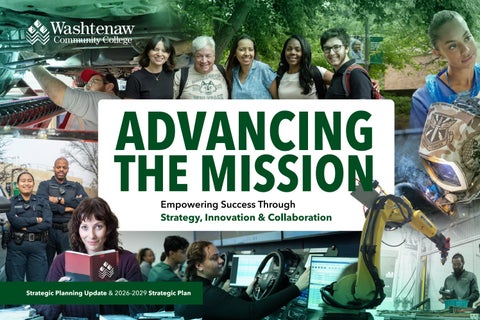
ADVANCING
THE MISSION Empowering Success Through Strategy, Innovation & Collaboration
Strategic Planning Update & 2026-2029 Strategic Plan
A letter from the Board Chair Serving on the Washtenaw Community College Board of Trustees offers a unique opportunity to see firsthand the life-changing impact of education. Every day, students from all walks of life come to WCC with different goals, experiences and aspirations. Whether they are preparing to transfer to a university, launching a new career, advancing in their current profession or learning new skills, they all share a desire to build a better future. Meeting those evolving needs requires innovation, collaboration and an unwavering commitment to student success. Throughout this strategic plan, you’ll see how faculty, staff and college leadership have worked together to strengthen academic programs, expand student support, build partnerships and respond to the changing needs of our community and workforce.
These accomplishments reflect WCC’s enduring mission to provide accessible, high-quality education while preparing students for success in an ever-changing world. The Board is proud to support this work and confident the college will continue transforming lives and strengthening our community for years to come. Sincerely,
Christina Fleming
A letter from the President I am pleased to present this update on Washtenaw Community College’s 2023-26 strategic plan, Shaping Our Collective Future in Transformative Times. This report highlights the accomplishments achieved through the dedication and collaboration of our faculty and staff and reflects our continued commitment to student success, institutional excellence, and community impact. Over the past three years, WCC has remained focused on expanding programs and opportunities for students in response to changing needs of employers and community. Guided by our strategic priorities, we strengthened student support, enhanced institutional effectiveness, expanded workforce partnerships, and embraced innovation to better serve our students and community. The accomplishments highlighted throughout this report demonstrate more than completed initiatives. They reflect a culture of collaboration, continuous improvement, and forward-thinking that continues to shape the college. Together, these efforts have strengthened WCC’s foundation and positioned us for continued success. As one strategic planning cycle concludes, another begins. I am proud to introduce our 2026-29 strategic plan, Advancing the Mission: Empowering Success Through Strategy, Innovation and Collaboration. Building on the momentum of the past three years, this framework outlines eight strategic pillars and related initiatives that will guide
our work as we continue strengthening student outcomes, fostering organizational excellence, embracing innovation, and expanding collaboration across our campus and throughout the communities we serve. Higher education continues to evolve rapidly, bringing both new opportunities and new challenges. WCC is well prepared to meet them because of the dedication, creativity, and unwavering commitment of our faculty and staff. Their work transforms lives every day and ensures the college remains responsive to the needs of our students, employers, and community. As you review the accomplishments of the past three years and explore the priorities that will guide our future, I hope you share my confidence in the direction of this remarkable institution. Together, we will continue advancing our mission and empowering success for the students and communities we proudly serve. With gratitude,
Rose B. Bellanca, Ed.D.
1
2
2023-2026
Where we’ve been From strengthening student success and expanding online learning to planning for the future of our campus and advancing data-informed decision-making, WCC made significant progress on the strategic priorities that guided the college from 2023–26. These efforts strengthened the student experience while positioning the college for continued success. The following pages highlight many of the accomplishments that supported these strategic priorities and their impact across the college.
3
Academic Advising •
Detroit Drives Degrees Community College Collaborative (D3C3): grant provided the opportunity to work with the national leader in student success at Georgia State’s National Institute for Student Success (NISS), and receive an independent evaluation of WCC’s systems centered on student success and equity.
•
Introduced Standard of Care to ensure a consistent student advising experience. »
Implemented an advising structure aligned with the TargetX student success system and Student Focus Advising Scheduling Platform.
»
Expanded advising appointment campaigns and early engagement strategies.
»
Modernized advisor training curriculum and materials.
»
Developed a new advisor onboarding program in Canvas, WCC’s learning management system.
Early Alerts & Proactive Student Support •
Student Success:
Implementing Targeted Success Initiatives to Enhance Learning and the Student Experience
Expanded Early Alerts to proactively identify students showing signs of concern and connect them to timely, coordinated, student-centered support. »
Increased number of students flagged through TargetX who received outreach within 48 hours — an increase of 5% over 2025.
Mental Health and Wellness •
Partnered with the JED Foundation, a national leader in mental health and suicide prevention, on Healthy Minds Survey providing a data-informed, customized action plan for WCC.
•
Restructured staffing model to include four dedicated full-time counselors, enhancing capacity for student support, and focused on early intervention and awareness of available resources.
KEY OUTCOMES: »
31% increase in counseling utilization and referrals over prior year.
»
New targeted workshops for adult learners on topics such as dealing with grief and self care.
»
Expanded Fall and Winter Wellness Fairs (700+ students served).
»
100% of advisors, success coaches and front desk staff trained on addressing students in crisis.
»
Care Team Engagement: 30% yearover-year increase and 126% increase since 2020-21.
Addressing Basic Needs to Support Student Success •
Improved Food Access: 32% increase in food pantry utilization, and food pantry expanded capacity by 130%
•
Secured a $212,000 State of Michigan grant to expand and enhance the food pantry, improving discreet client access and increasing the variety of available food and essential items.
•
Growth in Emergency Assistance in Collaboration with WCC Foundation: »
2023-24 - $26,925
»
2024-25 - $73,819
»
2025-26 - $125,273 (as of 4/27/26) – 462% increase since 2023.
BELOW: WCC student Reatta Jefferson provides a Student Impact Story at the 2026 WCC Foundation Women’s Council Luncheon. Photo credit: Emily Crombez
5
Digital Learning Transformation
3
Online Learning:
Expanding Access and Improving the Student Experience
•
Completed the college-wide transition from Blackboard to Canvas, creating a unified learning management system across all instructional formats.
•
Reformatted 214 online and blended courses using standardized course templates.
•
Supported more than 74,500 student enrollments through Canvas during the 2025-26 academic year.
Faculty Development and Student Support •
•
Expanded professional development through: »
110 faculty workshops.
»
2,347 faculty attendances.
»
3,617 faculty support interactions.
Enhanced the online student experience through improved navigation, accessibility, student resources and support for Summer Bridge, Dual Enrollment and Early Middle College programs.
Innovation and Institutional Growth •
Expanded digital learning through enhanced Canvas integrations, faculty AI and emerging technology initiatives, and support for a broad range of credit, non-credit, and partner programs.
•
Hosted the Michigan Canvas Conference and expanded data reporting, course quality review and technology governance.
Advancing Student Access •
Strengthened online learning as a key component of student access, flexibility and institutional sustainability.
•
Established the foundation for continued growth of online and blended learning.
NEXT STEPS •
Implement a strategic online learning plan focused on expanding high-demand programs, strengthening the online student experience and increasing enrollment.
•
Continue integrating online and in-person learning to improve student success and completion.
https://wccnet.instructure.com/
LEFT: Sample of student account in Canvas
7
Data Analytics:
Using Data to Improve Decision-Making
Institutional Research and Reporting
Dashboards and Decision Support
•
Expanded Analytics and Institutional Research to strengthen reporting, dashboards, surveys and support for campus initiatives.
•
Transitioned from Tableau to Power BI, providing more interactive dashboards and improved access to institutional data.
•
Continued providing data analysis and customized reporting to support enrollment, retention, student success and operational decision-making.
•
Expanded the use of analytics to support enrollment planning, course scheduling, program evaluation and student success initiatives.
•
Increased collaboration across the college through shared data resources and cross-functional planning efforts.
Data Analytics and Planning •
Introduced predictive enrollment models using 10 years of historical data to improve planning and resource allocation.
•
Expanded reporting capabilities with enhanced enrollment forecasting, attrition tracking, program review analytics and federal reporting.
NEXT STEPS •
Continue enhancing dashboards and data accessibility utilizing predictive analytics to strengthen evidencebased decision-making across the college.
Program Evaluation and Workforce Alignment •
Integrated labor market data into academic program review to better align programs with workforce demand.
•
Developed data-driven program evaluation tools using internal and external performance measures.
9
Campus Master Plan: Planning for Future Campus Needs
Campus Master Plan
Supporting Assessments
•
Launched development of a new Campus Master Plan to address changing student needs, expanded online and hybrid learning, evolving campus services and emerging technologies.
•
•
Selected The Collaborative as WCC’s planning partner and began the discovery and analysis phase.
•
Reviewed existing facilities and space on campus to inform Campus Master Plan.
Initiated facilities, infrastructure, resilience and parking assessments to support long-term campus planning and future capital improvements.
NEXT STEPS •
Continue development of the Campus Master Plan through preliminary studies, plan refinement and completion of the final plan. This is a continuing goal with completion of the final plan expected in spring/summer of 2027.
•
The completed master plan will help guide future campus improvements and capital investment decisions.
Campus Engagement •
Conducted campus tours and launched first rounds of targeted feedback from key groups on campus — such as faculty, staff and students — to help understand current and future needs and inform the plan.
•
Created and administered a campus-wide student survey to gauge students’ preferences and needs.
11
12
2026-2029 2026-2029
Where we’re going
Building on the progress of the past three years, WCC’s 2026-29 strategic plan establishes eight pillars that will guide the college’s continued growth and impact. Together, these initiatives focus on strengthening our people, expanding student success, meeting workforce needs, deepening community partnerships and ensuring the college remains innovative, responsive and wellpositioned for the future.
13
English/Writing faculty faculty member m 1e mber Mary Mar Mullalond Mullalond leads leads an an English/Writing y y In-Service In-Service session. session Photo credit: credit: JD JD Scott Scott Photo
14 14
Classroom Resources Coordinator Rick Cocco and other WCC employees participate in a Wellness Day yoga class. Photo credit: JD Scott
Pillar 1 Professional Development and Organizational Health WCC will strengthen organizational effectiveness, leadership, employee development and long-term sustainability by investing in professional learning, talent development, succession planning and employee wellness. These efforts will support the college’s strategic goals while fostering a resilient, innovative, inclusive and high-performing workplace. •
Enhance talent recruitment, onboarding and workforce planning.
•
Support faculty development focused on student success, instructional excellence, AI integration and mental health awareness.
•
Expand innovation, teaching excellence and professional development opportunities for faculty and staff.
•
Strengthen technical, customer service, safety, communication and technology skills across the college.
•
Build leadership capacity through succession planning, continuity planning and clear accountability.
15
Pillar 2 Student Success and Satisfaction Expand learning opportunities for recent high school graduates, adult learners, underserved and firstgeneration students, returning students, employers and the broader community through coordinated planning, training and strategic investment.
16
•
Create flexible, stackable learning pathways that connect noncredit, credential, degree and transfer opportunities while supporting adult learners.
•
Expand advising, career guidance, mental health and wellness resources to improve student persistence, completion and workforce readiness.
•
Strengthen academic quality by aligning programs with evolving community and workforce needs through flexible scheduling, core learning outcomes and continuous program review.
Pillar 3 Innovation, Agility and Responsiveness Create a flexible, student-centered learning environment that increases enrollment, improves student retention and completion, expands access and aligns educational pathways with workforce and transfer opportunities for recent high school graduates and adult learners. •
Expand flexible learning pathways, competency-based education and stackable credentials to improve enrollment, retention, completion and career success.
•
Integrate AI, emerging technologies and innovative workforce programs to strengthen student learning, digital literacy and career readiness.
•
Develop a centralized data warehouse to improve data integration, collaboration, transparency and informed decision-making.
17
Pillar 4 Visibility and Branding Position WCC as the region’s premier accessible, innovative, student-centered institution, recognized for academic excellence, career outcomes, workforce and economic development, lifelong learning opportunities and community impact.
18
•
Modernize WCC’s digital presence and student engagement strategies to improve visibility, recruitment and enrollment.
•
Expand targeted outreach, multilingual marketing and AI-supported communications to better serve adult learners and diverse communities.
•
Strengthen WCC’s identity through signature initiatives, workforce-focused messaging and an innovative digital student experience.
•
Leverage AI to improve efficiency, support data-informed decision-making, encourage innovation and strengthen operational effectiveness while maintaining ethical standards and accountability.
Pillar 5 Workforce Development Position WCC as a regional leader in workforce innovation, economic mobility, employer partnerships and lifelong learning by delivering accessible, data-informed programs that meet evolving community and labor market needs.
WCC’s new grant-funded mobile classroom allows the college to take training opportunities into the community.
•
Strengthen employer partnerships and advisory board engagement to align programs with labor market needs.
Photo credit: JD Scott
•
Establish the Workforce Solutions Center to deliver education, training, entrepreneurship, credentialing, workforce navigation, and AI-driven innovation that supports job seekers, working professionals, employers, and enhances regional economic growth.
•
Support entrepreneurship, career navigation and regional economic growth through integrated education and workforce initiatives.
19
Pillar 6 Partnerships Community and union skilled trades partnerships are central to WCC’s mission, connecting education and workforce training to high-demand, family-sustaining careers. Collaboration with labor unions, employers, industry leaders and community organizations helps ensure programs meet workforce needs while expanding access to apprenticeships, hands-on learning and industryrecognized credentials. These partnerships strengthen economic mobility, expand career opportunities and reinforce WCC’s role as a trusted regional leader in workforce and community development.
20
•
Expand skilled trades pathways through union partnerships to increase access to apprenticeships, certifications, hands-on training and high-demand careers.
•
Support Michigan’s workforce, credential attainment and talent retention goals.
•
Align programs with high-demand industries, including advanced manufacturing, EV/mobility, healthcare, cybersecurity, AI and skilled trades.
•
Advance economic mobility, equity and workforce development through regional and community partnerships.
•
Strengthen K-12 partnerships that expand dual enrollment and regional workforce opportunities.
An Ironworker checks a laser level during the union’s instructor training session on the WCC campus this summer. Photo credit: JD Scott
Student recipients of the Kiwanis Club Finish Line Scholarship join representatives of the organization. Photo credit: JD Scott
Pillar 7 Funding and Resources WCC will strengthen its long-term financial sustainability through responsible stewardship, innovation, strategic partnerships, diversified revenue, operational efficiency and mission-driven investments that support student success, workforce development, institutional excellence and regional economic prosperity. •
Pursue grant funding and expand partnerships with industry, municipalities, nonprofits and universities to advance institutional priorities.
•
Expand revenue opportunities, community programming and flexible learning options to increase market reach and institutional growth.
•
Advance sustainability, energy efficiency and climate resilience through environmentally responsible operations and infrastructure investments.
•
Modernize campus facilities and technology-enabled learning environments through a comprehensive master plan aligned with workforce, enrollment and emerging industry needs.
•
Expand affordability, financial support and student access initiatives to improve persistence, completion and success for adult learners and underserved students.
•
Increase philanthropic support, donor engagement and strategic partnerships to advance student success, workforce development, innovation and institutional priorities.
21
Pillar 8
Local youth enjoy the library at Parkridge Community Center in Ypsilanti, where Washtenaw Community College provides STEM, language and reading programs every summer.
Community Development and Engagement Community Development and Engagement is central to WCC’s mission, connecting education, workforce development and the evolving needs of the community. Through lifelong learning, strategic partnerships, workforce development, cultural enrichment and student support services, WCC helps strengthen economic mobility, civic engagement and regional prosperity while creating an inclusive, responsive and innovative environment that supports individuals, employers, organizations and the communities the college serves.
22
•
Strengthen partnerships with community organizations, nonprofits, schools and businesses to expand WCC’s impact.
•
Develop enrichment programs for youth, adults and seniors.
•
Increase the visibility of college-community partnerships.
.
.
,
0N1 -0 N 0 N
.
23
C, z 0 C, w 0::: ... w � w 0::: w ::c �
OVER A DECADE OF PLANNING
Since 2012, WCC has charted a bold path forward—aligning strategic goals with our mission and values to ensure long-term success. Our planning has helped us stay relevant, responsive, and resilient while serving students, partners and the broader community.
2012
Shaping Our Future 2012-15 WCC launches its first three-year strategic plan, built on data and input from faculty and staff, the community and business and industry leaders. Implemented initiatives include the Teaching and Learning Center, the Advanced Transportation Center, the Entrepreneurship Center, and new student success innovations.
2016
Shaping our Future Together 2016-19 WCC executes new goals to reflect emerging opportunities for the second three-year cycle of the strategic plan, such as public safety and sustainability.
24
2020
Shaping our Future Success 2020-23 WCC utilizes new environmental scanning and listening session feedback to create an updated strategic plan addressing disruptive change — empowering the college to be agile in an evolving landscape, including a commitment to best-in-class online learning.
2023
Shaping our Collective Future in Transformative Times 2023-26 WCC creates a new, focused roadmap that addresses specific needs and future opportunities. Informed by data, it provides infrastructure for a sustainable future for students and the college.
WCC Board of Trustees
Christina M. H. Fleming, Chair Angela Davis, Vice Chair David DeVarti, Treasurer Ruth A. Hatcher, Secretary William G. Milliken Jr. Diana McKnight-Morton Eileen Peck
WCC President & CEO Rose B. Bellanca, Ed.D.
Scan QR code or visit washtenaw.cc/strategicplans to view past strategic plan updates.
MISSION Our college strives to make a positive difference in people’s lives through accessible and excellent education programs and services.
VISION wccnet.edu Washtenaw Community College (WCC) is committed to equal opportunity and does not discriminate in its programs or activities. For title IX or ADA/504 inquiries, call 734-6775477. For facilities access inquiries, call 734-677-5322. For legal, compliance and accreditation information, visit wccnet. edu/disclosures. You may also call 734-973-3300 for information about WCC. Washtenaw Community College is accredited by the Higher Learning Commission, 230 South LaSalle Street, Suite 7-500, Chicago, Illinois 60604-1411 800-621-7440. 081026 / 6 0 0
WCC is a learner-centered, open-door college dedicated to student, community and staff success. We offer a wide spectrum of community college services with an emphasis on premier technical and career educational programs. College staff continuously learns to improve learning.
VALUES TEACHING AND LEARNING: We embrace teaching and learning as our central purpose. SUPPORT: We make every effort to help learners achieve success. DIVERSITY: We respect differences in people and in ideas.
PARTNERSHIPS: We plan and work together with respect, trust, and honesty within the college and with the communities we serve. INNOVATION: We seek the best possible ways to conduct our work.